Daily Current Affairs (DCA) 22 July, 2026
Free live session
NABARD Grade A 2026: 45-Day Final Revision Plan + Daily Targets
 🔒 Register to watchLast Sunday’s session · recording
8 of the top 10 in NABARD Grade A 2025, Rank 1 included, and Rank 1 back to back before that in 2021 and 2022: all prepared with C4S. Watch last Sunday's session on the 45-day final revision plan now, then join the next one live on Zoom.
Tomorrow · 7:30 PM IST · 75 minutes · free
In the news1
Context
Union Home Minister Amit Shah introduced the Prevention of Insults to National Honour (Amendment) Bill, 2026 in the Rajya Sabha on 20 July 2026 — the first day of the Monsoon Session — to extend to Vande Mataram the same statutory protection currently given to the National Anthem.
About the Bill
What It Is
- An amendment to the parent Prevention of Insults to National Honour Act, 1971 (Act No. 69 of 1971), which criminalises disrespect toward national symbols — National Flag, National Emblem, Constitution, National Anthem, National Motto, and the map of India.
- The 2026 Bill explicitly expands the scope to include the National Song (Vande Mataram).
- Cabinet approval: May 2026.
Aim
- To plug a long-standing statutory gap — the 1971 Act had no specific penal provision protecting the National Song.
- Fulfils the vision articulated by Constituent Assembly President Dr. Rajendra Prasad on 24 January 1950, that Vande Mataram “shall be honoured equally with Jana Gana Mana and shall have equal status with it.”
- Introduced during the 150th anniversary year of Vande Mataram’s composition.
Key Features
- Substitution of Section 3: Replaces Section 3 of the 1971 Act to place the National Song and National Anthem under the same protective legal umbrella.
- Criminalisation of interference: Makes it a criminal offence to intentionally —
- Prevent the singing of the National Anthem or National Song, or
- Cause disturbance to any assembly engaged in such singing.
- Penalty: Imprisonment up to three years, or fine, or both — the same as for the National Anthem/Flag.
- Historical reference: Cites Bankim Chandra Chattopadhyay’s composition (1875/1876, published in Anandamath, 1882) and its role in inspiring the freedom struggle.
Banking/Finance1
How & Why Farmers Producers Organization are formed? FPO #fpo #upsc #nabardgradea #agriculturenotesTap to play · from the C4S channel
Context
The RBI released the draft Foreign Exchange Management (Foreign Investment) Rules, 2026 for public consultation, proposing a principle-based regulatory framework to rationalise provisions, harmonise definitions and simplify the regulatory architecture improving clarity and reducing the compliance burden for foreign investors. Comments invited till 31 August 2026.
About the Draft Rules
Key Details
- Seeks to replace the existing Foreign Exchange Management (Non-Debt Instruments) Rules, 2019 (“NDI Rules”).
- Origin: Announced in the Union Budget 2026-27 by FM Nirmala Sitharaman, who promised “a comprehensive review of the FEM (Non-debt Instruments) Rules to create a more contemporary, user-friendly framework for foreign investments, consistent with India’s evolving economic priorities.”
- The Centre constituted a committee to review existing regulations; the RBI prepared the draft based on its recommendations, in consultation with the government and stakeholders.
Salient Proposals
- Principle-based, not prescriptive: replaces rigid prescriptive rules with a framework that can accommodate evolving business practices while retaining safeguards.
- Clear demarcation of procedural provisions under FEMA from policy and sector-specific requirements in the government’s FDI Policy — improving regulatory coherence and enabling timely policy changes.
- Investor-neutral and investee-neutral provisions.
- Ease of doing business: streamlined procedures, reduced compliance burden, greater operational flexibility, transparent and investor-friendly framework.
- Specifies conditions under which a public company may issue fresh equity shares, or existing shareholders may offer shares, on international stock exchanges (direct overseas listing).
Key Concepts
- FEMA (Foreign Exchange Management Act), 1999: The law governing foreign exchange transactions in India (replaced FERA, 1973); administered by the RBI, a civil law focused on facilitation rather than FERA’s criminal-penalty approach.
- NDI Rules, 2019: Framed by the Central Government under FEMA, governing foreign investment in non-debt instruments (equity, shares, LLP contributions, etc.).
- Non-Debt vs Debt Instruments: Non-debt = equity, shares, convertible instruments, real estate (governed by MoF/NDI Rules); debt = ECBs, bonds (governed by RBI regulations).
- FDI vs FPI: FDI is a lasting management interest (generally 10%+ stake, long-term); FPI is passive portfolio investment (below 10%, easily reversible — “hot money”).
Practice MCQs
Q1. With reference to the regulation of foreign investment in India, consider the following statements:
- The Foreign Exchange Management Act, 1999 replaced the Foreign Exchange Regulation Act, 1973.
- Foreign investment in non-debt instruments is currently governed by the FEM (Non-Debt Instruments) Rules, 2019.
- FDI is generally distinguished from FPI by a threshold of a 10% stake in a company.
- India’s sectoral FDI policy, including caps and routes, is framed by the Reserve Bank of India.
How many of the above statements are correct? (a) Only one (b) Only two (c) Only three (d) All four (e) None
Q2. With reference to the draft Foreign Exchange Management (Foreign Investment) Rules, 2026, consider the following statements:
- They seek to replace the existing FEM (Non-Debt Instruments) Rules, 2019.
- The review was announced in the Union Budget 2026-27.
- The draft proposes clear demarcation of procedural FEMA provisions from policy and sector-specific FDI requirements.
- The draft rules have already come into force, replacing the 2019 rules with immediate effect.
How many of the above statements are correct? (a) Only one (b) Only two (c) Only three (d) All four (e) None
Answer Key
- (c) — Statement 4 wrong: FDI policy is framed by DPIIT, not the RBI.
- (c) — Statement 4 wrong: the rules are still in draft, open for consultation until 31 August 2026.
Every day of the month in one file. Enter your details once — the download opens right away.
We already have your details, so no form: tap to open.
Download the July 2026 PDFDownload the July 2026 revision sheet PDFAgriculture3
Context
The PIB clarified the structure and implementation of PMKSY, an umbrella irrigation scheme — including its components, implementing ministries, funding pattern, and the absence of any specific provision for private-sector investment.
About PMKSY
What It Is
- India’s flagship umbrella scheme for irrigation development, launched 1 July 2015.
- A Centrally Sponsored Scheme (Core Scheme).
- Mottos: “Har Khet Ko Pani” (water to every field) and “Per Drop More Crop”.
- Aims: enhance physical access to water on farms; expand cultivable area under assured irrigation; improve water use efficiency; promote sustainable water conservation; achieve convergence of investments in irrigation at field level.
Components & Implementing Ministries
| Component | Implementing Body |
|---|---|
| Accelerated Irrigation Benefit Programme (AIBP) | Dept. of Water Resources, RD & GR — Ministry of Jal Shakti |
| Har Khet Ko Pani (HKKP) | Dept. of Water Resources, RD & GR — Ministry of Jal Shakti |
| Watershed Development Component (WDC) | Dept. of Land Resources — Ministry of Rural Development |
| Per Drop More Crop (PDMC) | Ministry of Agriculture & Farmers Welfare (now largely under RKVY) |
- AIBP: Fast-tracks completion of ongoing major and medium irrigation projects, including National Projects.
- HKKP: Creates new water sources via minor irrigation (surface + ground water); includes sub-components — CAD&WM, Surface Minor Irrigation (SMI), Repair, Renovation & Restoration (RRR) of water bodies, Ground Water Development.
- WDC: Watershed development in rainfed areas (subsumed the erstwhile Integrated Watershed Management Programme, IWMP).
Schemes Subsumed at Launch
- AIBP (Ministry of Water Resources) + IWMP (Dept. of Land Resources) + On Farm Water Management (OFWM) (Dept. of Agriculture & Cooperation).
Implementation & Funding
- Central Assistance is provided to States for creation of irrigation potential, command area development, and on-farm development.
- Projects are generally implemented by State Governments through competitive tendering; private contractors may participate as per State procurement rules.
- Works executed as per State norms.
- The scheme contains no specific provision for private-sector investment.
- Capacity building and training on efficient water management is undertaken by States/UTs under scheme guidelines — but consolidated State-wise data on farmers/field workers trained is NOT maintained centrally.
Verified Financial & Structural Details
- Funding pattern: Centre–State 75:25; 90:10 for North-Eastern and Hilly States.
- Outlay: initial ₹50,000 crore (2015-16 to 2019-20); extended 2021-22 to 2025-26 with an outlay of ~₹93,068 crore, including ₹37,454 crore central assistance.
- 90% grant to two National Projects — Renukaji (Himachal Pradesh) and Lakhwar (Uttarakhand) — critical for Delhi’s water supply and Yamuna rejuvenation.
- M-CADWM (Modernization of Command Area Development and Water Management) approved in 2025-26 as a sub-scheme of PMKSY-AIBP (initial outlay ₹1,600 crore) — delivers water via pressurised piped and micro-irrigation systems.
Exam Relevance
- UPSC Prelims: PMKSY launched 2015, CSS, funding 75:25 / 90:10; AIBP & HKKP under Ministry of Jal Shakti, WDC under Ministry of Rural Development, PDMC under Agriculture; NSC chaired by PM, NEC by NITI Aayog Vice-Chairman; Renukaji & Lakhwar national projects; M-CADWM (2025-26).
- NABARD Grade A/B: Extremely high relevance — core ARD topic: PMKSY components and ministries, watershed development, micro-irrigation, CAD, RRR, funding pattern; near-certain question area. (Also note NABARD administers the Long Term Irrigation Fund (LTIF) for AIBP projects.)
Practice MCQs
Q1. With reference to the Pradhan Mantri Krishi Sinchayee Yojana (PMKSY), consider the following statements:
- It was launched in 2015 as a Centrally Sponsored Scheme.
- The Accelerated Irrigation Benefit Programme and Har Khet Ko Pani components are implemented by the Ministry of Jal Shakti.
- The Watershed Development Component is implemented by the Department of Land Resources under the Ministry of Rural Development.
- The scheme is implemented solely by the Ministry of Agriculture and Farmers Welfare.
How many of the above statements are correct? (a) Only one (b) Only two (c) Only three (d) All four (e) None
Q2. With reference to the implementation of PMKSY, consider the following statements:
- Central assistance is provided to States for creation of irrigation potential and command area development.
- Projects are generally implemented by State Governments through competitive tendering as per State procurement rules.
- The Centre–State funding pattern is 75:25 for general States and 90:10 for North-Eastern and Hilly States.
- The scheme contains a dedicated provision mandating private sector investment in irrigation projects.
How many of the above statements are correct? (a) Only one (b) Only two (c) Only three (d) All four (e) None
Answer Key
- (c) — Statement 4 wrong: PMKSY spans three ministries, not the Agriculture Ministry alone.
- (c) — Statement 4 wrong: no specific provision for private sector investment exists.
Context
The PIB published the feature article “White Gold: India’s Cotton Story – From Seed to Shirt”, highlighting India’s cotton sector, recent policy initiatives, and its role in agriculture, textiles and exports. It showcases India’s journey from traditional cultivation to a modern, technology-driven, value-added cotton ecosystem under the vision of Atmanirbhar Bharat.
About the Feature
What It Is
- A PIB feature underlining cotton’s importance to India’s agricultural, industrial and export economy, and the government’s push on productivity, quality and global competitiveness.
- Cotton is termed “White Gold” for its economic value.
Key Characteristics
1. Global Cotton Leader
- India is the only country cultivating all four recognised cotton species.
- Rank 1 in cultivated area (114.84 lakh ha ≈ 38% of the global 304.08 lakh ha); Rank 2 in production and consumption.
- Contributes roughly 19–23% of global fibre production.
2. Economic Backbone
- Supports nearly 6 million cotton farmers; employs 40–50 million across the textile value chain.
- 62% of cultivation is rain-fed, 38% irrigated.
3. Policy-Driven Growth
- Backed by MSP procurement, Mission for Cotton Productivity, Kapas Kisan App, and Kasturi Cotton Bharat.
4. Technology & Quality Focus
- Promotes High-Density Planting System (HDPS), digital procurement, blockchain-based traceability, and climate-resilient varieties.
Geographical Spread (3 Zones, 9 States)
- Northern: Punjab, Haryana, Rajasthan
- Central: Gujarat, Maharashtra, Madhya Pradesh (largest producing zone)
- Southern: Telangana, Andhra Pradesh, Karnataka
- Also grown in Odisha and Tamil Nadu.
Major Initiatives
MSP Operations
- MSP recommended by CACP before each cotton year (Oct–Sept), for Medium and Long Staple seed cotton (kapas); targets ≥50% return over cost.
Mission for Cotton Productivity
- Aligned with the ‘5F’ vision — Farm → Fibre → Factory → Fashion → Foreign.
- Implemented jointly by the Ministry of Agriculture & Farmers Welfare and Ministry of Textiles, with 10 ICAR institutes.
Kapas Kisan App
- Digitised MSP procurement — self-registration, four-week rolling slot booking, Aadhaar-linked payments, real-time SMS updates; 41 lakh+ farmers registered.
Kasturi Cotton Bharat
- Branding/traceability initiative; outlay ₹30 crore (₹15 cr industry + ₹15 cr Ministry of Textiles); partners Ministry of Textiles, CCI, TEXPROCIL.
Context
The PIB detailed research findings and financial support under India’s natural farming push — including ICAR’s All India Network Programme on Natural Farming and the output-based incentive of ₹4,000/acre/year under the National Mission on Natural Farming (NMNF).
ICAR Research Programme
All India Network Programme on Natural Farming (AINP-NF)
- Initiated from 2020-21 (previously AINP-Organic Farming).
- 20 cooperating centres across 16 States; evaluates 8 major cropping systems and develops packages of practices.
- Involves 11 State Agricultural Universities, 8 ICAR institutes/centres, 1 deemed university.
Key Research Findings
Crop-System Packages Developed
| Region | Cropping System |
|---|---|
| Rajasthan & Gujarat | Groundnut + sesame – fennel + cabbage |
| Chhattisgarh & MP | Soybean + maize – wheat + mustard |
| Kerala | Cassava |
Soil Health Improvements
- Soil Organic Carbon (SOC) rose over 2–3 years — in Himalayan trials, from ~0.90% to 1.15%.
- Higher number and diversity of soil microorganisms than chemically farmed soils; balanced abundance of beneficial bacteria, fungi and actinomycetes.
- Improved nutrient cycling and soil structure → foundation for long-term fertility.
Practice-Level Benefits
- Mulching: maintains soil moisture, controls weeds, adds organic matter, boosts microbial activity.
- Multi-cropping: raises field biodiversity, reduces pest/disease incidence, improves nutrient use.
- Reduced chemical costs → higher net profits.
NITI Aayog Assessment Report
- ~91.2% of farmers adopting natural farming reported increased crop productivity and improved soil health.
- 90.1% reported reduced input/production costs.
Financial Assistance under NMNF
- Output-Based Incentive: ₹4,000 per acre per year for 2 years (up to 1 acre per farmer).
- Covers: practising natural farming, training more farmers, upkeep of livestock, preparation of natural farming inputs (including mixing/storage containers), or purchase of inputs from Bio-input Resource Centres (BRCs).
About NMNF
- A standalone Centrally Sponsored Scheme launched in November 2024, under the Ministry of Agriculture & Farmers Welfare.
- Builds on the earlier Bharatiya Prakritik Krishi Paddhati (BPKP) under Paramparagat Krishi Vikas Yojana (PKVY).
- Community support: two Krishi Sakhis / Community Resource Persons (CRPs) per cluster.
- Certification: simple farmer-friendly system under Participatory Guarantee System (PGS)-India, managed by the National Centre for Organic & Natural Farming (NCONF), Ghaziabad (reconstituted from the National Centre of Organic Farming).
- Real-time geo-tagged monitoring via the NMNF portal.
Facts To Remember20
India's Fertiliser Exports Rise 52% in Three Years
India’s fertiliser exports increased by nearly 52% between FY24 and FY26, according to data presented in Parliament. Although export volumes remain significantly lower than imports, the growth highlights India’s expanding presence in the global fertiliser market despite rising import dependence.
Santhali Film Angen Wins Historic National Film Award
The Santhali-language short film Angen (Invisible) became the first Santhali film to win a National Film Award. Directed by Ravi Raj Murmu, the 12-minute film received the Best Debut Film of a Director (Non-Feature Category) at the 72nd National Film Awards, showcasing Jharkhand’s tribal culture and indigenous storytelling.
Nation Pays Tribute to Freedom Fighter Batukeshwar Dutt
Union Home Minister Amit Shah paid tributes to revolutionary freedom fighter Batukeshwar Dutt on his death anniversary. Dutt is remembered for the 1929 Central Legislative Assembly bombing alongside Bhagat Singh, carried out to protest oppressive British laws and awaken the nation against colonial rule.
India Inaugurates First Immersive Language Museum 'Shabdalok'
Union Home Minister Amit Shah inaugurated Shabdalok, India’s first immersive language museum, at the National Library campus in Kolkata. The museum showcases nearly 380 Indian languages using digital displays, holograms, augmented reality (AR), virtual reality (VR), and interactive exhibits to celebrate India’s linguistic diversity.
India Approves First Dengue Vaccine 'QDENGA'
India approved its first dengue vaccine, QDENGA (TAK-003), after receiving clearance from the Drug Controller General of India (DCGI). The vaccine provides protection against all four dengue virus serotypes and is approved for individuals aged 4 to 60 years through a two-dose schedule.
India Receives 21st MH-60R Seahawk Helicopter from USA
The United States delivered the 21st MH-60R Seahawk helicopter to the Indian Navy under the 2020 Foreign Military Sales agreement. The advanced multi-role helicopter will strengthen India’s anti-submarine warfare, maritime surveillance, search and rescue, and naval operational capabilities.
DoLR and RBI Innovation Hub Explore Digital Land-Credit Infrastructure
The Department of Land Resources (DoLR) and the RBI Innovation Hub (RBIH) discussed integrating digital land records with the Unified Lending Interface (ULI). The initiative aims to improve institutional credit access for farmers through secure, consent-based digital lending using authenticated land records.
NSA Ajit Doval Selected for Lokmanya Tilak National Award 2026
National Security Advisor Ajit Doval was selected for the Lokmanya Tilak National Award 2026 in recognition of his outstanding contributions to national security, counter-terrorism, and border management. The award will be presented in Pune on 1 August 2026.
Andy Burnham Becomes New Prime Minister of the United Kingdom
Andy Burnham became the 59th Prime Minister of the United Kingdom after the resignation of Keir Starmer. A senior Labour Party leader and former Mayor of Greater Manchester, Burnham secured victory in the party leadership election before being invited by King Charles III to form the government.
 Scheme to knowMukhyamantri Majhi Ladki Bahin Yojana (Maharashtra): Rs 1,500 a Month, Eligibility, Verification Drive and FactsMukhyamantri Majhi Ladki Bahin Yojana is the Maharashtra government's direct cash transfer scheme that pays Rs 1,500 a…
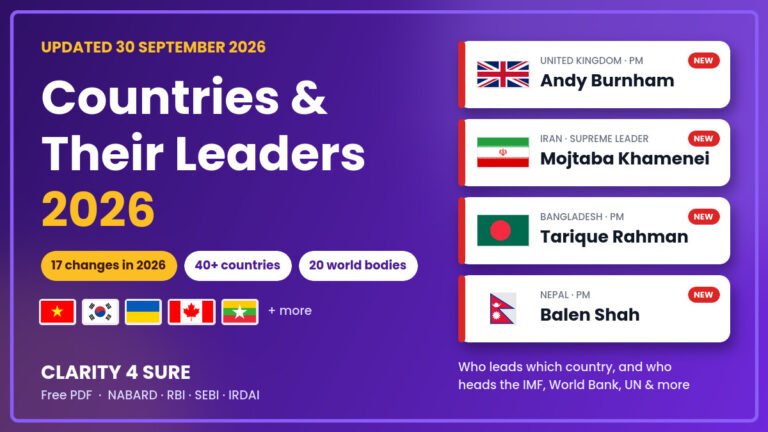 Free sheet · Static GKCountries & Their Leaders 2026Who leads which country in 2026, with all 17 changes marked. Get the article and the PDF free on WhatsApp.Get it free on WhatsApp →
Senegal President Bassirou Faye Becomes ECOWAS Chairman
Senegal’s President Bassirou Diomaye Faye was elected as the new Chairman of the Economic Community of West African States (ECOWAS) during its 69th summit held in Sierra Leone. He will serve a one-year term focusing on regional cooperation and institutional reforms.
NASA's James Webb Telescope Discovers Exoplanet 'Beta Pictoris d'
Astronomers using the James Webb Space Telescope (JWST) discovered a new giant exoplanet named Beta Pictoris d, located about 63 light-years from Earth. The discovery makes the Beta Pictoris system only the second known planetary system with three directly imaged planets.
US Air Force's YFQ-44A Fury Drone Conducts First Live Missile Test
The YFQ-44A Fury, a Collaborative Combat Aircraft developed by Anduril Industries, successfully launched its first live AIM-120 AMRAAM missile during testing. The drone is designed to operate alongside fighter aircraft such as the F-35 and F-22 in future combat operations.
FIFA World Cup 2026 Announces Record Prize Money
FIFA announced a record USD 871 million prize pool for the 2026 FIFA World Cup, making it the richest tournament in football history. Champions Spain received USD 51 million, while Argentina and England earned USD 34 million and USD 30 million, respectively.
Pakistan to Host SAF Games 2027
Pakistan will host the 14th South Asian Federation (SAF) Games from 23 to 31 March 2027 across Islamabad, Lahore, and Faisalabad. It will be the third time Pakistan hosts the regional multi-sport event after 1989 and 2004.
England Football Legend Kevin Keegan Passes Away
Former England football captain and two-time Ballon d’Or winner Kevin Keegan passed away at the age of 75. Widely regarded as one of England’s greatest footballers, he enjoyed a distinguished playing and managerial career.
Vice President Releases Book 'RSS @100'
Vice President C. P. Radhakrishnan released the book ‘RSS @100: A Century of Service, Unity & Sacrifice’, authored by Shyam Jaju and Anupam Trivedi. The book chronicles the Rashtriya Swayamsevak Sangh’s century-long journey and its contributions to nation-building.
The United Nations observed International Moon Day on 20 July to commemorate the Apollo 11 Moon landing in 1969. The day promotes peaceful space exploration, scientific research, and sustainable use of lunar resources.
Andhra Pradesh Partners with UN-Habitat for Sustainable Urban Development
The Government of Andhra Pradesh signed an MoU with UN-Habitat to establish a Centre of Excellence for Urban Affairs in Amaravati. The partnership will support climate-resilient cities, urban planning, digital governance, and sustainable development initiatives.
Uttar Pradesh Launches Kaushal Setu and Kaushal Sarathi Portals
The Uttar Pradesh Government launched the Kaushal Setu and Kaushal Sarathi portals to strengthen the state’s skill development ecosystem. The digital platforms will facilitate training registration, course information, district-wise training centres, and employment opportunities.
Transition VC Launches ₹1,500 Crore Fund II
Energy-transition-focused venture capital firm Transition VC launched its ₹1,500 crore Fund II to invest in engineering-led startups across clean energy, industrial deep-tech, and advanced manufacturing. The fund plans to support nearly 20 startups over a four-year investment period.