Daily Current Affairs (DCA) 23 April, 2026
Free live session
NABARD Grade A 2026: 45-Day Final Revision Plan + Daily Targets
 🔒 Register to watchLast Sunday’s session · recording
8 of the top 10 in NABARD Grade A 2025, Rank 1 included, and Rank 1 back to back before that in 2021 and 2022: all prepared with C4S. Watch last Sunday's session on the 45-day final revision plan now, then join the next one live on Zoom.
Tomorrow · 7:30 PM IST · 75 minutes · free
National Affairs4
INS Nireekshak in Colombo
Context:
The Indian Navy’s specialized vessel, INS Nireekshak, arrived at the Port of Colombo on April 21, 2026. It is participating in the 4th edition of IN-SLN DIVEX 2026, a week-long bilateral diving exercise aimed at strengthening maritime security and interoperability in the Indian Ocean.
What is INS Nireekshak (A15)?
INS Nireekshak is not a standard combat ship; it is a highly specialized Diving Support Vessel (DSV) and an interim Submarine Rescue Vessel (SRV).
- Key Role: Facilitates deep-sea diving operations, submarine rescue, and training of saturation divers.
- Specialized Equipment: Two Deep Submergence Rescue Vehicles (DSRV).
- A Diving Bell and two six-man recompression chambers (crucial for preventing decompression sickness in divers).
- Dynamic Positioning System (to maintain a precise position at sea during diving).
What is DIVEX 2026?
The exercise (April 21–27, 2026) is designed to refine the “underwater” diplomacy between India and Sri Lanka.
- Objective: Enhancing interoperability and exchanging “Best Practices” in specialized underwater operations.
- Humanitarian Outreach (Aarogya Maitri): As a gesture of solidarity, the ship is presenting two BHISM (Bharat Health Initiative for Sahyog Hita & Maitri) cubes to Sri Lanka.
What is MAHASAGAR?
The engagement aligns with India’s MAHASAGAR vision (Mutual and Holistic Advancement for Security and Growth Across Regions). This framework emphasizes:
- Collective Growth: Shared economic and security interests.
- Stability: Ensuring the Indian Ocean Region (IOR) remains peaceful and cooperative.
- Regional Leadership: Positioning India as a “First Responder” in the region for humanitarian and security needs.
Key Concepts
Q: Why is an “Operational Turnaround (OTR)” visit important?
A: OTRs allow a ship to refuel, restock supplies, and provide rest for the crew while simultaneously conducting diplomatic or training exercises in a foreign port.
Q: What is a “DSRV”?
A: A Deep Submergence Rescue Vehicle. It is a mini-submarine used specifically to rescue sailors from a disabled submarine trapped on the ocean floor.
Conceptual MCQs
Q1. INS Nireekshak is primarily classified as which type of vessel?
A) Guided Missile Destroyer
B) Aircraft Carrier
C) Diving Support and Submarine Rescue Vessel
D) Stealth Frigate
Q2. Under the “Aarogya Maitri” initiative, what specific humanitarian aid is INS Nireekshak providing to Sri Lanka?
A) 50,000 tons of rice
B) Two BHISM portable medical cubes
C) A new naval radar system
D) Solar power panels for Colombo port
Q3. The DIVEX 2026 exercise aligns with which Indian strategic vision for the Indian Ocean?
A) Project Mausam
B) MAHASAGAR
C) Operation Vanilla
D) SAGAR-MALA
Answers
- Q1: C (It is a specialized support ship, not a frontline combatant.)
- Q2: B (BHISM cubes are designed for rapid response in emergency medical situations.)
- Q3: B (MAHASAGAR is the Navy’s specific outreach framework for holistic regional security.)
Exam Relevance
| Exam Focus Area | Relevance Level |
| UPSC CSE | GS-2 (International Relations, India-Sri Lanka); GS-3 (Security/Defence) |
| SSC / Banking | Current Affairs (Naval exercises, New ships, Bilateral agreements) |
| Defence (NDA/CDS) | Maritime security, Ship capabilities, Regional strategic visions |
NARIT-AI
Context:
The Gujarat Police has developed the Narcotics Analysis & RAG-based Investigation Tool (NARIT-AI) to address a critical decline in conviction rates for cases under the Narcotic Drugs and Psychotropic Substances (NDPS) Act, which fell from 44.4% in 2020 to 25% in 2022.
“Primacy of Procedure”
In NDPS cases, evidence alone is rarely enough. The law demands strict adherence to procedural steps.
- The Problem: Even minor administrative or procedural lapses—such as errors in documentation, witness presence, or sample handling—often lead to “benefit of doubt” acquittals for accused individuals.
- The Resource Gap: There is often a shortage of specialized “writers” (police staff for documentation) at the district level, leading to administrative bottlenecks.
How NARIT-AI Works
Developed in collaboration with AI startup Gradiante Creative Services, the tool uses Retrieval-Augmented Generation (RAG) to provide a “bulletproof” investigation framework.
- Closed Knowledge Base: Unlike open-source AI, NARIT-AI only references a specific data library: the NDPS Act, the new criminal laws (BNS, BNSS, BSA), and thousands of Supreme Court/High Court judgments.
- Zero Hallucination: Because it is a “closed sandbox” system, it does not invent fake legal citations or non-existent judgments.
- Simple Interface: Investigating Officers (IOs) can simply upload a First Information Report (FIR), and the system generates case-specific instructions.
Key Concepts
Q: What is “RAG” (Retrieval-Augmented Generation)?
A: It is a technique that gives the AI a “textbook” (a specific database) to look at before it answers. This ensures the AI doesn’t rely on its own internal memory, which might be outdated or incorrect, but instead gives a fact-checked response based on the provided documents.
Q: Why is the NDPS Act conviction rate so low?
A: Largely due to “procedural non-compliance.” Defense lawyers often win cases not by proving their client is innocent, but by proving the police didn’t follow the exact steps mandated by the law.
Q: Does NARIT-AI replace the Public Prosecutor?
A: No. It is a “Paralegal Tool.” It helps the police build a “bulletproof” case file before it reaches the prosecutor, making the prosecutor’s job in court much easier.
Conceptual MCQs
Q1. NARIT-AI is primarily designed to address which issue in narcotics cases?
A) Lack of police manpower
B) Low conviction rates due to procedural lapses
C) High cost of forensic testing
D) Shortage of public prosecutors
Q2. What technology does NARIT-AI use to ensure its legal advice is factually grounded and does not “hallucinate”?
A) Open-source Web Scraping
B) Blockchain Encryption
C) Retrieval-Augmented Generation (RAG)
D) Facial Recognition
Q3. Which of the following is NOT a feature of NARIT-AI?
A) Generation of draft Chargesheets
B) Public access for reporting drug crimes
C) Identification of potential prosecution weaknesses
D) Checklists for evidence collection
Answers
- Q1: B (Procedural errors are the leading cause of acquittals in NDPS cases.)
- Q2: C (RAG restricts the AI to a verified, closed database of Indian laws.)
- Q3: B (The system is private and restricted to verified police users only.)
Exam Relevance
| Exam Focus Area | Relevance Level |
| UPSC CSE | GS-3 (Science & Tech: AI in Governance; Internal Security: Drug Trafficking) |
| Police/Defence Exams | Use of technology in modern policing |
The India–Africa Forum Summit (IAFS)
Context:
India is set to host the Fourth India-Africa Forum Summit (IAFS-IV) in New Delhi from May 28 to 31, 2026. This landmark event ends an 11-year hiatus since the last summit in 2015 and aims to redefine India’s role as the “Voice of the Global South.”
The 2026 Pivot
The 2026 summit is unique because it follows the permanent inclusion of the African Union (AU) in the G20 (achieved during India’s 2023 Presidency). The focus has shifted from simple aid to co-development and strategic partnership.
- Agenda 2063 Alignment: The summit will focus on aligning India’s development goals with Africa’s “Agenda 2063″—the AU’s blueprint for transforming Africa into a global powerhouse.
- Trade Milestone: Bilateral trade reached $103 billion in 2024–25, a 17% year-on-year increase.
- Critical Minerals: With Africa holding 30% of global mineral reserves, a key focus will be technical expertise in sustainable mining to fuel India’s green energy transition.
What are the Key Pillars of Cooperation?
1. Education & Human Capital
The establishment of the IIT Madras campus in Zanzibar, Tanzania (the first international IIT) serves as the flagship model for educational ties.
- Status 2026: The campus has expanded to include degrees in Data Science, AI, and Chemical Process Engineering, with 51% of its students coming from Tanzania and other African nations.
- Digital Infrastructure: Expansion of the e-VidyaBharati and e-AarogyaBharati platforms to provide remote education and tele-medicine across the continent.
2. Security & Defense
The partnership is moving beyond training to the supply of defense hardware.
- Maritime Security: Joint patrolling and capacity building in the Indian Ocean Region (IOR) to combat piracy and ensure stable trade routes.
- Hardware Exports: India is increasingly looking to supply “Made in India” defense equipment like patrol vessels and aircraft to African nations.
3. Diplomatic Footprint
India has significantly scaled up its physical presence to counter global competition.
- New Missions: Since 2018, India has opened 18 new embassies in Africa, bringing the total to 45 operational missions.
- Multilateral Support: India continues to advocate for the reform of the UN Security Council, pushing for permanent representation for Africa.
History of IAFS Summits
| Year | Venue | Key Focus |
| 2008 | New Delhi | Food and oil price volatility; 14 AU-chosen nations attended. |
| 2011 | Addis Ababa | Infrastructure and regional economic integration. |
| 2015 | New Delhi | Largest turnout (all 54 nations); focus on health and solar energy. |
| 2026 | New Delhi | Critical minerals, digital public infra, and Global South leadership. |
Key Concepts
Q: What is “South-South Cooperation”?
A: It is the technical and economic cooperation among developing countries in the “Global South.” Unlike “North-South” cooperation (which is often donor-recipient based), South-South focus is on mutual benefit and shared challenges.
Q: Why is the “Global South” term so prominent now?
A: India is positioning itself as the bridge between the developed West and the developing world. By leading the Global South, India gains more leverage in international forums like the UN and WTO.
Q: What are “Lines of Credit” (LoC)?
A: These are “soft loans” provided by India at low interest rates. African countries use this money to hire Indian companies for infrastructure projects, creating a win-win for both economies.
Conceptual MCQs
Q1. Which of the following marks a significant shift in the 2026 IAFS summit compared to earlier versions?
A) Focus only on oil imports
B) Alignment with Africa’s “Agenda 2063”
C) Reducing diplomatic missions
D) Barring private sector investment
Q2. Where was the first international campus of an Indian Institute of Technology (IIT) established in Africa?
A) Addis Ababa, Ethiopia
B) Nairobi, Kenya
C) Zanzibar, Tanzania
D) Lagos, Nigeria
Q3. Africa is estimated to hold what percentage of the world’s critical mineral reserves?
A) 5%
B) 15%
C) 30%
D) 60%
Answers
- Q1: B (Modernizing the partnership beyond traditional aid to long-term strategic alignment.)
- Q2: C (IIT Madras Zanzibar is the flagship project in education.)
- Q3: C (This makes the region vital for global high-tech and green energy industries.)
Exam Relevance
| Exam Focus Area | Relevance Level |
| UPSC CSE | GS-2 (International Relations: Bilateral, regional and global groupings) |
| RBI Grade B | Phase II: ESI (International Economic Institutions and regional groups) |
| State PCS | Current Affairs (Summits and host cities) |
Scheme for Special Assistance to States for Capital Investment (SASCI): SBI Report
Context:
The Scheme for Special Assistance to States for Capital Investment (SASCI) has been a pivotal tool in driving India’s post-pandemic recovery. However, a recent report by the State Bank of India (SBI) highlights a growing divergence in how effectively different states are absorbing these central funds.
Scheme for Special Assistance to States for Capital Investment (SASCI)
Launched during the COVID-19 pandemic (FY 2020-21) to prevent a slump in infrastructure spending, the SASCI scheme has evolved into a cornerstone of India’s “Capex-led” growth strategy. It provides long-term, interest-free financial support to states to build productive assets.
Functional Components of SASCI
The fund is generally distributed across different “Parts,” each with specific triggers:
- Part-I (Untied Funds): Allocated to states in proportion to their share of central taxes (as per the Finance Commission formula). States can use these for any ongoing or new capital projects.
- Part-II (Reform-Linked): Incentives provided to states that successfully implement specific reforms, such as:
- Urban Reforms: Updating building bylaws and urban planning.
- Land Records: Digitization of rural land records (GIS mapping).
- One District One Product (ODOP): Establishing Unity Malls to promote local crafts.
- Part-III (Sector-Specific): Dedicated funds for projects like Optical Fibre Cable (OFC) deployment in rural areas to complement the BharatNet mission.
State-Wise Performance (As of FY25)
| Performance Category | Top States (Utilisation %) | Bottom States (Utilisation %) |
| High Absorbers | West Bengal (96.7%) | Manipur (47.4%) |
| Consistent Leaders | Maharashtra (95.0%) | Nagaland (51.7%) |
| Steady Performers | Chhattisgarh (94.4%) | Punjab / Kerala / Telangana (Weaker) |
Key Concepts: Keyword Q&A
Q: Why is “Capital Expenditure” (Capex) preferred over “Revenue Expenditure”?
A: Revenue expenditure is for daily operational costs (salaries, subsidies) which don’t create assets. Capex (building bridges, hospitals, ports) creates assets that generate future income and jobs, leading to a higher multiplier effect on the GDP.
Q: What is “Untied Funding”?
A: These are funds provided without specific pre-conditions regarding which sector they must be spent on, giving states the flexibility to address their unique infrastructure gaps.
Q: How does this help the “Debt-to-GDP” ratio?
A: Since these are 50-year interest-free loans, they do not increase the immediate “interest payment” burden on the state budgets, making their debt profiles more sustainable while still allowing for growth-focused spending.
Conceptual MCQs
Q1. What is the repayment tenure for the loans provided under the SASCI scheme?
A) 10 years
B) 25 years
C) 50 years
D) 75 years
Q2. Which sector was given a specific focus for the development of “Iconic Centres” in the FY 2024-25 allocation?
A) Renewable Energy
B) Tourism
C) Space Technology
D) Deep-sea Mining
Q3. Under the reform-linked component of SASCI, funds are incentivized for which of the following activities?
A) Increasing agricultural subsidies
B) Digitization of rural land records
C) Repayment of old market loans
D) Funding of state election expenses
Answers
- Q1: C (The 50-year interest-free term is the defining feature of this assistance.)
- Q2: B (The objective is to upgrade 40 sites to global standards to attract private capital.)
- Q3: B (Reforms in land digitization and urban planning are key triggers for accessing incentive funds.)
Exam Relevance
| Exam Focus Area | Relevance Level |
| UPSC CSE | GS-3 (Indian Economy: Mobilization of resources, Government Budgeting) |
| RBI Grade B | Phase II: ESI (Fiscal Policy, Centre-State financial relations) |
Banking/Finance4
How & Why Farmers Producers Organization are formed? FPO #fpo #upsc #nabardgradea #agriculturenotesTap to play · from the C4S channel
Context:
The Reserve Bank of India (RBI) has issued a Draft Master Direction on Prepaid Payment Instruments (PPIs) to replace the 2021 framework. The revamp is designed to align with the 2025 KYC norms, tighten risk management, and mandate interoperability across the digital payment ecosystem.
What are Prepaid Payment Instruments (PPIs)?
Prepaid Payment Instruments (PPIs) are financial tools that allow you to store a pre-loaded monetary value to pay for goods, services, or fund transfers. Think of them as “digital cash containers”—you put money in first, then spend it later.
In April 2026, the Reserve Bank of India (RBI) issued new draft Master Directions to modernize these tools, focusing on tighter risk controls and deeper integration with the UPI ecosystem.
Key Operational Mandates
| Feature | Regulation Detail |
| Form Factor | Can be a Card or Digital Wallet. Paper vouchers are strictly prohibited. |
| Cross-Border Ban | PPIs are for domestic use only; they cannot be used for international payments. |
| Interoperability | Full-KYC wallets must be interoperable via UPI (for wallets) and Card Networks (for physical cards). |
| Discovery | PPI issuers can now facilitate the “discovery” of their wallets within third-party UPI apps (e.g., seeing your wallet balance inside Google Pay or BHIM). |
New Classification of PPIs
The RBI has streamlined wallets and cards into two main umbrellas based on their functionality and user verification levels.
1. General Purpose PPIs
Used for everyday transactions, including fund transfers and merchant payments.
- Full-KYC PPIs: Issued after complete digital/physical verification.
- Balance Limit: Maximum outstanding balance capped at ₹2 lakh.
- P2P Transfers: Capped at ₹25,000 per month.
- Cash Loading: Permitted up to ₹10,000 per month.
- Small PPIs: Issued with minimal details (OTP + self-declaration of ID).
- Balance Limit: Capped at ₹10,000.
- Restriction: Primarily for merchant payments; no cash loading or fund transfers.
2. Special Purpose PPIs
Designed for specific, restricted use cases.
- Gift PPIs: Max value ₹10,000; non-reloadable and cannot be purchased with cash.
- Transit PPIs: For public transport/tolls; max balance ₹3,000.
- Foreign National/NRI PPIs: Issued after Passport/Visa verification for P2M payments.
- Monthly Debit Limit: Capped at ₹5 lakh.
What are Mandatory Interoperability & Integration?
A core objective of the 2026 directions is to end the “closed-loop” nature of digital wallets.
- Universal Usage: PPI issuers must facilitate interoperability for Full-KYC PPI holders. This means a wallet from one company must be able to pay via UPI (by scanning any QR code) or Card Networks (at any POS terminal).
- Third-Party Discovery: For the first time, the RBI explicitly allows PPIs to be “discovered” on third-party UPI apps (e.g., viewing your wallet balance or paying through it within an app like Google Pay or BHIM).
Strict Security Controls
- Cross-Border Ban: The RBI has proposed that PPIs cannot be used for cross-border transactions; they remain strictly domestic payment tools.
- KYC Alignment: The rules are now synchronized with the KYC Norms of 2025, requiring more robust digital onboarding and fraud prevention measures.
- Inactivity Rule: Wallets with no transactions for one year must be classified as inactive, with clear paths for reactivation or closure.
Key Concepts
Q: What is a “Full-KYC PPI”?
A: It is a digital wallet or card where the customer has completed full identity verification. These instruments are highly flexible, allowing for P2P transfers, cash withdrawals (in some cases), and higher transaction limits.
Q: Why the strict ban on cash for Gift PPIs?
A: To prevent money laundering and ensure a clear digital audit trail for high-value gift cards, the RBI mandates they only be purchased via digital bank transfers.
Q: What is “Interoperability” in this context?
A: It is the ability for different payment systems to work together. For a PPI user, it means their wallet is no longer “trapped” in one app; they can use it to pay any merchant who accepts UPI or cards.
Conceptual MCQs
Q1. Under the draft 2026 norms, what is the monthly cap for Peer-to-Peer (P2P) transfers from a Full-KYC PPI?
A) ₹10,000
B) ₹25,000
C) ₹50,000
D) ₹1,00,000
Q2. Which type of PPI has its outstanding balance capped at a maximum of ₹3,000?
A) Small PPI
B) Gift PPI
C) Transit PPI
D) Foreign National PPI
Q3. According to the proposed guidelines, what is the status of using PPIs for cross-border transactions?
A) Permitted for Full-KYC users.
B) Permitted for NRIs only.
C) Not permitted.
D) Permitted up to ₹50,000.
Answers
- Q1: B (Monthly P2P transfers are strictly capped at ₹25,000.)
- Q2: C (Transit PPIs for Metro/Bus are kept at lower limits for high-speed offline processing.)
- Q3: C (RBI has maintained a domestic-only stance for PPIs in this draft.)
Exam Relevance
| Exam Focus Area | Relevance Level |
| RBI Grade B | Phase II: Finance (Payment & Settlement Systems, Regulatory Updates) |
| UPSC CSE | GS-3 (Indian Economy: Banking & Digital Infrastructure) |
| Bank PO / SSC | General Awareness (New limits, Banking terminology) |
Context:
In a significant regulatory shift, Pay Point India Network has become the first private-sector fintech company to secure direct membership in the Reserve Bank of India’s (RBI) Centralised Payment System (CPS). This move signals a maturing fintech landscape where non-bank entities are being granted the same infrastructure privileges as traditional banks.
From Intermediary to Direct Access
Before this development, fintechs operated as “sub-members,” meaning they had to route every transaction through a sponsor bank. Now, Pay Point India operates on par with commercial banks regarding payment processing.
| Feature | Previous Model (Sub-member) | New Model (CPS Member) |
| Connectivity | Through a Sponsor Bank | Directly with the RBI |
| Identity | Uses Sponsor Bank’s IFSC | Assigned its own unique IFSC code |
| Settlement | Settled in Bank’s books | Settlement account directly with RBI |
| Dependency | High (subject to bank’s technical glitches) | Zero (independent infrastructure) |
What is Centralised Payment System (CPS)?
The CPS is the backbone of the Indian financial system, owned and operated exclusively by the RBI. It consists of two primary pillars:
- NEFT (National Electronic Funds Transfer): A nationwide payment system facilitating one-to-one funds transfer. It operates in half-hourly batches.
- RTGS (Real Time Gross Settlement): Used for continuous, real-time settlement of high-value fund transfers (typically above 2 Lakh) on a transaction-by-transaction basis.
Strategic Significance of the Move
- Reduction in Systemic Risk: By removing the “middleman” bank, the point of failure is reduced. If a sponsor bank faces a technical outage, the fintech’s services are no longer paralyzed.
- Cost Efficiency: Fintechs no longer need to pay “transaction fees” or “hosting charges” to sponsor banks, which could eventually lead to cheaper services for end-users.
- Operational Speed: Direct integration with RTGS and NEFT ensures faster settlement cycles and better liquidity management.
- IFSC Empowerment: Having a dedicated IFSC code allows the fintech to be recognized as an independent financial destination, similar to a bank branch.
Key Concepts: Keyword Q&A
Q: What is an IFSC?
A: The Indian Financial System Code. It is an 11-character alphanumeric code used to uniquely identify bank branches (and now specific fintech entities) within the NEFT and RTGS networks.
Q: Why was this restricted to banks earlier?
A: The RBI maintained strict entry barriers to ensure financial stability. Direct access to the RBI’s “Current Account” is a high-trust privilege, as it involves the final settlement of money in the central bank’s books.
Q: Does this make Pay Point a Bank?
A: No. While it has “Bank-like” payment infrastructure access, it still cannot accept deposits or issue loans unless it holds a specific banking license. It remains a Payment System Provider (PSP).
Conceptual MCQs
Q1. Pay Point India has become the first private fintech to gain direct access to which system?
A) Unified Payments Interface (UPI)
B) Centralised Payment System (CPS)
C) SWIFT Network
D) Bharat Bill Payment System (BBPS)
Q2. What is a direct technical benefit of a fintech being assigned its own IFSC code?
A) It can now print its own currency.
B) It can issue credit cards without a bank partner.
C) It can process NEFT/RTGS transfers without an intermediary bank.
D) It is exempt from all RBI audits.
Q3. Which of the following is a component of the RBI’s Centralised Payment System?
A) Only RTGS
B) Only NEFT
C) Both RTGS and NEFT
D) Only IMPS
Answers
- Q1: B (CPS membership is the core achievement mentioned.)
- Q2: C (The IFSC allows the entity to be a direct “node” in the national payment highway.)
- Q3: C (RTGS and NEFT are the two primary vehicles of the CPS.)
Exam Relevance
| Exam Focus Area | Relevance Level |
| RBI Grade B | Phase II: Finance (Payment Systems in India, Digital Banking) |
| UPSC CSE | GS-3 (Indian Economy: Banking, Infrastructure, Fintech) |
| Bank PO / SSC | General Awareness (Banking updates, Fintech milestones) |
Context:
The Reserve Bank of India (RBI) has introduced the Digital Payments – E-mandate Framework, 2026. This consolidated set of rules streamlines recurring payments across UPI, cards, and prepaid instruments, balancing user convenience with a robust 24-hour “safety window” for every transaction.
When is an OTP Needed?
The new framework categorizes recurring payments by their risk and value. While the general limit remains at ₹15,000, specific “essential” financial commitments have a much higher threshold.
| Category | Limit (No OTP Required) | Examples |
| General Recurring | ₹15,000 | Netflix, Spotify, Utility Bills, Broadband, Gym Fees. |
| High-Value Exemptions | ₹1,00,000 | Insurance Premiums, Mutual Fund SIPs, Credit Card Bills. |
| Variable Payments | Set by User | Electricity bills where the amount changes each month. |
- Initial Setup: Every e-mandate must be registered using Additional Factor Authentication (AFA) (usually an OTP).
- The First Transaction: The very first payment under any mandate always requires an OTP, even if it is under ₹15,000.
The “Safety First” Features
The 2026 framework shifts significant control back to the consumer to prevent fraudulent or unwanted auto-debits.
- 24-Hour Pre-Debit Alert: Banks must send a notification (SMS/Email) at least 24 hours before any money is deducted.
- The “Opt-Out” Link: This alert must include a facility to cancel that specific transaction or revoke the entire mandate before the debit happens.
- Zero Charges: Banks and payment providers are prohibited from charging customers for setting up or using the e-mandate facility.
- Post-Transaction Feedback: Every debit must be followed by an instant notification that includes grievance redressal details (how to complain if the amount is wrong).
- Card Re-issuance: If your credit/debit card is re-issued (due to expiry or loss), banks can now automatically map your existing e-mandates to the new card, so your subscriptions aren’t interrupted.
Key Concepts: Keyword Q&A
Q: What is an “AFA” (Additional Factor Authentication)?
A: It’s a second layer of security beyond just your card details—typically an OTP sent to your phone or a biometric check.
Q: Can I stop a payment after I get the 24-hour alert?
A: Yes. The framework mandates that the alert must provide a clear way to “opt-out” of that specific payment cycle without needing to delete the entire subscription.
Q: What if a fraudster sets up a mandate?
A: The RBI has extended its “Zero-Liability” policy to e-mandates. If you report an unauthorized debit promptly, the bank is responsible for the loss.
Conceptual MCQs
Q1. According to the 2026 framework, what is the maximum limit for an auto-debit for a Mutual Fund SIP without requiring an OTP for each cycle? A) ₹15,000
B) ₹50,000
C) ₹1,00,000
D) ₹5,00,000
Q2. How much time in advance must a bank notify a customer before processing a recurring e-mandate payment? A) 1 hour
B) 12 hours
C) 24 hours
D) 48 hours
Q3. Which of the following is EXEMPT from the mandatory 24-hour pre-debit notification? A) Netflix Subscription
B) Electricity Bill
C) FASTag Auto-replenishment
D) Insurance Premium
Answers
- Q1: C (Insurance, Mutual Funds, and Credit Cards have a special ₹1 lakh limit.)
- Q2: C (The 24-hour window is a mandatory safety feature.)
- Q3: C (FASTag and NCMC are exempt to prevent travel delays.)
Exam Relevance
| Exam Focus Area | Relevance Level |
| RBI Grade B | Phase II: Finance (Payment Systems & Consumer Protection) |
| SSC / Bank PO | General Awareness (New transaction limits and banking terms) |
Every day of the month in one file. Enter your details once — the download opens right away.
We already have your details, so no form: tap to open.
Download the April 2026 PDFDownload the April 2026 revision sheet PDFAgriculture2
Overhauling the Sugarcane (Control) Order
Context:
The Department of Food and Public Distribution (DFPD) has proposed a total revamp of the Sugarcane (Control) Order, 1966. This 60-year-old regulation is being updated to reflect the industry’s shift from simple sugar production to a complex bio-refinery model centered on ethanol.
Stricter Financial Discipline for Farmer Payments
The draft aims to end the “arrears crisis” that has historically plagued the sugar sector by introducing aggressive financial penalties.
- The 14-Day Deadline: Sugar mills are now legally mandated to pay farmers within two weeks of cane delivery.
- 15% Penal Interest: If a mill misses this window, it must pay an annual interest rate of 15% on the delayed amount directly to the farmer.
- Revenue Recovery: For the first time, unpaid dues can be collected as “arrears of land revenue.” This empowers District Collectors to treat unpaid cane dues with the same legal urgency as unpaid taxes, allowing for the attachment of mill assets to pay farmers.
The “Ethanol” Pivot
The most significant structural change is the formal integration of the biofuel sector into the sugar regulatory framework.
- New Definition of ‘Producer’: The term now includes any entity using sugarcane juice, syrup, or molasses to manufacture downstream products (like ethanol).
- Ethanol-to-Sugar Conversion: For pricing and regulatory parity, the draft establishes that 600 litres of ethanol produced from sugarcane feedstock is equivalent to one tonne of sugar.
- Pricing Linkage: The value of by-products and ethanol will now be a formal factor in determining the Fair and Remunerative Price (FRP) for cane.
Modernization of By-products & Reporting
The draft recognizes that sugar mills no longer just produce sugar; they are energy and fertilizer hubs.
- Economic Value of Waste: By-products such as Bagasse (for power), Molasses (for spirits/fuel), and Press Mud (for organic fertilizer) are now formally defined to reflect their growing market importance.
- Digital Reporting (APIs): To eliminate data delays, the government will mandate mills to share production and payment data through Application Programming Interfaces (APIs). This allows for real-time monitoring of stocks and compliance.
- Khandsari Units: Small-scale khandsari (unrefined sugar) units, which were previously less regulated, now face mandatory licensing and quality checks to ensure food safety and fair pricing.
The 25-km Rule
Despite the modernization, the government has decided to retain the “spatial restriction” on mills.
- Mill Spacing: New sugar mills cannot be set up within a 25-km radius of an existing mill.
- Reasoning: This prevents “cane poaching” and ensures that every mill has a guaranteed “Reserved Area” or catchment zone, providing financial stability for both the mill and the local farmers.
Key Concepts: Keyword Q&A
Q: What are “Arrears of Land Revenue”?
A: This is a powerful legal mechanism. When a debt is classified this way, the government can recover it by seizing the debtor’s property, bank accounts, or auctioning their assets, similar to how unpaid land taxes are recovered.
Q: Why link 600 litres of ethanol to 1 tonne of sugar?
A: This “conversion rate” is essential for the government to track how much “sugar equivalent” is being diverted to the Ethanol Blending Programme (EBP). It helps in managing national sugar buffer stocks and calculating the revenue-sharing formula for farmers.
Q: What is the significance of the May 20 deadline?
A: The Ministry has invited comments from all stakeholders (farmers, mill owners, and states) until May 20, 2026. This is the final window for the industry to influence the rules before they become law.
Conceptual MCQs
Q1. Under the proposed draft, what is the penalty for a mill failing to pay a farmer within 14 days?
A) 5% per annum
B) 10% per annum
C) 15% per annum
D) Permanent closure of the mill
Q2. Which technology has been introduced to ensure real-time compliance and data sharing?
A) Blockchain Ledgers
B) Application Programming Interfaces (APIs)
C) Satellite Mapping
D) Automated Drones
Q3. The 25-km radius rule between sugar mills is primarily intended to:
A) Reduce air pollution
B) Ensure adequate sugarcane availability for each mill
C) Limit the production of ethanol
D) Encourage the growth of khandsari units
Answers
- Q1: C (15% interest is the proposed mandatory penalty.)
- Q2: B (The draft specifically mentions APIs for digital reporting.)
- Q3: B (It prevents unhealthy competition for raw materials within a specific catchment area.)
Exam Relevance
| Exam Focus Area | Relevance Level |
| UPSC CSE | GS-3 (Agriculture: Pricing, Ethanol Blending, Land Arrears) |
| NABARD / AFO | Rural Development and Agri-Policy (FRP, By-product value) |
Context:
IIT Ropar’s Centre of Excellence (CoE) in AI for Agriculture, known as ANNAM.AI (Alliance for Next-Gen Nourishment through Agriculture Modernisation), has launched India’s first fully integrated AI ecosystem for agriculture. This initiative aims to transition Indian farming from traditional methods to a “Green Intelligence” era.
Core Components of the Ecosystem
The ecosystem integrates hardware, human support, and AI-driven software to provide a 360-degree support system for farmers.
- ‘Swan’ AI Weather Stations: A network of 100 advanced, hyperlocal weather stations deployed across Punjab.
- Features: Captures real-time data on rainfall, wind speed, humidity, and solar radiation.
- Accuracy: Delivers forecasts with up to 99% accuracy, validated by the India Meteorological Department (IMD).
- Impact: Designed to reduce crop losses by 7-9% and save 20-30% of irrigation water.
- Krishi Intelligence Call Centres: Human-AI hybrid centers that provide real-time assistance and expert-validated advice to farmers.
- Annam Chat Engine (ACE): A multilingual AI-powered chat platform.
- Function: Allows farmers to interact in their preferred language.
- Capabilities: Provides advisories on soil health, pest management, and weather, supporting every recommendation with credible sources to build trust.
What are The Three-Layer AI Architecture?
The system is built on a structured framework to ensure data flows seamlessly from the field to the farmer.
- Infrastructure Layer (Data Collection): This “ground” layer consists of the physical hardware—IoT sensors and Swan weather stations—that gather raw environmental and crop data.
- Intelligence Layer (Data Analysis): The “brain” of the system where machine learning and computer vision models process the data. It identifies pest infestations from uploaded images and predicts yield patterns.
- Engagement Layer (Farmer Advisory): The “delivery” layer where insights are converted into simple, actionable advice via the ACE Chat Engine or mobile notifications.
Strategic Objectives
- Hyper-local Precision: Shifting from district-level weather reports to farm-level intelligence.
- Resource Optimization: Using AI to tell farmers exactly when to irrigate or apply pesticides, preventing over-use and reducing costs.
- Capacity Building: ANNAM.AI has committed to training 10,000 students and rural youth in climate-smart agriculture to ensure the technology is managed at the grassroots level.
- National Expansion: After the Punjab rollout, the system is targeted for expansion to Haryana, UP, Bihar, Maharashtra, and other states by June 2026.
Key Concepts: Keyword Q&A
Q: What does “Green Intelligence” mean?
A: While the Green Revolution of the 1960s was built on seeds, chemicals, and water, “Green Intelligence” refers to a new revolution built on Data, AI, and Farmer-first innovation.
Q: How does ACE prevent “AI Hallucinations”?
A: The chat engine is built using RAG (Retrieval-Augmented Generation), meaning it only provides answers based on a specific library of expert-validated agricultural research and IMD data, rather than general internet information.
Q: Is this service free for farmers?
A: Yes, the deployment of the initial 100 weather stations and the advisory platform is being offered at no cost to farmers in Punjab as part of the CoE’s mission.
Conceptual MCQs
Q1. What is the name of the multilingual AI chat engine launched by IIT Ropar for agricultural advisory?
A) Krishi Mitra
B) Annam Chat Engine (ACE)
C) Swan Engine
D) Agri-GPT
Q2. In the three-layer AI architecture of this ecosystem, which layer is responsible for raw data collection through sensors?
A) Intelligence Layer
B) Engagement Layer
C) Infrastructure Layer
D) Policy Layer
Q3. The ‘Swan’ weather stations aim to reduce irrigation water usage by what percentage?
A) 5-10%
B) 20-30%
C) 50%
D) 70%
Answers
- Q1: B (ACE is the primary interface for farmer engagement.)
- Q2: C (Infrastructure includes all physical IoT devices and stations.)
- Q3: B (Hyper-local data prevents unnecessary watering by predicting rainfall more accurately.)
Exam Relevance
| Exam Focus Area | Relevance Level |
| UPSC CSE | GS-3 (Agriculture: E-technology in the aid of farmers; S&T: AI applications) |
| NABARD Grade A/B | Agriculture & Rural Development (IT in Agriculture, Precision Farming) |
Facts To Remember17
MoEFCC Declares ESZ Around Barasingha Wildlife Sanctuary
The Ministry of Environment Forest and Climate Change declared a 408.7 sq. km Eco-Sensitive Zone around Barasingha Wildlife Sanctuary in Uttar Pradesh; the ESZ spans 307 villages across five districts; the move aims to conserve biodiversity and support local communities.
India–Bhutan Hold 7th Joint Group of Customs Meeting
India and Bhutan held the 7th Joint Group of Customs meeting in Munnar, Kerala to enhance trade facilitation and border management; discussions focused on digitisation, anti-smuggling, and coordinated border management; the meeting strengthens bilateral customs cooperation.
MoD Signs ₹975 Crore Deal for TRAWL System for Tanks
The Ministry of Defence signed contracts worth ₹975 crore with Bharat Earth Movers Limited for TRAWL assemblies; the system enhances minefield breaching capability of T-72 and T-90 tanks; it will boost operational readiness and support MSMEs.
IIT Ropar Launches AI-Based Agricultural Intelligence Ecosystem
IIT Ropar launched India’s first integrated AI-driven agricultural intelligence ecosystem; it includes weather stations, call centres, and AI advisory tools; the initiative aims to improve productivity and risk management in farming.
FedEx and IIT Madras Complete Intra-City Drone Delivery
FedEx and IIT Madras successfully conducted India’s first intra-city drone delivery in Bengaluru; the trial reduced delivery time significantly; it demonstrates scalable tech-enabled logistics solutions.
 Scheme to knowGreen Steel: Meaning, India’s Green Steel Taxonomy, Hydrogen DRI and Exam FactsGreen steel is steel made with far lower greenhouse-gas emissions than the conventional coal-based blast furnace route…
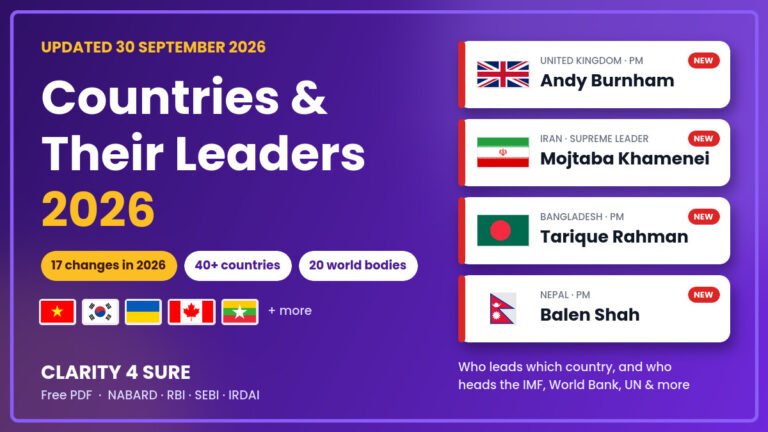 Free sheet · Static GKCountries & Their Leaders 2026Who leads which country in 2026, with all 17 changes marked. Get the article and the PDF free on WhatsApp.Get it free on WhatsApp →
Vice President C P Radhakrishnan Visits Sri Lanka
C. P. Radhakrishnan visited Sri Lanka, marking the first such visit by an Indian VP; he held talks with Anura Kumara Dissanayake and other leaders; multiple MoUs were signed to strengthen bilateral ties.
Karnataka Bank Partners with Pine Labs for Digital Payments
Karnataka Bank partnered with Pine Labs to enhance PoS payment solutions; the collaboration aims to expand digital payment infrastructure; it will support MSMEs and retail customers.
NBBL Onboards Postal Life Insurance on Bharat Connect
NPCI Bharat Bill Pay Limited onboarded Postal Life Insurance as a biller on Bharat Connect; the move enables digital premium payments; it enhances accessibility for policyholders across India.
ADNIC Gets Licence to Set Up Branch at GIFT City
Abu Dhabi National Insurance Company received approval to open a reinsurance branch at GIFT City; the licence was granted by IFSCA; the move strengthens India–UAE financial cooperation.
India’s Grandmaster R. Vaishali Wins FIDE Women’s Candidates 2026
In chess, India’s Grandmaster R. Vaishali won the FIDE Women’s Candidates Tournament 2026 in Cyprus yesterday. The 24-year-old defeated Russia’s Kateryna Lagno in the final round, finishing with 8.5 points out of 14 to clinch the title.
Tata Steel to Deploy World’s First EASyMelt Technology
Tata Steel signed an agreement with SMS Group to deploy EASyMelt technology; it aims to cut carbon emissions by over 50%; the project supports India’s decarbonisation and net-zero goals.
Six Women Win 2026 Goldman Environmental Prize
The Goldman Environmental Foundation awarded the 2026 Goldman Prize to six women; it marks the first time all winners are female; the award recognises grassroots environmental leadership globally.
Laureus World Sports Awards 2026 Winners Announced
Carlos Alcaraz and Aryna Sabalenka won top honours at Laureus Awards 2026; the event celebrated global sporting excellence; Paris Saint-Germain was named Team of the Year.
WEF Announces Young Global Leaders Class of 2026
World Economic Forum named 118 leaders in YGL Class of 2026; Indian leaders include Isha Ambani and Jay Shah; the programme focuses on global leadership development.
Former MP Dr Gopalrao Patil Passes Away
Gopalrao Patil passed away at 94 in Maharashtra; he was known for contributions to healthcare and education; he pioneered the ‘Latur Pattern’ of academic excellence.
World Creativity and Innovation Day 2026 Observed on April 21
The United Nations observes World Creativity and Innovation Day on April 21; it highlights the role of creativity in sustainable development; the day promotes innovation-driven global progress.
International Mother Earth Day 2026 Observed on April 22
International Mother Earth Day is observed on April 22 to promote environmental protection; the 2026 theme is “Our Power, Our Planet”; it emphasises sustainability and ecological balance.