
Daily Current Affairs Quiz: 24 & 25 July 2026
Free live session
NABARD Grade A 2026: what the 2025 cut-offs changed, and the 90-day plan
Today · 7:30 PM IST
1. The ICMM’s first Global Mining and Metals Water Dataset report — covering 12,000 facilities in 148 countries — found what share of global mining and metals facilities face significant physical water risk?
A. Nearly half
B. Nearly two-thirds
C. Nearly three-fourths
D. Nearly one-third
E. Over 90%
View Answer
Explanation: The International Council on Mining and Metals (ICMM) report (22 July 2026, London), produced with the WWF Water Risk Team and WRI, found nearly two-thirds of facilities face significant physical water risk across five indicators: floods, droughts, baseline water stress, baseline water depletion and interannual variability. Key stats: 38% face severe water stress, 27% are drought-prone (Africa-Middle East worst at 80.7%), 5% face 3+ compound risks — with Central India flagged as a compound water-risk hotspot (relevant to the National Critical Mineral Mission 2025 and MMDR Amendment Act 2023).
2. The SOFI 2026 report — theme “Understanding and Addressing the High Cost of a Healthy Diet” — is jointly published by which five UN agencies?
A. FAO, WFP, IFAD, UNICEF and WHO
B. FAO, WHO, UNDP, UNEP and WFP
C. WFP, UNICEF, WHO, World Bank and FAO
D. FAO, IFAD, ILO, WHO and UNICEF
E. UNCTAD, FAO, WFP, WHO and UNICEF
View Answer
Explanation: The State of Food Security and Nutrition in the World (SOFI) 2026 (released 21 July 2026) is the UN’s annual flagship tracking SDG Targets 2.1 (hunger) and 2.2 (malnutrition), jointly published by FAO, WFP, IFAD, UNICEF and WHO. It found 645 million people (7.8%) faced hunger in 2025 — down from 8.1% in 2024 — and 2.69 billion (32.7%) could not afford a healthy diet.
3. As per SOFI 2026, which region has overtaken Asia as the epicentre of global hunger?
A. Latin America & Caribbean
B. Oceania
C. Africa
D. West Asia
E. South-East Asia
View Answer
Explanation: Africa now has 309 million hungry (1 in 5, 20.0%) vs Asia’s 292 million (6.0%); 66.6% of Africans cannot afford a healthy diet. Other findings: animal-source foods, fruits and vegetables account for ~70% of healthy diet cost while starchy staples supply half the calories at only one-sixth the cost; anaemia among women (15-49) worsened to 30.7%; adult obesity rose to 16.2%; and 510-520 million may still face hunger in 2030 (56% in Africa). India drove Southern Asia’s undernourishment fall from 13.9% (2021) to 9.3% (2025), and excluding India flips the global affordability trend.
4. The Union Cabinet approved the “BHAVYA – Rasayan” Scheme on 24 July 2026 with an outlay of ₹3,030 crore to establish how many dedicated Chemical Parks?
A. Two
B. Three
C. Five
D. Seven
E. Ten
View Answer
Explanation: BHAVYA – Rasayan (Bharat Audyogik Vikas Yojana – Rasayan) — a central sector scheme of the Department of Chemicals & Petrochemicals, running FY 2026-27 to FY 2030-31 — will set up three Chemical Parks (₹3,000 cr for common infrastructure + ₹30 cr admin). Centre grants up to ₹1,000 crore per park with minimum ₹500 crore State contribution; parks selected via the Challenge Route; each needs minimum 8 sq km (2,000 acres) of encumbrance-free land. It is the chemicals vertical of the parent BHAVYA scheme (March 2026; 100 plug-and-play industrial parks, ₹33,660 crore).
5. DRDO conducted the maiden flight test of the “Kusha” LR-SAM — often called India’s indigenous answer to which foreign system?
A. Israeli Iron Dome
B. Russian S-400 Triumf
C. American THAAD
D. American Patriot
E. Russian S-500
View Answer
Explanation: Project Kusha’s maiden test (23 July 2026, Dr APJ Abdul Kalam Island, Odisha) intercepted an electronic target simulating a high-speed, high-altitude threat. It’s India’s indigenous S-400 equivalent — aligned with the “Sudarshan Chakra” national air umbrella vision — with three interceptor variants: M1 (150 km), M2 (250 km), M3 (350 km), plus indigenous AESA radars, command-and-control centres and high-precision seekers. The launch was monitored by Defence Secretary and DRDO Chairman Rajesh Kumar Singh.
6. The Cabinet-approved 2026 amendments to the Public Examinations (Prevention of Unfair Means) Act, 2024 propose raising the maximum fine for organised paper leaks to:
A. ₹1 crore
B. ₹2 crore
C. ₹5 crore
D. ₹10 crore
E. ₹25 crore
View Answer
Explanation: The draft amendment Bill (Cabinet, 24 July 2026) raises minimum punishment from 3 to 5 years, maximum imprisonment to 10 years, and maximum fine to ₹10 crore — with a three-month investigation deadline and statutory fast-track courts (a special court at Delhi’s Rouse Avenue is already designated). The parent Act (in force 21 June 2024) is India’s first central anti-paper-leak law: offences are cognizable, non-bailable and non-compoundable; investigation by DSP/ACP rank or above; cases transferable to the CBI. Under the 2024 Act, individuals faced 3-5 years + up to ₹10 lakh fine (Sec 10), organised crime 5-10 years + minimum ₹1 crore fine (Sec 11).
7. The Bharat 6G Alliance (B6GA) — which has expanded to 90 members — was established in July 2023 following the Bharat 6G Vision unveiled by the PM in which month/year?
A. January 2022
B. August 2022
C. March 2023
D. October 2023
E. March 2024
View Answer
Explanation: B6GA — an industry-led, government-facilitated platform supported by the DoT — flows from the Bharat 6G Vision (March 2023) and was established in July 2023. Now at 90 member organisations, it drives 6G research, IP creation and standard-setting, with bilateral MoUs with NextG Alliance (USA), 6G-IA (Europe), 6G Forum (South Korea), XGMF (Japan), 6G Brasil and the European Space Agency (ESA).
8. Under the PM-YASASVI scheme (Ministry of Social Justice & Empowerment), what is the annual family income ceiling for eligibility?
A. ₹1.00 lakh
B. ₹2.00 lakh
C. ₹2.50 lakh
D. ₹3.00 lakh
E. ₹8.00 lakh
View Answer
Explanation: PM-YASASVI (Prime Minister Young Achievers Scholarship Award Scheme for Vibrant India) covers OBC, EBC and DNT students outside the creamy layer with annual family income ≤ ₹2.50 lakh. Four tiers: Pre-Matric, Post-Matric, Top Class Schools and Top Class Colleges — Top Class School students get up to ₹75,000/yr (Class 9-10) and ₹1,25,000/yr (Class 11-12). Selection via YASASVI Entrance Test (YET) by NTA; applications via National Scholarship Portal with DBT to Aadhaar-seeded accounts. The hostel component originated in 1998-99.
9. NPCI is developing an offline NFC-based “Tap-and-Pay” UPI feature. What is the transaction limit without internet connectivity?
A. ₹500
B. ₹1,000
C. ₹2,000
D. ₹5,000
E. ₹10,000
View Answer
Explanation: The NPCI feature allows offline UPI payments up to ₹2,000 by tapping NFC-enabled devices — no QR scan needed, using the recipient’s UPI ID/VPA. It builds on UPI Lite X and aims to bridge UPI with contactless card payments. NFC (Near Field Communication) is a short-range wireless technology for contactless payments.
10. Under Mission Golden Spice, the multi-agency funding model for the Lakadong Turmeric project has MDoNER/NEC contributing 50%. What is the target for doubling farmers’ earnings by 2030?
A. From ₹20/kg to ₹50/kg
B. From ₹30–40/kg to ₹80/kg
C. From ₹50/kg to ₹100/kg
D. From ₹40/kg to ₹120/kg
E. From ₹25/kg to ₹75/kg
View Answer
Explanation: Mission Golden Spice (₹175.45 crore, launched 21 July 2026 by Jyotiraditya Scindia with Meghalaya CM Conrad Sangma) aims to double farmer earnings from ₹30-40/kg to ₹80/kg by 2030 and build a ₹100-crore local value-chain economy by 2028-29. Funding: MDoNER/NEC 50%, Agriculture Ministry 33.1%, Meghalaya 16.9%. Part of the “Unlock the Economic Potential of India’s Northeast” initiative under the Ashtalakshmi strategy; partners include APEDA, Spices Board, National Turmeric Board, ICAR, NABARD and SFAC.
11. What makes Lakadong Turmeric (grown mainly in Jaintia Hills, Meghalaya) special?
A. Longest shelf life among turmerics
B. Curcumin content of 7–12%, nearly four times the global average
C. It is the only organic turmeric in India
D. It grows without any irrigation
E. It has zero curcumin, making it medicinal
View Answer
Explanation: Lakadong turmeric’s 7-12% curcumin content — nearly 4x the global average — is its core competitive advantage. GI-tagged for Meghalaya and grown mainly in Jaintia Hills, it gained international visibility after being showcased by the PM at the G7 Summit. Target export markets: US, EU, Japan and Gulf countries.
12. Kutki (Picrorhiza kurroa) — for which Himachal farmers pioneered a sustainable stolon-based cultivation model — has what IUCN and CITES status?
A. Vulnerable; CITES Appendix I
B. Endangered; CITES Appendix II
C. Critically Endangered; CITES Appendix I
D. Near Threatened; CITES Appendix III
E. Least Concern; not CITES-listed
View Answer
Explanation: Kutki/Katuki (Picrorhiza kurroa) is IUCN Endangered (over-exploitation from destructive wild harvesting) and on CITES Appendix II. A high-altitude Himalayan herb (2,700-4,500 m, Kashmir to Sikkim; Greek Picros = bitter, Rhiza = root), its medicinal value resides in the stolon, not the fibrous roots. Mandi (HP) farmers now harvest only lateral stolons, leaving the mother rhizome to regenerate — harvest in ~2-2.5 years (September-October). Active principle: kutkin (kutkoside + Picroside I & II, used in 2,000+ formulations); Picroliv is a known hepatoprotective; key ingredient of Arogyavardhani Vati, balancing Pitta and Kapha doshas.
13. “AAROH” — India’s first comprehensive annual report on scientific mine closure, ecological restoration and post-mining land use — was released by which ministry and prepared by which body?
A. Ministry of Mines; Geological Survey of India
B. Ministry of Coal; Coal Controller Organisation (CCO)
C. Ministry of Environment; CPCB
D. Ministry of Coal; Coal India Limited
E. Ministry of Mines; Indian Bureau of Mines
View Answer
Explanation: AAROH (Annual Report on Mine Closure), released by the Ministry of Coal and prepared by the CCO, documents 42 scientifically closed coal mines (33 in the last year). At the event, Coal India’s Coal NEER Plants were virtually inaugurated and a tripartite MoU was signed involving BCCL, JRDA, Hindalco Industries and Rajdhani Universal Fabrics.
14. DRDO signed contracts under the ₹19,000-crore AEW&C Mk-II Programme, which will convert six aircraft of which type into airborne early-warning platforms?
A. Boeing 737
B. Airbus A321
C. Embraer ERJ-145
D. IL-76
E. C-295
View Answer
Explanation: The AEW&C Mk-II Programme (₹19,000 crore, approved by the Cabinet Committee on Security) will convert six Airbus A321 aircraft into advanced airborne warning platforms, with induction planned for 2032-33 — strengthening airborne surveillance and air defence.
15. During Zanzibar President Hussein Ali Mwinyi’s India visit (17-20 July 2026), the master plan of which campus — India’s first international IIT campus — was unveiled?
A. IIT Delhi Abu Dhabi
B. IIT Madras Zanzibar
C. IIT Bombay Dar es Salaam
D. IIT Kharagpur Nairobi
E. IIT Kanpur Colombo
View Answer
Explanation: The visit strengthened the India-Tanzania Strategic Partnership (blue economy, trade, tourism, health, education, technology) and unveiled the IIT Madras Zanzibar campus master plan — India’s first international IIT campus. Separately, NCVET recognised NIRDPR as a Dual Awarding Body for NSQF-aligned qualifications (107 Dual Awarding Bodies as of July 2026), and DIBD with the Goa government held the ‘BHASHINI Rajyam’ workshop for AI-powered multilingual governance (Konkani focus).
16. NABARD signed an MoU with which entity to jointly finance green, climate-resilient rural infrastructure, initially focusing on Maharashtra?
A. MSEDCL
B. MAHAPREIT
C. MIDC
D. MahaGenco
E. MSRDC
View Answer
Explanation: The NABARD-MAHAPREIT MoU covers renewable energy, Gram Panchayat infrastructure, biogas projects, solar-powered cold storage and decarbonisation of public institutions — supporting the circular economy and rural sustainability. Separately, Microsoft India and IIT Delhi’s FITT launched UNNATI AI 2.0 for AI innovation and skilling in Tier-2/Tier-3 cities.
17. Which company became India’s first Authorised Dealer Category-II (AD-II) entity to receive RBI approval for offering trade remittances (up to ₹25 lakh per transaction)?
A. Paytm Payments
B. EbixCash World Money Limited
C. Thomas Cook India
D. BookMyForex
E. Wise India
View Answer
Explanation: EbixCash became India’s first AD-II entity approved by RBI for trade remittances and family maintenance remittances — enabling trade remittances up to ₹25 lakh per transaction, supporting MSME importers/exporters. Separately, EnKash launched India’s first UPI-enabled meal card (payments from meal balance via eligible UPI QR codes with tax-saving benefits).
18. ICRA projected India’s real GDP growth for Q1 FY27 at:
A. 5.8–6.0%
B. 6.0–6.2%
C. 6.4–6.6%
D. 6.8–7.0%
E. 7.2–7.5%
View Answer
Explanation: ICRA projects Q1 FY27 real GDP growth at 6.4-6.6%, supported by strong industrial activity, infrastructure growth and improved high-frequency indicators — despite higher energy prices and input cost pressures.
19. Paras Semiconductors signed an MoU with MPSeDC to set up a ₹6,200-crore Greenfield facility of which type in Madhya Pradesh?
A. Fab (wafer fabrication)
B. OSAT (Outsourced Semiconductor Assembly and Test)
C. Display fab
D. Compound semiconductor fab
E. Chip design centre
View Answer
Explanation: The ₹6,200-crore Greenfield OSAT facility in Madhya Pradesh will manufacture advanced semiconductor packages for strategic applications, strengthening India’s semiconductor ecosystem and supporting the India Semiconductor Mission.
20. Who has been appointed the new CEO of NITI Aayog for a two-year tenure?
A. Nidhi Chhibber
B. Anurag Jain
C. B.V.R. Subrahmanyam
D. Amitabh Kant
E. Parameswaran Iyer
View Answer
Explanation: Anurag Jain, a 1989-batch IAS officer, was appointed CEO of NITI Aayog for two years — succeeding Nidhi Chhibber, who held additional charge. Separately, RBI approved Areion Group’s ₹936-crore acquisition of Aviom India Housing Finance under CIRP (estimated 65% lender recovery, subject to NCLT approval).
21. The Paralympic Committee of India and CPSFI signed an MoU to jointly bid for the 2029 World Abilitysport Games. Which two cities are under consideration as hosts?
A. Delhi and Mumbai
B. Chennai and Bhubaneswar
C. Hyderabad and Pune
D. Ahmedabad and Kochi
E. Bengaluru and Lucknow
View Answer
Explanation: The PCI-CPSFI MoU targets hosting the 2029 World Abilitysport Games — an international multi-sport event for athletes with disabilities — with Chennai and Bhubaneswar under consideration as host cities.
22. National Flag Adoption Day (22 July) commemorates the adoption of the Tiranga by the Constituent Assembly on 22 July of which year?
A. 1946
B. 1947
C. 1948
D. 1950
E. 1942
View Answer
Explanation: The Constituent Assembly adopted the Indian National Flag on 22 July 1947; the 2026 observance marks the 79th anniversary. Separately, National Broadcasting Day (23 July) commemorates India’s first organised radio broadcast by the Indian Broadcasting Company (IBC) in 1927 — 2026 marks the 99th anniversary.
23. India’s first dengue vaccine “Qdenga” has been developed by which company?
A. Serum Institute of India
B. Takeda (Japan)
C. Bharat Biotech
D. Sanofi (France)
E. Pfizer (USA)
View Answer
Explanation: Qdenga — developed by Japan’s Takeda, licensed in 40+ countries with WHO prequalification — protects against all four dengue serotypes and can be given WITHOUT prior dengue screening (unlike Dengvaxia). It needs two doses three months apart; concerns remain over relatively lower protection against DENV-3 and DENV-4 in dengue-naïve individuals, and affordability.
24. The US imposed a Section 301 tariff on Indian goods from 24 July 2026, citing inadequate enforcement against forced labour. What tariff rate was applied to India?
A. 5%
B. 7.5%
C. 10%
D. 12.5%
E. 15%
View Answer
Explanation: The US imposed a 10% Section 301 tariff on Indian goods from 24 July 2026. India was shifted from the proposed 12.5% to the 10% bracket after DGFT amended the Foreign Trade Policy (13 July 2026) to prohibit imports made with forced labour, and due to progress on the four Labour Codes. FIEO saw the lower rate as a competitive edge over 12.5%-tariff countries, though gems & jewellery and textile industries flagged margin and reputational concerns.
Every day of the month in one file. Enter your details once — the download opens right away.
We already have your details, so no form: tap to open.
Download the July 2026 current affairs quiz PDFDownload the July 2026 Exam Ready quiz PDFAll July 2026 quizzes in one place: every question of the month with answers, a full PDF and an Exam Ready PDF — July 2026 current affairs quiz
Related on Clarity 4 Sure

 Scheme to knowEmployees’ Pension Scheme (EPS-95): Contribution, Eligibility, Pension Types and FactsThe Employees' Pension Scheme, 1995 (EPS-95) is the pension scheme run by the Employees' Provident Fund Organisation…
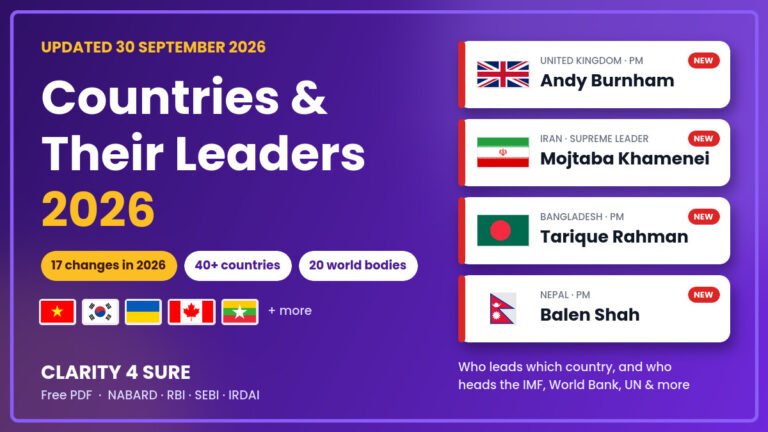 Free sheet · Static GKCountries & Their Leaders 2026Who leads which country in 2026, with all 17 changes marked. Get the article and the PDF free on WhatsApp.Get it free on WhatsApp →