Daily Current Affairs (DCA) 24 & 25 July, 2026
Free live session
NABARD Grade A 2026: 45-Day Final Revision Plan + Daily Targets
 🔒 Register to watchLast Sunday’s session · recording
Today · 8:30 PM IST
In the news3
Public Examinations (Prevention of Unfair Means) Act, 2024
Context
The Union Cabinet, chaired by the Prime Minister, approved a draft Bill on 24 July 2026 to amend the Public Examinations (Prevention of Unfair Means) Act, 2024. The amendments raise the minimum punishment from 3 years to 5 years, the maximum imprisonment to 10 years, and the maximum fine to ₹10 crore.
What the Parent Act Is
- India’s first dedicated central law to curb paper leaks, cheating and organised malpractice in national recruitment and entrance examinations.
- Passed by Parliament in February 2024 and brought into effect on 21 June 2024.
- Introduced in the Lok Sabha by the Union Minister of State for Personnel.
Aim
- Deter organised syndicates, cheating networks and rogue service providers from compromising examination integrity.
- Protect a transparent, merit-based selection process for millions of aspirants.
- Importantly, the Act targets organised gangs and institutions acting for monetary gain; ordinary candidate misconduct in the exam hall continues to be handled under the examination body’s own rules.
Comprehensive Definition of Unfair Means
- Leakage of question paper or answer key; unauthorised assistance to a candidate; tampering with a computer network, resource or system; creating fake websites for cheating or monetary gain; conducting fake examinations or issuing fake admit cards/offer letters; and manipulation of seating arrangements, dates and shifts to facilitate unfair means.
- Also covers falsification of merit lists and documents.
Penalty Structure Under the 2024 Act
- Section 10 — Individuals resorting to unfair means: imprisonment of 3 to 5 years and fine up to ₹10 lakh.
- Section 11 — Organised crime: imprisonment of 5 to 10 years and a fine of at least ₹1 crore.
- Service providers: fine up to ₹1 crore, recovery of proportionate examination cost, and a 4-year bar from any responsibility in conducting public examinations.
- Management liability: directors, senior managers or persons-in-charge who consent to or connive in cheating face 3 to 10 years imprisonment and a ₹1 crore fine.
- Property attachment and forfeiture for institutions and coaching centres found guilty of organised cheating, plus full cost recovery for re-conducting cancelled exams.
Procedural Features
- All offences are cognizable, non-bailable and non-compoundable.
- Investigation must be by an officer not below the rank of DSP or ACP.
- The Central Government may transfer any case to a central agency such as the CBI.
What the 2026 Amendments Propose
- Minimum penalty for individual offenders raised to 5 years, with a three-month deadline for completing investigations.
- Organised paper leaks to attract up to 10 years’ imprisonment and a fine of up to ₹10 crore.
- Statutory backing for fast-track courts and time-bound trials.
- A special fast-track court at Delhi’s Rouse Avenue Court has already been designated for paper-leak trials under the Act.
- The Delhi Police has constituted a Special Task Force (STF) in the Crime Branch to investigate paper leaks.
Bharat 6G Alliance (B6GA) Expands to 90 Members
Context
The Minister of State for Communications announced that the Bharat 6G Alliance (B6GA) has expanded its membership to 90 organisations. B6GA is an industry-led, government-facilitated platform to position India as a global leader in 6G.
What It Is
- An industry-led, government-facilitated collaborative platform bringing together domestic and international stakeholders.
- Drives research, intellectual property creation and standard-setting for next-generation networks.
- Established in July 2023, flowing from the Bharat 6G Vision unveiled by the Prime Minister in March 2023.
Nodal Support
- Facilitated by the Department of Telecommunications (DoT), Ministry of Communications.
Aim
- Drive indigenous 6G R&D toward a self-reliant (Atmanirbhar), globally competitive 6G ecosystem.
- Ensure India’s technological, manufacturing and IP priorities are embedded into global 6G standards.
Global Strategic Partners (Bilateral MoUs)
- NextG Alliance (USA)
- 6G-IA (Europe)
- 6G Forum (South Korea)
- XGMF (Japan)
- 6G Brasil
- European Space Agency (ESA)
PM-YASASVI (Prime Minister Young Achievers Scholarship Award Scheme for Vibrant India)
Context
The Minister of State for Social Justice and Empowerment reaffirmed the Government’s commitment to expanding educational opportunities for disadvantaged students through PM-YASASVI. The statement highlighted both scholarship support and hostel infrastructure for socially and educationally backward youth.
What It Is
- A comprehensive umbrella scheme implemented by the Department of Social Justice and Empowerment, Ministry of Social Justice and Empowerment.
- Unifies scholarship support and residential hostel infrastructure for socially and educationally backward youth across India.
Origin and Evolution
- The hostel construction component originated in 1998–99 to address educational backwardness among OBC youth, with a major revision in 2017–18.
- Later restructured into the present PM-YASASVI umbrella framework, covering assistance from school level through top-tier college education.
Aim
- Eliminate financial constraints and geographical barriers for students from rural and economically weaker sections.
- Ensure equitable access to secondary and higher education through scholarships and quality hostel facilities.
Target Beneficiaries and Eligibility
- Open to Other Backward Classes (OBC), Economically Backward Classes (EBC), and Denotified, Nomadic and Semi-Nomadic Tribes (DNT).
- Applicants must be listed in Central/State/UT OBC lists and fall strictly outside the creamy layer.
- Annual family income ceiling: ₹2.50 lakh.
- Selection for top-class components is through the YASASVI Entrance Test (YET) conducted by the National Testing Agency (NTA).
- Applications are made through the National Scholarship Portal (NSP), with funds transferred by DBT into Aadhaar-seeded accounts.
Four-Tiered Scholarship Structure
- Pre-Matric Scholarship Scheme (Classes 9–10).
- Post-Matric Scholarship Scheme (post-secondary stage).
- Top Class Education in Schools Scheme.
- Top Class Education in Colleges Scheme.
- Under the Top Class School component, Class 9–10 students receive up to ₹75,000 per annum and Class 11–12 up to ₹1,25,000 per annum, covering tuition and hostel expenses.
Banking/Finance2
How & Why Farmers Producers Organization are formed? FPO #fpo #upsc #nabardgradea #agriculturenotesTap to play · from the C4S channel
Updated Index of Core Industries (ICI)
Context
The Government of India released the updated Index of Core Industries (ICI) with a new base year of 2022–23, replacing the earlier 2011–12 series.
About Index of Core Industries (ICI)
What is it?
- A monthly production index that measures the performance of India’s core infrastructure industries.
- Acts as a lead indicator for the Index of Industrial Production (IIP).
Published By
- Office of Economic Adviser (OEA)
- Department for Promotion of Industry and Internal Trade (DPIIT)
- Ministry of Commerce and Industry
Objective
- Reflect current industrial and economic conditions.
- Align with updated GDP, GVA, CPI, and IIP series.
- Improve the accuracy of industrial growth measurement.
Key Changes
- Base Year: Updated from 2011–12 to 2022–23 = 100.
- Number of Core Industries: Increased from 8 to 9 with the addition of Iron Ore.
- Iron Ore Weight: 4.905%.
- Steel: Uses gross steel production instead of net production.
- Coal: Measures only raw coal production to avoid double counting.
Revised Sector Weights
- Electricity: 30.932% (Highest)
- Refinery Products: 22.572%
- Steel
- Cement
- Coal: 5.596%
- Iron Ore: 4.905%
- Natural Gas: 3.841%
- Fertilizers: 2.731%
- Crude Oil
Nine Core Industries
- Coal
- Crude Oil
- Natural Gas
- Refinery Products
- Fertilizers
- Steel
- Cement
- Electricity
- Iron Ore (Newly Added)
Offline UPI Payment (NFC-based Tap-and-Pay)
Context
The National Payments Corporation of India (NPCI) is developing an offline NFC-based Tap-and-Pay UPI feature, enabling users to make UPI payments up to ₹2,000 without internet connectivity.
What is the New Feature?
- Allows offline UPI payments using Near Field Communication (NFC) technology.
- Users can make payments by tapping NFC-enabled devices.
- No need to scan a QR code.
- Payments can be made by capturing the recipient’s UPI ID or Virtual Payment Address (VPA).
- Transaction limit: Up to ₹2,000 without internet.
Technology Used
- NFC (Near Field Communication): A short-range wireless communication technology that enables contactless payments.
- UPI ID / VPA: Unique payment address linked to a bank account.
Background
- Builds upon earlier initiatives such as UPI Lite X.
- Aims to bridge the gap between UPI payments and contactless card payments.
Every day of the month in one file. Enter your details once — the download opens right away.
We already have your details, so no form: tap to open.
Download the July 2026 PDFDownload the July 2026 revision sheet PDFAgriculture2
Mission Golden Spice — Lakadong Turmeric Value Chain Project
Context
Union Minister for Communications and DoNER Jyotiraditya M. Scindia, with Meghalaya CM Conrad K. Sangma, launched “Mission Golden Spice – Integrated Lakadong Turmeric Value Chain Enhancement Project”, a ₹175.45-crore convergence-led initiative, on 21 July 2026 at Sanchar Bhavan, New Delhi. It is a five-year (2025–2030) phased roadmap to build a farm-to-global-market ecosystem for Meghalaya’s GI-tagged Lakadong turmeric.
What It Is
- Officially the Integrated Lakadong Turmeric Value Chain Enhancement Project.
- A five-year phased initiative to turn Lakadong turmeric into a globally competitive premium brand.
- Part of the Centre’s “Unlock the Economic Potential of India’s Northeast” (USP) initiative under the Ashtalakshmi strategy.
Organisations Involved
- Anchor bodies: MDoNER and the North Eastern Council (NEC).
- State implementation: Government of Meghalaya.
- Convergence partners: Ministries of Agriculture & Farmers’ Welfare, Food Processing Industries and Commerce, along with APEDA, Spices Board, National Turmeric Board, ICAR, MeitY, NABARD and SFAC.
Aim
- Double farmers’ earnings from ₹30–40/kg to ₹80/kg by 2030.
- Overcome post-harvest losses and end distress sales.
- Establish processing facilities and position Lakadong as a flagship export to the US, EU, Japan and Gulf countries.
- Build a ₹100-crore local value-chain economy by 2028–29.
Phased Roadmap (2025–2030)
- Phase 1 — Value Chain Strengthening: infrastructure, cold chains and processing.
- Phase 2 — Expansion & Scale-up: commercial expansion, branding and export scaling.
Multi-Agency Funding Model
- MDoNER/NEC: 50%
- Ministry of Agriculture & Farmers’ Welfare: 33.1%
- Government of Meghalaya: 16.9%
Why Lakadong Is Special
- Curcumin content of 7–12%, nearly four times the global average — its core competitive advantage.
- Gained international visibility after being showcased by the Prime Minister at the G7 Summit.
- Grown mainly in Jaintia Hills, where soil and ecosystem give the crop its distinctive quality; it received the GI tag for Meghalaya.
Exam Relevance
- NABARD Grade A: Extremely high — direct subject matter; agri value chains, FPOs, cold chain finance, rural entrepreneurship, SFAC and NABARD’s own role.
Kutki (Picrorhiza kurroa) — Sustainable Cultivation Breakthrough in Himachal
Context
Farmers in Mandi district, Himachal Pradesh, have pioneered a sustainable, stolon-based cultivation and harvesting model for Kutki (Picrorhiza kurroa). Kutki is an endangered high-altitude Himalayan medicinal herb, declared so because of over-exploitation from its natural habitat. The new model harvests only the lateral creeping stolons, leaving the mother rhizome intact to regenerate. This converts a destructively wild-harvested species into a multi-year perennial crop, aligning conservation with farmer income.
What It Is
- Botanical name Picrorhiza kurroa Royle ex Benth.; known in Ayurveda as Katuki or Katukarohini, and locally as Kadu.
- A creeping perennial medicinal herb of the family Scrophulariaceae (placed in Plantaginaceae under modern APG classification).
- The name derives from Greek “Picros” (bitter) and “Rhiza” (root), reflecting its intense bitterness.
Native Habitat and Distribution
- Found in the alpine Himalayan region from Kashmir to Sikkim at elevations of 2,700–4,500 metres above mean sea level.
- Prefers moist, rocky, north-west facing slopes with well-drained, porous sandy-clay soil that lets rhizomes spread horizontally.
- In India: Jammu & Kashmir, Ladakh, Himachal Pradesh, Uttarakhand, Sikkim and Arunachal Pradesh.
- Key Himachal habitats: Chamba, Kangra, Mandi, Shimla, Kinnaur, Lahaul and Spiti.
- Outside India: Nepal, Bhutan, Pakistan, Tibet, western China and northern Myanmar.
Conservation Status
- IUCN Red List: Endangered — due to severe population decline from over-exploitation and destructive wild harvesting.
- CITES: Appendix II — international trade permitted only under strictly regulated export permits.
- Listed among the 37 top-priority species identified for conservation and cultivation in the Western Himalayas, owing to its narrow distribution range, small population size and high value.
Key Morphological Features
- Medicinal stolon vs non-medicinal fibrous root: the drug component resides in the stolon — a specialised horizontal stem creeping along the soil bearing nodes — while the fibrous roots carry no medicinal value.
- Forms low-growing mats through creeping underground rhizomes and aerial stolons.
- Bears a whorl of serrated leaves and white to pale purple flowers, flowering around June.
Bioactive Phytochemicals
- The active principle is kutkin, comprising kutkoside and the iridoid glycosides Picroside I and Picroside II, used in more than 2,000 herbal formulations.
- Also contains cucurbitacins, acetophenones, apocyanin and ferulic acid.
- The derived drug Picroliv is a well-known hepatoprotective extract.
The Non-Destructive Harvesting Breakthrough
- Traditional harvesting uproots the entire plant, which is why wild populations collapsed.
- The new model harvests only lateral creeping stolons, leaving the mother rhizome intact in the soil to regenerate continuously.
- When propagated through stolon cuttings, Kutki can be harvested in about 2–2.5 years, with harvest in September–October as the aerial parts wither.
- Stolon cuttings give faster multiplication and higher production than seed propagation.
Medicinal Significance
- A renowned Ayurvedic liver tonic used for hepatitis, cirrhosis and other liver disorders; it promotes bile flow.
- A key ingredient in Arogyavardhani Vati.
- Used to manage chronic fever, diabetes, asthma, cough, digestive disorders and inflammatory skin diseases.
- In Ayurvedic terms, it balances Pitta and Kapha doshas.
Exam Relevance
- NABARD Grade A: Very high — direct subject matter; high-value crop diversification, NTFP, farmer producer organisations, medicinal plant financing.
Facts To Remember20
MoC Releases ‘AAROH’, India’s First Scientific Mine Closure Report
The Ministry of Coal (MoC) released ‘AAROH: Annual Report on Mine Closure’, India’s first comprehensive report on scientific mine closure, ecological restoration, and post-mining land utilisation. Prepared by the Coal Controller Organisation (CCO), the report documents 42 scientifically closed coal mines, including 33 closed in the last year. During the event, Coal NEER Plants of Coal India Limited were virtually inaugurated, and a tripartite MoU was signed by BCCL, JRDA, Hindalco Industries, and Rajdhani Universal Fabrics.
India Emerges as Global Leader in Cotton Cultivation
The Government of India released a factsheet describing cotton as India’s “White Gold”, supporting the livelihoods of 6 million farmers and 40–50 million people in the textile value chain. India ranks 1st globally in cotton cultivation area (114.84 lakh hectares) and 2nd in both cotton production and consumption, contributing nearly 19% of global fibre production. The United States remains the largest destination for India’s cotton fabric exports.
DRDO Signs Contracts for AEW&C Mk-II Programme
The Defence Research and Development Organisation (DRDO) signed two major contracts for the AEW&C Mk-II Programme to strengthen India’s airborne surveillance and air defence capabilities. The ₹19,000-crore programme, approved by the Cabinet Committee on Security (CCS), will convert six Airbus A321 aircraft into advanced airborne warning platforms with induction planned for 2032–33.
Zanzibar President Hussein Ali Mwinyi Visits India
Zanzibar President Hussein Ali Mwinyi visited India from 17–20 July 2026 to strengthen the India–Tanzania Strategic Partnership. The visit focused on cooperation in the blue economy, trade, tourism, health, education, and technology, while also unveiling the master plan of the IIT Madras Zanzibar campus, India’s first international IIT campus.
NCVET Recognises NIRDPR as Dual Awarding Body
The National Council for Vocational Education and Training (NCVET) recognised the National Institute of Rural Development and Panchayati Raj (NIRDPR) as a Dual Awarding Body, enabling it to assess, certify, and award NSQF-aligned qualifications. The initiative will strengthen rural skilling, entrepreneurship, and Panchayati Raj capacity building, with 107 Dual Awarding Bodies recognised as of July 2026.
BHASHINI Rajyam Promotes AI-Powered Multilingual Governance
The Digital India BHASHINI Division (DIBD) and the Government of Goa organised the ‘BHASHINI Rajyam’ Workshop to promote AI-powered multilingual governance. The workshop showcased AI-based translation, speech recognition, transcription, and multilingual citizen services, while strengthening the Konkani language ecosystem.
NABARD Signs MoU with MAHAPREIT for Green Rural Infrastructure
NABARD signed an MoU with MAHAPREIT to jointly finance green, climate-resilient infrastructure across rural India, initially focusing on Maharashtra. Priority areas include renewable energy, Gram Panchayat infrastructure, biogas projects, solar-powered cold storage, and decarbonisation of public institutions, supporting the circular economy and rural sustainability.
Microsoft India and IIT Delhi Launch UNNATI AI 2.0
Microsoft India, in partnership with IIT Delhi’s FITT, launched UNNATI AI 2.0 to expand AI innovation, startup support, and AI skilling across Tier-2 and Tier-3 cities. The initiative aims to strengthen India’s AI talent pipeline and promote responsible AI solutions in healthcare, education, agriculture, and sustainability.
 Scheme to knowPM Anusuchit Jaati Abhyuday Yojana (PM-AJAY)PIB ContextThe Ministry of Social Justice and Empowerment reported that over ₹11,186 crore has been released under…
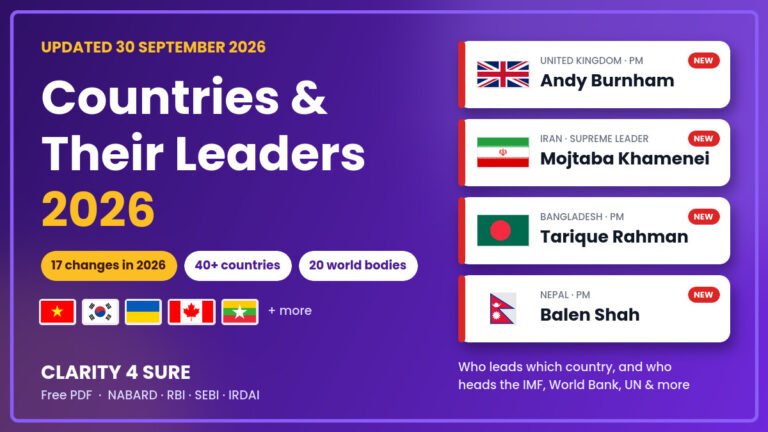 Free sheet · Static GKCountries & Their Leaders 2026Who leads which country in 2026, with all 17 changes marked. Get the article and the PDF free on WhatsApp.Get it free on WhatsApp →
UN SOFI Report: Global Hunger Declines Slightly in 2025
The UN Food and Agriculture Organization (FAO) released the SOFI 2026 Report, estimating that 645 million people (7.8% of the global population) faced hunger in 2025, a slight improvement over the previous year. However, the world remains off track to achieve SDG-2 (Zero Hunger by 2030), with Africa replacing Asia as the region with the highest number of undernourished people.
EbixCash Becomes India's First AD-II Entity for Trade Remittances
EbixCash World Money Limited became India’s first Authorised Dealer Category-II (AD-II) entity to receive RBI approval for offering trade remittances and family maintenance remittances. The licence enables trade remittances of up to ₹25 lakh per transaction and provides greater support to MSME importers and exporters.
EnKash Launches India's First UPI-Enabled Meal Card
EnKash launched India’s first UPI-enabled meal card, allowing employees to make payments by scanning eligible UPI QR codes directly from their meal balance. The initiative provides tax-saving benefits while expanding the use of digital employee benefit solutions.
ICRA Projects India's GDP Growth at 6.4–6.6% in Q1 FY27
ICRA projected India’s real GDP growth at 6.4–6.6% for Q1 FY27, supported by strong industrial activity, infrastructure growth, and improved high-frequency indicators. Despite higher energy prices and input cost pressures, the report indicates continued economic momentum.
Paras Semiconductors to Set Up ₹6,200-Crore OSAT Facility in MP
Paras Semiconductors signed an MoU with MPSeDC to establish a ₹6,200-crore Greenfield OSAT (Outsourced Semiconductor Assembly and Test) facility in Madhya Pradesh. The project will strengthen India’s semiconductor ecosystem, support the India Semiconductor Mission, and manufacture advanced semiconductor packages for strategic applications.
Anurag Jain Appointed CEO of NITI Aayog
The Government of India appointed Anurag Jain, a 1989-batch IAS officer, as the new CEO of NITI Aayog for a two-year tenure. He succeeds Nidhi Chhibber, who had been holding the additional charge, and will lead policy formulation, governance reforms, and long-term development planning.
RBI Approves Areion Group's Acquisition of Aviom India Housing Finance
The Reserve Bank of India (RBI) approved Areion Group’s ₹936-crore acquisition of Aviom India Housing Finance as part of its Corporate Insolvency Resolution Process (CIRP). The acquisition is expected to provide lenders with an estimated 65% recovery, subject to final approval by the National Company Law Tribunal (NCLT).
India Bids to Host 2029 World Ability sport Games
The Paralympic Committee of India (PCI) and the Cerebral Palsy Sports Federation of India (CPSFI) signed an MoU to jointly bid for hosting the 2029 World Abilitysport Games. Chennai and Bhubaneswar are under consideration as host cities for the international multi-sport event for athletes with disabilities.
National Flag Adoption Day Observed on 22 July
National Flag Adoption Day is observed every year on 22 July to commemorate the adoption of the Indian National Flag (Tiranga) by the Constituent Assembly on 22 July 1947. The 2026 observance marks the 79th anniversary, celebrating the Tiranga as a symbol of freedom, justice, liberty, and equality.
National Broadcasting Day Observed on 23 July
National Broadcasting Day is observed annually on 23 July to commemorate India’s first organised radio broadcast by the Indian Broadcasting Company (IBC) in 1927. The year 2026 marks the 99th anniversary of organised radio broadcasting in India, highlighting its role in public communication, education, and cultural preservation.
India Approves First Dengue Vaccine Qdenga
India has approved Qdenga, the country’s first dengue vaccine, developed by Takeda (Japan) and already licensed in over 40 countries with WHO prequalification. The vaccine protects against all four dengue virus serotypes and can be administered without prior dengue screening, unlike Dengvaxia. However, it requires two doses three months apart, has relatively lower protection against DENV-3 and DENV-4 in dengue-naïve individuals, and concerns remain over affordability and ensuring complete vaccination coverage among high-risk populations.
US Imposes 10% Section 301 Tariff on Indian Goods
The United States imposed a 10% Section 301 tariff on Indian goods from 24 July 2026, citing inadequate enforcement against forced labour in supply chains. India was shifted from the proposed 12.5% tariff to the 10% bracket after the DGFT amended the Foreign Trade Policy (13 July 2026) to prohibit imports made using forced labour and due to progress in implementing the four Labour Codes. While FIEO viewed the lower tariff as a competitive advantage over countries facing 12.5% tariffs, the gems & jewellery and textile industries expressed concerns over profit margins, reputational risks, and export competitiveness.