
NABARD Grade A 2027 Online Course — Foundation Coaching, Mentorship & Test Series
Foundation first, advanced later. A year, planned — with the mentors behind the NABARD Grade A 2025 toppers.
Online coaching for NABARD 2027, starting now: a foundation-first NABARD Grade A online course that builds ARD and ESI from the basics, then moves to the advanced syllabus, the test series and descriptive writing as the 2027 notification nears. Live mentorship, notes that stay current, and the same teachers behind the NABARD Grade A 2025 toppers. Sitting the 2026 exam instead? See the NABARD Grade A 2026 course.
2 lessons open free, no card asked for. Pay only if the teaching suits you.
See the 16-month roadmap ↓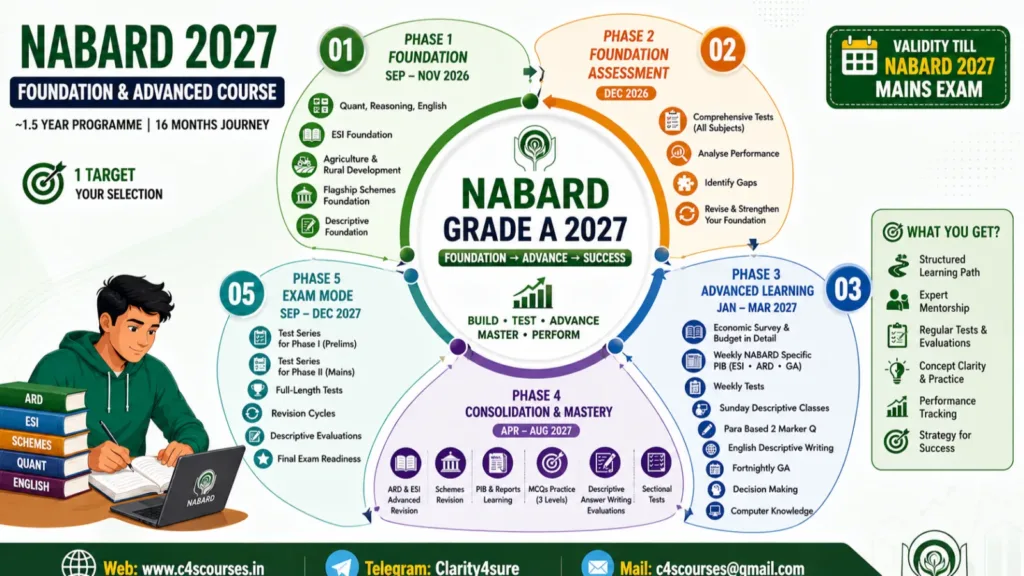
Free live session
NABARD Grade A 2026: 45-Day Final Revision Plan + Daily Targets
 🔒 Register to watchLast Sunday’s session · recording
8 of the top 10 in NABARD Grade A 2025, Rank 1 included, and Rank 1 back to back before that in 2021 and 2022: all prepared with C4S. Watch last Sunday's session on the 45-day final revision plan now, then join the next one live on Zoom.
In 2 days · Sun, 25 Oct at 7:30 PM IST · 75 minutes · free
NABARD Grade A 2025 results: 8 of the top 10 ranks, from one classroom



NABARD Grade A 2027 syllabus: the papers this course covers
What the NABARD Grade A 2027 online course includes
NABARD 2025 and 2026 results: the experience behind the 2027 plan
Before the plan, the outcomes it keeps producing: 32 final selections in NABARD Grade A 2025 from the mentorship and test series, 12 more through the interview programme and 16 waitlisted who missed the final list by a whisker — and 8 of the top 10 ranks on that same final list (ranks 1, 2, 3, 5, 6, 7, 8 and 9). The 2027 plan on this page is the same system, extended to sixteen months. Toppers from 2022 to 2026, in their own words:
“C4S is my sole prep ladder for NABARD Grade A — and for securing Rank 1.”
Sudarshan Reddy · Rank 1 · NABARD Grade A 2022 · total 186.25
“The one-on-one guidance with my C4S mentor and the quality sessions helped me become a NABARD Grade A officer.”
Prashant · NABARD Grade A officer · 2025
“Clarity helped me immensely at every stage — Monday mentor talks, high-standard ESI sectionals, Phase 2 answer-writing discussions, and a mock interview so close to the real one that certain questions were repeated exactly.”
Shivani K I · Assistant Manager, Grade A (RDBS) · 2025
“Clarity transformed my journey to become a NABARD officer — focused classes, materials and a quality test series.”
Dr Koyi Jyothsna · NABARD Grade A topper · 2024
“The surprise descriptive tests and evaluation — and the overall course — were a game-changer in my NABARD prep.”
Nazi Frah · NABARD Grade A topper · 2023
Waiting for the notification is not a NABARD 2027 strategy
The last completed cycle left no room to prepare: about six weeks from notification to Phase I, and roughly five weeks between Phase I and Phase II — too short to build concepts or descriptive writing from scratch. The preparation window effectively closes the day the notification is published.
- 8 Nov 2025 Notification
- 15 Dec 2025 Admit card
- 20 Dec 2025 Phase I exam
- 25 Jan 2026 Phase II exam
- 7 Mar 2026 Psychometric test
- 8 May 2026 Final result
Does your NABARD 2027 preparation look like this?
| The problem in your head | The C4S answer in the plan |
|---|---|
| “I don’t understand economics.” | Economics foundation from zero — 15 blocks, September 2026 |
| “ARD is completely new to me.” | Structured ARD learning, week by week, January–April 2027 |
| “PIB is endless.” | NABARD-specific weekly PIB (ESI + ARD + GA), filtered for the exam |
| “I read current affairs but forget.” | Weekly tests + monthly consolidation + three revision cycles |
| “The Economic Survey looks technical.” | Concepts first (Sep–Dec), then the Survey and Budget in detail (Jan–Feb) |
| “I don’t know how to write Phase II answers.” | Writing foundation → practice → mentor evaluation → rewrite |
| “Quant and reasoning scare me.” | November foundation + continuous weekly QRE practice |
| “I keep collecting material.” | One 16-month structured roadmap — nothing extra to hunt for |
Students don’t need more material. They need a plan that decides for them.
The C4S learning loop for NABARD Grade A 2027
Most preparation is read PIB → memorise → forget → repeat. The C4S loop replaces it with steps that run continuously for sixteen months, applied to every topic — because we don’t want you to finish the syllabus once; we want you to become exam-ready with it.
- Concept
- Understand the news
- Connect with the syllabus
- Solve MCQs
- Write the descriptive answer
That is why the batch starts with four months of foundations: once you own the concept, every PIB release, Survey chapter and Budget number attaches to something you already understand — and stays.
NABARD Grade A 2027 course roadmap: five phases, sixteen months
The NABARD Grade A 2027 online course runs from September 2026 to 31 December 2027 (the NABARD 2027 Mains) — sixteen months in five phases: build → test → advance → master → perform. Each milestone closes a chapter of the journey, so you always know what “done” looks like next.
Month-by-month detail, plus the ESI, ARD and descriptive methods behind this plan, is in our NABARD Grade A 2027 preparation strategy guide.
- Dec 2026 foundation ready
- Apr 2027 syllabus ready
- Jun 2027 revision ready
- Aug 2027 practice ready
- Sep 2027 Phase I ready
- Oct–Dec 2027 Phase II + exam ready
Weekly PIB, reports, QRE practice, answer writing and weekly tests run continuously across all sixteen months, whatever phase you are in.
What you get in the NABARD Grade A 2027 course
- 16months of validity — till 31 December 2027 (NABARD 2027 Mains)
- 5phases from foundation to exam mode
- 15economics foundation blocks
- 12social-issues foundation blocks
- 16week advanced ARD + ESI plan
- 3full revision cycles, plus rapid and final revision
- 52+weeks of NABARD-specific PIB and reports
- 2test series — Phase I and Phase II
- Weekly progress tests and monthly revisions, all sixteen months
- Individually evaluated descriptive answers
- Daily live classes, and every class is recorded — watch anytime
- Mentorship group and live doubt sessions
- Decision Making and Computer Knowledge — sessions plus monthly tests
Once you are with us, there is no need to refer to anything else. Outside books, random PDFs, ten Telegram channels and coaching-hopping are strictly prohibited in this batch. The course notes, weekly NABARD-specific PIB, reports, tests and evaluated writing are complete and exam-sufficient; your only job is to follow the roadmap.
What NABARD 2026 students say
5.0 from 63 reviews · 8 of the top 10 ranks in NABARD Grade A 2025 were C4S students
- 43+selections · 2023
- 32selections · 2024
- 32final selections · 2025
- 8 of top 10toppers · 2025
Honestly this is the best course for NABARD Grade A in terms of contet quality, conceptual teaching, and exam oriented focus for each topic and you will literally thank yourself for taking this course and also regret for not finding this course early.
The course is well-structured, exam oriented, and providing excellent guidance for such a competitive examination. A special thanks to Sangeeth Sir for his constant motivation, encouragement and valuable guidance. His teaching style makes the preparation journey much more focussed and confident. Highly recommended for every serious NABARD aspirant!
Highly recommended for serious aspirants. Finding quality course at a pocket friendly price is rare, Literally No other institution offers such quality content at this price what Clarity 4 Sure is providing. The Descriptive classes, structured live/recorded classes, Exam relevant notes are giving the exact direction needed for Phase 1 and phase 2. There are so many mock tests and mcqs to practice and analyze which is really helping in exam preparation. Thank You C4S.
Short and crisp notes for everything is provided. Though I'm an agriculture student I still get confused about some topics but the way our mentor teaches us and makes us remember every topic in the class itself. Ministry wise schemes and PIB powerplay are the best to cover current affairs.
Every section of this course is highly relevant for exam. and mentor guidance and insights are really helpful in understanding the real exam demands and relevance. One Stop Solution for NABARD Grade A Preparation.
Clarity4sure provides a well-structured, step-by-step, thorough explanation of all topics with notes and tests that help with understanding and retention. It helps you to cancel out the noise and focus on what is in the syllabus and important.
Best mentors and quality content
I feel the mentorship course covers everything for NABARD Grade A.
The foundation advantage: why NABARD 2027 starts in September 2026
“You are not studying extra economics. You are building the vocabulary required to understand NABARD ESI.” Most students prepare ESI as read PIB → memorise the scheme → read the Economic Survey → memorise the data → forget → repeat. The problem is a lack of conceptual foundation: without GDP, inflation, fiscal deficit, monetary policy, unemployment or FDI as owned concepts, every Survey chapter and news item is just another unrelated fact to memorise.
One concept, many marks. Take inflation — one “chapter” that carries you through a dozen places in the syllabus, the Survey, the Budget and the news. The same is true of every foundation block:
GDP connects with growth → sectoral GVA → per-capita income → fiscal deficit ratio → debt ratio → the Economic Survey.
Demand and supply connect with MSP → PM-AASHA → PSF → MIS → buffer stocks → food inflation → agricultural markets.
Timed to the calendar. September to December 2026 builds the vocabulary. When the new Economic Survey arrives in January 2027 and the Union Budget in February, everything taught from then on looks easy — and stays, because every number now attaches to a concept you already own.
Open the full month-by-month foundation plan (September–December 2026)
September 2026 — economics foundation
| # | Foundation area | Core concepts covered | Helps you understand |
|---|---|---|---|
| 1 | Basic language of economics | Micro vs macro, positive vs normative, stock vs flow, nominal vs real, factors of production, opportunity cost, productivity, economic agents | Basic economic terminology and logic |
| 2 | Demand, supply & markets | Demand, supply, equilibrium, elasticity, shortage/surplus, price ceiling/floor, competition, market intervention | MSP, food prices, subsidies, PM-AASHA, price policies |
| 3 | National income | GDP, GVA, NDP, GNI, NNI, current vs constant prices, GDP deflator, per-capita income, GDP = C+I+G+(X−M) | Economic Survey, Budget, growth data |
| 4 | Structure of the economy | Primary–secondary–tertiary, formal/informal, organised/unorganised, public/private, rural/urban, structural transformation | Nature and structural features of the Indian economy |
| 5 | Growth & development | Growth vs development, inclusive and sustainable growth, HDI, standard of living, Gini, Lorenz curve, multidimensional poverty | Human development, inequality, social justice |
| 6 | Inflation & prices | CPI, WPI, headline/core/food inflation, demand-pull, cost-push, deflation, disinflation, purchasing power, real income | Inflation trends and impact, RBI response |
| 7 | Money, banking & credit | Money supply, deposits, loans, interest rates, credit creation, PSL, financial inclusion, NPAs, rural credit | Banking reforms and rural financial institutions |
| 8 | Monetary policy | Repo, SDF, MSF, CRR, SLR, liquidity, MPC, inflation targeting, monetary transmission | RBI policy and inflation management |
| 9 | Government finance | Revenue/capital receipts and expenditure, taxes, fiscal/revenue/primary deficit, debt, subsidies, FRBM | Union Budget and fiscal policy |
| 10 | Poverty, employment & inequality | Poverty line, MPI, labour force, workforce, LFPR, WPR, UR, types of unemployment, underemployment, jobless growth | PLFS, poverty and employment programmes |
| 11 | Population & demography | Birth/death rate, TFR, sex ratio, dependency ratio, working-age population, demographic dividend, migration, urbanisation | Population policy and economic development |
| 12 | Economics of agriculture | Productivity, landholding, MSP, procurement, markets, credit, subsidies, food security, buffer stock, PDS, farm income | Agriculture and the ESI–ARD linkage |
| 13 | Industry & structural transformation | Industrialisation, manufacturing, MSMEs, PSEs, labour productivity, industrial policy, infrastructure, regional imbalance | Industrial development and performance |
| 14 | LPG & economic reforms | 1991 crisis, liberalisation, privatisation, globalisation, licence raj, FDI/FPI, disinvestment, deregulation, convertibility | Opening of the Indian economy and economic reforms |
| 15 | External sector & global economy | Exports/imports, BoT, BoP, current account, CAD, exchange rate, forex, FDI/FPI, external debt | IMF, World Bank, WTO, ADB, AIIB and globalisation |
October 2026 — social issues foundation
| # | Building block | Foundation concepts | Helps you understand |
|---|---|---|---|
| 1 | Indian social structure | Society, social institutions, diversity, multiculturalism, caste, class, community, family, joint/nuclear family | Nature of Indian society and social change |
| 2 | Population & demography | Population growth, Census, birth/death rate, TFR, sex ratio, dependency ratio, age structure, demographic transition | Population trends and the Population Policy |
| 3 | Demographic dividend & ageing | Working-age population, dependency burden, demographic dividend, ageing, human capital | The population–development relationship |
| 4 | Poverty & deprivation | Absolute/relative poverty, poverty line, rural/urban poverty, consumption, MPI, vulnerability | Poverty measurement and alleviation programmes |
| 5 | Employment & livelihoods | Labour force, workforce, LFPR, WPR, UR, formal/informal employment, unemployment, underemployment | PLFS, MGNREGS, DAY-NRLM, skilling |
| 6 | Inequality & social exclusion | Income/wealth inequality, Gini, exclusion, marginalisation, inter-generational inequality | Inclusive growth and social justice |
| 7 | Gender & women empowerment | Gender vs sex, gender inequality, FLFPR, unpaid care work, gender budgeting, SHGs, financial and economic empowerment | Mission Shakti, Lakhpati Didi, women-centric schemes |
| 8 | Social justice & vulnerable groups | SC, ST, OBC, minorities, PwDs, the elderly, children, constitutional safeguards, affirmative action | The social justice syllabus and welfare programmes |
| 9 | Education & human capital | Literacy, enrolment, GER, dropout, learning outcomes, educational wastage, skill development | NEP, Samagra Shiksha, scholarships, education indicators |
| 10 | Health, nutrition & sanitation | Public health, IMR, MMR, life expectancy, malnutrition, stunting/wasting, healthcare access, WASH | NHM, Ayushman Bharat, POSHAN, SBM, JJM |
| 11 | Urbanisation & migration | Rural–urban migration, push/pull factors, urbanisation, slums, informal workers, basic services | Urban poverty, migration and social infrastructure |
| 12 | Human development & social infrastructure | HDI, human capital, quality of life, education + health + income, SDGs, social protection | Human development, SDGs and development reports |
November 2026 — quant, reasoning and English
December 2026 — flagship schemes and answer writing
Your week inside the NABARD Grade A 2027 batch
Seven things happen every single week — not just ARD and ESI. This is what your preparation actually looks like after joining:
- Learn · ARD + ESI classes
- Update · weekly PIB + reports
- Practise · quant, reasoning and English
- Write · one descriptive answer
- Test · weekly progress test
- Analyse · weak areas
- Revise · improve and consolidate
Plan for roughly two to three focused hours a day; recordings keep you on track whenever you miss a live class. And there is a list of things you never have to worry about again: what should I study this week? which PIB is important for NABARD? when should I start descriptive writing? when should I revise ARD? when should I study the Economic Survey? when should I start mocks? The roadmap decides all of that. Your job is to execute.
NABARD Grade A 2027 advanced plan: 16 weeks of ARD and ESI in parallel (January–April 2027)
With the foundation in place, ARD and ESI progress together so the syllabus stays logical — agronomy alongside the Indian economy, livestock alongside rural banking, rural development alongside social issues. Every week carries the full practice column — weekly PIB, reports, QRE, answer writing, tests, and the Survey and Budget weeks — alongside its ARD and ESI topics.
For a subject-wise ARD plan with sources and a month-wise schedule, read how to prepare ARD for NABARD Grade A 2027.
| Month | Theme | ARD alongside ESI |
|---|---|---|
| January | Build the core | Agronomy, soil and water alongside the Indian economy, reforms, inflation and poverty |
| February | Understand the economy | Engineering and horticulture alongside the Economic Survey, the Budget, population, agriculture and industry |
| March | Build NABARD depth | Animal husbandry, fisheries and forestry alongside rural banking, financial reforms and the global economy |
| April | Integrate and test | Extension, climate change, Indian agriculture and rural development alongside social issues, education, social justice and human development |
January 2027 — the detailed week-wise plan
| Week | ARD | ESI | PIB, current affairs and practice |
|---|---|---|---|
| Week I | Agriculture & agronomy: definition, meaning and branches of agriculture; agronomy – meaning and scope; classification of field crops; factors affecting crop production; agro-climatic zones; cropping systems – meaning and types | Nature of the Indian economy: structural and institutional features; characteristics of the Indian economy; economic underdevelopment | Weekly PIB (ESI + ARD + GA) · reports in news · QRE practice · answer-writing lecture · weekly progress test |
| Week II | Dryland agriculture & modern farming: problems of dryland agriculture; seed production and processing; Seed Village; meteorology and weather parameters; crop-weather advisory; precision farming; System of Crop Intensification; organic farming | Economic reforms: opening up of the Indian economy; the 1991 reforms; liberalisation, privatisation and globalisation; impact of globalisation | Weekly PIB · reports in news · QRE practice · answer-writing lecture · weekly progress test |
| Week III | Soil & water conservation: major soil types; soil fertility; fertilisers; soil erosion and conservation; watershed management | Inflation: meaning and measurement; CPI/WPI; types and causes of inflation; inflation trends; impact on the economy, the individual and real income; inflation management | Weekly PIB · reports in news · QRE practice · answer-writing lecture · weekly progress test |
| Week IV | Water resources & irrigation: sources and types of irrigation; crop-water requirement; irrigation management; command area development; water conservation; micro-irrigation; irrigation pumps; major, medium and minor irrigation | Poverty & employment: concept and measurement of poverty; rural and urban poverty; poverty alleviation; employment generation; unemployment; major government interventions | Weekly PIB · reports in news · QRE practice · answer-writing lecture · weekly progress test + January revision |
February 2027 — the detailed week-wise plan
| Week | ARD | ESI | PIB, current affairs and practice |
|---|---|---|---|
| Week I | Farm & agricultural engineering: farm machinery and power; human, animal, mechanical and electrical power; solar, wind and biomass energy; biofuels; water-harvesting structures and farm ponds | Population & development: population trends; population growth; demographic transition; population and economic development; the Population Policy; demographic dividend and ageing | Weekly PIB · Economic Survey 2026-27 in detail · reports in news · QRE practice · answer writing · weekly test |
| Week II | Agro-processing & storage: processing; controlled and modified storage; storage of perishables; godowns, bins and grain silos; post-harvest losses | Agriculture in the Indian economy: characteristics and status; technical and institutional changes; agricultural performance; agriculture and economic development | Weekly PIB · Union Budget 2027-28 in detail · Economic Survey · QRE practice · descriptive class · weekly test |
| Week III | Plantation & horticulture: meaning and branches; major plantation and horticultural crops; production technology and agronomic practices; post-harvest management | Food security & rural credit: food security; agricultural challenges; institutional and non-institutional agencies in rural credit; role of credit in agriculture | Weekly PIB · Budget + Economic Survey integration · reports in news · QRE practice · answer writing · weekly test |
| Week IV | Horticulture value chains: value and supply-chain management; processing, storage, marketing and post-harvest management of horticultural and plantation produce | Industry: industrial policy; labour policy; industrial performance; regional imbalance in industrial development; public sector enterprises | Weekly PIB · reports in news · fortnightly GA · QRE practice · para-based 2-marker practice · weekly test + February revision |
March 2027 — the detailed week-wise plan
| Week | ARD | ESI | PIB, current affairs and practice |
|---|---|---|---|
| Week I | Animal husbandry I: role of livestock in the Indian economy; animal husbandry methods; common livestock terminology; cattle breeds and utility classification; feeds and fodders | Rural banking & financial institutions: rural financial architecture; commercial banks, RRBs, cooperative institutions, NABARD; financial inclusion | Weekly PIB · reports in news · QRE practice · decision making · answer writing · weekly test |
| Week II | Animal husbandry II + poultry: the poultry industry; poultry terminology, production and management; mixed farming; livestock–poultry–agriculture integration | Banking & financial-sector reforms: banking reforms; financial-sector reforms; priority sector and inclusion; the changing institutional architecture | Weekly PIB · reports in news · QRE practice · computer knowledge · para-based 2-markers · weekly test |
| Week III | Fisheries: freshwater, brackish and marine resources; aquaculture; fisheries management; biotechnology; post-harvest technology; fish-production terminology; importance to the Indian economy | External sector & globalisation: globalisation of the economy; international economic integration; FDI/FPI basics; trade and external-sector concepts | Weekly PIB · reports in news · QRE practice · fortnightly GA · English descriptive writing · weekly test |
| Week IV | Forestry: forest and forestry concepts; silviculture; forest mensuration; forest management and economics; social forestry; agroforestry; JFM; forest policy and legislation; recent developments | International institutions: IMF, World Bank, WTO; international funding institutions; regional economic cooperation and its relevance to India | Weekly PIB · reports in news · QRE practice · decision making + computer · answer-writing evaluation · weekly test + March revision |
April 2027 — the detailed week-wise plan
| Week | ARD | ESI | PIB, current affairs and practice |
|---|---|---|---|
| Week I | Agricultural extension: meaning, importance and role; extension approaches; evaluation of extension programmes; KVKs and the dissemination of agricultural technology | Indian social structure: social structure; multiculturalism; demographic trends; family and the joint-family system; social change; urbanisation and migration | Weekly PIB · reports in news · QRE practice · Phase I sectional tests begin · Sunday descriptive class · weekly test |
| Week II | Ecology & climate change: ecology; natural resources; conservation; GHGs; climate change; adaptation vs mitigation; agriculture and rural livelihoods; carbon credits; IPCC, UNFCCC and COP | Gender + social infrastructure: gender issues; women empowerment; social infrastructure; health; environment; development linkages | Weekly PIB · reports in news · QRE practice · fortnightly GA · 2-marker practice · Phase I + Phase II tests |
| Week III | Climate policy + Indian agriculture: NAPCC, SAPCC, NDC; climate finance; Indian agriculture – present scenario, trends and challenges; factors of production; agricultural finance and marketing; farm management; globalisation and food security | Education + social justice: status and system of education; illiteracy; educational relevance and wastage; the Education Policy; SC/ST/OBC issues; positive discrimination; socio-economic programmes | Weekly PIB · reports in news · QRE practice · English descriptive · answer evaluation · Phase I + Phase II tests |
| Week IV | Rural development: rural area and rural economy; economic, social and demographic characteristics; rural backwardness; occupational structure; farmers, labourers, artisans, handicrafts, traders and tribes; rural workforce; Panchayati Raj; MGNREGA; DAY-NRLM; drinking water; SBM; rural housing and the major RD programmes | Human development & social issues: social movements; the Indian political system; human development; HDI and development indicators; current economic and social issues; ESI syllabus integration and revision | Weekly PIB · reports in news · QRE practice · decision making + computer · descriptive evaluation · comprehensive ARD + ESI test + April revision |
By the end of April 2027: syllabus complete once, the Survey and Budget 2027-28 learned in detail, sectional tests already running — and everything about to be revised again. Learn → connect → practise → write → test → analyse.
The NABARD 2027 revision system: syllabus completion is not the end
Most courses sell content completion. This plan sells retention: revision I → revision II → revision III → rapid revision → final revision, before NABARD ever tests you. May to August runs ARD and ESI through three full cycles with schemes master-revision and weak-topic correction; September integrates static with current affairs and retests every error-notebook entry. You never “finish” a topic — you keep meeting it until it stops costing marks.
- May revision I
- June revision II
- July high-priority
- August revision III
- September rapid revision
- Oct–Dec final + exam mode
Open the month-by-month plan (May–December 2027)
| Month | ARD + ESI | PIB and current affairs | Phase I preparation | Phase II and descriptive | Review / focus |
|---|---|---|---|---|---|
| May 2027 | ARD revision I · ESI revision I | Weekly NABARD-specific PIB (ESI + ARD) · reports in news · fortnightly misc. GA | Phase I test series · QRE practice | Answer writing continues · ESI + ARD descriptive practice | Identify weak areas → revise |
| June 2027 | ARD revision II · ESI revision II · flagship schemes revision | Weekly PIB · reports in news · fortnightly GA | Sectional tests · QRE + DM + computer | Sunday descriptive classes · 2-marker practice · English descriptive | Test → analyse → improve |
| July 2027 | ARD high-priority revision · ESI high-priority revision | Weekly PIB · reports and indices · fortnightly GA | Phase I sectionals + FLTs · speed and accuracy | ESI/ARD answer writing · English descriptive · 2-marker questions | Weak-topic correction |
| August 2027 | ARD + ESI revision III · schemes master revision | Weekly PIB · reports in news · GA consolidation | Phase I FLTs · QRE + DM + computer tests | Descriptive writing · current-based ESI/ARD answers · English descriptive | Cumulative tests + analysis |
| September 2027 | ARD + ESI rapid revision · static + current integration | Weekly PIB · monthly PIB revision · reports + GA | Intensive Phase I tests · sectionals + FLTs | Descriptive practice continues · 2-marker practice | Error notebook + retesting |
| October 2027 | Exam-oriented ARD + ESI revision | Weekly PIB · reports · current affairs consolidation | Phase I FLTs · exam simulation · QRE + GA + DM + computer | Phase II test series starts · ARD + ESI objective tests · evaluated descriptive tests · English descriptive | Write → evaluate → feedback → rewrite |
| November 2027 | Final ARD + ESI revision · schemes + current integration | Weekly PIB · PIB consolidation · reports + GA | Phase I final test series · full-length mocks · time management | Phase II test series continues · ESI + ARD descriptive tests · English descriptive tests · individual answer evaluation | Mock → analyse → revise |
| December 2027 | Final consolidation · ARD + ESI high-yield revision | Latest PIB · reports · economic, social and agriculture updates | Phase I support as required by the actual exam schedule | Intensive Phase II test series · full Phase II simulation · ESI + ARD objective · evaluated descriptive answers · English descriptive · 2-marker tests | Exam simulation + final feedback + performance improvement |
October onwards is the key transition. The programme switches from learning to performing: the Phase I final test series runs on full-length mocks with time management, while the Phase II test series puts every ESI, ARD and English descriptive answer through a write → evaluate → feedback → rewrite loop — so the answer you write on exam day is the fourth or fifth version, not the first.
NABARD Grade A 2027 test and evaluation system: Phase I and Phase II
Testing is not an event at the end — it is a system that runs from the first month to the exam hall, weighted the way the exam is: ESI + ARD + GA are 100 of Phase I’s 200 marks and the whole Phase I merit, and one-fourth negative marking rewards accuracy built over months.
- Sep 2026 → weekly progress tests
- Dec 2026 foundation assessment
- Apr 2027 sectional tests begin
- Jul–Aug 2027 sectionals + full-length tests
- Sep 2027 intensive Phase I tests
- Oct–Nov 2027 final test series + mocks
- Dec 2027 support till the actual exam
- Question
- You write
- Mentor evaluates
- Specific feedback
- You rewrite
- Better answer
MSP guarantees a floor price, but because procurement is concentrated in rice and wheat, farmers rationally over-allocate land to these crops. Diversification therefore requires PM-AASHA-style price support for pulses and oilseeds, stronger procurement infrastructure, and demand-side measures…
Mentor feedback: Good MSP → procurement → cropping-pattern chain. Add one data point from the Economic Survey, restructure the middle paragraph as cause → effect → example, and close with a policy suggestion. Rewrite and resubmit.
Illustrative sample of the evaluation format.
Normal preparation vs the C4S NABARD 2027 approach
| Normal preparation | The C4S NABARD 2027 approach |
|---|---|
| Start with a random pile of material | Start with a foundation built for NABARD |
| Memorise the Economic Survey | Understand concepts first, then the Survey and Budget |
| Read every PIB release | NABARD-specific weekly PIB — ESI + ARD + GA |
| Finish the syllabus once | Three revision cycles + rapid + final revision |
| Start descriptive after Phase I | Writing foundation from December 2026 |
| Give mocks near the exam | Progressive testing from the first month |
| Write answers without feedback | Evaluate → feedback → rewrite → better answer |
| Prepare Phase I and Phase II separately | Integrated Phase I + Phase II preparation |
Who should join the NABARD Grade A 2027 batch — and who should not
This course may not be for you if you only want PDFs without attending classes or practising, you plan to start seriously only after the notification, or you are looking for shortcuts instead of revision, testing and evaluated writing. The C4S NABARD 2027 batch is designed for aspirants willing to follow a structured preparation cycle consistently.
NABARD Grade A 2027 exam pattern, eligibility and syllabus (indicative)
Why NABARD Grade A is worth sixteen months
Selection process — four stages, two that count
Phase I (200 marks) is a qualifying screen: only ESI, ARD and General Awareness (100 marks) count for shortlisting, the rest are qualifying. Phase II (200 marks) and the interview (50 marks, raised from 25) make the final merit of 250 — Phase I marks only shortlist you; the final rank is built on writing quality and the interview. Paper II moved from purely objective to objective plus descriptive, and both changes reward candidates who think in concepts and write with structure, which is exactly what this programme trains from December 2026 onwards.
| Phase I section (200 questions · 200 marks · 120 minutes) | Marks | Nature |
|---|---|---|
| Economic & Social Issues (ESI) | 40 | counts for merit |
| Agriculture & Rural Development (ARD) | 40 | counts for merit |
| General Awareness | 20 | counts for merit |
| English Language | 30 | qualifying |
| Reasoning Ability | 20 | qualifying |
| Quantitative Aptitude | 20 | qualifying |
| Computer Knowledge | 20 | qualifying |
| Decision Making | 10 | qualifying |
| Stage | Marks | What it is |
|---|---|---|
| Phase II · Paper I General English | 100 | Fully descriptive — essay, précis, comprehension, report or letter writing, typed on computer, in English. |
| Phase II · Paper II ESI & ARD | 100 | Objective plus descriptive combined for the general stream; specialist streams have a discipline-specific paper. |
| Psychometric test | — | Mandatory, objective, conducted before the interview; qualifying, marks not added to merit. |
| Interview | 50 | In English or Hindi, at the candidate’s option; counts for merit. |
Eligibility (as per the most recent cycle)
- Age: 21 to 30 years on the cut-off date; relaxation of 5 years for SC/ST, 3 years for OBC (NCL), and for PwBD and other categories as per Government of India rules.
- Qualification: a bachelor’s degree with 50% marks (45% for SC/ST/PwBD), or a post-graduate degree with 55%, or CA/CS/ICWA/MBA where the notification permits; specialist streams carry their own degree requirements.
- Frequency: conducted once a year — every attempt matters.
Syllabus snapshot
Pattern, eligibility and dates reflect the most recent NABARD Grade A cycle and are indicative; the official NABARD notification for the 2027 cycle is the only authoritative source. The full Phase I and Phase II tables with the marking scheme are on the NABARD Grade A syllabus section.
NABARD Grade A 2027 course fee and validity
The NABARD Grade A 2027 course fee is ₹3,999 (list price ₹6,999) — a one-time fee, with UPI, cards and all payment options on the course page — and the course is valid till 31 December 2027 — the NABARD Grade A 2027 Mains (Phase II). Everything is in the one enrolment:
- 16-month validity — till 31 December 2027 (NABARD 2027 Mains)
- Foundation (September–December) + the 16-week ARD and ESI plan
- Three revision cycles + rapid + final revision
- Phase I and Phase II test series, with individually evaluated descriptive answers
- Weekly NABARD-specific PIB · reports · fortnightly GA
- Decision Making and Computer Knowledge — sessions plus tests
- Live and recorded classes · the mentorship group · doubt sessions
- No outside material needed — strictly one-course preparation
Enrol for the NABARD Grade A 2027 batch
NABARD 2027 will not be prepared in the last sixty days. Build the foundation now, complete the syllabus systematically, revise it repeatedly and test yourself — before NABARD tests you. Four steps: open the course link → register or log in → enrol and join the mentorship group → begin the September foundation.
The opening lessons are free before you pay. Enrolment and payment are on learn.c4scourses.in.
NABARD Grade A 2027 preparation: read before you pay
The same desk that runs this course writes 908 free articles on this site. Judge the teaching from the teaching.

NABARD Grade A 2027 coaching — before you ask
Is it too early to start NABARD Grade A 2027 preparation?
No. The 2027 batch is built for a longer runway: the first months are foundation — ARD and ESI concepts, a daily current affairs habit, answer writing — so that the last six months before the exam go to tests and revision instead of first reading.
What does the NABARD 2027 online coaching cover?
The full NABARD Grade A syllabus for 2027: ARD, ESI, English descriptive and general awareness, with live classes, notes, sectional and full-length tests and descriptive evaluation. The advanced modules open as the 2027 notification approaches.
How is this different from the NABARD 2026 course?
Same teachers, longer plan. The 2026 batch is in its final stretch; the 2027 course starts with foundation and carries you through the 2027 exam, with the validity extended once if the exam is postponed.
Is there a free trial for the NABARD 2027 course?
Yes. The opening lessons are free — enrol only if the teaching suits you.
I have no background in economics or agriculture. Is the NABARD Grade A 2027 course suitable for me?
Yes. The September–December 2026 foundation assumes no prior background; it exists precisely to build the economics, social-issues and quant-reasoning-English vocabulary before the advanced ARD and ESI syllabus begins in January 2027.
Will I get recordings of the live classes?
Yes. Recordings are provided to all enrolled students, which also makes the programme workable alongside a full-time job or college.
Is there doubt-solving support?
Yes, through the private Telegram/WhatsApp mentorship group and dedicated live doubt sessions.
Are mock tests included in the NABARD 2027 batch?
Yes. Weekly progress tests, the December foundation assessment, Phase I sectionals and full-length mocks, and the Phase II test series with individually evaluated descriptive answers are all part of the programme.
Does the course cover current affairs, PIB and reports, or only ESI and ARD?
Both. Weekly NABARD-specific PIB (ESI + ARD + GA), reports in news, fortnightly GA, quant-reasoning-English practice, answer-writing lectures and weekly tests run through every week of the programme alongside the ARD and ESI syllabus.
Do I need any other books, PDFs or materials along with this course?
No. Once you are with us, you do not refer to anything else — outside books, random PDFs and material-hopping are strictly prohibited in this batch. The course notes, weekly NABARD-specific PIB, reports, tests and evaluated descriptive writing are complete and exam-sufficient; your only job is to follow the roadmap.
What is the NABARD Grade A 2027 course fee?
The fee is ₹3,999 (list price ₹6,999), paid once; all payment options are listed on the course page.
How long is the NABARD Grade A 2027 course valid?
Till 31 December 2027 — the NABARD Grade A 2027 Mains (Phase II) examination.
What if NABARD changes the exam pattern for 2027?
The plan follows the latest official pattern and is updated as per the official NABARD notification when it is released.
I am starting from zero. Is this too advanced?
No. The course begins with the basics of each paper and builds up. What it assumes is time, not prior knowledge.
How much time do I need every day?
Two to three focused hours, plus the daily current affairs on this site. Less than that and the test series will show it.
Are the notes enough, or do I need standard books?
The notes carry the syllabus. Books help for depth in one or two areas, and the mentors tell you which.
What happens after I pay?
You get access on learn.c4scourses.in with the same login, and the live class schedule on WhatsApp and Telegram.
2 lessons open free, no card asked for. Pay only if the teaching suits you.
Fees, batch timing, what the course covers, whether it fits your attempt — ask here. A mentor replies on WhatsApp within a working day.