
NABARD ARD Notes Series · Chapter 2 of 16
NABARD Seed Science Notes (ARD Syllabus): Seed Production, Seed Processing, Seed Village, Seed Certification and PYQs
These NABARD Grade A seed science notes, written for the NABARD 2026 and 2027 cycles, cover the syllabus line “Seed production, seed processing, seed village” from the agronomy block of the ARD syllabus, together with everything NABARD has asked around it: classes of seed and their tags, roguing, seed dormancy, Seed Replacement Rate, seed processing machines, germplasm conservation and seed laws. NABARD asked 10 seed-science questions from 2021 to 2025; each one is placed under its topic below, with the 2025-26 current affairs and 15 practice MCQs.

Written by Faiz Sir, NABARD Grade A mentor at Clarity 4 Sure (C4S). PYQs verified against the C4S NABARD PYQ repository; policy facts from the Union Budget 2025-26, the Ministry of Agriculture and parliamentary replies. Updated 3 November 2026.
NABARD Grade A seed science syllabus for 2026 and 2027
In the official NABARD Grade A ARD syllabus, seed science sits inside the agronomy block, right after dryland agriculture: “Seed production, seed processing, seed village”. NABARD’s questions on it also reach into seed classes, certification, dormancy, seed replacement, germplasm conservation and seed laws, so these notes cover all of them.
| Syllabus keyword | Related topics NABARD asks | PYQs | Jump to |
|---|---|---|---|
| Seed production | Classes of seed, tags, roguing, isolation, hybrid seed, SRR | 2023 (×2), 2024, 2025 | Seed production |
| Seed production (quality) | Certification, testing, dormancy | 2023 | Certification & testing |
| Seed processing | Cleaning, grading, treatment, storage, germplasm | 2022, 2024, 2025 | Seed processing |
| Seed village | Seed Village Programme, SMSP, seed cooperatives | 2024 (seed cooperative) | Seed village |
| Seed laws and movements | Seeds Act 1966, Seeds Bill 2025, PPV&FR, Beej Bachao Andolan | 2021 | Seed laws |
Prefer video? The C4S lecture Chapter 7: Seed Production, Seed Processing & Seed Village Concept follows this syllabus line topic by topic. It is embedded in the videos section below.
NABARD seed science PYQ analysis 2021–2025: what to expect in NABARD 2026
Seed science is a small topic with a steady return: 10 questions in five cycles, mostly static and mostly in Phase 1 ARD, with one Phase 2 question in 2022 and 2025.
| Year · paper | Question | Answer |
|---|---|---|
| 2025 · Phase 1 ARD | Term for area sown with certified/quality seed vs farm-saved seed | Seed Replacement Rate (SRR) |
| 2025 · Phase 2 ARD | Location of India’s National Seed Vault | Chang La, Ladakh |
| 2024 · Phase 1 ARD | Progeny of breeder seed | Foundation seed |
| 2024 · Phase 1 ARD | Chemical used for cryopreservation of seeds | Liquid nitrogen |
| 2024 · Phase 1 ESI | Areas of the three national multi-state cooperatives | Certified seeds, organics, exports |
| 2023 · Phase 1 ARD | Roguing means | Removing off-type plants |
| 2023 · Phase 1 ARD | Foundation seed is produced from | Breeder seed |
| 2023 · Phase 1 ARD | Method NOT used to break seed dormancy | Auxin and abscisic acid |
| 2022 · Phase 2 ARD | Machine that removes inert matter and adulterants | Air-screen cleaner |
| 2021 · Phase 1 ESI | Person associated with Beej Bachao Andolan | Vijay Jardhari |
Pattern: the seed chain (breeder → foundation) was asked in both 2023 and 2024. Seed production quality steps, processing machines and germplasm storage follow. Expect one to three seed questions per cycle. See also the earlier agronomy, meteorology and seed science PYQ analysis, or watch the NABARD ARD PYQ analysis video: Agronomy & Seed Science.
What is seed? Seed vs grain and the qualities of good seed
Botanically, a seed is a fertilised, mature ovule containing an embryo, stored food and a seed coat. In agriculture, seed is any plant part used for propagation: true seed, tubers (potato), setts (sugarcane), rhizomes (ginger) or cuttings. A grain is the same material grown for consumption.
| Basis | Seed | Grain |
|---|---|---|
| Purpose | Sowing (propagation) | Food, feed or industry |
| Genetic purity | Must be true to variety | Not required |
| Viability and vigour | Essential | Not required |
| Production | Under certification standards, with isolation and roguing | Normal cultivation |
| Treatment | Treated with fungicides or bio-agents | Not treated |
Characteristics of quality seed
- Genetic purity: true to the variety, free of off-types.
- Physical purity: free of inert matter, weed seeds and other crop seeds.
- High germination and vigour: quick, uniform emergence in the field.
- Optimum moisture: safe for storage (low moisture slows deterioration).
- Seed health: free of seed-borne diseases and insects.
- Uniform size and good test weight.
Good seed alone can raise yields by roughly 15–20%, which is why seed sits at the start of every productivity mission.
Seed production: classes of seed and the seed multiplication chain
India follows a three-generation system of seed multiplication: breeder → foundation → certified, starting from the breeder’s nucleus seed. Each class has a tag colour, and NABARD asked the chain in both 2023 and 2024.
Truthfully labelled (TL) seed sits outside certification: the producer guarantees the label (germination, purity) without official certification. Its label is opal green. “Registered seed” belongs to the US four-class system, not India’s, and appears in NABARD only as a distractor.
What is the progeny of breeder seed?
- Foundation seed
- Nucleus seed
- Certified seed
- Registered seed
- Truthfully labelled seed
Show answer
Foundation seed is produced from:
- Nucleus seed
- Breeder seed
- Registered seed
- Certified seed
- Truthfully labelled seed
Show answer
Principles of seed production: genetic and agronomic
Genetic principles
- Use the right seed source: each class must come from the class above it.
- Isolation: keep a seed crop away from other varieties of the same crop by distance (isolation distance) or time (different flowering dates). Cross-pollinated crops such as maize need far greater isolation than self-pollinated crops such as wheat or rice.
- Roguing: removing off-type plants, diseased plants and plants of other varieties before they shed pollen.
- Avoid volunteer plants: choose a field not sown with the same crop in the previous season.
Roguing means:
- Improving soil fertility
- Treating plants with biofertilisers
- Removing off-type plants
- Introducing new varieties
- All of the above
Show answer
Agronomic principles
- Region and season: grow seed where the crop flowers and matures well with dry weather at harvest.
- Field selection: fertile, well-drained, free of soil-borne diseases and volunteer plants.
- Sowing and seed rate: lower seed rates and wider spacing than grain crops make roguing easier.
- Nutrition, irrigation and plant protection as for a healthy crop.
- Harvest at physiological maturity, then dry, thresh and process carefully to avoid mechanical damage.
Hybrid seed production
Hybrid seed is the first-generation (F1) progeny of two genetically different parents, and must be bought fresh every season. Pollination is controlled by detasselling (maize), hand emasculation (cotton, vegetables) or cytoplasmic male sterility (CMS) using A, B and R lines (rice, pearl millet, sunflower). Read more in C4S notes on hybrid seeds.
Seed Replacement Rate (SRR) and Varietal Replacement Rate
Seed Replacement Rate (SRR) is the percentage of a crop’s area sown with certified or quality seed rather than farm-saved seed. It is the most important indicator of seed-sector performance, and NABARD asked it directly in 2025.
- Recommended SRR norms: about 25–33% for self-pollinated crops (wheat, rice, pulses), 35–50% for cross-pollinated crops and 100% for hybrids.
- Varietal Replacement Rate (VRR) measures how quickly old varieties are replaced by newly released ones.
- A higher SRR is linked to higher productivity, which is why seed village and seed hub programmes target it.
Which term measures the cultivated area sown with certified (quality) seed compared with the area sown with farm-saved seed?
Show answer
Seed certification and seed testing
Seed certification
Seed certification is a legally sanctioned system of quality control during seed multiplication. Under the Seeds Act, 1966, certification is voluntary, while labelling of notified kinds and varieties is compulsory. It is carried out by State Seed Certification Agencies, with the Central Seed Certification Board advising the government.
- Verify seed source
- Field inspection
- Sampling
- Seed testing
- Tagging and sealing
Field inspections check isolation, off-types, roguing and diseases. The certificate is generally valid for nine months from the date of testing, and can be revalidated for six months after retesting.
Seed testing
| Test | What it measures |
|---|---|
| Physical purity | Pure seed, inert matter, weed and other crop seeds |
| Germination | Percentage of seeds producing normal seedlings |
| Moisture | Safe moisture for storage |
| Other distinguishable varieties (ODV) | Genetic purity in the seed lot |
| Viability: tetrazolium (TZ) test | Quick check of live embryos using 2,3,5-triphenyl tetrazolium chloride |
| Seed health | Seed-borne pathogens and insects |
Seed testing follows ISTA (International Seed Testing Association) rules; India’s Central Seed Testing Laboratory functions at the National Seed Research and Training Centre, Varanasi.
Seed dormancy: causes and methods of breaking it
Seed dormancy is the state in which a viable seed does not germinate even under favourable conditions. It prevents pre-harvest sprouting but delays sowing.
| Cause | Method to break it |
|---|---|
| Hard, impermeable seed coat | Scarification (mechanical or acid), impaction, hot water |
| Chemical inhibitors in seed | Leaching (soaking in running water) |
| Immature embryo or cold requirement | Stratification (moist chilling) |
| Hormonal (high abscisic acid) | Gibberellic acid (GA₃), potassium nitrate, thiourea |
Which method is NOT used to break seed dormancy?
- Leaching inhibitors
- Scarification
- Auxin and abscisic acid
- Stratification
- Impaction
Show answer
Seed processing: steps, machines and seed treatment
Seed processing converts harvested seed into a clean, uniform, treated and packed product ready for sale and sowing. It removes inert matter, weed seeds, other crop seeds and damaged seed, and upgrades the lot.
- Receiving
- Drying
- Pre-cleaning
- Cleaning
- Grading
- Upgrading
- Treating
- Bagging and labelling
- Storage
| Machine | Separates by | Use |
|---|---|---|
| Scalper / pre-cleaner | Size (coarse) | Removes stalks, stones, large trash |
| Air-screen cleaner PYQ 2022 | Size, shape and weight (screens + air) | Basic cleaner: removes inert matter, chaff, light seeds |
| Indent cylinder | Length | Separates long and short seeds |
| Specific gravity separator | Density (weight) | Removes light, immature, insect-damaged seed |
| Spiral separator | Shape (roundness) | Separates round seeds (mustard) from flat ones |
| Velvet roll / magnetic separator | Surface texture | Removes rough-coated weed seeds (dodder) |
| Seed treater | Not a separator | Coats seed with fungicide, insecticide or bio-agents |
Which machine removes inert matter and adulterants from seed?
Show answer
Seed treatment
Seed treatment protects seed and seedlings from seed-borne and soil-borne pests and diseases: fungicides (thiram, captan, carbendazim), insecticides, and bio-agents such as Trichoderma and Pseudomonas fluorescens (NABARD 2024 asked that disease-suppressing microbes are “antagonists”). Rhizobium and PSB inoculation is a biofertiliser treatment for pulses.
Seed storage and germplasm conservation
Seed life in storage depends mainly on moisture and temperature: each fall in seed moisture and storage temperature lengthens storage life.
- Orthodox seeds (most cereals, pulses, oilseeds) can be dried to low moisture and stored cold for long periods.
- Recalcitrant seeds (coconut, mango, jackfruit, cocoa, rubber) die if dried, so they cannot be stored conventionally.
- Cryopreservation stores germplasm, embryos or pollen in liquid nitrogen at about −196°C PYQ 2024.
- National Gene Bank at ICAR-NBPGR, New Delhi; the National Seed Vault at Chang La, Ladakh (about 17,300 ft), set up by DRDO and ICAR-NBPGR, uses natural cold PYQ 2025.
Where is India’s National Seed Vault?
- Chang La Pass, Ladakh
- Sriganganagar, Rajasthan
- Kapurthala, Punjab
- Rohtak, Haryana
- Shikohabad, Uttar Pradesh
Show answer
Seed village: concept, Seed Village Programme and benefits
A seed village is a village where a trained group of farmers produces quality seed of selected crops and varieties to meet its own needs and those of nearby villages, at the right time and an affordable price. It is a named NABARD syllabus keyword because it is the cheapest way to raise the Seed Replacement Rate in places formal seed supply does not reach.
How the seed village concept works
- Select village and farmers
- Supply foundation or certified seed
- Train in seed production
- Grow under supervision
- Process, store and share or sell
Seed Village Programme (Beej Gram Yojana)
The Seed Village Programme is a component of the Sub-Mission on Seed and Planting Material (SMSP), now under the National Food Security and Nutrition Mission. Its aim is to upgrade the quality of farm-saved seed.
| Component | Assistance |
|---|---|
| Distribution of foundation/certified seed | 50% of seed cost for cereals; 60% for pulses, oilseeds, fodder and green manure crops, for one acre per farmer |
| Farmers’ training | ₹15,000 per group of 50–150 farmers on seed production and post-harvest seed technology |
| Funding pattern | 60:40 Centre–state (90:10 for north-eastern and Himalayan states) |
Benefits of seed villages
- Timely, local supply of quality seed at lower cost.
- Higher SRR and productivity; faster spread of new varieties.
- Extra income for seed-grower farmers; scope for FPOs and seed cooperatives.
- Seed self-sufficiency and resilience after floods or droughts.
The cooperative route was strengthened by Bharatiya Beej Sahakari Samiti Ltd (BBSSL), the national multi-state seed cooperative approved in January 2023, which NABARD asked about in the 2024 ESI paper. For pulses, ICAR seed hubs play a similar role.
Seed laws, policies and institutions in India
| Law or policy | Key point |
|---|---|
| Seeds Act, 1966 | Regulates quality of seed of notified kinds; voluntary certification, compulsory labelling |
| Seeds Rules, 1968 | Procedures under the Act |
| Seeds (Control) Order, 1983 | Licensing of seed dealers (under the Essential Commodities Act) |
| New Policy on Seed Development, 1988 | Opened seed imports and private participation |
| PPV&FR Act, 2001 | Protection of Plant Varieties and Farmers’ Rights; farmers can save, use, exchange and sell farm-saved seed (not branded) |
| National Seeds Policy, 2002 | Framework for seed sector growth |
| Draft Seeds Bill, 2025 | To replace the 1966 Act and 1983 Order (see current affairs) |
| Institution | Role |
|---|---|
| National Seeds Corporation (NSC), 1963 | Central seed company; produces foundation and certified seed |
| State Seed Corporations and State Seed Certification Agencies | Seed production and certification in states |
| ICAR-Indian Institute of Seed Science, Mau (UP) | Seed research and coordination |
| ICAR-NBPGR, New Delhi | National Gene Bank; plant genetic resources |
| PPV&FR Authority | Registers varieties and protects breeders’ and farmers’ rights |
| BBSSL, 2023 | National multi-state cooperative for quality seed |
Who is associated with the Beej Bachao Andolan?
Show answer
Seed science current affairs for NABARD Grade A 2026
Draft Seeds Bill, 2025
The Ministry of Agriculture released the Draft Seeds Bill, 2025 on 12–13 November 2025 for public comment, to replace the Seeds Act, 1966 and the Seeds (Control) Order, 1983. Key proposals:
- Mandatory registration of seed varieties after Value for Cultivation and Use (VCU) testing; varieties notified under the 1966 Act are deemed registered.
- Registration of dealers, distributors, producers, processors and nurseries; QR-coded traceability.
- Graded penalties: trivial, minor and major offences; major offences (spurious or unregistered seed) up to ₹30 lakh fine and three years’ imprisonment.
- Farmers may continue to save, exchange and sell farm-saved seed, except branded seed.
Status check: earlier Seeds Bills (2004 and 2019) never became law. The government said in January 2026 that it would take the new law to Parliament; confirm whether it has been introduced or passed before your exam. Read the background in Government plans amendments to the Seed Act.
National Mission on High Yielding Seeds
Announced in the Union Budget 2025-26 (1 February 2025), with ₹100 crore for 2025-26. Its three aims: strengthen the research ecosystem; develop and propagate high-yielding, pest-resistant and climate-resilient seeds; and make more than 100 seed varieties released since July 2024 commercially available. The same Budget announced a second gene bank with 10 lakh germplasm lines.
Other seed developments
- 109 high-yielding, climate-resilient and biofortified varieties of 61 crops were released by the Prime Minister on 11 August 2024.
- SATHI portal (Seed Traceability, Authentication and Holistic Inventory), launched in April 2023, tracks seed through the supply chain to curb spurious seed.
- Plans for modern seed breeding facilities: see India to set up 5 modern seed breeding facilities.
For reading these releases the NABARD way, see How to Study PIB for NABARD Grade A.
15 seed science practice MCQs for NABARD 2026
Attempt all 15 before opening the answers. Questions marked PYQ style follow NABARD’s format.
What is the correct sequence of seed multiplication in India?
- Breeder → nucleus → foundation → certified
- Nucleus → breeder → foundation → certified
- Nucleus → foundation → breeder → certified
- Breeder → foundation → registered → certified
- Nucleus → breeder → certified → foundation
Answer
The tag colour of certified seed is:
- Golden yellow
- White
- Azure blue
- Opal green
- Purple
Answer
Truthfully labelled seed is:
- Certified by the State Seed Certification Agency
- Produced only by ICAR
- Guaranteed by the producer without official certification
- The progeny of nucleus seed
- Always hybrid seed
Answer
Removal of off-type and diseased plants from a seed crop is called:
- Thinning
- Roguing
- Detasselling
- Hardening
- Gap filling
Answer
Which crop needs the largest isolation distance for seed production?
- Wheat
- Rice
- Maize
- Chickpea
- Lentil
Answer
In hybrid rice seed production with CMS, the male-sterile line is the:
- A line
- B line
- R line
- F1
- Maintainer of fertility
Answer
The recommended Seed Replacement Rate for hybrids is:
- 25%
- 33%
- 50%
- 75%
- 100%
Answer
Under the Seeds Act, 1966, which statement is correct?
- Certification is compulsory, labelling voluntary
- Certification is voluntary, labelling of notified kinds compulsory
- Both are voluntary
- Both are compulsory for all crops
- The Act covers only hybrids
Answer
The tetrazolium test is used to assess seed:
- Moisture
- Purity
- Viability
- Weight
- Size
Answer
Which hormone induces seed dormancy?
- Gibberellic acid
- Abscisic acid
- Cytokinin
- Ethylene
- Potassium nitrate
Answer
Which machine separates seeds by length?
- Air-screen cleaner
- Indent cylinder
- Specific gravity separator
- Spiral separator
- Velvet roll
Answer
Which of these is a recalcitrant seed?
- Wheat
- Paddy
- Coconut
- Chickpea
- Mustard
Answer
Under the Seed Village Programme, assistance for foundation/certified seed of pulses is:
- 25% of cost for two acres
- 50% of cost for one acre
- 60% of cost for one acre
- 75% of cost for one hectare
- 100% of cost
Answer
India’s National Gene Bank is maintained by:
- ICAR-IARI
- ICAR-NBPGR
- NSC
- ICAR-IISS
- PPV&FR Authority
Answer
Which statements about the Draft Seeds Bill, 2025 are correct? 1. It would replace the Seeds Act, 1966. 2. It proposes mandatory registration of seed varieties. 3. It bans farmers from selling farm-saved seed.
- 1 only
- 1 and 2
- 2 and 3
- 1 and 3
- All three
Answer
How to prepare seed science for NABARD Grade A 2026 and 2027
- Learn the seed chain with tag colours, parent and progeny, both ways.
- Learn production quality steps: isolation, roguing, certification stages, seed tests.
- Learn processing machines by the property each separates on.
- Learn seed village as concept + programme + assistance + benefits; it suits a Phase 2 descriptive question.
- Add current affairs: Seeds Bill 2025, NMHYS, gene bank, SATHI, BBSSL.
- Solve all 10 PYQs and the 15 MCQs above, then revise the facts table.
Free C4S videos for seed science and ARD PYQs
- Chapter 7: Seed Production, Seed Processing & Seed Village Concept (full lecture with MCQs)
- SEEDS Bill 2025 Explained: Key Features, Benefits & Exam Relevance
- NABARD ARD PYQ Analysis: Agronomy & Seed Science
- Agronomy explained with NABARD PYQs (ARD PYQ Series)
- The most important ARD chapters to revise
- NABARD Grade A PYQ Analysis playlist (topic-wise ARD and ESI)
- C4S PIB playlist for seed and agriculture current affairs
C4S NABARD Mentorship cum Complete Course: the programme behind the toppers
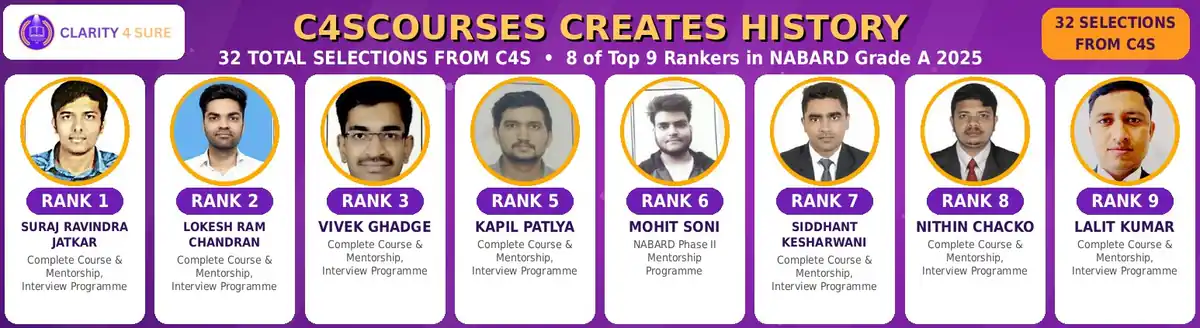
Free chapter notes explain one topic at a time. The C4S NABARD Grade A Mentorship cum Complete Course takes you through the whole syllabus with expert mentor guidance, concept classes, pinpointed master notes, chapter-wise tests, PYQ analysis, PIB and current affairs, and Phase 1 and Phase 2 preparation. In NABARD Grade A 2025, C4S students took 8 of the top 10 ranks and 32 final selections.

Toppers’ Talk
Join the NABARD Grade A Mentorship cum Complete Course
Expert mentor guidance, concept classes, master notes and chapter-wise tests for the whole NABARD syllabus, from the team behind 8 of the top 10 ranks in NABARD Grade A 2025.
NABARD Grade A 2026 Complete Course & Mentorship
For the upcoming 2026 cycle, Phase 1 and Phase 2.
Join NABARD 2026NABARD Grade A 2027 Complete Course & Mentorship
Foundation to Phase 2 for 2027 aspirants, with a free trial.
Join NABARD 2027NABARD English Descriptive
Essay, précis and letter for Phase 2 Paper I, every answer evaluated.
Join English DescriptiveFree ARD practice: Telegram, WhatsApp, YouTube and PYQ PDFs
Seed science revision checklist for NABARD
- Seed vs grain
- Qualities of good seed
- Nucleus → breeder → foundation → certified
- Tag colours, including TL
- Who produces each class
- Isolation and roguing
- Hybrid seed: detasselling, CMS A/B/R
- SRR norms and VRR
- Certification stages and validity
- Seed tests, TZ test, ISTA
- Dormancy causes and methods
- Processing steps
- Machines and what they separate
- Seed treatment and bio-agents
- Orthodox vs recalcitrant seed
- Gene bank, seed vault, cryopreservation
- Seed village concept and programme
- Seed laws 1966–2025
- NSC, IISS, NBPGR, PPV&FRA, BBSSL
- Seeds Bill 2025 and NMHYS
Next in the series: Chapter 3, Agro-Meteorology
Weather parameters, crop-weather advisory, monsoon, El Niño and La Niña (asked in 2025), and agromet advisory services.
More NABARD Grade A guides from C4S
- NABARD agronomy notes (Chapter 1)
- NABARD Grade A previous year question papers 2021–2025
- How to prepare ARD for NABARD Grade A 2027
- NABARD ESI guide
- How to study PIB for NABARD Grade A
- IBPS AFO to NABARD Grade A 2026
- NABARD Descriptive English guide
- NABARD Grade A cut-off analysis
NABARD seed science: frequently asked questions
What is the seed science syllabus for NABARD Grade A?
The NABARD ARD syllabus lists “seed production, seed processing, seed village” in its agronomy block. NABARD’s questions also cover classes of seed and tags, roguing, seed certification and testing, dormancy, Seed Replacement Rate, germplasm storage and seed laws.
Is seed science important for NABARD Grade A 2026?
Yes. NABARD asked 10 seed science questions from 2021 to 2025, including two or three in each recent cycle, and the breeder-to-foundation seed chain came in both 2023 and 2024. For NABARD 2026, add the current affairs too: the Draft Seeds Bill 2025, the National Mission on High Yielding Seeds and the second gene bank.
How many seed science questions come in NABARD Grade A?
NABARD asked 10 seed science questions from 2021 to 2025, usually one to three per cycle, mostly in Phase 1 ARD. The breeder-to-foundation seed chain was asked in both 2023 and 2024.
What are the classes of seed in India?
Nucleus seed, breeder seed (golden yellow tag), foundation seed (white tag) and certified seed (azure blue tag). Truthfully labelled seed carries an opal green label and is not officially certified.
What is a seed village?
A village where a trained group of farmers produces quality seed of selected crops for its own needs and nearby villages. Under the Seed Village Programme, farmers get 50% of the cost of foundation or certified seed for cereals and 60% for pulses, oilseeds, fodder and green manure crops for one acre, plus training.
What is Seed Replacement Rate?
The percentage of a crop’s area sown with certified or quality seed rather than farm-saved seed. Recommended norms are about 25–33% for self-pollinated crops, 35–50% for cross-pollinated crops and 100% for hybrids.
What are the steps of seed processing?
Receiving, drying, pre-cleaning, cleaning, grading, upgrading, treating, bagging and labelling, and storage. The air-screen cleaner is the basic cleaning machine; the indent cylinder, specific gravity separator and spiral separator upgrade the lot by length, density and shape.
What is the Draft Seeds Bill, 2025?
A draft law released in November 2025 to replace the Seeds Act, 1966 and the Seeds (Control) Order, 1983. It proposes mandatory registration of seed varieties, QR-coded traceability and penalties of up to ₹30 lakh and three years’ imprisonment for major offences, while letting farmers save and sell unbranded farm-saved seed.
Sources: NABARD questions from the C4S NABARD Grade A PYQ repository (memory-based, 2021–2025); Seed Village Programme assistance from Ministry of Agriculture parliamentary replies; National Mission on High Yielding Seeds from the Union Budget 2025-26 speech; Draft Seeds Bill, 2025 from the Ministry of Agriculture release of November 2025.