
How to Study PIB for NABARD Grade A: What to Read, What to Skip & PYQ Strategy
“Read PIB” is the most repeated advice for NABARD Grade A 2027, and the least explained. This guide shows exactly which Press Information Bureau releases deserve your time, what to extract from each one, and how NABARD has turned specific PIB releases into questions. We traced nine NABARD Grade A previous year questions from the 2023, 2024 and January 2026 papers back to the release behind them, with the date, the ministry and the exact fact NABARD lifted, so you can prepare government schemes and current affairs for NABARD 2027 the way the paper actually asks them.

Written by Faiz Sir, NABARD Grade A mentor at Clarity 4 Sure (C4S), with experience across multiple NABARD Grade A and UPSC CSE exam cycles. Updated 31 October 2026. C4S students took 8 of the top 10 ranks in NABARD Grade A 2025.
Daily help: ready-filtered releases every day in C4S Daily PIB Updates, and video explanations in the C4S PIB playlist on YouTube.
- PIB release
- NABARD relevance
- Exam facts
- Static background
- MCQs
- Phase 2 angle
The aim is not to become a reader of government press releases. It is to become a selective extractor of NABARD-relevant facts.
Is PIB important for NABARD Grade A 2027?
Yes, but selective PIB, not the whole website. PIB matters because a large part of the NABARD syllabus is government policy in action:
- Agriculture & Rural Development (ARD): farm schemes, irrigation, crop insurance, marketing, livestock, fisheries, horticulture, natural farming, credit, FPOs, mechanisation, rural development.
- Economic & Social Issues (ESI): schemes on poverty, employment, financial inclusion, health, education, women, skills, MSMEs, livelihoods.
- General Awareness (GA): major initiatives, institutions, reports, portals, committees and policy announcements.
- Phase 2: the same developments return as passage-based objective questions and descriptive answers.
So PIB is not a separate subject. It is a current-affairs layer over ARD, ESI and GA. The C4S NABARD PYQ repository shows how strong that layer is: the 2023 ESI paper was dominated by government schemes, and in 2025 most ESI questions came from schemes, reports and NABARD’s own publications rather than textbook economics.
PIB-based questions in NABARD: 9 PYQs traced to their PIB releases
NABARD never states its sources, and every question below is memory-based. But each one matches a specific PIB release closely: the same numbers, the same lists, sometimes the same phrasing. The bar shows how many months passed between the release and the exam that tested it.
Five of the ten release-to-exam pairs were under five months; the oldest was almost two years. Exam dates from the C4S PYQ repository; release dates from PIB.
1. PACS computerisation: one release, four Phase 2 questions (2023)
- PIB release
- “Cabinet approves Computerization of Primary Agriculture Credit Societies (PACS)”, Cabinet Committee on Economic Affairs, 29 June 2022
- NABARD paper
- Phase 2 ARD, 19 November 2023 (passage with four questions)
Passage: computerisation of 63,000 functional PACS with an outlay of ₹2,516 crore, on common ERP software linked to NABARD through StCBs and DCCBs, with GoI, state and NABARD shares of ₹1,528 crore, ₹736 crore and ₹252 crore. Questions asked: the full form of PACS; the project duration; the implementing agency; and the policy background.
Show answers and what NABARD lifted
PACS = Primary Agricultural Credit Society. Implementing agency: NABARD. The Cabinet release put the project at five years.
2. Vibrant Villages Programme: PIB wording inside the question (2023)
- PIB release
- Cabinet approval of the Vibrant Villages Programme, Ministry of Home Affairs, 15 February 2023 (₹4,800 crore, FY 2022-23 to 2025-26)
- NABARD paper
- Phase 1 ESI, 16 October 2023
Vibrant Villages Programme covers identified villages in 46 blocks of 19 districts on the northern border. Which are its focus interventions? 1. Road connectivity 2. Housing and village infrastructure 3. Energy including renewables 4. Television and telecom connectivity 5. Tourism and cultural heritage
Show answer and what NABARD lifted
All of the above.
3. National Sickle Cell Anaemia Elimination Mission: a four-question passage (2023)
- PIB release
- “PM launches National Sickle Cell Anaemia Elimination Mission”, Shahdol, Madhya Pradesh, 1 July 2023 (announced in Budget 2023-24)
- NABARD paper
- Phase 2 ESI, 19 November 2023
Which statements are correct? 1. People aged 0–18 are eligible. 2. It will incrementally cover everyone up to 45 years under NHM. 3. It aims to screen and counsel 7 crore people in three and a half years.
Show answer and what NABARD lifted
1 and 3. The mission starts with the 0–18 age group and extends incrementally up to 40 years, not 45. The same passage asked the mission’s name, its measures, and its target year (elimination as a public-health problem by 2047).
4. PM Vishwakarma: release plus guidelines (2023)
- PIB release
- Cabinet (CCEA) approval of PM Vishwakarma, 16 August 2023: ₹13,000 crore, FY 2023-24 to 2027-28, 18 family-based trades; launched 17 September 2023 (PIB backgrounder)
- NABARD paper
- Phase 2 ESI, 19 November 2023
Who is eligible under PM Vishwakarma? 1. A traditional wood/rubber artisan 2. A wooden toy maker 3. A woman tailor whose husband is a government servant
Show answer and what NABARD lifted
1 and 2. Families with a member in government service are excluded.
5. Union Budget 2023-24: three Phase 2 ARD questions from one speech (2023)
- PIB source
- Union Budget 2023-24 speech and PIB Budget highlights, 1 February 2023
- NABARD paper
- Phase 2 ARD, 19 November 2023
(a) Which centre has been declared the Global Centre of Excellence for Millets (Shree Anna)? (b) Which programme was announced with ₹2,200 crore to boost quality planting material for high-value horticulture? (c) Which Central Sector sub-scheme under PMMSY supports fisheries micro and small enterprises with over ₹6,000 crore?
Show answers and what NABARD lifted
(a) ICAR-Indian Institute of Millets Research, Hyderabad. (b) Horticulture Clean Plant Programme. (c) PM Matsya Kisan Samridhi Sah-Yojana (PM-MKSSY).
6. Three national multi-state cooperatives: a 20-month-old release (2024)
- PIB release
- Cabinet approval of national-level multi-state cooperative societies for exports, organic products and seeds, 11 January 2023
- NABARD paper
- Phase 1 ESI, 1 September 2024
In which areas has the Government set up three national-level multi-state cooperative societies? (i) Certified seeds (ii) Organic farming (iii) Promoting exports (iv) Oil palm production
Show answer and what NABARD lifted
(i), (ii) and (iii): Bharatiya Beej Sahakari Samiti Ltd, National Cooperative Organics Ltd and National Cooperative Exports Ltd.
7. PM-JUGA and PM-JANMAN: Budget in Phase 1, Cabinet in Phase 2 (2024)
- PIB releases
- Budget 2024-25 announcement, 23 July 2024; Cabinet approval of Pradhan Mantri Janjatiya Unnat Gram Abhiyan, 18 September 2024 (₹79,156 crore; about 63,000 villages; based on the learnings of PM-JANMAN, launched 15 November 2023)
- NABARD papers
- Phase 1 ESI, 1 September 2024 and Phase 2 ESI, 20 October 2024
Phase 1: Which statements about PM Janjatiya Unnat Gram Abhiyan are correct? … (iii) It will benefit 75,000 villages …
Phase 2 passage: “The Cabinet approved __X__ with an outlay of ₹79,156 crore … based on the learnings of __Y__, launched to ensure 100% saturation in PVTG habitations.” About Y: 1. Launched on 15 November 2023 2. Targets 75 PVTG communities 3. They live in 18 states and 1 UT.
Show answers and what NABARD lifted
Phase 1: statement (iii) is wrong; the scheme covers about 63,000 villages. Phase 2: X is the Abhiyan (launched as Dharti Aaba Janjatiya Gram Utkarsh Abhiyan on 2 October 2024); Y is PM-JANMAN, and all three statements about Y are correct.
8. PM-SURAJ and PM VISVAS: a 22-month-old launch in the January 2026 paper
- PIB release
- “PM launches Pradhan Mantri Samajik Utthan evam Rozgar Adharit Jankalyan (PM-SURAJ) portal”, Ministry of Social Justice and Empowerment, 13 March 2024; VISVAS details repeated in the Ministry’s Year-End Review 2024
- NABARD paper
- Phase 2 ESI, 25 January 2026 (2025 cycle)
Passage: Minister X announced PM VISVAS, giving 5% interest subvention to SC, OBC and Safai Karamchari SHGs and individuals through the ______ portal. Identify the portal and Minister X.
Show answers and what NABARD lifted
The PM SURAJ portal; Minister X is Dr Virendra Kumar, Minister of Social Justice and Empowerment.
9. Mission for Aatmanirbharta in Pulses: tenure tested 11 weeks after approval (2025)
- PIB releases
- Announced in Budget 2025-26 (1 February 2025); Cabinet approval on 1 October 2025; launched 11 October 2025 (PIB backgrounder): ₹11,440 crore, 2025-26 to 2030-31, 350 lakh tonnes target
- NABARD paper
- Phase 1 ESI, 20 December 2025
What is the tenure of the Mission for Aatmanirbharta in Pulses?
Show answer and what NABARD lifted
Up to 2030-31 (a six-year mission from 2025-26).
NABARD Grade A 2025 toppers from C4S: the method works
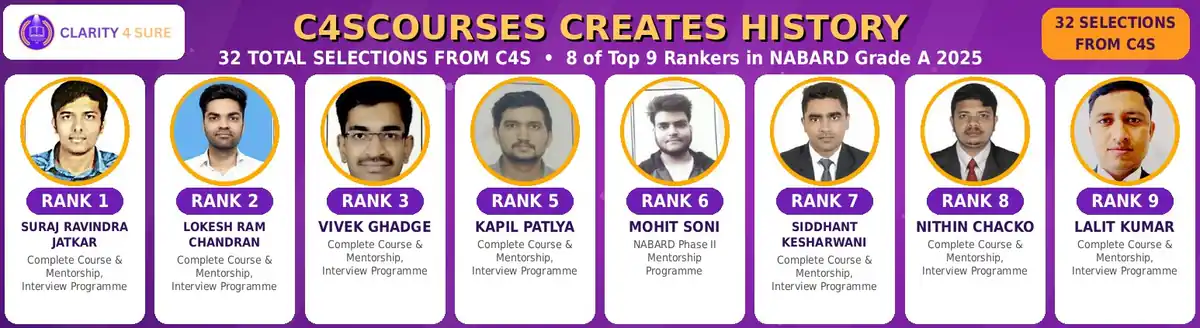
This scheme-first, PYQ-led way of reading PIB is how C4S students prepare ESI and ARD. In NABARD Grade A 2025, C4S students took 8 of the top 10 ranks (Ranks 1, 2, 3, 5, 6, 7, 8 and 9) and 32 final selections came from the NABARD Mentorship and Test Series programme.


How many months of PIB and current affairs for NABARD Grade A 2027?
The traced questions settle this with evidence rather than a rule of thumb. Cover PIB in three layers:
- Last 6 months before the exam: read every A+ release. Five of the ten traced release-to-exam gaps were under five months, and one question came 32 days after the Cabinet decision.
- 6 to 24 months back: revise schemes and Cabinet decisions. PACS computerisation (17 months), the three national cooperatives (20 months) and PM-SURAJ (22 months) all came from this band.
- Flagship schemes: no time limit. PMFBY, MGNREGA and KCC are tested every year whatever their launch date. If an old scheme is revised, the revision becomes current affairs.
In short: current-affairs window ≠ scheme launch window.
What to read on PIB and what to skip
PIB publishes far more than NABARD can ask. Your first job is filtering, not reading. Ask of every release: is there a new scheme, a change to an existing one (eligibility, subsidy, funding), a new mission, a Cabinet or Budget decision, a report, or headline production data? If it is only a minister attending an event, skip it.
| PIB content | Priority | What to do |
|---|---|---|
| New scheme or mission (agriculture, rural, social sector) | A+ | Read fully; make a scheme note |
| Cabinet approval or major scheme revision | A+ | Read fully; note outlay, duration, coverage, agency |
| Change in eligibility, subsidy, premium or funding | A+ | Memorise the change |
| Budget-day announcements | A+ | One-page note with outlays |
| Ministry Year-End Review (December) | A+ | Use as a revision index |
| Important report, survey or index | A | Extract key facts only |
| Production estimates (foodgrains, horticulture, milk, fish) | A | Headline figures and leading states |
| NABARD- or RBI-related development | A | Read |
| Portal or app launch | B | Read if linked to a scheme |
| Conference outcome | C | Only if a decision was taken |
| Routine speech, inauguration, visit, ceremony | Skip | Ignore |
Generally skip: routine minister speeches, ceremonial events, anniversaries without policy content, minor inaugurations, duplicate releases, political statements, long success stories with no new data, district-level achievements and event schedules. Selective reading is not incomplete preparation; it is exam-oriented preparation.
Which PIB ministries should NABARD aspirants follow?
Tier 1: follow every release
| Ministry | Focus for NABARD |
|---|---|
| Agriculture & Farmers Welfare | PM-KISAN, PMFBY, PM-AASHA, AIF, FPOs, natural and organic farming, digital agriculture, irrigation, horticulture, marketing, mechanisation, credit, seeds, soil health, pulses, edible oils, production estimates |
| Rural Development | MGNREGA, DAY-NRLM, PMAY-G, DDU-GKY, SHGs, rural infrastructure, land records |
| Fisheries, Animal Husbandry & Dairying | PMMSY, fisheries and milk production, livestock missions, animal health, breed improvement, Livestock Census |
| Finance | Financial inclusion, credit, MSMEs, banking, insurance, pension, Budget |
| Cooperation | PACS, cooperative credit, PACS computerisation, grain storage, national cooperatives |
Tier 2: follow selectively
MSME, Education, Health, Women & Child Development, Skill Development, Social Justice, Tribal Affairs, Jal Shakti, Environment, Food Processing, Consumer Affairs & Food, Panchayati Raj, and Statistics & Programme Implementation. The traced PYQs show why: Sickle Cell (Health and Tribal Affairs), PM-SURAJ (Social Justice) and PM-JUGA (Tribal Affairs) all came from Tier 2. The rule: follow the topic, not the ministry.
Government schemes for NABARD: what to extract from a PIB release
A 2,000-word release rarely needs a 2,000-word note. For every important scheme, extract these 13 points:
| Point | What to note |
|---|---|
| Name | Full name and abbreviation |
| Ministry | Administering ministry or department |
| Launch or approval | Date and approving body (Cabinet, CCEA, Budget) |
| Objective | The problem it solves |
| Beneficiary | Who receives the benefit |
| Eligibility | Who qualifies and who is excluded |
| Financial assistance | Subsidy, premium, grant, credit, interest subvention |
| Funding pattern | Centre–state–other shares |
| Components | Sub-schemes and focus areas (full list) |
| Implementing agency | Who actually implements it |
| Target | Coverage, beneficiaries, area, production |
| Duration | Approved period |
| Latest change | Why it is in the news now |
Every one of the nine traced questions maps to a row of this table: outlay and funding split (PACS), components (Vibrant Villages), eligibility (PM Vishwakarma, Sickle Cell), duration (Pulses), implementing agency (PACS) and portal (PM VISVAS).
Don’t study a scheme twice. If PIB announces a change to PMFBY, do not write a new five-page note. Update your master note: static background → latest change → PYQs → latest MCQs.
Worked examples: reading a PIB release the NABARD way
PM-AASHA: from one release to a whole ARD chapter
“PM-AASHA is a government scheme for farmers” is a useless note. Start with the core issue: price support and protection from distress sales. Then map the architecture: price support → MSP → procurement or price intervention → components → implementing agencies → latest change. From one release you revise MSP, CACP, procurement, marketable surplus, pulses and oilseeds, NAFED and NCCF.
NABARD did test the architecture: the 2023 ESI paper asked which of the Price Support Scheme, the Price Deficiency Payment Scheme and the Pilot of Private Procurement & Stockist Scheme are components of PM-AASHA (answer: all three). The same release can feed a Phase 2 descriptive on price-support mechanisms and farmer income.
PMFBY: go inside the scheme
- Objective
- Farmer premium
- Crops and risks covered
- Claim mechanism and triggers
- Technology
- Latest revision
NABARD 2024 ARD asked the farmer’s premium for kharif crops (2% of sum insured; 1.5% for rabi, 5% for commercial and horticultural crops). NABARD 2025 ARD asked the add-on trigger: on-account payment when expected yield is likely to be below 50% of normal. When PMFBY appears on PIB, look for premium, eligibility, coverage, technology, claims and changes.
MGNREGA: one scheme, many operational questions
A note that says “100 days of employment” is not enough. NABARD has asked: 150 days for ST households in forest areas with FRA rights (2023), the unemployment allowance of one-fourth of the wage for the first 30 days and one-half thereafter (2023), Gram Rozgar Diwas (2023), the 60:40 wage–material ratio at district level (2025), and job-card validity of five years (2025). For flagship schemes, go one layer deeper than objective and ministry.
Agriculture production estimates: data attached to concepts
From a foodgrain estimate, extract total production, crops at record levels, key crop figures, leading states and the change from the previous estimate. Skip every decimal, minor crops and long tables. NABARD can ask rankings, season–crop links, or which mission targets a commodity. Data should always be attached to a concept.
Natural farming and Digital Agriculture Mission: build the ecosystem
For the National Mission on Natural Farming, note ministry, objective, cluster architecture, farmer support, bio-input resource centres, outlay and duration, and link it to PKVY, soil health and climate-resilient agriculture. NABARD 2024 Phase 2 asked statements on natural farming (BPKP), and the 2025 descriptive asked the components, benefits and challenges of the Digital Agriculture Mission. For DAM, learn what each component answers: Farmer ID (who is the farmer?), geo-referenced land records (where is the farm?), Digital Crop Survey (what is being grown?).
PIB for ARD, ESI and GA: what each section needs
| Section | Priority PIB areas |
|---|---|
| ARD | Schemes (highest), production, credit (KCC, interest subvention, AIF, cooperatives), PMFBY, marketing (e-NAM, FPOs, MSP, PM-AASHA), irrigation (PMKSY), livestock and dairy, fisheries (PMMSY), horticulture (MIDH), natural and organic farming, mechanisation and drones, digital agriculture |
| ESI | Schemes on poverty, employment, housing, health, education, women, children, skills, financial inclusion, MSMEs, tribal development and livelihoods; reports and indices (publisher, what it measures, India’s position, one or two findings); PLFS indicators (LFPR, WPR, UR, usual vs current weekly status); PMJDY, MUDRA, insurance and pension schemes, SHG-bank linkage |
| GA | Major schemes, portals, committees, institutions, reports and national initiatives, wider but shallower. Do not let GA PIB eat into ARD and ESI time. |
One release, four uses
Take a PMMSY update. GA: scheme and ministry. ARD: fisheries, aquaculture, infrastructure. ESI: livelihoods, exports, rural economy. Phase 2: challenges and opportunities in India’s fisheries sector (NABARD asked PMMSY as a 15-mark descriptive in 2022). This is why topic integration beats ministry-wise memorisation.
Which PIB numbers to remember, and which to skip
| Category | Examples | Action |
|---|---|---|
| A: must remember | Assistance amounts, eligibility thresholds, premiums, funding ratios, major outlays, key targets, durations, important ranks | Memorise exactly |
| B: headline only | Production totals, beneficiary counts, broad allocations, milestones | Round figure and trend |
| C: skip | District data, long tables, repetitive state figures, tiny year-on-year changes | Ignore |
The dynamic data rule: if NABARD asked a value that changes (repo rate, milk-production share, a ranking, number of KVKs), the PYQ tells you the indicator is exam-worthy, not that the old value is. Mark it “dynamic: update before the exam”.
PIB strategy for Phase 1, Phase 2 objective and Phase 2 descriptive
Phase 1: fast recall
Notes as compact rows: scheme, ministry, objective, beneficiary, assistance, key feature, latest change. Reports: name, publisher, what it measures, India’s position, key finding. No paragraphs.
Phase 2 objective: one level deeper
For each A+ development ask why it was needed, how it works, who implements it, what its components are and what changed recently. That is exactly the shape of the PACS, Sickle Cell, PM-JUGA and PM VISVAS passages.
Phase 2 descriptive: examples, not PIB language
Use PIB to collect current examples, interventions, data and scheme names, then combine them with concepts. For an answer on agricultural marketing, that means MSP, PM-AASHA, e-NAM, FPOs, AIF, warehousing and digital procurement. Never copy release wording into an answer.
The C4S triangle
Every important PIB note should connect three things: static (which syllabus chapter), current (what exactly happened) and PYQ (how NABARD has tested this area). If you cannot make all three connections, the note is incomplete.
A daily, weekly and monthly PIB routine
The 15-minute daily method
- Scan (3 minutes): look only for NABARD-relevant releases. Short on time? Watch the day’s releases explained in the C4S PIB playlist.
- Extract (7 minutes): write only exam-worthy facts, using the 13-point framework.
- Connect (3 minutes): link to the static chapter, the scheme note and PYQs.
- Question (2 minutes): ask, “If I were NABARD, what would I ask from this?”
Weekly
Revise all A+ items, solve MCQs, mark wrong answers, return to the note, add the missing concept, and re-attempt: read → MCQ → analyse → revise → re-attempt.
Monthly
Sort the month into must-revise (A+ schemes and policy changes), important (reports, data) and read-once. Build one high-yield sheet organised by agriculture schemes, rural development, ESI and social sector, reports and GA. In December, add every relevant ministry’s Year-End Review.
The 8-point quick-revision card
For the final weeks, compress each scheme to ministry, objective, beneficiary, eligibility, financial assistance, components, implementing agency and latest change, plus target, outlay or duration where they are notable.
Common PIB preparation mistakes
- Reading everything instead of filtering first
- Making notes too long to revise
- Memorising only scheme names, when NABARD asks components, eligibility, outlays and durations
- Ignoring the static background behind a current development
- Ignoring PYQs, which show the depth NABARD wants
- Memorising every number instead of using the A/B/C rule
- Reading without solving MCQs
- Not revising: current affairs fade fastest
- Keeping ARD, ESI and GA notes in separate silos
- Studying PIB only for Phase 1, when the same facts drive Phase 2 passages and answers
Free NABARD PYQ PDFs, videos and Telegram channels
Free full-length NABARD PYQ PDFs on WhatsApp
Get any year’s complete NABARD Grade A question paper with answers, free. Tap a year to message C4S on WhatsApp:
Solve NABARD previous year questions online
Every question traced above sits in the NABARD Grade A PYQ repository (2021–2025) with answers and analysis. Year-wise pages: NABARD 2025 PYQs, 2024, 2023, 2022 and 2021. Also see the NABARD cut-off analysis, NABARD ESI guide, ARD topic-wise weightage, Descriptive English guide, daily current affairs, the daily quiz, the NABARD Grade A hub and PYQs for RBI, SEBI, IRDAI and more.
Free C4S videos on schemes, current affairs and PYQs
- C4S PIB playlist for NABARD, RBI and SEBI: important PIB releases and schemes explained on video
- Is PIB enough for RBI/NABARD schemes? The big mistake most aspirants make
- NABARD ESI question analysis, 2021–2024
- Priority chapters for ARD, ESI and GA based on PYQs
- NABARD 2021–2024 cut-off analysis
- The most important ARD chapters to revise
- 45-day final revision plan with daily targets and the 30-day consolidation plan
- NABARD Grade A PYQ Analysis playlist (topic-wise ARD and ESI PYQs)
- All C4S playlists: videos and notes
Join C4S on Telegram, WhatsApp, YouTube and Instagram
NABARD Grade A courses: enrol with C4S
Prepare government schemes, PIB, ESI and ARD with the mentors behind 8 of the top 10 NABARD Grade A 2025 ranks.
NABARD Grade A Phase 1 Crash Course 2026
Phase 1 in 30 days: ESI, ARD and current affairs for the upcoming prelims.
₹999
Enrol now: Crash CourseNABARD Grade A 2026 Mentorship & Test Series
Complete course, mentorship and test series for the 2026 cycle.
₹3,500 ₹6,000
NABARD Grade A 2027 Complete Course & Mentorship
Foundation to Phase 2 for 2027 aspirants, with a free trial.
₹3,999 ₹6,999
NABARD English Descriptive Course
Essay, précis and letter with every answer evaluated by a mentor.
₹1,499 ₹3,000
Compare all NABARD courses Start a free trial
Fees as listed on c4scourses.in on 31 October 2026; check the course page for current offers. Course details: Crash Course, Mentorship & Test Series 2026, 2027 programme, English Descriptive.
PIB for NABARD Grade A: frequently asked questions
Is PIB important for NABARD Grade A?
Yes. Government schemes, Cabinet decisions and Budget announcements drive a large share of NABARD’s ESI, ARD and GA questions and many Phase 2 passages. Read PIB selectively: new schemes, scheme changes, Cabinet and Budget decisions, reports and production data.
How many months of PIB should I read for NABARD?
Read every important release from the last six months, revise schemes and Cabinet decisions from the last 24 months, and keep flagship schemes such as PMFBY, MGNREGA and KCC updated regardless of launch date. Traced NABARD questions came from releases between one and 22 months old.
Which PIB ministries matter most for NABARD?
Agriculture & Farmers Welfare, Rural Development, Fisheries, Animal Husbandry & Dairying, Finance and Cooperation. Follow others, such as Health, Tribal Affairs and Social Justice, when a release touches the syllabus.
What should I note from a PIB release on a scheme?
Name, ministry, approval date, objective, beneficiary, eligibility, financial assistance, funding pattern, components, implementing agency, target, duration and the latest change. NABARD questions most often test outlays, components, eligibility, duration and the implementing agency.
Has NABARD asked questions directly from PIB releases?
NABARD does not name its sources, but many questions match specific releases closely. The 2023 Phase 2 passage on PACS computerisation used the outlay and cost shares from the Cabinet release of 29 June 2022, and the 2024 Phase 2 passage on PM-JUGA used the ₹79,156 crore outlay from the Cabinet release of 18 September 2024.
Should I memorise every number in a PIB release?
No. Memorise assistance amounts, thresholds, premiums, funding ratios, outlays, targets and durations exactly; keep production and beneficiary figures as round numbers; skip district-level data and long tables.
Which government schemes are important for NABARD Grade A 2027?
Prioritise agriculture, rural development, cooperation, fisheries and animal husbandry, and social-sector schemes: PMFBY, PM-KISAN, PM-AASHA, MGNREGA, DAY-NRLM, PMAY-G, PMMSY, MIDH, the Pulses Mission, the Digital Agriculture Mission, the National Mission on Natural Farming, PACS computerisation and recent Cabinet-approved missions. Learn their outlay, components, eligibility, duration and implementing agency.
Is PIB enough for NABARD Grade A current affairs?
No. PIB tells you which schemes are in the news, but eligibility rules and exclusions often come from scheme guidelines, and NABARD also asks reports, NABARD’s own publications and static concepts. Use PIB with PYQs, scheme guidelines and a monthly current-affairs compilation.
Sources: memory-based NABARD questions and exam dates from the C4S NABARD Grade A PYQ repository (2023, 2024 and 2025 cycles); release dates and figures from the Press Information Bureau releases linked in each card. NABARD does not publish the sources of its questions; the traces show the closest matching official release.