Source: PIB
Context:
The Central Government has officially notified all four Labour Codes, replacing 29 old labour laws (some from the 1930s–1950s). These Codes are being projected as a big step toward modernising India’s labour market.
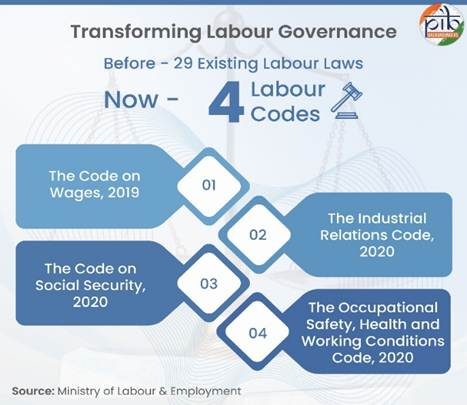
The Four Labour Codes
- Code on Wages (2019)
- Industrial Relations Code (2020)
- Code on Social Security (2020)
- Occupational Safety, Health and Working Conditions (OSHWC) Code (2020)
Key Objectives of the Labour Codes
- Simplification & Streamlining: Rationalises 29 labour laws into four comprehensive Codes.
- Enhanced Worker Protection: Covers wages, safety, social security, and welfare.
- Future-Ready Workforce: Supports flexible, formal employment with social protection.
- Inclusive Growth: Promotes gender equality, youth participation, and gig/migrant worker coverage.
- Ease of Compliance for Employers: Single registration, single license, single return.
Labour Codes and Key Features (India, 2025)
Code on Wages, 2019
- Universal Minimum Wage: Ensures minimum wage for all workers across organized & unorganized sectors.
- National Floor Wage: Central minimum benchmark; states cannot fix wages below this level.
- Gender-Neutral Pay: Prohibits wage discrimination across genders, including transgender workers.
- Overtime at 2× Rate: Mandatory for work beyond standard hours.
- Inspector-cum-Facilitator: Shifts focus from penal action to compliance guidance.
- Decriminalized Offences: Minor violations replaced by monetary penalties for compliance-friendly governance.
Industrial Relations Code, 2020
- Fixed-Term Employment (FTE): Time-bound contracts with full benefits, gratuity eligibility after 1 year.
- Re-skilling Fund: 15 days’ wages for retrenched employees for training & employability.
- Trade Union Recognition: Union with ≥51% membership recognized; otherwise, negotiating council formed.
- Higher Layoff Threshold: Approval for layoffs/closures raised from 100 → 300 workers.
- Strike Notice Rule: 14-day notice required to minimize disruption and promote negotiations.
- Expanded Definitions: Includes journalists, sales staff, supervisory employees earning ≤₹18,000.
Code on Social Security, 2020
- Universal Social Security: Life, health, maternity, old-age benefits extended to unorganized, gig, and platform workers.
- ESIC & EPF Expansion: Pan-India coverage; EPF inquiries time-bound & transparent.
- Social Security Fund: Dedicated fund for unorganized/gig workers, financed via aggregator contributions and penalties.
- Self-Assessed Cess: Builders can self-assess construction cess digitally.
- Gratuity for FTEs: Eligible after 1 year, improving project-based worker protections.
- Uniform Wage Definition: Standardizes wage components for correct EPF/ESIC/gratuity calculation.
Occupational Safety, Health & Working Conditions (OSHWC) Code, 2020
- Single Registration/Return: One unified system replaces multiple registrations.
- Migrant Worker Benefits: Includes self-migrated workers; annual travel allowance & portability of entitlements.
- Women’s Night Work: Allowed with consent & safety provisions; promotes equality & inclusion.
- National Worker Database: Digital database for unorganized/migrant workers; enables benefits & skill mapping.
- Working Hours Limit: 8 hours/day, 48 hours/week.
- Safety Committees: Required in establishments with ≥500 workers; joint employer–employee governance.
- Decriminalized Penalties: Minor offences converted into fines/compounding for compliance-oriented approach.
Significance
- Social Security Expansion: Workforce coverage increased from 19% (2015) → 64% (2025); Labour Codes further widen net.
- Pro-Worker & Pro-Employment: Protects informal, gig, migrant, and youth workers while enabling modern, flexible work arrangements.
- Boosts Industrial Growth & Employment: Simplified compliance and flexible frameworks enhance productivity.
- Inclusive & Gender-Sensitive: Equal pay, safety standards, and workforce participation encouraged.