Daily Current Affairs Quiz
04 & 05 March, 2026
International Affairs
1. Strait of Hormuz
Source: TH
Context:
Rising tensions involving Iran, Israel, and the United States have brought global attention to the Strait of Hormuz, due to fears that conflict could disrupt global oil and LNG shipments.
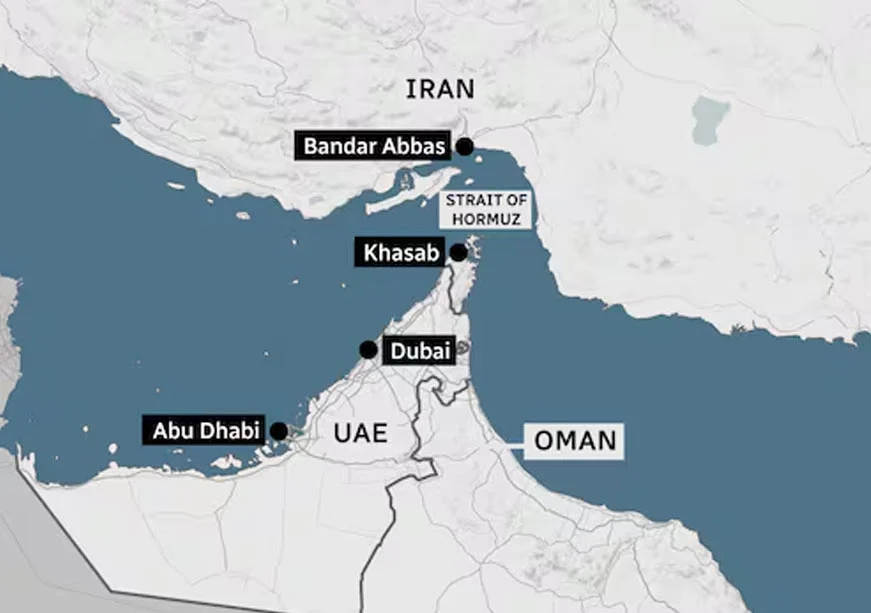
What is the Strait of Hormuz?
The Strait of Hormuz is a strategically vital maritime passage through which a large share of the world’s oil and gas exports travel from the Persian Gulf to global markets.
It is considered one of the most important energy chokepoints in the world.
Location
- Lies between Iran (north) and Oman (south).
- Connects the Persian Gulf to the Gulf of Oman and then to the Arabian Sea, opening into the Indian Ocean.
Geographic Features
- Narrowest width: ~33 km
- Shipping lanes: about 3 km wide in each direction
Because of this narrow passage, the strait is considered a critical maritime chokepoint.
Historical Importance
The Strait of Hormuz has long been central to global geopolitics and trade.
Major historical events linked to it include:
- 1973 Arab Oil Embargo
- Iran–Iraq War (1980–88), especially the “Tanker War”
- Repeated tensions involving tanker seizures and sanctions in 2012, 2019, and 2023–24
Iran has often used the threat of blocking the strait as a strategic tool during geopolitical disputes.
National Affairs
1. 16th Finance Commission on Centre–State Fiscal Relations (2026–31)
Source: TH
Why in News?
The 16th Finance Commission of India has submitted its recommendations for the period 2026–31. It retained the States’ share in tax devolution at 41%, while introducing changes in the horizontal distribution formula and proposing reforms such as merging cesses and surcharges into the divisible pool.
Constitutional Background
The Finance Commission is constituted under Article 280 of the Constitution of India to recommend:
- Distribution of tax revenues between the Centre and States (vertical devolution).
- Distribution of funds among states (horizontal devolution).
- Grants-in-aid under Article 275 of the Constitution of India.
The certification of the net proceeds of taxes is done by the Comptroller and Auditor General (CAG) under Article 279 of the Constitution of India.
Key Recommendations of the 16th Finance Commission
1. Vertical Devolution
The Commission retained the states’ share at 41% of the divisible pool, continuing the arrangement recommended by the 15th Finance Commission of India.
Grand Bargain Proposal
To address concerns about the rise of cesses and surcharges, the Commission proposed a “grand bargain”:
- The Centre should merge most cesses and surcharges into shareable taxes.
- States accept a smaller share of a larger divisible pool.
This aims to expand the total pool of shareable taxes.
Horizontal Devolution Formula
The Commission introduced a revised formula to distribute funds among states.
| Criterion | Weight |
|---|---|
| Income Distance | 42.5% |
| Population (2011 Census) | 17.5% |
| Demographic Performance | 10% |
| Forest & Ecology | 10% |
| Area | 10% |
| Contribution to GDP | 10% |
Key Changes
- Contribution to GDP (10%) introduced as a new criterion.
- Replaces earlier tax effort/fiscal discipline parameter.
- Slight reduction in income distance weight.
This shift rewards economic performance while maintaining redistribution goals.
Grants-in-Aid
Total grants recommended: ₹9.47 lakh crore
1. Local Body Grants – ₹8 lakh crore
Split between:
- Rural local bodies: ₹4.4 lakh crore
- Urban local bodies: ₹3.6 lakh crore
Conditions include:
- Timely constitution of State Finance Commissions
- Audited accounts
- Functional local governance institutions.
New Initiatives
- Urbanisation Premium Grant: ₹10,000 crore
- Infrastructure Grants for wastewater management: ₹56,100 crore
2. Disaster Management Grants – ₹2.04 lakh crore
Funds allocated for State Disaster Relief and Management Funds.
Cost sharing:
- 90:10 for Northeastern and Himalayan states
- 75:25 for other states.
Fiscal Roadmap and Reform Recommendations
Fiscal Deficit Targets
- Centre: Reduce fiscal deficit to 3.5% of GDP by 2030–31.
- States: Maintain fiscal deficit at 3% of GSDP.
Off-Budget Borrowings
The Commission recommended ending off-budget borrowings and including them in fiscal deficit calculations.
Power Sector Reforms
Encouraged privatisation of DISCOMs to improve efficiency.
Subsidy Rationalisation
Suggested rationalising subsidies, especially unconditional cash transfers enabled by the JAM Trinity (Jan Dhan–Aadhaar–Mobile).
Unconditional cash transfers now account for 20.2% of subsidy spending, up from 3% in 2018–19.
Public Sector Enterprise Reforms
Recommended:
- Closure of 308 inactive State PSEs
- Review of loss-making enterprises.
Key Issues and Criticisms
1. Retaining 41% Devolution
States had demanded 50% share in central taxes.
Critics argue the recommendation:
- Favours the Centre’s fiscal priorities
- Limits states’ untied fiscal resources.
2. Rising Cesses and Surcharges
Cesses and surcharges:
- Are not shared with states.
- Now account for nearly 20% of gross tax revenue.
The Commission did not impose firm limits, which may weaken fiscal federalism.
3. Shift Toward Performance-Based Transfers
The introduction of GDP contribution criterion benefits economically advanced states such as:
- Tamil Nadu
- Karnataka
- Maharashtra
This may reduce redistribution to poorer states.
4. Removal of Revenue Deficit Grants
The Commission discontinued revenue deficit grants, affecting:
- Hill states
- Northeastern states
- Structurally weaker economies.
5. Fiscal Discipline Conditions
Recommendations like:
- 3% deficit limit
- Ending off-budget borrowings
- Subsidy rationalisation
may limit fiscal flexibility of states.
Impact on States
Major Losing States
- Uttar Pradesh
- Bihar
- West Bengal
- Madhya Pradesh
- Odisha
- Several Northeastern states.
Implication
Reduced fiscal transfers could widen regional inequality, especially for states requiring higher public investment.
Steps Needed to Strengthen Fiscal Federalism
1. Increase Vertical Transfers
States’ share in tax revenue should be increased beyond 41%.
2. Limit Cesses and Surcharges
A legal cap (e.g., 10% of gross tax revenue) could prevent excessive centralisation.
3. Ensure Floor Guarantee
No state should receive less than its allocation under the 15th Finance Commission.
4. Strengthen Local Governments
Empower Panchayats and Urban Local Bodies through:
- Greater taxation powers
- Matching grants.
5. Revive Federal Dialogue
Regular meetings of the Inter-State Council of India under Article 263 of the Constitution of India can help resolve fiscal disputes.
2. MGNREGS Workers Flag Glitches in Monitoring App
Source: TH
Context:
Workers under the Mahatma Gandhi National Rural Employment Guarantee Scheme (MGNREGS) have reported technical problems with the updated National Mobile Monitoring System (NMMS) application used to record worker attendance. From March 1, the government made facial recognition mandatory for marking attendance in the NMMS app.
What is the NMMS App?
The National Mobile Monitoring System (NMMS) is a government mobile application used for:
- Recording real-time attendance of workers
- Uploading geotagged photographs of worksites
- Ensuring transparency in wage payments
- Monitoring the implementation of MGNREGS projects
Attendance is recorded by mates or supervisors, who take photographs of workers twice a day and upload them to the system.
Facial Recognition System
The latest update requires:
- Facial recognition authentication of workers
- Matching worker photos with Aadhaar data
- Mandatory use of the updated system to mark attendance
Mahatma Gandhi National Rural Employment Guarantee Scheme (MGNREGS)
The Mahatma Gandhi National Rural Employment Guarantee Scheme (MGNREGS) is one of India’s largest social welfare programmes aimed at enhancing livelihood security in rural areas by providing guaranteed wage employment.
Launch Date
- 2 February 2006
Implementing Ministry
- Ministry of Rural Development, Government of India
Additional Context
- The scheme was introduced under the Mahatma Gandhi National Rural Employment Guarantee Act, 2005.
3. Ruddy Shelduck (Brahminy Duck)
Context:
Residents of Mudh village, Ladakh have been protecting the Ruddy Shelduck for more than two decades. During the breeding season, villagers help escort young birds (fledglings) safely from nesting areas to the Indus River, highlighting a strong example of community-led conservation.
About the Ruddy Shelduck
Scientific Name
- Ruddy Shelduck (Tadorna ferruginea)
- It is also popularly known as the Brahminy Duck in India.
Distribution
- Found across Europe, Central Asia, and parts of Africa.
- Migratory populations winter in South Asia, especially in India.
Conservation Status
According to the International Union for Conservation of Nature (IUCN):
- Status: Least Concern
This means the species currently faces no major global extinction risk, though local conservation efforts remain important.
4. WTO’s 14th Ministerial Conference (MC14)
Context:
India has submitted proposals for the 14th WTO Ministerial Conference (MC14) focusing on:
- A permanent solution for food security
- Protection of traditional and small-scale fishermen
- Reform of the global trade dispute system
The conference will address key unresolved issues in global trade governance.
What is the WTO Ministerial Conference?
The Ministerial Conference is the highest decision-making body of the World Trade Organization (WTO).
Key Features
- Composed of trade ministers from all WTO member countries (currently about 166 members).
- Responsible for:
- Negotiating multilateral trade agreements
- Resolving major trade disputes
- Setting the future agenda for global trade rules
Legal Basis
The Ministerial Conference was established under the Marrakesh Agreement (1994) that created the WTO.
Frequency
- It must meet at least once every two years.
- It replaced earlier ministerial meetings held under the General Agreement on Tariffs and Trade (GATT).
WTO Ministerial Conference 14 (MC14)
Host
- Location: Yaoundé, Cameroon
- Dates: 26–29 March 2026
- Chair: Luc Magloire Mbarga Atangana, Cameroon’s Minister of Trade.
5. Government Plans Mandatory Carbon Credit Trading for Steel Sector
Source: BS
Context:
The Government of India plans to make compliance with the Carbon Credit Trading Scheme (CCTS) mandatory for companies in the steel industry. The decision is part of India’s broader strategy to reduce industrial greenhouse gas emissions and promote cleaner technologies. The scheme was introduced under the Energy Conservation (Amendment) Act, 2022, which laid the foundation for a domestic carbon market in India.
What is Carbon Credit Trading?
Carbon credit trading is a market-based mechanism to control greenhouse gas emissions.
Key Features
- 1 carbon credit = 1 tonne of carbon dioxide (CO₂) reduced or avoided.
- Companies receive an emission allowance.
- Firms that emit less than their limit can sell extra credits.
- Firms that emit more than their limit must buy credits.
This system creates financial incentives for companies to reduce pollution.
Carbon Credit Trading Scheme (CCTS)
The CCTS framework was notified in 2023, aiming to establish an Indian carbon market.
The system will:
- Set emission intensity targets for industries
- Allow trading of carbon credits
- Encourage adoption of low-carbon technologies
The Bureau of Energy Efficiency (BEE) is responsible for developing emissions targets and monitoring compliance.
Importance for India’s Climate Goals
The policy supports India’s broader climate commitments, including:
- Reducing emissions intensity of GDP
- Achieving net-zero emissions by 2070
- Expanding green industrial technologies
It also aligns India with global carbon market practices.
6. Shtil Missile System
Context:
The Ministry of Defence of India recently signed defence contracts worth ₹5,083 crore to strengthen maritime security, including the procurement of Shtil Missile System for frontline warships of the Indian Navy.
What is the Shtil Missile System?
The Shtil is a ship-based Surface-to-Air Missile (SAM) system designed to protect naval vessels from aerial threats.
Purpose
It intercepts threats such as:
- Fighter aircraft
- Helicopters
- Anti-ship missiles
- Unmanned aerial vehicles (UAVs)
The system provides medium-range air defence for naval fleets during maritime combat operations.
Development
- The missile system was developed by Russian defence industries and exported by Rosoboronexport, Russia’s state arms exporter.
- The system is derived from the Buk Missile System, a well-known Russian land-based air defence system.
7. Dusky Eagle-Owl
Source: TNIE
Context:
The Dusky Eagle-Owl has recently been sighted in the Phato tourism zone, Terai West Forest Division in Uttarakhand after nearly 15 years, highlighting the ecological importance of the region’s forests and wetlands.
About the Dusky Eagle-Owl
Scientific Name
Dusky Eagle-Owl (Ketupa coromanda)
It is a large bird of prey belonging to the owl family Strigidae.
Geographic Range
The species is found across South and Southeast Asia, including:
- India
- Nepal
- Bangladesh
- Pakistan
Conservation Status
According to the International Union for Conservation of Nature (IUCN):
- Status: Least Concern
This indicates that the species is not currently facing a high risk of extinction, though habitat protection remains important.
8. Operation Sankalp
Source: TH
Context:
Amid rising tensions in West Asia, Indian Navy warships deployed under Operation Sankalp have been placed on standby for Humanitarian Assistance and Disaster Relief (HADR) missions to protect Indian maritime interests and assist civilians if required.
What is Operation Sankalp?
Operation Sankalp (meaning Commitment in Sanskrit) is a maritime security mission of the Indian Navy aimed at protecting Indian merchant shipping and maintaining stability in the Indian Ocean Region (IOR).
Launch
The operation was launched on 19 June 2019 following security concerns after attacks on commercial ships in the Gulf of Oman and Strait of Hormuz.
Aim of the Operation
The mission focuses on:
- Ensuring safe passage of Indian merchant vessels through sensitive sea lanes.
- Protecting maritime trade routes in the Indian Ocean Region (IOR).
- Preventing piracy and maritime terrorism.
- Securing India’s energy imports, especially crude oil shipments.
Key Areas of Deployment
Indian naval vessels operate mainly in:
- Strait of Hormuz
- Gulf of Aden
- Gulf of Oman
These are strategic sea routes for global oil and trade movement.
Banking/Finance
1. IRDAI Proposes Shift of Insurers to Ind AS
Source: ET
Context:
The Insurance Regulatory and Development Authority of India (IRDAI) has issued a consultation paper proposing that insurance companies transition from Indian Generally Accepted Accounting Principles (IGAAP) to Indian Accounting Standards (Ind AS).
The reform aims to align the financial reporting framework of Indian insurers with global standards under International Financial Reporting Standards (IFRS).
Current Accounting System for Insurers
At present, Indian insurers follow accounting rules based on:
- Insurance Act, 1938
- IRDAI regulations
- IGAAP framework
However, most listed companies and large NBFCs in India have already migrated to Ind AS, making the insurance sector one of the last major financial segments yet to transition.
Objectives of the Ind AS Transition
IRDAI believes adopting Ind AS will:
1. Improve Transparency
Standardised reporting improves clarity in financial disclosures.
2. Increase Global Comparability
Financial statements will become comparable with international insurers.
3. Attract Foreign Investment
Global investors are more comfortable with IFRS-based reporting frameworks.
4. Improve Access to Global Capital Markets
Better reporting standards may help insurers raise capital internationally.
Transition Plan Proposed by IRDAI
Parallel Reporting in the First Year
During the first year of implementation:
- Insurers will submit Ind AS financial statements for statutory reporting.
- They will also submit IGAAP statements as special regulatory filings.
This dual reporting system will ensure a smoother transition.
Additional Audit Requirement
In the first year:
- Financial statements must undergo independent validation by an IRDAI-empanelled auditor.
- This will be in addition to the statutory audit.
Key Accounting Changes
Entity-Level Financial Statements
Under Ind AS, financial reporting will include:
- Balance Sheet
- Profit and Loss Account
- Statement of Changes in Equity
- Cash Flow Statement
These will be prepared at the entity level, consistent with global accounting practices.
Policyholder vs Shareholder Funds
Under the Insurance Act, insurers must keep policyholder and shareholder funds separate.
IRDAI’s proposed compromise:
- Primary financial statements prepared at entity level.
- Separate revenue accounts and schedules maintained for policyholder funds.
This maintains transparency while aligning with international standards.
Ind AS 117 for Insurance Contracts
The transition includes adoption of Ind AS 117, the accounting standard for insurance contracts aligned with IFRS 17.
Key Feature: Annual Cohorting
Insurance contracts must be grouped by year of issue to:
- Track profitability accurately
- Prevent cross-subsidisation between policyholder generations
Insurers requested exemption due to operational challenges, but IRDAI rejected this request.
Gradual Retrospective Implementation
To ease implementation, IRDAI proposed a phased retrospective approach:
- FY27: 10-year retrospective data
- FY28: 15-year retrospective data
- FY29: 20-year retrospective data
This allows insurers time to adjust systems and data structures.
Rules for Participating Life Insurance Policies
For participating life insurance business:
- Surplus distribution will continue under Section 49 of the Insurance Act.
- Shareholder participation remains capped at 10%.
This ensures policyholders continue receiving the majority of profits.
Implications of the Reform
If implemented, the transition to Ind AS will change how stakeholders evaluate insurance companies.
Affected stakeholders
- Investors
- Analysts
- Rating agencies
- Policyholders
2. SEBI Overlap Rules May Push Mutual Funds Toward Passive Products
Source: Mint
Background
The Securities and Exchange Board of India (SEBI) has revised mutual fund categorization norms to ensure clear differentiation between schemes within the same category.
Under the new rules:
- Portfolio overlap between thematic/sectoral funds and other equity schemes is capped at 50%.
- The rule excludes large-cap funds.
The move aims to prevent fund houses from launching multiple funds with similar portfolios under different themes.
What Is Portfolio Overlap?
Portfolio overlap refers to two mutual fund schemes holding many of the same stocks.
Previously:
- Asset management companies (AMCs) could launch several thematic or sectoral funds with similar holdings.
Now:
- SEBI requires meaningful differentiation between schemes.
This makes it harder to run multiple active funds with similar investment universes.
What Are Passive Funds?
Passive funds track a market index instead of actively selecting stocks.
Examples include:
- Index Funds
- Exchange-Traded Funds (ETFs)
- Fund of Funds (FoFs) investing in passive instruments
These funds follow rule-based investment strategies rather than active portfolio management.
Advantages of Passive Funds
Passive funds offer several benefits:
Lower Costs
Since they track an index, they require less active management, leading to lower expense ratios.
Transparency
Investors know exactly which index the fund tracks.
Easier Product Differentiation
Fund houses can launch different index-based products without violating overlap restrictions.
Possible Innovations in Passive Products
Experts expect greater innovation in passive investing due to the new rules.
1. Factor-Based Funds (Smart Beta)
These track indices based on specific factors such as:
- Higher Return on Equity (ROE)
- Strong dividend yield
- Lower volatility
- Better quality metrics
These are called factor-based passive funds.
2. Thematic Index ETFs
New ETFs may focus on emerging sectors such as:
- Electric Vehicles (EVs)
- Clean energy
- Technology sectors
These could track small baskets of 10–20 specialized stocks.
Growth of Passive Funds in India
Passive investments have been growing rapidly in India.
According to the Association of Mutual Funds in India (AMFI):
- Passive AUM share increased from 7.3% five years ago
- To about 19.02% of total mutual fund assets.
Global Comparison
In developed markets, passive investing dominates.
For example:
- In the United States, passive funds account for more than 50% of mutual fund assets.
India may gradually move in the same direction, though growth may be slower.
3. Bank Liquidity May Come Under Stress
Source: Mint
Context:
Banks in India may face temporary liquidity pressure in the March quarter as large volumes of short-term Certificates of Deposit (CDs) issued in recent months mature. Banks issued significant CDs in December, January, and February to manage tight funding conditions and slower growth in retail deposits.
What Are Certificates of Deposit (CDs)?
A Certificate of Deposit (CD) is a short-term money market instrument issued by banks to raise funds from institutional investors.
Key features
- Maturity period: 7 days to 1 year
- Usually offers higher interest rates than retail deposits
- Purchased mainly by mutual funds, corporates, and financial institutions
Banks use CDs to manage short-term liquidity needs.
Why Banks Issued More CDs Recently
Banks increased CD issuance mainly because:
1. Credit Growth Is Higher Than Deposit Growth
- Bank credit growth: ~13.4% year-on-year
- Deposit growth: ~11.2%
This gap creates funding pressure.
2. Slow Retail Deposit Mobilisation
Retail deposits have grown slowly, forcing banks to raise funds from the money market.
3. Tight Liquidity Conditions
Banks issued CDs to shore up liquidity buffers.
Impact on Liquidity Coverage Ratio (LCR)
The Reserve Bank of India requires banks to maintain a minimum Liquidity Coverage Ratio (LCR) of 100%.
What is LCR?
LCR measures whether a bank has enough high-quality liquid assets to meet 30 days of cash outflows.
Banks usually maintain 115–120% LCR as a safety cushion.
Why LCR May Fall
When CDs mature:
- Banks must repay the borrowed funds.
- These repayments count as cash outflows in the next 30 days.
- This reduces the LCR temporarily.
Analysts expect LCR to decline in Q4 FY2026 due to large CD maturities.
4. RBI Nod for SBI Mutual Fund to Acquire Stake in Bandhan Bank & RBL Bank
Source: FE
Context:
The Reserve Bank of India (RBI) has granted approval to SBI Mutual Fund to acquire up to 9.99% stake in Bandhan Bank and RBL Bank. This move allows the asset management company to increase its investment in the banking sector while remaining within regulatory limits on shareholding in banks.
Key Highlights:
Stake Limit
- SBI Mutual Fund can hold up to 9.99% of the paid-up share capital or voting rights in each bank.
- The stake must not exceed this limit without fresh approval from RBI.
Time Limit for Acquisition
- The acquisition must be completed within one year from the date of RBI approval.
- If the stake is not acquired within this period, the approval will lapse automatically.
Regulatory Conditions
If the holding of SBI Mutual Fund falls below 5%, it will need fresh RBI approval before raising the stake back to 5% or above.
The acquisition must comply with:
- Banking Regulation Act, 1949
- RBI guidelines on acquisition of shares in private banks
- Securities and Exchange Board of India (SEBI) regulations
- Foreign Exchange Management Act, 1999 (FEMA) provisions
Why RBI Approval is Required
RBI regulates shareholding in banks to ensure:
- Financial stability of banks
- Prevention of excessive ownership concentration
- Proper fit and proper assessment of investors
Typically, investors must obtain RBI approval to hold 5% or more in a private bank.
About SBI Mutual Fund
SBI Mutual Fund is one of India’s largest asset management companies.
- Established: 1987
- Joint venture between State Bank of India and Amundi (France).
It manages a large portfolio of equity, debt, and hybrid mutual fund schemes.
Agriculture
1. New Seed Act 2026 and Revised Pesticide Act 2026
Source: News on Air
Context:
On 1 March 2026, Shivraj Singh Chouhan, Union Minister of the Ministry of Agriculture and Farmers Welfare, announced two major agricultural reforms in Mussoorie, Uttarakhand:
- New Seed Act 2026
- Revised Pesticide Act 2026
These reforms aim to modernize India’s agricultural regulatory system, improve input quality, and protect farmers from substandard seeds and pesticides.
New Seed Act 2026
Objective
The New Seed Act 2026 seeks to improve transparency, quality control, and accountability in the seed sector.
Key Provisions
1. Mandatory Registration
- All seed companies must register with regulatory authorities before selling seeds in India.
- This ensures traceability and quality assurance.
2. QR Code-Based Transparency
- Seed packets will carry unique QR codes.
- Farmers can scan them to access information such as:
- Seed variety
- Origin
- Quality certification
- Producer details
3. Stronger Penalties
- Maximum penalty increased to ₹30 lakh.
- Imprisonment may also be imposed for deliberate offences such as selling fake or substandard seeds.
Revised Pesticide Act 2026
Objective
The Revised Pesticide Act 2026 aims to modernize pesticide regulation and improve environmental and farmer safety.
Replacement of Old Law
The new law will replace the Insecticides Act, 1968, which has governed pesticide regulation in India for decades.
Key Goals
- Strengthen quality control of pesticides
- Prevent sale of spurious or harmful chemicals
- Ensure safe usage of pesticides
- Align regulations with modern agricultural practices and international standards
Significance of the Reforms
1. Farmer Protection
The laws aim to protect farmers from fake seeds and substandard pesticides, which often cause crop losses.
2. Improved Agricultural Productivity
Better quality inputs can lead to higher yields and improved farm incomes.
3. Digital Transparency
The introduction of QR code tracking for seeds enhances transparency and accountability.
4. Modern Regulatory Framework
Replacing outdated laws helps align India’s agriculture with modern technology and global standards.
2. Karbi Anglong Ginger
Context:
Assam recently achieved an important milestone by exporting 1.2 metric tonnes of GI-tagged Karbi Anglong Ginger to London as a trial export consignment. This marks the first international shipment of this unique agricultural product from the state and highlights the growing global demand for region-specific Indian crops.
About Karbi Anglong Ginger
Karbi Anglong Ginger is a premium variety of ginger known for its distinct aroma, strong pungency, and medicinal value.
It has received the Geographical Indication (GI) tag, which certifies that the product originates from a specific region and possesses unique characteristics linked to that location.
Region of Cultivation
The crop is primarily grown in the Karbi Anglong district of Assam, particularly in the Singhasan Hills.
Traditional Farming Methods
Farmers use indigenous techniques such as:
- Jhum cultivation (shifting cultivation)
- Tila cultivation (farming on hill slopes)
These traditional practices help maintain the organic and natural quality of the crop.
Key Characteristics
1. Strong Aroma and Pungency
- Rich in essential oils
- Has a strong earthy flavour, making it highly valued in cooking.
2. Medicinal Properties
- Used in traditional medicine for:
- Digestive benefits
- Anti-inflammatory effects
3. Organic Cultivation
- Mostly grown through traditional, low-chemical farming methods.
4. High Market Demand
Karbi Anglong ginger is preferred in:
- Culinary industries
- Pharmaceutical products
- Food processing industries
Facts To Remember
1. NITI Aayog and JICA Sign Phase II Agreement to Promote SDGs in Aspirational Districts
In March 2026, NITI Aayog and JICA signed the Record of Discussions for Phase II of the Japan–India Cooperative Actions towards Sustainable Development Goals (SDGs). The initiative will support the Aspirational Districts Programme and Aspirational Blocks Programme. It aims to enhance institutional capacity, improve governance systems, and strengthen monitoring through evidence-based planning at the district and block levels.
2. BEE Celebrates 25th Foundation Day in New Delhi
The event was held on 1 March 2026 at India Habitat Centre, New Delhi, under the Ministry of Power. A special BEE@25 logo was unveiled to mark the silver jubilee year. The Renewable Consumption Obligation (RCO) Portal and the BEE Star Label Mobile App were also launched to strengthen monitoring and help consumers verify the energy performance of appliances.
3. Survey of India and Kerala Digital University Sign MoU for Geospatial Research
The collaboration aims to advance geospatial data collection, processing, and analysis using technologies like Artificial Intelligence and Machine Learning. Both institutions will conduct research projects, training programmes, and workshops in spatial data sciences. The partnership also promotes academic collaboration and strengthens India’s geospatial technology capabilities.
4. MeitY Launches Indigenous 30 kW Integrated Drive System for EVs
The new system integrates the electric motor and inverter into a compact unit using Interior Permanent Magnet Synchronous Motor architecture. It uses Silicon Carbide MOSFET modules for higher efficiency and improved thermal stability. The initiative aims to reduce import dependence in EV powertrain systems and promote domestic manufacturing under the PLI scheme.
5. Maharashtra Launches India’s First AI-Driven Skill Census ‘Saksham’
The census was launched in Mumbai to evaluate the skills of youth aged 18–40 years. It will cover about 55,000 households in the H-West ward using AI and GIS-based hyperlocal mapping. The survey will identify education levels, skill interests, and training needs to improve employment and entrepreneurship opportunities.
6. Government Announces Nationwide ASMITA Athletics League for Women
The league will be organised across nearly 250 locations in India to mark International Women’s Day. It will feature 100 m, 200 m, and 400 m races for girls and women in three age categories. The initiative is part of the Khelo India Mission to encourage grassroots sports participation and identify young female talent.
7. RBI and Bank of Japan Renew USD 75 Billion Bilateral Swap Arrangement
The agreement became effective on 28 February 2026 to strengthen financial cooperation between India and Japan. The arrangement allows both countries to exchange local currencies and US dollars to manage financial stress. It enhances macroeconomic stability and provides a financial safety net during currency or liquidity pressures.
8. India INX GA Partners HSBC IBU to Expand Overseas Investment Access
The partnership allows eligible investors to access global equities, ETFs, and other securities through the India INX GA platform. Investments will be made within the RBI’s Liberalised Remittance Scheme limit of USD 250,000 per financial year. The initiative strengthens GIFT City as a global financial hub and promotes regulated international investments.
9. Safeena Husain Named in TIME Women of the Year 2026
The recognition highlights her contribution to girls’ education and social empowerment in India. Founded in 2007, Educate Girls works to bring out-of-school girls back into classrooms in rural and tribal areas. The organisation now operates in more than 30,000 villages across 12 Indian states.
10. Former Union Minister KP Unnikrishnan Passes Away
He served in Indian politics for over three decades and was associated with the Indian National Congress. Before entering politics, he worked as a journalist with the Mathrubhumi newspaper. He also served on the Public Accounts Committee, contributing to parliamentary financial oversight.
11. Vice President Releases 16 Books on Tamil Scholars and Heritage
The books were published by the Publications Division of the Ministry of Information and Broadcasting. Most of the titles are in Tamil, covering subjects such as Rameswaram, Sri Ramanuja, Tamil temple architecture, and ancient traditions. The initiative aims to preserve and promote India’s rich cultural and literary heritage.
12. Book “Mahatma: A Great Communicator” Released in New Delhi
The book explores the communication skills of Mahatma Gandhi during India’s freedom struggle. It highlights how Gandhi used communication to mobilise the masses and promote non-violence. Published by Navajivan Trust, the book is available in Hindi, English, and Gujarati.
13. World Seagrass Day 2026 – March 1
The day aims to raise awareness about the role of seagrass in marine biodiversity, coastal protection, and climate change mitigation. The United Nations General Assembly declared the observance in 2022. The first World Seagrass Day was celebrated globally in 2023.
14. Civil Accounts Day 2026 – March 1
The day commemorates the establishment of ICAS in 1976 as part of reforms in public financial management. ICAS functions under the Department of Expenditure in the Ministry of Finance. The service manages government accounts and strengthens transparency in public finance administration.