What is the Export Promotion Mission (EPM)?
- About:
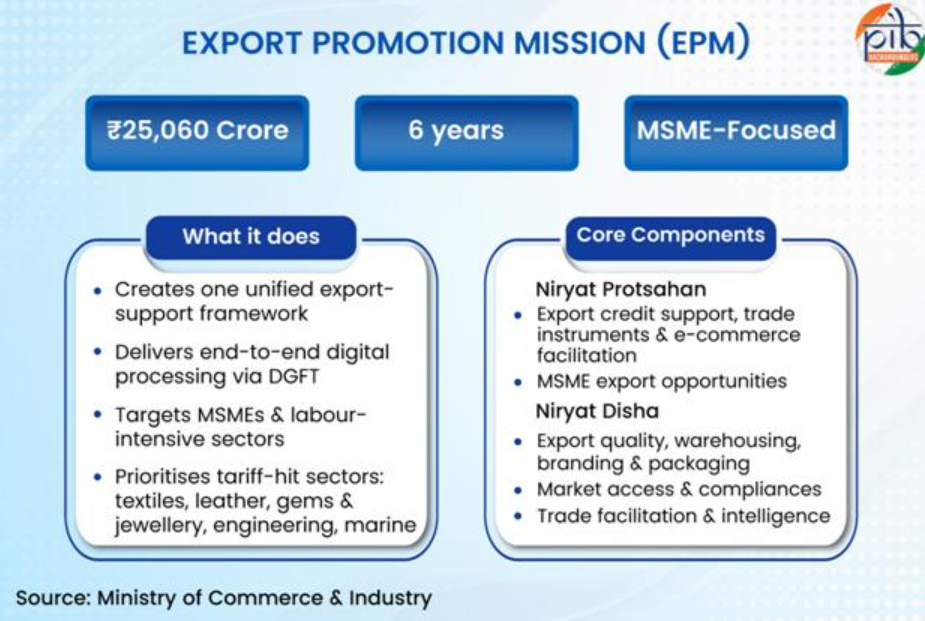
- The Export Promotion Mission (EPM), announced in the Union Budget 2025–26, brings together several previously fragmented export-support schemes into a single, digitally enabled framework. With a total outlay of ₹25,060 crore for the period from FY 2025–26 to FY 2030–31, the mission aims to strengthen India’s export ecosystem and improve the global competitiveness of sectors such as MSMEs and labour-intensive industries.
- Structure and Governance:
- EPM operates through a coordinated institutional structure involving multiple stakeholders such as the Department of Commerce, MSME Ministry, Finance Ministry, Export Promotion Councils, Commodity Boards, financial institutions, industry associations, and state governments. The Directorate General of Foreign Trade (DGFT) acts as the main implementing agency responsible for carrying out the mission.
- Integrated Sub-Schemes:
- The mission functions through two integrated sub-schemes—Niryat Protsahan and Niryat Disha—which together address both financial and non-financial requirements of exporters.
- Niryat Protsahan:
- This component focuses on financial support for exporters. It provides facilities such as affordable trade finance, interest subvention, factoring services, exporter credit cards, collateral support, and credit enhancement, especially aimed at helping MSMEs expand their export activities.
- Niryat Disha:
- This component focuses on non-financial support measures. It includes assistance in quality certification and compliance, branding and marketing, participation in trade fairs, logistics and transportation support, and district-level capacity building to help exporters access global markets more effectively.
- Digital Implementation and Monitoring:
- EPM is implemented through a digital platform managed by DGFT, enabling paperless processing and faster delivery of services. The digital system ensures transparency, integrated coordination among agencies, and quicker responses to changing global trade conditions.
- Sectoral and Regional Focus:
- The mission gives priority to sectors that are highly affected by tariffs, including textiles, leather, gems and jewellery, engineering goods, and marine products. It also focuses on supporting MSMEs, first-time exporters, and labour-intensive industries. Under the Niryat Disha component, special support is provided to interior and low-export districts to expand India’s export base and encourage wider participation in global trade.
- Regulatory and Central Bank Support:
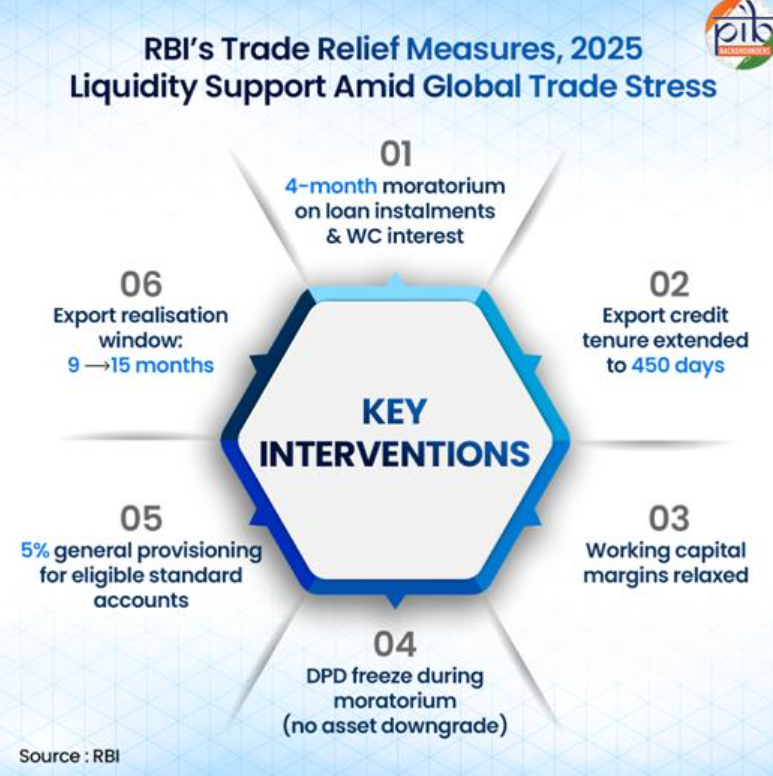
- The mission is further supported by the Reserve Bank of India’s Trade Relief Measures 2025, which help reduce liquidity pressures and provide financial support to export-oriented businesses.
- Expected Outcomes:
- The mission aims to improve access to trade finance for MSMEs, strengthen quality certification and compliance standards, enhance branding and global visibility of Indian products, and increase exports from non-traditional districts. These outcomes are expected to promote export-led economic growth, support the vision of Atmanirbhar Bharat, and contribute to achieving the long-term goal of Viksit Bharat by 2047, making India a stronger and more competitive participant in global trade.
What is the Status of India’s Export Industry?
- Export Growth:
- India’s exports reached a record USD 778.21 billion in 2023–24, showing a strong 67% increase compared to 2013–14. This significant growth reflects the expansion of India’s manufacturing sector, improvements in digital capabilities, and wider diversification of export markets rather than temporary fluctuations in trade.
- Major Export Markets:
- In 2023–24, India’s major export destinations included the United States, UAE, Netherlands, China, Singapore, United Kingdom, Saudi Arabia, Bangladesh, Germany, and Italy. Together, these ten countries accounted for about 51% of India’s total merchandise exports. India’s export presence has expanded across regions such as North America, the European Union, ASEAN, West Asia, and North-East Asia, indicating a broader and more diversified geographical reach.
- Evolution of India’s Export Composition:
- India’s export structure is gradually changing and moving toward higher-value products. The country is shifting from traditional low-value exports like textiles and basic agricultural goods to more advanced manufactured products such as electronics and engineering goods. At the same time, the services sector contributes nearly 44% of total exports, highlighting India’s strong global competitiveness in services. In addition, emerging sectors such as medical devices, renewable energy components, and advanced electronics are helping diversify India’s exports and increase value addition in global markets.
What are India’s Major Initiatives to Promote Exports?
| Initiative | Purpose / Key Features |
|---|---|
| PM Gati Shakti National Master Plan | Integrates infrastructure planning across sectors to improve multimodal connectivity and reduce logistics time and costs. |
| National Logistics Policy (NLP) | Aims to lower logistics costs in India by promoting multimodal transport systems and digital logistics platforms. |
| Credit Guarantee Scheme for Exporters (CGSE) | Provides a 100% government guarantee to exporters, including MSMEs, to improve access to credit, boost liquidity, and enhance global competitiveness. |
| Remission of Duties and Taxes on Exported Products (RoDTEP) | Refunds embedded taxes and duties that are not covered under GST, thereby improving the price competitiveness of Indian exports. |
| Rebate of State and Central Taxes and Levies (RoSCTL) | Offers rebates on state and central taxes specifically for the textile and apparel export sector. |
| Production Linked Incentive (PLI) Schemes | Encourages large-scale manufacturing and exports in sectors such as electronics, pharmaceuticals, textiles, drones, and others. |
| TIES (Trade Infrastructure for Export Scheme) | Supports the development of export-related infrastructure such as testing laboratories, inland container depots (ICDs), cold storage facilities, and border haats. |
| Free Trade Agreements (FTAs) | Improves market access and reduces tariffs through trade agreements with countries and regions such as UAE, Australia, and EFTA. |
| Districts as Export Hubs (DEH) | Promotes district-level products by supporting branding, capacity building, and logistics improvements to expand export potential. |
| MSME Lean & ZED Schemes | Helps MSMEs improve quality, reduce waste, and adopt global production and sustainability standards. |
Conclusion
The Export Promotion Mission (EPM) establishes a unified and technology-driven system aimed at strengthening India’s overall export ecosystem. By bringing together various export-support initiatives under a single framework, it helps streamline policies, improve coordination among institutions, and make support mechanisms more accessible to exporters. The mission also uses digital platforms to ensure faster processing, greater transparency, and more efficient delivery of services. In addition, complementary measures taken by the Reserve Bank of India (RBI) and the availability of credit guarantee schemes help improve access to finance and reduce liquidity challenges faced by exporters, especially MSMEs. Together, these initiatives enhance the stability and resilience of India’s export sector while strengthening the country’s position and competitiveness in global trade.
FAQ’s
Q. What is the Export Promotion Mission (EPM)?
EPM is a six-year, digitally enabled mission (outlay ₹25,060 crore for FY2025–26 to FY2030–31) that consolidates export support through Niryat Protsahan and Niryat Disha to boost MSME and labour-intensive exports.
Q. What are Niryat Protsahan and Niryat Disha?
Niryat Protsahan provides affordable trade finance (interest subvention, factoring, collateral support); Niryat Disha offers quality/compliance aid, branding, trade-fair support, warehousing and district-level logistics facilitation.
Q. How does the Credit Guarantee Scheme for Exporters (CGSE) support exporters?
CGSE expands export credit by up to Rs 20,000 crore with 100% government guarantee (via NCGTC), enabling collateral-free loans and additional working capital for eligible exporters, especially MSMEs.