Daily Current Affairs (DCA) 24 & 25 April, 2026
Free live session
NABARD Grade A 2026: 45-Day Final Revision Plan + Daily Targets
 🔒 Register to watchLast Sunday’s session · recording
Tomorrow · 7:30 PM IST
National Affairs7
Corporate Average Fuel Efficiency (CAFE-III) Norms
Context:
In mid-April 2026, Indian automakers reached a consensus on the Corporate Average Fuel Efficiency (CAFE-III) targets. While the headline numbers suggest a significant drop in permissible CO2 emissions, critics argue that the “flexible” design of the framework might allow manufacturers to avoid the radical shift toward electrification.
What are CAFE Norms?
CAFE (Corporate Average Fuel Efficiency) regulations target the fleet-wide average of fuel consumption and $CO_2$ emissions of a manufacturer’s entire vehicle lineup, rather than individual models.
- The Goal: To nudge carmakers toward energy-efficient technologies, reduce India’s crude oil import bill, and align with global emission standards.
- Evolution:
- Phase 1 (2017-2022): Target was 130 gCO2/km.
- Phase 2 (2022-2027): Target tightened to 113 gCO2/km.
- Phase 3 (2027-2032): Final target set at 78.9 gCO2/km by FY32.
Key Features of the 2026 Consensus
The latest draft finalized in April 2026 balances the needs of different industry segments through a “flatter compliance curve.”
- Unified Compliance Curve: The government removed the explicit $3\text{g}$ $CO_2\text{/km}$ relief for small cars (sub-4 meter). Instead, the overall formula was adjusted to ease the slope, making it less punishing for lighter vehicles while keeping pressure on heavier SUVs.
- Technology Neutrality: The framework supports multiple pathways, including Electric Vehicles (EVs), Strong Hybrids, and Flex-Fuel Vehicles (FFVs).
- Super Credits: To encourage green technology, cleaner vehicles count as more than one unit in a fleet’s average calculation:
- EVs: Count as 3 units (Super Credit factor of 3.0).
- Strong Hybrids: Credit factor trimmed to 1.6 (down from 2.0 in earlier drafts).
- Flex-Fuel Vehicles (FFVs): Credit factor set at 1.1.
Key Concepts
Q: What is the “WLTP” standard?
A: India is shifting from the current MIDC (Modified Indian Driving Cycle) to WLTP (Worldwide Harmonized Light Vehicles Test Procedure). WLTP is more rigorous and reflects real-world driving better, but often results in higher reported emission figures, making compliance tougher.
Conceptual MCQs
Q1. The CAFE-III norms in India are scheduled to be implemented starting from which date?
A) April 1, 2026
B) April 1, 2027
C) January 1, 2028
D) April 1, 2032
Q2. Under the proposed super credit scheme for CAFE-III, which technology receives the highest multiplier?
A) Strong Hybrids
B) Flex-Fuel Vehicles
C) Battery Electric Vehicles (BEVs)
D) CNG Vehicles
Q3. Which body is responsible for setting the efficiency standards and managing the credit trading under CAFE-III?
A) NITI Aayog
B) Bureau of Energy Efficiency (BEE)
C) RBI
D) Ministry of Road Transport and Highways
Answers: Q1: B | Q2: C | Q3: B
Exam Relevance
| Exam Focus Area | Relevance Level |
| UPSC CSE | GS-3 (Environment: Conservation, Pollution; Economy: Infrastructure) |
| RBI Grade B | Phase II: ESI (Sustainable Development, Industrial Policy) |
| State PCS | Understanding regulatory bodies and sectoral standards |
Dolphin Friends Initiative
Context:
The forest department in Prayagraj has officially launched the “Dolphin Friends” (Dolphin Mitras) volunteer network. This initiative aims to bridge the gap between scientific conservation and local community knowledge to protect the endangered Gangetic River Dolphin (Platanista gangetica).
What is the Dolphin Friends Initiative?
It is a participatory conservation model designed to decentralize river monitoring. Rather than relying solely on departmental patrolling, the initiative creates a dedicated network of volunteers who live and work along the river.
- Target Species: Gangetic River Dolphin, often referred to as the “Tiger of the Ganges.”
- Status: Endangered (IUCN Red List) and India’s National Aquatic Animal.
- Role: Volunteers act as the “eyes and ears” of the forest department, reporting sightings, threats, and habitat changes in real-time.
Key Concepts: Keyword Q&A
Q: What is a “Participatory Conservation Model”?
A: A strategy where local communities are not just bystanders but active partners in decision-making and monitoring, ensuring that conservation goals are sustainable and socially inclusive.
Q: Why is the Gangetic Dolphin called “Susu”?
A: It is a local name derived from the “sneeze-like” sound the dolphin makes when it surfaces to breathe through its blowhole.
Q: What are the main threats to these dolphins?
A: Habitat fragmentation due to dams/barrages, accidental entanglement in fishing nets (bycatch), pollution (agricultural and industrial), and increased river traffic.
Conceptual MCQs
Q1. The “Dolphin Friends” initiative was primarily launched in which city to strengthen river monitoring? A) Varanasi
B) Prayagraj
C) Haridwar
D) Kanpur
Q2. Why is monitoring intensified specifically during the monsoon season? A) Because the river water is clearest during the monsoon
B) Because it is the peak tourism season
C) Because it is the primary breeding and reproductive period for dolphins
D) Because dolphins migrate to the ocean during the monsoon
Q3. Which of the following groups are considered “key stakeholders” in the Dolphin Friends volunteer network? A) Industrialists and miners
B) Fishermen and boatmen
C) Highway engineers
D) Urban planners
Answers
- Q1: B (Prayagraj Forest Department lead the initiative.)
- Q2: C (Providing protection during breeding is critical for population growth.)
- Q3: B (Their direct daily engagement with the river makes them natural conservationists.)
Exam Relevance
| Exam Focus Area | Relevance Level |
| UPSC CSE | GS-3 (Environment: Conservation, Endangered Species, Community-based initiatives) |
Prime Minister Internship Scheme (PMIS)
Context:
The Ministry of Corporate Affairs (MCA) has significantly broadened the scope of the Prime Minister Internship Scheme (PMIS). In a major policy shift, the scheme now allows final-year students to gain corporate experience before even completing their degrees, effectively merging classroom learning with industry requirements.
What is the PMIS?
The PMIS is a “phygital” (physical + digital) flagship initiative aimed at tackling the “employability gap” in India. It places youth in the country’s top 500 companies to provide them with a professional pedigree and hands-on skills.
- Launch: Pilot phase started in October 2024 (following Union Budget 2024-25).
- Nodal Ministry: Ministry of Corporate Affairs (MCA).
- Scale: Targets the top 500 companies in India (selected based on CSR spend and turnover).
What are the Eligibility and Financials?
The scheme is designed to support the youth during their transition into the workforce.
- Age Limit: 18 to 25 years.
- Stipend Structure:
- Government Contribution: ₹5,000 per month.
- Company Contribution: ₹500 per month (from CSR funds).
- Total: Minimum of ₹5,500/month (Note: Current pilot highlights indicate some roles offer up to ₹9,000/month).
- Duration: A fixed 12-month period to ensure comprehensive professional immersion.
- Social Security: Every intern is covered under the Pradhan Mantri Jeevan Jyoti Bima Yojana and Pradhan Mantri Suraksha Bima Yojana.
Key Concepts
Q: What is a “Phygital” initiative?
A: It refers to a model that combines a Digital interface (the online application portal) with a Physical work experience (the actual 12-month on-site internship).
Q: Can a student apply if their college doesn’t provide an NOC?
A: No. The NOC is a mandatory requirement to ensure the internship is integrated with the student’s academic journey without violating attendance rules.
Q: Is the stipend paid through the company or the government?
A: It is a hybrid model. The government’s share is usually transferred via Direct Benefit Transfer (DBT) to the intern’s Aadhaar-linked bank account.
Conceptual MCQs
Q1. Which Ministry is the nodal agency for the Prime Minister Internship Scheme (PMIS)?
A) Ministry of Labour and Employment
B) Ministry of Skill Development and Entrepreneurship
C) Ministry of Corporate Affairs
D) Ministry of Education
Q2. Under the 2026 expansion, which category of students can now apply for the PMIS?
A) Only PhD scholars
B) Final-year undergraduate and postgraduate students
C) 10th and 12th-grade students
D) Only those who graduated before 2024
Q3. What is the standard duration of the internship provided under the PMIS?
A) 3 months
B) 6 months
C) 12 months
D) 24 months
Answers
- Q1: C (Ministry of Corporate Affairs manages the industry-government tie-up.)
- Q2: B (The recent rule change allows final-year students with an NOC.)
- Q3: C (The 12-month period is designed for deep industry immersion.)
Exam Relevance
| Exam Focus Area | Relevance Level |
| UPSC CSE | GS-2 (Govt Policies & Interventions), GS-3 (Employment/Economy) |
| RBI Grade B | Phase II: ESI (Social Justice, Employment generation schemes) |
| SSC / Bank | General Awareness (Current schemes, Ministry, and age limits) |
Atal Pension Yojana (APY)
Context:
The Atal Pension Yojana (APY) has achieved a historic milestone by surpassing 9 crore total gross enrolments. This highlights the growing penetration of formal social security among India’s unorganized workforce.
What is the APY?
The APY is India’s primary contributory pension scheme tailored for the unorganized sector (e.g., street vendors, domestic helps, laborers). It aims to ensure that no citizen faces financial destitution in their old age.
- Launch: May 9, 2015.
- Administrator: Pension Fund Regulatory and Development Authority (PFRDA).
- Vision: To provide a Sampurna Suraksha Kavach (Complete Security Shield) for those outside the formal provident fund (EPF) net.
Eligibility and Restrictions
The scheme is designed for early-career workers to build a corpus over several decades.
- Age Bracket: 18 to 40 years. (Joining early results in significantly lower monthly contributions).
- Banking: A savings bank account with auto-debit facility is mandatory.
- The “Tax-Payer” Rule: Since October 1, 2022, any citizen who is or has been an income-tax payer is ineligible to join. This ensures that the government’s co-contribution and subsidy benefits are targeted strictly at the underprivileged.
What is the “Triple Benefit” Structure?
The APY is unique because it provides security not just to the worker, but to the entire family unit.
| Benefit Stage | Recipient | Action |
| Stage 1 (Post-60) | Subscriber | Receives a guaranteed monthly pension (₹1k to ₹5k). |
| Stage 2 (After Subscriber) | Spouse | Receives the same pension amount for life. |
| Stage 3 (After Spouse) | Nominee | Receives the entire accumulated corpus (wealth) back. |
Key Concepts
Q: Why is the maximum entry age 40?
A: A pension fund needs time to grow. Since the pension starts at age 60, a 40-year-old still has 20 years to contribute, which is the minimum time required to build a sustainable corpus.
Q: What is the “Unorganized Sector”?
A: It refers to workers who do not have regular monthly salaries or benefits like ESI or EPF. This includes nearly 90% of India’s total workforce.
Q: What happens if I miss an auto-debit payment?
A: Banks charge a small penalty (usually ₹1 to ₹10 per month) for delayed payments. The account remains active as long as the total dues are cleared.
Conceptual MCQs
Q1. Who is the administrative body for the Atal Pension Yojana? A) RBI
B) SEBI
C) PFRDA
D) EPFO
Q2. As of the 2022 amendment, which group is specifically excluded from joining APY? A) Government employees
B) Income-tax payers
C) Doctors and Engineers
D) NRIs
Q3. Under the “Triple Benefit” rule, what happens after the death of both the subscriber and the spouse? A) The pension stops and the money goes to the Government.
B) The pension continues for the children.
C) The full accumulated corpus is returned to the nominee.
D) The money is donated to a social welfare fund.
Answers: Q1: C | Q2: B | Q3: C
Exam Relevance
| Exam Focus Area | Relevance Level |
| UPSC CSE | GS-2 (Social Justice), GS-3 (Inclusive Growth/Economy) |
| RBI Grade B | Phase II: ESI (Social Security & Poverty Alleviation) |
| SSC / Bank PO | Current Affairs (PFRDA, age limits, and milestones) |
NAMASTE Scheme
Context:
The Union Government has announced a significant surge in the implementation of the NAMASTE Scheme. The focus has shifted from mere policy to large-scale on-ground execution, including the profiling of thousands of workers, distribution of specialized PPE, and the integration of waste pickers into the formal social security net.
What is the NAMASTE Scheme?
The National Action for Mechanised Sanitation Ecosystem (NAMASTE) is a joint flagship initiative designed to end the era of hazardous manual cleaning of sewers and septic tanks.
- The Vision: To replace “Manual Scavenging” with a technology-driven “Sanipreneur” model.
- Nodal Ministries: A collaborative effort between the Ministry of Social Justice and Empowerment and the Ministry of Housing and Urban Affairs (MoHUA).
- Scope: Covers all Urban Local Bodies (ULBs) across India.
Strategic Objectives
The scheme operates on the principle that no human should be forced to enter a sewer line or septic tank.
- Zero Fatalities: Achieving a target of zero deaths in sanitation work through 100% mechanization.
- Formalization: Transforming informal “sanitation workers” into formal “skilled technicians” and small business owners (Sanipreneurs).
- Direct Intervention: Providing safety gear and health insurance to those who have historically been excluded from formal systems.
Key Features & 2026 Progress
The current phase highlights a move toward comprehensive social protection.
| Feature | Description | 2026 Milestone |
| Worker Profiling | Digital mapping and validation of every sewer/septic tank worker. | Large-scale profiling completed across Tier-1 and Tier-2 cities. |
| SUY Subsidy | Capital subsidy for buying mechanized cleaning vehicles. | Increase in “Sanipreneur” start-ups owned by former manual cleaners. |
| Health Security | Integration with Ayushman Bharat (PM-JAY). | Universal issuance of Ayushman cards to profiled workers. |
| PPE Distribution | Providing specialized Personal Protective Equipment. | Deployment of standardized, high-durability kits for urban workers. |
| Expanded Scope | Inclusion of Waste Pickers (since June 2024). | Solid waste management workers now eligible for scheme benefits. |
Key Concepts
Q: What is a “Sanipreneur”?
A: A portmanteau of “Sanitation” and “Entrepreneur.” It refers to sanitation workers who have transitioned into owners of mechanized sanitation businesses with government support.
Q: Why was the scope expanded to “Waste Pickers”?
A: Waste pickers are highly vulnerable to health hazards from solid waste. Their inclusion ensures they get formal recognition, safety gear, and the same health insurance benefits as sewer workers.
Q: Is “Manual Scavenging” still legal in India?
A: No. It was banned under the Prohibition of Employment as Manual Scavengers and their Rehabilitation Act, 2013. The NAMASTE scheme provides the technological and financial alternative to ensure the ban is effective on the ground.
Conceptual MCQs
Q1. The NAMASTE Scheme is a joint initiative of which two Ministries? A) Social Justice and Health
B) Social Justice and Housing & Urban Affairs
C) Housing & Urban Affairs and Rural Development
D) Home Affairs and Social Justice
Q2. What is the primary goal of the Swachhata Udyami Yojana (SUY) under this scheme? A) To build more public toilets
B) To provide loans for sanitation workers to buy mechanized cleaning equipment
C) To provide free water to urban slums
D) To build houses for waste pickers
Q3. As of the June 2024 update, which new group has been included under the NAMASTE scheme? A) Construction workers
B) Agricultural laborers
C) Waste pickers
D) Traffic police
Answers: Q1: B | Q2: B | Q3: C
Exam Relevance
| Exam Focus Area | Relevance Level |
| UPSC CSE | GS-2 (Govt Policies, Vulnerable Sections), GS-3 (Infrastructure/Sanitation) |
| SSC / Bank | General Awareness (Schemes, Nodal Ministries, and Full forms) |
Denotified, Nomadic, and Semi-Nomadic Tribes (DNTs)
Context:
The Union Social Justice Ministry’s annual report for 2025-26 has raised red flags regarding the “marginalization within marginalization” of DNTs. The report highlights a critical failure at the state level to issue community certificates, which has effectively blocked these tribes from accessing central welfare schemes like SEED and PMAY-G.
Who are the DNTs?
These communities are often described as the most “invisible” and vulnerable sections of Indian society.
- Denotified Tribes (DNTs): These are communities that were historically “notified” as “born criminals” under the Criminal Tribes Act (CTA) of 1871 during British rule. They were “denotified” when the Act was repealed in 1952.
- Nomadic & Semi-Nomadic Tribes: Communities that do not have a fixed habitation. They move for livelihoods related to pastoralism, petty trade (like ironsmiths), or traditional entertainment (like acrobatics).
Regional Distribution and Current Barriers
There are nearly 1,200 DNT/Nomadic communities in India, yet their legal classification remains a mess.
| Status Category | Description |
| Categorized | Many DNTs are listed under existing SC, ST, or OBC categories. |
| Unclassified | Approximately 268 communities fall outside any existing reserved category. |
| The Certificate Crisis | Only seven states are currently issuing the specific DNT community certificates. |
What is the SEED Scheme?
The SEED (Scheme for Economic Empowerment of DNTs) was launched to provide free coaching, health insurance (Ayushman Bharat), housing, and livelihood support. However, its impact has been minimal.
- Identification Gap: Without the “DNT Certificate,” a tribal member cannot apply for SEED.
- Marginalization within Groups: DNTs already classified as SC/ST often find themselves at the bottom of those hierarchies, struggling to compete for benefits with more dominant or settled SC/ST groups.
- Digital Divide: The requirement for online applications and Aadhaar-linked certification is difficult for nomadic groups who lack permanent addresses.
Key Concepts: Keyword Q&A
Q: What was the Ayyangar Committee?
A: Established in 1949, it was the committee that recommended the repeal of the Criminal Tribes Act, 1871, leading to the denotification of these tribes in 1952.
Q: What is the “Idate Commission”?
A: It was a national commission set up to identify and prepare a state-wise list of DNTs. It highlighted that these tribes have been neglected by both the central and state governments for decades.
Q: Why is PMAY-G access difficult for them?
A: The Pradhan Mantri Awas Yojana-Gramin requires a permanent land title and a community certificate. Nomadic tribes often lack land ownership and the necessary documentation.
Conceptual MCQs
Q1. In which year were the “Criminal Tribes” officially denotified by the Government of India? A) 1947
B) 1950
C) 1952
D) 1955
Q2. The SEED scheme, specifically aimed at the empowerment of DNTs, is implemented by which Ministry? A) Ministry of Tribal Affairs
B) Ministry of Social Justice and Empowerment
C) Ministry of Home Affairs
D) Ministry of Rural Development
Q3. Why are approximately 268 DNT communities considered “unclassified”? A) They have refused to join any category.
B) They are not listed in any of the SC, ST, or OBC lists.
C) They are considered part of the General category by choice.
D) They moved to other countries after 1947.
Answers: Q1: C | Q2: B | Q3: B
Exam Relevance
| Exam Focus Area | Relevance Level |
| UPSC CSE | GS-2 (Vulnerable Sections, Social Justice), GS-1 (Society: Tribal Issues) |
| State PSCs | Regional lists of DNTs and state-level welfare delivery |
Banking/Finance7
How & Why Farmers Producers Organization are formed? FPO #fpo #upsc #nabardgradea #agriculturenotesTap to play · from the C4S channel
Context:
The Reserve Bank of India’s (RBI) latest monthly bulletin highlights a critical shift in economic risk. While the Indian economy remains resilient, the central bank warns that persistent supply-side disruptions—driven by the West Asia conflict and climate risks—could eventually dampen consumer demand, leading to a broader economic slowdown.
What is Supply to Demand Shock?
A “supply shock” occurs when the availability of goods (like oil or grain) drops, causing prices to spike. The RBI is concerned about the second-round effects, where this initial shock bleeds into the rest of the economy.
- Higher Input Costs: As energy and transport costs rise due to the conflict in the Strait of Hormuz, companies may pass these costs to consumers.
- Deceleration Signs: The RBI noted early signs of cooling in high-frequency indicators such as port cargo and air passenger traffic.
- The Demand Shock: If inflation remains high, households may cut back on “discretionary” spending (luxury goods, travel, electronics), transforming a supply problem into a demand problem.
RBI’s Financial Defensive Maneuvers
The bulletin revealed that the RBI had been preparing for volatility even before the conflict peaked:
- Forex Buffer: The RBI net bought $7.4 billion in the spot foreign exchange market in February 2026 to strengthen India’s reserves.
- Speculation Control: On March 27, 2026, the RBI capped the “Net Open Position” in INR for banks at $100 million to prevent traders from betting too heavily against the rupee.
- Policy Stance: In the April 8 MPC meeting, the RBI kept the Repo Rate at 5.25% with a “neutral” stance, opting to “wait and watch” the geopolitical fallout.
Private vs. Public Sector Banks
While both groups lowered rates, Private Sector Banks demonstrated a much faster and stronger “pass-through” of rate cuts to borrowers compared to Public Sector Banks (PSBs).
| Metric (Feb 2025 – Feb 2026) | Private Sector Banks | Public Sector Banks |
| Reduction in WALR (Fresh Loans) | 104 bps | 75 bps |
| Reduction in WALR (Outstanding Loans) | 94 bps | 77 bps |
| Deposit Rate Softening | Broadly Similar | Broadly Similar |
- Foreign Banks: Recorded the sharpest reductions in both deposit and lending rates across the entire banking system.
- The Deposit Side: Transmission on term deposits was driven largely by bulk deposits, as banks responded to surplus liquidity by cutting interest on large-value institutional accounts.
Key Concepts
Q: What is WALR?
A: Weighted Average Lending Rate. It represents the average interest rate a bank charges on its entire portfolio (or fresh loans), weighted by the size of each loan. It is the most accurate measure of what borrowers are actually paying.
Q: What is a “Basis Point” (bps)?
A: A unit of measure for interest rates. $100\text{ bps} = 1\%$. Therefore, a $125\text{ bps}$ cut equals a $1.25\%$ reduction.
Q: Why do Private Banks transmit rates faster than PSBs?
A: Private banks often have a higher proportion of loans linked to external benchmarks and more flexible liability structures, allowing them to adjust pricing more dynamically to competitive market pressures.
Q: What is a “Second-round effect”?
A: It’s when an initial price hike (like oil) leads to a general increase in prices across the board (like food, bus fares, and manufacturing), eventually leading to demands for higher wages and further inflation.
Q: What is the “Long Period Average” (LPA) for the monsoon?
A: It is the average rainfall recorded over a 50-year period (currently 87 cm). A forecast of 92% is classified as “Below Normal,” which ranges from 90% to 95%.
Q: Why did the RBI buy $7.4 billion in the spot market?
A: By buying dollars, the RBI builds up its Foreign Exchange Reserves. These reserves act as a “war chest” that the RBI can later sell to support the Rupee if it starts falling too fast against the Dollar.
Conceptual MCQs
Q1. According to the RBI, how can a supply shock transform into a demand shock? A) By increasing the supply of luxury goods
B) By lowering the cost of energy
C) Through persistent inflation reducing household purchasing power
D) By increasing the monsoon rainfall to 110% of LPA
Q2. What is the IMD’s 2026 monsoon forecast in terms of the Long Period Average (LPA)? A) 85%
B) 92%
C) 100%
D) 104%
Q3. Which maritime route’s disruption is specifically mentioned as a risk to energy costs in the 2026 report? A) Suez Canal
B) Panama Canal
C) Strait of Hormuz
D) English Channel
Answers
- Q1: C (When people spend more on essentials like fuel, they buy less of everything else.)
- Q2: B (92% is the current forecast, indicating a “below normal” season.)
- Q3: C (The Strait of Hormuz is the primary chokepoint for West Asian oil.)
Exam Relevance
| Exam Focus Area | Relevance Level |
| RBI Grade B | Phase II: ESI (State of the Economy, Forex interventions) |
| Bank PO | General Awareness (Monsoon stats, Repo rates, RBI headlines) |
Context:
In a significant shift in regional sentiment, HSBC has downgraded Indian equities from “Neutral” to “Underweight.” The brokerage cites a combination of “imported inflation,” energy vulnerabilities, and a potential cooling of domestic consumer demand as the primary reasons for the shift.
What is the “Underweight” Rationale?
An “Underweight” rating suggest that a brokerage believes a market will underperform compared to its peers or a benchmark index. HSBC’s concerns are centered on the sustainability of corporate profits.
- Earnings Revision: While the market currently expects a 16% Y-o-Y earnings growth for 2026, HSBC expects these forecasts to be revised downward as input costs rise.
- Energy Dependency: India’s high reliance on imported energy makes it vulnerable to the current $100+ crude oil prices. This drains foreign exchange and spikes domestic inflation.
- Valuation Trap: Although Indian stock prices have dropped from their peaks, HSBC warns they will still look “expensive” if the underlying company earnings (the “E” in P/E ratio) start falling.
Key Risk Factors Flagged
The brokerage identifies several “red flags” that could dampen investor enthusiasm in the near term:
- Post-Election Fuel Hikes: HSBC notes the risk of fuel prices being adjusted upward after recent state elections, which would act as an immediate tax on consumption.
- Financial Stress: Higher inflation and rising interest rates could increase Non-Performing Loans (NPLs), putting pressure on the banking system.
- Rupee Weakness: With the INR crossing 94, foreign investors are seeing their returns “eroded” by currency depreciation, making them cautious about fresh inflows.
- The AI Threat: Investors are increasingly worried about how Generative AI will disrupt India’s massive software services (IT) sector, a traditional favorite for foreign funds.
Key Concepts
Q: What is the difference between Overweight, Neutral, and Underweight?
A: These are relative ratings. Overweight means an investor should hold more of that asset than the benchmark. Neutral means holding the same amount. Underweight means holding less, as the outlook is poor.
Q: Why do “SIPs” matter in this report?
A: Systematic Investment Plans (SIPs) from domestic retail investors provide a “floor” to the market. Even when foreign investors (FPIs) sell, local money keeps coming in, preventing a total market crash.
Q: Why does a weak Rupee stop foreign inflows?
A: If a foreign investor puts $100 into India and the Rupee falls by 5%, their investment is worth $95 in Dollar terms even if the stock price stays the same. Currency risk is a major deterrent for global funds.
Conceptual MCQs
Q1. Which rating has HSBC assigned to Indian equities in its April 2026 note?
A) Overweight
B) Neutral
C) Underweight
D) Strong Buy
Q2. According to HSBC, what is the primary threat to India’s software services sector?
A) High minimum wages
B) Implications of Artificial Intelligence (AI)
C) Below-normal monsoon
D) Lack of 5G infrastructure
Q3. Which market did HSBC upgrade from “Underweight” to “Neutral” in the same report?
A) Indonesia
B) South Korea
C) Thailand
D) Mainland China
Answers
- Q1: C (Downgraded from Neutral due to macro headwinds.)
- Q2: B (AI disruption is a growing concern for the IT services business model.)
- Q3: B (South Korea was upgraded as a “compelling growth story.”)
Exam Relevance
| Exam Focus Area | Relevance Level |
| UPSC CSE | GS-3 (Economy: Investment models, FPI flows, IT sector challenges) |
| RBI Grade B | Phase II: ESI (Global financial markets, Balance of Payments) |
| SEBI Grade A | Securities Market (Brokerage ratings, Equity strategy) |
Context:
The Reserve Bank of India (RBI) has officially cancelled the banking licence of Paytm Payments Bank Limited (PPBL). This final regulatory blow comes after years of supervisory concerns, effective from the close of business on April 24, 2026.
What is the Final Verdict?
The RBI has moved beyond business restrictions to a full termination of the bank’s legal right to operate.
- Statutory Ground: The action was taken under Section 22 (4) of the Banking Regulation Act, 1949.
- Prohibited Business: PPBL is now strictly barred from “banking” activities as defined in Section 5(b) and any additional business under Section 6 of the Act.
- High Court Application: The RBI will now approach the High Court to appoint a liquidator for the winding up (liquidation) of the bank.
What are the Safety of Funds?
The RBI has provided a crucial reassurance regarding the bank’s financial health during this shutdown.
- Sufficient Liquidity: The central bank confirmed that PPBL has enough liquidity to repay its entire deposit liability in full.
- Winding-Up Process: Deposits will be returned through the court-monitored winding-up process.
- Limited Impact: Since top-ups and fresh deposits were already banned in early 2024, most users have had over two years to exhaust their balances.
The “Paytm App” vs. “Paytm Bank”
Paytm (One 97 Communications Ltd) has moved quickly to clarify that the Paytm App is NOT the Paytm Bank.
| Feature | Status | Reason |
| Paytm UPI | Active | Operates via third-party bank handles (like AXIS, HDFC, SBI). |
| Paytm QR / Soundbox | Active | These are merchant services independent of PPBL. |
| Paytm Wallet | Discontinued | The wallet was a PPBL product; it is no longer reloadable. |
| Paytm Gold / Money | Active | These are managed by other subsidiaries of One 97. |
Key Concepts
Q: What is a “Payments Bank”?
A: A specialized type of bank that can accept deposits (up to ₹2 lakh) and offer payments/remittance services but cannot issue credit cards or provide loans.
Q: What does “Winding Up” mean?
A: It is the process of closing a company. Its assets are sold, its debts are paid off, and any remaining money is distributed to stakeholders (or in this case, depositors).
Q: Why did the RBI take such a harsh step?
A: The RBI cited persistent non-compliance and stated that the bank’s affairs were conducted in a manner “detrimental to the interests of depositors.”
Conceptual MCQs
Q1. Under which Section of the Banking Regulation Act, 1949, did the RBI cancel PPBL’s licence? A) Section 35A
B) Section 22 (4)
C) Section 45
D) Section 5(b)
Q2. Which of the following Paytm services remains UNINTERRUPTED after the bank’s closure? A) Loading money into Paytm Bank Wallet
B) Depositing money into a PPBL Savings Account
C) Paytm QR and Soundbox payments
D) Opening a new PPBL account
Q3. To which authority will the RBI apply for the winding up of the bank? A) Supreme Court
B) High Court
C) National Company Law Tribunal (NCLT)
D) Finance Ministry
Answers
- Q1: B (Section 22 (4) allows for licence withdrawal if conditions aren’t met.)
- Q2: C (Paytm has clarified its merchant and app services are independent entities.)
- Q3: B (Under the Banking Regulation Act, the RBI approaches the High Court for bank liquidations.)
Exam Relevance
| Exam Focus Area | Relevance Level |
| UPSC CSE | GS-3 (Economy: Banking Sector Reforms, Digital Payments, RBI’s Role) |
| RBI Grade B | Phase II: Finance & Management (Banking Regulations, Compliance) |
| Banking | Current Affairs (Corporate news, RBI circulars) |
SEBI Proposes Risk-Based Net Worth for Brokers
Context:
The Securities and Exchange Board of India (SEBI) has proposed a fundamental shift in how stockbrokers maintain their capital. Moving away from a simple cash-retention model, the new framework seeks to align a broker’s Variable Net Worth with the actual operational risk posed by the scale of their client base.
Why the Change?
The current method for calculating variable net worth is becoming obsolete due to recent safety reforms.
- The Old Rule: Brokers had to maintain a variable net worth equal to 10% of the average daily client cash balance they held.
- The “Upstreaming” Problem: SEBI recently mandated that brokers must “up-stream” (transfer) client funds to Clearing Corporations (CCs) daily. This means brokers now hold very little client cash on their own books.
- The Regulatory Gap: If brokers hold no cash, their variable net worth requirement drops to near zero—even if they have millions of clients. This creates a hidden risk if the broker faces a technical or operational failure.
What are the Proposed Risk-Based Formula?
SEBI’s new “comprehensive” approach aggregates two distinct risk components:
Component A: Client Fund Linked (10% Rule)
- Brokers must maintain 10% of the average credit balance of all clients over the previous six months. This ensures capital is still tied to the total value of client money handled, regardless of where it is currently stored (Upstreamed vs. Retained).
Component B: Client Scale Linked (The “Slab” System)
This introduces an “Operational Risk” buffer based on the number of active clients.
| Active Client Base | Additional Net Worth Required |
| Up to 10,000 | Standard Base Net Worth |
| 10,000 – 50,000 | + ₹50 Lakh |
| Every additional 50,000 | Further Incremental Buffers |
- Authorised Persons (APs): Graded capital requirements are also proposed for brokers who onboard clients through sub-brokers or APs, as these networks add an extra layer of supervision risk.
SEBI IPO Approvals
Alongside the policy changes, SEBI granted “Observation Letters” (approval) to three companies to launch their Initial Public Offerings (IPOs).
| Company | Deal Type | Highlights |
| EAAA India Alternatives | ₹1,500 Cr (OFS) | Entirely an Offer for Sale by promoter Edelweiss Securities. |
| MV Electrosystems | ₹290 Cr (Fresh Issue) | Manufactures electrical equipment for Railway rolling stock. |
| Yatayat Corporation | Fresh + OFS | Supply chain and logistics provider based in Gujarat. |
Key Concepts
Q: What is “Variable Net Worth”?
A: It is the “extra” capital a broker must have over and above the fixed base requirement. It fluctuates based on how much business or risk the broker is taking on.
Q: What is “Upstreaming of Funds”?
A: A safety mechanism where a broker cannot keep client money in their own bank account overnight. They must send it to the Clearing Corporation, which acts as a central vault, reducing the risk of the broker misusing client funds.
Q: What is an “Offer for Sale” (OFS) in an IPO?
A: This is when existing shareholders (like promoters or early investors) sell their shares to the public. The money goes to the sellers, not to the company’s bank account.
Conceptual MCQs
Q1. Why is SEBI moving away from the “10% of retained cash” model for broker net worth?
A) Because brokers are making too much profit
B) Because the “upstreaming” framework has reduced the cash actually held by brokers
C) Because SEBI wants to encourage brokers to hold more cash
D) Because the number of stockbrokers is decreasing
Q2. Under the proposed slab system, a broker with 40,000 direct active clients would need how much additional net worth?
A) ₹10 Lakh
B) ₹25 Lakh
C) ₹50 Lakh
D) ₹1 Crore
Q3. Which company received approval for an IPO that consists entirely of an “Offer for Sale”?
A) MV Electrosystems
B) Yatayat Corporation
C) EAAA India Alternatives
D) Edelweiss Securities
Answers
- Q1: B (Upstreaming makes the old cash-retention metric ineffective.)
- Q2: C (The ₹50 Lakh slab kicks in for the 10,000–50,000 client range.)
- Q3: C (Edelweiss is the promoter selling its stake in EAAA.)
Exam Relevance
| Exam Focus Area | Relevance Level |
| SEBI Grade A | Securities Market (Risk Management, Intermediary Regulations) |
| RBI Grade B | Phase II: Finance (Financial Markets and Regulators) |
| UPSC CSE | GS-3 (Economy: Capital Markets and Regulatory Bodies) |
CRIF-SIDBI Small Business Spotlight Report
Context:
The third edition of the ‘CRIF–SIDBI Small Business Spotlight Report’ highlights a nuanced shift in India’s small business credit landscape. While the total portfolio remains massive and resilient, the nature of lending is evolving toward higher volumes of smaller-sized loans.
Defining “Small Business” in the Credit Context
The report uses a functional definition of ‘Small Business’ based on financial interaction rather than just employee count:
- Exposure Limit: Entities or individuals with an aggregate credit exposure not exceeding ₹5 crore from the formal lending system.
- Borrower Profile: Includes both registered enterprises (Commercial Bureau) and individual proprietors who take loans in their own names for “business purposes.”
Key Findings: Value vs. Volume
The report identifies a divergence between the total value of credit and the frequency of lending.
| Metric | Dec 2024 (Y-o-Y) | Dec 2025 (Y-o-Y) | Analysis |
| Portfolio Value Growth | 20% | 14.9% | Growth has “moderated” due to a higher base effect. |
| Active Loan Count Growth | 9.6% | 13.8% | Lending frequency is accelerating. |
| Total Portfolio Value | – | ₹47.8 Lakh Cr | Significant scale, showing deep market resilience. |
Understanding the “High Base Effect”
The moderation from 20% to 14.9% growth is largely attributed to a high base. In financial terms, this means that because the total credit amount was already so large in 2024, maintaining the same percentage growth in 2025 would require a much larger absolute increase in lending.
Key Concepts: Keyword Q&A
Q: Why does the report include “Individual Proprietors”?
A: A vast majority of Indian small businesses operate as sole proprietorships. Often, these owners take loans against their personal PAN/Aadhaar but use the funds for business operations. Excluding them would significantly under-represent the actual credit flow to small businesses.
Q: What is “Formal Lending”?
A: Credit provided by regulated financial institutions like Public Sector Banks, Private Banks, NBFCs, and MFIs. These lenders report every transaction to credit bureaus like CRIF, allowing for the data seen in this report.
Conceptual MCQs
Q1. According to the CRIF-SIDBI report, a ‘Small Business’ is defined by a credit exposure not exceeding: A) ₹1 Crore
B) ₹5 Crore
C) ₹10 Crore
D) ₹50 Crore
Q2. What does the faster growth in ‘Active Loan Count’ (13.8%) compared to previous years indicate? A) Businesses are taking larger loans than before.
B) There is a rising share of smaller exposure loans in the ecosystem.
C) Total lending in India has decreased.
D) Interest rates have significantly dropped.
Q3. Which organization is the co-publisher of this report along with CRIF High Mark? A) RBI
B) NABARD
C) SIDBI
D) SEBI
Answers: Q1: B | Q2: B | Q3: C
Exam Relevance
| Exam Focus Area | Relevance Level |
| RBI Grade B | Phase II: ESI (MSME sector, Role of SIDBI, Financial Inclusion) |
| UPSC CSE | GS-3 (Economy: Inclusive growth, Banking and Financial institutions) |
| Bank PO / SSC | General Awareness (Banking terms, Current growth figures, and SIDBI) |
NBFCs Seek Access to Central Fraud Registry (CFR)
Context:
Non-Banking Financial Companies (NBFCs) have formally approached the Department of Financial Services (DFS) seeking access to the Reserve Bank of India’s (RBI) Central Fraud Registry (CFR). Currently, this critical database is exclusive to commercial banks, leaving NBFCs “in the dark” regarding the trustworthiness of overlapping borrowers.
What is the Central Fraud Registry (CFR)?
The CFR is a centralized searchable database of bank frauds established in 2016 to facilitate early detection and prevention.
- Threshold: It captures all fraud cases involving a sum of ₹1 lakh and above.
- Current Access: Restricted solely to commercial banks for monitoring and reporting.
- The “Lapse” in Data: Current fraud statistics (which hit ₹21,515 crore in the first half of FY26) only represent bank frauds, excluding those perpetrated against NBFCs.
Why NBFCs are Demanding Access
The demand stems from the increasing “interconnectedness” between banks and NBFCs in the modern financial ecosystem.
- Lending Partnerships: Banks and NBFCs now frequently engage in Co-Lending and cross-selling. If a customer commits fraud at a bank, an NBFC remains unaware of the risk when onboarding that same customer.
- Overlap of Customers: Most high-value borrowers maintain accounts with both banks and NBFCs.
- Asymmetry of Information: NBFCs argue that safety should be linked to the nature of the business (lending) rather than the legal nature of the entity (Bank vs. NBFC).
Amending the RBI Act
Granting access is not a simple administrative change. It involves a fundamental legal shift.
- Legislative Action: Experts suggest that providing NBFCs access to the CFR would likely require an amendment to the Reserve Bank of India Act, 1934.
- Privacy & Security: Expanding access to sensitive fraud data raises concerns regarding data privacy and the potential for misuse of “blacklists” by non-bank entities.
Access to CRILC
The CFR demand has renewed interest in accessing the Central Repository of Information on Large Credits (CRILC).
- What it is: A database capturing credit info of large borrowers with exposures of ₹5 crore and above.
- The Irony: NBFCs are mandated to report their data to CRILC quarterly, but they are not permitted to access the repository to check the credit history of prospective customers.
Digital Payments Intelligence Platform
To counter the rise in digital fraud, the RBI is planning a Digital Payments Intelligence Platform.
- Advanced Tech: It will leverage AI and machine learning to curb payment-related frauds in real-time.
- Consumer Protection: This coincides with new draft directions (March 2026) that defined “mis-selling” for the first time and established a strict ‘Code of Conduct’ for the sales force of lenders.
Key Concepts
Q: What is “Co-Lending”?
A: A model where a bank and an NBFC jointly lend to a borrower. Typically, the NBFC originates the loan and keeps 20% on its books, while the bank takes 80% of the exposure.
Q: Why is “Mis-selling” under the scanner?
A: Due to high retail credit growth, lenders often give employees aggressive targets. This can lead to agents selling products without explaining risks, which the new 2026 guidelines aim to stop.
Q: What is the “High Base Effect” in fraud reporting?
A: If last year’s fraud detection was very high, a smaller increase this year might look like “slowing” growth, even if the absolute amount (₹21,515 crore) is still massive.
Conceptual MCQs
Q1. The Central Fraud Registry (CFR) currently monitors fraud cases involving a minimum sum of:
A) ₹10,000
B) ₹1,00,000 (1 Lakh)
C) ₹5,00,000 (5 Lakh)
D) ₹1,00,00,000 (1 Crore)
Q2. Which legislative act would likely need an amendment to allow NBFCs access to the CFR?
A) Companies Act, 2013
B) Banking Regulation Act, 1949
C) Reserve Bank of India Act, 1934
D) IT Act, 2000
Q3. Large credit exposures reported to CRILC involve an aggregate fund-based and non-fund-based exposure of at least:
A) ₹1 Crore
B) ₹2 Crore
C) ₹5 Crore
D) ₹10 Crore
Answers: Q1: B | Q2: C | Q3: C
Every day of the month in one file. Enter your details once — the download opens right away.
We already have your details, so no form: tap to open.
Download the April 2026 PDFDownload the April 2026 revision sheet PDFAgriculture1
Government Hikes Wheat Procurement Target
Context:
The Central Government has raised the wheat procurement target for the current Rabi Marketing Season (RMS) to 34.5 million tonnes (MT). This 15% increase from the initial target reflects a shift in market dynamics where government prices have become more attractive to farmers than private market rates.
Why the Target was Revised?
The decision to hike the target early in the season is driven by several regional and economic factors:
- Market Price vs. MSP: As of April 22, the average market (mandi) price was ₹2,572 per quintal, which is lower than the government’s Minimum Support Price (MSP) of ₹2,585 per quintal. Farmers naturally prefer selling to the government to secure the higher guaranteed price.
- State Requests: Major wheat-producing states including Madhya Pradesh, Uttar Pradesh, Rajasthan, and Bihar explicitly requested the Centre to increase procurement to accommodate the high arrival of stocks in local mandis.
- Current Progress: The government has already purchased 16.4 MT so far in the ongoing season, nearly reaching the halfway mark of the new target.
2. Strategic Shift for Flour Millers
In a notable policy move, the government has urged flour millers to buy wheat directly from the open market.
- Reducing FCI Dependency: Historically, millers relied on the Food Corporation of India (FCI) to release stocks through the Open Market Sale Scheme (OMSS).
- Market Stabilization: By pushing millers to the mandis, the government aims to prevent mandi prices from crashing further and ensure that the private sector shares the burden of managing the surplus.
Key Concepts
Q: What is “Procurement”?
A: It is the process by which the government (through the FCI and state agencies) buys food grains from farmers at a pre-announced MSP to ensure food security and price stability.
Q: What is the “Rabi Marketing Season” (RMS)?
A: It is the period (typically starting in April) when crops sown in winter (like wheat and mustard) are harvested and brought to the market.
Q: Why do farmers choose MSP over Mandi prices?
A: If private traders offer less than the MSP, the government acts as a “buyer of last resort,” ensuring farmers do not suffer losses.
Conceptual MCQs
Q1. What is the newly revised wheat procurement target set by the government for 2026?
A) 20.5 MT
B) 30.0 MT
C) 34.5 MT
D) 45.0 MT
Q2. What is the primary reason more farmers are opting for government procurement this year?
A) Mandi prices are significantly higher than MSP
B) The government is giving free seeds for the next season
C) Mandi prices are lower than the MSP of ₹2,585
D) Private traders have been banned from buying wheat
Q3. Which of the following states requested an increase in wheat procurement targets?
A) Kerala and Tamil Nadu
B) Uttar Pradesh and Rajasthan
C) Assam and Nagaland
D) Gujarat and Maharashtra
Answers
- Q1: C (A 15% increase to 34.5 MT.)
- Q2: C (Farmers seek the higher guaranteed price when market rates fall.)
- Q3: B (These are major wheat-producing states in the northern and central belt.)
Exam Relevance
| Exam Focus Area | Relevance Level |
| UPSC CSE | GS-3 (Economy: Agriculture, MSP, Buffer Stocks, Food Security) |
| RBI Grade B | Phase II: ESI (Agriculture, Inflation, Rural Economy) |
| SSC / Bank PO | General Awareness (Current MSP, Procurement targets, FCI) |
Facts To Remember30
Rupee Crosses 94
The Indian rupee (INR) breached the psychological barrier of 94 per US Dollar for the first time, despite active intervention by the Reserve Bank of India (RBI). This marks the currency’s fourth consecutive session of decline.
7th edition of India-Uzbekistan Joint Military Exercise Dustlik culminates at Namangan in Uzbekistan
The 7th edition of the India-Uzbekistan Joint Military Exercise Dustlik culminated today at Namangan in Uzbekistan.
INS Sudarshini arrives at Las Palmas, Spain
The Indian Navy’s Sail Training Ship INS Sudarshini arrived at Las Palmas, Spain, as part of her ongoing transoceanic deployment under Lokayan 26.
Union Minister Meghwal inaugurates new office of Ministry of Law and Justice at Kartavya Bhawan-2
Minister for Law and Justice, Arjun Ram Meghwal, today inaugurated the new office of the Ministry of Law and Justice at the newly constructed Kartavya Bhawan-2 located on Kartavya Path in New Delhi.
Ministry of Rural Development finalises Calendar of SARAS Aajeevika Melas
The Ministry of Rural Development has finalised the Calendar of SARAS Aajeevika Melas at the National Level for the Financial Year 2026-27, aimed at promoting rural livelihoods, women entrepreneurship and traditional crafts across the country.
India celebrates National Panchayati Raj Day, strengthening local self-governance
National Panchayati Raj Day is being observed today. The day commemorates the establishment of the Panchayati Raj system as a formal structure of local self-governance.
PM Narendra Modi to address 133rd episode of Mann Ki Baat on Sunday at 11 AM
Prime Minister Narendra Modi will share his thoughts with the people of the country and abroad in the Mann Ki Baat programme on Akashvani at 11 a.m. on Sunday.
NAMASTE Scheme achieves milestone in advancing dignity and safety of sanitation workers
The National Action for Mechanised Sanitation Ecosystem Scheme has marked a significant milestone in advancing dignity, safety and sustainable livelihoods for sanitation workers across the country.
Govt launches first-ever Structured Pulse Procurement in Bihar under Atmanirbhar Pulses Mission
The Government has significantly expanded procurement operations under the PM-AASHA scheme, with the National Cooperative Consumers’ Federation of India Ltd. (NCCF) and the National Agricultural Cooperative Marketing Federation of India Ltd. (NAFED) playing a central role in Chhattisgarh.
MEA Secretary Sibi George meets UN Secretary General Antonio Guterres
Secretary (West) in the Ministry of External Affairs, Sibi George, has called on Secretary-General of the United Nations, Antonio Guterres.
 Scheme to knowKavach: Indian Railways’ Automatic Train Protection System – Versions, Deployment and FactsKavach (Hindi for "shield" or "armour") is the indigenous Automatic Train Protection (ATP) system of Indian Railways.…
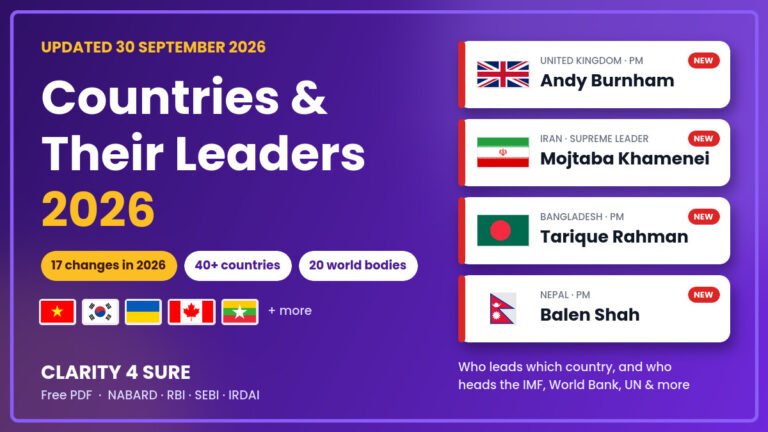 Free sheet · Static GKCountries & Their Leaders 2026Who leads which country in 2026, with all 17 changes marked. Get the article and the PDF free on WhatsApp.Get it free on WhatsApp →
RBI Monetary Policy Committee keeps repo rate unchanged at 5.25% amid global uncertainties
The Reserve Bank of India’s Monetary Policy Committee has unanimously decided to keep the policy repo rate unchanged at 5.25 per cent, citing rising global uncertainties and inflation risks.
Government launches VM Frames National Filmmaking Competition to mark 150 years of Vande Mataram
Government has launched VM Frames National Filmmaking Competition to mark 150 Years of Vande Mataram.
CEC Gyanesh Kumar inaugurates second phase of IEVP in New Delhi
The Election Commission has commenced the second phase of International Election Visitors’ Programme (IEVP) for the ongoing Assembly Elections in Tamil Nadu and West Bengal.
India Approves ₹30 Billion Currency Swap for Maldives
The Government of India approved a ₹30 billion swap facility for Maldives under the SAARC Currency Swap Framework; it strengthens India’s financial support to its neighbour; the move enhances regional economic stability and cooperation.
Ministry of Culture Launches ‘VM Frames’ Filmmaking Competition
The Ministry of Culture launched ‘VM Frames’ to mark 150 years of Vande Mataram by Bankim Chandra Chattopadhyay; it invites youth participation in filmmaking categories; awards worth ₹50 lakh aim to promote cultural awareness.
India–Japan Data Partnership for AI-Ready Smart Cities
DataKaveri Systems of Indian Institute of Science signed an MoU with ONESTRUCTION Inc.; the partnership integrates construction data into AI-ready urban systems; it will enhance smart city infrastructure and data-driven governance.
BharatGen and L&T Join Hands for Sovereign AI Platform
BharatGen Technology Foundation partnered with Larsen & Toubro entities to build India’s sovereign AI compute platform; the project focuses on AI chips, data centres, and language models; it strengthens India’s AI self-reliance under IndiaAI Mission.
MoS Jitin Prasada Visits Czech Republic to Boost Trade Ties
Jitin Prasada visited the Czech Republic to enhance trade and investment cooperation; he co-chaired the India-Czech Joint Commission meeting; the visit strengthened bilateral economic relations.
RBI Eases Forex Rules for Banks
The Reserve Bank of India eased restrictions on offshore forex derivatives; it allowed limited hedging under exposure caps; the move aims to stabilise the rupee and improve market flexibility.
Jio Financial Services Partners Allianz for Insurance JV
Jio Financial Services signed a pact with Allianz to form a 50:50 insurance joint venture; it combines digital reach with global expertise; the partnership targets India’s growing insurance market.
General Upendra Dwivedi Honoured in US Army War College Hall of Fame
Upendra Dwivedi was inducted into the US Army War College International Hall of Fame; he is the third Indian Army Chief to receive this honour; it recognises contributions to global military cooperation.
ACC Extends Tenure of PSU Bank Chiefs
The Appointments Committee led by Narendra Modi extended tenures of MDs and CEOs of Bank of India and Bank of Baroda; it also extended Indian Bank ED’s term; the move ensures leadership continuity in public sector banks.
Nasscom Appoints Srikanth Velamakanni as Chairman
NASSCOM appointed Srikanth Velamakanni as Chairman for 2026–27; he succeeds Sindhu Gangadharan; the appointment reflects leadership transition in India’s IT sector.
NASA Unveils Nancy Grace Roman Space Telescope
NASA unveiled the Roman Space Telescope to study dark matter and exoplanets; it will survey vast regions of the universe; the mission advances space research and cosmology.
Blue Origin Rocket Fails to Orbit Satellite
Blue Origin failed to place AST SpaceMobile satellite into orbit during New Glenn mission; engine issues caused deviation from planned trajectory; the incident highlights challenges in commercial space missions.
India Selected for FIFA Women’s Development Programme 2026
FIFA selected India for Women’s Development Programme; it aims to improve commercial and professional structure of women’s football; the initiative supports long-term sports development.
Oscar-Winning Designer Dean Tavoularis Passes Away
Dean Tavoularis passed away at 93 in Paris; he was known for films like The Godfather; he won an Academy Award for Best Art Direction.
General MM Naravane Launches New Book
Manoj Mukund Naravane launched “The Curious and the Classified”; the book explores military myths and traditions; it highlights lesser-known aspects of armed forces history.
Administrative Professionals Day 2026 Observed on April 22
Administrative Professionals Day recognises the role of administrative staff globally; it is observed during the last week of April; the day promotes professional development and workplace efficiency.
UN Spanish Language Day 2026 Observed on April 23
The United Nations observes Spanish Language Day on April 23; it promotes multilingualism and cultural diversity; the date honours writer Miguel de Cervantes.