

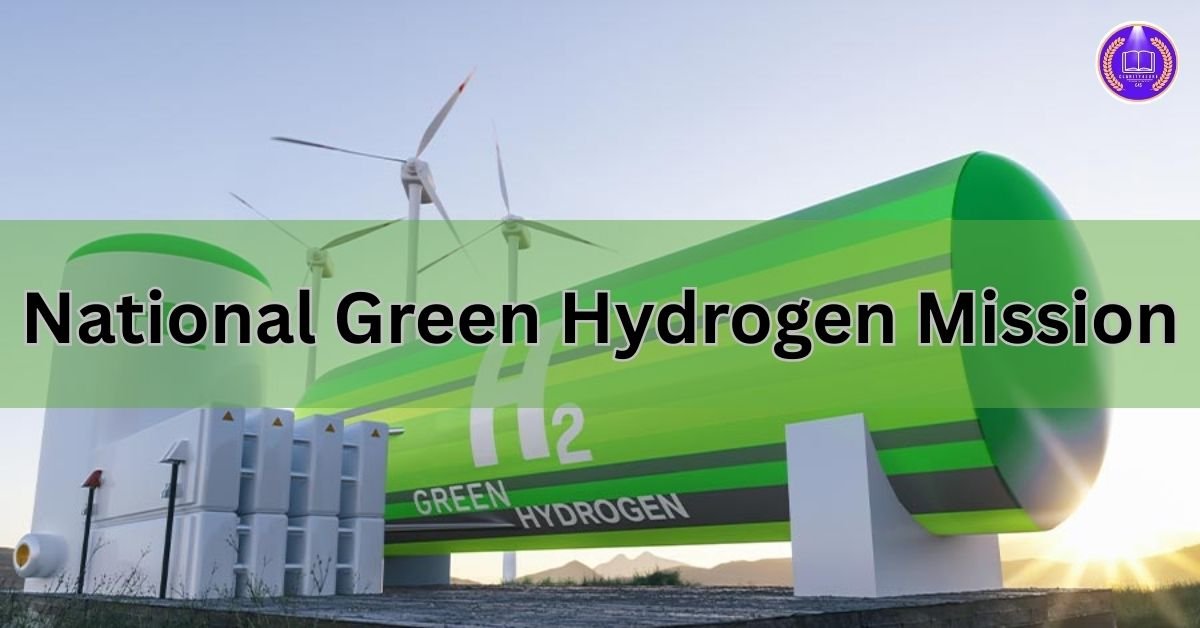
Why in News?
The Government of India has announced standards for green ammonia and green methanol to promote trade and production of green hydrogen derivatives under the National Green Hydrogen Mission.
Introduction
The National Green Hydrogen Mission aims to build a strong environment in India for the production, use, and development of green hydrogen technologies. Its main goal is to promote clean energy, reduce dependence on imported fossil fuels, and move the country towards a more sustainable and self-reliant energy system.
Green hydrogen is produced by splitting water into hydrogen and oxygen through a process called electrolysis. When this process uses electricity generated from renewable sources such as solar or wind power, the hydrogen produced is considered “green” because it does not release carbon emissions. Due to its clean nature and ability to store energy, green hydrogen is increasingly seen as an important solution for reducing emissions in sectors like industry, transport, and power.
India has strong potential to lead in this field because of its vast renewable energy capacity and its growing focus on addressing climate change. By promoting the production and use of green hydrogen, the mission seeks to make India a global hub for green hydrogen production and export while supporting the country’s long-term transition to a low-carbon economy.
National Green Hydrogen Mission
In January 2023, the Union Cabinet of India approved the National Green Hydrogen Mission, which marked an important step toward achieving the country’s sustainable energy goals and climate commitments.
- Budget and Implementation:
- The mission has been allocated a budget of ₹19,744 crore and will be implemented by the Ministry of New and Renewable Energy (MNRE).
- Objectives:
- The main objective of the mission is to make India a global centre for the production, use, and export of green hydrogen and its related products.
- Key Components:
- Strategic Interventions for the Green Hydrogen Transition Programme (SIGHT):
Under SIGHT, incentives will be provided to encourage domestic manufacturing of electrolysers and the production of green hydrogen in the country.
- Strategic Interventions for the Green Hydrogen Transition Programme (SIGHT):
- Green Hydrogen Hubs:
- The mission plans to identify and develop certain states and regions as Green Hydrogen Hubs, where large-scale production and use of green hydrogen can take place.
Expected Outcomes by 2030:
- Achieve green hydrogen production capacity of at least 5 million metric tonnes (MMT) per year.
- Add about 125 GW of renewable energy capacity.
- Attract more than ₹8 lakh crore in total investments.
- Create over six lakh jobs across different sectors.
- Reduce fossil fuel imports by more than ₹1 lakh crore.
- Avoid nearly 50 MMT of greenhouse gas emissions every year.
- Current Hydrogen Consumption:
- At present, India consumes around 6 million tonnes of hydrogen annually, mainly in the fertilizer industry and oil refineries.
- Future Projections:
- By 2050, India’s hydrogen demand is expected to increase to about 28 million tonnes, with the goal of meeting around 80% of this demand through green hydrogen.In January 2023, the Union Cabinet of India approved the National Green Hydrogen Mission, which marked an important step toward achieving the country’s sustainable energy goals and climate commitments.
- Budget and Implementation:
- The mission has been allocated a budget of ₹19,744 crore and will be implemented by the Ministry of New and Renewable Energy (MNRE).
- Objectives:
- The main objective of the mission is to make India a global centre for the production, use, and export of green hydrogen and its related products.
- Key Components:
- Strategic Interventions for the Green Hydrogen Transition Programme (SIGHT):
- Under SIGHT, incentives will be provided to encourage domestic manufacturing of electrolysers and the production of green hydrogen in the country.
- Green Hydrogen Hubs:
- The mission plans to identify and develop certain states and regions as Green Hydrogen Hubs, where large-scale production and use of green hydrogen can take place.
Expected Outcomes by 2030:
- Achieve green hydrogen production capacity of at least 5 million metric tonnes (MMT) per year.
- Add about 125 GW of renewable energy capacity.
- Attract more than ₹8 lakh crore in total investments.
- Create over six lakh jobs across different sectors.
- Reduce fossil fuel imports by more than ₹1 lakh crore.
- Avoid nearly 50 MMT of greenhouse gas emissions every year.
- Current Hydrogen Consumption:
- At present, India consumes around 6 million tonnes of hydrogen annually, mainly in the fertilizer industry and oil refineries.
- Future Projections:
- By 2050, India’s hydrogen demand is expected to increase to about 28 million tonnes, with the goal of meeting around 80% of this demand through green hydrogen.In January 2023, the Union Cabinet of India approved the National Green Hydrogen Mission, which marked an important step toward achieving the country’s sustainable energy goals and climate commitments.
- Budget and Implementation:
- The mission has been allocated a budget of ₹19,744 crore and will be implemented by the Ministry of New and Renewable Energy (MNRE).
- Objectives:
- The main objective of the mission is to make India a global centre for the production, use, and export of green hydrogen and its related products.
- Key Components:
- Strategic Interventions for the Green Hydrogen Transition Programme (SIGHT):
- Under SIGHT, incentives will be provided to encourage domestic manufacturing of electrolysers and the production of green hydrogen in the country.
- Green Hydrogen Hubs:
- The mission plans to identify and develop certain states and regions as Green Hydrogen Hubs, where large-scale production and use of green hydrogen can take place.
Expected Outcomes by 2030:
- Achieve green hydrogen production capacity of at least 5 million metric tonnes (MMT) per year.
- Add about 125 GW of renewable energy capacity.
- Attract more than ₹8 lakh crore in total investments.
- Create over six lakh jobs across different sectors.
- Reduce fossil fuel imports by more than ₹1 lakh crore.
- Avoid nearly 50 MMT of greenhouse gas emissions every year.
- Current Hydrogen Consumption:
- At present, India consumes around 6 million tonnes of hydrogen annually, mainly in the fertilizer industry and oil refineries.
- Future Projections:
- By 2050, India’s hydrogen demand is expected to increase to about 28 million tonnes, with the goal of meeting around 80% of this demand through green hydrogen.
National Green Hydrogen Mission Implementation
The mission aims to roll out in stages, initially targeting existing hydrogen-utilizing sectors for Green Hydrogen deployment and ecosystem development, then expanding to new economic sectors, with each phase’s key focus areas outlined.
- Phase I (2022-23 to 2025-26): Focus on creating demand and supply for Green Hydrogen by incentivising domestic electrolyser production, with initial deployment in existing hydrogen-using sectors like refineries, fertilizers, and city gas.
- This phase includes pilot projects for steel, mobility, and shipping, and establishing regulatory frameworks.
- Phase II (2026-27 to 2029-30): Anticipate Green Hydrogen to be cost-competitive with fossil fuels, leading to expanded production and exploration of commercial-scale projects in new sectors such as steel, mobility, shipping, railways, and aviation, alongside intensified R&D for continuous product development and deep decarbonisation of the economy.
National Green Hydrogen Mission Benefits and Goals
The National Green Hydrogen Mission (NGHM) aims to make India a global hub for the production, use, and export of green hydrogen and its derivatives. Some of the important benefits and goals of the mission are as follows:
- Decarbonisation:
- The mission is expected to significantly reduce carbon emissions and support the decarbonisation of the Indian economy.
- Reduced Dependence on Fossil Fuels:
- It seeks to lower India’s dependence on imported fossil fuels and other feedstock used in industries.
- Indigenous Manufacturing:
- The mission will promote the development of domestic manufacturing capabilities for green hydrogen technologies and related equipment.
- Employment Opportunities:
- It is expected to generate a large number of jobs across different sectors linked to the green hydrogen ecosystem.
- Export Opportunities:
- The mission will open up export opportunities for green hydrogen and its derivatives, strengthening India’s role in the global clean energy market.
- Green Hydrogen Hubs:
- In the initial phase, the mission plans to establish at least two green hydrogen hubs to promote large-scale production and utilisation.
- Pilot Projects:
- The mission also includes funding for several pilot projects such as low-carbon steel production, mobility projects using hydrogen fuel, and shipping projects based on green hydrogen.
The overall aim of the National Green Hydrogen Mission is to make India self-reliant (Aatmanirbhar) in clean energy while also contributing to and inspiring the global transition towards sustainable energy.
National Green Hydrogen Mission Challenges
The National Green Hydrogen Mission in India faces several challenges that need to be addressed for its successful implementation. Some of the key obstacles include:
- Incentive Disparity:
- The initial incentive of ₹50 per kilogram, which gradually decreases every year, is considered relatively low when compared with the incentives offered by other countries.
- Global Comparisons:
- Several countries are offering much higher financial support for green hydrogen projects. For example, the United States provides up to $3 per kilogram as a base tax credit and has also committed $8 billion for developing regional hydrogen hubs.
- Funding Insufficiency:
- The government has allocated around ₹5,400 crore, which accounts for only about 40% of the total required budget for fuel production, raising concerns about whether the available funding will be sufficient.
- European Support Levels:
- In comparison, European countries are offering around €4 per kilogram for projects in places such as Greece, which highlights the gap between India’s incentives and global support levels.
FAQ’s
Q1. What is the National Green Hydrogen Mission?
The National Green Hydrogen Mission is a government initiative launched by India to promote the production, use, and export of green hydrogen. The mission focuses on developing a strong ecosystem for green hydrogen technologies so that clean energy can be widely adopted. It also aims to reduce dependence on fossil fuels and support India’s transition toward a low-carbon and sustainable energy system.
Q2. What is the objective of the mission?
The main objective of the mission is to make India a global hub for the production, utilization, and export of green hydrogen and its derivatives. It also aims to strengthen energy security, reduce carbon emissions, encourage domestic manufacturing of related technologies, and support the country’s long-term climate goals.
Q3. What are the key targets and benefits of the mission?
The mission aims to achieve a green hydrogen production capacity of at least 5 million metric tonnes per year by 2030 and add around 125 GW of renewable energy capacity. It is also expected to attract large investments, create lakhs of employment opportunities, reduce fossil fuel imports, and significantly cut greenhouse gas emissions, thereby contributing to a cleaner and more sustainable economy.
Q4. What are the Strategic Interventions for Green Hydrogen Transition (SIGHT)?
SIGHT is a major programme under the National Green Hydrogen Mission that provides financial incentives to promote the domestic manufacturing of electrolysers and the production of green hydrogen. The goal is to encourage industries to invest in green hydrogen technologies, reduce production costs, and help build a strong green hydrogen ecosystem in India.







