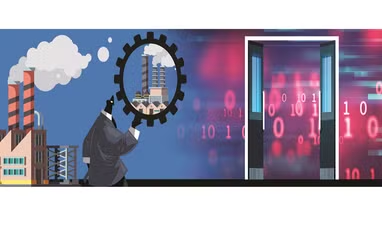
From local artisans and small businesses to growing manufacturing units, MSMEs are at the heart of India’s economic growth. With continuous government reforms, digital tools, and better support, these businesses now have easier access to loans, modern technology, skill development, and new market opportunities. Their increasing contribution to jobs, manufacturing, and exports shows how important they have become for the country’s progress. As India moves towards the vision of Viksit Bharat 2047, MSMEs will remain a key driver of employment, entrepreneurship, innovation, and inclusive economic growth.
India’s MSMEs: Powering Inclusive Economic Growth
Across India, every small business has its own unique story. It could be a weaver carrying forward a family tradition, a small manufacturer exporting products worldwide, a woman entrepreneur building her dream business, or a young innovator launching a startup. Though they work in different sectors and at different scales, all of them together make up India’s vibrant MSME ecosystem.
Today, MSMEs are much more than just businesses. They create jobs, encourage innovation, and support inclusive growth by providing opportunities in both rural and urban areas. With the help of government reforms, digital technology, easier access to finance, and supportive policies, the sector is growing stronger every year.
As India moves towards the goals of Aatmanirbhar Bharat and Viksit Bharat 2047, MSMEs will continue to play a crucial role in boosting entrepreneurship, strengthening the economy, and improving livelihoods. Their journey is not just about building successful businesses—it is also about empowering people and driving India’s overall growth and development.
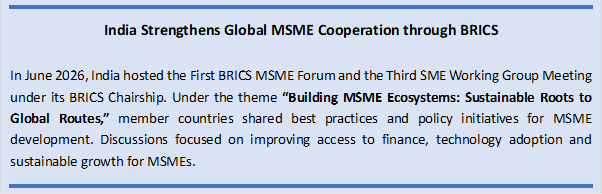
India’s MSME Landscape: Scale, Diversity and Impact
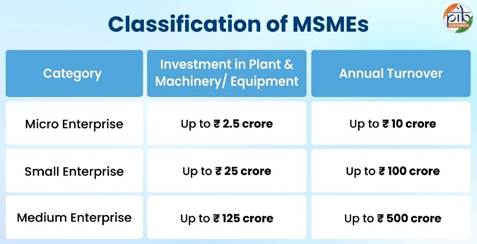
MSMEs have become one of the biggest drivers of India’s economy and industrial growth. Recognising their growing importance, the Government revised the definition of MSMEs from 1 April 2025. The new criteria, based on investment and annual turnover, allow businesses to grow without losing the benefits and support available under MSME schemes.
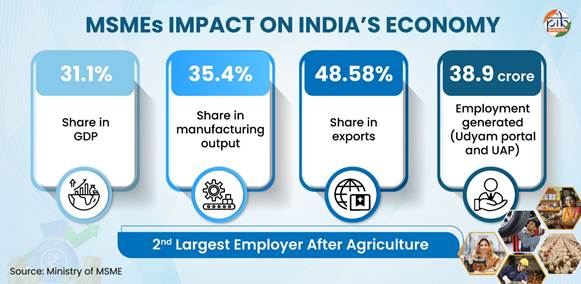
According to data released in January 2026, MSMEs contribute around 31.1% of India’s GDP, 35.4% of the country’s manufacturing output, and 48.58% of total exports. The sector also provides employment to more than 38.9 crore people, making it the second-largest source of jobs in India after agriculture.
Beyond their economic contribution, MSMEs are helping build a strong entrepreneurial culture across the country. They are creating opportunities for first-time business owners, women entrepreneurs, and young innovators, especially in rural and semi-urban areas. Government initiatives such as the Digital Credit Assessment Model and increased equity support to Small Industries Development Bank of India (SIDBI) are making it easier for these businesses to access formal finance, helping them grow, create more jobs, and contribute to India’s long-term development.
A Year of Transformation
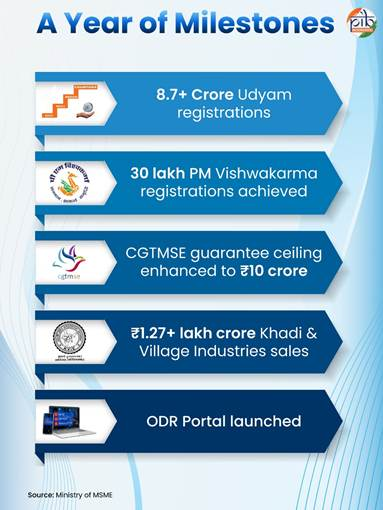
The year 2025–26 was an important milestone for India’s MSME sector. Several major initiatives and achievements helped strengthen small businesses by improving formalisation, access to finance, technology adoption, grievance resolution, and market opportunities.
Formalisation at a Record High
- More than 8.7 crore enterprises were registered under the Udyam Registration Portal and Udyam Assist Platform by June 2026. As more businesses entered the formal economy, they became eligible for government schemes, easier bank loans, and better business opportunities.
Better Access to Credit
- The Credit Guarantee Fund Trust for Micro and Small Enterprises (CGTMSE) completed 25 years of supporting MSMEs. Between 1 January and 30 November 2025, the trust approved 29.03 lakh loan guarantees worth ₹3.77 lakh crore. To further improve access to finance, the government increased the maximum guarantee coverage from ₹5 crore to ₹10 crore, allowing businesses to obtain larger collateral-free loans.
Strong Growth in Khadi, Village Industries and Coir
- The Khadi and Village Industries Commission recorded sales of more than ₹1.27 lakh crore during the year. This reflects the growing demand for locally made products and the increasing contribution of rural enterprises to employment and income generation. The coir industry also performed well, driven by higher exports and greater use of modern technology. Coir exports reached ₹6,614.40 crore in 2025–26.
Faster and More Technology-Driven Services
- The MSME Samadhaan Portal continued to help micro and small businesses recover delayed payments. By June 2026, it had received 2,56,892 applications involving claims worth ₹55,244.29 crore. Out of these, 58,148 cases had been successfully resolved by MSE Facilitation Councils. The CHAMPIONS Portal also performed strongly. During 2025–26, it received 39,494 grievances, and 39,387 of them were resolved, achieving an impressive 99.72% resolution rate.
To further improve dispute resolution, the government launched the Online Dispute Resolution (ODR) Portal. The platform is designed to resolve payment-related disputes quickly through a technology-enabled system, making it easier for MSMEs to receive their dues on time.
Empowering the Udyami with Policies & Initiatives
A strong support system of government policies and institutions has been one of the biggest reasons behind the growth of India’s MSME sector. Through various schemes, the government is helping entrepreneurs start, grow, and expand their businesses while creating jobs and boosting economic development.
PM Vishwakarma
PM Vishwakarma is a flagship scheme that supports artisans and craftspeople working in 18 traditional trades. It provides complete assistance—from skill training and modern toolkits to affordable loans, digital payments, and marketing support—helping artisans improve their income and expand their businesses.
The scheme has achieved remarkable success. Its target of 30 lakh beneficiary registrations, originally planned over four years, was completed in just two years.
Some of its key achievements include:
- Skill Development: More than 24 lakh artisans have completed basic skill training.
- Easy Credit: Over ₹5,133 crore has been sanctioned as collateral-free loans at concessional interest rates to more than 5.98 lakh beneficiaries.
- Digital Empowerment: More than 7.91 lakh artisans have adopted digital payment systems, making their businesses more modern and accessible.
A Scheme for Promotion of Innovation, Rural Industry and Entrepreneurship (ASPIRE)
The ASPIRE Scheme encourages entrepreneurship and self-employment in rural India. It supports aspiring entrepreneurs through skill training, business incubation, and assistance in setting up micro-enterprises.
As of June 2026, the scheme had established 109 Livelihood Business Incubators (LBIs) across the country, helping promote rural entrepreneurship and inclusive economic growth.
Its major achievements include:
- More than 1.23 lakh people have received skill training.
- Around 32,085 beneficiaries have secured employment.
- Over 1,000 micro-enterprises have been established, creating new livelihood opportunities and strengthening local economies.
Prime Minister’s Employment Generation Programme (PMEGP)
PMEGP is one of the Government’s flagship schemes to promote self-employment by helping people set up micro-enterprises in the non-farm sector. Under the scheme, eligible beneficiaries receive a margin money subsidy on bank loans, making it easier to start a new business with lower financial burden.
To make the scheme more accessible, the government introduced the online application facility in 19 regional languages, in addition to English and Hindi, from June 2025.
Since its launch, the scheme has made a significant impact. As of May 2026:
- More than 10.84 lakh micro-enterprises have been established.
- Around ₹29,623 crore has been provided as margin money subsidy.
- The scheme has helped generate employment for over 97 lakh people across the country.
MSME Champions Scheme
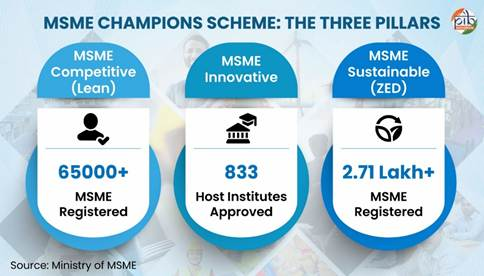
The MSME Champions Scheme helps small businesses become more innovative, productive, sustainable, and globally competitive. It supports MSMEs in adopting modern technologies, improving product quality, protecting intellectual property, and following global manufacturing standards.
The scheme works through three major components:
MSME Innovative
This component encourages innovation, product design, and intellectual property protection.
- Under the Incubation programme, 833 Host Institutes have been approved to support startups and nurture innovative business ideas.
- Under the Design programme, 21 Memorandums of Understanding (MoUs) have been signed, and 69 design projects by professionals and students have been approved.
- Through the Intellectual Property Facilitation Centres (IPFCs), businesses have received support for 191 patents, 807 trademarks, 99 industrial designs, and 6 Geographical Indication (GI) registrations.
MSME Sustainable (ZED)
The Zero Defect Zero Effect (ZED) initiative encourages MSMEs to manufacture high-quality products while reducing their environmental impact.
As of May 2026:
- More than 93.61 lakh MSMEs had registered under the programme.
- Over 6.68 lakh enterprises had successfully obtained ZED certification, reflecting their commitment to quality and sustainable manufacturing.
MSME Competitive (LEAN)
The LEAN Manufacturing Scheme helps MSMEs improve efficiency by reducing waste, lowering production costs, and adopting globally accepted manufacturing practices.
As of May 2026:
- More than 65,647 MSMEs had registered under the scheme.
- Nearly 18,961 enterprises had received LEAN certification, making them more productive and competitive in both domestic and international markets.
Self-Reliant India (SRI) Fund
Many MSMEs have the potential to grow but often struggle to raise equity capital. To address this, the Government launched the Self-Reliant India (SRI) Fund under the Aatmanirbhar Bharat package.
The fund provides equity investment to promising MSMEs, helping them expand their businesses, attract private investment, and scale up operations.
In the Union Budget 2026–27, the Government allocated an additional ₹2,000 crore to strengthen the SRI Fund, ensuring continued financial support for growing enterprises.
As of May 2026, the fund had supported 761 MSMEs with investments worth ₹2,851 crore.
Promotion of MSMEs in North Eastern Region and Sikkim
To boost industrial development in the North Eastern States and Sikkim, the Government continues to invest in infrastructure and entrepreneurship through this scheme.
By December 2025, 73 projects had been approved to improve manufacturing, testing facilities, packaging, skill development, and innovation infrastructure.
During 2025, eight new projects were approved in Assam and Meghalaya. These projects involve a total investment of ₹114.37 crore, with ₹89.60 crore provided by the Government.
These investments are strengthening industrial estates, tourism infrastructure, and creating new business opportunities across the region.
National SC-ST Hub
The National SC-ST Hub (NSSH) supports entrepreneurs from Scheduled Caste (SC) and Scheduled Tribe (ST) communities by improving their access to government procurement, markets, training, and business development opportunities.
Its major achievements include:
- More than 19,000 SC/ST entrepreneurs were supported between January and October 2025.
- 111 Vendor Development Programmes and three major business conclaves were organised in Odisha and Bihar.
- Government procurement from SC/ST-owned MSMEs increased significantly—from around ₹99 crore in 2015–16 to more than ₹3,731 crore in 2024–25.
- Around 230 candidates received hospitality skill training during 2025–26.
- By December 2025, SC/ST-owned MSMEs accounted for 1.93% of total government procurement.
Micro and Small Enterprises Cluster Development Programme
The MSE-CDP helps MSMEs grow through a cluster-based approach. Instead of supporting individual businesses separately, it develops shared infrastructure such as Common Facility Centres (CFCs), testing laboratories, and industrial estates that can be used by multiple enterprises.
As of June 2026:
- 612 projects had been approved.
- 364 projects had already been completed, providing modern infrastructure to thousands of MSMEs.
During 2025–26 (up to 20 November 2025):
- 11 new projects worth ₹253.23 crore were approved.
- Two projects were successfully completed.
This shared infrastructure helps businesses improve productivity, reduce costs, and access better technology.
Scheme of Fund for Regeneration of Traditional Industries
Traditional industries such as handicrafts, handloom, bamboo, coir, and village industries are an important part of India’s economy and cultural heritage. However, artisans often face challenges such as outdated technology, poor market access, and limited business opportunities.
The SFURTI scheme addresses these issues by organising artisans into clusters, where they receive better infrastructure, common facilities, design support, and marketing assistance.
As of June 2026:
- 513 artisan clusters had been approved across India.
- More than 3.03 lakh artisans had benefited from the scheme.
- 376 clusters were fully operational.
During 2023–24, 18 new clusters became operational, benefiting 11,810 artisans across 11 states.
Raising and Accelerating MSME Performance
Supported by the World Bank, the RAMP Scheme aims to improve MSMEs’ access to finance, markets, technology, and better business services while encouraging reforms at both the Central and State levels.
Some key achievements include:
- All 36 States and Union Territories submitted Systematic Investment Plans (SIPs).
- 398 projects worth ₹3,211.75 crore were approved.
- More than 55 lakh MSMEs had benefited from various RAMP initiatives by June 2026.
- Around 50% of the programme’s implementation targets had been achieved through timely completion of planned reforms and activities.
Technology Centres
Technology Centres help MSMEs adopt modern technologies, improve manufacturing, and develop a skilled workforce. They provide training, technical support, product development, and testing facilities for industries.
Currently:
- 18 Technology Centres are supporting MSMEs in manufacturing and technology-intensive sectors.
- Under the Technology Centres and Extension Centres (TCEC) scheme, 20 new Technology Centres and 100 Extension Centres are being established.
As of November 2025:
- 25 Extension Centres were operational.
- They had trained 53,963 young people and supported 1,357 MSMEs.
Under the Technology Centre System Programme (TCSP), supported by the World Bank:
- Nine new centres had been established.
- They trained 59,357 individuals and provided technical support to 1,520 MSMEs between January and November 2025.
By combining technology, skill development, innovation, and industry support, these centres are helping MSMEs modernise their operations, improve productivity, and compete successfully in domestic as well as global markets.
Shaping the Future Through Enterprise
The growth of India’s MSME sector reflects the country’s overall economic progress. Better access to finance, modern technology, skill development, infrastructure, and markets is helping small businesses grow stronger, become more competitive, and overcome challenges more effectively. As MSMEs continue to expand, they will create more jobs, encourage innovation, boost industrial and economic growth, and improve livelihoods across the country. Their continued success will play a vital role in building an inclusive, self-reliant, and developed India, supporting the vision of Viksit Bharat 2047.