

Daily Current Affairs Quiz
30 June, 2026
International Affairs
1. Seychelles
Source: The Hindu
Context
Seychelles, an archipelagic sovereign island republic in the western Indian Ocean, hosted PM Modi on his 27-29 June 2026 State Visit as Guest of Honour at its Golden Jubilee National Day celebrations (50 years of Independence on 29 June 1976). Recognized as one of the world’s smallest nations by land area but with a massive maritime footprint, Seychelles is celebrated for pristine white beaches, diverse coral systems, and pioneering ecological preservation. The country comprises two distinct island groups: the Granitic Inner Islands (Mahé Group) — the world’s only mid-ocean islands formed of ancient continental granite — and the Coralline Outer Islands — flat coral atolls. Mahé is the largest and most populous island, hosting the capital Victoria. The highest peak is Morne Seychellois (905 m / 2,969 ft) on Mahé. Two iconic biological features make Seychelles a global ecological treasure: the Coco de Mer palm (endemic to just two islands; bears world’s heaviest wild fruit) and the Aldabra Atoll (UNESCO World Heritage Site; sanctuary for ~100,000 wild giant tortoises). President: Dr. Patrick Herminie (6th President, since 2025).
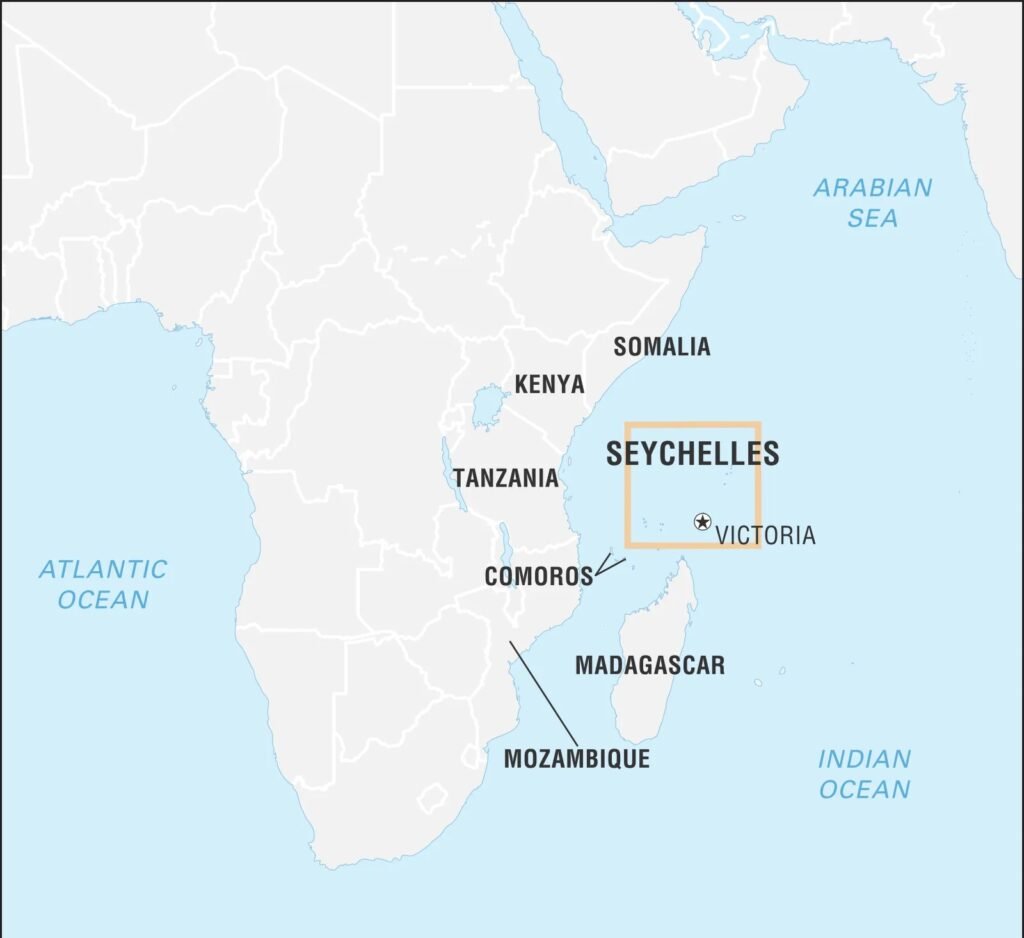
Where is Seychelles?
| Aspect | Detail |
|---|---|
| Region | Western Indian Ocean |
| Coordinates | 4°S to 11°S latitude; 46°E to 56°E longitude |
| Capital | Victoria, on Mahé (largest, most populous island) |
| Total Islands | 115 (a multi-island archipelago) |
| Independence | 29 June 1976 (from UK) |
| Government | Sovereign, multi-party Republic with a single legislative house (National Assembly) |
What are the key biological treasures?
| Feature | Detail |
|---|---|
| Coco de Mer Palm | Endemic to only 2 islands (Praslin + Curieuse); bears world’s largest and heaviest wild fruit (~30 kg); state-protected against poaching; cultural/national symbol |
| Aldabra Atoll | UNESCO World Heritage Site (1982); 2nd-largest coral atoll in the world; sanctuary for ~100,000 wild Aldabra giant tortoises |
Why is Seychelles strategically important to India?
| Aspect | Detail |
|---|---|
| MAHASAGAR Partner | Key partner in India’s Global Maritime Vision (2025) |
| Colombo Security Conclave | Full member from June 2026 (earlier observer) |
| Strategic Location | Western Indian Ocean — between Africa, India, Madagascar |
| Blue Economy Pioneer | World leader in Blue Bonds + Blue Economy frameworks |
| Diplomatic Relations | 50 years in 2026 |
| Defence Cooperation | India-built fast patrol vessels, Dornier aircraft, joint maritime training |
About the President of Seychelles
- Dr. Patrick Herminie — 6th President of Seychelles.
- Took office 2025.
- Met PM Modi during his February 2026 State Visit to India and June 2026 in Seychelles.
Practice MCQs
Q1. With reference to Seychelles, consider the following statements:
- Seychelles is a sovereign multi-party island republic located in the western Indian Ocean.
- Its capital, Victoria, is located on the largest island, Mahé.
- Seychelles gained independence on 29 June 1976.
- Seychelles is a single-island nation with no archipelagic features.
How many of the above statements are correct?
(a) Only one (b) Only two (c) Only three (d) All four (e) None
(Statement 4 is wrong; Seychelles is an ARCHIPELAGO of 115 islands, NOT a single-island nation.)
Q2. With reference to the two distinct island groups of Seychelles, consider the following statements:
- The Granitic Inner Islands, also known as the Mahé Group, consist of more than 40 central islands.
- These granitic islands are the world’s only mid-ocean islands formed of ancient continental granite.
- The Coralline Outer Islands consist of more than 70 low-lying coral atolls and are mostly uninhabited.
- Both island groups have similar geological origins and topography.
How many of the above statements are correct?
(a) Only one (b) Only two (c) Only three (d) All four (e) None
(Statement 4 is wrong; the two island groups have DIFFERENT geological origins — granitic continental rock vs coralline reef material — and very different topographies.)
Answer Key
- (c) — Statement 4 wrong: Seychelles is a 115-island archipelago.
- (c) — Statement 4 wrong: Different geological origins.
National Affairs
1. World’s Best School Prizes 2026
Source: TOI
Context
The World’s Best School Prizes 2026 shortlist — released by T4 Education, a UK-headquartered global education platform on 25 June 2026 — features seven Indian schools across four of the five award categories, setting a new global record for the highest number of shortlisted schools from any country in a single year since the awards were launched in 2022 (now in their 4th year). T4 Education was founded by Mr. Vikas Pota in the wake of the COVID-19 pandemic to celebrate schools transforming lives globally. Each category features a Top 10 shortlist (total 50 schools); category winners are selected by an independent Judging Academy of global education experts in November 2026, while the Community Choice Award is decided by public vote. All shortlisted schools will gather at the World Schools Summit in London in January 2027 to share best practices.
What is the World’s Best School Prizes?
- Organiser: T4 Education, UK-headquartered.
- Founded: 2022 (post-COVID).
- Founder: Mr. Vikas Pota.
- Year: 2026 = 4th edition.
- Categories (5):
- Innovation.
- Community Collaboration.
- Environmental Action.
- Supporting Healthy Lives.
- Overcoming Adversity.
- Per Category: Top 10 schools shortlisted = 50 total.
- Community Choice Award: Decided by public vote from all 50 shortlisted schools.
- World Schools Summit: London, January 2027.
Which 7 Indian schools made the shortlist?
| Category | School | State | Type |
|---|---|---|---|
| Innovation | PCMC Chhatrapati Shahuji Maharaj English Medium School, Kasarwadi, Pune | Maharashtra | Public (Pimpri-Chinchwad Municipal Corporation-run) |
| Innovation | Army Goodwill School Wuzur, Anantnag | Jammu & Kashmir | Public (Indian Army-run) |
| Community Collaboration | Healthy Planet TGA Early Years School, Noida | Uttar Pradesh | Independent (Kindergarten) |
| Community Collaboration | Inventure Academy, Bengaluru | Karnataka | Independent |
| Community Collaboration | Seth M.R. Jaipuria School, Vineet Khand, Gomti Nagar, Lucknow | Uttar Pradesh | Independent |
| Environmental Action | EuroSchool Bannerghatta, Bengaluru | Karnataka | Independent |
| Supporting Healthy Lives | Seth Anandram Jaipuria School, Lucknow | Uttar Pradesh | Independent |
State-wise distribution
| State | Schools Shortlisted |
|---|---|
| Uttar Pradesh (Noida + Lucknow ×2) | 3 |
| Karnataka (Bengaluru ×2) | 2 |
| Maharashtra (Pune) | 1 |
| Jammu & Kashmir (Anantnag) | 1 |
Practice MCQs
Q1. With reference to the World’s Best School Prizes 2026, consider the following statements:
- The prizes are organised by T4 Education, a UK-headquartered global education platform.
- The prizes were founded in 2022 in the wake of the COVID-19 pandemic.
- India has the highest number of shortlisted schools (seven) from any country in a single year since the prizes were launched.
- The prizes are organised by UNESCO at its headquarters in Paris.
How many of the above statements are correct?
(a) Only one (b) Only two (c) Only three (d) All four (e) None
(Statement 4 is wrong; the World’s Best School Prizes are organised by T4 Education (UK), NOT by UNESCO.)
Q2. With reference to the categories of the World’s Best School Prizes, consider the following statements:
- The prizes cover five categories: Innovation, Community Collaboration, Environmental Action, Supporting Healthy Lives, and Overcoming Adversity.
- Each category has a Top 10 shortlist of schools.
- Indian schools were shortlisted in four of the five categories in 2026.
- The category winners are decided through a public vote.
How many of the above statements are correct?
(a) Only one (b) Only two (c) Only three (d) All four (e) None
(Statement 4 is wrong; the category winners are selected by an independent Judging Academy of global education experts — NOT by public vote. Only the Community Choice Award is decided by public vote.)
Answer Key
- (c) — Statement 4 wrong: T4 Education organises it, not UNESCO.
- (c) — Statement 4 wrong: Judging Academy decides category winners; only Community Choice Award is by public vote.
2. Captive-Bred, Radio-Tagged White-Rumped Vulture (Gyps bengalensis)
Source: The Hindu
Context
A radio-tagged, captive-bred white-rumped vulture (Gyps bengalensis) — released earlier in 2026 at the Mudumalai Tiger Reserve (MTR), Nilgiris district, Tamil Nadu — was electrocuted on Sunday, 28 June 2026 after contact with a power line at Ebbanad village overlooking the Sigur plateau. The bird was initially part of the Bombay Natural History Society (BNHS) release of 34 captive-bred vultures at Pench, Melghat, and Tadoba-Andhari Tiger Reserves during December 2025-January 2026. It was first released at Tadoba-Andhari Tiger Reserve (TATR), Maharashtra in December 2025, drifted into Karnataka, was captured and treated after showing signs of illness, and in April 2026 BNHS + Karnataka Forest Department secured permission from the Tamil Nadu Forest Department to release it in MTR — home to the last sizeable population of white-rumped vultures in South India. The bird, however, failed to acclimatise, undertaking exploratory forays to Gudalur, Kalhatty, and Ebbanad before its electrocution. This marks the end of India’s first attempted reintroduction of a captive-bred white-rumped vulture into the South Indian landscape and is expected to influence future conservation policy.
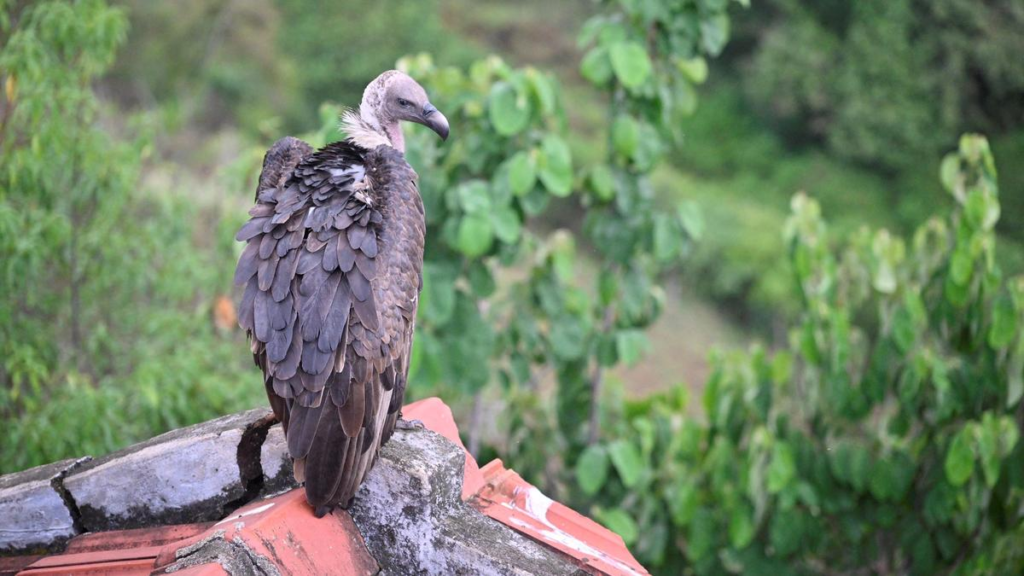
What is the White-Rumped Vulture (Gyps bengalensis)?
| Aspect | Detail |
|---|---|
| Scientific Name | Gyps bengalensis |
| Family | Accipitridae (Old World vultures) |
| IUCN Status | Critically Endangered (since 2000) |
| CITES | Appendix II |
| Wildlife (Protection) Act, 1972 | Schedule I (highest protection) |
| Population Decline | >99% in South Asia since 1990s |
| Main Cause | Diclofenac + other NSAIDs in veterinary use |
| Diet | Exclusively carrion (scavenger) |
| Breeding | October-April; monogamous; 1 nestling/year |
| Size | Smallest among Gyps species |
What is the Mudumalai Tiger Reserve (MTR)?
- State: Tamil Nadu.
- District: Nilgiris.
- Part of: Nilgiri Biosphere Reserve (India’s first BR, 1986).
- Adjoins: Bandipur TR (Karnataka), Nagarhole TR (Karnataka), Wayanad WLS (Kerala) — Mudumalai-Bandipur-Wayanad-Nagarhole landscape.
- WRV Population in MTR: 49-104 individuals across nesting colonies (Manigandan et al., 2023); 36 active nesting pairs documented (Venkitachalam & Senthilnathan, 2016); ~68 nests in adjoining Nilgiri North Forest Division (Ramakrishnan et al., 2014).
- Moyar Valley: Key vulture stronghold in MTR.
Who is the BNHS?
- Full Form: Bombay Natural History Society.
- Founded: 1883.
- HQ: Hornbill House, Mumbai.
- Status: Pan-India wildlife research and conservation NGO; partner of BirdLife International.
- Notable Role: First documented vulture decline in 1999; leads vulture conservation breeding programme since early 2000s.
What are the Jatayu Conservation Breeding Centres (JCBCs)?
| Centre | State | Partners |
|---|---|---|
| Pinjore | Haryana | BNHS + State Forest Dept |
| Rajabhatkhawa | West Bengal | BNHS + State Forest Dept |
| Rani | Assam | BNHS + State Forest Dept |
| Bhopal | Madhya Pradesh | BNHS + State Forest Dept |
Why are vultures critically important to ecosystem?
- Apex scavengers — clean up carcasses, prevent disease spread (anthrax, rabies, etc.).
- Ecosystem services: control pathogens that affect humans + livestock.
- Their decline has caused rise in feral dog populations → spike in rabies cases.
- A 2008 study estimated vulture decline caused ~₹2.3 lakh crore in economic losses in India over a decade.
What are India’s vulture conservation initiatives?
- Vulture Action Plan (VAP) 2020-2025 — by MoEFCC.
- Jatayu Conservation Breeding Centres (4 centres).
- Vulture Safe Zones (VSZs) — Diclofenac-free areas across India.
- Pench, Tadoba-Andhari, Melghat Tiger Reserves in Maharashtra — current reintroduction sites.
- Kaziranga landscape (Assam) — first soft-release of slender-billed vultures in March 2026.
Practice MCQs
Q1. With reference to the White-Rumped Vulture (Gyps bengalensis), consider the following statements:
- It is classified as Critically Endangered on the IUCN Red List.
- It is listed under Schedule I of the Wildlife (Protection) Act, 1972.
- Its primary cause of population decline has been the veterinary use of diclofenac and other NSAIDs.
- It is endemic to the South American continent.
How many of the above statements are correct?
(a) Only one (b) Only two (c) Only three (d) All four (e) None
(Statement 4 is wrong; the White-Rumped Vulture is native to South Asia (India, Nepal, Bangladesh, Pakistan), NOT endemic to South America.)
Q2. With reference to the electrocution incident at Mudumalai Tiger Reserve (28 June 2026), consider the following statements:
- The captive-bred white-rumped vulture was first released at Tadoba-Andhari Tiger Reserve in Maharashtra in December 2025.
- The bird was subsequently captured in Karnataka after showing signs of illness and treated before being released at Mudumalai Tiger Reserve in April 2026.
- The bird was electrocuted at Ebbanad village overlooking the Sigur plateau.
- The electrocution incident marks the success of India’s first attempted captive-bred WRV reintroduction in South India.
How many of the above statements are correct?
(a) Only one (b) Only two (c) Only three (d) All four (e) None
(Statement 4 is wrong; the electrocution marks the END (failure), NOT success of the first attempted reintroduction.)
Q3. With reference to the Bombay Natural History Society (BNHS), consider the following statements:
- BNHS was founded in 1883 and is headquartered at Hornbill House, Mumbai.
- BNHS is a partner of BirdLife International.
- BNHS leads India’s vulture conservation breeding programme in collaboration with state forest departments and the RSPB (UK).
- BNHS is a statutory body created under an Act of Parliament.
How many of the above statements are correct?
(a) Only one (b) Only two (c) Only three (d) All four (e) None
(Statement 4 is wrong; BNHS is a non-governmental, pan-India wildlife research NGO, NOT a statutory body created under an Act of Parliament.)
Q4. With reference to the Jatayu Conservation Breeding Centres (JCBCs), consider the following statements:
- The four JCBCs are located at Pinjore (Haryana), Rajabhatkhawa (West Bengal), Rani (Assam), and Bhopal (Madhya Pradesh).
- JCBCs are operated by BNHS in collaboration with state forest departments and the Royal Society for the Protection of Birds (RSPB), UK.
- The JCBCs currently house approximately 740 vultures, with about 110 already released into the wild for reintroduction.
- There is only one JCBC in India, located in Tamil Nadu.
How many of the above statements are correct?
(a) Only one (b) Only two (c) Only three (d) All four (e) None
(Statement 4 is wrong; there are 4 JCBCs (Pinjore, Rajabhatkhawa, Rani, Bhopal) — NOT one located in Tamil Nadu.)
Answer Key
- (c) — Statement 4 wrong: WRV is native to South Asia, not South America.
- (c) — Statement 4 wrong: Marks failure (end), not success.
- (c) — Statement 4 wrong: BNHS is an NGO, not a statutory body.
- (c) — Statement 4 wrong: 4 JCBCs exist, none in Tamil Nadu.
Exam Relevance
| Exam | Relevance |
|---|---|
| UPSC Prelims & Mains | Very High — GS-III (Environment, Biodiversity Conservation), Prelims (Schedules, IUCN, species) |
| State PCS (esp. TN, Kerala, Karnataka, Maharashtra) | High — MTR, Tadoba, BNHS, WRV |
| RBI Grade B (Phase I + II) | Medium — ESI on environment/biodiversity (recurring GA topic) |
| NABARD Grade A | High — Rural biodiversity, eco-services |
| Banking (SBI PO, IBPS, RBI Assistant) | High — GA on critically endangered species, schemes |
| Forest Service (IFS/IFoS) | Critical — Direct subject — Vulture conservation, BNHS, NSAIDs, JCBCs |
| SSC, Railway, Insurance | High — IUCN, Schedule I species, BNHS |
3. Jonathan the Giant Tortoise
Source: Times of India
Context
During his State Visit to Seychelles on 28 June 2026, PM Modi visited the Seychelles National Botanical Garden in Victoria, where he interacted with and fed native giant tortoises and planted a Coco de Mer palm sapling. The visit drew global attention to the Seychelles giant tortoise (Aldabrachelys gigantea) — particularly to Jonathan, the world’s oldest known living land animal at an estimated 194 years (as of 2026), recognised by Guinness World Records. Important: Jonathan does NOT live in Seychelles — he lives on the grounds of Plantation House (Governor’s Residence) on Saint Helena, a British Overseas Territory in the South Atlantic — where he was brought from Seychelles in 1882 as a gift to the Governor (already “fully mature” at ~50 years, implying birth no later than 1832). On 17 June 2026, Guinness World Records designated Jonathan a “Guinness Icon”, joining the likes of John Cena and Shohei Ohtani. Giant tortoises function as ecosystem engineers in their native island habitats — clearing brush, dispersing seeds, modifying landscapes.
Who is Jonathan?
| Aspect | Detail |
|---|---|
| Species | Seychelles giant tortoise (Aldabrachelys gigantea hololissa) — sub-species of Aldabra giant tortoise |
| Estimated Birth | c. 1832 (Governor of Saint Helena assigned symbolic birthday: 4 December 1832) |
| Estimated Age (2026) | 194 years |
| Current Home | Plantation House (Governor’s Residence), Saint Helena (British Overseas Territory, South Atlantic) |
| Brought from Seychelles to St Helena | 1882 (at full maturity, ~50 years old) |
| Guinness Record | Oldest living land animal (since 2022, surpassing Tu’i Malila of Tonga who died in 1966 aged 189) |
| Guinness Icon Status | 17 June 2026 |
What is the Seychelles giant tortoise?
| Aspect | Detail |
|---|---|
| Scientific Name | Aldabrachelys gigantea (Aldabra giant tortoise; Seychelles tortoise is a subspecies) |
| Habitat | Native to Aldabra Atoll, Seychelles (UNESCO WHS) — primary wild sanctuary |
| Wild Population | ~100,000+ on Aldabra Atoll |
| Weight | 250-350 kg (550-770 lbs) |
| Diet | Herbivorous — grasses, leaves, fruits, woody plants |
| Lifespan | Can exceed 150 years; among the longest-living animals |
| IUCN Status | Vulnerable |
| Schedule | CITES Appendix II |
| Role | Ecosystem engineers — clear brush, disperse seeds, modify habitat |
Other notable giant tortoises in history
| Tortoise | Detail |
|---|---|
| Adwaita | Aldabra giant tortoise that died at Alipore Zoological Gardens, Kolkata (2006) at estimated 255 years (unverified) |
| Tu’i Malila | Madagascar radiated tortoise that died in Tonga (1966) at 189 years |
| Lonesome George | Last Pinta Island tortoise (Galápagos), died June 2012 |
Practice MCQs
Q1. With reference to Jonathan the giant tortoise, consider the following statements:
- Jonathan is a Seychelles giant tortoise (Aldabrachelys gigantea hololissa) estimated to be 194 years old in 2026.
- He has been recognised by Guinness World Records as the world’s oldest living land animal.
- Jonathan currently lives on the grounds of Plantation House on Saint Helena, a British Overseas Territory in the South Atlantic.
- Jonathan currently lives at the Seychelles National Botanical Garden in Victoria.
How many of the above statements are correct?
(a) Only one (b) Only two (c) Only three (d) All four (e) None
(Statement 4 is wrong; Jonathan lives on Saint Helena Island, NOT in Seychelles. He was brought to Saint Helena from Seychelles in 1882 and has lived there since.)
Q2. With reference to the Aldabra giant tortoise (Aldabrachelys gigantea), consider the following statements:
- It is one of the largest reptiles on Earth and a herbivorous species.
- The Aldabra Atoll in Seychelles is a UNESCO World Heritage Site and the primary wild sanctuary, hosting approximately 100,000 individuals.
- It is classified as Vulnerable on the IUCN Red List.
- It is native to South America.
How many of the above statements are correct?
(a) Only one (b) Only two (c) Only three (d) All four (e) None
(Statement 4 is wrong; the Aldabra giant tortoise is native to the Indian Ocean (specifically Aldabra Atoll, Seychelles), NOT South America.)
Answer Key
- (c) — Statement 4 wrong: Jonathan lives on Saint Helena, not Seychelles.
- (c) — Statement 4 wrong: Native to Indian Ocean, not South America.
Exam Relevance
| Exam | Relevance |
|---|---|
| UPSC Prelims & Mains | High — GS-III (Environment, Biodiversity, Endangered Species) |
| State PCS | High — Environment, IUCN species |
| Forest Service (IFS/IFoS) | Critical — Direct subject — Giant tortoise, IUCN, Aldabra Atoll |
| RBI Grade B / NABARD | Low — General Awareness only |
| Banking (SBI PO, IBPS, RBI Assistant) | High — Current Affairs, world records |
| SSC, Railway, Insurance | Very High — Jonathan, Aldabra, IUCN, Guinness Icon |
4. PM Modi Conferred Seychelles’ Highest Presidential Distinction “Guardian of the Blue Horizon”
Context
On Sunday, 28 June 2026, Prime Minister Shri Narendra Modi was conferred Seychelles’ highest presidential distinction — “Guardian of the Blue Horizon” — by President Dr. Patrick Herminie at a special state ceremony in Victoria, Mahé. This is the first time the honour has ever been bestowed, after the Seychelles Parliament instituted it just weeks before the visit by overhauling its national awards system and repealing older medals (the previous framework automatically entitled every Seychelles President to the honour, drawing criticism on transparency). The award marks PM Modi’s 34th international state honour from a foreign nation. The distinction recognises India’s green leadership, Blue Economy advocacy, climate action, sustainable ocean resource management, and championing of Small Island Developing States (SIDS) — including the MAHASAGAR + SAGAR visions, International Solar Alliance (ISA), Mission LiFE, “Ek Ped Maa Ke Naam” (Plant for Mother) afforestation drive, and the International Big Cat Alliance (IBCA). PM Modi dedicated the honour to all countries fighting climate change.
What is the Guardian of the Blue Horizon?
- Type: Highest presidential distinction of Seychelles.
- Purpose: Recognises exemplary international leadership in:
- Environmental conservation.
- Climate resilience.
- Green growth.
- Sustainable management of marine ecosystems.
- Recently Instituted: Created by Seychelles Parliament weeks before PM Modi’s visit by overhauling national awards system + repealing older medals.
Why was the honour conferred? (Key Pillars)
| Pillar | Detail |
|---|---|
| Blue Economy | India’s strategic push under MAHASAGAR (2025) + SAGAR (2015) visions — clean ocean trade, maritime safety, ocean resource protection |
| SIDS Support | India as trusted partner to Small Island Developing States like Seychelles |
| International Solar Alliance (ISA) | Co-founded with France in November 2015; scaling solar power globally |
| Mission LiFE | Lifestyle for Environment — launched 20 October 2022 by PM Modi at COP27; “Pro-Planet People” movement |
| “Ek Ped Maa Ke Naam” | Plant a Tree for Mother — afforestation drive launched 5 June 2024 (World Environment Day) |
| International Big Cat Alliance (IBCA) | Conservation alliance for 7 big cat species; launched 9 April 2023 by PM Modi at “Project Tiger 50” celebration in Mysuru |
What is the International Solar Alliance (ISA)?
- Co-founded: by PM Modi + French President François Hollande on the sidelines of UNFCCC COP21, Paris (30 November 2015).
- HQ: Gurugram, India.
- Status: Treaty-based international organisation (Framework Agreement entered into force 6 December 2017).
- Mandate: Promote solar energy in sun-rich countries (between Tropic of Cancer + Tropic of Capricorn, later widened to all UN member states).
- Membership: 100+ countries.
What is Mission LiFE?
- Full Form: Lifestyle for Environment.
- Launched by: PM Modi at COP27 (20 October 2022), Sharm El-Sheikh, Egypt.
- Concept: “Pro-Planet People (P3)” — turn climate action into an individual movement; mindful, sustainable consumption.
- Approach: 7 themes — sustainable food, energy conservation, e-waste reduction, water conservation, waste reduction, plastic ban, healthy lifestyles.
What is “Ek Ped Maa Ke Naam”?
- Full Form: “Plant a Tree in the Name of Mother”.
- Launched by: PM Modi on 5 June 2024 (World Environment Day).
- Aim: Mass afforestation drive linking environmental care with maternal tribute.
- Target (Phase 1): 80 crore (800 million) saplings by March 2025.
- Implementing: Ministry of Environment, Forest & Climate Change (MoEFCC).
What is the International Big Cat Alliance (IBCA)?
- Launched by: PM Modi on 9 April 2023 at “Project Tiger 50” celebration in Mysuru.
- HQ: India.
- Members: Initially 96 countries (range countries + supporters).
- Big Cat Species Covered: Tiger, Lion, Snow Leopard, Cheetah, Jaguar, Leopard, Puma.
- Status: India ratified its Framework Agreement in 2024; entered into force after 5+ countries ratified.
Other major international honours received by PM Modi (selected, of 34 total)
- Order of the White Double Cross (First Class) — Slovakia (June 2026, Bratislava).
- The Grand Cordon of the Order of the Two Niles — Sudan.
- Order of King Hamad bin Isa al-Khalifa — Bahrain.
- Champions of the Earth Award (UNEP) — 2018.
- Seoul Peace Prize — 2018.
- Order of St. Andrew the Apostle — Russia.
- Legion of Merit — USA.
- Agricola Medal — FAO.
Practice MCQs
Q1. With reference to the “Guardian of the Blue Horizon” honour conferred on PM Modi on 28 June 2026, consider the following statements:
- It is the highest presidential distinction of Seychelles and was conferred by President Dr. Patrick Herminie.
- This is the first time this honour has ever been bestowed.
- It marks PM Modi’s 34th international state honour from a foreign nation.
- The honour was bestowed by the United Nations General Assembly.
How many of the above statements are correct?
(a) Only one (b) Only two (c) Only three (d) All four (e) None
(Statement 4 is wrong; the honour was bestowed by the President of Seychelles, NOT by the United Nations General Assembly.)
Q2. With reference to the key pillars behind the honour, consider the following statements:
- The honour recognises India’s MAHASAGAR (2025) and SAGAR (2015) maritime visions for the Indian Ocean.
- It honours India’s co-founding of the International Solar Alliance (ISA) at COP21 in Paris.
- It recognises Mission LiFE (Lifestyle for Environment), launched by PM Modi at COP27 in 2022.
- It honours India’s withdrawal from the Paris Climate Agreement.
How many of the above statements are correct?
(a) Only one (b) Only two (c) Only three (d) All four (e) None
(Statement 4 is wrong; India is a SIGNATORY and active participant in the Paris Climate Agreement — it has NOT withdrawn from it.)
Answer Key
- (c) — Statement 4 wrong: Conferred by Seychelles President, not UNGA.
- (c) — Statement 4 wrong: India is in Paris Agreement.
5. Delegation of Financial Powers to DRDO (DFP-2026)
Source: News on Air
Context
Defence Minister Shri Rajnath Singh on Monday, 29 June 2026 released the “Delegation of Financial Powers to DRDO (DFP-2026)” in New Delhi — a major reform to enhance efficiency, accountability, and timely execution of strategic R&D projects. The revised framework provides:
- Dedicated financial provisions for trial campaigns, testing and evaluation activities.
- Authorises sanctioning of pre-project R&D initiatives.
- Segregates financial powers for grants-in-aid related to Extra-Mural Research (EMR) Projects and Defence Innovation Accelerator-Centres of Excellence (DIA-CoE) under separate schedules.
The framework will enable faster production and induction of systems, platforms and technologies developed by DRDO into the Armed Forces, while strengthening collaboration with industry and academia — reinforcing the Aatmanirbhar Bharat vision. Alongside DFP-2026, the Minister also released the Delegation of Financial Powers to Defence Services (DFPDS-2026) to expedite defence procurement across the Armed Forces. The event was attended by CDS General NS Raja Subramani, Defence Secretary + DRDO Chairman Shri Rajesh Kumar Singh, Secretary (Defence Production) Shri Sanjeev Kumar, and CGDA Shri Anugraha Narayana Das.
What are the key features of DFP-2026?
| Feature | Detail |
|---|---|
| Trial + Testing Provisions | Dedicated financial provisions for trial campaigns, testing and evaluation activities |
| Pre-Project R&D | Authorises sanctioning of pre-project R&D initiatives |
| EMR Grants | Segregated under separate schedule — Extra-Mural Research (EMR) Projects |
| DIA-CoE Grants | Segregated under separate schedule — Defence Innovation Accelerator-Centres of Excellence (DIA-CoE) |
| Functional Empowerment | Enhanced at various levels within Department of Defence R&D |
| Safeguards | Powers subject to (a) availability of funds + (b) compliance with existing rules/regulations |
What is DRDO?
- Full Form: Defence Research and Development Organisation.
- Established: 1958.
- Under: Department of Defence R&D (DDR&D), Ministry of Defence.
- HQ: DRDO Bhawan, New Delhi.
- Chairman: Shri Rajesh Kumar Singh (also Defence Secretary).
- Network: 50+ labs/establishments across India.
- Notable Projects: BrahMos, Agni, Prithvi, Akash, Astra, Tejas (LCA), Arjun MBT, Pinaka MBRL, INS Arihant, Nag, ABHYAS, Rustom.
What is Extra-Mural Research (EMR)?
- DRDO grants-in-aid for external research partners — universities, IITs, NITs, research institutions.
- Aims to leverage academia talent for defence R&D.
- Now under a separate schedule in DFP-2026 for clearer financial governance.
What is the Defence Innovation Accelerator-Centres of Excellence (DIA-CoE)?
- DRDO-supported Centres of Excellence at premier academic institutions.
- Anchors iDEX (Innovations for Defence Excellence) ecosystem.
- Now under a separate schedule in DFP-2026 for streamlined grant management.
What is iDEX?
- Innovations for Defence Excellence — launched April 2018.
- Under Department of Defence Production (DDP).
- Engages startups, MSMEs, academia, R&D bodies, innovators for defence innovation.
- Implements Defence India Startup Challenge (DISC) initiatives.
Practice MCQs
Q1. With reference to the Delegation of Financial Powers to DRDO (DFP-2026), consider the following statements:
- DFP-2026 was released by Defence Minister Shri Rajnath Singh on 29 June 2026 in New Delhi.
- The framework aims to enhance efficiency, accountability, and timely execution of strategic defence R&D projects.
- It provides dedicated financial provisions for trial campaigns, testing and evaluation activities, and authorises sanctioning of pre-project R&D initiatives.
- DFP-2026 was released by the Reserve Bank of India.
How many of the above statements are correct?
(a) Only one (b) Only two (c) Only three (d) All four (e) None
(Statement 4 is wrong; DFP-2026 was released by the Defence Minister, not the RBI.)
Q2. With reference to the key features of DFP-2026, consider the following statements:
- The framework segregates financial powers for grants-in-aid related to Extra-Mural Research (EMR) Projects under a separate schedule.
- It segregates financial powers for Defence Innovation Accelerator-Centres of Excellence (DIA-CoE) under a separate schedule.
- All financial powers are subject to (a) availability of funds and (b) compliance with existing rules/regulations.
- The framework eliminates all internal approval hierarchies and grants unrestricted financial autonomy.
How many of the above statements are correct?
(a) Only one (b) Only two (c) Only three (d) All four (e) None
(Statement 4 is wrong; the framework retains internal approval hierarchies and is subject to availability of funds + compliance with rules — it does NOT grant unrestricted financial autonomy.)
Q3. With reference to DRDO, consider the following statements:
- DRDO was established in 1958 and is headquartered at DRDO Bhawan, New Delhi.
- DRDO functions under the Department of Defence Research and Development (DDR&D), Ministry of Defence.
- Notable DRDO projects include BrahMos, Agni, Prithvi, Akash, Tejas (LCA), Arjun MBT, and Pinaka MBRL.
- The current DRDO Chairman is also the Defence Secretary, Shri Rajesh Kumar Singh.
How many of the above statements are correct?
(a) Only one (b) Only two (c) Only three (d) All four (e) None
(All four statements are correct.)
Answer Key
- (c) — Statement 4 wrong: Released by Defence Minister, not RBI.
- (c) — Statement 4 wrong: Powers subject to funds + rules; no unrestricted autonomy.
- (d) All four — all statements correct.
6. Govt Launches “PM Family Care Tracker (PM-FCT)” + Health Passports
Source: The Hindu
Context
Union Home and Cooperation Minister Shri Amit Shah on Sunday, 28 June 2026 launched the pilot project of the PM Family Care Tracker (PM-FCT) and Health Passports in Gandhinagar, Gujarat — an integrated digital platform for real-time monitoring of beneficiaries to strengthen maternal and child health, nutrition, family welfare, and education. The system tracks pregnant women, newborns, infants, children, and adolescents up to 18 years, integrating data from three Gujarat State Departments — Health, Women & Child Development (WCD), and Education via the Poshan Tracker and Child Tracking System (CTS) portals. Every mother and child gets a unique digital identity through ABHA (Ayushman Bharat Health Account, 14-digit) + Birth Registration Number. The platform issues digital Health Passports at birth — containing hereditary disease records, treatments, immunisation up to age 18. The Minister also administered polio drops under the state’s three-day Pulse Polio campaign, distributed welfare kits + digital certificates to beneficiaries, and inaugurated the PM eBus Sewa in Gandhinagar. The pilot will be scaled pan-India in phases.
What is the PM Family Care Tracker (PM-FCT)?
- An integrated digital platform for end-to-end monitoring of family welfare beneficiaries.
- Target Group: Pregnant women, newborns, infants, children, adolescents up to 18 years.
- Focus Areas: Health, Nutrition, Education, Welfare.
What does PM-FCT track?
| Stage | Tracking |
|---|---|
| Pregnancy | Antenatal care (ANC) |
| Birth | Birth Registration Number + ABHA issuance |
| Newborn | Postnatal care, BCG immunisation |
| Infancy | Full immunisation, growth monitoring |
| Childhood | Nutrition, anganwadi enrolment, school enrolment + attendance |
| Adolescence | Adolescent health services up to age 18 |
Which 3 Gujarat departments are integrated?
| Department | Contribution |
|---|---|
| Health Department | Health records via Poshan Tracker + ABHA |
| Women + Child Development (WCD) Department | Anganwadi data, Poshan Tracker |
| Education Department | School enrolment + attendance via Child Tracking System (CTS) |
What is the Unique Digital Identity used?
- ABHA (Ayushman Bharat Health Account) — 14-digit unique health ID under ABDM.
- Birth Registration Number — issued at birth.
- Combined, they form the child’s lifetime digital identity on PM-FCT.
What are the key features?
- Digital Health Passports for families — containing medical records, hereditary diseases, treatments, immunisations up to age 18.
- Real-time dashboards for delivery of welfare schemes.
- Auto-alerts for missed vaccinations (notified to taluka + district health officers).
- Auto-alerts for school drop-outs.
- End-to-end monitoring of antenatal + postnatal care, immunisation, nutrition, growth monitoring, school enrolment + attendance, adolescent health.
What is ABHA (Ayushman Bharat Health Account)?
- A 14-digit unique health ID under the Ayushman Bharat Digital Mission (ABDM).
- Launched: 27 September 2021 by PM Modi.
- Implemented by National Health Authority (NHA).
What is the Poshan Tracker?
- An ICT-enabled application under the Ministry of Women and Child Development.
- Tracks nutritional status, anganwadi services, beneficiaries (children + pregnant + lactating women).
- Part of Mission Saksham Anganwadi & POSHAN 2.0.
What is the Child Tracking System (CTS)?
- A digital portal for tracking school enrolment + attendance under State Education Departments.
- Helps identify school drop-outs for re-engagement.
What is the Namo Shri Yojana referenced?
- Gujarat state scheme.
- Financial assistance up to ₹12,000 for eligible pregnant + lactating mothers.
- Complements central schemes like PM Matru Vandana Yojana (PMMVY).
What is PM eBus Sewa (also inaugurated)?
- Central scheme approved by Union Cabinet on 16 August 2023.
- Outlay: ₹57,613 crore (Central share: ₹20,000 crore over 10 years).
- Deploys 10,000 e-buses in 169 cities (priority to Tier-2/Tier-3 cities + cities with 3-40 lakh population).
- Implementing Ministry: Ministry of Housing & Urban Affairs (MoHUA).
Practice MCQs
Q1. With reference to the PM Family Care Tracker (PM-FCT) launched on 28 June 2026, consider the following statements:
- The pilot project was launched by Union Home and Cooperation Minister Shri Amit Shah at Gandhinagar, Gujarat.
- PM-FCT is an integrated digital platform tracking pregnant women, newborns, infants, children, and adolescents up to 18 years.
- The platform integrates data from three Gujarat departments — Health, Women and Child Development, and Education.
- PM-FCT was launched simultaneously in all 28 states and 8 Union Territories of India.
How many of the above statements are correct?
(a) Only one (b) Only two (c) Only three (d) All four (e) None
(Statement 4 is wrong; PM-FCT was launched as a pilot project in Gandhinagar only, with plans for phased expansion — NOT simultaneously across all states/UTs.)
Q2. With reference to the unique digital identity used by PM-FCT, consider the following statements:
- PM-FCT uses ABHA (Ayushman Bharat Health Account), a 14-digit unique health ID, as a key identifier.
- The platform also uses the Birth Registration Number to assign a unique identity to each child.
- The ABHA ID was launched on 27 September 2021 as part of the Ayushman Bharat Digital Mission (ABDM).
- The ABHA ID is a 10-digit mobile-linked identifier.
How many of the above statements are correct?
(a) Only one (b) Only two (c) Only three (d) All four (e) None
(Statement 4 is wrong; the ABHA is a 14-digit unique health ID, NOT a 10-digit mobile-linked identifier.)
Q3. With reference to the key features of PM-FCT, consider the following statements:
- The platform issues digital Health Passports containing lifetime medical records of children up to age 18.
- The platform generates auto-alerts for missed vaccinations and notifies taluka and district health officers.
- The platform provides end-to-end monitoring of antenatal/postnatal care, immunisation, nutrition, growth, school enrolment, and adolescent health.
- The platform is restricted to tracking only school enrolment and excludes health and nutrition data.
How many of the above statements are correct?
(a) Only one (b) Only two (c) Only three (d) All four (e) None
(Statement 4 is wrong; the platform tracks health, nutrition, education, AND welfare in an integrated manner — NOT restricted to school enrolment only.)
Q4. With reference to the supporting digital ecosystem of PM-FCT, consider the following statements:
- The Poshan Tracker is an ICT-enabled application under the Ministry of Women and Child Development.
- The Child Tracking System (CTS) is a digital portal for tracking school enrolment and attendance under State Education Departments.
- The ABHA is implemented by the National Health Authority (NHA) under the Ministry of Health and Family Welfare.
- The Poshan Tracker is administered by the Reserve Bank of India.
How many of the above statements are correct?
(a) Only one (b) Only two (c) Only three (d) All four (e) None
(Statement 4 is wrong; the Poshan Tracker is under the Ministry of Women and Child Development (MWCD), NOT the RBI.)
Answer Key
- (c) — Statement 4 wrong: Pilot in Gandhinagar only, phased expansion planned.
- (c) — Statement 4 wrong: ABHA is 14-digit, not 10-digit.
- (c) — Statement 4 wrong: Platform integrates health + nutrition + education + welfare.
- (c) — Statement 4 wrong: Poshan Tracker under MWCD, not RBI.
Banking/Finance
1. RBI’s New “Capital Market Exposure” Framework
Source: Business Standard
Context
A new RBI framework on bank credit to Capital Market Intermediaries (CMIs) comes into effect on Tuesday, 1 July 2026, after being deferred by three months from 1 April 2026 following representations from banks, brokers, and industry bodies. The framework — issued as RBI (Commercial Banks – Credit Facilities) Amendment Directions, 2026 (Revised) on 30 March 2026 (replacing the 13 February 2026 original) — inserts a new Chapter XIII A “Credit Facilities to Capital Market Intermediaries (CMIs)” prescribing 100% collateralisation, bars bank finance for CMI proprietary trading, allows market-makers funding against 100% cash/cash equivalents, and brings all CMI exposures under Capital Market Exposure (CME) + Large Exposure Framework (LEF) norms. On 24 June 2026, a four-member broker delegation met Union Finance Minister Smt. Nirmala Sitharaman and DEA Secretary Smt. Anuradha Thakur seeking relief — particularly a carveout for “liquidity providers” in designated liquid derivatives contracts, with bank provisions linked to SPAN (Standard Portfolio Analysis of Risk) utilisation below 50% of margin. The industry warns of widening bid-ask spreads + higher impact costs; bank guarantees account for ~₹1.2 trillion of the ₹11-12 trillion collateral pool at clearing corporations, with intraday funding facilities contributing another ₹80,000 crore. CareEdge Ratings has flagged potential adverse impact on trading volumes and market activity.
What are the 3 broad objectives of the framework?
- Enabling framework for banks to finance acquisitions by Indian corporates (incl. mergers + amalgamations).
- Rationalisation of lending limits for individuals against shares + units of REITs/InvITs.
- Principle-based framework for lending to Capital Market Intermediaries (CMIs) — brokers, clearing members, custodians, market makers.
Who are Capital Market Intermediaries (CMIs)?
- Regulated entities undertaking trade execution + market infrastructure services in capital markets.
- Includes: broking, clearing, custody, market-making, and other incidental services.
- Excludes: Standalone Primary Dealers (SPDs) and Qualified Central Counterparties (QCCPs).
What are the key changes for CMIs (Chapter XIII A)?
| Element | Norm |
|---|---|
| Eligibility | Only SEBI-registered + regulated CMIs in compliance with prudential norms |
| Treatment | All exposures to CMIs = Capital Market Exposure (CME) |
| Collateral | 100% (Fully Secured) for all credit facilities, including intraday |
| Eligible Collateral | Eligible securities + cash + permissible financial assets + immovable property + receivables + bank guarantees + SBLC |
| Excluded as Collateral | Commercial Paper + Non-Convertible Debentures of original/initial maturity ≤ 1 year |
| Proprietary Trading Funding | PROHIBITED (banks shall NOT provide finance to CMIs for acquiring securities on their own account) |
| Limited Exception | Market-makers can be funded — but against 100% cash or cash equivalents |
| Intraday Facilities | Permitted at 50% collateral minimum for centrally cleared client trades |
| Group/Promoter Collateral | Acceptable if unencumbered + exclusively charged + legally enforceable |
| Counterparty Limits | Required at counterparty + aggregate level under Large Exposure Framework (LEF) |
What are the bank guarantee norms (for CMIs)?
| Purpose | Collateral Requirement |
|---|---|
| Non-Proprietary (client) Guarantees | Minimum 50% collateral; at least 25% in cash |
| Proprietary Trading Guarantees | 100% Secured; at least 50% in cash |
What are the loan-against-securities (LAS) norms (for individuals)?
- Loan-to-Value (LTV) cap on listed shares: 60%.
- IPO subscription loans: Capped at ₹25 lakh per individual; minimum 25% margin.
- Minimum haircut on equity shares: 40%.
- LAS caps: Apply at banking system level (not just per-bank).
What is the acquisition finance norm?
- Scope expanded to include mergers + amalgamations.
- Permitted only for acquisition of CONTROL of a NON-FINANCIAL target.
- Maximum financing cap: 75% of acquisition value.
- Refinancing: Only after deal is complete + control established.
- SPV/subsidiary acquisitions: Require corporate guarantee from acquiring company.
What are brokers seeking?
| Demand | Detail |
|---|---|
| Carveout for Liquidity Providers | Recognition in designated liquid derivatives contracts |
| SPAN-Linked Treatment | Bank provisions linked to SPAN < 50% margin utilisation for liquidity providers |
| Interim Arrangement | Formal liquidity-provider recognition could take time |
| Wider Market-Making Definition | Currently narrow (restricted to SME platforms) |
| Commodity Brokers | Capital gains tax exemption on Electronic Gold Receipts (EGRs) |
What is SPAN?
- Standard Portfolio Analysis of Risk — a portfolio-based margining system developed by Chicago Mercantile Exchange (CME) in 1988.
- Used globally + by Indian exchanges to compute initial margin on F&O positions.
- Calculates worst probable loss under multiple scenarios.
What is a “Liquidity Provider” in capital markets?
- An entity that continuously quotes bid + ask prices across market segments.
- Maintains narrow spreads + market depth.
- Absorbs buy/sell orders — helping investors enter/exit with minimal market impact.
- Different from Market-Makers, who are formally designated under SEBI’s market-making framework.
What is the Large Exposure Framework (LEF)?
- RBI’s prudential framework capping a bank’s exposure to a single counterparty + group of connected counterparties as a percentage of Tier 1 capital.
- Single counterparty limit: 20% of Tier 1 capital (extendable to 25% in exceptional cases).
- Group limit: 25% of Tier 1 capital.
What is Capital Market Exposure (CME)?
- A prudential category for bank exposures linked to capital market activities (loans against shares, financing brokers, IPO funding, etc.).
- Aggregate CME of a bank is capped at 40% of net worth (with sub-limits on direct + indirect exposures).
- All exposures to CMIs are now explicitly classified as CME under the new framework.
What are Electronic Gold Receipts (EGRs)?
- A digital instrument representing physical gold stored in a vault.
- Traded on Indian exchanges like NSE, BSE under SEBI’s EGR framework.
- Approved by SEBI in September 2021.
- Commodity brokers seek capital gains tax exemption on EGRs (currently treated as securities).
Practice MCQs
Q1. With reference to the RBI (Commercial Banks – Credit Facilities) Amendment Directions, 2026 (Revised), consider the following statements:
- The Directions take effect from 1 July 2026, after being deferred from 1 April 2026.
- The Directions insert a new Chapter XIII A titled “Credit Facilities to Capital Market Intermediaries (CMIs)”.
- The Directions are issued under the Banking Regulation Act, 1949.
- The Directions apply only to NBFCs and not to commercial banks.
How many of the above statements are correct?
(a) Only one (b) Only two (c) Only three (d) All four (e) None
(Statement 4 is wrong; the Directions apply specifically to COMMERCIAL BANKS, NOT NBFCs.)
Q2. With reference to the framework for bank credit to Capital Market Intermediaries (CMIs), consider the following statements:
- All credit facilities to CMIs must be on a fully secured (100% collateralised) basis.
- Banks are prohibited from financing CMIs for acquiring securities on their own account, i.e. proprietary trading.
- Bank funding for market-makers is permitted against 100% cash or cash equivalents.
- The Standalone Primary Dealers and Qualified Central Counterparties are also classified as CMIs under the framework.
How many of the above statements are correct?
(a) Only one (b) Only two (c) Only three (d) All four (e) None
(Statement 4 is wrong; Standalone Primary Dealers (SPDs) and Qualified Central Counterparties (QCCPs) are EXCLUDED from the definition of CMIs.)
Q3. With reference to the broker delegation that met the Finance Minister on 24 June 2026, consider the following statements:
- The four-member broker delegation met Union Finance Minister Smt. Nirmala Sitharaman and DEA Secretary Smt. Anuradha Thakur seeking relief.
- The brokers sought a carveout for “liquidity providers” in designated liquid derivatives contracts.
- The brokers proposed bank-credit treatment for liquidity providers linked to SPAN utilisation below 50% of margin.
- Commodity brokers sought capital gains tax exemption on Electronic Gold Receipts (EGRs).
How many of the above statements are correct?
(a) Only one (b) Only two (c) Only three (d) All four (e) None
(All four statements are correct.)
Q4. With reference to the size of the collateral pool, consider the following statements:
- Bank guarantees account for approximately ₹1.2 trillion of the ₹11-12 trillion collateral pool maintained with clearing corporations.
- Intraday funding facilities contribute approximately ₹80,000 crore to the collateral pool.
- A CareEdge Ratings report has flagged potential adverse impact on trading volumes and market activity.
- The Indian capital markets currently have no collateral pool with clearing corporations.
How many of the above statements are correct?
(a) Only one (b) Only two (c) Only three (d) All four (e) None
(Statement 4 is wrong; the collateral pool with clearing corporations is approximately ₹11-12 trillion, NOT non-existent.)
Answer Key
- (c) — Statement 4 wrong: Apply to commercial banks, not NBFCs.
- (c) — Statement 4 wrong: SPDs and QCCPs are EXCLUDED from CMIs.
- (d) All four — all statements correct.
- (c) — Statement 4 wrong: Collateral pool is ~₹11-12 trillion.
Exam Relevance
| Exam | Relevance |
|---|---|
| RBI Grade B (Phase I + II) | CRITICAL — Direct subject — Capital market exposure, CMIs, prudential norms, BR Act 1949, LEF, CME, broker regulation; Phase II ESI + FM essay-worthy |
| SEBI Grade A | Critical — Direct subject — CMIs, broker regulation, market-making, SPAN, EGR |
| NABARD Grade A | High — RBI prudential norms (recurring) |
| SIDBI / IRDAI Grade A | High — Banking regulation, capital markets |
Agriculture
1. SOMS 2026: 4th Edition of Speciality Fertilizer Summit + B2B Expo
Source: BL
Context
The Soluble Fertilizer Industry Association (SFIA) is hosting the 4th edition of SOMS 2026 — the Speciality Fertilizer Summit + B2B Expo at the Helipad Exhibition Centre, Gandhinagar, Gujarat from 2-4 July 2026 (the two-day conference component on 3-4 July; B2B engagement opening 2 July). With theme “The Foundation of a Self-Reliant India”, the event aims to promote innovation, reduce import dependency (India currently imports 70-80% of soluble fertilizer needs), and accelerate India’s specialty fertilizer self-reliance under the Aatmanirbhar Bharat framework. Discussions will cover “The Big Debate”, linkages in fertilizer distribution, India’s agri-startup readiness, the Fertilizer (Control) Order (FCO) 1985, the Essential Commodities Act (ECA) 1955, and specialty fertilizers as a solution to the subsidy burden. The Summit also features SFIA’s first-ever Agri-Journalism Awards recognising agricultural journalism in English, Hindi, Gujarati, and Marathi, and a national platform for students and researchers. Shri Rajib Chakraborty, National President of SFIA, said the summit will produce policy recommendations to the Government of India for an industry-friendly framework supporting domestic manufacturing + innovation + import substitution.
What is the key event?
- Event: SOMS 2026 — 4th edition.
- Full Form: Soluble, Organic, Micronutrient & Bio-Stimulant Fertilizers Summit + B2B Expo.
- Venue: Helipad Exhibition Centre, Gandhinagar, Gujarat.
- Theme: “The Foundation of a Self-Reliant India”.
- Organiser: Soluble Fertilizer Industry Association (SFIA).
What will the summit cover?
| Session | Detail |
|---|---|
| The Big Debate (Day 1) | Linkages in fertilizer distribution + agri-startup readiness |
| Policy Reform | Industry views on FCO 1985, ECA 1955 |
| Subsidy Reform | Specialty fertilizers as solution to subsidy burden |
| Panel Discussions | Fertilizer startups, innovation, policy reforms, manufacturing challenges, roadmap |
| Agri-Journalism Awards | First-ever by SFIA — English, Hindi, Gujarati, Marathi |
| Student/Researcher Platform | Showcase innovations + research |
What is SFIA?
- Full Form: Soluble Fertilizer Industry Association (India).
- Status: National association for MSME + large manufacturers of specialty (water-soluble, organic, micronutrient, bio-stimulant) fertilizers.
- Role: Policy advocacy, agronomy research support, supply chain stabilisation.
- Engagement: With 50+ universities, ICAR, CSIR, ICAR-National Research Centre for Grapes.
- Global Partner: China Council for the Promotion of International Trade (CCPIT).
What is SOMS?
| Letter | Meaning |
|---|---|
| S | Soluble Fertilizers (water-soluble) |
| O | Organic Fertilizers |
| M | Micronutrient Fertilizers |
| S | Bio-Stimulants |
- A scientifically structured approach to nutrient delivery that integrates multiple nutrient sources for high yield, residue-free, sustainable agriculture.
- Reduces dependency on conventional subsidised urea + DAP by 30-90%.
What is the Fertilizer (Control) Order (FCO), 1985?
- Issued under Section 3 of the Essential Commodities Act, 1955.
- Regulates quality, distribution, pricing of fertilizers in India.
- Defines specifications and grades, lists permissible fertilizers, regulates manufacturing licences.
- Administered by Department of Fertilizers, Ministry of Chemicals & Fertilizers.
What is the Essential Commodities Act (ECA), 1955?
- A central law empowering the Government of India to control production, supply, distribution, and prices of essential commodities.
- Covers food grains, drugs, fertilizers, petroleum products, etc.
- Allows the Centre to prescribe price ceilings, ban hoarding, regulate stock limits.
Practice MCQs
Q1. With reference to SOMS 2026, consider the following statements:
- SOMS 2026 is the 4th edition of the Speciality Fertilizer Summit + B2B Expo.
- It is being organised by the Soluble Fertilizer Industry Association (SFIA), India.
- The event will be held at the Helipad Exhibition Centre, Gandhinagar, Gujarat in early July 2026.
- SOMS stands for “Sustainable Organic Mango Strategy”.
How many of the above statements are correct?
(a) Only one (b) Only two (c) Only three (d) All four (e) None
(Statement 4 is wrong; SOMS stands for Soluble + Organic + Micronutrient + Bio-Stimulant fertilizers — NOT “Sustainable Organic Mango Strategy”.)
Q2. With reference to the theme and objectives of SOMS 2026, consider the following statements:
- The theme of SOMS 2026 is “The Foundation of a Self-Reliant India”.
- The summit aims to reduce India’s dependency on imports for soluble fertilizers.
- India currently imports approximately 70-80% of its soluble fertilizer needs.
- The summit aims to increase India’s dependence on imported chemical fertilizers.
How many of the above statements are correct?
(a) Only one (b) Only two (c) Only three (d) All four (e) None
(Statement 4 is wrong; the summit aims to REDUCE import dependence and promote self-reliance, NOT increase dependence on imports.)
Q3. With reference to the Fertilizer (Control) Order (FCO), 1985, consider the following statements:
- The FCO 1985 was issued under Section 3 of the Essential Commodities Act, 1955.
- The FCO regulates the quality, distribution, and pricing of fertilizers in India.
- The FCO is administered by the Department of Fertilizers under the Ministry of Chemicals and Fertilizers.
- The FCO 1985 is a regulation issued by the Reserve Bank of India.
How many of the above statements are correct?
(a) Only one (b) Only two (c) Only three (d) All four (e) None
(Statement 4 is wrong; the FCO 1985 was issued by the Government of India under the ECA 1955, NOT by the RBI.)
Q4. With reference to the SOMS approach and Water-Soluble Fertilizers (WSFs), consider the following statements:
- SOMS = Soluble + Organic + Micronutrient + Bio-Stimulant Fertilizers.
- WSF adoption has reportedly reduced reliance on subsidised urea and DAP by 30-90%.
- In banana farming, WSF use has reduced water consumption by approximately 35% and increased profits by up to ₹98,000/hectare.
- Water-Soluble Fertilizers cannot be used with drip irrigation.
How many of the above statements are correct?
(a) Only one (b) Only two (c) Only three (d) All four (e) None
(Statement 4 is wrong; WSFs are SPECIFICALLY DESIGNED for use with drip irrigation/fertigation — that is their core application.)
Answer Key
- (c) — Statement 4 wrong: SOMS = Soluble + Organic + Micronutrient + Bio-Stimulant.
- (c) — Statement 4 wrong: Aims to reduce, not increase, import dependence.
- (c) — Statement 4 wrong: FCO by GoI under ECA, not RBI.
- (c) — Statement 4 wrong: WSFs designed FOR drip irrigation.
2. AgriStack: India’s Digital Public Infrastructure (DPI) for Agriculture
Source: Businessline
Context
India’s AgriStack — the Digital Public Infrastructure (DPI) for agriculture built by the Ministry of Agriculture & Farmers Welfare — is being hailed as the “UPI of Indian agriculture”, driving rapid scheme delivery and credit transformation. Two recent proof points: Maharashtra disbursed over ₹14,000 crore in Kharif disaster relief to 89 lakh farmers in just 5 days in February 2026, and Chhattisgarh successfully executed MSP-based paddy procurement for over 32 lakh farmers in a single season in March 2026. AgriStack rests on three federated, authenticated, consent-driven registries: the Farmers’ Registry (target 11 crore Farmer IDs; ~8.62 crore created), the Crop Sown Registry (target 30 crore farm plots across 604 districts by Kharif 2026 via mobile-based Digital Crop Surveys), and Geo-Referenced Village Maps (5.4 lakh of 6.75 lakh villages done; full target March 2027). AgriStack is connected to RBI’s Unified Lending Interface (ULI) — built by Reserve Bank Innovation Hub (RBIH), Bengaluru — enabling paperless, sub-30-minute farmer loans by pulling verified data via APIs. The RBI Kisan Credit Card Directions, 2026 issued on 19 June 2026 (effective 1 January 2027) consolidate KCC rules across Commercial Banks, SFBs, RRBs, and Rural Co-op Banks, retaining the ₹2 lakh collateral-free limit per borrower (raised in December 2024 from ₹1.6 lakh). Bharat-VISTAAR (Virtually Integrated System to Access Agricultural Resources) — a multilingual AI platform announced in the Union Budget 2026 — will further integrate AgriStack portals with ICAR best-practice packages.
What is AgriStack?
- Type: Digital Public Infrastructure (DPI) for agriculture.
- Built by: Ministry of Agriculture & Farmers Welfare, GoI.
- Architecture: Federated, authenticated, consent-driven.
- Compared to: Often called the “UPI of Indian agriculture” or “Aadhaar of farmers” (FM Nirmala Sitharaman in Budget 2026: “one of the next UPI initiatives“).
- Status: Phased rollout; over 70% coverage already in several states.
What are the 3 foundational registries?
| Registry | Detail | Target |
|---|---|---|
| 1. Farmers’ Registry | Single verified digital Farmer ID linked to land + livestock + family details | 11 crore Farmer IDs (8.62 crore created so far) |
| 2. Crop Sown Registry | Dynamic record of crops planted, season-wise, via mobile Digital Crop Survey (DCS) | 30 crore farm plots, 604 districts by Kharif 2026 |
| 3. Geo-Referenced Village Maps | Cadastral maps with GPS coordinates for every farm plot | 5.4 lakh of 6.75 lakh villages done; full by March 2027 |
What is the Unified Farmer Service Interface (UFSI)?
- Open API gateway under AgriStack.
- Allows authorised public + private apps (banks, agri-techs, value-chain firms) to plug in + exchange data seamlessly.
- Center-State data federation with consent-brokered access.
What is Krishi-DSS?
- Krishi Decision Support System.
- Launched: 16 August 2024 by Govt of India.
- Integrates: Geospatial + non-geospatial data (satellite, weather, soil, crop signatures, reservoir + groundwater data, govt scheme data).
- Use: Decision support to ministry + state agri-departments + extension workers.
What is Bharat-VISTAAR?
- Full Form: Virtually Integrated System to Access Agricultural Resources.
- Announced: Union Budget 2026 by FM Nirmala Sitharaman.
- Purpose: Multilingual AI platform integrating AgriStack portals with ICAR best-practice packages.
What is the Digital Crop Survey (DCS)?
- A mobile-based crop-mapping system captured directly from the field.
- Replaces traditional Girdawari paper-based surveys.
- Uses smartphone + image-based + drone/satellite imagery.
- Provides real-time crop area information at plot level.
- Pilot: 11 states (2023-24).
- Geo-fencing: Surveyors cannot log a crop unless their live GPS location matches the plot’s coordinates — eliminating proxy reporting.
How does AgriStack link with RBI’s Unified Lending Interface (ULI)?
| Aspect | Detail |
|---|---|
| ULI built by | Reserve Bank Innovation Hub (RBIH), Bengaluru |
| Announced by RBI | 10 August 2023 (as “Public Tech Platform for Frictionless Credit”) |
| Pilot | September 2022 — digitalising KCC loans <₹1.6 lakh in MP, TN, Karnataka, UP, Maharashtra |
| Phase 1 Focus | Digital Kisan Credit, crop loans, agri-financing (₹2 lakh crore annual market) |
| Connectivity | 89 integrated lenders + 53 data providers + 141 data points |
| Loan Speed | Sub-30 minutes, paperless; via Aadhaar + satellite crop data + soil reports + market prices |
What is the Kisan Credit Card (KCC) and the RBI KCC Directions 2026?
| Aspect | Detail |
|---|---|
| KCC launched | 1998 |
| Modified KCC Scheme | 2004 |
| Latest Update — RBI KCC Directions, 2026 | Issued 19 June 2026 |
| Effective Date | 1 January 2027 |
| Covers | Commercial Banks, SFBs, RRBs, Rural Co-operative Banks |
| Collateral-Free Limit | ₹2 lakh per borrower (raised in December 2024 from ₹1.6 lakh) |
| Marginal Farmer Limit (≤1 ha) | ₹10,000-₹50,000 flexible (not linked to land value) |
| Crop Season Definition | Short-duration crops: 12 months; long-duration crops: 18 months |
| Interest Subvention | 2% (effective rate 7%); prompt repayment incentive 3% (effective 4%) |
How does AgriStack bridge the credit gap?
| Earlier Pain Point | AgriStack Solution |
|---|---|
| Self-reported farmer data → loan fraud / multiple loans on same plot | Crop Sown Registry matches loan amounts to actual crop acreage |
| Land verification took weeks | Geo-referenced village maps + Farmer ID enable instant verification |
| High collateral asks for small farmers | ₹2 lakh collateral-free KCC limit + pre-populated risk-scored applications |
| Tenant farmers couldn’t get credit (no land title) | ULI verifies end-use of funds without requiring land titles |
Practice MCQs
Q1. With reference to AgriStack, consider the following statements:
- AgriStack is a Digital Public Infrastructure (DPI) for India’s agriculture sector, built by the Ministry of Agriculture and Farmers Welfare.
- It is built on a federated, authenticated, and consent-driven architecture.
- Its three foundational registries are the Farmers’ Registry, the Crop Sown Registry, and the Geo-Referenced Village Maps.
- AgriStack is an open-source initiative developed and administered exclusively by the Reserve Bank of India.
How many of the above statements are correct?
(a) Only one (b) Only two (c) Only three (d) All four (e) None
(Statement 4 is wrong; AgriStack is built by the Ministry of Agriculture and Farmers Welfare, NOT the RBI. The RBI handles the linked credit infrastructure (ULI).)
Q2. With reference to the Crop Sown Registry and Geo-Referenced Village Maps under AgriStack, consider the following statements:
- The Crop Sown Registry is populated via mobile-based Digital Crop Surveys (DCS).
- The Government targets covering 30 crore farm plots across 604 districts by the Kharif 2026 season.
- Approximately 5.4 lakh of 6.75 lakh villages have been geo-referenced, with full coverage targeted by March 2027.
- Surveyors can log a crop or upload a photo from any location, regardless of GPS coordinates.
How many of the above statements are correct?
(a) Only one (b) Only two (c) Only three (d) All four (e) None
(Statement 4 is wrong; the platform is GEO-FENCED — surveyors can log a crop or upload a photo only when their live GPS location matches the plot’s coordinates — to prevent proxy reporting.)
Q3. With reference to the Unified Lending Interface (ULI), consider the following statements:
- ULI was announced by the RBI on 10 August 2023 as a “Public Tech Platform for Frictionless Credit”.
- ULI was developed by the Reserve Bank Innovation Hub (RBIH), located in Bengaluru.
- The pilot launched in September 2022 covered digitalisation of Kisan Credit Card loans below ₹1.6 lakh in select districts of MP, TN, Karnataka, UP, and Maharashtra.
- ULI is operated by the Securities and Exchange Board of India (SEBI).
How many of the above statements are correct?
(a) Only one (b) Only two (c) Only three (d) All four (e) None
(Statement 4 is wrong; ULI is built and operated by the RBI (via RBIH), NOT SEBI.)
Q4. With reference to the RBI Kisan Credit Card Directions, 2026, consider the following statements:
- The Directions were issued by the RBI on 19 June 2026 and will become effective from 1 January 2027.
- The collateral-free credit limit under KCC is ₹2 lakh per borrower, raised from ₹1.6 lakh in December 2024.
- The Directions apply to Commercial Banks, Small Finance Banks, Regional Rural Banks, and Rural Co-operative Banks.
- The Directions have raised the collateral-free limit further to ₹10 lakh per borrower in 2026.
How many of the above statements are correct?
(a) Only one (b) Only two (c) Only three (d) All four (e) None
(Statement 4 is wrong; the collateral-free limit remains at ₹2 lakh per borrower under the 2026 Directions — it has NOT been raised to ₹10 lakh.)
Q5. With reference to the real-world impact of AgriStack cited in the article, consider the following statements:
- Maharashtra disbursed over ₹14,000 crore in disaster relief to 89 lakh farmers in just five days in February 2026.
- Chhattisgarh successfully executed MSP-based paddy procurement covering over 32 lakh farmers in a single season in March 2026.
- AgriStack relies exclusively on individual farmer smartphone ownership and high-speed internet for delivery.
- Last-mile connectivity is supported by Common Service Centres (CSCs), farmer cooperatives, and Krishi Sakhis.
How many of the above statements are correct?
(a) Only one (b) Only two (c) Only three (d) All four (e) None
(Statement 3 is wrong; AgriStack does NOT require every farmer to own a smartphone or have high-speed internet — it relies on on-the-ground support networks (CSCs, cooperatives, Krishi Sakhis).)
Answer Key
- (c) — Statement 4 wrong: Built by MoAFW, not RBI.
- (c) — Statement 4 wrong: Platform is geo-fenced.
- (c) — Statement 4 wrong: ULI by RBI/RBIH, not SEBI.
- (c) — Statement 4 wrong: Collateral-free limit remains at ₹2 lakh.
- (c) — Statement 3 wrong: AgriStack doesn’t require farmer smartphones for all.
Exam Relevance
| NABARD Grade A | CRITICAL — Direct subject — AgriStack, KCC, FPOs, rural credit, ULI |
Facts To Remember
1. Amit Shah Chairs 10th Apex-Level NCORD Meeting in New Delhi
Amit Shah chaired the 10th Apex-Level Meeting of the Narco-Coordination Centre in New Delhi. A vision document on narcotics control and the NCB Annual Report 2025 were released. The meeting also launched a nationwide drug disposal campaign targeting seized narcotics worth ₹6,000 crore.
2. Virendra Kumar Leads Nasha Mukt Bharat Saptah Rally in Haridwar
Virendra Kumar led the valedictory rally of Nasha Mukt Bharat Saptah in Haridwar. Over 4,000 citizens participated in the campaign promoting a drug-free India. The initiative strengthened awareness on drug prevention and community welfare.
3. GBU Partners for Mission ShakthiSAT Lunar Initiative
Gautam Buddha University partnered with IN-SPACe and Space Kidz India for Mission ShakthiSAT. The mission aims to empower 12,000 girls from 108 countries in space technology and STEM education. It supports women-led leadership in global space research.
4. Gujarat Police Signs MoU with Bharat Taxi
Gujarat Police signed an MoU with Bharat Taxi to improve public safety and urban mobility. The initiative integrates SOS emergency response and mandatory driver verification. It enhances secure and tech-enabled transportation services.
5. Shivraj Singh Chouhan Launches AI-Enabled Rural Audit Portal
Shivraj Singh Chouhan launched an AI-enabled Rural Internal Audit portal. The platform improves audit planning, compliance tracking, and financial oversight for rural development schemes. It strengthens transparency and governance in public spending.
6. IIT Delhi and Sorbonne University Launch Joint Degree Programmes
Indian Institute of Technology Delhi and Sorbonne University announced joint Master’s and PhD programmes from 2026. The collaboration expands research in biological sciences, AI, robotics, and materials science. It deepens Indo-French academic cooperation.
7. Two Indian Women Win 2026 Green Oscar Awards
Parveen Sheikh and Barkha Subba won the 2026 Whitley Awards, known as the Green Oscars. They were honored for protecting endangered bird and amphibian species. Their work highlights India’s grassroots conservation success.
8. Indian Coast Guard Commissions ICGS Akshay
Indian Coast Guard commissioned the Fast Patrol Vessel ICGS Akshay in Goa. The vessel strengthens maritime security, search and rescue, and EEZ surveillance. It boosts coastal defense and marine protection capabilities.
9. ISRO Conducts Record Test of Next-Generation Rocket Engine
Indian Space Research Organisation successfully tested a semi-cryogenic rocket engine at 88% target thrust. The engine will power the SC120 propulsion stage of future launch vehicles. It is expected to enhance payload capacity and efficiency.
10. Ethan Vaz and Harshavardhan Become India’s 96th and 97th Grandmasters
Ethan Vaz and G. B. Harshavardhan became India’s 96th and 97th Chess Grandmasters. Ethan secured his final GM norm in Sarajevo while Harshavardhan achieved his title in Chennai. Their success reflects India’s growing chess excellence.
11. Ben Stokes Retires from International Cricket
Ben Stokes announced retirement from international cricket after a 15-year career. He retired with over 7,000 Test runs and 250 wickets. Stokes leaves behind a remarkable all-round legacy.
12. Mintage World Launches Book on Modi-Era Stamps and Coins
Stamps, Coins, and Banknotes Issued During the Premiership of Shri Narendra Modi was launched by Mintage World in New Delhi. The book documents India’s development through stamps, coins, and currency. It showcases major initiatives under the Modi government.
13. World MSME Day Observed on June 27
World MSME Day recognizes the contribution of micro, small, and medium enterprises to innovation and economic growth. The 2026 theme is “Empowering MSMEs through Innovation and Sustainable Industrial Development.” It highlights MSMEs’ role in achieving SDGs.
14. National Insurance Awareness Day Observed on June 28
National Insurance Awareness Day promotes awareness about insurance as a financial protection tool. It emphasizes risk management for individuals and businesses. The day also highlights the evolution of India’s insurance sector.
15. World Allergy Week Observed from June 21–27
World Allergy Organization observed World Allergy Week from June 21 to 27. The 2026 theme is “Allergy Care Is Essential Care.” The campaign raises awareness about allergic diseases and healthcare access.













