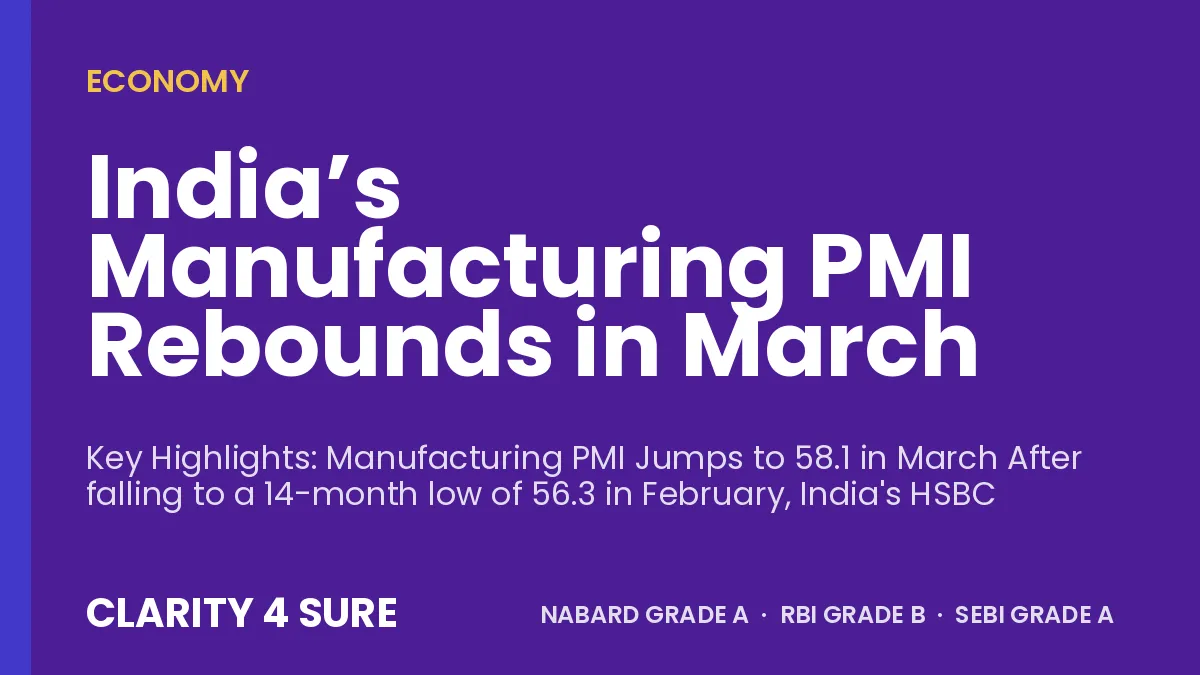
The Purchasing Managers’ Index (PMI) is a leading economic indicator that controls business activity over the manufacturing and services spectrums. Monthly based surveys of companies on economic trends and market conditions provide a base for it.
Types of PMI
- Manufacturing PMI – It measures the performance of the manufacturing sector.
- Services PMI – It assesses the activities present in the services sector.
- Composite PMI – It is an index that aggregates manufacturing and services activities.
How is the Manufacturing PMI Derived?
PMI is calculated from the survey responses provided by manufacturing companies based on five key variables:
- New Orders (30%)
- Output (25%)
- Employment (20%)
- Suppliers’ Delivery Times (15%)
- Stock of Items Purchased (10%)
PMI values are interpreted as follows:
“RBI MPC Unpacked: Key Theory Meets Today’s Macro Trends”Tap to play · from the C4S channel
- Above 50 is the expansion of business activity.
- Below 50 is the contraction of business activity.
- Closer to 50 is little change in business conditions.
- Growth or decline rates are determined by comparison of month over month PMI values.
Global PMI Measurement
The Purchasing Managers’ Index (PMI) was first published in 1948 by the Institute for Supply Management (ISM), USA. The Singapore Institute of Purchasing and Materials Management (SIPMM) compiles PMI for Singapore. IHS Markit is known to be producing PMI for 30 countries, with India being one of them. The Manufacturing PMI in India dates back to survey responses from 500 manufacturing companies.
Why is PMI Important?
- Early Economic Indicator
- The PMI itself is released even before other major economic indicators such as GDP or industrial output., making it exceedingly handy for forecasting economic trends.
- Helps Businesses Plan
- Manufacturers and suppliers use PMI data to adjust production levels and anticipate demand.
- Investor confidence
- The stock market investors use PMI to assess the economic health to make investment decisions confidently.