The Securities and Exchange Board of India (SEBI), India’s capital markets regulator, has approved amendments to the SEBI (Mutual Funds) Regulations, 2026 allowing mutual funds to use intraday borrowing facilities for a wider range of liquidity management purposes, beyond just redemption and unitholder payouts. This decision was approved at the 214th SEBI Board Meeting held in Mumbai on 19 June 2026, following a Consultation Paper issued on 13 May 2026 (with public comments invited till 3 June 2026) and detailed discussions with the Mutual Fund Advisory Committee (MFAC), the Association of Mutual Funds in India (AMFI), and other stakeholders. The expanded framework allows Asset Management Companies (AMCs) to use intraday borrowings for: (a) trade settlements (pay-in/pay-out timing mismatches), (b) foreign exchange (forex) obligations, (c) derivative-related Mark-to-Market (MTM) payments, and (d) repayment of existing borrowings. Intraday borrowings can now also exceed the value of guaranteed receivables from the Government of India, RBI, and clearing corporations, provided they are extinguished by end of day or converted into overnight borrowings within prescribed limits. SEBI clarified that intraday borrowings cannot be used as a source of leverage, and the cost or charges must be borne by the AMC, not by investors. The decision was taken under the chairmanship of SEBI Chairman Tuhin Kanta Pandey.
Context
The Decision
“RBI MPC Unpacked: Key Theory Meets Today’s Macro Trends”Tap to play · from the C4S channel
- Venue: 214th SEBI Board Meeting, Mumbai.
- Chair: Tuhin Kanta Pandey, SEBI Chairman.
- Amendments to: SEBI (Mutual Funds) Regulations, 2026.
A clean PDF of this page with the C4S header — it opens right away, and the link comes to your WhatsApp too.
Existing Framework
- SEBI (Mutual Funds) Regulations, 2026: Came into effect on 1 April 2026.
- Original Provision: Intraday borrowing only for redemption/unitholder payouts.
- Restriction: Borrowing limited to guaranteed receivables from GoI, RBI, CCIL and other clearing corporations.
- Implementation Deferred: Till 15 July 2026 due to operational challenges raised by AMFI/AMCs.
Why the Change?
- AMFI Representations: Highlighted that narrow scope did not reflect actual industry usage.
- Real-world Practice: Mutual funds use intraday borrowing for:
- Trade pay-in obligations.
- Forex settlements.
- Derivative margin requirements.
- Repayment of existing borrowings.
Revised Framework
| Feature | Previous Framework | Revised Framework |
|---|---|---|
| Purposes Permitted | Redemption/unitholder payouts only | Trade settlements, forex, MTM derivatives, repayment of borrowings, redemptions |
| Receivable Basis | Only guaranteed receivables (GoI, RBI, CCIL) | Expected inflows including non-guaranteed (secondary market, maturity proceeds) |
| Borrowing Cap | Limited to guaranteed receivables | Can exceed receivables if repaid by end-of-day |
| Use as Leverage | Restricted | Explicitly prohibited as leverage |
| Cost Bearer | AMC | AMC (no change; investors protected) |
| Existing 20% Cap | Applies | Continues to apply for unitholder payouts |
Existing Borrowing Limits (Verified — Regulation 42(1) of SEBI MF Regulations, 2026)
- Maximum borrowing: Up to 20% of scheme’s net assets.
- Maximum duration: 6 months.
- Purposes: Temporary liquidity needs for:
- Repurchase/redemption of units.
- Payment of interest/IDCW payouts.
- Trade settlement by equity index/ETFs on account of under-execution.
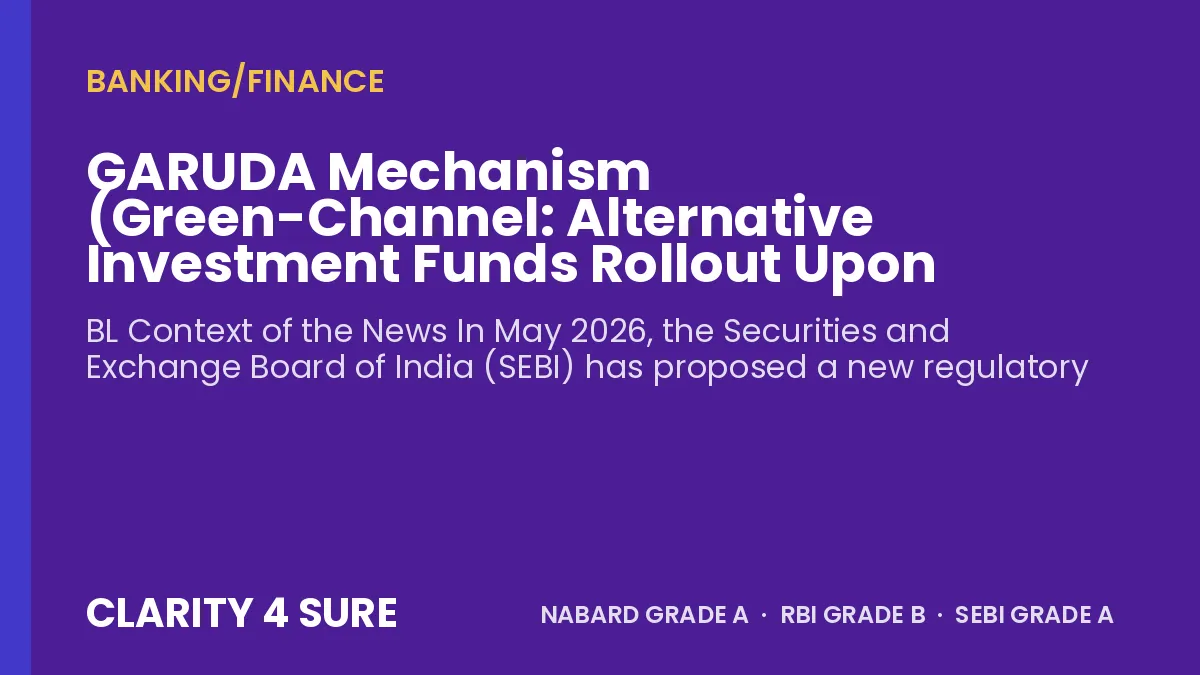
GARUDA Mechanism for AIFs
- GARUDA = Green-Channel: AIF Rollout Upon Document Acknowledgement.
- New scheme launch timeline reduced to 10 working days for regular AIFs.
- Accredited-investor-only schemes and angel funds: Can launch immediately upon registration.
- Aim: Faster, more efficient capital deployment by Alternative Investment Funds (AIFs).
What is a Mutual Fund?
- A pooled investment vehicle managed by an Asset Management Company (AMC).
- Collects money from multiple investors and invests in equity, debt, hybrid securities, etc.
- Regulated by: SEBI, since 1996 through SEBI (Mutual Funds) Regulations.
- Industry size: Average AUM ≈ ₹82 lakh crore (as of April 2026).
About AMFI
- Full Name: Association of Mutual Funds in India.
- Established: 22 August 1995.
- HQ: Mumbai.
- Function: Industry body for development of mutual fund industry, self-regulation, investor education.
- Tagline: “Mutual Funds Sahi Hai”.
About SEBI
- Full Name: Securities and Exchange Board of India.
- Established: 12 April 1988 (non-statutory); statutory powers via SEBI Act, 1992.
- HQ: Mumbai.
- Chairman: Tuhin Kanta Pandey (since 1 March 2025).
- Functions: Regulator of securities and commodity markets.
- Reports to: Ministry of Finance, Government of India.
Practice MCQs
Q1. With reference to the SEBI proposal/approval on intraday borrowing by mutual funds, consider the following statements:
- The consultation paper was issued on 13 May 2026 and the proposal was approved at the 214th SEBI Board Meeting on 19 June 2026.
- Mutual funds can now use intraday borrowing for trade settlements, forex obligations, and derivative-related payments.
- Any cost or charges related to intraday borrowing must be borne by the Asset Management Company (AMC), not by investors.
- Intraday borrowings can be used as a source of leverage to enhance investment exposure.
How many of the above statements are correct?
(a) Only one (b) Only two (c) Only three (d) All four (e) None
(Statement 4 is wrong; SEBI explicitly clarified that intraday borrowings cannot be used as a source of leverage.)
Q2. With reference to the existing borrowing framework for mutual funds under Regulation 42(1) of SEBI (Mutual Funds) Regulations, 2026, consider the following statements:
- Mutual funds cannot borrow more than 20% of a scheme’s net assets.
- Borrowings cannot extend beyond six months.
- Borrowings can be used to meet temporary liquidity needs for redemption, interest payments, and IDCW payouts.
- Mutual funds are permitted unlimited borrowing for any purpose at all times.
How many of the above statements are correct?
(a) Only one (b) Only two (c) Only three (d) All four (e) None
(Statement 4 is wrong; borrowings are strictly capped at 20% of net assets and restricted to temporary liquidity needs.)
Q3. With reference to the Association of Mutual Funds in India (AMFI), consider the following statements:
- AMFI was established on 22 August 1995.
- It is headquartered in Mumbai.
- Its functions include industry development, investor education, and self-regulation.
- AMFI is a statutory regulator of the mutual fund industry in India.
How many of the above statements are correct?
(a) Only one (b) Only two (c) Only three (d) All four (e) None
(Statement 4 is wrong; AMFI is an industry body, NOT a statutory regulator; the statutory regulator of mutual funds is SEBI.)
Q4. With reference to the Securities and Exchange Board of India (SEBI), consider the following statements:
- SEBI was established as a non-statutory body on 12 April 1988.
- It was granted statutory powers through the SEBI Act, 1992.
- The current Chairman of SEBI is Tuhin Kanta Pandey, who took charge on 1 March 2025.
- SEBI is headquartered in New Delhi.
How many of the above statements are correct?
(a) Only one (b) Only two (c) Only three (d) All four (e) None
(Statement 4 is wrong; SEBI is headquartered in Mumbai, NOT New Delhi.)
Q5. With reference to other SEBI reforms approved at the 214th Board Meeting on 19 June 2026, consider the following statements:
- Open market share buybacks through stock exchanges have been reintroduced from 1 August 2026.
- Such buybacks must be completed within 66 working days.
- The GARUDA mechanism reduces the AIF scheme launch timeline to 10 working days for regular AIFs.
- GARUDA stands for “General Authority for Regulating Underwriting and Distribution Activities”.
How many of the above statements are correct?
(a) Only one (b) Only two (c) Only three (d) All four (e) None
(Statement 4 is wrong; GARUDA stands for “Green-Channel: AIF Rollout Upon Document Acknowledgement”, NOT “General Authority for Regulating Underwriting and Distribution Activities”.)
Q6. With reference to the Clearing Corporation of India Limited (CCIL), consider the following statements:
- CCIL was established on 30 April 2001 and is headquartered in Mumbai.
- It provides clearing and settlement services for transactions in money, G-Secs, forex, and derivative markets.
- Receivables from CCIL are considered guaranteed receivables for mutual funds.
- CCIL is a subsidiary of the Reserve Bank of India.
How many of the above statements are correct?
(a) Only one (b) Only two (c) Only three (d) All four (e) None
(Statement 4 is wrong; CCIL is NOT a subsidiary of the RBI; it is an independent clearing corporation with shareholders including major banks and financial institutions, though RBI plays a supervisory role.)
Answer Key
- (c), Statements 1, 2, 3 are correct; Statement 4 is wrong because intraday borrowings cannot be used as leverage.
- (c), Statements 1, 2, 3 are correct; Statement 4 is wrong because borrowings are capped at 20% of net assets.
- (c), Statements 1, 2, 3 are correct; Statement 4 is wrong because AMFI is an industry body, not a statutory regulator.
- (c), Statements 1, 2, 3 are correct; Statement 4 is wrong because SEBI is headquartered in Mumbai.
- (c), Statements 1, 2, 3 are correct; Statement 4 is wrong because GARUDA’s expansion is different.
- (c), Statements 1, 2, 3 are correct; Statement 4 is wrong because CCIL is not an RBI subsidiary.