
Daily Current Affairs Quiz: 11 & 12 October 2026
Free live session
NABARD Grade A 2026: 45-Day Final Revision Plan + Daily Targets
 🔒 Register to watchLast Sunday’s session · recording
8 of the top 10 in NABARD Grade A 2025, Rank 1 included, and Rank 1 back to back before that in 2021 and 2022: all prepared with C4S. Watch last Sunday's session on the 45-day final revision plan now, then join the next one live on Zoom.
In 8 days · Sun, 25 Oct at 7:30 PM IST · 75 minutes · free
1. The PM Dhan-Dhaanya Krishi Yojana (PMDDKY), which completed one year on 11 October 2026, covers how many Aspirational Agricultural Districts?
A. 50
B. 75
C. 100
D. 112
E. 150
View Answer
Explanation: PMDDKY is a focused agricultural development scheme for 100 Aspirational Agricultural Districts, implemented by the Ministry of Agriculture and Farmers Welfare. Formally launched by the Prime Minister on 11 October 2025, it aims to lift farm productivity, promote crop diversification and sustainable farming, and widen access to agricultural credit in these lagging districts.
2. For what duration did the Union Cabinet approve the PM Dhan-Dhaanya Krishi Yojana?
A. Three years
B. Four years
C. Five years
D. Six years
E. Ten years
View Answer
Explanation: The Cabinet cleared the scheme on 16 July 2025 for a six-year period beginning with 2025-26. Besides productivity and diversification, its goals include better post-harvest storage at panchayat and block levels, improved irrigation facilities and easier access to both short-term and long-term farm credit.
3. Under PMDDKY, which body provides guidance and review while district, state and national committees oversee implementation?
A. NABARD
B. NITI Aayog
C. Reserve Bank of India
D. Ministry of Rural Development
E. Indian Council of Agricultural Research
View Answer
Explanation: District-level plans under PMDDKY are prepared to match local agricultural needs, with committees at district, state and national levels monitoring progress and NITI Aayog guiding and reviewing the effort. An FPO Sangam held in December 2025 brought together over 72 FPOs from 15 States and 33 PMDDKY districts.
4. The Nanda Devi Biosphere Reserve in Uttarakhand has two core zones. Which pair correctly identifies them?
A. Nanda Devi National Park and Valley of Flowers National Park
B. Nanda Devi National Park and Jim Corbett National Park
C. Valley of Flowers National Park and Gangotri National Park
D. Rajaji National Park and Govind National Park
E. Nanda Devi National Park and Great Himalayan National Park
View Answer
Explanation: The reserve is a high-altitude Himalayan landscape under UNESCO’s Man and the Biosphere Programme, and its two core zones are jointly inscribed as a World Heritage Site. It covers 6,407 sq km across Chamoli, Pithoragarh and Bageshwar districts. A 2026 decadal monitoring campaign by the state Forest Department and WII found landslide-prone zones in the core had nearly doubled.
5. Madhya Pradesh began reintroducing wild water buffaloes after nearly a century by releasing eight animals into which tiger reserve?
A. Bandhavgarh Tiger Reserve
B. Panna Tiger Reserve
C. Satpura Tiger Reserve
D. Pench Tiger Reserve
E. Kanha Tiger Reserve
View Answer
Explanation: On 11 October 2026, eight wild water buffaloes were released into a 17-hectare enclosure in the Supkhar range of Kanha Tiger Reserve. The move brings the species back to the state after roughly a hundred years and is meant to rebuild its wild population as part of broader conservation efforts.
6. What crude steel capacity target has been set for 2047 in the draft National Steel Policy 2047?
A. 300 million tonnes
B. 505 million tonnes
C. 604 million tonnes
D. 450 million tonnes
E. 700 million tonnes
View Answer
Explanation: The draft policy seeks 604 million tonnes of crude steel capacity by 2047 to raise production, sharpen competitiveness and reduce import dependence. It also projects finished steel demand of 505 million tonnes, per capita consumption of 302 kg and steel exports of 45 million tonnes by that year.
7. India imports nearly what share of its coking coal requirement, a key raw material concern flagged in the draft National Steel Policy 2047?
A. 65%
B. 92%
C. 70%
D. 45%
E. 80%
View Answer
Explanation: Raw materials account for roughly 65-70% of the cost of making steel, so input security matters greatly. India is largely self-sufficient in iron ore but relies on imports for nearly 92% of its coking coal needs, a major vulnerability for an industry aiming to expand capacity sharply.
8. Under the RBI’s new Foreign Exchange Risk Reserve (FERR), banks must set aside what share of any rupee forex derivative contract above $2 million?
A. 5%
B. 10%
C. 15%
D. 20%
E. 25%
View Answer
Explanation: Banks must park 20% of such contracts as cash with the RBI, earning no return, and the RBI can vary the ratio as conditions require. By tying up bank funds, FERR makes hedging against a falling rupee costlier, which slows forward dollar buying that would otherwise add to pressure on the currency.
9. The RBI’s FERR mechanism was borrowed from which country, which had reduced its own reserve ratio to zero in March 2026?
A. China
B. Japan
C. Brazil
D. Russia
E. South Korea
View Answer
Explanation: China long used a Foreign Exchange Risk Reserve Ratio of 20%. In March 2026 it cut the ratio to zero because the yuan was strengthening and it wanted to remove the cost of betting against its own currency. India moved the opposite way, bringing in the reserve as the rupee neared its all-time low.
10. The GST Council was constituted under which Article of the Constitution?
A. Article 246A
B. Article 269A
C. Article 280
D. Article 270
E. Article 279A
View Answer
Explanation: Article 279A was inserted by the 101st Constitutional Amendment Act, 2016, and the Council was notified on 12 September 2016. It is a joint Centre-State forum regarded as a pillar of cooperative federalism. Its 57th meeting in New Delhi announced administrative and process reforms that take effect from 1 April 2027.
11. Who attends GST Council meetings as a permanent non-voting invitee?
A. Revenue Secretary
B. Chief Economic Adviser
C. Chairperson, CBIC
D. Comptroller and Auditor General of India
E. Governor, Reserve Bank of India
View Answer
Explanation: The Union Finance Minister chairs the Council, with the Union Minister of State for Revenue or Finance and a Finance or Taxation Minister nominated by each State/UT as members. The Revenue Secretary serves as ex-officio Secretary, while the CBIC Chairperson attends permanently but without voting rights.
12. TRISHNA, a thermal infrared satellite expected to launch within 12-16 months, is a joint mission of ISRO and which space agency?
A. NASA (United States)
B. CNES (France)
C. ESA (Europe)
D. JAXA (Japan)
E. DLR (Germany)
View Answer
Explanation: TRISHNA, the Thermal Infra-Red Imaging Satellite for High-resolution Natural Resource Assessment, is an ISRO-CNES project. It will track land surface temperature, water stress, vegetation health and energy exchanges, producing data useful for agriculture, water-resource management, climate studies and environmental monitoring.
13. As per data from ACLED, India accounted for what share of global demonstrations recorded through September 2026?
A. 4.5%
B. 10.2%
C. 12.8%
D. 17.5%
E. 21.0%
View Answer
Explanation: The US-based Armed Conflict Location & Event Data Project counted 18,074 demonstrations in India through September 2026, up from 11,020 in 2017. India has reportedly held the largest global share for five straight years, while Pakistan, Mexico and France were also in the top five at about 4-5% each.
14. INS Mangrol, the third indigenous Anti-Submarine Warfare Shallow Water Craft (ASW-SWC), was built by which shipyard?
A. Cochin Shipyard Limited, Kochi
B. Garden Reach Shipbuilders & Engineers, Kolkata
C. Mazagon Dock Shipbuilders, Mumbai
D. Goa Shipyard Limited
E. Hindustan Shipyard Limited, Visakhapatnam
View Answer
Explanation: INS Mangrol was built by Cochin Shipyard Limited and scheduled for commissioning at the Naval Dockyard, Mumbai, on 12 October 2026. Such craft are designed to detect and counter submarines and underwater threats in shallow coastal waters, strengthening the Navy’s coastal defence and anti-submarine capability.
Every day of the month in one file. Enter your details once — the download opens right away.
We already have your details, so no form: tap to open.
Download the October 2026 current affairs quiz PDFDownload the October 2026 Exam Ready quiz PDFAll October 2026 quizzes in one place: every question of the month with answers, a full PDF and an Exam Ready PDF — October 2026 current affairs quiz
Related on Clarity 4 Sure
 Scheme to knowMukhyamantri Majhi Ladki Bahin Yojana (Maharashtra): Rs 1,500 a Month, Eligibility, Verification Drive and FactsMukhyamantri Majhi Ladki Bahin Yojana is the Maharashtra government's direct cash transfer scheme that pays Rs 1,500 a…
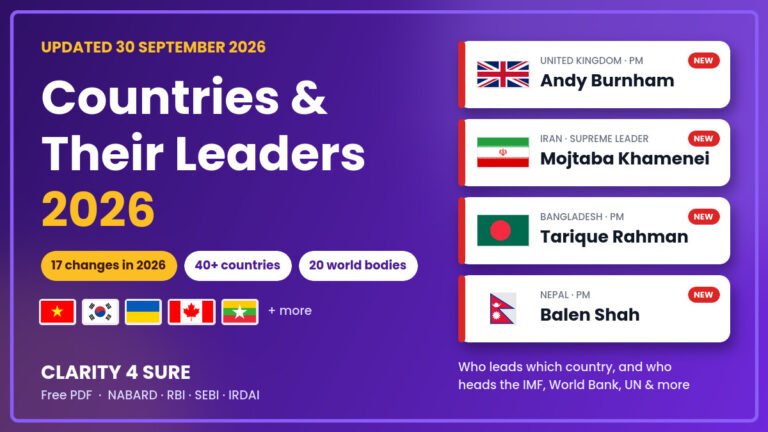 Free sheet · Static GKCountries & Their Leaders 2026Who leads which country in 2026, with all 17 changes marked. Get the article and the PDF free on WhatsApp.Get it free on WhatsApp →