Organic Farming
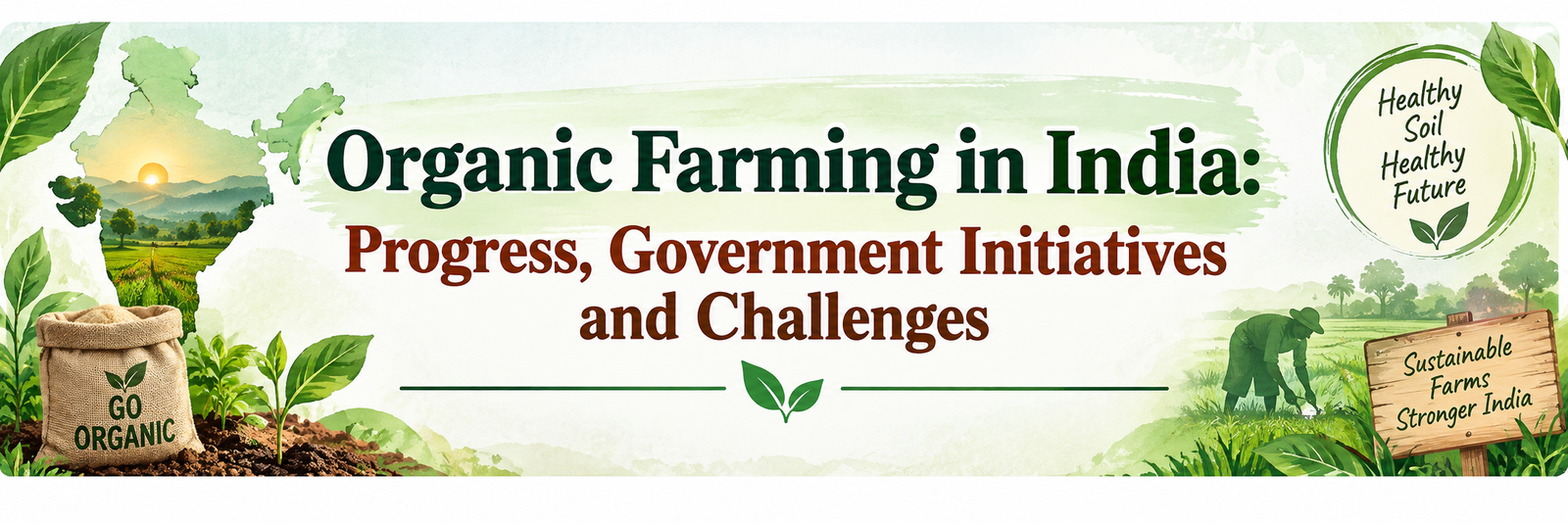
Organic farming is a method of farming that avoids or greatly reduces the use of chemical fertilisers, pesticides, and genetically modified organisms (GMOs). Instead, it relies on natural and eco-friendly methods such as crop rotation, compost, green manure, natural pest control, and mechanical farming techniques. The main aim is to maintain soil health, protect the environment, and produce food in a more sustainable way.
India has the largest number of organic farmers in the world, accounting for around 44% of the global total. However, India ranks only around ninth in terms of the total area under organic cultivation. This shows an important difference: India has a very large number of organic farmers, but the average area cultivated organically by these farmers is relatively small. This contrast is particularly important for understanding India’s organic farming sector and is relevant to UPSC GS-III topics such as agriculture, sustainable development, and food security.
Status of Organic Farming in India
| Indicator | Value |
|---|---|
| Area under organic certification | About 5.9 million hectares (2022–23), including areas used for wild harvest |
| Number of organic farmers | More than 25 lakh farmers, making India the largest in the world by number of organic farmers |
| Organic food production | Around 29 lakh tonnes in 2022–23 |
| Organic exports | More than USD 700 million in 2023–24 |
| Top organic-producing state | Madhya Pradesh |
| First fully organic state | Sikkim, which became fully organic in 2016 |
| India’s global rank by organic farming area | Around 8th–9th in the world |
Updated Status of Organic Farming in India
According to APEDA data for 2023–24, India’s organic food exports have grown to more than USD 708 million. India exports a wide range of organic products, covering over 1,300 different products, with major markets including the USA, European Union, Canada, and Australia.
The area covered under the National Programme for Organic Production (NPOP) has also expanded to more than 5.9 million hectares. However, a large portion of this area—around 3.9 million hectares—is under wild harvest, where naturally occurring products are collected from forests and other natural areas rather than being cultivated on farms. This shows that India’s organic sector is growing not only through organic farming but also through the collection and certification of naturally occurring organic products.
Why Organic Farming Matters
Organic farming offers several benefits for farmers, consumers, and the environment. Organic products can often be sold at higher prices, with farmers receiving a premium of around 20–40% in domestic and international markets. Since organic farming avoids synthetic pesticides and fertilisers, it can also reduce the risk of chemical residues in food, making it attractive from a health and food-safety perspective.
Organic farming also helps improve soil health. The use of compost, organic manure, and crop rotation increases organic matter in the soil, improves microbial activity, and helps the soil retain more water. Healthier soils can also store more carbon, contributing to environmental sustainability. Over time, farmers can reduce their dependence on expensive chemical fertilisers and pesticides, lowering their exposure to rising input costs.
Another major advantage is that organic farming can make farms more resilient to drought and water shortages, as organically managed soils generally have better water-holding capacity. It is also more labour-intensive than chemical-based farming, which can create additional employment opportunities in rural areas. Finally, organic and mixed-crop farming can support biodiversity by providing a better environment for plants, insects, birds, and other organisms. In areas with strong organic farming traditions, this can also encourage eco-tourism and sustainable rural development.
Certification and Regulation
India follows a dual certification system for organic farming, meaning there are two main systems for certifying organic products depending on where they are sold.
1. National Programme for Organic Production (NPOP)
The NPOP is mainly used for organic products that are meant for export. It is managed by the Ministry of Commerce and Industry through APEDA. Under this system, organic farms and products are checked and certified by independent, accredited certification agencies. NPOP certification is recognised in several international markets, including the European Union, Switzerland, Canada, and other countries, although some countries may require additional certification or conditions.
2. Participatory Guarantee System (PGS-India)
PGS-India is mainly meant for the domestic market. It is managed under the Ministry of Agriculture and Farmers Welfare. Instead of depending entirely on expensive third-party certification, farmers can verify each other’s farming practices through a peer-group system. This makes certification cheaper and more practical, especially for small and marginal farmers. The system is administered through the National Centre for Organic & Natural Farming (NCONF).
Jaivik Bharat Logo
The Jaivik Bharat logo is a government-approved mark that helps consumers identify certified organic food products. Products certified under recognised organic systems such as NPOP and PGS-India can carry the appropriate organic identification, making it easier for consumers to distinguish certified organic products from conventional ones.
Regulatory Framework
Organic food in India is regulated by the Food Safety and Standards Authority of India (FSSAI) under the Food Safety and Standards (Organic Foods) Regulations, 2017. These rules lay down standards for the production, processing, sale, labelling, and import of organic food products.
Paramparagat Krishi Vikas Yojana (PKVY)
The PKVY was launched in 2015 to encourage farmers to adopt organic farming. It promotes organic farming through clusters of farmers, making it easier to provide training, financial assistance, organic inputs, certification, and marketing support. Under the scheme, groups of farmers can work together to develop organic farming practices and sell their produce in the market.
Mission Organic Value Chain Development for North Eastern Region (MOVCDNER)
The MOVCDNER was introduced in 2015 to promote organic farming in the North-Eastern states of India. Unlike schemes that focus only on production, it follows a complete value-chain approach. This means support is provided from the supply of seeds and organic inputs to production, collection, processing, certification, packaging, branding, and marketing. This helps farmers get better access to markets and earn more from organic products.
Bharatiya Prakritik Krishi Paddhati (BPKP)
The BPKP was introduced as a component of PKVY to promote natural farming. It encourages farmers to reduce or avoid chemical inputs and use low-cost, locally available natural inputs. Traditional preparations such as Jeevamrit and Beejamrit are commonly used under this approach. The focus is on reducing farming costs while maintaining soil health and ecological balance.
National Mission on Natural Farming (NMNF)
The National Mission on Natural Farming (NMNF) was introduced to expand natural farming across the country. It aims to encourage farmers to move towards chemical-free and low-input farming methods. The mission focuses on expanding natural farming practices, developing local sources of bio-inputs, providing training to farmers, and creating Bio-Input Resource Centres (BRCs) to make natural farming inputs easily available.
Other Government Support
The government also provides support for the development of bio-input infrastructure through schemes involving institutions such as NABARD. The National Project on Organic Farming (NPOF) has also supported the promotion and development of organic farming and organic inputs. In addition, the Soil Health Card Scheme complements organic farming by providing farmers with information about the condition and nutrient requirements of their soil, helping them use inputs more efficiently.
India’s approach to organic farming combines certification, financial support, technology, market development, and natural farming practices. NPOP mainly supports export-oriented organic production, while PGS-India provides a more affordable certification route for the domestic market. Schemes such as PKVY, MOVCDNER, and NMNF aim to help farmers adopt sustainable farming methods while improving soil health, reducing input costs, and creating better market opportunities.
Challenges in Scaling Up
Poor Awareness
Many farmers are still not fully aware of organic farming methods and their long-term benefits. Practices such as vermicomposting, green manuring, bio-fertilisers, and biological pest control require proper training and guidance. However, agricultural extension services and training programmes do not reach all farmers equally, especially those in remote areas.
Shortage of Organic Inputs and Biomass
Organic farming requires a regular supply of materials such as crop residues, cow dung, compost, and other organic matter. However, crop residues are often burned or used as animal fodder and fuel, leaving less material available for composting. Small farmers may also find it difficult to arrange enough organic manure to meet the nutrient requirements of their crops.
Weak Supporting Infrastructure
The infrastructure needed to support organic farming is still developing. Certification can be expensive and time-consuming, particularly for small farmers. There are also limited dedicated markets, organic mandis, storage facilities, processing units, and organised retail networks for organic products. The relatively high price of organic food can also discourage many consumers from buying it regularly.
Higher Input Costs
Although organic farming reduces dependence on chemical inputs, some organic inputs can initially be expensive. Products such as neem cake, vermicompost, bio-pesticides, and organic manure may cost more per unit compared to heavily subsidised chemical fertilisers such as urea and DAP. This can make organic farming financially difficult for small and marginal farmers.
Fall in Yield During the Transition Period
Farmers may experience a drop in crop yields during the first few years after shifting from conventional to organic farming. The soil takes time to adjust to the new system and regain its natural fertility. Without adequate financial or income support during this transition period, farmers may find it difficult to continue and may return to conventional farming.
Lack of Suitable Seeds
Many commonly available hybrid and high-yielding varieties have been developed to perform well with chemical fertilisers and pesticides. Farmers practising organic farming need varieties that can perform well with natural inputs and are resistant to local pests and diseases. However, suitable native and traditional varieties are not always easily available or properly distributed.
Difficulties in Export Markets
Indian organic exporters also face challenges in international markets. They have to meet strict requirements related to quality, chemical residues, certification, documentation, and traceability. Differences between Indian and foreign certification systems can sometimes require additional certification and increase the cost and complexity of exporting organic product
Way Forward
Organic farming in India needs a stronger support system to become economically viable and sustainable. Farmers should be encouraged to use green manuring, vermicomposting, composting, and integrated organic farming systems so that they have a reliable supply of nutrients. Biological methods of controlling pests and weeds, such as neem-based products, Trichoderma, pheromone traps, and other natural methods, should also be promoted.
The certification process should be made simpler, cheaper, and faster, particularly for small and marginal farmers. Creating organic farming clusters and developing strong local and regional brands can help farmers access better markets and obtain higher prices. Products linked with their region or unique identity, such as organic products from Sikkim or traditional agricultural products from different states, can be promoted through branding and geographical indications.
Farmers also need financial support during the transition period, particularly during the first few years when yields may decline. Support through direct income assistance or suitable price incentives can encourage farmers to remain committed to organic farming. Farmer Producer Organisations (FPOs) can play an important role by bringing farmers together, reducing input costs, facilitating certification, processing and packaging produce, and helping them reach consumers directly.
Finally, greater investment is needed in research, training, and development of suitable seeds and farming technologies. Institutions such as ICAR and its research centres can help develop crop varieties that perform well under organic conditions. Together, these measures can make organic farming more productive, affordable, market-oriented, and sustainable, while improving farmers’ incomes and protecting the environment.