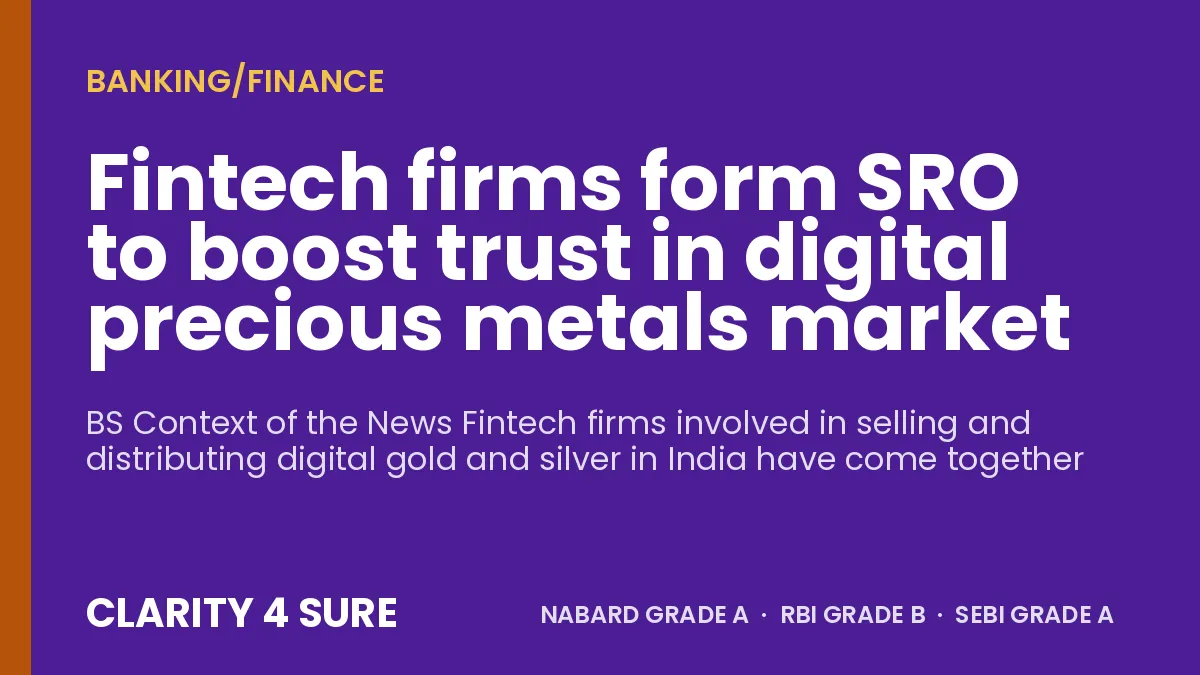
The Reserve Bank of India (RBI) invited applications from entities to becomea self regulatory organization (SRO) in the account aggregator (AA) space by June 15. According to RBI, the AA ecosystem is distinct in its complexity, involving exchange of data amonga diverse array of regulated entities (REs) operating under varied regulatory environments.
What is an SRO?
A Self-Regulatory Organization (SRO) is a non-governmental entity with the authority to establish and enforce industry regulations and professional standards. These organizations operate independently but may be subject to governmental oversight to ensure compliance with broader policies.
In financial markets, SROs—such as stock exchanges—aim to protect investors by enforcing ethical standards and professional integrity.
Key Takeaways
- Independent Authority: SROs set industry-specific rules and regulations.
- Enforcement Mechanisms: They ensure compliance through penalties or expulsion.
- Governmental Oversight: Though independent, SROs often operate under regulatory supervision.
- Industry-Driven: Businesses and professionals can form SROs to maintain standards and competitiveness.
- Financial Sector Examples: FINRA, NYSE, and IIROC regulate financial markets and member institutions.
How SRO Functions?
Though privately operated, SROs exercise regulatory influence within their industries. Their power comes from internal governance and agreements among industry players, rather than direct government mandates.
Authority and Responsibilities
- Regulation & Compliance
- Members must adhere to established rules.
- Violations can lead to penalties or expulsion.
- Membership Standards
- Entry requirements (e.g., education, experience) are set.
- Ethical conduct is mandated.
- Investor & Consumer Protection
- Educating investors on best practices.
- Safeguarding against fraud and unethical behavior.
- Dispute Resolution
- Many SROs provide arbitration services for disputes.
Note: Governmental regulations take precedence over SRO policies.
Examples of SROs
Financial Industry SROs
- Financial Industry Regulatory Authority (FINRA) – Regulates broker-dealers in the U.S.
- New York Stock Exchange (NYSE) – Maintains trading rules and investor protections.
- Investment Industry Regulatory Organization of Canada (IIROC) – Oversees Canadian securities markets.
- Chicago Board of Trade (CBOT) – Regulates commodity trading.
Professional & Industry-Specific SROs
Free live session
NABARD Grade A 2026: what the 2025 cut-offs changed, and the 90-day plan
The 2025 cycle was the toughest on record at every stage. This session reads those numbers properly and turns them into a week-by-week plan for Phase 1.
In 5 days · Sun, 4 Oct at 7:30 PM IST · 75 minutes · free
“RBI MPC Unpacked: Key Theory Meets Today’s Macro Trends”Tap to play · from the C4S channel
- American Bar Association (ABA) – Sets legal ethics and professional standards.
- American Institute of Certified Public Accountants (AICPA) – Regulates accounting practices.
- Association of Mutual Funds in India (AMFI) – Governs mutual fund operations in India.
Example: FINRA’s Role
- Licenses securities dealers.
- Conducts audits to ensure compliance.
- Oversees arbitration in financial disputes.
- Operates under SEC oversight, meaning federal regulations override FINRA rules.
SROs in Business & Trade
A clean PDF of this page with the C4S header — it opens right away, and the link comes to your WhatsApp too.
How They Operate?
- Members create and enforce their own rules.
- Violators face fines, reprimands, or expulsion.
- While autonomous, they may be subject to government regulation.
Comparing SROs & Government Regulators
| Feature | SROs | Government Regulators (e.g., SEC) |
|---|---|---|
| Authority | Industry-based | Legislative mandate |
| Oversight | Self-governed, with some external regulation | Fully government-controlled |
| Compliance Enforcement | Member-driven | Legally binding |
| Examples | FINRA, NYSE, AMFI | SEC, RBI, EU regulators |
SROs play a vital role in regulating industries by setting standards, ensuring compliance, and protecting stakeholders. While they function i
Source: BS