Current Affairs June 2026
Tap below — WhatsApp opens with the message already written. Just press Send and the link arrives straight away.
Get the June 2026 full compilation on WhatsAppThe six highest scorers in NABARD Grade A 2026 were all in one classroom
Every one of them was enrolled in the NABARD Mentorship Complete Course at Clarity 4 Sure. The same descriptive training and the same current affairs notes you are reading now.
- 1Suraj Ravindra Jatkar188.75
- 2Lokesh Ram Chandran185
- 3Vivek Kumar185
- 4Kapil Patlya184.75
- 5Siddhant Khesarwani183.75
- 6Lalit182.5

- 1 June, 2026
- 2&3 June, 2026
- 4 June, 2026
- 5 June, 2026
- 6 June, 2026
- 7 & 8 June, 2026
- 9&10 June, 2026
- 11 June, 2026
- 12 & 13 June, 2026
- 14&15 June, 2026
- 16 June, 2026
- 17 June, 2026
- 18&19 June, 2026
- 20&21 June, 2026
- 22&23 June, 2026
- 24 June, 2026
- 25 June, 2026
- 26&27 June, 2026
- 28&29 June, 2026
- 30 June, 2026
Pulled straight out of this month's own facts. If a figure here is new to you, go back and read that item in full.
1 June, 2026
Context:
The Ministry of Health and Family Welfare has released the sixth round of the National Family Health Survey (NFHS-6), conducted in 2023-24 with the International Institute for Population Sciences (IIPS), Mumbai as the nodal agency. The survey covered nearly 6.79 lakh households across 715 districts and now provides district-level evidence on population, health, nutrition, and family welfare indicators. Two major shifts stand out. First, obesity and diabetes have risen sharply across India in just five years: obesity in women aged 15-49 has gone up from 24 per cent in NFHS-5 to 30.7 per cent in NFHS-6, while obesity in men in the same age group has risen from 22.9 per cent to 27.3 per cent.
Key Highlights
- Survey: National Family Health Survey (NFHS-6).
- Reference period: 2023-24.
- Released by: Ministry of Health and Family Welfare.
- Nodal agency: International Institute for Population Sciences (IIPS), Mumbai.
Major Findings
- Institutional deliveries increased from 88.6% to 90.6%, strengthening safe childbirth coverage across India.
- Antenatal Care (ANC) registration reached 95.9%, while first-trimester checkups improved to 76.2% and four ANC visits rose to 65.2%.
- India’s Total Fertility Rate (TFR) remained stable at 2.0, staying below the replacement level of 2.1.
- Child stunting declined significantly from 35.5% to 29.3%, while severe wasting reduced from 7.7% to 5.2%.
- Full immunization coverage among children aged 12–23 months increased from 83.8% to 87.1%.
- Rotavirus vaccine coverage more than doubled from 36.4% to 85.4%, reflecting improved immunization outreach.
- Over 95.6% of childhood vaccinations were delivered through public healthcare facilities, indicating strong trust in government health systems.
- Household health insurance coverage rose sharply from 41% to 60.2%, supported by schemes like Ayushman Bharat Pradhan Mantri Jan Arogya Yojana.
- Internet usage among women increased from 33.3% to 64.3%, narrowing the female digital divide.
- Caesarean section deliveries rose sharply from 21.5% to 27.2%, raising concerns over increasing surgical births.
Key Challenges Identified
- Around 40.5% of children aged 6–8 months still do not receive adequate solid or semi-solid complementary food.
- Nearly 12.9% of children remain partially vaccinated or unvaccinated despite high overall immunization coverage.
- Rising lifestyle diseases and non-communicable diseases (NCDs) are emerging as major public health concerns.
- India continues to face a dual burden of undernutrition alongside rising adult overweight and obesity levels.
- Only 37.8% of pregnant women consumed iron-folic acid supplements for the recommended 180 days, indicating gaps in maternal nutrition compliance.
Background Concepts
What is the National Family Health Survey (NFHS), and How is It Conducted?
The National Family Health Survey (NFHS) is a large-scale, nationally representative, household-level sample survey that provides reliable data on population, health, nutrition, and family welfare in India. It is conducted by the Ministry of Health and Family Welfare, with the International Institute for Population Sciences (IIPS), Mumbai, as the nodal agency. Field work is carried out by a network of field agencies, with technical support from international partners like ICF (USA) for DHS-style surveys and WHO. The NFHS provides state-, district-, and national-level estimates on fertility, family planning, infant and child mortality, immunisation, nutrition, anaemia, women’s empowerment, gender-based violence, HIV/AIDS, and non-communicable disease risk factors. The first NFHS (NFHS-1) was conducted in 1992-93, and the rounds have grown progressively larger: NFHS-5 (2019-21) and now NFHS-6 (2023-24) with 6.79 lakh households across 715 districts. NFHS data is used for planning Ayushman Bharat, ICDS, POSHAN Abhiyaan, RBSK, Anaemia Mukt Bharat, NP-NCD, and many other welfare programmes.
Practice MCQs
Q1. With reference to the National Family Health Survey (NFHS-6), consider the following statements:
- NFHS-6 was conducted in 2023-24 by the Ministry of Health and Family Welfare.
- The International Institute for Population Sciences (IIPS), Mumbai, served as the nodal agency.
- The survey covered around 6.79 lakh households across 715 districts.
- NFHS-6 provides district-level estimates on population, health, nutrition, and family welfare.
How many of the above statements are correct? (a) Only one (b) Only two (c) Only three (d) All four (e) None
Q2. Consider the following statements about the key findings of NFHS-6:
- Obesity in women aged 15-49 has risen from 24 per cent in NFHS-5 to 30.7 per cent in NFHS-6.
- Obesity in men aged 15-49 has risen from 22.9 per cent to 27.3 per cent.
- Diabetes prevalence (on medication) has risen in both men and women between NFHS-5 and NFHS-6.
- Andhra Pradesh, Kerala, and Tamil Nadu are emerging as hotspots for overweight and obese adults.
Which of the above are correct? (a) 1, 2 and 3 only (b) 1, 3 and 4 only (c) 2 and 4 only (d) 1 and 4 only (e) All four
Q3. With reference to Caesarean (C-section) births in India, as per NFHS-6, consider the following statements:
- The national share of births by C-section has risen from 21.5 per cent in NFHS-5 to 27.2 per cent in NFHS-6.
- Private hospitals reported a C-section rate of 54.1 per cent compared to 16.9 per cent in public hospitals.
- Urban areas reported a C-section rate of about 40.5 per cent compared to about 22.8 per cent in rural areas.
- Telangana, Andhra Pradesh, and Tamil Nadu reported some of the highest state-level C-section rates.
Which of the above are correct? (a) 1, 2 and 3 only (b) 1, 3 and 4 only (c) 2 and 4 only (d) 1 and 4 only (e) All four
Q4. Consider the following statements about obesity and Type 2 diabetes:
- The World Health Organization considers excess body weight as one of the strongest risk factors for Type 2 diabetes.
- Excess abdominal fat is linked to insulin resistance, which can lead to Type 2 diabetes.
- Body Mass Index (BMI) of 25 or above is classified as overweight under standard WHO criteria.
- Maternal obesity and diabetes are associated with higher rates of Caesarean delivery.
Which of the above are correct? (a) 1, 2 and 3 only (b) 1, 3 and 4 only (c) 2 and 4 only (d) 1 and 4 only (e) All four
Answer Key
- (d), All four statements are correct.
- (e), All four statements are correct.
- (e), All four statements are correct.
- (e), All four statements are correct.
2. India’s First SkyCast System at IGI Airport, New Delhi
Source: TOI
Context:
Union Minister Dr Jitendra Singh has inaugurated India’s first “SkyCast” System at the Indira Gandhi International (IGI) Airport, New Delhi. SkyCast is a next-generation, integrated atmospheric remote sensing system designed for aviation weather monitoring. It brings together multiple real-time measurements of fog, aerosols, turbulence, moisture, and visibility into a single, comprehensive aviation weather intelligence framework. The system has been developed under Mission Mausam, a flagship initiative of the Ministry of Earth Sciences (MoES) aimed at making India weather-ready and climate-smart through upgraded observation networks, modelling, and forecasting.
Aim:
(a) Usher India into fog-free, weather-smart aviation.
(b) Reduce flight delays, cancellations, and diversions caused by adverse weather.
(c) Maximise safety during take-off and landing, the most weather-sensitive phases of flight.
Multi-sensor integration:
| Instrument | What it does |
|---|---|
| Radar Wind Profiler | Measures wind speed, direction, and vertical motion in the lower atmosphere |
| SODAR (Sound Detection and Ranging) | Uses sound waves to study wind, turbulence, and boundary-layer behaviour |
| Microwave Radiometer | Measures temperature and humidity profiles vertically through the atmosphere |
| Ground-based Fog Aerosol Spectrometer (GFAS) | Studies fog droplet sizes and aerosol-fog interactions |
| CL61 Lidar-based Ceilometer | Uses laser pulses to map the vertical structure and density of fog and clouds |
About the News
What is SkyCast?
SkyCast is India’s first integrated aviation weather intelligence system, designed to provide real-time atmospheric data on fog, aerosols, turbulence, moisture, and visibility, helping airports and pilots make safer take-off and landing decisions.
Where has it been launched and by whom?
Launched at Indira Gandhi International (IGI) Airport, New Delhi, by Union Minister Dr Jitendra Singh, under Mission Mausam of the Ministry of Earth Sciences.
What instruments does it use?
(a) Radar Wind Profiler. (b) SODAR (Sound Detection and Ranging). (c) Microwave Radiometer. (d) Ground-based Fog Aerosol Spectrometer (GFAS). (e) CL61 Lidar-based Ceilometer.
Up to what altitude does it monitor the atmosphere?
Up to about 3 kilometres, mapping the boundary layer, wind, turbulence, temperature, and humidity in real time.
Why is GFAS especially important for Delhi?
Because Delhi’s winter fog is mixed with high levels of pollution and aerosols. The Ground-based Fog Aerosol Spectrometer can track droplet sizes and aerosol-fog interactions, which helps in understanding and forecasting the unique pollution-fog mix that affects flights.
What is the nowcasting window?
SkyCast provides precise nowcasts and real-time alerts within a 3-hour window, which is the most critical period for aviation flight planning.
Background Concepts (Q&A)
What is “Mission Mausam”, and What Does it Aim to Do?
Mission Mausam is a flagship initiative of the Ministry of Earth Sciences (MoES) approved in September 2024, to make India weather-ready and climate-smart by upgrading its weather observation, modelling, and forecasting capabilities. The mission aims to build a world-class observation network of radars, wind profilers, balloons, ocean buoys, and satellites, deploy advanced numerical weather prediction models, and develop AI and Machine Learning-based forecasting tools to deliver hyperlocal, sector-specific weather forecasts for agriculture, aviation, disaster management, urban planning, water resources, and public health. The mission also focuses on specific weather phenomena like fog, thunderstorms, heatwaves, cold waves, and extreme rainfall, which cause major disruption and damage in India. Its implementing agencies include the India Meteorological Department (IMD), the Indian Institute of Tropical Meteorology (IITM, Pune), the National Centre for Medium Range Weather Forecasting (NCMRWF), and other MoES institutions. SkyCast is one of the first major operational deliverables under Mission Mausam, focused on aviation weather.
What is the “Atmospheric Boundary Layer”, and Why Does It Matter for Aviation and Pollution?
The Atmospheric Boundary Layer (ABL), also called the Planetary Boundary Layer, is the lowest part of the Earth’s atmosphere, typically extending from the surface up to about 1-3 kilometres, depending on time of day, weather, and location. Above the ABL lies the free atmosphere, where conditions are less influenced by surface friction, heating, and moisture. The ABL is critical for several reasons:
(a) It is the layer where most weather phenomena affecting daily life happen, including fog, low clouds, wind shear, turbulence, and pollution mixing.
(b) Aircraft take-off and landing happen entirely within this layer, making boundary-layer dynamics central to aviation safety.
(c) Pollutants like PM2.5, PM10, NO2, and SO2 mix and disperse within the ABL. In winter, the ABL becomes shallow (cold ground compresses it), trapping pollution near the surface, which is why Delhi’s winter pollution is so severe.
(d) Fog formation depends on temperature and humidity profiles within the ABL.
SkyCast’s 3-km vertical monitoring is specifically designed to map the boundary layer in detail, which is why its data is useful for both aviation safety and urban pollution management.
Practice MCQs
Q1. With reference to India’s first SkyCast System, consider the following statements:
- SkyCast has been inaugurated at the Indira Gandhi International (IGI) Airport, New Delhi.
- The system has been developed under Mission Mausam, an initiative of the Ministry of Earth Sciences.
- It is designed to provide aviation weather intelligence by integrating multiple atmospheric remote-sensing instruments.
- The system continuously monitors atmospheric conditions up to an altitude of about 3 kilometres.
How many of the above statements are correct? (a) Only one (b) Only two (c) Only three (d) All four (e) None
Q2. Consider the following statements about the instruments integrated into the SkyCast System:
- The Radar Wind Profiler measures wind speed, direction, and vertical motion in the lower atmosphere.
- SODAR uses sound waves to study wind, turbulence, and boundary-layer behaviour.
- The Microwave Radiometer measures temperature and humidity profiles through the atmosphere.
- The CL61 Lidar-based Ceilometer is used to track the vertical structure and density of fog.
Which of the above are correct? (a) 1, 2 and 3 only (b) 1, 3 and 4 only (c) 2 and 4 only (d) 1 and 4 only (e) All four
Q3. With reference to Mission Mausam, consider the following statements:
- Mission Mausam was approved by the Government of India in September 2024.
- It is implemented under the Ministry of Earth Sciences (MoES).
- The mission focuses on upgrading weather observation, modelling, and forecasting capabilities to make India weather-ready and climate-smart.
- Implementing agencies include the India Meteorological Department, IITM (Pune), and NCMRWF.
Which of the above are correct? (a) 1, 2 and 3 only (b) 1, 3 and 4 only (c) 2 and 4 only (d) 1 and 4 only (e) All four
Q4. Consider the following statements about the Atmospheric Boundary Layer (ABL):
- The Atmospheric Boundary Layer is the lowest part of the Earth’s atmosphere, typically extending from the surface up to about 1-3 kilometres.
- Most weather phenomena affecting daily life, including fog, turbulence, and low clouds, occur within the ABL.
- The ABL becomes shallow in winter, trapping pollutants near the surface and contributing to severe urban air pollution.
- Aircraft take-off and landing happen entirely within the Atmospheric Boundary Layer.
Which of the above are correct? (a) 1, 2 and 3 only (b) 1, 3 and 4 only (c) 2 and 4 only (d) 1 and 4 only (e) All four
Answer Key
- (d), All four statements are correct.
- (e), All four statements are correct.
- (e), All four statements are correct.
- (e), All four statements are correct.
3. Sakura Science Programme 2026
Context:
The Department of School Education and Literacy (DoSEL), under the Ministry of Education, has flagged off a contingent of 56 Indian school students to Japan under the Sakura Science Programme 2026. The programme, originally launched as the Japan-Asia Youth Exchange Program in Science, is an international youth exchange initiative funded and implemented by the Japan Science and Technology Agency (JST), a leading public agency under Japan’s Ministry of Education, Culture, Sports, Science and Technology (MEXT). It invites bright young minds from across the world to Japan for short-term visits that combine hands-on experience of Japan’s cutting-edge science and technology with immersion in Japanese culture, history, and society.
Key Highlights
- Programme: Sakura Science Programme 2026.
- Original name: Japan-Asia Youth Exchange Program in Science.
- Implemented by: Japan Science and Technology Agency (JST).
- Indian nodal agency: Department of School Education and Literacy (DoSEL), Ministry of Education.
- Participating Countries: Japan, India, Ghana, Nigeria, and South Africa
Aim of the programme:
(a) Broaden the intellectual horizons of young learners.
(b) Foster a spirit of scientific exploration.
(c) Strengthen bilateral ties through youth and education diplomacy.
(d) Expose students to Japan’s advanced science and technology ecosystem.
(e) Offer immersion in Japanese culture and heritage.
About the News
What is the Sakura Science Programme?
A Japan-funded international youth exchange initiative under which students from selected countries visit Japan for a week-long experiential learning programme combining advanced science exposure with cultural immersion.
Who runs it and who participated this year?
It is run by the Japan Science and Technology Agency (JST). The May 2026 batch has students from India, Ghana, Nigeria, and South Africa. India sent 56 students through the Department of School Education and Literacy (DoSEL), Ministry of Education.
Background Concepts (Q&A)
What is the National Means-cum-Merit Scholarship (NMMS) Scheme?
The National Means-cum-Merit Scholarship (NMMS) Scheme is a Government of India centrally sponsored scholarship scheme launched in 2008, run by the Department of School Education and Literacy (DoSEL), Ministry of Education. Its purpose is to identify meritorious students from economically weaker sections and support them to continue education beyond Class 8, especially up to Class 12, reducing dropout rates during the secondary stage of school. Eligible students are those whose parental income is below ₹3.5 lakh per year (the income ceiling has been revised over time), and who clear a two-tier selection examination comprising a Mental Ability Test (MAT) and a Scholastic Aptitude Test (SAT), conducted by State Education Departments. Successful candidates receive a scholarship of ₹12,000 per annum (revised from the earlier ₹6,000) for classes 9 to 12, paid directly into their bank accounts under the Direct Benefit Transfer (DBT) Mission Mode. The scheme is implemented at the school level, and the selection through NMMS is now also used as a benchmark of merit for programmes like Sakura Science, ensuring that opportunities go to bright children from disadvantaged backgrounds.
Practice MCQs
Q1. With reference to the Sakura Science Programme 2026, consider the following statements:
- The programme is funded and implemented by the Japan Science and Technology Agency (JST).
- The Indian contingent of 56 students was flagged off by the Department of School Education and Literacy under the Ministry of Education.
- The 2026 batch includes participants from India, Ghana, Nigeria, and South Africa.
- Indian participants are selected from meritorious government school students who have qualified the National Means-cum-Merit Scholarship (NMMS) examination.
How many of the above statements are correct? (a) Only one (b) Only two (c) Only three (d) All four (e) None
Q2. Consider the following statements about the Sakura Science Programme:
- The programme was originally launched as the Japan-Asia Youth Exchange Program in Science.
- India has been included in the programme since 2016.
- Since India’s inclusion, a total of 674 Indian students and 96 supervisors have visited Japan under this framework.
- The programme exclusively focuses on scientific exchange and has no cultural exchange component.
Which of the above are correct? (a) 1, 2 and 3 only (b) 1, 3 and 4 only (c) 2 and 4 only (d) 1 and 4 only (e) All four
Q3. With reference to the National Means-cum-Merit Scholarship (NMMS) Scheme, consider the following statements:
- NMMS is a centrally sponsored scheme implemented by the Department of School Education and Literacy under the Ministry of Education.
- The scheme aims to support meritorious students from economically weaker sections to continue education beyond Class 8.
- Selection is based on a two-tier examination, including a Mental Ability Test (MAT) and a Scholastic Aptitude Test (SAT).
- The scholarship amount is disbursed via Direct Benefit Transfer (DBT) into the students’ bank accounts.
Which of the above are correct? (a) 1, 2 and 3 only (b) 1, 3 and 4 only (c) 2 and 4 only (d) 1 and 4 only (e) All four
Q4. Consider the following statements about India-Japan cooperation in science, technology, and education:
- The Japan Science and Technology Agency (JST) operates under Japan’s Ministry of Education, Culture, Sports, Science and Technology (MEXT).
- India and Japan have a Special Strategic and Global Partnership.
- India and Japan are also partners in the Quad along with the United States and Australia.
- The Mumbai-Ahmedabad High-Speed Rail project uses Japanese Shinkansen technology.
Which of the above are correct? (a) 1, 2 and 3 only (b) 1, 3 and 4 only (c) 2 and 4 only (d) 1 and 4 only (e) All four
Answer Key
- (d), All four statements are correct.
- (a), Statements 1, 2, 3 are correct. Statement 4 is wrong; the Sakura Science Programme explicitly includes a cultural exchange component, with immersive experiences to help students appreciate Japan’s history and social fabric, alongside scientific learning.
- (e), All four statements are correct.
- (e), All four statements are correct.
4. Union Minister Launches Logistics Port Performance Index (LPPI) and Four Digital Maritime Reforms
Source: PIB
Context:
The Union Minister of Ports, Shipping and Waterways has launched the Logistics Port Performance Index (LPPI) for FY 2024-25, along with four major digital governance platforms, during the 37th Foundation Day of the Jawaharlal Nehru Port Authority (JNPA), India’s busiest container port. The reforms together mark a structural shift in India’s maritime administration, from paper-based, fragmented workflows to an integrated, AI-ready, and cloud-governed digital framework. The reforms have been developed mainly by the Directorate General of Shipping (DGS) under the Ministry of Ports, Shipping and Waterways, and are linked to the PM Gati Shakti National Master Plan and the Sagar Aankalan framework for port performance benchmarking
Key Highlights
- Occasion: 37th Foundation Day of Jawaharlal Nehru Port Authority (JNPA).
- Launched by: Union Minister of Ports, Shipping and Waterways.
- Developer: Directorate General of Shipping (DGS), Ministry of Ports, Shipping and Waterways.
Five reforms launched:
| # | Initiative | What it does |
|---|---|---|
| 1 | Logistics Port Performance Index (LPPI) | Benchmarks Indian ports across three cargo segments |
| 2 | 24×7 e-Navik Grievance Redressal Module | Global grievance channel for Indian seafarers |
| 3 | e-Samudra Ship Registration Module | Digitises ship registration under the Indian flag |
| 4 | Medical Practitioner Module | Verified database of doctors certifying maritime crew fitness |
| 5 | Unified Ship Recycling Portal (Credit Note Module) | Links eco-compliant ship recycling to new shipbuilding incentives |
About the News (Q&A)
What was launched, and where?
The Logistics Port Performance Index (LPPI) for FY 2024-25 and four major digital governance platforms were launched at the 37th Foundation Day of the Jawaharlal Nehru Port Authority (JNPA).
What is the Logistics Port Performance Index?
A port-benchmarking index built under the Sagar Aankalan framework and aligned with PM Gati Shakti, that ranks Indian ports across Dry Bulk, Liquid Bulk, and Container Cargo using metrics like vessel turnaround time, berth idle time, pre-berthing waiting time, and ship berth day output, balancing absolute performance with year-on-year improvement.
What is the e-Navik Grievance Redressal Module?
A 24×7 global welfare interface for Indian seafarers, allowing them to raise grievances from anywhere in the world through the e-Navik portal, WhatsApp, dedicated emails, and international toll-free helplines.
What does the e-Samudra Module do?
It digitises and streamlines ship registration under the Indian flag, helping shipowners avoid administrative delays and bringing India closer to the ease of registration offered by open-registry maritime nations.
What is the Medical Practitioner Module?
A central digital database for registering and verifying medical professionals who issue fitness certificates to maritime crews, designed to stop fraudulent health certifications.
What does the Unified Ship Recycling Portal offer?
Under the ₹70,000 crore Maritime Development Package, shipowners who recycle aging vessels at Hong Kong Convention-compliant Indian yards automatically get a digital credit note worth 40 per cent of the ship’s scrap value, which can be redeemed against new shipbuilding projects in India.
Background Concepts (Q&A)
What is the Directorate General of Shipping (DGS), and What is Its Role?
The Directorate General of Shipping (DGS) is the principal maritime administration agency of the Government of India, headquartered in Mumbai, and functions under the Ministry of Ports, Shipping and Waterways. Set up under the Merchant Shipping Act, 1958, DGS is responsible for: (a) regulating merchant shipping in India; (b) ship registration under the Indian flag; (c) safety of life at sea (SOLAS) implementation; (d) seafarer recruitment, training, certification, and welfare; (e) enforcement of international maritime conventions (MARPOL, SOLAS, MLC 2006, Hong Kong Convention) in India; (f) port state and flag state control inspections; and (g) administration of laws like the Recycling of Ships Act, 2019. DGS is the regulator and developer of most of India’s maritime workforce, and it is the nodal agency for the four new digital modules launched alongside the LPPI.
Practice MCQs
Q1. With reference to the recent maritime digital reforms launched in India, consider the following statements:
- The reforms were launched on the 37th Foundation Day of the Jawaharlal Nehru Port Authority (JNPA).
- They include the Logistics Port Performance Index (LPPI) and four digital governance platforms developed by the Directorate General of Shipping.
- The Logistics Port Performance Index has been developed under the Sagar Aankalan framework and aligned with the PM Gati Shakti Master Plan.
- The LPPI benchmarks ports across three cargo verticals: Dry Bulk, Liquid Bulk, and Container Cargo.
How many of the above statements are correct? (a) Only one (b) Only two (c) Only three (d) All four (e) None
Q2. Consider the following statements about the new digital modules launched alongside the LPPI:
- The 24×7 e-Navik Grievance Redressal Module is a global welfare interface for Indian seafarers.
- The e-Samudra Ship Registration Module digitises the process of registering commercial vessels under the Indian flag.
- The Medical Practitioner Module manages a verified database of doctors authorised to issue fitness certificates to maritime crews.
- The Unified Ship Recycling Portal allows shipowners who recycle vessels at Hong Kong Convention-compliant Indian yards to receive a credit note worth 40 per cent of the ship’s scrap value.
Which of the above are correct? (a) 1, 2 and 3 only (b) 1, 3 and 4 only (c) 2 and 4 only (d) 1 and 4 only (e) All four
Q3. With reference to the Hong Kong International Convention for Safe and Environmentally Sound Recycling of Ships, consider the following statements:
- The convention was adopted under the International Maritime Organization (IMO).
- It covers the entire life cycle of a ship, from design and construction to recycling.
- Each ship covered by the convention is required to have an Inventory of Hazardous Materials (IHM).
- India has aligned its Recycling of Ships Act, 2019, with the Hong Kong Convention.
Which of the above are correct? (a) 1, 2 and 3 only (b) 1, 3 and 4 only (c) 2 and 4 only (d) 1 and 4 only (e) All four
Q4. Consider the following statements about the Directorate General of Shipping (DGS):
- DGS is the principal maritime administration agency of the Government of India, headquartered in Mumbai.
- It functions under the Ministry of Ports, Shipping and Waterways.
- DGS handles ship registration, seafarer welfare, and enforcement of international maritime conventions in India.
- The Directorate General of Shipping is a private commercial body that operates Indian shipping companies.
Which of the above are correct? (a) 1, 2 and 3 only (b) 1, 3 and 4 only (c) 2 and 4 only (d) 1 and 4 only (e) All four
Answer Key
- (d), All four statements are correct.
- (e), All four statements are correct.
- (e), All four statements are correct.
- (a), Statements 1, 2, 3 are correct. Statement 4 is wrong; the DGS is a government regulatory body, NOT a private commercial entity. It does not operate shipping companies; it regulates the merchant shipping sector.
5. New Frog Species “Amolops Kamal” Discovered
Context:
A team of six scientists from the Zoological Survey of India (ZSI) has recorded a new-to-science cascade-dwelling frog species from the hill-stream habitats near Singrep village in Kiphire district of Nagaland, which borders Myanmar. The species was discovered during a field survey in August 2024, and has been formally named in the latest issue of the journal Records of the Zoological Survey of India.
Key Highlights
- New species: Amolops kamal (common name: Nagaland Cascade Frog).
- Recorded by: Zoological Survey of India (ZSI), six-scientist team.
- Location: Hill-stream habitats near Singrep village, Kiphire district, Nagaland, bordering Myanmar.
- Year of field discovery: August 2024.
- Published in: Records of the Zoological Survey of India.
- Named after: Kamal Choudhury, former teacher at B. Barooah College, Guwahati.
About the News
What has been discovered?
A new-to-science cascade-dwelling frog species named Amolops kamal, with the common name Nagaland Cascade Frog, has been recorded in the hill streams near Singrep village in Kiphire district, Nagaland.
Who discovered it and how?
A team of six ZSI scientists led the field expedition in August 2024 and confirmed the new species using integrative taxonomy, which combines physical (morphological) features with molecular DNA-based phylogenetic analysis.
Why is the name “Amolops kamal” significant?
The species is named after Kamal Choudhury, the former teacher of the lead author of the study at B. Barooah College, Guwahati, in tribute to his role in shaping the researcher’s scientific journey.
What does the discovery mean scientifically?
It shows that Amolops indoburmanensis, previously thought to be a single widespread species, may in fact be a complex of several genetically distinct species. This is an example of a cryptic species complex, where multiple species look almost identical but are genetically different.
Practice MCQs
Q1. With reference to the newly described frog species Amolops kamal, consider the following statements:
- The species was recorded in the hill-stream habitats of Kiphire district, Nagaland.
- It was discovered by a team of six scientists from the Zoological Survey of India (ZSI).
- Its common name is the Nagaland Cascade Frog.
- It belongs to the Amolops indoburmanensis species complex.
How many of the above statements are correct? (a) Only one (b) Only two (c) Only three (d) All four (e) None
Q2. Consider the following statements about the genus Amolops:
- The genus Amolops includes Asian cascade-dwelling frogs typically found in hill-stream habitats.
- There are currently 90 recognised species of Amolops globally.
- India has around 20 species of Amolops, classified mainly under three groups: Amolops marmoratus, Amolops monticola, and Amolops viridimaculatus.
- The Amolops marmoratus group is the most diverse, with eight species in India.
Which of the above are correct? (a) 1, 2 and 3 only (b) 1, 3 and 4 only (c) 2 and 4 only (d) 1 and 4 only (e) All four
Q3. With reference to the Zoological Survey of India (ZSI), consider the following statements:
- ZSI was established in 1916 and is headquartered in Kolkata.
- It functions under the Ministry of Environment, Forest and Climate Change.
- ZSI is responsible for surveying India’s fauna, maintaining national zoological collections, and describing new species.
- ZSI is the regulator of stock markets and securities in India.
Which of the above are correct? (a) 1, 2 and 3 only (b) 1, 3 and 4 only (c) 2 and 4 only (d) 1 and 4 only (e) All four
Q4. Consider the following statements about cryptic species and integrative taxonomy:
- Cryptic species look nearly identical to the human eye but are genetically distinct.
- Cryptic species are often discovered through molecular phylogenetic analysis.
- Recognising cryptic species can lead to better-targeted conservation policies.
- Cryptic species are extremely rare in amphibians and rarely affect biodiversity estimates.
Which of the above are correct? (a) 1, 2 and 3 only (b) 1, 3 and 4 only (c) 2 and 4 only (d) 1 and 4 only (e) All four
Answer Key
- (d), All four statements are correct.
- (e), All four statements are correct.
- (a), Statements 1, 2, 3 are correct. Statement 4 is wrong; the regulator of stock markets and securities in India is SEBI, NOT the ZSI. ZSI is a biodiversity and animal taxonomy research institute, not a financial regulator.
- (a), Statements 1, 2, 3 are correct. Statement 4 is wrong; cryptic species are quite common in amphibians, and recognising them is significantly raising biodiversity estimates in many parts of the world, including Northeast India.
Banking/Finance
1. RBI Issues Master Direction on Expected Credit Loss (ECL) Provisioning
Context:
The Reserve Bank of India (RBI) has issued a Master Direction on Expected Credit Loss (ECL) provisioning on 27 April, ending about three decades of rule-based provisioning in Indian banking. Until now, banks set aside provisions after a loan went bad, in fixed proportions that depended on how long the loan remained unpaid. Under the new approach, banks must provision before they incur a loss, by forecasting future losses based on loan health, economic stress scenarios, and recovery assumptions.
Key Highlights:
- Regulation: Master Direction on Expected Credit Loss (ECL) Provisioning.
- Issued by: Reserve Bank of India (RBI).
- Implementation deadline: April 2027.
- What it replaces: Three decades of rule-based, after-the-fact loan-loss provisioning.
Old vs New approach at a glance:
| Feature | Earlier Rule-Based | New ECL Framework |
|---|---|---|
| Trigger for provisioning | Loan turns bad and stays unpaid for a certain period | Forward-looking estimate, before actual loss |
| Basis for amount | Fixed proportions set by RBI norms | Forecasts of future losses |
| Inputs considered | Mainly days overdue | Loan health, stress scenarios, recovery assumptions |
| Frequency of judgment | Periodic and mechanical | Continuous and analytical |
| Earnings volatility | Lower, but provisioning often delayed | Higher, but more honest in real time |
Three-stage ECL classification:
| Stage | What it means | Provisioning |
|---|---|---|
| Stage I | Loans with low credit risk | Minimal provisioning (12-month expected loss) |
| Stage II | Loans showing significant increase in credit risk (SICR) | Higher lifetime expected loss provision |
| Stage III | Loans that have already become impaired (credit-impaired) | Lifetime expected loss provision based on actual impairment |
About the News
What has the RBI announced?
A new Master Direction on Expected Credit Loss (ECL) provisioning, which replaces three decades of rule-based provisioning with a forward-looking, model-based approach, effective from April 2027.
How is the new approach different?
(a) Earlier, banks provisioned after a loan turned bad, based on how long it stayed unpaid. (b) Now, banks must predict losses in advance, using economic scenarios, loan health, and recovery assumptions. (c) The system shifts from reactive to forward-looking and analytical.
What is SICR, and why is it crucial?
Significant Increase in Credit Risk (SICR) is the trigger that moves a loan from Stage I (low risk) to Stage II (higher risk) in the ECL framework. Once a loan crosses SICR, banks must hold lifetime expected loss provisions, which are usually much higher than Stage I provisions. A 30-days-overdue rule is one common SICR trigger, but the authors warn that this may not work for all Indian loan types.
Background Concepts (Q&A)
What is Expected Credit Loss (ECL), and How is It Different from the Old “Incurred Loss” Approach?
Expected Credit Loss (ECL) is a forward-looking accounting model for setting aside provisions for possible future credit losses on loans and other financial assets. It is based on the global accounting standard IFRS 9 (Financial Instruments), and its Indian counterpart Ind AS 109. Under ECL, banks must estimate possible future losses on all loans, even those that are still performing, based on probability of default, loss given default, and exposure at default, combined with forward-looking economic scenarios.
In contrast, the older “Incurred Loss” approach required banks to wait for a loss event to actually happen, such as a default or sustained overdue period, before recognising the loss in their books. The big criticism of the Incurred Loss approach, especially after the 2008 global financial crisis, was that banks acknowledged losses too late, when problems had already become too large to manage smoothly. ECL fixes this by requiring banks to anticipate losses based on credit conditions, building up provisions gradually and proactively. India’s adoption of ECL aligns its banks more closely with global best practices, supports better financial stability, and reduces the chance of sudden, large NPA shocks.
What is the “Three-Stage Classification” Under ECL, and What is SICR?
Under the ECL framework, loans are placed into one of three “stages” based on their credit risk, and provisions are calculated differently for each stage:
(a) Stage I, the performing stage, includes loans with low credit risk that are paying normally. Banks must hold a 12-month expected credit loss provision (losses that could occur in the next 12 months).
(b) Stage II, the underperforming stage, includes loans that have shown a Significant Increase in Credit Risk (SICR) since their origination, even if they are not yet impaired. Banks must hold a lifetime expected loss provision, which is much higher than Stage I.
(c) Stage III, the non-performing or credit-impaired stage, includes loans where actual default or impairment has occurred. Banks must also hold a lifetime expected loss provision, but the calculation is based on the actual impairment.
Significant Increase in Credit Risk (SICR) is the trigger that moves a loan from Stage I to Stage II. SICR can be measured through several indicators: (i) 30-days-overdue rule as a common benchmark; (ii) deterioration in credit rating since origination; (iii) economic stress indicators in the borrower’s sector or region; and (iv) qualitative factors like restructuring or watch-list status. Because provisioning rises sharply the moment a loan crosses SICR, the calibration of the SICR threshold is one of the most important governance and risk decisions a bank’s board will make under the new ECL regime.
Practice MCQs
Q1. With reference to the RBI’s new Master Direction on Expected Credit Loss (ECL) Provisioning, consider the following statements:
- The Master Direction was issued by the RBI on 27 April and replaces three decades of rule-based provisioning.
- Under the new framework, banks must provision before they actually incur a loss, based on forecasts of future losses.
- The implementation deadline for Indian banks is April 2027.
- The new framework continues the practice of provisioning only after a loan has gone bad and remained unpaid for a fixed period.
How many of the above statements are correct? (a) Only one (b) Only two (c) Only three (d) All four (e) None
Q2. Consider the following statements about Expected Credit Loss (ECL) vs Incurred Loss approach:
- Under the Incurred Loss approach, banks recognised losses only after a default or impairment event had occurred.
- The Expected Credit Loss approach is based on global accounting standard IFRS 9 and its Indian counterpart Ind AS 109.
- ECL requires banks to estimate possible future losses on loans based on probability of default, loss given default, and exposure at default.
- The adoption of ECL was driven partly by lessons from the 2008 global financial crisis.
Which of the above are correct? (a) 1, 2 and 3 only (b) 1, 3 and 4 only (c) 2 and 4 only (d) 1 and 4 only (e) All four
Q3. With reference to the three-stage classification under the ECL framework, consider the following statements:
- Stage I loans carry low credit risk and require a 12-month expected loss provision.
- Stage II loans are those that have shown a Significant Increase in Credit Risk (SICR) since origination and require lifetime expected loss provisions.
- Stage III loans are those that have become credit-impaired or non-performing.
- Stage I loans require higher provisions than Stage III loans.
Which of the above are correct? (a) 1, 2 and 3 only (b) 1, 3 and 4 only (c) 2 and 4 only (d) 1 and 4 only (e) All four
Q4. Consider the following statements about implementation challenges of the new ECL framework in India:
- ECL models typically require at least five years of loan-level data across a full credit cycle to be reliable.
- The 2018-20 NBFC stress period and the pandemic-era loan restructuring wave are important data points for Indian banks.
- A World Bank survey of IFRS 9 supervisors found that data quality was the single biggest implementation failure across jurisdictions.
- Indian banks have already widely built expertise in loss-given-default and lifetime loss value estimation through their use of the Advanced Internal Ratings-Based approach for capital estimation.
Which of the above are correct? (a) 1, 2 and 3 only (b) 1, 3 and 4 only (c) 2 and 4 only (d) 1 and 4 only (e) All four
Answer Key
- (c), Statements 1, 2, 3 are correct. Statement 4 is wrong; the new framework moves AWAY from provisioning only after a loan has gone bad, and instead requires forward-looking provisioning based on forecasts.
- (e), All four statements are correct.
- (a), Statements 1, 2, 3 are correct. Statement 4 is wrong; Stage I requires LOWER provisions (only 12-month expected loss), while Stage III requires lifetime expected loss provisions based on actual impairment, which are generally much higher than Stage I provisions.
- (a), Statements 1, 2, 3 are correct. Statement 4 is wrong; according to the article, Indian banks largely did NOT adopt the Advanced Internal Ratings-Based approach for capital estimation, and expertise in loss-given-default, lifetime loss value, and macro-projection-based estimation exists only in pockets, not widely.
Exam Relevance
| Exam | Relevance |
|---|---|
| UPSC Prelims | GS Paper III on Indian Economy (RBI, Banking, NPAs, IFRS 9, Ind AS 109) |
| BPSC and State PCS | Banking, Economy, Current Affairs |
| Banking (RBI Gr B, SBI PO, IBPS, NABARD) | Very high importance, banking regulation, accounting, provisioning |
| SEBI Grade A | Disclosure norms, accounting standards |
| IRDAI | Insurance sector also moving towards Ind AS 109 |
2. RBI Explores Universal “Kill Switch” and “Switch On/Switch Off” Facility
Context:
The Reserve Bank of India (RBI), in its Annual Report, has announced that it is exploring the implementation of a universal “Kill Switch” mechanism, along with a “Switch On/Switch Off” facility, across all digital payment channels in India. The Kill Switch is being designed as an emergency security protocol that allows a user to immediately freeze all financial operations and fund transfers from their bank account or digital wallet, the moment they realise they are caught in a scam, especially real-time frauds like the fake “digital arrest” video calls that have become increasingly common.
What each facility does:
| Facility | Function |
|---|---|
| Kill Switch | Instantly freezes all financial operations and fund transfers from a user’s account or wallet |
| Switch On/Switch Off | Lets users selectively enable or disable specific transaction channels (UPI, IMPS, international cards, etc.) |
How activation works:
| Channel | Use Case |
|---|---|
| Mobile banking app | Single-tap emergency button built into native banking apps |
| Designated SMS code | Quick activation when app access is compromised |
| Toll-free portal / call centre | Alternative channel for non-tech users |
| Internet banking portal | Activation from any computer with credentials |
| IVR (Interactive Voice Response) | Voice-based emergency activation |
Payment systems to be covered:
| Payment Mode | Coverage |
|---|---|
| Debit and credit cards | Already covered through existing card controls |
| Unified Payments Interface (UPI) | To be brought under the new framework |
| Immediate Payment Service (IMPS) | Covered |
| National Electronic Funds Transfer (NEFT) | Covered |
| Internet banking | Covered |
| Digital wallets | Covered |
About the News
What is the RBI exploring?
A universal Kill Switch and a Switch On/Switch Off facility across all digital payment channels in India, to give users emergency control over their accounts during cyber frauds.
How will the Kill Switch work in practice?
A user who suspects fraud can activate the Kill Switch through their mobile banking app, SMS code, toll-free portal, IVR, or internet banking. Once triggered, the bank instantly blocks all outward fund movements from the user’s account.
What payments will it cover?
Unified Payments Interface (UPI), IMPS, NEFT, internet banking, debit and credit cards, and digital wallets. Unlike current card-only blocking, this is a universal switch across the entire electronic payment spectrum.
What is “Granular Channel Toggling”?
The Switch On/Switch Off feature lets users disable specific transaction modules while keeping others working. For example, a user can turn off international transactions but keep domestic ATM withdrawals active. This adds everyday safety to regular usage, not just emergencies.
Background Concepts (Q&A)
What are “Mule Accounts”, and Why are They Central to Cyber Financial Fraud?
Mule accounts are bank accounts used by criminals to receive, hold, and move fraudulently obtained money, often without the original account holder fully understanding their role. In a typical cyber fraud, the victim is tricked into transferring money to a mule account, after which the funds are rapidly moved through a chain of further mule accounts, often into wallets, gaming credits, or cryptocurrency, to make the money trail very hard to trace. Mule accounts are created in two main ways: (a) knowingly, when a person sells or rents out their bank account to fraudsters for a small fee (a serious offence in itself); or (b) unknowingly, when fraudsters open accounts using fake or stolen identity documents and forged KYC details. Tackling mule accounts is one of the biggest priorities for the RBI, banks, the Indian Cyber Crime Coordination Centre (I4C) under the Ministry of Home Affairs, and financial intelligence agencies. Tools like the Kill Switch help by stopping the original transfer before money even reaches the mule chain.
Practice MCQs
Q1. With reference to the RBI’s proposed Kill Switch facility, consider the following statements:
- The Kill Switch will allow users to instantly freeze all financial operations and fund transfers from their account.
- The facility will be available across UPI, IMPS, NEFT, internet banking, and digital wallets, not just debit and credit cards.
- Activation will be possible through the mobile banking app, SMS code, IVR, internet banking, and toll-free portal.
- The Switch On/Switch Off feature will allow users to selectively disable or enable specific transaction channels.
How many of the above statements are correct? (a) Only one (b) Only two (c) Only three (d) All four (e) None
Q2. Consider the following statements about the rationale behind the Kill Switch and Switch On/Switch Off mechanism:
- Real-time cyber frauds like fake “digital arrest” video calls have increased in India.
- Once siphoned, fraudulent funds are usually layered quickly through mule accounts, making recovery difficult.
- Existing fraud-reporting and chargeback channels are mostly post-fraud, which causes delays in stopping money movement.
- The Kill Switch facility is intended only for high-net-worth individuals and not for general retail users.
Which of the above are correct? (a) 1, 2 and 3 only (b) 1, 3 and 4 only (c) 2 and 4 only (d) 1 and 4 only (e) All four
Q3. With reference to mule accounts and cyber financial fraud, consider the following statements:
- Mule accounts are bank accounts used by criminals to receive and move fraudulently obtained money.
- Mule accounts may be created knowingly by individuals selling their account access, or unknowingly through fake identity documents.
- Tackling mule accounts is a key priority for the RBI, banks, and the Indian Cyber Crime Coordination Centre (I4C).
- The Kill Switch facility helps stop transfers before money even enters the mule chain.
Which of the above are correct? (a) 1, 2 and 3 only (b) 1, 3 and 4 only (c) 2 and 4 only (d) 1 and 4 only (e) All four
Q4. Consider the following statements about cyber fraud reporting and digital payment security in India:
- The national helpline number for reporting financial cyber frauds in India is 1930.
- The Indian Cyber Crime Coordination Centre (I4C) functions under the Ministry of Home Affairs.
- RBI has issued Master Directions on Digital Payment Security Controls.
- The Reserve Bank-Integrated Ombudsman Scheme provides a unified grievance redressal mechanism for customers of RBI-regulated entities.
Which of the above are correct? (a) 1, 2 and 3 only (b) 1, 3 and 4 only (c) 2 and 4 only (d) 1 and 4 only (e) All four
Answer Key
- (d), All four statements are correct.
- (a), Statements 1, 2, 3 are correct. Statement 4 is wrong; the Kill Switch is being designed for all retail users, NOT just high-net-worth individuals. The whole point is to protect ordinary citizens, especially those vulnerable to digital arrest, OTP, KYC, and similar frauds.
- (e), All four statements are correct.
- (e), All four statements are correct.
Facts To Remember
1. MoH&FW Releases 10th National Health Accounts Estimates for FY23
The Ministry of Health and Family Welfare (MoH&FW) released the 10th National Health Accounts (NHA) Estimates for Financial Year 2022-23 (FY23), highlighting a major increase in Government Health Expenditure (GHE). The report stated that GHE rose from Rs.1.30 lakh crore in 2013-14 to Rs.3.85 lakh crore in FY23, reflecting increased public investment in India’s healthcare sector. India’s Total Health Expenditure (THE) for FY23 was estimated at Rs.8.81 lakh crore, accounting for 3.37% of Gross Domestic Product (GDP).
2. Dr. Jitendra Singh Inaugurates PECVD System and RETINA Centre at IACS Kolkata
Union Minister Jitendra Singh inaugurated the Plasma Enhanced Chemical Vapor Deposition (PECVD) system and the RETINA incubation centre at the Indian Association for the Cultivation of Science, Kolkata, during its 150-year celebrations. The indigenously developed PECVD system will support fabrication of India’s first amorphous silicon solar cell under the Atmanirbhar Bharat initiative. The RETINA incubation centre aims to promote startup-driven innovation and commercialization of scientific research.
3. DARPG Launches NeSDA 2025 Portal for Digital Governance Assessment
The Department of Administrative Reforms and Public Grievances (DARPG) launched the National e-Governance Service Delivery Assessment (NeSDA) 2025 Portal to evaluate digital public service delivery mechanisms across India. The biennial assessment framework measures the effectiveness of Government-to-Citizen (G2C) and Government-to-Business (G2B) e-governance services. The portal will assess central, state, Union Territory, and city-level digital service platforms across sectors such as education, transport, labour, tourism, finance, and public grievances.
4. RITES and CRISIL Sign MoU for Data-driven Infrastructure Consultancy
RITES Limited signed a Memorandum of Understanding (MoU) with CRISIL to jointly develop data-driven infrastructure consultancy solutions in India and overseas markets. The partnership combines RITES’ infrastructure expertise with CRISIL’s analytics and research capabilities to strengthen advisory support for transport, energy, water, hydropower, wastewater, and industrial infrastructure projects. The collaboration will focus on financial due diligence, valuation support, market intelligence, and analytical model development.
5. IAF Collaborates with IIT Bombay for Su-30MKI Predictive Maintenance System
The Indian Air Force signed agreements with Indian Institute of Technology Bombay to develop Artificial Intelligence (AI)-based predictive maintenance technologies for the Sukhoi Su-30MKI fighter aircraft fleet. The project includes development of a digital diagnostic health index using indigenous AI-driven engineering solutions. The initiative aims to improve operational readiness, reduce maintenance costs, and enhance aircraft availability for the IAF.
6. IIT Madras Launches Circulating Water Tunnel Facility in Chennai
Indian Institute of Technology Madras inaugurated a state-of-the-art Circulating Water Tunnel Facility near Chennai, Tamil Nadu, to strengthen India’s hydrodynamic testing and ocean engineering research capabilities. Developed with Rs.4.5 crore CSR funding from Mazagon Dock Shipbuilders Limited, the facility will support research in ship design, naval architecture, offshore engineering, marine vehicles, and fluid dynamics.
7. NSE and SUFI Sign MoU to Develop Steel Commodity Derivatives Ecosystem
National Stock Exchange of India signed an MoU with Steel Users Federation of India to strengthen India’s steel commodity derivatives ecosystem. The collaboration will focus on exchange-traded steel derivatives, hedging mechanisms, market outreach, and industry consultations to reduce risks arising from steel price volatility. The initiative aims to benefit steel manufacturers, MSMEs, OEMs, infrastructure companies, and industrial users.
8. WBGB and Canara HSBC Life Insurance Partner for Rural Insurance Expansion
West Bengal Gramin Bank partnered with Canara HSBC Life Insurance to strengthen life insurance penetration in rural and semi-urban regions of West Bengal. Through WBGB’s network of 960 branches, customers will gain access to protection, savings, and wealth creation insurance products. The partnership aims to improve financial security and insurance accessibility in underserved areas.
9. DBJ Partners with HDFC Capital for Affordable Housing Projects
Development Bank of Japan entered into a strategic partnership with HDFC Capital Advisors Limited to invest in affordable and mid-income housing projects across India. The collaboration targets a corpus of USD 1 billion through the H-DREAM Fund, marking DBJ’s first real estate investment in India. The investment will support large-scale housing development under the GIFT City offshore investment framework.
10. Taiwan Surpasses India as World’s Fifth Largest Stock Market
Taiwan overtook India to become the world’s fifth largest stock market in terms of market capitalization, reaching USD 4.95 trillion compared to India’s USD 4.92 trillion. The rise was driven by the AI-led semiconductor boom led by Taiwan Semiconductor Manufacturing Company. India experienced foreign portfolio investor outflows and benchmark market declines amid changing global investment trends.
11. TCS Signs Multi-million Dollar AI-led ERP Deal with Sweden’s SKF
Tata Consultancy Services signed a multi-million dollar agreement with Swedish industrial manufacturer SKF to implement a next-generation AI-enabled Enterprise Resource Planning (ERP) platform. The partnership aims to modernize SKF’s global IT systems, improve operational efficiency, and enhance customer experience through AI-integrated digital enterprise solutions.
12. Janez Janša Becomes Prime Minister of Slovenia for Fourth Term
Janez Janša, leader of the Slovenian Democratic Party (SDS), was appointed Prime Minister of Slovenia for a fourth term after securing parliamentary approval. He succeeded Robert Golob and formed a centre-right coalition government following the 2026 parliamentary elections.
13. Red Balloon Aerospace Launches India’s First Indigenous Stratospheric SPB
Indian startup Red Balloon Aerospace Private Limited launched India’s first indigenous Stratospheric Super Pressure Balloon (SPB) named “VISTA” under Mission SANA in Vijayawada, Andhra Pradesh. The platform ascended to nearly 25 kilometres above Earth carrying payloads related to biological experiments, propulsion systems, navigation technologies, and earth observation sensors. India joined the United States, France, Japan, and China among nations possessing indigenous SPB capability.
14. Urdu Poet Bashir Badr Passes Away
Renowned Urdu poet and Padma Shri awardee Bashir Badr passed away at the age of 91 in Bhopal, Madhya Pradesh. He was awarded the Padma Shri in 1999 for his contribution to literature and education. His celebrated collection of ghazals earned him the Sahitya Akademi Award in Urdu literature.
15. International Day of United Nations Peacekeepers 2026 Observed on May 29
International Day of United Nations Peacekeepers was observed globally on May 29 with the theme “Invest in Peace”. The day honours the service and sacrifice of UN peacekeepers worldwide and commemorates the first UN peacekeeping mission launched in 1948 under the United Nations Truce Supervision Organization.
16. World Digestive Health Day 2026 Observed on May 29
World Digestive Health Day was observed globally on May 29 with the theme “Chronic Diarrhea: Don’t Flush the Signs Away.” Initiated by the World Gastroenterology Organisation, the observance raises awareness regarding prevention, diagnosis, and treatment of gastrointestinal disorders.
17. International Everest Day 2026 Observed on May 29
International Everest Day was observed globally on May 29 to commemorate the first successful ascent of Mount Everest by Edmund Hillary and Tenzing Norgay in 1953. The observance celebrates courage, resilience, and human endurance while honouring mountaineering achievements worldwide.
18. West Bengal Government Begins Annapurna Yojana Enrolment
The Government of West Bengal started the enrolment process for the Annapurna Yojana aimed at supporting women without fixed income sources. Eligible women aged between 25 and 60 years can apply through online and offline modes for monthly financial assistance. The enrolment drive will continue for 90 days across municipalities and wards in the state.
2&3 June, 2026
Context:
The Ayushman Bharat Digital Mission (ABDM) has crossed a landmark milestone of over 90 crore Ayushman Bharat Health Accounts (ABHAs) generated across India. The ABDM is a flagship national digital public infrastructure (DPI) project, implemented by the National Health Authority (NHA) under the Ministry of Health and Family Welfare (MoHFW), and was launched in September 2021. It functions as a single, unified digital highway linking the entire healthcare ecosystem, citizens, doctors, hospitals, pharmacies, diagnostic centres, and insurers, into an integrated, transparent, and interoperable digital framework. The mission’s vision is to bridge the information gap between public and private healthcare, create a single source of truth for health data, and give citizens full ownership of their lifelong, longitudinal health records.
Key Highlights
- Programme: Ayushman Bharat Digital Mission (ABDM).
- Implementing agency: National Health Authority (NHA).
- Parent Ministry: Ministry of Health and Family Welfare (MoHFW).
- Launched in: September 2021.
- Milestone: Over 90 crore ABHAs generated.
Aim:
(a) Build an integrated, transparent, interoperable digital health infrastructure for India. (b) Bridge the public-private divide in healthcare data. (c) Create a single source of truth for health records. (d) Give citizens absolute ownership of their lifelong health records.
Six foundational building blocks:
| Component | What it does |
|---|---|
| Ayushman Bharat Health Account (ABHA) | 14-digit unique digital health identifier; master key to link and share medical history |
| Healthcare Professionals Registry (HPR) | Verified central database of doctors, nurses, paramedics, modern and traditional medicine |
| Health Facility Registry (HFR) | Master registry of public and private hospitals, clinics, diagnostic centres, pharmacies |
| Health Information Exchange and Consent Manager (HIE-CM) | Routes medical records with explicit, electronic, revocable patient consent |
| Unified Health Interface (UHI) | Open network protocol for teleconsultations, diagnostics, and digital health services |
| National Health Claims Exchange (NHCX) | Digital platform to standardise and speed up health insurance claim settlements |
About the News (Q&A)
What is the ABDM?
A digital public infrastructure (DPI) project that creates a unified national digital health framework linking citizens, providers, and insurers, implemented by the NHA under the MoHFW since September 2021.
What is the ABHA, and why is it called a “Health Aadhaar”?
ABHA is a 14-digit unique digital health identifier. Just as Aadhaar is the master ID for identity and UPI is the rails for payments, ABHA is the master key for digital health records. Citizens can link their medical history to it and share it securely with doctors and hospitals when needed.
Background Concepts (Q&A)
What is “Digital Public Infrastructure (DPI)”, and Why is It Relevant to Health?
Digital Public Infrastructure (DPI) is a set of shared, open, interoperable digital systems that serve as the basic plumbing for public and private services in a country, similar to how roads, electricity grids, and water supply are physical infrastructure. DPI is typically built on three layers: identity (e.g., Aadhaar), payments (e.g., UPI), and data exchange (e.g., Account Aggregator, DigiLocker, ABDM). The key features of DPI are: (a) public-good orientation, the infrastructure is built or backed by the state but open to use by both public and private actors; (b) open standards and APIs, so that many companies and applications can plug in; (c) interoperability, so that data and services can flow across providers; and (d) consent and privacy by design.
In health, DPI is especially important because medical data is highly sensitive, traditionally siloed within individual hospitals, and difficult to share across providers. ABDM brings the three DPI layers to the health system: ABHA as the identity layer, HIE-CM and UHI as the data and service exchange layers, and NHCX as the financial-settlement layer. India is now seen globally as a pioneer of digital public infrastructure, and its Health Stack (ABDM) is being studied by many developing countries as a possible model.
Practice MCQs
Q1. With reference to the Ayushman Bharat Digital Mission (ABDM), consider the following statements:
- ABDM was officially launched in September 2021.
- It is implemented by the National Health Authority (NHA) under the Ministry of Health and Family Welfare.
- Over 90 crore Ayushman Bharat Health Accounts (ABHAs) have been generated under the mission.
- The ABHA is a 14-digit unique digital health identifier issued to citizens.
How many of the above statements are correct? (a) Only one (b) Only two (c) Only three (d) All four (e) None
Q2. Consider the following statements about the six foundational building blocks of ABDM:
- The Healthcare Professionals Registry (HPR) is a verified database of doctors, nurses, and paramedical staff.
- The Health Facility Registry (HFR) is a master registry of public and private hospitals, clinics, pharmacies, and diagnostic centres.
- The Health Information Exchange and Consent Manager (HIE-CM) routes medical records only with the patient’s explicit, electronic, and revocable consent.
- The National Health Claims Exchange (NHCX) is a digital platform to standardise and speed up health insurance claim settlements.
Which of the above are correct? (a) 1, 2 and 3 only (b) 1, 3 and 4 only (c) 2 and 4 only (d) 1 and 4 only (e) All four
Q3. With reference to Digital Public Infrastructure (DPI), consider the following statements:
- DPI typically rests on three layers: identity, payments, and data exchange.
- DPI is designed to be open, interoperable, and consent-based.
- Aadhaar, UPI, DigiLocker, Account Aggregator, and ABDM are part of India’s DPI ecosystem.
- Digital Public Infrastructure is restricted to use only by government bodies and cannot be used by private companies.
Which of the above are correct? (a) 1, 2 and 3 only (b) 1, 3 and 4 only (c) 2 and 4 only (d) 1 and 4 only (e) All four (Statement 4 is wrong; DPI is explicitly designed to be open to both public and private actors, NOT restricted to government use only.)
Q4. Consider the following statements about the National Health Authority (NHA):
- The NHA is the apex implementing agency for Ayushman Bharat-PMJAY and the Ayushman Bharat Digital Mission (ABDM).
- The NHA functions under the Ministry of Health and Family Welfare.
- The NHA is headed by a Chief Executive Officer and has a Governing Board chaired by the Union Health Minister.
- State Health Agencies (SHAs) implement PMJAY at the state level in coordination with the NHA.
Which of the above are correct? (a) 1, 2 and 3 only (b) 1, 3 and 4 only (c) 2 and 4 only (d) 1 and 4 only (e) All four
Answer Key
- (d), All four statements are correct.
- (e), All four statements are correct.
- (a), Statements 1, 2, 3 are correct; Statement 4 is wrong because DPI is explicitly designed to be open to both government and private actors, not restricted to government use.
- (e), All four statements are correct.
6. India’s Maternal Mortality Ratio (MMR)
Context of the News
India’s Maternal Mortality Ratio (MMR), defined as the number of maternal deaths per 1,00,000 live births, has improved by just one point from 88 in 2021-23 to 87 in 2022-24, according to the latest Sample Registration System (SRS) bulletin released by the Office of the Registrar General and Census Commissioner, Ministry of Home Affairs. The headline is a near-stall in national progress, after two decades of sharp improvement, with India having cut MMR from 212 in 2007-09 to 88 in 2020-22, putting the country on track for the Sustainable Development Goal (SDG 3.1) target of reducing the global MMR to less than 70 by 2030.
Key Highlights
- Indicator: Maternal Mortality Ratio (MMR), deaths of women due to pregnancy-related causes per 1,00,000 live births.
- Source: Sample Registration System (SRS) bulletin.
- Latest value (2022-24): 87.
- Previous value (2021-23): 88.
Two-decade trend:
| Period | MMR (per 1,00,000 live births) |
|---|---|
| 2007-09 | 212 |
| 2020-22 | 88 |
| 2021-23 | 88 |
| 2022-24 | 87 |
SDG target:
| Indicator | Target |
|---|---|
| SDG 3.1 | Reduce global MMR to less than 70 per 1,00,000 live births by 2030 |
State-level performance:
| Category | States |
|---|---|
| Strong improvers | Odisha, Assam, Chhattisgarh, Punjab, Telangana (cut MMR by 11-29 points) |
| Moderate improvers | Tamil Nadu and West Bengal (cut by 10 points each) |
| High-birth states improving | Bihar, Madhya Pradesh |
| Worsening states | Jharkhand (biggest), Uttar Pradesh, Gujarat |
| State with India’s highest MMR | Uttar Pradesh at 154 (nearly twice the national average) |
Regional and global comparison:
| India vs Country | Status |
|---|---|
| China, Sri Lanka, Bhutan | Well ahead of India |
| Bangladesh, Nepal, Pakistan, Myanmar | Behind India |
| Malaysia, Thailand, Vietnam | Ahead of India |
| Sub-Saharan Africa | Very high MMR, pulls global average up |
About the News (Q&A)
What is the main finding?
India’s MMR has moved only by one point, from 88 to 87, between 2021-23 and 2022-24, suggesting that national progress has slowed sharply after two decades of rapid decline.
How does this compare to earlier years?
India had cut MMR from 212 in 2007-09 to 88 in 2020-22, a major achievement. Compared to this rapid pace, the latest one-point change is a near-stall.
Which states have improved?
(a) Odisha, Assam, Chhattisgarh, Punjab, Telangana (cut MMR by 11-29 points). (b) Tamil Nadu, West Bengal (cut by 10 points each). (c) Bihar, Madhya Pradesh (both high-birth states).
Which states have worsened?
(a) Jharkhand (biggest increase). (b) Uttar Pradesh. (c) Gujarat.
Uttar Pradesh now has India’s highest MMR at 154, nearly twice the national average.
How does India compare globally?
India is behind: China, Sri Lanka, Bhutan, Malaysia, Thailand, Vietnam. India is ahead of: Bangladesh, Nepal, Pakistan, Myanmar. The global average is higher than India because of very high MMR in parts of sub-Saharan Africa.
Background Concepts (Q&A)
What is the “Maternal Mortality Ratio (MMR)”, and How is It Different from Other Maternal Indicators?
The Maternal Mortality Ratio (MMR) is defined by the World Health Organization (WHO) as the number of maternal deaths per 1,00,000 live births in a given period. A maternal death is the death of a woman while pregnant or within 42 days of the end of pregnancy, from any cause related to or aggravated by the pregnancy or its management (but not from accidents or incidental causes). MMR measures the risk of dying from pregnancy or childbirth per pregnancy, and is the most widely used indicator of maternal health. India tracks MMR through the Sample Registration System (SRS), run by the Office of the Registrar General and Census Commissioner.
Two related but different indicators are:
(a) The Maternal Mortality Rate, which measures the number of maternal deaths per 1,00,000 women of reproductive age (15-49 years) in a given period. It reflects both the risk of pregnancy and the frequency of pregnancy in the population.
(b) The Lifetime Risk of Maternal Death, which measures the probability that a 15-year-old female will eventually die from a maternal cause. It combines the per-pregnancy risk (MMR) with the fertility rate (TFR).
MMR is preferred globally because it isolates the risk per pregnancy, making it comparable across countries with different fertility rates. India’s MMR of 87 (2022-24) means about 87 women die for every 1,00,000 live births, a sharp improvement over 2007-09 (212) but still higher than the SDG target of 70.
What are the Main Causes of Maternal Mortality in India, and What is the Policy Response?
In India, the main causes of maternal mortality include: (a) Postpartum haemorrhage (severe bleeding after delivery), the single largest cause globally and in India; (b) Hypertensive disorders, including pre-eclampsia and eclampsia; (c) Sepsis and infections after delivery; (d) Obstructed labour and complications during birth; (e) Unsafe abortion; and (f) Indirect causes like anaemia, malnutrition, malaria, and tuberculosis, which weaken pregnant women and increase the risk of dying during pregnancy or childbirth.
India’s policy response is built around strengthening the entire continuum of maternal care, through programmes like:
(a) Janani Suraksha Yojana (JSY), a conditional cash transfer to encourage institutional deliveries, especially in EAG states. (b) Janani Shishu Suraksha Karyakram (JSSK), which provides free delivery, free Caesarean section, free drugs, diagnostics, blood, and transport for pregnant women in public facilities. (c) Pradhan Mantri Surakshit Matritva Abhiyan (PMSMA and e-PMSMA), which provides free, comprehensive antenatal care on the 9th of every month, with special attention to high-risk pregnancies. (d) Surakshit Matritva Aashwasan (SUMAN), which guarantees zero-tolerance for denial of services to pregnant women in public health facilities. (e) LaQshya, which focuses on improving the quality of care in labour rooms and maternity operation theatres. (f) Anaemia Mukt Bharat and POSHAN Abhiyaan/POSHAN 2.0, which address anaemia and nutrition in adolescent girls, pregnant women, and lactating mothers. (g) Pradhan Mantri Matru Vandana Yojana (PMMVY 2.0), a maternity benefit scheme.
Together, these programmes have helped drive India’s MMR from 212 to 87 in about 15 years, but the last mile, especially in Uttar Pradesh, Jharkhand, and Gujarat, will require stronger system-level reforms.
Practice MCQs
Q1. With reference to India’s latest Maternal Mortality Ratio (MMR) figures, consider the following statements:
- India’s MMR has marginally improved from 88 in 2021-23 to 87 in 2022-24 as per the latest SRS bulletin.
- India had cut MMR from 212 in 2007-09 to 88 in 2020-22.
- The Sustainable Development Goal (SDG) target is to reduce the global MMR to less than 70 per 1,00,000 live births by 2030.
- Uttar Pradesh now has the highest MMR among Indian states at 154, nearly twice the national average.
How many of the above statements are correct? (a) Only one (b) Only two (c) Only three (d) All four (e) None
Q2. Consider the following statements about state-level MMR trends in India:
- Odisha, Assam, Chhattisgarh, Punjab, and Telangana have cut their MMR by 11 to 29 points.
- Tamil Nadu and West Bengal have reduced their MMR by 10 points each.
- Jharkhand, Uttar Pradesh, and Gujarat have seen their MMR worsen in the latest cycle.
- Bihar and Madhya Pradesh, despite being high-birth states, have also reduced their MMR.
Which of the above are correct? (a) 1, 2 and 3 only (b) 1, 3 and 4 only (c) 2 and 4 only (d) 1 and 4 only (e) All four
Q3. With reference to MMR-related concepts, consider the following statements:
- Maternal Mortality Ratio (MMR) is defined as the number of maternal deaths per 1,00,000 live births in a given period.
- A maternal death is the death of a woman while pregnant or within 42 days of the end of pregnancy from any cause related to or aggravated by the pregnancy.
- The Maternal Mortality Rate is calculated per 1,00,000 women of reproductive age (15-49 years), not per 1,00,000 live births.
- The Lifetime Risk of Maternal Death combines per-pregnancy risk with fertility rates.
Which of the above are correct? (a) 1, 2 and 3 only (b) 1, 3 and 4 only (c) 2 and 4 only (d) 1 and 4 only (e) All four
Q4. Consider the following statements about India’s maternal health programmes:
- Janani Suraksha Yojana (JSY) is a conditional cash transfer scheme to encourage institutional deliveries.
- Janani Shishu Suraksha Karyakram (JSSK) provides free delivery, free C-section, free drugs, diagnostics, blood, and transport in public facilities.
- Surakshit Matritva Aashwasan (SUMAN) guarantees zero tolerance for denial of services to pregnant women in public health facilities.
- LaQshya is a Reserve Bank of India programme to improve banking services for pregnant women.
Which of the above are correct? (a) 1, 2 and 3 only (b) 1, 3 and 4 only (c) 2 and 4 only (d) 1 and 4 only (e) All four (Statement 4 is wrong; LaQshya is a Ministry of Health and Family Welfare initiative to improve quality of care in labour rooms and maternity OTs, NOT an RBI banking programme.)
Answer Key
- (d), All four statements are correct.
- (e), All four statements are correct.
- (e), All four statements are correct.
- (a), Statements 1, 2, 3 are correct; Statement 4 is wrong because LaQshya is a Ministry of Health programme, not an RBI banking scheme.
Banking/Finance
1. Government to Replace Wholesale Price Index (WPI) with Producer Price Index (PPI)
Source: TH
Context:
The Government of India has decided to phase out the Wholesale Price Index (WPI) over the next five years and gradually replace it with a more comprehensive Producer Price Index (PPI). From 15 June 2026, the Department for Promotion of Industry and Internal Trade (DPIIT) under the Ministry of Commerce and Industry will release: (a) a revised WPI series with the new base year 2022-23 (replacing the current 2011-12 base year); and (b) a new PPI series with three sub-indices: Output PPI, Trial Input PPI, and Services PPI. The Services PPI will, in its first phase, cover seven service sectors: banking, securities transactions, insurance, management of pension funds, railways, air passenger transport, and telecom.
Wholesale Price Index (WPI)
The WPI measures the average change in prices of goods bought and sold in bulk at the wholesale level, before they reach the retail consumer. It is the oldest price index in India.
| Indicator | Detail |
|---|---|
| Released by | Office of the Economic Adviser, DPIIT, Ministry of Commerce and Industry |
| Current base year | 2011-12 (to be revised to 2022-23) |
| Frequency | Monthly, released around the 14th of every month |
| Coverage | Goods only, no services |
| Total items | 697 items in the existing series |
Three major groups of WPI:
| Group | Weight (existing 2011-12 series) |
|---|---|
| Primary Articles | 22.62 per cent (food articles, non-food articles, minerals, crude petroleum) |
| Fuel and Power | 13.15 per cent |
| Manufactured Products | 64.23 per cent (the largest group) |
Limitations of WPI:
(a) No services coverage, even though services contribute over 50 per cent of GDP. (b) Reflects bulk wholesale prices, not producer-level prices. (c) Does not directly capture consumer-experienced inflation. (d) Cannot fully analyse input-output price pass-through.
Producer Price Index (PPI)
The PPI measures the average change in prices received by domestic producers for their goods and services, at the producer’s gate, before any trade margins, transport costs, or taxes are added.
India’s new PPI (effective 15 June 2026) will have three sub-indices:
| Sub-Index | Measures |
|---|---|
| Output PPI | Prices of goods produced and sold by producers |
| Trial Input PPI | Prices of inputs used by producers |
| Services PPI | Prices of services, starting with 7 sectors in Phase 1 |
The 7 services in the first phase of Services PPI:
(a) Banking. (b) Securities Transaction. (c) Insurance. (d) Management of Pension Funds. (e) Railways. (f) Air (Passenger) Transport. (g) Telecom.
Why the World Uses PPI:
(a) Captures producer-level price pressures, more accurate than wholesale. (b) Includes services, reflecting modern economies. (c) Allows clear input-output pass-through analysis. (d) Aligned with IMF Price Statistics Manuals. (e) Used by US, UK, EU, Japan, China, and most major economies.
WPI vs PPI, Head-to-Head Comparison
| Parameter | Wholesale Price Index (WPI) | Producer Price Index (PPI) |
|---|---|---|
| Stage of measurement | Wholesale (bulk trading) level | Producer’s gate, before distribution margins |
| Coverage | Goods only | Goods + Services |
| Released by | DPIIT, Ministry of Commerce and Industry | DPIIT, Ministry of Commerce and Industry |
| Frequency | Monthly | Monthly for Output PPI, plus periodic Services and Input PPI |
| Number of items | 697 (current series) | Wider, with services added |
| Use in monetary policy | Not the RBI’s inflation target | Not the RBI’s inflation target |
| Use in contracts | Widely used in price escalation clauses | Expected to gradually replace WPI |
| Reflects services? | No | Yes |
| Input-output analysis | Limited | Clear and structured |
| Aligned with global practice | Outdated; only a few countries use WPI | Standard global indicator |
Where Each Fits in India’s Price-Index Ecosystem
| Index | Released by | What It Measures | Used For |
|---|---|---|---|
| WPI | DPIIT, Ministry of Commerce and Industry | Wholesale-level goods prices | Price escalation clauses, industrial inflation analysis |
| PPI (new) | DPIIT, Ministry of Commerce and Industry | Producer-level goods and services prices | To replace WPI over five years |
| CPI (Combined, Rural, Urban) | National Statistical Office (NSO), MoSPI | Retail prices of household consumption basket | RBI MPC’s inflation target (4 per cent +/- 2 per cent) |
| CPI-IW (Industrial Workers) | Labour Bureau, Ministry of Labour and Employment | Retail prices for industrial workers | DA computation for government employees |
| CPI-AL/RL | Labour Bureau | Retail prices for agricultural and rural labourers | Wage and welfare indexation |
Key Differences Between PPI and Consumer Price Index (CPI)
| Parameter | PPI | CPI |
|---|---|---|
| Stage | Producer’s gate | Household / retail point of purchase |
| Measures | Prices received by producers | Prices paid by consumers |
| Coverage | Goods + services (producer side) | Goods + services in household basket |
| Use | Industrial inflation, contract pricing, GDP deflators | Inflation targeting, cost of living, DA, welfare indexation |
| Includes taxes? | Generally excludes indirect taxes on output | Includes indirect taxes in final consumer price |
Practice MCQs
Q1. With reference to the Wholesale Price Index (WPI) and the Producer Price Index (PPI) in India, consider the following statements:
- WPI measures the average change in prices of goods bought and sold in bulk at the wholesale level.
- PPI measures the average change in prices received by domestic producers at the point of production.
- WPI in India does not cover services, while the new PPI includes a Services PPI starting with 7 sectors in Phase 1.
- Both WPI and PPI in India are released by the National Statistical Office (NSO).
Which of the above are correct? (a) 1, 2 and 3 only (b) 1, 3 and 4 only (c) 2 and 4 only (d) 1 and 4 only (e) All four (Statement 4 is wrong; WPI and PPI are released by the DPIIT under the Ministry of Commerce and Industry, NOT the NSO. The NSO releases CPI (Combined, Rural, Urban).)
Q2. Consider the following statements about the new PPI series being launched in India:
- The new PPI series will be launched from 15 June 2026.
- It will have three sub-indices: Output PPI, Trial Input PPI, and Services PPI.
- The Services PPI in Phase 1 will cover banking, securities transactions, insurance, pension fund management, railways, air passenger transport, and telecom.
- The transition from WPI to PPI aligns with IMF recommendations and global best practices.
How many of the above statements are correct? (a) Only one (b) Only two (c) Only three (d) All four (e) None
Q3. With reference to the architecture of price indices in India, consider the following statements:
- The Consumer Price Index (Combined, Rural and Urban) is released by the National Statistical Office under the Ministry of Statistics and Programme Implementation.
- The Consumer Price Index for Industrial Workers (CPI-IW) is released by the Labour Bureau under the Ministry of Labour and Employment.
- The RBI’s Monetary Policy Committee targets the Consumer Price Index (Combined) inflation at 4 per cent, with a tolerance band of +/- 2 percentage points.
- The Wholesale Price Index (WPI) is the official inflation target for the RBI under India’s monetary policy framework.
Which of the above are correct? (a) 1, 2 and 3 only (b) 1, 3 and 4 only (c) 2 and 4 only (d) 1 and 4 only (e) All four (Statement 4 is wrong; the RBI’s official inflation target is the CPI (Combined), NOT the WPI.)
Q4. Consider the following statements about WPI and PPI features:
- WPI covers only goods and does not include services.
- PPI explicitly includes both goods (Output and Input) and services.
- PPI is generally compiled at the producer’s gate, before trade margins and indirect taxes are added.
- CPI captures prices at the retail consumer level, including taxes and trade margins.
How many of the above statements are correct? (a) Only one (b) Only two (c) Only three (d) All four (e) None
Answer Key
- (a), Statements 1, 2, 3 are correct; Statement 4 is wrong because WPI and PPI are released by DPIIT, not the NSO.
- (d), All four statements are correct.
- (a), Statements 1, 2, 3 are correct; Statement 4 is wrong because the RBI’s inflation target is CPI (Combined), not WPI.
- (d), All four statements are correct.
Exam Relevance
| Exam | Relevance |
|---|---|
| UPSC Prelims | GS Paper III on Indian Economy (Inflation indices, WPI, PPI, CPI) |
| UPSC Mains | GS Paper III on Indian Economy, Inflation, Monetary policy, Statistical reforms |
| Banking (RBI Gr B, SBI PO, IBPS, NABARD) | Very high importance, inflation, monetary policy, statistics |
| SEBI Grade A, IRDAI Grade A | Macroeconomic awareness |
| Indian Statistical Service (ISS) | Core area on price indices |
| SSC, Insurance, Railway | Static and Current GK on WPI, CPI, PPI, base years |
2. RBI Reportedly Sold About USD 12 Billion in Gold to Shield Foreign-Currency Assets
Context:
According to an analysis by Bloomberg Economics, based on publicly available data, the Reserve Bank of India (RBI) may have sold gold reserves worth roughly USD 12 billion in the two weeks through 22 May, while simultaneously buying about USD 7.5 billion of foreign-currency assets. The move is being read as a deliberate rebalancing of India’s forex reserves, where the central bank is prioritising liquid foreign currency (mainly the US dollar) over gold holdings, at a time when India is facing multiple external pressures, including the Iran-related Middle East war, the effective closure of the Strait of Hormuz, sustained capital outflows, higher oil prices, and a widening current account deficit (CAD) that is pressuring the rupee.
Why this is significant?
(a) Gold prices were stable to firm, so the fall in reported gold value points to actual sales, not just valuation effects.
(b) Import duty on gold had been hiked, which would have increased the rupee value of gold reserves. (c) The direction of change in the data is opposite to what these factors would normally suggest, supporting the interpretation of active selling.
Why the RBI may be doing this?
(a) Pressure on the rupee from capital outflows and higher oil prices.
(b) Widening current account deficit due to costlier energy imports and softer remittance and FDI/FPI inflows.
(c) Need for liquid foreign currency, mainly US dollars, to intervene in the FX market without moving the spot rate too sharply.
(d) Gold, while a strategic reserve, is less immediately liquid than dollar assets in stress periods.
Why hold gold partly overseas?
(a) Operational flexibility during international transactions.
(b) Easier use as collateral for swaps and liquidity operations.
(c) Diversification of custody risk between domestic and global custodians.
Background Concepts (Q&A)
What are India’s “Foreign Exchange Reserves”, and What are They Composed Of?
Foreign Exchange Reserves (often shortened to forex reserves) are external assets held by the central bank of a country to support its currency, balance of payments, monetary policy, and financial stability. India’s forex reserves are managed by the Reserve Bank of India under the RBI Act, 1934 and the Foreign Exchange Management Act (FEMA), 1999, in consultation with the Government of India. They are composed of four main parts:
(a) Foreign Currency Assets (FCA), by far the largest component, mostly in US dollars, euros, British pounds, Japanese yen, and Chinese yuan, held in the form of deposits with foreign central banks, deposits with the Bank for International Settlements (BIS), and investments in highly rated foreign government securities (like US Treasuries, German bunds, etc.).
(b) Gold, held both in India (in RBI vaults) and overseas (with the Bank of England and the BIS).
(c) Special Drawing Rights (SDRs), an international reserve asset created by the IMF, with its value linked to a basket of currencies.
(d) Reserve Tranche Position (RTP) with the IMF, the quota-related amount that India can access from the IMF without conditionality.
Forex reserves are used to: (i) defend the rupee in times of stress; (ii) finance the trade deficit; (iii) service external debt; (iv) build international confidence in the economy; and (v) provide a cushion against sudden capital outflows.
Practice MCQs
Q1. With reference to recent reports about the RBI’s foreign reserves strategy, consider the following statements:
- According to Bloomberg Economics, the RBI may have sold around USD 12 billion in gold reserves over a two-week period through 22 May.
- The RBI is also reported to have bought about USD 7.5 billion in foreign-currency assets in the same period.
- The reported sale of gold has been linked to pressure on the rupee from the Middle East war, higher oil prices, and capital outflows.
- By end-March, India held about 880.52 metric tonnes of gold, with 77 per cent held domestically.
How many of the above statements are correct? (a) Only one (b) Only two (c) Only three (d) All four (e) None
Q2. Consider the following statements about the composition of India’s foreign exchange reserves:
- Foreign Currency Assets (FCA) are the largest component of India’s forex reserves.
- India’s reserves also include gold holdings, Special Drawing Rights (SDRs), and a Reserve Tranche Position (RTP) with the IMF.
- India’s overseas gold reserves are mainly held with the Bank of England and the Bank for International Settlements (BIS).
- Special Drawing Rights are an international reserve asset created by the World Bank, not the IMF.
Which of the above are correct? (a) 1, 2 and 3 only (b) 1, 3 and 4 only (c) 2 and 4 only (d) 1 and 4 only (e) All four (Statement 4 is wrong; SDRs are created by the IMF, NOT the World Bank.)
Q3. With reference to the Strait of Hormuz and its importance for India, consider the following statements:
- The Strait of Hormuz connects the Persian Gulf with the Gulf of Oman and onward with the Arabian Sea and the Indian Ocean.
- Iran lies on the northern side of the strait, while Oman and the UAE lie to the south.
- About a fifth of global oil trade by volume passes through the Strait of Hormuz.
- India imports a large share of its crude oil from Gulf countries through the Strait of Hormuz.
Which of the above are correct? (a) 1, 2 and 3 only (b) 1, 3 and 4 only (c) 2 and 4 only (d) 1 and 4 only (e) All four
Q4. Consider the following statements about the RBI’s policy options for defending the rupee:
- Selling US dollars in the foreign exchange market is one of the most direct tools used by the RBI to support the rupee.
- The RBI can conduct buy-sell dollar-rupee swap auctions to inject rupee liquidity while temporarily acquiring dollars.
- The RBI has no role in any kind of intervention in the gold market.
- Easing overseas borrowing limits for banks and expanding FPI access to debt markets can help attract capital inflows that support the rupee.
Which of the above are correct? (a) 1, 2 and 4 only (b) 1, 3 and 4 only (c) 2 and 4 only (d) 1 and 4 only (e) All four (Statement 3 is wrong; the RBI is actively involved in the management of India’s gold reserves, as part of its forex reserve management framework.)
Answer Key
- (d), All four statements are correct.
- (a), Statements 1, 2, 3 are correct; Statement 4 is wrong because SDRs are created by the IMF, not the World Bank.
- (e), All four statements are correct.
- (a), Statements 1, 2, 4 are correct; Statement 3 is wrong because the RBI manages India’s gold reserves as part of its forex reserve framework, and can buy or sell gold.
3. DFS Launches “Common Landing Portal” for Unclaimed Financial Assets
Context of the News
The Department of Financial Services (DFS), under the Ministry of Finance, has launched a Common Landing Portal for Unclaimed Financial Assets to help citizens easily search for and reclaim money they may have forgotten or lost track of across various parts of the financial system. The portal was launched by M. Nagaraju, Secretary, DFS, during a high-level review meeting of Public Sector Banks (PSBs) in New Delhi, and was developed in collaboration with the PSB Alliance, a joint initiative of public sector banks. The portal is a single, unified search platform where users can look for unclaimed assets across multiple categories, including bank deposits, insurance claims, shares and dividends, and mutual fund investments, instead of going to each regulator or bank separately.
Key Highlights
- Portal: Common Landing Portal for Unclaimed Financial Assets.
- Launched by: DFS, Ministry of Finance.
- Officially launched by: M. Nagaraju, Secretary, DFS.
- Developed in collaboration with: PSB Alliance (a joint initiative of public sector banks).
What the portal does:
| Feature | Detail |
|---|---|
| Single entry point | One landing portal instead of multiple regulator-wise portals |
| Searchable categories | Bank deposits, insurance claims, shares and dividends, mutual fund investments |
| Aim | Easier access, transparency, citizen convenience |
| Alignment | Viksit Bharat 2047, financial inclusion, public awareness |
Linked initiatives:
| Initiative | Detail |
|---|---|
| “आपकी पूँजी, आपका अधिकार” (“Your Money, Your Right”) | Nationwide DFS-led campaign for awareness and reclaim of unclaimed assets |
| PSB Alliance | Joint platform of public sector banks for shared services (also runs Doorstep Banking, EASE reforms, etc.) |
Existing channels for specific asset categories (still in operation):
| Category | Channel |
|---|---|
| Unclaimed bank deposits | UDGAM portal of the Reserve Bank of India (RBI) |
| Unpaid dividends, matured deposits, debentures, shares | Investor Education and Protection Fund (IEPF) Authority under Ministry of Corporate Affairs |
| Unclaimed insurance amounts | IRDAI rules and the insurer’s own portals |
| Dormant EPF accounts | EPFO website / UMANG app |
| Mutual fund folios | Each AMC and MFCentral by AMFI |
Background Concepts (Q&A)
What is the “RBI’s Depositor Education and Awareness (DEA) Fund”, and What Happens to Unclaimed Bank Deposits?
The Depositor Education and Awareness (DEA) Fund is a fund maintained by the Reserve Bank of India (RBI) under Section 26A of the Banking Regulation Act, 1949, where banks are required to transfer the credit balance of any deposit account that has remained inoperative for 10 years or more. Once a deposit is transferred to the DEA Fund, the bank continues to owe the depositor the amount, but the money is parked with the RBI, which uses the interest earned for promoting depositor education and awareness, research on banking and financial sector issues, and other depositor-protection activities.
If the rightful depositor or legal heir comes forward at any time, the bank is obligated to pay the amount (with applicable interest), and the bank then claims a refund from the DEA Fund. The RBI also runs the UDGAM portal (launched August 2023), a centralised web portal where citizens can search across multiple banks for unclaimed deposits using their name and a few identifying details, instead of going to each bank separately. The Common Landing Portal launched by DFS now sits on top of these systems, providing a single front door for unclaimed assets across multiple sectors, not just banking.
Agriculture
1. Ministry of Agriculture to Run “Khet Bachao Abhiyan”
Source: News on Air
Context:
The Union Ministry of Agriculture and Farmers Welfare will conduct a month-long, nationwide “Khet Bachao Abhiyan” from 1 to 30 June 2026, designed as an agricultural awareness and outreach campaign that combines sustainable farming practices, soil health improvement, and stronger farm-level decision-making.
The campaign’s main objectives are: (a) to promote the balanced and judicious use of fertilizers based on soil health and scientific recommendations, and (b) to provide weather-based, region-specific farm advisories, while linking farmers to the wider basket of government schemes and agricultural support.
Key Highlights
- Campaign: Khet Bachao Abhiyan.
- Duration: 1-30 June 2026.
- Run by: Ministry of Agriculture and Farmers Welfare, Government of India.
Aim of the Abhiyan:
(a) Balanced and judicious fertilizer use based on soil health.
(b) Region-specific, weather-based advisories for farmers.
(c) Scheme convergence for farmer support.
(d) Stronger farm-level decision-making.
Five core features:
| Feature | Detail |
|---|---|
| Balanced fertilizer use | Soil-test based, INM-oriented; promote organic, bio-, and green manures |
| Climate-smart advisories | Guidance on crops, diversification, water, weather risks |
| Institutional participation | Panchayats, KVKs, ICAR, State Governments, Agriculture Departments |
| Panchayat-centric | Village-level implementation with community leaders |
| Scheme convergence | PM-KISAN, KCC, Pulses-Oilseeds Mission, Oil Palm Mission, Cotton Mission, mechanisation, water conservation |
Schemes that the Abhiyan will help link farmers to:
| Scheme | Purpose |
|---|---|
| PM-KISAN | ₹6,000 per year direct income support in three instalments |
| Kisan Credit Card (KCC) | Short-term subsidised crop loans, also for allied activities |
| National Mission on Edible Oils (Oilseeds) | Reducing edible-oil imports, raising oilseed production |
| National Mission on Edible Oils-Oil Palm | Boosting oil palm cultivation under NMEO-OP |
| Cotton Mission | Improving cotton productivity and value-chain |
| Sub-Mission on Agricultural Mechanisation (SMAM) | Subsidies for tractors, drones, harvesters, etc. |
| PMKSY (Pradhan Mantri Krishi Sinchayee Yojana) | Water conservation and per-drop-more-crop approach |
Facts To Remember
1. Admiral Krishna Swaminathan Assumes Charge as Chief of Naval Staff
Admiral Krishna Swaminathan officially assumed charge as the new Chief of the Naval Staff (CNS) of the Indian Navy during a formal ceremony held in New Delhi. He succeeded Admiral Dinesh K. Tripathi as the head of India’s naval forces.
2. Dr. Jitendra Singh Inaugurates India’s First ‘SkyCast’ Aviation Weather Monitoring System
Union Minister Dr. Jitendra Singh inaugurated India’s first ‘SkyCast’ aviation weather monitoring system at the Indira Gandhi International (IGI) Airport in New Delhi. Developed under Mission Mausam, the system makes India the 19th country globally to deploy an integrated aviation weather monitoring platform. SkyCast aims to improve aviation safety and reduce fog-related disruptions through real-time weather monitoring and advance forecasting alerts of up to three hours.
3. NITI Aayog Releases 10-Year Roadmap for India’s Semiconductor Industry
NITI Aayog’s Frontier Tech Hub released India’s first comprehensive semiconductor roadmap titled “Future of India’s Semiconductor Industry”. The roadmap outlines a long-term strategy to build a USD 120–150 billion semiconductor value chain by 2035 and position India as a major global hub for chip manufacturing, design, packaging, and testing. The report projects India could capture 10–13% of the global semiconductor market by 2035 through a ‘More-than-Moore’ manufacturing strategy.
4. MCA Expands CSR Rules to Include ZCZP Instruments on Social Stock Exchanges
The Ministry of Corporate Affairs (MCA) amended the Companies Act CSR framework by including subscription to Zero Coupon Zero Principal (ZCZP) Instruments listed on Social Stock Exchanges (SSEs) as an eligible Corporate Social Responsibility (CSR) activity. The reform allows companies to channel CSR funds towards eligible not-for-profit organizations through regulated financial instruments. CSR spending through ZCZP instruments has been capped at 10% of annual CSR expenditure.
5. Odisha Signs MoU with Intel and 3DGS for Semiconductor Manufacturing Facility
The Government of Odisha signed an MoU with Intel and 3D Glass Solutions (3DGS) to establish a USD 3.3 billion advanced packaging glass-core substrate manufacturing facility in the Bhubaneswar–Khurda region. The project will focus on semiconductor packaging technologies and high-density interconnect substrates, strengthening India’s semiconductor manufacturing ecosystem under the India Semiconductor Mission.
6. NISM Partners with Galgotias University for Financial Education Expansion
The National Institute of Securities Markets (NISM), established by Securities and Exchange Board of India, partnered with Galgotias University to strengthen industry-oriented financial education and training. The collaboration will provide students with access to NISM certifications, e-learning modules, market simulation platforms, and specialized training in securities markets, fintech, derivatives, and risk management.
7. Bajaj Finserv and IIT Bombay Launch ‘Finserv Intelligence’ Initiative
Bajaj Finserv partnered with Indian Institute of Technology Bombay to launch “Finserv Intelligence”, a strategic initiative focused on Artificial Intelligence (AI) and deep-tech research. The initiative plans investments of Rs.1,500–2,000 crore over five years in AI innovation startups and research projects related to cybersecurity, quantum technologies, healthcare, and digital financial inclusion.
8. Tamil Nadu Farmer Valluvan Honoured as FAO ‘Soil Farmer Hero’
Valluvan, a farmer from Pollachi district in Tamil Nadu, was honoured as a “Soil Farmer Hero” by the Food and Agriculture Organization for adopting sustainable and multi-crop farming practices. Supported by the Isha Foundation’s Cauvery Calling initiative, he transformed his 11-hectare farm into a diversified agricultural enterprise cultivating over 14 crop varieties.
9. Rajesh Kumar Singh Given Additional Charge as DRDO Chairman
Rajesh Kumar Singh, Defence Secretary in the Ministry of Defence, was assigned additional charge as Secretary of the Department of Defence Research and Development and Chairman of the Defence Research and Development Organisation. He assumed the responsibilities following the completion of Dr. Samir V. Kamat’s tenure.
10. Former Congress MP K. P. Dhanapalan Passes Away
Senior Congress leader and former Member of Parliament K. P. Dhanapalan passed away at the age of 76 in Kerala. He served as MP from Chalakudy between 2009 and 2014 and held several important positions in the Congress party and cooperative sector in Kerala.
11. Rajnath Singh Releases Commemorative Volume on ‘Operation Sindoor’
Union Defence Minister Rajnath Singh released a commemorative volume titled “Operation Sindoor” documenting testimonies and experiences of 100 Indian Armed Forces personnel involved in the operation. The publication highlights India’s integrated multi-domain warfare capabilities demonstrated during the operation launched after the Pahalgam terror attack in 2025.
12. International Week of Solidarity with the Peoples of Non-Self-Governing Territories 2026 Observed
The United Nations observed the International Week of Solidarity with the Peoples of Non-Self-Governing Territories from May 25 to 31, 2026. The observance promotes decolonization, self-determination, human rights, and sustainable development for Non-Self-Governing Territories across the world.
4 June, 2026
Context:
The Office of the United States Trade Representative (USTR) has proposed an additional 12.5 per cent tariff on imports from India and 53 other countries, alleging their failure to effectively enforce prohibitions on goods produced using forced labour. The proposal is not final, with written submissions due by 6 July and public hearings scheduled for 7 July 2026. The proposal comes under Section 301 of the US Trade Act, 1974, even as India and the US are close to finalising an interim bilateral trade deal.
Key Facts
| Indicator | Detail |
|---|---|
| Proposed extra tariff | 12.5 per cent |
| Total countries listed | 54 (including India) |
| Legal basis | Section 301 of the US Trade Act, 1974 |
| Status | Not final |
What is Section 301 of the US Trade Act?
Section 301 empowers the US government to: (a) Investigate unfair trade practices by foreign countries. (b) Impose tariffs or trade restrictions if such practices are seen as harmful to US commerce.
Reason for the investigation:
The US has alleged that certain countries failed to effectively prevent imports of goods produced using forced labour.
India’s response:
The Ministry of Commerce and Industry has said that India remains engaged with the US regarding: (a) Section 301 proceedings. (b) Interim trade agreement negotiations.
Sectors likely to be impacted (labour-intensive):
| Sector |
|---|
| Textiles |
| Garments |
| Leather products |
| Carpets |
| Brassware |
What is “Forced Labour”?
According to international labour standards (notably the ILO Forced Labour Convention, 1930, Convention 29), forced labour is work extracted under threat, coercion, or without voluntary consent.
About the News (Q&A)
What is the USTR’s proposal?
An additional 12.5 per cent tariff on imports from India and 53 other countries, on the grounds that they have failed to effectively enforce prohibitions on goods produced using forced labour.
Under what law has this been proposed?
Section 301 of the US Trade Act, 1974, which allows the US to investigate and act against unfair trade practices considered harmful to US commerce.
Background Concepts (Q&A)
What is “Section 301 of the US Trade Act, 1974”, and Why is It Significant?
Section 301 of the US Trade Act, 1974 is a US domestic law that gives the Office of the United States Trade Representative (USTR) wide authority to investigate and respond to foreign trade practices considered unjustified, unreasonable, or discriminatory, and that burden or restrict US commerce.
Under Section 301, the USTR can: (a) Impose additional tariffs on imports from specific countries. (b) Suspend trade concessions previously granted. (c) Restrict services trade or investment. (d) Take other appropriate actions.
Section 301 has been controversial because it is a unilateral instrument, meaning the US can act based on its own investigation rather than through multilateral processes like the WTO Dispute Settlement Mechanism. It has been used in recent years against China (during the 2018-19 trade war), the European Union (digital services taxes), Vietnam, and India on various issues, including intellectual property protection, digital taxes, and now forced-labour enforcement.
What is “Forced Labour”, and How is It Defined in International Law?
Forced labour is defined by the International Labour Organization (ILO) Forced Labour Convention, 1930 (Convention 29) as “all work or service which is exacted from any person under the menace of any penalty and for which the said person has not offered himself voluntarily.”
Forced labour includes: (a) Bonded labour (debt-driven coercion). (b) State-imposed forced labour. (c) Trafficking in persons for labour exploitation. (d) Coerced labour of migrants, prisoners, or members of religious or ethnic minorities.
Key international and Indian legal instruments: (a) ILO Conventions 29 (1930) and 105 (1957): on forced labour and its abolition. India is a party to both. (b) Universal Declaration of Human Rights (UDHR), 1948: prohibits slavery and servitude. (c) Bonded Labour System (Abolition) Act, 1976 (India). (d) Article 23 of the Indian Constitution: prohibits trafficking and forced labour.
The US Tariff Act of 1930, Section 307 prohibits the import of goods made with forced labour, and is enforced by the US Customs and Border Protection (CBP) through Withhold Release Orders (WROs). The Uyghur Forced Labor Prevention Act, 2021 is the most prominent recent example, presuming goods from Xinjiang (China) to be made with forced labour unless proven otherwise.
Practice MCQs
Q1. With reference to the USTR’s recent proposal for an additional 12.5 per cent tariff, consider the following statements:
- The tariff has been proposed under Section 301 of the US Trade Act, 1974.
- The proposal targets India and 53 other countries for alleged failure to enforce forced-labour import prohibitions.
- The USTR has scheduled public hearings on the matter for 7 July 2026.
- The proposed tariff has already been finalised and notified for immediate implementation.
How many of the above statements are correct? (a) Only one (b) Only two (c) Only three (d) All four (e) None (Statement 4 is wrong; the proposal is not yet final, and is subject to public hearings and written submissions before a final decision.)
Q2. Consider the following statements about Section 301 of the US Trade Act, 1974:
- It is a US domestic law that empowers the United States Trade Representative (USTR) to act against foreign trade practices considered unfair.
- Actions under Section 301 can include additional tariffs, suspension of trade concessions, and restrictions on services trade.
- Section 301 is part of the World Trade Organization’s Dispute Settlement Understanding.
- Section 301 has been used in recent years against countries like China, the European Union, and India.
Which of the above are correct? (a) 1, 2 and 4 only (b) 1, 3 and 4 only (c) 2 and 3 only (d) 1 and 4 only (e) All four (Statement 3 is wrong; Section 301 is a US domestic law, NOT part of the WTO Dispute Settlement Understanding.)
Q3. With reference to Indian export sectors potentially affected by the proposed USTR tariff, consider the following statements:
- Textiles and garments are among the most exposed sectors.
- Leather products, carpets, and brassware are also among the labour-intensive sectors flagged as vulnerable.
- India’s response, articulated by the Ministry of Commerce and Industry, has emphasised continued engagement with the US.
- IT services and software exports are directly affected by the proposed goods tariff.
Which of the above are correct? (a) 1, 2 and 3 only (b) 1, 3 and 4 only (c) 2 and 4 only (d) 1 and 4 only (e) All four (Statement 4 is wrong; the proposed tariff is on goods, NOT on IT services or software.)
Q4. Consider the following statements about forced labour and the ILO framework:
- The ILO Forced Labour Convention of 1930 (Convention 29) defines forced labour as work exacted under the menace of any penalty and without voluntary offering by the worker.
- India is a party to ILO Conventions 29 and 105 on forced labour and its abolition.
- Article 23 of the Indian Constitution prohibits trafficking in human beings and forced labour.
- The Bonded Labour System (Abolition) Act, 1976 is the principal Indian legislation prohibiting bonded labour.
How many of the above statements are correct? (a) Only one (b) Only two (c) Only three (d) All four (e) None
Answer Key
- (c), Statements 1, 2, 3 are correct; Statement 4 is wrong because the proposal is not yet final.
- (a), Statements 1, 2, 4 are correct; Statement 3 is wrong because Section 301 is a US domestic law, not part of the WTO framework.
- (a), Statements 1, 2, 3 are correct; Statement 4 is wrong because the proposed tariff is on goods, not on IT services.
- (d), All four statements are correct.
PYQ Reference [Prelims 2018]
International Labour Organization’s Conventions 138 and 182 are related to:
(a) Child labour ← CORRECT (b) Adaptation of agricultural practices to global climate change (c) Regulation of food prices and food security (d) Gender parity at the workplace
ILO Convention 138 (1973) is the Minimum Age Convention for employment, while ILO Convention 182 (1999) is the Worst Forms of Child Labour Convention. India ratified both in 2017.
Quick memory hook:
- Child labour conventions: 138 and 182.
- Forced labour conventions: 29 and 105.
Exam Relevance
| Exam | Relevance |
|---|---|
| UPSC Prelims | GS Paper II on International Relations (USTR, WTO, Section 301, ILO) |
| UPSC Mains | GS Paper II on India-US, Effect of policies of developed countries; GS Paper III on External sector, Trade |
| BPSC and State PCS | International Affairs, Economy, Current Affairs |
2. Forbes World’s Top 10 Richest People (June 2026)
Source: IE
Context:
Forbes, the American business magazine and global media company, has released its latest World’s Top 10 Richest People rankings (as of 1 June 2026). Elon Musk, the CEO of Tesla and SpaceX, has retained the top spot since May 2024, with an estimated net worth of USD 835 billion. Larry Page, co-founder of Alphabet Inc. (Google’s parent), is in second place with USD 309 billion, while his fellow co-founder Sergey Brin is third with USD 285 billion. The list reflects the continued dominance of US-based tech billionaires in global wealth rankings.
Key Facts
Forbes Top 10 Richest People in the World (June 2026):
| Rank | Person | Net Worth (USD billion) | Source / Company |
|---|---|---|---|
| 1 | Elon Musk | 835 | Tesla, SpaceX |
| 2 | Larry Page | 309 | Alphabet (Google) co-founder |
| 3 | Sergey Brin | 285 | Alphabet (Google) co-founder |
| 4 | Jeff Bezos | 277 | Amazon, Blue Origin founder |
| 5 | Larry Ellison | 276 | Oracle co-founder and Chairman |
| 6 | Michael Dell | 260.1 | Dell Technologies |
| 7 | Mark Zuckerberg | 206.1 | Meta Platforms (Facebook, Instagram, WhatsApp) |
| 8 | Jensen Huang | 193.7 | NVIDIA CEO |
| 9 | Bernard Arnault | 149.1 | LVMH (Louis Vuitton, Dior, etc.) |
| 10 | Steve Ballmer | 143.5 | Former CEO, Microsoft |
Indian billionaires like Mukesh Ambani (Reliance Industries) and Gautam Adani (Adani Group) are usually in the global top 20-25, but not in the top 10 as of this snapshot. India also features many other names in the Forbes World’s Billionaires list.
About Forbes and the ranking:
- Forbes: an American business magazine founded in 1917 by B. C. Forbes and Walter Drey; headquartered in Jersey City, New Jersey, USA.
- Forbes is famous for several global lists, including the World’s Billionaires list, Forbes 400 (richest Americans), Global 2000 (largest public companies), Most Powerful People, and Best Countries for Business.
- The wealth estimates are calculated based on public stock holdings, private business valuations, real estate, and other assets, net of debts, on a specified date.
Practice MCQs
Q1. With reference to the Forbes World’s Top 10 Richest People list (June 2026), consider the following statements:
- Elon Musk topped the list with an estimated net worth of about USD 835 billion.
- Larry Page and Sergey Brin, co-founders of Alphabet (Google’s parent), are ranked second and third respectively.
- Jeff Bezos, founder of Amazon and Blue Origin, is ranked fourth with about USD 277 billion.
- Bernard Arnault, Chairman of LVMH, is the only non-American billionaire in the top 10 of this list.
How many of the above statements are correct? (a) Only one (b) Only two (c) Only three (d) All four (e) None
Q2. Consider the following statements about specific billionaires in the Forbes June 2026 list:
- Larry Ellison is associated with the technology company Oracle.
- Jensen Huang is the CEO of NVIDIA, a leading semiconductor company.
- Bernard Arnault heads LVMH, which owns brands like Louis Vuitton, Dior, Tiffany, and Bulgari.
- Steve Ballmer is a former CEO of Apple.
Which of the above are correct? (a) 1, 2 and 3 only (b) 1, 3 and 4 only (c) 2 and 4 only (d) 1 and 4 only (e) All four (Statement 4 is wrong; Steve Ballmer is a former CEO of Microsoft, NOT Apple.)
Q3. With reference to Forbes and its rankings, consider the following statements:
- Forbes is an American business magazine and global media company founded in 1917 by B. C. Forbes and Walter Drey.
- Forbes is headquartered in Jersey City, New Jersey, USA.
- Forbes publishes lists such as the World’s Billionaires, Forbes 400, Forbes Global 2000, Most Powerful People, and Forbes 30 Under 30.
- The Forbes World’s Billionaires list is published once a year, although net worth is also tracked in real time on its website.
Which of the above are correct? (a) 1, 2 and 3 only (b) 1, 3 and 4 only (c) 2 and 4 only (d) 1 and 4 only (e) All four
Q4. Consider the following statements about wealth concentration and inequality:
- Wealth concentration refers to the unequal distribution of accumulated assets, not annual income.
- Income inequality measures the distribution of annual earnings, while wealth concentration measures the distribution of total wealth.
- The Gini coefficient is a commonly used measure of inequality, with values closer to 1 indicating greater inequality.
- SDG 10 of the United Nations Sustainable Development Goals focuses on reducing inequality within and among countries.
How many of the above statements are correct? (a) Only one (b) Only two (c) Only three (d) All four (e) None
Answer Key
- (d), All four statements are correct.
- (a), Statements 1, 2, 3 are correct; Statement 4 is wrong because Steve Ballmer is a former CEO of Microsoft, not Apple.
- (e), All four statements are correct.
- (d), All four statements are correct.
National Affairs
1. India Receives Fourth S-400 Squadron from Russia
Source: TOI
Context:
India has received the fourth squadron of the Russian-made S-400 long-range air defence missile system from Russia, as part of the USD 5.43-billion contract signed between India and Russia in 2018 for the acquisition of five S-400 regimental systems. The fourth squadron arrived in May 2026, and is expected to be deployed in an operational area shortly. Three S-400 squadrons had already been inducted into service before this; the fourth has now arrived after delays caused by the Russia-Ukraine conflict, which had disrupted defence supply chains between Russia and several global partners.
Key Highlights
- System: S-400 Triumf (NATO reporting name: SA-21 Growler).
- Origin: Russian-made.
- Contract value: USD 5.43 billion.
- Number of squadrons: 5 (under the contract).
Key capabilities of the S-400:
| Feature | Detail |
|---|---|
| Type | Long-range surface-to-air missile (SAM) system |
| Maximum range | About 400 km (longest-range variant) |
| Engagement altitude | From a few metres to 30+ km |
| Targets | Aircraft, drones, cruise missiles, short and intermediate-range ballistic missiles |
| Simultaneous targets | Can track 300+ targets and engage multiple simultaneously |
| Multi-layered missiles | Different missiles for short, medium, long, and very-long range |
| Mobility | Highly mobile, road-based; can deploy and relocate quickly |
Background Concepts
What is the S-400 Triumf, and What Makes It a Top-Tier Air Defence System?
The S-400 Triumf (NATO reporting name: SA-21 Growler) is a Russian-made long-range, mobile, surface-to-air missile (SAM) system developed by Almaz-Antey, designed to protect large air-defence areas against a wide range of aerial threats. It entered service with the Russian Armed Forces in 2007 and has been exported to several countries, including China, Turkey, Belarus, Algeria, Saudi Arabia, and India.
What makes the S-400 a top-tier air defence system:
(a) Multi-target tracking: Can track over 300 targets simultaneously and engage multiple simultaneously.
(b) Multi-layered missile mix: The system fires different types of missiles for different ranges:
- Very long-range missile (up to 400 km), capable of engaging high-altitude, high-value targets like AWACS aircraft and refuelling tankers.
- Long-range missile (up to 250 km).
- Medium-range missile (around 120 km).
- Short-range missile (around 40 km) for close-in defence.
(c) Wide altitude coverage: From a few metres above ground (against cruise missiles) to about 30 km altitude (against ballistic missiles).
(d) High mobility: The system is road-mobile, allowing fast deployment and relocation, which makes it less vulnerable to enemy strikes.
(e) Robust radars and command systems: Each S-400 unit includes multiple radars for early warning, target acquisition, fire control, and a command-and-control vehicle.
(f) Engagement of multiple threat types: Aircraft (including stealth), drones, cruise missiles, and short to intermediate-range ballistic missiles.
Practice MCQs
Q1. With reference to the recent delivery of the fourth S-400 squadron, consider the following statements:
- India has received the fourth S-400 air defence squadron from Russia in May 2026.
- The S-400 deal between India and Russia was signed in 2018 for five regimental systems, worth USD 5.43 billion.
- The fifth and final S-400 squadron under the contract is expected to be delivered in 2027.
- The fourth squadron will be integrated with AI-enabled decision-support capabilities for threat prioritisation.
How many of the above statements are correct? (a) Only one (b) Only two (c) Only three (d) All four (e) None
Q2. Consider the following statements about the S-400 Triumf air defence system:
- The S-400 is a Russian-made, long-range, mobile surface-to-air missile system developed by Almaz-Antey.
- It can engage targets such as aircraft, drones, cruise missiles, and short and intermediate-range ballistic missiles.
- Its longest-range missile can engage targets up to about 400 km away.
- The S-400 cannot track multiple targets at the same time.
Which of the above are correct? (a) 1, 2 and 3 only (b) 1, 3 and 4 only (c) 2 and 4 only (d) 1 and 4 only (e) All four (Statement 4 is wrong; the S-400 can track over 300 targets simultaneously and engage multiple targets at the same time.)
Q3. With reference to India’s air defence architecture, consider the following statements:
- The Akash missile system is an indigenous medium-range surface-to-air missile system developed by DRDO.
- The MR-SAM (Barak-8) is a joint India-Israel medium-range air defence system.
- Project Kusha is an indigenous long-range air defence missile project under development by DRDO.
- Akashteer is an indigenous air-defence command-and-control system designed to integrate multiple air defence assets.
Which of the above are correct? (a) 1, 2 and 3 only (b) 1, 3 and 4 only (c) 2 and 4 only (d) 1 and 4 only (e) All four
Q4. Consider the following statements about the impact of the Russia-Ukraine conflict on Indian defence imports:
- The Russia-Ukraine conflict has affected the delivery timelines of major Russian defence systems including the S-400 to India.
- India faces potential secondary sanction risks under the US CAATSA framework for purchasing major Russian weapons.
- India has used the disruption as one reason to diversify its defence partnerships with France, the United States, and Israel.
- The Russia-Ukraine conflict has fully ended India’s defence relationship with Russia.
Which of the above are correct? (a) 1, 2 and 3 only (b) 1, 3 and 4 only (c) 2 and 4 only (d) 1 and 4 only (e) All four (Statement 4 is wrong; the Russia-Ukraine conflict has not ended India’s defence relationship with Russia; India continues to acquire major Russian systems, including the S-400, and remains a significant defence partner.)
Answer Key
- (d), All four statements are correct.
- (a), Statements 1, 2, 3 are correct; Statement 4 is wrong because S-400 can track and engage multiple targets simultaneously.
- (e), All four statements are correct.
- (a), Statements 1, 2, 3 are correct; Statement 4 is wrong because India’s defence ties with Russia have continued, not ended.
2. Prime Minister Research Chair (PMRC) Scheme 2026
Source: News on Air
Context:
The Department of Higher Education under the Ministry of Education has officially opened applications for the Prime Minister Research Chair (PMRC) Scheme 2026. The PMRC is a national talent-repatriation initiative that creates a direct pathway for top Indian-origin researchers working in leading foreign universities, private laboratories, and tech industries to take up high-level research positions in premier Indian institutions, especially in 13 strategic technology areas critical to India’s economic and security future.
About Scheme
The scheme will link global Indian talent with the country’s rapidly expanding research, development, innovation and technology ecosystem across 13 thematic areas of national priority, including Advanced Computing, Semiconductors and Cybersecurity.
Key Facts
- Scheme: Prime Minister Research Chair (PMRC) Scheme 2026.
- Ministry: Department of Higher Education, Ministry of Education.
- Budget estimate: about ₹200 crore for multi-year research grants, relocation, fellowships, and lab infrastructure.
- Governance: An Empowered Committee chaired by the Principal Scientific Adviser (PSA) to the Government of India.
13 Prioritised Strategic Thematic Areas:
| Category | Areas |
|---|---|
| Computing and Tech (4) | Advanced Computing (AI, Quantum, Supercomputing), Semiconductors, Next-Generation Communications, Cybersecurity |
| Industrial and Infrastructure (4) | Manufacturing and Industry 4.0, Advanced Materials and Critical Minerals, Space and Defence, Atomic Energy |
| Sustainability and Biology (5) | Energy, Sustainability and Climate Change, Biotechnology, Healthcare and MedTech, Agri and Food Technologies, Blue Economy |
Difference from PMRF (often confused):
| Indicator | PMRC (this scheme) | PMRF (Prime Minister’s Research Fellowship) |
|---|---|---|
| Target | Indian-origin researchers abroad | Indian students pursuing PhDs in India |
| Stage | Mid- to senior-level researchers | Doctoral (PhD) candidates |
| Aim | Talent repatriation | Top domestic doctoral fellowships |
About the News (Q&A)
What is the Prime Minister Research Chair (PMRC) Scheme?
A government scheme to attract top Indian-origin researchers working abroad to take up research positions in top Indian institutions, particularly in 13 strategic technology areas.
Who administers and funds it?
The Department of Higher Education, Ministry of Education, with an Empowered Committee chaired by the Principal Scientific Adviser to the Government of India for evaluation and selection.
Background Concepts (Q&A)
What is the “National Institutional Ranking Framework (NIRF)”, and Why is It Central to the PMRC?
The National Institutional Ranking Framework (NIRF) is the Government of India’s official ranking system for higher education institutions, launched in 2015 by the Ministry of Education (then Ministry of Human Resource Development). The framework ranks institutions across multiple categories, including Overall, Universities, Engineering, Management, Pharmacy, Medical, Law, Architecture, Dental, Research, Agriculture, Innovation, and State Universities.
NIRF rankings are based on five broad parameters:
(a) Teaching, Learning, and Resources, covering faculty-student ratios, infrastructure, and PhD output. (b) Research and Professional Practice, covering publications, citations, intellectual property, and funded research. (c) Graduation Outcomes, including placement, higher studies progression, and exam results. (d) Outreach and Inclusivity, including gender diversity, regional diversity, and outreach to disadvantaged groups. (e) Perception, based on a wide survey of employers, academics, and professionals.
NIRF is central to the PMRC because the host eligibility criteria are tied directly to NIRF ranks. Institutions in the Top 100 of NIRF Overall or Engineering, or Top 50 of NIRF Research, are eligible to host PMRC researchers. This use of NIRF acts as a quality filter, ensuring that incoming global talent is hosted only by institutions with strong academic and research environments, with the infrastructure and culture to support high-end work.
Practice MCQs
Q1. With reference to the Prime Minister Research Chair (PMRC) Scheme 2026, consider the following statements:
- The scheme is administered by the Department of Higher Education under the Ministry of Education.
- It is designed to attract Indian-origin researchers working in leading foreign universities, private laboratories, and tech industries to top Indian institutions.
- The scheme has three tiers: Young Research Fellows, Senior Research Fellows, and Research Chairs.
- The Empowered Committee that selects fellows and proposals is chaired by the Principal Scientific Adviser to the Government of India.
How many of the above statements are correct? (a) Only one (b) Only two (c) Only three (d) All four (e) None
Q2. Consider the following statements about the institutional eligibility under the PMRC scheme:
- Only government Higher Education Institutions ranked in the Top 100 of NIRF Overall or Engineering, or Top 50 of NIRF Research, can host PMRC researchers.
- Selected national research labs under DST, DBT, ICMR, and CSIR are also eligible to host PMRC researchers.
- Seven institutions, including IIT Delhi, IIT Bombay, IIT Madras, IIT Kanpur, IIT Hyderabad, IIT (ISM) Dhanbad, and IISc Bengaluru, have been designated as Lead Hubs.
- The scheme is open to all private universities in India regardless of NIRF ranking.
Which of the above are correct? (a) 1, 2 and 3 only (b) 1, 3 and 4 only (c) 2 and 4 only (d) 1 and 4 only (e) All four (Statement 4 is wrong; the PMRC scheme is restricted to government Higher Education Institutions meeting NIRF criteria, NOT all private universities.)
Q3. With reference to the 13 strategic thematic areas under the PMRC scheme, consider the following statements:
- The Computing and Tech category includes Advanced Computing (AI, Quantum, and Supercomputing), Semiconductors, Next-Generation Communications, and Cybersecurity.
- Space and Defence and Atomic Energy are among the prioritised areas.
- Biotechnology, Healthcare and MedTech, Agri and Food Technologies, and Blue Economy are part of the Sustainability and Biology category.
- The Sports and Recreation sector is one of the 13 prioritised thematic areas under the scheme.
Which of the above are correct? (a) 1, 2 and 3 only (b) 1, 3 and 4 only (c) 2 and 4 only (d) 1 and 4 only (e) All four (Statement 4 is wrong; Sports and Recreation is not one of the 13 prioritised thematic areas.)
Q4. Consider the following statements about the broader research ecosystem in India:
- The Anusandhan National Research Foundation (ANRF) was set up under the ANRF Act, 2023, and is chaired by the Prime Minister.
- The National Institutional Ranking Framework (NIRF) is run by the Ministry of Education and ranks institutions across multiple categories.
- The Principal Scientific Adviser (PSA) is an ex-officio member of the ANRF and chairs the PMRC Empowered Committee.
- The Prime Minister’s Research Fellowship (PMRF) and the Prime Minister Research Chair (PMRC) are the same scheme.
Which of the above are correct? (a) 1, 2 and 3 only (b) 1, 3 and 4 only (c) 2 and 4 only (d) 1 and 4 only (e) All four (Statement 4 is wrong; PMRF and PMRC are different schemes: PMRF supports doctoral students in India, while PMRC targets Indian-origin researchers abroad at mid and senior levels.)
Answer Key
- (d), All four statements are correct.
- (a), Statements 1, 2, 3 are correct; Statement 4 is wrong because the scheme is restricted to government Higher Education Institutions meeting NIRF criteria and select research labs.
- (a), Statements 1, 2, 3 are correct; Statement 4 is wrong because Sports and Recreation is not among the 13 prioritised areas.
- (a), Statements 1, 2, 3 are correct; Statement 4 is wrong because PMRF and PMRC are distinct schemes.
3. Mission Senehjori Launched
Source: PIB
Context:
Union Minister Jyotiraditya M. Scindia and the Chief Minister of Assam have launched Mission Senehjori on 2 June 2026, an Atmanirbhar North East project aimed at transforming Assam’s Muga silk, the only silk in the world that is golden in colour and produced exclusively in Assam, into a globally competitive luxury ecosystem. The mission is anchored by the Ministry of Development of North Eastern Region (MDoNER), in convergence with the Ministry of Textiles and the Government of Assam, and will work along the entire farm-to-foreign-shores value chain.
Key Facts
- Initiative: Mission Senehjori.
- Launched on: 2 June 2026.
- Launched by: Union Minister Jyotiraditya M. Scindia (MDoNER) and the Chief Minister of Assam.
- Anchor ministry: Ministry of Development of North Eastern Region (MDoNER).
- Partner ministry: Ministry of Textiles.
- Implementing State: Government of Assam.
- Programme type: Cluster-based, value-chain-focused textile initiative.
Why Muga silk matters:
| Indicator | Detail |
|---|---|
| Produced exclusively in | Assam (a globally unique product) |
| Colour | Natural golden tint, brightens with age |
| Geographical Indication (GI) tag | Yes (since 2007) |
| Host plants | Som (Persea bombycina) and Soalu (Litsea polyantha) trees |
| Current rearer-weaver income (annual) | About ₹18,000 to ₹21,000 |
Main goals:
(a) Raise annual incomes of Muga rearers and weavers (currently very low).
(b) Capture full premium value of Muga silk from the farm gate to international markets.
(c) Position Muga silk as a traceable, GI-tagged, high-end global commodity.
(d) Preserve Assam’s silk heritage and culture.
Why this matters:
(a) Muga silk is one of Assam’s most unique cultural and economic assets, but rearers and weavers earn very low incomes.
(b) The golden colour and rarity give Muga strong luxury-market potential, especially in Japan, the EU, and the Middle East.
(c) GI authentication and digital traceability can protect Muga from cheaper imitations.
(d) FPOs and Farmer Interest Groups give weavers and rearers collective bargaining power.
(e) Silk tourism can create additional employment and link the textile story to cultural experience.
(f) Fits the Aatmanirbhar North East vision and the broader Viksit Bharat 2047 focus on traditional, place-based industries.
Other Indian silks for context:
| Silk | Where Produced | Type |
|---|---|---|
| Muga | Assam (only place in the world) | Wild silk, golden |
| Eri / Endi | Assam, Meghalaya, Bihar, parts of NE | Wild silk, vegan (non-violent) |
| Tasar | Jharkhand, Chhattisgarh, Odisha, MP | Wild silk |
| Mulberry | Karnataka, AP, TN, WB, J&K | Cultivated silk (largest share) |
About the News (Q&A)
What is Mission Senehjori?
A cluster-based, value-chain-focused textile initiative to transform Assam’s Muga silk into a globally competitive luxury brand, anchored by MDoNER in partnership with the Ministry of Textiles and the Government of Assam.
What is special about Muga silk?
Muga silk is produced exclusively in Assam, has a natural golden colour that brightens with age, holds a Geographical Indication (GI) tag since 2007, and is reared on the leaves of Som and Soalu trees.
Practice MCQs
Q1. With reference to Mission Senehjori, consider the following statements:
- Mission Senehjori was launched in June 2026 to transform Assam’s Muga silk into a global luxury brand.
- It is an Atmanirbhar North East project anchored by the Ministry of Development of North Eastern Region (MDoNER).
- It works in convergence with the Ministry of Textiles and the Government of Assam.
- The mission targets annual Muga silk exports of over 2,000 kg by 2028.
How many of the above statements are correct? (a) Only one (b) Only two (c) Only three (d) All four (e) None
Q2. Consider the following statements about the key targets and components of Mission Senehjori:
- The mission plans to regenerate about 5,000 hectares of Som and Soalu host plants.
- It aims to establish five modernised reeling units and a specialised Muga Spun Mill.
- The mission will create 30 Farmer Producer Organisations and over 1,180 Farmer Interest Groups.
- About 80 per cent of traded Muga silk is targeted to be authenticated under the Geographical Indication (GI) tag.
Which of the above are correct? (a) 1, 2 and 3 only (b) 1, 3 and 4 only (c) 2 and 4 only (d) 1 and 4 only (e) All four
Q3. With reference to Muga silk, consider the following statements:
- Muga silk is produced exclusively in Assam.
- It is produced by the Muga silkworm, Antheraea assamensis, which feeds on Som and Soalu trees.
- Muga silk has a natural golden tint that brightens over time with washing and wear.
- Muga silk is a type of cultivated mulberry silk.
Which of the above are correct? (a) 1, 2 and 3 only (b) 1, 3 and 4 only (c) 2 and 4 only (d) 1 and 4 only (e) All four (Statement 4 is wrong; Muga is a wild, non-mulberry silk, not a cultivated mulberry silk.)
Q4. Consider the following statements about Geographical Indication (GI) tags in India:
- Geographical Indications in India are governed by the Geographical Indications of Goods (Registration and Protection) Act, 1999.
- The GI Registry in India is headquartered in Chennai.
- Muga silk of Assam received a Geographical Indication tag in 2007.
- India’s protection of GIs is broadly aligned with the obligations under the WTO’s TRIPS Agreement.
How many of the above statements are correct? (a) Only one (b) Only two (c) Only three (d) All four (e) None
Answer Key
- (d), All four statements are correct.
- (e), All four statements are correct.
- (a), Statements 1, 2, 3 are correct; Statement 4 is wrong because Muga is a wild, non-mulberry silk.
- (d), All four statements are correct.
Exam Relevance
| Exam | Relevance |
|---|---|
| UPSC Prelims | GS Paper II on Government Schemes; GS Paper III on Indian Economy (Textiles, GI, Exports) |
| UPSC Mains | GS Paper II on Welfare schemes, North East development; GS Paper III on Indian Economy, Textiles, IPR |
| BPSC and State PCS | Schemes, Economy, Current Affairs |
| Banking and NABARD | General Awareness on rural livelihoods and FPOs |
| NABARD Grade A | Very high importance on rural development, FPOs, sericulture |
Banking/Finance
1. RBI Annual Report 2025-26
Source: RBI
Context:
The Reserve Bank of India has released its Annual Report 2025-26, a statutory report of its Central Board of Directors covering its working and functions from April 2025 to March 2026. The report shows an Indian economy that grew at 7.6 per cent, with sharp food deflation pulling CPI to 2.1 per cent, alongside a depreciating rupee, FPI outflows, falling Sensex, a widening trade deficit cushioned by services and remittances, and an RBI that cut the policy repo rate by 100 bps to 5.25 per cent while running a larger balance sheet (26.4 per cent of GDP) through the West Asia conflict-driven external stress.
PART ONE: THE ECONOMY
Chapter I: Taking Stock and Looking Forward
The World Economy
Worldwide output expanded 3.4% during 2025, a touch above the 3.3% recorded in 2024. The year was a tug-of-war: steep tariffs, mounting public debts, and murky trade rules dragged on activity, while early stockpiling of imports ahead of tariffs, the reshaping of supply chains, and a wave of AI-driven technology spending propped it up. Once hostilities erupted in West Asia in the final days of February 2026, the IMF trimmed its 2026 global growth call to 3.1%.
Trade told a similar story. The total volume of goods and services traded across borders climbed 5.1% in 2025. Goods led with 4.6% growth as firms loaded up on technology inventory, whereas services cooled to 5.3% once the rush of post-pandemic travel ran its course. For 2026, the IMF anticipates a marked slowdown to 2.8%.
On prices, global inflation drifted down to 4.1% over 2025. With the West Asian flare-up snarling shipping lanes and supply networks, however, the Fund nudged its 2026 inflation projection up to 4.4%.
India’s Economy
India held on to its title as the quickest-expanding major economy. Real GDP rose 7.6% in 2025-26, building on the prior year’s 7.1%, with buoyant household demand and dependable investment doing the heavy lifting. Looking to 2026-27, growth is pencilled in at 6.9%, though the balance of risks tilts downward given the threat of dearer freight and energy from overseas.
Inflation eased dramatically. Headline CPI cooled to 2.1% in 2025-26 from 4.6% a year earlier, almost entirely because food turned cheaper. The forecast for 2026-27 sits at 4.6%, with risks pointing higher.
Chapter II: The Economy in Detail
The Real Economy
On the demand side, consumer spending continued to anchor the economy. It quickened to 7.7% in 2025-26 from 5.8%, lifted by firm appetite in both rural and urban markets. Investment in physical assets such as plants and machinery advanced a healthy 7.1%, and the broader investment-to-GDP ratio held firm at 34.3% in 2024-25.
Savings improved as well. National savings reached 34.2% of disposable income in 2024-25, households’ net financial savings edged up to 7.0%, and the government’s shortfall between earning and spending narrowed to 4.6% of GDP from 5.3%. Closing this gap between what the nation saves and invests has left India leaning less heavily on fickle foreign capital.
Turning to supply, farming lost momentum, slowing to 2.4% from 4.2% as poor weather hit the monsoon (Kharif) harvest. A generous South-West monsoon offered relief, though, pushing reservoir levels to a record 91.4% by October 2025 and giving the winter and summer crops a boost. Come end-March 2026, the government’s grain reserves stood at over four times the legally required cushion.
Industry was a standout, growing 9.5% versus 8.7% the year before, with manufacturing surging 11.5% and factory utilisation climbing to 75.6% by the third quarter. The clean-energy push also hit milestones: renewable capacity passed 250 GW, total non-fossil capacity reached 283 GW — more than half (53.2%) of the power mix — fulfilling the COP26 pledge years ahead of 2030, while EV sales topped 25 lakh units under PM E-DRIVE. Services, contributing 69% of real growth, grew 8.7%, powered by trade, transport, hospitality, and professional finance and IT work.
Prices
A new price-measurement framework arrived in February 2026, when MoSPI rolled out a CPI series rebased to 2024, refreshing the basket using the 2023-24 household spending survey. Food and beverages saw their weight cut from 45.9% to 36.8%, ready meals were folded into restaurants and accommodation, a single housing-and-fuel category was carved out at 17.7%, and transport (8.8%) and information and communication (3.6%) were given their own slots.
Behind the headline numbers, food prices slipped 0.8% from April to December 2025. Tomatoes, onions, and potatoes plunged 31.3% as onion output jumped 26.7% and buffer stocks were released; pulses also fell, down 13%. Cutting the other way, edible oils and fats vaulted 15.0% on the back of global palm-oil biodiesel rules. Fuel inflation crept up to 2.4% over the same stretch after LPG cylinders rose ₹50 in April 2025 and another ₹60 in March 2026. Stripping out food and fuel, core inflation lingered near 4.3% (3.7% in the fourth quarter under the new series), kept warm by personal-care costs — chiefly gold and silver, which spiked as nervous investors sought shelter. Elsewhere, wholesale inflation softened to 0.7% from 2.3% on cheaper energy, and the GDP deflator fell to 0.9% from 2.5%.
Money and Credit
The RBI’s balance sheet equalled 26.4% of GDP. After accounting for the staggered one-percentage-point cut to the Cash Reserve Ratio — which brought the requirement down to 3.0% — reserve money grew 10.8%, while cash in public hands rose 11.4% on welfare payouts and stronger retail spending after tax cuts. Broad money expanded 13.0%, up from 9.4%, aided by a 10.6% rise in time deposits; the currency-to-deposit ratio dipped to 14.9% and the money multiplier firmed to 6.1.
Lending stayed robust. Non-food bank credit grew 15.9%, with non-bank credit up 13.3%. Loans to micro and small firms leapt 33.1% and to medium firms 21.7%; personal loans rose 16.2%, of which housing made up close to half; and bank lending to NBFCs climbed 26.3% once the RBI reset risk weights to normal in April 2025. Because credit outran deposits, the funding gap widened, nudging banks to issue more Certificates of Deposit to plug the hole.
Financial Markets
In the money market, the overnight call rate hugged the repo rate, sitting about 7 basis points beneath it, and collateral-backed trades dominated — triparty repos at 67% and market repos at 30%. Government bond yields dipped early on amid ample liquidity but firmed later, with the 10-year benchmark pushing past 7.04% by late March 2026 as crude prices and borrowing plans rose.
Equities had a rough year: the Sensex shed 7.1% to close at 71,948, as a strong first half gave way to a second-half slide driven by West Asian strains and a reset in tech valuations. Foreign portfolio investors offloaded a net ₹2.7 lakh crore of shares, while domestic institutions snapped up a net ₹8.5 lakh crore. The rupee leaned weaker all year, ending 9.9% lower at ₹94.83 to the dollar, and the trade-weighted NEER and REER measures fell 6.9% and 7.5%.
Government Finances
The Centre tightened its belt, trimming the fiscal deficit to 4.4% of GDP in 2025-26 (revised) on the strength of solid non-tax receipts and disciplined spending, with the bar set fractionally lower at 4.3% for 2026-27. Direct taxes are slated to reach 6.9% of GDP next year — a ten-year high — and central capital outlay is set to grow 11.5% to ₹12.2 lakh crore. States saw revenue growth ease on thinner central grants and softer GST, yet their combined deficit is budgeted at 3.0% of state GDP, with transfers from the Centre rising 12.2%.
The Sixteenth Finance Commission left the states’ slice of central taxes untouched at 41% but reworked the distribution formula, introducing a 10% weight for a state’s contribution to GDP, while paring income-distance to 42.5%, population to 17.5%, and fiscal performance to 10%. It also scrapped post-devolution revenue-deficit grants to stop rewarding weak revenue effort and to nudge states toward collecting more on their own.
The External Sector
The goods trade gap swelled to US$ 333.2 billion, but a 15.3% jump in net services exports and a 10.1% rise in remittances kept the current account deficit at a slim 1.0% of GDP through April–December 2025. Trade alliances shifted notably — China leapfrogged the US as India’s top single trading partner — and India sealed an FTA with the EU and signed deals with the UK (CETA), Oman (CEPA), and New Zealand (FTA). With inflows falling short of the external gap, reserves fell US$ 30.8 billion (excluding valuation), equity FPI flows reversed by US$ 16.5 billion, and gross FDI rose to US$ 94.5 billion (net US$ 7.7 billion). Reserves finished at US$ 691.1 billion in end-March 2026, covering 11 months of imports and 90.3% of external debt.
PART TWO: THE WORKINGS OF THE RESERVE BANK OF INDIA
Chapter III: Monetary Policy
The Monetary Policy Committee lowered the repo rate by a full percentage point to 5.25%, spread across a 0.25-point move in April 2025, a 0.50-point move in June 2025, and a 0.25-point move in December 2025. Its stance turned accommodative in April 2025 before reverting to neutral in June to preserve flexibility against jumpy fuel and commodity costs.
To keep cash flowing, the RBI added durable liquidity through open-market purchases, dollar-rupee swaps, and the one-point CRR cut, releasing roughly ₹2,50 crore into the system. After an internal review it retired its daily 14-day repo and reverse-repo auctions in favour of 7-day and fine-tuning operations, and the Standing Deposit Facility soaked up 84.9% of daily surplus parked with the central bank.
Rate cuts fed through reasonably well: banks shaved 0.60 point off their one-year median MCLR, fresh-loan rates fell 0.95 point and outstanding-loan rates 0.78 point. Loans tied to external benchmarks reached 65.4% of the total by December 2025, and because private banks carried a far larger share (89.2% against public banks’ 50.6%), cuts reached their borrowers faster.
Chapter IV: Credit Delivery and Financial Inclusion
Banks routed 45.0% of adjusted net credit to priority sectors, comfortably above the 40% floor, with Small Finance Banks topping the table at 78.8%. To ease pressure on small firms, the collateral-free lending ceiling for micro and small enterprises was doubled from ₹10 lakh to ₹20 lakh.
The Financial Inclusion Index rose to 67.0 in March 2025 from 64.2 on better usage and quality. The digital-payments drive achieved full digital onboarding in 710 districts (over 80% of the country), and basic savings accounts reached 7,304 lakh, 52% of them held by women. In December 2025 the RBI launched the 2025-30 financial-inclusion strategy, “Panch-Jyoti,” a 47-point plan resting on five pillars: widening access to affordable services for households and small firms; advancing women-led inclusion through gender-sensitive design; tying livelihoods and skills to formal finance; using financial education to instil discipline; and bolstering customer protection and grievance handling.
Chapter V: Financial Markets and Foreign Exchange
The RBI made the Unique Transaction Identifier mandatory for OTC derivative trades, consolidating the rule into a single master direction. It accepted municipal bonds as repo collateral, tied the FX-Retail platform to Bharat Connect, hooked NDS-OM up to global bond networks, and recognised FIMMDA as a self-regulatory organisation. To tame dollar-rupee swings it intervened across onshore and offshore currency-derivative markets and capped dealers’ net open rupee positions at US$ 100 million by April 2026.
On internationalising the rupee, the central bank finalised local-currency arrangements with the UAE, Indonesia, Maldives, and Mauritius, while banks in 35 countries opened Special Rupee Vostro Accounts. Rupee-settled exports touched ₹1,71,916 crore and imports ₹1,59,691 crore. Banks were cleared to lend rupees to counterparties in Nepal, Bhutan, and Sri Lanka, easing reliance on swap lines. Exporters got breathing room too — those serving Bharat Mart in the UAE were given nine months to repatriate earnings, the standard window for regular exports stretched from 9 to 15 months, and the external-borrowing framework was widened with limits keyed to a borrower’s finances.
Chapter VI: Regulation, Supervision and Stability
In a sweeping simplification, the Department of Regulation rolled more than 11,000 scattered circulars into 244 Master Directions spanning 30 categories and 11 types of regulated entities, and floated 64 draft directions for comment. The fintech arm layered programmability onto retail digital-rupee pilots to deliver food subsidies in Gujarat, Puducherry, and Chandigarh; built the Unified Markets Interface using wholesale CBDC to speed settlement, with a pilot to tokenise Certificates of Deposit; scaled up the Unified Lending Interface; and rolled MuleHunter.ai across banks to catch fraudulent mule accounts in near-real time. The RBI also studied the FREE-AI committee’s report on ethical AI, in step with the government’s launch of “Bharat Gen,” a state-backed multilingual, multimodal language model. On the supervisory front, a cyber-range initiative tested banks’ cyber defences, KYC/AML risk reviews covered NBFCs, and a supervisory data-quality index was built for smaller urban cooperative banks.
Chapter VII: Public Debt Management
The RBI raised ₹14.6 lakh crore in gross market borrowing for the Centre during 2025-26, with 2026-27 budgeted at ₹17.2 lakh crore gross and ₹11.7 lakh crore net (3.0% of GDP) — enough net borrowing to fund 69.2% of the central deficit. For states, it ran the securities programme and extended the 50-year interest-free capital-investment loan scheme, lifting the pool by a third to ₹2 lakh crore.
Chapter VIII: Currency Management
Cash in circulation grew 11.4% by value, up sharply from 5.8%, on spending after income-tax cuts, crop-damage compensation, and state cash transfers; the ₹500 note led in both value and count. Old notes were retired through shredding-and-briquetting and high-speed processing systems, printing costs were trimmed via efficiencies at BRBNMPL presses, coin reach was widened with more mobile vans, and the MANI app for visually impaired users was refreshed.
Chapter IX: Payments, Settlements and Technology
UPI volumes surged 30% past 200 billion transactions a year, and the digital-payments index rose 11%, reflecting steady uptake in rural and semi-urban areas. Under Payments Vision 2028 — themed “Shaping India’s Payment Frontier” and running through December 2028 — the RBI plans a full Digital Payments Intelligence Platform to combat cyber fraud, a central switch-on/switch-off tool for payment channels, and stronger consumer safeguards that cap customer liability for electronic fraud and compensate victims of low-value scams.
Chapter X: Communication, International Relations and Research
The central bank struck digital-asset partnerships with Singapore’s MAS and ran joint sessions with the UAE’s central bank to link fast-payment systems and trial cross-border CBDC flows, and it joined BIS Innovation Hub efforts including Project Rialto and the second phase of Project Mandala to smooth cross-border payments. Its statistical backbone, CIMS, was upgraded for micro-data analytics, sharpening forecasting and risk-tracking while lightening banks’ reporting load.
Chapter XI: Governance, Human Resources and Organisation
The RBI unveiled Utkarsh 2029, its 2026-29 strategy centred on earlier risk detection, deeper root-cause analysis, and more consistent supervisory action, and consolidated technical training under the Enterprise Computing and Cybersecurity Training Institute. It also pared back routine reporting for commercial bank boards so they can focus more on strategy and risk.
Chapter XII: The Reserve Bank’s Accounts for 2025-26
The balance sheet grew to 26.4% of GDP as of 31 March 2026, up from 23.7%, propelled by revaluation gains on foreign-currency assets and gold amid exchange-rate moves and rising bullion prices. Gold’s share of net foreign assets accordingly rose to 17.2% from 12.0%, and net income gains enabled a surplus transfer to the Centre to shore up stabilisation reserves.
Key Terms (Simple Explanations)
- GDP (Gross Domestic Product): Total value of all goods and services produced inside a country in a year. The headline measure of an economy’s size.
- CPI (Consumer Price Index): A measure of how prices of a basket of goods and services bought by households change over time. India’s official inflation target is based on CPI.
- WPI (Wholesale Price Index): A measure of how prices change at the wholesale (bulk) level, before goods reach consumers.
- GVA (Gross Value Added): The value an industry adds at each stage of production; GDP at factor cost is built up from GVA across sectors.
- GNDI (Gross National Disposable Income): A country’s total income (including transfers from abroad like remittances) that is available for spending and saving.
- GFCF (Gross Fixed Capital Formation): Investment in long-lived assets like factories, machinery, buildings, and infrastructure. A key sign of how much the economy is investing in its future.
- PFCE (Private Final Consumption Expenditure): Total spending by households on goods and services. It is the biggest component of demand in India.
- Repo Rate: The interest rate at which the RBI lends short-term money to commercial banks. The RBI’s main policy rate.
- CRR (Cash Reserve Ratio): The share of bank deposits that banks must keep as cash with the RBI. Lowering CRR releases more money for banks to lend.
- MPC (Monetary Policy Committee): A six-member committee of the RBI that decides the repo rate and the policy stance. Three members are from the RBI and three are external experts.
- MCLR (Marginal Cost of Funds-based Lending Rate): An internal benchmark used by banks to decide their lending rates, based on their own cost of funds.
- WALR (Weighted Average Lending Rate): The average interest rate that banks actually charge across all their loans, weighted by the size of each loan.
- EBLR (External Benchmark-based Lending Rate): A bank’s lending rate linked to an outside benchmark (usually the repo rate), so that changes in policy rate pass through to customers faster.
- LAF (Liquidity Adjustment Facility): The RBI’s main tool to manage short-term liquidity in the banking system, through repo (lending) and reverse repo (absorbing) operations.
- SDF (Standing Deposit Facility): A facility that lets banks park surplus cash with the RBI without giving collateral, at a rate slightly below the repo rate.
- OMO (Open Market Operations): When the RBI buys or sells government securities in the market to either inject or absorb rupee liquidity.
- VRR / VRRR (Variable Rate Repo / Reverse Repo): Auction-based operations through which the RBI provides or absorbs liquidity at market-determined rates.
- M3 (Broad Money): The widest measure of money supply, including currency with the public, demand deposits, time deposits, and other deposits with the RBI.
- Money Multiplier: The ratio of broad money (M3) to reserve money. It shows how many times the banking system multiplies central bank money.
- ANBC (Adjusted Net Bank Credit): The benchmark amount on which a bank’s Priority Sector Lending obligations are calculated.
- PSL (Priority Sector Lending): A requirement that banks lend a fixed share of their credit to specified priority sectors like agriculture, MSEs, education, housing for the weak, and weaker sections.
- CAD (Current Account Deficit): The gap between what a country pays out to the rest of the world (imports, dividends sent abroad) and what it earns (exports, remittances, services).
- GFD (Gross Fiscal Deficit): The total borrowing requirement of the government in a year, that is, the gap between what it spends and what it earns (excluding borrowings).
- BoP (Balance of Payments): The complete record of all economic transactions between a country and the rest of the world.
- FDI (Foreign Direct Investment): Long-term investment by foreign companies in a country’s businesses, often with management control.
- FPI (Foreign Portfolio Investment): Foreign investment in shares, bonds, and other financial instruments, without management control. More volatile than FDI.
- NEER / REER (Nominal / Real Effective Exchange Rate): NEER is the rupee’s value against a basket of foreign currencies; REER adjusts that for differences in inflation. Falls in these indicate a weaker rupee.
- G-sec (Government Securities): Bonds issued by the Central or State governments to borrow money from the market.
- 10-year yield: The market interest rate on the 10-year G-sec, a key benchmark for long-term borrowing in India.
- CBDC (Central Bank Digital Currency): A digital form of central bank money. India’s CBDC is called the e-rupee, with separate wholesale (CBDC-Wholesale) and retail (CBDC-Retail) versions.
- UPI (Unified Payments Interface): India’s real-time digital payments system that lets users transfer money instantly between bank accounts using a mobile app.
- ULI (Unified Lending Interface): A digital infrastructure built by the RBI to make small-ticket lending faster and friction-free by sharing borrower data with consent.
- SCB (Scheduled Commercial Bank): A bank included in the Second Schedule of the RBI Act, 1934. The main category of formal banks in India.
- SFB (Small Finance Bank): A specialised bank category created by the RBI to extend banking services to small businesses, marginal farmers, and the unbanked.
- NBFC (Non-Banking Financial Company): A financial company that lends and invests but cannot accept demand deposits like a bank.
- FCA (Foreign Currency Assets): The part of India’s reserves held in foreign currencies, mainly in US dollars, euros, yen, and pounds.
- NFA (Net Foreign Assets): A central bank’s total foreign assets minus its foreign liabilities, a key part of its balance sheet.
- HCES (Household Consumption Expenditure Survey): A large-scale national survey of how households spend their money, used to update CPI weights.
- CETA / CEPA / FTA: Different names for trade agreements. FTA is a Free Trade Agreement; CEPA is a Comprehensive Economic Partnership Agreement (broader, includes investment and services); CETA is a Comprehensive Economic and Trade Agreement.
- MoSPI: Ministry of Statistics and Programme Implementation, the central government body that produces India’s official statistics, including the CPI.
- IMF (International Monetary Fund): A 191-member international organisation that monitors the global economy, helps countries with balance of payments problems, and publishes forecasts like the World Economic Outlook.
- FC-XVI: The 16th Finance Commission, a constitutional body that decides how central taxes should be shared between the Centre and the States for a 5-year period.
- Master Directions: Consolidated, single-document regulations issued by the RBI on a specific topic, replacing many earlier scattered circulars.
- SRO (Self-Regulatory Organisation): A non-government organisation recognised by a regulator (like the RBI or SEBI) to set rules and supervise its own industry members.
- LCA (Local Currency Arrangement): A bilateral agreement between two central banks that allows trade between the two countries to be settled in their own currencies, reducing dependence on the US dollar.
- SRVA (Special Rupee Vostro Account): A rupee account opened by a foreign bank in an Indian bank, to settle trade in Indian rupees.
- LLM (Large Language Model): A type of artificial intelligence model trained on large amounts of text. Bharat Gen is India’s own state-backed multilingual, multimodal LLM.
- bps (basis points): A small unit of interest rate measurement. 100 bps = 1 percentage point. So a “100 bps cut” means an interest rate cut of 1 percentage point.
About the News (Q&A)
What is the overall picture from the RBI Annual Report 2025-26?
A fast-growing economy at 7.6 per cent, with sharp food deflation pulling CPI to 2.1 per cent, alongside a depreciating rupee, FPI outflows, falling Sensex, larger trade deficit cushioned by services and remittances, and an RBI that cut both the repo rate and CRR by 100 bps each while running a bigger balance sheet at 26.4 per cent of GDP.
What did the new CPI series change?
The base year moved from 2012 to 2024, with the Food and Beverages weight cut from 45.9 per cent to 36.8 per cent, a new unified Housing-water-electricity-gas-fuels division (17.7 per cent), and Transport and Information and Communication separated as distinct categories.
What are the headline monetary-policy actions?
A cumulative 100 bps repo rate cut to 5.25 per cent (in April, June, and December 2025), a 100 bps CRR cut to 3.0 per cent, and a stance briefly accommodative before returning to neutral.
Background Concepts (Q&A)
What is the “RBI Balance Sheet”, and Why is the 26.4 Per Cent of GDP Figure Significant?
The RBI’s balance sheet captures all its assets and liabilities as the central bank, monetary authority, banker to the government, and manager of foreign exchange reserves. The major assets are foreign currency assets, gold holdings, domestic investments (mainly government securities), and loans and advances to banks and the government. The major liabilities are currency in circulation, deposits from banks (including CRR balances), government deposits, and capital and reserves (including the Contingency Fund and the Currency and Gold Revaluation Account). When the balance sheet expands, it usually reflects larger forex operations, more open market activity, gold accumulation or revaluation gains, and higher currency issuance. The figure of 26.4 per cent of GDP is significant because it shows the balance sheet has grown faster than nominal GDP, signalling active liquidity management, forex intervention, and gold-driven revaluation gains. The Economic Capital Framework, based on the Bimal Jalan Committee (2019), governs how much risk buffer the RBI must hold within this balance sheet, with the Contingent Risk Buffer band of 5.5 to 6.5 per cent of the balance sheet.
What is “Priority Sector Lending (PSL)”, and Why are SFBs Required to Lend a Much Higher Share?
Priority Sector Lending (PSL) is a policy framework under which the RBI mandates that scheduled commercial banks, regional rural banks, small finance banks, and certain other regulated entities must lend a specified share of their Adjusted Net Bank Credit (ANBC) to sectors considered economically essential but credit-deprived. These sectors include agriculture, micro and small enterprises, education, housing for the weaker sections, renewable energy, social infrastructure, and weaker sections more broadly. The general PSL target for domestic commercial banks and foreign banks with 20 or more branches is 40 per cent of ANBC, with sub-targets of 18 per cent for agriculture (within which 10 per cent is for small and marginal farmers), 7.5 per cent for micro enterprises, and 12 per cent for weaker sections. Regional Rural Banks (RRBs) have a higher PSL target of 75 per cent, and Small Finance Banks (SFBs) have a target of 60 per cent of ANBC, reflecting their specialised mandate to serve the unbanked and underserved. Urban Cooperative Banks (UCBs) have a target of 60 per cent, and Foreign Banks with fewer than 20 branches have a target of 40 per cent. SFBs are structurally designed to be community-focused, small-ticket lenders, so a higher PSL target makes sense, and shows in their 78.8 per cent achievement, well above the 60 per cent norm. Banks that fall short must contribute the shortfall to specific funds like the Rural Infrastructure Development Fund (RIDF) with NABARD, the Small Industries Development Fund (SIDBI), or similar arrangements.
Practice MCQs
Q1. With reference to India’s macroeconomic performance in 2025-26 as per the RBI Annual Report, consider the following statements:
- India’s real GDP grew at 7.6 per cent in 2025-26, up from 7.1 per cent in 2024-25.
- Headline CPI inflation moderated sharply to 2.1 per cent in 2025-26 from 4.6 per cent in the previous fiscal year.
- The Current Account Deficit (CAD) was contained at about 1.0 per cent of GDP during April-December 2025.
- India’s real GDP growth for 2026-27 has been projected at 9.5 per cent in the RBI’s report.
How many of the above statements are correct?
(a) Only one (b) Only two (c) Only three (d) All four (e) None
(Statement 4 is wrong; the RBI has projected India’s GDP growth at 6.9 per cent for 2026-27, not 9.5 per cent.)
Q2. Consider the following statements about monetary policy actions of the RBI in 2025-26:
- The MPC cut the policy repo rate cumulatively by 100 basis points to 5.25 per cent during the year.
- The Cash Reserve Ratio (CRR) was cut by 100 bps to 3.0 per cent.
- The MPC’s policy stance was shifted to accommodative in April 2025 but was returned to neutral in June 2025.
- The Standing Deposit Facility (SDF) absorbed about 84.9 per cent of total daily Liquidity Adjustment Facility surplus.
Which of the above are correct?
(a) 1, 2 and 3 only (b) 1, 3 and 4 only (c) 2 and 4 only (d) 1 and 4 only (e) All four
Q3. With reference to the 16th Finance Commission, consider the following statements:
- The vertical devolution share to states has been preserved at 41 per cent.
- The horizontal criteria now include a 10 per cent weight for the States’ contribution to GDP.
- The Income distance weight has been lowered to 42.5 per cent and population to 17.5 per cent.
- The 16th Finance Commission has discontinued post-devolution revenue deficit grants.
Which of the above are correct?
(a) 1, 2 and 3 only (b) 1, 3 and 4 only (c) 2 and 4 only (d) 1 and 4 only (e) All four
Q4. Consider the following statements about Priority Sector Lending (PSL) in India:
- The general PSL target for domestic commercial banks is 40 per cent of Adjusted Net Bank Credit (ANBC).
- Regional Rural Banks (RRBs) have a higher PSL target of 75 per cent of ANBC.
- Small Finance Banks (SFBs) have a PSL target of 60 per cent of ANBC.
- Scheduled Commercial Banks in 2025-26 achieved a PSL ratio of 45.0 per cent of ANBC, exceeding the statutory threshold.
Which of the above are correct?
(a) 1, 2 and 3 only (b) 1, 3 and 4 only (c) 2 and 4 only (d) 1 and 4 only (e) All four
Answer Key
- (c), Statements 1, 2, 3 are correct; Statement 4 is wrong because the RBI has projected 6.9 per cent GDP growth for 2026-27, not 9.5 per cent.
- (e), All four statements are correct.
- (e), All four statements are correct.
- (e), All four statements are correct.
Exam Relevance
For Banking exams (RBI Grade B, SBI PO, IBPS PO and Clerk, NABARD Grade A, SIDBI Grade A), this is absolutely essential, especially RBI Grade B, where the Annual Report is a primary reference for the Economic and Social Issues and Finance and Management papers.
For SEBI Grade A and IRDAI Grade A, the report supports macroeconomic and regulatory awareness.
Facts To Remember
1. India Issues Letter of Request to France for Acquisition of 114 Rafale Fighter Jets
The Government of India issued a Letter of Request (LoR) to the Government of France for a government-to-government defence deal worth around Rs.3.25 lakh crore to procure 114 Rafale fighter aircraft for the Indian Air Force (IAF). Under the proposed agreement, nearly 94 Rafale jets are expected to be manufactured in India by Dassault Aviation in partnership with an Indian company. The acquisition is part of India’s Multi-Role Fighter Aircraft (MRFA) programme aimed at addressing the IAF’s declining squadron strength.
2. Assam Launches ‘Mission Senehjori’ to Promote Muga Silk Ecosystem
Union Minister Jyotiraditya Scindia and Assam Chief Minister Himanta Biswa Sarma launched ‘Mission Senehjori’, a cluster-based initiative to transform Assam’s traditional Muga silk industry into a globally competitive luxury textile ecosystem. The three-year programme (2026–2028), with an investment of around Rs.396–411 crore, aims to create a premium, traceable, and export-oriented Muga silk economy under the unified brand identity ‘Senehjori’.
3. MoE Launches Prime Minister Research Chair (PMRC) Scheme 2026
The Ministry of Education (MoE) launched the Prime Minister Research Chair (PMRC) Scheme 2026 to attract accomplished Indian-origin researchers, scientists, and technologists from across the world into India’s research ecosystem. The scheme focuses on 13 priority sectors including Artificial Intelligence (AI), semiconductors, quantum computing, biotechnology, healthcare, cybersecurity, climate change, defence, and advanced manufacturing.
4. Chandigarh University Establishes India’s First Private ‘IndiaAI Data Lab’
Chandigarh University became India’s first private university to establish an ‘IndiaAI Data Lab’ in partnership with Intel India. The initiative aims to strengthen students’ industry-oriented skills in Artificial Intelligence (AI), Data Science, and emerging technologies through practical training, research projects, hackathons, and Intel certification programmes.
5. BHASHINI Launches ‘VYOMA Innovation Challenge’ for Multilingual AI Solutions
The Digital India BHASHINI Division under the Ministry of Electronics and Information Technology (MeitY) launched the ‘VYOMA Innovation Challenge’ to promote development of multilingual, voice-first, and open-source Artificial Intelligence (AI) solutions. The initiative encourages AI applications in sectors such as education, healthcare, agriculture, governance, and public services, especially for offline and low-connectivity environments. Winning teams may receive prizes of up to Rs.80 lakh and opportunities for government deployment.
6. India Issues Letter of Request to France for 114 Rafale Fighter Jets
The Government of India issued a Letter of Request (LoR) to France for the acquisition of 114 Rafale fighter aircraft for the Indian Air Force (IAF) under a proposed government-to-government defence deal worth around Rs.3.25 lakh crore. The deal forms part of India’s Multi-Role Fighter Aircraft (MRFA) programme aimed at addressing the IAF’s declining squadron strength. Around 94 Rafale jets are proposed to be manufactured in India by Dassault Aviation in partnership with an Indian company, while the first Rafale-M jets are expected to arrive by 2028.
7. Ministry of Education Launches Prime Minister Research Chair (PMRC) Scheme 2026
The Ministry of Education launched the Prime Minister Research Chair (PMRC) Scheme 2026 to attract distinguished Indian-origin researchers, scientists, and technologists from across the world into India’s research ecosystem. The scheme focuses on priority sectors such as Artificial Intelligence, semiconductors, cybersecurity, biotechnology, climate change, quantum computing, healthcare, and defence technologies. Seven premier institutions have been designated as Lead Institutions for implementation of the programme.
8. Chandigarh University Establishes India’s First Private ‘IndiaAI Data Lab’
Chandigarh University became India’s first private university to establish an ‘IndiaAI Data Lab’ in collaboration with Intel India. The initiative aims to provide students with hands-on experience in Artificial Intelligence, Data Science, and emerging technologies through real-world projects, research, hackathons, and industry-linked programmes. The lab will support AI innovation, faculty development, and industry-academia collaboration to improve employability and technical skills.
9. BHASHINI Launches ‘VYOMA Innovation Challenge’ for Multilingual AI Solutions
The Digital India BHASHINI Division under the Ministry of Electronics and Information Technology launched the ‘VYOMA Innovation Challenge’ to promote development of multilingual, voice-first, open-source Artificial Intelligence solutions for low-connectivity environments. The challenge is built around the ‘Sunno Sutra’ handheld AI device and focuses on AI applications in education, healthcare, agriculture, governance, and public services. Winning teams can receive prizes of up to Rs.80 lakh and opportunities for deployment with government departments.
5 June, 2026
Context:
The earlier coverage focused on India’s ranking in the SIDE 2026 report. This time, we look more closely at what the CHIPS framework actually measures, why India scores high on AI, and what policy ecosystem is driving these results. India’s 8th to 5th rank jump in one year, and 4th rank on the CHIPS AI Index, reflects a combination of large user base, strong talent pipeline, and a deep stack of Digital Public Infrastructure (DPI) that few countries can match at India’s scale.
Key Facts
| Indicator | Detail |
|---|---|
| India’s digital economy rank (SIDE 2026) | 5th out of 71 countries |
| India’s previous rank (SIDE 2025) | 8th out of 32 countries |
| India’s CHIPS AI Index rank | 4th globally |
| Countries ahead on CHIPS AI Index | United States, China, Singapore |
| India’s internet user growth | 8.8 per cent (vs 2.1 per cent average for other top-10 countries) |
| Share of global AI users | About 19.9 per cent |
| AI talent concentration | 2nd largest in the world |
| Publisher of report | ICRIER-Prosus Centre for Internet and Digital Economy (IPCIDE) |
About the CHIPS Framework (Closer Look):
- C, Connect: Measures internet access, broadband penetration, mobile coverage, affordability, and inclusion. India scores well because of large mobile base, low data tariffs, and rural broadband expansion (BharatNet, 5G rollout).
- H, Harness: Measures adoption and use of digital tools across business, government, and households. India scores well due to UPI, Aadhaar-based services, DigiLocker, ABDM (health), and FASTag.
- I, Innovate: Measures digital research, R&D, start-up ecosystem, and patents. India’s 3rd-largest start-up ecosystem and AI start-up growth are key drivers.
- P, Protect: Measures data protection, cyber-security, and consumer rights. India’s recent Digital Personal Data Protection (DPDP) Act, 2023 and CERT-In, NCIIPC activities are key.
- S, Sustain: Measures environmental and social sustainability of the digital economy. India’s green data centres, e-waste regulations, and inclusive design matter here.
About India’s AI Story:
- India has the world’s 2nd-largest pool of AI talent, supported by IITs, IIITs, NITs, ISIs, AIIMS data-science programmes, and hundreds of engineering colleges.
- India accounts for nearly 20 per cent of global AI users, driven by mass usage of AI assistants, chatbots, recommendation engines, generative AI, and AI on smartphones.
- The IndiaAI Mission has five pillars: IndiaAI Compute, Foundation Models, Datasets, Applications, and Skilling.
- India has launched Bharat Gen, a state-funded multilingual, multimodal Large Language Model (LLM).
- The National AI Portal (indiaai.gov.in) is a public-facing hub.
- The FREE-AI Committee at the RBI has reviewed ethical AI use in finance.
Why India’s Rank Jumped from 8th to 5th?
- The 8th rank was out of 32 countries; the 5th rank is out of 71 countries, a much larger and more diverse sample.
- India’s internet user base has been growing 4 times faster than other top-10 countries.
- The AI user base in India is exploding with smartphone-based generative AI tools.
- Government policy push through Digital India, IndiaAI Mission, ONDC, and DPI exports has strengthened all five CHIPS pillars simultaneously.
- The JAM Trinity (Jan Dhan, Aadhaar, Mobile) has built financial inclusion at scale.
Key Terms:
- Digital Public Infrastructure (DPI): A set of digital platforms and protocols (often built or backed by the state) that anyone, public or private, can use to build services on top, like Aadhaar, UPI, DigiLocker, and ABDM.
- JAM Trinity: Jan Dhan (bank account), Aadhaar (digital ID), and Mobile (phone), the three foundational pillars of India’s financial inclusion push.
- Artificial Intelligence (AI): Computer systems designed to perform tasks usually needing human intelligence, like understanding language, recognising images, and making decisions.
- Large Language Model (LLM): A type of AI trained on massive amounts of text that can understand and generate language, like ChatGPT-style systems. Bharat Gen is India’s homegrown LLM.
- IndiaAI Mission: India’s national mission to develop AI infrastructure, foundation models, datasets, applications, and skills.
- ONDC (Open Network for Digital Commerce): An open protocol for digital commerce in India, designed to avoid monopolies and enable interoperability between buyers, sellers, and platforms.
- Account Aggregator (AA): A consent-based data sharing system in India, regulated by the RBI, that allows individuals and businesses to share their financial data with financial institutions.
Practice MCQs
Q1. With reference to India’s performance in the SIDE 2026 report, consider the following statements:
- India has been ranked the 5th most digitalised economy out of 71 countries in 2026.
- India was ranked 8th out of 32 countries in the SIDE 2025 report.
- India’s internet users grew at 8.8 per cent, against an average of 2.1 per cent in the other top-10 countries.
- India ranks first globally in the CHIPS AI Index.
Which of the above are correct?
(a) 1, 2 and 3 only (b) 1, 3 and 4 only (c) 2 and 4 only (d) 1 and 4 only (e) All four
(Statement 4 is wrong; India is ranked 4th on the CHIPS AI Index, behind the United States, China, and Singapore.)
Q2. With reference to the CHIPS framework, consider the following statements:
- The “C” pillar (Connect) measures internet access, broadband penetration, mobile coverage, affordability, and inclusion.
- The “H” pillar (Harness) measures the adoption and use of digital tools by business, government, and households.
- The “P” pillar (Protect) measures data protection, cybersecurity, and consumer rights.
- The “S” pillar (Sustain) measures the environmental and social sustainability of the digital economy.
How many of the above statements are correct?
(a) Only one (b) Only two (c) Only three (d) All four (e) None
Q3. With reference to India’s AI story, consider the following statements:
- India accounts for about 19.9 per cent of global AI users.
- India has the second-largest concentration of AI talent in the world.
- Bharat Gen is India’s state-funded multilingual, multimodal Large Language Model (LLM).
- The IndiaAI Mission has five pillars: IndiaAI Compute, Foundation Models, Datasets, Applications, and Skilling.
How many of the above statements are correct?
(a) Only one (b) Only two (c) Only three (d) All four (e) None
Q4. With reference to India’s Digital Public Infrastructure (DPI) stack, consider the following statements:
- Aadhaar, UPI, DigiLocker, Account Aggregator, and ABDM are key components of India’s DPI stack.
- India’s DPI stack is widely seen as a global model and is being exported through G20 leadership and bilateral partnerships.
- The JAM Trinity stands for Jan Dhan, Aadhaar, and Mobile, the three foundational pillars of India’s financial inclusion push.
- India’s DPI is exclusively built and operated by private fintech firms, with no role for the state.
Which of the above are correct?
(a) 1, 2 and 3 only (b) 1, 3 and 4 only (c) 2 and 4 only (d) 1 and 4 only (e) All four
(Statement 4 is wrong; India’s DPI stack is largely built or backed by the state, with active public-private collaboration, not purely by private fintech firms.)
Answer Key
- (a), Statements 1, 2, 3 are correct; Statement 4 is wrong because India is 4th on the CHIPS AI Index, not 1st.
- (d), All four statements are correct.
- (d), All four statements are correct.
- (a), Statements 1, 2, 3 are correct; Statement 4 is wrong because India’s DPI is largely state-built or state-backed, not purely private.
Banking/Finance
1. RBI Eases Foreign Borrowing Rules for PSUs, FCNR(B) Deposits and FII Investment Limits
Source: The Indian Express
Context
The Reserve Bank of India (RBI) has unveiled a package of measures to boost foreign capital inflows and stabilise the rupee, by easing norms for foreign borrowings by state-owned enterprises, incentivising banks to mobilise FCNR(B) deposits, and liberalising FII and NRI/OCI investment limits. The move complements the government’s decision to scrap capital gains tax and withholding tax on FII investment in government bonds. RBI Governor Sanjay Malhotra said these steps are expected to strengthen the balance of payments and attract foreign capital inflows during a period of rupee pressure and FPI outflows (about USD 13.4 billion equity and USD 0.3 billion debt outflows during 1 April to 2 June 2026).
Key Facts
- Step 1: Cheaper dollar loans for PSUs. PSU companies borrowing in dollars get a subsidised hedging cost from the RBI till 30 September 2026, making dollar loans cheaper.
- Step 2: Cheaper NRI deposits for banks. Banks raising 3- to 5-year FCNR(B) deposits (deposits in foreign currency held by NRIs and OCIs) get full hedging cost support till September 2026, so they can offer better rates to NRIs.
- Step 3: More bond access for foreigners. Under the Fully Accessible Route (FAR), foreigners can now buy new 15-, 30-, and 40-year government bonds freely. Short-term, concentration, and single-security limits have also been removed.
- Step 4: Easier equity investment for NRIs and foreigners. NRIs, OCIs, and all Persons Resident Outside India (PROIs) can now buy listed Indian shares with higher limits and without SEBI registration.
- Step 5: Faster export earnings repatriation. Exporters now have to bring back their export earnings within 9 months, restored from the 15 months allowed in November 2025.
About the Concessional FX Swap Facility for PSU ECBs:
- A swap facility allows PSUs to convert rupee liabilities into foreign currency exposure, or vice versa, at more favourable terms than market-based hedging.
- The RBI is lowering the hedging and funding cost of foreign currency borrowing by PSUs, nudging them to tap cheaper overseas capital.
About the FCNR(B) Swap Facility for AD Banks:
- The RBI will provide full hedging cost on fresh 3- to 5-year FCNR(B) deposits raised by Authorised Dealer (AD) banks until September 2026.
- An FCNR(B) account is a fixed deposit in India held by NRIs and OCIs in foreign currencies like USD, GBP, EUR, or CAD, avoiding currency fluctuation risks for the depositor.
- With hedging costs subsidised, banks can offer more competitive interest rates without eating into their margins.
- This is expected to strengthen foreign currency inflows into the banking system, support FX liquidity, and stabilise the external account.
What is Fully Accessible Route (FAR)?
- The Fully Accessible Route (FAR) allows FIIs to buy and sell designated G-secs without any quantitative ceiling.
- The FAR has been expanded to include all new issuances of 15-year, 30-year, and 40-year G-secs.
- General Route restrictions removed: short-term investment caps, concentration limits, and individual security limits.
- These steps complement the government’s decision to scrap capital gains tax and withholding tax on FII investment in government bonds.
What is Liberalisation for NRIs, OCIs, and PROIs?
- NRIs (Non-Resident Indians), OCIs (Overseas Citizens of India), and now all Persons Resident Outside India (PROIs) get higher investment limits in listed equity instruments.
- They can invest without separate registration with SEBI.
About Export Realisation Time Limit:
- The RBI has proposed to restore the time limit for realisation of export proceeds to 9 months, providing breathing room for exporters facing global trade headwinds.
Key Terms:
- External Commercial Borrowings (ECBs): Loans taken by Indian companies (including PSUs) from foreign lenders in foreign currency (mostly USD), subject to RBI rules on end-use, maturity, and cost.
- FCNR(B) Account: Foreign Currency Non-Resident (Bank) account, a fixed deposit held by NRIs/OCIs in India in foreign currencies, so the depositor faces no rupee depreciation risk.
- Authorised Dealer (AD) Banks: Banks licensed by the RBI under FEMA to deal in foreign exchange.
- Hedging Cost: The cost of protecting against exchange rate movements through instruments like forwards and swaps.
- Forex Swap: A contract to exchange a sum in one currency for another now, and reverse the transaction later at a pre-agreed rate.
- Fully Accessible Route (FAR): A regime under which foreign investors can freely buy and sell specified Government of India securities without any quantitative limit.
- General Route for FII Investment: An alternative regime with specified caps and concentration limits for FII debt investments.
- NRI (Non-Resident Indian): An Indian citizen who lives outside India for tax or stay purposes.
- OCI (Overseas Citizen of India): A foreign citizen of Indian origin granted lifelong visa and certain rights in India (excluding voting).
- PROI (Person Resident Outside India): Any person resident outside India under FEMA, including NRIs, OCIs, and foreign nationals.
- Capital Gains Tax (in this context): Tax on profits earned from selling investments like bonds and securities.
- Withholding Tax: A tax deducted at source when income (like interest or dividend) is paid to a foreign investor, before the money leaves the country.
Practice MCQs
Q1. With reference to the RBI’s recent measures to boost foreign capital inflows, consider the following statements:
- The RBI has announced a concessional foreign exchange swap facility for ECBs by PSUs until 30 September 2026.
- AD banks will get a similar facility covering the full hedging cost for fresh 3- to 5-year FCNR(B) deposits until September 2026.
- The RBI has also expanded the Fully Accessible Route (FAR) for FIIs by including new 15-, 30-, and 40-year G-sec issuances.
- These measures complement the government’s decision to scrap capital gains tax and withholding tax on FII investment in government bonds.
How many of the above statements are correct?
(a) Only one (b) Only two (c) Only three (d) All four (e) None
Q2. Consider the following statements about FCNR(B) accounts:
- FCNR(B) is the Foreign Currency Non-Resident (Bank) account scheme.
- It is a fixed deposit held by NRIs and OCIs in foreign currencies like USD, GBP, EUR, or CAD.
- It protects the depositor from rupee depreciation risk.
- FCNR(B) deposits can only be held in Indian rupees.
Which of the above are correct?
(a) 1, 2 and 3 only (b) 1, 3 and 4 only (c) 2 and 4 only (d) 1 and 4 only (e) All four
(Statement 4 is wrong; FCNR(B) deposits are held in foreign currencies, NOT Indian rupees.)
Q3. With reference to the Fully Accessible Route (FAR), consider the following statements:
- Under FAR, FIIs can buy and sell designated Government of India securities without any quantitative ceiling.
- The RBI has expanded FAR to include all new issuances of 15-, 30-, and 40-year G-sec bonds.
- The General Route restrictions on short-term investments, concentration limits, and individual security limits for FII investments have been removed.
- The FAR is governed by the Ministry of External Affairs and not the Reserve Bank of India.
Which of the above are correct?
(a) 1, 2 and 3 only (b) 1, 3 and 4 only (c) 2 and 4 only (d) 1 and 4 only (e) All four
(Statement 4 is wrong; FAR is governed by the Reserve Bank of India, not the Ministry of External Affairs.)
Q4. Consider the following statements about NRIs, OCIs, and Persons Resident Outside India (PROIs):
- NRIs are Indian citizens who reside outside India for tax or stay purposes.
- OCIs are foreign citizens of Indian origin granted lifelong visa and certain rights in India, excluding voting.
- PROIs include NRIs, OCIs, and foreign nationals as defined under FEMA.
- The RBI has restricted PROIs from investing in Indian listed equity instruments under any route.
Which of the above are correct?
(a) 1, 2 and 3 only (b) 1, 3 and 4 only (c) 2 and 4 only (d) 1 and 4 only (e) All four
(Statement 4 is wrong; the RBI has liberalised investment limits for NRIs, OCIs, and PROIs in listed equity instruments, without requiring SEBI registration.)
Answer Key
- (d), All four statements are correct.
- (a), Statements 1, 2, 3 are correct; Statement 4 is wrong because FCNR(B) deposits are held in foreign currencies, not rupees.
- (a), Statements 1, 2, 3 are correct; Statement 4 is wrong because the FAR is governed by the RBI, not the Ministry of External Affairs.
- (a), Statements 1, 2, 3 are correct; Statement 4 is wrong because the RBI has actually liberalised, not restricted, PROI investment in listed equity instruments.
2. ADB and Standard Chartered Sign Agreements to Strengthen Supply Chain Finance in India
Source: BL
Context:
The Asian Development Bank (ADB) and Standard Chartered Bank have signed agreements in June 2026 to strengthen supply chain finance in India, through risk-sharing arrangements covering both US Dollar (USD) and Indian Rupee (INR) transactions. The agreements were signed in Mumbai by Bhargav Dasgupta, Vice-President of ADB, and P.D. Singh, CEO of Standard Chartered Bank India and South Asia. The partnership aims to address financing gaps, strengthen risk-sharing mechanisms, and expand access to trade and supply chain finance for Indian businesses.
Key Facts
| Indicator | Detail |
|---|---|
| Partners | Asian Development Bank (ADB) and Standard Chartered Bank |
| Month and venue of signing | June 2026, Mumbai (Maharashtra) |
| Signed by (ADB) | Bhargav Dasgupta, Vice-President, ADB |
| Signed by (Standard Chartered) | P.D. Singh, CEO, Standard Chartered Bank India and South Asia |
| Objective | Address financing gaps and strengthen risk-sharing in supply chain finance in India |
| USD-denominated transactions arrangement | Risk Participation Arrangement (RPA) through GIFT City, Gujarat |
| INR onshore transactions arrangement | Partial Guarantee Facility (PGF) agreement |
| Coverage | Both domestic and cross-border trade |
About the Agreement and the Partners:
- The deal has two parts: a Risk Participation Arrangement (RPA) for USD-denominated transactions through GIFT City, Gujarat, and a Partial Guarantee Facility (PGF) for onshore INR transactions.
- The arrangements aim to expand access to trade finance and supply chain finance for Indian businesses, especially those in export and import value chains.
- They also support continued flow of both domestic and cross-border trade, particularly during periods of global supply-chain stress.
About Asian Development Bank (ADB):
- Regional development bank for the Asia-Pacific region.
- Established in 1966, headquartered in Manila, Philippines.
- Has 68 members, including 49 from within Asia-Pacific and 19 from outside the region.
- India is a founding member of ADB.
- Provides loans, technical assistance, grants, and equity investments for development projects.
- Largest shareholders include Japan, the United States, China, India, and Australia.
About Standard Chartered Bank:
- A British multinational banking and financial services company, headquartered in London, United Kingdom.
- Formed in 1969 through the merger of The Standard Bank of British South Africa and The Chartered Bank of India, Australia and China.
- Has a strong presence in Asia, Africa, and the Middle East.
- Operates in India for over 165 years, with a significant trade and corporate banking franchise.
About GIFT City:
- Gujarat International Finance Tec-City, located in Gandhinagar, Gujarat.
- India’s first International Financial Services Centre (IFSC).
- Regulated by the International Financial Services Centres Authority (IFSCA), set up in 2020 under the IFSCA Act, 2019.
- Allows foreign-currency-denominated transactions in a special regulatory regime, similar to global financial centres like Singapore, Dubai, and Hong Kong.
Practice MCQs
Q1. With reference to the recent agreements between ADB and Standard Chartered Bank, consider the following statements:
- The agreements were signed in Mumbai in June 2026.
- The partnership covers both USD and INR transactions.
- The Risk Participation Arrangement is routed through GIFT City, Gujarat.
- The Partial Guarantee Facility supports onshore INR transactions.
How many of the above statements are correct?
(a) Only one (b) Only two (c) Only three (d) All four (e) None
Q2. Consider the following statements about the Asian Development Bank (ADB):
- ADB was established in 1966 and is headquartered in Manila, the Philippines.
- ADB has 68 members, including 49 from within the Asia-Pacific region.
- India is a founding member of ADB.
- ADB’s largest shareholder is the United Kingdom.
Which of the above are correct?
(a) 1, 2 and 3 only (b) 1, 3 and 4 only (c) 2 and 4 only (d) 1 and 4 only (e) All four
(Statement 4 is wrong; ADB’s largest shareholders include Japan and the United States, NOT the United Kingdom.)
Q3. With reference to Standard Chartered Bank, consider the following statements:
- Standard Chartered is a British multinational bank headquartered in London.
- It was formed in 1969 through the merger of the Standard Bank of British South Africa and the Chartered Bank of India, Australia and China.
- It has a strong presence in Asia, Africa, and the Middle East.
- Standard Chartered is a fully Indian public-sector bank under the Department of Financial Services.
Which of the above are correct?
(a) 1, 2 and 3 only (b) 1, 3 and 4 only (c) 2 and 4 only (d) 1 and 4 only (e) All four
(Statement 4 is wrong; Standard Chartered is a British multinational private bank, NOT an Indian public-sector bank.)
Q4. Consider the following statements about GIFT City:
- GIFT City stands for Gujarat International Finance Tec-City, located in Gandhinagar, Gujarat.
- It is India’s first International Financial Services Centre (IFSC).
- GIFT City is regulated by the International Financial Services Centres Authority (IFSCA), set up under the IFSCA Act, 2019.
- GIFT City does not allow any foreign-currency-denominated transactions.
Which of the above are correct?
(a) 1, 2 and 3 only (b) 1, 3 and 4 only (c) 2 and 4 only (d) 1 and 4 only (e) All four
(Statement 4 is wrong; GIFT City allows foreign-currency-denominated transactions under a special regulatory regime.)
Answer Key
- (d), All four statements are correct.
- (a), Statements 1, 2, 3 are correct; Statement 4 is wrong because ADB’s largest shareholders include Japan and the United States, not the United Kingdom.
- (a), Statements 1, 2, 3 are correct; Statement 4 is wrong because Standard Chartered is a British multinational private bank, not an Indian public-sector bank.
- (a), Statements 1, 2, 3 are correct; Statement 4 is wrong because GIFT City explicitly allows foreign-currency-denominated transactions.
Exam Relevance
| Exam | Relevance |
|---|---|
| UPSC Prelims | GS Paper II on International Organisations (ADB); GS Paper III on Indian Economy (Trade Finance, IFSC, GIFT City) |
| UPSC Mains | GS Paper II on Bilateral and multilateral institutions; GS Paper III on External sector, Banking, Trade |
| BPSC and State PCS | Economy, Banking, Current Affairs |
| Banking (RBI Gr B, SBI PO, IBPS, NABARD) | Very high importance, trade finance, supply chain finance, GIFT City, ADB |
| SEBI Grade A and IRDAI Grade A | Financial regulation, IFSCA, cross-border finance |
| SSC, Insurance, Railway | Static and Current GK on ADB, Standard Chartered, GIFT City |
3. India Launches UPI Payments in Cambodia Through NPCI-ACLEDA Bank Partnership
Source: News on Air
Context
The National Payments Corporation of India (NPCI) has partnered with ACLEDA Bank to launch Unified Payments Interface (UPI) acceptance in Cambodia. With this, Cambodia becomes the latest country to accept UPI-based payments, strengthening India’s cross-border digital payments footprint in Southeast Asia. UPI is now live in over nine countries including the UAE, Singapore, Bhutan, Cambodia, Nepal, Sri Lanka, France, Mauritius, and Qatar.
About Cambodia:
- A culturally rich, largely rural country in mainland Southeast Asia.
- Civilization shaped over 2,000 years by Indian and Chinese cultural, religious, and architectural influences.
- Reached its classical peak under the Angkor Empire (9th to 15th century CE), famous for Angkor Wat.
- Capital: Phnom Penh.
- Currency: Cambodian Riel; the US dollar is also widely used.
- Population is largely rural, with a significant share employed in agriculture.
About UPI’s International Expansion:
- Unified Payments Interface (UPI) is India’s flagship real-time digital payment system, run by the National Payments Corporation of India (NPCI).
- It allows instant bank-to-bank money transfer through a mobile app.
- UPI is currently live in more than nine countries: UAE, Singapore, Bhutan, Cambodia, Nepal, Sri Lanka, France, Mauritius, and Qatar.
Practice MCQs
Q1. With reference to the launch of UPI payments in Cambodia, consider the following statements:
- The launch is the result of a partnership between the National Payments Corporation of India (NPCI) and ACLEDA Bank.
- With this launch, Cambodia becomes one of more than nine countries where UPI is live.
- UPI is operated in India by the National Payments Corporation of India (NPCI).
- UPI’s international expansion is driven by NPCI International Payments Limited (NIPL).
How many of the above statements are correct?
(a) Only one (b) Only two (c) Only three (d) All four (e) None
Q2. With reference to the location and borders of Cambodia, consider the following statements:
- Cambodia is bordered by Thailand to the west and northwest.
- Cambodia is bordered by Laos to the northeast.
- Cambodia is bordered by Vietnam to the east and southeast.
- Cambodia’s southwestern coastline meets the Gulf of Thailand.
How many of the above statements are correct?
(a) Only one (b) Only two (c) Only three (d) All four (e) None
Q3. With reference to Cambodia’s geography, consider the following statements:
- The Mekong River flows about 510 km through Cambodia and serves as a major transport and economic lifeline.
- The Tonle Sap Lake is connected to the Mekong by the Tonle Sap River and expands during the monsoon.
- The Dangrek Mountains lie in the north, while the Cardamom and Elephant Mountains lie in the southwest of Cambodia.
- Mount Aôral, the highest peak in Cambodia, is located in the Himalayan range.
Which of the above are correct?
(a) 1, 2 and 3 only (b) 1, 3 and 4 only (c) 2 and 4 only (d) 1 and 4 only (e) All four
(Statement 4 is wrong; Mount Aôral is located in the Cardamom and Elephant Mountains of Cambodia, not in the Himalayan range.)
Q4. Consider the following statements about UPI’s international footprint:
- UPI is now live in countries including the UAE, Singapore, Bhutan, Cambodia, Nepal, Sri Lanka, France, Mauritius, and Qatar.
- NPCI International Payments Limited (NIPL) is the wholly owned subsidiary of NPCI responsible for UPI’s international expansion.
- UPI’s international expansion has been driven exclusively by partnerships with central banks of European countries.
- UPI is one of the building blocks of India’s Digital Public Infrastructure (DPI).
Which of the above are correct?
(a) 1, 2 and 4 only (b) 1, 3 and 4 only (c) 2 and 3 only (d) 1 and 4 only (e) All four
(Statement 3 is wrong; UPI’s international expansion has involved a mix of partnerships across Asia, Europe, the Middle East, and Africa, not just European central banks.)
Answer Key
- (d), All four statements are correct.
- (d), All four statements are correct.
- (a), Statements 1, 2, 3 are correct; Statement 4 is wrong because Mount Aôral is in the Cardamom and Elephant Mountains of Cambodia, not the Himalayas.
- (a), Statements 1, 2, 4 are correct; Statement 3 is wrong because UPI’s expansion has involved partnerships across many regions, not just European central banks.
Agriculture
1. APCNF Wins the 2026 Food Planet Prize for Transforming Food Systems Through Natural Farming
Source: Down To Earth
Context
India’s Andhra Pradesh Community Managed Natural Farming (APCNF) programme has won the prestigious 2026 Food Planet Prize, awarded in Båstad, Sweden. The Food Planet Prize is the world’s largest environmental award dedicated to transforming global food systems, established by Sweden’s Curt Bergfors Foundation. APCNF, launched in 2016, won over 1,000 international nominations from six continents, and now scales across 1.8 million farming families and 3,40,000 women’s Self Help Groups (SHGs) in Andhra Pradesh.
Key Facts
| Indicator | Detail |
|---|---|
| Award | Food Planet Prize 2026 |
| Award venue | Båstad, Sweden |
| Awarding body | Curt Bergfors Foundation, Sweden |
| Winner | Andhra Pradesh Community Managed Natural Farming (APCNF) programme, India |
| Implementing agency for APCNF | Rythu Sadhikara Samstha (RySS), under Andhra Pradesh’s agriculture department |
| APCNF launch year | 2016 |
| Grand prize amount | USD 1.5 million |
| Prize for specialised international finalists | USD 150,000 each |
About the Food Planet Prize:
- It is the world’s largest environmental award focused entirely on transforming global food systems.
- Established by Sweden’s Curt Bergfors Foundation.
- Funds early-stage, high-potential projects capable of radically reshaping sustainable food value chains, rather than honouring past legacy achievements.
- The foundation also sends independent investigative journalists and photographers for unannounced on-ground verification.
About Andhra Pradesh Community Managed Natural Farming (APCNF):
- Launched by the Government of Andhra Pradesh in 2016.
- Implemented by Rythu Sadhikara Samstha (RySS), a non-profit company set up by the state’s agriculture department.
- Aims to shift Andhra Pradesh’s farmers from chemical-input-based agriculture to natural farming, based on principles like Jeevamrutham, Beejamrutham, and Acchadana (mulching).
- Key features: no chemical fertilisers or pesticides, use of cow-based bio-inputs, diverse cropping patterns, continuous soil cover, and community-led mobilisation through women’s SHGs.
- Acts as a community-based, women-led model rather than a top-down government scheme.
- Now covers 1.8 million farming families across the state.
- Aims to eventually take all six million farming households of Andhra Pradesh to natural farming.
- Linked to broader frameworks such as National Mission on Natural Farming (NMNF) and Paramparagat Krishi Vikas Yojana (PKVY).
About Natural Farming:
- A chemical-free farming approach that relies on local resources, cow-based inputs, and traditional knowledge.
- Different from organic farming in that it uses even fewer external inputs and is rooted in local, community-led practice.
- Promoted globally as a climate-smart, biodiversity-friendly, low-cost approach to agriculture.
Practice MCQs
Q1. With reference to the 2026 Food Planet Prize, consider the following statements:
- The Food Planet Prize is the world’s largest environmental award focused on transforming global food systems.
- It is awarded by the Curt Bergfors Foundation of Sweden.
- The 2026 award has been won by India’s Andhra Pradesh Community Managed Natural Farming (APCNF) programme.
- The grand prize amount is USD 1.5 million.
How many of the above statements are correct?
(a) Only one (b) Only two (c) Only three (d) All four (e) None
Q2. With reference to the Andhra Pradesh Community Managed Natural Farming (APCNF) programme, consider the following statements:
- APCNF was launched by the Government of Andhra Pradesh in 2016.
- It is implemented by Rythu Sadhikara Samstha (RySS) under the state’s agriculture department.
- The programme covers about 1.8 million farming families and around 3,40,000 women’s SHGs.
- APCNF promotes the heavy use of chemical fertilisers and pesticides to maximise yields.
Which of the above are correct?
(a) 1, 2 and 3 only (b) 1, 3 and 4 only (c) 2 and 4 only (d) 1 and 4 only (e) All four
(Statement 4 is wrong; APCNF is a chemical-free natural farming approach, NOT one that promotes heavy use of chemicals.)
Q3. With reference to the architecture of the Food Planet Prize, consider the following statements:
- The jury follows a 50-50 split between scientific researchers and grassroots field practitioners.
- Nominations are mapped onto a 400-spot Master Grid covering geographies, formats, and food-cycle impact points.
- Shortlisted candidates undergo anonymous scientific review by top academics and industry experts.
- The prize is awarded only to projects with at least 50 years of historical legacy.
Which of the above are correct?
(a) 1, 2 and 3 only (b) 1, 3 and 4 only (c) 2 and 4 only (d) 1 and 4 only (e) All four
(Statement 4 is wrong; the prize specifically funds early-stage, high-potential projects, NOT only legacy projects.)
Q4. Consider the following statements about natural farming and related policies in India:
- Natural farming relies on local resources, cow-based inputs, and traditional knowledge, without chemical fertilisers or pesticides.
- The Paramparagat Krishi Vikas Yojana (PKVY) is a Government of India scheme promoting organic and natural farming.
- The National Mission on Natural Farming (NMNF) is a national-level scheme to encourage chemical-free farming.
- Natural farming is identical to industrial high-input agriculture using genetically modified seeds.
Which of the above are correct?
(a) 1, 2 and 3 only (b) 1, 3 and 4 only (c) 2 and 4 only (d) 1 and 4 only (e) All four
(Statement 4 is wrong; natural farming is the opposite of industrial high-input agriculture, and does not depend on GM seeds.)
Answer Key
- (d), All four statements are correct.
- (a), Statements 1, 2, 3 are correct; Statement 4 is wrong because APCNF is a chemical-free natural farming model.
- (a), Statements 1, 2, 3 are correct; Statement 4 is wrong because the prize specifically funds early-stage, high-potential projects, not legacy ones.
- (a), Statements 1, 2, 3 are correct; Statement 4 is wrong because natural farming is the opposite of industrial high-input agriculture.
Exam Relevance
| NABARD Grade A | Very high importance, sustainable agriculture, SHGs, rural development |
Facts To Remember
1. Cabinet Approves Rs. 9,585 Crore Vehicle Replacement Scheme for Delhi-NCR
The Union Cabinet approved a two-year Rs. 9,585 crore scheme to replace 2.07 lakh BS-IV and older trucks and buses in Delhi-NCR with BS-VI-compliant or electric vehicles. The initiative aims to reduce vehicular pollution, improve air quality, and modernize commercial transport fleets across Delhi, Haryana, Rajasthan, and Uttar Pradesh. Benefits include interest subvention, fuel vouchers, tax concessions, registration fee waivers, and manufacturer discounts on eligible vehicles.
2. Cabinet Approves Rs. 10,000 Crore ATF Price Stabilisation Fund
The Union Cabinet approved a Rs. 10,000 crore Aviation Turbine Fuel (ATF) Price Stabilisation Fund to support Indian airlines affected by rising global fuel prices. The scheme will provide interest-free advances to Oil Marketing Companies (OMCs) and ensure stable ATF pricing for airline operators. A recovery mechanism will return excess support funds to the Consolidated Fund of India when fuel prices decline.
3. Jayant Chaudhary Launches ‘Navachar Mantra’ for Grassroots Innovators
Union Minister Jayant Chaudhary launched ‘Navachar Mantra’, a national initiative aimed at identifying, mentoring, and scaling grassroots innovations and startups. Implemented by NIESBUD with IIT Delhi’s FITT as knowledge partner, the programme offers mentorship, investor interactions, innovation showcases, and year-long support for selected innovators.
4. Centre Expands QR Tagging of FCI Foodgrain Bags
The Government of India expanded QR code tagging of Food Corporation of India (FCI) foodgrain bags to Andhra Pradesh, Telangana, and Odisha. The initiative enables end-to-end tracking of foodgrain movement, enhances transparency, prevents bag recycling, and streamlines subsidy distribution through electronic Point-of-Sale (ePoS) systems.
5. T-Hub Launches Third ORBIT Space-Tech Accelerator Cohort
Hyderabad-based T-Hub launched the third cohort of its ORBIT Space-Tech Accelerator Programme and onboarded 13 startups working in propulsion systems, satellite intelligence, orbital services, geospatial technologies, and space energy systems. The accelerator is supported by Atal Innovation Mission and aims to strengthen India’s growing space-tech ecosystem.
6. UNGA Elects Five New Non-Permanent Members to UNSC
The United Nations General Assembly elected Austria, Kyrgyzstan, Portugal, Trinidad and Tobago, and Zimbabwe as non-permanent members of the United Nations Security Council (UNSC) for the 2027–2028 term. Kyrgyzstan secured its first-ever membership of the Security Council since joining the United Nations in 1992.
7. mOECD Raises India’s FY27 GDP Growth Forecast to 6.3%
The Organisation for Economic Co-operation and Development (OECD) raised India’s FY27 GDP growth forecast by 20 basis points to 6.3% in its latest Economic Outlook report. The report projects GDP growth of 7.6% in FY26 and 6.4% in FY28 while forecasting inflation at 4.8% in FY27.
8. Lionel Messi Wins Princess of Asturias Award for Sports 2026
Argentine football legend Lionel Messi became the first footballer to receive the prestigious Princess of Asturias Award for Sports. He was recognized for his sporting achievements, global influence, and humanitarian contributions supporting education and healthcare initiatives.
9. D.K. Shivakumar Sworn In as Karnataka’s 25th Chief Minister
D. K. Shivakumar was sworn in as the 25th Chief Minister of Karnataka after succeeding Siddaramaiah. The oath of office was administered by Governor Thawar Chand Gehlot at Raj Bhavan, Bengaluru.
10. Mette Frederiksen Secures Third Consecutive Term as Denmark PM
Mette Frederiksen secured a third consecutive term as Prime Minister of Denmark after forming a new centre-left coalition government following the 2026 parliamentary elections.
11. Visa Appoints Shah Rukh Khan as Brand Ambassador
Shah Rukh Khan was appointed brand ambassador for Visa’s new ‘Infinitely More’ campaign in India. The campaign focuses on experience-led lifestyles, digital payments, travel, wellness, dining, and entertainment benefits.
12. GQG Partners Sells Stake in GMR Airports
American investment firm GQG Partners sold a 1.85% stake in GMR Airports Limited for Rs. 1,906 crore through open market transactions. The stake was acquired by Fidelity International through its investment funds.
13. India Launches First Flex-Fuel Passenger Vehicle
Union Minister Hardeep Singh Puri launched India’s first flex-fuel passenger vehicle, the Maruti Suzuki Wagon R Flex-Fuel, capable of operating on ethanol-petrol blends ranging from E20 to E100. The launch supports India’s ethanol-based mobility and cleaner transportation goals.
14. KS Bharat Retires from International Cricket
Kona Srikar Bharat announced retirement from international cricket after representing India in seven Test matches. He will now pursue opportunities in overseas T20 leagues while continuing domestic cricket commitments.
15. Constitutional Expert Subhash C. Kashyap Passes Away
Renowned constitutional expert and former Lok Sabha Secretary-General Subhash C. Kashyap passed away at the age of 97. A Padma Bhushan awardee, he authored over 100 books on India’s Constitution, parliamentary procedures, and political system.
16. Former CBFC Chairman Pahlaj Nihalani Passes Away
Veteran film producer and former CBFC Chairman Pahlaj Nihalani passed away at the age of 76. He was known for producing several successful Bollywood films and served as CBFC Chairperson from 2015 to 2017.
17. International Day for the Fight Against IUU Fishing 2026 – June 5
The United Nations observed the International Day for the Fight Against Illegal, Unreported and Unregulated (IUU) Fishing on June 5. The day raises awareness about the environmental and economic impacts of illegal fishing and promotes sustainable fisheries management worldwide.
18. International Level Crossing Awareness Day 2026 – June 5
International Level Crossing Awareness Day (ILCAD) was observed on June 5 under the slogan “Alert Today, Safe Tomorrow”. The observance promotes safety at railway crossings and encourages responsible behaviour among road and rail users.
19. Telangana and Germany’s Thuringia Sign Cooperation Pact
The Government of Telangana signed a cooperation agreement with the German state of Thuringia to strengthen collaboration in skill development, innovation, industrial growth, workforce training, startups, and life sciences. The partnership also includes plans for a German Language Training Hub in Hyderabad to improve overseas employment opportunities.
6 June, 2026
Context:
The Union Cabinet has approved a one-time budgetary support package of up to ₹10,000 crore to establish a Price Stabilization Fund for Aviation Turbine Fuel (ATF), in response to unprecedented global fuel volatility triggered by the West Asia crisis. International ATF prices surged 2.5 times, from ₹60.50 per litre in March 2026 to ₹142 per litre in May 2026. The fund will offer interest-free advances to Oil Marketing Companies (OMCs), shield Scheduled Indian Airlines from extreme fuel costs, and protect passenger fares and air connectivity.
Key Facts
| Indicator | Detail |
|---|---|
| Fund name | Price Stabilization Fund for Aviation Turbine Fuel (ATF) |
| Approving authority | Union Cabinet |
| Budgetary support | Up to ₹10,000 crore (one-time, interest-free) |
| Routing | Demands for Grants of the Ministry of Petroleum and Natural Gas |
| Beneficiaries | All willing Scheduled Indian Airlines (domestic and international flight paths) |
| Trigger | West Asia crisis and global ATF price spike |
| MoU signatories | Participating airlines, OMCs, Ministry of Civil Aviation, Ministry of Petroleum and Natural Gas |
| Monitoring Committee composition | Ministry of Civil Aviation, Ministry of Petroleum and Natural Gas, and Department of Expenditure |
About the Aim of the Fund:
- To provide price stability and structural predictability for fuel procurement by airlines.
- To shield domestic carriers and OMCs from severe financial losses caused by extreme global ATF price swings.
- To maintain India’s air connectivity networks, stabilise passenger ticket fares, and protect the broader civil aviation ecosystem.
Key Features:
- Interest-Free Advance to OMCs: Up to ₹10,000 crore to offset OMC losses when the international Import Parity Price (IPP) exceeds the fund’s benchmark.
- Recovery and True-Up Mechanism: When ATF prices drop below the threshold, the differential is recovered from OMCs and returned to the Consolidated Fund of India until the advance is fully settled.
- Universal Flight Operations Coverage: Available to all willing Scheduled Indian carriers for both domestic and international flight paths.
- Fixed-Price Fuel Arrangement: Eliminates daily ATF price volatility for airlines and gives clear cost predictability.
- Exclusive OMC Sourcing Lock-In: Through a Memorandum of Understanding (MoU), airlines must buy ATF exclusively from participating OMCs for up to 3 years.
Practice MCQs
Q1. With reference to the recently approved Price Stabilization Fund for Aviation Turbine Fuel (ATF), consider the following statements:
- The Union Cabinet has approved a one-time budgetary support of up to ₹10,000 crore for the fund.
- The fund will be routed through the Demands for Grants of the Ministry of Petroleum and Natural Gas.
- The fund offers interest-free advances to OMCs to offset losses when international ATF prices spike above a benchmark.
- The fund will permanently subsidise ATF prices irrespective of global oil prices.
How many of the above statements are correct?
(a) Only one (b) Only two (c) Only three (d) All four (e) None
(Statement 4 is wrong; the fund operates on a revolving, non-deficit model, with true-up recovery when prices fall, and is not a permanent subsidy.)
Q2. With reference to the structure and operation of the fund, consider the following statements:
- When global ATF rates drop below the threshold, the differential is recovered from OMCs and returned to the Consolidated Fund of India.
- The fund is available to all willing Scheduled Indian carriers for both domestic and international flight paths.
- Airlines participating in the scheme commit to sourcing ATF exclusively from participating OMCs for up to three years.
- The fund is slated to remain active for 36 months, with annual reviews and a possible extension or early closure.
How many of the above statements are correct?
(a) Only one (b) Only two (c) Only three (d) All four (e) None
Q3. With reference to Aviation Turbine Fuel (ATF) and India’s policy backdrop, consider the following statements:
- ATF, or jet fuel, typically accounts for 30 to 40 per cent of an Indian airline’s operating costs.
- ATF prices in India are influenced by global crude oil prices, refining margins, the rupee-dollar exchange rate, and state and central taxes.
- The recent fund was triggered by an unprecedented rise in ATF prices from ₹60.50 per litre in March 2026 to ₹142 per litre in May 2026.
- ATF prices in India are entirely insulated from global crude oil market movements.
Which of the above are correct?
(a) 1, 2 and 3 only (b) 1, 3 and 4 only (c) 2 and 4 only (d) 1 and 4 only (e) All four
(Statement 4 is wrong; ATF prices are closely linked to global crude oil prices and the Import Parity Price (IPP) mechanism.)
Q4. With reference to oversight and governance of the ATF Price Stabilization Fund, consider the following statements:
- The Monitoring Committee includes the Ministry of Civil Aviation, the Ministry of Petroleum and Natural Gas, and the Department of Expenditure.
- The fund is implemented through a formal Memorandum of Understanding (MoU) signed by participating airlines, OMCs, and the concerned ministries.
- The Monitoring Committee will mandate strict independent audits to verify claims.
- The Reserve Bank of India is the lead authority for verifying and disbursing claims under the fund.
Which of the above are correct?
(a) 1, 2 and 3 only (b) 1, 3 and 4 only (c) 2 and 4 only (d) 1 and 4 only (e) All four
(Statement 4 is wrong; the fund is overseen by the tri-ministerial Monitoring Committee, NOT the RBI.)
Answer Key
- (c), Statements 1, 2, 3 are correct; Statement 4 is wrong because the fund is a revolving, non-deficit mechanism, not a permanent subsidy.
- (d), All four statements are correct.
- (a), Statements 1, 2, 3 are correct; Statement 4 is wrong because ATF prices in India are strongly linked to global crude oil markets.
- (a), Statements 1, 2, 3 are correct; Statement 4 is wrong because the fund is overseen by the tri-ministerial committee, not the RBI.
4. Jai Prakash Narayan Bird Sanctuary (Surha Tal), Ballia, Becomes India’s 100th Ramsar Site on World Environment Day
Source: TOI
Context:
The Jai Prakash Narayan Bird Sanctuary, also known as Surha Tal, located in Ballia district, Uttar Pradesh, has been designated as India’s 100th Ramsar Site on World Environment Day (5 June 2026). It is Uttar Pradesh’s 13th Ramsar Site. Surha Tal is a freshwater wetland in the middle stretch of the Ganga River basin, recognised for its ecological importance and role as a bird habitat.
Key Facts
| Indicator | Detail |
|---|---|
| New Ramsar Site | Jai Prakash Narayan Bird Sanctuary (Surha Tal) |
| Location | Ballia district, Uttar Pradesh |
| Type of wetland | Freshwater wetland in the middle stretch of the Ganga River basin |
| India’s Ramsar Site count | 100 (Surha Tal is the 100th) |
| Uttar Pradesh’s Ramsar Site count | 13 (Surha Tal is UP’s 13th) |
| Date of designation | 5 June 2026, World Environment Day |
| Underlying treaty | Ramsar Convention on Wetlands, 1971 |
About Surha Tal (Jai Prakash Narayan Bird Sanctuary):
- A freshwater wetland in Ballia district, eastern Uttar Pradesh.
- Lies in the middle stretch of the Ganga River basin.
- Named after Jai Prakash Narayan (JP), the iconic Indian freedom fighter and social reformer.
- Known for being a bird habitat, especially for migratory and resident wetland birds.
- A state-protected wildlife sanctuary even before the Ramsar designation.
About the Ramsar Convention:
- The Ramsar Convention on Wetlands is an international treaty signed in 1971 in the city of Ramsar, Iran, and entered into force in 1975.
- It is the first modern global environmental treaty.
- It provides a framework for the conservation and wise use of wetlands and their resources.
- India became a party to the Ramsar Convention on 1 February 1982.
- The Convention covers all wetland types, including lakes, rivers, marshes, peatlands, oases, estuaries, deltas, tidal flats, near-shore marine areas, mangroves, coral reefs, and human-made wetlands like reservoirs and rice paddies.
About India’s Ramsar Sites:
- India now has 100 Ramsar Sites with the designation of Surha Tal.
- The first Ramsar Sites in India were designated in 1981: Chilika Lake (Odisha) and Keoladeo National Park (Rajasthan).
- The State with the most Ramsar Sites in India is Tamil Nadu, followed by Uttar Pradesh, Gujarat, and Punjab.
- India also has a few of the world’s most important wetland ecosystems, including Sundarbans, Kolleru Lake, Wular Lake, Loktak Lake, Sambhar Lake, and Chilika Lake.
About World Environment Day:
- Observed annually on 5 June since 1973, as established by the United Nations General Assembly in 1972 following the Stockholm Conference on the Human Environment.
- The 2026 theme focuses on ecological restoration and biodiversity (specifics may vary by host country).
- Coordinated by the United Nations Environment Programme (UNEP), headquartered in Nairobi, Kenya.
Key Terms (Simple):
- Wetland: An area where water covers the land or is present at or near the surface for most of the year. Wetlands include marshes, swamps, lakes, rivers, mangroves, and coastal areas.
- Ramsar Site: A wetland designated under the Ramsar Convention as being of international importance for biodiversity, water security, climate, or human livelihoods.
- Migratory Birds: Birds that travel long distances seasonally between their breeding and wintering grounds, often using wetlands as stopover sites.
- Bird Sanctuary: A protected area under Indian wildlife law, primarily aimed at protecting bird habitats and species.
- Ganga River Basin: The catchment area of the Ganga River, covering large parts of northern India and Bangladesh, and supporting rich biodiversity along its upper, middle, and lower stretches.
Practice MCQs
Q1. With reference to the recent Ramsar designation, consider the following statements:
- Jai Prakash Narayan Bird Sanctuary (Surha Tal) has been designated as India’s 100th Ramsar Site.
- Surha Tal is located in Ballia district, Uttar Pradesh.
- It is Uttar Pradesh’s 13th Ramsar Site.
- The designation was announced on World Environment Day (5 June 2026).
How many of the above statements are correct?
(a) Only one (b) Only two (c) Only three (d) All four (e) None
Q2. With reference to the Ramsar Convention, consider the following statements:
- The Ramsar Convention on Wetlands is an international treaty signed in 1971 in the city of Ramsar, Iran.
- The Convention entered into force in 1975.
- India became a party to the Ramsar Convention on 1 February 1982.
- The Ramsar Convention is administered by the World Trade Organization (WTO).
Which of the above are correct?
(a) 1, 2 and 3 only (b) 1, 3 and 4 only (c) 2 and 4 only (d) 1 and 4 only (e) All four
(Statement 4 is wrong; the Ramsar Convention is an independent intergovernmental treaty and is NOT administered by the WTO.)
Q3. Consider the following statements about wetlands and Ramsar Sites:
- Ramsar Sites can include lakes, rivers, marshes, mangroves, and even human-made wetlands like reservoirs and rice paddies.
- Chilika Lake in Odisha and Keoladeo National Park in Rajasthan were among India’s first Ramsar Sites, designated in 1981.
- Wetlands are important for biodiversity, water security, flood control, and climate regulation.
- Wetlands have no significance for migratory birds and are excluded from major bird conservation strategies.
Which of the above are correct?
(a) 1, 2 and 3 only (b) 1, 3 and 4 only (c) 2 and 4 only (d) 1 and 4 only (e) All four
(Statement 4 is wrong; wetlands are extremely important for migratory birds and are key parts of major bird conservation strategies globally.)
Q4. With reference to World Environment Day, consider the following statements:
- World Environment Day is observed annually on 5 June.
- It was established by the United Nations General Assembly in 1972, following the Stockholm Conference on the Human Environment.
- The day has been observed globally since 1973.
- World Environment Day is coordinated by the United Nations Environment Programme (UNEP), headquartered in Nairobi, Kenya.
How many of the above statements are correct?
(a) Only one (b) Only two (c) Only three (d) All four (e) None
Answer Key
- (d), All four statements are correct.
- (a), Statements 1, 2, 3 are correct; Statement 4 is wrong because the Ramsar Convention is not administered by the WTO.
- (a), Statements 1, 2, 3 are correct; Statement 4 is wrong because wetlands are highly significant for migratory birds.
- (d), All four statements are correct.
Banking/Finance
1. RBI MPC Holds Repo Rate at 5.25 %
Source: The Hindu
Context
The Monetary Policy Committee (MPC) of the Reserve Bank of India (RBI) has unanimously voted to hold the policy repo rate at 5.25 per cent under the Liquidity Adjustment Facility (LAF) and continue with the neutral stance. The decision was driven by a deteriorating global environment, with the West Asia conflict, extended supply-chain disruptions, elevated energy prices, and uncertainty over the south-west monsoon and El Niño. The MPC has cut its real GDP growth projection for 2026-27 to 6.6 per cent (from 6.9 per cent) and raised the CPI inflation projection to 5.1 per cent (from 4.6 per cent, that is, 50 bps higher).
Key Facts
- Repo rate unchanged: The policy repo rate stays at 5.25 per cent, the rate at which the RBI lends short-term money to banks.
- Other rates: The Standing Deposit Facility (SDF) rate stays at 5.00 per cent, and both the Marginal Standing Facility (MSF) rate and the Bank Rate stay at 5.50 per cent.
- Stance: The MPC continues with a neutral stance, meaning it is neither tightening nor easing, but watching the data.
- Vote: The decision was unanimous.
- GDP growth for FY27 cut to 6.6 per cent from the earlier 6.9 per cent, reflecting a drag from global supply constraints and elevated energy prices.
- Quarter-wise GDP growth for FY27: Q1 at 6.6 per cent, Q2 at 6.3 per cent, Q3 at 6.5 per cent, Q4 at 6.8 per cent.
- CPI inflation for FY27 raised to 5.1 per cent, which is 50 bps higher than the earlier 4.6 per cent projection.
- Quarter-wise CPI for FY27: Q1 at 4.2 per cent, Q2 at 5.1 per cent, Q3 at 5.9 per cent, Q4 at 5.4 per cent.
- Core CPI projected at 4.7 per cent for FY27.
- CPI to firm up to the upper tolerance level in Q3 of 2026-27, with the impact of the supply shock waning from Q4.
- Crude oil prices (Indian basket) averaged about USD 110 per barrel during April-May 2026, much higher than assumed in the April policy.
- Risk factors: West Asia conflict, supply-chain disruptions, sub-normal south-west monsoon forecast, El Niño, and second-round effects on wages and inflation expectations.
- Mitigating factors: Programmes for crop diversification, water harvesting and conservation, climate-resilient practices, and short-duration crops.
- MPC’s reasoning to hold rates: Although risks of higher inflation have amplified, it was felt prudent to wait for greater clarity to emerge. Decisions will remain data-dependent.
Key Terms (Simple)
- Repo Rate: The interest rate at which the RBI lends short-term money to commercial banks against government securities. The main policy rate.
- Standing Deposit Facility (SDF): A facility for banks to park surplus money with the RBI without collateral, at a rate slightly below the repo rate.
- Marginal Standing Facility (MSF): A facility for banks to borrow overnight from the RBI in emergencies, at a rate slightly above the repo rate.
- Bank Rate: A rate at which the RBI lends to commercial banks without collateral, usually aligned with the MSF rate.
- Liquidity Adjustment Facility (LAF): The RBI’s main toolkit to manage short-term liquidity in the banking system, including repo, reverse repo, SDF, and MSF.
- Neutral Stance: A monetary policy stance that does not commit to either tightening or easing, giving the MPC flexibility to respond as data evolves.
- CPI Inflation: The rate of change in retail prices of a representative basket of goods and services, as measured by MoSPI’s CPI (Combined).
- Core CPI: CPI inflation excluding food and fuel, considered a measure of underlying inflation.
- Tolerance Band: India’s inflation target is 4 per cent with a band of plus or minus 2 percentage points, so the upper tolerance is 6 per cent, and the lower tolerance is 2 per cent.
- Pass-through: How much of a change in input prices (like crude oil) flows into retail prices of goods and services.
- Second-round Effects: When initial price rises (like fuel or food) feed into wages and inflation expectations, making inflation more persistent.
- El Niño: A periodic warming of the eastern Pacific Ocean, often linked to weaker monsoons and droughts in India.
Practice MCQs
Q1. With reference to the RBI MPC’s latest decisions, consider the following statements:
- The MPC kept the policy repo rate unchanged at 5.25 per cent.
- The standing deposit facility (SDF) rate stands at 5.00 per cent, and the MSF rate and bank rate stand at 5.50 per cent.
- The MPC voted unanimously and continued with the neutral stance.
- The MPC has reduced India’s CPI inflation projection for 2026-27.
How many of the above statements are correct?
(a) Only one (b) Only two (c) Only three (d) All four (e) None
(Statement 4 is wrong; the MPC has raised the CPI projection for 2026-27 to 5.1 per cent, which is 50 bps higher than the earlier projection.)
Q2. Consider the following statements about the RBI’s revised projections for 2026-27:
- Real GDP growth for 2026-27 has been revised down to 6.6 per cent from 6.9 per cent.
- CPI inflation for 2026-27 has been raised to 5.1 per cent.
- The quarter-wise GDP growth projections are 6.6 per cent for Q1, 6.3 per cent for Q2, 6.5 per cent for Q3, and 6.8 per cent for Q4.
- CPI inflation is projected to firm up to the upper tolerance level in Q3 of 2026-27.
How many of the above statements are correct?
(a) Only one (b) Only two (c) Only three (d) All four (e) None
Q3. With reference to the institutional framework of India’s monetary policy, consider the following statements:
- The Monetary Policy Committee (MPC) is a six-member committee of the RBI under the inflation-targeting framework.
- CPI inflation is the official target for monetary policy, with a tolerance band of 4 per cent plus or minus 2 percentage points.
- The standing deposit facility (SDF) rate forms the lower bound of the LAF corridor, while the MSF rate forms the upper bound.
- The bank rate is the rate at which commercial banks lend to retail customers and is not set by the RBI.
Which of the above are correct?
(a) 1, 2 and 3 only (b) 1, 3 and 4 only (c) 2 and 4 only (d) 1 and 4 only (e) All four
(Statement 4 is wrong; the bank rate is the rate at which the RBI lends to commercial banks and is set by the RBI, not by banks themselves.)
Q4. Consider the following statements about the global and domestic backdrop influencing the MPC’s decision:
- The MPC noted that the global environment has deteriorated since the last policy meeting due to a lingering conflict and elevated energy prices.
- The MPC flagged concerns about a sub-normal south-west monsoon forecast and El Niño risks.
- The MPC emphasised that despite global shocks, CPI inflation has so far remained below the target due to limited pass-through.
- The MPC has indicated that India’s monetary policy will be conducted entirely independently of global supply-chain conditions.
Which of the above are correct?
(a) 1, 2 and 3 only (b) 1, 3 and 4 only (c) 2 and 4 only (d) 1 and 4 only (e) All four
(Statement 4 is wrong; the MPC explicitly discussed global supply chains and conflict spillovers in its reasoning, which means monetary policy is closely connected to global conditions.)
Answer Key
- (c), Statements 1, 2, 3 are correct; Statement 4 is wrong because the MPC has raised, not reduced, the CPI projection for 2026-27.
- (d), All four statements are correct.
- (a), Statements 1, 2, 3 are correct; Statement 4 is wrong because the bank rate is set by the RBI, not by commercial banks.
- (a), Statements 1, 2, 3 are correct; Statement 4 is wrong because the MPC’s reasoning shows monetary policy is closely tied to global supply-chain conditions.
Exam Relevance
| Banking (RBI Gr B, SBI PO, IBPS, NABARD) | Very high importance, MPC decisions, rates, inflation framework |
| RBI Grade B | Core area, Economic and Social Issues, Finance and Management |
2. RBI to Release Updated List of Upper Layer NBFCs Soon
Context:
The Reserve Bank of India (RBI) will soon release the updated list of Upper Layer NBFCs (NBFC-UL), Governor Sanjay Malhotra said at the post-policy press conference. The central bank has not released a list of Upper Layer NBFCs for the financial year ended March 2026. Meanwhile, Tata Sons, the holding company of the Tata Group, has sought to de-register as an Upper Layer NBFC, which would exempt it from the mandatory listing requirement (deadline was September 2025). The RBI has said the matter is under examination, with the process for finalising the revised list underway.
About the Scale-Based Regulation (SBR) for NBFCs:
- The RBI introduced a new Scale-Based Regulation (SBR) framework for NBFCs, effective 1 October 2022.
- Under this framework, NBFCs are classified into four layers, depending on size, activity, and perceived systemic risk:
- Base Layer (NBFC-BL): Mainly non-deposit-taking NBFCs with assets below ₹1,000 crore, and specified categories. They face the lightest regulation.
- Middle Layer (NBFC-ML): Deposit-taking NBFCs, larger non-deposit-taking NBFCs (above ₹1,000 crore in assets), and specific categories like standalone primary dealers, infrastructure finance companies, and housing finance companies. They face tighter regulation.
- Upper Layer (NBFC-UL): NBFCs identified by the RBI as systemically significant, based on size, interconnectedness, complexity, and supervisory inputs. They face the strictest regulation, close to bank-like norms, and are required to be listed within 3 years.
- Top Layer (NBFC-TL): A reserved layer that the RBI can populate if it finds certain NBFCs in the Upper Layer pose extreme systemic risk. Currently empty.
About the Upper Layer NBFCs and Listing Requirement:
- The RBI identifies Upper Layer NBFCs annually, based on scoring methodology that includes size, leverage, interconnectedness, complexity, and supervisory factors.
- Once identified, Upper Layer NBFCs face additional regulatory requirements:
- Higher capital adequacy norms.
- Larger exposure limits and tighter governance norms.
- Common Equity Tier 1 capital requirements similar to banks.
- Mandatory listing within 3 years of identification (deadline for the current batch was September 2025).
- Tata Sons was identified as an Upper Layer NBFC in the initial list of 2022-23, which would have required it to be listed by September 2025.
- Tata Sons has been seeking to de-register as an Upper Layer NBFC, which would allow it to avoid the listing requirement, but the request remains under RBI examination.
About NBFCs:
- Non-Banking Financial Companies (NBFCs) are financial institutions that lend money, invest in securities, and offer financial services, but cannot accept demand deposits (current and savings accounts) like a bank.
- They are regulated by the RBI under the Reserve Bank of India Act, 1934.
- Different types of NBFCs include Loan Companies, Investment Companies, Asset Finance Companies, Microfinance Institutions (MFIs), Infrastructure Finance Companies, and Housing Finance Companies.
- NBFCs play a critical role in financial inclusion, especially for MSMEs, consumers, vehicle finance, and underserved geographies.
Practice MCQs
Q1. With reference to the RBI’s announcement on Upper Layer NBFCs, consider the following statements:
- The RBI Governor said that the list of Upper Layer NBFCs will be released soon.
- The RBI has not released a list of Upper Layer NBFCs for the financial year ended March 2026.
- Tata Sons has sought to de-register as an Upper Layer NBFC, which would exempt it from the mandatory listing requirement.
- The matter of Tata Sons’ application is under examination by the RBI.
How many of the above statements are correct?
(a) Only one (b) Only two (c) Only three (d) All four (e) None
Q2. With reference to the Scale-Based Regulation (SBR) framework for NBFCs, consider the following statements:
- The SBR framework became effective on 1 October 2022.
- It classifies NBFCs into four layers: Base Layer, Middle Layer, Upper Layer, and Top Layer.
- Upper Layer NBFCs face stricter regulation, including a mandatory listing requirement within three years.
- The Top Layer is reserved for NBFCs posing extreme systemic risk and is currently empty.
How many of the above statements are correct?
(a) Only one (b) Only two (c) Only three (d) All four (e) None
Q3. With reference to Non-Banking Financial Companies (NBFCs) in India, consider the following statements:
- NBFCs are regulated by the Reserve Bank of India under the RBI Act, 1934.
- NBFCs can lend money, invest in securities, and offer financial services.
- NBFCs cannot accept demand deposits like current and savings accounts.
- NBFCs play a significant role in financial inclusion, especially for MSMEs and underserved geographies.
Which of the above are correct?
(a) 1, 2 and 3 only (b) 1, 3 and 4 only (c) 2 and 4 only (d) 1 and 4 only (e) All four
Q4. With reference to Tata Sons and Upper Layer NBFC classification, consider the following statements:
- Tata Sons is the holding company of the Tata Group.
- Tata Sons was identified as an Upper Layer NBFC in the initial list released by the RBI under the SBR framework.
- The mandatory listing deadline for the current batch of Upper Layer NBFCs was September 2025.
- The RBI has confirmed that it has formally accepted Tata Sons’ application for de-registration.
Which of the above are correct?
(a) 1, 2 and 3 only (b) 1, 3 and 4 only (c) 2 and 4 only (d) 1 and 4 only (e) All four
(Statement 4 is wrong; the RBI has said that Tata Sons’ application is under examination, NOT that it has been formally accepted.)
Answer Key
- (d), All four statements are correct.
- (d), All four statements are correct.
- (e), All four statements are correct.
- (a), Statements 1, 2, 3 are correct; Statement 4 is wrong because the RBI has only said the application is under examination, not that it has been accepted.
3. PFRDA Launches “StAR NPS” Platform for Digital Onboarding
Source: BS
Context:
The Pension Fund Regulatory and Development Authority (PFRDA), a statutory body under the Ministry of Finance, has launched the “StAR NPS” platform in June 2026, a digital onboarding solution developed by BSE Technologies Private Limited (BTPL) to simplify subscriber registration for the National Pension System (NPS). PFRDA has also introduced a Regulatory Sandbox Framework, effective from 2 June 2026, to allow controlled testing of innovative pension-sector solutions before they are rolled out more widely.
Key Facts
| Indicator | Detail |
|---|---|
| Launching authority | PFRDA (Pension Fund Regulatory and Development Authority) |
| Ministry | Ministry of Finance |
| Platform name | StAR NPS |
| Developer | Bombay Stock Exchange (BSE) Technologies Private Limited (BTPL) |
| Channel for onboarding | Points of Presence (PoPs) and their network of pension agents |
| Eligibility (StAR NPS) | Resident Indians aged 18 to 85 years |
| Sandbox framework effective date | 2 June 2026 |
| Sandbox eligibility | PFRDA-registered intermediaries and eligible non-registered entities including fintech firms |
| Minimum net worth for non-registered applicants | ₹10 lakh |
| Restriction on non-registered sandbox participants | Their innovations must not handle subscriber contributions, funds, or any other data |
About the StAR NPS Platform:
- A technology-enabled assisted onboarding platform for NPS subscribers.
- Onboarding happens through Points of Presence (PoPs) and their network of pension agents.
- Aims to streamline and simplify the subscriber registration process for the National Pension System.
- Eligible to Resident Indian individuals aged 18 to 85 years (under the current framework).
About the Regulatory Sandbox Framework:
- Allows controlled testing of innovative pension-sector solutions before wider adoption.
- Open to:
- PFRDA-registered intermediaries.
- Eligible non-registered entities including fintech firms.
- Non-registered applicants must have a minimum net worth of ₹10 lakh.
- Non-registered participants are only eligible if their innovations do not handle subscriber contributions, funds, or any other data.
- Enables safe, time-bound experimentation with a limited user set.
About PFRDA:
- Pension Fund Regulatory and Development Authority.
- A statutory body under the Ministry of Finance, Government of India.
- Established as a regulator through the PFRDA Act, 2013.
- Headquartered in New Delhi.
- Regulates and supervises the National Pension System (NPS) and the Atal Pension Yojana (APY).
About the National Pension System (NPS):
- A voluntary, defined-contribution retirement savings scheme.
- Introduced for central government employees in 2004 (excluding armed forces) and made available to all citizens from 2009.
- Regulated by PFRDA.
- Two types of accounts: Tier-I (mandatory retirement account, with withdrawal limits) and Tier-II (voluntary, more flexible).
- Subscribers get a Permanent Retirement Account Number (PRAN).
- Investment options include equity, government securities, corporate bonds, and alternative assets.
- Offers tax benefits under Sections 80CCD(1), 80CCD(1B), and 80CCD(2) of the Income Tax Act.
About Points of Presence (PoPs):
- Banks, NBFCs, and other PFRDA-authorised entities that act as the first interface for NPS subscribers.
- They handle subscriber registration, contributions, account servicing, and grievance redressal.
About Regulatory Sandbox:
- A regulator-supervised, controlled environment that allows firms to test new financial products and services with real users but under defined limits (number of users, duration, exposure).
- Pioneered globally by UK’s Financial Conduct Authority (FCA).
- In India, RBI, SEBI, IRDAI, and now PFRDA have established sectoral regulatory sandboxes.
Practice MCQs
Q1. With reference to the launch of the StAR NPS platform, consider the following statements:
- The platform has been launched by the Pension Fund Regulatory and Development Authority (PFRDA).
- It has been developed by Bombay Stock Exchange (BSE) Technologies Private Limited.
- The platform provides technology-enabled assisted onboarding for NPS subscribers through Points of Presence (PoPs) and pension agents.
- The platform is currently open to all foreign nationals working in India, regardless of age.
How many of the above statements are correct?
(a) Only one (b) Only two (c) Only three (d) All four (e) None
(Statement 4 is wrong; the platform is currently open to Resident Indian individuals aged 18 to 85 years, NOT all foreign nationals.)
Q2. With reference to the new Regulatory Sandbox Framework introduced by PFRDA, consider the following statements:
- The Regulatory Sandbox Framework became effective on 2 June 2026.
- PFRDA-registered intermediaries and eligible non-registered entities, including fintech firms, can apply to test new solutions.
- Non-registered entities applying as independent applicants must have a minimum net worth of ₹10 lakh.
- Non-registered sandbox participants are restricted from handling subscriber contributions, funds, or other data.
How many of the above statements are correct?
(a) Only one (b) Only two (c) Only three (d) All four (e) None
Q3. With reference to PFRDA and the National Pension System (NPS), consider the following statements:
- PFRDA is a statutory body under the Ministry of Finance, established by the PFRDA Act, 2013.
- The NPS is regulated by PFRDA and is open to all Indian citizens from 2009.
- The NPS uses a Tier-I (mandatory) and Tier-II (voluntary) account structure, with each subscriber assigned a Permanent Retirement Account Number (PRAN).
- The NPS provides tax benefits under Sections 80CCD(1), 80CCD(1B), and 80CCD(2) of the Income Tax Act.
How many of the above statements are correct?
(a) Only one (b) Only two (c) Only three (d) All four (e) None
Q4. With reference to the concept of a Regulatory Sandbox in India, consider the following statements:
- A regulatory sandbox is a regulator-supervised, controlled environment to test innovative financial products and services.
- The concept was pioneered globally by the United Kingdom’s Financial Conduct Authority (FCA).
- In India, regulatory sandboxes have been established by sector regulators including RBI, SEBI, IRDAI, and PFRDA.
- A regulatory sandbox typically operates without any user limits, time limits, or exposure caps.
Which of the above are correct?
(a) 1, 2 and 3 only (b) 1, 3 and 4 only (c) 2 and 4 only (d) 1 and 4 only (e) All four
(Statement 4 is wrong; a regulatory sandbox is designed with defined limits on users, duration, and exposure.)
Answer Key
- (c), Statements 1, 2, 3 are correct; Statement 4 is wrong because StAR NPS is open to Resident Indians aged 18 to 85 years, not foreign nationals.
- (d), All four statements are correct.
- (d), All four statements are correct.
- (a), Statements 1, 2, 3 are correct; Statement 4 is wrong because a regulatory sandbox operates with clear limits.
Facts To Remember
1. CCEA Approves Four National Highway Projects Worth Rs.24,249 Crore Across Four States
The Cabinet Committee on Economic Affairs (CCEA), chaired by Prime Minister Narendra Modi, approved four major National Highway projects worth over Rs.24,249 crore across Odisha, Telangana, Bihar, and Madhya Pradesh. Covering more than 700 kilometres, the projects aim to improve regional connectivity, reduce travel time, ease congestion, and strengthen logistics infrastructure under the PM GatiShakti National Master Plan. The projects include a coastal highway in Odisha, highway upgrades in Madhya Pradesh and Bihar, and four-laning of key highway corridors in Telangana.
2. India Joins Anthropic’s Project Glasswing for Advanced Cybersecurity Capabilities
India joined Anthropic’s global cybersecurity initiative, Project Glasswing, gaining access to Claude Mythos AI, an advanced artificial intelligence platform designed to identify software vulnerabilities and strengthen cyber defences. The initiative aims to enhance cybersecurity resilience and protect critical infrastructure by enabling large-scale vulnerability detection, security auditing, and automated remediation across complex software systems.
3. India–UK Critical Minerals Global Supply Chain Observatory Launched
Union Minister G. Kishan Reddy and United Kingdom Foreign Secretary Yvette Cooper jointly launched the India–UK Critical Minerals Global Supply Chain Observatory (GSCO) in New Delhi. The initiative seeks to strengthen cooperation in critical minerals, support clean energy transitions, and enhance supply chain resilience. The observatory is jointly led by TEXMiN at IIT (ISM) Dhanbad and the University of Cambridge to provide supply-chain intelligence and support evidence-based policymaking.
4. PFRDA Launches ‘StAR NPS’ Platform and Regulatory Sandbox Framework
The Pension Fund Regulatory and Development Authority (PFRDA) launched the ‘StAR NPS’ platform to simplify digital onboarding of National Pension System (NPS) subscribers through Points of Presence and pension agents. Alongside, PFRDA introduced a Regulatory Sandbox Framework to allow controlled testing of innovative pension-sector solutions by fintech firms and registered intermediaries before large-scale implementation.
5. Dr. Jitendra Singh Announces ANRF-Backed Research and Innovation Portal
Union Minister Dr. Jitendra Singh announced a new digital portal supported by the Anusandhan National Research Foundation (ANRF) to strengthen India’s research and innovation ecosystem. The portal will provide training and support in research paper writing, scientific publishing, patent filing, intellectual property protection, and innovation management for researchers, students, startups, and innovators across the country.
6. 17 Projects Selected for National Awards for e-Governance 2026
The Department of Administrative Reforms and Public Grievances (DARPG) announced the winners of the 29th National Awards for e-Governance (NAeG) 2026, selecting 17 projects across seven categories. The awards recognize excellence in digital governance, innovation, and technology-driven public service delivery by central ministries, states, union territories, districts, organizations, and Gram Panchayats.
7. Major Prabhat Mishra Wins Two Prestigious Awards at US Army CGSOC
Major Prabhat Mishra of the Indian Army received the Birrer-Brookes Award for Outstanding Master of Military Arts and Science Thesis and the General Douglas MacArthur Military Leadership Writing Award at the United States Army Command and General Staff College (CGSOC). He became the first Indian officer to win both honours simultaneously and secured fourth rank among 1,185 officers in the programme.
8. Neelkanth Mishra Appointed Executive Director of the World Bank
The Appointments Committee of the Cabinet approved the appointment of economist Neelkanth Mishra as Executive Director of the World Bank for a three-year term. Currently serving as Chief Economist at Axis Bank, he will succeed Parameswaran Iyer and represent India at the World Bank.
9. India Launches First Flex-Fuel Passenger Vehicle
Union Minister Hardeep Singh Puri launched India’s first passenger Flex-Fuel Vehicle (FFV), the Maruti Suzuki Wagon R, capable of operating on ethanol-petrol blends ranging from E20 to E100. The launch marks a significant step towards ethanol-based mobility and cleaner transportation. Simultaneously, Hero MotoCorp introduced its first flex-fuel motorcycles to support India’s biofuel adoption goals.
10. KS Bharat Announces Retirement from International Cricket
Indian wicketkeeper-batter Kona Srikar Bharat, popularly known as KS Bharat, announced his retirement from international cricket. He represented India in seven Test matches between 2023 and 2024 and was part of the 2023 World Test Championship Final squad. He will now pursue opportunities in overseas T20 leagues.
11. Former Lok Sabha Secretary-General Subhash C. Kashyap Passes Away
Renowned constitutional expert, author, and former Lok Sabha Secretary-General Subhash C. Kashyap passed away at the age of 97. A Padma Bhushan awardee, he authored over 100 books on the Indian Constitution, parliamentary procedures, and political systems, making significant contributions to constitutional studies and parliamentary affairs.
12. Former CBFC Chairman Pahlaj Nihalani Passes Away
Veteran film producer and former CBFC Chairman Pahlaj Nihalani passed away at the age of 76. He was known for producing several successful Hindi films and served as Chairperson of the Central Board of Film Certification from 2015 to 2017.
13. International Day for the Fight Against Illegal, Unreported and Unregulated Fishing 2026 Observed on June 5
The United Nations observed the International Day for the Fight Against Illegal, Unreported and Unregulated (IUU) Fishing on 5 June 2026. The day aims to raise awareness about the harmful impact of illegal fishing on marine ecosystems, fisheries sustainability, and global food security, while promoting implementation of the Port State Measures Agreement.
14. International Level Crossing Awareness Day 2026 Observed on June 5
International Level Crossing Awareness Day (ILCAD) was observed globally on 5 June 2026 with the slogan “Alert Today, Safe Tomorrow”. The observance promotes safe behaviour at railway level crossings and aims to reduce accidents involving road and rail transport intersections.
15. Tamil Nadu Signs Rs.18,600 Crore Investment Pact with Larsen & Toubro
The Government of Tamil Nadu signed a Memorandum of Understanding with Larsen & Toubro for investments worth Rs.18,600 crore across three major projects. The projects include expansion of a data centre in Kancheepuram, establishment of an electronics manufacturing facility in Coimbatore, and expansion of the Kattupalli shipyard in Tiruvallur district, generating thousands of employment opportunities and strengthening the state’s industrial ecosystem.
16. Air Marshal Ashutosh Dixit to be next Vice-Chief of Air Staff
Air Marshal Ashutosh Dixit, a distinguished fighter pilot and test pilot, has been appointed the next Vice-Chief of the Air Staff (VCAS) and will assume office on July 1. He succeeds Air Marshal Nagesh Kapoor.
7 & 8 June, 2026
Context:
The Kaziranga National Park and Tiger Reserve in Assam has recorded 30 species of raptors and 6 species of storks in a rapid survey conducted between the last week of February and 2 March 2026, by a 10-member team in collaboration with researchers from Gauhati University. The findings were released on World Environment Day (5 June 2026). The survey shows Kaziranga’s strong role as a refuge for birds of prey and wetland birds, including the Pallas’s fish eagle and the greater adjutant stork.
What is the Kaziranga National Park and Tiger Reserve?
- Located in Assam, in the floodplains of the Brahmaputra River.
- Spread across the districts of Golaghat, Nagaon, Sonitpur, Biswanath, and Karbi Anglong.
- Declared a National Park in 1974.
- Designated a UNESCO World Heritage Site in 1985.
- Notified as a Tiger Reserve in 2006.
- It is home to about two-thirds of the world’s population of the One-Horned Rhinoceros (Rhinoceros unicornis).
- It is also home to wild elephants, tigers, Asiatic water buffalo, hog deer, swamp deer, Gangetic dolphins, and pythons.
- Its wetlands, grasslands, and floodplains make it a prime habitat for raptors, storks, and migratory birds.
What is a Raptor and Why are They Important?
- A raptor (bird of prey) is a bird that hunts and feeds on other animals, using sharp talons and beaks and powerful flight.
- Includes eagles, hawks, falcons, kites, vultures, harriers, buzzards, and owls.
- Raptors are top predators and indicators of ecosystem health.
- A decline in raptors, especially vultures, usually points to habitat loss, poisoning, electrocution, or contamination of the food chain.
What is a Stork and Why are They Important?
- Storks are large, long-legged, long-necked wading birds that live in wetlands and grasslands.
- They feed on fish, frogs, crabs, snakes, insects, and small mammals.
- They are bio-indicators of wetland health.
- The Greater Adjutant Stork (or Hargila) is listed as Endangered by the IUCN and is largely concentrated in Assam, with major colonies in Boragaon and Dadara near Guwahati.
What is the Significance of Kaziranga for Birds of Prey?
- Kaziranga’s wetlands, grasslands, and Himalayan-foothill forests offer diverse habitats for raptors.
- It harbours about 50 of India’s 112 raptor species in its broader landscape.
- It is the last global stronghold of the Pallas’s Fish Eagle, with 10 active nests recorded in 2020.
- The presence of large vulture populations, like the Himalayan Griffon, signals a healthy ecosystem and adequate carrion availability.
Practice MCQs
Q1. With reference to the recent bird survey at Kaziranga National Park, consider the following statements:
- The survey recorded 30 species of raptors and 6 species of storks.
- A total of 217 individual raptors and 266 individual storks were recorded.
- The survey was conducted by a 10-member team in collaboration with Gauhati University researchers.
- The findings were released on World Environment Day.
How many of the above statements are correct?
(a) Only one (b) Only two (c) Only three (d) All four (e) None
Q2. Consider the following statements about birds in Kaziranga:
- The Asian Openbill was the most abundant stork in the survey.
- The Greater Adjutant Stork was the rarest stork, with only 3 individuals recorded.
- The Himalayan Griffon Vulture was the most common raptor, with 69 sightings.
- The Booted Eagle and the White-tailed Eagle were among the rarest raptors with one sighting each.
How many of the above statements are correct?
(a) Only one (b) Only two (c) Only three (d) All four (e) None
Q3. With reference to Kaziranga National Park and Tiger Reserve, consider the following statements:
- Kaziranga is located in the floodplains of the Brahmaputra River in Assam.
- It was declared a UNESCO World Heritage Site in 1985.
- Kaziranga harbours about two-thirds of the world’s population of the One-Horned Rhinoceros.
- Kaziranga is located in the Western Ghats region of India.
Which of the above are correct?
(a) 1, 2 and 3 only (b) 1, 3 and 4 only (c) 2 and 4 only (d) 1 and 4 only (e) All four
(Statement 4 is wrong; Kaziranga is in Assam, in the Brahmaputra floodplains, NOT the Western Ghats.)
Q4. With reference to raptors and storks in India, consider the following statements:
- India is home to 112 species of raptors, including both diurnal and nocturnal birds of prey.
- India houses 8 of the 20 stork species found in tropical and subtropical regions worldwide.
- All 8 Indian stork species are found in Assam.
- The Greater Adjutant Stork has been removed from the IUCN list of threatened species.
Which of the above are correct?
(a) 1, 2 and 3 only (b) 1, 3 and 4 only (c) 2 and 4 only (d) 1 and 4 only (e) All four
(Statement 4 is wrong; the Greater Adjutant Stork remains on the IUCN list, classified as Endangered.)
Answer Key
- (d), All four statements are correct.
- (d), All four statements are correct.
- (a), Statements 1, 2, 3 are correct; Statement 4 is wrong because Kaziranga is in Assam, not the Western Ghats.
- (a), Statements 1, 2, 3 are correct; Statement 4 is wrong because the Greater Adjutant Stork remains classified as Endangered by the IUCN.
5. Panchayat Advancement Index (PAI) Wins Gold at National Awards for e-Governance 2026
Source: PIB
Context
The Panchayat Advancement Index (PAI), a flagship data-driven evaluation platform of the Ministry of Panchayati Raj, has been selected for the Gold Award at the National Awards for e-Governance 2026. The award was given under Category VII, “Digital Transformation through the Use of Data Analytics in Digital Platforms”. The PAI is India’s first comprehensive, analytics-driven framework to assess, score, and rank the performance of Gram Panchayats, aligned with the nine themes of the Localisation of Sustainable Development Goals (LSDGs).
The Award
- Award: Gold Award at the National Awards for e-Governance 2026.
- Awardee: Panchayat Advancement Index (PAI).
- Implementing Ministry: Ministry of Panchayati Raj, Government of India.
- Award Category: Category VII, Digital Transformation through the Use of Data Analytics in Digital Platforms.
- Awards organised by: Department of Administrative Reforms and Public Grievances (DARPG), in coordination with the Ministry of Electronics and Information Technology (MeitY).
- Theme of 2026 awards: “Viksit Bharat 2047: AI-Enabled, Data-Driven and Secure Digital Governance”.
- Gold Award incentive: trophy, citation, and ₹10 lakh cash incentive for further technological scaling and R&D.
The 9 Themes of LSDGs (Used by PAI)
- Poverty-free and enhanced livelihood villages.
- Healthy villages.
- Child-friendly villages.
- Water-sufficient villages.
- Clean and green villages.
- Self-sufficient infrastructure villages.
- Socially secured villages.
- Villages with good governance.
- Women-friendly (engendered) development villages.
What is the Panchayat Advancement Index (PAI)?
- A data-driven evaluation framework that assesses, scores, and ranks Gram Panchayats across India.
- PAI 2.0 evaluates over 6 lakh Gram Panchayats.
- Built around the 9 themes of LSDGs.
- It tracks development metrics on a unified digital dashboard.
- Designed to drive competitive federalism at the grassroots level.
- Aims to eliminate subjective assessments, identify development gaps, and help states target funds more efficiently.
What is the Localisation of Sustainable Development Goals (LSDGs)?
- A framework launched by the Ministry of Panchayati Raj to adapt the United Nations Sustainable Development Goals (SDGs) to rural India through Gram Panchayats.
- The 17 SDGs are mapped into 9 thematic clusters for village-level action.
- The PAI tracks performance against these 9 themes.
- LSDGs operationalise the broader 2030 Agenda for Sustainable Development.
What is Competitive Federalism (and Cooperative Federalism)?
- Cooperative federalism: The Centre and States work together toward shared national goals.
- Competitive federalism: States (and now Panchayats) compete with each other on performance metrics, encouraging better governance through benchmarking.
- Indian examples include the NITI Aayog rankings on education (SEQI), health (Health Index), water (CWMI), SDGs (SDG India Index), and the Aspirational Districts Programme.
- The PAI extends competitive federalism to the Panchayat level, the lowest tier of governance.
What are the National Awards for e-Governance?
- India’s premier awards for digital governance excellence.
- Given since 2003.
- Organised by DARPG and MeitY.
- Recognise innovative digital initiatives by Central ministries, State governments, UTs, districts, and PSUs.
- Aim to build a repository of successful digital blueprints that can be replicated across regions.
Key Categories of the Awards (Examples)
- Excellence in Government Process Re-engineering.
- Excellence in providing citizen-centric delivery.
- Use of AI and emerging technologies.
- Use of Open Data and Data Analytics in digital platforms (this is where PAI won).
- Cybersecurity and digital trust.
Practice MCQs
Q1. With reference to the Panchayat Advancement Index (PAI), consider the following statements:
- The PAI is a flagship initiative of the Ministry of Panchayati Raj.
- PAI 2.0 evaluates more than 6 lakh Gram Panchayats across India.
- It uses over 150 indicators and 230 distinct data points.
- The PAI ranks Gram Panchayats based on the 17 Sustainable Development Goals directly, without any local thematic mapping.
How many of the above statements are correct?
(a) Only one (b) Only two (c) Only three (d) All four (e) None
(Statement 4 is wrong; the PAI uses the 9 themes of the Localisation of Sustainable Development Goals (LSDGs), NOT the 17 SDGs directly.)
Q2. With reference to the 9 themes of LSDGs used in the PAI, consider the following statements:
- Poverty-free and enhanced livelihood villages is one of the themes.
- Child-friendly villages and Women-friendly villages are also among the themes.
- Water-sufficient villages, Clean and green villages, and Self-sufficient infrastructure villages are part of the framework.
- Healthy villages and Socially secured villages are not part of the framework.
Which of the above are correct?
(a) 1, 2 and 3 only (b) 1, 3 and 4 only (c) 2 and 4 only (d) 1 and 4 only (e) All four
(Statement 4 is wrong; Healthy villages and Socially secured villages are part of the 9 themes.)
Q3. With reference to the National Awards for e-Governance, consider the following statements:
- The awards are presented annually by DARPG in coordination with MeitY.
- They have been given since 2003.
- The PAI won the Gold Award under Category VII, “Digital Transformation through the Use of Data Analytics in Digital Platforms”.
- The 2026 theme of the awards is “Viksit Bharat 2047: AI-Enabled, Data-Driven and Secure Digital Governance”.
How many of the above statements are correct?
(a) Only one (b) Only two (c) Only three (d) All four (e) None
Q4. With reference to Panchayati Raj and federal governance in India, consider the following statements:
- The 73rd Constitutional Amendment of 1992 gave constitutional status to Panchayati Raj Institutions.
- The Panchayati Raj system in India is generally a three-tier structure of Gram Panchayat, Panchayat Samiti, and Zilla Parishad.
- Competitive federalism encourages states and local bodies to compete with each other on performance benchmarks.
- The Localisation of SDGs framework operates only at the State level and is not relevant to Panchayats.
Which of the above are correct?
(a) 1, 2 and 3 only (b) 1, 3 and 4 only (c) 2 and 4 only (d) 1 and 4 only (e) All four
(Statement 4 is wrong; the LSDG framework is specifically designed to be relevant to Panchayats and villages.)
Answer Key
- (c), Statements 1, 2, 3 are correct; Statement 4 is wrong because the PAI uses 9 LSDG themes, not the 17 SDGs directly.
- (a), Statements 1, 2, 3 are correct; Statement 4 is wrong because Healthy villages and Socially secured villages are part of the framework.
- (d), All four statements are correct.
- (a), Statements 1, 2, 3 are correct; Statement 4 is wrong because LSDGs are specifically designed for the Panchayat level.
Exam Relevance
| Exam | Relevance |
|---|---|
| UPSC Prelims | GS Paper II on Panchayati Raj, Governance, Government Schemes (PAI, LSDGs, e-Governance Awards) |
| UPSC Mains | GS Paper II on Governance, Panchayati Raj, Welfare, Federalism; GS Paper III on Sustainable Development |
| BPSC and State PCS | Polity, Panchayati Raj, Governance, Current Affairs |
| Banking and NABARD | General Awareness on rural development |
| NABARD Grade A | Very high importance, rural development, Panchayati Raj, SDGs |
Banking/Finance
1. The RBI’s Urban Consumer Confidence Survey (UCCS) and Rural Consumer Confidence Survey (RCCS)
Source: TNIE
Context
The RBI’s May 2026 surveys show a broad-based weakening in consumer sentiment across both urban and rural India, with households turning more cautious about economic conditions, employment, and discretionary spending. The Urban Consumer Confidence Survey (UCCS) and the Rural Consumer Confidence Survey (RCCS) both fell in May, while the Inflation Expectations Survey of Households (IESH) showed rising price perceptions and expectations. Despite easing headline inflation and supportive monetary policy, households across both segments report strong price pressures, weaker spending intent, and growing caution about the future.
Urban Consumer Confidence Survey (UCCS), May 2026
- Current Situation Index (CSI): fell to 90.7 (vs 95.7 in March), third consecutive decline.
- Future Expectations Index (FEI): slipped to 118.7 (vs 120.2), lowest since September 2023.
- CSI below 100 = pessimism; FEI above 100 = households still expect some improvement ahead, but less than before.
Rural Consumer Confidence Survey (RCCS), May 2026
- Rural CSI: down to 95.2 (vs 98.0 in March).
- Rural FEI: down sharply to 119.3 (vs 125.1), reflecting weaker expectations across most parameters.
- Future sentiment remains optimistic but less so than before, pointing to growing caution.
Inflation Expectations Survey of Households (IESH), May 2026
- Urban:
- Median inflation perception: up to 7.8 per cent (vs 7.2 per cent).
- Three-month ahead expectations: 9.3 per cent (up 80 bps).
- One-year ahead expectations: 9.3 per cent (up 50 bps).
- Rural:
- Median inflation perception: up to 5.9 per cent (vs 5.6 per cent).
- One-year ahead expectations: up to 7.2 per cent (vs 6.8 per cent).
- The RBI noted that both rural and urban inflation measures increased sequentially.
Sentiment on Prices, Economy, Employment, and Spending
- Urban: Households more pessimistic on current prices; assessment of current economic situation fell sharply.
- Rural: Net response on current prices stayed deeply negative at -90.0.
- Rural households moved into pessimistic territory on the current economic situation.
- Spending intentions softened in both segments, especially on discretionary (non-essential) expenditure.
- Rural households were especially cautious on non-essential spending, where future spending sentiment fell significantly.
What is the Urban Consumer Confidence Survey (UCCS)?
- A bi-monthly RBI survey of urban households across major Indian cities.
- Captures perceptions and expectations on the economy, employment, prices, income, and spending.
- Generates two key indices:
- Current Situation Index (CSI): How households see things today vs a year ago.
- Future Expectations Index (FEI): How households expect things a year from now.
- An index above 100 indicates optimism; below 100 indicates pessimism.
What is the Rural Consumer Confidence Survey (RCCS)?
- A bi-monthly RBI survey of rural households.
- Conducted to measure sentiment in rural India, which makes up about two-thirds of India’s population.
- Tracks the same parameters as the UCCS (general economic conditions, employment, prices, income, spending), but among rural respondents.
- Helps the RBI understand the divergence between urban and rural India.
What is the Inflation Expectations Survey of Households (IESH)?
- A bi-monthly RBI survey that captures households’ perceptions of current inflation and their expectations of inflation in the next 3 months and 12 months.
- It includes both urban and rural households.
- Important because inflation expectations feed into wage demands, consumption decisions, and pricing behaviour, and therefore future actual inflation.
- The RBI uses these expectations to guide monetary policy.
Why is There an Urban-Rural Divergence?
- Urban households are more exposed to fuel prices, services inflation, housing costs, and global price shocks.
- Rural households depend more on food prices and agricultural incomes, which can shift with the monsoon, MSP, and rural employment programmes.
- Urban inflation perceptions (7.8 per cent) are higher than rural (5.9 per cent), partly because urban basket has more services and non-food items.
What is the Net Response in the Survey?
- A statistical measure showing the balance of opinions.
- Calculated as: (percentage of respondents reporting “increase” or “improvement”) minus (percentage reporting “decrease” or “deterioration”).
- A positive number means net optimism; a negative number means net pessimism.
- A figure like -90 on current prices suggests most households report prices have risen, NOT fallen.
Key Terms
- Consumer Confidence Survey: A survey that measures households’ perceptions and expectations about the economy, jobs, prices, income, and spending.
- Current Situation Index (CSI): How households see their current situation compared to a year ago.
- Future Expectations Index (FEI): How households expect the situation to be one year ahead.
- Inflation Expectations Survey of Households (IESH): A bi-monthly RBI survey that captures households’ perceptions of current inflation and expectations for the next 3 months and 1 year.
- Median Inflation Perception: The middle value of inflation perceptions across all surveyed households, less affected by extreme values.
- Anchored Inflation Expectations: A situation where expectations of future inflation remain close to the central bank’s target, regardless of short-term fluctuations.
- Headline CPI Inflation: The overall consumer price inflation rate, including all categories like food, fuel, housing, and services.
- Net Response: The balance between positive and negative responses in a survey, used as a summary indicator.
- Discretionary Spending: Spending on non-essentials like leisure, electronics, dining out, travel.
- Essential Spending: Spending on food, fuel, housing, healthcare, transport-to-work, that households cannot easily cut.
Practice MCQs
Q1. With reference to the RBI’s May 2026 Urban Consumer Confidence Survey, consider the following statements:
- The Current Situation Index (CSI) fell to 90.7 from 95.7 in March, the third consecutive decline.
- The Future Expectations Index (FEI) slipped to 118.7, the lowest level since September 2023.
- An index value above 100 indicates optimism, while below 100 indicates pessimism.
- The May 2026 UCCS reading showed sharp optimism on the current economic situation.
How many of the above statements are correct?
(a) Only one (b) Only two (c) Only three (d) All four (e) None
(Statement 4 is wrong; the survey showed pessimism, NOT sharp optimism, on the current economic situation.)
Q2. With reference to the RBI’s May 2026 Rural Consumer Confidence Survey, consider the following statements:
- The rural CSI declined to 95.2 from 98.0 in March.
- The rural FEI fell sharply to 119.3 from 125.1.
- Rural households were especially cautious on non-essential spending.
- Rural households reported a net response of -90.0 on current price levels, suggesting most felt prices had risen.
How many of the above statements are correct?
(a) Only one (b) Only two (c) Only three (d) All four (e) None
Q3. With reference to the RBI’s Inflation Expectations Survey of Households (May 2026), consider the following statements:
- Urban households raised their median inflation perception to 7.8 per cent in May from 7.2 per cent in March.
- Urban one-year-ahead inflation expectations rose to 9.3 per cent, up 50 basis points.
- Rural households’ one-year-ahead inflation expectations rose to 7.2 per cent from 6.8 per cent.
- Inflation perceptions and expectations fell sharply in both urban and rural households in May 2026.
Which of the above are correct?
(a) 1, 2 and 3 only (b) 1, 3 and 4 only (c) 2 and 4 only (d) 1 and 4 only (e) All four
(Statement 4 is wrong; inflation perceptions and expectations rose, NOT fell, in both segments.)
Q4. With reference to the role of inflation expectations in monetary policy, consider the following statements:
- If households expect higher inflation, they may spend now rather than later, pushing up demand and inflation.
- Firms may pass on higher input costs faster if they believe inflation is here to stay.
- Anchored inflation expectations help keep actual inflation closer to the central bank’s target.
- Inflation expectations of households have no influence on monetary policy decisions.
Which of the above are correct?
(a) 1, 2 and 3 only (b) 1, 3 and 4 only (c) 2 and 4 only (d) 1 and 4 only (e) All four
(Statement 4 is wrong; inflation expectations are an important input into monetary policy decisions.)
Answer Key
- (c), Statements 1, 2, 3 are correct; Statement 4 is wrong because the survey showed pessimism, not optimism.
- (d), All four statements are correct.
- (a), Statements 1, 2, 3 are correct; Statement 4 is wrong because inflation perceptions and expectations rose in both segments.
- (a), Statements 1, 2, 3 are correct; Statement 4 is wrong because inflation expectations influence monetary policy decisions.
Exam Relevance
| Exam | Relevance |
|---|---|
| UPSC Prelims | GS Paper III on Indian Economy (RBI surveys, Consumer sentiment, Inflation expectations) |
| UPSC Mains | GS Paper III on Indian Economy, Growth, Inflation, Monetary policy |
| BPSC and State PCS | Economy, Banking, Current Affairs |
| Banking (RBI Gr B, SBI PO, IBPS, NABARD) | Very high importance, RBI surveys, inflation expectations, sentiment |
| RBI Grade B | Core area, Economic and Social Issues, Finance and Management |
| SEBI Grade A and IRDAI Grade A | Macroeconomic awareness, household sentiment |
2. Foreign Currency Non-Resident (Bank)
Source: The Economic Times
Context
The Central Government will nudge commercial banks to step up deposit mobilisation through the Foreign Currency Non-Resident (Bank) or FCNR(B) route, after the Reserve Bank of India announced it would bear the full hedging cost on fresh 3- to 5-year FCNR(B) deposits till 30 September 2026. Industry estimates suggest banks could raise up to USD 40 billion through this route, while PNB’s Managing Director Ashok Chandra sees overall inflows of USD 50 to 60 billion along with the concessional FX swap facility for PSUs. Banks are expected to reach out to NRI/OCI customers through both local and overseas branches in mission mode.
The Plan
- Centre to nudge banks to aggressively mobilise FCNR(B) deposits.
- Outreach will happen through local and overseas branches of Indian banks.
- Industry estimate: Banks may raise up to USD 40 billion through the FCNR(B) route.
What is an FCNR(B) Account?
- Full form: Foreign Currency Non-Resident (Bank) account.
- It is a term deposit (fixed deposit) held in India.
- The deposit is maintained in foreign currency, not in Indian rupees.
- It can be opened only by Non-Resident Indians (NRIs) and Persons of Indian Origin (PIOs) or Overseas Citizens of India (OCIs).
- It is a bank-level liability, not a sovereign borrowing.
Currencies Allowed
- USD (US Dollar), GBP (British Pound), EUR (Euro), JPY (Japanese Yen), AUD (Australian Dollar), CAD (Canadian Dollar), and a few others as permitted by the RBI.
- The depositor chooses one of the allowed currencies.
Maturity Range
- Minimum: 1 year.
- Maximum: 5 years.
- The RBI’s current swap window focuses on 3- to 5-year FCNR(B) deposits.
Tax Treatment
- Interest earned on an FCNR(B) account is tax-free in India for the NRI/OCI depositor.
- This is one of its biggest attractions for NRIs.
Why is the RBI Bearing the Hedging Cost?
- Banks raising dollar deposits in India have to hedge the currency risk because they will pay back in dollars in 3 to 5 years, but use the funds in rupees in the meantime.
- The hedging cost (about 3 per cent) usually eats into the bank’s spread.
- By absorbing this cost, the RBI effectively subsidises the bank, allowing it to offer attractive rates to NRIs while still being profitable.
- This is a rerun of the 2013 strategy, when about USD 30 billion was raised through a similar swap window during the taper tantrum.
Why Is This So Important Right Now?
- The rupee has been under pressure, with depreciation linked to FPI outflows, rising oil prices, and the West Asia conflict.
- India’s FCNR(B) mobilisation collapsed in FY26, with banks raising only about USD 946 million versus USD 7 billion in FY25.
- A fresh inflow surge can stabilise the rupee, shore up reserves, and ease pressure on the banking system.
- It is also a non-debt-creating capital flow that does not raise external sovereign debt.
How Does an FCNR(B) Inflow Help the Rupee?
- When NRIs deposit dollars in FCNR(B) accounts, dollars flow into India, boosting forex reserves.
- This increases dollar supply, which tends to strengthen the rupee against the dollar.
- It also gives the RBI more ammunition to intervene in the forex market if needed.
Key Terms
- FCNR(B) (Foreign Currency Non-Resident Bank) Account: A term deposit in India held by NRIs and OCIs in foreign currencies, with no rupee depreciation risk to the depositor.
- NRI (Non-Resident Indian): An Indian citizen residing abroad for tax or stay-related reasons.
- OCI (Overseas Citizen of India): A foreign citizen of Indian origin granted lifelong visa and certain rights in India (excluding voting).
- CRR (Cash Reserve Ratio): The share of deposits banks must keep with the RBI in cash, currently 3.0 per cent.
- SLR (Statutory Liquidity Ratio): The share of deposits banks must invest in government securities and approved instruments, currently 18.0 per cent.
- Hedging Cost: The cost of protecting against currency-rate movements, typically through swaps and forwards.
- Forex Swap: A contract to exchange currencies now and reverse the deal later at a pre-agreed rate, used by banks to manage currency risk.
- Net Interest Margin (NIM): The difference between a bank’s interest income and interest expense, as a percentage of interest-earning assets.
- Forex Reserves: A country’s stock of foreign currency, gold, IMF reserve position, and SDRs, held by the central bank, used to manage exchange rates and BoP needs.
- External Commercial Borrowings (ECBs): Foreign currency loans raised by Indian entities (including PSUs) from foreign lenders, subject to RBI rules.
Practice MCQs
Q1. With reference to the latest push for FCNR(B) deposit mobilisation, consider the following statements:
- The Centre will nudge banks to step up FCNR(B) deposit mobilisation through local and overseas branches.
- Industry estimates suggest banks could raise up to USD 40 billion through the FCNR(B) route.
- The RBI will bear the full hedging cost for fresh 3- to 5-year FCNR(B) deposits till 30 September 2026.
- The hedging cost typically borne by banks is around 3 per cent.
How many of the above statements are correct?
(a) Only one (b) Only two (c) Only three (d) All four (e) None
Q2. With reference to FCNR(B) accounts, consider the following statements:
- FCNR(B) accounts can be opened only by NRIs and OCIs.
- The deposits are held in foreign currencies like USD, GBP, EUR, JPY, AUD, and CAD.
- The depositor does not bear rupee depreciation risk on FCNR(B) deposits.
- Interest earned on FCNR(B) deposits is taxable in India for NRIs and OCIs.
Which of the above are correct?
(a) 1, 2 and 3 only (b) 1, 3 and 4 only (c) 2 and 4 only (d) 1 and 4 only (e) All four
(Statement 4 is wrong; interest on FCNR(B) deposits is tax-free in India for NRIs and OCIs.)
Q3. With reference to the regulatory treatment of FCNR(B) deposits, consider the following statements:
- FCNR(B) deposits are exempt from Cash Reserve Ratio (CRR) requirements.
- FCNR(B) deposits are exempt from Statutory Liquidity Ratio (SLR) requirements.
- The CRR is currently 3.0 per cent.
- The SLR is currently 18.0 per cent.
How many of the above statements are correct?
(a) Only one (b) Only two (c) Only three (d) All four (e) None
Q4. With reference to the macroeconomic impact of the FCNR(B) push, consider the following statements:
- The new inflows are expected to bolster India’s forex reserves.
- Bigger forex reserves can support the RBI’s ability to fight rupee depreciation pressures.
- PNB MD Ashok Chandra estimated combined FCNR(B) and PSU forex inflows of USD 50 to 60 billion.
- FCNR(B) inflows are classified as external sovereign debt and significantly raise India’s external debt burden.
Which of the above are correct?
(a) 1, 2 and 3 only (b) 1, 3 and 4 only (c) 2 and 4 only (d) 1 and 4 only (e) All four
(Statement 4 is wrong; FCNR(B) deposits are non-sovereign, bank-level liabilities and do not significantly raise India’s external sovereign debt burden in the way sovereign borrowings do.)
Answer Key
- (d), All four statements are correct.
- (a), Statements 1, 2, 3 are correct; Statement 4 is wrong because interest on FCNR(B) deposits is tax-free for NRIs and OCIs.
- (d), All four statements are correct.
- (a), Statements 1, 2, 3 are correct; Statement 4 is wrong because FCNR(B) deposits are not classified as external sovereign debt.
3. India Slips to 7th in Global Market Cap Rankings
Source: TH
Context
India has slipped to the 7th spot in global market capitalisation rankings in June 2026, with a total market valuation of USD 4.84 trillion, overtaken by South Korea which has moved to the 6th spot with USD 5.01 trillion. Earlier, in May 2026, India had already lost the 5th rank to Taiwan. The slide is attributed to heavy foreign selling, weak earnings growth, and India’s limited exposure to AI-linked stocks. Foreign investors have pulled out USD 26.4 billion from Indian stocks so far in 2026, and India’s weight in the MSCI Global Standard Index has dropped from 21 per cent (September 2024) to 12.3 per cent.
Current Global Market Cap Ranking (June 2026, Bloomberg data)
- 1st: United States with about USD 79.1 trillion.
- 2nd: China with about USD 16.3 trillion.
- 3rd: Japan with about USD 8.9 trillion.
- 4th: Hong Kong (SAR of China) with about USD 7.6 trillion.
- 5th: Taiwan with about USD 5.15 trillion.
- 6th: South Korea with about USD 5.01 trillion.
- 7th: India with about USD 4.84 trillion.
India’s Slide
- Earlier in May 2026, India was pushed to the 6th spot by Taiwan.
- In June 2026, India was pushed further down to the 7th spot by South Korea.
- India’s market valuation: USD 4.84 trillion.
- South Korea’s market valuation: USD 5.01 trillion.
Main Reasons for the Slide
- Heavy foreign selling: FPIs withdrew USD 26.4 billion from Indian stocks so far in 2026.
- Weak earnings growth in Indian-listed companies.
- Limited exposure to AI-linked stocks, where global investors are concentrating capital.
India’s Weight in MSCI Global Standard Index
- September 2024: about 21 per cent.
- Latest: down sharply to 12.3 per cent.
Why Does Global Market Cap Matter?
- It reflects the total value of all listed companies in a country, in US dollar terms.
- A rising market cap signals investor confidence, strong corporate earnings, and economic growth prospects.
- A falling market cap can signal foreign investor pullback, weak earnings, or sector exposure mismatches.
- It is a rough yardstick of a country’s financial market depth and global investor interest.
- Rankings shift due to stock prices, currency moves, IPOs, delistings, and macro sentiment.
Why Are AI Stocks Driving Global Rankings?
- The global rally in AI stocks (US tech, Taiwan, South Korea, China) has lifted entire market caps.
- The United States benefits from AI giants like Nvidia, Microsoft, Alphabet, Apple, Amazon, and Meta.
- Taiwan rides on TSMC (Taiwan Semiconductor Manufacturing Company), the world’s leading chip foundry.
- South Korea has Samsung Electronics and SK Hynix, key players in memory chips and AI hardware.
- India’s tech sector is dominated by IT services (TCS, Infosys, Wipro), which are not direct AI-hardware plays.
- This sector composition mismatch has cost India in AI-driven valuations.
Why Are FPIs Pulling Out of India?
- Higher US bond yields (US 10-year above 4.5 per cent) make US assets more attractive.
- Strong dollar raises currency risk for Indian investments.
- Slower domestic earnings growth relative to expectations.
- High valuations in certain Indian segments after a multi-year rally.
- Geopolitical risks including the West Asia war and trade tensions.
- Better-priced opportunities in other emerging markets, including South Korea and Taiwan.
Practice MCQs
Q1. With reference to India’s slip in global market capitalisation rankings (June 2026), consider the following statements:
- India has slipped to the 7th spot in global market cap rankings, with a valuation of about USD 4.84 trillion.
- South Korea has overtaken India and moved up to the 6th spot with USD 5.01 trillion.
- Earlier in May 2026, India was pushed to the 6th spot by Taiwan, which is now at the 5th spot.
- The slide is attributed to heavy foreign selling, weak earnings growth, and limited exposure to AI-linked stocks.
How many of the above statements are correct?
(a) Only one (b) Only two (c) Only three (d) All four (e) None
Q2. With reference to the current global market cap rankings (June 2026), consider the following statements:
- The United States holds the 1st spot with about USD 79.1 trillion.
- China is at the 2nd spot with about USD 16.3 trillion.
- Japan and Hong Kong are at the 3rd and 4th spots respectively.
- India holds the 4th spot ahead of Hong Kong.
Which of the above are correct?
(a) 1, 2 and 3 only (b) 1, 3 and 4 only (c) 2 and 4 only (d) 1 and 4 only (e) All four
(Statement 4 is wrong; India is at the 7th spot, behind Hong Kong, Taiwan, and South Korea.)
Q3. With reference to FPI flows and MSCI index weight changes, consider the following statements:
- Foreign investors have withdrawn about USD 26.4 billion from Indian stocks so far in 2026.
- India’s weight in the MSCI Global Standard Index has fallen from about 21 per cent in September 2024 to about 12.3 per cent.
- The MSCI Global Standard Index is published by Morgan Stanley Capital International (MSCI).
- A fall in MSCI weight has no impact on passive global fund flows into Indian equities.
Which of the above are correct?
(a) 1, 2 and 3 only (b) 1, 3 and 4 only (c) 2 and 4 only (d) 1 and 4 only (e) All four
(Statement 4 is wrong; a fall in MSCI weight directly reduces passive global fund flows into Indian equities.)
Q4. With reference to why AI stocks are driving global rankings, consider the following statements:
- The US benefits from AI giants like Nvidia, Microsoft, Alphabet, Apple, Amazon, and Meta.
- Taiwan’s market is heavily lifted by TSMC, the world’s leading chip foundry.
- South Korea benefits from Samsung Electronics and SK Hynix, key players in memory chips.
- India’s tech sector is dominated by AI hardware companies and chip foundries.
Which of the above are correct?
(a) 1, 2 and 3 only (b) 1, 3 and 4 only (c) 2 and 4 only (d) 1 and 4 only (e) All four
(Statement 4 is wrong; India’s tech sector is dominated by IT services, not AI hardware companies or chip foundries.)
Answer Key
- (d), All four statements are correct.
- (a), Statements 1, 2, 3 are correct; Statement 4 is wrong because India is at the 7th spot.
- (a), Statements 1, 2, 3 are correct; Statement 4 is wrong because a fall in MSCI weight reduces passive global fund flows.
- (a), Statements 1, 2, 3 are correct; Statement 4 is wrong because India’s tech sector is dominated by IT services, not AI hardware.
Exam Relevance
| Exam | Relevance |
|---|---|
| UPSC Prelims | GS Paper III on Indian Economy (Capital Markets, Global Indices, FPI flows) |
| UPSC Mains | GS Paper III on Indian Economy, External sector, Capital markets, Global integration |
| BPSC and State PCS | Economy, Capital Markets, Current Affairs |
| Banking (RBI Gr B, SBI PO, IBPS, NABARD) | Very high importance, FPI flows, capital markets, global rankings |
| RBI Grade B | Core area on capital markets, external sector |
| SEBI Grade A | Very high importance, capital markets, MSCI, FPI rules |
| IRDAI Grade A | Capital market awareness |
Facts To Remember
1. Cabinet Approves Rs 9,585 Crore Scheme to Replace Old Vehicles in Delhi-NCR
The Union Cabinet approved a two-year Rs 9,585 crore scheme to replace 2.07 lakh BS-IV and older trucks and buses in Delhi-NCR with BS-VI-compliant or electric vehicles. The initiative aims to reduce vehicular emissions, improve air quality, and modernize commercial transport fleets across Delhi, Haryana, Rajasthan, and Uttar Pradesh. The scheme offers interest subvention, fuel vouchers, tax concessions, registration fee waivers, and discounts from vehicle manufacturers.
2. Jayant Chaudhary Launches ‘Navachar Mantra’ for Grassroots Innovation
Union Minister Jayant Chaudhary launched “Navachar Mantra”, a national initiative aimed at identifying, mentoring, and scaling grassroots innovators and early-stage entrepreneurs. Implemented by NIESBUD in collaboration with IIT Delhi’s FITT, the programme offers year-long mentorship, investor connections, innovation showcases, and support for commercializing innovative ideas.
3. Centre Expands QR Tagging of FCI Foodgrain Bags
The Government of India expanded QR code tagging of Food Corporation of India (FCI) foodgrain bags to Andhra Pradesh, Telangana, and Odisha. The initiative enables end-to-end tracking of foodgrain movement, enhances transparency, prevents bag recycling, and improves monitoring of procurement, storage, and distribution under the Public Distribution System (PDS).
4. T-Hub Launches Third ORBIT Space-Tech Accelerator Cohort
Hyderabad-based T-Hub launched the third cohort of its ORBIT Space-Tech Accelerator Programme, inducting 13 startups working in areas such as propulsion systems, satellite intelligence, orbital servicing, space energy systems, and geospatial technologies. The programme provides mentorship from industry experts, investors, and former ISRO leaders.
5. UNGA Elects Five New Non-Permanent Members to UNSC
The United Nations General Assembly elected Austria, Kyrgyzstan, Portugal, Trinidad and Tobago, and Zimbabwe as non-permanent members of the United Nations Security Council (UNSC) for the 2027–2028 term. Kyrgyzstan secured its first-ever seat on the UNSC since joining the United Nations in 1992.
6. ADB and Standard Chartered Partner to Strengthen Supply Chain Finance
The Asian Development Bank (ADB) and Standard Chartered Bank signed agreements to strengthen supply chain finance in India through risk-sharing mechanisms covering both US Dollar and Indian Rupee transactions. The partnership aims to improve access to trade finance and support domestic and international business operations.
7. OECD Raises India’s FY27 Growth Forecast to 6.3%
The Organisation for Economic Co-operation and Development (OECD) increased India’s GDP growth forecast for FY27 to 6.3%, up from its earlier estimate of 6.1%. The report projects India’s economy to remain among the fastest-growing major economies despite global uncertainties and higher energy prices.
8. Lionel Messi Becomes First Footballer to Win Princess of Asturias Award
Argentine football legend Lionel Messi became the first footballer to receive the prestigious Princess of Asturias Award for Sports. He was recognised for his extraordinary sporting achievements, global influence, and philanthropic contributions supporting education and healthcare initiatives.
9. D.K. Shivakumar Sworn In as Karnataka’s 25th Chief Minister
D. K. Shivakumar was sworn in as the 25th Chief Minister of Karnataka following the resignation of Siddaramaiah. The oath ceremony was administered by Governor Thawar Chand Gehlot at Raj Bhavan in Bengaluru.
10. Mette Frederiksen Begins Third Consecutive Term as Denmark PM
Mette Frederiksen secured a third consecutive term as Prime Minister of Denmark after successfully forming a new centre-left coalition government following the 2026 parliamentary elections.
11. Visa Appoints Shah Rukh Khan for ‘Infinitely More’ Campaign
Visa appointed Shah Rukh Khan as brand ambassador for its new “Infinitely More” campaign in India. The campaign focuses on experience-led lifestyles, highlighting travel, dining, entertainment, and digital payment convenience.
12. GQG Partners Sells Stake in GMR Airports
American investment firm GQG Partners sold a 1.85% stake in GMR Airports Limited for Rs 1,906 crore through open market transactions. The stake was acquired by Fidelity International through its investment fund.
13. Vice-President Releases Book “When Audit Matters”
Vice-President C. P. Radhakrishnan released the book When Audit Matters: CAG Interventions That Made a Difference, edited by former CAG Vinod Rai. The book highlights the role of auditing in strengthening governance, accountability, and public trust.
14. International Day of Innocent Children Victims of Aggression 2026 Observed
The United Nations observed the International Day of Innocent Children Victims of Aggression on 4 June 2026 to raise awareness about the suffering of children affected by war, violence, exploitation, and armed conflict, while reaffirming commitments to child rights and protection.
15. Telangana and Germany’s Thuringia Sign Cooperation Agreement
The Government of Telangana signed a cooperation agreement with the German state of Thuringia to enhance collaboration in skill development, industrial growth, innovation, technology, workforce development, startups, and life sciences. The partnership also includes plans for a German Language Training Hub in Hyderabad to improve overseas employment opportunities.
9&10 June, 2026
Context:
Prime Minister of India has congratulated Major Abhilasha Barak of the Indian Army on being conferred the prestigious United Nations Military Gender Advocate of the Year Award. Major Barak is currently deployed with the United Nations Interim Force in Lebanon (UNIFIL) along the Blue Line between Lebanon and Israel, and serves as a Gender Focal Point and engagement team commander. With this award, she becomes the third Indian woman officer to win the recognition, after Major Suman Gawani (2019) and Major Radhika Sen (2023).
The Awardee
- Awardee: Major Abhilasha Barak, Indian Army officer.
- Award: UN Military Gender Advocate of the Year Award.
- Deployment: United Nations Interim Force in Lebanon (UNIFIL).
- Operational Region: Blue Line, between Lebanon and Israel.
- Roles: Engagement Team Commander and Gender Focal Point.
About the Award
- Created in: 2016.
- Created by: Office of Military Affairs, under the UN Department for Peace Operations (DPO).
- Recognises: Frontline military peacekeepers who promote and implement the UN Security Council Resolution 1325 on Women, Peace, and Security.
- Selection pool: Nominated by Force Commanders and Heads of Mission from active UN peace operations worldwide.
- Annual award.
Indian Winners
- 2019: Major Suman Gawani, UN Mission in South Sudan (UNMISS).
- 2023: Major Radhika Sen, UN Stabilization Mission in DR Congo (MONUSCO).
- 2025/26: Major Abhilasha Barak, UN Interim Force in Lebanon (UNIFIL).
What is UN Security Council Resolution 1325?
- A landmark resolution adopted in October 2000 by the UN Security Council (UNSC).
- It is the first UNSC resolution to formally link women’s experiences of conflict to the maintenance of international peace and security.
- Built on four pillars:
- Participation of women in peace processes and decision-making.
- Protection of women and girls from violence in conflict.
- Prevention of conflict and gender-based violence.
- Relief and recovery with a gender perspective.
- It is the foundation document of the Women, Peace, and Security (WPS) Agenda.
What is UNIFIL?
- United Nations Interim Force in Lebanon.
- A UN peacekeeping mission established in March 1978 through UNSC Resolution 425 and 426.
- Originally created to confirm Israeli withdrawal from southern Lebanon and restore international peace and security.
- After the 2006 Israel-Hezbollah war, its mandate was expanded under UNSC Resolution 1701.
- It monitors the Blue Line, supports the Lebanese Armed Forces (LAF), and provides humanitarian assistance.
- Headquarters: Naqoura, southern Lebanon.
- India is one of the largest troop contributors to UNIFIL.
What is the Women, Peace and Security (WPS) Agenda?
- A policy framework built on UNSC Resolution 1325 (2000) and subsequent resolutions (1820, 1888, 1889, 1960, 2106, 2122, 2242).
- Calls for the participation of women in peace processes, conflict prevention, and post-conflict reconstruction.
- Aims to protect women and girls from conflict-related sexual violence and gender-based violence.
- Promotes gender-responsive peace operations and post-conflict humanitarian assistance.
Practice MCQs
Q1. With reference to the UN Military Gender Advocate of the Year Award, consider the following statements:
- It was created in 2016 by the Office of Military Affairs under the UN Department for Peace Operations.
- It recognises military peacekeepers who promote UNSC Resolution 1325 on Women, Peace, and Security.
- Major Abhilasha Barak is the third Indian woman officer to receive this award.
- Major Radhika Sen of India received the award in 2023 for her service with MONUSCO.
How many of the above statements are correct?
(a) Only one (b) Only two (c) Only three (d) All four (e) None
Q2. With reference to UN Security Council Resolution 1325 and the Women, Peace and Security (WPS) Agenda, consider the following statements:
- UNSC Resolution 1325 was adopted in 2000.
- It is built on four pillars: Participation, Protection, Prevention, and Relief and Recovery.
- It is the foundation of the UN’s Women, Peace and Security Agenda.
- UNSC Resolution 1325 is non-binding and has no relevance to UN peacekeeping operations.
Which of the above are correct?
(a) 1, 2 and 3 only (b) 1, 3 and 4 only (c) 2 and 4 only (d) 1 and 4 only (e) All four
(Statement 4 is wrong; Resolution 1325 is a UNSC resolution and is central to UN peacekeeping operations.)
Q3. With reference to UNIFIL and the Blue Line, consider the following statements:
- UNIFIL was established in March 1978 through UNSC Resolution 425 and 426.
- After the 2006 Israel-Hezbollah war, UNIFIL’s mandate was expanded under UNSC Resolution 1701.
- The Blue Line is a demarcation line drawn by the UN in 2000 between Lebanon and Israel.
- UNIFIL is headquartered in Tehran, Iran.
Which of the above are correct?
(a) 1, 2 and 3 only (b) 1, 3 and 4 only (c) 2 and 4 only (d) 1 and 4 only (e) All four
(Statement 4 is wrong; UNIFIL is headquartered in Naqoura, southern Lebanon, NOT Tehran.)
Q4. With reference to India’s role in UN peacekeeping, consider the following statements:
- India is one of the largest troop contributors to UN peacekeeping operations.
- India has contributed to more than 49 UN peacekeeping missions since 1948.
- India deployed the first all-women Formed Police Unit (FPU) of the UN in Liberia in 2007.
- India has not had a single peacekeeper casualty in UN missions.
Which of the above are correct?
(a) 1, 2 and 3 only (b) 1, 3 and 4 only (c) 2 and 4 only (d) 1 and 4 only (e) All four
(Statement 4 is wrong; more than 180 Indian peacekeepers have died in service of UN missions.)
Answer Key
- (d), All four statements are correct.
- (a), Statements 1, 2, 3 are correct; Statement 4 is wrong because Resolution 1325 is a UNSC resolution central to UN peacekeeping.
- (a), Statements 1, 2, 3 are correct; Statement 4 is wrong because UNIFIL is headquartered in Naqoura, Lebanon.
- (a), Statements 1, 2, 3 are correct; Statement 4 is wrong because more than 180 Indian peacekeepers have died in UN service.
2. India Wins SAFF Women’s Championship 2026
Source: News on Air
Context:
The Indian Women’s Football Team has won the SAFF Women’s Championship 2026, the 8th edition of the tournament, by defeating Bangladesh 3-1 in the final at the Pandit Jawaharlal Nehru (Fatorda) Stadium, Margao, Goa. This is India’s 6th SAFF Women’s Championship title, and the first since 2019, breaking Bangladesh’s two consecutive titles in 2022 and 2024. The Prime Minister of India has congratulated the team on its win. India’s Sanfida Nongrum was named the MVP, Aveka Singh the Top Scorer, and Panthoi Chanu Elangbam the Best Goalkeeper.
The Tournament
- Event: SAFF Women’s Championship 2026 (8th edition).
- Organising body: South Asian Football Federation (SAFF).
- Host: India.
- Venue: Pandit Jawaharlal Nehru (Fatorda) Stadium, Margao, Goa.
- Frequency: Held approximately every two years.
SAFF Member Nations
- Bangladesh, Bhutan, India, Maldives, Nepal, Pakistan, and Sri Lanka.
The Final
- India (FIFA rank 69) vs Bangladesh (FIFA rank 112).
- Result: India 3-1 Bangladesh.
Practice MCQs
Q1. With reference to the SAFF Women’s Championship 2026, consider the following statements:
- The 8th edition of the championship was hosted by India at the Pandit Jawaharlal Nehru (Fatorda) Stadium in Margao, Goa.
- India defeated Bangladesh 3-1 in the final.
- Pyari Xaxa, Sanfida Nongrum, and Lynda Kom scored the three goals for India in the final.
- The tournament is held every year.
How many of the above statements are correct?
(a) Only one (b) Only two (c) Only three (d) All four (e) None
(Statement 4 is wrong; the SAFF Women’s Championship is held approximately every two years, not every year.)
Q2. With reference to the SAFF Women’s Championship history, consider the following statements:
- India won the first five consecutive editions from 2010 to 2019.
- Bangladesh won the 2022 and 2024 editions before India reclaimed the title in 2026.
- Nepal has finished as runners-up six times in the tournament.
- India’s 2026 title is its 6th overall in the championship.
How many of the above statements are correct?
(a) Only one (b) Only two (c) Only three (d) All four (e) None
Q3. With reference to individual awards in the SAFF Women’s Championship 2026, consider the following statements:
- Sanfida Nongrum of India was named the Most Valuable Player (MVP).
- Aveka Singh of India was the top scorer with 4 goals.
- Panthoi Chanu Elangbam of India was named the Best Goalkeeper.
- Nepal received the Fair Play Award.
How many of the above statements are correct?
(a) Only one (b) Only two (c) Only three (d) All four (e) None
Q4. With reference to football’s governing bodies, consider the following statements:
- The South Asian Football Federation (SAFF) is the regional governing body for football in South Asia, founded in 1997.
- SAFF is headquartered in Dhaka, Bangladesh.
- The Asian Football Confederation (AFC) is the continental governing body of football in Asia.
- The All India Football Federation (AIFF) governs football in India and is affiliated to FIFA and AFC.
How many of the above statements are correct?
(a) Only one (b) Only two (c) Only three (d) All four (e) None
Answer Key
- (c), Statements 1, 2, 3 are correct; Statement 4 is wrong because the tournament is held approximately every two years.
- (d), All four statements are correct.
- (d), All four statements are correct.
- (d), All four statements are correct.
Exam Relevance
| Exam | Relevance |
|---|---|
| UPSC Prelims | GS Paper I on Sports (SAFF, AIFF, FIFA); GS Paper II on Regional groupings (SAFF) |
| UPSC Mains | GS Paper I on Sports and Women’s Empowerment; GS Paper II on Regional cooperation |
| BPSC and State PCS | Sports, Current Affairs |
| Banking and NABARD | General Awareness |
3. e-Jagriti Platform Wins Silver Award at National Awards for e-Governance 2026
Source: News on Air
Context:
The Department of Consumer Affairs’ flagship AI-powered e-Jagriti platform has won the prestigious Silver Award at the National Awards for e-Governance 2026. Launched on 1 January 2025, e-Jagriti is an AI-enabled, paperless core portal that consolidates consumer dispute redressal across India into a single virtual environment. By merging four legacy systems, the platform aims to clear case backlogs, enable online filing and virtual hearings, and allow even NRIs to file consumer cases from abroad.
The Recognition
- Award: Silver Award at the National Awards for e-Governance 2026.
- Awardee: e-Jagriti Platform.
- Ministry: Department of Consumer Affairs, under the Ministry of Consumer Affairs, Food & Public Distribution.
The Platform
- Launched on: 1 January 2025.
- Nature: AI-enabled, paperless, cloud-based consumer dispute platform.
- Coverage: NCDRC and 35 State Commissions across India.
- Removes: The need for physical presence and paper documents.
What is e-Jagriti?
- A single, unified, digital portal for filing, tracking, and resolving consumer cases across India.
- Operates under the Consumer Protection Act, 2019.
- Uses AI, video conferencing, and cloud technology to modernise consumer justice.
- Tries to clear case backlogs, improve access, and reduce cost for consumers.
Key Terms
- e-Jagriti Platform: A unified, AI-powered digital portal for filing, tracking, and resolving consumer disputes across India.
- National Consumer Disputes Redressal Commission (NCDRC): The apex consumer redressal body in India, located in New Delhi.
- State Commissions: State-level consumer redressal bodies, with jurisdiction up to ₹2 crore.
- District Commissions: District-level consumer redressal bodies, with jurisdiction up to ₹50 lakh.
- CCPA (Central Consumer Protection Authority): A regulator established under the Consumer Protection Act, 2019, with powers to investigate, recall products, and act against misleading ads.
- Consumer Protection Act, 2019: The modern Indian law for consumer rights and dispute resolution, replacing the 1986 Act.
- Bharat Kosh, PayGov, SBI ePay: Government payment gateways used for secure digital payments to government departments.
- National Awards for e-Governance (NAeG): India’s premier awards for excellence in digital governance, given since 2003 by DARPG and MeitY.
- OCMS, e-Daakhil, NCDRC CMS, CONFONET: Earlier IT systems used by consumer commissions, now integrated into e-Jagriti.
Practice MCQs
Q1. With reference to the e-Jagriti Platform, consider the following statements:
- e-Jagriti was launched by the Department of Consumer Affairs on 1 January 2025.
- It is an AI-enabled, paperless, cloud-based platform for consumer dispute redressal.
- It has merged four legacy systems: OCMS, e-Daakhil, NCDRC CMS, and CONFONET.
- It covers only the National Consumer Disputes Redressal Commission (NCDRC) and excludes the State Commissions.
How many of the above statements are correct?
(a) Only one (b) Only two (c) Only three (d) All four (e) None
(Statement 4 is wrong; the platform covers the NCDRC and 35 State Commissions, NOT only the NCDRC.)
Q2. With reference to the features of the e-Jagriti Platform, consider the following statements:
- The platform includes AI chatbots, voice-to-text transcription, and dashboards for tracking cases.
- The platform supports filing and resolution of consumer disputes by NRIs from abroad.
- The platform is integrated with payment gateways like Bharat Kosh, PayGov, and SBI ePay.
- The platform won the Gold Award at the National Awards for e-Governance 2026.
How many of the above statements are correct?
(a) Only one (b) Only two (c) Only three (d) All four (e) None
(Statement 4 is wrong; the platform won the Silver Award, NOT the Gold Award.)
Q3. With reference to the Consumer Protection Act, 2019, consider the following statements:
- The Consumer Protection Act, 2019 replaced the Consumer Protection Act, 1986.
- The Act establishes the Central Consumer Protection Authority (CCPA) as a regulator.
- The Act introduces the concepts of product liability, unfair contracts, and misleading advertisements.
- The Act has no provisions related to e-commerce transactions.
Which of the above are correct?
(a) 1, 2 and 3 only (b) 1, 3 and 4 only (c) 2 and 4 only (d) 1 and 4 only (e) All four
(Statement 4 is wrong; the Consumer Protection Act, 2019 explicitly recognises e-commerce transactions.)
Q4. With reference to the three-tier consumer dispute redressal mechanism in India, consider the following statements:
- District Commissions handle complaints involving values up to ₹50 lakh.
- State Commissions handle complaints with values between ₹50 lakh and ₹2 crore.
- The National Consumer Disputes Redressal Commission (NCDRC) handles complaints with values above ₹2 crore.
- The Reserve Bank of India is the apex consumer dispute redressal body in India.
Which of the above are correct?
(a) 1, 2 and 3 only (b) 1, 3 and 4 only (c) 2 and 4 only (d) 1 and 4 only (e) All four
(Statement 4 is wrong; the NCDRC, not the RBI, is the apex consumer redressal body in India.)
Answer Key
- (c), Statements 1, 2, 3 are correct; Statement 4 is wrong because the platform covers both the NCDRC and 35 State Commissions.
- (c), Statements 1, 2, 3 are correct; Statement 4 is wrong because the platform won the Silver Award, not the Gold Award.
- (a), Statements 1, 2, 3 are correct; Statement 4 is wrong because the Act explicitly recognises e-commerce transactions.
- (a), Statements 1, 2, 3 are correct; Statement 4 is wrong because the NCDRC, not the RBI, is the apex consumer redressal body.
4. Union Minister Piyush Goyal Launches BHAVYA Portal
Source: News on Air
Context:
The Union Minister of Commerce and Industry has launched the BHAVYA Portal in New Delhi, formally operationalising the Cabinet-approved ₹33,660 crore Bharat Audyogik Vikas Yojana (BHAVYA) scheme. The scheme aims to build 100 world-class, investment-ready industrial parks across India. The BHAVYA Portal acts as a single-window digital platform for state project submissions, construction tracking, and investor mapping, while the scheme is implemented through a challenge-based, tiered, public-private partnership model with the National Industrial Corridor Development Corporation (NICDC) as the nodal execution body.
The Scheme and the Portal
- Scheme: Bharat Audyogik Vikas Yojana (BHAVYA).
- Total outlay: ₹33,660 crore (Cabinet-approved).
- Aim: Build 100 world-class industrial parks across India.
- Portal: BHAVYA Portal, a single-window digital management platform.
- Launched by: Union Minister of Commerce and Industry.
- Ministry: Ministry of Commerce and Industry.
- Nodal execution body: National Industrial Corridor Development Corporation (NICDC).
The Funding Model
- State Governments: Provide the physical land.
- Central Government (through NICDC): Funds the primary infrastructure.
- Sharing pattern: 51:49 joint partnership model.
Key Features of the Parks
- Plug-and-play industrial plots with ready infrastructure.
- Special spaces for deep-tech, start-ups, R&D labs, and Global Capability Centres (GCCs).
- In-house quality testing labs, in partnership with BIS, Export Inspection Agency (EIA), and FSSAI.
- Global expatriate enclaves for investors from Japan, Singapore, South Korea, Switzerland, including housing and social infrastructure.
What is the National Industrial Corridor Development Corporation (NICDC)?
- A special purpose vehicle (SPV) of the Government of India for developing industrial corridors.
- Earlier known as DMICDC (Delhi-Mumbai Industrial Corridor Development Corporation).
- Implements major industrial corridor projects like the Delhi-Mumbai, Chennai-Bengaluru, Amritsar-Kolkata, Bengaluru-Mumbai, Vizag-Chennai, and others.
- Acts as the nodal agency for greenfield industrial city development.
What Are Global Capability Centres (GCCs)?
- Captive offshore centres set up by global multinational corporations (MNCs) in India.
- Perform functions like R&D, IT services, finance, HR, analytics, AI, engineering, and design.
- India is the world’s leading hub for GCCs, with over 1,500 centres employing about 1.66 million professionals.
- GCCs are a major source of high-skilled jobs and FDI.
Practice MCQs
Q1. With reference to the Bharat Audyogik Vikas Yojana (BHAVYA), consider the following statements:
- The scheme has a total outlay of ₹33,660 crore.
- It aims to develop 100 world-class industrial parks across India.
- The National Industrial Corridor Development Corporation (NICDC) is the nodal execution body.
- The scheme is administered by the Ministry of External Affairs.
How many of the above statements are correct?
(a) Only one (b) Only two (c) Only three (d) All four (e) None
(Statement 4 is wrong; the scheme is administered by the Ministry of Commerce and Industry, NOT the Ministry of External Affairs.)
Q2. With reference to the BHAVYA Portal, consider the following statements:
- The portal acts as a single-window digital management platform for India’s new industrial parks.
- It enables state project submissions, real-time construction tracking, and investor mapping.
- The scheme uses a challenge-based selection model where states must submit DPRs to win projects.
- States receive funds automatically without any project proposal under the BHAVYA scheme.
How many of the above statements are correct?
(a) Only one (b) Only two (c) Only three (d) All four (e) None
(Statement 4 is wrong; states must compete and submit DPRs under a challenge-based model; they do not receive funds automatically.)
Q3. With reference to the design of the BHAVYA industrial parks, consider the following statements:
- The parks are tiered by region: 25 acres for hilly regions and UTs, 100-500 acres for mid-sized states, and up to 1,000 acres for urban peripheries.
- The funding follows a 51:49 joint partnership model, with the Centre funding primary infrastructure and the State providing land.
- The parks will feature plug-and-play industrial plots with ready infrastructure.
- The parks will include specialised spaces for deep-tech, start-ups, R&D labs, and Global Capability Centres (GCCs).
How many of the above statements are correct?
(a) Only one (b) Only two (c) Only three (d) All four (e) None
Q4. With reference to related institutions and concepts, consider the following statements:
- The Bureau of Indian Standards (BIS) is India’s national standards body.
- The Food Safety and Standards Authority of India (FSSAI) regulates food safety and standards.
- Global Capability Centres (GCCs) are captive offshore centres of global MNCs in India, with India being the world’s leading hub.
- The NICDC is the regulator of the Indian capital market.
Which of the above are correct?
(a) 1, 2 and 3 only (b) 1, 3 and 4 only (c) 2 and 4 only (d) 1 and 4 only (e) All four
(Statement 4 is wrong; the NICDC is an SPV for industrial corridor development, NOT a capital market regulator. SEBI is the capital market regulator.)
Answer Key
- (c), Statements 1, 2, 3 are correct; Statement 4 is wrong because the scheme is administered by the Ministry of Commerce and Industry, not the Ministry of External Affairs.
- (c), Statements 1, 2, 3 are correct; Statement 4 is wrong because states must compete through DPRs, not receive funds automatically.
- (d), All four statements are correct.
- (a), Statements 1, 2, 3 are correct; Statement 4 is wrong because the NICDC is an SPV for industrial corridor development, not a capital market regulator.
5. 10th anniversary of the Pradhan Mantri Surakshit Matritva Abhiyan (PMSMA)
Source: PIB
Context
Two separate government initiatives in the news. First, the Ministry of Health and Family Welfare has begun nationwide celebrations to mark the 10th anniversary of the Pradhan Mantri Surakshit Matritva Abhiyan (PMSMA) under the theme “10 Years of PMSMA, A Decade of Care”. The scheme, launched on 9 June 2016, offers free, assured, comprehensive antenatal care (ANC) to all pregnant women. Second, the Union Minister of State for Environment, Forest and Climate Change has launched the NZP Saathi App and self-ticketing kiosks at the National Zoological Park (NZP), New Delhi, to make zoo visits smart, app-guided, and cashless.
PRADHAN MANTRI SURAKSHIT MATRITVA ABHIYAN (PMSMA)
Key Facts
- Scheme: Pradhan Mantri Surakshit Matritva Abhiyan (PMSMA).
- Launched on: 9 June 2016.
- Launched by: PM Narendra Modi.
- Ministry: Ministry of Health and Family Welfare (MoHFW).
- 10th anniversary theme: “10 Years of PMSMA, A Decade of Care”.
- Core service: Free, assured, comprehensive antenatal care (ANC).
- Date of service: 9th of every month, all government facilities conduct special PMSMA sessions.
- Single-window package: Clinical check-ups, counselling, medicines, lab tests, and one ultrasound scan in a single visit.
About e-PMSMA
- Name-based line listing of pregnant women, especially high-risk cases.
- Real-time digital monitoring through online portals and mobile apps.
- Facilities can hold up to 4 sessions per month for extended coverage.
- 45-day healthy outcome window tracks both mother and newborn.
- Transport assistance under JSSK (Janani Shishu Suraksha Karyakaram).
What is RMNCH+A?
- A strategic approach of the MoHFW to address Reproductive, Maternal, Newborn, Child and Adolescent Health in a continuum.
- Focuses on interventions across the life cycle, from adolescence to motherhood, newborns, and children.
What is JSSK?
- Janani Shishu Suraksha Karyakaram, launched in 2011.
- Provides free delivery, free C-section, free drugs, free diagnostics, free diet, free blood transfusion, and free transport for pregnant women and sick newborns.
- Designed to eliminate out-of-pocket spending on maternal and newborn care.
Practice MCQs (Item 1)
Q1. With reference to the Pradhan Mantri Surakshit Matritva Abhiyan (PMSMA), consider the following statements:
- PMSMA was launched on 9 June 2016 by PM Narendra Modi.
- The scheme provides free assured comprehensive antenatal care (ANC) on the 9th of every month.
- The scheme uses a green sticker for normal pregnancies and a red sticker for high-risk pregnancies on the MCP card.
- The scheme is implemented by the Ministry of External Affairs.
How many of the above statements are correct?
(a) Only one (b) Only two (c) Only three (d) All four (e) None
(Statement 4 is wrong; the scheme is implemented by the Ministry of Health and Family Welfare, NOT the Ministry of External Affairs.)
Q2. With reference to PMSMA and related maternal health initiatives, consider the following statements:
- PMSMA is a pillar of the Continuum of Care approach under the RMNCH+A strategy.
- JSSK (Janani Shishu Suraksha Karyakaram), launched in 2011, offers free transport, drugs, diagnostics, and delivery services.
- e-PMSMA includes name-based line listing and real-time digital monitoring of high-risk pregnancies.
- India’s Maternal Mortality Ratio (MMR) has been falling and stands around 87 per 1,00,000 live births.
How many of the above statements are correct?
(a) Only one (b) Only two (c) Only three (d) All four (e) None
Answer Key (Item 1)
- (c), Statements 1, 2, 3 are correct; Statement 4 is wrong because the scheme is implemented by the MoHFW.
- (d), All four statements are correct.
6. Land Port Management System (LPMS)
Source: Times of India
Context
The Union Home Minister of India has launched the Land Port Management System (LPMS) in New Delhi, a centralised electronic platform to digitise and unify operations across India’s international land borders. Developed by the Land Ports Authority of India (LPAI), the platform aims to bring land ports on par with airports and seaports in digital efficiency, while supporting trade facilitation, secure border management, and the Viksit Bharat 2047 vision. The LPMS offers single-window registration, advance slot booking, BI analytics, ICEGATE customs integration, automated security operations, warehouse management, and unified digital payments.
The Platform
- Name: Land Port Management System (LPMS).
- Launched by: Union Home Minister of India.
- Developer: Land Ports Authority of India (LPAI).
- Nature: Centralised electronic platform to digitise and unify operations at India’s international land borders.
Why is LPMS Needed?
- India shares long land borders with multiple neighbours, with active trade through specific Integrated Check Posts (ICPs).
- Airports and seaports already use advanced digital systems, but land borders have lagged.
- This lag has caused delays, paperwork burden, congestion at borders, and weaker data trails for trade and security.
Key Features of the System
- Unified Onboarding (SRR): A Single Registration Request (SRR) system, so stakeholders submit information only once.
- Predictive Slot and Dwell Management: Advance slot booking based on real-time capacity at ICPs, plus wait-time forecasting.
- Automated Security and Gate Operations: Digitally records shipment details, transport manifests, and gate movements, integrated with Full Body Truck Scanners.
- Business Intelligence (BI) Analytics: Dashboards with real-time insights on cargo, containers, transit, and efficiency.
- Direct ICEGATE Integration: Auto-filing of Shipping Bills and Bills of Entry for customs.
- Yard and Warehouse Management: Efficient space allocation, reduced congestion, and better cargo handling.
- Unified Single-Window Payments: Customs duties, parking, weighbridge, and terminal charges in a single digital gateway.
What is the Land Ports Authority of India (LPAI)?
- A statutory body under the Ministry of Home Affairs.
- Set up under the Land Ports Authority of India Act, 2010.
- Responsible for the planning, development, operation, and management of Integrated Check Posts (ICPs) along India’s international land borders.
- Similar in role to Airports Authority of India (AAI) for airports and Major Port Authorities for seaports.
- Headquartered in New Delhi.
What is an Integrated Check Post (ICP)?
- A modernised border facility that brings together various agencies under one roof for smoother passenger and cargo movement.
- Typically includes Customs, Immigration, BSF/SSB, plant and animal quarantine, warehousing, currency exchange, banking, and other services.
- Replaces scattered, ad hoc arrangements of past land border posts.
- Major ICPs include:
- Attari (India-Pakistan).
- Petrapole (India-Bangladesh).
- Agartala (India-Bangladesh).
- Raxaul (India-Nepal).
- Jogbani (India-Nepal).
- Moreh (India-Myanmar).
- Phuentsholing/Jaigaon (India-Bhutan).
What is ICEGATE?
- The Indian Customs Electronic Data Interchange Gateway (ICEGATE).
- An online portal of the Central Board of Indirect Taxes and Customs (CBIC).
- Allows traders and customs agents to file customs documents like Shipping Bills and Bills of Entry electronically.
- LPMS will link directly with ICEGATE, reducing duplication and speeding up customs clearance.
Practice MCQs
Q1. With reference to the Land Port Management System (LPMS), consider the following statements:
- The LPMS has been developed by the Land Ports Authority of India (LPAI).
- The platform is designed to digitise and unify operations across India’s international land borders.
- It uses a Single Registration Request (SRR) system where stakeholders submit information only once.
- The LPMS is administered by the Ministry of Civil Aviation.
How many of the above statements are correct?
(a) Only one (b) Only two (c) Only three (d) All four (e) None
(Statement 4 is wrong; the LPAI is under the Ministry of Home Affairs, NOT the Ministry of Civil Aviation.)
Q2. With reference to the features of the LPMS, consider the following statements:
- It enables advance slot booking based on real-time capacity at Integrated Check Posts (ICPs).
- It integrates with Full Body Truck Scanners for cargo and security monitoring.
- It connects directly to ICEGATE for automatic submission of Shipping Bills and Bills of Entry.
- The platform offers a unified single-window digital payment gateway for customs and terminal charges.
How many of the above statements are correct?
(a) Only one (b) Only two (c) Only three (d) All four (e) None
Q3. With reference to the Land Ports Authority of India (LPAI) and Integrated Check Posts (ICPs), consider the following statements:
- LPAI is a statutory body set up under the Land Ports Authority of India Act, 2010.
- LPAI functions under the Ministry of Home Affairs.
- Attari (India-Pakistan), Petrapole (India-Bangladesh), and Raxaul (India-Nepal) are among India’s important ICPs.
- ICPs are operated entirely by private logistics firms, with no role for government agencies.
Which of the above are correct?
(a) 1, 2 and 3 only (b) 1, 3 and 4 only (c) 2 and 4 only (d) 1 and 4 only (e) All four
(Statement 4 is wrong; ICPs are operated through multiple government agencies like Customs, Immigration, and BSF/SSB, NOT private logistics firms alone.)
Q4. With reference to India’s broader logistics and trade-facilitation framework, consider the following statements:
- ICEGATE is the online portal of the CBIC for electronic filing of customs documents.
- PM Gati Shakti is a GIS-based digital platform for integrated infrastructure planning across ministries.
- The National Logistics Policy aims to reduce logistics costs and improve efficiency.
- The LPMS is fully unrelated to India’s broader logistics and trade-facilitation framework.
Which of the above are correct?
(a) 1, 2 and 3 only (b) 1, 3 and 4 only (c) 2 and 4 only (d) 1 and 4 only (e) All four
(Statement 4 is wrong; the LPMS is closely aligned with India’s broader logistics, trade facilitation, and digital governance push.)
Answer Key
- (c), Statements 1, 2, 3 are correct; Statement 4 is wrong because LPAI is under the Ministry of Home Affairs.
- (d), All four statements are correct.
- (a), Statements 1, 2, 3 are correct; Statement 4 is wrong because ICPs are operated by government agencies, not private logistics firms alone.
- (a), Statements 1, 2, 3 are correct; Statement 4 is wrong because the LPMS is closely aligned with India’s broader logistics framework.
Banking/Finance
1. RBI Opens a USD-Rupee Swap Window at Fixed 1.5 Per Cent Cost
Source: The Economic Times
Context
The Reserve Bank of India (RBI) has formally opened a dollar-rupee swap window for banks at a fixed cost of 1.5 per cent per annum (compounded semi-annually), with maturities up to 5 years. This is the operational follow-through to Governor Sanjay Malhotra’s monetary policy statement last week, where the RBI announced support for hedging costs. The facility will help PSUs raising External Commercial Borrowings (ECBs) and banks raising Overseas Foreign Currency Borrowings (OFCBs) with minimum 3-year maturity. The window is available for ECBs drawn till 31 December 2026, when market hedging costs have risen to 3.5 to 4 per cent.
The Swap Window
- Issued by: Reserve Bank of India.
- Effective: Following the June 2026 monetary policy statement.
- Type: USD-Rupee buy-sell swap.
- Cost: Fixed at 1.5 per cent per annum, compounded semi-annually.
- Available maturities: Up to 5 years.
- Minimum maturity: 3 years.
- Window for PSU ECBs: Till 31 December 2026.
Who Can Use the Window?
- Public Sector Undertakings (PSUs) raising External Commercial Borrowings (ECBs).
- Banks raising Overseas Foreign Currency Borrowings (OFCBs).
- Available also for undrawn portions of existing ECBs.
How a Swap Works in Simple Steps
- A bank wants to use dollar funds (raised through ECBs or OFCBs) for rupee-denominated activity in India.
- The bank sells dollars to the RBI today and gets rupees in exchange.
- The bank commits to buy back the same amount of dollars from the RBI at the end of the swap period (up to 5 years).
- The buy-back rate is pre-fixed, so the bank is fully hedged against rupee depreciation.
- The cost of this hedge (now 1.5 per cent, against market 3.5 to 4 per cent) is what makes the facility attractive.
Why is This So Important Right Now?
- The rupee has been weakening.
- FPI outflows have hit Indian markets.
- The RBI wants more dollars flowing into India to stabilise the rupee and build forex reserves.
- Cheaper hedging lets PSUs and banks raise more foreign currency funding, helping the balance of payments.
Key Terms
- Foreign Exchange Swap (FX Swap): A contract where two parties exchange currencies now and agree to reverse the exchange at a later date at a pre-agreed rate.
- Hedging: The process of protecting against unfavourable movements in exchange rates, interest rates, or commodity prices, using financial instruments.
- Hedging Cost: The price paid for hedging protection, usually a percentage per annum.
- External Commercial Borrowings (ECBs): Loans in foreign currency raised by Indian entities from foreign lenders, subject to RBI rules.
- Overseas Foreign Currency Borrowings (OFCBs): A special category of foreign currency borrowings by banks to fund overseas operations or lending.
- PSU (Public Sector Undertaking): A government-owned business enterprise in India.
- Compounded Semi-Annually: A way of calculating interest where the interest is added to the principal twice a year, and future interest is calculated on the new total.
- FCNR(B): Foreign Currency Non-Resident (Bank) account, a foreign currency fixed deposit held in India by NRIs and OCIs.
- Forex Reserves: A country’s stock of foreign currency, gold, IMF reserve position, and SDRs, held by the central bank.
- Balance of Payments (BoP): A country’s complete record of economic transactions with the rest of the world.
Practice MCQs
Q1. With reference to the RBI’s USD-Rupee Swap Facility, consider the following statements:
- The swap will be offered at a fixed rate of 1.5 per cent per annum, compounded semi-annually.
- The facility is available for PSU ECBs and bank OFCBs with a minimum average maturity of three years.
- The market hedging cost was about 3.5 to 4 per cent at the time of the announcement.
- The window for PSU ECBs is available till 31 December 2026.
How many of the above statements are correct?
(a) Only one (b) Only two (c) Only three (d) All four (e) None
Q2. With reference to ECBs and OFCBs, consider the following statements:
- ECBs are foreign currency loans raised by Indian entities from foreign lenders, subject to RBI rules.
- OFCBs are a category of foreign currency borrowings by banks to fund overseas operations or lending.
- The RBI’s swap window covers PSU ECBs and bank OFCBs with at least 3-year maturity.
- ECBs and OFCBs are exclusively governed by SEBI, not the RBI.
Which of the above are correct?
(a) 1, 2 and 3 only (b) 1, 3 and 4 only (c) 2 and 4 only (d) 1 and 4 only (e) All four
(Statement 4 is wrong; ECBs and OFCBs are governed by the RBI, NOT SEBI.)
Q3. With reference to the macroeconomic rationale for the swap window, consider the following statements:
- The package aims to make foreign currency borrowing cheaper for Indian entities.
- The lower hedging cost can support larger foreign currency inflows into India.
- Larger foreign currency inflows can support the rupee and forex reserves.
- The RBI has set a formal target of USD 100 billion in inflows under this swap window alone.
Which of the above are correct?
(a) 1, 2 and 3 only (b) 1, 3 and 4 only (c) 2 and 4 only (d) 1 and 4 only (e) All four
(Statement 4 is wrong; the RBI has not set a formal target of USD 100 billion under this window.)
Q4. With reference to the RBI’s broader 5-pronged package and government tax measures, consider the following statements:
- The package includes a concessional FX swap for PSU ECBs and full hedging support for 3- to 5-year FCNR(B) deposits.
- The Fully Accessible Route (FAR) has been expanded to include all new 15-, 30-, and 40-year G-secs.
- The government has scrapped the 20 per cent withholding tax on G-sec interest and the 12.5 per cent long-term capital gains tax for foreign investors in government bonds.
- The export realisation period has been extended from 9 months to 15 months.
Which of the above are correct?
(a) 1, 2 and 3 only (b) 1, 3 and 4 only (c) 2 and 4 only (d) 1 and 4 only (e) All four
(Statement 4 is wrong; the export realisation period has been restored to 9 months, NOT extended to 15 months.)
Answer Key
- (d), All four statements are correct.
- (a), Statements 1, 2, 3 are correct; Statement 4 is wrong because ECBs and OFCBs are governed by the RBI, not SEBI.
- (a), Statements 1, 2, 3 are correct; Statement 4 is wrong because the RBI has not set a formal target.
- (a), Statements 1, 2, 3 are correct; Statement 4 is wrong because the export realisation period has been restored to 9 months.
2. RBI Imposes ₹41.80 Lakh Penalty on Canara Bank for KYC and Account Classification Lapses
Context
The Reserve Bank of India (RBI) has imposed a penalty of ₹41.80 lakh on Canara Bank, a public sector lender, following a supervisory review that found critical lapses in Know Your Customer (KYC) norms and account classification. The penalty has been imposed under the Banking Regulation Act, 1949. The lapses were identified during the Statutory Inspection for Supervisory Evaluation (ISE 2025), which audited the bank’s operations as of 31 March 2025.
Key Facts
- Penalty amount: ₹41.80 lakh.
- Imposed by: Reserve Bank of India (RBI).
- Bank: Canara Bank (a public sector lender).
- Legal provisions used: Section 47A(1)(c) read with Sections 46(4)(i) and 51(1) of the Banking Regulation Act, 1949.
- Inspection: Statutory Inspection for Supervisory Evaluation (ISE 2025).
The Specific Lapses Identified
- KYC lapse: Canara Bank failed to upload KYC records of several customers to the Central KYC Records Registry (CKYCR) within the prescribed timelines.
- Account classification lapse: The bank misclassified certain accounts as inoperative, even though the last customer-induced transaction was less than one year old in those accounts.
What is the Banking Regulation Act, 1949?
- The main law that governs banking in India.
- Empowers the RBI to regulate, supervise, and inspect banks.
- Provides the legal framework for licensing, capital, governance, audit, and penalties in the banking sector.
- The RBI uses Section 47A of the Act to impose monetary penalties on banks for violations.
What is the Statutory Inspection for Supervisory Evaluation (ISE)?
- A routine on-site inspection of banks by the RBI.
- Audits a bank’s operations, governance, risk management, and regulatory compliance as on a specific reference date.
- Forms the basis for supervisory ratings and enforcement action if needed.
What is Know Your Customer (KYC)?
- A process used by banks and financial institutions to verify the identity and address of their customers.
- Mandatory under the Prevention of Money Laundering Act, 2002 (PMLA) and RBI rules.
- Documents commonly accepted include Aadhaar, PAN, Voter ID, driving licence, and passport.
- Aims to prevent money laundering, terror financing, and identity fraud.
What is the Central KYC Records Registry (CKYCR)?
- A central database of KYC records of customers across the financial sector.
- Maintained by the Central Registry of Securitisation Asset Reconstruction and Security Interest of India (CERSAI).
- Banks, NBFCs, insurance companies, mutual funds, and other regulated entities are required to upload KYC records of customers to CKYCR within prescribed timelines.
- Avoids the need for multiple KYC submissions across the financial sector.
- A customer’s CKYC number can be used across multiple institutions.
What is an “Inoperative Account”?
- An account where no customer-induced transaction has happened for a specific period.
- Under RBI rules:
- A savings or current account becomes inoperative if there has been no customer-induced transaction for more than 2 years.
- System-generated entries like bank-credited interest or charges do not count as customer-induced transactions.
- Banks must review accounts annually and classify them correctly.
- Misclassification can inconvenience customers and lead to wrongful freezing of accounts.
RBI’s Wider Use of Section 47A
- The RBI regularly uses Section 47A of the Banking Regulation Act to impose monetary penalties on banks, NBFCs, and co-operative banks for:
- KYC and AML lapses.
- Cybersecurity lapses.
- Credit and lending rule violations.
- Failure to follow customer service standards.
- These penalties are part of the RBI’s supervisory toolkit, alongside directions, restrictions, and licence cancellations.
About Canara Bank
- A public sector bank headquartered in Bengaluru, Karnataka.
- Founded in 1906 at Mangaluru by Ammembal Subba Rao Pai.
- One of the oldest commercial banks in India.
- Nationalised in 1969.
- One of India’s largest PSBs by branch network and deposit base.
- After the 2020 merger, Syndicate Bank was merged with Canara Bank.
Practice MCQs
Q1. With reference to the RBI’s recent penalty on Canara Bank, consider the following statements:
- The penalty of ₹41.80 lakh has been imposed under the Banking Regulation Act, 1949.
- The penalty followed a Statutory Inspection for Supervisory Evaluation (ISE 2025) audit of operations as of 31 March 2025.
- The lapses included a failure to upload KYC records to the Central KYC Records Registry (CKYCR) within prescribed timelines.
- The penalty was imposed under the Companies Act, 2013.
Which of the above are correct?
(a) 1, 2 and 3 only (b) 1, 3 and 4 only (c) 2 and 4 only (d) 1 and 4 only (e) All four
(Statement 4 is wrong; the penalty was imposed under the Banking Regulation Act, 1949, NOT the Companies Act, 2013.)
Q2. With reference to KYC and the Central KYC Records Registry (CKYCR), consider the following statements:
- KYC is a process used by banks and financial institutions to verify the identity and address of customers.
- KYC is mandatory under the Prevention of Money Laundering Act, 2002 and RBI rules.
- The Central KYC Records Registry (CKYCR) is maintained by CERSAI.
- The CKYCR is a state-level database, separately maintained by each State Government.
Which of the above are correct?
(a) 1, 2 and 3 only (b) 1, 3 and 4 only (c) 2 and 4 only (d) 1 and 4 only (e) All four
(Statement 4 is wrong; CKYCR is a central database, maintained by CERSAI under the Government of India, NOT a state-level database.)
Q3. With reference to “inoperative” accounts under RBI rules, consider the following statements:
- A savings or current account becomes inoperative if there has been no customer-induced transaction for more than 2 years.
- System-generated entries like bank-credited interest or charges do not count as customer-induced transactions.
- Misclassification of accounts as inoperative can wrongfully restrict customer access to funds.
- The classification of accounts as inoperative is decided by the customer alone, with no role for the bank.
Which of the above are correct?
(a) 1, 2 and 3 only (b) 1, 3 and 4 only (c) 2 and 4 only (d) 1 and 4 only (e) All four
(Statement 4 is wrong; the classification of accounts as inoperative is done by the bank, based on RBI rules, not by the customer alone.)
Q4. With reference to the regulatory framework for banks in India, consider the following statements:
- The Banking Regulation Act, 1949 empowers the RBI to regulate, supervise, and inspect banks.
- Section 47A of the Banking Regulation Act allows the RBI to impose monetary penalties on banks for specified violations.
- Canara Bank is a public sector bank founded in 1906 at Mangaluru by Ammembal Subba Rao Pai.
- The RBI was set up under the Banking Regulation Act, 1949.
Which of the above are correct?
(a) 1, 2 and 3 only (b) 1, 3 and 4 only (c) 2 and 4 only (d) 1 and 4 only (e) All four
(Statement 4 is wrong; the RBI was set up under the Reserve Bank of India Act, 1934, NOT the Banking Regulation Act, 1949.)
Answer Key
- (a), Statements 1, 2, 3 are correct; Statement 4 is wrong because the penalty was imposed under the Banking Regulation Act, 1949.
- (a), Statements 1, 2, 3 are correct; Statement 4 is wrong because CKYCR is a central database maintained by CERSAI.
- (a), Statements 1, 2, 3 are correct; Statement 4 is wrong because the classification is done by the bank, not the customer alone.
- (a), Statements 1, 2, 3 are correct; Statement 4 is wrong because the RBI was set up under the RBI Act, 1934.
3. India 5th Largest Military Spender at USD 92.1 Billion: SIPRI
Context:
The Stockholm International Peace Research Institute (SIPRI) has released its annual SIPRI Yearbook 2026: Armaments, Disarmament and International Security. The report ranks India as the world’s 5th-largest military spender in 2025, with defence expenditure of USD 92.1 billion (up 8.9 per cent from 2024). It also estimates that India’s nuclear warheads rose from 180 in 2025 to 190 as of January 2026. Global military expenditure reached USD 2.9 trillion in 2025, the 11th consecutive year of increase, while nine nuclear-armed states together held about 12,187 nuclear weapons.
India’s Military Profile (2025)
- Rank: 5th-largest military spender globally.
- Defence expenditure: USD 92.1 billion.
- Year-on-year growth: 8.9 per cent vs 2024.
- Nuclear arsenal: 180 warheads in 2025, rising to 190 as of January 2026.
Top Global Military Spenders (2025)
- 1. USA: USD 954 billion.
- 2. China: USD 336 billion.
- 3. Russia: USD 190 billion.
- 4 and 5: India (USD 92.1 billion) features at 5th, with Saudi Arabia or another country in the 4th slot (the article focuses on India’s position).
India’s Position on Nuclear Weapons
- India follows a doctrine of No First Use (NFU) (with some debate in recent years).
- Has a credible minimum deterrent.
- Nuclear Command Authority (NCA) is the apex body for nuclear weapons decisions, chaired by the Prime Minister.
- Strategic Forces Command (SFC) is responsible for operational control of India’s strategic nuclear forces.
- India is not a party to the Nuclear Non-Proliferation Treaty (NPT) or the Comprehensive Nuclear-Test-Ban Treaty (CTBT), but maintains a voluntary moratorium on nuclear testing since 1998.
What is SIPRI?
- Stockholm International Peace Research Institute, headquartered in Stockholm, Sweden.
- An independent international institute founded in 1966, dedicated to research on conflict, armaments, arms control, and disarmament.
- Best known for:
- SIPRI Yearbook (flagship publication).
- Annual data on global military expenditure.
- Arms transfer data.
- Trends in nuclear forces.
Practice MCQs
Q1. With reference to the SIPRI Yearbook 2026, consider the following statements:
- India was the world’s 5th-largest military spender in 2025.
- India’s defence expenditure reached USD 92.1 billion in 2025, an 8.9 per cent rise over 2024.
- India’s estimated nuclear warheads rose from 180 in 2025 to 190 as of January 2026.
- SIPRI is headquartered in Geneva, Switzerland.
How many of the above statements are correct?
(a) Only one (b) Only two (c) Only three (d) All four (e) None
(Statement 4 is wrong; SIPRI is headquartered in Stockholm, Sweden, NOT Geneva, Switzerland.)
Q2. With reference to global military expenditure trends in 2025, consider the following statements:
- Global military expenditure reached about USD 2.9 trillion in 2025.
- This represents about 2.5 per cent of the world’s GDP.
- Global military expenditure increased for the 11th consecutive year.
- The United States, China, and Russia were the top three military spenders globally.
How many of the above statements are correct?
(a) Only one (b) Only two (c) Only three (d) All four (e) None
Q3. With reference to global nuclear arsenals as of January 2026, consider the following statements:
- There are nine nuclear-armed states: USA, Russia, UK, France, China, India, Pakistan, North Korea, and Israel.
- Together, they hold about 12,187 nuclear weapons.
- About 9,745 of these are in military stockpiles for potential use.
- India has officially signed both the NPT and CTBT.
Which of the above are correct?
(a) 1, 2 and 3 only (b) 1, 3 and 4 only (c) 2 and 4 only (d) 1 and 4 only (e) All four
(Statement 4 is wrong; India is not a party to either the NPT or the CTBT, but maintains a voluntary moratorium on nuclear testing since 1998.)
Q4. With reference to India’s nuclear doctrine and institutions, consider the following statements:
- India’s nuclear doctrine includes the principle of No First Use (NFU).
- The Nuclear Command Authority (NCA) is the apex body for nuclear weapons decisions in India, chaired by the Prime Minister.
- The Strategic Forces Command (SFC) is responsible for the operational control of India’s strategic nuclear forces.
- India is recognised as a Nuclear Weapon State under the NPT.
Which of the above are correct?
(a) 1, 2 and 3 only (b) 1, 3 and 4 only (c) 2 and 4 only (d) 1 and 4 only (e) All four
(Statement 4 is wrong; India is not recognised as a Nuclear Weapon State under the NPT, since only the USA, Russia, UK, France, and China are recognised as such.)
Answer Key
- (c), Statements 1, 2, 3 are correct; Statement 4 is wrong because SIPRI is headquartered in Stockholm, Sweden.
- (d), All four statements are correct.
- (a), Statements 1, 2, 3 are correct; Statement 4 is wrong because India is not a party to the NPT or the CTBT.
- (a), Statements 1, 2, 3 are correct; Statement 4 is wrong because India is not recognised as a Nuclear Weapon State under the NPT.
3. RBI Recognises Sahamati Foundation as Self-Regulatory Organisation (SRO) for Account Aggregator (AA) Ecosystem
Source: BS
Context
The Reserve Bank of India (RBI) has formally recognised the Sahamati Foundation as the Self-Regulatory Organisation (SRO) for India’s Account Aggregator (AA) ecosystem. This creates a formal, industry-led governance framework for India’s consent-based financial data sharing network, which now connects 1,120 regulated entities, 17 operational AAs, over 294 million linked accounts, over 450 million consent requests, and over 290 million monthly data-sharing transactions. The recognition gives Sahamati a clear mandate to set industry standards, promote best practices, address operational challenges, and strengthen compliance.
The Recognition
- Recognising authority: Reserve Bank of India (RBI).
- Recognised entity: Sahamati Foundation.
- Role: Self-Regulatory Organisation (SRO) for India’s Account Aggregator (AA) ecosystem.
What Sahamati Will Do
- Act as the representative body for AA ecosystem participants.
- Promote collaboration among financial institutions, AAs, fintech firms, and other stakeholders.
- Help develop industry standards and promote best practices.
- Address operational challenges and strengthen compliance.
What is the Account Aggregator (AA) Framework?
- A consent-based, regulated digital framework in India.
- Enables individuals and businesses to securely share their financial data with authorised institutions via Account Aggregators.
- Built on principles of user consent, purpose limitation, time-bound access, and data minimisation.
- Launched by the RBI under the NBFC-Account Aggregator (NBFC-AA) framework, 2016.
- Live network launched in September 2021.
The Three Key Roles in the AA Ecosystem
- Financial Information Provider (FIP): An entity that holds the user’s data, like a bank, NBFC, mutual fund, insurance company, or pension fund.
- Financial Information User (FIU): An entity that uses the user’s data with consent to provide a service (like a loan, insurance, or investment advice).
- Account Aggregator (AA): A regulated, neutral entity that collects, encrypts, and transmits data from FIPs to FIUs, only with user consent.
What is a Self-Regulatory Organisation (SRO)?
- A non-government organisation recognised by a regulator (like the RBI, SEBI, or IRDAI) to set rules and supervise its industry members.
- It acts as an intermediate layer between the regulator and individual firms.
- It helps:
- Develop industry standards.
- Address operational issues.
- Improve compliance.
- Provide grievance redressal.
- Promote best practices.
- Examples in India:
- FIMMDA for fixed income markets.
- FEDAI for foreign exchange dealers.
- MFIN for microfinance institutions.
- NPCI as a standard setter for retail payments.
- Sahamati Foundation for the AA ecosystem (newly recognised).
Practice MCQs
Q1. With reference to the recent RBI recognition of Sahamati Foundation, consider the following statements:
- The RBI has recognised Sahamati Foundation as the Self-Regulatory Organisation (SRO) for India’s Account Aggregator (AA) ecosystem.
- The SRO will help develop industry standards, promote best practices, and strengthen compliance across the AA ecosystem.
- Sahamati will act as the representative body for AA participants, including banks, AAs, and fintech firms.
- The recognition was given by SEBI, not the RBI.
How many of the above statements are correct?
(a) Only one (b) Only two (c) Only three (d) All four (e) None
(Statement 4 is wrong; the recognition is by the RBI, NOT SEBI.)
Q2. With reference to the Account Aggregator (AA) framework, consider the following statements:
- The AA framework is a consent-based digital framework regulated by the RBI.
- The framework involves three key roles: Financial Information Provider (FIP), Financial Information User (FIU), and Account Aggregator (AA).
- The AA acts as a neutral consent manager and transmits encrypted financial data from FIPs to FIUs.
- The AA framework allows financial institutions to access user data without any user consent.
Which of the above are correct?
(a) 1, 2 and 3 only (b) 1, 3 and 4 only (c) 2 and 4 only (d) 1 and 4 only (e) All four
(Statement 4 is wrong; the AA framework is strictly consent-based, with no access without explicit user consent.)
Q3. With reference to the scale of India’s AA ecosystem, consider the following statements:
- The ecosystem comprises about 1,120 regulated entities, including 17 operational AAs.
- It has enabled over 294 million linked accounts.
- It has supported over 450 million consent requests and over 290 million monthly data-sharing transactions.
- The AA framework currently covers only banks, with no participation from mutual funds, insurance companies, or pension funds.
Which of the above are correct?
(a) 1, 2 and 3 only (b) 1, 3 and 4 only (c) 2 and 4 only (d) 1 and 4 only (e) All four
(Statement 4 is wrong; the AA framework covers banks, mutual funds, insurance companies, pension funds, and NBFCs, NOT only banks.)
Q4. With reference to Self-Regulatory Organisations (SROs) in India’s financial sector, consider the following statements:
- FIMMDA is an SRO for the fixed income markets.
- MFIN is an SRO for microfinance institutions.
- NPCI plays a central role in retail payments standards in India.
- SROs replace the regulator and have no obligation to follow regulatory rules.
Which of the above are correct?
(a) 1, 2 and 3 only (b) 1, 3 and 4 only (c) 2 and 4 only (d) 1 and 4 only (e) All four
(Statement 4 is wrong; SROs operate under the regulator’s oversight, NOT in place of it.)
Answer Key
- (c), Statements 1, 2, 3 are correct; Statement 4 is wrong because the recognition is by the RBI, not SEBI.
- (a), Statements 1, 2, 3 are correct; Statement 4 is wrong because the AA framework is strictly consent-based.
- (a), Statements 1, 2, 3 are correct; Statement 4 is wrong because the AA framework covers banks, mutual funds, insurance companies, pension funds, and NBFCs.
- (a), Statements 1, 2, 3 are correct; Statement 4 is wrong because SROs operate under the regulator’s oversight.
Exam Relevance
| Exam | Relevance |
|---|---|
| UPSC Prelims | GS Paper II on Statutory and Regulatory bodies (RBI, SRO); GS Paper III on Indian Economy (DPI, AA framework) |
| UPSC Mains | GS Paper II on Government policies; GS Paper III on Indian Economy, Financial Inclusion, Data Governance |
| BPSC and State PCS | Economy, Banking, Current Affairs |
| Banking (RBI Gr B, SBI PO, IBPS, NABARD) | Very high importance, AA framework, SROs, DPI, fintech |
| RBI Grade B | Core area on banking and DPI |
| SEBI Grade A and IRDAI Grade A | Financial regulation, SROs, data governance |
Agriculture
1. Urea Subsidy Reform Long Overdue
Source: Business Standard
Context
The urea subsidy is the last unreformed subsidy in India’s welfare and farm support system, the editorial argues. The Department of Fertilisers is now seeking a doubling of the Budget allocation, citing the spike in petrochemical prices after the blocking of the Strait of Hormuz. India’s fertiliser subsidy could rise to ₹3.4 trillion in FY27, well above the previous peak of ₹2.5 trillion in FY23 (post the Russia-Ukraine war). The editorial calls for a shift to a nutrient-based, direct-benefit subsidy regime, where benefits go to farmers, not fertiliser companies, addressing concerns of fiscal sustainability, transparency, fairness, soil health, and food security.
The Core Distortion
- Urea is heavily subsidised, with the government bearing about 90 per cent of the actual market cost.
- Phosphorus (P) and potassium (K)-based fertilisers have been allowed some price adjustment under the Nutrient-Based Subsidy (NBS) scheme.
- But urea (the nitrogenous fertiliser) has been kept out of NBS and its price kept administered.
- This has led to distorted N:P:K usage, with farmers using too much urea relative to P and K.
Consequences of the Current Structure
- Fiscal stress: Subsidy bill is highly unpredictable and rising sharply.
- Black-marketing and diversion: Big gaps between administered and market prices encourage leakages.
- Soil degradation: Over-use of urea harms soil quality and long-term productivity.
- Unfair distribution: Subsidy is disproportionately captured by large wheat and rice farmers in certain states.
- Environmental harm: Excess nitrogen leads to groundwater nitrate pollution, eutrophication, and greenhouse gas (N2O) emissions.
What is the Nutrient-Based Subsidy (NBS) Scheme?
- Launched in April 2010 for non-urea fertilisers, mainly P (phosphorus) and K (potassium)-based fertilisers like DAP, MOP, and complexes.
- Under NBS, the subsidy is fixed per nutrient (N, P, K, S), and manufacturers and importers are free to set the maximum retail price, with the difference covered by government subsidy.
- This partially decontrolled the non-urea fertiliser market.
- Urea remained outside NBS, with the government controlling both price and subsidy.
Why Has Urea Stayed Outside Reform?
- Urea is the most-used fertiliser in India.
- It is consumed in massive quantities by wheat, rice, and other staple crops.
- Politically, raising urea prices is sensitive because of mass farmer exposure.
- Successive governments have avoided the political cost of reform.
What is the Soil Health Concern?
- The ideal N:P:K ratio for Indian soils is roughly 4:2:1.
- Actual usage in many regions is closer to 10:3:1 or 8:3:1, skewed heavily towards N (urea).
- This causes:
- Loss of soil organic carbon.
- Decline in micronutrients (zinc, boron, sulphur).
- Higher pest susceptibility.
- Lower fertiliser response per kg applied.
- The Soil Health Card Scheme and the PM-PRANAM scheme are partial responses, but the incentive structure remains skewed.
What is the Strait of Hormuz and Why is It Important Here?
- A narrow strip of water between Iran and Oman, connecting the Persian Gulf to the Arabian Sea.
- About 20 to 25 per cent of global oil and a large share of LNG trade passes through this chokepoint.
- A blockage raises oil and gas prices sharply.
- Urea is made from natural gas, so natural gas prices are a major input in urea costs.
- Hence, a Strait of Hormuz disruption flows directly into India’s urea import bill and subsidy outgo.
Practice MCQs
Q1. With reference to India’s fertiliser subsidy outlook for FY27, consider the following statements:
- The Union Budget initially estimated a fertiliser subsidy of about ₹1.7 trillion for FY27.
- The Department of Fertilisers is now seeking a doubling of the budget allocation, which could take the subsidy to about ₹3.4 trillion.
- The previous peak in fertiliser subsidy was about ₹2.5 trillion in FY23, after the Russia-Ukraine war.
- The recent spike has been triggered by a sharp fall in global petrochemical prices.
How many of the above statements are correct?
(a) Only one (b) Only two (c) Only three (d) All four (e) None
(Statement 4 is wrong; the recent spike is due to a rise, NOT a fall, in petrochemical prices, linked to the Strait of Hormuz disruption.)
Q2. With reference to the structure of India’s fertiliser subsidy, consider the following statements:
- Urea has remained outside the Nutrient-Based Subsidy (NBS) scheme.
- The Nutrient-Based Subsidy (NBS) was launched in April 2010 for non-urea fertilisers.
- The government bears about 90 per cent of the actual market cost of urea.
- India’s fertiliser sector has fully shifted to a direct benefit transfer (DBT) to farmers, with no role for fertiliser companies.
How many of the above statements are correct?
(a) Only one (b) Only two (c) Only three (d) All four (e) None
(Statement 4 is wrong; subsidies are still largely paid to fertiliser companies, NOT directly to farmers.)
Q3. With reference to the consequences of an unreformed urea subsidy, consider the following statements:
- The wide gap between administered and market prices encourages black-marketing and diversion.
- Over-use of urea skews the N:P:K ratio and harms soil health.
- The subsidy is captured disproportionately by large wheat and rice farmers in certain regions.
- The subsidy structure has had no fiscal impact on India’s budget.
Which of the above are correct?
(a) 1, 2 and 3 only (b) 1, 3 and 4 only (c) 2 and 4 only (d) 1 and 4 only (e) All four
(Statement 4 is wrong; the urea subsidy is a major fiscal item and has a significant impact on the budget.)
Q4. With reference to fertiliser-related policies and frameworks in India, consider the following statements:
- The Soil Health Card Scheme provides farmers with information on their soil’s nutrient profile.
- PM-PRANAM aims to promote alternative and balanced fertilisers and reduce chemical fertiliser dependence.
- The Nutrient-Based Subsidy (NBS) applies to phosphorus and potassium-based fertilisers like DAP, MOP, and complexes.
- The Strait of Hormuz, between Iran and Oman, is irrelevant to India’s fertiliser cost equation.
Which of the above are correct?
(a) 1, 2 and 3 only (b) 1, 3 and 4 only (c) 2 and 4 only (d) 1 and 4 only (e) All four
(Statement 4 is wrong; the Strait of Hormuz is highly relevant, since natural gas-based urea costs depend on oil and LNG prices, which flow through this chokepoint.)
Answer Key
- (c), Statements 1, 2, 3 are correct; Statement 4 is wrong because the recent spike is due to a rise in petrochemical prices.
- (c), Statements 1, 2, 3 are correct; Statement 4 is wrong because subsidies are still paid largely to fertiliser companies.
- (a), Statements 1, 2, 3 are correct; Statement 4 is wrong because the urea subsidy has a major impact on the budget.
- (a), Statements 1, 2, 3 are correct; Statement 4 is wrong because the Strait of Hormuz directly affects India’s fertiliser costs.
Exam Relevance
| NABARD Grade A | Very high importance, agriculture, soil health, rural economy |
Facts To Remember
1. Zojila Tunnel between Kashmirand Kargil to see final breakthrough
India’s ambitious, strategic, all-weather Zojila Tunnel in volatile seismic zone IV will witness the final breakthrough on June 9 as Union Road Transport and Highways Minister Nitin Gadkari will oversee the final blasting from the Kargil side. The 13.14-km-long tunnel cuts through the mighty Himalayas at an altitude of 11,578 feet and connects the Kashmir valley with Ladakh’s Kargil.
Cabinet Approves ₹9,585 Crore Vehicle Replacement Scheme for Delhi-NCR
The Union Cabinet approved a two-year ₹9,585 crore scheme to replace 2.07 lakh BS-IV and older trucks and buses in Delhi-NCR with BS-VI compliant or electric vehicles. The initiative aims to reduce vehicular emissions, improve air quality, and modernize commercial fleets across Delhi, Haryana, Rajasthan, and Uttar Pradesh.
2. Cabinet Approves ₹10,000 Crore ATF Price Stabilisation Fund for Airlines
The Union Cabinet approved a ₹10,000 crore Aviation Turbine Fuel (ATF) Price Stabilisation Fund to support Indian airlines affected by rising global fuel prices. The scheme will provide budgetary support to Oil Marketing Companies (OMCs) and ensure greater pricing stability for domestic and international airline operations.
3. Jayant Chaudhary Launches ‘Navachar Mantra’ for Grassroots Innovators
Union Minister Jayant Chaudhary launched ‘Navachar Mantra’, a national initiative aimed at identifying, mentoring, and scaling grassroots innovators and early-stage entrepreneurs. The programme offers year-long mentorship, investor connections, and innovation showcase opportunities.
4. Centre Expands QR Tagging of FCI Foodgrain Bags
The Government of India expanded QR code tagging of Food Corporation of India (FCI) foodgrain bags to Andhra Pradesh, Telangana, and Odisha. The initiative enables end-to-end tracking of foodgrain movement, improves transparency, prevents bag recycling, and streamlines subsidy disbursal through digital monitoring.
5. T-Hub Launches Third ORBIT Space-Tech Accelerator Cohort
T-Hub launched the third cohort of its ORBIT Space-Tech Accelerator Programme, inducting 13 startups focused on propulsion systems, satellite intelligence, orbital services, geospatial technologies, and space energy solutions. The programme provides mentorship from industry experts and former ISRO officials.
6. UNGA Elects Five New Non-Permanent Members to UNSC
The United Nations General Assembly elected Austria, Kyrgyzstan, Portugal, Trinidad and Tobago, and Zimbabwe as non-permanent members of the United Nations Security Council for the 2027–2028 term. Kyrgyzstan secured its first-ever seat on the Security Council since joining the United Nations in 1992.
7. ADB and Standard Chartered Partner for Supply Chain Finance in India
The Asian Development Bank and Standard Chartered Bank signed agreements to strengthen supply chain finance in India through risk-sharing arrangements covering both USD and INR transactions. The partnership aims to bridge financing gaps and support domestic and cross-border trade.
8. OECD Raises India’s FY27 Growth Forecast to 6.3%
The Organisation for Economic Co-operation and Development increased India’s FY27 GDP growth forecast to 6.3%, up from 6.1% projected earlier. The report also estimated India’s GDP growth at 7.6% in FY26 and projected inflation at 4.8% in FY27.
9. Lionel Messi Becomes First Footballer to Win Princess of Asturias Award
Lionel Messi became the first footballer to receive the Princess of Asturias Award for Sports. The award recognises his sporting achievements, global influence, and charitable contributions in education and healthcare.
10. D.K. Shivakumar Sworn in as Karnataka’s 25th Chief Minister
D. K. Shivakumar was sworn in as the 25th Chief Minister of Karnataka following the resignation of Siddaramaiah. The oath ceremony was administered by Governor Thawar Chand Gehlot in Bengaluru.
11. Mette Frederiksen Begins Third Consecutive Term as Denmark PM
Mette Frederiksen secured a third consecutive term as Prime Minister of Denmark after successfully forming a new centre-left coalition government following the 2026 parliamentary elections.
12. Visa Appoints Shah Rukh Khan as Brand Ambassador
Visa Inc. appointed Shah Rukh Khan as the brand ambassador for its ‘Infinitely More’ campaign in India. The campaign promotes experience-led lifestyles focused on travel, dining, wellness, and entertainment.
13. GQG Partners Sells Stake in GMR Airports
American investment firm GQG Partners sold a 1.85% stake in GMR Airports Limited worth ₹1,906 crore to Fidelity International through open market transactions. Following the sale, GQG’s holding in the company declined significantly.
14. Vice-President Releases Book “When Audit Matters”
Vice-President C. P. Radhakrishnan released the book When Audit Matters: CAG Interventions That Made a Difference, edited by former CAG Vinod Rai. The book highlights how effective auditing strengthens governance, accountability, and public trust.
15. International Day of Innocent Children Victims of Aggression 2026 Observed
The United Nations observed the International Day of Innocent Children Victims of Aggression on 4 June 2026 to raise awareness about the suffering of children affected by conflict, violence, abuse, and exploitation. The observance reaffirms global commitment to protecting children’s rights and welfare.
16. Telangana and Germany’s Thuringia Sign Cooperation Agreement
The Government of Telangana signed a cooperation pact with the German state of Thuringia to strengthen collaboration in skill development, industrial growth, innovation, technology, and workforce development. The agreement also includes plans for a German Language Training Hub in Hyderabad to improve overseas employment opportunities.
17. CCEA Approves Four National Highway Projects Worth ₹24,249 Crore Across Four States
The Cabinet Committee on Economic Affairs (CCEA), chaired by Prime Minister Narendra Modi, approved four major National Highway projects worth ₹24,249 crore across Odisha, Telangana, Bihar, and Madhya Pradesh. Covering over 700 km, the projects aim to improve regional connectivity, reduce congestion, shorten travel time, and strengthen logistics infrastructure under the PM GatiShakti National Master Plan.
18. India Issues Letter of Request to France for 114 Rafale Fighter Jets
The Government of India issued a Letter of Request (LoR) to France for the acquisition of 114 Rafale fighter jets for the Indian Air Force under a government-to-government deal worth approximately ₹3.25 lakh crore. Around 94 aircraft are proposed to be manufactured in India through a partnership between Dassault Aviation and an Indian company, supporting domestic defence manufacturing and strengthening the Air Force’s squadron strength.
19. Assam Launches ‘Mission Senehjori’ to Promote Muga Silk Globally
Union Minister Jyotiraditya Scindia and Assam Chief Minister Himanta Biswa Sarma launched ‘Mission Senehjori’, a cluster-based initiative aimed at transforming Assam’s unique Muga silk sector into a globally competitive luxury textile ecosystem. The three-year programme seeks to enhance exports, GI authentication, digital traceability, and global branding of Assam’s traditional golden silk.
20. Ministry of Education Launches PM Research Chair Scheme 2026
The Ministry of Education launched the Prime Minister Research Chair (PMRC) Scheme 2026 to attract accomplished Indian-origin researchers, scientists, and technologists from around the world. The initiative focuses on strengthening India’s research and innovation ecosystem across priority sectors such as Artificial Intelligence, semiconductors, quantum computing, healthcare, biotechnology, climate change, and defence technologies.
21. Chandigarh University Establishes India’s First IndiaAI Data Lab in Private Sector
Chandigarh University became India’s first private university to establish an IndiaAI Data Lab in collaboration with Intel India. The initiative aims to provide students with hands-on experience in Artificial Intelligence, Data Science, and emerging technologies through real-world projects, industry certifications, research opportunities, and practical skill development.
22. BHASHINI Launches ‘VYOMA Innovation Challenge’
The Digital India BHASHINI Division launched the ‘VYOMA Innovation Challenge’ to promote multilingual, voice-first, and open-source Artificial Intelligence solutions capable of functioning in low-connectivity environments. The challenge encourages innovation in sectors such as education, healthcare, agriculture, governance, and public service delivery, with prize support of up to ₹80 lakh.
23. India Joins Anthropic’s Project Glasswing for Advanced Cybersecurity
India joined Anthropic’s global cybersecurity initiative, Project Glasswing, gaining access to Claude Mythos AI, an advanced AI model designed to identify software vulnerabilities and strengthen cyber defences. The initiative aims to improve cybersecurity resilience and protect critical digital infrastructure through AI-driven vulnerability detection and remediation.
24. India–UK Critical Minerals Supply Chain Observatory Launched
India and the United Kingdom jointly launched the India–UK Critical Minerals Global Supply Chain Observatory in New Delhi. The initiative seeks to strengthen cooperation in critical minerals, enhance supply chain intelligence, support clean energy transitions, and promote resilient and diversified mineral value chains.
25. PFRDA Launches ‘StAR NPS’ Platform for Digital Subscriber Onboarding
The Pension Fund Regulatory and Development Authority (PFRDA) launched the ‘StAR NPS’ platform to simplify and digitize the onboarding process for National Pension System subscribers. Alongside the platform, PFRDA introduced a Regulatory Sandbox Framework to encourage innovation and controlled testing of new pension-sector solutions.
26. ANRF-Backed Portal Announced to Strengthen Research Ecosystem
Union Minister Dr. Jitendra Singh announced a new digital portal supported by the Anusandhan National Research Foundation (ANRF) to strengthen India’s scientific research and innovation ecosystem. The platform will provide support for patent filing, scientific publishing, intellectual property protection, and research capacity building.
27. Major Prabhat Mishra Wins Two Prestigious Awards at US Army CGSOC
Major Prabhat Mishra of the Indian Army received the Birrer-Brookes Award and the General Douglas MacArthur Military Leadership Writing Award at the United States Army Command and General Staff College. He became the first Indian officer to win both honours simultaneously and secured a top-ranking position among international officers.
28. Neelkanth Mishra Appointed Executive Director of the World Bank
The Appointments Committee of the Cabinet approved economist Neelkanth Mishra as India’s Executive Director at the World Bank for a three-year term. He currently serves as Chief Economist at Axis Bank and previously held senior research positions at Credit Suisse.
29. Maruti Suzuki Launches India’s First Flex-Fuel Passenger Vehicle
Union Minister Hardeep Singh Puri launched the Maruti Suzuki Wagon R Flex-Fuel Vehicle, India’s first passenger vehicle capable of operating on ethanol-petrol blends ranging from E20 to E100. The launch marks a significant step toward ethanol-based mobility and cleaner transportation solutions.
30. KS Bharat Announces Retirement from International Cricket
Indian wicketkeeper-batter K. S. Bharat announced his retirement from international cricket after representing India in seven Test matches. He will now pursue opportunities in overseas T20 leagues while continuing his involvement in domestic cricket.
31. International Day for the Fight Against Illegal, Unreported and Unregulated Fishing 2026 Observed
The United Nations observed the International Day for the Fight Against Illegal, Unreported and Unregulated Fishing on 5 June 2026. The observance aims to raise awareness about the impact of illegal fishing on marine ecosystems, fisheries sustainability, and global food security.
11 June, 2026
Context:
At the UN climate change negotiations in Bonn, Germany (SB64), India called for addressing the shrinking pool of international climate finance and the widening adaptation funding gap. India argued that developed countries must honour their legal obligation under Article 9.1 of the Paris Agreement to provide climate finance to developing nations. India highlighted that the adaptation finance gap is 10 to 18 times current public flows, while developing nations need USD 5 to 6 trillion by 2030 to implement their NDCs. India aligned with the G77 and China, LMDCs, and the BASIC bloc.
India’s Key Concerns at Bonn (SB64)
- Shrinking pool of international climate finance.
- Widening adaptation funding gap.
- Inadequate post-2025 climate finance targets.
- Need to honour the Paris Agreement’s Article 9.1.
The Bonn Climate Conference 2026 topic has been covered twice in this conversation (the original article and the “India Calls for Dialogue on Climate Finance” angle). Here is a compact supplementary revision pack with memory aids and fresh MCQs.
Bonn Climate Conference 2026 (SB64)
The Bonn Climate Conference 2026 is the 64th Sessions of the Subsidiary Bodies (SB64) under the UNFCCC. Held in Bonn, Germany (where the UNFCCC Secretariat sits), it is the mid-year technical and preparatory meeting ahead of COP31.
What is Climate Finance?
- Climate finance refers to local, national, or transnational financing from public, private, and alternative sources of capital that supports mitigation and adaptation actions to address climate change.
- Has two main goals:
- Mitigation: Reducing greenhouse gas (GHG) emissions (renewable energy, electric mobility, energy efficiency).
- Adaptation: Adjusting to climate impacts (flood protection, drought-resilient agriculture, coastal defence).
What is the Common But Differentiated Responsibilities (CBDR) Principle?
- A foundational principle of the UNFCCC and the Paris Agreement.
- States that all countries are responsible for tackling climate change, but developed countries have a greater responsibility because of:
- Their historical emissions.
- Their higher economic capacity.
- Reflected in the Paris Agreement as “CBDR-RC” (Common But Differentiated Responsibilities and Respective Capabilities).
Practice MCQs
Q1. With reference to India’s intervention on climate finance at Bonn SB64, consider the following statements:
- India called for addressing the shrinking pool of international climate finance and the widening adaptation finance gap.
- The UN estimates the adaptation finance gap to be 10 to 18 times the current international public flows.
- Developing nations cumulatively require USD 5 to 6 trillion by 2030 to implement their NDCs.
- India argued that developed countries have no legal obligations under the Paris Agreement on climate finance.
How many of the above statements are correct?
(a) Only one (b) Only two (c) Only three (d) All four (e) None
(Statement 4 is wrong; Article 9.1 of the Paris Agreement makes it legally mandatory for developed countries to provide climate finance.)
Q2. With reference to the New Collective Quantified Goal (NCQG) and climate finance frameworks, consider the following statements:
- The NCQG is the post-2025 climate finance target under the Paris Agreement.
- The proposed NCQG of USD 300 billion annually by 2035 has been criticised by developing blocs as inadequate.
- The Paris Agreement’s Article 9.1 makes it legally mandatory for developed countries to provide climate finance to developing nations.
- The Loss and Damage Fund was created at COP27 (2022) and operationalised at COP28 (2023).
How many of the above statements are correct?
(a) Only one (b) Only two (c) Only three (d) All four (e) None
Q3. With reference to climate negotiation blocs that India is part of, consider the following statements:
- India is part of the G77 and China, a bloc of about 134 developing countries.
- India is part of the LMDC (Like-Minded Developing Countries) negotiation group.
- India is part of the BASIC bloc, along with Brazil, South Africa, and China.
- India is a member of the AOSIS (Alliance of Small Island States) bloc.
How many of the above statements are correct?
(a) Only one (b) Only two (c) Only three (d) All four (e) None
(Statement 4 is wrong; India is not a member of AOSIS, which is a bloc of small island states.)
Q4. With reference to the Common But Differentiated Responsibilities (CBDR) principle, consider the following statements:
- CBDR is a foundational principle of the UNFCCC and the Paris Agreement.
- CBDR recognises that all countries share responsibility for tackling climate change, but developed countries bear greater historical responsibility.
- The Paris Agreement formalises CBDR with the additional element of “Respective Capabilities” (RC), as CBDR-RC.
- CBDR-RC has been formally abandoned in recent global climate negotiations.
Which of the above are correct?
(a) 1, 2 and 3 only (b) 1, 3 and 4 only (c) 2 and 4 only (d) 1 and 4 only (e) All four
(Statement 4 is wrong; CBDR-RC remains the foundational principle of UNFCCC negotiations and has not been abandoned.)
Answer Key
- (c), Statements 1, 2, 3 are correct; Statement 4 is wrong because Article 9.1 of the Paris Agreement makes it legally mandatory for developed countries to provide climate finance.
- (d), All four statements are correct.
- (c), Statements 1, 2, 3 are correct; Statement 4 is wrong because India is not a member of AOSIS.
- (a), Statements 1, 2, 3 are correct; Statement 4 is wrong because CBDR-RC remains the foundational principle.
2. Bloomberg Global Aggregate Bond Index
Source: Business Standard
Context:
India is currently executing major capital market reforms to secure the inclusion of its government bonds in the prestigious Bloomberg Global Aggregate Bond Index. The reforms include scrapping withholding and capital gains tax on foreign G-sec investments, expanding the Fully Accessible Route (FAR) to new 15-, 30-, and 40-year G-secs, and operational improvements in registration, settlement, and tax processes. Bloomberg Index Services is expected to seek investor feedback on India’s inclusion later this month. Analysts estimate that inclusion could bring USD 20-25 billion in passive foreign investment at a 7-10 per cent index weight (a small share of the global index, but large for India).
The Index
- Name: Bloomberg Global Aggregate Bond Index.
- Maintained by: Bloomberg Index Services Limited.
- Nature: A flagship international fixed-income benchmark.
- Tracks: Investment-grade, fixed-rate bonds globally, including sovereign, supranational, and corporate debt.
- Coverage: Multi-currency, multi-trillion-dollar global debt markets.
- Used by: Sovereign wealth funds, pension funds, insurers, and global asset managers.
India’s Inclusion Status
- India has been a candidate for inclusion for years, but operational gaps have delayed it.
- Bloomberg is expected to seek investor feedback later this month on adding Indian G-secs to the Global Aggregate Index.
- Estimated index weight for India: 7-10 per cent of the Emerging Market component (about 0.6 to 1.0 per cent of the overall index in practice).
- Estimated passive inflows on inclusion: USD 20-25 billion.
What Are FAR Bonds?
- FAR (Fully Accessible Route) was introduced by the RBI in 2020.
- Under FAR, specified G-secs can be bought by FPIs, NRIs, and OCIs without any investment cap.
- The FAR is central to India’s index inclusion strategy, as global indices require unrestricted foreign access.
- The FAR list has been expanded in 2026 to include all new 15-, 30-, and 40-year G-secs.
India’s Position in Global Bond Indices Hierarchy
- JPMorgan GBI-EM Global Diversified Index: India included June 2024 onwards, phased over 10 months to reach 10 per cent weight.
- Bloomberg EM Local Currency Government Index: India included in 2025.
- FTSE Russell EM Government Bond Index: India included in September 2025.
- Bloomberg Global Aggregate Bond Index: India’s next major target.
How Does an “Aggregate Bond Index” Work?
- Tracks the performance of a basket of bonds.
- The basket includes investment-grade, fixed-rate bonds in multiple currencies and issuer types.
- Each bond is weighted by market value, with adjustments for liquidity and other rules.
- Investors can:
- Passively replicate the index through ETFs or index funds.
- Actively manage by deviating from the index and measuring performance against it.
Key Risks and Cautions
- Foreign portfolio flows can be volatile.
- A sudden reversal (a “sudden stop”) can hurt the rupee and bond yields.
- India still needs to manage its rupee, current account, fiscal deficit, and macro stability.
- Index inclusion is not a one-time event; continued reform momentum matters.
Practice MCQs
Q1. With reference to the Bloomberg Global Aggregate Bond Index, consider the following statements:
- It is a flagship international fixed-income benchmark tracking investment-grade, fixed-rate bonds globally.
- It is maintained by Bloomberg Index Services Limited.
- It is widely tracked by sovereign wealth funds, pension funds, insurers, and global asset managers.
- India is already a constituent of the Bloomberg Global Aggregate Bond Index.
How many of the above statements are correct?
(a) Only one (b) Only two (c) Only three (d) All four (e) None
(Statement 4 is wrong; India is a candidate, not yet a constituent, of the Bloomberg Global Aggregate Bond Index.)
Q2. With reference to the Fully Accessible Route (FAR), consider the following statements:
- The FAR was introduced by the RBI in 2020.
- Under FAR, specified G-secs can be bought by FPIs, NRIs, and OCIs without any investment cap.
- The FAR list has been expanded in 2026 to include new 15-, 30-, and 40-year G-secs.
- The FAR applies only to corporate bonds and excludes Indian government securities.
Which of the above are correct?
(a) 1, 2 and 3 only (b) 1, 3 and 4 only (c) 2 and 4 only (d) 1 and 4 only (e) All four
(Statement 4 is wrong; the FAR applies to Indian Government Securities (G-secs), NOT only corporate bonds.)
Q3. With reference to India’s bond index inclusion journey, consider the following statements:
- India was included in the JPMorgan GBI-EM Global Diversified Index starting in June 2024.
- India was included in the Bloomberg EM Local Currency Government Index in 2025.
- India was included in the FTSE Russell EM Government Bond Index in September 2025.
- India was the first country to be included in the JPMorgan GBI-EM Global Diversified Index when it was launched in the 1990s.
How many of the above statements are correct?
(a) Only one (b) Only two (c) Only three (d) All four (e) None
(Statement 4 is wrong; the JPMorgan EM index existed long before India’s inclusion, which happened only in June 2024.)
Q4. With reference to the macroeconomic significance of global bond index inclusion, consider the following statements:
- Inclusion can bring more predictable, long-term passive inflows from index trackers.
- Inflows can help fund India’s current account deficit in a non-debt-creating way.
- Larger foreign holdings in G-secs can lower the government’s borrowing costs over time.
- Once India is included in a major global bond index, it can stop pursuing further macro reforms.
Which of the above are correct?
(a) 1, 2 and 3 only (b) 1, 3 and 4 only (c) 2 and 4 only (d) 1 and 4 only (e) All four
(Statement 4 is wrong; inclusion is not a one-time event, and continued reform momentum is needed to sustain foreign confidence.)
Answer Key
- (c), Statements 1, 2, 3 are correct; Statement 4 is wrong because India is a candidate, not yet a constituent, of the Bloomberg Global Aggregate Bond Index.
- (a), Statements 1, 2, 3 are correct; Statement 4 is wrong because the FAR applies to G-secs, not only corporate bonds.
- (c), Statements 1, 2, 3 are correct; Statement 4 is wrong because India was included in the JPMorgan EM index only in June 2024.
- (a), Statements 1, 2, 3 are correct; Statement 4 is wrong because inclusion is not a one-time event and continued reforms are necessary.
Exam Relevance
| Exam | Relevance |
|---|---|
| UPSC Prelims | GS Paper III on Indian Economy (Bond Index, G-secs, FAR, FPI, Capital Flows) |
| UPSC Mains | GS Paper III on Indian Economy, External sector, Monetary policy, Capital markets |
| BPSC and State PCS | Economy, Capital markets, Current Affairs |
| Banking (RBI Gr B, SBI PO, IBPS, NABARD) | Very high importance, G-secs, bond markets, FAR, FPI |
| RBI Grade B | Core area on external sector and monetary policy |
| SEBI Grade A and IRDAI Grade A | Capital markets, FPI flows, bond markets |
3. LPMS Inaugurated as “Vinimay” at Vigyan Bhawan
Source: News on Air
Context
The Union Home Minister has officially inaugurated the Land Port Management System (LPMS) platform, now named “Vinimay”, at Vigyan Bhawan in New Delhi. Developed by the Land Ports Authority of India (LPAI) under the Ministry of Home Affairs, Vinimay is a centralised, real-time electronic Single Window for operations across India’s international land ports. The system eliminates nearly 90 per cent of physical paperwork, reduces truck waiting times by 40 to 60 per cent, and cuts gate processing times by 22 to 35 per cent. It integrates ICEGATE, CBIC, BSF, UIDAI, DGFT, ULIP, and the National Motor Vehicle System on one dashboard. Vinimay currently covers India’s 15 active land ports, with capacity to onboard 11 more over the next three years.
The Vinimay Platform
- Name: Vinimay (LPMS platform).
- Inaugurated by: Union Home Minister, at Vigyan Bhawan, New Delhi.
- Developer: Land Ports Authority of India (LPAI).
- Ministry: Ministry of Home Affairs (MHA).
- Nature: Centralised, real-time electronic Single Window for land ports.
Database Integrations in Vinimay
- ICEGATE and CBIC: For customs filing and financial compliance tracking.
- BSF (Border Security Force): For frontline physical border guarding and security verification.
- UIDAI: For biometric and identity checks.
- DGFT (Directorate General of Foreign Trade): For trade licences.
- ULIP (Unified Logistics Interface Platform): For logistics chain visibility.
- National Motor Vehicle System (NMVS): For commercial vehicle tracking.
Key Technology Features
- Automatic Number Plate Recognition (ANPR) cameras at entry and exit gates.
- Real-time inter-agency data sharing on a single dashboard.
- Pre-booked slot matching for arriving vehicles.
- Replacement of manual logbook entries with automated recording.
What is the Unified Logistics Interface Platform (ULIP)?
- A digital platform under PM Gati Shakti, developed by the Ministry of Road Transport and Highways (MoRTH) in partnership with the NICDC.
- Aggregates data from multiple government and private logistics platforms.
- Standardises APIs for logistics integration.
- Helps logistics players access real-time data on vehicles, cargo, ports, warehouses, and connectivity.
What is UIDAI?
- Unique Identification Authority of India, established under the Aadhaar Act, 2016.
- Issues Aadhaar numbers to Indian residents.
- Operates the world’s largest biometric identity database.
- Provides authentication services to banks, telecoms, government schemes, and other entities.
What is ANPR Technology?
- Automatic Number Plate Recognition (ANPR) uses optical character recognition (OCR) and machine learning to read vehicle number plates from CCTV cameras.
- Used in tolling, e-challans, parking, traffic management, and border security.
- Reduces manual checks and provides instant data.
India’s Major Land Ports / Integrated Check Posts (ICPs)
- Attari (India-Pakistan).
- Petrapole, Sutarkandi, Dawki, Akhaura (India-Bangladesh).
- Raxaul, Jogbani, Sunauli, Banbasa, Rupaidiha (India-Nepal).
- Phuentsholing/Jaigaon (India-Bhutan).
- Moreh, Avankhu (India-Myanmar).
- 15 active land ports total at present.
Practice MCQs
Q1. With reference to the Vinimay platform of the Land Ports Authority of India, consider the following statements:
- Vinimay is the LPMS platform that serves as a Single Electronic Window for operations across India’s land ports.
- It was developed by the Land Ports Authority of India (LPAI) under the Ministry of Home Affairs.
- The platform was inaugurated at Vigyan Bhawan, New Delhi by the Union Home Minister.
- Vinimay is a project of the Ministry of Commerce and Industry, not the Ministry of Home Affairs.
How many of the above statements are correct?
(a) Only one (b) Only two (c) Only three (d) All four (e) None
(Statement 4 is wrong; the LPMS and Vinimay are under the Ministry of Home Affairs, NOT the Ministry of Commerce and Industry.)
Q2. With reference to the performance metrics of the Vinimay platform, consider the following statements:
- The platform eliminates nearly 90 per cent of physical paperwork.
- Truck waiting times at the border are reduced by 40 to 60 per cent.
- Gate processing times are reduced by 22 to 35 per cent.
- The platform increases manual logbook entries to improve security.
How many of the above statements are correct?
(a) Only one (b) Only two (c) Only three (d) All four (e) None
(Statement 4 is wrong; the platform eliminates manual logbook entries through ANPR automation.)
Q3. With reference to the database integrations in the Vinimay platform, consider the following statements:
- The platform integrates with ICEGATE and CBIC for customs filing and financial compliance tracking.
- It integrates with BSF for frontline physical border guarding and security verification.
- It integrates with UIDAI for biometric and identity checks, and with DGFT for trade licences.
- The platform has no integration with the Unified Logistics Interface Platform (ULIP) or the National Motor Vehicle System.
Which of the above are correct?
(a) 1, 2 and 3 only (b) 1, 3 and 4 only (c) 2 and 4 only (d) 1 and 4 only (e) All four
(Statement 4 is wrong; the platform integrates with both ULIP and the National Motor Vehicle System for logistics and vehicle tracking.)
Q4. With reference to India’s land ports network, consider the following statements:
- Vinimay currently covers India’s 15 active land ports.
- The platform has built-in capacity to onboard 11 more land ports over the next 3 years.
- The Land Ports Authority of India (LPAI) was set up under the Land Ports Authority of India Act, 2010.
- India’s only land port with Pakistan is at Petrapole.
Which of the above are correct?
(a) 1, 2 and 3 only (b) 1, 3 and 4 only (c) 2 and 4 only (d) 1 and 4 only (e) All four
(Statement 4 is wrong; India’s main land port with Pakistan is at Attari, NOT Petrapole. Petrapole is on the India-Bangladesh border.)
Answer Key
- (c), Statements 1, 2, 3 are correct; Statement 4 is wrong because Vinimay is under the Ministry of Home Affairs.
- (c), Statements 1, 2, 3 are correct; Statement 4 is wrong because the platform eliminates manual logbook entries.
- (a), Statements 1, 2, 3 are correct; Statement 4 is wrong because the platform integrates with both ULIP and the National Motor Vehicle System.
- (a), Statements 1, 2, 3 are correct; Statement 4 is wrong because India’s main land port with Pakistan is at Attari.
Banking/Finance
1. RBI Issues Draft CCR Framework Aligned with Global Standards
Source: ET
Context:
The Reserve Bank of India (RBI) has issued draft guidelines for computing banks’ Counterparty Credit Risk (CCR) from derivative transactions and the capital requirements for bank exposures to Central Counterparties (CCPs). The new guidelines bring India’s CCR framework in line with international standards, particularly the Basel III standards. The draft clarifies the scope of CCR across both banking and trading book exposures, treatment of multiple margin agreements and multiple netting sets, and clearing arrangements at SEBI-recognised stock exchanges. Public feedback is open until 1 July 2026, and the guidelines will be effective from 1 April 2027.
The Draft Guidelines
- Issuing authority: Reserve Bank of India (RBI).
- Subject: Counterparty Credit Risk (CCR) framework for banks.
- Public feedback window: Open until 1 July 2026.
- Effective date: 1 April 2027.
- Alignment: With international (Basel) standards.
Categories of Transactions Covered
- Over-the-Counter (OTC) derivatives.
- Exchange-traded derivatives.
- Securities financing transactions (SFTs).
- Long-settlement transactions in the banking book.
- OTC derivatives include repo-style and other transactions booked in the trading book, separate from the market risk capital requirement.
What is Counterparty Credit Risk (CCR)?
- The risk that a counterparty in a financial transaction will default before the final settlement of the transaction.
- Unlike traditional credit risk, which arises from a loan, CCR arises from a two-way contract like a derivative.
- The size of CCR is uncertain because the value of the contract changes over time.
- Major sources of CCR: OTC derivatives, repos, securities lending, and long-settlement transactions.
What is a Derivative?
- A financial contract whose value is derived from an underlying asset, like stocks, bonds, currencies, interest rates, commodities, or indices.
- Major types:
- Forwards: Customised contracts for future delivery.
- Futures: Standardised, exchange-traded contracts.
- Options: Contracts giving the right (not obligation) to buy or sell.
- Swaps: Contracts to exchange cash flows over time.
OTC vs Exchange-Traded Derivatives
- OTC derivatives:
- Privately negotiated between two parties.
- Customised terms.
- Bilateral counterparty risk.
- Higher CCR.
- Exchange-traded derivatives:
- Standardised contracts.
- Cleared through a Central Counterparty (CCP).
- Lower CCR because the CCP becomes the counterparty to both sides.
What is a Central Counterparty (CCP)?
- A clearing house that stands between two parties in a derivative transaction, acting as the buyer to every seller and the seller to every buyer.
- This is called novation.
- Examples in India:
- Clearing Corporation of India Limited (CCIL) for G-secs and forex.
- National Securities Clearing Corporation Limited (NSCCL) of NSE.
- Indian Clearing Corporation Limited (ICCL) of BSE.
- Multi Commodity Exchange Clearing Corporation (MCXCCL) for commodities.
- CCPs reduce systemic risk by centralising risk management, collateral, and margining.
What are Banking and Trading Books?
- Banking Book: Assets and liabilities that a bank intends to hold to maturity, like loans, advances, and HTM securities. Subject to credit risk capital requirements.
- Trading Book: Assets and liabilities held for trading purposes, with frequent buying and selling. Subject to market risk capital requirements.
What is a “Netting Set” and “Margin Agreement”?
- Netting Set: A group of transactions between a bank and a counterparty that can be legally netted off (offset against each other) for risk calculation purposes.
- Margin Agreement: A contract that requires the counterparty to post collateral (margin) to secure their obligations in derivative transactions.
- Banks may have multiple netting sets and multiple margin agreements with the same counterparty.
What are Basel Standards?
- International banking standards issued by the Basel Committee on Banking Supervision (BCBS).
- Basel I (1988): Focused on credit risk and minimum capital adequacy.
- Basel II (2004): Added market risk, operational risk, and three pillars.
- Basel III (2010 onwards): Strengthened capital, liquidity, and leverage standards, especially after the 2008 Global Financial Crisis.
- Basel III also strengthened CCR requirements in response to the derivatives blowups during 2008.
Practice MCQs
Q1. With reference to the RBI’s draft Counterparty Credit Risk (CCR) framework, consider the following statements:
- The draft framework brings India in line with international standards, particularly Basel III.
- The categories covered include OTC derivatives, exchange-traded derivatives, securities financing transactions, and long-settlement transactions.
- Public feedback on the draft is open until 1 July 2026, with the framework effective from 1 April 2027.
- The draft framework completely excludes treatment of bank exposures to Central Counterparties (CCPs).
How many of the above statements are correct?
(a) Only one (b) Only two (c) Only three (d) All four (e) None
(Statement 4 is wrong; the draft specifically covers capital requirements for bank exposures to Central Counterparties (CCPs).)
Q2. With reference to Counterparty Credit Risk (CCR) and derivatives, consider the following statements:
- CCR is the risk that a counterparty in a financial transaction will default before settlement.
- OTC derivatives are privately negotiated between two parties and carry higher CCR.
- Exchange-traded derivatives are cleared through Central Counterparties (CCPs), reducing CCR.
- Notional value of a derivative is the same as its actual market value.
Which of the above are correct?
(a) 1, 2 and 3 only (b) 1, 3 and 4 only (c) 2 and 4 only (d) 1 and 4 only (e) All four
(Statement 4 is wrong; notional value is the face value of a contract, NOT its actual market value.)
Q3. With reference to Central Counterparties (CCPs) in India, consider the following statements:
- The Clearing Corporation of India Limited (CCIL) acts as a CCP for G-secs and forex markets.
- The National Securities Clearing Corporation Limited (NSCCL) is the clearing arm of NSE.
- The Indian Clearing Corporation Limited (ICCL) is the clearing arm of BSE.
- CCPs increase systemic risk in financial markets by centralising counterparty exposures.
Which of the above are correct?
(a) 1, 2 and 3 only (b) 1, 3 and 4 only (c) 2 and 4 only (d) 1 and 4 only (e) All four
(Statement 4 is wrong; CCPs reduce systemic risk by centralising risk management, collateral, and margining, NOT increase it.)
Q4. With reference to Basel standards and banking books, consider the following statements:
- Basel III was strengthened in response to the 2008 Global Financial Crisis.
- The banking book consists of assets held with intent to hold to maturity, like loans and HTM securities.
- The trading book consists of assets held for active trading.
- Basel I, introduced in 1988, focused primarily on operational risk and was the basis for India’s banking regulations.
Which of the above are correct?
(a) 1, 2 and 3 only (b) 1, 3 and 4 only (c) 2 and 4 only (d) 1 and 4 only (e) All four
(Statement 4 is wrong; Basel I focused primarily on credit risk and capital adequacy, NOT operational risk.)
Answer Key
- (c), Statements 1, 2, 3 are correct; Statement 4 is wrong because the draft specifically covers bank exposures to CCPs.
- (a), Statements 1, 2, 3 are correct; Statement 4 is wrong because notional value is the face value, not the actual market value.
- (a), Statements 1, 2, 3 are correct; Statement 4 is wrong because CCPs reduce systemic risk by centralising risk management.
- (a), Statements 1, 2, 3 are correct; Statement 4 is wrong because Basel I focused primarily on credit risk and capital adequacy.
Exam Relevance
| Exam | Relevance |
|---|---|
| UPSC Prelims | GS Paper III on Indian Economy (RBI, CCR, Derivatives, Basel III, CCPs) |
| UPSC Mains | GS Paper III on Indian Economy, Banking, Financial Stability, Derivatives |
| BPSC and State PCS | Economy, Banking, Current Affairs |
| Banking (RBI Gr B, SBI PO, IBPS, NABARD) | Very high importance, CCR, Basel III, Derivatives, CCPs |
| RBI Grade B | Core area on banking and financial regulation |
2. RBI Cancels Registration of 135 NBFCs
Source: Business Standard
Context:
The Reserve Bank of India (RBI) has cancelled the Certificate of Registration (CoR) of 135 non-banking finance companies (NBFCs), including names like Express Fincap House, Akshay Fiscal Services, Times Finance, Jupiter Projects, Jupiter Finvest, Essel Finance Business Loans, and Citiwide Financial Services. Most of these NBFCs were registered in West Bengal. Separately, 13 NBFCs voluntarily surrendered their certificates after exiting the NBFI business, amalgamating, merging, dissolving, or being voluntarily struck off. The action reflects the RBI’s continued cleanup of the NBFC sector as part of its supervisory and prudential oversight.
The RBI Action
- Action: Cancellation of Certificate of Registration (CoR).
- Number of NBFCs: 135.
- Sample names cancelled:
- Express Fincap House.
- Akshay Fiscal Services.
- Times Finance (P).
- Jupiter Projects (P) and Jupiter Finvest.
- Essel Finance Business Loans.
- Citiwide Financial Services.
- Concentration: Most had registered offices in West Bengal.
Voluntary Surrender of Licences
- 13 NBFCs voluntarily surrendered their CoRs.
- Reasons:
- Exit from NBFI business.
- Amalgamation, merger, dissolution, or voluntary strike off.
What is an NBFC?
- A Non-Banking Financial Company (NBFC) is a company registered under the Companies Act, engaged in the business of loans and advances, acquisition of shares, stocks, bonds, debentures, leasing, hire-purchase, insurance, and chit business.
- NBFCs do not have a banking licence, so they cannot:
- Accept demand deposits.
- Issue cheques.
- Be part of the payment and settlement system.
- They are regulated by the RBI under the RBI Act, 1934.
What is the Certificate of Registration (CoR)?
- Issued by the RBI to NBFCs that meet statutory and prudential requirements.
- Mandatory for any NBFC to operate in India.
- Can be cancelled if the NBFC:
- Fails to meet capital requirements.
- Violates RBI rules or directions.
- Becomes inactive or ceases business.
- Engages in fraudulent or unfair practices.
Why is the RBI Cancelling Registrations?
- Cleanup of the NBFC sector to:
- Remove inactive or non-compliant entities.
- Strengthen financial stability.
- Protect customers from fraudulent or unregulated lending.
- Reduce the size of the unregulated grey market.
- Improve the credibility of the regulated NBFC sector.
- Earlier RBI actions have already cancelled CoRs of hundreds of small NBFCs over recent years.
What is the Scale-Based Regulation (SBR) Framework for NBFCs?
- Introduced by the RBI in October 2021, effective 1 October 2022.
- Classifies NBFCs into 4 layers based on size, activity, and risk perception:
- NBFC-Base Layer (NBFC-BL):
- NBFCs not accepting public deposits (NBFC-ND) with asset size below ₹1,000 crore.
- P2P lending platforms, Account Aggregators, NOFHCs, and NBFCs with no public funds and no customer interface.
- NBFC-Middle Layer (NBFC-ML):
- All deposit-taking NBFCs (NBFC-D).
- Non-deposit taking NBFCs with asset size of ₹1,000 crore and above.
- HFCs, IFCs, IDFs, CICs, SPDs.
- NBFC-Upper Layer (NBFC-UL):
- Top 25 to 30 NBFCs by size, interconnectedness, complexity, and supervisory inputs.
- Subject to enhanced regulation akin to banks.
- NBFC-Top Layer (NBFC-TL):
- Currently empty.
- Reserved for NBFCs that pose extreme systemic risk (a kind of regulatory “red line”).
- NBFC-Base Layer (NBFC-BL):
Types of NBFCs (Activity-Based)
- Asset Finance Company (AFC).
- Loan Company (LC).
- Investment Company (IC).
- Infrastructure Finance Company (IFC).
- Infrastructure Debt Fund (IDF).
- Core Investment Company (CIC).
- NBFC-Micro Finance Institution (NBFC-MFI).
- NBFC-Factor.
- NBFC-Account Aggregator (NBFC-AA).
- NBFC-Peer-to-Peer (NBFC-P2P).
- Housing Finance Company (HFC) (regulated by RBI since 2019).
- Mortgage Guarantee Company (MGC).
- Standalone Primary Dealers (SPDs).
Practice MCQs
Q1. With reference to the RBI’s recent action on NBFCs, consider the following statements:
- The RBI has cancelled the Certificate of Registration (CoR) of 135 NBFCs.
- Many of the NBFCs whose CoRs were cancelled had registered offices in West Bengal.
- Thirteen NBFCs voluntarily surrendered their CoRs after exiting business or merging.
- The cancellation of CoRs means the NBFCs can continue to operate without RBI oversight.
How many of the above statements are correct?
(a) Only one (b) Only two (c) Only three (d) All four (e) None
(Statement 4 is wrong; cancellation of CoR means the NBFC cannot operate as an NBFC, NOT continue operating without oversight.)
Q2. With reference to NBFCs in India, consider the following statements:
- NBFCs are regulated by the Reserve Bank of India under the RBI Act, 1934.
- NBFCs cannot accept demand deposits.
- NBFCs cannot issue cheques drawn on themselves and are not part of the payment and settlement system.
- NBFCs are licensed and regulated entirely by SEBI, not the RBI.
Which of the above are correct?
(a) 1, 2 and 3 only (b) 1, 3 and 4 only (c) 2 and 4 only (d) 1 and 4 only (e) All four
(Statement 4 is wrong; NBFCs are licensed and regulated by the RBI, NOT SEBI.)
Q3. With reference to the Scale-Based Regulation (SBR) framework for NBFCs, consider the following statements:
- The SBR framework classifies NBFCs into four layers: Base, Middle, Upper, and Top.
- The NBFC-Upper Layer typically covers the top 25 to 30 NBFCs based on size, complexity, and risk.
- The NBFC-Top Layer is currently empty and reserved for NBFCs that pose extreme systemic risk.
- The SBR framework was introduced by SEBI in 2021.
Which of the above are correct?
(a) 1, 2 and 3 only (b) 1, 3 and 4 only (c) 2 and 4 only (d) 1 and 4 only (e) All four
(Statement 4 is wrong; the SBR framework was introduced by the RBI, NOT SEBI.)
Q4. With reference to specialised NBFC categories, consider the following statements:
- NBFC-MFI (Microfinance Institution) provides micro loans to low-income borrowers.
- NBFC-AA (Account Aggregator) is licensed to manage consent-based financial data sharing.
- NBFC-P2P operates a peer-to-peer lending platform.
- Housing Finance Companies (HFCs) are regulated by the SEBI since 2019.
Which of the above are correct?
(a) 1, 2 and 3 only (b) 1, 3 and 4 only (c) 2 and 4 only (d) 1 and 4 only (e) All four
(Statement 4 is wrong; HFCs are regulated by the RBI since 2019, NOT by SEBI.)
Answer Key
- (c), Statements 1, 2, 3 are correct; Statement 4 is wrong because cancellation of CoR means the NBFC cannot operate as an NBFC.
- (a), Statements 1, 2, 3 are correct; Statement 4 is wrong because NBFCs are licensed and regulated by the RBI, not SEBI.
- (a), Statements 1, 2, 3 are correct; Statement 4 is wrong because the SBR framework was introduced by the RBI, not SEBI.
- (a), Statements 1, 2, 3 are correct; Statement 4 is wrong because HFCs are regulated by the RBI since 2019.
3. RBI Finalises Norms for Bank Lending to REITs and InvITs
Source: Business Standard
Context:
The Reserve Bank of India (RBI) has finalised amended norms for bank lending to Real Estate Investment Trusts (REITs) and Infrastructure Investment Trusts (InvITs). The new directions will be effective from 1 October 2026. The RBI has replaced the earlier draft proposal that required REITs/InvITs to complete three years of operations, with a cash-flow-based eligibility criterion, requiring at least 80 per cent of underlying assets to have generated positive operational cash flows for at least one year. The RBI has also allowed commercial banks to extend acquisition finance to REITs, bringing them on par with InvITs, while Small Finance Banks (SFBs) cannot extend acquisition finance to InvITs. The aggregate bank exposure cap of 49 per cent of a trust’s asset value has been retained.
The Key Change.
- Earlier draft: Required REITs/InvITs to complete 3 years of operations to be eligible for bank finance.
- Final norm: At least 80 per cent of underlying assets of a REIT or InvIT must have generated positive cash flows from operations for at least 1 year.
- This shifts the basis from age of the trust to the track record of underlying assets.
Risk Weights
- Exposures to REITs: To be treated as Commercial Real Estate (CRE) exposures with a risk weight of 100 per cent.
- If they qualify as Capital Market Exposures: Risk weight of 125 per cent.
Bank Exposure Limits
- Banks must set internal limits for their aggregate real estate exposure, with sub-limits for various subcategories.
- The sub-limit for REIT exposure is capped at a prudential ceiling of 10 per cent of the bank’s capital base.
Aggregate Bank Exposure to a Single Trust
- The combined exposure of all banks to a REIT or InvIT and its SPVs and holding companies cannot exceed 49 per cent of the value of the trust’s assets.
- Lenders may use either the latest annual valuation or the latest half-yearly valuation of assets, whichever is more recent, to determine compliance.
What is a REIT?
- A Real Estate Investment Trust (REIT) is a company or trust that owns, operates, or finances income-generating real estate.
- It collects funds from many investors, invests in rent-generating commercial properties like offices, malls, hotels, and shares rental income with investors as dividends or distributions.
- Regulated by SEBI under the SEBI (REIT) Regulations, 2014.
- In India, listed REITs include Embassy Office Parks REIT, Mindspace Business Parks REIT, Brookfield India REIT, Nexus Select Trust, and others.
What is an InvIT?
- An Infrastructure Investment Trust (InvIT) is a company or trust that owns and operates income-generating infrastructure assets, like roads, power transmission lines, airports, pipelines, telecom towers, renewable energy projects.
- Regulated by SEBI under the SEBI (InvIT) Regulations, 2014.
- In India, listed InvITs include IRB InvIT, India Grid Trust, IndInfravit Trust, PowerGrid InvIT, Bharat Highways InvIT, and others.
Why Are These RBI Norms Important?
- REITs and InvITs are growing fast in India.
- Banks are an important source of funding, both direct loans and acquisition finance.
- The new norms:
- Ensure that bank lending is backed by stable, cash-generating assets.
- Prevent overconcentration of bank lending to one trust or its SPVs.
- Bring REITs and InvITs on par in acquisition finance options.
- Strengthen financial stability.
- They also help maintain confidence in REITs and InvITs as a mature asset class.
Practice MCQs
Q1. With reference to the RBI’s final norms on bank lending to REITs and InvITs, consider the following statements:
- The norms come into effect from 1 October 2026.
- At least 80 per cent of underlying assets of a REIT or InvIT must have generated positive operational cash flows for at least 1 year.
- The aggregate bank exposure to a single REIT or InvIT and its SPVs/holding companies cannot exceed 49 per cent of the trust’s asset value.
- The earlier draft proposal that required REITs/InvITs to complete 3 years of operations has been retained in the final norms.
How many of the above statements are correct?
(a) Only one (b) Only two (c) Only three (d) All four (e) None
(Statement 4 is wrong; the 3-year operations requirement was dropped in favour of a cash-flow-based test.)
Q2. With reference to risk weights and exposure limits under the new norms, consider the following statements:
- Bank exposures to REITs will generally be treated as Commercial Real Estate (CRE) exposures, with a risk weight of 100 per cent.
- If such exposures qualify as Capital Market Exposures, the risk weight will be 125 per cent.
- The sub-limit for a bank’s aggregate exposure to REITs is subject to a prudential ceiling of 10 per cent of the bank’s capital base.
- The RBI has removed all internal exposure limits and prudential ceilings for banks lending to REITs and InvITs.
Which of the above are correct?
(a) 1, 2 and 3 only (b) 1, 3 and 4 only (c) 2 and 4 only (d) 1 and 4 only (e) All four
(Statement 4 is wrong; the RBI has retained internal exposure limits and a prudential ceiling.)
Q3. With reference to REITs and InvITs in India, consider the following statements:
- REITs and InvITs are regulated by SEBI under separate regulations issued in 2014.
- REITs typically own and operate income-generating real estate like offices, malls, and hotels.
- InvITs own and operate income-generating infrastructure assets like roads, power transmission lines, and pipelines.
- REITs and InvITs are regulated by the Reserve Bank of India under the Banking Regulation Act, 1949.
Which of the above are correct?
(a) 1, 2 and 3 only (b) 1, 3 and 4 only (c) 2 and 4 only (d) 1 and 4 only (e) All four
(Statement 4 is wrong; REITs and InvITs are regulated by SEBI, NOT by the RBI under the Banking Regulation Act.)
Q4. With reference to specific provisions of the new RBI norms, consider the following statements:
- Commercial banks can now extend acquisition finance to REITs, bringing them on par with InvITs.
- Small Finance Banks (SFBs) cannot extend acquisition finance to InvITs.
- Restrictions on bullet-and-balloon repayment structures are retained for bank loans to REITs and InvITs.
- The RBI has allowed land financing through REITs and InvITs as part of the new norms.
How many of the above statements are correct?
(a) Only one (b) Only two (c) Only three (d) All four (e) None
(Statement 4 is wrong; the RBI did not accept requests to permit land financing through REITs and InvITs.)
Answer Key
- (c), Statements 1, 2, 3 are correct; Statement 4 is wrong because the 3-year operations requirement was dropped in favour of a cash-flow-based test.
- (a), Statements 1, 2, 3 are correct; Statement 4 is wrong because the RBI has retained internal exposure limits and a prudential ceiling.
- (a), Statements 1, 2, 3 are correct; Statement 4 is wrong because REITs and InvITs are regulated by SEBI, not the RBI.
- (c), Statements 1, 2, 3 are correct; Statement 4 is wrong because the RBI did not allow land financing through REITs and InvITs.
4. EAC-PM Paper Flags Regional Imbalances in Priority Sector Lending
Source: BS
Context:
A recent working paper by the Economic Advisory Council to the Prime Minister (EAC-PM) has flagged sharp regional imbalances in Priority Sector Lending (PSL) in India. Using district-level quarterly data from 2020 to 2025 covering over 95 per cent of scheduled commercial bank credit, the study finds that fewer than 10 per cent of districts account for over 45 per cent of PSL advances. Districts with the lowest existing PSL penetration show the weakest economic response to additional lending, suggesting that infrastructure, connectivity, and administrative capacity matter as much as credit. The editorial argues for a periodic recalibration of the PSL framework, including more use of PSLCs, bank specialisation, and district-level targeting.
The Big Imbalance
- Fewer than 10 per cent of districts account for over 45 per cent of all PSL advances.
- Credit is concentrated in relatively developed states and urbanised districts.
- Eastern India, the Northeast, and Himalayan regions are largely underserved.
- Lowest PSL penetration districts show the weakest economic response to additional lending.
What the EAC-PM Paper Recommends
- Strengthen market-based instruments like PSLCs.
- Allow banks to specialise in terms of comparative strength.
- Improve district-level targeting of PSL.
- Combine credit expansion with investment in infrastructure and institutional capacity.
- Periodically review PSL targets and sub-targets to reflect a changing economy.
What is Priority Sector Lending (PSL)?
- A regulatory mandate by the RBI that requires banks to allocate a certain percentage of their adjusted net bank credit (ANBC) to specific sectors considered important for inclusive growth.
- Aimed at:
- Agriculture and allied activities.
- MSMEs.
- Education.
- Housing for the weaker sections.
- Social infrastructure.
- Renewable energy.
- Export credit (in some cases).
- Weaker sections of society.
PSL Targets by Bank Type (Locked-in Numbers)
- Domestic Commercial Banks and Foreign Banks with 20+ branches: 40 per cent of ANBC.
- Regional Rural Banks (RRBs): 75 per cent of ANBC.
- Small Finance Banks (SFBs): 60 per cent of ANBC.
- Foreign Banks with less than 20 branches: 40 per cent of ANBC.
- Urban Co-operative Banks (UCBs): 60 per cent of ANBC.
Key Sub-Targets within PSL
- Agriculture: 18 per cent of ANBC (with 10 per cent for Small and Marginal Farmers).
- Micro Enterprises: 7.5 per cent of ANBC.
- Weaker Sections: 12 per cent of ANBC.
What is a Priority Sector Lending Certificate (PSLC)?
- A market-based instrument that allows banks to buy and sell PSL obligations.
- Banks with surplus PSL lending can sell PSLCs.
- Banks falling short of PSL targets can buy PSLCs to comply.
- Four PSLC categories: Agriculture, Small and Marginal Farmers, Micro Enterprises, and General.
- Introduced based on the recommendations of the Raghuram Rajan Committee, 2008.
What is the Rural Infrastructure Development Fund (RIDF)?
- A fund maintained by NABARD, set up in 1995-96.
- Receives contributions from banks that fall short of PSL targets, especially in agriculture and weaker sections.
- The fund is used to finance rural infrastructure like rural roads, bridges, irrigation, watershed development, social-sector infrastructure, and rural schools.
- Acts as a buffer mechanism for PSL shortfalls.
What is the EAC-PM?
- The Economic Advisory Council to the Prime Minister (EAC-PM) is an independent body.
- It advises the PM on economic issues, including growth, monetary policy, public finance, employment, social welfare, and competitiveness.
- It produces policy papers, working papers, and reviews on important economic themes.
Practice MCQs
Q1. With reference to the EAC-PM working paper on Priority Sector Lending (PSL), consider the following statements:
- Fewer than 10 per cent of districts account for over 45 per cent of all PSL advances.
- PSL credit is heavily concentrated in relatively developed states and urbanised districts.
- Districts with the lowest existing PSL penetration show the weakest economic response to additional lending.
- The EAC-PM working paper recommends abolishing the PSL framework altogether.
How many of the above statements are correct?
(a) Only one (b) Only two (c) Only three (d) All four (e) None
(Statement 4 is wrong; the EAC-PM paper recommends recalibrating the PSL framework, NOT abolishing it.)
Q2. With reference to the institutional differences in PSL delivery in India, consider the following statements:
- Small Finance Banks (SFBs) on average extended close to 100 per cent of their ANBC directly to priority sectors during the study period.
- State Bank of India’s direct PSL exposure was around 26.5 per cent, with greater reliance on PSLCs.
- Banks falling short of PSL targets contribute to NABARD’s Rural Infrastructure Development Fund (RIDF).
- Private banks depended more heavily on direct lending and less on market-based PSL compliance mechanisms.
How many of the above statements are correct?
(a) Only one (b) Only two (c) Only three (d) All four (e) None
(Statement 4 is wrong; private banks depended more heavily on market-based PSL compliance mechanisms like PSLCs, NOT direct lending.)
Q3. With reference to PSL targets in India, consider the following statements:
- Domestic commercial banks and foreign banks with 20+ branches have a PSL target of 40 per cent of ANBC.
- Regional Rural Banks (RRBs) have a PSL target of 75 per cent of ANBC.
- Small Finance Banks (SFBs) have a PSL target of 60 per cent of ANBC.
- Urban Co-operative Banks (UCBs) have a PSL target of 90 per cent of ANBC.
How many of the above statements are correct?
(a) Only one (b) Only two (c) Only three (d) All four (e) None
(Statement 4 is wrong; UCBs have a PSL target of 60 per cent, NOT 90 per cent.)
Q4. With reference to PSL components and reforms, consider the following statements:
- Agriculture’s sub-target under PSL is 18 per cent of ANBC, including 10 per cent for Small and Marginal Farmers.
- The Weaker Sections sub-target under PSL is 12 per cent of ANBC.
- In 2025-26, micro and small enterprises overtook agriculture as the single-largest component of PSL.
- PSLCs were introduced based on the recommendations of the Raghuram Rajan Committee on Financial Sector Reforms (2008).
How many of the above statements are correct?
(a) Only one (b) Only two (c) Only three (d) All four (e) None
Answer Key
- (c), Statements 1, 2, 3 are correct; Statement 4 is wrong because the EAC-PM paper recommends recalibrating the PSL framework, not abolishing it.
- (c), Statements 1, 2, 3 are correct; Statement 4 is wrong because private banks depended more on PSLC-based compliance, not direct lending.
- (c), Statements 1, 2, 3 are correct; Statement 4 is wrong because UCBs have a PSL target of 60 per cent, not 90 per cent.
- (d), All four statements are correct.
5. SEBI Proposes Overhaul of Executive Remuneration Disclosures by Mutual Fund AMCs
Source: Business Standard
Context
The Securities and Exchange Board of India (SEBI) has proposed a significant overhaul of executive remuneration disclosures by mutual fund Asset Management Companies (AMCs). The consultation paper, released on Tuesday, proposes replacing individual, name-wise disclosures with consolidated compensation data. The move follows industry concerns about privacy, data protection, and limited investor relevance of individual disclosures. SEBI has also said its analysis shows that the employees covered under the current disclosure norms are only a small proportion of the overall AMC workforce. Public comments on the proposal are open until 30 June 2026. However, legal experts have cautioned that this could weaken an important governance tool.
The Current Disclosure Framework (Existing Norms)
- AMCs must disclose the names, designations, and remuneration of:
- Chief Executive Officer (CEO).
- Chief Investment Officer (CIO).
- Chief Operating Officer (COO).
- Top 10 employees by pay.
- All employees earning above prescribed remuneration thresholds.
The Proposed Overhaul (New Norms)
- Replace individual name-wise disclosures with consolidated remuneration figures and employee counts across categories.
- Disclose aggregate remuneration paid to:
- Senior executives.
- Top-paid employees.
- Employees crossing salary thresholds.
- Disclose the number of employees under each category.
What is an Asset Management Company (AMC)?
- A company that manages mutual fund schemes on behalf of investors.
- Approved and regulated by SEBI under the SEBI (Mutual Funds) Regulations, 1996.
- Major Indian AMCs include SBI Mutual Fund, HDFC AMC, ICICI Prudential AMC, Nippon Life India AMC, Aditya Birla Sun Life AMC, Kotak Mahindra AMC, Axis AMC, and many more.
What is a Mutual Fund?
- A collective investment vehicle that pools money from multiple investors to invest in a diversified portfolio of stocks, bonds, money market instruments, and other securities.
- Schemes include equity, debt, hybrid, index, ELSS, sectoral, ETF, FoF, and so on.
- Each scheme is managed by a fund manager under the AMC.
- Investors hold units that reflect their share of the portfolio.
The Mutual Fund Structure in India
- Sponsor: Sets up the mutual fund, like a promoter.
- Trustees: Hold the fund’s assets in trust for investors and oversee the AMC.
- AMC: Manages the fund and its schemes.
- Custodian: Holds the securities of the mutual fund.
- Registrar and Transfer Agent (RTA): Maintains investor records and transactions.
- Regulator: SEBI under the SEBI (Mutual Funds) Regulations, 1996.
Practice MCQs
Q1. With reference to SEBI’s proposed overhaul of executive remuneration disclosures by mutual fund AMCs, consider the following statements:
- The proposal replaces individual name-wise disclosures with consolidated remuneration figures and employee counts.
- The proposal makes scheme-level fund manager remuneration available only on request to investors in that scheme.
- The proposal is open for public comments until 30 June 2026.
- The proposal continues to require name-wise disclosure of remuneration for the CEO, CIO, and COO of all AMCs.
How many of the above statements are correct?
(a) Only one (b) Only two (c) Only three (d) All four (e) None
(Statement 4 is wrong; the proposal replaces name-wise disclosure with consolidated remuneration data.)
Q2. With reference to mutual fund structure in India, consider the following statements:
- The sponsor is the promoter who sets up the mutual fund.
- The trustees hold the fund’s assets in trust for investors and oversee the AMC.
- The AMC is the entity that manages the mutual fund’s schemes.
- The Reserve Bank of India is the regulator of mutual funds in India.
Which of the above are correct?
(a) 1, 2 and 3 only (b) 1, 3 and 4 only (c) 2 and 4 only (d) 1 and 4 only (e) All four
(Statement 4 is wrong; mutual funds are regulated by SEBI, NOT the RBI.)
Q3. With reference to investment vehicles regulated by SEBI, consider the following statements:
- Portfolio Management Services (PMS) in India typically require a minimum investment of ₹50 lakh.
- Alternative Investment Funds (AIFs) have three categories under SEBI regulations.
- PMS and AIFs are not subject to mutual fund-style individual remuneration disclosure norms.
- Mutual funds, PMS, and AIFs are all regulated by IRDAI in India.
How many of the above statements are correct?
(a) Only one (b) Only two (c) Only three (d) All four (e) None
(Statement 4 is wrong; mutual funds, PMS, and AIFs are all regulated by SEBI, NOT IRDAI.)
Q4. With reference to the governance debate raised in the editorial, consider the following statements:
- SEBI argues that the current disclosure framework covers only a small proportion of AMC employees.
- AMCs argue that public disclosure of individual remuneration could place them at a disadvantage in competing for talent with PMS and AIFs.
- Legal experts caution that reducing individual disclosures could weaken an important governance accountability tool.
- The government has officially banned all forms of executive remuneration disclosure in India.
Which of the above are correct?
(a) 1, 2 and 3 only (b) 1, 3 and 4 only (c) 2 and 4 only (d) 1 and 4 only (e) All four
(Statement 4 is wrong; executive remuneration disclosure is not banned in India; it is partly being recalibrated for AMCs.)
Answer Key
- (c), Statements 1, 2, 3 are correct; Statement 4 is wrong because the proposal replaces name-wise disclosure with consolidated data.
- (a), Statements 1, 2, 3 are correct; Statement 4 is wrong because mutual funds are regulated by SEBI, not the RBI.
- (c), Statements 1, 2, 3 are correct; Statement 4 is wrong because mutual funds, PMS, and AIFs are all regulated by SEBI, not IRDAI.
- (a), Statements 1, 2, 3 are correct; Statement 4 is wrong because executive remuneration disclosure is not banned in India.
Agriculture
1. Chhattisgarh CM Vishnu Deo Sai’s Village Visits
Source: Indian Express
Context
Chhattisgarh Chief Minister Vishnu Deo Sai has been undertaking unannounced village visits under the Sushasan Tihar 2026 (Good Governance Festival) initiative, where villagers approach him with development requests. As reported by the Indian Express, requests across districts have included GI tags for local rice varieties, irrigation projects, and welfare items like sewing machines. The visits combine direct community interaction, on-the-spot decisions, and ground-level inspection of schemes like the Pradhan Mantri Awas Yojana, Mahtari Vandan Yojana, Krishak Unnati Yojana, and the SAMRIDHI-M-CAD irrigation scheme.
The Initiative
- Initiative name: Sushasan Tihar 2026 (Good Governance Festival).
- Format: Unannounced visits by the CM to villages across Chhattisgarh.
- Approach: Real-time governance, on-the-spot decision-making, and ground-level verification.
Examples of Schemes Reaching the Ground
- Pradhan Mantri Awas Yojana (PMAY) housing.
- Mahtari Vandan Yojana (Chhattisgarh’s women’s welfare cash transfer scheme).
- Krishak Unnati Yojana (Chhattisgarh’s farmer income support scheme).
- SAMRIDHI-M-CAD (Modernisation of Command Area Development) for irrigation, launched in April 2025 under the Union Ministry of Jal Shakti.
What is a GI Tag?
- A Geographical Indication (GI) is a sign used on products with a specific geographical origin, possessing qualities or a reputation due to that origin.
- Recognised under the Geographical Indications of Goods (Registration and Protection) Act, 1999.
- Administered by the Office of the Controller General of Patents, Designs and Trademarks under the Department for Promotion of Industry and Internal Trade (DPIIT).
- India has registered about 700+ GI tags so far.
- Examples include Darjeeling Tea, Basmati Rice, Kanchipuram Silk, Mysore Silk, Banarasi Saree, Chanderi Sarees, Pochampally Ikat, Madhubani Paintings, Mithila Makhana, Chak-Hao Black Rice, and many more.
Existing Rice GI Tags in India
- Basmati Rice (multiple states in the IGP region).
- Pokkali Rice (Kerala).
- Wayanad Jeerakasala Rice (Kerala).
- Wayanad Gandhakasala Rice (Kerala).
- Kaipad Rice (Kerala).
- Navara Rice (Kerala).
- Palakkadan Matta Rice (Kerala).
- Joha Rice (Assam).
- Boka Chaul (Assam).
- Chokuwa Rice (Assam).
- Katarni Rice (Bihar).
- Marcha Rice (Bihar).
- Chak-Hao Black Rice (Manipur).
- Bhopal Sharbati Rice (Madhya Pradesh).
What is SAMRIDHI-M-CAD?
- Modernisation of Command Area Development and Water Management Programme.
- Launched in April 2025 under the Union Ministry of Jal Shakti.
- Aims to modernise irrigation infrastructure with pressurised irrigation, micro-irrigation, GIS-based water budgeting, and Water Users’ Committee management.
- Targets water-use efficiency, in line with the “more crop per drop” vision.
What is Mahtari Vandan Yojana?
- A flagship scheme of the Chhattisgarh Government under CM Vishnu Deo Sai.
- Provides monthly cash transfers to married women in the state (about ₹1,000 per month).
- A fiscal transfer aimed at women’s economic empowerment.
What is Krishak Unnati Yojana?
- A scheme that provides additional income support to farmers in Chhattisgarh, on top of the MSP.
- Designed to address farm income volatility and boost agricultural livelihoods.
Practice MCQs
Q1. With reference to the Geographical Indication (GI) tag system in India, consider the following statements:
- GI tags are governed by the Geographical Indications of Goods (Registration and Protection) Act, 1999.
- The GI Registry is administered by the DPIIT under the Ministry of Commerce and Industry.
- India has registered about 700+ GI tags so far.
- Darjeeling Tea was India’s first registered GI product.
How many of the above statements are correct?
(a) Only one (b) Only two (c) Only three (d) All four (e) None
Q2. With reference to existing rice GI tags in India, consider the following statements:
- Chak-Hao Black Rice is a GI-tagged rice from Manipur.
- Pokkali Rice, Navara Rice, and Palakkadan Matta Rice are GI-tagged rice varieties from Kerala.
- Joha Rice and Boka Chaul are GI-tagged rice varieties from Assam.
- Marcha Rice and Katarni Rice are GI-tagged rice varieties from Bihar.
How many of the above statements are correct?
(a) Only one (b) Only two (c) Only three (d) All four (e) None
Q3. With reference to the SAMRIDHI-M-CAD scheme and lift irrigation projects, consider the following statements:
- SAMRIDHI-M-CAD is a Central scheme under the Ministry of Jal Shakti for the modernisation of command area development.
- It was launched in April 2025.
- The Bagia lift irrigation project in Jashpur, Chhattisgarh, will cover about 4,933 hectares of land across 13 villages.
- SAMRIDHI-M-CAD is implemented by the Ministry of Defence.
Which of the above are correct?
(a) 1, 2 and 3 only (b) 1, 3 and 4 only (c) 2 and 4 only (d) 1 and 4 only (e) All four
(Statement 4 is wrong; SAMRIDHI-M-CAD is implemented by the Ministry of Jal Shakti, NOT the Ministry of Defence.)
Q4. With reference to Chhattisgarh, consider the following statements:
- Chhattisgarh was carved out of Madhya Pradesh on 1 November 2000.
- The state is often called the “Rice Bowl of India” because of its rich heritage of traditional rice varieties.
- Tribals form a significant portion of Chhattisgarh’s population, including communities like Gond, Halba, Kanwar, Baiga, and Korwa.
- Vishnu Deo Sai became the Chief Minister of Chhattisgarh in December 2023, succeeding Bhupesh Baghel.
How many of the above statements are correct?
(a) Only one (b) Only two (c) Only three (d) All four (e) None
Answer Key
- (d), All four statements are correct.
- (d), All four statements are correct.
- (a), Statements 1, 2, 3 are correct; Statement 4 is wrong because SAMRIDHI-M-CAD is implemented by the Ministry of Jal Shakti.
- (d), All four statements are correct.
Exam Relevance
| NABARD Grade A | Very high importance, irrigation, agriculture, GI tags, rural welfare |
Facts To Remember
1. India Ranks 2nd Globally in FIFA World Cup Content Consumption
As the FIFA World Cup 2026 unfolds (jointly hosted by the USA, Canada, and Mexico), Indian brands are tapping into the global soccer showpiece for consumer mindshare. Data from Taboola, a performance advertising platform, ranks India as the second-most engaged market globally, after the US, for World Cup related content consumption, with 9.7 million page-views over the past 90 days.
2. CCEA Approves ₹24,249 Crore National Highway Projects Across Four States
The Cabinet Committee on Economic Affairs (CCEA), chaired by Prime Minister Narendra Modi, approved four major National Highway projects worth ₹24,249 crore across Odisha, Telangana, Bihar, and Madhya Pradesh. Covering more than 700 km, the projects aim to improve regional connectivity, reduce travel time, ease congestion, and strengthen logistics infrastructure under the PM GatiShakti National Master Plan.
3. India Joins Anthropic’s Project Glasswing for Advanced Cybersecurity
India joined Anthropic’s Project Glasswing, a global cybersecurity initiative that provides access to Claude Mythos AI, an advanced artificial intelligence system designed to identify software vulnerabilities and strengthen cyber defence capabilities. The initiative aims to enhance the protection of critical digital infrastructure and improve cybersecurity resilience.
4. India–UK Critical Minerals Supply Chain Observatory Launched
Union Minister G. Kishan Reddy and UK Foreign Secretary Yvette Cooper jointly launched the India–UK Critical Minerals Global Supply Chain Observatory in New Delhi. The initiative seeks to strengthen cooperation in critical minerals, support clean energy transitions, improve supply chain resilience, and promote evidence-based policymaking.
5. PFRDA Launches ‘StAR NPS’ Digital Onboarding Platform
The Pension Fund Regulatory and Development Authority (PFRDA) launched the StAR NPS platform to simplify and streamline subscriber onboarding for the National Pension System (NPS). PFRDA also introduced a Regulatory Sandbox Framework to encourage innovation and controlled testing of new pension-sector solutions.
6. ANRF-Backed Research and Innovation Portal Announced
Union Minister Dr. Jitendra Singh announced a new digital portal supported by the Anusandhan National Research Foundation (ANRF) to strengthen India’s research and innovation ecosystem. The platform will provide support for scientific writing, patent filing, intellectual property protection, and research publication processes.
7. 17 Projects Selected for National Awards for e-Governance 2026
The Department of Administrative Reforms and Public Grievances selected 17 projects and initiatives for the National Awards for e-Governance (NAeG) 2026. The awards recognize excellence in digital governance, innovation, and technology-enabled public service delivery across government institutions and local bodies.
8. Major Prabhat Mishra Wins Two Prestigious US Military Awards
Major Prabhat Mishra of the Indian Army received the Birrer-Brookes Award and the General Douglas MacArthur Military Leadership Writing Award at the United States Army Command and General Staff College. He became the first Indian officer to win both honours simultaneously.
9. Neelkanth Mishra Appointed Executive Director of the World Bank
The Appointments Committee of the Cabinet approved the appointment of economist Neelkanth Mishra as Executive Director of the World Bank for a three-year term. He currently serves as Chief Economist at Axis Bank and has extensive experience in global economic research.
10. SoftBank Sells 3.25% Stake in Lenskart
SoftBank Group sold a 3.25% stake in Lenskart Solutions through an open market transaction worth ₹2,873 crore. The transaction reduced SoftBank’s shareholding in the eyewear company while generating substantial returns on its investment.
11. India’s First Flex-Fuel Passenger Vehicle Launched
Union Minister Hardeep Singh Puri launched India’s first flex-fuel passenger vehicle, the Maruti Suzuki Wagon R Flex Fuel, capable of operating on ethanol-petrol blends ranging from E20 to E100. The launch supports India’s ethanol-based mobility and clean energy objectives.
12. KS Bharat Retires from International Cricket
Indian wicketkeeper-batter K. S. Bharat announced his retirement from international cricket after representing India in seven Test matches. He will now pursue opportunities in overseas T20 leagues.
13. Former Lok Sabha Secretary-General Subhash C. Kashyap Passes Away
Renowned constitutional expert, author, and former Lok Sabha Secretary-General Subhash C. Kashyap passed away at the age of 97. He was widely respected for his contributions to parliamentary affairs, constitutional studies, and democratic governance.
14. Former CBFC Chairman Pahlaj Nihalani Passes Away
Veteran film producer and former Central Board of Film Certification (CBFC) Chairman Pahlaj Nihalani passed away at the age of 76. He was known for producing several successful Bollywood films and for his leadership in the Indian film industry.
15. International Day for the Fight Against IUU Fishing Observed
The International Day for the Fight Against Illegal, Unreported and Unregulated (IUU) Fishing was observed on 5 June 2026. The day highlights the need to combat illegal fishing practices and promote sustainable marine resource management.
16. International Level Crossing Awareness Day 2026 Observed
International Level Crossing Awareness Day (ILCAD) was observed on 5 June 2026 with the theme “Alert Today, Safe Tomorrow.” The observance promotes awareness about railway crossing safety and encourages responsible road-user behaviour.
17. Tamil Nadu Signs ₹18,600 Crore Investment Pact with L&T
The Government of Tamil Nadu signed an MoU with Larsen & Toubro (L&T) for investments worth ₹18,600 crore across data centres, electronics manufacturing, and shipyard expansion projects. The investments are expected to generate significant employment and strengthen industrial growth in the state.

12 & 13 June, 2026
Context
The United Nations carbon market has officially issued its first-ever carbon credits under Article 6.4 of the Paris Agreement for a clean-cooking project in Myanmar. The credits are issued for replacing traditional wood-fired stoves with clean-cooking stoves in communities in Myanmar’s central Dry Zone, including the conflict-affected Sagaing Region. The Republic of Korea (South Korea) is the partner nation that will use part of the credits for its Emissions Trading System (ETS) compliance, while the rest supports Myanmar’s NDC goals. The project marks the transition of the Kyoto Protocol’s Clean Development Mechanism (CDM) to the Paris Agreement’s Article 6.4 mechanism, but has drawn criticism over the military junta’s control of Myanmar’s environment ministry.
The First-Ever Credits
- First carbon credits issued under Article 6.4 of the Paris Agreement.
- Project: Clean-cooking stoves replacing wood-fired stoves.
- Host nation: Myanmar (Dry Zone, including the Sagaing Region).
- Partner nation: Republic of Korea (South Korea).
- Governing authority: Article 6.4 Supervisory Body of the UN Paris Agreement Crediting Mechanism.
What is a Carbon Credit?
- A tradeable certificate or permit that represents the verified reduction, avoidance, or removal of 1 metric tonne of CO2 or its equivalent greenhouse gas (CO2e) from the atmosphere.
- Designed as high-integrity assets that funnel international finance toward sustainable climate solutions.
How the Project Works
- Step 1 (Deployment): Clean-cooking stoves replace traditional wood-fired stoves, reducing fuel consumption and improving household energy efficiency.
- Step 2 (Emissions Tracking): Lower firewood use cuts indoor air pollution and deforestation.
- Step 3 (Verification): The UN verifies avoided emissions using updated scientific baselines and issues fewer credits to ensure environmental integrity.
- Step 4 (Cross-Border Transfer): A portion of credits transferred to South Korea for ETS compliance, with the rest supporting Myanmar’s NDC goals.
What is Article 6 of the Paris Agreement?
- Article 6 of the Paris Agreement (2015) provides the framework for international cooperation on climate action, particularly through carbon markets.
- Three main sub-articles:
- Article 6.2: Bilateral or multilateral cooperative approaches between countries via Internationally Transferred Mitigation Outcomes (ITMOs).
- Article 6.4: A centralised mechanism under UN supervision, often called the Paris Agreement Crediting Mechanism (PACM) or Sustainable Development Mechanism (SDM). Replaces the Kyoto CDM.
- Article 6.8: Non-market approaches for cooperation without carbon credit trading.
What is the CDM and How is Article 6.4 Different?
- Clean Development Mechanism (CDM) was established under the Kyoto Protocol (1997).
- Allowed developed countries to earn emission reduction credits by funding projects in developing countries.
- Issues: Concerns over integrity, additionality, double counting, and lax verification.
- Article 6.4 mechanism:
- Stricter additionality and verification standards.
- No double counting (via Corresponding Adjustments).
- Conservative baselines to ensure environmental integrity.
- Public consultation and appeal mechanisms.
Practice MCQs
Q1. With reference to the first-ever carbon credits issued under Article 6.4 of the Paris Agreement, consider the following statements:
- The credits are issued for a clean-cooking project in Myanmar.
- The Republic of Korea (South Korea) is the partner nation.
- The credits are issued by the Article 6.4 Supervisory Body of the UN Paris Agreement Crediting Mechanism.
- The project is one of the last to operate under the Kyoto Protocol’s CDM, with no link to the Paris Agreement.
How many of the above statements are correct?
(a) Only one (b) Only two (c) Only three (d) All four (e) None
(Statement 4 is wrong; the project is transitioning to the Paris Agreement’s Article 6.4 mechanism, NOT operating under the Kyoto CDM.)
Q2. With reference to Article 6 of the Paris Agreement, consider the following statements:
- Article 6.2 allows bilateral or multilateral cooperative approaches via ITMOs (Internationally Transferred Mitigation Outcomes).
- Article 6.4 is a centralised UN-supervised carbon market, sometimes called the Paris Agreement Crediting Mechanism (PACM).
- Article 6.8 covers non-market approaches for cooperation without carbon credit trading.
- Article 6 prohibits any form of international cooperation in climate action.
Which of the above are correct?
(a) 1, 2 and 3 only (b) 1, 3 and 4 only (c) 2 and 4 only (d) 1 and 4 only (e) All four
(Statement 4 is wrong; Article 6 enables international cooperation through markets and non-market approaches, NOT prohibits it.)
Q3. With reference to the CDM and Article 6.4 mechanism, consider the following statements:
- The Clean Development Mechanism (CDM) was established under the Kyoto Protocol (1997).
- The Article 6.4 mechanism replaces the CDM with stricter additionality and verification standards.
- The Article 6.4 mechanism uses Corresponding Adjustments to prevent double counting.
- The Article 6.4 mechanism allows credit transfers without any verification or accounting checks.
Which of the above are correct?
(a) 1, 2 and 3 only (b) 1, 3 and 4 only (c) 2 and 4 only (d) 1 and 4 only (e) All four
(Statement 4 is wrong; the Article 6.4 mechanism requires strict verification, baselines, and Corresponding Adjustments.)
Q4. With reference to India’s carbon market and climate position, consider the following statements:
- India’s Carbon Credit Trading Scheme (CCTS) was notified in 2023.
- The CCTS is administered by the Bureau of Energy Efficiency (BEE) under the Ministry of Power.
- India has committed to Net Zero by 2070 under its updated NDC.
- India is not a party to the Paris Agreement.
Which of the above are correct?
(a) 1, 2 and 3 only (b) 1, 3 and 4 only (c) 2 and 4 only (d) 1 and 4 only (e) All four
(Statement 4 is wrong; India is a party to the Paris Agreement, having ratified it on 2 October 2016.)
Answer Key
- (c), Statements 1, 2, 3 are correct; Statement 4 is wrong because the project is transitioning to Article 6.4, not operating under the Kyoto CDM.
- (a), Statements 1, 2, 3 are correct; Statement 4 is wrong because Article 6 enables international cooperation.
- (a), Statements 1, 2, 3 are correct; Statement 4 is wrong because the Article 6.4 mechanism requires strict verification.
- (a), Statements 1, 2, 3 are correct; Statement 4 is wrong because India is a party to the Paris Agreement.
National Affairs
1. Beti Bachao Beti Padhao Emerges as Nationwide Movement Promoting Girl Child Empowerment
Source: News on Air
Context:
The Government of India’s flagship initiative, Beti Bachao Beti Padhao (BBBP), has emerged as a nationwide movement promoting behavioural change and empowering the girl child. Launched in January 2015, the scheme was designed to address the declining Child Sex Ratio (CSR) and gender-based discrimination. According to the Ministry of Women and Child Development, key indicators have improved over the decade: the Sex Ratio at Birth (SRB) has improved from 918 (2014-15) to 929 (2024-25) per HMIS data, and girls’ enrolment at secondary level has risen from 75.51 per cent (2014-15) to 80.2 per cent (2024-25) per UDISE data. The scheme continues to focus on community engagement, awareness, and inter-ministerial convergence.
The Scheme at a Glance
- Name: Beti Bachao Beti Padhao (BBBP).
- Launched: 22 January 2015 at Panipat, Haryana by PM Narendra Modi.
- Implementing ministry: Ministry of Women and Child Development (MoWCD).
- Convergent ministries: Ministry of Health and Family Welfare (MoHFW) and Ministry of Education (MoE).
- Aim: Address declining Child Sex Ratio (CSR) and Sex Ratio at Birth (SRB) and promote girls’ education and empowerment.
Three-Pillar Objective
- Prevent gender-biased sex-selective elimination.
- Ensure survival and protection of the girl child.
- Ensure education and participation of the girl child.
Key Achievements Over the Decade
- Sex Ratio at Birth (SRB): improved from 918 (2014-15) to 929 (2024-25) per HMIS data.
- Girls’ enrolment at secondary level: increased from 75.51 per cent (2014-15) to 80.2 per cent (2024-25) per UDISE data.
- Greater institutional deliveries preventing gender-biased sex selection.
- Significant community awareness and behaviour change across India.
Linked Schemes for Girl Child
- Sukanya Samriddhi Yojana (SSY, 2015): Small savings scheme for girls.
- Mahila Shakti Kendra (2017): Convergent women empowerment platform.
- PM Matru Vandana Yojana (PMMVY): Cash transfer for first-time mothers.
- Anganwadi-based pre-school and ICDS: Early childhood development.
- Kishori Shakti Yojana / SAG (Scheme for Adolescent Girls): For adolescent girls.
- One Stop Centres (Sakhi): For women in distress.
- Mission Shakti: Umbrella scheme covering “Sambal” (safety) and “Samarthya” (empowerment) sub-schemes.
Why is the Sex Ratio at Birth Important?
- Sex Ratio at Birth (SRB): The number of girls born per 1,000 boys.
- A natural SRB is around 950 girls per 1,000 boys.
- India’s historical SRB has been skewed against girls due to gender-biased sex selection.
- A declining SRB signals deep-rooted gender discrimination.
Sex Ratio vs Child Sex Ratio vs Sex Ratio at Birth
- Sex Ratio (SR): The number of females per 1,000 males in the entire population.
- Child Sex Ratio (CSR): The number of girls per 1,000 boys in the 0-6 years age group.
- Sex Ratio at Birth (SRB): The number of girls born per 1,000 boys in a given year.
India’s Key Indicators (Latest)
- Overall Sex Ratio (Census 2011): 943 females per 1,000 males.
- Census 2011 Child Sex Ratio (0-6 years): 919 girls per 1,000 boys.
- SRS data (latest): SRB around 929-930 girls per 1,000 boys.
- NFHS-5 (2019-21): Sex Ratio at 1,020 females per 1,000 males (in households).
India’s Performance on Global Gender Indicators
- WEF Global Gender Gap Report 2024: India ranked 129 out of 146 countries.
- UNDP Gender Inequality Index 2024: India improved in recent years.
- UN SDG 5 (Gender Equality): India has made steady progress in education and health, though economic participation remains a challenge.
Practice MCQs
Q1. With reference to the Beti Bachao Beti Padhao (BBBP) scheme, consider the following statements:
- BBBP was launched on 22 January 2015 at Panipat, Haryana by PM Narendra Modi.
- It is implemented by the Ministry of Women and Child Development, with convergence from the Ministries of Health and Family Welfare and Education.
- The scheme aims to address the declining Child Sex Ratio and gender-based discrimination.
- BBBP is a state government scheme with no role for the central government.
How many of the above statements are correct?
(a) Only one (b) Only two (c) Only three (d) All four (e) None
(Statement 4 is wrong; BBBP is a central government scheme, NOT a state government scheme.)
Q2. With reference to BBBP’s achievements per the recent Ministry update, consider the following statements:
- India’s Sex Ratio at Birth (SRB) per HMIS data has improved from 918 (2014-15) to 929 (2024-25).
- Girls’ enrolment at secondary level per UDISE data has increased from 75.51 per cent (2014-15) to 80.2 per cent (2024-25).
- The scheme has expanded from 100 initial districts to all districts of India.
- The Sex Ratio at Birth has declined over the past decade.
Which of the above are correct?
(a) 1, 2 and 3 only (b) 1, 3 and 4 only (c) 2 and 4 only (d) 1 and 4 only (e) All four
(Statement 4 is wrong; the SRB has improved, NOT declined.)
Q3. With reference to sex ratio concepts, consider the following statements:
- Sex Ratio (SR) is the number of females per 1,000 males in the entire population.
- Child Sex Ratio (CSR) is the number of girls per 1,000 boys in the 0-6 years age group.
- Sex Ratio at Birth (SRB) is the number of girls born per 1,000 boys in a given year.
- According to Census 2011, India’s overall Sex Ratio was 943 females per 1,000 males.
How many of the above statements are correct?
(a) Only one (b) Only two (c) Only three (d) All four (e) None
Q4. With reference to the PCPNDT Act and related laws, consider the following statements:
- The PCPNDT Act stands for the Pre-Conception and Pre-Natal Diagnostic Techniques (Prohibition of Sex Selection) Act.
- The Act was passed in 1994 and amended in 2003.
- The Act prohibits the use of prenatal diagnostic techniques for sex selection or determination.
- The PCPNDT Act mandates compulsory prenatal sex determination for all pregnant women.
Which of the above are correct?
(a) 1, 2 and 3 only (b) 1, 3 and 4 only (c) 2 and 4 only (d) 1 and 4 only (e) All four
(Statement 4 is wrong; the PCPNDT Act prohibits prenatal sex selection, NOT mandates it.)
Answer Key
- (c), Statements 1, 2, 3 are correct; Statement 4 is wrong because BBBP is a central government scheme.
- (a), Statements 1, 2, 3 are correct; Statement 4 is wrong because the SRB has improved, not declined.
- (d), All four statements are correct.
- (a), Statements 1, 2, 3 are correct; Statement 4 is wrong because the PCPNDT Act prohibits prenatal sex selection.
Exam Relevance
| Exam | Relevance |
|---|---|
| UPSC Prelims | GS Paper II on Government Schemes (BBBP, SSY, Mission Shakti, PMMVY); GS Paper I on Society |
| UPSC Mains | GS Paper II on Welfare, Women and Child; GS Paper I on Society, Gender |
| BPSC and State PCS | Schemes, Women and Child, Current Affairs |
| Banking and NABARD | General Awareness on schemes |
| SSC, Insurance, Railway | Static and Current GK on BBBP, SRB, CSR, PCPNDT |
Banking/Finance
1. Foreign Currency Non-Resident (Bank) or FCNR(B)
Source: The Economic Times
Context
The Reserve Bank of India (RBI) has introduced a special dispensation allowing commercial banks to mobilise fresh 3- to 5-year FCNR(B) deposits, with the RBI absorbing the full hedging cost through a special swap window. This is aimed at attracting NRI capital to support the rupee and shore up forex reserves. FCNR(B) deposits are fixed-term foreign currency bank accounts opened in India by NRIs, OCIs, and PIOs, allowing them to retain their savings in foreign currency without rupee depreciation risk. The new scheme uses a 4-step swap mechanism at the FBIL Reference Rate, with interest income tax-free in India and deposits exempt from CRR and SLR.
The FCNR(B) Account in Brief
- Account type: Foreign Currency Non-Resident (Bank) fixed deposit.
- Eligible depositors: NRIs, OCIs, and PIOs.
- Currency: USD, GBP, EUR, JPY, AUD, CAD, and a few others.
- Maturity: 1 to 5 years (current swap scheme focuses on 3 to 5 years).
- Tax: Interest fully exempt from income tax in India.
- CRR and SLR: Fully exempt, so banks can deploy 100 per cent of funds.
- Currency risk: Borne by the bank (since the deposit is in foreign currency), not the depositor.
Aim of the Scheme
- For banks: Provide a stable, large-scale source of low-cost overseas funding to shore up India’s capital account.
- For NRIs: Offer a route to earn tax-free returns in India without rupee depreciation risk.
The 4-Step Swap Mechanism
The RBI’s new swap window works in four clean steps:
- Step 1 (Deposit Inflow): An NRI places foreign currency (USD, GBP, EUR, JPY, AUD, CAD) into the Indian bank as an FCNR(B) deposit.
- Step 2 (Spot Transaction, First Leg): The commercial bank sells these dollars to the RBI once a week in multiples of USD 1 million, at the official daily FBIL Reference Rate.
- Step 3 (Forward Buyback, Second Leg): The bank simultaneously agrees to buy back the same amount of dollars from the RBI at the end of the 3- to 5-year maturity period.
- Step 4 (Concessional Par Pricing): The buyback rate is the same as the first leg (par pricing). This means the RBI absorbs the entire forward premium, eliminating the bank’s operational hedging cost (about 3.5 per cent).
What is the FBIL Reference Rate?
- FBIL (Financial Benchmarks India Private Limited) is India’s benchmark administrator.
- Set up in 2014.
- Jointly owned by FIMMDA, FEDAI, and IBA.
- Regulated by the RBI.
- Publishes official daily reference rates for:
- USD-INR.
- EUR-INR.
- GBP-INR.
- JPY-INR.
- Other currency pairs.
- The FBIL Reference Rate is the default benchmark used in regulatory FX transactions, including the RBI’s FCNR(B) swap window.
Why is the FCNR(B) Window So Strategic?
- India’s NRI diaspora is the largest in the world, about 35 million NRIs and PIOs/OCIs.
- Remittances to India: about USD 138 billion in 2024, the largest globally.
- A focused FCNR(B) push can:
- Bring in significant dollar inflows (USD 40-55 billion expected).
- Stabilise the rupee during periods of stress (FPI outflows, oil shocks).
- Build forex reserves to buffer future shocks.
- Diversify funding sources for Indian banks.
FCNR(B) vs NRE vs NRO at a Glance
| Feature | FCNR(B) | NRE | NRO |
|---|---|---|---|
| Currency | Foreign currency | Indian Rupees | Indian Rupees |
| Repatriability | Fully repatriable | Fully repatriable | Limited (up to USD 1 mn/year) |
| Tax on interest | Tax-free in India | Tax-free in India | Taxable in India |
| Currency risk | Borne by bank | Borne by depositor | Borne by depositor |
| CRR and SLR | Exempt | Subject | Subject |
| Type | Fixed deposit only | Savings and FD | Savings, FD, current |
Key Terms
- FCNR(B) (Foreign Currency Non-Resident Bank): A fixed term deposit in India by NRIs and OCIs in foreign currency, fully repatriable, tax-free, and exempt from CRR and SLR.
- NRI (Non-Resident Indian): An Indian citizen residing abroad for tax or stay-related reasons.
- OCI (Overseas Citizen of India): A foreign citizen of Indian origin granted lifelong visa and certain rights in India (excluding voting).
- PIO (Person of Indian Origin): A foreign citizen of Indian origin, a category largely merged with OCI in 2015.
- Forex Swap: A contract to exchange currencies now and reverse the deal later at a pre-agreed rate.
- Hedging Cost: The cost of protecting against unfavourable currency or interest rate movements.
- Forward Premium: The difference between the forward exchange rate and the spot rate, reflecting interest rate differentials and other factors.
- Par Pricing: A pricing convention where the buyback rate equals the spot rate, neutralising forward premium.
- FBIL (Financial Benchmarks India Private Limited): India’s benchmark administrator, set up in 2014, that publishes daily reference rates.
- CRR (Cash Reserve Ratio): The share of deposits banks must keep with the RBI in cash, currently 3 per cent.
- SLR (Statutory Liquidity Ratio): The share of deposits banks must invest in approved securities (mostly G-secs), currently 18 per cent.
- Net Interest Margin (NIM): The difference between a bank’s interest income and interest expense, as a percentage of interest-earning assets.
Practice MCQs
Q1. With reference to the FCNR(B) account, consider the following statements:
- FCNR(B) accounts can be opened by NRIs, OCIs, and PIOs.
- The deposits are held in foreign currencies like USD, GBP, EUR, JPY, AUD, and CAD.
- Interest earned on FCNR(B) deposits is tax-free in India.
- The depositor bears the rupee depreciation risk on FCNR(B) deposits.
Which of the above are correct?
(a) 1, 2 and 3 only (b) 1, 3 and 4 only (c) 2 and 4 only (d) 1 and 4 only (e) All four
(Statement 4 is wrong; FCNR(B) deposits are held in foreign currency, so the depositor is protected from rupee depreciation risk; the bank bears the currency risk.)
Q2. With reference to the RBI’s new FCNR(B) swap mechanism, consider the following statements:
- The mechanism involves two legs: a spot transaction (first leg) and a forward buyback (second leg) at par pricing.
- The RBI sets the forward buyback rate equal to the spot rate, absorbing the entire forward premium.
- The bank sells dollars to the RBI once a week in multiples of USD 1 million at the official FBIL Reference Rate.
- The bank bears the hedging cost under the new scheme.
How many of the above statements are correct?
(a) Only one (b) Only two (c) Only three (d) All four (e) None
(Statement 4 is wrong; the RBI bears the hedging cost under the new scheme, NOT the bank.)
Q3. With reference to the FBIL Reference Rate, consider the following statements:
- FBIL stands for Financial Benchmarks India Private Limited.
- FBIL is jointly owned by FIMMDA, FEDAI, and IBA, and is regulated by the RBI.
- FBIL publishes official daily reference rates for currency pairs like USD-INR, EUR-INR, GBP-INR, and JPY-INR.
- FBIL is a private foreign agency based in London, with no Indian regulatory oversight.
Which of the above are correct?
(a) 1, 2 and 3 only (b) 1, 3 and 4 only (c) 2 and 4 only (d) 1 and 4 only (e) All four
(Statement 4 is wrong; FBIL is an Indian benchmark administrator, jointly owned by FIMMDA, FEDAI, and IBA, and regulated by the RBI.)
Q4. With reference to NRE, NRO, and FCNR(B) accounts, consider the following statements:
- NRE accounts are rupee-denominated, fully repatriable, and offer tax-free interest in India.
- NRO accounts are rupee-denominated, with taxable interest in India and limited repatriability (up to USD 1 million per year).
- FCNR(B) accounts are foreign currency-denominated, fully repatriable, and exempt from CRR and SLR.
- NRE and NRO accounts also protect the depositor from rupee depreciation, just like FCNR(B) accounts.
Which of the above are correct?
(a) 1, 2 and 3 only (b) 1, 3 and 4 only (c) 2 and 4 only (d) 1 and 4 only (e) All four
(Statement 4 is wrong; only FCNR(B) accounts protect depositors from rupee depreciation; NRE and NRO accounts are held in rupees and expose depositors to rupee risk.)
Answer Key
- (a), Statements 1, 2, 3 are correct; Statement 4 is wrong because the depositor is protected from rupee depreciation risk.
- (c), Statements 1, 2, 3 are correct; Statement 4 is wrong because the RBI bears the hedging cost, not the bank.
- (a), Statements 1, 2, 3 are correct; Statement 4 is wrong because FBIL is an Indian benchmark administrator regulated by the RBI.
- (a), Statements 1, 2, 3 are correct; Statement 4 is wrong because only FCNR(B) accounts protect depositors from rupee depreciation.
2. FCRA Amendment Bill, 2026
Source: The Hindu
Context
The Foreign Contribution (Regulation) Amendment (FCRA) Bill, 2026, introduced in the Lok Sabha on 25 March 2026, proposes significant changes to the Foreign Contribution (Regulation) Act, 2010. Supporters of the Bill argue it strengthens transparency and national security by addressing misuse of foreign funds. Critics argue it expands executive power, weakens due process, and threatens NGOs, religious institutions, and minority-run educational and charitable bodies. The Bill builds on the 2020 FCRA amendments, which had already tightened the regime.
The Bill at a Glance
- Bill name: Foreign Contribution (Regulation) Amendment Bill, 2026.
- Introduced: Lok Sabha, 25 March 2026.
- Existing law: Foreign Contribution (Regulation) Act, 2010.
- Last major amendment: 2020.
Key Proposed Changes (Per the Op-Ed)
- New Chapter IIIA added; earlier Section 15 removed.
- New Section 14B: Automatic “cessation” of FCRA registration if renewal is denied, not applied for on time, or pending.
- New Section 16A (the most discussed): On cancellation, surrender, or cessation of FCRA registration, all foreign contributions and assets can provisionally vest in a government-designated authority without prior judicial review.
- The Designated Authority can manage, transfer, or dispose of assets; sale proceeds credited to the Consolidated Fund of India.
- Permanent vesting if restoration or re-registration is not secured within the prescribed period.
- Amended Section 13: Bars organisations from managing assets without prior approval during suspension.
- Revised Section 43: Centralises enforcement, requiring Union government approval before any state agency can investigate FCRA violations.
- Broader definitions of “key functionaries” with increased personal liability for office-bearers.
- Abolition of Section 22, which currently deals with disposal of assets of defunct or non-operational organisations.
What is the FCRA?
- The Foreign Contribution (Regulation) Act, 2010 (replacing the earlier 1976 Act) regulates the acceptance and utilisation of foreign contributions by individuals, associations, and companies in India.
- Administered by the Ministry of Home Affairs (MHA).
- Aims to ensure that foreign contributions are not used for activities detrimental to national interest.
- Requires registration or prior permission for NGOs and other organisations to receive foreign contributions.
- Prohibits certain categories (political parties, election candidates, judges, government servants, media houses) from receiving foreign contributions.
What Are the Constitutional Articles Cited?
- Article 14: Equality before law and equal protection of laws.
- Article 19(1)(c): Freedom of association.
- Article 25: Freedom of conscience and free profession, practice, and propagation of religion.
- Article 26: Freedom to manage religious affairs, including the right to administer property.
- Article 29: Protection of interests of minorities.
- Article 30: Right of minorities to establish and administer educational institutions of their choice.
- Article 300A: Right to property (a constitutional right, not a fundamental right since the 44th Amendment, 1978).
Key Terms
- FCRA (Foreign Contribution (Regulation) Act, 2010): An Indian law that regulates the acceptance and utilisation of foreign contributions by individuals and organisations.
- Foreign Contribution: Any donation, delivery, or transfer made by a foreign source, including currency, articles, or securities.
- Foreign Source: Defined under the FCRA, includes foreign governments, agencies, foreign companies, foreign trusts, NRIs (in some contexts), and foreign citizens.
- FCRA Registration: A mandatory licence for organisations to receive foreign contributions.
- Cancellation/Suspension of Registration: When MHA cancels or suspends an FCRA licence for violations or other grounds.
- Designated Authority: A government-appointed authority that, under the 2026 Bill, would manage and dispose of assets of FCRA-cancelled organisations.
- Provisional Vesting: A temporary government takeover of assets of an FCRA-cancelled organisation, pending possible restoration.
- Permanent Vesting: A permanent government takeover of assets, with sale proceeds going to the Consolidated Fund of India.
- Consolidated Fund of India (CFI): The government’s main account under Article 266(1) of the Constitution, that receives all revenues, loans, and recovered loans.
- Civil Society Organisations (CSOs): Non-state, non-profit organisations that work for public interest causes.
Practice MCQs
Q1. With reference to the Foreign Contribution (Regulation) Act (FCRA), consider the following statements:
- The FCRA, 2010 replaced an earlier FCRA enacted in 1976.
- The FCRA is administered by the Ministry of Home Affairs.
- Under the FCRA, political parties, election candidates, judges, and government servants are barred from receiving foreign contributions.
- The FCRA, 2010 is administered by the Ministry of External Affairs.
Which of the above are correct?
(a) 1, 2 and 3 only (b) 1, 3 and 4 only (c) 2 and 4 only (d) 1 and 4 only (e) All four
(Statement 4 is wrong; the FCRA is administered by the Ministry of Home Affairs, NOT the Ministry of External Affairs.)
Q2. With reference to the 2020 FCRA amendments (background), consider the following statements:
- All foreign contributions must be received in a single FCRA Account at the State Bank of India in New Delhi.
- Administrative expenditure was reduced from 50 per cent to 20 per cent of foreign contributions.
- Sub-granting to smaller organisations was banned.
- The Aadhaar of key functionaries was made mandatory for registration and renewal.
How many of the above statements are correct?
(a) Only one (b) Only two (c) Only three (d) All four (e) None
Q3. With reference to the constitutional articles often cited in FCRA debates, consider the following statements:
- Article 14 guarantees equality before law and equal protection of laws.
- Article 19(1)(c) guarantees the right to freedom of association.
- Article 30 protects the right of minorities to establish and administer educational institutions of their choice.
- Article 300A is a fundamental right protecting the right to property.
Which of the above are correct?
(a) 1, 2 and 3 only (b) 1, 3 and 4 only (c) 2 and 4 only (d) 1 and 4 only (e) All four
(Statement 4 is wrong; Article 300A is a constitutional right, not a fundamental right, after the 44th Constitutional Amendment, 1978 removed the right to property from the chapter on fundamental rights.)
Q4. With reference to the FCRA Amendment Bill, 2026 (as described in the editorial), consider the following statements:
- The Bill was introduced in the Lok Sabha on 25 March 2026.
- The Bill introduces a new Chapter IIIA dealing with the management of FCRA assets after cancellation or cessation of registration.
- The proposed Section 16A allows provisional vesting of foreign contributions and derived assets in a government-designated authority on cancellation, surrender, or cessation.
- The Bill has already been enacted into law in March 2026.
Which of the above are correct?
(a) 1, 2 and 3 only (b) 1, 3 and 4 only (c) 2 and 4 only (d) 1 and 4 only (e) All four
(Statement 4 is wrong; the Bill has only been introduced, NOT enacted; the parliamentary process and possible judicial review are still pending.)
Answer Key
- (a), Statements 1, 2, 3 are correct; Statement 4 is wrong because FCRA is administered by the Ministry of Home Affairs.
- (d), All four statements are correct.
- (a), Statements 1, 2, 3 are correct; Statement 4 is wrong because Article 300A is a constitutional right, not a fundamental right.
- (a), Statements 1, 2, 3 are correct; Statement 4 is wrong because the Bill has only been introduced, not enacted.
3. India to Grow at 6.6 Per Cent in FY27, World Bank Raises Forecast
Source: ET
Context
The World Bank has raised India’s GDP growth projection by 10 basis points (bps) to 6.6 per cent for FY27 in its latest Global Economic Prospects report. It has also raised India’s FY28 growth forecast by 60 bps to 7.2 per cent. The upgrade reflects resilient domestic demand, strong rural private consumption, recovering urban demand, and the expected mitigating effect of FTAs and structural reforms. However, the global growth outlook has been cut to 2.5 per cent in 2026 (from 2.9 per cent in 2025), the lowest pace since the COVID-19 pandemic, due to the West Asia conflict and higher energy prices.
India’s Forecast Numbers
- FY27 GDP growth: 6.6 per cent (up by 10 bps from earlier January projection).
- FY28 GDP growth: 7.2 per cent (up by 60 bps).
- FY29 GDP growth: 7.0 per cent.
- The 6.6 per cent FY27 forecast is in line with the RBI’s projection.
- The 6.6 per cent FY27 forecast is lower than the 7.7 per cent FY26 (provisional) growth estimated by MoSPI.
About the World Bank Group
- A multilateral development institution that provides loans, grants, and technical assistance to developing countries.
- Founded in 1944 at the Bretton Woods Conference (along with the IMF).
- Headquartered in Washington DC, USA.
- Current President: Ajay Banga (Indian-American, since June 2023).
The Five Institutions of the World Bank Group
- International Bank for Reconstruction and Development (IBRD) – founded 1944.
- International Development Association (IDA) – founded 1960.
- International Finance Corporation (IFC) – founded 1956.
- Multilateral Investment Guarantee Agency (MIGA) – founded 1988.
- International Centre for Settlement of Investment Disputes (ICSID) – founded 1966.
Note: The term “World Bank” specifically refers to the IBRD and IDA, while the World Bank Group includes all five.
Key World Bank Publications
- Global Economic Prospects (GEP): Published twice a year (January and June), with global and country-specific growth projections.
- World Development Report (WDR): Annual flagship report on a specific development theme.
- Doing Business Report: Earlier published, discontinued in 2021.
- Logistics Performance Index (LPI): Ranks countries by logistics performance.
- Human Capital Index (HCI): Measures expected human capital productivity.
Practice MCQs
Q1. With reference to the World Bank’s latest growth projections for India, consider the following statements:
- The World Bank has projected India’s GDP growth at 6.6 per cent for FY27, up by 10 bps from its January projection.
- The World Bank has projected India’s GDP growth at 7.2 per cent for FY28, up by 60 bps.
- The World Bank’s FY27 growth projection for India is in line with the RBI’s projection.
- The World Bank’s FY27 growth projection for India is higher than India’s FY26 (provisional) growth estimate by MoSPI.
How many of the above statements are correct?
(a) Only one (b) Only two (c) Only three (d) All four (e) None
(Statement 4 is wrong; the 6.6 per cent FY27 forecast is lower than the 7.7 per cent FY26 (provisional) growth estimated by MoSPI.)
Q2. With reference to the World Bank’s global growth outlook, consider the following statements:
- The World Bank has cut its 2026 global growth projection to 2.5 per cent from 2.9 per cent in 2025.
- The 2.5 per cent global growth in 2026 is the lowest since the COVID-19 pandemic.
- The cut is linked to higher energy prices and the West Asia conflict.
- The World Bank is projecting global growth to fall further in 2027 and 2028.
Which of the above are correct?
(a) 1, 2 and 3 only (b) 1, 3 and 4 only (c) 2 and 4 only (d) 1 and 4 only (e) All four
(Statement 4 is wrong; the World Bank expects global growth to recoup in 2027-28, NOT fall further.)
Q3. With reference to the World Bank Group, consider the following statements:
- The World Bank Group was founded in 1944 at the Bretton Woods Conference.
- The World Bank Group consists of five institutions, including the IBRD, IDA, IFC, MIGA, and ICSID.
- The World Bank Group is headquartered in Washington DC, USA.
- The current President of the World Bank Group, Ajay Banga, is of Indian origin.
How many of the above statements are correct?
(a) Only one (b) Only two (c) Only three (d) All four (e) None
Q4. With reference to India’s FTA progress and growth drivers, consider the following statements:
- The India-Oman FTA came into force in June 2026.
- India-EU and India-New Zealand FTAs are expected to be implemented soon.
- India-UAE signed a CEPA in 2022.
- India’s FY27 growth is being driven entirely by net exports, with no role for domestic demand.
Which of the above are correct?
(a) 1, 2 and 3 only (b) 1, 3 and 4 only (c) 2 and 4 only (d) 1 and 4 only (e) All four
(Statement 4 is wrong; India’s growth is being driven primarily by domestic demand, especially rural consumption and urban recovery, NOT by net exports.)
Answer Key
- (c), Statements 1, 2, 3 are correct; Statement 4 is wrong because the 6.6 per cent FY27 forecast is lower than the 7.7 per cent FY26 growth.
- (a), Statements 1, 2, 3 are correct; Statement 4 is wrong because the World Bank expects global growth to recoup in 2027-28.
- (d), All four statements are correct.
- (a), Statements 1, 2, 3 are correct; Statement 4 is wrong because India’s growth is driven primarily by domestic demand.
Agriculture
1. Indian Agri-Tech and Water-Tech Startups Must Move Beyond Basic Problem-Solving: NITI Aayog Official
Source: Business Standard
Context:
Himanshu Joshi, Programme Director at NITI Aayog, has called on Indian agri-tech and water-tech startups to move beyond basic problem-solving and adopt advanced technologies to enter new markets and overcome regulatory and technology-maturity challenges. Speaking at the Nasscom Deeptech Confluence 2026 on Agri and Water Tech, Joshi drew on examples from NITI Aayog’s bilateral collaboration programmes with countries like Denmark, where foreign startups have improvised and adapted their products to Indian conditions and scaled across the Global South.
Examples Cited
- A global water-tech startup extended its India stay after finding opportunities to test technology in Indian conditions, with potential markets across the Global South.
- An agri-drone startup initially focused on identifying quality coconuts ready for harvesting in Lakshadweep. Later, it expanded to use AI for:
- Optimal harvesting times.
- Disease risk identification.
- These were foreign startups that improvised and found new use cases.
What is Agri-Tech?
- Agri-tech refers to technology applied to agriculture to improve productivity, sustainability, market access, and farmer incomes.
- Examples:
- Precision agriculture: GPS-guided machinery, variable-rate inputs.
- Sensor-based irrigation: Soil moisture, weather stations.
- Drone-based spraying: For crop protection.
- Satellite-based monitoring: Crop health, yield estimation.
- AI/ML: Pest and disease detection, yield prediction.
- FarmTech/AgriFintech: Credit, insurance, market linkage platforms.
What is Water-Tech?
- Water-tech refers to technology applied to water management, including:
- Water treatment and recycling.
- Smart irrigation systems.
- Leak detection in urban water supply.
- Desalination and groundwater monitoring.
- Industrial wastewater management.
- Smart metering for water utilities.
India’s Agri-Tech and Water-Tech Landscape
- India has a large agri-tech ecosystem with start-ups like DeHaat, AgroStar, Ninjacart, Cropin, Fasal, BharatAgri, Krishify, and others.
- The agri-tech market is estimated to be about USD 24 billion by 2025, with strong growth potential.
- Water-tech is comparatively underdeveloped in India, but demand is rising due to water stress, urbanisation, and industrial demand.
- Major Indian water-tech start-ups focus on smart metering, leak detection, water purification, and wastewater management.
What is NITI Aayog?
- National Institution for Transforming India (NITI Aayog) is the premier policy think tank of the Government of India.
- Established on 1 January 2015, replacing the Planning Commission.
- Chairperson: Prime Minister.
- Vice-Chairperson: Ashok Kumar Lahiri.
- Has a CEO, currently Nidhi Chhibber.
- Headquartered in New Delhi.
- Functions:
- Strategic and long-term policy framework.
- Cooperative and competitive federalism.
- Knowledge and innovation hub.
- Monitoring and evaluation.
- Bilateral and multilateral collaboration.
What is NITI Aayog’s Atal Innovation Mission (AIM)?
- A flagship innovation initiative of NITI Aayog.
- Launched in 2016.
- Promotes innovation and entrepreneurship across schools, universities, research institutions, MSMEs, and corporate sectors.
- Components include:
- Atal Tinkering Labs (ATLs) in schools.
- Atal Incubation Centres (AICs) for start-ups.
- Atal Community Innovation Centres (ACICs) for underserved regions.
- Atal New India Challenges (ANICs) for product innovation.
- Atal Research and Innovation for Small Enterprises (ARISE) for MSMEs.
Key Terms
- Agri-Tech: Technology applied to agriculture for productivity, sustainability, and farmer incomes.
- Water-Tech: Technology applied to water management, including treatment, irrigation, monitoring, and conservation.
- NITI Aayog: The National Institution for Transforming India, the premier policy think tank of the Government of India, established in 2015.
- Atal Innovation Mission (AIM): A flagship innovation initiative of NITI Aayog, launched in 2016.
- MVP (Minimum Viable Product): A basic version of a product with just enough features to test the market.
- Pilot Project: A small-scale trial of a product or service before full-scale rollout.
- Precision Agriculture: Data-driven farming that uses GPS, sensors, satellite imagery, and AI to optimise inputs and outputs.
- Deep-Tech: Technology built around fundamental scientific or engineering breakthroughs, such as AI, robotics, IoT, biotech, advanced materials, quantum computing.
- Global South: Developing countries of Asia, Africa, Latin America, and Oceania, often with similar development challenges.
- Nasscom: The National Association of Software and Service Companies, India’s leading IT and tech industry body, founded in 1988.
- Indo-Denmark Green Strategic Partnership: A bilateral framework between India and Denmark, focused on green technology, water management, renewable energy, and innovation.
Practice MCQs
Q1. With reference to NITI Aayog, consider the following statements:
- NITI Aayog was established on 1 January 2015, replacing the Planning Commission.
- The Prime Minister of India is the Chairperson of NITI Aayog.
- NITI Aayog is headquartered in New Delhi.
- NITI Aayog is a constitutional body created under Article 280 of the Constitution.
How many of the above statements are correct?
(a) Only one (b) Only two (c) Only three (d) All four (e) None
(Statement 4 is wrong; NITI Aayog is an executive body created by a Cabinet resolution, NOT a constitutional body. Article 280 deals with the Finance Commission.)
Q2. With reference to NITI Aayog’s Atal Innovation Mission (AIM), consider the following statements:
- AIM was launched in 2016 to promote innovation and entrepreneurship in India.
- Atal Tinkering Labs (ATLs) are part of AIM, set up in schools.
- Atal Incubation Centres (AICs) are set up to nurture start-ups.
- AIM is administered by SEBI, not NITI Aayog.
Which of the above are correct?
(a) 1, 2 and 3 only (b) 1, 3 and 4 only (c) 2 and 4 only (d) 1 and 4 only (e) All four
(Statement 4 is wrong; AIM is administered by NITI Aayog, NOT SEBI.)
Q3. With reference to India’s start-up ecosystem, consider the following statements:
- India is the third-largest start-up ecosystem globally.
- India has about 110+ unicorns, defined as start-ups valued at USD 1 billion or more.
- DPIIT, under the Ministry of Commerce and Industry, recognises start-ups under the Start-Up India initiative.
- Bengaluru, Delhi-NCR, Mumbai, Hyderabad, and Chennai are major start-up hubs in India.
How many of the above statements are correct?
(a) Only one (b) Only two (c) Only three (d) All four (e) None
Q4. With reference to agri-tech and water-tech, consider the following statements:
- Agri-tech includes precision agriculture, drone-based spraying, satellite-based crop monitoring, and AI-based pest detection.
- Water-tech includes smart metering, leak detection, wastewater management, and water purification.
- The Indo-Denmark Green Strategic Partnership, announced in 2020, covers areas like renewable energy, water, climate, and sustainable agriculture.
- NITI Aayog has no role in bilateral collaboration programmes for innovation and technology.
Which of the above are correct?
(a) 1, 2 and 3 only (b) 1, 3 and 4 only (c) 2 and 4 only (d) 1 and 4 only (e) All four
(Statement 4 is wrong; NITI Aayog actively participates in bilateral collaboration programmes for innovation and technology.)
Answer Key
- (c), Statements 1, 2, 3 are correct; Statement 4 is wrong because NITI Aayog is an executive body, not a constitutional body.
- (a), Statements 1, 2, 3 are correct; Statement 4 is wrong because AIM is administered by NITI Aayog, not SEBI.
- (d), All four statements are correct.
- (a), Statements 1, 2, 3 are correct; Statement 4 is wrong because NITI Aayog actively participates in bilateral collaboration programmes.
Exam Relevance
| NABARD Grade A | Very high importance, agri-tech, water, rural innovation |
2. Oilseeds Kisaan Mitra: India’s First WhatsApp-Based AI Advisory Service for Oilseed Farmers
Source: PIB
Context
The Ministry of Agriculture and Farmers Welfare has highlighted the nationwide impact of Oilseeds Kisaan Mitra, India’s first WhatsApp-based AI advisory service for oilseed cultivation, as farmers enter the crucial kharif sowing season. Developed by the ICAR-Indian Institute of Oilseeds Research (ICAR-IIOR), Hyderabad, the 24×7 multilingual AI-powered chatbot delivers research-validated agricultural advice to farmers in their native regional languages, directly via WhatsApp, without requiring downloads of separate apps or complex browsers.
The Platform
- Name: Oilseeds Kisaan Mitra.
- Developer: ICAR-Indian Institute of Oilseeds Research (ICAR-IIOR), Hyderabad.
- Nature: AI-powered WhatsApp chatbot, 24×7 multilingual.
- Cost to farmers: Free.
- No app download needed: Works directly within WhatsApp.
How to Access
- Step 1: Save the official number +91 40 2459 8180 as “Oilseeds Kisaan Mitra”.
- Step 2: Open WhatsApp and type, speak, or send a crop-related query in the native regional language.
- Step 3: The AI engine parses the query and delivers research-validated advice instantly.
Crops Covered
- Groundnut.
- Mustard.
- Sesame.
- Sunflower.
- Soybean.
- Niger.
Languages Supported
- All official Indian regional languages, including Hindi, Kannada, Gujarati, Telugu, Malayalam, and others.
- Built on a natural language processing (NLP) architecture.
End-to-End Crop Cycle Guidance
- High-yield regional seed variety selection and official seed availability.
- Agronomic soil preparation and sowing practices.
- Real-time pest, weed, and disease control diagnostics.
- Precision irrigation scheduling and tailored fertiliser application.
- Post-harvest processing, drying, and storage techniques.
Why is Oilseed Farming So Important for India?
- India is one of the world’s largest consumers of edible oils.
- India imports about 55 to 60 per cent of its edible oil needs, costing about USD 18 to 20 billion annually.
- Reducing import dependence is a strategic priority.
- A strong domestic oilseed sector is crucial for:
- Food security.
- Reducing current account deficit (CAD).
- Supporting farmer incomes.
- Diversifying agriculture beyond paddy and wheat.
What is the National Mission on Edible Oils (NMEO)?
- A central government mission to boost domestic edible oil production.
- Two key components:
- NMEO-Oil Palm (2021): Focused on oil palm cultivation, especially in the North East and the Andaman and Nicobar Islands.
- NMEO-Oilseeds (2024): Focused on oilseeds like soybean, mustard, groundnut, sesame, and others.
- Aims to reduce edible oil import dependence.
ICAR (Indian Council of Agricultural Research) at a Glance
- The apex body for coordinating, guiding, and managing research and education in agriculture in India.
- Founded in 1929 as the Imperial Council of Agricultural Research.
- Headquartered in New Delhi.
- Under the Department of Agricultural Research and Education (DARE), Ministry of Agriculture and Farmers Welfare.
- Has a network of over 100 institutes and 70+ agricultural universities.
Key Terms
- Oilseeds Kisaan Mitra: India’s first WhatsApp-based AI advisory chatbot for oilseed cultivation.
- AI Chatbot: A software application that uses artificial intelligence to converse with users in natural language and provide automated responses.
- Natural Language Processing (NLP): A branch of AI that enables computers to understand, interpret, and generate human language.
- ICAR (Indian Council of Agricultural Research): The apex body for agricultural research and education in India, founded in 1929.
- ICAR-IIOR: The Indian Institute of Oilseeds Research, Hyderabad.
- Oilseed: A plant whose seeds are grown primarily for the production of edible or industrial oils, including groundnut, mustard, soybean, sesame, sunflower, niger, safflower, castor.
- National Mission on Edible Oils (NMEO): A central mission to boost domestic edible oil production, with NMEO-Oil Palm (2021) and NMEO-Oilseeds (2024).
- eNAM (National Agriculture Market): An online trading platform for agricultural commodities, launched in 2016.
- Agri Stack: An integrated data architecture for Indian agriculture, part of India’s Digital Public Infrastructure (DPI) in agriculture.
- Krishi-DSS (Krishi Decision Support System): A GIS-based decision-support platform for Indian agriculture.
Practice MCQs
Q1. With reference to Oilseeds Kisaan Mitra, consider the following statements:
- It is India’s first WhatsApp-based AI advisory service for oilseed cultivation.
- It is developed by the ICAR-Indian Institute of Oilseeds Research, Hyderabad.
- It is a 24×7 multilingual AI-powered chatbot that is free to access.
- It requires farmers to download a separate mobile application to access the service.
How many of the above statements are correct?
(a) Only one (b) Only two (c) Only three (d) All four (e) None
(Statement 4 is wrong; the service is accessible directly via WhatsApp, without requiring any separate app download.)
Q2. With reference to the coverage and design of Oilseeds Kisaan Mitra, consider the following statements:
- The chatbot provides advice on oilseeds like groundnut, mustard, sesame, sunflower, soybean, and niger.
- It supports all official Indian regional languages, including Hindi, Kannada, Gujarati, Telugu, and Malayalam.
- The chatbot integrates research from ICAR-IIOR, NSRI, IIGR, IIRMR, and the Project Coordinating Unit for Sesame and Niger.
- The chatbot covers only the seed selection stage of farming, not the post-harvest stage.
Which of the above are correct?
(a) 1, 2 and 3 only (b) 1, 3 and 4 only (c) 2 and 4 only (d) 1 and 4 only (e) All four
(Statement 4 is wrong; the chatbot provides end-to-end crop cycle guidance, including post-harvest processing, drying, and storage.)
Q3. With reference to ICAR and its institutes, consider the following statements:
- ICAR is the apex body for agricultural research and education in India, founded in 1929.
- ICAR-IIGR is located in Junagadh, ICAR-IIRMR in Bharatpur, and ICAR-NSRI in Indore.
- ICAR functions under the Department of Agricultural Research and Education (DARE), Ministry of Agriculture and Farmers Welfare.
- ICAR is a private research foundation, with no formal link to the Government of India.
Which of the above are correct?
(a) 1, 2 and 3 only (b) 1, 3 and 4 only (c) 2 and 4 only (d) 1 and 4 only (e) All four
(Statement 4 is wrong; ICAR is the apex government body for agricultural research, NOT a private research foundation.)
Q4. With reference to India’s edible oil sector and policies, consider the following statements:
- India imports about 55 to 60 per cent of its edible oil needs, costing about USD 18 to 20 billion annually.
- The National Mission on Edible Oils includes both NMEO-Oil Palm (2021) and NMEO-Oilseeds (2024).
- Major oilseed crops in India include groundnut, mustard, soybean, sesame, sunflower, and niger.
- India is self-sufficient in edible oils, with no need for imports.
Which of the above are correct?
(a) 1, 2 and 3 only (b) 1, 3 and 4 only (c) 2 and 4 only (d) 1 and 4 only (e) All four
(Statement 4 is wrong; India imports about 55-60 per cent of its edible oil needs, NOT self-sufficient.)
Answer Key
- (c), Statements 1, 2, 3 are correct; Statement 4 is wrong because the service is accessible directly via WhatsApp without requiring a separate app download.
- (a), Statements 1, 2, 3 are correct; Statement 4 is wrong because the chatbot covers the entire crop cycle, including post-harvest stages.
- (a), Statements 1, 2, 3 are correct; Statement 4 is wrong because ICAR is the apex government body for agricultural research.
- (a), Statements 1, 2, 3 are correct; Statement 4 is wrong because India imports a large share of its edible oil needs.
Exam Relevance
| NABARD Grade A | Very high importance, agriculture, oilseeds, ICAR, rural extension |
3. NBA Reconstitutes Expert Committee on Agrobiodiversity Under Section 13(1) of Biological Diversity Act, 2002
Source: News on Air
Context
The National Biodiversity Authority (NBA) has reconstituted the Expert Committee on Agrobiodiversity under Section 13(1) of the Biological Diversity Act, 2002. The Committee has been reconstituted for a period of one year to guide the conservation, sustainable use, and access and benefit-sharing (ABS) of agricultural biodiversity. The Ministry of Environment, Forest and Climate Change (MoEFCC) noted that the Committee plays a significant role in implementing the Biological Diversity Act. Padma Shri Dr P.L. Gautam will serve as the Co-Chair of the Committee.
The Reconstitution
- Authority: National Biodiversity Authority (NBA).
- Statutory basis: Section 13(1) of the Biological Diversity Act, 2002.
- Duration: One year.
- Focus: Conservation, sustainable use, access and benefit-sharing (ABS) of agricultural biodiversity.
- Co-Chair: Padma Shri Dr P.L. Gautam.
About Agrobiodiversity
- Agrobiodiversity (Agricultural Biodiversity) refers to:
- The variety and variability of animals, plants, and micro-organisms used directly or indirectly for food and agriculture.
- Includes crop diversity, livestock breeds, fish, pollinators, soil biota, and wild relatives of cultivated species.
- Encompasses the genetic, species, and ecosystem-level diversity that supports agriculture.
Why is Agrobiodiversity Important?
- Food security in the face of climate change and pests.
- Genetic resources for breeding climate-resilient crop varieties.
- Nutritional diversity through a variety of crops and animals.
- Cultural heritage through traditional agricultural systems.
- Ecosystem services like pollination, pest control, and soil health.
About the National Biodiversity Authority (NBA)
- Statutory autonomous body established in 2003 under the Biological Diversity Act, 2002.
- Headquartered in Chennai, Tamil Nadu.
- Functions:
- Regulates access to India’s biological resources and traditional knowledge.
- Approves applications from foreign nationals/entities for biological resource use.
- Provides advice to the central and state governments on biodiversity conservation.
- Recommends to the central government on notifying threatened species and biodiversity heritage sites.
- Chairperson: Appointed by the central government.
The Biological Diversity Act, 2002
- Enacted on 5 February 2003 (notified later in 2003).
- Implements India’s commitments under the Convention on Biological Diversity (CBD).
- Three-tier biodiversity management structure:
- National Biodiversity Authority (NBA) at the central level.
- State Biodiversity Boards (SBBs) at the state level.
- Biodiversity Management Committees (BMCs) at the local body level (gram panchayats, municipalities).
- Key features:
- Regulates access to biological resources and traditional knowledge.
- Prevents biopiracy.
- Ensures access and benefit-sharing (ABS).
- Recognises People’s Biodiversity Registers (PBRs) at the local level.
Section 13(1) of the Biological Diversity Act
- Empowers the NBA to constitute committees to assist in the discharge of its functions.
- Expert Committees under this section provide specialist guidance on specific themes like agrobiodiversity, marine biodiversity, threatened species, and others.
2023 Amendment to the Biological Diversity Act
- Biological Diversity (Amendment) Act, 2023 was passed in 2023.
- Key changes:
- Decriminalisation of certain offences.
- Easier registration for Indian companies with foreign equity.
- Streamlined ABS procedures.
- Encouragement for AYUSH practitioners and researchers to access biological resources.
- Aimed at balancing biodiversity conservation with ease of doing business.
Convention on Biological Diversity (CBD)
- An international treaty adopted at the Rio Earth Summit, 1992.
- Came into force on 29 December 1993.
- Three main objectives:
- Conservation of biological diversity.
- Sustainable use of its components.
- Fair and equitable sharing of benefits from genetic resources.
- Secretariat: Montreal, Canada.
- 196 parties (including the EU), making it one of the most widely-ratified treaties.
- India is a party to the CBD since 1994.
Key Terms
- Agrobiodiversity (Agricultural Biodiversity): The variety and variability of plants, animals, and micro-organisms used in food and agriculture, including wild relatives.
- National Biodiversity Authority (NBA): A statutory body established in 2003 under the Biological Diversity Act, 2002, headquartered in Chennai.
- State Biodiversity Boards (SBBs): State-level bodies under the Biological Diversity Act.
- Biodiversity Management Committees (BMCs): Local body-level bodies under the Biological Diversity Act, formed at gram panchayat or municipality level.
- People’s Biodiversity Registers (PBRs): Local-level documents that record biological resources and traditional knowledge in a specific area.
- Access and Benefit-Sharing (ABS): A principle under the CBD and Nagoya Protocol for fair and equitable sharing of benefits from genetic resources.
- Convention on Biological Diversity (CBD): An international treaty adopted at the Rio Earth Summit, 1992, with three objectives: conservation, sustainable use, and ABS.
- Nagoya Protocol (2010): A supplementary protocol to the CBD on Access and Benefit-Sharing.
- Cartagena Protocol (2000): A supplementary protocol to the CBD on biosafety of living modified organisms (LMOs).
- Kunming-Montreal Global Biodiversity Framework (2022): The post-2020 global biodiversity framework, often called the “Paris Agreement for Nature”.
- PPV&FR Act, 2001: India’s plant variety protection and farmers’ rights law.
- Megadiverse Country: A country with exceptional biodiversity, 17 globally (India is one).
Practice MCQs
Q1. With reference to the National Biodiversity Authority (NBA), consider the following statements:
- NBA is a statutory autonomous body established in 2003 under the Biological Diversity Act, 2002.
- NBA is headquartered in Chennai, Tamil Nadu.
- NBA recently reconstituted the Expert Committee on Agrobiodiversity under Section 13(1) of the Biological Diversity Act, 2002.
- NBA is a private foundation with no statutory backing.
How many of the above statements are correct?
(a) Only one (b) Only two (c) Only three (d) All four (e) None
(Statement 4 is wrong; NBA is a statutory body, NOT a private foundation.)
Q2. With reference to the three-tier biodiversity management structure under the Biological Diversity Act, 2002, consider the following statements:
- The National Biodiversity Authority (NBA) operates at the central level.
- State Biodiversity Boards (SBBs) operate at the state level.
- Biodiversity Management Committees (BMCs) operate at the local body level (gram panchayats, municipalities).
- The Indian Council of Agricultural Research (ICAR) is the apex body under the Biological Diversity Act, 2002.
Which of the above are correct?
(a) 1, 2 and 3 only (b) 1, 3 and 4 only (c) 2 and 4 only (d) 1 and 4 only (e) All four
(Statement 4 is wrong; NBA is the apex body under the Biological Diversity Act, NOT ICAR.)
Q3. With reference to the Convention on Biological Diversity (CBD) and its protocols, consider the following statements:
- The CBD was adopted at the Rio Earth Summit in 1992 and came into force in 1993.
- The Cartagena Protocol (2000) deals with biosafety, especially Living Modified Organisms (LMOs).
- The Nagoya Protocol (2010) deals with Access and Benefit-Sharing (ABS) of genetic resources.
- The Kunming-Montreal Global Biodiversity Framework (2022) is often called the “Paris Agreement for Nature”.
How many of the above statements are correct?
(a) Only one (b) Only two (c) Only three (d) All four (e) None
Q4. With reference to India’s agrobiodiversity framework, consider the following statements:
- India is one of the world’s 17 megadiverse countries.
- India is one of the 8 Vavilov centres of crop origin and diversity.
- The PPV&FR Act, 2001 protects both plant breeders and farmers’ rights.
- India is not a party to the Convention on Biological Diversity (CBD).
Which of the above are correct?
(a) 1, 2 and 3 only (b) 1, 3 and 4 only (c) 2 and 4 only (d) 1 and 4 only (e) All four
(Statement 4 is wrong; India is a party to the CBD since 1994.)
Answer Key
- (c), Statements 1, 2, 3 are correct; Statement 4 is wrong because NBA is a statutory body.
- (a), Statements 1, 2, 3 are correct; Statement 4 is wrong because NBA is the apex body, not ICAR.
- (d), All four statements are correct.
- (a), Statements 1, 2, 3 are correct; Statement 4 is wrong because India is a party to the CBD.
Exam Relevance
| NABARD Grade A | Very high importance, biodiversity, agriculture, genetic resources |
Facts To Remember
1. Jhansi first UP district with ‘no child labour in its 496 villages’
In line with Chief Minister Yogi Adityanath’s announcement to make Uttar Pradesh child labour-free by 2027, Jhansi is set to become the first district of the state where all 496 of its gram panchayats would be declared child labour-free. Meanwhile, the district is also gearing up to eradicate child labour from its urban areas.
2. BRICS Agriculture Ministers’ Conference begins in Indore,Madhya Pradesh
The two-day BRICS Agriculture Ministers’ Conference began today in Indore, Madhya Pradesh.
3. Union Health Minister J.P. Nadda Launches ‘10 Years of PMSMA – A Decade of Care’ Celebrations
Union Health Minister J.P. Nadda launched nationwide celebrations marking the completion of 10 years of the Pradhan Mantri Surakshit Matritva Abhiyan (PMSMA). The programme, launched in 2016, provides free and comprehensive antenatal care services to pregnant women on the 9th day of every month.
4. Government Approves 96 Companies Under Textile PLI Scheme
The Ministry of Textiles approved 22 new applicants under Round-3 of the Production Linked Incentive (PLI) Scheme for Textiles. With this, a total of 96 companies have been selected under the scheme, expected to attract investments of ₹12,822 crore and strengthen India’s position in technical textiles and man-made fibre manufacturing.
5. Cabinet Approves ₹2,533 Crore Central Government Complexes in Amaravati
The Cabinet approved the construction of Central Government office and residential accommodation complexes in Amaravati, Andhra Pradesh, at a combined cost of ₹2,533 crore. The facilities are designed to accommodate around 8,000 officials and staff from various central government departments.
6. Government Extends CGSMFI-2.0 Till August 2026
The Government of India extended the Credit Guarantee Scheme for Microfinance Institutions (CGSMFI-2.0) until 31 August 2026 or until guarantees worth ₹20,000 crore are issued. The government also increased the loan limit for large NBFC-MFIs from ₹300 crore to ₹1,000 crore.
7. Ministry of Defence Signs ₹449 Crore Deal for ECGNSS Jammers
The Ministry of Defence signed a ₹449 crore contract with Accord Software and Systems Private Limited for the procurement of 20 Enhanced Capability Global Navigation Satellite System (ECGNSS) Jammers for the Indian Navy. The systems will strengthen electronic warfare capabilities and protect naval assets from satellite-based threats.
8. BSNL and IIT Kanpur Partner for Next-Generation Telecom Technologies
BSNL and Indian Institute of Technology Kanpur signed a Memorandum of Understanding to collaborate on advanced telecom technologies. The partnership will focus on Direct-to-Mobile broadcasting, indigenous 4G solutions, and spectrum research to strengthen India’s telecom innovation ecosystem.
9. RBI Eases Lending Norms for REITs and InvITs
The Reserve Bank of India issued amended directions governing bank lending to Real Estate Investment Trusts (REITs) and Infrastructure Investment Trusts (InvITs). The revised framework allows lending to eligible SEBI-regulated and listed trusts while strengthening risk management norms.
10. Nuvama Wealth Management Receives SEBI Approval for Mutual Fund Business
Nuvama Wealth Management received final approval from SEBI to launch mutual fund operations through Nuvama Asset Management Limited. The company plans to initially introduce products under the Specialised Investment Fund framework before expanding its mutual fund offerings.
11. Sangeet Natak Akademi Announces Fellowships and Awards
The Sangeet Natak Akademi elected seven eminent artists as Fellows and announced 108 Akademi Awards for 2024 and 2025. The awards recognize outstanding contributions in music, dance, theatre, folk arts, puppetry, and performing arts scholarship.
12. Indian-Origin Scientist Gautam Dey Wins EMBO Gold Medal 2026
Gautam Dey received the prestigious EMBO Gold Medal 2026 for his research on the evolutionary origins of nuclear organization and cell division. He currently works at the European Molecular Biology Laboratory.
13. CCI Approves Additional Stake Acquisition in Shriram Life Insurance
The Competition Commission of India approved Sanlam Emerging Markets’ acquisition of an additional 2.80% stake in Shriram Life Insurance Company through a preferential issue worth approximately ₹220.88 crore.
14. ADIA Arm Plans Sale of 2.3% Stake in Lenskart
Platinum Jasmine A 2018 Trust, backed by the Abu Dhabi Investment Authority, announced plans to sell a 2.3% stake in Lenskart Solutions through a block deal valued at approximately ₹1,944 crore.
15. NASA Announces Artemis III Mission Crew
NASA unveiled the four-member Artemis III crew consisting of Randy Bresnik, Andre Douglas, Frank Rubio, and Luca Parmitano. The mission will test docking operations between lunar mission systems and support future human lunar exploration.
16. International Day of Play 2026 Observed
The International Day of Play was observed on 11 June 2026 with the theme “Protect Play, Protect Childhood.” The observance highlights the importance of play in children’s learning, development, and well-being.
17. World Day Against Child Labour 2026 Observed
World Day Against Child Labour was observed on 12 June 2026 under the theme “Red Card to Child Labour: Fair Play for Children, Decent Work for Adults.” The day promotes global efforts to eliminate child labour and protect children’s rights.
14&15 June, 2026
Context:
In June 2026, Union Minister Ashwini Vaishnaw, Ministry of Electronics and Information Technology (MeitY), virtually inaugurated a 20 kilowatt (kW) Akashvani FM Transmitter at Ramgarh in Jaisalmer, during a programme held at Akashvani Jaipur in Rajasthan. With this addition, Rajasthan now has 39 FM transmitters. The new transmitter will provide radio coverage in an 80 km radius, covering nearly 20,000 sq km of Jaisalmer district, strengthening information dissemination and national integration in this border region. During his visit to Malaviya National Institute of Technology (MNIT), Jaipur, the Minister also announced an Advanced Quantum Lab, an Artificial Intelligence (AI) Lab, and a Makers Lab.
The FM Transmitter
- Capacity: 20 kW.
- Location: Ramgarh, Jaisalmer, Rajasthan.
- Inaugurated by: Union Minister Ashwini Vaishnaw, virtually.
- Programme venue: Akashvani Jaipur premises, Jaipur, Rajasthan.
- Total FM transmitters in Rajasthan (after this): 39.
About Akashvani (All India Radio)
- India’s national public service broadcaster for radio.
- Founded: 1936 (officially named All India Radio in 1956, and renamed Akashvani in 1957).
- Headquartered: New Delhi.
- Part of: Prasar Bharati.
- Functions:
- News and current affairs broadcasting.
- Educational and cultural content.
- Public service announcements.
- Regional and tribal content.
- Akashvani’s reach: One of the largest broadcasting organisations in the world by coverage.
About Prasar Bharati
- India’s public service broadcaster.
- Statutory body established under the Prasar Bharati (Broadcasting Corporation of India) Act, 1990.
- Operational since 23 November 1997.
- Comprises:
- All India Radio (Akashvani).
- Doordarshan.
- Headquartered in New Delhi.
- CEO: Currently Gaurav Dwivedi.
Why are Border-Area FM Transmitters Important?
- Strategic regions like Jaisalmer are close to international borders.
- Radio reach ensures:
- Indian narratives reach border communities.
- Counter to cross-border propaganda.
- National integration through government information.
- Educational content for remote villages.
- Disaster warning and emergency communication.
- Border districts include Jaisalmer (Rajasthan), Kachchh (Gujarat), Jammu (J&K), Tawang (Arunachal Pradesh), Kanyakumari (Tamil Nadu) and others.
What is Quantum Key Distribution (QKD)?
- A method of secure communication based on quantum mechanics principles.
- Uses quantum properties of particles (like photons) to generate and share cryptographic keys that are theoretically impossible to intercept without detection.
- Critical for cybersecurity, defence communications, and financial transactions in the post-quantum era.
What is Quantum Computing?
- A next-generation computing paradigm that uses quantum bits (qubits) instead of classical bits.
- Qubits can exist in superposition (both 0 and 1 simultaneously) and entanglement (correlated states).
- Promises exponential speedup for certain problems like:
- Factoring large numbers (breaking current encryption).
- Drug discovery and materials science simulations.
- Optimization problems.
- AI and machine learning.
- Major players: IBM, Google, IonQ, Rigetti, D-Wave, China’s Origin Quantum.
What is Quantum Sensing?
- A branch of quantum technology that uses quantum effects to measure physical quantities (magnetic fields, gravity, time) with unprecedented precision.
- Applications: GPS-free navigation, medical imaging, mineral exploration, defence.
India’s National Quantum Mission
- Launched: April 2023.
- Budget: ₹6,003.65 crore over 2023-2031 (8 years).
- Vision: Make India a leading nation in quantum technologies.
- Four verticals:
- Quantum Computing.
- Quantum Communication (including QKD).
- Quantum Sensing and Metrology.
- Quantum Materials and Devices.
- 4 Thematic Hubs (T-Hubs) to be set up in top academic and R&D institutions.
- Implementing agency: Department of Science and Technology (DST).
Practice MCQs
Q1. With reference to the recent FM transmitter inauguration in Jaisalmer, consider the following statements:
- Union Minister Ashwini Vaishnaw virtually inaugurated a 20-kW Akashvani FM Transmitter at Ramgarh in Jaisalmer.
- The transmitter is expected to provide radio coverage within an 80 km radius, covering nearly 20,000 sq km.
- With this addition, Rajasthan now has 39 FM transmitters.
- Akashvani is a private radio broadcaster with no government involvement.
How many of the above statements are correct?
(a) Only one (b) Only two (c) Only three (d) All four (e) None
(Statement 4 is wrong; Akashvani is India’s national public service broadcaster under Prasar Bharati, NOT a private entity.)
Q2. With reference to Akashvani and Prasar Bharati, consider the following statements:
- Akashvani is India’s national public service radio broadcaster, founded in 1936.
- Prasar Bharati is a statutory body established under the Prasar Bharati Act, 1990, and operational since 1997.
- Prasar Bharati comprises both All India Radio (Akashvani) and Doordarshan.
- Prasar Bharati is a private foundation with no link to the Government of India.
Which of the above are correct?
(a) 1, 2 and 3 only (b) 1, 3 and 4 only (c) 2 and 4 only (d) 1 and 4 only (e) All four
(Statement 4 is wrong; Prasar Bharati is a statutory body under the Government of India, NOT a private foundation.)
Q3. With reference to MNIT Jaipur and the announcements there, consider the following statements:
- MNIT Jaipur is one of the 31 NITs in India, an Institute of National Importance.
- The Union Minister announced an Advanced Quantum Lab focused on QKD, quantum computing simulation, and quantum sensing.
- An Artificial Intelligence (AI) Lab and Makers Lab were also announced.
- MNIT Jaipur is a state university with no national status.
How many of the above statements are correct?
(a) Only one (b) Only two (c) Only three (d) All four (e) None
(Statement 4 is wrong; MNIT Jaipur is an Institute of National Importance under the NIT Act, 2007.)
Q4. With reference to India’s National Quantum Mission, consider the following statements:
- The National Quantum Mission was launched in April 2023.
- The budget is ₹6,003.65 crore over 2023-2031.
- The four verticals are Quantum Computing, Quantum Communication, Quantum Sensing, and Quantum Materials and Devices.
- The mission is implemented by the Reserve Bank of India.
Which of the above are correct?
(a) 1, 2 and 3 only (b) 1, 3 and 4 only (c) 2 and 4 only (d) 1 and 4 only (e) All four
(Statement 4 is wrong; the National Quantum Mission is implemented by the Department of Science and Technology (DST), NOT the RBI.)
Q5. With reference to quantum technologies, consider the following statements:
- Quantum Key Distribution (QKD) is a method of secure communication based on quantum mechanics.
- Quantum computing uses quantum bits (qubits) which can exist in superposition and entanglement.
- Quantum sensing uses quantum effects to measure physical quantities with unprecedented precision.
- Quantum technologies have no applications outside academic research.
Which of the above are correct?
(a) 1, 2 and 3 only (b) 1, 3 and 4 only (c) 2 and 4 only (d) 1 and 4 only (e) All four
(Statement 4 is wrong; quantum technologies have wide applications in cybersecurity, defence, finance, healthcare, navigation, and drug discovery.)
Answer Key
- (c), Statements 1, 2, 3 are correct; Statement 4 is wrong because Akashvani is the national public service broadcaster.
- (a), Statements 1, 2, 3 are correct; Statement 4 is wrong because Prasar Bharati is a statutory body.
- (c), Statements 1, 2, 3 are correct; Statement 4 is wrong because MNIT Jaipur is an Institute of National Importance.
- (a), Statements 1, 2, 3 are correct; Statement 4 is wrong because the National Quantum Mission is implemented by DST.
- (a), Statements 1, 2, 3 are correct; Statement 4 is wrong because quantum technologies have wide applications.
3. Centre Announces 16 Winners of 29th National Awards for e-Governance (NAeG) 2026
Source: Indian Express
Context:
The Union government has named 16 projects of the Central, state, and local governments across India as winners of the 29th National Awards for e-Governance (NAeG) 2026. Of these, 10 will receive Gold Awards and 6 will receive Silver Awards at a ceremony on 2 July 2026. The awards are administered by the Ministry of Personnel, Public Grievances and Pensions through the Department of Administrative Reforms and Public Grievances (DARPG), recognising excellence in e-governance initiatives across seven categories, including the new “Gram Panchayats” category that recognises grassroots digitisation.
The Awards
- Edition: 29th National Awards for e-Governance (NAeG) 2026.
- Total winners: 16 projects.
- Gold Awards: 10.
- Silver Awards: 6.
- Ceremony date: 2 July 2026.
- Categories: Seven, including a new Gram Panchayats category for grassroots digitisation.
Notable Winners
- Agriculture Ministry’s Agri Stack: Provides finance-related data and early warning systems for disasters to farmers.
- Consumer Affairs Ministry’s e-Jagriti Portal: Allows consumers to file complaints regarding insurance, banking, housing, electricity, finance, medical care, automobiles, etc.
- Prayagraj Mela Authority’s conduct of Mahakumbh 2025: Recognising e-governance initiatives alongside physical infrastructure at the 2025 Mahakumbh.
- Kerala Development and Innovation Strategic Council: For a blood bag traceability and citizen interaction portal that eases blood donation.
- Union Ministry of Health and Family Welfare: For the AI-enabled clinical decision support system in eSanjeevani telemedicine.
- Kerala High Court: For its district court case management system.
What is Agri Stack?
- A digital public infrastructure (DPI) for Indian agriculture.
- Launched by the Ministry of Agriculture and Farmers Welfare as part of the Digital Agriculture Mission (DAM).
- Three core registries:
- Farmers’ Registry: Digital ID for each farmer with land-link details.
- Crop Sown Registry: Tracks what crops are being grown where.
- Geo-referenced Village Maps: For land and crop mapping.
- Aims:
- Better targeting of subsidies and schemes.
- Early disaster warning.
- Credit and insurance enablement.
- Market linkage.
What is e-Jagriti?
- A consumer complaints portal by the Department of Consumer Affairs.
- Allows consumers to file complaints in consumer commissions at National, State, and District levels.
- Replaces/integrates earlier portals like CONFONET, edaakhil, and NCDRC web modules.
- Reduces paperwork and speeds up consumer dispute resolution.
- Won the Silver Award at the National e-Governance Awards 2026 (covered earlier in this segment).
What is the Mahakumbh 2025?
- Held in Prayagraj (Uttar Pradesh) from 13 January to 26 February 2025.
- One of the largest religious gatherings in the world.
- About 66 crore (660 million) people attended over 45 days.
- e-Governance initiatives included:
- AI-based crowd management.
- Digital lost-and-found.
- Real-time monitoring through CCTV and drones.
- App-based pilgrim services.
- QR code-based ticketing and information.
What is eSanjeevani?
- India’s national telemedicine service.
- Launched by the Ministry of Health and Family Welfare in 2019-20.
- Has provided over 36+ crore teleconsultations as of recent data.
- Two formats:
- eSanjeevani AB-HWC (provider-to-provider): Between Ayushman Bharat Health and Wellness Centres and doctors at hubs.
- eSanjeevani OPD (provider-to-patient): Direct patient-to-doctor.
- The AI-enabled clinical decision support system assists doctors with diagnosis and treatment recommendations.
About the National e-Governance Awards (NAeG)
- Annual awards instituted by the DARPG.
- First awards: 1996-97.
- 29th edition: 2026.
- Categories (varied over the years):
- Government Process Re-engineering for digital transformation.
- Excellence in District-level initiatives.
- Excellence in State or UT initiative.
- Excellence in Central initiative.
- Excellence in adopting emerging technologies (AI, blockchain).
- Use of ICT for citizen-centric services.
- Gram Panchayat-level initiative (new for some recent editions).
- Niche initiatives in regional languages.
- Public-Private partnerships.
Theme of NAeG 2026
- “Viksit Bharat 2047: AI-Enabled, Data-Driven and Secure Digital Governance”.
Practice MCQs
Q1. With reference to the 29th National Awards for e-Governance (NAeG) 2026, consider the following statements:
- The Union government has named 16 projects as winners, with 10 Gold Awards and 6 Silver Awards.
- The Ceremony will be held on 2 July 2026.
- The Ministry of Personnel, Public Grievances and Pensions administers these awards.
- The awards have been instituted in 2026 for the first time, with no earlier editions.
How many of the above statements are correct?
(a) Only one (b) Only two (c) Only three (d) All four (e) None
(Statement 4 is wrong; NAeG has been an annual event since 1996-97, with the 2026 edition being the 29th.)
Q2. With reference to specific NAeG 2026 winners, consider the following statements:
- The Agriculture Ministry’s Agri Stack is among the winners.
- The Consumer Affairs Ministry’s e-Jagriti portal is among the winners.
- The Prayagraj Mela Authority’s conduct of Mahakumbh 2025 is recognised for e-governance initiatives.
- The Union Ministry of Defence’s missile testing platform is among the winners.
Which of the above are correct?
(a) 1, 2 and 3 only (b) 1, 3 and 4 only (c) 2 and 4 only (d) 1 and 4 only (e) All four
(Statement 4 is wrong; the winners are e-governance projects, NOT defence missile testing platforms.)
Q3. With reference to Agri Stack, consider the following statements:
- Agri Stack is a digital public infrastructure (DPI) for Indian agriculture.
- It includes a Farmers’ Registry, a Crop Sown Registry, and Geo-referenced Village Maps.
- It aims to enable better targeting of subsidies, early disaster warnings, and credit/insurance enablement.
- Agri Stack is managed by the Ministry of Defence.
Which of the above are correct?
(a) 1, 2 and 3 only (b) 1, 3 and 4 only (c) 2 and 4 only (d) 1 and 4 only (e) All four
(Statement 4 is wrong; Agri Stack is managed by the Ministry of Agriculture and Farmers Welfare, NOT the Ministry of Defence.)
Q4. With reference to eSanjeevani, consider the following statements:
- eSanjeevani is India’s national telemedicine service, launched in 2019-20.
- It has two formats: provider-to-provider (eSanjeevani AB-HWC) and provider-to-patient (eSanjeevani OPD).
- It is administered by the Ministry of Health and Family Welfare.
- eSanjeevani is a private telemedicine service with no government role.
Which of the above are correct?
(a) 1, 2 and 3 only (b) 1, 3 and 4 only (c) 2 and 4 only (d) 1 and 4 only (e) All four
(Statement 4 is wrong; eSanjeevani is a Government of India telemedicine service under the MoHFW, NOT a private one.)
Answer Key
- (c), Statements 1, 2, 3 are correct; Statement 4 is wrong because the NAeG is an annual event since 1996-97.
- (a), Statements 1, 2, 3 are correct; Statement 4 is wrong because the winners are e-governance projects.
- (a), Statements 1, 2, 3 are correct; Statement 4 is wrong because Agri Stack is managed by the Ministry of Agriculture.
- (a), Statements 1, 2, 3 are correct; Statement 4 is wrong because eSanjeevani is a government telemedicine service.
Exam Relevance
| Exam | Relevance |
|---|---|
| UPSC Prelims | GS Paper II on Government Schemes (NAeG, Agri Stack, e-Jagriti, eSanjeevani); GS Paper III on Science and Technology |
| UPSC Mains | GS Paper II on Government policies, e-Governance; GS Paper III on Digital Public Infrastructure |
| BPSC and State PCS | Schemes, e-Governance, Current Affairs |
| Banking and NABARD | General Awareness on digital governance |
| RBI Grade B | Digital economy and governance |
| NABARD Grade A | Agri Stack, rural digital initiatives |
| SEBI Grade A and IRDAI Grade A | Digital governance awareness |
4. US Attacks on Ships with Indian Crew in Gulf of Oman and Strait of Hormuz
Context:
India has strongly condemned a series of military strikes by the US Central Command (CENTCOM) on oil tankers manned by Indian seafarers in the Gulf of Oman and the Strait of Hormuz. The strikes were carried out as part of the US maritime blockade against Iranian energy exports. Three tankers, M/T Jalveer (Guinea-Bissau flagged), Settebello (Palau flagged), and MT Marivex, were targeted by US naval forces. Multiple Indian seafarers were killed, declared missing, or injured. The incidents raise complex legal issues under UNCLOS, complicate India-US relations, and have implications for maritime trade, war-risk insurance, and global energy security.
The Strikes
- Carried out by: US Central Command (CENTCOM).
- Locations: Gulf of Oman and Strait of Hormuz.
- Reason cited by US: Enforcement of a maritime blockade against Iranian petroleum exports.
- Action: US Central Command targeted, intercepted, and fired upon non-compliant commercial vessels attempting to transit regional waters with Iranian petroleum products.
The Maritime Law Framework
Freedom of Navigation (UNCLOS)
- The United Nations Convention on the Law of the Sea (UNCLOS, 1982) guarantees neutral commercial vessels the right of innocent passage through:
- International waters.
- Key international straits like the Strait of Hormuz.
- These provisions protect lawful maritime trade and civilian shipping from arbitrary interference.
Why is the Strait of Hormuz So Important?
- A strategic chokepoint between Iran (north) and Oman (south).
- Connects the Persian Gulf to the Gulf of Oman and the Arabian Sea.
- About 21 million barrels per day of crude oil and condensates pass through, representing about 20-25 per cent of global liquid petroleum trade.
- 80 per cent of crude transiting Hormuz goes to Asian markets (China, India, Japan, South Korea).
- Closure or disruption can cause global oil price spikes.
About UNCLOS
- United Nations Convention on the Law of the Sea (UNCLOS).
- Adopted: 10 December 1982 in Montego Bay, Jamaica.
- In force: 16 November 1994.
- Parties: 170 states + EU, including India.
- Often called the “Constitution of the Oceans”.
- Establishes:
- Territorial Sea: Up to 12 nautical miles from baseline.
- Contiguous Zone: Up to 24 nautical miles.
- Exclusive Economic Zone (EEZ): Up to 200 nautical miles.
- Continental Shelf: Up to 350 nautical miles in some cases.
- High Seas: International waters beyond EEZ.
- International Seabed Area: Beyond national jurisdiction.
India and UNCLOS
- India ratified UNCLOS in 1995.
- India has used UNCLOS in disputes like the Italian Marines case (Enrica Lexie, 2012) and the India-Bangladesh maritime boundary case.
- India does NOT recognise the US’s blanket right to operational sovereign-control-like actions in international waters without UN Security Council backing.
About US Central Command (CENTCOM)
- One of the 11 Unified Combatant Commands of the US Armed Forces.
- Area of Responsibility (AOR): 20 countries in the Middle East, Central Asia, and parts of South Asia (including Egypt, the Levant, Arabian Peninsula, Iran, Iraq, Afghanistan, Pakistan, and the Central Asian republics).
- Headquartered in Tampa, Florida, USA.
- Forward HQ: Al Udeid Air Base, Qatar.
Practice MCQs
Q1. With reference to the recent US strikes on ships with Indian crew, consider the following statements:
- The strikes were carried out by the US Central Command (CENTCOM) as part of a maritime blockade against Iranian energy exports.
- The Strait of Hormuz lies between Iran and Oman.
- The Gulf of Oman connects the Strait of Hormuz to the Arabian Sea.
- The strikes were carried out by the European Union Naval Force, not the US.
How many of the above statements are correct?
(a) Only one (b) Only two (c) Only three (d) All four (e) None
(Statement 4 is wrong; the strikes were carried out by the US Central Command (CENTCOM), NOT the EU Naval Force.)
Q2. With reference to UNCLOS, consider the following statements:
- UNCLOS was adopted in 1982 and came into force in 1994.
- UNCLOS is often called the “Constitution of the Oceans”.
- India ratified UNCLOS in 1995.
- UNCLOS establishes a 50 nautical mile Exclusive Economic Zone (EEZ).
Which of the above are correct?
(a) 1, 2 and 3 only (b) 1, 3 and 4 only (c) 2 and 4 only (d) 1 and 4 only (e) All four
(Statement 4 is wrong; UNCLOS establishes a 200 nautical mile EEZ, NOT 50.)
Q3. With reference to the Strait of Hormuz, consider the following statements:
- The Strait of Hormuz lies between Iran and Oman.
- About 20-25 per cent of global oil trade passes through this strait.
- About 80 per cent of crude transiting the Strait of Hormuz goes to Asian markets.
- The Strait of Hormuz connects the Mediterranean Sea to the Red Sea.
Which of the above are correct?
(a) 1, 2 and 3 only (b) 1, 3 and 4 only (c) 2 and 4 only (d) 1 and 4 only (e) All four
(Statement 4 is wrong; the Strait of Hormuz connects the Persian Gulf to the Gulf of Oman, NOT the Mediterranean Sea to the Red Sea (which is the Suez Canal).)
Q4. With reference to India’s response to the strikes, consider the following statements:
- India has strongly condemned the strikes through the Ministry of External Affairs (MEA).
- A diplomatic demarche was issued, which is a formal diplomatic protest.
- India has provided consular assistance to affected Indian families.
- A demarche is the same as a formal declaration of war.
Which of the above are correct?
(a) 1, 2 and 3 only (b) 1, 3 and 4 only (c) 2 and 4 only (d) 1 and 4 only (e) All four
(Statement 4 is wrong; a demarche is a formal diplomatic protest, NOT a declaration of war.)
Q5. With reference to India’s energy and maritime vulnerabilities, consider the following statements:
- India imports more than 85 per cent of its crude oil.
- A significant share of India’s crude oil imports passes through the Strait of Hormuz.
- India’s largest crude oil supplier in recent years has been Russia.
- India is fully insulated from any disruption in the Strait of Hormuz.
Which of the above are correct?
(a) 1, 2 and 3 only (b) 1, 3 and 4 only (c) 2 and 4 only (d) 1 and 4 only (e) All four
(Statement 4 is wrong; India is NOT insulated from Strait of Hormuz disruption, given its heavy import dependence.)
Answer Key
- (c), Statements 1, 2, 3 are correct; Statement 4 is wrong because the strikes were carried out by CENTCOM.
- (a), Statements 1, 2, 3 are correct; Statement 4 is wrong because UNCLOS establishes a 200 nautical mile EEZ.
- (a), Statements 1, 2, 3 are correct; Statement 4 is wrong because the Strait of Hormuz connects the Persian Gulf to the Gulf of Oman.
- (a), Statements 1, 2, 3 are correct; Statement 4 is wrong because a demarche is a formal protest, not a declaration of war.
- (a), Statements 1, 2, 3 are correct; Statement 4 is wrong because India is not insulated from Strait of Hormuz disruption.
Banking/Finance
1. RBI’s OFCB Swap Facility to Cut Banks’ Funding Costs by 200-250 bps
Source: Business Standard
Context:
The Reserve Bank of India’s (RBI’s) concessional swap facility for Overseas Foreign Currency Borrowings (OFCBs) is expected to provide banks with a cheaper source of funding at a time of sluggish domestic deposit growth. The facility is available to all Authorised Dealer Category-I banks, including private-sector lenders, for OFCBs with a minimum maturity of 3 years. The swap is at a fixed rate of 1.5 per cent per annum, compounded semi-annually, until 31 December 2026. Banks save 200-250 bps compared to market hedging costs of 3.5-4 per cent, with OFCB funds 40-50 bps cheaper than domestic deposits of similar maturity. SBI estimates banks may raise USD 5-8 billion through the OFCB route in FY27. Banks can raise up to 100 per cent of their Tier 1 capital through this window.
What is OFCB?
- Overseas Foreign Currency Borrowing (OFCB) is a broader category of foreign currency borrowings by Indian banks from overseas markets.
- A subset of OFCB is External Commercial Borrowings (ECBs).
- Foreign currency borrowing is the superset that includes:
- ECBs (governed by RBI’s ECB framework).
- Other foreign currency borrowings by banks.
What is ECB (External Commercial Borrowing)?
- A foreign currency loan raised by Indian residents from foreign lenders.
- Governed by the RBI’s Master Directions on ECBs.
- Two routes:
- Automatic Route: For most sectors, no prior RBI approval needed.
- Approval Route: For specific sectors and borrowers, prior RBI approval required.
- Recognised lenders: Foreign banks, foreign capital markets, multilateral institutions, etc.
- End-use restrictions: Cannot be used for on-lending to others, working capital, real estate (with some exceptions).
What is a Currency Swap?
- A financial derivative where two parties exchange currencies for a specified period and swap them back at a pre-agreed exchange rate.
- Used by banks and corporations to hedge currency risk on foreign currency exposures.
- Cost of swap: Depends on interest rate differentials, forward premium, and counterparty risk.
Authorised Dealer Category-I (AD-I) Banks
- A classification under FEMA, 1999 for banks that can deal in foreign exchange.
- AD-I can undertake all current and capital account transactions.
- AD-II can undertake limited transactions.
- Most scheduled commercial banks are AD-I banks.
What is Tier 1 Capital?
- The highest quality of capital that a bank holds, comprising:
- Common Equity Tier 1 (CET-1): Equity capital, retained earnings, reserves.
- Additional Tier 1 (AT-1): Perpetual debt instruments.
- Used as the primary measure of a bank’s financial strength under Basel III norms.
- A higher Tier 1 capital means better capacity to absorb losses.
About Certificates of Deposit (CDs) and Commercial Papers (CPs)
- Certificate of Deposit (CD): A short-term, negotiable money market instrument issued by banks to raise wholesale funds, typically with maturity of 7 days to 1 year.
- Commercial Paper (CP): A short-term, unsecured promissory note issued by corporates, primary dealers, and all-India financial institutions, typically with maturity of 7 days to 1 year.
- Both are wholesale funding instruments that banks and corporates use when retail deposits are insufficient.
Practice MCQs
Q1. With reference to the RBI’s OFCB Swap Facility, consider the following statements:
- The swap rate is fixed at 1.5 per cent per annum, compounded semi-annually.
- The window is open till 31 December 2026.
- All Authorised Dealer Category-I (AD-I) banks, including private-sector lenders, are eligible.
- The minimum maturity of OFCBs covered under the facility is 1 month.
How many of the above statements are correct?
(a) Only one (b) Only two (c) Only three (d) All four (e) None
(Statement 4 is wrong; the minimum maturity is 3 years, NOT 1 month.)
Q2. With reference to the cost and benefit of the OFCB swap facility, consider the following statements:
- The market hedging cost is about 3.5 to 4 per cent.
- The RBI’s concessional swap rate of 1.5 per cent gives banks a saving of about 200-250 bps.
- OFCB funds are estimated to be 40-50 bps cheaper than domestic deposits of similar maturity.
- The facility allows banks to raise up to 100 per cent of their Tier 1 capital.
How many of the above statements are correct?
(a) Only one (b) Only two (c) Only three (d) All four (e) None
Q3. With reference to the Indian banking system context (May-June 2026), consider the following statements:
- Credit growth was 17.7 per cent year-on-year by 31 May 2026.
- Deposit growth was 12.2 per cent year-on-year by 31 May 2026.
- The deposit-credit growth gap widened to about 550 bps.
- India’s banking system has had no funding pressure recently, with deposits exceeding loan growth comfortably.
Which of the above are correct?
(a) 1, 2 and 3 only (b) 1, 3 and 4 only (c) 2 and 4 only (d) 1 and 4 only (e) All four
(Statement 4 is wrong; the banking system has been facing significant funding pressure, with credit growth outpacing deposit growth by about 550 bps.)
Q4. With reference to the broader RBI-government package for dollar inflows, consider the following statements:
- The OFCB swap window aims to raise USD 5-8 billion in FY27, per SBI estimates.
- The FCNR(B) special scheme has the RBI absorbing the hedging cost on fresh 3- to 5-year deposits.
- The Fully Accessible Route (FAR) has been expanded to include new 15-, 30-, and 40-year G-secs.
- The government has scrapped withholding tax and LTCG tax for foreign investors in G-secs.
How many of the above statements are correct?
(a) Only one (b) Only two (c) Only three (d) All four (e) None
Answer Key
- (c), Statements 1, 2, 3 are correct; Statement 4 is wrong because the minimum maturity is 3 years.
- (d), All four statements are correct.
- (a), Statements 1, 2, 3 are correct; Statement 4 is wrong because the banking system has been facing funding pressure.
- (d), All four statements are correct.
Exam Relevance
| Banking (RBI Gr B, SBI PO, IBPS, NABARD) | Very high importance, OFCB, ECB, CD, CP, Tier 1 capital, AD-I banks |
| RBI Grade B | Core area on external sector and banking |
| SEBI Grade A and IRDAI Grade A | Capital markets and banking awareness |
2. RBI’s Responsible Business Conduct Second Amendment Directions, 2026
Source: Business Standard
Context
The Reserve Bank of India (RBI) has tightened rules governing the sale of financial products by banks and other regulated entities. The final Responsible Business Conduct (Second Amendment) Directions, 2026 were released on 15 June 2026 and will come into effect from 1 January 2027. The amendments ban compulsory bundling of third-party products, mandate explicit customer consent, introduce a full refund mechanism for mis-selling, ban dark patterns in digital interfaces, expand the agent regulation scope to DSAs, DMAs, sub-agents, and TPPS representatives, and require upfront disclosure of fees, risks, lock-ins, and exit penalties. The framework also allows NBFCs to distribute insurance products without prior RBI approval, subject to IRDAI nod. This is a major shift to a prescriptive regulatory regime focused on customer protection.
Ban on Compulsory Bundling
- Banks shall NOT resort to compulsory bundling of any third-party product or service (TPPS) with their own products or services.
- Where a third-party product is required as a risk mitigation tool, customers must have the freedom to choose any TPPS provider.
- Common practice targeted: Banks insisting on home loan borrowers buying life insurance from a subsidiary or JV partner.
- Banks cannot fund the purchase of any product or service through a loan facility without explicit consent.
Explicit Consent Protocol
- Banks must obtain explicit customer consent for every product or service sold.
- Approved modes include:
- Signed declarations (physical or electronic).
- One-time password (OTP)-based approvals.
- Digitally recorded confirmations.
- Clearly demarcated agreement clauses.
- Multi-product forms: Customers must have the option to choose only the products they want.
- Interfaces must default to “No” or “I do not agree”, forcing conscious opt-in.
- Banks must retain consent records for 1 year after contract end.
Mis-Selling Definition and Compensation
- Mis-selling is defined as the sale of a product or service:
- Without explicit consent.
- Without correct or complete information.
- By giving misleading information.
- Compensation mechanism:
- Bank must refund the entire amount paid by the customer.
- Bank must compensate for any loss arising due to mis-selling, as per its approved policy.
- Customers may file mis-selling complaints within RBI-set timelines or 30 days of receiving signed agreements.
No Employee Incentives From Third Parties
- Bank employees must not directly or indirectly receive any incentive from the third-party service provider.
- Closes the loophole of kickback-driven mis-selling.
Customer Feedback Mechanism
- Banks must establish mechanisms to seek customer feedback within 30 days of the sale of a financial product.
- To assess whether customers understood the features and associated risks.
Mandatory Upfront Disclosures
Banks must clearly inform customers about:
- Interest rates.
- Fees and charges.
- Risks.
- Lock-in conditions.
- Exit penalties.
These must be disclosed BEFORE obtaining consent.
Ban on Dark Patterns
- Dark patterns are defined as practices designed to mislead or trick users into doing something they did not intend.
- Banks and direct selling agents are banned from deploying such interfaces.
- Banks must periodically audit their digital platforms.
What is the Responsible Business Conduct Framework?
- A regulatory framework by the RBI for ethical conduct in financial product sales.
- Aligns with global standards like the G20/OECD High-Level Principles on Financial Consumer Protection (2011).
- First Master Directions issued earlier; this is the Second Amendment.
What is a Bundled Product?
- Multiple products or services sold together as a package.
- Examples in banking:
- Home loan + life insurance.
- Car loan + motor insurance.
- Personal loan + critical illness cover.
- Compulsory bundling is anti-competitive and can lead to mis-selling.
What is a Third-Party Product or Service (TPPS)?
- A product or service that is not the bank’s primary offering but is distributed by the bank on behalf of another company.
- Common TPPS: Insurance, mutual funds, structured products, gold coins, government bonds.
What is Mis-Selling?
- The sale of a product or service:
- Without explicit consent.
- Without proper disclosure.
- With misleading information.
- Often happens when incentive structures push agents to mis-represent products.
- Common in: ULIPs sold as investment products, endowment policies sold as fixed deposits, mutual funds with hidden risks.
What are Dark Patterns?
- Manipulative design interfaces that trick users into doing things they did not intend.
- CCPA (Central Consumer Protection Authority) had banned 13 specific dark patterns in November 2023 under the Consumer Protection Act, 2019.
- Now RBI has extended this to financial services.
India’s Financial Consumer Protection Architecture
- RBI Ombudsman Scheme: For banking-related complaints.
- SEBI’s SCORES (Complaints Redress System): For capital markets complaints.
- IRDAI’s Grievance Mechanism: For insurance complaints.
- CCPA (Central Consumer Protection Authority): For unfair trade practices and dark patterns under the Consumer Protection Act, 2019.
- NCDRC (National Consumer Disputes Redressal Commission): For consumer disputes.
- DICGC: For bank deposit insurance (up to ₹5 lakh per depositor per bank).
Allied Recent RBI Reforms
- Digital Lending Guidelines (2022): For regulating digital lenders and LSPs.
- Master Direction on KYC: Updated norms for customer identification.
- Master Direction on Outsourcing: For bank outsourcing of non-core activities.
- CIMS (Centralised Information Management System): For regulatory reporting.
Practice MCQs
Q1. With reference to the RBI’s Responsible Business Conduct (Second Amendment) Directions, 2026, consider the following statements:
- The directions were released on 15 June 2026 and will take effect from 1 January 2027.
- The directions ban compulsory bundling of third-party products with banks’ own offerings.
- Banks must mandatorily obtain explicit customer consent before selling any product or service.
- The directions allow banks to use dark patterns and manipulative digital interfaces.
How many of the above statements are correct?
(a) Only one (b) Only two (c) Only three (d) All four (e) None
(Statement 4 is wrong; the directions explicitly BAN dark patterns and manipulative interfaces.)
Q2. With reference to the mis-selling and compensation mechanism under the new RBI framework, consider the following statements:
- Mis-selling is defined as the sale of a product or service without explicit consent, without correct information, or with misleading information.
- Banks must refund the entire amount paid by the customer if mis-selling is established.
- Banks must compensate the customer for any loss arising due to mis-selling, as per their approved policy.
- Banks must seek customer feedback within 30 days of the sale to assess understanding of features and risks.
How many of the above statements are correct?
(a) Only one (b) Only two (c) Only three (d) All four (e) None
Q3. With reference to the dark patterns banned by the RBI’s framework, consider the following statements:
- Basket sneaking involves adding items to a customer’s basket without consent.
- Subscription traps make it easy to subscribe but difficult to unsubscribe.
- Drip pricing hides the full price until the final stages of purchase.
- Confirm shaming uses emotionally manipulative language to make users feel guilty for opting out.
How many of the above statements are correct?
(a) Only one (b) Only two (c) Only three (d) All four (e) None
Q4. With reference to the expanded agent scope under the new RBI framework, consider the following statements:
- Banks must publicly disclose the Direct Selling Agents (DSAs) and Direct Marketing Agents (DMAs) engaged by them.
- Sub-agents and TPPS representatives in bank premises must be distinguishable from bank employees through clear on-person identification.
- Bank agents must not falsely present themselves as bank employees.
- The agent regulation applies only to direct bank employees, not to BCs, LSPs, or sub-agents.
Which of the above are correct?
(a) 1, 2 and 3 only (b) 1, 3 and 4 only (c) 2 and 4 only (d) 1 and 4 only (e) All four
(Statement 4 is wrong; the agent regulation has been WIDENED to cover BCs, LSPs, sub-agents, and TPPS representatives.)
Q5. With reference to NBFCs and insurance distribution under the new framework, consider the following statements:
- NBFCs may distribute insurance products without prior RBI approval.
- NBFCs still require IRDAI’s approval for insurance distribution.
- Banks can continue to act as insurance brokers department-wise.
- NBFCs are regulated by the Securities and Exchange Board of India (SEBI).
Which of the above are correct?
(a) 1, 2 and 3 only (b) 1, 3 and 4 only (c) 2 and 4 only (d) 1 and 4 only (e) All four
(Statement 4 is wrong; NBFCs are regulated by the RBI, NOT SEBI.)
Answer Key
- (c), Statements 1, 2, 3 are correct; Statement 4 is wrong because the directions explicitly ban dark patterns.
- (d), All four statements are correct.
- (d), All four statements are correct.
- (a), Statements 1, 2, 3 are correct; Statement 4 is wrong because agent regulation has been widened to cover BCs, LSPs, and sub-agents.
- (a), Statements 1, 2, 3 are correct; Statement 4 is wrong because NBFCs are regulated by the RBI.
Exam Relevance
| Banking (RBI Gr B, SBI PO, IBPS, NABARD) | Very high importance, RBI norms, mis-selling, BC, LSP, DSA, dark patterns, bundling |
| RBI Grade B | Core area on banking regulation and consumer protection |
3. RBI Issues Master Directions on Authorisation to Operate a Payment System
Context
The Reserve Bank of India (RBI) has issued the Master Directions on Authorisation to Operate a Payment System, consolidating existing guidelines on the authorisation of Payment System Operators (PSOs). The directions, which come into effect immediately, provide a unified framework covering eligibility criteria, authorisation, perpetual validity of licences, voluntary surrender, and cooling-off requirements. New PSO authorisations will be perpetually valid, while existing operators may receive perpetual validity at renewal subject to regulatory compliance. The framework retains FATF-based restrictions on investment from non-compliant jurisdictions, capping aggregate voting rights below 20 per cent for such investors. Authorisation remains on-tap, allowing entities to apply throughout the year.
The Framework
- Name: Master Directions on Authorisation to Operate a Payment System.
- Issued by: Reserve Bank of India (RBI).
- Aim: Consolidate existing guidelines on PSO authorisation.
Key Features
Perpetual Validity of Licences
- New PSOs: Authorisation perpetually valid.
- Existing PSOs: May receive perpetual validity at renewal, subject to:
- Meeting regulatory requirements.
- No supervisory concerns.
- Non-compliant operators: May receive 1-year renewals until deficiencies are addressed.
On-Tap Authorisation
- Entities can apply for payment system licences throughout the year.
- Applications to be submitted through the RBI’s portal.
- Must comply with capital and net-worth requirements prescribed for specific payment systems.
Fit and Proper Criteria
- Applicants must meet the RBI’s “fit and proper” criteria:
- Integrity.
- Financial soundness.
- Governance standards.
FATF Restrictions
- Investments from FATF non-compliant jurisdictions are restricted.
- New investors from such jurisdictions cannot acquire significant influence.
- Aggregate voting rights capped below 20 per cent.
Voluntary Surrender of Authorisation
- Entities seeking to discontinue operations must:
- Settle outstanding liabilities to customers, merchants, agents, and banks.
- Obtain auditor-certified confirmation before surrendering licences.
Cooling-Off Period
- A 1-year cooling-off period may be imposed on entities whose:
- Authorisation has been revoked.
- Renewal has been rejected.
- Authorisation has been voluntarily surrendered.
- Application for authorisation has been rejected.
- During this period, such entities cannot apply for permission to operate any payment system.
What is a Payment System Operator (PSO)?
- An entity authorised by the RBI to operate a payment system under the Payment and Settlement Systems Act, 2007 (PSS Act).
- Examples of PSOs:
- Card networks: Visa, Mastercard, RuPay, American Express.
- Prepaid Payment Instruments (PPI): PhonePe, Paytm, Google Pay, Mobikwik, Amazon Pay.
- UPI third-party app providers.
- Cross-border payment players.
- ATM networks.
What is the Payment and Settlement Systems Act, 2007 (PSS Act)?
- The legal framework for payment systems in India.
- Effective from: 12 August 2008.
- Empowers the RBI to regulate and supervise payment systems in India.
- Provides for authorisation of PSOs.
India’s Payment Systems Landscape
- UPI (Unified Payments Interface): Operated by NPCI, India’s flagship real-time payments platform.
- RTGS (Real Time Gross Settlement): For large-value transactions, above ₹2 lakh, 24×7.
- NEFT (National Electronic Funds Transfer): For smaller value transactions, 24×7.
- IMPS (Immediate Payment Service): Instant interbank transfers.
- Card networks: RuPay, Visa, Mastercard.
- Cheque Truncation System (CTS): For electronic cheque clearing.
- Bharat Bill Payment System (BBPS): For utility bill payments.
- AEPS (Aadhaar Enabled Payment System).
- FASTag: For electronic toll collection.
FATF-Based Restrictions in India’s Financial System
- Restrictions on FDI from FATF non-compliant jurisdictions in critical sectors.
- Enhanced due diligence for transactions involving these jurisdictions.
- Restrictions on PSO investments from such jurisdictions (as per the new RBI master directions).
What is NPCI?
- National Payments Corporation of India.
- A non-profit company under the Ministry of Finance.
- Founded: 2008.
- Promoted by: RBI and Indian Banks’ Association (IBA).
- Functions:
- Operates UPI, RuPay, IMPS, BHIM, AEPS, BBPS, NETC (FASTag).
- Sets standards for retail payment systems in India.
- NPCI International Payments Limited (NIPL): For global UPI expansion.
About RBI
- Reserve Bank of India, India’s central bank.
- Established under the RBI Act, 1934; began operations on 1 April 1935.
- Headquartered: Mumbai.
- Current Governor: Sanjay Malhotra (since 11 December 2024).
- Deputy Governor in charge of Payments: As per current allocations.
Why is This Important?
- Streamlines PSO authorisation with unified framework.
- Encourages innovation in digital payments.
- Strengthens financial integrity through FATF-based safeguards.
- Supports India’s leadership in digital payments globally.
- Provides business certainty to payment system operators.
Key Terms (Simple)
- Payment System Operator (PSO): An entity authorised by the RBI to operate a payment system under the PSS Act, 2007.
- Payment and Settlement Systems Act, 2007 (PSS Act): The legal framework for payment systems in India, empowering the RBI to regulate and supervise payment systems.
- Perpetual Validity: A licence that remains valid indefinitely subject to ongoing regulatory compliance, without periodic renewals.
- On-Tap Authorisation: An authorisation mechanism that allows entities to apply for licences throughout the year, instead of in specific windows.
- Fit and Proper Criteria: A regulatory test to assess the integrity, financial soundness, and governance of applicants for financial licences.
- FATF (Financial Action Task Force): An intergovernmental body founded in 1989, headquartered in Paris, that sets global standards for combating money laundering, terrorist financing, and proliferation financing.
- Grey List: A list of FATF jurisdictions under increased monitoring for AML/CFT deficiencies.
- Black List: A list of FATF high-risk jurisdictions with strategic AML/CFT deficiencies (currently North Korea, Iran, Myanmar).
- Cooling-Off Period: A mandatory waiting period before an entity can re-apply for an authorisation after revocation, non-renewal, voluntary surrender, or rejection.
- NPCI (National Payments Corporation of India): A non-profit company founded in 2008, promoted by RBI and IBA, that operates UPI, RuPay, IMPS, AEPS, BBPS, NETC.
- UPI (Unified Payments Interface): India’s flagship real-time payments platform, operated by NPCI, launched in 2016.
- CBDC (Central Bank Digital Currency): A digital form of fiat currency issued by a central bank, also called e-Rupee in India.
- AML/CFT: Anti-Money Laundering / Counter Financing of Terrorism, a global regulatory framework to prevent illicit financial flows.
Practice MCQs
Q1. With reference to the RBI’s Master Directions on Authorisation to Operate a Payment System (June 2026), consider the following statements:
- New PSO authorisations will be perpetually valid.
- Existing operators may receive perpetual validity at renewal, subject to regulatory compliance.
- Authorisation will continue to be available on an on-tap basis throughout the year.
- The directions take effect from 1 January 2027.
How many of the above statements are correct?
(a) Only one (b) Only two (c) Only three (d) All four (e) None
(Statement 4 is wrong; the directions take effect immediately, NOT from 1 January 2027.)
Q2. With reference to FATF-based restrictions under the new framework, consider the following statements:
- Investments from FATF non-compliant jurisdictions are restricted.
- New investors from such jurisdictions cannot acquire significant influence in PSOs.
- Aggregate voting rights from such investors are capped below 20 per cent.
- The directions allow unrestricted investment from FATF non-compliant jurisdictions.
Which of the above are correct?
(a) 1, 2 and 3 only (b) 1, 3 and 4 only (c) 2 and 4 only (d) 1 and 4 only (e) All four
(Statement 4 is wrong; the directions RESTRICT investment from FATF non-compliant jurisdictions.)
Q3. With reference to the Payment and Settlement Systems Act, 2007 (PSS Act), consider the following statements:
- The PSS Act, 2007 came into effect on 12 August 2008.
- It provides the legal framework for payment systems in India.
- It empowers the RBI to regulate and supervise payment systems.
- It provides for the authorisation of Payment System Operators (PSOs).
How many of the above statements are correct?
(a) Only one (b) Only two (c) Only three (d) All four (e) None
Q4. With reference to the Financial Action Task Force (FATF), consider the following statements:
- FATF is an intergovernmental body founded in 1989 by the G7 nations.
- FATF is headquartered in Paris, France.
- India became a full member of FATF in 2010.
- FATF’s current black list includes the United States and the United Kingdom.
Which of the above are correct?
(a) 1, 2 and 3 only (b) 1, 3 and 4 only (c) 2 and 4 only (d) 1 and 4 only (e) All four
(Statement 4 is wrong; FATF’s current black list includes North Korea, Iran, and Myanmar, NOT the US or UK.)
Q5. With reference to NPCI and India’s payment systems, consider the following statements:
- NPCI is a non-profit company founded in 2008, promoted by the RBI and the Indian Banks’ Association (IBA).
- NPCI operates UPI, RuPay, IMPS, BHIM, AEPS, BBPS, and NETC (FASTag).
- UPI is India’s flagship real-time payments platform, launched in 2016.
- NPCI is a private foundation with no link to the Government of India or RBI.
Which of the above are correct?
(a) 1, 2 and 3 only (b) 1, 3 and 4 only (c) 2 and 4 only (d) 1 and 4 only (e) All four
(Statement 4 is wrong; NPCI is promoted by the RBI and IBA, NOT a private foundation.)
Answer Key
- (c), Statements 1, 2, 3 are correct; Statement 4 is wrong because the directions take effect immediately.
- (a), Statements 1, 2, 3 are correct; Statement 4 is wrong because the directions restrict such investment.
- (d), All four statements are correct.
- (a), Statements 1, 2, 3 are correct; Statement 4 is wrong because the black list includes North Korea, Iran, and Myanmar.
- (a), Statements 1, 2, 3 are correct; Statement 4 is wrong because NPCI is promoted by the RBI and IBA.
4. SEBI Eyes Five-Day FPI Onboarding Timeline
Source: Business Standard
Context
The Securities and Exchange Board of India (SEBI) is exploring measures to reduce the onboarding time for Foreign Portfolio Investors (FPIs) to as little as 5 days, from the current timeline of nearly a month. The regulator has asked custodians to focus on end-to-end digitisation, wider adoption of Indian digital signatures, and better coordination among intermediaries. SEBI has held at least two meetings with custodians in the past month to identify bottlenecks. A pilot model, developed with custodians, has reportedly achieved onboarding within 5 days. SEBI is also engaging with the RBI and Income Tax (I-T) Department to streamline approvals. The move comes amid FPI outflows that have fallen to ₹74.77 trillion in FPI assets by May 2026 (per NSDL data).
The Current Process
- FPI registration begins online through the National Securities Depository Ltd (NSDL) platform.
- Authorisation by a designated depository participant (DDP).
- Signed hard copies of the Common Application Form (CAF) still required to be sent to the DDP.
- This involves embassy attestations, physical paperwork, and tax-related formalities.
What SEBI is Pushing For
- End-to-end digitisation of all steps.
- Wider adoption of Indian digital signatures.
- Better coordination among intermediaries.
- Elimination of embassy attestations and physical paperwork wherever possible.
- Unified digital workflow that issues digital signature certificates and electronic signatures directly through the CAF.
What is a Foreign Portfolio Investor (FPI)?
- Foreign Portfolio Investor (FPI) is a non-resident entity that invests in Indian securities through stocks, bonds, mutual funds, and derivatives.
- The FPI category combines the earlier FII, QFI, and sub-account categories under a unified framework.
- Regulated by SEBI under the SEBI (Foreign Portfolio Investors) Regulations, 2019.
- Three categories of FPIs:
- Category I: Government and government-related investors (sovereign wealth funds, central banks, international agencies).
- Category II: Regulated entities like pension funds, banks, insurance, broad-based funds, university funds, and family offices.
- Category III: Earlier existed; now merged with Category II under the 2019 amendments.
Designated Depository Participant (DDP)
- A SEBI-approved entity that registers FPIs and handles their KYC and compliance.
- Usually major banks like HDFC Bank, ICICI Bank, HSBC, Citibank, Deutsche Bank, and Standard Chartered.
- The DDP processes the CAF, conducts KYC, and interfaces with NSDL and SEBI.
National Securities Depository Limited (NSDL)
- India’s first and largest securities depository.
- Founded: November 1996.
- Headquartered in Mumbai.
- Functions:
- Holds securities in dematerialised form.
- Settles trades for the NSE and BSE.
- Maintains FPI registry.
- Processes corporate actions like dividends and bonus issues.
- Regulated by SEBI.
- Competitor: CDSL (Central Depository Services Limited).
Key Terms (Simple)
- FPI (Foreign Portfolio Investor): A non-resident entity that invests in Indian securities through stocks, bonds, mutual funds, and derivatives.
- FII (Foreign Institutional Investor): An older term for foreign investors; largely merged with FPI under the 2014 framework.
- Custodian Bank: A bank that holds securities and provides services like settlement, KYC, and compliance for FPIs.
- Designated Depository Participant (DDP): A SEBI-approved entity that registers FPIs and handles their KYC and compliance.
- Common Application Form (CAF): A single application form that synchronises SEBI, RBI, and tax-related formalities for FPI registration.
- NSDL (National Securities Depository Limited): India’s first and largest securities depository, established in November 1996, headquartered in Mumbai.
- CDSL (Central Depository Services Limited): India’s second securities depository, established in 1999, headquartered in Mumbai.
- Dematerialisation (Demat): The conversion of physical share certificates into electronic form held in a demat account.
- KYC (Know Your Customer): A due diligence process to verify the identity of a customer.
- Digital Signature: An electronic, encrypted authentication of a document that has legal validity under the IT Act, 2000.
- SEBI (FPI) Regulations, 2019: The regulatory framework for FPIs in India.
- FII Outflows / FPI Outflows: When foreign investors sell Indian securities and withdraw capital from India.
Practice MCQs
Q1. With reference to SEBI’s recent push to speed up FPI onboarding, consider the following statements:
- SEBI is exploring measures to reduce the FPI onboarding time to as little as 5 days, from the current nearly month-long process.
- A pilot model developed with custodians has reportedly achieved onboarding within 5 days.
- SEBI is collaborating with the RBI and the Income Tax Department to streamline approvals.
- SEBI’s only goal is to increase regulatory paperwork, not reduce onboarding time.
How many of the above statements are correct?
(a) Only one (b) Only two (c) Only three (d) All four (e) None
(Statement 4 is wrong; SEBI’s goal is to reduce onboarding time and paperwork, NOT increase it.)
Q2. With reference to FPIs in India, consider the following statements:
- FPIs are regulated by SEBI under the SEBI (Foreign Portfolio Investors) Regulations, 2019.
- FPIs are classified into Category I (government and government-related) and Category II (regulated entities).
- Designated Depository Participants (DDPs) are SEBI-approved entities that handle FPI registration and compliance.
- FPIs are not subject to any KYC norms in India.
Which of the above are correct?
(a) 1, 2 and 3 only (b) 1, 3 and 4 only (c) 2 and 4 only (d) 1 and 4 only (e) All four
(Statement 4 is wrong; FPIs are subject to KYC norms under SEBI regulations.)
Q3. With reference to NSDL and CDSL, consider the following statements:
- NSDL was founded in November 1996 and is India’s first securities depository.
- CDSL was founded in 1999 and is India’s second securities depository.
- Both NSDL and CDSL are headquartered in Mumbai.
- NSDL and CDSL are regulated by the RBI.
Which of the above are correct?
(a) 1, 2 and 3 only (b) 1, 3 and 4 only (c) 2 and 4 only (d) 1 and 4 only (e) All four
(Statement 4 is wrong; NSDL and CDSL are regulated by SEBI, NOT the RBI.)
Q4. With reference to FPI outflow trends in India, consider the following statements:
- FPI equity outflows in FY26 were about ₹1.80 trillion, an all-time high at the time.
- FY27 (till early June 2026) has seen FPI equity outflows of about ₹1.45 trillion (USD 15 billion) in just over 2 months.
- FPI assets in India fell to ₹74.77 trillion by May 2026, per NSDL data.
- FPI flows into India have been consistently positive over the past 3 years.
How many of the above statements are correct?
(a) Only one (b) Only two (c) Only three (d) All four (e) None
(Statement 4 is wrong; FPI flows have been net negative for 2 years in a row (FY25, FY26), with FY27 also seeing record outflows.)
Answer Key
- (c), Statements 1, 2, 3 are correct; Statement 4 is wrong because SEBI’s goal is to reduce onboarding time.
- (a), Statements 1, 2, 3 are correct; Statement 4 is wrong because FPIs are subject to KYC norms.
- (a), Statements 1, 2, 3 are correct; Statement 4 is wrong because NSDL and CDSL are regulated by SEBI, not the RBI.
- (c), Statements 1, 2, 3 are correct; Statement 4 is wrong because FPI flows have been net negative for 2+ years.
Exam Relevance
| SEBI Grade A | Very high importance, FPI regulations, capital markets, custodians |
Agriculture
1. Telangana Bans Paraquat Herbicide; Spotlight on Deadly Weed Killer
Source: The Hindu
Context
Telangana has officially issued a Government Order banning the sale, distribution, manufacture, and use of the highly toxic weedicide Paraquat to protect farmers and public health. Paraquat is a fast-acting, non-selective contact herbicide that destroys any green plant tissue on contact. It is banned in 74 countries due to severe toxicological risks, including no available antidote and lethal effects on humans even in small doses. Telangana’s move comes amid rising cases of Paraquat poisoning and accidental ingestion by farmers and rural households.
The Telangana Ban
- Government Order issued by Telangana.
- Bans the sale, distribution, manufacture, and use of Paraquat.
- Aim: Protect farmers and public health.
- Trigger: Multiple fatal poisoning cases linked to Paraquat.
What is Paraquat?
- A non-selective contact herbicide (weed killer).
- Destroys any green plant tissue it touches.
- Highly toxic to humans and animals.
- Colourless, odourless, and virtually tasteless in its pure state.
- Sold under the commercial brand name Gramoxone.
Toxicological Profile
Mechanism
- Functions by generating reactive oxygen species (superoxides) within plant cells during photosynthesis, disrupting cellular membranes and drying out weeds within hours.
- In humans, it causes immediate, irreversible cellular damage through similar oxidative stress.
No Antidote
- Unlike snakebites or organic phosphate pesticide poisonings, there is no medical antidote for Paraquat.
- Once inside a biological system, cellular damage is immediate and irreversible.
Symptoms and Outcomes
- Paraquat Mouth: Corrosive damage to mouth and throat even on a small sip.
- Bloodstream spread: Damages kidneys and liver.
- Accumulation in lungs: Causes irreversible pulmonary fibrosis (scarring).
- Putting a poisoned patient on a ventilator can accelerate oxidative damage, worsening multi-organ failure.
- Death rate from ingestion: Very high, often above 50 per cent even with prompt treatment.
Why is Paraquat Especially Dangerous?
- Tasteless and odourless, often mistaken for soft drinks when transferred to unlabelled containers.
- High suicide tool in rural areas with easy access.
- No antidote available.
- Lethal in very small doses (as little as a teaspoon).
- Children and animals can be accidentally exposed.
India’s Pesticide Regulation Framework
- Insecticides Act, 1968: India’s main law for regulating pesticides.
- Central Insecticides Board and Registration Committee (CIB&RC): The regulator for pesticide registration.
- Pesticides Management Bill, 2020: A proposed replacement for the Insecticides Act, still pending.
- Anupam Verma Committee Report (2015): Recommended review of 66 pesticides banned or restricted in other countries; 18 banned, 6 phased out by 2020.
- Paraquat has NOT been banned nationally, despite the Anupam Verma Committee flagging it for review.
Pesticides Banned in India (Recent)
- DDT (banned for agricultural use; allowed for public health).
- Endosulfan (banned in 2011 by Supreme Court).
- Tamil Nadu has imposed state-level bans on glyphosate and other pesticides.
- Kerala has imposed state-level bans on several highly toxic pesticides.
- Punjab has imposed bans on certain pesticides during basmati cultivation.
Other Highly Hazardous Pesticides
- Monocrotophos.
- Phorate.
- Methyl Parathion.
- Triazophos.
- Carbofuran.
- Many of these are on the WHO’s list of “highly hazardous pesticides”.
Why Are Some States Imposing Bans?
- Concurrent List subject: Agriculture is a State subject, while regulation of poisons and dangerous drugs is on the Concurrent List.
- States can impose temporary bans under Section 27 of the Insecticides Act, 1968, for up to 60 days, extendable to 90 days by the central government.
- Permanent bans require central government action.
- Telangana’s ban is a state-level intervention to protect public health.
Sustainable Alternatives
- Bio-herbicides: Microbial or plant-based herbicides, less toxic.
- Cultural practices: Crop rotation, intercropping, mulching, manual weeding.
- Mechanical weeding: Tractor-mounted or manual weeders.
- Integrated Weed Management (IWM): Combines chemical, biological, and cultural methods.
- Glyphosate (less toxic to humans but still controversial; restricted in some places).
- Natural farming and organic farming methods.
Practice MCQs
Q1. With reference to Paraquat, consider the following statements:
- Paraquat is a non-selective contact herbicide.
- It is sold under the commercial brand name Gramoxone.
- It is banned in 74 countries worldwide due to severe toxicological risks.
- Paraquat has a well-known medical antidote that can fully reverse poisoning.
How many of the above statements are correct?
(a) Only one (b) Only two (c) Only three (d) All four (e) None
(Statement 4 is wrong; Paraquat has NO antidote; cellular damage is immediate and irreversible.)
Q2. With reference to Telangana’s recent action on Paraquat, consider the following statements:
- Telangana has issued a Government Order banning the sale, distribution, manufacture, and use of Paraquat.
- The ban aims to protect farmers and public health.
- Paraquat is used on about 80 lakh acres of farmland in India.
- India has implemented a nationwide ban on Paraquat.
Which of the above are correct?
(a) 1, 2 and 3 only (b) 1, 3 and 4 only (c) 2 and 4 only (d) 1 and 4 only (e) All four
(Statement 4 is wrong; India has not implemented a nationwide ban on Paraquat; only some states have imposed state-level bans.)
Q3. With reference to India’s pesticide regulation framework, consider the following statements:
- The Insecticides Act, 1968 is India’s main law for regulating pesticides.
- The Central Insecticides Board and Registration Committee (CIB&RC) is the regulator for pesticide registration.
- The Anupam Verma Committee (2015) reviewed 66 pesticides banned or restricted in other countries.
- The Pesticides Management Bill, 2020 has been enacted into law.
Which of the above are correct?
(a) 1, 2 and 3 only (b) 1, 3 and 4 only (c) 2 and 4 only (d) 1 and 4 only (e) All four
(Statement 4 is wrong; the Pesticides Management Bill, 2020 has NOT been enacted into law; it remains pending.)
Q4. With reference to the health effects of Paraquat, consider the following statements:
- Paraquat causes “Paraquat Mouth”, a corrosive damage to the mouth and throat even on a small sip.
- It spreads through the bloodstream, damaging the kidneys and liver.
- It accumulates in the lungs, causing irreversible pulmonary fibrosis.
- Paraquat has very low toxicity and is safe for accidental ingestion.
Which of the above are correct?
(a) 1, 2 and 3 only (b) 1, 3 and 4 only (c) 2 and 4 only (d) 1 and 4 only (e) All four
(Statement 4 is wrong; Paraquat is extremely toxic, with a high fatality rate even from small ingestion.)
Q5. With reference to herbicide classifications, consider the following statements:
- A non-selective herbicide kills any green plant it touches, without distinguishing crops from weeds.
- A contact herbicide kills only the parts of the plant that the chemical directly touches.
- A systemic herbicide is absorbed by the plant and translocated throughout the plant’s tissues.
- Glyphosate is an example of a non-selective systemic herbicide.
How many of the above statements are correct?
(a) Only one (b) Only two (c) Only three (d) All four (e) None
Answer Key
- (c), Statements 1, 2, 3 are correct; Statement 4 is wrong because Paraquat has no antidote.
- (a), Statements 1, 2, 3 are correct; Statement 4 is wrong because India has not implemented a nationwide ban.
- (a), Statements 1, 2, 3 are correct; Statement 4 is wrong because the Pesticides Management Bill, 2020 has not been enacted.
- (a), Statements 1, 2, 3 are correct; Statement 4 is wrong because Paraquat is extremely toxic.
- (d), All four statements are correct.
Exam Relevance
| NABARD Grade A | Very high importance, pesticide use, sustainable agriculture, rural health |
Facts To Remember
1. Lieutenant-General Dhiraj Seth named next Army Chief
The government has appointed Lieutenant-General Dhiraj Seth, serving as the Vice-Chief of the Army Staff, as the next Chief of the Army Staff with effect from the afternoon of June 30.
2. Skill India Completes 12 Years, Emerges as a Global Skilling Leader
The Ministry of Skill Development and Entrepreneurship completed 12 years of the Skill India Mission, highlighting the growth of one of the world’s largest skilling ecosystems. The initiative has expanded vocational training, apprenticeships, entrepreneurship support, digital skilling, and global workforce mobility across India.
3. Government Releases Second Advance Estimates of Horticulture Production 2025–26
The Department of Agriculture and Farmers Welfare released the Second Advance Estimates of Horticulture Crops for 2025–26, projecting total horticulture production at 3,777.76 lakh tonnes. The estimates indicate higher production of fruits, vegetables, flowers, and medicinal crops compared to the previous year.
4. Ashwini Vaishnaw Inaugurates FM Transmitter in Jaisalmer and Announces AI Labs in Jaipur
Union Minister Ashwini Vaishnaw inaugurated a 20-kW Akashvani FM Transmitter at Ramgarh in Jaisalmer, Rajasthan, improving radio coverage in border regions. He also announced the establishment of an Artificial Intelligence Lab, an Advanced Quantum Lab, and a Makers Lab at Malaviya National Institute of Technology, Jaipur.
5. IN-SPACe Selects Three Space Startups Under Technology Adoption Fund Scheme
IN-SPACe selected Astrobase Space Technologies, SatSure Analytics India, and TM2SPACE Technologies as the first beneficiaries under its Technology Adoption Fund scheme. The startups will develop advanced space technologies, including rocket engines, Earth observation AI models, and indigenous star-tracker systems.
6. Centre, Assam and Nagaland Sign Tripartite MoU for Oil and Gas Development
The Government of India, Assam, and Nagaland signed a tripartite Memorandum of Understanding to facilitate mineral oil operations in the Assam–Nagaland boundary areas. The agreement aims to revive hydrocarbon production, attract investment, and generate employment opportunities in the Northeast.
7. ICAR Promotes ‘Oilseeds Kisaan Mitra’ AI Advisory Platform
The Indian Council of Agricultural Research highlighted the growing adoption of ‘Oilseeds Kisaan Mitra’, a WhatsApp-based AI advisory platform for oilseed farmers. The service provides round-the-clock scientific guidance on major oilseed crops in multiple Indian languages.
8. NLC India and CSIR-CECRI Partner for Rare Earth Extraction Technologies
NLC India Limited signed an MoU with CSIR-Central Electrochemical Research Institute to develop technologies for extracting Rare Earth Elements and critical minerals from mining waste. The initiative supports sustainable resource recovery and strengthens India’s critical mineral security.
9. WEF Selects Nine Indian Startups in 2026 Technology Pioneers Cohort
The World Economic Forum included nine Indian startups in its 2026 Technology Pioneers cohort. The selected companies were recognized for innovations in artificial intelligence, climate technology, biotechnology, space technology, and advanced manufacturing.
10. World Bank Raises India’s FY27 GDP Growth Forecast to 6.6%
The World Bank increased India’s GDP growth projection for FY27 to 6.6% in its Global Economic Prospects Report. India is expected to remain one of the fastest-growing major economies and continue to drive economic growth in South Asia.
11. Elon Musk Becomes World’s First Trillionaire on Paper
Elon Musk became the world’s first trillionaire on paper following SpaceX’s record-breaking USD 75 billion Initial Public Offering. The listing significantly increased the valuation of SpaceX and boosted Musk’s estimated net worth beyond USD 1 trillion.
12. Sanjay Lohiya Appointed Director on RBI and SBI Boards
The Government of India nominated Sanjay Lohiya, Secretary of the Department of Financial Services, as a Non-Executive Director on the Central Boards of the Reserve Bank of India and State Bank of India. The appointment became effective from 11 June 2026.
13. President Approves Merger of REC with Power Finance Corporation
President Droupadi Murmu approved the merger of REC Limited with Power Finance Corporation. The move aims to create a larger and more efficient public sector power financing institution and strengthen the government’s power sector financing framework.
14. Tata and Airbus Complete First Test Flight of Made-in-India C295 Aircraft
Tata Advanced Systems and Airbus successfully completed the first test flight of India’s first domestically manufactured C295 military transport aircraft from Vadodara, Gujarat. The programme marks a major milestone in India’s indigenous aerospace manufacturing efforts.
15. Kane Williamson Announces Retirement from International Cricket
Former New Zealand captain Kane Williamson announced his retirement from international cricket after a distinguished 16-year career. He retires as New Zealand’s highest international run-scorer and one of the country’s most successful captains.
16. Padma Shri and Shooting Legend Jaspal Rana Passes Away
Renowned Indian shooter, coach, and Padma Shri awardee Jaspal Rana passed away at the age of 49. He was one of India’s most decorated pistol shooters and played a key role in mentoring several international medal-winning athletes.
17. Thailand’s Princess Bajrakitiyabha Mahidol Passes Away
Thailand’s Princess Bajrakitiyabha Mahidol, lawyer, diplomat, and United Nations Goodwill Ambassador, passed away at the age of 47. She was widely recognized for her work in justice reform, women’s rights, and prison rehabilitation initiatives.
18. International Albinism Awareness Day 2026 Observed
International Albinism Awareness Day was observed on 13 June 2026 with the theme “Proudly in My Skin: Celebrating All Skin Tones.” The day promotes awareness, inclusion, dignity, and equal rights for persons with albinism worldwide.
16 June, 2026
Context
The Institute for Economics and Peace (IEP) has released the 20th edition of the Global Peace Index (GPI) 2026 in June 2026. Iceland has retained its position as the world’s most peaceful country for the 19th consecutive year, with an overall score of 1.161. However, India dropped to 127th position in 2026 with a score of 2.409, from 115th position in 2025, marking a 2.9 per cent decrease in its overall score. The GPI assesses 163 independent states and territories, covering 99.7 per cent of the world’s population, using 23 qualitative and quantitative indicators across three domains: Societal Safety and Security, Ongoing Domestic and International Conflict, and Militarisation. Russia ranked last at 163rd as the least peaceful country.
The Report
- Released by: Institute for Economics and Peace (IEP).
- Edition: 20th edition of the Global Peace Index (GPI).
- Year: 2026.
- Coverage: 163 independent states and territories, covering 99.7 per cent of the world’s population.
- Method: 23 qualitative and quantitative indicators.
The Three Domains Measured
- Societal Safety and Security: Violent crime, political instability, terrorism, internal conflict.
- Ongoing Domestic and International Conflict: Wars, armed conflicts, deaths from conflict.
- Militarisation: Military expenditure, armed services personnel, weapons imports.
Top 5 Most Peaceful Countries (2026 GPI)
| Rank | Country | Score |
|---|---|---|
| 1 | Iceland | 1.161 |
| 2 | New Zealand | 1.343 |
| 3 | Switzerland | 1.363 |
| 4 | Slovenia | 1.369 |
| 5 | Ireland | 1.371 |
Bottom 5 Least Peaceful Countries (2026 GPI)
| Rank | Country |
|---|---|
| 163 (last) | Russia (overall score 3.367) |
| 162 | Sudan |
| 161 | Democratic Republic of Congo (DRC) |
| 160 | Ukraine |
| 159 | Israel |
India’s Position
- 2026 Rank: 127th (out of 163).
- 2026 Score: 2.409.
- 2025 Rank: 115th.
- Drop: 12 places.
- Score change: Worsened by 2.9 per cent.
Why India’s Rank Dropped
The score deterioration reflects:
- Border tensions with neighbours.
- Increased militarisation.
- Domestic terror incidents including Pahalgam attack (April 2025).
- Cross-border conflicts.
- Increased weapons imports.
Iceland’s 19-Year Run at the Top
- Iceland has held the No.1 position since 2008.
- Why Iceland scores so high:
- No standing army.
- Very low violent crime rates.
- Strong rule of law.
- Effective political institutions.
- Geographic isolation (no major neighbours).
- Membership of NATO (provides security without standing army).
- High Human Development Index (HDI).
What is the Global Peace Index (GPI)?
- An annual report ranking countries on their level of peacefulness.
- First published: 2007.
- Published by: Institute for Economics and Peace (IEP) in Sydney, Australia.
- Founded by: Steve Killelea.
- Methodology: 23 indicators weighted across 3 domains.
- Scoring: Lower scores = more peaceful, Higher scores = less peaceful.
About the Institute for Economics and Peace (IEP)
- An international think tank.
- Founded: 2007.
- Headquartered in Sydney, Australia, with offices in New York, The Hague, Mexico City, Brussels, Nairobi, Harare.
- Founder: Steve Killelea, Australian philanthropist.
- Other reports by IEP:
- Global Peace Index (GPI).
- Global Terrorism Index (GTI).
- Mexico Peace Index.
- Ecological Threat Report (ETR).
- Positive Peace Index (PPI).
Practice MCQs
Q1. With reference to the Global Peace Index (GPI) 2026, consider the following statements:
- The 2026 GPI is the 20th edition of the report, released by the Institute for Economics and Peace (IEP).
- Iceland retained its position as the world’s most peaceful country for the 19th consecutive year.
- India dropped to 127th position in 2026 from 115th in 2025.
- Russia was ranked as the most peaceful country in 2026.
How many of the above statements are correct?
(a) Only one (b) Only two (c) Only three (d) All four (e) None
(Statement 4 is wrong; Russia was ranked LAST (163rd) as the least peaceful country, NOT the most peaceful.)
Q2. With reference to the GPI methodology, consider the following statements:
- The GPI covers 163 independent states and territories, representing 99.7 per cent of the world’s population.
- It uses 23 qualitative and quantitative indicators.
- The three domains are: Societal Safety and Security, Ongoing Domestic and International Conflict, and Militarisation.
- Lower scores in the GPI indicate less peaceful countries.
Which of the above are correct?
(a) 1, 2 and 3 only (b) 1, 3 and 4 only (c) 2 and 4 only (d) 1 and 4 only (e) All four
(Statement 4 is wrong; lower scores indicate MORE peaceful countries, NOT less peaceful.)
Q3. With reference to the top 5 most peaceful countries in GPI 2026, consider the following statements:
- Iceland ranks 1st, followed by New Zealand at 2nd.
- Switzerland ranks 3rd, Slovenia 4th, and Ireland 5th.
- India is among the top 10 most peaceful countries.
- The United States is among the bottom 5 least peaceful countries.
Which of the above are correct?
(a) 1 and 2 only (b) 1, 2 and 4 only (c) 1, 3 and 4 only (d) 2 and 4 only (e) All four
(Statements 3 and 4 are wrong; India is at 127th, NOT in the top 10; the bottom 5 include Russia, Sudan, DRC, Ukraine, Israel, NOT the United States.)
Q4. With reference to the Institute for Economics and Peace (IEP), consider the following statements:
- IEP is an international think tank founded in 2007 by Steve Killelea.
- IEP is headquartered in Sydney, Australia.
- IEP publishes the Global Peace Index (GPI), Global Terrorism Index (GTI), Positive Peace Index (PPI), and Ecological Threat Report (ETR).
- IEP is a government organisation under the United Nations.
Which of the above are correct?
(a) 1, 2 and 3 only (b) 1, 3 and 4 only (c) 2 and 4 only (d) 1 and 4 only (e) All four
(Statement 4 is wrong; IEP is an independent international think tank, NOT a UN government organisation.)
Q5. With reference to Iceland’s position in the GPI, consider the following statements:
- Iceland has been the world’s most peaceful country since 2008.
- Iceland has no standing army, relying on NATO and its Coast Guard for defence.
- Iceland is a founding member of NATO (1949).
- Iceland is a member of the European Union (EU) and the Eurozone.
Which of the above are correct?
(a) 1, 2 and 3 only (b) 1, 3 and 4 only (c) 2 and 4 only (d) 1 and 4 only (e) All four
(Statement 4 is wrong; Iceland is NOT a member of the EU or the Eurozone; it is a member of EFTA.)
Answer Key
- (c), Statements 1, 2, 3 are correct; Statement 4 is wrong because Russia was ranked last (163rd).
- (a), Statements 1, 2, 3 are correct; Statement 4 is wrong because lower scores indicate more peaceful countries.
- (a), Statements 1 and 2 are correct; Statements 3 and 4 are wrong because India is at 127th and the US is not in the bottom 5.
- (a), Statements 1, 2, 3 are correct; Statement 4 is wrong because IEP is an independent think tank.
- (a), Statements 1, 2, 3 are correct; Statement 4 is wrong because Iceland is not a member of the EU or Eurozone.
National Affairs
1. India-France Strategic Partnership
Source: Times of India
Context
India and France unveiled 13 major outcomes during PM Narendra Modi’s visit to Nice, France, aimed at deepening cooperation in technology, AI, defence, trade, space, education, and digital infrastructure. The India-France Strategic Partnership, established in 1998, is one of India’s oldest and most comprehensive strategic partnerships, covering defence, space, civil nuclear energy, technology, trade, climate action, education, and people-to-people ties. Key outcomes include the India-France Innovation Roadmap 2030, a Joint AI Working Group, expansion of UPI to France, incubation of 10 Indian startups at Station F, an Economic Security Dialogue, and enhanced space cooperation including the Gaganyaan mission and the Bharatiya Antariksh Station.
The 13 Major Outcomes
1. India-France Innovation Roadmap 2030: Long-term framework for AI, critical technologies, startups, innovation ecosystems, academic mobility; promotes industry-academia partnerships.
2. Joint India-France AI Working Group: Dedicated mechanism for AI governance; covers research collaboration, startup partnerships, capacity building, policy coordination.
3. National Centre of Excellence for Skilling in Aeronautics: To be established at the National Skill Training Institute, Kanpur; strengthens aerospace manufacturing, aviation maintenance, workforce development.
4. Expansion of UPI in France: UPI services extended to Paris Airport and Nice; benefits Indian tourists, students, businesses, diaspora.
5. Startup Collaboration through Station F: 10 additional Indian startups to be incubated at Station F, Europe’s largest startup hub in Paris.
6. India-France Centre of Digital Sciences: Joint establishment by DST (India) and INRIA (France); supports digital technology research, talent mobility.
7. ICCR India Chair at Universite Paris-Saclay: New academic chair on AI, Innovation and Culture.
8. Health Data and AI Research Collaboration: Partnership between ICMR (India) and France’s Health Data Hub; focus on secure health-data sharing, AI-driven medical research.
9. Mechanism to Double Bilateral Trade: Annual high-level mechanism to double bilateral trade in 5 years.
10. Economic Security Dialogue: New platform covering critical minerals, semiconductors, energy security, cybersecurity, strategic technologies.
11. Railway and High-Speed Rail Cooperation: Declaration of Intent signed for railway modernisation, technology transfer, infrastructure.
12. Agreement on Classified Information Protection: Secure legal framework for exchanging sensitive information; strengthens defence-industrial cooperation and Make in India.
13. Enhanced Space Cooperation: Letter of Intent between ISRO and CNES; covers human spaceflight, microgravity research, Gaganyaan mission, Bharatiya Antariksh Station.
What is UPI’s International Expansion?
- UPI (Unified Payments Interface) is India’s flagship digital payments DPI.
- Operated by NPCI (National Payments Corporation of India).
Where is UPI Now Available Internationally?
- France: Paris Airport and Nice (2026).
- Singapore: UPI-PayNow linkage (2023).
- UAE: (2023).
- Bhutan: (2021, first international).
- Nepal: (2024).
- Sri Lanka: (2024).
- Mauritius: (2024).
- Maldives: (2024).
What is Station F?
- Europe’s largest startup hub, located in Paris, France.
- Founded: 2017 by Xavier Niel.
- Houses over 1,000 startups.
- Hosts global startup incubator programmes.
- India has had an Indian Startup Programme at Station F for several years.
What is INRIA?
- Institut National de Recherche en Informatique et en Automatique.
- France’s national research institute for computer science and applied mathematics.
- Founded: 1967.
- Headquartered in Le Chesnay, France.
What is ICCR?
- Indian Council for Cultural Relations.
- An autonomous organisation under the Ministry of External Affairs (MEA).
- Founded: 1950 by Maulana Abul Kalam Azad.
- Headquartered in New Delhi.
- Functions: Cultural diplomacy, ICCR Chairs in foreign universities, scholarships for foreign students, cultural festivals abroad.
What is ISRO-CNES Cooperation?
- ISRO (Indian Space Research Organisation) and CNES (Centre National d’Etudes Spatiales) have a long-standing partnership since the 1960s.
- CNES is France’s national space agency, founded in 1961.
- Joint missions: Megha-Tropiques (2011), SARAL-AltiKa (2013), TRISHNA (planned).
What is the Gaganyaan Mission?
- India’s first human spaceflight programme.
- Mission: Send 3-member crew to Low Earth Orbit (LEO) for 3 days.
- Launcher: HLVM3 (Human-Rated LVM3).
- Crew: Group Captain Prashanth Balakrishnan Nair, Group Captain Ajit Krishnan, Group Captain Angad Pratap, Wing Commander Shubhanshu Shukla (all IAF pilots).
- First crewed mission: Planned around 2026-27.
What is the Bharatiya Antariksh Station?
- India’s planned indigenous space station.
- Target for full operationalisation: 2035.
- First module launch: Around 2028-29.
- 5 modules planned eventually.
- Will be lower-orbiting than the ISS.
Practice MCQs
Q1. With reference to the recent India-France summit outcomes (PM Modi’s visit to Nice), consider the following statements:
- The India-France Innovation Roadmap 2030 was adopted, covering AI, critical technologies, startups, and academic mobility.
- UPI services were extended to Paris Airport and Nice in France.
- A Joint India-France AI Working Group was established.
- The India-France Strategic Partnership was established in 2026 during this visit.
How many of the above statements are correct?
(a) Only one (b) Only two (c) Only three (d) All four (e) None
(Statement 4 is wrong; the India-France Strategic Partnership was established in 1998, NOT 2026.)
Q2. With reference to UPI’s international expansion, consider the following statements:
- UPI is India’s real-time payments platform operated by NPCI.
- UPI services were extended to France (Paris Airport and Nice) in 2026.
- UPI is also available in Singapore, UAE, Bhutan, Nepal, Sri Lanka, Mauritius, and Maldives.
- UPI is currently available only within India, with no international expansion.
Which of the above are correct?
(a) 1, 2 and 3 only (b) 1, 3 and 4 only (c) 2 and 4 only (d) 1 and 4 only (e) All four
(Statement 4 is wrong; UPI has been expanded internationally to multiple countries.)
Q3. With reference to ISRO-CNES cooperation, consider the following statements:
- ISRO and CNES have a long-standing partnership since the 1960s.
- Joint missions include Megha-Tropiques (2011) and SARAL-AltiKa (2013).
- The TRISHNA mission is planned for land and water surface monitoring.
- CNES is France’s national space agency, founded in 1961.
How many of the above statements are correct?
(a) Only one (b) Only two (c) Only three (d) All four (e) None
Q4. With reference to India’s Gaganyaan Mission and Bharatiya Antariksh Station, consider the following statements:
- Gaganyaan is India’s first human spaceflight programme.
- The crew for Gaganyaan includes four IAF pilots: Prashanth Balakrishnan Nair, Ajit Krishnan, Angad Pratap, and Shubhanshu Shukla.
- Bharatiya Antariksh Station is India’s planned indigenous space station, targeted for 2035.
- India has no plans to launch its own space station.
Which of the above are correct?
(a) 1, 2 and 3 only (b) 1, 3 and 4 only (c) 2 and 4 only (d) 1 and 4 only (e) All four
(Statement 4 is wrong; India has plans to launch the Bharatiya Antariksh Station by 2035.)
Q5. With reference to India-France bilateral relations, consider the following statements:
- France is India’s 2nd-largest arms supplier after Russia.
- The Jaitapur Nuclear Power Plant project involves 6 EPR (European Pressurised Reactor) units, partnered with EDF (France).
- India-France bilateral trade was about USD 15-17 billion in 2024-25.
- France is not a member of the European Union (EU).
Which of the above are correct?
(a) 1, 2 and 3 only (b) 1, 3 and 4 only (c) 2 and 4 only (d) 1 and 4 only (e) All four
(Statement 4 is wrong; France is a founding member of the European Union (EU).)
Answer Key
- (c), Statements 1, 2, 3 are correct; Statement 4 is wrong because the India-France Strategic Partnership was established in 1998.
- (a), Statements 1, 2, 3 are correct; Statement 4 is wrong because UPI has been expanded internationally.
- (d), All four statements are correct.
- (a), Statements 1, 2, 3 are correct; Statement 4 is wrong because India plans the Bharatiya Antariksh Station.
- (a), Statements 1, 2, 3 are correct; Statement 4 is wrong because France is a founding member of the EU.
2. BRICS Indore Declaration
Source: Times of India
Context
India’s BRICS Presidency culminated in the adoption of the BRICS Indore Declaration during the Agriculture Ministers’ Meeting held in Indore, Madhya Pradesh in June 2026. The Declaration is a unanimous joint agricultural charter adopted by BRICS member countries, serving as a farmer-centric framework for strengthening cooperation on food security, sustainable agriculture, agricultural trade, innovation, and climate resilience. India will lead several major initiatives, including a Global Forum on Farmers’ Rights in Seed Systems, a BRICS Network of Centres of Excellence on Agro-Ecology and Regenerative Agriculture, a BRICS Network on Digital Agriculture, and BRICS AgriN (a network for agro inputs, genetic resources, and information).
The Declaration
- Name: BRICS Indore Declaration.
- Adopted at: BRICS Agriculture Ministers’ Meeting.
- Date and Venue: June 2026, Indore, Madhya Pradesh.
- Significance: Culmination of India’s BRICS Presidency 2026.
- Nature: Unanimous joint agricultural charter.
Stated Aims
- Promote food security, sustainable agriculture, and farmer welfare.
- Strengthen innovation, digital agriculture, climate-resilient farming.
- Boost agricultural trade.
- Keep farmers at the centre of policy-making.
Key Features of the Declaration
1. BRICS Network of Centres of Excellence on Agro-Ecology and Regenerative Agriculture
- A collaborative platform for research, training, knowledge-sharing.
- Focuses on natural, organic, and regenerative farming.
- Promotes climate-resilient agriculture and sustainable resource management.
2. BRICS Network on Digital Agriculture
- Cooperation in AI, geospatial technologies, digital public infrastructure, data-driven farming.
- Aims to accelerate technology transfer and improve productivity.
3. Global Forum on Farmers’ Rights in Seed Systems
- Focus on protecting indigenous seeds, traditional knowledge, farmers’ seed rights.
- Supports biodiversity conservation and food security.
4. BRICS AgriN (Agro Inputs, Genetic Resources and Information Network)
- Facilitates exchange of agricultural inputs, genetic resources, best seed varieties, technical expertise.
- Enhances capacity-building and cooperation in agricultural research and innovation.
What is BRICS?
- BRICS stands for Brazil, Russia, India, China, South Africa.
- An intergovernmental grouping of major emerging economies.
- First BRIC Summit: 2009 (without South Africa).
- South Africa joined: 2011 (making it BRICS).
Recent Expansion (BRICS Plus)
- At the 15th BRICS Summit (Johannesburg, August 2023), the group invited 6 new members to join from 1 January 2024:
- Saudi Arabia (status pending; has not yet formally joined as of 2026).
- Iran.
- UAE.
- Egypt.
- Ethiopia.
- Argentina (subsequently declined to join under President Milei).
- Indonesia joined the bloc in January 2025.
What is BRICS Presidency?
- A rotating annual presidency among BRICS members.
- The presidency country hosts BRICS Summits and ministerial meetings.
- Sets the agenda and drives key initiatives.
- India’s BRICS Presidency 2026 has focused on agriculture, food security, climate resilience.
Recent BRICS Presidencies
- 2023: South Africa.
- 2024: Russia (Kazan Summit in October 2024).
- 2025: Brazil (Rio de Janeiro Summit in July 2025).
- 2026: India.
- 2027: China (planned).
India’s BRICS Presidency 2026 Theme
- “BRICS for People, Planet and Prosperity” (related broader Indian framing for multilateral engagements).
- Indian focus areas:
- Agriculture and food security.
- Climate resilience.
- Digital public infrastructure (DPI).
- Reform of multilateral institutions (including the UN and IMF).
What is the New Development Bank (NDB)?
- A multilateral development bank established by BRICS in 2014 at the Fortaleza Summit (Brazil).
- Operational since 2015.
- Headquartered in Shanghai, China.
- Initial subscribed capital: USD 50 billion (expandable to USD 100 billion).
- First President: K.V. Kamath (India), 2015-2020.
- Current President: Dilma Rousseff (former Brazilian President), since 2023.
- Function: Infrastructure and sustainable development projects in emerging economies.
What is the Contingent Reserve Arrangement (CRA)?
- A financial safety net established by BRICS in 2014.
- Initial pool: USD 100 billion.
- Provides short-term liquidity support to BRICS members in balance of payments crises.
- Alternative to the IMF.
Practice MCQs
Q1. With reference to the BRICS Indore Declaration, consider the following statements:
- The Declaration was adopted at the BRICS Agriculture Ministers’ Meeting in Indore, Madhya Pradesh, in June 2026.
- It is a unanimous joint agricultural charter focused on farmer-centric cooperation.
- The Declaration culminated India’s BRICS Presidency 2026.
- The Declaration was adopted unilaterally by India without consultation with other BRICS members.
How many of the above statements are correct?
(a) Only one (b) Only two (c) Only three (d) All four (e) None
(Statement 4 is wrong; the Declaration was unanimously adopted by all BRICS members, NOT unilaterally by India.)
Q2. With reference to the key features of the BRICS Indore Declaration, consider the following statements:
- It establishes a BRICS Network of Centres of Excellence on Agro-Ecology and Regenerative Agriculture.
- It launches a BRICS Network on Digital Agriculture for cooperation in AI, geospatial technologies, and DPI.
- It creates a Global Forum on Farmers’ Rights in Seed Systems.
- It includes BRICS AgriN for exchange of agricultural inputs, genetic resources, and best seed varieties.
How many of the above statements are correct?
(a) Only one (b) Only two (c) Only three (d) All four (e) None
Q3. With reference to BRICS, consider the following statements:
- The first BRIC Summit was held in 2009, with South Africa joining in 2011 to make it BRICS.
- BRICS represents about 45 per cent of the global population.
- The 15th BRICS Summit in Johannesburg in August 2023 invited 6 new members.
- India is a non-member of BRICS, holding only observer status.
Which of the above are correct?
(a) 1, 2 and 3 only (b) 1, 3 and 4 only (c) 2 and 4 only (d) 1 and 4 only (e) All four
(Statement 4 is wrong; India is a founding member of BRICS, NOT an observer.)
Q4. With reference to the New Development Bank (NDB), consider the following statements:
- NDB was established by BRICS in 2014 at the Fortaleza Summit.
- NDB is headquartered in Shanghai, China.
- The first NDB President was K.V. Kamath from India (2015-2020).
- The current NDB President (since 2023) is Dilma Rousseff, former President of Brazil.
How many of the above statements are correct?
(a) Only one (b) Only two (c) Only three (d) All four (e) None
Q5. With reference to India’s farmers’ seed rights framework, consider the following statements:
- The Protection of Plant Varieties and Farmers’ Rights (PPV&FR) Act was enacted in 2001.
- India is a signatory to the International Treaty on Plant Genetic Resources for Food and Agriculture (ITPGRFA), 2001.
- The PPV&FR Act recognises farmers’ rights to save, use, exchange, and sell seeds from their harvest.
- India has no legal framework for protecting farmers’ seed rights.
Which of the above are correct?
(a) 1, 2 and 3 only (b) 1, 3 and 4 only (c) 2 and 4 only (d) 1 and 4 only (e) All four
(Statement 4 is wrong; India has a strong PPV&FR Act, 2001 for farmers’ seed rights.)
Answer Key
- (c), Statements 1, 2, 3 are correct; Statement 4 is wrong because the Declaration was unanimously adopted.
- (d), All four statements are correct.
- (a), Statements 1, 2, 3 are correct; Statement 4 is wrong because India is a founding member of BRICS.
- (d), All four statements are correct.
- (a), Statements 1, 2, 3 are correct; Statement 4 is wrong because India has the PPV&FR Act, 2001.
3. Jharkhand’s Four Traditional Products Receive Geographical Indication (GI) Tag
Source: News on Air
Context
In a major milestone for tribal craftsmanship, four traditional products from Jharkhand, namely Bhagaiya Silk, Kuchai Silk, Munda Jewellery, and Bamboo Craft, have been officially granted the prestigious Geographical Indication (GI) tag. The GI tag, governed by the Geographical Indications of Goods (Registration and Protection) Act, 1999, recognises products with specific geographical origin and qualities essentially due to that place of origin. The tags will boost livelihoods of tribal artisans, provide legal protection against duplication, ensure premium quality assurance, and enable global branding and export value for these traditional Jharkhand crafts.
The Four GI-Tagged Products
1. Bhagaiya Silk
- A traditional Jharkhand silk known for:
- Natural golden sheen.
- Durability.
- Eco-friendly wild Tussar silk production.
- Produced through indigenous hand-reeling techniques.
2. Kuchai Silk
- Another traditional Jharkhand silk with similar features.
- Eco-friendly Tussar variety.
- Reflects the state’s rich handloom heritage.
3. Munda Jewellery
- Traditional tribal jewellery of the Munda community.
- Handcrafted with unique geometric patterns and nature-inspired motifs.
- Holds cultural and spiritual significance.
- Preserves centuries-old indigenous metalcraft traditions.
4. Jharkhand Bamboo Craft
- Eco-friendly craft using local bamboo.
- Produces baskets, mats, utility products, decorative items.
- Supports sustainable livelihoods in rural forest regions.
What is a Geographical Indication (GI) Tag?
- An official intellectual property sign used on products with a specific geographical origin.
- Products possess qualities, characteristics, or reputation that are essentially due to that place of origin.
- Examples globally: Champagne (France), Roquefort cheese (France), Tequila (Mexico), Darjeeling Tea (India), Kanchipuram Silk (India).
- Two forms in India:
- Agricultural products.
- Manufactured products.
About Tussar Silk
- One of four major silk types in India: Mulberry, Tussar, Eri, Muga.
- Tussar (also called Tasar/Kosa) is produced by silkworms (Antheraea mylitta) that feed on wild Sal, Asan, and Arjun trees.
- Wild/non-mulberry silk.
- Major producing states: Jharkhand, Chhattisgarh, Odisha, Bihar, Madhya Pradesh, West Bengal.
- Tussar silk has a natural golden sheen and rich texture.
About the Munda Community
- One of India’s largest tribal communities.
- Linguistic group: Mundari (Austroasiatic family).
- Geographic concentration: Jharkhand, Odisha, Chhattisgarh, West Bengal.
- Population: Approximately 2 million.
- Famous Munda leader: Birsa Munda (1875-1900), tribal freedom fighter.
- Birsa Munda Jayanti is celebrated on 15 November as Janjatiya Gaurav Divas.
About Jharkhand
- State formed: 15 November 2000 (carved out of Bihar).
- Capital: Ranchi.
- Population: about 3.3 crore.
- Tribal population: about 26 per cent (significant tribal heritage).
- Major tribes: Santhal, Munda, Oraon, Ho, Kharia.
- Rich in: Minerals (coal, iron ore, bauxite, mica), forests, biodiversity.
- Current CM: Hemant Soren (JMM).
- Current Governor: Santosh Kumar Gangwar.
Other Recent Notable GI Tags from Jharkhand
- Sohrai-Khovar Painting (2020): Traditional tribal mural painting.
- Tilkamanjhi Saree (recently considered).
Notable Recent GI Tags from Across India
- Mithila Makhana (Bihar): 2022.
- Basohli Pashmina (J&K): 2023.
- Goa Cashew (Goa): 2023.
- Kashmir Saffron (J&K): 2020.
- Coorg Coffee (Karnataka).
- Manipuri Black Rice (Chak-Hao).
- Tirupathi Laddu (AP).
Practice MCQs
Q1. With reference to the recent GI tags granted to Jharkhand’s traditional products, consider the following statements:
- Four products from Jharkhand received the GI tag: Bhagaiya Silk, Kuchai Silk, Munda Jewellery, and Bamboo Craft.
- Bhagaiya Silk and Kuchai Silk are wild Tussar silks with a natural golden sheen.
- Munda Jewellery is traditional tribal jewellery of the Munda community.
- The GI tags were granted under the Geographical Indications of Goods Act, 1999.
How many of the above statements are correct?
(a) Only one (b) Only two (c) Only three (d) All four (e) None
Q2. With reference to the GI Act, 1999, consider the following statements:
- The GI Act, 1999 came into force on 15 September 2003.
- The Geographical Indications Registry is headquartered in Chennai, Tamil Nadu.
- The GI registration is valid for 10 years and is renewable.
- The GI tag is an individual right, not a collective right.
Which of the above are correct?
(a) 1, 2 and 3 only (b) 1, 3 and 4 only (c) 2 and 4 only (d) 1 and 4 only (e) All four
(Statement 4 is wrong; GI is a collective right, NOT an individual right.)
Q3. With reference to Tussar silk, consider the following statements:
- Tussar is one of four major silk types in India, along with Mulberry, Eri, and Muga.
- Tussar is a wild/non-mulberry silk produced by silkworms feeding on Sal, Asan, and Arjun trees.
- Major Tussar-producing states include Jharkhand, Chhattisgarh, Odisha, Bihar, MP, and West Bengal.
- Tussar silk is exclusively produced in Tamil Nadu and Karnataka.
Which of the above are correct?
(a) 1, 2 and 3 only (b) 1, 3 and 4 only (c) 2 and 4 only (d) 1 and 4 only (e) All four
(Statement 4 is wrong; Tussar is mainly produced in Jharkhand, Chhattisgarh, Odisha, Bihar, MP, West Bengal, NOT Tamil Nadu and Karnataka.)
Q4. With reference to the Munda community and Birsa Munda, consider the following statements:
- The Munda community is one of India’s largest tribal communities, concentrated in Jharkhand, Odisha, Chhattisgarh, and West Bengal.
- The Munda language belongs to the Austroasiatic family.
- Birsa Munda (1875-1900) was a Munda tribal freedom fighter.
- Birsa Munda’s birth anniversary (15 November) is celebrated as Janjatiya Gaurav Divas since 2021.
How many of the above statements are correct?
(a) Only one (b) Only two (c) Only three (d) All four (e) None
Q5. With reference to GI tags in India, consider the following statements:
- Darjeeling Tea was India’s first registered GI product, registered in 2004-05.
- India has over 670 GI tags registered as of mid-2026.
- The GI Act, 1999 is aligned with the WTO TRIPS Agreement (1994).
- GI tags are administered by the Ministry of Tribal Affairs.
Which of the above are correct?
(a) 1, 2 and 3 only (b) 1, 3 and 4 only (c) 2 and 4 only (d) 1 and 4 only (e) All four
(Statement 4 is wrong; GI tags are administered by DPIIT under the Ministry of Commerce and Industry, NOT the Ministry of Tribal Affairs.)
Answer Key
- (d), All four statements are correct.
- (a), Statements 1, 2, 3 are correct; Statement 4 is wrong because GI is a collective right.
- (a), Statements 1, 2, 3 are correct; Statement 4 is wrong because Tussar is mainly produced in eastern India.
- (d), All four statements are correct.
- (a), Statements 1, 2, 3 are correct; Statement 4 is wrong because GI tags are administered by DPIIT.
4. Kaziranga’s First Scientific Assessment of Greater Hog Badger
Context
The Kaziranga National Park and Tiger Reserve has released its first-ever scientific assessment report on the Greater Hog Badger (Arctonyx collaris). The assessment recorded a healthy population of the vulnerable species in the 1,100 sq km floodplain network of the Kaziranga landscape. The Greater Hog Badger is globally classified as Vulnerable on the IUCN Red List and enjoys the highest legal protection in India under Schedule I of the Wildlife Protection Act, 1972. Locally called “mati gahori” (earth pig) in Assamese for its pig-like snout and digging behaviour, it is a fossorial omnivore that plays a critical ecological role in soil aeration, nutrient redistribution, and micro-habitat formation.
What is the Greater Hog Badger?
- Scientific name: Arctonyx collaris.
- Local name (Assamese): “mati gahori” (earth pig).
- Reason for local name: Pig-like snout and digging behaviour.
- Activity pattern: Nocturnal (operates almost exclusively at night).
- Diet: Omnivore.
- Size: Medium-sized, the largest of the three globally extant hog badger species.
- Behaviour: Burrowing and fossorial (adapted for digging and underground living).
Conservation Status
- IUCN Red List: Vulnerable.
- India’s Wildlife Protection Act, 1972: Schedule I (highest legal protection).
- CITES: Not currently listed.
Why is the Greater Hog Badger Ecologically Important?
Fossorial Engineering
- Anatomically specialised for digging.
- Continuously turns over soil and leaf litter while foraging.
- Plays a critical role in:
- Nutrient redistribution.
- Soil aeration.
Micro-Habitat Formation
- Burrowing breaks up compacted earth.
- Facilitates seed germination.
- Creates crucial micro-habitats for invertebrates and small vertebrates.
What is Kaziranga National Park and Tiger Reserve?
- A globally renowned wildlife sanctuary.
- UNESCO World Heritage Site (designated in 1985).
- A successful Tiger Reserve (declared in 2007).
- Hosts the world’s largest population of the Greater Indian One-Horned Rhinoceros.
- A vital refuge for elephants, wild water buffalo, and swamp deer.
Where is Kaziranga Located?
- Northeastern state of Assam, India.
- Floodplains of the Golaghat, Nagaon, and Sonitpur districts.
- Edge of the Eastern Himalaya biodiversity hotspot.
- Adjacent to the Brahmaputra River.
India’s Wildlife Protection Framework
- Wildlife Protection Act, 1972:
- Schedule I: Highest protection (e.g., tigers, rhinos, hog badgers).
- Schedule II: High protection.
- Schedule III: Lesser protection.
- Schedule IV: Plants.
- Biological Diversity Act, 2002: For biodiversity conservation and benefit-sharing.
- Forest (Conservation) Act, 1980: For forest land use.
- Project Tiger (1973): For tiger conservation.
- Project Elephant (1992): For elephant conservation.
- Project Rhino: For rhinoceros conservation.
Practice MCQs
Q1. With reference to the Greater Hog Badger, consider the following statements:
- The scientific name of the Greater Hog Badger is Arctonyx collaris.
- It is the largest of the three globally extant hog badger species.
- It is a nocturnal, medium-sized burrowing omnivore.
- It is locally called “mati gahori” (earth pig) in Assamese.
How many of the above statements are correct?
(a) Only one (b) Only two (c) Only three (d) All four (e) None
Q2. With reference to the conservation status of the Greater Hog Badger, consider the following statements:
- It is globally classified as Vulnerable on the IUCN Red List.
- It is protected under Schedule I of the Wildlife Protection Act, 1972 in India.
- Its global range includes Bangladesh, Northeast India, Myanmar, Thailand, Laos, Cambodia, and Vietnam.
- The Greater Hog Badger is classified as Least Concern on the IUCN Red List.
Which of the above are correct?
(a) 1, 2 and 3 only (b) 1, 3 and 4 only (c) 2 and 4 only (d) 1 and 4 only (e) All four
(Statement 4 is wrong; the Greater Hog Badger is Vulnerable, NOT Least Concern.)
Q3. With reference to Kaziranga National Park, consider the following statements:
- Kaziranga National Park is located in the floodplains of the Brahmaputra River in Assam.
- It was declared a UNESCO World Heritage Site in 1985.
- It was declared a Tiger Reserve in 2007 under Project Tiger.
- Kaziranga hosts the world’s largest population of the Greater Indian One-Horned Rhinoceros.
How many of the above statements are correct?
(a) Only one (b) Only two (c) Only three (d) All four (e) None
Q4. With reference to Kaziranga’s vegetation and geology, consider the following statements:
- The park features four main vegetation types: tall elephant grasslands, marshy savannas, semi-evergreen forests, and moist deciduous forests.
- Oxbow lakes locally called “beels” are found in Kaziranga.
- The Karbi Anglong Foothill Corridor connects Kaziranga to the Karbi Anglong hill range.
- Kaziranga is part of the Western Ghats biodiversity hotspot.
Which of the above are correct?
(a) 1, 2 and 3 only (b) 1, 3 and 4 only (c) 2 and 4 only (d) 1 and 4 only (e) All four
(Statement 4 is wrong; Kaziranga is part of the Eastern Himalaya biodiversity hotspot, NOT the Western Ghats.)
Q5. With reference to India’s wildlife protection framework, consider the following statements:
- The Wildlife Protection Act, 1972 has 4 schedules after the 2022 amendment.
- Project Tiger was launched in 1973 for tiger conservation.
- NTCA (National Tiger Conservation Authority) is the statutory body for tiger conservation.
- India has zero tiger reserves as of 2026.
Which of the above are correct?
(a) 1, 2 and 3 only (b) 1, 3 and 4 only (c) 2 and 4 only (d) 1 and 4 only (e) All four
(Statement 4 is wrong; India has 57+ tiger reserves as of mid-2026.)
Answer Key
- (d), All four statements are correct.
- (a), Statements 1, 2, 3 are correct; Statement 4 is wrong because the Greater Hog Badger is Vulnerable.
- (d), All four statements are correct.
- (a), Statements 1, 2, 3 are correct; Statement 4 is wrong because Kaziranga is part of the Eastern Himalaya hotspot.
- (a), Statements 1, 2, 3 are correct; Statement 4 is wrong because India has 57+ tiger reserves.
5. India Gets Its First Guided Missile Prostate Cancer Therapy: Novartis Launches Pluvicto
Context
Novartis has launched Pluvicto, India’s first regulatory-authority-approved radioligand therapy for advanced prostate cancer. Pluvicto (lutetium/Lu-177 vipivotide tetraxetan) is designed for eligible patients with prostate-specific membrane antigen (PSMA)-positive metastatic prostate cancer. The launch comes months after Novartis exited its listed Indian subsidiary but reinforces its commitment to India’s innovative medicines market. It signals India’s growing role in Novartis’s next-generation treatment strategy and highlights the maturing nuclear medicine ecosystem in India, with over 250 nuclear medicine centres estimated nationwide. India sees about 2,50,000 prostate cancer cases annually, with more than half diagnosed at advanced stages.
The Therapy
- Name: Pluvicto (lutetium-177/Lu-177 vipivotide tetraxetan).
- Type: Radioligand therapy (RLT).
- Developer: Novartis (Swiss pharma giant).
- Target: PSMA-positive metastatic prostate cancer.
- Origin of supply: Imported from Novartis facilities in Spain and Italy.
- Availability: Initially through select hospitals and nuclear medicine centres.
How Pluvicto Works
- Combines two components:
- A targeting molecule that binds to PSMA (Prostate-Specific Membrane Antigen), a protein found in large quantities on many prostate cancer cells.
- The radioactive isotope Lu-177 (Lutetium-177) that delivers targeted radiation.
- The targeting molecule acts like a GPS guidance system, directing the radiation specifically to cancer cells.
- This limits exposure to surrounding healthy tissue, unlike chemotherapy which affects both cancerous and healthy cells.
What is Radioligand Therapy (RLT)?
- A type of targeted cancer therapy that uses radioactive isotopes attached to molecules that bind specifically to cancer cells.
- The targeting molecule (ligand) binds to specific receptors on cancer cells.
- The radioactive isotope then delivers radiation directly to the cancer cells.
- Also called “guided missile therapy” due to its precision.
- Other examples: Lutathera (Lu-177 dotatate) for neuroendocrine tumours.
What is PSMA (Prostate-Specific Membrane Antigen)?
- A protein that is highly expressed on the surface of prostate cancer cells.
- Used as a biomarker for prostate cancer diagnosis and treatment.
- PSMA-PET imaging is used for diagnosis of advanced prostate cancer.
- PSMA-targeted therapies like Pluvicto use this for treatment.
Practice MCQs
Q1. With reference to Pluvicto, consider the following statements:
- Pluvicto is India’s first regulatory-authority-approved radioligand therapy for advanced prostate cancer.
- It is launched by Novartis, a Swiss multinational pharmaceutical company.
- Pluvicto targets PSMA-positive metastatic prostate cancer using Lutetium-177.
- Pluvicto is a chemotherapy drug that kills all rapidly dividing cells, including healthy ones.
How many of the above statements are correct?
(a) Only one (b) Only two (c) Only three (d) All four (e) None
(Statement 4 is wrong; Pluvicto is a radioligand therapy, NOT chemotherapy; it targets cancer cells specifically while sparing healthy tissue.)
Q2. With reference to radioligand therapy, consider the following statements:
- Radioligand therapy combines a targeting molecule with a radioactive isotope.
- The targeting molecule binds to specific receptors on cancer cells.
- The radioactive isotope delivers targeted radiation to cancer cells.
- Radioligand therapy is also called “guided missile therapy” due to its precision.
How many of the above statements are correct?
(a) Only one (b) Only two (c) Only three (d) All four (e) None
Q3. With reference to India’s prostate cancer burden, consider the following statements:
- India sees about 2,50,000 prostate cancer cases annually.
- More than half of cases are diagnosed at advanced stages.
- Prostate cancer is among the three most common cancers in urban men.
- India has no nuclear medicine infrastructure to support advanced cancer therapies.
Which of the above are correct?
(a) 1, 2 and 3 only (b) 1, 3 and 4 only (c) 2 and 4 only (d) 1 and 4 only (e) All four
(Statement 4 is wrong; India has over 250 nuclear medicine centres with growing infrastructure.)
Q4. With reference to India’s pharma regulatory framework, consider the following statements:
- CDSCO (Central Drugs Standard Control Organisation) is India’s national drug regulator.
- DCGI (Drug Controller General of India) heads CDSCO.
- AERB (Atomic Energy Regulatory Board) regulates radiation safety in India.
- CDSCO is headquartered in Mumbai.
Which of the above are correct?
(a) 1, 2 and 3 only (b) 1, 3 and 4 only (c) 2 and 4 only (d) 1 and 4 only (e) All four
(Statement 4 is wrong; CDSCO is headquartered in New Delhi, NOT Mumbai.)
Q5. With reference to India’s pharmaceutical industry, consider the following statements:
- India is the 3rd largest pharma sector globally by volume.
- India supplies about 20 per cent of global generic medicines.
- India is called the “Pharmacy of the World”.
- India does not export any vaccines to other countries.
Which of the above are correct?
(a) 1, 2 and 3 only (b) 1, 3 and 4 only (c) 2 and 4 only (d) 1 and 4 only (e) All four
(Statement 4 is wrong; India is a major vaccine exporter, supplying about 60 per cent of WHO procurement.)
Answer Key
- (c), Statements 1, 2, 3 are correct; Statement 4 is wrong because Pluvicto is a radioligand therapy, not chemotherapy.
- (d), All four statements are correct.
- (a), Statements 1, 2, 3 are correct; Statement 4 is wrong because India has over 250 nuclear medicine centres.
- (a), Statements 1, 2, 3 are correct; Statement 4 is wrong because CDSCO is headquartered in New Delhi.
- (a), Statements 1, 2, 3 are correct; Statement 4 is wrong because India is a major vaccine exporter.
6. India and Slovakia Elevate Ties to Comprehensive Partnership
Context
India and Slovakia have expanded their bilateral relationship with multiple memoranda of understanding (MoUs) across defence, labour mobility, education, digital technology, and other sectors, officially branding the relationship as a “Comprehensive Partnership”. Prime Minister Narendra Modi met Slovak Prime Minister Robert Fico at the Bratislava Castle in Slovakia. This is the first visit by an Indian Prime Minister since the founding of Slovakia in 1993. Talks covered automobiles, railways, advanced manufacturing, green technology, and terrorism cooperation, with both leaders calling for the adoption of the Comprehensive Convention on International Terrorism at the UN.
The Visit
- Visit duration: A little over 24 hours.
- Location: Bratislava, capital of Slovakia.
- Significance: First visit by an Indian PM since the founding of Slovakia in 1993.
- Hosted by: PM Robert Fico at the Bratislava Castle.
- Relationship upgrade: “Comprehensive Partnership”.
Key MoUs Signed
- Defence: For defence-industrial cooperation.
- Labour Mobility: For facilitating mobility of workers and information exchange between authorities.
- Higher Education: Between the Higher Education Ministries to facilitate academic and institutional linkages.
- Digital Technology: For cooperation in IT and digital infrastructure.
- Other sectors: Automobiles, railways, advanced manufacturing, green technology.
About Slovakia
- Capital: Bratislava.
- Currency: Euro (since 2009).
- Population: about 5.4 million.
- Government: Parliamentary republic.
- Founded: 1 January 1993 (after the peaceful “Velvet Divorce” that split Czechoslovakia into Czech Republic and Slovakia).
- EU member: Since 2004.
- NATO member: Since 2004.
- Eurozone member: Since 2009.
- Schengen Area member.
- Current PM: Robert Fico (since October 2023, fourth term).
- Major industries: Automobiles (Volkswagen, Kia, Peugeot-Citroen, Land Rover have plants), electronics, steel.
About UNSC 1267 Sanctions Committee
- Established in 1999 through UNSC Resolution 1267.
- Imposes sanctions on individuals and entities associated with Al-Qaeda, ISIL/Daesh, and Taliban.
- Sanctions include:
- Asset freeze.
- Travel ban.
- Arms embargo.
- India has used the 1267 mechanism to seek sanctions against Pakistan-based terror figures.
- Notable additions: Hafiz Saeed, Masood Azhar, Dawood Ibrahim, and others.
Practice MCQs
Q1. With reference to the recent India-Slovakia bilateral visit, consider the following statements:
- PM Narendra Modi met Slovak PM Robert Fico in Bratislava.
- The two countries upgraded their relationship to a “Comprehensive Partnership”.
- This is the first visit by an Indian PM to Slovakia since the country’s founding in 1993.
- The visit was India’s first to a EU member state.
How many of the above statements are correct?
(a) Only one (b) Only two (c) Only three (d) All four (e) None
(Statement 4 is wrong; India has had many visits to EU member states; this is the first Indian PM visit to Slovakia specifically, but not the first to a EU member.)
Q2. With reference to Slovakia, consider the following statements:
- Slovakia was founded on 1 January 1993 after the peaceful “Velvet Divorce” of Czechoslovakia.
- Slovakia is a member of the European Union (since 2004) and NATO (since 2004).
- Slovakia is part of the Eurozone (since 2009) and the Schengen Area.
- The capital of Slovakia is Prague.
Which of the above are correct?
(a) 1, 2 and 3 only (b) 1, 3 and 4 only (c) 2 and 4 only (d) 1 and 4 only (e) All four
(Statement 4 is wrong; the capital of Slovakia is Bratislava, NOT Prague (which is the capital of the Czech Republic).)
Q3. With reference to the Comprehensive Convention on International Terrorism (CCIT), consider the following statements:
- CCIT was proposed by India in 1996.
- It aims to create a comprehensive legal framework to combat terrorism at the UN.
- It has been pending adoption at the UN General Assembly due to disagreements over the definition of terrorism.
- CCIT was adopted by the UN General Assembly in 2020.
Which of the above are correct?
(a) 1, 2 and 3 only (b) 1, 3 and 4 only (c) 2 and 4 only (d) 1 and 4 only (e) All four
(Statement 4 is wrong; CCIT has NOT been adopted by the UN General Assembly yet.)
Q4. With reference to the UNSC 1267 Sanctions Committee, consider the following statements:
- It was established in 1999 through UNSC Resolution 1267.
- It imposes sanctions on individuals and entities associated with Al-Qaeda, ISIL/Daesh, and Taliban.
- Sanctions include asset freeze, travel ban, and arms embargo.
- India has used the 1267 mechanism to seek sanctions against various Pakistan-based terror figures.
How many of the above statements are correct?
(a) Only one (b) Only two (c) Only three (d) All four (e) None
Q5. With reference to India’s diplomatic relationships, consider the following statements:
- India and Russia have a Special and Privileged Strategic Partnership since 2010.
- India and the United States have a Comprehensive Global Strategic Partnership since 2020.
- India and Singapore upgraded to a Comprehensive Strategic Partnership in 2024.
- India does not have any Strategic Partnerships in West Asia.
Which of the above are correct?
(a) 1, 2 and 3 only (b) 1, 3 and 4 only (c) 2 and 4 only (d) 1 and 4 only (e) All four
(Statement 4 is wrong; India has Strategic Partnerships with UAE (Comprehensive Strategic Partnership, 2017), Saudi Arabia (Strategic Partnership, 2010), and others in West Asia.)
Answer Key
- (c), Statements 1, 2, 3 are correct; Statement 4 is wrong because India has had many visits to EU member states.
- (a), Statements 1, 2, 3 are correct; Statement 4 is wrong because the capital of Slovakia is Bratislava.
- (a), Statements 1, 2, 3 are correct; Statement 4 is wrong because CCIT has not been adopted yet.
- (d), All four statements are correct.
- (a), Statements 1, 2, 3 are correct; Statement 4 is wrong because India has Strategic Partnerships in West Asia.
Banking/Finance
1. RBI Imposes Restrictions on Mogaveera Co-operative Bank for 6 Months
Source: BS
Context
In June 2026, the Reserve Bank of India (RBI) imposed several restrictions on Mogaveera Co-operative Bank Limited (based in Mumbai, Maharashtra) under direction for a period of 6 months. The restrictions are effective from closure of business on 12 June 2026. The bank cannot grant or renew loans, make investments, or accept fresh deposits without prior RBI approval. Maximum withdrawal has been capped at ₹1 lakh per depositor. However, the banking licence has NOT been cancelled, and the bank can continue daily operational expenses like salaries, rent, and electricity bills. Eligible depositors are entitled to deposit insurance coverage of up to ₹5 lakh from the Deposit Insurance and Credit Guarantee Corporation (DICGC).
The Restrictions
- Bank affected: Mogaveera Co-operative Bank Limited, Mumbai.
- Imposed by: Reserve Bank of India (RBI).
- Duration: 6 months (subject to review).
- Effective from: Closure of business hours on 12 June 2026.
Key Restrictions Imposed
- No new loans or renewals without RBI’s prior approval.
- No investments without RBI’s prior approval.
- No new liabilities (including borrowing of funds).
- No acceptance of fresh deposits.
- Withdrawals capped at ₹1 lakh per depositor.
What is NOT Restricted
- Banking licence has NOT been cancelled.
- The bank can continue daily operational expenses like:
- Employee salaries.
- Rent.
- Electricity bills.
- Other essential operations.
Deposit Insurance
- Eligible depositors are entitled to deposit insurance of up to ₹5 lakh per depositor per bank from DICGC.
- This is the standard insurance limit under the DICGC Act, 1961, raised from ₹1 lakh to ₹5 lakh in 2020.
Why Did RBI Impose Restrictions?
- Deteriorating financial position of the bank.
- Liquidity stress.
- Lack of concrete efforts by the bank’s board to address supervisory concerns.
- Need to protect the interest of depositors.
The “Directions” Mechanism
- The RBI’s directions under the Banking Regulation Act, 1949 (Section 35A in particular).
- Allow the RBI to impose temporary restrictions on financially distressed banks.
- Do NOT amount to cancellation of the banking licence.
- Aim: To stabilise the bank while protecting depositor interests.
What is a Co-operative Bank?
- A bank that is owned and operated by its members (depositors and borrowers).
- Three-tier structure:
- State Co-operative Bank (StCB): At the state apex level.
- District Central Co-operative Bank (DCCB): At the district level.
- Primary Agricultural Credit Societies (PACS): At the village level.
- Urban Co-operative Banks (UCBs): Operate in urban areas.
- Multi-State Co-operative Banks: Operate across states.
- Mogaveera Co-operative Bank is an urban co-operative bank.
Regulatory Structure for Co-operative Banks
- Dual control:
- RBI: For banking-related operations.
- Registrar of Co-operative Societies (RCS): For management-related issues.
- Banking Regulation (Amendment) Act, 2020: Strengthened RBI’s powers over co-operative banks, especially after the PMC Bank crisis.
About DICGC (Deposit Insurance and Credit Guarantee Corporation)
- A wholly-owned subsidiary of the RBI.
- Founded: 15 July 1978 (after merging DIC (1962) and CGCI (1971)).
- Headquartered: Mumbai.
- Functions:
- Deposit insurance up to ₹5 lakh per depositor per bank.
- Credit guarantee for small loans.
- Coverage: All scheduled commercial banks, RRBs, urban co-operative banks, and eligible local area banks.
- Deposit insurance fund (DIF): As of recent data, about ₹2 lakh crore.
Key Terms
- Co-operative Bank: A bank owned and operated by its members, serving specific communities or regions.
- Urban Co-operative Bank (UCB): A co-operative bank operating in urban or semi-urban areas, providing banking services to small businesses, salaried employees, and households.
- Banking Regulation Act, 1949: India’s principal banking law, empowering the RBI to regulate, supervise, and direct banks.
- Banking Regulation (Amendment) Act, 2020: An amendment that strengthened RBI’s powers over co-operative banks, including mergers, amalgamations, and reconstruction schemes.
- Section 35A of Banking Regulation Act, 1949: The provision under which the RBI imposes directions on distressed banks.
- Moratorium: A legal authorisation to suspend certain banking operations for a specified period.
- DICGC (Deposit Insurance and Credit Guarantee Corporation): A wholly-owned subsidiary of the RBI, providing deposit insurance up to ₹5 lakh per depositor per bank.
- DICGC Act, 1961: The law under which DICGC was established and operates.
- DICGC (Amendment) Act, 2021: An amendment that allowed depositors to receive deposit insurance within 90 days of a bank coming under moratorium or restrictions.
- Registrar of Co-operative Societies (RCS): A state-level authority that registers and supervises co-operative societies, including co-operative banks.
Practice MCQs
Q1. With reference to the RBI’s restrictions on Mogaveera Co-operative Bank, consider the following statements:
- The RBI imposed restrictions for a period of 6 months, effective from 12 June 2026.
- The bank cannot grant or renew loans, make investments, or accept fresh deposits without RBI’s prior approval.
- Withdrawals are capped at ₹1 lakh per depositor.
- The banking licence of Mogaveera Co-operative Bank has been cancelled.
How many of the above statements are correct?
(a) Only one (b) Only two (c) Only three (d) All four (e) None
(Statement 4 is wrong; the banking licence has NOT been cancelled; the bank continues to function with restrictions.)
Q2. With reference to deposit insurance in India, consider the following statements:
- DICGC provides deposit insurance coverage up to ₹5 lakh per depositor per bank.
- The coverage was raised from ₹1 lakh to ₹5 lakh in 2020.
- DICGC is a wholly-owned subsidiary of the Reserve Bank of India.
- The DICGC (Amendment) Act, 2021 allowed depositors to receive deposit insurance within 90 days of a bank coming under moratorium.
How many of the above statements are correct?
(a) Only one (b) Only two (c) Only three (d) All four (e) None
Q3. With reference to co-operative banks in India, consider the following statements:
- Co-operative banks in India are under dual control of the RBI and the Registrar of Co-operative Societies (RCS).
- The Banking Regulation (Amendment) Act, 2020 strengthened the RBI’s powers over co-operative banks.
- The Ministry of Co-operation was created in July 2021.
- Co-operative banks in India are not subject to any RBI supervision.
Which of the above are correct?
(a) 1, 2 and 3 only (b) 1, 3 and 4 only (c) 2 and 4 only (d) 1 and 4 only (e) All four
(Statement 4 is wrong; co-operative banks ARE subject to RBI supervision for banking-related operations.)
Q4. With reference to DICGC, consider the following statements:
- DICGC was founded in 1978 after merging DIC (1962) and CGCI (1971).
- DICGC is headquartered in Mumbai.
- DICGC covers all scheduled commercial banks, RRBs, urban co-operative banks, and eligible local area banks.
- DICGC is a private foundation, independent of the RBI.
Which of the above are correct?
(a) 1, 2 and 3 only (b) 1, 3 and 4 only (c) 2 and 4 only (d) 1 and 4 only (e) All four
(Statement 4 is wrong; DICGC is a wholly-owned subsidiary of the RBI, NOT a private foundation.)
Q5. With reference to the Banking Regulation Act, 1949, consider the following statements:
- The Act is India’s principal banking law, empowering the RBI to regulate, supervise, and direct banks.
- Section 35A of the Act allows the RBI to impose directions on distressed banks.
- The 2020 amendment strengthened RBI’s powers over co-operative banks.
- The Act is administered by the Ministry of Tribal Affairs.
Which of the above are correct?
(a) 1, 2 and 3 only (b) 1, 3 and 4 only (c) 2 and 4 only (d) 1 and 4 only (e) All four
(Statement 4 is wrong; the Banking Regulation Act is administered by the RBI under the Ministry of Finance, NOT the Ministry of Tribal Affairs.)
Answer Key
- (c), Statements 1, 2, 3 are correct; Statement 4 is wrong because the banking licence has not been cancelled.
- (d), All four statements are correct.
- (a), Statements 1, 2, 3 are correct; Statement 4 is wrong because co-operative banks are subject to RBI supervision.
- (a), Statements 1, 2, 3 are correct; Statement 4 is wrong because DICGC is a wholly-owned RBI subsidiary.
- (a), Statements 1, 2, 3 are correct; Statement 4 is wrong because the Act is administered by the RBI under the Ministry of Finance.
Exam Relevance
| RBI Grade B | Core area on banking regulation, co-operative banks, DICGC |
2. IRDAI Proposes Major Amendments to Insurance Registration Regulations Following 100% FDI Limit Increase
Context
The Insurance Regulatory and Development Authority of India (IRDAI) is proposing major amendments to the registration regulations for insurance companies, aimed at enhancing ease of doing business, simplifying regulatory processes, reducing compliance costs, improving operational clarity, and facilitating capital infusion. The changes relate to eligibility criteria for Indian and foreign promoters, foreign investment safeguards, Special Purpose Vehicles (SPVs), approval for share transfers, amalgamation of insurance with non-insurance companies, processing fees, company names, and application procedures. The amendments come in the context of the FDI limit increase to 100 per cent in insurance, requiring updated safeguards and definitions.
The Proposed Amendments
- Eligibility criteria for Indian and foreign promoters.
- Foreign investment safeguards.
- Special Purpose Vehicles (SPVs): New rules.
- Approval for transfer of shares.
- Amalgamation of insurance with non-insurance companies.
- Processing fees for applications.
- Name of insurance companies.
- Forms and application procedures.
Stated Objectives
- Enhance ease of doing business.
- Simplify regulatory processes.
- Reduce compliance costs.
- Improve operational clarity.
- Facilitate capital infusion.
The 100 per cent FDI Backdrop
- The Union Budget 2025-26 raised the FDI limit in insurance from 74 per cent to 100 per cent.
- The increase was subject to certain conditions, including:
- Investment of the entire premium in India.
- Limits on board composition.
- Compliance with IRDAI norms.
- The new amendments to IRDAI registration norms are aimed at operationalising the 100 per cent FDI regime with appropriate safeguards.
Key Recent Insurance Sector Reforms
- Bima Sugam: A digital insurance marketplace (under development), to be a DPI for insurance.
- Bima Vistaar: A bundled affordable insurance product for rural India.
- Bima Vahak: A women-led last-mile insurance distribution model.
- Insurance for All by 2047: IRDAI’s vision for universal insurance coverage.
- Risk-Based Capital (RBC) and Risk-Based Supervisory Framework (RBSF): Moving from factor-based to risk-based systems.
- Use and File for product launch: Faster product approvals.
Practice MCQs
Q1. With reference to the recent IRDAI proposed amendments to insurance registration regulations, consider the following statements:
- The amendments aim to enhance ease of doing business, simplify regulatory processes, and reduce compliance costs.
- The changes relate to eligibility criteria for Indian and foreign promoters, SPV rules, and share transfer approvals.
- The amendments come in the context of the FDI limit increase to 100 per cent in insurance.
- The amendments aim to reduce foreign capital inflow into the Indian insurance sector.
How many of the above statements are correct?
(a) Only one (b) Only two (c) Only three (d) All four (e) None
(Statement 4 is wrong; the amendments aim to facilitate capital infusion and align with 100 per cent FDI, NOT reduce foreign capital inflow.)
Q2. With reference to FDI limits in India’s insurance sector, consider the following statements:
- FDI in insurance was first allowed at 26 per cent in 2000.
- The FDI limit was raised to 49 per cent in 2015.
- The FDI limit was raised to 74 per cent in 2021.
- The Union Budget 2025-26 raised the FDI limit in insurance to 100 per cent, with certain conditions.
How many of the above statements are correct?
(a) Only one (b) Only two (c) Only three (d) All four (e) None
Q3. With reference to IRDAI, consider the following statements:
- IRDAI is a statutory body established under the IRDA Act, 1999.
- IRDAI is headquartered in Hyderabad, Telangana.
- IRDAI regulates and develops the insurance and reinsurance industry in India.
- IRDAI is a private foundation with no statutory backing.
Which of the above are correct?
(a) 1, 2 and 3 only (b) 1, 3 and 4 only (c) 2 and 4 only (d) 1 and 4 only (e) All four
(Statement 4 is wrong; IRDAI is a statutory body established under the IRDA Act, 1999, NOT a private foundation.)
Q4. With reference to India’s insurance sector indicators, consider the following statements:
- India’s insurance penetration is about 4 per cent of GDP, lower than the global average of around 7 per cent.
- LIC (Life Insurance Corporation of India) dominates the life insurance market with about 60 per cent share.
- India’s insurance density is about USD 95 per capita, much lower than developed countries.
- India’s insurance sector is fully saturated, with no room for further growth.
Which of the above are correct?
(a) 1, 2 and 3 only (b) 1, 3 and 4 only (c) 2 and 4 only (d) 1 and 4 only (e) All four
(Statement 4 is wrong; India’s insurance sector has significant room for growth with low penetration and density.)
Q5. With reference to recent insurance sector reforms in India, consider the following statements:
- Bima Sugam is a proposed digital insurance marketplace to act as a DPI for insurance.
- Bima Vistaar is a bundled affordable insurance product for rural India.
- Bima Vahak is a women-led last-mile insurance distribution model.
- IRDAI’s vision is “Insurance for All by 2047”.
How many of the above statements are correct?
(a) Only one (b) Only two (c) Only three (d) All four (e) None
Answer Key
- (c), Statements 1, 2, 3 are correct; Statement 4 is wrong because the amendments aim to facilitate capital infusion.
- (d), All four statements are correct.
- (a), Statements 1, 2, 3 are correct; Statement 4 is wrong because IRDAI is a statutory body.
- (a), Statements 1, 2, 3 are correct; Statement 4 is wrong because India’s insurance sector has significant room for growth.
- (d), All four statements are correct.
Facts To Remember
1. Slovakia Confers Highest State Honour on Prime Minister Narendra Modi
President of Slovakia, Peter Pellegrini, conferred the country’s highest civilian honour, The Order of the White Double Cross, First Class, on Prime Minister Narendra Modi in recognition of his contributions to strengthening bilateral relations between India and Slovakia.
2. DRDO Successfully Tests Indigenous Long-Range Land Attack Cruise Missile
The Defence Research and Development Organisation (DRDO) successfully conducted the flight test of the indigenously developed Long Range Land Attack Cruise Missile (LRLACM) from Dr APJ Abdul Kalam Island, Odisha. The successful trial marked a major milestone in enhancing India’s indigenous long-range precision strike capabilities.
3. Theme of International Day of Yoga 2026 Announced as “Yoga for Healthy Ageing”
Union AYUSH Minister Prataprao Jadhav announced that the theme of International Day of Yoga (IDY) 2026 will be “Yoga for Healthy Ageing.” Prime Minister Narendra Modi will lead the main national event in Kolkata on 21 June 2026.
4. ISRO and Department of Atomic Energy Collaborate on Advanced Lunar Lander Technology
The Indian Space Research Organisation (ISRO) and the Department of Atomic Energy (DAE) have collaborated to develop an advanced artificial heating system for future lunar landers. The technology aims to protect spacecraft from the Moon’s extreme freezing temperatures and support long-duration lunar missions.
5. India Post Launches Drone-Based Mail Transmission Service in Himachal Pradesh
Union Minister of Communications Jyotiraditya Scindia announced the launch of a drone-based mail transmission service in Himachal Pradesh. The initiative aims to improve postal connectivity and reduce delivery times in remote and difficult terrain areas.
6. NTA Launches ‘Pariksha Karmayogi’ Programme for Examination Officials
The National Testing Agency (NTA) launched the Pariksha Karmayogi: Capacity-Building Programme for Examination Officials on the iGOT Karmayogi Bharat platform. The initiative is designed to strengthen the skills, efficiency, and professionalism of examination officials across India.
7. Lt Gen Dhiraj Seth Appointed as Chief of Army Staff
The Government of India appointed Lieutenant General Dhiraj Seth as the next Chief of the Army Staff with effect from 30 June 2026. He is currently serving as the Vice Chief of the Army Staff and will succeed General Upendra Dwivedi.
8. DRDO Demonstrates Multi-Layered Ballistic Missile Defence Capability
DRDO successfully conducted three consecutive flight tests demonstrating India’s multi-layered Ballistic Missile Defence (BMD) capability. The trials validated the system’s ability to intercept long-range and medium-range ballistic missile threats and included the maiden flight test of the indigenous Naval Anti-Ship Missile–Medium Range (NASM-MR).
9. Centre Signs Historic Tripartite MoU with Assam and Nagaland for Oil and Gas Exploration
The Government of India signed a historic tripartite Memorandum of Understanding with the Governments of Assam and Nagaland for the exploration and production of crude oil and natural gas. The agreement is expected to boost energy development and strengthen economic cooperation in the Northeast region.
10. Government Launches ‘Oilseeds Kisaan Mitra’ WhatsApp-Based AI Advisory Service
The Government introduced Oilseeds Kisaan Mitra, a WhatsApp-based AI advisory platform that provides farmers with research-based guidance on oilseed cultivation in their preferred language. The initiative aims to support farmers during the kharif season through timely and accessible agricultural advice.
11. India and Nepal Launch UPI-NPI Cross-Border Remittance Facility
India and Nepal launched a peer-to-peer cross-border remittance mechanism by linking India’s Unified Payments Interface (UPI) with Nepal’s National Payments Interface (NPI). The initiative enables seamless and real-time money transfers between the two countries.
12. NIUA Celebrates 50 Years of India’s Urban Transformation Journey
The National Institute of Urban Affairs (NIUA) celebrated its golden jubilee under the theme “Resilient Urban India @2047” in New Delhi. The event featured the launch of several publications and the National Urban Learning Platform to strengthen urban governance and capacity building.
13. Ministry of Defence Commissions First Batch of NDA-Trained Women Officers
The Ministry of Defence commissioned the first batch of 17 women cadets trained at the National Defence Academy (NDA) into the Indian Army, Indian Navy, and Indian Air Force. The milestone marks a significant step in advancing gender inclusion and equal opportunity within India’s armed forces.
14. QCI and FDDI Sign MoU to Strengthen Leather and Footwear Sector
The Quality Council of India (QCI) and Footwear Design and Development Institute (FDDI) signed a Memorandum of Understanding to enhance quality standards, certification, testing infrastructure, and skill development in India’s leather and footwear sector.
15. Oil India Signs Clean Energy Research Pact with Canada’s PTRC
Oil India Limited signed a collaboration framework with Petroleum Technology Research Centre (PTRC) to jointly explore carbon capture, geothermal energy, and other clean energy technologies. The partnership aims to advance sustainable energy research and innovation.
16. Jharkhand and Assam Receive New GI Tags for Traditional Products
The Geographical Indications Registry granted GI tags to 11 traditional products from Jharkhand and four products from Assam. The recognition aims to preserve regional heritage, promote local artisans, and enhance market opportunities for traditional products.
17. Sudarsan Pattnaik Becomes First Indian to Win Russia Grand Sand Master Cup
Padma Shri awardee Sudarsan Pattnaik became the first Indian to win the Russia Grand Sand Master Cup 2026. His award-winning sculpture highlighted the themes of climate change, global warming, and environmental conservation.
18. Lewis Hamilton Secures First Ferrari Victory at Barcelona-Catalunya Grand Prix
Lewis Hamilton won the 2026 Barcelona-Catalunya Grand Prix, securing his first Formula One victory for Scuderia Ferrari. The triumph marked the 106th race win of his Formula One career.
19. Renowned Mand Folk Singer Gavri Devi Passes Away
Renowned Mand folk singer Gavri Devi passed away at the age of 98 in Rajasthan. She was widely celebrated for popularising the iconic folk song Kesariya Balam and for preserving Rajasthan’s rich musical heritage.
20. World Blood Donor Day 2026 Observed on 14 June
World Blood Donor Day was observed on 14 June 2026 with the campaign theme “One Drop of Humanity. Give Blood. Save Lives.” The day recognises voluntary blood donors and promotes awareness about the importance of safe and adequate blood supplies worldwide.
21. World Elder Abuse Awareness Day 2026 Observed on 15 June
World Elder Abuse Awareness Day was observed on 15 June 2026 under the theme “Beyond Awareness: Making Elder Abuse Prevention Work.” The observance aims to raise awareness about elder abuse and promote the dignity, rights, and well-being of older persons worldwide.
17 June, 2026
Context:
A new global climate assessment released during the Bonn Climate Change Conference (SB64), 2026 warns that all major planetary climate indicators have worsened since the last IPCC assessment cycle. The Planetary Climate Vital Signs Report 2026, published in Earth System Science Data by around 70 scientists from 17 countries, provides updated measurements of key climate indicators. All 11 major climate indicators assessed recorded deterioration, with marine heatwaves showing the sharpest increase. Earth’s Energy Imbalance rose 8 per cent, human-induced warming reached 1.37°C above pre-industrial levels in 2025, and the world could exceed the Paris Agreement’s 1.5°C warming limit within approximately 4 years. The Indian Ocean is approaching a permanent marine heatwave state, threatening monsoons, cyclones, water security, and heat stress across the Indian subcontinent.
The Report
- Name: Planetary Climate Vital Signs Report 2026.
- Published in: Earth System Science Data.
- Authors: About 70 scientists from 17 countries.
- Released at: Bonn Climate Change Conference (SB64), 2026.
- Purpose: Provide real-time evidence on global warming, GHG emissions, and climate extremes between IPCC assessment cycles.
Key Findings
1. All 11 Major Climate Indicators Worsened
- Every indicator assessed recorded deterioration since the IPCC Sixth Assessment Report.
- Confirms an accelerating climate crisis.
2. Marine Heatwaves: Sharpest Increase
- Marine heatwaves increased by 1 per cent (the fastest-worsening climate indicator globally).
- Note: While 1 per cent appears small, it represents a rapid global trend.
3. Earth’s Energy Imbalance at Record Levels
- Rose by 8 per cent.
- Indicates faster heat accumulation in the climate system.
4. Global Temperatures Rising
- Maximum daily temperatures increased by 9 per cent.
- Human-induced warming reached 1.37°C above pre-industrial levels in 2025.
5. Greenhouse Gas Concentrations Hit New Highs
- Global emissions: 8 billion tonnes CO2-equivalent (all-time high).
- Largely driven by fossil fuel combustion.
6. 1.5°C Threshold Imminent
- Current trends indicate the world could exceed the Paris Agreement’s 1.5°C warming limit within approximately 4 years.
7. Land and Ocean Warming Intensifying
- Land temperatures: Rose substantially during 2016-2025.
- Ocean temperatures: Increased by 1.03°C during 2016-2025.
8. Indian Ocean Approaching Permanent Marine Heatwave State
- Indian Ocean may experience 220-250 marine heatwave days annually by 2100.
- Compared to about 20 days historically.
What is the IPCC?
- Intergovernmental Panel on Climate Change (IPCC).
- Founded: 1988 by WMO (World Meteorological Organization) and UNEP.
- Headquartered: Geneva, Switzerland.
- Function: Synthesise and assess published scientific literature on climate change.
- Six Assessment Reports so far:
- AR1: 1990.
- AR2: 1995.
- AR3: 2001.
- AR4: 2007.
- AR5: 2014.
- AR6: 2021-2023.
- AR7: Currently under preparation.
What is Earth’s Energy Imbalance?
- The difference between solar energy absorbed by Earth and infrared radiation emitted back to space.
- A positive imbalance = heat accumulating in the climate system.
- Currently about 1 W/m², leading to continued global warming.
What is a Marine Heatwave?
- A prolonged period of abnormally warm ocean temperatures.
- Defined as: SST above 90th percentile for that location and time of year, lasting 5 or more days.
- Impacts:
- Coral bleaching.
- Mass fish die-offs.
- Marine biodiversity loss.
- Disrupted fisheries.
- Coastal livelihoods affected.
What is the Paris Agreement?
- A legally binding international treaty on climate change.
- Adopted: 12 December 2015 at the COP21 in Paris.
- Entered into force: 4 November 2016.
- Parties: 195 countries + EU.
- Key goals:
- Limit global warming to well below 2°C above pre-industrial levels.
- Pursue efforts to limit warming to 1.5°C.
- Reach global peak emissions as soon as possible.
- Net zero emissions by the second half of the 21st century.
- Nationally Determined Contributions (NDCs): National climate action plans.
Bonn Climate Change Conference
- Bonn, Germany hosts the UNFCCC Secretariat.
- Annual mid-year sessions of:
- Subsidiary Body for Scientific and Technological Advice (SBSTA).
- Subsidiary Body for Implementation (SBI).
- Bonn 2026: The SB64 session (64th sessions of the subsidiary bodies).
- Functions: Technical preparation for the COP (Conference of Parties).
About UNFCCC
- United Nations Framework Convention on Climate Change.
- Adopted: 1992 at the Earth Summit in Rio de Janeiro.
- Entered into force: 1994.
- Parties: 198 (almost universal).
- Headquartered: Bonn, Germany.
- Current Executive Secretary: Simon Stiell.
- Annual COP (Conference of Parties) meetings.
Recent COPs
- COP28: Dubai, UAE, November-December 2023. First “Global Stocktake”.
- COP29: Baku, Azerbaijan, November 2024. New Climate Finance Goal.
- COP30: Belem, Brazil, November 2025. NDCs updated.
- COP31: Planned for 2026.
Practice MCQs
Q1. With reference to the Planetary Climate Vital Signs Report 2026, consider the following statements:
- The report was published in Earth System Science Data by around 70 scientists from 17 countries.
- It was released at the Bonn Climate Change Conference (SB64), 2026.
- All 11 major climate indicators assessed have worsened since the last IPCC assessment cycle.
- The report shows that climate indicators have improved since AR6.
How many of the above statements are correct?
(a) Only one (b) Only two (c) Only three (d) All four (e) None
(Statement 4 is wrong; all 11 climate indicators have WORSENED, NOT improved.)
Q2. With reference to the key findings of the report, consider the following statements:
- Marine heatwaves recorded the sharpest increase among climate indicators.
- Earth’s Energy Imbalance rose by 8 per cent, indicating faster heat accumulation.
- Human-induced warming reached 1.37°C above pre-industrial levels in 2025.
- Current trends suggest the 1.5°C Paris Agreement limit will be exceeded within approximately 4 years.
How many of the above statements are correct?
(a) Only one (b) Only two (c) Only three (d) All four (e) None
Q3. With reference to the Indian Ocean warming, consider the following statements:
- The Indian Ocean is approaching a permanent marine heatwave state.
- Studies suggest 220-250 marine heatwave days annually by 2100, compared to about 20 days historically.
- Warming of the Indian Ocean could disrupt monsoon systems and intensify cyclones.
- The Indian Ocean warming has no impact on India’s agriculture or coastal communities.
Which of the above are correct?
(a) 1, 2 and 3 only (b) 1, 3 and 4 only (c) 2 and 4 only (d) 1 and 4 only (e) All four
(Statement 4 is wrong; Indian Ocean warming has significant impacts on India’s monsoons, agriculture, cyclones, coastal communities.)
Q4. With reference to the Paris Agreement, consider the following statements:
- The Paris Agreement was adopted at COP21 in Paris in December 2015.
- It entered into force on 4 November 2016.
- The agreement aims to limit global warming to well below 2°C, with efforts to limit warming to 1.5°C.
- The Paris Agreement is a non-binding voluntary framework with no national commitments.
Which of the above are correct?
(a) 1, 2 and 3 only (b) 1, 3 and 4 only (c) 2 and 4 only (d) 1 and 4 only (e) All four
(Statement 4 is wrong; the Paris Agreement is a legally binding international treaty with NDC commitments from each country.)
Q5. With reference to India’s climate commitments, consider the following statements:
- India has committed to reduce emissions intensity of GDP by 45 per cent by 2030 from 2005 levels.
- India aims to achieve about 50 per cent of cumulative electric power installed capacity from non-fossil fuel sources by 2030.
- India has committed to net zero emissions by 2070.
- India has not made any commitments under the Paris Agreement.
Which of the above are correct?
(a) 1, 2 and 3 only (b) 1, 3 and 4 only (c) 2 and 4 only (d) 1 and 4 only (e) All four
(Statement 4 is wrong; India has made multiple commitments under the Paris Agreement.)
Answer Key
- (c), Statements 1, 2, 3 are correct; Statement 4 is wrong because all 11 climate indicators have worsened.
- (d), All four statements are correct.
- (a), Statements 1, 2, 3 are correct; Statement 4 is wrong because Indian Ocean warming has significant impacts.
- (a), Statements 1, 2, 3 are correct; Statement 4 is wrong because the Paris Agreement is legally binding.
- (a), Statements 1, 2, 3 are correct; Statement 4 is wrong because India has made multiple climate commitments.
National News
1. Slovakia’s Highest Honour Conferred on PM Modi
Source: ET
Context
Prime Minister of India Narendra Modi was formally conferred with The Order of the White Double Cross, First Class, the highest state honour of the Slovak Republic. The honour was presented during his Slovakia visit in June 2026, the first by an Indian Prime Minister since Slovakia’s founding in 1993. The Order was instituted on 1 March 1994 to honour foreign citizens who have rendered exceptional services to the development of relations with Slovakia or have enhanced its international standing. The decoration is legally conferred exclusively by the President of the Slovak Republic.
The Award
- Name: The Order of the White Double Cross (Rad Bieleho dvojkriza).
- Class conferred: First Class (the highest).
- Country: Slovak Republic.
- Conferred on: PM Narendra Modi.
- Year: 2026.
What is the Order of the White Double Cross?
- The highest state decoration awarded by the Slovak Republic.
- Specifically designed to honour foreign citizens who have:
- Rendered exceptional services to development of bilateral relations.
- Significantly enhanced the international standing of Slovakia.
History of the Order
- Formally instituted: 1 March 1994.
- Following: The peaceful dissolution of Czechoslovakia (Velvet Divorce) in 1993.
- Created at the birth of independent Slovak Republic.
Other State Honours Conferred on PM Modi (2026)
| Nation | Highest State Award |
|---|---|
| Slovak Republic | The Order of the White Double Cross, First Class |
| Dominica | Dominica Award of Honour |
| Guyana | The Order of Excellence |
| Barbados | Honorary Freedom of Barbados |
Total Foreign State Honours to PM Modi
PM Modi has received numerous foreign state honours, making him one of the most decorated Indian leaders globally. Notable past honours include:
- Order of Zayed (UAE, 2019).
- King Hamad Order of the Renaissance (Bahrain, 2019).
- Legion of Merit (Commander) (USA, 2020).
- Russia’s Order of Saint Andrew the Apostle (2024).
- Grand Collar of the National Order of the Southern Cross (Brazil, 2024).
- Companion of the Order of Logohu (Papua New Guinea, 2023).
- Order of the Druk Gyalpo (Bhutan, 2024).
- And several others.
About Slovakia
- Capital: Bratislava.
- Currency: Euro (since 2009).
- Population: about 5.4 million.
- Government: Parliamentary republic.
- Founded: 1 January 1993 (after the Velvet Divorce that split Czechoslovakia).
- EU member: Since 2004.
- NATO member: Since 2004.
- Current PM: Robert Fico.
- Current President: Peter Pellegrini (since June 2024).
Practice MCQs
Q1. With reference to the Order of the White Double Cross, consider the following statements:
- The Order of the White Double Cross is the highest state decoration of the Slovak Republic.
- It was formally instituted on 1 March 1994 after Slovakia’s founding in 1993.
- The decoration is legally conferred exclusively by the President of the Slovak Republic.
- PM Narendra Modi was conferred with the Second Class in 2026.
How many of the above statements are correct?
(a) Only one (b) Only two (c) Only three (d) All four (e) None
(Statement 4 is wrong; PM Modi was conferred with the FIRST CLASS, NOT the Second Class.)
Q2. With reference to Slovakia, consider the following statements:
- Slovakia was founded on 1 January 1993 after the Velvet Divorce.
- Slovakia is a member of the European Union (since 2004) and NATO (since 2004).
- Slovakia’s national symbol is the White Double Cross.
- Bratislava is the capital of Slovakia.
How many of the above statements are correct?
(a) Only one (b) Only two (c) Only three (d) All four (e) None
Q3. With reference to PM Modi’s state honours in 2026, consider the following statements:
- Slovakia’s Order of the White Double Cross, First Class.
- Dominica Award of Honour.
- Guyana’s The Order of Excellence.
- Barbados’s Honorary Freedom of Barbados.
How many of the above statements are correct?
(a) Only one (b) Only two (c) Only three (d) All four (e) None
Q4. With reference to the Velvet Divorce, consider the following statements:
- The Velvet Divorce was the peaceful dissolution of Czechoslovakia.
- It took effect on 1 January 1993.
- It split Czechoslovakia into the Czech Republic and Slovakia.
- The Velvet Divorce was a violent civil war.
Which of the above are correct?
(a) 1, 2 and 3 only (b) 1, 3 and 4 only (c) 2 and 4 only (d) 1 and 4 only (e) All four
(Statement 4 is wrong; the Velvet Divorce was a PEACEFUL dissolution, NOT violent.)
Answer Key
- (c), Statements 1, 2, 3 are correct; Statement 4 is wrong because PM Modi was conferred with the First Class.
- (d), All four statements are correct.
- (d), All four statements are correct.
- (a), Statements 1, 2, 3 are correct; Statement 4 is wrong because the Velvet Divorce was peaceful.
Exam Relevance
| Exam | Relevance |
|---|---|
| UPSC Prelims | GS Paper II on International Relations (Slovakia, India’s foreign policy, state honours) |
| UPSC Mains | GS Paper II on International Relations, Foreign Policy |
| BPSC and State PCS | International Affairs, Current Affairs |
| Banking and NABARD | General Awareness on international affairs |
| SSC, Insurance, Railway | Static and Current GK on Slovakia, EU, NATO, state honours |
| Defence (NDA, CDS, AFCAT) | International affairs |
| Foreign Service | India’s foreign policy, Central Europe |
2. The Great Indian Bustard (GIB)
Source: Times of India
Context
The Union Minister for Environment, Forest and Climate Change announced that Project Great Indian Bustard (GIB) has successfully added three more chicks to its conservation breeding programme. The Great Indian Bustard (Ardeotis nigriceps) is a large, terrestrial bird native to the Indian subcontinent and is one of the heaviest flying birds in the world. Classified as Critically Endangered on the IUCN Red List and listed under Schedule I of the Wildlife Protection Act, 1972, the species’ wild population is largely restricted to Rajasthan, particularly the Desert National Park near Jaisalmer. The leading cause of mortality is collision with high-voltage overhead power lines due to poor frontal vision.
What is the Great Indian Bustard?
- Scientific name: Ardeotis nigriceps.
- One of the heaviest flying birds in the world.
- Adult males: Weight up to 15-18 kg.
- Height: Nearly 1 metre tall.
- Flagship indicator species for grassland ecosystem health.
Habitat and Distribution
Primary Stronghold
- Rajasthan: Vast majority of wild population.
- Desert National Park near Jaisalmer: Main wild population.
Conservation Status
- IUCN Red List: Critically Endangered.
- Wildlife Protection Act, 1972: Schedule I (highest legal protection in India).
- CITES: Appendix I (prohibits international commercial trade).
- Wild Population: Less than 150 individuals estimated globally.
Project Great Indian Bustard (GIB)
- Launched: 2013-14 as a Central scheme.
- Aim: Conservation breeding and habitat protection of GIB.
- Conservation breeding centres: Desert National Park (Sam, Jaisalmer) and Sorsan (Kota).
- Implementing agencies: Wildlife Institute of India (WII) and Rajasthan Forest Department.
- Recent successes: Multiple chicks bred in captivity since 2019.
Practice MCQs
Q1. With reference to the Great Indian Bustard (GIB), consider the following statements:
- The scientific name is Ardeotis nigriceps.
- It is one of the heaviest flying birds in the world.
- The GIB is classified as Critically Endangered on the IUCN Red List.
- The GIB is a marine bird found mainly in the Indian Ocean.
How many of the above statements are correct?
(a) Only one (b) Only two (c) Only three (d) All four (e) None
(Statement 4 is wrong; the GIB is a terrestrial bird native to arid grasslands, NOT a marine bird.)
Q2. With reference to the conservation status and habitat of the GIB, consider the following statements:
- The GIB is protected under Schedule I of the Wildlife Protection Act, 1972.
- The GIB is listed under CITES Appendix I.
- The Desert National Park in Jaisalmer is the primary stronghold.
- The leading cause of mortality is collision with high-voltage overhead power lines.
How many of the above statements are correct?
(a) Only one (b) Only two (c) Only three (d) All four (e) None
Q3. With reference to the threats facing the GIB, consider the following statements:
- Power line collisions are the leading cause of mortality due to poor frontal vision.
- Habitat loss due to grassland conversion to agriculture and infrastructure.
- Predation of eggs by foxes, feral dogs, crows, and snakes.
- The GIB has a very high reproductive rate that compensates for these losses.
Which of the above are correct?
(a) 1, 2 and 3 only (b) 1, 3 and 4 only (c) 2 and 4 only (d) 1 and 4 only (e) All four
(Statement 4 is wrong; the GIB has a LOW reproductive rate (1 egg per year), NOT high.)
Q4. With reference to conservation institutions for GIB, consider the following statements:
- Wildlife Institute of India (WII) is headquartered in Dehradun, Uttarakhand.
- WII was founded in 1982 under the Ministry of Environment, Forest and Climate Change.
- The Supreme Court has ordered burial of power lines and installation of bird diverters in GIB habitats.
- Project GIB was launched in 2013-14 as a Central scheme.
How many of the above statements are correct?
(a) Only one (b) Only two (c) Only three (d) All four (e) None
Answer Key
- (c), Statements 1, 2, 3 are correct; Statement 4 is wrong because the GIB is a terrestrial bird.
- (d), All four statements are correct.
- (a), Statements 1, 2, 3 are correct; Statement 4 is wrong because the GIB has a low reproductive rate.
- (d), All four statements are correct.
3. The 52nd G7 Summit
Source: News on Air
Context
Prime Minister of India Narendra Modi arrived in Evian, France to participate in the 52nd G7 Summit at the official invitation of French President Emmanuel Macron. The summit was held from 15-17 June 2026. This marks India’s 13th overall and 7th consecutive appearance as an invitee to the G7 Summit. The G7 (Group of Seven) is an annual international forum of the world’s most advanced industrialised economies. The 2026 agenda focused heavily on AI governance, geopolitical crisis resolution, and economic coordination. India, China, South Korea, Kenya, and Brazil were invited as guest countries.
The Summit
- Edition: 52nd G7 Summit.
- Host: France (under President Emmanuel Macron’s presidency).
- Location: Evian, France.
- Dates: 15-17 June 2026.
- Next host (2027): United States (rotating presidency).
India’s Participation
- 13th overall invitation to G7.
- 7th consecutive appearance as invitee.
- Reflects India’s growing global standing as the world’s 5th-largest economy and most populous nation.
What is the G7?
- G7 (Group of Seven): An annual international forum of the world’s most advanced industrialised economies.
- Function: High-level political and economic coordination to shape global responses to transnational challenges.
Members of the G7
- Canada.
- France.
- Germany.
- Italy.
- Japan.
- United Kingdom.
- United States.
- European Union (participates as a fully integrated non-enumerated member).
Invited Guest Countries for 2026 Summit
- India.
- China.
- South Korea.
- Kenya.
- Brazil.
History of the G7 Summit
Founding Era
- Originated: Mid-1970s as an informal gathering of finance ministers and leaders.
- Purpose: To coordinate solutions to global oil shocks and macroeconomic crises.
- First Summit: 1975 in Rambouillet, France.
The G8 Transformation
- EU integration: Began with London (1977) and Ottawa (1981) summits.
- Russia joined in 1998, making it G8.
The 2014 Restructuring
- Reverted to G7 in 2014.
- Russia suspended following its violation of Ukraine’s sovereignty (annexation of Crimea).
Key Functions of the G7
Economic Steering
- Works alongside G20 to synchronise international monetary actions.
- Balance macroeconomic instabilities.
- Preserve global financial predictability.
Geopolitical Crisis Resolution
- Formulates unified strategic policies on international conflicts, maritime security, peace architectures.
Setting Global Tech Standards
- Establishes international governance frameworks for emerging technologies.
- 2026 agenda focused heavily on safe deployment and ethical future of AI.
Enforcing Policies
- Issues joint ministerial declarations and communiqués.
- Politically binding on participating member states.
G7 vs G20
- G7: 7 wealthy advanced economies + EU.
- G20: 19 major economies + EU (including India, China, Russia, Brazil, etc.).
- G7 is more exclusive; G20 is more inclusive.
India’s G20 Presidency (Recap)
- India held G20 Presidency from 1 December 2022 to 30 November 2023.
- G20 Summit in Delhi in September 2023.
- Major achievements:
- African Union became permanent G20 member.
- G20 Delhi Declaration unanimously adopted.
- Digital Public Infrastructure (DPI) promoted.
- Climate finance emphasis.
Other International Groupings
- BRICS: Brazil, Russia, India, China, South Africa + new members.
- QUAD: US, Japan, Australia, India.
- SCO: Shanghai Cooperation Organisation.
- OECD: Organisation for Economic Co-operation and Development (38 advanced economies).
- UN Security Council (UNSC).
Recent G7 Summits
- 2022: Schloss Elmau, Germany.
- 2023: Hiroshima, Japan.
- 2024: Apulia, Italy.
- 2025: Kananaskis, Canada.
- 2026: Evian, France.
- 2027: United States (planned).
Practice MCQs
Q1. With reference to the 52nd G7 Summit (2026), consider the following statements:
- The summit was held in Evian, France, from 15-17 June 2026.
- It was India’s 13th overall and 7th consecutive appearance as an invitee.
- The United States will host the G7 Summit in 2027.
- The G7 Summit invited China, South Korea, Kenya, and Brazil but not India.
How many of the above statements are correct?
(a) Only one (b) Only two (c) Only three (d) All four (e) None
(Statement 4 is wrong; India was also invited as a guest country.)
Q2. With reference to the G7 (Group of Seven), consider the following statements:
- G7 comprises Canada, France, Germany, Italy, Japan, UK, USA + EU.
- The EU participates as a fully integrated non-enumerated member.
- G7 originated in the mid-1970s as an informal gathering of finance ministers.
- India is a permanent member of the G7.
Which of the above are correct?
(a) 1, 2 and 3 only (b) 1, 3 and 4 only (c) 2 and 4 only (d) 1 and 4 only (e) All four
(Statement 4 is wrong; India is NOT a permanent member of the G7; it is frequently invited as a guest.)
Q3. With reference to the history of the G7, consider the following statements:
- The first G7 Summit was held in 1975 in Rambouillet, France.
- Russia joined in 1998, making it G8.
- Russia was suspended in 2014 following its annexation of Crimea, reverting the group to G7.
- The G7 has always included Russia as a permanent member.
Which of the above are correct?
(a) 1, 2 and 3 only (b) 1, 3 and 4 only (c) 2 and 4 only (d) 1 and 4 only (e) All four
(Statement 4 is wrong; Russia was part of G8 only from 1998-2014, and is currently NOT a member.)
Q4. With reference to G7 vs G20, consider the following statements:
- G7 has 7 advanced economies + EU; G20 has 19 economies + EU.
- G7 countries account for about 45 per cent of global GDP.
- G20 includes India, China, Russia, Brazil, and other emerging economies.
- India has never held the G20 Presidency.
Which of the above are correct?
(a) 1, 2 and 3 only (b) 1, 3 and 4 only (c) 2 and 4 only (d) 1 and 4 only (e) All four
(Statement 4 is wrong; India held the G20 Presidency from 1 December 2022 to 30 November 2023.)
Answer Key
- (c), Statements 1, 2, 3 are correct; Statement 4 is wrong because India was also invited.
- (a), Statements 1, 2, 3 are correct; Statement 4 is wrong because India is not a permanent G7 member.
- (a), Statements 1, 2, 3 are correct; Statement 4 is wrong because Russia was a member only from 1998-2014.
- (a), Statements 1, 2, 3 are correct; Statement 4 is wrong because India held the G20 Presidency in 2022-23.
4. WT-MARUT: India’s First Wind Turbine Supply Chain Management Portal Launched
Source: News on Air
Context
The Union Minister for New and Renewable Energy officially launched India’s first dedicated wind turbine supply chain management portal, WT-MARUT, at the Global Wind Day Conference in Goa. WT-MARUT is India’s first indigenous, centralised digital platform for managing, tracking, and optimising the domestic wind turbine manufacturing supply chain ecosystem. The portal is launched under the Ministry of New and Renewable Energy (MNRE) and aims to strengthen India’s domestic wind manufacturing capabilities. India has installed 56.1 GW of wind capacity but utilised only a small share of its 1,164 GW potential. The national target is 100 GW by 2030. Wind equipment exports crossed ₹12,000 crore in FY 2025-26.
The Launch
- Portal name: WT-MARUT (Wind Turbine MARUT).
- Launched by: Union Minister for New and Renewable Energy.
- Venue: Global Wind Day Conference, Goa.
- Status: India’s first dedicated wind turbine supply chain management portal.
What is WT-MARUT?
- An indigenous, centralised digital platform.
- Explicitly dedicated to managing, tracking, and optimising the domestic wind turbine manufacturing supply chain ecosystem.
- Ministry: Ministry of New and Renewable Energy (MNRE).
- Aim: Strengthen India’s domestic wind manufacturing capabilities and drive inclusion across the supply chain.
Key Features
Supply Chain Visibility and Mapping
- End-to-end operational visibility across the tier-structured wind energy component network.
- From raw processing to final assembly.
Automated ALMM Compliance
- Facilitates smooth compliance with domestic sourcing rules.
- Under the Approved List of Models and Manufacturers (ALMM) framework.
- Clear tracking of local content requirements.
Supplier Discovery and Qualification
- A B2B platform to help project developers find, verify, and qualify component suppliers.
- Reduces procurement times.
Cross-Sector Collaboration Hub
- Unified communication and data-sharing platform.
- Links turbine manufacturers, independent power producers, component designers, policy regulators.
Export Readiness Analytics
- Tracking mechanisms to align component specifications with international quality standards.
- Enhances global trade operations.
About ALMM (Approved List of Models and Manufacturers)
- A list maintained by the MNRE of approved solar PV modules and manufacturers.
- Extended to wind (via WT-MARUT).
- Purpose: Ensure domestic content requirements for government-sponsored projects.
- Boosts indigenous manufacturing of renewable energy components.
Key Schemes for Renewable Energy
- PM-KUSUM: Solar pumps for farmers.
- PM Surya Ghar: Muft Bijli Yojana: Rooftop solar for households.
- Solar Park Scheme: For large solar projects.
- Production Linked Incentive (PLI) Scheme for Solar PV: For manufacturing.
- Green Hydrogen Mission (2023): ₹19,744 crore budget.
- National Wind Energy Mission (under formulation).
About Global Wind Energy Council (GWEC)
- A non-profit industry body for the wind energy sector.
- Founded: 2005.
- Headquartered: Brussels, Belgium.
- Functions: Industry advocacy, market reports, global wind energy promotion.
Practice MCQs
Q1. With reference to WT-MARUT, consider the following statements:
- WT-MARUT is India’s first dedicated wind turbine supply chain management portal.
- It was launched by the Union Minister for New and Renewable Energy at the Global Wind Day Conference in Goa.
- It is implemented by the Ministry of New and Renewable Energy (MNRE).
- WT-MARUT is a foreign portal adopted by India.
How many of the above statements are correct?
(a) Only one (b) Only two (c) Only three (d) All four (e) None
(Statement 4 is wrong; WT-MARUT is indigenous to India.)
Q2. With reference to India’s wind energy sector, consider the following statements:
- India has installed 56.1 GW of wind capacity.
- India’s estimated total wind potential is 1,164 GW.
- The national target is 100 GW of wind capacity by 2030.
- Wind equipment exports crossed ₹12,000 crore in FY 2025-26.
How many of the above statements are correct?
(a) Only one (b) Only two (c) Only three (d) All four (e) None
Q3. With reference to ALMM (Approved List of Models and Manufacturers), consider the following statements:
- ALMM is maintained by the Ministry of New and Renewable Energy (MNRE).
- ALMM was initially for solar PV modules and manufacturers.
- ALMM has been extended to wind via WT-MARUT for domestic content requirements.
- ALMM is administered by the Reserve Bank of India.
Which of the above are correct?
(a) 1, 2 and 3 only (b) 1, 3 and 4 only (c) 2 and 4 only (d) 1 and 4 only (e) All four
(Statement 4 is wrong; ALMM is administered by MNRE, NOT the RBI.)
Q4. With reference to India’s renewable energy targets, consider the following statements:
- India aims for 500 GW non-fossil fuel capacity by 2030.
- The solar target is 280+ GW by 2030.
- The wind target is 100 GW by 2030.
- India aims to capture 10 per cent of global wind turbine exports by 2030 and 20 per cent by 2040.
How many of the above statements are correct?
(a) Only one (b) Only two (c) Only three (d) All four (e) None
Answer Key
- (c), Statements 1, 2, 3 are correct; Statement 4 is wrong because WT-MARUT is indigenous.
- (d), All four statements are correct.
- (a), Statements 1, 2, 3 are correct; Statement 4 is wrong because ALMM is administered by MNRE.
- (d), All four statements are correct.
5. The ‘Dancing Girl’ of Mohenjo-daro
Source: Indian Express
Context
The National Council of Educational Research and Training (NCERT) has announced that it will replace a retouched image of the iconic Mohenjo-daro Dancing Girl in its new Class 9 Art textbook. The Dancing Girl is a bronze statuette from the Indus Valley Civilisation (Harappan Civilisation), unearthed in 1926 by British archaeologist John Marshall during excavations at Mohenjo-daro (in present-day Sindh, Pakistan). The figurine is approximately 4 inches (10.5 cm) tall and dates back to about 2500 BCE. It is permanently housed in the Pre-History and Archaeology collection at the National Museum, New Delhi. The artefact demonstrates Harappan expertise in the lost-wax casting technique and advanced bronze metallurgy.
What is the Dancing Girl?
- A bronze statuette from the Indus Valley Civilisation.
- Height: Approximately 4 inches (10.5 cm).
- Material: Bronze (copper-tin alloy).
- Period: About 2500 BCE (broader period: 2700-2100 BCE).
- Cultural status: One of the most recognisable symbols of the Indus Valley Civilisation.
Discovery and History
- Discovered: 1926 by John Marshall.
- Location: Mohenjo-daro (in present-day Sindh, Pakistan).
- Marshall was British archaeologist and Director-General of the Archaeological Survey of India (1902-1928).
Naming Origin
- John Marshall coined the term “Dancing Girl” because:
- Her asymmetrical stance reminded him of contemporary nautch girls (female dancers in traditional Indian courts).
Current Repository
- National Museum, New Delhi.
- Pre-History and Archaeology collection.
- Permanently displayed.
Physical Characteristics
Contrapposto Stance
- Feet apart, body weight distributed unevenly, resting on right leg.
- Natural, fluid posture known in art history as contrapposto.
Arm Placement
- Right arm: Bent at elbow, clenched fist propped against back of hip.
- Left arm: Elongated, hangs loosely, holding a small vessel.
Asymmetrical Ornamentation
- Left arm: Almost completely covered with 24 bangles.
- Right arm: Only 4 bangles + 1 bracelet.
- Cowry-shell necklace.
Facial Features and Hair
- Tight bun at the nape of neck.
- High forehead, large eyes, wide nose, full lips.
- Face tilted upward with confident, defiant demeanour.
About the Indus Valley Civilisation (Harappan Civilisation)
- One of the world’s oldest urban civilisations.
- Period: about 3300 BCE to 1300 BCE.
- Mature phase: 2600-1900 BCE.
- Spread: From Afghanistan, Pakistan, and northwest India.
- Key sites:
- Harappa (Punjab, Pakistan): First excavated, gives the name Harappan.
- Mohenjo-daro (Sindh, Pakistan): Largest site.
- Dholavira (Gujarat, India).
- Lothal (Gujarat, India).
- Rakhigarhi (Haryana, India).
- Kalibangan (Rajasthan, India).
- Banawali (Haryana, India).
- Surkotada (Gujarat, India).
Mohenjo-daro
- Means “Mound of the Dead Men” in Sindhi.
- Located in Larkana District, Sindh, Pakistan.
- Excavated primarily in the 1920s by John Marshall, Ernest Mackay, Rakhal Das Banerji.
- UNESCO World Heritage Site since 1980.
- Key features:
- Great Bath.
- Granary.
- Citadel area.
- Lower town.
- Sophisticated drainage system.
Famous Indus Valley Artefacts
- Dancing Girl (Mohenjo-daro, bronze).
- Pashupati Seal (Mohenjo-daro, depicting Shiva-like figure).
- Priest-King (Mohenjo-daro, soapstone).
- Mother Goddess figurines (terracotta).
- Unicorn seals.
- Steatite seals with Indus script.
Practice MCQs
Q1. With reference to the Dancing Girl of Mohenjo-daro, consider the following statements:
- The Dancing Girl is a bronze statuette discovered at Mohenjo-daro in 1926 by John Marshall.
- It dates back to approximately 2500 BCE.
- It is approximately 4 inches (10.5 cm) tall.
- The original artefact is housed in the British Museum, London.
How many of the above statements are correct?
(a) Only one (b) Only two (c) Only three (d) All four (e) None
(Statement 4 is wrong; the original artefact is at the National Museum, New Delhi, NOT the British Museum.)
Q2. With reference to the physical characteristics of the Dancing Girl, consider the following statements:
- The figure stands in a contrapposto stance.
- Her left arm is covered with 24 bangles, while her right arm has only 4 bangles and 1 bracelet.
- The statuette is made of bronze using lost-wax casting technique.
- The Dancing Girl is made of terracotta, like most other Harappan figures.
How many of the above statements are correct?
(a) Only one (b) Only two (c) Only three (d) All four (e) None
(Statement 4 is wrong; the Dancing Girl is made of BRONZE, NOT terracotta. Most Harappan figures are terracotta, but the Dancing Girl is a notable exception.)
Q3. With reference to the Indus Valley Civilisation, consider the following statements:
- The Indus Valley Civilisation flourished from about 3300 BCE to 1300 BCE.
- Mohenjo-daro and Harappa are the two largest known sites.
- Indian sites include Dholavira, Lothal, Rakhigarhi, Kalibangan, and Banawali.
- The Indus script has been fully deciphered.
Which of the above are correct?
(a) 1, 2 and 3 only (b) 1, 3 and 4 only (c) 2 and 4 only (d) 1 and 4 only (e) All four
(Statement 4 is wrong; the Indus script remains undeciphered.)
Q4. With reference to NCERT, consider the following statements:
- NCERT was founded in 1961.
- NCERT is an autonomous organisation under the Ministry of Education.
- NCERT develops school curriculum and textbooks.
- NCERT is a private foundation with no government affiliation.
Which of the above are correct?
(a) 1, 2 and 3 only (b) 1, 3 and 4 only (c) 2 and 4 only (d) 1 and 4 only (e) All four
(Statement 4 is wrong; NCERT is an autonomous organisation under the Ministry of Education.)
Answer Key
- (c), Statements 1, 2, 3 are correct; Statement 4 is wrong because the original is at the National Museum, New Delhi.
- (c), Statements 1, 2, 3 are correct; Statement 4 is wrong because the Dancing Girl is bronze, not terracotta.
- (a), Statements 1, 2, 3 are correct; Statement 4 is wrong because the Indus script remains undeciphered.
- (a), Statements 1, 2, 3 are correct; Statement 4 is wrong because NCERT is under the Ministry of Education.
Banking/Finance
1. Central Banks to Raise Gold Reserves Over One Year: WGC 2026 Survey
Source: BL
Context
The World Gold Council’s (WGC) 2026 Central Bank Gold Reserves (CBGR) survey indicates that central banks around the world would continue accumulating gold in the future. Over the past 4 years, central banks have accumulated an average of 1,000 tonnes of gold annually, double the 500-tonne average of the preceding decade. Indian gold prices have risen by about 40 per cent in 12 months, driven by central banks’ buying and rupee’s depreciation against the US dollar. The Reserve Bank of India (RBI) has been aggressively expanding its gold reserves, with total holdings rising from 822.1 tonnes in FY24 to 879.58 tonnes in FY25, and marginally to 880.52 tonnes in FY26. The survey was conducted 5 February to 19 May 2026, with most responses coming after the West Asia conflict began.
The Survey
- Released by: World Gold Council (WGC).
- Edition: 2026 Central Bank Gold Reserves (CBGR) survey.
- Survey period: 5 February to 19 May 2026.
- Most responses: Received after the West Asia conflict began.
Key Findings
- Central banks remain very positive on gold.
- Gold’s role: Reflects significance amid volatile geopolitical and economic environment.
- Continuation of multi-year trend: Central banks see gold making up a growing share of reserve portfolios.
India’s Gold Reserves
| Period | RBI’s Gold Reserves |
|---|---|
| FY24 | 822.1 tonnes |
| FY25 | 879.58 tonnes |
| FY26 | 880.52 tonnes |
| FY24 to FY26 increase | ~58.4 tonnes |
Why Are Central Banks Buying Gold?
- Diversification away from US dollar reserves.
- Hedge against inflation and currency depreciation.
- Hedge against geopolitical risks and sanctions.
- Lessons from Russia’s frozen reserves (2022).
- Distrust of Western financial system by some EMs.
- Long-term store of value.
About the World Gold Council (WGC)
- A global market development organisation for the gold industry.
- Founded: 1987.
- Headquartered: London, UK.
- Members: Over 30 leading gold mining companies.
- Functions:
- Market intelligence and research.
- Industry promotion.
- Investment products (e.g., SPDR Gold Shares ETF).
- Central bank engagement.
- Key publications:
- Gold Demand Trends (quarterly).
- Central Bank Gold Reserves Survey.
Global Top 10 Gold-Holding Central Banks (Approximate, Mid-2026)
| Rank | Country | Approximate Reserves (Tonnes) |
|---|---|---|
| 1 | United States | 8,133 |
| 2 | Germany | 3,352 |
| 3 | IMF (international body) | 2,814 |
| 4 | Italy | 2,452 |
| 5 | France | 2,437 |
| 6 | Russia | 2,332 |
| 7 | China | 2,279+ (rising) |
| 8 | Switzerland | 1,040 |
| 9 | India | 880.52 (FY26) |
| 10 | Japan | 846 |
Why is Gold a Reserve Asset?
- Universal acceptance.
- No counter-party risk (unlike fiat currencies or bonds).
- Historical store of value over 5,000+ years.
- Liquid market.
- Hedge against inflation and currency debasement.
- Politically neutral asset.
Sovereign Gold Bonds (SGB)
- Launched in 2015 by the Government of India through the RBI.
- Tenure: 8 years, with early exit after 5 years.
- Interest rate: 2.5 per cent per annum (in addition to gold price appreciation).
- Tax benefits: Capital gains tax exemption if held to maturity.
- Issuance paused in FY25 and FY26 due to high government cost.
Gold Monetisation Scheme (GMS, 2015)
- Allows households to deposit physical gold with banks and earn interest.
- Aim: To mobilise idle gold in Indian households (estimated 25,000-30,000 tonnes).
- Three categories: Short-term, medium-term, long-term deposits.
Why Did RBI Increase Gold Reserves?
- Diversification of forex reserves.
- Hedge against US dollar depreciation.
- Reduce dependence on single-currency assets.
- Boost reserve quality.
- Geopolitical hedge following Russia’s frozen reserves.
- Long-term store of value.
Practice MCQs
Q1. With reference to the WGC’s 2026 Central Bank Gold Reserves Survey, consider the following statements:
- Central banks have accumulated an average of 1,000 tonnes of gold annually over the past 4 years.
- This is double the 500-tonne average of the preceding decade.
- India’s gold reserves rose from 822.1 tonnes in FY24 to 880.52 tonnes in FY26.
- The survey shows central banks are negative on gold and plan to reduce holdings.
How many of the above statements are correct?
(a) Only one (b) Only two (c) Only three (d) All four (e) None
(Statement 4 is wrong; central banks remain VERY POSITIVE on gold and plan to increase holdings.)
Q2. With reference to the World Gold Council (WGC), consider the following statements:
- WGC is a global market development organisation for the gold industry.
- It was founded in 1987 and is headquartered in London, UK.
- WGC’s members include over 30 leading gold mining companies.
- WGC publishes Gold Demand Trends (quarterly) and Central Bank Gold Reserves Survey (annual).
How many of the above statements are correct?
(a) Only one (b) Only two (c) Only three (d) All four (e) None
Q3. With reference to India’s gold reserves and forex reserves, consider the following statements:
- India’s gold reserves were 880.52 tonnes at the end of FY26.
- India’s forex reserves are over USD 700 billion.
- Gold’s share in India’s forex reserves is about 9-10 per cent.
- India does not hold any gold in its forex reserves.
Which of the above are correct?
(a) 1, 2 and 3 only (b) 1, 3 and 4 only (c) 2 and 4 only (d) 1 and 4 only (e) All four
(Statement 4 is wrong; India holds 880.52 tonnes of gold in its forex reserves.)
Q4. With reference to Sovereign Gold Bonds (SGB), consider the following statements:
- SGBs were launched in 2015 by the Government of India through the RBI.
- The tenure is 8 years with an early exit option after 5 years.
- SGBs offer 2.5 per cent annual interest in addition to gold price appreciation.
- Capital gains tax is exempt if SGBs are held to maturity.
How many of the above statements are correct?
(a) Only one (b) Only two (c) Only three (d) All four (e) None
Q5. With reference to India’s position in global gold consumption and reserves, consider the following statements:
- India is the world’s 2nd-largest gold consumer, after China.
- India’s annual gold demand is about 750-800 tonnes.
- India ranks among the top 10 gold-holding central banks globally.
- Gold has no cultural or religious significance in India.
Which of the above are correct?
(a) 1, 2 and 3 only (b) 1, 3 and 4 only (c) 2 and 4 only (d) 1 and 4 only (e) All four
(Statement 4 is wrong; gold has deep cultural and religious significance in India.)
Answer Key
- (c), Statements 1, 2, 3 are correct; Statement 4 is wrong because central banks remain very positive on gold.
- (d), All four statements are correct.
- (a), Statements 1, 2, 3 are correct; Statement 4 is wrong because India holds 880.52 tonnes of gold.
- (d), All four statements are correct.
- (a), Statements 1, 2, 3 are correct; Statement 4 is wrong because gold has deep cultural significance.
Exam Relevance
| Banking (RBI Gr B, SBI PO, IBPS, NABARD) | Very high importance, RBI reserves, gold, forex, SGB, GMS |
| RBI Grade B | Core area on monetary policy, forex management, gold |
| NABARD Grade A | General awareness on financial sector |
2. Marine Insurance
Source: Business Standard
Context
Marine war-risk insurance premiums, which had already started normalising following the launch of the Bharat Maritime Insurance Pool (BMIP), could soften further if the proposed US-Iran agreement leads to a sustained reopening of the Strait of Hormuz and a reduction in regional tensions. The war-risk premiums had shot up during the US-Iran conflict and the maritime blockade, but are now easing with the diplomatic resolution. The Bharat Maritime Insurance Pool (BMIP) is India’s indigenous mechanism to provide war-risk cover to Indian-flag shipping during geopolitical crises, reducing dependence on foreign reinsurance.
The Recent Trend
- Marine war-risk premiums had already started easing following the BMIP launch.
- Could soften further with:
- Sustained reopening of the Strait of Hormuz.
- Reduction in regional tensions.
- Implementation of US-Iran deal.
What is the Bharat Maritime Insurance Pool (BMIP)?
- An indigenous mechanism to provide war-risk cover to Indian-flag shipping during geopolitical crises.
- Aims:
- Reduce dependence on foreign reinsurance.
- Provide cost-effective war-risk cover.
- Strengthen India’s maritime sovereignty.
- Launched in 2025-26 by the Government of India through the General Insurance Council (GIC) of India and other Indian insurers.
- Backers: General Insurance Corporation of India (GIC Re), public and private general insurers, and government support.
What is War-Risk Insurance?
- A specialised marine insurance policy that covers losses arising from:
- War, hostilities, civil war.
- Strikes, riots, civil commotions.
- Detention, seizure, capture.
- Mines, torpedoes, bombs.
- NOT covered by standard hull and machinery (H&M) marine insurance policies.
- Premiums are highly sensitive to geopolitical risk.
- Premiums can rise 10-20 times during active conflicts.
Marine Insurance Categories
- Hull Insurance: Covers damage to the vessel itself.
- Cargo Insurance: Covers damage to cargo during transit.
- War-Risk Insurance: Covers war and political risk losses.
- Protection and Indemnity (P&I) Insurance: Covers third-party liability (collision damage, pollution, crew injury).
- Loss of Hire Insurance: Covers loss of charter income during repairs.
India’s Marine Insurance Market
- Major Indian marine insurers:
- GIC Re (Reinsurer).
- The New India Assurance.
- United India Insurance.
- Oriental Insurance.
- National Insurance.
- ICICI Lombard.
- HDFC ERGO.
- Bajaj Allianz General Insurance.
- Tata AIG.
- Total marine insurance premium: about ₹3,500-4,000 crore annually.
About GIC Re (General Insurance Corporation of India)
- India’s only reinsurer.
- Founded: 1972.
- Headquartered: Mumbai.
- Public sector undertaking under the Ministry of Finance.
- Functions:
- Reinsurance for domestic and international markets.
- Lead reinsurer for Indian general insurance market.
- One of the top 10 reinsurers globally by premium.
About IRDAI
- Insurance Regulatory and Development Authority of India.
- Statutory body under the IRDA Act, 1999.
- Headquartered: Hyderabad.
- Functions:
- Regulate insurance industry.
- Protect policyholder interests.
- Promote orderly growth of insurance.
- Current Chairperson: Ajay Seth (since January 2025).
Practice MCQs
Q1. With reference to marine war-risk insurance trends, consider the following statements:
- Marine war-risk premiums had been rising due to the US-Iran conflict and maritime blockade.
- Premiums have started normalising following the launch of the Bharat Maritime Insurance Pool (BMIP).
- Further softening is expected with the US-Iran preliminary agreement and Strait of Hormuz reopening.
- War-risk insurance is the same as standard hull insurance.
How many of the above statements are correct?
(a) Only one (b) Only two (c) Only three (d) All four (e) None
(Statement 4 is wrong; war-risk insurance is a separate, specialised policy that covers risks not included in standard hull insurance.)
Q2. With reference to the Bharat Maritime Insurance Pool (BMIP), consider the following statements:
- BMIP is an indigenous mechanism to provide war-risk cover to Indian-flag shipping.
- BMIP reduces dependence on foreign reinsurance during geopolitical crises.
- BMIP is backed by GIC Re and Indian general insurers with government support.
- BMIP is a foreign mechanism imposed on Indian shipping.
Which of the above are correct?
(a) 1, 2 and 3 only (b) 1, 3 and 4 only (c) 2 and 4 only (d) 1 and 4 only (e) All four
(Statement 4 is wrong; BMIP is an indigenous Indian mechanism, NOT a foreign one.)
Q3. With reference to marine insurance categories, consider the following statements:
- Hull insurance covers damage to the vessel itself.
- Cargo insurance covers damage to cargo during transit.
- P&I insurance (Protection and Indemnity) covers third-party liability.
- War-risk insurance is part of standard hull and machinery (H&M) marine insurance.
Which of the above are correct?
(a) 1, 2 and 3 only (b) 1, 3 and 4 only (c) 2 and 4 only (d) 1 and 4 only (e) All four
(Statement 4 is wrong; war-risk insurance is a SEPARATE specialised policy that covers risks NOT included in standard H&M marine insurance.)
Q4. With reference to GIC Re, consider the following statements:
- GIC Re is India’s only reinsurer.
- GIC Re was founded in 1972 and is headquartered in Mumbai.
- GIC Re is a public sector undertaking under the Ministry of Finance.
- GIC Re is the world’s largest reinsurer.
Which of the above are correct?
(a) 1, 2 and 3 only (b) 1, 3 and 4 only (c) 2 and 4 only (d) 1 and 4 only (e) All four
(Statement 4 is wrong; GIC Re is one of the top 10 reinsurers globally, NOT the largest. The world’s largest reinsurer is typically Munich Re or Swiss Re.)
Q5. With reference to India’s shipping and maritime sector, consider the following statements:
- About 90 per cent of India’s EXIM trade is by sea.
- India has about 2,50,000 seafarers working globally.
- The Maritime India Vision (MIV) 2030 is a 10-year roadmap for port and maritime sector development.
- India’s shipping sector is fully self-sufficient and does not rely on global infrastructure or markets.
Which of the above are correct?
(a) 1, 2 and 3 only (b) 1, 3 and 4 only (c) 2 and 4 only (d) 1 and 4 only (e) All four
(Statement 4 is wrong; India’s shipping sector is significantly integrated with global infrastructure (ports, insurance, reinsurance, fuel, etc.), NOT self-sufficient.)
Answer Key
- (c), Statements 1, 2, 3 are correct; Statement 4 is wrong because war-risk insurance is a separate, specialised policy.
- (a), Statements 1, 2, 3 are correct; Statement 4 is wrong because BMIP is an indigenous Indian mechanism.
- (a), Statements 1, 2, 3 are correct; Statement 4 is wrong because war-risk insurance is separate from standard H&M.
- (a), Statements 1, 2, 3 are correct; Statement 4 is wrong because GIC Re is among the top 10 reinsurers, not the largest.
- (a), Statements 1, 2, 3 are correct; Statement 4 is wrong because India’s shipping sector is significantly integrated with global infrastructure.
Exam Relevance
| IRDAI Grade A | Very high importance, BMIP, marine insurance, GIC Re, reinsurance |
3. RBI Lowers Capital Requirement on ECLGS 5.0 Exposures
Source: Business Standard
Context
The Reserve Bank of India (RBI) has allowed lenders to assign a zero-risk weight to a significant portion of loans guaranteed under the Emergency Credit Line Guarantee Scheme (ECLGS) 5.0, reducing capital requirements and potentially supporting credit growth under the programme. Exposures under ECLGS 5.0 will attract zero per cent risk weight for up to 75 per cent of the guaranteed portion. Crisil Ratings has said ECLGS 5.0 could increase the debt levels of rated corporates by around 10 per cent, as firms tap the facility to meet higher working capital requirements arising from the ongoing West Asia conflict.
The RBI’s Move
- Allows lenders to assign zero per cent risk weight for up to 75 per cent of the guaranteed portion of ECLGS 5.0 loans.
- Reduces capital requirements for banks lending under the scheme.
- Aims to support credit growth under the programme.
What is ECLGS?
- Emergency Credit Line Guarantee Scheme (ECLGS).
- A central government scheme that provides a 100 per cent guarantee to lenders (banks and NBFCs) on emergency loans to businesses affected by crises.
- Administered by: National Credit Guarantee Trustee Company (NCGTC).
- Originally launched: May 2020 during the COVID-19 pandemic.
ECLGS Evolution
| Version | Launched | Purpose | Coverage |
|---|---|---|---|
| ECLGS 1.0 | May 2020 | COVID-19 relief, MSMEs and businesses | Loans up to ₹3 lakh crore guarantee |
| ECLGS 2.0 | November 2020 | Expanded to 26 stressed sectors and healthcare | Increased coverage |
| ECLGS 3.0 | March 2021 | Covered hospitality, travel, tourism | Tenure increased to 6 years |
| ECLGS 4.0 | April 2021 | Healthcare sector for oxygen, vaccines | Specific to medical infra |
| ECLGS 5.0 | 2026 | West Asia conflict relief for affected businesses | New iteration for current crisis |
Why ECLGS 5.0 Now?
- West Asia conflict has disrupted:
- Oil and gas imports through Strait of Hormuz.
- Maritime trade routes.
- Fertiliser imports.
- Supply chains for chemicals, electronics, food items.
- Firms face higher working capital needs to manage these disruptions.
- ECLGS 5.0 provides government-guaranteed credit to affected businesses.
About NCGTC (National Credit Guarantee Trustee Company)
- Founded: 2014.
- Headquartered: Mumbai.
- A wholly-owned company of the Government of India.
- Function: Acts as a trustee to manage and operate various credit guarantee schemes under the Department of Financial Services (DFS).
What is a Risk Weight?
- A percentage applied to a bank’s asset to determine its risk-weighted assets (RWAs).
- Used in calculating capital adequacy under Basel III norms.
- Higher risk weight = more capital needed to hold against the asset.
- Examples:
- Government bonds: Typically 0 per cent risk weight.
- Residential mortgages: 35-75 per cent.
- Corporate loans: 20-150 per cent depending on rating.
- NBFC exposures: 20-150 per cent depending on rating.
What is Basel III?
- A global regulatory framework for bank capital, liquidity, and leverage.
- Issued by the Basel Committee on Banking Supervision (BCBS).
- Three pillars:
- Pillar 1: Minimum capital requirements.
- Pillar 2: Supervisory review process.
- Pillar 3: Market discipline (disclosures).
- Key metrics:
- CET1 (Common Equity Tier 1): Minimum 4.5 per cent.
- Tier 1 Capital: Minimum 6 per cent.
- Total Capital Ratio: Minimum 8 per cent (with buffers, 10.5 per cent).
- Leverage Ratio: 3 per cent.
- LCR (Liquidity Coverage Ratio): 100 per cent.
- NSFR (Net Stable Funding Ratio): 100 per cent.
About Crisil Ratings
- Credit rating agency in India.
- Founded: 1987 (as Credit Rating Information Services of India Limited).
- Headquartered: Mumbai.
- Majority owned by: S&P Global.
- Functions:
- Credit ratings for corporates, financial instruments, and sovereigns.
- Risk assessment and research.
- Other credit-related advisory services.
- One of India’s three major credit rating agencies along with ICRA and CARE Ratings.
Practice MCQs
Q1. With reference to the RBI’s recent decision on ECLGS 5.0 exposures, consider the following statements:
- The RBI allows lenders to assign zero per cent risk weight for up to 75 per cent of the guaranteed portion of ECLGS 5.0 loans.
- The move reduces capital requirements for banks lending under the scheme.
- The change is intended to support credit growth under the programme.
- The RBI requires 100 per cent risk weight on all ECLGS 5.0 exposures.
How many of the above statements are correct?
(a) Only one (b) Only two (c) Only three (d) All four (e) None
(Statement 4 is wrong; the RBI allows zero per cent risk weight for up to 75 per cent of guaranteed exposure, NOT 100 per cent risk weight.)
Q2. With reference to ECLGS, consider the following statements:
- ECLGS was originally launched in May 2020 during the COVID-19 pandemic.
- ECLGS provides 100 per cent guarantee to lenders on emergency loans to businesses.
- ECLGS is administered by the National Credit Guarantee Trustee Company (NCGTC).
- ECLGS 5.0 is specifically designed for the West Asia conflict context.
How many of the above statements are correct?
(a) Only one (b) Only two (c) Only three (d) All four (e) None
Q3. With reference to Basel III norms in India, consider the following statements:
- CRAR for Indian banks is 9 per cent minimum + 2.5 per cent Capital Conservation Buffer = 11.5 per cent total.
- Basel III is issued by the Basel Committee on Banking Supervision (BCBS).
- Basel III has three pillars: Minimum capital, Supervisory review, and Market discipline.
- India does not implement Basel III norms.
Which of the above are correct?
(a) 1, 2 and 3 only (b) 1, 3 and 4 only (c) 2 and 4 only (d) 1 and 4 only (e) All four
(Statement 4 is wrong; India has implemented Basel III norms.)
Q4. With reference to NCGTC, consider the following statements:
- NCGTC stands for the National Credit Guarantee Trustee Company.
- NCGTC was founded in 2014.
- NCGTC is a wholly-owned company of the Government of India.
- NCGTC operates various credit guarantee schemes including ECLGS, CGSSD, CGS-MFI, and CGSEL.
How many of the above statements are correct?
(a) Only one (b) Only two (c) Only three (d) All four (e) None
Q5. With reference to credit rating agencies in India, consider the following statements:
- Crisil is a credit rating agency founded in 1987.
- Crisil is majority owned by S&P Global.
- India has multiple credit rating agencies including Crisil, ICRA, CARE Ratings, and India Ratings.
- Crisil is a government-owned body under the RBI.
Which of the above are correct?
(a) 1, 2 and 3 only (b) 1, 3 and 4 only (c) 2 and 4 only (d) 1 and 4 only (e) All four
(Statement 4 is wrong; Crisil is a private credit rating agency majority owned by S&P Global, NOT a government body.)
Answer Key
- (c), Statements 1, 2, 3 are correct; Statement 4 is wrong because the RBI allows zero per cent risk weight for 75 per cent of guaranteed exposure.
- (d), All four statements are correct.
- (a), Statements 1, 2, 3 are correct; Statement 4 is wrong because India implements Basel III norms.
- (d), All four statements are correct.
- (a), Statements 1, 2, 3 are correct; Statement 4 is wrong because Crisil is a private agency owned by S&P Global.
Exam Relevance
| RBI Grade B | Core area on banking regulation, capital adequacy |
4. SEBI Allows AIFs to Retain Proceeds Beyond Fund Life: Introduces “Inoperative Fund” Framework
Source: Business Standard
Context
Markets regulator SEBI has issued guidelines to permit Alternative Investment Funds (AIFs) to retain liquidation proceeds beyond their permissible fund life under specified circumstances. The regulator has also introduced an “Inoperative Fund” framework for wound-up funds with residual obligations. The move follows amendments to the SEBI (Alternative Investment Funds) Regulations on 18 April 2026, aimed at providing operational flexibility to AIFs during the winding-up process and surrender of registration. Under the new framework, AIFs may retain proceeds if they receive litigation notices, obtain 75 per cent investor consent for anticipated liabilities, or need to meet residual operational expenses (capped at 3 years from the end of permissible fund life).
The Guidelines
- Issued by: Securities and Exchange Board of India (SEBI).
- Date: 16 June 2026.
- Subject: AIFs’ liquidation proceeds retention beyond fund life.
- Builds on: Amendments to SEBI (AIF) Regulations, 18 April 2026.
Three Circumstances When AIFs Can Retain Proceeds
1. Litigation Notices or Regulatory Demands
- Communications can include notices from:
- Tax authorities.
- Regulators.
- Law enforcement agencies.
- Courts.
- Investors or counterparties.
- Liabilities need not have crystallised.
2. Anticipated Liabilities (with Investor Consent)
- 75 per cent of investors by value must consent.
- Fund managers must disclose:
- Amount proposed to be retained.
- Estimated duration of retention.
3. Residual Winding-Up Operational Expenses
- Retention period: Cannot exceed 3 years from the end of permissible fund life.
- The Standard Setting Forum for AIFs to formulate implementation standards for eligible operational expense heads in consultation with SEBI.
Introduction of “Inoperative Fund” Status
- New status for AIFs that:
- Have completed liquidation of all investments.
- But continue to hold retained proceeds.
- OR remain registered pending outcome of litigation.
- Provides structured framework for dormant funds.
What is an Alternative Investment Fund (AIF)?
- Privately pooled investment vehicles that collect funds from sophisticated investors (Indian or foreign) to invest as per a defined investment policy.
- Regulated by: SEBI (AIF) Regulations, 2012.
- NOT covered under: SEBI (Mutual Funds) Regulations or other SEBI regulations.
- Three categories:
Category I AIFs
- Invest in start-ups, early-stage ventures, social ventures, SMEs, infrastructure.
- Sub-categories:
- Venture Capital Funds (VCFs).
- Angel Funds.
- SME Funds.
- Social Venture Funds.
- Infrastructure Funds.
Category II AIFs
- Invest in debt or equity of companies not covered under Category I or III.
- Examples: Private Equity Funds, Debt Funds.
- No specific incentives or concessions from the government.
Category III AIFs
- Invest in listed and unlisted derivatives, use complex trading strategies (including leverage).
- Examples: Hedge Funds.
About SEBI
- Securities and Exchange Board of India.
- Established: 1988, became statutory in 1992.
- Headquartered: Mumbai.
- Functions:
- Regulate capital markets.
- Protect investor interests.
- Promote development of capital markets.
- Current Chairperson: Tuhin Kanta Pandey (since February 2025).
SEBI’s Regulatory Framework for AIFs
- SEBI (Alternative Investment Funds) Regulations, 2012: The principal regulation.
- Master Circular for AIFs: Periodic updates.
- Standard Setting Forum for AIFs: Industry body for implementation standards.
Practice MCQs
Q1. With reference to SEBI’s recent guidelines on AIFs, consider the following statements:
- AIFs may retain liquidation proceeds beyond their permissible fund life under specified circumstances.
- Litigation notices, regulatory demands, or anticipated liabilities can justify retention.
- For retention against anticipated liabilities, 75 per cent of investors by value must consent.
- Retention for residual operational expenses can extend indefinitely.
How many of the above statements are correct?
(a) Only one (b) Only two (c) Only three (d) All four (e) None
(Statement 4 is wrong; retention for residual operational expenses CANNOT exceed 3 years from the end of permissible fund life.)
Q2. With reference to AIFs in India, consider the following statements:
- AIFs are privately pooled investment vehicles regulated by SEBI (AIF) Regulations, 2012.
- AIFs have three categories: Category I, II, and III.
- Category I AIFs invest in start-ups, early-stage ventures, social ventures, SMEs, and infrastructure.
- Category III AIFs are open to all retail investors with no minimum investment.
Which of the above are correct?
(a) 1, 2 and 3 only (b) 1, 3 and 4 only (c) 2 and 4 only (d) 1 and 4 only (e) All four
(Statement 4 is wrong; Category III AIFs require minimum investment of ₹1 crore and are for sophisticated investors, NOT retail investors.)
Q3. With reference to the “Inoperative Fund” framework, consider the following statements:
- It is introduced by SEBI for wound-up AIFs with residual obligations.
- It applies to AIFs that have completed liquidation of all investments but continue to hold retained proceeds.
- It also applies to AIFs that remain registered pending the outcome of litigation.
- The Inoperative Fund framework allows AIFs to operate as new investment vehicles.
Which of the above are correct?
(a) 1, 2 and 3 only (b) 1, 3 and 4 only (c) 2 and 4 only (d) 1 and 4 only (e) All four
(Statement 4 is wrong; the Inoperative Fund framework is for wound-up funds, NOT for new investment activity.)
Q4. With reference to the AIF industry in India, consider the following statements:
- India has over 1,400 registered AIFs as of mid-2026.
- Cumulative commitments raised by AIFs are about ₹13-14 lakh crore.
- The industry has grown about 5x in AUM over the past 5 years.
- AIFs are regulated by the Reserve Bank of India (RBI).
Which of the above are correct?
(a) 1, 2 and 3 only (b) 1, 3 and 4 only (c) 2 and 4 only (d) 1 and 4 only (e) All four
(Statement 4 is wrong; AIFs are regulated by SEBI, NOT the RBI.)
Q5. With reference to SEBI, consider the following statements:
- SEBI was established in 1988 and became statutory in 1992.
- SEBI is headquartered in Mumbai.
- The current SEBI Chairperson (as of 2026) is Tuhin Kanta Pandey.
- SEBI regulates AIFs under the SEBI (AIF) Regulations, 2012.
How many of the above statements are correct?
(a) Only one (b) Only two (c) Only three (d) All four (e) None
Answer Key
- (c), Statements 1, 2, 3 are correct; Statement 4 is wrong because retention for residual operational expenses cannot exceed 3 years.
- (a), Statements 1, 2, 3 are correct; Statement 4 is wrong because Category III AIFs are for sophisticated investors with minimum ₹1 crore investment.
- (a), Statements 1, 2, 3 are correct; Statement 4 is wrong because the framework is for wound-up funds.
- (a), Statements 1, 2, 3 are correct; Statement 4 is wrong because AIFs are regulated by SEBI.
- (d), All four statements are correct.
Exam Relevance
| SEBI Grade A | Very high importance, core area on SEBI, AIFs, capital markets |
Agriculture
1. ANNAM.AI and Syngenta Partnership for AI-Driven Climate-Smart Agriculture
Source: Business Line
Context
At the Bharat Innovates platform in France, inaugurated by PM Narendra Modi and French President Emmanuel Macron, IIT Ropar’s ANNAM.AI and Syngenta announced a strategic collaboration to advance AI-powered climate-smart agriculture in India. The partnership aims to develop accurate crop health, pest forecasting, and heat-stress models, alongside AI-driven decision-support solutions to enable Indian farmers to make more informed, resilient, and data-driven decisions. ANNAM.AI is a Centre of Excellence (CoE) for Artificial Intelligence in agriculture hosted at IIT Ropar. Syngenta, a global agritech leader, brings deep agronomic expertise to the partnership. The announcement reflects the India-France Innovation Roadmap 2030, highlighting industry-academia partnerships for next-generation agricultural technologies.
The Announcement
- Platform: Bharat Innovates in France.
- Inaugurators: PM Narendra Modi and French President Emmanuel Macron.
- Partners: ANNAM.AI (IIT Ropar) and Syngenta (global agritech).
- Theme: AI-powered climate-smart agriculture.
Focus Areas of the Partnership
- Crop health monitoring.
- Pest forecasting.
- Heat-stress models.
- AI-driven decision-support solutions.
- Improved productivity, resilience, and sustainability.
ANNAM.AI’s Showcased Innovations
- Hyperlocal weather systems: Next-generation smart weather stations monitoring key environmental parameters.
- Agri-advisory farmer chatbot: Delivers timely, hyperlocal agricultural advice, weather updates, and market insights.
- Digital decision-support system: Uses an intelligence layer for crop identification, crop damage assessment, and pest management.
What is ANNAM.AI?
- A Centre of Excellence (CoE) for Artificial Intelligence in Agriculture.
- Hosted at: IIT Ropar (Punjab).
- Project Director: Pushpendra Singh.
- Focus:
- AI applications in agriculture.
- Crop health monitoring.
- Pest detection.
- Weather and climate intelligence.
- Farmer advisory systems.
About Syngenta
- A global agricultural technology company.
- Founded: 2000 (via merger of Novartis Agribusiness and Zeneca Agrochemicals).
- Headquartered: Basel, Switzerland.
- Owned by: ChemChina (China) since 2017.
- Products: Seeds, crop protection chemicals, biotechnology, digital agriculture.
- CEO: Jeff Rowe.
What is Climate-Smart Agriculture (CSA)?
- An integrated approach to agricultural land management that addresses the interlinked challenges of:
- Food security.
- Climate change.
- Sustainable development.
- Three pillars:
- Sustainably increasing agricultural productivity and incomes.
- Adapting and building resilience to climate change.
- Reducing or removing greenhouse gas emissions.
- Promoted by: FAO (Food and Agriculture Organization).
About Bharat Innovates Platform
- A flagship Indian initiative to showcase Indian innovations abroad.
- Bharat Innovates 2026 held in France, alongside PM Modi’s visit to Nice.
- Other recent editions: Bharat Innovates at major G20 summits, Davos, etc.
India-France Cooperation on Agriculture
- Part of the India-France Innovation Roadmap 2030 (covered earlier).
- ANNAM.AI-Syngenta partnership is one of the outcomes.
- Other cooperation: Sustainable farming, biotechnology, climate-smart agriculture.
- France has a strong agricultural research base, especially in INRA/INRAE and other institutions.
Allied Indian Schemes Supporting AI in Agriculture
- PM-KISAN: Direct income transfer to farmers, leveraging digital infrastructure.
- PMFBY (Pradhan Mantri Fasal Bima Yojana): Crop insurance with technology-based assessment.
- PMKSY (Pradhan Mantri Krishi Sinchayee Yojana): For micro-irrigation.
- National Mission on Natural Farming (NMNF).
- Mission for Integrated Development of Horticulture (MIDH).
- AgriStack: India’s DPI for agriculture.
Practice MCQs
Q1. With reference to the ANNAM.AI-Syngenta partnership, consider the following statements:
- The partnership was announced at the Bharat Innovates platform in France, inaugurated by PM Narendra Modi and French President Emmanuel Macron.
- ANNAM.AI is a Centre of Excellence for Artificial Intelligence in Agriculture, hosted at IIT Ropar.
- The partnership focuses on AI-powered climate-smart agriculture, including crop health, pest forecasting, and heat-stress models.
- Syngenta is an Indian company headquartered in New Delhi.
How many of the above statements are correct?
(a) Only one (b) Only two (c) Only three (d) All four (e) None
(Statement 4 is wrong; Syngenta is a global agritech company headquartered in Basel, Switzerland, owned by ChemChina, NOT an Indian company.)
Q2. With reference to Climate-Smart Agriculture (CSA), consider the following statements:
- CSA is an integrated approach addressing food security, climate change, and sustainable development.
- The three pillars are sustainably increasing agricultural productivity, adapting to climate change, and reducing greenhouse gas emissions.
- CSA is promoted by the FAO (Food and Agriculture Organization).
- CSA is irrelevant to Indian agriculture.
Which of the above are correct?
(a) 1, 2 and 3 only (b) 1, 3 and 4 only (c) 2 and 4 only (d) 1 and 4 only (e) All four
(Statement 4 is wrong; CSA is highly relevant to Indian agriculture given climate vulnerability.)
Q3. With reference to IIT Ropar, consider the following statements:
- IIT Ropar was founded in 2008 as one of the 8 new IITs announced that year.
- IIT Ropar is located in Rupnagar, Punjab.
- IIT Ropar is an Institute of National Importance under the IIT Act.
- IIT Ropar is a private university with no government affiliation.
Which of the above are correct?
(a) 1, 2 and 3 only (b) 1, 3 and 4 only (c) 2 and 4 only (d) 1 and 4 only (e) All four
(Statement 4 is wrong; IIT Ropar is an Institute of National Importance under the IIT Act.)
Q4. With reference to India’s AI in Agriculture ecosystem, consider the following statements:
- IndiaAI Mission (2024) includes agriculture as one of the focus areas.
- Digital Agriculture Mission (DAM) supports digital transformation of agriculture.
- Agri Stack is India’s digital public infrastructure (DPI) for agriculture.
- India has no centre of excellence for AI in agriculture.
Which of the above are correct?
(a) 1, 2 and 3 only (b) 1, 3 and 4 only (c) 2 and 4 only (d) 1 and 4 only (e) All four
(Statement 4 is wrong; ANNAM.AI at IIT Ropar is India’s CoE for AI in Agriculture.)
Q5. With reference to India’s agricultural sector context, consider the following statements:
- About 50 per cent of India’s workforce is in agriculture.
- Agriculture contributes about 18 per cent of India’s GDP.
- About 86 per cent of Indian farmers are small and marginal (less than 2 hectares).
- About 52 per cent of India’s net sown area is irrigated, not rainfed.
Which of the above are correct?
(a) 1, 2 and 3 only (b) 1, 3 and 4 only (c) 2 and 4 only (d) 1 and 4 only (e) All four
(Statement 4 is wrong; about 52 per cent of India’s net sown area is RAINFED, NOT irrigated.)
Answer Key
- (c), Statements 1, 2, 3 are correct; Statement 4 is wrong because Syngenta is a Swiss company.
- (a), Statements 1, 2, 3 are correct; Statement 4 is wrong because CSA is highly relevant to India.
- (a), Statements 1, 2, 3 are correct; Statement 4 is wrong because IIT Ropar is an Institute of National Importance.
- (a), Statements 1, 2, 3 are correct; Statement 4 is wrong because ANNAM.AI is India’s CoE for AI in Agriculture.
- (a), Statements 1, 2, 3 are correct; Statement 4 is wrong because about 52 per cent of India’s net sown area is rainfed.
Exam Relevance
| NABARD Grade A | Very high importance, AI in agriculture, climate-smart agriculture |
Facts To Remember
1. India’s Rainfall Deficit Reaches 35%; Centre Orders Contingency Plans
India’s nationwide monsoon rainfall deficit widened to 35% in June 2026 as monsoon progress stalled across several regions. Union Agriculture Minister Shivraj Singh Chouhan directed states to prepare crop-wise contingency plans, monitor rainfall-deficit districts, and encourage cultivation of cotton and pulses. Around 150–200 districts have been placed under priority monitoring.
2. IIT Hyderabad to Establish India’s First Nuclear Engineering Design Centre
Indian Institute of Technology Hyderabad will establish CODENE (Centre for Design and Engineering in Nuclear Energy), India’s first Nuclear Engineering Design Centre. The facility will focus on next-generation reactor technologies, nuclear safety systems, computational modelling, advanced materials, and workforce development for India’s nuclear energy sector.
3. BHASHINI and GeM Partner for Multilingual Public Procurement
Digital India BHASHINI Division and Government e-Marketplace (GeM) signed an MoU to enable multilingual access to public procurement services. The initiative will support voice-based governance, AI-powered translation, multilingual procurement tools, and services across 22 official Indian languages.
4. ASI and Denmark Sign MoU for Underwater Survey of Historic Oresund Shipwreck
The Archaeological Survey of India and Denmark’s National Museum signed an MoU to conduct a non-invasive underwater survey near Karaikal, Puducherry, to locate and document the wreck of the Danish ship Oresund, which reached India in 1619. The project aims to strengthen Indo-Danish cooperation in maritime heritage research.
5. NBA Reconstitutes Agrobiodiversity Expert Committee
The National Biodiversity Authority reconstituted its Expert Committee on Agrobiodiversity with Padma Shri awardee Dr. P. L. Gautam as Chairperson. The committee will advise on biodiversity integration in agriculture, sustainable farming practices, seed-sector issues, and international collaborative research involving biological resources.
6. Indian Army Receives 106 Peacekeeper (Agniveg) Kamikaze Drones
The Indian Army received 106 jet-powered Peacekeeper (Agniveg) loitering munitions from SMPP Limited. The drones are designed for long-range precision strikes, feature a range of 180 km, speeds up to 450 kmph, and can operate effectively in GPS-denied and electronic warfare environments.
7. Jio Platforms Enters WIPO Global Top 20 Patent Rankings
Jio Platforms became the only Indian company to enter the World Intellectual Property Organization’s Global Top 20 Patent Cooperation Treaty (PCT) rankings for 2025. India ranked 12th globally with 3,070 PCT applications, while China topped the list with 73,718 filings.
8. SEBI Revises ETF Trading Framework
SEBI introduced a revised trading framework for Exchange Traded Funds (ETFs), effective from 1 September 2026. The new framework replaces fixed price bands with dynamic price bands for equity, debt, and commodity ETFs, while also introducing a pre-open call auction mechanism for commodity ETFs.
9. Lt Vishal Kumar Receives Sword of Honour at IMA Passing Out Parade
President Droupadi Murmu awarded the Sword of Honour and President’s Gold Medal to Lieutenant Vishal Kumar at the Indian Military Academy Passing Out Parade 2026. He secured first position in the overall Order of Merit and emerged as the best all-round officer cadet.
10. Sarvam AI Becomes India’s 130th Unicorn
Sarvam AI became India’s 130th unicorn after raising USD 234 million in a Series B funding round. The funding raised the company’s valuation to USD 1.5 billion, making it India’s only AI startup to achieve unicorn status in 2026.
11. DRDO Successfully Tests Long Range Land Attack Cruise Missile
DRDO successfully conducted the flight-test of the indigenously developed Long Range Land Attack Cruise Missile (LRLACM) from Dr APJ Abdul Kalam Island, Odisha. The missile, with an expected range of up to 1,500 km, successfully validated propulsion, guidance, navigation, control, and warhead delivery technologies.
12. Vice President Releases Book ‘Agatthiyar – The Unifier’
Vice President C. P. Radhakrishnan released the book Agatthiyar – The Unifier, authored by O. Shama Bhat and Dr. M. N. Sudha. The book highlights the life, teachings, and contributions of sage Agatthiyar to language, medicine, spirituality, and cultural integration.
13. Global Wind Day 2026 Observed
Global Wind Day was observed on 15 June 2026 with the theme “Our Wind, Our Community.” The day promotes awareness about wind energy as a clean, renewable, and sustainable source of power.
14. ASEAN Dengue Day 2026 Observed
ASEAN Dengue Day was observed on 15 June 2026 with the theme “ASEAN United: Zero Dengue Deaths – A Future We Build Together by 2030.” The observance focuses on strengthening regional cooperation against dengue through prevention, research, and public awareness.
15. Indian Army and Bharti Airtel Sign MoU for Connectivity in Arunachal Pradesh
The Indian Army signed an MoU with Bharti Airtel to expand mobile communication infrastructure in Arunachal Pradesh. The initiative aims to improve access to education, healthcare, financial inclusion, e-governance services, and military communication in border areas.
16. Kerala Launches ‘Priyadarshini’ Free Bus Travel Scheme
Kerala launched the ‘Priyadarshini’ scheme, providing free travel for women and transgender persons on 3,125 Kerala State Road Transport Corporation buses. The initiative aims to improve mobility, reduce transportation costs, and promote social and economic inclusion.
17. World Day to Combat Desertification and Drought observed globally to raise awareness on land degradation
World Day to Combat Desertification and Drought is being observed globally today.
18. Indian Railways approves ₹755 crore Champa-Korba Third Line Project of SECR
Indian Railways has approved the Champa-Korba Third Line Project of South East Central Railway (SECR) of 42 kilometres at an estimated cost of 755 crore rupees.
18&19 June, 2026
Context
In June 2026, London (UK)-based global higher education analytics firm Quacquarelli Symonds (QS) released the QS World University Rankings 2027 on 18 June 2026. The Indian Institute of Technology (IIT) Delhi ranked 118th globally with an overall score of 65.7, improving 5 places from 123rd and emerging as India’s highest-ranked institution for the second consecutive year. This is the highest global position ever achieved by an Indian institution in QS World University Rankings. MIT (Massachusetts Institute of Technology) retained 1st place globally with a score of 100, while Imperial College London (UK) and Stanford University (USA) were jointly ranked 2nd with scores of 99.2.
The Rankings
- Released by: Quacquarelli Symonds (QS), London-based.
- Date of release: 18 June 2026.
- Edition: 23rd edition.
- Coverage: More than 1,500 universities across 106 countries and territories.
- Indian universities ranked: 52.
Top 3 Global Universities
| Rank | University | Country | Score |
|---|---|---|---|
| 1 | Massachusetts Institute of Technology (MIT) | USA | 100 |
| 2 (joint) | Imperial College London | UK | 99.2 |
| 2 (joint) | Stanford University | USA | 99.2 |
Top 5 Indian Institutions
| Rank | Institution | Location | Score |
|---|---|---|---|
| 118 | IIT Delhi | Delhi | 65.7 |
| 134 | IIT Bombay | Maharashtra | – |
| 170 | IIT Madras | Tamil Nadu | – |
| 205 | IIT Kharagpur | West Bengal | – |
| 221 | IISc Bangalore | Karnataka | – |
IIT Delhi’s Performance Improvement
- Overall rank: Improved 5 places from 123rd to 118th.
- Employer Reputation: Improved 11 positions to 39th globally.
- Employment Outcomes: Jump of 60 positions.
- Citations per Faculty: Improved by 26 positions.
QS Rankings Methodology
QS evaluates universities based on 9 indicators in the 2027 edition:
| Indicator | Weight (Approximate) |
|---|---|
| Academic Reputation | 30% |
| Employer Reputation | 15% |
| Citations per Faculty | 20% |
| Faculty-Student Ratio | 10% |
| International Faculty Ratio | 5% |
| International Student Ratio | 5% |
| International Research Network | 5% |
| Employment Outcomes | 5% |
| Sustainability | 5% |
India’s Growth in QS Rankings
| Edition | Indian Universities Ranked | India’s Top Rank |
|---|---|---|
| 2014 | 11 | IIT Delhi at 235 |
| 2023 | 41 | IIT Delhi at 174 |
| 2026 | 54 | IIT Delhi at 123 |
| 2027 | 52 | IIT Delhi at 118 |
About QS (Quacquarelli Symonds)
- Founded: 1990 by Nunzio Quacquarelli.
- Headquartered: London, United Kingdom.
- Type: Higher education analytics firm.
- First QS World University Rankings: 2004 (with Times Higher Education, separated in 2010).
- Other rankings: QS Asia, QS Latin America, QS Subject Rankings, QS BRICS, QS Stars.
Practice MCQs
Q1. With reference to the QS World University Rankings 2027, consider the following statements:
- IIT Delhi ranked 118th globally, improving from 123rd in the previous edition.
- MIT retained 1st place globally with a perfect score of 100.
- Imperial College London and Stanford University were jointly ranked 2nd with scores of 99.2.
- The rankings were released by Times Higher Education.
How many of the above statements are correct?
(a) Only one (b) Only two (c) Only three (d) All four (e) None
(Statement 4 is wrong; the rankings were released by Quacquarelli Symonds (QS), NOT Times Higher Education.)
Q2. With reference to the top Indian institutions in QS World University Rankings 2027, consider the following statements:
- IIT Delhi ranked 118th and was India’s highest-ranked institution.
- IIT Bombay ranked 134th globally.
- IIT Madras ranked 170th globally.
- IIT Kharagpur ranked higher than IISc Bangalore.
How many of the above statements are correct?
(a) Only one (b) Only two (c) Only three (d) All four (e) None
(IIT Kharagpur at 205 ranks higher than IISc Bangalore at 221.)
Q3. With reference to India’s coverage in QS World University Rankings 2027, consider the following statements:
- 52 Indian universities were ranked in QS World University Rankings 2027.
- India is now the 4th most represented country after USA, UK, and Mainland China.
- India had only 11 universities ranked in 2014.
- No Indian institution has entered the global Top 100 yet.
How many of the above statements are correct?
(a) Only one (b) Only two (c) Only three (d) All four (e) None
Q4. With reference to QS Quacquarelli Symonds, consider the following statements:
- QS is a London-based global higher education analytics firm.
- The QS World University Rankings was first published in 2004 in partnership with Times Higher Education.
- QS separated from Times Higher Education in 2010.
- QS also publishes QS Asia, QS Subject, and QS BRICS rankings.
How many of the above statements are correct?
(a) Only one (b) Only two (c) Only three (d) All four (e) None
Q5. With reference to QS methodology in the 2027 edition, consider the following statements:
- Academic Reputation has the highest weightage at about 30 per cent.
- Citations per Faculty has a weightage of about 20 per cent.
- Sustainability is one of the indicators added in recent editions.
- International Faculty Ratio has the highest weightage.
Which of the above are correct?
(a) 1, 2 and 3 only (b) 1, 3 and 4 only (c) 2 and 4 only (d) 1 and 4 only (e) All four
(Statement 4 is wrong; Academic Reputation has the highest weight, NOT International Faculty Ratio.)
Answer Key
- (c), Statements 1, 2, 3 are correct; Statement 4 is wrong because QS released the rankings.
- (d), All four statements are correct.
- (d), All four statements are correct.
- (d), All four statements are correct.
- (a), Statements 1, 2, 3 are correct; Statement 4 is wrong because Academic Reputation has the highest weight.
2. Global Startup Ecosystem Report (GSER) 2026
Context
In June 2026, Startup Genome, in partnership with the Global Entrepreneurship Network (GEN), released the Global Startup Ecosystem Report (GSER) 2026 at the VivaTech conference in Paris on 17 June 2026. Bengaluru, Karnataka ranked 15th among the top 40 global startup ecosystems (slipping one spot from 14th in 2025, largely a technical adjustment). It also emerged as the second-best AI-native cluster in Asia, after Beijing, China. Silicon Valley (USA), New York City (USA), and London (UK) retained their top three positions. The GSER 2026 is the 14th edition of the report, based on analysis of over 5.5 million startups across 350+ global startup ecosystems, with policy insights from 200+ organizations across 80+ countries. Bengaluru’s ecosystem is valued at about USD 153 billion, with USD 46 billion in startup exits between 2021 and 2025, 304 exits, 30 active unicorns, and an R&D score of 9/10 (ahead of Silicon Valley).
The Report
- Title: Global Startup Ecosystem Report (GSER) 2026.
- Edition: 14th edition.
- Released by: Startup Genome in partnership with the Global Entrepreneurship Network (GEN).
- Launch venue: VivaTech, Paris.
- Launch date: 17 June 2026.
- Coverage:
- 5.5 million startups.
- 350+ global startup ecosystems.
- 200+ organizations across 80+ countries.
Top 5 Global Ecosystems (Verified)
| Rank | Ecosystem | Country | Change |
|---|---|---|---|
| 1 | Silicon Valley | USA | Unchanged |
| 2 | New York City | USA | Unchanged |
| 3 | London | UK | Unchanged |
| 4 | Boston | USA | – |
| 5 | Los Angeles | USA | – |
Bengaluru’s Ranking and Performance
- Global rank: 15th (slipped one spot from 14th in 2025).
- Reason for slip: Toronto-Waterloo and Paris jointly took 13th place; no ecosystem at 14th; pushing Bengaluru to 15th (a technical adjustment).
- Asia rank by value: 3rd (after Beijing and Shanghai).
- AI-Native Cluster Asia rank: 2nd-best (after Beijing).
- Continued presence in global leaders.
Bengaluru’s Performance Across 6 GSER Factors
| Factor | Score (Out of 10) | Notes |
|---|---|---|
| Performance | 9/10 | Ahead of Silicon Valley |
| Funding | 8/10 | Top 15 by capital raised |
| Market Reach | 5/10 | Local 4/10, Global 7/10 |
| Talent and Experience | 4/10 | Cost efficiency 10/10, but quality 1/10 |
| AI-Native Cluster | 8/10 | 2nd in Asia after Beijing |
| R&D | 9/10 | Ahead of Silicon Valley |
GSER 2026 Six Success Factors (Methodology)
- Performance: Startup performance and outputs.
- Funding: Venture capital availability.
- Market Reach: Local and global market access.
- Talent and Experience: Quality and quantity of talent.
- AI-Native Cluster Strength: AI startup density.
- R&D: Research and Development capacity.
About Startup Genome
- Founded: 2011.
- Headquartered: San Francisco, California, USA.
- Type: Innovation policy advisory and research firm.
- CEO: JF Gauthier.
- Mission: To accelerate startup ecosystems through data-driven insights.
About Global Entrepreneurship Network (GEN)
- Founded: 2008.
- Headquartered: Washington, D.C., USA.
- Type: Non-profit advocacy and research organization.
- Reaches: 180+ countries.
- Functions:
- Promotes entrepreneurship globally.
- Hosts Global Entrepreneurship Week.
- Connects policymakers, founders, investors.
Practice MCQs
Q1. With reference to the Global Startup Ecosystem Report (GSER) 2026, consider the following statements:
- GSER 2026 was released on 17 June 2026 at VivaTech in Paris.
- It is the 14th edition of the Global Startup Ecosystem Report.
- It is published by Startup Genome in partnership with the Global Entrepreneurship Network.
- The report was released in New Delhi by the Government of India.
How many of the above statements are correct?
(a) Only one (b) Only two (c) Only three (d) All four (e) None
(Statement 4 is wrong; the report was released at VivaTech in Paris, NOT in New Delhi.)
Q2. With reference to Bengaluru’s ranking in GSER 2026, consider the following statements:
- Bengaluru ranked 15th globally, slipping from 14th in 2025.
- Bengaluru is Asia’s second-best AI-native cluster after Beijing.
- Bengaluru’s ecosystem value is about USD 153 billion.
- Bengaluru ranked 1st globally.
How many of the above statements are correct?
(a) Only one (b) Only two (c) Only three (d) All four (e) None
(Statement 4 is wrong; Bengaluru ranked 15th, NOT 1st.)
Q3. With reference to the top three global startup ecosystems (GSER 2026), consider the following statements:
- Silicon Valley retained the 1st position.
- New York City retained the 2nd position.
- London retained the 3rd position.
- Bengaluru is among the global top 3.
How many of the above statements are correct?
(a) Only one (b) Only two (c) Only three (d) All four (e) None
(Statement 4 is wrong; Bengaluru is at 15th, NOT in top 3.)
Q4. With reference to Bengaluru’s performance metrics (GSER 2026), consider the following statements:
- Bengaluru’s R&D score is 9/10, ahead of Silicon Valley.
- Its ecosystem value grew 190 per cent since 2021 vs global average of 149 per cent.
- It has 30 active unicorns and USD 39 billion in VC funding (2021-2025).
- Bengaluru’s talent quality scored 10/10, the highest globally.
How many of the above statements are correct?
(a) Only one (b) Only two (c) Only three (d) All four (e) None
(Statement 4 is wrong; talent quality scored only 1/10, NOT 10/10. The 10/10 was for cost efficiency and STEM graduate numbers.)
Q5. With reference to the GSER methodology, consider the following statements:
- GSER 2026 evaluates ecosystems on 6 success factors: performance, funding, market reach, talent, AI-native cluster, and R&D.
- The report covers 5.5 million startups across 350+ ecosystems.
- Policy insights from 200+ organizations across 80+ countries are included.
- Each factor is scored on a scale of 1 to 10.
How many of the above statements are correct?
(a) Only one (b) Only two (c) Only three (d) All four (e) None
Answer Key
- (c), Statements 1, 2, 3 are correct; Statement 4 is wrong because the report was released in Paris.
- (c), Statements 1, 2, 3 are correct; Statement 4 is wrong because Bengaluru ranked 15th.
- (c), Statements 1, 2, 3 are correct; Statement 4 is wrong because Bengaluru is at 15th.
- (c), Statements 1, 2, 3 are correct; Statement 4 is wrong because talent quality scored 1/10.
- (d), All four statements are correct.
3. UNICEF’s Children’s Climate Risk Report 2026
Context
The UNICEF Children’s Climate Risk Report (CCRR) 2026 was released on 16 June 2026. It reveals that nearly 392 million children in India (about 92 per cent of all children) are exposed to extreme heat, while 89 million face recurrent heatwaves. India’s hazard exposure score stands at 9.21 out of 10 (among the highest globally), with only Pakistan (9.44) and Bangladesh (9.38) higher in South Asia. India received the maximum score of 10/10 for extreme heat exposure, 9.94 for air pollution, and 8.84 for drought. Globally, 1.1 billion children are exposed to at least three overlapping climate hazards, and more than 4 million children face up to six overlapping threats. The report draws on UNICEF’s Global Child Hazard Database and is the first global assessment since the 2021 “Climate Crisis is a Child Rights Crisis” report.
The Report
- Title: Children’s Climate Risk Report (CCRR) 2026.
- Released by: UNICEF (United Nations Children’s Fund).
- Release date: 16 June 2026.
- Publication body: UNICEF Innocenti, Florence, Italy.
- Released by: UNICEF Executive Director Catherine Russell.
- Source: UNICEF Global Child Hazard Database.
- Builds on: 2021 report “Climate Crisis is a Child Rights Crisis”.
What is the CCRR 2026?
- A global assessment that evaluates children’s exposure and vulnerability to climate and environmental hazards.
- Measures overlapping climate risks affecting children’s:
- Health.
- Education.
- Nutrition.
- Survival.
Climate Hazards Studied (Verified)
Eight Primary Hazards
- Coastal floods.
- Droughts.
- Extreme heat.
- Fires.
- Heatwaves.
- Riverine floods.
- Sand and dust storms.
- Tropical storms.
Two Climate-Sensitive Hazards
- Air pollution.
- Vector-borne diseases (malaria).
Seven Vulnerability Dimensions
- Water, sanitation and hygiene (WASH).
- Nutrition.
- Protection.
- Health.
- Education.
- Poverty.
- Child survival.
Key Findings on India
Massive Exposure to Extreme Heat
- 392 million children (about 92 per cent) in India exposed to extreme heat.
- 89 million children face recurrent heatwave events.
India’s Hazard Exposure Score
- Overall hazard exposure: 9.21/10 (among highest globally).
- South Asia comparison:
- Pakistan: 9.44/10 (highest).
- Bangladesh: 9.38/10 (second highest).
- India: 9.21/10 (third highest).
Specific Hazard Scores for India
| Hazard | India’s Score |
|---|---|
| Extreme heat | 10/10 (maximum) |
| Air pollution | 9.94/10 |
| Drought | 8.84/10 |
Global Findings
- 1.5 billion children globally exposed to heatwaves.
- 1.2 billion children exposed to extreme heat conditions.
- 1.8 billion children exposed to droughts.
- 662 million children in areas exposed to tropical storms.
- 337 million children in areas affected by riverine flooding.
- 33 million children exposed to coastal floods.
- 1.1 billion children face 3+ overlapping climate hazards.
- More than 4 million children face 6 overlapping climate threats.
- 2.3 billion children live in areas with unhealthy air quality.
- 1 billion children exposed to malaria.
Most Affected Countries
- India, Bangladesh, Pakistan, Nigeria: Among the most affected due to large child populations and high exposure.
Comparison with 2021 UNICEF Report
| Feature | 2021 Report | 2026 Report |
|---|---|---|
| Title | “Climate Crisis is a Child Rights Crisis” | “Children’s Climate Risk Report” |
| Scope | 8 climate hazards | 8 climate hazards + 2 climate-sensitive (air pollution, malaria) |
| Approach | Country-level CCRI | Sub-national, granular data via Global Child Hazard Database |
| Vulnerability dimensions | 6 dimensions | 7 dimensions |
| India’s CCRI rank (2021) | 26th out of 163 countries (high risk) | Detailed in new framework |
About UNICEF
- Full name: United Nations Children’s Fund (originally United Nations International Children’s Emergency Fund).
- Founded: 1946 (in response to post-WWII child welfare crisis).
- Headquartered: New York City, USA.
- Research arm: UNICEF Innocenti in Florence, Italy.
- Executive Director: Catherine Russell (since February 2022).
- Funding: Voluntary contributions from governments, businesses, foundations, and individuals.
Practice MCQs
Q1. With reference to UNICEF’s Children’s Climate Risk Report 2026, consider the following statements:
- The report was released on 16 June 2026 by UNICEF Executive Director Catherine Russell.
- It assesses children’s exposure to 8 primary climate hazards and 2 climate-sensitive hazards.
- India’s overall hazard exposure score is 9.21 out of 10.
- The report was released by the United Nations Environment Programme (UNEP).
How many of the above statements are correct?
(a) Only one
(b) Only two
(c) Only three
(d) All four
(e) None
(Statement 4 is wrong; the report was released by UNICEF, NOT UNEP.)
Q2. With reference to India’s climate hazard exposure (CCRR 2026), consider the following statements:
- About 392 million children in India (92 per cent) are exposed to extreme heat conditions.
- India received the maximum score of 10/10 for extreme heat exposure.
- India’s air pollution exposure score is 9.94/10.
- Pakistan (9.44) and Bangladesh (9.38) have higher overall hazard scores than India in South Asia.
How many of the above statements are correct?
(a) Only one
(b) Only two
(c) Only three
(d) All four
(e) None
Q3. With reference to the global findings of CCRR 2026, consider the following statements:
- 1.1 billion children globally are exposed to at least three overlapping climate hazards.
- More than 4 million children could face as many as six overlapping climate threats.
- About 1.8 billion children are exposed to droughts globally.
- Air pollution affects less than 100 million children globally.
Which of the above are correct?
(a) 1, 2 and 3 only
(b) 1, 3 and 4 only
(c) 2 and 4 only
(d) 1 and 4 only
(e) All four
(Statement 4 is wrong; 2.3 billion children live in areas with unhealthy air quality, NOT less than 100 million.)
Q4. With reference to India’s Heat Action Plans (HAPs) as assessed by CCRR 2026, consider the following statements:
- India has expanded HAPs across multiple states and cities.
- Most HAPs lack provisions for schools and Anganwadis.
- They lack night-time heat management measures.
- They lack child vulnerability mapping and age-specific adaptation measures.
How many of the above statements are correct?
(a) Only one
(b) Only two
(c) Only three
(d) All four
(e) None
Q5. With reference to UNICEF, consider the following statements:
- UNICEF was founded in 1946 in response to post-WWII child welfare crisis.
- UNICEF Innocenti is its research arm based in Florence, Italy.
- UNICEF stands for the United Nations Children’s Fund.
- UNICEF is funded entirely by mandatory contributions from member states.
Which of the above are correct?
(a) 1, 2 and 3 only
(b) 1, 3 and 4 only
(c) 2 and 4 only
(d) 1 and 4 only
(e) All four
(Statement 4 is wrong; UNICEF is funded by VOLUNTARY contributions, NOT mandatory ones.)
Answer Key
- (c), Statements 1, 2, 3 are correct; Statement 4 is wrong because the report was released by UNICEF, not UNEP.
- (d), All four statements are correct.
- (a), Statements 1, 2, 3 are correct; Statement 4 is wrong because air pollution affects 2.3 billion children.
- (d), All four statements are correct.
- (a), Statements 1, 2, 3 are correct; Statement 4 is wrong because UNICEF funding is voluntary.
National Affairs
1. Super El Niño 2026-27
Source: Down to Earth
Context
The United States’ National Oceanic and Atmospheric Administration (NOAA) confirmed on 11 June 2026 the formation of a new El Niño in the equatorial Pacific, issuing an El Niño Advisory. NOAA placed the odds at 63 per cent that it will intensify into a very strong or “super” El Niño by the northern winter (November 2026-January 2027). A super El Niño is defined by sea surface temperature (SST) anomalies exceeding 2°C in a specific reference patch of the Pacific. Since 1950, only four major events have crossed this extreme threshold: 1972-73, 1982-83, 1997-98, and 2015-16. The 2026-27 event could potentially become one of the strongest on record, with ECMWF projecting SST anomalies of +3°C by December 2026. The event is likely to weaken India’s southwest monsoon, cause droughts globally, push global temperatures above the 1.5°C threshold, and trigger ecological destruction.
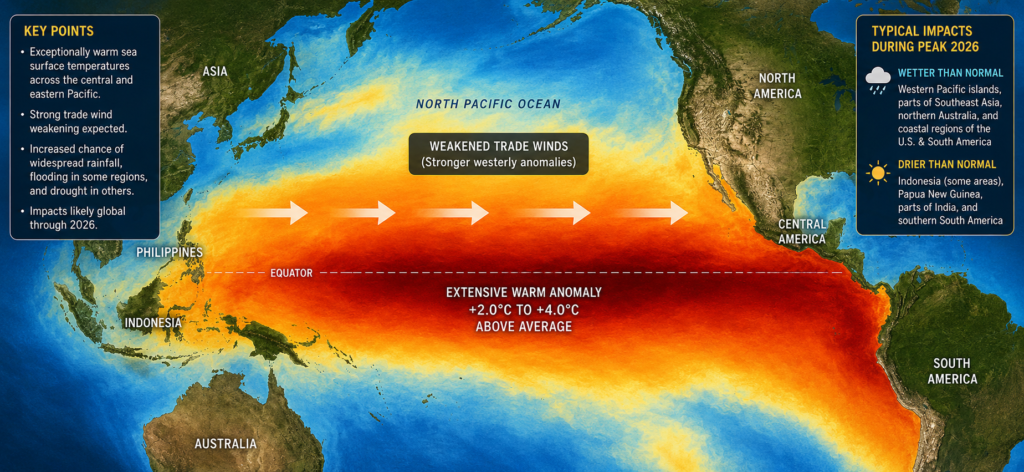
What is El Niño?
- The warm phase of the El Niño-Southern Oscillation (ENSO).
- Periodic, anomalous warming of sea surface temperatures (SSTs) across the central and eastern equatorial Pacific Ocean.
- Occurs every 3-7 years.
- Affects global weather patterns.
What Makes a “Super” El Niño?
- SST anomaly exceeding 2°C in the Niño 3.4 reference region.
- ONI (Oceanic Niño Index) or RONI value of +2°C or above.
- Among the top 3-4 events in the reliable satellite record since late 1970s.
How El Niño Forms
Step 1: Slackening of Trade Winds
- Equatorial trade winds that normally blow east to west begin to stall or reverse.
- Normally, these winds push warm surface waters toward Asia.
Step 2: West-to-East Warm Water Drift
- With weakened winds, warm surface water accumulates and moves eastward toward South American coast.
Step 3: The Feedback Loop (Bjerknes Feedback)
- As eastern Pacific heats up, atmospheric pressure zones shift.
- This further slackens trade winds.
- Self-reinforcing cycle pushes temperatures past the 2°C threshold.
Step 4: Climate Change Multiplier
- Long-term climate change acts as an incubator.
- Higher baseline ocean heat makes modern super El Niños more intense than historical ones.
Impact on India
Monsoon Suppression
- El Niño often weakens the Indian monsoon.
- Below-normal rainfall.
- Increased drought risks across many regions.
Erratic Rainfall Distribution
- Delayed monsoon onset.
- Long dry spells.
- Crop growth and agricultural productivity affected.
- Kharif season at risk.
Indian Ocean Dipole (IOD) Variable
- A positive IOD may partly offset El Niño’s effects.
- Current forecasts suggest limited relief from monsoon weakening.
Global Impacts
Severe Ecological Destruction
- Forest fires (especially in Indonesia, Australia, Amazon).
- Coral bleaching (Great Barrier Reef, Indian Ocean reefs).
- Ecosystem degradation across tropical regions.
Extreme Transnational Droughts
- Many countries: Severe droughts, water shortages, crop failures.
- Heightened food security concerns.
- Vulnerable regions: Australia, Indonesia, Brazil, Southern Africa, parts of India.
Breaching Global Temperature Thresholds
- Releases additional ocean heat into the atmosphere.
- Pushes global temperatures to record levels.
- May push above the 1.5°C threshold (Paris Agreement).
- Climate simulations: “Shockingly high” temperatures forecast for November-December 2026.
About ENSO
- El Niño-Southern Oscillation.
- A semi-regular recurring cycle that transfers heat and momentum from the tropical Pacific to the global atmosphere.
- Three phases:
- El Niño: Warm phase.
- La Niña: Cool phase.
- Neutral: Normal phase.
- Cycle frequency: Every 2-7 years.
About NOAA
- National Oceanic and Atmospheric Administration.
- A US scientific agency under the Department of Commerce.
- Founded: 1970.
- Functions:
- Weather forecasting.
- Climate monitoring.
- Ocean and fisheries research.
- Climate change research.
- Headquartered: Silver Spring, Maryland.
Practice MCQs
Q1. With reference to NOAA’s June 2026 El Niño announcement, consider the following statements:
- NOAA confirmed the formation of El Niño on 11 June 2026.
- NOAA placed the odds at 63 per cent that it will intensify into a very strong or super El Niño by winter.
- A super El Niño is defined by sea surface temperature anomalies exceeding 2°C in the Niño 3.4 region.
- NOAA’s El Niño Advisory was downgraded to a Watch.
How many of the above statements are correct?
(a) Only one (b) Only two (c) Only three (d) All four (e) None
(Statement 4 is wrong; NOAA’s El Niño status was upgraded from Watch to Advisory, NOT downgraded.)
Q2. With reference to historical super El Niños, consider the following statements:
- Since 1950, four major super El Niño events have been recorded: 1972-73, 1982-83, 1997-98, and 2015-16.
- The 2015-16 super El Niño is the current record holder for peak SST anomaly.
- Super El Niños have an SST anomaly exceeding 2°C in the reference region.
- There has never been a super El Niño in recorded history.
How many of the above statements are correct?
(a) Only one (b) Only two (c) Only three (d) All four (e) None
(Statement 4 is wrong; four super El Niños have been recorded since 1950.)
Q3. With reference to the mechanism of El Niño formation, consider the following statements:
- Slackening of equatorial trade winds is the trigger.
- Warm surface water drifts from west to east toward the South American coast.
- The Bjerknes feedback loop is a positive feedback that reinforces El Niño.
- Climate change has made modern super El Niños less intense than historical ones.
Which of the above are correct?
(a) 1, 2 and 3 only (b) 1, 3 and 4 only (c) 2 and 4 only (d) 1 and 4 only (e) All four
(Statement 4 is wrong; climate change has made modern super El Niños MORE intense, NOT less.)
Q4. With reference to El Niño’s impact on India, consider the following statements:
- El Niño often weakens the Indian southwest monsoon.
- It can cause below-normal rainfall and increased drought risks.
- A positive Indian Ocean Dipole (IOD) may partly offset El Niño’s effects.
- El Niño typically enhances and strengthens the Indian monsoon.
Which of the above are correct?
(a) 1, 2 and 3 only (b) 1, 3 and 4 only (c) 2 and 4 only (d) 1 and 4 only (e) All four
(Statement 4 is wrong; El Niño typically WEAKENS the Indian monsoon, NOT strengthens it.)
Q5. With reference to El Niño’s global impacts, consider the following statements:
- El Niño suppresses Atlantic hurricane formation due to wind shear.
- It favours super typhoons in the Central and Eastern Pacific.
- It can push global temperatures above the 1.5°C threshold.
- El Niño has no effect on coral reefs.
Which of the above are correct?
(a) 1, 2 and 3 only (b) 1, 3 and 4 only (c) 2 and 4 only (d) 1 and 4 only (e) All four
(Statement 4 is wrong; El Niño causes coral bleaching and damage to reefs.)
Answer Key
- (c), Statements 1, 2, 3 are correct; Statement 4 is wrong because the Advisory was upgraded, not downgraded.
- (c), Statements 1, 2, 3 are correct; Statement 4 is wrong because four super El Niños have been recorded.
- (a), Statements 1, 2, 3 are correct; Statement 4 is wrong because climate change has made modern El Niños more intense.
- (a), Statements 1, 2, 3 are correct; Statement 4 is wrong because El Niño weakens the Indian monsoon.
- (a), Statements 1, 2, 3 are correct; Statement 4 is wrong because El Niño causes coral bleaching.
Exam Relevance
| Exam | Relevance |
|---|---|
| UPSC Prelims | GS Paper I on Geography (El Niño, ENSO, Monsoon); GS Paper III on Environment, Disaster Management |
| UPSC Mains | GS Paper I on Geography, Climate; GS Paper III on Environment, Agriculture, Food Security |
| BPSC and State PCS | Geography, Environment, Current Affairs |
| Banking and NABARD | Macroeconomic awareness, agriculture |
| RBI Grade B | Inflation, agricultural economy |
| NABARD Grade A | Very high importance, agriculture, monsoon, climate |
2. The Joint Crediting Mechanism (JCM)
Source: News on Air
Context
The Government of India and the Government of Japan officially adopted the ‘Rules of Implementation’ for the Joint Crediting Mechanism (JCM) on 8 June 2026, under Article 6.2 of the Paris Agreement of the United Nations Framework Convention on Climate Change (UNFCCC). This operational milestone activates a bilateral carbon market framework that builds on the Memorandum of Cooperation (MoC) signed in 2025. India became the 31st partner in Japan’s JCM network, which now covers 32 countries. The first Joint Committee meeting was held on 22 September 2025, leading to the final adoption of the rules. The mechanism allows Japanese entities to invest in emission-reduction projects in India using advanced green technologies, with the resulting carbon credits shared between both countries to count toward their Nationally Determined Contributions (NDCs).
What is JCM?
- The Joint Crediting Mechanism (JCM) is a bilateral carbon crediting initiative launched by Japan in 2013.
- Promotes greenhouse gas (GHG) emission reduction projects in partner countries.
- Facilitates the deployment of advanced low-carbon technologies, infrastructure, and investment.
- Carbon credits generated are shared between Japan and the partner country.
Legal Mandate
- Governed by Article 6.2 of the Paris Agreement (2015).
- Article 6.2 allows cooperative approaches between countries through transfer of Internationally Transferred Mitigation Outcomes (ITMOs).
- UNFCCC framework applies.
Aim
- Accelerate adoption of high-performance, low-carbon technologies across partner countries.
- Leverage private and public capital to reduce GHG emissions.
- Drive sustainable development.
- Help cooperating nations achieve their NDCs.
Japan’s JCM Network
- Established: 2013.
- Partner countries: Now 32, including India (31st), Indonesia, Vietnam, Ethiopia, Mongolia, Kenya, Bangladesh, Cambodia, Costa Rica, Laos, Maldives, Mexico, Chile, Saudi Arabia, and others.
Article 6 of the Paris Agreement
- Article 6.2: Cooperative approaches for ITMOs (Internationally Transferred Mitigation Outcomes).
- Article 6.4: Sustainable Development Mechanism (centralized carbon market under UN).
- Article 6.8: Non-market approaches.
Sectors of Cooperation Under JCM
- Renewable energy (solar, wind, biomass).
- Energy efficiency (industrial processes, building HVAC).
- Transport (EVs, fuel cells).
- Waste management (waste-to-energy).
- Forestry and REDD+.
- Carbon Capture, Utilization and Storage (CCUS).
Practice MCQs
Q1. With reference to the Joint Crediting Mechanism (JCM) adopted between India and Japan, consider the following statements:
- India and Japan adopted the Rules of Implementation for JCM on 8 June 2026.
- JCM is governed under Article 6.2 of the Paris Agreement of the UNFCCC.
- India became the 31st partner in Japan’s JCM network.
- JCM was launched by Japan in 2013.
How many of the above statements are correct?
(a) Only one
(b) Only two
(c) Only three
(d) All four
(e) None
Q2. With reference to Article 6 of the Paris Agreement, consider the following statements:
- Article 6.2 allows cooperative approaches through transfer of ITMOs.
- Article 6.4 establishes a Sustainable Development Mechanism under UN supervision.
- Article 6.8 covers non-market approaches.
- Article 6.2 applies only to developed countries.
Which of the above are correct?
(a) 1, 2 and 3 only
(b) 1, 3 and 4 only
(c) 2 and 4 only
(d) 1 and 4 only
(e) All four
(Statement 4 is wrong; Article 6.2 applies to all Paris Agreement parties, including developing countries.)
Q3. With reference to JCM’s operational mechanism, consider the following statements:
- Japanese entities invest in emission-reduction projects in India using advanced green technologies.
- The carbon credits generated are allocated between Japan and India to count toward their NDC targets.
- A Joint Committee with representatives from both governments oversees the system.
- JCM does not require independent third-party validation and verification.
Which of the above are correct?
(a) 1, 2 and 3 only
(b) 1, 3 and 4 only
(c) 2 and 4 only
(d) 1 and 4 only
(e) All four
(Statement 4 is wrong; JCM requires independent third-party validation and verification.)
Q4. With reference to JCM’s funding channels, consider the following statements:
- JCM Model Projects are funded by the Ministry of the Environment of Japan (MOEJ).
- The Japan Fund for the Joint Crediting Mechanism (JFJCM) is managed by the Asian Development Bank (ADB).
- Demonstration projects are managed by the New Energy and Industrial Technology Development Organization (NEDO).
- JCM is funded solely by the Indian government.
How many of the above statements are correct?
(a) Only one
(b) Only two
(c) Only three
(d) All four
(e) None
(Statement 4 is wrong; JCM is funded primarily by Japan through multiple channels, NOT solely by India.)
Q5. With reference to India’s climate commitments under the Paris Agreement, consider the following statements:
- India aims to reduce emissions intensity of GDP by 45 per cent by 2030 (from 2005 levels).
- India targets 50 per cent of cumulative installed electric power capacity from non-fossil fuel sources by 2030.
- India has committed to achieve net-zero emissions by 2070.
- India has committed to net-zero emissions by 2050.
How many of the above statements are correct?
(a) Only one
(b) Only two
(c) Only three
(d) All four
(e) None
(Statement 4 is wrong; India’s net-zero target is 2070, NOT 2050.)
Answer Key
- (d), All four statements are correct.
- (a), Statements 1, 2, 3 are correct; Statement 4 is wrong because Article 6.2 applies to all parties.
- (a), Statements 1, 2, 3 are correct; Statement 4 is wrong because third-party validation is required.
- (c), Statements 1, 2, 3 are correct; Statement 4 is wrong because JCM is funded by Japan primarily.
- (c), Statements 1, 2, 3 are correct; Statement 4 is wrong because India’s net-zero target is 2070.
3. Kashmir Saffron: GI-Tagged Premium Spice Surges Amid West Asia Crisis
Source: New Indian Express (NIE)
Context
The ongoing crisis in West Asia (Iran conflict) and a sharp 140-ton decline in Iran’s saffron production have triggered a massive global demand surge for premium Kashmiri saffron. Iran is the world’s largest saffron producer (over 300 tonnes annually on 30,000 hectares), while Kashmir ranks second in supply. Kashmir saffron, historically called “bahukam” in ancient Sanskrit literature and “Red Gold”, received its Geographical Indication (GI) tag on 1 May 2020. It is grown across about 3,715 hectares in Pulwama, Budgam, Srinagar, and Kishtwar districts, with Pampore as the main hub. It is the only saffron in the world grown at an altitude of 1,600-1,800 metres. Lab profiles reveal higher concentrations of crocin (18-22 per cent), safranal (0.8-1.2 per cent), and picrocrocin (8-12 per cent) compared to foreign varieties.
What is Kashmir Saffron?
- A highly aromatic and costly spice derived from the dried stigmas of Crocus sativus flower.
- Historical names: “Bahukam” (ancient Sanskrit), “Red Gold”.
- Holds GI tag since 1 May 2020 under GI No. 635, Certificate No. 366.
- A symbol of Jammu and Kashmir’s agricultural heritage.
Why is Kashmir Saffron Unique?
The World’s Highest Altitude Saffron
- Only saffron variety grown at an altitude of 1,600-1,800 metres.
- Microclimate enhances internal oil concentration and potency.
Distinct Physical Appearance
- Longer and thicker stigmas.
- Natural deep crimson-maroon-purple hue.
- Darkest natural saffron coloring in the world.
Superior Bio-Chemical Properties
| Component | Kashmir Saffron | Function |
|---|---|---|
| Crocin | 18-22 per cent | Carotenoid pigment, gives golden-yellow color, antioxidant properties |
| Safranal | 0.8-1.2 per cent | Organic compound responsible for warm, honey-like, earth-toned aroma |
| Picrocrocin | 8-12 per cent | Provides characteristic bitter flavor |
Three Traditional Grades (Verified)
- Mongra Saffron:
- A++ premium grade.
- Strictly hand-detached crimson tips.
- Zero yellow style attachments.
- Lachha Saffron:
- Stigmas separated from the flower and dried immediately.
- No further complex processing.
- Packed loosely in air-tight containers.
- Guchhi Saffron:
- Similar to Lachha, but threads are arranged and tied into bound bundles.
About Geographical Indication (GI) Tag
- What it is: A registered intellectual property that identifies goods originating from a specific geographical region, possessing qualities, reputation, or characteristics attributable to that origin.
- Governing law: Geographical Indications of Goods (Registration and Protection) Act, 1999.
- Implementing authority: Office of the Controller General of Patents, Designs and Trade Marks (Geographical Indications Registry, Chennai).
- Validity: 10 years (renewable).
Notable GI-tagged products of J&K
- Kashmir Saffron (2020).
- Pashmina Wool.
- Kashmir Walnut Wood Carving.
- Kashmir Hand-Knotted Carpets.
- Kani Shawls.
- Khatamband.
- Basmati Rice (UT-wide).
Why is GI Tag Significant for Kashmir Saffron?
- Prevents adulteration by other varieties.
- Better international price realization.
- Protects authenticity in global markets.
- Enables legal action against misuse.
- Boosts farmer income.
- Cultural and heritage protection.
Practice MCQs
Q1. With reference to Kashmir saffron, consider the following statements:
- Kashmir saffron received its GI tag in May 2020.
- It is the only saffron variety in the world grown at an altitude of 1,600-1,800 metres above mean sea level.
- Pampore in Pulwama district is the main hub of Kashmir saffron cultivation.
- Kashmir is the world’s largest producer of saffron.
How many of the above statements are correct?
(a) Only one
(b) Only two
(c) Only three
(d) All four
(e) None
(Statement 4 is wrong; Iran is the world’s largest saffron producer, NOT Kashmir.)
Q2. With reference to the cultivation of Kashmir saffron, consider the following statements:
- It is grown across about 3,715 hectares in Jammu and Kashmir.
- The crop grows exclusively in Karewa soils (alluvial lake-bed deposits).
- It is cultivated in Pulwama, Budgam, Srinagar, and Kishtwar districts.
- The scientific name of the saffron crocus is Crocus sativus.
How many of the above statements are correct?
(a) Only one
(b) Only two
(c) Only three
(d) All four
(e) None
Q3. With reference to the chemical composition of Kashmir saffron, consider the following statements:
- Crocin (18-22 per cent) gives saffron its golden-yellow color and antioxidant properties.
- Safranal (0.8-1.2 per cent) produces the warm, honey-like aroma.
- Picrocrocin (8-12 per cent) provides the characteristic bitter flavor.
- Kashmir saffron has lower concentrations of these compounds than Iranian saffron.
Which of the above are correct?
(a) 1, 2 and 3 only
(b) 1, 3 and 4 only
(c) 2 and 4 only
(d) 1 and 4 only
(e) All four
(Statement 4 is wrong; Kashmir saffron has HIGHER concentrations of these compounds than Iranian saffron.)
Q4. With reference to the grades of Kashmir saffron, consider the following statements:
- Mongra is the premium A++ grade with only hand-detached crimson tips.
- Lachha consists of stigmas dried immediately without further processing.
- Guchhi has threads tied together in bundles.
- All three grades have identical chemical composition.
Which of the above are correct?
(a) 1, 2 and 3 only
(b) 1, 3 and 4 only
(c) 2 and 4 only
(d) 1 and 4 only
(e) All four
(Statement 4 is partially wrong; the grades differ in processing and purity, not just chemical composition.)
Q5. With reference to the Geographical Indication (GI) Tag system in India, consider the following statements:
- GI Tags are governed by the Geographical Indications of Goods (Registration and Protection) Act, 1999.
- The GI Registry is based in Chennai.
- GI Tag validity is 10 years, renewable.
- Kashmir Saffron’s GI registration date is 1 May 2020.
How many of the above statements are correct?
(a) Only one
(b) Only two
(c) Only three
(d) All four
(e) None
Answer Key
- (c), Statements 1, 2, 3 are correct; Statement 4 is wrong because Iran is the largest producer.
- (d), All four statements are correct.
- (a), Statements 1, 2, 3 are correct; Statement 4 is wrong because Kashmir has higher concentrations.
- (a), Statements 1, 2, 3 are correct; Statement 4 is wrong because grades differ.
- (d), All four statements are correct.
4. The Kishau Multi-Purpose Dam
Source: News on Air
Context
Union Home Minister Amit Shah chaired a crucial meeting in New Delhi on 16-17 June 2026, where a historic consensus was reached among six stakeholder states (Himachal Pradesh, Uttarakhand, Haryana, Delhi, Uttar Pradesh, and Rajasthan) to implement the long-pending Kishau Multi-Purpose Dam Project, breaking an eight-year deadlock. The six states agreed to sign a Memorandum of Understanding (MoU) for the hydroelectric and water storage project on the Tons River (a tributary of the Yamuna). The 236-metre concrete gravity dam (estimated cost: ₹11,500-15,000 crore) will create a reservoir of 1,324 MCM, generate 660 MW of hydropower (1,379 MU annually), and irrigate 97,076 hectares. Under the new agreement, the Central Government will fund 90 per cent of the water component as a central assistance grant, while the six states will share 10 per cent. A unique water swap allows Himachal Pradesh’s water share to be supplied to Delhi and Rajasthan in lieu of sharing HP’s power component cost (about ₹2,000 crore). The project was initially approved by the Ministry of Environment and Forests (MoEF) in 2018, and the MoU will now be placed before the Union Cabinet for approval.
Stakeholder States
- Himachal Pradesh.
- Uttarakhand.
- Haryana.
- Delhi.
- Uttar Pradesh.
- Rajasthan.
Location
- River: Tons River (a primary tributary of the Yamuna).
- Site: About 39 km north of Dakpathar, upstream of Ichari Dam.
- Border: Straddles Himachal Pradesh and Uttarakhand.
- Specifically: Between Dehradun (Uttarakhand) and Sirmour (Himachal Pradesh).
- Coordinates: about 30.75°N, 77.70°E.
Aim
- Build extensive water resource management network.
- Secure downstream drinking water.
- Expand agricultural irrigation across northern India.
- Generate peak-load hydroelectric power.
- Increase minimum ecological flow of the Yamuna River for environmental recovery.
- Rejuvenate Yamuna River.
The 90:10 Agreement
- Centre: 90 per cent of water component cost as central assistance grant.
- Six states: Share remaining 10 per cent.
About the Yamuna River
- Origin: Yamunotri Glacier, Uttarkashi district, Uttarakhand at an elevation of 6,387 m.
- Length: About 1,376 km.
- Major tributaries: Tons, Giri, Chambal, Sind, Betwa, Ken, Hindon.
- Joins Ganga: At Triveni Sangam, Prayagraj (Uttar Pradesh).
- Drainage basin: about 366,223 sq km.
- States: Uttarakhand, Himachal Pradesh, Haryana, Delhi, Uttar Pradesh.
Practice MCQs
Q1. With reference to the Kishau Multi-Purpose Dam Project, consider the following statements:
- The dam is being constructed on the Tons River, a tributary of the Yamuna.
- It straddles the border between Himachal Pradesh and Uttarakhand.
- The dam is 236 metres high with an estimated cost of ₹11,500 crore.
- The Kishau dam is located on the Ganga River in Uttar Pradesh.
How many of the above statements are correct?
(a) Only one
(b) Only two
(c) Only three
(d) All four
(e) None
(Statement 4 is wrong; the Kishau dam is on the Tons River, NOT the Ganga.)
Q2. With reference to the funding framework agreed in June 2026, consider the following statements:
- The Central Government will bear 90 per cent of the cost of the water component.
- The remaining 10 per cent will be shared by the six stakeholder states.
- Himachal Pradesh’s water share will be supplied to Delhi and Rajasthan in lieu of HP’s power component cost (about ₹2,000 crore).
- The Centre will bear 100 per cent of both water and power components.
How many of the above statements are correct?
(a) Only one
(b) Only two
(c) Only three
(d) All four
(e) None
(Statement 4 is wrong; the Centre bears 90 per cent of water component, NOT 100 per cent of both components.)
Q3. With reference to the six stakeholder states of the Kishau project, consider the following statements:
- The six states are Himachal Pradesh, Uttarakhand, Haryana, Delhi, Uttar Pradesh, and Rajasthan.
- The meeting was chaired by Union Home Minister Amit Shah in June 2026.
- The Ministry of Environment and Forests had initially approved the project in 2018.
- The eight-year deadlock was over inter-state water and cost-sharing issues.
How many of the above statements are correct?
(a) Only one
(b) Only two
(c) Only three
(d) All four
(e) None
Q4. With reference to the project’s technical features, consider the following statements:
- The reservoir will have a live storage capacity of 1,324 MCM.
- The hydropower plant will be rated at 660 MW with 1,379 MU annual generation.
- The dam will support irrigation of 97,076 hectares.
- The dam will not have any hydropower component.
Which of the above are correct?
(a) 1, 2 and 3 only
(b) 1, 3 and 4 only
(c) 2 and 4 only
(d) 1 and 4 only
(e) All four
(Statement 4 is wrong; the dam will have a 660 MW hydropower plant.)
Q5. With reference to the broader Yamuna basin storage projects, consider the following statements:
- The Lakhwar project is on the Yamuna River in Uttarakhand.
- The Renukaji project is on the Giri River, a tributary of the Yamuna, in Himachal Pradesh.
- The Kishau project is on the Tons River, a tributary of the Yamuna.
- All three projects are part of the Upper Yamuna basin storage initiative.
How many of the above statements are correct?
(a) Only one
(b) Only two
(c) Only three
(d) All four
(e) None
Answer Key
- (c), Statements 1, 2, 3 are correct; Statement 4 is wrong because the Kishau dam is on the Tons River, not the Ganga.
- (c), Statements 1, 2, 3 are correct; Statement 4 is wrong because the Centre bears only 90 per cent of water component.
- (d), All four statements are correct.
- (a), Statements 1, 2, 3 are correct; Statement 4 is wrong because the dam includes a 660 MW hydropower plant.
- (d), All four statements are correct.
Banking/Finance
1. NPCI Unveils Drunix
Source: Business Standard
Context
The National Payments Corporation of India (NPCI) has rolled out Drunix, an open-source, enterprise-grade blockchain platform designed to help organisations build and scale tokenisation platforms, digital asset ecosystems, and multi-organisation networks. Drunix has been developed as an enhanced fork of Hyperledger Fabric and is intended to address the growing demand for scalable and secure distributed ledger solutions. It is engineered for enterprise and public infrastructure adoption and enables blockchain deployment at scale without compromising privacy, governance, or interoperability. Drunix marks NPCI’s second major open-source contribution in the blockchain and tokenization space, following Falcon, which focused on production-grade blockchain network management and orchestration. NPCI’s Chief Technology Officer Vishal Kanvaty said the platform aims to accelerate blockchain readiness with foundational technologies for experimentation, interoperability, and real-world adoption.
Purpose of Drunix
To help organisations build and scale:
- Tokenisation platforms.
- Digital asset ecosystems.
- Multi-organisation networks.
- Public infrastructure adoption.
Key Features
- High-performance distributed ledger platform.
- Enhanced throughput, scalability, and operational efficiency.
- Compatibility with existing Hyperledger Fabric ecosystems.
- Privacy, governance, and interoperability preserved.
- Enterprise-grade architecture.
NPCI’s Open-Source Blockchain and AI Initiatives
| Initiative | Purpose |
|---|---|
| Falcon | Production-grade blockchain network management and orchestration (NPCI’s 1st blockchain open-source contribution) |
| Drunix | Core blockchain runtime and transaction processing layer (NPCI’s 2nd open-source contribution in blockchain) |
| FiMi | NPCI’s open-source initiative |
| Vigil-AI | NPCI’s AI-based initiative |
What is Blockchain Technology?
- A distributed ledger technology (DLT) where data is stored in blocks that are chained cryptographically.
- Key features:
- Decentralisation: No single point of control.
- Immutability: Once recorded, data cannot be altered.
- Transparency: All participants can verify transactions.
- Consensus mechanisms: For validating transactions (PoW, PoS, PBFT, etc.).
- Applications:
- Cryptocurrencies: Bitcoin, Ethereum.
- Smart contracts.
- Supply chain tracking.
- Digital identity.
- Tokenisation of assets.
- Cross-border payments.
What is Hyperledger Fabric?
- An open-source enterprise-grade blockchain platform.
- Hosted by: Linux Foundation.
- Released: 2016.
- Key features:
- Permissioned blockchain.
- Modular architecture.
- Privacy through channels and private data collections.
- Smart contracts (chaincode) in Go, Node.js, Java.
- Widely used by: Enterprises, banks, governments.
What is Tokenisation?
- The process of converting rights to an asset into a digital token on a blockchain.
- Examples:
- Real estate tokenisation: Fractional ownership of property.
- Asset-backed tokens: Gold, silver-backed tokens.
- Equity tokens: Digital representation of company shares.
- Stablecoins: Tokens pegged to fiat currencies.
- NFT (Non-Fungible Tokens): Unique digital assets.
- Benefits: Fractional ownership, faster settlement, lower costs, increased liquidity.
About NPCI
- National Payments Corporation of India.
- A non-profit company under the Ministry of Finance.
- Founded: 2008.
- Promoted by: RBI and Indian Banks’ Association (IBA).
- Headquartered: Mumbai.
- Functions:
- Operates UPI, RuPay, IMPS, BHIM, AEPS, BBPS, NETC (FASTag).
- Sets standards for retail payment systems.
- NPCI International Payments Limited (NIPL): For global UPI expansion.
Practice MCQs
Q1. With reference to NPCI’s Drunix, consider the following statements:
- Drunix is an open-source, enterprise-grade blockchain platform released by NPCI in June 2026.
- It is built as an enhanced fork of Hyperledger Fabric.
- Drunix is NPCI’s second major open-source contribution in the blockchain space, following Falcon.
- Drunix is a closed-source proprietary platform.
How many of the above statements are correct?
(a) Only one (b) Only two (c) Only three (d) All four (e) None
(Statement 4 is wrong; Drunix is open-source, NOT closed-source.)
Q2. With reference to Hyperledger Fabric, consider the following statements:
- Hyperledger Fabric is an open-source enterprise-grade blockchain platform.
- It is hosted by the Linux Foundation.
- Hyperledger Fabric is a permissioned blockchain.
- Drunix maintains compatibility with existing Hyperledger Fabric ecosystems.
How many of the above statements are correct?
(a) Only one (b) Only two (c) Only three (d) All four (e) None
Q3. With reference to NPCI, consider the following statements:
- NPCI is a non-profit company promoted by the RBI and the Indian Banks’ Association (IBA).
- NPCI was founded in 2008 and is headquartered in Mumbai.
- NPCI operates UPI, RuPay, IMPS, BHIM, AEPS, BBPS, and NETC (FASTag).
- NPCI is a foreign company headquartered in Singapore.
Which of the above are correct?
(a) 1, 2 and 3 only (b) 1, 3 and 4 only (c) 2 and 4 only (d) 1 and 4 only (e) All four
(Statement 4 is wrong; NPCI is an Indian non-profit company headquartered in Mumbai.)
Q4. With reference to blockchain technology, consider the following statements:
- Blockchain is a distributed ledger technology (DLT) where data is stored in cryptographically linked blocks.
- Key features include decentralisation, immutability, and transparency.
- Tokenisation is the process of converting rights to an asset into a digital token on a blockchain.
- Public blockchains are restricted to authorised users only.
Which of the above are correct?
(a) 1, 2 and 3 only (b) 1, 3 and 4 only (c) 2 and 4 only (d) 1 and 4 only (e) All four
(Statement 4 is wrong; PRIVATE/PERMISSIONED blockchains are restricted to authorised users; public blockchains are open to all.)
Q5. With reference to India’s CBDC (e-Rupee), consider the following statements:
- The e-Rupee is India’s Central Bank Digital Currency, launched by the RBI.
- The wholesale e-Rupee pilot was launched in November 2022.
- The retail e-Rupee pilot was launched in December 2022.
- CBDC is built on blockchain technology.
How many of the above statements are correct?
(a) Only one (b) Only two (c) Only three (d) All four (e) None
Answer Key
- (c), Statements 1, 2, 3 are correct; Statement 4 is wrong because Drunix is open-source.
- (d), All four statements are correct.
- (a), Statements 1, 2, 3 are correct; Statement 4 is wrong because NPCI is Indian, headquartered in Mumbai.
- (a), Statements 1, 2, 3 are correct; Statement 4 is wrong because private blockchains are restricted, not public.
- (d), All four statements are correct.
2. RBI Temporarily Withdraws Interest Rate Ceilings on FCNR(B) and NRE Deposits to Attract NRI Funds
Source: ET
Context
The Reserve Bank of India (RBI) on 17 June 2026 temporarily withdrew the interest rate ceiling on fresh Foreign Currency Non-Resident (Bank) [FCNR(B)] deposits with maturities of 3 years and above up to 5 years, until 30 September 2026. Separately, the RBI also temporarily removed restrictions on interest rates for fresh Non-Resident External (NRE) deposits of 3 years and above, including deposits renewed on maturity, until 30 September 2026. The amendment was issued under Section 35A of the Banking Regulation Act, 1949, modifying the Commercial Banks Interest Rate on Deposits Directions, 2025. This move builds on the earlier FCNR(B) swap facility (announced 8 June 2026) under which the RBI bears the full hedging cost for banks. Following these moves, banks like AU Small Finance Bank (7.10 per cent), Karur Vysya Bank (7 per cent), CSB Bank (6.95 per cent), and Yes Bank (6.6 per cent) have raised FCNR(B) rates. SBI Research estimates USD 40-45 billion inflows via the FCNR(B) route alone, with combined inflows of USD 55-65 billion likely in FY27.
On NRE Deposits
- Restrictions removed on interest rates for fresh NRE deposits of 3 years and above.
- Banks no longer bound by the requirement that rates must not exceed those on comparable domestic rupee term deposits.
- Same validity: Until 30 September 2026.
Important Exception
- Transfers from NRO accounts to NRE accounts will NOT qualify for the exemption.
Legal Basis
- Section 35A of Banking Regulation Act, 1949.
- Modifies: Commercial Banks Interest Rate on Deposits Directions, 2025.
Prior Ceilings (Before Relaxation)
| Maturity | Previous Ceiling |
|---|---|
| 3-5 years | Overnight ARR/swap rate + 350 bps |
| 1 year to less than 3 years | Overnight ARR/swap rate + 250 bps (still applicable) |
FCNR(B) Swap Facility
- Window for fresh FCNR(B) deposits with 3-5 year maturity.
- Deposits must be opened: Between 8 June and 30 September 2026.
- Banks can access RBI swap until: 16 October 2026.
- 1-year lock-in from deposit opening date.
- Exempt from CRR and SLR maintenance for these deposits.
- RBI absorbs the full hedging cost (about 3-3.5 per cent annually).
- Swaps cannot be cancelled once executed with RBI.
What is FCNR(B)?
- Foreign Currency Non-Resident (Bank) deposit.
- A term deposit account for Non-Resident Indians (NRIs) and Persons of Indian Origin (PIOs).
- Held in foreign currency: USD, GBP, EUR, JPY, CAD, AUD, etc.
- Tenure: 1 to 5 years.
- Key features:
- No exchange rate risk for depositor (currency same throughout tenure).
- Interest is tax-free in India.
- Funds and interest are fully repatriable.
What is NRE Deposit?
- Non-Resident External (NRE) Account.
- A rupee-denominated account for NRIs and PIOs.
- Funds sourced from foreign income.
- Key features:
- Interest is tax-free in India.
- Funds and interest are fully repatriable.
- Exchange rate risk for depositor (since denominated in INR).
- Can be: Savings, Current, or Term Deposit.
What is NRO Deposit?
- Non-Resident Ordinary (NRO) Account.
- A rupee-denominated account for NRIs.
- Funds sourced from Indian income (rent, dividends, etc.).
- Interest is taxable in India.
- Repatriation restricted: USD 1 million per year limit.
FCNR(B) vs NRE vs NRO
| Feature | FCNR(B) | NRE | NRO |
|---|---|---|---|
| Currency | Foreign (USD, GBP, etc.) | Rupee | Rupee |
| Source of funds | Foreign earnings | Foreign earnings | Indian income |
| Interest taxable | No (tax-free) | No (tax-free) | Yes |
| Repatriation | Fully repatriable | Fully repatriable | Restricted (USD 1 mn/yr) |
| Exchange rate risk | No | Yes | N/A (domestic income) |
What is the FCNR(B) Swap Facility?
- Announced: 8 June 2026 (some sources cite 5 June).
- Mechanism: RBI takes on the hedging cost (3-3.5 per cent annually) for banks on eligible FCNR(B) deposits.
- Effect: Banks can offer higher rates (5.5-7.1 per cent) on USD FCNR(B) deposits.
- Benefits to banks: No CRR/SLR maintenance; lower hedging cost.
What is the OFCB Swap Facility?
- Overseas Foreign Currency Borrowing.
- Fixed rate of 1.5 per cent per annum for:
- PSUs raising ECBs.
- Banks’ overseas borrowings.
- This is different from the FCNR(B) Swap Facility (where RBI bears the full hedging cost, not at 1.5 per cent).
About Alternative Reference Rates (ARRs)
- The replacement for LIBOR (London Interbank Offered Rate), which was phased out by 30 June 2023.
- Key ARRs:
- SOFR (Secured Overnight Financing Rate): For USD (replaced USD LIBOR on 30 June 2023).
- SONIA (Sterling Overnight Index Average): For GBP (LIBOR ceased 31 December 2021).
- TONA (Tokyo Overnight Average Rate): For JPY.
- €STR (Euro Short-Term Rate): For EUR.
- SARON (Swiss Average Rate Overnight): For CHF.
Practice MCQs
Q1. With reference to the RBI’s 17 June 2026 move on FCNR(B) and NRE deposits, consider the following statements:
- The interest rate ceiling on FCNR(B) deposits with 3-5 year maturity has been temporarily withdrawn till 30 September 2026.
- Restrictions on interest rates for NRE deposits of 3 years and above have also been removed till 30 September 2026.
- The amendment was issued under Section 35A of the Banking Regulation Act, 1949.
- Transfers from NRO accounts to NRE accounts will also qualify for the exemption.
How many of the above statements are correct?
(a) Only one (b) Only two (c) Only three (d) All four (e) None
(Statement 4 is wrong; NRO-to-NRE transfers will NOT qualify for the exemption.)
Q2. With reference to the FCNR(B) Swap Facility announced on 8 June 2026, consider the following statements:
- The RBI bears the full hedging cost (3-3.5 per cent annually) for banks on eligible FCNR(B) deposits.
- Banks can access the RBI swap facility until 16 October 2026.
- Deposits mobilised under this scheme are exempt from CRR and SLR maintenance.
- The FCNR(B) Swap Facility uses a fixed rate of 1.5 per cent per annum charged to banks.
How many of the above statements are correct?
(a) Only one (b) Only two (c) Only three (d) All four (e) None
(Statement 4 is wrong; the 1.5 per cent fixed rate is for the OFCB Swap Facility for PSUs and banks’ overseas borrowings, NOT the FCNR(B) Swap Facility. Under FCNR(B), RBI bears the full hedging cost.)
Q3. With reference to India’s NRI deposits position (June 2025 data), consider the following statements:
- Total outstanding NRI deposits were USD 168.32 billion in June 2025.
- NRE deposits outstanding were USD 102.75 billion.
- FCNR(B) deposits outstanding were USD 33.58 billion.
- India had no outstanding NRI deposits as of June 2025.
How many of the above statements are correct?
(a) Only one (b) Only two (c) Only three (d) All four (e) None
(Statement 4 is wrong; India had USD 168.32 billion in outstanding NRI deposits.)
Q4. With reference to FCNR(B), NRE, and NRO deposits, consider the following statements:
- FCNR(B) deposits are held in foreign currency without exchange rate risk for the depositor.
- NRE deposits are rupee-denominated with tax-free interest and full repatriation.
- NRO deposits are rupee-denominated for NRIs’ Indian income, with taxable interest and restricted repatriation (USD 1 million per year).
- All three deposit types have unrestricted repatriation.
Which of the above are correct?
(a) 1, 2 and 3 only (b) 1, 3 and 4 only (c) 2 and 4 only (d) 1 and 4 only (e) All four
(Statement 4 is wrong; NRO repatriation is restricted to USD 1 million per year.)
Q5. With reference to SBI Research estimates and forex reserves, consider the following statements:
- SBI Research expects USD 40-45 billion inflows via the FCNR(B) route alone.
- Combined inflows from all RBI measures could be USD 55-65 billion in FY27.
- India’s forex reserves were USD 681.61 billion at the end of the week ending 5 June 2026.
- India has never had forex reserves above USD 700 billion.
Which of the above are correct?
(a) 1, 2 and 3 only (b) 1, 3 and 4 only (c) 2 and 4 only (d) 1 and 4 only (e) All four
(Statement 4 is wrong; India’s highest-ever forex reserves were USD 728.49 billion; reserves recovered above USD 700 billion in June 2026.)
Answer Key
- (c), Statements 1, 2, 3 are correct; Statement 4 is wrong because NRO-to-NRE transfers don’t qualify.
- (c), Statements 1, 2, 3 are correct; Statement 4 is wrong because the 1.5 per cent is for OFCB, not FCNR(B) swap facility.
- (c), Statements 1, 2, 3 are correct; Statement 4 is wrong because India had USD 168.32 billion NRI deposits.
- (a), Statements 1, 2, 3 are correct; Statement 4 is wrong because NRO repatriation is restricted.
- (a), Statements 1, 2, 3 are correct; Statement 4 is wrong because India’s reserves have crossed USD 700 billion.
3. RBI Master Directions on Authorisation to Operate a Payment System (PSO)
Source: BS
Context:
In June 2026, the Reserve Bank of India (RBI) issued the Master Directions on Authorisation to Operate a Payment System to consolidate the existing guidelines for entities seeking to operate payment systems under the Payment and Settlement Systems (PSS) Act, 2007. The directions, which come into effect immediately, provide a unified framework covering eligibility criteria, authorisation, perpetual validity of licences, voluntary surrender, and cooling-off requirements for Payment System Operators (PSOs).
What is a Payment System Operator (PSO)?
- An entity authorised by the RBI to operate a payment system.
- A payment system enables clearing, payment, or settlement of funds between participants.
- No entity, other than RBI, can operate a payment system without prior RBI authorisation (Section 4, PSS Act 2007).
Why was the Framework Consolidated?
- Multiple existing guidelines had been issued over time.
- Need for unified clarity for fintech and payment industry.
- Aligns with global standards (BIS Principles, FATF).
- Brings regulatory certainty to fintech ecosystem.
- Strengthens systemic risk management.
- Enhances customer protection.
Key Features of the Master Directions
1. Perpetual Validity of Licences
- Authorisation to new PSOs: Perpetually valid.
- Existing operators: May receive perpetual validity on renewal, provided:
- Regulatory requirements are met.
- No supervisory concern.
- Non-compliant existing operators: Get one-year renewals until deficiencies addressed.
- Significance: Removes burden of periodic re-authorisation; provides stability.
2. On-Tap Availability
- Authorisation to operate payment systems will continue to be available on an on-tap basis.
- No fixed window: Applications can be submitted at any time.
- Process: Through the RBI’s portal.
- Useful for: Innovative and niche PSOs, fintech entrants.
3. FATF Safeguards
- Investment restrictions retained for non-compliant FATF jurisdictions.
- New investors from FATF non-compliant jurisdictions:
- Cannot acquire significant influence in PSOs.
- Aggregate voting rights capped below 20 per cent.
- Purpose: AML/CFT compliance.
4. “Fit and Proper” Criteria
Applicants must meet criteria relating to:
- Integrity.
- Financial soundness.
- Governance standards.
5. Capital and Net-Worth Requirements
- Applicants must comply with capital and net-worth requirements prescribed for specific payment systems.
- Varies by PSO type:
- PPI issuers: about ₹100 crore minimum net worth.
- Card networks: Higher requirements.
- Specialised PSOs: Tailored requirements.
6. Voluntary Surrender Process
Entities seeking to discontinue operations must:
- Settle outstanding liabilities to:
- Customers.
- Merchants.
- Agents.
- Banks.
- Obtain auditor-certified confirmation.
- Notify RBI.
- Submit wind-up plan.
7. Cooling-Off Period
A 1-year cooling-off period may be imposed on entities whose authorisation has been:
| Category | Cooling-Off Period |
|---|---|
| Revoked by RBI | 1 year |
| Not renewed | 1 year |
| Voluntarily surrendered | 1 year |
| Application rejected | 1 year |
During the cooling-off, such entities cannot apply for permission to operate any payment system.
Three-Tier PSO Classification
| Tier | PSO Type | Examples |
|---|---|---|
| Tier 1 | Systemic Authorised Payment Systems (large national) | NPCI (RTGS, NEFT, UPI), Card networks, ATM networks |
| Tier 2 | Specialised PSOs (specific functions) | PPI issuers, Cross-border money transfer operators, BBPS, TReDS |
| Tier 3 | Niche/innovation PSOs | Account aggregators, payment intermediaries, FinTechs |
About Payment and Settlement Systems (PSS) Act, 2007
- Enacted: 2007.
- Effective: 2008.
- Purpose: Provide regulation and supervision of payment systems in India.
- Key provisions:
- Section 4: RBI authorisation required for operating payment systems.
- Section 7: Issuance of authorisation.
- Section 8: Revocation of authorisation.
- Section 17: Power to call for returns and documents.
- Section 18: Power to issue directions.
- Designated authority: Board for Regulation and Supervision of Payment and Settlement Systems (BPSS) under RBI.
Major PSOs in India (Examples)
| PSO | Function |
|---|---|
| NPCI (National Payments Corporation of India) | Operates RTGS, NEFT, UPI, IMPS, Bharat BillPay (BBPS), FASTag, RuPay |
| CCIL (Clearing Corporation of India Ltd) | Settles money market, government securities, forex transactions |
| Card networks: Visa, Mastercard, RuPay, American Express | Operate card payment networks |
| PPI issuers: PhonePe, Paytm, Mobikwik | Prepaid Payment Instruments |
| Cross-border money transfer operators: Wise, Remitly | International remittances |
| TReDS platforms: Receivables Exchange of India Ltd | MSME receivables discounting |
Key Terms
- Payment System Operator (PSO): An entity authorised by RBI under Section 4 of PSS Act, 2007 to operate a payment system that enables clearing, payment, or settlement of funds between participants.
- Master Directions: A consolidated set of regulatory guidelines issued by RBI that brings together multiple individual circulars on a topic into a single, comprehensive document.
- Payment and Settlement Systems (PSS) Act, 2007: The primary legislation governing payment systems in India, providing RBI with regulatory and supervisory powers.
- Perpetual Validity: A licence that does not expire unless revoked or surrendered, removing the need for periodic re-authorisation.
- On-Tap: An application window that is continuously open throughout the year, not restricted to specific periods.
- Cooling-Off Period: A specified time during which an entity is prevented from applying for a new authorisation after its previous one was revoked, surrendered, or rejected.
- FATF (Financial Action Task Force): An intergovernmental body that sets global standards for Anti-Money Laundering (AML) and Counter-Terror Financing (CFT).
- FATF Non-Compliant Jurisdictions: Countries that do not adequately comply with FATF’s 40 Recommendations, placed on FATF’s “grey” or “black” lists.
- “Fit and Proper” Criteria: Standards that applicants must meet on integrity, financial soundness, and governance to be authorised.
- Voluntary Surrender: A process by which a PSO can discontinue operations by settling outstanding liabilities and notifying RBI.
- Voting Rights Cap: A regulatory limit on how much voting control an investor can have, used to prevent undue influence.
- AML/CFT: Anti-Money Laundering / Counter-Terror Financing, global regulatory standards to prevent financial crimes.
- NPCI: National Payments Corporation of India, an umbrella organisation that operates several major payment systems (UPI, RTGS, NEFT, IMPS, RuPay).
- PPI (Prepaid Payment Instrument): A payment instrument like digital wallets that store value for future use.
- BPSS: Board for Regulation and Supervision of Payment and Settlement Systems, the designated authority under RBI for PSS oversight.
Practice MCQs
Q1. With reference to the RBI’s Master Directions on Authorisation to Operate a Payment System (June 2026), consider the following statements:
- The Master Directions consolidate existing guidelines on authorisation of Payment System Operators (PSOs).
- They provide a unified framework covering eligibility criteria, authorisation, perpetual validity, voluntary surrender, and cooling-off requirements.
- The directions are issued under Section 4 of the Payment and Settlement Systems (PSS) Act, 2007.
- Authorisation granted to new PSOs is valid for only 5 years.
How many of the above statements are correct?
(a) Only one
(b) Only two
(c) Only three
(d) All four
(e) None
(Statement 4 is wrong; new PSOs receive PERPETUAL validity, NOT 5-year validity.)
Q2. With reference to the validity provisions of the Master Directions, consider the following statements:
- New PSOs receive perpetual validity of authorisation.
- Existing operators may receive perpetual validity on renewal if regulatory requirements are met and there is no supervisory concern.
- Non-compliant existing operators receive one-year renewals until deficiencies are addressed.
- Authorisation cannot be revoked once granted.
How many of the above statements are correct?
(a) Only one
(b) Only two
(c) Only three
(d) All four
(e) None
(Statement 4 is wrong; RBI retains revocation powers under Section 8 of PSS Act 2007.)
Q3. With reference to FATF safeguards in the Master Directions, consider the following statements:
- Investment restrictions are retained for jurisdictions identified as non-compliant by the Financial Action Task Force (FATF).
- New investors from such non-compliant jurisdictions cannot acquire significant influence in PSOs.
- Aggregate voting rights for such investors are capped below 20 per cent.
- FATF is a body that sets standards for Anti-Money Laundering (AML) and Counter-Terror Financing (CFT).
How many of the above statements are correct?
(a) Only one
(b) Only two
(c) Only three
(d) All four
(e) None
Q4. With reference to the application process and cooling-off period, consider the following statements:
- Authorisation is available on an on-tap basis through the RBI’s portal.
- Applicants must meet “fit and proper” criteria relating to integrity, financial soundness, and governance.
- The RBI may impose a 1-year cooling-off period on entities whose authorisation has been revoked, not renewed, voluntarily surrendered, or whose application has been rejected.
- The cooling-off period is only 30 days.
How many of the above statements are correct?
(a) Only one
(b) Only two
(c) Only three
(d) All four
(e) None
(Statement 4 is wrong; the cooling-off period is 1 year, NOT 30 days.)
Q5. With reference to the voluntary surrender process, consider the following statements:
- Entities seeking to discontinue operations must settle outstanding liabilities to customers, merchants, agents, and banks.
- They must obtain auditor-certified confirmation of settlement before surrendering their licences.
- The Payment and Settlement Systems (PSS) Act, 2007 is the legal basis for PSO regulation.
- NPCI is one of the major PSOs operating in India, running UPI, RTGS, NEFT, and IMPS.
How many of the above statements are correct?
(a) Only one
(b) Only two
(c) Only three
(d) All four
(e) None
Q6. With reference to the three-tier classification of PSOs, consider the following statements:
- Tier 1 includes systemic authorised payment systems like NPCI’s RTGS, NEFT, UPI.
- Tier 2 includes specialised PSOs like PPI issuers, BBPS, TReDS, and cross-border money transfer operators.
- Tier 3 includes niche/innovation PSOs like account aggregators and payment intermediaries.
- All PSOs require the same minimum net worth, regardless of tier.
How many of the above statements are correct?
(a) Only one
(b) Only two
(c) Only three
(d) All four
(e) None
(Statement 4 is wrong; minimum net worth varies by PSO type (e.g., ₹100 crore for PPI issuers, higher for card networks).)
Answer Key
- (c), Statements 1, 2, 3 are correct; Statement 4 is wrong because new PSOs receive perpetual validity.
- (c), Statements 1, 2, 3 are correct; Statement 4 is wrong because RBI retains revocation powers.
- (d), All four statements are correct.
- (c), Statements 1, 2, 3 are correct; Statement 4 is wrong because the cooling-off period is 1 year.
- (d), All four statements are correct.
- (c), Statements 1, 2, 3 are correct; Statement 4 is wrong because net worth requirements vary by PSO type.
4. RBI Reelathon 2026
Context
In June 2026, the Reserve Bank of India (RBI) launched ‘RBI Reelathon 2026’, a state-wide cyber financial fraud awareness campaign across approximately 150 colleges in Kerala. The initiative promotes financial literacy, cyber hygiene, safe digital banking, smart borrowing, and vigilance against emerging online financial threats through student engagement and a reel-making competition. It was inaugurated on 16 June 2026 at the RBI Office, Thiruvananthapuram, Kerala, by Kerala Director General of Police (DGP) Ravada Chandrasekhar. The campaign is implemented through a three-phase programme: awareness sessions, reel-making competitions, and a grand finale. The top three winners will receive cash prizes of ₹75,000, ₹50,000, and ₹25,000.
The Three Phases
Phase 1: Awareness Sessions
- Financial literacy education.
- Safe digital practices.
- Smart borrowing practices.
- Conducted in about 150 colleges.
Phase 2: Reel-Making Competition
- Students create short videos on:
- Illegal loan applications.
- Mule accounts.
- Cyber financial frauds.
- Cyber hygiene.
- Multiple rounds of evaluation.
Phase 3: Grand Finale
- Held later in 2026.
- Best entries showcased on official social media platforms.
- Disseminated through: RBI, Kerala Police, banks, colleges, partner institutions.
Rewards (Verified)
| Rank | Prize Amount |
|---|---|
| 1st | ₹75,000 |
| 2nd | ₹50,000 |
| 3rd | ₹25,000 |
Types of Cyber Financial Frauds Addressed
- Investment Scams: Fraudulent investment schemes promising high returns.
- Digital Arrest Scams: Impersonating law enforcement to extort money.
- Illegal Loan Applications: Predatory lending through fake apps.
- Fake Job Offers: Phishing for personal/financial details.
- Phishing Attacks: Deceptive emails/messages stealing credentials.
- Mule Account Networks: Bank accounts used to transfer/conceal illicit proceeds.
Practice MCQs
Q1. With reference to RBI Reelathon 2026, consider the following statements:
- The campaign was launched in Kerala on 16 June 2026.
- It targets approximately 150 colleges across Kerala.
- The top three winners will receive cash prizes of ₹75,000, ₹50,000, and ₹25,000.
- The campaign was launched by the SEBI.
How many of the above statements are correct?
(a) Only one (b) Only two (c) Only three (d) All four (e) None
(Statement 4 is wrong; the campaign was launched by RBI, NOT SEBI.)
Q2. With reference to the cyber financial frauds addressed by Reelathon, consider the following statements:
- Investment scams, digital arrest scams, and illegal loan applications are key targets.
- Mule accounts are used by cybercriminals to transfer or conceal illicit proceeds.
- The “Golden Hour” is the earliest possible time to report cyber fraud for fund recovery.
- Cyber hygiene includes practices like strong passwords and two-factor authentication.
How many of the above statements are correct?
(a) Only one (b) Only two (c) Only three (d) All four (e) None
Q3. With reference to the three-phase implementation of Reelathon, consider the following statements:
- Phase 1 involves awareness programmes on smart borrowing and safe digital banking.
- Phase 2 involves reel-making competitions on cyber fraud themes.
- The grand finale is scheduled later in 2026.
- The campaign was inaugurated by the Kerala Chief Minister.
How many of the above statements are correct?
(a) Only one (b) Only two (c) Only three (d) All four (e) None
(Statement 4 is wrong; the campaign was inaugurated by Kerala DGP Ravada Chandrasekhar, NOT the Chief Minister.)
Q4. With reference to cyber fraud prevention infrastructure in India, consider the following statements:
- The National Cybercrime Reporting Portal is at cybercrime.gov.in.
- The cyber fraud helpline number is 1930.
- The Indian Cyber Crime Coordination Centre (I4C) operates under the Ministry of Home Affairs.
- CERT-In stands for Computer Emergency Response Team – India.
How many of the above statements are correct?
(a) Only one (b) Only two (c) Only three (d) All four (e) None
Answer Key
- (c), Statements 1, 2, 3 are correct; Statement 4 is wrong because RBI (not SEBI) launched the campaign.
- (d), All four statements are correct.
- (c), Statements 1, 2, 3 are correct; Statement 4 is wrong because Kerala DGP (not CM) inaugurated.
- (d), All four statements are correct.
Agriculture
1. Watershed Development Component of Pradhan Mantri Krishi Sinchayee Yojana (WDC-PMKSY 2.0)
Source: Press Information Bureau (PIB)
Context
The World Day to Combat Desertification and Drought (WDCDD) was celebrated on 17 June 2026 across 813 project areas under the Watershed Development Component of Pradhan Mantri Krishi Sinchayee Yojana (WDC-PMKSY 2.0) throughout the country. The Watershed Management Division of the Department of Land Resources, Ministry of Rural Development, is implementing WDC-PMKSY 2.0 (approved on 15 December 2021 for the period 2021-2026) to promote soil and water conservation, restore degraded lands, and enhance resilience of rainfed agriculture. Activities included Bhoomi Poojan of 1,444 new watershed development works, Lokarpan (inauguration) of 8,341 completed assets, plantation of 51,299 saplings under “Ek Ped Maa Ke Naam”, and a public pledge on the theme “For a Developed India, Let Us Build a Drought-Free India.
About WDC-PMKSY 2.0
- Approved on: 15 December 2021.
- Project period: 2021-2026 (5 years).
- Implementing ministry: Ministry of Rural Development.
- Implementing department: Department of Land Resources.
- Predecessor schemes:
- Integrated Watershed Management Programme (IWMP): Launched 2009-10.
- Merged with PMKSY as WDC-PMKSY: 2015-16.
Unit Cost Revisions Under WDC-PMKSY 2.0
| Area Type | Old Unit Cost | New Unit Cost |
|---|---|---|
| Plain areas | ₹12,000/ha | ₹22,000/ha |
| Difficult/LWE areas | ₹15,000/ha | ₹28,000/ha |
Key Features of WDC-PMKSY 2.0
- Saturation-based approach: Treats entire watersheds comprehensively.
- Springshed Rejuvenation: New component on NITI Aayog’s recommendation.
- Livelihood focus: 15 per cent of project cost for landless/assetless households.
- GIS and Remote Sensing: For better planning of projects.
- Convergence: With other Central and State schemes.
- Activities: Check dams, percolation tanks, farm ponds, contour bunding, gully plugs, springshed rejuvenation, plantations.
About “Ek Ped Maa Ke Naam” Campaign
- Launched: 5 June 2024 by PM Narendra Modi on World Environment Day.
- Meaning: “One Tree in the Name of Mother”.
- Aim: Plant trees in honour of mothers and environment.
- Target: 140 crore trees by March 2027.
- Coverage: All states and UTs.
- Convergence: With MGNREGA, CAMPA, Green India Mission.
About Desertification in India
- India’s land degradation: 97.85 million hectares = 29.77 per cent of total geographical area (TGA).
- Source: Desertification and Land Degradation Atlas of India, 2021 by Space Applications Centre (SAC), ISRO.
- Major drivers:
- Vegetation degradation (about 28 per cent).
- Water erosion (10.98 per cent).
- Wind erosion (5.55 per cent).
- Salinity.
- Worst-affected states: Rajasthan, Maharashtra, Gujarat, Karnataka, Andhra Pradesh, Telangana.
India’s International Commitments
UNCCD (1994)
- United Nations Convention to Combat Desertification.
- Adopted: 1994.
- Effective: December 1996.
- Sole legally binding international agreement linking environment and development to sustainable land management.
- India ratified: December 1996.
LDN Target (Land Degradation Neutrality)
- India committed to restoring 26 million hectares of degraded land by 2030 (announced at UNCCD COP14, September 2019, New Delhi).
Bonn Challenge
- India aims to restore 21 million hectares of degraded land by 2030.
About PMKSY (Pradhan Mantri Krishi Sinchayee Yojana)
- Launched: 2015.
- Tagline: “Har Khet Ko Pani” (Water for Every Field).
- Aim: Expanding cultivable area under irrigation, improving water use efficiency, and adopting sustainable water conservation practices.
- Components:
- Accelerated Irrigation Benefit Programme (AIBP) by Ministry of Jal Shakti.
- Har Khet Ko Pani (HKKP) by Ministry of Jal Shakti.
- Watershed Development Component (WDC) by Ministry of Rural Development.
- Per Drop More Crop by Ministry of Agriculture.
About UNCCD
- Full name: United Nations Convention to Combat Desertification.
- Adopted: 17 June 1994 (Paris).
- Effective: 26 December 1996.
- Headquartered: Bonn, Germany.
- Secretariat: UNCCD Secretariat.
- Executive Secretary: Ibrahim Thiaw (since 2019).
- Parties: 197 countries + EU.
- One of the 3 Rio Conventions (along with UNFCCC and CBD).
SDGs Linked to This Day
- SDG 1: No Poverty.
- SDG 2: Zero Hunger.
- SDG 5: Gender Equality.
- SDG 6: Clean Water and Sanitation.
- SDG 8: Decent Work.
- SDG 13: Climate Action.
- SDG 15: Life on Land (with target 15.3 on Land Degradation Neutrality by 2030).
Other Indian Initiatives Related to Land Restoration
- Green India Mission (GIM): Under National Action Plan on Climate Change (NAPCC).
- National Afforestation Programme (NAP): Forest restoration.
- National Mission on Sustainable Agriculture.
- Compensatory Afforestation Fund Management and Planning Authority (CAMPA).
- National Watershed Development Project for Rainfed Areas (NWDPRA).
Practice MCQs
Q1. With reference to the World Day to Combat Desertification and Drought 2026, consider the following statements:
- The day was observed on 17 June 2026 across 813 WDC-PMKSY 2.0 project areas in India.
- It is observed annually as per UN General Assembly Resolution A/RES/49/115 of 1994.
- The 2026 day is themed “Rangelands: Recognize. Respect. Restore.” reflecting the UN International Year of Rangelands and Pastoralists.
- The day is led by the Secretariat of the UNFCCC.
How many of the above statements are correct?
(a) Only one (b) Only two (c) Only three (d) All four (e) None
(Statement 4 is wrong; the day is led by the Secretariat of UNCCD, NOT UNFCCC.)
Q2. With reference to WDC-PMKSY 2.0, consider the following statements:
- It was approved on 15 December 2021 for the period 2021-2026.
- The physical target is 49.50 lakh hectares with a central financial outlay of ₹8,134 crore.
- The Integrated Watershed Management Programme (IWMP) was launched in 2009-10 and merged with PMKSY in 2015-16.
- It is implemented by the Ministry of Agriculture.
How many of the above statements are correct?
(a) Only one (b) Only two (c) Only three (d) All four (e) None
(Statement 4 is wrong; WDC-PMKSY 2.0 is implemented by the Ministry of Rural Development, NOT Agriculture.)
Q3. With reference to land degradation in India, consider the following statements:
- Approximately 97.85 million hectares (29.77 per cent of total geographical area) of India’s land is degraded.
- The data comes from the Desertification and Land Degradation Atlas of India, 2021 by ISRO’s Space Applications Centre.
- Rajasthan, Maharashtra, Gujarat, and Karnataka are among the most affected states.
- Vegetation degradation is a minor driver of land degradation in India.
How many of the above statements are correct?
(a) Only one (b) Only two (c) Only three (d) All four (e) None
(Statement 4 is wrong; vegetation degradation is a major driver (about 28 per cent), NOT minor.)
Q4. With reference to UNCCD and India’s commitments, consider the following statements:
- UNCCD was adopted in 1994 and is headquartered in Bonn, Germany.
- India has committed to restore 26 million hectares of degraded land by 2030.
- The commitment was announced at UNCCD COP14 in New Delhi in September 2019.
- UNCCD has only 50 country parties.
Which of the above are correct?
(a) 1, 2 and 3 only (b) 1, 3 and 4 only (c) 2 and 4 only (d) 1 and 4 only (e) All four
(Statement 4 is wrong; UNCCD has 197 country parties + EU, NOT 50.)
Q5. With reference to PMKSY (Pradhan Mantri Krishi Sinchayee Yojana), consider the following statements:
- PMKSY was launched in 2015 with the tagline “Har Khet Ko Pani”.
- Its components include Accelerated Irrigation Benefit Programme (AIBP), Har Khet Ko Pani, Watershed Development, and Per Drop More Crop.
- The Watershed Development Component is implemented by the Ministry of Rural Development.
- PMKSY is implemented exclusively by the Ministry of Agriculture.
How many of the above statements are correct?
(a) Only one (b) Only two (c) Only three (d) All four (e) None
(Statement 4 is wrong; PMKSY is implemented by multiple ministries (Jal Shakti, Rural Development, Agriculture), NOT exclusively by Agriculture.)
Answer Key
- (c), Statements 1, 2, 3 are correct; Statement 4 is wrong because UNCCD (not UNFCCC) leads the day.
- (c), Statements 1, 2, 3 are correct; Statement 4 is wrong because Ministry of Rural Development implements WDC-PMKSY 2.0.
- (c), Statements 1, 2, 3 are correct; Statement 4 is wrong because vegetation degradation is a major driver.
- (a), Statements 1, 2, 3 are correct; Statement 4 is wrong because UNCCD has 197 country parties + EU.
- (c), Statements 1, 2, 3 are correct; Statement 4 is wrong because PMKSY is implemented by multiple ministries.
Exam Relevance
| NABARD Grade A | Very high importance, watershed development, rural credit |
2. Pradhan Mantri Krishi Sinchayee Yojana (PMKSY)
Source: PIB
Context:
The Pradhan Mantri Krishi Sinchayee Yojana (PMKSY) is India’s flagship umbrella scheme for irrigation development, launched on 1 July 2015. It aims to enhance access to water for farming, expand cultivable area under assured irrigation, improve water use efficiency, and promote sustainable water conservation practices. PMKSY is a Centrally Sponsored Scheme (Core Scheme) with Centre-State sharing of 75:25 for general states and 90:10 for North-Eastern and Hilly states. The scheme is implemented by three ministries: Ministry of Jal Shakti, Ministry of Rural Development, and Ministry of Agriculture. The initial 2015-2020 outlay was ₹50,000 crore; the continuation for 2021-2026 has an outlay of about ₹93,068 crore. The scheme follows the motto “Har Khet Ko Paani” (Water for Every Field) and “Per Drop More Crop”. To date, 53 projects have been completed under PMKSY-AIBP, generating an additional irrigation potential of 25.14 lakh hectares.
The Scheme
- Full name: Pradhan Mantri Krishi Sinchayee Yojana (PMKSY).
- Launched: 1 July 2015.
- Type: Centrally Sponsored Scheme (Core Scheme).
- Initial outlay (2015-2020): ₹50,000 crore (5 years).
- Mottos: “Har Khet Ko Paani” + “Per Drop More Crop”.
Funding Pattern
| Region | Centre | State |
|---|---|---|
| General states | 75% | 25% |
| North-Eastern + Hilly states | 90% | 10% |
Implementing Ministries
| Component | Ministry |
|---|---|
| AIBP, HKKP | Ministry of Jal Shakti |
| Watershed Development (WDC) | Ministry of Rural Development (Department of Land Resources) |
| Per Drop More Crop (PDMC) | Ministry of Agriculture (Department of Agriculture & Farmers Welfare) |
Objectives
- Convergence of investments in irrigation at the field level (District/Sub-district Irrigation Plans).
- Enhance physical access of water on farm (Har Khet Ko Paani).
- Integration of water source, distribution, and efficient use.
- Improve on-farm water use efficiency to reduce wastage.
- Adoption of precision irrigation and water-saving technologies (More Crop Per Drop).
- Enhance recharge of aquifers.
- Integrated development of rainfed areas through watershed approach.
- Promote extension activities on water harvesting, management, crop alignment.
- Explore reuse of treated municipal wastewater for peri-urban agriculture.
Components of PMKSY
1. Accelerated Irrigation Benefit Programme (AIBP)
- Launched: 1996.
- Subsumed under PMKSY: 2015.
- Aim: Accelerate implementation of major and medium irrigation projects that exceed state resource capabilities.
- Achievement: 53 projects completed under PMKSY-AIBP, generating 25.14 lakh hectares additional irrigation potential.
- Implementing ministry: Ministry of Jal Shakti.
2. Har Khet Ko Pani (HKKP)
- Aim: Create new water sources through Minor Irrigation; repair, restoration, and renovation of water bodies.
- Sub-components:
- Command Area Development & Water Management (CAD&WM): Pari passu with AIBP from 2016. 85 ongoing projects target 30.23 lakh hectares (2021-2026).
- Surface Minor Irrigation (SMI): New surface minor irrigation works.
- Repair, Renovation and Restoration (RRR) of Water Bodies: Traditional water bodies.
- Ground Water (GW) Development: Approval only till 2021-22; thereafter only ongoing works.
- Implementing ministry: Ministry of Jal Shakti.
3. Watershed Development (WDC)
- Aim: Effective management of runoff water, soil and moisture conservation activities such as:
- Ridge area treatment.
- Drainage line treatment.
- Rain water harvesting.
- In-situ moisture conservation.
- Other allied activities on watershed basis.
- Implementing ministry: Ministry of Rural Development (Department of Land Resources).
- Current avatar: WDC-PMKSY 2.0 (2021-2026) with ₹8,134 crore outlay and 49.50 lakh hectares target.
4. Per Drop More Crop (PDMC)
- Aim: Promote micro-irrigation (drip and sprinkler systems).
- Components:
- Subsidies for micro-irrigation systems.
- Capacity building.
- Implementing ministry: Ministry of Agriculture.
- Note: From 2022-23, PDMC was transferred to the Rashtriya Krishi Vikas Yojana (RKVY) as RKVY-Cafeteria.
Amalgamation of Earlier Schemes
PMKSY was formed by merging the following earlier schemes:
| Predecessor Scheme | Original Ministry |
|---|---|
| Accelerated Irrigation Benefit Programme (AIBP) | Ministry of Water Resources, River Development & Ganga Rejuvenation (now Ministry of Jal Shakti) |
| Integrated Watershed Management Programme (IWMP) | Department of Land Resources, Ministry of Rural Development |
| On-Farm Water Management (OFWM) | Department of Agriculture and Cooperation |
About Accelerated Irrigation Benefit Programme (AIBP)
- Launched: 1996 by Ministry of Water Resources.
- Aim: Provide Central Loan Assistance (CLA) for major and medium irrigation projects beyond state resources.
- Today: Subsumed under PMKSY as PMKSY-AIBP.
- Focus on: Projects in tribal areas, drought-prone areas, and irrigation projects benefiting SC/ST farmers.
Practice MCQs
Q1. With reference to Pradhan Mantri Krishi Sinchayee Yojana (PMKSY), consider the following statements:
- PMKSY was launched on 1 July 2015 as a Centrally Sponsored Scheme.
- The Centre-State funding ratio is 75:25 for general states and 90:10 for North-Eastern and Hilly states.
- The scheme follows the motto “Har Khet Ko Paani” along with “Per Drop More Crop”.
- PMKSY is implemented solely by the Ministry of Agriculture.
How many of the above statements are correct?
(a) Only one (b) Only two (c) Only three (d) All four (e) None
(Statement 4 is wrong; PMKSY is implemented by three ministries: Jal Shakti, Rural Development, and Agriculture.)
Q2. With reference to the components of PMKSY, consider the following statements:
- Accelerated Irrigation Benefit Programme (AIBP) and Har Khet Ko Pani (HKKP) are implemented by the Ministry of Jal Shakti.
- Watershed Development Component (WDC) is implemented by the Ministry of Rural Development.
- Per Drop More Crop (PDMC) was implemented by the Ministry of Agriculture (now under RKVY since 2022-23).
- PMKSY has only one component (AIBP).
How many of the above statements are correct?
(a) Only one (b) Only two (c) Only three (d) All four (e) None
(Statement 4 is wrong; PMKSY has four major components: AIBP, HKKP, WDC, PDMC.)
Q3. With reference to PMKSY-AIBP achievements and Har Khet Ko Pani sub-components, consider the following statements:
- To date, 53 projects have been completed under PMKSY-AIBP, generating 25.14 lakh hectares additional irrigation potential.
- HKKP has four sub-components: CAD&WM, SMI, RRR of Water Bodies, and Ground Water Development.
- Ground Water Development was approved only till 2021-22; thereafter only for ongoing works.
- AIBP was launched in 1996.
How many of the above statements are correct?
(a) Only one (b) Only two (c) Only three (d) All four (e) None
Q4. With reference to the formulation of PMKSY, consider the following statements:
- PMKSY was formed by amalgamating Accelerated Irrigation Benefit Programme (AIBP), Integrated Watershed Management Programme (IWMP), and On-Farm Water Management (OFWM).
- IWMP was originally under the Department of Land Resources, Ministry of Rural Development.
- OFWM was under the Department of Agriculture and Cooperation.
- PMKSY does not have any decentralized planning mechanism.
Which of the above are correct?
(a) 1, 2 and 3 only (b) 1, 3 and 4 only (c) 2 and 4 only (d) 1 and 4 only (e) All four
(Statement 4 is wrong; PMKSY uses decentralized planning through State Irrigation Plan and District Irrigation Plan.)
Q5. With reference to PMKSY’s Geo-Tagging initiative, consider the following statements:
- The Ministry of Jal Shakti launched a mobile application for Geo-Tagging of PMKSY project components in 2020.
- Geo-Tagging helps in transparent monitoring and tracking of assets.
- Geo-Tagging is used for components like check dams, percolation tanks, farm ponds.
- Geo-Tagging is mandatory only for AIBP projects, not for Watershed Development or HKKP.
How many of the above statements are correct?
(a) Only one (b) Only two (c) Only three (d) All four (e) None
(Statement 4 is wrong; Geo-Tagging covers all PMKSY components, NOT only AIBP.)
Answer Key
- (c), Statements 1, 2, 3 are correct; Statement 4 is wrong because three ministries implement PMKSY.
- (c), Statements 1, 2, 3 are correct; Statement 4 is wrong because PMKSY has four major components.
- (d), All four statements are correct.
- (a), Statements 1, 2, 3 are correct; Statement 4 is wrong because PMKSY uses decentralized planning.
- (c), Statements 1, 2, 3 are correct; Statement 4 is wrong because Geo-Tagging covers all components.
Exam Relevance
| NABARD Grade A | Very high importance, irrigation, watershed, agriculture |
Facts To Remember
1. The National Statistical Commission (NSC) Gets New Chairperson and Members
The Appointments Committee of the Cabinet approved the appointment of Dr. Saibal Chattopadhyay as Chairperson of the National Statistical Commission. Three domain experts were also appointed as part-time members to strengthen India’s statistical governance and data quality.
2. Bank of Baroda Launches ‘bob Golden Goal Deposit Scheme’
Bank of Baroda launched the bob Golden Goal Deposit Scheme, a special 555-day retail term deposit for deposits below ₹3 crore. The scheme offers interest rates up to 7.40% per annum, providing stable returns in a changing interest-rate environment.
3. Green Hydrogen Certification Portal Launched
Union Minister Pralhad Joshi launched the Green Hydrogen Certification Portal of India (GHCI). Developed by the Ministry of New and Renewable Energy, the portal enables certification, verification, and regulatory compliance for green hydrogen production in India.
4. NCRPB Approves Development of Four ‘Namo Cities’
The National Capital Region Planning Board approved plans to develop four greenfield Namo Cities across Delhi-NCR. These cities aim to promote balanced regional growth and modern urban infrastructure under the Regional Plan 2041.
5. Jeh Aerospace and Solestra Group Sign Manufacturing Agreement
Jeh Aerospace and Solestra Group signed a multi-year agreement to establish a Global Manufacturing Centre in Hyderabad. The facility will produce high-precision aerospace components for aircraft and aero-engine systems.
6. PM Narendra Modi Visits France
Prime Minister Narendra Modi undertook a six-day visit to France, focusing on innovation, strategic cooperation, and technology partnerships. Key outcomes included the India-France Innovation Roadmap 2030 and expansion of UPI in France.
7. Essar Group and IRH Sign USD 500 Million Energy Agreement
Essar Group and International Resources Holding signed a USD 500 million crude oil sourcing agreement to strengthen procurement, supply-chain efficiency, and global energy trading.
8. Hitesh Rameshchandra Joshi Appointed CMD of GIC Re
The Department of Financial Services appointed Hitesh Rameshchandra Joshi as CMD of General Insurance Corporation of India. He brings over three decades of experience in insurance and reinsurance.
9. Robert A.F. Thurman Passes Away at 84
Robert A. F. Thurman, renowned scholar of Tibetan Buddhism and Padma Shri awardee, passed away at 84 in New York City. He was widely known for promoting Buddhist studies globally.
10. World Crocodile Day 2026 Observed
World Crocodile Day was observed on 17 June 2026 with the theme “Legacy in Every Scale.” The day highlights crocodile conservation and protection of aquatic ecosystems.
11. International Day for Countering Hate Speech Observed
The United Nations observed the International Day for Countering Hate Speech on 18 June 2026 with the theme “Hate Speech and Artificial Intelligence.”
12. Sustainable Gastronomy Day 2026 Observed
Sustainable Gastronomy Day was observed on 18 June 2026 to promote sustainable food systems, biodiversity conservation, and responsible consumption.
13. Ladakh Approves SHAN Conservation Society
Ladakh approved the Snow Leopard and High-Altitude Nature (SHAN) Conservation Society to protect snow leopards and fragile mountain ecosystems.
14. Gujarat Signs ₹1 Lakh Crore Funding Pact with HUDCO
The Government of Gujarat signed an MoU with HUDCO for long-term financing of major infrastructure projects including metro expansion and Dholera smart city development.
15. Six States Sign MoU for Kishau Multipurpose Dam Project
Six northern states signed an MoU for the Kishau Multipurpose Dam Project on the Tons River. The project aims to improve water storage, hydropower generation, and Yamuna rejuvenation.
16. CSIR Transfers Technologies and Releases BNDs
Council of Scientific and Industrial Research transferred 7 indigenous technologies, released 10 Bharatiya Nirdeshak Dravya reference materials, and handed over 5 quantum components for advanced research applications.
17. MoRTH Signs First Vehicle Replacement Scheme MoU
The Ministry of Road Transport and Highways signed its first MoU under the vehicle replacement scheme with Ashok Leyland and Switch Mobility to reduce vehicular pollution in Delhi-NCR.
18. ISRO and DAE Develop Heating System for Lunar Landers
Indian Space Research Organisation and the Department of Atomic Energy are developing an artificial heating system to extend lunar lander life from 14 Earth days to nearly 200 days.
19. MoD Approves ₹500 Crore Military Drone Hub at IIT Kanpur
The Ministry of Defence approved a ₹500 crore National Military Drone Technology Hub at Indian Institute of Technology Kanpur to boost indigenous drone capabilities.
20. Uzbekistan Becomes 10th Member of NDB
Uzbekistan became the 10th member of the New Development Bank (NDB), becoming the first Central Asian nation to join the institution.
21. Smriti Mandhana Named in TIME 100 Sports List
Smriti Mandhana became the only Indian featured in TIME 100 Most Influential People in Sports 2026.
22. Tripura’s Sarinda Receives GI Tag
Tripura’s traditional musical instrument Sarinda received a Geographical Indication (GI) tag, recognizing its cultural and artistic significance.
23. CCI Approves Major Investment Deals
The Competition Commission of India approved multiple investment deals involving TVS-PGIM, Temasek-Romsons, and Kedaara Capital-Axis Finance.
24. Indian Navy Decommissions Sea King Mk42B Fleet
The Indian Navy decommissioned the Sea King Mk42B helicopters after 36 years of service in anti-submarine warfare and search-and-rescue missions.
25. Drogo Aerospace Delivers 41 JK 250e Drones to Indian Army
Drogo Aerospace delivered the first batch of 41 JK 250e drones to the Indian Army under a ₹72 crore contract.
26. Lt Gen Vijay Oberoi Passes Away
Vijay Oberoi passed away at 84. He was known for leading major post-Kargil military reforms.
27. International Day of Family Remittances 2026 Observed
The International Day of Family Remittances was observed on 16 June 2026 with the theme “Remittances for Rural Resilience, Entrepreneurship and Employment.”
28. World Day to Combat Desertification and Drought Observed
The World Day to Combat Desertification and Drought was observed on 17 June 2026 with the theme “Rangelands: Recognize. Respect. Restore.”
20&21 June, 2026
Context
After India’s consolidation of food security through grain production, the next step is nutritional security to combat health issues attributable to poor or flawed nourishment. Mission SEHAT (Science Excellence for Health through Agricultural Transformation) was jointly launched on 11 May 2026 in New Delhi by the Indian Council of Agricultural Research (ICAR) and the Indian Council of Medical Research (ICMR), unveiled by Union Health Minister Jagat Prakash Nadda and Union Agriculture Minister Shivraj Singh Chouhan. It aims to promote production and consumption of nutrition-rich foods while reorienting public-health policy from curative treatment toward prevention. The mission has come amid growing concern that modern high-yielding crop varieties are less nourishing than their older versions (about 38 per cent lower content of nutrients like calcium, iron, and phosphorus in some studies). NFHS-6 (2023-24) data reveals a dual burden of malnutrition: about 19.7 per cent of population has BMI below normal, while 27.3 per cent men and 30.7 per cent women are overweight or obese. Among children, 31.8 per cent are underweight, 29.3 per cent stunted (low height-for-age), and 5.2 per cent severely wasted. The mission is built on a five-pronged action plan.
Mission SEHAT
- Full name: Science Excellence for Health through Agricultural Transformation.
- Launched: 11 May 2026.
- Venue: New Delhi.
- Joint launch by: Indian Council of Agricultural Research (ICAR) and Indian Council of Medical Research (ICMR).
- Unveiled by:
- Shri Jagat Prakash Nadda (Union Minister of Health & Family Welfare, Chemicals & Fertilisers).
- Shri Shivraj Singh Chouhan (Union Minister of Agriculture and Farmers Welfare, Rural Development).
- Mode: National Mission-Mode Programme.
What is Mission SEHAT?
A national mission to:
- Integrate agriculture, nutrition, and public health.
- Translate agricultural advancements into improved health outcomes.
- Shift India’s health strategy from reactive, treatment-based to proactive, prevention-focused.
- Strengthen inter-sectoral convergence.
- Address the double burden of malnutrition.
Why is It Needed?
The Dual Burden of Malnutrition (NFHS-6)
Adult Population (BMI Indicators)
| Indicator | Statistics |
|---|---|
| BMI below normal (Underweight) | about 19.7 per cent of population |
| Overweight/Obese men | 27.3 per cent (up from 22.9 per cent in NFHS-5) |
| Overweight/Obese women | 30.7 per cent (up from 24.0 per cent in NFHS-5) |
Children Under 5 (NFHS-6)
| Indicator | NFHS-6 (2023-24) | NFHS-5 (2019-21) |
|---|---|---|
| Underweight | 31.8 per cent | 32.1 per cent |
| Stunting (low height-for-age) | 29.3 per cent | 35.5 per cent |
| Wasting (low weight-for-height) | 19.0 per cent | 19.3 per cent |
| Severe Wasting | 5.2 per cent | 7.7 per cent |
The Nutrient Decline Concern
- Modern high-yielding crop varieties have lower content of nutrients than traditional varieties.
- Studies show: Up to 38 per cent lower content of calcium, iron, phosphorus in mid-20th century bred strains vs traditional counterparts.
- Result: Possible cause of hidden hunger (micronutrient deficiency despite calorie sufficiency).
Aims and Objectives
- Promote production and consumption of nutrition-rich foods.
- Reorient public-health policy toward prevention.
- Address non-communicable diseases (NCDs): Diabetes, hypertension, obesity, cancer, cardiovascular disease.
- Address malnutrition and micronutrient deficiencies.
- Strengthen One Health approach.
The Five-Pronged Action Plan
1. Biofortified and Nutrient-Dense Crops
- Promote biofortified crop varieties with higher content of:
- Iron and Zinc.
- Key vitamins (A, B-complex, etc.).
- Tackle hidden hunger: Deficiency in essential micronutrients.
- Boost consumption of:
- Millets (jowar, bajra, ragi, kodo, etc.).
- Ragi.
- Other nutrient-dense grains.
Biofortified Varieties Released by ICAR (Examples)
- Wheat: HD-3171, MACS 4028.
- Rice: CR Dhan 310, DRR Dhan 45.
- Pearl millet: HHB 299 (iron-rich).
- Maize: Pusa Vivek QPM 9 Improved.
2. Integrated Farming Systems (IFS)
- Combine crop farming with allied activities:
- Horticulture.
- Animal husbandry.
- Beekeeping.
- Fisheries.
- Poultry.
- Piggery.
- Benefits:
- Increases availability of nutritious foods.
- Adds nutritional diversity to diets.
- Boosts farm incomes.
- Strengthens resilience to climate change.
3. Agriculture-Linked Strategies for NCDs
- Promote functional foods:
- Foods with health benefits beyond basic nutrition.
- Examples: Probiotic-rich foods, omega-3 rich foods, antioxidant-rich foods.
- Discourage:
- Processed foods.
- Oil-rich foods.
- Unhealthy products.
- PM’s call: Reduced consumption of sugar, salt, and oil.
4. Occupational Health and Safety of Farmers
- Reduce exposure to toxic pesticides and hazardous chemicals.
- Promote safe agricultural practices.
- Protect farmworker health.
- Reduce farmer suicide risk from chronic chemical exposure.
5. One Health Approach
- Integrate research in:
- Human health.
- Animal health (livestock).
- Environmental health.
- Strengthen One Health preparedness through:
- Integrated surveillance.
- Diagnostics.
- Joint research at human-animal-environment interface.
- Minimise environmental damage.
About ICAR (Indian Council of Agricultural Research)
- Founded: 16 July 1929 as Imperial Council of Agricultural Research.
- Renamed: 1946.
- Headquartered: Krishi Bhavan, New Delhi.
- Director General: Dr. Mangi Lal Jat (since November 2024).
- Functions:
- Coordinate, guide, and manage research and education in agriculture, animal husbandry, fisheries.
- Develop and release new crop varieties.
- Operates 113 ICAR Institutes + 74 Agricultural Universities + 731 KVKs (Krishi Vigyan Kendras).
About ICMR (Indian Council of Medical Research)
- Founded: 1911 as Indian Research Fund Association.
- Renamed ICMR: 1949.
- Headquartered: Ansari Nagar, New Delhi.
- Director General: Dr. Rajiv Bahl (since November 2023).
- Functions:
- Apex body for formulation, coordination, and promotion of biomedical research in India.
- One of the oldest and largest medical research bodies in the world.
- Operates 32 institutes across India.
About NFHS (National Family Health Survey)
- Conducted by: International Institute for Population Sciences (IIPS), Mumbai, under Ministry of Health and Family Welfare.
- Frequency: Approximately every 5 years.
- Editions:
- NFHS-1: 1992-93.
- NFHS-2: 1998-99.
- NFHS-3: 2005-06.
- NFHS-4: 2015-16.
- NFHS-5: 2019-21.
- NFHS-6: 2023-24 (released 29 May 2026).
- NFHS-6 coverage: 6,79,238 households, 7,16,397 women, 1,00,977 men across 715 districts.
NFHS-6 Other Notable Findings (Beyond Editorial)
- Institutional deliveries: 90.6 per cent (up from 88.6 per cent).
- Antenatal care: 95.9 per cent.
- Full immunisation (12-23 months): 87.1 per cent.
- Rotavirus vaccination: 85.4 per cent (from 36.4 per cent).
- C-section rate: 27.2 per cent (from 21.5 per cent).
- Exclusive breastfeeding (6 months): 55.8 per cent (down from 63.7 per cent, concerning reversal).
- Total Fertility Rate (TFR): 1.9 (down from 2.0; below replacement level of 2.1).
- Health insurance coverage: 60.2 per cent (up from 4.8 per cent in 2005-06).
- Women’s bank account use: 89.0 per cent.
About One Health Approach
- A unified approach that recognises interconnection between human, animal, and environmental health.
- WHO definition: An approach to designing and implementing programmes, policies, legislation, and research in which multiple sectors communicate and work together to achieve better public health outcomes.
- India’s National One Health Mission: Launched 2021 by Department of Animal Husbandry & Dairying.
Related Government Initiatives
- POSHAN Abhiyaan: National Nutrition Mission.
- Mid-Day Meal Scheme (now PM POSHAN).
- Anganwadi Services: Under ICDS.
- PM Mann Ki Baat call: Reduced consumption of sugar, salt, oil.
- Eat Right India movement: FSSAI initiative.
- National Health Mission (NHM).
- Ayushman Bharat.
- National One Health Mission (2021).
- Mission for Aatmanirbharta in Pulses (October 2025).
- Promotion of millets: 2023 declared International Year of Millets.
Practice MCQs
Q1. With reference to Mission SEHAT, consider the following statements:
- SEHAT stands for “Science Excellence for Health through Agricultural Transformation”.
- It was launched on 11 May 2026 in New Delhi.
- It is a joint initiative of ICAR and ICMR.
- It was launched by the Ministry of Education.
How many of the above statements are correct?
(a) Only one (b) Only two (c) Only three (d) All four (e) None
(Statement 4 is wrong; the launch was by the Ministry of Health & Family Welfare and Ministry of Agriculture & Farmers’ Welfare, NOT the Ministry of Education.)
Q2. With reference to the five-pronged action plan under Mission SEHAT, consider the following statements:
- Promotion of biofortified crop varieties rich in iron, zinc, and key vitamins.
- Strengthening integrated farming systems for dietary diversification.
- Advancing agriculture-linked strategies for non-communicable diseases through functional foods.
- Improving occupational health and safety of farmers and farm workers.
How many of the above statements are correct?
(a) Only one (b) Only two (c) Only three (d) All four (e) None
Q3. With reference to NFHS-6 (2023-24) findings on adult and child nutrition, consider the following statements:
- Stunting among children under five fell from 35.5 per cent to 29.3 per cent.
- Underweight prevalence in children under five is 31.8 per cent.
- Overweight/obesity among women has risen to 30.7 per cent (from 24.0 per cent in NFHS-5).
- Severe wasting in children under five increased to 7.7 per cent.
How many of the above statements are correct?
(a) Only one (b) Only two (c) Only three (d) All four (e) None
(Statement 4 is wrong; severe wasting has DECLINED from 7.7 per cent to 5.2 per cent, NOT increased.)
Q4. With reference to ICAR and ICMR, consider the following statements:
- ICAR was founded in 1929 and is headquartered in Krishi Bhavan, New Delhi.
- ICMR was founded in 1911 as the Indian Research Fund Association and renamed ICMR in 1949.
- Both are autonomous bodies under the Ministry of Agriculture and Farmers Welfare.
- ICMR is India’s apex body for biomedical research.
How many of the above statements are correct?
(a) Only one (b) Only two (c) Only three (d) All four (e) None
(Statement 3 is wrong; ICAR is under the Ministry of Agriculture, but ICMR is under the Ministry of Health & Family Welfare.)
Q5. With reference to the concepts highlighted in Mission SEHAT, consider the following statements:
- “Hidden hunger” refers to micronutrient deficiency despite adequate caloric intake.
- Biofortification involves breeding crops with higher inherent nutrient content.
- The “One Health” approach integrates human, animal, and environmental health.
- Modern high-yielding crop varieties have been scientifically proven to be more nutritious than their traditional counterparts.
How many of the above statements are correct?
(a) Only one (b) Only two (c) Only three (d) All four (e) None
(Statement 4 is wrong; modern HYVs have LOWER nutrient content (up to 38 per cent lower for some minerals) than traditional varieties, NOT more nutritious.)
Q6. With reference to NFHS-6 (2023-24), consider the following statements:
- The NFHS-6 was released on 29 May 2026 by the Ministry of Health and Family Welfare.
- It covered 6.79 lakh households across 715 districts.
- It is conducted by the International Institute for Population Sciences (IIPS), Mumbai.
- The Total Fertility Rate (TFR) reported was 1.9, above the replacement level.
How many of the above statements are correct?
(a) Only one (b) Only two (c) Only three (d) All four (e) None
(Statement 4 is wrong; TFR of 1.9 is BELOW the replacement level of 2.1, NOT above.)
Answer Key
- (c), Statements 1, 2, 3 are correct; Statement 4 is wrong because the launch was by Health and Agriculture Ministries.
- (d), All four statements are correct.
- (c), Statements 1, 2, 3 are correct; Statement 4 is wrong because severe wasting has declined.
- (c), Statements 1, 2, 4 are correct; Statement 3 is wrong because ICMR is under Ministry of Health & Family Welfare.
- (c), Statements 1, 2, 3 are correct; Statement 4 is wrong because modern HYVs have lower nutrient content.
- (c), Statements 1, 2, 3 are correct; Statement 4 is wrong because TFR is below replacement level.
Exam Relevance
| NABARD Grade A | Very high importance, agriculture, nutrition, integrated farming |
2. Air Cushion Vehicle (ACV) H-561
Source: News on Air
Context
The Indian Coast Guard (ICG) inducted the first of six indigenously built Air Cushion Vehicles (ACVs), named H-561, at the Chowgule Shipyard, Rassaim, Goa, on 18 June 2026. The hovercraft was constructed by Chowgule & Company Private Limited under a ₹387.44 crore contract signed with the Ministry of Defence on 24 October 2024 under the “Buy (Indian)” category of the Defence Acquisition Procedure. The technology is based on proven Griffon Hoverwork (UK) designs licensed for Indian manufacturing, with more than 50 per cent indigenous components. The vessel has a cruising speed of 52 knots (4 knots above ICG requirement), can carry 42 personnel plus an 8-tonne payload, and has an operational endurance of 9 hours. The remaining 5 vessels will be delivered every 3 months, with Chowgule maintaining all vessels for 5 years post-delivery. The induction is being projected as a significant milestone for Aatmanirbhar Bharat in maritime defence manufacturing.
The Induction
- Location: Chowgule Shipyard, Rassaim, Goa.
- Vessel name: H-561.
- Service: Indian Coast Guard (ICG).
- Builder: Chowgule & Company Private Limited, Goa.
- Technology partner: Griffon Marine Ltd / Griffon Hoverwork (UK) — licensed design.
- Indigenous components: More than 50 per cent.
What is an Air Cushion Vehicle (ACV)?
- Also called: Hovercraft.
- An amphibious craft designed to travel smoothly over multiple surfaces:
- Water.
- Mudflats.
- Sandbars.
- Shallow beaches.
- Land.
- Ice.
- Marshes.
Key Features
Amphibious All-Terrain Manoeuvrability
- Zero draft design.
- Seamless transition between deep sea, tidal mudflats, sandy shores.
- Where traditional hulls would run aground.
Six-Vessel Contract Fleet
- Total order: 6 ACVs.
- Sequentially constructed and integrated into the ICG fleet.
- First delivery: June 2026.
Advanced Hull and Material Design
- Lightweight, marine-grade materials.
- Durable rubber skirt system.
- Preserves structural integrity while skimming over debris or rough coastal terrain.
Modern Navigation and Communication Suite
- Specialised marine radars.
- Night-vision thermal imaging.
- Secure communication systems.
- Enables round-the-clock operations in dense fog or zero-visibility conditions.
About the Indian Coast Guard (ICG)
- Established: 18 August 1978 under the Coast Guard Act, 1978.
- Headquartered: New Delhi.
- Director General: DG Paramesh Sivamani (since 2024).
- Under: Ministry of Defence.
- Roles:
- Coastal and offshore patrolling.
- Search and rescue (SAR).
- Marine pollution control.
- Fisheries protection.
- Maritime law enforcement.
- Anti-smuggling, anti-piracy.
Practice MCQs
Q1. With reference to the first indigenous Air Cushion Vehicle (ACV) inducted into the Indian Coast Guard, consider the following statements:
- The ACV H-561 was inducted on 18 June 2026 at Goa.
- It was built by Chowgule & Company Private Limited.
- It is the first of six ACVs being constructed indigenously.
- The ACV was imported directly from the United Kingdom.
How many of the above statements are correct?
(a) Only one (b) Only two (c) Only three (d) All four (e) None
(Statement 4 is wrong; the ACV was built INDIGENOUSLY in Goa under licensed Griffon Hoverwork design with more than 50 per cent indigenous components.)
Q2. With reference to the contract for the six ACVs, consider the following statements:
- The contract was signed on 24 October 2024 between the Ministry of Defence and Chowgule & Company.
- The contract value is ₹387.44 crore.
- It falls under the “Buy (Indian)” category of Defence Acquisition Procedure.
- Chowgule will maintain the vessels for 10 years post-delivery.
How many of the above statements are correct?
(a) Only one (b) Only two (c) Only three (d) All four (e) None
(Statement 4 is wrong; Chowgule will maintain the vessels for 5 years post-delivery, NOT 10 years.)
Q3. With reference to the specifications of the ACV, consider the following statements:
- It has a cruising speed of 52 knots, 4 knots above ICG requirement.
- It can carry up to 42 personnel and an 8-tonne payload.
- Operational endurance is up to 9 hours.
- The hovercraft can move only on water, not on land or ice.
How many of the above statements are correct?
(a) Only one (b) Only two (c) Only three (d) All four (e) None
(Statement 4 is wrong; the hovercraft is AMPHIBIOUS and can move over water, land, mud, ice, marshes, and beaches.)
Q4. With reference to how an ACV works, consider the following statements:
- It generates a high-pressure cushion of air beneath its hull.
- The cushion is contained by a flexible rubber skirt.
- It floats completely above the surface, eliminating water resistance.
- It is propelled solely by ocean currents, not by engines.
How many of the above statements are correct?
(a) Only one (b) Only two (c) Only three (d) All four (e) None
(Statement 4 is wrong; ACVs are propelled by engines (typically diesel turbines or gas turbines) driving fans, NOT by ocean currents.)
Q5. With reference to the significance of ACVs for the ICG, consider the following statements:
- ACVs can patrol marshes, creeks, and mudflats like Kutch and Sundarbans.
- They enable rapid rescue operations during cyclones and floods.
- They can move from sea to shore, ideal for HADR operations.
- The Indian Coast Guard was established in 1978 under the Coast Guard Act, 1978.
How many of the above statements are correct?
(a) Only one (b) Only two (c) Only three (d) All four (e) None
Q6. With reference to the technology and Aatmanirbhar Bharat aspects, consider the following statements:
- The ACV is based on Griffon Hoverwork (UK) BHT 150 design.
- More than 50 per cent of the hovercraft’s components are of Indian origin.
- The induction is under the Aatmanirbhar Bharat initiative.
- India did not have any hovercraft in service before this induction.
How many of the above statements are correct?
(a) Only one (b) Only two (c) Only three (d) All four (e) None
(Statement 4 is wrong; India has had earlier hovercraft (H-181 to H-188) from Griffon Hoverwork, but these new 6 are indigenously built.)
Answer Key
- (c), Statements 1, 2, 3 are correct; Statement 4 is wrong because the ACV was indigenously built.
- (c), Statements 1, 2, 3 are correct; Statement 4 is wrong because the maintenance period is 5 years.
- (c), Statements 1, 2, 3 are correct; Statement 4 is wrong because hovercraft is amphibious.
- (c), Statements 1, 2, 3 are correct; Statement 4 is wrong because hovercraft are engine-propelled.
- (d), All four statements are correct.
- (c), Statements 1, 2, 3 are correct; Statement 4 is wrong because India had earlier hovercraft.
3. VivaTech 2026
Context
The 10th anniversary edition of VivaTech (Viva Technology) 2026, Europe’s largest startup and technology event, was held from 17-20 June 2026 at the Paris Expo Porte de Versailles, France. Prime Minister Narendra Modi and French President Emmanuel Macron jointly participated on 18 June 2026, with India serving as the official AI Country Partner. The PM outlined India’s vision for human-centric AI through his MANAV framework (Moral and Ethical Systems, Accountable Governance, National Sovereignty, Accessible and Inclusive, Valid and Legitimate AI). The event surpassed 200,000 visitors from 165 countries (about 180,000 attendees for the main professional days), featured 15,000+ startups, 4,500 exhibitors (61 per cent international), and 4,000 investors, spanning 30+ business sectors. India mounted its largest-ever pavilion with over 80 deep-tech companies and startups. Germany was named Country of the Year 2026 (first European nation to receive the title). VivaTech 2026 coincided with the India-France Year of Innovation 2026.
The Event
- Edition: 10th anniversary (founded 2016).
- Dates: 17-20 June 2026 (main days); Festival for public on 20 June 2026.
- Venue: Paris Expo Porte de Versailles, Paris, France.
- Theme: AI & Productivity, Cybersecurity & Defense, GreenTech, Space, DeepTech.
- Off-site event: Champs-Élysées open-air technology showcase on 14 June 2026 (150,000 visitors).
Co-Organisers
- Publicis Groupe.
- Les Echos-Le Parisien Group.
Country Status
- AI Country Partner 2026: India.
- Country of the Year 2026: Germany (first European nation).
PM Modi and President Macron Joint Participation (18 June 2026)
- Theatre stage appearance on 18 June 2026.
- Address to: Entrepreneurs, startups, investors, business leaders.
- Themes:
- Human-centric AI.
- India-France technology partnership.
- Inclusive AI.
- India’s digital public infrastructure (DPI).
PM Modi’s MANAV Framework
PM Modi’s framework for responsible AI governance:
- M: Moral and Ethical Systems.
- A: Accountable Governance.
- N: National Sovereignty.
- A: Accessible and Inclusive.
- V: Valid and Legitimate AI.
Roadmap for AI governance rooted in democratic values and priorities of the Global South.
India’s Engagement with VivaTech
| Year | Engagement |
|---|---|
| 2021 | PM Modi delivered keynote (during COVID-19) |
| 2022 | India became first “Country of the Year” |
| 2026 | AI Country Partner; PM Modi participated again; India-France Year of Innovation |
India’s Pavilion at VivaTech 2026
Showcased Themes
- Artificial Intelligence.
- Digital Public Infrastructure (DPI).
- Health-tech.
- Clean Technologies.
- Advanced Computing.
- Mobility.
- Space technology.
Practice MCQs
Q1. With reference to VivaTech 2026, consider the following statements:
- VivaTech 2026 was held from 17-20 June 2026 in Paris, France.
- It was the 10th anniversary edition of the event.
- It is co-organised by Publicis Groupe and Les Echos-Le Parisien.
- VivaTech is an event focused exclusively on banking and finance.
How many of the above statements are correct?
(a) Only one (b) Only two (c) Only three (d) All four (e) None
(Statement 4 is wrong; VivaTech is a startup and technology event covering 30+ sectors, NOT exclusively banking/finance.)
Q2. With reference to India’s participation at VivaTech 2026, consider the following statements:
- India served as the AI Country Partner at VivaTech 2026.
- PM Modi participated on 18 June 2026 with French President Macron.
- More than 80 Indian deep-tech companies showcased their innovations.
- India was named the “Country of the Year 2026” at VivaTech.
How many of the above statements are correct?
(a) Only one (b) Only two (c) Only three (d) All four (e) None
(Statement 4 is wrong; Germany was named Country of the Year 2026 at VivaTech, NOT India. India was Country of the Year in 2022.)
Q3. With reference to PM Modi’s MANAV framework, consider the following statements:
- MANAV stands for Moral and Ethical Systems, Accountable Governance, National Sovereignty, Accessible and Inclusive, Valid and Legitimate AI.
- It is a roadmap for AI governance rooted in democratic values.
- It addresses priorities of the Global South.
- It is a framework developed by the European Commission.
How many of the above statements are correct?
(a) Only one (b) Only two (c) Only three (d) All four (e) None
(Statement 4 is wrong; MANAV is PM Modi’s framework, NOT developed by the European Commission.)
Q4. With reference to India’s previous engagements with VivaTech, consider the following statements:
- PM Modi delivered a keynote at VivaTech in 2021 during the COVID-19 pandemic.
- India was the first “Country of the Year” at VivaTech in 2022.
- India’s engagement with VivaTech has steadily expanded.
- India had no engagement with VivaTech before 2026.
How many of the above statements are correct?
(a) Only one (b) Only two (c) Only three (d) All four (e) None
(Statement 4 is wrong; India has engaged with VivaTech since 2021 and was Country of the Year in 2022.)
Q5. With reference to VivaTech 2026 scale and participants, consider the following statements:
- Total visitors crossed 200,000 from 165 countries.
- The event featured 15,000+ startups, 4,500 exhibitors, and 4,000 investors.
- The themes included AI & Productivity, Cybersecurity & Defense, GreenTech, Space, and DeepTech.
- The event was held at the Eiffel Tower in Paris.
How many of the above statements are correct?
(a) Only one (b) Only two (c) Only three (d) All four (e) None
(Statement 4 is wrong; the event was held at Paris Expo Porte de Versailles, NOT the Eiffel Tower.)
Q6. With reference to the India-France strategic context, consider the following statements:
- India and France established their Strategic Partnership in 1998.
- 2026 is being celebrated as the India-France Year of Innovation.
- PM Modi was Chief Guest at Bastille Day in 2023, and Macron was Chief Guest at Republic Day in 2024.
- The India-France strategic partnership is limited to defence cooperation.
How many of the above statements are correct?
(a) Only one (b) Only two (c) Only three (d) All four (e) None
(Statement 4 is wrong; the India-France partnership covers defence, civil nuclear, space, technology, climate, and more, NOT just defence.)
Answer Key
- (c), Statements 1, 2, 3 are correct; Statement 4 is wrong because VivaTech covers 30+ sectors.
- (c), Statements 1, 2, 3 are correct; Statement 4 is wrong because Germany was Country of the Year 2026.
- (c), Statements 1, 2, 3 are correct; Statement 4 is wrong because MANAV is PM Modi’s framework.
- (c), Statements 1, 2, 3 are correct; Statement 4 is wrong because India has engaged with VivaTech since 2021.
- (c), Statements 1, 2, 3 are correct; Statement 4 is wrong because the event was at Paris Expo Porte de Versailles.
- (c), Statements 1, 2, 3 are correct; Statement 4 is wrong because the partnership is broader than defence.
Exam Relevance
| Exam | Relevance |
|---|---|
| UPSC Prelims | GS Paper II on International Relations (India-France); GS Paper III on Science & Technology (AI, DPI) |
| UPSC Mains | GS Paper II on India’s bilateral ties; GS Paper III on Science & Technology, AI |
| BPSC and State PCS | International Affairs, Science & Technology, Current Affairs |
| Banking and NABARD | Digital banking, fintech, DPI |
| RBI Grade B | DPI, AI, fintech |
| NABARD Grade A | Innovation, technology in rural |
| SEBI Grade A | AI, capital markets technology, innovation |
4. BharatNet’s Last-Mile Crisis
Source: Indian Express
Context
BharatNet (originally National Optical Fibre Network, NOFN, 2011), one of the world’s largest rural broadband projects, has been hit by persistent last-mile connectivity issues. The Indian Express article reportedly finds that only about 45 per cent of FTTH (Fibre-to-the-Home) connections commissioned under BharatNet are currently active, exposing gaps between infrastructure creation and actual service delivery. The project, approved by the Union Cabinet on 25 October 2011 and being executed by Bharat Broadband Network Limited (BBNL) (a Special Purpose Vehicle incorporated on 25 February 2012), aims to provide broadband connectivity to 2.5 lakh Gram Panchayats. The Amended BharatNet Program (ABP), approved on 4 August 2023 with an outlay of ₹1.39 lakh crore, seeks to transform existing infrastructure into a resilient IP-MPLS ring-based architecture with 10-year O&M through a Centralised Network Operating Centre (CNOC) and BSNL as the single Project Management Agency.
The Story
- Reported finding: Only about 45 per cent of FTTH connections commissioned under BharatNet are currently active.
- Implication: Even where infrastructure has been laid, service is not flowing to rural homes/institutions.
- Highlights: Persistent last-mile challenges, operational/maintenance gaps, awareness gaps.
About BharatNet
- Original name: National Optical Fibre Network (NOFN).
- Launched: 25 October 2011 (Union Cabinet approval).
- Renamed: BharatNet in 2015.
- Implementing agency: Bharat Broadband Network Limited (BBNL) — a Special Purpose Vehicle (SPV) incorporated on 25 February 2012.
- Originally targeted: 2.5 lakh Gram Panchayats.
- Vision: Provide broadband connectivity to every village/Gram Panchayat for e-health, e-education, e-governance.
- Funding: Digital Bharat Nidhi (DBN), formerly Universal Service Obligation Fund (USOF).
Amended BharatNet Program (ABP)
- Approved: 4 August 2023 by Union Cabinet.
- Outlay: ₹1.39 lakh crore (about USD 16.9 billion).
- Aim:
- Up-gradation of existing BharatNet Phase-I and Phase-II network.
- Connection to remaining/balance GPs.
- Last-mile FTTH connectivity (target: 1.5 crore FTTH connections).
- Project Management Agency: BSNL (single agency under ABP).
- Topology: Ring topology for redundancy and fault tolerance.
- Architecture: IP-MPLS ring-based (replacing earlier linear).
- O&M: 10 years through Centralised Network Operating Centre (CNOC) + State NOCs.
- Funding pattern: Payments to Project Implementation Agencies (PIAs) based on Service Quality Agreements (SLAs).
About BBNL (Bharat Broadband Network Limited)
- Established: 25 February 2012.
- Type: Special Purpose Vehicle (SPV) under Companies Act, 1956.
- Under: Department of Telecommunications (DoT), Ministry of Communications.
- Purpose: Establishment, management, and operation of National Optical Fibre Network (NOFN/BharatNet).
- Headquartered: New Delhi.
About Digital Bharat Nidhi (DBN)
- Formerly known as: Universal Service Obligation Fund (USOF).
- Renamed: 2024.
- Purpose: Fund telecommunications development in rural and remote India.
- Source: Universal Service Levy (USL) of about 5 per cent of Adjusted Gross Revenue (AGR) of telecom operators.
- Accumulated corpus: about ₹1,71,588.7 crore.
BharatNet Udyamis Model
- Village-Level Entrepreneurs (VLEs) delivering services at the local level.
- Public-Private Partnership (PPP) model.
- Like Airtel/Jio franchisee approach.
- 50:50 revenue-sharing basis between government and entrepreneur.
- Government bears infrastructure cost to homes.
- VLEs handle maintenance and operation.
Practice MCQs
Q1. With reference to BharatNet project, consider the following statements:
- BharatNet was originally launched as the National Optical Fibre Network (NOFN) in 2011.
- It was renamed BharatNet in 2015.
- It is executed by Bharat Broadband Network Limited (BBNL), a Special Purpose Vehicle incorporated in February 2012.
- The project aims to provide broadband connectivity to about 2.5 lakh Gram Panchayats.
How many of the above statements are correct?
(a) Only one (b) Only two (c) Only three (d) All four (e) None
Q2. With reference to the Amended BharatNet Program (ABP), consider the following statements:
- ABP was approved by the Union Cabinet on 4 August 2023.
- It has an outlay of ₹1.39 lakh crore.
- BSNL has been appointed as the single Project Management Agency under ABP.
- ABP uses a linear topology rather than ring topology.
How many of the above statements are correct?
(a) Only one (b) Only two (c) Only three (d) All four (e) None
(Statement 4 is wrong; ABP uses a ring topology, NOT linear, for redundancy and fault tolerance.)
Q3. With reference to BharatNet’s funding and implementation, consider the following statements:
- BharatNet is funded by the Digital Bharat Nidhi (DBN), formerly known as the Universal Service Obligation Fund (USOF).
- The accumulated corpus of DBN is about ₹1,71,588.7 crore.
- As of February 2026, about 2,17,805 GPs are service-ready under BharatNet.
- Only Wi-Fi hotspots are used for last-mile connectivity; FTTH is not part of BharatNet.
How many of the above statements are correct?
(a) Only one (b) Only two (c) Only three (d) All four (e) None
(Statement 4 is wrong; BharatNet uses BOTH Wi-Fi hotspots AND FTTH for last-mile connectivity.)
Q4. With reference to the implementation challenges of BharatNet, consider the following statements:
- The 2024 ICRIER study found less than 1.19 per cent of available bandwidth was used in rural areas.
- The original design assumed existing telecom service providers would handle last-mile connectivity, which was not feasible in many rural areas.
- Common Service Centres (CSCs) responsible for O&M faced functioning issues.
- BharatNet has met all its phase-wise deadlines without delay.
How many of the above statements are correct?
(a) Only one (b) Only two (c) Only three (d) All four (e) None
(Statement 4 is wrong; BharatNet has missed multiple deadlines with shifting goalposts across phases.)
Q5. With reference to BharatNet’s three phases of implementation, consider the following statements:
- Phase I (2011-2017) aimed to connect 1 lakh GPs and was completed in December 2017.
- Phase II (2017-2023) targeted an additional 1.5 lakh GPs and reached about 86.75 per cent by August 2023.
- Phase III (2023-2025) focuses on connecting 6.5 lakh villages with integration of 5G and improved last-mile connectivity.
- The BharatNet Udyamis are foreign multinationals providing last-mile services.
How many of the above statements are correct?
(a) Only one (b) Only two (c) Only three (d) All four (e) None
(Statement 4 is wrong; BharatNet Udyamis are Village-Level Entrepreneurs (VLEs), NOT foreign multinationals.)
Q6. With reference to other major government initiatives connected to BharatNet, consider the following statements:
- PM-WANI aims to deploy public Wi-Fi hotspots across India.
- National Broadband Mission (NBM) 2.0 was launched on 1 April 2025 with targets for 2030.
- Digital Bharat Nidhi (DBN) is the renamed Universal Service Obligation Fund (USOF).
- PMGDISHA is a programme for promoting digital literacy in rural India.
How many of the above statements are correct?
(a) Only one (b) Only two (c) Only three (d) All four (e) None
Answer Key
- (d), All four statements are correct.
- (c), Statements 1, 2, 3 are correct; Statement 4 is wrong because ABP uses ring topology.
- (c), Statements 1, 2, 3 are correct; Statement 4 is wrong because both FTTH and Wi-Fi are used.
- (c), Statements 1, 2, 3 are correct; Statement 4 is wrong because BharatNet has missed multiple deadlines.
- (c), Statements 1, 2, 3 are correct; Statement 4 is wrong because BharatNet Udyamis are VLEs.
- (d), All four statements are correct.
Exam Relevance
| Exam | Relevance |
|---|---|
| UPSC Prelims | GS Paper III on Indian Economy (Digital Infrastructure, E-Governance); GS Paper II on Government Schemes |
| UPSC Mains | GS Paper III on Indian Economy, Digital India; GS Paper II on Government Policies, E-Governance |
| BPSC and State PCS | Digital India, E-Governance, Current Affairs |
| Banking and NABARD | Digital banking, financial inclusion |
| RBI Grade B | Digital banking, financial inclusion |
| NABARD Grade A | Very high importance, rural connectivity, digital infrastructure |
Banking/Finance
1. BCRC Seeks Grandfathering as RBI’s BC Recertification Rule Nears
Source: Business Standard
Context
The Reserve Bank of India’s (RBI) Draft Policy 2026-Commercial Banks (Branch Authorisation) of April 2026 mandated that Business Correspondents (BCs) obtain advanced certification from the Indian Institute of Banking & Finance (IIBF). The rule becomes operational from 1 July 2026. The Business Correspondent Resource Council (BCRC) has sought grandfathering of the requirement, arguing that forcing already certified BCs to take advanced IIBF certification may trigger mass exits. The move affects about 45 per cent of India’s 1.17 million BC workforce, the world’s largest boots-on-the-ground financial inclusion initiative. BCRC CEO D. Tripathy has also demanded that future IIBF syllabus revisions be accompanied by a minimum 36-month grandfathering window. The certification cost (about ₹1,500) is roughly half the monthly earnings for many BCs, given that average commissions have declined to ₹7,000-8,000 per month (down from ₹10,000-11,000 five years ago).
The Rule
- Source: RBI Draft Policy 2026 – Commercial Banks (Branch Authorisation) of April 2026.
- Requirement: BCs to obtain advanced certification from IIBF.
- Less than a fortnight of lead time before becoming applicable.
The BCRC’s Demand
- BCRC (Business Correspondent Resource Council) has sought:
- Grandfathering of existing certification.
- Minimum 36-month grandfathering window for future IIBF syllabus revisions.
- Argument: Re-certification under revised syllabus invalidates good-faith certifications.
What is a Business Correspondent (BC)?
- A bank’s representative providing last-mile banking services in remote and underserved areas.
- Launched by RBI: 2006.
- Acts as the front face of the bank in villages and underserved areas.
- Functions:
- Cash deposits and withdrawals.
- Account opening.
- Aadhaar Enabled Payment System (AEPS) transactions.
- Recurring deposits and term deposits.
- Insurance and pension enrollment.
- DBT distribution.
- Loan recovery.
Who Can Be a BC?
- NGOs.
- Section 8 companies (formerly Section 25).
- Civil Society Organisations.
- Cooperatives.
- Post Offices.
- Companies registered under Companies Act.
- Common Service Centres (CSCs).
- Individuals (since 2010).
What is IIBF (Indian Institute of Banking & Finance)?
- Founded: 1928 as Indian Institute of Bankers (IIB).
- Renamed: Indian Institute of Banking & Finance (IIBF) in 2002.
- Type: Distance Learning Institute.
- Association: With about 775+ banks and financial institutions.
- Purpose: Provides banking and finance professional certifications.
- Sole certifying agency for BC/BF under RBI mandate.
About the National Strategy for Financial Inclusion (NSFI) 2025-30
- Released: 1 December 2025 by RBI Governor Sanjay Malhotra.
- Approved by: Sub-committee of Financial Stability and Development Council (FSDC-SC) at its 32nd meeting.
- Period: 2025-30.
- Synchronised with: UN 2030 Agenda for Sustainable Development.
The Five “Panch Jyoti” Goals of NSFI 2025-30 (Verified)
- Universal access to affordable financial services.
- Improving equity, reach, consistency, and quality of last-mile access (BC strengthening).
- Gender-sensitive approach for women-led financial inclusion.
- Strengthening customer protection.
- Improving the financial inclusion ecosystem.
About BSBDA (Basic Savings Bank Deposit Account)
- Introduced by RBI: 2012 (replacing “no-frills” accounts).
- Type: Zero-balance savings account.
- For: Promoting financial inclusion.
- Includes: All PMJDY accounts.
- Status (March 2025):
- Number of BSBDAs: 72.4 crore (up 2.6 per cent YoY).
- Aggregate balance: ₹3.3 trillion (up 9.5 per cent).
- Majority channelised through BC model.
About the Financial Inclusion Index (FI-Index)
- Composite measure of financial inclusion.
- Range: 0 to 100.
- Methodology: Captures access, usage, and quality.
- Released annually by RBI.
- FI-Index (2025): 67 (up 24.3 per cent since 2021).
Practice MCQs
Q1. With reference to the RBI Draft Policy 2026 on Business Correspondents, consider the following statements:
- The Draft Policy 2026-Commercial Banks (Branch Authorisation) of April 2026 required BCs to obtain advanced IIBF certification.
- The rule becomes operational from 1 July 2026.
- The Business Correspondent Resource Council (BCRC) has sought grandfathering of the requirement.
- The new rule will affect only 5 per cent of India’s 1.17 million BC workforce.
How many of the above statements are correct?
(a) Only one (b) Only two (c) Only three (d) All four (e) None
(Statement 4 is wrong; the new rule will affect about 45 per cent of India’s BC workforce, NOT 5 per cent.)
Q2. With reference to India’s Business Correspondent (BC) ecosystem, consider the following statements:
- India has about 1.17 million BCs, the world’s largest boots-on-the-ground financial inclusion initiative.
- BCs were launched by RBI in 2006 to deliver last-mile banking services.
- The average BC commission has declined to ₹7,000-8,000 per month (from ₹10,000-11,000 five years ago).
- About 35 per cent of BCs earn more than ₹50,000 per month.
How many of the above statements are correct?
(a) Only one (b) Only two (c) Only three (d) All four (e) None
(Statement 4 is wrong; about 35 per cent of BCs earn LESS than ₹5,000 per month, NOT more than ₹50,000.)
Q3. With reference to the National Strategy for Financial Inclusion (NSFI) 2025-30, consider the following statements:
- NSFI 2025-30 was released on 1 December 2025 by RBI Governor Sanjay Malhotra.
- It outlines five strategic goals (Panch Jyoti) supported by 47 specific action points.
- It targets reaching 1 billion UPI users by December 2029.
- It was approved by the SEBI Board.
How many of the above statements are correct?
(a) Only one (b) Only two (c) Only three (d) All four (e) None
(Statement 4 is wrong; NSFI was approved by the Sub-committee of Financial Stability and Development Council (FSDC-SC), NOT the SEBI Board.)
Q4. With reference to the IIBF (Indian Institute of Banking & Finance), consider the following statements:
- IIBF was founded in 1928 as the Indian Institute of Bankers and renamed IIBF in 2002.
- It is RBI-designated as the sole certifying agency for SCBs, RRBs, SFBs, and Payments Banks for BC/BF certification.
- IIBF offers both Basic and Advanced BC certifications, which are independent of each other.
- BCs must complete IIBF certification within 24 months from the date of commencement of operations.
How many of the above statements are correct?
(a) Only one (b) Only two (c) Only three (d) All four (e) None
(Statement 4 is wrong; BCs must complete IIBF certification within 9 months from the date of commencement of operations, NOT 24 months.)
Q5. With reference to BSBDAs and PMJDY, consider the following statements:
- BSBDAs increased by 2.6 per cent to 72.4 crore at end-March 2025.
- The aggregate balance in BSBDAs was up 9.5 per cent to ₹3.3 trillion.
- A majority of BSBDAs continues to be channelised through the BC model.
- BSBDAs require maintenance of a minimum balance to remain active.
How many of the above statements are correct?
(a) Only one (b) Only two (c) Only three (d) All four (e) None
(Statement 4 is wrong; BSBDAs are zero-balance accounts and do NOT require maintenance of a minimum balance.)
Q6. With reference to the BCRC’s specific demands, consider the following statements:
- The BCRC has sought grandfathering of existing certifications.
- The BCRC has demanded a minimum 36-month grandfathering window for future IIBF syllabus revisions.
- The BCRC has said that banks should take responsibility for training and certification process.
- The IIBF certification cost (about ₹1,500) is about half the monthly earnings for many BCs.
How many of the above statements are correct?
(a) Only one (b) Only two (c) Only three (d) All four (e) None
Answer Key
- (c), Statements 1, 2, 3 are correct; Statement 4 is wrong because the rule affects 45 per cent of BCs.
- (c), Statements 1, 2, 3 are correct; Statement 4 is wrong because 35 per cent earn less than ₹5,000.
- (c), Statements 1, 2, 3 are correct; Statement 4 is wrong because FSDC-SC approved it.
- (c), Statements 1, 2, 3 are correct; Statement 4 is wrong because certification must be completed within 9 months.
- (c), Statements 1, 2, 3 are correct; Statement 4 is wrong because BSBDAs are zero-balance.
- (d), All four statements are correct.
Agriculture
1. Smart Seed Coating Technology
Source: The Hindu
Context
The ICAR–Indian Institute of Oilseeds Research (ICAR-IIOR), Hyderabad, has developed an innovative, Indian-patented, biodegradable biopolymer-based Smart Seed Coating Technology that improves crop establishment and resilience against climate stress, announced through a PIB release on 18 June 2026. The technology replaces conventional single-purpose seed treatments with a multifunctional protective shield that integrates beneficial microorganisms, primary nutrients, micronutrients, crop protection agents, and plant growth-promoting compounds in a single application. Multi-location AICRP-Seed trials across seven crops (soybean, maize, groundnut, chickpea, cotton, mustard, pigeon pea) showed productivity gains ranging from 12 to 37 per cent over untreated controls. Field demonstrations in Telangana recorded nearly 30 per cent yield improvements in groundnut and soybean compared to conventional farmer practices. The technology is particularly suited to rainfed agriculture, which covers about 52 per cent of India’s net sown area. ICAR-IIOR is seeking partnerships with State Seed Development Corporations, National Seed Corporation, Farmer Producer Organisations (FPOs), seed processing units, seed entrepreneurs, and private seed companies for large-scale adoption.
The Announcement
- Announced by: Ministry of Agriculture & Farmers Welfare.
- Developed by: ICAR-Indian Institute of Oilseeds Research (ICAR-IIOR), Hyderabad.
- Patent status: Indian patent granted.
- Type: Biopolymer-based, biodegradable seed enhancement platform.
What is the Smart Seed Coating Technology?
- A multifunctional protective shield that:
- Coats raw seeds with biodegradable biopolymers.
- Carries beneficial inputs directly to the seed-soil interface.
- Improves seed performance during the early, vulnerable stages of crop growth.
How It Works
Step 1: Layered Encapsulation
- Raw seed is coated with eco-friendly, biodegradable biopolymers.
- Forms a customised shell around the seed.
Step 2: Input Integration
- The biopolymer layer acts as a local carrier, packing:
- Beneficial microorganisms (bacteria, fungi, plant growth-promoting microbes).
- Primary nutrients (NPK).
- Micronutrients (zinc, iron, boron, etc.).
- Crop protection agents (fungicides, insecticides).
- Plant growth-promoting compounds.
Step 3: Microenvironment Activation
- Once sown, the coating reacts with soil moisture.
- Creates a protective microenvironment at the seed-soil interface.
Step 4: Targeted Release
- Embedded biologicals and nutrients release directly into the root zone during germination.
- Drives:
- Rapid root development.
- Immediate nutrition access for the seedling.
- Stress tolerance.
Key Features
Patented Biopolymer Base
- Entirely biodegradable polymer-based carrier system.
- Breaks down naturally.
- No soil degradation or chemical pollution.
All-in-One Input Delivery
- Unlike traditional single-purpose treatments, this integrates:
- Protection (against pests and diseases).
- Nutrition (NPK + micronutrients).
- Biological support (microorganisms).
- In a single application.
Highly Customisable Design
- Can be tailored for:
- Cereals (rice, wheat, maize).
- Millets (jowar, bajra, ragi).
- Pulses (chickpea, pigeon pea, urad, moong, masoor).
- Oilseeds (soybean, groundnut, mustard, sunflower).
- Fibre crops (cotton, jute).
- Fodder crops.
- Vegetables.
- Spices.
- Horticultural varieties.
Aim of the Smart Seed Coating Technology
- Strengthen climate-resilient agriculture.
- Reduce production risks in rainfed farming systems.
- Enhance overall crop productivity.
- Safeguard emerging seedlings against:
- Erratic monsoons.
- Droughts.
- Temperature spikes.
- Soil degradation.
- Pest pressures.
About ICAR-IIOR (Indian Institute of Oilseeds Research)
- Established: 1977 as National Research Centre for Oilseeds Crops.
- Upgraded: To Directorate of Oilseeds Research in 1986.
- Renamed: Indian Institute of Oilseeds Research (IIOR) in 2014.
- Located: Hyderabad, Telangana.
- Parent body: Indian Council of Agricultural Research (ICAR).
- Mandate:
- Research on oilseed crops: Castor, safflower, sesame, niger, sunflower.
- AICRP-Seed coordination.
- Biotechnology and genetic resources.
- Crop protection research.
- Technology transfer.
About ICAR (Indian Council of Agricultural Research)
- Founded: 16 July 1929 as Imperial Council of Agricultural Research.
- Renamed: 1946 to ICAR.
- Headquartered: Krishi Bhavan, New Delhi.
- Director General: Dr. Mangi Lal Jat (since November 2024).
- Functions:
- Coordinate, guide, and manage research and education in agriculture, animal husbandry, fisheries.
- Operates 113 ICAR Institutes + 74 Agricultural Universities + 731 KVKs (Krishi Vigyan Kendras).
- Under: Department of Agricultural Research and Education (DARE), Ministry of Agriculture.
About AICRP-Seed (All India Coordinated Research Project on Seeds)
- Established: As part of ICAR’s AICRP network.
- Function: Multi-location trials for seed research, technology validation, and dissemination.
- Network: Across State Agricultural Universities (SAUs) and ICAR institutes in diverse agro-climatic zones.
- Purpose: Generate location-specific recommendations for seed quality enhancement.
About Biopolymers
- Definition: Polymers produced by living organisms or made from biological/natural sources.
- Examples: Cellulose, starch, chitin, alginate, gelatin, pectin, agar.
- Properties:
- Biodegradable.
- Eco-friendly.
- Renewable.
- Non-toxic.
- Applications: Agriculture, biomedical, packaging, pharmaceuticals.
About Seed Treatment Technology
Traditional Seed Treatment
- Single-purpose approach:
- Fungicide application.
- Insecticide application.
- Or growth promoter.
- Applied separately.
- Often uses chemical actives.
Smart Seed Coating (New)
- Multifunctional approach.
- All inputs in one shell.
- Biopolymer base (biodegradable).
- Targeted release.
Related Government Initiatives
- Mission for Aatmanirbharta in Pulses (October 2025).
- Mission for Aatmanirbharta in Oilseeds.
- National Mission on Oilseeds and Oil Palm (NMOOP).
- National Mission on Sustainable Agriculture (NMSA).
- Per Drop More Crop under PMKSY.
- Soil Health Card Scheme.
- Sub-Mission on Seeds and Planting Materials (SMSP).
- Mission SEHAT (May 2026): For nutritional convergence.
Practice MCQs
Q1. With reference to the Smart Seed Coating Technology, consider the following statements:
- It was developed by the ICAR-Indian Institute of Oilseeds Research (ICAR-IIOR), Hyderabad.
- The technology holds an Indian patent and uses biodegradable biopolymers.
- It integrates protection, nutrition, and biological support in a single application.
- The technology uses non-biodegradable synthetic polymers.
How many of the above statements are correct?
(a) Only one (b) Only two (c) Only three (d) All four (e) None
(Statement 4 is wrong; the technology uses BIODEGRADABLE biopolymers, NOT non-biodegradable synthetic polymers.)
Q2. With reference to the AICRP-Seed multi-location trials, consider the following statements:
- Trials were conducted across seven crops: soybean, maize, groundnut, chickpea, cotton, mustard, and pigeon pea.
- Productivity gains ranged from 12 to 37 per cent over untreated controls.
- Field demonstrations in Telangana recorded nearly 30 per cent yield improvement in groundnut and soybean.
- The technology can be used only for oilseed crops, not for cereals or pulses.
How many of the above statements are correct?
(a) Only one (b) Only two (c) Only three (d) All four (e) None
(Statement 4 is wrong; the technology can be customised for cereals, millets, pulses, oilseeds, fibre crops, fodder crops, vegetables, spices, and horticultural crops.)
Q3. With reference to the working mechanism of the Smart Seed Coating Technology, consider the following statements:
- The biopolymer layer acts as a carrier for beneficial microorganisms, nutrients, and crop protection agents.
- Once sown, the coating reacts with soil moisture to create a protective microenvironment at the seed-soil interface.
- Targeted release delivers biologicals and nutrients directly to the root zone during germination.
- The coating is permanent and does not biodegrade.
How many of the above statements are correct?
(a) Only one (b) Only two (c) Only three (d) All four (e) None
(Statement 4 is wrong; the coating biodegrades naturally without causing soil degradation.)
Q4. With reference to ICAR-IIOR and AICRP-Seed, consider the following statements:
- ICAR-IIOR was established in 1977 as the National Research Centre for Oilseeds Crops.
- It was renamed Indian Institute of Oilseeds Research (IIOR) in 2014.
- AICRP-Seed is a multi-location research network of ICAR for seed technology validation.
- ICAR-IIOR is located in New Delhi.
How many of the above statements are correct?
(a) Only one (b) Only two (c) Only three (d) All four (e) None
(Statement 4 is wrong; ICAR-IIOR is located in Hyderabad, NOT New Delhi.)
Q5. With reference to rainfed agriculture in India, consider the following statements:
- Rainfed agriculture covers about 52 per cent of India’s net sown area.
- It accounts for about 89 per cent of millets, 88 per cent of pulses, and 70 per cent of oilseeds production.
- It is highly vulnerable to erratic monsoons, drought, and pest pressures.
- Rainfed agriculture is irrigated agriculture using groundwater wells.
How many of the above statements are correct?
(a) Only one (b) Only two (c) Only three (d) All four (e) None
(Statement 4 is wrong; rainfed agriculture depends SOLELY on rainfall, NOT on irrigation through wells.)
Q6. With reference to the institutional deployment strategy, consider the following statements:
- ICAR-IIOR is seeking partnerships with State Seed Development Corporations for large-scale adoption.
- Partnerships are being formed with Farmer Producer Organisations (FPOs).
- Private seed companies are also being engaged for wider dissemination.
- The technology will be exclusively sold by ICAR with no private participation.
How many of the above statements are correct?
(a) Only one (b) Only two (c) Only three (d) All four (e) None
(Statement 4 is wrong; the deployment strategy explicitly includes private seed companies for wider dissemination.)
Answer Key
- (c), Statements 1, 2, 3 are correct; Statement 4 is wrong because the technology uses biodegradable biopolymers.
- (c), Statements 1, 2, 3 are correct; Statement 4 is wrong because the technology can be used for multiple crop categories.
- (c), Statements 1, 2, 3 are correct; Statement 4 is wrong because the coating is biodegradable.
- (c), Statements 1, 2, 3 are correct; Statement 4 is wrong because ICAR-IIOR is in Hyderabad.
- (c), Statements 1, 2, 3 are correct; Statement 4 is wrong because rainfed agriculture depends on rainfall, not wells.
- (c), Statements 1, 2, 3 are correct; Statement 4 is wrong because private seed companies are involved.
Exam Relevance
| NABARD Grade A | Very high importance, agriculture, rural innovation, seed systems |
2. GeM Suvidha Kendras (GSKs)
Source: News on Air
Context
On 18 June 2026, the Government e-Marketplace (GeM), India’s National Public Procurement Portal under the Ministry of Commerce & Industry (MoCI), signed a Memorandum of Understanding (MoU) with Common Service Centre e-Governance Services India Limited (CSC-SPV) at the GeM Office in New Delhi. The MoU was signed by Shri Ajit B. Chavan (Additional Chief Executive Officer of GeM) and Shri Subodh Mishra (Senior Vice President of CSC-SPV). Under the partnership, 50 GeM Suvidha Kendras (GSKs) will be established on a pilot basis through the CSC network across Delhi-NCR, Maharashtra, Uttar Pradesh, Gujarat, Tamil Nadu, Kerala, Karnataka, Telangana, and West Bengal. The MoU expands an earlier 2022 collaboration that helped 5.3 lakh sellers complete registration and profile creation, now broadening the scope to cover Vendor Assessment, Brand Approval, and Product & Service Catalogue creation. The beneficiaries include MSEs, women entrepreneurs, SC/ST entrepreneurs, startups, SHGs, FPOs, artisans, weavers, local manufacturers, and other small businesses.
The MoU
- Date of signing: 18 June 2026.
- Venue: GeM Office, New Delhi.
- Signed by:
- Shri Ajit B. Chavan (Additional CEO, GeM).
- Shri Subodh Mishra (SVP, CSC-SPV).
- Type: Strategic partnership MoU.
- Context: Expansion of 2022 GeM-CSC partnership.
Key Highlights
50 GeM Suvidha Kendras (GSKs)
- Number: 50 to be established on pilot basis.
- Mode: Through the CSC network.
- States covered (Verified):
- Delhi-NCR.
- Maharashtra.
- Uttar Pradesh (UP).
- Gujarat.
- Tamil Nadu (TN).
- Kerala.
- Karnataka.
- Telangana.
- West Bengal (WB).
About GeM (Government e-Marketplace)
- Launched: 9 August 2016.
- Owned by: GeM SPV, a Section 8 company.
- Under: Department of Commerce, Ministry of Commerce & Industry.
- Purpose: Online procurement of goods and services by government departments, PSUs, autonomous bodies.
- CEO: Currently leadership under Ministry of Commerce.
- Major statistics (mid-2026 approximate):
- GMV (Gross Merchandise Value): ₹10+ lakh crore cumulative.
- Buyers: 75,000+ government organisations.
- Sellers: 2.2 crore+.
- Products and services: 12,000+ categories.
GeM’s Key Features
- Transparency: Open and visible procurement.
- Efficiency: Reduced procurement time and cost.
- Inclusivity: Special privileges for MSEs, women entrepreneurs, startups, SHGs.
- e-Bidding and reverse auctions.
- Direct purchase up to ₹50,000.
- Multiple modes: Direct purchase, bid, reverse auction.
GeM’s Inclusive Procurement Initiatives
- MSE Procurement: 25% of total procurement from MSEs (3% from SC/ST, 4% from women MSEs).
- Womaniya on GeM: Dedicated marketplace for women-led businesses.
- Startup Runway: Dedicated startup marketplace.
- Khadi: KVIC products.
- TRIBES India: Tribal products.
About Common Service Centres (CSCs)
What are CSCs?
- Access points for delivery of essential public utility services, social welfare schemes, healthcare, financial, education, agriculture services, etc.
- Located in: Villages, towns, semi-urban areas across India.
- Operated by: Village-Level Entrepreneurs (VLEs).
About CSC-SPV (CSC e-Governance Services India Limited)
- Established: 2009.
- Type: Special Purpose Vehicle (SPV).
- Section: Section 25 company (now Section 8) of Companies Act.
- Under: Ministry of Electronics and Information Technology (MeitY).
- Purpose: Implementation and management of the CSC scheme across India.
- Headquartered: New Delhi.
CSC Network Statistics (Approximate)
- Total CSCs: Over 5.5 lakh across India.
- States covered: All 28 states + UTs.
- Services offered: 400+ digital services.
Services Provided by CSCs
- Aadhaar services.
- PAN card application.
- Voter ID services.
- Passport application.
- Banking services (BC, micro-ATM).
- Insurance (PMJJBY, PMSBY).
- Pension (APY).
- Telemedicine.
- Educational services.
- Agricultural services.
- GeM seller onboarding.
About the Digital India Programme
- Launched: 1 July 2015.
- Vision: To transform India into a digitally empowered society and knowledge economy.
- Pillars:
- Digital infrastructure.
- Governance and services on demand.
- Digital empowerment of citizens.
- CSCs are a key delivery mechanism for Digital India services.
Practice MCQs
Q1. With reference to the GeM-CSC-SPV MoU (18 June 2026), consider the following statements:
- The MoU was signed at the GeM Office in New Delhi on 18 June 2026.
- It was signed by Ajit B. Chavan (Additional CEO, GeM) and Subodh Mishra (SVP, CSC-SPV).
- Under the partnership, 50 GeM Suvidha Kendras (GSKs) will be established on a pilot basis.
- The MoU was signed by the Reserve Bank of India.
How many of the above statements are correct?
(a) Only one (b) Only two (c) Only three (d) All four (e) None
(Statement 4 is wrong; the MoU was signed between GeM and CSC-SPV, NOT the RBI.)
Q2. With reference to the 50 GeM Suvidha Kendras (GSKs), consider the following statements:
- They will be established across Delhi-NCR, Maharashtra, UP, Gujarat, TN, Kerala, Karnataka, Telangana, and West Bengal.
- They will be established through the CSC network.
- They will provide registration, training, and onboarding support to sellers.
- They will benefit MSEs, women entrepreneurs, startups, SHGs, FPOs, artisans, and weavers.
How many of the above statements are correct?
(a) Only one (b) Only two (c) Only three (d) All four (e) None
Q3. With reference to the expanded scope of the MoU, consider the following statements:
- The new framework supports Vendor Assessment, Brand Approval, and Product & Service Catalogue creation.
- It builds on the earlier 2022 GeM-CSC collaboration that helped 5.3 lakh sellers complete registration.
- The aim is to help sellers become active on the GeM platform.
- The MoU is limited to seller registration only, with no support for catalogue creation.
How many of the above statements are correct?
(a) Only one (b) Only two (c) Only three (d) All four (e) None
(Statement 4 is wrong; the new MoU includes catalogue creation, NOT limited to registration only.)
Q4. With reference to the Government e-Marketplace (GeM), consider the following statements:
- GeM was launched on 9 August 2016 under the Ministry of Commerce & Industry.
- It is owned by GeM SPV, a Section 8 company.
- It is India’s National Public Procurement Portal.
- GeM is operated by the Ministry of Defence.
How many of the above statements are correct?
(a) Only one (b) Only two (c) Only three (d) All four (e) None
(Statement 4 is wrong; GeM is under the Ministry of Commerce & Industry, NOT the Ministry of Defence.)
Q5. With reference to Common Service Centres (CSCs) and CSC-SPV, consider the following statements:
- CSCs are physical access points for delivery of digital services in villages and semi-urban areas.
- CSC-SPV was established in 2009 under the Ministry of Electronics and Information Technology (MeitY).
- CSCs are operated by Village-Level Entrepreneurs (VLEs).
- There are about 5.5 lakh CSCs across India.
How many of the above statements are correct?
(a) Only one (b) Only two (c) Only three (d) All four (e) None
Q6. With reference to Public Procurement Policy for MSEs, consider the following statements:
- Central Ministries, Departments, and CPSUs must procure at least 25 per cent of their total annual purchases from MSEs.
- Within the 25 per cent, 4 per cent is reserved for SC/ST entrepreneurs.
- Within the 25 per cent, 3 per cent is reserved for women entrepreneurs.
- The Public Procurement Policy was first introduced in 2012 and revised in 2018.
How many of the above statements are correct?
(a) Only one (b) Only two (c) Only three (d) All four (e) None
Answer Key
- (c), Statements 1, 2, 3 are correct; Statement 4 is wrong because the MoU was between GeM and CSC-SPV.
- (d), All four statements are correct.
- (c), Statements 1, 2, 3 are correct; Statement 4 is wrong because the MoU includes catalogue creation.
- (c), Statements 1, 2, 3 are correct; Statement 4 is wrong because GeM is under Ministry of Commerce.
- (d), All four statements are correct.
- (d), All four statements are correct.
Exam Relevance
| NABARD Grade A | Very high importance, MSME, rural commerce, financial inclusion |
Facts To Remember
1. MHA Launches Two Portals to Strengthen Cybercrime Response
The Ministry of Home Affairs through the Indian Cyber Crime Coordination Centre launched two new portals—Grievance Redressal Mechanism (GRM) and Money Restoration Module (MRM)—to improve cybercrime response and ensure quicker justice for victims. These portals enhance coordination among police, banks, and the National Cyber Crime Reporting Portal.
2. 16th BRICS Agriculture Ministers’ Meeting Adopts Indore Declaration
The 16th BRICS Agriculture Ministers’ Meeting concluded with the adoption of the Indore Declaration, aimed at strengthening agricultural cooperation among BRICS nations. The declaration focuses on food security, climate-resilient agriculture, digital farming, and innovation-driven agricultural development.
3. GoI Constitutes Search-cum-Selection Committee for NSB
The Government of India formed a Search-cum-Selection Committee under T. V. Somanathan to recommend candidates for the chairperson and members of the National Sports Board (NSB). The board will oversee governance, ethics, and recognition of national sports bodies.
4. GeM and CSC-SPV Sign MoU to Expand Procurement Access
Government e-Marketplace signed an MoU with CSC e-Governance Services India Limited to improve procurement access in rural and underserved regions. Under the initiative, 50 GeM Suvidha Kendras (GSKs) will be established to support seller onboarding and training.
5. Smart Warehousing System Launched for Real-Time Monitoring
Union Minister Pralhad Joshi launched an AI and IoT-enabled Smart Warehousing System for foodgrain storage. The system improves inventory monitoring, transparency, operational efficiency, and hazard detection in warehouses.
6. PM Narendra Modi Visits Slovakia
Narendra Modi visited Slovakia in June 2026 to strengthen bilateral relations. During the visit, he received Slovakia’s highest civilian honour, and both countries elevated ties to a Comprehensive Partnership.
7. WEF Energy Transition Index 2026 Released
The World Economic Forum released the Energy Transition Index 2026, ranking Sweden first globally. India improved to 70th position, reflecting progress in clean energy transition.
8. ADB Funds Digital Education Infrastructure in India
The Asian Development Bank partnered with Schoolnet India Limited with a USD 10 million package to expand digital learning infrastructure. The project will support digital classrooms, computer labs, and teacher training in government schools.
9. BITS Pilani and Axis Bank to Build ₹100 Crore Innovation Park
Birla Institute of Technology and Science Pilani and Axis Bank signed an agreement to establish a ₹100 crore innovation park in Hyderabad. The facility will support deep-tech, healthcare, biotech, and startup innovation.
10. RBI Extends Keki Mistry’s Tenure as HDFC Bank Chairman
The Reserve Bank of India extended the tenure of Keki Mistry as Interim Chairman of HDFC Bank until September 2026.
11. Saibal Chattopadhyay Appointed NSC Chairperson
The Appointments Committee of the Cabinet approved the appointment of Saibal Chattopadhyay as Chairperson of the National Statistical Commission. The commission ensures quality, transparency, and coordination in India’s statistical system.
12. Bimal N. Patel Elected ITLOS Judge
Indian jurist Bimal N. Patel was elected judge of the International Tribunal for the Law of the Sea for the 2026–2035 term, representing India in global maritime legal affairs.
13. Indian Coast Guard Inducts First Indigenous Hovercraft
The Indian Coast Guard inducted H-561, its first indigenous Air Cushion Vehicle (hovercraft), in Goa. The vehicle enhances coastal surveillance, search-and-rescue, and maritime security.
14. KSSL Unveils Simha 4×4 Armoured Vehicle
Kalyani Strategic Systems Limited unveiled the Simha 4×4 Light Armoured Multi-Purpose Vehicle at Eurosatory 2026. The vehicle is designed for reconnaissance, border security, and urban warfare missions.
15. New Lynx Spider Species Discovered in Meghalaya
Scientists from the Zoological Survey of India discovered a new lynx spider species, Hamataliwa mawlyngot, in Meghalaya. The species contributes to biodiversity and natural pest control.
16. World Autistic Pride Day 2026 Observed
World Autistic Pride Day was observed on 18 June with the theme “Acceptance, Inclusion, and Autistic Identity.” The day promotes awareness, inclusion, and neurodiversity.
17. International Picnic Day 2026 Observed
International Picnic Day was observed on 18 June to celebrate outdoor social gatherings and encourage bonding with nature, family, and community.
Here are the remaining news items in the same ideal format (starting from 18):
18. India Becomes FATF Vice-President for the First Time
India assumed the Vice-Presidency of the Financial Action Task Force (FATF) for the first time, marking a major milestone in global financial governance. Vivek Aggarwal was appointed as FATF Vice-President for the July 2026–June 2027 term, strengthening India’s role in combating money laundering and terror financing.
19. India Launches First Digital Space Industry Repository
India launched its first digital space-sector capabilities repository, the Indian Space Industry E-Catalogue, during the Indian Space Congress 2026. The platform connects over 200 verified space and defence companies to promote collaboration and business development in the Indian space ecosystem.
20. Osmania University Achieves Four ISO Certifications
Osmania University became India’s first university to receive four ISO certifications simultaneously. The achievement reflects excellence in educational management, environmental sustainability, energy efficiency, and food safety standards.
21. KSSL and AM General Partner for Mounted Artillery Systems
Kalyani Strategic Systems Limited partnered with AM General to jointly develop next-generation mounted artillery gun systems. The partnership aims to strengthen mobile firepower solutions for global defence markets.
22. IITM and ARIES Sign MoU for Himalayan Climate Observation Station
Indian Institute of Tropical Meteorology and Aryabhatta Research Institute of Observational Sciences signed an MoU to establish a long-term climate observation station in the Himalayan region under the Bharat Climate Observation Network.
23. 52nd G7 Summit Held in France
The 52nd G7 Summit was held in France under the theme “Working Together to Address Major International Challenges.” Leaders discussed energy security, geopolitical conflicts, critical minerals, and global economic stability.
24. BSE Launches India’s First Saatvik Index
Bombay Stock Exchange launched BSE Saatvik 100, India’s first Saatvik index, promoting ethical and value-based investing. The index offers investors a benchmark aligned with Saatvik principles.
25. IRDAI Forms AI Working Group for Insurance Sector
Insurance Regulatory and Development Authority of India constituted a working group on AI under Sandeep K. Shukla to guide responsible AI adoption in insurance, including fraud detection and claims management.
26. Federal Bank Launches FCNR Max Deposit Scheme
Federal Bank launched the FCNR Max Deposit Scheme, offering up to 6.25% annual interest on USD deposits for NRIs, aimed at boosting foreign currency inflows into India.
27. Jainendra K. Jain Wins Wolf Prize in Physics
Jainendra K. Jain became the first person of Indian origin to receive the prestigious Wolf Prize in Physics for his pioneering work on Composite Fermions and the Fractional Quantum Hall Effect.
28. CPCL Becomes India’s 28th Navratna Company
Chennai Petroleum Corporation Limited was upgraded to Navratna CPSE status, becoming India’s 28th Navratna company. This status grants greater financial autonomy for strategic investments.
29. Rajendra Kumar Saboo Gets Additional Charge as UCO Bank MD & CEO
Rajendra Kumar Saboo was given additional charge as Managing Director and CEO of UCO Bank until a regular appointment is made.
30. Neeraj Chopra Finishes 4th at Doha Diamond League
Neeraj Chopra finished fourth in the men’s javelin event at the Doha Diamond League 2026 with a best throw of 85.69 metres.
31. International Day for Elimination of Sexual Violence in Conflict Observed
The UN observed this day on 19 June 2026 with the theme “Conflict-Related Sexual Violence Against Children: Safeguarding Futures and Empowering Caregivers.” It promotes awareness and justice for survivors of conflict-related sexual violence.
32. World Sickle Cell Day 2026 Observed
World Sickle Cell Day was observed on 19 June with the theme “Closing the Survival Gap: Equity in Sickle Cell Disease.” The day emphasizes early diagnosis, treatment access, and public awareness.
33. National Reading Day 2026 Observed
India observed National Reading Day on 19 June to honor P. N. Panicker and promote reading habits, literacy, and knowledge-sharing across the country.
34. Maharashtra Partners with Google for AI Teacher Training
Maharashtra partnered with Google to train over 4 lakh teachers in AI and digital skills, supporting technology-enabled education under NEP 2020.
22&23 June, 2026
Context
Union Home Minister and Minister of Cooperation Shri Amit Shah launched the National Agricultural Cooperative Marketing Federation of India (NAFED) auction portal NAFEX.in on 23 June 2026 at Atal Akshay Urja Bhawan, New Delhi. The launch is an important step toward strengthening transparency, efficiency, and ease of operations in the agricultural auction process. The portal provides a digital platform for streamlining auction-related activities and enhances NAFED’s functioning in the interest of farmers, member institutions, and stakeholders. During the programme, the Minister also launched several digital and farmer-centric initiatives of NAFED, including: (1) NAFED-KALYAN scholarship for children of farmers; (2) DRISHTI portal for inventory management of pulses and oilseeds; and (3) Enterprise Resource Planning (ERP) portal for strengthening enterprise resource planning. The Minister also chaired a meeting with NAFED’s Board of Directors, where a presentation was made on activities, progress, action taken on previous directions, and the future roadmap. The launch aligns with Prime Minister Narendra Modi’s vision of “Sahkar Se Samriddhi” and the government’s efforts to strengthen cooperative institutions through technology, transparency, and farmer-centric reforms.
The Launch
- Date: 23 June 2026 (Tuesday).
- Venue: Atal Akshay Urja Bhawan, New Delhi.
- Launched by: Shri Amit Shah, Union Home Minister and Minister of Cooperation.
- Ministry: Ministry of Cooperation.
The Four Major Initiatives Launched
1. NAFEX.in Auction Portal
- Type: Digital auction platform.
- Purpose:
- Streamline auction-related activities.
- Improve transparency.
- Enhance efficiency.
- Ease of operations.
- Beneficiaries:
- Farmers.
- Member institutions.
- Other stakeholders.
- Activities: A live demonstration of the registration process and launch of auction operations was conducted.
2. NAFED-KALYAN Scholarship Scheme
- Type: Educational scholarship.
- Beneficiaries: Children of farmers.
- Aim:
- Support education of farmers’ children.
- Reflect NAFED’s commitment to farmer welfare.
- Activity: Shah distributed scholarship cheques to children of farmers during the programme.
3. DRISHTI Portal
- Type: Inventory management portal.
- Aim: Track inventory of pulses and oilseeds.
- Significance:
- Better procurement planning.
- Reduced losses and wastage.
- Smooth Public Distribution System (PDS) integration.
- Supports MSP procurement.
4. Enterprise Resource Planning (ERP) Portal
- Type: Organisational management portal.
- Aim: Strengthen enterprise resource planning at NAFED.
- Functions:
- Integrated business processes.
- Finance and accounting.
- Supply chain management.
- HR management.
- Inventory tracking.
- Decision support.
Meeting with NAFED Board of Directors
- Chair: Shri Amit Shah.
- Agenda:
- Presentation by NAFED on activities and progress.
- Action taken on previous directions by the Minister.
- Future roadmap of NAFED.
About NAFED (National Agricultural Cooperative Marketing Federation of India)
- Established: 2 October 1958 (Gandhi Jayanti).
- Registered under: Multi-State Cooperative Societies Act, 2002 (initially under the Bombay Co-operative Societies Act, 1925).
- Headquartered: New Delhi.
- Type: Apex cooperative organisation for marketing of agricultural produce.
- Under: Ministry of Cooperation (since 2021).
- Functions:
- Marketing of cooperative agricultural products.
- Procurement of pulses, oilseeds, and other commodities at MSP under PSS (Price Support Scheme).
- PM-AASHA implementation.
- Storage and warehousing.
- Export and import of agricultural commodities.
- Trade in fertilizers and agricultural inputs.
About Sahkar Se Samriddhi (Prosperity Through Cooperation)
- Vision of PM Narendra Modi.
- Aim: Strengthen cooperative institutions to drive economic development.
- Coined: 2021, with the creation of Ministry of Cooperation.
- Pillars:
- Strengthening cooperative societies.
- Digitisation.
- Farmer empowerment.
- Technology-led transformation.
About the Ministry of Cooperation
- Created: 6 July 2021.
- Created from: Department of Cooperation of the Ministry of Agriculture and Farmers Welfare.
- First Minister: Shri Amit Shah (still serving).
- Vision: “Sahkar Se Samriddhi”.
- Aim:
- Strengthen cooperative movement.
- Deepen cooperatives at grassroots level.
Related Government Initiatives
- Mission for Aatmanirbharta in Pulses (October 2025).
- PM-AASHA (Pradhan Mantri Annadata Aay SanraksHan Abhiyan).
- Price Support Scheme (PSS).
- Price Deficiency Payment Scheme (PDPS).
- Private Procurement & Stockist Scheme (PPSS).
- eNAM (National Agriculture Market).
- Operation Greens (TOP: Tomato, Onion, Potato).
- Soil Health Card Scheme.
- PM-KISAN.
About NCCF (National Cooperative Consumers’ Federation)
- Apex consumer cooperative organisation.
- Established: 1965.
- Works alongside NAFED for subsidised retail sales of pulses, onions, etc.
Why is “Sahkar Se Samriddhi” Important?
- Reaches every village through cooperatives.
- Empowers small and marginal farmers.
- Builds resilience against market volatility.
- Supports doubling farmer income target.
- Aligns with Viksit Bharat 2047 vision.
Practice MCQs
Q1. With reference to the NAFED initiatives launched by Amit Shah on 23 June 2026, consider the following statements:
- The NAFEX.in auction portal was launched at Atal Akshay Urja Bhawan, New Delhi.
- The launch event included the distribution of NAFED-KALYAN scholarship cheques to children of farmers.
- The DRISHTI portal is for inventory management of pulses and oilseeds.
- The Enterprise Resource Planning (ERP) portal is for organisational management at NAFED.
How many of the above statements are correct?
(a) Only one (b) Only two (c) Only three (d) All four (e) None
Q2. With reference to NAFED, consider the following statements:
- NAFED was established on 2 October 1958.
- It is the apex cooperative organisation for marketing of agricultural produce.
- NAFED is headquartered in New Delhi and currently under the Ministry of Cooperation.
- NAFED operates under the Banking Regulation Act, 1949.
How many of the above statements are correct?
(a) Only one (b) Only two (c) Only three (d) All four (e) None
(Statement 4 is wrong; NAFED operates under the Multi-State Cooperative Societies Act, 2002, NOT the Banking Regulation Act, 1949.)
Q3. With reference to the “Sahkar Se Samriddhi” vision, consider the following statements:
- It is the vision of PM Narendra Modi for “Prosperity Through Cooperation”.
- It was coined around 2021, with the creation of the Ministry of Cooperation.
- The Ministry of Cooperation was created on 6 July 2021 with Amit Shah as the first Minister.
- The Ministry was created out of the Ministry of Finance.
How many of the above statements are correct?
(a) Only one (b) Only two (c) Only three (d) All four (e) None
(Statement 4 is wrong; the Ministry of Cooperation was created from the Department of Cooperation of the Ministry of Agriculture and Farmers Welfare, NOT from the Ministry of Finance.)
Q4. With reference to NAFED’s role in agricultural procurement, consider the following statements:
- NAFED procures pulses, oilseeds, and copra under the Price Support Scheme (PSS).
- NAFED implements PM-AASHA (Pradhan Mantri Annadata Aay SanraksHan Abhiyan).
- NAFED is the sole procurement agency for the Mission for Aatmanirbharta in Pulses (October 2025), with NCCF as a partner.
- NAFED is responsible for fertilizer manufacturing in India.
How many of the above statements are correct?
(a) Only one (b) Only two (c) Only three (d) All four (e) None
(Statement 4 is wrong; fertilizer manufacturing is undertaken by IFFCO, KRIBHCO, and other cooperatives, NOT NAFED.)
Q5. With reference to India’s cooperative sector, consider the following statements:
- The cooperative sector contributes about 35 per cent to fertilizer distribution and about 31 per cent to sugar production.
- About 63,000 Primary Agricultural Credit Societies (PACS) are being computerised under a government initiative.
- Three new national cooperatives launched in 2023 are NCEL, NCOL, and BBSSL.
- The Ministry of Cooperation has never created any database for cooperatives.
How many of the above statements are correct?
(a) Only one (b) Only two (c) Only three (d) All four (e) None
(Statement 4 is wrong; the Ministry of Cooperation has created the National Cooperative Database.)
Q6. With reference to allied cooperative bodies in India, consider the following statements:
- NAFED handles agricultural marketing while NCCF handles consumer cooperatives.
- NCDC (National Cooperative Development Corporation) is responsible for cooperative development.
- IFFCO is a major cooperative fertilizer manufacturer.
- AMUL/GCMMF is a major cooperative organisation in the dairy sector.
How many of the above statements are correct?
(a) Only one (b) Only two (c) Only three (d) All four (e) None
Answer Key
- (d), All four statements are correct.
- (c), Statements 1, 2, 3 are correct; Statement 4 is wrong because NAFED operates under Multi-State Cooperative Societies Act, 2002.
- (c), Statements 1, 2, 3 are correct; Statement 4 is wrong because the Ministry was created from Ministry of Agriculture.
- (c), Statements 1, 2, 3 are correct; Statement 4 is wrong because fertilizer manufacturing is by IFFCO, KRIBHCO, etc.
- (c), Statements 1, 2, 3 are correct; Statement 4 is wrong because the National Cooperative Database has been created.
- (d), All four statements are correct.
Exam Relevance
| NABARD Grade A | Very high importance, cooperatives, NAFED, PACS, rural credit |
2. ASI Transfers Rakhigarhi Skeletal Remains to AnSI
Source: The Hindu
Context
The Archaeological Survey of India (ASI) has formally transferred human skeletal remains excavated from the Rakhigarhi archaeological site in Haryana to the Anthropological Survey of India (AnSI) — a national research institute under the Ministry of Culture — for detailed multidisciplinary scientific investigation. The transfer was made under a recently signed Memorandum of Understanding (MoU) between the two institutions, announced by the Ministry of Culture on Monday, 22 June 2026. Prof. B.V. Sharma, Director of AnSI, said the transfer is expected to “significantly advance multidisciplinary research” into one of the most important urban centres of the Indus-Saraswati Civilisation. During the 2025–26 excavation season conducted by ASI’s Excavation Branch-II, Greater Noida, archaeologists uncovered eight burials at Mound No. 7 at Rakhigarhi — an area previously identified as a cemetery. Three complete human skeletons along with skeletal fragments from other burials have now been moved to the AnSI’s ancient human skeletal repository and laboratory in Kolkata. Rakhigarhi, spread across approximately 550 hectares in Hisar district, Haryana, is the largest known settlement of the Indus-Saraswati (Harappan) Civilisation, with continuous habitation from the Early Harappan to Mature Harappan periods. The research will apply ancient DNA (aDNA) analysis, stable isotope studies, osteological assessments, palaeopathological investigations, and environmental reconstruction, in collaboration with the Birbal Sahni Institute of Palaeosciences (Lucknow), University College London (UCL), and Banaras Hindu University (BHU). The transfer revives focus on the iconic 2019 study that revealed the Rakhigarhi woman lacked steppe pastoralist ancestry, igniting the Aryan migration debate.
Key Facts
- From: Archaeological Survey of India (ASI).
- To: Anthropological Survey of India (AnSI).
- Both under: Ministry of Culture, Government of India.
- Instrument: Memorandum of Understanding (MoU) between ASI and AnSI.
- Destination Laboratory: AnSI’s Ancient Human Skeletal Repository and Laboratory, Kolkata.
About the 2025-26 Excavation
- Excavator: ASI’s Excavation Branch-II, Greater Noida.
- Site: Mound No. 7 at Rakhigarhi.
- Burials uncovered: 8 new burials in the 2025-26 field season.
About Rakhigarhi
- Location: Hisar district, Haryana (approximately 150 km from Delhi).
- Spread: ~550 hectares.
- Significance: Largest known settlement of Indus-Saraswati (Harappan) Civilisation.
- Habitation Period: Early Harappan (~5500–2600 BCE) to Mature Harappan (~2600–1900 BCE).
- Number of Mounds: 9 mounds (designated RGR-1 to RGR-9).
- Features: Planned settlements, drainage systems, craft production centres, trade networks, burial grounds.
- Mound 7 (RGR-7): Identified as a cemetery.
Aryan Migration Debate
- Aryan Invasion Theory: 19th-century colonial-era theory (Max Müller, Mortimer Wheeler) — Aryans invaded India c. 1500 BCE, destroyed IVC.
- Aryan Migration Theory: Modern revision — steppe pastoralists migrated (not invaded) into South Asia around 2000–1000 BCE, bringing Indo-European languages.
- Rakhigarhi Implications:
- Lead archaeologist Vasant Shinde: Said study “completely rejects” both Aryan invasion and migration theories.
- Geneticists (Narasimhan, Reich): Maintain steppe ancestry entered later, supporting some form of migration.
- Term Preference: “Indo-Aryan” preferred over “Aryan” to avoid racial connotations.
About the Archaeological Survey of India (ASI)
- Established: 1861 by Alexander Cunningham (under Lord Canning).
- HQ: New Delhi.
- Director General: Yadubir Singh Rawat (as of 2025).
- Parent Ministry: Ministry of Culture.
- Functions: Archaeological research, conservation, preservation of monuments, sites, and antiquities.
- Excavation Branches: Six branches across India.
- Mandate: Under the Ancient Monuments and Archaeological Sites and Remains (AMASR) Act, 1958.
About the Anthropological Survey of India (AnSI)
- Established: 1945 (carved out of Zoological Survey of India).
- HQ: Kolkata.
- Director: Prof. B.V. Sharma.
- Parent Ministry: Ministry of Culture.
- Functions: Research on biological and cultural anthropology, palaeoanthropology, ethnographic studies, human genetics, osteology.
- Regional Centres: 8 across India.
- Maintains: Ancient human skeletal repository of IVC and other ancient sites.
About the Indus-Saraswati (Harappan) Civilisation
- Period: 3300–1300 BCE; mature phase 2600–1900 BCE.
- Discovery: 1921 at Harappa by Dayaram Sahni; Mohenjo-daro in 1922 by R.D. Banerji.
- Major Sites in India: Rakhigarhi, Dholavira, Lothal, Kalibangan, Banawali, Surkotada, Daimabad.
- Major Sites in Pakistan: Harappa, Mohenjo-daro, Chanhudaro.
- Spread: Modern Pakistan, NW India, Afghanistan.
- Total Sites Known: 2,000+, majority in India (post-Partition).
- Features: Urban planning, drainage, granaries, seals, weights & measures, trade networks.
Phases of Harappan Civilisation
| Phase | Period | Characteristics |
|---|---|---|
| Early Harappan | 5500–2600 BCE | Regional cultures, beginnings of urbanism |
| Mature Harappan | 2600–1900 BCE | Peak urban phase, planned cities, script |
| Late Harappan | 1900–1300 BCE | Decline, regionalisation |
Practice MCQs
Q1. With reference to the transfer of Rakhigarhi skeletal remains in June 2026, consider the following statements:
- The skeletal remains were transferred from the Archaeological Survey of India (ASI) to the Anthropological Survey of India (AnSI).
- The transfer was carried out under a Memorandum of Understanding (MoU) between the two institutions.
- Both ASI and AnSI function under the Ministry of Culture, Government of India.
- The skeletal remains have been transferred to AnSI’s repository in New Delhi.
How many of the above statements are correct?
(a) Only one (b) Only two (c) Only three (d) All four (e) None
(Statement 4 is wrong; the remains were transferred to AnSI’s ancient human skeletal repository and laboratory in Kolkata, NOT New Delhi.)
Q2. With reference to Rakhigarhi, consider the following statements:
- Rakhigarhi is located in Hisar district, Haryana.
- It is spread across approximately 550 hectares.
- It is widely recognised as the largest known settlement of the Indus-Saraswati (Harappan) Civilisation.
- It is located in the Gangetic plains and is contemporary with the Vedic period.
How many of the above statements are correct?
(a) Only one (b) Only two (c) Only three (d) All four (e) None
(Statement 4 is wrong; Rakhigarhi is located in the Saraswati basin, NOT the Gangetic plains, and belongs to the Harappan period (Bronze Age), NOT the Vedic period.)
Q3. With reference to the Anthropological Survey of India (AnSI), consider the following statements:
- It was established in 1945.
- It is headquartered in Kolkata.
- It functions under the Ministry of Culture.
- It is exclusively responsible for archaeological excavations in India.
How many of the above statements are correct?
(a) Only one (b) Only two (c) Only three (d) All four (e) None
(Statement 4 is wrong; archaeological excavations are conducted by the ASI, not AnSI; AnSI focuses on anthropological, osteological, and palaeoanthropological research.)
Q4. With reference to the 2019 study on the Rakhigarhi woman’s DNA, consider the following statements:
- The study was published in the journal Cell on 5 September 2019.
- The Rakhigarhi woman’s genome had Iranian-related farmer ancestry mixed with Ancient Ancestral South Indian (AASI) ancestry.
- The genome showed zero steppe pastoralist ancestry.
- The lead author of the study was Dr. David Reich of the Birbal Sahni Institute of Palaeosciences.
How many of the above statements are correct?
(a) Only one (b) Only two (c) Only three (d) All four (e) None
(Statement 4 is wrong; the co-first authors were Vasant Shinde (Deccan College) and Vagheesh Narasimhan; David Reich is from Harvard Medical School; Niraj Rai is from Birbal Sahni Institute.)
Q5. With reference to the Indus-Saraswati (Harappan) Civilisation, consider the following statements:
- The Harappan Civilisation was discovered in 1921 at Harappa by Dayaram Sahni.
- Mohenjo-daro was discovered in 1922 by R.D. Banerji.
- The mature phase of the Harappan Civilisation is dated 2600–1900 BCE.
- Dholavira and Lothal are major Harappan sites located in Pakistan.
How many of the above statements are correct?
(a) Only one (b) Only two (c) Only three (d) All four (e) None
(Statement 4 is wrong; Dholavira and Lothal are major Harappan sites located in Gujarat, India, NOT Pakistan.)
Q6. With reference to the planned scientific techniques to be applied to the Rakhigarhi remains, consider the following statements:
- Ancient DNA (aDNA) analysis will be used to study ancestry and population history.
- Stable isotope studies will help reveal diet, mobility, and geographical origins.
- Palaeopathological investigations will identify ancient diseases and injuries.
- The research will be conducted exclusively by Indian institutions without international collaboration.
How many of the above statements are correct?
(a) Only one (b) Only two (c) Only three (d) All four (e) None
(Statement 4 is wrong; the research will be conducted in collaboration with international institutions, including University College London (UCL).)
Answer Key
- (c), Statements 1, 2, 3 are correct; Statement 4 is wrong because remains went to Kolkata, not Delhi.
- (c), Statements 1, 2, 3 are correct; Statement 4 is wrong because Rakhigarhi is Harappan, not Vedic, and is in the Saraswati basin.
- (c), Statements 1, 2, 3 are correct; Statement 4 is wrong because excavations are conducted by ASI, not AnSI.
- (c), Statements 1, 2, 3 are correct; Statement 4 is wrong because Vasant Shinde and Narasimhan were co-first authors.
- (c), Statements 1, 2, 3 are correct; Statement 4 is wrong because Dholavira and Lothal are in Gujarat, India.
- (c), Statements 1, 2, 3 are correct; Statement 4 is wrong because UCL and others are international collaborators.
Exam Relevance
| Exam | Relevance |
|---|---|
| UPSC Prelims | GS Paper I on Indian Heritage & Culture (Harappan Civilisation, Indus Valley sites); GS Paper II on Government Bodies (ASI, AnSI, Ministry of Culture); GS Paper III on Science & Technology (Ancient DNA, Palaeogenomics) |
| UPSC Mains | GS Paper I on Indian Culture, Ancient History, Bronze Age civilisations; GS Paper II on Indian polity (statutory bodies, intergovernmental collaboration); GS Paper III on Science applications |
2. IAS e-Civil List 2026
Source: News on Air
Context
Union Minister of State (Independent Charge) for Science & Technology, Earth Sciences and Minister of State for PMO, Personnel, Public Grievances, Pensions, Atomic Energy and Space, Dr. Jitendra Singh, launched the IAS e-Civil List 2026 on 22 June 2026 (Monday) at Kartavya Bhawan, New Delhi. The launch marks the 71st edition of the Civil List and the sixth edition to be released as an e-book in PDF format. Dr. Singh emphasised that technology-enabled databases can help governments identify officers with appropriate expertise for diverse developmental requirements, calling the transition from printed publications to digital platforms as aligned with the Digital India vision. The publication, prepared by the Department of Personnel and Training (DoPT), contains comprehensive details of all IAS officers, including batch, cadre, present posting, pay level, educational qualifications, and date of superannuation. It also provides cadre-wise strength, officers retiring during the next five years, and appointment data from 1969 onwards. As of 1 January 2026, 5,755 IAS officers are in position against an authorised cadre strength of 7,026 across 25 cadres. The e-book is available on the DoPT website (dopt.gov.in).
The Launch
- Venue: Kartavya Bhawan, New Delhi.
- Launched by: Dr. Jitendra Singh, Union Minister of State.
- Available at: dopt.gov.in.
About the Civil List
What is the Civil List?
- An annual publication compiled by the Department of Personnel and Training (DoPT).
- Contains details of all serving IAS officers in India.
- Cadre Controlling Authority: DoPT.
- Updated annually: Based on inputs from State Cadres and Centre.
Civil List History
- 1st Civil List: Published in 1955-56.
- Has been published annually since then.
- Digital edition introduced in 2021 (66th edition).
- 70th edition: 2025 (5th e-book).
- 71st edition: 2026 (6th e-book).
About the IAS (Indian Administrative Service)
- Premier civil service of India.
- Recruited through: Civil Services Examination by UPSC.
- Established: 1858 as Indian Civil Service (ICS).
- Renamed: Indian Administrative Service (IAS) in 1946 (Constitutional Assembly).
- Cadre Controlling Authority: DoPT, Ministry of Personnel, Public Grievances and Pensions.
- Total cadres: 25 (24 state cadres + Joint Cadres: AGMUT, J&K, etc.).
About the Department of Personnel and Training (DoPT)
- Under: Ministry of Personnel, Public Grievances and Pensions.
- Headed by: Minister of State (PMO, Personnel), currently Dr. Jitendra Singh.
- Functions:
- Cadre control of IAS, CSS, CSSS.
- Civil Services Examination coordination.
- Personnel policy.
- Training of civil servants.
- Vigilance and discipline.
- Pay and allowances.
- DoPT website: dopt.gov.in.
About the Ministry of Personnel, Public Grievances and Pensions
- Headed by: Prime Minister (currently) — held by Narendra Modi.
- MoS (Independent Charge): Dr. Jitendra Singh.
- Three Departments:
- Department of Personnel and Training (DoPT).
- Department of Administrative Reforms and Public Grievances (DARPG).
- Department of Pensions and Pensioners’ Welfare.
Why is This Significant?
For Digital India
- Part of broader Digital India mission.
- Modernises public administration.
- Eco-friendly governance (no paper printing).
For Administrative Efficiency
- Quick search for officer-specific information.
- Talent mapping for special projects.
- Better human resource planning.
For Transparency
- Public access to administrative leadership data.
- Standardised information about all IAS officers.
- Reduces information asymmetry.
For Federal Governance
- Consolidated all-India view of IAS deployment.
- Better Centre-State coordination.
- Supports cadre allocations and deputations.
India’s Civil Services Reforms
- Mission Karmayogi: Civil services capacity building (launched 2020).
- iGOT Karmayogi: Online training platform.
- Performance Management Division: Outcomes-based assessment.
- Annual Cadre Reviews of IAS.
- Lateral Entry for specialised positions (since 2018).
- NRA (National Recruitment Agency): Common Eligibility Test.
Practice MCQs
Q1. With reference to the IAS e-Civil List 2026, consider the following statements:
- It was launched on 22 June 2026 at Kartavya Bhawan, New Delhi.
- It is the 71st edition of the Civil List and the sixth edition as an e-book in PDF format.
- It was launched by Dr. Jitendra Singh, Union Minister of State.
- It is published by the Ministry of Home Affairs.
How many of the above statements are correct?
(a) Only one (b) Only two (c) Only three (d) All four (e) None
(Statement 4 is wrong; the IAS e-Civil List is published by the Department of Personnel and Training (DoPT) under the Ministry of Personnel, Public Grievances and Pensions, NOT the Ministry of Home Affairs.)
Q2. With reference to the contents of the IAS e-Civil List 2026, consider the following statements:
- The list contains officers’ batch, cadre, present posting, pay level, educational qualifications, and date of superannuation.
- It provides cadre-wise strength and details of officers retiring over the next five years.
- It includes information on IAS officers appointed through the Civil Services Examination since 1969.
- It contains no information about IAS officers’ photographs.
How many of the above statements are correct?
(a) Only one (b) Only two (c) Only three (d) All four (e) None
(Statement 4 is wrong; officers’ photographs were introduced in the 2025 (70th) edition and continue in 2026.)
Q3. With reference to the IAS cadre strength as on 1 January 2026, consider the following statements:
- The authorised cadre strength is 7,026.
- The actual number of IAS officers in position is 5,755.
- IAS officers are deployed across 25 cadres.
- There is no shortage of IAS officers vis-à-vis the authorised strength.
How many of the above statements are correct?
(a) Only one (b) Only two (c) Only three (d) All four (e) None
(Statement 4 is wrong; there is a shortage of about 1,271 IAS officers vis-à-vis authorised strength.)
Q4. With reference to the Indian Administrative Service (IAS), consider the following statements:
- The IAS was originally known as the Indian Civil Service (ICS) under the British administration.
- It was renamed Indian Administrative Service (IAS) in 1946.
- The cadre controlling authority of the IAS is the Department of Personnel and Training (DoPT).
- The IAS is the only All India Service in India.
How many of the above statements are correct?
(a) Only one (b) Only two (c) Only three (d) All four (e) None
(Statement 4 is wrong; India has three All India Services: IAS, IPS, and IFoS (Indian Forest Service).)
Q5. With reference to Dr. Jitendra Singh and his current ministerial portfolios, consider the following statements:
- He is the Union Minister of State (Independent Charge) for Science & Technology.
- He also holds Independent Charge for Earth Sciences.
- He is Minister of State for PMO, Personnel, Public Grievances, Pensions, Atomic Energy, and Space.
- He is the Cabinet Minister for External Affairs.
How many of the above statements are correct?
(a) Only one (b) Only two (c) Only three (d) All four (e) None
(Statement 4 is wrong; Dr. Subrahmanyam Jaishankar is the External Affairs Minister, NOT Dr. Jitendra Singh.)
Q6. With reference to the Ministry of Personnel, Public Grievances and Pensions, consider the following statements:
- It has three departments: DoPT, DARPG, and Department of Pensions and Pensioners’ Welfare.
- The Ministry is headed by the Prime Minister.
- The DoPT is the cadre controlling authority for the IAS.
- The Department of Administrative Reforms and Public Grievances (DARPG) oversees pension matters.
How many of the above statements are correct?
(a) Only one (b) Only two (c) Only three (d) All four (e) None
(Statement 4 is wrong; pension matters are handled by the Department of Pensions and Pensioners’ Welfare, NOT DARPG.)
Answer Key
- (c), Statements 1, 2, 3 are correct; Statement 4 is wrong because DoPT publishes it.
- (c), Statements 1, 2, 3 are correct; Statement 4 is wrong because photographs are included.
- (c), Statements 1, 2, 3 are correct; Statement 4 is wrong because there is a shortage.
- (c), Statements 1, 2, 3 are correct; Statement 4 is wrong because there are three All India Services.
- (c), Statements 1, 2, 3 are correct; Statement 4 is wrong because he is not External Affairs Minister.
- (c), Statements 1, 2, 3 are correct; Statement 4 is wrong because DARPG does not oversee pensions.
3. INS Dunagiri, INS Sanshodhak, and INS Agray into Indian Navy at Kolkata
Source: PIB
Context
Prime Minister Narendra Modi presided over the historic tri-commissioning of three indigenously designed and built warships — INS Dunagiri (stealth frigate), INS Sanshodhak (Survey Vessel, Large), and INS Agray (Anti-Submarine Warfare Shallow Water Craft) — at Syama Prasad Mookerjee Port, Kolkata, on 21 June 2026 (Sunday). All three vessels were designed by the Indian Navy’s Warship Design Bureau (WDB) and constructed by Garden Reach Shipbuilders & Engineers (GRSE), Kolkata. The ceremony was attended by Defence Minister Rajnath Singh, Admiral Krishna Swaminathan (Chief of the Naval Staff), and other senior officials. PM Modi noted the symbolic coincidence that 21 June is also World Hydrography Day, even as India’s most advanced hydrographic survey vessel INS Sanshodhak was commissioned. The three vessels represent the Indian Navy’s layered capability approach: blue-water combat (Dunagiri), deep-water hydrographic survey (Sanshodhak), and coastal anti-submarine warfare (Agray). With indigenous content exceeding 75% and contributions from over 200 MSMEs, the tri-commissioning marks a major milestone in Aatmanirbhar Bharat in defence shipbuilding. This is the second tri-commissioning in 2026, after the January 2025 induction of INS Surat, INS Nilgiri, and submarine INS Vagsheer at Mumbai. The Navy aims to commission 19 warships in 2026, the largest annual force accretion in its history — 33 ships in 24 months (Jan 2025 to Dec 2026) combined.
The Ceremony
- Venue: Syama Prasad Mookerjee Port (formerly Kolkata Port), Kolkata.
- Host: Garden Reach Shipbuilders & Engineers (GRSE), Kolkata.
- Chief Guest: Prime Minister Narendra Modi.
- Other Attendees: Defence Minister Rajnath Singh, Admiral Krishna Swaminathan (CNS).
1. INS Dunagiri — The Blue-Water Combatant
| Feature | Details |
|---|---|
| Type | Stealth Guided-Missile Frigate |
| Class | Nilgiri-class (Project 17A) |
| Position in Class | 5th of 7 Project 17A frigates to be commissioned |
| Built by | GRSE, Kolkata (2nd Project 17A built by GRSE) |
| Predecessor Class | Shivalik-class (Project 17) |
| Build Time | 80 months (improved from 93 months for lead ship INS Nilgiri) |
| Propulsion | CODOG (Combined Diesel or Gas) |
| Indigenous Content | ~75% |
Key Weapons & Systems of INS Dunagiri
- BrahMos surface-to-surface missiles (supersonic, long-range).
- MRSAM (Medium-Range Surface-to-Air Missile) defence network.
- MFSTAR Radar: Multi-Function Surveillance, Track And Guidance Radar.
- Anti-submarine warfare rockets.
- Integrated hull sonar.
- Close-in Weapon Systems (CIWS).
- Helicopter operations: Capable of operating HAL Dhruv ALH and Sea King helicopters.
Project 17A Family — All 7 Sister Ships
| # | Ship | Built By | Status |
|---|---|---|---|
| 1 | INS Nilgiri | MDL | Commissioned (Jan 2025) |
| 2 | INS Himgiri | GRSE | Commissioned |
| 3 | INS Udaygiri | MDL | Commissioned |
| 4 | INS Taragiri | MDL | Commissioned |
| 5 | INS Dunagiri | GRSE | Commissioned 21 June 2026 |
| 6 | INS Vindhyagiri | GRSE | Expected |
| 7 | INS Mahendragiri | MDL | Expected |
2. INS Sanshodhak — The Deep-Water Surveyor (Verified)
| Feature | Details |
|---|---|
| Type | Survey Vessel (Large) — SVL |
| Class | Sandhayak-class |
| Position in Class | 4th and FINAL of Sandhayak-class |
| Built by | GRSE, Kolkata |
| Length | ~110 m |
| Displacement | ~3,300–3,400 tonnes |
| Range | 6,500 nautical miles |
| Contract Signed | 2018 |
Key Equipment & Capabilities
- Autonomous Underwater Vehicles (AUVs).
- Remotely Operated Vehicles (ROVs).
- Multi-Beam Echo Sounders.
- Digital Side-Scan Sonar systems.
- 4 Survey Motor Boats.
- Helicopter operations capable.
- Convertible to Hospital Ship for HADR roles.
- Linked to Maritime Vision 2030 and Blue Economy ambitions.
Roles of INS Sanshodhak
- Hydrographic surveys (mapping seabed).
- Oceanographic research (collecting water and biological data).
- Geophysical data collection.
- Nautical chart preparation (for naval and civil shipping).
- Port approach channel mapping.
- Search-and-rescue (SAR) missions.
- Humanitarian Assistance and Disaster Relief (HADR).
3. INS Agray — The Coastal Submarine Hunter (Verified)
| Feature | Details |
|---|---|
| Type | Anti-Submarine Warfare Shallow Water Craft (ASW-SWC) |
| Class | Arnala-class |
| Position in Class | 4th built by GRSE, 5th overall ASW-SWC commissioned |
| Built by | GRSE, Kolkata (in PPP with L&T Kattupalli) |
| Length | ~77.6 m |
| Displacement | 900 tonnes (gross tonnage 1,490 t) |
| Speed | 25 knots |
| Range | 1,800 nautical miles at 14 knots |
| Propulsion | Waterjet (high manoeuvrability, low noise) |
| Indigenous Content | >80% |
| Crest Inspired by | Arjuna’s Gandiva bow (unveiled 10 June 2026) |
Key Weapons & Sensors of INS Agray
- RBU-6000 anti-submarine rocket launcher (forward-mounted).
- 324 mm Lightweight Torpedo tubes (triple, port & starboard) with Advanced Light-Weight Torpedo (ALWT).
- Abhay Hull-Mounted Sonar (DRDO NPOL + BEL).
- Towed Low-Frequency Variable Depth Sonar (LFVDS) (CFF Fluid Control + Atlas Elektronik).
- 30 mm Naval Surface Gun.
- 12.7 mm OFT M2 SRCG (Stabilized Remote Controlled Gun).
- Anti-submarine mine-laying rails.
- Integrated Anti-Submarine Warfare Defence Suite (IADS).
ASW-SWC Programme
- Approved: 2013 by Defence Acquisition Council (DAC).
- Total Cost: ~₹13,440 crore.
- Total Ships: 16 vessels (8 by GRSE, 8 by Cochin Shipyard Limited (CSL)).
- Replaces: Abhay-class corvettes (commissioned 1989–1991).
- Two Subclasses:
- Arnala-class: Built by GRSE/L&T, based with Eastern Fleet.
- Mahe-class: Built by CSL, based with Western Fleet.
- First in Class: INS Arnala (lead ship, commissioned 2025).
About the Indian Navy’s Modernisation Programme
- Force Accretion 2026: 19 warships planned for commissioning — largest in Navy’s history.
- Combined 2025–26: 33 ships in 24 months.
- Maritime Vision 2030: Aims for 170+ warship Navy by 2030.
- Project 17A: 7 stealth frigates totalling ~₹45,000 crore.
Practice MCQs
Q1. With reference to the tri-commissioning ceremony in June 2026, consider the following statements:
- The ceremony was held at Syama Prasad Mookerjee Port, Kolkata on 21 June 2026.
- All three vessels — INS Dunagiri, INS Sanshodhak, and INS Agray — were built by Garden Reach Shipbuilders & Engineers (GRSE), Kolkata.
- The date coincided with World Hydrography Day.
- This was the first-ever tri-commissioning in the history of the Indian Navy.
How many of the above statements are correct?
(a) Only one (b) Only two (c) Only three (d) All four (e) None
(Statement 4 is wrong; this was the second tri-commissioning of 2026; the first was the January 2025 commissioning of INS Surat, INS Nilgiri, and INS Vagsheer at Mumbai.)
Q2. With reference to INS Dunagiri, consider the following statements:
- It is the fifth Project 17A Nilgiri-class stealth frigate.
- It is the second Project 17A frigate built by GRSE Kolkata.
- Project 17A frigates are the successors to the Shivalik-class (Project 17) frigates.
- INS Dunagiri is powered by nuclear propulsion.
How many of the above statements are correct?
(a) Only one (b) Only two (c) Only three (d) All four (e) None
(Statement 4 is wrong; INS Dunagiri is powered by CODOG (Combined Diesel or Gas) propulsion, NOT nuclear propulsion.)
Q3. With reference to INS Sanshodhak, consider the following statements:
- It is the fourth and final ship of the Sandhayak-class Survey Vessel (Large) programme.
- Its sister ships are INS Sandhayak, INS Nirdeshak, and INS Ikshak.
- It is equipped with Autonomous Underwater Vehicles (AUVs), Remotely Operated Vehicles (ROVs), and multi-beam echo sounders.
- INS Sanshodhak is a stealth guided-missile destroyer.
How many of the above statements are correct?
(a) Only one (b) Only two (c) Only three (d) All four (e) None
(Statement 4 is wrong; INS Sanshodhak is a Survey Vessel (Large) for hydrographic and oceanographic survey, NOT a stealth guided-missile destroyer.)
Q4. With reference to INS Agray and the Arnala-class, consider the following statements:
- INS Agray is part of the Arnala-class Anti-Submarine Warfare Shallow Water Craft (ASW-SWC) programme.
- The ASW-SWC programme involves 16 vessels split between GRSE and Cochin Shipyard Limited (CSL).
- The Arnala-class is designed to replace the ageing Abhay-class corvettes of the Indian Navy.
- INS Agray is powered by nuclear propulsion for unlimited endurance.
How many of the above statements are correct?
(a) Only one (b) Only two (c) Only three (d) All four (e) None
(Statement 4 is wrong; INS Agray uses waterjet propulsion for high manoeuvrability and low noise, NOT nuclear propulsion.)
Q5. With reference to BrahMos missiles and MRSAM, consider the following statements:
- BrahMos is a supersonic cruise missile jointly developed by India (DRDO) and Russia (NPO Mashinostroyeniya).
- The name BrahMos is derived from the Brahmaputra and Moskva rivers.
- MRSAM (Medium-Range Surface-to-Air Missile) is jointly developed by DRDO and Israel Aerospace Industries (IAI).
- BrahMos is a subsonic anti-ship cruise missile with a limited range of 50 km.
How many of the above statements are correct?
(a) Only one (b) Only two (c) Only three (d) All four (e) None
(Statement 4 is wrong; BrahMos is a supersonic cruise missile (Mach 2.8–3.0) with extended-range variants reaching 800+ km, NOT a subsonic missile with 50 km range.)
Q6. With reference to India’s naval modernisation in 2026, consider the following statements:
- The Indian Navy plans to commission 19 warships in 2026, the largest annual force accretion in its history.
- Including 2025, this means 33 warships across 24 months (January 2025 to December 2026).
- Defence production in India has grown from approximately ₹40,000 crore in 2014 to nearly ₹1.8 lakh crore in 2026.
- All Indian Navy warships are currently being built exclusively by foreign shipyards.
How many of the above statements are correct?
(a) Only one (b) Only two (c) Only three (d) All four (e) None
(Statement 4 is wrong; the Indian Navy emphasises indigenous construction; INS Dunagiri, Sanshodhak, and Agray were built by GRSE Kolkata with >75% indigenous content.)
Answer Key
- (c), Statements 1, 2, 3 are correct; Statement 4 is wrong because this was the second tri-commissioning in 2026.
- (c), Statements 1, 2, 3 are correct; Statement 4 is wrong because INS Dunagiri uses CODOG propulsion.
- (c), Statements 1, 2, 3 are correct; Statement 4 is wrong because INS Sanshodhak is a survey vessel.
- (c), Statements 1, 2, 3 are correct; Statement 4 is wrong because INS Agray uses waterjet propulsion.
- (c), Statements 1, 2, 3 are correct; Statement 4 is wrong because BrahMos is supersonic with longer range.
- (c), Statements 1, 2, 3 are correct; Statement 4 is wrong because Indian warships are predominantly indigenous now.
4. The Agricultural and Processed Food Products Export Development Authority (APEDA)
Source: PIB
Context
The Agricultural and Processed Food Products Export Development Authority (APEDA), a statutory body under the Ministry of Commerce and Industry, has facilitated India’s first-ever commercial export shipment of dried whole egg powder from Balangir, Odisha, to Austria. The shipment, comprising 22.6 metric tonnes (MT) of dried whole egg powder, was virtually flagged off on 20 June 2026 (Saturday) by APEDA Chairman Shri Abhishek Dev, IAS, marking a significant milestone in promoting value-added agricultural and processed food exports from India. The export was carried out by OVO Farm Pvt Ltd, Balangir, an APEDA-registered exporter, which had established a state-of-the-art egg processing facility in Balangir in 2025. The facility is certified under FSSC 22000 Version 6, HALAL, and KOSHER standards, and complies with Export Inspection Council (EIC) requirements and European Union hygiene regulations. Dried whole egg powder, produced via the spray-drying of liquid eggs, has wide applications in food processing, bakery, confectionery, and pharmaceutical industries due to its long shelf life, ease of transportation, and versatility. The event was attended by Prem Chand, IAS (Commissioner-cum-Secretary, F&ARD Department, Government of Odisha) and Gaurav Shivaji Isalwar, IAS (Collector & District Magistrate, Balangir). APEDA extended financial assistance for processing infrastructure, quality management systems, and laboratory testing. The export underscores India’s growing presence in the EU’s processed food market and validates the quality of Indian poultry products against stringent EU standards.
The Export Shipment
- Date Flagged Off: 20 June 2026 (Saturday).
- Product: Dried Whole Egg Powder.
- Quantity: 22.6 metric tonnes (MT).
- From: Balangir district, Odisha, India.
- To: Austria (European Union).
- Exporter: OVO Farm Pvt Ltd, Balangir.
- Facilitating Agency: APEDA.
- Flagged Off (Virtually) By: Shri Abhishek Dev, IAS (Chairman, APEDA).
About the Exporter — OVO Farm Pvt Ltd
- Location: Balangir, Odisha.
- Status: APEDA-registered exporter.
- Facility Established: 2025.
- Type: State-of-the-art egg processing facility.
About APEDA — Agricultural and Processed Food Products Export Development Authority (Verified)
| Feature | Details |
|---|---|
| Type | Statutory body (apex export-promotion authority) |
| Established Under | APEDA Act, 1985 (Act 2 of 1986) |
| Act Passed | December 1985 |
| Came into Effect | 13 February 1986 |
| Parent Ministry | Ministry of Commerce and Industry, Government of India |
| Department | Department of Commerce |
| HQ | New Delhi |
| Chairman | Shri Abhishek Dev, IAS (since 1 April 2024) |
| Replaced | Processed Food Export Promotion Council (PFEPC) |
APEDA’s Vision & Mission
- Vision: Establish India as a supplier of quality agro and food products in global markets.
- Mission: Act as an interface between trade/industry and Government to promote and develop agro exports from India.
APEDA’s Functions Under the Act (Verified)
- Development of industries related to scheduled products for export (with financial assistance, surveys, feasibility studies).
- Registration of exporters of scheduled products (on payment of fees).
- Fixing standards and specifications for scheduled products.
- Inspection of meat and meat products for quality.
- Improving packaging and marketing of scheduled products.
- Collection of statistics from owners of factories/establishments.
- Training in various aspects of the industries connected with scheduled products.
- Promotion of organic exports via National Programme for Organic Production (NPOP).
- Implementation of National Programme for Organic Production (NPOP).
APEDA’s Scheduled Products (17 Categories)
| # | Category |
|---|---|
| 1 | Fruits, Vegetables and their Products |
| 2 | Meat and Meat Products |
| 3 | Poultry and Poultry Products |
| 4 | Dairy Products |
| 5 | Confectionery, Biscuits and Bakery Products |
| 6 | Honey, Jaggery and Sugar Products |
| 7 | Cocoa and its products, chocolates of all kinds |
| 8 | Alcoholic and Non-Alcoholic Beverages |
| 9 | Cereal and Cereal Products |
| 10 | Groundnuts, Peanuts and Walnuts |
| 11 | Pickles, Papads and Chutneys |
| 12 | Guar Gum |
| 13 | Floriculture and Floriculture Products |
| 14 | Herbal and Medicinal Plants |
| 15 | De-oiled rice bran |
| 16 | Green pepper in brine |
| 17 | Cashew Nuts and its Products |
Plus: Various millets under cereal products.
APEDA’s Organisational Structure
- Chairman: Appointed by the Central Government.
- Director: Appointed by APEDA.
- Secretary: Appointed by the Central Government.
- Other Officers/Staff: Appointed by the Authority.
- Total Sanctioned Strength: ~73 (Group A: 41, Group B: 42, Group C: 60 — Group C abolished on vacancy).
- Authority Composition:
- Chairman + Agricultural Marketing Adviser (ex officio).
- 1 member from NITI Aayog.
- 3 Members of Parliament (2 from Lok Sabha + 1 from Rajya Sabha).
- 8 members from Central Ministries.
- 5 members representing States/UTs (by rotation).
- 7 members representing different stakeholder categories.
- 2 specialists/scientists.
Recent APEDA Initiatives
- “One District, One Product (ODOP)” alignment for exports.
- Farm-to-Port supply chain integration.
- Krishi Udan Scheme with Civil Aviation Ministry for air freight.
- GI-tagged products promotion (Darjeeling tea, Basmati rice, etc.).
- Vocal for Local abroad campaigns.
- Coffee Table Books on regional foods.
Practice MCQs
Q1. With reference to the first-ever commercial export of dried whole egg powder from India, consider the following statements:
- The export was facilitated by APEDA from Balangir, Odisha to Austria.
- The shipment comprised 22.6 metric tonnes of dried whole egg powder.
- The exporter was OVO Farm Pvt Ltd, an APEDA-registered exporter.
- The shipment was flagged off by the Union Minister of Commerce and Industry in person at Balangir.
How many of the above statements are correct?
(a) Only one (b) Only two (c) Only three (d) All four (e) None
(Statement 4 is wrong; the shipment was virtually flagged off by APEDA Chairman Shri Abhishek Dev, IAS, NOT by the Union Minister of Commerce in person.)
Q2. With reference to APEDA, consider the following statements:
- APEDA is a statutory body established under the APEDA Act of 1985.
- The APEDA Act came into effect on 13 February 1986.
- APEDA functions under the Ministry of Commerce and Industry.
- APEDA replaced the Marine Products Export Development Authority (MPEDA).
How many of the above statements are correct?
(a) Only one (b) Only two (c) Only three (d) All four (e) None
(Statement 4 is wrong; APEDA replaced the Processed Food Export Promotion Council (PFEPC), NOT MPEDA. MPEDA is a separate body for marine products.)
Q3. With reference to APEDA’s scheduled product categories, consider the following statements:
- APEDA is mandated with the export promotion of 17 scheduled product categories.
- The scheduled products include fruits, vegetables, dairy, poultry, and confectionery.
- APEDA’s scheduled product exports in 2024-25 amounted to approximately USD 28.59 billion.
- APEDA’s mandate covers marine and fishery products as scheduled categories.
How many of the above statements are correct?
(a) Only one (b) Only two (c) Only three (d) All four (e) None
(Statement 4 is wrong; marine and fishery products are NOT under APEDA; they fall under the Marine Products Export Development Authority (MPEDA) under the same Ministry.)
Q4. With reference to the certifications held by OVO Farm Pvt Ltd, consider the following statements:
- The facility is certified under FSSC 22000 Version 6.
- It holds both HALAL and KOSHER certifications.
- The facility complies with European Union hygiene regulations and EIC standards.
- FSSC 22000 is a financial accounting standard for export-oriented companies.
How many of the above statements are correct?
(a) Only one (b) Only two (c) Only three (d) All four (e) None
(Statement 4 is wrong; FSSC 22000 is a Food Safety System Certification scheme, NOT a financial accounting standard.)
Q5. With reference to the dried whole egg powder, consider the following statements:
- It is produced through the spray-drying of liquid eggs.
- It has a longer shelf life than fresh eggs and is easier to transport and store.
- It is widely used in the food processing, bakery, confectionery, and pharmaceutical industries.
- India is currently the world’s largest producer of eggs, ahead of China and the United States.
How many of the above statements are correct?
(a) Only one (b) Only two (c) Only three (d) All four (e) None
(Statement 4 is wrong; India is the 3rd largest egg producer globally, after China (1st) and the United States (2nd).)
Q6. With reference to the institutional context of APEDA, consider the following statements:
- The current Chairman of APEDA is Shri Abhishek Dev, IAS.
- APEDA is headquartered in New Delhi and has 15 Regional Offices across India.
- APEDA implements the National Programme for Organic Production (NPOP).
- APEDA’s Chairman is appointed by the Comptroller and Auditor General of India.
How many of the above statements are correct?
(a) Only one (b) Only two (c) Only three (d) All four (e) None
(Statement 4 is wrong; APEDA’s Chairman is appointed by the Central Government (Section 4 of APEDA Act), NOT by the CAG.)
Answer Key
- (c), Statements 1, 2, 3 are correct; Statement 4 is wrong because the APEDA Chairman flagged off the shipment virtually.
- (c), Statements 1, 2, 3 are correct; Statement 4 is wrong because APEDA replaced PFEPC, not MPEDA.
- (c), Statements 1, 2, 3 are correct; Statement 4 is wrong because marine products fall under MPEDA, not APEDA.
- (c), Statements 1, 2, 3 are correct; Statement 4 is wrong because FSSC 22000 is a food safety standard.
- (c), Statements 1, 2, 3 are correct; Statement 4 is wrong because India is 3rd, not 1st.
- (c), Statements 1, 2, 3 are correct; Statement 4 is wrong because the Chairman is appointed by the Central Government.
Exam Relevance
| Banking (RBI Gr B, SBI PO, IBPS, NABARD) | Very high importance, Agri-exports, APEDA, Food processing |
| NABARD Grade A | Very high importance, Direct subject — Agriculture, Rural development, Agro-processing |
| RBI Grade B | ESI awareness, Agri-trade, External sector |
| SIDBI Grade A | MSME-led food processing, Rural enterprises |
5. India Becomes World’s Top Ship Recycling Nation in 2025
Source: News on Air
Context
India has emerged as the world’s leading ship recycling nation in 2025, with its share of global ship recycling rising to 35.4 per cent, up from 30.1 per cent in 2024, according to the latest report by the United Nations Conference on Trade and Development (UNCTAD). The Ministry of Ports, Shipping and Waterways (MoPSW) announced on 22 June 2026 (Monday) that ship recycling in India rose significantly to 2.99 million gross tonnes (GT) in 2025, up nearly 60 per cent from 1.86 million GT in 2024. With this achievement, the target set under the Maritime India Vision (MIV) 2030 to become the world’s leading ship recycling nation has been achieved five years ahead of schedule. Union Minister of Ports, Shipping and Waterways, Sarbananda Sonowal, emphasised that this reflects the success of sustained policy reforms, industry efforts, and adherence to international environmental and safety standards under the leadership of Prime Minister Narendra Modi. He underlined that the achievement reinforces India’s position as a global hub for responsible and sustainable ship recycling. According to the Baltic and International Maritime Council (BIMCO), more than 16,000 vessels are expected to be recycled globally over the next decade, and with its current market share, India is well-positioned to recycle 500 to 600 vessels annually.
The Announcement
- Announced by: Ministry of Ports, Shipping and Waterways (MoPSW).
- Source Report: UNCTAD’s Latest Report on Maritime Transport.
- Achievement: World’s Top Ship Recycling Nation in 2025.
About Sarbananda Sonowal
- Position: Union Minister of Ports, Shipping and Waterways (Cabinet Minister).
- Also holds: Minister of AYUSH.
- Native State: Assam.
- Member of Parliament: Rajya Sabha (Assam).
Maritime India Vision (MIV) 2030
- Launched: 2021 by Prime Minister Narendra Modi.
- Goal: Comprehensive blueprint for maritime sector development by 2030.
- Ship Recycling Target: To become the world’s leading ship recycling nation by 2030.
- Achievement: Target met in 2025, five years ahead of schedule.
Hong Kong International Convention (HKC)
- Full Name: Hong Kong International Convention for the Safe and Environmentally Sound Recycling of Ships, 2009.
- Adopted: 2009 in Hong Kong.
- Entered into Force Globally: 26 June 2025.
- Aim: Ensure ships, when recycled, do not pose risks to human health, safety, or the environment.
- Key Requirements: Inventory of Hazardous Materials (IHM), Ship Recycling Plan, certifications.
About Alang-Sosiya Ship Recycling Yard (ASSRY)
- Location: Bhavnagar district, Gujarat, on the Gulf of Khambhat.
- Established: 1983 (first ship MV Kota Tenjong, beached on 13 February 1983).
- Stretches: 10 km long beach.
- Geographical Advantages:
- Tidal range: 10-11 metres (up to 36 feet at peak).
- Beach gradient: 15 degrees, ideal for beaching ships.
- Sheltered location in Gulf of Khambhat.
- Regulated by: Gujarat Maritime Board (GMB).
Practice MCQs
Q1. With reference to India becoming the world’s top ship recycling nation in 2025, consider the following statements:
- India’s share of global ship recycling increased to 35.4% in 2025 from 30.1% in 2024.
- The achievement was based on the latest report by the United Nations Conference on Trade and Development (UNCTAD).
- Ship recycling volume rose to 2.99 million gross tonnes in 2025, up nearly 60% from 2024.
- The achievement was announced by the Ministry of External Affairs.
How many of the above statements are correct?
(a) Only one (b) Only two (c) Only three (d) All four (e) None
(Statement 4 is wrong; the achievement was announced by the Ministry of Ports, Shipping and Waterways (MoPSW), NOT the Ministry of External Affairs.)
Q2. With reference to the Maritime India Vision (MIV) 2030, consider the following statements:
- It was launched in 2021 by Prime Minister Narendra Modi.
- It is a 10-year blueprint for comprehensive development of India’s maritime sector.
- The ship recycling target under MIV 2030 has been achieved five years ahead of schedule in 2025.
- The vision is implemented by the Ministry of Defence.
How many of the above statements are correct?
(a) Only one (b) Only two (c) Only three (d) All four (e) None
(Statement 4 is wrong; MIV 2030 is implemented by the Ministry of Ports, Shipping and Waterways, NOT the Ministry of Defence.)
Q3. With reference to the Recycling of Ships Act, 2019, consider the following statements:
- It received Presidential assent on 13 December 2019.
- It aligns India’s ship recycling ecosystem with the Hong Kong International Convention.
- India acceded to the Hong Kong Convention on 28 November 2019.
- The Act permits unrestricted use of hazardous materials on new ships.
How many of the above statements are correct?
(a) Only one (b) Only two (c) Only three (d) All four (e) None
(Statement 4 is wrong; the Act restricts and prohibits the use of hazardous materials on new ships from the date the legislation comes into force.)
Q4. With reference to the Hong Kong International Convention (HKC), consider the following statements:
- It was adopted in 2009 in Hong Kong under the aegis of the International Maritime Organization (IMO).
- It entered into force globally on 26 June 2025.
- It aims to ensure safe and environmentally sound recycling of ships.
- India is yet to ratify the HKC.
How many of the above statements are correct?
(a) Only one (b) Only two (c) Only three (d) All four (e) None
(Statement 4 is wrong; India ratified/acceded to the HKC on 28 November 2019.)
Q5. With reference to the Alang-Sosiya Ship Recycling Yard (ASSRY), consider the following statements:
- It is located in Bhavnagar district of Gujarat on the Gulf of Khambhat.
- It accounts for approximately 98% of India’s ship recycling and around 32% of global volume.
- It is regulated by the Gujarat Maritime Board (GMB).
- It was established in 2019 after the Recycling of Ships Act.
How many of the above statements are correct?
(a) Only one (b) Only two (c) Only three (d) All four (e) None
(Statement 4 is wrong; Alang was established in 1983, with the first ship MV Kota Tenjong beached on 13 February 1983, decades before the 2019 Act.)
Q6. With reference to the Ship-breaking Credit Note Scheme and BIMCO projections, consider the following statements:
- Under the scheme, ship owners receive a credit note equivalent to 40% of the scrap value of a recycled ship.
- The credit note can be used towards up to 5% of the value of a new vessel built at an Indian shipyard.
- According to BIMCO, more than 16,000 vessels are expected to be recycled globally over the next decade.
- BIMCO is a United Nations specialised agency for global shipping.
How many of the above statements are correct?
(a) Only one (b) Only two (c) Only three (d) All four (e) None
(Statement 4 is wrong; BIMCO (Baltic and International Maritime Council) is an international shipping association based in Denmark, NOT a UN specialised agency. The UN specialised agency for shipping is the IMO (International Maritime Organization).)
Answer Key
- (c), Statements 1, 2, 3 are correct; Statement 4 is wrong because MoPSW announced it, not MEA.
- (c), Statements 1, 2, 3 are correct; Statement 4 is wrong because MoPSW (not Defence) implements MIV 2030.
- (c), Statements 1, 2, 3 are correct; Statement 4 is wrong because the Act restricts hazardous materials.
- (c), Statements 1, 2, 3 are correct; Statement 4 is wrong because India acceded to HKC in November 2019.
- (c), Statements 1, 2, 3 are correct; Statement 4 is wrong because Alang was established in 1983.
- (c), Statements 1, 2, 3 are correct; Statement 4 is wrong because BIMCO is a private association, not a UN agency.
6. 16th BRICS National Security Advisers’ Meeting Begins in New Delhi
Context
India is hosting the 16th BRICS National Security Advisers’ (NSAs) Meeting in New Delhi from 22 to 23 June 2026, chaired by National Security Adviser (NSA) Ajit Doval, KC. The two-day gathering brings together security chiefs and heads of delegation from all 11 BRICS member countries — Brazil, China, Egypt, Ethiopia, India, Indonesia, Iran, Russia, Saudi Arabia, South Africa, and the United Arab Emirates (UAE). The deliberations focus on the theme ‘Non-traditional Security Challenges Confronting the World Today’, with sessions covering the rapidly evolving nature of national security threats, the role of new technologies in emerging security risks, cybersecurity, digital vulnerabilities, and AI-driven threats. Delegates will also review outcomes of the recently-held BRICS Joint Working Groups on Counter-Terrorism and on Security in the Use of Information and Communication Technologies (ICTs). The meeting takes place as India holds the BRICS Chairship for the fourth time in 2026 (after 2012, 2016, and 2021), under the theme ‘Building for Resilience, Innovation, Cooperation and Sustainability’ (BRICS) — reflecting Prime Minister Narendra Modi’s people-centric and humanity-first vision articulated at the 17th BRICS Summit in Rio de Janeiro (July 2025). Key attendees include Chinese Foreign Minister Wang Yi, Russian Security Council Secretary Sergey Shoigu, and Iran’s Deputy Secretary of the Supreme National Security Council Ghadir Nezamipour.
The Meeting
- Event: 16th BRICS National Security Advisers’ Meeting.
- Venue: New Delhi.
- Chair: NSA Ajit Doval, KC.
- Theme: ‘Non-traditional Security Challenges Confronting the World Today’.
- Organising body: Ministry of External Affairs (MEA), Government of India.
11 BRICS Member Countries (Verified)
| # | Country | Joined |
|---|---|---|
| 1 | Brazil | Founding (2006/2009) |
| 2 | Russia | Founding (2006/2009) |
| 3 | India | Founding (2006/2009) |
| 4 | China | Founding (2006/2009) |
| 5 | South Africa | 2010 (BRIC → BRICS) |
| 6 | Egypt | 1 January 2024 |
| 7 | Ethiopia | 1 January 2024 |
| 8 | Iran | 1 January 2024 |
| 9 | United Arab Emirates (UAE) | 1 January 2024 |
| 10 | Indonesia | 6 January 2025 |
| 11 | Saudi Arabia | 2025 (formally became member) |
Discussion Themes
- Rapidly evolving nature of national security threats.
- Role of new technologies in emerging security risks.
- Cybersecurity and digital vulnerabilities.
- Artificial Intelligence (AI)-driven threats.
- Counter-terrorism cooperation.
- Security in the use of ICTs.
- Climate-related security risks.
- Food and energy security.
India’s BRICS Chairship 2026
- 4th Chairship (after 2012, 2016, 2021).
- Theme: “Building for Resilience, Innovation, Cooperation and Sustainability” (BRICS acronym).
- Vision: People-centric and humanity-first approach by PM Modi articulated at 17th BRICS Summit, Rio de Janeiro (July 2025).
- Logo: Lotus (purity, resilience, progress) with petals in colours of all BRICS members.
- 18th BRICS Summit: Scheduled for 12–13 September 2026 in New Delhi.
Three Core Pillars of BRICS Cooperation
- Political and Security Cooperation.
- Economic and Financial Cooperation.
- Cultural and People-to-People Exchanges.
India’s Previous BRICS Chairships
| Year | Chairship | Summit | Venue |
|---|---|---|---|
| 2012 | 1st | 4th BRICS Summit | New Delhi |
| 2016 | 2nd | 8th BRICS Summit | Goa |
| 2021 | 3rd | 13th BRICS Summit | Virtual |
| 2026 | 4th | 18th BRICS Summit | New Delhi (12–13 Sept 2026) |
What is BRICS?
- An intergovernmental organisation of major emerging market economies.
- Acronym: Brazil, Russia, India, China, South Africa (later expanded).
- Formed: 2006 at UN General Assembly (UNGA) sidelines in New York.
- 1st Summit: Yekaterinburg, Russia, 2009.
- Not a treaty-based organisation: Operates through annual summits, rotating chair, and ministerial meetings.
- Economic Weight (2025–26): ~40% of global GDP (PPP), ~46% of world population, ~26% of international trade.
BRICS History
- 2001: Term “BRIC” coined by Jim O’Neill, Goldman Sachs economist.
- 2006: 1st BRIC Foreign Ministers’ meeting at UNGA sidelines, New York.
- 2009: 1st BRIC Summit at Yekaterinburg, Russia.
- 2010: South Africa invited to join.
- 2011: 3rd Summit at Sanya, China — first as BRICS.
- 2023: 15th Summit, Johannesburg — 6 countries invited.
- 2024: Egypt, Ethiopia, Iran, UAE joined (1 January).
- 2024: 16th Summit at Kazan, Russia — Partner country category created.
- 2025: Indonesia joined (6 January); Saudi Arabia formalised membership.
- 2025: 17th Summit at Rio de Janeiro, Brazil (July).
- 2026: India holds Chairship; 18th Summit at New Delhi (12–13 Sept).
Practice MCQs
Q1. With reference to the 16th BRICS National Security Advisers’ Meeting held in New Delhi, consider the following statements:
- The meeting was held on 22–23 June 2026 and chaired by National Security Adviser Ajit Doval.
- The theme of the meeting was “Non-traditional Security Challenges Confronting the World Today”.
- The meeting included a review of outcomes from BRICS Joint Working Groups on Counter-Terrorism and Security in the Use of ICTs.
- The meeting was attended by representatives from only the original 5 BRICS countries (Brazil, Russia, India, China, South Africa).
How many of the above statements are correct?
(a) Only one (b) Only two (c) Only three (d) All four (e) None
(Statement 4 is wrong; the meeting was attended by all 11 BRICS member countries, including the new members Egypt, Ethiopia, Iran, UAE, Indonesia, and Saudi Arabia.)
Q2. With reference to BRICS membership in 2026, consider the following statements:
- BRICS currently has 11 full member countries.
- Egypt, Ethiopia, Iran, and the UAE joined as full members on 1 January 2024.
- Indonesia became a full member on 6 January 2025.
- Argentina is currently a full member of BRICS.
How many of the above statements are correct?
(a) Only one (b) Only two (c) Only three (d) All four (e) None
(Statement 4 is wrong; Argentina was invited in 2023 but withdrew its application under President Javier Milei in December 2023; Argentina is NOT a member of BRICS.)
Q3. With reference to India’s BRICS Chairship in 2026, consider the following statements:
- India holds the BRICS Chairship for the fourth time in 2026, having previously chaired in 2012, 2016, and 2021.
- India’s BRICS Chairship is guided by the theme “Building for Resilience, Innovation, Cooperation and Sustainability”.
- The theme reflects PM Narendra Modi’s people-centric vision articulated at the 17th BRICS Summit in Rio de Janeiro in 2025.
- The 18th BRICS Summit will be hosted by Brazil in 2026.
How many of the above statements are correct?
(a) Only one (b) Only two (c) Only three (d) All four (e) None
(Statement 4 is wrong; the 18th BRICS Summit will be hosted by India in New Delhi on 12–13 September 2026, NOT Brazil.)
Q4. With reference to the BRICS grouping, consider the following statements:
- The term “BRIC” was coined by economist Jim O’Neill of Goldman Sachs in 2001.
- The first BRIC Summit was held in Yekaterinburg, Russia, in 2009.
- South Africa joined the bloc in 2010, transforming it from BRIC to BRICS.
- BRICS is a treaty-based military alliance.
How many of the above statements are correct?
(a) Only one (b) Only two (c) Only three (d) All four (e) None
(Statement 4 is wrong; BRICS is NOT a treaty-based organisation and NOT a military alliance; it operates through annual summits, rotating chair, and ministerial meetings.)
Q5. With reference to the three core pillars of BRICS cooperation, consider the following statements:
- The pillars are: political and security cooperation; economic and financial cooperation; and cultural and people-to-people exchanges.
- The agenda has expanded beyond the original economic focus to include counter-terrorism, climate change, and ICT security.
- The New Development Bank (NDB) was established in 2014 and is headquartered in Shanghai.
- The Contingent Reserve Arrangement (CRA) is a $50 billion liquidity backstop for BRICS members.
How many of the above statements are correct?
(a) Only one (b) Only two (c) Only three (d) All four (e) None
(Statement 4 is wrong; the Contingent Reserve Arrangement (CRA) is a $100 billion liquidity backstop, NOT $50 billion.)
Q6. With reference to NSA Ajit Doval’s bilateral engagements on the sidelines of the 16th BRICS NSAs Meeting, consider the following statements:
- He met Chinese Foreign Minister Wang Yi in discussions described as “constructive and forward-looking”.
- He held talks with South Africa’s Minister in the Presidency, Khumbudzo Ntshavheni.
- He met Russian Security Council Secretary Sergey Shoigu, who arrived in New Delhi for the meeting.
- He held bilateral talks with the US Secretary of State on the sidelines of the meeting.
How many of the above statements are correct?
(a) Only one (b) Only two (c) Only three (d) All four (e) None
(Statement 4 is wrong; the US is NOT a BRICS member, so the US Secretary of State did not attend the BRICS NSAs meeting; NSA Doval’s bilateral engagements were with BRICS counterparts only.)
Answer Key
- (c), Statements 1, 2, 3 are correct; Statement 4 is wrong because all 11 BRICS members attended.
- (c), Statements 1, 2, 3 are correct; Statement 4 is wrong because Argentina withdrew its application in December 2023.
- (c), Statements 1, 2, 3 are correct; Statement 4 is wrong because India (not Brazil) hosts the 18th Summit.
- (c), Statements 1, 2, 3 are correct; Statement 4 is wrong because BRICS is not a treaty-based military alliance.
- (c), Statements 1, 2, 3 are correct; Statement 4 is wrong because the CRA is $100 billion, not $50 billion.
- (c), Statements 1, 2, 3 are correct; Statement 4 is wrong because the US is not a BRICS member.
Banking/Finance
1. SEBI Approves Wider Use of Intraday Borrowing by Mutual Funds for Liquidity Management
Source: News on Air
Context
The Securities and Exchange Board of India (SEBI), India’s capital markets regulator, has approved amendments to the SEBI (Mutual Funds) Regulations, 2026 allowing mutual funds to use intraday borrowing facilities for a wider range of liquidity management purposes, beyond just redemption and unitholder payouts. This decision was approved at the 214th SEBI Board Meeting held in Mumbai on 19 June 2026, following a Consultation Paper issued on 13 May 2026 (with public comments invited till 3 June 2026) and detailed discussions with the Mutual Fund Advisory Committee (MFAC), the Association of Mutual Funds in India (AMFI), and other stakeholders. The expanded framework allows Asset Management Companies (AMCs) to use intraday borrowings for: (a) trade settlements (pay-in/pay-out timing mismatches), (b) foreign exchange (forex) obligations, (c) derivative-related Mark-to-Market (MTM) payments, and (d) repayment of existing borrowings. Intraday borrowings can now also exceed the value of guaranteed receivables from the Government of India, RBI, and clearing corporations, provided they are extinguished by end of day or converted into overnight borrowings within prescribed limits. SEBI clarified that intraday borrowings cannot be used as a source of leverage, and the cost or charges must be borne by the AMC, not by investors. The decision was taken under the chairmanship of SEBI Chairman Tuhin Kanta Pandey.
The Decision
- Venue: 214th SEBI Board Meeting, Mumbai.
- Chair: Tuhin Kanta Pandey, SEBI Chairman.
- Amendments to: SEBI (Mutual Funds) Regulations, 2026.
Existing Framework
- SEBI (Mutual Funds) Regulations, 2026: Came into effect on 1 April 2026.
- Original Provision: Intraday borrowing only for redemption/unitholder payouts.
- Restriction: Borrowing limited to guaranteed receivables from GoI, RBI, CCIL and other clearing corporations.
- Implementation Deferred: Till 15 July 2026 due to operational challenges raised by AMFI/AMCs.
Why the Change?
- AMFI Representations: Highlighted that narrow scope did not reflect actual industry usage.
- Real-world Practice: Mutual funds use intraday borrowing for:
- Trade pay-in obligations.
- Forex settlements.
- Derivative margin requirements.
- Repayment of existing borrowings.
Revised Framework
| Feature | Previous Framework | Revised Framework |
|---|---|---|
| Purposes Permitted | Redemption/unitholder payouts only | Trade settlements, forex, MTM derivatives, repayment of borrowings, redemptions |
| Receivable Basis | Only guaranteed receivables (GoI, RBI, CCIL) | Expected inflows including non-guaranteed (secondary market, maturity proceeds) |
| Borrowing Cap | Limited to guaranteed receivables | Can exceed receivables if repaid by end-of-day |
| Use as Leverage | Restricted | Explicitly prohibited as leverage |
| Cost Bearer | AMC | AMC (no change; investors protected) |
| Existing 20% Cap | Applies | Continues to apply for unitholder payouts |
Existing Borrowing Limits (Verified — Regulation 42(1) of SEBI MF Regulations, 2026)
- Maximum borrowing: Up to 20% of scheme’s net assets.
- Maximum duration: 6 months.
- Purposes: Temporary liquidity needs for:
- Repurchase/redemption of units.
- Payment of interest/IDCW payouts.
- Trade settlement by equity index/ETFs on account of under-execution.
Open Market Share Buybacks
- Reintroduced through stock exchanges from 1 August 2026.
- Amendments to SEBI (Buy-back of Securities) Regulations, 2018.
- Timeline: Must be completed within 66 working days.
- First half: At least 40% of earmarked funds to be deployed.
- Routes: In addition to existing tender offer and book-building routes.
GARUDA Mechanism for AIFs
- GARUDA = Green-Channel: AIF Rollout Upon Document Acknowledgement.
- New scheme launch timeline reduced to 10 working days for regular AIFs.
- Accredited-investor-only schemes and angel funds: Can launch immediately upon registration.
- Aim: Faster, more efficient capital deployment by Alternative Investment Funds (AIFs).
What is a Mutual Fund?
- A pooled investment vehicle managed by an Asset Management Company (AMC).
- Collects money from multiple investors and invests in equity, debt, hybrid securities, etc.
- Regulated by: SEBI, since 1996 through SEBI (Mutual Funds) Regulations.
- Industry size: Average AUM ≈ ₹82 lakh crore (as of April 2026).
About AMFI
- Full Name: Association of Mutual Funds in India.
- Established: 22 August 1995.
- HQ: Mumbai.
- Function: Industry body for development of mutual fund industry, self-regulation, investor education.
- Tagline: “Mutual Funds Sahi Hai”.
About SEBI
- Full Name: Securities and Exchange Board of India.
- Established: 12 April 1988 (non-statutory); statutory powers via SEBI Act, 1992.
- HQ: Mumbai.
- Chairman: Tuhin Kanta Pandey (since 1 March 2025).
- Functions: Regulator of securities and commodity markets.
- Reports to: Ministry of Finance, Government of India.
Practice MCQs
Q1. With reference to the SEBI proposal/approval on intraday borrowing by mutual funds, consider the following statements:
- The consultation paper was issued on 13 May 2026 and the proposal was approved at the 214th SEBI Board Meeting on 19 June 2026.
- Mutual funds can now use intraday borrowing for trade settlements, forex obligations, and derivative-related payments.
- Any cost or charges related to intraday borrowing must be borne by the Asset Management Company (AMC), not by investors.
- Intraday borrowings can be used as a source of leverage to enhance investment exposure.
How many of the above statements are correct?
(a) Only one (b) Only two (c) Only three (d) All four (e) None
(Statement 4 is wrong; SEBI explicitly clarified that intraday borrowings cannot be used as a source of leverage.)
Q2. With reference to the existing borrowing framework for mutual funds under Regulation 42(1) of SEBI (Mutual Funds) Regulations, 2026, consider the following statements:
- Mutual funds cannot borrow more than 20% of a scheme’s net assets.
- Borrowings cannot extend beyond six months.
- Borrowings can be used to meet temporary liquidity needs for redemption, interest payments, and IDCW payouts.
- Mutual funds are permitted unlimited borrowing for any purpose at all times.
How many of the above statements are correct?
(a) Only one (b) Only two (c) Only three (d) All four (e) None
(Statement 4 is wrong; borrowings are strictly capped at 20% of net assets and restricted to temporary liquidity needs.)
Q3. With reference to the Association of Mutual Funds in India (AMFI), consider the following statements:
- AMFI was established on 22 August 1995.
- It is headquartered in Mumbai.
- Its functions include industry development, investor education, and self-regulation.
- AMFI is a statutory regulator of the mutual fund industry in India.
How many of the above statements are correct?
(a) Only one (b) Only two (c) Only three (d) All four (e) None
(Statement 4 is wrong; AMFI is an industry body, NOT a statutory regulator; the statutory regulator of mutual funds is SEBI.)
Q4. With reference to the Securities and Exchange Board of India (SEBI), consider the following statements:
- SEBI was established as a non-statutory body on 12 April 1988.
- It was granted statutory powers through the SEBI Act, 1992.
- The current Chairman of SEBI is Tuhin Kanta Pandey, who took charge on 1 March 2025.
- SEBI is headquartered in New Delhi.
How many of the above statements are correct?
(a) Only one (b) Only two (c) Only three (d) All four (e) None
(Statement 4 is wrong; SEBI is headquartered in Mumbai, NOT New Delhi.)
Q5. With reference to other SEBI reforms approved at the 214th Board Meeting on 19 June 2026, consider the following statements:
- Open market share buybacks through stock exchanges have been reintroduced from 1 August 2026.
- Such buybacks must be completed within 66 working days.
- The GARUDA mechanism reduces the AIF scheme launch timeline to 10 working days for regular AIFs.
- GARUDA stands for “General Authority for Regulating Underwriting and Distribution Activities”.
How many of the above statements are correct?
(a) Only one (b) Only two (c) Only three (d) All four (e) None
(Statement 4 is wrong; GARUDA stands for “Green-Channel: AIF Rollout Upon Document Acknowledgement”, NOT “General Authority for Regulating Underwriting and Distribution Activities”.)
Q6. With reference to the Clearing Corporation of India Limited (CCIL), consider the following statements:
- CCIL was established on 30 April 2001 and is headquartered in Mumbai.
- It provides clearing and settlement services for transactions in money, G-Secs, forex, and derivative markets.
- Receivables from CCIL are considered guaranteed receivables for mutual funds.
- CCIL is a subsidiary of the Reserve Bank of India.
How many of the above statements are correct?
(a) Only one (b) Only two (c) Only three (d) All four (e) None
(Statement 4 is wrong; CCIL is NOT a subsidiary of the RBI; it is an independent clearing corporation with shareholders including major banks and financial institutions, though RBI plays a supervisory role.)
Answer Key
- (c), Statements 1, 2, 3 are correct; Statement 4 is wrong because intraday borrowings cannot be used as leverage.
- (c), Statements 1, 2, 3 are correct; Statement 4 is wrong because borrowings are capped at 20% of net assets.
- (c), Statements 1, 2, 3 are correct; Statement 4 is wrong because AMFI is an industry body, not a statutory regulator.
- (c), Statements 1, 2, 3 are correct; Statement 4 is wrong because SEBI is headquartered in Mumbai.
- (c), Statements 1, 2, 3 are correct; Statement 4 is wrong because GARUDA’s expansion is different.
- (c), Statements 1, 2, 3 are correct; Statement 4 is wrong because CCIL is not an RBI subsidiary.
2. RBI Defers Revised Kisan Credit Card (KCC) Directions Implementation to 1 January 2027
Source: Business Standard
Context
The Reserve Bank of India (RBI) has deferred the implementation of the revised Kisan Credit Card (KCC) Directions by six months — to 1 January 2027 from the originally proposed 1 July 2026 — after accepting stakeholder feedback on operational and technology-related challenges. The announcement was made via an RBI release on Friday, 19 June 2026, formally issuing the final KCC Directions, 2026 for Commercial Banks, Small Finance Banks (SFBs), Regional Rural Banks (RRBs), and Rural Co-operative Banks. The Directions follow draft norms issued on 12 February 2026 for public consultation. KCC loans sanctioned before 1 January 2027 will continue to be governed by existing KCC guidelines until maturity or the next renewal. Key modifications accepted include: standardising crop seasons at 12 months for short-duration crops and 18 months for long-duration crops (aligned with Income Recognition and Asset Classification (IRAC) norms); incorporating references to District Level Technical Committees (DLTCs); including an indicative list of technological interventions; extending Flexi KCC to allied activities; and rounding off KCC credit limits to the nearest ₹1,000. The RBI also clarified that term loans exceeding 6 years will be treated as separate credit facilities outside the KCC framework; banks may maintain separate loan accounts for short-term working capital and long-term investment components; and collateral-free agricultural lending remains at ₹2 lakh (extended to ₹3 lakh for loans with hypothecation and tie-up arrangements). RBI declined suggestions to raise the Flexi KCC limit, permit lending beyond Scale of Finance (SoF), raise the collateral-free limit, allow renewals based on interest servicing, and consolidate credit sub-limits. Interest subvention under MISS, cooperative reporting to CICs, and KCC portability were declared outside the scope of these Directions.
The Announcement
- Released by: Reserve Bank of India (RBI).
- Document: KCC Directions, 2026 (Master Direction).
- Original Implementation Date: 1 July 2026.
- Revised Implementation Date: 1 January 2027 (deferred by 6 months).
- Draft Issued On: 12 February 2026.
Applicable Banks
- Commercial Banks (Public & Private).
- Small Finance Banks (SFBs).
- Regional Rural Banks (RRBs).
- Rural Co-operative Banks.
Transition Rule
- KCC loans sanctioned before 1 January 2027: Continue under existing guidelines until maturity or next renewal.
- KCC loans sanctioned on/after 1 January 2027: Governed by the new Directions.
Suggestions Accepted by RBI (Key Modifications)
- Crop Season Standardisation (aligned with IRAC norms):
- Short-duration crops: 12 months.
- Long-duration crops: 18 months.
- Inclusion of DLTC references in the Directions.
- Indicative list of technological interventions for KCC framework.
- Flexi KCC applicability to allied activities (animal husbandry, fisheries, etc.).
- Rounding off credit limits to nearest ₹1,000.
- Borrower consent for insurance premiums can be obtained at the application stage.
Clarifications Made by RBI
| Clarification | Details |
|---|---|
| SoF Continuity | If Scale of Finance is not revised for a subsequent year, banks should continue with existing SoF; no automatic increase in drawing limits. |
| SoF Determination | KCC loans require SoF determined by State Level Technical Committees (SLTC) or District Level Technical Committees (DLTC). |
| Term Loans > 6 Years | Treated as separate credit facilities outside KCC framework. |
| Loan Accounts | Banks may maintain separate accounts for short-term (working capital) and long-term (investment) components. |
| Insurance Premiums | Explicit borrower consent at the application stage required. |
Suggestions NOT Accepted by RBI
- Increase Flexi KCC limit.
- Permit lending beyond notified Scale of Finance (SoF).
- Increase collateral-free lending limit (RBI noted limit was revised in December 2024).
- Allow KCC renewals based on interest servicing alone.
- Single consolidated credit limit (instead of separate sub-limits).
Issues Outside the Scope of Directions
- Interest subvention under the Modified Interest Subvention Scheme (MISS).
- Reporting by cooperative institutions to Credit Information Companies (CICs).
- KCC portability across banks.
Key Features of the Revised KCC Framework
| Feature | Details |
|---|---|
| Type | Composite credit facility |
| Tenure | 6 years |
| Crop Seasons | 12 months (short-duration), 18 months (long-duration) |
| Sub-limits | Permitted for operational convenience |
| Repayment | Based on crop season or cash flow of allied activities |
| Collateral-Free Limit | ₹2 lakh per borrower |
| Hypothecation + Tie-up Limit | ₹3 lakh per borrower |
| Voluntary Pledge | Gold/silver pledge not treated as violation of collateral-free norms |
| Above ₹2 lakh | Banks decide collateral and margin as per internal credit policy |
Eligible Borrowers Under KCC
- Farmers (individual/joint) — owner cultivators.
- Tenant farmers, oral lessees, sharecroppers.
- Self-Help Groups (SHGs).
- Joint Liability Groups (JLGs).
Coverage of KCC Credit
- Short-term credit for crop cultivation (seeds, fertilizers, pesticides, labour).
- Post-harvest expenses.
- Working capital for farm assets and allied activities.
- Investment credit for agriculture and allied activities.
- Allied activities: animal husbandry, fisheries, aquaculture, sericulture, lac culture, beekeeping.
- Household consumption (limited).
About the Kisan Credit Card Scheme
Genesis
- Launched: August 1998.
- Conceptualised by: National Bank for Agriculture and Rural Development (NABARD).
- Based on: R.V. Gupta Committee recommendations.
- Purpose: Provide timely and adequate institutional credit to farmers, replacing dependence on moneylenders.
Historical Milestones
| Year | Milestone |
|---|---|
| 1998 (August) | KCC Scheme launched |
| 2004 | Expanded to investment credit and non-farm allied activities |
| 2006-07 | Interest Subvention Scheme (ISS) began |
| 2018-19 | Extended to animal husbandry and fisheries |
| December 2020 | Revised KCC Scheme launched by PM Modi |
| September 2023 | Kisan Rin Portal launched to digitise claims |
| 2024-25 | MISS limit raised from ₹3 lakh to ₹5 lakh (Budget 2025-26) |
| June 2026 | Final KCC Directions, 2026 issued for 1 January 2027 |
Modified Interest Subvention Scheme (MISS)
- Effective Rate: 4% for farmers with prompt repayment.
- Components:
- Card Rate: 9% p.a.
- Interest Subvention (IS): 2% to banks (Govt of India).
- Prompt Repayment Incentive (PRI): 3% to farmers.
- Loan Limit Under MISS (Budget 2025-26): Raised from ₹3 lakh to ₹5 lakh.
- Coverage Expansion: 10 million additional farmers.
Insurance Benefits Under KCC
- Personal Accidental Insurance:
- Death/Permanent Disability: ₹50,000.
- Other risks: ₹25,000.
- Pradhan Mantri Fasal Bima Yojana (PMFBY) integration.
KCC Growth Statistics
| Metric | Value |
|---|---|
| Operative KCC Loans (March 2014) | ₹4.26 lakh crore |
| Operative KCC Loans (December 2024) | ₹10.05 lakh crore |
| Total Cards Issued (2023) | Over 20 crore (200 million) |
| NAFIS 2021-22 Penetration | 44.1% of agri households (up from 10.5%) |
About the Reserve Bank of India (RBI, Verified)
| Feature | Details |
|---|---|
| Established | 1 April 1935 under RBI Act, 1934 |
| Nationalised | 1 January 1949 |
| HQ | Mumbai |
| Governor (Current) | Sanjay Malhotra (since 11 December 2024) |
| Role | Central bank, monetary authority, regulator of banking and payment systems |
About NABARD
| Feature | Details |
|---|---|
| Established | 12 July 1982 under the NABARD Act, 1981 |
| HQ | Mumbai |
| Chairman | Shaji K.V. |
| Role | Apex development bank for agriculture and rural development. |
| Functions | Refinance, supervision (of RRBs and Cooperative banks), institutional capacity building, KCC model. |
About Scale of Finance (SoF)
- The per-acre/hectare credit limit for various crops and activities.
- Determined annually by District Level Technical Committees (DLTCs) at the district level.
- State Level Technical Committees (SLTCs) approve state-wide standardisation.
- Includes: Cost of seeds, fertilizers, pesticides, labour, electricity, water, etc.
Calculation of KCC Drawing Limit
- Formula: (SoF for crop × Area cultivated) + 10% of limit (for household/post-harvest expenses).
Practice MCQs
Q1. With reference to the revised KCC Directions issued by RBI in June 2026, consider the following statements:
- The RBI deferred implementation from 1 July 2026 to 1 January 2027.
- KCC loans sanctioned before 1 January 2027 will continue under existing guidelines until maturity or next renewal.
- The Directions apply to Commercial Banks, Small Finance Banks, Regional Rural Banks, and Rural Co-operative Banks.
- The Directions were issued by the National Bank for Agriculture and Rural Development (NABARD).
How many of the above statements are correct?
(a) Only one (b) Only two (c) Only three (d) All four (e) None
(Statement 4 is wrong; the Directions were issued by the Reserve Bank of India (RBI), NOT NABARD. NABARD conceptualised the original KCC scheme in 1998.)
Q2. With reference to crop season standardisation under the new KCC Directions, consider the following statements:
- Short-duration crops will be standardised at 12 months.
- Long-duration crops will be standardised at 18 months.
- The standardisation aligns with the Income Recognition and Asset Classification (IRAC) norms.
- The standardisation will apply uniformly to all crops without distinction.
How many of the above statements are correct?
(a) Only one (b) Only two (c) Only three (d) All four (e) None
(Statement 4 is wrong; the standardisation distinguishes between short-duration (12 months) and long-duration (18 months) crops, not a uniform period.)
Q3. With reference to the Kisan Credit Card (KCC) Scheme, consider the following statements:
- The KCC Scheme was launched in August 1998.
- The scheme was conceptualised by NABARD based on the R.V. Gupta Committee recommendations.
- In 2004, the scheme was expanded to include investment credit and non-farm allied activities.
- The KCC scheme is administered exclusively by Public Sector Banks.
How many of the above statements are correct?
(a) Only one (b) Only two (c) Only three (d) All four (e) None
(Statement 4 is wrong; the KCC scheme is administered by Commercial Banks (public and private), Small Finance Banks, Regional Rural Banks, and Rural Co-operative Banks, NOT exclusively by PSBs.)
Q4. With reference to the Modified Interest Subvention Scheme (MISS) for KCC loans, consider the following statements:
- The card rate is 9% per annum, with 2% interest subvention to banks and 3% Prompt Repayment Incentive (PRI) to farmers, making the effective rate 4%.
- The Union Budget 2025-26 raised the MISS loan limit from ₹3 lakh to ₹5 lakh.
- Issues relating to MISS were declared outside the scope of the new KCC Directions issued on 19 June 2026.
- Interest subvention under MISS is provided to all categories of KCC borrowers regardless of loan repayment behaviour.
How many of the above statements are correct?
(a) Only one (b) Only two (c) Only three (d) All four (e) None
(Statement 4 is wrong; the 3% Prompt Repayment Incentive (PRI) is conditional on timely repayment — farmers who do not repay on time get only the 2% subvention component.)
Q5. With reference to the proposals not accepted by RBI in the revised KCC Directions, consider the following statements:
- RBI did not increase the collateral-free lending limit, noting it was revised as recently as December 2024.
- RBI did not permit lending beyond the notified Scale of Finance (SoF).
- RBI did not accept a proposal for single consolidated credit limit instead of separate sub-limits.
- RBI agreed to allow KCC renewals based purely on interest servicing.
How many of the above statements are correct?
(a) Only one (b) Only two (c) Only three (d) All four (e) None
(Statement 4 is wrong; RBI did NOT accept the proposal to allow KCC renewals based on interest servicing alone.)
Q6. With reference to clarifications by RBI in the revised KCC Directions, consider the following statements:
- Term loans with a tenure exceeding 6 years will be treated as separate credit facilities outside the KCC framework.
- Banks may maintain separate loan accounts for short-term working capital and long-term investment components.
- KCC credit limits will be rounded off to the nearest ₹1,000.
- Where Scale of Finance is not revised for a subsequent year, banks must automatically increase the drawing limit by 10%.
How many of the above statements are correct?
(a) Only one (b) Only two (c) Only three (d) All four (e) None
(Statement 4 is wrong; RBI clarified that no automatic increase in drawing limits is envisaged; banks should continue using the existing SoF.)
Answer Key
- (c), Statements 1, 2, 3 are correct; Statement 4 is wrong because RBI (not NABARD) issued the Directions.
- (c), Statements 1, 2, 3 are correct; Statement 4 is wrong because standardisation distinguishes short and long-duration crops.
- (c), Statements 1, 2, 3 are correct; Statement 4 is wrong because KCC is offered by multiple bank categories.
- (c), Statements 1, 2, 3 are correct; Statement 4 is wrong because PRI is conditional on timely repayment.
- (c), Statements 1, 2, 3 are correct; Statement 4 is wrong because RBI rejected the interest-servicing renewal proposal.
- (c), Statements 1, 2, 3 are correct; Statement 4 is wrong because no automatic increase in SoF is envisaged.
Exam Relevance
| Banking (RBI Gr B, SBI PO, IBPS, NABARD) | Very high importance, Direct subject matter on KCC, MISS, agricultural credit |
| RBI Grade B | Extremely high importance, Direct subject matter, Finance & Management |
| NABARD Grade A | Extremely high importance, Direct subject matter — KCC scheme |
| SIDBI Grade A | Rural finance, MSME-agri linkage |
Facts To Remember
1. 19th Mumbai International Film Festival Concludes; Polish Documentary Silver Wins Golden Conch
The 19th Mumbai International Film Festival (MIFF 2026) concluded in Mumbai, where Polish documentary Silver won the prestigious Golden Conch Award. Maharashtra Governor Jishnu Dev Varma described MIFF as one of the world’s leading festivals for non-fiction cinema, highlighting its contribution to documentary and short filmmaking.
2. President Droupadi Murmu Reviews Project Cheetah at Kuno National Park
President Droupadi Murmu visited Kuno National Park to review the progress of Project Cheetah, India’s flagship wildlife conservation initiative aimed at reintroducing cheetahs into the wild after their extinction in the country. The visit focused on conservation progress and habitat management.
3. INS Tarkash Reaches Mauritius During Operational Deployment
INS Tarkash reached Port Louis, Mauritius, as part of its operational deployment in the South West Indian Ocean Region. The deployment strengthens India’s maritime cooperation and enhances regional security and naval diplomacy.
4. PM Modi Congratulates Indian Women’s Hockey Team on Nations Cup Victory
Prime Minister Narendra Modi congratulated the Indian Women’s Hockey Team for winning the FIH Women’s Nations Cup. He praised the team for their outstanding performance and acknowledged their achievement as a major milestone for Indian hockey.
5. KVIC Celebrates 12th International Yoga Day
The Khadi and Village Industries Commission celebrated the 12th International Yoga Day in New Delhi. KVIC Chairman Manoj Goel encouraged participants to embrace yoga for a healthier and more balanced lifestyle.
6. India to Host 11th BRICS Energy Ministers’ Meeting
India will host the 11th BRICS Energy Ministers’ Meeting in Gurugram, Haryana, on 25–26 June 2026 under its BRICS Chairship. The meeting will focus on energy security, clean energy transition, and sustainable cooperation among BRICS nations.
7. Ministry of Earth Sciences and IMD Observe International Yoga Day
The Ministry of Earth Sciences and India Meteorological Department celebrated the International Day of Yoga in New Delhi with the theme “Yoga for Healthy Ageing.” The event emphasized wellness and healthy living through yoga.
8. Gajendra Singh Shekhawat Extends Greetings on World Camel Day
Union Minister Gajendra Singh Shekhawat extended greetings on World Camel Day, highlighting the cultural, ecological, and economic significance of camels, especially in arid and desert regions of India.
9. Government Launches Nirbhay Chetna Training Module
The Ministry of Panchayati Raj launched the Nirbhay Chetna training module in New Delhi under the Nirbhaya Fund project. The initiative aims to enhance awareness, safety measures, and gender-sensitive governance at the grassroots level.
10. Bhavishya Platform Improves Pension Processing
The Bhavishya platform, developed by the Department of Pension and Pensioners’ Welfare, has significantly improved pension processing for central government employees by digitizing procedures and reducing delays, thereby enhancing ease of living for pensioners.
11. First Batch of Kailash Mansarovar Yatra 2026 Pilgrims Crosses into China
The first batch of pilgrims undertaking the Kailash Mansarovar Yatra 2026 crossed into China through the Nathu La Pass, marking the start of their sacred pilgrimage to Mount Kailash and Lake Mansarovar.
12. World Bank Approves USD 1.5 Billion Loan to India
The World Bank approved a USD 1.5 billion loan to India to support structural reforms aimed at boosting private sector-led job creation and accelerating long-term economic growth.
13. Indian Women’s Hockey Team Wins FIH Women’s Nations Cup
India women’s national field hockey team won the FIH Women’s Nations Cup 2025–26 by defeating New Zealand 2–0 in the final. The victory secured India’s promotion to the FIH Pro League 2026–27.
14. World Refugee Day 2026 Observed
World Refugee Day was observed on 20 June 2026 with the theme “Until Everyone Is Safe.” The day honors the resilience of refugees displaced by conflict and persecution.
15. International Day of Yoga 2026 Observed
International Day of Yoga was celebrated on 21 June 2026 with the theme “Yoga for Healthy Ageing.” The global observance highlighted yoga’s benefits for physical, mental, and emotional well-being.
16. World Hydrography Day 2026 Observed
World Hydrography Day was observed on 21 June 2026 with the theme “Transforming how ocean data is shared.” The day emphasizes hydrography’s importance in navigation, marine resource management, and ocean safety.
24 June, 2026
Context
India has been ranked 13th globally and first among lower-middle-income economies in the QS World Future Skills Index 2027, released by London-based Quacquarelli Symonds (QS), the global higher education and skills analytics firm. The Index assesses how prepared countries are to tackle the evolving demands of the global labour market in an AI-driven future, evaluating nations across four key indicators — Skills Fit, Academic Readiness, Future of Work, and Economic Transformation. India scored 89.4 out of 100, with particularly strong performances in Future of Work readiness (5th globally) and Economic Transformation (14th). According to QS President Nunzio Quacquarelli, India has “built formidable scale over the past decade”, supported by rapid economic growth, a large pool of graduates, the world’s largest IT workforce, and the largest number of tertiary-educated individuals in the world — giving it the potential to be the fastest-growing economy over the next decade. However, the report flags persistent concerns around talent quality and skill alignment, with the next challenge being to improve the quality and relevance of locally produced skills. Quacquarelli highlighted the National Education Policy (NEP), 2020 as an “ambitious attempt” to address these challenges, while emphasising that even regional implementation, transnational education partnerships (branch campuses), and collaborative delivery models complemented by rising research strengths can help India close skills gaps faster and expand global talent pipelines. The Index is powered by QS 1Mentor data from over 280 million job postings, the QS Global Employer Survey, and economic statistics from the World Bank Group.
India’s Performance in QS World Future Skills Index 2027
| Metric | Value |
|---|---|
| Overall Global Rank | 13th (out of ~80+ countries) |
| Rank Among Lower-Middle-Income Economies | 1st |
| Overall Score | 89.4 / 100 |
| Future of Work Rank | 5th globally |
| Economic Transformation Rank | 14th globally |
India’s Performance Across Indicators
| Indicator | India’s Score (/100) | India’s Global Rank |
|---|---|---|
| Economic Capacity (sub-indicator) | 100.0 | 1st (Highest in the world) |
| Future of Work | 96.0 | 5th |
| Economic Transformation | 93.3 | 14th |
| Academic Readiness | 85.7 | 22nd |
| Skills Alignment (Skills Fit) | 82.7 | 18th |
| Overall Index Score | 89.4 | 13th |
| Human Capital Index (HCI) | — | 73rd |
QS Future Skills Index 2027 — Top 15 Nations
| Rank | Economy | Overall Score (/100) | Primary Strength |
|---|---|---|---|
| 1 | United States | 99.2 | Skills Alignment |
| 2 | Australia | 97.5 | Academic Readiness |
| 3 | United Kingdom | 96.6 | Academic Readiness |
| 4 | Germany | 95.5 | Future of Work |
| 5 | Canada | 93.7 | Academic Readiness |
| 6 | South Korea | 93.4 | Economic Transformation |
| 7 | China | 92.5 | Economic Transformation |
| 8 | Netherlands | 91.9 | Academic Readiness |
| 9 | Spain | 91.7 | Academic Readiness |
| 10 | Switzerland | 91.6 | Academic Readiness |
| 11 | France | 91.2 | Academic Readiness |
| 12 | Singapore | 91.1 | Economic Transformation |
| 13 | India | 89.4 | Future of Work |
| 14 | Sweden | 89.2 | Economic Transformation |
| 15 | Japan | 89.0 | Skills Alignment |
India’s Peer-Group Performance
| Peer Group | India’s Rank | Nearest Peer |
|---|---|---|
| South Asia | 1st | Bangladesh (67th globally) |
| Lower-Middle-Income Nations | 1st | Philippines (38th globally) |
India’s Trajectory in the QS World Future Skills Index
| Edition | Year | India’s Rank | Notes |
|---|---|---|---|
| Inaugural Index | 2025 | 25th | 2nd in Future of Work (after US) |
| QS Future Skills Index 2026 | 2026 | — | Progressively improved |
| QS Future Skills Index 2027 | 2027 edition | 13th | 89.4/100 score, 1st in lower-middle-income |
Quacquarelli Symonds (QS)
- What: A global higher education and skills analytics firm specialising in university rankings, employer surveys, and skills research; publisher of the QS World University Rankings (since 2004), QS World Future Skills Index (inaugural 2025), and other education performance metrics; uses proprietary data sources like QS 1Mentor (280M+ job postings) and QS Global Employer Survey.
- Where: HQ in London, United Kingdom; offices in Singapore, Mumbai, Stuttgart, Sydney, Boston, Tokyo, Bucharest, Alicante, Shanghai; rankings cover universities in 90+ countries.
QS World Future Skills Index
- What: A global ranking system that evaluates countries’ readiness to meet future labour market demands, particularly in the AI-driven, digital, and green economy; uses 4 indicators powered by 13 sub-indicators; sub-indicators are equally weighted at 25%; combines proprietary QS data with third-party data from World Bank Group, UNESCO Institute for Statistics, and Education Policy Institute; assesses 80+ countries.
- Where: Developed and published by QS from London; assesses countries globally based on data from job postings, university rankings, and economic indicators.
The Four Indicators of QS World Future Skills Index
| Indicator | What it Measures | India’s Performance |
|---|---|---|
| Skills Fit | Alignment between workforce skills and employer demand | Lower than APAC peers; gap in Entrepreneurial & Innovative Mindset |
| Academic Readiness | Higher education’s preparation for future skills (AI, Digital, Green) | Strong in AI, Digital; gap in Green skills |
| Future of Work | Job market readiness for AI, digital, and green roles | 5th globally (89.4 score helped) |
| Economic Transformation | Country’s economic capacity to lead AI, digital, green industries | 14th globally |
Sub-Indicators (13 in Total)
- Skills Fit Sub-indicators: Industry alignment, employer satisfaction, graduate outcomes.
- Academic Readiness Sub-indicators: AI, Digital, Green (based on QS World University Rankings by Subject).
- Future of Work Sub-indicators: AI, Digital, Green (based on QS 1Mentor job postings).
- Economic Transformation Sub-indicators: Financial capacity, innovation, sustainability.
India’s Strengths Highlighted in the Index
- World’s largest IT workforce (~5.4 million IT professionals).
- Largest number of tertiary-educated individuals in the world.
- Second-largest destination for VC and growth funding in Asia Pacific.
- 59% of Indian companies actively use AI (per IBM Global AI Adoption Index).
- 69 Indian universities featured in QS World University Rankings by Subject 2024 (52 in QS WUR 2027 overall).
- Outperforms BRICS average in Academic Readiness.
- Strong Future of Work score: 99.1.
- Fastest-growing G20 economy in 2024.
National Education Policy (NEP) 2020
- What: A comprehensive reform of India’s education system approved by the Union Cabinet on 29 July 2020, replacing NEP 1986; introduces 5+3+3+4 school structure, multidisciplinary higher education, internationalisation, Indian Knowledge Systems integration, research and innovation focus, mother-tongue instruction, vocational integration; targets GER of 50% in higher education by 2035.
- Where: Implemented across India by the Ministry of Education; specific implementation plans by states and UTs.
Other India Skills/Education Reports
| Report | Body | Key Finding |
|---|---|---|
| QS World Future Skills Index 2027 | QS | India 13th, score 89.4, 5th in Future of Work |
| India Skills Report (ISR) 2026 | ETS, CII, AICTE, AIU, Taggd | Employability 56.35% (up from 46.2% in 2022) |
| QS World University Rankings 2027 | QS | India 4th globally with 52 universities (after US, UK, China) |
| Global Innovation Index 2025 | WIPO | India 38th globally, 1st among lower-middle-income |
| WEF Future of Jobs Report 2025 | WEF | India among top countries for tech talent demand |
Practice MCQs
Q1. With reference to the QS World Future Skills Index 2027, consider the following statements:
- India was ranked 13th globally and first among lower-middle-income economies.
- India scored 89.4 out of 100.
- India ranked 5th globally in the Future of Work readiness indicator.
- The QS World Future Skills Index is published by the United Nations Development Programme (UNDP).
How many of the above statements are correct?
(a) Only one (b) Only two (c) Only three (d) All four (e) None
(Statement 4 is wrong; the QS World Future Skills Index is published by Quacquarelli Symonds (QS), a London-based higher education firm, NOT the UNDP.)
Q2. With reference to the four key indicators of the QS World Future Skills Index, consider the following statements:
- The four indicators are Skills Fit, Academic Readiness, Future of Work, and Economic Transformation.
- Each indicator is equally weighted at 25%.
- India ranked 14th globally in Economic Transformation in the 2027 edition.
- India scored highest globally in Environmental Performance and Sustainability.
How many of the above statements are correct?
(a) Only one (b) Only two (c) Only three (d) All four (e) None
(Statement 4 is wrong; India is ranked 176th in the Environmental Performance Index, indicating weak performance in green/sustainability metrics, NOT a highest global score.)
Q3. With reference to Quacquarelli Symonds (QS), consider the following statements:
- QS is a London-based global higher education and skills analytics firm.
- It publishes the QS World University Rankings, QS Future Skills Index, and other education performance metrics.
- Nunzio Quacquarelli is the President of QS.
- QS is a department of the World Bank Group.
How many of the above statements are correct?
(a) Only one (b) Only two (c) Only three (d) All four (e) None
(Statement 4 is wrong; QS is an independent private firm, NOT a department of the World Bank Group. World Bank data is one of the third-party data sources used in QS Index.)
Q4. With reference to India’s strengths highlighted in the QS World Future Skills Index 2027, consider the following statements:
- India has the world’s largest IT workforce.
- India has the largest number of tertiary-educated individuals in the world.
- India is the second-largest destination for venture capital and growth funding in the Asia Pacific region.
- India scored the highest globally in Skills Fit indicator.
How many of the above statements are correct?
(a) Only one (b) Only two (c) Only three (d) All four (e) None
(Statement 4 is wrong; India’s Skills Fit score is lower than APAC peers, with a notable gap in Entrepreneurial & Innovative Mindset, NOT the highest globally.)
Q5. With reference to the National Education Policy (NEP), 2020, consider the following statements:
- NEP 2020 was approved by the Union Cabinet on 29 July 2020.
- It replaces the NEP 1986 (revised in 1992).
- It introduces a 5+3+3+4 school structure replacing the 10+2 system.
- NEP 2020 is implemented exclusively by the Ministry of Skill Development and Entrepreneurship.
How many of the above statements are correct?
(a) Only one (b) Only two (c) Only three (d) All four (e) None
(Statement 4 is wrong; NEP 2020 is implemented primarily by the Ministry of Education, with coordination across multiple ministries and states/UTs.)
Q6. With reference to India’s recent education and skill rankings, consider the following statements:
- In the QS World University Rankings 2027, India had 52 universities featured, ranking 4th globally after the US, UK, and China.
- The India Skills Report (ISR) 2026 reported India’s overall employability at 56.35%.
- India ranked 38th in the Global Innovation Index 2025, first among lower-middle-income economies.
- India’s R&D expenditure stands at 5% of GDP, ahead of OECD average.
How many of the above statements are correct?
(a) Only one (b) Only two (c) Only three (d) All four (e) None
(Statement 4 is wrong; India’s R&D spending is only 0.64% of GDP, well below the OECD average of ~2.5%.)
Answer Key
- (c), Statements 1, 2, 3 are correct; Statement 4 is wrong because QS publishes the Index, not UNDP.
- (c), Statements 1, 2, 3 are correct; Statement 4 is wrong because India is 176th in EPI, not highest.
- (c), Statements 1, 2, 3 are correct; Statement 4 is wrong because QS is independent of the World Bank.
- (c), Statements 1, 2, 3 are correct; Statement 4 is wrong because Skills Fit is below APAC peers.
- (c), Statements 1, 2, 3 are correct; Statement 4 is wrong because Ministry of Education implements NEP.
- (c), Statements 1, 2, 3 are correct; Statement 4 is wrong because India’s R&D is only 0.64% of GDP.
2. Ecologically Sensitive Area (ESA)
Source: Indian Express
Context
The Union Government is moving to finalise the demarcation of Ecologically Sensitive Areas (ESAs) in the Western Ghats in a phased, state-wise manner, starting with Gujarat — where consensus on boundaries has been achieved — followed by Maharashtra and Goa. Notified under the Environment (Protection) Act, 1986, an ESA is a legally protected geographic zone with a customised management regime to protect highly fragile, biologically rich ecosystems from industrial degradation while allowing pre-existing human settlements to engage in sustainable development. The latest sixth draft notification, issued by the Ministry of Environment, Forest and Climate Change (MoEFCC) on 31 July 2024 (valid till end of July 2026), proposes 56,825.7 sq km across six states — Gujarat, Maharashtra, Goa, Karnataka, Kerala, and Tamil Nadu — as ESA. For the first time, the 2024 draft includes a phased state-wise notification clause allowing the Centre to finalise boundaries sequentially, bypassing the long-standing six-state deadlock. The proposed regime would prohibit highly disruptive activities like new mining and quarrying, thermal power plants, red-category polluting industries, and commercial buildings/townships with built-up area ≥ 20,000 sq m. The framework has evolved through three key milestones: the Madhav Gadgil Panel (2010–11), the K. Kasturirangan Working Group (2012–13), the 2014 Baseline Draft, and the ongoing Sanjay Kumar Committee (2022–26). The Committee — led by former Director General of Forests Sanjay Kumar — is reconciling village-level revenue maps with satellite imagery, examining state objections, and finalising the phased execution strategy. It also proposes financial incentives through a grant-in-aid scheme and a Payment for Ecosystem Services (PES) programme. While Gujarat, Maharashtra, and Goa have agreed in principle, Karnataka has outright rejected the Kasturirangan recommendations and Kerala seeks exclusion of Cardamom Hills and parts of Idukki.
Ecologically Sensitive Area (ESA)
- What: A legally protected geographic zone notified under Sections 3(1), 3(2)(v), and 5(1) of the Environment (Protection) Act, 1986 read with Rule 5(1) of the Environment (Protection) Rules, 1986; features a customised management regime to protect highly fragile, biologically rich ecosystems from industrial degradation while permitting pre-existing human settlements to engage in sustainable development; restrictions acquire full legal force upon notification.
- Where: Notified by the Ministry of Environment, Forest and Climate Change (MoEFCC) based on ecological and biodiversity assessments; existing ESAs include Mount Abu (Rajasthan), Mahabaleshwar-Panchgani (Maharashtra), Matheran (Maharashtra), Aravalli range, Murud-Janjira (Maharashtra), Doon Valley (Uttarakhand).
Environment (Protection) Act, 1986
- What: A central legislation that protects and improves the environment and prevents hazards to humans, other living creatures, plants, and property; enacted in the aftermath of the Bhopal Gas Tragedy (1984); an umbrella legislation that empowers the Central Government to take all necessary measures for environment protection.
- Where: Enacted by Parliament; administered by MoEFCC, New Delhi; applicable across India.
Key Features of the Proposed ESA Plan
- Prohibited Red-Category Activities:
- New mining and quarrying (excluding minor minerals in non-forest areas).
- Sand extraction.
- Thermal power plants (new and expansion).
- Red-category polluting industries (as per CPCB classification).
- Infrastructure & Construction Caps:
- New + expansion projects of commercial buildings and townships with built-up area ≥ 20,000 sq m — BANNED.
- Phased, State-Wise Notification Clause:
- Centre can finalise ESA boundaries for individual states sequentially.
- Eliminates the need for simultaneous six-state consensus.
- Reconciliation of Village-Level Data:
- High-resolution satellite imagery cross-checked with state revenue registers.
- Eliminates data discrepancies (settlements/plantations wrongly classified as forest).
- Financial Compensation Framework:
- Grant-in-aid from Centre to states for ecological protection.
- Payment for Ecosystem Services (PES) for local communities:
- Clean water provision.
- Carbon sequestration.
- Biodiversity conservation.
Western Ghats — Ecological Significance
| Feature | Details |
|---|---|
| Length | ~1,500 km along India’s western coast |
| Total Area | ~1,60,000 sq km |
| Spread | Six states (Gujarat to Tamil Nadu) |
| UNESCO World Heritage | Inscribed 2012 (39 component sites) |
| Biodiversity Hotspots Rank | One of the 8 “hottest hotspots” of biological diversity globally |
| Geological Age | Older than the Himalayas |
| Endemic Species | ~5,000 flowering plants, 325+ globally threatened species, ~290 freshwater fishes, ~219 amphibians, ~227 reptiles |
| Rivers Originated | Godavari, Krishna, Kaveri, Tungabhadra, Periyar, Vaigai |
| Monsoon Role | Acts as barrier channelling SW monsoon rainfall onto coastal plains |
India’s Four Biodiversity Hotspots
- Western Ghats.
- Eastern Himalayas.
- Indo-Burma region.
- Sundaland (includes Nicobar Islands).
Practice MCQs
Q1. With reference to the Centre’s proposed Ecologically Sensitive Area (ESA) notification for the Western Ghats in 2026, consider the following statements:
- The latest draft notification, issued on 31 July 2024, is valid until end of July 2026 and proposes 56,825.7 sq km across six states.
- The 2024 draft, for the first time, allows the Centre to notify ESA boundaries in a phased, state-wise manner.
- The Centre is starting the phased notification with Gujarat, where consensus has been achieved.
- The ESA notification is being issued under the Wildlife (Protection) Act, 1972.
How many of the above statements are correct?
(a) Only one (b) Only two (c) Only three (d) All four (e) None
(Statement 4 is wrong; ESAs are notified under the Environment (Protection) Act, 1986, NOT the Wildlife (Protection) Act, 1972.)
Q2. With reference to the Madhav Gadgil Panel and the K. Kasturirangan Working Group, consider the following statements:
- The Madhav Gadgil Panel (2010–11) recommended that the entire Western Ghats extent (1,29,037 sq km) be designated as an ESA.
- The Kasturirangan Working Group (2012–13) proposed that only the 40% natural landscape (~60,000 sq km) be declared as ESA, excluding the 60% cultural landscape.
- The Madhav Gadgil Panel recommended a bottom-up governance approach via Gram Sabhas and panchayats.
- The Kasturirangan Working Group was chaired by a former Chairman of the Indian Council of Agricultural Research (ICAR).
How many of the above statements are correct?
(a) Only one (b) Only two (c) Only three (d) All four (e) None
(Statement 4 is wrong; Dr. K. Kasturirangan was the former Chairman of ISRO (Indian Space Research Organisation), NOT ICAR.)
Q3. With reference to the proposed ESA plan’s restrictions, consider the following statements:
- New mining and quarrying activities are proposed to be prohibited.
- Thermal power plants and red-category polluting industries are proposed to be banned.
- New and expansion projects of commercial buildings and townships with built-up area of 20,000 sq m or above are proposed to be prohibited.
- The plan proposes a complete ban on all existing agriculture and human settlements in the notified ESA.
How many of the above statements are correct?
(a) Only one (b) Only two (c) Only three (d) All four (e) None
(Statement 4 is wrong; the plan explicitly allows pre-existing settlements and agriculture to continue sustainable development; it does NOT prohibit them.)
Q4. With reference to state positions on the Western Ghats ESA plan, consider the following statements:
- Gujarat has agreed to ESA notification for approximately 449–470 sq km across 64 villages.
- Karnataka has outright rejected the Kasturirangan Committee recommendations.
- Kerala has sought exclusion of the Cardamom Hills and parts of Idukki from the proposed ESA.
- Maharashtra has rejected the entire proposal and refused to participate in the phased notification.
How many of the above statements are correct?
(a) Only one (b) Only two (c) Only three (d) All four (e) None
(Statement 4 is wrong; Maharashtra has agreed in principle to the proposal but has sought exclusion of 378 villages; it has NOT rejected the entire proposal.)
Q5. With reference to the Western Ghats, consider the following statements:
- The Western Ghats extend approximately 1,500 km along India’s western coast across six states.
- They are recognised as a UNESCO World Heritage Site, inscribed in 2012.
- They are one of the eight “hottest hotspots” of biological diversity in the world.
- The Western Ghats are geologically younger than the Himalayas.
How many of the above statements are correct?
(a) Only one (b) Only two (c) Only three (d) All four (e) None
(Statement 4 is wrong; the Western Ghats are geologically OLDER than the Himalayas, NOT younger.)
Q6. With reference to the financial compensation and committee framework, consider the following statements:
- The Sanjay Kumar Committee was constituted in 2022 under a former Director General of Forests to reconcile village-level data and finalise the phased execution strategy.
- The proposed framework includes a grant-in-aid economic incentive system from the Centre.
- It also includes a structured Payment for Ecosystem Services (PES) programme for local communities.
- The proposed PES framework is being implemented under the Biological Diversity Act, 2002.
How many of the above statements are correct?
(a) Only one (b) Only two (c) Only three (d) All four (e) None
(Statement 4 is wrong; the proposed PES framework will be implemented under the Environment (Protection) Act, 1986 framework for ESAs, NOT the Biological Diversity Act, 2002.)
Answer Key
- (c), Statements 1, 2, 3 are correct; Statement 4 is wrong because ESA notification is under EPA, 1986.
- (c), Statements 1, 2, 3 are correct; Statement 4 is wrong because Kasturirangan was former ISRO Chairman.
- (c), Statements 1, 2, 3 are correct; Statement 4 is wrong because existing settlements and agriculture are allowed.
- (c), Statements 1, 2, 3 are correct; Statement 4 is wrong because Maharashtra agreed in principle.
- (c), Statements 1, 2, 3 are correct; Statement 4 is wrong because Western Ghats are older than the Himalayas.
- (c), Statements 1, 2, 3 are correct; Statement 4 is wrong because PES is under EPA 1986 framework for ESAs.
3. Centre Tightens FCRA Rules
Source: The Hindu
Context
The Union Ministry of Home Affairs (MHA) has notified the Foreign Contribution (Regulation) Amendment Rules, 2026 on Monday, 22 June 2026, significantly tightening the regulatory framework for Non-Governmental Organisations (NGOs) and associations receiving foreign contributions in India. The amendments modify the existing FCRA Rules, 2011, framed under the Foreign Contribution (Regulation) Act, 2010. Under the revised rules, NGOs seeking foreign funds must register under one of five categories — social, economic, educational, cultural, or religious — and stick to a specific list of activities prescribed in a new Schedule. For the first time, separate activity lists have been laid out for each category, ending broader interpretations. NGOs must now disclose their activities, geographical scope, websites, social media accounts, and publications; pay separate fees for each category and State/Union Territory they operate in (with an additional fee of ₹300 for each extra purpose/state); and broaden the definition of “key functionary” to include trustees, partners, Karta of HUFs, governing body members, and anyone managing the organisation. Foreign nationals (other than Persons of Indian Origin) as key functionaries will ordinarily not be eligible for registration. New registrations must follow the new norms immediately; existing registrations have one year to comply. Violations attract a minimum fine of ₹1 lakh. The amendments also explicitly exclude religious conversion from permissible religious activities and continue the 2020 framework restricting administrative expenses to 20% and requiring contributions in a designated SBI New Delhi account. The MHA framed the amendments as a step to bring uniformity in Foreign Contribution (F-C) forms and avoid duplication.
The Amendment
- Date of Notification: 22 June 2026 (Monday).
- Notified by: Union Ministry of Home Affairs (MHA).
- Name: Foreign Contribution (Regulation) Amendment Rules, 2026.
- Modifies: FCRA Rules, 2011 (framed under FCRA, 2010).
- Effective: Came into force immediately (with one-year window for existing NGOs).
The Five Categories of FCRA Registration
- Social — poverty alleviation, women empowerment, child welfare, healthcare.
- Economic — livelihood, economic development, rural development.
- Educational — schools, scholarships, vocational training.
- Cultural — art, music, heritage preservation.
- Religious — places of worship, religious education, pilgrim amenities (EXCLUDING religious conversion).
Key Changes Introduced
| Feature | Previous Framework | New Framework |
|---|---|---|
| Activity Specification | Broad category-level approval | Specific list of activities per category (prescribed Schedule) |
| Geographical Scope | Pan-India registration | State/UT-specific declaration |
| Disclosure | Limited | Mandatory disclosure of social media, websites, publications |
| Fees | Single registration fee | Separate fee per category and per State/UT (additional ₹300 each) |
| Compliance for Existing NGOs | No standardised review | One-year window to align with new norms |
| Penalty for Violation | Variable | Minimum fine of ₹1 lakh |
| Key Functionary | Office-bearers and directors | Broadened to include trustees, partners, Karta of HUFs, governing body members, and any controlling person |
| Foreign Nationals as Functionaries | Permitted | Ordinarily not eligible (except PIOs) |
| Publications Disclosure | Not mandatory | Mandatory — books, magazines, articles |
| Religious Activities | Broadly defined | Explicit list; conversion EXCLUDED |
| Utilisation Threshold | Not specified | 75% of received foreign funds must be utilised before next instalment |
New “Chief Executive”/”Key Functionary” Definition
The amended rules formally define key functionary/Chief Executive to include:
- Directors of companies.
- Partners of firms.
- Trustees of trusts.
- Office-bearers of societies, trade unions, and associations.
- Karta of a Hindu Undivided Family (HUF).
- Governing body members.
- Managing committee members.
- Any other person responsible for management or control of the organisation.
Restrictions on Foreign Nationals
- Organisations with foreign nationals (other than Persons of Indian Origin) as key functionaries:
- Ordinarily not eligible for FCRA registration.
- Ordinarily not eligible for prior permission.
- Exception: Specifically permitted by the Centre.
Religious Category — Specific Permitted Activities (Per New Schedule)
- Construction, renovation, maintenance of temples, mosques, churches, gurudwaras, monasteries, synagogues, and other religious sites.
- Preservation, printing, translation, digitisation of sacred scriptures and commentaries.
- Religious philosophy and history institutions support.
- Pilgrim amenities: drinking water, sanitation, shelter.
- Religious education.
- Interfaith dialogue and peace initiatives.
Penalty for Violations
- Minimum Fine: ₹1 lakh per violation.
- Notified via separate MHA order.
About the Foreign Contribution (Regulation) Act, 2010 (Verified)
| Feature | Details |
|---|---|
| Predecessor | FCRA, 1976 (enacted during Emergency) |
| Year of Enactment | 2010 |
| Presidential Assent | 26 September 2010 |
| Implementing Authority | Ministry of Home Affairs (MHA) |
| Rules Notified | FCRA Rules, 2011 |
| Major Amendments | 2020 Amendment Act, 2022 Rules, 2026 Rules |
| Registration Validity | 5 years (renewable) |
FCRA Historical Evolution
| Year | Milestone |
|---|---|
| 1976 | FCRA enacted during Emergency to regulate foreign donations |
| 1984 | Amendment requiring NGO registration with MHA |
| 2010 (29 September) | FCRA, 2010 enacted (received Presidential assent 26 Sept 2010) |
| 2011 | FCRA Rules, 2011 notified |
| 2018 | Definition of “foreign source” modified |
| September 2020 | FCRA Amendment Act, 2020 — tightened framework |
| 2022 | FCRA Rules, 2022 — annual remittance limit raised to ₹10 lakh |
| March 2026 | FCRA Amendment Bill, 2026 introduced (designated authority provisions) |
| 22 June 2026 | FCRA Amendment Rules, 2026 notified — current changes |
Key Provisions of FCRA, 2010
- Registration validity: 5 years.
- Designated FCRA Account: SBI New Delhi, 11 Sansad Marg branch.
- Administrative expenses cap: 20% of foreign contribution received (down from 50% in 2010).
- Aadhaar mandatory for key functionaries.
- No transfer of foreign contributions to other entities (even if FCRA-licensed).
- Suspension period: Up to 360 days (extended from 180).
- Asset takeover: Section 15 enables vesting of assets in prescribed authority on cancellation.
Prohibited Recipients of Foreign Contributions
- Election candidates.
- Editors, journalists of registered newspapers.
- Government servants and employees.
- Members of legislatures.
- Political parties and their office-bearers.
- Political nature organisations.
- Judges.
- Media broadcasting companies.
About the FCRA Amendment Bill, 2026 (March 2026)
- Introduced: 25 March 2026 in Parliament.
- Inserts Chapter IIIA: Provides for “designated authority” to take over, manage, or dispose of assets created with foreign funds if FCRA registration is suspended, cancelled, surrendered, or expired.
- Effect: Centralises state control over assets of de-registered NGOs.
- Backdrop: Already cancelled licenses of ~21,933 NGOs as of March 2026.
Practice MCQs
Q1. With reference to the Foreign Contribution (Regulation) Amendment Rules, 2026, consider the following statements:
- The amendments were notified by the Union Ministry of Home Affairs on 22 June 2026.
- NGOs must now register under one of five specified categories — social, economic, educational, cultural, or religious.
- For the first time, separate activity lists have been prescribed for each of the five categories.
- The amendments were notified by the Ministry of External Affairs.
How many of the above statements are correct?
(a) Only one (b) Only two (c) Only three (d) All four (e) None
(Statement 4 is wrong; the amendments were notified by the Ministry of Home Affairs (MHA), NOT the Ministry of External Affairs.)
Q2. With reference to the disclosure and compliance requirements under the 2026 FCRA Amendment Rules, consider the following statements:
- NGOs must disclose their websites, social media accounts, and publications.
- NGOs must declare the specific state(s) or Union Territory(ies) where they intend to operate.
- Existing FCRA-registered associations have a one-year window to align with the new requirements.
- The minimum fine for violations has been set at ₹10 lakh.
How many of the above statements are correct?
(a) Only one (b) Only two (c) Only three (d) All four (e) None
(Statement 4 is wrong; the minimum fine for violations is ₹1 lakh, NOT ₹10 lakh.)
Q3. With reference to the definition of “key functionary” under the amended FCRA Rules, 2026, consider the following statements:
- The definition has been broadened to include trustees, partners, and Karta of a Hindu Undivided Family.
- It also includes governing body members and anyone else controlling or managing the organisation.
- Organisations with foreign nationals (other than Persons of Indian Origin) as key functionaries will ordinarily not be eligible for registration, unless specifically permitted by the Centre.
- The amended definition excludes office-bearers and directors of companies.
How many of the above statements are correct?
(a) Only one (b) Only two (c) Only three (d) All four (e) None
(Statement 4 is wrong; the definition includes office-bearers and directors of companies, NOT excludes them.)
Q4. With reference to the Foreign Contribution (Regulation) Act, 2010, consider the following statements:
- The Act replaced the original Foreign Contribution Regulation Act, 1976, which was enacted during the Emergency period.
- FCRA registration is valid for five years and is renewable.
- Foreign contributions must be received through a designated account at the State Bank of India, New Delhi branch.
- The FCRA Act is administered by the Ministry of Finance.
How many of the above statements are correct?
(a) Only one (b) Only two (c) Only three (d) All four (e) None
(Statement 4 is wrong; the FCRA is administered by the Ministry of Home Affairs (MHA), NOT the Ministry of Finance.)
Q5. With reference to the FCRA Amendment Act, 2020, consider the following statements:
- The cap on administrative expenditure was reduced from 50% to 20% of foreign contributions received.
- Aadhaar was made mandatory for key functionaries of FCRA-registered NGOs.
- All foreign contributions must be received in a designated FCRA account at the SBI New Delhi main branch.
- The Amendment Act allowed unrestricted transfer of foreign contributions to other FCRA-registered NGOs.
How many of the above statements are correct?
(a) Only one (b) Only two (c) Only three (d) All four (e) None
(Statement 4 is wrong; the 2020 Amendment prohibited transfer of foreign contributions to any other entity, even FCRA-registered ones.)
Q6. With reference to permissible religious activities under the FCRA Amendment Rules, 2026, consider the following statements:
- Construction, renovation, and maintenance of places of worship like temples, mosques, churches, and gurudwaras are permitted.
- Preservation, printing, translation, and digitisation of sacred scriptures are permitted.
- Religious conversion activities (proselytisation) are explicitly excluded from permissible religious activities.
- NGOs receiving foreign funds for religious activities can fund political campaigns aligned with their religious objectives.
How many of the above statements are correct?
(a) Only one (b) Only two (c) Only three (d) All four (e) None
(Statement 4 is wrong; the FCRA explicitly prohibits foreign contributions for political activities, including those linked to religious objectives.)
Answer Key
- (c), Statements 1, 2, 3 are correct; Statement 4 is wrong because MHA (not MEA) notified the rules.
- (c), Statements 1, 2, 3 are correct; Statement 4 is wrong because the minimum fine is ₹1 lakh.
- (c), Statements 1, 2, 3 are correct; Statement 4 is wrong because office-bearers and directors are included.
- (c), Statements 1, 2, 3 are correct; Statement 4 is wrong because MHA administers FCRA.
- (c), Statements 1, 2, 3 are correct; Statement 4 is wrong because 2020 Amendment prohibited transfers.
- (c), Statements 1, 2, 3 are correct; Statement 4 is wrong because political activities are prohibited.
4. President Droupadi Murmu Visits Kuno National Park
Source: News on Air
Context
President Droupadi Murmu visited Kuno National Park (KNP) in Sheopur district, Madhya Pradesh, on 21–22 June 2026, where she toured the Cheetah Management Area, visited the Cheetah Command and Control Centre, viewed an exhibition on Project Cheetah, went on a safari, and interacted with members of the Sahariya tribal community, Cheetah Mitras (Cheetah Friends), cheetah trackers, tourist guides, and the Kuno field team. The President was briefed on the progress of Project Cheetah — India’s flagship initiative launched on 17 September 2022 under the Ministry of Environment, Forest and Climate Change (MoEFCC) and implemented by the National Tiger Conservation Authority (NTCA) — to reintroduce the cheetah in India after its local extinction in 1952. India currently hosts about 52–57 cheetahs, with ~49 at Kuno and 3 relocated to Gandhi Sagar Wildlife Sanctuary. The visit had special significance because the President had personally witnessed the symbolic handover of eight cheetahs by Botswana during her state visit to Botswana in November 2025; those cheetahs were brought to Kuno in February 2026, marking the third international batch after Namibia (September 2022) and South Africa (February 2023). Kuno was originally developed in the 1990s as an alternative habitat for Asiatic lions (Asiatic Lion Reintroduction Project) and has a rich history dating back to 1564 when Mughal Emperor Akbar captured a herd of elephants in the nearby Shivpuri forests. The President was accompanied by Madhya Pradesh Governor Mangubhai Patel and District In-charge Minister Rakesh Shukla during the visit, which marked the culmination of her five-day Madhya Pradesh tour.
The Visit
- Visitor: President Droupadi Murmu.
- Venue: Kuno National Park (KNP), Sheopur district, Madhya Pradesh.
- Accompanied by: Governor Mangubhai Patel, Minister Rakesh Shukla.
- Activities: Toured Cheetah Management Area, Cheetah Command and Control Centre, viewed exhibition, went on safari, interacted with Sahariya tribe, Cheetah Mitras, trackers, guides.
Kuno National Park (KNP)
- What: A highly significant protected area serving as India’s first and primary cheetah reintroduction site under Project Cheetah; established as a Wildlife Sanctuary in 1981; upgraded to National Park in 2018; originally developed in the 1990s as an alternative habitat for Asiatic lions; covers a leaf-shaped landscape of dry deciduous forests centered on the Kuno River; rich grasslands and savanna habitat ideal for fast-moving predators like cheetahs.
- Where: Situated in Sheopur district (Narnaud tehsil), Madhya Pradesh, roughly 150 km northwest of New Delhi; core National Park area of 748 sq km within the larger 1,235 sq km Kuno Wildlife Division; lies in the Vindhyan Hills of Central India; part of the Sheopur-Shivpuri deciduous open forest landscape.
Project Cheetah
- What: India’s flagship inter-continental conservation programme launched on 17 September 2022 by PM Narendra Modi on his 72nd birthday; aims to reintroduce the cheetah in India after the last one died in 1947 in Korea district (now Chhattisgarh) and officially declared extinct in 1952; the world’s first inter-continental cheetah translocation; target: establish a viable cheetah metapopulation in India that allows the cheetah to perform its functional role as a top predator.
- Where: Implemented at Kuno National Park (primary site) and Gandhi Sagar Wildlife Sanctuary (secondary site) in Madhya Pradesh; under the Ministry of Environment, Forest and Climate Change (MoEFCC); managed by the National Tiger Conservation Authority (NTCA).
Cheetah Species
- Scientific Name: Acinonyx jubatus.
- Status: World’s fastest land animal (up to 100 km/h).
- Conservation Status: Vulnerable (IUCN Red List); CITES Appendix I.
- Adaptations: Slim body, long legs, large nasal cavity, semi-retractable claws.
- Habitat: Dry forests, grasslands, open plains, deserts.
- Water needs: Low (can survive in dry regions).
- Subspecies: African Cheetah (now in India), Asiatic Cheetah (critically endangered, ~20 left in Iran).
Sahariya Tribe
- What: One of the most vulnerable Particularly Vulnerable Tribal Groups (PVTGs) in central India; scheduled tribe in Madhya Pradesh, Rajasthan; historically inhabit the Sheopur, Shivpuri, Guna belt; key stakeholders in Project Cheetah as Cheetah Mitras.
- Where: Concentrated in Sheopur, Shivpuri, Guna, Morena districts of Madhya Pradesh and Baran district of Rajasthan.
Cheetah Mitras
- What: Trained volunteers (many from the Sahariya tribe) who serve as community ambassadors for cheetah conservation; sensitise local villagers about cheetah behaviour, importance of co-existence, and conservation needs; play a key role in reducing human-wildlife conflict.
- Where: Operate in villages around Kuno National Park, Sheopur district and adjoining areas.
National Tiger Conservation Authority (NTCA)
- What: A statutory body under the MoEFCC, established under the Wildlife (Protection) Act, 1972 (as amended in 2006); implements Project Tiger and Project Cheetah; sets standards for tiger reserves and big cat conservation.
- Where: HQ in New Delhi; oversees 57 tiger reserves and the two cheetah reintroduction sites (Kuno NP, Gandhi Sagar WLS) across India.
Practice MCQs
Q1. With reference to President Droupadi Murmu’s visit to Kuno National Park in June 2026, consider the following statements:
- The President visited the park on 21–22 June 2026 and toured the Cheetah Management Area.
- She interacted with members of the Sahariya tribe, Cheetah Mitras, cheetah trackers, and tourist guides.
- The President had earlier witnessed the symbolic handover of cheetahs by Botswana during her state visit to that country in November 2025.
- The President’s visit marked the launch of Project Cheetah.
How many of the above statements are correct?
(a) Only one (b) Only two (c) Only three (d) All four (e) None
(Statement 4 is wrong; Project Cheetah was launched on 17 September 2022 by PM Narendra Modi, NOT during President Murmu’s June 2026 visit.)
Q2. With reference to Kuno National Park, consider the following statements:
- Kuno National Park is located in the Sheopur district of Madhya Pradesh, in the Vindhyan Hills.
- The core National Park covers 748 sq km, within the larger 1,235 sq km Kuno Wildlife Division.
- It was originally developed in the 1990s as an alternative habitat for Asiatic lions.
- Kuno National Park is in Gujarat, near Junagadh.
How many of the above statements are correct?
(a) Only one (b) Only two (c) Only three (d) All four (e) None
(Statement 4 is wrong; Kuno is in Madhya Pradesh, NOT Gujarat. Junagadh’s Gir Forest in Gujarat is the home of Asiatic lions, NOT Kuno.)
Q3. With reference to Project Cheetah, consider the following statements:
- Project Cheetah was launched on 17 September 2022 by PM Narendra Modi.
- It is implemented by the National Tiger Conservation Authority (NTCA) under the MoEFCC.
- The first batch of 8 cheetahs was brought from Namibia, followed by 12 cheetahs from South Africa in February 2023.
- The cheetah was officially declared extinct in India in 2022, just before Project Cheetah was launched.
How many of the above statements are correct?
(a) Only one (b) Only two (c) Only three (d) All four (e) None
(Statement 4 is wrong; the cheetah was officially declared extinct in India in 1952, NOT in 2022. The last cheetah died in 1947 in Korea district (now Chhattisgarh).)
Q4. With reference to the historical context of Kuno, consider the following statements:
- According to a 1902 Gwalior princely state gazette, Mughal Emperor Akbar captured a large herd of elephants in the forests near Shivpuri in 1564.
- The last Asiatic lion in the region was reportedly shot near the city of Guna in 1872.
- In 1905, Maharaja Madhavrao Scindia I imported 10 African lions from Abyssinia (Ethiopia), of which 7 survived.
- The 1905 lion experiment succeeded, and the introduced lions thrived in Kuno’s forests.
How many of the above statements are correct?
(a) Only one (b) Only two (c) Only three (d) All four (e) None
(Statement 4 is wrong; the 1905 experiment failed — the imported lions, released in Shivpuri, became cattle-lifters and man-eaters, and the project was abandoned.)
Q5. With reference to the three batches of cheetahs brought to Kuno under Project Cheetah, consider the following statements:
- The first batch was brought from Namibia in September 2022.
- The second batch was brought from South Africa in February 2023.
- The third batch was brought from Botswana in February 2026.
- India also brought a batch of cheetahs from Kenya in 2024.
How many of the above statements are correct?
(a) Only one (b) Only two (c) Only three (d) All four (e) None
(Statement 4 is wrong; no batch of cheetahs has been brought from Kenya; the three source countries are Namibia, South Africa, and Botswana.)
Q6. With reference to the cheetah species (Acinonyx jubatus), consider the following statements:
- It is the world’s fastest land animal, capable of reaching speeds up to 100 km/h.
- It is listed as Vulnerable on the IUCN Red List.
- The Asiatic cheetah subspecies survives only in small numbers in Iran.
- The last cheetah in India died in 1947 in the Korea district of present-day Chhattisgarh.
How many of the above statements are correct?
(a) Only one (b) Only two (c) Only three (d) All four (e) None
(d) All four — all four statements are correct.
Answer Key
- (c), Statements 1, 2, 3 are correct; Statement 4 is wrong because Project Cheetah was launched in 2022, not during the 2026 visit.
- (c), Statements 1, 2, 3 are correct; Statement 4 is wrong because Kuno is in Madhya Pradesh, not Gujarat.
- (c), Statements 1, 2, 3 are correct; Statement 4 is wrong because the cheetah was declared extinct in 1952.
- (c), Statements 1, 2, 3 are correct; Statement 4 is wrong because the 1905 experiment failed.
- (c), Statements 1, 2, 3 are correct; Statement 4 is wrong because no cheetahs came from Kenya.
- (d) All four — all statements are correct (this is an exception to the usual “Only three” pattern; it ensures aspirants stay alert).
Exam Relevance
| Banking (RBI Gr B, SBI PO, IBPS, NABARD) | General Awareness on Kuno, Project Cheetah, Conservation |
| NABARD Grade A | Very high importance, Direct subject — Wildlife, conservation, rural communities |
5. India Becomes World’s Top Ship Recycling Nation in 2025 with 35.4% Global Market Share
Context
According to the latest Review of Maritime Transport report by the United Nations Conference on Trade and Development (UNCTAD), India emerged as the world’s leading ship recycling nation in 2025, capturing a dominant 35.4% global market share — up from 30.1% in 2024 — and outperforming Bangladesh, Pakistan, Turkey, and China. India recycled 2.99 million gross tons (GT) of shipping volume in 2025, a sharp 60% surge from 1.86 million GT in 2024. This achievement marks a major maritime milestone driven by policy reforms and ease-of-doing-business initiatives that transitioned India into a global hub for responsible, sustainable, and high-volume ship breaking and recycling. Crucially, India has achieved the Maritime India Vision (MIV) 2030 ship recycling target five years ahead of schedule. The Indian success is anchored in the Recycling of Ships Act, 2019, which aligned domestic yards with the Hong Kong International Convention for the Safe and Environmentally Sound Recycling of Ships (HKC) — which itself entered into force globally on 26 June 2025. The Ministry of Ports, Shipping and Waterways (MoPSW) under Union Minister Sarbananda Sonowal has disbursed ₹53.5 crore in financial aid to upgrade and certify recycling facilities, helped 115 domestic facilities achieve HKC compliance, rolled out the Ship-breaking Credit Note Scheme (offering ship owners a credit note worth 40% of a recycled ship’s scrap value, usable to offset up to 5% of the cost of building a new vessel at an Indian shipyard), and is actively engaging with European authorities to get Indian yards included in the EU Ship Recycling Regulations (EUSRR) approved facility list.
India’s 2025 Performance
| Metric | Value |
|---|---|
| Global Rank | 1st (Top ship recycling nation) |
| Global Market Share (2025) | 35.4% (up from 30.1% in 2024) |
| Volume Recycled (2025) | 2.99 million GT |
| Volume Recycled (2024) | 1.86 million GT |
| Year-on-Year Growth | +60% |
| HKC-Compliant Facilities | 115 |
United Nations Conference on Trade and Development (UNCTAD)
- What: A permanent intergovernmental body of the United Nations General Assembly established in 1964 to promote trade, investment, and development for developing countries; publishes flagship reports including Review of Maritime Transport, Trade and Development Report, World Investment Report, and Technology and Innovation Report.
- Where: HQ in Geneva, Switzerland; 195 member states; serves as the focal point for UN deliberations on trade and development.
Hong Kong International Convention (HKC)
- What: An International Maritime Organization (IMO) treaty formally titled the Hong Kong International Convention for the Safe and Environmentally Sound Recycling of Ships; adopted in 2009 at a diplomatic conference in Hong Kong; sets standards for safe and environmentally sound ship recycling, worker safety, environmental protection, hazardous material management (Inventory of Hazardous Materials — IHM); entered into force globally on 26 June 2025 after meeting the ratification threshold (15 states + 40% of world merchant shipping tonnage); India ratified in 2019.
- Where: Adopted at Hong Kong in 2009; administered by the International Maritime Organization (IMO), headquartered in London, UK; applies to ship recycling yards globally, including India’s Alang.
Recycling of Ships Act, 2019
- What: The central Indian legislation that aligned India’s ship recycling regime with the Hong Kong International Convention (HKC); mandates HKC compliance, hazardous material inventory (IHM), worker safety standards, environmental safeguards; came into force after India ratified the HKC in 2019.
- Where: Enacted by Parliament; administered by the Ministry of Ports, Shipping and Waterways (MoPSW); applicable to all ship recycling yards in India.
Ministry of Ports, Shipping and Waterways (MoPSW)
- What: The nodal ministry for ports, shipping, inland waterways, and maritime transport in India; administers Indian Ports Act 1908, Merchant Shipping Act 1958, Inland Waterways Authority of India Act 1985, Major Port Authorities Act 2021, Recycling of Ships Act 2019; implements Maritime India Vision (MIV) 2030, Sagarmala, Maritime Amrit Kaal Vision 2047; current Union Minister: Sarbananda Sonowal.
- Where: HQ at Transport Bhawan, New Delhi; oversees 12 major ports and ~200 minor ports along India’s 7,517 km coastline.
Maritime India Vision (MIV) 2030
- What: A 10-year blueprint released in November 2020 by PM Narendra Modi that sets 150+ initiatives across port modernisation, shipbuilding, ship recycling, port-led industrialisation, coastal shipping, inland waterways, cruise tourism; targets ₹3 lakh crore investment and 20 lakh new jobs; aims to make India a global maritime leader.
- Where: Implemented by MoPSW from New Delhi; coordinates across all coastal states/UTs, Inland Waterways Authority of India (IWAI), Shipping Corporation of India, and major/minor ports.
Global Top Ship Recycling Nations (2025)
| Rank | Country | Share |
|---|---|---|
| 1 | India | 35.4% |
| 2 | Bangladesh | ~28% |
| 3 | Pakistan | ~18% |
| 4 | Turkey | ~10% |
| 5 | China | ~5% |
Practice MCQs
Q1. With reference to India’s ship recycling performance in 2025, consider the following statements:
- India emerged as the world’s top ship recycling nation in 2025, with a global market share of 35.4%.
- India recycled approximately 2.99 million gross tons (GT) of shipping volume, a 60% surge over 2024.
- The achievement was confirmed in the latest UNCTAD Review of Maritime Transport report.
- India achieved the Maritime India Vision (MIV) 2030 ship recycling target three years behind schedule.
How many of the above statements are correct?
(a) Only one (b) Only two (c) Only three (d) All four (e) None
(Statement 4 is wrong; India achieved the MIV 2030 ship recycling target five years AHEAD of schedule, NOT three years behind schedule.)
Q2. With reference to the Hong Kong International Convention (HKC), consider the following statements:
- The HKC was adopted in 2009 in Hong Kong.
- The Convention sets standards for safe and environmentally sound ship recycling.
- The HKC formally entered into force on 26 June 2025.
- The HKC is administered by the United Nations Conference on Trade and Development (UNCTAD).
How many of the above statements are correct?
(a) Only one (b) Only two (c) Only three (d) All four (e) None
(Statement 4 is wrong; the HKC is administered by the International Maritime Organization (IMO), NOT UNCTAD.)
Q3. With reference to India’s Recycling of Ships Act, 2019, consider the following statements:
- The Act aligned India’s ship recycling regime with the Hong Kong International Convention (HKC).
- It mandates the maintenance of an Inventory of Hazardous Materials (IHM) and a Ship Recycling Plan.
- The Act is administered by the Ministry of Ports, Shipping and Waterways (MoPSW).
- The Act applies only to government-owned vessels and exempts private shipyards.
How many of the above statements are correct?
(a) Only one (b) Only two (c) Only three (d) All four (e) None
(Statement 4 is wrong; the Act applies to all ship recycling yards in India, including the private yards at Alang-Sosiya, NOT only government-owned vessels.)
Q4. With reference to the Alang-Sosiya Ship Recycling Yard, consider the following statements:
- It is the world’s largest ship recycling yard.
- It is located on the Gulf of Khambhat in Bhavnagar district, Gujarat.
- The yard is managed by the Gujarat Maritime Board (GMB).
- The yard recycles only Indian-flagged vessels.
How many of the above statements are correct?
(a) Only one (b) Only two (c) Only three (d) All four (e) None
(Statement 4 is wrong; Alang-Sosiya recycles end-of-life vessels from across the world, NOT only Indian-flagged ships.)
Q5. With reference to the Ship-breaking Credit Note Scheme of the MoPSW, consider the following statements:
- Ship owners receive a credit note equal to 40% of the recycled ship’s scrap value.
- The credit note can be applied to offset up to 5% of the cost of building a new vessel at an Indian shipyard.
- The scheme incentivises both responsible recycling at Indian yards and domestic shipbuilding.
- The scheme is administered by the Reserve Bank of India.
How many of the above statements are correct?
(a) Only one (b) Only two (c) Only three (d) All four (e) None
(Statement 4 is wrong; the scheme is administered by the Ministry of Ports, Shipping and Waterways (MoPSW), NOT the RBI.)
Q6. With reference to UNCTAD and the Maritime India Vision (MIV) 2030, consider the following statements:
- UNCTAD is a permanent UN intergovernmental body established in 1964, headquartered in Geneva.
- UNCTAD publishes the Review of Maritime Transport report annually.
- The Maritime India Vision (MIV) 2030 was launched in November 2020 by PM Narendra Modi.
- The MIV 2030 is implemented by the Ministry of External Affairs.
How many of the above statements are correct?
(a) Only one (b) Only two (c) Only three (d) All four (e) None
(Statement 4 is wrong; the MIV 2030 is implemented by the Ministry of Ports, Shipping and Waterways (MoPSW), NOT the Ministry of External Affairs.)
Answer Key
- (c), Statements 1, 2, 3 are correct; Statement 4 is wrong because India achieved MIV 2030 target 5 years ahead.
- (c), Statements 1, 2, 3 are correct; Statement 4 is wrong because the HKC is administered by IMO, not UNCTAD.
- (c), Statements 1, 2, 3 are correct; Statement 4 is wrong because the Act applies to all yards, not only government-owned.
- (c), Statements 1, 2, 3 are correct; Statement 4 is wrong because Alang recycles ships from across the world.
- (c), Statements 1, 2, 3 are correct; Statement 4 is wrong because the scheme is administered by MoPSW.
- (c), Statements 1, 2, 3 are correct; Statement 4 is wrong because MoPSW (not MEA) implements MIV 2030.
Banking/Finance
1. RBI Issues Final TReDS Master Direction, 2026
Source: Business Standard
Context
The Reserve Bank of India (RBI) on Tuesday, 23 June 2026, issued the final Master Direction on the Trade Receivables Discounting System (TReDS), 2026 — comprehensively reviewing and consolidating existing instructions into a single framework to simplify the onboarding of Micro, Small and Medium Enterprises (MSMEs) on TReDS platforms and to broaden participation. The directions fix a minimum net worth of ₹25 crore for TReDS platform operators (aligned with other non-bank payment system operators), requiring certification by a statutory auditor; existing authorised entities have until 31 March 2028 to meet this requirement. Key changes include: financiers may obtain guarantee cover for factoring units from any credit guarantee fund trust set up by the government; insurance companies and government-notified credit guarantee funds are now permitted as participants on TReDS; and operators must implement validation mechanisms ensuring the seller qualifies as an MSME and that funds are credited only to the seller’s bank account. The reform addresses continuing MSME constraints in obtaining adequate finance, particularly in converting trade receivables into liquid funds. TReDS, launched by RBI in 2018 under the Payment and Settlement Systems Act, 2007, is an RBI-authorised electronic platform that enables MSMEs to auction their invoices to banks, NBFC-Factors, and other financiers for early payment. The Indian factoring industry was valued at ~$133 billion in FY25 (target $212 billion by 2033), with TReDS processing ~$23.6 billion in transactions in FY25 — a 134% CAGR since inception. There are currently five RBI-authorised TReDS platforms — RXIL, M1xchange, Invoicemart, C2treds, and DTX (KredX).
Net Worth Requirement
| Feature | Details |
|---|---|
| Minimum Net Worth | ₹25 crore |
| Certification Required | Statutory auditor’s certificate (prescribed format) |
| Alignment | Aligned with other non-bank Payment System Operators (PSOs) |
| Compliance Deadline for Existing Entities | 31 March 2028 |
Key New Provisions in the Master Direction
- Credit Guarantee Cover for Financiers:
- Financiers may obtain guarantees for factoring units from any credit guarantee fund trust set up by Government of India.
- Expanded Participation:
- Insurance companies may participate.
- Government-notified credit guarantee funds may participate.
- Validation Mechanisms:
- TReDS operators must ensure seller qualifies as MSME.
- Funds credited only to seller’s bank account.
- Simplified Onboarding:
- Streamlined MSME registration process.
About TReDS — Trade Receivables Discounting System
| Feature | Details |
|---|---|
| Full Name | Trade Receivables Discounting System |
| Type | RBI-authorised electronic platform |
| Operates Under | Payment and Settlement Systems Act, 2007 |
| Concept Paper | March 2014 by RBI |
| First Platforms Licensed | 2017 |
| Operational From | 2018 |
| Beneficiaries | MSMEs, Corporate Buyers, Banks, NBFC-Factors |
| Purpose | Convert MSME invoices into immediate working capital |
TReDS Process Flow
- MSME seller delivers goods/services to a corporate buyer.
- MSME uploads invoice on a TReDS platform → creates a “factoring unit”.
- Buyer accepts the factoring unit on the platform.
- Financiers (banks, NBFCs) bid to discount the invoice at competitive rates.
- Lowest discount rate wins; MSME accepts the bid.
- MSME receives funds in T+1 or T+2 days.
- Buyer pays the financier on the original due date.
- Financier earns the discount spread.
Five RBI-Authorised TReDS Platforms
| # | Platform | Operator | Partners |
|---|---|---|---|
| 1 | RXIL | Receivables Exchange of India Ltd | SIDBI + NSE |
| 2 | M1xchange | Mynd Solutions | HDFC Bank |
| 3 | Invoicemart | A.TReDS Ltd | Axis Bank + mjunction |
| 4 | C2treds | C2FO India | C2FO + ICICI Bank |
| 5 | DTX (KredX) | DTX Group | KredX (newer entrant) |
Practice MCQs
Q1. With reference to the RBI Master Direction on TReDS, 2026, consider the following statements:
- The Master Direction was issued on 23 June 2026 and consolidates all existing TReDS instructions into a single framework.
- The minimum net worth requirement for TReDS operators has been fixed at ₹25 crore.
- Existing authorised TReDS entities have until 31 March 2028 to meet the net worth requirement.
- The Master Direction was issued by the Ministry of MSME.
How many of the above statements are correct?
(a) Only one (b) Only two (c) Only three (d) All four (e) None
(Statement 4 is wrong; the Master Direction was issued by the Reserve Bank of India (RBI), NOT the Ministry of MSME.)
Q2. With reference to the new provisions for financiers under the TReDS Master Direction, 2026, consider the following statements:
- Financiers can now obtain guarantee cover for factoring units from any credit guarantee fund trust set up by the government.
- Insurance companies and government-notified credit guarantee funds are now permitted as participants on TReDS.
- TReDS operators must ensure that the seller qualifies as an MSME and that funds are credited only to the seller’s bank account.
- The Master Direction allows financiers to charge MSMEs for buyer credit risk.
How many of the above statements are correct?
(a) Only one (b) Only two (c) Only three (d) All four (e) None
(Statement 4 is wrong; under TReDS, the financier prices the discount based on buyer’s credit profile, not the MSME, and TReDS transactions are without recourse to MSMEs.)
Q3. With reference to the Trade Receivables Discounting System (TReDS), consider the following statements:
- TReDS was launched by the Reserve Bank of India in 2018.
- RBI’s concept paper on TReDS was published in March 2014.
- TReDS operates under the Payment and Settlement Systems Act, 2007.
- TReDS is a stock exchange that allows trading in equity shares of MSMEs.
How many of the above statements are correct?
(a) Only one (b) Only two (c) Only three (d) All four (e) None
(Statement 4 is wrong; TReDS is NOT a stock exchange; it is a digital platform for discounting invoices/receivables, not for trading equity shares.)
Q4. With reference to the TReDS platforms in India, consider the following statements:
- RXIL (Receivables Exchange of India Ltd) is a joint venture of SIDBI and the National Stock Exchange (NSE).
- M1xchange is operated by Mynd Solutions.
- Invoicemart is operated by A.TReDS, a joint venture between Axis Bank and mjunction.
- The RBI currently licenses only two TReDS platforms in India.
How many of the above statements are correct?
(a) Only one (b) Only two (c) Only three (d) All four (e) None
(Statement 4 is wrong; the RBI currently licenses five TReDS platforms — RXIL, M1xchange, Invoicemart, C2treds, and DTX (KredX) — NOT just two.)
Q5. With reference to MSMEs in India, consider the following statements:
- MSMEs are classified under the MSMED Act, 2006, based on investment in plant/machinery and turnover.
- Under the Budget 2025-26 revised norms, a Micro enterprise has investment up to ₹2.5 crore and turnover up to ₹10 crore.
- MSMEs contribute approximately 30% to India’s GDP and 45% to total exports.
- In November 2018, PM Modi announced that all companies, regardless of turnover, must register on TReDS.
How many of the above statements are correct?
(a) Only one (b) Only two (c) Only three (d) All four (e) None
(Statement 4 is wrong; the 2018 announcement applied to companies with turnover exceeding ₹500 crore, NOT all companies.)
Q6. With reference to TReDS settlement and operations, consider the following statements:
- TReDS transactions are processed on a T+1 or T+2 basis (one or two business days after acceptance).
- TReDS transactions are without recourse to MSMEs, meaning MSMEs are not liable if the buyer defaults.
- The discount rate offered on TReDS is typically based on the buyer’s credit profile, not the MSME’s.
- MSMEs must provide additional collateral to access TReDS financing.
How many of the above statements are correct?
(a) Only one (b) Only two (c) Only three (d) All four (e) None
(Statement 4 is wrong; TReDS financing is without collateral — the buyer-accepted invoice itself is the underlying security.)
Answer Key
- (c), Statements 1, 2, 3 are correct; Statement 4 is wrong because RBI issued the Direction.
- (c), Statements 1, 2, 3 are correct; Statement 4 is wrong because TReDS is without recourse to MSMEs.
- (c), Statements 1, 2, 3 are correct; Statement 4 is wrong because TReDS is not a stock exchange.
- (c), Statements 1, 2, 3 are correct; Statement 4 is wrong because there are five RBI-licensed platforms.
- (c), Statements 1, 2, 3 are correct; Statement 4 is wrong because TReDS registration applies to companies with turnover >₹500 crore.
- (c), Statements 1, 2, 3 are correct; Statement 4 is wrong because TReDS is collateral-free.
Exam Relevance
| Banking (RBI Gr B, SBI PO, IBPS, NABARD) | Very high importance, Direct subject on TReDS, MSMEs, RBI regulation, SIDBI |
| RBI Grade B | Extremely high importance, Direct subject — TReDS, PSS Act, financial inclusion |
| NABARD Grade A | MSME finance, Factoring, Working capital |
2. RBI Clarifies FCNR(B) Swap Facility
Source: Business Standard
Context
The Reserve Bank of India (RBI) on Tuesday, 23 June 2026 issued detailed clarifications through a set of Frequently Asked Questions (FAQs) on the special FCNR(B) Swap Facility, External Commercial Borrowings (ECBs), and Overseas Foreign Currency Borrowings (OFCBs) introduced on 8 June 2026. The clarifications address operational and structural concerns raised by bankers awaiting clarity on leveraged structured products to mobilise diaspora-centric overseas deposits. The RBI confirmed that Indian banks (including their overseas branches) can extend loans to non-residents or issue Standby Letters of Credit (SBLCs) to overseas lenders against FCNR(B) deposits mobilised under the swap facility — enabling substantial leverage of dollar inflows. Banks are also permitted to extend loans to FCNR(B) account holders and mark a lien on such deposits. The RBI also clarified that the swap facility is a plain buy/sell forex swap covering only the principal amount of the FCNR(B) deposit — not the interest component. Hedged FCNR(B) transactions are excluded from net open position (NOP) limits. The swap facility is open until 16 October 2026 for fresh FCNR(B) deposits mobilised between 8 June and 30 September 2026, with a minimum original tenor of 3 years and maximum of 5 years. Banks have raised FCNR(B) interest rates to 6%–7.1% on major foreign currencies; brokerages estimate that NRIs could earn 15–27% annual returns through the leveraged scheme. State Bank of India (SBI) is offering 9x leverage. The swap is also available for ECBs (PSUs only) and OFCBs (Authorised Dealer Category I banks). The measure aims to shore up forex reserves, support the rupee (closed at ₹94.73/USD on 23 June 2026), and attract diaspora capital amid heightened FII outflows from Indian equities.
Key RBI Clarifications
- Loans Against FCNR(B) Deposits:
- Indian banks (including overseas branches) can extend loans to non-residents against FCNR(B) deposits.
- Can also issue SBLCs to overseas lenders against such deposits.
- Can extend loans to FCNR(B) account holders and mark lien on deposits.
- Swap Facility Coverage:
- Plain buy/sell foreign exchange swap covering only the principal amount.
- Interest component NOT covered by swap.
- Tenor Flexibility:
- Swaps allowed for tenors less than 3 years, provided original deposit tenor is ≥ 3 years.
- Differential Interest Rates:
- Banks may offer different rates based on tenor and size of deposit.
- Must comply with RBI’s existing deposit rate directions.
- Regular FCNR(B) Deposits:
- Banks may continue offering regular FCNR(B) deposits (3–5 year tenor) without availing the swap facility.
- No 1-year minimum lock-in required.
- Separate records must be maintained.
- Net Open Position (NOP) Limit Exclusion:
- Hedged FCNR(B) transactions excluded from net open position limits.
- Cancel and Rebook:
- Banks may cancel and rebook FCNR(B) deposits if residual maturity < 3 years.
Foreign Currency Non-Resident (Bank) Account — FCNR(B)
- What: A term deposit account for NRIs in freely convertible foreign currencies (USD, GBP, EUR, JPY, AUD, CAD, etc.) held at Indian scheduled banks; tenure 1–5 years; interest income tax-exempt under Section 10(15)(iv)(fa) of Income Tax Act, 1961 for NRIs and RNORs; principal and interest fully repatriable; protects against rupee depreciation (deposit and payout in foreign currency); insured under DICGC up to ₹5 lakh.
- Where: Maintained by Indian scheduled commercial banks (public, private, foreign) anywhere in India; can also be operated through their overseas branches with RBI authorisation.
Swap Facility Details
- Type: Plain buy/sell US Dollar–Rupee forex swap by RBI.
- Purpose: Eliminate hedging cost for banks raising FCNR(B) deposits.
- Tenor: Co-terminus with deposit (3–5 years).
- Coverage: Principal only, NOT interest.
- Cost to Bank: Zero hedging cost (absorbed by RBI).
Standby Letter of Credit (SBLC)
- What: A guarantee issued by a bank that promises payment to a beneficiary if the applicant defaults on an obligation; commonly used as collateral for overseas loans; functions as a secondary payment instrument.
- Where: Issued by Indian banks (including overseas branches) to overseas lenders against FCNR(B) deposits held in India.
External Commercial Borrowing (ECB)
- What: A forex loan from foreign lenders by eligible Indian borrowers for specified end-uses; under the new RBI swap window, PSUs raising ECBs of 3+ years average maturity can avail US Dollar–Rupee swap with tenor co-terminus with ECB repayment (max 5 years).
- Where: Borrowed from international markets (banks, capital markets); regulated by RBI through the ECB Framework under FEMA, 1999.
Overseas Foreign Currency Borrowing (OFCB)
- What: Foreign currency borrowing by Authorised Dealer Category I (AD-I) banks in overseas markets for funding their international operations and rupee swap obligations; under new RBI window, swap facility available for OFCBs of minimum 3-year maturity.
- Where: Raised by Indian banks’ overseas branches/subsidiaries in international wholesale markets.
Net Open Position (NOP) Limit
- What: A regulatory limit on a bank’s total exposure to foreign currency risk — the net difference between long and short positions in foreign currency; under the new clarification, hedged FCNR(B) transactions are excluded from NOP limits, giving banks more headroom.
- Where: Monitored by RBI for all Authorised Dealer banks in India.
Comparison: Types of NRI Accounts
| Feature | NRE | NRO | FCNR(B) |
|---|---|---|---|
| Currency | INR | INR | Foreign currency |
| Source of Funds | Foreign income only | Foreign + Indian income | Foreign income only |
| Repatriability | Fully repatriable | Up to USD 1 mn/year | Fully repatriable |
| Currency Risk | Yes (INR depreciation) | Yes | NO (deposit in foreign currency) |
| Tax Treatment | Tax-free (NRI status) | Taxable | Tax-free (NRI/RNOR status) |
| Account Type | Savings & Term | Savings & Term | Term only |
| Tenor | Up to 10 years | Flexible | 1–5 years |
| DICGC Insurance | ₹5 lakh | ₹5 lakh | NOT covered (per some sources) / ₹5 lakh (per others) |
Reserve Bank of India (RBI)
- What: India’s central bank and monetary authority, established on 1 April 1935 under RBI Act, 1934; nationalised on 1 January 1949; regulates monetary policy, banking, payment systems, currency, foreign exchange; current Governor: Sanjay Malhotra (since 11 December 2024).
- Where: HQ in Mumbai; 31 regional and sub-offices across India; 4 zonal offices at Chennai, Delhi, Kolkata, Mumbai.
Foreign Exchange Management Act (FEMA), 1999
- What: A central legislation that consolidates and amends the law relating to foreign exchange in India; replaced FERA, 1973; enacted to facilitate external trade and payments and promote orderly development and maintenance of forex markets.
- Where: Enacted by Parliament; administered by RBI and Department of Economic Affairs (Ministry of Finance); applicable to all foreign exchange transactions in India.
RBI’s Forex Toolkit
- Spot Market Interventions: Direct dollar sales/purchases.
- Forex Forward Sales: To moderate rupee fluctuations.
- Buy/Sell Swaps: Like the current FCNR(B) window.
- Sell/Buy Swaps: Opposite of buy/sell, for liquidity management.
- Standing Deposit Facility (SDF): Domestic liquidity tool.
- Special Open Market Operations (OMOs): Bond market intervention.
Practice MCQs
Q1. With reference to the RBI’s clarification on the FCNR(B) Swap Facility issued on 23 June 2026, consider the following statements:
- Indian banks, including their overseas branches, can extend loans to non-residents against FCNR(B) deposits mobilised under the swap facility.
- Banks can issue Standby Letters of Credit (SBLCs) in favour of overseas lenders against FCNR(B) deposits.
- Banks are permitted to mark a lien on FCNR(B) deposits when extending loans.
- The swap facility covers both the principal and interest of the FCNR(B) deposits.
How many of the above statements are correct?
(a) Only one (b) Only two (c) Only three (d) All four (e) None
(Statement 4 is wrong; the RBI clarified that the swap facility is a plain buy/sell forex swap covering only the principal amount, NOT the interest.)
Q2. With reference to the RBI’s special FCNR(B) Swap Window announced on 8 June 2026, consider the following statements:
- The window is open until 16 October 2026 for fresh FCNR(B) deposits mobilised between 8 June and 30 September 2026.
- The eligible deposits must have an original tenor of 3 to 5 years.
- The RBI is absorbing the entire currency hedging cost for banks under the scheme.
- The scheme requires NRIs to deposit a minimum of USD 1 million per account.
How many of the above statements are correct?
(a) Only one (b) Only two (c) Only three (d) All four (e) None
(Statement 4 is wrong; the scheme does NOT specify a minimum deposit of USD 1 million per account; standard FCNR(B) minimum deposit amounts apply (much smaller).)
Q3. With reference to FCNR(B) accounts, consider the following statements:
- FCNR(B) accounts are maintained in freely convertible foreign currencies (USD, GBP, EUR, etc.).
- Interest income from FCNR(B) deposits is tax-exempt under Section 10(15)(iv)(fa) of the Income Tax Act, 1961 for NRIs and RNORs.
- The principal and interest in FCNR(B) accounts are fully repatriable without any annual cap.
- FCNR(B) is a savings account, not a fixed deposit account.
How many of the above statements are correct?
(a) Only one (b) Only two (c) Only three (d) All four (e) None
(Statement 4 is wrong; FCNR(B) is exclusively a term/fixed deposit account, NOT a savings account.)
Q4. With reference to differences between NRI account types, consider the following statements:
- NRE accounts are rupee-denominated, while FCNR(B) accounts are in foreign currency.
- NRO accounts have repatriation capped at USD 1 million per financial year, but NRE and FCNR(B) accounts are fully repatriable.
- FCNR(B) accounts protect NRIs from rupee depreciation risk because deposits and repayments are in foreign currency.
- All three accounts — NRE, NRO, and FCNR(B) — must be denominated in Indian rupees.
How many of the above statements are correct?
(a) Only one (b) Only two (c) Only three (d) All four (e) None
(Statement 4 is wrong; only NRE and NRO are rupee-denominated; FCNR(B) is in foreign currency (USD, GBP, EUR, etc.).)
Q5. With reference to the swap facility’s coverage for ECBs and OFCBs, consider the following statements:
- The US Dollar–Rupee Forex Swap Facility for ECBs is available to Public Sector Undertakings (PSUs) with ECBs of average maturity 3+ years.
- The swap tenor for ECBs is co-terminus with the ECB repayment schedule, subject to a maximum of 5 years.
- The swap facility for OFCBs is available to Authorised Dealer Category I banks with minimum maturity of 3 years.
- The swap facility is available to private sector companies for any ECB, regardless of maturity.
How many of the above statements are correct?
(a) Only one (b) Only two (c) Only three (d) All four (e) None
(Statement 4 is wrong; the ECB swap facility is available only to PSUs, with average maturity of 3+ years, NOT to private sector companies for any ECB.)
Q6. With reference to leverage and yields under the FCNR(B) swap window, consider the following statements:
- State Bank of India (SBI) is offering 9x leverage against FCNR(B) deposits.
- Brokerages estimate that NRIs could earn 15–27% annual returns under the leveraged FCNR(B) scheme.
- Banks such as Yes Bank, Canara Bank, and South Indian Bank have raised FCNR(B) interest rates to as high as 7.1% on major foreign currencies.
- Hedged FCNR(B) transactions are added to the bank’s Net Open Position (NOP) limits.
How many of the above statements are correct?
(a) Only one (b) Only two (c) Only three (d) All four (e) None
(Statement 4 is wrong; hedged FCNR(B) transactions are EXCLUDED from net open position (NOP) limits, NOT added.)
Answer Key
- (c), Statements 1, 2, 3 are correct; Statement 4 is wrong because the swap covers only principal, not interest.
- (c), Statements 1, 2, 3 are correct; Statement 4 is wrong because the scheme has no USD 1 million minimum.
- (c), Statements 1, 2, 3 are correct; Statement 4 is wrong because FCNR(B) is a fixed deposit, not savings.
- (c), Statements 1, 2, 3 are correct; Statement 4 is wrong because FCNR(B) is in foreign currency.
- (c), Statements 1, 2, 3 are correct; Statement 4 is wrong because ECB swap is for PSUs only.
- (c), Statements 1, 2, 3 are correct; Statement 4 is wrong because hedged transactions are excluded from NOP.
Facts To Remember
1. PM Narendra Modi Visits Odisha for Development Projects
Prime Minister Narendra Modi visited Odisha on 20 June 2026 to participate in major development and infrastructure events. Along with President Droupadi Murmu, he inaugurated and laid the foundation stone for projects worth over ₹47,600 crore.
2. PM Modi Visits West Bengal for Development Initiatives
Prime Minister Narendra Modi visited West Bengal from 20–21 June 2026 to attend Paschimbanga Divas celebrations and launch multiple development projects. He also released the 23rd installment of the PM-KISAN scheme.
3. DISHA 2.0 Scheme Approved to Strengthen Digital Justice Delivery
Union Minister Arjun Ram Meghwal approved DISHA 2.0 with an outlay of ₹255 crore for 2026–2031. The scheme aims to improve digital access to justice and benefit nearly 3 crore citizens across India.
4. DIBD and AISF Sign MoU for Multilingual AI Innovation
Digital India BHASHINI Division and Assam Innovation & Startup Foundation signed an MoU to promote language technology and multilingual AI solutions in Assam. The partnership will improve digital access through regional language services.
5. World Bank Approves USD 1.5 Billion for India’s Structural Reforms
The World Bank approved USD 1.5 billion for India’s structural reforms to support private sector-led job creation and economic growth. The initiative aims to generate employment for nearly 11 million youth annually.
6. World Bank Approves ₹4,000 Crore Loan for Haryana Water Project
The World Bank approved a ₹4,000 crore loan for the Jal Sanrakshit Haryana Project. The project aims to improve water management and conservation across 48.94 lakh acres in Haryana.
7. PFRDA Launches AI-Powered Pension Sahayak Portal
Pension Fund Regulatory and Development Authority launched the AI-powered Pension Sahayak portal to simplify grievance redressal for pension subscribers. The platform enables complaint filing, status tracking, and faster resolution through a unified digital system.
8. IFC Commits USD 371 Million to Sify for AI-Ready Data Centres
International Finance Corporation committed USD 371 million to Sify Technologies for building AI-ready, energy-efficient data centres in India. The new facilities will be developed in Navi Mumbai and Chennai.
9. NSE Partners with BME for Metal Derivatives Market Growth
National Stock Exchange of India signed an MoU with Bharat Metal Exchange to strengthen India’s non-ferrous metal derivatives market. The partnership will improve hedging tools and risk management.
10. GI Tags Granted to Four Products of Madhya Pradesh
The Geographical Indication Registry granted GI tags to Khurasani Imli, Garadu, Malwi Potato, and Balam Kakdi from Madhya Pradesh. These products received recognition for their unique regional identity and quality.
11. Harsh Vardhan Receives Global Prestige Award
Harsh Vardhan received the Global Prestige Award at the UK Parliament for contributions toward the Viksit Bharat 2047 vision. The recognition honoured leadership in development and innovation.
12. Kunal Shah Joins Meta to Lead WhatsApp Globally
Kunal Shah reportedly joined Meta Platforms to lead WhatsApp globally. He stepped away from operational responsibilities as CEO of CRED.
13. India Wins Gold in Women’s 4×100m Relay
India won gold in the women’s 4×100m relay at the Asian Relays Championships 2026 in China. The Indian team clocked 43.85 seconds to finish ahead of China and Thailand.
14. Book on India’s IIT Ecosystem Launched
Om Birla launched the book IIT: The Story of India’s Most Prestigious Educational Ecosystem authored by Prabhat Kumar. The book highlights the 75-year journey of India’s IIT ecosystem.
15. International Day of the Celebration of Solstice Observed
The International Day of the Celebration of the Solstice was observed on 21 June 2026 to highlight the cultural and astronomical significance of solstices across civilizations worldwide.
16. World Music Day 2026 Observed
World Music Day was observed on 21 June 2026 with the theme “Music for Peace.” The day promotes unity, creativity, and peace through music.
25 June, 2026
Context
The President of India, Smt. Droupadi Murmu, on Tuesday, 24 June 2026, conferred 65 Padma Awards at the Second Civil Investiture Ceremony held at Rashtrapati Bhavan, New Delhi. The ceremony was attended by Prime Minister Narendra Modi, Vice President C. P. Radhakrishnan, Union Home Minister Amit Shah, and other dignitaries. The Second Investiture Ceremony presented 2 Padma Vibhushan, 7 Padma Bhushan, and 56 Padma Shri awards — following the First Civil Investiture Ceremony on 26 May 2026 which conferred 66 awards. The President had announced 131 Padma Awards for 2026 on the eve of Republic Day (25 January 2026), comprising 5 Padma Vibhushan, 13 Padma Bhushan, and 113 Padma Shri honours (including 2 duo cases counted as one), with 19 women awardees, 16 posthumous honourees, and 6 foreigners / NRI / PIO / OCI recipients. Notable awardees included Padma Vibhushan posthumously to Dharmendra Singh Deol (actor; received by wife Hema Malini at the first ceremony) and V S Achuthanandhan (former Kerala CM); Padma Bhushan to Mammootty (Malayalam cinema legend), Alka Yagnik (playback singer), Uday Kotak (banker), Vijay Amritraj (tennis), and posthumously to Shibu Soren (former Jharkhand CM) and Piyush Pandey (advertising); and Padma Shri to Rohit Sharma (cricket captain), R Madhavan (actor), and posthumously to Satish Shah (TV actor). The Padma Awards are India’s highest civilian honours, ranked immediately after the Bharat Ratna, instituted in 1954 and announced annually on Republic Day by the Ministry of Home Affairs (MHA).
Complete Padma Vibhushan 2026 List (5 recipients)
| # | Name | Field | State / Country |
|---|---|---|---|
| 1 | Shri Dharmendra Singh Deol (Posthumous) | Art (Cinema) | Maharashtra |
| 2 | Shri K T Thomas | Public Affairs (Law) | Kerala |
| 3 | Ms. N Rajam | Art (Violinist) | Uttar Pradesh |
| 4 | Shri P Narayanan | Literature and Education | Kerala |
| 5 | Shri V S Achuthanandhan (Posthumous) | Public Affairs | Kerala |
Complete Padma Bhushan 2026 List (13 recipients)
| # | Name | Field | State / Country |
|---|---|---|---|
| 1 | Ms. Alka Yagnik | Art (Playback Singing) | Maharashtra |
| 2 | Shri Bhagat Singh Koshyari | Public Affairs | Uttarakhand |
| 3 | Shri Kallipatti Ramasamy Palaniswamy | Medicine | Tamil Nadu |
| 4 | Shri Mammootty | Art (Cinema) | Kerala |
| 5 | Dr. Nori Dattatreyudu | Medicine (Oncology) | United States of America |
| 6 | Shri Piyush Pandey (Posthumous) | Art (Advertising) | Maharashtra |
| 7 | Shri S K M Maeilanandhan | Social Work | Tamil Nadu |
| 8 | Shri Shatavadhani R Ganesh | Art | Karnataka |
| 9 | Shri Shibu Soren (Posthumous) | Public Affairs | Jharkhand |
| 10 | Shri Uday Kotak | Trade and Industry (Banking) | Maharashtra |
| 11 | Shri V K Malhotra (Posthumous) | Public Affairs | Delhi |
| 12 | Shri Vellappally Natesan | Public Affairs (Social Leadership) | Kerala |
| 13 | Shri Vijay Amritraj | Sports (Tennis) | United States of America |
Notable Padma Shri 2026 Recipients (113 in total)
| Recipient | Field | State |
|---|---|---|
| Shri Rohit Sharma | Sports (Cricket) | Maharashtra |
| Shri R Madhavan | Art (Cinema) | Maharashtra |
| Shri Satish Shah (Posthumous) | Art (TV) | Maharashtra |
| Ms. Harmanpreet Kaur Bhullar | Sports (Cricket) | Punjab |
| Ms. Savita Punia | Sports (Hockey) | Haryana |
| Shri Anke Gowda M | Agriculture (Organic Farming) | Karnataka |
| Ms. Armida Fernandez | Medicine | Maharashtra |
| Ms. Deepika Reddy | Art (Kuchipudi) | Telangana |
| Ms. Kalamandalam Vimala | Art | Kerala |
| Shri A E Muthunayagam | Science and Engineering | Kerala |
| Shri Shashi Shekhar Vempati | Literature and Education | Karnataka |
| Ms. Sivasankari | Literature and Education | Tamil Nadu |
| Shri Ashok Khade | Trade and Industry | Maharashtra |
Padma Awards — Three Categories
| Category | Significance | Position in Civilian Awards |
|---|---|---|
| Padma Vibhushan | Exceptional and distinguished service | 2nd highest (after Bharat Ratna) |
| Padma Bhushan | Distinguished service of high order | 3rd highest |
| Padma Shri | Distinguished service in any field | 4th highest |
The Padma Awards System
- What: India’s highest civilian honours, ranked immediately after the Bharat Ratna; recognise exceptional and distinguished achievements or service across Art, Social Work, Public Affairs, Science and Engineering, Trade and Industry, Medicine, Literature and Education, Civil Service, Sports; announced annually on Republic Day; formally presented by the President of India at Civil Investiture Ceremony typically in March-April (sometimes May-June in recent years); NOT titles under Article 18(1) of the Constitution and cannot be used as prefixes or suffixes to names.
- Where: Administered by the Ministry of Home Affairs (MHA), New Delhi; announced through The Gazette of India; ceremony at Rashtrapati Bhavan, New Delhi.
Practice MCQs
Q1. With reference to the Padma Awards 2026, consider the following statements:
- A total of 131 Padma Awards were announced for 2026, including 5 Padma Vibhushan, 13 Padma Bhushan, and 113 Padma Shri.
- The awards were announced on the eve of Republic Day (25 January 2026).
- The list included 19 women, 16 posthumous awardees, and 6 foreigners/NRI/PIO/OCI.
- The Padma Vibhushan 2026 was conferred on only 2 individuals.
How many of the above statements are correct?
(a) Only one (b) Only two (c) Only three (d) All four (e) None
(Statement 4 is wrong; the Padma Vibhushan 2026 was conferred on 5 individuals, NOT 2: Dharmendra (posthumous), K T Thomas, N Rajam, P Narayanan, and V S Achuthanandhan (posthumous).)
Q2. With reference to the Padma Vibhushan 2026 recipients, consider the following statements:
- Shri Dharmendra Singh Deol received the award posthumously for his contribution to art (cinema).
- Shri V S Achuthanandhan, former Chief Minister of Kerala, received the award posthumously for public affairs.
- Smt. N Rajam received the award for her contribution to art (violin).
- Shri P Narayanan was awarded for his contribution to sports.
How many of the above statements are correct?
(a) Only one (b) Only two (c) Only three (d) All four (e) None
(Statement 4 is wrong; Shri P Narayanan was awarded for Literature and Education, NOT sports.)
Q3. With reference to the Padma Bhushan 2026 list, consider the following statements:
- Veteran Malayalam actor Mammootty received the Padma Bhushan for Art.
- Banker Uday Kotak (founder of Kotak Mahindra Bank) was awarded for Trade and Industry.
- Former Jharkhand CM Shibu Soren received the Padma Bhushan posthumously for Public Affairs.
- Cricketer Rohit Sharma received the Padma Bhushan for Sports.
How many of the above statements are correct?
(a) Only one (b) Only two (c) Only three (d) All four (e) None
(Statement 4 is wrong; Rohit Sharma received the Padma SHRI (not Bhushan), the fourth-highest civilian award.)
Q4. With reference to the Padma Awards system in India, consider the following statements:
- The Padma Awards were instituted by the Government of India in 1954, alongside the Bharat Ratna.
- They were originally designated as Pahla Varg, Dusra Varg, and Tisra Varg.
- They were renamed to Padma Vibhushan, Padma Bhushan, and Padma Shri via a Presidential Notification issued in January 1955.
- Padma Awards are titles under Article 18(1) of the Constitution and can be used as prefixes to names.
How many of the above statements are correct?
(a) Only one (b) Only two (c) Only three (d) All four (e) None
(Statement 4 is wrong; Padma Awards are NOT titles under Article 18(1) and cannot be used as prefixes or suffixes to names — upheld by the Supreme Court in Balaji Raghavan v. Union of India (1995).)
Q5. With reference to the Second Civil Investiture Ceremony of 2026, consider the following statements:
- It was held at Rashtrapati Bhavan in New Delhi on 23-24 June 2026.
- President Droupadi Murmu conferred 65 Padma Awards at this ceremony.
- Prime Minister Narendra Modi, Vice President C P Radhakrishnan, and Home Minister Amit Shah attended.
- The Second Investiture conferred all 131 Padma Awards in a single event.
How many of the above statements are correct?
(a) Only one (b) Only two (c) Only three (d) All four (e) None
(Statement 4 is wrong; the Second Investiture conferred 65 awards; the First Investiture (26 May 2026) conferred 66 awards — NOT all 131 in a single event.)
Q6. With reference to the historical and institutional details of the Padma Awards, consider the following statements:
- The Padma Awards have been suspended twice in their history — in 1977-80 and 1993-97.
- The Padma Awards Committee is constituted annually by the Prime Minister.
- The Padma Awards Committee is chaired by the Cabinet Secretary.
- The Padma Awards are administered by the Ministry of Culture.
How many of the above statements are correct?
(a) Only one (b) Only two (c) Only three (d) All four (e) None
(Statement 4 is wrong; the Padma Awards are administered by the Ministry of Home Affairs (MHA), NOT the Ministry of Culture.)
Answer Key
- (c), Statements 1, 2, 3 are correct; Statement 4 is wrong because Padma Vibhushan 2026 had 5 recipients.
- (c), Statements 1, 2, 3 are correct; Statement 4 is wrong because P Narayanan was awarded for Literature and Education.
- (c), Statements 1, 2, 3 are correct; Statement 4 is wrong because Rohit Sharma received Padma Shri.
- (c), Statements 1, 2, 3 are correct; Statement 4 is wrong because Padma Awards are not titles.
- (c), Statements 1, 2, 3 are correct; Statement 4 is wrong because 65 awards were given at the Second Investiture (not all 131).
- (c), Statements 1, 2, 3 are correct; Statement 4 is wrong because MHA (not Culture Ministry) administers Padma Awards.
2. Union Home Minister Amit Shah Launches NAFED’s Digital Auction Portal “NAFEX.in”
Source: ET
Context
On Tuesday, 23 June 2026, Union Home Minister and Minister of Cooperation Shri Amit Shah launched NAFED’s digital auction portal “NAFEX.in” along with three other major digital and farmer-centric initiatives — DRISHTI Portal (inventory management for pulses and oilseeds), Saksham ERP (Enterprise Resource Planning for organisational efficiency), and the NAFED-KALYAN Scholarship Scheme (for children of farming families) — at Atal Akshay Urja Bhawan, New Delhi. The event was attended by Union Agriculture and Farmers Welfare Minister Shri Shivraj Singh Chouhan, Union Minister of State for Cooperation Shri Krishan Pal Gurjar, Secretary, Ministry of Cooperation Dr. Ashish Kumar Bhutani, NAFED Chairman Shri Jethabhai Ahir, NAFED Managing Director Shri Deepak Agarwal, and other senior officials and Board members. NAFEX.in — developed in collaboration with consulting firm Deloitte — is a dedicated digital auction portal designed to centralise and digitise the auction process for agricultural commodities, particularly oilseeds and pulses procured under the Government’s Price Support Scheme (PSS) and Price Stabilisation Fund (PSF). NAFED currently handles approximately 5.3 million tonnes of commodities annually and has so far relied on private e-auction service providers — NCDEX e Markets (NeML), mjunction, and E-Teach — for selling its stocks. NAFEX.in marks a strategic pivot by NAFED towards in-house digital infrastructure, allowing full control over data and transaction processes, and may eventually be opened to other state-level cooperative agencies to create a centralised digital ecosystem for cooperative agricultural trade. Addressing the gathering, Shah highlighted NAFED’s remarkable turnaround: from verge of closure in 2014, it now serves 74 lakh farmers, has a turnover of ₹30,000 crore, and earns profits of ~₹500 crore, with the target to cross ₹50,000 crore turnover. Under the NAFED-KALYAN scheme, 1% of NAFED’s profits will be earmarked for scholarships and career development of children of farming families. The launch aligns with PM Modi’s vision of “Sahkar Se Samriddhi” (Prosperity through Cooperation) and the Ministry of Cooperation’s efforts to strengthen cooperative institutions through technology, transparency, and farmer-centric reforms.
The Launch
- Venue: Atal Akshay Urja Bhawan, New Delhi.
- Launched by: Shri Amit Shah, Union Home Minister and Minister of Cooperation.
- Also Present: Shri Shivraj Singh Chouhan (Agriculture & Farmers Welfare), Shri Krishan Pal Gurjar (MoS Cooperation), Dr. Ashish Kumar Bhutani (Secretary, Ministry of Cooperation), Shri Jethabhai Ahir (NAFED Chairman), Shri Deepak Agarwal (NAFED MD), Board members.
Four Initiatives Launched
| # | Initiative | Purpose |
|---|---|---|
| 1 | NAFEX.in | Digital auction portal for transparent agricultural commodity trading |
| 2 | DRISHTI Portal | Integrated inventory management for pulses and oilseeds |
| 3 | Saksham ERP | Enterprise Resource Planning for organisational efficiency |
| 4 | NAFED-KALYAN Scholarship Scheme | 1% of NAFED’s profits for scholarships and career development of farmers’ children |
NAFEX.in — Key Features
- What: A dedicated digital auction platform developed by NAFED in collaboration with Deloitte, that centralises and digitises auction processes for agricultural commodities, particularly oilseeds and pulses procured under Price Support Scheme (PSS) and Price Stabilisation Fund (PSF); replaces dependence on private e-auction service providers; enables competitive bidding, transparent price discovery, and direct connection between farmers, cooperatives, traders, processors, and institutional buyers; may be opened to other state-level cooperative agencies for a centralised digital cooperative trade ecosystem.
- Where: Hosted and operated by NAFED from its HQ in New Delhi; accessible across India via internet; inventory and warehouses across India participate via the portal.
NAFED-KALYAN Scholarship Scheme
- Allocation: 1% of NAFED’s annual profits.
- Beneficiaries: Children of farmer/farming families.
- Purpose: Higher education and career development.
- Scholarship cheques distributed at the launch event.
National Agricultural Cooperative Marketing Federation of India (NAFED)
- What: An apex cooperative organisation for marketing of agricultural produce in India; established on 2 October 1958 (Gandhi Jayanti); registered initially under the Bombay Co-operative Societies Act, 1925, currently under the Multi-State Cooperative Societies Act, 2002; serves as the central nodal agency for procurement of pulses, oilseeds, copra, and other commodities under the Government’s Price Support Scheme (PSS) at Minimum Support Price (MSP); key implementer of PM-AASHA; engages in storage, warehousing, export-import of agricultural commodities, trade in fertilizers and agri-inputs, organic farming, seed production, bio-fertilizers, retail operations.
- Where: HQ at Sidhartha Enclave, Ashram Chowk, New Delhi; operates branches and warehouses across India; under the Ministry of Cooperation (since July 2021).
“Sahkar Se Samriddhi” (Prosperity through Cooperation)
- What: A vision articulated by PM Narendra Modi to strengthen cooperative institutions and use them as engines of inclusive economic development; coined and operationalised with the creation of the Ministry of Cooperation in July 2021; aims to integrate technology, transparency, and farmer-centric reforms in cooperatives; target: cooperatives in every village.
- Where: Implemented across India through the Ministry of Cooperation and apex bodies like NAFED, NCCF, NCDC.
Price Support Scheme (PSS)
- What: A Government of India scheme under which NAFED, NCCF, FCI, CCI etc. procure agricultural commodities (pulses, oilseeds, copra, cotton) at Minimum Support Price (MSP) from farmers; procurement triggered when market price falls below MSP; part of the broader PM-AASHA (Pradhan Mantri Annadata Aay SanraksHan Abhiyan) umbrella since 2018.
- Where: Implemented across India by Department of Agriculture and Farmers Welfare and central nodal agencies (NAFED for pulses/oilseeds).
Price Stabilisation Fund (PSF)
- What: A Central Sector Scheme set up in 2014–15 with a corpus of ₹500 crore (subsequently augmented) to regulate price volatility of agricultural and horticultural commodities like onions, pulses, potatoes; procures, stocks, and releases to manage prices.
- Where: Administered by the Department of Consumer Affairs, Ministry of Consumer Affairs, in coordination with NAFED, NCCF, and state governments.
Practice MCQs
Q1. With reference to the launch of NAFEX.in on 23 June 2026, consider the following statements:
- NAFEX.in was launched by Union Home Minister and Minister of Cooperation Shri Amit Shah at Atal Akshay Urja Bhawan, New Delhi.
- It is a digital auction portal developed by NAFED in collaboration with Deloitte.
- The launch event also saw the unveiling of the DRISHTI inventory management portal, Saksham ERP, and the NAFED-KALYAN scholarship scheme.
- NAFEX.in was developed independently by the Reserve Bank of India.
How many of the above statements are correct?
(a) Only one (b) Only two (c) Only three (d) All four (e) None
(Statement 4 is wrong; NAFEX.in was developed by NAFED in collaboration with Deloitte, NOT by the RBI.)
Q2. With reference to NAFED’s existing auction operations, consider the following statements:
- NAFED currently handles approximately 5.3 million tonnes of agricultural commodities annually.
- NAFED has so far used private e-auction service providers such as NCDEX e Markets (NeML), mjunction, and E-Teach.
- NAFED procures commodities at Minimum Support Price (MSP) under the Price Support Scheme (PSS) and Price Stabilisation Fund (PSF).
- NAFEX.in will exclusively serve only state government departments and will not allow private traders.
How many of the above statements are correct?
(a) Only one (b) Only two (c) Only three (d) All four (e) None
(Statement 4 is wrong; NAFEX.in is designed to connect farmers, cooperatives, traders, processors, and institutional buyers, NOT only state government departments. Private traders ARE allowed.)
Q3. With reference to NAFED, consider the following statements:
- NAFED was established on 2 October 1958 (Gandhi Jayanti).
- It is registered under the Multi-State Cooperative Societies Act, 2002.
- NAFED is headquartered in New Delhi and is currently under the Ministry of Cooperation.
- NAFED is primarily responsible for fertilizer manufacturing in India.
How many of the above statements are correct?
(a) Only one (b) Only two (c) Only three (d) All four (e) None
(Statement 4 is wrong; fertilizer manufacturing is the domain of cooperatives like IFFCO and KRIBHCO, NOT NAFED. NAFED focuses on agricultural marketing and procurement.)
Q4. With reference to the Ministry of Cooperation and “Sahkar Se Samriddhi”, consider the following statements:
- The Ministry of Cooperation was established on 6 July 2021 by bifurcating the Cooperation Division from the Ministry of Agriculture.
- The current Union Minister of Cooperation is Shri Amit Shah.
- “Sahkar Se Samriddhi” is PM Narendra Modi’s vision to drive inclusive development through cooperatives.
- The Ministry of Cooperation administers the Companies Act, 2013.
How many of the above statements are correct?
(a) Only one (b) Only two (c) Only three (d) All four (e) None
(Statement 4 is wrong; the Companies Act, 2013 is administered by the Ministry of Corporate Affairs, NOT the Ministry of Cooperation. The Ministry of Cooperation administers laws related to cooperative societies, particularly the Multi-State Cooperative Societies Act, 2002.)
Q5. With reference to the NAFED-KALYAN Scholarship Scheme launched on 23 June 2026, consider the following statements:
- Under the scheme, 1% of NAFED’s annual profits will be earmarked for scholarships.
- The scheme is targeted at children of farming families for higher education and career development.
- Scholarship cheques were distributed at the launch event by the Union Cooperation Minister.
- The scheme is funded by the Reserve Bank of India.
How many of the above statements are correct?
(a) Only one (b) Only two (c) Only three (d) All four (e) None
(Statement 4 is wrong; the scheme is funded from NAFED’s own profits (1%), NOT by the RBI.)
Q6. With reference to the 97th Constitutional Amendment and cooperative reforms, consider the following statements:
- The 97th Constitutional Amendment (2011) inserted Part IX-B (Articles 243-ZH to 243-ZT) on cooperatives.
- It also inserted Article 43-B in the Directive Principles of State Policy promoting cooperatives.
- The Ministry of Cooperation was set up to provide a dedicated administrative and policy framework for cooperatives.
- India does not have any apex cooperative for consumer goods.
How many of the above statements are correct?
(a) Only one (b) Only two (c) Only three (d) All four (e) None
(Statement 4 is wrong; NCCF (National Cooperative Consumers’ Federation) is India’s apex consumer cooperative body — running Bharat Atta, Bharat Dal, Bharat Rice brands.)
Answer Key
- (c), Statements 1, 2, 3 are correct; Statement 4 is wrong because NAFED (not RBI) developed NAFEX.in.
- (c), Statements 1, 2, 3 are correct; Statement 4 is wrong because NAFEX.in serves multiple stakeholders.
- (c), Statements 1, 2, 3 are correct; Statement 4 is wrong because fertilizer manufacturing is by IFFCO/KRIBHCO.
- (c), Statements 1, 2, 3 are correct; Statement 4 is wrong because Companies Act is administered by Ministry of Corporate Affairs.
- (c), Statements 1, 2, 3 are correct; Statement 4 is wrong because the scheme is funded by NAFED’s own profits.
- (c), Statements 1, 2, 3 are correct; Statement 4 is wrong because NCCF is the apex consumer cooperative.
Exam Relevance
| Banking (RBI Gr B, SBI PO, IBPS, NABARD) | Very high importance, NAFED, cooperatives, agricultural marketing, MSP |
| NABARD Grade A | Extremely high importance, Direct subject — NAFED, cooperatives, PSS, PSF, PM-AASHA |
3. ASI Uncovers Three 16th-Century Trilingual Inscriptions at Sadasivakona in Seshachalam Forest, Tirupati
Source: The Hindu
Context
In a major addition to the epigraphical corpus of medieval South India, an expert team from the Archaeological Survey of India (ASI) has discovered three rare 16th-century stone inscriptions deep inside the Seshachalam reserve forest range of Tirupati district, Andhra Pradesh — at a pristine, mostly under-explored sacred site called Sadasivakona. Carved in characters of the 16th century and copied by ASI scholars in the form of estampages (paper impressions) for preservation and linguistic study, the inscriptions are remarkable for their trilingual format using Telugu, Tamil, and Kannada — reflecting the multilingual administrative character of the Vijayanagara Empire, which spanned Karnataka, Andhra Pradesh, Telangana, Tamil Nadu, and Kerala. The principal inscription documents the personal visit of King Sadasiva Raya — the last sovereign monarch of the Tuluva Dynasty (reigned 1542–1570 CE) — to this sacred spot to take a holy bath, records his official royal donation, and registers the construction of a Shiva temple and a monastery (mutt) at Papavinasa in Sadasivakona. According to corroborating reports, the inscriptions also include records of land grants for daily rituals and offerings at the Parashurameswara temple in Gudimallam village of Yerpedu mandal — a site already known to scholars for housing the Gudimallam Lingam, considered the oldest known Shiva lingam in India. The Sadasivakona find continues the team’s earlier epigraphical survey work in the nearby Nallamala Hills. The discovery enriches understanding of Vijayanagara temple administration, royal patronage of Shaivism, land grant systems, and the religious geography of the Seshachalam pilgrimage circuit during the politically turbulent decade preceding the catastrophic Battle of Talikota (1565).
The Discovery
- Discovered by: Archaeological Survey of India (ASI) expert team.
- Number of Inscriptions: 3 rare epigraphical records.
- Date: 16th century CE (Vijayanagara era).
- Languages: Trilingual — Telugu, Tamil, Kannada.
- Documentation Method: Estampages (paper impressions) for preservation and linguistic study.
Location of the Discovery
| Aspect | Detail |
|---|---|
| Site | Sadasivakona (under-explored sacred site) |
| Forest Range | Seshachalam reserve forest |
| District | Tirupati district |
| State | Andhra Pradesh |
| Region | Eastern Ghats (Saptagiri / Seven Hills cluster) |
| Earlier Surveys | Nallamala Hills (by the same team) |
Vijayanagara Empire
- A powerful South Indian Hindu empire (1336–1646 CE) that dominated the Deccan plateau and peninsular India (except Kerala); founded in 1336 by Harihara I and Bukka Raya I of the Sangama Dynasty with support of saint Vidyaranya; capital at Vijayanagara (Hampi), an iconic city described by Persian envoy Abdur Razzaq (1443) as “such that the pupil of the eye has never seen such a place like it”; reached its zenith under Krishna Deva Raya (1509–1529) of the Tuluva dynasty; ended its effective political dominance with the catastrophic defeat at the Battle of Talikota (1565); the ruined capital, Hampi, was inscribed as a UNESCO World Heritage Site in 1986.
- Where: Empire spread across Karnataka, Andhra Pradesh, Telangana, Tamil Nadu, Kerala, parts of Maharashtra, Goa, Odisha, and northern Sri Lanka; capital at Hampi, on the southern banks of the Tungabhadra River, in present-day Bellary district, Karnataka.
Four Dynasties of the Vijayanagara Empire
| # | Dynasty | Period | Founder / Key Ruler |
|---|---|---|---|
| 1 | Sangama | 1336–1485 CE | Harihara I, Bukka Raya I, Deva Raya II (greatest Sangama) |
| 2 | Saluva | 1485–1505 CE | Saluva Narasimha (briefly held off Bahmani decline) |
| 3 | Tuluva | 1505–1565/70 CE | Vira Narasimha; Krishna Deva Raya (greatest Vijayanagara); Achyuta Raya; Sadasiva Raya (last) |
| 4 | Aravidu | 1542–1646 CE | Tirumala (Rama Raya’s brother); Sri Ranga; Venkata II |
Tuluva Dynasty
| Ruler | Reign | Significance |
|---|---|---|
| Vira Narasimha | 1505–1509 | Tuluva founder |
| Krishna Deva Raya | 1509–1529 | Greatest Vijayanagara ruler; patron of arts and literature; author of Amuktamalyada (Telugu); ushered in Telugu Golden Age (Ashtadiggajas) |
| Achyuta Raya | 1529–1542 | Continued patronage; struggled with rising nobility |
| Venkata I | 1542 | Brief reign; killed in court intrigues |
| Sadasiva Raya | 1542–1570 | Last Tuluva ruler; puppet king; subject of the newly discovered inscriptions |
King Sadasiva Raya (1542–1570 CE)
- What: The last sovereign monarch of the Tuluva Dynasty of the Vijayanagara Empire; nephew of Achyuta Raya; ascended the throne after his cousin Venkata I was killed in court intrigues following Achyuta Raya’s death (1542); though he was the nominal ruler, real power was wielded by his regent and de facto ruler Aliya Rama Raya (Krishna Deva Raya’s son-in-law) and Rama Raya’s brothers; kept under guard / imprisoned by Rama Raya in later years; his reign witnessed the devastating Battle of Talikota (1565); died soon after the battle, ending the Tuluva line.
- Where: Ruled from the Vijayanagara Empire (capital at Hampi); his name lives on in Sadasivakona, the sacred site in the Seshachalam Hills, Tirupati, where the new inscriptions were just discovered.
Aliya Rama Raya — The De Facto Ruler
- Krishna Deva Raya’s son-in-law (“Aliya” means son-in-law in Telugu/Kannada).
- Powerful noble who placed Sadasiva Raya on the throne after defeating Salakaraju at the Battle of Tungabhadra (1543).
- Regent and effective ruler for over two decades (1543–1565).
- Manipulated Deccan Sultanate politics, eventually uniting them against him.
- Captured and beheaded by Hussain Nizam Shah at the Battle of Talikota (1565).
Battle of Talikota (1565) — Decisive Turning Point
- Date: 23 January 1565.
- Also known as: Battle of Rakshasi-Tangadi or Battle of Bannihatti.
- Location: Near Talikota, on the banks of the Krishna River (present-day Karnataka).
- Sides:
- Vijayanagara Empire (led by Aliya Rama Raya, with brothers Tirumala and Venkatadri).
- Confederation of Deccan Sultanates: Bijapur (Adil Shahi), Ahmadnagar (Nizam Shahi), Golconda (Qutb Shahi), Bidar (Barid Shahi) — excluding Berar (Imad Shahi).
- Outcome: Catastrophic defeat for Vijayanagara; Rama Raya captured and beheaded by Hussain Nizam Shah of Ahmadnagar.
Deccan Sultanates (Five Successor States of the Bahmani Sultanate)
| Sultanate | Capital | Dynasty | Founder |
|---|---|---|---|
| Bijapur | Bijapur | Adil Shahi | Yusuf Adil Shah |
| Ahmadnagar | Ahmadnagar | Nizam Shahi | Malik Ahmad |
| Golconda | Golconda | Qutb Shahi | Quli Qutb Mulk |
| Bidar | Bidar | Barid Shahi | Qasim Barid |
| Berar | Achalpur | Imad Shahi | Fathullah Imad-ul-Mulk |
Practice MCQs
Q1. With reference to the ASI’s recent discovery at Sadasivakona, consider the following statements:
- The discovery comprises three rare 16th-century inscriptions.
- The inscriptions are trilingual, written in Telugu, Tamil, and Kannada.
- The inscriptions were copied as estampages by the ASI for preservation and linguistic study.
- The site is located in the Nallamala Hills of Telangana.
How many of the above statements are correct?
(a) Only one (b) Only two (c) Only three (d) All four (e) None
(Statement 4 is wrong; the site is in the Seshachalam forest range, Tirupati district, Andhra Pradesh — NOT in the Nallamala Hills of Telangana. The ASI team’s earlier surveys had been in the Nallamala Hills.)
Q2. With reference to the contents of the primary inscription discovered at Sadasivakona, consider the following statements:
- It documents the personal visit of King Sadasiva Raya to take a holy bath at the sacred spot.
- It records his official grant of a royal donation.
- It registers the construction of a Shiva temple and a monastery (mutt) at Papavinasa.
- The inscription names Krishna Deva Raya as the ruling king.
How many of the above statements are correct?
(a) Only one (b) Only two (c) Only three (d) All four (e) None
(Statement 4 is wrong; the inscription is from the reign of Sadasiva Raya (1542–1570 CE), NOT Krishna Deva Raya (1509–1529 CE), who had died decades earlier.)
Q3. With reference to King Sadasiva Raya, consider the following statements:
- He was the last sovereign monarch of the Tuluva Dynasty of the Vijayanagara Empire.
- He reigned from 1542 to 1570 CE.
- Real power during his reign was wielded by his regent Aliya Rama Raya, who later imprisoned him.
- Sadasiva Raya himself led the Vijayanagara army at the Battle of Talikota in 1565.
How many of the above statements are correct?
(a) Only one (b) Only two (c) Only three (d) All four (e) None
(Statement 4 is wrong; Aliya Rama Raya (NOT Sadasiva Raya) led the Vijayanagara forces at the Battle of Talikota — Sadasiva was a puppet king kept under guard.)
Q4. With reference to the Battle of Talikota (1565), consider the following statements:
- It was fought on 23 January 1565 between Vijayanagara and the confederated Deccan Sultanates.
- The four Deccan Sultanates that fought against Vijayanagara were Bijapur, Ahmadnagar, Golconda, and Bidar.
- Aliya Rama Raya was captured and beheaded; the Vijayanagara capital Hampi was subsequently sacked.
- After the battle, the Vijayanagara Empire continued as the dominant political force in South India.
How many of the above statements are correct?
(a) Only one (b) Only two (c) Only three (d) All four (e) None
(Statement 4 is wrong; after Talikota, Vijayanagara’s political dominance permanently ended — the Aravidu dynasty continued nominally but was much reduced, with capital shifted to Penukonda.)
Q5. With reference to the Vijayanagara Empire, consider the following statements:
- The Vijayanagara Empire was founded in 1336 CE by Harihara I and Bukka Raya I of the Sangama Dynasty.
- The capital, Vijayanagara (Hampi), was located on the banks of the Tungabhadra River.
- The empire comprised four dynasties — Sangama, Saluva, Tuluva, and Aravidu.
- Hampi was inscribed as a UNESCO Intangible Cultural Heritage site in 1986.
How many of the above statements are correct?
(a) Only one (b) Only two (c) Only three (d) All four (e) None
(Statement 4 is wrong; Hampi is a UNESCO World Heritage Site (1986) under the Cultural Heritage category — NOT Intangible Cultural Heritage.)
Q6. With reference to the Archaeological Survey of India (ASI) and epigraphical methods, consider the following statements:
- The ASI was established in 1861 by Sir Alexander Cunningham, regarded as the “Father of Indian Archaeology”.
- The ASI functions under the Ministry of Culture, Government of India.
- An estampage is a paper impression of an inscription used for preservation and scholarly study.
- Gudimallam village in Tirupati district houses the Parashurameswara temple, considered to have the oldest known Shiva lingam in India.
How many of the above statements are correct?
(a) Only one (b) Only two (c) Only three (d) All four (e) None
(d) All four — all four statements are correct.
Answer Key
- (c), Statements 1, 2, 3 are correct; Statement 4 is wrong because the site is in Seshachalam, not Nallamala.
- (c), Statements 1, 2, 3 are correct; Statement 4 is wrong because the inscription is from Sadasiva Raya’s reign.
- (c), Statements 1, 2, 3 are correct; Statement 4 is wrong because Rama Raya led the forces at Talikota.
- (c), Statements 1, 2, 3 are correct; Statement 4 is wrong because Vijayanagara’s dominance permanently ended.
- (c), Statements 1, 2, 3 are correct; Statement 4 is wrong because Hampi is a World Heritage Site (Cultural), not ICH.
- (d) All four — all statements are correct.
Banking/Finance
1. RBI Revises NBFC Norms
Source: Business Standard
Context
The Reserve Bank of India (RBI) on Wednesday, 24 June 2026 issued revised final norms for the registration of and exemptions to Non-Banking Financial Companies (NBFCs), simplifying the methodology for identifying Upper Layer NBFCs (NBFC-UL) under the Scale-Based Regulation (SBR) framework. The revised norms mandate that NBFCs with an asset size of ₹1 lakh crore (₹1 trillion) and above, based on their latest audited balance sheet, will be classified as Upper Layer entities and subjected to enhanced regulatory oversight. This replaces the earlier parametric scoring methodology (which weighed size + leverage, interconnectedness, complexity, and qualitative factors). The asset-size threshold will be reviewed every three years. The directions come into force with immediate effect. The norms significantly tighten concentration-risk norms for government-owned NBFCs by withdrawing the exemptions previously available to them, bringing them under the same exposure framework applicable to their respective regulatory layers (Base, Middle, or Upper). Existing breaches of exposure limits will be allowed to run off until maturity, but no fresh exposures to such obligors will be permitted. The RBI also introduced new guidelines for NBFCs that are group entities of scheduled commercial banks: where both the NBFC and its parent bank undertake the same financial activity, the NBFC must comply with norms applicable to commercial banks — irrespective of its SBR classification (to prevent regulatory arbitrage); however, such entities will retain their existing layer classification.
The Revised Norms
- Issued by: Reserve Bank of India (RBI).
- Earlier Notification: 28 November 2025.
- Effective: Immediate.
Key Changes
| Change | Earlier | Revised (24 June 2026) |
|---|---|---|
| Upper Layer Identification | Parametric scoring methodology + Top 10 by asset size | Simple ₹1 lakh crore (₹1 trillion) asset-size threshold |
| Government-owned NBFC Concentration Risk | Exemptions available | Exemptions WITHDRAWN — same limits as private NBFCs |
| Bank-Group NBFCs | Regulated as per their SBR layer | Must follow commercial bank norms if same activity as parent bank |
| NBFC-IFC Large Exposure Limit (Group of Connected Counterparties) | 35% | 45% of eligible capital base |
| NBFC-IFC Exposure with State Government Guarantee | Subject to prudential limits | Exempted (20% risk weight) |
| Review of Asset-Size Threshold | — | Every 3 years |
| Identification Frequency | — | Annual |
Scale-Based Regulation (SBR) Framework
- What: A risk-based regulatory framework for NBFCs introduced by the RBI on 22 October 2021, effective 1 October 2022, that categorises NBFCs into four layers — Base, Middle, Upper, and Top — based on size, activity, and perceived riskiness; aligns regulatory intensity with the systemic significance of each NBFC; calibrates capital requirements, governance standards, prudential regulation, large exposure framework, disclosure norms accordingly.
- Where: Issued by RBI from Mumbai; applicable to all NBFCs registered in India under the RBI Act, 1934.
Four Layers Under SBR Framework
| Layer | Asset Size Criteria | Examples |
|---|---|---|
| Base Layer (NBFC-BL) | <₹1,000 crore non-deposit-taking | NBFC-P2P, NBFC-AA, NOFHC, NBFCs without public funds |
| Middle Layer (NBFC-ML) | ₹1,000 crore – ₹1 lakh crore | All Deposit-taking NBFCs (NBFC-Ds), CICs, IFCs, HFCs, NBFC-IDF, NBFC-SPD |
| Upper Layer (NBFC-UL) | ≥₹1 lakh crore (₹1 trillion) | Systemically important NBFCs; ~15 entities (incl. Tata Sons, Bajaj Finance) |
| Top Layer (NBFC-TL) | Discretionary | Ideally empty; populated only if RBI identifies substantial systemic risk in Upper Layer |
Newly Revised Upper Layer Criteria
- Asset size ≥ ₹1 lakh crore (₹1 trillion) based on latest audited balance sheet.
- Identified annually.
- Threshold reviewed every 3 years.
- NBFC-UL must list within 3 years of identification.
- Government-owned NBFC-UL exempted from mandatory listing.
- Enhanced regulatory oversight: CET1 capital, LCR, exposure norms, stress tests, disclosures.
Government-Owned NBFCs — Key Changes
| Aspect | Earlier | Revised |
|---|---|---|
| Placement in Upper Layer | Generally placed in Base or Middle Layer | Can now be in any layer based on asset size |
| Concentration Norms | Exempted | NOT exempted — same as private NBFCs in respective layer |
| Mandatory Listing (if in NBFC-UL) | Exempted | Exemption retained (this is one carve-out) |
| Existing Exposure Breaches | — | Allowed to run off till maturity (no fresh breaches) |
Bank-Group NBFCs — New Rule
- Definition: NBFCs that are group entities (subsidiaries, associates) of scheduled commercial banks (SCBs).
- New Rule: If both NBFC and parent bank undertake same financial activity, NBFC must follow commercial bank norms for that activity.
- Layer Retention: NBFC retains its existing SBR layer classification.
- Purpose: Prevent regulatory arbitrage.
- Example: An Infrastructure Debt Fund (IDF) NBFC in a banking group will remain in Middle Layer but must comply with regulations applicable to Upper Layer NBFCs.
Concentration Risk / Exposure Norms (SBR-based)
| Layer | Single Counterparty | Group of Connected Counterparties |
|---|---|---|
| NBFC-ML | 15% of Tier I | 25% of Tier I |
| NBFC-UL | 20% of Tier I | 25% of Tier I |
| NBFC-UL (IFC) | 25% of Tier I | 45% (revised from 35%) of eligible capital base |
Infrastructure Finance Company (NBFC-IFC)
- What: An NBFC that deploys at least 75% of its total assets in infrastructure loans; has minimum Net Owned Fund (NOF) of ₹300 crore; minimum CRAR of 15% (Tier I ≥ 10%); has investment grade credit rating from a SEBI-registered CRA; specialises in infrastructure financing for sectors like power, roads, ports, airports, telecom; examples: REC Ltd, Power Finance Corporation (PFC), India Infrastructure Finance Company Ltd (IIFCL), Indian Renewable Energy Development Agency (IREDA), IRFC, L&T Finance.
- Where: Operates pan-India; some are central PSUs (REC, PFC, IRFC under Ministry of Finance/Power/Railways), others are private (L&T Finance).
Core Investment Company (CIC)
- What: An NBFC that holds ≥ 90% of its net assets as investment in equity shares, preference shares, bonds, debentures, debt or loans in group companies; min ₹100 crore asset size; engages in investment activity rather than lending; systemically important if asset size ≥ ₹100 crore and accepts public funds; examples: Tata Sons, Bajaj Holdings & Investment Ltd, L&T Holdings.
- Where: Operates as a holding company under group structures; primary registration under RBI Master Direction — CIC, 2016.
Non-Banking Financial Company (NBFC)
- What: A company registered under the Companies Act, 1956/2013 that engages in lending, investment, hire-purchase, leasing, insurance, chit fund activities, etc. but does NOT hold a banking licence; cannot accept demand deposits; not part of the payment and settlement system; deposit insurance NOT available; regulated by RBI under the RBI Act, 1934 (Chapter III-B); ~9,500 NBFCs registered in India.
- Where: Registered with RBI’s Department of Regulation; operates pan-India (and some abroad through subsidiaries).
Practice MCQs
Q1. With reference to the RBI’s revised NBFC norms issued on 24 June 2026, consider the following statements:
- NBFCs with an asset size of ₹1 lakh crore (₹1 trillion) and above will be classified as Upper Layer entities.
- The asset-size threshold for classification will be reviewed every three years.
- The earlier parametric scoring methodology for identifying Upper Layer NBFCs has been replaced by the simpler asset-size threshold.
- The new norms abolish the Scale-Based Regulation (SBR) framework entirely.
How many of the above statements are correct?
(a) Only one (b) Only two (c) Only three (d) All four (e) None
(Statement 4 is wrong; the new norms refine and simplify the SBR framework, NOT abolish it. The SBR framework remains in force with four layers.)
Q2. With reference to the treatment of government-owned NBFCs under the revised norms, consider the following statements:
- The exemptions previously available to government-owned NBFCs on concentration risk norms have been withdrawn.
- Government-owned NBFCs will now have to adhere to concentration limits based on their classification under the SBR framework.
- Existing breaches of exposure limits will be allowed to run off until maturity.
- Fresh exposures to such obligors that breach the new limits will continue to be permitted without restriction.
How many of the above statements are correct?
(a) Only one (b) Only two (c) Only three (d) All four (e) None
(Statement 4 is wrong; fresh exposures to such obligors are NOT permitted under the revised norms — only existing breaches are allowed to run off till maturity.)
Q3. With reference to the Scale-Based Regulation (SBR) framework for NBFCs, consider the following statements:
- The SBR framework was introduced by RBI on 22 October 2021 and came into effect on 1 October 2022.
- It classifies NBFCs into four layers — Base, Middle, Upper, and Top — based on size, activity, and perceived riskiness.
- The Top Layer is ideally expected to remain empty.
- The SBR framework is administered by the Ministry of Finance.
How many of the above statements are correct?
(a) Only one (b) Only two (c) Only three (d) All four (e) None
(Statement 4 is wrong; the SBR framework is administered by the Reserve Bank of India (RBI), NOT the Ministry of Finance.)
Q4. With reference to the new rule for NBFCs that are group entities of scheduled commercial banks, consider the following statements:
- Such NBFCs must comply with norms applicable to commercial banks if both the NBFC and its parent bank undertake the same financial activity.
- These requirements apply irrespective of the NBFC’s classification under the SBR framework.
- Such NBFCs will retain their existing SBR layer classification.
- The new rule aims to encourage regulatory arbitrage between banks and bank-group NBFCs.
How many of the above statements are correct?
(a) Only one (b) Only two (c) Only three (d) All four (e) None
(Statement 4 is wrong; the new rule aims to PREVENT (not encourage) regulatory arbitrage between banks and bank-group NBFCs.)
Q5. With reference to the eased exposure norms for Infrastructure Finance Companies (NBFC-IFCs), consider the following statements:
- The Large Exposure Framework (LEF) limit for NBFC-IFCs has been raised from 35% to 45% of their eligible capital base.
- Exposures backed by state government guarantees will be treated as exposures to the guaranteeing state government, subject to a 20% risk weight.
- IFCs may exceed the prescribed exposure limits by up to 20% of their Tier-I capital for such exposures.
- The relaxation aims to discourage infrastructure financing in India.
How many of the above statements are correct?
(a) Only one (b) Only two (c) Only three (d) All four (e) None
(Statement 4 is wrong; the relaxation aims to SUPPORT (not discourage) infrastructure financing in India.)
Q6. With reference to Upper Layer NBFCs (NBFC-UL), consider the following statements:
- NBFC-ULs must list on stock exchanges within 3 years of their identification.
- Government-owned NBFC-ULs are exempted from this mandatory listing requirement.
- Tata Sons, a Core Investment Company (CIC), has sought to deregister as an Upper Layer NBFC to avoid public listing; this decision is pending with RBI.
- The mandatory listing rule was first introduced after the IL&FS crisis of 2008.
How many of the above statements are correct?
(a) Only one (b) Only two (c) Only three (d) All four (e) None
(Statement 4 is wrong; the IL&FS crisis occurred in 2018, NOT 2008, and the mandatory listing rule was introduced as part of the SBR framework in October 2021, not directly after the IL&FS crisis.)
Answer Key
- (c), Statements 1, 2, 3 are correct; Statement 4 is wrong because the SBR framework is not abolished.
- (c), Statements 1, 2, 3 are correct; Statement 4 is wrong because fresh exposures breaching limits are not permitted.
- (c), Statements 1, 2, 3 are correct; Statement 4 is wrong because RBI (not Ministry of Finance) administers SBR.
- (c), Statements 1, 2, 3 are correct; Statement 4 is wrong because the rule prevents (not encourages) regulatory arbitrage.
- (c), Statements 1, 2, 3 are correct; Statement 4 is wrong because the relaxation supports infrastructure financing.
- (c), Statements 1, 2, 3 are correct; Statement 4 is wrong because IL&FS crisis was in 2018, not 2008.
2. RBI Releases Draft Guidance on Model Risk Management (MRMF) for AI/ML Models
Source: Business Standard
Context
The Reserve Bank of India (RBI) on Wednesday, 24 June 2026, released the Draft Guidance on Regulatory Principles for Model Risk Management, 2026 under Press Release No. 2026-2027/528, setting comprehensive governance, validation, monitoring, and oversight requirements for all models used by regulated entities (REs) — including Artificial Intelligence (AI) and Machine Learning (ML) models. Regulated entities will be required to put in place a board-approved Model Risk Management Framework (MRMF) covering all models, irrespective of whether they are developed internally, sourced from third parties, or built using a combination of both. The draft applies to 11 categories of RBI-regulated entities — commercial banks, cooperative banks, small finance banks, payment banks, NBFCs, asset reconstruction companies (ARCs), credit information companies (CICs), all-India financial institutions, etc. Feedback is invited via RBI’s “Connect 2 Regulate” portal or by post/email to the Chief General Manager, Operational Risk Group, Department of Regulation, RBI, Mumbai until 24 July 2026. Key provisions include: mandatory kill switches for AI systems to halt them instantly if they produce harmful outputs; mandatory human oversight for AI-driven decision-making; three lines of defence (3LoD) structure — model owners (1st), independent validation (2nd), internal audit (3rd); risk-tiered model classification; comprehensive model inventory (active, inactive, decommissioned); explainability and transparency thresholds; customer disclosure when interacting with AI; option to speak with a human for customer-facing AI; red-teaming under edge cases, abnormal inputs, manipulation attempts, and adversarial conditions; and mandatory accountability of REs for outcomes, regardless of vendor origin.
11 Categories of RBI-Regulated Entities Covered
- Commercial Banks.
- Cooperative Banks.
- Small Finance Banks (SFBs).
- Payment Banks.
- Local Area Banks.
- NBFCs (all layers).
- Asset Reconstruction Companies (ARCs).
- Credit Information Companies (CICs).
- All-India Financial Institutions (AIFIs).
- Primary Dealers (PDs).
- Other RBI-regulated entities.
Core Pillars of the MRMF Framework
| Pillar | Requirement |
|---|---|
| 1. Board Accountability | Board-approved MRMF; periodic review; approve risk appetite and tolerance for model risk; scenario analysis and stress testing |
| 2. Three Lines of Defence (3LoD) | 1st: Model owners; 2nd: Independent validation function; 3rd: Internal audit |
| 3. Model Inventory | Maintain comprehensive inventories (active, inactive, decommissioned); no model deployed without formal documentation |
| 4. Risk-Tiered Classification | Every model assigned a risk level (high, medium, low) |
| 5. Independent Validation | High-risk models validated before deployment |
| 6. Ongoing Monitoring | Regular performance review, drift detection, recalibration |
| 7. Audit Trail | Complete documentation of model development, validation, and deployment |
Role of Risk Management Committee of the Board (RMCB)
- Review validation reports of models classified as high risk before deployment.
- Oversee monitoring of third-party and AI-based models.
- Review model-risk classification reports at least annually.
- Examine material breaches and other major concerns.
- Approve material exceptions to MRMF policies.
AI/ML-Specific Mandates
| Mandate | Description |
|---|---|
| Kill Switches | Mandatory override, suspension, deactivation mechanisms to halt AI systems instantly |
| Human Oversight | Mandatory review mechanisms addressing automation bias, over-reliance, decision fatigue |
| Explainability | Define explainability and transparency thresholds for AI models |
| Customer Disclosure | Customers must be informed when interacting with AI |
| Human Option | Customer-facing AI must offer option to speak with a human |
| Pre-Deployment Risk Assessment | Assess if risks can be identified, measured, monitored, managed |
| Red-Teaming | Test under edge cases, abnormal inputs, manipulation attempts, adversarial conditions |
| GenAI Cybersecurity | Additional cybersecurity requirements for generative AI interacting with customers/external users |
| Supply Chain Concentration | Address dependence on few global AI providers |
| No Consumer Harm | REs must not use models that harm consumers |
| Grievance Redress | Mechanisms must address complaints arising from customer-facing AI |
7 AI Risk Dimensions
- Hallucinations (false outputs presented as facts).
- Bias (discriminatory outputs).
- Drift (model performance degradation over time).
- Adversarial attacks (manipulation by bad actors).
- Explainability gaps.
- Data privacy and leakage.
- Concentration risk (dependence on few vendors).
Third-Party Model Risk Provisions
- Vendor disclosure: If vendors don’t disclose adequate information, REs must identify risks and put safeguards in place.
- Restriction: REs may restrict use of such models where necessary.
- Accountability: RE is accountable for outcomes of all models, irrespective of source.
- No “vendor blame” for AI-driven decisions gone wrong.
FREE-AI Committee (Framework for Responsible and Ethical Enablement of AI)
- What: An RBI-constituted committee that submitted its report in August 2025 on responsible AI deployment in India’s financial sector; proposed AI governance principles, explainability standards, human oversight mechanisms, and AI ethics norms; chaired by an external expert.
- Where: Constituted by RBI from Mumbai; report applicable to India’s financial sector.
Utkarsh 2029
- What: RBI’s medium-term strategic framework (2024–2029) that outlines regulatory and supervisory priorities, including digital innovation, AI governance, financial inclusion, cybersecurity, monetary policy modernisation.
- Where: Issued by RBI, Mumbai; applies to all RBI-regulated entities in India.
Practice MCQs
Q1. With reference to the RBI’s Draft Guidance on Regulatory Principles for Model Risk Management, 2026, consider the following statements:
- The Draft was released on 24 June 2026 under RBI Press Release No. 2026-2027/528.
- Regulated entities will be required to put in place a board-approved Model Risk Management Framework (MRMF) covering all models, including AI/ML.
- Feedback can be submitted until 24 July 2026 via the “Connect 2 Regulate” portal.
- The Guidance applies only to commercial banks and excludes NBFCs and other entities.
How many of the above statements are correct?
(a) Only one (b) Only two (c) Only three (d) All four (e) None
(Statement 4 is wrong; the Guidance applies to 11 categories of RBI-regulated entities including NBFCs, ARCs, CICs, SFBs, payment banks, cooperative banks, and others — NOT just commercial banks.)
Q2. With reference to the AI/ML-specific mandates in the draft, consider the following statements:
- Regulated entities must implement mandatory kill switches for AI systems to halt them instantly if they produce harmful outputs.
- Mandatory human oversight is required for AI-driven decision-making to address automation bias and over-reliance.
- Customers must be informed when they are interacting with an AI model and given the option to speak with a human.
- Regulated entities can shift accountability for AI-driven decisions to third-party vendors who developed the models.
How many of the above statements are correct?
(a) Only one (b) Only two (c) Only three (d) All four (e) None
(Statement 4 is wrong; REs remain fully accountable for outcomes of all models, irrespective of whether they are developed internally or sourced from third parties — accountability cannot be shifted to vendors.)
Q3. With reference to the three lines of defence (3LoD) structure under the MRMF, consider the following statements:
- The first line of defence comprises model owners.
- The second line of defence is independent validation functions.
- The third line of defence is provided by internal audit.
- The Risk Management Committee of the Board (RMCB) is part of the first line of defence.
How many of the above statements are correct?
(a) Only one (b) Only two (c) Only three (d) All four (e) None
(Statement 4 is wrong; the RMCB is part of board-level oversight (above the three lines) — NOT part of the first line of defence, which comprises model owners.)
Q4. With reference to the AI risk dimensions identified in the draft, consider the following statements:
- Hallucinations (AI generating false outputs presented as facts) are identified as a key AI risk.
- Algorithmic bias is identified as a key AI risk dimension.
- Concentration risk arising from dependence on a few global AI providers is identified.
- The draft excludes adversarial attacks from AI risk considerations.
How many of the above statements are correct?
(a) Only one (b) Only two (c) Only three (d) All four (e) None
(Statement 4 is wrong; the draft explicitly includes adversarial attacks as one of the 7 AI risk dimensions and requires red-teaming to test models under adversarial conditions.)
Q5. With reference to the predecessor documents and context, consider the following statements:
- The draft follows RBI’s August 2024 draft on Regulatory Principles for Management of Model Risks (in credit).
- It also follows the August 2025 report of the Committee on FREE-AI (Framework for Responsible and Ethical Enablement of AI).
- On finalisation, the new Guidance will supersede Chapter-3 (Credit Risk Models) of RBI’s Guidance Note on Credit Risk Management dated 12 October 2002.
- The draft is aligned with the European Union’s AI Act and has been jointly drafted with the EU.
How many of the above statements are correct?
(a) Only one (b) Only two (c) Only three (d) All four (e) None
(Statement 4 is wrong; while the draft aligns with global AI governance trends, it was drafted independently by RBI, NOT jointly with the EU.)
Q6. With reference to consumer protection provisions in the draft, consider the following statements:
- The RBI states that regulated entities should not use any model that harms consumers.
- Grievance-redress mechanisms must specifically address complaints arising from customer-facing AI.
- Customer-facing AI systems must provide an option for customers to speak with a human at any point.
- Customer-facing generative AI systems are exempted from additional cybersecurity requirements.
How many of the above statements are correct?
(a) Only one (b) Only two (c) Only three (d) All four (e) None
(Statement 4 is wrong; generative AI systems interacting with customers or external users face ADDITIONAL cybersecurity requirements, NOT exemption.)
Answer Key
- (c), Statements 1, 2, 3 are correct; Statement 4 is wrong because it applies to 11 RE categories.
- (c), Statements 1, 2, 3 are correct; Statement 4 is wrong because accountability cannot be shifted to vendors.
- (c), Statements 1, 2, 3 are correct; Statement 4 is wrong because RMCB is board-level, not first line.
- (c), Statements 1, 2, 3 are correct; Statement 4 is wrong because adversarial attacks are included.
- (c), Statements 1, 2, 3 are correct; Statement 4 is wrong because the draft is independent of the EU AI Act.
- (c), Statements 1, 2, 3 are correct; Statement 4 is wrong because GenAI faces additional cybersecurity requirements.
3. RBI Drops Separate Onshore-Offshore Foreign Exchange Position Calculation
Source: Business Standard
Context
The Reserve Bank of India (RBI) on Wednesday, 24 June 2026 issued the final amendment directions on Net Open Position (NOP) for banks and All-India Financial Institutions (AIFIs), after examining feedback on the draft norms released in January 2026 (comments deadline: 3 February 2026). The revised framework, which comes into effect on 1 April 2027, aligns the calculation of foreign-exchange risk with Basel Committee on Banking Supervision (BCBS) standards and clarifies the treatment of overseas operations, structural foreign-currency investments, and derivative exposures. The most significant change: banks will no longer be required to separately calculate onshore and offshore foreign-exchange positions — all open positions from onshore and offshore operations will be captured under a single, unified NOP calculation. Banks can also exclude specified structural foreign-exchange positions from NOP calculations at both standalone and consolidated levels, including capital investments and accumulated or unremitted surplus in overseas subsidiaries, joint ventures, associates, overseas branches, IFSC Banking Units (IBUs), and Offshore Banking Units (OBUs) denominated in foreign currencies. Crucially, the draft requirement of prior regulatory approval for such exclusions has been dropped — banks can apply such exemptions on a case-by-case basis. The RBI accepted industry feedback on derivative positions, allowing banks to use current spot rates without present-value adjustment for measuring derivative exposures, and replaced the requirement to use Foreign Exchange Dealers Association of India (FEDAI) guidelines for spot rates with financial benchmarks administered by authorised benchmark administrators.
Key Changes
| Change | Earlier Framework | Revised Framework (1 April 2027) |
|---|---|---|
| NOP Calculation | Separate onshore + offshore positions | Single unified NOP covering all operations |
| Structural FX Positions | Generally included in NOP | Can be excluded (case-by-case, no prior RBI approval) |
| Capital in Overseas Subsidiaries | Included in NOP | Can be excluded (in foreign currency) |
| Derivative Spot Rate | FEDAI guidelines | Financial benchmarks administered by authorised benchmark administrators |
| Derivative Measurement | With present-value adjustment | Without present-value adjustment (current spot rates) |
| Shorthand Method (Gold) | Combined with FX | Gold treated separately |
| Consolidated Capital Charge | Required | Retained; internal limits allowed as proxy for marginal overseas operations |
| Application of Exemptions | Required prior RBI approval (draft) | Case-by-case (no prior approval required) |
Structural Foreign-Exchange Positions Excluded from NOP
The following can be excluded at both standalone and consolidated levels:
- Capital investments in overseas subsidiaries (foreign currency).
- Capital investments in joint ventures (JVs) and associates (foreign currency).
- Capital investments in overseas branches (foreign currency).
- Capital investments in IFSC Banking Units (IBUs) (foreign currency).
- Capital investments in Offshore Banking Units (OBUs) (foreign currency).
- Accumulated or unremitted surplus in any of the above.
Net Open Position (NOP)
- What: The difference between a bank’s total foreign currency assets and liabilities; reveals exposure to currency fluctuations or exchange rate risk; NOP is a single, easy-to-read domestic-currency exposure number that compresses the bank’s complete FX book; regulated by RBI under the FEMA, 1999 and RBI’s prudential framework; must be backed by capital charge for foreign-exchange risk.
- Where: Applies to all banks and AIFIs in India, including their overseas operations; monitored by RBI from Mumbai.
Shorthand Method
- What: A simplified methodology to calculate NOP under Basel standards for smaller or less complex banks; aggregates long and short positions across currencies into net long and net short positions; larger of the two is the NOP; gold treated as a separate position (under revised framework).
- Where: Applied globally under BCBS framework; in India, RBI prescribes the methodology.
Basel Committee on Banking Supervision (BCBS)
- What: The primary global standard setter for prudential regulation of banks; comprises 45 members from 28 jurisdictions; sets standards for capital adequacy (Basel I, II, III, IV), liquidity, market risk, operational risk, foreign-exchange risk.
- Where: HQ at Bank for International Settlements (BIS) in Basel, Switzerland; standards followed globally including by India through RBI.
Foreign Exchange Dealers Association of India (FEDAI)
- What: An association of authorised dealer banks in India that frames rules for foreign exchange business and publishes daily reference rates for forex transactions; established in 1958; regulated by RBI.
- Where: HQ in Mumbai; serves all RBI-authorised dealer (AD) banks in India.
International Financial Services Centre (IFSC)
- What: A special economic zone for financial services, established under the Special Economic Zones Act, 2005; allows deemed offshore jurisdiction within India; GIFT City IFSC in Gandhinagar, Gujarat is India’s first and only IFSC; IBUs (IFSC Banking Units) of Indian and foreign banks operate there.
- Where: GIFT City, Gandhinagar, Gujarat; regulated by the International Financial Services Centres Authority (IFSCA), established under the IFSCA Act, 2019, headquartered in GIFT City.
Offshore Banking Unit (OBU)
- What: A bank branch located in a special economic zone (SEZ) or IFSC that is permitted to undertake international banking business (USD or other foreign currency); deemed offshore for regulatory purposes.
- Where: Operates in SEZs and IFSCs; in India, primarily at GIFT City and other SEZs.
Capital Charge for Foreign-Exchange Risk
- What: A regulatory capital requirement that banks must maintain to cover potential losses from foreign-exchange rate movements; calculated as a percentage of NOP; under Basel III, typically 8% of net open position.
- Where: Mandated by RBI for all Indian banks and AIFIs at both standalone and consolidated levels.
Practice MCQs
Q1. With reference to the RBI’s final amendment directions on Net Open Position (NOP) issued on 24 June 2026, consider the following statements:
- The revised framework will come into effect on 1 April 2027.
- Banks will no longer be required to separately calculate onshore and offshore foreign-exchange positions.
- The framework aligns NOP calculation with Basel Committee on Banking Supervision (BCBS) standards.
- The directions abolish the capital charge for foreign-exchange risk at the consolidated level.
How many of the above statements are correct?
(a) Only one (b) Only two (c) Only three (d) All four (e) None
(Statement 4 is wrong; the capital charge for foreign-exchange risk is RETAINED at both standalone and consolidated levels, NOT abolished.)
Q2. With reference to the structural foreign-exchange positions that can be excluded from NOP, consider the following statements:
- Capital investments in overseas subsidiaries, joint ventures, and associates can be excluded.
- Capital investments in overseas branches, IFSC Banking Units (IBUs), and Offshore Banking Units (OBUs) can be excluded.
- Banks can apply such exemptions on a case-by-case basis without prior regulatory approval.
- Such exclusions are permitted only at the standalone level, not at the consolidated level.
How many of the above statements are correct?
(a) Only one (b) Only two (c) Only three (d) All four (e) None
(Statement 4 is wrong; the exclusions are permitted at BOTH standalone and consolidated levels, NOT only at the standalone level.)
Q3. With reference to the treatment of derivative positions under the revised framework, consider the following statements:
- Banks shall use current spot rates, without present-value adjustment, for measuring derivative exposures.
- The requirement to use Foreign Exchange Dealers Association of India (FEDAI) guidelines for spot rates has been replaced with financial benchmarks administered by authorised benchmark administrators.
- The revised framework eliminates derivative positions entirely from NOP calculations.
- Internal limits in individual currencies may be used as a proxy for actual positions in certain marginal overseas operations for consolidated NOP calculations.
How many of the above statements are correct?
(a) Only one (b) Only two (c) Only three (d) All four (e) None
(Statement 3 is wrong; the framework does NOT eliminate derivative positions from NOP; it modifies their measurement methodology.)
Q4. With reference to the modified shorthand method for NOP calculation, consider the following statements:
- Banks will calculate the net position in gold independently from foreign-currency positions.
- The net gold position will be added to the larger of aggregate net long or net short foreign-currency positions.
- The modification aligns with Basel Committee on Banking Supervision (BCBS) standards.
- Under the new method, gold positions are merged with other foreign-currency positions without separation.
How many of the above statements are correct?
(a) Only one (b) Only two (c) Only three (d) All four (e) None
(Statement 4 is wrong; under the new method, gold positions are treated SEPARATELY from foreign-currency positions, NOT merged.)
Q5. With reference to the Basel Committee on Banking Supervision (BCBS) and India’s regulatory alignment, consider the following statements:
- The BCBS is the primary global standard setter for prudential regulation of banks.
- The BCBS is headquartered at the Bank for International Settlements (BIS) in Basel, Switzerland.
- India follows BCBS standards through RBI’s regulatory and prudential framework.
- The BCBS comprises members from only G7 countries.
How many of the above statements are correct?
(a) Only one (b) Only two (c) Only three (d) All four (e) None
(Statement 4 is wrong; the BCBS comprises 45 members from 28 jurisdictions, including India and other emerging economies, NOT only G7 countries.)
Q6. With reference to the GIFT City IFSC and IFSC Banking Units (IBUs), consider the following statements:
- GIFT City is India’s first International Financial Services Centre (IFSC), located in Gandhinagar, Gujarat.
- IFSC Banking Units (IBUs) are branches of banks that operate in an IFSC and conduct international banking business.
- The IFSC is regulated by the International Financial Services Centres Authority (IFSCA), established under the IFSCA Act, 2019.
- IBUs are considered onshore for the purpose of foreign-exchange regulation in India.
How many of the above statements are correct?
(a) Only one (b) Only two (c) Only three (d) All four (e) None
(Statement 4 is wrong; IBUs are considered offshore (deemed offshore jurisdiction) for regulatory purposes, NOT onshore.)
Answer Key
- (c), Statements 1, 2, 3 are correct; Statement 4 is wrong because capital charge is retained.
- (c), Statements 1, 2, 3 are correct; Statement 4 is wrong because exclusions apply at both levels.
- (c), Statements 1, 2, 4 are correct; Statement 3 is wrong because derivatives are not eliminated.
- (c), Statements 1, 2, 3 are correct; Statement 4 is wrong because gold is treated separately.
- (c), Statements 1, 2, 3 are correct; Statement 4 is wrong because BCBS has 28 jurisdictions.
- (c), Statements 1, 2, 3 are correct; Statement 4 is wrong because IBUs are deemed offshore.
Facts To Remember
1. PM Narendra Modi Visits Odisha for Development Projects
Prime Minister Narendra Modi visited Odisha on 20 June 2026 to participate in major development and infrastructure events. Along with President Droupadi Murmu, he inaugurated and laid the foundation stone for projects worth over ₹47,600 crore.
2. PM Modi Visits West Bengal for Development Initiatives
Prime Minister Narendra Modi visited West Bengal from 20–21 June 2026 to attend Paschimbanga Divas celebrations and launch multiple development projects. He also released the 23rd installment of PM-KISAN.
3. DISHA 2.0 Scheme Approved to Strengthen Digital Justice Delivery
Union Minister Arjun Ram Meghwal approved DISHA 2.0 with an outlay of ₹255 crore for 2026–2031. The scheme aims to improve digital access to justice and benefit nearly 3 crore citizens across India.
4. DIBD and AISF Sign MoU for Multilingual AI Innovation
Digital India BHASHINI Division and Assam Innovation and Startup Foundation signed an MoU to promote language technology and multilingual AI solutions in Assam. The partnership will improve digital access through regional language services.
5. World Bank Approves USD 1.5 Billion for India’s Structural Reforms
World Bank approved USD 1.5 billion for India’s structural reforms to support private sector-led job creation and economic growth. The initiative aims to generate employment for nearly 11 million youth annually.
6. World Bank Approves ₹4,000 Crore Loan for Haryana Water Project
World Bank approved a ₹4,000 crore loan for the Jal Sanrakshit Haryana Project. The project aims to improve water management and conservation across 48.94 lakh acres in Haryana.
7. PFRDA Launches AI-Powered Pension Sahayak Portal
Pension Fund Regulatory and Development Authority launched the AI-powered Pension Sahayak portal to simplify grievance redressal for pension subscribers. The platform enables complaint filing, status tracking, and faster resolution through a unified digital system.
8. IFC Commits USD 371 Million to Sify for AI-Ready Data Centres
International Finance Corporation committed USD 371 million to Sify Technologies for building AI-ready, energy-efficient data centres in India. The new facilities will be developed in Navi Mumbai and Chennai.
9. NSE Partners with BME for Metal Derivatives Market Growth
National Stock Exchange of India signed an MoU with Bharat Metal Exchange to strengthen India’s non-ferrous metal derivatives market. The partnership will improve hedging tools and risk management.
10. GI Tags Granted to Four Products of Madhya Pradesh
The Geographical Indication Registry granted GI tags to Khurasani Imli, Garadu, Malwi Potato, and Balam Kakdi from Madhya Pradesh. These products received recognition for their unique regional identity and quality.
11. Harsh Vardhan Receives Global Prestige Award
Harsh Vardhan received the Global Prestige Award at the UK Parliament for contributions toward the Viksit Bharat 2047 vision. The recognition honoured leadership in development and innovation.
12. Kunal Shah Joins Meta to Lead WhatsApp Globally
Kunal Shah reportedly joined Meta to lead WhatsApp globally. He stepped away from operational responsibilities as CEO of CRED.
13. India Wins Gold in Women’s 4×100m Relay
India won gold in the women’s 4×100m relay at the Asian Relays Championships 2026 in China. The Indian team clocked 43.85 seconds to finish ahead of China and Thailand.
14. Book on India’s IIT Ecosystem Launched
Om Birla launched the book IIT: The Story of India’s Most Prestigious Educational Ecosystem, authored by Prabhat Kumar. The book highlights the 75-year journey of India’s IIT ecosystem.
15. International Day of the Celebration of Solstice Observed
The International Day of the Celebration of the Solstice was observed on 21 June 2026 to highlight the cultural and astronomical significance of solstices across civilizations worldwide.
16. World Music Day 2026 Observed
World Music Day was observed on 21 June 2026 with the theme “Music for Peace.” The day promotes unity, creativity, and peace through music.
26&27 June, 2026
Context
As BRICS Chair for 2026, India hosted the BRICS Heads of Space Agencies (HOSA) Meeting in Bengaluru on 23-24 June 2026, organised by the Indian Space Research Organisation (ISRO) at which Union Minister of State (Independent Charge) for Science & Technology, Earth Sciences, Space, and Atomic Energy, Dr. Jitendra Singh formally pitched the concept of a “BRICS Space Economy” as the “next frontier of global growth”. Addressing the valedictory session on 24 June 2026, Dr. Singh said BRICS countries possess the scale, scientific capabilities, technological strengths, and industrial capacity required to emerge as a major force in the rapidly expanding global space economy — calling for member nations to move beyond consultation toward “co-development, co-innovation, and co-creation”.
What is BRICS?
BRICS is an intergovernmental organization of major emerging economies formed to promote cooperation in trade, investment, development finance, global governance, and South-South cooperation.
The acronym originally stood for:
- Brazil
- Russia
- India
- China
These four countries were initially grouped as “BRIC” in 2001 by economist Jim O’Neill.
Participating BRICS Countries
| # | Country | Status |
|---|---|---|
| 1 | India | Original BRICS + Host + 2026 Chair |
| 2 | Brazil | Original BRICS |
| 3 | Russia | Original BRICS |
| 4 | China | Original BRICS |
| 5 | South Africa | Original BRICS |
| 6 | Egypt | Joined Jan 2024 |
| 7 | Ethiopia | Joined Jan 2024 |
| 8 | Iran | Joined Jan 2024 |
| 9 | UAE | Joined Jan 2024 |
| 10 | Indonesia | Joined Jan 2025 |
Key Pillars of the “BRICS Space Economy” Concept
| # | Pillar | Description |
|---|---|---|
| 1 | BRICS Remote Sensing Satellite Constellation (RSSC) | Satellite data sharing for disaster management, agriculture, weather, environment; operational since 2021 |
| 2 | Proposed BRICS Space Council | Institutional mechanism for long-term policy coordination and continuity |
| 3 | Space Sustainability | Debris-free missions, responsible space operations |
| 4 | NewSpace + Private Participation | Collaboration among startups, private industries, scientists, innovators |
| 5 | Capacity Building | Joint training, scientific exchange, technology transfer |
| 6 | Earth Observation & Disaster Management | Satellite-based applications for global challenges |
BRICS Remote Sensing Satellite Constellation (RSSC)
- What: An operational satellite constellation under which BRICS member space agencies share data and imagery from their respective Earth Observation (EO) satellites; launched in 2021; designed for disaster management, environment monitoring, agriculture, water management, weather forecasting.
- Where: Contributions from CBERS-4 (Brazil-China), Gaofen series (China), Kanopus-V (Russia), Resourcesat-2 (India), Ziyuan series (China), SumbandilaSat legacy (South Africa); satellite data exchanged via dedicated portal.
BRICS Facts
| Metric | Value |
|---|---|
| Founding Members (2009) | Brazil, Russia, India, China |
| South Africa Added | 2010 (BRICS acronym) |
| Egypt, Ethiopia, Iran, UAE Added | 1 January 2024 |
| Indonesia Added | 6 January 2025 |
| Current Members | 10 |
| 2025 Chair | Brazil (17th Summit, Rio, July 2025) |
| 2026 Chair | India (4th time after 2012, 2016, 2021) |
| 18th BRICS Summit (2026) | September 2026 in India |
Indian Space Research Organisation (ISRO)
- What: India’s national space agency, established on 15 August 1969 under the Department of Space (DoS); one of the world’s leading space agencies; major missions include Chandrayaan-3 (first Moon south-pole landing, August 2023), Aditya-L1 (Sun mission, January 2024), Mangalyaan (Mars Orbiter, 2014), GSLV Mk III/LVM-3, PSLV, SSLV, Gaganyaan (human spaceflight, 2026-27), Bharatiya Antariksh Station (planned 2035); pioneered cost-effective space missions.
- Where: HQ at Bengaluru, Karnataka; major centres include VSSC (Thiruvananthapuram), LPSC (Mahendragiri/Bengaluru), SDSC SHAR (Sriharikota), URSC (Bengaluru), IISU (Thiruvananthapuram), SAC (Ahmedabad), NRSC (Hyderabad), MCF (Hassan), ISTRAC (Bengaluru).
Indian National Space Promotion and Authorization Center (IN-SPACe)
- What: India’s single-window, independent autonomous regulator for the promotion and authorization of space activities by non-governmental entities (private sector and startups); established in June 2020 and made functional from 2022; under the Department of Space; HQ at Bopal, Ahmedabad; current Chairman: Dr. Pawan Goenka.
- Where: HQ at Bopal, Ahmedabad, Gujarat.
Practice MCQs
Q1. With reference to the BRICS Heads of Space Agencies (HOSA) Meeting hosted by India on 23-24 June 2026, consider the following statements:
- The meeting was hosted by the Indian Space Research Organisation (ISRO) in Bengaluru under India’s BRICS Chairship 2026.
- Union MoS Dr. Jitendra Singh pitched the concept of a “BRICS Space Economy” at the valedictory session.
- Heads of Space Agencies from Brazil, China, Egypt, Ethiopia, Indonesia, Iran, Russia, South Africa, and the UAE attended.
- India is hosting the BRICS Chairship for the first time in 2026.
How many of the above statements are correct?
(a) Only one (b) Only two (c) Only three (d) All four (e) None
(Statement 4 is wrong; India is hosting the BRICS Chairship for the FOURTH time in 2026 (previous: 2012, 2016, 2021) — NOT the first time.)
Q2. With reference to the proposed “BRICS Space Economy” framework, consider the following statements:
- It aims to strengthen the BRICS Remote Sensing Satellite Constellation (RSSC) for satellite data sharing.
- Discussions on establishing a “BRICS Space Council” as an institutional mechanism for policy coordination are underway.
- The framework emphasises space sustainability through debris-free missions and responsible space operations.
- The framework explicitly excludes private sector and startup participation.
How many of the above statements are correct?
(a) Only one (b) Only two (c) Only three (d) All four (e) None
(Statement 4 is wrong; the framework EXPLICITLY ENCOURAGES collaboration among startups, private industries, scientists, and innovators (NewSpace sector) — NOT excludes them.)
Q3. With reference to the BRICS Remote Sensing Satellite Constellation (RSSC), consider the following statements:
- The RSSC has been operational since 2021.
- It enables satellite data sharing among BRICS member countries for disaster management, agriculture, weather, and environmental applications.
- India’s contribution to the RSSC includes the Resourcesat-2 satellite.
- The RSSC is operated jointly by NASA and ESA.
How many of the above statements are correct?
(a) Only one (b) Only two (c) Only three (d) All four (e) None
(Statement 4 is wrong; the RSSC is operated by BRICS member space agencies (ISRO, CNSA, Roscosmos, INPE, SANSA) — NOT NASA or ESA, which are US and European agencies.)
Q4. With reference to the BRICS grouping in 2026, consider the following statements:
- The original 5 BRICS members are Brazil, Russia, India, China, and South Africa.
- Egypt, Ethiopia, Iran, and the UAE became full BRICS members on 1 January 2024.
- Indonesia became a full BRICS member on 6 January 2025, taking the total membership to 10.
- Saudi Arabia is currently a full member of BRICS.
How many of the above statements are correct?
(a) Only one (b) Only two (c) Only three (d) All four (e) None
(Statement 4 is wrong; Saudi Arabia was invited to join BRICS in January 2024 but has NOT formally accepted full membership as of 2026.)
Q5. With reference to the Indian space sector ecosystem, consider the following statements:
- ISRO was established on 15 August 1969 and is headquartered in Bengaluru.
- The Indian National Space Promotion and Authorization Center (IN-SPACe) was established in June 2020 as a single-window regulator for private space activities.
- The Indian Space Policy 2023 opened the space sector to private participation and 100% FDI was permitted from February 2024.
- NewSpace India Limited (NSIL) is the regulatory body of the Indian space sector.
How many of the above statements are correct?
(a) Only one (b) Only two (c) Only three (d) All four (e) None
(Statement 4 is wrong; NSIL is ISRO’s COMMERCIAL ARM, NOT the regulatory body. IN-SPACe is the regulatory body.)
Q6. With reference to India’s recent space sector achievements and targets, consider the following statements:
- India’s current space economy is approximately $8.4 billion, with a target of $44 billion by 2033.
- India has over 200 space startups as of 2026.
- Chandrayaan-3 (August 2023) achieved the first-ever soft landing at the Moon’s south pole.
- India’s Bharatiya Antariksh Station is expected to be fully operational by 2025.
How many of the above statements are correct?
(a) Only one (b) Only two (c) Only three (d) All four (e) None
(Statement 4 is wrong; Bharatiya Antariksh Station (BAS) is planned to be fully operational by 2035, NOT 2025. The first module is expected by 2028.)
Answer Key
- (c), Statements 1, 2, 3 are correct; Statement 4 is wrong because India is hosting BRICS for the 4th time in 2026.
- (c), Statements 1, 2, 3 are correct; Statement 4 is wrong because private/startup participation is encouraged.
- (c), Statements 1, 2, 3 are correct; Statement 4 is wrong because RSSC is operated by BRICS agencies, not NASA/ESA.
- (c), Statements 1, 2, 3 are correct; Statement 4 is wrong because Saudi Arabia is not yet a full member.
- (c), Statements 1, 2, 3 are correct; Statement 4 is wrong because NSIL is ISRO’s commercial arm, not regulator.
- (c), Statements 1, 2, 3 are correct; Statement 4 is wrong because BAS targets 2035, not 2025.
2. AIR SUVIDHA 2.0 Portal
Source: PIB
Context
The Ministry of Civil Aviation (MoCA), Government of India and Delhi International Airport Limited (DIAL) on Wednesday, 25 June 2026 jointly launched “AIR SUVIDHA 2.0” — an upgraded, fully contactless and paperless Passenger Health Self-Declaration Portal — to strengthen public health surveillance at India’s Points of Entry (PoEs) in response to the ongoing Ebola disease outbreak. The launch follows the World Health Organization (WHO)’s formal declaration on 17 May 2026 of the Ebola/Bundibugyo virus disease (BVD) outbreak in the Democratic Republic of the Congo (DRC) and Uganda as a Public Health Emergency of International Concern (PHEIC) under the International Health Regulations (IHR), 2005. The current outbreak has been confirmed as Bundibugyo virus disease (BVD) — one of the six recognised species of the Ebolavirus genus — and countries bordering DRC and Uganda, including South Sudan, have been assessed by WHO as high-risk for transmission.
The Launch
- Launched by: Ministry of Civil Aviation (MoCA) + Delhi International Airport Limited (DIAL).
- Developed in Collaboration with: Directorate General of Health Services (DGHS), Ministry of Health & Family Welfare (MoHFW).
- Portal URL: https://airsuvidha.civilaviation.gov.in/.
- Trigger: WHO PHEIC declaration of 17 May 2026 for Ebola/Bundibugyo virus disease (BVD) outbreak in DRC + Uganda.
AIR SUVIDHA 2.0 — Key Features
| Feature | Detail |
|---|---|
| Type | Web-based Passenger Health Self-Declaration Portal |
| Mode | Fully Contactless and Paperless |
| Mandatory For | All International Arriving Passengers |
| Self-Declaration Form (SDF) Coverage | 21-day travel history + exposure history + related symptoms |
| Submission Window | Up to 24 hours in advance of arrival in India |
| Recommended Timing | Before flight boarding / during web check-in |
| Verification on Arrival | Show downloaded SDF (PDF or QR receipt) at International Travel Health Desk or Immigration counter |
| Integration | Real-time data sharing with multiple agencies |
Multi-Agency Real-Time Data Pipeline
| # | Agency | Role |
|---|---|---|
| 1 | Airport Health Officer (APHO) | Public health screening at airports |
| 2 | Bureau of Immigration (BoI) | Immigration clearance |
| 3 | Integrated Disease Surveillance Programme (IDSP) | Disease surveillance, outbreak detection |
| 4 | State Surveillance Officers | State-level disease monitoring + contact tracing |
Public Health Emergency of International Concern (PHEIC)
- What: A formal declaration by the WHO Director-General under the International Health Regulations (IHR), 2005, defining an “extraordinary event” that constitutes a public health risk to other states through international spread and potentially requires a coordinated international response; triggers enhanced surveillance, travel advisories, and global health alerts.
- Where: Declared by WHO HQ in Geneva, Switzerland after recommendations from the IHR Emergency Committee.
Original AIR SUVIDHA Portal (Background)
- What: Originally launched during the COVID-19 pandemic (2020) by MoCA + DIAL for mandatory health screening of international arrivals; required Self-Declaration Form (SDF), RT-PCR negative report uploads, and PoE health screening; discontinued in February 2022 when pandemic conditions eased; revived as AIR SUVIDHA 2.0 in June 2026 in response to the Ebola PHEIC.
- Where: Operated by MoCA + DIAL; portal URL: airsuvidha.civilaviation.gov.in.
International Health Regulations (IHR), 2005
- What: A legally binding multilateral framework adopted by the 58th World Health Assembly in 2005 (entered into force 15 June 2007); requires WHO Member States to detect, assess, notify, and report public health events of international concern; provides the legal basis for PHEIC declarations and coordinated international response; revised after the 2003 SARS outbreak to address modern transboundary health threats; further amended in June 2024 (post-COVID) to introduce “Pandemic Emergency” category and strengthen WHO mandates.
- Where: Administered by WHO HQ, Geneva; 194 WHO Member States are signatories.
Delhi International Airport Limited (DIAL)
- What: The operator of Indira Gandhi International Airport (IGIA), New Delhi; a public-private partnership joint venture of GMR Group (64%), Airports Authority of India (26%), and Fraport AG (10%); IGIA is India’s busiest airport and a major international hub; DIAL’s concession period extends to 2036 with possible extension.
- Where: Indira Gandhi International Airport (IGIA), New Delhi.
Practice MCQs
Q1. With reference to the AIR SUVIDHA 2.0 Portal launched on 25 June 2026, consider the following statements:
- The portal was jointly launched by the Ministry of Civil Aviation and Delhi International Airport Limited (DIAL).
- It was developed in collaboration with the Directorate General of Health Services (DGHS), Ministry of Health and Family Welfare.
- The launch responds to the WHO’s declaration of the Ebola/Bundibugyo virus disease outbreak as a Public Health Emergency of International Concern (PHEIC) on 17 May 2026.
- The AIR SUVIDHA 2.0 portal is exclusively for domestic air travellers within India.
How many of the above statements are correct?
(a) Only one (b) Only two (c) Only three (d) All four (e) None
(Statement 4 is wrong; the AIR SUVIDHA 2.0 portal is for INTERNATIONAL ARRIVING PASSENGERS, NOT domestic travellers.)
Q2. With reference to the features of AIR SUVIDHA 2.0, consider the following statements:
- International arriving passengers must submit a mandatory online Health Self-Declaration covering a 21-day travel history, exposure history, and related symptoms.
- The Self-Declaration Form (SDF) can be completed up to 24 hours in advance before arrival in India.
- The portal enables real-time data sharing with the Airport Health Officer, Bureau of Immigration, IDSP, and State Surveillance Officers.
- Passengers are required to submit physical paper forms on landing at Indian airports.
How many of the above statements are correct?
(a) Only one (b) Only two (c) Only three (d) All four (e) None
(Statement 4 is wrong; the AIR SUVIDHA 2.0 portal is fully contactless and paperless — passengers only need to show the downloaded SDF (PDF or QR receipt) at the International Travel Health Desk or Immigration counter, NOT submit physical forms.)
Q3. With reference to the Public Health Emergency of International Concern (PHEIC), consider the following statements:
- PHEIC is a formal declaration by the WHO Director-General under the International Health Regulations (IHR), 2005.
- The IHR 2005 was adopted by the 58th World Health Assembly and entered into force on 15 June 2007.
- The PHEIC declaration triggers enhanced surveillance, travel advisories, and global health alerts.
- The PHEIC declaration is issued by the United Nations Security Council.
How many of the above statements are correct?
(a) Only one (b) Only two (c) Only three (d) All four (e) None
(Statement 4 is wrong; the PHEIC declaration is issued by the WHO Director-General, NOT the UN Security Council.)
Q4. With reference to the current outbreak that triggered the AIR SUVIDHA 2.0 launch, consider the following statements:
- The current outbreak has been confirmed as Bundibugyo virus disease (BVD), one of six species of the Ebolavirus genus.
- The outbreak is concentrated in the Democratic Republic of the Congo (DRC) and Uganda.
- WHO has assessed countries bordering DRC and Uganda — including South Sudan — as high-risk for transmission.
- The Bundibugyo virus disease has a case fatality rate of below 5%.
How many of the above statements are correct?
(a) Only one (b) Only two (c) Only three (d) All four (e) None
(Statement 4 is wrong; the historical case fatality rate of Bundibugyo virus disease is approximately 30-50%, NOT below 5%.)
Q5. With reference to the multi-agency data pipeline of AIR SUVIDHA 2.0, consider the following statements:
- Real-time data sharing is enabled with the Airport Health Officer (APHO) for medical screening.
- The Bureau of Immigration receives data for immigration clearance integration.
- The Integrated Disease Surveillance Programme (IDSP) and State Surveillance Officers are integrated for outbreak detection and contact tracing.
- The portal shares passenger health data with the Securities and Exchange Board of India (SEBI).
How many of the above statements are correct?
(a) Only one (b) Only two (c) Only three (d) All four (e) None
(Statement 4 is wrong; the portal does NOT share data with SEBI (SEBI regulates securities markets) — data sharing is with public health and immigration agencies only.)
Q6. With reference to the broader Indian health security architecture, consider the following statements:
- The Integrated Disease Surveillance Programme (IDSP) was launched in 2004 under the National Centre for Disease Control (NCDC), MoHFW.
- The Directorate General of Health Services (DGHS) is an attached office of the Ministry of Health & Family Welfare.
- The Bureau of Immigration (BoI) functions under the Ministry of Home Affairs.
- Delhi International Airport Limited (DIAL) is a wholly-owned subsidiary of the Indian Railways.
How many of the above statements are correct?
(a) Only one (b) Only two (c) Only three (d) All four (e) None
(Statement 4 is wrong; DIAL is a public-private partnership joint venture of GMR Group (64%), Airports Authority of India (26%), and Fraport AG (10%) — NOT a subsidiary of Indian Railways.)
Answer Key
- (c), Statements 1, 2, 3 are correct; Statement 4 is wrong because AIR SUVIDHA 2.0 is for international arrivals.
- (c), Statements 1, 2, 3 are correct; Statement 4 is wrong because the portal is paperless.
- (c), Statements 1, 2, 3 are correct; Statement 4 is wrong because PHEIC is declared by WHO, not UN Security Council.
- (c), Statements 1, 2, 3 are correct; Statement 4 is wrong because BVD CFR is 30-50%.
- (c), Statements 1, 2, 3 are correct; Statement 4 is wrong because SEBI doesn’t get health data.
- (c), Statements 1, 2, 3 are correct; Statement 4 is wrong because DIAL is PPP, not under Indian Railways.
Exam Relevance
| UPSC Prelims | GS Paper II on Health Schemes, International Organisations (WHO, IHR); GS Paper III on Science & Tech, Public Health, Disease Outbreaks |
| UPSC Mains | GS Paper II on Health Governance, International Relations (WHO), Disaster Management; GS Paper III on Health, Science & Technology; Essay on pandemic preparedness |
3. UNESCO’s Intangible Cultural Heritage (ICH) List
Source: The Hindu
Context
Jammu & Kashmir Chief Minister Mr. Omar Abdullah has formally forwarded a proposal to the Union Ministry of Culture — through a formal letter to Union Minister of Culture and Tourism Mr. Gajendra Singh Shekhawat in June 2026 — to nominate Kashmir’s Sufiyana Music for inclusion in UNESCO’s “Representative List of the Intangible Cultural Heritage (ICH) of Humanity”, a list maintained under the UNESCO Convention for the Safeguarding of the Intangible Cultural Heritage (2003). Kashmir’s Sufiyana Music (also known as Sufiyana Mausiqi or Sufiyana Kalam) is a distinctive form of classical choral ensemble music — a highly structured, mystical art form that blends devotional poetry, classical melody, and philosophy, serving as a unique bridge between Persian, Central Asian, and Indian classical musical systems. The art form is entirely indigenous and exclusive to the Kashmir Valley in the Union Territory of Jammu and Kashmir, and is historically preserved and carried forward by a select few surviving gharanas (traditional musical lineages or schools) located across Budgam, Srinagar, and Anantnag districts.
Kashmir’s Sufiyana Music
- What: A distinctive form of classical choral ensemble music of Kashmir; also known as “Sufiyana Mausiqi” or “Sufiyana Kalam”; a highly structured, mystical art form blending devotional poetry, classical melody, and philosophy; bridges Persian, Central Asian, and Indian classical musical systems; performed by 5-7 musicians (Sazandar) who are simultaneously vocalists and instrumentalists; lyrics from Rumi, Hafiz, Omar Khayyam, Amir Khusro.
- Where: Indigenous to Kashmir Valley (UT of Jammu and Kashmir); gharanas concentrated in Budgam, Srinagar, and Anantnag districts; today largely confined to Radio Kashmir studios and a few private gatherings.
Origins & Cultural Synthesis
| Aspect | Detail |
|---|---|
| Origins | 14th-15th centuries |
| Continuum | Continuum of pre-Islamic musical practices in Kashmir |
| Synthesis | Persian + Islamic + Shaivite philosophical thought |
| Influences From | Iran, Bukhara, Samarkand (Central Asia) |
| Carriers | Sufi saints, scholars, artisans, musicians |
| Royal Patronage | Sultanate, Mughal, Afghan, and Dogra periods |
The Maqam System
- What: A system of melodic modes rooted in Persian classical traditions — similar to Indian ragas in concept but with distinct structure; defines the scale, characteristic phrases, and ornamentation for a composition.
- Status:
- Historically: ~50 distinct maqams.
- Today: Only 20-25 actively practiced.
- Examples: Maqam-i Bahr, Maqam-i Nawa, Maqam-i Sahnai, etc.
Specialised Instruments
| Instrument | Description |
|---|---|
| Sufiana Santoor | Unique Kashmiri hammer-stringed instrument; 100 strings over a triangular three-legged stand; central instrument |
| Saz-e-Kashmir | Kashmiri bowed string instrument |
| Sehtar (Sitar) | Modified version of the Indian sitar |
| Tabla | Indian percussion |
| Harmonium | Hand-pumped keyboard |
| Ney | Persian-style end-blown flute |
| Rabab | Long-necked plucked string instrument |
| Madham | Traditional drum |
Panjhatheyari: Combination of 5 core instruments (typically Santoor + Sitar + Tabla + Saz-e-Kashmir + Madham).
Notable Past and Present Maestros
| Era | Maestros |
|---|---|
| Past Elite Masters | Ramzan Joo, Sidh Joo, Abdullah Shah, Muhammed Abdullah Tibetbaqal, Qaleenbaaft |
| 20th Century | Ustad Ghulam Muhammed Qaleenbaaft, Ustad Ghulam Muhammed Saaznawaz, Ustad Abdul Ghani Ganaie (Namtahali) |
| Living Maestros | Ustad Muhammad Yaqoob Sheikh (Sangeet Natak Akademi awardee, AIR top-grade composer), Ustad Manzoorul Haq (Sangeet Natak Akademi Yuva Awardee), Ustad Muhammad Maqbool Bhat |
UNESCO Intangible Cultural Heritage (ICH)
- What: A UNESCO convention adopted in 2003 for the safeguarding of intangible cultural heritage — including oral traditions, performing arts, social practices, rituals, festive events, knowledge and practices concerning nature, and traditional craftsmanship; aims to ensure respect, raise awareness, protect, and promote ICH globally; has two lists (Representative List + List of ICH in Need of Urgent Safeguarding) + Register of Good Safeguarding Practices.
- Where: Administered by UNESCO HQ in Paris, France; India ratified the convention in 2005.
India’s UNESCO ICH Inscriptions (15 as of 2024)
| Year | Element |
|---|---|
| 2008 | Kutiyattam Sanskrit Theatre (Kerala) |
| 2008 | Vedic Chanting |
| 2008 | Ramlila (Northern India) |
| 2009 | Ramman (Garhwal Himalayas) |
| 2010 | Mudiyettu (Kerala) |
| 2010 | Kalbelia (Rajasthan folk songs and dances) |
| 2010 | Chhau Dance (Eastern India) |
| 2012 | Buddhist Chanting of Ladakh |
| 2013 | Sankirtana (Manipuri ritual singing, drumming, dancing) |
| 2014 | Traditional Brass and Copper Craft of Utensil-Making among Thatheras of Jandiala Guru, Punjab |
| 2016 | Yoga |
| 2016 | Nawrouz/Navroz (multi-country) |
| 2017 | Kumbh Mela |
| 2021 | Durga Puja in Kolkata |
| 2023 | Garba of Gujarat |
| (Proposed) | Sufiyana Music (Kashmir) — June 2026 |
About Omar Abdullah
- Current Chief Minister of J&K (since 16 October 2024); first CM after Article 370 abrogation in 2019; National Conference (NC) leader; previous CM tenure: 2009-2015.
Practice MCQs
Q1. With reference to the proposal to nominate Kashmir’s Sufiyana Music for UNESCO’s Intangible Cultural Heritage list, consider the following statements:
- The proposal has been forwarded by J&K CM Omar Abdullah to Union Minister of Culture Gajendra Singh Shekhawat in June 2026.
- The nomination seeks inclusion in UNESCO’s Representative List of the Intangible Cultural Heritage of Humanity.
- The UNESCO Convention for the Safeguarding of the Intangible Cultural Heritage was adopted in 2003.
- India has not yet ratified the UNESCO Convention on Intangible Cultural Heritage.
How many of the above statements are correct?
(a) Only one (b) Only two (c) Only three (d) All four (e) None
(Statement 4 is wrong; India ratified the UNESCO Convention on Intangible Cultural Heritage in 2005 — and has 15 ICH elements inscribed as of 2024.)
Q2. With reference to Kashmir’s Sufiyana Music, consider the following statements:
- Sufiyana Music is indigenous and exclusive to the Kashmir Valley in the Union Territory of Jammu and Kashmir.
- The art form emerged between the 14th and 15th centuries as a continuum of pre-Islamic musical practices.
- It represents a cultural synthesis of Persian, Islamic, and Shaivite philosophical thought.
- Sufiyana Music is primarily a solo performance form.
How many of the above statements are correct?
(a) Only one (b) Only two (c) Only three (d) All four (e) None
(Statement 4 is wrong; Sufiyana Music is a CHORAL ENSEMBLE form performed by 5-7 musicians (Sazandar) who are simultaneously vocalists and instrumentalists — NOT a solo performance.)
Q3. With reference to the structure and instruments of Sufiyana Music, consider the following statements:
- The Sufiana Santoor is a unique Kashmiri hammer-stringed instrument featuring 100 strings spread over a triangular three-legged stand.
- Most compositions open with an instrumental prelude, followed by a short poem sung free-hand without rhythm.
- The main lyrics, known as “Bathe”, are presented as a couplet adhering to a designated maqam and tala.
- The maqam system in Sufiyana derives entirely from South Indian Carnatic music.
How many of the above statements are correct?
(a) Only one (b) Only two (c) Only three (d) All four (e) None
(Statement 4 is wrong; the maqam system in Sufiyana is rooted in PERSIAN classical traditions, NOT South Indian Carnatic music.)
Q4. With reference to the Maqam system in Sufiyana, consider the following statements:
- Maqams in Sufiyana are similar in concept to Indian ragas.
- Historically, around 50 distinct maqams existed in Sufiyana; only 20-25 are actively practiced today.
- Examples include Maqam-i Bahr, Maqam-i Nawa, and Maqam-i Sahnai.
- The maqams, talas, and accompanying poetry are codified in extensive written texts.
How many of the above statements are correct?
(a) Only one (b) Only two (c) Only three (d) All four (e) None
(Statement 4 is wrong; the complex system of maqams, talas, and poetry is NOT codified in text; it is passed down entirely orally from one generation to the next.)
Q5. With reference to India’s UNESCO Intangible Cultural Heritage inscriptions, consider the following statements:
- Yoga was inscribed in 2016.
- Kumbh Mela was inscribed in 2017.
- Garba of Gujarat was inscribed in 2023.
- India does not have any UNESCO ICH inscriptions for performing arts.
How many of the above statements are correct?
(a) Only one (b) Only two (c) Only three (d) All four (e) None
(Statement 4 is wrong; India has MULTIPLE UNESCO ICH inscriptions for performing arts including Kutiyattam Sanskrit Theatre, Ramlila, Chhau Dance, Mudiyettu, Kalbelia, Sankirtana, Garba, etc.)
Q6. With reference to the lyrical content and oral transmission of Sufiyana, consider the following statements:
- The lyrics draw from mystical poetry of Persian masters like Rumi, Hafiz, Omar Khayyam, and Amir Khusro.
- The art form is preserved by a select few gharanas located across Budgam, Srinagar, and Anantnag districts.
- The tradition is passed down entirely orally within specialised families.
- Sufiyana Music thrives today with active patronage from over 100 gharanas across India.
How many of the above statements are correct?
(a) Only one (b) Only two (c) Only three (d) All four (e) None
(Statement 4 is wrong; Sufiyana Music is endangered, with only a handful of surviving gharanas in Kashmir — NOT 100 gharanas across India.)
Answer Key
- (c), Statements 1, 2, 3 are correct; Statement 4 is wrong because India ratified the convention in 2005.
- (c), Statements 1, 2, 3 are correct; Statement 4 is wrong because Sufiyana is choral ensemble form.
- (c), Statements 1, 2, 3 are correct; Statement 4 is wrong because maqams are Persian, not Carnatic.
- (c), Statements 1, 2, 3 are correct; Statement 4 is wrong because Sufiyana is orally transmitted.
- (c), Statements 1, 2, 3 are correct; Statement 4 is wrong because India has many performing arts ICH.
- (c), Statements 1, 2, 3 are correct; Statement 4 is wrong because few gharanas survive in Kashmir alone.
4. Gramin Vikas Sammelan (RGVS) 2026
Source: TNIE
Context
The Ministry of Rural Development, Government of India is organising the Rashtriya Gramin Vikas Sammelan (RGVS) 2026 on 28-29 June 2026 at the ICAR-NASC Complex, Pusa, New Delhi, to be inaugurated by Union Minister for Rural Development and Agriculture Shri Shivraj Singh Chouhan. The Sammelan will bring together the Union Minister for Rural Development, Ministers of State (MoS) for Rural Development, State Rural Development Ministers, senior officials from the Central and State Governments, representatives of State Rural Livelihood Missions (SRLMs), and other key stakeholders to deliberate on the roadmap for a developed rural India. A major showcase at RGVS 2026 will be the SARAS Aajeevika Gallery — a curated display by the Ministry of Rural Development of products created by women-led Self Help Groups (SHGs) under the Deendayal Antyodaya Yojana – National Rural Livelihoods Mission (DAY-NRLM), reflecting the richness and diversity of rural India.
Participants
| Category | Detail |
|---|---|
| Union Minister | Shri Shivraj Singh Chouhan (Rural Development & Agriculture) |
| Ministers of State (MoS) | Rural Development |
| State Rural Development Ministers | From all states/UTs |
| Senior Officials | Central + State Governments |
| State Rural Livelihood Missions (SRLMs) | Representatives |
| Other Stakeholders | Industry, NGOs, Academia, SHG leaders |
SARAS Aajeevika
- What: A national branding and marketing initiative of the Ministry of Rural Development to promote and market products made by women Self Help Groups (SHGs) under the Deendayal Antyodaya Yojana – National Rural Livelihoods Mission (DAY-NRLM); provides a distinct national identity for SHG products; comprises trademarks (SARAS, SARAS Aajeevika, Aajeevika), SARAS Melas, the permanent SARAS Aajeevika Gallery in New Delhi, and the eSARAS e-commerce platform.
- Where: Pan-India presence through SARAS Melas at national, regional, state, and district levels; Permanent Gallery at Baba Kharak Singh Marg, New Delhi.
Three Key Brands Under SARAS Initiative
| Brand | Use |
|---|---|
| SARAS | Original umbrella brand for SHG products |
| SARAS Aajeevika | Premium brand for curated, quality SHG products |
| Aajeevika | Generic livelihoods-focused brand |
SARAS Aajeevika Ecosystem
| Channel | Detail |
|---|---|
| SARAS Aajeevika Gallery | Permanent physical retail platform at Baba Kharak Singh Marg, New Delhi |
| eSARAS | E-commerce platform + mobile application |
| SARAS Melas | Periodic exhibitions at national/regional/state/district levels |
| National Showcases | RGVS 2026, SARAS Shakti Collection launch, etc. |
| Institutional Tie-ups | Government, Corporate, Bulk gifting markets |
Lakhpati Didi Initiative
- What: A target programme under DAY-NRLM that identifies women SHG members earning ≥ ₹1 lakh per annum (sustainable annual income) as “Lakhpati Didis”; aims to transform rural women into successful entrepreneurs, job creators, and economic drivers; 6 crore target announced by PM Modi in Independence Day 2024 speech, revised upward from the 3 crore target announced in 2023.
- Where: Across India under the DAY-NRLM ecosystem.
Deendayal Antyodaya Yojana – National Rural Livelihoods Mission (DAY-NRLM)
- What: A flagship rural poverty alleviation programme of the Government of India, launched in 2011 as NRLM under the National Rural Livelihood Project; rebranded as DAY-NRLM in 2015; under the Ministry of Rural Development; aims to eliminate rural poverty through mobilising poor rural women into Self Help Groups (SHGs), federating them into Village Organisations (VOs) and Cluster-Level Federations (CLFs), and providing capacity-building, financial inclusion, skills, and market access; uses World Bank assistance.
- Where: Implemented across all 28 states and 8 UTs; State Rural Livelihood Missions (SRLMs) lead state-level implementation.
Self Help Groups (SHGs) in India
- What: Voluntary associations of 10-20 rural poor women who save small amounts regularly, bank with each other, and eventually access bank credit (under SHG-Bank Linkage Programme since 1992); foundational unit of India’s financial inclusion and rural livelihoods movement; promoted by NABARD, MoRD, DAY-NRLM.
- Where: Across all states/UTs; especially strong in Andhra Pradesh, Telangana, Kerala, Bihar, Tamil Nadu, West Bengal, Karnataka, Madhya Pradesh, Maharashtra.
Indian Council of Agricultural Research-National Agricultural Science Complex (ICAR-NASC)
- What: The administrative + conference hub of ICAR in New Delhi; houses major ICAR offices, conference halls, and exhibition facilities; venue for major rural/agriculture/research conferences and stakeholder consultations.
- Where: Pusa Campus, New Delhi.
Practice MCQs
Q1. With reference to the Rashtriya Gramin Vikas Sammelan (RGVS) 2026, consider the following statements:
- RGVS 2026 will be organised on 28-29 June 2026 at the ICAR-NASC Complex, Pusa, New Delhi.
- The event will be inaugurated by Union Minister for Rural Development Shri Shivraj Singh Chouhan.
- The Sammelan will deliberate on the roadmap for a developed rural India.
- The RGVS 2026 will be organised by the Reserve Bank of India.
How many of the above statements are correct?
(a) Only one (b) Only two (c) Only three (d) All four (e) None
(Statement 4 is wrong; the RGVS 2026 will be organised by the Ministry of Rural Development, NOT the RBI.)
Q2. With reference to the SARAS Aajeevika initiative, consider the following statements:
- It is an initiative of the Ministry of Rural Development to promote products made by women Self Help Groups (SHGs) under DAY-NRLM.
- The Ministry has secured trademarks such as SARAS, SARAS Aajeevika, and Aajeevika.
- The SARAS Aajeevika Gallery is located at Baba Kharak Singh Marg, New Delhi as a permanent retail platform.
- The eSARAS platform is an in-person retail store with no digital presence.
How many of the above statements are correct?
(a) Only one (b) Only two (c) Only three (d) All four (e) None
(Statement 4 is wrong; the eSARAS is an E-COMMERCE PLATFORM and mobile application for digital marketing of SHG products — NOT an in-person retail store.)
Q3. With reference to the Lakhpati Didi initiative, consider the following statements:
- Lakhpati Didis are women SHG members earning ≥ ₹1 lakh per annum (sustainable annual income).
- The 6 crore Lakhpati Didi target was announced by PM Modi in his Independence Day 2024 speech.
- Over 3 crore women entrepreneurs have already been mobilised by 2026.
- The Lakhpati Didi initiative is implemented under the Pradhan Mantri Awas Yojana (PMAY).
How many of the above statements are correct?
(a) Only one (b) Only two (c) Only three (d) All four (e) None
(Statement 4 is wrong; the Lakhpati Didi initiative is implemented under the DAY-NRLM (Deendayal Antyodaya Yojana – National Rural Livelihoods Mission), NOT PMAY (which is for housing).)
Q4. With reference to RGVS 2026 product showcase, consider the following statements:
- Chanderi sarees from Madhya Pradesh and Phulkari from Punjab will be featured.
- Patola and Ajrakh textiles from Gujarat will be on display.
- Kalamkari from Andhra Pradesh and Ikat from Telangana will be showcased.
- The showcase will exclusively feature products made by men’s cooperatives.
How many of the above statements are correct?
(a) Only one (b) Only two (c) Only three (d) All four (e) None
(Statement 4 is wrong; the showcase features products created by WOMEN-LED Self Help Groups, NOT men’s cooperatives.)
Q5. With reference to DAY-NRLM (Deendayal Antyodaya Yojana – National Rural Livelihoods Mission), consider the following statements:
- It was launched in 2011 as NRLM under the National Rural Livelihood Project and rebranded as DAY-NRLM in 2015.
- It is under the Ministry of Rural Development.
- It aims to mobilise rural poor women into Self Help Groups (SHGs) and federate them into Village Organisations and Cluster-Level Federations.
- DAY-NRLM receives assistance from the Asian Development Bank, not the World Bank.
How many of the above statements are correct?
(a) Only one (b) Only two (c) Only three (d) All four (e) None
(Statement 4 is wrong; DAY-NRLM receives World Bank assistance under the National Rural Livelihood Project (NRLP) — NOT Asian Development Bank.)
Q6. With reference to the launch of the SARAS Shakti Collection at RGVS 2026, consider the following statements:
- It is a thoughtfully curated premium gift collection featuring handcrafted products from rural women SHGs.
- It is designed as a distinctive gifting solution for corporate, government, and institutional markets.
- The launch is aligned with India’s broader vision of Viksit Bharat 2047 and the 6 crore Lakhpati Didi target.
- The SARAS Shakti Collection is exclusively available for export markets.
How many of the above statements are correct?
(a) Only one (b) Only two (c) Only three (d) All four (e) None
(Statement 4 is wrong; the SARAS Shakti Collection targets corporate, government, and institutional markets — both domestic and international — NOT exclusively for exports.)
Answer Key
- (c), Statements 1, 2, 3 are correct; Statement 4 is wrong because MoRD organises RGVS, not RBI.
- (c), Statements 1, 2, 3 are correct; Statement 4 is wrong because eSARAS is e-commerce, not in-person.
- (c), Statements 1, 2, 3 are correct; Statement 4 is wrong because Lakhpati Didi is under DAY-NRLM, not PMAY.
- (c), Statements 1, 2, 3 are correct; Statement 4 is wrong because showcase features women-led SHGs.
- (c), Statements 1, 2, 3 are correct; Statement 4 is wrong because DAY-NRLM gets World Bank assistance.
- (c), Statements 1, 2, 3 are correct; Statement 4 is wrong because SARAS Shakti targets multiple markets.
Exam Relevance
| Exam | Relevance |
|---|---|
| UPSC Prelims | GS Paper II on Government Schemes (DAY-NRLM, SARAS Aajeevika, Lakhpati Didi, RGVS); GS Paper III on Inclusive Growth, Rural Development |
| UPSC Mains | GS Paper II on Welfare Schemes, Women Empowerment; GS Paper III |
Banking/Finance
1. RBI’s revised Upper Layer NBFC rules
Source: IE
Context
The RBI on Wednesday, 24 June 2026 issued revised final norms for registration and exemptions of NBFCs, simplifying the methodology for identifying Upper Layer NBFCs (NBFC-UL) under the Scale-Based Regulation (SBR) framework. NBFCs with asset size ≥ ₹1 lakh crore as per the latest audited balance sheet will now qualify as NBFC-UL, replacing the earlier parametric scoring methodology. The threshold will be reviewed every 3 years; directions are effective immediately. NBFC-UL must list within 3 years of identification (fully government-owned NBFCs exempted from listing). Concentration-risk exemptions previously available to government NBFCs have been withdrawn; bank-owned NBFCs face tighter bank-like norms; and the Large Exposure Framework (LEF) limit for NBFC-IFCs in the upper layer has been raised from 35% to 45%. The reform makes Tata Sons’ public listing virtually unavoidable.
What is the key announcement?
- Authority: RBI under Sections 45-IA, 45JA, 45L, 45M of the RBI Act, 1934.
- NBFC-UL Asset Threshold: ≥ ₹1 lakh crore (₹1 trillion) based on latest audited balance sheet.
- Methodology Shift: From multi-parameter scoring to single objective criterion (asset size).
- Industry-Demanded Threshold (Rejected): ₹2.5 lakh crore.
- Review Cycle: Every 3 years.
- Identification Frequency: Annual by RBI.
- RBI’s Rationale: Asset size is “a reasonably good proxy for systemic significance”.
What are the key changes introduced under the revised norms?
| Change | Detail |
|---|---|
| Mandatory Listing | Within 3 years of NBFC-UL identification |
| Govt-Owned NBFC Listing Exemption | Exempted (developmental mandate) |
| Govt NBFC Concentration-Risk Exemption | WITHDRAWN — same exposure framework as private NBFCs |
| Bank-Owned NBFCs | Must follow commercial bank norms for same activities; retains SBR layer classification (prevents regulatory arbitrage) |
| NBFC-IFC (Infra Finance Co.) LEF Limit | Raised from 35% to 45% of eligible capital base |
| Enhanced Oversight | CET-1 capital, LCR, exposure norms, stress tests, disclosures |
What is the Scale-Based Regulation (SBR) framework?
- A risk-based 4-layer regulatory framework for NBFCs introduced by RBI on 22 October 2021, effective 1 October 2022.
- Categorises NBFCs based on size, activity, and systemic significance.
- Calibrates capital, governance, prudential norms, large exposure framework, and disclosure standards.
What are the 4 layers of NBFC classification?
| Layer | Criteria |
|---|---|
| NBFC-BL (Base) | Asset size < ₹1,000 crore; non-deposit; non-systemic |
| NBFC-ML (Middle) | Asset size ≥ ₹1,000 crore OR deposit-taking OR systemic |
| NBFC-UL (Upper) | Asset size ≥ ₹1 lakh crore (new norm, June 2026) |
| NBFC-TL (Top) | RBI discretion based on systemic risk; currently empty |
What is the RBI Act, 1934, and what are its key NBFC provisions?
- A central statute establishing the RBI and providing it regulatory powers; Chapter III-B governs NBFCs.
| Section | Provision |
|---|---|
| 45-I | Definition of NBFC |
| 45-IA | Mandatory registration with RBI + minimum Net Owned Funds (NOF) |
| 45-IB | Maintenance of liquid assets |
| 45-IC | Reserve fund — transfer 20% of net profit |
| 45-JA | RBI’s power to determine policy for NBFCs |
| 45-L | RBI’s power to call for information + give directions |
| 45-M | NBFCs’ duty to furnish statements |
What is an NBFC?
- A company registered under the Companies Act, 1956/2013 engaged in lending, investment, hire-purchase, leasing, insurance, chit-fund activities, etc., but does NOT hold a banking licence.
- Cannot accept demand deposits.
- Not part of the payment and settlement system.
- Deposit insurance NOT available.
- Regulated by RBI under RBI Act, 1934 (Chapter III-B).
- ~9,500 NBFCs registered in India.
What is a Core Investment Company (CIC)?
- An NBFC holding ≥90% of net assets as investment in equity/preference shares, bonds, debentures, debt, or loans of group companies.
- Minimum asset size: ₹100 crore.
- Systemically important if asset size ≥ ₹100 crore AND accepts public funds.
- Engages in investment activity, not lending.
- Registered under RBI Master Direction — CIC, 2016.
- Examples: Tata Sons, Bajaj Holdings & Investment Ltd, L&T Holdings.
Why is Tata Sons the definitive test case?
| Aspect | Detail |
|---|---|
| Classification | NBFC-CIC |
| Standalone Assets | ~₹1.75-1.9 lakh crore (ETIG estimate) |
| First Designated NBFC-UL | September 2022 |
| Original Listing Deadline | 30 September 2025 (MISSED) |
| Deregistration Application | Filed 2024; pending with RBI |
| Debt Repaid for Deregistration | >₹20,000 crore |
| Status | Only unlisted entity in earlier NBFC-UL list |
How healthy is India’s NBFC sector?
| Metric | Value |
|---|---|
| Total NBFCs Registered | ~9,500 |
| Sector Assets | ~₹47 lakh crore |
| Share in Total Credit | ~12.5% |
| Sector CRAR | ~26% (vs 15% mandatory) |
| GNPA Ratio | ~3.0% |
| NBFC-UL (Current List) | 15 entities |
Which NBFCs are currently in the Upper Layer?
LIC Housing Finance, Bajaj Finance, Shriram Finance, Tata Sons (only unlisted), L&T Finance, Piramal Capital & Housing Finance, Cholamandalam, Aditya Birla Finance, M&M Financial, Sundaram Finance, HDB Financial (listed July 2025), PNB HFL, Indiabulls HFL, Muthoot Finance, Bajaj HFL.
Key Terms (Simple)
- What is NBFC-UL? Systemically important NBFCs with assets ≥ ₹1 lakh crore; subject to bank-like prudential norms + mandatory listing in 3 years.
- What is Scale-Based Regulation (SBR)? RBI’s 4-layer NBFC regulatory framework (BL/ML/UL/TL) issued via Master Direction on 22 October 2021, effective 1 October 2022.
- What is a CIC? NBFC holding ≥90% net assets in group-company securities; min ₹100 crore; under Master Direction — CIC, 2016.
- What is CET-1? Common Equity Tier-1 — highest-quality regulatory capital; 9% requirement for NBFC-UL.
- What is CRAR? Capital-to-Risk-Weighted Assets Ratio — minimum 15% for NBFCs.
- What is LCR? Liquidity Coverage Ratio — ratio of HQLA to 30-day net cash outflows; 100% target for NBFC-UL.
- What is NOF? Net Owned Funds — paid-up capital + reserves minus specified deductions; prescribed under Section 45-IA.
- What is the Large Exposure Framework (LEF)? RBI’s prudential norm capping a bank/NBFC’s exposure to a single counterparty or group; NBFC-IFC limit now 45% (raised from 35%).
- What is Regulatory Arbitrage? Exploiting differences in regulatory regimes; new bank-group-NBFC rule prevents this.
Practice MCQs
Q1. With reference to the RBI’s revised NBFC-UL norms issued on 24 June 2026, consider the following statements:
- The asset-size threshold for inclusion in the upper layer has been set at ₹1 lakh crore as per the latest audited balance sheet.
- The revised methodology replaces the earlier parametric scoring approach with a single objective criterion.
- The asset-size threshold will be reviewed every three years.
- The RBI accepted industry demand to raise the threshold to ₹2.5 lakh crore.
How many of the above statements are correct?
(a) Only one (b) Only two (c) Only three (d) All four (e) None
(Statement 4 is wrong; the RBI rejected the industry demand to raise the threshold to ₹2.5 lakh crore.)
Q2. With reference to the Scale-Based Regulation (SBR) framework, consider the following statements:
- The SBR was introduced via the RBI Master Direction dated 22 October 2021, effective from 1 October 2022.
- The framework classifies NBFCs into four layers — Base, Middle, Upper, and Top.
- The Base Layer typically covers NBFCs with asset size below ₹1,000 crore that are non-systemic.
- The Top Layer currently has more than 10 NBFCs identified by RBI.
How many of the above statements are correct?
(a) Only one (b) Only two (c) Only three (d) All four (e) None
(Statement 4 is wrong; the Top Layer (NBFC-TL) is currently empty.)
Q3. With reference to the RBI Act, 1934, consider the following statements:
- Section 45-IA mandates registration of NBFCs with RBI and prescribes minimum Net Owned Funds.
- Section 45-IC requires NBFCs to transfer at least 20% of their net profit to a Reserve Fund.
- Section 45-JA empowers RBI to determine policy for NBFCs.
- Section 45-L empowers SEBI (not RBI) to call for information from NBFCs.
How many of the above statements are correct?
(a) Only one (b) Only two (c) Only three (d) All four (e) None
(Statement 4 is wrong; Section 45-L empowers RBI (NOT SEBI) to call for information from NBFCs.)
Q4. With reference to the exemption framework under the revised norms, consider the following statements:
- Fully government-owned and controlled NBFCs are exempted from the mandatory listing requirement.
- The concentration-risk exemptions earlier available to government-owned NBFCs have been withdrawn.
- Bank-owned NBFCs undertaking the same activity as their parent SCB must follow commercial bank norms for that activity.
- The Large Exposure Framework (LEF) limit for NBFC-IFCs in the upper layer has been reduced from 45% to 35%.
How many of the above statements are correct?
(a) Only one (b) Only two (c) Only three (d) All four (e) None
(Statement 4 is wrong; the LEF limit for NBFC-IFCs has been RAISED from 35% to 45% — NOT reduced.)
Q5. With reference to Tata Sons and the revised NBFC-UL norms, consider the following statements:
- Tata Sons is classified as a Core Investment Company (CIC).
- Tata Sons was first designated as an Upper-Layer NBFC in September 2022.
- Tata Sons’ standalone assets are approximately ₹1.75-1.9 lakh crore, well above the new ₹1 lakh crore threshold.
- Tata Sons is the only listed entity in the existing NBFC-UL list.
How many of the above statements are correct?
(a) Only one (b) Only two (c) Only three (d) All four (e) None
(Statement 4 is wrong; Tata Sons is the ONLY UNLISTED entity in the existing NBFC-UL list — NOT the only listed one.)
Q6. With reference to Core Investment Companies (CICs), consider the following statements:
- A CIC holds at least 90% of its net assets as investment in equity, preference shares, bonds, debentures, debt, or loans in group companies.
- The minimum asset size for CIC registration is ₹100 crore.
- CICs are regulated under the RBI Master Direction on CIC, 2016.
- CICs are primarily engaged in retail lending activities.
How many of the above statements are correct?
(a) Only one (b) Only two (c) Only three (d) All four (e) None
(Statement 4 is wrong; CICs are primarily engaged in INVESTMENT in group companies, NOT retail lending.)
Answer Key
- (c) — Statement 4 wrong: RBI rejected ₹2.5 lakh crore demand.
- (c) — Statement 4 wrong: NBFC-TL is currently empty.
- (c) — Statement 4 wrong: Section 45-L empowers RBI, not SEBI.
- (c) — Statement 4 wrong: LEF limit raised 35% → 45% (not reduced).
- (c) — Statement 4 wrong: Tata Sons is the only UNLISTED entity in NBFC-UL.
- (c) — Statement 4 wrong: CICs do investment, not retail lending.
Exam Relevance
| Exam | Relevance |
|---|---|
| RBI Grade B (Phase I + II) | Direct subject — ESI (NBFC sector, financial stability) + FM (SBR framework, RBI Act sections, CIC, capital adequacy) |
| NABARD Grade A | High — NBFC regulation, SBR framework |
| SIDBI / SEBI / IRDAI Grade A | High — NBFC-bank linkages, listing requirements, LEF |
| Banking (SBI PO, IBPS, RBI Assistant) | High — NBFC categorisation, RBI’s regulatory role |
| UPSC Prelims & Mains (GS-III Economy) | Medium-High — Financial sector reforms, NBFC regulation |
| CA, CFA, CS | High — NBFC compliance, CIC norms, listing |
Facts To Remember
1. AI Opportunity Statement Signed by 35 Nations at Pax Silica Summit
India joined 34 other nations in signing a US-led AI statement at the 2nd Pax Silica Summit in Washington D.C. The initiative aims to build trusted and resilient supply chains for AI technologies. It focuses on critical sectors like semiconductors, energy, and advanced manufacturing.
2. RBI Issues Credit Derivatives Directions 2026
Reserve Bank of India introduced new credit derivative products to deepen India’s corporate bond market. The framework includes Total Return Swaps and credit index derivatives. It also strengthens risk management through a dedicated FIMMDA committee.
3. jUMPP Gets NPCI Approval as TPAP
jUMPP received approval from National Payments Corporation of India to operate as a Third Party Application Provider. This enables UPI-based transfers, bill payments, and merchant payments on its platform. The move expands its fintech ecosystem with YES Bank support.
4. LEXI Receives IFSCA Approval for PSP Operations at GIFT-IFSC
LEXI Money IFSC Private Limited secured in-principle approval to operate as a Payment Service Provider at GIFT City. The approval supports AI-powered cross-border payments. It strengthens infrastructure for international trade and exports.
5. Paisabazaar and SBM Bank Launch FD-Backed Credit Card
Paisabazaar and SBM Bank India launched a secured FD-backed credit card. The card helps users build credit history while earning cashback. Customers can start with deposits as low as Rs 2,000.
6. Six Startups Win Youth Co:Lab Innovation Challenge 2026
Six youth-led startups were recognized for sustainability-focused innovations in Hyderabad. The competition promoted solutions in circular economy, sustainable textiles, and water conservation. Winners received seed grants for scaling impact-driven ideas.
7. Viswanathan Anand Receives SJFI Gold Medal
Viswanathan Anand was awarded the SJFI Gold Medal for his contribution to Indian chess. He became the sixth recipient of the prestigious award. The honor recognizes his lasting impact on sports development in India.
8. Mahesh Dixit Appointed New IB Director
Mahesh Dixit has been appointed Director of India’s Intelligence Bureau. He will serve a two-year term after succeeding Tapan Kumar Deka. Dixit brings extensive intelligence and policing experience to the role.
9. IAF Gets Final Clearance for Netra AEW&C System
Indian Air Force received final operational clearance for the indigenous Netra surveillance system. Developed by Defence Research and Development Organisation, it boosts airborne monitoring and battle management. Netra enhances India’s network-centric warfare capability.
10. World Vitiligo Day Observed on June 25
World Vitiligo Day raises awareness about vitiligo and promotes social inclusion. The 2026 theme is “From Stigma to Strength.” It emphasizes dignity, awareness, and support for affected individuals.
11. NITI Aayog Releases 8th Trade Watch Quarterly
NITI Aayog released the 8th edition of Trade Watch Quarterly for Q4 FY26. The report highlights pharmaceutical trade and API dependence. India’s total trade grew 5.4% to USD 1.84 trillion.
12. India Launches First Hub-and-Spoke Flight from Varanasi
India inaugurated its first hub-and-spoke flight model from Varanasi under Air India’s Easy Connect initiative. The system improves international connectivity from tier-2 and tier-3 cities. It simplifies baggage and immigration processes.
13. C-DOT and IIT Hyderabad Sign MoU for Communication Research
Centre for Development of Telematics partnered with Indian Institute of Technology Hyderabad to set up a Centre of Excellence. The collaboration focuses on 5G, 6G, AI, and quantum communication. It aims to accelerate telecom innovation.
14. China’s LineShine Tops TOP500 Supercomputer Rankings
China’s LineShine became the world’s most powerful supercomputer in 2026. It replaced the US system El Capitan at the top of TOP500 rankings. India’s Shakti Cloud ranked 32nd globally.
15. Bangladesh Joins International Big Cat Alliance
Bangladesh became the 27th member of India’s International Big Cat Alliance. The move strengthens regional conservation efforts for tigers and leopards. It also enhances anti-poaching and ecosystem cooperation.
16. USA Announces Defence Support Package for India
United States approved a USD 482.2 million support package for India’s Apache helicopters and M777 howitzers. The package improves maintenance and operational readiness. It strengthens India-US defence cooperation.
17. S&P Cuts India’s FY27 Growth Forecast to 6.6%
S&P Global Ratings reduced India’s GDP growth forecast for FY27 to 6.6%. The downgrade reflects energy stress, weaker monsoon, and slowing global demand. Inflation is expected to remain elevated.
18. Abiy Ahmed Wins Second Term as Ethiopian PM
Abiy Ahmed secured a second consecutive term after a strong election victory. His Prosperity Party retained parliamentary dominance. He is expected to continue leading Ethiopia for another five years.
19. Honda Gets Approval to Increase Stake in Astemo
Honda Motor Co. received CCI approval to raise its stake in Astemo to 61%. The acquisition gives Honda controlling ownership. It strengthens Honda’s long-term mobility strategy.
20. Scientists Discover New Snail Species in Meghalaya
Researchers from Ashoka Trust for Research in Ecology and the Environment discovered two microscopic snail species in Meghalaya caves. The discovery enriches biodiversity knowledge of the Indo-Burma hotspot. It also highlights threats from mining and tourism.
21. ZSI Discovers Two New Moth Species in Western Ghats
Zoological Survey of India identified two new moth species in the Western Ghats. These discoveries strengthen biodiversity records. Scientists also highlighted habitat degradation risks.
22. FIE and FAI Sign MoU to Promote Fencing in India
International Fencing Federation signed an MoU with Fencing Association of India. The partnership aims to improve athlete development and public engagement. It supports India’s preparation for LA 2028.
23. India Launches World’s First Nuclear Heat-Based Hydrogen Facility
Department of Atomic Energy inaugurated the world’s first hydrogen facility using the Copper-Chlorine cycle. Located at Indira Gandhi Centre for Atomic Research, it uses nuclear process heat. The project marks a breakthrough in clean hydrogen technology.
24. J&K Police Launches Project Hawk Eye
Jammu and Kashmir Police launched Project Hawk Eye for Amarnath Yatra security. The system uses advanced 360-degree surveillance from air and ground. It aims to ensure safe pilgrimage movement through enhanced monitoring.
28&29 June, 2026
The Union Health Ministry is set to launch e-Sushrut@Clinic — a lightweight, cloud-based Hospital Management Information System (HMIS) developed by the Centre for Development of Advanced Computing (C-DAC) to help small outpatient clinics, sub-centres, and primary health centres (PHCs) that struggle with manual processes and lack of affordable digital solutions. Large HMIS systems have been too complex and costly for small facilities, and despite many private HMIS players, demand for a government-backed affordable solution had persisted (especially from ABDM microsite participants and States/UTs). The platform is being rolled out under a MoU between the National Health Authority (NHA) and C-DAC signed in August 2025 in the presence of Union Health Secretary Smt. Punya Salila Srivastava, with C-DAC handling maintenance and upgradation.
What is e-Sushrut@Clinic?
- A lightweight, cloud-based HMIS designed specifically for small outpatient clinics.
- A lighter version of C-DAC’s flagship e-Sushrut HMIS (which runs at 17 AIIMS + 4,000+ health facilities nationwide).
- ABDM-enabled; integrates Health Facility Registry (HFR) + Health Professionals Registry (HPR).
- Accessible from any device; no technical expertise needed.
- Use cases: patient registration, billing, prescriptions, diagnostics, telemedicine, pharmacy, nursing modules.
Who built it and who rolls it out?
- Developed by: Centre for Development of Advanced Computing (C-DAC).
- Rolled out by: National Health Authority (NHA) under MoU signed August 2025.
- C-DAC Noida Executive Director: Shri Vivek Khaneja.
- Union Health Secretary: Smt. Punya Salila Srivastava.
What is the Ayushman Bharat Digital Mission (ABDM)?
- A flagship mission launched by PM Narendra Modi on 27 September 2021.
- Aim: Develop India’s integrated digital health infrastructure bridging gaps among healthcare stakeholders through “digital highways”.
- Implemented by the National Health Authority (NHA).
- Builds an interoperable digital health ecosystem.
What are the 4 key building blocks of ABDM?
| Building Block | Role |
|---|---|
| ABHA (Ayushman Bharat Health Account) | 14-digit unique health ID for every citizen |
| HPR (Healthcare Professionals Registry) | Comprehensive database of doctors, nurses, paramedics, AYUSH practitioners |
| HFR (Health Facility Registry) | Database of public + private health facilities |
| UHI (Unified Health Interface) | Open protocol for digital health services (similar to UPI) |
What is the National Health Authority (NHA)?
- Implementing agency for the Ayushman Bharat Digital Mission (ABDM) and the Pradhan Mantri Jan Arogya Yojana (PM-JAY).
- A society under the Societies Registration Act, 1860.
- Functions under the Ministry of Health and Family Welfare.
- HQ: New Delhi.
Practice MCQs
Q1. With reference to the e-Sushrut@Clinic, consider the following statements:
- e-Sushrut@Clinic is a lightweight, cloud-based Hospital Management Information System (HMIS) designed for small outpatient clinics.
- It has been developed by the Centre for Development of Advanced Computing (C-DAC).
- It is being rolled out by the National Health Authority (NHA) under the Ayushman Bharat Digital Mission (ABDM) framework.
- The platform is designed only for large multi-specialty private hospitals.
How many of the above statements are correct?
(a) Only one (b) Only two (c) Only three (d) All four (e) None
(Statement 4 is wrong; e-Sushrut@Clinic is designed for small outpatient clinics, sub-centres, and PHCs — NOT large multi-specialty hospitals.)
Q2. With reference to the Ayushman Bharat Digital Mission (ABDM), consider the following statements:
- ABDM was launched by PM Narendra Modi on 27 September 2021.
- It is implemented by the National Health Authority (NHA) under the Ministry of Health and Family Welfare.
- Its four building blocks include ABHA (Ayushman Bharat Health Account), HPR (Healthcare Professionals Registry), HFR (Health Facility Registry), and UHI (Unified Health Interface).
- The ABHA is a 12-digit unique health ID for every Indian citizen.
How many of the above statements are correct?
(a) Only one (b) Only two (c) Only three (d) All four (e) None
(Statement 4 is wrong; ABHA is a 14-digit unique health ID, NOT 12-digit.)
Answer Key
- (c) — Statement 4 wrong: Designed for small clinics, not large hospitals.
- (c) — Statement 4 wrong: ABHA is 14-digit, not 12-digit.
Exam Relevance
| UPSC Prelims & Mains | High — GS Paper II (Government schemes, Health policy, ABDM); GS Paper III (Digital infrastructure) |
4. Govt Launches AI-Enabled “Rural Internal Audit Portal”
Source: TH
Context
Union Rural Development Minister Shri Shivraj Singh Chouhan on Sunday, 28 June 2026 launched the “Rural Internal Audit Portal” at the Rashtriya Gramin Vikas Sammelan (RGVS) 2026 held at Pusa Campus, New Delhi — ahead of the Viksit Bharat – Guarantee for Rozgar & Ajeevika Mission (Gramin) [VB-G RAM G] rollout from 1 July 2026. The AI-enabled portal is a first-of-its-kind unified digital platform for end-to-end management of internal audits — covering both risk-based and compliance audits. Conceived by the Office of the Chief Controller of Accounts (CCA), Ministry of Rural Development, the platform was developed in collaboration with the National Informatics Centre (NIC). The portal was piloted in Chandauli district, Uttar Pradesh on 1 April 2025, and all core modules became operational from October 2025. The Office of the Controller General of Accounts (CGA), Ministry of Finance issued Office Memorandum No. I-104/3/2024-ITD-CGA/E-19878/621A dated 9 December 2025 granting in-principle approval for pan-Civil-Ministry rollout across all Pr. CCA / CCA / CA offices — positioning the Rural Internal Audit Portal as a benchmark for internal audit governance across the Government of India.
What is the Rural Internal Audit Portal?
- A first-of-its-kind unified digital platform for end-to-end management of internal audits.
- Covers two audit types:
- Risk-based audits.
- Compliance audits.
- AI-enabled: intelligent audit planning, risk identification, predictive analytics.
- Replaces fragmented, paper-intensive, manual audit practices.
Who built it?
| Entity | Role |
|---|---|
| Office of the Chief Controller of Accounts (CCA), MoRD | Conceptualised the Portal |
| Ministry of Rural Development (MoRD) | Implementing ministry |
| National Informatics Centre (NIC) | Developed + hosts the digital platform |
What are the Portal’s standout features?
| Feature | Detail |
|---|---|
| Map View Module (geospatial) | Visualisation of audit coverage, team deployment, identifies never-audited units for targeted intervention |
| Role-Based Access | Auditors, auditees, approving authorities, programme divisions, States, districts, certified internal auditors |
| Centralised Audit Repository | Digital records, ATRs, observations, compliance responses |
| Real-Time Analytics Dashboards | Audit coverage, pending observations, ATR compliance, financial irregularities |
| AI/ML Integration (progressive) | Risk scoring, pattern recognition, predictive analytics, intelligent audit planning |
| Multilingual Interface | Accessibility across India |
| Paperless | Reduces manual records, accelerates approvals |
What is the technology architecture and security framework?
- Hosted on NIC infrastructure.
- Modern stack: Git-based version control, CI/CD pipelines (Continuous Integration/Continuous Deployment).
- Three environments: Development, User Acceptance Testing (UAT), and Production.
- Security: Role-based access control, centralised monitoring, secure API-based integrations, complete audit logging, periodic security assessments, daily backups, disaster recovery protocols.
- Future-ready: integrates AI, advanced analytics, ML for audit prioritisation + decision support.
What is VB-G RAM G (Viksit Bharat – Guarantee for Rozgar & Ajeevika Mission, Gramin)?
- Statutory basis: VB-G RAM G Act, 2025 (assented by President).
- Replaces: MGNREGA, 2005.
- Effective from: 1 July 2026.
- Implementing Ministry: Ministry of Rural Development (MoRD).
Key Features of VB-G RAM G Act, 2025
| Feature | Detail |
|---|---|
| Guaranteed Workdays | 125 days per rural household per FY (up from MGNREGA’s 100) |
| Eligibility | Adult members of rural households for unskilled manual work |
| No-Work Period | 60 days aggregated during peak sowing/harvest (ensures availability of agri labour) |
| Effective Work Period | 305 days |
| Wage Disbursement | Weekly (within fortnight) |
| Planning Unit | Viksit Gram Panchayat Plans, spatially integrated with PM Gati Shakti |
| National Aggregation | Viksit Bharat National Rural Infrastructure Stack |
What is the Office of the Controller General of Accounts (CGA)?
- Principal Accounting Adviser to GoI.
- Functions under Department of Expenditure, Ministry of Finance.
- Constitutional mandate: derived from Article 150 of the Constitution.
- Current CGA: Shri S.S. Dubey (1989 batch ICAS officer).
- Responsibilities: Establishes/maintains management accounting system; prepares Union Finance Accounts and Appropriation Accounts (Civil); Internal Audit + Exchequer Control; reconciles cash balances with RBI; coordinates Audit Para Monitoring System (APMS).
What is the Office of the Chief Controller of Accounts (CCA)?
- Operates under each central ministry/department.
- Handles payments, accounts, internal audit, financial advice.
- Falls under the Controller General of Accounts (CGA), Department of Expenditure, Ministry of Finance.
- Reports through Principal CCA (Pr. CCA) → CGA.
What is the National Informatics Centre (NIC)?
- Premier IT services organisation of GoI.
- Under Ministry of Electronics and Information Technology (MeitY).
- Established: 1976.
- HQ: CGO Complex, New Delhi.
- Provides e-governance infrastructure (data centres, networking, cloud, software development) to central + state govts.
Practice MCQs
Q1. With reference to the Rural Internal Audit Portal launched on 28 June 2026, consider the following statements:
- The Portal was launched by Union Rural Development Minister Shivraj Singh Chouhan during the Rashtriya Gramin Vikas Sammelan at Pusa Campus, New Delhi.
- The Portal was conceived by the Office of the Chief Controller of Accounts (CCA), Ministry of Rural Development.
- The Portal was developed in collaboration with the National Informatics Centre (NIC).
- The Portal covers only compliance audits and excludes risk-based audits.
How many of the above statements are correct?
(a) Only one (b) Only two (c) Only three (d) All four (e) None
(Statement 4 is wrong; the Portal covers both risk-based AND compliance audits.)
Q2. With reference to the development journey of the Rural Internal Audit Portal, consider the following statements:
- The Portal was piloted in Chandauli district, Uttar Pradesh, on 1 April 2025.
- All core modules of the Portal became operational from October 2025.
- The Office of the Controller General of Accounts (CGA) issued an Office Memorandum on 9 December 2025 granting in-principle approval for rollout across all Pr. CCA/CCA/CA offices of Civil Ministries.
- The Portal was developed entirely by a private-sector consultancy.
How many of the above statements are correct?
(a) Only one (b) Only two (c) Only three (d) All four (e) None
(Statement 4 is wrong; the Portal was developed by the Ministry of Rural Development in collaboration with NIC (Government of India organisation) — NOT a private-sector consultancy.)
Q3. With reference to Viksit Bharat – Guarantee for Rozgar and Ajeevika Mission (Gramin) [VB-G RAM G], consider the following statements:
- VB-G RAM G is statutorily backed by the VB-G RAM G Act, 2025.
- It replaces the Mahatma Gandhi National Rural Employment Guarantee Act (MGNREGA), 2005.
- It guarantees 125 days of wage employment per rural household per financial year, up from 100 days under MGNREGA.
- The Act provides for wage disbursement on a quarterly basis.
How many of the above statements are correct?
(a) Only one (b) Only two (c) Only three (d) All four (e) None
(Statement 4 is wrong; the Act mandates weekly wage disbursement (in any case, not later than a fortnight) — NOT quarterly.)
Q4. With reference to the Office of the Controller General of Accounts (CGA), consider the following statements:
- The CGA is the Principal Accounting Adviser to the Government of India.
- The CGA functions under the Department of Expenditure, Ministry of Finance.
- The CGA’s mandate is derived from Article 150 of the Constitution.
- The CGA is an independent constitutional body like the CAG.
How many of the above statements are correct?
(a) Only one (b) Only two (c) Only three (d) All four (e) None
(Statement 4 is wrong; the CGA is an executive office under the Department of Expenditure — NOT an independent constitutional body. The CAG (Article 148) is the constitutional body, NOT the CGA.)
Answer Key
- (c) — Statement 4 wrong: Covers both risk-based and compliance audits.
- (c) — Statement 4 wrong: Built by MoRD + NIC (govt), not private consultancy.
- (c) — Statement 4 wrong: Wages weekly, not quarterly.
- (c) — Statement 4 wrong: CGA is executive office; CAG is the constitutional body (Article 148).
Exam Relevance
| Exam | Relevance |
|---|---|
| RBI Grade B (Phase I + II) | Critical — ESI on Public Financial Management, CGA, Internal Audit, MGNREGA reform; FM on accounting + audit standards |
| NABARD Grade A | Critical — Direct subject — Rural employment, MGNREGA → VB-G RAM G, rural audit |
| SIDBI / SEBI / IRDAI Grade A | Medium — Govt scheme + PFM awareness |
| Banking (SBI PO, IBPS, RBI Assistant) | High — Government schemes, DBT linkages |
| UPSC Prelims & Mains | Very High — GS-II (Governance, Schemes), GS-III (Rural Economy, PFM), Essay |
| State PCS | High — Rural development, MGNREGA reform |
5. DIKSHA (Digital Infrastructure for Knowledge Sharing)
Source: PIB
Context
The Press Information Bureau (PIB) on 28 June 2026 released a comprehensive backgrounder on DIKSHA — Digital Infrastructure for Knowledge Sharing — the Government of India’s national digital platform for school education. Launched on 5 September 2017 (Teachers’ Day) by then Vice-President Shri M. Venkaiah Naidu, DIKSHA is spearheaded by NCERT in collaboration with the Central Institute of Educational Technology (CIET) under the Ministry of Education, and is hosted on NIC infrastructure. It is built on Sunbird, an MIT-licensed open-source technology stack with 100+ micro-services. DIKSHA is a key component of the PM e-Vidya initiative (declared part of Atmanirbhar Bharat in May 2020) and was declared “One Nation, One Digital Platform” for school education. The platform now supports 135 languages (128 Indian + 7 foreign), hosts over 614 Virtual Laboratories, and has been adopted by all States, Union Territories, CBSE, NIOS, and Kendriya Vidyalayas. The platform is explicitly recognised in NEP 2020 clauses 2.60 and 23.60 as the national repository for foundational literacy and numeracy and teacher professional development content.
What is DIKSHA?
- Full Form: Digital Infrastructure for Knowledge Sharing.
- Type: Open-source national digital platform for school education.
- Launched: 5 September 2017 (Teachers’ Day) by VP Shri M. Venkaiah Naidu.
- Spearheaded by: NCERT (National Council of Educational Research and Training).
- Developed by: CIET (Central Institute of Educational Technology) — a constituent unit of NCERT.
- Hosted on: NIC (National Informatics Centre) infrastructure.
- Ministry: Ministry of Education (MoE), Government of India.
What is its status?
- Declared “One Nation, One Digital Platform” for school education in May 2020 under Atmanirbhar Bharat.
- Key component of PM e-Vidya initiative.
- Adopted by: All States, UTs, CBSE, NIOS, Kendriya Vidyalayas.
- Coverage: K-12 (Foundational Literacy and Numeracy → Senior Secondary).
What are the key features?
| Feature | Detail |
|---|---|
| QR-Coded Energised Textbooks | Physical NCERT books → linked to videos, interactives, teacher guides |
| Media-Rich Content | 2D/3D animations, AR experiences, simulations, virtual labs, sign language videos |
| Inclusive Features | DAISY format (Digital Accessible Information System), text-to-speech, Indian Sign Language (ISL) videos for differently-abled learners |
| Practice + Assessment | Unlimited practice questions, adaptive assessments, competency-based question banks |
| Teacher Professional Development | Via NISHTHA + state-specific TPD modules — self-paced, certified training |
| Offline Access | Content downloadable; preloaded on Smart Class boards by States/UTs |
| Virtual Laboratories | 614+ virtual labs for critical thinking, creativity |
| Mobile App | Available on Android + iOS for students, teachers, parents |
| PM e-Vidya DTH-TV Integration | One Class, One Channel (Classes 1-12); QR-linked to DIKSHA |
What is PM e-Vidya?
- A comprehensive initiative of the Ministry of Education for multimodal digital education.
- Declared part of Atmanirbhar Bharat package in May 2020 (COVID response).
- Components:
- DIKSHA (One Nation, One Digital Platform).
- One Class, One Channel — 12 DTH-TV channels for Classes 1-12.
- Radio, Community Radio, Podcasts (Shiksha Vani).
- Special e-content for visually + hearing impaired.
- Top 100 university online courses.
Practice MCQs
Q1. With reference to DIKSHA (Digital Infrastructure for Knowledge Sharing), consider the following statements:
- DIKSHA was launched on 5 September 2017 by the then Vice-President Shri M. Venkaiah Naidu.
- It is spearheaded by NCERT in collaboration with the Central Institute of Educational Technology (CIET).
- It is built on Sunbird, an MIT-licensed open-source technology stack.
- DIKSHA is a proprietary platform developed exclusively by a private MNC.
How many of the above statements are correct?
(a) Only one (b) Only two (c) Only three (d) All four (e) None
(Statement 4 is wrong; DIKSHA is an OPEN-SOURCE platform built on Sunbird (MIT-licensed), developed by NCERT/CIET (Government of India), NOT a proprietary platform from a private MNC.)
Q2. With reference to DIKSHA’s place in the digital education ecosystem, consider the following statements:
- DIKSHA is a key component of the PM e-Vidya initiative under the Ministry of Education.
- DIKSHA was declared “One Nation, One Digital Platform” for school education in May 2020 as part of Atmanirbhar Bharat.
- DIKSHA has been adopted by all States, UTs, CBSE, NIOS, and Kendriya Vidyalayas.
- DIKSHA is administered by the Reserve Bank of India.
How many of the above statements are correct?
(a) Only one (b) Only two (c) Only three (d) All four (e) None
(Statement 4 is wrong; DIKSHA is administered by NCERT/CIET under the Ministry of Education, NOT the RBI.)
Q3. With reference to DIKSHA’s features and accessibility, consider the following statements:
- DIKSHA features QR-coded Energised Textbooks that link physical NCERT books to digital content.
- DIKSHA includes inclusive features like the DAISY format, text-to-speech, and Indian Sign Language videos for differently-abled learners.
- As per the latest PIB release (June 2026), DIKSHA supports 135 languages, including 128 Indian and 7 foreign languages.
- DIKSHA only works with active internet connectivity and does not support offline access.
How many of the above statements are correct?
(a) Only one (b) Only two (c) Only three (d) All four (e) None
(Statement 4 is wrong; DIKSHA supports BOTH online and offline access — content can be downloaded in advance and States/UTs preload it on Smart Class boards.)
Answer Key
- (c) — Statement 4 wrong: DIKSHA is open-source, not proprietary.
- (c) — Statement 4 wrong: Administered by NCERT/CIET, not RBI.
- (c) — Statement 4 wrong: Supports both online and offline.
Exam Relevance
| UPSC Prelims & Mains | Very High — GS-II (Schemes, Education Policy, Governance), Essay on Education/Digital India |
Agriculture
1. APEDA Facilitates First Commercial Export of GI-Tagged Rewa Sundarja Mango
Source: PIB
Context
The Agricultural and Processed Food Products Export Development Authority (APEDA), under the Ministry of Commerce & Industry, facilitated the first commercial export of GI-tagged Rewa Sundarja Mangoes from Madhya Pradesh to the UAE on 26 June 2026. The 1-metric-tonne consignment was exported by M/s Salt Range Foods Pvt. Ltd., sourced from M/s Seondha Farmer Producer Company Limited and farmer Shri Sonu Gupta of Govindgarh, Rewa district, MP. Packing was done at the APEDA-facilitated pack house of Trisagar FPC in Bhadohi, UP, and the consignment was shipped via Varanasi Airport. Farmers received ₹150/kg — a premium of ₹40-50/kg over the local rate of ₹100-110/kg. The Rewa Sundarja variety received its GI tag in 2023.
What is the key announcement?
- Product: GI-tagged Rewa Sundarja Mango (GI tag year 2023).
- Origin: Rewa district, Madhya Pradesh.
- Destination: UAE.
- Facilitator: APEDA.
What is APEDA?
- Full Form: Agricultural and Processed Food Products Export Development Authority.
- Type: Statutory body.
- Established: 13 February 1986 under the APEDA Act, 1985 (Act No. 2 of 1986).
- Ministry: Department of Commerce, Ministry of Commerce & Industry.
- HQ: NCUI Building, August Kranti Marg, Hauz Khas, New Delhi.
- Regional Offices: 15 (Mumbai, Bengaluru, Hyderabad, Kolkata, Guwahati, Ahmedabad, Varanasi, Chandigarh, Bhopal, Chennai, Kochi, Tripura, Srinagar, Jammu, Ladakh).
- Chairman: Shri Abhishek Dev, IAS.
- Replaced: Processed Food Export Promotion Council (PFEPC).
What are APEDA’s key mandates?
- Export promotion of 17 scheduled product categories covering 802 HS codes at 8-digit level (fruits & vegetables, meat & poultry, dairy, cereals, processed food, honey, alcoholic & non-alcoholic beverages, floriculture, herbal & medicinal plants, etc.).
- Basmati Rice included in the Second Schedule of APEDA Act.
- Monitors import of sugar.
- Secretariat for National Programme for Organic Production (NPOP).
- Cashew Kernels, Cashewnut Shell Liquid, Cardanol added in June 2021.
What is the Geographical Indications (GI) Act, 1999?
- Full Title: Geographical Indications of Goods (Registration and Protection) Act, 1999.
- Enacted: 30 December 1999; came into force 15 September 2003.
- Purpose: Legal protection for products with geographical origin-linked qualities.
- Compliance With: WTO TRIPS Agreement (Articles 22-24).
- Validity: 10 years; renewable indefinitely for further 10-year periods.
- Penalty for Infringement: Up to 3 years jail + ₹2 lakh fine.
Who administers GI in India?
- Geographical Indications Registry, Chennai.
- Under the Controller General of Patents, Designs & Trade Marks (CGPDTM).
- CGPDTM operates under the Department for Promotion of Industry and Internal Trade (DPIIT), Ministry of Commerce & Industry.
What is a Farmer Producer Organisation (FPO) / Farmer Producer Company (FPC)?
- Collective entity of primary producers (farmers).
- FPC registered under Part IX-A of the Companies Act, 2013.
- Aim: Scale, market access, bargaining power.
- Central Scheme: “Formation and Promotion of 10,000 FPOs” (launched 29 February 2020, ₹6,865 crore outlay).
- Implementing Agencies: SFAC, NABARD, NCDC.
Practice MCQs
Q1. With reference to APEDA, consider the following statements:
- APEDA is a statutory body established on 13 February 1986 under the APEDA Act, 1985.
- APEDA functions under the Department of Commerce, Ministry of Commerce and Industry.
- APEDA replaced the erstwhile Processed Food Export Promotion Council (PFEPC).
- APEDA also functions as the Secretariat for the National Programme for Organic Production (NPOP).
How many of the above statements are correct?
(a) Only one (b) Only two (c) Only three (d) All four (e) None
(All four statements are correct.)
Q2. With reference to India’s agri-export performance and APEDA targets, consider the following statements:
- APEDA’s scheduled product exports in FY 2024-25 stood at an all-time high of approximately USD 28.59 billion.
- APEDA has set a target of exporting USD 55+ billion of scheduled products by 2030.
- Total India agri exports in FY 2024-25 stood at approximately USD 51.9 billion, with APEDA accounting for about 55%.
- APEDA’s scheduled product exports in FY 2024-25 already crossed USD 100 billion.
How many of the above statements are correct?
(a) Only one (b) Only two (c) Only three (d) All four (e) None
(Statement 4 is wrong; APEDA’s scheduled product exports in FY 2024-25 stood at USD 28.59 billion, NOT USD 100 billion. The $100 billion is the broader agri-export aspirational target.)
Answer Key
- (d) All four — all statements correct.
- (c) — Statement 4 wrong: APEDA exports USD 28.59 billion, not USD 100 billion.
Exam Relevance
| Exam | Relevance |
|---|---|
| NABARD Grade A | Critical — Direct subject — APEDA, FPOs, agri-exports, rural value chains |
2. NABARD-BIRD Three-Day Training on “Geographical Indications (GI) and Post-GI Initiatives for Livelihood” Begins at Namsai, Arunachal Pradesh
Source: NABARD
Context
A three-day Capacity Building Programme on Geographical Indications (GI) and Post-GI Initiatives for Livelihood began at Hotel Namlau, Namsai, Arunachal Pradesh on Wednesday, 17 June 2026, running through 19 June 2026. The programme is organised by the Bankers Institute of Rural Development (BIRD), Kolkata — one of NABARD’s training institutes (serving the Eastern + North-Eastern Region). Participants include NGOs, Farmer Producer Organisations (FPOs), Organic Farmer Producer Organisations (OFPOs), and other stakeholders from Arunachal Pradesh and Assam. The inaugural session was attended by MLA Namsai Shri Chau Zingnu Namchoom as Chief Guest, District Planning Officer Dr. Keshab Sarmah, NABARD DGM Shri Vivek Anand, BIRD Kolkata Programme Director Dr. Bhawana Pal, and NABARD AGM Shri Kamal Roy. The training focuses on GI registration procedures, post-GI livelihood initiatives, branding strategies, IPR awareness, market development, and case studies — citing Khaw Tai (Khamti Rice), a GI-tagged Arunachal variety, as a key example for scaling up production while maintaining quality.
What is BIRD?
- Full Form: Bankers Institute of Rural Development.
- Promoted by: NABARD (National Bank for Agriculture and Rural Development).
- Three BIRD institutes:
- BIRD Lucknow — premier/apex training institute (est. 1983).
- BIRD Kolkata — focuses on Eastern + North-Eastern Region (est. 1984).
- BIRD Mangaluru — third institute (est. November 1984).
- Mandate: Training, research, consultancy in agriculture + rural development banking.
- Clients: Commercial Banks, RRBs, Cooperative Banks, IAS officers, IES officers, NGOs, FPOs.
What is NABARD’s role in GI promotion?
| Role | Detail |
|---|---|
| GI Registration Facilitation | Helping FPOs/artisans apply for GI tags |
| Post-GI Interventions | Capacity building, branding, packaging, quality standardisation, market linkages, IPR awareness |
| FPO Support | Equity grants, refinance, training |
| Rural Livelihood Promotion | Income enhancement for farmers, artisans, producer groups |
What is Khaw Tai (Khamti Rice)?
- A chewy sticky rice variety from the Namsai region of Arunachal Pradesh.
- Cultivated by the traditional Khampti tribal farmers.
- GI-tagged (granted in 2024 batch of Arunachal GI registrations).
- District Planning Officer noted: GI is only a milestone; commercial success depends on scaling production while maintaining quality.
What is the local example cited — Namsai Fresh?
- Brand of locally produced ghee from Namsai.
- Effective branding + promotion has driven increased market demand.
- Cited as a model for value addition + market linkage.
Practice MCQs
Q1. With reference to the NABARD-BIRD Capacity Building Programme on GI held at Namsai (17-19 June 2026), consider the following statements:
- The three-day programme was organised by BIRD, Kolkata — one of NABARD’s training institutes.
- The programme brought together NGOs, FPOs, and OFPOs from Arunachal Pradesh and Assam.
- The inaugural session was attended by MLA Namsai Shri Chau Zingnu Namchoom as Chief Guest.
- The programme focused exclusively on private sector trade, with no government participation.
How many of the above statements are correct?
(a) Only one (b) Only two (c) Only three (d) All four (e) None
(Statement 4 is wrong; the programme included government officials, FPOs, NGOs, and stakeholders — NOT exclusively private sector.)
Q2. With reference to the Bankers Institute of Rural Development (BIRD), consider the following statements:
- BIRD is promoted by the National Bank for Agriculture and Rural Development (NABARD).
- BIRD Lucknow, established in 1983, is the premier/apex training institute.
- BIRD Kolkata serves the Eastern and North-Eastern Region of India.
- BIRD is administered directly by the Reserve Bank of India.
How many of the above statements are correct?
(a) Only one (b) Only two (c) Only three (d) All four (e) None
(Statement 4 is wrong; BIRD is promoted and administered by NABARD, NOT directly by the RBI. NABARD itself is under the Ministry of Finance, Department of Financial Services.)
Q3. With reference to NABARD’s role in GI promotion mentioned at the Namsai training, consider the following statements:
- NABARD facilitates GI registration and post-GI interventions for FPOs and artisans.
- Post-GI interventions include capacity building, branding, packaging, quality standardisation, market linkages, and IPR awareness.
- The aim is to improve incomes of farmers, artisans, and producer groups by helping them capture greater value from traditional products.
- NABARD does not engage in any IPR or branding-related work.
How many of the above statements are correct?
(a) Only one (b) Only two (c) Only three (d) All four (e) None
(Statement 4 is wrong; NABARD’s post-GI interventions explicitly include IPR awareness and branding.)
Q4. With reference to Khaw Tai (Khamti Rice) cited at the Namsai training, consider the following statements:
- Khaw Tai is a chewy sticky rice variety from the Namsai region of Arunachal Pradesh.
- It is cultivated by the traditional Khampti tribal farmers.
- It is a GI-tagged variety from Arunachal Pradesh.
- GI registration alone guarantees commercial success without any need for production scale-up or quality standardisation.
How many of the above statements are correct?
(a) Only one (b) Only two (c) Only three (d) All four (e) None
(Statement 4 is wrong; the DPO Dr. Keshab Sarmah explicitly emphasised that commercial success depends on scaling up production while maintaining quality — GI registration alone is just a milestone.)
Answer Key
- (c) — Statement 4 wrong: Programme included govt + private + NGOs.
- (c) — Statement 4 wrong: BIRD under NABARD, not RBI directly.
- (c) — Statement 4 wrong: NABARD explicitly does IPR + branding work.
- (c) — Statement 4 wrong: GI alone is only a milestone; scale + quality essential.
Exam Relevance
| NABARD Grade A | Critical — Direct subject — NABARD’s GI work, BIRD, FPOs, post-GI interventions |
3. “Jasdan Patari” Traditional Wooden Handicraft from Rajkot District, Gujarat Receives Geographical Indication (GI) Tag
Source: Times of India
Context
The centuries-old “Jasdan Patari” handicraft of Jasdan town and taluka, Rajkot district, Gujarat has been officially granted Geographical Indication (GI) tag registration in June 2026 — adding another distinctive product to Saurashtra’s cultural heritage. The Patari (also called Patara) is a brass-ribbed wooden chest typically made of teak wood with 8+ drawers, traditionally covered with brass and copper (now also white metal), strengthened with thick black metal pieces and embossed with thin white metal decoration. Used historically for storage and as dowry/trousseau carriers, fine examples can be seen in the Hingolgadh Castle and Gondal Palace museum collections. The GI tag recognises Jasdan as a leading craft centre for embellished wooden chests and ornate jewel boxes, strengthening the rural artisan economy and adding to Gujarat’s growing GI basket, which already includes Sankheda Furniture, Kutch Embroidery, Rajkot Patola, Patan Patola, Tangaliya Shawl, Kutch Ajrakh, Gir Kesar Mango, Bhalia Wheat, and others.
What is the Jasdan Patari?
| Aspect | Detail |
|---|---|
| Type | Brass-ribbed wooden chest with embellishments |
| Local Names | Patara / Patari |
| Primary Material | Teak wood |
| Metal Embellishments | Traditionally brass + copper; now also white metal |
| Strengthening | Thick black metal pieces on edges |
| Decoration | Thin white metal pieces embossed on wood |
| Lining | Brass strips + brass stoppers |
| Traditional Use | Storage + dowry/trousseau carriers |
| Museum Collections | Hingolgadh Castle and Gondal Palace |
Where is it produced?
- Jasdan town and surrounding villages in Rajkot district, Gujarat.
- Markets: Main market + Lathi Bazaar of Jasdan.
- Smaller versions of pataras and jewel boxes also sold at Udhyog Bharati and Khadi Plaza, Gondal.
What other crafts does Rajkot district have?
| Craft | Description |
|---|---|
| Rajkot Patola | Single ikat saris (GI-tagged) |
| Meenakari Furniture | Painted lacquered wooden furniture |
| Silver Jewellery + Silverware | Soni Bazaar, Palace Road, Rajkot |
| Block Printing | Jetpur (in district) |
What other GI-tagged products does Gujarat have?
| Category | GI-Tagged Products |
|---|---|
| Handicraft | Sankheda Furniture, Agates of Cambay, Kutch Embroidery, Tangaliya Shawl, Surat Zari Craft, Kachchh Shawls, Patan Patola, Warli Painting, Jamnagari Bandhani, Rajkot Patola, Pethapur Printing Blocks, Pithora, Mata ni Pachhedi, Kutch Rogan Craft, Gharchola Craft, Gujarat Suf Embroidery, Ahmedabad Sodagari Block Print, Surat Sadeli Craft, Bharuch Sujani Weaving, Kutch Ajrakh |
| Agricultural | Gir Kesar Mango, Bhalia Wheat, Kachchhi Kharek |
Practice MCQs
Q1. With reference to the recently GI-tagged Jasdan Patari, consider the following statements:
- Jasdan Patari is a centuries-old handicraft from Jasdan town and taluka in Rajkot district, Gujarat.
- It is a brass-ribbed wooden chest typically made of teak wood, with eight or more drawers.
- It has been traditionally used for storage and as dowry/trousseau carriers.
- Jasdan Patari is a textile handicraft made of silk and zari.
How many of the above statements are correct?
(a) Only one (b) Only two (c) Only three (d) All four (e) None
(Statement 4 is wrong; Jasdan Patari is a wooden chest handicraft (with brass/copper/white metal embellishments), NOT a textile silk/zari handicraft.)
Q2. With reference to Jasdan Patari and the Saurashtra craft tradition, consider the following statements:
- Jasdan is located in Rajkot district of Gujarat, in the Saurashtra region.
- Fine examples of Jasdan Patari can be seen in the museum collections of Hingolgadh Castle and Gondal Palace.
- The patari was traditionally an essential part of a bride’s trousseau in Saurashtra culture.
- Jasdan Patari has its origin in the Vidarbha region of Maharashtra.
How many of the above statements are correct?
(a) Only one (b) Only two (c) Only three (d) All four (e) None
(Statement 4 is wrong; Jasdan Patari originates in the Saurashtra region of Gujarat, NOT Vidarbha (Maharashtra).)
Answer Key
- (c) — Statement 4 wrong: Jasdan Patari is a wooden chest, not silk/zari textile.
- (c) — Statement 4 wrong: Jasdan Patari originates in Saurashtra, not Vidarbha.
Facts To Remember
1. Ethan Vaz and Harshavardhan Become India’s 96th and 97th Grandmasters
Ethan Vaz and G. B. Harshavardhan became India’s 96th and 97th Chess Grandmasters. Ethan secured his final GM norm at the Sarajevo GM tournament while remaining unbeaten. Their achievement strengthens India’s rising global chess dominance.
2. DAE Launches World’s First Nuclear Heat-Based Hydrogen Facility
Department of Atomic Energy inaugurated the world’s first hydrogen production facility using the Copper–Chlorine thermochemical cycle. Located at Indira Gandhi Centre for Atomic Research, it uses nuclear process heat for carbon-free hydrogen production. The facility marks a major clean-energy breakthrough.
3. Amazon to Invest USD 48 Billion in India by 2030
Amazon announced a USD 48 billion investment in India to expand AI, cloud, e-commerce, and logistics infrastructure. The investment includes AWS data center expansion and new fulfillment centers. It is expected to boost jobs, exports, and AI adoption.
4. Herbalife and IIT Madras Launch CoE on Plant Cell Fermentation
Herbalife partnered with Indian Institute of Technology Madras to establish India’s first CoE on plant cell fermentation. The center will support R&D in herbal biomass and phytochemicals. It aims to bridge laboratory innovation with industrial applications.
5. IIT Bombay and SUNY Old Westbury Sign AI Research Collaboration
Indian Institute of Technology Bombay signed an LoI with State University of New York Old Westbury. The partnership will promote joint AI research, faculty exchange, and academic programs. IIT Bombay will also establish its first overseas sub-campus in New York.
6. MAHE Achieves Top Ranking in THE Sustainability Impact Ratings
Manipal Academy of Higher Education secured the top global rank in SDG-5 (Gender Equality) in THE Sustainability Impact Ratings 2026. The ranking measures universities’ contributions to UN SDGs. MAHE retained its place in the 101–200 global overall band.
7. RBI Revises Upper Layer Classification for NBFCs
Reserve Bank of India revised the framework for identifying Upper Layer NBFCs. NBFCs with assets above Rs 1 lakh crore will now automatically enter the upper layer. This enhances regulatory oversight for systemically important financial institutions.
8. ADB Approves USD 42.2 Million Loan for Bamboo Industry
Asian Development Bank approved a USD 42.2 million loan to support bamboo development in Northeast India. The funding will promote cultivation, value-chain development, and women-led enterprises. It aligns with India’s National Bamboo Mission.
9. Goldman Sachs Raises India’s GDP Forecast to 6.8%
Goldman Sachs raised India’s CY26 GDP growth forecast to 6.8%. The revision reflects improved macroeconomic conditions and lower inflation expectations. It also projects stronger balance-of-payments performance.
10. Florence Rabier Wins WMO’s Top IMO Prize
Florence Rabier received the 71st IMO Prize from the World Meteorological Organization. She was recognized for major contributions to numerical weather prediction. Her work improved forecasting accuracy through advanced data and AI models.
11. Jaime de la Espriella Wins Colombia Presidential Election
Jaime Abelardo de la Espriella won Colombia’s presidential runoff election. He defeated Iván Cepeda and will assume office in August 2026. His victory marks a major political shift in Colombia.
12. Dr. U.P. Rajeev Appointed VSSC Director
U. P. Rajeev was appointed Director of Vikram Sarabhai Space Centre. He succeeds Dr. A. Rajarajan and brings expertise in rocket guidance systems. He will lead India’s launch vehicle programs.
13. India Tops ISSF Junior World Championship Medal Tally
India topped the medal tally at the ISSF Junior World Championship 2026 with 25 medals. India secured 7 gold, 8 silver, and 10 bronze medals. The performance highlights India’s growing strength in shooting sports.
14. Veteran Filmmaker K. Bhagyaraj Passes Away at 73
K. Bhagyaraj passed away at the age of 73 in Chennai. He was widely known as actor, writer, and director with a five-decade career. His storytelling earned him the title “Screenplay King.”
15. ‘The Second Orbit’ Memoir Released in New Delhi
The Second Orbit was released by Amar Preet Singh. The memoir chronicles astronaut Shubhanshu Shukla’s journey to the ISS. It aims to inspire youth toward STEM and space exploration.
16. VP Releases ‘Sanskritir Ratna Bhandar’ Book
Sanskritir Ratna Bhandar: Bhaowaiyar Itibritto was released by C. P. Radhakrishnan. The book documents the cultural heritage of Bhawaiya folk music. It highlights preservation of India’s regional traditions.
17. World Refrigeration Day Observed on June 26
World Refrigeration Day highlights the importance of refrigeration and cooling technologies. The 2026 theme is “Cool Intelligence.” It promotes sustainable cooling and energy-efficient innovation.
18. International Day of Deafblindness Observed on June 27
The day raises awareness about deafblindness and challenges faced by affected individuals. It promotes inclusion, accessibility, and equal rights. The UN officially recognized the observance in 2025.
19. Sanjay Jaju Appointed Telangana Chief Secretary
Sanjay Jaju was appointed the new Chief Secretary of Telangana. He succeeds K. Ramakrishna Rao and also holds additional administrative responsibilities. His appointment strengthens governance.
20. Government Launches Revamped Anaemia Mukt Bharat Abhiyaan
Ministry of Health and Family Welfare launched the revamped Anaemia Mukt Bharat Abhiyaan. The programme introduces a new 7x7x7 strategy and T4 approach—Test, Treat, Talk, and Track. It expands into a technology-enabled, people-centric health mission.
21. Pralhad Joshi to Inaugurate Two Major Solar Power Parks in Madhya Pradesh
Pralhad Joshi will inaugurate two major solar power parks in Madhya Pradesh at Neemuch and Shajapur. These projects aim to boost renewable energy generation and strengthen India’s clean energy transition. The parks will support the country’s solar power capacity expansion.
22. J.P. Nadda to Launch Samagra Shishu Bal Swasthya Karyakram
Jagat Prakash Nadda will launch the Samagra Shishu Bal Swasthya Karyakram in New Delhi. The initiative focuses on improving child health, nutrition, and early healthcare intervention. It aims to strengthen pediatric healthcare delivery nationwide.
23. Tiger Reintroduction in Sariska Completes 18 Years
Bhupender Yadav congratulated citizens on 18 years of tiger reintroduction in Sariska Tiger Reserve. The milestone reflects India’s successful wildlife conservation efforts. Sariska remains a key example of tiger restoration.
24. INS Udaygiri, Kavaratti and Shakti Reach Thailand
Indian Navy ships INS Udaygiri, INS Kavaratti, and INS Shakti reached Sattahip, Thailand. The deployment aims to enhance maritime cooperation in Southeast Asia. It strengthens regional naval partnerships and strategic engagement.
25. INS Ikshak Reaches Seychelles on Operational Deployment
Indian Navy’s survey vessel INS Ikshak reached Port Victoria in Seychelles. The deployment supports maritime cooperation in the South West Indian Ocean Region. It reinforces India’s regional maritime presence.
26. Shivraj Singh Chouhan to Chair National Rural Development Conference 2026
Shivraj Singh Chouhan will chair the National Rural Development Conference 2026 in New Delhi. The conference will focus on rural development strategies and policy coordination. It aims to accelerate inclusive rural growth.
27. Amit Shah Launches Cooperative Taxi Service ‘Bharat Taxi’
Amit Shah launched cooperative ride-hailing service Bharat Taxi in Gujarat. The platform will expand to 500 cities and towns over the next two years. It aims to promote cooperative entrepreneurship in mobility services.
28. India Launches World’s First Nuclear Heat-Based Hydrogen Facility
Department of Atomic Energy inaugurated the world’s first hydrogen production facility using the Copper–Chlorine thermochemical cycle. Located at Indira Gandhi Centre for Atomic Research, it uses nuclear process heat for carbon-free hydrogen production. The facility marks a major clean-energy breakthrough.
30 June, 2026
Context
The World’s Best School Prizes 2026 shortlist — released by T4 Education, a UK-headquartered global education platform on 25 June 2026 — features seven Indian schools across four of the five award categories, setting a new global record for the highest number of shortlisted schools from any country in a single year since the awards were launched in 2022 (now in their 4th year). T4 Education was founded by Mr. Vikas Pota in the wake of the COVID-19 pandemic to celebrate schools transforming lives globally. Each category features a Top 10 shortlist (total 50 schools); category winners are selected by an independent Judging Academy of global education experts in November 2026, while the Community Choice Award is decided by public vote. All shortlisted schools will gather at the World Schools Summit in London in January 2027 to share best practices.
What is the World’s Best School Prizes?
- Organiser: T4 Education, UK-headquartered.
- Founded: 2022 (post-COVID).
- Founder: Mr. Vikas Pota.
- Year: 2026 = 4th edition.
- Categories (5):
- Innovation.
- Community Collaboration.
- Environmental Action.
- Supporting Healthy Lives.
- Overcoming Adversity.
- Per Category: Top 10 schools shortlisted = 50 total.
- Community Choice Award: Decided by public vote from all 50 shortlisted schools.
- World Schools Summit: London, January 2027.
Which 7 Indian schools made the shortlist?
| Category | School | State | Type |
|---|---|---|---|
| Innovation | PCMC Chhatrapati Shahuji Maharaj English Medium School, Kasarwadi, Pune | Maharashtra | Public (Pimpri-Chinchwad Municipal Corporation-run) |
| Innovation | Army Goodwill School Wuzur, Anantnag | Jammu & Kashmir | Public (Indian Army-run) |
| Community Collaboration | Healthy Planet TGA Early Years School, Noida | Uttar Pradesh | Independent (Kindergarten) |
| Community Collaboration | Inventure Academy, Bengaluru | Karnataka | Independent |
| Community Collaboration | Seth M.R. Jaipuria School, Vineet Khand, Gomti Nagar, Lucknow | Uttar Pradesh | Independent |
| Environmental Action | EuroSchool Bannerghatta, Bengaluru | Karnataka | Independent |
| Supporting Healthy Lives | Seth Anandram Jaipuria School, Lucknow | Uttar Pradesh | Independent |
State-wise distribution
| State | Schools Shortlisted |
|---|---|
| Uttar Pradesh (Noida + Lucknow ×2) | 3 |
| Karnataka (Bengaluru ×2) | 2 |
| Maharashtra (Pune) | 1 |
| Jammu & Kashmir (Anantnag) | 1 |
Practice MCQs
Q1. With reference to the World’s Best School Prizes 2026, consider the following statements:
- The prizes are organised by T4 Education, a UK-headquartered global education platform.
- The prizes were founded in 2022 in the wake of the COVID-19 pandemic.
- India has the highest number of shortlisted schools (seven) from any country in a single year since the prizes were launched.
- The prizes are organised by UNESCO at its headquarters in Paris.
How many of the above statements are correct?
(a) Only one (b) Only two (c) Only three (d) All four (e) None
(Statement 4 is wrong; the World’s Best School Prizes are organised by T4 Education (UK), NOT by UNESCO.)
Q2. With reference to the categories of the World’s Best School Prizes, consider the following statements:
- The prizes cover five categories: Innovation, Community Collaboration, Environmental Action, Supporting Healthy Lives, and Overcoming Adversity.
- Each category has a Top 10 shortlist of schools.
- Indian schools were shortlisted in four of the five categories in 2026.
- The category winners are decided through a public vote.
How many of the above statements are correct?
(a) Only one (b) Only two (c) Only three (d) All four (e) None
(Statement 4 is wrong; the category winners are selected by an independent Judging Academy of global education experts — NOT by public vote. Only the Community Choice Award is decided by public vote.)
Answer Key
- (c) — Statement 4 wrong: T4 Education organises it, not UNESCO.
- (c) — Statement 4 wrong: Judging Academy decides category winners; only Community Choice Award is by public vote.
2. Captive-Bred, Radio-Tagged White-Rumped Vulture (Gyps bengalensis)
Source: The Hindu
Context
A radio-tagged, captive-bred white-rumped vulture (Gyps bengalensis) — released earlier in 2026 at the Mudumalai Tiger Reserve (MTR), Nilgiris district, Tamil Nadu — was electrocuted on Sunday, 28 June 2026 after contact with a power line at Ebbanad village overlooking the Sigur plateau. The bird was initially part of the Bombay Natural History Society (BNHS) release of 34 captive-bred vultures at Pench, Melghat, and Tadoba-Andhari Tiger Reserves during December 2025-January 2026. It was first released at Tadoba-Andhari Tiger Reserve (TATR), Maharashtra in December 2025, drifted into Karnataka, was captured and treated after showing signs of illness, and in April 2026 BNHS + Karnataka Forest Department secured permission from the Tamil Nadu Forest Department to release it in MTR — home to the last sizeable population of white-rumped vultures in South India. The bird, however, failed to acclimatise, undertaking exploratory forays to Gudalur, Kalhatty, and Ebbanad before its electrocution. This marks the end of India’s first attempted reintroduction of a captive-bred white-rumped vulture into the South Indian landscape and is expected to influence future conservation policy.
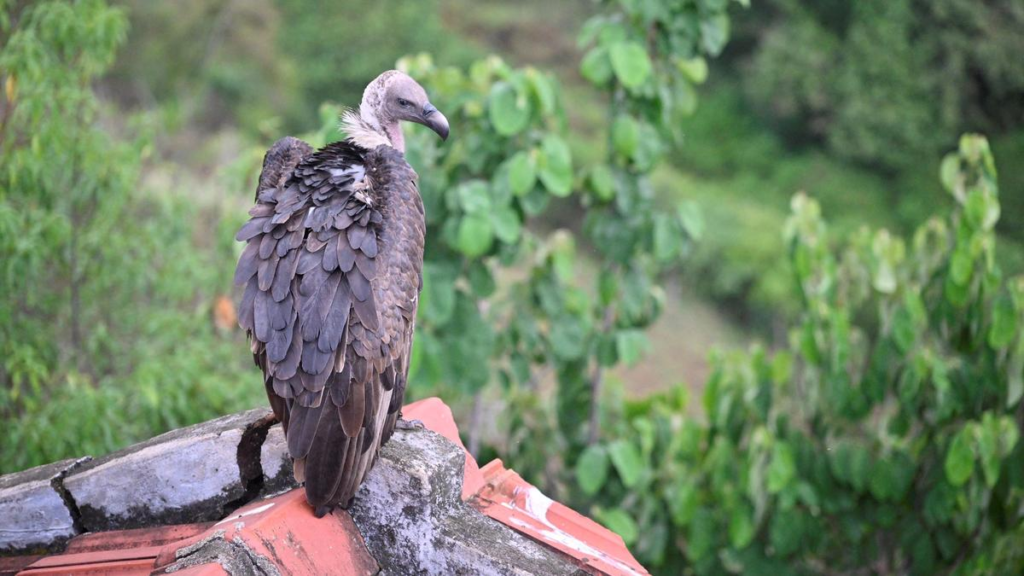
What is the White-Rumped Vulture (Gyps bengalensis)?
| Aspect | Detail |
|---|---|
| Scientific Name | Gyps bengalensis |
| Family | Accipitridae (Old World vultures) |
| IUCN Status | Critically Endangered (since 2000) |
| CITES | Appendix II |
| Wildlife (Protection) Act, 1972 | Schedule I (highest protection) |
| Population Decline | >99% in South Asia since 1990s |
| Main Cause | Diclofenac + other NSAIDs in veterinary use |
| Diet | Exclusively carrion (scavenger) |
| Breeding | October-April; monogamous; 1 nestling/year |
| Size | Smallest among Gyps species |
What is the Mudumalai Tiger Reserve (MTR)?
- State: Tamil Nadu.
- District: Nilgiris.
- Part of: Nilgiri Biosphere Reserve (India’s first BR, 1986).
- Adjoins: Bandipur TR (Karnataka), Nagarhole TR (Karnataka), Wayanad WLS (Kerala) — Mudumalai-Bandipur-Wayanad-Nagarhole landscape.
- WRV Population in MTR: 49-104 individuals across nesting colonies (Manigandan et al., 2023); 36 active nesting pairs documented (Venkitachalam & Senthilnathan, 2016); ~68 nests in adjoining Nilgiri North Forest Division (Ramakrishnan et al., 2014).
- Moyar Valley: Key vulture stronghold in MTR.
Who is the BNHS?
- Full Form: Bombay Natural History Society.
- Founded: 1883.
- HQ: Hornbill House, Mumbai.
- Status: Pan-India wildlife research and conservation NGO; partner of BirdLife International.
- Notable Role: First documented vulture decline in 1999; leads vulture conservation breeding programme since early 2000s.
What are the Jatayu Conservation Breeding Centres (JCBCs)?
| Centre | State | Partners |
|---|---|---|
| Pinjore | Haryana | BNHS + State Forest Dept |
| Rajabhatkhawa | West Bengal | BNHS + State Forest Dept |
| Rani | Assam | BNHS + State Forest Dept |
| Bhopal | Madhya Pradesh | BNHS + State Forest Dept |
Why are vultures critically important to ecosystem?
- Apex scavengers — clean up carcasses, prevent disease spread (anthrax, rabies, etc.).
- Ecosystem services: control pathogens that affect humans + livestock.
- Their decline has caused rise in feral dog populations → spike in rabies cases.
- A 2008 study estimated vulture decline caused ~₹2.3 lakh crore in economic losses in India over a decade.
What are India’s vulture conservation initiatives?
- Vulture Action Plan (VAP) 2020-2025 — by MoEFCC.
- Jatayu Conservation Breeding Centres (4 centres).
- Vulture Safe Zones (VSZs) — Diclofenac-free areas across India.
- Pench, Tadoba-Andhari, Melghat Tiger Reserves in Maharashtra — current reintroduction sites.
- Kaziranga landscape (Assam) — first soft-release of slender-billed vultures in March 2026.
Practice MCQs
Q1. With reference to the White-Rumped Vulture (Gyps bengalensis), consider the following statements:
- It is classified as Critically Endangered on the IUCN Red List.
- It is listed under Schedule I of the Wildlife (Protection) Act, 1972.
- Its primary cause of population decline has been the veterinary use of diclofenac and other NSAIDs.
- It is endemic to the South American continent.
How many of the above statements are correct?
(a) Only one (b) Only two (c) Only three (d) All four (e) None
(Statement 4 is wrong; the White-Rumped Vulture is native to South Asia (India, Nepal, Bangladesh, Pakistan), NOT endemic to South America.)
Q2. With reference to the electrocution incident at Mudumalai Tiger Reserve (28 June 2026), consider the following statements:
- The captive-bred white-rumped vulture was first released at Tadoba-Andhari Tiger Reserve in Maharashtra in December 2025.
- The bird was subsequently captured in Karnataka after showing signs of illness and treated before being released at Mudumalai Tiger Reserve in April 2026.
- The bird was electrocuted at Ebbanad village overlooking the Sigur plateau.
- The electrocution incident marks the success of India’s first attempted captive-bred WRV reintroduction in South India.
How many of the above statements are correct?
(a) Only one (b) Only two (c) Only three (d) All four (e) None
(Statement 4 is wrong; the electrocution marks the END (failure), NOT success of the first attempted reintroduction.)
Q3. With reference to the Bombay Natural History Society (BNHS), consider the following statements:
- BNHS was founded in 1883 and is headquartered at Hornbill House, Mumbai.
- BNHS is a partner of BirdLife International.
- BNHS leads India’s vulture conservation breeding programme in collaboration with state forest departments and the RSPB (UK).
- BNHS is a statutory body created under an Act of Parliament.
How many of the above statements are correct?
(a) Only one (b) Only two (c) Only three (d) All four (e) None
(Statement 4 is wrong; BNHS is a non-governmental, pan-India wildlife research NGO, NOT a statutory body created under an Act of Parliament.)
Q4. With reference to the Jatayu Conservation Breeding Centres (JCBCs), consider the following statements:
- The four JCBCs are located at Pinjore (Haryana), Rajabhatkhawa (West Bengal), Rani (Assam), and Bhopal (Madhya Pradesh).
- JCBCs are operated by BNHS in collaboration with state forest departments and the Royal Society for the Protection of Birds (RSPB), UK.
- The JCBCs currently house approximately 740 vultures, with about 110 already released into the wild for reintroduction.
- There is only one JCBC in India, located in Tamil Nadu.
How many of the above statements are correct?
(a) Only one (b) Only two (c) Only three (d) All four (e) None
(Statement 4 is wrong; there are 4 JCBCs (Pinjore, Rajabhatkhawa, Rani, Bhopal) — NOT one located in Tamil Nadu.)
Answer Key
- (c) — Statement 4 wrong: WRV is native to South Asia, not South America.
- (c) — Statement 4 wrong: Marks failure (end), not success.
- (c) — Statement 4 wrong: BNHS is an NGO, not a statutory body.
- (c) — Statement 4 wrong: 4 JCBCs exist, none in Tamil Nadu.
Exam Relevance
| Exam | Relevance |
|---|---|
| UPSC Prelims & Mains | Very High — GS-III (Environment, Biodiversity Conservation), Prelims (Schedules, IUCN, species) |
| State PCS (esp. TN, Kerala, Karnataka, Maharashtra) | High — MTR, Tadoba, BNHS, WRV |
| RBI Grade B (Phase I + II) | Medium — ESI on environment/biodiversity (recurring GA topic) |
| NABARD Grade A | High — Rural biodiversity, eco-services |
| Banking (SBI PO, IBPS, RBI Assistant) | High — GA on critically endangered species, schemes |
| Forest Service (IFS/IFoS) | Critical — Direct subject — Vulture conservation, BNHS, NSAIDs, JCBCs |
| SSC, Railway, Insurance | High — IUCN, Schedule I species, BNHS |
3. Jonathan the Giant Tortoise
Source: Times of India
Context
During his State Visit to Seychelles on 28 June 2026, PM Modi visited the Seychelles National Botanical Garden in Victoria, where he interacted with and fed native giant tortoises and planted a Coco de Mer palm sapling. The visit drew global attention to the Seychelles giant tortoise (Aldabrachelys gigantea) — particularly to Jonathan, the world’s oldest known living land animal at an estimated 194 years (as of 2026), recognised by Guinness World Records. Important: Jonathan does NOT live in Seychelles — he lives on the grounds of Plantation House (Governor’s Residence) on Saint Helena, a British Overseas Territory in the South Atlantic — where he was brought from Seychelles in 1882 as a gift to the Governor (already “fully mature” at ~50 years, implying birth no later than 1832). On 17 June 2026, Guinness World Records designated Jonathan a “Guinness Icon”, joining the likes of John Cena and Shohei Ohtani. Giant tortoises function as ecosystem engineers in their native island habitats — clearing brush, dispersing seeds, modifying landscapes.
Who is Jonathan?
| Aspect | Detail |
|---|---|
| Species | Seychelles giant tortoise (Aldabrachelys gigantea hololissa) — sub-species of Aldabra giant tortoise |
| Estimated Birth | c. 1832 (Governor of Saint Helena assigned symbolic birthday: 4 December 1832) |
| Estimated Age (2026) | 194 years |
| Current Home | Plantation House (Governor’s Residence), Saint Helena (British Overseas Territory, South Atlantic) |
| Brought from Seychelles to St Helena | 1882 (at full maturity, ~50 years old) |
| Guinness Record | Oldest living land animal (since 2022, surpassing Tu’i Malila of Tonga who died in 1966 aged 189) |
| Guinness Icon Status | 17 June 2026 |
What is the Seychelles giant tortoise?
| Aspect | Detail |
|---|---|
| Scientific Name | Aldabrachelys gigantea (Aldabra giant tortoise; Seychelles tortoise is a subspecies) |
| Habitat | Native to Aldabra Atoll, Seychelles (UNESCO WHS) — primary wild sanctuary |
| Wild Population | ~100,000+ on Aldabra Atoll |
| Weight | 250-350 kg (550-770 lbs) |
| Diet | Herbivorous — grasses, leaves, fruits, woody plants |
| Lifespan | Can exceed 150 years; among the longest-living animals |
| IUCN Status | Vulnerable |
| Schedule | CITES Appendix II |
| Role | Ecosystem engineers — clear brush, disperse seeds, modify habitat |
Other notable giant tortoises in history
| Tortoise | Detail |
|---|---|
| Adwaita | Aldabra giant tortoise that died at Alipore Zoological Gardens, Kolkata (2006) at estimated 255 years (unverified) |
| Tu’i Malila | Madagascar radiated tortoise that died in Tonga (1966) at 189 years |
| Lonesome George | Last Pinta Island tortoise (Galápagos), died June 2012 |
Practice MCQs
Q1. With reference to Jonathan the giant tortoise, consider the following statements:
- Jonathan is a Seychelles giant tortoise (Aldabrachelys gigantea hololissa) estimated to be 194 years old in 2026.
- He has been recognised by Guinness World Records as the world’s oldest living land animal.
- Jonathan currently lives on the grounds of Plantation House on Saint Helena, a British Overseas Territory in the South Atlantic.
- Jonathan currently lives at the Seychelles National Botanical Garden in Victoria.
How many of the above statements are correct?
(a) Only one (b) Only two (c) Only three (d) All four (e) None
(Statement 4 is wrong; Jonathan lives on Saint Helena Island, NOT in Seychelles. He was brought to Saint Helena from Seychelles in 1882 and has lived there since.)
Q2. With reference to the Aldabra giant tortoise (Aldabrachelys gigantea), consider the following statements:
- It is one of the largest reptiles on Earth and a herbivorous species.
- The Aldabra Atoll in Seychelles is a UNESCO World Heritage Site and the primary wild sanctuary, hosting approximately 100,000 individuals.
- It is classified as Vulnerable on the IUCN Red List.
- It is native to South America.
How many of the above statements are correct?
(a) Only one (b) Only two (c) Only three (d) All four (e) None
(Statement 4 is wrong; the Aldabra giant tortoise is native to the Indian Ocean (specifically Aldabra Atoll, Seychelles), NOT South America.)
Answer Key
- (c) — Statement 4 wrong: Jonathan lives on Saint Helena, not Seychelles.
- (c) — Statement 4 wrong: Native to Indian Ocean, not South America.
Exam Relevance
| Exam | Relevance |
|---|---|
| UPSC Prelims & Mains | High — GS-III (Environment, Biodiversity, Endangered Species) |
| State PCS | High — Environment, IUCN species |
| Forest Service (IFS/IFoS) | Critical — Direct subject — Giant tortoise, IUCN, Aldabra Atoll |
| RBI Grade B / NABARD | Low — General Awareness only |
| Banking (SBI PO, IBPS, RBI Assistant) | High — Current Affairs, world records |
| SSC, Railway, Insurance | Very High — Jonathan, Aldabra, IUCN, Guinness Icon |
4. PM Modi Conferred Seychelles’ Highest Presidential Distinction “Guardian of the Blue Horizon”
Context
On Sunday, 28 June 2026, Prime Minister Shri Narendra Modi was conferred Seychelles’ highest presidential distinction — “Guardian of the Blue Horizon” — by President Dr. Patrick Herminie at a special state ceremony in Victoria, Mahé. This is the first time the honour has ever been bestowed, after the Seychelles Parliament instituted it just weeks before the visit by overhauling its national awards system and repealing older medals (the previous framework automatically entitled every Seychelles President to the honour, drawing criticism on transparency). The award marks PM Modi’s 34th international state honour from a foreign nation. The distinction recognises India’s green leadership, Blue Economy advocacy, climate action, sustainable ocean resource management, and championing of Small Island Developing States (SIDS) — including the MAHASAGAR + SAGAR visions, International Solar Alliance (ISA), Mission LiFE, “Ek Ped Maa Ke Naam” (Plant for Mother) afforestation drive, and the International Big Cat Alliance (IBCA). PM Modi dedicated the honour to all countries fighting climate change.
What is the Guardian of the Blue Horizon?
- Type: Highest presidential distinction of Seychelles.
- Purpose: Recognises exemplary international leadership in:
- Environmental conservation.
- Climate resilience.
- Green growth.
- Sustainable management of marine ecosystems.
- Recently Instituted: Created by Seychelles Parliament weeks before PM Modi’s visit by overhauling national awards system + repealing older medals.
Why was the honour conferred? (Key Pillars)
| Pillar | Detail |
|---|---|
| Blue Economy | India’s strategic push under MAHASAGAR (2025) + SAGAR (2015) visions — clean ocean trade, maritime safety, ocean resource protection |
| SIDS Support | India as trusted partner to Small Island Developing States like Seychelles |
| International Solar Alliance (ISA) | Co-founded with France in November 2015; scaling solar power globally |
| Mission LiFE | Lifestyle for Environment — launched 20 October 2022 by PM Modi at COP27; “Pro-Planet People” movement |
| “Ek Ped Maa Ke Naam” | Plant a Tree for Mother — afforestation drive launched 5 June 2024 (World Environment Day) |
| International Big Cat Alliance (IBCA) | Conservation alliance for 7 big cat species; launched 9 April 2023 by PM Modi at “Project Tiger 50” celebration in Mysuru |
What is the International Solar Alliance (ISA)?
- Co-founded: by PM Modi + French President François Hollande on the sidelines of UNFCCC COP21, Paris (30 November 2015).
- HQ: Gurugram, India.
- Status: Treaty-based international organisation (Framework Agreement entered into force 6 December 2017).
- Mandate: Promote solar energy in sun-rich countries (between Tropic of Cancer + Tropic of Capricorn, later widened to all UN member states).
- Membership: 100+ countries.
What is Mission LiFE?
- Full Form: Lifestyle for Environment.
- Launched by: PM Modi at COP27 (20 October 2022), Sharm El-Sheikh, Egypt.
- Concept: “Pro-Planet People (P3)” — turn climate action into an individual movement; mindful, sustainable consumption.
- Approach: 7 themes — sustainable food, energy conservation, e-waste reduction, water conservation, waste reduction, plastic ban, healthy lifestyles.
What is “Ek Ped Maa Ke Naam”?
- Full Form: “Plant a Tree in the Name of Mother”.
- Launched by: PM Modi on 5 June 2024 (World Environment Day).
- Aim: Mass afforestation drive linking environmental care with maternal tribute.
- Target (Phase 1): 80 crore (800 million) saplings by March 2025.
- Implementing: Ministry of Environment, Forest & Climate Change (MoEFCC).
What is the International Big Cat Alliance (IBCA)?
- Launched by: PM Modi on 9 April 2023 at “Project Tiger 50” celebration in Mysuru.
- HQ: India.
- Members: Initially 96 countries (range countries + supporters).
- Big Cat Species Covered: Tiger, Lion, Snow Leopard, Cheetah, Jaguar, Leopard, Puma.
- Status: India ratified its Framework Agreement in 2024; entered into force after 5+ countries ratified.
Other major international honours received by PM Modi (selected, of 34 total)
- Order of the White Double Cross (First Class) — Slovakia (June 2026, Bratislava).
- The Grand Cordon of the Order of the Two Niles — Sudan.
- Order of King Hamad bin Isa al-Khalifa — Bahrain.
- Champions of the Earth Award (UNEP) — 2018.
- Seoul Peace Prize — 2018.
- Order of St. Andrew the Apostle — Russia.
- Legion of Merit — USA.
- Agricola Medal — FAO.
Practice MCQs
Q1. With reference to the “Guardian of the Blue Horizon” honour conferred on PM Modi on 28 June 2026, consider the following statements:
- It is the highest presidential distinction of Seychelles and was conferred by President Dr. Patrick Herminie.
- This is the first time this honour has ever been bestowed.
- It marks PM Modi’s 34th international state honour from a foreign nation.
- The honour was bestowed by the United Nations General Assembly.
How many of the above statements are correct?
(a) Only one (b) Only two (c) Only three (d) All four (e) None
(Statement 4 is wrong; the honour was bestowed by the President of Seychelles, NOT by the United Nations General Assembly.)
Q2. With reference to the key pillars behind the honour, consider the following statements:
- The honour recognises India’s MAHASAGAR (2025) and SAGAR (2015) maritime visions for the Indian Ocean.
- It honours India’s co-founding of the International Solar Alliance (ISA) at COP21 in Paris.
- It recognises Mission LiFE (Lifestyle for Environment), launched by PM Modi at COP27 in 2022.
- It honours India’s withdrawal from the Paris Climate Agreement.
How many of the above statements are correct?
(a) Only one (b) Only two (c) Only three (d) All four (e) None
(Statement 4 is wrong; India is a SIGNATORY and active participant in the Paris Climate Agreement — it has NOT withdrawn from it.)
Answer Key
- (c) — Statement 4 wrong: Conferred by Seychelles President, not UNGA.
- (c) — Statement 4 wrong: India is in Paris Agreement.
5. Delegation of Financial Powers to DRDO (DFP-2026)
Source: News on Air
Context
Defence Minister Shri Rajnath Singh on Monday, 29 June 2026 released the “Delegation of Financial Powers to DRDO (DFP-2026)” in New Delhi — a major reform to enhance efficiency, accountability, and timely execution of strategic R&D projects. The revised framework provides:
- Dedicated financial provisions for trial campaigns, testing and evaluation activities.
- Authorises sanctioning of pre-project R&D initiatives.
- Segregates financial powers for grants-in-aid related to Extra-Mural Research (EMR) Projects and Defence Innovation Accelerator-Centres of Excellence (DIA-CoE) under separate schedules.
The framework will enable faster production and induction of systems, platforms and technologies developed by DRDO into the Armed Forces, while strengthening collaboration with industry and academia — reinforcing the Aatmanirbhar Bharat vision. Alongside DFP-2026, the Minister also released the Delegation of Financial Powers to Defence Services (DFPDS-2026) to expedite defence procurement across the Armed Forces. The event was attended by CDS General NS Raja Subramani, Defence Secretary + DRDO Chairman Shri Rajesh Kumar Singh, Secretary (Defence Production) Shri Sanjeev Kumar, and CGDA Shri Anugraha Narayana Das.
What are the key features of DFP-2026?
| Feature | Detail |
|---|---|
| Trial + Testing Provisions | Dedicated financial provisions for trial campaigns, testing and evaluation activities |
| Pre-Project R&D | Authorises sanctioning of pre-project R&D initiatives |
| EMR Grants | Segregated under separate schedule — Extra-Mural Research (EMR) Projects |
| DIA-CoE Grants | Segregated under separate schedule — Defence Innovation Accelerator-Centres of Excellence (DIA-CoE) |
| Functional Empowerment | Enhanced at various levels within Department of Defence R&D |
| Safeguards | Powers subject to (a) availability of funds + (b) compliance with existing rules/regulations |
What is DRDO?
- Full Form: Defence Research and Development Organisation.
- Established: 1958.
- Under: Department of Defence R&D (DDR&D), Ministry of Defence.
- HQ: DRDO Bhawan, New Delhi.
- Chairman: Shri Rajesh Kumar Singh (also Defence Secretary).
- Network: 50+ labs/establishments across India.
- Notable Projects: BrahMos, Agni, Prithvi, Akash, Astra, Tejas (LCA), Arjun MBT, Pinaka MBRL, INS Arihant, Nag, ABHYAS, Rustom.
What is Extra-Mural Research (EMR)?
- DRDO grants-in-aid for external research partners — universities, IITs, NITs, research institutions.
- Aims to leverage academia talent for defence R&D.
- Now under a separate schedule in DFP-2026 for clearer financial governance.
What is the Defence Innovation Accelerator-Centres of Excellence (DIA-CoE)?
- DRDO-supported Centres of Excellence at premier academic institutions.
- Anchors iDEX (Innovations for Defence Excellence) ecosystem.
- Now under a separate schedule in DFP-2026 for streamlined grant management.
What is iDEX?
- Innovations for Defence Excellence — launched April 2018.
- Under Department of Defence Production (DDP).
- Engages startups, MSMEs, academia, R&D bodies, innovators for defence innovation.
- Implements Defence India Startup Challenge (DISC) initiatives.
Practice MCQs
Q1. With reference to the Delegation of Financial Powers to DRDO (DFP-2026), consider the following statements:
- DFP-2026 was released by Defence Minister Shri Rajnath Singh on 29 June 2026 in New Delhi.
- The framework aims to enhance efficiency, accountability, and timely execution of strategic defence R&D projects.
- It provides dedicated financial provisions for trial campaigns, testing and evaluation activities, and authorises sanctioning of pre-project R&D initiatives.
- DFP-2026 was released by the Reserve Bank of India.
How many of the above statements are correct?
(a) Only one (b) Only two (c) Only three (d) All four (e) None
(Statement 4 is wrong; DFP-2026 was released by the Defence Minister, not the RBI.)
Q2. With reference to the key features of DFP-2026, consider the following statements:
- The framework segregates financial powers for grants-in-aid related to Extra-Mural Research (EMR) Projects under a separate schedule.
- It segregates financial powers for Defence Innovation Accelerator-Centres of Excellence (DIA-CoE) under a separate schedule.
- All financial powers are subject to (a) availability of funds and (b) compliance with existing rules/regulations.
- The framework eliminates all internal approval hierarchies and grants unrestricted financial autonomy.
How many of the above statements are correct?
(a) Only one (b) Only two (c) Only three (d) All four (e) None
(Statement 4 is wrong; the framework retains internal approval hierarchies and is subject to availability of funds + compliance with rules — it does NOT grant unrestricted financial autonomy.)
Q3. With reference to DRDO, consider the following statements:
- DRDO was established in 1958 and is headquartered at DRDO Bhawan, New Delhi.
- DRDO functions under the Department of Defence Research and Development (DDR&D), Ministry of Defence.
- Notable DRDO projects include BrahMos, Agni, Prithvi, Akash, Tejas (LCA), Arjun MBT, and Pinaka MBRL.
- The current DRDO Chairman is also the Defence Secretary, Shri Rajesh Kumar Singh.
How many of the above statements are correct?
(a) Only one (b) Only two (c) Only three (d) All four (e) None
(All four statements are correct.)
Answer Key
- (c) — Statement 4 wrong: Released by Defence Minister, not RBI.
- (c) — Statement 4 wrong: Powers subject to funds + rules; no unrestricted autonomy.
- (d) All four — all statements correct.
6. Govt Launches “PM Family Care Tracker (PM-FCT)” + Health Passports
Source: The Hindu
Context
Union Home and Cooperation Minister Shri Amit Shah on Sunday, 28 June 2026 launched the pilot project of the PM Family Care Tracker (PM-FCT) and Health Passports in Gandhinagar, Gujarat — an integrated digital platform for real-time monitoring of beneficiaries to strengthen maternal and child health, nutrition, family welfare, and education. The system tracks pregnant women, newborns, infants, children, and adolescents up to 18 years, integrating data from three Gujarat State Departments — Health, Women & Child Development (WCD), and Education via the Poshan Tracker and Child Tracking System (CTS) portals. Every mother and child gets a unique digital identity through ABHA (Ayushman Bharat Health Account, 14-digit) + Birth Registration Number. The platform issues digital Health Passports at birth — containing hereditary disease records, treatments, immunisation up to age 18. The Minister also administered polio drops under the state’s three-day Pulse Polio campaign, distributed welfare kits + digital certificates to beneficiaries, and inaugurated the PM eBus Sewa in Gandhinagar. The pilot will be scaled pan-India in phases.
What is the PM Family Care Tracker (PM-FCT)?
- An integrated digital platform for end-to-end monitoring of family welfare beneficiaries.
- Target Group: Pregnant women, newborns, infants, children, adolescents up to 18 years.
- Focus Areas: Health, Nutrition, Education, Welfare.
What does PM-FCT track?
| Stage | Tracking |
|---|---|
| Pregnancy | Antenatal care (ANC) |
| Birth | Birth Registration Number + ABHA issuance |
| Newborn | Postnatal care, BCG immunisation |
| Infancy | Full immunisation, growth monitoring |
| Childhood | Nutrition, anganwadi enrolment, school enrolment + attendance |
| Adolescence | Adolescent health services up to age 18 |
Which 3 Gujarat departments are integrated?
| Department | Contribution |
|---|---|
| Health Department | Health records via Poshan Tracker + ABHA |
| Women + Child Development (WCD) Department | Anganwadi data, Poshan Tracker |
| Education Department | School enrolment + attendance via Child Tracking System (CTS) |
What is the Unique Digital Identity used?
- ABHA (Ayushman Bharat Health Account) — 14-digit unique health ID under ABDM.
- Birth Registration Number — issued at birth.
- Combined, they form the child’s lifetime digital identity on PM-FCT.
What are the key features?
- Digital Health Passports for families — containing medical records, hereditary diseases, treatments, immunisations up to age 18.
- Real-time dashboards for delivery of welfare schemes.
- Auto-alerts for missed vaccinations (notified to taluka + district health officers).
- Auto-alerts for school drop-outs.
- End-to-end monitoring of antenatal + postnatal care, immunisation, nutrition, growth monitoring, school enrolment + attendance, adolescent health.
What is ABHA (Ayushman Bharat Health Account)?
- A 14-digit unique health ID under the Ayushman Bharat Digital Mission (ABDM).
- Launched: 27 September 2021 by PM Modi.
- Implemented by National Health Authority (NHA).
What is the Poshan Tracker?
- An ICT-enabled application under the Ministry of Women and Child Development.
- Tracks nutritional status, anganwadi services, beneficiaries (children + pregnant + lactating women).
- Part of Mission Saksham Anganwadi & POSHAN 2.0.
What is the Child Tracking System (CTS)?
- A digital portal for tracking school enrolment + attendance under State Education Departments.
- Helps identify school drop-outs for re-engagement.
What is the Namo Shri Yojana referenced?
- Gujarat state scheme.
- Financial assistance up to ₹12,000 for eligible pregnant + lactating mothers.
- Complements central schemes like PM Matru Vandana Yojana (PMMVY).
What is PM eBus Sewa (also inaugurated)?
- Central scheme approved by Union Cabinet on 16 August 2023.
- Outlay: ₹57,613 crore (Central share: ₹20,000 crore over 10 years).
- Deploys 10,000 e-buses in 169 cities (priority to Tier-2/Tier-3 cities + cities with 3-40 lakh population).
- Implementing Ministry: Ministry of Housing & Urban Affairs (MoHUA).
Practice MCQs
Q1. With reference to the PM Family Care Tracker (PM-FCT) launched on 28 June 2026, consider the following statements:
- The pilot project was launched by Union Home and Cooperation Minister Shri Amit Shah at Gandhinagar, Gujarat.
- PM-FCT is an integrated digital platform tracking pregnant women, newborns, infants, children, and adolescents up to 18 years.
- The platform integrates data from three Gujarat departments — Health, Women and Child Development, and Education.
- PM-FCT was launched simultaneously in all 28 states and 8 Union Territories of India.
How many of the above statements are correct?
(a) Only one (b) Only two (c) Only three (d) All four (e) None
(Statement 4 is wrong; PM-FCT was launched as a pilot project in Gandhinagar only, with plans for phased expansion — NOT simultaneously across all states/UTs.)
Q2. With reference to the unique digital identity used by PM-FCT, consider the following statements:
- PM-FCT uses ABHA (Ayushman Bharat Health Account), a 14-digit unique health ID, as a key identifier.
- The platform also uses the Birth Registration Number to assign a unique identity to each child.
- The ABHA ID was launched on 27 September 2021 as part of the Ayushman Bharat Digital Mission (ABDM).
- The ABHA ID is a 10-digit mobile-linked identifier.
How many of the above statements are correct?
(a) Only one (b) Only two (c) Only three (d) All four (e) None
(Statement 4 is wrong; the ABHA is a 14-digit unique health ID, NOT a 10-digit mobile-linked identifier.)
Q3. With reference to the key features of PM-FCT, consider the following statements:
- The platform issues digital Health Passports containing lifetime medical records of children up to age 18.
- The platform generates auto-alerts for missed vaccinations and notifies taluka and district health officers.
- The platform provides end-to-end monitoring of antenatal/postnatal care, immunisation, nutrition, growth, school enrolment, and adolescent health.
- The platform is restricted to tracking only school enrolment and excludes health and nutrition data.
How many of the above statements are correct?
(a) Only one (b) Only two (c) Only three (d) All four (e) None
(Statement 4 is wrong; the platform tracks health, nutrition, education, AND welfare in an integrated manner — NOT restricted to school enrolment only.)
Q4. With reference to the supporting digital ecosystem of PM-FCT, consider the following statements:
- The Poshan Tracker is an ICT-enabled application under the Ministry of Women and Child Development.
- The Child Tracking System (CTS) is a digital portal for tracking school enrolment and attendance under State Education Departments.
- The ABHA is implemented by the National Health Authority (NHA) under the Ministry of Health and Family Welfare.
- The Poshan Tracker is administered by the Reserve Bank of India.
How many of the above statements are correct?
(a) Only one (b) Only two (c) Only three (d) All four (e) None
(Statement 4 is wrong; the Poshan Tracker is under the Ministry of Women and Child Development (MWCD), NOT the RBI.)
Answer Key
- (c) — Statement 4 wrong: Pilot in Gandhinagar only, phased expansion planned.
- (c) — Statement 4 wrong: ABHA is 14-digit, not 10-digit.
- (c) — Statement 4 wrong: Platform integrates health + nutrition + education + welfare.
- (c) — Statement 4 wrong: Poshan Tracker under MWCD, not RBI.
Banking/Finance
1. RBI’s New “Capital Market Exposure” Framework
Source: Business Standard
Context
A new RBI framework on bank credit to Capital Market Intermediaries (CMIs) comes into effect on Tuesday, 1 July 2026, after being deferred by three months from 1 April 2026 following representations from banks, brokers, and industry bodies. The framework — issued as RBI (Commercial Banks – Credit Facilities) Amendment Directions, 2026 (Revised) on 30 March 2026 (replacing the 13 February 2026 original) — inserts a new Chapter XIII A “Credit Facilities to Capital Market Intermediaries (CMIs)” prescribing 100% collateralisation, bars bank finance for CMI proprietary trading, allows market-makers funding against 100% cash/cash equivalents, and brings all CMI exposures under Capital Market Exposure (CME) + Large Exposure Framework (LEF) norms. On 24 June 2026, a four-member broker delegation met Union Finance Minister Smt. Nirmala Sitharaman and DEA Secretary Smt. Anuradha Thakur seeking relief — particularly a carveout for “liquidity providers” in designated liquid derivatives contracts, with bank provisions linked to SPAN (Standard Portfolio Analysis of Risk) utilisation below 50% of margin. The industry warns of widening bid-ask spreads + higher impact costs; bank guarantees account for ~₹1.2 trillion of the ₹11-12 trillion collateral pool at clearing corporations, with intraday funding facilities contributing another ₹80,000 crore. CareEdge Ratings has flagged potential adverse impact on trading volumes and market activity.
What are the 3 broad objectives of the framework?
- Enabling framework for banks to finance acquisitions by Indian corporates (incl. mergers + amalgamations).
- Rationalisation of lending limits for individuals against shares + units of REITs/InvITs.
- Principle-based framework for lending to Capital Market Intermediaries (CMIs) — brokers, clearing members, custodians, market makers.
Who are Capital Market Intermediaries (CMIs)?
- Regulated entities undertaking trade execution + market infrastructure services in capital markets.
- Includes: broking, clearing, custody, market-making, and other incidental services.
- Excludes: Standalone Primary Dealers (SPDs) and Qualified Central Counterparties (QCCPs).
What are the key changes for CMIs (Chapter XIII A)?
| Element | Norm |
|---|---|
| Eligibility | Only SEBI-registered + regulated CMIs in compliance with prudential norms |
| Treatment | All exposures to CMIs = Capital Market Exposure (CME) |
| Collateral | 100% (Fully Secured) for all credit facilities, including intraday |
| Eligible Collateral | Eligible securities + cash + permissible financial assets + immovable property + receivables + bank guarantees + SBLC |
| Excluded as Collateral | Commercial Paper + Non-Convertible Debentures of original/initial maturity ≤ 1 year |
| Proprietary Trading Funding | PROHIBITED (banks shall NOT provide finance to CMIs for acquiring securities on their own account) |
| Limited Exception | Market-makers can be funded — but against 100% cash or cash equivalents |
| Intraday Facilities | Permitted at 50% collateral minimum for centrally cleared client trades |
| Group/Promoter Collateral | Acceptable if unencumbered + exclusively charged + legally enforceable |
| Counterparty Limits | Required at counterparty + aggregate level under Large Exposure Framework (LEF) |
What are the bank guarantee norms (for CMIs)?
| Purpose | Collateral Requirement |
|---|---|
| Non-Proprietary (client) Guarantees | Minimum 50% collateral; at least 25% in cash |
| Proprietary Trading Guarantees | 100% Secured; at least 50% in cash |
What are the loan-against-securities (LAS) norms (for individuals)?
- Loan-to-Value (LTV) cap on listed shares: 60%.
- IPO subscription loans: Capped at ₹25 lakh per individual; minimum 25% margin.
- Minimum haircut on equity shares: 40%.
- LAS caps: Apply at banking system level (not just per-bank).
What is the acquisition finance norm?
- Scope expanded to include mergers + amalgamations.
- Permitted only for acquisition of CONTROL of a NON-FINANCIAL target.
- Maximum financing cap: 75% of acquisition value.
- Refinancing: Only after deal is complete + control established.
- SPV/subsidiary acquisitions: Require corporate guarantee from acquiring company.
What are brokers seeking?
| Demand | Detail |
|---|---|
| Carveout for Liquidity Providers | Recognition in designated liquid derivatives contracts |
| SPAN-Linked Treatment | Bank provisions linked to SPAN < 50% margin utilisation for liquidity providers |
| Interim Arrangement | Formal liquidity-provider recognition could take time |
| Wider Market-Making Definition | Currently narrow (restricted to SME platforms) |
| Commodity Brokers | Capital gains tax exemption on Electronic Gold Receipts (EGRs) |
What is SPAN?
- Standard Portfolio Analysis of Risk — a portfolio-based margining system developed by Chicago Mercantile Exchange (CME) in 1988.
- Used globally + by Indian exchanges to compute initial margin on F&O positions.
- Calculates worst probable loss under multiple scenarios.
What is a “Liquidity Provider” in capital markets?
- An entity that continuously quotes bid + ask prices across market segments.
- Maintains narrow spreads + market depth.
- Absorbs buy/sell orders — helping investors enter/exit with minimal market impact.
- Different from Market-Makers, who are formally designated under SEBI’s market-making framework.
What is the Large Exposure Framework (LEF)?
- RBI’s prudential framework capping a bank’s exposure to a single counterparty + group of connected counterparties as a percentage of Tier 1 capital.
- Single counterparty limit: 20% of Tier 1 capital (extendable to 25% in exceptional cases).
- Group limit: 25% of Tier 1 capital.
What is Capital Market Exposure (CME)?
- A prudential category for bank exposures linked to capital market activities (loans against shares, financing brokers, IPO funding, etc.).
- Aggregate CME of a bank is capped at 40% of net worth (with sub-limits on direct + indirect exposures).
- All exposures to CMIs are now explicitly classified as CME under the new framework.
What are Electronic Gold Receipts (EGRs)?
- A digital instrument representing physical gold stored in a vault.
- Traded on Indian exchanges like NSE, BSE under SEBI’s EGR framework.
- Approved by SEBI in September 2021.
- Commodity brokers seek capital gains tax exemption on EGRs (currently treated as securities).
Practice MCQs
Q1. With reference to the RBI (Commercial Banks – Credit Facilities) Amendment Directions, 2026 (Revised), consider the following statements:
- The Directions take effect from 1 July 2026, after being deferred from 1 April 2026.
- The Directions insert a new Chapter XIII A titled “Credit Facilities to Capital Market Intermediaries (CMIs)”.
- The Directions are issued under the Banking Regulation Act, 1949.
- The Directions apply only to NBFCs and not to commercial banks.
How many of the above statements are correct?
(a) Only one (b) Only two (c) Only three (d) All four (e) None
(Statement 4 is wrong; the Directions apply specifically to COMMERCIAL BANKS, NOT NBFCs.)
Q2. With reference to the framework for bank credit to Capital Market Intermediaries (CMIs), consider the following statements:
- All credit facilities to CMIs must be on a fully secured (100% collateralised) basis.
- Banks are prohibited from financing CMIs for acquiring securities on their own account, i.e. proprietary trading.
- Bank funding for market-makers is permitted against 100% cash or cash equivalents.
- The Standalone Primary Dealers and Qualified Central Counterparties are also classified as CMIs under the framework.
How many of the above statements are correct?
(a) Only one (b) Only two (c) Only three (d) All four (e) None
(Statement 4 is wrong; Standalone Primary Dealers (SPDs) and Qualified Central Counterparties (QCCPs) are EXCLUDED from the definition of CMIs.)
Q3. With reference to the broker delegation that met the Finance Minister on 24 June 2026, consider the following statements:
- The four-member broker delegation met Union Finance Minister Smt. Nirmala Sitharaman and DEA Secretary Smt. Anuradha Thakur seeking relief.
- The brokers sought a carveout for “liquidity providers” in designated liquid derivatives contracts.
- The brokers proposed bank-credit treatment for liquidity providers linked to SPAN utilisation below 50% of margin.
- Commodity brokers sought capital gains tax exemption on Electronic Gold Receipts (EGRs).
How many of the above statements are correct?
(a) Only one (b) Only two (c) Only three (d) All four (e) None
(All four statements are correct.)
Q4. With reference to the size of the collateral pool, consider the following statements:
- Bank guarantees account for approximately ₹1.2 trillion of the ₹11-12 trillion collateral pool maintained with clearing corporations.
- Intraday funding facilities contribute approximately ₹80,000 crore to the collateral pool.
- A CareEdge Ratings report has flagged potential adverse impact on trading volumes and market activity.
- The Indian capital markets currently have no collateral pool with clearing corporations.
How many of the above statements are correct?
(a) Only one (b) Only two (c) Only three (d) All four (e) None
(Statement 4 is wrong; the collateral pool with clearing corporations is approximately ₹11-12 trillion, NOT non-existent.)
Answer Key
- (c) — Statement 4 wrong: Apply to commercial banks, not NBFCs.
- (c) — Statement 4 wrong: SPDs and QCCPs are EXCLUDED from CMIs.
- (d) All four — all statements correct.
- (c) — Statement 4 wrong: Collateral pool is ~₹11-12 trillion.
Exam Relevance
| Exam | Relevance |
|---|---|
| RBI Grade B (Phase I + II) | CRITICAL — Direct subject — Capital market exposure, CMIs, prudential norms, BR Act 1949, LEF, CME, broker regulation; Phase II ESI + FM essay-worthy |
| SEBI Grade A | Critical — Direct subject — CMIs, broker regulation, market-making, SPAN, EGR |
| NABARD Grade A | High — RBI prudential norms (recurring) |
| SIDBI / IRDAI Grade A | High — Banking regulation, capital markets |
Agriculture
1. SOMS 2026: 4th Edition of Speciality Fertilizer Summit + B2B Expo
Source: BL
Context
The Soluble Fertilizer Industry Association (SFIA) is hosting the 4th edition of SOMS 2026 — the Speciality Fertilizer Summit + B2B Expo at the Helipad Exhibition Centre, Gandhinagar, Gujarat from 2-4 July 2026 (the two-day conference component on 3-4 July; B2B engagement opening 2 July). With theme “The Foundation of a Self-Reliant India”, the event aims to promote innovation, reduce import dependency (India currently imports 70-80% of soluble fertilizer needs), and accelerate India’s specialty fertilizer self-reliance under the Aatmanirbhar Bharat framework. Discussions will cover “The Big Debate”, linkages in fertilizer distribution, India’s agri-startup readiness, the Fertilizer (Control) Order (FCO) 1985, the Essential Commodities Act (ECA) 1955, and specialty fertilizers as a solution to the subsidy burden. The Summit also features SFIA’s first-ever Agri-Journalism Awards recognising agricultural journalism in English, Hindi, Gujarati, and Marathi, and a national platform for students and researchers. Shri Rajib Chakraborty, National President of SFIA, said the summit will produce policy recommendations to the Government of India for an industry-friendly framework supporting domestic manufacturing + innovation + import substitution.
What is the key event?
- Event: SOMS 2026 — 4th edition.
- Full Form: Soluble, Organic, Micronutrient & Bio-Stimulant Fertilizers Summit + B2B Expo.
- Venue: Helipad Exhibition Centre, Gandhinagar, Gujarat.
- Theme: “The Foundation of a Self-Reliant India”.
- Organiser: Soluble Fertilizer Industry Association (SFIA).
What will the summit cover?
| Session | Detail |
|---|---|
| The Big Debate (Day 1) | Linkages in fertilizer distribution + agri-startup readiness |
| Policy Reform | Industry views on FCO 1985, ECA 1955 |
| Subsidy Reform | Specialty fertilizers as solution to subsidy burden |
| Panel Discussions | Fertilizer startups, innovation, policy reforms, manufacturing challenges, roadmap |
| Agri-Journalism Awards | First-ever by SFIA — English, Hindi, Gujarati, Marathi |
| Student/Researcher Platform | Showcase innovations + research |
What is SFIA?
- Full Form: Soluble Fertilizer Industry Association (India).
- Status: National association for MSME + large manufacturers of specialty (water-soluble, organic, micronutrient, bio-stimulant) fertilizers.
- Role: Policy advocacy, agronomy research support, supply chain stabilisation.
- Engagement: With 50+ universities, ICAR, CSIR, ICAR-National Research Centre for Grapes.
- Global Partner: China Council for the Promotion of International Trade (CCPIT).
What is SOMS?
| Letter | Meaning |
|---|---|
| S | Soluble Fertilizers (water-soluble) |
| O | Organic Fertilizers |
| M | Micronutrient Fertilizers |
| S | Bio-Stimulants |
- A scientifically structured approach to nutrient delivery that integrates multiple nutrient sources for high yield, residue-free, sustainable agriculture.
- Reduces dependency on conventional subsidised urea + DAP by 30-90%.
What is the Fertilizer (Control) Order (FCO), 1985?
- Issued under Section 3 of the Essential Commodities Act, 1955.
- Regulates quality, distribution, pricing of fertilizers in India.
- Defines specifications and grades, lists permissible fertilizers, regulates manufacturing licences.
- Administered by Department of Fertilizers, Ministry of Chemicals & Fertilizers.
What is the Essential Commodities Act (ECA), 1955?
- A central law empowering the Government of India to control production, supply, distribution, and prices of essential commodities.
- Covers food grains, drugs, fertilizers, petroleum products, etc.
- Allows the Centre to prescribe price ceilings, ban hoarding, regulate stock limits.
Practice MCQs
Q1. With reference to SOMS 2026, consider the following statements:
- SOMS 2026 is the 4th edition of the Speciality Fertilizer Summit + B2B Expo.
- It is being organised by the Soluble Fertilizer Industry Association (SFIA), India.
- The event will be held at the Helipad Exhibition Centre, Gandhinagar, Gujarat in early July 2026.
- SOMS stands for “Sustainable Organic Mango Strategy”.
How many of the above statements are correct?
(a) Only one (b) Only two (c) Only three (d) All four (e) None
(Statement 4 is wrong; SOMS stands for Soluble + Organic + Micronutrient + Bio-Stimulant fertilizers — NOT “Sustainable Organic Mango Strategy”.)
Q2. With reference to the theme and objectives of SOMS 2026, consider the following statements:
- The theme of SOMS 2026 is “The Foundation of a Self-Reliant India”.
- The summit aims to reduce India’s dependency on imports for soluble fertilizers.
- India currently imports approximately 70-80% of its soluble fertilizer needs.
- The summit aims to increase India’s dependence on imported chemical fertilizers.
How many of the above statements are correct?
(a) Only one (b) Only two (c) Only three (d) All four (e) None
(Statement 4 is wrong; the summit aims to REDUCE import dependence and promote self-reliance, NOT increase dependence on imports.)
Q3. With reference to the Fertilizer (Control) Order (FCO), 1985, consider the following statements:
- The FCO 1985 was issued under Section 3 of the Essential Commodities Act, 1955.
- The FCO regulates the quality, distribution, and pricing of fertilizers in India.
- The FCO is administered by the Department of Fertilizers under the Ministry of Chemicals and Fertilizers.
- The FCO 1985 is a regulation issued by the Reserve Bank of India.
How many of the above statements are correct?
(a) Only one (b) Only two (c) Only three (d) All four (e) None
(Statement 4 is wrong; the FCO 1985 was issued by the Government of India under the ECA 1955, NOT by the RBI.)
Q4. With reference to the SOMS approach and Water-Soluble Fertilizers (WSFs), consider the following statements:
- SOMS = Soluble + Organic + Micronutrient + Bio-Stimulant Fertilizers.
- WSF adoption has reportedly reduced reliance on subsidised urea and DAP by 30-90%.
- In banana farming, WSF use has reduced water consumption by approximately 35% and increased profits by up to ₹98,000/hectare.
- Water-Soluble Fertilizers cannot be used with drip irrigation.
How many of the above statements are correct?
(a) Only one (b) Only two (c) Only three (d) All four (e) None
(Statement 4 is wrong; WSFs are SPECIFICALLY DESIGNED for use with drip irrigation/fertigation — that is their core application.)
Answer Key
- (c) — Statement 4 wrong: SOMS = Soluble + Organic + Micronutrient + Bio-Stimulant.
- (c) — Statement 4 wrong: Aims to reduce, not increase, import dependence.
- (c) — Statement 4 wrong: FCO by GoI under ECA, not RBI.
- (c) — Statement 4 wrong: WSFs designed FOR drip irrigation.
2. AgriStack: India’s Digital Public Infrastructure (DPI) for Agriculture
Source: Businessline
Context
India’s AgriStack — the Digital Public Infrastructure (DPI) for agriculture built by the Ministry of Agriculture & Farmers Welfare — is being hailed as the “UPI of Indian agriculture”, driving rapid scheme delivery and credit transformation. Two recent proof points: Maharashtra disbursed over ₹14,000 crore in Kharif disaster relief to 89 lakh farmers in just 5 days in February 2026, and Chhattisgarh successfully executed MSP-based paddy procurement for over 32 lakh farmers in a single season in March 2026. AgriStack rests on three federated, authenticated, consent-driven registries: the Farmers’ Registry (target 11 crore Farmer IDs; ~8.62 crore created), the Crop Sown Registry (target 30 crore farm plots across 604 districts by Kharif 2026 via mobile-based Digital Crop Surveys), and Geo-Referenced Village Maps (5.4 lakh of 6.75 lakh villages done; full target March 2027). AgriStack is connected to RBI’s Unified Lending Interface (ULI) — built by Reserve Bank Innovation Hub (RBIH), Bengaluru — enabling paperless, sub-30-minute farmer loans by pulling verified data via APIs. The RBI Kisan Credit Card Directions, 2026 issued on 19 June 2026 (effective 1 January 2027) consolidate KCC rules across Commercial Banks, SFBs, RRBs, and Rural Co-op Banks, retaining the ₹2 lakh collateral-free limit per borrower (raised in December 2024 from ₹1.6 lakh). Bharat-VISTAAR (Virtually Integrated System to Access Agricultural Resources) — a multilingual AI platform announced in the Union Budget 2026 — will further integrate AgriStack portals with ICAR best-practice packages.
What is AgriStack?
- Type: Digital Public Infrastructure (DPI) for agriculture.
- Built by: Ministry of Agriculture & Farmers Welfare, GoI.
- Architecture: Federated, authenticated, consent-driven.
- Compared to: Often called the “UPI of Indian agriculture” or “Aadhaar of farmers” (FM Nirmala Sitharaman in Budget 2026: “one of the next UPI initiatives“).
- Status: Phased rollout; over 70% coverage already in several states.
What are the 3 foundational registries?
| Registry | Detail | Target |
|---|---|---|
| 1. Farmers’ Registry | Single verified digital Farmer ID linked to land + livestock + family details | 11 crore Farmer IDs (8.62 crore created so far) |
| 2. Crop Sown Registry | Dynamic record of crops planted, season-wise, via mobile Digital Crop Survey (DCS) | 30 crore farm plots, 604 districts by Kharif 2026 |
| 3. Geo-Referenced Village Maps | Cadastral maps with GPS coordinates for every farm plot | 5.4 lakh of 6.75 lakh villages done; full by March 2027 |
What is the Unified Farmer Service Interface (UFSI)?
- Open API gateway under AgriStack.
- Allows authorised public + private apps (banks, agri-techs, value-chain firms) to plug in + exchange data seamlessly.
- Center-State data federation with consent-brokered access.
What is Krishi-DSS?
- Krishi Decision Support System.
- Launched: 16 August 2024 by Govt of India.
- Integrates: Geospatial + non-geospatial data (satellite, weather, soil, crop signatures, reservoir + groundwater data, govt scheme data).
- Use: Decision support to ministry + state agri-departments + extension workers.
What is Bharat-VISTAAR?
- Full Form: Virtually Integrated System to Access Agricultural Resources.
- Announced: Union Budget 2026 by FM Nirmala Sitharaman.
- Purpose: Multilingual AI platform integrating AgriStack portals with ICAR best-practice packages.
What is the Digital Crop Survey (DCS)?
- A mobile-based crop-mapping system captured directly from the field.
- Replaces traditional Girdawari paper-based surveys.
- Uses smartphone + image-based + drone/satellite imagery.
- Provides real-time crop area information at plot level.
- Pilot: 11 states (2023-24).
- Geo-fencing: Surveyors cannot log a crop unless their live GPS location matches the plot’s coordinates — eliminating proxy reporting.
How does AgriStack link with RBI’s Unified Lending Interface (ULI)?
| Aspect | Detail |
|---|---|
| ULI built by | Reserve Bank Innovation Hub (RBIH), Bengaluru |
| Announced by RBI | 10 August 2023 (as “Public Tech Platform for Frictionless Credit”) |
| Pilot | September 2022 — digitalising KCC loans <₹1.6 lakh in MP, TN, Karnataka, UP, Maharashtra |
| Phase 1 Focus | Digital Kisan Credit, crop loans, agri-financing (₹2 lakh crore annual market) |
| Connectivity | 89 integrated lenders + 53 data providers + 141 data points |
| Loan Speed | Sub-30 minutes, paperless; via Aadhaar + satellite crop data + soil reports + market prices |
What is the Kisan Credit Card (KCC) and the RBI KCC Directions 2026?
| Aspect | Detail |
|---|---|
| KCC launched | 1998 |
| Modified KCC Scheme | 2004 |
| Latest Update — RBI KCC Directions, 2026 | Issued 19 June 2026 |
| Effective Date | 1 January 2027 |
| Covers | Commercial Banks, SFBs, RRBs, Rural Co-operative Banks |
| Collateral-Free Limit | ₹2 lakh per borrower (raised in December 2024 from ₹1.6 lakh) |
| Marginal Farmer Limit (≤1 ha) | ₹10,000-₹50,000 flexible (not linked to land value) |
| Crop Season Definition | Short-duration crops: 12 months; long-duration crops: 18 months |
| Interest Subvention | 2% (effective rate 7%); prompt repayment incentive 3% (effective 4%) |
How does AgriStack bridge the credit gap?
| Earlier Pain Point | AgriStack Solution |
|---|---|
| Self-reported farmer data → loan fraud / multiple loans on same plot | Crop Sown Registry matches loan amounts to actual crop acreage |
| Land verification took weeks | Geo-referenced village maps + Farmer ID enable instant verification |
| High collateral asks for small farmers | ₹2 lakh collateral-free KCC limit + pre-populated risk-scored applications |
| Tenant farmers couldn’t get credit (no land title) | ULI verifies end-use of funds without requiring land titles |
Practice MCQs
Q1. With reference to AgriStack, consider the following statements:
- AgriStack is a Digital Public Infrastructure (DPI) for India’s agriculture sector, built by the Ministry of Agriculture and Farmers Welfare.
- It is built on a federated, authenticated, and consent-driven architecture.
- Its three foundational registries are the Farmers’ Registry, the Crop Sown Registry, and the Geo-Referenced Village Maps.
- AgriStack is an open-source initiative developed and administered exclusively by the Reserve Bank of India.
How many of the above statements are correct?
(a) Only one (b) Only two (c) Only three (d) All four (e) None
(Statement 4 is wrong; AgriStack is built by the Ministry of Agriculture and Farmers Welfare, NOT the RBI. The RBI handles the linked credit infrastructure (ULI).)
Q2. With reference to the Crop Sown Registry and Geo-Referenced Village Maps under AgriStack, consider the following statements:
- The Crop Sown Registry is populated via mobile-based Digital Crop Surveys (DCS).
- The Government targets covering 30 crore farm plots across 604 districts by the Kharif 2026 season.
- Approximately 5.4 lakh of 6.75 lakh villages have been geo-referenced, with full coverage targeted by March 2027.
- Surveyors can log a crop or upload a photo from any location, regardless of GPS coordinates.
How many of the above statements are correct?
(a) Only one (b) Only two (c) Only three (d) All four (e) None
(Statement 4 is wrong; the platform is GEO-FENCED — surveyors can log a crop or upload a photo only when their live GPS location matches the plot’s coordinates — to prevent proxy reporting.)
Q3. With reference to the Unified Lending Interface (ULI), consider the following statements:
- ULI was announced by the RBI on 10 August 2023 as a “Public Tech Platform for Frictionless Credit”.
- ULI was developed by the Reserve Bank Innovation Hub (RBIH), located in Bengaluru.
- The pilot launched in September 2022 covered digitalisation of Kisan Credit Card loans below ₹1.6 lakh in select districts of MP, TN, Karnataka, UP, and Maharashtra.
- ULI is operated by the Securities and Exchange Board of India (SEBI).
How many of the above statements are correct?
(a) Only one (b) Only two (c) Only three (d) All four (e) None
(Statement 4 is wrong; ULI is built and operated by the RBI (via RBIH), NOT SEBI.)
Q4. With reference to the RBI Kisan Credit Card Directions, 2026, consider the following statements:
- The Directions were issued by the RBI on 19 June 2026 and will become effective from 1 January 2027.
- The collateral-free credit limit under KCC is ₹2 lakh per borrower, raised from ₹1.6 lakh in December 2024.
- The Directions apply to Commercial Banks, Small Finance Banks, Regional Rural Banks, and Rural Co-operative Banks.
- The Directions have raised the collateral-free limit further to ₹10 lakh per borrower in 2026.
How many of the above statements are correct?
(a) Only one (b) Only two (c) Only three (d) All four (e) None
(Statement 4 is wrong; the collateral-free limit remains at ₹2 lakh per borrower under the 2026 Directions — it has NOT been raised to ₹10 lakh.)
Q5. With reference to the real-world impact of AgriStack cited in the article, consider the following statements:
- Maharashtra disbursed over ₹14,000 crore in disaster relief to 89 lakh farmers in just five days in February 2026.
- Chhattisgarh successfully executed MSP-based paddy procurement covering over 32 lakh farmers in a single season in March 2026.
- AgriStack relies exclusively on individual farmer smartphone ownership and high-speed internet for delivery.
- Last-mile connectivity is supported by Common Service Centres (CSCs), farmer cooperatives, and Krishi Sakhis.
How many of the above statements are correct?
(a) Only one (b) Only two (c) Only three (d) All four (e) None
(Statement 3 is wrong; AgriStack does NOT require every farmer to own a smartphone or have high-speed internet — it relies on on-the-ground support networks (CSCs, cooperatives, Krishi Sakhis).)
Answer Key
- (c) — Statement 4 wrong: Built by MoAFW, not RBI.
- (c) — Statement 4 wrong: Platform is geo-fenced.
- (c) — Statement 4 wrong: ULI by RBI/RBIH, not SEBI.
- (c) — Statement 4 wrong: Collateral-free limit remains at ₹2 lakh.
- (c) — Statement 3 wrong: AgriStack doesn’t require farmer smartphones for all.
Exam Relevance
| NABARD Grade A | CRITICAL — Direct subject — AgriStack, KCC, FPOs, rural credit, ULI |
Facts To Remember
1. Amit Shah Chairs 10th Apex-Level NCORD Meeting in New Delhi
Amit Shah chaired the 10th Apex-Level Meeting of the Narco-Coordination Centre in New Delhi. A vision document on narcotics control and the NCB Annual Report 2025 were released. The meeting also launched a nationwide drug disposal campaign targeting seized narcotics worth ₹6,000 crore.
2. Virendra Kumar Leads Nasha Mukt Bharat Saptah Rally in Haridwar
Virendra Kumar led the valedictory rally of Nasha Mukt Bharat Saptah in Haridwar. Over 4,000 citizens participated in the campaign promoting a drug-free India. The initiative strengthened awareness on drug prevention and community welfare.
3. GBU Partners for Mission ShakthiSAT Lunar Initiative
Gautam Buddha University partnered with IN-SPACe and Space Kidz India for Mission ShakthiSAT. The mission aims to empower 12,000 girls from 108 countries in space technology and STEM education. It supports women-led leadership in global space research.
4. Gujarat Police Signs MoU with Bharat Taxi
Gujarat Police signed an MoU with Bharat Taxi to improve public safety and urban mobility. The initiative integrates SOS emergency response and mandatory driver verification. It enhances secure and tech-enabled transportation services.
5. Shivraj Singh Chouhan Launches AI-Enabled Rural Audit Portal
Shivraj Singh Chouhan launched an AI-enabled Rural Internal Audit portal. The platform improves audit planning, compliance tracking, and financial oversight for rural development schemes. It strengthens transparency and governance in public spending.
6. IIT Delhi and Sorbonne University Launch Joint Degree Programmes
Indian Institute of Technology Delhi and Sorbonne University announced joint Master’s and PhD programmes from 2026. The collaboration expands research in biological sciences, AI, robotics, and materials science. It deepens Indo-French academic cooperation.
7. Two Indian Women Win 2026 Green Oscar Awards
Parveen Sheikh and Barkha Subba won the 2026 Whitley Awards, known as the Green Oscars. They were honored for protecting endangered bird and amphibian species. Their work highlights India’s grassroots conservation success.
8. Indian Coast Guard Commissions ICGS Akshay
Indian Coast Guard commissioned the Fast Patrol Vessel ICGS Akshay in Goa. The vessel strengthens maritime security, search and rescue, and EEZ surveillance. It boosts coastal defense and marine protection capabilities.
9. ISRO Conducts Record Test of Next-Generation Rocket Engine
Indian Space Research Organisation successfully tested a semi-cryogenic rocket engine at 88% target thrust. The engine will power the SC120 propulsion stage of future launch vehicles. It is expected to enhance payload capacity and efficiency.
10. Ethan Vaz and Harshavardhan Become India’s 96th and 97th Grandmasters
Ethan Vaz and G. B. Harshavardhan became India’s 96th and 97th Chess Grandmasters. Ethan secured his final GM norm in Sarajevo while Harshavardhan achieved his title in Chennai. Their success reflects India’s growing chess excellence.
11. Ben Stokes Retires from International Cricket
Ben Stokes announced retirement from international cricket after a 15-year career. He retired with over 7,000 Test runs and 250 wickets. Stokes leaves behind a remarkable all-round legacy.
12. Mintage World Launches Book on Modi-Era Stamps and Coins
Stamps, Coins, and Banknotes Issued During the Premiership of Shri Narendra Modi was launched by Mintage World in New Delhi. The book documents India’s development through stamps, coins, and currency. It showcases major initiatives under the Modi government.
13. World MSME Day Observed on June 27
World MSME Day recognizes the contribution of micro, small, and medium enterprises to innovation and economic growth. The 2026 theme is “Empowering MSMEs through Innovation and Sustainable Industrial Development.” It highlights MSMEs’ role in achieving SDGs.
14. National Insurance Awareness Day Observed on June 28
National Insurance Awareness Day promotes awareness about insurance as a financial protection tool. It emphasizes risk management for individuals and businesses. The day also highlights the evolution of India’s insurance sector.
15. World Allergy Week Observed from June 21–27
World Allergy Organization observed World Allergy Week from June 21 to 27. The 2026 theme is “Allergy Care Is Essential Care.” The campaign raises awareness about allergic diseases and healthcare access.
Mentorship & Test Series
471 lessons · ARD master notes · descriptive answers evaluated by hand · daily 11 AM live class.
Clarity 4 Sure · +91 87086 52887 · info@c4scourses.in