
NABARD Grade A · ARD Hub · Agriculture & Rural Development
NABARD Grade A ARD: Complete Agriculture & Rural Development Syllabus, Chapter-wise Notes, PYQs and Free Video Classes
Agriculture & Rural Development (ARD) is one of the two biggest subjects in NABARD Grade A: 40 marks in Phase 1 and half of Phase 2 Paper II. This hub brings everything for ARD into one place for the NABARD 2026 and 2027 cycles: the official ARD syllabus in its exact sequence, the PYQ priority of every section, C4S’s chapter-wise ARD notes, and 40 free C4S video classes, mapped topic by topic so you always know what to read and what to watch next.

Written by Faiz Sir, NABARD Grade A mentor at Clarity 4 Sure (C4S), whose students took 8 of the top 10 ranks in NABARD Grade A 2025. Syllabus from the official NABARD notification; priorities from the C4S PYQ analysis. Updated 3 November 2026.
NABARD Grade A ARD exam pattern for 2026
ARD is tested in both phases. In Phase 1 it is a merit section, so its marks count towards shortlisting; in Phase 2 it shares Paper II with Economic & Social Issues (ESI).
| Stage | Paper | Questions | Marks | Time |
|---|---|---|---|---|
| Phase 1 | Agriculture & Rural Development (merit section) | 40 | 40 | Within the 120-minute paper |
| Phase 2 | Paper II: ESI + ARD, objective | 30 (1 or 2 marks each) | 50 | 30 min |
| Phase 2 | Paper II: ESI + ARD, descriptive (attempt 4 of 6: 2 × 15 and 2 × 10 marks) | 6 | 50 | 90 min |
Phase 2 pattern from NABARD’s official Information Handout (Phase II, 2025). Paper II descriptive answers can be typed in English or Hindi. Check the 2026 notification for any change; follow updates on the NABARD Grade A 2026 notification page, and see the whole-exam syllabus on the NABARD Grade A syllabus page.
NABARD Grade A ARD syllabus for Phase 1 and Phase 2: official sequence, section by section
The ARD syllabus is the same for Phase 1 and Phase 2. This is the NABARD Grade A ARD syllabus in the exact order and wording of the official notification. Each row shows its PYQ priority, the C4S chapter notes and the matching free C4S video class.
| Section | Official syllabus keywords | PYQ priority | Notes | Video class |
|---|---|---|---|---|
| Agriculture & agronomy | Agriculture: definition, meaning and its branches; Agronomy: definition, meaning and scope of agronomy; classification of field crops; factors affecting crop production; agro-climatic zones; cropping systems: definition and types; problems of dryland agriculture | High | Chapter 1 | Ch 1 · 2 · 3 · 4 · 5 · 6 · 11 |
| Seed | Seed production, seed processing, seed village | High | Chapter 2 | Ch 7 |
| Meteorology | Meteorology: weather parameters, crop-weather advisory | Medium | Chapter 3 | Ch 8 · 9 |
| Modern farming | Precision farming, System of Crop Intensification, organic farming | High | Chapter 4 soon | Ch 10 · 13 |
| (a) Soil and Water Conservation | Major soil types, soil fertility, fertilisers, soil erosion, soil conservation, watershed management | Very high | Chapter 5 soon | Ch 12-I · 12-II · MCQs |
| (b) Water Resource | Irrigation management: types of irrigation, sources of irrigation, crop-water requirement, command area development, water conservation techniques, micro-irrigation, irrigation pumps, major, medium and minor irrigation | High | Chapter 6 soon | Ch 14 |
| (c) Farm and Agri Engineering | Farm machinery and power; sources of power on the farm: human, animal, mechanical, electrical, wind, solar and biomass; bio fuels; water harvesting structures, farm ponds, watershed management; agro processing; controlled and modified storage, perishable food storage, godowns, bins and grain silos | Medium | Chapter 7 soon | Ch 15 |
| (d) Plantation & Horticulture | Definition, meaning and its branches; agronomic practices and production technology of various plantation and horticulture crops; post-harvest management, value and supply chain management of plantation and horticulture crops | Very high | Chapter 8 soon | Marathon |
| (e) Animal Husbandry | Farm animals and their role in Indian economy; animal husbandry methods in India; common terms pertaining to different species of livestock; utility classification of breeds of cattle; introduction to common feeds and fodders, their classification and utility | Very high | Chapter 9 soon | MCQ session |
| (e) Poultry | Introduction to poultry industry in India (past, present and future status); common terms pertaining to poultry production and management; concept of mixed farming and its relevance to socio-economic conditions of farmers in India; complementary and obligatory nature of livestock and poultry production with that of agricultural farming | Very high | Chapter 10 soon | In the daily discussions |
| (f) Fisheries | Fisheries resources, management and exploitation: freshwater, brackish water and marine; aquaculture: inland and marine; biotechnology; post-harvest technology; importance of fisheries in India; common terms pertaining to fish production | High | Chapter 11 soon | Fishery MCQs |
| (g) Forestry | Basic concepts of forest and forestry; principles of silviculture, forest mensuration, forest management and forest economics; concepts of social forestry, agroforestry, joint forest management; forest policy and legislation in India; India State of Forest Report; recent developments under the Ministry of Environment, Forest and Climate Change | Medium | Chapter 12 soon | PYQ series |
| (h) Agriculture Extension | Its importance and role; methods of evaluation of extension programmes; role of Krishi Vigyan Kendras (KVK) in dissemination of agricultural technologies | Medium | Chapter 13 soon | In the daily discussions |
| (i) Ecology and Climate Change | Ecology and its relevance to man; natural resources, their sustainable management and conservation; causes of climate change, greenhouse gases (GHG), major GHG emitting countries, climate analysis; distinguish between adaptation and mitigation; climate change impact on agriculture and rural livelihood; carbon credit; IPCC, UNFCCC, CoP meetings; funding mechanisms for climate change projects; initiatives by the Government of India: NAPCC, SAPCC, INDC | High | Chapter 14 soon | PYQ series |
| (j) Present scenario of Indian agriculture | Present scenario of Indian agriculture and allied activities; recent trends; major challenges in agriculture; measures to enhance viability of agriculture; factors of production in agriculture; agricultural finance and marketing; impact of globalisation on Indian agriculture and issues of food security; concept and types of farm management | High | Chapter 15 soon | Agri Census · Economics PYQs |
| Rural Development | Concept of rural area; structure of the Indian rural economy; importance and role of the rural sector in India; economic, social and demographic characteristics of the Indian rural economy; causes of rural backwardness; rural population in India; occupational structure: farmers, agricultural labourers, artisans, handicrafts, traders, forest dwellers/tribes and others; trends of change in rural population and rural workforce; problems and conditions of rural labour; issues and challenges in handlooms; Panchayati Raj Institutions: functions and working; MGNREGA, NRLM (Aajeevika), rural drinking water programmes, Swachh Bharat, rural housing, PURA and other rural development programmes | Very high | Chapter 16 soon | In the daily discussions |
Sequence and wording from the official NABARD Grade A ARD syllabus. PYQ priority from the C4S ARD topic-wise weightage analysis. Always check the latest notification for changes.
Most important ARD topics for NABARD 2026: PYQ-based priority
All ARD sections are not equal. C4S’s five-year PYQ analysis puts the sections into three tiers:
Animal Husbandry and Poultry, Soil & Water Conservation, Plantation & Horticulture, Rural Development, and ARD current affairs and schemes.
Agronomy and field crops, seed, modern farming, Irrigation & Water Resources, Fisheries, Ecology & Climate Change, and agricultural economics (section j).
Farm & Agri Engineering, Forestry, Agricultural Extension and Meteorology.
Medium does not mean skip: these sections still produce one or two questions a year. Study in syllabus order, then spend extra revision time on the very-high tier. The full year-wise data is in NABARD Grade A ARD topic-wise weightage (5-year PYQ analysis), and every question is in the NABARD Grade A previous year question papers 2021–2025.
NABARD ARD previous year questions (PYQs) and difficulty level
NABARD does not publish its papers, so ARD PYQs are memory-based. C4S has compiled every Phase 1 and Phase 2 ARD question from 2021 to 2025 with answers and analysis.
- Where to practise: the NABARD Grade A previous year question papers, with year pages for 2025, 2024, 2023, 2022 and 2021.
- Topic by topic: the chapter notes place every PYQ under its syllabus topic: 23 agronomy questions in Chapter 1 and 10 seed questions in Chapter 2, and the meteorology questions (one in four of the last five cycles) in Chapter 3.
- On video: the ARD PYQ series explains agronomy, soil and water conservation, seed, forestry, environment and economics questions.
How difficult is NABARD ARD?
ARD is generally moderate. Most questions are static facts and concepts: scientific names, breeds, cropping systems, soil and irrigation terms. Recent papers add more statement-based (“which is NOT correct”), match-the-following and passage-based questions, especially in Phase 2, plus questions on current schemes and missions. Non-agriculture students find the terminology hard at first; agriculture graduates find the scheme and rural development parts newer.
Free NABARD ARD video classes: the complete chapter-wise lecture series
The C4S Free ARD Full Syllabus Playlist teaches the ARD syllabus chapter by chapter, with MCQs at the end of each class. Watch the whole playlist here, or pick a chapter below.
ARD lecture series: chapters in syllabus order
 Chapter 1Agriculture: definition, meaning, branches + MCQs
 Chapter 2Agronomy fully explained
 Chapter 3Classification of field crops
 Chapter 4Agro-climatic & agro-ecological zones + MCQs
 Chapter 5Cropping pattern: definition, types, examples
 Chapter 6Dryland agriculture: concepts, challenges, strategies
 Chapter 7Seed production, processing & seed village
 Chapter 8Agricultural meteorology
 Chapter 9Crop-weather advisory
 Chapter 10Organic agriculture
 Chapter 11Factors affecting crop production
 Chapter 12 · Part ISoil & water conservation
 Chapter 12 · Part IISoil & water conservation
 Chapter 13System of crop intensification & precision farming
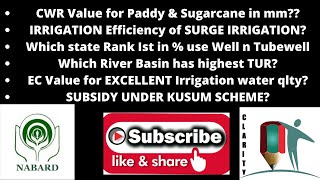 Chapter 14Water resources & irrigation management
 Chapter 15Farm power & agricultural engineering
ARD MCQ sessions and marathon classes
- NABARD Grade A Horticulture marathon lecture
- Fishery MCQs for NABARD Grade A, based on previous year questions
- Nutrient deficiency symptoms, based on questions asked
- Soil fertility, acidity and salt-tolerant crops: MCQs
- Agriculture Census for NABARD
- NABARD Phase II mock (ESI/ARD)
NABARD ARD Phase 2 preparation: daily discussions and PYQ series
The C4S DAILY ARD playlist is built for Phase 2 (Mains) and for PYQ-based revision: 14 days of option-by-option ARD discussions, including NABARD bankable model projects, followed by the topic-wise ARD PYQ series. Read it alongside the C4S article Daily discussion on important and probable ARD/ESI questions.
ARD PYQ series (Phase 1)
- Agronomy explained with PYQs
- Soil & water conservation explained with PYQs
- Seed science, forestry, economics and environment explained with PYQs
- Environment and economics explained with PYQs
ARD Mains daily discussion (Day 1 to Day 14)
Chapter-wise NABARD ARD notes: the NABARD ARD Notes Series
The free NABARD ARD Notes Series turns each syllabus section into one detailed chapter: official syllabus keywords, every PYQ placed under its topic, important facts, current affairs and practice MCQs. Chapters follow the syllabus order.
NABARD ARD descriptive questions in Phase 2
Phase 2 Paper II asks you to attempt four of six descriptive questions (two of 15 marks, two of 10 marks) across ESI and ARD. Recent ARD descriptive questions show what NABARD expects:
| Year | ARD descriptive question | Where to prepare |
|---|---|---|
| 2025 | Components, benefits and challenges of the Digital Agriculture Mission | Modern farming (Chapter 4) and PIB guide |
| 2024 | Short note on dryland farming (10 marks) | Chapter 1, dryland agriculture |
| 2024 | Post-harvest management of horticulture crops (15 marks) | Plantation & Horticulture (Chapter 8) |
| 2022 | Pradhan Mantri Matsya Sampada Yojana (15 marks) | Fisheries (Chapter 11) |
The pattern: a static concept (dryland farming, post-harvest management) or a flagship scheme (PMMSY, Digital Agriculture Mission), answered with structure, data and current examples. See every Phase 2 question in the PYQ repository; the writing method is in the ESI guide and the Descriptive English guide.
ARD current affairs and government schemes for NABARD 2026
A large share of ARD marks comes from agriculture schemes, missions and data: PMFBY, PM-KISAN, PMKSY, MIDH, PMMSY, the National Mission on Natural Farming, the Digital Agriculture Mission, the pulses and oilseeds missions, and the latest crop estimates. ARD and ESI share these, so prepare them once.
How many months of ARD current affairs? C4S’s trace of NABARD questions back to their PIB releases found that half came from releases under five months old and the oldest was about 22 months old. So read every important release from the last six months, revise schemes and Cabinet decisions from the last 24 months, and keep flagship schemes (PMFBY, PM-KISAN, PMKSY, MGNREGA) updated whatever their launch year.
Use these:
- How to Study PIB for NABARD Grade A: what to read and skip, and nine PYQs traced to their PIB release.
- C4S Daily PIB Updates and monthly current affairs.
- NABARD ESI guide for schemes, reports and rural economy topics that overlap with ARD.
- C4S PIB playlist for current affairs on video.
Best books and study resources for NABARD ARD
No single book matches the NABARD ARD syllabus, so use the syllabus table above as your checklist and build from free, reliable sources:
| Need | Source |
|---|---|
| Syllabus-wise notes with PYQs | The free C4S NABARD ARD Notes Series and the ARD video classes |
| Agriculture concepts (agronomy, soil, horticulture, animal husbandry) | ICAR’s Handbook of Agriculture; the TNAU Agritech Portal; ICAR e-courses for BSc Agriculture-level topics |
| Schemes and missions | PIB releases, ministry annual reports and the Economic Survey agriculture chapter (see the PIB guide) |
| Rural development and rural finance | Ministry of Rural Development annual report; NABARD’s annual report and NAFIS survey; the ESI guide |
| Practice | The PYQ repository, chapter MCQs and the daily ARD MCQs on AgriClarity |
For a month-wise reading plan built around these sources, see the ARD preparation strategy.
How to prepare ARD for NABARD Grade A 2026 and 2027
- Go section by section in syllabus order using the table above: read the chapter notes, then watch the matching class.
- Solve the PYQs of each section as soon as you finish it, from the PYQ repository and the PYQ series videos.
- Give extra revision to the very-high tier: animal husbandry and poultry, soil and water conservation, horticulture and rural development.
- Add schemes and current affairs through PIB, linked to each chapter.
- Practise Phase 2 with the daily ARD discussions and one descriptive answer a week.
For the month-wise plan, sources and the non-agriculture approach, read How to Prepare for ARD in NABARD Grade A: the complete strategy. Agriculture graduates coming from IBPS AFO can start with IBPS AFO to NABARD Grade A 2026; complete beginners with NABARD Grade A 2027 preparation from zero.
C4S NABARD Mentorship cum Complete Course: the programme behind the toppers
Free notes and videos explain one topic at a time. The C4S NABARD Grade A Mentorship cum Complete Course takes you through all of ARD, ESI and GA with expert mentor guidance, concept classes, pinpointed master notes and chapter-wise tests, plus PYQ analysis, PIB and current affairs, Phase 1 tests and Phase 2 descriptive practice. In NABARD Grade A 2025, C4S students took 8 of the top 10 ranks and 32 final selections.


Toppers’ Talk
Join the NABARD Grade A Mentorship cum Complete Course
Expert mentor guidance, concept classes, master notes and chapter-wise tests for ARD, ESI and the whole NABARD syllabus.
NABARD Grade A 2026 Complete Course & Mentorship
For the upcoming 2026 cycle, Phase 1 and Phase 2.
Join NABARD 2026NABARD Grade A 2027 Complete Course & Mentorship
Foundation to Phase 2 for 2027 aspirants, with a free trial.
Join NABARD 2027NABARD English Descriptive
Essay, précis and letter for Phase 2 Paper I, every answer evaluated.
Join English DescriptiveFree NABARD ARD resources: channels, PYQs and guides
NABARD Grade A guides from C4S
| Guide | Use it for |
|---|---|
| NABARD Grade A previous year question papers 2021–2025 | Every PYQ with answers and cut-offs; year pages 2025, 2024, 2023, 2022, 2021 |
| ARD topic-wise weightage | Five-year PYQ data for every ARD topic |
| How to prepare ARD | Month-wise plan, sources, non-agri strategy |
| Agronomy notes · Seed science notes | Chapter-wise ARD notes with PYQs and MCQs |
| NABARD ESI guide | The other half of Paper II |
| PIB for NABARD | Schemes and current affairs |
| Descriptive English | Phase 2 Paper I |
| NABARD Grade A syllabus · cut-offs · 2026 notification | Whole-exam syllabus, cut-off trend, dates |
| IBPS AFO to NABARD Grade A 2026 | For agriculture graduates moving from AFO |
NABARD Grade A ARD: frequently asked questions
What is ARD in NABARD Grade A?
ARD stands for Agriculture and Rural Development. It carries 40 questions and 40 marks as a merit section in Phase 1, and it shares Phase 2 Paper II (100 marks, objective and descriptive) with Economic and Social Issues.
What is the NABARD Grade A ARD syllabus?
The official ARD syllabus covers agriculture and agronomy, seed, meteorology, precision farming, SCI and organic farming, then (a) soil and water conservation, (b) water resource, (c) farm and agri engineering, (d) plantation and horticulture, (e) animal husbandry and poultry, (f) fisheries, (g) forestry, (h) agriculture extension, (i) ecology and climate change, (j) the present scenario of Indian agriculture, and rural development.
Which ARD topics are most important for NABARD Grade A 2026?
C4S’s five-year PYQ analysis rates animal husbandry and poultry, soil and water conservation, plantation and horticulture, rural development, and ARD current affairs and schemes as very high priority, followed by agronomy, irrigation, fisheries, ecology and climate change, and agricultural economics.
Can non-agriculture students prepare ARD for NABARD?
Yes. Study the syllabus section by section, start with the C4S chapter notes and free video classes, solve the PYQs of each section, and connect schemes through PIB. The ARD strategy guide includes a plan for non-agriculture students.
Are there free video classes for NABARD ARD?
Yes. The C4S Free ARD Full Syllabus playlist covers the ARD syllabus chapter by chapter with MCQs, and the DAILY ARD playlist adds 14 days of Phase 2 ARD discussions and a topic-wise PYQ series, about 40 videos in all.
What kind of ARD descriptive questions come in NABARD Phase 2?
Recent ARD descriptive questions include the Digital Agriculture Mission (2025), a short note on dryland farming (2024), post-harvest management of horticulture crops (2024) and PMMSY (2022). They test a static concept or a flagship scheme with structure, data and examples.
What is the difficulty level of NABARD ARD?
Generally moderate. Most ARD questions test static facts and concepts, but recent papers include more statement-based, match-the-following and passage-based questions, especially in Phase 2, along with questions on current schemes.
Which books are best for NABARD ARD?
No single book matches the syllabus. Use the official syllabus as a checklist, C4S’s free chapter notes and video classes, ICAR’s Handbook of Agriculture and the TNAU Agritech Portal for concepts, PIB and ministry reports for schemes, and NABARD publications for rural finance.
How many months of ARD current affairs should I cover for NABARD?
Read every important release from the last six months and revise schemes and Cabinet decisions from the last 24 months. In C4S’s trace of NABARD questions to PIB releases, the gap between release and exam ranged from about one month to 22 months.
How should I prepare ARD for NABARD Phase 1 and Phase 2 together?
Follow the syllabus order, read each chapter, watch its class and solve its PYQs, then add schemes and current affairs. For Phase 2, use the daily ARD discussions and write one descriptive answer a week from the very-high-priority sections.
How many marks is ARD in NABARD Grade A?
ARD is 40 marks in Phase 1. In Phase 2 it forms Paper II with ESI: 50 marks objective (30 questions in 30 minutes) and 50 marks descriptive (four of six questions in 90 minutes).
Sources: official NABARD Grade A ARD syllabus; NABARD Information Handout, Phase II (2025); C4S NABARD PYQ repository and ARD topic-wise weightage analysis; video classes from the Clarity4Sure YouTube channel.