NABARD Grade A ARD Overview
Before diving into how to prepare Agriculture and Rural Development (ARD) for the NABARD Grade A exam, let’s first understand the role of this section in the exam pattern.
ARD in Phase 1
- Objective type section
- Carries 40 marks
- Part of the merit section, meaning its score is counted for selection
ARD in Phase 2
- Total 50 marks
- 25 marks objective questions
- 25 marks descriptive questions
This means ARD is not just important for clearing Phase 1, but it also has a major impact on your final merit in Phase 2. A strong command over ARD can significantly improve your overall score and increase your chances of selection in the NABARD Grade A exam.
NABARD Grade A ARD Preparation Strategy
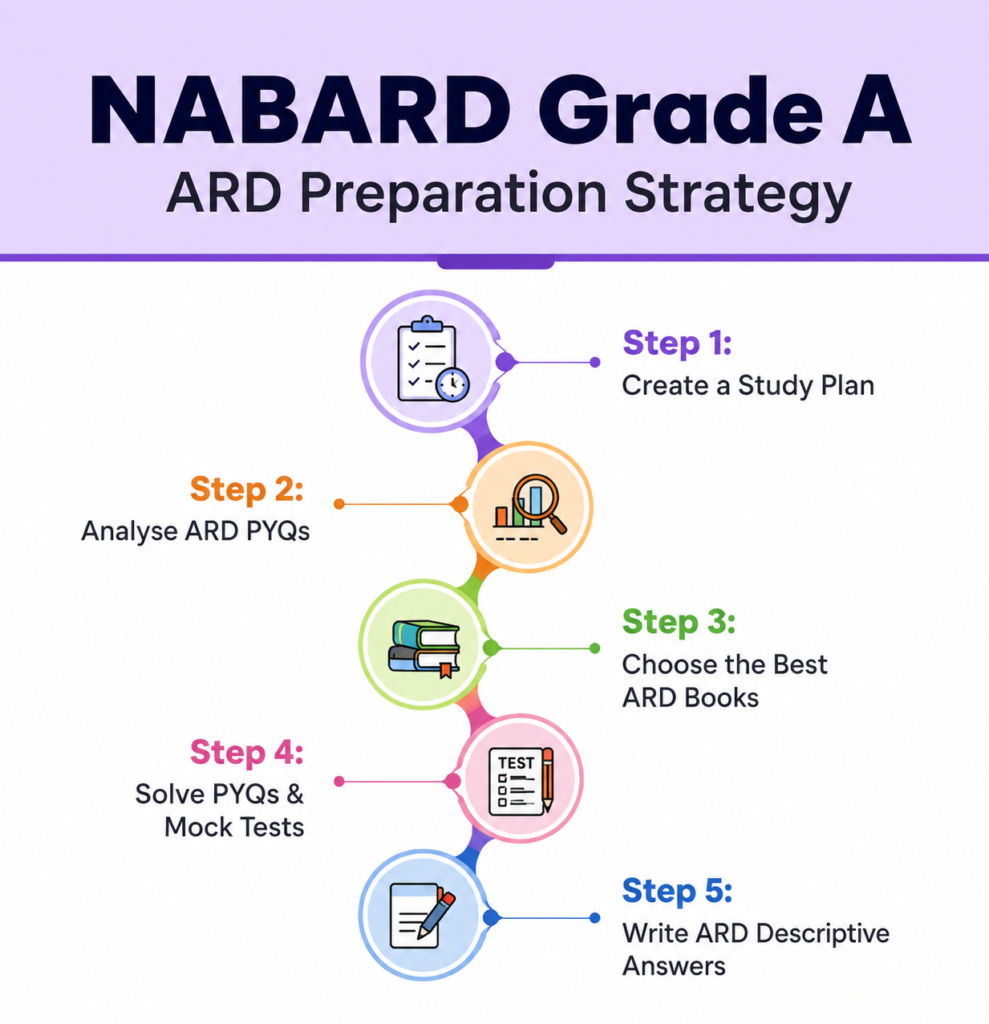
Step 1: Create a Study Plan for the NABARD Grade A ARD Subject
The first step in ARD preparation is to follow a proper study plan. Since the syllabus is vast, studying randomly can create confusion and make revision difficult. A structured timetable helps you cover the entire syllabus systematically while giving enough time for revision and practice.
If you are a working aspirant, try to dedicate at least 3–4 hours daily for ARD preparation. Full-time aspirants should aim for 6–8 hours daily to complete the syllabus comfortably along with revision and mock tests.
| Days | Topics to Cover |
|---|---|
| 1–3 | Basics of Agriculture – Cropping systems, soil types, irrigation, climate, and seasons |
| 4–6 | Agronomy & Farming Practices – Seed technology, fertilizers, soil conservation, and organic farming |
| 7 | Revision |
| 8–10 | Farm Mechanization & Irrigation Systems – Tools, machinery, micro-irrigation, and water conservation |
| 11–13 | Animal Husbandry & Dairy – Livestock, breeding, diseases, and dairy programs |
| 14 | Revision |
| 15–17 | Fisheries & Forestry – Fish farming, aquaculture, forest types, and social forestry |
| 18–20 | Agriculture Schemes & Programs – PM-KISAN, PMFBY, PMKSY, Soil Health Card, E-NAM, etc. |
| 21 | Revision |
| 22–24 | Rural Development & Institutions – Panchayati Raj, SHGs, NGOs, microfinance, and rural credit |
| 25–27 | NABARD & Its Functions – Refinance, RIDF, rural infrastructure funding, and development roles |
| 28 | Revision |
| 29–30 | Agricultural Economics & Policies – WTO, MSP, subsidies, and credit institutions |
Important Notes
- Make short notes for every topic you study.
- Prepare one-page summaries of important schemes, terms, and facts.
- Revise daily after completing study sessions.
- Use weekends for full weekly revision.
- Solve topic-wise MCQs after finishing each topic.
- Practice descriptive answer writing regularly for Phase 2 preparation.
Following a disciplined timetable like this will help you complete the ARD syllabus in a planned manner without feeling overwhelmed. Once the basics are clear, the next step is to analyse previous years’ ARD questions to understand the most important and high-weightage topics asked in the NABARD Grade A exam.
Step 2: Analyse Previous Year’s NABARD Grade A ARD Questions
Before starting preparation in depth, it is very important to analyse previous years’ ARD questions. This helps you understand what NABARD actually asks in the exam and where you should focus more during preparation.
By analysing previous year questions, you can:
- Identify the most important and high-weightage topics
- Understand the difficulty level of questions
- Learn the pattern of conceptual and factual questions
- Avoid wasting time on less important areas
- Prepare smarter instead of studying everything randomly
To make the process easier, the previous years’ ARD questions have already been analysed, and the following topics were found to be the most important for the NABARD Grade A exam.
Important ARD Static Topics
These are the core theoretical topics from which questions are frequently asked in both Phase 1 and Phase 2:
- Soil and Water Conservation
- Animal Husbandry and Plantation Crops
- Agronomy and Field Crops
- Farming System
- Cropping System and Cropping Pattern
- Forestry
- Introduction to Agriculture
- Agrometeorology
- Seed and Sowing
- Farm and Agriculture Engineering
- Water Resources and Irrigation Management
- Agriculture Extension
- Fisheries
- Important Agronomic Practices
- Agriculture Economics
- Ecology and Climate Change
- Rural Development
Important ARD Current Affairs Topics
Current affairs play a major role in ARD preparation, especially in Phase 1 objective questions and Phase 2 descriptive answers. Focus mainly on the last 6 months of agriculture and rural development updates.
Important Agriculture Schemes
- Agriculture Infrastructure Fund (AIF)
- PMKSY
- PMFBY
- PM-KMY
- e-NAM
- KCC
- Soil Health Card (SHC)
- PMMSY
- National Horticulture Mission (NHM)
Important Rural Development Schemes
Reports, Surveys, and Important Data
- Census 2011
- Socio-Economic Caste Census (SECC)
- Livestock Census
- Agriculture Census
- Annual Reports of:
- Ministry of Agriculture & Farmers Welfare
- Animal Husbandry & Dairying
- NABARD
- MSP-related reports
- Latest Union Budget
- Latest Economic Survey
- Indian State of Forest Report
- Key Statistics of Cooperative Banks
If you prepare these topics properly, you will cover a major portion of the questions asked in the ARD section. After identifying these important areas, the next step is to choose the right books and study resources for effective preparation.
ARD Difficulty Level
The overall difficulty level of the Agriculture and Rural Development (ARD) section in the NABARD Grade A exam is generally considered to be moderate. Most questions are concept-based and factual in nature. If your basics are clear and you regularly revise current affairs, scoring well in ARD becomes much easier.
The static portion mainly tests your understanding of agriculture concepts, while the current affairs section focuses on government schemes, reports, budgets, rural development programs, and recent updates related to agriculture.
Step 3: Choose authentic government and agriculture-related resources
Candidates should also follow authentic government and agriculture-related resources for current affairs, schemes, reports, and updated data.
Important Sources for Current Affairs and Government Updates
- Press Information Bureau (PIB) – for government schemes and reports
- Krishi Jagran
- BusinessLine
Important Official Websites
- Ministry of Rural Development (MoRD)
- Ministry of Agriculture & Farmers’ Welfare (MoAFW)
- NABARD Official Website
Additional Useful Resources
- ARD Current Affairs Notes
- Tamil Nadu Agricultural University (TNAU) resources
- ICAR e-Courses by the Indian Council of Agricultural Research
The best strategy is to first complete your static syllabus from standard books and then regularly update yourself with current affairs related to agriculture and rural development. Consistent revision and practice will gradually make ARD one of the highest-scoring sections in the NABARD Grade A exam.
Step 4: Solve PYQs and Attempt Mock Tests
After completing at least half of your ARD syllabus, start practicing ARD PYQs and attempting sectional mock tests regularly. This will help you apply what you’ve learned and identify areas for improvement.

- Take time-bound tests regularly so that you get used to the actual exam pressure and learn how to manage time effectively.
- After every test, carefully analyse your mistakes instead of simply checking the score.
- Try to understand why a question went wrong — whether it was due to lack of knowledge, confusion between concepts, silly mistakes, or poor time management.
- Revise weak topics immediately and note down the types of questions that are repeatedly asked in the exam.
- In the beginning, focus more on accuracy rather than speed. Once your concepts become strong, speed will automatically improve with practice.
- Reattempt difficult questions after a few days to see whether you have improved and understood the concept properly.
Step 5: Practice Writing Descriptive ARD Answers
Along with preparing objective questions, you also need to focus on writing descriptive ARD answers for Phase 2.

- Write one topic-based answer daily to build consistency.
- Include real data, government schemes, and examples to make your answers more credible.
- Structure answers with a clear Introduction, Body, and Conclusion.
- Stick to word limits (usually 400–600 words) and practice within a timer.
- Review your answers to check for grammar, spelling, flow, and relevance.
Here are some important descriptive Agriculture and Rural Development topics to practice:
- Sustainable and organic farming in India
- Role of technology in modern agriculture
- Importance of micro-irrigation in India
- Development of fisheries and Blue Revolution
- Role of NABARD in Self-Help Groups (SHGs)
- Role of rural credit institutions in agriculture
- Impact of PM-KISAN, PMFBY, and PMKSY on farmers
- Use of AI, IoT, and drones in Indian agriculture
What Next ?
Now you have a proper roadmap to prepare ARD for the NABARD Grade A exam. If you stay consistent with your studies, revise regularly, and keep yourself updated with the latest agriculture and rural development schemes, scoring well in ARD becomes much easier.
Start by building your basics strong, then gradually focus on current affairs related to Agriculture and Rural Development. Practice previous year questions and make answer writing a regular habit. This combination will improve your concepts, boost confidence, and help you perform well in both Phase 1 and Phase 2 of the exam.
FAQ’s
What is the ARD subject in the NABARD Grade A exam?
ARD stands for Agriculture and Rural Development. It is one of the most important subjects in the NABARD Grade A exam and plays a major role in both Phase 1 and Phase 2. The subject mainly covers topics related to agriculture, rural economy, government schemes, farming practices, animal husbandry, rural development programs, and current affairs related to these areas.
How many marks is ARD worth in NABARD Grade A?
In Phase 1, ARD is asked along with ESI for 40 marks. In Phase 2, ARD has a separate objective and descriptive paper, making it one of the highest-scoring and most important subjects in the exam.
Is ARD a compulsory subject for all streams?
Yes, ARD is compulsory for every candidate appearing for NABARD Grade A, no matter their educational background or stream.
What is the difficulty level of ARD in the NABARD Grade A exam?
The level is usually moderate. Most questions are concept-based and current-affairs oriented. Candidates who study consistently and revise regularly can score very well in ARD.
Do I need an agriculture background to prepare for ARD?
No, an agriculture background is not necessary. Many candidates from engineering, commerce, humanities, and other streams clear NABARD every year. The key is understanding the basics and following a proper study plan.
How many months of ARD current affairs should I cover?
Ideally, you should prepare at least 6–8 months of Agriculture and Rural Development current affairs before the exam.
How important is ARD for the final selection?
ARD is extremely important because it carries significant weight in both prelims and mains. A strong score in ARD can greatly improve your chances of final selection.
What kind of questions are asked in the ARD descriptive paper?
The descriptive paper usually includes:
- Agriculture-related issues
- Government schemes and rural policies
- Sustainable farming and technology in agriculture
- Rural development challenges
- Food security, irrigation, dairy, fisheries, and allied sectors
Questions are generally asked in essay or analytical answer format.
Should I focus more on static or current ARD?
Both are important. Static concepts help you understand the subject clearly, while current affairs help you tackle practical and updated questions. A balanced preparation strategy works best.
How can I make my ARD descriptive answers better?
You can improve your answers by:
- Writing answers regularly
- Using proper structure: Introduction, Body, and Conclusion
- Adding government schemes, reports, and real examples
- Including recent data and current affairs
- Keeping language simple, clear, and relevant
- Practicing within a time limit
Consistent practice and regular revision are the biggest keys to scoring well in ARD.