Current Affairs August 2026
Tap below — WhatsApp opens with the message already written. Just press Send and the link arrives straight away.
Get the August 2026 full compilation on WhatsAppThe six highest scorers in NABARD Grade A 2026 were all in one classroom
Every one of them was enrolled in the NABARD Mentorship Complete Course at Clarity 4 Sure. The same descriptive training and the same current affairs notes you are reading now.
- 1Suraj Ravindra Jatkar188.75
- 2Lokesh Ram Chandran185
- 3Vivek Kumar185
- 4Kapil Patlya184.75
- 5Siddhant Khesarwani183.75
- 6Lalit182.5

- 31 July, 2026
- 01 & 02 August, 2026
- 03 & 04 August, 2026
- 05 & 06 August, 2026
- 07 & 08 August, 2026
- 09 & 10 August, 2026
- 11 & 12 August, 2026
- 13 August, 2026
- 14 August, 2026
- 15 August, 2026
- 16 & 17 August, 2026
- 18 August, 2026
- 19 August, 2026
- 20 August, 2026
- 21 August, 2026
- 22 August, 2026
- 23&24 August, 2026
- 25 August, 2026
- 26 August, 2026
- 27 August, 2026
- 28&29 August, 2026
- 30&31 August, 2026
Pulled straight out of this month's own facts. If a figure here is new to you, go back and read that item in full.
31 July, 2026
Context
Tamil Nadu Chief Minister C. Joseph Vijay wrote to Prime Minister Narendra Modi on 28 July 2026, urging the Union Government not to grant any statutory or administrative approval to Karnataka’s proposed Mekedatu balancing reservoir project unless it is demonstrably consistent with the CWDT Award and the Supreme Court’s judgment.
About the Cauvery River
- One of India’s major east-flowing peninsular rivers, historically called Dakshin Ganga (“Ganga of the South”) and Ponni in Tamil.
- Origin: Talakaveri, on the Brahmagiri range of the Western Ghats in Kodagu (Coorg) district, Karnataka, at an elevation of about 1,341 m.
- Basin area: 81,155 sq km, about 2.7% of India’s geographical area, spread across Karnataka (34,273), Tamil Nadu (43,856), Kerala (2,866) and Puducherry.
- Bounded by the Western Ghats on the west, the Eastern Ghats on the east and south, and ridges separating it from the Krishna and Pennar basins on the north.
Tributaries
- Left bank: Harangi, Hemavati, Shimsha, Arkavati.
- Right bank: Lakshmantirtha, Kabini, Suvarnavati, Bhavani, Noyyal, Amaravati.
About the Mekedatu Project
- Mekedatu means “Goat’s Leap” in Kannada — a deep gorge where the Arkavati joins the Cauvery.
- Location: Ramanagara district, Karnataka, about 90–100 km south of Bengaluru, roughly 4 km upstream of the Tamil Nadu border.
- Type: proposed multipurpose balancing reservoir-cum-drinking water project, executed by Cauvery Neeravari Nigam Ltd (CNNL).
- Cost: estimated at roughly ₹6,000–9,000 crore across different project reports.
- Objectives: supply 4.75 TMC of drinking water to the Bengaluru Metropolitan Region — the additional quantum granted by the Supreme Court — and generate 400 MW of hydroelectric power; Karnataka also argues it would regulate monthly releases to Tamil Nadu and prevent floodwaters escaping to the sea.
4. ADR–NEW Report on Chief Ministers: Criminalisation of Politics
Context
The Association for Democratic Reforms (ADR) and National Election Watch (NEW) released an analysis of the self-sworn election affidavits of all 31 incumbent Chief Ministers — heading 28 states and 3 Union Territories with legislatures (Delhi, Puducherry and Jammu & Kashmir). The affidavits are those filed with the Election Commission before each Chief Minister’s most recent election.
What is Criminalisation of Politics?
- The growing participation and election of individuals with criminal backgrounds to public office — legislatures and executive positions alike.
- It undermines democratic governance by allowing persons facing serious criminal charges to shape law-making and public administration.
- Drivers: money and muscle power in elections, the “winnability” calculus of parties, weak and delayed judicial processes, and voter tolerance driven by caste, community or patronage considerations.
Key Findings
Criminal Cases
- 14 of 31 (45%) Chief Ministers have declared criminal cases.
- 11 (35%) face serious criminal cases.
- Two Chief Ministers have declared attempt-to-murder cases.
Assets
- Average declared assets of Chief Ministers: ₹118.07 crore.
- Combined assets of all 31 Chief Ministers: ~₹3,660 crore.
- Four Chief Ministers have assets exceeding ₹100 crore.
Wider Trend (18th Lok Sabha, 2024)
- MPs with criminal cases increased from 30% (2009) to 46% (2024).
- MPs with serious criminal cases rose from 14% (2009) to 31% (2024).
- Serious criminal cases among MPs have increased by 124% since 2009.
- Candidates with criminal cases had a 15.3% winning chance in 2024, compared to 4.4% for candidates with clean records.
Legal Framework
- Section 8, Representation of the People Act, 1951 disqualifies legislators only upon conviction.
- Under Section 8(3), conviction with imprisonment of 2 years or more leads to disqualification during imprisonment plus 6 years after release.
- Mere pending criminal cases or framing of charges do not result in disqualification.
Banking/Finance
1. RBI Allows Banks to Link Bulk Deposit Rates to Liquidity Profile
Sources: BS
Context
The Reserve Bank of India has given banks greater flexibility in pricing bulk deposits, allowing differential interest rates based on the liquidity characteristics of such deposits under the Liquidity Coverage Ratio (LCR) framework, while retaining the broader principle of uniformity in deposit pricing.
RBI Amends Interest Rate Directions for Bulk Deposits
Uniformity Retained
- Deposit interest rates must remain uniform across all branches for similar deposits accepted on the same date.
- No discrimination between customers for identical deposits.
Flexibility Introduced
- Banks can offer differential interest rates on bulk deposits based on the differential run-off rate under the Liquidity Coverage Ratio (LCR) framework.
- Eliminates the need to create artificial maturity buckets for pricing.
Stronger Disclosure Norms
- Deposit interest rates must strictly follow the pre-disclosed schedule on the bank’s website.
- Bulk deposit rates must be published daily at 10:00 AM, with a maximum grace period until 10:10 AM.
What is a Bulk Deposit?
Defined under the Master Direction – RBI (Interest Rate on Deposits) Directions:
| Category of bank | Bulk deposit threshold |
|---|---|
| Scheduled Commercial Banks (excluding RRBs) and Small Finance Banks | Single rupee term deposit of ₹3 crore and above |
| Regional Rural Banks and Local Area Banks | Single rupee term deposit of ₹1 crore and above |
- The SCB/SFB threshold was raised from ₹2 crore to ₹3 crore in June 2024 (it had earlier moved from ₹1 crore to ₹2 crore in 2019).
- Rationale given at the time: better classification between bulk and retail deposits and improved asset–liability management.
What is the Liquidity Coverage Ratio (LCR)?
- A Basel III liquidity standard requiring a bank to hold enough High Quality Liquid Assets (HQLA) to survive an acute stress scenario lasting 30 calendar days.
- Formula: LCR = Stock of HQLA ÷ Total Net Cash Outflows over 30 days. The minimum requirement is 100%.
- Run-off factor: the assumed percentage of a given category of deposit or funding that would be withdrawn during the 30-day stress window. Stable retail deposits carry low run-off factors; unsecured wholesale funding carries much higher ones, because large institutional depositors are far more flight-prone.
- This is the economic logic behind the new rule: a deposit with a higher run-off rate imposes a higher HQLA cost on the bank, and the bank may now price that cost into the interest rate it offers.
Practice MCQs
Q1. With reference to the RBI’s recent amendments to the directions on interest rates on deposits, consider the following statements:
- Banks have been permitted to offer differential interest rates on bulk deposits by considering the differential run-off rate applicable under the Liquidity Coverage Ratio framework.
- The requirement that deposit interest rates be uniform across all branches and customers has been withdrawn.
- Interest rates on bulk deposits must be disclosed on the bank’s website by 10:10 am on each business day.
- The amended directions come into effect from 1 October 2026.
How many of the above statements are correct? (a) Only one (b) Only two (c) Only three (d) All four (e) None
Q2. With reference to bulk deposits in India, consider the following statements:
- For Scheduled Commercial Banks other than Regional Rural Banks, and for Small Finance Banks, a bulk deposit means a single rupee term deposit of ₹3 crore and above.
- For Regional Rural Banks and Local Area Banks, the bulk deposit threshold is ₹1 crore and above.
- The threshold for Scheduled Commercial Banks was raised from ₹2 crore to ₹3 crore in 2024.
- Bulk deposits are governed by the Master Direction on Interest Rate on Advances.
How many of the above statements are correct? (a) Only one (b) Only two (c) Only three (d) All four (e) None
Answer Key
- (c) — Statements 1, 3, 4 are correct; Statement 2 is wrong because the RBI has expressly retained the uniformity principle. Rates must remain uniform across branches and customers; the flexibility is confined to differentiation on the basis of LCR run-off characteristics.
- (c) — Statements 1, 2, 3 are correct; Statement 4 is wrong because bulk deposits fall under the Master Direction – RBI (Interest Rate on Deposits) Directions. Interest Rate on Advances governs lending rates, not deposits.
2. Sovereign-Backed Protection & Indemnity Cover for Indian Shipping
Sources: TH
Context
The Department of Financial Services (DFS), Ministry of Finance, launched India’s first sovereign-backed Protection & Indemnity (P&I) insurance product under the Bharat Maritime Insurance Pool (BMIP) at an event in New Delhi on Thursday, 30 July 2026. The product was designed by The New India Assurance Company Limited, and the event was chaired by DFS Secretary Sanjay Lohiya, who handed over the first P&I policy document to Shipping Corporation of India Limited.
Key Features of the P&I Product
- Covers third-party liabilities — crew liability, cargo liability, pollution liability and wreck removal.
- Supported by a 24×7 port correspondent network, with an indemnity limit of up to USD 1.5 billion through the pool’s combined underwriting capacity.
- Aims to reduce India’s dependence on the International Group of P&I Clubs, which have historically dominated third-party liability insurance for shipping.
- Positioned by the Ministry as a step towards Atmanirbhar Bharat in specialised insurance — reducing dependence on foreign markets and retaining the value generated by India’s maritime trade within the domestic economy.
What is P&I Insurance?
- Marine insurance has two broad limbs: Hull & Machinery (damage to the ship itself) and Cargo (damage to goods). P&I covers the third-party liabilities that fall outside both.
- Typical P&I heads: injury, death or repatriation of crew, passenger claims, cargo loss or damage claims, oil pollution, wreck removal, collision liability beyond hull cover, fines and stowaway costs.
- Globally, P&I is provided by P&I Clubs — mutual, not-for-profit associations owned and controlled by shipowner and charterer members, which pool large claims among themselves.
- The International Group of P&I Clubs is a not-for-profit association of 12 clubs covering roughly 87–90% of the world’s ocean-going tonnage and over 95% of ocean-going tankers.
The Bharat Maritime Insurance Pool (BMIP)
Approval and launch
- Approved by the Union Cabinet in April 2026; formally launched with first policy issuances on 12 May 2026.
- Total underwriting capacity of USD 1.5 billion, backed by a sovereign guarantee of USD 1.4 billion (₹12,980 crore).
- Reported to run for 10 years, extendable by a further five, with the corpus funded by ship owners and oil companies and partial backing from GIC Re.
Coverage
- All four critical maritime risk categories — Hull and Machinery, Cargo, Protection and Indemnity, and War Risk — for Indian-flagged or Indian-controlled vessels, and for any vessel starting from or destined for an Indian port.
Facts To Remember
1. President Murmu Launches New Initiatives to Mark Four Years in Office
President Droupadi Murmu launched multiple initiatives at Rashtrapati Bhavan in July 2026 to mark four years of her presidency. The initiatives include an application-based e-Audio Guide, RAAHI heritage connector, Bachpan ‘Bal Parisar’, e-Upahaar (3rd Edition), Net Zero Energy Strategy service block, and infrastructure projects. Vice President C.P. Radhakrishnan also released five commemorative books highlighting her four-year presidential journey.
2. Delhi Tops e-Zero FIR Registrations for Cyber Financial Fraud
The Ministry of Home Affairs informed Parliament that over 12,000 e-Zero FIRs were registered for cyber financial fraud in 2025 across 18 States and UTs. Delhi recorded the highest number with 6,115 cases, followed by Chandigarh. The e-Zero FIR system allows victims to report fraud through the National Cyber Crime Reporting Portal or the 1930 helpline before converting it into a regular FIR within three days.
3. Tripura Signs Three MoUs with NSE
The Government of Tripura signed three MoUs with the National Stock Exchange (NSE) to promote financial literacy, skill development, entrepreneurship, and investment awareness. The collaboration covers SIPARD, the Directorate of Industries & Commerce, and the Directorate of Skill Development. NSE will fund the programmes, while the state government will provide training infrastructure.
4. CUK and Indian Navy Sign MoU for Maritime Research
The Central University of Kerala signed an MoU with the Indian Navy to strengthen collaboration in maritime studies, defence research, innovation, and strategic knowledge development. The partnership will focus on AI, cybersecurity, ocean sciences, logistics, and maritime technologies. It also aims to enhance defence innovation through academic and research cooperation.
5. IISc to Host Fifth C-DOT Telecom Centre of Excellence
FSID, C-DOT, and IISc Bengaluru signed an agreement to establish a Centre of Excellence for advanced telecom research. The centre will focus on 5G, 6G, AI, cybersecurity, quantum communication, and industry-academia collaboration. It becomes C-DOT’s fifth Centre of Excellence in India.
6. India Becomes World’s Second-Largest Supplier of Seafarers
According to the BIMCO-ICS Seafarer Workforce Report 2026, India became the world’s second-largest supplier of seafarers with over 3.11 lakh professionals, accounting for 12.16% of the global workforce. India moved from fifth position in 2015 to second in 2026, behind the Philippines. The report also highlighted a global shortage of qualified maritime officers.
7. ADB Approves USD 850 Million for Rooftop Solar Programme
The Asian Development Bank approved an USD 850 million loan under Subprogram-2 of the Accelerating Affordable and Inclusive Rooftop Solar Systems Development Programme. The funding supports the Prime Minister Surya Ghar: Muft Bijli Yojana and aims to help India achieve 30 GW rooftop solar capacity by FY27. It is also expected to reduce nearly 28.8 million tonnes of CO₂ emissions.
8. Open Secure AI Alliance Launched
NVIDIA, Microsoft, IBM, and several global technology firms launched the Open Secure AI Alliance (OSAA) to strengthen AI security and resilience. The alliance promotes secure-by-design AI systems, common security standards, and collaborative research. It was launched following growing cybersecurity concerns involving AI platforms.
9. Satya Pal Kumar Appointed Director of FIU-IND
The Appointments Committee of the Cabinet appointed IRS officer Satya Pal Kumar as Director of the Financial Intelligence Unit-India (FIU-IND) for a five-year term. He succeeded Pankaj Kumar Mishra. FIU-IND plays a key role in combating money laundering, terror financing, and suspicious financial transactions.
10. CCI Approves Go Digit Merger
The Competition Commission of India approved the merger of Go Digit Infoworks Services with Go Digit General Insurance. It is the first merger between an insurance company and a non-insurance holding company under the amended Insurance Laws Act, 2025. Following the merger, Fairfax Group will hold a 57.28% stake in Go Digit General Insurance.
11. New Fungus Species Discovered in Maharashtra
Researchers discovered a new polypore fungus species named Microporellus kolhapurensis in Kolhapur district, Maharashtra. The discovery was published in the Botanical Survey of India journal Nelumbo. It is only the second recorded species of the Microporellus genus found in Maharashtra.
12. Delhi Launches Lakshmi Yojana
The Delhi Government approved the Delhi Lakshmi Yojana to provide ₹2,500 monthly financial assistance to eligible women. The scheme has a budget allocation of ₹5,110 crore for 2026–27. Eligible women can choose between full payment through RD/FD or a combination of RD/FD and CBDC wallet.
13. Chhattisgarh Launches DWEEPTI Yojana
Chhattisgarh launched DWEEPTI Yojana, India’s first women-led distributed renewable energy policy. The scheme aims to create 5,000 solar enterprises, generate 50,000 green jobs, and provide clean energy access to five lakh families. Women SHGs will be trained as “Solar Didis” under the initiative.
14. Shatmanyu Shrivastava Appointed LIC CFO
LIC appointed Shatmanyu Shrivastava as Executive Director (Finance & Accounts) and Chief Financial Officer following the resignation of Sunil Agrawal. He previously served as Executive Director (Enterprise Risk Management) and Chief Risk Officer. Varadarajan Muthuvenkataraman was appointed as the new Chief Risk Officer.
15. Ajinkya Rahane Retires from International Cricket
Former Indian batter Ajinkya Rahane announced his retirement from all formats of international cricket in July 2026. Rahane was known for his calm leadership and played a key role in India’s historic Test series victory in Australia. He finished his career with 12 Test centuries, including eight overseas.
16. India Gets First Department of Military Medicine
Union Defence Minister Rajnath Singh inaugurated India’s first dedicated Department of Military Medicine at Command Hospital, Lucknow. The department will strengthen combat medical preparedness through research, training, and specialised programmes in military trauma, CBRNE response, disaster medicine, and humanitarian assistance.
17. India to Set Up First Telecom Manufacturing Zone
The Department of Telecommunications and the Madhya Pradesh Government signed an MoU to establish India’s first Telecom Manufacturing Zone at Gwalior. Spread over nearly 350 acres, the project will manufacture telecom equipment, semiconductors, optical fibre, and 5G/6G products under a plug-and-play industrial model.
18. MoTA Signs MoU for RET Medicinal Plant Conservation
The Ministry of Tribal Affairs signed a three-year MoU with CSIR-NBRI to conserve Rare, Endangered and Threatened (RET) medicinal plant species. The collaboration will integrate traditional tribal knowledge with modern botanical research while ensuring equitable benefit sharing with tribal communities.
19. MoRD Partners with PCI India for Women-Led Enterprises
The Ministry of Rural Development signed a three-year non-financial MoU with PCI India to strengthen women-led enterprises through public procurement. A National Resource Cell will be established under DAY-NRLM to support SHG enterprises with GeM onboarding, tender participation, and capacity building across selected states.
20. IRDAI Clears Magma General Insurance Acquisition
IRDAI approved Patanjali Ayurved and DS Group’s acquisition of Magma General Insurance from Sanoti Properties for ₹4,500 crore. Patanjali will acquire a 73.56% stake, while DS Group will acquire 24.50%. IRDAI also granted an insurance licence to ProTec General Insurance.
21. SBI Card and Google Pay Launch Co-Branded Credit Card
SBI Card and Google Pay launched the Google Pay Flex SBI Card with RuPay and Visa variants. The RuPay version supports UPI-linked credit card payments and offers annual rewards of up to ₹18,000. The card integrates directly with the Google Pay app for digital account management.
22. NCDEX Launches ‘Nidhi’ Mutual Fund Platform
NCDEX launched “NCDEX Nidhi”, a mutual fund transaction platform aimed at expanding mutual fund penetration in rural and semi-rural India. Built on API-first architecture, the platform initially onboarded six Asset Management Companies and supports UPI AutoPay for SIPs.
23. Telecom Excellence Awards 2025 Presented
Union Minister Jyotiraditya M. Scindia presented the Pandit Deendayal Upadhyaya Telecom Excellence Awards 2025 to Amantya Technologies and Finaara. During the event, the theme “Scale without Boundaries” was unveiled for India Mobile Congress 2026, scheduled from 7–10 October in New Delhi.
24. Four Mathematicians Receive 2026 Fields Medal
The International Mathematical Union awarded the 2026 Fields Medal to John Pardon, Yu Deng, Jacob Tsimerman, and Hong Wang. Yu Deng and Hong Wang became the first Chinese nationals to receive the honour, while Hong Wang became only the third woman ever to win the prestigious mathematics award.
25. Seventh Mahe-Class ASW Vessel Launched
Cochin Shipyard Limited launched Machilipatnam, the seventh Mahe-class Anti-Submarine Warfare Shallow Water Craft for the Indian Navy. The vessel has over 80% indigenous content and is named after the historic port city of Machilipatnam in Andhra Pradesh, reflecting India’s Aatmanirbhar Bharat vision.
26. India Finishes Third at ISSF World Cup 2026
India finished third at the ISSF World Cup Rifle/Pistol 2026 held in Hangzhou, China, with one gold, one silver, and two bronze medals. Esha Singh won gold in the women’s 25m pistol, while Sainyam Vij secured silver in the women’s 10m air pistol.
27. International Tiger Day – 29 July
International Tiger Day is observed every year on 29 July to promote global tiger conservation and protect tiger habitats. Established in 2010 during the St. Petersburg Tiger Summit, the day highlights efforts to conserve the species. India remains home to nearly 70% of the world’s tiger population.
28. International Day of Friendship – 30 July
The United Nations observes the International Day of Friendship on 30 July to promote peace, solidarity, and mutual understanding among people and nations. First officially observed in 2011, the day encourages friendship as a means of fostering global harmony.
01 & 02 August, 2026
Context
The Union Cabinet, chaired by Prime Minister Narendra Modi, approved ‘Samudra Manthan’ — the National Offshore Exploration Scheme on 31 July 2026, a Central Sector Scheme of the Ministry of Petroleum and Natural Gas with an approved outlay of ₹84,084 crore for implementation up to FY 2030-31.
The scheme translates the Prime Minister’s vision, articulated from the Red Fort on Independence Day 2025, of a “modern-day Samudra Manthan” to unlock India’s vast offshore energy potential — the mythological churning of the ocean recast as a search for hydrocarbons beneath the seabed.
What It Is
A comprehensive, mission-mode programme covering the entire offshore exploration value chain, from data acquisition to commercialisation of discoveries.
Interventions provided for
- Large-scale acquisition, processing and interpretation of high-quality seismic data.
- Accelerated deepwater and ultra-deepwater exploratory drilling.
- Scientific drilling in frontier basins.
- Development of common offshore production and evacuation infrastructure.
- Establishment of an integrated Oil & Gas Manufacturing and Services Zone.
- Dedicated provisions for digital programme management, capacity building, technology adoption, stakeholder engagement and international outreach.
Component-wise Outlay
| Component | Outlay | Detail |
|---|---|---|
| Deepwater exploratory drilling | ₹43,200 crore | 60 deepwater exploration wells; Government support of up to 50% of eligible drilling cost or ₹675 crore per well, whichever is lower |
| Offshore seismic data acquisition | ₹28,534 crore | Acquisition, processing and interpretation of modern seismic data |
| Common offshore infrastructure hubs | ₹10,000 crore | Shared production and evacuation infrastructure to speed commercialisation of discoveries |
| Oil & Gas Manufacturing and Services Zone | ₹2,000 crore | Domestic manufacturing and localisation of critical equipment and services |
2. Nipun: India’s Second Indigenous Diving Support Vessel
Sources: TOI
Context
Hindustan Shipyard Limited (HSL) formally delivered ‘Nipun’ — the second indigenous Diving Support Vessel (DSV) built for the Indian Navy — at Visakhapatnam on 30 July 2026, roughly a year after the lead ship of the class.
What It Is
A specialised, long-endurance naval vessel designed for deep-sea diving, underwater salvage, submarine rescue and search-and-rescue (SAR) missions — the second vessel of the Nistar-class DSVs.
- Built by: Hindustan Shipyard Limited, Visakhapatnam.
- Classification: designed and constructed in accordance with the Classification Rules of the Indian Register of Shipping (IRS).
- Name: from Sanskrit, meaning one who is adept, capable and well-versed in a particular discipline.
- Project: a two-ship programme contracted with HSL in September 2018 at a total cost of roughly ₹2,393 crore.
Aim: to strengthen the Navy’s underwater strategic capabilities as a dedicated platform for deep-sea saturation diving, submarine rescue and salvage — reducing dependence on foreign rescue vessels.
About Hindustan Shipyard Limited
- Established in 1941 as Scindia Shipyard at Visakhapatnam; nationalised in 1952.
- Transferred from the Ministry of Shipping to the Ministry of Defence in 2010.
- Builds and repairs naval vessels and submarines; also constructed the fleet support ships and undertakes submarine refits.
3. Prevention of Insults to National Honour (Amendment) Bill, 2026
Sources: TH
Context
Parliament has passed the Prevention of Insults to National Honour (Amendment) Bill, 2026, which extends legal protection to Vande Mataram by prescribing penalties for obstructing or disrupting its singing — the same protection already available to the National Anthem.
Objective and Rationale
Objective: to provide statutory protection to the National Song comparable to that already available for the National Anthem.
Government’s rationale: the Bill recalls the Constituent Assembly proceedings of 24 January 1950, when President Dr. Rajendra Prasad declared that:
- Jana Gana Mana would be the National Anthem, and
- Vande Mataram, which had played a historic part in the freedom struggle, would be honoured equally with Jana Gana Mana and have equal status with it.
The Parent Act: Prevention of Insults to National Honour Act, 1971
| Section | Content | Punishment |
|---|---|---|
| Section 2 | Prohibits burning, mutilating, defacing, defiling, disfiguring, destroying, trampling upon, or otherwise showing disrespect to or bringing into contempt the Indian National Flag or the Constitution of India, in any public place or place within public view — whether by words or acts | Up to 3 years, fine, or both |
| Section 3 | Prohibits intentionally preventing the singing of the National Anthem or causing disturbance to any assembly engaged in such singing | Up to 3 years, fine, or both |
| Section 3A | Enhanced penalty on second and subsequent convictions under Section 2 or 3 | Minimum 1 year |
What Changes in 2026
| Feature | Before | After |
|---|---|---|
| Scope of Section 3 | National Anthem only | National Anthem and National Song |
| Prohibited conduct | Intentionally preventing the singing of, or disturbing an assembly engaged in singing, the Anthem | The same conduct in relation to either the Anthem or the Song |
| First offence | Up to 3 years, fine, or both | Unchanged |
| Repeat conviction (Section 3A) | Minimum 1 year | Extended to repeat Vande Mataram offences |
About Vande Mataram
| Aspect | Detail |
|---|---|
| Meaning | “Mother, I Bow to Thee” |
| Composer | Bankim Chandra Chattopadhyay, in Sanskritised Bengali |
| First published | In the Bengali literary journal Bangadarshan, on 7 November 1875 |
| Novel | Later included in Anandamath (1882), set against the Sanyasi Rebellion of the late eighteenth century and the Great Bengal Famine |
| Music | Set to music by Rabindranath Tagore |
| National Song status | First two stanzas adopted by the Congress Working Committee in 1937 |
| Equal honour | Affirmed by Dr. Rajendra Prasad on 24 January 1950 |
Constitutional position: the Constitution does not explicitly mention a National Song. Article 51A(a) makes it a Fundamental Duty of every citizen to abide by the Constitution and respect its ideals and institutions, the National Flag and the National Anthem. The National Song is absent from the text, though official protocol accords it equal respect.
Jana Gana Mana
- Composed by Rabindranath Tagore; first sung at the Calcutta session of the Congress on 27 December 1911.
- Adopted as the National Anthem on 24 January 1950 — the last day of the Constituent Assembly.
4. India’s First Telecom Manufacturing Zone (TMZ), Gwalior
Sources: News on Air
Context
The Department of Telecommunications (DoT) and the Government of Madhya Pradesh signed a Memorandum of Understanding on 30 July 2026 at Vigyan Bhawan, New Delhi, to establish India’s first integrated Telecom Manufacturing Zone (TMZ) at Gwalior.
What It Is
An integrated 350-acre plug-and-play industrial cluster creating a specialised ecosystem for telecom and electronics manufacturing, R&D, testing, certification, innovation and intellectual property creation under one roof.
| Parameter | Detail |
|---|---|
| Location | Gwalior, Madhya Pradesh. Phase-I: about 170 acres — roughly 100 acres in the SADA (Special Area Development Authority) region and 70 acres in the Gwalior IT Park |
| Governing structure | A dedicated Special Purpose Vehicle (SPV) — 51% Government of Madhya Pradesh, 49% DoT |
| Central funding | About ₹493 crore (commonly reported as ₹500 crore) as 100% financial assistance for core infrastructure in Phase-I |
| State contribution | Phase-I land provided free of cost by the Madhya Pradesh Government |
| Phase-I duration | Approximately three years, with Phase-II initiated in parallel |
Aim: to reduce reliance on imported telecom hardware, accelerate indigenous R&D for 5G and 6G technologies, boost domestic manufacturing, and establish India as a global exporter of telecom equipment — encapsulated in the slogan “Design in India, Make in India, Export from India.”
5. Western Ghats and the Ecologically Sensitive Area Notification
Sources: The Indian Express
Context
The Western Ghats Ecologically Sensitive Area (ESA) notification remains unfinalised more than a decade after the first draft. Following the expiry of the previous draft in July 2026, the Ministry of Environment, Forest and Climate Change (MoEF&CC) re-issued a fresh draft notification proposing about 56,825.7 sq km as ESA and extended the tenure of the expert committee headed by former Director General of Forests Sanjay Kumar until July 2027.
About the Western Ghats
- A chain running roughly 1,600 km parallel to India’s west coast, from the Tapi valley in the north to Kanyakumari in the south, across six States — Gujarat, Maharashtra, Goa, Karnataka, Kerala and Tamil Nadu.
- Older than the Himalayas; total area estimated by the Kasturirangan group at about 1.64 lakh sq km.
- One of the world’s eight “hottest” biodiversity hotspots; extremely high endemism in amphibians, fish, reptiles and flowering plants.
- UNESCO World Heritage Site (2012) — 39 serial sites comprising national parks, wildlife sanctuaries and reserved forests.
- Highest peak: Anamudi (2,695 m), Kerala. Major passes: Palghat, Goa (Thal), Bhor and Shencottah gaps.
- Source of major peninsular rivers — Godavari, Krishna, Cauvery, Tungabhadra, Periyar — and a decisive influence on the south-west monsoon.
Ecologically Sensitive Area (ESA)
- An Ecologically Sensitive Area (ESA) is a region notified under the Environment (Protection) Act, 1986 to conserve ecologically fragile ecosystems.
- ESAs act as buffer zones around protected areas and other environmentally important regions.
- Certain activities such as mining, quarrying, thermal power plants, and highly polluting industries are prohibited or strictly regulated.
- Sustainable activities like agriculture, horticulture, eco-tourism, and traditional livelihoods are generally permitted under regulated conditions.
6. Registration of Births and Deaths (Amendment) Bill, 2026
Sources: The Hindu
Context
The Lok Sabha passed the Registration of Births and Deaths (Amendment) Bill, 2026 on 31 July 2026 without debate, by voice vote amid Opposition protests against the police action on student protesters at Jantar Mantar on 20 July.
What the Bill Does
It amends Section 13 of the Registration of Births and Deaths Act, 1969, which governs delayed registration.
Existing position
- An order is required to register any birth or death reported more than one year after the event.
- Such an order may be issued by a District Magistrate, Sub-Divisional Magistrate, or an Executive Magistrate authorised by the District Magistrate, after verifying correctness and on payment of a prescribed fee.
Proposed two-tier structure
| Delay | Authority required |
|---|---|
| More than 1 year but within 2 years | Order of District Magistrate / Sub-Divisional Magistrate / authorised Executive Magistrate (substituted Section 13(3)), after verification of authenticity |
| More than 2 years | Order of a Judicial Magistrate of the First Class (new Section 13(3A)) |
- The Bill also updates legal definitions, aligning the expression “executive magistrate” with the Bharatiya Nagarik Suraksha Sanhita, 2023, replacing references to the Code of Criminal Procedure, 1973.
- Effect: a judicial layer of verification is added to a process that had so far remained wholly within the administrative machinery.
Background: The Parent Act and the 2023 Amendment
- Registration of Births and Deaths Act, 1969 makes registration of births and deaths compulsory; the certificate issued confers legal identity.
- Administered through the Registrar General of India (under the Ministry of Home Affairs), Chief Registrars in States, and District and local Registrars.
- 2023 Amendment (in force from 1 October 2023): created a national database of registered births and deaths maintained by the Registrar General; required Aadhaar numbers of parents and the informant for birth registration; and made the birth certificate a single document for admission to educational institutions, issue of driving licence, passport, voter registration, marriage registration and government appointments.
Rationale for tightening: to curb fraudulent or fabricated late registrations used to manufacture proof of identity, age or citizenship — a concern that grows once the birth certificate becomes a single foundational document.
Also on the Table That Day
The Constitution (130th Amendment) Bill, 2025
- Introduced in the Lok Sabha by Home Minister Amit Shah on 20 August 2025; referred to a 31-member Joint Committee constituted on 12 November 2025.
- Seeks to amend Articles 75, 164 and 239AA, inserting provisions for automatic removal of a Minister, Chief Minister or the Prime Minister who is arrested and detained in custody for 30 consecutive days on allegation of an offence punishable with imprisonment of five years or more.
- Mechanism: a Minister is removed by the President on the advice of the Prime Minister (or Governor on the CM’s advice) on the 31st day; if no such advice is tendered, the Minister ceases to hold office thereafter. A Prime Minister or Chief Minister must resign by the 31st day, failing which he ceases to hold office.
- Re-appointment on release from custody is not barred.
- Companion Bills: the Jammu and Kashmir Reorganisation (Amendment) Bill, 2025 and the Government of Union Territories (Amendment) Bill, 2025, extending the scheme to J&K and Puducherry (the 130th Amendment itself covers Delhi).
Practice MCQs
Q1. With reference to the Registration of Births and Deaths (Amendment) Bill, 2026, consider the following statements:
- It amends the Registration of Births and Deaths Act, 1969.
- It provides that a birth or death reported more than two years after its occurrence may be registered only on the order of a Judicial Magistrate of the First Class.
- For a delay of more than one year but within two years, registration continues to require an order of a District Magistrate, Sub-Divisional Magistrate or authorised Executive Magistrate.
- The Bill received the assent of the President after being passed by both Houses in July 2026.
How many of the above statements are correct? (a) Only one (b) Only two (c) Only three (d) All four (e) None
Q2. With reference to the registration of births and deaths in India, consider the following statements:
- Registration of births and deaths is compulsory under the parent Act of 1969.
- The Registrar General of India functions under the Ministry of Home Affairs.
- Following the 2023 amendment, the birth certificate serves as a single document for purposes such as admission to educational institutions and issue of a passport.
- The 2026 Bill aligns the term “executive magistrate” with the Bharatiya Nagarik Suraksha Sanhita, 2023.
How many of the above statements are correct? (a) Only one (b) Only two (c) Only three (d) All four (e) None
Answer Key
- (c) — Statements 1, 2, 3 are correct; Statement 4 is wrong because the Bill was passed only by the Lok Sabha on 31 July 2026 and still awaits consideration by the Rajya Sabha; presidential assent follows passage by both Houses.
- (d) — All four are correct. Registration is compulsory under the 1969 Act; the Registrar General of India sits under the MHA; the 2023 amendment made the birth certificate a single foundational document from 1 October 2023; and the 2026 Bill updates the definition of “executive magistrate” in line with the BNSS, 2023.
7. Pradhan Mantri Surya Sarovar Yojana (PM-SSY)
Sources: News on Air
Context
The Union Cabinet, chaired by Prime Minister Narendra Modi, approved the Pradhan Mantri Surya Sarovar Yojana (PM-SSY) on 31 July 2026 with an outlay of ₹5,070 crore, to promote floating solar projects co-located with battery storage across reservoirs, dams and other inland water bodies.
What It Is
A Central Sector Scheme promoting Floating Solar Photovoltaic (FSPV) generation integrated with Energy Storage Systems (ESS). It uses water surfaces — reservoirs, dams, lakes, irrigation tanks and industrial ponds — to generate clean power while avoiding land-use conflict.
| Parameter | Detail |
|---|---|
| Nodal Ministry | Ministry of New and Renewable Energy (MNRE) |
| Implementing Agency | Solar Energy Corporation of India (SECI) |
| Total outlay | ₹5,070 crore |
| Capacity target | 5,000 MW of FSPV |
| Storage target | 10,000 MWh, minimum 2-hour duration |
| Sanctioning window | FY 2026-27 to FY 2030-31 |
| Coverage | All States and Union Territories |
Aim: to expand India’s floating solar capacity from the present ~700 MW to 5,700 MW, mitigate land acquisition bottlenecks, reduce evaporation losses from reservoirs, and enhance grid reliability.
Floating Solar Photovoltaic (FSPV)
- Floating Solar Photovoltaic (FSPV) refers to solar power plants installed on floating platforms over water bodies such as reservoirs, lakes, ponds, and dams.
- It generates renewable electricity while reducing pressure on land resources.
- The water surface helps cool solar panels, improving efficiency and reducing evaporation losses.
- FSPV supports clean energy generation, optimal use of unused water surfaces, and lower land acquisition requirements.
Key Features
- Central Financial Assistance (CFA): ₹1 crore per MW, released post-commissioning. Its purpose is to bridge the roughly 25% higher capital cost of floating solar platforms compared with ground-mounted solar — floats, anchoring and marine-grade cabling add cost that a level-playing-field tariff would not otherwise cover.
- Mandatory co-located storage: minimum 2-hour ESS with every project, to supply power during evening peak demand and reduce renewable energy curtailment during periods of excess midday generation.
- Project de-risking grants: up to ₹50 lakh per project for initial technical feasibility studies — bathymetry and hydrography surveys, solar yield calculations, and aquatic ecological impact assessments.
- Aatmanirbhar manufacturing push: stimulates indigenous manufacturing across the value chain — floatation platforms, anchoring and mooring systems, PV modules and storage batteries.
8. India’s Next Growth Frontier Report
Source: PIB
Context
In July 2026, the Competere Foundation for Trade and Competition Policy — an independent policy and advocacy group — released its report “India’s Next Growth Frontier: Reducing Anti-Competitive Market Distortions (ACMDs) to Build on India’s 2010–2023 Reform Progress.” As per the report, India has emerged as one of the strongest structural reformers among the economies studied, improving its overall global ranking by 25 places — from 82nd in 2010 to 57th in 2023.
About the Report
Aim: to track India’s structural and pro-competitive reforms between 2010 and 2023, and to recommend further reforms strengthening productivity, investment and global competitiveness.
What It Is
A report assessing India’s reform performance through the Market Distortions Performance Index (MDPI) — the Foundation’s own index measuring the extent to which anti-competitive market distortions impede efficient market functioning. It evaluates how structural reforms have reduced distortions and improved India’s competitiveness in the global economy.
Aim: to assess India’s progress in reducing anti-competitive market distortions and to recommend reforms that strengthen productivity, investment and global competitiveness.
Key Findings
- Improved global ranking: India rose from 82nd (2010) to 57th (2023) on the MDPI — a gain of 25 places, making it one of the strongest structural reformers among the economies studied.
- Three-pillar assessment: the index evaluates
- Protection of property rights
- Domestic competition
- International competition
- Major reform drivers: the Goods and Services Tax (GST), the Insolvency and Bankruptcy Code (IBC), trade facilitation measures — including the Indian Customs Electronic Gateway (ICEGATE), the Single Window Interface for Facilitating Trade (SWIFT) and Direct Port Delivery (DPD) — and broader regulatory improvements.
- Need for competition reforms: calls for an evidence-based, consumer welfare-oriented competition policy, especially for digital markets and emerging sectors.
- Global trade integration: recommends reviewing sector-specific investment restrictions and strengthening cooperation with like-minded countries to address international regulatory barriers.
Understanding Anti-Competitive Market Distortions (ACMDs)
An ACMD is any government measure, regulation or private practice that distorts competition and misallocates resources — distinct from ordinary anti-competitive conduct by firms, which competition law already addresses.
| Pillar | Typical distortions |
|---|---|
| Property rights | Weak contract enforcement, insecure land titles, poor intellectual property protection, slow insolvency resolution |
| Domestic competition | State monopolies, licensing barriers, preferential treatment of favoured firms, opaque procurement, price controls |
| International competition | Tariff and non-tariff barriers, sectoral FDI caps, restrictive standards, discriminatory localisation requirements |
Banking/Finance
1. IRDAI Reforms: Intermediary Rules Tightened, Investment Norms Eased
Sources: Business Standard
Context
The IRDAI, at its 137th Authority Meeting held on 28 July 2026 at its head office in Hyderabad, approved a package of regulatory, supervisory and developmental reforms, reported on 31 July 2026. The reforms advance implementation of the Sabka Bima Sabki Raksha (Amendment of Insurance Laws) Act, 2025 (SBSR Act) and support the goal of “Insurance for All by 2047.”
Regulations approved at the meeting
- IRDAI (Actuarial, Finance and Investment Functions of Insurers) (Second Amendment) Regulations, 2026
- IRDAI (Registration, Capital Structure, Transfer of Shares and Amalgamation of Insurers) (Amendment) Regulations, 2026
- IRDAI (Policyholders’ Education and Protection Fund) Regulations, 2026
- Amendments mandating tagging of authorised salespersons
- IRDAI (Manner and Procedure for Imposition of Penalties) Regulations, 2026
- Registration granted to ProTec General Insurance Ltd.
Part A — Tightening of Intermediary Rules
Scope: corporate agents, insurance brokers, insurance marketing firms (IMFs), web aggregators and Common Public Service Centre Special Purpose Vehicles (CPSC-SPVs).
1. Perpetual registration
- A certificate of registration, once issued, remains valid indefinitely, subject to payment of a non-refundable annual fee — replacing the earlier system of periodic renewal.
- Registration continues until suspended or cancelled by IRDAI, or surrendered by the intermediary.
- Annual fee: the higher of ₹10,000 or 0.04% of commission and other receipts from insurers during the preceding financial year.
2. Salesperson tagging — traceability at the point of sale
- Intermediaries must maintain records identifying the individual involved in the sale or solicitation of every policy.
- The name and functional identity of broker-qualified persons, point-of-sales persons, designated persons, authorised verifiers or other authorised salespersons must appear in proposal forms, policy documents and certificates of insurance, along with contact details of the relevant branch or office.
- For policies sold directly through an intermediary’s digital platform without any salesperson’s involvement, the principal officer’s contact details must be included.
- Effective from 1 January 2027.
- Purpose: creates a clear audit trail. If a customer later alleges mis-selling, wrong advice or non-disclosure of material terms, the responsible salesperson can be identified.
3. Enhanced disclosures
- Additional disclosure obligations for majority foreign-owned entities and those crossing specified commission-income thresholds — aligning the regime with the new 100% FDI framework.
- IRDAI may impose conditions on an intermediary’s business at registration or subsequently, in the interest of policyholders and the orderly growth of the sector.
4. Training
- For insurance marketing firms, principal officers and insurance salespersons must complete at least 25 hours of training once every three years through an examination body recognised by IRDAI.
Part B — Easing of Investment Norms
Under the amendments to the actuarial, finance and investment functions regulations:
| Provision | Limit |
|---|---|
| Investment in operational infrastructure SPVs rated AA or above | Up to 20% |
| Combined investment in private limited companies, AIFs and VCFs | Up to 3% for life insurers; 5% for general insurers |
| Overall exposure to promoter groups | Capped at 5% of investment assets |
| Repo and government securities lending transactions | 25% of available securities or ₹10,000 crore, whichever is lower |
Risk oversight: a comprehensive annual Financial Condition Report is now mandatory, covering solvency, reserve adequacy, liquidity, stress testing and Asset-Liability Management resilience.
Part C — The Enabling Statute: SBSR Act, 2025
| Feature | Detail |
|---|---|
| Passed | Lok Sabha 16 December 2025; Rajya Sabha 17 December 2025; Presidential assent 20 December 2025 |
| Commencement | 5 February 2026 — except the restriction on common directors and officers of insurers, banks and investment companies (Section 32A of the Insurance Act) |
| Acts amended | Insurance Act, 1938; Life Insurance Corporation Act, 1956; IRDA Act, 1999 |
Key provisions
- FDI in Indian insurance companies raised from 74% to 100% of paid-up equity capital (Section 3AA). The cap for insurance intermediaries remains 100% under the automatic route, and for LIC 20%. A DPIIT Press Note amending the FDI Policy was issued on 9 February 2026.
- Net-owned fund requirement for foreign reinsurers reduced from ₹5,000 crore to ₹1,000 crore.
- Removed the ₹100 crore minimum paid-up share capital requirement for insurance co-operative societies.
- One-time licensing for intermediaries, and suspension of licence rather than outright cancellation.
- IRDAI empowered to disgorge wrongful gains from insurers and intermediaries; penalties rationalised with prescribed factors for imposition.
- Standard operating procedure mandating a consultative regulation-making process.
- Section 16A — constitution of the Policyholders’ Education and Protection Fund (PEPF), established and administered by IRDAI, funded by grants and donations from IRDAI, the Central and State Governments and companies, and by monies collected as penalties.
PEPF objectives: promoting insurance awareness and financial literacy, strengthening grievance redressal, enhancing policyholder services through technology, and enabling tracing and recovery of unclaimed insurance amounts.
About IRDAI
- Statutory body established under the IRDA Act, 1999; headquarters at Hyderabad (shifted from Delhi in 2001).
- Constituted on the recommendations of the Malhotra Committee (1993), chaired by former RBI Governor R.N. Malhotra, which recommended opening the sector to private participation and creating an independent regulator.
- Composition: a Chairperson, up to five whole-time members and four part-time members, appointed by the Central Government.
- Domestic Systemically Important Insurers (D-SIIs) designated by IRDAI: LIC, GIC Re and The New India Assurance Company.
Agriculture
1. PM-KISAN Extended to 2030-31
Sources: The Hindu
Context
The Union Cabinet on 31 July 2026 approved the continuation of the Pradhan Mantri Kisan Samman Nidhi (PM-KISAN) Scheme from 2026-27 to 2030-31, with a total financial outlay of ₹3,15,614 crore (about ₹3.15 lakh crore). This is a five-year extension covering FY 2026-27 through FY 2030-31, announced by Information and Broadcasting Minister Ashwini Vaishnaw after the Cabinet meeting.
About the Scheme
| Feature | Detail |
|---|---|
| Launched | February 2019 (announced in the Interim Budget; effective retrospectively from 1 December 2018) |
| Type | Central Sector Scheme — 100% funded by the Union Government |
| Nodal ministry | Ministry of Agriculture and Farmers Welfare, Department of Agriculture and Farmers Welfare |
| Benefit | ₹6,000 per year per eligible landholding farmer family |
| Mode | Three equal instalments of ₹2,000, transferred through Direct Benefit Transfer (DBT) into Aadhaar-seeded bank accounts |
| Coverage | Initially confined to small and marginal farmers holding up to 2 hectares; extended to all landholding farmer families from 1 June 2019 |
Facts To Remember
1. Delhi Launches Registration Portal for Delhi Lakshmi Yojana
The Delhi Government launched the registration portal for the Delhi Lakshmi Yojana, under which eligible women will receive ₹2,500 per month as financial assistance. The scheme is expected to benefit around 17 lakh women, with support aimed at improving financial security for women from economically weaker sections.
2. Ladakh Declares 23 Heritage Sites as Protected Monuments
The Union Territory of Ladakh notified 23 heritage sites as Protected Monuments under the Jammu & Kashmir Ancient Monuments Preservation Act, 1920. The move provides statutory protection to archaeological, historical and cultural sites across Leh, Nubra, Sham, Zanskar and Kargil, strengthening heritage conservation in the region.
3. IN-SPACe Issues Guidelines for Space Object Re-entry
IN-SPACe released new guidelines under the Indian Space Policy 2023 to regulate planned re-entry of space objects by private entities. The framework mandates prior authorisation, safety assessments, liability compliance and insurance provisions to ensure safe and accountable spacecraft re-entry operations.
4. IIT Gandhinagar and IAIRO Sign MoU for AI Research
IIT Gandhinagar and the Indian Artificial Intelligence Research Organisation (IAIRO) signed an MoU to promote AI research, education and talent development. The collaboration includes joint research projects, faculty exchange, AI infrastructure development and specialised academic programmes.
5. NSDC and AVPL to Set Up 350 Drone Skill Centres
The National Skill Development Corporation (NSDC) partnered with AVPL International to establish 350 Advanced Skill Centres for Drone Technology over three years. The centres will provide training in drone piloting, manufacturing, AI applications, GIS, maintenance and entrepreneurship to build a future-ready workforce.
6. Candere Hurun India Women Leaders List 2026 Released
Candere and Hurun India released the second edition of the India Women Leaders List 2026, recognising 117 women achievers across 12 categories. Roshni Nadar, Priya Nair, Avani Lekhara and Sudha Murty were among the leading personalities honoured for their contributions in business, sports and social impact.
7. Saudi Arabia Launches Maritime Defence Alliance
Saudi Arabia and 13 other countries announced a Multinational Maritime Defence Alliance to safeguard shipping routes across the Red Sea, Gulf of Aden and Bab el-Mandeb Strait. The alliance aims to strengthen maritime security, protect freedom of navigation and secure global trade routes.
8. Venezuela Withdraws from Rome Statute
Venezuela formally notified the United Nations of its withdrawal from the Rome Statute, initiating its exit from the International Criminal Court (ICC). The withdrawal will take effect after one year but will not affect ongoing ICC investigations or proceedings initiated before the withdrawal.
9. RBI Defers Basel III Disclosure Norms
The Reserve Bank of India postponed the implementation of the revised Basel Pillar III disclosure framework by six months to 1 April 2027. The extension was granted after stakeholder feedback, allowing banks additional time to align with the Expected Credit Loss framework.
10. ADB Approves USD 1 Billion Urban Transformation Loan
The Asian Development Bank approved a USD 1 billion loan to support India’s Urban Challenge Fund and accelerate urban transformation. The programme will strengthen municipal governance, improve infrastructure, expand municipal financing and promote digital urban management systems.
11. Indian Navy Receives Indigenous Diving Support Vessel ‘Nipun’
The Indian Navy inducted ‘Nipun’, the second indigenous Diving Support Vessel built by Hindustan Shipyard Limited. With around 75% indigenous content, the vessel enhances India’s capabilities in deep-sea diving, submarine rescue, underwater salvage and maritime emergency operations.
12. Ajinkya Rahane Retires from International Cricket
Former Indian batter Ajinkya Rahane announced his retirement from international cricket after a distinguished 12-year career. He represented India in 195 international matches and captained the team to the historic 2020–21 Border-Gavaskar Trophy victory in Australia.
13. World Day Against Trafficking in Persons 2026 – 30 July
The United Nations observed World Day Against Trafficking in Persons on 30 July to raise awareness about human trafficking and strengthen victim protection. The 2026 theme was “Trapped Behind the Scam”, highlighting the growing misuse of online scams for human trafficking.
14. World Ranger Day 2026 – 31 July
World Ranger Day was observed on 31 July to honour rangers who protect wildlife and natural heritage while remembering those who lost their lives in the line of duty. The 2026 theme was “Rangers: Guardians of a Changing Planet.”
15. Odisha Signs ₹3,385 Crore BharatNet Agreement
The Odisha Government signed a tripartite agreement with Digital Bharat Nidhi and BSNL to implement the amended BharatNet programme worth ₹3,384.82 crore. The project aims to provide optical fibre connectivity to around 50,000 villages across the state.
16. Tamil Nadu Signs Four MoUs for GCCs and Foreign University Campus
The Tamil Nadu Government signed four MoUs to establish Global Capability Centres, R&D facilities and the University of Western Australia’s India campus in Chennai. The projects are expected to attract significant investments and generate nearly 2,920 employment opportunities.
03 & 04 August, 2026
Context
The Lok Sabha passed the Bill on 3 August 2026 by voice vote, without debate, amid Opposition protests over the Jantar Mantar police action and the alleged chadhawa chori at the Ram Temple. Law Minister Arjun Ram Meghwal introduced it; a statutory resolution disapproving the Ordinance was rejected. The Bankers’ Books Evidence Bill, 2026 and Indian Statistical Institute Bill, 2026 were introduced the same day.
What the Bill Does
- Amends Section 2, Supreme Court (Number of Judges) Act, 1956.
- Judges excluding the CJI: 33 → 37; total including CJI: 34 → 38.
- Replaces the Ordinance of 16 May 2026; carries a saving clause validating actions taken under it.
- No constitutional amendment needed — Article 124(1) leaves the strength to ordinary law.
Rationale — Pendency
| Indicator | Figure |
|---|---|
| Pending cases (1 Jan 2026) | 92,101 |
| Instituted in 2025 | 75,410 |
| Disposed in 2025 | 65,615 |
Also intended to let the CJI constitute Constitution Benches regularly.
Strength Progression (incl. CJI)
1950: 8 → 1956: 11 → 1960: 14 → 1977: 18 → 1986: 26 → 2009: 31 → 2019: 34 → 2026: 38
Key Constitutional Points
- 124(1) — strength alterable by Parliament by ordinary law.
- 124(3) — HC judge 5 yrs / HC advocate 10 yrs / distinguished jurist (never used).
- Retirement age 65; appointments via the Collegium (Second and Third Judges Cases); NJAC struck down in 2015.
- Article 123 — President’s ordinance power; lapses six weeks after reassembly; D.C. Wadhwa (1987) barred re-promulgation. Article 213 is the Governor’s equivalent.
2. MSME Development (Amendment) Bill, 2026
Source: The Hindu
Context
The Rajya Sabha passed the Bill, amid Opposition demands for an apology from Home Minister Amit Shah over the police action against protesting students. The Upper House functioned only 19 minutes in the morning and was adjourned soon after passage. Opposition members did not participate in the debate; amendments moved by INDIA bloc members Ajay Maken, John Brittas, V. Sivadasan and A.A. Rahim were defeated by voice vote. The Lok Sabha passed it on 7 August 2026, completing parliamentary approval.
Key Provisions
- Registration
- MSME registration becomes voluntary. The Centre will establish a free digital registration platform, giving statutory backing to the Udyam Registration Portal.
- Classification
- MSMEs will be classified using investment and turnover criteria. Thresholds can be revised by notification without amending the Act.
- Delayed Payments
- Central PSEs must settle MSME procurement invoices through TReDS.
- New Section 22A requires notified entities to disclose MSME invoices routed through TReDS.
- States can establish multiple MSEFCs, with faster online dispute resolution and arbitration.
- Decriminalisation
- Criminal fines replaced with graded civil penalties. Penalties may increase by 10% every three years.
- Development Commissioner becomes the adjudicating officer; appeals must be filed within 30 days and disposed of within 60 days.
New Enforcement Provisions
- Section 18(6) — Online Dispute Resolution: empowers the Central Government to establish an ODR mechanism for mediation and arbitration through audio-video and other electronic means, removing the cost and travel barrier that deters small suppliers from pursuing claims.
- Section 18A — Recovery as arrears of land revenue: mediated settlement agreements and arbitral awards may be recovered through the District Collector, Deputy Commissioner or any other authority notified by the State Government. Such awards constitute a legally enforceable debt capable of recognition under the Insolvency and Bankruptcy Code, 2016.
- Sections 20–21 substituted: States may establish additional Facilitation Councils and have greater flexibility in deciding MSEFC composition, to speed up disposal.
- Section 22A: notified Central and State Public Sector Enterprises and other notified entities must disclose details of MSME invoices routed through TReDS.
3. Pradhan Mantri Surya Sarovar Yojana (PM-SSY)
Source: PIB
Context
The Union Cabinet approved the Pradhan Mantri Surya Sarovar Yojana (PM-SSY) on 31 July 2026 with an outlay of ₹5,070 crore, to promote floating solar projects with battery storage across reservoirs, dams and other inland water bodies.
What It Is
A national renewable energy Central Sector Scheme promoting floating solar power generation co-located with energy storage. It optimises water surfaces — reservoirs, dams, lakes, irrigation tanks and industrial ponds — to generate clean energy while preventing land-use conflicts.
| Parameter | Detail |
|---|---|
| Nodal Ministry | Ministry of New and Renewable Energy (MNRE) |
| Implementing Agency | Solar Energy Corporation of India (SECI) |
| Total outlay | ₹5,070 crore |
Aim: to expand India’s floating solar capacity from about 700 MW to 5,700 MW, by adding 5,000 MW coupled with 10,000 MWh of storage — mitigating land acquisition bottlenecks, reducing evaporation losses, and enhancing grid reliability.
Key Features
- Capacity target: 5,000 MW of Floating Solar Photovoltaic (FSPV) projects across all States and UTs between FY 2026-27 and FY 2030-31.
- Mandatory co-located energy storage: Energy Storage Systems with a minimum 2-hour duration, totalling 10,000 MWh, to supply power during peak demand hours and reduce renewable energy curtailment.
- Central Financial Assistance: ₹1 crore per MW, released post-commissioning, to bridge the roughly 25% higher capital cost of floating platforms compared with ground-mounted solar.
- Project de-risking grants: up to ₹50 lakh per project for initial technical feasibility studies — bathymetry and hydrography surveys, solar yield calculations, and aquatic ecological impact assessments.
- Aatmanirbhar manufacturing push: indigenous manufacturing across the value chain — floatation platforms, anchoring and mooring systems, PV modules and storage batteries.
- Expected investment: about ₹28,500 crore; CO₂ reduction of roughly 10 million tonnes annually; 16,000–17,000 full-time equivalent jobs.
4. The Revamped Khelo India Scheme
Source: PIB
Context
The Union Cabinet, chaired by the Prime Minister, approved an expanded and revamped Khelo India Scheme on 31 July 2026, along with an enhanced Assistance to National Sports Federations (ANSF) scheme. Announced by I&B Minister Ashwini Vaishnaw, the Government described it as the country’s most ambitious sports development programme since Independence.
What It Is
The central flagship initiative of the Ministry of Youth Affairs and Sports, designed to revive India’s sports culture at the grassroots, identify athletic talent, construct modern sports infrastructure, and establish a structured pathway to national and international excellence.
| Parameter | Detail |
|---|---|
| Original launch | 2016–17, extensively restructured in 2017–18, by merging the Rajiv Gandhi Khel Abhiyan, Urban Sports Infrastructure Scheme and National Sports Talent Search System |
| Revamped period | FY 2026–27 to FY 2030–31 |
| Combined outlay | ₹36,441 crore — nearly eight times the previous cycle |
| Ministry | Youth Affairs and Sports |
Aim: aligned with the Khelo Bharat Niti 2025 and NEP 2020, it integrates sports with education, expands the talent pool, builds high-performance ecosystems, and supports India’s Commonwealth Games and Olympic hosting ambitions.
Key Features
- Massive athlete pool expansion: introduces the Emerging Khelo India Athletes (E-KIAs) category alongside existing Khelo India Athletes (KIAs), expanding the structured development ecosystem nearly ten-fold under professional coaching and scientific support.
- School-level integration: two new initiatives — Khelo India Feeder Schools (KIFS) and Khelo India Utkrishta Vidyalayas (KIUV) — to embed physical education into mainstream school curricula and enable early talent identification.
- Integrated nationwide training ecosystem: a seamless tier of National Centres of Excellence (NCOEs), Khelo India State Centres of Excellence (KISCEs), SAI Training Centres (STCs), and Youth Sports Companies (YSCs) operated by the Armed Forces.
- National Coach Accreditation Board (NCAB): to standardise coaching qualifications, enforce high-performance benchmarks and upscale sports science support personnel.
- Unified digital sports platform: integrating athlete databases, talent assessments and funding trails; alongside expansion of the Fit India Movement into remote, border and marginalised communities.
5. Exercise ROTOR CLAP III
Source: Times of India
Context
The Indian Air Force concluded its week-long counter-drone exercise, ROTOR CLAP III, on Sunday, 2 August 2026, at the Pokhran Field Firing Range, Jaisalmer district, Rajasthan.
What It Is
The third edition of a specialised rotary-wing (helicopter) counter-drone operational exercise conducted by the IAF, built around the theme “Counter-Unmanned Aerial Systems (Counter-UAS)” — testing and refining rotary-wing responses to drone threats.
| Parameter | Detail |
|---|---|
| Host force | Indian Air Force |
| Location | Pokhran Field Firing Range, Jaisalmer, Rajasthan (Western Desert Sector) |
| Participation | Exclusively Indian — multiple helicopter units and rotary-wing platforms from across the IAF |
| Theme | Counter-UAS |
Aim: to validate new operational concepts, test Tactics, Techniques and Procedures (TTPs), and enhance combat preparedness of the IAF’s rotary-wing fleet against emerging, low-altitude unmanned aerial system threats in realistic desert combat conditions.
6. Project SARATHI
Source: PIB
Context
Union Health Minister J.P. Nadda chaired a high-level review meeting in New Delhi on 1 August 2026 to assess a nationwide expansion framework for Project SARATHI across central government hospitals and medical institutions.
What It Is
Project SARATHI — Students’ Alliance for Responsible Action to Transform Healthcare Institutes — is a youth-led, volunteer-driven patient assistance initiative. It deploys trained student volunteers across public hospitals to provide non-clinical navigation, guidance and mobility assistance, humanising hospital environments and easing non-medical loads on clinical staff.
Aim: to improve patient experience in high-volume public hospitals through compassionate non-clinical support, while constructively engaging youth in civic duty, community service and healthcare empathy.
Related Framework
- MY Bharat (Mera Yuva Bharat) — an autonomous body launched on 31 October 2023 under the Ministry of Youth Affairs and Sports as a technology-driven youth development platform; the National Youth Corps pays volunteers a monthly honorarium.
- National Service Scheme (NSS), 1969 — the older student volunteering programme under the same ministry.
- ABHA — a 14-digit health account number under the Ayushman Bharat Digital Mission (2021), implemented by the National Health Authority.
- PGIMER Chandigarh — an Institute of National Importance established in 1962, under the Ministry of Health and Family Welfare.
Banking/Finance
1. Favara–UPI Cross-Border Payment Corridor
Source: TH
Context
The Maldives Monetary Authority (MMA) launched the Favara–UPI Cross-Border Payment Corridor, which went live on 30 July 2026, enabling real-time remittances from the Maldives to India.
What It Is
A real-time cross-border payment corridor integrating the Maldives’ Favara Instant Payment System with India’s Unified Payments Interface (UPI), enabling seamless person-to-person (P2P) fund transfers.
Aim: to facilitate secure, instant and low-cost cross-border digital payments, strengthen bilateral financial connectivity, and deepen economic cooperation.
Key Features
- Real-time P2P transfers: individuals in the Maldives send funds instantly, with transactions initiated in Maldivian Rufiyaa (MVR) and credited in Indian Rupees (INR) to UPI-enabled bank accounts in India.
- Initial banking partners: Bank of Maldives Plc and Maldives Islamic Bank Plc, through their existing mobile banking applications — no additional payment platform is required.
- Permitted remittance categories: family-maintenance remittances under both foreign inward and outward remittance provisions, and gift-related remittances permitted under the Maldives’ foreign outward remittance framework.
- Institutional collaboration: the MMA, RBI, NPCI International Payments Limited (NIPL) and participating financial institutions.
- Origin: builds on an agreement signed between NIPL and the MMA in July 2025; full operational readiness was reached after an accelerated 10-day implementation covering system testing, certification, institutional onboarding and live transaction validation.
- Future expansion: upcoming phases will introduce QR-based merchant payments and additional cross-border digital payment services.
UPI is now accepted in nine countries — Cambodia, Singapore, the UAE, France, Mauritius, Nepal, Bhutan, Qatar and Sri Lanka — enabling Indian travellers to pay abroad through UPI.
2. Taxation and Other Laws (Amendment) Bill, 2026
Source: Business Standard
Context
Finance Minister Nirmala Sitharaman introduced the Bill in the Lok Sabha on 4 August 2026; it was passed on 6 August 2026 by voice vote without discussion, amid Opposition protests over the 20 July police action. It awaits Rajya Sabha approval. The Bill repeals and replaces the Income-tax (Amendment) Ordinance, 2026 (promulgated 5 June 2026) and amends three statutes: the Income-tax Act, 2025, the Finance Act, 2026, and the Payment and Settlement Systems Act, 2007.
Key Provisions
| Area | Provision |
|---|---|
| Government securities | FIIs and the Bank for International Settlements exempt from tax on interest income and capital gains from G-secs, subject to prescribed reporting; applies to income arising on or after 1 April 2026 (carried over from the Ordinance) |
| Rough diamond trade | Exemption until 31 March 2041 on income from sale of rough diamonds in notified special zones, for eligible foreign companies — diamond mining companies, sightholders, brokers, aggregators, and tender or auction entities |
| Electronics manufacturing | Exemption for foreign companies on income from storage and sale of components held in customs bonded warehouses and supplied to contract manufacturers of specified electronic goods |
| Offshore investment funds | Safe harbour conditions eased for eligible investment funds and eligible fund managers, reducing tax uncertainty for fund managers operating from India |
| Business trusts (REITs / InvITs) | Removes the restriction that denied exemption on dividends received by unit holders where the SPV had opted for the concessional (new) tax regime |
| Digital payments | Amends Section 10A of the PSS Act, 2007 — removes references to the Income-tax Act and empowers the Central Government to notify electronic payment modes on which banks and payment system providers cannot levy charges |
Agriculture
1. India’s Gene-Edited Rice Varieties
Source: PIB
Context:
One of India’s two gene-edited rice varieties, Pusa DST Rice 1, is set to be planted in the coming rabi season for seed multiplication, with transplanting around November 2026. The Indian Council of Agricultural Research (ICAR) is expected to sign an MoU this month with US-based Corteva, which holds the licence for CRISPR-Cas9 technology.
About Gene-Edited Rice in India
What It Is?
- Genome editing (CRISPR-Cas) works like a molecular scalpel, allowing scientists to precisely cut and rewrite sections of a plant’s DNA to develop traits such as higher yield, climate resilience or disease resistance — without introducing foreign genes.
- On 4 May 2025, Union Agriculture Minister Shivraj Singh Chouhan announced that ICAR scientists had, for the first time anywhere, developed two rice varieties using gene-editing technology.
Developing Institutions: ICAR–Indian Agricultural Research Institute (IARI), New Delhi, and ICAR–Indian Institute of Rice Research (IIRR), Hyderabad.
Aim: To develop climate-resilient, high-yielding rice varieties tolerant to drought, salinity and alkalinity, compressing varietal development from 8–10 years to 3–5, and to move India’s genome-editing capability from laboratory research to farmers’ fields.
The Two Varieties
| Pusa DST Rice 1 | DRR Dhan 100 (Kamala) | |
|---|---|---|
| Developed by | ICAR–IARI, New Delhi | ICAR–IIRR, Hyderabad |
| Tool used | CRISPR-Cas9 (licence held by Corteva) | CRISPR-Cas12a (patent held by MIT/Broad Institute) |
| Parent variety | MTU1010 | Samba Mahsuri (BPT 5204) |
| Gene edited | SDN-1 mutant of the Drought and Salt Tolerance (DST) gene | Cytokinin oxidase gene (Gn1a) |
| Trait gained | Tolerance to drought, salinity and alkalinity | Higher yield, earlier maturity, drought tolerance |
Key Features
- Seed multiplication ready: IARI already holds about 2 tonnes of Pusa DST Rice 1 seed, sufficient to begin multiplication in the coming rabi season.
- Field-tested: validated in multilocation field trials during 2023 and 2024.
Facts To Remember
1. Ankur and Yashaswini Win Commonwealth Table Tennis Titles
Ankur Bhattacharjee and Yashaswini Ghorpade won the men’s and women’s singles titles respectively at the 22nd Commonwealth Table Tennis Championships in New Delhi, as India secured four of the five gold medals, including the women’s doubles and mixed doubles crowns.
2. Odisha Seeks UNESCO Tag for Puri Rath Yatra
The Odisha Government has sought UNESCO recognition for the Rath Yatra of the Shree Jagannath Temple in Puri by seeking its nomination to the list of Intangible Cultural Heritage of Humanity, highlighting the festival’s cultural and religious significance.
3. Justice M.S. Liberhan Passes Away at 87
Justice Manmohan Singh Liberhan, who headed the commission that investigated the circumstances surrounding the demolition of the Babri Mosque at Ayodhya, passed away at the age of 87 in Chandigarh.
4. Cabinet Approves Expanded Khelo India Scheme with ₹36,441 Crore Outlay
The Union Cabinet approved the expanded Khelo India Scheme and enhanced Assistance to National Sports Federations with a combined outlay of ₹36,441 crore for 2026–27 to 2030–31, introducing initiatives such as Khelo India Feeder Schools, Khelo India Utkrishta Vidyalayas and Emerging Khelo India Athletes.
5. Cabinet Approves ₹84,084 Crore Samudra Manthan Scheme
The Union Cabinet approved the ₹84,084 crore Samudra Manthan–National Offshore Exploration Scheme to boost offshore oil and gas exploration, strengthen India’s energy security, reduce import dependence and increase domestic oil and gas production.
6. Cabinet Approves ₹5,070 Crore PM-SSY for Floating Solar Projects
The Union Cabinet approved ₹5,070 crore under the Pradhan Mantri Surya Sarovar Yojana for developing 5,000 MW of floating solar capacity with energy storage systems, aiming to strengthen renewable energy generation and grid reliability.
7. Cabinet Extends PM-KISAN Scheme for Five Years
The Union Cabinet approved continuation of the PM-KISAN scheme for 2026–27 to 2030–31 with an outlay of ₹3.15 lakh crore, continuing annual financial assistance of ₹6,000 to eligible farmer families through three equal DBT instalments.
8. India Launches Sovereign-Backed P&I Insurance Product under BMIP
The Department of Financial Services launched India’s first sovereign-backed Protection & Indemnity insurance product under the Bharat Maritime Insurance Pool, providing third-party liability coverage of up to USD 1.5 billion for Indian shipping against maritime and war-related risks.
9. AYUSH Ministry and IndiaAI Sign MoU for AI-Driven Traditional Medicine
The Ministry of AYUSH and IndiaAI signed an MoU to promote AI-driven innovation in traditional medicine by enabling access to health research datasets, AI infrastructure and computing resources, while supporting research, digital health and capacity building.
10. UNESCO Adds Ancient Buddhist Site of Sarnath to World Heritage List
The 48th UNESCO World Heritage Committee session in Busan, South Korea, inscribed 25 new sites, including the Ancient Buddhist Site of Sarnath in Uttar Pradesh, taking the total number of UNESCO World Heritage Sites to 1,273 across 173 countries.
11. India-Maldives Launch Favara-UPI Cross-Border Payment Corridor
The Maldives Monetary Authority operationalised the integration of its Favara instant payment system with India’s UPI, enabling real-time cross-border transfers and strengthening digital payment connectivity between India and the Maldives.
12. Varsha Ashok Aglawe Becomes First Woman Director General of GSI
Varsha Ashok Aglawe assumed charge as the 54th Director General of the Geological Survey of India, becoming the first woman to head the organisation in its 176-year history, with focus areas including critical minerals, mineral security and offshore exploration.
13. Former COAS General Vishwa Nath Sharma Passes Away
Former Chief of Army Staff General Vishwa Nath Sharma passed away at the age of 91 in New Delhi, having served as the 14th Chief of Army Staff from May 1988 to June 1990 and receiving the AVSM and PVSM.
14. Franco Baresi Passes Away at 66
Italian football legend and former AC Milan captain Franco Baresi passed away at the age of 66 in Milan, having spent his entire club career with AC Milan and won six Serie A titles and three European Cup/UEFA Champions League titles.
15. Kailash Chandra Pant Passes Away at 90
Renowned Hindi writer and 2026 Padma Shri awardee Kailash Chandra Pant passed away at the age of 90 in Bhopal, having made significant contributions to Hindi literature, journalism and cultural activities.
16. World FinTech Day Observed on August 1
World FinTech Day was observed on August 1 to highlight the growing role of financial technology in modernising financial services, expanding financial inclusion and transforming the global financial industry.
17. World Wide Web Day Observed on August 1
World Wide Web Day was observed on August 1 to commemorate the development of the World Wide Web by Sir Tim Berners-Lee, who developed the first web server and browser in 1990 and launched the world’s first website in 1991.
18. Tamil Nadu Signs Four MoUs for GCCs and Foreign University Campus
The Tamil Nadu Government signed four MoUs to establish Global Capability Centres, R&D facilities and the University of Western Australia’s India campus in Chennai, with the projects expected to attract significant investments and generate nearly 2,920 employment opportunities.
05 & 06 August, 2026
Context: Union Health Minister J.P. Nadda chaired a high-level review meeting in New Delhi on 1 August 2026 to assess a nationwide expansion framework for Project SARATHI across central government hospitals and medical institutions.
What It Is
- Project SARATHI — Students’ Alliance for Responsible Action to Transform Healthcare Institutes — is a youth-led, volunteer-driven patient assistance initiative that deploys trained student volunteers across public hospitals to provide non-clinical navigation, guidance and mobility assistance, humanising hospital environments and easing non-medical loads on clinical staff.
- Nodal Ministry: Ministry of Health and Family Welfare (MoHFW).
- Platform Integration: Integrated with the MY Bharat (Mera Yuva Bharat) digital portal of the Ministry of Youth Affairs and Sports for volunteer registration, orientation, attendance tracking, performance monitoring and certification, and for ABHA ID creation.
- Aim: to improve the overall patient experience in high-volume public hospitals through compassionate non-clinical support, while constructively engaging youth in civic duty, community service and healthcare empathy.
Key Features
- Non-clinical patient support: volunteers assist patients and attendants with hospital layout navigation, wheelchair and stretcher mobility, OPD desk registration, and locating diagnostic laboratories.
- Strict guardrails on responsibilities: volunteers provide purely supportive services and undertake no clinical, medical or administrative duties — a safeguard explicitly discussed at the review, since the risk of role creep in understaffed hospitals is real.
- Integration with MY Bharat: onboarding, attendance logging, performance tracking and certification through the MoYAS platform.
- Digital health enablement: trained volunteers help visiting patients create Ayushman Bharat Health Account (ABHA) IDs and navigate digital health applications, speeding up registration queues.
- Low-cost, high-impact model: draws on local NSS units, nursing trainees and youth volunteers, offering a scalable framework to improve public hospital satisfaction.
Related Framework
- MY Bharat (Mera Yuva Bharat) — autonomous body launched 31 October 2023 under the Ministry of Youth Affairs and Sports; the National Youth Corps pays volunteers a monthly honorarium.
- National Service Scheme (NSS), 1969 — the older student volunteering programme under the same ministry.
- ABHA — a 14-digit health account number under the Ayushman Bharat Digital Mission (2021), implemented by the National Health Authority.
- PGIMER Chandigarh — an Institution of National Importance established in 1962, under the Ministry of Health and Family Welfare.
3. Nasha Mukt Yuva for Viksit Bharat Sankalp Abhiyan
Source: The Hindu
Context:
Prime Minister Narendra Modi launched the Nasha Mukt Yuva for Viksit Bharat Sankalp Abhiyan through video conferencing — a nationwide campaign to build a drug-free youth population as the foundation of Viksit Bharat@2047.
What It Is
A nationwide mass awareness and behavioural change campaign to prevent drug abuse among youth through community participation (Jan Bhagidari), sustained public engagement and healthy lifestyle promotion.
Aim: to build a drug-free, physically and mentally healthy youth population able to contribute to the vision of Viksit Bharat by 2047.
Key Features
- 100-week national campaign — activities organised every Sunday across the country, rather than as a one-time observance.
- Mass community participation — supported by 125+ spiritual, educational, industrial and public organisations, covering 28,000+ locations nationwide.
- Youth-centric activities — sports events, walkathons, meditation sessions, cultural programmes, nukkad nataks, discussion forums, art competitions, yoga and community engagement.
- Public pledge movement — over one crore youth took a nationwide anti-drug pledge, committing both to personal sobriety and to spreading the message in schools, colleges and communities.
- Rehabilitation and social reintegration — encourages seeking professional help through rehabilitation centres and promotes giving recovering individuals a second chance.
4. Glaw Lake (Glow Lake) — India’s 101st Ramsar Site
Source: News on Air
Context:
Union Minister for Environment, Forest and Climate Change Bhupender Yadav announced the designation of Glaw Lake (also known as Glow Lake) in Arunachal Pradesh as India’s 101st Ramsar Site — marking Arunachal Pradesh’s very first Ramsar Site and taking India’s tally of internationally protected wetlands past the 100 mark.
What It Is
A high-altitude, pristine, natural freshwater lake in the Eastern Himalayas, spread over an estimated 8 sq km at an elevation of about 1,168 metres above sea level, and a major source of the perennial Kamlang River.
| Aspect | Detail |
|---|---|
| District | Lohit District, Arunachal Pradesh (near the town of Wakro) |
| Protected area | Lies deep inside the Kamlang Tiger Reserve and Wildlife Sanctuary, bounded by the Lang River to the north and Namdapha National Park to the south |
| Indigenous communities | Surrounded by traditional territories of the Miju Mishmi, Digaro Mishmi and Idu Mishmi tribes |
Origin
- Hydrological: fed by multiple perennial high-altitude mountain streams flowing down from Eastern Himalayan glaciated ridges.
- Geomorphological: formed through natural tectonic activity and land-block warping typical of the Eastern Himalayan structural fold belt, creating a high-altitude depression that impounds alpine run-off.
Ecological Significance
- A biodiversity hotspot, surrounded by lush vegetation supporting rich floral diversity.
- Over 150 tree species and 49 orchid species recorded within the site and its catchment.
- Located in the Eastern Himalaya biodiversity hotspot, one of the world’s most species-rich and least-explored regions.
- Its perennial feed to the Kamlang River makes it a water security asset for downstream communities.
Background: The Ramsar Convention
| Feature | Detail |
|---|---|
| Full name | Convention on Wetlands of International Importance, especially as Waterfowl Habitat |
| Signed | 2 February 1971 at Ramsar, Iran; in force from 1975 |
| World Wetlands Day | 2 February |
| India’s accession | 1982; first sites — Chilika Lake (Odisha) and Keoladeo National Park (Rajasthan) |
| India’s tally | 101 — the highest in Asia and among the highest in the world |
| Montreux Record | A register of Ramsar sites where ecological character has changed or is likely to change. India’s entries: Keoladeo National Park and Loktak Lake (Manipur) |
Exam Relevance
UPSC — Prelims (GS-III, Environment): Ramsar sites are among the most reliably tested current-affairs items. Retain: Glaw Lake — 101st Ramsar Site — Arunachal Pradesh’s first — Lohit district — Kamlang Tiger Reserve — Kamlang River. Also fix the standing facts: Convention signed 1971 at Ramsar, Iran; India acceded 1982 with Chilika and Keoladeo; Montreux Record entries — Keoladeo and Loktak; Wetland City Accreditation — Indore and Udaipur; World Wetlands Day 2 February. Note the adjacency of Namdapha National Park, itself a frequently asked site. Mains (GS-III): usable in answers on wetland conservation and ecosystem services, on the gap between international designation and domestic legal protection, and on community-based conservation — the Mishmi territories here illustrate why “wise use” rather than exclusionary protection is the Ramsar approach.
NABARD Grade A — Moderate relevance for Phase I General Awareness and the environment component of Phase II. Retain the site name, state, district and India’s tally. Wetlands connect to NABARD’s watershed development and natural resource management work, and the ecosystem services framing — groundwater recharge, flood moderation, fisheries livelihoods — is the useful angle.
5. The e-Pratyaropan Digital Platform
Source: BS
Context:
During the 16th Indian Organ Donation Day (IODD) event in New Delhi, Union Minister of State for Health and Family Welfare Anupriya Patel unveiled the e-Pratyaropan Digital Platform, along with the NOTTO Mobile App and the “Angdaan Karo, Jug Jug Jiyo” year-long national awareness campaign.
What It Is
An integrated, national-level unified digital platform to digitise and streamline India’s organ donation and transplantation ecosystem — a central interface connecting hospitals, transplant surgeons, organ donors, waiting-list recipients and regulatory bodies into a single technology-enabled framework.
| Parameter | Detail |
|---|---|
| Nodal Ministry | Ministry of Health and Family Welfare (MoHFW) |
| Implementing Agency | National Organ and Tissue Transplant Organisation (NOTTO) |
Aim: to establish a transparent, fair and efficient organ donation framework that eliminates manual delays, prevents malpractice, maintains real-time organ registries, and speeds up matching and allocation.
Key Features
- Unified national registry and waitlist management — real-time digital databases for transplant waiting lists, deceased and living donors, tissue banks and donation pledges. Waiting lists are generated automatically at hospital, state, regional and national levels from data uploaded by transplant centres.
- Automated and transparent allocation — protocol-based algorithms aligned with THOTA (Transplantation of Human Organs and Tissues Act) guidelines, allocating retrieved organs strictly on medical priority, geography and urgency, eliminating discretionary bias.
- Hospital and stakeholder integration — registered hospitals, ROTTOs and SOTTOs log transplant procedures, organ retrieval alerts and recipient updates within mandatory timeframes (e.g. 48 hours post-procedure).
- Digital identity verification — integrates mobile and digital ID platforms for pledges and issues authentic digital pledge certificates.
- Real-time organ tracking — interoperable with the NOTTO Mobile App to monitor movement of retrieved organs along green corridors and transport routes.
6. UNESCO Tag for Puri Rath Yatra
Source: The Hindu
Context:
The Odisha Chief Minister urged the Centre to nominate Puri’s Shree Jagannath Rath Yatra for inclusion in UNESCO’s Representative List of the Intangible Cultural Heritage of Humanity.
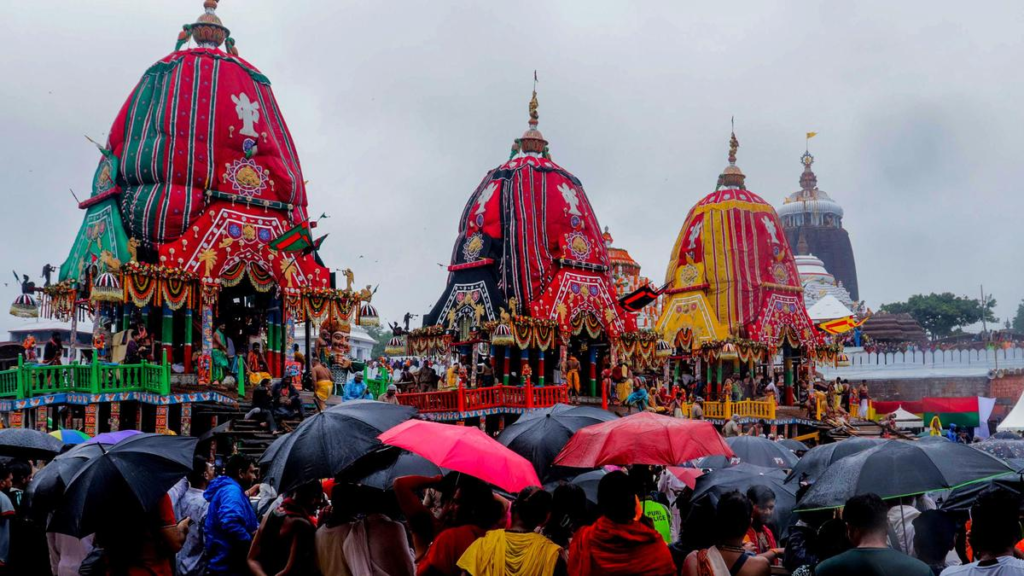
Origin and Antiquity
- Puranic and historical roots: textual descriptions appear in the Brahma Purana, Padma Purana, Skanda Purana and Kapila Samhita.
- European accounts: documented by European travellers since the 13th century, with detailed accounts from the 17th century onward.
- Annual occurrence: during the bright fortnight (Shukla Paksha) of the lunar month of Ashadha (June–July).
Key Features
Annual reconstruction of chariots. Three massive, distinct wooden chariots are newly built every year:
| Chariot | Deity |
|---|---|
| Nandighosha | Lord Jagannath |
| Taladhwaja | Lord Balabhadra |
| Darpadalana | Goddess Subhadra |
- Built from specific timber types — Phassi and Dhausa — traditionally brought from the ex-princely state of Dasapalla along the Mahanadi River.
- Hereditary artisan guilds. Construction follows ancient architectural canons (Shilpa Shastras), executed by hereditary teams of carpenters (Maharanas), blacksmiths, painters and tailors.
- The divine procession. The deities are brought out of the 12th-century Jagannath Temple in the grand Pahandi Bije procession and placed on chariots aligned on the Bada Danda (Grand Avenue), where millions of devotees pull them to the Gundicha Temple.
Exam Relevance
UPSC — Prelims (GS-I, Art and Culture): the three chariots and their deities, the Ashadha timing, Gundicha and Mausi Maa temples, and — most importantly — the distinction between the 2003 ICH Convention and the 1972 World Heritage Convention, with India’s inscribed ICH elements. UPSC has asked directly about ICH elements before. Mains (GS-I): usable on cultural heritage as a resource for diplomacy and livelihoods, and on the argument that intangible heritage safeguarding protects craft communities and skills — the Maharana carpenters, weavers and painters — rather than merely a festival.
Banking/Finance
1. Taxation and Other Laws (Amendment) Bill, 2026
Source: BS
Context:
Parliament passed the Taxation and Other Laws (Amendment) Bill, 2026, replacing the Income-tax (Amendment) Ordinance, 2026 and amending the Income-tax Act, 2025, the Finance Act, 2026, and the Payment and Settlement Systems Act, 2007. The Bill seeks to attract foreign investment, promote Make in India, enhance ease of doing business, and strengthen India’s digital and financial ecosystem.
What It Is
An omnibus amending Bill introduced by Finance Minister Nirmala Sitharaman, using targeted tax exemptions to onshore four value chains — electronics manufacturing, diamond trading, cloud computing and fund management — while creating enabling power over charges on digital payments. The Lok Sabha passed it; the Rajya Sabha returned it, the procedure applicable to a Money Bill under Article 109.
Key Provisions
| Area | Provision |
|---|---|
| Electronics manufacturing | Tax holiday for foreign companies supplying capital goods or using Indian factories for contract manufacturing extended from 5 years to 15 years (up to 2040-41); eligible goods explicitly defined as mobile phones, laptops, servers, wearables |
| Diamonds and electronics storage | Exemption for eligible foreign diamond companies on rough diamond sales in notified special zones, and for income from storage of electronic components in customs bonded warehouses |
| Government securities | FIIs and the Bank for International Settlements exempted from income tax on interest and capital gains from G-secs |
| Foreign fund managers | Rules simplified to allow relocation to India without the foreign fund becoming taxable here, with safeguards against tax avoidance and round-tripping retained |
| Data centres | Removes multi-layered government approval requirements for foreign cloud companies claiming exemptions; allows Indian data centres to operate on a leased basis, not only direct ownership |
| REITs and InvITs | Restores tax-free dividend income for unit holders; raises surcharge on SPVs of business trusts from 10% to 25% |
| UPI / MDR | Amends the PSS Act, 2007 to empower the Central Government to permit banks and PSPs to levy charges on UPI and other notified electronic payment modes, replacing the existing prohibition |
The Tax Rates Displaced
Before the exemption, income of FIIs from government securities was taxed at:
| Head | Earlier rate |
|---|---|
| Interest income | 20% |
| Short-term capital gains | 30% |
| Long-term capital gains | 12.5% |
The exemption applies to income arising on or after 1 April 2026.
The UPI / MDR Question
- What the Bill does: creates the legal power for the Centre to permit charges. It does not itself impose any charge.
- The existing bar: banks and payment system providers are currently prohibited from levying any charge, directly or indirectly, on notified electronic payment modes, operating through Section 269SU of the Income-tax Act read with the PSS Act.
Exam Relevance
RBI Grade B — Highest-value item for Phase II Paper III. Master the MDR debate end to end: what MDR is, why it was zeroed, the sustainability problem for acquirers and PSPs, budgetary incentives as the current substitute, and the tiered-MDR proposal. Also note the FII exemption on G-secs for bond market development and global index inclusion, the fund manager provision for GIFT City and onshoring financial services, and REITs/InvITs for infrastructure financing.
2. RBI Monetary Policy — August 2026
Source: The Hindu
Context:
The Monetary Policy Committee voted unanimously on 5 August 2026 to keep the policy repo rate under the Liquidity Adjustment Facility unchanged at 5.25%, after assessing evolving macroeconomic and financial developments.
The Decision
| Parameter | Outcome |
|---|---|
| Repo rate | 5.25% — unchanged, unanimous (6-0) |
| Standing Deposit Facility (SDF) | 5.00% |
| Marginal Standing Facility (MSF) and Bank Rate | 5.50% |
| Stance | Neutral — continued |
| CPI inflation, FY27 | 5.0% (lowered 10 bps) — Q1 5.3%, Q2 4.7%, Q3 5.9%, Q4 5.5% |
| Real GDP growth, FY27 | Raised to 6.7% from 6.6% |
| Last rate revision | December 2025 |
| Next meeting | 5–7 October 2026 |
Background Concepts
Liquidity Adjustment Facility (LAF) — the RBI’s principal instrument for managing day-to-day liquidity in the banking system, operating through a corridor of rates:
| Rate | Function |
|---|---|
| SDF (5.00%) | Floor of the corridor. Banks park surplus funds with the RBI without collateral; introduced in April 2022, replacing the fixed reverse repo as the effective floor |
| Repo (5.25%) | The policy rate. Rate at which the RBI lends to banks against government securities for short periods |
| MSF (5.50%) | Ceiling of the corridor. Banks borrow overnight beyond their normal limits, dipping into the SLR portfolio |
| Bank Rate (5.50%) | Rate for RBI’s long-term lending, without collateral; aligned to MSF and used for penal purposes |
The corridor is symmetric — 25 basis points on either side of the repo rate. Its width signals how tightly the RBI wants to anchor overnight money market rates; a narrower corridor means tighter control.
Policy stance — the forward guidance signal, distinct from the rate itself:
- Accommodative — bias toward easing, supporting growth.
- Neutral — no directional bias; the MPC may move either way as data evolves.
- Withdrawal of accommodation / Tightening — bias toward raising rates or draining liquidity.
Practice MCQs
Q1. With reference to the Monetary Policy Committee decision of August 2026, consider the following statements:
- The Committee unanimously decided to keep the policy repo rate unchanged at 5.25 per cent.
- It decided to continue with the neutral policy stance.
- The Standing Deposit Facility rate stood at 5 per cent, while the Marginal Standing Facility rate and the Bank Rate stood at 5.5 per cent.
- The policy repo rate is fixed under the Liquidity Adjustment Facility.
How many of the above statements are correct? (a) Only one (b) Only two (c) Only three (d) All four (e) None
Q2. With reference to the liquidity adjustment facility corridor, consider the following statements:
- The Standing Deposit Facility rate forms the floor of the corridor.
- Under the Standing Deposit Facility, banks park surplus funds with the Reserve Bank without providing collateral.
- The Marginal Standing Facility rate forms the ceiling of the corridor.
- The repo rate is the rate at which the Reserve Bank lends to banks against government securities.
How many of the above statements are correct? (a) Only one (b) Only two (c) Only three (d) All four (e) None
Answer Key
- (d) — All four are correct. The unanimity of the vote and the retention of the neutral stance indicate that the pause reflected shared judgement rather than a divided committee.
- (d) — All four are correct. The key distinction is collateral: the SDF is uncollateralised, whereas the repo and MSF involve government securities — the MSF specifically allowing banks to dip into their SLR holdings.
Exam Relevance
RBI Grade B — Highest-priority current-affairs item. Expect direct questions on the August 2026 numbers and descriptive questions on monetary policy transmission, the neutral stance and managing external shocks. Master the statutory scaffolding: Section 45ZB (constitution), 45ZA (target), 45ZN (failure report), and the corridor mechanics. The strongest analytical themes are (i) why monetary policy is a blunt instrument against supply shocks; (ii) the rupee–capital flows–US yields channel; and (iii) the “neither dovish nor hawkish” framing as an articulation of what a neutral stance means in practice.
3. RBI to Resume Licensing of Urban Cooperative Banks
Source: The Hindu
Context:
Announced alongside the August 2026 monetary policy, the RBI will resume licensing of Urban Cooperative Banks (UCBs) on an “on tap” basis after a pause of more than two decades, as part of developing a vibrant cooperative sector. Governor Sanjay Malhotra said draft guidelines would be issued shortly for stakeholder consultation.
What It Is
Three developmental and regulatory measures announced alongside the monetary policy:
1. On-tap licensing of UCBs
- A discussion paper on Licensing of UCBs was published on 13 January 2026 for stakeholder feedback; the decision follows that feedback.
- There are 1,457 urban cooperative banks as per RBI and NABARD.
- Fresh UCB licensing had been paused since 2004, following governance failures and bank collapses in the sector.
- “On tap” means the application window stays continuously open — applicants may apply at any time rather than only in specific rounds. The RBI already follows this for universal banks and small finance banks.
Indicative eligibility criteria proposed in the draft for credit cooperative societies seeking conversion:
| Criterion | Threshold |
|---|---|
| Minimum deposit base | ₹10,000 crore |
| Minimum net worth | ₹300 crore |
| Years in existence | At least 10 years |
| CRAR | At least 12% |
| Net NPA ratio | Not more than 3% |
| Registration | Multi-State Co-operative Societies Act, 2002 |
Multi-state societies will be considered first; select uni-state societies with a wider footprint may follow. No member may hold more than 5% of share capital; directors may not hold executive positions. Applications will be made through the RBI’s PRAVAAH portal; in-principle approval is valid for 18 months.
2. Review of concentration risk norms for RCBs
- Currently governed by the Credit Monitoring Arrangement (CMA) instructions of 2008.
- The banking sector generally, and cooperative banking in particular, have expanded and changed significantly over 18 years, requiring a fresh look at prudential norms.
- Objective: develop a vibrant cooperative sector while addressing prudential concerns arising from concentrated lending.
- Draft amendment directions to be issued for wider consultation.
Background: Cooperative Banking Structure
| Tier | Institutions |
|---|---|
| Urban Cooperative Banks | Single-state and multi-state; urban and semi-urban areas |
| Rural Cooperative Banks (short-term) | State Cooperative Banks → District Central Cooperative Banks → Primary Agricultural Credit Societies |
| Rural Cooperative Banks (long-term) | State and Primary Cooperative Agriculture and Rural Development Banks |
- Dual regulation: the RBI regulates banking functions under the Banking Regulation Act, 1949; incorporation, management and audit rest with the Registrar of Cooperative Societies (State) or the Central Registrar (multi-state).
- The Banking Regulation (Amendment) Act, 2020 expanded RBI powers over cooperative banks after the PMC Bank crisis.
- DICGC deposit insurance of ₹5 lakh per depositor per bank covers cooperative banks.
- NABARD supervises State Cooperative Banks and District Central Cooperative Banks.
Exam Relevance
NABARD Grade A — Very high relevance. NABARD supervises State Cooperative Banks and District Central Cooperative Banks, and the review of concentration risk norms for RCBs falls squarely in its domain. Know the CMA instructions of 2008, the rural cooperative structure, PACS computerisation, and NABARD’s refinance role. Expect direct questions on the UCB count (1,457) and on the RCB concentration-risk review.
RBI Grade B — Highest-priority item alongside the policy decision itself.
Agriculture
1. Framework for Fertilizer Sale (FFS)
Source: Business Standard
Context:
A new digital platform for transparent and farmer-centric fertiliser distribution has been implemented on a pilot basis in 56 districts across 23 states, Minister of State for Chemicals and Fertilisers Anupriya Patel informed the Rajya Sabha on 4 August 2026 in a written reply. The pilot has expanded rapidly — it covered 40 districts across 20 states as of late July 2026.
What It Is
The “Framework for Fertilizer Sale” (FFS) is jointly developed by the Ministry of Chemicals and Fertilisers (Department of Fertilizers) and the Ministry of Agriculture and Farmers Welfare, with the consent of state governments, and rolled out in a staggered pilot manner.
Objective: to make fertiliser distribution more transparent, organised, farmer-centric, land- and crop-data integrated, and demand-driven.
How It Works
- Registration — the farmer or an authorised representative registers through a mobile application, entering land and crop details.
- Pre-booking — advance booking of fertiliser requirements against those details.
- Token generation — a QR code-based token is generated on successful booking.
- Retail verification — the retailer scans the QR code through a Point of Sale (PoS) machine.
- Distribution — fertiliser is released after Aadhaar-based biometric authentication, per existing procedure.
Supporting Digital Infrastructure
- Integrated Fertilizer Management System (iFMS) — an online platform for real-time monitoring and management of fertiliser movement across the country, tracking dispatches, allocation, rake placement, stock position and state-wise supply status by states and stakeholders. FFS purchase reports feed into iFMS dashboards.
- AgriStack / Farmer Registry — a registry of about 102.8 million (10.28 crore) farmer IDs is being integrated with PM-KISAN, the Jan Samarth platform for Kisan Credit Card loans, and MSP-based crop procurement systems.
Exam Relevance
NABARD Grade A — Very high relevance for Phase II Paper II. Know the DBT mechanics, the 2025-26 figures (746.57 LMT, 8.4 crore farmers, 2.87 lakh retailers, ₹2.17 lakh crore subsidy), the 50-bag limit and state variations, and AgriStack’s three registries (farmer registry, geo-referenced village maps, crop-sown registry). The Jan Samarth–KCC linkage is directly relevant to NABARD’s credit mandate, as is the exclusion risk for tenant farmers — connect to Joint Liability Groups as the standard workaround for landless cultivators.
2. BIOFACH INDIA 2026
Source: PIB
Context:
The Agricultural and Processed Food Products Export Development Authority (APEDA), under the Ministry of Commerce & Industry, in collaboration with Nuernberg Messe India, is organising BIOFACH INDIA 2026 from 6–8 August 2026 at the India Expo Centre & Mart, Greater Noida, Delhi-NCR — a platform for trade, knowledge exchange and business networking across the organic, natural and sustainable food sectors.
Key Features
- 200+ exhibitors, including 60+ under APEDA Pavilion — exporters, women entrepreneurs, FPOs/FPCs, startups and organic enterprises.
- Organic products: cereals, pulses, millets, spices, tea, coffee, fruits, vegetables, processed foods, medicinal plants, honey, edible oils and nutraceuticals.
- 35+ international buyers from 13 countries, including Taiwan, Japan, South Korea, Australia and Egypt, through Buyer-Seller Meets.
- Technical sessions on organic certification, traceability, sustainability, market access and international quality standards.
About APEDA
- Established under the Agricultural and Processed Food Products Export Development Authority Act, 1985, functioning under the Ministry of Commerce & Industry; headquartered in New Delhi.
- Mandated to develop and promote exports of scheduled products — fruits and vegetables, meat and poultry, dairy, confectionery, cereals, floriculture, herbal and medicinal plants, and organic products.
- Note: basmati rice is under APEDA; spices are handled by the Spices Board, tea by the Tea Board, coffee by the Coffee Board, and marine products by MPEDA.
- APEDA is the National Accreditation Body under the National Programme for Organic Production (NPOP).
Background: India’s Organic Ecosystem
Certification systems
| System | Scope |
|---|---|
| NPOP (National Programme for Organic Production) | Third-party certification for exports; implemented by APEDA; recognised as equivalent by the EU, Switzerland and others |
| PGS-India (Participatory Guarantee System) | Peer-appraisal-based certification for domestic markets and small farmers; under the Ministry of Agriculture |
| Jaivik Bharat | The unified organic logo of FSSAI, which regulates organic food sold domestically |
- Supporting schemes: the Paramparagat Krishi Vikas Yojana (PKVY) and the Mission Organic Value Chain Development for North Eastern Region (MOVCDNER) — the latter explaining the strong North-East presence at the event, and why the DoNER Secretary was Chief Guest.
- India’s position: the country has the largest number of organic producers in the world, though a relatively modest share of global organic area. Sikkim is the world’s first fully organic State (2016). Major organic exports include organic soybean, rice, oilseeds, cereals, millets, medicinal plants, tea, spices and processed foods, with the United States and European Union as principal destinations.
- IFOAM – Organics International is the global umbrella body for the organic movement, founded in 1972 and headquartered in Bonn, Germany.
Facts To Remember
1. Tata Sons Continues as Upper-Layer NBFC
RBI Governor Sanjay Malhotra indicated that Tata Sons, the holding company of the Tata Group, will continue to be classified as an Upper-Layer NBFC under RBI’s principle-based regulatory framework.
2. DSC A24 Launched as India’s Fifth Diving Support Craft
The Indian Navy launched DSC A24, the fifth and final Diving Support Craft, at Titagarh, Kolkata. Built by Titagarh Rail Systems Limited, the catamaran-hulled vessel has around 70% indigenous content and will support diving, salvage and coastal operations.
3. PM Modi Inaugurates Development Projects Worth ₹17,900 Crore in Andhra Pradesh
Prime Minister Narendra Modi visited Andhra Pradesh and Karnataka on 1 August 2026. In Andhra Pradesh, he inaugurated and launched projects worth over ₹17,900 crore covering aviation, semiconductors, renewable energy, power transmission, roads and youth development.
4. CCI Launches ‘Kapas Darshan’ Bulletin on 56th Foundation Day
Union Minister Giriraj Singh launched the Kapas Darshan Bulletin during the 56th Foundation Day of the Cotton Corporation of India. The event also highlighted the ₹5,659-crore Cotton Productivity Mission–Kapas Kanti and saw the signing of four MoUs to improve cotton quality, traceability and market access.
5. REC and PFC Sign ₹26,850 Crore Loan Agreement for Meja Power Project
REC Limited and Power Finance Corporation signed a ₹26,850-crore common loan agreement with Meja Urja Nigam for the expansion of the Meja Thermal Power Project in Uttar Pradesh. The project will add 2,400 MW through three 800-MW ultra-supercritical units.
6. SEBI Extends Digital Accessibility Audit Deadline to October 2026
SEBI extended the deadline for regulated entities to complete digital accessibility audits and remediation to 31 October 2026. It also introduced the GARUDA framework to streamline the processing of Alternative Investment Fund placement memorandums.
7. SBI Research Projects Around 7% GDP Growth in Q1 FY27
SBI Research projected India’s GDP growth at around 7% in Q1 FY27, above the RBI’s 6.6% projection. The estimate was supported by stronger vehicle sales, electricity demand, exports and industrial activity.
8. Gujarat’s Pithora Painting Receives GI Tag
The Geographical Indications Registry granted a GI tag to Gujarat’s traditional Pithora Painting, associated with the Rathwa, Bhil, Bhilala and Nayaka communities. The tribal art form traditionally uses natural colours and features horses representing gods, ancestors and nature.
9. K. Rajaraman’s Tenure as IFSCA Chairman Extended Till 2028
The Government extended K. Rajaraman’s tenure as Chairperson of the International Financial Services Centres Authority until 24 October 2028. He is a retired 1989-batch IAS officer and became IFSCA’s first full-time Chairperson in 2023.
10. Vice Admiral AN Pramod Assumes Charge as Deputy Chief of Naval Staff
Vice Admiral AN Pramod assumed charge as Deputy Chief of Naval Staff, succeeding Vice Admiral Tarun Sobti. A communication and electronic warfare specialist, he previously served as Director General Naval Operations and received the AVSM and YSM.
11. Indian Navy Launches DSC A24, Fifth and Final Diving Support Craft
The Indian Navy launched DSC A24, the fifth and final vessel under the Diving Support Craft project at Titagarh, Kolkata. The indigenously built vessel features a twin-hull catamaran design, approximately 300–400 tonnes displacement and around 70% indigenous content.
12. New Catfish Species ‘Pseudolaguvia khairii’ Discovered in Odisha
A new freshwater catfish species, Pseudolaguvia khairii, was discovered in the Budhabalanga River of Odisha’s Mayurbhanj district. It was named after Khairi, the famous Royal Bengal tigress of Similipal Tiger Reserve.
13. India Finishes Fourth at 2026 Commonwealth Games with 39 Medals
India finished fourth at the 2026 Commonwealth Games in Glasgow with 39 medals, including 13 gold, 17 silver and 9 bronze. Australia topped the medal table with 171 medals, followed by England and Canada.
14. Nirmal Purja Dies in Avalanche on Broad Peak
Renowned Nepali-British mountaineer Nirmal Purja died in an avalanche on Broad Peak in Pakistan. He was famous for completing all 14 eight-thousanders in 6 months and 6 days under Project Possible 14/7 in 2019.
15. Indian Organ Donation Day Observed on August 3
Indian Organ Donation Day was observed on 3 August to raise awareness about organ and tissue donation. In 2026, the government launched the ‘Jug Jug Jiyo’ campaign, e-Pratyaropan platform and NOTTO mobile application.
16. World Breastfeeding Week 2026 Observed from August 1–7
World Breastfeeding Week was observed from 1–7 August 2026 to promote breastfeeding and support systems for mothers. The 2026 theme was “Breastfeeding for a sustainable start in life: strengthen what works.”
17. Andhra Pradesh and Australia Sign Four MoUs
Andhra Pradesh and Australia signed four MoUs to strengthen cooperation in clean energy, advanced manufacturing, inclusive education, student mental health and skill development. The agreements include a partnership to establish a Centre of Excellence for Solar Manufacturing at IIT Tirupati.
Got it. Starting from Sl. No. 1 and keeping exactly the concise format you want:
18. Cabinet Approves GOBARdhan Scheme with ₹23,731 Crore Outlay
The Union Cabinet approved the GOBARdhan – National Circular Bioenergy Scheme with a total outlay of ₹23,731 crore. The scheme aims to promote clean energy, strengthen the rural economy and create around 1.5 lakh jobs through the conversion of organic waste into bioenergy.
19. India Successfully Test-Fires Agni-4 Ballistic Missile
India successfully test-fired the Agni-4 medium-range ballistic missile from the Integrated Test Range at Chandipur, Odisha. The Defence Ministry stated that the launch successfully validated the missile’s operational and technical parameters, strengthening India’s strategic defence capabilities.
20. Lok Sabha Passes Bankers’ Books Evidence Bill, 2026
The Lok Sabha passed the Bankers’ Books Evidence Bill, 2026, which seeks to modernise the legal framework governing evidence related to bankers’ books. The Bill provides for the recognition and use of electronic and digital records of banking transactions as evidence.
21. India Launches Clouded Leopard Conservation Action Plan
On International Clouded Leopard Day, India launched a dedicated Clouded Leopard Conservation Action Plan to strengthen the protection of this elusive wild cat. The initiative focuses on habitat conservation, scientific monitoring and coordinated efforts to protect clouded leopard populations.
22. 4th Tri-Services Future Warfare Course Begins in New Delhi
The 4th edition of the Tri-Services Future Warfare Course commenced in New Delhi under the Headquarters Integrated Defence Staff. The four-week course brings together officers from the three armed forces to develop a deeper understanding of future warfare, emerging technologies and joint military operations.
23. India Wins 39 Medals at Glasgow Commonwealth Games 2026
India finished the 2026 Commonwealth Games with 39 medals, including 13 gold, 17 silver and 9 bronze, securing fourth position in the overall medal tally. Glasgow also formally handed over the Commonwealth Games baton to India, which will host the 2030 edition in Ahmedabad.
24. SBI Research Projects Around 7% GDP Growth in Q1 FY27
SBI Research projected that India’s economy could grow by around 7% in Q1 FY27, supported by stronger high-frequency indicators, improved industrial activity and a recovery in exports. The estimate is higher than the RBI’s earlier 6.6% projection for the quarter.
25. Air Marshal Tejpal Singh Takes Charge as Deputy Chief of Air Staff
Air Marshal Tejpal Singh assumed charge as the Deputy Chief of the Air Staff (DCAS) of the Indian Air Force. His appointment comes as part of the IAF’s senior leadership transition and strengthening of its operational and strategic capabilities.
26. Army Chief Launches Indigenous Xtreme Weather Grade Diesel
Chief of Army Staff General Dhiraj Seth launched indigenously developed Xtreme Weather Grade (XWG) Diesel in New Delhi. Developed jointly by the Indian Army and oil marketing companies, the specialised fuel is designed to improve the mobility, safety and operational readiness of military vehicles in extreme weather conditions.
07 & 08 August, 2026
Context:
NITI Aayog released a report titled “Reimagining Care: Strategies for Empowering Caregivers in Viksit Bharat@2047.”
Who Are Caregivers
Per the WHO definition adopted in the report, caregivers are individuals who provide physical, emotional and social support to people who cannot independently perform activities of daily living due to age, chronic illness or disability.
| Type | Description |
|---|---|
| Formal caregivers | Trained professionals — personal care aides, home health aides, geriatric assistants — delivering non-medical or clinical support in homes, hospitals or institutions for remuneration |
| Informal caregivers | Family members, friends or community volunteers providing unpaid, non-formal long-term care |
The Indian Landscape
| Indicator | Figure |
|---|---|
| Elderly population (60+) | 149 million (10.5%) in 2022 → projected 347 million (20.8%) by 2050 |
| Persons with disabilities | Over 26.8 million (2.21%), with 21 benchmark disability categories under the RPwD Act, 2016 |
| Unpaid care time (Time Use Survey) | Women 299 minutes/day against men’s 97 minutes/day |
| Care services market | USD 29.62 billion (2023) → USD 72.31 billion by 2030, at a CAGR of 13.76% |
The demographic point: India’s elderly share doubles from about 10% to 21% within a single generation. Countries that aged at this pace — Japan, China — did so at far higher per capita income. India will face a large long-term care burden before it becomes rich enough to fund it institutionally.
Types of Caregivers in India
- Family-based informal caregivers — relatives providing unpaid assistance within households; traditionally the backbone of India’s social fabric.
- Community-based informal caregivers — local volunteers, extended kin and Self-Help Groups, such as Kudumbashree’s K4 Care and Kerala’s Neighbourhood Network in Palliative Care.
- Institutional formal caregivers — trained staff in old-age homes, rehabilitation centres and hospital geriatric wards.
- Home-based and specialised palliative caregivers — paid professionals providing bedside assistance, dementia support and chronic illness management at the patient’s residence.
2. Vehicle-to-Vehicle (V2V) Technology
Source: Business Standard
Context: The Ministry of Road Transport and Highways (MoRTH) issued a draft notification proposing amendments to the Central Motor Vehicles Rules, 1989, to introduce Vehicle-to-Vehicle communication technology in Indian vehicles.
What It Is
- An advanced wireless communication framework enabling nearby motor vehicles to continuously broadcast and receive real-time data on speed, location, direction, acceleration and braking status.
- Unlike traditional sensors — cameras and radar — which require a direct line of sight, V2V enables proactive accident prevention by warning drivers about hazards beyond their visual range.
- Aim: to reduce road fatalities and accidents by complementing existing Advanced Driver Assistance Systems (ADAS), expanding situational awareness, and building a foundation for broader Intelligent Transportation Systems (ITS).
How It Works
- On-Board Units (OBUs): factory-fitted units continuously transmit low-latency data packets containing GPS coordinates, velocity, trajectory and status alerts.
- Peer-to-peer data mesh: transmissions occur directly between nearby vehicles within a range of several hundred metres, without relying on cellular towers or cloud servers.
- Real-time risk computation: an onboard processor analyses received data against the host vehicle’s own vector, calculating collision risk within milliseconds and triggering visual, audio or haptic warnings before the hazard is visible.
3. The Clouded Leopard
Source: News on Air
Context: On International Clouded Leopard Day (observed 4 August), the Ministry of Environment, Forest and Climate Change launched the Clouded Leopard Conservation Action Plan (CAP).
About the Conservation Action Plan
- A comprehensive, multi-state strategic framework to secure habitats, restore ecological corridors, standardise population assessments, and empower local communities for the species’ long-term survival in India.
- Aim: to halt population decline, protect critical forest landscapes across Northeast India, establish reliable population baselines through advanced science, and mitigate human-wildlife conflict outside formal protected areas.
About the Species
The Clouded Leopard (Neofelis nebulosa) is an evolutionarily ancient, medium-sized wild cat bridging the gap between big cats (Panthera) and small cats (Felinae). Molecular research suggests it branched from the Pantherinae lineage over 6 million years ago, making it one of the most ancient living feline species.
Distribution and habitat
- Found from Nepal, Bhutan, Bangladesh and Northeast India through Southeast Asia (Indochina, Sumatra, Borneo) to southern China.
- Prefers lowland dense tropical rainforest, but adapts to dry woodlands, mangrove swamps (in Borneo), and Himalayan foothill forests up to 2,743 metres.
Conservation and legal status
| Framework | Status |
|---|---|
| IUCN Red List | Vulnerable |
| Wild Life (Protection) Act, 1972 | Schedule I |
| CITES | Appendix I |
4. India at the Commonwealth Games 2026
Context: India concluded its Commonwealth Games 2026 campaign in Glasgow, Scotland, with a tally of 39 medals, finishing fourth overall.
About the Games
| Detail | Particulars |
|---|---|
| Edition | 23rd Commonwealth Games |
| Host | Glasgow, Scotland |
| Dates | 23 July – 2 August 2026 |
| Mascot | Finnie |
| Indian contingent | 122 athletes across 10 sports |
| Opening ceremony flag-bearer | Mirabai Chanu; baton-bearer Lovlina Borgohain |
| Closing ceremony flag-bearer | Jaismine Lamboria |
| Host for 2030 | Ahmedabad, Gujarat, India |
India’s Medal Tally
| Medal | Count |
|---|---|
| Gold | 13 |
| Silver | 17 |
| Bronze | 9 |
| Total | 39 — ranked 4th |
Sport-wise breakdown
| Sport | Gold | Silver | Bronze | Total |
|---|---|---|---|---|
| Boxing | 7 | 3 | 0 | 10 |
| Athletics | 0 | 5 | 5 | 10 |
| Weightlifting | 1 | 6 | 1 | 8 |
| Para Athletics | 3 | 2 | 1 | 6 |
| Judo | 2 | 1 | 1 | 4 |
| Para Powerlifting | 0 | 0 | 1 | 1 |
Note: some circulating tables give Para Athletics 2 golds and Athletics 7 silvers — the correct figures are Para Athletics 3 golds and Athletics 5 silvers and 5 bronzes.
India’s Gold Medallists
| Athlete | Event |
|---|---|
| Mirabai Chanu | Women’s 48 kg Weightlifting — a historic hat-trick of CWG golds |
| Preeti Pawar | Women’s 54 kg Boxing |
| Jaismine Lamboria | Women’s 57 kg Boxing |
| Sakshi Chaudhary | Women’s 51 kg Boxing |
| Priya Ghanghas | Women’s 60 kg Boxing |
| Arundhati Choudhary | Women’s 70 kg Boxing |
| Sachin Siwach | Men’s 60 kg Boxing |
| Ankush Panghal | Men’s 80 kg Boxing |
| Dilip Gavit | Men’s 100 m T47 Para Athletics |
| Soman Rana | Men’s Shot Put F57 Para Athletics |
| Sharmila Dhankar | Women’s Shot Put F57 Para Athletics |
| Asmita Dey | Women’s -48 kg Judo — first-ever individual judo gold |
| Harsh Singh | Men’s -60 kg Judo |
Records and Context
- Boxing delivered a record 10 medals including seven golds — the most won by any nation in the sport at a single Commonwealth Games.
- India recorded its best-ever judo performance at a single Games — three medals including its first-ever judo gold.
- Lovlina Borgohain, the Olympic medallist, added silver in the women’s 75 kg boxing category.
5. GOBARdhan — National Circular Bioenergy Scheme
Source: PIB
Context: The Union Cabinet approved the National Circular Bioenergy Scheme – GOBARdhan, with an outlay of ₹23,731 crore, to catalyse the growth of compressed biogas (CBG).
What It Is
GOBARdhan — Galvanising Organic Bio-Agro Resources Dhan — a scheme to raise domestic CBG production almost tenfold through assured offtake, administered pricing, capital subsidies, pipeline infrastructure and easier access to finance.
| Parameter | Detail |
|---|---|
| Outlay | ₹23,731 crore |
| Period | FY 2026-27 to FY 2035-36 |
| Administering Ministry | Petroleum and Natural Gas |
| Feedstock | Agricultural residue, cattle dung, sugar industry press mud, municipal organic waste and other biomass |
| Output | CBG, blended into CNG (transport) and PNG (domestic); plus organic manure |
Origin: GOBARdhan was originally launched under the Swachh Bharat Mission (Grameen) in 2018 as a solid and liquid waste management component. It has now been recast as a national clean-energy and circular-economy programme.
Objective
- Convert cattle dung, agricultural residues and other organic waste into Compressed Biogas (CBG) and organic manure.
- Increase domestic CBG production by nearly 10 times.
- Reduce dependence on imported natural gas and strengthen energy security.
- Promote waste-to-wealth and a circular bioeconomy.
- Mobilise large-scale private investment and generate rural employment.
The Six Growth Engines
- Assured CBG offtake — procurement by City Gas Distribution entities.
- Stable, administered CBG pricing.
- Capital assistance for plants.
- Pipeline infrastructure development.
- Credit guarantee support.
- CBG Ecosystem Challenge Fund.
Banking/Finance
1. The Closing Auction Session (CAS)
Source: Times of India
Context: The Closing Auction Session was introduced by Indian stock exchanges for cash market stocks with derivatives, following SEBI’s directive of 16 January 2026. It became effective from 3 August 2026, launched simultaneously by the NSE and BSE.
What It Is
- A dedicated 20-minute daily auction mechanism in the cash market segment for equity stocks on which derivative (F&O) contracts are available. Instead of computing closing prices through continuous trade averages, CAS aggregates buy and sell orders to discover a single, fair equilibrium closing price.
- Aim: to curb end-of-day price manipulation, improve price discovery, align Indian equity markets with global best practices, and deliver more accurate benchmark values for mutual funds, ETFs and derivatives settlement.
How It Works
| Phase | Timing | What happens |
|---|---|---|
| Phase 1 — Transition and Reference Price | 3:15 – 3:20 PM | Continuous trading ends for eligible F&O stocks. A reference price is computed from the VWAP of trades between 3:00 and 3:15 PM, with a strict ±3% price band |
| Phase 2 — Order Entry | 3:20 – 3:30 PM | 3:20–3:25 PM: market and limit orders may be placed, modified or cancelled. 3:25–3:30 PM: only limit orders accepted; market orders cannot be altered or cancelled. The window closes at a random time between 3:28 and 3:30 PM to prevent order spoofing |
| Phase 3 — Order Matching and Price Discovery | 3:30 – 3:35 PM | Orders matched at a single equilibrium price maximising executable volume; market orders get execution priority over limit orders |
2. Licensing of Urban Cooperative Banks
Source: BS
Context:
The Reserve Bank of India (RBI) is set to resume licensing of urban cooperative banks (UCBs), after a pause of more than two decades, as part of developing a vibrant co-operative sector.
The Legal Basis
Licensing of UCBs is the regulatory authorisation granted by the RBI under Section 22 read with Section 56 of the Banking Regulation Act, 1949. It empowers primary cooperative credit societies to conduct banking — accepting public deposits and granting credit — in urban and semi-urban areas.
Section 56 is the provision that applies the Banking Regulation Act to cooperative societies with modifications.
Regulatory Timeline
| Year | Development |
|---|---|
| 1966 | UCBs brought under RBI’s regulatory ambit via amendments to the BR Act |
| May 1993 – June 2001 | Liberalised licensing era — over 820 new UCB licences issued |
| 2004 | RBI suspended new UCB licensing following widespread failures |
| January 2026 | RBI released a comprehensive Discussion Paper on reopening licensing |
| August 2026 | Governor announced draft guidelines for on-tap licensing based on stakeholder feedback |
Why Licensing Was Halted in 2004
- Widespread insolvency: nearly 31% of UCBs licensed during the 1990s liberalisation turned financially unsound within a short period, owing to poor credit appraisal and rapid unviable expansion.
- Governance failures and frauds: the Madhavpura Mercantile Cooperative Bank crisis (2001) — linked to the Ketan Parekh stock scam — exposed severe corporate governance deficits, conflict of interest and insider lending.
- Dual regulation gaps: banking operations were supervised by the RBI while administrative and managerial oversight rested with State Registrars of Cooperative Societies, creating enforcement delays and supervisory loopholes.
Why a Restart Is Now Feasible
- Strengthened statutory powers: the Banking Regulation (Amendment) Act, 2020 gave the RBI direct powers over UCB management, board constitution and resolution — effectively closing the dual-regulation loophole.
- Four-tier prudential framework: deposit-based tiered regulatory standards (Tiers 1 to 4) in force since December 2022, ensuring calibrated risk oversight.
- Improved sector balance sheets: gross NPAs of UCBs fell to a six-year low of ₹21,769 crore in FY26, with higher provisioning coverage ratios and capital buffers.
- Institutional backing: the National Urban Cooperative Finance and Development Corporation (NUCFDC), established in 2024, offers shared technology platforms, liquidity support and capital mobilisation for UCBs.
Practice MCQs
Q1. With reference to the licensing of Urban Cooperative Banks, consider the following statements:
a. Licensing is granted under Section 22 read with Section 56 of the Banking Regulation Act, 1949.
b. UCBs were brought under the RBI’s regulatory ambit in 1966.
c. Over 820 new UCB licences were issued between 1993 and 2001.
d. The RBI suspended fresh UCB licensing in 2004.
How many of the above statements are correct? (a) Only one (b) Only two (c) Only three (d) All four (e) None
Answer Key
- (d) — All four are correct. Section 56 is the key provision — it applies the Banking Regulation Act to cooperative societies with modifications.
Exam Relevance
RBI Grade B — Very high relevance. Master the four-tier framework (Tier 1: deposits up to ₹100 crore; Tier 2: ₹100–1,000 crore; Tier 3: ₹1,000–10,000 crore; Tier 4: above ₹10,000 crore), the 2020 Amendment’s specific powers, NUCFDC’s role, and the Madhavpura episode as the reference failure.
3. The Bankers’ Books Evidence Bill, 2026
Source: The Hindu
Context: The Lok Sabha passed the Bankers’ Books Evidence Bill, 2026 by voice vote amid Opposition protests. Introduced by the Finance Minister on 3 August 2026, it replaces the 135-year-old colonial-era Bankers’ Books Evidence Act, 1891, aligning legal evidence standards with modern digital, virtual and cloud-based banking.
What It Is
- A framework regulating how bank records are admitted as valid evidence in legal proceedings. It allows certified physical and electronic extracts of bank records to be presented in court without requiring original ledgers or summoning bank officials as routine witnesses.
- Aim: to modernise India’s banking evidence law, incorporate technology-neutral provisions for digital records, speed up judicial proceedings in financial disputes, and reduce operational burdens on banking personnel.
Key Features
- Expanded definition of “bankers’ books” — broadened beyond paper ledgers to cover all record formats, including electronic, digital, virtual and cloud-based databases.
- Admissibility and integrity conditions for electronic records — enforceable provided they:
- are a true representation of the data,
- show no unauthorised data changes, and
- reflect no system tampering.
- Standardised digital certification — electronic records submitted to courts must carry a technical certificate detailing the generating computer system, authenticated by manual or digital signatures of designated branch or office heads.
- Protection against compulsory court attendance — bank officers cannot be compelled to produce original books or appear as witnesses where the bank is not a party, unless ordered by a judge for a strictly defined special cause.
- Power to extend coverage — empowers the Central Government to extend the Act to other financial sector institutions by notification.
3. RBI’s Draft Framework on Credit Valuation Adjustment Risk
Source: Business Standard
Context: The Reserve Bank of India has proposed a revised framework governing how commercial banks must set aside capital against the risk of losses on their derivative trades, replacing rules in place since 2011. Comments have been invited until 28 August, with the rules proposed to take effect from 1 April 2027.
Applicability: all commercial banks, excluding small finance banks, payments banks and local area banks.
What CVA Is
Credit Valuation Adjustment (CVA) is an adjustment banks make to the price of a derivative contract to account for the possibility that the counterparty on the other side of the trade could default. The capital charge ensures banks set aside enough capital to cover such potential losses.
In simple terms: if a bank enters a ten-year interest rate swap with a corporate, the swap may be worth money to the bank — but only if the corporate is still solvent when payment falls due. CVA is the value the bank subtracts to reflect that risk, and the CVA capital charge is the buffer held against the risk that this adjustment itself moves adversely as the counterparty’s credit quality deteriorates.
Why the Change
- The existing framework was based on Basel Committee on Banking Supervision (BCBS) standards issued in 2010.
- The BCBS has since revised its guidelines as part of the final Basel III framework, prompting the RBI to update its rules to align with global standards.
The Proposed Approach
Banks must use the Basic Approach for CVA (BA-CVA), with a choice between two versions:
| Version | Feature | Suited to |
|---|---|---|
| Reduced BA-CVA | Does not recognise any hedges taken against CVA risk | Banks that do not hedge this risk |
| Full BA-CVA | Allows banks to factor in eligible hedges — such as single-name and index credit default swaps — provided they meet specific conditions linking the hedge to the counterparty | Banks that actively hedge CVA risk |
The Simplified Treatment for Smaller Books
- Banks whose aggregate notional amount of non-centrally cleared derivatives is ₹10 trillion or less may skip the BA-CVA computation altogether.
- Instead, they may set their CVA capital requirement equal to 100% of their capital requirement for counterparty credit risk.
- Such banks cannot recognise any CVA hedges under this simpler treatment.
- The RBI’s supervisory arm can deny a bank this option if it finds the bank’s CVA risk material to its overall risk profile.
Background Concepts
- Derivative: a contract whose value derives from an underlying asset, rate or index — interest rate swaps, currency forwards, credit default swaps.
- Counterparty credit risk: the risk that the other party to a derivative defaults before final settlement. Distinct from ordinary credit risk because the exposure varies with market movements and can be positive or negative.
- Central clearing: trades routed through a central counterparty (in India, the Clearing Corporation of India Ltd) are far less risky, since the CCP guarantees performance. This is why the ₹10 trillion threshold applies specifically to non-centrally cleared derivatives — those are where CVA risk actually resides.
- Credit default swap (CDS): a contract that pays out if a specified entity defaults — effectively insurance against counterparty failure, and hence an eligible CVA hedge.
- Basel III: the post-2008 global regulatory framework covering capital adequacy, leverage and liquidity, issued by the BCBS, which is hosted by the Bank for International Settlements at Basel.
Exam Relevance
RBI Grade B — Very high relevance for Phase II Paper III. This is core prudential regulation and precisely the technical territory RBI papers reward.
4. RBI’s NBFC Upper Layer List 2026-27
Source: The Hindu
Context: The Reserve Bank of India released a list of 17 large (Upper Layer) non-banking finance companies for 2026-27, which included Tata Sons — subjecting them to enhanced regulatory norms for at least five years and mandatory listing within three years of identification. The RBI added that Tata Sons’ status “is without prejudice to the outcome of its application for de-registration, which is under examination.”
Scale-Based Regulation
Scale-Based Regulation (SBR) is a regulatory approach in which financial institutions are regulated according to their size, complexity, interconnectedness and risk profile, rather than applying identical rules to every institution.
Under the RBI’s Scale Based Regulation (SBR) framework, NBFCs are placed in four layers, with regulatory intensity rising by size, activity and perceived risk.
| Layer | Composition |
|---|---|
| Base Layer (NBFC-BL) | Smaller, non-deposit-taking NBFCs below the asset threshold |
| Middle Layer (NBFC-ML) | Deposit-taking NBFCs, HFCs, IFCs, IDFs, SPDs and larger non-deposit-taking NBFCs |
| Upper Layer (NBFC-UL) | NBFCs specifically identified annually by the RBI as warranting enhanced regulatory requirements |
| Top Layer (NBFC-TL) | Ordinarily empty; populated only if the RBI judges a substantial increase in systemic risk from specific UL NBFCs |
Consequences of UL classification
- Enhanced regulatory norms for a minimum of five years, even if the NBFC later falls below the parametric benchmarks.
- Mandatory listing within three years of identification.
- Additional requirements including a Common Equity Tier 1 ratio, large exposure norms, differential provisioning, an independent compliance function, and internal capital adequacy assessment.
Agriculture
1. FarmerChat 2.0
Source: businessline
Context: Digital Green India launched an upgraded version of its FarmerChat app, even as the number of users of the AI-powered farming advisory app crossed 10 lakh, spanning farmers and frontline extension workers across the country.
What It Is
An AI-powered farming advisory application offering trusted, hyperlocal guidance to farmers, developed by Digital Green India. It provides timely, context-aware advice across a farmer’s decisions — from crop and pest management to livestock care and weather — even in low-connectivity environments.
Key Features
- Conversational interface — farmers can ask questions by voice, photo or text, accommodating low literacy and the reality that many field problems are easier to photograph than to name.
- Coverage across the farming cycle — crop planning, pest and disease management, livestock care, weather forecasts and inputs.
- Technology stack — fine-tuned language models combined with Retrieval-Augmented Generation (RAG) and expert-validated datasets, refined through Reinforcement Learning from Human Feedback (RLHF).
- What 2.0 adds — saves farmer preferences, such as speaking to the digital assistant or uploading photographs of field problems.
Exam Relevance
NABARD Grade A — High relevance for Phase II Paper II. Agricultural extension, digital agriculture and women’s participation in agriculture are core themes. Retain the figures (10 lakh users, 5 languages, 30 lakh queries, 45% women, ₹33 per farmer per year) and the extension-reach argument.
2. India’s First T2T Genome of Pigeonpea
Source: businessline
Context: The Indian Council of Agricultural Research announced that it has developed India’s first fully annotated telomere-to-telomere (T2T) reference genome of pigeonpea (Cajanus cajan L. Millsp.), variety ‘Asha’.
What It Is
A complete, gap-free genome sequence covering every chromosome from one telomere to the other, including the centromeres — as distinct from a draft genome, which leaves gaps in repetitive regions that older sequencing technology could not resolve.
| Parameter | Detail |
|---|---|
| Developed by | ICAR–National Institute for Plant Biotechnology (NIPB), New Delhi |
| Size | 752.65 million base pairs |
| Chromosomes covered | All 11, including centromeres and telomeres |
| Assembly designation | NIPB_CcT2T_4, deposited in the global database NCBI |
Why a T2T Genome Is Different
- A draft genome sequences the readable parts of the DNA and leaves gaps wherever the sequence becomes repetitive — precisely where centromeres and telomeres sit. Short-read sequencing cannot resolve long stretches of near-identical repeats.
- A T2T assembly closes those gaps, reading each chromosome continuously end to end. The 92 contigs for 11 chromosomes indicates near-complete chromosome-level assembly, and the 99.9% transcriptome read alignment is the accuracy check — nearly every RNA sequence maps cleanly onto the assembly.
- Why the gaps mattered: centromeric and repetitive regions govern chromosome segregation, recombination frequency and the behaviour of large gene families — including many disease-resistance genes, which cluster in repeat-rich regions. A breeder working from a draft was effectively blind in exactly the areas where stress-tolerance and resistance traits often reside.
The Institutional Track Record
- 2011 — ICAR–NIPB published the world’s first draft genome of pigeonpea variety ‘Asha’ — the first crop genome sequenced entirely in India.
- 2017 — an improved draft genome was published.
- Now — the fully annotated T2T assembly.
Why Pigeonpea Matters
Popularly known as Arhar or Tur, it is one of India’s most important pulse crops and a major source of dietary protein, central to food and nutritional security. India remains a net importer of pulses.
3. Proposed Central Law on Women Farmers’ Rights
Source: The Hindu
Context: The Union government is considering a separate legislation to protect the rights of women farmers, on the lines of the Maharashtra Women Farmers Empowerment Act, 2026, said S. Mahendra Dev, Chairman of the Economic Advisory Council to the Prime Minister, in Chennai. He was speaking at the inauguration of a conference on “Building Gender-just Food, Land and Water Systems” at the M.S. Swaminathan Research Foundation (MSSRF).
The Core Problem
- For decades, the word “farmer” in government records meant the person who owns the land. Since agricultural land is predominantly registered in the names of male family members, women who sow, transplant, weed, harvest, rear livestock and handle post-harvest processing remained legally invisible — and therefore ineligible for institutional credit, subsidies, crop insurance, extension services and most farmer-centric schemes.
- In Maharashtra, women hold only about 15.5% of operational farmland, though they perform a large share of agricultural labour.
The Maharashtra Model
| Feature | Detail |
|---|---|
| Status | First Indian State law dedicated to women farmers; passed unanimously by the Legislative Assembly and later the Legislative Council |
| Introduced by | Agriculture Minister Dattatraya Bharane |
| Core instrument | Woman Farmer Certificate — formal recognition as a farmer irrespective of land ownership |
| Benefits unlocked | Government welfare schemes, agricultural subsidies, institutional credit, crop insurance, extension services and financial assistance |
| Institutions created | Women Farmers Database; Maharashtra State Fund for Women Farmers; Women Farmers Empowerment Cell; Women Farmers Empowerment Council; State Monitoring Committee |
| Local role | Gram Panchayats and local institutions identify eligible women farmers and facilitate certification |
| Definition of agriculture | Broad — crop cultivation, seed production, animal husbandry, poultry, dairy, livestock rearing, apiculture, fisheries, aquaculture, sericulture, vermiculture, horticulture, floriculture, mushroom cultivation and agro-forestry |
The Fund receives grants from the Central and State Governments, donations and other sources, and involves recurring expenditure from the Consolidated Fund of the State.
Exam Relevance
NABARD Grade A — Very high relevance for Phase II Paper II. Women in agriculture, land rights, Kisan Credit Card access and Self-Help Group linkage are core themes, and NABARD directly finances women’s SHGs and Joint Liability Groups — the standard workaround for cultivators without land title. Retain the 15.5% operational holding figure, the certificate mechanism, and the institutions created under the Maharashtra Act.
Facts To Remember
1. Cabinet Approves GOBARdhan National Circular Bioenergy Scheme
The Union Cabinet approved the GOBARdhan National Circular Bioenergy Scheme with a total outlay of ₹23,731 crore to promote clean energy and rural prosperity. The scheme is expected to generate around 1.5 lakh jobs and strengthen India’s circular bioeconomy.
2. India Successfully Test-Fires Agni-4 Ballistic Missile
India successfully test-fired the Agni-4 medium-range ballistic missile from the Integrated Test Range at Chandipur, Odisha. The Defence Ministry said the launch successfully validated all operational and technical parameters.
3. Lok Sabha Passes Bankers’ Books Evidence Bill, 2026
The Lok Sabha passed the Bankers’ Books Evidence Bill, 2026, providing legal recognition to electronic and digital records of bankers’ books as evidence. The legislation seeks to modernise the legal framework governing banking records.
4. India Launches Clouded Leopard Conservation Action Plan
India launched a dedicated Conservation Action Plan for Clouded Leopards on International Clouded Leopard Day to strengthen habitat protection, scientific monitoring and community participation. The initiative focuses on conserving the species across Northeast India.
5. Tri-Services Future Warfare Course Begins in New Delhi
The 4th Tri-Services Future Warfare Course commenced in New Delhi under the Headquarters Integrated Defence Staff. The four-week programme aims to enhance jointness and prepare military officers for emerging and future warfare challenges.
6. India Wins 39 Medals at Glasgow Commonwealth Games 2026
India finished fourth at the Glasgow Commonwealth Games 2026 with 39 medals, including 13 gold, 17 silver and 9 bronze. Australia topped the medal table with 171 medals, while Glasgow handed over the Commonwealth Games baton to Ahmedabad, host of the 2030 edition.
7. India’s Economy Likely to Grow Around 7% in Q1 FY27
According to SBI Research, India’s economy is likely to grow by around 7% in Q1 FY27, supported by stronger economic indicators, industrial activity and recovering exports. The estimate is higher than the RBI’s earlier projection of 6.6%.
8. Air Marshal Tejpal Singh Takes Charge as Deputy Chief of Air Staff
Air Marshal Tejpal Singh assumed charge as the Deputy Chief of the Air Staff of the Indian Air Force. His appointment comes as part of the senior leadership changes within the IAF.
9. Indian Army Launches Indigenous Xtreme Weather Grade Diesel
Chief of Army Staff General Dhiraj Seth launched indigenously developed Xtreme Weather Grade Diesel in New Delhi. Developed jointly by the Indian Army and oil marketing companies, the specialised fuel is designed to improve the mobility and operational availability of military vehicles in extreme weather conditions.
10. Delhi Government Launches STEM Innovation Lab
Delhi Chief Minister Rekha Gupta inaugurated a STEM Innovation Lab at Sarvodaya Vidyalaya in Pitampura to promote experiential learning in Science, Technology, Engineering and Mathematics. The initiative aims to equip government-school students with skills needed for an innovation-driven future.
11. PM Modi Calls for Promotion of Indian Handloom
Prime Minister Narendra Modi urged citizens to promote Indian handloom products ahead of National Handloom Day on August 7. He also recalled the Swadeshi Movement of 1905, highlighting the cultural and economic significance of India’s handloom sector.
12. U.S. Senate Passes Bill Threatening 100% Tariff on India
The U.S. Senate passed the Lindsey O. Graham Sanctioning Russia and Iran Act, 2026, which could impose tariffs of up to 100% on countries continuing to import Russian oil under specified conditions. India faces potential exposure as one of the major importers of Russian crude oil.
13. IRDAI Seeks Monthly Insurance Data for Index of Service Production
The IRDAI directed insurers, excluding reinsurers, to submit monthly data on premium income, investment income and claims paid for the preparation of the Index of Service Production (ISP). The move will strengthen the availability of data for measuring activity in the insurance sector.
14. Odisha to Launch Five Food Parks at Investor Summit
The Odisha Government will launch five food parks at the Odisha Food Pro 2026 investors’ meet in New Delhi. The state is targeting around ₹10,000 crore in investments and more than 20,000 jobs through the initiative.
15. Guwahati–Tezpur Highway Corridor Approved
The Union Cabinet approved the ₹8,970 crore Guwahati–Tezpur Highway Corridor in Assam as a four-lane, access-controlled section of NH-15. The project will be developed under the Build-Operate-Transfer (BOT) Toll model to improve connectivity in the region.
16. Bhawana Kanth Becomes India’s First Woman Fighter Combat Leader
Squadron Leader Bhawana Kanth became the first Indian woman Fighter Combat Leader (FCL) after completing the specialised course at TACDE, Gwalior. The achievement marks another milestone in the growing role of women in India’s fighter combat operations.
17. 12 Rat-Hole Miners Receive Sarvottam Jeevan Raksha Padak
The Union Government conferred the Sarvottam Jeevan Raksha Padak, India’s highest-tier Jeevan Raksha Padak award, on 12 rat-hole miners for their extraordinary bravery during the Silkyara Tunnel rescue operation. The award recognises exceptional courage in saving human lives under extreme risk.
18. India Hosts BRICS Meeting of National Statistical Offices
India hosted the Meeting of Heads of National Statistical Offices of BRICS countries in Lucknow from August 3–4, 2026. Held under the theme “Quality Statistics as a Driver of Change,” the meeting focused on strengthening statistical cooperation among BRICS nations.
19. C-DAC and GSI Sign MoU for Mineral Exploration and Disaster Management
C-DAC and Geological Survey of India (GSI) signed an MoU to use advanced technologies for mineral exploration, geoscience and disaster management. The partnership will focus on AI-based geological data processing, 3D subsurface mapping, critical mineral exploration, landslide monitoring and GLOF studies.
20. IIT Hyderabad Launches Nuclear Technology Programme ANUGYAN
IIT Hyderabad and Crimson Energy Experts India launched ANUGYAN, India’s first industry–academia nuclear technology orientation programme. The three-month residential programme aims to develop skilled professionals to support India’s goal of expanding nuclear power capacity to 100 GW by 2047.
21. Jupiter Wagons Partners with Lucchini RS for Railwheel Manufacturing
Jupiter Wagons partnered with Italy’s Lucchini RS and SIMEST to establish India’s first fully integrated private-sector railwheel manufacturing platform. The partnership involves a combined €28 million investment and will support technology transfer and domestic railwheel production.
22. Niyo Forex and GlobalPay Receive RBI AD-II Licences
Niyo Forex and GlobalPay secured perpetual and expanded Authorised Dealer Category-II (AD-II) licences from the RBI under the updated FEMA framework. The approvals will enable the fintech companies to expand regulated foreign exchange, remittance and cross-border payment services.
23. Air India and Azerbaijan Airlines Sign Codeshare Partnership
Air India and Azerbaijan Airlines (AZAL) entered into a codeshare partnership to strengthen connectivity between India and Azerbaijan. Air India will place its AI code on AZAL’s daily Delhi–Baku and Mumbai–Baku flights, enabling passengers to book the services through Air India.
24. Prasanta Mahapatra Appointed SEBI Executive Director
Prasanta Mahapatra assumed charge as an Executive Director of SEBI, overseeing the Corporation Finance Investigation Department and Recovery and Refund Department. He brings more than 27 years of experience in securities market regulation and supervision.
25. Kerala Researchers Discover New Seahorse Species
Researchers from Kerala University of Fisheries and Ocean Studies identified a new seahorse species named Hippocampus amandavincentae, resolving a 150-year-old taxonomic confusion. The discovery represents the fifth recorded seahorse species from the Kerala coast and strengthens knowledge of India’s marine biodiversity.
26. D. Y. Patil Passes Away at 90
Former Governors of Tripura and Bihar, D. Y. Patil, passed away at the age of 90 in Kolhapur, Maharashtra. A renowned educationist and founder of the D.Y. Patil Group, he was awarded the Padma Shri in 1991 for his contributions to education and social service.
27. Annapurni Subramaniam Wins COSPAR Vikram Sarabhai Medal 2026
Indian astrophysicist Annapurni Subramaniam, Director of the Indian Institute of Astrophysics, received the COSPAR Vikram Sarabhai Medal 2026 in Italy. She became the first Indian woman and the fourth Indian scientist to receive the prestigious award.
28. Senior Bureaucrats Appointed to IMF, ADB and Other Global Bodies
The Appointments Committee of the Cabinet approved the appointment of senior Indian bureaucrats to international organisations including the IMF, ADB and ICAO. Rahul Jain was appointed Senior Adviser to the IMF Executive Director, while Baldeo Purushartha was appointed Senior Adviser to the ADB Executive Director.
29. Tewolde Gebremariam Appointed Air India CEO and MD
Air India appointed former Ethiopian Airlines CEO Tewolde Gebremariam as its new CEO and Managing Director, succeeding Campbell Wilson. He brings more than a decade of experience in international aviation, network expansion, safety management and airline operations.
30. T. V. Somanathan Gets One-Year Extension as Cabinet Secretary
The Appointments Committee of the Cabinet approved a one-year extension for T. V. Somanathan as Cabinet Secretary, extending his tenure beyond August 30, 2026. The ACC also approved a one-year extension for Union Home Secretary Govind Mohan until August 2027.
31. Justice M. S. Liberhan Passes Away at 87
Former Chief Justice of the Madras High Court and Andhra Pradesh High Court, Justice M. S. Liberhan, passed away at the age of 87. He was widely known for heading the Liberhan Commission, which investigated the 1992 Babri Masjid demolition.
32. National Javelin Day Observed on August 7
National Javelin Day was observed on August 7 to commemorate Neeraj Chopra’s historic gold medal at the Tokyo Olympics 2020 and promote javelin throw in India. The Athletics Federation of India declared August 7 as National Javelin Day in 2021.
33. Tamil Nadu Presents First Budget of TVK Government
Tamil Nadu Finance Minister N. Marie Wilson presented the TVK government’s first budget for FY27, targeting a $1.5 trillion state economy by 2031. The budget focused on AI, industrial expansion, education, infrastructure and social welfare, with major allocations for education, health and energy.
34. Hiroshima Day 2026 Observed on August 6
Hiroshima Day was observed on August 6 to commemorate the victims of the atomic bombing of Hiroshima in 1945. The year 2026 marks the 81st anniversary of the tragedy.
35. International Clouded Leopard Day Observed on August 4
International Clouded Leopard Day was observed on August 4 to raise awareness about conserving the elusive wild cat. India marked the occasion by launching a Conservation Action Plan focused on habitat protection, scientific monitoring and community participation across Northeast India.
09 & 10 August, 2026
Context: In a world-first milestone, five captive-bred Slender-billed Vultures along with five White-rumped Vultures were released into the wild using the “Soft Release” scientific method in the Biswanath Wildlife Division of Kaziranga National Park, Assam.
Slender-billed Vulture (Gyps tenuirostris)
An Old World scavenger bird of prey of the family Accipitridae. Once considered a subspecies of the Indian Vulture under the name Long-billed Vulture, it is now classified as a distinct species native to South Asia and parts of Southeast Asia.
| Aspect | Detail |
|---|---|
| IUCN status | Critically Endangered |
| Habitat | Savannas, open arid landscapes, dry deciduous forests and river valleys, primarily at lower elevations; avoids dense human habitation but visits slaughterhouses and garbage dumps for carrion |
| Distribution | Sub-Himalayan regions of northern and eastern India (notably Assam), Nepal, Bangladesh, Myanmar and Cambodia |
Key features: an unfeathered, narrow, elongated black head and long skinny black neck, giving a scruffy appearance; a distinct shiny, slender beak adapted for deep carcass feeding; dark brown, light brown and beige plumage with cream-coloured feathering on the legs visible in flight.
White-rumped Vulture (Gyps bengalensis)
The smallest of the Old World Gyps vultures, native to South and Southeast Asia. Formerly among the most abundant large birds of prey in the world during the 1980s, its global population collapsed by over 99% within two decades due to veterinary drug toxicity.
| Aspect | Detail |
|---|---|
| IUCN status | Critically Endangered |
| Habitat | Highly adaptable — open landscapes, grasslands, open deciduous forests, agricultural areas; uniquely adapted to live close to human settlements and slaughterhouse grounds |
| Distribution | Northern and central India, Pakistan, Nepal, Bangladesh, and localised pockets of Southeast Asia |
Key features:
- Signature white patch on the lower back/rump and underwing coverts, visible in flight or when stretching wings.
- Overall dark/black plumage with a whitish downy ruff or collar at the base of the neck.
- 12 tail feathers, against 14 in most other Gyps species.
- Lethal drug vulnerability — highly susceptible to renal failure from consuming livestock carcasses treated with NSAIDs such as diclofenac, aceclofenac, ketoprofen and nimesulide.
The Vulture Crisis
- The 99% collapse was traced to diclofenac, used to treat cattle. Vultures feeding on treated carcasses suffered visceral gout and kidney failure. India banned veterinary diclofenac in 2006, and later ketoprofen and aceclofenac; meloxicam is the approved vulture-safe alternative.
- Why it mattered beyond the birds: vultures removed millions of tonnes of carcass waste. Their disappearance allowed feral dog and rat populations to expand, raising rabies incidence and carcass-borne disease — one of the most cited examples of a collapsed ecosystem service with direct human health and economic cost.
- Conservation framework: the Action Plan for Vulture Conservation (2020–2025); Vulture Conservation Breeding Centres (Pinjore in Haryana, Rajabhatkhawa in West Bengal, Rani in Assam and others) run with the Bombay Natural History Society; Vulture Safe Zones; and Schedule I protection under the Wild Life (Protection) Act, 1972.
2. Agni-IV Ballistic Missile
Source: Times of India
Context: The Strategic Forces Command (SFC) successfully conducted a routine training launch of the Agni-IV intermediate-range ballistic missile off the coast of Odisha.
What It Is
- An indigenous, nuclear-capable, two-stage solid-fuelled Intermediate-Range Ballistic Missile (IRBM) with a strike range of about 4,000 km, serving as a core land-based component of India’s nuclear triad.
- Developed by: the Defence Research and Development Organisation (DRDO).
- Aim: to provide a highly mobile, survivable and precise land-based nuclear deterrent against regional strategic threats across Asia, strengthening India’s policy of Credible Minimum Deterrence and No First Use.
3. E-Samudra Platform
Source: PIB
Context: The Union Minister for Ports, Shipping and Waterways launched E-Samudra, an integrated digital portal aimed at accelerating the digital transformation of India’s maritime administration.
What It Is
A comprehensive, single-window, Digital-First and Faceless portal designed to digitise and streamline administrative workflows across India’s maritime sector. It integrates services for seafarers, shipping companies, recruitment agencies, training institutes and port authorities under a unified digital framework.
| Parameter | Detail |
|---|---|
| Nodal Ministry | Ministry of Ports, Shipping and Waterways (MoPSW) |
| Implementing Agency | Directorate General of Maritime Administration (DGMA) |
| Strategic context | Aligned with Maritime India Vision 2030 and Maritime Amrit Kaal Vision 2047 |
Aim: to transition maritime governance from a paper-based office model to a transparent, predictable digital ecosystem, enhancing Ease of Living for Indian seafarers and Ease of Doing Business for maritime businesses.
Key Features
- Single-window digital governance — consolidates administrative workflows, online fee payments, real-time application tracking and digital certificate issuance into a single paperless portal.
- Digital Seafarers Employment Agreement (d-SEA) — verifiable digital employment agreements safeguarding contractual entitlements, transparent wages and labour standards for crew.
- Real-time seafarer tracking dashboard — monitors deployment, safety, location and welfare of Indian seafarers worldwide, regardless of vessel flag.
- 24×7 integrated grievance redressal (e-NAVIK) — connects seafarers directly with emergency response, medical help and grievance resolution, accessible onboard or ashore.
- Remote maritime access — the Digital-First and Faceless design allows seafarers deployed on high-seas vessels to access official services.
- Focus on inclusion and mental health — complements existing seafarer welfare programmes.
4. Indian Navy–US Navy Explosive Ordnance Disposal Exercise 2026
Source: News on Air
Context: The 8th edition of the Indian Navy–US Navy Explosive Ordnance Disposal (EOD) Exercise 2026 is scheduled to take place at the Southern Naval Command, Kochi, Kerala.
What It Is
A specialised bilateral military training exercise focused on underwater salvage, bomb disposal and explosive ordnance neutralisation. It forms part of the joint salvage and EOD series historically conducted under the SALVEX banner, initiated by both navies in 2005.
| Participant | Detail |
|---|---|
| India | Specialist diving and EOD teams of the Indian Navy, hosted at Southern Naval Command, Kochi |
| United States | Specialist diving and EOD technicians of the US Navy |
Aim: to enhance operational interoperability, deepen professional cooperation, and build tactical synergy between the specialist diving and EOD units of the two navies.
5. Amboseli National Park
Context:
In Kenya’s Amboseli National Park ecosystem, a mystery unfolded following the sudden deaths of 15–16 African elephants within a single month. The Kenya Wildlife Service (KWS) launched an investigation after preliminary tests detected cyanide poisoning, likely linked to agrochemicals from nearby farms.
What It Is
Formerly the Maasai Amboseli Game Reserve, it is one of Kenya’s most famous national parks. Known as the “Land of Giants”, it is celebrated for large herds of free-ranging African elephants set against the backdrop of Mount Kilimanjaro.
| Aspect | Detail |
|---|---|
| Location | Kajiado County, southern Kenya, abutting the border with Tanzania |
| Drainage and basin | Protects a dried-up Pleistocene lake basin in a semi-arid savanna ecosystem |
| Gazetted as National Park | 1974 — originally a game reserve for the Maasai |
| UNESCO status | Man and Biosphere Reserve, 1991, recognising the coexistence of Maasai pastoralists, their livestock and wildlife |
6. Nurses Registration and Tracking System (NRTS)
Source: The Hindu
Context: More than two-thirds of India’s registered nursing workforce are yet to be brought under the Nurses Registration and Tracking System (NRTS), despite the digital platform having been introduced over seven years ago. Government data tabled in the Lok Sabha show only 14.24 lakh of 46.02 lakh registered nursing personnel are enrolled, leaving 31.78 lakh outside the national system.
What It Is
A digital platform launched by the Indian Nursing Council (INC) in association with the National Informatics Centre (NIC) to maintain a live national register of nursing personnel and provide a common online platform for:
- Primary registration
- Renewal
- Reciprocal (inter-State) registration
- Higher qualification registration
- Other related services
Personnel covered: Auxiliary Nurse Midwives (ANMs), Registered Nurses and Registered Midwives (RN & RM), and Lady Health Visitors (LHVs). Enrolment leads to issue of a National Unique Identity (NUID) card.
Consequences of Incomplete Rollout
- Nurses wait months for No Objection Certificates (NOCs) required to change their place of employment.
- Those seeking overseas employment face delays in credential verification, affecting career opportunities and livelihoods.
- Duplication and delay: the Indian Professional Nurses Association (IPNA) contends that several State Nursing Registration Councils continue to process registration, renewal and reciprocal registration through their own systems, defeating the purpose of a centralised registry.
Agriculture
1. Learning from Self Help Groups
Source: Business Standard
Context: An opinion piece arguing that the Self Help Group movement is the most significant innovation in the rural financial landscape in many decades, and that policymakers have misread its lessons. The core policy question posed: whether to nurture a system coming from the grassroots and allow it to grow naturally, or infuse growth hormones.
Self Help Groups (SHGs)
Self Help Groups are small, voluntary, community-based groups, usually comprising 10–20 members, who come together for savings, credit, livelihood activities and mutual support.
Key Features
- Members make regular savings and create a common fund.
- The group provides small loans to members, reducing dependence on informal moneylenders.
- SHGs promote financial inclusion, entrepreneurship and livelihood generation.
- They are an important tool for women’s economic empowerment in rural areas.
- SHGs are often linked with banks for access to formal credit.
What Made SHGs Work
- Savings first, not credit. The movement started with savings — a counter-intuitive initiative in a rural financial system where credit had always been the credo. This inversion is the movement’s foundational insight.
- Women at the centre. It targeted poor rural women, circumventing the patriarchal assumption that the male head of household should be at the centre of poverty intervention. The author argues this was not merely a gender argument but fundamentally a product-design argument.
How the SHG Model Works
- Members save small, fixed amounts regularly, usually weekly or monthly.
- Savings are collected during local group meetings.
- The accumulated fund is used to provide loans to members.
- Loans are provided based on mutual trust and group-based decision-making.
- SHGs effectively function as local financial institutions.
- Later, bank linkage enabled SHGs to access larger institutional loans.
Key Lesson — Savings First
The article challenges the idea that poor households cannot save.
Poor households generally value:
- Safety
- Proximity
- Easy transactions
- Regular savings
- Trust
The success of SHGs shows that small and regular savings can become an important source of financial security.
Problem with the Current Approach
Excessive focus on subsidised credit, grants and external funding can weaken the original savings-led model.
- SHGs may accumulate funds but have limited productive lending.
- Defaults can restrict further lending.
- Excessive dependence on external credit can reduce the importance of members’ own savings.
Innovative Example — Insurance + Savings
An SHG in Ananthapur, Andhra Pradesh, developed an approach to make insurance more accessible:
- Members opted for an annual insurance policy.
- The group provided an interest-free loan to pay the annual premium.
- The premium was effectively converted into a monthly savings-like arrangement.
- Group profits were also used to support members.
2. Reorienting PM-KISAN
Source: Business Standard
Context: The Union Cabinet’s decision to extend PM-KISAN for five years from 2026-27 to 2030-31 is an expected continuation of a programme providing annual income support to farmers. The editorial argues the extension is an opportunity to reorient the scheme — specifically, to extend it to tenant and landless farmers and to use its architecture to reform the fertiliser subsidy.
PM-KISAN — Current Position
- Provides ₹6,000 annually to eligible farmers in three instalments.
- Uses Aadhaar authentication and digital verification.
- Around 95 million farmers have benefited.
- The scheme has been extended for five years from 2026-27 to 2030-31.
- The annual support has remained at ₹6,000 since the scheme began.
Key Issue — Tenant Farmers
PM-KISAN primarily covers land-owning farmers, with eligibility linked to land records.
However:
- India has a large number of tenant farmers and landless cultivators.
- Tenant farmers are vulnerable to rising input costs and climate-related risks.
- They often have limited access to institutional credit and government support.
- Excluding them creates a gap between land ownership and actual cultivation.
Suggested solution: State-level verification can be used to identify genuine cultivators and extend support to eligible tenant farmers.
Linking Fertiliser Subsidy with PM-KISAN
The editorial proposes using PM-KISAN’s existing JAM and DBT infrastructure for fertiliser subsidy delivery.
Under the proposed approach:
- Fertiliser requirements could be estimated based on landholding and crop patterns.
- Subsidy could be transferred directly to farmers.
- This could reduce dependence on the current system of routing subsidies through fertiliser producers.
- Better targeting could reduce leakages and misuse.
- It could also address the excessive use of subsidised urea.
Facts To Remember
1. Squadron Leader Bhawana Kanth Becomes IAF’s First Woman Fighter Combat Leader
In August 2026, Squadron Leader Bhawana Kanth became the first woman fighter pilot of the Indian Air Force to complete the Fighter Combat Leader (FCL) course at TACDE, Gwalior. She became the first woman graduate of the IAF’s elite “Top Gun” school. The 20-week course trains selected pilots to lead complex air combat and tactical missions.
2. LASPL and Massivit Sign MoU for India’s First Large-Format Additive Manufacturing Facility
In August 2026, Lohia Aerospace Systems Private Limited (LASPL) signed an MoU with Israel-based Massivit to establish India’s first commercial large-format additive manufacturing facility in Kanpur, Uttar Pradesh. The project involves an investment of USD 8–10 million over 1–2 years. It will support aerospace and defence manufacturing through advanced 3D-printing technology.
3. RBI Expands Upper-Layer NBFC List to 17 for FY27
In August 2026, the Reserve Bank of India (RBI) identified 17 NBFCs for inclusion in the Upper Layer (NBFC-UL) for FY 2026–27. The number increased from 15 in January 2025. REC, PFC, IRFC and HUDCO were added to the list, while Tata Sons continued as an upper-layer NBFC.
4. RBI Extends Loan Recovery Norms Deadline to January 1, 2027
In August 2026, the RBI extended the implementation deadline for its revised framework on loan recovery and recovery agents from October 1, 2026 to January 1, 2027. Existing recovery agents not previously covered will receive a transition period to obtain certification from IIBF or an institute having a tie-up with IIBF. Certain bank employees, regular instalment collectors and assisting law firms are exempted.
5. SBI Life Partners with J&K Bank to Offer Insurance Solutions Across India
In August 2026, SBI Life Insurance Company entered into a corporate agency partnership with Jammu & Kashmir Bank. The partnership will distribute SBI Life’s protection, savings, retirement and child insurance products through J&K Bank’s branch network. It aims to improve insurance penetration and financial inclusion in line with the vision of Insurance for All by 2047.
6. Standard Chartered Gets IFSCA Approval for Wealth Management Services from GIFT City
In August 2026, Standard Chartered Bank received approval from IFSCA to offer wealth management products and services through its GIFT City branch. The approval will allow the bank to provide retail wealth management, capital-market products and other financial solutions. It further strengthens GIFT IFSC as an international financial hub.
7. Indian Bank Approves Rs 500 Crore MSME Loans During Credit Outreach Programme
In August 2026, Indian Bank approved nearly Rs 500 crore in MSME loans to 128 beneficiaries during its Credit Outreach Programme. The bank also mobilised credit proposals worth around Rs 1,250 crore. The programme included the launch of a Unified MSME Portal enabling digital lending through PAN, GST and Udyam Registration data.
8. Kroll Report 2025: Shah Rukh Khan Tops Indian Celebrity Brand Rankings
In August 2026, Kroll released its 11th Celebrity Brand Valuation 2025 report, ranking Shah Rukh Khan as India’s most valuable celebrity with a brand value of USD 177.9 million. Ranveer Singh ranked second at USD 162.9 million, while Virat Kohli ranked third at USD 158.4 million. The combined brand value of India’s top 25 celebrities stood at around USD 2 billion.
9. India Successfully Test-Fires Agni-4 Missile from Chandipur, Odisha
In August 2026, India successfully conducted the flight test of the Agni-4 Medium-Range Ballistic Missile from Chandipur, Odisha. The test was carried out by the Strategic Forces Command (SFC) in collaboration with DRDO. The two-stage, solid-fuel missile has an approximate range of 4,000 km and can carry a payload of up to 1,000 kg.
10. R Praggnanandhaa Wins Maiden Saint Louis Rapid & Blitz Title
Indian Grandmaster R Praggnanandhaa won his maiden Saint Louis Rapid & Blitz title in the United States, held from July 31 to August 7, 2026. He finished with 23.5 points, winning the rapid section and maintaining his lead in blitz. The tournament was the fourth leg of the 11th Grand Chess Tour.
11. England Pacer John Turner Announces Retirement from Professional Cricket
In August 2026, England fast bowler John Turner announced his retirement from professional cricket at the age of 25. A prolonged back stress fracture and recurring injuries ended his five-year career. He represented England in 2 ODIs and 2 T20Is and took 97 wickets in 51 domestic matches for Hampshire.
12. National Handloom Day 2026 – August 7
National Handloom Day is observed annually on August 7 to honour India’s handloom weavers and highlight the sector’s contribution to socio-economic development. The Government declared August 7 as National Handloom Day in 2015 to commemorate the Swadeshi Movement of 1905. The 12th National Handloom Day was celebrated in New Delhi in 2026.
13. Quit India Movement Day 2026 – August 8
Quit India Movement Day, also known as August Kranti Diwas, is observed on August 8 to commemorate the launch of the Quit India Movement in 1942. Mahatma Gandhi gave the historic “Do or Die” call during the movement. Aruna Asaf Ali became an iconic figure after hoisting the national flag at Gowalia Tank Maidan.
14. Nagasaki Day 2026 – August 9
Nagasaki Day is observed annually on August 9 to commemorate the atomic bombing of Nagasaki, Japan, in 1945 during World War II. In 2026, the world marked the 81st anniversary of the bombing. The US B-29 bomber Bockscar dropped the plutonium-based “Fat Man” atomic bomb on the city.
15. International Day of the World’s Indigenous Peoples 2026 – August 9
The International Day of the World’s Indigenous Peoples is observed annually on August 9 to recognise the rights, cultures, traditions and knowledge systems of indigenous communities. The UN proclaimed the day in 1994, with the first observance held in 1995. The 2026 theme is “Honouring Indigenous Midwives: Safeguarding Life and Well-being.”
11 & 12 August, 2026
Context: The 13th BRICS Education Ministers’ Meeting concluded in Bhubaneswar, Odisha, with the adoption of the 13th BRICS Education Ministers’ Declaration — also called the Bhubaneswar Declaration — under India’s BRICS Chairship 2026.
What It Is
A joint policy framework adopted by BRICS member countries to deepen cooperation in education, skills, research, innovation and academic mobility.
- Reflects India’s 2026 BRICS Chairship theme: “Building for Resilience, Innovation, Cooperation and Sustainability.”
- Places learners, teachers, researchers and youth at the centre of cooperation.
- Chaired by Union Education Minister Pralhad Joshi, who described education as the foundation of inclusive growth and reaffirmed a “people-centric and humanity-first” approach.
About
- Aim: to build inclusive, resilient, future-ready and human-centred education systems through stronger cooperation in foundational learning, skill development, research, academic mobility and institutional capacity.
- Participants: Brazil, Russia, China, South Africa, Indonesia, Iran, Ethiopia and the United Arab Emirates, alongside India.
- Preparatory process: the 3rd BRICS Education Senior Officials’ Meeting was held at Bhubaneswar on 5 August 2026 to finalise the draft declaration.
Background
- BRICS — originally Brazil, Russia, India, China (2009), with South Africa joining in 2010. The bloc expanded from 2024 to include Egypt, Ethiopia, Iran and the UAE, with Indonesia joining in 2025. Saudi Arabia has been invited.
- India holds the BRICS Chairship in 2026 and will host the 18th BRICS Summit in New Delhi on 12–13 September 2026.
- Institutions: the New Development Bank (Shanghai, President Dilma Rousseff) and the Contingent Reserve Arrangement.
- The declaration’s priorities align closely with the National Education Policy 2020 — multidisciplinary learning, internationalisation of higher education, FLN under NIPUN Bharat, and digital transformation.
2. National Co-operative Development Corporation (Amendment) Bill, 2026
Source: TH
Context: The Minister of State for Cooperation introduced the National Co-operative Development Corporation (Amendment) Bill, 2026 in the Lok Sabha.
About the NCDC
A statutory apex financial and developmental organisation functioning under the Ministry of Cooperation.
| Aspect | Detail |
|---|---|
| Established | 1963, under the NCDC Act, 1962 |
| Ministry | Ministry of Cooperation (created 2021; earlier under Agriculture) |
| Headquarters | New Delhi |
Aim: to plan, promote and finance nationwide programmes for the production, processing, marketing, storage, export and import of agricultural produce, foodstuffs and notified commodities through cooperative frameworks.
Key functions
- Financial assistance and credit flow — direct loans, grants and working capital to eligible cooperative societies and developmental institutions.
- Infrastructure development — processing units, cold chains, storage godowns and marketing infrastructure across rural networks.
- Inclusive cooperative support — targeted assistance to weaker section cooperatives, including women, SC/ST and smallholder farmer collectives.
- Market integration and trade facilitation — agricultural export-import, value addition and supply chain linkages.
Key Features of the Amendment Bill
- Broadened statutory mandate — changes NCDC’s core mandate from planning and promoting programmes “through co-operative societies” to “for co-operative development”, expanding its operational scope.
- Direct funding via intermediary entities — allows NCDC to extend loans and grants directly to cooperative societies or non-cooperative entities such as specialised agencies and statutory bodies engaged in supporting cooperative development.
- Share capital participation — empowers NCDC, subject to Central Government approval, to participate directly in the share capital of eligible cooperative societies and supporting development entities.
- Expanded scope — widens the definition of foodstuffs to cover processed and notified food items, and removes geographical restrictions on industrial goods financing.
- Enhanced operational and credit powers — new Sections 9A and 13A granting incidental powers for smoother operations and enabling credit information sharing with the Central Government, RBI and banks.
3. The Moon Base Programme
Context: During the 9th meeting of the India–US Civil Space Joint Working Group (CSJWG) held at ISRO headquarters in Bengaluru, NASA officially invited the Indian Space Research Organisation to join its Moon Base programme. The invitation builds upon the growing strategic space partnership between the two nations under the Artemis Accords.
What It Is
A NASA-led initiative to build humanity’s first permanent lunar outpost near the lunar South Pole — a sustainable surface habitat where astronauts will live, work, conduct scientific research and test deep-space survival technologies.
| Aspect | Detail |
|---|---|
| Lead agency | NASA |
| Announced | 2026 |
Aim: to establish an enduring human presence on the Moon, explore volatile water-ice resources at the lunar South Pole, and create a technological stepping stone for future crewed missions to Mars.
Key Features
- Strategic South Pole positioning — capitalises on the region’s unique geology, where elevated ridges receive near-continuous sunlight for solar energy while nearby craters shield vast deposits of water ice in permanent shadow.
- Commercial and private sector integration — heavily leverages partners such as Astrobotic, Blue Origin, Firefly Aerospace and Intuitive Machines for cargo landers, surface rovers and autonomous drones.
- In-Situ Resource Utilisation (ISRU) — harvesting lunar regolith and extracting water ice to generate oxygen, drinking water and rocket propellant on site.
- Phased modular infrastructure — built step by step using expandable surface habitats, uncrewed logistics landers, surface power grids and pressurised rovers.
- Open scientific data architecture — designed under the Artemis Accords framework to enable transparent international sharing of lunar scientific data and environmental observations.
4. Shruti — Next Generation Offshore Patrol Vessel
Source: TOI
Context: Yard 3037 (Shruti), a Next Generation Offshore Patrol Vessel (NGOPV) built for the Indian Navy, was launched at M/s Garden Reach Shipbuilders & Engineers (GRSE), Kolkata.
What It Is
- An indigenously designed and constructed NGOPV of the Shachi class, named after India’s ancient cultural heritage — Shruti, referring to the four Vedas. It is engineered for multi-domain maritime operations in both coastal and deep-sea waters.
- Aim: to augment the Navy’s surface fleet for constant ocean surveillance, protection of offshore assets, anti-piracy operations, counter-infiltration and Humanitarian Assistance and Disaster Relief (HADR).
5. Prakriti Gyan Dham — The Eco-Educational Hub
Source: Times of India
Context: The Union Minister of State for Science and Technology, Dr. Jitendra Singh, dedicated Prakriti Gyan Dham, India’s first-of-its-kind eco-educational hub, to the nation.
What It Is
An interactive, open-air eco-educational facility and living repository of India’s botanical wealth, heritage trees and environmental research. It functions as a “walkable classroom” for students, researchers, nature enthusiasts and farmers to engage directly with plant science and sustainable bio-resources.
| Aspect | Detail |
|---|---|
| Location | Maharishi Parashar Bioresource Centre (MPBC), Banthra, on the outskirts of Lucknow, Uttar Pradesh |
| Developing agency | CSIR–National Botanical Research Institute (CSIR-NBRI), Lucknow |
Aim: to extend scientific research beyond laboratory walls into society — fostering experiential environmental education, preserving botanical-cultural heritage, promoting threatened plant conservation, and driving livelihood generation through bio-technologies.
Key Features
- PAaVan Path (Heritage Trail) — the centrepiece. Plants and Associated Vegetations for Appreciating Nature — an interpretive trail displaying curated plant species representing India’s diverse ecological regions.
- Indian Heritage Garden with QR systems — features cloned descendants of historically sacred and freedom-struggle trees, paired with smartphone-scannable QR audio-guides.
- The Bamboosteum — houses 43 indigenous and exotic bamboo species, demonstrating their role as carbon-sequestering, renewable bioresources for soil restoration, green infrastructure and sustainable rural crafts.
Conservation Enclaves
| Enclave | Purpose |
|---|---|
| Vibhav | Preserving India’s Rare, Endangered and Threatened (RET) plant species |
| Bhairav | A living map of the official State Plants of all Indian States and Union Territories |
Banking/Finance
1. Polymer Banknotes for ₹10 and ₹20
Source: TH
Context: The government has approved the introduction of one billion polymer banknotes each of ₹10 and ₹20 for field trials, Finance Minister Nirmala Sitharaman informed the Rajya Sabha in a written reply.
What Was Approved
- The RBI, on the recommendation of its Central Board, sent a proposal to the government under Section 25 of the RBI Act, 1934.
- The proposal covers one billion pieces each of ₹10 and ₹20 polymer banknotes for field trials, and regular issuance in these two denominations after successful completion of field trials.
- Per the RBI, these polymer banknotes are proposed to be issued alongside paper substrate-based banknotes — not as replacements.
The Legal Basis — Section 25
- Section 25 of the RBI Act, 1934 provides that the design, form and material of bank notes shall be approved by the Central Government after consideration of the recommendations of the Central Board of the RBI.
- This is the constitutional division that matters: the RBI has the sole right to issue banknotes in India (Section 22), but the design and material require government approval. The denomination of notes is likewise governed by statute — Section 24 permits notes of ₹2, ₹5, ₹10, ₹20, ₹50, ₹100, ₹200, ₹500, ₹2,000, and other denominations up to ₹10,000 as the Central Government may specify.
Why Polymer Notes
| Advantage | Detail |
|---|---|
| Durability | Polymer notes last substantially longer than cotton-based paper notes — typically two to five times — which is why the trial targets the lowest denominations, where soiling and wear are worst |
| Cleanliness | Resistant to moisture, dirt and grease; harder for contaminants to adhere |
| Security | Permits features difficult to replicate — transparent windows, optically variable devices, holographic elements |
| Cost over life | Higher unit printing cost, offset by longer circulation life and reduced replacement volumes |
| Environment | Recyclable at end of life, though production is petroleum-based |
Exam Relevance
RBI Grade B — High relevance. Currency management is a core RBI function and this is precisely the kind of institutional detail Phase II Paper III rewards.
2. Fitch Affirms India’s Sovereign Rating at BBB-
Source: TH
Context: Fitch Ratings affirmed India’s sovereign credit rating at BBB-, the lowest investment grade, and retained its stable outlook, citing robust growth prospects and sound external finance fundamentals — while flagging elevated government debt and lagging structural metrics as rating constraints.
What Fitch Said
Strengths cited
- A robust growth outlook and solid external finance fundamentals.
- A strengthening record of delivering macroeconomic stability and improving policy credibility, which should underpin continued robust growth and enhance resilience — despite near-term headwinds from the energy shock.
Constraints cited
- Still-weak fiscal metrics — high deficits, debt and debt service compared with peers, despite recent consolidation.
- Lagging structural metrics, including governance indicators and GDP per capita.
- Recent protests stemming from the NEET paper leaks may point to rising concerns among youth over employment opportunities, risking fiscal spending pressures over time.
India’s Sovereign Ratings
| Agency | Rating | Outlook |
|---|---|---|
| Fitch | BBB- | Stable |
| Moody’s | Baa3 | Stable |
| S&P Global Ratings | BBB | Stable |
| Morningstar DBRS | BBB | Stable |
Agriculture
1. National Climate Stack Innovation Challenge
Source: businessline
Context: NABARD, with support from the Gates Foundation and Dalberg Advisors, announced the winners of the National Climate Stack Innovation Challenge — a national initiative to advance DiCRA (Data in Climate Resilient Agriculture) as a Digital Public Infrastructure for rural climate resilience.
What It Is
A challenge launched to mobilise India’s scientific, academic and innovation ecosystem to develop credible, near-term climate hazard forecasting models and decision-ready applications for agriculture, rural finance, insurance and public planning.
| Aspect | Detail |
|---|---|
| Lead institution | NABARD |
| Supported by | Gates Foundation, Dalberg Advisors |
| Platform advanced | DiCRA — Data in Climate Resilient Agriculture |
| NABARD Chairman | Shaji Krishnan V |
The Winners
| Rank | Organisation | Solution |
|---|---|---|
| First | SatSure Analytics India Pvt Ltd | A composite climate vulnerability index scoring villages on climate risk by combining exposure, sensitivity and adaptive capacity. Uses satellite and climate datasets to generate dynamic village-level risk scores supporting farmer advisories, financial-sector portfolio assessment and public planning |
| Second | EXPERIQS Pvt Ltd | A block-level drought intelligence platform combining drought indices, vegetation signals and climate projections. Translates climate intelligence into crop-cycle impact assessments, farmer financial stress signals and API-enabled outputs for farmers, FPOs, rural lenders, insurers and public agencies |
| Third | VARSAPRADAYA Pvt Ltd | A 3-km, 20-year hazard scoring and advisory engine built on DiCRA. Combines climate projections, satellite data and field intelligence to support irrigation scheduling, crop-risk alerts, rural credit assessment, afforestation planning and village-level vulnerability mapping |
Exam Relevance
NABARD Grade A — Highest possible relevance. This is NABARD’s own initiative, announced by its Chairman, and touches its core mandate.
Facts To Remember
1. India Donates Five Peacocks to UN Office at Geneva
India donated five peacocks, including a rare white-feathered male, to the United Nations Office at Geneva (UNOG), reviving a historic tradition. The birds were formally handed over by Arindam Bagchi to UNOG Director-General Tatiana Valovaya. The donation highlights India’s natural heritage and environmental commitment.
2. NASA Invites ISRO to Join Moon Base Programme
NASA has invited ISRO to join its Moon Base programme, aimed at returning humans to the Moon and eventually establishing a permanent settlement. The offer was made during the 9th India-US Civil Space Joint Working Group meeting in Bengaluru on August 5–6, 2026. The partnership builds on India’s participation in the Artemis Accords.
3. Prof. Deepak Dhar Wins 2026 Dirac Medal
Renowned Indian theoretical physicist Prof. Deepak Dhar received the prestigious 2026 Dirac Medal from the International Centre for Theoretical Physics (ICTP). He shared the award with Bernard Derrida, Marc Mézard and Haim Sompolinsky. He became the first Indian physicist to receive the Dirac Medal.
4. Sangeet Natak Akademi Fellowship & Awards
The President of India will confer the Sangeet Natak Akademi Fellowships (Akademi Ratna) and Sangeet Natak Akademi Awards (Akademi Puraskar) for 2024 and 2025 at Vigyan Bhawan, New Delhi. Akademi Ratna is the highest honour of the Akademi and is limited to 40 living eminent personalities. The awards recognise outstanding contributions to India’s performing arts.
5. PM Modi Inaugurates ‘Param Pragya’ AI Supercomputing Facility
Prime Minister Narendra Modi inaugurated ‘Param Pragya’, an AI-enabled high-performance supercomputing facility at IIT Delhi’s Sonipat campus. The facility will strengthen research in Artificial Intelligence, data science and advanced computing. The event was held during the 57th convocation of IIT Delhi.
6. ‘Prakriti Gyan Dham’ Eco-Educational Hub Launched in Lucknow
Union MoS Dr. Jitendra Singh dedicated ‘Prakriti Gyan Dham’, an eco-educational hub, to the nation in Lucknow. Developed by CSIR-NBRI, it integrates scientific research, biodiversity conservation, environmental education and botanical heritage. The event also featured the transfer of plant-based technologies to support women-led entrepreneurship.
7. Amit Shah Flags Off ‘Har Ghar Tiranga Yatra’ in Puducherry
Union Home Minister Amit Shah flagged off the Har Ghar Tiranga Yatra in Puducherry to promote the Tricolour as a symbol of national unity and identity. The campaign, launched in 2022 under Azadi Ka Amrit Mahotsav, will also focus on the commemoration of 150 years of Vande Mataram. Shah also presented the President’s Colours to Puducherry Police.
8. 8th India-US Navy EOD Exercise Begins in Kochi
The Indian Navy and US Navy commenced the 8th Explosive Ordnance Disposal (EOD) Exercise 2026 at Kochi from 10–14 August 2026. The five-day exercise aims to improve interoperability and operational cooperation between specialist diving and EOD teams. It includes expert exchanges, cross-training, equipment demonstrations and practical exercises.
9. DPIIT Signs Five MoUs to Strengthen Startup Ecosystem
DPIIT signed five strategic MoUs with Cashfree Payments, Darwin Dynamics, Vultr India, Cars24 and Council for Startup India. The partnerships aim to improve startups’ access to digital infrastructure, technology, mentorship, investment and global markets. The initiative also focuses on strengthening entrepreneurship in Tier-II, Tier-III and rural regions.
10. NeGD and AAERI Launch ‘AAERI Verify’
The National e-Governance Division (NeGD) and Association of Australian Education Representatives in India (AAERI) launched ‘AAERI Verify’ in New Delhi. The platform enables digital verification of documents for Indian students applying to Australian universities. Integrated with DigiLocker, it reduces manual verification time from several days to around 120–240 seconds.
11. CCRAS and BIS Sign MoU for AYUSH Quality Standards
CCRAS signed an MoU with the Bureau of Indian Standards (BIS) to strengthen quality standards, scientific research and conformity assessment in the AYUSH sector. The agreement marks the 100th MoU signed by BIS and its first with an AYUSH organisation. It aims to establish globally recognised standards for safe and scientifically validated traditional medicine.
12. RBI’s 101st Survey of Professional Forecasters Projects 6.6% GDP Growth
The RBI’s 101st Survey of Professional Forecasters projected India’s real GDP growth at 6.6% for FY27, up from 6.5% in the previous survey. Growth is projected at 7.0% for FY28. The survey also estimated real GDP growth at 6.8% in Q1 FY27.
13. IndusInd Bank and EazyDiner Launch Lifetime-Free RuPay Credit Card
IndusInd Bank and EazyDiner launched the EazyDiner IndusInd Bank Platinum RuPay Credit Card. The lifetime-free card can be linked with UPI applications and offers dining, entertainment and other rewards. Customers can avail benefits without paying annual or joining fees.
14. Indel Remit Gets Perpetual AD-II Licence from RBI
Indel Remit, the foreign exchange arm of Indel Money, received a perpetual Authorised Dealer-II (AD-II) licence from the RBI. The licence expands its ability to provide foreign exchange and trade-remittance services. The facility will particularly benefit MSMEs, traders and business executives.
15. Rahul Navin Gets One-Year Extension as ED Director
The Appointments Committee of the Cabinet approved a one-year extension for Rahul Navin, Director of the Enforcement Directorate. His tenure has been extended until 13 August 2027 or until further orders. Navin, a 1993-batch IRS officer, has held several key positions in the ED since joining it as Special Director in 2019.
16. Astrobase Unveils India’s First Private 800 kN FFSC Rocket Engine
Indian deep-tech startup Astrobase Space Technologies unveiled ‘EVEREST’, an 800 kN Full-Flow Staged Combustion (FFSC) rocket engine. The LOX–methane engine is designed for reusable medium-lift launch vehicles and orbital missions. The company plans full-scale hot-fire testing in 2026 and targets its first launch for December 2028.
17. Ariha Pangambam Wins India’s First Senior Women’s Gold in Asian Aerobic Gymnastics
Manipur’s Ariha Pangambam won India’s first-ever individual gold medal in the senior women’s category at the 2026 Asian Aerobic Gymnastics Championships. She scored 19.100 points in the event held in Tagaytay City, Philippines. Thailand’s Chanyapit Manee won silver and Japan’s Mahiro Kishibe won bronze.
18. World Lion Day 2026 – August 10
World Lion Day is observed annually on 10 August to raise awareness about lion conservation and threats to Panthera leo. The day was initiated in 2013 by Big Cat Rescue and co-founded by Dereck and Beverly Joubert. It promotes global efforts to protect lions and their ecosystems.
19. World Biofuel Day 2026 – August 10
World Biofuel Day is observed on 10 August to promote biofuels as renewable alternatives to fossil fuels. In India, the Ministry of Petroleum and Natural Gas has observed the day since 2015. The date commemorates Rudolf Diesel’s demonstration of a diesel engine powered by peanut oil in 1893.
20. PM E-DRIVE Incentive for Electric Two-Wheelers Revised
The Ministry of Heavy Industries amended the PM E-DRIVE Scheme, limiting the incentive for electric two-wheelers to ₹2,500 per kWh, capped at ₹5,000 per vehicle, for April 2025–March 2028. The scheme promotes EV adoption, charging infrastructure and domestic EV manufacturing. It has a total outlay of ₹11,900 crore.
21. GeM Completes 10 Years
Government e-Marketplace (GeM) completed 10 years of operations, with Union Minister Piyush Goyal honouring leading buyers and sellers. GeM launched a nationwide five-digit helpdesk number 14550 and a customised commemorative ‘My Stamp’. The government also highlighted plans to make GeM more AI-enabled and user-friendly.
22. PLFS April–June 2026: Unemployment Rate Rises to 5.4%
The National Statistics Office released the Quarterly PLFS Bulletin for April–June 2026. The unemployment rate for persons aged 15 years and above rose to 5.4%, compared with the previous quarter. Overall LFPR stood at 54.6%, while rural and urban LFPR were 56.9% and 50.2%, respectively.
23. MSME Ministry and DPIIT Sign MoU for GI Products
The Ministry of MSME and DPIIT signed an MoU to accelerate the commercialisation, standardisation and market access of GI products. Under the ‘Bharat GI’ banner, GI producers will be connected with platforms such as ONDC and GeM. The initiative also supports artisans, weavers, producers and the ODOP ecosystem.
24. Agriculture Students Receive Scholarships Through NSP
Union Minister Shivraj Singh Chouhan launched an initiative for scholarship and fellowship disbursement to agriculture students through the National Scholarship Portal. Around ₹21.35 crore was transferred through DBT to more than 6,000 students. The initiative aims to ensure regular and hassle-free financial assistance.
25. NABL Launches Accreditation Scheme for Mobile Food Testing Laboratories
NABL launched India’s first Accreditation Scheme for Mobile Food Testing Laboratories under its Integrated Assessment Programme. The scheme aims to provide reliable and internationally benchmarked food testing services closer to communities. It will strengthen food safety surveillance, speed up regulatory action and improve consumer confidence.
26. MoSPI Signs MoUs with IDEAS and ISI Kolkata
MoSPI signed two MoUs with IDEAS and the Indian Statistical Institute, Kolkata to strengthen data-driven statistical analysis. The collaboration will develop a GDP nowcasting tool and a harmonised indicator framework linking government scheme data with NSS household data. It aims to support evidence-based policymaking under Viksit Bharat @2047.
27. India Donates Five Peacocks to UNOG
India donated five peacocks, including one rare white-feathered male, to the United Nations Office at Geneva. The birds were handed over by Arindam Bagchi to UNOG Director-General Tatiana Valovaya. The donation revives a tradition dating back to 1981, when India had earlier gifted a breeding pair to Geneva.
28. Airtel Business Partners ITI for Digital Transformation
Airtel Business and ITI Limited entered into a strategic partnership to strengthen enterprise digital infrastructure in India. The collaboration covers data centres, sovereign cloud, AI, IoT, cybersecurity and LEO satellite services. It will also support secure connectivity through OFC, GPON, SD-WAN and private 4G/5G networks.
29. Adani Airport City Incorporates Global IFSC Subsidiary
Adani Airport City Limited incorporated AACL Global IFSC Limited, a wholly owned subsidiary under Adani Airport Holdings. The new entity will operate as a Global Treasury Centre under IFSCA regulations. It will undertake permitted treasury and finance-related activities from the International Financial Services Centre.
30. Deepak Dhar Becomes First Indian to Win Dirac Medal
Indian theoretical physicist Prof. Deepak Dhar became the first Indian physicist to receive the Dirac Medal in 2026. The award recognised his pioneering work in statistical mechanics, stochastic processes and complex physical systems. He shared the honour with Bernard Derrida, Marc Mézard and Haim Sompolinsky.
31. V.O.C. Port Becomes First Indian Port with ISO 50001:2018 Certification
V.O. Chidambaranar Port in Tamil Nadu became India’s first port to receive ISO 50001:2018 certification for its Energy Management System. The port also received recognition as a Scope-2 Emission-Free Port, with renewable energy meeting 93.89% of its electricity needs in FY26. The certification promotes efficient and sustainable energy management.
32. Vietnam’s VinSpace Signs SpaceX Launch Deal
Vietnamese aerospace company VinSpace signed an agreement with SpaceX to launch its first satellites through a 2027 Transporter rideshare mission. The partnership will support Vietnam’s indigenous satellite capabilities and reduce launch costs through shared Falcon 9 missions. VinSpace will manage satellite design, testing, launch coordination and in-orbit operations.
33. World Steelpan Day 2026 – August 11
World Steelpan Day is observed annually on 11 August to recognise the cultural importance of the steelpan, the national musical instrument of Trinidad and Tobago. The UN General Assembly adopted the observance through Resolution A/RES/77/316 in 2023. The day promotes the instrument’s cultural heritage and contribution to sustainable development.
13 August, 2026
Context: The Ministry of Textiles is organising ‘Srijan: Voices from the Loom’ in New Delhi to celebrate the contribution of women weavers to India’s handloom heritage.
What It Is
- A special programme recognising the stories, skills and contributions of women weavers engaged in India’s handloom sector, giving women artisans a platform to narrate their experiences of resilience, creativity and preservation of traditional weaving practices.
- Organised by: Ministry of Textiles, Government of India.
- Aim: to recognise and amplify the voices of women weavers, celebrate their role in preserving India’s weaving traditions, and highlight their contribution to the country’s handloom heritage.
Key Features
- Women weaver participation — brings together over 100 women weavers from six handloom clusters.
- First-person narratives — a platform for weavers to share personal journeys, challenges and achievements.
- Celebrating resilience — highlights how women artisans sustain livelihoods while overcoming social and economic challenges.
- Preserving weaving traditions — recognises women’s role in transmitting traditional handloom skills and knowledge across generations.
- Anthology release — an anthology documenting the stories, journeys and voices of participating women weavers.
Why Women Weavers
The handloom sector is the largest cottage industry in India and the second largest source of rural employment after agriculture. Its defining demographic fact is that roughly 70% of handloom workers are women — the highest female participation of any Indian industry.
Background: The Handloom Sector
| Aspect | Detail |
|---|---|
| National Handloom Day | 7 August, marking the launch of the Swadeshi Movement in 1905 |
| Employment | Around 35 lakh handloom workers, roughly 70% women |
| Nodal Ministry | Ministry of Textiles (Office of the Development Commissioner for Handlooms) |
Key schemes
- National Handloom Development Programme (NHDP) — cluster development, marketing, credit and skill support.
- Raw Material Supply Scheme — subsidised yarn.
- Handloom Weavers’ Comprehensive Welfare Scheme — insurance cover.
- India Handloom Brand and the Handloom Mark — quality and authenticity certification.
- Handloom Reservation Act, 1985 — reserves specified articles for exclusive production on handlooms.
- Shilp Didi programme for women artisans; Samarth for skilling in textiles.
2. The Indonesian Babirusa
Context: Chester Zoo in the UK announced the birth of Rana, a rare babirusa piglet, amid declining wild populations threatened by African swine fever, habitat loss and hunting in Indonesia.
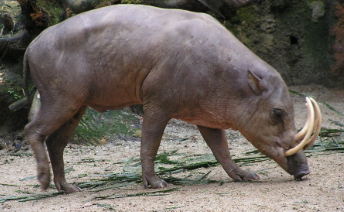
What It Is
The babirusa (genus Babyrousa) — commonly called the “pig-deer” — is one of the oldest living and strangest wild pig species. The name comes from Malay, describing its distinctive look and stag-like upper tusks (babi = pig, rusa = deer).
| Aspect | Detail |
|---|---|
| Geographic range | Endemic exclusively to four Indonesian islands — Sulawesi, Togian, Sula and Buru |
| Ecosystem | Tropical rainforests, swamps and wetlands, often near riverbanks and ponds rich in aquatic plants |
| IUCN status | Vulnerable |
3. Kerala Renamed Keralam
Context: Parliament passed the Kerala (Alteration of Name) Bill, 2026, officially renaming Kerala as Keralam, following a unanimous resolution by the State Legislative Assembly.
What It Is
A Parliamentary law amending the First Schedule of the Constitution to change the official name from Kerala to Keralam — aligning the English legal name with its native Malayalam pronunciation and cultural heritage.
Constitutional Provisions
| Provision | Content |
|---|---|
| Article 3 | Empowers Parliament by law to form new States, alter State boundaries, or change the name of any existing State |
| First Schedule | Modified at Entry 15, which lists the names and territorial extents of States |
| Article 4 | Provides that such a law is not deemed a constitutional amendment under Article 368, and is passed by simple majority |
Procedure to Change a State’s Name
- Initiation and State resolution — typically begins with the State Legislative Assembly passing a resolution requesting the Centre to alter the name.
- Presidential recommendation — a Bill may be introduced in either House only on the prior recommendation of the President.
- Reference to the State Legislature — before recommending the Bill, the President refers it to the affected State Assembly to express its views within a specified period.
- Non-binding State views — consultation is mandatory, but the views expressed are not binding on the President or Parliament.
- Introduction in Parliament — once the referral period expires or views are received.
- Passage by simple majority — under Article 4, treated as an ordinary Bill requiring a simple majority in both Houses.
- Presidential assent and Gazette notification — the Act then modifies the First Schedule.
The key constitutional point: although the First Schedule is part of the Constitution, altering it under Article 3 is expressly excluded from Article 368 by Article 4. Parliament can therefore redraw the map of India by simple majority — a striking feature of India’s “indestructible Union of destructible States.”
Precedents: Orissa → Odisha (2011), Uttaranchal → Uttarakhand, Pondicherry → Puducherry, United Provinces → Uttar Pradesh, Madras → Tamil Nadu, Mysore → Karnataka.
Practice MCQs
Q1. With reference to the alteration of a State’s name, consider the following statements:
a. Article 3 empowers Parliament to change the name of an existing State. b. Such a Bill may be introduced only on the prior recommendation of the President. c. The President must refer the Bill to the affected State Legislature for its views. d. The views expressed by the State Legislature are binding on Parliament.
How many of the above statements are correct? (a) Only one (b) Only two (c) Only three (d) All four (e) None
Q2. Consider the following statements:
a. A law altering the name of a State amends the First Schedule of the Constitution. b. Under Article 4, such a law is not deemed to be a constitutional amendment for the purposes of Article 368. c. It is passed by a simple majority in both Houses of Parliament. d. Odisha was renamed from Orissa through a similar process in 2011.
How many of the above statements are correct? (a) Only one (b) Only two (c) Only three (d) All four (e) None
Answer Key
- (c) — Statements a, b, c are correct; statement d is wrong because the State Legislature’s views are consultative and not binding. Parliament may proceed even if the State disagrees — the basis for describing India as an indestructible Union of destructible States.
- (d) — All four are correct. The Article 4 exclusion from Article 368 is the most examinable constitutional point.
4. One Herb, One Standard (OHOS) Initiative
Source: News on Air
Context: The Ministry of Ayush and the Ministry of Health and Family Welfare renewed their partnership under the ‘One Herb, One Standard’ initiative for an additional three years.
What It Is
An inter-ministerial collaborative framework to establish unified, scientifically synchronised quality and testing standards (monographs) for medicinal plants used across different systems of medicine in India.
| Implementing body | Parent ministry |
|---|---|
| Pharmacopoeia Commission for Indian Medicine & Homoeopathy (PCIM&H) | Ministry of Ayush |
| Indian Pharmacopoeia Commission (IPC) | Autonomous body under MoHFW |
Aim: to eliminate conflicting quality parameters across different pharmacopoeias, establishing single, clear and scientifically reliable standards for medicinal herbs, improving the quality, safety and international credibility of Indian botanical products.
Key Features
- Harmonised quality standards — synchronises testing methods and quality parameters for identical medicinal plants across the Indian Pharmacopoeia (IP) and the Ayurvedic, Siddha, Unani and Homoeopathic (ASU&H) Pharmacopoeias.
- Phase-wise monograph development — builds on 50 single-herb monographs developed in the first phase, initiated in 2022.
- Cross-system integration — applies to single drugs of plant origin used across five recognised systems: Ayurveda, Siddha, Sowa-Rigpa, Unani and Homoeopathy.
- Alignment with global benchmarks — integrates international quality parameters to meet global trade and regulatory demands.
- Streamlined testing protocols — a single reference standard for testing laboratories, regulators and manufacturers, avoiding conflicting analytical requirements.
Exam Relevance
UPSC — Prelims: the babirusa’s endemism to four Indonesian islands and Vulnerable status; Article 3 and Article 4 and the simple-majority rule for altering State names; the five AYUSH systems including Sowa-Rigpa, and the distinction between IPC (MoHFW) and PCIM&H (Ayush). Mains: the Kerala renaming supports GS-II answers on federalism and Parliament’s power over State identity; OHOS supports GS-III answers on standardisation as a non-tariff trade enabler for AYUSH exports.
NABARD Grade A — OHOS has a real hook: medicinal and aromatic plants cultivation is a rural livelihood, and standardised monographs raise realisation for growers by making the crop export-grade. Connect to the National Medicinal Plants Board.
Banking/Finance
1. UPI at 10: India’s Digital Payments Revolution
Source: Indian Express
Context: As the Unified Payments Interface completed 10 years of operation, Parliament passed the Taxation and Other Laws (Amendment) Bill, 2026, which amends Section 10A of the Payment and Settlement Systems Act, 2007, removing the statutory prohibition against levying a Merchant Discount Rate on UPI and RuPay debit card transactions.
What UPI Is
- Launched as a pilot in April 2016 by the RBI and NPCI, fully operational from August 2016.
- India’s real-time, interoperable mobile payment system, built on the Immediate Payment Service (IMPS) protocol.
- Allows instant bank-to-bank transfers via Virtual Payment Addresses (VPAs) or QR codes.
- Over a decade it has moved from a domestic retail experiment to the backbone of India’s digital economy, handling the vast majority of non-cash consumer payments.
Evolution and Growth Drivers
- Early policy vision (2012–13): the RBI’s payment vision documents identified IMPS as a foundation for rapid proliferation of mobile merchant and peer-to-person transfers.
- Demonetisation and pandemic (2016 and 2020): both catalysed a structural shift away from cash and cash-on-delivery toward contactless QR payments.
- Private venture capital inflow (2019–2021): large investments into fintech firms such as Paytm and PhonePe expanded Point-of-Sale infrastructure and user acquisition.
- Zero-MDR mandate (2020): following the Nandan Nilekani Committee recommendations on deepening digital payments, the government mandated 0% MDR on UPI and RuPay cards, subsidising low-value transactions up to ₹2,000.
The Proposed MDR Reform
A calibrated, threshold-based MDR is being evaluated, designed to ensure sustainability without discouraging small merchants or individual citizens:
| Category | Treatment |
|---|---|
| Consumers and P2P transfers | 100% free — guaranteed zero fee |
| Small merchants (annual turnover below ₹1–1.5 crore), including kirana stores | Zero merchant fees continue |
| Large commercial enterprises | Nominal MDR of about 0.05% to 0.3–0.6%, applying only to P2M transactions exceeding ₹2,000 |
Agriculture
1. Regenerative Farming and Climate Resilience — The Beforest Model
Source: businessline
Context: With rainfall becoming increasingly unpredictable and temperatures rising, regenerative agriculture is emerging as a way to strengthen soil, water security, biodiversity and farm resilience. The experience of Beforest, a regenerative land restoration initiative, illustrates the approach.
What It Is
- Beforest, founded in 2018, works at the intersection of agriculture, ecology and climate resilience. It has built six collectives across Kodagu, Hyderabad, Mumbai and Bhopal, spanning about 1,300 acres with 196 members.
- What a collective is — per founder and CEO Sunith Reddy: a group of people bound by a shared commitment to regenerative living who co-own and co-manage a single landscape, with a minimum land requirement of about 100 acres.
The Model at Scale
Asked what would follow if every district adopted the model, Reddy described a sequence that becomes a cycle:
- Water security is established — the foundation on which everything else stands.
- Succession progresses — bare soil disappears, green cover thickens, biodiversity climbs.
- New diversity increases seed dispersal, which accelerates green cover, which attracts more diversity.
Regenerative Agriculture
A set of practices aimed at rebuilding soil health, water cycles and biodiversity rather than merely sustaining current yields. Core practices: minimal tillage, permanent soil cover, crop and species diversity, integration of trees and livestock, and elimination of synthetic inputs.
Distinguish from adjacent concepts:
- Organic farming — defined by the absence of synthetic inputs; certification-based.
- Natural farming (ZBNF/Bharatiya Prakritik Krishi Paddhati) — low-cost, input-free, using on-farm preparations such as jeevamrit.
- Agroforestry — integration of trees with crops or livestock.
- Regenerative agriculture — outcome-defined: is soil organic carbon, water retention and biodiversity improving?
Exam Relevance
NABARD Grade A — Very high relevance for Phase II Paper II. This touches several core areas at once: watershed development (NABARD’s flagship, through the Watershed Development Fund), agroforestry, climate-resilient agriculture, and financing gaps in green agriculture. The observation that institutional funding is almost absent from regenerative land restoration is directly a NABARD question — it is precisely the kind of long-gestation, ecology-first investment that commercial lenders avoid and a development bank exists to fund. Connect to NABARD’s role with the Green Climate Fund, Adaptation Fund and NAFCC, and to FPO-based aggregation as the smallholder route to the same practices.
2. Precision Agriculture — ICAR’s Network Programme
Source: PIB
Context: ICAR informed Parliament of its programme of national importance, the Network Programme on Precision Agriculture (ICAR-NePPA), involving 16 ICAR Research Institutes across different domains.
What It Is
- Precision agriculture applies inputs — water, nutrients, pesticides — in the right quantity, at the right place, at the right time, instead of uniformly across a field. The gain comes from matching input to actual need: yield rises and waste falls at the same time.
- ICAR-NePPA develops technologies using sensors, remote sensing (ground, drone, satellite), AI and ICTs, across five domains:
| Domain | Focus |
|---|---|
| Crop and soil | Spatio-temporal monitoring and management of crop and soil health |
| Post-harvest | Sensor-based quality monitoring — mango, banana, pulses, rice |
| Vertical farming | IoT-based precision farming for high-value vegetables under controlled environment |
| Aquaculture | Sensor-based monitoring of the aquatic environment |
| Livestock | IoT-enabled health monitoring |
Technologies Developed
- Water and nutrients: sensor-based irrigation, drip fertigation, precision subsurface drip, poly-mulching, raised-bed cultivation, modified raised and sunken conservation beds.
- Machinery and drones: drone-based spraying, AI-enabled precision planters, variable rate fertiliser applicator.
- Controlled environment: low-cost protected cultivation, hydroponics, aeroponics, agrivoltaic farming, agro-aqua land configuration.
- Sensing and quality instruments: SPAD meter 2.0 (leaf chlorophyll), rapid Aflatoxin-B1 detection in maize, IoT cold-room control, AI grain analyser, AI rice-seed quality assessment, image-processing contamination measurement in seed cotton, computer-vision ginning percentage measurement, digital twin-based fruit quality monitoring, and blockchain-enabled banana supply chain traceability.
- Digital tools: the Dweep Microclimate Monitor; a Remote Pilot Training Organisation (RPTO) at Dehradun for UAV training.
- Aquaculture: a tank-based super-intensive precision shrimp farming system yielding 120–150 tonnes/ha/year over three cycles, with smart automation and strict biosecurity.
Facts To Remember
1. Retail Inflation Rises to 19-Month High of 4.45%
India’s retail inflation rose to 4.45% in July 2026, marking a 19-month high. The rise was driven mainly by higher food and fuel prices. The data indicates renewed inflationary pressure on household consumption and the overall economy.
2. President Murmu Gives Assent to Bill Criminalising Insult to Vande Mataram
President Droupadi Murmu gave assent to the Prevention of Insults to National Honour (Amendment) Bill, 2026. The amendment extends legal protection to Vande Mataram, similar to the protection already provided to the national anthem. It criminalises intentional disruption or prevention of its singing.
3. IBM Partners with MIT-Bengaluru and CHRIST University to Establish AI Centres
IBM partnered with MIT Bengaluru and CHRIST University to establish AI-focused centres in India. The centres will promote AI research, advanced computing, innovation and skilling. Key areas include Generative AI, Machine Learning, cybersecurity, LLMs and responsible AI.
4. PMS Bazaar Partners with NDML to Expand SEBI Accredited Investor Certification
PMS Bazaar partnered with NSDL Database Management Limited (NDML) to simplify the SEBI Accredited Investor certification process. The partnership aims to provide end-to-end assistance and faster certification. Eligible investors can benefit from lower investment thresholds and access to sophisticated investment products.
5. SBI Research Projects India’s GDP Growth at 8% for Q1 FY27
SBI Research projected India’s real GDP growth at around 8% in Q1 FY27, higher than the RBI’s 7% estimate. The projection is based on 54 high-frequency indicators covering agriculture, industry and services. Strong consumption, industrial output, services activity and government capital expenditure supported the optimistic outlook.
6. Ambani Family Tops 2026 Hurun India Most Valuable Family Businesses List
The Ambani family, led by Mukesh Ambani, retained the top position with a valuation of ₹25.8 lakh crore. The Birla and Jindal families ranked second and third respectively. The combined value of India’s top 300 family businesses reached ₹138 lakh crore, highlighting their major role in the Indian economy.
7. Hungary Elects András Baka as President
The Hungarian Parliament elected former Supreme Court chief András Baka as the country’s new President. He secured 140 votes in favour and 6 against. He is scheduled to assume office on 19 August 2026 for a term of up to five years.
8. Indian Navy Launches Next-Generation Offshore Patrol Vessel ‘Shruti’
The Indian Navy launched Shruti, the second of four Next-Generation Offshore Patrol Vessels being built by GRSE, Kolkata. The vessel is part of a ₹9,781-crore NGOPV programme. The project aims to strengthen India’s indigenous warship-building and maritime security capabilities.
9. Skyroot Aerospace Signs Multi-Launch Agreement with HEX20
Skyroot Aerospace signed a Multi-Launch Agreement with HEX20 for three dedicated Vikram-series missions. The missions will support Earth observation, payload demonstrations and rideshare opportunities. Launches are scheduled to begin from Q4 2027.
10. Don Nelson, Five-Time NBA Champion, Passes Away
Legendary American basketball coach Don Nelson passed away at the age of 86. He won five NBA championships as a player with the Boston Celtics and later coached for 31 years. He recorded 1,335 regular-season wins and was inducted into the Basketball Hall of Fame in 2012.
11. Nuclear Scientist M.P. Parameswaran Passes Away at 91
Renowned Indian nuclear scientist, writer and science communicator M.P. Parameswaran passed away at the age of 91. He worked at BARC and later became closely associated with the Kerala Sastra Sahitya Parishad. He made major contributions to science popularisation, literacy movements and environmental awareness.
12. PM Modi Releases Ram Nath Kovind’s Autobiography
Prime Minister Narendra Modi released former President Ram Nath Kovind’s autobiography, Triumph of the Indian Republic: My Life, My Struggles. Published by Rupa Publications, the book covers Kovind’s early life, legal career, public service and tenure as India’s 14th President. It also highlights perseverance, education and democratic values.
13. International Youth Day 2026 – August 12
International Youth Day is observed annually on 12 August to highlight youth contributions and address issues affecting young people. The 2026 theme is “Different Contexts, Common Aspirations.” The first official observance was held in 2000.
14. World Elephant Day 2026 – August 12
World Elephant Day is observed on 12 August to promote elephant conservation and protection. It was first observed in 2012 and was conceptualised by Patricia Sims, Michael Clarke and Sivaporn Dardarananda. Elephants are the world’s largest land animals and have a gestation period of around 22 months.
15. Gujarat Approves ₹20 Crore for Four Centres of Excellence in Natural Farming
The Gujarat Government approved ₹20 crore for 2026–27 to establish four Centres of Excellence for natural farming. The centres will be located in Navsari, Morbi, Bhavnagar and Chhota Udepur. They will provide farmers with training, technology support, soil testing, value addition and post-harvest facilities.
16. National Biodiversity Authority Releases ₹15 Crore ABS Proceeds
The National Biodiversity Authority (NBA) released over ₹15 crore under the Access and Benefit Sharing (ABS) mechanism from mustard genetic resources. The amount will be distributed among 26 State Biodiversity Boards and 3 Union Territory Biodiversity Councils. The move supports fair sharing of benefits arising from the use of biological resources.
17. Ahilyabai Holkar Remembered on Her Death Anniversary
Union Home Minister Amit Shah and Defence Minister Rajnath Singh paid tributes to Ahilyabai Holkar on her death anniversary. She is remembered for her major contributions to the preservation and restoration of heritage sites. Her legacy also includes social welfare and public works across India.
18. ‘Srijan: Voices from the Loom’ to Celebrate Women Weavers
The Ministry of Textiles will organise ‘Srijan: Voices from the Loom’ to celebrate women involved in India’s handloom sector. The programme will highlight their journeys, contributions and experiences. It aims to recognise the important role of women in preserving India’s weaving heritage.
19. Gramin Gyan Setu App Launched in Gandhinagar
Union Home Minister Amit Shah launched the Gramin Gyan Setu app through video conferencing. The app aims to integrate libraries across the Gandhinagar Lok Sabha constituency of Gujarat. It is designed to improve access to library resources and strengthen knowledge-sharing among communities.
20. Vriksh Mitra Parivar Launches Nationwide Plantation Drive
More than 50,000 saplings were planted across India on the occasion of Hariyali Amavasya. The campaign was conducted under the ‘Ek Ped Maa Ke Naam’ initiative. The plantation drive was led by Agriculture and Rural Development Minister Shivraj Singh Chouhan in collaboration with Vriksh Mitra Parivar.
21. Railways Approves Kavach 4.0 for 660 Route Kilometres
Indian Railways approved the installation of Kavach Version 4.0 on 660 route kilometres of the Izzatnagar Division of North Eastern Railway. The project has an estimated cost of ₹295 crore. Kavach is aimed at improving railway safety through an indigenous automatic train protection system.
22. India Home to Over 60% of World’s Wild Asian Elephants
Prime Minister Narendra Modi highlighted India’s role in elephant conservation on World Elephant Day. India is home to over 60% of the world’s wild Asian elephants. The statement underlined the importance of elephants in India’s ecological heritage and conservation efforts.
23. India-Nepal Sign MoUs for Eight Development Projects
India and Nepal signed MoUs for eight development projects covering education, health and agriculture. The projects will be implemented using Indian grant assistance. The initiatives aim to strengthen development cooperation and people-centric partnership between the two countries.
24. India Hosts Nearly 60% of World’s Wild Asian Elephants
Minister of State for Environment, Forest and Climate Change Kirti Vardhan Singh highlighted India’s importance in Asian elephant conservation. Nearly 60% of the world’s wild Asian elephants live in India. He described the country as a living symbol of the elephant’s ecological heritage.
25. MSME Ministry and DPIIT Sign MoU for GI Products
The Ministry of MSME and DPIIT signed an MoU to improve the commercialisation and market access of GI-tagged products. The collaboration seeks to strengthen their presence in domestic and global markets. It is expected to support producers and businesses associated with India’s Geographical Indication products.
26. India-US Navy EOD Exercise 2026 Begins
The Indian Navy-US Navy Explosive Ordnance Disposal (EOD) Exercise 2026 began at the Southern Naval Command in Kochi. The bilateral exercise will continue until 14 August 2026. It aims to improve interoperability, operational capabilities and professional cooperation between the two navies.
27. GI-Tagged Mithila Makhana Exported to Australia
For the first time, 18 metric tonnes of GI-tagged Mithila Makhana were exported from Bihar to Australia. The consignment was procured directly from farmers in Darbhanga. The export marks an important step in expanding international markets for Bihar’s GI-tagged agricultural products.
27. India–SACU Preferential Trade Agreement
India and the Southern African Customs Union (SACU) signed the Terms of Reference (ToR) to begin negotiations for a Preferential Trade Agreement (PTA). This is India’s first ToR signing with the African region.
About SACU: SACU is the oldest customs union in the world, established in 1910, with its secretariat in Windhoek, Namibia. It has five members — South Africa, Botswana, Namibia, Lesotho and Eswatini.

14 August, 2026
Daily Current Affairs Quiz
14 August , 2026
Daily Current Affairs for NABARD Grade A and RBI Grade B 2026 covering the most important developments in Indian Economy, Banking, RBI, Agriculture, Rural Development, Government Schemes, Financial Markets, Reports & Indices, International Relations, Environment and Science & Technology.
NABARD CURRENT AFFAIRS
1. Agriculture Current Affairs in News
1. IIHT SUTRA 2026 Conclave on Handloom Technology
Union Minister Giriraj Singh inaugurated IIHT SUTRA 2026, the first national conclave of Indian Institutes of Handloom Technology. Held under the theme “Weaving the Future of the Indian Handloom Sector – Educate. Innovate”, it focused on education, research, skills and innovation. MoUs were signed with Grasim Industries, NITRA and IIM Sambalpur.
2. ‘Srijan: Voices from the Loom’ Celebrates Women Weavers
The Ministry of Textiles organised ‘Srijan: Voices from the Loom’ to recognise the contribution of women weavers to India’s handloom heritage. The event highlighted their personal journeys, achievements and role in sustaining traditional weaving. An anthology featuring the stories and experiences of women weavers was also released.
3. PCIM&H and IPC Renew MoU for ‘One Herb, One Standard’
The Pharmacopoeia Commission for Indian Medicine & Homoeopathy (PCIM&H) and Indian Pharmacopoeia Commission (IPC) renewed their MoU for the ‘One Herb, One Standard’ initiative. The programme aims to establish uniform quality standards for medicinal plants used across different Indian systems of medicine. The renewed agreement will also support international quality alignment and exports.
4. Three New Cascade Frog Species Discovered in Northeast India
Scientists led by Prof. S. D. Biju of the University of Delhi discovered three new cascade frog species in Northeast India. They are Ammachi’s Cascade Frog, Sendenyu Cascade Frog and Beautiful Cascade Frog. The discovery was based on extensive fieldwork, DNA sequencing and morphological studies, highlighting India’s rich amphibian biodiversity.
2. Schemes in News
1. Gaj Gaurav Awards 2026
Source: TH
Context: During national celebrations of World Elephant Day 2026 at Visakhapatnam, the Union Minister of State for Environment, Forest and Climate Change conferred the Gaj Gaurav Awards 2026.
What is the Gaj Gaurav Award?
India’s national honour for outstanding contributions and frontline service in Asian elephant conservation and management.
| Aspect | Detail |
|---|---|
| Instituted | 2022, by the Ministry of Environment, Forest and Climate Change |
| Occasion | 30 years of Project Elephant (launched 1992) |
| Presented on | World Elephant Day, 12 August |
2026 Winners
- Jaldapara National Park, West Bengal — 7 mahouts, for courage during the severe Torsha and Malangi river floods: Bikash Kharia (stayed back in strong currents to guide stranded kumki — trained — elephants to safety), Rajiv Oraon (secured five captive elephants during flash floods), Ajibul Haque, Ajit Gabur, Mumtaz Alam, Amasur Kheriya, Dilip Munda.
- Namdapha National Park and Tiger Reserve, Arunachal Pradesh — 2 caregivers, the only recipients from the Northeast: Ganesh Tamang (Senior Mahout, over 26 years of service) and Sumit Gogoi (Elephant Attendant, 5 years).
Project Elephant
- Launched 1992 as a Centrally Sponsored Scheme
- India holds about 60% of the world’s wild Asian elephants
- The Asian elephant is Endangered on the IUCN Red List and listed in Schedule I of the Wild Life (Protection) Act, 1972
- It is India’s National Heritage Animal (declared 2010)
- 33 Elephant Reserves across the country
- Gaj Yatra is the awareness campaign for corridor protection
- MIKE — Monitoring the Illegal Killing of Elephants — is the CITES programme India participates in
2. Small Modular Reactors (SMRs)
Source: Business Standard
Context: Under the newly launched Nuclear Energy Mission, the Government informed the Lok Sabha that it plans to develop and operationalise at least five indigenous Small Modular Reactors by 2033. This supports India’s goal of 100 GWe of nuclear capacity by 2047.
What is a Small Modular Reactor?
An advanced nuclear reactor with lower electrical output than conventional gigawatt-scale plants. As defined by the IAEA, an SMR typically produces up to 300 MWe per unit.
| Aspect | Detail |
|---|---|
| India’s nodal developer | Bhabha Atomic Research Centre (BARC), under the Department of Atomic Energy |
| Legal framework | SHANTI Act, 2025 — Sustainable Harnessing and Advancement of Nuclear Energy for Transforming India Act |
- The SHANTI Act, 2025 enables private sector participation in nuclear technology manufacturing and deployment — the change that makes SMR scale-up possible.
- Aim: deliver clean, flexible, low-carbon baseload electricity and industrial heat, while cutting initial capital cost, construction time and land requirement compared with large nuclear plants.
How SMRs Work
- Nuclear fission — heavy nuclei such as Uranium-235 are split in a controlled chain reaction to produce heat
- Modular factory fabrication — major components are built in centralised factories and shipped to site for rapid assembly, instead of a decade of site-specific civil construction
- Heat conversion — the heat produces steam to drive turbines, or is used directly for high-temperature industrial processes
3. Reports / Articles in News
1. NITI Aayog Report on Key Sectors for Global Manufacturing Hub
Source: PIB
Context: NITI Aayog has released a report titled “Key Sectors to Position India as a Global Manufacturing Hub.” It uses a structured, data-driven framework to identify sectors that can drive India’s ambition to become a global manufacturing powerhouse. This edition covers four sectors — Chemicals, Textiles, Telecom and Networking Equipment, and Solar Photovoltaic manufacturing — with reports on eight more sectors to follow.
What the Report Does
- The assessment looks at India’s manufacturing position against global trends, sectoral growth opportunities and global benchmarks. It examines seven factors that decide whether a country can compete in manufacturing.
- The aim: find sectors where India has real growth potential and where targeted action can strengthen domestic capability, raise competitiveness and value addition, and accelerate export-oriented manufacturing.
Key Highlights:
Sector 1: Chemicals
- Main areas: Petrochemicals, specialty chemicals and inorganic chemicals.
- India should increase downstream production of higher-value products.
- Focus on domestic manufacturing, better use of raw materials and strategic FTAs to reduce imports.
Sector 2: Textiles
- Contributes about 2% of GDP, 11% of manufacturing GVA and 9% of merchandise exports.
- Employs over 45 million people and exports about $37.7 billion annually.
- Focus on MMF, technical and sustainable textiles, along with better raw materials, infrastructure, skills and technology.
- India needs to reduce its dependence on cotton and match the growing global demand for man-made fibres.
Sector 3: Telecom Equipment
- India is the world’s second-largest telecom market, with over 1.2 billion subscribers.
- Main issue: India is a large market but depends heavily on imported components.
- Focus on local component production, technology transfer, industrial clusters, R&D and exports.
Sector 4: Solar PV
- Solar capacity stood at 106 GW in March 2025, with a target of 280 GW by 2030.
- India has strong module production but still imports many cells and wafers.
- Build the full chain: polysilicon → wafers → cells → modules through technology, R&D, investment and skilled workers.
Common Theme
India needs to move beyond basic production and assembly and capture more value within the country. The focus is on domestic value addition, lower import dependence and stronger global competitiveness.
Practice MCQs
Q1. With reference to the NITI Aayog report on key manufacturing sectors, consider the following statements:
a. It covers chemicals, textiles, telecom and networking equipment, and solar photovoltaic manufacturing.
b. The study was structured into four phases, beginning with shortlisting sectors by relative attractiveness.
c. Reports on eight more sectors are to follow.
d. The report assesses only market size and ignores infrastructure and technology readiness.
How many of the above statements are correct? (a) Only one (b) Only two (c) Only three (d) All four (e) None
Q2. With reference to India’s textile and apparel sector as described in the report, consider the following statements:
a. It contributes about 11 per cent to manufacturing gross value added.
b. It accounts for about 9 per cent of merchandise exports.
c. It employs more than 45 million people and is the second-largest employer after agriculture.
d. India is the second-largest textile exporter in the world.
How many of the above statements are correct? (a) Only one (b) Only two (c) Only three (d) All four (e) None
Answer Key
- (c) — Statements a, b, c are correct. Statement d is wrong: the report assesses seven factors including infrastructure readiness, technology readiness, raw material availability and India’s position in the value chain, not market size alone.
- (c) — Statements a, b, c are correct. Statement d is wrong: India is the sixth-largest textile exporter globally, with a 4.1% share of global textile and apparel exports.
RBI CURRENT AFFAIRS
1. Banking and Finance
1. Amit Shah Inaugurates NUCFDC’s New Premises in Mumbai
Union Minister Amit Shah inaugurated the new premises of the National Urban Cooperative Finance and Development Corporation (NUCFDC) in Mumbai. During the ‘Sahkar Nav-Kranti’ programme, NUCFDC launched Bank in a Box, an integrated technology platform for Urban Cooperative Banks. An MoU with NFSU will also strengthen cybersecurity and digital-forensics support for UCBs.
2. SEBI Accredited Investor Framework 2026
SEBI has proposed changes to its Accredited Investor Framework, including allowing investment managers to certify an investor’s status during onboarding. It has also proposed adding securities market assets as a qualifying criterion. Accredited investors may receive benefits such as lower investment thresholds and access to products with greater regulatory flexibility.
3. Bank of America to Acquire 49.9% in Jio Credit
Bank of America and Jio Financial Services entered into a joint venture agreement under which BofA may acquire up to 49.9% stake in Jio Credit for around ₹18,268 crore. Initially, BofA will acquire a 26.5% stake through preferential allotment. The partnership is expected to provide Jio Credit with additional capital and global expertise in financial services and risk management.
5. MCX and NISM to Establish Commodity Markets Research Centre
Multi Commodity Exchange of India (MCX) and NISM signed an MoU to establish a dedicated Commodity Markets Research Centre. The centre will focus on research, training and awareness in India’s commodity derivatives market. Its activities will include policy research, white papers, doctoral fellowships, faculty programmes and training on hedging and risk management.
RBI AND NABARD CURRENT AFFAIRS
1. Economy in News
1. India–SACU Sign ToR for Preferential Trade Agreement
India and the Southern African Customs Union (SACU) signed Terms of Reference for negotiations towards a Preferential Trade Agreement (PTA). It marks India’s first ToR with the African region and aims to expand trade in pharmaceuticals, automobiles, textiles, engineering goods and agriculture. SACU is the world’s oldest customs union, established in 1910, with five members.
2. CSL Delivers ‘MS Maria’ to German Shipping Company
Cochin Shipyard Limited (CSL) delivered MS Maria, the second of eight HS EcoFreighter multi-purpose vessels, to Germany-based HS Schiffahrts. The vessel has a 7,000 DWT capacity and is designed for worldwide trade. It can carry diverse cargo including containers, steel coils, timber, dry bulk and project cargo.
3. Former Chinese Premier Zhu Rongji Passes Away at 97
Former Chinese Premier Zhu Rongji passed away at the age of 97. He served as China’s Premier from 1998 to 2003 and played an important role in economic reforms, including restructuring state-owned enterprises and strengthening fiscal and financial systems. He also played a key role in China’s WTO accession in 2001.
2. Social Issue in News
1. Joint Parliamentary Committee (JPC)
Source: Indian Express
Context: The Lok Sabha referred the Foreign Contribution (Regulation) Amendment Bill, 2026 to a Joint Parliamentary Committee, following strong objections from Opposition parties and civil society.
What is a JPC?
An ad hoc (temporary) parliamentary committee set up for detailed, clause-by-clause examination of a controversial Bill, a complex legislative proposal, or a major financial or governance issue.
| Aspect | Detail |
|---|---|
| Constitutional status | Not mentioned in the Constitution |
| Governing rules | Rules of Procedure and Conduct of Business of both Houses |
| How formed | A motion moved in one House and concurred with by the other |
| Chairperson | Appointed by the Speaker of the Lok Sabha |
| Composition ratio | Lok Sabha members typically twice the number from the Rajya Sabha (2:1) |
| Party strength | Membership and chairmanship reflect relative party strengths, giving the ruling side a majority |
| After the report | The committee automatically stands dissolved |
Key Functions
- Clause-by-clause scrutiny to identify administrative, legal or constitutional loopholes
- Summoning power — may call for official records and papers, and summon officials, experts and stakeholders
- Public consultation — invites written submissions and holds oral hearings with affected organisations, industry bodies and civil society
- Recommendations and dissent — prepares an advisory report; dissenting members may append formal Notes of Dissent
Practice MCQs
Q1. With reference to a Joint Parliamentary Committee, consider the following statements:
a. It is not explicitly mentioned in the Constitution of India.
b. It is constituted when a motion moved in one House is adopted and concurred with by the other.
c. Its chairperson is appointed by the Speaker of the Lok Sabha.
d. It is a permanent committee that continues across Parliaments.
How many are correct? (a) One (b) Two (c) Three (d) All four (e) None
Answer Key
- (c) — a, b, c correct. Statement d is wrong: a JPC is an ad hoc committee, dissolved automatically once it submits its report — unlike standing committees, which are reconstituted annually.
3. Misc GA in News
1. Sumit Sarkar, Eminent Historian, Passes Away at 87
Eminent Marxist historian Sumit Sarkar, a noted scholar of modern Indian history, passed away at the age of 87 in New Delhi. He taught history at the University of Delhi and was a Fellow of Wolfson College, Oxford. He was also a visiting professor at several universities in the US and Europe.
2. India–Malaysia Exercise Udara Shakti 2026
The Indian Air Force (IAF) and Royal Malaysian Air Force (RMAF) commenced the third edition of bilateral Exercise Udara Shakti 2026 in Malaysia. The exercise focuses on improving interoperability, operational coordination and defence cooperation. India deployed Rafale fighters and C-17 aircraft, while Malaysia participated with Su-30MKM, F/A-18D and A400M aircraft.
3. International Left-Handers Day 2026 – August 13
International Left-Handers Day is observed annually on 13 August to celebrate left-handed people and highlight the challenges they face. The day was conceptualised by Dean Robert Campbell in 1976 and officially launched by the Left-Handers Club in 1992. It promotes greater awareness of left-handedness in a predominantly right-handed world.
15 August, 2026
Daily Current Affairs Quiz
15 August , 2026
Daily Current Affairs for NABARD Grade A and RBI Grade B 2026 covering the most important developments in Indian Economy, Banking, RBI, Agriculture, Rural Development, Government Schemes, Financial Markets, Reports & Indices, International Relations, Environment and Science & Technology.
NABARD CURRENT AFFAIRS
1. Agriculture Current Affairs in News
1. Black-necked Crane
Context: The Bombay Natural History Society (BNHS), working with the Indian Army and local authorities, has sterilised over 2,950 free-ranging dogs in Ladakh since 2022 to reduce predation on the Black-necked Crane and its chicks.
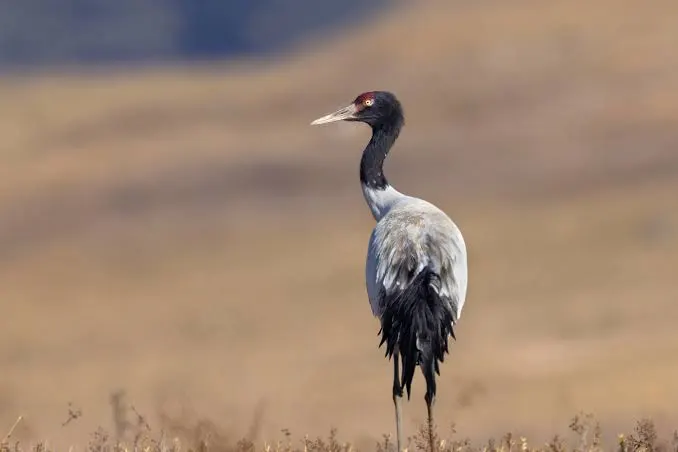
What is the Black-necked Crane?
The only exclusively alpine species among the world’s 15 crane species.
| Aspect | Detail |
|---|---|
| Local names | Thrung Thrung Karmo (Dzongkha), Cha Tung-Tung (Ladakhi) |
| State Bird of | Union Territory of Ladakh |
| IUCN Red List | Near Threatened (NT) |
| Range countries | India, China, Bhutan, Nepal |
2. Fertiliser Subsidy Rises Despite Low Nutrient-Use Efficiency
- India is spending more on fertiliser subsidies, while only around 40% of applied nutrients are absorbed by crops.
- Unused nutrients can cause:
- Groundwater contamination
- Air pollution
- Nutrient wastage
- Higher subsidy burden
- The issue highlights the need to improve Nutrient-Use Efficiency (NUE).
2. Schemes in News
1. PM Vishwakarma Scheme 2.0
Source: Business Standard
Context: The Centre is likely to launch the second phase of the PM Vishwakarma scheme on 17 September, with a sharper focus on improving credit access and market linkages for traditional artisans and craftspeople. The date is observed as Vishwakarma Jayanti and is also the Prime Minister’s birthday.
What is the PM Vishwakarma Scheme?
- Launch Year: 2023
- Type: Central Sector Scheme
- Nodal Ministry: Ministry of Micro, Small & Medium Enterprises (MSME)
Eligibility
- Traditional artisans and craftsmen above 18 years of age.
- Covers 18 identified traditional trades.
A scheme providing holistic, end-to-end support to traditional artisans and craftspeople through:
- Collateral-free credit
- Skill training
- Modern tools
- Incentives for digital transactions
- Market-linkage support
2. PM Surya Ghar Muft Bijli Yojana
Source: The Hindu
Context: Several States, including Uttar Pradesh, Andhra Pradesh and Bihar, are giving financial aid to households that cannot afford rooftop solar installations — as a way to cut the revenue losses they incur from subsidising electricity.
What is PM Surya Ghar: Muft Bijli Yojana?
- Launch: February 2024
- Nodal Ministry: Ministry of New and Renewable Energy (MNRE)
- Type: Central Sector Scheme
About the Scheme
- PM Surya Ghar: Muft Bijli Yojana is a major rooftop solar scheme for households.
- It aims to promote residential rooftop solar installations and reduce household electricity bills.
- The scheme targets 1 crore households by March 2027.
- Households can get up to 300 units of free electricity per month through rooftop solar generation.
Implementation
- National Level: National Programme Implementation Agency (NPIA)
- State Level: State Implementation Agencies (SIAs)
3. Shakti Ki Saptadhara: Seven Streams of India’s Growth Explained
Context: The Prime Minister, in his Independence Day address on 15 August 2026, outlined “Shakti Ki Saptadhara” — seven streams of national strength that can drive India towards Aatmanirbharta and Viksit Bharat.
What is Saptadhara?
- Saptadhara means seven streams. It refers to the seven strategic areas of India’s growth and national strength identified by the Prime Minister from the Red Fort.
- It brings together manufacturing, agriculture, technology, infrastructure, defence, the green and blue economy, and soft power as interconnected pillars for India’s next phase of development.
The Seven Streams
- Manufacturing: Make India a global manufacturing and supply-chain hub by improving cost, quality, scale and precision, including domestic component production.
- Farming & Food Processing: Connect Indian farms to global markets and promote millets, spices, fruits, vegetables and traditional foods as global brands.
- Technology & Innovation: Develop India as a hub for data centres, robotics, emerging technologies, next-gen communication and 6G, building on UPI and DPI.
- Gati Shakti & Connectivity: Improve multimodal connectivity through roads, expressways, high-speed rail and ports to reduce logistics costs.
- Raksha Shakti: Promote Aatmanirbhar defence manufacturing, especially drones and next-generation defence technologies, and make India a global defence supplier.
- Green & Blue Economy: Lead in green hydrogen, renewables and energy storage, while expanding fisheries, coastal tourism and ocean technologies.
- Soft Power: Strengthen India’s global cultural influence through Yoga, handicrafts, films, animation, gaming, digital content and tourism.
RBI CURRENT AFFAIRS
1. Banking and Finance
1. Pradhan Mantri Jan Dhan Yojana (PMJDY) Completes 12 Years
Source: The Hindu
Context: The Pradhan Mantri Jan Dhan Yojana (PMJDY) has completed 12 years. Announced by the Prime Minister from the Red Fort on 15 August 2014, the scheme has crossed 58 crore accounts with deposits of about ₹3 lakh crore, and became the first layer of India’s JAM trinity and wider digital public infrastructure.
What is PMJDY?
- Launch Date: 28 August 2014
- Type: National Mission for Financial Inclusion
- Nodal Ministry: Ministry of Finance
- Implementing Agency: Department of Financial Services (DFS)
Objective
- To ensure universal access to banking services for every household.
- To provide affordable financial services such as:
- Savings accounts
- Remittance facilities
- Credit
- Insurance
- Pension services
Key Features of PMJDY
- BSBDA: Zero-balance savings account with interest and basic banking facilities.
- RuPay Debit Card: Free RuPay card with accident insurance cover.
- Overdraft: Up to ₹10,000, subject to eligibility.
- DBT: Direct transfer of government subsidies and benefits.
- Insurance: Accident cover and life insurance for eligible account holders.
- Mobile Banking: Access to banking services through mobile and digital platforms.
2. RBI Closes FCNR(B) Swap Window
Source: IE
Context: The Reserve Bank of India has decided to close its swap facility for FCNR(B) deposits one month ahead of schedule, after banks mobilised $52.3 billion under the scheme by 13 August. The decision comes barely a week after Governor Sanjay Malhotra said on 5 August that there was no proposal to withdraw the scheme.
What is an FCNR(B) Deposit?
- FCNR(B) stands for Foreign Currency Non-Resident (Bank) deposit.
- It is a term deposit held in foreign currency by a non-resident Indian with an Indian bank. Both the principal and interest are paid in the same foreign currency, so the depositor faces no rupee conversion risk.
What is the Swap Window?
Launched on 8 June 2026, the facility lets banks swap the foreign currency they raise through FCNR(B) deposits with the RBI.
How it works:
- The bank collects dollars from NRI depositors
- It sells those dollars to the RBI and receives rupees
- At maturity, the transaction reverses at the same exchange rate
- RBI bears the full hedging cost. Because the exchange rate is fixed at both ends, the bank carries no currency risk.
That is what allows banks to offer attractive interest rates to NRI depositors.
3. L&T to Build NVIDIA B300 AI Factory in Chennai
- Larsen & Toubro (L&T) secured a ₹10,000–15,000 crore order to build a large AI computing facility for Together AI.
- The facility will be located at L&T’s Chennai data-centre campus.
- It will deploy 10,000 NVIDIA B300 GPUs.
- The facility will support AI training, inference and model fine-tuning.
4. NCLT Launches e-Inspection and e-Certified Copy Services
- The National Company Law Tribunal (NCLT) launched e-Inspection and e-Certified Copy Services.
- Users can digitally inspect case records and obtain certified copies through the NCLT e-Filing portal.
- The initiative is part of the e-Courts 2.0 programme.
- It aims to reduce physical visits and improve the speed, transparency and accessibility of judicial records.
- NCLT was established on 1 June 2016 under the Companies Act, 2013.
RBI AND NABARD CURRENT AFFAIRS
1. Reports in News
1. US Transshipment Report
Source: IE
Context: The White House Office of Trade and Manufacturing Policy has named India among more than 40 countries and trading jurisdictions exposed to Chinese-linked transshipment risks, in a report titled ‘The Great Transshipment Scam’. India has been placed in Tier-1 of what the report calls China’s Shadow Transshipment Network.
What is Illegal Transshipment?
The report defines it as routing goods through a third country where they undergo:
- Minor processing
- Relabelling
- Repackaging
- Re-invoicing
- Changes in paperwork
The Three Tiers
| Tier | Countries | Basis of classification |
|---|---|---|
| Tier 1 | India, Mexico, Canada, European Union | Illegal transshipment risk is “embedded” within massive legitimate trade flows |
| Tier 2 | Vietnam, Malaysia, Thailand | “Closely integrated” with China |
| Tier 3 | Cambodia, Panama, UAE | “Weak customs enforcement” |
Read Tier 1 carefully. India is not placed there for weak enforcement or close integration with China. It is placed there because its trade with the US is so large that suspect flows can hide inside legitimate ones. That is a very different accusation — and a much harder one to disprove.
Corridors named in the report:
| Corridor | Product | US region affected |
|---|---|---|
| Pune–Gujarat–Chennai (India) | Pumps and compressors | Cincinnati, Dayton, Columbus |
| Ho Chi Minh City (Vietnam) | Electrical switching and circuit protection | Chicago, Milwaukee, Rockford |
| Penang–Kulim (Malaysia) | Plastic articles | Akron, Canton, Upstate South Carolina |
| Bekasi–Batam (Indonesia) | Plastic boxes, cases, crates, packing | Houston, Lake Charles, Beaumont, Tulsa |
| Ayutthaya–Samut Prakan (Thailand) | Thermostats | Minneapolis–St. Paul |
2. WIPO Report: India Ranks Fifth in Generative AI Patent Filings
Source: Business Standard
Context: India ranks fifth globally in generative AI (GenAI) patent filings, driven by a 64% compound annual growth rate between 2024 and 2025, according to a report by the World Intellectual Property Organization (WIPO), a specialised agency of the United Nations.
What the Report Shows
The push for patents illustrates how companies are moving from experimentation to large commercial deployment of AI.
India’s numbers:
- Published 929 GenAI patents in 2024 and 2025 alone
- That equals nearly 70% of the 1,350 patents India published over the entire previous decade (2014–2023)
Global Rankings
| Rank | Country | Share of global GenAI patents (2024–25) | Growth (CAGR) |
|---|---|---|---|
| 1 | China | Over 70% | — |
| 2 | United States | 10% | 92% |
| 3 | Japan | 6.5% | 230% |
| 4 | South Korea | 3.7% | — |
| 5 | India | 2% | 64% |
The Countries Closing In on India
Those ranked below the top five are narrowing the gap as they accelerate patenting:
- Germany — sixth
- United Kingdom — eighth
- Canada and Switzerland
India’s fifth place is therefore not secure. Its 2% share is small in absolute terms, and countries behind it are growing faster than the gap allows for comfort.
2. Economy in News
1. BHEL and Hystar Collaborate on PEM Electrolysers
- BHEL and Norway-based Hystar AS entered into a strategic collaboration for PEM electrolyser manufacturing in India.
- PEM stands for Proton Exchange Membrane.
- The partnership will promote green hydrogen, indigenous manufacturing and clean-energy technology.
- BHEL will now offer both PEM and alkaline electrolyser solutions.
- The collaboration supports the National Green Hydrogen Mission.
2. Andaman & Nicobar Plans Green AI/Data Centre
- The Andaman and Nicobar Administration invited proposals for a private-sector-led Green AI/Data Centre.
- Campbell Bay in Great Nicobar is one of the potential locations.
- The project aims to develop sustainable AI and data-centre infrastructure in the islands.
3. Social Issue in News
1. India Celebrates 80th Independence Day
- India celebrated its 80th Independence Day on 15 August 2026 at the Red Fort, New Delhi.
- PM Narendra Modi delivered his 13th consecutive Independence Day speech.
- The celebrations focused on:
- 150 years of Vande Mataram
- “Yuva Shakti – Leading the Journey to Viksit Bharat@2047”
- Modi became the 2nd PM after Jawaharlal Nehru to deliver 13 consecutive Independence Day speeches.
4. Misc GA in News
1. India Approves First Fully Commercial Earth Observation Satellite Constellation
- IN-SPACe approved India’s first fully commercial Earth Observation (EO) satellite constellation under the PPP model.
- The consortium is led by PixxelSpace India and includes Dhruva Space, PierSight Space and SatSure Analytics.
- The constellation will consist of 12 satellites.
- It will use panchromatic, multispectral, hyperspectral and SAR technologies.
- Investment: Over ₹1,200 crore
- Expected operationalisation: 2029
2. Shaurya Chakra Awardees 2026
- 19 personnel received the Shaurya Chakra.
- Awardees included:
- 11 Army personnel
- 1 Navy personnel
- 1 Air Force personnel
- 6 Police and Central Armed Forces personnel
- Lance Naik Narender Sindhu of 9 Rashtriya Rifles received the award posthumously.
16 & 17 August, 2026
Daily Current Affairs Quiz
16 & 17 August , 2026
Daily Current Affairs for NABARD Grade A and RBI Grade B 2026 covering the most important developments in Indian Economy, Banking, RBI, Agriculture, Rural Development, Government Schemes, Financial Markets, Reports & Indices, International Relations, Environment and Science & Technology.
NABARD CURRENT AFFAIRS
1. Schemes in News
1. Reform Utsav: Citizen-Driven Governance Reform Campaign
Source: Indian Express
Context: The Union Government plans to launch a three-month “Reform Utsav” campaign, likely from 2 October 2026, to systematically capture citizens’ suggestions and turn them into actionable governance reforms.
What is Reform Utsav?
- A citizen-driven governance reform campaign that aims to create an institutional mechanism through which citizen feedback is identified, deliberated upon and converted into implementable reforms.
- The core idea: establish a continuous pipeline connecting
- Citizen voice → actionable reform → implementation or committed roadmap
- Aim: to institutionalise citizen participation in governance and create a responsive mechanism for identifying, prioritising and implementing administrative and structural reforms.
The Three Stages
- Jan Manthan – Discover
- Citizens submit reform suggestions through a portal, meetings, webinars and outreach.
- AI will classify and organise suggestions.
- A multilingual call centre may improve accessibility.
- Vimarsh – Deliberate
- Evaluate suggestions to identify quick-win reforms.
- Prepare roadmaps for structural reforms.
- Samadhan & Sankalp Siddhi – Resolution
- A coordination committee will conduct bi-weekly reviews.
- Track implementation and progress of reforms.
2. Gaj Gaurav Awards 2026
- The Ministry of Environment, Forest and Climate Change (MoEFCC) conferred the Gaj Gaurav Awards 2026 during World Elephant Day celebrations in Visakhapatnam.
- 7 mahouts and elephant handlers from Jaldapara National Park, West Bengal were honoured.
- They rescued six stranded captive elephants and helped move 13 wild one-horned rhinoceroses to safer areas during severe floods.
3. Karnataka Approves Sandhya Kiran Scheme
- The Karnataka Cabinet approved the Sandhya Kiran Scheme for state pensioners below 70 years and their families.
- It is a contributory cashless healthcare scheme under Ayushman Bharat–Arogya Karnataka (AB-ArK).
- Around 4.93 lakh beneficiaries will be covered.
- The scheme provides ₹5 lakh annual family health cover.
- It covers secondary, tertiary and emergency treatment at empanelled hospitals.
2. Reports / Articles in News
1. Green India Mission
Source: The Hindu
Context: The Comptroller and Auditor General (CAG) has flagged major shortcomings in the Green India Mission (GIM) — inadequate funding, weak coordination between government schemes, poor monitoring, and failure to meet key targets for improving forest cover and its quality.
What is the Green India Mission?
| Aspect | Detail |
|---|---|
| Launched | 2014, by the Ministry of Environment, Forest and Climate Change |
| Conceived | 2010, as part of the National Action Plan on Climate Change (NAPCC) |
| Status | One of the eight missions under the NAPCC |
| Aim | Protect, restore and enhance India’s forest cover |
Objectives:
- Improve ecosystem services — biodiversity, water and carbon sequestration
- Increase forest-based livelihoods
Targets:
- Increase forest and tree cover over 5 million hectares
- Improve the quality of forest and tree cover over another 5 million hectares
RBI Current Affairs
1. Banking and Finance
1. FAST-DS: Foreign Assets Disclosure Scheme for Small Taxpayers
Source: IE
Context: The Income Tax Department has notified a new voluntary disclosure scheme allowing small taxpayers to declare certain undisclosed foreign assets and income by paying an effective 60% tax. The scheme lets eligible individuals come clean without facing further penalties or prosecution.
What is FAST-DS?
A limited-period voluntary disclosure scheme allowing eligible taxpayers to declare undisclosed foreign assets, undisclosed foreign income or undeclared foreign assets by paying a prescribed tax or fee — and receive immunity from further tax, penalty and prosecution under the Black Money Act.
| Aspect | Detail |
|---|---|
| Announced in | Union Budget 2026-27 |
| Legal basis | Chapter IV of the Finance Act, 2026 |
| Notified by | Central Board of Direct Taxes (CBDT) |
| In force from | 16 August 2026 |
| Closes on | 31 December 2026 |
| Valuation date | 31 March 2026 |
| Filing | Electronically, in Form 1 |
Who Is Eligible
An assessee is eligible if he is resident in India in the relevant previous year.
A non-resident or RNOR (Resident but Not Ordinarily Resident) may also be eligible if he was resident in India:
- In the year to which the undisclosed income relates, or
- In the year in which the undisclosed asset was acquired
Situations covered:
- Failure to disclose the asset or income in a return filed before the scheme commenced
- Where such asset or income has escaped assessment within the meaning of Section 147 of the Income-tax Act, 1961
Target group: students, young professionals, technology employees and relocated non-resident Indians — cases where overseas assets went unreported because of inadvertence, lack of awareness or a change in residential status.
The Two Categories
| Category A | Category B | |
|---|---|---|
| What it covers | Undisclosed foreign asset or foreign income never offered to tax | Foreign asset already offered to tax, or acquired when the assessee was a non-resident, but not declared in the relevant ITR schedule |
| Value ceiling | ₹1 crore (as on 31 March 2026) | ₹5 crore |
| Payable | 30% tax + an additional amount equal to the tax = effective 60% | Flat fee of ₹1 lakh |
| Above the ceiling | Not eligible | Not eligible if assets exceed ₹5 crore |
2. SEBI Proposes Colour-Coded Credit Risk-o-Meter
- SEBI proposed a mandatory colour-coded Credit Risk-o-Meter for debt securities.
- The aim is to make credit risk easier for investors to understand and compare.
- Existing credit ratings such as AAA, AA+ and BBB- would be converted into 6 visual risk levels.
- The levels range from lowest credit risk to high to very high risk of default.
3. IFSCA Grants Investment Banking Licence to Nexent Capital
- IFSCA granted an Investment Banking licence to Nexent Capital IFSC Pvt. Ltd.
- The company will operate from GIFT City, Gandhinagar, Gujarat.
- It can undertake activities such as IPOs, FPOs, SPAC listings, secondary listings, debt capital market transactions and advisory services.
- The registration was granted under the IFSCA (Capital Market Intermediaries) Regulations, 2025.
RBI AND NABARD CURRENT AFFAIRS
1. Economy in News
1. MMDR Amendment Bill 2026
Source: PIB
Context: The Mines and Minerals (Development and Regulation) Amendment Bill, 2026 was introduced in Parliament to establish a uniform, Centre-directed fiscal framework for mining and restrict state-level taxes on mineral rights and mineral-bearing lands.
What the Bill Does
It amends the principal MMDR Act, 1957 to:
- Curb multiple, cascading state levies
- Establish central conditions on mineral taxation
Why now: it responds to the Supreme Court’s 2024 nine-judge Constitution Bench ruling in Mineral Area Development Authority (MADA) v. SAIL, which recognised the constitutional power of states to tax mineral rights and mineral-bearing lands, while holding that royalty is not a tax.
Key Features of the Bill
| Provision | What it does |
|---|---|
| Amendment to Section 2 | Explicitly extends the Central Government’s regulatory control over “mineral-bearing lands” as per prescribed parameters |
| New Section 9D | Prohibits states from imposing any tax, cess or levy on mineral rights or mineral-bearing lands — whether based on quantity, value or royalty — except in accordance with conditions or restrictions prescribed by the Centre |
| Retrospective invalidation | All unpaid or unrecovered dues of state levies from before the amendment are deemed invalid |
| No refunds | State taxes or cesses already collected or deposited by mining companies before the amendment will not be refunded |
| Section 13 — delegated rule-making | Empowers the Centre to frame executive rules specifying the exact parameters, conditions and ceilings under which states may levy mineral taxes |
The two clauses that matter most:
- Section 9D does not abolish the state’s power to tax — it makes that power conditional on central permission. The state may still levy, but only within limits the Centre sets.
- Section 13 is where those limits will actually be written. The Bill itself does not specify ceilings; it delegates that to executive rules. So the real extent of the restriction will emerge later, through rules rather than legislation.
2. India–Nepal Sign MoUs for 8 Development Projects
- India and Nepal signed MoUs for 8 High Impact Community Development Projects (HICDPs).
- Total estimated cost: NPR 803 million.
- The projects will receive grant assistance from India.
- Focus areas include education, health, agriculture and digital transformation.
- The projects will be implemented across 7 districts in 4 provinces of Nepal.
3. JSW Neo Energy–Bhutan Pact for 920 MW Hydroelectric Project
- JSW Neo Energy and Bhutan’s Druk Green Power Corporation (DGPC) signed an agreement to develop the 920 MW Punatsangchhu-III Hydroelectric Project.
- The project is located on the Punatsangchhu River in Bhutan.
- DGPC will hold 51% and JSW Neo Energy 49% in the joint venture.
- The project will be developed on a Build-Own-Operate-Transfer (BOOT) basis.
- It is JSW Neo Energy’s first power generation venture outside India.
4. Andhra Pradesh–CSIR-NGRI Pact for Critical Mineral Exploration
- The Andhra Pradesh Government and CSIR-NGRI signed an agreement to explore lithium and gallium deposits in the Kadapa Basin.
- Exploration will focus on the Vempalle region.
- Earlier studies indicated lithium concentrations of up to 1,000 ppm and gallium up to 250 ppm.
- The project has an estimated cost of ₹140 crore and will be fully funded by the National Mineral Exploration Trust (NMET).
- AP also signed an agreement with IIT (ISM) Dhanbad–TEXMiN to establish a Centre of Excellence for mining.
2. Social Issue in News
1. Mahadayi (Mandovi) River: Origin, Course and Tributaries
Source: The Hindu
Context: The Environment Ministry informed the Lok Sabha that no Karnataka proposal for environmental clearance of the Mahadayi diversion is under consideration, and that the National Board for Wildlife (NBWL) has not approved forest diversion for the Kalasa Nala scheme in the Kali–Sahyadri tiger corridor.
What is the Mahadayi River?
A west-flowing inter-state river in peninsular India, known as the Mandovi River in Goa. It is the primary lifeline of Goa, flowing through the rugged Western Ghats before discharging into the Arabian Sea.
Origin and Course
| Aspect | Detail |
|---|---|
| Origin | A cluster of 30 springs in the Bhimgad Wildlife Sanctuary, near Degao/Khanapur in Belagavi (Belgaum) district, Karnataka, in the Western Ghats |
| Total length | About 117 km |
| Mouth | Drains into the Arabian Sea at Panaji (North Goa), through the Mormugao and Aguada bays |
| States | Karnataka, Maharashtra, Goa |
Major Tributaries
In Karnataka:
- Kalasa Nala and Banduri Nala — the key streams in Karnataka’s Kalasa-Banduri drinking water project
In Goa:
- Bail Nala
- Pansheer Nala
- Andher Nala
- Khandepar River
- Ragada River
- Mapusa River
3. Misc GA in News
1. VIHAAN: India’s First Indigenous Broadband Networking Chip
Source: PIB
Context: Chennai-based fabless semiconductor startup Aheesa Digital Innovations, supported under MeitY’s Design Linked Incentive (DLI) Scheme, has achieved first-pass silicon success for its indigenous broadband networking System-on-Chip (SoC) named ‘VIHAAN’.
What is VIHAAN?
India’s first domestically designed broadband networking System-on-Chip (SoC).
| Aspect | Detail |
|---|---|
| Designed by | Aheesa Digital Innovations, Chennai, Tamil Nadu |
| Architecture | Open-standard RISC-V |
| Processor | Indigenous VEGA processor, developed by C-DAC |
| Government backing | Design Linked Incentive (DLI) Scheme — India Semiconductor Mission / MeitY |
| Purpose | High-throughput, secure and sovereign semiconductor solutions for optical fibre and broadband customer premises equipment (CPE) |
Aim: deliver high-performance, domestically designed telecom silicon for Fibre-to-the-Home (FTTH) deployments and broadband routers across Indian households and businesses, reducing reliance on imported foreign networking chips.
Key Terms
- System-on-Chip (SoC) — a single chip that carries the processor, memory controller, networking and security functions together, instead of separate components on a board
- Fabless — a company that designs chips but does not own a fabrication plant; manufacturing is outsourced to a foundry
- First-pass silicon success — the chip worked on its very first fabrication attempt, without needing a redesign
- RISC-V — an open-standard instruction set architecture, free to use, unlike proprietary architectures such as ARM or x86
- CPE (Customer Premises Equipment) — the router or modem installed in a home or office
2. N. Chandrasekaran to Step Down as Tata Sons Chairman
- Natarajan Chandrasekaran will step down as Executive Chairman of Tata Sons after completing his current term on 20 February 2027.
- He became Chairman of Tata Sons in February 2017 and was reappointed in 2022.
- Before becoming Tata Sons Chairman, he served as CEO and MD of TCS from 2009.
- He played a major role in the Tata Group’s expansion into areas including aviation, electronics and digital businesses.
3. Kirti Chakra Awardee Major General Sunil Kumar Razdan Passes Away
- He received the Kirti Chakra, India’s second-highest peacetime gallantry award.
- Major General Sunil Kumar Razdan (Retd.) passed away on 13 August 2026 at the age of 70.
- He was a Kirti Chakra and Vishisht Seva Medal (VSM) awardee.
- He became the Indian Army’s first wheelchair-borne General.
- In a 1994 counter-terrorist operation in Jammu & Kashmir, he led an operation that rescued hostages despite suffering severe injuries.
18 August, 2026
Daily Current Affairs Quiz | NABARD Grade A & RBI Grade B | Economy, Banking & Agriculture
Daily Current Affairs for NABARD Grade A and RBI Grade B 2026 covering the most important developments in Indian Economy, Banking, RBI, Agriculture, Rural Development, Government Schemes, Financial Markets, Reports & Indices, International Relations, Environment and Science & Technology.
NABARD CURRENT AFFAIRS
1. Agriculture Current Affairs in News
1. United Nations Convention to Combat Desertification (UNCCD)
Source: PIB
Context: India launched its first-ever Guide to Grasslands and Other Open Natural Ecosystems (ONEs) of India at the 17th Session of the Conference of the Parties (COP17) to the United Nations Convention to Combat Desertification (UNCCD) in Ulaanbaatar, Mongolia.
What are Open Natural Ecosystems?
- The core problem the Guide addresses: these ecosystems have long been judged by the absence of trees and classified as “wasteland” — even though they shelter species found nowhere else on earth and sustain pastoral communities.
- Open Natural Ecosystems (ONEs) are naturally treeless or sparsely treed landscapes — grasslands, savannas, scrublands, ravines and deserts.
What is the UNCCD?
| Aspect | Detail |
|---|---|
| Full name | United Nations Convention to Combat Desertification |
| One of the three Rio Conventions | With the UNFCCC (climate) and CBD (biodiversity) |
| COP17 venue | Ulaanbaatar, Mongolia |
| India hosted | COP14, in New Delhi (2019) |
| Key concept | Land Degradation Neutrality (LDN) — SDG target 15.3 |
| Convention | Subject |
|---|---|
| UNCCD | Desertification and land degradation |
| UNFCCC | Climate change |
| CBD | Biodiversity |
Origin and Membership
| Aspect | Detail |
|---|---|
| Genesis | Formally recommended by Agenda 21 at the 1992 Rio Earth Summit (UNCED) |
| Adopted | Paris, 17 June 1994 |
| Entered into force | December 1996 |
| Parties | 197 — 196 countries plus the European Union |
| Observance | 17 June is the World Day to Combat Desertification and Drought |
Aim
To combat desertification, reverse land degradation and mitigate the effects of drought in arid, semi-arid and dry sub-humid areas (drylands) — in order to achieve Land Degradation Neutrality (LDN) by 2030 and support sustainable livelihoods.
India and the UNCCD
- India hosted COP14 in New Delhi (2019), where the Delhi Declaration was adopted
- India has committed to restoring 26 million hectares of degraded land by 2030
- At COP17, India launched its first-ever Guide to Grasslands and Other Open Natural Ecosystems
- Roughly 30% of India’s land area is affected by degradation, per the Desertification and Land Degradation Atlas prepared by SAC-ISRO
2. Meghalaya Opens Centre of Excellence for Eri Silk Weaving
- Meghalaya CM Conrad K. Sangma inaugurated a Centre of Excellence (CoE) for Eri Silk Weaving in Ri-Bhoi district.
- Eri Silk, also known as Ryndia, is an indigenous silk variety of Meghalaya.
- The centre will promote traditional weaving, Ahimsa Silk, design development, innovation and artisan support.
- Meghalaya’s handloom sector supports more than 50,000 households, with women making up over 70% of the workforce.
3. Bengal’s Traditional Folk Industries to Get Skill India Support
- Traditional industries of West Bengal, including handloom and Dokra craft, will receive support under the Skill India Programme.
- Special initiatives will be undertaken through PM-SETU.
- The initiative aims to strengthen traditional skills and improve opportunities for artisans.
2. Schemes in News
1. Jal Jeevan Mission Completes 7 Years
Source: PIB
Context: On 15 August 2026, the Jal Jeevan Mission (JJM) completed seven years of implementation. Rural tap-water coverage has risen to over 15.91 crore households, and more than 2 lakh villages have been declared ‘Har Ghar Jal’ certified.
What is the Jal Jeevan Mission?
Objective: to provide a Functional Household Tap Connection (FHTC) to every rural household, at 55 litres per person per day.
| Aspect | Detail |
|---|---|
| Launched by | Prime Minister Narendra Modi |
| Launch date | 15 August 2019 |
| Original deadline | 2024 |
| Extended deadline | December 2028 (by the Union Cabinet) |
| Ministry | Ministry of Jal Shakti (MoJS) |
| Implementing department | Department of Drinking Water and Sanitation (DDWS) |
| Scheme type | Centrally Sponsored Scheme (CSS) |
| Water supply norm | 55 litres per person per day |
Funding Pattern
| Category | Centre : State |
|---|---|
| Himalayan and North-Eastern states | 90:10 |
| Union Territories | 100% by the Centre |
| Other states | 50:50 |
What ‘Har Ghar Jal’ Certification Means?
- A village is certified only after the Gram Sabha passes a resolution confirming that every household in the village has a functional tap connection with adequate quantity and prescribed quality of water.
- The certification is therefore a community declaration, not an administrative claim — which is what distinguishes it from a simple count of connections installed.
Practice MCQs
Q1. With reference to the Jal Jeevan Mission, consider the following statements:
a. It was launched on 15 August 2019 to provide a Functional Household Tap Connection to every rural household.
b. It aims to supply 55 litres of water per person per day.
c. It is implemented by the Department of Drinking Water and Sanitation under the Ministry of Jal Shakti.
d. It is a Central Sector Scheme funded entirely by the Union Government.
How many of the above statements are correct? (a) Only one (b) Only two (c) Only three (d) All four (e) None
Q2. With reference to the funding pattern of the Jal Jeevan Mission, consider the following statements:
a. The Centre-State funding ratio for Himalayan and North-Eastern states is 90:10.
b. Union Territories are funded entirely by the Central Government.
c. For other states, the funding ratio is 50:50.
d. The mission’s deadline was extended from 2024 to December 2028.
How many of the above statements are correct? (a) Only one (b) Only two (c) Only three (d) All four (e) None
Answer Key
- (c) — a, b, c correct. Statement d is wrong: JJM is a Centrally Sponsored Scheme, with costs shared between the Centre and the States in varying ratios — not a Central Sector Scheme.
- (d) — All four correct. Remember the three ratios: 90:10 for Himalayan and NE states, 100% for UTs, 50:50 for others.
2. NABARD Launches RSVC-AMRIT Platform for Rural Innovation
Source: PIB
Context: On 15 August 2026, Principal Scientific Adviser to the Government of India, Prof. Ajay Kumar Sood, launched the RSVC-AMRIT platform, developed by NABARD in collaboration with the Office of the Principal Scientific Adviser (OPSA), to strengthen rural innovation and technology transfer.
What is RSVC-AMRIT?
- The digital backbone of the RuTAGe Smart Village Centre (RSVC) ecosystem.
- AMRIT stands for Accelerated Medium for Rural Innovations and Technologies.
| Function | What it does |
|---|---|
| Technology discovery | Helps identify suitable technologies for rural needs |
| Validation | Tests whether a technology actually works in the field |
| Deployment tracking | Follows where a technology has been installed |
| Monitoring | Tracks performance after deployment |
| Knowledge management | Builds a national repository of rural innovations and best practices |
About NABARD
| Aspect | Detail |
|---|---|
| Established | 1982 |
| Headquarters | Mumbai, Maharashtra |
| Status | India’s apex development financial institution for agriculture and rural development |
| Chairman | Dr. Shaji Krishnan V. (Shaji K.V.) |
What is RuTAG?
- RuTAG — Rural Technology Action Group — is an initiative of the Office of the Principal Scientific Adviser, operating through IIT-based cells that adapt scientific and engineering solutions to rural needs.
- The RSVC model extends this by creating village-level centres where those technologies are demonstrated, adopted and maintained — and RSVC-AMRIT is the digital system that ties the centres, the technologies and the users together.
3. Ayushman Bharat PM-JAY Launched in West Bengal
- West Bengal formally launched Ayushman Bharat–PM Jan Arogya Yojana (AB-PMJAY) on 16 August 2026.
- The scheme provides health coverage of up to ₹5 lakh per family per year.
- Around 2,000 government and private hospitals in the state will be available under the scheme.
- All citizens above 70 years will be covered, including around 35 lakh elderly beneficiaries.
- The state also launched Mukhyamantri Swasthya Bima Yojana for families not covered under AB-PMJAY.
3. Reports
1. NITI Aayog Releases Report on Professional Services
- NITI Aayog released its 3rd Services Thematic report, “India’s Services Sector: Insights on Regulatory Regime in Professional Services.”
- Professional services contribute nearly 25% of India’s total services exports.
- The report suggests a four-pronged strategy:
- Harness emerging trends
- Strengthen professional services in the wider value chain
- Adopt global best practices
- Promote continuous professional development
- Key regulatory barriers include nationality/residency requirements, licensing rules, qualification requirements and recognition of foreign qualifications.
4. PIB in News
1. Sapt Dhara of Shakti: Agriculture and Rural Development Roadmap
Source: PIB
Context: Union Minister for Agriculture and Farmers’ Welfare and Rural Development, Shri Shivraj Singh Chouhan, will administer a pledge to officials of both ministries at the Pusa campus, New Delhi, following the “Sapt Dhara of Shakti” outlined by the Prime Minister in his Independence Day address.
- Who will participate: progressive farmers, Lakhpati Didis, agricultural exporters and food processors.
- Aim of the meeting: translate the vision of a Viksit Bharat by 2047 into a clear and actionable roadmap for agriculture and rural development.
The Agriculture Priorities in Sapt Dhara of Shakti
From the Prime Minister’s Independence Day address:
- Strengthening agriculture and food production
- Promoting food processing
- Expanding access to global markets
- Commitment to providing fertilisers to farmers at subsidised prices amid global crises and uncertainties
- Creating new global markets and opportunities for farmers, particularly in agriculture and marine products, including seafood
- Self-reliance — long-term measures taken over the past decade to keep India secure and self-reliant in essential requirements such as fertilisers and fuel, especially amid global uncertainty
2. CCRAS-NIIMH Signs MoU with SEMIRI for Medical Manuscripts
- CCRAS-NIIMH signed an MoU with Sevadhi Museum & Indological Research Institute (SEMIRI) for digitising medical manuscripts.
- The initiative aims to preserve and improve access to India’s traditional medical knowledge.
- NIIMH will provide technical and scholarly support for digitisation and catalogue preparation.
- The catalogue will include details such as title, author, subject, script and language.
RBI Current Affairs
1. Banking and Finance
1. RBI Proposes Ban on NBFC Revolving Credit
Source: Business Standard
Context: The Finance Industry Development Council (FIDC), the self-regulatory organisation (SRO) for the NBFC sector, is set to flag concerns over the RBI’s proposed ban on revolving credit products. The industry argues the move could create regulatory arbitrage in favour of banks.
What the RBI Has Proposed
In draft guidelines issued on 6 August, the RBI proposed restricting NBFCs to offering only term loans — effectively barring them from providing revolving credit facilities.
What is Revolving Credit?
| Feature | Revolving credit | Term loan |
|---|---|---|
| How it works | A sanctioned limit the borrower can draw, repay and draw again | A fixed amount disbursed once, repaid on a set schedule |
| Examples | Cash credit, overdraft, working capital limits, credit cards | Home loan, vehicle loan, business term loan |
| Flexibility | Borrower draws only what is needed, when needed | Full amount disbursed upfront |
| Paperwork | One-time sanction, repeated use | Fresh sanction each time |
2. RBI Imposes ₹59.20 Lakh Penalty on IndusInd Bank
- RBI imposed a monetary penalty of ₹59.20 lakh on IndusInd Bank.
- The action was related to non-compliance with RBI directions on Interest Rate on Deposits and Securitisation of Standard Assets.
- The bank was found to have:
- Paid interest on certain current account deposits in violation of RBI directions.
- Undertaken synthetic securitisation of standard assets against RBI guidelines.
- The violations were identified during RBI’s inspection based on the bank’s financial position as of 31 March 2025.
RBI AND NABARD CURRENT AFFAIRS
1. Economy in News
1. Electronics Component Manufacturing Scheme (ECMS)
Source: ET
Context: The Ministry of Electronics and Information Technology (MeitY) approved projects collectively worth ₹7,877 crore for incentives under the Electronics Component Manufacturing Scheme (ECMS).
What is ECMS?
- A scheme to build domestic manufacturing of electronic components — the parts that go inside finished devices, which India has largely imported even while assembling phones and laptops here.
- How incentives work: approved projects receive turnover-linked or capex-linked incentives upon achieving key milestones.
Components Being Made in India for the First Time
The approved projects include several parts never manufactured before in India:
- Electrolyte additives
- Hermetic terminals — used for defence-grade sealed assemblies
- Metalised films for capacitors
- Coils
2. SEMICON India 2026 to Be Held in September
- The 5th edition of SEMICON India 2026 will be held in New Delhi from 17 September 2026.
- The three-day event will have over 500 exhibitors.
- Around 240 companies from more than 40 countries are expected to participate.
- Prime Minister Narendra Modi will inaugurate the event.
2. Misc GA in News
1. Exercise MAITREE-XV
Source: News on Air
Context: An 85-personnel Indian Army contingent, primarily from 9 Gorkha Rifles, departed for Thailand to participate in the 15th edition of the India–Thailand Joint Military Exercise MAITREE-XV (2026).
What is Exercise MAITREE?
An annual bilateral joint military exercise between the Indian Army and the Royal Thai Army, designed to improve tactical cooperation, share field expertise and build joint operational capabilities.
| Aspect | Detail |
|---|---|
| Host country | Thailand — at Vibhavadi Rangsit Camp, Surat Thani |
| Participants | India and Thailand, 85 personnel from each side |
| Indian contingent | Primarily from 9 Gorkha Rifles |
| Instituted | 2006 |
| Frequency | Annual, alternating between the two countries |
| Previous edition | 14th, at the Foreign Training Node, Umroi, Meghalaya, September 2025 |
2. MoD Signs ₹1,577 Crore Contracts for Loiter Munition Systems
- The Ministry of Defence signed contracts worth about ₹1,577 crore with Tata Advanced Systems Limited (TASL) and NIBE Ltd.
- The contracts are for Loiter Munition Systems for the Indian Army.
- Procurement is under the Buy (Indian) category through the Fast Track Procedure (FTP).
- TASL will receive 64% of the order, while NIBE will receive 36%.
- Delivery is to be completed within 12 months.
3. Divyastra Mk3 Completes Maiden Flight
- Kawa UAV Pvt. Ltd. successfully conducted the maiden flight of Divyastra Mk3.
- It is described as India’s first indigenous jet-powered loitering munition.
- The system uses an indigenous jet engine developed by DG Propulsion.
- It was developed without imported jet engines or foreign critical subsystems.
- The maiden flight was achieved within one year of programme initiation.
4. MIDHANI Gets GE Aerospace S400 Lab Approval
- Mishra Dhatu Nigam Limited (MIDHANI) became the first Indian company to receive S400 laboratory approval from GE Aerospace.
- The approval covers testing of high-performance metallic materials and aerospace alloys.
- It will strengthen MIDHANI’s capabilities in superalloys, titanium alloys and aerospace-grade material testing.
- MIDHANI is a Miniratna Category-I PSU under the Ministry of Defence.
5. NIELIT Launches Cyber Kushti 2026
- NIELIT launched Cyber Kushti 2026, a national cybersecurity and AI hackathon.
- It aims to test human decision-making and judgment in AI-driven cybersecurity situations.
- It is organised with the ISAC Foundation, with CERT-In as the knowledge partner.
- The competition will have three rounds: Akhada, Dangal and Kesari.
- The winning team will receive the title “Cyber Kesari 2026” and a Gada.
6. SpaceX Sets Record with Two Falcon 9 Launches
- SpaceX launched two Falcon 9 rockets just 38.5 minutes apart.
- One rocket carried 8 Globalstar satellites into Low Earth Orbit.
- The second carried the classified USSF-366 mission for the US Space Force.
- This set a company record for the shortest gap between two Falcon 9 launches.
7. Magnus Carlsen Wins Esports World Cup Chess 2026
- Magnus Carlsen won the Esports World Cup Chess 2026 title for the second consecutive year.
- He defeated Denis Lazavik 2–0 in the final.
- Hikaru Nakamura finished third, while Alireza Firouzja finished fourth.
- Carlsen received a prize of USD 250,000.
- The tournament was held in Paris, France, from 11–15 August 2026.
8. Sculptor Chandrashekhar Y. Shilpi Passes Away
- National Award-winning sculptor Chandrashekhar Y. Shilpi passed away at the age of 75 in Karnataka.
- He was known for traditional wood, stone and Panchaloha sculpture.
- His works were influenced by Chalukya, Hoysala, Chola, Rashtrakuta and Pallava traditions.
- He received the National Award for Master Craftspersons 2024 and the Karnataka Rajyotsava Award 2014.
19 August, 2026
Daily Current Affairs Quiz | NABARD Grade A & RBI Grade B | Economy, Banking & Agriculture
Daily Current Affairs for NABARD Grade A and RBI Grade B 2026 covering the most important developments in Indian Economy, Banking, RBI, Agriculture, Rural Development, Government Schemes, Financial Markets, Reports & Indices, International Relations, Environment and Science & Technology.
NABARD Current Affairs
Agriculture Current Affair
1. PM-MKSSY and India’s Fisheries Sector
Source: PIB
Context: The Department of Fisheries, Ministry of Fisheries, Animal Husbandry and Dairying, celebrated the 80th Independence Day in New Delhi in the presence of fishers and fish farmers from across the country — in line with the national themes of “150 Years of Vande Mataram” and “Yuva Shakti for Viksit Bharat@2047”.
India’s Position in Global Fisheries
| Indicator | India’s position |
|---|---|
| Fish production | Second-largest in the world — 8% of global output |
| Aquaculture production | Second |
| Shrimp production and export | First |
| Capture fisheries | Among the largest producers |
Government Investment Since 2015
- Pradhan Mantri Matsya Sampada Yojana (PMMSY)
- About: PMMSY is the flagship scheme of the Government of India for the comprehensive development of the fisheries and aquaculture sector.
- Launched: September 2020
- Ministry: Ministry of Fisheries, Animal Husbandry and Dairying
- Implementing Department: Department of Fisheries
- Blue Revolution Scheme
- Focus: Overall development of fisheries and aquaculture.
- Aim: Increase fish production, improve infrastructure, employment and fisher livelihoods.
- Fisheries and Aquaculture Infrastructure Development Fund (FIDF)
- Focus: Fisheries infrastructure.
- Provides concessional finance for projects such as fishing harbours, cold chains, fish markets and aquaculture infrastructure.
- Pradhan Mantri Matsya Kisan Samridhi Sah-Yojana (PM-MKSSY)
- A sub-scheme of PMMSY.
- Focus: Formalising the fisheries sector, improving access to institutional finance, insurance, value-chain efficiency and quality management.
- Targets fishers, fish farmers, fish vendors, micro and small fisheries enterprises and other stakeholders.
2. Fog Harvesting: How Morocco Collects Water from Mist
Source: TOI
Context: A fog-harvesting network on Mount Boutmezguida in southwestern Morocco supplies piped water to local homes in the Aït Baamrane region.
What is Fog Harvesting?
- A water-collection method that uses mesh nets to capture tiny water droplets from fog and channel them into storage or piping systems.
- It is also called cloud or mist water collection, and is used in arid and semi-arid regions.
- How it works in simple terms: fog is water already suspended in the air as microscopic droplets. When fog passes through a fine mesh, the droplets collect on the threads, merge into larger drops, and run down into a collecting gutter below. No energy is needed — the wind does the work of pushing fog through the net, and gravity does the rest.
The Technology Used
- The project uses black polymer mesh nets and CloudFisher technology.
- CloudFisher nets are three-dimensional and food-safe, developed along with WaterFoundation and Aqualonis. They can withstand mountain winds of up to 120 km per hour, and work without electricity.
- That wind strength is the important part. Earlier fog nets often tore in strong mountain winds, so durability — not collection ability — was the real problem the technology had to solve.
Why It Matters
- It creates water where rain does not fall. In regions bordering deserts, annual rainfall may be negligible while fog is frequent. Fog harvesting converts an existing atmospheric resource into usable water without drilling, damming or pumping.
- Zero energy, low maintenance. No electricity, no moving parts, no fuel. That makes it viable in remote settlements far from a grid.
- It reduces the burden on women. In such regions, water collection is overwhelmingly women’s work, often involving hours of walking. Piped supply returns that time — which is also why a women-led organisation built the project.
- Relevance for India: fog harvesting has been trialled in parts of the Western Ghats, the Nilgiris and the Himalayan foothills, where orographic fog is common. It remains a niche supplement, not a substitute for rainwater harvesting or watershed development, but it belongs in the same family of decentralised, low-energy water solutions.
Important Facts for Exams
- Fog harvesting is also called cloud or mist water collection in arid and semi-arid regions
- Gravity-fed water systems move water without pumps when the source is at a higher elevation
- The Amazigh are an indigenous people of North Africa, including Morocco
- The Anti-Atlas Mountains form part of the mountain system in southern Morocco
3. Defence Ministry Notifies 6th Positive Indigenisation List
- The Department of Defence Production (DDP) notified the 6th Positive Indigenisation List (PIL) on 18 August 2026.
- The list contains 405 defence items.
- These items will be progressively sourced from domestic manufacturers.
- The initiative supports Aatmanirbhar Bharat and greater self-reliance in defence production.
Schemes in News
1. Government Approves Incentive Scheme for Domestic PNG Connections
- The government approved an Incentive Scheme for Promotion of Domestic PNG Connections.
- The scheme aims to expand access to clean, safe and affordable piped cooking gas.
- It will promote the use of Piped Natural Gas (PNG) among households across India.
- The scheme will be effective from 1 September 2026.
2. Digital Bharat Nidhi Signs Agreement with Chhattisgarh
- Digital Bharat Nidhi, under the Department of Telecommunications, signed an agreement with the Chhattisgarh Government for digitisation of Gram Panchayats and villages.
- The agreement involves Chhattisgarh State BharatNet Infrastructure Limited, BSNL and Chhattisgarh Infotech Promotion Society.
- The project will support implementation of the Amended BharatNet programme.
3. New Rail Connectivity in Gwalior-Chambal Region
- A 56-km gauge-converted rail section connecting Kailaras–Sabalgarh–Birpur in Madhya Pradesh was inaugurated on 18 August 2026.
- The Gwalior–Kailaras MEMU service has been extended up to Birpur.
- The project will improve rail connectivity and transportation in the Gwalior-Chambal region.
4. VB-G RAM G Replaces MGNREGA
- Viksit Bharat–Guarantee for Rozgar and Ajeevika Mission (Gramin) (VB-G RAM G) replaced MGNREGA.
- Key milestones:
- Bill passed: December 2025
- Replacement announced: 1 April 2026
- Draft Rules: 22 May 2026
- Final Rules: End of June 2026
- The source highlights a sharp decline in employment generation under the new rural employment framework.
Social Issue in News
1. RSSDI Rural Outreach Digital Portal and VISHWAS Video Library Launched
Source: PIB
Context: Union Minister of State for Science and Technology Dr. Jitendra Singh virtually launched the Research Society for the Study of Diabetes in India (RSSDI) Rural Outreach Digital Portal and the VISHWAS Diabetes Awareness Video Library.
Key Details
Diabetes prevention as a national priority. The Minister called for making diabetes prevention and preventive healthcare a national priority, and emphasised a community-led, technology-enabled and data-driven approach to tackle diabetes in rural and underserved areas.
What the digital portal will do:
- Standardised platform for beneficiary registration
- Systematic treatment documentation
- Follow-up
- Programme monitoring
- Generation of anonymised real-world data for public health planning and research
RSSDI Rural Outreach Programme
A community-driven initiative focused on awareness, early diagnosis, treatment, follow-up and prevention of diabetes in rural India, through village adoption by RSSDI members.
About RSSDI
| Aspect | Detail |
|---|---|
| Founded | 1972 |
| Status | Asia’s largest professional medical organisation for diabetes researchers and healthcare providers |
| Headquarters | Jaipur, Rajasthan |
RBI Current Affairs
Banking and Finance
1. SEBI Launches Two Cybersecurity Portals and NISM RegTech Lab
Source: BS
Context: Tuhin Kanta Pandey, Chairman of SEBI, launched two new web portals — ‘SEBI Incident Reporting’ and ‘Cyber Suraksha’ — to strengthen cybersecurity and information sharing across the securities market ecosystem.
The Two Portals
| Portal | Purpose |
|---|---|
| SEBI Incident Reporting | A new version of SEBI’s incident reporting portal, making cyber-incident reporting more structured, timely and actionable |
| Cyber Suraksha | A central hub for sharing cybersecurity information — cybersecurity knowledge, vulnerability warnings, policy measures and incident insights |
The Incident Reporting portal is aligned with the Financial Stability Board (FSB)’s Format for Incident Reporting Exchange (FIRE), ensuring smooth exchange of cross-border incident reporting.
NISM RegTech Lab
- The SEBI Chairman also inaugurated the RegTech Lab at the National Institute of Securities Markets (NISM), Patalganga campus, Mumbai.
- Purpose: promote technology-enabled and practical learning in regulatory compliance and securities-market regulation.
Background
- SEBI is the regulator of India’s securities markets, established under the SEBI Act, 1992, headquartered in Mumbai.
- NISM is a public trust established by SEBI in 2006 for education, training and research in securities markets.
- SEBI’s Cybersecurity and Cyber Resilience Framework (CSCRF) governs cybersecurity requirements for regulated entities.
- The Financial Stability Board is an international body monitoring the global financial system, hosted by the BIS at Basel.
Practice MCQs
Q1. With reference to the portals launched by SEBI, consider the following statements:
a. The two portals launched were ‘SEBI Incident Reporting’ and ‘Cyber Suraksha’.
b. The Incident Reporting portal is aligned with the Financial Stability Board’s Format for Incident Reporting Exchange.
c. Cyber Suraksha will serve as a central hub for cybersecurity knowledge, vulnerability warnings, policy measures and incident insights.
d. They were launched at SEBI’s Symposium on Cyber Defence in Mumbai.
How many of the above statements are correct? (a) Only one (b) Only two (c) Only three (d) All four (e) None
Q2. Consider the following statements:
a. The SEBI Chairman inaugurated a RegTech Lab at the National Institute of Securities Markets, Patalganga.
b. The RegTech Lab aims to promote technology-enabled learning in regulatory compliance and securities-market regulation.
c. The National Institute of Securities Markets was established by SEBI.
d. The Financial Stability Board is an agency of the Securities and Exchange Board of India.
How many of the above statements are correct? (a) Only one (b) Only two (c) Only three (d) All four (e) None
Answer Key
- (d) — All four correct. The FSB’s FIRE format is the detail most likely to be tested.
- (c) — a, b, c correct. Statement d is wrong: the Financial Stability Board is an international body monitoring the global financial system, hosted by the Bank for International Settlements at Basel. It has no connection to SEBI’s institutional structure.
2. Currency in Circulation Rises Despite Digital Payments Growth
Source: ET
Context: Despite the declining share of cash in individual transactions amid growing adoption of digital payments, currency in circulation (CIC) continues to grow at double-digit rates. Shirish Chandra Murmu, Deputy Governor, RBI, said this combination is making future cash demand harder to predict and is complicating the RBI’s planning for cash production and distribution capacity.
What is Currency in Circulation?
Currency in Circulation (CIC) is the total value of banknotes and coins in the economy — held by the public, in ATMs and in bank vaults outside the RBI. It is a component of reserve money (M0), the RBI’s own liability, and the base on which broader money supply measures are built.
Reserve Money (M0)
- Reserve Money (M0) is also called High-Powered Money or Monetary Base.
- It is the base of the money supply in the economy and is largely controlled by the RBI.
Components of M0
M0 mainly includes:
- Currency in circulation (CIC) — currency notes and coins held by the public.
- Bankers’ deposits with RBI — reserves that commercial banks maintain with the RBI.
- Other deposits with RBI — deposits of institutions such as certain financial institutions and foreign central banks.
3. CCI Approves Tata Steel’s Stake Purchase in TM International Logistics
- The Competition Commission of India (CCI) approved Tata Steel’s acquisition of an additional 23% stake in TM International Logistics Ltd.
- The approval was given on 18 August 2026.
- The acquisition will further increase Tata Steel’s stake in the logistics company.
RBI and NABARD Current Affairs
1. Maharashtra Makes Snakebite a Notifiable Disease
- Maharashtra declared snakebite a notifiable disease on 18 August 2026.
- Government and private hospitals, medical colleges and other healthcare facilities will have to report snakebite cases.
- The move aims to improve data collection, monitoring and treatment of snakebite cases.
2. NTA Introduces Four-Tier Question Paper Checks
- The National Testing Agency (NTA) introduced a four-tier question paper checking system.
- The system aims to strengthen question-paper security and quality control.
- NTA also removed 600 experts from its panels as part of the process.
- The announcement was made on 18 August 2026 in New Delhi.
3. QpiAI Opens Quantum Processing Unit Facility in Bengaluru
- Bengaluru-based QpiAI inaugurated an 8-inch Quantum Processing Unit (QPU) manufacturing facility.
- The facility is located in Jakkur, Bengaluru.
- It represents the second phase of QpiAI’s quantum technology development.
- The facility aims to strengthen India’s capabilities in quantum computing hardware.
4. LandSpace Lands Zhuque-3 Booster
- China-based private space company LandSpace successfully landed the first-stage booster of its Zhuque-3 Y2 rocket.
- The 66-metre rocket was launched on 19 August 2026.
- The vertical landing marks an important step towards reusable launch vehicle technology.
- The mission also deployed the Honghu-3 commercial satellites.
5. SEMICON India 2026 to Be Held in New Delhi
- SEMICON India 2026 will be held from 17–19 September 2026.
- Venue: Yashobhoomi (India International Convention & Expo Centre), Dwarka, New Delhi.
- The event will focus on India’s semiconductor and electronics manufacturing ecosystem.
6. Karnataka Plans Expansion of Tumakuru Industrial Node
- Karnataka has earmarked 1,736 acres for the Tumakuru Node of the Bengaluru-Chennai Industrial Corridor.
- The project targets around ₹7,000 crore investment.
- It is expected to generate more than 88,000 jobs.
- The expansion aims to strengthen industrial development and manufacturing in the region.
7. NHAI Extends Digital FASTag Local Pass to 121 Toll Plazas
- NHAI expanded its digital FASTag Local Pass facility to 121 toll plazas across India.
- The facility is aimed at providing easier toll access to local residents.
- Eligible residents can use the digital system instead of relying on physical passes.
20 August, 2026
Daily Current Affairs for NABARD Grade A and RBI Grade B 2026 covering the most important developments in Indian Economy, Banking, RBI, Agriculture, Rural Development, Government Schemes, Financial Markets, Reports & Indices, International Relations, Environment and Science & Technology.
NABARD Current Affairs
Reports / Schemes in News
1. Her Harvest 2026: Women Farmers Report
Source: Business Standard
Context: A report by grain commerce platform Arya.ag, titled “Her Harvest 2026: The Hidden Cost of Women’s Invisible Work in Indian Agriculture”, finds that unequal access to land, finance and technology is leaving a large part of India’s farm potential untapped.
Key Highlights
| Indicator | Key Figure |
|---|---|
| Wage gap | Women earn ₹82 per ₹100 earned by men |
| Wage difference | 20–30% lower for similar work |
| Share of farmed area operated by women | 11.72% |
| Farm productivity gap | Women-run farms are 24% less productive |
| Estimated annual output loss | ₹1.2–2 lakh crore |
| Share of farm economy affected | 2.5–4% of ₹48.7 lakh crore |
| Working women in agriculture | 64.4% |
| Working women in agriculture (2017–18) | 57% |
| Rural working women in agriculture | 76.9% |
| Women agricultural workers as unpaid helpers | 50.5% |
| Men agricultural workers as unpaid helpers | 21.7% |
| UN International Year | 2026 – International Year of the Woman Farmer |
The Four Recommendations
- Recognise women as farmers irrespective of land ownership, and publish gender-disaggregated data on credit, procurement and FPO membership
- Expand financial access through collateral-light credit, warehouse receipts, and women-held Kisan Credit Cards
- Route drones, advisory services and market technology directly through women-run institutions
- Build women-led FPOs as permanent market institutions, not pilot projects
The Concept to Understand
- Land ownership decides who is recognised as a farmer. Recognition decides who gets credit, extension services and procurement.
- So the cycle runs:
- Not recognised as a farmer → no formal credit → cannot buy inputs or pay for storage → must sell at harvest when prices are lowest (distress sale) → low income → no assets, no land → still not recognised as a farmer
- Men migrate to cities, women increasingly run the farms. But the person doing the work is not the person on the record.
- Women-run farms produce less not because women farm less efficiently, but because they farm with fewer resources. The problem is administrative, not agricultural.
The Three Rs
The report frames its solution around resources, recognition and returns:
- Equal access to resources could raise yields on women-run farms by 20 to 30 per cent
- Higher harvest income for women could raise household incomes by 20 to 30 per cent
2. Digital Bharat Nidhi Partners with Chhattisgarh to Digitise Gram Panchayats
Source: News on Air
Context: The Digital Bharat Nidhi (DBN), under the Department of Telecommunications (DoT), Ministry of Communications, signed an agreement with Chhattisgarh State BharatNet Infrastructure Limited (CSBIL), BSNL and the Chhattisgarh Infotech Promotion Society (CHiPS) for implementing the Amended BharatNet Programme (ABP) under the State-led model.
What is the Amended BharatNet Programme?
- Objective: to upgrade and expand the existing BharatNet network, provide future-ready broadband connectivity to Gram Panchayats and villages on a demand basis, and strengthen digital inclusion in rural and remote areas.
- The phrase “on a demand basis” matters. Earlier BharatNet phases laid fibre to Gram Panchayats regardless of whether anyone was using it, and much of that capacity sat idle. Connecting on demand means extending the network where there is actual usage — a shift from building infrastructure to serving users.
What is Digital Bharat Nidhi?
- Formerly known as the Universal Service Obligation Fund (USOF).
- Established: under the Indian Telegraph (Amendment) Act, 2003
- Renamed: as Digital Bharat Nidhi under the Telecommunications Act, 2023
- Came into effect: 31 August 2024
- How it works: telecom operators pay a Universal Service Levy as a percentage of their adjusted gross revenue. That money funds telecom infrastructure in areas where commercial operators would not invest on their own — remote, hilly, tribal and low-revenue rural regions.
About BharatNet
- BharatNet is India’s flagship rural broadband programme, aimed at connecting all Gram Panchayats with optical fibre.
- Phase I connected GPs mainly through existing fibre of central PSUs. Phase II extended the network further. The Amended BharatNet Programme now upgrades what exists and extends connectivity to villages beyond the Gram Panchayat headquarters.
Agriculture Current Affairs in News
1. Parichha Weir Recognised as World Heritage Irrigation Structure
- The International Commission on Irrigation and Drainage designated the 140-year-old Parichha Weir in Jhansi, UP, as a World Heritage Irrigation Structure.
- It serves as the headworks of the 2,654-km Betwa Canal System, irrigating 4,28,360 hectares across five districts of UP and MP.
- Three other Indian structures were also selected: Ashti Medium Project (Maharashtra), Chhapawara Dam (Rajasthan) and Pechiparai Dam (Tamil Nadu). Awards will be presented in October 2026 at Marseille, France.
2. GoI Approves Incentive Scheme for Domestic PNG Connections
- The scheme, effective from 1 September 2026, aims to expand piped natural gas access as a clean, safe and affordable cooking fuel.
- City Gas Distribution companies will receive 200 SCM of lower-priced domestic APM gas for every incremental billed domestic PNG connection above a threshold set for each Geographical Area.
- The incentive is designed to push CGD firms to convert unbilled connections into active ones and extend networks to new areas.
- It will be disbursed in two tranches over six months. India currently has 1.74 crore domestic PNG connections.
3. Digital Bharat Nidhi Signs BharatNet Agreement with Chhattisgarh
- Digital Bharat Nidhi, which functions under the Department of Telecommunications, signed the agreement with the Chhattisgarh government on 18 August 2026.
- It is part of the Amended BharatNet Programme to extend broadband connectivity to gram panchayats and villages.
4. Tamil Nadu Raises CMCHIS Cover to ₹25 Lakh
- The state increased the annual cover under the Chief Minister’s Comprehensive Health Insurance Scheme five-fold, from ₹5 lakh to ₹25 lakh.
- The move is intended to shield families from high treatment costs for serious illnesses.
RBI Current Affairs
Banking and Finance
1. Razorpay Launches Vulcan: India’s First AI Payments Foundation Model
Context: Razorpay, a leading Indian fintech firm, launched “Razorpay Vulcan” — India’s first AI-powered payments foundation model, designed to make digital transactions more reliable, secure and predictable.
What is a Foundation Model?
- A foundation model is a large AI model trained on enormous volumes of data, which can then be applied to many related tasks rather than being built for one narrow purpose.
- In this case: instead of separate systems for fraud detection, transaction routing and checkout, a single model trained on payments data handles all of them — because the underlying patterns are the same.
What Problems It Addresses
Vulcan is designed to tackle four issues across India’s digital payments ecosystem:
- Payment failures
- Fraud
- Transaction routing
- Checkout-related friction
About Razorpay
- Founded: 2014
- Founders: Harshil Mathur and Shashank Kumar
- Headquarters: Bengaluru, Karnataka
- What it does: payment and financial technology solutions for businesses
2. SEBI Bars Two Entities for CAS Trade Manipulation
Source: Business Standard
Context: In one of the swiftest crackdowns on market malfeasance, SEBI barred Copthall Mauritius Investment and Mansi Share & Stock Broking from accessing the securities market for alleged manipulative trades during the Closing Auction Session (CAS).
What is the Closing Auction Session?
- The CAS is a short window at the end of the trading day, used to discover a single closing price for stocks that have derivative contracts. Instead of averaging trades over 30 minutes, it collects all buy and sell orders and matches them at one equilibrium price.
- Why the closing price matters so much: it settles derivatives contracts. An option that would expire worthless at one closing price can become profitable at a slightly different one. That gives anyone holding derivative positions a reason to try nudging the close — and a short, concentrated window is where a large order moves the price most cheaply.
What the Alleged Manipulation Involved
- According to SEBI’s earlier findings, both entities placed very large orders and then cancelled them within seconds.
- The tactic is known as spoofing — placing orders with no intention of letting them execute, purely to move the price, then withdrawing them.
- This allowed the entities to avoid losses or make gains on derivatives positions that would otherwise have expired worthless.
Important Facts for Exams
- SEBI is the regulator of India’s securities markets, established under the SEBI Act, 1992, headquartered in Mumbai
- Impounding means SEBI takes custody of the money identified as wrongful gain, pending final proceedings
- Proprietary trading is when a broking firm trades using its own money, as distinct from executing trades for clients
- Spoofing is prohibited under SEBI’s PFUTP Regulations — Prohibition of Fraudulent and Unfair Trade Practices
3. PSBs Propose 2% Climate Finance Sub-Target Under Priority Sector Lending
Source: Business Standard
Context: Public-sector banks (PSBs) have proposed carving out a 2% sub-target for climate and transition finance within the existing Priority Sector Lending (PSL) requirement of 40% of Adjusted Net Bank Credit (ANBC) for scheduled commercial banks.
What the Banks Proposed
- A 2% sub-target for climate and transition finance within PSL
- Higher lending limits for loans to the renewable energy sector under PSL
- Inclusion of electric vehicle financing within the PSL framework
- Cover for EV charging infrastructure, battery-swapping infrastructure and commercial EV fleets
The Current PSL Framework
Scheduled commercial banks must lend 40% of Adjusted Net Bank Credit to priority sectors. At present there is no separate climate or transition sub-target under PSL. Within that, there are existing sub-targets:
- Agriculture — 18% (14% non-corporate farmers, 10% small/marginal)
- Micro enterprises — 7.5%
- Weaker sections — 12%, covering Scheduled Castes, Scheduled Tribes, minority communities and self-help groups
- The remainder goes to other eligible sectors, including housing, education, renewable energy, social infrastructure and export credit
The Renewable Energy Limits Proposed
- Raising the limit to ₹75 crore for wind and small hydropower projects
- Retaining the ₹35 crore limit for solar photovoltaic projects
- Keeping the overall ceiling at ₹100 crore per borrower from the banking system
What is Transition Finance?
- Transition finance is lending to high-carbon-emitting industries to help them reduce emissions — as distinct from green finance, which funds activities that are already clean.
- The industries involved: iron and steel, chemicals and fertilisers, and construction.
Important Facts for Exams
- Priority Sector Lending requires scheduled commercial banks to lend 40% of Adjusted Net Bank Credit to specified sectors
- Green finance funds already-clean activity; transition finance funds emission reduction in high-carbon industries
- The climate finance taxonomy was announced in Budget 2024-25 and released in draft by the DEA, but is not yet finalised
- India’s target is net zero by 2070
Practice MCQs
Q1. With reference to the proposals made by public-sector banks, consider the following statements:
a. They proposed a 2% sub-target for climate and transition finance within priority sector lending.
b. They sought higher lending limits for the renewable energy sector under PSL.
c. They proposed bringing electric vehicle financing within the PSL framework.
d. A separate climate sub-target already exists under the current PSL framework.
How many of the above statements are correct? (a) Only one (b) Only two (c) Only three (d) All four (e) None
Q2. With reference to the priority sector lending framework, consider the following statements:
a. Scheduled commercial banks must lend 40% of Adjusted Net Bank Credit to priority sectors.
b. The sub-target for agriculture is 18%.
c. The sub-target for micro enterprises is 7.5% and for weaker sections 12%.
d. Renewable energy is excluded from priority sector lending.
How many of the above statements are correct? (a) Only one (b) Only two (c) Only three (d) All four (e) None
Answer Key
- (c) — a, b, c correct. Statement d is wrong: there is no separate climate or transition sub-target under the current PSL framework. Creating one is exactly what the banks have proposed.
- (c) — a, b, c correct. Statement d is wrong: renewable energy is already an eligible PSL category, falling within the residual portion alongside housing, education, social infrastructure and export credit.
3. J&K Bank Partners with HDFC Life
- Jammu & Kashmir Bank signed a Corporate Agency Agreement with HDFC Life Insurance Company to distribute insurance products through its branch network.
- Customers will get access to HDFC Life’s range covering protection, savings and investment, retirement planning and other life-stage needs.
- The partnership supports IRDAI’s vision of “Insurance for All by 2047”.
- HDFC Life, established in 2000 and headquartered in Mumbai, is promoted by HDFC Bank.
RBI and NABARD Current Affairs
1. The BRICS New Development Bank (NDB)
Context: Abdolnasser Hemmati, Governor of the Central Bank of Iran, announced that Iran is advancing toward official membership in the BRICS New Development Bank (NDB). The announcement came during his visit to India for the BRICS finance ministers and central bank governors meeting held in Jaipur.
What is the NDB?
- A multilateral development bank (MDB) established by the founding BRICS nations, formerly called the BRICS Development Bank.
- Headquarters: Shanghai, China
- What it does: provides loans, equity participation, guarantees and technical assistance to finance sustainable infrastructure and green development projects across emerging markets and developing countries.
- Current President: Dilma Rousseff, former President of Brazil
History and Formation
- 2012 — the idea of a South–South development bank was first mooted by India at the 4th BRICS Summit in New Delhi
- 15 July 2014 — the formal Agreement establishing the NDB was signed at the 6th BRICS Summit in Fortaleza, Brazil, alongside a $100 billion Contingent Reserve Arrangement (CRA)
- July 2015 — the bank entered into force, with India’s K.V. Kamath as its first elected President
Membership and Shareholding
- Founding members: Brazil, Russia, India, China and South Africa — each initially contributing an equal share of the $50 billion subscribed capital, out of $100 billion authorised capital
- Members admitted since: Bangladesh, United Arab Emirates, Egypt, Algeria and Uzbekistan, which officially joined on 5 June 2026 as the bank’s tenth member.
- Prospective members — admitted by the Board of Governors but yet to deposit their instrument of accession: Uruguay, Colombia, Ethiopia, Angola and Zimbabwe.
2. The PM CARES Fund
Source: Times of India
Context: The PM CARES Fund released its delayed FY 2023-24 and FY 2024-25 audited statements, showing expenditure of just ₹87.85 lakh in FY25 against ₹1,279.9 crore income and an ₹8,452.06 crore closing balance.
What is the PM CARES Fund?
- Full name: the Prime Minister’s Citizen Assistance and Relief in Emergency Situations Fund.
- It is a dedicated national public charitable trust set up to provide assistance, emergency relief and rehabilitation during public health crises, natural calamities or man-made disasters.
- Established: registered on 27 March 2020 under the Registration Act, 1908, in New Delhi
- Why it was created: in the wake of the COVID-19 pandemic, to create a flexible national corpus for healthcare infrastructure, indigenous medical research and direct financial relief
Key Features
- Governance: chaired by the Prime Minister of India (ex-officio), with the Ministers of Defence, Home Affairs and Finance as ex-officio trustees, alongside eminent nominated trustees who serve pro bono.
- Tax benefit: donations qualify for 100 per cent tax exemption under Section 80G of the Income Tax Act, 1961.
- CSR eligibility: corporate contributions count as eligible Corporate Social Responsibility spending under Schedule VII of the Companies Act, 2013.
- FCRA exemption: granted an exemption under the Foreign Contribution (Regulation) Act, with a dedicated bank account to accept international donations — similar to the Prime Minister’s National Relief Fund (PMNRF).
PM CARES vs PMNRF
- Both are charitable trusts, both give 80G exemption, both accept foreign donations.
- The difference: the PMNRF dates from 1948, set up by Jawaharlal Nehru to assist Partition refugees, and its funds are used mainly for relief to families affected by natural calamities and for medical treatment. PM CARES was created in 2020 specifically for emergency and pandemic-related response, with a broader mandate including healthcare infrastructure and research.
3. Unemployment Rate Falls to 5.1% in July 2026: PLFS
- The National Statistics Office released the 16th monthly PLFS bulletin, showing the unemployment rate (Current Weekly Status, age 15+) fell from 5.5% in June to 5.1% in July 2026.
- Rural unemployment stood at 4.5% while urban unemployment was 6.7%.
- The Labour Force Participation Rate improved to 55.4% from 54.4% in June.
- The Worker Population Ratio rose to 52.5% from 51.4%, indicating more people entering and finding work.
4. MoD Notifies 6th Positive Indigenisation List of 405 Items
- The Department of Defence Production notified the list comprising 389 items of Defence PSUs and 16 items of the Indian Coast Guard.
- It includes line replaceable units, sub-systems, sub-assemblies, spares, components and raw materials, with estimated business potential of ₹3,070 crore.
- Platforms covered include ALH, LUH, Su-30MKI, LCA, T-72, T-90, BMP-II, missile systems and defence electronics.
- DPSUs involved include HAL, BEL, BDL, BEML, AVNL, GRSE, GSL, HSL, MIDHANI and MIL; the full list is on the SRIJAN portal (srijandefence.gov.in).
5. DRDO Invites Private Firms for Missile Production
- DRDO issued an Expression of Interest on 18 August 2026 through Research Centre Imarat (RCI), Hyderabad.
- It seeks long-term partnerships with private industry to manufacture missile systems, deepening private participation in defence production.
6. Rajnath Singh Flags Off ‘Aparajita – Parang La 2026’
- The Defence Minister flagged off the All India Girls High Altitude Long Trek, a flagship NCC adventure activity, in New Delhi on 18 August 2026, with DG NCC Lt Gen Virendra Vats in attendance.
- The 250-km, 30-day expedition crosses the Parang La Pass (5,578 m / 18,300 ft), linking Spiti Valley (HP) with the Changthang region of Ladakh via Kibber, Dumla, Thaltak, Norbu Sumdo, Kiangdom and Korzok.
- The team has 28 NCC girl cadets (average age 19, youngest 16.5) led by three women officers from the three services.
- It aims to promote women empowerment, leadership and national integration, reflecting “Nari Shakti” and “Ek Bharat, Shreshtha Bharat”.
Economy in News
1. India’s Exports Rise 13.31% to USD 80.14 Bn in July 2026
- The Ministry of Commerce and Industry released trade data showing total exports (merchandise + services) rose 13.31% year-on-year, from USD 70.72 billion in July 2025 to USD 80.14 billion in July 2026.
- Merchandise exports grew 19.63% to USD 44.24 billion, surpassing the previous record of USD 38.34 billion set in July 2022.
- Total imports grew 15.83% to USD 95.16 billion, widening the trade deficit to USD 15.03 billion from USD 11.43 billion a year earlier.
- Services exports were estimated at USD 35.89 billion, up from USD 33.74 billion.
2. MeitY Approves 31 More Projects Worth ₹7,877 Crore under ECMS
- The approvals, handed over in the presence of Union Minister Ashwini Vaishnaw and MoS Jitin Prasada in New Delhi, take the total sanctioned projects under the Electronics Components Manufacturing Scheme to 106, covering 30 products across 15 states.
- The new projects cover 20 target segment products — 3 sub-assemblies, 10 bare components, 6 supply chain products and 1 capital goods item.
- They span 10 states: Goa, Gujarat, Haryana, Himachal Pradesh, Karnataka, Maharashtra, Tamil Nadu, Telangana, Uttar Pradesh and Uttarakhand.
3. Glenmark Gets USFDA Approval for Fluticasone Nasal Spray
- Glenmark Pharmaceuticals received US Food and Drug Administration approval for Fluticasone Propionate Nasal Spray USP, 0.05 mg (50 mcg) per spray.
- The approval allows the company to market the generic corticosteroid nasal spray in the US.
4. Dilmah to Launch Thambapanni Luxury Teas in India
- Sri Lankan tea major Dilmah is entering India’s luxury tea market with Thambapanni, a curated collection of Indian teas.
- The range will follow a hospitality-led distribution model, available only to premium hotels in pyramid bags and loose-leaf form.
5. 2nd BRICS 2026 Tourism Working Group Meeting Held in Jaipur
- The meeting was held in Jaipur, Rajasthan, on 19 August 2026 under India’s BRICS Chairship.
- It was organised by the Union Ministry of Tourism to discuss cooperation on tourism among member nations.
Miscellaneous Current Affairs
1. DoT Enforces Nine-SIM Limit Using Subscriber Photographs
- The Department of Telecommunications issued a circular on 17 August 2026 directing telecom service providers to deny new mobile connections to subscribers who have already reached the nine-SIM limit.
- Subscriber photographs will be used to verify identity and detect individuals holding connections beyond the permitted limit.
2. BHU Secures Six ICMR Research Grants
- Banaras Hindu University (BHU), Varanasi, secured approval for six biomedical research grants under the Indian Council of Medical Research scheme on 20 August 2026.
- The grants will support research projects in medical sciences at the university.
3. Sadbhavana Diwas 2026 — August 20
- Observed annually on 20 August to promote peace, unity, goodwill and harmony among communities.
- It marks the birth anniversary of former Prime Minister Rajiv Gandhi.
- The first Sadbhavana Diwas was observed on 20 August 1992, following his assassination in 1991.
- Sadbhavana means goodwill and harmony.
4. World Photography Day 2026 — August 19
- Observed globally on 19 August to celebrate the art, science and history of photography.
- The 2026 theme is “HOME”, encouraging people to share photographs reflecting their personal meaning of home.
- The day commemorates the daguerreotype, an early practical photographic process developed by Louis Daguerre.
- The term “photography”, meaning “drawing with light”, was coined by Sir John Herschel in 1839.
5. Trains to Run at 100 kmph on Katra–Banihal Section
- The Ministry of Railways approved a maximum permissible speed of 100 kmph on the 111-km Katra–Banihal broad-gauge section on 19 August 2026.
- The section falls under Northern Railway’s Jammu Division and is an important part of the rail link to the Kashmir Valley.
6. Visakhapatnam Gets Submarine Rescue Test Plinth
- A shore-based Launch and Recovery System (LARS) Test Plinth was inaugurated on 19 August 2026 at the Submarine Rescue Unit (East), Visakhapatnam.
- The facility will enable testing and maintenance of submarine rescue equipment on shore.
- Vice Admiral Sanjay Bhalla was present at the inauguration.
7. National Sports Awards 2025 Announced; No Khel Ratna
- The Ministry of Youth Affairs and Sports named 17 Arjuna Awardees, including Tejaswin Shankar, Divya Deshmukh, Treesa Jolly and Gayatri Gopichand.
- Former footballer I Arumainayagam, a 1962 Asian Games gold medallist, received the Arjuna Award (Lifetime).
- The Army Paralympic Node, Pune, received the Rashtriya Khel Protsahan Puraskar.
- Dronacharya Award (Regular): Parveer Singh, Chhote Lal Yadav and Neha Nandkumar Chavan.
- Dronacharya Award (Lifetime): Dharmendra Singh Yadav and Virender Kumar.
- No athlete was selected for the Major Dhyan Chand Khel Ratna.
8. India Beats Pakistan 5–3 at Hockey World Cup
- India defeated Pakistan 5–3 in the Pool D match at Wagener Stadium, Amstelveen, Netherlands, on 19 August.
- India initially led 3–0 and later 4–1.
- Pakistan fought back but Hardik Singh scored to seal India’s victory.
- The win helped India advance to the next phase of the World Cup.
9. Sindhu and Shetty Advance at Badminton World Championships
- PV Sindhu defeated Canada’s Wen Yu Zhang in straight games at the IGI Stadium, New Delhi.
- Ayush Shetty also won his match in straight games.
- Sindhu, the 2019 world champion, will face World No. 3 Wang Zhi Yi of China in the pre-quarterfinals.
- Shetty will face Indonesia’s Alwi Farhan next.
10. China Recovers Rocket First Stage on Land for First Time
- China successfully recovered a rocket first stage on land, marking a milestone in its reusable launch technology programme.
- It was reported as China’s second successful first-stage recovery, following a recovery on a sea platform in July.
11. ESPN Co-founder William F. Rasmussen Passes Away at 93
- William F. Rasmussen, co-founder of ESPN, died in Seattle, Washington, at the age of 93.
- He and his son Scott Rasmussen launched ESPN in 1979 from Bristol, Connecticut.
- Rasmussen was later recognised as the “Father of Sports Television” by USA Today.
- He was inducted into the Sports Broadcasting Hall of Fame in 2025.
- He authored books including Sports Junkies Rejoice! The Birth of ESPN and ESPN: One Giant Leap for Fankind (2023).
21 August, 2026
Daily Current Affairs for NABARD Grade A and RBI Grade B 2026 covering the most important developments in Indian Economy, Banking, RBI, Agriculture, Rural Development, Government Schemes, Financial Markets, Reports & Indices, International Relations, Environment and Science & Technology.
NABARD Current Affairs
Misc GA in News
1. Makhana
Source: PIB
Context: India’s makhana market is projected to reach ₹11,000–₹12,000 crore by 2029-30, supported by rising global demand and modern cultivation. The Centre has approved a ₹476.03-crore scheme and established the National Makhana Board.
What is Makhana?
- Scientific name: Euryale ferox
- A high-value aquatic crop belonging to the water lily family (Nymphaeaceae).
- The edible part is the starchy seed, which is dried, graded, roasted and popped — manually or mechanically — into white, crunchy puffs known as fox nuts or gorgon nuts.
Where It Grows
- Habitat: shallow, stagnant freshwater wetlands, perennial ponds, oxbow lakes (beels), ditches and flood-prone lowlands with slow water currents
- Climate: warm, humid tropical to sub-tropical, with water depth of 1 to 1.5 metres and clayey or alluvial organic-rich pond beds
- This is why makhana matters for Bihar specifically. It grows in exactly the kind of waterlogged, flood-prone land that is useless for conventional crops — turning a liability into a cash crop.
Where It Is Grown
- India produces 85–90 per cent of the world’s makhana — effectively a global monopoly. Smaller pockets exist in Nepal, Bangladesh, China and Japan.
- Bihar contributes nearly 90 per cent of India’s makhana, concentrated in the Mithilanchal and Kosi-Seemanchal regions — districts including Darbhanga, Madhubani, Purnia, Katihar, Saharsa, Supaul, Araria and Sitamarhi.
- GI tag: Mithila Makhana received the Geographical Indication tag in 2022, registered by the Mithilanchal Makhana Utpadak Sangh, Purnia.
- Other states: cultivated on a smaller scale in the wetlands of West Bengal, Assam, Odisha and Manipur.
2. NCW’s Yashoda AI Programme for Women’s Digital Empowerment
Source: News on Air
Context: The National Commission for Women (NCW) organised the “Yashoda AI – Women’s Path to AI Empowerment” programme at Lovely Professional University, Jalandhar, Punjab, to promote AI literacy, digital empowerment, cyber safety and greater participation of women in emerging technologies.
‘She Serves’ programme. She inaugurated this at a women’s college in Jalandhar, to encourage young women to explore career opportunities in the Armed Forces.
What Yashoda AI Does
The initiative aims to equip women with AI skills and encourage their participation in technology-driven fields.
Four focus areas:
- AI literacy
- Digital empowerment
- Cyber safety
- Participation of women in emerging technologies
About the National Commission for Women
- Established: 1992
- Statutory basis: the National Commission for Women Act, 1990
- Headquarters: New Delhi
- Status: a statutory body — not a constitutional one
- Chairperson: Vijaya Rahatkar
- Mandate: protect and promote women’s rights in India
3. AkinAnalytics Launches NIKA2 Kisan Drone
- Hyderabad-based AkinAnalytics launched the indigenous NIKA2 Kisan Medium Drone for agriculture and other field-intensive sectors.
- The drone has a 16-litre spraying payload and 12-litre spreading payload.
- It includes features such as terrain following, fail-safe systems and night-operation capability.
- It can be used in agriculture, aquaculture, plantations, mining, energy, infrastructure and defence.
- The launch supports India’s goals of Make in India, indigenous technology and technology-driven farming.
RBI Current Affairs
Banking and Finance
1. LIC Gets RBI Approval to Increase Stake in HDFC Bank
- The RBI approved LIC to increase its stake in HDFC Bank up to 9.99% of the bank’s paid-up share capital or voting rights.
- LIC currently holds around 4.11% stake in HDFC Bank.
- The approval does not mean LIC will immediately increase its holding to 9.99%.
- Any further acquisition must comply with RBI, SEBI, FEMA and Banking Regulation Act requirements.
- The move gives LIC greater flexibility as a major institutional investor in the banking sector.
2. Paul Merchants Finance Launches Exclusive Silver Loan Branches
- Paul Merchants Finance became the first NBFC in India to establish exclusive branches for silver loans.
- The initiative follows RBI’s Lending Against Gold and Silver Collateral Directions, 2025.
- The company initially launched silver loan services in Chandigarh.
- Customers can avail loans ranging from ₹2,000 to ₹15 lakh against eligible silver jewellery, ornaments and approved silver coins.
- The initiative brings silver-backed lending further into the formal regulated financial system.
3. CCI Approves Prudential’s Majority Stake Acquisition in Bharti Life Insurance
- The Competition Commission of India (CCI) approved Prudential Corporation Holdings’ proposal to acquire a 75% stake in Bharti Life Insurance.
- The proposed transaction is valued at around ₹3,500 crore.
- Prudential currently holds a 22% stake in its life insurance joint venture with ICICI Bank and will need to reduce this holding to meet regulatory requirements.
- CCI also approved Tata Steel’s acquisition of an additional 23% stake in TM International Logistics Limited.
- CCI is India’s main competition regulator and works to prevent anti-competitive practices and protect consumer interests.
4. Paramotor Digital Partners with NSDL Payments Bank
- Paramotor Digital Technology partnered with NSDL Payments Bank to issue co-branded prepaid cards across India.
- The partnership will support digital spending, gifting, rewards and loyalty platforms.
- The prepaid solutions will comply with RBI regulations and operate through payment networks.
- Paramotor Digital operates platforms such as SpendPro, Yayyy.shop and RewardOn.
- The company had filed confidential draft IPO papers with SEBI in May 2026.
5. President Gives Assent to Taxation and Payment Laws Amendment, 2026
- President Droupadi Murmu gave assent to the Taxation and Other Laws (Amendment) Act, 2026 and amendments to the Payment and Settlement Systems Act, 2007.
- The taxation law replaces the Income-tax (Amendment) Ordinance, 2026.
- It provides tax exemptions for specified foreign institutional investors and the Bank for International Settlements (BIS) on interest and capital gains from government securities.
- The amendments aim to attract foreign capital and support domestic electronics manufacturing.
- Changes to the payment law also modify the legal framework for charges on specified digital payment modes.
RBI & NABARD Current Affairs
1. The Zonal Councils
Source: News on Air
Context: Union Home Minister Amit Shah is scheduled to chair the 31st Southern Zonal Council (SZC) meeting in Mahabalipuram, Tamil Nadu.
What Are Zonal Councils?
- High-level statutory deliberative bodies created to promote interstate cooperation, resolve disputes, and ensure coordinated socio-economic planning among States and Union Territories grouped into geographic zones.
- Established: 1956
- Statutory basis: Part III of the States Reorganisation Act, 1956
- Status: statutory bodies, not constitutional bodies
The Zones
The 1956 Act divided the country into five Zonal Councils:
- Northern
- Central
- Eastern
- Western
- Southern
The sixth is separate. The North-Eastern Council was created under a different law — the North-Eastern Council Act, 1971 — and is therefore not one of the five Zonal Councils under the 1956 Act.
Composition
- Chairman: the Union Home Minister, who chairs all five Zonal Councils
- Vice-Chairman: the Chief Minister of a member State, held by rotation, each for a one-year term
- Members: the Chief Minister and two other Ministers from each State in the zone, and the Administrator of each Union Territory in the zone
- Advisers: one nominee of NITI Aayog, plus the Chief Secretary of each member State
Key Functions
- Inter-state boundary and linguistic disputes — deliberates on border friction and matters concerning linguistic minorities
- Joint socio-economic planning — common regional policies across agriculture, health, education, coastal security and disaster management
- Regional transport and infrastructure — coordinated planning for inter-state highways, railway connectivity and regional energy grids
- Water sharing and river valley coordination — mutual agreements on inter-state water sharing, irrigation canals and reservoir operations
- Technical screening via Standing Committees — each Council operates through a Standing Committee headed by the Chief Secretaries of member States, on rotation, which screens and resolves administrative issues before they reach the ministerial council
2. The GISAT-1A Mission
Source: Indian Express
Context: ISRO is preparing to launch the GISAT-1A (EOS-05) Earth observation satellite aboard the GSLV-F17 rocket.
What is GISAT-1A?
- An agile Geo-Imaging Satellite designed to operate from geostationary orbit, about 36,000 km above the equator.
- The key difference from ordinary remote sensing satellites: conventional Earth observation satellites orbit in Low Earth Orbit (LEO), circling the planet and passing over any given place only occasionally. GISAT-1A stays fixed over the Indian subcontinent, giving continuous, near real-time coverage.
Mission Details
- Agency: ISRO
- Launch vehicle: GSLV Mk-II (Flight F17), with the indigenous Cryogenic Upper Stage (CE-7.5) and a 4-metre Ogive payload fairing
- Aim: near real-time, high-frequency imaging of the Indian subcontinent and surrounding seas, for disaster monitoring, agricultural assessment and national security surveillance
3. Ayushman Bharat – PM Jan Arogya Yojana (AB-PMJAY)
Source: Mint
Context: The Centre’s Ayushman Bharat and West Bengal’s Mukhyamantri Swasthya Bima Yojana were rolled out in the State, providing cashless secondary and tertiary healthcare through empanelled hospitals.
What is AB-PMJAY?
- The world’s largest government-funded health assurance scheme.
- Implemented by: the National Health Authority (NHA), under the Ministry of Health and Family Welfare
- Launched: 23 September 2018
- Coverage: the bottom 40 per cent of India’s vulnerable and low-income population
- Policy origin: recommended by the National Health Policy 2017, to achieve Universal Health Coverage and Sustainable Development Goal 3
The Four Pillars of Ayushman Bharat
- AB-PMJAY — secondary and tertiary hospitalisation assurance
- Ayushman Arogya Mandirs (AAMs) — decentralised comprehensive primary healthcare
- Ayushman Bharat Digital Mission (ABDM) — digital health infrastructure and ABHA IDs
- PM-ABHIM — health infrastructure upgradation across rural and urban centres
Key Features
- ₹5 lakh annual cover per family, for secondary and tertiary care at empanelled public and private hospitals
- Pre-existing conditions covered from day one — over 1,900 medical and surgical packages, plus 3 days pre-hospitalisation and 15 days post-hospitalisation diagnostic and medication costs
- No cap on family size, gender or age
- Universal cover for those aged 70 and above — ₹5 lakh annually, irrespective of socio-economic status
- Cashless, paperless and nationally portable — the Ayushman Card works at any empanelled hospital anywhere in India
Economy in News
1. Core Sector Growth Slows to 5.4% in July 2026
- India’s core industrial sector growth slowed to 5.4% in July 2026, from 6% in June 2026.
- The slowdown was mainly due to weaker performance in fertilizers, iron ore and steel, while natural gas and crude oil continued to contract.
- Coal growth reached 7.6%, an 11-month high.
- Fertilizer output contracted 8%, while iron ore growth slowed to 29.5% and steel growth to 2.9%.
- The Index of Core Industries covers 8 major sectors, including coal, crude oil, natural gas, refinery products, fertilizers, steel, cement and electricity.
2. India’s FY27 Growth Forecast Raised to 6.8%
- India Ratings and Research (Ind-Ra) raised India’s FY27 GDP growth forecast from 6.7% to 6.8%.
- The upward revision was mainly supported by expectations of lower crude oil prices.
- Ind-Ra projected nominal GDP growth at 10.4% for FY27.
- CPI inflation was projected at 4.9%, while WPI inflation was estimated at 8.5%.
- Major risks include geopolitical tensions, high inflation, rupee depreciation and weaker government capital expenditure.
3. Export Payments in Indian Rupees: Rules Eased
- The DGFT amended the Foreign Trade Policy 2023 to allow exporters to receive payments in Indian rupees while retaining eligible export benefits.
- Earlier, exporters could face difficulty claiming FTP benefits when export payments were realised in rupees.
- For countries outside the Asian Clearing Union (ACU), contracts and invoices can now be made in rupees or foreign currency.
- Rupee payments received through approved banking channels will qualify for FTP benefits, except for exports to Nepal and Bhutan under the specified provision.
- The move is expected to encourage international use of the Indian rupee and make rupee-based trade easier.
4. PhonePe Partners with MeitY and DPIIT
- PhonePe signed an MoU with MeitY to integrate PhonePe PulsePro data into the PM GatiShakti National Master Plan portal.
- The data will provide additional insights into digital transactions and economic activity for infrastructure planning.
- The integration is being carried out in collaboration with BISAG-N.
- PhonePe also signed an MoU with DPIIT to support and strengthen India’s startup ecosystem.
- The partnerships aim to promote data-driven infrastructure planning and innovation.
5. Reliance Industries and Rolls-Royce Partner for AMCA Engine
- Reliance Industries Limited (RIL) partnered with Rolls-Royce to develop an indigenous combat aircraft engine for India’s AMCA programme.
- The companies will explore setting up an Aerospace Gas Turbine Complex in India.
- The facility is expected to support advanced power and propulsion technology.
- The AMCA is India’s planned 5th-generation stealth multi-role fighter aircraft.
- The programme is managed by the Aeronautical Development Agency (ADA) under the Ministry of Defence.
6. Google to Acquire Spirit Airlines’ Business Data
- Google emerged as the winning bidder to acquire part of Spirit Airlines’ internal enterprise data and software assets for US$10 million.
- The data may be used for product development and AI model training.
- The dataset includes business information such as emails, Teams messages, spreadsheets, calendars and operational data.
- The data will be de-identified and will not include customer information or personally identifiable information.
- The transaction is subject to approval by a U.S. bankruptcy court.
Misc GA in News
1. UNHCR, SICCI and Ethiraj College Partner for Refugee Inclusion
- UNHCR, SICCI and Ethiraj College for Women signed an MoU to promote refugee education, self-reliance and inclusion in India.
- The partnership will focus on education, research, community engagement and livelihood support.
- The Department of Social Work at Ethiraj College will act as the nodal department for implementing activities.
- The partnership will particularly support refugee communities, including Sri Lankan refugees in Tamil Nadu.
- UNHCR is a UN agency established in 1950 and headquartered in Geneva, Switzerland.
2. World Mosquito Day 2026 – August 20
- World Mosquito Day is observed every year on 20 August.
- The day commemorates Sir Ronald Ross’s discovery in 1897 that female Anopheles mosquitoes transmit malaria.
- Ross made the discovery while working in Secunderabad, India.
- His findings helped establish the role of mosquitoes in malaria transmission.
- In 1902, Ronald Ross received the Nobel Prize in Physiology or Medicine for his work on malaria.
3. India–Japan Maritime Security Cooperation Strengthened
- India and Japan signed a Memorandum of Arrangement (MoA) on Maritime Security Cooperation during Defence Minister Shinjirō Koizumi’s visit to India.
- The agreement aims to strengthen cooperation between the Indian Navy and Japan Maritime Self-Defense Force.
- Key areas include Maritime Domain Awareness (MDA), search and rescue, and humanitarian assistance and disaster relief (HADR).
- Both countries reaffirmed their commitment to a free and open Indo-Pacific.
- The cooperation is part of the broader Japan–India Special Strategic and Global Partnership.
4. Indian Army Chief Dhiraj Seth Visits Nepal
- Chief of Army Staff General Dhiraj Seth visited Nepal from 17–19 August 2026 to strengthen India–Nepal defence relations.
- He held talks with Nepal Army Chief General Ashok Raj Sigdel on military cooperation and matters of mutual interest.
- General Seth was conferred the honorary rank of General of the Nepali Army by Nepal President Ramchandra Paudel.
- He also laid a wreath at Tundikhel and received a Guard of Honour at Nepal Army Headquarters.
- The visit highlighted the strong military-to-military ties between India and Nepal.
5. Thermal Protection System (TPS) of Gaganyaan
- The Thermal Protection System (TPS) protects a spacecraft or crew capsule from extreme heat during high-speed atmospheric re-entry.
- It acts as an external protective layer around the spacecraft.
- During re-entry, the spacecraft experiences very high aerodynamic heating due to its high speed.
- The TPS prevents excessive heat from reaching the crew module and astronauts.
- ISRO is testing the TPS as part of preparations for the Gaganyaan human spaceflight mission.
6. New Himalayan Plant Species Named After Nirmal Purja
- A new Himalayan plant species has been named Impatiens nimspurjae in honour of Nepali mountaineer Nirmal “Nimsdai” Purja.
- The species was discovered in Myagdi district of Nepal by researchers Bhakta Bahadur Raskoti and Rita Ale.
- It belongs to the Impatiens genus and the Balsaminaceae family.
- The plant grows on humid slopes and forest margins at around 2,800–2,900 metres altitude.
- Nirmal Purja climbed all 14 eight-thousanders in 6 months and 6 days in 2019.
7. Dr. Eluri Sreedhar Appointed Honorary Advisor to BRICS CCI
- Dr. Eluri Sreedhar was appointed Honorary Advisor to BRICS CCI in August 2026.
- Yogesh Sharma was also appointed as National Advisor to BRICS CCI.
- Dr. Sreedhar is known for his work in education, entrepreneurship, social development and community empowerment.
- He founded Sreedhar’s CCE (College of Competitive Exams).
- As Honorary Advisor, he will support economic cooperation, strategic partnerships and inclusive development.
8. Lakshmanan Meyyappan Becomes World’s Youngest Male CA
- Indian-origin finance professional Lakshmanan Meyyappan was recognised by Guinness World Records as the world’s youngest male Chartered Accountant.
- He achieved the record at the age of 16 years and 141 days in June 2021.
- He completed the ACCA qualification at the age of 16 after beginning the course at 15.
- He later obtained the CFA Charterholder designation in 2025.
- He is pursuing an MSc in Finance at the American University of Sharjah and works as a Senior Research Analyst in Dubai.
22 August, 2026
Daily Current Affairs for NABARD Grade A and RBI Grade B 2026 covering the most important developments in Indian Economy, Banking, RBI, Agriculture, Rural Development, Government Schemes, Financial Markets, Reports & Indices, International Relations, Environment and Science & Technology.
NABARD Current Affairs
PIB in News
1. National Report on Deep-Sea and Distant-Water Fishery Resources of the Indian EEZ
Source: PIB
Context: Marking the Silver Jubilee of the Centre for Marine Living Resources & Ecology (CMLRE), the Ministry of Earth Sciences (MoES) released the “National Report on Deep-Sea and Distant-Water Fishery Resources of the Indian EEZ.”
What is an Exclusive Economic Zone?
- An EEZ extends up to 200 nautical miles from a country’s coastline. Within it, the country has exclusive rights to explore and exploit marine resources — fish, minerals, energy — though other countries retain freedom of navigation.
- India’s EEZ, at 2.37 million sq km, is larger than two-thirds of its land area.
Where the Research Was Done
- The Arabian Sea
- The Bay of Bengal
- Lakshadweep waters
- The Andaman Sea
- The Southern Ocean (Antarctica)
Key Findings
- Twilight Zone (200–1,000 metres): This deep part of the ocean has lanternfish, shrimps and squid-like animals. They move up at night to feed and go deeper during the day. This helps carry carbon from the surface to the deep ocean, helping control the climate.
- Deep-sea resources: The sea floor beyond 200 metres has large but less-used stocks of shrimps, fish, flatfish and eels.
- Important ocean species: The report covers tuna, billfish, sharks, squid and Antarctic krill.
- Biodiversity hotspots: Important areas include Kollam Bank, Angria Bank, Mangalore Deep-Sea Slope, Trivandrum Terrace, Lakshadweep and Andaman-Nicobar Islands.
- New technology: The study uses underwater sound, eDNA, satellites, AI and automated observation systems to study marine life.
- Why it matters: Identifying breeding and important habitat areas can help protect marine life while allowing fishing in suitable areas.
2. The Central Adoption Resource Authority (CARA)
Source: Times of India
Context: CARA is reviewing the Adoption Regulations, 2022 to address procedural bottlenecks and improve the adoption of special needs children, including those with treatable conditions.
What is CARA?
- The statutory apex body and nodal authority for the adoption of Indian children — specifically orphaned, abandoned and surrendered children.
- Parent ministry: Ministry of Women and Child Development (MWCD)
Establishment and Status
- Originally established: 1990, as an autonomous body to oversee and streamline child adoption
- Statutory status: conferred under Section 68 of the Juvenile Justice (Care and Protection of Children) Act, 2015, as amended in 2021
- International mandate: designated as India’s Central Authority for inter-country adoption under the 1993 Hague Convention on Protection of Children and Co-operation in Respect of Intercountry Adoption, which India ratified in 2003
- Aim: ensure transparent, ethical and child-centric adoptions, prevent trafficking, and secure safe, permanent families for orphaned, abandoned and surrendered children.
RBI Current Affairs
Banking/Finance
1. IDFC FIRST Bank Makes Maiden $500 Million Bond Issuance
- IDFC FIRST Bank completed its maiden $500 million bond issuance through its IFSC Banking Unit at GIFT City, Gujarat.
- The bonds have a 3-year maturity, due in 2029, with a fixed 5.625% coupon rate.
- The bonds were issued under the Regulation S format to investors outside the US.
- The notes received a ‘BBB-‘ rating with Stable Outlook from S&P Global Ratings.
- The issuance marks the bank’s entry into the global debt capital market.
2. S. Somanath and Anand Mahindra Appointed to RBI Central Board
- Former ISRO Chairman S. Somanath and Anand Mahindra were appointed/re-appointed as Part-time, Non-official Directors on the RBI Central Board.
- Their tenure is for 4 years from 20 August 2026.
- Somanath served as the 10th Chairman of ISRO from January 2022 to January 2025.
- During his tenure, India achieved the Chandrayaan-3 soft landing near the lunar south pole.
3. Wizzmoni and Oman Air Launch AI-Powered Multi-Currency Travel Card
- Wizzmoni Financial Services partnered with Oman Air to launch the Wizz Voyager Multi-Currency Card.
- The AI-powered prepaid card supports more than 35 currencies.
- It targets international travellers, including students, professionals and tourists.
- The card offers features such as real-time tracking, digital forex services and financial controls.
- Wizzmoni is an RBI-authorised Category II Dealer, and the card is issued in association with Visa.
4. SEBI Proposes Advertisement Code for Online Bond Platforms
Source: The Hindu
Context: SEBI has proposed an advertisement code for Online Bond Providers Platforms (OBPPs), in a consultation paper released to boost reach and address the need for investor awareness about this asset class.
What is an Online Bond Providers Platform?
- An OBPP is a SEBI-registered electronic platform that allows retail investors to buy and sell corporate bonds online, in the same way they would buy shares through a broking app.
- Why they were created. Corporate bonds in India have traditionally been an institutional market — traded in large lots between banks, insurers and mutual funds. A retail investor with ₹50,000 had no practical way in. OBPPs broke the market into small, purchasable units and put them on an app.
- SEBI introduced the OBPP framework in November 2022, requiring such platforms to register as stock brokers in the debt segment of a recognised stock exchange.
RBI and NABARD Current Affairs
1. The Zhuque-3 Y2 Reusable Launch Vehicle
Context: Beijing-based private firm LandSpace launched its Zhuque-3 Y2, placing the Honghu-03 satellite into orbit and successfully soft-landing the reusable first stage in Gansu Province.
What is Zhuque-3?
- A two-stage, medium-to-heavy, partially reusable orbital launch vehicle, built with a stainless-steel structural frame and propelled entirely by liquid oxygen and methane (methalox).
- Developer: LandSpace, a private Chinese firm
- Recovery method: Vertical Takeoff, Vertical Landing (VTVL) — the booster lands upright on its own engines
- Aim: cut space transportation costs by recovering and reusing the expensive first stage multiple times, enabling high-frequency, low-cost deployment of large Low Earth Orbit satellite internet constellations.
Reusable Launch Vehicles Around the World
- United States — Falcon 9, Falcon Heavy, Starship, New Shepard, New Glenn
- China — Long March-10B, Zhuque-3
- India — RLV-TD / RLV-LEX
- Europe (ESA) — the Themis programme
- Japan (JAXA) — CALLISTO
2. Mobile Phone Manufacturing Scheme (MPMS)
Source: BS
Context: The Ministry of Electronics and Information Technology (MeitY) notified the Mobile Phone Manufacturing Scheme (MPMS), aimed at incentivising domestic assembly of smartphones and greater local value addition. The ₹62,500 crore scheme was approved by the Union Cabinet on 15 July and continues the earlier PLI Scheme for Large Scale Electronics Manufacturing, which ran from 2020 to FY26.
What is Mobile Phone Manufacturing Scheme (MPMS)?
The Mobile Phone Manufacturing Scheme (MPMS) is a ₹62,500 crore, five-year government scheme aimed at making India a stronger global hub for mobile phone manufacturing.
- Scheme outlay: ₹62,500 crore
- Duration: through 2030-31
- India’s position: second largest phone manufacturer in the world
- Main aim: Increase mobile phone production and domestic value addition in India.
- Indian brands: The scheme also provides special support to Indian-owned mobile phone brands, including incentives for Indian design and R&D.
MPMS is designed to encourage companies to make more mobile phones and their components in India, while also helping Indian mobile brands compete with global companies.
Economy in News
1. India and ADB Sign $230 Million Loan for Chennai Water Infrastructure
- India and the Asian Development Bank (ADB) signed a $230 million loan agreement for the Chennai Climate-Resilient Water Security and Sewerage Project.
- The project will modernise and expand water supply and sanitation infrastructure in Chennai.
- It aims to strengthen climate resilience, public health and quality of life.
- The project also seeks to create a more efficient and financially sustainable urban water system.
- It aligns with urban development initiatives including AMRUT 2.0 and the Urban Challenge Fund.
2. Jindal Steel and IIT Hyderabad to Establish Centre of Excellence
- Jindal Steel Limited and IIT Hyderabad signed an MoU to establish the Jindal Steel Centre of Excellence at the IIT Hyderabad campus.
- The CoE will focus on high-strength, value-added and value-engineered steel products and solutions.
- It will support research, application development, technical demonstrations and training.
- The initiative aims to promote lighter, stronger and more efficient steel solutions for infrastructure and strategic sectors.
Misc GA in News
1. Permanent Bench of J&K High Court Approved for Ladakh
- The Union Cabinet approved a permanent bench of the High Court of Jammu & Kashmir and Ladakh in the Union Territory of Ladakh.
- It will become the third judicial location of the common High Court after Jammu and Srinagar.
- The bench will improve access to justice for people living in remote areas of Leh and Kargil.
- It is expected to reduce the need for litigants to travel to Jammu or Srinagar.
2. International Day of Remembrance and Tribute to Victims of Terrorism
- The International Day of Remembrance and Tribute to the Victims of Terrorism was observed on 21 August 2026.
- The day was established by the UN General Assembly in 2017 through Resolution A/RES/72/165.
- 2026 Theme: “Healing Through Memory“.
- The observance focuses on honouring victims and survivors of terrorism and supporting their recovery, rehabilitation and reintegration.
- A UN event also highlighted online harms faced by victims of terrorism.
3. World Senior Citizen’s Day 2026
- World Senior Citizen’s Day is observed annually on 21 August to recognise the contributions of senior citizens.
- The day was officially proclaimed by US President Ronald Reagan in 1988.
- The UN separately observes 1 October as the International Day of Older Persons.
- According to the source, the global population aged 60+ is expected to reach 2.1 billion by 2050.
- India is projected to have more than 300 million senior citizens by 2050.
4. MALHAR 2026 Celebrates India’s Classical Music Heritage
- Vice President C. P. Radhakrishnan inaugurated MALHAR 2026 in New Delhi.
- It is a youth-centric, monsoon-themed celebration of Indian classical music organised by Antar Hriday Connect.
- The initiative aims to connect young people with India’s traditional musical heritage.
- The Vice President highlighted the role of youth as custodians and ambassadors of India’s cultural heritage.
5. Japan Defence Minister Shinjirō Koizumi Visits India
- Japan’s Defence Minister Shinjirō Koizumi visited India from 19–20 August 2026 to strengthen defence and maritime security cooperation.
- India and Japan signed a Memorandum of Arrangement (MoA) on Maritime Security Cooperation.
- India’s DRDO and Japan’s ATLA agreed to strengthen cooperation in advanced defence technologies.
- Both sides also agreed to establish a Defence Industry Forum and expand military exercises such as Dharma Guardian and JAIMEX.
- Koizumi visited INS Chennai, the National War Memorial and the Manekshaw Centre.
6. Flying Wedge Defence Unveils AI-Piloted Fighter Jet Programme
- Indian defence startup Flying Wedge Defence & Aerospace Technologies unveiled FWD Supreme Lite, described in the source as India’s first AI-piloted fighter jet programme.
- The aircraft is designed and developed in India and targets AI-driven autonomous operations.
- The platform is projected to have up to 30 hours of endurance and a 3,000-km range.
- Phase-I targets speeds up to Mach 0.9, while Phase-II aims for Mach 2 and autonomous multi-aircraft teaming.
- The programme is based on the proposed “Mobbing Doctrine”, involving large numbers of AI-piloted aircraft.
7. Astronomers Discover ‘Mega-Earth’ GJ 523b
- Astronomers confirmed the existence of GJ 523b, an unusually large exoplanet informally called a “mega-Earth.”
- It is around 23 times Earth’s mass and has a radius about 2.55 times that of Earth.
- The planet orbits a K-dwarf star located around 87 light-years away.
- It completes one orbit in approximately 17.75 days.
- The planet was initially detected by NASA’s TESS and later confirmed using ground-based observations.
8. Mirza Fakhrul Islam Alamgir Elected Bangladesh President
- Mirza Fakhrul Islam Alamgir, a senior BNP leader, was elected the 23rd President of Bangladesh.
- He was elected by the Jatiya Sangsad for a 5-year term.
- He secured 255 votes, defeating Colonel (Retd.) Oli Ahmed, who received 88 votes.
- The election followed the resignation of Mohammed Shahabuddin.
- The 2026 election was described in the source as Bangladesh’s first contested presidential election in 35 years.
9. Two Indian Doctors Nominated for Pakistan’s Nishan-e-Imtiaz
- Pakistan nominated Mumbai-based doctors Dr Jal Ratanji Patel and Dr Jal Dhaybho-Koo for the Nishan-e-Imtiaz, Pakistan’s highest civilian award.
- The doctors reportedly treated Muhammad Ali Jinnah and kept his terminal illness confidential before Partition.
- They had diagnosed Jinnah with advanced tuberculosis in 1946 through an X-ray.
- The award is scheduled to be conferred posthumously in March 2027.
10. Ahmedabad to Host Commonwealth Cue Sports Championships 2026
- Ahmedabad, Gujarat, will host the 2nd Commonwealth Cue Sports Championships in October 2026.
- The event will be held at the Veer Savarkar Sports Complex.
- Athletes from 45 countries will compete across 5 disciplines and 10 medal events.
- The championship will be conducted under the aegis of the Billiards and Snooker Federation of India (BSFI) and World Confederation of Billiards Sports (WCBS).
11. Sri Lankan Singer Nanda Malini Dies at 82
- Nanda Malini, an iconic Sri Lankan singer, passed away at the age of 82 in Nawala near Colombo.
- She was born in 1943 in British Ceylon and became one of Sri Lanka’s most celebrated Sinhalese artistes.
- Her music reflected the political and social changes in Sri Lanka during the 1970s and 1980s.
- She studied Hindustani music at Bhatkhande College of Hindustani Music, Lucknow, India.
- The Sri Lankan government announced three days of mourning in her honour.
23&24 August, 2026
Daily Current Affairs for NABARD Grade A and RBI Grade B 2026 covering the most important developments in Indian Economy, Banking, RBI, Agriculture, Rural Development, Government Schemes, Financial Markets, Reports & Indices, International Relations, Environment and Science & Technology.
RBI and NABARD Current Affairs
Agriculture Current Affairs in News
1. Indo-Pacific Partnership for Maritime Domain Awareness (IPMDA)
Source: The Hindu
Context: Maritime security experts stressed the urgent need to accelerate the IPMDA to ensure unimpeded global trade and freedom of navigation, amid rising geopolitical tensions in West Asia and the Indo-Pacific.
What is IPMDA?
- A technology-driven multilateral security initiative launched by the Quad — India, Australia, Japan and the United States.
- What it provides: a shared, near-real-time maritime operational picture across the Pacific Islands, Southeast Asia and the Indian Ocean.
How It Works
IPMDA fuses three data sources:
- Commercial satellite radio-frequency (RF) data
- Synthetic Aperture Radar (SAR)
- Automatic Identification System (AIS)
What it achieves: tracking dark vessels, preventing illegal maritime activity, and protecting Sea Lines of Communication (SLOCs).
Origin and Architecture
- Launched: formally announced by Quad leaders at the Tokyo Summit in May 2022, as a non-military, public-good initiative supporting regional maritime transparency.
2. MALHAR 2026
Source: PIB
Context: Vice President C. P. Radhakrishnan inaugurated ‘MALHAR 2026’, a youth-centric, monsoon-themed celebration of Indian classical music, organised by Antar Hriday Connect in New Delhi.
About MALHAR 2026
- Objective: a cultural programme showcasing India’s classical music traditions and celebrating its diverse artistic heritage, while providing a platform for classical musicians, traditional performers and music enthusiasts.
- Activities: competitions and performances across classical and contemporary music, dance, theatre and literary events.
- Participation: wide participation from educational institutions, cultural groups and emerging artists representing different regions of India.
What is Malhar Raga?
- A classical music tradition associated with the monsoon season (Varsha Ritu), linked to the legendary 16th-century court musician Tansen.
- The tradition behind it. Indian classical music assigns ragas to seasons and times of day. Malhar belongs to the rains, and the enduring legend holds that Tansen’s rendition of Miyan ki Malhar could bring down rainfall.
- Tansen was one of the Navaratnas — the nine gems — at the court of Akbar. He is credited with creating several ragas including Miyan ki Malhar, Miyan ki Todi and Darbari Kanada.
- Related ragas in the Malhar family: Megh Malhar, Miyan ki Malhar, Gaud Malhar, Ramdasi Malhar.
3. Reclaiming Assam’s Elephant Habitat Through Invasive Plant Management
Source: The Hindu
Context: A project in Assam aims to improve the quality of an elephant habitat by removing invasive alien plants (IAPs) and converting them into biochar — turning a botanical liability into a carbon-rich asset.
Where the Project Is
- Location: Khalingduar Reserve Forest, under the Dhansiri Forest Division, Udalguri district, Assam — bordering Bhutan
- Region: the Bodoland Territorial Region (BTR)
- Implementing organisation: Aaranyak, a Guwahati-based biodiversity conservation organisation
The Three Invasive Species Targeted
- Lantana camara
- Chromolaena odorata
- Mikania micrantha
The problem they cause: although these species can provide nectar resources or structural cover, their proliferation is altering native plant communities and constraining regeneration.
They compete with native vegetation for light, space, moisture and nutrients, gradually stifling the growth of native grasses, herbs, shrubs and naturally regenerating trees.
The Three-Part Method
- One — Targeted IAP management. Existing vegetation was catalogued to identify patches with substantial IAP dominance. Based on the survey, IAPs were manually uprooted to minimise regrowth and reduce competitive pressure on regenerating vegetation.
- Two — Seed-ball-assisted regeneration. Native seeds encased in clay and compost are scattered in cleared areas, so native vegetation reclaims the space rather than the invasives returning.
- Three — Conversion of cleared biomass into biochar.
What is Biochar?
- A fine-grained, porous, charcoal-like substance made by heating organic waste in a controlled environment with little or no oxygen.
- How it differs from burning: instead of burning to ash, this thermal process transforms the biomass into a stable, solid form of carbon that resists decay and can remain in the ground for thousands of years.
- The process is called pyrolysis. Ordinary burning releases the carbon back into the atmosphere as CO2. Pyrolysis locks most of it into a solid form that does not decompose — which is why biochar counts as carbon sequestration rather than disposal.
What biochar does in soil. Its properties vary considerably with feedstock and production conditions, but its porous structure can influence:
- Soil water retention
- Nutrient retention
- Soil aggregation
- Microbial habitat
4. Himachal Pradesh and ISB Sign MoU for Forest Economy
- Himachal Pradesh Forest Department signed a 5-year MoU with ISB-BIPP.
- The partnership aims to unlock an estimated ₹22,600 crore forest and pastoral economy.
- Major resources include amla, pine needles, wild mangoes, sal seeds and rhododendron flowers.
5. National Campaign on Entrepreneurship-II Launched
- The Ministry of Rural Development launched National Campaign on Entrepreneurship-II under DAY-NRLM.
- The three-month campaign will run from 21 August to 21 November 2026.
- It aims to train 5 lakh SHG women, formalise 50,000 enterprises and support the goal of creating 6 crore Lakhpati Didis.
RBI Current Affairs
Banking and Finance
1. IRDAI Tightens Enforcement of Expense of Management Limits
Source: Business Standard
Context: IRDAI’s action against life and non-life insurers for breaching Expense of Management (EoM) limits signals that the regulator is serious about bringing operating and distribution costs within prescribed limits.
What Happened
IRDAI barred four insurers from opening new places of business for six months, after they breached the regulator-mandated EoM limits for 2024-25:
- Edelweiss Life Insurance
- Pramerica Life Insurance
- ACKO General Insurance
- Niva Bupa Health Insurance
What is Expense of Management?
- EoM is the total of an insurer’s operating expenses and distribution costs — salaries, office costs, marketing, and crucially commissions paid to agents and brokers.
- IRDAI caps EoM as a percentage of premium.
- Why the cap exists. Every rupee an insurer spends on running itself is a rupee not available for paying claims or for reducing premiums. A regulator that lets expenses run unchecked ends up with policyholders paying more for less.
- As a senior private sector insurance official put it, bringing costs within limits frees up more funds for claims and improves affordability.
2. Rural-Urban Divide in Female Labour Force Participation: PLFS 2025
Source: The Hindu
Context: The Periodic Labour Force Survey (PLFS) 2025 shows a significant increase in the Female Labour Force Participation Rate (FLFPR) since 2020, following the COVID-19 pandemic — with the rise more pronounced in rural areas than urban.
Key Figures to Remember
- Overall FLFPR (age 15+): rose from 30% in 2019-20 to 40% in 2025
- Rural FLFPR: rose from 33% to 45.9%
- Urban FLFPR: rose from 23.3% to 27.7%
What FLFPR Means
- The Female Labour Force Participation Rate is the share of working-age women who are either working or actively looking for work.
- It counts both the employed and the unemployed-but-seeking. A woman engaged only in unpaid domestic work is not counted in the labour force.
Average Annual Percentage Point (AAPP)
- The article uses Average Annual Percentage Point (AAPP) change — how many percentage points a State’s FLFPR rose each year on average between 2019-20 and 2025.
- The limitation: AAPP measures only the pace of change, not the level a State started from
Rural Areas
| Category | States |
|---|---|
| Above national average | West Bengal, Uttar Pradesh, Gujarat, Odisha, Bihar, Rajasthan, Haryana |
| Below national average | Madhya Pradesh, Punjab, Jharkhand, Chhattisgarh, Uttarakhand, Maharashtra, Goa, Himachal Pradesh, 5 Southern States |
Rural: Baseline + Pace
| Category | States |
|---|---|
| Low baseline + fast improvement | Bihar, Uttar Pradesh, West Bengal, Haryana |
| Low baseline + slow improvement | Goa, Punjab |
| High baseline + fast improvement | Odisha, Gujarat, Rajasthan |
| High baseline + slow improvement | Madhya Pradesh, Jharkhand, Uttarakhand, Chhattisgarh, Maharashtra, Himachal Pradesh, 5 Southern States |
Urban Areas
| Category | States |
|---|---|
| Strongest improvement | Rajasthan, Gujarat |
| Above national average | Uttarakhand, Kerala, Chhattisgarh, Karnataka, Odisha, Bihar, Andhra Pradesh |
| Below national average | Remaining States |
Urban: Baseline + Pace
| Category | States |
|---|---|
| Low baseline + fast improvement | Rajasthan, Gujarat, Uttarakhand, Bihar |
| Low baseline + slow improvement | Uttar Pradesh, Jharkhand, Haryana, Punjab |
| High baseline + fast improvement | Kerala, Karnataka, Chhattisgarh, Odisha, Andhra Pradesh |
3. SEBI Study Shows Heavy Losses for Retail Derivatives Traders
- SEBI studies found that retail participation in equity derivatives declined for the first time in a decade in FY26.
- The number of unique investors fell to 8.75 million, while retail traders suffered a combined net loss of ₹91,685 crore.
- Nearly 9 out of 10 traders made losses, with options accounting for around 92% of total losses.
4. EPFO 3.0: Pension Plan Proposed for Construction Workers
- EPFO is considering a pension scheme for construction workers using surplus funds collected through the Building and Other Construction Workers (BoCW) cess.
- The proposal is part of the planned EPFO 3.0 reforms.
- The initiative could provide greater social-security coverage to construction workers.
5. Razorpay Launches Multi-Currency EEFC Facility
- Razorpay launched a multi-currency EEFC settlement facility for exporters in partnership with RBL Bank.
- It supports USD, EUR, GBP, AED and SGD.
- The facility allows exporters to retain foreign-currency earnings and manage forex conversion more efficiently.
RBI and NABARD Current Affairs
1. India to Surpass China in Affluent Consumers by 2036: Report
Source: Times of India
Context: India is projected to have 10.8 crore affluent consumers by 2036, marginally surpassing China’s 10.3 crore, according to a joint report by NielsenIQ and World Data Lab.
How the Report Defines Its Terms
- Affluent consumers — people spending more than $90 a day
- Core consumers — people spending between $13 and $90 a day
| Indicator | Figure |
|---|---|
| India affluent consumers (2026) | 2.6 crore |
| India affluent consumers (2036) | 10.8 crore |
| India’s increase | +8.2 crore |
| China affluent consumers (2036) | 10.3 crore |
| China’s increase | +6.2 crore |
| India core consumers (2026) | 64.9 crore |
| U.S. affluent consumers (2036) | 23.1 crore |
| World affluent consumers (2036) | 102.5 crore |
| Global increase (2026–2036) | +36.9 crore |
| Largest rise among countries shown | India |
2. The Asian Development Bank (ADB)
Context: The Government of India and the Asian Development Bank signed a $230 million loan agreement for the Chennai Climate-Resilient Water Security and Sewerage Project, to modernise Chennai’s water supply and wastewater infrastructure.
What is the ADB?
- A regional multilateral development bank dedicated to promoting social and economic progress, eradicating extreme poverty, and fostering sustainable, inclusive growth across Asia and the Pacific.
- How it is structured: modelled closely on the World Bank, operating through a weighted voting system where voting power is proportional to member capital subscriptions.
Important Facts for Exams
- ADB established 19 December 1966; headquartered at Manila, Philippines
- President: Masato Kanda
- 69 members — 49 regional, 20 non-regional
- Weighted voting proportional to capital subscription
- Asian Development Fund (ADF) — its concessional lending window
- India is a founding member and among its largest borrowers
- Compare with AIIB (Beijing, 2016) and NDB (Shanghai, equal founder voting)
- Recent India project: $230 million for the Chennai Climate-Resilient Water Security and Sewerage Project, aligned with AMRUT 2.0 and the Urban Challenge Fund
3. Terrier Cyber Quest 2026 (TCQ 3.0)
Source: News on Air
Context: The Indian Army’s Territorial Army, with the non-profit think tank CyberPeace, launched the third edition of Terrier Cyber Quest 2026 (TCQ 3.0).
What It Is
- An apex national defence hackathon and cyber challenge organised by the Territorial Army.
- It serves as an open-innovation bridge connecting the Armed Forces with ethical hackers, software developers, AI researchers and digital communicators.
- Aim: develop indigenous cyber solutions, identify vulnerabilities, and strengthen India’s defence against cyber and information warfare.
4. Paradip Port Gets ₹427.80 Crore Infrastructure Projects
- Union Minister Sarbananda Sonowal inaugurated seven projects worth ₹427.80 crore at Paradip Port in Odisha.
- Major projects include capital dredging, a new bridge, PNG supply and an Advanced Vessel Traffic Management System.
- Three additional mechanisation projects worth ₹1,580.36 crore were also taken up to improve port capacity.
5. INS Mangrol Delivered to Indian Navy
- Cochin Shipyard Limited delivered INS Mangrol, the third of eight Anti-Submarine Warfare Shallow Water Crafts.
- The vessel has around 80% indigenous content.
- It is equipped with shallow-water sonar, lightweight torpedoes and indigenous anti-submarine rockets.
6. DGFT Eases Rupee Invoicing Rules for Exporters
- DGFT has relaxed rules allowing exporters greater flexibility to invoice overseas transactions in Indian rupees or foreign currencies.
- Eligible rupee payments can now qualify for FTP benefits and fulfilment of export obligations.
- The clarification excludes Nepal and Bhutan from this specific benefit.
7. ADB Provides $230 Million for Chennai Water Infrastructure
- India and the Asian Development Bank signed a $230 million loan agreement to modernise Chennai’s water supply and sanitation system.
- Chennai will implement a comprehensive ring-main water supply system under the project.
- The project aims to improve climate resilience, public health and access to safe water.
8. India-Singapore Expand Cooperation in Key Emerging Sectors
- India and Singapore strengthened cooperation in semiconductors, digital payments, fintech, green energy, healthcare and advanced manufacturing.
- Both countries are also exploring cooperation in space technology, Small Modular Reactors and cybersecurity.
- The partnership includes initiatives related to semiconductors, green hydrogen and digital connectivity.
9. India-Mauritius Sign Energy Cooperation Agreements
- India and Mauritius signed agreements to strengthen cooperation in the oil and gas sector.
- Indian Oil Corporation signed a 5-year agreement with Mauritius for assured supplies of petrol, diesel and ATF.
- The agreements aim to strengthen long-term energy security and bilateral cooperation.
10. Chhattisgarh Strengthens PM GatiShakti Implementation
- Chhattisgarh signed MoUs with BISAG-N and NLDSL to improve geospatial planning and logistics management.
- The state has onboarded 35+ departments and mapped 600+ additional data layers.
- The initiative will support data-driven infrastructure and supply-chain planning.
11. Supreme Court Bans Construction Near Jojari River in Rajasthan
- The Supreme Court imposed an interim ban on construction and development within 100 metres of the Jojari River in Rajasthan.
- The Court took the step over concerns about industrial pollution, untreated effluents, groundwater contamination and damage to agriculture and wildlife.
- The case is being heard in In Re: 2 Million Lives at Risk, Contamination in Jojari River, Rajasthan.
12. International Day of Remembrance and Tribute to Victims of Terrorism
- The day was observed on 21 August 2026.
- 2026 Theme: Healing Through Memory.
- The UN observes the day to honour victims and survivors of terrorism and support their recovery and rehabilitation.
13. International Day for Victims of Violence Based on Religion or Belief
- The day was observed on 22 August 2026.
- It was established by the UN General Assembly in 2019.
- The day promotes protection of victims, religious tolerance and respect for human rights.
Misc GA in News
1. India Demonstrates Indigenous 5 kN Rotating Detonation Engine
- Defence startup D-Propulse Aerospace demonstrated India’s first indigenous 5 kN air-breathing Rotating Detonation Engine (RDE).
- The system uses pressure-gain combustion, which can improve propulsion efficiency.
- The technology has achieved Technology Readiness Level-5 (TRL-5).
2. Sowcar Janaki Dies at 94
- Veteran actress Sowcar Janaki passed away at the age of 94 in Chennai.
- She worked in Tamil, Telugu, Kannada, Malayalam and Hindi cinema.
- She received the Padma Shri in 2022 for her contribution to Indian cinema.
3. Nanda Malini Dies at 82
- Iconic Sri Lankan singer Nanda Malini passed away at the age of 82.
- She was an influential voice in Sri Lankan music during the political and social changes of the 1970s and 1980s.
- She had studied Hindustani music at Bhatkhande College of Hindustani Music in Lucknow.
25 August, 2026
Daily Current Affairs for NABARD Grade A and RBI Grade B 2026 covering the most important developments in Indian Economy, Banking, RBI, Agriculture, Rural Development, Government Schemes, Financial Markets, Reports & Indices, International Relations, Environment and Science & Technology.
NABARD Current Affairs
Agriculture Current Affairs in News
1. SKM Opposes NCDC (Amendment) Act as Attack on States’ Rights
Source: The Hindu
Context: The Samyukt Kisan Morcha (SKM) called the NCDC (Amendment) Act, 2026 an “onslaught” on the federal rights of States. The Bill was passed by Parliament on 12 August, amending the NCDC Act of 1962.
Cooperative Society
A cooperative society is a group of people who voluntarily come together to meet a common economic or social need by jointly owning and managing an organisation.
Cooperation is a State subject.
- Entry 32, State List — cooperative societies
- Entry 43, Union List — only multi-state cooperative societies
So the Centre can legislate on cooperatives that cross state borders. It cannot ordinarily legislate on cooperatives operating within one state.
National Co-operative Development Corporation (NCDC) Amendment Act, 2026
The National Co-operative Development Corporation (Amendment) Act, 2026 amends the NCDC Act, 1962 to expand NCDC’s role in financing and supporting the cooperative sector. The President gave assent to the Act on 14 August 2026.
Why was it amended?
- Earlier, NCDC mainly supported cooperative programmes through cooperative societies.
- The amendment changes this to a broader focus on “co-operative development”.
- This allows NCDC to work with other entities involved in developing cooperatives, helping reduce procedural delays and improve access to finance.
Key provisions
- Direct loans and grants: NCDC can now provide loans and grants directly to cooperative societies and entities engaged in cooperative development, subject to security requirements.
- Share capital: With Central Government approval, NCDC can participate in the share capital of cooperative societies and eligible entities.
- Broader funding: NCDC can provide funds for activities involving agricultural produce, foodstuffs, livestock, poultry feed, industrial goods, notified commodities and services.
- Expanded food coverage: The definition of eligible food products now includes processed food and other edible products.
- Wider craft coverage: The definition of handicrafts/crafts is expanded beyond only those located in rural areas.
- Credit information: NCDC can collect or share credit information with the Central Government, RBI, banks and notified financial institutions.
- Incidental powers: NCDC can undertake activities necessary for effectively performing its functions.
2. Floating Solar in India and PM Surya Sarovar Yojana
Source: Indian Express
Context: The Union Cabinet approved the Pradhan Mantri Surya Sarovar Yojana (PM-SSY) with an outlay of ₹5,070 crore, to deploy 5,000 MW of Floating Solar Photovoltaic (FSPV) projects integrated with 10,000 MWh of battery energy storage across India’s reservoirs and inland water bodies.
What Is Floating Solar?
- Floating solar — also called Floating Photovoltaic (FPV) — involves mounting solar panels on buoyant platforms anchored to the bed or banks of freshwater bodies: dams, reservoirs, lakes and industrial water ponds.
- Electricity is transmitted onshore through underwater cables.
- Its core appeal: a land-neutral renewable option that avoids land acquisition disputes while conserving water through reduced evaporation.
Advantages
- Land conservation: Avoids large-scale agricultural/forest land diversion and land acquisition issues.
- Higher efficiency: Water cooling can improve solar output by around 5–15%.
- Lower evaporation: Panel shading reduces water loss from reservoirs.
- Hydro-solar integration: Uses existing transmission lines, substations and grid infrastructure.
- Controls algae: Reduced sunlight can limit algal growth and improve water quality.
About PM Surya Sarovar Yojana
- PM Surya Sarovar Yojana refers to the government’s initiative to promote floating solar power plants on reservoirs and water bodies.
- Approval/Launch:31 July 2026 — approved by the Union Cabinet.
- Ministry:Ministry of New and Renewable Energy (MNRE).
- Outlay and target: ₹5,070 crore for 5,000 MW, from FY 2026-27 to FY 2030-31
Main objective
- Generate clean solar electricity without requiring large areas of land.
- Make productive use of reservoirs, dams and other water bodies.
- Reduce water evaporation through shading.
- Support India’s renewable-energy and clean-energy targets.
3. India’s First Soil Texture Map Developed by NBSS&LUP
Source: News on Air
Context: The National Bureau of Soil Survey and Land Use Planning (NBSS&LUP), a premier institute under ICAR, announced India’s first Soil Texture Map during its 50th Foundation Day in Nagpur, Maharashtra. The map, released in July 2026, provides hectare-level soil information to support crop planning, irrigation management and land-use decisions.
What is Soil Texture?
- Soil texture means the proportion of sand, silt and clay present in soil.
- It affects:
- Water-holding capacity
- Drainage
- Aeration
- Crop suitability
How was it developed?
- Combines field soil data, remote sensing, satellite imagery and Artificial Intelligence (AI).
- AI helps estimate soil properties for areas where direct soil sampling is not available.
Key Applications
- Crop planning: Helps identify suitable crops for different soils.
- Irrigation management: Supports better water-use planning.
- Precision agriculture: Enables field-specific farm decisions.
- Land-use planning: Helps assess land according to its soil characteristics.
About NBSS&LUP
| Detail | |
|---|---|
| Established | 1976 |
| Headquarters | Nagpur, Maharashtra |
| Parent body | ICAR |
| Director | Dr. N.G. Patil |
| Occasion | 50th Foundation Day |
4. Regenerative Agriculture
Source: PIB
Context: Regenerative agriculture is gaining policy attention in India, as declining soil health, water stress and climate variability threaten long-term agricultural productivity.
What Is Regenerative Agriculture?
- A holistic farming approach that places soil health and biodiversity at its core.
- The crucial distinction: unlike conventional sustainability models that aim only to maintain existing conditions, regenerative agriculture actively works to restore, rebuild and improve the ecological health of the land over time.
- Aim: rebuild soil fertility, improve water retention, enhance biodiversity, and strengthen natural agro-ecosystems — making farming resilient against climate stress while ensuring long-term productivity and secure farmer livelihoods.
How It Works — Four Methods
1. On-farm biological formulations
Replaces synthetic fertilisers and chemical pesticides with farm-derived bio-inputs:
- Beejamrut — seed treatment
- Jeevamrut — liquid microbial culture
- GhanJeevamrut — solid form of the same
- Neemastra — neem-based pest control
- Dashparni — a ten-leaf botanical extract for pest management
Purpose: restore beneficial soil microbial activity.
2. Soil armour through mulching and green manuring
Uses cover cropping, green manuring and organic residue mulching to:
- Shield topsoil from erosion
- Lock in soil moisture
- Build organic matter
- Cycle nutrients
3. Multi-tier ecosystem diversification
- Integrates crops with livestock, agroforestry, horticulture, fisheries and apiculture — building multi-source farm revenue and protection against single-crop failure.
4. Precision water management
- Micro-irrigation — drip and sprinkler systems — applying water directly to root zones, maximising water-use efficiency while preventing nutrient leaching and runoff.
Key Features
- Minimum tillage: Less ploughing protects soil structure and useful microorganisms.
- Year-round soil cover: Mulch and cover crops protect soil and retain moisture.
- Crop-livestock integration: Animal dung and urine are used as natural farm inputs.
- Less chemical use: Natural and botanical methods are used for pest control.
5. Fertiliser Subsidy: 58.04% of FY27 Budget Used
- ₹99,128.70 crore spent by 19 August 2026.
- 58.04% of the fertiliser subsidy budget already used.
- Rise in global urea prices, linked to the West Asia conflict, increased subsidy needs.
6. Government Tightens E20 Petrol Quality Rules
- Government may make OMCs responsible for maintaining fuel-quality standards.
- E20 petrol must have less than 3 ppm chloride contamination.
- Aim is to protect vehicle components and improve fuel quality.
- E20 = 20% ethanol + 80% petrol.
Reports / Articles in News
1. ILO-NCAER Report
Source: Business Standard
Context: A joint policy brief by the International Labour Organization (ILO) and the National Council of Applied Economic Research (NCAER) finds that women remain significantly underrepresented in India’s platform economy — despite India having virtually closed the gender gap in basic bank account ownership.
Key finding
- India’s platform economy is growing rapidly, but women remain underrepresented.
- Platform workers increased from 7.7 million (2020) to 12 million (2024–25) and may reach 23.5 million by 2029–30.
- Women make up less than 1% of two-wheeler delivery drivers in urban India.
| Indicator | Women | Men |
|---|---|---|
| Bank account ownership (2014) | 43% | 62% |
| Bank account ownership (2024) | 89% | 88% |
| Can conduct online banking transactions | 25.2% | 47.1% |
| Lack capital needed to enter platform work | 52% | 40% |
| Share of outstanding individual bank credit (March 2023) | 22.9% | — |
Rural women able to conduct online banking: 17.1%
Key point: The bank-account gap has nearly closed, but women still face a large digital skills and access-to-credit gap.
RBI Current Affairs
Banking and Finance
1. SEBI Unveils IT Resilience Index for Market Infrastructure Institutions
Source: TH
Context: SEBI introduced an Information Technology Resilience Index (ITRI) for market infrastructure institutions (MIIs) including stock exchanges and depositories — to strengthen the resilience of their IT systems.
What Are Market Infrastructure Institutions?
MIIs are the institutions on which the entire securities market runs:
- Stock exchanges — NSE, BSE
- Depositories — NSDL, CDSL
- Clearing corporations
The Nine Parameters
The index will assess MIIs across nine parameters:
- Availability
- Security
- Integrity
- Governance
- Reliability and monitoring
- Business continuity
- Modularity and flexibility
- Scalability
- Other relevant factors
The Early Warning System
MIIs will be required to develop an Early Warning System (EWS) to:
- Detect deterioration in ITRI parameters that could lead to performance issues, system slowness or other disruptions
- Take remedial measures
2. Government Appoints Three Part-Time Directors to RBI Board
- Annie George Mathew, Janmejaya Kumar Sinha and Syed Akbaruddin appointed.
- They will serve for a 4-year term from 24 August 2026.
- Appointment made under Section 8(1)(c) of RBI Act, 1934.
- RBI Governor: Sanjay Malhotra.
3. VinFast India and Federal Bank Sign MoU
- MoU signed to provide dealer inventory financing.
- Helps VinFast dealers manage working capital and vehicle inventory.
- Supports expansion of VinFast’s EV dealership network in India.
- Federal Bank headquarters: Aluva, Kerala.
4. PNB Launches Special Credit Cards for Indian Army
- PNB signed an MoU with the Indian Army.
- PNB LUXURA Metal for officers and PNB Parakram for JCOs and other ranks.
- Benefits include CSD cashback, airport lounge access and zero forex markup.
- PNB is headquartered in New Delhi.
RBI and NABARD Current Affairs
1. Exercise Udara Shakti 2026
Source: News on Air
Context: The Indian Air Force concluded its participation in Exercise Udara Shakti 2026 in Malaysia, following its deployment at Exercise Pitch Black 2026 in Australia.
What Is Exercise Udara Shakti?
- A biennial bilateral tactical air combat exercise between the Indian Air Force (IAF) and the Royal Malaysian Air Force (RMAF).
- Host country: Malaysia
- Aim: strengthen defence cooperation, tactical interoperability, joint air-combat capabilities and operational flexibility across the Indo-Pacific.
2. Nationwide Cloud and AI Skilling Initiative
Source: News on Air
Context: The National Skill Development Corporation (NSDC) and Cultus Education, with support from Amazon Web Services (AWS), launched a nationwide Cloud and AI skilling initiative.
What It Is
- A 100 per cent online digital workforce development programme designed to bridge the technical divide in non-metropolitan regions.
- The pathway: from self-paced digital literacy → instructor-led technical coursework → globally recognised AWS certifications → employer interview linkages.
- Aim: provide underserved youth in Tier-2 and Tier-3 towns with industry-ready technical skills, credentials and direct access to technology jobs.
3. India Hosts BRICS ICT Track in Pune
- Held in Pune, Maharashtra, from 17–21 August 2026.
- Theme: “Innovate, Cooperate and Transform (ICT) for a Resilient Future.”
- India and Brazil signed an MoU on AI, 5G/6G, Open RAN, IoT and D2D.
- Major events included the BRICS Digital Forum and 12th Communications Ministers Meeting.
4. BRICS Tourism Meeting Held in Jaipur
- India hosted the 2nd BRICS Tourism Working Group Meeting.
- Jaipur Declaration was adopted.
- Focus on AI, sustainable tourism, skills and seamless travel.
- Tourism cooperation among BRICS countries was strengthened.
5. BRICS Environment Ministers Meet in New Delhi
- 12th BRICS Environment Ministers’ Meeting held in New Delhi.
- Chaired by Bhupender Yadav.
- Meeting adopted a Joint Ministerial Statement.
- Four environmental compendiums were also launched.
6. Maharashtra and Germany’s Hesse Sign MoU
- Maharashtra and Hesse, Germany signed an MoU for cooperation.
- Focus areas: investment, industry, innovation, skills and employment.
- Cooperation also covers AI, IT, healthcare, automobiles and financial services.
- A Joint Working Group will be formed within 90 days.
Social Issue in News
1. BRICS Youth Summit Held in Gandhinagar
- Held in Gandhinagar, Gujarat, on 19–20 August 2026.
- Friends of MY Bharat digital initiative was launched.
- Connects Indian-origin youth abroad with Indian youth programmes.
- Focus on volunteering, nation-building and youth cooperation.
2. Five African Countries End Polio Type-2 Outbreaks
- WHO confirmed closure of outbreaks in Burundi, Ghana, Guinea-Bissau, Republic of Congo and Uganda.
- Progress achieved through stronger vaccination and surveillance.
- Laboratory systems and community participation were also improved.
- Important milestone towards global polio eradication.
3. IIMA Healthcare Summit Focuses on AI in Healthcare
- 3rd IIMA Healthcare Summit 2026 held on “Advancing AI in Healthcare.”
- Focus on AI-driven drug discovery, treatment and disease surveillance.
- AI Centres of Excellence established at AIIMS Delhi, PGIMER Chandigarh and AIIMS Rishikesh.
- Aim is to move India from “Pharmacy of the World” to “Laboratory of the World.”
4. SAVE America Act Seeks Stricter U.S. Voting Rules
- Proposed U.S. law aimed at strengthening voter eligibility requirements.
- Requires proof of citizenship for voter registration.
- Proposes photo ID requirements for voting.
- Focus: improving the integrity of federal elections.
Misc GA in News
1. Indian Navy Receives Mahe-Class Vessel Mangrol
- Mangrol is the third ASW-SWC of the Mahe class.
- Built by Cochin Shipyard Limited (CSL).
- Has more than 80% indigenous content.
- Used for anti-submarine warfare and coastal surveillance.
2. DRDO Transfers Two Defence Technologies to Indian Industry
- NSTL signed two LAToT agreements in August 2026.
- Mohini Submarine Fired Decoy transferred to Bharat Dynamics Limited.
- LM2500 Gas Turbine technology transferred to Vertex Engineering Systems.
- Aim: strengthen indigenous defence manufacturing.
3. China Develops Hypersonic Air-to-Air Weapon Capability
- China has developed hypersonic weapons capable of launching air-to-air missiles.
- Designed to threaten high-value aircraft such as tankers and command aircraft.
- It strengthens China’s long-range military capabilities.
- Highlights growing importance of hypersonic weapons in modern warfare.
4. National Space Day Observed on 23 August
- Observed every year on 23 August.
- Marks the success of Chandrayaan-3’s Moon landing.
- 2026 Theme: “Towards Viksit Bharat: Innovating, Collaborating and Aspiring to Global Space Leadership.”
- First observed in 2024.
5. Sophie Adenot Becomes First French Woman to Walk in Space
- ESA astronaut Sophie Adenot became the first French woman to perform a spacewalk.
- She worked outside the International Space Station (ISS).
- Spacewalk lasted 6 hours 23 minutes.
- She became the second European woman to perform a spacewalk after Samantha Cristoforetti.
6. Alex Lanier and An Se-young Win 2026 BWF World Championships
- Alex Lanier of France won the men’s singles title.
- An Se-young of South Korea won the women’s singles title.
- Treesa Jolly and Gayatri Gopichand won India’s bronze in women’s doubles.
- India hosted the championship in New Delhi.
7. East Bengal Wins 135th Durand Cup 2026
- East Bengal FC defeated Mohun Bagan Super Giant 4–1.
- Edmund Lalrindika scored a hat-trick.
- East Bengal won the title after a 22-year gap.
- Victory took East Bengal to a record-equalling 17 Durand Cup titles.
8. Pranesh M Wins Kanizsa Open 2026
- Indian Grandmaster Pranesh M won the Kanizsa Open 2026 in Hungary.
- Finished with 7 points from 9 rounds.
- Won the title on superior tiebreak.
- His FIDE rating reached around 2673.
9. Ashutosh Parida Selected for 47th Sarala Puraskar
- Odia poet Ashutosh Parida selected for the 47th Sarala Puraskar.
- Award given for poetry collection ‘Bishwas De Pruthwi’.
- Award carries ₹7 lakh, citation and copper plaque.
- Award ceremony scheduled in Bhubaneswar on 25 October 2026.
26 August, 2026
Daily Current Affairs for NABARD Grade A and RBI Grade B 2026 covering the most important developments in Indian Economy, Banking, RBI, Agriculture, Rural Development, Government Schemes, Financial Markets, Reports & Indices, International Relations, Environment and Science & Technology.
NABARD Current Affairs
Agriculture Current Affairs in News
1. India’s First Non-GMO High-Expansion Popcorn Maize Hybrid Seed
Source: TH
Context: Vice-President C. P. Radhakrishnan launched India’s first non-GMO, high-expansion popcorn maize hybrid seed at Musunuru in Eluru district, Andhra Pradesh.
What It Is
- An indigenously developed hybrid maize seed designed specifically for producing high-expansion popcorn, launched in association with Gourmet Popcornica.
- Developed with: ICAR-IIMR — the Indian Institute of Maize Research
The Two Terms Explained
- Non-GMO — the desired characteristics have been developed without genetic modification. The traits come from conventional breeding — crossing selected parent lines over successive generations — rather than from inserting foreign genes.
- High expansion — the ability of kernels to produce a larger volume of popped corn. It is measured as expansion ratio — the volume of popped corn produced per unit of unpopped kernel.
Aim
- Develop a domestic, high-quality popcorn maize seed ecosystem
- Reduce dependence on imported hybrid technology
- Improve farmer-market linkages
- Make India’s popcorn industry globally competitive
Key Features
- Indigenous hybrid technology — an Indian alternative to imported high-quality popcorn maize hybrids, strengthening domestic seed capability
- Non-GMO variety — improved commercial characteristics without genetically modified technology
- High-expansion capability — kernels with high popping expansion, suitable for premium popcorn processing and markets
2. Periyar Kullan: Kerala’s Second Registered Indigenous Cattle Breed
Source: New Indian Express
Context: The ICAR-National Bureau of Animal Genetic Resources (NBAGR) officially registered the Periyar cow, popularly known as Periyar Kullan, as an indigenous cattle breed — making it only the second indigenous cattle breed from Kerala to receive national recognition, after the Vechur cow.
What It Is
- A small-to-medium-sized indigenous dwarf cattle breed native to the Western Ghats forest fringes and plantation tracts of central Kerala.
- Also known locally as: Kuttampuzha cattle and Andukanni
Habitat and Distribution
- Geographical range: riverine and plantation belts of Ernakulam and Thrissur districts, Kerala — particularly around Koovappady, Angamaly, Kothamangalam and Chalakudy
- Rearing environment: thrives under semi-feral and silvopastoral systems — grazing within mixed vegetation of trees, shrubs and natural grasses in rubber and spice plantations and forest fringes — with minimal human management
Important Facts for Exams
- NBAGR — ICAR-National Bureau of Animal Genetic Resources, located at Karnal, Haryana; it registers India’s animal genetic resources
- Periyar Kullan is Kerala’s second registered indigenous cattle breed, after Vechur
- Vechur is the world’s smallest cattle breed, at about 130 kg
- Periyar Kullan weighs 150–200 kg; yields 2.5–4 litres daily; A2 beta-casein
- Also called Kuttampuzha cattle and Andukanni
- Other famous Indian dwarf breed: Punganur (Andhra Pradesh)
- Silvopastoral — trees, forage and livestock on the same land
- Related programme: Rashtriya Gokul Mission, for indigenous breed conservation and development
3. Government Proposes Ban on Insecticide Carbosulfan
Source: TNIE
Context: The central government has proposed banning the widely used plant protection chemical carbosulfan, over its alleged toxic effects on human and animal health and the lack of any known antidote in the event of an accident.
Important Facts for Exams
- Carbosulfan → Carbamate insecticide → Acetylcholinesterase inhibitor.
- Proposed ban under the Insecticides Act, 1968
- Expert panel constituted 14 January; report submitted 12 June
- The ban covers manufacture, import, transport, distribution, sale and use
- Central Insecticides Board and Registration Committee (CIB&RC) registers pesticides in India
- India has previously banned or phased out several pesticides on the Anupam Verma Committee recommendations
- Monocrotophos, phorate, dichlorvos and others have faced similar review
- The Insecticides Act, 1968 is administered by the Ministry of Agriculture and Farmers Welfare
4. RBI August Bulletin: Monsoon Revival Eases Agriculture Risks
- July’s southwest monsoon recovery helped kharif sowing move closer to normal levels.
- Rainfall deficit improved from −35.4% at June-end to −13% at July-end.
- Kharif sowing deficit narrowed from −22% to −2.9%.
- By August 24, rainfall deficit was only −1%.
Schemes in News
1. The Garbhini Mitra Course
Source: PIB
Context: The All India Institute of Ayurveda (AIIA), New Delhi, launched the “Garbhini Mitra” course for the 2026–2027 academic session.
What It Is
- A structured, six-month offline healthcare skill-development training programme that blends traditional Ayurvedic maternal care principles with fundamental modern healthcare-support practices.
- Its purpose: develop non-clinical support personnel who provide lifestyle guidance, dietary advice and wellness assistance to women through pregnancy and the postpartum period.
- Implementing body: All India Institute of Ayurveda (AIIA), New Delhi — an autonomous premier institution under the Ministry of Ayush.
- Aim: create a cadre of skilled community health workers and maternal wellness guides delivering pre-conceptional, antenatal and postnatal support, while facilitating timely clinical referrals to qualified medical professionals.
2. Odisha Launches ‘Bidesh Sikhyabruti’ Scholarship Scheme
- Odisha launched the scheme for meritorious SC/ST students pursuing higher education abroad.
- Selected students can receive up to ₹25 lakh per year.
- 50 students will be selected annually for universities ranked among the Top 200 in QS World University Rankings.
- The scheme operates under the Mukhyamantri Medhabi Chhatra Protsahan Yojana (MMCPY).
3. MeitY Launches GENESIS EIR Cohort 3.0
- MeitY Startup Hub launched the third cohort of GENESIS Entrepreneur-in-Residence (EIR).
- It supports aspiring entrepreneurs, innovators, researchers, students and early-stage startup founders.
- Focus areas include AI/ML, IoT, semiconductors, VLSI and cybersecurity.
- Selected innovators can receive financial assistance of up to ₹10 lakh.
4. NITI Aayog Report: 8.7 Crore Youth Not Studying, Working or in Training
- NITI Aayog released “Reimagining Skilling for Viksit Bharat@2047.”
- Around 87 million (8.7 crore) youth aged 15–29 years were identified as not in education, employment or training.
- Only 8.25% of graduates are employed in jobs matching their qualifications.
- Fewer than 1 in 12 secondary schools offer vocational subjects.
PIB in News
1. PNGRB Approves 1,800-km LPG Pipeline Network
- PNGRB approved around 1,800 km of LPG pipelines across six states.
- The projects involve an estimated investment of around ₹7,000 crore.
- Three major projects are Cherlapally–Nagpur, Jhansi–Sitarganj and Shikrapur–Goa–Hubli.
- The common-carrier LPG pipeline network will increase from about 7,700 km to nearly 9,500 km.
2. Dak Sewa and Dak MITRA Apps Revamped
- Union Minister Jyotiraditya M. Scindia launched revamped Dak Sewa and Dak MITRA apps.
- Dak MITRA is designed for operations across more than 1.4 lakh Branch Post Offices.
- Dak Sewa provides services such as tracking, booking, complaints and Post Office/PIN-code locators.
- The app supports 23 Indian languages through BHASHINI.
3. CBN and PHARMEXCIL Sign MoU to Boost Pharma Exports
- Central Bureau of Narcotics (CBN) and PHARMEXCIL signed an MoU.
- It aims to promote legitimate pharmaceutical exports and prevent diversion of controlled substances.
- Both organisations will develop a Voluntary Code of Conduct (VCC).
- The partnership will include workshops, awareness programmes and regulatory information sharing.
RBI Current Affairs
Banking and Finance
1. UPI Completes 10 Years of Digital Payment Revolution
- UPI completed 10 years on August 25, 2026.
- It accounted for around 84% of India’s digital payments in FY26, according to the uploaded source.
- Annual transaction volume increased from 1.78 crore in FY17 to over 24,162 crore in FY26.
- Transaction value increased from ₹0.07 lakh crore to around ₹314 lakh crore.
2. Citigroup and Axis Bank Partner for NRI FCNR Investments
- Citigroup and Axis Bank partnered to provide financing support to NRIs investing in FCNR deposits.
- Citigroup will provide financing through its offshore operations.
- Axis Bank will issue Standby Letters of Credit (SBLCs) to support the arrangement.
- The partnership is expected to support forex inflows and India’s foreign exchange reserves.
3. PSBs Use ‘Banking for Youth’ as Entry-Level Hiring Pipeline
- Public sector banks plan to use the Mera Yuva Bharat (MY Bharat) portal for internships and training.
- The initiative aims to create a pipeline for entry-level recruitment.
- It follows Finance Minister Nirmala Sitharaman’s call for banks to become more youth-friendly.
- The initiative will provide young people with practical exposure to the banking sector.
RBI and NABARD Current Affairs
Economy in News
1. RBI August Bulletin: Monsoon Revival Eases Agriculture Risks
- Improvement in the southwest monsoon during July helped kharif sowing move closer to normal.
- Rainfall deficit improved from −35.4% at June-end to −13% at July-end.
- Kharif sowing deficit narrowed from −22% to −2.9%.
- By August 24, rainfall deficit had narrowed to just −1%.
2. TCS Acquires Porsche’s IT Arm MHP for €320 Million
- Tata Consultancy Services (TCS) announced the acquisition of MHP Management- und IT-Beratung GmbH.
- MHP is the management and IT consulting subsidiary of Porsche AG.
- The acquisition has an enterprise value of €320 million, around ₹3,575 crore.
- The deal is part of a five-year, €1.25-billion strategic partnership focused on AI, digital transformation and software-defined mobility.
3. UP and Japan’s Yamanashi Prefecture Sign Five MoUs
- Uttar Pradesh and Japan’s Yamanashi Prefecture signed five MoUs.
- Cooperation covers skills, energy, tourism, industry and institutional ties.
- Yamanashi announced a ₹600-crore fund for MSMEs from the prefecture to invest in Uttar Pradesh.
- The partnership also aims to establish Japanese Global Capability Centres (GCCs) in Noida and Greater Noida.
Social Issue in News
1. India Remains Canada’s Top Source of Permanent Residents
Source: Times of India
Context: Canada admitted 1.8 lakh new permanent residents (PRs) in the first half of 2026, with Indians accounting for 44,335 — nearly one in four admissions — according to data from Immigration, Refugees and Citizenship Canada (IRCC).
Key Figures to Remember
First half of 2026 — top source countries:
| Rank | Country | PRs admitted |
|---|---|---|
| 1 | India | 44,335 |
| 2 | Philippines | 13,475 |
| 3 | China | 9,630 |
| 4 | Cameroon | 8,810 |
China overtook Cameroon to move into third place.
Full year 2025 — top source countries:
| Rank | Country | PRs admitted |
|---|---|---|
| 1 | India | 98,830 (nearly a lakh) |
| 2 | Philippines | 25,230 |
| 3 | Cameroon | 22,925 |
| 4 | China | 21,115 |
Combined 2025 and first half of 2026: 1.4 lakh Indian citizens became Canadian PRs.
Important Facts for Exams
- IRCC — Immigration, Refugees and Citizenship Canada
- India is Canada’s top source of permanent residents — 44,335 in H1 2026, 98,830 in 2025
- India’s share fell from about 30 per cent (2023) to 25 per cent (2025)
- India is the world’s largest recipient of remittances, and has the largest overseas migrant population at about 18.5 million (NITI Aayog)
2. 8.7 Crore Indian Youth Outside Education, Employment and Training
- NITI Aayog identified 8.7 crore youth aged 15–29 years who are not studying, working or receiving training.
- The report highlights a major education-to-employment gap.
- Only 8.25% of graduates are employed in roles aligned with their qualifications.
- The report stresses the need for stronger vocational education and industry-linked skills.
3. Odisha’s Bidesh Sikhyabruti Scholarship for SC/ST Students
- The Odisha Government launched the scholarship for SC/ST students pursuing higher education abroad.
- Students can receive up to ₹25 lakh annually.
- 50 students will be selected every year.
- The scheme aims to improve access to quality international higher education.
Misc GA in News
1. India Condemns Attack on UNMISS Peacekeepers in South Sudan
- India condemned a deadly ambush on UNMISS peacekeepers near Pajut in Jonglei State.
- An Ethiopian Blue Helmet was killed and several personnel were injured.
- UNMISS is a multidimensional UN peacekeeping mission operating in South Sudan.
- It operates under Chapter VII of the UN Charter and works to protect civilians and maintain stability.
2. Kaziah Liz Mejo Wins Miss Universe India 2026
- Kaziah Liz Mejo from Kerala won the Miss Universe India 2026 title.
- She became the first woman from Kerala to win the title.
- She will represent India at the 75th Miss Universe pageant in November 2026 in Puerto Rico.
- The finale was organised by the Glamanand Group in Jaipur.
3. India Test-Fires First 100% Indigenous AK-203 ‘Sher’ Rifle
- Indo-Russian Rifles Private Limited (IRRPL) produced and test-fired the first fully indigenised AK-203 ‘Sher’ assault rifle.
- The rifle was manufactured using Indian components and materials.
- The project supports Aatmanirbhar Bharat and localisation of defence production.
- A ₹5,200-crore contract covers 6,01,427 AK-203 rifles.
4. US Navy Unveils AIM-424 Malice Missile
- The US Navy unveiled the AIM-424 Malice, a next-generation long-range air-to-air missile.
- Its reported range exceeds 250 nautical miles or 463 km.
- The missile uses a two-stage solid-propellant rocket motor.
- It is designed to target high-value airborne assets such as AWACS, refuelling tankers and bombers.
5. Guwahati to Host 2028 India Open Badminton Tournament
- The 2028 India Open will be held at the National Centre of Excellence for Badminton in Guwahati, Assam.
- The tournament is part of the BWF World Tour Super 750 category.
- The shift from New Delhi is linked to Republic Day security arrangements.
- The tournament is scheduled to return to New Delhi in 2029.
6. Karn Sharma Announces Retirement From All Formats
- Indian leg-spinner Karn Sharma announced retirement from all formats of competitive cricket at the age of 38.
- He represented India in 1 Test, 2 ODIs and 1 T20I.
- He recorded 270 First-Class, 153 List-A and 168 T20 wickets.
- He won four IPL titles with Sunrisers Hyderabad, Mumbai Indians and Chennai Super Kings.
7. Arindam Chaudhuri Launches ‘Africa Before America’
- Dr. Arindam Chaudhuri launched his book “Africa Before America.”
- The book explores African history, civilisations and global economic development.
- It focuses on reducing global income inequality and promoting human development in Africa.
- It also presents the 1.25:1 egalitarian concept related to income inequality.
8. International Day for Remembrance of Slave Trade and Its Abolition – August 23
- The International Day is observed every year on 23 August.
- It commemorates the 1791 uprising in Saint-Domingue, present-day Haiti.
- UNESCO’s 29th General Conference in 1997 adopted the resolution declaring the day.
- The day highlights the history and lasting impact of slavery and the transatlantic slave trade.
9. UP–Japan Cooperation to Promote Skills, Tourism and Industry
- Uttar Pradesh and Yamanashi Prefecture of Japan signed five MoUs.
- The agreements cover skilling, Japanese-language training, tourism, GCCs and legislative cooperation.
- Japanese-language training will support employment opportunities in Japan’s hospitality, healthcare and engineering sectors.
- The partnership aims to strengthen India–Japan economic and institutional relations.
27 August, 2026
Daily Current Affairs for NABARD Grade A and RBI Grade B 2026 covering the most important developments in Indian Economy, Banking, RBI, Agriculture, Rural Development, Government Schemes, Financial Markets, Reports & Indices, International Relations, Environment and Science & Technology.
NABARD Current Affairs
Agriculture Current Affairs in News
1. Mission Samriddh Gaon Launched
Source: HT
Context: Union Minister Shivraj Singh Chouhan, Ministry of Rural Development, launched Mission Samriddh Gaon at Krishi Bhawan, New Delhi — to develop a comprehensive model for rural transformation by creating poverty-free, employment-rich villages with assured access to basic amenities.
What It Is
- An integrated rural transformation and livelihood-saturation framework
- It coordinates Central and state welfare programmes to deliver:
- Comprehensive infrastructure
- Assured basic amenities
- Diversified income streams
- Targeted social protection
- Delivered directly to rural households and Gram Panchayats
About
- Nodal Ministry: Rural Development (MoRD)
- Pilot locations: Budni block (Sehore district) and Khategaon block (Dewas district), Madhya Pradesh
- Aim: build self-reliant, poverty-free and economically vibrant villages where every rural family has sustainable livelihood opportunities and access to basic amenities — thereby eliminating distress rural-to-urban migration.
The Five Key Features
- Family-level saturation: Maps eligible households and plans at family, Gram Panchayat and block levels for universal scheme access.
- Inter-departmental convergence: Integrates agriculture, health, education, skilling, rural development and infrastructure.
- Integrated Farming Systems (IFS): Combines horticulture, livestock, fisheries, poultry and beekeeping to diversify farm income.
- Women farmer empowerment: Promotes the Lakhpati Didi model through advisory, credit and enterprise opportunities.
- Rural infrastructure & value addition: Supports warehouses, cold chains and village-level processing to reduce losses and retain value locally.
Practice MCQs
Q1. With reference to Mission Samriddh Gaon, consider the following statements:
a. It was launched by the Ministry of Rural Development.
b. It aims to create poverty-free, employment-rich villages with assured access to basic amenities.
c. It will be piloted in Budni and Khategaon blocks of Madhya Pradesh.
d. It focuses exclusively on agricultural development.
How many of the above statements are correct? (a) Only one (b) Only two (c) Only three (d) All four (e) None
Q2. Consider the following statements:
a. An integrated development framework will be prepared at family, gram panchayat and block levels.
b. Households will be linked to central and state government schemes based on eligibility and needs.
c. The mission emphasises convergence across agriculture, employment, health, education and rural infrastructure.
d. Reducing distress migration is among the mission’s stated aims.
How many of the above statements are correct? (a) Only one (b) Only two (c) Only three (d) All four (e) None
Answer Key
- (c) — a, b, c correct. Statement d is wrong: the mission emphasises convergence across agriculture, employment, health, education and rural infrastructure — it is deliberately multi-sectoral, not agriculture-only.
- (d) — All four correct. The three-level framework — family, gram panchayat, block — is the most testable structural detail.
2. The e-Shram Portal
Source: PIB
Context: The e-Shram Portal completed five years of operation on 26 August 2026, marking a milestone in building India’s social security architecture for the informal economy.
What It Is
- India’s first comprehensive, Aadhaar-authenticated National Database of Unorganised Workers (NDUW)
- Assigns every registered worker a portable 12-digit Universal Account Number (UAN)
- Serves as a unified digital platform connecting the informal workforce to social security benefits, job portals, skilling opportunities and pension plans
About
- Launch date: 26 August 2021
- Nodal Ministry: Labour and Employment (MoLE)
- Aim: build a centralised, verifiable national registry of the unorganised workforce, enable convergence and portability of welfare schemes across ministries, and ensure seamless delivery of benefits — especially during economic disruptions and emergencies.
Who Can Register
- Workers aged 16 and above
- Who are not income-tax payers
- And not enrolled in EPFO or ESIC
Covered categories: agricultural labourers, domestic help, construction workers, street vendors, and gig and platform workers
Convergence of 15 Schemes
| Area | Key Details |
|---|---|
| Life Insurance – PMJJBY | Provides ₹2 lakh life insurance cover. |
| Accident Insurance – PMSBY | Provides up to ₹2 lakh for accidental death or permanent disability. |
| Pension – PM-SYM | Provides an assured ₹3,000 monthly pension after attaining 60 years. |
| Food Security – ONORC | Enables migrant workers to access their foodgrain entitlement across States. |
| Social Assistance – NSAP | Supports vulnerable sections through various social assistance programmes. |
| Rural Housing – PMAY-G | Supports eligible rural households in getting pucca houses. |
| Employment – NCS | Connects workers with job opportunities and employers. |
| Skills & Apprenticeships – SIDH | Helps workers access skill development and apprenticeship opportunities. |
| Language Access – Bhashini | Uses AI-based language technology to provide access in 22 scheduled Indian languages. |
| Migrant Workers | Captures family migration information, helping workers access welfare benefits even after moving between States. |
| BOCW Integration | Helps workers with onboarding into State Building and Other Construction Workers (BOCW) Boards. |
3. Laokhowa Wildlife Sanctuary
Source: Times of India
Context: Assam’s Laokhowa Wildlife Sanctuary recorded its first-ever sighting of the rare migratory Smew (Mergellus albellus) during the 7th Kaziranga Waterbird Count 2026 — alongside sightings of the critically endangered Bengal Florican.
What It Is
- A protected area spanning 70.13 sq km
- Part of the contiguous Laokhowa-Burhachapori ecosystem
- An officially notified buffer zone of Kaziranga Tiger Reserve
- An essential wildlife migration corridor in the central Brahmaputra floodplain
Location
- District: Nagaon, central Assam
- Position: on the southern bank of the Brahmaputra River
Surrounded by
- Kaziranga National Park to the east
- Orang National Park and Pobitora Wildlife Sanctuary to the west
- Pakke-Nameri to the north
- Karbi Anglong hills to the south
The Two Birds in the News
- Smew (Mergellus albellus) — a small migratory diving duck that breeds in northern Europe and Asia and winters further south. Its appearance this far south and east is unusual, which is why the sighting was recorded as a first.
- Bengal Florican — Critically Endangered on the IUCN Red List, a grassland bird found in the Brahmaputra floodplains and the Terai. It is among India’s most threatened birds, and its presence indicates intact tall grassland habitat.
4. Bihar Leads India’s Mushroom Revolution
- India’s mushroom production increased from 51,000 tonnes in 2015 to nearly 3.48 lakh tonnes in 2024.
- Mushroom production recorded a 23.76% CAGR during the period.
- India has become the world’s third-largest mushroom producer, but its global share is only around 0.7%.
- Bihar is emerging as a major hub, although short shelf life, market linkages and production instability remain challenges.
5. Meghalaya Assembly Opposes Uranium Mining
- The Meghalaya Assembly passed a resolution opposing uranium mining and uranium ore-processing facilities in the State.
- The resolution was moved by Chief Minister Conrad K. Sangma.
- The move follows concerns raised by the Khasi Students’ Union and local communities in uranium-bearing areas.
- The major uranium-bearing region mentioned is West Khasi Hills district.
6. Ministry of Rural Development Highlights Community-led Water Security
- The Ministry of Rural Development participated in World Water Week 2026 in Stockholm, Sweden.
- India showcased community-led water security and rural development initiatives.
- The focus was on technology-enabled governance and sustainable natural-resource management.
- The initiatives aim to strengthen climate-resilient and inclusive water management.
Schemes in News
1. Pradhan Mantri Jan Dhan Yojana Completes 12 Years
- PMJDY was launched on 28 August 2014 to promote financial inclusion.
- It aims to provide access to bank accounts, credit, insurance, pension and remittance facilities.
- The scheme has played a major role in bringing unbanked sections into the formal financial system.
- Its 12-year milestone highlights India’s progress in financial inclusion and digital banking.
2. PMFME Scheme Showcases Micro Food Enterprises
- The PMFME Conclave 2026 was held on 24–25 August 2026 in New Delhi.
- PMFME Bazaar showcased products from micro food enterprises across 25 States and UTs.
- It supported SHGs, FPOs, cooperatives and entrepreneurs through branding and market access.
- MoFPI signed MoUs with APEDA, ONDC and NABKISAN to strengthen market and institutional linkages.
3. Tamil Nadu Announces ‘Annapurnam Super Six’ Scheme
- Tamil Nadu announced three free LPG cylinders for eligible economically disadvantaged families.
- Beneficiaries include families with annual income up to ₹2.5 lakh, small and marginal farmers and transgender families.
- The scheme is expected to benefit around 1.30 crore families.
- The estimated annual cost is around ₹4,000 crore.
4. Tamil Nadu Expands Free Bus Travel for Women and Transgenders
- The Vetri Payanam scheme will expand fare-free bus travel for women and transgenders.
- Free travel will cover express, Limited Stop Service and Deluxe government buses in metropolitan and urban areas.
- The scheme is scheduled to come into force from 2 October 2026.
- The estimated annual expenditure is around ₹6,000 crore.
5. World Water Week 2026 Focuses on Water Security
- World Water Week 2026 is being held from 23–27 August 2026.
- The 2026 theme is “Water for People and Progress.”
- It is organised annually by the Stockholm International Water Institute (SIWI).
- The forum focuses on sustainable, equitable and climate-resilient water management.
PIB in News
1. India-Seychelles Bilateral Meeting Focuses on Fisheries and Blue Economy
- The Department of Fisheries held a high-level bilateral meeting with Seychelles on 25 August 2026.
- Discussions focused on fisheries, aquaculture and the blue economy.
- The meeting aimed to strengthen bilateral cooperation in the fisheries sector.
- It also promotes sustainable use of marine resources and coastal ecosystems.
2. SIDBI-RRB Conclave Focuses on MSME Co-Lending
- SIDBI organised a conclave with the Heads of Regional Rural Banks (RRBs) on 25 August 2026.
- The meeting focused on expanding the SIDBI-RRB MSME Co-Lending arrangement.
- The initiative aims to improve credit availability to MSMEs, particularly through the RRB network.
- It strengthens the role of RRBs in supporting rural enterprises and entrepreneurship.
3. PPPAC Approves Private Operation of 11 Airports
- The Public Private Partnership Appraisal Committee (PPPAC) gave in-principle approval for privatisation of 11 airports.
- The airports will be offered in five bundles under the PPP model.
- Estimated private-sector investment is around ₹8,622 crore.
- The concession period will be 50 years, with concessionaires required to retain 60% of AAI employees for up to three years.
4. PMFME Conclave 2026 Promotes Micro Food Processing Enterprises
- MoFPI partnered with APEDA, ONDC and NABKISAN to strengthen institutional support.
- Union Minister Chirag Paswan inaugurated the PMFME Conclave 2026 in New Delhi.
- The PMFME Bazaar showcased traditional and regional food products from 25 States and UTs.
- The event promoted branding, digital commerce, market access and entrepreneurship.
RBI Current Affairs
Economy in News
1. Foreign Direct Investment
Source: The Hindu
Context: India attracted $30.7 billion in gross foreign direct investment during the April–June 2026 quarter — the highest level in at least 15 years. Net FDI rose to its highest since June 2022.
Key Figures to Remember
| Measure | Amount |
|---|---|
| Gross inflows | $30.7 billion |
| Gross outflows | $22.8 billion |
| Net FDI | $7.8 billion |
What is Foreign Direct Investment?
It means investment made by a company or individual from one country into a business or company located in another country, with a lasting interest or significant control. e.g. If a Japanese company invests in an Indian automobile factory and establishes or acquires a stake in the business, that investment is FDI.
Why is FDI important for India?
- Brings foreign capital into India.
- Creates jobs and employment.
- Brings new technology and skills.
- Improves productivity and competitiveness.
- Helps expand manufacturing and infrastructure.
- Can increase India’s exports.
- Supports overall economic growth.
FDI vs FPI
- FDI: Long-term investment in a business, usually involving significant influence/control.
- FPI: Foreign investors mainly buy financial assets such as shares and bonds without seeking management control.
2. Tamil Nadu Announces Major Welfare Expenditure
- Tamil Nadu announced new welfare measures including free LPG cylinders and expanded free bus travel.
- The free LPG scheme is expected to cost around ₹4,000 crore annually.
- The expanded free bus programme is expected to cost nearly ₹6,000 crore annually.
- These measures have implications for state expenditure and welfare-oriented fiscal policy.
Banking and Finance
1. Incremental Cash Reserve Ratio (iCRR)
Source: Business Standard
Context: The RBI may tighten liquidity by imposing an incremental cash reserve ratio (iCRR) — requiring banks to park a larger share of fresh deposits with the central bank — before resorting to a repo rate hike, to make monetary transmission more effective.
What Is Incremental CRR
- CRR is the share of a bank’s Net Demand and Time Liabilities (NDTL) kept with the RBI, earning no interest
- An incremental CRR applies not to the whole deposit base, but only to the increase in deposits over a specified period
- Why the incremental form is used: a full CRR hike hits every bank’s entire deposit base, which is blunt and costly. An iCRR targets only recent deposit growth, draining the new surplus without penalising the existing book
Simple Example
- Suppose a bank had deposits of ₹1,000 crore earlier and now its deposits increase to ₹1,200 crore.
- The incremental deposit = ₹200 crore.
- If RBI imposes an Incremental CRR of 10%, the bank has to keep:
- 10% of ₹200 crore = ₹20 crore
- with the RBI as additional cash reserve.
Why does RBI use Incremental CRR?
- To absorb excess liquidity from the banking system.
- To reduce the amount of money available for banks to lend.
- To control inflationary pressure.
- It can be used as a temporary liquidity-management measure.
Normal CRR vs Incremental CRR
- CRR: Applies to a bank’s overall Net Demand and Time Liabilities (NDTL).
- Incremental CRR: Applies only to the additional/incremental deposits accumulated during a specified period.
2. SEBI’s IT Resilience Index (ITRI)
Source: The Hindu
Context: SEBI introduced the IT Resilience Index (ITRI) — a quantitative technology health scorecard for Market Infrastructure Institutions (MIIs).
What ITRI Is
- A first-of-its-kind quantitative regulatory barometer to evaluate, score and benchmark the technical robustness of critical capital market infrastructure
- It measures cybersecurity posture, fault tolerance and disaster-recovery capability
- The analogy that matters: just as capital adequacy ratios measure financial health in banking, ITRI measures systemic digital resilience in capital markets
Aim: assess whether the core IT backbones running trading, clearing, settlement and depository systems can withstand, absorb and rapidly recover from:
- Operational shocks
- Cyberattacks
- Software glitches
- Extreme transaction-volume surges
— without destabilising the broader financial system.
The Nine-Parameter Architecture with Weights
The parameters are weighted by systemic criticality:
- Availability — 20 per cent
- Cybersecurity — 20 per cent
- Business Continuity — 10 per cent
- Reliability — 10 per cent
- Scalability — 5 per cent
Along with integrity, governance, monitoring, modularity and flexibility.
3. SIDBI-RRB Co-Lending Arrangement to Expand MSME Credit
- SIDBI held a conclave with Regional Rural Banks to expand MSME co-lending.
- The arrangement aims to combine the strengths of SIDBI and RRBs.
- It can improve formal credit access for micro and small enterprises in rural areas.
- The initiative is important for rural entrepreneurship and employment generation.
4. Tata Capital and Resona Bank Partner to Support Japanese Companies
- Tata Capital Limited signed an MoU with Japan’s Resona Bank.
- The partnership will help Japanese companies enter or expand their operations in India.
- Resona Bank will leverage Tata Capital’s Indian network and market expertise.
- The agreement follows Resona Bank’s USD 20 million investment commitment in Tata Capital Growth Fund III.
RBI and NABARD Current Affairs
Social Issue in News
1. UNDP-HUL Partnership to Support 50,000 Safai Mitras
- UNDP India and Hindustan Unilever Limited (HUL) announced the next phase of their partnership.
- The initiative aims to support 50,000 Safai Mitras by 2028.
- Waste-management systems will be strengthened across 50 cities and Urban Local Bodies.
- The partnership focuses on social inclusion, recycling efficiency and better urban waste management
Misc GA in News
1. India-Vietnam Coast Guard Exercise ‘Sahyog HOP TAC’ Held in Chennai
- The 2nd India-Vietnam Joint Exercise Sahyog HOP TAC was hosted in Chennai.
- The exercise involved the Indian Coast Guard and Vietnam Coast Guard.
- It focused on maritime law enforcement and marine pollution response.
- The first edition of the exercise was held in 2018 in the Bay of Bengal.
2. DRDO Transfers Conventional Missile Technologies to Indian Industry
- Defence Minister Rajnath Singh approved the transfer of technology for DRDO-developed conventional missile systems.
- Eligible Indian industries can manufacture these systems subject to required qualifications, certifications and approvals.
- The move increases participation of Indian private companies and MSMEs in defence production.
- It supports Aatmanirbhar Bharat and indigenous defence manufacturing.
3. India Strengthens Water Sustainability Partnership with UN GCNI
- WAE Limited partnered with UN Global Compact Network India (UN GCNI).
- The partnership promotes technology-driven water sustainability solutions.
- Focus areas include water scarcity, resource efficiency and sustainable industrial practices.
- It supports SDGs including SDG 9, SDG 12, SDG 13 and SDG 17.
4. India-Seychelles Cooperation Strengthens Blue Economy
- India and Seychelles held bilateral discussions on fisheries, aquaculture and the blue economy.
- The cooperation focuses on sustainable use of marine resources.
- Fisheries is important for livelihoods, food security and coastal economic development.
- The partnership strengthens India’s engagement with Indian Ocean island nations.
Miscellaneous GA
1. Diving Support Vessel ‘Nipun’ to Join Indian Navy
- Nipun is the second indigenously designed and constructed Nistar-class Diving Support Vessel.
- It was indigenously designed and built by Hindustan Shipyard Limited (HSL), Visakhapatnam.
- It supports deep-sea saturation diving, underwater salvage and submarine rescue operations.
- It enhances the Indian Navy’s capability for deep-sea underwater operations.
2. Rare Waterspout Spotted Over Brahmaputra River
- A rare rotating water column resembling a waterspout was observed over the Brahmaputra.
- The phenomenon was reported near Paharpur in Baghbar, Barpeta district, Assam.
- A waterspout is a rotating column of air and condensed water vapour over a water body.
- It generally forms beneath cumulus or cumulonimbus clouds.
3. India to Host 18th BRICS Summit in New Delhi
- India will host the 18th BRICS Summit in New Delhi.
- The summit is scheduled for 12–13 September.
- It will bring together leaders of BRICS member and partner countries.
- Outreach invitees are also expected to participate.
4. GSL Hands Over ICGS Ajit to Indian Coast Guard
- Goa Shipyard Limited (GSL) handed over ICGS Ajit to the Indian Coast Guard.
- It is the 7th vessel in a series of eight Fast Patrol Vessels.
- The vessels are being built under the Buy-Indian Designed, Developed and Manufactured (Buy-IDDM) framework.
- The project is part of a ₹473-crore contract awarded to GSL in 2022.
5. CSIR-NAL Develops Indigenous Gas Turbine Engines for UAVs
- CSIR-NAL unveiled three indigenous micro and small gas turbine engines: NJ-05, NJ-50 and NJ-100.
- They have thrust capacities of 5 kg, 50 kg and 100 kg, respectively.
- The engines are designed for defence UAVs and missile systems.
- They use high-RPM turbomachinery and advanced combustion technologies, strengthening India’s indigenous aerospace capability.
28&29 August, 2026
Daily Current Affairs for NABARD Grade A and RBI Grade B 2026 covering the most important developments in Indian Economy, Banking, RBI, Agriculture, Rural Development, Government Schemes, Financial Markets, Reports & Indices, International Relations, Environment and Science & Technology.
NABARD Current Affairs
Agriculture Current Affairs in News
1. Nepal Flash Flood 2026
Source: Indian Express
Context: On 26 August 2026, a devastating flash flood struck the mountainous region along the Nepal–China border.
What Happened
- Worst-affected areas: Rasuwa, Nuwakot, Dhading and Chitwan in Nepal
- Also affected Tibet’s Gyirong County and Gyirong Port
- A major torrent of water, ice, rock, mud and debris rushed downstream through Himalayan river valleys
- Villages, bridges, roads, hydropower infrastructure and other facilities were destroyed
- The flood travelled through the Bhote Koshi–Trishuli/Narayani–Gandak river system
- Because this system connects with northern India, authorities in Bihar and Uttar Pradesh monitored the situation
- Nepal’s government described extensive damage to homes, schools, hospitals, roads, bridges and hydropower plants
What Triggered It?
This was not a conventional monsoon flood. The disaster developed through a rapid chain of events:
Glacier / ice-rock collapse
↓
Ice and rock avalanche
↓
Large amount of debris enters the river/tributary
↓
River gets temporarily blocked or its flow is suddenly displaced
↓
Water + ice + mud + rocks surge downstream
↓
Flash flood + powerful debris flow
↓
Destruction of settlements and infrastructure
Was It a GLOF?
- A GLOF (Glacial Lake Outburst Flood) occurs when a glacial lake suddenly releases a large volume of water, usually because its natural dam fails.
- In this case: the initial trigger was a glacier / ice-rock collapse and avalanche, not a classic GLOF.
- But: the disaster subsequently created or affected temporary barrier lakes, raising the possibility of another flood if those unstable lakes breach.
Why the Himalayas Are Becoming More Vulnerable
Rising temperatures — the Hindu Kush Himalaya (HKH) region is warming rapidly. Higher temperatures:
- Accelerate glacier melting
- Weaken glacier structures
- Destabilise mountain slopes
- Increase rockfalls and avalanches
- Contribute to formation and expansion of glacial lakes
- Destabilise permafrost
- Increase the probability of sudden flood events
2. The DAANVEER Initiative
Source: PIB
Context: The Ministry of Panchayati Raj called for nationwide public participation under the ‘DAANVEER’ initiative — encouraging citizens, CSR entities and the Indian diaspora to donate desktop computers to verified Gram Panchayats.
What It Is
- A technology-enabled, people-led Computer Crowdsourcing Initiative
- Allows individuals, philanthropic organisations, CSR partners and the diaspora to directly purchase and donate standardised desktop computers
- To state-verified Gram Panchayats needing digital hardware
About
- Nodal Ministry: Panchayati Raj (MoPR)
- Complements: infrastructure funding under the Rashtriya Gram Swaraj Abhiyan (RGSA)
- Aim: bridge the rural digital divide and strengthen grassroots digital governance by augmenting IT hardware across Gram Panchayats through voluntary, transparent public contributions.
Key Features
- App-to-marketplace integration: Select a verified Panchayat on Meri Panchayat App → purchase through DigiHaat (ONDC) with pre-filled details.
- Standardised hardware: Donors choose government-approved computer bundles meeting required technical specifications.
- State-level verification: Only Panchayats officially identified as lacking IT infrastructure are listed.
- Real-time tracking: Track the entire process from payment and dispatch to delivery and receipt.
- Digital recognition: Panchayat Secretary confirms delivery → donor receives a verifiable Certificate of Appreciation.
3. Ammannia telanganensis
Source: New Indian Express
Context: A new freshwater flowering plant species discovered in Telangana has been named Ammannia telanganensis and described in the international taxonomy journal Phytotaxa.
What It Is
- An annual, herbaceous, semi-aquatic flowering plant
- Belongs to the Lythraceae (loosestrife) family
- A newly classified species within the genus Ammannia — a group of wetland-adapted herbs found in tropical and subtropical freshwater habitats
Habitat and Distribution
- Ecosystem: grows in wet, sandy soils along seasonal streams, temporary puddles and marshy margins of freshwater bodies
Where found:
- Rangareddy district — Narsingi and Gachibowli
- Nagarkurnool district — Vatwarlapalle, in the Amrabad Tiger Reserve
- Associated flora: co-exists with Ammannia multiflora and various Rotala species
- Flowering and fruiting: post-monsoon through winter — November to February
Key Terms
- Pedunculate — borne on a stalk; sessile — attached directly, without a stalk
- Apetalous — lacking petals
- Testa — the outer seed coat
- Cyme — a flower cluster in which the central flower opens first
- Riparian — relating to the bank of a river or stream
4. NABARD-NaBFID MoU on Rural Infrastructure Financing
Source: ET
Context: NABARD and the National Bank for Financing Infrastructure and Development (NaBFID) signed an MoU to enhance financing support for rural infrastructure and Public-Private Partnership (PPP) projects, by providing long-term and competitively priced finance.
The Objective
- Enhance availability of long-term finance for rural infrastructure and allied value chains
- Support commercially viable projects
- Improve connectivity and market access
- Boost rural incomes
Focus Areas
- Water and sanitation
- Irrigation
- Post-harvest storage and cold-chain infrastructure
- Terminal markets
- Rural roads and bridges
- Warehousing
- Compressed biogas projects
About NaBFID
| Detail | |
|---|---|
| Established | 2021, under the NaBFID Act, 2021 |
| Headquarters | Mumbai, Maharashtra |
| Status | India’s Development Finance Institution (DFI) for infrastructure financing |
| Managing Director | Rajkiran Rai G |
5. Banas Bio-CNG Model Plant Inaugurated
Source:TOI
Context: The Banas Bio-CNG Model Plant — a joint initiative of Banas Dairy, Suzuki Motor Corporation and the National Dairy Development Board (NDDB) — was inaugurated at Vinchhivadi, Dhanera taluka, Banaskantha district, Gujarat.
Purpose: promote clean energy, circular economy and additional income opportunities for livestock farmers.
How the Plant Works
- Processes 100 metric tonnes per day (MTPD) of cattle dung
- Through anaerobic digestion
- To produce clean fuel and organic fertiliser
Gramin Bharat Taxi
- Nine taxis were flagged off under the country’s first rural-level cooperative-model “Gramin Bharat Taxi” service
- Under which drivers own their vehicles
6. Climate-Proofing India’s Food System
Source: The Hindu
Context: India has strong food production and buffer stocks, but must build a climate-resilient, sustainable food-security system to protect agriculture, supply chains and the PDS from rising temperatures, erratic monsoons and groundwater depletion.
What Climate-Proofing Means
- Redesigning national agricultural, procurement, storage and public distribution policies to withstand climate change
- Shifting focus away from volumetric calorie production through monoculture
- Toward “sustainable food and nutrition security”
Five Pillars of a Climate-Resilient Food System
- Diversified procurement: Expand MSP beyond rice and wheat to millets, pulses and oilseeds suited to local climates.
- Diversified PDS: Add millets and pulses to PDS, PM POSHAN and Anganwadi programmes for better nutrition and lower water use.
- Climate-proof storage: Develop flood-resilient silos, temperature-controlled storage and cold chains.
- Weather-based planning: Use IMD forecasts for buffer stocks, MSP procurement and district-level contingency planning.
- Sustainable farming: Promote micro-irrigation, climate-resilient seeds and weather-indexed crop insurance under PM Fasal Bima Yojana.
7. Global Drought Resilience Architecture: DRI and DRIF
Source: Times of India
Context: At UNCCD COP17, a new global drought resilience architecture was launched to shift from reactive crisis response to proactive preparedness — featuring the world’s first Drought Resilience Index (DRI) and Drought Resilience Investment Facility (DRIF).
Drought Resilience Index (DRI)
- What it is: the world’s first comprehensive technical monitoring metric to evaluate a country’s systemic capacity to handle and withstand drought.
- Aim: enable countries to assess their capacity to anticipate, prepare for and adapt to droughts, while identifying structural vulnerabilities to inform data-driven policies and investments.
Key features:
- AI-powered analytics — helps policymakers, technical experts and the public interpret complex climate and geographical data into practical insights
- Vulnerability mapping — pinpoints regional and national vulnerabilities, allowing governments to target high-risk areas before a drought escalates into a humanitarian crisis
- Proactive paradigm shift — from reactive disaster relief to technology-enabled resilience and preparedness
- Policy and investment guide — turns raw metrics into actionable intelligence on where to allocate resources
Drought Resilience Investment Facility (DRIF)
- What it is: the world’s first global catalytic financing platform dedicated exclusively to funding and scaling drought resilience projects.
- Aim: use public capital to reduce investment risk, thereby unlocking much larger flows of institutional and private finance.
8. Government Introduces Fortnightly Sugar Allocation System
- The Centre will introduce a fortnightly sugar allocation system from September, replacing the monthly quota system.
- Mills must sell at least 40% of their allocation in the first week.
- The remaining allocation must be sold in the following week.
- Mills have also been directed to dispatch sold sugar within one week, aimed at improving market supply.
Schemes in News
1. PM SVANidhi Completes One Year of Restructured Phase
- PM SVANidhi completed one year of its restructured phase on 27 August 2026.
- The revamped scheme goes beyond credit to include digital payments, social security, financial inclusion and entrepreneurship.
- The scheme has been extended up to 31 March 2030.
- It provides collateral-free working-capital loans to street vendors, with a 7% interest subsidy on timely repayment.
Reports/Articles in News
1. S&P Flags Risk of Fiscal Slippage in India
- S&P Global Ratings flagged a risk of slippage in the Centre’s fiscal deficit target while retaining a stable outlook.
- The Centre’s FY27 fiscal deficit target is 4.3% of GDP.
- S&P expects the Centre’s deficit to decline to 3.9% by FY30.
- General government fiscal deficit is projected at 7.3% of GDP in FY27, declining to 6.6% by FY30.
PIB in News
1. National Conclave on Tribal Languages and Museums Held in Mysuru
- The Ministry of Tribal Affairs organised the National Conclave on Tribal Languages & Museums from 24–26 August 2026.
- The Mysuru Declaration was adopted, focusing on preservation and revitalisation of tribal languages.
- The upgraded Adi Vaani Platform and Jago AI Conversational Assistant were launched.
- MoTA and CIIL signed an MoU for documentation, preservation and promotion of tribal languages.
2. India’s Maritime Roadmap Discussed at Sagar Samvad
- Union Minister Sarbananda Sonowal chaired the inaugural Sagar Samvad in New Delhi.
- The theme focused on Maritime India Vision 2030 and Maritime Amrit Kaal Vision 2047.
- The five-point roadmap covers fiscal reforms, assured cargo, competitive financing, regulatory simplification and Ease of Doing Business.
- India also plans to add 100 new vessels to its foreign-dependent merchant fleet over the next five years.
3. Critical Minerals Innovation Hackathon 2026 Launched
- Union Minister G. Kishan Reddy launched CMiH 2026 to promote innovation in critical minerals.
- One problem statement focuses on mapping lithium and rare-earth-element pegmatite zones using open-source data.
- Another focuses on a Smart Technology & Patent Tracker for critical minerals.
- The initiative supports the National Critical Mineral Mission by involving students, researchers, startups and innovators.
RBI Current Affairs
Banking and Finance
1. PMJDY: 12 Years of Financial Inclusion
Source: PIB
Context: The Pradhan Mantri Jan Dhan Yojana (PMJDY) completed 12 years since its launch by the Prime Minister in 2014.
What PMJDY Is
- India’s National Mission for Financial Inclusion
- Provides universal, affordable access to formal financial services for unbanked adults
- Anchored in the principle: “Banking the Unbanked, Securing the Unsecured, Funding the Unfunded”
- Provides Basic Savings Bank Deposit (BSBD) accounts with no minimum balance requirement
- Integrates with Direct Benefit Transfers through the Jan Dhan-Aadhaar-Mobile (JAM) trinity
Important Facts for Exams
- PMJDY launched 28 August 2014 by the Prime Minister; announced from the Red Fort on 15 August 2014
- Tagline: “Mera Khaata, Bhagya Vidhata”
- Principle: Banking the Unbanked, Securing the Unsecured, Funding the Unfunded
- Under the Department of Financial Services, Ministry of Finance
2. RBI Relaxes FCNR(B) Swap Access for Large Transactions
- RBI allowed banks to access its concessional dollar-rupee swap facility outside their designated weekly window.
- The relaxation applies to FCNR(B)-related transactions exceeding $100 million.
- Banks receiving such inflows can now access the facility on the same day instead of waiting for their allotted day.
- The move aims to reduce the lag between mobilisation of funds and transfer to RBI.
RBI and NABARD Current Affairs
1. Samarthak — India’s First Indigenous Multi-Purpose Vessel
Source: Times of India
Context: Samarthak, the first indigenously designed and constructed Multi-Purpose Vessel (MPV), built by Larsen & Toubro at its Kattupalli shipyard, was formally delivered to the Indian Navy.
What It Is
- The lead ship of the Indian Navy’s new class of Multi-Purpose Vessels
- Displacement: about 3,750 tonnes
- A versatile naval auxiliary platform for secondary combat, trials, training, logistics and environmental protection missions
Economy in News
1. Russia Remains India’s Largest Crude Oil Supplier
- India’s Russian crude imports are expected at around 2.1 million barrels per day (mbpd) in August 2026.
- This is lower than the record 2.6 mbpd recorded in June and July.
- Despite the decline, Russia continues to account for more than 40% of India’s crude imports.
- Lower imports reflect factors such as refinery maintenance, reduced Russian availability and increased competition from China, rather than weakening Indian demand alone.
Social Issue in News
1. Mizoram Declares 79 Heritage Sites as State Protected Monuments
- Mizoram declared 79 monuments and archaeological sites as State Protected Monuments.
- The move aims to preserve the State’s historical and cultural heritage.
- Two sites in Champhai district have also been recognised as Monuments of National Importance by the ASI.
- Four additional sites have been proposed for protection.
Misc GA in News
1. Trishuli River System Hit by Catastrophic Flash Flood
- A catastrophic flash flood originating from a dammed lake in Tibet affected the Trishuli river system in Nepal.
- The event followed a 4.4-magnitude earthquake and sent an estimated 20 million cubic metres of excess water downstream.
- The affected system includes the Bhote Koshi–Trishuli–Narayani rivers.
- The Trishuli is a transboundary, snow-fed Himalayan river and an important tributary of the Gandaki/Narayani basin.
2. India Signs Javelin Missile Procurement Agreement with the US
- India signed a Letter of Offer and Acceptance (LOA) with the US for Javelin anti-tank guided missile systems.
- Procurement will take place through the US Foreign Military Sales (FMS) route.
- The Javelin is an anti-tank guided missile system.
- The agreement strengthens India-US defence cooperation.
3. DRDO Tests Indigenous Military Combat Parachute System
- DRDO successfully tested the Military Combat Parachute System (MCPS) in Ladakh.
- The system demonstrated jumps from 22,000 feet in temperatures of around −15°C.
- It was developed by ADRDE, with life-support systems from DEBEL.
- MCPS supports HALO and HAHO operations and incorporates features such as improved steering and NavIC compatibility.
4. SpaceX Announces Starbase Louisiana
- SpaceX announced plans for a USD 100 billion rocket launch complex in southern Louisiana.
- The facility, called Starbase Louisiana, is planned as a large-scale spaceport for Starship operations.
- Construction is planned to begin in 2027, with the first Starship launch targeted for 2029.
- It would become SpaceX’s fourth US launch site and second Starship-focused launch complex.
5. L&T Delivers Indigenous Multi-Purpose Vessel ‘Samarthak’
- The Indian Navy received its first indigenous Multi-Purpose Vessel (MPV), Samarthak, built by L&T.
- The Ministry of Defence had signed an ₹887-crore contract with L&T in 2022 for two MPVs.
- The vessel has more than 75% indigenous content.
- It will serve as a versatile platform for testing indigenous naval weapons and sensors.
6. New Sunflower Family Species Discovered in Arunachal Pradesh
- CSIR-IHBT researchers discovered Doronicum sanctum in Tawang district of Arunachal Pradesh.
- The species was found at an altitude of around 4,000 metres.
- It is the first documented species of the Doronicum genus in Northeast India.
- The discovery highlights the rich biodiversity of the Eastern Himalayas.
7. Praggnanandhaa Becomes First Indian to Win Grand Chess Tour
- Indian Grandmaster R. Praggnanandhaa won the Grand Chess Tour 2026 Finals.
- He defeated Fabiano Caruana 15–13 in the final at the Saint Louis Chess Club.
- He became the first Indian champion of the Grand Chess Tour.
- He received a USD 200,000 winner’s prize.
8. Lando Norris Wins 2026 Dutch Grand Prix
- Lando Norris of McLaren won the 2026 Dutch Grand Prix at Zandvoort, Netherlands.
- The race was the 12th round of the 2026 Formula One World Championship.
- Kimi Antonelli finished second, while George Russell finished third.
- The victory helped Norris reduce the championship gap.
9. World Sanskrit Day Observed on 28 August
- World Sanskrit Day 2026 was observed on 28 August.
- It is celebrated annually on Shravana Purnima to promote the Sanskrit language.
- The observance was initiated by the Ministry of Education in 1969.
- The day also commemorates Panini, the ancient Sanskrit grammarian and author of Ashtadhyayi.
30&31 August, 2026
Daily Current Affairs for NABARD Grade A and RBI Grade B 2026 covering the most important developments in Indian Economy, Banking, RBI, Agriculture, Rural Development, Government Schemes, Financial Markets, Reports & Indices, International Relations, Environment and Science & Technology.
NABARD Current Affairs
Agriculture Current Affairs in News
1. Integrated Fertilizer Management System (iFMS)
Source: Mint
Context: The government is turning its fertiliser management into a data-driven platform, linking sales with farmer, land and crop records and tracking supplies from production to retail — through the Integrated Fertilizer Management System (iFMS).
Aim: spot supply gaps and unusual buying patterns early, while making subsidy payouts more transparent.
What is iFMS?
The Integrated Fertilizer Management System (iFMS) is a web-based system of the Government of India used to monitor and manage the availability, movement, distribution and sale of fertilizers across the country.
It helps the government track fertilizers from manufacturers/importers → wholesalers → retailers → farmers.
Key Objectives
- Ensure timely availability of fertilizers to farmers.
- Monitor the supply and movement of fertilizers across States and districts.
- Track fertilizer stocks at different levels.
- Help prevent shortages, diversion and black marketing.
- Support better management of fertilizer subsidy.
- Provide data for policy-making and supply planning.
How does it work?
Production/Import
↓
Fertilizer companies
↓
Movement to States
↓
Wholesalers
↓
Retailers
↓
Farmers
The system captures information related to fertilizer production, dispatch, transportation, stock and sales.
2. The Spoon-tailed Duskhawker
Source: TOI
Context: Researchers documented the first verifiable photographic record of the rare Spoon-tailed Duskhawker (Gynacantha basiguttata) along the Miao-Vijaynagar Road inside Namdapha National Park and Tiger Reserve, Arunachal Pradesh.
About the species
- Scientific name: Gynacantha basiguttata
- Common name: Spoon-tailed Duskhawker
- Order: Odonata
- Family: Aeshnidae
- Type: Large predatory dragonfly
- It is associated with Southeast Asia, with the species originally described from the Philippines.
- It is notable for its spoon-shaped terminal appendages, which give it its common name.
- It is also known for crepuscular behaviour, meaning it is particularly active around dawn and dusk.
About Namdapha National Park
- Located in Changlang district, Arunachal Pradesh
- India’s easternmost tiger reserve
- The only protected area in the world where four large cats occur: tiger, leopard, snow leopard and clouded leopard
- Home to the endemic Namdapha flying squirrel (Critically Endangered)
- Borders Myanmar
3. Neelakurinji-like Bloom in Kudremukh Hills
Source: The Hindu
Context: A rare blue-violet flower resembling Neelakurinji has bloomed along trekking trails in the Kudremukh region of Chikkamagaluru district, Karnataka — attracting trekkers and nature enthusiasts.
Neelakurinji-like Bloom in Kudremukh Hills
- A mass flowering event has added a striking blue-purple appearance to parts of the Kudremukh Hills in Karnataka.
- The flowering has been compared to the famous Neelakurinji (Strobilanthes kunthiana) bloom of the Western Ghats.
About Neelakurinji
- Scientific name: Strobilanthes kunthiana
- Family: Acanthaceae
- Famous for blooming once in 12 years
- Found in the shola grasslands of the Western Ghats, chiefly in Kerala, Tamil Nadu and Karnataka
- The Nilgiri Hills take their name from it — nilgiri meaning “blue mountains”
- Added to Schedule III of the Wildlife (Protection) Act, 1972 in 2024, giving it legal protection
- The last major bloom in the Munnar region was in 2018
About Kudremukh
- Located in Chikkamagaluru district, Karnataka, in the Western Ghats
- Kudremukh National Park is the second largest protected area of tropical wet evergreen forest in the Western Ghats
- The name means “horse face” in Kannada, from the shape of a peak
- Kudremukh peak is among Karnataka’s highest, at about 1,894 m
- Source of three rivers: the Tunga, Bhadra and Nethravathi
- Part of the Western Ghats UNESCO World Heritage Site
- Notable for shola-grassland ecosystems, the habitat where Kurinji species occur
4. Carcass Dump Relocation Reduces Vulture Electrocution in Dehradun
Source: The Hindu
Context: A decade-old study published in the Journal of Threatened Taxa suggests that relocating a livestock carcass dump 2.4 km away from high-tension power infrastructure near Dehradun, Uttarakhand, may have saved vultures from electrocution.
The Threats Vultures Face
- Poisoning
- Veterinary non-steroidal anti-inflammatory drugs (NSAIDs)
- Food scarcity
- Habitat loss
Important Facts for Exams
- Study published in the Journal of Threatened Taxa; conducted at Sudhauwala, Dehradun
- Species affected: Himalayan griffon, Eurasian griffon, cinereous vulture
- Wildlife Institute of India is based at Dehradun
- Diclofenac was banned for veterinary use in 2006; meloxicam is the safe substitute
- Indian vulture species: White-rumped, Indian (long-billed), Slender-billed, Red-headed, Egyptian, Himalayan griffon, Eurasian griffon, Cinereous, Bearded
- White-rumped, Indian, Slender-billed and Red-headed vultures are Critically Endangered (IUCN)
- Action Plan for Vulture Conservation 2020-25; Vulture Conservation Breeding Centres at Pinjore, Rajabhatkhawa and Rani
5. Gangaichthys indonepalicus — New Subterranean Fish
- New subterranean fish discovered in West Champaran, Bihar, near the Nepal border.
- First recorded subterranean fish from the Indo-Gangetic Basin.
- Important for biodiversity, taxonomy and aquatic ecosystems.
6. Applications of Remote Sensing in Governance
- Remote sensing supports agriculture, forest management, disaster management and resource planning.
- Provides large-area spatial data for evidence-based governance.
- Important application: agricultural monitoring and natural-resource management.
Schemes in News
1. MGNREGA Workers Migrated to VB-G RAM G
- All workers registered under MGNREGA have been migrated to VB-G RAM G.
- Migration applies even where e-KYC has not been completed.
- Important for rural employment, beneficiary identification and digital governance.
2. BHU–CII E2EE Career Lounge
- Provides skill training, internships, placements, career counselling and entrepreneurship support.
- Connects higher education with employability and entrepreneurship.
- Relevant to rural youth skilling and employment.
Reports/Articles in News
1. Ease of Doing R&D in India — NITI Aayog
- Nearly 80% of ANRF funding is concentrated in IITs.
- India lacks a standardised system to track who receives R&D funds, from which agency and for what purpose.
- Proposed UPMS requires Persistent Digital Identifiers (PIDs) and metadata infrastructure.
2. Forex Reserves
- India’s forex reserves reached a record $729.3 billion.
- Reserves provide around 11 months of import cover.
- Important for external-sector resilience and macroeconomic stability.
PIB in News
1. DoT–C-DOT Optical Network Testbed
- DoT and C-DOT signed a 5-year agreement for an end-to-end optical network testbed.
- It will test indigenous optical and quantum-security technologies.
- Focus: bridging R&D innovation and commercial deployment.
2. CISF–Drone Federation of India MoU
- Partnership focuses on counter-drone capabilities for critical infrastructure.
- Behror, Rajasthan, will develop a Centre of Excellence.
- Includes drone detection, counter-drone systems and drone forensics.
3. ICAR / Agricultural Research Link
- Research ecosystem reforms are important for improving agricultural R&D, technology transfer and innovation.
- Greater coordination among research agencies can reduce duplication of publicly funded research.
RBI and NABARD Current Affairs
Banking and Finance
1. India’s Forex Reserves at Record High
- Forex reserves reached $729.3 billion for the week ended 21 August 2026.
- Around $47 billion was added after RBI’s swap scheme announced on 5 June.
- Reserves now cover approximately 11 months of imports.
2. Current Account Deficit
- India’s CAD was around 0.6% of GDP in 2025–26.
- Lower CAD indicates relatively stronger external-sector stability.
- Important for RBI, balance of payments and exchange-rate management.
Economy in News
1. The PARIVARTAN Scheme
Source: News on Air
Context: The newly launched PARIVARTAN Scheme has gained rapid traction — registering over 1,300 beneficiaries, onboarding 42 banks and NBFCs, and partnering with 15 auto OEMs across Delhi-NCR.
What It Is
PARIVARTAN — Programme for Accelerated Renewal and Incentivization of Vehicle Assets for Reducing Transport Air Pollution and Network Emissions
- A vehicle scrappage and fleet renewal programme
- Replaces pre-BS-IV and BS-IV commercial trucks and buses registered in Delhi-NCR
- With BS-VI compliant or electric vehicles
About
- Implementing Ministry: Road Transport and Highways (MoRTH)
- Funding Agency: National Capital Region Planning Board (NCRPB), under the Ministry of Housing and Urban Affairs
- Aim: phase out and replace over 2 lakh older, high-emission commercial trucks and buses across the NCR, to curb vehicular air pollution and particulate emissions.
2. India–Canada Comprehensive Economic Partnership Agreement
Source: The Hindu
Context: India and Canada reaffirmed their commitment to conclude negotiations for a Comprehensive Economic Partnership Agreement (CEPA) by the end of 2026.
Key Features
| Key Feature | Main Points |
|---|---|
| CEPA by 2026 | Conclude negotiations by year-end 2026 |
| Trade Expansion | Increase bilateral trade to about CAD 70 billion by 2030 |
| Investment Protection | Begin BIT negotiations for greater investor certainty and protection |
| Digital Payments & Fintech | Cooperation in UPI, remittances, fintech, capital markets, financial stability & financial crime prevention |
| Strategic Investments | Focus on critical minerals, AI, technology, infrastructure, energy & resilient supply chains, with greater Canadian institutional and pension fund participation |
What CEPA Is
- A broad trade and economic agreement aimed at:
- Liberalising trade
- Promoting investment
- Strengthening financial and commercial ties
- Aim: expand bilateral trade and investment, reduce trade barriers, deepen financial cooperation, and create a predictable framework for businesses and investors.
3. The Javelin Missile System
Source: TH
Context: India signed a Letter of Offer and Acceptance (LOA) with the United States to procure the FGM-148 Javelin anti-tank guided missile (ATGM) system through the Foreign Military Sales (FMS) route, under emergency procurement powers.
What It Is
- An American-made, shoulder-fired, man-portable third-generation Anti-Tank Guided Missile (ATGM)
- Widely recognised as one of the world’s premier precision infantry weapons
- Designed to neutralise main battle tanks, armoured fighting vehicles, fortified bunkers and low-flying helicopters
About
- Produced by: the Javelin Joint Venture (JJV) — a partnership between Raytheon (RTX) and Lockheed Martin
- Entered service: 1996, with the US Armed Forces; extensively combat-tested globally
- Aim: give dismounted infantry a lightweight, highly survivable, point-and-shoot weapon capable of defeating advanced armour without wire guidance or stationary exposure after launch.
4. Sovereign AI — Gnani Artha
- Gnani Artha is an indigenous sovereign AI stack comprising Evon 3.3 and Plexus.
- Evon 3.3 is a 30-billion-parameter open-weights LLM.
- Focus: data sovereignty, Indian languages and reduced dependence on foreign AI systems.
5. India–Taiwan Industrial Collaboration
- FICCI and CNFI organised the 10th Taiwan–India Industrial Collaboration Summit.
- Six MoUs were signed covering electronics, green technologies, smart automotive components and recycling.
- Shows India’s growing integration with global manufacturing and technology supply chains.
6. GCAP Dialogue Partner
- India obtained Dialogue Partner status in the Global Combat Air Programme (GCAP).
- GCAP involves UK, Italy and Japan.
- Relevant to India’s defence technology, strategic autonomy and future aerospace capabilities.
Social Issue in News
1. MGNREGA to VB-G RAM G Migration
- Migration of all MGNREGA workers to VB-G RAM G is important for rural employment administration.
- e-KYC completion is not mandatory for migration.
- Relevant to rural livelihoods, social security and digital inclusion.
2. E2EE Career Lounge
- BHU–CII initiative focuses on education-to-employment and entrepreneurship.
- Provides counselling, internships, apprenticeships, placement assistance and skill development.
- Relevant to youth employment and human-capital development.
Misc GA in News
1. International Day Against Nuclear Tests
- Observed annually on 29 August.
- Declared by UNGA Resolution A/RES/64/35 in 2009.
- The date commemorates the closure of the Semipalatinsk Nuclear Test Site in Kazakhstan in 1991.
2. NASA — Nancy Grace Roman Space Telescope
- NASA launched the Nancy Grace Roman Space Telescope on 30 August 2026.
- Important for research on dark energy, exoplanets and the infrared universe.
- Important Science & Technology GA for competitive exams.
3. India–USA Javelin Deal
- Indian Army signed a $93 million deal for nearly 100 Javelin ATGMs.
- Javelin is a fire-and-forget, infrared-guided anti-tank missile.
- Relevant to India–US defence cooperation and defence indigenisation.
Miscellaneous GA
1. Tim Cook Steps Down as Apple CEO
- Tim Cook ends his tenure as Apple CEO on 31 August 2026.
- John Ternus takes over as CEO.
- Important corporate appointment.
2. King Haakon VIII of Norway
- Crown Prince Haakon succeeds King Harald V as King Haakon VIII.
- He becomes Norway’s Head of State.
- Important international appointment.
3. Peyman Kargar — TVS Motor
- Peyman Kargar will become TVS Motor’s CEO and Director from 27 January 2027.
- He succeeds K.N. Radhakrishnan.
- Has more than 30 years of global automotive experience.
4. DARPG — Rajbhasha Utkrishtta Sammaan
- DARPG selected for Rajbhasha Utkrishtta Sammaan 2025–26.
- Recognised for its performance in implementing Hindi as Official Language.
- Award to be presented on Hindi Diwas, 14 September 2026.
5. YJ-18A Missile
- China reportedly tested a new stealth-coated YJ-18A anti-ship cruise missile variant.
- Radar-absorbing coating is intended to reduce radar reflection.
- Important Defence & Science and Technology current affair.
6. Meera Behn & Subhadra Kumari Chauhan
- Indian Coast Guard decommissioned two Fast Patrol Vessels after around two decades of service.
- Used for maritime security and coastal surveillance.
- Important Defence GA.
7. China–Bangladesh 2+2 Dialogue
- China and Bangladesh are preparing for their first 2+2 diplomatic and defence dialogue.
- Combines foreign affairs and defence-level engagement.
- Important for India’s neighbourhood and regional geopolitics.
8. Sone River Water Pact
- Bihar and Jharkhand are scheduled to sign a Sone River water-sharing agreement.
- Intended to resolve a 25-year-old inter-state water dispute.
- Important for federalism, river-water sharing and Bihar/Jharkhand geography.
Mentorship & Test Series
471 lessons · ARD master notes · descriptive answers evaluated by hand · daily 11 AM live class.
Clarity 4 Sure · +91 87086 52887 · info@c4scourses.in