Current Affairs January 2026
Every day of the month in one file. Enter your details once — the download opens right away.
We already have your details, so no form: tap to open.
Download the January 2026 PDFDownload the January 2026 revision sheet PDFFree live session
NABARD Grade A 2026: what the 2025 cut-offs changed, and the 90-day plan
The 2025 cycle was the toughest on record at every stage. This session reads those numbers properly and turns them into a week-by-week plan for Phase 1.
Today · 7:30 PM IST · 75 minutes · free
January 2026 at a glance
21 daily compilations, 694 items across 5 topics — Facts To Remember weighed the most. Read the charts first: they tell you where this month's questions will come from.
21 daily compilations | 694 items covered | 5 topics | 18 data tables |
Items by topic | Items per day Darker = a heavier day. Two-day posts are split across their days. |
₹2,817 crore ₹2,817 crore allocated in September 2024 for the Mission. Government may Link Urea Sales to Digital Farmer IDs via Agri Stack · 23 & 24 January 2026 | ₹18,336 crore Re-examination of 122 large fraud cases involving ₹18,336 crore, following a landmark Supreme Court judgment (27 Marc… RBI Releases “Report on Trend and Progress of Banking in India 2024–25” · 30 & 31 December 2025 |
₹25,060 crore The scheme was unveiled by the Department of Commerce and forms part of the broader ₹25,060 crore Export Promotion Mi… Market Access Support (MAS) Scheme · 1 & 2 January 2026 | ₹55,000 crore The Central Silk Board has set a target to double India’s silk value chain from ₹55,000 crore to over ₹1,10,000 crore… India’s Silk Value Chain to Cross ₹1.1 Lakh Crore by 2030 · 3 January 2026 |
₹1,000 Additionally, eligible women also receive ₹1,000 under Janani Suraksha Yojana (JSY), making the total maternity benef… Pradhan Mantri Matru Vandana Yojana (PMMVY) Completes 9 Years · 4 & 5 January 2026 | ₹5,181 crore Total financial outlay: ₹5,181 crore over six years (till 2030–31). Export Promotion Mission (EPM) · 4 & 5 January 2026 |
₹2,818.85 crore Allocation in FY 2025–26: ₹2,818.85 crore Ministry Proposes Doubling Auto PLI Allocation to ₹5,800 Crore · 6 & 7 January 2026 | ₹25,000 Individuals who bring accident victims to hospitals — termed “Rahavirs” — will receive a cash award of ₹25,000 Centre to Launch Nationwide Cashless Treatment Scheme for Road Accident Victims · 9 January 2026 |
₹63,939 crore Current Status of Unclaimed Deposits: ₹63,939 crore transferred by PSBs to the DEA Fund as of March 31, 2025 Unclaimed Deposits · 10 January 2026 | ₹5 lakh Deposit insurance limit: ₹5 lakh per depositor per bank 97% of Bank Deposit Accounts Insured: RBI Data · 14 January 2026 |
₹6,717 crore Rising public support: Budget outlay rose from ₹6,717 crore (2019–20) to ₹22,094 crore (2023–24) NITI Aayog Report: Achieving Efficiencies in MSME Sector through Convergence of Schemes · 16 & 17 January 2026 | ₹10,000 crore ₹10,000 crore corpus, managed by Small Industries Development Bank of India (SIDBI). 10 Years of StartUp India · 16 & 17 January 2026 |
 Scheme to knowPM Vidyalaxmi Scheme: Collateral-Free Education Loans, Interest Subvention and FactsPM Vidyalaxmi is a Central Sector scheme, approved by the Union Cabinet on 6 November 2024, under which any student…
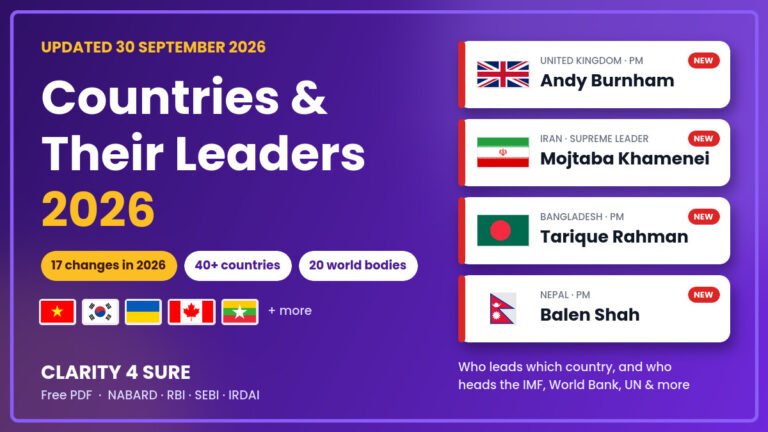 Free sheet · Static GKCountries & Their Leaders 2026Who leads which country in 2026, with all 17 changes marked. Get the article and the PDF free on WhatsApp.Get it free on WhatsApp →
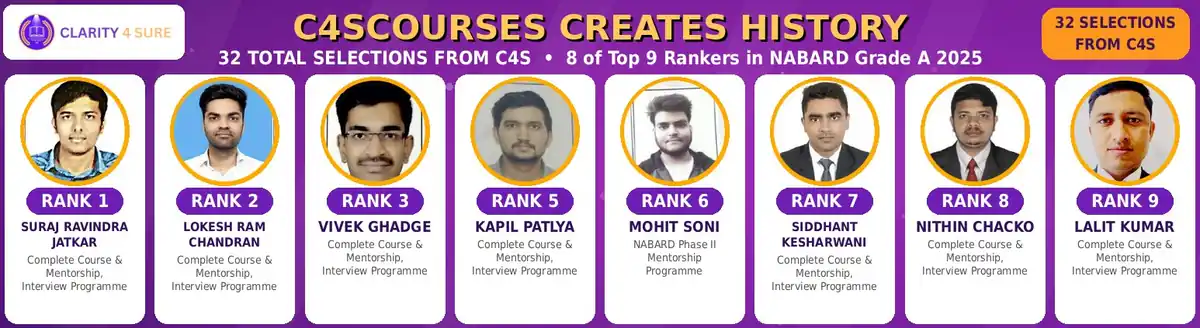
8 of the top 10 ranks in NABARD Grade A 2025 came from one classroom
Ranks 1, 2, 3, 5, 6, 7, 8 and 9 on the final list, and 32 selections in all, prepared with C4S Courses (Clarity 4 Sure). The same descriptive training and the same current affairs notes you are reading now.
- 1Suraj Ravindra JatkarRank 1
- 2Lokesh Ram ChandranRank 2
- 3Vivek GhadgeRank 3
- 5Kapil PatlyaRank 5
- 6Mohit SoniRank 6
- 7Siddhant KesharwaniRank 7
- 8Nithin ChackoRank 8
- 9Lalit KumarRank 9
- 30&31 December, 2025
- 01 & 02 January, 2026
- 03 January, 2026
- 04&05 January, 2026
- 06&07 January, 2026
- 08 January, 2026
- 09 January, 2026
- 10 January, 2026
- 11&12 January, 2026
- 13 January, 2026
- 14 January, 2026
- 15 January, 2026
- 16&17 January, 2026
- 18 & 19 January, 2026
- 20 January, 2026
- 21 January, 2026
- 22 January, 2026
- 23&24 January, 2026
- 25&26 January, 2026
- 27 & 28 January, 2026
- 29 & 30 January, 2026
30&31 December, 2025
Daily Current Affairs Quiz
30 & 31 December, 2025
International Affairs
1. India–New Zealand Free Trade Agreement (FTA)
Source: TH
The India–New Zealand Free Trade Agreement (FTA), concluded in December 2025 and announced after negotiations that began in March 2025, marks a major step in India’s strategy of trade diversification and deeper economic integration with high-income economies.
The agreement was finalised under the leadership of Narendra Modi and Christopher Luxon, and is being described as one of India’s fastest-concluded FTAs (nine months).
What is the India–New Zealand FTA?
It is a comprehensive trade and investment agreement covering:
- Goods
- Services
- Investment
- Skilled labour mobility
- MSME cooperation
- Traditional knowledge and wellness services
The FTA is designed not merely as a tariff-cutting pact, but as a long-term framework for economic cooperation and access to the Oceania–Pacific region.
What zero-duty access will India get?
- 100% of India’s exports to New Zealand will face zero customs duty
- This provides full market access for Indian goods
In return:
- India will reduce or eliminate tariffs on 95% of New Zealand’s exports
- 57% of these products become duty-free from day one
How much FDI is New Zealand committing?
- $20 billion in Foreign Direct Investment (FDI) by 2030
- Spread across 118 sectors
- Focus areas:
- Services
- Skill mobility
- Employment generation
- Education, healthcare, construction, IT
Notably, the agreement includes binding timelines and clawback provisions if investment commitments are not met — a first in India’s FTAs.
Key New Elements in the Agreement
- Facilitation of Ayurveda, yoga and traditional medicine services (first such commitment by New Zealand)
- Easier movement of Indian professionals, including:
- IT professionals
- Engineers
- Healthcare workers
- Yoga instructors
- Chefs and music teachers
- Student-friendly provisions:
- Work permits up to 20 hours/week
- Extended post-study work visas
Why is India accelerating FTAs?
India’s rapid push for FTAs reflects strategic, economic and geopolitical compulsions:
- Trade diversification
- Reduce dependence on the U.S., EU and China
- India–U.S. trade ($132 bn) exposed India to tariff shocks
- WTO-plus commitments
- Services, digital trade, investment rules go beyond WTO norms
- Geopolitical alignment
- FTAs as tools of strategic partnerships (Oceania, West Asia, Africa)
- Domestic policy alignment
- Support Make in India, PLI schemes, and global value chain integration
- Response to U.S. tariff pressures
- Sharp fall in India’s exports to the U.S. in late 2025
- Indo-U.S. FTA negotiations stalled, especially over agriculture
This is India’s third FTA in 2025, after agreements with the UK and Oman.
National Affairs
1. INSV Kaundinya
Context:
Prime Minister Narendra Modi extended New Year greetings to the crew of INSV Kaundinya, who are currently on a maritime voyage, praising their enthusiasm and dedication as India prepares to welcome 2026.
About Kaundinya
INSV Kaundinya is a historic stitched sailing vessel of the Indian Navy, reconstructed to revive and showcase India’s ancient maritime traditions and long-distance seafaring heritage.
Key Highlights:
- Type: Stitched wooden sailing ship (plank-and-cord construction)
- Inspired by: 5th-century CE Ajanta cave paintings depicting Indian ocean-going vessels
- Construction method: Planks stitched together using coir rope, without nails or metal fasteners
- Material: Teak wood and traditional natural fibres
- Name origin: Named after Kaundinya, an ancient Indian mariner associated with early maritime links between India and Southeast Asia
Development & Launch
- Built by: Traditional shipwrights from Kerala using age-old methods
- Commissioned by: Indian Navy in collaboration with cultural and archaeological experts
- Launched at: Goa (Indian Navy)
2. Ayushman Bharat – Pradhan Mantri Jan Arogya Yojana (AB-PMJAY)
Context:
Ayushman Bharat – Pradhan Mantri Jan Arogya Yojana (AB-PMJAY) is India’s flagship health assurance scheme that provides up to ₹5 lakh per family per year for secondary and tertiary care hospitalization in empaneled public and private hospitals. In 2025, the scheme was expanded significantly when Odisha and Delhi formally joined AB-PMJAY.
Key Features
- Launched: 2018
- Nodal agency: National Health Authority (NHA)
- Coverage: Up to ₹5 lakh per family per year
- Care included: Secondary and tertiary hospitalisation
- Mode: Cashless and paperless treatment
- Hospitals: Empanelled public and private hospitals across India
- Beneficiaries: Poor and vulnerable families identified from SECC 2011 and updated databases
3. Parvati-Arga Bird Sanctuary Declared Eco-Sensitive Zone
Source: News on Air
Context:
The Parvati–Arga Bird Sanctuary in Uttar Pradesh has been notified as an Eco-Sensitive Zone (ESZ) by the Ministry of Environment, Forest and Climate Change (MoEFCC) to strengthen ecological protection around the sanctuary.
Key Facts
- Location: Gonda district, Uttar Pradesh
- Ecosystem: Freshwater wetlands, lakes, marshes
- Importance: Critical habitat for resident and migratory water birds
- Ramsar Status: Recognised as a Ramsar Wetland of International Importance
About the Eco-Sensitive Zone (ESZ)
- ESZs are notified under the Environment (Protection) Act, 1986
- Act as a buffer zone around protected areas like national parks and sanctuaries
- Aim to regulate human activities rather than completely prohibit them
Activities under ESZ
- Prohibited: Polluting industries, mining, major hydropower projects
- Regulated: Construction, tourism, groundwater extraction
- Permitted: Traditional agriculture, eco-friendly livelihoods, conservation-based tourism
4. India Ranks 3rd in Global Rare Earth Reserves
Source: ET
Context:
India has emerged as the world’s third-largest holder of rare earth reserves, underscoring its growing strategic importance in critical minerals essential for modern technologies and clean energy transitions.
Key Highlights:
- Global Rank India: 3rd in rare earth reserves
- Estimated Reserves: ~6.9 million tonnes (REO)
- Share of Global Reserves: Around 6–7%
Rankings (REO Reserves):
- China – 44 MT
- Brazil – ~21 MT
- India – 6.9 MT (6–7% of global)
About Rare Earth Elements (REEs)
- A group of 17 elements including lanthanides, scandium, and yttrium
- Despite the name, they are not truly rare, but are difficult to extract and process economically
- Crucial for:
- Electric vehicles & wind turbines (permanent magnets)
- Smartphones & electronics
- Defence, space & aerospace systems
- Green hydrogen & advanced batteries
India’s Resource Base
- Major deposits found in beach sand minerals containing monazite
- Concentrated along coastal regions of:
- Odisha
- Andhra Pradesh
- Tamil Nadu
- Kerala
- Managed primarily by Indian Rare Earths Limited (IREL)
5. Amit Shah Inaugurates Redeveloped Batadrava Than, Assam
Source: PIB
Context:
Amit Shah, Union Home Minister of India, inaugurated the redeveloped Batadrava Than in Assam, marking a significant step towards preserving Assam’s spiritual, cultural, and Vaishnavite heritage.
About Batadrava Than
- Batadrava Than is one of the most sacred Vaishnavite monasteries (Sattras) in Assam
- Location: Nagaon district, Assam
- Founded by: Srimanta Sankardev, the 15th–16th century saint, reformer, and social philosopher
- Considered the birthplace of the Neo-Vaishnavite movement (Ekasarana Dharma) in Assam
Key Features of the Redevelopment
- Restoration of heritage architecture while maintaining traditional Sattra aesthetics
- Improved pilgrim amenities including pathways, lighting, and visitor facilities
- Cultural spaces for showcasing Ankiya Naat, Sattriya traditions, and Vaishnavite literature
- Environment-friendly infrastructure aligned with heritage conservation norms
6. Pinaka Long Range Guided Rocket (LRGR-120)
Source: PIB
Context:
The Defence Research and Development Organisation (DRDO) has successfully conducted the maiden flight test of the Pinaka Long Range Guided Rocket (LRGR-120) from the Integrated Test Range (ITR), Chandipur, marking a major milestone in India’s indigenous rocket artillery capabilities.
About Pinaka Long Range Guided Rocket (LRGR-120)
The Pinaka LRGR-120 is an indigenously developed, precision-guided rocket variant of the Pinaka Multi‑Barrel Rocket System, designed for long-range, high-accuracy battlefield strikes.
Developed by
- Armament Research and Development Establishment (ARDE)
- In association with High Energy Materials Research Laboratory (HEMRL)
- Under the aegis of DRDO
Aim of the System
- Extend the strike range of the Pinaka rocket family
- Deliver precision-guided firepower with reduced collateral damage
- Enhance operational flexibility using existing Pinaka launch infrastructure
7. PM Highlights Narsapuram Lace Craft in Man Ki Baat
Context:
The Prime Minister, in Man Ki Baat, highlighted the Narsapuram Lace Craft as a model of women-led economic empowerment, cultural continuity, and sustainable livelihoods. The recent conferment of the Geographical Indication (GI) tag has brought renewed national focus to this centuries-old craft of the Godavari region.
About Narsapuram Lace Craft
Narsapuram Lace Craft is a handmade crochet lace tradition, where artisans use a single crochet hook and fine cotton threads to create intricate lace patterns. The craft is known for its precision, patience, and high skill, resulting in products such as lace trims, table linens, garments, and decorative items.
Region
- State: Andhra Pradesh
- Districts: West Godavari and Dr. B.R. Ambedkar Konaseema
- Key Centres: Narsapur, Palacole, Razole, Amalapuram
Historical Background
- Origins: Introduced in 1844, when European missionaries trained local women in lace-making techniques
- Resilience: The craft survived famines, colonial-era economic disruptions, and market fluctuations, remaining a dependable source of income for women
- Evolution: Over time, Narsapuram lace gained global recognition as a distinctive hand-crafted textile tradition
Banking/Finance
1. India Becomes the World’s 4th Largest Economy
Source: ET
Context:
India has officially emerged as the world’s fourth-largest economy, overtaking Japan, marking a major milestone in its economic journey and reinforcing its position as the fastest-growing major economy globally.
Key Highlights
- Global Rank: 4th largest economy
- GDP Size: ~USD 4.18 trillion
- Surpassed: Japan
- Ahead of: United Kingdom
- Next Target: Germany (projected by 2030)
Global Ranking Snapshot
- United States
- China
- Germany
- India
- Japan
Growth Drivers
- Robust private consumption, supported by rising incomes and urban demand
- Public capital expenditure on infrastructure (roads, railways, digital public goods)
- Strong performance in services, especially IT, finance, and business services
- Expansion of manufacturing under Make in India and PLI schemes
- Macro-economic stability with controlled fiscal and external sector risks
Recent Growth Performance
- India recorded 8%+ real GDP growth in recent quarters
- Continues to outpace other major economies amid global slowdown concerns
- Recognised as the fastest-growing large economy by international institutions
2. RBI Releases “Report on Trend and Progress of Banking in India 2024–25”
Source: TH
Context:
The Reserve Bank of India (RBI) has released its statutory annual publication, the “Report on Trend and Progress of Banking in India 2024–25”, in accordance with Section 36(2) of the Banking Regulation Act, 1949. The report provides a comprehensive assessment of the health, performance, and evolving risks of India’s banking system.
Purpose of the Report
- To present an annual review of the functioning of the banking sector
- To assess financial stability, resilience, and regulatory outcomes
- To inform the Government of India and Parliament on banking sector developments
Key Findings of the Report
1. Bank Frauds: Fewer Cases, Higher Amounts
- Number of frauds declined to 23,879 cases (2024–25) from 36,052 cases (2023–24)
- Amount involved increased sharply to ₹34,771 crore from ₹11,261 crore in the previous year
Reason for spike in value:
- Re-examination of 122 large fraud cases involving ₹18,336 crore, following a landmark Supreme Court judgment (27 March 2023)
Legal context:
- In SBI v. Rajesh Agarwal, the Supreme Court ruled that borrowers must be given an opportunity to be heard before accounts are classified as ‘fraud’, reinforcing the principles of natural justice.
2. Fraud Profile: Type-wise Trends
- Card / Internet frauds
- 66.8% of total cases (highest by number)
- Advances-related frauds
- 33.1% of total amount involved (highest by value)
3. Bank-wise Contribution to Frauds
- Private Sector Banks (PVBs)
- 59.3% of total cases
- Largest share by number: Card/Internet frauds
- Largest share by value: Advances-related frauds
- Public Sector Banks (PSBs)
- 70.7% of the total amount involved
- Advances-related frauds dominate both by number and value
4. Trend Across Bank Groups
- Card/Internet frauds
- Declined across all bank groups (both in number and amount)
- Advances-related frauds
- Increased across all bank groups in number
- Increased in amount across all banks except PSBs
5. Resilience & Growth of Scheduled Commercial Banks (SCBs)
- Double-digit growth in deposits and credit, though moderated compared to last year
- Consolidated SCB balance sheet growth: 11.2% (vs 15.5% in 2023–24)
- Assets side
- Bank credit: +11.5%
- Investments: +9.2%
- Liabilities side
- Deposits: +11.1%
(Often described as the “resilient 11-11-11” growth pattern)
6. Profitability
- Net profits of SCBs increased, but at a slower pace
- Moderation partly due to slower growth in Net Interest Income (NII)
7. Capital Adequacy & Leverage
- CRAR of SCBs
- 17.4% at end-March 2025
- 17.2% at end-September 2025
- Leverage ratio remained well above regulatory minimums, indicating strong buffers
8. Asset Quality
- Asset quality strengthened further
- GNPA ratio
- 2.2% at end-March 2025
- 2.1% at end-September 2025
- These levels represent a multi-decadal low, reflecting improved credit discipline and recoveries
9. Urban Co-operative Banks (UCBs)
- Recorded higher balance sheet growth compared to the previous year
- Asset quality improved for the fourth consecutive year
- Strengthening observed in capital buffers and profitability
10. Non-Banking Financial Companies (NBFCs)
- Continued double-digit credit growth
- Maintained robust capital buffers
- Asset quality improved during the year, despite pockets of stress in specific segments
3. SEBI Surplus Transfer Proposal
Source: BS
Context:
During the Winter Session of Parliament, the government introduced the Securities Markets Code, 2025 Bill, which seeks to consolidate securities market laws. A key concern arises from Clause 124, which proposes the transfer of the annual surplus of the market regulator to the Consolidated Fund of India (CFI).
What Does Clause 124 Propose?
- 25% of SEBI’s annual surplus to be credited to a Reserve Fund, capped at two years’ preceding expenditure.
- Remaining surplus to be transferred annually to the CFI.
- This effectively hard-codes a ceiling on the regulator’s expenditure and mandates surplus transfer to the government.
How SEBI’s General Fund Works (Current System)
- Inflows: Fees and charges levied on market infrastructure institutions, regulated entities, and market participants.
- Outflows: Revenue and capital expenditure of Securities and Exchange Board of India (SEBI).
- Autonomy: SEBI’s budget is approved by its own Board—core to its financial independence under the SEBI Act, 1992.
4. Govt Plans to Amend SARFAESI Act to Include Special Situation Funds (SSFs)
Source: Business Standard
Context:
The Union government is considering amending the SARFAESI Act, 2002 to expand the definition of “financial institution” to include Special Situation Funds (SSFs), with the aim of speeding up recovery of stressed assets and NPAs.
About SARFAESI Act, 2002
- Full form: Securitisation and Reconstruction of Financial Assets and Enforcement of Security Interest Act, 2002
- Enables banks and financial institutions to recover dues above ₹1 lakh by enforcing security interests without court or tribunal intervention.
- Key provision: Section 13 (enforcement of security interest).
What are Special Situation Funds (SSFs)?
- Defined and regulated by Securities and Exchange Board of India (SEBI).
- Classified as Category I Alternative Investment Funds (AIFs).
- Focus on:
- Distressed assets
- Stressed loans
- Corporate restructuring, insolvency, mergers
- Play an active role in turnaround and revival of stressed companies.
Proposed Amendments
- Inclusion of SSFs under SARFAESI
- SSFs to be added under Section 2(1)(m) (definition of financial institution).
- Will allow SSFs to directly invoke SARFAESI provisions for recovery.
- Time Limit for Borrower Representations
- Amendment to Section 13(3A).
- Borrowers must submit objections to a demand notice (Section 13(2)) within 30 days of receipt.
- Currently, no statutory timeline, leading to delays.
5. Research, Development and Innovation Fund (RDIF)
Context:
The Government of India has created the Research, Development and Innovation Fund (RDIF) with a corpus of ₹1 lakh crore (≈ $11 billion) to transform India’s R&D and deep-tech innovation ecosystem by providing long-term, risk-tolerant capital.
Research, Development and Innovation Fund (RDIF)
The Research, Development and Innovation Fund (RDIF) is a ₹1 lakh crore (~$11 billion) government initiative aimed at financing high-risk, high-impact research and deep-tech innovation in India through long-term risk capital, rather than conventional grants.
Key Features
- Nature: Sovereign risk-capital fund (not a grant or subsidy scheme).
- Objective: Bridge the “valley of death” between lab research and commercialisation.
- Time Horizon: Designed for patient capital with a long-term (up to 50 years) outlook.
- Focus: Deep-tech and strategic sectors where private funding is limited due to high risk.
Institutional Framework
- Anchored under the Anusandhan National Research Foundation (ANRF).
- Operates through a two-tier structure:
- Special Purpose Fund (SPF): Holds government capital.
- Professional fund managers (AIFs, NBFCs, public financial institutions) deploy funds into startups and ventures.
Priority Sectors
- Artificial Intelligence & semiconductors
- Biotechnology & life sciences
- Quantum technologies
- Clean energy & climate tech
- Space, defence, and advanced materials
6. Funds Raised by Banks Hit 3-Year Low: RBI
Source: Mint
Context:
The Reserve Bank of India (RBI) has reported that fundraising by banks through capital market routes—private placements, qualified institutional placements (QIPs), and preferential allotments—has fallen to its lowest level in the last three financial years.
Contrasting Trend
- RBI noted that fundraising increased during FY25, mainly driven by PSBs, which recorded 36.6% growth in funds raised—largely through debt instruments.
- The current slowdown marks a reversal of the rising trend seen between FY23 and FY25.
Reasons for Decline
- Ample deposit mobilisation at select banks.
- Higher bond yields, reducing appetite for long-term debt issuance.
- Tighter liquidity conditions and uncertainty over the interest rate cycle.
- Banks reassessing funding mix after heavy reliance on private placements in recent years to meet capital and regulatory needs.
Why it Matters
- Indicates a shift in bank funding strategies.
- Reflects sensitivity of bank capital raising to interest rates and liquidity conditions.
- Important for understanding capital adequacy, credit growth, and financial stability.
Agriculture
1. IS 19262:2025 for Electric Agricultural Tractors
Source: PIB
Context:
Pralhad Joshi, Union Minister for Consumer Affairs, Food and Public Distribution, released IS 19262:2025, India’s first dedicated quality and safety standard for Electric Agricultural Tractors, marking a major step towards clean, safe, and sustainable farm mechanisation.
About IS 19262:2025
IS 19262:2025 is a national standard that lays down technical, safety, and performance requirements for electric agricultural tractors, ensuring their reliability, safety, and suitability for Indian farming conditions.
Objectives
- Ensure operator and electrical safety
- Promote standardisation of electric farm machinery
- Support the transition towards clean energy in agriculture
- Build consumer confidence in electric tractors
Facts To Remember
1. BJP Ministers inaugurate library built in memory of Vajpayee twice in one day
Union Minister of State for Cooperation Krishan Pal Gurjar and Haryana Local Bodies Minister Vipul Goel inaugurated a library building in Faridabad
2. Share of Banks in SCBs’ Balance Sheet (FY25): Key Takeaways
According to the latest ‘Report on Trend and Progress of Banking in India’ published by the Reserve Bank of India on December 30, 2025, the structure of India’s banking system witnessed marginal but notable shifts during FY25, reflecting changing competitive dynamics and funding patterns.
3. Bracewell announces retirement
Former New Zealand all-rounder Doug Bracewell announced his retirement from all forms of cricket.
4. Deepti Sharma becomes top wicket-taker in women’s T20Is
Deepti Sharma became the top wicket-taker in women’s T20Is.
5.Banks Report 30% Jump in Fraud Amount in April–September 2025: RBI
According to the Reserve Bank of India (RBI)’s Trend and Progress of Banking in India report, the amount involved in banking frauds jumped sharply in the first half of FY26 (April–September 2025), even though the number of reported cases fell.
5. DAC Approves Defence Proposals Worth ₹79,000 Crore
In December 2025, the Defence Acquisition Council (DAC), chaired by Rajnath Singh, approved defence procurement proposals worth ₹79,000 crore.
6. FITT & IDFC First Bank Launch New IGNITE Cohort
On Dec 29, 2025, Foundation for Innovation and Technology Transfer (FITT) partnered with IDFC First Bank.
Program:
- IGNITE (Innovation Growth & Nurturing Initiative for Technology Entrepreneurs)
Objective:
- Support deep-tech startups
- Bridge academia–industry gap
7. DoT Releases National Frequency Allocation Plan-2025
In December 2025, Department of Telecommunications (DoT) released NFAP-2025, effective 30 December 2025.
Purpose:
- Management & allocation of radio frequency spectrum
- Supports 5G, satellite communication, defence & aviation needs
8. India–Australia Trade: Zero Duty on All Tariff Lines
Key Decision:
- 100% Australian tariff lines → Zero duty
- Effective from 1 January 2026
9. HAL’s Dhruv-NG Helicopter Inaugurated
In December 2025, Ram Mohan Naidu inaugurated Dhruv-NG at Hindustan Aeronautics Limited, Bengaluru.
10. Former Bangladesh PM Khaleda Zia Passes Away
On Dec 30, 2025, former Bangladesh PM Begum Khaleda Zia passed away at age 80.
Key Facts:
- Chairperson: Bangladesh Nationalist Party (BNP)
- Born: 15 August 1945, Jalpaiguri (now WB)
11. Jayshree Ullal Tops Hurun India Rich List 2025 (Indian-Origin Executives)
Jayshree Ullal, CEO of Arista Networks, ranked 1st among Indian-origin professional executives.
Key Facts:
- Net worth: USD 5.7 billion (~₹50,170 crore)
- Category: Professional managers/executives (not founders)
12. Russia Launches Soyuz-2.1b Rocket with 52 Satellites
On Dec 28, 2025, Russia launched Soyuz-2.1b rocket from Vostochny Cosmodrome.
13. Jharkhand School Survey Adds ‘Other’ Religion Category
The Jharkhand government has decided to add an ‘Other’ religion category in its ongoing school survey after objections from tribal groups over the exclusion of indigenous faiths.
About the Survey:
- Conducted under DAHAR 2.0 (Digital Habitation Mapping and Real-time Monitoring).
- Implemented by the Jharkhand Education Project Council under Samagra Shiksha.
- Covers children aged 3–18 years to track enrolment, dropouts, and educational planning.
14. Rediff.com India Secures TPAP Licence from NPCI
Rediff.com India Limited, a subsidiary of Infibeam Avenues Limited, received final approval from National Payments Corporation of India (NPCI) to operate as a Third-Party Application Provider (TPAP).
- Platform: RediffPay
- Stage: Closed User Group (CUG) testing
- PSP Bank: Axis Bank
15. IDFC First Bank Launches ‘Gaj’ Metal Credit Card
IDFC First Bank launched ‘Gaj’, an invitation-only premium metal credit card for HNIs.
- Top tier in Ashva–Mayura–Gaj card series
- Joining & annual fee: ₹12,500 + GST
- Annual fee waived on ₹10 lakh annual spend
16. Syria Unveils New Currency Series
Syria unveiled a new series of banknotes, to be circulated from January 1, 2026.
17. India Allows Export of Organic Sugar with Annual Cap
India has partially relaxed export restrictions on organic sugar by permitting limited overseas shipments, while continuing to tightly manage domestic sugar supplies.
18. Arjun Erigaisi finishes Day 1 as table-topper at FIDE World Blitz Championships
In Chess, India’s Arjun Erigaisi finished Day 1 of the 2025 FIDE World Blitz Chess Championships in Doha, Qatar as table-topper. With 10 points in the 13 rounds played, Arjun is currently leading the Open section with Maxime Vachier-Lagrave and Fabiano Caruana.
- Re-examination of 122 large fraud cases involving ₹18,336 crore, following a landmark Supreme Court judgment (27 March 2023) RBI Releases “Report on Trend and Progress of B…
- On Dec 29, 2025, Foundation for Innovation and Technology Transfer (FITT) partnered with IDFC First Bank. FITT & IDFC First Bank Launch New IGNITE Cohort
- ESZs are notified under the Environment (Protection) Act, 1986 Parvati-Arga Bird Sanctuary Declared Eco-Sensit…
- Autonomy: SEBI’s budget is approved by its own Board—core to its financial independence under the SEBI Act, 1992. SEBI Surplus Transfer Proposal
- India will reduce or eliminate tariffs on 95% of New Zealand’s exports India–New Zealand Free Trade Agreement (FTA)
01 & 02 January, 2026
Daily Current Affairs Quiz
01 & 02 January, 2026
National Affairs
1. Dynamic Ground Water Resource Assessment Report, 2024
Context:
The Union Minister of Jal Shakti has released the Dynamic Ground Water Resource Assessment Report, 2024, which indicates a net improvement in India’s groundwater status compared to 2017, marked by higher recharge and moderated long-term extraction. This reflects important spatial and temporal changes in a critical geographical feature — groundwater.
Key Highlights of the Report:
1. Changing Groundwater Status (Spatial Trends)
- Rising Recharge:
- Total annual groundwater recharge stands at 446.90 BCM, showing a long-term increase due to rainwater harvesting, tanks, ponds, and conservation structures.
- Moderate Extraction:
- Annual groundwater extraction is 245.64 BCM, with the stage of extraction at 60.47%, suggesting national-level sustainability.
- Expansion of ‘Safe’ Units:
- 73.4% of assessment units are now categorised as Safe (up from 62.6% in 2017).
- Decline in Over-exploitation:
- Over-exploited units reduced from 17.24% (2017) to 11.13% (2024) — a partial reversal of groundwater stress.
2. Role of Water Bodies & Conservation Structures
- Recharge from tanks, ponds, and artificial recharge structures increased to 25.34 BCM, nearly doubling since 2017.
- Highlights the revival of traditional water bodies as critical geographical features influencing subsurface hydrology.
3. Persistent Regional Imbalances
Despite national improvement, groundwater stress remains spatially concentrated in:
- North-West India: Punjab, Haryana, Delhi, Rajasthan
- Western & Peninsular India: Gujarat, Tamil Nadu, Karnataka, Telangana
These regions coincide with arid/semi-arid climates, water-intensive cropping, and hard rock aquifers, underscoring the location-specific nature of groundwater depletion.
4. Climatic Sensitivity
- Rainfall dominance: Nearly 61% of recharge comes from rainfall.
- With ~75% of rainfall concentrated in June–September, groundwater availability remains highly sensitive to monsoon variability and climate change.
Reasons for Groundwater Depletion (Geographical Perspective)
- Agriculture-driven Over-extraction
- Groundwater supports ~62% of irrigation.
- Water-intensive crops (rice, sugarcane) dominate NW and peninsular India, pushing 11.13% units into Over-exploited category.
- Seasonal Rainfall Regime
- Sharp temporal mismatch between monsoon recharge and year-round withdrawal.
- Hydro-geological Constraints
- ~Two-thirds of India lies in hard rock terrain, where groundwater is stored only in fractured zones → limited storage and rapid depletion.
- Energy Subsidy Distortion
- Cheap/free electricity encourages excessive pumping, especially in Punjab, Haryana, Rajasthan, Tamil Nadu, where >25% units are Critical/Over-exploited.
- Urban–Industrial Pressure
- Rising urbanisation and industrial clusters contribute to 245.64 BCM annual groundwater draft (2024).
Initiatives Addressing Groundwater Stress
- National Aquifer Mapping Programme (NAQUIM & NAQUIM 2.0):
Aquifer-level scientific mapping and management planning. - Atal Bhujal Yojana (ATAL JAL):
Community-led demand-side management in water-stressed blocks. - Master Plan for Artificial Recharge (2020):
Proposal for ~1.42 crore structures to harness 185 BCM of monsoon runoff. - Jal Shakti Abhiyan – Catch the Rain:
Nationwide rainwater harvesting and water conservation. - PMKSY (Groundwater Component):
Promotes efficient irrigation and conjunctive water use.
Challenges Linked to Groundwater as a Geographical Resource
- Water Security Risk:
Supplies 85% of rural and ~50% of urban drinking water. - Regional Inequality:
Stress concentrated in NW India, western arid zones, and peninsular crystalline belts. - Quality Degradation:
- 127 units (1.88%) saline
- Arsenic and fluoride contamination in stressed aquifers.
- Climate Vulnerability:
Marginal fall in recharge from 449.08 BCM (2023) to 446.90 BCM (2024) due to erratic rainfall. - Governance Fragmentation:
Groundwater as a State subject leads to uneven regulation and weak pricing signals.
Way Forward (Geography-Informed Strategy)
- Aquifer-based Management:
Scale up NAQUIM/NAQUIM-2.0 for village-level aquifer plans, prioritising Critical and Over-exploited units. - Demand-side Reforms:
Crop diversification, rational power subsidies, micro-irrigation to sustainably keep extraction below 60%. - Artificial Recharge Expansion:
Implement the Master Plan for Artificial Recharge (2020) to harness 185 BCM monsoon runoff. - Community Stewardship:
Expand ATAL JAL across 8,220 water-stressed Gram Panchayats. - Data-driven Governance:
Institutionalise annual groundwater assessment using IN-GRES (GIS-based platform) for real-time correction.
2. BSNL Launched Voice over WiFi (VoWiFi) Services
Source: PIB
Context:
State-run telecom operator Bharat Sanchar Nigam Limited (BSNL) has launched Voice over WiFi (VoWiFi) services across all telecom circles in India, enabling users to make voice calls and send SMS over Wi-Fi networks. The move significantly enhances connectivity in areas with weak or no mobile network coverage, especially indoors and in remote regions.
What is Voice over WiFi (VoWiFi)?
- VoWiFi is a technology that allows users to make and receive voice calls and text messages using a Wi-Fi connection instead of a cellular tower.
- It works on the IMS (IP Multimedia Subsystem) framework.
- Uses:
- The same mobile number
- The default phone dialer
- No third-party app is required, unlike internet calling platforms.
3. Central Excise (Amendment) Act, 2025
Context: TH
Context:
The Union Government has notified the Central Excise (Amendment) Act, 2025, along with related tax changes on tobacco products, to be effective from February 1, 2026. The reform ends the GST Compensation Cess, revises central excise duties, and seeks to raise tobacco prices in line with public health and fiscal objectives.
About the Central Excise (Amendment) Act, 2025
The Central Excise (Amendment) Act, 2025 amends the Central Excise Act, 1944 to restructure excise duties on tobacco and tobacco-related products, which continue to remain outside the full GST framework.
Key Features of the Act
1. Revision of Central Excise Duties
The Act updates excise rates to maintain and enhance the overall tax burden after the discontinuation of the GST compensation cess.
Revised duty rates include:
- Unmanufactured tobacco: 64% → 70%
- Chewing tobacco: 25% → 100%
- Hookah/Gudaku tobacco: 25% → 40%
- Smoking mixtures (pipes/cigarettes): 60% → 325%
- Cigarettes:
- From ₹200–₹735 → ₹2,700–₹11,000 per 1,000 sticks
2. Public Health Objective
- The reform aligns with global public health guidance, which stresses that real tobacco prices should rise faster than incomes to curb consumption.
- Addresses the issue of stagnant affordability of cigarettes despite income growth over the past decade.
3. GST Rate Restructuring on Tobacco
- Beedis: Shifted to 18% GST
- All other tobacco products: Shifted to 40% GST
This replaces the earlier structure that combined GST with a compensation cess.
4. New Valuation Mechanism
- For products such as chewing tobacco, gutkha, khaini, jarda, GST valuation will now be:
- Based on the Retail Sale Price (RSP) declared on the package
- Aims to curb under-reporting and tax evasion.
About GST Compensation Cess
The GST Compensation Cess was an additional levy on select goods (including tobacco) to compensate States for revenue losses due to GST.
- Introduced: July 2017
- Original duration: 5 years (till June 2022)
- Continued beyond this period to clear compensation liabilities
- Now discontinued from February 1, 2026
4. Centre Pre-Publishes Draft Rules for Four Labour Codes
Source: Mint
The Ministry of Labour and Employment has pre-published the draft Rules for implementation of the four Labour Codes, inviting public comments within 45 days. The move marks a major step towards operationalising India’s landmark labour law reforms, covering wages, industrial relations, social security, and occupational safety.
What Is the Key Announcement?
- Draft Rules uploaded on the Ministry’s website for public consultation
- Mandate a 48-hour work week
- Lay down special safeguards for women working night shifts
- Extend social security coverage to gig and platform workers
- Define workers, wages, gratuity, bonus, and employment categories
Code-wise Key Provisions
1. Code on Wages – Draft Rules
- Supersedes 18 earlier rules, including:
- Payment of Wages Rules, 1937
- Minimum Wages (Central) Rules, 1950
- Equal Remuneration Rules, 1976
- Minimum wage fixation based on:
- Standard working-class family (earning worker + spouse + two children)
- Three adult consumption units
- 2,700 calories per day per unit
- 66 metres of cloth per year
- Housing rent: 10% of food & clothing expenditure
- Fuel, electricity & misc.: 20%
- Children’s education, medical & recreation needs
- 25% for contingencies
- Wages to vary by:
- Geographical area
- Skill levels (unskilled, semi-skilled, skilled, highly skilled)
- A Technical Committee, headed by the Director-General of Employment, will advise on skill categorisation.
- A Central Advisory Board proposed for fixing the floor wage.
2. Code on Social Security – Draft Rules
- Supersedes 12 existing rules, including:
- Employees’ State Insurance Rules, 1950
- Payment of Gratuity Rules, 1972
- Unorganised Workers’ Social Security Rules
- National Social Security Board to be constituted:
- Includes representatives of unorganised sector workers & employers
- Five members from gig and platform workers, on a rotational basis
- Creche facility mandatory in establishments employing 50 or more workers, for children below six years.
3. Women & Night-Shift Employment
- Employers must ensure:
- Written consent of women employees
- Safe transportation facilities
- CCTV surveillance and workplace safety measures
- Aims to balance gender inclusion with safety and dignity at work.
4. Industrial Relations Code – Draft Rules
- Integrates:
- Industrial Disputes (Central) Rules, 1957
- Industrial Employment (Standing Orders) Rules, 1946
- Covers:
- Registration & functioning of trade unions
- Secret ballot for verification of trade unions
- Classification of workers:
- Permanent, Temporary, Apprentices, Probationers
- Badlis, Casual workers
- Fixed-Term Employment (engagement through a written contract for a fixed duration)
5. SPREE 2025 Scheme
Source: PIB
Context:
The Ministry of Labour and Employment has extended the deadline of the SPREE 2025 scheme to January 31, 2026, providing additional time for employers and employees to avail benefits under the Employees’ State Insurance framework.
About SPREE 2025
- Full form: Scheme for Promotion of Registration of Employers and Employees
- Launched by: Employees’ State Insurance Corporation (ESIC)
- Launch date: July 2025
- Ministry: Ministry of Labour and Employment
- Legal basis: Employees’ State Insurance Act, 1948
- Legal framework: Implemented under the Employees’ State Insurance Act
Objective
- Expand social security coverage
- Encourage voluntary registration of:
- Unregistered employers
- Left-out or uncovered workers
Key Features
- No penalty or prosecution: No inspections, damages, or demands for past non-compliance
- No retrospective contribution: ESI contributions applicable only after registration
- Digital onboarding: Registration through ESIC, Shram Suvidha, and MCA portals
- Inclusive coverage: Applies to establishments and workers left out earlier
6. DRDO Carries Out Successful Salvo Launch of Pralay Missiles
Source: TOI
Context:
The Defence Research and Development Organisation (DRDO) successfully conducted a salvo launch of two indigenously developed Pralay missiles from the same launcher, marking a significant milestone in India’s conventional missile capability.
Key Details of the Test
- Type of test: Salvo launch (multiple missiles fired in quick succession from one launcher)
- Location: Off the Odisha coast
- Range & tracking: Monitored by sensors of the Integrated Test Range (ITR), Chandipur
About the Pralay Missile
- Type: Short-range, surface-to-surface quasi-ballistic missile
- Nature: Conventional (non-nuclear) missile system
- Range: ~150–500 km
- Launch platform: Road-mobile Transporter Erector Launcher (TEL)
- Guidance: Advanced navigation system with high accuracy
- Role: Precision strike against high-value enemy targets
7. Ancient Savannas of Western Maharashtra
Source: TH
Why in News?
A new ecological study published in People and Nature, a journal of the British Ecological Society, has shown that the savannas of western Maharashtra are ancient ecosystems, not degraded or deforested landscapes.
The study uses medieval Marathi literature, oral traditions, archival records, and ecological evidence to trace open tree–grass savanna landscapes back at least 750 years, well before colonial-era timber extraction. It challenges the dominant policy narrative that treats savannas as degraded forests and calls for distinct conservation approaches that respect both biodiversity and local cultural histories.
What are Savannas?
- Mixed tree–grass ecosystems with:
- Open canopies
- Seasonal drought
- Strong fire–grazing interactions
- Dominated by thorny trees, drought-adapted shrubs, perennial grasses, and browsing-resilient species.
Savannas vs Forests (Conceptual Difference)
- Savannas:
- Fire- and grazing-maintained
- Low tree density
- Grass-dominated systems
- Closed Forests:
- Dense canopy
- Shade-tolerant species
- Fire-sensitive ecology
Indian Ecological Terminology (Historical)
- vana / jāgala → wild, open, drier landscapes (scrub, savanna, grasslands)
- anūpa → wetter areas, marshes, and closed forests
Modern policy often misinterprets vana as only “dense forest”, leading to misclassification of savannas.
Types of Savannas in Maharashtra
- Fine-leaf savannas:
- Drier belts (≤ 1000 mm rainfall)
- Broadleaf savannas:
- Wetter belts (≥ 700 mm rainfall)
- Both coexist in the 700–1000 mm rainfall transition zone.
8. Market Access Support (MAS) Scheme
Source: PIB
Context:
The Government of India has launched a ₹4,531 crore Market Access Support (MAS) scheme for a six-year period (FY 2025–26 to FY 2030–31) to strengthen the global reach, visibility, and competitiveness of Indian exporters through structured, outcome-oriented interventions.
The scheme was unveiled by the Department of Commerce and forms part of the broader ₹25,060 crore Export Promotion Mission, approved by the Union Cabinet in November 2025.
About Market Access Support (MAS)
- MAS is implemented under the Niryat Disha sub-scheme of the Export Promotion Mission (EPM).
- It represents a shift towards structured, outcome-driven export promotion, focusing on buyer connectivity, visibility of Indian products, and entry into priority and emerging markets.
- Ministry: Ministry of Commerce and Industry, Government of India.
Implementing Ministries & Institutions
- Lead Ministry: Ministry of Commerce and Industry
- Jointly implemented by:
- Department of Commerce
- Ministry of MSME
- Ministry of Finance
- In coordination with: Indian Missions abroad, Export Promotion Councils (EPCs), Commodity Boards, and industry associations
What MAS Provides
Under the MAS framework, the government will offer financial and institutional support for:
- Buyer–Seller Meets (BSMs)
- Participation in international trade fairs and exhibitions
- Mega reverse BSMs hosted in India
- Trade delegations to targeted export destinations
Additional features include:
- A 3–5 year rolling calendar of major market-access events for advance planning
- Mandatory online feedback from exporters to assess buyer quality, leads generated, and market relevance
- Continuous refinement of guidelines based on data-led evaluation
- All processes—event listings, proposals, approvals, onboarding, fund release, and monitoring—will be routed through the government’s trade portal trade.gov.in.
MSME-Centric Design
- Minimum 35% MSME participation mandated for supported events
- Focus on new geographies and smaller markets to diversify India’s export base
- Rationalised financial ceilings and cost-sharing norms
- Partial airfare support for exporters with turnover up to ₹75 lakh in the previous year
Understanding the Export Promotion Mission (EPM)
- Total Outlay: ₹25,060 crore (FY26–FY31)
- Implemented jointly by:
- Department of Commerce
- Ministry of MSME
- Ministry of Finance
- Two sub-schemes:
- Niryat Protsahan – Trade finance & credit support (₹10,400 crore)
- Niryat Disha – Non-financial enablers like branding, logistics, compliance & market access (₹14,660 crore)
- Nodal Agency: Directorate General of Foreign Trade
- Priority sectors:
- Textiles
- Leather
- Gems & jewellery
- Engineering goods
- Marine products
Banking/Finance
1. Financial Stability Report (FSR), December 2025
Source: Mint
Context:
The Reserve Bank of India released the December 2025 edition of the Financial Stability Report (FSR) on 31 December 2025, warning that near-term risks to India’s economy and financial system may arise from global geopolitical and trade-related uncertainties.
About the Financial Stability Report (FSR)
- A half-yearly publication of the RBI
- Reflects the collective assessment of all financial sector regulators under the Financial Stability and Development Council (FSDC) Sub-Committee
- Evaluates current and emerging risks to India’s financial stability
Key Highlights of FSR – December 2025
1. Global Macrofinancial Risks
- Global growth remains resilient, supported by:
- Fiscal measures
- Front-loaded trade
- Strong investment in artificial intelligence (AI)
- Downside risks persist due to:
- High public debt
- Elevated policy uncertainty
- Risk of sharp market corrections
- RBI cautioned that:
- Excess liquidity is fuelling risk-on sentiment
- A sharp correction—especially if AI optimism fades—could spill over due to rising interconnectedness of financial markets
2. Domestic Macrofinancial Risks
- Indian economy continues to grow, driven by:
- Strong domestic demand
- Benign inflation
- Fiscal consolidation and prudent macroeconomic policies
- Near-term risks stem from:
- Global geopolitical tensions
- Trade disruptions impacting exchange rates, exports, earnings, and foreign investment
- Overall, the domestic financial system remains sound, supported by:
- Strong balance sheets
- Easy financial conditions
- Low market volatility
3. Financial Institutions’ Health
- Scheduled Commercial Banks (SCBs):
- Strong capital adequacy and liquidity buffers
- Improved asset quality and profitability
- Stress tests show ability to withstand severe adverse scenarios while remaining above regulatory capital norms
- Urban Cooperative Banks (UCBs):
- Largely healthy with sound capital buffers
- Profitability remains strong despite softer net interest margins
- Non-Banking Financial Companies (NBFCs):
- Improving asset quality
- Stable profitability
- Mutual Funds & Clearing Corporations:
- Stress tests confirm resilience to adverse shocks
- Insurance Sector:
- Continues to display balance sheet resilience
- Solvency ratios remain above minimum regulatory thresholds
4. Regulatory and Supervisory Initiatives
- Financial regulators are:
- Strengthening governance and accountability
- Enhancing customer and investor protection
- Improving ease of doing business
- RBI highlighted efforts to:
- Reorganise regulatory instructions
- Improve clarity and accessibility
- Reduce compliance burden for regulated entities
Overall Assessment
The December 2025 FSR reaffirms that India’s financial system is resilient and well-capitalised, even as global uncertainties and market vulnerabilities rise. The RBI, however, stresses the need for continued vigilance amid external shocks.
2. Banks Allowed to Set Up Their Own Pension Funds under NPS
Source: TH
Context:
India’s pension regulator, the Pension Fund Regulatory and Development Authority (PFRDA), has permitted banks to sponsor and independently set up pension funds to manage assets under the National Pension System (NPS). The move aims to enhance competition, efficiency, and depth in India’s pension ecosystem.
What Has Changed?
- PFRDA has granted in-principle approval for banks to act as pension fund sponsors under NPS.
- This approval is subject to eligibility norms aligned with RBI guidelines.
- Until now, banks primarily functioned as Points of Presence (PoPs)—handling subscriber registration, contributions, and servicing, but not fund management.
Eligibility Conditions for Banks
Banks seeking to sponsor pension funds must meet criteria related to:
- Net worth
- Market capitalisation
- Prudential soundness and regulatory compliance
These safeguards ensure that only financially strong and well-governed banks enter pension fund management.
Current NPS Landscape
- PFRDA oversees pension assets worth over USD 177 billion.
- There are currently 10 registered pension fund managers under NPS.
- Some existing pension funds already have indirect links to banks and other financial institutions, but this reform allows direct bank sponsorship.
Part of Broader Pension Reforms
This decision fits into a series of recent reforms aimed at modernising and diversifying NPS investments:
Expanded Investment Options (Dec 2024)
- NPS subscribers allowed to invest in:
- Gold and silver Exchange-Traded Funds (ETFs)
- Nifty 50 index
- Alternative Investment Funds (AIFs)
Fee Structure Revision
- Investment Management Fee (IMF) for pension funds revised
- New fee structure to take effect from April 1, 2026
Governance Strengthening
- Three new trustees appointed to the NPS Trust Board
- Includes Dinesh Kumar Khara, former Chairman of State Bank of India
3. Government Notifies Rules to Enable 100% FDI in Insurance Sector
Source: ET
Context:
The Government of India has notified the final rules enabling 100% Foreign Direct Investment (FDI) in the insurance sector, marking a major reform aimed at attracting global capital and enhancing ease of doing business.
The rules were notified by the Ministry of Finance following parliamentary approval of the amended insurance law during the Winter Session and came into force on December 30, 2025, upon publication in the Official Gazette.
What Has Changed?
1. Board & Management Composition Relaxed
- Earlier requirement:
- Majority of directors and key management personnel had to be Indian residents
- Revised rule:
- This condition has been removed for insurance companies with foreign investment
2. Indian Leadership Safeguard Retained
- At least one key leadership position must be held by a Resident Indian citizen:
- Chairperson, Chief Executive Officer (CEO), or
- Managing Director (MD)
This ensures Indian oversight at the strategic level, even with full foreign ownership.
Legal & Policy Background
- The rules operationalise the new Insurance Amendment Law, which:
- Was passed by Parliament
- Received Presidential assent
- Was notified after stakeholder consultations on the draft rules issued in August 2025
- The reform aligns with the government’s broader push for:
- Liberalisation of the financial sector
- Ease of doing business
- Deeper insurance penetration
4. KYC Rules Eased for Company Directors
Context:
The Ministry of Corporate Affairs (MCA) has announced a major compliance relief for company directors, allowing them to file their Know Your Customer (KYC) details once every three years instead of annually.
The relaxed norms will come into effect from March 31.
What Has Changed?
- Earlier:
- Company directors were required to file KYC annually
- Now:
- KYC filing required once in three years
- Applies to directors governed under Section 12A of the Companies (Appointment & Qualification of Directors) Rules, 2014
This move significantly reduces the regulatory and compliance burden for hundreds of thousands of directors.
What is KYC?
Know Your Customer (KYC) is a regulatory process through which financial institutions verify the identity, address, and financial profile of customers before or while providing services. It aims to prevent money laundering, terrorist financing, fraud, and identity theft.
Who mandates KYC in India?
- KYC norms are prescribed and supervised by the Reserve Bank of India
- Also followed by other regulators like SEBI and IRDAI for their respective entities
What is CKYC?
Central Know Your Customer (CKYC) is a centralised KYC system in India that allows a customer to complete KYC once and use it across multiple financial institutions.
Who manages CKYC?
- CKYC Registry is managed by Central Registry of Securitisation Asset Reconstruction and Security Interest of India (CERSAI)
- Implemented under the Prevention of Money Laundering Act (PMLA), 2002
Agriculture
1. Climate-Resilient Agriculture (CRA)
Source: TH
Context:
India’s food system stands at a crossroads. Climate change is no longer a distant risk—it is already reshaping farming through erratic rainfall, frequent heatwaves, declining soil health, water stress, and rising pest pressures. For a country that must feed a rapidly growing population, sustaining agricultural productivity under these conditions requires a fundamental shift. This is where Climate-Resilient Agriculture (CRA) becomes essential.
What Is Climate-Resilient Agriculture?
Climate-resilient agriculture refers to farming systems that anticipate, absorb, and adapt to climate shocks, while maintaining or improving productivity and environmental sustainability.
CRA integrates:
- Biotechnology tools:
- Biofertilizers and biopesticides to reduce chemical dependence
- Soil-microbiome analysis to restore soil health
- Genome-edited crops designed for tolerance to drought, heat, salinity, and pests
- Digital and AI technologies:
- AI-driven analytics that combine weather, soil, and crop data
- Precision irrigation, pest forecasting, and yield prediction
- Locally tailored advisories instead of one-size-fits-all practices
The goal is not just climate adaptation, but productive, low-input, and knowledge-intensive agriculture.
Why India Specifically Needs CRA
- India remains a predominantly agricultural nation, with livelihoods of millions tied to farming.
- Around 51% of India’s net sown area is rainfed, yet it produces nearly 40% of the country’s food—making it highly vulnerable to rainfall variability.
- Conventional input-intensive farming models are increasingly fragile under climate stress.
- Climate volatility threatens food security, farmer incomes, and rural stability.
CRA offers India a pathway to protect yields, reduce ecological damage, and stabilise farm incomes in a warming world.
Where Does India Stand Today?
Institutional Efforts
- In 2011, Indian Council of Agricultural Research (ICAR) launched the National Innovations in Climate Resilient Agriculture (NICRA) programme.
- Demonstrated location-specific practices such as:
- System of Rice Intensification (SRI)
- Aerobic and direct-seeded rice
- Zero-till wheat sowing
- Climate-resilient crop varieties
- In-situ residue management
- Implemented across 448 climate-resilient villages
- Demonstrated location-specific practices such as:
- The National Mission for Sustainable Agriculture focuses on:
- Rainfed agriculture
- Water-use efficiency
- Soil health management
- Integrated farming systems
Policy & Market Developments
- The BioE3 policy positions CRA as a priority area for biotechnology-led solutions.
- Several bio-inputs are already commercialised.
- India’s agritech ecosystem is expanding rapidly, offering:
- AI-based crop advisories
- Precision irrigation
- Crop health monitoring and yield forecasting
Key Gaps and Risks
Despite progress, scaling CRA faces serious constraints:
- Low adoption among small and marginal farmers due to limited awareness, access, and affordability
- Quality inconsistencies in biofertilizers and biopesticides, eroding farmer trust
- Slow rollout of climate-resilient and genome-edited seeds, with uneven State-wise adoption
- A persistent digital divide, limiting reach of AI-based tools
- Continuing soil degradation, groundwater depletion, and climate volatility
- Fragmented policy coordination, diluting impact
Without addressing these, climate impacts may outpace adaptation efforts.
The Way Forward: Why a National CRA Roadmap Is Needed
India now needs a coherent, integrated national roadmap for climate-resilient agriculture, rather than isolated schemes.
Key priorities include:
- Accelerating R&D and deployment of climate-tolerant and genome-edited crops
- Strengthening quality standards and supply chains for bio-inputs
- Expanding digital infrastructure and climate advisories for small farmers
- Providing financial incentives, climate insurance, and affordable credit during transition
- Aligning biotechnology, climate adaptation, and agricultural policy under a single strategic framework—anchored in the BioE3 vision
2. Government’s New Seed Push to Revive Cotton and Boost Farm Productivity
Source: Mint
Context:
On January 1, 2026, the Government of India unveiled a major agricultural productivity drive by releasing around 185 new high-yielding seed varieties and hybrids across a wide range of crops. The move aims to improve seed quality, raise farm productivity, and strengthen food security, with a special focus on reviving cotton yields.
What Has Been Announced?
- ~185 new seed varieties and hybrids released for cultivation and commercial sale
- Covers key crops:
- Rice
- Maize
- Cotton
- Millets
- Pulses
- Oilseeds
- Sugarcane
Key Feature
- All newly released cotton seeds remain Bt-II hybrids
- Bt-II refers to second-generation Bt cotton, containing Bacillus thuringiensis genes for pest resistance
- Indicates policy continuity, with no introduction of new biotech traits
India remains the world’s second-largest cotton producer, after China, but has faced stagnant yields, pest pressures, and rising cultivation costs in recent years.
What are Bt-II hybrids?
Bt-II hybrids are genetically modified (GM) cotton hybrids that contain two insect-resistant genes (Cry1Ac and Cry2Ab) derived from the bacterium Bacillus thuringiensis (Bt). These genes enable the cotton plant to produce toxins that kill bollworm pests, especially the American bollworm.
Why Bt-II? (Bt-I vs Bt-II)
- Bt-I hybrids:
- Contain only one gene (Cry1Ac)
- Effective initially but pests developed resistance over time
- Bt-II hybrids:
- Contain two genes (Cry1Ac + Cry2Ab)
- Provide broader and more durable resistance to bollworms
3. Union Government Launches Integrated e-Bill System for Fertiliser Subsidies
Source: BL
Context:
The Union Government has launched an integrated e-Bill System to digitally process fertiliser subsidies worth around ₹2 lakh crore, marking a major step towards end-to-end digital governance in subsidy administration.
About the e-Bill System for Fertiliser Subsidies
The e-Bill System is a completely digital, end-to-end platform for:
- Submission
- Processing
- Tracking
- Payment
of fertiliser subsidy bills.
It replaces the earlier paper-based and manual workflow, reducing delays and procedural inefficiencies.
Nodal Ministry
- Ministry of Chemicals and Fertilizers
Objectives
- Ensure timely, transparent, and accountable disbursal of fertiliser subsidies
- Improve financial discipline and expenditure monitoring
- Strengthen auditability and compliance through digital trails
- Enhance overall efficiency in subsidy management
Key Features of the e-Bill System
- End-to-end digital workflow
- Eliminates physical movement of subsidy bills and manual scrutiny
- Online claim submission
- Fertiliser companies can submit subsidy claims digitally and track payment status in real time
- Real-time tracking & centralised reporting
- Enables continuous monitoring of subsidy expenditure at the national level
- Built-in financial controls
- Automatic validation of claims against predefined norms
- Enforces rule-based compliance before payments are cleared
- Tamper-proof audit trail
- Every action is digitally logged, supporting audits and accountability
- FIFO (First-In-First-Out) processing
- Ensures uniform, predictable, and non-discretionary bill clearance
- Faster payments
- Facilitates timely release of weekly fertiliser subsidy payments, improving liquidity for fertiliser companies
Facts To Remember
1. World rapid and blitz
Of the 14 medals on offer at the World rapid and blitz chess championships in Doha, India claimed three. That is not bad, but last year India had a title — Koneru Humpy had won the rapid championship, and this time around she had to settle for bronze.
2. R.K. Shriramkumar receives Sangita Kalanidhi award
Hindustani violinist N. Rajam advised students of music to pursue their practice without interruption, saying it would keep opening doors they never expected.
3. Air Marshal Nagesh Kapoor takes charge as Vice Chief of Air Staff
Air Marshal Nagesh Kapoor assumed charge as the Vice Chief of the Air Staff, succeeding Air Marshal Narmdeshwar Tiwari, who superannuated after 40 years of service.
4. First Vande Bharat sleeper train to ply between Guwahati and Kolkata
Prime Minister Narendra Modi will flag off the first Vande Bharat sleeper train later this month, Railway Minister Ashwini Vaishnaw said. It will ply between Guwahati and Kolkata.
5. Centre Imposes Safeguard Duty on Steel Imports for Three Years
The Government of India has imposed a safeguard duty of up to 12% on the import of select steel products for a period of three years, aiming to protect the domestic steel industry from a surge in low-priced imports, particularly from China and a few other countries.
6. Credit growth nears 12%, deposit slows to 9.35%
Credit growth in the period ended December 15 expanded to nearly 12 per centyear-on-year (Y-o-Y), while deposit growth slowed further to 9.35 per cent, according to revised data released by the Reserve Bank of India (RBI).
7. UPI Ends 2025 on a High with Record 21.6 Billion Transactions
India’s flagship digital payments system, the Unified Payments Interface (UPI), closed December 2025 on a record-breaking note, underscoring the deepening shift towards cashless transactions across the country. According to data released by the National Payments Corporation of India (NPCI), UPI processed 21.63 billion transactions in December, up from 20.47 billion in November, marking a new all-time high.
8. Goa name its new district Kushavati
Goa’s third district will be named Kushavati, deriving its name from Kushavati river that flows through southern Goa.
9. PM Modi to inaugurate Grand International Exposition of Sacred Piprahwa Relics in New Delhi
Prime Minister Narendra Modi will inaugurate the Grand International Exposition of Sacred Piprahwa Relics related to Bhagwan Buddha, the Light and the Lotus: Relics of the Awakened One at Rai Pithora Cultural Complex in Delhi tomorrow.
10. Chief coach Sjoerd Marijne appointed for Indian women’s hockey team
Sjoerd Marijne has been appointed as the chief coach of the Indian women’s hockey team. This announcement was made by Hockey India today. The Dutchman had led Indian women to a historic fourth-place finish at the 2020 Tokyo Olympics, which was their second appearance at the quadrennial event in more than 36 years.
11. Centre approves 22 new projects under Electronics Components Manufacturing Scheme worth ₹41,863 crore
Centre has approved 22 new proposals under the third tranche of the Electronics Components Manufacturing Scheme, involving a projected investment of 41 thousand 863 crore rupees. These approvals cover the manufacturing of 11 target-segment products, including mobile manufacturing, telecom, consumer electronics, strategic electronics, automotive, and IT hardware.
12. Ecuador President Daniel Noboa declares 60-day emergency amid surge in criminal violence
Ecuadorian President Daniel Noboa has declared a new 60-day state of emergency in nine provinces and three municipalities. This comes due to an increase in criminal violence, which has caused serious internal commotion. The President said the 60-day validity of the decree aims to contain and reduce high-intensity violence, neutralise ongoing or imminent threats, and dismantle criminal structures.
13. NHAI discontinues Know Your Vehicle cards for new car FASTag issuances
National Highways Authority of India (NHAI) has announced discontinuation of Know Your Vehicle (KYV) cards for cars for all new FASTag issuances with effect from 1st of next month.
14. India International Youth Sailing Championship 2026 to take place at Chennai Port
The 11th India International Youth Sailing Championship 2026 will officially take place from 4th to 10th January at the Chennai Port. The Championship was launched in Chennai yesterday.
15. Repealing and Amending Act 2025 passed to simplify legal framework
The Repealing and Amending Act, 2025, was passed in the recently concluded winter session of the Parliament. The Act aims to simplify the country’s legal framework by repealing obsolete and redundant laws and making targeted amendments to select existing statutes.
16. India’s first bullet train to be launched on August 15, 2027 between Mumbai and Ahmedabad
Railways Minister Ashwini Vaishnaw today announced that India is likely to receive its first Bullet Train on 15th August 2027. Briefing media in New Delhi today, the Minister said India’s first bullet train project is under construction between Ahmedabad and Mumbai.
- 73.4% of assessment units are now categorised as Safe (up from 62.6% in 2017). Dynamic Ground Water Resource Assessment Report…
- Original duration: 5 years (till June 2022) Central Excise (Amendment) Act, 2025
- The Ministry of Labour and Employment has extended the deadline of the SPREE 2025 scheme to January 31, 2026, providing additional time for employers and employees to avail benefits under the Employees’ State Insurance framework. SPREE 2025 Scheme
- The scheme was unveiled by the Department of Commerce and forms part of the broader ₹25,060 crore Export Promotion Mission, approved by the Union Cabinet in November 2025. Market Access Support (MAS) Scheme
- Applies to directors governed under Section 12A of the Companies (Appointment & Qualification of Directors) Rules, 2014 KYC Rules Eased for Company Directors
03 January, 2026
Daily Current Affairs Quiz
03 January, 2026
International Affairs
1. U.S. forces capture Maduro after strikes on Venezuela
Source: TOI
Context:
US President Donald Trump confirmed US carried out large scale military strikes against Venzeula and captured Venezuelan President Nicolas Maduro and his wife.
Venezuela
Basics
- Capital: Caracas
- Region: Northern South America
- Currency: Bolívar (with widespread dollar use)
- Political system: Presidential republic
Neighbouring Countries of Venezuela
- Venezuela has a long northern coastline along the Caribbean Sea, which places it close to Caribbean island nations, though these are not land neighbours.
- The country is strategically positioned between the Andes region, the Amazon Basin, and the Caribbean.
- Colombia – to the west
- Brazil – to the south
- Guyana – to the east
Leadership & Politics
- President: Nicolás Maduro
- Long-running political crisis marked by disputed elections, opposition crackdowns, and international pressure.
- Periodic negotiations with opposition and external actors over sanctions relief and electoral guarantees.
Economy
- Oil-dominated: Holds one of the world’s largest proven crude reserves (Orinoco Belt).
- Challenges: Years of mismanagement, sanctions, and underinvestment led to hyperinflation (since eased), output collapse, and infrastructure decay.
- Recent trend: Modest stabilization via partial dollarization, selective
2. Asteroid Bennu and the Origins of Life
Context:
New scientific studies of samples brought back from asteroid Bennu suggest that many of the fundamental chemical ingredients required for life on Earth may have originated in space, lending strong support to theories of extraterrestrial contributions to life’s emergence.
Key Discovery
- Samples from asteroid Bennu, collected by OSIRIS-REx, contain:
- Sugars such as ribose (RNA sugar) and glucose
- Amino acids
- All five nucleobases found in DNA and RNA
- This confirms the complete molecular inventory required for life on a single asteroid.
About the Mission
- NASA’s OSIRIS-REx spacecraft collected samples from Bennu in 2020.
- The sample capsule returned to Earth in September 2023.
- Since then, scientists in the U.S. and Japan have been analysing the material.
National Affairs
1. Indian Army Procures Suryastra Long-Range Rocket Launcher
Source: TH
Context:
Under emergency procurement (EP) powers, the Indian Army has signed a ₹293 crore contract with NIBE Limited, in collaboration with Israel, for the supply of an advanced long-range rocket launcher system, significantly boosting India’s deep-strike artillery capabilities.
About the Weapon System – Suryastra
- India’s first Made-in-India universal multi-calibre rocket launcher
- Strike Ranges:
- Rockets: 150 km & 300 km
- Loitering munitions: up to 100 km
- Accuracy: Circular Error Probable (CEP) < 5 metres in trials
- Capabilities:
- Precision surface-to-surface strikes
- Engagement of multiple targets simultaneously
- Integration of multiple rocket types from a single launcher
2. ASUSE (Annual Survey of Unincorporated Sector Enterprises)
Context:
In a significant step towards statistical transparency and data literacy, the Ministry of Statistics and Programme Implementation has released its first-ever reader-friendly guide to help users better understand official surveys conducted in India.
About Know Your Survey: A User Guide to ASUSE
- A first-of-its-kind publication released by the National Statistics Office.
- Designed to demystify ASUSE (Annual Survey of Unincorporated Sector Enterprises) for data users, researchers, policymakers, and respondents.
- Uses simple, non-technical language, moving away from dense statistical jargon traditionally associated with official surveys.
Objectives
- Improve public trust in official data.
- Enable informed use of survey data by academics, analysts, and policymakers.
- Address misconceptions and doubts among survey respondents.
- Align Indian statistical communication with global best practices.
3. PM Pays Tribute to Savitribai Phule
Source: News on Air
Context:
On the birth anniversary of Savitribai Phule, the Prime Minister paid homage to her enduring legacy, recalling her lifelong commitment to education, equality, and social transformation—values that continue to shape India’s social justice discourse.
About Savitribai Phule (1831–1897)
Who She Was
- A pioneering social reformer, poet, and educator, widely regarded as India’s first female teacher of modern education.
- A foundational figure of Indian feminism and anti-caste reform.
Early Life
- Born in Naigaon (present-day Maharashtra); married in childhood to Jyotirao Phule.
- Relocated to Pune, where exposure to learning ignited her mission to reform society through education.
Key Contributions
- 1848: Co-founded India’s first girls’ school at Bhidewada, Pune.
- Played a central role in nurturing the Satyashodhak Samaj, promoting equality and rationalism.
- Popularised Satyashodhak marriages—simple ceremonies without priests or dowry.
4. Pro-Active Governance and Timely Implementation (PRAGATI)
Context:
Following the 50th review meeting of PRAGATI, the Cabinet Secretary highlighted that land acquisition has emerged as the single largest cause of infrastructure project delays, accounting for around 35% of stalled or delayed projects. This underscores persistent Centre–State and inter-departmental coordination challenges in India’s infrastructure push.
About Pro-Active Governance and Timely Implementation (PRAGATI)
What it is
- PRAGATI is a centralised, ICT-enabled governance platform for:
- Grievance redressal
- Programme implementation
- Monitoring of projects of national importance
- Enables real-time review and resolution of critical bottlenecks.
Launched
- 25 March 2015, by the Government of India under the leadership of the Prime Minister.
Objectives
- Ensure timely implementation of infrastructure and development projects.
- Resolve inter-ministerial and Centre–State coordination issues.
- Promote e-transparency, accountability, and outcome-based governance.
5. Cetacean Morbillivirus Detected in Arctic Waters
Source: IE
Context:
Scientists have, for the first time, detected cetacean morbillivirus (CeMV) in Arctic waters, using drones to collect whale breath (blow) samples. This marks a major advance in non-invasive wildlife disease surveillance and signals changing disease dynamics in polar ecosystems.
About Cetacean Morbillivirus (CeMV)
What it is
- A highly infectious viral disease affecting marine mammals such as whales, dolphins, porpoises, and pilot whales.
- Belongs to the morbillivirus group, closely related to measles (humans) and canine distemper (dogs).
Where it is found
- Earlier reported in the North Atlantic, Mediterranean Sea, and Pacific Ocean.
- New detection in Arctic waters, particularly among humpback and sperm whales, indicates a geographical expansion of the virus.
Origin
- First identified in 1987.
- Believed to have evolved from terrestrial morbilliviruses and later adapted to marine mammals.
- Spreads mainly through close contact and respiratory droplets.
6. Electronics Components Manufacturing Scheme (ECMS)
Context:
The Ministry of Electronics and Information Technology has approved 22 additional projects under the Electronics Components Manufacturing Scheme (ECMS), involving a fresh investment of ₹41,863 crore. This marks a major push to deepen India’s electronics manufacturing ecosystem beyond final assembly.
About the Electronics Components Manufacturing Scheme (ECMS)
What it is
- Electronics Components Manufacturing Scheme is a flagship incentive programme aimed at boosting domestic manufacturing of electronic components, sub-assemblies, and capital equipment.
- Seeks to reduce India’s heavy import dependence in electronics and strengthen supply-chain resilience.
Nodal Ministry
- Implemented by the Ministry of Electronics and Information Technology (MeitY).
Launch & Outlay
- Approved by the Union Cabinet in 2024.
- Total financial outlay: ₹22,919 crore.
Tenure
- Turnover-linked incentives: 6 years (including a 1-year gestation period).
- Capex-based incentives: 5 years.
7. Skilling for AI Readiness (SOAR)
Context:
On January 1, 2026, the Droupadi Murmu launched a series of initiatives under Skilling for AI Readiness (SOAR)—a key pillar of the Skill India Mission—at an event organised by the Ministry of Skill Development and Entrepreneurship at the Rashtrapati Bhavan Cultural Centre.
Key Launches & Announcements
1. #SkillTheNation Challenge
- A nationwide AI skilling initiative launched under SOAR.
- Focuses on AI awareness, learning, certification, and real-world application.
- Targets learners across urban, semi-urban, and rural India, ensuring inclusivity.
2. IGNOU Centre at Rairangpur, Odisha
- Virtually inaugurated a new Indira Gandhi National Open University centre.
- Located in a tribal-dominated region of northern Odisha.
- Aims to expand access to:
- Distance education
- Vocational training
- Skill-oriented programmes
- Especially benefits youth from rural and underserved areas.
3. Conferment of AI Certificates
- The President awarded AI certificates to:
- Students
- Members of Parliament (MPs)
- Recipients completed AI learning modules under the SOAR initiative, signalling leadership-by-example in digital skilling.
About Skilling for AI Readiness (SOAR)
- An integral component of the Skill India Mission focused on preparing India’s workforce for the AI-driven economy.
- Emphasises AI literacy, ethical use, and practical problem-solving.
Learning Model & Partnerships
- Blended delivery: Online and offline modes.
- Implemented in collaboration with IGNOU and Skill Centres nationwide.
- Offers multi-level courses—from beginner to advanced.
Aims & Significance
- Build a future-ready, inclusive workforce aligned with emerging technologies.
- Democratise access to AI education beyond metros.
- Encourage innovation and entrepreneurship through applied AI solutions.
- Strengthen India’s position in the global digital and AI talent landscape.
8. MoSPI Launches New Logo & Mascot ‘Sankhyiki’
Source: PIB
Context:
On 1 January 2026, the Ministry of Statistics and Programme Implementation (MoSPI) unveiled its new logo and official mascot ‘Sankhyiki’ in New Delhi, signalling a renewed effort to modernise its institutional identity and strengthen public engagement with official statistics.
Key Highlights
- New Logo:
- Reflects MoSPI’s evolving role in a data-driven governance ecosystem.
- Emphasises credibility, transparency, and relevance of official statistics in policymaking.
- Mascot – ‘Sankhyiki’:
- Derived from the Sanskrit word for statistics/data, symbolising accuracy, inclusiveness, and scientific rigour.
- Designed as a public-facing ambassador to simplify complex statistical concepts for citizens, students, and data users.
Objectives of the Initiative
- Enhance public outreach and statistical literacy.
- Make official data more approachable, relatable, and user-friendly.
- Reinforce trust in India’s official statistical system amid growing demand for transparent and reliable data.
9. India’s Silk Value Chain to Cross ₹1.1 Lakh Crore by 2030
Context:
India is aiming to significantly scale up its sericulture sector, positioning silk as a high-value agricultural and export commodity through productivity enhancement, technological adoption, and wider geographical spread.
Key Announcement
- The Central Silk Board has set a target to double India’s silk value chain from ₹55,000 crore to over ₹1,10,000 crore by 2030.
- The Board functions under the Ministry of Textiles.
Central Silk Board (CSB)
What it is
- The apex statutory body for the overall development of sericulture and the silk industry in India.
- Functions under the Ministry of Textiles.
Established
- 1948 (by an Act of Parliament).
Headquarters
- Bengaluru, Karnataka.
Government Initiatives
- Support through schemes such as Silk Samagra.
- Increased participation of States in the silk economy.
- Emphasis on diversification of silk applications beyond traditional uses.
Banking/Finance
1. Government Rolls Out ₹7,300 crore Schemes to Ease MSME Financing
Source: BS
Context:
To improve access to affordable credit for export-oriented MSMEs, the government has rolled out new credit-linked support schemes, aimed at strengthening liquidity, boosting exports, and enhancing bank lending.
Key Announcement
- The Government of India has launched two schemes worth ₹7,300 crore to ease financing constraints for Micro, Small and Medium Enterprises (MSMEs).
- The schemes are part of a broader effort to support export growth and MSME competitiveness.
Scheme 1: Collateral Support for Export Credit
- Total outlay: ₹2,114 crore
- Objective:
- Provide credit-guarantee support for export-linked working capital loans to MSME exporters
- Key Features:
- Collateral guarantee up to ₹10 crore per firm
- Guarantee coverage:
- Micro & Small exporters: up to 85%
- Medium exporters: up to 65%
- Nature:
- Designed to complement existing credit guarantee mechanisms
- Aims to increase bank lending to export-oriented MSMEs
- Rollout:
- Detailed guidelines to be notified by CGTMSE
- Initial pilot phase, followed by integration into a revised export promotion framework
Scheme 2: Credit Support under Export Promotion Framework
- Part of the broader Export Promotion Mission measures
- Detailed operational guidelines to be issued by the RBI
- Focus:
- Lowering the cost of credit
- Improving liquidity access for MSMEs engaged in exports
2. Government Panel Reviews Foreign Banks’ Plans to Open Branches in India
Source: BS
Context:
India is reviewing proposals from foreign banks to expand their presence amid a calibrated liberalisation of the financial sector and evolving FDI and trade commitments.
About the IDC Mechanism
- DFS is the nodal department for evaluating proposals from foreign and domestic banks.
- Before finalising decisions, the IDC consults:
- Ministry of Home Affairs – security perspective
- Ministry of External Affairs – political and diplomatic perspective
- Department of Commerce – economic and trade perspective
Eligibility to Become a Foreign Bank in India
Foreign banks are permitted to operate in India under a regulated and calibrated framework to balance financial openness with systemic stability. The entire process is governed by the Reserve Bank of India (RBI) in consultation with the Government of India.
Who qualifies as a foreign bank?
A foreign bank is a banking institution that:
- Is incorporated outside India
- Holds a valid banking licence in its home country
- Is subject to effective regulation and supervision by the home country regulator
Capital Requirements
- Branch Mode: Assigned capital as specified by RBI
- WOS Mode: Minimum ₹5 billion paid-up capital, with additional capital linked to expansion
Modes of Entry into India
Foreign banks can operate in India through three routes:
- Branch Mode
- Operates as an extension of the parent bank
- Can undertake full banking activities
- More common among global banks with limited physical presence
- Wholly Owned Subsidiary (WOS)
- Incorporated in India as a separate legal entity
- Greater operational freedom and near-national treatment
- Preferred by RBI for large-scale retail operations
- Representative (Liaison) Office
- Only for liaison, research, and promotional work
- No deposit-taking or lending allowed
3. SEBI Working on Technology Road Map for Stock Exchanges & MIIs
Source: BS
Context:
With capital markets becoming more complex and technology-driven, the market regulator is stepping up efforts to future-proof India’s market infrastructure institutions (MIIs).
Key Development
- Securities and Exchange Board of India (SEBI) is planning to constitute a working group to develop a technology road map for Market Infrastructure Institutions (MIIs).
- The announcement was made by Tuhin Kanta Pandey, Chairman, SEBI.
About the Technology Road Map
- Applicable to MIIs such as:
- Stock exchanges
- Clearing corporations
- Depositories
- The road map will outline:
- A 5-year technology vision
- A 10-year technology vision
- Objective:
- Provide a structured framework for the securities market ecosystem
- Ensure MIIs keep pace with rapidly evolving markets
Focus Areas Highlighted by SEBI
- Technology investment
- Risk management
- Cyber resilience
- Emphasis on:
- Quality and sophistication of markets, not just scale
- Investor protection alongside innovation
AI-Driven Regulatory Initiatives
SEBI has already deployed or is developing several artificial intelligence (AI) tools:
- AI-powered market surveillance system
- Detects fraud and market manipulation
- AI-driven advertisement viewer
- Monitors advertisements by asset management companies
- Disclosure monitoring tools
- Track compliance by listed entities
- AI-driven inspection tool (under development)
- Strengthens risk-based supervision
- Analyses cyber audit reports
- Identifies control gaps
- Classifies regulated entities based on risk exposure
Sensex at 40: Broader Perspective
- Speaking at the 40th anniversary of the Sensex, Pandey noted:
- The Sensex has mirrored India’s economic transformation over four decades.
- Its changing composition reflects:
- Rise of private enterprises
- Shift from traditional industries to services, finance, and technology
- Deeper integration with global capital markets
Agriculture
1. India Surpasses China to Become the World’s Largest Rice Producer
Source: TOI
Context:
India has overtaken China to rank No. 1 globally in rice production, reflecting sustained gains from improved irrigation, high-yielding varieties, and supportive procurement policies.
Global Status
- India: World’s largest rice producer (150.18 MT)
- China: Second largest (145.28 MT)
State-wise Rice Production (2023–24)
(As per Economic Survey, Statistical Appendix)
| Rank | State | Production | Share |
|---|---|---|---|
| 1 | Telangana | 16.63 MT | ~12.17% |
| 2 | Uttar Pradesh | 15.72 MT | ~11.50% |
| 3 | West Bengal | 15.12 MT | ~11.06% |
Other major rice-producing states:
Andhra Pradesh, Punjab, Odisha, Bihar, Chhattisgarh, Tamil Nadu, Assam.
Geographical Features of Rice Production in India
1. Climate Belt
- Rice thrives in hot, humid climates.
- Hence, concentration in eastern, southern, and north-eastern India.
2. Water Geography
- Strong presence in river floodplains and deltas:
- Ganga–Brahmaputra Plains
- Krishna–Godavari Delta
- Cauvery Delta
- Abundant alluvial soils and surface water support paddy cultivation.
3. Irrigation-driven Expansion
- In lower rainfall regions (e.g., Punjab, western UP), rice is sustained by canals and tube-wells.
- This boosts yields but raises groundwater depletion and water-stress concerns.
4. Terrain Adaptation
- In hilly and north-eastern regions, rice is grown using terraced cultivation, enabling controlled water flow and soil conservation.
Facts To Remember
1. Nritya Kalanidhi award conferred on Urmila Satyanarayanan
Bharatanatyam exponent Urmila Satyanarayanan was presented the Nritya Kalanidhi award at the 19th Dance Festival inaugurated at the Music Academy in the city on Saturday.
2. DoP & SIDBI Sign MoU for Verification of Informal Micro Enterprises
In December 2025, the Department of Posts (India Post) under the Ministry of Communications signed a Memorandum of Understanding (MoU) with the Small Industries Development Bank of India (SIDBI), under the Ministry of Finance, in New Delhi.
3. Union MoS Pemmasani Launches ‘Land Stack’ Pilot & GoRT
In December 2025, Chandra Sekhar Pemmasani, Union Minister of State, Ministry of Rural Development, launched the Land Stack portal, a first-of-its-kind national digital land governance initiative.
About Land Stack
- Part of the Digital India Land Record Modernisation Programme (DILRMP).
- Integrates land records, ownership, usage, valuation, and geo-spatial data.
- Enables data-driven land governance, transparency, and efficient service delivery.
4. J.P. Nadda Launches Integrated e-Bill System for Fertilizer Subsidy
On January 1, 2026, Jagat Prakash Nadda, Union Minister for Ministry of Chemicals and Fertilizers, launched an Integrated electronic (e)-Bill System at Kartavya Bhawan, New Delhi.
Objective
- Digitally process fertilizer subsidy claims worth ~₹2 lakh crore annually.
5. Kaushal Manthan concludes with finalisation of Skill Resolutions 2026
The Ministry of Skill Development and Entrepreneurship concluded the week-long Kaushal Manthan with a high-level session chaired by the Minister of State for Skill Development and Entrepreneurship, Jayant Chaudhary.
- 25 March 2015, by the Government of India under the leadership of the Prime Minister. Pro-Active Governance and Timely Implementation…
- The Central Silk Board has set a target to double India’s silk value chain from ₹55,000 crore to over ₹1,10,000 crore by 2030. India’s Silk Value Chain to Cross ₹1.1 Lakh Cro…
- In December 2025, Chandra Sekhar Pemmasani, Union Minister of State, Ministry of Rural Development, launched the Land Stack portal, a first-of-its-kind national digital land governance initiative. Union MoS Pemmasani Launches ‘Land Stack’ Pilot…
- On January 1, 2026, Jagat Prakash Nadda, Union Minister for Ministry of Chemicals and Fertilizers, launched an Integrated electronic (e)-Bill System at Kartavya Bhawan, New Delhi. J.P. Nadda Launches Integrated e-Bill System fo…
- 1848: Co-founded India’s first girls’ school at Bhidewada, Pune. PM Pays Tribute to Savitribai Phule
04&05 January, 2026
Daily Current Affairs Quiz
04 & 05 January, 2026
National Affairs
1. Pradhan Mantri Matru Vandana Yojana (PMMVY) Completes 9 Years
Context:
Pradhan Mantri Matru Vandana Yojana, a flagship scheme of the government for pregnant women and lactating mothers, has completed nine years.
Pradhan Mantri Matru Vandana Yojana (PMMVY)
The Pradhan Mantri Matru Vandana Yojana (PMMVY) is a maternity benefit scheme implemented by the Government of India to provide conditional cash assistance to pregnant and lactating women for their first living child. The scheme aims to improve maternal health, nutrition, and compensate for wage loss during pregnancy and after childbirth.
- Launched: 1 January 2017
- Ministry: Ministry of Women and Child Development
Key Objectives
- Improve health and nutrition of pregnant and lactating women
- Encourage early registration of pregnancy
- Promote institutional delivery
- Ensure timely vaccination and post-natal care
- Partially compensate wage loss
- Coverage: Over 4.5 crore women enrolled; more than ₹19,000 crore disbursed
- Significance: Strengthens maternal health, nutrition, and early childcare outcomes
Cash Assistance Structure
Total benefit: ₹5,000 (Direct Benefit Transfer – DBT)
| Installment | Amount | Condition |
|---|---|---|
| 1st | ₹1,000 | Early registration of pregnancy |
| 2nd | ₹2,000 | At least one antenatal check-up |
| 3rd | ₹2,000 | Childbirth registered + first cycle of immunisation |
Additionally, eligible women also receive ₹1,000 under Janani Suraksha Yojana (JSY), making the total maternity benefit ₹6,000, as mandated under the National Food Security Act, 2013.
2. Electronics Component Manufacturing Scheme (ECMS)
Source: ET
Context:
India is accelerating its push to strengthen domestic electronics manufacturing and reduce import dependence through targeted fiscal incentives.
Key Development
- The Ministry of Electronics and Information Technology (MeitY) has approved 22 additional projects under the Electronics Component Manufacturing Scheme (ECMS).
- Total investment committed by the approved projects: ₹41,863 crore.
- Total outlay of ECMS: ₹22,919 crore.
About the ECMS
- Objective: Promote domestic manufacturing of electronic components.
- Incentive structure:
- Payouts linked to incremental production.
- Additional incentives tied to employment generation.
- The scheme is time-competitive, rewarding firms that achieve production milestones early.
Beneficiaries
- The scheme supports a mix of:
- Small and medium Indian firms, and
- Established industry players such as Tata Electronics Pvt. Ltd..
- According to Ashwini Vaishnaw, incentives will benefit both emerging enterprises and large manufacturing heavyweights.
Key Feature
- First-to-finish incentive model:
- Companies that complete their production roadmaps earlier will receive payouts faster.
- Encourages speed, efficiency, and early capacity creation.
3. Export Promotion Mission (EPM)
Context:
To boost exports and ease credit constraints faced by exporters—especially MSMEs—the Government has expanded the Export Promotion Mission (EPM) with additional financial support measures.
Key Developments
- The Government of India has introduced two new credit-linked schemes under the Export Promotion Mission (EPM).
- Total financial outlay: ₹5,181 crore over six years (till 2030–31).
- With this announcement, 3 out of 11 schemes under EPM have been operationalised.
- The schemes fall under the Niryat Protsahan category, aimed at reducing the cost of export credit.
Scheme 1: Interest Subvention for Pre- and Post-Shipment Export Credit
- Objective: Lower the cost of export finance for exporters.
- Coverage:
- Pre-shipment and post-shipment rupee export credit
- Extended by scheduled commercial banks
- Beneficiaries:
- Eligible MSME exporters
- Implemented as per:
- Reserve Bank of India Master Directions
- Expected Impact:
- Improves MSME liquidity
- Enhances export competitiveness
- Supports India’s integration into global value chains
- Maintains fiscal prudence
Scheme 2: Collateral Support for Export Credit
- Objective: Enable MSME exporters to access bank credit despite limited collateral or third-party guarantees.
- Implementation Agency:
- Credit Guarantee Fund Trust for Micro and Small Enterprises (CGTMSE)
- Nature:
- Implemented on a pilot basis
- Applicable to export-linked working capital loans
- Eligibility:
- MSME exporters dealing in notified tariff lines
- Guarantee Coverage:
- Micro & Small exporters: up to 85%
- Medium exporters: up to 65%
4. Rah-Veer (Good Samaritan) Scheme
Source: PIB
Context:
The Ministry of Road Transport and Highways (MoRTH) has reiterated the protections and incentives available under the Rah-Veer (Good Samaritan) Scheme to encourage bystanders to assist road accident victims without fear of legal or procedural harassment.
About Rah-Veer
Rah-Veer is a Good Samaritan initiative notified under Section 134A of the Motor Vehicles (Amendment) Act, 2019, aimed at protecting citizens who help road accident victims during the Golden Hour—the critical first hour after an accident when timely medical care can save lives.
Key Features
1. Legal Protection
- No civil or criminal liability for helpers acting in good faith.
- Protection from unnecessary police or legal proceedings.
2. Right to Anonymity
- Rah-Veers cannot be compelled to disclose personal details.
- Cannot be forced to become witnesses in court.
3. Limited Police Interaction
- Only one voluntary statement, if the helper chooses.
- Statement to be recorded at a time and place convenient to the Rah-Veer.
4. Hospital Safeguards
- Hospitals must provide immediate emergency treatment.
- No demand for payment or paperwork from the helper.
- Mandatory acknowledgement receipt to the Rah-Veer.
5. Recognition & Incentives
- Incentive available up to five times in a year for repeat acts of assistance.
- ₹25,000 cash reward
- Certificate of Appreciation
5. Olive Ridley Sea Turtles
Context:
With the nesting season underway, wildlife authorities have established sea turtle hatcheries along the Chennai coast to safeguard eggs and enhance hatchling survival, especially from threats like predation, artificial lighting, and human disturbance.
What is it?
The Olive Ridley sea turtle is among the smallest and most abundant sea turtle species, named after its olive-green, heart-shaped carapace (shell). It is globally renowned for its spectacular mass nesting phenomenon known as arribada, during which thousands of females nest simultaneously on selected beaches.
Habitat and Distribution
Global Range
- Tropical waters of the Indian, Pacific, and Atlantic Oceans
Indian Context
- Major mass nesting sites along the Odisha coast:
- Gahirmatha
- Rushikulya
- Devi River mouth
- Solitary nesting occurs along:
- Tamil Nadu (including Chennai coast)
- Andhra Pradesh
- Andaman and Nicobar Islands
Marine Habitat
- Primarily pelagic (open ocean) species
- Migrates seasonally to sandy beaches for nesting
Conservation Status
- IUCN Red List: Vulnerable
- India (Legal Protection): Schedule I species under the Wildlife (Protection) Act, 1972
6. Suryastra Rocket System – Indian Army Induction
Context:
The Indian Army has signed a ₹293-crore emergency procurement contract with NIBE Ltd., in collaboration with Elbit Systems, for the induction of the Suryastra rocket system—a long-range universal rocket launcher with strike capabilities of up to 300 km.
About Suryastra Rocket System
Suryastra is India’s first indigenous universal multi-calibre long-range rocket launcher system, designed for precision surface-to-surface strikes at 150 km and 300 km. It can integrate multiple rocket and missile types on a single launch platform, offering both saturation and precision firepower.
Origin & Technology
- Manufacturer: NIBE Ltd. (India)
- Technology Partner: Elbit Systems (Israel)
- Technology Base: Israeli PULS (Precise & Universal Launching System)
- Adaptation: Customised for Indian Army requirements under a Technology Collaboration Agreement (July 2025)
Aim of Induction
- Enhance the Army’s deep-strike and stand-off firepower
- Provide a single, flexible rocket artillery platform for diverse combat roles
- Support Make in India and reduce dependence on imported long-range artillery systems
7. Indian Army to Deploy Ramjet-Powered Shells for 155 mm Artillery
Context:
The Indian Army is set to become the first armed force in the world to operationally deploy ramjet-powered artillery shells for its 155 mm artillery guns, marking a major leap in long-range conventional firepower.
What is it?
Ramjet-powered artillery shells are advanced 155 mm projectiles equipped with an air-breathing ramjet propulsion module. After being fired from a conventional artillery gun, the ramjet sustains thrust in flight, significantly extending the shell’s range without altering the gun system itself.
About Ramjet Technology
A ramjet is a type of air-breathing jet engine with no moving parts, designed to operate efficiently at supersonic speeds.
- Does not carry its own oxidiser
- Uses atmospheric oxygen for combustion
- Becomes efficient only after the projectile reaches high speed (provided by the gun launch)
Key advantage: Much higher efficiency and range compared to rocket-based propulsion for artillery shells.
Banking/Finance
1. ‘Insurance Misselling a Significant Concern’, Says Irdai
Source: ET
Context:
India’s insurance regulator has flagged misselling and unfair business practices as a growing concern, calling for corrective action by insurers to protect policyholders and strengthen trust in the sector.
Key Findings
- The Insurance Regulatory and Development Authority of India (IRDAI) has stated that insurance misselling remains a significant concern.
- Insurers have been advised to conduct a root-cause analysis to identify and address the reasons behind such practices.
What Is Insurance Misselling?
- Selling insurance products without adequate disclosure of:
- Terms and conditions
- Costs and benefits
- Product suitability for the customer
- Often involves pushing unsuitable or complex policies to meet sales targets.
Government’s Stand
- The Ministry of Finance has repeatedly cautioned banks and insurers against misselling.
- Emphasis has been placed on:
- Corporate governance best practices
- Ethical sales behaviour
- Protecting consumer interests
2. RBI Eases Related-Party Lending Norms
Source: FE
Context:
The Reserve Bank of India (RBI) has issued final guidelines on lending to related parties, easing several provisions from the draft norms and providing significant regulatory relief to banks and other regulated entities (REs).
What is the decision?
RBI has allowed existing related-party transactions that do not comply with the new norms to continue till their contractual maturity, subject to strict conditions. This move reduces disruption and avoids forced unwinding of legacy exposures.
Key Relief Measures
1. Run-off of Existing Exposures
- Non-compliant related-party loans can continue till maturity
- No enhancement, renewal, repricing, or change in terms allowed
- Replaces the earlier proposal of a one-year run-off, offering greater operational flexibility
2. Scope Rationalisation
- Equity investments in related parties excluded from the framework
- Debt investments in related parties continue to be covered
3. NBFC Exemptions
- Certain NBFCs exempted, including:
- NBFCs not accessing public funds
- Core Investment Companies (CICs)
Definition Changes for Clarity
- ‘Senior officer’ replaced with ‘specified employee’
- Defined as employees placed up to two levels below the board
- Scope of ‘related party’ narrowed
- Removal of duplicative references to relatives
- ₹5 crore shareholding threshold eliminated
- RBI rejected calls to raise materiality thresholds
- Adopted a scale-based framework: larger REs face proportionately tighter limits
Other Important Changes
Cooperative Banks
- Scale-based approach introduced
- Tier-4 Urban Cooperative Banks allowed limited related-party lending with board approval
All India Financial Institutions (AIFIs)
- Existing prohibitions on lending to directors and interested entities continue unchanged
Board Approval Exemptions
- Related-party loans fully secured by:
- Government securities
- Fixed deposits
- Life insurance policies
- Condition: Loan-to-Value ≤ 100% of realisable value
- Such loans do not require board approval
3. RBI Relaxes Risk-Weight Norms for NBFC Infrastructure Financing
Source: FE
Context:
The Reserve Bank of India (RBI) has eased risk-weight norms for infrastructure lending by Non-Banking Financial Companies (NBFCs), compared with its draft framework, while issuing the final guidelines on Thursday. The move provides capital relief to lenders while retaining repayment-based safeguards to ensure prudence.
What is the change?
RBI has lowered the repayment thresholds required for NBFC exposures to qualify for reduced risk weights for high-quality infrastructure projects, though it has retained repayment-linked criteria, underscoring that repayments remain a key indicator of reduced project risk.
Major Capital Relief: Key Changes
| Risk Weight | Draft Norm | Final Norm |
|---|---|---|
| 75% | After 5% repayment of original project debt | After 2% repayment |
| 50% | After 10% repayment | After 5% repayment |
- Applies to original sanctioned project debt
- Any additional borrowing will be clubbed to assess eligibility
Expanded Scope: High-Quality Infrastructure Projects
RBI has partially widened the definition of high-quality infrastructure projects to include those where revenues depend on rights granted under concession or contract by:
- Central or State Governments
- Public sector entities
- Statutory or regulatory bodies
However, termination protection clauses have been retained, as RBI considers them essential to safeguard lenders’ interests.
Agriculture
1. A Lesson from Beed in Raising Farmers’ Incomes
Source: IE
Context:
At a time when India’s goal of substantially raising farmers’ incomes remains elusive, an experiment from Beed district in Maharashtra offers a practical, scalable pathway to transform rural livelihoods—especially in drought-prone regions.
The Beed Breakthrough
- Beed district, traditionally marked by low rainfall and agrarian distress, witnessed a dramatic turnaround in farm incomes.
- The initiative was led by Global Vikas Trust (GVT) under the leadership of Mayank Gandhi.
- An independent assessment by Tata Institute of Social Sciences (TISS) found that per-acre incomes rose more than 10 times—from about ₹38,700 to nearly ₹3.9 lakh.
What Changed on the Ground?
1. Crop Diversification
- Farmers shifted from low-return crops like cotton and soybean to high-value horticulture, including:
- Papaya
- Pomegranate
- Sweet lime
- Custard apple
- Guava
- Banana
- These crops offered better price realisation and year-round income potential.
2. Scientific Farming Practices
- Adoption of high-density plantations and modern agronomic techniques.
- Continuous hand-holding and training, rather than one-time advisories.
3. Affordable Quality Inputs
- Saplings procured in bulk and supplied to farmers at nearly half the market price.
- Cost support came through CSR funds and philanthropic contributions, lowering entry barriers.
4. Water Security as the Foundation
- Construction of:
- Farm ponds
- Deep recharge shafts
- Result:
- Groundwater levels improved sharply—from around 400 feet to nearly 50 feet in many villages.
- Reliable water made diversification sustainable, not risky.
5. Credit & Risk Mitigation
- Banks were brought in with credit guarantees, reducing farmers’ fear of debt.
- Risk was shared across institutions, not borne by farmers alone.
Lessons for National Policy
- Crop diversification + water security is a powerful income multiplier.
- Doubling farmers’ income may be too modest a target—with the right support, incomes can grow manifold.
- Government schemes can amplify impact by aligning:
- Horticulture missions
- Watershed development
- Rural credit and insurance
- Replicable in other semi-arid and rain-fed regions of India.
2. ICAR Releases 184 New Crop Varieties
Source: TOI
Context:
The Union Minister of Agriculture and Farmers’ Welfare, Shivraj Singh Chouhan, today released 184 new varieties of 25 crops developed by the Indian Council of Agricultural Research (ICAR) at New Delhi. These varieties have been bred with improved yield, climate resilience, and nutritional traits.
Key Highlights of the Release
Crop-wise Break-up
- Rice: 60 varieties
- Maize: 50 varieties
- Oilseeds: 13 varieties
- Others: Pulses, millets, fodder and horticultural crops (part of total 25 crops)
Policy & Governance Announcements
- The government aims to ensure that all agriculture-related schemes reach farmers within three years of launch.
- Six regional zones have been created for pre-Rabi and pre-Kharif regional conferences, feeding into national conferences and helping states prepare a Krishi Roadmap tailored to regional needs.
- The government is considering introducing the Seed Bill in the upcoming Parliament session, signalling reforms in seed regulation, quality assurance, and farmer protection.
Facts To Remember
1. CM inaugurates ‘Shabdotsav’, 3-day literary, cultural festival
Staying connected to one’s roots is essential in the present times, Chief Minister Rekha Gupta as she inaugurated ‘Delhi Shabdotsav’, a three-day literature and cultural festival.
2. Telangana adopts resolution for restoration of MGNREGA
The Telangana Legislative Assembly on Friday adopted a unanimous resolution demanding that the Centre restore the Mahatma Gandhi National Rural Employment Guarantee Act (MGNREGA) as it is.
3. Billionaires’ Wealth Loses Share as India’s GDP Expands
After a phase of rapid accumulation between 2014 and 2021, the wealth of India’s billionaire promoters is now growing slower than the economy, leading to a decline in their share of national output.
Key Findings
- In CY2025, the combined net worth of India’s billionaire promoters (in US dollar terms) fell by 5%.
- Over the same period, India’s nominal GDP (in dollar terms) grew by 7.5% in FY25.
- Consequently, billionaires’ wealth as a share of GDP declined to 25.2% in CY25 from 28.5% a year earlier—the lowest in three years.
3. US tariff high, India’s seafood exports to other nations up 16%
India’s marine products exports increased by 16% in terms of value and 12% in volume during the first seven months (April-October) of FY 2025-26 as compared to the corresponding period last fiscal, shows official data. According to the data, India’s seafood exports increased to $4.87 billion in April-October 2025 from $4.19 billion during the same period of 2024.
4. Goa to Get Third District ‘Kushavati’
- Announcement: By CM Pramod Sawant
- Headquarters: Quepem
- Talukas included: Dharbandora, Quepem, Sanguem, Canacona
- Special feature: ~27% tribal population
- Status: Aspirational district; eligible for ₹15 crore additional central funding
- Importance: Balanced regional development and focused tribal welfare
5. India’s First Vande Bharat Sleeper Train
- Route: Guwahati (Assam) – Howrah (West Bengal)
- Designed by: Integral Coach Factory (ICF)
- Manufactured by: BEML Ltd
- Plan:
- 10 rakes by March 2026
- 50 additional rakes by ICF later
6. 50th PRAGATI Meeting Chaired by PM
- Projects reviewed: Infrastructure projects worth ₹40,000+ crore
- Impact:
- Projects worth ₹85 lakh crore accelerated since 2014
- ~94% issues resolved across 377 projects
- Governance significance: Outcome-oriented, tech-enabled project monitoring
7. President Launches ‘Skill The Nation’ AI Challenge
- Under Skilling for AI Readiness (SOAR) initiative
- Also inaugurated: IGNOU Regional & Skill Centre at Rairangpur, Odisha
- Focus: Inclusive, people-centric AI skilling for youth and marginalised groups
- Importance: Preparing India’s workforce for an AI-driven economy
8. MoSPI Unveils New Logo & Mascot ‘सांख्यिकी’
- Theme: Data for Development
- Logo elements: Ashoka Chakra, Rupee symbol, growth bar
- Mascot: ‘सांख्यिकी’ to simplify statistics and build public trust
- Significance: Citizen-centric, data-driven governance
9. Kaamya Karthikeyan Skis to South Pole
- Achievement: Youngest Indian (18 years) to ski to the South Pole
- Distance: 115 km in Antarctica
- Background: Completed Seven Summits Challenge before 18
- Significance: Symbol of youth achievement, adventure sports, and gender inspiration
10. ‘Samudra Pratap’ in Goa
Defence Minister Rajnath Singh commissioned the Indian Coast Guard’s (ICG) first indigenously designed and built pollution control vessel, Samudra Pratap, in Goa. The vessel will serve as a critical platform for enforcing marine pollution control regulations, maritime law enforcement, search and rescue operations, and safeguarding the country’s Exclusive Economic Zone.
11. Sheikh Mohammed bin Rashid marks 20 years as UAE prime minister
Sheikh Mohammed bin Rashid Al Maktoum, Vice President and Prime Minister of the UAE and Ruler of Dubai, marked the 20th anniversary of his assumption of the office of Prime Minister on this day in 2006, in a gathering with current and former ministers who have served with him over the past two decades.
12. 2nd Khelo India Beach Games set to begin at Ghoghla Beach in Diu
The 2nd Khelo India Beach Games is set to begin today at the Ghoghla Beach in Diu. More than 2,100 athletes will participate in eight different sports of the Beach Games, which is being organised by the Union Territory of Dadra and Nagar Haveli and Daman and Diu.
13. India’s AYUSH System Recognised in Bilateral Agreements with Oman, New Zealand
The Commerce Ministry has said that India’s traditional medicine system – AYUSH – has received formal recognition in bilateral trade agreements with Oman and New Zealand.
14. Rajasthan to host Regional AI Impact Conference 2026 in Jaipur on January 6
Rajasthan will host a Regional AI Impact Conference 2026 on the 6th of this month in Jaipur. Minister of Electronics and Information Technology Ashwini Vaishnaw and Minister of State for Electronics and Information Technology Jitin Prasada will attend the conference.
15. Govt announces relaxation for deep-tech startups, removing three-year existence condition to avail DSIR recognition
The government has removed the condition of three-year existence for deep-tech startups to avail recognition under DSIR’s Industrial Research and Development Promotion Program.
16. World Braille Day
The world is celebrating World Braille Day today to mark the celebration of its creator, Louis Braille. Braille is a code that enables the visually impaired to read with their fingertips using a system of six raised dots.
17. Sports: Deepti Sharma becomes highest wicket-taker in Women’s T20Is (152 wickets)
First player globally with 1,000 runs + 150 wickets in T20Is
- Additionally, eligible women also receive ₹1,000 under Janani Suraksha Yojana (JSY), making the total maternity benefit ₹6,000, as mandated under the National Food Security Act, 2013. Pradhan Mantri Matru Vandana Yojana (PMMVY) Com…
- Total financial outlay: ₹5,181 crore over six years (till 2030–31). Export Promotion Mission (EPM)
- Projects worth ₹85 lakh crore accelerated since 2014 50th PRAGATI Meeting Chaired by PM
- India (Legal Protection): Schedule I species under the Wildlife (Protection) Act, 1972 Olive Ridley Sea Turtles
- Total investment committed by the approved projects: ₹41,863 crore. Electronics Component Manufacturing Scheme (ECM…
06&07 January, 2026
Daily Current Affairs Quiz
06 & 07 January, 2026
National Affairs
1. Unlawful Activities (Prevention) Act – UAPA
Source: The Hindu
Context:
The Supreme Court refused bail to Umar Khalid and Sharjeel Imam in the 2020 Delhi riots case.
Unlawful Activities (Prevention) Act – UAPA
The Unlawful Activities (Prevention) Act (UAPA) is India’s main anti-terror law.
Its purpose is to protect the sovereignty, unity, and security of India by preventing activities linked to terrorism, secession, and unlawful organizations.
Why was UAPA made?
- Enacted in 1967
- Strengthened after major security threats (especially post-2004 and 2008)
- To give the government strong legal tools to deal with terrorism and anti-national activities
What does UAPA do?
1. Defines “Unlawful Activities”
Any action that:
- Threatens India’s unity or integrity
- Supports secession or disintegration
- Encourages violence against the state
2. Deals with Terrorist Activities
UAPA covers:
- Planning or committing terrorist acts
- Funding terrorism
- Recruiting or training terrorists
- Possessing weapons or materials for terrorism
3. Bans Organizations
- Government can declare an organization as a terrorist organization
- Membership, support, or funding such groups becomes a crime
4. Individuals Can Be Declared Terrorists
(After 2019 amendment)
- Even individuals, not just organizations, can be notified as terrorists
5. Special Powers to Investigating Agencies
- Longer detention period (up to 180 days without filing a chargesheet)
- Strict bail conditions (bail is very difficult)
- Property linked to terrorism can be seized
Legal basis used
- Section 43D(5), UAPA:
- Courts need only assess whether accusations are prima facie true.
- Considerations like long incarceration or delay in trial carry limited weight.
- Section 15, UAPA (Terrorist Act):
- Interpreted broadly to include acts beyond direct violence, such as threatening disruption of essential services.
2. ICGS Samudra Pratap Commissioned
Source: TH
What is the news?
The Indian Coast Guard (ICG) has commissioned ICGS Samudra Pratap, the first of two indigenously designed Pollution Control Vessels (PCVs), significantly enhancing India’s maritime pollution response and safety capabilities.
Key highlights
Built by Goa Shipyard Limited, it is:
- India’s first indigenously designed Pollution Control Vessel (PCV)
- Largest ship in the Indian Coast Guard (ICG) fleet
- Built with over 60% indigenous content, with a target of 90% indigenisation in future vessels
Capabilities of ICGS Samudra Pratap
- Pollution response
- Advanced pollution detection systems
- Specialised pollution response boats
- Fire-fighting
- Modern onboard fire-fighting equipment
- Maritime safety & security
- Coastal patrol and law enforcement
- Extended surveillance
- Long-range operations across India’s maritime zones
- Aviation facilities
- Helicopter hangar for enhanced reach, even in rough seas
3. India launches e-Production Investment Business Visa (e-B-4) for Chinese nationals
Source: TH
What is the news?
India has introduced a new e-Production Investment Business Visa (e-B-4 Visa) for Chinese nationals, allowing them to travel to India for specific business and investment-related activities.
Key features of the e-B-4 Visa
- Introduced on: January 1
- Eligibility: Chinese businessmen
- Application mode: Fully online, without visiting the embassy or agents
- Processing time: About 45–50 days
- Validity / Stay: Permission to stay in India for up to six months
Permitted activities
The e-B-4 Visa allows travel for:
- Installation and commissioning of equipment
- Production-related business activities
- Investment-linked commercial engagements
The visa is tailored for manufacturing and production ecosystems, rather than general tourism or employment.
4. Aditya-L1 Solar Mission
Source: The Hindu
What is the news?
On the second anniversary of Aditya-L1 reaching the Sun–Earth Lagrange Point-1 (L1), the Indian Space Research Organisation (ISRO) has released an Announcement of Opportunity (AO) inviting Indian scientists to submit proposals for the first AO cycle observations using Aditya-L1 data
About Aditya-L1 mission
- India’s first dedicated solar mission
- Launched: September 2, 2023
- Reached L1: January 6, 2024 (after 127 days)
- Observation point: Sun–Earth L1, ~1.5 million km from Earth
- Enables continuous, uninterrupted observation of the Sun, free from eclipses or occultation
Why is the L1 point important?
- Aditya-L1 is placed at Lagrange Point 1, about 1.5 million km from Earth, towards the Sun.
- Provides a stable gravitational location to observe the Sun constantly
- Ideal for studying:
- Solar flares
- Coronal mass ejections (CMEs)
- Solar wind
- Space weather events affecting Earth
What is the Announcement of Opportunity (AO)?
- A formal call inviting researchers to:
- Propose solar observations using Aditya-L1 instruments
- Provide scientific and technical justification
- Analyse data if the proposal is approved
5. Ministry Proposes Doubling Auto PLI Allocation to ₹5,800 Crore
Source: TH
What is the news?
The Ministry of Heavy Industries (MHI) has proposed doubling the allocation for the Production Linked Incentive (PLI) scheme for automobiles and auto components to ₹5,800 crore in the upcoming financial year.
- Allocation in FY 2025–26: ₹2,818.85 crore
- Proposed allocation (next FY): ₹5,800 crore
About the Auto PLI Scheme
- Launched: 2021
- Total outlay: ₹25,938 crore
- Objective:
- Boost domestic manufacturing
- Attract investment
- Promote green mobility
Key features
- Incentives linked to incremental production
- Mandatory Domestic Value Addition (DVA) of 50%
- Focus on Zero Emission Vehicles (ZEVs):
- Battery Electric Vehicles (BEVs)
- Hydrogen Fuel Cell Vehicles
6. Somnath Temple
Context:
The Prime Minister of India highlighted the thousand-year survival of the Somnath Temple, marking 1,000 years since the 1026 CE attack by Mahmud of Ghazni, underscoring the temple’s civilisational resilience and cultural continuity.
About the Somnath Temple
The Somnath Temple is one of the 12 sacred Jyotirlingas of Lord Shiva, revered across Hindu traditions. It is popularly known as the “Eternal Shrine” due to its repeated destruction and reconstruction over centuries.
Location
- Place: Prabhas Patan, near Veraval
- Region: Saurashtra, Gujarat
- Geographical significance:
- Located on the Arabian Sea coast
- Situated at the Triveni Sangam of the Kapila, Hiran, and Saraswati rivers
Historical Evolution
Ancient Origins
- Mentioned in texts such as the Shiva Purana
- Archaeological and epigraphic evidence suggests worship from ancient times
- Indicates the long continuity of Shaivite tradition
1026 CE: Mahmud of Ghazni’s Attack
- The temple was attacked and plundered by Mahmud of Ghazni
- This event is considered the most cited historical rupture in the temple’s history
Medieval Reconstructions
- Rebuilt multiple times by:
- Kumarapala, a Chaulukya ruler (12th century)
- Chudasama dynasty kings
- Destroyed again during Delhi Sultanate invasions
- Historical records indicate the temple was destroyed and rebuilt at least six times
This repeated cycle reinforced Somnath’s image as a symbol of resilience and faith.
Modern Reconstruction
- Rebuilt after Independence under the leadership of:
- Sardar Vallabhbhai Patel
- With strong support from K. M. Munshi
- Reconstructed temple inaugurated in 1951
- Seen as a symbol of cultural revival and national self-confidence
Architectural Features
- Built in the Chaulukya (Solanki) style of temple architecture
- Key elements:
- Lofty shikhara
- Intricate stone carvings
- Spacious garbhagriha housing the Jyotirlinga
- Baan-Stambh inscription:
- States that from the temple’s southern arrow, there is no landmass until the South Pole
- Symbolises cosmic orientation and sacred geography
7. India Inaugurates National Environmental Standard Laboratory (NESL)
Source: PIB
Context:
India has inaugurated the world’s second National Environmental Standard Laboratory (NESL) at CSIR–National Physical Laboratory (NPL), New Delhi, strengthening the country’s environmental monitoring and standards ecosystem. Alongside, India also operationalised the world’s fifth National Primary Standard Facility for Solar Cell Calibration.
About National Environmental Standard Laboratory (NESL)
The National Environmental Standard Laboratory (NESL) is an apex national facility for:
- Testing
- Calibration
- Certification
of air pollution monitoring instruments, specifically validated under Indian climatic and environmental conditions.
Location
- CSIR–National Physical Laboratory (NPL), New Delhi
Institutions Involved
- Council of Scientific & Industrial Research (CSIR)
- CSIR–National Physical Laboratory
8. PM Inaugurates Grand International Exposition of Sacred Piprahwa Relics
Source: News on Air
Context:
On January 3, 2026, Prime Minister Narendra Modi inaugurated the Grand International Exposition of Sacred Piprahwa Relics titled “The Light and the Lotus: Relics of the Awakened One” in New Delhi.
What are the Piprahwa Relics?
The Piprahwa relics are believed to be mortal remains of Lord Buddha, discovered in 1898 at Piprahwa (present-day Uttar Pradesh).
- Identified as Kapilavastu relics, linked to the Shakya clan
- Among the earliest archaeological evidence of Buddhism
- Regarded as extremely sacred by Buddhists worldwide
9. India Develops 3D-Printed Automatic Weather Stations under Mission Mausam
Context:
In January 2026, Indian scientists led by Indian Institute of Tropical Meteorology (IITM), Pune, developed India’s first 3D-printed Automatic Weather Stations (AWS) under Mission Mausam.
What is Mission Mausam?
Mission Mausam is a national initiative led by the India Meteorological Department (IMD) to:
- Strengthen weather observation infrastructure
- Improve forecast accuracy
- Enhance early warning systems for extreme weather events
What are Automatic Weather Stations (AWS)?
AWS are unmanned systems that automatically measure and transmit:
- Temperature
- Rainfall
- Humidity
- Wind speed & direction
- Atmospheric pressure
They send real-time data to weather centres for forecasting and alerts.
Banking/Finance
1. TMB Partners with TechFini to Strengthen UPI Infrastructure
Context:
On January 5, 2026, Tamilnad Mercantile Bank (TMB) entered into a strategic partnership with TechFini to enhance its UPI acquiring and issuing capabilities.
UPI (Unified Payments Interface)
UPI is a real-time digital payment system developed by the National Payments Corporation of India (NPCI) that allows instant bank-to-bank money transfers using a mobile phone.
Who launched UPI?
- Developed by NPCI
- Launched in 2016
- Operates under the supervision of the Reserve Bank of India (RBI)
UPI Autopay & Lending Automation
- Enables automated EMI and loan repayments
- Supports UPI Autopay mandates
- Expands UPI use cases in credit, collections, and recurring payments
TechFini UPI Platform – Features
- Cloud-native architecture
- Includes:
- TPAP services
- UPI Plugin SDK
- Acquiring & issuing infrastructure
- UPI Autopay
- Capacity: Up to 10,000 transactions per second (TPS)
2. SEBI Proposes New Norm for Sharing Price Data for Educational Use
Source: The Hindu
What is the news?
The Securities and Exchange Board of India (SEBI) has proposed a revised framework for sharing price data for educational purposes, introducing a 30-day time lag to balance data security with academic relevance.
What is the proposed change?
New proposal
- Price data can be shared and used with a 30-day lag
- Applicable only for educational purposes
Current regulation
- Educational institutions can:
- Access price data with one-day lag
- Use the data with a three-month lag
Why is SEBI proposing this change?
SEBI cited stakeholder feedback and internal deliberations:
- One-day lag was considered too short
- Risk of misuse of exchange data
- Three-month lag was considered too long
- Reduces educational relevance
- 30-day lag seen as a balanced approach:
- Minimises misuse risk
- Keeps academic content current and effective
3. RBI Draft Rules to Tighten Dividend Payouts by Banks
Source: TOI
What is the news?
The Reserve Bank of India (RBI) has issued draft rules to tighten dividend payouts by banks, linking distributions to capital adequacy, asset quality, and profit quality. The uniform prudential framework will be effective from FY27.
Why has RBI moved this proposal?
- In the previous financial year, banks paid over ₹75,000 crore in dividends after record profits.
- RBI aims to ensure that capital buffers are preserved, dividends are sustainable, and payouts do not weaken financial stability.
Who will be covered?
Included
- All banking companies
- Corresponding new banks
- State Bank of India (SBI)
- Foreign banks operating in India in branch mode
Excluded
- Small finance banks
- Payments banks
- Local area banks
- Regional rural banks (RRBs)
Key Elements of the Draft Framework
1. Capital Adequacy-Based Restrictions
Capital Adequacy Ratio is a measure of a bank’s financial strength. It shows how much capital a bank has to absorb losses compared to the risk in its assets (mainly loans).
Banks will be permitted to distribute dividends only if they meet minimum regulatory capital ratios, including buffers, both before and after dividend payout. This ensures that capital levels are not weakened due to shareholder distributions.
2. Asset Quality Linkage
Dividend eligibility will depend on the health of the loan book, including:
- Levels of NPAs
- Provisioning adequacy
- Overall credit risk profile
Banks with stressed assets will face restrictions or prohibition on dividend payouts.
3. Profit Quality Emphasis
The RBI has stressed that profits should be:
- Sustainable
- Core-business driven
- Adequately provisioned
One-time gains or accounting-driven profits will not justify dividend payments.
4. RBI Proposes to Raise Banks’ Dividend Payout Cap to 75%
Source: ET
What is the news?
The Reserve Bank of India (RBI) has proposed raising the ceiling on dividend payouts by banks to 75% of net profit, up from the earlier 40% cap, while introducing stricter prudential safeguards linked to capital strength, asset quality, and provisioning.
The draft framework is open for public comments till February 5 and will be effective from FY27.
Key proposals by RBI
1. Higher dividend cap
- Maximum dividend payout: 75% of net profit
- Applies to:
- Indian banks
- Foreign banks operating in India in branch mode
2. Graded dividend framework (linked to CET1)
CET1 is the highest-quality and most reliable capital a bank has. It is the first buffer used to absorb losses when a bank faces financial stress.
Dividend payouts will depend on Common Equity Tier 1 (CET1) capital ratios:
- CET1 < 8% → No dividend allowed
- CET1 > 20% → Banks may distribute up to 100% of adjusted net profit,
- Subject to the 75% overall payout cap
Adjusted net profit =
Net profit – Net Non-Performing Assets (NPAs)
3. Higher bar for systemically important banks
Domestic Systemically Important Banks (D-SIBs) such as:
- State Bank of India
- HDFC Bank
- ICICI Bank
will require even higher CET1 ratios to pay maximum dividends:
- SBI: 20.8% CET1
- HDFC Bank: 20.4% CET1
- ICICI Bank: 20.2% CET1
4. Role of bank boards strengthened
Before declaring dividends, bank boards must assess:
- Asset quality and provisioning gaps
- Capital projections
- Long-term growth and sustainability plans
5. Profit quality checks
- Any overstatement of profit must be deducted
- Exceptional/extraordinary income excluded
- Profits flagged in modified audit opinions must be adjusted downward
6. Rules for foreign banks
- Foreign banks in branch mode may remit surplus without prior RBI approval
- If excess remittance is detected during audit:
- Head office must refund the excess
- Make good the capital shortfall
5. India’s Loan-to-Deposit Ratio (LDR) Hits Record 81%
What is the news?
India’s banking system has seen its loan-to-deposit ratio (LDR) rise to an all-time high of 81% in the December quarter, highlighting a widening gap between credit growth and deposit mobilisation. The trend has raised concerns about banks’ funding comfort and may prompt higher deposit rates.
What is Loan-to-Deposit Ratio (LDR)?
LDR measures how much of a bank’s deposits are used for lending.
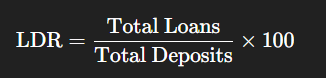
- Higher LDR → banks are lending aggressively
- Lower LDR → banks have surplus liquidity
What does an 81% LDR indicate?
- Banks have lent out ₹81 for every ₹100 of deposits
- This is historically high for India
- Signals tightening liquidity conditions in the banking system
What is driving the imbalance?
- Strong demand for:
- Retail loans
- MSME credit
- Slower household savings accretion into bank deposits
- Competition from:
- Market-linked instruments
- Small savings schemes
6. RBI Tightens Credit Risk Management: Curbs Related-Party Lending
What is the news?
The Reserve Bank of India (RBI) has notified comprehensive changes to credit risk management rules for commercial banks, prohibiting fresh lending to promoters, large shareholders and related entities, while allowing existing non-compliant related-party loans to continue till maturity.
The new framework will come into force from April 1, 2026.
Key objectives of the new norms
- Prevent conflict of interest and connected lending
- Strengthen governance, transparency and accountability
- Align Indian banking practices with global prudential standards
- Reduce risks of evergreening, crony lending and insider abuse
Who are covered under the restrictions?
Banks are barred from lending to:
- Their promoters
- Relatives of promoters
- Shareholders holding 10% or more equity
- Entities controlled or significantly influenced by such persons
Exception:
- Non-strategic institutional shareholdings without control or influence
Governance & compliance requirements
Banks must:
- Adopt board-approved policies on related-party lending
- Set aggregate exposure limits and sub-limits
- Establish whistleblower mechanisms for reporting unethical or irregular loans
- Ensure recusal of:
- Directors
- Key managerial personnel
- Specified employees
from decisions involving their own or related-party interests
Approval thresholds for related-party loans
Loans crossing materiality thresholds require board or committee approval:
- ₹25 crore – Large banks
- ₹10 crore – Mid-sized banks
- ₹5 crore – Smaller banks
Additional requirements:
- Maintain updated lists of related parties
- Conduct quarterly compliance reviews
- Report deviations to Audit Committees
- Annual disclosure of loans to specified employees
Treatment of existing related-party transactions
- Existing transactions not compliant with new norms:
- May continue till maturity
- Cannot be:
- Renewed
- Re-priced
- Enhanced
- Modified
unless they fully meet the new rules
RBI clarified that any change in terms will trigger mandatory compliance with the revised framework.
Scope clarifications
- Equity investments → Excluded from the new directions
- Debt instruments of related parties → Covered
- Listed banks must also comply with:
- Securities and Exchange Board of India (SEBI) disclosure norms
- RBI’s intra-group exposure limits
Changes in definition of ‘related parties’
- Removed earlier ₹5 crore monetary threshold for shareholding
- Excluded nominee directors of other banks appointed by statutory bodies
- Restrictions retained on:
- RBI’s own nominee directors
- Independent directors
Special cases
- Agricultural and allied loans to directors of rural cooperative banks will continue to be governed by existing statutory restrictions
Penalties for non-compliance
Violations or circumvention may lead to:
- Monetary penalties
- Higher provisioning requirements
- Forensic audits
- Business restrictions
7. Payments Regulatory Board (PRB)
Context:
The first meeting of the Payments Regulatory Board (PRB) was held in Mumbai under the chairmanship of Sanjay Malhotra, marking the operationalisation of India’s revamped payments governance framework.
About the Payments Regulatory Board (PRB)
The Payments Regulatory Board (PRB) is a statutory authority through which the Reserve Bank of India exercises regulatory, supervisory, and enforcement powers over payment and settlement systems in India, ensuring their safety, efficiency, integrity, and stability.
Legal Basis & Evolution
- Established under: Section 3 of the Payment and Settlement Systems (PSS) Act, 2007
- Operational from: 9 May 2025
- Replaced: Board for Regulation and Supervision of Payment and Settlement Systems (BPSS)
- Rationale: To provide institutional autonomy, transparency, and multi-stakeholder oversight in a rapidly expanding digital payments ecosystem
Composition
The PRB is a multi-stakeholder body, comprising:
- Chairperson: RBI Governor
- Members:
- RBI Deputy Governor (in charge of payments)
- Central Government nominees
- Independent experts in payments, fintech, cybersecurity, and financial markets
- Senior officials associated with digital payment infrastructure (e.g., NPCI, UIDAI)
Key Functions of PRB
1. Authorisation & Oversight
- Grants, regulates, suspends, or cancels authorisation of payment systems such as:
- UPI
- Card networks
- Wallets
- RTGS / NEFT
- Prepaid payment instruments
2. Standards & Interoperability
- Prescribes technical, operational, and cybersecurity standards
- Ensures interoperability, resilience, and fraud prevention
3. Risk Management & Consumer Protection
- Addresses:
- Systemic and settlement risks
- Data security and privacy
- Dispute resolution and grievance redressal
4. Policy Direction
- Reviews performance of payment systems
- Guides long-term digital payments strategy, innovation, and inclusion
5. Supervision & Enforcement
- Conducts inspections and audits
- Issues binding directions under the PSS Act
- Can impose penalties and corrective actions
Agriculture
1. Why India’s fertiliser policy needs a fundamental overhaul
What is the issue?
India’s fertiliser subsidy regime has become fiscally costly, economically inefficient, environmentally damaging, and harmful to public health. Despite spending close to ₹1.9 trillion in FY25 on fertiliser subsidies (with FY26 allocations at ~₹1.6 trillion, likely to overshoot), outcomes in crop productivity and nutrient efficiency continue to deteriorate.
Key problems with the current fertiliser policy
1. Massive fiscal burden with poor returns
- Fertiliser subsidy (FY25): ₹1.9 trillion+
- Additional hidden subsidy:
- Natural gas supplied to fertiliser plants at ~50% of market price
- Imports rising:
- 10 million tonnes → 12 million tonnes next year
- Result: Escalating costs without commensurate gains in output
2. Falling nutrient use efficiency
- Share of applied fertiliser actually absorbed by crops:
- Nitrogen (urea): <35%
- Phosphorus: ~20%
- Potassium: 50–80%
- Large quantities are:
- Diverted for resale
- Lost to air and water systems
3. Declining fertiliser productivity
- Fertiliser-to-grain response ratio:
- 1970s: ~1:10
- 2015 (irrigated areas): ~1:2.7
- Indicates diminishing marginal returns from fertiliser use
4. Distorted nutrient balance (NPK imbalance)
- Ideal NPK ratio: 4 : 2 : 1
- India’s current ratio: 10.9 : 4.4 : 4
- Cause:
- Heavily subsidised urea encourages overuse
- Effects of excess urea:
- Nitrous oxide emissions → climate warming
- Nitrate leaching → groundwater contamination & health risks
- More vegetative growth without proportional grain yield
5. Global comparison highlights inefficiency
- Farm value addition per unit land:
- India: 38% of China
- China uses:
- More fertiliser
- But with balanced NPK use and better technology
- Outcome: higher productivity per unit input
What reforms are suggested?
1. Shift to Direct Cash Transfers (DCT)
- Replace subsidies to fertiliser companies with:
- Direct cash support to farmers
- Transfers linked to:
- Cultivated area (not ownership)
- Benefits:
- Reduces leakage and diversion
- Empowers farmers to choose optimal fertiliser mix
- Reveals true demand and shortages
2. Move to market-determined fertiliser prices
- Allow fertiliser firms to:
- Price products freely
- Innovate (nano fertilisers, complex fertilisers)
- Farmers, supported by cash transfers and extension services, can:
- Optimise nutrient use by soil type
3. Promote coal gasification
- Reduce dependence on imported LNG
- Use abundant domestic coal as fertiliser feedstock
- Co-benefits:
- Energy security
- Support for climate transition by stabilising power supply alongside renewables
Facts To Remember
1. Former World billiards champion Manoj Kothari passes away
Former World billiards champion and Indian cue sports chief coach Manoj Kothari passed away, according to his family sources. Kothari was 67 and is survived by his wife and son Sourav. He was not keeping well and was being treated in Tamil Nadu.
2. Former Kerala Minister V.K. Ebrahim Kunju passes away
V.K. Ebrahim Kunju, senior leader of the Indian Union Muslim League (IUML) and former Minister for Public Works, died in Kochi.
3. National Siddha Day 2026 – January 6
About National Siddha Day
- Observed on: January 6
- Occasion: Birth anniversary of Sage Agathiyar, regarded as the father of the Siddha system of medicine
- Astronomical link: Coincides with the Ayilyam star in the Tamil month of Margazhi
- 2026 marks: 9th National Siddha Day
- Theme 2026: “Siddha for Global Health”
4. World Day of War Orphans 2026 – January 6
About World Day of War Orphans
- Observed on: January 6
- First observed: January 6, 1995
- Proposed by: French NGO SOS Enfants en Détresse (1994)
5. Sports
- Andre De Grasse Named International Ambassador for Tata Mumbai Marathon 2026
- Sjoerd Marijne Reappointed Chief Coach of Indian Women’s Hockey Team
- PM Modi Virtually Inaugurates 72nd National Volleyball Championship
6. PM Inaugurates 72nd National Volleyball Tournament
On January 4, 2026, Prime Minister Narendra Modi virtually inaugurated the 72nd National Volleyball Tournament (Senior National Championship).
- Venue: Dr. Sampurnanand Sports Stadium
- Location: Varanasi, Uttar Pradesh
- Mode: Video conferencing
- Present: UP CM Yogi Adityanath
- Established under: Section 3 of the Payment and Settlement Systems (PSS) Act, 2007 Payments Regulatory Board (PRB)
- Allocation in FY 2025–26: ₹2,818.85 crore Ministry Proposes Doubling Auto PLI Allocation …
- In January 2026, Indian scientists led by Indian Institute of Tropical Meteorology (IITM), Pune, developed India’s first 3D-printed Automatic Weather Stations (AWS) under Mission Mausam. India Develops 3D-Printed Automatic Weather Sta…
- On January 5, 2026, Tamilnad Mercantile Bank (TMB) entered into a strategic partnership with TechFini to enhance its UPI acquiring and issuing capabilities. TMB Partners with TechFini to Strengthen UPI In…
- Built with over 60% indigenous content, with a target of 90% indigenisation in future vessels ICGS Samudra Pratap Commissioned
08 January, 2026
Daily Current Affairs Quiz
08 January, 2026
National Affairs
1. ISRO to Launch EOS-N1 Earth Observation Satellite
Source: TH
Context:
The Indian Space Research Organisation (ISRO) is set to carry out its first mission of 2026 with the launch of the PSLV-C62 / EOS-N1 mission on January 12, 2026, at 10:17 AM IST.
The launch will take place from the Satish Dhawan Space Centre, Sriharikota.
About the EOS-N1 Satellite
- EOS-N1 is an Earth Observation (EO) imaging satellite
- Designed primarily for strategic purposes
- ISRO has not disclosed detailed specifications, indicating its security-sensitive nature
- Likely applications include:
- High-resolution earth imaging
- Surveillance and reconnaissance
- Monitoring of borders, maritime zones, and strategic assets
Launch Vehicle & Mission Profile
- Launch Vehicle: PSLV
- Mission designation: PSLV-C62
- This will be the 105th launch from Sriharikota
- Also carries multiple secondary payloads developed by:
- Indian start-ups
- Academic institutions
- International collaborators
2. India’s Progress on its Climate Targets
Source: TH
Context:
Recent analyses show that India is doing well on some climate promises, but big challenges remain, especially on coal use and total emissions.
What are India’s climate targets?
India’s climate goals come from its Nationally Determined Contribution (NDC) under the Paris Agreement.
They are based on the idea that developing countries need space to grow while still acting on climate change.
India’s main targets (by 2030):
- Reduce emissions intensity of GDP by 45% (from 2005 level)
- 50% of power capacity from non-fossil sources
- 500 GW renewable energy capacity
- Create extra forest carbon sink of 2.5–3 billion tonnes CO₂
- Net-zero emissions by 2070
Where India is doing well
1. Emissions intensity reduction — On track
- India already reduced emissions intensity by ~36% by 2020
- Original Paris target was met 10 years early
- Shows India is producing more GDP per unit of emissions
2. Non-fossil power capacity — Target achieved early
- By 2025, over 50% of installed power capacity is non-fossil
- Solar and wind are the biggest contributors
3. Renewable energy growth — Strong but uneven
- Solar grew rapidly: 3 GW (2014) → 110+ GW (2025)
- Wind growth has been slower
- 175 GW (2022) target missed, but 500 GW (2030) still possible
Where the real problems lie
1. Absolute emissions are still rising
- India’s total emissions are now ~3.3–3.4 Gt CO₂e
- Even if intensity falls, total emissions rise due to fast growth
- This eats into India’s future carbon budget
2. Heavy dependence on coal continues
- Coal provides 65–70% of electricity generation
- Installed coal capacity ~219 GW
- Plan to add ~80 GW more coal capacity by 2031–32
3. Weak storage & grid infrastructure
- Solar capacity is high, but:
- Battery storage is very low (<0.3 GWh)
- Transmission expansion is behind schedule
- Without storage and grids, renewables can’t replace coal fully
4. Forest carbon sink quality is questionable
- Forest targets are close on paper
- But:
- Reliance on plantations, not natural forests
- Poor use of CAMPA funds
- Forests vulnerable to droughts and fires
3. New Species Discovered in India (2025)
Context:
In December 2025, Indian scientists announced the discovery of several new species across diverse ecosystems, ranging from the Eastern Himalayas to the Western Ghats and Northeast India. These findings highlight India’s rich biodiversity and the importance of habitat conservation.
Key New Species Discovered
1. Bridgeoporus kanadii – Colossal Fungi
- Type: Macro fungus
- Location: West Kameng district, Arunachal Pradesh
- Habitat: Old-growth fir (Abies) forests
- Key Feature:
- Thick, leathery, extremely large fruiting body
- Strong enough for a human to sit on
2. Rhinophis siruvaniensis – Siruvani Shieldtail Snake
- Type: Non-venomous, burrowing snake (Uropeltidae family)
- Location: Siruvani Hills, Palakkad district, Kerala
- Habitat: High-rainfall rainforests of the Western Ghats
- Key Feature:
- Fossorial lifestyle
- Specialised tail shield for digging and protection
3. Neelus sikkimensis – High-Altitude Springtail
- Type: Tiny arthropod (Collembola / springtail)
- Location: Sikkim, Eastern Himalayas
- Habitat: Cold desert, high-altitude soils
- Key Feature:
- Possesses a “furcula” (jumping organ)
- Significance:
- First record of genus Neelus in India
- Only the 8th known species globally
4. Parasynnemellisia khasiana – Bamboo Forest Fungus
- Type: New genus and species of fungus
- Location: Mawsynram, Khasi Hills, Meghalaya
- Habitat: Extremely wet bamboo forests
- Key Feature:
- Could not be classified under any existing fungal genus
5. Dolomedes indicus – Indian Fishing Spider
- Type: Semi-aquatic spider
- Location: Wayanad and Lakkidi, Kerala
- Habitat: Streams and rainforests
- Key Feature:
- Can “skate” on water
- Hunts small fish and aquatic insects
6. Ophiorrhiza mizoramensis – Coffee Family Plant
- Type: Flowering shrub (Rubiaceae family)
- Location: Murlen National Park, Mizoram
- Habitat: Indo-Myanmar biodiversity zone
- Key Feature:
- Dark purplish-pink tubular flowers
- Unique stigma structure
4. National Intelligence Grid (NATGRID)
Context:
Recent reports point to a major expansion of the National Intelligence Grid (NATGRID), including its integration with the National Population Register (NPR) and wider access for State police, reviving debates on privacy, oversight, and surveillance in India.
What is NATGRID?
National Intelligence Grid (NATGRID) is a technology-based intelligence-sharing platform created after the 26/11 Mumbai terror attacks to overcome information silos among security agencies.
Core Idea
- It does not store data
- It acts as a secure middleware
- Authorised agencies can query multiple databases in real time
Key Features of NATGRID
- Multi-database access
Connects 21 types of datasets, including:- Travel records
- Bank & financial data
- Telecom metadata
- Identity documents
- Vehicle & property records
- Agency access
- Initially limited to central agencies
- Now extended to State police up to SP rank
- Tiered sensitivity
- Non-sensitive
- Sensitive
- Highly sensitive data
- Advanced analytics
- AI tools for:
- Entity resolution
- Pattern recognition
- Facial recognition
- AI tools for:
Recent Expansion of NATGRID
1. Integration with NPR
- Linking with National Population Register
- Enables family-tree and household-based identity verification
- Covers about 119 crore residents
- Strengthens suspect verification across databases
2. Wider State-Level Access
- State police (SP rank) can now access NATGRID
- Makes it a routine Centre–State investigative tool
- No longer limited to counter-terrorism alone
3. AI Tool – GANDIVA
- Links suspects across:
- KYC
- Vehicle
- Licence databases
- Cuts investigation time from days to minutes
- Raises risks of automated errors
5. India becomes first country to commercially produce bio-bitumen
Source: News on Air
Context:
India has become the first country in the world to commercially produce bio-bitumen for road construction, marking a major milestone in green infrastructure and sustainable transport.
What is Bio-bitumen?
Bio-bitumen is a bio-based alternative to conventional petroleum bitumen, used as a binding material in road construction.
- Made mainly from agricultural residues, especially rice straw
- Can partially replace fossil-fuel-based bitumen without reducing road quality
- Helps convert farm waste into a valuable infrastructure input
Institutions involved
- Council of Scientific and Industrial Research (CSIR)
- CSIR-Central Road Research Institute (CSIR-CRRI), New Delhi
- CSIR-Indian Institute of Petroleum (CSIR-IIP), Dehradun
Key features of Bio-bitumen
- Partial fossil fuel replacement
- 20–30% of conventional bitumen can be replaced safely
- Performance assured
- Successfully tested for:
- Rutting (surface deformation)
- Cracking
- Moisture damage
- Durability and rheology
- Successfully tested for:
- Environment-friendly
- Reduces stubble burning
- Lowers overall carbon footprint of road construction
- Cost-effective
- Lower construction costs
- Longer service life of roads
- Field tested
- A 100-metre trial road stretch laid on NH-40 (Jorabat–Shillong Expressway, Meghalaya) proved real-world feasibility
6. ISRO’s EOS-N1 (Anvesha) Mission
Source: TOI
Context:
The Indian Space Research Organisation (ISRO) will begin 2026 with the PSLV-C62 mission, which will launch the advanced Earth Observation Satellite EOS-N1, also known by its codename “Anvesha”, along with 18 co-passenger payloads.
The launch will take place from Sriharikota in January 2026.
What is EOS-N1 (Anvesha)?
- EOS-N1 is an advanced Earth observation and surveillance satellite
- It uses hyperspectral imaging technology
- Designed to serve both strategic (security) and civilian purposes
- Part of India’s next-generation remote sensing and reconnaissance capability
Launch Details
- Mission: PSLV-C62
- Launch vehicle: Polar Satellite Launch Vehicle (PSLV)
- Payloads: EOS-N1 + 18 co-passenger satellites
- Launch site: Sriharikota
- Timeline: January 2026
7. Union Minister Dharmendra Pradhan Releases 55 Literary Works in Classical Indian Languages
Source: TH
Context:
On 6 January 2026, Dharmendra Pradhan, Union Minister for Ministry of Education, released 55 scholarly literary works in classical Indian languages at an event in New Delhi.
The initiative aims to promote India’s rich linguistic heritage and ensure wider and more inclusive access to classical knowledge.
Languages Covered
The released works include texts in:
- Classical Kannada
- Telugu
- Malayalam
- Odia
- Tamil
In addition, an Indian Sign Language (ISL) interpretation of the Tirukkural was also launched.
Publications by CIIL
Out of the 55 works, 41 books were prepared by the Centres of Excellence for Classical Languages under the Central Institute of Indian Languages (CIIL), Mysuru, an autonomous body under the Ministry of Education.
These books focus on Classical Kannada, Telugu, Malayalam, and Odia.
Notable releases include:
- English and Hindi translations of Madalapanji
- English translation of Rudrasudhanidhi
- Shilpa Shabdabali
- Charyapada
These translations aim to make classical literature accessible to a wider audience.
8. NITI Aayog Launches 5th Edition of Trade Watch Quarterly
Source: News on Air
Context:
In January 2026, NITI Aayog released the 5th edition of the Trade Watch Quarterly (TWQ) report for Q1 (April–June 2025) of FY26.
The report was launched in New Delhi by Arvind Virmani, Member, NITI Aayog.
The report provides a data-driven assessment of India’s trade performance amid changing global economic conditions.
Key Highlights of the Report
Focus Area: Automotive Exports
- The main focus of this edition is India’s automotive exports, including vehicles and auto components.
- It analyses global demand, tariff structures, and India’s participation in global value chains.
Auto-Components Market
- The global auto-components market was valued at USD 856 billion in 2024, growing at a 3% CAGR since 2015.
- India’s auto-component exports nearly doubled from USD 8.2 billion to USD 16.9 billion, growing at a 7% CAGR, faster than the global average.
Automotive Exports Performance
- Since 2015, India’s share in global automotive imports has remained around 1%.
- India’s automotive exports grew at 3.5% CAGR, slightly below the global average of 3.9%.
- In 2024, India contributed about USD 30 billion (1.4%) to the USD 2.2 trillion global automotive import market, showing large untapped potential.
Global Trade Trends
- Global trade in goods and services grew by about 2.5% (quarter-on-quarter) in Q1 FY26.
- Growth was mainly driven by developing economies and South-South trade, while US trade slowed overall growth.
- Goods trade growth increased from 2% to 2.5%, and services trade rebounded.
India’s Trade Numbers (Q1 FY26)
- Exports: USD 209 billion
- Imports: USD 230 billion
- Trade deficit: USD 21 billion
- Both exports and imports grew by 3–4% year-on-year.
Banking/Finance
1. Federal Bank Unveils Refreshed Brand Identity ‘The Fortuna Wave’
Context:
On January 7, 2026, Federal Bank launched a refreshed brand identity called ‘The Fortuna Wave’ in Mumbai, Maharashtra.
The launch took place in the presence of Vidya Balan, the brand ambassador of the bank.
The rebranding reflects the bank’s focus on modernisation, digital readiness, and future growth.
About ‘The Fortuna Wave’
- Core Symbol: A new visual insignia featuring three waves
- Meaning of Waves:
- Authenticity
- Togetherness
- Prosperity
- Design Philosophy:
- More fluid and adaptable than the earlier boxed logo
- Improved visibility across digital and physical platforms
- Visual Features:
- Dynamic wave motif
- Rounded, modern wordmark for “FEDERAL BANK”
- Retention of the signature yellow underline
- Bright, digital-friendly colour palette
About Federal Bank
- Founded: 1931
- Headquarters: Aluva, Kerala
- Type: Private sector bank
- Services:
- Savings and current accounts
- Loans
- Digital banking services
- NRI banking services
2. RBI Proposes 3-Year Cooling-Off Period for Co-operative Bank Directors
Context:
The Reserve Bank of India (RBI) has proposed that directors of co-operative banks must take a 3-year break after completing 10 continuous years on the board.
Key Points
- A director who serves 10 years continuously on a co-operative bank board:
- Cannot be re-appointed for 3 years
- Cannot hold any role in the same bank during this period (except as a normal member or customer)
- During the cooling-off period:
- The person can become a director in another co-operative bank
- While calculating the 10-year tenure:
- All service periods are counted
- Breaks shorter than 3 years do not reset tenure
- Only a break of 3 years or more resets the count
Legal Background
- The Banking Regulation (Amendment) Act increased the maximum continuous tenure of co-operative bank directors from 8 years to 10 years
- RBI’s proposal operationalises this limit through a cooling-off rule
3. RBI Considering New Relief Measures for Exporters
Context:
The Reserve Bank of India (RBI) is thinking about new ways to support Indian exporters who are facing losses due to high U.S. import tariffs. This comes after an earlier RBI relief measure — a loan repayment moratorium — saw very low participation.
What Is the Problem Exporters Are Facing?
- The U.S. has imposed tariffs of up to 50% on some Indian goods
- This includes a 25% tariff linked to India’s purchase of Russian oil
- Affected sectors include:
- Garments
- Jewellery
- Leather goods
- Chemicals
Recently, Donald Trump also warned that tariffs could rise further if India does not reduce Russian oil imports.
What Relief Did RBI Offer Earlier? Why Didn’t It Work?
Earlier Measure (November)
- Exporters with U.S. exposure were allowed to defer term-loan repayments
- Covered repayments due between September and December
- Banks required exporters to prove revenue loss
Outcome
- Less than 20% of eligible exporters applied
- Many firms could not document losses quickly
- As a result, the scheme had limited impact
What New Options Is RBI Considering?
RBI is now exploring:
- Relaxing eligibility conditions for loan moratorium
- Allowing fresh loans at subsidised interest rates
Bankers have also suggested that:
- Direct cash subsidies may work better than loan relief
- This would help exporters absorb losses and reduced profit margins
4. SEBI Extends Timeline for Mutual Fund Distributor Incentives
Source: Mint
Context:
The Securities and Exchange Board of India (SEBI) has extended the deadline to 11 March for implementing an additional incentive structure for mutual fund (MF) distributors.
Earlier, this new incentive system was supposed to start from 1 February.
What Is This Incentive Scheme About?
The incentive scheme is meant to:
- Encourage MF distributors to bring in new individual investors from B-30 cities
(cities other than the top 30 major cities) - Promote greater participation of women investors from any city
Purpose of the Incentive Scheme
- To increase mutual fund penetration:
- In B-30 cities (cities beyond the top 30 by MF assets)
- Among women investors across all cities
Key Features of the Incentive Structure
- Eligibility for distributors:
- New individual investors (new PAN) from B-30 cities
- New women investors (new PAN) from T-30 and B-30 cities
- Incentive amount:
- 1% of first lump-sum investment or first-year SIP
- Maximum ₹2,000 per investor
- Condition:
- Investor must remain invested for at least one year
- Funding source:
- Paid from the 2 basis points already earmarked for investor education
- Paid over and above trail commissions
Important Exclusions
- No dual incentive for the same woman investor from B-30 cities
- Incentive not applicable to:
- ETFs
- Certain Fund of Funds
- Overnight, liquid, ultra-short, and low-duration schemes
Facts To Remember
1. 2018 Asian Games 1,500m gold-winner Johnson retires
National record-holder and Asian Games gold-winning Indian middle-distance runner Jinson Johnson announced his retirement after a 15-year career shaped by “relentless training, quiet struggles, and painful injuries”.
2. Markets Fall 1% Amid Uncertainty Over U.S. Tariffs
Indian stock markets saw their sharpest one-day fall in over four months due to fresh worries about U.S. trade tariffs linked to Russia.
- Sensex fell 780 points (0.9%) to close at 84,181
- Nifty 50 dropped 264 points (1.01%) to 25,877
This was the biggest single-day decline since August 26, 2025.
3. Indian Railways Becomes the World’s Largest Electrified Rail Network
Indian Railways has become the largest electrified railway system in the world, with about 99.2% of its broad-gauge network electrified as of November 2025.
This milestone places India ahead of all other countries in railway electrification.
4. Census 2027: First Phase to Begin from April 1, 2026
India’s long-delayed Census 2027 will begin with its first phase — Houselisting Operations (HLO) — from April 1 to September 30, 2026, across all States and Union Territories, according to a notification issued by the Registrar-General and Census Commissioner of India.
5. IRFC Secures ‘Excellent’ Rating from DPE for 5th Consecutive Year
In January 2026, Indian Railways Finance Corporation (IRFC) received an ‘Excellent’ performance rating from the Department of Public Enterprises (DPE) for FY 2024–25. This is the fifth consecutive year that IRFC has achieved the highest rating since its stock market listing in FY21.
6. K. Balasubrahmanian Appointed Chairman of AERB
In January 2026, the Appointments Committee of the Cabinet (ACC) appointed A K Balasubrahmanian as the Chairman of the Atomic Energy Regulatory Board (AERB) for a three-year tenure.
About AERB
- Established in 1983 under the Atomic Energy Act, 1962
- Headquarters: Mumbai, Maharashtra
- Apex body for nuclear and radiation safety regulation in India
7. Government Extends Abhishek Dev’s Tenure as APEDA Chairman
On January 6, 2026, the ACC approved a one-year extension of Abhishek Dev as Chairman of APEDA, effective from February 8, 2026.
About APEDA
- Established in 1985 under APEDA Act
- Headquarters: New Delhi
- Promotes exports of agricultural and processed food products
8. NASA’s Hubble Discovers Starless Gas Cloud ‘Cloud-9’
In January 2026, NASA’s Hubble Space Telescope discovered a starless, dark-matter-dominated gas cloud named Cloud-9, near Messier-94, about 14 million light-years from Earth.
Key Facts
- Nickname: Cloud-9
- Type: Starless hydrogen gas cloud
- Diameter: ~4,900 light-years
- Dark Matter Mass: ~5 billion solar masses
- Special Feature: Invisible in visible light, detected only through hydrogen
9. Earth’s Rotation Day – 8 January 2026
Earth’s Rotation Day is observed every year on 8 January to commemorate Léon Foucault’s 1851 pendulum experiment, which proved that the Earth rotates.
10. India Likely to Grow at 6.6% in FY27: UN Explained Simply
The United Nations has projected that India’s economy will grow by 6.6% in FY 2026–27, according to its report World Economic Situation and Prospects 2026, released by UN DESA.
- Established in 1983 under the Atomic Energy Act, 1962 K. Balasubrahmanian Appointed Chairman of AERB
- The Indian Space Research Organisation (ISRO) is set to carry out its first mission of 2026 with the launch of the PSLV-C62 / EOS-N1 mission on January 12, 2026, at 10:17 AM IST. ISRO to Launch EOS-N1 Earth Observation Satelli…
- Reduce emissions intensity of GDP by 45% (from 2005 level) India’s Progress on its Climate Targets
- The global auto-components market was valued at USD 856 billion in 2024, growing at a 3% CAGR since 2015. NITI Aayog Launches 5th Edition of Trade Watch …
- A director who serves 10 years continuously on a co-operative bank board: RBI Proposes 3-Year Cooling-Off Period for Co-o…
09 January, 2026
Daily Current Affairs Quiz
09 January, 2026
National Affairs
1. UN DESA Pegs India’s Growth at 7.2% in FY 2025–26
Source: TH
Context:
The United Nations Department of Economic and Social Affairs (UN DESA) has projected India’s GDP growth at 7.2% in FY 2025–26, broadly in line with the Union government’s estimate of 7.4%, despite rising global trade uncertainties, particularly from U.S. tariffs.
The projection was made in the World Economic Situation and Prospects 2026 report.
Key Drivers Supporting India’s Growth
According to UN DESA, India’s growth momentum will be sustained by:
1. Resilient Domestic Consumption
- Strong household demand continues to anchor growth
- Acts as a buffer against external shocks
2. Robust Public Investment
- Government-led capital expenditure remains a key growth engine
- Infrastructure spending supports multiplier effects across sectors
3. Supply-Side Expansion
- Continued growth in manufacturing and services
- Supports employment, exports, and productivity gains
Medium-Term Growth Outlook
The report projects a gradual moderation in growth over the medium term:
| Period | Growth Projection |
|---|---|
| Calendar Year 2025 | 7.4% |
| FY 2026–27 | 6.6% |
| FY 2027–28 | 6.8% |
2. Centre to Launch Nationwide Cashless Treatment Scheme for Road Accident Victims
Source: TH
The Government of India is set to launch a nationwide cashless treatment scheme for road accident victims, aimed at reducing fatalities through timely medical intervention during the critical ‘Golden Hour’. The scheme is expected to be launched soon by Narendra Modi, according to Nitin Gadkari.
Key Features of the Scheme
1. Cashless Medical Treatment
- Coverage of up to ₹1.5 lakh per accident victim
- Applicable to road accidents anywhere in India, not limited to National Highways
- Focus on immediate hospital care in the first 60 minutes (Golden Hour) after an accident
2. Funding Mechanism
- Primary funding through third-party motor insurance, purchased at the time of vehicle registration
- In cases where the vehicle is uninsured, expenses will be met from the Road Safety Fund
3. Incentive for ‘Good Samaritans’
- Individuals who bring accident victims to hospitals — termed “Rahavirs” — will receive a cash award of ₹25,000
- Reward limited to one individual per incident
- Aims to counter bystander hesitation and legal fears
3. Textiles Ministry Signs MoUs with 15 States Under Tex-RAMPS Scheme
Source: TH
Context:
The Ministry of Textiles has signed MoUs with 15 States under a new scheme called Tex-RAMPS (Textiles focused Research, Assessment, Monitoring, Planning and Start-Up). The agreements were signed during a national textile ministers’ conference held in Guwahati, which focused on strengthening India’s textile sector.
What is Tex-RAMPS?
Tex-RAMPS stands for Textile Research, Advanced Manufacturing, and Processing Scheme.
It is a Central Government scheme aimed at strengthening research, innovation, and advanced manufacturing in India’s textile sector.
- Launch/approval date: November 2025
- Implementation period: FY 2025-26 to FY 2030-31
Ministry
Implemented by the Ministry of Textiles, Government of India.
Objective
The scheme aims to:
- Promote cutting-edge research and innovation in textiles
- Encourage advanced manufacturing technologies
- Improve productivity, quality, and global competitiveness
- Support India’s transition from traditional textiles to high-value and technical textiles
Key Focus Areas
- Textile research & development (R&D)
- Advanced processing technologies
- Sustainable and eco-friendly manufacturing
- Technical textiles (medical, industrial, defence, geo-textiles, etc.)
- Industry–academia collaboration
4. 79th Foundation Day of the Bureau of Indian Standards (BIS)
Context:
The 79th Foundation Day of the Bureau of Indian Standards (BIS) was celebrated recently.
On the occasion, the Union Minister highlighted that BIS is moving from a purely regulatory role to a more facilitative approach, in line with:
- Ease of Doing Business
- Quality-led growth
- Developing a quality culture across society
About Bureau of Indian Standards (BIS)
- BIS is India’s National Standards Body
- It ensures standardisation, certification, hallmarking, and quality assurance of goods and services
- Objective:
- Protect consumers
- Improve product quality
- Enhance India’s global competitiveness
Establishment & Legal Framework
- Established: 1987
- Came into force: 1 April 1987
- Governing law: BIS Act, 2016
- Headquarters: New Delhi
New Initiatives Launched by BIS
1. BIS Standardisation Portal (Beta Launch)
- Fully digital end-to-end platform for standards development
- Covers entire lifecycle:
- Proposal → drafting → publication
- Key features:
- Dashboards
- Role-based access
- Faster timelines
- Greater transparency
2. SHINE – Standards Help Inform & Nurture Empowered Women
- Women-centric initiative
- Works through:
- Self-Help Groups (SHGs)
- NGOs
- Objective:
- Build quality awareness
- Position women as “quality ambassadors” at the community level
3. BIS–SAKSHAM
- Annual Excellence Recognition Scheme
- Recognises:
- Institutions
- Individuals
- Focus on:
- Knowledge
- Skills
- High-impact contributions in standardisation and quality
5. Uttarakhand Police Tops ICJS 2.0 Rankings
Source: BS
Context:
Uttarakhand Police secured first rank in the ICJS 2.0 national rankings, while the Uttarakhand State Disaster Response Force (SDRF) was commended for its exemplary service during Prayagraj Mahakumbh-2025.
About ICJS 2.0
- ICJS stands for Inter-Operable Criminal Justice System.
- It is a flagship digital initiative of the Ministry of Home Affairs (MHA).
- ICJS 2.0 is the upgraded version aimed at end-to-end digital integration of the criminal justice system.
Key Points:
- Uttarakhand ranked 1st with a score of 93.46, followed by Haryana (93.41) and Assam (93.16).
- Rankings were released by the National Crime Records Bureau (NCRB) through the CCTNS/ICJS Progress Dashboard.
- ICJS 2.0 integrates police, courts, prosecution, prisons, forensics, and fingerprint databases on a single digital platform.
- Effective implementation enabled faster investigations, digital case diaries, e-charge sheets, and evidence-based prosecution.
- The system follows the “One Data, One Entry” principle to reduce duplication and improve transparency.
- Ministry of Home Affairs targets full operationalisation of ICJS 2.0 by 2026.
Banking/Finance
1. RBI Cancels Registration of 35 NBFCs
Source: News on Air
Context:
The Reserve Bank of India (RBI) has cancelled the Certificate of Registration (CoR) of 35 Non-Banking Financial Companies (NBFCs) for non-compliance with regulatory requirements.
Key Details:
- Action taken under Section 45-IA(6) of the RBI Act, 1934.
- Cancellations were effective between December 9 and December 31, 2025.
- These NBFCs are barred from carrying on NBFC business as defined under the Act.
- Most affected NBFCs are concentrated in Delhi and the National Capital Region (NCR).
- In addition, 16 NBFCs voluntarily surrendered their registration due to business exit, restructuring, or regulatory reclassification.
Reasons for Cancellation:
- Failure to meet minimum net owned fund (NOF) requirements
- Non-filing or irregular submission of statutory returns
- Non-compliance with prudential norms and governance standards
- Inactivity or violation of conditions of registration
About NBFCs:
- NBFCs provide services such as loans, asset financing, investments, and microfinance.
- They are regulated by RBI but cannot accept demand deposits like banks.
2. GDP Likely to Grow 7.4% in FY26
Source: IE
Context:
India’s economy is expected to grow by 7.4% in FY 2025–26, according to the National Statistics Office (NSO).
This is higher than FY25’s growth of 6.5%, showing that the economy remains strong despite global challenges.
Real vs Nominal GDP
- Real GDP growth (7.4%) shows actual economic expansion
- Nominal GDP growth (8%) includes inflation
The gap between the two is very small (0.6%), which means inflation is extremely low.
In fact, the GDP deflator is just 0.5%, the lowest in nearly 50 years.
Because of this low inflation, nominal growth is the slowest since the COVID year (FY21).
Why Growth May Slow in the Second Half
The estimates assume:
- 8% growth in the first half of FY26
- 6.9% growth in the second half
This slowdown is mainly due to:
- High base effect (last year’s strong growth)
- Slower increase in government spending
What Is Driving the Economy?
1. Investment Is Improving
- Private investment and infrastructure spending are expected to rise
- Gross Fixed Capital Formation (GFCF) is projected to grow around 7%
2. Consumption Is Mixed
- Private consumption (PFCE) is improving but may plateau
- Government consumption (GFCE) remains strong
3. EPFO to Allow Instant PF Advance Withdrawal via BHIM App
Source: ET
Context:
The Employees’ Provident Fund Organisation (EPFO) will soon allow its members to withdraw provident fund (PF) advances instantly through the BHIM app, likely within the next 2–3 months. This move is part of EPFO’s digital overhaul to improve ease of access for its 30+ crore members and manage its large corpus of over ₹26 lakh crore more efficiently.
How Will the New Facility Work?
- EPFO has partnered with the National Payments Corporation of India (NPCI)
- Members will:
- Log in to the BHIM app
- Submit an advance withdrawal request for allowed purposes such as:
- Medical needs
- Education
- Special or emergency situations
- EPFO will verify and authenticate the claim digitally
- Once approved, the money will be credited instantly to the member’s UPI-linked bank account
- Payments will be routed through State Bank of India (SBI)
4. SEBI Introduces New Compliance Reporting Format for SIFs
Source: ET
Context:
The Securities and Exchange Board of India (SEBI) has introduced a new compliance reporting format to ensure uniform and stricter reporting for Specialised Investment Funds (SIFs) managed by mutual funds and asset management companies (AMCs).
What Has Changed?
- SEBI has modified the Compliance Test Report (CTR)
- A separate section exclusively for SIFs has been added
- This ensures consistent and transparent compliance reporting across all AMCs managing SIFs
What AMCs Must Now Report
AMCs managing SIFs must disclose additional details, including:
- Minimum investment threshold compliance
- Certification requirements of SIF fund managers (when notified by SEBI)
- Whether investment strategies match SEBI-approved characteristics
- Limits on fees and expenses
- Investment restrictions, including:
- Single-issuer exposure limits (for both debt and equity)
What are Specialised Investment Funds (SIFs)?
- SIFs are a new category of mutual fund products designed for sophisticated investors.
- They allow advanced, strategy-driven investments that go beyond traditional MF schemes.
- Positioned between mutual funds and Alternative Investment Funds (AIFs) in terms of risk and flexibility.
Key Features of SIFs
- Target investors: High-net-worth and informed investors
- Investment strategies: Long–short, sectoral, thematic, quantitative, and other specialised strategies
- Higher risk–return profile compared to conventional mutual funds
- Higher minimum investment threshold than regular MF schemes
Agriculture
1. Government Proposes New Law to Regulate Pesticides
Source: TH
Context:
The Ministry of Agriculture and Farmers Welfare has asked the public for feedback on a draft Pesticides Management Bill, which will replace the old Insecticides Act of 1968. The aim of the new Bill is to make sure that pesticides used in India are safe, effective, and environmentally responsible
Why Is a New Law Needed?
The existing law is over 55 years old and does not fully address:
- Modern pesticides
- Environmental concerns
- Human and animal health risks
- New biological and traditional pest-control methods
The new Bill updates regulation to suit current scientific and agricultural needs.
What Does the Draft Bill Cover?
The Bill will regulate every stage of a pesticide’s life cycle, including:
- Manufacture and import
- Packaging and labelling
- Storage, transport, and sale
- Advertisement and distribution
- Use and final disposal
The goal is to ensure that only safe and effective pesticides are available to farmers and consumers.
What Is a ‘Pesticide’ Under the New Bill?
The Bill defines pesticides very broadly. It includes:
- Chemical and biological substances
- Pest killers and repellents
- Plant growth regulators
- Defoliants, desiccants, and sprouting inhibitors
- Substances used to protect crops before or after harvest
This wide definition helps close loopholes in regulation.
Focus on Safety and Environment
The Bill aims to:
- Reduce risks to humans and animals
- Protect beneficial organisms (not just kill pests)
- Safeguard the environment
- Promote biological pesticides and traditional knowledge-based solutions
New Regulatory Bodies Proposed
1. Central Pesticides Board
- Will advise the Centre and States on:
- Scientific and technical issues
- Good manufacturing practices
- Safe disposal of pesticides and containers
- Standards for pesticide advertisements
- Recall procedures for unsafe pesticides
2. Registration Committee
- Will:
- Approve or reject pesticides
- Set conditions for registration
- Periodically review safety and effectiveness
- Cancel registrations if needed
- Maintain a digital national register of pesticides
Strict Punishment for Serious Harm
If a pesticide causes death or grievous injury, the Bill provides for:
- Jail term up to 5 years
- Fine between ₹10 lakh and ₹50 lakh
- Or both
This is meant to improve accountability and deterrence.
Facts To Remember
1. Trump Clears Bill Allowing Up to 500% Tariffs on Buyers of Russian Oil
In a significant escalation of pressure on countries importing Russian energy, Donald Trump has cleared a bipartisan Russia Sanctions Bill that would empower the U.S. President to impose punitive tariffs of up to 500% on countries purchasing oil or uranium from Russia.
2. Rathour appointed Sri Lanka batting coach for T20 WC
Former India batting coach Vikram Rathour was on Thursday appointed Sri Lanka’s batting coach for the T20 World Cup, beginning on February 7. Rathour will assume charge on January 18 and will remain with the team until March 10.
3. NSO Releases First Advance Estimates (FAE) of GDP
- Real GDP growth: 7.4% (FY25: 6.5%)
- Real GDP size: ₹201.9 lakh crore
- Nominal GDP growth: 8% (lower due to low inflation)
- Nominal GDP size: ₹357.14 lakh crore
- Real GVA growth: 7.3%
4. Indian Navy to Set Up New Naval Base at Haldia (WB)
- Region: Bay of Bengal
- Purpose: Maritime surveillance, coastal security, rapid response
- Supports: Anti-piracy, HADR, evacuation ops
- Platforms: Fast Interceptor Crafts, Water-Jet Attack Crafts
5. India’s First Fully Paperless District Court
- Location: Kalpetta, Wayanad (Kerala)
- Inaugurated by: CJI Surya Kant
- Features:
- 100% digital filing → judgment
- AI-based case summaries & voice-to-text
- Secure digital signatures
6. USA Withdraws from 66 International Bodies
- Decision by: President Donald Trump
- Includes:
- International Solar Alliance (ISA)
- IPCC, IRENA, UNFCCC, UNFPA
7. UN Declares 2026 as International Year of Rangelands & Pastoralists
- Declared by: UNGA
- Lead agency: FAO
- Why important?
- Rangelands cover ~50% of Earth
- Support 2 billion people & global livestock
8. Tamil Nadu’s First Jallikattu of 2026 Begins at Thatchankurichi
Tamil Nadu inaugurated its first Jallikattu event of 2026 at Thatchankurichi near Gandharvakottai, with 900 bulls, 300 tamers and strict safety oversight.
9. Bhoramdev Corridor Project Launched Under Swadesh Darshan 2.0 in Chhattisgarh
The Chhattisgarh government launched the ₹146-crore Bhoramdev Corridor Project under Swadesh Darshan 2.0 to develop Bhoramdev Dham as a major pilgrimage and tourism hub.
10. Hardeep Singh Ahluwalia Appointed Interim MD & CEO of Canara Bank
Canara Bank appointed Hardeep Singh Ahluwalia as Interim Managing Director and CEO from January 1, 2026, following the retirement of K. Satyanarayana Raju.
11. Venkaiah Naidu Elected President of Atal Smriti Nyas Society
Former Vice President M. Venkaiah Naidu was elected President of the Atal Smriti Nyas Society, succeeding the late Vijay Kumar Malhotra.
12. Andre De Grasse Named International Ambassador for Tata Mumbai Marathon 2026
Olympic sprint champion Andre De Grasse was appointed International Event Ambassador for the 21st Tata Mumbai Marathon scheduled on January 18, 2026.
12. Sjoerd Marijne Reappointed Chief Coach of Indian Women’s Hockey Team
Dutch coach Sjoerd Marijne was reappointed as Chief Coach of the Indian women’s hockey team, marking his third stint with the side.
13. World Introvert Day Observed on January 2
World Introvert Day was observed globally to recognise the strengths and contributions of introverted personalities.
14. International Mind–Body Wellness Day Marked on January 3
The day highlighted the importance of holistic well-being through mental, physical and emotional balance.
15. World Braille Day Observed on January 4
World Braille Day marked the birth anniversary of Louis Braille, promoting accessibility and inclusion for the visually impaired.
16. National Birds Day Observed on January 5
National Birds Day focused on bird conservation and their ecological importance.
17. World Day of War Orphans Observed on January 6
The day raised awareness about the challenges faced by children orphaned due to war and conflict.
If you want, I can also convert these into one-line current affairs notes, MCQ-friendly points, or a monthly CA compilation.
18. IEEE Medal of Honor 2026
- Awarded to: Jensen Huang (CEO, NVIDIA)
- For: Revolutionising GPUs & AI computing
- Prize: $2 million
19. Retirements & Obituary
| Name | Category | Key Details | Major Achievements / Legacy |
|---|---|---|---|
| Jinson Johnson | Sports – Athletics | Asian Games gold medallist (1500m) | • Gold (1500m) – Asian Games 2018• Holds Indian national records in 800m & 1500m • Represented India at Rio Olympics 2016 |
| Usman Khawaja | Sports – Cricket | Retired from international cricket | • Australia’s first Muslim Test cricketer • 6,206 Test runs• 16 Test centuries |
| Kabindra Purkayastha | Obituary – Politics | Veteran BJP leader from Assam | • Former Union MoS (Communications) • Key figure in BJP’s growth in Assam |
| Madhav Gadgil | Obituary – Environment | Father of modern Indian ecology | • Key role in Nilgiri Biosphere Reserve • Architect of Biological Diversity Act, 2002 • Chairman, Western Ghats Ecology Expert Panel • Awards: Padma Shri, Padma Bhushan, UN Champion of the Earth |
- Ministry of Home Affairs targets full operationalisation of ICJS 2.0 by 2026. Uttarakhand Police Tops ICJS 2.0 Rankings
- Individuals who bring accident victims to hospitals — termed “Rahavirs” — will receive a cash award of ₹25,000 Centre to Launch Nationwide Cashless Treatment …
- Action taken under Section 45-IA(6) of the RBI Act, 1934. RBI Cancels Registration of 35 NBFCs
- India’s economy is expected to grow by 7.4% in FY 2025–26, according to the National Statistics Office (NSO).This is higher than FY25’s growth of 6.5%, showing that the economy remains strong despite global challenges. GDP Likely to Grow 7.4% in FY26
- Nominal GDP growth: 8% (lower due to low inflation) NSO Releases First Advance Estimates (FAE) of G…
10 January, 2026
Daily Current Affairs Quiz
10 January, 2026
International Affairs
1. Greenland
Context:
The proposal by US President Donald Trump to acquire Greenland has resurfaced, drawing strong opposition from Denmark and European allies due to sovereignty concerns and international law constraints.
Geography & Location
- Greenland (Kalaallit Nunaat): World’s largest island.
- Location: North Atlantic Ocean, largely within the Arctic Circle, between North America and Europe.
Political Status
- Self-governing territory within the Kingdom of Denmark.
- Denmark controls defence, foreign affairs, and currency.
- Greenland’s elected government handles domestic affairs under the Self-Rule Act, 2009, recognizing the island’s right to self-determination.
Geological Features & Resources
- Greenland Ice Sheet: Covers ~80% of the island; second largest after Antarctica; important for climate change studies.
- Ancient shield rocks: Part of the Canadian Shield, mainly Precambrian rocks.
- Fjords and glaciers: Deep coastlines with fast-moving glaciers like Jakobshavn Glacier.
- Resource potential: Rich in rare earth elements, critical minerals, and hydrocarbons.
Legal Constraints
- UN Charter (Article 2(4)) prohibits acquiring territory by threat or use of force.
- Territorial transfer requires free, voluntary consent of:
- Denmark (sovereign state)
- People of Greenland
- Annexation or coerced cession is illegal under modern international law.
National Affairs
1. US Considers 500% Tariffs on Russian Oil Buyers
Source: TH
Context:
The United States is reviewing a bipartisan proposal—the Sanctioning Russia Act of 2025—that would allow tariffs of up to 500% on countries continuing to import Russian energy, including India. The move follows US President Donald Trump’s support for the bill, aimed at curbing Russia’s revenues funding its war in Ukraine.
Background
- Post-2022 Russia–Ukraine War, India increased imports of discounted Russian crude to safeguard energy security.
- The US and G7 imposed a $60/barrel price cap to limit Russian revenues without disrupting global oil markets.
- India, despite slightly reducing imports, remains a major buyer of Russian oil, prompting previous US penalty tariffs on Indian exports (25%, later 50%).
- The proposed bill escalates pressure by linking energy trade to secondary sanctions.
Key Features of the Sanctioning Russia Act, 2025
- Secondary Sanctions Framework:
- Empowers the US President to impose tariffs and sanctions on countries buying Russian oil, gas, uranium, and petroleum products—even if not directly trading with the US.
- Punitive Tariff Provision:
- Tariffs of up to 500% on goods and services imported from countries knowingly trading in Russian-origin energy products.
- Financial Isolation of Russia:
- Authorizes property-blocking sanctions on Russian financial institutions and foreign entities transacting with them.
- Presidential Discretion:
- President can determine tariff levels and targets, allowing flexibility in diplomacy.
- National Interest Waiver:
- Tariffs can be waived for up to 180 days for specific countries, goods, or services if in the US national interest.
- Strategic Objective:
- Designed to cripple Russia’s war-financing capacity and pressure third countries to reduce dependence on discounted Russian energy.
2. UIDAI Launches Aadhaar Mascot ‘Udai’
Source: News on Air
Context:
The Unique Identification Authority of India (UIDAI) has introduced ‘Udai’ (उदय), an official mascot for Aadhaar, aimed at making Aadhaar-related information more relatable, human-friendly, and accessible to citizens.
Purpose
Udai serves as a resident-facing communication companion, simplifying public understanding of Aadhaar services and promoting responsible usage. It is designed to enhance trust, improve clarity, and standardise communication for over a billion residents.
Organisation Involved
- Unique Identification Authority of India (UIDAI)
Key Features
- People-Centric Communication
- Uses a friendly mascot to explain complex Aadhaar processes in a simple and engaging way.
- Wide Service Coverage
- Covers Aadhaar functionalities such as updates, authentication, offline verification, selective data sharing, and adoption of new technologies.
- Participatory Creation
- Selected through an open national contest with 875 entries and multi-tier evaluation, ensuring citizen participation.
- Inclusive Outreach
- Designed to aid clarity across multiple languages, literacy levels, and digital access capabilities, making Aadhaar services more accessible to all residents.
3. PANKHUDI Portal
Source: TNIE
Context:
The Union Minister has launched PANKHUDI, an integrated digital platform designed to enhance ease of living for women and children by streamlining CSR partnerships and stakeholder collaboration.
Ministry Involved
- Ministry of Women and Child Development
Aim
- Strengthen coordination, transparency, and structured participation among government bodies, citizens, NRIs, NGOs, and corporates.
- Improve service delivery and outcomes for women and children nationwide.
Key Features
- Unified CSR Interface
- Single platform for individuals, NRIs, NGOs, corporates, and government agencies to collaborate on social initiatives.
- Priority Themes
- Focus on Nutrition, Health, Early Childhood Care & Education (ECCE), Child Welfare & Protection, and Women’s Safety & Empowerment.
- Flagship Mission Support
- Digitally supports Mission Saksham Anganwadi & Poshan 2.0, Mission Vatsalya, and Mission Shakti through defined workflows.
- End-to-End Transparency
- Online registration, proposal submission, approvals, and real-time tracking
- Only non-cash contributions are allowed to ensure traceability.
4. India–AI Impact Summit 2026
Source: PIB
Context:
India has announced the India–AI Impact Summit 2026, scheduled for 19–20 February 2026 in New Delhi. This will be the first-ever global AI summit hosted in the Global South, positioning India as a hub for shaping inclusive and development-oriented artificial intelligence governance.
Purpose
The summit is a high-level multilateral forum, announced by the Prime Minister at the France AI Action Summit, aimed at advancing responsible, equitable, and inclusive AI cooperation, with a particular focus on Global South priorities.
Key Features
- Global South Leadership
- First global AI summit hosted in a developing country.
- Amplifies Southern perspectives in AI governance, often underrepresented in global AI discourse.
- Multilateral Continuity
- Builds on G20 AI Principles, UN & GPAI resolutions, the African Declaration on AI, and the Hamburg Declaration on Responsible AI.
- Ensures alignment with existing international AI norms while incorporating Global South priorities.
- Three Sutras Framework
- People: Human-centric, inclusive, culturally sensitive, and trustworthy AI.
- Planet: Environmentally responsible AI aligned with climate action, sustainability, and reduced energy footprint.
- Progress: AI for equitable growth in health, education, governance, agriculture, and public services.
- Outcome-Oriented Approach
- Focus on concrete deliverables, cooperative mechanisms, and implementation frameworks, rather than declarations alone.
- Encourages actionable solutions for AI deployment in the Global South.
- Strategic Geopolitics of AI
- Addresses challenges like employment disruption, algorithmic bias, and energy-intensive AI systems.
- Frames AI within the rapidly evolving global technological and geopolitical order.
5. National IED Data Management System (NIDMS) Launched
Source: News on Air
Context:
Union Home Minister Amit Shah inaugurated the National Improvised Explosive Device Data Management System (NIDMS), a first-of-its-kind national digital platform that compiles data on all bomb blasts and IED incidents in India since 1999.
What is NIDMS?
NIDMS is a secure, centralised database designed to enable systematic analysis of bomb explosion-related incidents across the country. It integrates previously siloed datasets to support counter-terrorism investigations and strategic planning.
Key Objectives
- Strengthen investigation of terrorist incidents
- Enable trend analysis of explosions and IED usage
- Identify patterns, modus operandi, and inter-linkages between incidents
- Support data-driven counter-terror strategies
Institutional Framework
- Headquarters: National Security Guard (NSG) garrison, Manesar, Haryana
- Primary Authority: NSG (post-blast analysis lead force)
- Access: State Police, Central Armed Police Forces (CAPFs), and other investigating agencies
Core Features
- Comprehensive Coverage: Details of every blast/IED incident since 1999
- Signature Linking: Connects incidents based on:
- Location
- Type of explosion
- Circuit and device used
- Pattern Recognition: Analyses explosives, circuits, and operational methods
- Single-Window Access: One-click access to data earlier scattered across case files
- Secure Sharing: Standardised and protected data exchange among agencies
6. DRDO Conducts Key Test for Hypersonic Missile Programme
Source: TOI
Context:
The Defence Research and Development Organisation (DRDO) has achieved a major milestone in India’s hypersonic missile development programme through a successful long-duration ground test of a critical propulsion component.
Key Development
- The Defence Research & Development Laboratory (DRDL), Hyderabad successfully conducted a long-duration ground test of an actively-cooled scramjet full-scale combustor.
- The test was carried out at DRDL’s state-of-the-art Scramjet Connect Pipe Test Facility.
Scramjet Technology
- Scramjet (Supersonic Combustion Ramjet) is an air-breathing engine
- Enables sustained flight at hypersonic speeds (Mach 5 and above)
- Uses supersonic combustion, allowing missiles to:
- Exceed five times the speed of sound (over 6,100 kmph)
- Maintain high speeds for extended durations without carrying onboard oxidiser
7. Battery Energy Storage Systems (BESS)
Source: Mint
Context:
With battery energy storage systems (BESS) emerging as a key pillar of India’s renewable energy transition—covering both grid-scale storage and electric mobility—the government is exploring a ₹500-crore allocation in the FY27 Budget to strengthen domestic testing, certification, and R&D infrastructure.
Battery Energy Storage Systems (BESS)
- BESS refers to systems that store electrical energy in batteries for later use, enabling electricity to be dispatched on demand.
- Key for grid stability, renewable energy integration, and electric mobility.
Objectives of the Initiative
- Set up National BESS Testing and Safety Centres under National Accreditation Board (NABL) or Bureau of Indian Standards (BIS)
- Establish certification centres to validate prototypes of advanced battery chemistries
- Support battery-pack level testing for electric vehicles (EVs)
- Promote R&D partnerships between industry, national laboratories, and Indian Institutes of Technology (IITs) with multi-year grants
Banking/Finance
1. SEBI Excludes Small Brokers from Technical Glitch Framework
Source: Mint
Context:
The Securities and Exchange Board of India (SEBI) has revised its technical glitch reporting framework, exempting smaller stock brokers from certain compliance requirements.
Key Highlights:
1. Scope and Applicability
- Applies only to stockbrokers with >10,000 registered clients
- Exempts ~60% of small and mid-sized brokers with limited trading technology dependence
- Stock exchanges will release the list of applicable brokers
2. Glitch Classification and Exemptions
Not all system issues are reportable:
- Excluded glitches:
- Originating outside the broker’s trading architecture
- Do not directly affect trading functionality
- Have negligible impact on clients or trading services
- Provides immunity from penalties for problems beyond broker control
3. Reporting Requirements
- Preliminary incident report: Within 1 day (or next trading day if on a holiday)
- Root cause analysis report: Within 14 working days
- Reporting portal: Single common reporting platform replacing multiple reports to different exchanges
- Reporting timeline: Extended from 1 hour to 2 hours for initial reporting to exchanges and clients
- Trading holidays are accounted for in reporting timelines
2. Unclaimed Deposits
Context:
The Finance Ministry will review the progress made by Public Sector Banks (PSBs) in settling unclaimed bank deposits and assets at a high-level meeting scheduled for January 14.
Unclaimed Deposits
- Deposits in bank accounts that remain inactive for a specified period, usually 10 years, with no withdrawal or claim by the depositor.
- Transferred by banks to the Depositor Education and Awareness (DEA) Fund under the Government of India.
Regulatory Oversight:
- Ministry of Finance monitors the progress of Public Sector Banks (PSBs) in settling unclaimed deposits.
- PSBs are required to facilitate claims and report unclaimed funds regularly.
- Current Status of Unclaimed Deposits: ₹63,939 crore transferred by PSBs to the DEA Fund as of March 31, 2025
3. Offsite Monitoring and Surveillance (OSMOS)
Source: TH
Context:
The Reserve Bank of India (RBI) plans to strengthen offsite supervision of banks in real-time, moving beyond traditional onsite inspections. This was highlighted by RBI Governor Sanjay Malhotra at the Third Annual Global Conference of the College of Supervisors, Mumbai.
Current Supervision Framework
- RBI traditionally relies on onsite inspections under a risk-based CAMELS framework, covering:
- Capital adequacy
- Asset quality
- Management quality
- Earnings
- Liquidity
- Systems
- Inspections are annual or targeted, focusing on core risk areas
Offsite Monitoring and Surveillance (OSMOS)
- OSMOS is a technology-driven framework used by the Reserve Bank of India (RBI) for real-time, offsite supervision of banks.
- Enables continuous monitoring of banks’ financial health without waiting for periodic onsite inspections.
Purpose:
- Detect risks early in asset quality, liquidity, capital adequacy, and operational health.
- Shift focus from manual, periodic inspection to tech-enabled continuous supervision.
- Reduce systemic risks and improve regulatory efficiency.
Key Features of OSMOS
- Real-Time Offsite Surveillance:
- Uses daily, weekly, and monthly automated data submissions by banks.
- Covers financial statements, liquidity ratios, capital adequacy, and risk indicators.
- Data Analytics:
- Advanced data analytics and dashboards help supervisors detect stress signals quickly.
- Supports risk-based supervision and prioritizes attention on banks showing early signs of distress.
- Resource Optimisation:
- About 70–75% of supervisory effort can be shifted from onsite inspection to offsite data analysis.
- Reduces dependency on manual checks, enabling faster and informed decisions.
- SupTech & AI Integration:
- Incorporates AI-enabled tools and supervisory technology (SupTech).
- Improves predictive analytics for bank stress and potential failures.
- Continuous Risk Assessment:
- Enables quarterly checks for weak banks, early detection of non-performing assets, and liquidity mismatches.
- Enhances RBI’s ability to intervene proactively rather than reactively.
- Data Sources & Platforms:
- RBI collects data from banks through multiple reporting platforms, now integrated for easier analysis.
- Examples include: CRILC (Central Repository of Information on Large Credits), supervisory returns, and asset quality databases.
4. SEBI Tightens Merchant Banking Norms
Source: Mint
Context:
The Securities and Exchange Board of India (SEBI) has introduced stringent new regulations for merchant bankers, effective 3 January 2026, aimed at pruning inactive players, strengthening balance sheets, and reducing systemic risk.
Merchant Bankers
- Merchant bankers are financial intermediaries who assist companies in raising capital from the markets and provide corporate advisory services.
- Their services include issue management, underwriting, portfolio management, loan syndication, and corporate restructuring.
Regulator:
- Securities and Exchange Board of India (SEBI) regulates merchant bankers under SEBI (Merchant Bankers) Regulations.
New Regulatory Requirements
- Net Worth and Liquid Net Worth
- Category I:
- Phase I (Jan 2027): Net worth ₹25 crore, Liquid Net Worth ₹6.25 crore
- Phase II (Jan 2028): Net worth ₹50 crore, Liquid Net Worth ₹12.5 crore
- Category II:
- Phase I (Jan 2027): Net worth ₹7.5 crore, Liquid Net Worth ₹1.87 crore
- Phase II (Jan 2028): Net worth ₹10 crore, Liquid Net Worth ₹2.5 crore
- Firms failing Category I standards drop to Category II; failing Category II standards barred from new issues
- Category I:
- Minimum Revenue Mandate
- Category I: ₹25 crore over a rolling three-year period
- Category II: ₹5 crore
- Enforcement starts April 2029, with exceptions for pandemics or global recessions
- Capital and Underwriting Norms
- Definition of eligible liquid assets tightened, with haircuts on instruments (equities, govt securities)
- Underwriting exposure capped at 20x liquid net worth
- Staffing and Governance
- Mandatory NISM Series-IX Merchant Banking Certification for all employees
- Certification deadlines:
- Existing staff: 2 Jan 2027
- New staff: within 90 days of joining post 3 Jan 2026
- Experience norms tightened; core activities cannot be outsourced beyond 90 days from 3 April 2026
5. Axis Finance Launches Vyapar Business Loan for MSMEs
Source: BL
Context:
On 8th January 2026, Axis Finance Limited (AFL), a wholly owned NBFC subsidiary of Axis Bank, launched the ‘Axis Finance Vyapar Business Loan’. It is a collateral-free credit solution aimed at Micro and Small Enterprises (MSEs) in semi-urban and rural India.
About Vyapar Business Loan
- Purpose: To support working capital needs, business expansion, and equipment upgrades for micro and small business owners.
- Loan Amount: Up to ₹10 lakh.
- Collateral: Not required.
- Repayment: Flexible tenures tailored to business needs.
- Process: Minimal documentation, data-driven underwriting, and quick disbursal.
- Target Segment: Shopkeepers, traders, service providers, and small entrepreneurs in retail, trading, and services sectors.
Other Initiative by Axis Bank
- Safety Centre on Mobile Banking App ‘Open’
- Features:
- SMS authentication for transactions
- Blocking Internet Banking, fund transfers, UPI, and Net Banking transactions
- Restricting addition of new payees
- Setting secure transaction limits to enhance digital banking security
Facts To Remember
1. Varanasi ‘Tent City’ Violated Environmental Norms: NGT
Context:
The National Green Tribunal (NGT) has ruled that the ‘Tent City’ set up on the Ganga riverbed in Varanasi, Uttar Pradesh, and inaugurated by the Prime Minister in January 2023, was established and operated in violation of environmental laws.
About IATA
- Global airline trade body representing over 360 airlines worldwide.
- Covers more than 80% of global air traffic.
- Sets industry standards, including safety, security, efficiency, and sustainability in air transport.
2. IREDA Secures ‘Excellent’ Rating in MoU Performance with MNRE
Organisation: Indian Renewable Energy Development Agency (IREDA), under Ministry of New & Renewable Energy (MNRE)
Achievement: “Excellent” rating, score: 96.42/100 for FY25 in MoU performance with MNRE.
3. MeitY Inaugurates ‘Param Shakti’ Supercomputing Facility at IIT Madras
Event: Inauguration of Param Shakti, state-of-the-art supercomputing facilityPlace: IIT Madras, Chennai, Tamil Nadu
Inaugurated By: Shri S. Krishnan, Secretary, MeitY
4. Book on Life of President Droupadi Murmu Released
Event: Release of biography ‘Agni Sarassulo Vikasinchina Kamalam Droupadi Murmu’
Date: January 2026
Place: Andhra University, Visakhapatnam, Andhra Pradesh
Author: Former MP Yarlagadda Lakshmi Prasad
Released By: Lakshmamma, a sanitation worker – symbolic of empowerment
5. Pravasi Bharatiya Divas (PBD) – 9 January
Event: Observance of Pravasi Bharatiya Divas (PBD)
Date: 9th January (biennial)
Purpose: Honors contributions of the overseas Indian community; marks Mahatma Gandhi’s return from South Africa in 1915
Organizer: Ministry of External Affairs (MEA)
Format: Biennial convention since 2015
Next Convention: 2027 (19th edition)
6. Ensure All Calls Are from 1600-Series Numbers: IRDAI to Insurers
The Insurance Regulatory and Development Authority of India (IRDAI) has directed all insurers to use only the 1600-number series for making service and transactional voice calls to policyholders and customers.
7. IBBI Launches IICA PGIP Website
IBBI Chairperson Ravi Mittal launched the Post Graduate Internship Programme (PGIP) website at IICA to strengthen skill-building in corporate governance and insolvency.
8. EXIM Bank Raises $1 Billion via USD Bonds
EXIM Bank issued dual-tranche U.S. dollar-denominated bonds, marking India’s first debt issuance of 2026 and supporting external financing and trade.
8. SBI Promotes India-Israel Trade in Rupees
SBI, India’s sole bank in Israel, facilitates bilateral trade in INR as FTA discussions advance, reducing currency risk and boosting trade autonomy.
9. Abhyuday-3 Technical Hindi Symposium
CSIR–NIScPR, IIT Indore, and IIT Jodhpur jointly organised Abhyuday-3 to promote technical knowledge and research communication in Hindi.
10. Siddaramaiah Becomes Longest-Serving Karnataka CM
Siddaramaiah surpassed Devaraj Urs’s record, becoming the longest-serving Chief Minister in Karnataka, highlighting continuity in leadership and social justice focus.
11. India’s GDP Projected at 6.9% for FY 2026-27
India Ratings & Research (Ind-Ra) projected 6.9% GDP growth for FY 2026-27, slightly lower than 7.4% in FY 2025-26, indicating moderated economic momentum.
12. Justice A. Muhamed Mustaque Sworn in as Chief Justice of Sikkim High Court
Justice Mustaque became the 24th Chief Justice of Sikkim High Court, with Governor Om Prakash Mathur administering the oath.
13. Steve Smith Becomes Second-Highest Run-Scorer in Ashes History
Australian batter Steve Smith surpassed Jack Hobbs to become the second-highest run-scorer in Ashes history during the 5th Test at Sydney.
14. Manoj Kothari Passes Away at 67
Former IBSF World Billiards Champion and Dhyan Chand Awardee Manoj Kothari passed away, leaving a legacy in cue sports and mentorship.
- Greenland’s elected government handles domestic affairs under the Self-Rule Act, 2009, recognizing the island’s right to self-determination. Greenland
- Deposits in bank accounts that remain inactive for a specified period, usually 10 years, with no withdrawal or claim by the depositor. Unclaimed Deposits
- Phase I (Jan 2027): Net worth ₹25 crore, Liquid Net Worth ₹6.25 crore SEBI Tightens Merchant Banking Norms
- EXIM Bank issued dual-tranche U.S. dollar-denominated bonds, marking India’s first debt issuance of 2026 and supporting external financing and trade. EXIM Bank Raises $1 Billion via USD Bonds
- India, despite slightly reducing imports, remains a major buyer of Russian oil, prompting previous US penalty tariffs on Indian exports (25%, later 50%). US Considers 500% Tariffs on Russian Oil Buyers

11&12 January, 2026
Daily Current Affairs Quiz
11&12 January, 2026
National Affairs
1. Aditya-L1 Solar Mission ISRO
Context:
The Indian Space Research Organisation (ISRO) announced that its Aditya-L1 solar mission has provided crucial insights into how intense solar storms affect Earth’s magnetosphere, especially during extreme space-weather events.
Key findings of the study
- The most severe impacts occurred when the turbulent region of a solar storm struck Earth.
- This turbulence strongly compressed Earth’s magnetic field, pushing it unusually close to the planet.
- As a result, some geostationary orbit satellites were briefly exposed to harsh space conditions, a phenomenon seen only during severe space-weather events.
About the Mission
- Mission Type: India’s first dedicated solar observatory
- Launch Vehicle: PSLV-XL (Polar Satellite Launch Vehicle – XL configuration)
- Launched by: Indian Space Research Organisation
- Launch Date: September 2023
- Orbit: Halo orbit around L1 (Lagrange Point-1), ~1.5 million km from Earth towards the Sun
- Objective: Continuous observation of the Sun without Earth’s shadow
2. Regional Cooperation Agreement on Combating Piracy and Armed Robbery against Ships in Asia (ReCAAP)
Source: BS
Context:
India is set to deepen maritime security engagement in Asia through closer cooperation with Regional Cooperation Agreement on Combating Piracy and Armed Robbery against Ships in Asia (ReCAAP). The move aims to promote safe and secure seas amid evolving maritime security threats.
Key Developments
- India will enhance coordination with the ReCAAP Information Sharing Centre (ISC), based in Singapore.
- Greater cooperation is expected with India’s Maritime Rescue Coordination Centre (MRCC), which serves as the Indian Focal Point for ReCAAP.
About ReCAAP
- Established: 2006
- Members: 21 countries
- Headquarters: Singapore
- Nature: Government-to-government regional framework
- Objective:
- Combat piracy and armed robbery against ships
- Enhance maritime security and safety
- India is a founding member.
3. PSLV-C62 / EOS-N1 Mission
Source: ET
Context:
The 22.5-hour countdown has begun for the launch of PSLV-C62 / EOS-N1 mission from Sriharikota. Launch scheduled at 10:17 a.m. from the first launch pad.
Launch Details
- Launch vehicle: Polar Satellite Launch Vehicle (PSLV)
- Mission name: PSLV-C62 / EOS-N1
- Variant: PSLV-DL
- PSLV flight number: 64th
- Total launches from Sriharikota: 105th
- Launch site: Satish Dhawan Space Centre
- Executing agency: Indian Space Research Organisation (ISRO)
Mission Nature
- Commercial mission executed through NewSpace India Limited (NSIL)
- Payloads:
- EOS-N1 (primary satellite): Injected into Sun Synchronous Orbit (SSO)
- 15 co-passenger satellites
- EOS-N1:
- Earth Observation Satellite
- Built for strategic purposes
4. Bharatiya Antariksh Station (BAS): India’s Space Station
Source: TOI
Context:
The Indian Space Research Organisation (ISRO) has taken a formal step towards establishing India’s own space station by inviting Indian industry to develop the first module of the proposed Bharatiya Antariksh Station (BAS).
BAS-01 Module
- First operational module of India’s future space station
- To be placed in Low Earth Orbit (LEO)
- Scheduled for deployment by 2028
- Forms the first step towards a five-module space station by 2035
Key Features of Bharatiya Antariksh Station (BAS)
- Planned mass: ~20 tonnes
- Designed to host three astronauts
- Envisioned as a modular space station
- Intended to ensure sustained human presence in space
- Successor programme to Gaganyaan
5. Govt May Mandate Source Code Access for Smartphone Security
Source: TH
Context:
The Union government is considering mandating smartphone manufacturers to share source code and comply with new software security requirements. The proposal has triggered concerns from global tech firms such as Apple and Samsung, according to a Reuters report.
What is Proposed?
- Under the proposed Indian Telecom Security Assurance Requirements (ITSAR):
- Smartphone makers may be required to:
- Provide access to source code for security analysis
- Notify the government of major software updates
- Comply with a set of 83 security standards
- Smartphone makers may be required to:
- Objective:
- Enhance user data security
- Prevent online fraud, cyber breaches, and malware threats
6. AyulSat
Source: ET
Context:
India is a step closer to becoming the second country in the world to demonstrate on-orbit satellite refuelling, with the launch of AyulSat aboard PSLV-C62. The mission is led by Indian space start-up OrbitAid, in collaboration with Indian Space Research Organisation (ISRO).
What is AyulSat?
- Launched by: Indian Space Research Organisation
- Launch Vehicle: PSLV
- Mission Type: Technology Demonstration
- Satellite Mass: ~25 kg
- Developer: OrbitAid Aerospace
- Launch Date: January 2026
Mission Objective
- To demonstrate technologies critical for on-orbit servicing, including:
- Fuel transfer mechanisms in micro-gravity
- Satellite refuelling interfaces
- Propellant management in space
- Acts as a precursor mission for future in-orbit refuelling and satellite life-extension systems
7. TERI Report on India’s PV Manufacturing
Context:
The The Energy and Resources Institute (TERI) released the report “India’s PV Manufacturing & Its Strategic Inflection Points” at the Bharat Climate Forum 2026, alongside the launch of the National Cleantech Manufacturing Implementation Plan.
The report examines how India can capture higher domestic value from its rapidly expanding solar deployment by strengthening upstream and midstream manufacturing.
What the TERI Report Is About
It is a strategic policy-and-industry assessment of India’s solar photovoltaic (PV) manufacturing value chain, covering:
- Polysilicon
- Ingots and wafers
- Solar cells
- Solar modules
The report identifies “strategic inflection points” where targeted interventions in policy, finance, R&D, and skilling can make India globally competitive, resilient, and less import-dependent.
Key Trends Highlighted
| Theme | Key Highlights |
|---|---|
| Global Solar PV Scale (2024–25) | • Global cumulative PV capacity: ~2.2 TW (end-2024) • Global module manufacturing capacity: ~1.8 TW (projected end-2025) |
| Global Manufacturing Concentration | • ~80% of PV manufacturing capacity concentrated in China across the value chain |
| China’s Upstream Dominance | • Wafers: ~98% • Polysilicon: ~92% • Cells: ~91.8% • Modules: ~84.6% |
| Systemic Risks | • High geographic concentration creates supply-chain vulnerabilities • Energy-importing countries face risks from price shocks, export controls, and geopolitical disruptions |
| India’s Current Manufacturing Profile | • Manufacturing base is downstream-heavy • Dominated by module assembly, limited upstream integration |
| India’s Installed Capacity (FY2025) | • Module manufacturing capacity: ~120 GW per year |
| Policy Drivers of Scale-Up in India | • Production Linked Incentive (PLI) schemes • High import duties on finished solar panels • ALMM (Approved List of Models and Manufacturers) creating domestic demand-pull |
| India’s 2030 Manufacturing Ambition | • Module capacity: >280 GW/year • Cell capacity: ~171 GW/year (from ~30 GW currently) |
| Key Bottleneck: Finance | • Upstream segments are capital-intensive and high-risk • Limited access to low-cost, long-tenure finance |
| Proposed Financial Innovation (TERI) | • Issuance of sovereign Green PV Bonds • Objective: Lower borrowing costs and de-risk upstream investments |
| Need for a Full Manufacturing Ecosystem | • Solar Manufacturing Technology Parks • Dedicated PV–Semiconductor Skill Council • Structured recycling and circular economy frameworks |
| Stakeholder Involvement Required | • Central & State Governments • OEMs and developers • MSMEs • Financial institutions and long-term investors |
8. Indian Army Launches DIME Platform
Source: ET
Context:
On 8 January 2026, the Indian Army launched Depot Integration Management Edition (DIME), a new digital platform aimed at modernising and digitising military logistics management.
What is DIME?
DIME is a comprehensive digital logistics platform designed to provide commanders with real-time, data-driven visibility of spares, equipment, and inventory across the Army’s logistics chain.
Development Details
- Developed by: Indian Army and Bhaskaracharya National Institute for Space Applications and Geo-Informatics (BISAG-N)
- Ministry Involved: Ministry of Electronics and Information Technology (MeitY)
Purpose of DIME
- Integrate inventory control, maintenance planning, and demand forecasting
- Enable faster and more informed decision-making by commanders
- Replace fragmented, manual logistics processes with a unified digital system
9. Indian Army Procures Solar-Powered MAPSS UAV
Context:
In January 2026, the Indian Army placed a Rs 168 crore order with NewSpace Research & Technologies (NRT) for the Medium Altitude Persistent Surveillance System (MAPSS) UAV. This marks the first deployment of solar-powered UAVs by the Indian Army, beyond battery-powered and tethered drones.
About MAPSS UAV
Indigenous Development
- Developed under the iDEX framework
- Reflects India’s push for Atmanirbhar defence technologies
Long Endurance Capability
- Solar-powered recharging enables persistent, long-duration flights
- Suitable for continuous Intelligence, Surveillance and Reconnaissance (ISR) missions
Operational Roles
- Border and area surveillance
- Electronic Intelligence (ELINT)
- Communications relay
- Artillery spotting and network extension
Advanced Mission Autonomy
- Capable of operating in GNSS-denied environments
- Reduces logistical dependence and enhances survivability in contested zones
Low Detectability
- Quiet electric propulsion
- Low thermal signature
- Minimises enemy detection risks
Banking/Finance
1. Bank of Baroda Gets RBI Approval to Set Up SPD Subsidiary
Source: BL
Context:
In January 2026, Bank of Baroda (BoB) received in-principle approval from the Reserve Bank of India (RBI) to switch from its existing Bank Primary Dealer (PD) business to a wholly-owned subsidiary for undertaking Standalone Primary Dealer (SPD) business.
This marks a key step in the strategic restructuring of Public Sector Banks (PSBs).
What Does the Approval Mean?
- BoB will hive off its PD activities from the bank’s balance sheet
- The new entity will operate as a Standalone Primary Dealer (SPD)
- Final setup is subject to other regulatory approvals
Regulatory Background and Policy Context
- The RBI introduced the Primary Dealer (PD) system in 1995 to deepen the Government Securities (G-Sec) market
- In 2006–07, banks were allowed to undertake PD business departmentally
- RBI has now encouraged clearer separation of risks by strengthening the SPD framework
RBI Liquidity Support to SPD
- RBI increased the aggregate Standing Liquidity Facility (SLF) limit for SPDs
- From Rs 10,000 crore to Rs 15,000 crore
- Effective from April 2, 2025
- Liquidity available at the prevailing repo rate
About Primary Dealers (PDs)
Primary Dealers are RBI-registered NBFCs that act as intermediaries in the Government Securities market, ensuring liquidity and smooth debt issuance.
Functions
- Buy government securities directly from RBI
- Underwrite and distribute G-Secs
- Provide liquidity through secondary market trading
Types of PDs in India
Bank PDs
- PD business conducted as a department within a commercial bank
Standalone Primary Dealers (SPDs)
- Either:
- Wholly-owned subsidiaries of banks, or
- NBFCs incorporated under the Companies Act
About Bank of Baroda
- MD & CEO: Dr. Debadatta Chand
- Headquarters: Vadodara, Gujarat
- Tagline: India’s International Bank
- Established: 1908
2. Skydo Gets RBI Authorization as PA-CB
Source: BL
Context:
On 9 January 2026, Skydo, a cross-border payments platform, received final authorization from the RBI to operate as a Payment Aggregator – Cross Border (PA-CB) entity.
What does a Payment Aggregator – Cross Border (PA-CB)?
- Aggregates and processes international inbound and outbound payments
- Enables Indian exporters, importers, MSMEs, freelancers, and platforms to receive or make foreign payments
- Acts as an intermediary between merchants and overseas buyers/payers
Why did RBI introduce PA-CB?
- To bring cross-border payment fintechs under a clear regulatory framework
- To enhance consumer protection, AML/CFT compliance, and transparency
- To ensure secure, traceable, and regulated forex transactions
What is a PA-CB License?
A PA-CB license allows an entity to:
- Collect payments from foreign customers
- Remit funds to Indian businesses
- Operate under full RBI regulatory oversight
About Skydo
- Founded: 2022
- Headquarters: Bengaluru, Karnataka
- Received in-principle RBI approval in 2025
- Focus: Building cross-border payment infrastructure for Indian businesses
3. Stricter KYC Norms for Crypto Exchanges in India
Source: ET
Context:
India has tightened Know Your Customer (KYC) and anti-money laundering (AML) norms for cryptocurrency exchanges. The move follows updated guidelines issued on January 8 by the Financial Intelligence Unit (FIU).
What has been mandated?
New KYC Requirements
Crypto exchanges must now mandatorily collect:
- PAN of the customer
- Selfie with liveness detection
- Geographical coordinates (latitude & longitude) of onboarding location
- Date & timestamp of onboarding
- IP address of the user
- Bank account verification using ‘penny-drop’ method
These form part of enhanced Client Due Diligence (CDD) norms.
Reporting & Compliance
- All crypto exchanges must:
- Register with FIU as “reporting entities”
- Submit regular reports on suspicious transactions
- Maintain customer transaction records
- The FIU functions under the Ministry of Finance.
Activities Restricted
The guidelines:
- Discourage Initial Coin Offerings (ICOs) and Initial Token Offerings (ITOs)
- Prohibit facilitation of:
- Tumblers and mixers
- Anonymity-enhancing tokens
- Aim to curb:
- Money laundering
- Terrorist financing
- Proliferation financing
Legal Framework
- Crypto exchanges are regulated under the:
- Prevention of Money Laundering Act (PMLA)
- Cryptocurrencies:
- Not legal tender in India
- Taxed under the Income-Tax Act
Background
- FIU first issued AML-CFT guidelines for crypto service providers in March 2023.
- The 2025 update strengthens surveillance and traceability amid rising crypto adoption.
4. MoRTH Proposes Amendments to the Motor Vehicles Act (MV Act)
Source: TNIE
Context:
The Ministry of Road Transport and Highways (MoRTH) has proposed amendments to the Motor Vehicles Act (MV Act) to:
- Curb uninsured vehicles
- Tighten driving licence (DL) norms
- Link insurance premiums with driver behaviour
Key Proposal: Behaviour-Based Insurance
Linking Premiums to Challan History
- Proposed amendment to Section 147 of the MV Act
- Empowers Insurance Regulatory and Development Authority of India (IRDAI) to:
- Fix base insurance premiums and liabilities based on:
- Vehicle age
- Traffic violation (challan) history
- Fix base insurance premiums and liabilities based on:
Expanding Mandatory Third-Party Insurance
- Proposal to extend mandatory third-party insurance coverage to:
- Owner
- Driver
- Occupants of personal vehicles
- Currently mandatory only for:
- Commercial vehicles
- Aim:
- Increase insurance penetration
- Protect road users financially
- Issue highlighted:
- Large number of vehicles, especially two-wheelers, remain uninsured
Driving Licence (DL) Reforms Proposed
1. Renewal & Driving Test
- Amendment to Section 9 (Issuance & Renewal of DL)
- Proposal:
- Remove exemption from driving test during renewal if:
- Applicant has a poor challan history
- Remove exemption from driving test during renewal if:
- Current rule:
- No driving test required if renewal is sought within one year before licence expiry
2. Bar on Fresh Licence
- Proposal:
- No fresh DL for applicants whose licence was revoked in the last 3 years
- Objective:
- Improve road safety
- Deter habitual offenders
3. Graded Licence System
- Proposal to:
- Introduce graded eligibility for heavier/larger vehicles
- Based on:
- Driving experience
- Skill progression
- Similar to international best practices
4. Medical Fitness Norms
- Mandatory medical certificate age proposed to be raised:
- From 40 years → 60 years
- Applicable for:
- New DL issuance
- DL renewal
5. Regulatory Review Cell (RRC)
Context:
The Reserve Bank of India (RBI) is preparing for wide-ranging regulatory reforms to modernise India’s financial architecture in line with Viksit Bharat 2047. These changes build on recent initiatives to simplify regulation, strengthen governance, and align credit flow with economic priorities.
Regulatory Review Cell (RRC)
The Regulatory Review Cell (RRC) is an institutional mechanism set up under the Ministry of Road Transport and Highways (MoRTH) to review, streamline, and rationalise regulations in the road transport and highways sector.
- Set up by RBI and housed in the Department of Regulation
- Operational from October 1, 2025
- Mandate:
- Comprehensive review of regulations every 5–7 years
- Remove obsolete rules (“regulatory spring-cleaning”)
Background
- Builds on Regulatory Review Authority (RRA 2.0)
- Over 400 circulars withdrawn
- Inspired by:
- Global central bank best practices
- Law Commission of India (96th Report, 1984) advocating periodic repeal of outdated laws
6. Integrated Ombudsman Scheme (IOS)
Source: BS
Context:
The Reserve Bank of India (RBI) has launched a nationwide special campaign (Jan 1–Feb 28) to clear all pending customer grievances under the Integrated Ombudsman Scheme (IOS). The move signals a regulatory shift from rule-based compliance to consumer-centric governance.
Integrated Ombudsman Scheme (IOS)
The Integrated Ombudsman Scheme (IOS) is a single, unified grievance redressal mechanism introduced by the Reserve Bank of India (RBI) to resolve customer complaints against regulated financial entities.
What is IOS?
Launched in November 2021, the IOS merged and replaced multiple earlier ombudsman schemes into one common framework to simplify complaint filing and resolution.
Schemes merged under IOS
- Banking Ombudsman Scheme
- Non-Banking Financial Companies (NBFC) Ombudsman Scheme
- Digital Transactions Ombudsman Scheme
Now governed by one authority, one process, and one portal
Who is covered?
Complaints can be filed against:
- Banks (public, private, foreign)
- NBFCs
- Payment system operators
- Digital payment service providers
- Credit institutions regulated by RBI
7. Small Finance Banks (SFBs)
Context:
A decade after the licensing of Small Finance Banks (SFBs), their performance is being reassessed in terms of financial inclusion, innovation, and differentiation from microfinance institutions (MFIs). The experience of SFBs is contrasted with the mixed outcomes of universal banks, local area banks (LABs), and payments banks.
Small Finance Banks (SFBs)
Small Finance Banks (SFBs) are specialised banks licensed by the Reserve Bank of India (RBI) to promote financial inclusion by providing basic banking services to unserved and underserved sections of society.
Key features
- Can accept deposits (savings, current, fixed)
- Can provide loans, especially small-ticket credit
- Required to focus at least 75% of Adjusted Net Bank Credit (ANBC) on priority sector lending
- Minimum 50% of loans must be of ₹25 lakh or less
- Subject to CRR, SLR, and prudential norms like other banks
Ownership & governance
- Promoter’s minimum initial stake: 40%
- Mandatory listing within 6 years of commencement
- Regulated fully by RBI under the Banking Regulation Act, 1949
Background: Why SFBs Were Introduced
RBI’s Original Vision (2014)
- Create small, locally rooted banks with:
- Strong regional focus
- Deep financial inclusion
- Technology-led, low-cost operations
- Target:
- Unserved and underserved populations
- Savings mobilisation + credit delivery
Key Regulatory Requirements
- 75% of Adjusted Net Bank Credit (ANBC) to priority sector
- 50% of loan book to consist of loans below ₹25 lakh
- Preference (not mandate) for operations in:
- North-East
- Eastern & Central India
Agriculture
1. Digital Agriculture Mission with AI
Source: Mint
Context:
- The Centre is considering a major expansion of the Digital Agriculture Mission (DAM) in the upcoming Union Budget.
- The proposed outlay is ₹7,500 crore for FY27–FY30, marking a 166% increase over the earlier allocation of ₹2,817 crore for FY22–FY26.
What is the Digital Agriculture Mission (DAM)?
- Launched in FY22 as a five-year mission
- Nodal ministry: Department of Agriculture and Farmers Welfare
- Objective:
- Build Digital Public Infrastructure (DPI) for agriculture
- Enable AI-driven, real-time decision-making at farm and policy levels
Key Components of DAM
- AgriStack
- Unified digital database of farmers, land records and crops
- Krishi Decision Support System (KDSS)
- AI-enabled analytics for:
- Weather
- Crop stress
- Pest outbreaks
- Yield forecasting
- AI-enabled analytics for:
- Soil Fertility & Profile Maps
- Integrated soil health and nutrient datasets
- Remote Sensing & AI Tools
- Crop monitoring
- Early warning systems
2. Parasitic Weed Threatens India’s Mustard Crop
Source: IE
Context:
India’s mustard crop — the backbone of indigenous edible oil production — is facing a growing biotic threat from a parasitic weed, Orobanche aegyptiaca, prompting concerns over farm incomes, oilseed self-reliance and crop sustainability.
Why Mustard Matters
- Largest indigenous oilseed crop of India
- Cultivated on ~9 million hectares
- Key contributor to:
- Edible oil availability
- Import substitution
- Crop diversification in rabi season
- Central to India’s National Mission on Edible Oils–Oilseeds
The Weed: Orobanche aegyptiaca
Nature
- A root-parasitic weed
- Lacks chlorophyll → depends entirely on host plant
- Attaches to mustard roots underground
Why It Is Dangerous
- Damage begins before visible emergence
- Extracts:
- Water
- Nutrients
- Photosynthates
- Yield loss becomes irreversible by the time detection is possible
Persistence
- One plant produces 40,000–45,000 seeds
- Seeds remain viable in soil for up to 20 years
- Creates long-term soil infestation
Emerging Solutions
1. Herbicide-Tolerant Mustard Hybrids
- Enable selective weed control
- Allow use of specific herbicides without harming crop
- Being trialled by farmers in affected areas
2. Biotechnological Approaches
- Development of:
- Multi-herbicide resistant mustard lines
- Potential for:
- Precision weed control
- Reduced yield loss
3. Digitalisation of India’s Dairy Sector
Source: PIB
Context:
The National Dairy Development Board (NDDB) has achieved a major milestone by generating over 35.68 crore Pashu Aadhaar IDs, strengthening the digital backbone of India’s dairy ecosystem. This transformation is often described as the Second White Revolution, shifting focus from volume expansion to traceability, efficiency, quality assurance, and value addition.
What is Digitalising India’s Dairy Sector?
Digitalisation refers to the use of digital databases, automation, analytics, and IT platforms across the dairy value chain—from animal identification and breeding to milk procurement, payments, logistics, and exports. India, accounting for 25% of global milk production, is using digital tools to convert scale into sustainable farmer income and global competitiveness.
Importance of the Dairy Sector in India
- Rural Livelihood Security
Provides regular income to over 80 million rural households, especially in rain-fed regions.
Example: Dairying stabilises incomes in Vidarbha and Marathwada during crop failures. - Nutritional Security
Key source of protein, calcium, and micronutrients for a largely vegetarian population.
Example: Fortified milk under Mid-Day Meal and ICDS addresses Vitamin A and D deficiencies. - Economic Contribution
Contributes more to agricultural GDP than rice and wheat combined.
Example: Amul model showcases commercial scale and export potential. - Women Empowerment
Women manage most household dairy activities, strengthening financial independence.
Example: Women-led SHGs running milk collection centres in Odisha and Andhra Pradesh. - Inclusive Growth
Livestock ownership is widely distributed, unlike land.
Key Fact: About 75% of rural households with 2–4 animals drive India’s global dairy leadership.
Initiatives for Digitalisation
- National Digital Livestock Mission (NDLM):
Creation of the Bharat Pashudhan database covering breeding, health, and vaccination records. - Pashu Aadhaar:
12-digit unique identification for animals enabling traceability, disease surveillance, insurance, and credit linkage. - Automatic Milk Collection System (AMCS):
Digital fat/SNF testing with instant, transparent payments to farmers. - NDDB Dairy ERP (NDERP):
Open-source ERP (ERPNext) to manage the supply chain from procurement to consumer. - GIS-based Route Optimisation:
Reduces fuel costs, procurement time, and milk spoilage.
National Dairy Development Board (NDDB)
The National Dairy Development Board (NDDB) is a statutory body set up to promote, finance, and support the development of India’s dairy sector, with the objective of increasing milk production and improving rural livelihoods.
Background
- Established in 1965
- Headquarters: Anand, Gujarat
- Created under the National Dairy Development Board Act, 1987
4. Government Boosts Fertilizer Security
Source: PIB
Context:
India has achieved an all-time high fertilizer production of 524.62 lakh tonnes in 2025, meeting nearly 73% of its total fertilizer demand through domestic supply. This marks a major step towards strengthening fertilizer security and reducing vulnerability to global disruptions.
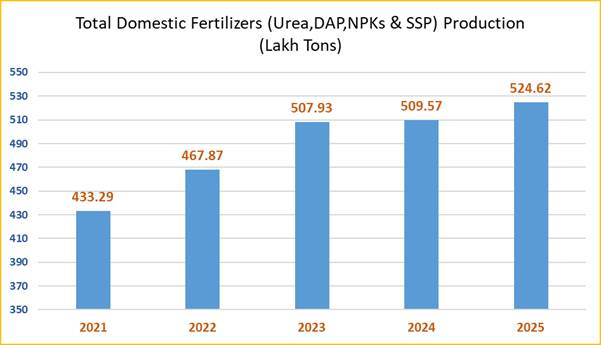
What is Fertilizer Security?
Fertilizer security refers to ensuring the timely, affordable, and uninterrupted availability of key fertilizers—Urea, DAP, NPKs, and SSP—to Indian farmers by:
- Reducing import dependence
- Expanding domestic production
- Securing raw material supply chains
It is a critical component of food security, farm productivity, and macroeconomic stability.
Facts To Remember
1. Women’s Hockey India League Final
In the Women’s Hockey India League (HIL) final held at the Marang Gomke Jaipal Singh Stadium Jharkhand, the title clash between Pipers and Shrachi Bengal Tigers went down to a third sudden-death encounter of the season.
2. Tarique Rahman named BNP chairperson
Tarique Rahman has been appointed chairperson of the Bangladesh Nationalist Party (BNP), days after the demise of his mother and former party chairperson Khaleda Zia.
3. Govt. launches drive to reduce road accident deaths
The Union Ministry of Road Transport and Highways, in collaboration with the NGO Save Life Foundation, has identified 100 districts with the highest number of road crashes to launch a data-driven zero-fatalities programme, in line with the government’s pledge to reduce road deaths by 50% by 2030.
4. Kerala women spikers retain title; Railways men triumph
It was mixed luck for Kerala in the 72nd senior National volleyball championships in Varanasi on Sunday. Defending champion Kerala women retained the title with a 22-25, 25-20, 25-15, 22-25, 15-8 win over Railways.
5. Third time lucky for Poland in United Cup
Poland battled past Switzerland 2-1 in the United Cup final on Sunday to banish the pain of title-round defeats in the previous two editions and secure a long-awaited maiden triumph in the season-opening mixed-team competition.
6. Indian Railways reigns supreme with twin titles
It was double delight for the Indian Railways at the 75th senior National basketball championship at the Nehru Indoor Stadium on Sunday.
7. Govt to Open ASI Monument Conservation to Private Sector
Context:
The Union government has decided to open the conservation of centrally protected ASI monuments to private sector participation under a revamped framework of the National Cultural Fund (NCF). The move introduces a public–private partnership (PPP) model aimed at strengthening heritage conservation capacity and reducing delays.
8. India’s rice exports surge in 2025 after lifting curbs
India’s rice exports rose 19.4% in 2025 to 21.55 million metric tonnes, the second-highest level on record, after the government lifted all export restrictions imposed earlier, according to officials cited by Reuters. Exports are now close to the 2022 record of 22.3 million tonnes, underscoring India’s dominance as the world’s largest rice exporter.
9. Nation pays homage to Swami Vivekananda on National Youth Day
The nation pays homage to Swami Vivekananda on National Youth Day today.
10. India to host 28th Conference of Speakers and Presiding Officers of Commonwealth
India will host the 28th Conference of Speakers and Presiding Officers of the Commonwealth (CSPOC) in New Delhi.
11. Union Minister Bhupender Yadav says PACS network gives India resilience against global economic crisis
Union Minister for Environment, Forest and Climate Change Bhupender Yadav today said that India’s strong network of Primary Agricultural Credit Societies (PACS), comprising 32 crore people, provides the country with resilience against any global economic crisis.
12. India-Germany sign MoUs; defence, trade & technology, marking new chapter in bilateral relations
India and Germany have announced a wide range of initiatives spanning defence, trade, and technology, marking a new chapter in bilateral relations following a high-level meeting between Prime Minister Narendra Modi and German Chancellor Friedrich Merz in Gandhinagar.
13. Union Home Minister Amit Shah pays tribute to Rajmata Jijabai on her birth anniversary
Union Home Minister Amit Shah today paid tribute to Rajmata Jijabai on her birth anniversary.
14. Govt says fish production in country increased to 198 lakh tonnes in 2024-25 from 95 lakh tonnes in 2013-14
The government has said that the fish production in the country has increased to around 198 lakh tonnes in 2024-25 from 95 lakh tonnes of fish production in 2013-14.
15. Union Minister Ashwini Vaishnaw to participate in G7 Critical Minerals Ministerial Meeting today in Washington
Union Minister for Electronics and Information Technology Ashwini Vaishnaw will participate in the G7 Critical Minerals Ministerial Meeting today in Washington DC, United States.
16. PRAGATI platform marks 50th meeting, boosting pro-active governance since launch by PM Modi in 2015
The Prime Minister’s flagship platform for Pro-Active Governance and Timely Implementation, PRAGATI, has marked a significant milestone with the successful conduct of its 50th meeting.
17. Udyan Utsav: Celebration of Indian heritage, agriculture, sustainability & citizen engagement
Over a lakh people visited the second edition of the Udyan Utsav, hosted at Rashtrapati Nilayam, Bolarum, during the past 9 days.
18. Tunisian filmmaker Zoubeir Jlassi win world’s largest AI Film Award for his film Lily & receives one-million-dollar prize
Tunisian filmmaker Zoubeir Jlassi has won the world’s largest AI Film Award for his film Lily, receiving a one-million-dollar prize from Sheikha Latifa bint Mohammed bin Rashid Al Maktoum during the 1 Billion Followers Summit in Dubai.
19. NHAI creates four Guinness World Records on Bengaluru–Kadapa–Vijayawada Economic Corridor
The National Highway Authority of India (NHAI) has successfully created four Guinness World Records on the under-implementation Bengaluru-Kadapa-Vijayawada Economic Corridor of NH-544G.
20. PM Modi Praises Shrimad Vijayaratna Sunder Surishwarji Maharaj on 500th Book Release
Prime Minister Narendra Modi has said that Shrimad Vijayaratna Sunder Surishwarji Maharaj has not confined knowledge to books alone.
- Forms the first step towards a five-module space station by 2035 Bharatiya Antariksh Station (BAS): India’s Spac…
- FIU first issued AML-CFT guidelines for crypto service providers in March 2023. Stricter KYC Norms for Crypto Exchanges in India
- Required to focus at least 75% of Adjusted Net Bank Credit (ANBC) on priority sector lending Small Finance Banks (SFBs)
- Law Commission of India (96th Report, 1984) advocating periodic repeal of outdated laws Regulatory Review Cell (RRC)
- Created under the National Dairy Development Board Act, 1987 Digitalisation of India’s Dairy Sector
13 January, 2026
Daily Current Affairs Quiz
13 January, 2026
International Affairs
1. Operation Hawkeye
Context:
The United States conducted large-scale airstrikes against ISIS targets in Syria under Operation Hawkeye, following an ISIS ambush in Palmyra that killed two U.S. soldiers and a civilian interpreter.
What is Operation Hawkeye?
- A U.S.-led counter-terrorism military operation
- Involves air and precision strikes against Islamic State (ISIS) infrastructure and fighters in Syria
- Launched: December 2025
- Authority: Under President Donald Trump
- Executed by: US Central Command (CENTCOM)
About Syria
- A sovereign Middle Eastern country
- Emerged from a 13-year civil war (2011–2024)
- Currently governed by an interim government led by President Ahmed al-Sharaa
- Capital: Damascus (one of the world’s oldest continuously inhabited cities)
- Location: South-West Asia; strategic link between Levant and Mesopotamia
- Borders: Turkey, Iraq, Jordan, Lebanon, Israel
2. How U.S. Actions Under Donald Trump Violate International Law
Source: TH
Context:
An opinion article by Thomas Mathew critiques recent U.S. military action against Venezuela, announced by U.S. President Donald Trump, arguing that it represents a serious violation of international law and reflects the breakdown of the global balance-of-power system.
Core Principles of International Law Involved
- Sovereign Equality of States
- Non-intervention in Internal Affairs
- Prohibition on Use of Force (UN Charter Article 2(4))
- Collective Security through the UN Security Council
- Respect for International Treaties and Institutions
What Happened?
- President Trump announced U.S. military action against Venezuela from Mar-a-Lago (Florida).
- He declared:
- Capture and trial of Venezuelan President Nicolas Maduro and his wife Cilia Flores in New York on charges of “narco-terrorism”.
- U.S. control over Venezuela’s governance and oil resources.
- Compensation to U.S. companies whose assets were nationalised earlier.
Questioning the Official Justification
- U.S. justified action as counter-narcotics enforcement.
- However:
- ~69% of U.S. drug overdose deaths since 2000 are linked to fentanyl, whose precursors largely originate in China.
- Venezuela is only a modest source of cocaine to the U.S.
- Venezuela possesses the world’s largest proven oil reserves, suggesting economic and strategic motives.
Violation of International Law
- The action violates the United Nations Charter, especially:
- Article 2(4): Prohibits threat or use of force against sovereignty and territorial integrity of states.
- Article 51: Allows force only in self-defence.
- No:
- UN Security Council authorisation
- Immediate self-defence justification
- Hence, the action is termed a flagrant breach of international law.
Breakdown of the Balance of Power
- Balance of power historically prevented unchecked dominance:
- Post-World War II bipolar system (U.S.–Soviet Union) restrained unilateral action.
- Historical examples:
- Bangladesh Liberation War (1971):
- U.S. Seventh Fleet (TF-74) countered by Soviet naval deployment, protecting India.
- Yom Kippur War (1973):
- Soviet military signalling forced Israeli restraint; U.S. declared DEFCON-3.
- Bangladesh Liberation War (1971):
- Collapse of the Soviet Union in 1991 ended effective counter-balancing.
Consequences of Unipolarity
- U.S. adoption of pre-emptive war doctrine.
- Regime changes through direct or indirect intervention in:
- Iraq
- Libya
- Syria
- Egypt
- Venezuela episode seen as continuation of this trend.
Implications for India
- U.S. actions show insensitivity to India’s security interests.
- India needs:
- Strengthened military-industrial complex
- Strategic autonomy
- Long-term defence capacity building
3. India Likely to Join U.S.-Led “Pax Silica” Initiative
Source: IE
Context:
India will be invited next month to join “Pax Silica”, a U.S.-led multilateral initiative focused on cooperation in semiconductors, critical minerals, and artificial intelligence, according to incoming U.S. Ambassador to India Sergio Gor.
Pax Silica
Pax Silica is a U.S.-led multilateral initiative for cooperation in semiconductors, critical minerals, and artificial intelligence (AI), aimed at strengthening secure, resilient, and trusted technology supply chains amid geopolitical and trade disruptions.
- Launched: December 2025
- Lead country: United States
- Initial members: Japan, Australia, South Korea, Singapore, the U.K., the Netherlands, Israel, UAE
- India: To be invited to join (announcement by the U.S. Ambassador)
- Focus areas:
- Semiconductor supply chains
- Critical minerals
- Artificial Intelligence
National Affairs
1. Indusfood 2026
Context:
Union Minister Chirag Paswan (Ministry of Food Processing Industries) inaugurated the 9th edition of Indusfood in Greater Noida, Uttar Pradesh, in January 2026.
About Indusfood 2026
- What is it?
Asia’s premier global Food & Beverage (F&B) sourcing and trade show - Dates: January 8–10, 2026
- Venue: India Expo Centre & Mart, Greater Noida
- Organised by: Trade Promotion Council of India (TPCI)
- Under: Ministry of Commerce & Industry
Major Initiatives Launched
- World Culinary Heritage Conference 2026
- First edition held on January 9, 2026
- Organised by Indian Federation of Culinary Associations (IFCA)
- BHARATI Startup Challenge
- Launched by APEDA
- Full form: Bharat’s Hub for Agritech, Resilience, Advancement and Incubation for Export Enablement
- Aim: Promote agritech innovation and food export entrepreneurship
- India–UAE Food Corridor
- Launched by Abu Dhabi Food Hub (UAE)
- Objective:
- Strengthen food security
- Streamline supply chains
- Boost bilateral food trade
2. 3rd Indian Lighthouse Festival (ILF) 2026
Source: PIB
Context:
The 3rd edition of the Indian Lighthouse Festival (ILF 3.0) was held from January 9–10, 2026, at MGM Park, Visakhapatnam, Andhra Pradesh.
About the Festival
- Organised by:
- Ministry of Ports, Shipping and Waterways (MoPSW)
- Directorate General of Lighthouses and Lightships (DGLL)
- Nature:
- National festival celebrating India’s lighthouse heritage, maritime history and coastal tourism
Key Highlights
- Inaugurated by:
- M. Venkaiah Naidu (Chief Guest)
- In presence of Sarbananda Sonowal, Union Minister for Ports, Shipping & Waterways
- Infrastructure Initiatives Launched:
- Foundation stone laid (virtually) for reconstruction of staff quarters at:
- Junglighat, Sri Vijaya Puram, Andaman and Nicobar Islands
- Virtual inauguration of Light & Sound Projection Mapping Show at:
- Aguada Lighthouse, Goa
- Foundation stone laid (virtually) for reconstruction of staff quarters at:
3. Indian Army Conducts First MCF Exercise ‘Sanjha Shakti’
Source: PIB
Context:
The Indian Army conducted its first-ever Military–Civil Fusion (MCF) exercise ‘Sanjha Shakti’ on January 8–9, 2026, at Diggi Range, Khadki Military Station, Pune, under the Southern Command.
Key Details
- Type: Inaugural Military–Civil Fusion (MCF) exercise
- Location: Diggi Range, Khadki Military Station, Pune (Maharashtra)
- Organised by: Indian Army (MG & G Area, Southern Command)
- Participants:
- Indian Army
- 16 civilian agencies (including Maharashtra Police, Force One, Fire & Emergency Services)
- 350+ civilian personnel
4. PSLV Mission-C62
Source: TH
Context:
The Indian Space Research Organisation (ISRO) suffered a second consecutive setback as the PSLV-C62 mission failed after the rocket deviated from its intended flight path during the third stage, resulting in the loss of 16 satellites, including EOS-N1 (Anvesha).
Mission Details
- Launch Vehicle: PSLV-C62
- Height: 44.4 metres
- Configuration: Four-stage (two solid + two liquid stages)
- Launch Site: Satish Dhawan Space Centre
- Planned Orbit: 512 km Sun-synchronous orbit
- Launch Operator: NewSpace India Limited
EOS-N1 (Anvesha)
- Developed by Defence Research and Development Organisation (DRDO)
- Hyperspectral Earth observation satellite
- Applications:
- Strategic defence
- Agriculture monitoring
- Urban mapping
- Environmental assessment
5. National Youth Day – Swami Vivekananda Jayanti (12 January)
Context:
Swami Vivekananda’s birth anniversary on 12 January is observed as National Youth Day. Droupadi Murmu paid tribute to his role in awakening India’s spiritual and national consciousness.
About Swami Vivekananda
- Born Narendranath Datta on January 12, 1863, in Kolkata
- Combined modern education with deep engagement in Indian philosophy
- Emphasised mental and physical strength as foundations of character
- He was a key disciple of Ramakrishna Paramahamsa and the founder of the Ramakrishna Mission.
- He brought Indian philosophy—especially Vedanta and Yoga—to the global stage.
- His historic address at the Parliament of the World’s Religions (Chicago, 1893) introduced the world to India’s spiritual heritage and message of universal brotherhood.
- Motto: “Atmano mokshartham jagat hitaya cha” (Self-realisation and service of the world)
6. Viksit Bharat Shiksha Adhishthan Bill, 2025
Context:
Viksit Bharat Shiksha Adhishthan Bill, 2025, introduced in the Lok Sabha on December 15, 2025, as a major reform aligned with the vision of Viksit Bharat 2047 and the National Education Policy 2020.
Key Objectives
- Streamline regulation by replacing multiple regulators with one apex body
- Improve quality, accountability, and outcomes in higher education
- Reduce bureaucratic compliance and promote institutional autonomy
- Align higher education with “Viksit Bharat @2047” vision
Institutional Framework
VBSA will function through three vertical councils:
- Regulatory Council (Viniyaman Parishad)
- Licensing and authorization of institutions
- Ensuring minimum academic norms
- Standards Council (Manak Parishad)
- Setting learning outcomes, curriculum benchmarks, and faculty norms
- Accreditation Council (Gunvatta Parishad)
- Quality assessment and outcome-based accreditation
Major Changes Proposed
- Repeals existing laws governing:
- University Grants Commission
- All India Council for Technical Education
- National Council for Teacher Education
- Introduces outcome-based regulation instead of input-heavy controls
- Encourages multidisciplinary education, research, and innovation
Coverage
- Applies to central, state, deemed universities, private HEIs and INIs
- Professional courses such as medicine, law, pharmacy, etc. may remain under sector-specific regulators
7. DRDO Successfully Tests Man-Portable Anti-Tank Guided Missile (MPATGM)
Source: TOI
Context:
The Defence Research and Development Organisation (DRDO) successfully conducted a flight test of the indigenously developed third-generation Man-Portable Anti-Tank Guided Missile (MPATGM) on Sunday.
About MPATGM
- Third-generation, fire-and-forget missile
- Man-portable system for infantry units
- Equipped with:
- Imaging Infrared (IIR) homing seeker
- Top-attack capability (strikes weaker upper armour of tanks)
- Designed to neutralise modern armoured threats at close to medium ranges
8. Article 6 of the Paris Agreement
Context:
An opinion article by Aparna Sharma highlights how Article 6 (A6) of the Paris Agreement, made fully operational at COP29, offers India a strategic opportunity to accelerate low-carbon growth, attract climate finance, and strengthen global partnerships.
What is Article 6 of the Paris Agreement?
- Provides market and non-market mechanisms for international cooperation on climate mitigation.
- Article 6.2:
- Bilateral/plurilateral cooperation
- Exchange of Internationally Transferred Mitigation Outcomes (ITMOs)
- Article 6.4:
- Paris Agreement Crediting Mechanism
- Successor to the Clean Development Mechanism (CDM)
- Ensures robust accounting and avoids double counting of emission reductions.
India’s Entry into Article 6
- In August 2025, India signed the Joint Crediting Mechanism (JCM) with Japan, operationalising Article 6.2.
- Signifies India’s formal participation in international carbon markets under the Paris framework.
Why Article 6 is Important for India
- Enables:
- Technology transfer
- Support for R&D and innovation
- Climate finance inflows
- Stronger bilateral and plurilateral relations
- Goes beyond carbon credit trading to support:
- Low-carbon industrial transformation
- Resilient trade relationships in a carbon-constrained global economy
Banking/Finance
1. Retail Inflation Rises to 3-Month High in December 2025
Source: TH
Context:
India’s retail inflation (CPI) rose to a three-month high of 1.33% in December 2025, remaining below the lower tolerance level of 2% set by the Reserve Bank of India.
What is Retail Inflation?
Retail inflation measures the rate at which prices of goods and services bought by households rise over time. In India, it is tracked using the Consumer Price Index (CPI).
- What it covers: Food, clothing, housing, fuel & light, transport, education, healthcare, etc.
- Who publishes it: The Ministry of Statistics and Programme Implementation releases CPI data monthly.
- Why it matters: It reflects the cost of living and directly affects household budgets.
- Policy link: The Reserve Bank of India uses CPI-based retail inflation to set monetary policy, targeting 4% with a ±2% tolerance band.
2. SEBI’s Proposed Trading Rules Revamp
Source: Mint
Context:
The Securities and Exchange Board of India (SEBI) has released a consultation paper proposing a major overhaul of trading regulations by simplifying legacy rules and delegating greater supervisory powers to stock exchanges.
What is Being Proposed?
- Consolidation of trading norms into a single framework by:
- Revising the Master Circular for Stock Exchanges and Clearing Corporations (MSECC)
- Revising the Master Circular for Commodity Derivatives (MCCD)
- Objective:
- Remove outdated provisions
- Streamline compliance
- Update rules that are over a decade old
Key Proposed Changes
- Higher Net-Worth Requirement for Margin Trading Facility (MTF)
- Increase minimum net worth for brokers from:
- ₹3 crore → ₹5 crore (or higher if exchanges decide)
- Existing norm introduced in 2004, last revised in 2022
- Increase minimum net worth for brokers from:
- Liquidity Enhancement & Market Making
- Merge Liquidity Enhancement Schemes (LES) into a single principle-based framework
- Remove obsolete market-making provisions
- Aim:
- Improve liquidity
- Ensure better price discovery
- Reduce volatility in thinly traded securities
- Operational Simplification
- Align timelines for:
- Net-worth statements
- Auditor certificates
- Reduce duplicative and low-value compliance filings
- Align timelines for:
Shift in Regulatory Approach
- SEBI proposes to delegate routine supervision to stock exchanges:
- Exchanges become first-line regulators
- Powers include:
- Setting net-worth norms for MTF brokers
- Examining surveillance alerts
- Levying penalties via member committees
- SEBI to focus more on:
- Policy-making
- System-level oversight
3. RBI Tightens Digital Oversight on Compliance, Outsourcing and AI
Context:
The Reserve Bank of India (RBI) has signalled stricter supervisory scrutiny over banks’ digital operations, compliance practices, third-party outsourcing and use of artificial intelligence, as financial systems become faster, more interconnected and technology-driven.
Three Key Regulatory Expectations
1. Continuous Compliance (Not Episodic)
- Compliance should not be treated as a quarter-end or audit-time exercise.
- Faster business and risk cycles require:
- Year-round operational discipline
- Strong data governance
- Supervisors will assess:
- How quickly banks explain anomalies
- How decisively they correct issues
- Responsiveness will be seen as a sign of control maturity, not back-office formality.
2. Stronger Oversight of Third-Party Arrangements
- Rising dependence on:
- Cloud service providers
- Fintech partners
- Technology vendors
- RBI’s position:
- Accountability cannot be outsourced
- Banks must ensure:
- Clear responsibility for incidents
- Contracts enabling audit, access and resilience
- Third-party risk management is now viewed as core risk management, especially for cross-border operations.
3. Heightened Scrutiny of AI and Analytics
- Increasing use of AI in:
- Credit underwriting
- Fraud detection
- Risk management
- RBI will closely examine:
- Model risk
- Explainability of algorithms
- Fairness and bias
- Banks must be prepared for deeper supervisory questioning as AI tools become embedded in core functions.
4. RBI’s Scale-Based Regulatory (SBR) Framework
Source: BL
Context:
The Reserve Bank of India (RBI) is expected to release an updated list of ‘Upper Layer’ Non-Banking Financial Companies (NBFCs) by mid-2026, with a strong possibility of including large NBFCs promoted by banks or backed by strong corporate promoters.
RBI’s Scale-Based Regulatory (SBR) Framework
The Scale-Based Regulatory (SBR) Framework is a risk-based regulatory architecture introduced by the Reserve Bank of India for Non-Banking Financial Companies (NBFCs).
It links the intensity of regulation to the size, complexity, and systemic risk posed by NBFCs.
Objectives
- Align regulation with systemic risk rather than a one-size-fits-all approach
- Strengthen financial stability
- Improve governance, prudential norms, and transparency
- Reduce regulatory arbitrage between banks and NBFCs
Four-Tier Classification under SBR
1. Base Layer (NBFC-BL)
- Non-systemically important NBFCs
- Lowest regulatory intensity
- Basic prudential and conduct norms
2. Middle Layer (NBFC-ML)
- All deposit-taking NBFCs
- Non-deposit taking NBFCs above a threshold size
- Enhanced governance, risk management, and disclosure norms
3. Upper Layer (NBFC-UL)
- NBFCs identified as systemically significant
- Subject to bank-like regulations (capital, leverage, governance)
- Identified using a scoring-based framework (size, interconnectedness, complexity)
4. Top Layer (NBFC-TL)
- Expected to be empty normally
- For NBFCs posing extreme systemic risk
- RBI may impose very stringent supervisory measures
Key Regulatory Features
- Stricter capital adequacy norms for higher layers
- Mandatory governance standards (board structure, risk committees)
- Enhanced disclosures and audits
- Prompt Corrective Action (PCA) applicability
5. IRDAI Scrutinises Insurers for Breaching Expense & Commission Limits
Source: BL
Context:
The Insurance Regulatory and Development Authority of India (IRDAI) has sought explanations from 23 insurance companies—8 life insurers and 15 non-life insurers—for overshooting prescribed limits on expenses of management, mainly commissions.
Background
- Action taken under the IRDAI (Expenses of Management, including Commission, of Insurers) Regulations, 2024.
- The regulator is examining submissions and will decide penal action on a case-by-case basis after due process.
IRDAI (Expenses of Management, including Commission, of Insurers) Regulations, 2024
These regulations, notified by the Insurance Regulatory and Development Authority of India, lay down a new, flexible framework to regulate Expenses of Management (EoM) of insurers, including commission and distribution expenses.
They replace the rigid product-wise expense caps with an overall EoM-based approach.
Objectives
- Promote operational efficiency and cost discipline
- Provide pricing and distribution flexibility to insurers
- Enhance policyholder protection and transparency
- Support insurance penetration and inclusion
Key Provisions
1. Expenses of Management (EoM) Concept
EoM includes:
- Commission and remuneration to agents/intermediaries
- Marketing and distribution costs
- Operating and administrative expenses
Regulated through an overall EoM ratio, not individual product caps.
2. EoM Limits (Overall Ceiling)
- Separate EoM limits prescribed for:
- Life insurers
- General insurers
- Health insurers
- Reinsurers
- Limits linked to gross premium written and business mix
3. Flexibility in Commission
- Insurers can decide commission structures freely
- No product-wise or channel-wise caps
- Subject to:
- Overall EoM ceiling
- Board-approved expense policy
4. Board & Governance Requirements
- Mandatory Board-approved EoM policy
- Policy must ensure:
- Reasonableness of expenses
- Fair treatment of policyholders
- Long-term sustainability
5. Disclosure & Oversight
- Enhanced public disclosures on expenses
- Annual certification by:
- Appointed Actuary
- CEO/CFO
- IRDAI empowered to intervene in case of:
- Persistent breach
- Mis-selling or unfair practices
6. Axis Finance Launches ‘Vyapar’ Business Loan for MSMEs
Context:
Axis Finance, a non-banking financial company (NBFC), has launched Vyapar Business Loan, a collateral-free credit product aimed at supporting micro and small businesses (MSMEs), especially in semi-urban and rural markets.
Key Features of Vyapar Business Loan
- Loan amount: Up to ₹10 lakh
- Collateral: No collateral required
- Tenure: Flexible repayment options
- Target segments:
- Retail
- Service
- Trading businesses
- Designed for shopkeepers, traders and service providers
7. PhonePe Launches ‘Bolt’ to Streamline In-App Card Payments
Source: BL
Context:
PhonePe Payment Gateway has launched ‘PhonePe PG Bolt’, a new solution to simplify Visa and Mastercard credit and debit card payments through a faster and more secure in-app checkout process.
What is PhonePe PG Bolt?
- A card payment solution for merchants using PhonePe Payment Gateway.
- Supports Visa and Mastercard cards.
- Uses device tokenization to enhance security and speed.
Key Features
- One-time tokenization of Visa/Mastercard cards on the PhonePe app.
- Tokenised cards can be used across all merchants integrated with PhonePe PG.
- Eliminates the need to:
- Re-tokenize cards for each merchant
- Enter CVV for repeat transactions on the same device
- Enables a one-click, in-app checkout experience.
- Removes redirects to external payment pages, keeping users within the merchant app.
8. RBI Bars Resident Indians from Issuing Credit Guarantees to NRIs
Source: BS
Context:
The Reserve Bank of India (RBI) has issued new Foreign Exchange Management Regulations prohibiting resident Indians from issuing credit guarantees in favour of Non-Resident Indians (NRIs).
Key Provisions
- Resident Indians cannot issue credit guarantees for NRIs under FEMA regulations.
- Residents may act as:
- Surety, or
- Principal debtor,
only if: - The underlying transaction is permitted under foreign exchange law, and
- Both resident and non-resident parties are eligible to lend or borrow from each other under existing borrowing and lending rules.
Legal Framework
- Issued under the Foreign Exchange Management Act (FEMA).
- Aims to ensure:
- Compliance with cross-border capital flow regulations
- Prevention of unauthorised financial exposure and risk
9. Optimum Credit–Deposit (CD) Ratio for Banks: SBI Report
Source: BS
Context:
A research report by State Bank of India (SBI) has stated that a credit–deposit (CD) ratio beyond optimal levels sharply reduces incremental profitability and strains bank liquidity.
Key Findings:
- Optimum CD Ratio:
- Public sector & private banks: 76–80%
- Foreign banks: 65–70%
- CD ratios above 80% (PSBs & private banks) and above 70% (foreign banks):
- Diminish profitability gains
- Increase leverage-related risks
Credit–Deposit (CD) Ratio
The credit–deposit (CD) ratio is a banking indicator that shows the proportion of deposits mobilised by banks that is deployed as credit (loans).
CD Ratio=(Total Credit/Total Deposits)×100
Who uses it?
- Monitored closely by the Reserve Bank of India
- Used by banks, policymakers, and regulators to assess credit flow and liquidity conditions
Why is it important?
- Indicates credit deployment efficiency
- Reflects financial deepening of an economy or region
- Helps assess bank liquidity and stability
- Used to identify regional credit imbalances
Agriculture
1. Rajasthan’s First Fully Organic Panchayat
Source: TH
Context:
Bamanwas Kankar panchayat in Rajasthan has become the first panchayat in the State to be officially certified as fully organic, marking a significant grassroots milestone in sustainable agriculture.
Location:
- Bamanwas Kankar Panchayat, Kotputli–Behror district, Rajasthan
- Comprises seven hamlets
What makes it ‘Fully Organic’?
- Complete ban on chemical pesticides and synthetic fertilisers
- Organic livestock management, aligned with ecological and health standards
- Integrated approach covering agriculture, animal husbandry, soil health, and water conservation
Why was the shift made?
- Declining soil fertility
- Falling groundwater levels
- Rising input costs of chemical farming
- Health concerns due to prolonged exposure to agrochemicals
Implementation Process:
- Transition initiated through collective village discussions over the past year
- Farmers shifted focus from short-term yields to long-term sustainability
- Supported by Cofarmin Federation of Organic Societies and Producer Companies (COFED)
Certification & Expansion Plans:
- COFED is issuing crop and livestock certification for the first cycle
- Target to convert 300 panchayats into fully organic village bodies by year-end across:
- Bikaner
- Alwar
- Kotputli–Behror
- Bhilwara
Facts To Remember
1. Canadian trailblazer Raonic announces retirement at 35
Former World No. 3 Milos Raonic announced his retirement on Monday, ending a career that earned him eight ATP titles.
2. India Faces Second-Highest Economic Burden Due to Diabetes: Study
A global study published in Nature Medicine estimates that India bears the second-highest economic burden due to diabetes, amounting to INT$ 11.4 trillion, after the United States.
3. Swachh Jal Abhiyan
The Madhya Pradesh government launched the Swachh Jal Abhiyan following the death of over 20 people in Bhagirathpura, Indore, due to contaminated drinking water.
4. GAIL & PNGRB Launch #NonStopZindagi Campaign
In January 2026, GAIL (India) Limited partnered with the Petroleum and Natural Gas Regulatory Board (PNGRB) to roll out the nationwide #NonStopZindagi campaign under National PNG Drive 2.0.
5. Golden Globe Awards 2026
The 83rd Golden Globe Awards were held on January 11, 2026, at the Beverly Hilton, California (USA), honouring excellence in film and television released in 2025.
The awards are presented annually by the Hollywood Foreign Press Association (HFPA).
- Host: Nikki Glaser (second consecutive year)
- First presented in 1944
- Popularly called “Hollywood’s Party of the Year”
- Most Awarded Film:
- One Battle After Another (Director: Paul Thomas Anderson)
- 4 awards out of 9 nominations:
- Best Picture (Musical or Comedy)
- Best Director
- Best Screenplay
- Best Supporting Actress
- Top TV Series:
- Adolescence (Director: Philip Barantini)
- 4 awards, including Best Limited Series
6. BSE Wins Asia Best Employer Brand Award 2026
In January 2026, Bombay Stock Exchange (BSE) received the Asia Best Employer Brand Award 2026.
- Award Event: Hong Kong Leadership Awards & CMO Asia Awards
- Venue: InterContinental Grand Stanford, Hong Kong SAR, China
- Recognition for:
- People-first workplace culture
- Strong HR practices
- Inclusive, high-performance environment
7. Khelo India Beach Games (KIBG) 2026
Karnataka emerged as the overall champion of the 2nd Khelo India Beach Games 2026, held at Ghoghla Beach, Diu.
- Dates: January 5–10, 2026
- Venue: Ghoghla Beach, Diu
- Organised by: UT of Dadra & Nagar Haveli and Daman & Diu
- Technical supervision: Sports Authority of India & national federations
8. Obituary: Davinder Singh Garcha
Former Indian hockey player and Olympian Davinder Singh Garcha passed away in January 2026 at age 73 in Jalandhar, Punjab.
Awards & Roles
- Major Dhyan Chand Award (2021) – Lifetime achievement
- Police Career: Former IPS officer; DIG, Punjab Police
- Post-retirement:
- President, Olympian Surjit Hockey Society
- President, Mohinder Singh Munshi Hockey Tournament (All-India U-19)
9. ECI Prepares for IICDEM 2026
The Election Commission of India held a CEOs’ conference in New Delhi to prepare for IICDEM 2026, focusing on global best practices in election management.
10. IICDEM 2026: Global Election Platform
India International Conference on Democracy and Election Management (IICDEM) is ECI’s global forum for sharing democratic and electoral governance experiences worldwide.
11. Assam Hosts National Textiles Ministers’ Conference 2026
Assam hosted a two-day national conference to drive policy, innovation, exports and sustainability in textiles under the theme “Weaving Growth, Heritage & Innovation”.
12. Posts & Rural Development Ministries Sign MoU
The Department of Posts and Ministry of Rural Development signed an MoU to boost rural financial inclusion via doorstep digital banking through IPPB.
12. India–Bhutan Judicial Cooperation Strengthened
The Supreme Court of India signed an MoU with Bhutan’s apex court to exchange young law clerks and deepen judicial collaboration.
13. Rajasthan Hosts Regional AI Impact Conference
Rajasthan hosted a precursor AI conference ahead of India AI Impact Summit 2026, focusing on inclusive, responsible and governance-driven AI adoption.
14. Rajasthan Launches AI & ML Policy 2026
Rajasthan unveiled its AI & ML Policy 2026 and AI portal to shift from e-governance to AI-driven, citizen-centric governance.
15. YUVA AI & iStart Platforms Launched
Rajasthan launched YUVA AI, iStart LMS and AVGC-XR portals to skill youth and boost AI-led innovation and startups.
16. Agri Ministry & India Post Fast-Track Sample Testing
The Department of Agriculture & Farmers Welfare partnered with India Post to cut pesticide and seed sample testing time to 48–72 hours.
17. DICGC Insures 41.5% of Bank Deposits
As of March 2025, Deposit Insurance and Credit Guarantee Corporation insured ₹100.12 lakh crore of deposits with a fund balance of ₹2.29 lakh crore.
18. SBI Opens First Global Capability Centre
State Bank of India inaugurated its first Global Capability Centre in Bengaluru to support India’s GCC ecosystem.
19. Goldman Sachs Cuts India Growth Forecast
Goldman Sachs projected India’s GDP growth at 6.8% in FY27, citing moderation from previous highs.
20. Amazon Pay Launches Fixed Deposits
Amazon Pay rolled out fixed deposits via its app in partnership with banks and NBFCs, starting from ₹1,000.
21. IDFC FIRST Bank Launches Zero-Forex Credit Card
IDFC FIRST Bank introduced the Zero-Forex Diamond Reserve Credit Card for frequent global travellers.
22. ICICI Bank Enters Capital Gains Account Scheme
ICICI Bank will offer Capital Gains Accounts from 2026, enabling tax-efficient capital gains reinvestment.
23. IDFC FIRST Bank Launches ‘Gaj’ Metal Card
IDFC FIRST Bank launched ‘Gaj’, an invitation-only premium metal credit card for high-net-worth individuals.
24. Canara Bank Launches ‘Canara ai1Pe’ UPI App
Canara Bank launched a unified next-gen UPI app for seamless digital payments.
25. South Indian Bank Launches RuPay NFC Sticker
South Indian Bank introduced ‘SIB Paytag’, a contactless RuPay NFC payment sticker.
26. Amazon Pay Enables Biometric UPI
Amazon Pay launched biometric authentication for UPI payments up to ₹5,000, eliminating PIN entry.
27. Axis Bank Launches ‘Safety Centre’
Axis Bank introduced an in-app Safety Centre allowing users to instantly secure digital banking services.
28. TMB Partners TechFini for Scalable UPI
Tamilnad Mercantile Bank partnered with TechFini to strengthen cloud-native, high-volume UPI payment and collection solutions.
29. Bargi Dam
Context:
The National Dam Safety Authority (NDSA) has issued a show-cause notice to the Narmada Valley Development Authority (NVDA) over serious safety lapses at Bargi Dam.
- Location
- Jabalpur district, Madhya Pradesh
- River
- Built on the Narmada River
30. Modi, Merz Launch International Kite Festival 2026 in Ahmedabad
Prime Minister Narendra Modi and German Chancellor Friedrich Merz jointly inaugurated the International Kite Festival 2026 at the Sabarmati Riverfront, Ahmedabad, with Germany as a key international partner.
- ~69% of U.S. drug overdose deaths since 2000 are linked to fentanyl, whose precursors largely originate in China. How U.S. Actions Under Donald Trump Violate Int…
- India’s retail inflation (CPI) rose to a three-month high of 1.33% in December 2025, remaining below the lower tolerance level of 2% set by the Reserve Bank of India. Retail Inflation Rises to 3-Month High in Decem…
- Action taken under the IRDAI (Expenses of Management, including Commission, of Insurers) Regulations, 2024. IRDAI Scrutinises Insurers for Breaching Expens…
- Rajasthan hosted a precursor AI conference ahead of India AI Impact Summit 2026, focusing on inclusive, responsible and governance-driven AI adoption. Rajasthan Hosts Regional AI Impact Conference
- Major Dhyan Chand Award (2021) – Lifetime achievement Awards & Roles
14 January, 2026
Daily Current Affairs Quiz
14 January, 2026
National Affairs
1. Jharkhand Notifies PESA Rules
Source: TOI
Context:
In January 2026, Jharkhand notified rules under the Panchayat (Extension to Scheduled Areas) Act, 1996 (PESA)—25 years after the state’s formation and nearly three decades after the law was enacted.
This finally operationalises tribal self-governance in Jharkhand’s Fifth Schedule areas.
What is PESA?
- PESA (1996) extends Part IX of the Constitution (Panchayati Raj) to Fifth Schedule tribal areas.
- It recognises the Gram Sabha as the primary authority over:
- Local governance
- Land and forests
- Community resources
- Enacted on 24 December 1996 to realise tribal self-rule in Scheduled Areas across nine States, including Jharkhand.
Why Was PESA Needed?
1. Colonial Dispossession
- British forest and land laws alienated tribal communities from customary lands.
- Traditional governance systems were weakened or destroyed.
2. Constitutional Gap
- Fifth Schedule (Article 244) aimed to protect tribal areas.
- But without local self-governance, protections remained weak.
3. 73rd Constitutional Amendment (1992)
- Introduced Panchayati Raj nationwide.
- Scheduled Areas were excluded due to their special status.
4. Bhuria Committee (1994–95)
- Recommended Gram Sabha–centric governance.
- Emphasised tribal control over natural resources and development.
5. Enactment of PESA (1996)
- Legalised direct democracy in tribal villages.
Key Features of PESA
1. Gram Sabha as Supreme Authority
- Village assemblies are the foundation of governance in Scheduled Areas.
- Bureaucratic control is subordinate to community decisions.
2. Protection of Customary Law & Culture
- Governance must respect:
- Tribal customs
- Religious practices
- Traditional dispute-resolution systems
3. Control Over Natural Resources
- Gram Sabhas exercise rights over:
- Minor forest produce (MFP)
- Village water bodies
- Community lands
4. Land Acquisition Safeguards
- Mandatory consultation with Gram Sabhas before land acquisition.
- Restoration of illegally transferred tribal land.
5. Local Economic & Social Regulation
- Powers to regulate:
- Village markets
- Money-lending
- Liquor
- Authority to identify beneficiaries of government schemes.
2. BHASHINI Samudaye
Context:
BHASHINI Samudaye is being organised in New Delhi by the Ministry of Electronics and Information Technology (MeitY) to strengthen India’s Indian-language AI ecosystem through collaboration, open datasets, and ethical governance.
What is BHASHINI Samudaye?
BHASHINI Samudaye is a collaborative ecosystem platform under BHASHINI that enables:
- Co-creation
- Participatory governance
- Scaling of Indian-language AI tools, datasets and services
It brings together academia, startups, civil society, states, and technology developers.
Institutional Framework
- Led by the Digital India BHASHINI Division (DIBD)
- Implemented under the National Language Translation Mission (NLTM)
- Anchored in India’s Digital Public Infrastructure (DPI) approach
3. Man Portable Anti-Tank Guided Missile (MPATGM)
Source: PIB
Context:
India has successfully flight-tested the third-generation Fire-and-Forget MPATGM with top-attack capability against a moving target, marking a major milestone in indigenous infantry anti-tank capability.
What is MPATGM?
The MPATGM is a third-generation, fire-and-forget, shoulder-launched anti-tank guided missile system designed to destroy modern main battle tanks (MBTs) and armoured vehicles under day-night and all-weather conditions.
Developed by
- Defence Research and Development Organisation (DRDO)
- Lead laboratory: Defence Research & Development Laboratory (DRDL), Hyderabad
Aim
To equip Indian infantry with a lightweight, high-precision and lethal anti-armour weapon that enhances battlefield survivability and lethality.
4. National Sports Governance Rules, 2026
Source: News on Air
What is the development?
On 12 January 2026, the Ministry of Youth Affairs and Sports (MYAS) notified the National Sports Governance (National Sports Bodies—NSBs) Rules, 2026 under the National Sports Governance Act, 2025. The rules aim to overhaul sports governance in India by mandating athlete inclusion, transparent elections, and ethical administration, aligned with Olympic Charter standards.
Key Provisions of the National Sports Governance Rules, 2026
1. Athlete Representation (Sportspersons of Outstanding Merit—SOMs)
- Minimum 4 SOMs in the General Body of every NSB
- At least 50% women among SOMs
- Minimum 4 women in the Executive Committee
- NSBs may reserve posts for SOMs in their byelaws
2. Eligibility Criteria for SOMs
- Minimum age: 25 years
- Must have retired from active sport
- Must not have participated in selection-level events for at least one year prior to application
3. Tiered Classification of SOMs
- 10-tier system based on sporting achievements
- Ranges from:
- Olympic & Paralympic medalists
- To National Games and National Championship medalists
- Ensures inclusive coverage across sports disciplines
4. Governance & Ethics
- Mandatory frameworks for NSBs and Regional Sports Federations
- Emphasis on:
- Transparent elections
- Ethical governance
- Athlete-centric decision-making
- Alignment with international best practices (Olympic Charter)
About the Ministry of Youth Affairs and Sports (MYAS)
- Union Minister: Dr. Mansukh Mandaviya (Porbandar, Gujarat)
- Minister of State: Raksha Khadse (Raver, Maharashtra)
Banking/Finance
1. PFRDA Forms Panel for Assured Payout Framework under NPS
Context:
The Pension Fund Regulatory and Development Authority (PFRDA) has constituted a 15-member expert committee to frame guidelines and regulations for assured pension payouts under the National Pension System (NPS).
- The committee is chaired by M. S. Sahoo, former Chairman of the Insolvency and Bankruptcy Board of India (IBBI)
- It will function as a standing advisory committee on structured pension payouts
Problem with the current NPS
- NPS is a defined contribution, market-linked scheme
- Retirement income is:
- Uncertain
- Dependent on market conditions
- This deters risk-averse subscribers, despite growing pension needs
The initiative aims to enhance retirement income security, not just corpus accumulation.
Mandate of the Committee
1. Assured Payout Regulations
- Frame rules for assured pension income products within NPS
- Align with provisions of the PFRDA Act
2. Risk Management Framework
- Prescribe:
- Capital requirements
- Solvency norms
- Ensure sustainability of assured payouts
3. Transition from Accumulation to Decumulation
- Ensure a smooth end-to-end transition for subscribers moving from:
- Saving phase → Pension payout phase
4. Market-Based Guarantees
- Deliberate on:
- Novation of contracts
- Settlement mechanisms
- Ensure payouts are:
- Legally enforceable
- Market-based, not fiscally guaranteed
5. Tax Implications
- Examine tax treatment of assured payouts under NPS
2. Tripura Gramin Bank Introduces India’s First Solar-Powered ATM Van
Context:
In January 2026, Tripura Gramin Bank (TGB) became the first Regional Rural Bank (RRB) in India to introduce India’s first fully solar-powered mobile ATM van, named “TGB on Wheels”.
About ‘TGB on Wheels’
Background
- The ATM van initiative was formally inaugurated in July 2023 by Nirmala Sitharaman, Union Minister of Finance, during her visit to Tripura.
Services Offered
- Mobile ATM and basic banking services
- Uninterrupted operations using solar power
- Effective in remote and power-deficient rural areas
Sustainability Aspect
- Fully solar-powered, reducing carbon footprint
- Aligns banking outreach with green and climate-resilient practices
Recognition
- TGB received the SKOCH Silver Award for excellence in governance and innovation, recognising the impact of this initiative.
3. Unified Regulatory Framework for Crypto Exchanges
Context:
Ahead of Union Budget 2026–27, the Ministry of Finance is in discussions with the Securities and Exchange Board of India (SEBI) and the Reserve Bank of India (RBI) to put in place a formal regulatory framework for crypto exchanges in India.
Proposed Regulatory Architecture
1. SEBI as the Primary Regulator
- All Indian crypto exchanges to be mandatorily registered with SEBI
- SEBI to oversee:
- Trading platforms
- Disclosure norms
- Market conduct
- Investor protection
Addresses the long-standing gap of no single market regulator for crypto assets.
2. RBI’s Role
- Oversight of:
- Foreign Direct Investment (FDI) in crypto entities
- Cross-border transactions
- Capital flow risks
Reflects RBI’s mandate over external sector stability and monetary sovereignty.
Why Is This Needed?
Fragmented Oversight at Present
Currently, crypto regulation is spread across agencies:
- Tax authorities → taxation of Virtual Digital Assets (VDAs)
- Financial Intelligence Unit – India (FIU-IND) → anti-money laundering compliance
- Enforcement agencies → illicit flows and violations
Policymakers view this fragmentation as a major enforcement and monitoring weakness.
What are Crypto Exchanges?
Crypto exchanges are digital platforms where users can buy, sell, trade, or hold cryptocurrencies (e.g., Bitcoin, Ether). They act as marketplaces, matching buyers and sellers, and often provide wallets, custody, and analytics.
Types of Crypto Exchanges
- Centralised Exchanges (CEXs)
- Operated by a company; require KYC/AML
- Higher liquidity; custodial risk
- Decentralised Exchanges (DEXs)
- Peer-to-peer via smart contracts; non-custodial
- Lower counterparty risk; higher tech risk
- Hybrid Exchanges
- Mix of custodial control and on-chain settlement
Objectives of the Proposed Framework
- Investor protection through regulated exchanges
- Market integrity and transparency
- Tax compliance and traceability of transactions
- Curbing illicit financial flows, money laundering, and terror financing
- Creating a regulated crypto ecosystem rather than banning innovation
4. RBI May Introduce Licence Regime for Corporate Business Correspondents
Source: BS
Context:
The Reserve Bank of India (RBI) is considering a licensing framework for corporate Business Correspondents (BCs). This would bring fintech firms operating as corporate BCs under direct RBI regulation, instead of the current model where sponsor banks bear responsibility for BC actions.
Who are Business Correspondents?
Business Correspondents (BCs) are agents appointed by banks to deliver basic banking and financial services at the grassroots level, especially in rural, remote, and underserved areas, where setting up brick-and-mortar branches is not viable. They act as the last-mile interface between banks and customers.
Who Regulates BCs?
- Regulated indirectly by the Reserve Bank of India (RBI)
- Banks are fully responsible for the actions of BCs they appoint
- BCs themselves are not directly licensed by RBI (as of now)
Who Can Act as BCs?
- Individuals (kirana shop owners, retired teachers, ex-servicemen, SHG members)
- NGOs, MFIs
- Companies and fintech firms (as Corporate BCs)
Services Provided by BCs
- Opening Basic Savings Bank Deposit Accounts (BSBDA)
- Cash deposit and withdrawal
- Aadhaar-enabled payment services (AePS)
- Direct Benefit Transfer (DBT) disbursement
- Utility bill payments and remittances
- Micro-insurance and pension enrolment (PMJJBY, PMSBY, APY)
Current Regulatory Arrangement
- Corporate BCs (many are fintechs) are not licensed by RBI
- Partner/sponsor banks are held accountable for BC conduct
- Some fintechs hold separate licences for limited functions:
- Prepaid Payment Instruments (PPI)
- Payment Aggregators (PA)
This fragmented oversight has created regulatory gaps.
5. RBI Proposes to Resume UCB Licensing
Source: IE
Context:
The Reserve Bank of India (RBI) has released a Discussion Paper proposing to resume licensing of Urban Co-operative Banks (UCBs)—a process paused since 2004. The paper outlines minimum capital, asset quality, governance, and footprint criteria, to be followed by draft norms after public consultation.
Key Proposals
1. Minimum Eligibility Thresholds
- Minimum capital: ₹300 crore (as of March 31 of the previous FY)
- Capital Adequacy Ratio (CAR): ≥ 12%
- Net NPA: ≤ 3% at the time of licence grant
(Context: Average CAR of existing UCBs is ~18%; 92% have CAR >12%.)
2. Track Record & Financial Soundness
- Active operations: at least 10 years
- Good financial track record: at least 5 years
- Positive, improving trends in operating and financial parameters over the last five years
3. Size & Risk Rationale
- RBI notes that most past UCB failures involved smaller banks.
- Hence, the proposal favours licensing only large co-operative credit societies with longer, stable track records.
4. Geographic Footprint
- Preference for multi-state co-operative credit societies to ensure scale and competitiveness.
- Select uni-state societies may be considered if they demonstrate a wider footprint.
- Aim: enable UCBs to compete with SFBs, commercial banks, and NBFCs that operate pan-India.
6. RBI Proposes Change in Computation of Owned Funds of NBFCs
Source: BS
Context:
RBI has proposed amendments to how owned funds of Non-Banking Financial Companies (NBFCs) are calculated. Quarterly profits may now be included as part of free reserves, subject to conditions.
Key Conditions
- Quarterly financial statements must undergo a limited review by statutory auditors
- Quarterly profits must be adjusted for the average dividend payout of the last three years
- Final includible amount to be computed using an RBI-prescribed formula
Why does this matter?
- Owned funds are critical for:
- Capital adequacy
- Leverage limits
- Regulatory compliance
- Inclusion of quarterly profits:
- Improves capital flexibility
- Helps NBFCs expand lending without frequent capital raises
- Reflects current financial strength, not just annual results
7. World Bank Raises India’s FY27 Growth Forecast to 6.5%
Source: BS
Context:
The World Bank has upgraded India’s GDP growth forecast for FY27 to 6.5%, from 6.3% projected in October 2025, citing stronger domestic demand and resilient exports.
- Forecast unchanged compared to June 2025
- India expected to remain the fastest-growing major economy
Key Drivers Behind the Upgrade
1. Resilient Domestic Demand
- Consumption and investment momentum stronger than earlier expected
- Improved business and consumer confidence
2. Export Performance
- Exports more resilient despite:
- Higher U.S. tariffs on some Indian goods
- The U.S. accounts for ~12% of India’s merchandise exports
- Services trade surplus continues to cushion merchandise trade deficit
Medium-Term Outlook
- FY28 growth projected at 6.6%
- Supported by:
- Robust services sector
- Export recovery
- Pickup in investment
8. RBI Issues Foreign Exchange Management (Guarantees) Regulations, 2026
Source: News on Air
Context:
In January 2026, the Reserve Bank of India (RBI) issued the Foreign Exchange Management (Guarantees) Regulations, 2026, creating a comprehensive regulatory framework for guarantees involving persons resident outside India.
The regulations are issued under the Foreign Exchange Management Act, 1999 (FEMA).
Who Must Comply?
- Authorised Dealer (AD) Category-I banks
- Banks must follow the new regulations while:
- Issuing
- Modifying
- Invoking guarantees involving non-residents
Key Provisions of the Regulations
1. Comprehensive Reporting Framework
- Mandatory reporting of all guarantees:
- Issued
- Modified
- Invoked
- Reporting to be done in a prescribed format
- Manner and format of submission to be notified separately by RBI
2. Supersession of Earlier Circulars
- Earlier A.P. (DIR Series) circulars listed in the annexure have been superseded
- Creates a single, consolidated regulatory framework
3. Discontinuation of Quarterly Reporting
- Quarterly reporting of guarantees for Trade Credit has been discontinued
- Effective from the quarter ending March 2026
4. Amendments to Existing Master Directions
Guarantee-related provisions amended in Master Directions covering:
- External Commercial Borrowings (ECB)
- Trade Credits
- Export and Import of Goods & Services
- FEMA Reporting requirements
5. Customer Awareness
- AD banks have been instructed to:
- Inform customers about the new regulations
- Ensure compliance with revised norms
Facts To Remember
1. TTD Launches QR-Based Footwear Management System
The Tirumala Tirupati Devasthanams (TTD) has introduced a QR code–based footwear management system at Tirumala to streamline the collection and retrieval of pilgrims’ footwear. The system was inaugurated at the Tarigonda Vengamamba Anna Prasadam Complex.
2. 97% of Bank Deposit Accounts Insured: RBI Data
Latest data released by the Reserve Bank of India shows that 97.3% of bank deposit accounts in India were fully insured as of September 2025.
- Deposit insurance limit: ₹5 lakh per depositor per bank
- Value-based coverage: 42.1% of total deposit value insured (up from 41.5% in March 2025)
3. Forest Fire in Valley of Flowers, Uttarakhand
Uttarakhand has sought assistance from the Indian Air Force to control a forest fire raging for five consecutive days in the Valley of Flowers, a UNESCO World Heritage Site located in Chamoli district. The fire broke out in the Painkhanda forest area within the Nanda Devi National Park.
4. IndiaAI Mission Signs MoU with UPDESCO to Build State-Level AI Skilling Ecosystem
On 12 January 2026, the IndiaAI Mission signed a MoU with Uttar Pradesh Development Systems Corporation Limited (UPDESCO) to create one of India’s largest state-level Artificial Intelligence (AI) skilling ecosystems in Uttar Pradesh.
5. Innoviti Receives RBI Nod for Online & Offline Payment Aggregation
On 13 January 2026, Innoviti Technologies Private Limited received a Certificate of Authorisation from the Reserve Bank of India (RBI) to operate as a Payment Aggregator (PA).
6. Indian Mountaineer Aritra Roy Summits Mt. Aconcagua
In January 2026, Indian mountaineer Aritra Roy successfully summited Mount Aconcagua in Argentina, marking the 4th milestone in his Seven Summits Challenge.
6. Meta Appoints Dina Powell McCormick as President & Vice Chairman
On 12 January 2026, Meta Platforms Inc. appointed Dina Powell McCormick as President & Vice Chairman.
7. ISRO’s PSLV-C62 Suffers Anomaly After 3rd Stage
On 12 January 2026, Indian Space Research Organisation (ISRO) reported an anomaly at the end of PS3 during PSLV-C62 mission.
- Launch site: Satish Dhawan Space Centre
- Mission operator: NewSpace India Limited
- Primary payload: EOS-N1 (Anvesha) – DRDO hyperspectral satellite
- Total payloads: 16
- Orbit: Sun Synchronous Orbit (~511 km)
- 2nd consecutive PSLV issue after PSLV-C61 (May 2025)
8. Australia Captain Alyssa Healy Retires
In January 2026, Alyssa Healy announced retirement from all formats after the India series.
9. Obituary: Former MP Thomas Kuthiravattam
- Veteran Kerala Congress (M) leader
- Rajya Sabha MP (1985–1991)
- Member of Bofors JPC
- Passed away at 80 in Alappuzha
10. INSV Kaundinya arrives at Port Sultan Qaboos in Muscat after completing its maiden voyage from Gujarat
Indian Navy sailing vessel INSV Kaundinya has arrived at Port Sultan Qaboos in Muscat after completing its maiden voyage from Gujarat.
11. WPI Inflation rises to 0.83% in December 2025
Country’s wholesale price index-based inflation (WPI) edged up to 0.83 per cent in December 2025 on an annual basis, from a deflation of 0.32 per cent registered in November last year.
12. National Turmeric Board is empowering farmers & promoting turmeric export: Union Minister Piyush Goyal
Commerce and Industry Minister Piyush Goyal has said that the National Turmeric Board is empowering farmers and promoting turmeric export globally.
13. World Intellectual Foundation to launch Responsible Nations Index on Jan 19
The Responsible Nations Index will be launched by the World Intellectual Foundation on January 19 in collaboration with Jawaharlal Nehru University, the Indian Institute of Management Mumbai and the Dr Ambedkar International Centre.
14. MeitY organises BHASHINI Samudaye workshop to strengthen India’s language AI ecosystem
The Ministry of Electronics and Information Technology organised a workshop on BHASHINI Samudaye: Strengthening India’s Language AI Ecosystem in New Delhi.
15. Weather forecast across country
The India Meteorological Department (IMD) has forecast cold wave to severe cold wave conditions along with dense to very dense fog over Delhi, Haryana, Chandigarh and Punjab.
16. VP Radhakrishnan extends greetings on Makar Sankranti, Pongal, Lohri, Magh Bihu, Kanuma, Uttarayan, Tusu Parab
Vice-President C P Radhakrishnan today extended his greetings to the citizens on the occasions of Makar Sankranti, Pongal, Lohri, Magh Bihu, Kanuma, Uttarayan, Tusu Parab and other harvest festivals.
17. India and France emphasise closer cooperation to strengthen global security
India and France have underscored the importance of closer cooperation to address challenges in the global security environment, with the aim of advancing peace and stability.
18. Gati Shakti cargo terminals drive India’s logistics transformation
India’s logistics sector has made remarkable progress in recent years, achieving a significant milestone with logistics costs now reduced to 7.97 per cent of GDP.
19. Defence Minister Rajnath Singh inaugurates Medical Camp in Lakshadweep via video conference
Defence Minister Rajnath Singh today addressed the inaugural ceremony of the Multi-Speciality Joint Services Medical Camp in Lakshadweep through video conference.
20. Union Minister Shivraj Singh Chouhan to attend Atmanirbhar Hanol Mahotsav in Gujarat
Union Minister of Agriculture and Farmers’ Welfare and Rural Development, Shivraj Singh Chouhan, will participate in the ‘Atmanirbhar Hanol Mahotsav-2026′ in Gujarat.
21. Ministry of Electronics and Information Technology to organise BHASHINI Samudaye Workshop
The Ministry of Electronics and Information Technology will organise the BHASHINI Samudaye workshop, Strengthening India’s Language AI Ecosystem, tomorrow in New Delhi.
22. India’s electric vehicle market accounts for 8% of New Vehicle Registrations in 2025: Vahan Portal Data
India’s electric vehicle market accounted for 8 per cent of all new vehicle registrations in 2025, with total EV sales reaching 23 lakh units.
23. India to host 28th Conference of Speakers and Presiding Officers of Commonwealth
India will host the 28th Conference of Speakers and Presiding Officers of the Commonwealth (CSPOC) in New Delhi.
24. Ministry of Agriculture & Farmers Welfare says Rabi crops coverage crosses 644 lakh hectares
The Ministry of Agriculture and Farmers Welfare has informed that the overall coverage of Rabi crops has reached more than 644 lakh hectare area as of the 9th of this month.
- In January 2026, Tripura Gramin Bank (TGB) became the first Regional Rural Bank (RRB) in India to introduce India’s first fully solar-powered mobile ATM van, named “TGB on Wheels”. Tripura Gramin Bank Introduces India’s First So…
- The World Bank has upgraded India’s GDP growth forecast for FY27 to 6.5%, from 6.3% projected in October 2025, citing stronger domestic demand and resilient exports. World Bank Raises India’s FY27 Growth Forecast …
- In January 2026, the Reserve Bank of India (RBI) issued the Foreign Exchange Management (Guarantees) Regulations, 2026, creating a comprehensive regulatory framework for guarantees involving persons resident outside India. RBI Issues Foreign Exchange Management (Guarant…
- Latest data released by the Reserve Bank of India shows that 97.3% of bank deposit accounts in India were fully insured as of September 2025. 97% of Bank Deposit Accounts Insured: RBI Data
- Country's wholesale price index-based inflation (WPI) edged up to 0.83 per cent in December 2025 on an annual basis, from a deflation of 0.32 per cent registered in November last year. WPI Inflation rises to 0.83% in December 2025
15 January, 2026
Daily Current Affairs Quiz
15 January, 2026
National Affairs
1. INSV Kaundinya
Context:
The INSV Kaundinya, a hand-stitched wooden sailing ship, successfully completed a historic voyage from Porbandar (India) to Muscat (Oman) in January 2026, retracing ancient Indian Ocean trade routes. It is named after Kaundinya, the legendary Indian mariner and merchant associated with early maritime trade between India and Southeast Asia.
- Skipper: Vikas Sheoran, Commander, Indian Navy
- Arrival Port: Port Sultan Qaboos
About INSV Kaundinya
- Length: ~20 metres
- Built at: Divar Island, Goa
- Shipbuilder: Hodi Innovations
- Constructed with support from:
- Naval architects
- Archaeologists
- Traditional shipwrights
2. Employment and Social Trends 2026 Report: ILO
Source: TH
Context:
The International Labour Organization (ILO) has projected that the global unemployment rate will remain at a historically low level of 4.9% in 2026, affecting about 186 million people worldwide, according to its Employment and Social Trends 2026 report released in Geneva.
Key Findings of the Report:
1. Low unemployment, but poor job quality
- Despite low unemployment, job quality remains a major concern.
- Around 284 million workers globally still live in extreme poverty, earning less than $3 per day.
- Over 2 billion workers continue to be engaged in informal employment, lacking job security and social protection.
2. Slow decline in working poverty
- Between 2015 and 2025, the share of workers in extreme poverty declined by only 3.1 percentage points, reaching 7.9%.
- This is sharply lower than the 15 percentage point decline achieved in the previous decade.
- The ILO flags this as a sign of weak progress in inclusive growth.
3. Rising informality
- The global informality rate increased by 0.3 percentage points between 2015 and 2025.
- This reverses gains made in the earlier decade, when informality had declined.
Regional and structural concerns
- Low-income countries are witnessing a rise in working poor and informal workers, highlighting uneven recovery.
- Gender gaps remain widespread across labour markets.
- Limited progress has been made, except in areas such as the reduction of contributing family work.
ILO Director-General Gilbert F. Houngbo warned that these trends show “a lack of progress where it is needed most.”
Trade and structural shifts
- The report identifies trade uncertainty as a persistent short-term feature of the global economy.
- These uncertainties are interacting with:
- Structural transformation
- Digitalisation
- Together, they are reshaping global supply chains, production systems, and labour demand, often faster than workers can adapt.
3. Kuki-Zo Council Reiterates Demand for Union Territory
Source: TH
Context:
The Kuki-Zo Council (KZC) has reiterated its demand for a separate Union Territory (UT) for the Kuki-Zo tribes in Manipur, citing continued insecurity and loss of faith in the State administration following the ethnic violence that began in May 2023. The demand was conveyed to Amit Shah, Union Home Minister, through a memorandum submitted after a mass rally in Churachandpur district.
What is the Kuki-Zo Council?
The Kuki-Zo Council (KZC) is an umbrella socio-political organisation representing the Kuki-Zo tribal groups mainly in Manipur, and parts of Mizoram and Assam. It functions as a collective negotiating and coordinating platform for political, administrative, and security-related issues affecting the Kuki-Zo people.
Who are the Kuki-Zo?
- An umbrella ethnolinguistic grouping that includes Kuki, Zo (Zomi), and related tribes
- Predominantly Scheduled Tribes
- In Manipur, they mainly inhabit hill districts such as:
- Churachandpur
- Kangpokpi
- Pherzawl
- Tengnoupal
4. Responsible Nations Index (RNI)
Source: News on Air
Context:
The World Intellectual Foundation (WIF) will launch the Responsible Nations Index (RNI) in collaboration with Jawaharlal Nehru University (JNU), IIM Mumbai, and the Dr Ambedkar International Centre.
About the Responsible Nations Index
The Responsible Nations Index is a global ranking framework that evaluates how responsibly countries:
- Govern their societies
- Protect the environment
- Contribute to global peace and stability
Aim
To shift global benchmarking away from purely economic (GDP) or power-based (military strength) rankings towards a values-based assessment focused on:
- Human dignity
- Sustainability
- International responsibility
Key Features
- Coverage: 154 countries worldwide
- Data: Transparent, globally sourced indicators
- Framework: Built around three core dimensions:
- Internal Responsibility
- Human dignity
- Justice and rule of law
- Welfare and inclusion of citizens
- Environmental Responsibility
- Climate action
- Biodiversity protection
- Sustainable use of natural resources
- External Responsibility
- Peace and non-aggression
- International cooperation
- Contribution to global stability
5. 16th Assembly of the International Renewable Energy Agency (IRENA)
Context:
The 16th Assembly of the International Renewable Energy Agency (IRENA) concluded in Abu Dhabi, urging an accelerated global transition to renewable energy to meet climate and energy security goals.
About IRENA
- World’s only intergovernmental organisation exclusively focused on renewable energy
- Acts as a global hub for:
- Policy advice
- Technology cooperation
- Data and analysis
- Investment support
Founded: 26 January 2009 (Bonn, Germany)
Statute in force: 8 July 2010
Headquarters: Masdar City, Abu Dhabi (UAE)
India: Founding member
Aim of IRENA
To accelerate the global energy transition through sustainable and equitable use of renewables for:
- Climate change mitigation
- Energy access
- Energy security
- Green economic growth
6. BRICS India 2026
Source: TH
Context:
India has officially launched the BRICS India 2026 logo and website ahead of assuming the Chairmanship of BRICS in 2026.
About BRICS India 2026 Logo
Official visual identity of India’s BRICS Chairship 2026.
Host: India
Chairmanship period: Calendar year 2026
Milestone: 20th anniversary of BRICS (2006–2026)
Logo Theme & Features
- Inspired by Lotus (India’s national flower)
- Symbolises:
- Resilience
- Unity in diversity
- Harmony
- Namaste hands at centre → dialogue & cooperation
- Five petals → Brazil, Russia, India, China, South Africa
- Reflects Vasudhaiva Kutumbakam
7. Jharkhand Megaliths
Source: TOI
Context:
The State of Jharkhand has initiated efforts to secure a UNESCO World Heritage Tag for its vast and unique megalithic landscapes, with the Chief Minister highlighting their significance at international platforms such as Davos and in the UK.
What are Megaliths?

Megaliths are large stone structures erected by prehistoric and early historic communities for multiple purposes, including:
- Burials and ancestor commemoration
- Ritual and ceremonial functions
- Boundary marking
- Astronomical observations (sunrise/sunset tracking)
Common forms include:
- Menhirs (standing stones)
- Dolmens (table-like burial structures)
- Burial slabs
- Cairns
- Stone circles
Region
- Ranchi–Khunti belt (Chokahatu)
- Hazaribagh region
- Chatra–Ramgarh–Gumla–Simdega
- Singhbhum (Ho areas)
Unique Features
- Living megalithic tradition — new stones still erected
- Linked with Munda, Ho, Oraon, Asur communities
- Local terms:
- Sasandiri (dolmens)
- Birdiri (menhirs)
- Some sites aligned with solstice/equinox
8. Shaksgam Valley
Context:
The Shaksgam Valley is in focus after China defended infrastructure activity following India’s protest.
About Shaksgam Valley
Also called the Trans-Karakoram Tract, a high-altitude region claimed by India but administered by China.
Location
- North of Siachen Glacier
- Between Karakoram and Kunlun ranges
- Part of Pakistan-occupied Kashmir, administered by China’s Xinjiang
History & Dispute
- Part of princely Jammu & Kashmir
- 1963 Sino-Pakistan Agreement:
- Pakistan ceded 5,180 sq km to China
- India rejected the agreement as illegal
- Article 6: Boundary temporary pending Kashmir resolution
9. Kashi–Tamil Sangamam
Source: TH
Context:
Prime Minister Narendra Modi celebrated Pongal and highlighted the Kashi–Tamil Sangamam initiative as a powerful symbol of India’s cultural unity amid diversity, reinforcing the spirit of “Ek Bharat, Shreshtha Bharat.”
He articulated these views in a blog titled “Kashi-Tamil Sangamam and a tribute to ‘Ek Bharat, Shreshtha Bharat’” and during Pongal celebrations in New Delhi.
About Kashi–Tamil Sangamam
A cultural, academic, and people-to-people exchange initiative that celebrates the civilisational links between Kashi (Varanasi) and Tamil Nadu.
Key Highlights
- First edition held in 2022
- Translation of Tholkappiyam (ancient Tamil text) into:
- 4 Indian languages
- 6 foreign languages
- Sage Agastya Vehicle Expedition from Tenkasi to Kashi
- Special trains operated by Indian Railways
- Valedictory function of the 2025 edition held in Rameswaram
Banking/Finance
1. RBI Issues Norms for Internal Ombudsman in Banks & NBFCs
Source: ET
Context:
In January 2026, the Reserve Bank of India (RBI) issued fresh guidelines on the appointment and functioning of Internal Ombudsmen (IOs) in banks and Non-Banking Financial Companies (NBFCs) to strengthen customer grievance redressal mechanisms. RBI has issued separate directions to provide category-specific clarity for banks and NBFCs.
Who is an Internal Ombudsman (IO)?
An Internal Ombudsman is an independent senior functionary within a regulated entity who:
- Reviews customer complaints rejected by the bank/NBFC
- Acts as a last internal checkpoint before a complaint can be escalated to RBI’s Integrated Ombudsman Scheme (IOS)
Key Objectives of the New Norms
- Strengthen consumer protection
- Improve fairness and transparency in complaint handling
- Reduce avoidable escalation to RBI
- Ensure institutional accountability in banks and NBFCs
Key Features of RBI Guidelines
1. Mandatory Appointment
- Banks and specified NBFCs must appoint an Internal Ombudsman
- IO must be independent of executive management
2. Independence & Tenure
- IO should not have held any executive role in the same entity in the recent past
- Fixed tenure to ensure functional autonomy
3. Scope of Review
- IO to review all complaints rejected (fully or partly) by internal grievance redressal units
- Decision of IO must be reasoned and documented
4. Binding Nature
- Banks/NBFCs cannot override the decision of the Internal Ombudsman
- If IO upholds rejection, only then can the complaint move to RBI’s IOS
5. Governance & Reporting
- Direct reporting to the MD/CEO or Board-level committee
- Periodic reporting on complaint trends and systemic issues
2. SMBC gets RBI’s in-principle Approval to set up Wholly Owned Subsidiary in India
Source: BS
Context:
Japan’s Sumitomo Mitsui Banking Corporation (SMBC) has received in-principle approval from the Reserve Bank of India (RBI) to establish a wholly owned subsidiary (WOS) in India. The approval allows SMBC to convert its existing branch-based operations into a locally incorporated subsidiary, the RBI said in a statement.
What does the approval mean?
- SMBC will transition from a branch model to a wholly owned subsidiary structure
- The subsidiary will be incorporated under Indian law
- This gives the bank:
- Greater operational flexibility
- Ability to expand its business footprint
- Scope to undertake activities with local capital and governance
Current SMBC presence in India
SMBC currently operates through:
- Branches in New Delhi, Mumbai, Chennai and Bengaluru
- One branch at the GIFT City International Financial Services Centre (IFSC) in Gujarat
These branches will be converted into the WOS once final approvals are granted.
3. Sebi Tightens Scrutiny of NFOs over Portfolio Overlap
Context:
India’s market regulator, the Securities and Exchange Board of India (Sebi), has begun closely scrutinising new fund offers (NFOs) for portfolio overlap with existing schemes, even as its draft proposals on the issue are yet to be notified.
Key proposals in the consultation paper
Cap on portfolio overlap
- Sectoral and thematic schemes:
- Maximum 50% stock overlap with other equity schemes within the same AMC
- Exception: Large-cap schemes
- Objective: Ensure clear differentiation among schemes
Value and contra funds
- Sebi proposes allowing AMCs to offer both value and contra funds
- Condition:
- Portfolio overlap between the two must not exceed 50%
- Monitoring:
- At the time of NFO deployment
- Thereafter semi-annually, using month-end portfolios
Corrective actions if overlap breaches limits
If overlap exceeds permitted levels:
- AMC must rebalance portfolios within 30 business days
- Possible extension of another 30 days with investment committee approval
- If breach persists:
- Investors must be given an exit option without exit load
4. New Fund Offer (NFO)
Context:
India’s market regulator, the Securities and Exchange Board of India (Sebi), has intensified scrutiny of New Fund Offers (NFOs) to check portfolio overlap with existing mutual fund schemes, even though its draft proposals on the issue are yet to be formally notified.
What is an NFO?
A New Fund Offer (NFO) is the initial launch of a mutual fund scheme by an Asset Management Company (AMC), during which investors can subscribe to units at a fixed offer price (usually ₹10 per unit). NFOs are regulated by the Securities and Exchange Board of India (SEBI).
Key Characteristics
- Offer period: Open for subscription for a limited time
- Unit price: Generally fixed at launch (e.g., ₹10)
- Post-NFO: Units are allotted and the scheme becomes open-ended (if applicable)
- Disclosure: Scheme Information Document (SID) and Key Information Memorandum (KIM) must be provided
Types of NFOs
- Open-ended NFOs
- Can be bought/sold anytime after launch
- NAV-based transactions
- Close-ended NFOs
- Fixed maturity period
- Listed on stock exchanges
- By investment style
- Equity (large-cap, mid-cap, thematic/sectoral)
- Debt
- Hybrid
- Passive (index funds, ETFs)
5. RBI Proposes Changes to FX Risk Norms for Banks
Context:
The Reserve Bank of India (RBI) has proposed revisions to the framework governing how banks calculate net foreign exchange (FX) exposure and set aside capital for FX risk, with the aim of aligning domestic norms with global standards and ensuring uniform implementation across regulated entities.
The proposed rules are open for stakeholder feedback and are expected to come into effect from April 1, 2027.
What is changing?
1. Unified net open position (NOP) calculation
- RBI has proposed doing away with separate onshore and offshore NOP calculations
- Banks would compute a single consolidated FX exposure
- This simplifies reporting and improves comparability across institutions
2. Exclusion of ‘structural’ FX positions
Banks may exclude certain long-term, non-trading FX positions from NOP calculations, such as:
- Foreign-currency investments in:
- Overseas subsidiaries
- Branches
- Affiliated but non-consolidated entities
These positions are typically strategic and long-term, not meant for short-term trading gains.
Why RBI is proposing these changes
- To align India’s FX risk framework with global regulatory practices
- To remove inconsistencies in how banks calculate FX exposure
- To ensure more accurate capital allocation against FX risk
- To reduce unnecessary capital strain arising from structural, non-volatile exposures
Facts To Remember
1. Rakesh Aggarwal appointed NIA chief
Counter-terrorism expert Rakesh Aggarwal was on Wednesday appointed the new DG of the National Investigation Agency (NIA).
2. Primary health care gets a boost as govt. launches 81 Ayushman Arogya Mandirs
The Delhi government on Wednesday inaugurated 81 new Ayushman Arogya Mandirs (AAMs) aimed at bringing free treatment closer to residents of the national capital. This takes the number of inaugurated AAMs to 319.
3. Wholesale price inflation rises to an 8-month high of 0.83%
Wholesale price inflation increased for the second month in a row, rising 0.83% in December 2025, driven by an uptick in prices of food, non-food articles, and manufactured items on a month-on-month basis, government data showed on Wednesday.
4. Gujarat CM reviews rescue operations under Karuna Abhiyan-2026 during Uttarayan
The Chief Minister of Gujarat, Bhupendra Patel, reviewed wildlife rescue operations being carried out under Karuna Abhiyan-2026 during the Uttarayan (kite-flying) festival, following a surge in bird injuries caused by sharp kite strings (manja).
5. Kashi-Tamil Sangamam celebrates living unity of India’s many traditions while honouring their unique identities: PM
Prime Minister Narendra Modi has said that Kashi-Tamil Sangamam celebrates the living unity of India’s many traditions while honouring their unique identities.
6. Jammu and Kashmir secures second rank in Export Preparedness Index 2024
Jammu and Kashmir has achieved a significant milestone in its export development journey by securing the second rank among Small States, Northeastern States and Union Territories in the Export Preparedness Index (EPI) 2024, released by NITI Aayog.
7. Department of Financial Services launches composite salary account package for central government employees
The Department of Financial Services today launched a composite salary account package for central government employees in association with Public Sector Banks.
8. Govt launches Paripoorna Mediclaim Ayush Bima offering cashless and modern treatments for CGHS beneficiaries
The Department of Financial Services today launched the Paripoorna Mediclaim Ayush Bima for Central Government Health Scheme (CGHS) beneficiaries.
9. 10th Armed Forces Veterans Day observed nationwide with celebration at Military Station in Nava Raipur
The 10th Armed Forces Veterans Day is being observed across the country today.
10. NHAI testing real-time alerts to reduce cattle-related crashes on highways
The National Highways Authority of India-NHAI has launched a pilot initiative to deliver real-time safety alerts to National Highway users.
- Founded: 26 January 2009 (Bonn, Germany)Statute in force: 8 July 2010Headquarters: Masdar City, Abu Dhabi (UAE)India: Founding member 16th Assembly of the International Renewable En…
- Between 2015 and 2025, the share of workers in extreme poverty declined by only 3.1 percentage points, reaching 7.9%. Employment and Social Trends 2026 Report: ILO
- Official visual identity of India’s BRICS Chairship 2026. BRICS India 2026
- Maximum 50% stock overlap with other equity schemes within the same AMC Sebi Tightens Scrutiny of NFOs over Portfolio O…
- Unit price: Generally fixed at launch (e.g., ₹10) New Fund Offer (NFO)
16&17 January, 2026
Daily Current Affairs Quiz
16&17 January, 2026
National Affairs
1. The Global Risks Report 2026
Source: WEF
Context:
The World Economic Forum (WEF) has identified geo-economic confrontation as the top short-term global risk in its Global Risks Report 2026, surpassing armed conflict. This reflects escalating trade wars, sanctions regimes, and the strategic weaponisation of economic tools.
About the Global Risks Report 2026
- The 21st annual flagship assessment by the WEF.
- Based on the Global Risks Perception Survey (GRPS) covering leaders from government, business, academia, civil society, and international organisations.
- Assesses 33 global risks over:
- Short term: 2 years
- Long term: 10 years
Key Findings
- Geo-economic confrontation ranks 1st in the 2-year horizon, defined as the strategic use of trade barriers, tariffs, sanctions, investment restrictions, and resource controls.
- Extreme weather events fall from 2nd (2025) to 4th in short-term rankings.
- Pollution declines from 6th to 9th, indicating reduced immediate salience.
- Biodiversity loss and ecosystem collapse remain critical in the 10-year horizon, despite declining short-term rankings.
- Adverse outcomes of AI technologies rank 30th (short term) but surge to 5th (long term).
- Concerns include job losses, social fragmentation, mental health impacts, misinformation, and AI use in warfare, driven by weak governance.
Implications and Challenges for India
- Trade fragmentation & supply shocks
- Weaponised trade threatens exports and manufacturing inputs.
- Example: US–China tech restrictions have pushed India towards domestic semiconductor and electronics localisation under PLI schemes.
- Strategic vulnerability in critical minerals
- Resource concentration risks India’s clean-energy transition.
- Example: Dependence on China-dominated rare earths has accelerated overseas mineral acquisition and the Critical Minerals Mission.
- AI governance & labour disruption
- Automation pressures threaten IT and BPO employment.
- Example: IndiaAI Mission and large-scale skilling reforms.
- Climate-linked infrastructure stress
- Extreme events strain ageing infrastructure and public finances.
- Example: 2023–25 floods and heatwaves disrupting railways, power grids, and urban services.
- Social polarisation & trust deficit
- Misinformation weakens democratic institutions.
- Example: Election-period fake news prompting tighter digital governance and fact-checking mechanisms.
WEF Recommendations
- Rebuild trust-based multilateral cooperation to manage shared systemic risks in a fragmented multipolar order.
- De-weaponise economic policy tools by improving transparency and predictability in trade and investment rules.
- Strengthen global AI governance frameworks to address ethical, labour, and security challenges.
- Invest in resilient infrastructure capable of withstanding climate and geopolitical shocks.
- Address inequality proactively to prevent cascading political and social instability.
2. NITI Aayog Report: Achieving Efficiencies in MSME Sector through Convergence of Schemes
Source: PIB
Context:
In January 2026, NITI Aayog released a comprehensive report advocating convergence of MSME schemes to reduce duplication, enhance efficiency, and improve last-mile delivery amid rising public expenditure on MSMEs.
About the Report
- A policy blueprint prepared by the Administrative Staff College of India (ASCI) for NITI Aayog.
- Reviews 18 centrally administered MSME schemes.
- Focuses on information, process, and institutional convergence to improve coordination, outcomes, and resource utilisation.
Objective of the Report
- Strengthen the effectiveness of government support to MSMEs
- Reduce duplication and fragmentation in scheme delivery
- Improve efficiency, outreach, and outcome orientation of public expenditure on MSMEs
- Build a cohesive MSME support ecosystem through strategic convergence
MSME Sector: Key Facts
- GDP contribution: ~29–30% of India’s GDP
- Employment: Over 28.7 crore people (second only to agriculture)
- Exports: ~45–46% of India’s exports (though only ~1% are direct exporters)
- Scale & spread: 6.3+ crore MSMEs; ~51% located in rural areas
- Rising public support: Budget outlay rose from ₹6,717 crore (2019–20) to ₹22,094 crore (2023–24)
Rationale for Scheme Convergence
- Unified digital access to schemes
- Multiple portals increase compliance costs and information asymmetry.
- A single window simplifies discovery, eligibility checks, and applications.
- Cluster development rationalisation
- Overlapping cluster schemes dilute funding and accountability.
- Convergence improves scale, infrastructure quality, and collective competitiveness.
- Skill programme alignment
- Fragmented skilling schemes target similar beneficiaries, causing duplication.
- Alignment improves employability and industry linkage.
- Marketing support integration
- Dispersed schemes limit visibility and scale.
- Example: A Unified Marketing Assistance Wing can streamline MSME participation in IITF, buyer–seller meets, and overseas expos.
- Innovation ecosystem consolidation
- Parallel incubation schemes fragment mentoring and funds.
- Example: Integrating ASPIRE into MSME Innovative strengthens agro-rural incubation by combining grassroots and advanced innovation support.
Major MSME Initiatives
- Udyam Registration & Udyam Assist Platform: Digital formalisation and scheme access
- PMEGP & PM Vishwakarma: Self-employment, entrepreneurship, and artisan livelihoods
- CGTMSE & SRI Fund: Collateral-free credit and equity infusion
- RAMP Programme: Productivity, resilience, and global competitiveness
- GeM & Public Procurement Policy: Assured market access via mandated MSME procurement
Challenges in Scheme Convergence
- Inter-ministerial silos
- Jurisdictional resistance slows data sharing.
- Example: Overlaps between MSME Ministry and Rural Development Ministry in village industries.
- Risk of dilution of targeted schemes
- Vulnerable groups may lose focus in broad mergers.
- Example: National SC/ST Hub needs ring-fenced funding and autonomy.
- Capacity constraints at the field level
- Uneven capabilities of District Industries Centres (DICs) affect uptake and grievance redressal.
- Data integration issues
- Legacy IT systems hinder real-time tracking.
- Example: Poor integration between state MSME dashboards and Udyam portal.
- Transition risks for beneficiaries
- Abrupt mergers may delay benefits during administrative restructuring.
Key Recommendations
- Centralised MSME Portal:
AI-enabled single digital platform integrating schemes, compliance, finance, and market intelligence (dashboards, chatbots, mobile access). - Cluster scheme convergence:
Merge SFURTI with MSE-CDP via a sub-scheme for traditional industries with unified governance and funding. - Skill programme rationalisation:
Three-tier framework—entrepreneurship, technical skills, and rural/women artisans—reducing overlap while preserving inclusion. - Dedicated Marketing Assistance Wing:
Unified domestic and export promotion framework for trade fairs and buyer–seller meets. - Innovation scheme integration:
Integrate ASPIRE into MSME Innovative as a special agro-rural category with earmarked funds.
3. Amended Forest Conservation Guidelines 2026
Context:
In January 2026, the Ministry of Environment, Forest and Climate Change (MoEFCC) amended the Forest Conservation Guidelines under the Van (Sanrakshan Evam Samvardhan) Adhiniyam to allow non-government participation in restoring degraded forest land.
About the Amended Guidelines
- Revision of the 2023 Guidelines issued under the Van (Sanrakshan Evam Samvardhan) Adhiniyam (earlier Forest Conservation Act, 1980).
- Reclassifies plantation and afforestation on forest land as “forestry activities”, even when undertaken by government or non-government entities, provided:
- Activities conform to approved Working Plans/Management Plans, and
- Remain under State Forest Department supervision.
Key Amendments
- Reclassification of plantations
- Plantation and afforestation on forest land are treated as forestry activities, not non-forest use.
- Exemption from Compensatory Afforestation (CA)
- Restoration/plantation on degraded forest land no longer requires CA, as no formal diversion is deemed to occur.
- Waiver of Net Present Value (NPV)
- NPV payments are not applicable to such plantation/restoration activities.
- Entry of non-government entities
- States may engage private and non-government entities for afforestation and restoration.
- Plan-based approvals
- Activities must strictly follow approved Working/Management Plans.
- State discretion on utilisation and revenue sharing
- States can design case-specific frameworks for use of produce and revenue sharing.
- Ownership and control retained by government
- Central approval framework continues; forest land management and ownership remain with the State.
4. IndiaAI Mission
Context:
IndiaAI, an Independent Business Division under Digital India Corporation of the Ministry of Electronics and Information Technology, in collaboration with the National Financial Reporting Authority (NFRA), has launched the IndiaAI Financial Reporting Compliance Challenge.
What it is
The IndiaAI Mission is a national mission of the Government of India aimed at building a robust, inclusive, and responsible Artificial Intelligence (AI) ecosystem aligned with India’s developmental priorities.
It seeks to position India as a global hub for AI innovation, while ensuring ethical use, social inclusion, and economic impact.
Nodal Ministry & Implementation
- Nodal Ministry: Ministry of Electronics and Information Technology (MeitY)
- Implemented through a mission-mode approach involving government, industry, startups, academia, and research institutions.
Objectives
- Democratise access to AI computing, data, and skills
- Promote home-grown AI models and applications
- Enable responsible, safe, and trustworthy AI
- Apply AI to priority sectors for inclusive growth
- Strengthen India’s AI research, startup, and talent ecosystem
Key Pillars of the IndiaAI Mission
1. IndiaAI Compute Capacity
- Creation of shared national AI computing infrastructure
- Provides affordable access to high-end GPUs and AI accelerators for startups, researchers, and MSMEs
- Reduces dependence on foreign compute providers
2. IndiaAI Innovation Centre
- Supports development of indigenous Large Language Models (LLMs) and foundational AI models
- Focus on Indian languages, contexts, and use cases
- Encourages collaboration between academia, startups, and industry
3. IndiaAI Datasets Platform
- Establishes a unified national data platform
- Enables access to high-quality, anonymised, non-personal datasets
- Supports AI innovation while ensuring data security and privacy
4. IndiaAI Application Development Initiative
- Promotes AI adoption in priority sectors, including:
- Agriculture
- Healthcare
- Education
- Climate & disaster management
- Governance and public service delivery
- Focus on scalable, socially relevant AI solutions
5. IndiaAI FutureSkills
- Large-scale AI skilling and reskilling programmes
- Targets:
- Students
- Working professionals
- Government officials
- Aims to address job displacement risks and build AI-ready workforce
6. Responsible AI Framework
- Development of ethical AI guidelines
- Focus areas:
- Transparency
- Bias mitigation
- Accountability
- Safety and trust
- Aligns with global discussions on AI governance
5. CSIR-NIScPR 5th Foundation Day & SVASTIK Portal Launch
Source: PIB
Context:
The CSIR-National Institute of Science Communication and Policy Research (CSIR-NIScPR) celebrated its 5th Foundation Day on 14 January 2026 in New Delhi, highlighting its work in science communication, policy research, AI-enabled multilingual outreach, and traditional knowledge validation.
About CSIR-NIScPR
- A constituent institute of Council of Scientific and Industrial Research (CSIR)
- Mandate:
- Science communication
- Science, technology & innovation (STI) policy research
- Validation and dissemination of traditional knowledge
- Plays a key role in evidence-based policymaking and public engagement with science
SVASTIK Web Portal Launched
What is SVASTIK?
SVASTIK stands for Scientifically Validated Societal Traditional Knowledge.
- A national initiative implemented by CSIR-NIScPR
- Launched following the vision articulated by the Prime Minister of India
- Objective:
- Communicate scientifically validated Indian traditional knowledge to society
Key Features of the SVASTIK Portal
- Centralised digital access to all SVASTIK content
- Multilingual dissemination:
- English
- 19 Indian languages
- 5 foreign languages
- Enhances:
- Outreach
- Accessibility
- Sustained stakeholder engagement
- Bridges traditional knowledge with scientific validation
6. Export Preparedness Index (EPI) 2024
Source: PIB
Context:
The NITI Aayog released the Export Preparedness Index (EPI) 2024 on 14 January 2026, offering a comprehensive assessment of export readiness across Indian States and Union Territories (UTs).
- First edition: August 2020
- Current edition: 4th edition
- Strategic alignment:
- Target of USD 1 trillion merchandise exports by 2030
- Vision of Viksit Bharat @2047
Purpose of EPI
- Provide an evidence-based framework to assess:
- Strength
- Resilience
- Inclusiveness
of subnational export ecosystems
- Identify:
- Structural challenges
- Growth levers
- Policy opportunities
- Emphasise the role of States and districts in India’s export trajectory and integration into global value chains (GVCs)
Framework & Coverage
- 4 Pillars
- 13 Sub-pillars
- 70 Indicators
→ Enables a granular, policy-relevant assessment
Pillars of EPI 2024
Export Infrastructure (20%)
- Trade & logistics infrastructure
- Connectivity & utilities
- Industrial infrastructure
Business Ecosystem (40%)
- Macroeconomic environment
- Cost competitiveness
- Human capital
- Access to finance & credit
- MSME ecosystem
- Industrial & innovation environment
Policy & Governance (20%)
- State export policy
- Regulatory environment
- Institutional capacity
- Trade facilitation
Export Performance (20%)
- Export outcomes & trends
- Export diversification
- Global integration
- Market access
New dimensions added in 2024:
- Macroeconomic stability
- Cost competitiveness
- Financial access
- MSME ecosystem strength
Classification of States & UTs
- Large States
- Small States
- North Eastern States
- Union Territories
Top Performing States & UTs (EPI 2024)
A. Large States – Leaders
- Maharashtra
- Tamil Nadu
- Gujarat
- Uttar Pradesh
- Andhra Pradesh
B. Small States, North-East & UTs – Leaders
- Uttarakhand
- Jammu & Kashmir
- Nagaland
- Dadra & Nagar Haveli and Daman & Diu
- Goa
7ect India’s push towards digital governance, export competitiveness, cultural diplomacy, AI-driven regulation, and global leadership in energy, justice, and sustainability.
If you want next:
- Prelims MCQs
- GS-wise mains answers
- One-page rapid revision sheets
- Month-wise CA compilation
7. Project Suncatcher
Context:
Google (via Google Research) has unveiled Project Suncatcher, a research initiative exploring AI datacentres in low-Earth orbit (LEO) powered entirely by solar energy, aimed at addressing AI’s rapidly growing electricity demand.
About Project Suncatcher
A concept and research programme to deploy AI datacentres in space, operating in LEO and running continuously on solar power to support energy-intensive AI workloads.
Aim
- Reduce AI’s energy footprint using uninterrupted solar energy.
- Decouple AI compute growth from terrestrial constraints such as:
- Power grids
- Land availability
- Water-intensive cooling systems
How It Works
- Sun-synchronous LEO orbits:
Satellites operate in orbits with continuous exposure to sunlight, avoiding night cycles. - Clustered satellite architecture:
Not a sparse global swarm, but densely clustered satellites functioning like a distributed datacentre. - Distributed AI workloads:
- Training and inference are split across satellites.
- Ultra-high-bandwidth inter-satellite links handle most data movement.
- Earth downlinks are used mainly for inputs and outputs, not heavy internal traffic.
- Space-ready compute:
- Uses radiation-tolerant TPUs.
- Specialised thermal designs dissipate heat in vacuum without water cooling.
8. Kruger National Park
Context:
Kruger National Park was temporarily closed to day visitors after severe flooding, caused by prolonged heavy rainfall leading to multiple rivers overflowing.
About Kruger National Park
- South Africa’s largest and oldest national park
- One of Africa’s most renowned wildlife reserves, globally significant for conservation and eco-tourism
Location
- Situated in northeastern South Africa
- Spans two provinces:
- Limpopo
- Mpumalanga
- Borders:
- Mozambique (east)
- Close to Zimbabwe (north)
9. Lokpal of India
Context:
The Lokpal of India observed its Foundation Day on 16 January 2026, marking the date on which the institution legally came into force in 2014.
About Lokpal of India
- A statutory, independent anti-corruption ombudsman at the Union level.
- Conceived as a sui generis institution to inquire into and investigate allegations of corruption against high public functionaries, including political and bureaucratic executives.
Legal Basis and Establishment
- Established under the Lokpal and Lokayuktas Act
- Section 3 of the Act was brought into force on 16 January 2014, giving legal effect to the institution.
Composition
- Chairperson + up to 8 Members
- Composition ensures 50% Judicial Members and 50% Non-Judicial Members
- Appointed by the President of India on the recommendation of a statutory Selection Committee
- Tenure:
- 5 years or
- Till the age of 70 years, whichever is earlier
Eligibility Criteria
Chairperson
- Former Chief Justice of India or Judge of the Supreme Court
Judicial Members
- Former Judges of the Supreme Court or Chief Justices of High Courts
Non-Judicial Members
- Persons of impeccable integrity
- Minimum 25 years’ experience in fields such as:
- Public administration
- Vigilance
- Law
- Finance
Powers and Functions
- Receives complaints under the Prevention of Corruption Act, 1988
- Orders preliminary inquiry through:
- Its Inquiry Wing, or
- Other authorised agencies
- Directs investigation where a prima facie case exists
- Exercises limited superintendence over the Central Bureau of Investigation (CBI) for cases referred by it
- Possesses civil court–like powers:
- Summoning persons
- Requiring production of documents
- Examination on oath
- Can authorise search, seizure, and provisional attachment of assets
- Has exclusive authority to grant sanction for prosecution in cases before it
- May:
- Recommend departmental action
- Order prosecution
- Close cases
- Proceed against false or vexatious complainants
10. Central Vigilance Commission (CVC)
Source: IE
Context:
Shri Praveen Vashista, IPS (Bihar cadre, 1991 batch), has been appointed as Vigilance Commissioner in the Central Vigilance Commission and took oath on 16 January 2026.
About the Central Vigilance Commission
- The apex integrity and vigilance institution of the Government of India.
- Mandated to promote integrity, transparency, and accountability in public administration and to prevent corruption in Central Government organisations.
Establishment & Legal Status
- 1964: Established by an executive resolution of the Government of India.
- 2003: Conferred statutory status under the Central Vigilance Commission Act, strengthening its independence and authority.
Composition & Tenure
- Chairperson: Central Vigilance Commissioner
- Members: Up to two Vigilance Commissioners
- Appointed by the President of India on the recommendation of a high-level committee.
- Tenure:
- 4 years or
- Up to 65 years of age, whichever is earlier.
11. 10 Years of StartUp India
Source: PIB
Context:
On National StartUp Day (16 January 2026), the Prime Minister of India extended greetings as India completed 10 years of the StartUp India initiative, launched in 2016 to promote innovation and entrepreneurship.
About StartUp India
- A flagship initiative of the Government of India to catalyse a startup culture and build a strong, inclusive ecosystem for innovation and entrepreneurship.
- Implemented through a dedicated StartUp India Team under the Department for Promotion of Industry and Internal Trade (DPIIT).
Launched on
- 16 January 2016
- National StartUp Day is observed annually on 16 January.
Objectives
- Transform India into a job-creator economy rather than a job-seeker one.
- Enable startups to start, sustain, and scale through full lifecycle support:
Ideation → Incubation → Funding → Mentorship → Scaling.
Key Features (19-Point Action Plan)
- Ease of Doing Business reforms
- Simplified compliance and self-certification.
- Faster exit mechanisms for failed ventures.
- Incubation & infrastructure support
- Support to incubators, accelerators, and ecosystem institutions.
- IPR facilitation
- Faster and cheaper patent, trademark, and design filings.
- Regulatory & compliance easing
- Simplified company incorporation and labour/environment norms for startups.
- Tax & policy support
- Incentives to encourage early-stage risk-taking and innovation.
- Funding backbone – Fund of Funds for Startups (FFS)
- ₹10,000 crore corpus, managed by Small Industries Development Bank of India (SIDBI).
- Invests in Alternative Investment Funds (AIFs) to expand domestic risk capital.
- Digital ecosystem enablers
- StartUp India Portal for registration, discovery, networking, and resources.
- Dedicated helpline and email support.
- Mentorship & market connections
- Platforms like MAARG and investor-connect initiatives linking startups with mentors, incubators, and investors.
12. Dugongs
Source: The Hindu
Context:
The Union government’s Expert Appraisal Committee (EAC) under the Ministry of Environment, Forest and Climate Change (MoEFCC) has asked Tamil Nadu to revise the design of the proposed International Dugong Conservation Centre at Manora (Thanjavur).
About Dugongs
- A large, slow-moving marine mammal, commonly called the “sea cow”.
- Strictly herbivorous, feeding exclusively on seagrass.
- Considered a keystone species due to its role in maintaining healthy seagrass ecosystems.
- Scientific name: Dugong dugon
Habitat
- Found in warm, shallow coastal waters of the Indian Ocean and western Pacific Ocean.
- Inhabits seagrass meadows, estuaries, lagoons, and nearshore waters.
- Unlike manatees, dugongs are strictly marine and do not enter freshwater.
Conservation Status
- IUCN Red List: Vulnerable
13. Sammakka–Saralamma Jatara
Context:
Telangana is preparing for the biennial Sammakka–Saralamma Jatara beginning 28 January 2026, along with large-scale redevelopment of the sacred precinct at Medaram.
About Sammakka–Saralamma Jatara
- A biennial tribal spiritual festival honouring Sammakka and Saralamma, ancestral goddesses of the Koya Adivasi community.
- Recognised as Asia’s largest tribal festival and among the largest human congregations in the world.
Where it is held
- At Medaram village in Mulugu district, Telangana.
- Located inside the Eturnagaram Wildlife Sanctuary, part of the Dandakaranya forest belt.
- Celebrated during the full moon of Magh month (Hindu calendar).
Agriculture
1. India–Israel Joint Declaration on Fisheries and Aquaculture
Context:
India and Israel signed a Joint Ministerial Declaration of Intent to deepen cooperation in fisheries and aquaculture during the Global Summit on Blue Food Security 2026 held in Eilat.
About the Joint Declaration
A bilateral cooperation framework between India and Israel aimed at strengthening fisheries and aquaculture through technology transfer, joint research, innovation, and capacity building, aligned with sustainable and climate-resilient development goals.
Key Features
- Advanced aquaculture technologies
- Cooperation in RAS (Recirculatory Aquaculture Systems), biofloc, cage culture, aquaponics, mariculture, seaweed farming, and aquarium systems.
- Genetic and seed improvement
- Joint programmes on high-yield species, pathogen-free seed, brood stock development, and genetic enhancement.
- Water and resource efficiency
- Adoption of Israeli water-saving and water-management technologies, crucial for inland and coastal aquaculture.
- Innovation and startups
- Promotion of startups, incubators, and R&D ecosystems to support the Blue Economy.
- Monitoring and traceability
- Technology-enabled fisheries monitoring, data systems, transparency, and traceability for responsible fishing.
- Capacity building
- Training in deep-sea fishing, vessel design, coastal aquaculture, processing, marketing, and development of harbours and landing centres.
Facts To Remember
1. NHAI Pilot for Real-Time Stray Cattle Safety Alerts on National Highways
The National Highways Authority of India (NHAI) has launched a pilot project to deliver real-time safety alerts to highway users approaching stray cattle–prone zones, as part of Road Safety Month 2026. The initiative aims to reduce accidents caused by sudden cattle movement, especially during fog and low-visibility conditions.
2. New Delhi World Book Fair (NDWBF) 2026
The 53rd New Delhi World Book Fair 2026 has begun at Bharat Mandapam, New Delhi, and will run till 18 January 2026. For the first time, entry is free to promote a stronger reading culture.
3. Uttarakhand Police Tops ICJS 2.0 Rankings
Uttarakhand Police ranked 1st nationally in ICJS 2.0 with a score of 93.46, as per National Crime Records Bureau (NCRB).
4. New Reed Snake Species Discovered in Mizoram
A new snake species Calamaria mizoramensis was discovered in Mizoram.
- Led by H. T. Lalremsanga
- Published in Zootaxa
- Genus: Calamaria (69 species globally)
- Nature:
- Non-venomous
- Nocturnal
- Semi-fossorial
- Habitat: Humid forested hill regions
5. India Energy Week (IEW) 2026
India Energy Week 2026 will be held in Goa from 27–30 January 2026.
- Patronage: Ministry of Petroleum and Natural Gas
- Hosts:
- Federation of Indian Petroleum Industry (FIPI)
- dmg events
- Participation: 120+ countries
- Focus:
- Energy security
- Investment
- Decarbonisation
About IEA
- Established: 18 Nov 1974
- HQ: Paris, France
- Members: 32
- Executive Director: Fatih Birol
6. India’s First Fully Paperless District Judiciary
India’s first fully paperless district judiciary was inaugurated at Kalpetta, Kerala, by Surya Kant.
- End-to-end digital courts
- E-filing & online scrutiny
- AI tools:
- Case summarisation
- Voice-to-text
- Digital signatures
- In-house District Court Case Management System (Kerala High Court)
7. World Economic Forum (WEF) Annual Meeting 2026
The WEF Annual Meeting 2026 will be held at Davos-Klosters, Switzerland, from 19–23 January 2026.
- Edition: 56th
- Theme: A Spirit of Dialogue
About WEF
- Founded: 1971
- Founder: Klaus Schwab
- HQ: Cologny, Switzerland
- Chairman: Larry Fink
- President & CEO: Børge Brende
Key Reports
- Global Gender Gap Report
- Global Competitiveness Report
- Energy Transition Index
- Global Travel & Tourism Report
- Global IT Report (with INSEAD & Cornell)
8. Appointments
- Chairman, AERB: K. Balasubrahmanian
- CJI, Sikkim HC: Justice A. Muhamed Mustaque
- CJI, Jharkhand HC: Justice Mahesh Sonak
- President, Atal Smriti Nyas: Venkaiah Naidu
- MD & CEO, Hyundai Motor India: Tarun Garg
- DGFT: Lav Aggarwal
- Chairman, CLE: Ramesh Kumar Juneja
9. Awards
- Jensen Huang, CEO of NVIDIA
- Awarded 2026 IEEE Medal of Honor
- For pioneering accelerated computing
- Prize: $2 million
10. Important Days (January)
- 8 Jan: African National Congress Foundation Day
- 8 Jan: Earth’s Rotation Day
- 9 Jan: Pravasi Bharatiya Divas
- 10 Jan: World Hindi Day
- Theme 2026: Promoting Hindi on Global Platforms
11. Obituary: Madhav Gadgil (1942–2026)
- Renowned ecologist & environmentalist
- Pioneer of Western Ghats ecology
- UN Champions of the Earth Award (2024)
- Founder, Centre for Ecological Sciences, IISc
- Key contributor to:
- Biological Diversity Act, 2003
- Forest Rights Act, 2006
- Rising public support: Budget outlay rose from ₹6,717 crore (2019–20) to ₹22,094 crore (2023–24) NITI Aayog Report: Achieving Efficiencies in MS…
- ₹10,000 crore corpus, managed by Small Industries Development Bank of India (SIDBI). 10 Years of StartUp India
- Revision of the 2023 Guidelines issued under the Van (Sanrakshan Evam Samvardhan) Adhiniyam (earlier Forest Conservation Act, 1980). Amended Forest Conservation Guidelines 2026
- Section 3 of the Act was brought into force on 16 January 2014, giving legal effect to the institution. Lokpal of India
- 2003: Conferred statutory status under the Central Vigilance Commission Act, strengthening its independence and authority. Central Vigilance Commission (CVC)
18 & 19 January, 2026
Daily Current Affairs Quiz
18 & 19 January, 2026
International Affairs
1. United Nations Economic and Social Council (ECOSOC)
Context:
On 23 January 2026, the United Nations Economic and Social Council (ECOSOC) will celebrate its 80th anniversary, marking eight decades of coordinating global action on development.
About ECOSOC
- What it is: One of the six principal organs of the UN, ECOSOC serves as the central forum for international economic, social, and environmental policy coordination, consensus-building, and follow-up on global development commitments.
- Established: 1945 under the UN Charter
- First Meeting: 23 January 1946, London
- Aim: Advance sustainable development by integrating economic growth, social inclusion, and environmental protection, ensuring no one is left behind.
Key Functions
- Policy Coordination: Guides and coordinates the UN development system, including specialized agencies and programmes.
- Global Platform: Facilitates debates, consensus-building, and innovative thinking on development challenges.
- SDG Follow-Up: Monitors and reviews progress on Sustainable Development Goals (SDGs) through the High-Level Political Forum (HLPF).
- Inclusive Engagement: Grants consultative status to 6,500+ NGOs, enabling civil society participation.
- Institutional Linkage: Oversees functional commissions, regional commissions, and expert bodies.
- UN System Governance: Elects executive boards of agencies like UNICEF, UNDP, and UNHCR.
2. UN Biodiversity Beyond National Jurisdiction (BBNJ) Treaty
Context:
The BBNJ Treaty has entered into force after surpassing the required 60 ratifications, establishing the first legally binding global framework to conserve biodiversity in areas beyond national jurisdiction (the High Seas).
About the BBNJ Treaty
- What it is: A legally binding UN treaty under UNCLOS to conserve and sustainably use marine biodiversity in areas beyond national jurisdiction.
- Also known as: High Seas Treaty
- Origin & History:
- Negotiations began in 2008 due to concerns over unregulated high seas exploitation.
- Finalised in March 2023 after 15 years of discussions.
- Entered into force 120 days after the 60th ratification, achieved in September 2025.
Targets
- Achieve the “30 by 30” goal: protect 30% of the global ocean area by 2030.
- Enable large-scale conservation across two-thirds of the oceans beyond national control.
National Affairs
1. SVAMITVA (Survey of Villages Abadi and Mapping with Improvised Technology in Village Area) Scheme
Context:
The Government of India plans to leverage high-resolution drone survey data generated under the SVAMITVA (Survey of Villages Abadi and Mapping with Improvised Technology in Village Area) scheme to improve rural civic infrastructure, beyond its original objective of providing legal property ownership records.
About SVAMITVA Scheme
- Objective: Provide legal property identification (IDs) for rural households to facilitate credit access and property rights.
- Implementation: Uses drone surveys to map inhabited villages with high-accuracy 3D data.
- Coverage: Drone surveys have been conducted in 327,000 villages out of a target of 340,000.
- Property ID Delivery: Cards issued in 150,000 villages so far.
- Ministry: The SVAMITVA scheme is implemented under the Ministry of Panchayati Raj (MoPR), Government of India.
2. India Emerges as a Global Cooperative Powerhouse
Context:
The United Nations declared 2025 as the International Year of Cooperatives (IYC), recognizing the global importance of cooperatives. India has leveraged this momentum under the vision of “Sahkar Se Samriddhi”, becoming a major global player in cooperative development.
Sahkar Se Samriddhi
“Sahkar Se Samriddhi” is the vision and policy framework of the Government of India for strengthening the cooperative sector.
- Meaning: Literally translates to “Prosperity through Cooperation”, emphasizing economic growth, social inclusion, and community-led development through cooperatives.
- Objective: To position India as a global leader in cooperative enterprises, ensuring that cooperatives contribute to financial inclusion, rural livelihoods, and women empowerment.
Cooperatives
Cooperatives are member-owned and member-managed organizations formed to meet the common economic, social, or cultural needs of their members. They operate on the principle of mutual help, democratic control, and shared benefits.
- Membership-based: Owned and controlled by people who use their services.
- Democratic governance: One member, one vote, regardless of shareholding.
- Profit sharing: Surplus/profit is distributed among members or reinvested for the benefit of members.
- Purpose: Focused on serving members’ interests, not just maximizing profits.
- Legal status: Registered under cooperative societies laws (e.g., the Cooperative Societies Act, 1912 in India or state-specific laws).
Importance of Cooperatives in India
- Grassroots Credit Access
- Provide short-term liquidity to underserved farmers.
- PACS are being computerized and linked with NABARD for transparent credit flow.
- Market Integration for Small Producers
- Aggregate small-scale produce to improve bargaining power and market access.
- Example: Amul (GCMMF) connects millions of milk producers to global supply chains.
- Food Security and Storage
- Decentralized grain storage reduces post-harvest losses.
- 112 PACS godowns provide 68,702 MT of storage capacity.
- Promoting Sustainable Livelihoods
- Support allied activities like fisheries and organic farming.
- Example: NCOL promotes organic farming through “Bharat Organics” branding and pesticide testing.
- Affordable Service Delivery
- Act as multi-service hubs at the village level.
- 800+ PACS assigned as Pradhan Mantri Bhartiya Janaushadhi Kendras for low-cost medicines.
Key Initiatives Taken for Cooperatives
- Digitalization & ERP: ₹2,925 crore project to computerize PACS in 14 languages for real-time auditing.
- Apex Multi-State Societies: Creation of NCEL (Exports), NCOL (Organics), BBSSL (Seeds) for end-to-end support.
- White Revolution 2.0: Target to increase milk procurement by 50% in five years via 20,070 new Dairy Cooperative Societies.
- Legislative and Fiscal Reforms: Cooperative surcharge reduced from 12% to 7%, PACS allowed 25+ new business activities under Model Bye-laws.
3. Chips to Start-up (C2S) Programme
Source: PIB
Context:
The Chips to Start-up (C2S) Programme has recently highlighted its tangible outcomes: 56 student-designed chips fabricated, 75+ patents filed, and extensive chip design training, reflecting India’s growing indigenous semiconductor design capability.
About the Programme
- What it is: A national initiative to develop industry-ready chip design talent and strengthen India’s indigenous semiconductor design ecosystem through hands-on training, R&D, and fabrication exposure.
- Launched in: 2022
- Implemented by: Ministry of Electronics and Information Technology (MeitY)
- Aim:
- Build a robust pipeline of skilled chip designers
- Enable hands-on chip fabrication experience
- Promote start-ups, patents, and IP creation
- Support technological self-reliance in semiconductors
Key Features
| Feature | Details |
|---|---|
| Outlay | ₹250 crore (5 years) |
| Human Resource Targets | 200 PhDs, 7,000 M.Tech (VLSI), 8,800 M.Tech (related streams with VLSI), 69,000 B.Tech students |
| Infrastructure Access | Shared EDA tools, HPC, FPGA boards, and SMART labs |
| Hands-on Fabrication | Shared wafer runs via Semi-Conductor Laboratory (SCL), Mohali |
| Chip Design Enablement | National ChipIN Centre operated by C-DAC, Bengaluru |
| Innovation Outcomes | Start-up incubation, patents, IP cores, ASICs, SoCs |
| Industry Collaboration | Training with global EDA and semiconductor firms |
4. Second Range-Wide Dolphin Survey
Source: News on Air
Context:
The second range-wide Dolphin Survey has been launched from Bijnor, Uttar Pradesh under Project Dolphin to update population estimates, assess habitats, and evaluate threats to riverine and estuarine dolphins.
About Project Dolphin
- What it is: A national conservation initiative aimed at protecting riverine and oceanic dolphins through habitat protection, scientific monitoring, and stakeholder engagement.
- Launched on: 15 August 2020
- Nodal Ministry: Ministry of Environment, Forest and Climate Change (MoEFCC)
- Aim:
- Safeguard India’s dolphin diversity
- Address threats like habitat degradation, pollution, by-catch, and altered river flows
- Empower local communities for conservation
About the Second Range-Wide Dolphin Survey
- Objective: Pan-India scientific estimation of population, distribution, habitat condition, and threats to riverine and estuarine dolphins
- Implementation: Conducted in two phases across major river systems and coastal/estuarine stretches
- Coordinating Agencies: Wildlife Institute of India in collaboration with State Forest Departments and conservation partners
- Methodology:
- Standardised survey protocols
- Use of hydrophones for acoustic monitoring
- Trained field teams for visual and acoustic counts
5. BRICS Plus Naval Exercise
Source: Mint
Context:
India’s decision to skip the BRICS Plus naval exercise “Will for Peace 2026” has been highlighted in international discussions. New Delhi clarified that these drills are not institutionalised BRICS activities and that its non-participation was a considered political choice amid evolving geopolitics.
About BRICS Plus Naval Exercises
- What it is: Host-led, non-institutionalised maritime drill involving selected BRICS members and invited partner countries, conducted outside the formal BRICS framework.
- Host Nation: South Africa (off the coast of Simon’s Town, near Cape Town)
- Theme: “Joint Actions to Ensure the Safety of Key Shipping Lanes and Maritime Economic Activities”
- Aim: Conduct joint maritime operations to safeguard critical shipping lanes and maritime economic activities, highlighting cooperation among Global South nations
Participants
- Active Navies: China, Russia, Iran, United Arab Emirates, South Africa
- Observers: Brazil, Egypt, Ethiopia, Indonesia
- Non-Participants: India, Brazil (opted out of active participation)
Key Features
- Operations include:
- Maritime security drills
- Counter-terrorism operations
- Anti-sea strike drills
- Search and rescue exercises
- Operational coordination led by China, with participation of states under sanctions such as Russia and Iran
- Framed as part of the “BRICS Plus” outreach, extending beyond core BRICS membership
6. PM Launches ₹6,957-Crore Kaziranga Elevated Corridor Project
Source: TH
Context:
Prime Minister Narendra Modi laid the foundation stone for the ₹6,957-crore Kaziranga elevated corridor project in Assam’s Kaliabor and virtually flagged off two Amrit Bharat trains from the poll-bound State. The event combined infrastructure rollout with political messaging ahead of upcoming elections.
Key Project Details
- Project length: 86 km
- Type: Four-lane National Highway corridor
- Elevated stretch: 35 km passing through Kaziranga National Park
- Estimated cost: ₹6,957 crore
Kaziranga National Park
- Location: Assam, India (Golaghat and Nagaon districts)
- Established: 1905 (as a reserve forest), declared a National Park in 1974
- UNESCO Status: World Heritage Site (1985)
7. World’s Largest Green Hydrogen & Ammonia Project: Kakinada, Andhra Pradesh
Source: TH
Context:
India is aggressively promoting green energy and decarbonisation, aiming to meet net-zero targets by 2070. Green hydrogen is a key focus for the National Hydrogen Mission, providing a clean alternative to fossil fuels in industries like fertilizers, steel, and transport.
Location:
- Kakinada, Andhra Pradesh
Developer & Investment:
- AM Green, part of Greenko Group
- Investment: USD 10 billion (₹84,000 crore)
Capacity & Phases:
- Green ammonia production: 1.5 MTPA in 3 phases
- Phase 1 (2027): 0.5 MTPA
- Phase 2 (2028): 1.0 MTPA
- Phase 3 (2030): 1.5 MTPA (full capacity)
- Electrolyser capacity: 1950 MW
- Renewable energy input: 2 GW from wind & solar, total RE capacity 7.5 GW
8. Womaniya Initiative – Government e-Marketplace (GeM)
Context:
India has been promoting women entrepreneurship, self-reliance, and MSME empowerment under national initiatives like Aatmanirbhar Bharat, Make in India, and Vocal for Local. Public procurement has historically underutilized women-led enterprises. The ‘Womaniya Initiative’ seeks to bridge this gap by enabling direct access to government buyers for women entrepreneurs and SHGs. The initiative aligns with efforts to increase inclusivity in economic participation and strengthen the women-led MSE ecosystem.
Event:
- 7th Anniversary: 14 January 2026
- Launched on: 14 January 2019
- Organized by: GeM, Ministry of Commerce and Industry (MoC&I)
Objective:
- Enable women entrepreneurs and Self-Help Groups (SHGs) to sell their products to ministries, government departments, and institutions.
- Strengthen onboarding, compliance, product listing, and training through partnerships.
About Government e-Marketplace (GeM):
- Launched: 9 August 2016
- Headquarters: New Delhi
- CEO: Mihir Kumar
- Platform for central and state ministries, departments, and PSUs to procure goods and services efficiently
9. INDIA LAUNCHES RESPONSIBLE NATIONS INDEX (RNI) 2026
Source: News on Air
Launch Details
- Organiser: World Intellectual Foundation (WIF)
- Purpose: Promote ethical governance, social well-being, environmental stewardship, and global responsibility—moving beyond power and economic metrics
Key Highlights:
- RNI assesses nations based on:
- Ethical governance
- Social well-being
- Environmental stewardship
- Global responsibility
- Focuses on responsibility-centric evaluation rather than traditional power-centric measures
- Initiated as a three-year academic and policy research project with contributions from:
- Jawaharlal Nehru University (JNU)
- Indian Institute of Management Mumbai (IIM-M)
- Launch included an expert panel discussion chaired by N. K. Singh (Chairman, 15th Finance Commission)
- Goal: Facilitate a global dialogue on responsible nationhood, inclusive development, and cooperative international progress
Global Ranking – Top & Notable Nations
| Rank | Country | Score |
|---|---|---|
| 1 | Singapore | 0.61945 |
| 2 | Switzerland | 0.58692 |
| 3 | Denmark | 0.58372 |
| 4 | Cyprus | 0.57737 |
| 5 | Sweden | 0.57397 |
| 10 | Georgia | 0.55805 |
| 15 | Norway | 0.55291 |
| 16 | India | 0.55151 |
| 17 | France | 0.54835 |
| 25 | United Kingdom | 0.53849 |
| 50 | Indonesia | 0.51992 |
| 66 | USA | 0.50880 |
| 68 | China | 0.50547 |
| 81 | Brazil | 0.49324 |
| 88 | South Africa | 0.48539 |
| 90 | Pakistan | 0.48336 |
| 96 | Russia | 0.47896 |
| 145 | Afghanistan | 0.41398 |
| 146 | North Korea | 0.41329 |
| 152 | South Sudan | 0.37389 |
| 153 | Syria | 0.37254 |
| 154 | Central African Republic | 0.35715 |
Banking/Finance
1. Tax-Saving Investments
Context:
With less than three months left in FY26, investors under the old tax regime often rush to make tax-saving investments. Experts warn that last-minute, deduction-driven choices may compromise long-term financial stability and liquidity.
Key Considerations for Tax Planning
- Evaluate the regime: Check if the old tax regime truly benefits you before investing.
- Avoid overcommitting: Do not lock too much money in low-liquidity tax-saving products. Tax efficiency should not compromise cash flow.
- Align with goals: Investments should suit short-term liquidity needs, medium-term objectives, and long-term retirement goals.
Major Tax-Saving Instruments
- Provident Funds (EPF & VPF)
- EPF: Employee and employer contribute; voluntary top-up (VPF) is possible.
- Tax benefits under Section 80C; withdrawals largely tax-efficient.
- Pros: Capital safety, disciplined savings
- Cons: Low liquidity, moderate returns; suitable for conservative investors.
- Public Provident Fund (PPF)
- Government-backed, 15-year lock-in, 7.1% return
- EEE (Exempt–Exempt–Exempt) tax status
- Suitable for conservative, long-term savers
- Equity-Linked Savings Scheme (ELSS)
- 80C deduction, high growth potential through equity
- 36-month lock-in, can invest via SIP
- Suitable for long-term investors comfortable with market volatility
- National Pension System (NPS)
- Market-linked retirement savings through equity and debt
- Tax deductions under Section 80CCD(1B)
- Partial withdrawals allowed; a portion must be annuitized
- Best for long-term, disciplined retirement savings
- Other Options under Section 80C
- Five-year tax-saving FDs, SCSS, Sukanya Samriddhi Yojana, life insurance, home loan principal repayment, tuition fees
- Deductions under 80D (health insurance), 80G (donations), HRA exemption
2. RBI Proposes Linking BRICS Digital Currencies for Cross-Border Payments
Source: TOI
Context:
The Reserve Bank of India (RBI) has recommended to the Government of India that a proposal to link the Central Bank Digital Currencies (CBDCs) of BRICS countries be included in the agenda of the 2026 BRICS Summit. The move aims to facilitate smoother cross-border payments among member nations.
About the Proposal
- Objective:
- Enable seamless cross-border transactions within BRICS nations.
- Promote interoperability of payment systems and digital currencies.
- Support global usage of the Indian digital rupee (e-Rupee) without targeting de-dollarisation.
- Scope:
- Focus on trade finance and tourism payments among BRICS members: Brazil, Russia, India, China, and South Africa.
- Could include technical discussions on governance, interoperability, settlement mechanisms, and managing trade imbalances via bilateral forex swaps.
- Background:
- Builds on the 2025 BRICS declaration in Rio, which pushed for interoperable payment systems.
- All main BRICS members have been piloting CBDCs, though none have fully launched them.
- RBI Initiatives on e-Rupee:
- Enables offline payments.
- Provides programmability for government subsidy transfers.
- Allows fintech firms to offer digital currency wallets.
What are BRICS Digital Currencies?
BRICS Digital Currencies refer to Central Bank Digital Currencies (CBDCs) issued by BRICS member states and proposals to link or interoperate these CBDCs for cross-border payments, trade settlement, and financial cooperation.
It is not a single BRICS currency, but a network of national digital currencies.
Key Countries & Their CBDCs
- China
- Digital Yuan (e-CNY) – most advanced; pilot in retail & cross-border use
- India
- Digital Rupee (e₹) – wholesale & retail pilots by Reserve Bank of India
- Brazil
- Digital Real (Drex) – pilot underway
- Russia
- Digital Ruble – cross-border focus due to sanctions
- South Africa
- CBDC pilot for interbank settlement
Is this De-Dollarisation?
- Partially, but not explicitly:
- Focus is on efficiency and resilience, not replacing the dollar
- India maintains that CBDC cooperation ≠ anti-dollar strategy
- Dollar remains dominant in:
- Reserves
- Global finance
- BRICS approach is incremental diversification
3. Nominal GDP Growth for FY27 Likely at 10–10.5%
Source: BS
Context:
Ahead of the Union Budget 2026–27, a Business Standard poll of economists indicates that the government is likely to assume nominal GDP growth of 10–10.5% for FY27.
Key Highlights
- FY26 Nominal GDP (First Advance Estimates):
- Growth seen at ~8%, with nominal GDP at ₹357 trillion
- Lower than 9.8% in FY25, mainly due to subdued inflation
- FY27 Budget Assumption:
- Ministry of Finance expected to use FY26 estimates as the base
- Second Advance Estimates (Feb 27) with new base year (2022–23) may alter projections
Nominal GDP
- The total value of all goods and services produced in an economy measured at current market prices, without adjusting for inflation.
- Reflects: Both changes in quantity of output and price levels.
- Usage: Useful for understanding the current market size and government revenue potential, but can be misleading during periods of high inflation.
Real GDP
- The total value of all goods and services produced, adjusted for inflation, measured at constant prices from a base year.
- Reflects: Actual growth in production/output, stripping out price changes.
- Usage: Better for comparing economic growth over time and assessing true economic performance.
Key Difference Table
| Feature | Nominal GDP | Real GDP |
|---|---|---|
| Prices | Current year prices | Constant/base year prices |
| Adjusted for inflation? | No | Yes |
| Purpose | Measures market size & revenue potential | Measures true economic growth |
| Sensitive to inflation? | Yes | No |
4. Paripoorna Mediclaim Ayush Bima (2026)
Context:
The Department of Financial Services today launched the Paripoorna Mediclaim Ayush Bima for Central Government Health Scheme (CGHS) beneficiaries. This insurance policy offers cashless facilities, modern treatments and access to a wide network of hospitals.
Launch & Authority:
- Launched in January 2026 by Department of Financial Services (DFS), Ministry of Finance
- For CGHS beneficiaries
Objective:
- Provides comprehensive health insurance complementing CGHS
- Covers modern treatment and AYUSH therapies
- Ensures cashless treatment and access to a nationwide hospital network
Coverage & Features:
- Policy members: Up to 6 per policy
- Sum Insured: ₹10 lakh or ₹20 lakh
- Co-payment options:
- 70:30 (Insurer:Subscriber) – 28% discount
- 50:50 – 42% discount
- AYUSH coverage: 100% of sum insured
- Modern treatment coverage: 25% to 100% of sum insured
- Room rent: 1% (Normal), 2% (ICU)
- Hospitalisation: 30 days pre-hospitalisation, 60 days post-hospitalisation
5. DFS Launches Composite Salary Account Package for Central Government Employees
Launch Details:
- Date: 14 January 2026
- Launched by: M. Nagaraju, Secretary, Department of Financial Services (DFS)
Objective:
To provide Central Government employees (Group A, B & C) a comprehensive, one-stop financial solution integrating banking, insurance, and card benefits, enhancing financial security, convenience, and lifestyle perks.
Key Features:
- Banking Benefits:
- Zero-balance salary account with unlimited transactions and no maintenance charges
- Concessional loan rates for housing, education, vehicles, and personal loans
- Insurance Coverage:
- Personal accident insurance: Rs 1.5 crore
- Air accident insurance: Rs 2 crore
- Provides financial security and peace of mind by integrating insurance into the salary account
- Card & Lifestyle Benefits:
- Premium debit/credit card facilities
- Airport lounge access, cashback, reward programs
- Simplified access to banking and lifestyle perks
6. RBI Tightens Scrutiny of Priority Sector Loans Purchased via Securitisation Notes
Source: BL
Context:
RBI observed that asset quality of priority sector loans (PSL) originated by banks directly is generally better than that acquired through securitisation or direct assignment. To safeguard PSL integrity and ensure accurate classification, RBI issued Priority Sector Lending – Targets and Classification (Amendment) Directions, 2026.
Key Guidelines:
1. Verification of PSL Status:
- Banks purchasing loans via securitisation notes must verify priority sector eligibility of the underlying portfolio.
- Verification methods include:
- Certification by external auditors of the originating entity (e.g., NBFCs).
- Sample checks by bank staff or appointed auditors.
- Banks must document these norms in their internal policy manuals.
2. Eligible PSL Investments via Securitisation Notes:
- Loans to priority sector categories (excluding ‘others’) can be classified as PSL based on underlying assets.
- Exclusion: Loans against gold jewellery originated by NBFCs are not eligible.
- Bank credit to National Co-operative Development Corporation (NCDC) for on-lending to cooperatives is eligible under relevant PSL categories.
3. Caps and Limits:
- No loan-related charges (guarantee fees, inspection charges, service fees) for PSL loans up to ₹50,000.
- For self-help groups (SHGs) / joint liability groups (JLGs), the ₹50,000 cap applies per member, not per group.
- Housing loans via HFCs approved by National Housing Bank for on-lending:
- Eligible for PSL classification under housing category.
- Aggregate limit: ₹20 lakh per borrower.
- Banks must maintain borrower-wise details and obtain auditor certificates confirming that PSL benefits were not claimed from any other bank.
7. RBI Proposes Linking BRICS Digital Currencies to Ease Cross-Border Payments
Source: BL
Context:
RBI has proposed linking central bank digital currencies (CBDCs) of BRICS members (Brazil, Russia, India, China, South Africa) to facilitate cross-border trade and tourism payments. Aim is to enhance efficiency, reduce transaction costs, and potentially reduce reliance on the US dollar amid rising geopolitical tensions. Initiative builds on the 2025 BRICS Rio Declaration, which emphasized interoperable payment systems.
Key Highlights:
1. Proposal Details:
- Objective: Connect CBDCs of BRICS countries for cross-border trade and tourism.
- Technological Requirements: Interoperable platforms, governance rules, settlement mechanisms for trade imbalances.
- Settlement Idea: Bilateral foreign exchange swaps may be used to manage imbalances.
- Status: All BRICS members are running pilot CBDC projects; none have fully launched yet.
2. Strategic & Geopolitical Significance:
- Could irritate the US, which has warned against bypassing the dollar.
- Past attempts to promote local-currency trade between India and Russia faced hurdles; RBI allowed investment of excess rupee balances in local bonds.
- India positions e-rupee as a safer, regulated alternative to stablecoins, which pose risks to monetary stability and payments ecosystem.
3. Challenges:
- Hesitation among members to adopt foreign technological platforms may delay progress.
- Consensus needed on tech standards, governance, and regulatory alignment.
- Implementation expected to be gradual, with weekly or monthly settlements via swaps as a temporary mechanism.
8. RBI Issues Guidelines for Interest Subvention under Export Promotion Mission (Niryat Protsahan)
Source: News on Air
Key Details
- Scheme Name: Export Promotion Mission – Niryat Protsahan
- Purpose: Provide interest subvention on pre-shipment and post-shipment export credit to eligible exporters
- Implementation: Pilot basis by Government of India
Operational Guidelines
- Issuing Authority: Reserve Bank of India (RBI)
- Notification: Directorate General of Foreign Trade (DGFT)
- Scope: Applies to:
- Scheduled Commercial Banks
- Cooperative Banks
- All-India Financial Institutions
- Eligibility: Benefits strictly for eligible exporters as defined under the scheme
- Credit Covered:
- Pre-shipment export credit – financing provided before goods are shipped
- Post-shipment export credit – financing provided after goods have been shipped
Agriculture
1. Agri Subsidy and Need for Reform
Source: IE
Context:
During the 2026 Union Budget cycle, there is a focus on rationalizing food and fertilizer subsidies, which together account for roughly 8.5% of the total budget. Policymakers are exploring merging these subsidies into an augmented PM-Kisan scheme to improve efficiency and reduce distortions.
What Are Agricultural Subsidies?
- Financial support provided by the government to farmers to reduce input costs (fertilizers, power, seeds) or ensure price stability (MSP).
- Need for reform arises due to:
- Environmental degradation from overuse of urea and chemical fertilizers.
- Skewed cropping patterns favoring cereals over pulses and oilseeds.
- Fiscal strain due to escalating subsidy bills.
Importance of Subsidies in India
- Ensuring Food Security
- Keeps staples affordable under NFSA and PMGKAY.
- Example: PM Garib Kalyan Yojana provides 5kg free grains to 813 million people.
- Shielding from Global Volatility
- Protects farmers from sudden spikes in raw material prices.
- Example: ₹3,500/t DAP subsidy in 2025 to stabilize MRP despite global phosphoric acid cost rise.
- Encouraging Crop Diversification
- Incentivizes production of pulses and oilseeds over cereals.
- Example: Mission on Pulses procures 100% tur, urad, masur at MSP, aiming for self-sufficiency by 2027.
- Promoting Modern Technology
- Reduces cost barriers for high-tech equipment.
- Example: Sub-Mission on Agricultural Mechanization provides 40–50% subsidies on drones and automated sprayers.
- Climate Resilience
- Supports adaptation to erratic monsoons via micro-irrigation and solar power.
- Example: PM-KUSUM solarized 49 lakh agricultural pumps by early 2026.
Initiatives for Reform
- Digitalization of PACS: ₹2,925 crore project to computerize 80,000 PACS for transparent credit delivery.
- Nutrient-Based Subsidy (NBS) Expansion: Introduced fortified fertilizers (Magnesium, Zinc) to promote soil health.
- PM-PRANAM Scheme: Incentivizes states to reduce chemical fertilizer use by sharing 50% of subsidy savings.
- DBT Integration: Direct transfer of ₹3.7 lakh crore to 11 crore farmers under PM-Kisan to reduce leakages.
2. First Open-Sea Marine Fish Farming Project in the Andaman Sea
Source: PIB
Context:
India has launched its first open-sea marine fish farming project in the Andaman Sea, advancing the Blue Economy through science-led, livelihood-oriented utilisation of ocean resources.
About the Project
- What it is: India’s first pilot open-sea aquaculture initiative involving marine finfish and seaweed farming in natural ocean conditions using indigenously developed open-sea cages and marine technologies.
- Location: North Bay, near Sri Vijaya Puram, Andaman Sea, Union Territory of Andaman & Nicobar Islands.
- Implementing Agencies:
- Ministry of Earth Sciences (MoES)
- National Institute of Ocean Technology (NIOT)
- Aim: Unlock ocean-based economic potential, generate sustainable coastal livelihoods, and demonstrate technical feasibility for scaling open-sea aquaculture under India’s Blue Economy vision.
Key Features
- Open-Sea Finfish Farming: Using NIOT-designed cages resilient to natural ocean conditions.
- Deep-Water Seaweed Cultivation: Seed distribution to local fishers for livelihood enhancement.
- Community Participation: Livelihood-centric pilot integrating science, technology, and local involvement.
- Scalable Model: PPP-ready approach based on feasibility studies and field experience.
- Economic & Environmental Benefits: Strengthens marine food security, employment, and coastal resilience.
About the Andaman Sea
- What it is: A marginal sea of the northeastern Indian Ocean, historically significant for trade and strategically important for maritime connectivity and ecology.
- Location & Borders:
- Adjoins South-East Asia
- Borders the Irrawaddy River delta, Myanmar, Thailand, Sumatra (Indonesia), and the Strait of Malacca
- Key Features:
- Area: ~7.98 lakh sq km, providing space for ocean circulation, sediment deposition, and marine resource use.
- Andaman–Nicobar Ridge: Tectonically active subduction zone, shaping seismic and volcanic characteristics.
- Deep Submarine Valleys: >4,400 m depth in parts, among the deepest zones in the eastern Indian Ocean.
- Shallow Northern Continental Shelf: Sediment deposition from Irrawaddy River influences salinity, turbidity, and marine habitats.
Facts To Remember
1. A.P. to launch quantum skilling course for students
Andhra Pradesh has enrolled 55,000 students on a mass quantum skilling course on “Quantum Computing: Quantum Algorithms and Qiskit” through the National Programme on Technology Enhanced Learning set to begin
2. India Invited to Join Gaza ‘Board of Peace’
The United States has invited India to join a proposed Board of Peace for Gaza, a multilateral body envisaged under U.S. President Donald Trump’s peace plan for the Gaza Strip. The invitation was conveyed through a letter from President Trump to Prime Minister Narendra Modi, shared publicly by U.S. Ambassador Sergio Gor.
3. Wikipedia Partners with Microsoft, Meta, Amazon to Monetize AI Training
- On Wikipedia’s 25th anniversary (January 2026), Wikimedia Foundation signed strategic partnerships to provide structured, paid access to its content for AI training.
- Partnerships With: Amazon, Meta, Microsoft, Mistral AI, Perplexity
- Programme: Wikimedia Enterprise
- Objective: Support development of Large Language Models (LLMs) and chatbots.
4. Aaryan Varshney Becomes India’s 92nd Chess Grand Master
- Event: 16th Andranik Margaryan Memorial, Armenia (Jan 9–16, 2026)
- Achievement: Secured 3rd GM norm with 6.5/8 points; became India’s 92nd GM and 8th from Delhi.
- Opponent in Decisive Round: FM Tyhran Ambartsumian (Armenia)
- About GM Title: Awarded by FIDE; requires 3 GM norms and minimum rating of 2500.
- FIDE HQ: Lausanne, Switzerland | President: Arkady Dvorkovich
5. National Startup Day 2026 – 16 January
- Background: Celebrates India’s entrepreneurial ecosystem and 10 years of Start-up India (launched 2016 by DPIIT, MoC&I).
- 2026 Celebrations:
- Event at Bharat Mandapam, New Delhi, addressed by PM Narendra Modi.
- Launch of 5th edition of National Startup Awards (NSA 5.0) and Startup Ranking Framework (SRF 5.0).
- NSA 5.0: Recognises startups in 20 categories across Tier-I and Tier-III cities, including deep-tech sectors.
- SRF 5.0: Evaluates 34 States & UTs on 6 reform areas and 19 action points: policy support, infrastructure, funding, market access, capacity building.
6. MP Govt Signs MoU with BHASHINI to Strengthen Multilingual Digital Governance
- Parties: Digital India BHASHINI Division (MeitY) & Government of Madhya Pradesh
- Event: Regional AI Impact Conference 2026, Bhopal, MP
- Objective: Integrate BHASHINI AI-powered language tools and APIs into state digital platforms.
7. Navi Mumbai International Airport to Be Named After D B Patil
- Navi Mumbai International Airport will be named after late D B Patil, a prominent leader linked with farmers’ and local rights movements, as announced by Maharashtra Chief Minister Devendra Fadnavis at a public meeting in Airoli.
- Navi Mumbai is set to become the next economic growth engine of Maharashtra, with the airport acting as a catalyst for sectors like pharmaceuticals, food processing, services, innovation-driven enterprises, and import–export activities.
8. Andhra Pradesh Cabinet Approves Dagadarthi Greenfield Airport in Nellore District
- The Andhra Pradesh Cabinet approved the Dagadarthi Greenfield Airport project in Nellore district, marking a major boost to regional aviation infrastructure.
- With this approval, Dagadarthi will become the 8th airport in Andhra Pradesh, strengthening air connectivity in the state.
9. GAIL Joins PNGRB’s National PNG Drive 2.0 to Promote PNG and CNG Across India
- GAIL (India) Limited has partnered with PNGRB for the National PNG Drive 2.0 initiative, joining the nationwide #NonStopZindagi campaign to promote Piped Natural Gas (PNG) and Compressed Natural Gas (CNG) adoption across India.
- National PNG Drive 2.0 runs from 1 January to 31 March 2026, supporting India’s goal to increase the share of natural gas in the energy mix to 15% by 2030.
10. Essar Signs ₹5,100 Crore MoU with Gujarat for Large-Scale Bio-Fuel Project
- Essar Future Energy Limited signed an MoU with the Gujarat government to invest ₹5,100 crore in setting up a large-scale bio-fuel complex in Devbhumi Dwarka district.
- The MoU was signed at the Vibrant Gujarat Regional Conference (VGRC) held in Rajkot, marking a major push for renewable energy in the state.
- The proposed bio-fuel project will have an initial feedstock processing capacity of 1 million tonnes per annum (MTPA) and was signed in the presence of senior state ministers and officials.
11. Indian Mountaineer Aritra Roy Conquers Mount Aconcagua in Argentina
- Indian mountaineer Aritra Roy successfully summited Mount Aconcagua in Argentina, the highest peak outside Asia at 6,967.15 meters above sea level.
- The solo expedition, sponsored by Hindustan Aeronautics Limited (HAL), is part of Roy’s Seven Summits challenge, following his earlier climb of Mount Everest.
- Roy reached the summit on January 7 at 2:00 PM local time after a 44-km trek in extreme conditions with temperatures as low as –40°C, facing snowstorms and blizzards.
12. India Climbs to 80th Position in Global Passport Index 2026
- India ranked 80th in the Henley Passport Index 2026, with visa-free, visa-on-arrival or eTA access to 55 destinations, sharing the rank with Algeria and Niger.
- India’s position has improved by five places from 85th in 2025, reflecting a gradual increase in global mobility for Indian passport holders.
- Despite the improvement, India remains below the global average of over 100 destinations, with limited access to Europe, the UK, the US, and Canada, restricting spontaneous travel.
- Singapore continues to hold the most powerful passport (192 destinations), followed by Japan and South Korea jointly at second place, while Afghanistan remains the weakest (24 destinations).
- Compared to peers, India lags behind China (59th, 81 destinations), Saudi Arabia (54th, 88 destinations) and South Africa (48th, 101 destinations), highlighting the mobility gap for Indian travellers.
13. Kotak Mahindra Bank Names Former Bajaj Finance MD Anup Kumar Saha as Whole-Time Director
- Kotak Mahindra Bank appointed former Bajaj Finance MD Anup Kumar Saha as its whole-time director.
- Saha will oversee consumer banking, marketing, and data analytics, focusing on customer-centric transformation, digital innovation, and data-led strategies.
Recent Appointments in Banking & Insurance Sector
- CEO of HSBC Private Bank – Ida Liu (replace Georges Elhedery)
- CEO of Health Insurance Ecosystem by General Insurance Council – Prakash
- Interim MD & CEO of Canara Bank – Hardeep Singh Ahluwalia (replace K. Satyanarayana Raju)
- Non-Executive Chairman of India Infoline Finance Limited (IIFL) – B.P. Kanungo
14. Australia Women’s Captain Alyssa Healy Announces Retirement from International Cricket
- Australia women’s team captain Alyssa Healy announced her retirement from all forms of international cricket ahead of the T20 World Cup 2026.
Recently Retired Players
- Jinson Johnson (Kerala, India) – Middle-distance Runner
- Usman Khawaja (Australia) – International cricket
- Doug Bracewell (New Zealand) – all forms of international cricket
- Mohit Sharma (India) – All Forms of Cricket
- Kane Williamson (New Zealand) – T20 Internationals
- Rohan Bopanna (India) – Professional Tennis
15. Indian Army Inducts Solar-Powered MAPSS Drone for Long-Endurance Border Surveillance
- Indian Army signs ₹168 crore contract for MAPSS, a solar-powered surveillance drone system, marking the first induction of a solar-powered unmanned aerial platform for long-endurance border monitoring.
16. IMF raises India’s economic growth forecast to 7.3 per cent for current fiscal
The International Monetary Fund (IMF) has raised India’s economic growth projection for 2025 by 0.7 percentage point to 7.3 per cent.
17. INS Sudarshini to embark on 10-month Lokayan 26 voyage
The Indian Navy Ship, INS Sudarshini, will embark on a 10-month transoceanic expedition, on the voyage of Lokayan 26.
18. Government e-Marketplace & WTC Mumbai sign MoU to strengthen MSME participation
Government e-Marketplace (GeM) and World Trade Centre (WTC) Mumbai today signed a Memorandum of Understanding to boost outreach and strengthen MSME participation in public procurement.
19. Union Minister Bhupender Yadav chairs 88th meeting of Standing Committee of National Board for Wildlife
Environment, Forest and Climate Change Minister Bhupender Yadav today chaired the 88th meeting of the Standing Committee of the National Board for Wildlife in New Delhi.
20. Veteran music composer Ilaiyaraaja to be honored with Padmapani Award at 11th Ajanta-Ellora International Film Festival
The prestigious ‘Padmapani Award’ of the 11th Ajanta-Ellora International Film Festival has been announced for this year’s veteran music composer Ilaiyaraaja.
21. Union Minister Jitan Ram Manjhi inaugurates PM Vishwakarma Haat 2026 in New Delhi
Union Minister of Micro, Small and Medium Enterprises (MSME) Jitan Ram Manjhi has described MSMEs as the backbone of the country’s development. Mr Manjhi said this while addressing the inaugural ceremony of PM Vishwakarma Haat 2026 in New Delhi
- Launched in January 2026 by Department of Financial Services (DFS), Ministry of Finance Paripoorna Mediclaim Ayush Bima (2026)
- Example: Mission on Pulses procures 100% tur, urad, masur at MSP, aiming for self-sufficiency by 2027. Agri Subsidy and Need for Reform
- Finalised in March 2023 after 15 years of discussions. UN Biodiversity Beyond National Jurisdiction (B…
- Established: 1905 (as a reserve forest), declared a National Park in 1974 PM Launches ₹6,957-Crore Kaziranga Elevated Cor…
- Celebrates India’s entrepreneurial ecosystem and 10 years of Start-up India (launched 2016 by DPIIT, MoC&I). National Startup Day 2026 – 16 January
20 January, 2026
Daily Current Affairs Quiz
20 January, 2026
International Affairs
1. Pax Silica
Source: The Hindu
Context:
The Pax Silica initiative, launched by the United States in December 2025, aims to secure rare earth elements (REEs), semiconductor, and Artificial Intelligence (AI) supply chains, reduce coercive dependencies, and build trusted digital infrastructure. India is expected to be invited to join, reflecting its growing role in the global digital and AI ecosystem.
What is Pax Silica?
- A multilateral initiative focused on:
- Securing critical mineral and semiconductor supply chains
- Supporting AI and advanced manufacturing ecosystems
- Reducing over-dependence on single countries for key technologies
- The term:
- “Pax” = peace
- “Silica” = core material for semiconductor manufacturing
- Objective: Ensure that future tech supply chains promote peace, resilience, and prosperity
Key Members & Observers
Core participants
- United States – Strategic lead
- Japan, South Korea – Semiconductor manufacturing strength
- Australia – Lithium and REE reserves
- Netherlands – Advanced lithography (ASML)
- Singapore – Chip manufacturing hub
- Israel – AI, defence tech, cybersecurity
- UK – Third-largest AI market
- UAE & Qatar – Capital-rich AI ecosystem builders
Observers
- Canada, European Union, OECD, Taiwan
National Affairs
1. India–UAE Pledge to Double Bilateral Trade to $200 Billion
Source: ET
Context:
India and the UAE have agreed to double their bilateral trade to USD 200 billion by 2032 and jointly reaffirmed their commitment to counter terrorism in all its forms, strengthening the India–UAE Comprehensive Strategic Partnership.
What is the India–UAE Pledge?
A broad strategic understanding to deepen cooperation across:
- Trade and investment
- Energy security
- Defence and counter-terrorism
- Space and advanced technology
- Infrastructure and finance
- Cultural and people-to-people ties
Key Provisions of the Agreement
| Area | Key Provisions | Key Details / Implications |
|---|---|---|
| Trade & Economic Cooperation | Target to double bilateral trade | Bilateral trade aimed at USD 200 billion by 2032 |
| Builds on India–UAE CEPA (2022) | Reduced tariffs; boosted services and investment flows | |
| Priority sectors | Manufacturing, services, digital trade, supply-chain integration | |
| Energy Partnership | Long-term LNG agreement | USD 3 billion deal: ADNOC Gas to supply LNG to HPCL for 10 years |
| Strategic energy shift | India becomes UAE’s largest LNG customer | |
| Broader energy cooperation | Civil nuclear energy, energy infrastructure, clean energy transition | |
| Defence & Security | Strategic Defence Partnership | Letter of Intent to conclude a formal partnership |
| Counter-terrorism | Joint condemnation of terrorism in all forms | |
| Security cooperation | Defence manufacturing, intelligence sharing, maritime security | |
| Space & Advanced Technology | Space collaboration | LoI on joint space infrastructure development and commercialisation |
| Digital infrastructure | Establishment of a supercomputing cluster in India | |
| Frontier technologies | Cooperation in AI, high-performance computing, space applications | |
| Investment & Infrastructure | Industrial development | UAE participation in Special Investment Region at Dholera, Gujarat |
| Financial services expansion | DP World and First Abu Dhabi Bank operations in GIFT City | |
| Strategic objective | Strengthens India’s role as a global financial and logistics hub |
2. Environmental Protection Fund (EPF)
Source: The Times of India
Context:
The Union Government has notified detailed rules for the utilisation and administration of the Environmental (Protection) Fund, giving operational effect to provisions introduced under the Jan Vishwas Act, 2023. The Fund aims to ensure that penalties collected for environmental violations are reinvested into environmental protection and restoration.
What is the Environmental (Protection) Fund?
- A statutory fund of the Government of India
- Created to utilise monetary penalties imposed for violations of environmental laws
- Focuses on:
- Pollution control
- Environmental restoration
- Monitoring and research
- Capacity building of regulatory institutions
Legal Basis
- Provided under: Environment (Protection) Act, 1986
- Operationalised: Through rules notified in January 2026
- Strengthened by: Jan Vishwas Act, 2023
- Decriminalised several environmental offences
- Retained financial penalties as enforcement tools
Nodal Authority
- Administered by the Ministry of Environment, Forest and Climate Change (MoEFCC)
- Or any authority notified by the Central Government
Objectives
- Recycle pollution penalties for:
- Environmental remediation
- Promotion of clean technologies
- Strengthening environmental governance
- Shift from punitive criminalisation to compliance-based regulation
3. Indian Skimmer Conservation Project Launched
Context:
The Bombay Natural History Society (BNHS), in collaboration with the National Mission for Clean Ganga (NMCG), has launched a new conservation project to protect the endangered Indian Skimmer and its breeding habitats across the Ganga River Basin.
About the Indian Skimmer
- A riverine bird species scientifically known as Rynchops albicollis
- Known for its unique feeding behaviour:
- Flies low over water
- Skims the surface using its elongated lower mandible to catch fish
Habitat
- Prefers large, slow-flowing rivers
- Nests on:
- Exposed sandbars
- River islands
- Major breeding rivers:
- Ganga
- Chambal
- Yamuna
- Tributaries
- Uses coastal areas during the non-breeding season
Conservation Status
- IUCN Red List: Endangered (EN)
- Global population: ~3,700–4,400 individuals
- India hosts ~90% of the global population, making conservation efforts in India critical
Key Characteristics
- Bill: Bright orange; lower mandible longer than upper
- Plumage: Black upperparts and white underparts
- Breeding behaviour: Colonial nester, often alongside terns
- Considered an indicator species of healthy riverine ecosystems
Threats to the Species
- Sand mining on riverbeds
- Alteration of river flow due to dams and barrages
- Pollution and decline in fish availability
- Human disturbance at nesting sites
About the Conservation Project
- Focus areas:
- Protection of breeding sandbars
- Habitat restoration
- Monitoring population trends
- Community engagement and awareness
- Aligns with:
- River rejuvenation under the Clean Ganga initiative
- Biodiversity conservation goals
4. Export Promotion Mission (EPM)
Source: News on Air
Context:
The Reserve Bank of India (RBI) has issued operational guidelines for extending interest subvention on export credit under Niryat Protsahan, bringing eligible exporters under the ambit of the Export Promotion Mission (EPM)—a flagship, mission-mode export framework announced in the Union Budget 2025–26.
What is the Export Promotion Mission (EPM)?
The Export Promotion Mission (EPM) is a unified national, mission-mode framework aimed at strengthening India’s export competitiveness by integrating:
- Affordable export finance
- Market access support
- Compliance readiness
- Digital governance
It replaces fragmented export-support schemes with an outcome-linked, digitally driven approach.
Key Details
Established in
- Union Budget 2025–26
Mission Period
- FY 2025–26 to FY 2030–31
Nodal Implementing Agency
- Directorate General of Foreign Trade (DGFT)
Objectives
- Boost export competitiveness of:
- MSMEs
- First-time exporters
- Labour-intensive sectors
- Non-traditional and low-export districts
- Ensure:
- Affordable trade finance
- Global market readiness
- Reduced compliance burden
Structure of Export Promotion Mission
Two Integrated Sub-Schemes
1. Niryat Protsahan (Financial Enablers)
- Interest subvention on:
- Pre-shipment and post-shipment export credit
- Export factoring
- Deep-tier financing
- Support mechanisms:
- Collateral support
- E-commerce exporter credit cards
- Interest subvention regulated by RBI, routed through banks and financial institutions
2. Niryat Disha (Non-Financial Enablers)
- Support for:
- Quality certification
- Branding and marketing
- Participation in trade fairs
- Logistics and warehousing
- Inland transport reimbursement
- Cluster-based and district-level export capacity building
5. Parbati Giri
Context:
The Prime Minister of India paid tribute to Parbati Giri on her birth centenary, recalling her fearless participation in India’s freedom struggle and her lifelong dedication to social service, especially among marginalised communities in western Odisha.
Who was Parbati Giri?
- Indian freedom fighter and social reformer from Odisha
- Widely known as the “Mother Teresa of Western Odisha”
- Worked extensively for:
- The poor and landless
- Tribal communities
- Prisoners and leprosy patients
Early Life
- Born: 19 January 1926
- Birthplace: Samlaipadar village, Bargarh district, Odisha
- Inspired by nationalist leaders and her uncle Ramachandra Giri
- Left formal education early
- Joined the Indian National Congress organisational work by 1938
- Adopted Gandhian principles as her guiding philosophy
5. Hooghly River Mapped Using Drones
Source: The Times of India
Context:
For the first time, State Mission for Clean Ganga (SMCG), West Bengal, has begun deploying drones to map pollution sources along a 120-km stretch of the Hooghly River, marking a technology-driven approach to river rejuvenation under the Clean Ganga framework.
About the Hooghly River
- The Hooghly River (also spelled Hugli) is a major distributary of the Ganga River system in West Bengal.
- It serves as a vital lifeline for:
- Navigation
- Industry
- Urban settlements, including Kolkata
Origin
- Formed near Nabadwip
- Originates from the confluence of:
- Bhagirathi River
- Jalangi River
- The Bhagirathi is itself a distributary of the Ganga, placing the Hooghly firmly within the Ganga deltaic system.
Course
- Flows southward through the districts of:
- Nadia
- Hooghly
- Howrah
- Kolkata
- South 24 Parganas
- Empties into the Bay of Bengal through a wide estuary
Major Tributaries
- Ajay
- Damodar
- Rupnarayan
- Haldi
River System
- Hooghly is a distributary (tributary arm) of the Ganga
- Provides direct navigable access from the Bay of Bengal to inland Kolkata
6. Tamil Nadu Assured Pension Scheme (TAPS)
Context:
The Tamil Nadu government has introduced a new hybrid pension model called the Tamil Nadu Assured Pension Scheme (TAPS) to address long-standing demands from government employees for pension security while avoiding the heavy fiscal burden of the Old Pension Scheme (OPS).
Why TAPS was introduced
- Political commitment by the Dravida Munnetra Kazhagam (DMK) to improve pension security
- OPS restoration deemed fiscally impractical
- Pressure from employee unions ahead of Assembly elections
- Recommendations of a committee headed by Gagandeep Singh Bedi
What is TAPS?
TAPS is a hybrid pension scheme combining features of:
- Old Pension Scheme (OPS)
- Andhra Pradesh Guaranteed Pension Scheme (APGPS)
- Unified Pension Scheme (UPS)
It aims to provide assured, inflation-linked pension while retaining employee contributions.
Key Features of TAPS
- Contribution:
- Employee: 10% of basic pay
- Government: Matching or higher contribution
- Pension amount:
- 50% of the last month’s basic pay (more generous than UPS)
- No pension reset (unlike OPS)
- Dearness Allowance (DA):
- Extended to pensioners and family pensioners
- Eligibility:
- Assured pension regardless of length of service
- Family pension:
- 60% of the pension last drawn
- Death-cum-Retirement Gratuity (DCRG):
- Up to ₹25 lakh
- Special compassionate pension:
- For CPS retirees before TAPS implementation
7. India ranks 6th in Asia Manufacturing Index 2026
Source: BS
Context:
India has ranked sixth among 11 Asian countries in the Asia Manufacturing Index (AMI) 2026, which assesses the relative competitiveness of manufacturing economies across eight pillars and 43 sub-parameters. The ranking highlights India’s strong economic and workforce fundamentals but flags persistent structural and policy bottlenecks.
Overall Rankings (Top & Bottom)
- China – 1st (retains top position for 3rd year)
- Malaysia – 2nd (up from previous years)
- Vietnam – 3rd
- Singapore – 4th
- South Korea – 5th
- India – 6th
- Indonesia
- Thailand
- Japan
- Philippines
- Bangladesh
India’s Performance Snapshot
India retains its 6th position for the second consecutive year:
- Ranked 4th in 2024 (when only 8 countries were assessed)
- Slipped to 6th in 2025 after expansion to 11 countries
The index describes India as exhibiting a “unique duality” — strong growth momentum alongside deep-seated structural constraints.
Pillars Used in the Index
Countries are evaluated across 8 key pillars:
- Economy
- Political risk
- Business environment
- International trade
- Tax policy
- Infrastructure
- Workforce
- Innovation
Scores are on a scale of 100, with higher scores indicating stronger performance.
India’s Pillar-wise Ranking
| Pillar | Rank |
|---|---|
| Economy | 3 |
| Workforce | 1 |
| Infrastructure | 4 |
| Innovation | 5 |
| Business environment | 6 |
| Political risk | 9 |
| International trade | 9 |
| Tax policy | 9 |
8. Automatic Weather Stations (AWS)
Source: PIB
What is the News?
On 15 January 2026, Union MoS (IC) Dr Jitendra Singh announced the deployment of 200 Automatic Weather Stations (AWS) across four major Indian cities to strengthen urban weather observation and forecasting.
Announcement Details
- Occasion: 151st Foundation Day of the India Meteorological Department (IMD)
- Venue: Mausam Bhawan, New Delhi
- Implementing Ministry: Ministry of Earth Sciences (MoES)
- Mission: Mission Mausam – Phase II
Key Features of the Initiative
Coverage
- Total AWS: 200
- Cities Covered (50 each):
- Delhi
- Mumbai (Maharashtra)
- Chennai (Tamil Nadu)
- Pune (Maharashtra)
Objective
- To generate high-resolution, granular urban weather data
- Improve forecasting of:
- Sudden downpours
- Thunderstorms
- Extreme heat events
- Rapid pressure changes
New Facilities Inaugurated at IMD
As part of the foundation day celebrations, the following were inaugurated:
- Model Observatory
- 3D-Printed Automatic Weather Station
- Agro-AWS
9. 17th Trilateral Coast Guard Exercise DOSTI-17
What is the News?
The 17th edition of the trilateral Coast Guard exercise ‘DOSTI-17’ involving India, Sri Lanka, and Maldives was conducted in Male, Maldives.
Key Details
- Exercise Name: DOSTI-17
- Type: Biennial Trilateral Coast Guard Exercise
- Dates: 17–19 January 2026
- Location: Male, Maldives
- Participants:
- Indian Coast Guard (ICG)
- Sri Lanka Coast Guard (SLCG)
- Maldives National Defence Force (MNDF) – Coast Guard
Objective
- Enhance maritime cooperation
- Improve interoperability
- Strengthen operational coordination among the three countries
Background of Exercise DOSTI
- Initiated: 1991
- Originally: Bilateral exercise between India and Maldives
- Expanded to Trilateral: 2012 (Sri Lanka joined)
- Previous Edition: February 2024, Maldives
About the Indian Coast Guard
- Director General: Paramesh Sivamani
- Headquarters: New Delhi
- Established: 1977
- Motto: Vayam Rakshamah (We Protect)
10. SBI Life launches ‘Smart Platina Advantage’
What is the News?
SBI Life Insurance launched ‘SBI Life – Smart Platina Advantage’, a guaranteed savings life insurance plan aimed at long-term financial security and life cover.
Product Snapshot
- Type: Individual, non-linked, non-participating life insurance savings plan
- Objective: Long-term guaranteed savings + life cover for key life goals
- Target Users: Planning for children’s education, retirement, wealth creation, secondary income
Key Features
- Premium Payment: Limited Premium Payment Term (LPPT) of 7 or 10 years
- Policy Term: 15 / 20 / 30 years
- Minimum Premium: ₹50,000 per annum
- Guaranteed Additions: Accrue annually; higher additions for larger premiums & longer terms
- Maturity Options:
- Lump sum or
- Installments up to 7 years (post-maturity liquidity)
- Life Cover: Protection throughout the policy term in case of death
- Predictability: Guaranteed benefits independent of market fluctuations
- Tax Benefits: As per Income Tax Act provisions
Why it matters (Exam Angle)
- Non-linked & non-participating → low risk, predictable returns
- Supports household financial planning amid market volatility
- Aligns with long-term savings and insurance penetration
Banking/Finance
1. IMF Upgrades India’s Growth Forecast for FY 2025-26
Source: The Hindu
Context:
The IMF has revised upward India’s GDP growth projection for the current financial year 2025-26 to 7.3%, from its earlier estimate of 6.6%, citing stronger-than-expected economic performance in the third quarter and strong momentum in the fourth quarter.
India’s Growth Outlook
- FY 2025-26: 7.3% (up from 6.6%)
- Revision driven by:
- Better-than-expected Q3 growth
- Strong Q4 momentum
- Growth expected to moderate to 6.4% in 2026 and 2027 as temporary and cyclical factors fade
- IMF projection is slightly below the Union government’s estimate of 7.4%
Global Economic Outlook
- Global growth projections:
- 2026: 3.3%
- 2027: 3.2%
- Growth remains resilient, broadly unchanged from earlier estimates
- Balance of forces:
- Headwinds: Shifting and restrictive trade policies
- Tailwinds:
- Rising investment in technology, especially Artificial Intelligence (AI)
- Supportive fiscal and monetary policies
- Accommodative financial conditions
- Adaptability of the private sector
2. PSBs Urge RBI to Include SDLs in OMO Auctions
Source: BS
Context:
Public Sector Banks (PSBs) have urged the Reserve Bank of India (RBI) to include State Development Loans (SDLs)—state government bonds—in its Open Market Operation (OMO) purchase auctions, amid a sharp widening of yield spreads between SDLs and central government securities.
What Are SDLs?
- State Development Loans (SDLs) are bonds issued by State governments
- Used to finance:
- Fiscal deficits
- Capital expenditure
- Generally carry higher yields than G-Secs due to:
- Higher perceived risk
- Lower liquidity
What is Open Market Operation (OMO)?
Open Market Operations (OMOs) are the buying and selling of government securities by the RBI in the open market to regulate liquidity conditions and support the monetary policy stance.
Objective of OMOs
- Manage liquidity in the banking system
- Influence interest rates and bond yields
- Ensure smooth monetary transmission
- Maintain orderly conditions in the government bond market
3. SEBI proposes ₹20,000-Crore Threshold to Identify Significant Indices
Source: The Hindu
Context:
SEBI has proposed a ₹20,000-crore asset under management (AUM) threshold to identify “significant indices” that will come under the scope of the Index Providers Regulations, 2024, with the aim of strengthening governance, transparency, and oversight of market benchmarks used by mutual funds.
What is the Proposal?
- An index will be classified as “significant” if:
- It is tracked or used as a benchmark by domestic mutual fund schemes
- The cumulative AUM exceeds ₹20,000 crore
- Such indices will be subject to enhanced regulatory oversight under the new Index Providers Regulations.
Assets Under Management (AUM)
Assets Under Management (AUM) refers to the total market value of financial assets that a financial institution manages on behalf of investors at a given point in time.
It represents the size, scale, and investor confidence in a fund or financial entity.
Who Reports AUM?
- Mutual Funds
- Asset Management Companies (AMCs)
- Pension funds
- Hedge funds
- Portfolio Management Services (PMS)
- Insurance companies
What Does AUM Include?
- Equity investments
- Debt instruments (bonds, G-Secs)
- Money market instruments
- Hybrid assets
- Cash and cash equivalents
AUM fluctuates daily based on market movements and investor inflows/outflows.
4. EPFO Simplifies PF Withdrawal Rules
Source: BS
Context:
The EPFO has simplified the Employees’ Provident Fund (EPF) withdrawal framework, making it easier for members to understand when, why, and how much PF money can be withdrawn, while cautioning against excessive early withdrawals that may affect retirement security.
What Has Changed?
1. Fewer Withdrawal Categories
- Earlier: 12+ categories with different service requirements (2–7 years)
- Now: 5 broad categories
- Outcome:
- Simpler eligibility rules
- Fewer claim errors
- Faster processing
2. Reduced Minimum Service Requirement
- Minimum service period reduced to 1 year for most withdrawals
- Earlier rules varied depending on purpose
- This improves access for younger and mobile workers
3. Wider Access to PF Corpus
Members can now withdraw:
- Employee’s contribution
- Employer’s contribution
- Accrued interest on both
(This was not always uniformly allowed earlier)
When Can You Withdraw 100% of PF Funds?
Full withdrawal of PF balance is allowed for the following purposes:
- Medical treatment
- For self or dependent family members
- Higher education
- Marriage
- Self, children, siblings
- Housing needs
- Purchase or construction of house
5. SEBI Introduces Closing Auction Session (CAS) for Equity Markets
Source: Mint
Context:
SEBI has directed stock exchanges and clearing corporations to implement a Closing Auction Session (CAS) in the equity cash market. This will change how closing prices are discovered, replacing the current VWAP-based mechanism and aligning India’s markets with global best practices.
What is a Closing Auction Session (CAS)?
- CAS determines the closing price through an auction, not continuous trading.
- All buy and sell orders during the auction window are pooled together.
- A single equilibrium price is discovered where maximum shares can be traded.
Current system (to be replaced)
- Closing price based on Volume Weighted Average Price (VWAP) of the last 30 minutes of trading.
- Vulnerable to manipulation such as “marking the close” using large last-minute trades.
Key Features of CAS
- Auction duration: 20 minutes at the end of the trading day
- Random closing time: Traders won’t know the exact second the auction ends
- Single price discovery: Reduces last-minute volatility
- Reduced scope for manipulation
Why SEBI introduced CAS
1. Improve price integrity
- Prevents artificial price movement near market close
- Closing price reflects true demand–supply balance
2. Reduce volatility
- Eliminates sudden spikes caused by large end-session trades
3. Global alignment
- Matches practices followed in:
- US
- UK
- European exchanges
- Closing auction prices are globally used for:
- Index calculation
- Mutual fund NAVs
- Derivatives settlement
Facts To Remember
1. Senegal stuns Morocco to win AFCON title in extra time
Senegal stunned Morocco in Sunday’s Africa Cup of Nations final in Rabat as Pape Gueye’s goal gave it a 1-0 extra-time win over the host at the end of a match marred in controversy. It was Senegal’s second title in the last three editions.
2. Shaea Muhssin Mohammed Al-Zindani Appointed PM of Yemen
On 15 January 2026, Yemen’s Presidential Leadership Council (PLC) appointed Shaea Muhssin Mohammed Al-Zindani as the Prime Minister of Yemen.
3. ICICI Bank Re-appoints Sandeep Bakshi as MD & CEO
In January 2026, ICICI Bank re-appointed Sandeep Bakshi as MD & CEO.
4. Indian Army Day 2026
Indian Army Day (Bhartiya Sena Diwas) is observed annually on 15 January.
5. Bharat Electricity Summit 2026
- Host Country: India
- Dates: 19–22 March 2026
- Venue: Yashobhoomi, New Delhi
- Theme: “Electrifying Growth. Empowering Sustainability. Connecting Globally”
6. UNSW (Australia) to Open Bengaluru Campus
- University: University of New South Wales
- Location: Manyata Tech Park, Bengaluru
- Opening: August 2026
7. Ashwini Vaishnaw to Attend G7 Critical Minerals Meeting
- Venue: Washington DC, USA
- Focus: Secure global supply chains for critical minerals
- Linkage: Viksit Bharat, manufacturing, high-technology sectors
8. Piramal Finance Secures $350 Million Multilateral Funding
- Lenders:
- International Finance Corporation – $200M
- Asian Development Bank – $150M
- Tenor: 5 years
- Framework: Sustainable Finance Framework
9. Goodwill Ambassador
- Person: MS Dhoni
- Event: Pune Grand Tour 2026
- Nature: International road cycling event
10. ICC Players of the Month – December 2025
- Men: Mitchell Starc
- Women: Laura Wolvaardt
11. Pune Grand Tour 2026
- Dates: 19–23 January 2026
- Category: UCI Continental Road Cycling Race (2.2)
- Route: 437 km (Deccan Plateau & Sahyadri Range)
- Participation: 171 riders, 29 teams, 35 countries
12. FIFA World Cup 2026 Trophy in India
- Unveiled by: Mansukh Mandaviya & Gilberto D’Silva
- Cities: Delhi → Guwahati
- Host Countries (2026): USA, Canada, Mexico
- Teams: 48 (first time)
13. Major Awards
- Asia Best Employer Brand 2026: Bombay Stock Exchange
- UN SG Award 2025: Major Swathi Shantha Kumar (Indian Army)
- IEEE Medal of Honor 2026: Jensen Huang (NVIDIA)
- Scientist of the Year (NSW): Nalini Joshi
- Tyler Prize: Toby Kiers (fungal networks research)
14. AI Film Award
- Winner: Zoubeir Jlassi (Tunisia)
- Film: Lily
- Prize: $1 Million
15. Indian Army Day 2026
- Date: 15 January
- Edition: 78th
- Venue: Jaipur, Rajasthan
- Host Command: South Western Command
16. National Startup Day
- Date: 16 January
- Objective: Promote startups, innovation, employment
- Linked Initiative: Startup India
17. International Solar Alliance highlightsIndia’s success in delivering affordable solar power to millions at World Economic Forum
The International Solar Alliance (ISA) highlighted India’s success in delivering affordable solar power to millions of homes and farmers at the World Economic Forum (WEF) in Davos.
18. 16 teams to perform in grand finale of National School Band Competition on Jan 24
The National School Band Competition organised as part of the Republic Day Celebrations 2026 has culminated at the zonal level.
19. Over 4 crore 53 lakh bank accounts opened under Sukanya Samriddhi Yojana, says Govt
The government has said that over four crore 53 lakh bank accounts have been opened under the Sukanya Samriddhi Yojana with total deposits of more than three lakh 33 thousand crore rupees.
20. Union Minister Pralhad Joshi meets world leaders on World Economic Forum 2026 in Davos
Union Minister for New and Renewable Energy Pralhad Joshi today met with world leaders on the sidelines of the World Economic Forum 2026, which is currently being held in Davos, Switzerland.
21. India to host AI Impact Summit from 16th to 20th February at Bharat Mandapam
India will host the AI Impact Summit from 16th to 20th February this year at Bharat Mandapam, New Delhi.
22. VP Radhakrishnan launches book Chalice of Ambrosia: Ram Janmabhoomi-Challenge & Response in New Delhi
Vice President Dr C. P. Radhakrishnan today launched a book titled Chalice of Ambrosia: Ram Janmabhoomi-Challenge and Response in New Delhi.
23. Jharkhand CM Hemant Soren participates in CII-organised global sustainability roundtable at World Economic Forum in Davos
At the World Economic Forum in Davos, Jharkhand Chief Minister Hemant Soren participated in a CII-organised global sustainability roundtable and outlined Jharkhand’s vision for sustainable and inclusive growth.
24. Fisheries Dept to organise round table conference in New Delhi tomorrow
The Department of Fisheries will organise a round table conference with Ambassadors and High Commissioners from 83 partner countries in New Delhi
25. C-DOT wins SKOCH Award 2025 for Cell Broadcast Solution
The Centre for Development of Telematics (C-DOT) has been conferred the SKOCH Award-2025 for its Cell Broadcast Solution.
- Growth expected to moderate to 6.4% in 2026 and 2027 as temporary and cyclical factors fade IMF Upgrades India’s Growth Forecast for FY 202…
- Provided under: Environment (Protection) Act, 1986 Environmental Protection Fund (EPF)
- UN SG Award 2025: Major Swathi Shantha Kumar (Indian Army) Major Awards
- India hosts ~90% of the global population, making conservation efforts in India critical Indian Skimmer Conservation Project Launched
- 50% of the last month’s basic pay (more generous than UPS) Tamil Nadu Assured Pension Scheme (TAPS)
21 January, 2026
Daily Current Affairs Quiz
21 January, 2026
International Affairs
1. UNESCO Media and Information Literacy (MIL) Alliance
Why in News?
The UNESCO Media and Information Literacy (MIL) Alliance has announced the election of its first-ever Global Board, marking a significant milestone in strengthening its institutional governance and global coordination.
What is the UNESCO MIL Alliance?
- The MIL Alliance is a global collaborative network coordinated by UNESCO.
- It brings together organisations, institutions, and experts to:
- Promote media and information literacy (MIL)
- Counter disinformation, misinformation, and hate speech
- Strengthen democratic participation and informed citizenship
Launch & Evolution
- Launched in:2013
- At the Global Forum for Partnerships on MIL, Abuja, Nigeria
- Relaunched in:2025
- During Global MIL Week
- With the Cartagena Declaration
- Accompanied by a renewed Strategic Action Plan
Organisations Involved
- Coordinated by: UNESCO (through its MIL Unit)
- Network strength:
- 300+ organisations
- 180 individual experts
- Representation from 100+ countries
Objectives
- Build societal resilience against:
- Disinformation
- Misinformation
- Hate speech
- Enable the MIL community to:
- Shape policies and practices
- Influence decision-making at global, regional, and national levels
National Affairs
1. Reusable Rockets
Source: TH
Why in News?
The global space industry is moving decisively towards rocket reusability as SpaceX’s Starship prepares for full-scale commercial operations, while Indian Space Research Organisation (ISRO) advances towards its Orbital Return Flight Experiment (OREX). These efforts aim to reduce launch costs by up to 80%, redefining access to space.
What are Reusable Rockets?
- Reusable rockets are launch vehicles designed to return safely to Earth after launch.
- Costly components such as engines, avionics, and structures are refurbished and reused.
- This shifts spaceflight from a disposable model to a transportation model, similar to commercial aviation, enabling multiple flights of the same hardware.
Why Rockets Have Multiple Stages
- Weight reduction: Empty fuel tanks become dead weight
- Efficiency: Smaller mass accelerates faster
- Reusability shift:
- Earlier: stages discarded
- Now: stages guided back to Earth (land/sea)
Global Leaders vs India (Status by 2026)
| Feature | Global Leaders (SpaceX / Blue Origin) | India (ISRO) |
|---|---|---|
| Recovery Method | Vertical Take-off & Vertical Landing (VTVL) | Winged RLV + Retro-propulsion |
| Reuse Record | Falcon 9 reused 30+ times | Experimental stage |
| Main Vehicle | Falcon 9, Starship | Pushpak (RLV-TD), NGLV |
| Strategic Focus | Commercial dominance, Mars | Strategic autonomy, space station |
2. Lok Sabha to Launch Digital Attendance System
Source: TNIE
Why in News?
The Lok Sabha will introduce a digital attendance system from the Budget Session 2026 to ensure the physical presence of Members of Parliament (MPs) inside the House during sittings.
What is the Digital Attendance System?
- A seat-based biometric attendance mechanism for MPs.
- Replaces the earlier lobby register system, where attendance was marked outside the House.
- Attendance can be recorded only from the MP’s designated seat inside the Lok Sabha chamber.
Announced By
- Om Birla, Speaker of the Lok Sabha
Objectives
- Ensure actual physical presence of MPs during proceedings
- Improve transparency, discipline, and productivity of Parliament
- Strictly link daily allowance to attendance inside the House
- Discourage token attendance and absenteeism
How the System Works
- Each MP’s seat is fitted with a digital console
- Attendance marked through biometric thumb authentication
- Attendance can be recorded only while the House is in session
- Once the House is adjourned (normal or due to disruptions), the system is locked
- Failure to mark attendance leads to forfeiture of daily allowance and related entitlements
3. Internet Governance Internship & Capacity Building Scheme (IGICBS)
Source: PIB
Why in News?
The National Internet Exchange of India (NIXI) has completed one year of the Internet Governance Internship & Capacity Building Scheme (IGICBS) and marked the milestone with a national-level event in New Delhi.
What is IGICBS?
- IGICBS is a national internship and capacity-building programme aimed at training Indian youth in internet governance.
- It enables informed participation in national and global internet policy, standards-setting, and technical forums.
Launch & Institutional Framework
- Launched in: 2025
- Completed one year: January 2026
- Nodal implementing agency: NIXI
- Administrative ministry: Ministry of Electronics and Information Technology (MeitY)
Objectives
- Build a skilled talent pool in internet governance
- Strengthen India’s voice in global internet decision-making bodies
- Promote a safe, inclusive, resilient, and trustworthy internet ecosystem
4. Artemis II Mission
Source: TOI
Context:
The National Aeronautics and Space Administration (NASA) has set February 6 as the target launch date for Artemis II, the first crewed lunar mission in over five decades, marking humanity’s return to crewed deep-space exploration since 1972.
What is Artemis II?
- Artemis II is NASA’s first crewed mission under the Artemis programme.
- It involves a lunar flyby mission (no landing), sending astronauts around the Moon aboard the Orion spacecraft.
- Purpose: to test deep-space systems with astronauts onboard before attempting a lunar landing.
Organisations Involved
- National Aeronautics and Space Administration (NASA) – Lead agency
- Canadian Space Agency (CSA) – International partner
Objectives
- Validate human-rated deep-space systems under real mission conditions
- Prepare for Artemis III lunar landing
- Lay the foundation for future human missions to Mars
- Establish a sustained human presence beyond Earth orbit
5. Young Ambassadors of Change Initiative
Source: TOI
Context:
A government school in Tiruchirappalli (Trichy), Tamil Nadu, has launched an innovative value-education programme to inculcate moral values and social responsibility among children through daily practice rather than rote learning.
What is the Young Ambassadors of Change Initiative?
- A school-based value education initiative launched at the Government Aadi Dravidar Primary School, Kattur.
- Objective: To nurture core moral, civic, and social values in children using experiential and community-linked learning.
6. Two New Rare Ant Fly Species Discovered
Source: TH
Context:
Researchers have discovered two new, extremely rare ant fly species from Delhi and the Western Ghats, highlighting the hidden biodiversity of urban forests and recognised biodiversity hotspots.
What are Ant Flies?
- Ant flies belong to the subfamily Microdontinae under the family Syrphidae.
- They are known for myrmecophily:
- Their larvae live inside ant nests
- Feed on ant brood
- This highly specialised life cycle makes them:
- Exceptionally rare
- Difficult to detect and study
Newly Discovered Species
1. Metadon ghorpadei
- Scientific name: Metadon ghorpadei
- Discovery site: Northern Ridge Forest, Delhi Ridge
- Habitat type: Urban, fragmented, and disturbed forest
Key Features
- Member of Microdontinae with ant-nest–dependent larval stage
2. Metadon reemeri
- Scientific name: Metadon reemeri
- Discovery site: Siruvani Hills, Western Ghats, Tamil Nadu
Key Features
- Exhibits the same specialised ant-associated life cycle
- Belongs to a poorly studied insect group, despite the region’s protected status
7. Kumbhalgarh Wildlife Sanctuary Notified as Eco-Sensitive Zone (ESZ)
Source: TOI
Context:
The Ministry of Environment, Forest and Climate Change (MoEFCC) has notified the Kumbhalgarh Wildlife Sanctuary as an Eco-Sensitive Zone (ESZ) to strengthen conservation efforts in the Aravalli Range.
About Kumbhalgarh Wildlife Sanctuary
- A protected wildlife reserve known for its dry deciduous forest ecosystem
- Surrounds the historic Kumbhalgarh Fort
- Important habitat within the Aravalli hill system
Location & Extent
- State: Rajasthan
- Districts covered:
- Rajsamand
- Udaipur
- Pali
- Physiographic region: Aravalli Range (western India)
- Total area: ~610.5 sq km
- Includes core and buffer zones
What is an Eco-Sensitive Zone (ESZ)?
- Eco-Sensitive Zones (ESZs) are areas notified around Protected Areas such as:
- National Parks
- Wildlife Sanctuaries
- Purpose: To act as a “shock absorber” or transition zone between fragile ecosystems and areas of high human activity.
Legal Basis
- Notified under the Environment (Protection) Act, 1986
- Declared by the Ministry of Environment, Forest and Climate Change (MoEFCC)
8. 28th Conference of Speakers and Presiding Officers of the Commonwealth (CSPOC)
Source: PIB
Context:
India hosted the 28th Conference of Speakers and Presiding Officers of the Commonwealth (CSPOC) from January 14–16, 2026, marking the fourth time the country has hosted this prestigious parliamentary forum.
About CSPOC 2026
- Host: Government of India
- Organised by: Parliament of India
- Venue: Central Hall of Samvidhan Sadan, New Delhi
- Chair: Om Birla, Speaker of the Lok Sabha
- India’s earlier hostings: 1970–71, 1986, 2010
Chairmanship Handover
- Chairmanship of 29th CSPOC handed over to:
- Lindsay Hoyle
- Speaker of the House of Commons
- Next CSPOC (29th):
- Location: London, United Kingdom
- Year: 2028
9. 5th Edition of INS Sagardhwani Flagged Off for Sagar Maitri V (SM-5)
Source: PIB
Why in News?
In January 2026, INS Sagardhwani was flagged off for the 5th edition of the Sagar Maitri initiative (SM-5) from Southern Naval Command, Kochi, strengthening India’s oceanographic cooperation in the Indian Ocean Region (IOR).
About Sagar Maitri Programme
Vision
- Aligned with the Government of India’s MAHASAGAR vision
(Mutual and Holistic Advancement for Security and Growth Across Regions)
Objective
- Promote:
- Scientific cooperation
- Oceanographic research
- Capacity building
- Socio-economic engagement
- Enhance Underwater Domain Awareness (UDA) for the Indian Navy
MAITRI Framework
- MAITRI: Marine & Allied Interdisciplinary Training and Research Initiative
- Acts as the scientific pillar for long-term ocean research partnerships
- Encourages professional exchanges and joint studies among IOR nations
Sagar Maitri V (SM-5)
Participating Countries (8 IOR nations)
- Oman
- Maldives
- Sri Lanka
- Thailand
- Malaysia
- Singapore
- Indonesia
- Myanmar
About INS Sagardhwani
- Type: Marine Acoustic Research Ship (MARS)
- Role: Oceanographic and acoustic research
- Ownership & design: DRDO–NPOL
- Operation: Indian Navy
- Built by: Garden Reach Shipbuilders & Engineers (GRSE), Kolkata
- Commissioned: July 1994
Historical Significance
- Retraces routes of INS Kistna from the International Indian Ocean Expedition (1962–65)
Banking/Finance
1. EPFO 3.0
Source: ET
Context:
The Employees’ Provident Fund Organisation (EPFO) is set to roll out EPFO 3.0, a major digital upgrade involving a new portal, backend software overhaul, and AI-powered language translation, aimed at improving service delivery and accessibility.
What is EPFO 3.0
EPFO 3.0 represents the next phase of digital transformation of provident fund services, moving beyond incremental fixes to a core system overhaul, similar to a banking-style core platform.
Key Features
- New Integrated Portal
- Completely revamped, user-friendly interface
- Faster grievance redressal and claim settlement
- Unified access to services across EPFO offices nationwide
- Backend Software Overhaul
- Introduction of a core-banking-like system
- Enables members to access services from any EPFO office, irrespective of location
- Improves data consistency, scalability, and efficiency
- AI-Powered Language Translation
- Use of AI tools such as Bhashini
- Enables services in regional languages
- Aims to improve accessibility for non-English/Hindi users
Objectives
- Enhance ease of doing business and ease of living
- Improve digital inclusion for workers across regions
- Prepare EPFO systems for future expansion under new labour codes
- Reduce delays and complexity in PF-related services
2. Centre May Amend Sarfaesi Act
Source: BS
Context:
The Union government is considering amendments to the Sarfaesi Act, 2002 to remove legal ambiguities, enhance oversight of the Central Registry, and improve ease of doing business.
Key Institution Involved
- Central Registry of Securitisation Asset Reconstruction and Security Interest of India (CERSAI)
- Central registry for security interests created over property and assets
- Helps prevent multiple lending and fraud
What is the SARFAESI Act, 2002?
- A law enacted to empower banks and financial institutions to recover non-performing assets (NPAs) without court intervention.
- Enables lenders to seize, manage, and sell secured assets of defaulting borrowers.
What is the Proposed Amendment
- The Centre plans to explicitly empower itself to issue directions to CERSAI
- This will be done without diluting existing powers of the RBI
- Aims to clarify the Centre’s role in governance and oversight
Present Legal Position
- Section 20 of the Sarfaesi Act, 2002:
- Authorises the Central Government to set up CERSAI
- Does not clearly define the Centre’s power to issue directions on its functioning
- This ambiguity has led to:
- Governance gaps
- Overlap concerns between the Centre and the Reserve Bank of India (RBI)
What is CERSAI?
- CERSAI is a centralised registry that records details of:
- Security interests created over property and assets
- Securitisation and asset reconstruction transactions
- It aims to prevent multiple lending, fraud, and information asymmetry in the financial system.
Legal Basis
- Established under Section 20 of the SARFAESI Act, 2002
- Set up by the Central Government of India
3. RRB Amalgamation
Source: ET
Context:
The Ministry of Finance will hold a high-level review meeting on January 30 to assess the performance of Regional Rural Banks (RRBs) after their latest amalgamation.
What is RRB Amalgamation?
- RRB amalgamation refers to the merger of multiple Regional Rural Banks within a State into a single RRB.
- Implemented under the RRB Act, 1976, with the objective of improving operational efficiency, financial viability, and governance.
Objectives of RRB Amalgamation
- Strengthen capital base and balance sheets
- Reduce operational costs and duplication
- Improve credit delivery to:
- Agriculture
- MSMEs
- Self-Help Groups (SHGs)
- Enhance financial inclusion in rural and semi-urban areas
- Improve governance and risk management
Phases of RRB Amalgamation
Phase-wise Consolidation
- Phase I (2005–2010):
- RRBs sponsored by the same bank merged within a State
- Phase II (2012–2014):
- Further consolidation to improve scale and efficiency
- Phase III (2019–2021):
- One RRB per sponsoring bank per State
- Phase IV (Effective May 1):
- One RRB per State in most cases
- Total RRBs reduced to 28
Institutional Framework
- Regulation: Reserve Bank of India (RBI)
- Supervision & Refinancing: National Bank for Agriculture and Rural Development (NABARD)
- Ownership pattern:
- Central Government – 50%
- State Government – 15%
- Sponsor Bank – 35%
4. RBI Recognises FEDAI as Self-Regulatory Organisation (SRO) for Authorised Dealers
Source: BL
Context:
In January 2026, the Reserve Bank of India (RBI) recognised the Foreign Exchange Dealers’ Association of India (FEDAI) as a Self-Regulatory Organisation (SRO) for all Authorised Dealers (ADs) under the RBI’s Omnibus Framework for SROs.
Key Details of RBI Recognition
- Recognition Basis:
- FEDAI’s long-standing role in regulating conduct and practices in the foreign exchange market
- Role as an SRO
- Frame standards and codes of conduct for Authorised Dealers
- Promote best practices and ethical behaviour
- Monitor compliance and market discipline
- Act as a first-level supervisory body in forex markets
- Omnibus SRO Framework – Objectives
- Strengthen self-regulation
- Enhance accountability and consistency
- Reduce direct regulatory burden on RBI
- Improve market governance
- Transition Period
- RBI has granted one year to FEDAI to:
- Align governance structure
- Upgrade systems
- Improve transparency
- Meet Omnibus SRO requirements
- RBI has granted one year to FEDAI to:
About FEDAI
- Established: 1958
- Headquarters: Mumbai, Maharashtra
- Chairman: Srinivasa Panigrahi
(CGM – Global Markets, State Bank of India) - Nature: Apex body of foreign exchange dealers in India
5. Canara Bank Partners with NBSL to Integrate UPI into Canara ai1Pe
Source: BS
Context:
In January 2026, Canara Bank partnered with NPCI BHIM Services Limited (NBSL) to integrate Unified Payments Interface (UPI) technology into its payment application Canara ai1Pe.
Key Details of the Partnership
- Entities involved:
- Canara Bank
- NPCI BHIM Services Limited (NBSL)
- Parent organisation of NBSL:
- National Payments Corporation of India (NPCI)
What is the Integration About?
- NBSL’s plugin-based UPI solution has been integrated into Canara ai1Pe
- Enables:
- Secure
- Compliant
- Scalable
UPI-based digital payments
- Available for:
- Canara Bank customers
- Non-customers as well
About NBSL’s Plugin-Based UPI Model
- Acts as a technology layer plugged into a bank’s existing app
- Ensures:
- Faster feature rollouts
- Regulatory compliance
- Uniform UPI experience
- Aligns with NPCI’s vision of standardised, secure, and scalable digital payments
Facts To Remember
1. Govt may remove small-car exception in CAFE-3 norms
The Bureau of Energy Efficiency (BEE) is considering removing the special exemption for very small petrol cars in the final notification of Corporate Average Fuel Efficiency Phase-3 (CAFE-3) norms.
- What are CAFE Norms
- India is moving towards CAFE-3, applicable from 2027 onwards.
- CAFE norms regulate average CO₂ emissions of vehicles sold by an automobile manufacturer.
- Targets are fleet-based, not vehicle-specific.
2. RBI approves Kaizad Bharucha as HDFC Bank Whole-Time Director
The Reserve Bank of India (RBI) has approved the re-appointment of Kaizad Bharucha as a Whole-Time Director (Deputy Managing Director) on the board of HDFC Bank.
3. IMF Raises India’s Economic Growth Forecast to 7.3% in FY26
In January 2026, the International Monetary Fund (IMF) raised India’s growth forecast for FY26 to 7.3%, up from 6.6% projected in October 2025.
- Report: World Economic Outlook (WEO) – “Global Economy: Steady amid Divergent Forces”
- India remains the fastest-growing major economy
- Upgrade reflects:
- Strong domestic demand
- Public investment push
- Services and manufacturing resilience
4. ACC Appoints New Directors General of NIA, BSF & ITBP
The Appointments Committee of the Cabinet (ACC) approved new DG-level appointments in key security forces.
- National Investigation Agency (NIA): Rakesh Aggarwal
- Border Security Force (BSF): Praveen Kumar
- Indo-Tibetan Border Police (ITBP): Shatrujeet Singh Kapoor
5. Yoweri Museveni Re-elected President of Uganda for Seventh Term
Yoweri Museveni won Uganda’s presidential election, securing a seventh term.
- Vote share: 71.65%
- Party: National Resistance Movement
- Term: 2026–2031
- One of Africa’s longest-serving leaders
6. Vijender Singh Appointed Member of Asian Boxing Council (ABCO)
India’s Olympic medallist Vijender Singh was appointed as a member of the Asian Boxing Council (ABCO).
7. New Crustacean Genus Indiaphonte bijoyi Discovered in Lakshadweep
Researchers from Cochin University of Science and Technology (CUSAT) discovered a new genus and species of microscopic crustacean.
- Scientific name: Indiaphonte bijoyi
- Type: Harpacticoid copepod
- Location: Kavaratti Lagoon, Lakshadweep
- Highlights India’s marine biodiversity
8. Vice-President Releases Hindi Edition of ‘Palanivelu GUTS’
The C. P. Radhakrishnan, Vice-President of India, released the Hindi edition of ‘Palanivelu GUTS’.
About the Book
- Autobiography of Dr. C. Palanivelu
- Field: Advanced laparoscopic surgery
- Venue: New Delhi
9. PM Modi Launches India’s First Overnight Sleeper Vande Bharat Train
Prime Minister Narendra Modi launched India’s first overnight sleeper Vande Bharat Express on the Howrah–Kamakhya (Guwahati) route during his visit to West Bengal.
10. India’s First Green Ammonia Project Launched in Kakinada
India’s first Green Ammonia project was launched in Kakinada, Andhra Pradesh, with CM N. Chandrababu Naidu laying the foundation stone.
11. Ponduru Khadi Receives GI Tag
Ponduru Khadi, a traditional hand-woven cotton fabric from Andhra Pradesh, has been granted a Geographical Indication (GI) tag.
- Location: Ponduru village, Srikakulam district, Andhra Pradesh
- GI holder: Khadi and Village Industries Commission
12. Finke River Recognised as World’s Oldest Flowing River
The Finke River in central Australia has been recognised as the world’s oldest continuously flowing river.
- Age: ~300–400 million years
- Length: ~640 km
- Local name: Larapinta (Arrernte people)
- Feature: Intermittent flow with connected ancient river system
13. CareEdge Projects 7% GDP Growth for India in FY27
CareEdge Ratings projected 7% GDP growth for India in FY 2026-27.
14. Sandeep Bakhshi Re-appointed MD & CEO of ICICI Bank
Sandeep Bakhshi was re-appointed as MD & CEO of ICICI Bank.
- Tenure: Two years
- Effective from: 4 October 2026
- ICICI Bank:
- Founded: 1994
- HQ: Mumbai
15. Uganda President Yoweri Museveni Wins Seventh Term
Ugandan President Yoweri Museveni won a seventh term in office.
- Vote share: 71.65%
- In power since: 1986
- Capital: Kampala
- Currency: Ugandan shilling
16. Indian Navy’s First Training Squadron Reaches Singapore
The Indian Navy’s First Training Squadron reached Changi Naval Base, Singapore during a deployment in the South East Indian Ocean Region.
16. Important Day: Penguin Awareness Day – 20 January
To raise awareness about penguin conservation, climate change impacts, and polar ecosystems.
17. National Disaster Response Force (NDRF) Raising Day – January 19
National Disaster Response Force (NDRF) Raising Day was observed on 19 January 2026.
- Established under Section 20 of the SARFAESI Act, 2002 Centre May Amend Sarfaesi Act
- Notified under the Environment (Protection) Act, 1986 Kumbhalgarh Wildlife Sanctuary Notified as Eco-…
- Implemented under the RRB Act, 1976, with the objective of improving operational efficiency, financial viability, and governance. RRB Amalgamation
- The Lok Sabha will introduce a digital attendance system from the Budget Session 2026 to ensure the physical presence of Members of Parliament (MPs) inside the House during sittings. Lok Sabha to Launch Digital Attendance System
- India hosted the 28th Conference of Speakers and Presiding Officers of the Commonwealth (CSPOC) from January 14–16, 2026, marking the fourth time the country has hosted this prestigious parliamentary forum. 28th Conference of Speakers and Presiding Offic…
22 January, 2026
Daily Current Affairs Quiz
22 January, 2026
International Affairs
1. Spain Joins Indo-Pacific Oceans Initiative (IPOI)
Source: NIE
Why in News?
- Spain has formally joined the Indo-Pacific Oceans Initiative (IPOI).
- Spain’s Foreign Minister handed over the Declaration of Accession to India’s External Affairs Minister S. Jaishankar.
About the Indo-Pacific Oceans Initiative (IPOI)
- The Indo-Pacific Oceans Initiative (IPOI) is a non-treaty, voluntary, and cooperative framework for practical maritime collaboration among like-minded countries in the Indo-Pacific.
- It is not a military alliance, but a platform for functional cooperation.
Launch Details
- Announced in: 2019
- Forum: East Asia Summit, Bangkok
- Initiated by: India
Strategic Foundation
- IPOI builds on India’s SAGAR doctrine (Security and Growth for All in the Region).
- Reflects India’s vision of the Indo-Pacific as:
- Free
- Open
- Inclusive
- Rules-based
2. Arabian Sea
Why in News?
Unusual boiling or bubbling of seawater has been reported in the Arabian Sea, off the Gujarat coast, triggering concern among fishermen and authorities.
About the Arabian Sea
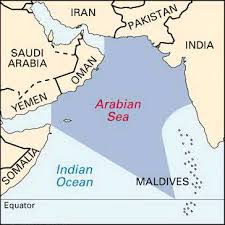
- The Arabian Sea is a north-western arm of the Indian Ocean.
- It is a critical maritime corridor linking:
- Europe
- West Asia
- Africa
- South Asia
- One of the world’s busiest sea routes, vital for energy and trade flows.
Bordering Countries
- India
- Pakistan
- Iran
- Oman
- Yemen
- Somalia
Major Basins
- Arabian Basin
- Somali Basin
National Affairs
1. National Legislative Index (NLI)
Source: PIB
Why in News?
At the 86th All India Presiding Officers’ Conference, Lok Sabha Speaker Om Birla announced the initiation of a National Legislative Index (NLI) to objectively assess the performance of legislatures in India.
What is the National Legislative Index (NLI)?
- The National Legislative Index (NLI) is a proposed performance evaluation framework designed to objectively measure and compare the functioning of:
- Parliament
- State Legislatures
- It will rely on predefined, quantifiable indicators, rather than subjective or political assessments.
Objectives of NLI
- Promote healthy competition among legislatures.
- Improve efficiency, accountability, and quality of legislative functioning.
- Encourage people-centric, outcome-oriented law-making.
- Strengthen institutional credibility of legislatures.
2. Operation Trashi-I
Why in News?
Operation Trashi-I entered its fourth day in January 2026 as security forces intensified counter-terrorism operations in the forested areas of Kishtwar district, Jammu & Kashmir.
What is Operation Trashi-I?
- Operation Trashi-I is a multi-day counter-terrorism and area-domination operation aimed at:
- Tracking
- Neutralising
- Dismantling terrorist groups
- Focus area:
- Dense forest belts of the Chatroo region in Kishtwar.
3. Judicial Removal
Source: TH
Why in News?
- In December 2025, 107 Lok Sabha MPs (INDIA bloc) submitted a notice for removal of Justice G.R. Swaminathan, Judge of the Madras High Court.
- The notice was submitted to Om Birla, Speaker of the Lok Sabha.
- Allegations included acting against secular constitutional principles and bias towards a particular community.
Constitutional Provisions Involved
- Article 124(4) & 124(5) – Removal of Supreme Court judges
- Articles 217(1)(b) & 218 – Removal of High Court judges
- Term used: “Removal”, not impeachment
- Impeachment term is used only for the President of India (Article 61)
Statutory Framework
- Judges (Inquiry) Act, 1968
- Judges Inquiry Rules
- Parliament empowered to:
- Regulate procedure
- Provide for investigation and proof of misbehaviour/incapacity
Grounds for Removal
- Proved misbehaviour or incapacity
- Judicial interpretation:
- Misbehaviour includes:
- Corruption
- Wilful abuse of office
- Lack of integrity
- Moral turpitude
- Misbehaviour includes:
- Key Supreme Court judgments:
- K. Veeraswami v. Union of India (1991) – Absolute standards of judicial honesty
- M. Krishna Swamy v. Union of India (1992) – Not every error amounts to misbehaviour; mens rea required
Procedure for Removal of a Judge
- Notice of motion
- Lok Sabha: Minimum 100 MPs
- Rajya Sabha: Minimum 50 MPs
- Submitted to:
- Speaker (Lok Sabha) / Chairman (Rajya Sabha)
- Admission of motion by Speaker/Chairman
- Formation of 3-member Inquiry Committee:
- Supreme Court Judge
- Chief Justice of a High Court
- Distinguished Jurist
- Committee submits report
- Special majority in both Houses
- Address to the President → Removal order
4. First ‘Made in India’ C-295 Aircraft
Source: IE
Why in News?
India’s first fully Made-in-India C-295 military transport aircraft will roll out before September 2026, marking a major milestone in indigenous defence manufacturing. The announcement was made by External Affairs Minister S. Jaishankar.
About the C-295 Programme
- Aircraft type: Medium-range tactical transport aircraft
- Purpose: Replace ageing HS-748 Avro aircraft in the Indian Air Force
- Manufacturing model: Public–private partnership
- Key partners:
- Airbus Defence and Space
- Tata Advanced Systems Limited
Production & Indigenisation
- Final Assembly Line (FAL): Vadodara, Gujarat
- Total aircraft ordered: 56
- 16 manufactured in Spain
- 40 to be built in India
- Represents India’s first private-sector-led military aircraft assembly line.
5. Chief Economists Outlook: World Economic Forum (WEF)
Source: BS
Why in News?
South Asia has emerged as the most optimistic region globally in terms of economic growth outlook, according to the latest Chief Economists Outlook released by the WEF.
Key Findings: South Asia
Growth Expectations
- 66% economists bullish on South Asia:
- 6% expect very strong growth
- 60% expect strong growth
- Sharp turnaround from September survey:
- Only 31% were optimistic earlier
- India is identified as the anchor of regional growth, despite rising global trade headwinds.
Inflation Outlook
- 69% expect moderate inflation (up from 64% in September)
- 18% expect low inflation
- Only 3% expect high inflation (down sharply from 18% earlier)
Role of Artificial Intelligence (AI)
- 50% of economists expect AI-driven productivity gains in South Asia within 1–2 years.
- Comparable with East Asia & Pacific (60%).
- South Asia better positioned than Europe, where gains may take up to 3 years.
- India seen as the primary driver of AI-led productivity growth.
Comparative Regional Sentiment (Growth Expectations)
| Region | Strong / Very Strong Growth (%) |
|---|---|
| South Asia | 66 |
| East Asia & Pacific | 45 |
| China | 24 |
| United States | 11 |
| Europe | 3 |
6. Cabinet Approves Continuation of Atal Pension Yojana (APY) till 2030–31
Source: PIB
Context:
The Union Cabinet, chaired by Narendra Modi, has approved the continuation of the Atal Pension Yojana (APY) up to 2030–31, along with extended funding for outreach, development, and gap funding.
About Atal Pension Yojana (APY)
- Atal Pension Yojana (APY) is a voluntary, government-backed pension scheme that provides a guaranteed monthly pension after the age of 60.
- It primarily targets workers in the unorganised sector, who lack formal social security coverage.
Launch Details
- Launched on: 9 May 2015
Implementing Authority
- Administered by: Pension Fund Regulatory and Development Authority (PFRDA)
- Implemented through:
- Banks
- Post Offices
Objectives
- Ensure old-age income security for poor, underprivileged, and unorganised workers.
- Promote financial inclusion and long-term retirement savings.
- Reduce dependence on family and state support in old age.
Key Features
- Guaranteed Monthly Pension (after 60 years):
- ₹1,000 / ₹2,000 / ₹3,000 / ₹4,000 / ₹5,000
- Eligibility:
- Indian citizens aged 18–40 years
- Must have a savings bank or post office account
- Contribution Mechanism:
- Contribution-based
- Auto-debit (monthly / quarterly / half-yearly) until age 60
- Family Security:
- Same pension payable to spouse after subscriber’s death
- Accumulated corpus returned to nominee thereafter
- Tax Rule:
- Income-tax payers are not eligible for new enrolment after 1 October 2022
- Investment:
- Funds invested as per PFRDA guidelines through approved pension funds
7. Section 17A of the Prevention of Corruption Act, 1988
Source: The Hindu
Why in News?
A two-judge Bench of the Supreme Court of India delivered a split verdict (2026) on the constitutional validity of Section 17A of the Prevention of Corruption Act, 1988, which mandates prior approval before investigating public servants.
What is Section 17A?
- Section 17A was inserted by the Prevention of Corruption (Amendment) Act, 2018.
- It bars any police officer from conducting an enquiry, inquiry, or investigation into offences under the Act without prior approval, where:
- The alleged offence relates to a decision or recommendation made in official duty.
Key Features of Section 17A
- Mandatory prior approval at the investigation stage for acts linked to official decisions.
- Competent authority:
- Union Government / State Government / Authority competent to remove the official from service.
- Exception – Trap cases:
- No prior approval required if a public servant is caught red-handed accepting a bribe.
- Time-bound approval:
- Decision within 3 months
- Extendable by 1 month with recorded reasons.
- Distinct from Section 19:
- Section 19 requires sanction only at the prosecution stage, not investigation.
8. DIBD–Survey of India MoU for Toponymic Data Digitisation
Source: PIB
Context:
The Digital India BHASHINI Division (DIBD) under MeitY signed an MoU with the Survey of India (SoI) to digitise, transcribe, and standardise geographical place names (toponyms) across India using AI-based language technologies.
Participating Institutions
- DIBD (MeitY)
- Survey of India (SoI) – under Department of Science & Technology (DST), Ministry of Science & Technology
Objective
- Creation of accurate, multilingual, and standardised toponymic datasets for India.
- Digitisation and validation of over 16 lakh (1.6 million) geographical locations.
SoI–BHASHINI Collaboration
Role of Survey of India (SoI)
- National nodal agency for standardisation and maintenance of geographical names.
- Conducts large-scale toponymic field surveys in local vernacular languages.
- Leads the National Geographical Name Information System (NGNIS).
Role of DIBD / BHASHINI
- Deployment of indigenous AI-powered language tools.
- Conversion of vernacular audio recordings into validated digital text.
- Creation of a comprehensive Toponymy Database.
About BHASHINI (BHASHa INterface for India)
- Ministry: Ministry of Electronics and Information Technology (MeitY)
- Established: 2022
- Objective: Enable multilingual digital access and translation across Indian languages.
- CEO: Amitabh Nag
Banking/Finance
1. Small Industries Development Bank of India (SIDBI)
Source: ET
Context:
The Union Cabinet, chaired by Narendra Modi, approved an equity infusion of ₹5,000 crore into the Small Industries Development Bank of India (SIDBI) to expand credit availability for MSMEs and strengthen its balance sheet.
About SIDBI
- SIDBI is the principal financial institution for:
- Promotion
- Financing
- Development of the Micro, Small and Medium Enterprises (MSME) sector in India.
- It also coordinates institutions engaged in MSME financing.
Establishment & Legal Status
- Established: April 1990
- Mode: Act of Parliament
- Headquarters: Lucknow
Key Functions of SIDBI
1. Refinance Support
- Provides bulk, low-cost refinance to:
- Banks
- Small Finance Banks (SFBs)
- Non-Banking Financial Companies (NBFCs)
- Helps scale MSME lending without stressing lenders’ balance sheets.
2. Direct Lending to MSMEs
- Extends direct loans for:
- Fixed capital
- Working capital
- Targets MSMEs with limited or no access to bank credit.
3. Collateral-Free & Digital Credit
- Promotes collateral-free MSME lending.
- Uses:
- Digital data
- Alternative credit assessment tools
- Lowers entry barriers for small and first-time entrepreneurs.
4. Venture Debt & Startup Financing
- Provides non-equity funding to:
- Startups
- Growth-stage MSMEs
- Supports:
- Innovation
- Technology adoption
- Scale-up of enterprises
5. Developmental & Handholding Role
- Initiatives such as Udyami Mitra:
- Act as facilitation platforms
- Connect MSMEs with:
- Banks
- Credit products
- Advisory and mentoring support
6. Support to Microfinance Institutions
- Channels funds and institutional support to Microfinance Institutions (MFIs).
- Enables credit flow to micro-enterprises and grassroots entrepreneurs.
2. PhonePe receives SEBI approval for IPO
Source: ET
Context:
Fintech major PhonePe has received SEBI’s approval to proceed with its Initial Public Offering (IPO) and is expected to file an Updated Draft Red Herring Prospectus (UDRHP) shortly. The move clears the way for one of India’s most anticipated fintech IPOs in the near future.
IPO (Initial Public Offering)
IPO (Initial Public Offering) refers to the process by which a private company offers its shares to the public for the first time and gets listed on a stock exchange (in India, mainly BSE and NSE).
Objectives of an IPO
- Raise funds for expansion, debt repayment, R&D, or working capital
- Provide exit/partial exit to promoters and early investors
- Enhance brand visibility and credibility
- Enable future fundraising through capital markets
IPO Process in India
- Appointment of merchant bankers (lead managers)
- Filing of Draft Red Herring Prospectus (DRHP) with SEBI
- SEBI scrutiny and approval
- Price discovery (via book building or fixed price)
- Opening and closing of the issue
- Allotment of shares and listing on stock exchanges
Types of IPO
- Fixed Price Issue: Price is fixed in advance
- Book Building Issue: Price band is given; final price discovered through bids
About PhonePe
- Market leader in India’s digital payments ecosystem
- Commands over 45% market share in UPI transactions
- Core offerings:
- UPI payments
- Digital wallets
- Financial services (insurance, investments, lending)
- Key player in India’s fintech-led financial inclusion story
3. Monthly State of the Economy Report: RBI Report
Source: BS
Why in News?
The Reserve Bank of India (RBI), in its Monthly State of the Economy Report, highlighted a sharp increase in credit flow to the commercial sector.
Key Findings of the RBI Report
Credit Growth
- Credit flow from banks and non-financial sources to the commercial sector:
- Increased by 44%
- During April–December 2025–26 (M9FY26)
- Indicates buoyant demand conditions in the economy.
Drivers of Credit Expansion
1. Rural Demand Revival
- Improved rural consumption has supported:
- Credit demand
- Overall economic momentum
2. Gradual Recovery in Urban Demand
- Urban consumption and investment showing signs of recovery.
- Contributing to sustained credit uptake.
GDP Outlook (FY26)
- First Advance Estimates of GDP for FY26 reflect:
- Resilience of the Indian economy
- Growth drivers:
- Private Final Consumption Expenditure (PFCE)
- Fixed Investment
- Growth largely supported by domestic factors, despite:
- A challenging external environment
Role of Non-Bank Financial Sources
- Non-bank channels (such as NBFCs, capital markets, and other financial institutions):
- Complement bank lending
- Improve credit availability to the commercial sector
- Reduce excessive dependence on banks alone.
4. NITI Aayog Suggests ₹13,000 crore Schemes for MSME Decarbonisation
Source: BS
Why in News?
NITI Aayog has recommended ₹13,000 crore worth of schemes to support decarbonisation of MSMEs, addressing rising energy costs and tightening global environmental norms.
Background
- MSMEs:
- Contribute ~30% to India’s GDP
- Employ 250+ million people
- Account for ~46% of exports
- Energy is among the highest input costs for MSMEs.
- Failure to decarbonise could:
- Reduce export competitiveness
- Expose firms to carbon-related trade barriers
Key Recommendations by NITI Aayog
1. Viability Gap Funding (VGF) Scheme
- Proposed outlay: ₹6,000 crore
- Objective:
- Promote adoption of energy-efficient technologies
- Key features:
- VGF capped at 15% of total project cost
- Funds credited directly to Original Equipment Manufacturers (OEMs)
- Projects selected through competitive bidding
- Supports projects that are economically viable but marginally unviable financially
2. PM-Suryaghar–like Solar Rooftop Scheme for MSMEs
- Proposed Phase-1 allocation: ₹7,000 crore
- Objective:
- Provide capital subsidies for green electricity adoption
- Key features:
- Rooftop solar installations up to 3 kW
- Target coverage: ~8 lakh micro enterprises
- Capital subsidy provided directly to enterprises
- Long-term outlook:
- Total projected outlay: ₹28,672 crore over 20 years
- Projected capex: ₹21,109 crore
5. RBI Guidelines on Interest Subvention for Export Credit under NIRYAT PROTSAHAN
Source: News on Air
Context:
In January 2026, the Reserve Bank of India (RBI) issued operational guidelines for extending interest subvention on pre- and post-shipment export credit under the Export Promotion Mission (EPM) – NIRYAT PROTSAHAN (Component-I).
NIRYAT PROTSAHAN – Interest Subvention Component
Objective
- To reduce the cost of export credit and improve access to pre- and post-shipment rupee credit for MSME exporters, thereby enhancing export competitiveness.
Eligibility Framework
Eligible Lending Institutions
- All Scheduled Commercial Banks (SCBs) (excluding RRBs)
- Primary (Urban) Co-operative Banks (UCBs)
- State Co-operative Banks (StCBs)
- All-India Financial Institutions (AIFIs)
Eligible Exporters
- MSME manufacturer exporters
- MSME merchant exporters
- Mandatory requirements:
- Valid and active Importer-Exporter Code (IEC)
- Valid MSME Udyam Registration Number (URN)
Scope of Coverage
- Interest subvention applicable only to exports covered under a notified “positive list”.
- The list is defined at the HSN six-digit tariff line level, ensuring targeted and product-specific support.
6. RBI Grants In-Principle Approval to Payoneer India as PA-CB
Context:
RBI granted in-principle approval to Payoneer India Pvt. Ltd. to operate as a Payment Aggregator – Cross Border (PA-CB).
Purpose
- Facilitate inward (exports) and outward (imports) cross-border payments.
About Payoneer PA-CB Approval
Operations
- Enables end-to-end cross-border payment solutions:
- Indian exporters receiving overseas funds
- Indian importers making international payments
Target Beneficiaries
- MSMEs
- Startups
- Export-oriented businesses integrating into global value chains
Regulatory Conditions for Non-Bank PA-CBs
- RBI authorisation mandatory
- Net worth requirements:
- ₹15 crore initially
- ₹25 crore by end of third year
- Transaction cap: ₹25 lakh per transaction
- Operational rules:
- Separate accounts for imports and exports
- No netting of flows permitted
Facts To Remember
1. Himachal CM Inaugurates Helicopter Services in Shimla
The initiative aims to boost air connectivity and tourism in the hill State. Sukhvinder Singh Sukhu, Chief Minister of Himachal Pradesh, inaugurated helicopter services from Sanjauli heliport, Shimla.
2. NASA astronaut Sunita Williams retires after 27-year stellar career
NASA astronaut Sunita Williams has retired from the space agency, capping a stellar 27-year career during which she completed three missions aboard the International Space Station and set various human spaceflight records.
3. Deepinder Goyal Resigns as CEO of Eternal Group
Deepinder Goyal resigned as Director, Managing Director (MD) and CEO of Eternal Limited.
4. Tata Communications Appoints Ganesh Lakshminarayanan as MD & CEO
Tata Communications Limited appointed Ganesh Lakshminarayanan as Managing Director & CEO.
5. Odisha–Meghalaya MoU to Strengthen ECCED
Odisha and Meghalaya governments signed an MoU to enhance cooperation in Early Childhood Care, Education and Development (ECCED).
6. Assam Govt Launches ‘Atal Vichal Agragami Assam Scheme’
Assam CM Himanta Biswa Sarma announced the Atal Vichal Agragami Assam Scheme to support research scholars.
7. IIT Delhi Launches CoE for Regulatory Affairs in Power Sector
Union Power Minister Manohar Lal inaugurated a Centre of Excellence at IIT Delhi to strengthen regulatory research, capacity building, and advisory support in the power sector in collaboration with CERC and Grid India.
8. Union Environment Minister Chairs 88th SC-NBWL Meeting
Environment Minister Bhupender Yadav chaired the 88th Standing Committee of the National Board for Wildlife meeting to review infrastructure and development proposals in protected and eco-sensitive areas.
9. India–UAE Set $200 Billion Trade Target by 2032
India and the UAE agreed to double bilateral trade to $200 billion by 2032 and expand cooperation in nuclear energy, LNG supply, infrastructure, and financial services.
10. Wikimedia Foundation Partners Big Tech for Paid AI Access
The Wikimedia Foundation partnered with firms like Amazon, Meta, Microsoft, Mistral AI, and Perplexity to provide paid access to Wikipedia content for AI model training.
11. PM Modi Addresses Bagurumba Dwhou 2026 in Assam
Prime Minister Narendra Modi addressed the Bagurumba Dwhou 2026 cultural festival in Guwahati, celebrating the heritage and folk traditions of the Bodo community.
12. Tamil Nadu Announces Semmozhi Illakiya Virudhu
Tamil Nadu launched the Semmozhi Illakiya Virudhu, a ₹5-lakh annual award to honour literary excellence in major Indian languages other than Hindi.
13. Madrid to Host Laureus World Sports Awards Again
Madrid will host the Laureus World Sports Awards for the third consecutive year at Cibeles Palace on 20 April 2026.
14. 6th ASEAN–India Digital Ministers’ Meeting Held
The 6th ASEAN–India Digital Ministers Meeting approved the Digital Work Plan 2026, focusing on inclusive, secure, and connected digital ecosystems.
15. Vidarbha Wins Maiden Vijay Hazare Trophy
Vidarbha clinched their first Vijay Hazare Trophy by defeating Saurashtra in the final held at Bengaluru.
16. C-DOT Wins SKOCH Award 2025
C-DOT received the SKOCH Award 2025 for its indigenous Cell Broadcast Solution enabling real-time, multi-language disaster alerts.
17. INS Sudarshini to Sail on Lokayan-26 Voyage
INS Sudarshini will undertake a 10-month Lokayan-26 expedition across 13 countries to promote maritime heritage and naval diplomacy.
18. India Flags Off Guided Pinaka Rockets to Armenia
India dispatched the first batch of guided Pinaka rocket systems to Armenia, highlighting India’s growing defence export capability.
19. 21 January Observed as Foundation Day of Three States
Tripura, Manipur, and Meghalaya observe their Foundation Day on 21 January, marking their statehood in 1972.
- Section 17A was inserted by the Prevention of Corruption (Amendment) Act, 2018. Section 17A of the Prevention of Corruption Act…
- At the 86th All India Presiding Officers’ Conference, Lok Sabha Speaker Om Birla announced the initiation of a National Legislative Index (NLI) to objectively assess the performance of legislatures in India. National Legislative Index (NLI)
- 69% expect moderate inflation (up from 64% in September) Chief Economists Outlook: World Economic Forum …
- Digitisation and validation of over 16 lakh (1.6 million) geographical locations. DIBD–Survey of India MoU for Toponymic Data Dig…
- The Union Cabinet, chaired by Narendra Modi, approved an equity infusion of ₹5,000 crore into the Small Industries Development Bank of India (SIDBI) to expand credit availability for MSMEs and strengthen its balance sheet. Context:
23&24 January, 2026
Daily Current Affairs Quiz
23&24 January, 2026
International Affairs
1. United States Set to Formally Withdraw from the World Health Organization (WHO)
Source: TH
What is the news?
The United States is set to formally withdraw from the World Health Organization (WHO) after completing the mandatory one-year notice period, despite widespread concerns over the impact on global health governance, pandemic preparedness, and U.S. public health interests.
About the World Health Organization (WHO)
- The specialised health agency of the United Nations.
- Responsible for:
- Coordinating international public health
- Responding to health emergencies
- Setting global health standards
- Objective: Achieve the highest attainable standard of health for all peoples.
Establishment & Headquarters
- Established: 7 April 1948 (observed as World Health Day)
- Headquarters: Geneva, Switzerland
- Membership: 194 Member States
Historical Background
- Originated from International Sanitary Conferences (1851–1938).
- Absorbed the League of Nations Health Organization after World War II.
- Key achievements:
- Eradication of smallpox
- Near-eradication of polio
- Leadership during Ebola outbreaks
- Global coordination during the COVID-19 pandemic
Core Functions of WHO
- Global health leadership: Coordinates responses to pandemics and epidemics.
- Standard setting: Develops norms like:
- International Classification of Diseases (ICD)
- International Health Regulations (IHR)
- Universal Health Coverage (UHC): Advocates equitable access to health services.
- Technical assistance: Policy advice, capacity building, health systems support.
- Data & surveillance: Global health statistics, early-warning alerts.
National Affairs
1. Global Water Bankruptcy Report
Source: Down To Earth (DTE)
What is the news?
The UNU-INWEH has released a flagship report titled “Global Water Bankruptcy: Living Beyond Our Hydrological Means in the Post-Crisis Era”, warning that large parts of the world have entered a permanent state of water insolvency, where water use exceeds renewable and safe limits.
What is “Water Bankruptcy”?
- A persistent failure state where:
- Long-term water withdrawals exceed renewable inflows and safe depletion thresholds.
- Results in irreversible damage to natural water capital (aquifers, rivers, wetlands).
- The report argues that terms like “water stress” or “water crisis” are inadequate, as the earlier “normal” hydrological baseline has already collapsed in many regions.
Key Data & Findings
- Global scale:
- ~75% of world population lives in water-insecure or critically water-insecure countries (2026).
- Agriculture:
- ~70% of global freshwater used for agriculture.
- 170+ million hectares of irrigated cropland under high or very high water stress.
- Groundwater:
- ~70% of major global aquifers show long-term decline.
- Land subsidence of up to 25 cm/year in some regions.
- Wetlands:
- Loss of ~410 million hectares in 50 years (≈ size of the EU).
- Economic cost:
- Anthropogenic droughts cost $307 billion annually, more than the GDP of ~75% of UN member states.
Major Causes Identified
- Slow-onset depletion: Chronic over-allocation and over-pumping.
Example: Severe groundwater depletion in the Indo-Gangetic Plain. - Infrastructure-driven overshoot: Dams and diversions enabling unsustainable urban growth.
Example: Inter-basin transfers supplying Chennai failing during monsoon shocks. - Ecological liquidation: Loss of wetlands and forests reduces recharge and flood buffering.
Example: Bengaluru wetland degradation. - Climate-amplified overshoot: Climate change accelerates glacier melt and rainfall variability.
Example: Himalayan glacier retreat threatening Indus–Ganga flows. - Institutional inertia: Policies assume return of old hydrological normal.
Example: Resistance to crop diversification in water-scarce regions.
2. Netaji Subhas Chandra Bose
Source: IE
Context:
Parakram Diwas–2026 being organised in the Andaman and Nicobar Islands to mark the 129th Birth Anniversary of Netaji Subhas Chandra Bose.
Who was Netaji Subhas Chandra Bose?
Netaji Subhas Chandra Bose was a revolutionary nationalist leader who championed complete independence (Purna Swaraj) through assertive and military means, offering a decisive ideological alternative to the predominantly non-violent strategy of India’s freedom movement.
Early Life
- Born: 23 January 1897, Cuttack (Odisha)
- Educated at:
- Presidency College
- Scottish Church College
- Cleared the Indian Civil Services (ICS) Examination (1920) in England.
- Resigned from ICS to dedicate himself fully to the national movement.
Role in the Freedom Movement
1. Radical Congress Leadership
- Elected Congress President:
- 1938 (Haripura)
- 1939 (Tripuri)
- Represented the Left-wing, militant nationalist current within the INC.
2. Demand for Purna Swaraj
- Rejected dominion status and constitutional gradualism.
- Advocated immediate independence, especially during Britain’s wartime vulnerability.
3. Socialist Economic Vision
- Founded the National Planning Committee (1938).
- Supported:
- State-led industrialisation
- Scientific planning
- Economic self-reliance
4. Ideological Challenge within INC
- Resigned after the Tripuri crisis, exposing deep tensions between:
- Gandhian non-violence
- Bose’s militant political realism
5. Forward Bloc
- Founded the Forward Bloc (1939).
- Mobilised youth, workers, and leftists under a radical nationalist platform.
3. Operation Megaburu
Source: The Times of India (TOI)
What is the news?
Operation Megaburu, a major anti-Maoist counter-insurgency operation in Jharkhand’s West Singhbhum district, led to the killing of 16 Maoists, including senior CPI (Maoist) leader Anal alias Patiram Manjhi. The operation marks one of the most significant blows to Maoist leadership in the State in recent years.
What is Operation Megaburu?
- A large-scale security offensive against the CPI (Maoist).
- Conducted in the Saranda forest region, one of the last major Maoist strongholds in Jharkhand.
Key Details
- Launched: January 2026
- Location:
- Kumdi area
- Kiriburu Police Station
- West Singhbhum district, Jharkhand
4. Governor’s Power to Address the State Legislature
What is the issue?
Several States have witnessed disputes over the Governor’s Address to the State Legislature, raising concerns about constitutional propriety, the limits of gubernatorial discretion, and adherence to the principle of responsible government.
What is the Governor’s Address?
- A constitutional formality delivered:
- At the first session after State Assembly elections, and
- At the first session of every calendar year.
- Purpose:
- To inform the Legislature of the policies, priorities, and legislative agenda of the elected State government.
- It does not represent the personal views of the Governor.
Constitutional Provisions Involved
- Article 163:
- Governor acts on the aid and advice of the Council of Ministers, except in limited discretionary matters.
- Article 174:
- Power to summon, prorogue, and dissolve the Legislature — to be exercised on Cabinet advice.
- Article 175:
- Governor may address or send messages to the House.
- Article 176:
- Mandates the Governor’s Address at specified sessions and provides for discussion of the Address.
Nature of the Governor’s Powers
- Mandatory duty, not discretion:
- The Governor must deliver the Address but cannot alter, omit, or rewrite the speech prepared by the elected government.
- No independent policy authority:
- The Address reflects the Council of Ministers’ agenda, ensuring democratic accountability.
- Symbolic constitutional role:
- The Governor is a constitutional head, not a parallel authority.
- Procedural follow-up:
- Legislature discusses the Address, ensuring scrutiny through elected representatives.
5. Pangolakha Wildlife Sanctuary
Source: The Hindu
What is Pangolakha Wildlife Sanctuary?
Pangolakha Wildlife Sanctuary is a high-altitude protected area and a designated Important Bird Area (IBA) in East Sikkim, forming part of India’s eastern Himalayan frontier with exceptional ecological and strategic significance.
Location
- State: Sikkim
- District: East Sikkim
- Geographical setting: Eastern Himalayas
Neighbouring Regions
- East: Bhutan
- North: China (Tibet Autonomous Region) via Nathu La–Jelep La corridor
- South: Extends towards West Bengal, linking with Neora Valley National Park
Biogeography & Ecology
- Part of the Eastern Himalayas biodiversity hotspot
- Encompasses three major biomes:
- Eurasian High Montane (Alpine & Tibetan)
- Sino-Himalayan Temperate Forest
- Sino-Himalayan Subtropical Forest
6. Military Quantum Mission Policy Framework
Source: PIB
What is the news?
The Chief of Defence Staff (CDS), General Anil Chauhan, has released the Military Quantum Mission Policy Framework, marking India’s first structured roadmap to integrate quantum technologies into the Indian Armed Forces.
What is the Military Quantum Mission Policy Framework?
- A strategic vision and roadmap document for the systematic adoption and operationalisation of quantum technologies across:
- Indian Army
- Indian Navy
- Indian Air Force
- Seeks to provide future battlefield superiority through disruptive technologies.
Objectives
- Tri-services integration: Ensure jointness and interoperability in quantum capability development.
- Civil–military fusion: Align defence needs with the National Quantum Mission (NQM).
- Strategic autonomy: Reduce dependence on foreign quantum technologies.
7. India ranks 8th globally in AI investment: WEF White Paper
Source: BS
What is the news?
India has been ranked 8th among 11 major economies in terms of historical accumulated investment in Artificial Intelligence (AI) between 2010 and 2024, measured as a percentage of 2024 GDP, according to a WEF white paper released in Davos.
Key Rankings (AI Investment as % of 2024 GDP)
| Rank | Country / Region | Investment (% of GDP) |
|---|---|---|
| 1 | United States | 3.4 – 5.1 |
| 2 | Singapore | 3.1 – 4.6 |
| 3 | South Korea | 2.2 – 3.3 |
| 4 | China | 1.7 – 2.6 |
| 5 | UAE | 1.5 – 2.3 |
| 6 | Japan | 1.5 – 2.2 |
| 7 | Canada | 1.5 – 2.2 |
| 8 | India | 1.2 – 1.8 |
| 9 | UK | 1.4 – 2.0 |
| 10 | Europe (excl. UK) | 1.1 – 1.6 |
| 11 | Brazil | 0.7 – 1.1 |
Key Findings of the Report
- AI is capital-intensive: Requires massive investments with uncertain short-term returns.
- US and China dominance:
- Account for ~65% of total global AI investment since 2010
- Total investment: $2.15–3.25 trillion
- Both countries follow a full-stack AI approach (hardware, data, models, applications).
Global AI Investment Trends
- Projected additional annual AI investment till 2030: ~$1.5 trillion
- AI infrastructure (data centres):
- Cumulative investment since 2010: $600 billion
- Global hyperscalers:
- Current: 1,136
- Projected by 2030: 2,000+
- Hardware investment:
- Over $200 billion invested since 2010
- Expected growth: 15–25% annually (~$90 bn/year)
- Foundational models:
- Projected growth: 25–35% annually
- Expected to reach $300 bn/year by 2030
8. LR-AShM (Long Range Anti-Ship Hypersonic Missile)
Source: The Hindu
Context:
The Defence Research and Development Organisation (DRDO) will showcase India’s advanced indigenous defence technologies at the 77th Republic Day parade and Bharat Parv 2026. A major highlight will be the display of the Long Range Anti-Ship Hypersonic Missile (LR-AShM) along with a dedicated DRDO tableau.
About LR-AShM (Long Range Anti-Ship Hypersonic Missile)
- Type: Hypersonic glide missile
- Capability:
- Engages both static and moving targets
- High precision strike capability
- Speed: Hypersonic (Mach 5 and above)
- Role: Enhances India’s maritime strike capability, especially against high-value naval targets
9. Military Quantum Mission Policy Framework
Source: PIB
Context:
The Chief of Defence Staff (CDS) General Anil Chauhan released the Military Quantum Mission Policy Framework, providing a structured roadmap for the integration of quantum technologies across the Indian Army, Navy, and Air Force.
About Military Quantum Mission Policy Framework
- A strategic vision and implementation roadmap for adopting quantum technologies in the Indian Armed Forces.
- Aligned with India’s National Quantum Mission (NQM).
Objective
- Achieve future battlefield superiority through disruptive technologies.
- Ensure tri-services jointness and interoperability.
- Strengthen technological self-reliance in defence.
Key Focus Areas
- Quantum Communication: Ultra-secure, tamper-proof military communications.
- Quantum Computing: Faster data processing, optimisation, cryptography.
- Quantum Sensing & Metrology: High-precision navigation, surveillance, detection.
- Quantum Materials & Devices: Advanced sensors and next-generation defence hardware.
Banking/Finance
1. Net FDI Negative for Fourth Consecutive Month in November 2025
Source: The Hindu
What is the news?
India’s net Foreign Direct Investment (FDI) remained negative for the fourth consecutive month in November 2025, with outflows exceeding inflows by $446 million, according to RBI data. Net Foreign Portfolio Investment (FPI) has also been negative so far in FY 2025–26, reflecting rising investor uncertainty.
What is Net FDI?
Net Foreign Direct Investment (Net FDI) is the balance between foreign direct investment inflows into a country and outflows from that country over a given period.
Net FDI = Gross FDI Inflows – (Repatriation+Disinvestment+Outward FDI)
FDI Composition
- Top source countries (inward FDI):
- Japan, Singapore, United States (over 75% of inflows)
- Top recipient sectors:
- Financial services
- Manufacturing
- Retail & wholesale trade
Outward FDI Trends
- Major destinations:
- Singapore, Mauritius, U.S., U.K.
- Key sectors (70%+):
- Manufacturing
- Financial, insurance & business services
Why is this important?
- FDI vs FPI:
- FDI is considered long-term and growth-generating, while FPI is short-term and return-driven.
- Negative net FDI despite steady gross inflows indicates:
- Rising repatriation and profit booking
- Cautious investor sentiment
- Prolonged negative capital flows can pressure:
- Rupee
- Current account financing
- Medium-term investment outlook
2. Reinsurance
Source: The Indian Express
What is the news?
Global reinsurers, along with Indian insurers, have paid $125 million (≈ ₹1,125 crore) to Air India towards hull and engine loss arising from the Ahmedabad air crash involving an Air India aircraft.
What is Reinsurance?
Reinsurance is insurance for insurance companies.
It is a risk-transfer mechanism in which an insurance company (cedant) transfers a part of its risk to another insurer called the reinsurer, in exchange for a reinsurance premium.
Purpose:
- Protect insurers from large or catastrophic losses
- Ensure financial stability and solvency
- Increase underwriting capacity
How Reinsurance Works
Policyholder → Insurer (Cedant) → Reinsurer
- Insurer collects premium from the policyholder
- Insurer passes part of the risk + premium to the reinsurer
- Reinsurer pays the insurer when a large loss occurs
Types of Reinsurance (Important for IRDAI Exam)
1. Facultative Reinsurance
- Case-by-case basis
- Each risk is negotiated separately
- Used for high-value or unusual risks
- Example: Individual aircraft insurance
2. Treaty Reinsurance
- Automatic coverage for a class of risks
- Long-term agreement
- No need for individual approval
Methods of Reinsurance
A. Proportional Reinsurance
- Risk and premium shared in an agreed ratio
- Reinsurer shares both profits and losses
Types:
- Quota Share
- Surplus
B. Non-Proportional Reinsurance
- Reinsurer pays only when losses exceed a threshold
- Used for catastrophic losses
Key type for this event:
- Excess of Loss Reinsurance
Reinsurance & Air India Crash
| Aspect | Relevance |
|---|---|
| Hull & engine loss | Covered under aviation insurance |
| $125 million payout | Paid mainly by reinsurers |
| Indian insurers | Acted as cedants |
| Passenger liability | Separate liability insurance |
| Risk spread | Across global reinsurance market |
Important Reinsurance Terms for IRDAI Exam
| Term | Meaning |
|---|---|
| Cedant | Insurer transferring risk |
| Reinsurer | Insurer accepting risk |
| Retrocession | Reinsurer reinsuring its own risk |
| Retention | Portion of risk kept by insurer |
| Capacity | Max risk insurer can underwrite |
| Solvency margin | Financial buffer required by IRDAI |
IRDAI-Specific Points to Remember
1. GIC Re
- India’s national reinsurer
- Owned by Government of India
- Mandatory cession applies to Indian insurers
2. Mandatory Cession
- Indian insurers must cede a fixed % of reinsurance to GIC Re
- Ensures domestic risk retention
3. Reinsurance Regulation
- Governed by:
- IRDAI (Re-insurance) Regulations
- Objectives:
- Policyholder protection
- Financial stability
- Orderly growth of insurance sector
3. RXIL Becomes India’s First TReDS Platform to Declare Interim Dividend
Source: Business Line
What is the news?
Receivables Exchange of India Limited (RXIL) has declared and paid an interim dividend of 21.6% (on face value), becoming the first Trade Receivables Discounting System (TReDS) platform in India to return capital to its stakeholders.
About RXIL (Very Important for Exams)
Basic Profile
- Full name: Receivables Exchange of India Limited
- Regulator: Reserve Bank of India (RBI)
Timeline
- RBI approval: December 2016
- First TReDS transaction: 9 January 2017
Promoters / Partners
- SIDBI
- National Stock Exchange (NSE)
- State Bank of India (SBI)
- ICICI Bank
- Yes Bank
Function
- Operates a digital TReDS platform.
- Enables discounting of trade receivables raised by MSMEs.
- Helps MSMEs receive early payment for invoices raised on large buyers.
Unique Feature
- Only TReDS platform with State Government participation
- Goa Government
- Tamil Nadu Government
What is TReDS?
Trade Receivables Discounting System (TReDS) is:
- An electronic platform
- Facilitates financing of MSME trade receivables
- Buyers, sellers, and financiers participate digitally
- Regulated by RBI
Objectives of TReDS
- Improve MSME liquidity
- Reduce dependence on collateral-based loans
- Ensure timely payments
- Promote formalisation of MSME finance
Agriculture
1. Government may Link Urea Sales to Digital Farmer IDs via Agri Stack
Source: BS
What is the news?
The Union government is considering integrating urea sales with digital farmer IDs through the Agri Stack platform in a phased manner. The move, currently at the pilot stage, aims to rationalise fertiliser subsidies amid record urea consumption and rising subsidy burden.
About the Proposed Mechanism
Phase I (Pilot Stage)
- Pilots in 7 districts with high farmer-ID coverage.
- Digital farmer ID used to ensure urea is sold only to:
- Landowners
- Cultivators
- Authorised persons
- Introduction of advisory alerts for purchases exceeding recommended doses (no immediate sales cap).
Phase II (Expansion)
- Roll-out to more states.
- Possible sales limits based on ICAR-recommended dosages, factoring in:
- Crop type
- Landholding size
- Irrigation availability
What is Agri Stack?
- A Digital Public Infrastructure (DPI) for Agriculture.
- Aims to integrate data and services for better farm outcomes.
- Key components:
- Agri Stack
- Krishi Decision Support System (KDSS)
- Soil Fertility & Profile Map
- Part of the Digital Agriculture Mission.
- ₹2,817 crore allocated in September 2024 for the Mission.
Facts To Remember
1. PM launches projects, flags off new train services in Kerala
Prime Minister Narendra Modi inaugurated and flagged off multiple railway services and development projects in Kerala, including three new Amrit Bharat Express trains, a new passenger train, and the launch of the PM SVANidhi Credit Card.
2. Murmu inaugurates ‘Granth Kutir’ at Rashtrapati Bhavan
President Droupadi Murmu inaugurated ‘Granth Kutir’ at the Rashtrapati Bhavan on Friday. The Granth Kutir is a library and archival space with a rich collection of manuscripts and books in 11 classical languages of India, including Tamil, Sanskrit, Kannada, Malayalam, Odia, Marathi, Pali, Prakrit, Assamese and Bengali.
3. Foundation Stone Laid for India’s First Private Satellite Manufacturing Plant
The foundation stone for India’s first integrated private-sector satellite manufacturing plant, named ‘Palmnaro’, was laid at Sanand, Gujarat.
- Project name: Palmnaro
- Location: Khoraaj Industrial Estate, Sanand, Gujarat
- Laid by: Arjunbhai Modhwadia, Gujarat Minister for Science & Technology
- Sector: Private space manufacturing
4. VP C. P. Radhakrishnan Releases Hindi Edition of “Palanivelu GUTS”
Vice President C. P. Radhakrishnan released the Hindi edition of Dr. C. Palanivelu’s autobiography in New Delhi, highlighting ethical innovation and perseverance in modern medicine.
5. India Launches Responsible Nations Index
India launched the Responsible Nations Index (RNI) in New Delhi to assess countries on ethical governance, social well-being, environmental stewardship, and global responsibility.
6. Responsible Nations Index 2026 Rankings Released
Singapore topped the Responsible Nations Index 2026, while India ranked 16th with an overall score of 0.55151.
7. Bharat Steel 2026 Summit Announced
The Ministry of Steel will organise Bharat Steel 2026 on 16–17 April 2026 in New Delhi, focusing on sustainability and technological transformation in the steel sector.
8. Union Cabinet Extends Atal Pension Yojana till 2030-31
The Union Cabinet approved the continuation of the Atal Pension Yojana up to 2030-31 to expand old-age income security for unorganised sector workers.
9. SAMPANN Pension Platform Integrated with DigiLocker
The SAMPANN pension platform was integrated with DigiLocker to provide paperless and secure access to pension documents for telecom pensioners.
10. Canara Bank Integrates NBSL’s Plugin-Based UPI Solution
Canara Bank became the first bank to integrate NPCI BHIM Services Limited’s plugin-based UPI solution into its Canara aiPe app.
11. JPMorgan to Set Up Branch in GIFT City
JPMorgan Chase & Co. will establish a branch in GIFT City to trade equities and financial instruments under IFSCA regulation.
12. RBI Approves Re-appointment of Kaizad Bharucha
The RBI approved the re-appointment of Kaizad Bharucha as Deputy Managing Director of HDFC Bank for a three-year term starting April 2026.
13. Deepinder Goyal to Step Down as Eternal Group CEO
Eternal founder Deepinder Goyal will step down as Group CEO, with Blinkit CEO Albinder Dhindsa set to take over.
14. BCCI Signs ₹270 Crore Gemini Sponsorship Deal
BCCI signed a ₹270 crore sponsorship deal with Google’s Gemini ahead of IPL 2026, marking a major AI entry into Indian cricket sponsorship.
15. Essar Signs ₹5,100 Crore MoU with Gujarat
Essar signed a ₹5,100 crore MoU with the Gujarat government for setting up a large-scale bio-fuel project.
16. Supreme Court of India Signs MoU with Bhutan Apex Court
The Supreme Court of India signed an MoU with Bhutan’s Apex Court to facilitate exchange of young legal professionals.
17. Delhi Government Signs MoU with RBI
The Delhi government signed an MoU with the Reserve Bank of India to streamline borrowings and improve cash management.
18. NTH and NHAI Sign MoU on Highway Quality
National Test House and NHAI signed an MoU to strengthen quality assurance mechanisms in national highway projects.
19. Parakram Diwas Observed on 23 January
Parakram Diwas is observed annually on 23 January to commemorate the birth anniversary of Netaji Subhas Chandra Bose and honour his role in India’s freedom struggle.
20. Lieutenant Colonel Sita Ashok Shelke selected for Subhas Chandra Bose National Award for Disaster Management 2026
Lieutenant Colonel Sita Ashok Shelke has been selected for the Subhas Chandra Bose National Award for Disaster Management 2026 in the individual category for her outstanding work in the field of disaster management.
21. PM Modi & Home Minister Amit Shah pay tribute to Bharat Ratna Karpoori Thakur on his birth anniversary
Prime Minister Narendra Modi paid tribute to Bharat Ratna Jananayak Karpoori Thakur on his birth anniversary.
22. Union Home Minister Amit Shah extends greetings on National Girl Child Day
Union Home Minister Amit Shah today extended greetings to all the countrymen on the occasion of National Girl Child Day.
23. President Droupadi Murmu inaugurates Granth Kutir at Rashtrapati Bhavan
President Droupadi Murmu inaugurated the Granth Kutir at Rashtrapati Bhavan yesterday.
24. India to host fourth edition of India Energy Week in Goa
India will host the fourth edition of India Energy Week from 27th to 30th January in Goa.
25. Centre approves wage revision for PSGICs, NABARD and pension hike for RBI retirees
The Central Government has approved the wage revision for Public Sector General Insurance companies (PSGICs) and the National Bank for Agriculture and Rural Development (NABARD).
26. Vice-President CP Radhakrishnan arrives in Odisha for Parakram Diwas
Vice-President CP Radhakrishnan arrived in Bhubaneswar this morning on a one-day visit to Odisha to commemorate ‘Parakram Divas’.
27. ‘Fishers of Men’ Shortlisted for 24th Hong Kong-Asia Film Financing Forum
Waves Film Bazaar has announced that one of its projects, titled ‘Fishers of Men’, has been shortlisted for the 24th edition of the Hong Kong-Asia Film Financing Forum.
28. Govt releases 32nd NeSDA Way Forward Monthly Report for States/UTs
The Department of Administrative Reforms and Public Grievances has released the 32nd edition of the National e-Governance Service Delivery Assessment, NeSDA – Way Forward Monthly Report for December 2025.
29. Election Commission launches ECINET digital platform at IICDEM 2026
The India International Conference on Democracy and Election Management is going on in New Delhi.
30. MSDE signs MoU with WEF to collaborate on strengthening India’s skills and Technical Education
The Ministry of Skill Development and Entrepreneurship has signed a Memorandum of Understanding (MoU) with the World Economic Forum to collaborate on strengthening India’s skills and Technical and Vocational Education and Training ecosystem.
31. PM’s flagship platform PRAGATI accelerates Ahmedabad Metro Rail Project
Prime Minister’s flagship platform for Pro-Active Governance and Timely Implementation, PRAGATI, has marked a significant milestone with the successful conduct of its 50th meeting.
32. Jal Shakti Minister V L Kanta Rao inaugurates national workshop “PreciSense 2026” in Pune
Emphasising the critical importance of reliable data for accurate water conservation planning in the era of climate change, Secretary of the Ministry of Jal Shakti, V. L. Kanta Rao, said that the use of modern sensors to obtain precise information has become the need of the hour.
- Founded the National Planning Committee (1938). Netaji Subhas Chandra Bose
- ₹2,817 crore allocated in September 2024 for the Mission. Government may Link Urea Sales to Digital Farme…
- Established: 7 April 1948 (observed as World Health Day) United States Set to Formally Withdraw from the…
- ~75% of world population lives in water-insecure or critically water-insecure countries (2026). Global Water Bankruptcy Report
- Account for ~65% of total global AI investment since 2010 India ranks 8th globally in AI investment: WEF …
25&26 January, 2026
Daily Current Affairs Quiz
25&26 January, 2026
International Affairs
1. USA Officially Withdraws from the World Health Organization (WHO)
Source: TH
Context:
The United States of America (USA) formally withdrew from the World Health Organization (WHO) on 22 January 2026, ending its 78-year membership. The move followed sustained criticism of the WHO’s functioning, particularly its handling of the COVID-19 pandemic.
Background
- The withdrawal process was initiated through Executive Order 14155, signed by President Donald J. Trump on 20 January 2025.
- As per WHO rules, withdrawal requires a one-year notice period, which concluded in January 2026.
What is WHO?
The World Health Organization (WHO) is the UN’s apex body responsible for international public health, disease prevention, health promotion, and emergency health response.
- Established: 7 April 1948
- Headquarters: Geneva, Switzerland
- Members: 194 countries
- Director-General: Dr. Tedros Adhanom Ghebreyesus (Ethiopia)
- World Health Day: 7 April (marks WHO’s founding)
India & WHO
- India is a founding member
- Hosts WHO country and regional collaborations
- WHO supports India in:
- TB elimination
- Immunisation (UIP)
- Disease surveillance (IDSP)
2. 56th Annual Meeting of the World Economic Forum (WEF)
Venue: Davos-Klosters, Switzerland
Dates: 19–23 January 2026
Theme: “A Spirit of Dialogue”
Why in News?
The 56th Annual Meeting of the World Economic Forum (WEF) brought together global political, business and technology leaders to discuss economic uncertainty, geopolitical tensions, and the future of technology-led growth.
Key Reports Launched
1. WEF Chief Economists’ Outlook – January 2026
- 53% of Chief Economists expect global economic conditions to weaken in 2026
- Improvement from 72% pessimism in September 2025
- Indicates cautious optimism amid persistent global risks
2. AI Adoption Report
- Title: “Proof Over Promise: Insights on Real-World AI Adoption from 2025 MINDS Organization”
- Collaboration: WEF & Accenture
- Focus:
- Practical, scalable AI deployment
- Moving beyond pilot projects to real-world impact
India Highlight:
- Tech Mahindra Ltd recognised under WEF’s MINDS programme for making AI work in real-world applications
AI Investment Ranking
- India ranked 8th (out of 11 countries) in AI investment as a share of GDP (2010–2024)
- Estimated AI investment: 1.2%–1.8% of 2024 GDP
- Top countries:
- USA
- Singapore
- South Korea
- China
World Economic Forum (WEF)
The World Economic Forum (WEF) is an international non-governmental and non-profit organisation that brings together leaders from government, business, academia, and civil society to address global economic, social, political, and technological challenges through dialogue and cooperation.
Establishment & Headquarters
- Founded: 1971
- Founder: Klaus Schwab
- Headquarters: Cologny, near Geneva, Switzerland
National Affairs
1. PLI Scheme for White Goods
Source: PIB
Why in News?
The Government of India has selected five companies in the fourth round of the PLI Scheme for White Goods, with a committed investment of ₹863 crore, to boost domestic manufacturing of Air Conditioners (ACs) and LED lights.
What is the PLI Scheme for White Goods?
- A Central Sector Scheme providing performance-linked financial incentives.
- Incentives are based on incremental sales of domestically manufactured components.
- Objective:
- Reduce import dependence
- Promote domestic value addition
- Strengthen manufacturing ecosystems for white goods
Key Details
- Launched: FY 2021–22
- Implementation period: Till FY 2028–29
- Target sectors:
- Air Conditioners (ACs)
- LED Lights
Nodal & Monitoring Authorities
- Implementing Ministry: Ministry of Commerce and Industry
- Monitoring Authority:Empowered Group of Secretaries (EGoS)
- Chairperson: Cabinet Secretary
Target Segments under the Scheme
1. Air Conditioners
2. LED Lights
2. Asiatic Wild Dog (Dhole)
Source: TH
Why in News?
A rare Asiatic Wild Dog (Dhole) has been camera-trapped for the first time in the Ratapani Tiger Reserve, Madhya Pradesh.
The sighting indicates improving habitat quality and prey availability in the reserve.
About Asiatic Wild Dog (Dhole)
- Scientific name: Cuon alpinus
- A wild canid native to South and Southeast Asia
- A social, pack-hunting apex predator
- Plays a crucial role in regulating herbivore populations and maintaining ecosystem balance
Habitat & Distribution
- Preferred habitats:
- Dense forests
- Forest–grassland mosaics
- Hilly and undulating terrains with good prey density
- India:
- Central Indian forests
- Western Ghats
- Eastern Ghats
Conservation Status
- IUCN Red List: Endangered (EN)
- Major threats:
- Habitat fragmentation
- Decline in prey species
- Disease transmission from domestic dogs
- Human disturbance
3. State of Finance for Nature 2026 Report
Context:
The State of Finance for Nature (SFN) 2026 report warns that global financial flows continue to be overwhelmingly nature-negative, threatening biodiversity, climate resilience, and long-term economic stability.
What is the State of Finance for Nature (SFN) 2026?
- The State of Finance for Nature 2026 is the fourth edition of UNEP’s flagship report.
- It tracks global financial flows that are:
- Nature-positive (protect, restore, sustainably manage ecosystems)
- Nature-negative (degrade biodiversity and ecosystems)
- Aims to shift the global economy from nature erosion to Nature-based Solutions (NbS).
Core Functions of the SFN Report
1. Tracking Global Capital Flows
- Identifies and quantifies:
- Nature-positive finance (restoration, conservation, sustainable use)
- Nature-negative finance (pollution, deforestation, ecosystem degradation)
2. Assessing Progress under Rio Conventions
The report evaluates whether finance is aligned with commitments under:
- Convention on Biological Diversity (CBD)
- UN Framework Convention on Climate Change (UNFCCC)
- UN Convention to Combat Desertification (UNCCD)
3. Promoting Nature-based Solutions (NbS)
SFN provides a financial roadmap to transition from a nature-eroding economy to a nature-positive economy using Nature-based Solutions (NbS).
Nature-based Solutions include:
- Ecosystem restoration
- Sustainable land and water management
- Climate adaptation and disaster risk reduction
- Biodiversity conservation linked to livelihoods
Key Findings of the SFN 2026 Report
1. A Massive Nature Finance Gap
- Required NbS investment by 2030: US$571 billion/year
- Current investment: US$220 billion/year
- Gap: Investment must increase 2.5 times
2. Dominance of Nature-Negative Finance
- Annual finance harming nature: US$7.3 trillion
- Equals ~7% of global GDP
- Creates a 30:1 imbalance between destruction and restoration
3. Environmentally Harmful Subsidies (EHS)
- Governments provide US$2.4 trillion/year in harmful subsidies
- Major contributors:
- Fossil fuels (US$1.13 trillion)
- Agriculture, water, fisheries
- These subsidies lock economies into unsustainable paths
4. Private Sector’s Negative Footprint
- Private capital in nature-negative sectors: US$4.9 trillion
- Concentrated in:
- Energy
- Utilities
- Industrials
- Reflects mispricing of environmental externalities
5. Public Sector Dominates Nature-Positive Finance
- Of US$220 billion NbS finance:
- 90% comes from public sources
- Shows weak private sector participation
6. Nature Risk = Financial Risk
- 50%+ of global GDP depends on nature
- Biodiversity loss threatens:
- Supply chains
- Insurance markets
- Financial stability
4. Inland Waterways Development Council (IWDC 3.0)
Source: TOI
Why in News?
The 3rd meeting of the Inland Waterways Development Council (IWDC 3.0) was held in Kochi, Kerala, on 23 January 2026, chaired by Union Minister Sarbananda Sonowal.
What is the IWDC?
The Inland Waterways Development Council (IWDC) is a high-level institutional mechanism set up by the Government of India to review, coordinate, and accelerate development and utilisation of inland waterways for cargo and passenger transport, and explore ecosystem linkages to economic growth.
IWDC 3.0
- When & Where: 3rd meeting held on 23 January 2026 in Kochi, Kerala.
- Chair: Union Minister Sarbananda Sonowal (Ministry of Ports, Shipping and Waterways).
Objectives of IWDC 3.0
- Review progress of inland water transport since:
- IWDC 1.0 (2024)
- IWDC 2.0 (2025)
- Chart a future roadmap focusing on:
- Green mobility
- Multimodal logistics
- River-led economic development
5. Indian Railways’ First Humanoid Robot – ‘ASC ARJUN’
Source: IE
Why in News?
Indian Railways deployed its first humanoid robot ‘ASC ARJUN’ at Visakhapatnam Railway Station, Andhra Pradesh, in January 2026.
About ‘ASC ARJUN’
- Type: Humanoid robot
- Deployment agency: Railway Protection Force (RPF)
- Developed in: Visakhapatnam using indigenous technology
- Role: Augments (does not replace) human security and station staff
Key Capabilities
1. Security & Surveillance
- Face Recognition System (FRS) for identifying intruders
- Real-time IoT-based alerts to RPF control rooms
- Enhances response time during security threats
2. Crowd Management
- AI-based crowd density analysis
- Helps manage peak-hour congestion and prevent stampede-like situations
3. Platform Patrolling
- Semi-autonomous 24×7 patrols
- Obstacle detection and avoidance
- Reduces routine manpower burden
6. Indian Army–IISc MoU on Indigenous AI Defence System
Source: PIB
Why in News?
On 23 January 2026, the Indian Army signed an MoU with the Indian Institute of Science (IISc), Bengaluru to develop an indigenous AI-based defence system.
Purpose of the AI System
- Address challenges in:
- Digital information warfare
- Modern and hybrid warfare
- Enhance battlefield decision-making and situational awareness
Key Features of the Collaboration
- Joint research & innovation
- Field-oriented testing
- Integration of:
- Indian Army’s operational experience
- IISc’s academic expertise
- Indian industry support
7. President inaugurates Granth Kutir at Rashtrapati Bhavan
Source: TH
Why in News?
In January 2026, President Droupadi Murmu inaugurated “Granth Kutir”, a cultural and literary space at Rashtrapati Bhavan, New Delhi, aimed at preserving and showcasing India’s rich intellectual and literary heritage.
About Granth Kutir
- Location: Rashtrapati Bhavan, New Delhi
- Nature: Cultural and literary heritage space
- Collection:
- ~2,300 books
- ~50 rare manuscripts
- Manuscript materials:
- Palm leaves
- Paper
- Bark
- Cloth
Key Objectives
- Preservation of India’s intellectual heritage
- Promotion of classical languages and knowledge systems
- Public awareness of India’s literary and scholarly traditions
Classical Languages Represented
- Tamil
- Sanskrit
- Kannada
- Telugu
- Malayalam
- Odia
- Marathi
- Pali
- Prakrit
- Assamese
- Bengali
Banking/Finance
1. Buyforex Secures In-Principle PSP Approval at GIFT IFSC
Source: TH
Why in News?
In January 2026, Buyforex, a wholly owned entity of EbixCash World Money (subsidiary of Eraaya Lifespaces Ltd.), received in-principle approval for Payment Service Provider (PSP) authorisation from the International Financial Services Centres Authority (IFSCA) at GIFT IFSC.
Key Significance
- Buyforex became the first Authorised Dealer Category-II (AD-II) licensed group entity to secure PSP approval at GIFT IFSC.
- Strengthens India’s ambition to position GIFT IFSC as a global cross-border payments hub.
What is a Payment Service Provider (PSP)?
A Payment Service Provider (PSP) is an entity authorised by a financial regulator to offer, facilitate, and manage payment services, including digital payments, e-money, merchant payments, and cross-border fund transfers, in a regulated and secure manner.
PSP Authorisation in India
Regulatory Authorities
- Reserve Bank of India (RBI)
- Regulates PSPs operating within India
- International Financial Services Centres Authority (IFSCA)
- Regulates PSPs operating from GIFT-IFSC for cross-border and international transactions
Permitted Services under PSP Approval
Buyforex is authorised to provide four regulated payment services:
- Account issuance
- E-money issuance
- Merchant acquisition
- Cross-border fund transfers
2. PFRDA sets up SAARG to Modernise NPS Investment Framework
Source: TOI
Why in News?
The Pension Fund Regulatory and Development Authority (PFRDA) has constituted a high-level expert committee to overhaul and modernise the investment framework of the National Pension System (NPS) in line with global best practices.
About the Committee
- Name: Committee of Investment Experts for Strategic Asset Allocation and Risk Governance (SAARG)
- Chairperson:Narayan Ramachandran
- Former CEO, Morgan Stanley India
- Chairman, TeamLease Services Ltd.
Mandate of SAARG
- Review existing NPS investment guidelines
- Benchmark NPS with leading global pension systems
- Align NPS with India’s evolving investment and capital market ecosystem
- Recommend reforms in:
- Strategic asset allocation
- Risk governance frameworks
Core Objectives
- Strengthen long-term retirement wealth creation
- Improve portfolio diversification
- Enhance risk management and governance standards
- Expand investment choices for NPS subscribers
Composition of the Panel
The committee includes experts from:
- Capital markets
- Mutual funds & asset management
- Securities law and regulation
3. PFRDA Introduces ‘NPS Swasthya Pension Scheme’
Source: Business Standard
Why in News?
The Pension Fund Regulatory and Development Authority (PFRDA) has allowed the launch of the NPS Swasthya Pension Scheme as a Proof of Concept (PoC) under its Regulatory Sandbox Framework, marking a first attempt to integrate health-related benefits with India’s pension system.
What is the NPS Swasthya Pension Scheme?
- A sector-specific, voluntary, contributory pension scheme under the National Pension System (NPS)
- Designed to provide financial support for outpatient and inpatient medical expenses
- Operates under the Multiple Scheme Framework (MSF)
- Governed by the PFRDA Act, 2013
Key Objectives
- Test the operational, technological, and regulatory feasibility of linking pensions with healthcare spending
- Address rising out-of-pocket medical expenses
- Explore pension-based solutions to ageing and health-related vulnerabilities
Key Features of the Pilot Scheme
1. Regulatory Sandbox & PoC
- Implemented on a limited and controlled basis
- Pension Funds (PFs) must obtain prior PFRDA approval
- PFs may collaborate with:
- FinTech firms
- Health Benefit Administrators (HBAs)
- Third-Party Administrators (TPAs)
2. Partial Withdrawals for Medical Needs
- Allowed for medical expenses
- Withdrawal cap:
- Up to 25% of subscriber’s own contributions at any instance
- No limit on number of withdrawals
- Minimum corpus requirement: ₹50,000 before first withdrawal
3. Premature Exit for Critical Treatment
- In case of inpatient medical expenses exceeding 70% of total corpus in a single instance
- Subscriber permitted:
- 100% lump-sum premature exit
4. Transfer from Existing NPS Accounts
- Subscribers above 40 years (excluding government employees) may:
- Transfer up to 30% of their contributions
- From existing NPS Tier-I account to Swasthya account
5. Exit Safeguards
- If PoC is found unviable:
- Subscribers can transfer accumulated corpus back to the regular NPS account
- Exit as per existing NPS rules
4. RBI Updates Priority Sector Lending (PSL) Rules
Source: Economic Times
Why in News?
In January 2026, the Reserve Bank of India (RBI) revised the Priority Sector Lending (PSL) framework to improve regulatory compliance, transparency, and risk alignment, especially in on-lending arrangements and reporting practices.
What is Priority Sector Lending (PSL)?
PSL is a mandatory credit allocation framework under which banks must lend a fixed share of their Adjusted Net Bank Credit (ANBC) to priority sectors such as:
- Agriculture
- MSMEs
- Education
- Housing
- Export credit
- Weaker sections
Its objective is inclusive growth and financial deepening.
Key Changes Introduced by RBI
1. Stronger Compliance & Audit Oversight
- Banks must now obtain external auditor certification for:
- PSL claims through on-lending to NBFCs, MFIs, HFCs, and cooperatives.
- Objective:
- Prevent double counting
- Ensure loans genuinely reach priority sectors
2. Alignment with Prudential Risk Norms
- PSL rules aligned with:
- Capital adequacy norms
- Credit concentration norms
- Credit Risk Transfer (CRT) guidelines
- Ensures PSL growth does not weaken banking stability.
3. Clarification of ANBC Calculation
- RBI refined treatment of:
- Long-term bonds
- FCNR(B) / NRE-linked advances
- Reduces ambiguity in determining PSL targets.
4. Standardised Treatment of Off-Balance Sheet Exposures
- Uniform norms across:
- Commercial banks
- Small Finance Banks (SFBs)
- Cooperative banks
- Improves consistency and comparability in PSL reporting.
5. Inclusion of NCDC Loans
- Bank loans to National Cooperative Development Corporation (NCDC) for on-lending to cooperatives now qualify as PSL,
- Subject to caps and audit certification.
6. Rationalisation for Small Finance Banks
- PSL target for Small Finance Banks revised downward (around 60% of ANBC).
- Balances:
- Financial inclusion mandate
- Risk management and sustainability.
7. Enhanced Disclosure & Reporting
- Stricter timelines and formats for:
- Quarterly and annual PSL disclosures
- Continued protection for small borrowers:
- No service charges on small PSL loans (e.g. SHGs/JLGs).
Facts To Remember
1. Graça Machel Wins Indira Gandhi Prize for Peace 2026
Graça Machel, a globally respected humanitarian and women’s rights advocate from Mozambique, has been selected for the Indira Gandhi Prize for Peace, Disarmament and Development (2026).
2. Dr Chandrakant Lahariya Wins Wiley Research Heroes Prize 2025
In January 2026, Dr Chandrakant Lahariya, a former World Health Organization (WHO) staff member, became the first Indian to receive the Wiley Research Heroes Prize 2025 in the category “Impact Beyond Academia.”
3. Sikkim Police Conferred President’s Police Colour Award 2026
In January 2026, the Sikkim Police received the President’s Police Colour Award (Nishaan) for outstanding service, professionalism, and dedication.
About President’s Police Colour Award
- One of India’s highest police honours
- Nature: Collective honour for the entire police force
- Authority to confer:
- President of India
- Prime Minister
- Union Home Minister
4. Arijit Basu Appointed Part-time Chairman of IndusInd Bank
In January 2026, Arijit Basu was appointed Additional Director (Non-Executive Independent Director) and Part-time Chairman of IndusInd Bank for a three-year term, effective 31 January 2026.
5. ‘Red Lines Redrawn: Operation Sindoor and India’s New Normal’
On 22 January 2026, COAS General Upendra Dwivedi launched the book in New Delhi.
- Publisher: Konark Publishers Pvt. Ltd.
Authors
- Maj Gen Bipin Bakshi (Retd)
- Air Marshal Rajesh Kumar (Retd)
- Ambassador Anil Trigunayat (Retd)
- Brig Akhelesh Bhargava (Retd)
6. Election Commission Launches ECINET Platform
- Event: India International Conference on Democracy & Election Management (IICDEM) 2026
- Launched by: CEC Gyanesh Kumar
- Platform: ECINET
- Features:
- Integrates 40+ election apps & web services
- Single platform for citizens, candidates, parties & officials
- Available in 22 Indian languages + English
8. Lucknow Becomes UP’s First ‘Zero Fresh Waste Dump’ City
- Achievement: 100% scientific processing of municipal solid waste
- Key Facility: Shivari Waste Processing Plant
9. Punjab Launches First Dog Sanctuary
- Location: Haibowal Dairy Complex, Ludhiana
- Nature: Pilot project
- Objective:
- Address stray dog menace
- Reduce dog-bite cases
- Ensure humane animal management
10. Sukanya Samriddhi Yojana (SSY) Completes 11 Years
- Launched: 22 January 2015
- Under: Beti Bachao, Beti Padhao
- Interest Rate: 8.2%
- Deposit Limits:
- Minimum: ₹250/year
- Maximum: ₹1.5 lakh/year
- Tax Benefit: Section 80C
- Deposit Period: 15 years
- Maturity: 21 years from account opening
11. Amit Shah to Launch ODOC Scheme in UP
- Event: Uttar Pradesh Day Celebrations
- Venue: Rashtra Prerna Sthal, Lucknow
- Key Launch: One District One Cuisine (ODOC)
- Aim: Promote district-specific traditional cuisine through branding & market access
12. CDS Releases Military Quantum Mission Policy Framework
- Released by: CDS General Anil Chauhan
- Objective: Integrate quantum technologies in Armed Forces
- Four Pillars:
- Quantum Communication
- Quantum Computing
- Quantum Sensing & Metrology
- Quantum Materials & Devices
13. Hyderabad to Host Wings India 2026
- Venue: Begumpet Airport, Hyderabad
- Nature: Asia’s largest civil aviation event
- Organised since: 2008 (biennial)
- Inaugurated by: Civil Aviation Minister K. Ram Mohan Naidu
- Theme 2026:Indian Aviation: Paving the Future – From Design to Deployment, Manufacturing to Maintenance, Inclusivity to Innovation, and Safety to Sustainability
14. India–WEF Partnership on Skills Accelerator
- MoU between:
- Ministry of Skill Development & Entrepreneurship
- World Economic Forum (WEF)
- Objective: Bridge skill gaps in:
- AI
- Green energy
- Robotics
- Advanced manufacturing
- Existing Accelerator Countries: Azerbaijan, Bahrain, Brazil, Indonesia, Nigeria, Qatar
15. Saina Nehwal Retires
- Olympics: Bronze – London 2012
- World Rank: No. 1 (2015)
- Major Titles: CWG Gold (2010, 2018), World Championship Silver (2015)
- Awards: Padma Bhushan, Padma Shri, Khel Ratna, Arjuna Award
Recently Retired Players
- Alyssa Healy (Australia) – Cricket
- Usman Khawaja (Australia) – Cricket
- Kane Williamson (NZ) – T20Is
- Doug Bracewell (NZ) – Cricket
- Mohit Sharma (India) – Cricket
- Jinson Johnson (India) – Athletics
16. IMPORTANT DAYS – 24 JANUARY
National Girl Child Day 2026
- Theme: Empowering Every Daughter, Building a Stronger India
National Girl Child Day (NGCD) 2026
- 19th observance
- Established: 2008
- Ministry: Ministry of Women & Child Development (MoWCD)
International Day of Education (IDE) 2026
- 8th observance
- Declared by: UNGA Resolution A/RES/73/25 (2018)
- First observed: 2019
Theme 2026
“The Power of Youth in Co-Creating Education”
- 53% of Chief Economists expect global economic conditions to weaken in 2026 56th Annual Meeting of the World Economic Forum…
- The State of Finance for Nature (SFN) 2026 report warns that global financial flows continue to be overwhelmingly nature-negative, threatening biodiversity, climate resilience, and long-term economic stability. State of Finance for Nature 2026 Report
- The Government of India has selected five companies in the fourth round of the PLI Scheme for White Goods, with a committed investment of ₹863 crore, to boost domestic manufacturing of Air Conditioners (ACs) and LED lights. PLI Scheme for White Goods
- Indian Railways deployed its first humanoid robot ‘ASC ARJUN’ at Visakhapatnam Railway Station, Andhra Pradesh, in January 2026. Indian Railways’ First Humanoid Robot – ‘ASC AR…
- Up to 25% of subscriber’s own contributions at any instance PFRDA Introduces ‘NPS Swasthya Pension Scheme’
27 & 28 January, 2026
Daily Current Affairs Quiz
27 & 28 January, 2026
International Affairs
1. First SCO Council of National Coordinators Meeting 2026 Held in Beijing
Why in News?
The first meeting of the Shanghai Cooperation Organisation (SCO) Council of National Coordinators (CNC) for 2026 was held in Beijing, under the chairmanship of the Kyrgyz Republic, to finalize the agenda for upcoming high-level SCO summits later this year.
Council of National Coordinators (CNC)
What is it?
- The primary coordination and management mechanism of the SCO.
- Acts as a link between SCO standing bodies and member states.
Core Functions
- Coordination: Synchronises multilateral cooperation among member states in line with the SCO Charter.
- Preparation: Conducts groundwork for meetings of:
- Council of Heads of State (CHS)
- Council of Heads of Government (CHG)
- Implementation: Oversees execution of decisions and agreements adopted at previous SCO summits.
About Shanghai Cooperation Organisation (SCO)
- A permanent intergovernmental international organisation
- The world’s largest regional organisation by geographic area and population
- Accounts for:
- ~42% of global population
- ~23% of global nominal GDP
Key Facts
- Established: 15 June 2001
- Predecessor: Shanghai Five (1996)
- Headquarters (Secretariat): Beijing, China
- Official Languages: Russian and Chinese
Member States (10)
- China
- Russia
- India (Joined 2017)
- Pakistan (Joined 2017)
- Kazakhstan
- Kyrgyz Republic
- Tajikistan
- Uzbekistan
- Iran (Joined 2023)
- Belarus (Joined 2024)
Permanent Bodies
- SCO Secretariat (Beijing): Main executive and administrative body
- RATS (Tashkent): Regional Anti-Terrorist Structure dealing with:
- Terrorism
- Separatism
- Extremism (“Three Evils”)
National Affairs
1. Enhancing Circular Economy of ELVs in India: NITI Aayog Report
Source: TH
Context:
A NITI Aayog report has warned that End-of-Life Vehicles (ELVs) in India could double to nearly 50 million by 2030, posing serious risks related to road safety, pollution, and waste management, while also highlighting the untapped resource potential of vehicle scrapping.
What are End-of-Life Vehicles (ELVs)?
- Vehicles that are:
- No longer roadworthy
- Invalidly registered
- Voluntarily declared as waste by owners
- Scientific ELV management enables:
- Recovery of valuable materials (steel, aluminium)
- Reduction of environmental and safety hazards
Key Trends & Data
- Rising ELV stock:
- 23 million (2025) → ~50 million (2030)
- Pollution impact:
- BS-I vehicles emit up to 8× more pollutants than BS-VI vehicles
- Resource recovery potential:
- ~98 million tonnes of steel recoverable from vehicles made between 2005–2023
- Infrastructure gap:
- Required ATS by 2027: 500
- Operational ATS (Sept 2025): 156
- Informal sector dominance:
- Informal yards: 2–3 lakh ELVs/year
- Formal RVSFs (FY25): 72,000 vehicles
Regulatory Framework for ELVs
- Voluntary Vehicle-Fleet Modernisation Programme (2021)
- Mandatory fitness tests:
- Private vehicles >20 years
- Commercial vehicles >15 years
- Mandatory fitness tests:
- Motor Vehicles (RVSF) Rules, 2021
- Legal framework for Registered Vehicle Scrapping Facilities
- Introduction of Certificate of Deposit (CoD)
- Extended Producer Responsibility (EPR) Rules, 2025
- OEMs mandated to meet material recovery targets
- Steel recovery target:
- 8% (2025–2030)
- Mandatory ATS Testing (from Oct 2024)
- Fitness tests only via Automated Testing Stations
- Incentive Scheme (SASCI)
- Over ₹2,000 crore provided to States
- Supports ATS and scrapping infrastructure
Key Challenges Identified
1. Informal vs Formal Price Gap
- Informal scrappers evade:
- GST
- Environmental norms
- Example:
- Dzire-class car:
- Informal offer: ₹38,000
- RVSF offer: ₹23,000
- ₹15,000 incentive to choose informal route
- Dzire-class car:
2. Regional Infrastructure Imbalance
- ATS & RVSFs concentrated in few States
- Example:
- Gujarat: ~56 ATS
- Sikkim / Arunachal Pradesh: negligible facilities
3. De-registration Bottlenecks
- Paper-heavy processes
- No penalty for non-de-registration
- Result:
- “Ghost vehicles” remain active on VAHAN database
4. Poor Financial Viability of RVSFs
- High capital cost
- <20% capacity utilisation
- Break-even may take ~10 years
5. Compromised Fitness Testing
- Improper issuance of fitness certificates
- Vehicles certified without physical inspection
- Undermines road safety and environmental goals
NITI Aayog Recommendations
1. Infrastructure Expansion
- Target: One ATS per district
- PSU-led RVSFs in commercially unviable regions
2. Formalisation of Informal Sector
- Integrate informal units via Udyam Assist Platform
- One-time waiver for legacy environmental violations
3. Strengthening EPR
- Raise steel recovery targets:
- Up to 35% by 2035
- Exclude production scrap from ELV recovery targets
4. Digital Reforms
- Aadhaar-based ownership transfer
- De-registration only after valid Certificate of Deposit
5. Financial Innovation
- Allow carbon credits from formal scrapping
- Potential gain: ₹2,000 per vehicle
2. Tap Water Coverage in Urban India
Source: IE
Context:
Urban tap water coverage in India has increased significantly from 49% in 2011 to about 77% in 2025–26, largely due to the implementation of AMRUT and AMRUT 2.0 under the Ministry of Housing and Urban Affairs (MoHUA).
What is Tap Water Coverage?
- Proportion of urban households receiving piped water supply within premises
- Ensures reliable, safe, and affordable drinking water access
AMRUT (Atal Mission for Rejuvenation and Urban Transformation)
AMRUT 1.0 (2015–)
- Projects approved: 6,008
- Total outlay: ₹83,470.84 crore
- Focus: Basic urban infrastructure (water supply, sewerage, green spaces)
AMRUT 2.0 (2021–)
- Projects approved: ~9,000
- Total outlay: ₹1.89 lakh crore
- Key focus:
- Universal water supply coverage
- Water security
- Reuse of treated wastewater
Jal Hi Amrit Initiative
- Water Resource Recovery Cells set up in 25 States/UTs
- AMRUT Mitras:
- 28,000+ women SHG members engaged
- Promotes:
- Circular water economy
- Community participation
3. The 16th India–European Union (EU) Summit
Source: TOI
Context:
The 16th India–European Union (EU) Summit begins today, with both sides set to upgrade their strategic partnership by signing a Security and Defence Partnership (SDP) and advancing talks on trade, climate, and global security.
Key Participants
- India: Prime Minister Narendra Modi
- European Union:
- Ursula von der Leyen (President, European Commission)
- Antonio Costa (President, European Council)
Key Outcomes Expected
1. Security & Defence Cooperation
- Signing of India–EU Security and Defence Partnership (SDP)
- Explores Indian participation in European defence initiatives
- Possible Security of Information Agreement (SOIA)
2. Trade & Economy
- Finalisation / firming up of India–EU Free Trade Agreement (FTA)
- India–EU Business Forum held alongside the summit
3. Strategic Agenda
- Adoption of a new strategic roadmap
- Strengthening a rules-based global order
4. MoPR Facilitates Panchayat Leaders & Launches Key Initiatives
Source: PIB
Why in News?
The Ministry of Panchayati Raj (MoPR) honoured elected Panchayat representatives and launched multiple governance-related initiatives during a special event held ahead of Republic Day 2026.
Initiatives & Publications Launched
- PANCHAM – Panchayat Assistance & Messaging Chatbot
- PESA State Rankings 2024–25
- Gramoday Sankalp Magazine (17th Edition)
- Compendium of Basic Statistics on Panchayati Raj Institutions – 2025
- Expert Committee Report on Service Delivery at Panchayat Level
About PANCHAM
- Developed by: MoPR in collaboration with UNICEF
- Purpose: Digital governance support tool for Panchayats
- Functions:
- Real-time guidance
- Simplified workflows
- Easy access to governance information
- Coverage: Direct digital connect with over 30 lakh Panchayat representatives & functionaries
- Significance: Enhances last-mile governance and service delivery
PESA State Rankings 2024–25
About PESA
- Full Form: Panchayats (Extension to Scheduled Areas) Act, 1996
- Objective: Empower Gram Sabhas in Scheduled Areas
Top Performing States
- Maharashtra – Rank 1
- Madhya Pradesh – Rank 2
- Himachal Pradesh – Rank 3
5. Rajasthan Launches RAJ-UNNATI Digital Governance Platform
Source: IE
Why in News?
Rajasthan launched RAJ-UNNATI, becoming the first Indian state to replicate the PRAGATI model at the state level.
About RAJ-UNNATI
- Inspired by: PRAGATI (GoI)
- Type: State-level digital governance platform
- Objectives:
- Fast-track development projects
- Resolve long-pending issues
- Reduce administrative delays
- Monitor Central & State schemes
- Structured grievance redressal
- Key Features:
- Real-time data integration
- Performance monitoring
- Inter-departmental coordination
About PRAGATI
- Launched: 2014
- Initiated by: Government of India
- Purpose: Real-time monitoring of major infrastructure & development projects
6. Wings India 2026 – Asia’s Largest Civil Aviation Event
Source: News on Air
Context:
Wings India 2026, Asia’s largest civil aviation exhibition and conference, will be held from 28–31 January 2026 at Begumpet Airport, Hyderabad, highlighting India’s emergence as a global aviation hub.
What is Wings India?
- A biennial global civil aviation exhibition and conference
- Combines:
- Flying and static aircraft displays
- B2B and B2G meetings
- Policy dialogues and investor sessions
- Covers the entire aviation ecosystem
Organisers & Venue
- Organised by the Ministry of Civil Aviation
- Hyderabad designated as the permanent venue
- Hosted at Begumpet Airport
7. Humanoid Robot ‘ASC ARJUN’ Deployed by Indian Railways
Source: IE
Context:
Indian Railways has deployed an AI-powered humanoid robot named ‘ASC ARJUN’ at Visakhapatnam Railway Station, marking a first-of-its-kind initiative across the railway network.
What is ‘ASC ARJUN’?
- An AI-enabled humanoid robot
- Assists the Railway Protection Force (RPF) in:
- Station surveillance
- Crowd management
- Passenger assistance
Developed By
- Indigenously designed and developed in Visakhapatnam
- Created by a dedicated Indian Railways technical team
- Uses home-grown technology
Aim
- Enhance passenger safety and security
- Optimise manpower deployment
- Improve service delivery using emerging technologies
Key Functions
| Function Area | Key Features / Description |
|---|---|
| Security & Surveillance | Face Recognition System (FRS) for intrusion detection; AI-based crowd monitoring |
| Real-Time Alerts | Sends instant alerts to RPF control rooms during suspicious activities and emergencies |
| Emergency Response | Fire and smoke detection system for early warning |
| Passenger Assistance | Automated announcements in English, Hindi, and Telugu |
| Autonomous Patrolling | Semi-autonomous navigation; obstacle avoidance; 24×7 platform patrols |
| Human Interaction | Friendly gestures such as Namaste for passengers and salutes for RPF personnel |
8. Aralam Butterfly Sanctuary
Source: The Hindu
Context:
The Kerala government has officially renamed Aralam Wildlife Sanctuary as Aralam Butterfly Sanctuary, making it the first butterfly sanctuary in Kerala.
What is Aralam Butterfly Sanctuary?
- A protected area in the Western Ghats
- Exclusively recognised for butterfly conservation
- Aims to protect:
- Butterfly species
- Host plants
- Nectar-rich habitats
Location
- Kannur district, Kerala
- On the western slopes of the Western Ghats
- Borders:
- Brahmagiri Wildlife Sanctuary (Karnataka)
- Adjoins Kottiyoor Wildlife Sanctuary (Kerala)
Ecological Significance
- Part of the Western Ghats biodiversity hotspot
- Known for exceptional butterfly diversity
- Supports endemic and rare species
- Acts as an ecological corridor with adjoining sanctuaries
9. Buddhist Diamond Triangle Added to UNESCO World Heritage Tentative List
Source: The Times of India
Why in News?
The UNESCO World Heritage Centre has added Odisha’s Buddhist Diamond Triangle—Lalitgiri, Udayagiri, and Ratnagiri—to India’s Tentative List for World Heritage Sites.
About Buddhist Diamond Triangle
- A serial cultural nomination comprising three interconnected Buddhist monastic complexes
- Located in Jajpur and Cuttack districts of Odisha
- Documents 1,500 years of continuous Buddhist history
- Showcases the evolution of Buddhism through:
- Theravada (Hinayana)
- Mahayana
- Vajrayana (Esoteric Buddhism)
Key Sites
Lalitgiri – The Ancient Spiritual Hub
- Location: Cuttack district
- Period: 2nd–3rd Century BCE (oldest site)
- Key Discovery:
- Massive stupa with gold, silver, and stone relic caskets, believed to contain relics of Lord Buddha
- Architectural Importance:
- East-facing apsidal chaityagriha (first of its kind in Odisha)
- Historical Evidence:
- Inscriptions mentioning “Sri Chandraditya Vihara”
Udayagiri – The Sunrise Hill of Monasteries
- Largest complex in the triangle
- Period: 1st–13th Century CE
- Architectural Features:
- Unique double-storeyed monastery
- Madhavapura Mahavihara
- Artistic Significance:
- Colossal images of Avalokiteswara
- Pancha Dhyani Buddhas
- Buddhist School: Mahayana (artistic peak)
Ratnagiri – Epicentre of Vajrayana Buddhism
- Often compared to Nalanda
- Major centre of Vajrayana (Tantric) Buddhism
- Iconography:
- Sculptures of Tara, Vajrapani, Jambhala
- Unique Aspect:
- Strong evidence of female patronage, including Queen Karpurashri
- Architecture:
- Stupas combining Buddhist and Brahmanical motifs
- Distinctiveness: Unique architectural syncretism found nowhere else
Banking/Finance
1. RBI Proposes Reopening Licensing Window for Urban Co-operative Banks (UCBs)
Source: IE
Context:
The Reserve Bank of India (RBI) has proposed reopening the licensing window for Urban Co-operative Banks (UCBs) after a gap of over 20 years, and has invited stakeholder feedback on the proposal.
About Urban Co-operative Banks (UCBs)
- Member-owned, community-based banks
- Operate mainly in urban and semi-urban areas
- Provide banking and credit services to:
- Small borrowers
- Traders
- Salaried employees
- MSMEs
- Governed by co-operative principles:
- Mutual help
- Democratic control (one member, one vote)
- Local participation
Origin & Evolution
- Late 19th century: Co-operative credit movement inspired by Britain & Germany
- 1904: First urban co-operative credit society registered in Kanchipuram
- 1966: UCBs brought under Banking Regulation Act, 1949
- Resulted in dual control:
- RBI (banking functions)
- State Governments (management & incorporation)
- Resulted in dual control:
- 1990s: Rapid licensing led to:
- Weak governance
- Financial instability
- 2004: RBI stopped issuing new UCB licences
Reform Phase
- Banking Regulation (Amendment) Act, 2020
- Strengthened RBI’s supervisory powers
- National Urban Co-operative Finance and Development Corporation (NUCFDC), 2024
- Focus on:
- Technology adoption
- Professional governance
- Financial resilience
- Focus on:
Key Functions of UCBs
- Mobilisation of local deposits
- Credit to:
- MSMEs
- Urban informal sector
- Small traders & professionals
- Promotion of financial inclusion
- Relationship-based banking at affordable rates
2. Economic Survey of India 2026
Source: PIB
Why in News?
The Chief Economic Advisor (CEA) Dr. V. Anantha Nageswaran will present the Economic Survey of India 2026 on January 29, 2026, ahead of the Union Budget 2026–27 scheduled for February 1, 2026.
About the Economic Survey of India
- The flagship annual document of the Ministry of Finance.
- Provides an official review of India’s economic performance over the past 12 months.
- Acts as a background document and analytical foundation for the Union Budget.
- Offers a roadmap for future economic reforms.
Origin & History
- First presented: 1950–51
- Initially: Part of the Union Budget documents
- Since 1964: De-linked from the Budget and presented one day prior to it to inform budgetary decisions.
Who Prepares the Survey?
- Prepared by the Economics Division, Department of Economic Affairs (DEA).
- Authored under the overall guidance of the Chief Economic Advisor (CEA).
- Released after approval of the Union Finance Minister.
Aim & Objectives
- Sectoral Review: Performance analysis of:
- Agriculture
- Industry
- Services
- Infrastructure
- Macroeconomic Assessment:
- GDP growth
- Inflation (CPI & WPI)
- Fiscal deficit
- Trade balance
- Future Outlook:
- Growth projections for the upcoming fiscal year
- Policy recommendations and reform priorities
Structure of the Economic Survey
Part A
- Major macroeconomic developments
- Broad review of the economy
- Outlook for the next financial year
Part B
- In-depth, data-driven analysis of key socio-economic issues such as:
- Health
- Education
- Employment
- Climate change
- Social sector outcomes
3. ESMA–RBI Renew Information-Sharing Pact
Source: ET
Context:
The European Securities and Markets Authority (ESMA) and the Reserve Bank of India (RBI) have signed a new information-sharing agreement, ending a three-year impasse over the recognition of Indian central counterparties (CCPs) by the European Union.
Background
- ESMA is the EU’s financial markets regulator.
- Indian CCPs clear and settle trades, reducing systemic risk.
- In October 2022, ESMA withdrew recognition of six Indian clearing houses after the earlier MoU expired in March 2022.
- Core dispute:
- ESMA sought direct supervisory access
- Indian regulators opposed foreign inspection of domestic clearing entities
Key Developments
- ESMA and RBI signed a new pact to exchange supervisory information
- Replaces the 2017 MoU
- Allows ESMA to rely on RBI’s regulatory and supervisory framework
- Enables Clearing Corporation of India Ltd (CCIL) to re-apply for ESMA recognition
Indian Clearing Houses Affected Earlier
- Clearing Corporation of India Ltd (CCIL)
- Indian Clearing Corporation Ltd
- India International Clearing Corporation Ltd
- NSE Clearing Ltd
- NSE IFSC Clearing Corporation Ltd
- Multi Commodity Exchange Clearing Corporation Ltd
Agriculture
1. New Plant Species Discovered: Hoya nagaensis
Source: The Hindu (TH)
Why in News?
Researchers from Nagaland University have recorded a new plant species, Hoya nagaensis, from a community-managed forest in Nagaland.
About Hoya nagaensis
- A previously undocumented flowering plant species
- Belongs to the Hoya genus, known for ornamental, waxy flowers
- Identified through detailed taxonomic research
Region Found
- Kavünhou Community Reserved Forest
- Phek district, Nagaland
- Part of the Eastern Himalayan biodiversity region
Key Features
- Distinctive leaf morphology and floral characteristics differentiating it from other Hoya species
- Grows in high-altitude temperate forest ecosystems
- Habitat is scientifically underexplored
- Extremely restricted distribution, recorded from a single location
Conservation Status
- Provisionally assessed as Critically Endangered
- Threats include:
- Limited geographic range
- Habitat pressure despite community protection
2. Smart & Integrated Fishing Harbour Sanctioned at Mayabunder
Source: News on Air
Why in News?
The Union Department of Fisheries has sanctioned the development of a Smart and Integrated Fishing Harbour at Mayabunder, giving a major boost to maritime and fisheries infrastructure in the Andaman & Nicobar Islands.
Smart Fishing Harbour at Mayabunder
- A technology-enabled, integrated fishing harbour
- Designed not only as a landing site but as a complete fisheries value-chain ecosystem
Key Features
- Fish Handling Capacity: ~9,900 tonnes annually
- Vessel Capacity: Safe berthing facilities for 430 fishing vessels
- IoT-enabled systems:
- Digital traceability
- Real-time monitoring of landings
- Sustainable Fisheries Management:
- Measures to combat Illegal, Unreported and Unregulated (IUU) fishing
- Energy Efficiency:
- Use of green energy
- Eco-friendly post-harvest handling to reduce fish losses
Facts To Remember
1. Indian Railways deploys humanoid robot ‘ASC ARJUN’
Indian Railways introduced its first AI-powered humanoid robot at Visakhapatnam station to enhance passenger safety, surveillance, and service delivery.
2. MSDE signs MoU with World Economic Forum
MSDE partnered with WEF to strengthen India’s TVET ecosystem through a Skills Accelerator aligning skilling with industry and global needs.
3. DARPG releases 32nd NeSDA Way Forward Report
The report reviews digital service delivery across States/UTs, noting 24,090 e-services and high saturation of mandatory services.
4. BHASHINI signs MoU with Survey of India
The agreement aims to digitise and standardise India’s geographical place names using AI-based multilingual language technologies.
5. Gujarat and Odisha discoms top power utility rankings
Gujarat’s public and Odisha’s private power utilities emerged as top performers in the Power Ministry’s 14th integrated ranking report.
6. India–Namibia Foreign Office Consultations held
India and Namibia agreed to deepen cooperation in defence, critical minerals, health, agriculture, and digital public infrastructure.
7. India ranks 8th globally in AI investment: WEF
WEF report shows India’s AI investments lag advanced economies, accounting for 1.2–1.8% of 2024 GDP.
8. Payoneer India gets RBI in-principle PA-CB approval
Payoneer India received approval to operate as a cross-border payment aggregator for merchants and exporters.
9. Ganesh Lakshminarayanan appointed MD & CEO-Designate of Tata Communications
Tata Communications named Ganesh Lakshminarayanan to lead the company, bringing over three decades of global experience.
10. Arijit Basu appointed Chairman of IndusInd Bank
RBI approved Arijit Basu as Chairman of IndusInd Bank, effective January 31, 2026.
11. Switzerland to host 2027 global artificial intelligence summit
Days before India hosts the global artificial intelligence (AI) summit of 2026, Switzerland on Wednesday said it intends to organize the next edition in Geneva in 2027.
12. Veteran Journalist Mark Tully Passed Away
Veteran journalist and Padma awardee Sir William Mark Tully passed away in January 2026 at the age of 90 in New Delhi.
He was BBC’s “voice of India”, served as its New Delhi Bureau Chief for 22 years, and was awarded Padma Shri (1992) and Padma Bhushan (2005).
13. Former BCCI President Inderjit Singh Bindra Passed Away
Former BCCI President Inderjit Singh Bindra passed away in January 2026 at the age of 84 in New Delhi.
An IAS officer of Punjab cadre, he modernised Indian cricket administration and played a key role in hosting the 1987 and 1996 Cricket World Cups.
14. National Voters’ Day 2026 Observed on January 25
India observed the 16th National Voters’ Day (NVD) on January 25, 2026.
The theme was “My India, My Vote”, marking 76 years of the Election Commission of India, established on 25 January 1950 under Article 324.
15. President Droupadi Murmu Attends 16th National Voters’ Day Event
The Election Commission of India celebrated NVD-2026 in New Delhi on January 26, 2026.
President Droupadi Murmu was the Chief Guest and conferred the Best Electoral Practices Awards 2025.
16. National Tourism Day 2026 Observed on January 25
National Tourism Day was observed across India on 25 January 2026 to promote tourism and cultural heritage.
The day commemorates the formation of the Ministry of Tourism in 1949 and highlights tourism’s role in economic growth.
17. UN Observes World Tourism Day on September 27
World Tourism Day is celebrated annually on 27 September by the United Nations.
It marks the adoption of the UN World Tourism Organization (UNWTO) Statutes in 1970.
18. Madhya Pradesh Declares 2026 as ‘Year of Agriculture’
MP Governor Mangubhai Patel declared 2026 as the ‘Year of Agriculture’ during Republic Day celebrations in Bhopal.
The initiative focuses on farmers’ welfare, natural farming, technology adoption, income enhancement, and agri-exports.
19. Maharashtra Launches India’s First Dedicated Menopause Clinics
The Government of Maharashtra has launched the country’s first dedicated menopause clinics across government hospitals and urban health facilities to address the physical and mental health needs of women during menopause.
- Full Form: Panchayats (Extension to Scheduled Areas) Act, 1996 MoPR Facilitates Panchayat Leaders & Launches K…
- Urban tap water coverage in India has increased significantly from 49% in 2011 to about 77% in 2025–26, largely due to the implementation of AMRUT and AMRUT 2.0 under the Ministry of Housing and Urban Affairs (MoHUA). Tap Water Coverage in Urban India
- 1904: First urban co-operative credit society registered in Kanchipuram RBI Proposes Reopening Licensing Window for Urb…
- WEF report shows India’s AI investments lag advanced economies, accounting for 1.2–1.8% of 2024 GDP. India ranks 8th globally in AI investment: WEF
- Headquarters (Secretariat): Beijing, China First SCO Council of National Coordinators Meet…
29 & 30 January, 2026
Daily Current Affairs Quiz
29 & 30 January, 2026
International Affairs
1. 2nd India–Arab Foreign Ministers’ Meeting 2026
Source: News on Air
Why in News?
Ministers and delegates of the 22-member Arab League (League of Arab States – LAS) are meeting in New Delhi for the 2nd India–Arab Foreign Ministers’ Meeting, marking a major diplomatic outreach by India amid heightened geopolitical tensions in West Asia and the global order.
Background: Arab League (LAS)
- Established: 22 March 1945
- Headquarters: Cairo, Egypt
- Members: 22 countries from North Africa & West Asia
- India–LAS engagement formalised: March 2002 (MoU signed)
Objectives of India–LAS MoU (2002)
- Promote traditional ties of friendship & cooperation
- Institutionalise dialogue
- Provide for annual meetings between:
- India’s External Affairs Minister
- Arab League Secretary General
Institutional Frameworks of Engagement
- Arab-India Cooperation Forum (AICF):
- Established: 2008
- First meeting: 2016, Manama (Bahrain)
- India’s Permanent Representative to LAS:
- Indian Ambassador to Egypt (since 2010)
- India–LAS Partnership & Investment Summit:
- Biennial flagship economic event
- New Initiative (2026):
- India & Arab Countries Chambers of Commerce, Industry and Agriculture
Key Pillars of India–Arab League Engagement
- Strategic Partnership Agreements with:
- Oman (2008)
- UAE (2015)
- Saudi Arabia (2019)
- Egypt (2023)
- Qatar (2025)
- Strong convergence in multilateral forums:
- BRICS, SCO
- Alignment of national visions:
- Saudi Vision 2030
- UAE Centennial 2071
- Oman Vision 2040
- India’s Viksit Bharat @2047
National Affairs
1. Centre Notifies New Solid Waste Management Rules, 2026
Source: The Indian Express
Why in News?
The Central Government has notified the Solid Waste Management (SWM) Rules, 2026, replacing the 2016 rules and placing greater responsibility on bulk waste generators to improve waste segregation, processing, and accountability.
Key Features of SWM Rules, 2026
Mandatory Source Segregation
Waste must be segregated into four streams:
- Wet waste
- Dry waste
- Sanitary waste
- Special care waste
Objective: Improve recycling efficiency and reduce landfill burden.
Higher Responsibility for Bulk Waste Generators
- Bulk generators (large residential complexes, institutions, commercial establishments) contribute ~30% of total waste.
- Mandatory on-site processing of wet waste, where feasible.
- If not feasible, generators must obtain an Extended Bulk Waste Generator Responsibility (EBWGR) certificate.
Shifts burden away from urban local bodies towards waste producers.
Polluter Pays Principle
- Authorities empowered to impose environmental compensation for:
- Non-segregation
- Improper disposal
- False reporting
- Ensures financial accountability for violations.
Digital Monitoring & Transparency
- Introduction of a centralised online portal to track:
- Waste generation
- Collection
- Transportation
- Processing
- Disposal
- Reduces paperwork and improves real-time oversight.
Circular Economy Orientation
- Encourages:
- Recycling
- Composting
- Waste-to-energy (RDF)
- Scientific criteria for setting up waste processing facilities and buffer zones.
2. UGC Anti-Discrimination (Equity) Regulations, 2026
Source: IE
Why in News?
The University Grants Commission (UGC) notified the Promotion of Equity in Higher Education Institutions Regulations, 2026, triggering nationwide debate and protests over whether the rules promote inclusion or risk bias and administrative overreach.
What Are the UGC Equity Regulations, 2026?
- A binding regulatory framework to prevent discrimination in higher educational institutions (HEIs).
- Replaces earlier advisory guidelines with mandatory, enforceable norms.
- Applies to students, faculty, and non-teaching staff across all recognised HEIs.
Objectives
- Prevent discrimination on grounds such as:
- Caste
- Religion
- Gender
- Disability
- Place of birth
- Ensure equal dignity, access, and opportunity on campuses.
- Strengthen institutional accountability rather than ad-hoc redressal.
Key Provisions
Institutional Mechanisms
- Equal Opportunity Centres (EOCs) mandatory in every HEI.
- Equity Committees with representation from:
- SC, ST, OBC
- Women
- Persons with Disabilities
- Appointment of Equity Officers / Ambassadors for awareness and monitoring.
Complaint Redressal
- Time-bound inquiry process for discrimination complaints.
- Mandatory reporting of cases and outcomes to the UGC.
- Annual compliance reports by institutions.
Enforcement Powers
- UGC empowered to:
- Withhold grants
- Derecognise institutions
- Debar institutions from schemes for non-compliance
Marks a shift from moral persuasion to regulatory enforcement.
Why the Controversy?
Concerns Raised
- Vague definitions of “discrimination” and “structural unfairness”.
- Fear of misuse or selective targeting.
- Allegations of reverse discrimination against general-category students.
- Increased bureaucratic burden on universities.
- Claims that parliamentary panel suggestions were not fully incorporated.
Supportive Arguments
- Persistent discrimination and exclusion on campuses require strong legal backing.
- Advisory guidelines failed to prevent caste-based and social exclusion.
- Aligns with constitutional values:
- Article 14 (Equality)
- Article 15 (Non-discrimination)
- Article 21 (Dignity)
Judicial Intervention
- The Supreme Court has stayed the implementation of the Regulations, citing:
- Vagueness
- Potential for misuse
- Directed reconsideration and clarification of provisions.
3. World Bank Report: A Breath of Change (2025)
Source: The Telegraph
Why in News?
The World Bank report A Breath of Change highlights that nearly one billion people in the Indo-Gangetic Plains and Himalayan Foothills (IGP-HF) are exposed to the most polluted air globally, calling for urgent transboundary cooperation.
About A Breath of Change
- A strategic solutions document, not merely a diagnostic study.
- Covers 13 jurisdictions across 5 countries:
- India, Bangladesh, Nepal, Pakistan, Bhutan
- Treats the IGP-HF as a single airshed, where pollution crosses political boundaries.
- Uses the “4Is framework”:
- Information
- Incentives
- Institutions
- Infrastructure
Key Data & Trends
Health & Economic Impact
- ~1 million premature deaths annually in the region due to air pollution.
- Economic loss: ~10% of regional GDP every year.
- Life expectancy loss: Over 3 years due to PM₂.₅ exposure.
- Children at risk:
- 81% of public-school students exposed to hazardous PM₂.₅ (>35 µg/m³).
Pollution Severity
- IGP-HF has highest PM₂.₅ levels globally:
- 8–20× higher than WHO guidelines.
- Over 50% of PM₂.₅ in many areas comes from outside local jurisdictions.
- Nepal’s Terai: ~68% pollution is transboundary.
Why Pollution is Transboundary in IGP-HF
Geography & Topography
- Himalayan barrier traps pollutants.
- Winter temperature inversions worsen smog.
- Delhi acts as a pollution sink due to inflow from Punjab–Haryana.
Wind Patterns
- North-westerly winter winds transport pollution across borders.
- Pollution from Pakistan’s Punjab can contribute up to 30% of PM₂.₅ in Indian Punjab.
Secondary Particle Formation
- Long-range transport of precursor gases:
- SO₂, NOx, ammonia
- These react in the atmosphere to form secondary PM₂.₅ far from the source.
Agricultural Residue Burning
- Seasonal crop burning in India & Pakistan creates regional haze episodes.
- Smoke plumes blanket the entire airshed during post-harvest months.
Industrial Clusters
- High-stack industries (thermal power plants, brick kilns).
- MSME clusters in Kanpur, Dhaka, etc., cause both local and cross-boundary exposure.
Existing Regional & National Initiatives
- Kathmandu Roadmap (2022):
- Science-policy dialogue & shared air-quality vision.
- Thimphu Outcome (2024):
- Endorsed “35 by 35” target (PM₂.₅ ≤ 35 µg/m³ by 2035).
- Malé Declaration:
- Non-binding platform for regional air monitoring.
- India’s NCAP:
- PM₁₀ reduction focus in 130+ cities.
- Market Innovation:
- Gujarat’s PM Emissions Trading System (Surat).
Key Challenges Identified
Institutional
- Fragmented mandates across ministries.
- Weak Centre–State–local coordination.
Financial
- Lack of long-term regional financing.
- Donor-dependent platforms lose momentum.
Enforcement
- Understaffed pollution control boards.
- Limited capacity for penalties & compliance.
Data Gaps
- Monitoring skewed towards cities.
- Rural pollution largely invisible.
Economic Barriers
- High upfront costs for:
- Clean farm equipment
- Industrial retrofitting
- Vehicle upgrades
World Bank’s Recommended Solutions: The 4Is Framework
Information
- Expand real-time monitoring.
- Use satellite data & GeoAI to identify hotspots (brick kilns, fires).
Incentives
- Reform fuel & fertiliser subsidies.
- Redirect support to:
- EVs
- Clean cooking
- Crop-residue solutions (Happy Seeder).
Institutions
- Enact Clean Air Acts with clear accountability.
- Create a permanent regional secretariat for the IGP-HF airshed.
Infrastructure
- Regional power grids
- EV charging corridors
- Common industrial boilers for MSMEs
Market Instruments
- Scale up Emissions Trading Systems (ETS).
- Pollution taxes (e.g., Nepal’s Green Tax).
4. Sampoornata Abhiyan 2.0
Source: News on Air
Why in News?
NITI Aayog CEO Shri B.V.R. Subrahmanyam launched Sampoornata Abhiyan 2.0, a 3-month mission-mode campaign to achieve 100% saturation of critical development indicators in India’s most underserved regions.
About Sampoornata Abhiyan 2.0
- A time-bound, results-oriented campaign to fast-track social sector outcomes.
- Covers:
- 112 Aspirational Districts
- 513 Aspirational Blocks
- Builds on the success of Sampoornata Abhiyan (Phase-I, 2024).
- Focuses on last-mile delivery and full coverage (saturation) rather than incremental progress.
Key Performance Indicators (KPIs)
KPIs for Aspirational Blocks (6)
- Supplementary Nutrition:
- Regular intake by children (6 months–6 years) under ICDS.
- Growth Monitoring:
- Real-time measurement of children at Anganwadi Centres.
- Anganwadi Sanitation:
- Functional toilets in Anganwadi Centres.
- Drinking Water:
- Availability of safe drinking water in operational Anganwadis.
- Girls’ Education:
- Schools with adequate and functional girls’ toilets.
- Animal Health:
- Vaccination of bovine animals against Foot and Mouth Disease (FMD).
KPIs for Aspirational Districts (5)
- Newborn Health:
- Percentage of live births weighed at birth.
- TB Control:
- TB case notification rates (public + private sector).
- Health Outreach:
- Regular conduct of VHSND/UHSND.
- School Infrastructure:
- Schools with functional girls’ toilets.
- Livestock Security:
- Universal vaccination of livestock.
5. PANCHAM Digital Chatbot
Why in News?
The Ministry of Panchayati Raj launched PANCHAM (Panchayat Assistance and Messaging Chatbot) on the eve of India’s 77th Republic Day, creating a first-of-its-kind two-way digital bridge between the Central Government and over 30 lakh elected Panchayat representatives.
What is PANCHAM?
- PANCHAM (Panchayat Assistance and Messaging Chatbot) is a WhatsApp-based AI digital assistant for Panchayati Raj Institutions (PRIs).
- Designed as a digital companion for Sarpanches, ward members, and Panchayat functionaries.
- Eliminates the need for separate apps, logins, or intermediaries by using the widely familiar WhatsApp interface.
Ministry & Collaboration
- Nodal Ministry: Ministry of Panchayati Raj (MoPR)
- Knowledge Partner: UNICEF
Aim & Objectives
- Direct Digital Connectivity:
- Establish a real-time, two-way communication channel between GoI and village-level leaders.
- Information Saturation:
- Ensure 100% awareness of Central and State welfare schemes at the grassroots.
- Feedback & Governance:
- Enable field-level challenges to reach policymakers instantly.
6. Sunabeda Wildlife Sanctuary
Source: The Times of India
Why in News?
The Sunabeda Wildlife Sanctuary in Odisha has been officially declared Maoist-free, enabling systematic wildlife monitoring. Recent camera trap surveys indicate a thriving leopard population (over 70 individuals), positioning Sunabeda as a potential Leopard Haven in Central India.
About Sunabeda Wildlife Sanctuary
- A major biodiversity hotspot and a proposed Tiger Reserve in western Odisha.
- Established in 1983.
- Part of the Deccan Peninsula biogeographic zone.
- Functions as an important ecological corridor in Central India.
Location & Extent
- District: Nuapada, Odisha
- Inter-State Link: Adjoins Sitanadi Wildlife Sanctuary and Udanti Wildlife Sanctuary in Chhattisgarh
7. Power Gap Index
Source: Business Standard
Why in News?
For the first time, the Economic Survey 2025–26 has cited the Power Gap Index, highlighting a strategic paradox: although India has entered the Major Power category globally, it still records a negative Power Gap score (-4.0), indicating unrealised strategic potential.
What is the Power Gap Index?
- The Power Gap Index measures a country’s Power Efficiency—its ability to convert material resources into real geopolitical influence.
- It is a secondary analytical tool derived from the Asia Power Index.
Interpretation
- Positive score:
- Overperformer / Smart power (effective conversion of resources into influence)
- Negative score:
- Underperformer / Unrealised potential
It challenges the assumption that economic size or military strength automatically equals influence.
Developed By
- Lowy Institute, Sydney, Australia
- Part of the Asia Power Index project (launched in 2018)
Methodology & Criteria
How is the Power Gap Calculated?
- Power Gap = Comprehensive Power – Expected Power
- Expected Power is estimated based on a country’s resource base.
Eight Thematic Measures (131 Indicators)
A. Resource-Based Measures (What a country HAS)
- Economic Capability – GDP, technology, connectivity
- Military Capability – Defence spending, force strength, weapon systems
- Resilience – Energy security, internal stability, nuclear deterrence
- Future Resources – Demographics and economic outlook (to 2035)
B. Influence-Based Measures (What a country DOES)
- Economic Relationships – Trade networks, investment leverage
- Defence Networks – Alliances, partnerships, arms transfers
- Diplomatic Influence – Global standing, diplomatic reach
- Cultural Influence – Soft power and opinion shaping
India’s Ranking: 2025–26 Scorecard
| Indicator | India’s Status | Rank |
|---|---|---|
| Asia Power Index Rank | Top 3 | 3rd |
| Comprehensive Power Score | 40.0 / 100 | 3rd (after US & China) |
| Category | Major Power | First time |
| Power Gap Score | –4.0 | Lowest in Asia (excluding Russia & N. Korea) |
8. Digital Food Currency (CBDC for Food Subsidy)
Source: The Times of India
Why in News?
The Government of India is set to launch a pilot programme for a Digital Food Currency, a programmable form of Central Bank Digital Currency (CBDC), to modernise the Public Distribution System (PDS) and streamline the world’s largest food security programme.
What is Digital Food Currency?
- A programmed version of the e-Rupee (CBDC) issued by the Reserve Bank of India.
- Instead of physical foodgrains or cash transfers, beneficiaries receive digital food coupons:
- Usable only for foodgrain purchase
- Redeemable only at authorised Fair Price Shops (FPS)
- Serves as a Proof of Concept (PoC) for using CBDC in social welfare delivery.
Implementing Institutions
- Regulator: Reserve Bank of India (RBI)
- Implementing Ministry:
- Ministry of Consumer Affairs, Food and Public Distribution
- Technology & Payments Support:
- National Payments Corporation of India (NPCI)
- Supply-side Integration:
- Food Corporation of India (FCI)
Aim & Objectives
- Ensure subsidy is used strictly for foodgrains (no diversion).
- Enable real-time tracking of foodgrain distribution.
- Reduce biometric authentication failures at ration shops.
- Familiarise beneficiaries with digital currency wallets, nudging a digital-first economy.
9. Paathara (Khoni) Practice
Source: The Hindu
Why in News?
The Paathara (or Khoni) traditional grain storage practice in Srikakulam district, Andhra Pradesh, is facing imminent extinction, raising concerns over the loss of indigenous agricultural knowledge systems.
What is the Paathara (Khoni) Practice?
- Requires no electricity, chemicals, or modern preservatives
- Paathara (called Khoni in Odia) is a traditional underground grain storage pit.
- It is a scientifically evolved indigenous method used to store freshly harvested paddy for:
- Long-term household consumption
- Seed preservation
- Ritual and ceremonial use
10. Living Root Bridges Submitted to UNESCO World Heritage List
Source: News on Air
Why in News?
India has officially submitted the nomination dossier for Meghalaya’s Living Root Bridges to UNESCO for evaluation under the 2026–27 World Heritage cycle.
The nomination is titled “Jingkieng Jri / Lyu Chrai Cultural Landscape.”
What are the Living Root Bridges?
- Locally known as Jingkieng Jri, the Living Root Bridges are pedestrian bridges grown from the aerial roots of living trees.
- They represent a unique form of living bio-engineering, where nature and human knowledge evolve together.
- Unlike conventional bridges, they grow stronger with time and can last for several centuries.
Location
- State: Meghalaya
- Key Regions:
- East Khasi Hills
- West Jaintia Hills
Banking/Finance
1. Economic Survey 2025–26
Source: The Hindu
Why in News?
The Economic Survey 2025–26, tabled in Parliament, projects a strong medium-term growth outlook for India while warning of a grim and fragile global economic scenario that could pose risks to the Indian economy.
Key Highlights of Economic Survey 2025–26
India’s Growth Outlook
- Medium-term growth forecast raised to: 7%
(Earlier estimate: 6.5% in Economic Survey 2022–23) - FY 2025–26 (current year):
- Government estimate: 7.4%
- Survey ‘nowcast’ for Q3 (Oct–Dec 2025): 7%
- FY 2026–27 (FY27):
- Growth range projected at 6.8% – 7.2%
Drivers of Higher Medium-Term Growth
- Capital accumulation
- Improved labour force participation
- Higher efficiency in factor deployment
Reform Momentum Cited
- Manufacturing push: Production-Linked Incentive (PLI) schemes
- FDI liberalisation
- Logistics reforms
- Sustained public investment in physical & digital infrastructure
- Tax law simplification
- MSME-focused measures to ease credit constraints
- Improved corporate and financial sector balance sheets
- Rising formalisation of employment
- Better tax administration
These factors collectively raise India’s potential growth to ~7% in the medium term.
Global Economic Outlook: Key Risks
- Survey flags a fragile and insecure global environment
- Estimates a 10–20% probability of a global crisis in 2026
- Potentially worse than the 2008 Global Financial Crisis
- Even the best-case global scenario mirrors 2025 conditions but with greater fragility
- All three global scenarios outlined by the Survey could adversely impact India
2. Indian Banks to Face No Cap on Branch Openings in EU
Source: BS
Why in News?
Under the proposed India–European Union (EU) trade agreement, Indian banks will face no cap on branch openings in the EU, while EU banks will be allowed to open up to 15 branches in India over four years once the pact comes into force.
Key Provisions Related to Banking & Services
Branch Opening Norms
- EU banks in India:
- Allowed to open up to 15 branches over four years
- Indian banks in the EU:
- No numerical cap on branch openings
- India has made a similar offer to New Zealand under its trade agreement.
Existing EU Bank Presence in India
- Major EU banks operating in India include:
- Deutsche Bank (Germany)
- BNP Paribas (France)
- Société Générale (France)
3. SEBI’s Corporate Bond Liquidity Window Sees Low Adoption
Source: Mint
Why in News?
A corporate bond liquidity window introduced by SEBI in November 2024 to improve liquidity in India’s corporate bond market has seen negligible usage, with issuers largely opting not to offer the facility.
Background
- India’s corporate bond market has long been criticised for low secondary market liquidity
- Institutional investors typically hold bonds till maturity
- This has discouraged retail investor participation
- To address this, SEBI introduced a liquidity window mechanism via put options
About SEBI’s Liquidity Window Framework
- A mechanism allowing investors to exit corporate bonds early
- Issuers can offer put options, enabling investors to sell bonds back to the issuer at pre-specified intervals
Applicability
- Applies to listed non-convertible securities
- Offered at issuer’s discretion:
- To all investors, or
- Only to retail investors
- Facility can be exercised one year after issuance
Key Features of the Framework
- Issuers must:
- Reserve at least 10% of final issue size for buybacks
- Obtain board approval
- Ensure non-discriminatory treatment of investors
- Liquidity window:
- Can be opened monthly or quarterly
- Open for three working days
- If demand exceeds limits:
- Bonds accepted on a proportionate basis
- Post window:
- Issuer must sell bonds via exchange/RFQ/online platform or extinguish them within 45 days
- Settlement:
- Payment to investors within 1 working day
- Final settlement on T+4 basis
Valuation & Pricing Rules
- Bonds valued on T-1 basis
- Buyback price:
- Cannot be at a discount of more than 100 basis points
- Plus accrued interest
- Aim: Investor protection
Agriculture
1. MoA&FW Constitutes High-Level Committee to Strengthen FPOs in Tamil Nadu
Source: BL
Why in News?
The Ministry of Agriculture and Farmers Welfare (MoA&FW) has constituted a High-Level Committee to review and strengthen the functioning of Farmer Producer Organisations (FPOs) in Tamil Nadu, with a focus on governance, sustainability, and market integration.
About the High-Level Committee
Composition
The Committee includes representatives from:
- National Bank for Agriculture and Rural Development (NABARD)
- National Agricultural Cooperative Marketing Federation of India (NAFED)
- Small Farmers’ Agribusiness Consortium (SFAC) – Tamil Nadu
- Indian Council of Agricultural Research – National Research Centre for Banana (ICAR–NRCB)
- Representatives from:
- FPOs
- Non-Governmental Organisations (NGOs)
- Officials from the Department of Agriculture & Farmers Welfare (DoA&FW)
About Farmer Producer Organisations (FPOs)
- A collective of farmers registered as a legal entity to:
- Aggregate produce
- Improve bargaining power
- Access inputs, technology, credit, and markets
- Increase farm incomes
Legal Framework
FPOs can be registered under:
- Companies Act, 2013, or
- Co-operative Societies Act, 1912 (State-specific)
- Government of India achieved its target of 10,000 FPOs under the Formation and Promotion of 10,000 FPOs Scheme.
- 10,000th FPO inaugurated: Khagaria, Bihar – 24 February 2025
Facts To Remember
1. UIDAI launches updated version of Aadhaar app
The Unique Identification Authority of India (UIDAI) on Wednesday launched a revamped version of the Aadhaar app, with features such as ability to update mobile number and address online.
2. 66% Sanitation Workers in Central Government from SC, ST, OBC Groups: DoPT Report
The Department of Personnel and Training (DoPT), in its Annual Report 2024–25, revealed that over 66% of Group C sanitation workers (safai karmacharis) employed in the Union government belong to Scheduled Castes (SC), Scheduled Tribes (ST), and Other Backward Classes (OBC).
3. President Approves Jeevan Raksha Padak Series Awards 2025
On 26 January 2026, President Droupadi Murmu approved Jeevan Raksha Padak Series awards for 30 individuals for courageous life-saving acts.
The awards include 6 Sarvottam, 6 Uttam and 18 Jeevan Raksha Padaks, with 6 honours given posthumously.
4. About Jeevan Raksha Padak Series
Instituted in 1961, the awards recognise bravery in saving human lives under varying degrees of risk.
Monetary benefits range from ₹1 lakh to ₹2 lakh depending on the category.
5. President Murmu Approves Gallantry Awards 2026
The President approved gallantry awards for 70 Armed Forces and CAPF personnel, including 6 posthumous honours, on the eve of the 77th Republic Day.
Awards include Ashoka Chakra, Kirti Chakra, Shaurya Chakra and multiple Sena, Nao Sena and Vayu Sena Medals.
6. Ashoka Chakra Awardee 2026 – Group Captain Shubhanshu Shukla
IAF officer Shubhanshu Shukla received the Ashoka Chakra for exceptional courage and achievement.
He became the first Indian to visit the International Space Station during the Axiom-4 Mission.
7. Kirti Chakra Awardees 2026
Kirti Chakra recipients include Major Arshdeep Singh, Naib Subedar Doleshwar Subba and Group Captain Prashanth Balakrishnan Nair.
The award is India’s second-highest peacetime gallantry honour.
8. Shaurya Chakra to Two Women Naval Officers
Lieutenant Commander Dilna K. and Lieutenant Commander Roopa A were awarded the Shaurya Chakra.
They are among the few women officers recognised for exceptional bravery in peacetime operations.
9. Microsoft Launches Second-Generation ‘Maia 200’ AI Chip
In January 2026, Microsoft unveiled its Maia 200 in-house AI processor to strengthen its AI ecosystem.
The chip is manufactured by TSMC using advanced 3-nanometer technology.
The chip offers higher compute power, increased memory bandwidth and improved energy efficiency.
It has been deployed at Microsoft’s Iowa data centre with plans for wider expansion.
10. Maharashtra Deputy Chief Minister Ajit Pawar Passed Away
Ajit Pawar, Deputy CM of Maharashtra and NCP chief, died at the age of 66 in a Learjet aircraft crash at Baramati airport.
He was one of Maharashtra’s longest-serving Deputy Chief Ministers, holding the post six times.
11. Assam Launches Mukhya Mantrir Eti Koli Duti Paat Scheme
Assam CM Himanta Biswa Sarma launched the scheme to mark 200 years of the tea industry in the state.
It provides one-time financial assistance of ₹5,000 to over six lakh tea garden workers.
12. India’s First AI-Enabled State University Pilot Launched in Meerut, UP
In January 2026, Union Minister Jayant Chaudhary announced India’s first AI-enabled state university pilot at Chaudhary Charan Singh University (CCSU), Meerut.
The initiative aims to integrate artificial intelligence across teaching, learning, administration and employability.
13. Google Grants ₹85 Crore for AI Integration in Education
Google committed ₹85 crore (USD 10 million) to Wadhwani AI to support national AI platforms.
The grant will assist integration of AI tools into SWAYAM and POSHAN Tracker programmes.
14. President Approves 2026 Gallantry and Distinguished Service Awards for ICG
President Droupadi Murmu approved gallantry and distinguished service awards for Indian Coast Guard personnel on the eve of the 77th Republic Day.
The awards recognise bravery, professionalism and exceptional service in maritime security and rescue operations.
15. Indian Coast Guard Honoured for Maritime Protection
ICG personnel were awarded for safeguarding maritime borders and responding to sea emergencies.
The honours reinforce India’s commitment to strengthening coastal and maritime security.
16. 6th Khelo India Winter Games 2026 Held in Ladakh
The sixth edition of Khelo India Winter Games was inaugurated on 20 January 2026 at Leh, UT Ladakh.
The first phase, dedicated to ice sports, concluded successfully on 26 January 2026.
Haryana Emerges Overall Champion in Ice Sports Phase
Haryana topped the medal tally with 5 gold, 1 silver and 2 bronze medals.
Ladakh finished second while Maharashtra secured the third position.
17. Mascot and Scheme of Khelo India Winter Games
The mascot “Sheen-E-She (Shan)” represents the snow leopard and Himalayan resilience.
The Games are conducted under the Khelo India Scheme of the Ministry of Youth Affairs and Sports.
18. IMPORTANT DAYS
International Day of Clean Energy 2026 Observed on January 26
The day promotes a global transition to clean, affordable and sustainable energy systems.
The 2026 theme is “Clean Energy for People and Planet”.
International Customs Day 2026 Observed on January 26
The day recognises the role of customs officials in trade facilitation and societal protection.
The 2026 theme is “Customs protecting society through vigilance and commitment”.
International Holocaust Remembrance Day 2026 Observed on January 27
The day commemorates victims of the Holocaust and promotes remembrance worldwide.
It is observed annually under the United Nations framework.
- Endorsed “35 by 35” target (PM₂.₅ ≤ 35 µg/m³ by 2035). World Bank Report: A Breath of Change (2025)
- Medium-term growth forecast raised to: 7%(Earlier estimate: 6.5% in Economic Survey 2022–23) Economic Survey 2025–26
- Part of the Asia Power Index project (launched in 2018) Power Gap Index
- Co-operative Societies Act, 1912 (State-specific) MoA&FW Constitutes High-Level Committee to Stre…
- Members: 22 countries from North Africa & West Asia 2nd India–Arab Foreign Ministers’ Meeting 2026
Swipe for all 5 courses →
Clarity 4 Sure · +91 87086 52887 · info@c4scourses.in