Current Affairs February 2026
Every day of the month in one file. Enter your details once — the download opens right away.
We already have your details, so no form: tap to open.
Download the February 2026 PDFDownload the February 2026 revision sheet PDFFree live session
NABARD Grade A 2026: what the 2025 cut-offs changed, and the 90-day plan
The 2025 cycle was the toughest on record at every stage. This session reads those numbers properly and turns them into a week-by-week plan for Phase 1.
Today · 7:30 PM IST · 75 minutes · free
February 2026 at a glance
21 daily compilations, 647 items across 5 topics — Facts To Remember weighed the most. Read the charts first: they tell you where this month's questions will come from.
21 daily compilations | 647 items covered | 5 topics | 11 data tables |
Items by topic | Items per day Darker = a heavier day. Two-day posts are split across their days. |
₹69,725 Launched under a ₹69,725-crore maritime package (Oct 2025). India’s First Mega Shipbuilding Cluster in Tamil Nadu · 31 January 2026 | 10.1% The Reserve Bank of India reported that listed private non-financial companies recorded 10.1% year-on-year sales grow… RBI Reports 10.1% Sales Growth for Private Non-Financial Companies · 27 February 2026 |
₹5 lakh Deposit insurance: Covered up to ₹5 lakh by the Deposit Insurance and Credit Guarantee Corporation (DICGC) under the … Slice Introduces India’s First UPI-Centric Digital Banking Ecosystem · 31 January 2026 | ₹3,671.82 crore AYUSH Budget 2025–26 (RE): ₹3,671.82 crore AYUSH Ministry to Invite Proposals for New Ayurveda Institutes · 3 & 4 February 2026 |
₹350 crore High-value agriculture mission: ₹350 crore. Budget 2026-27: Plantations & Fisheries Central to Farm Income Strategy · 3 & 4 February 2026 | ₹18.76 lakh In February 2026, the Reserve Bank of India (RBI) imposed a compounding fee of ₹18.76 lakh on One 97 Communications L… RBI Imposes Compounding Fee on One 97 Communications for FEMA Violations · 5 & 6 February 2026 |
₹24,040 crore Gold ETFs (January 2026): ₹24,040 crore Sebi May Tighten Scrutiny of IPO and QIP Proceeds · 11 February 2026 | ₹1 trillion Outstanding CP issuances declined by ~₹1 trillion since August 2025. Commercial Papers (CPs) vs Certificates of Deposit (CDs) · 15 & 16 February 2026 |
15% Bank: 15% of transaction value RBI Plans ₹25,000 Compensation for Cyber Fraud Victims · 7 February 2026 | 100% Nature: Central Sector Scheme (100% funded by Centre) Central Sector Scheme of Formation and Promotion of 10,000 Farmer Producer Organizations (FPOs) · 8 & 9 February 2026 |
37% Climate mitigation:NbS can deliver up to 37% of cost-effective CO₂ mitigation needed by 2030 to keep warming below 2°C. Nature-based Solutions (NbS) in Focus after TREESCAPES 2026 Congress · 10 February 2026 | 10% CPI in 2026 = 110 → prices are 10% higher than in 2024 Govt. Unveils New CPI Series · 13 February 2026 |
 Scheme to knowBanking Related Government Schemesn1. Pradhan Mantri Jan Dhan Yojna Pradhan Mantri Jan Dhan Yojana is National Mission under the ministry of Finance on…
 Free sheet · Static GKCountries & Their Leaders 2026Who leads which country in 2026, with all 17 changes marked. Get the article and the PDF free on WhatsApp.Get it free on WhatsApp →
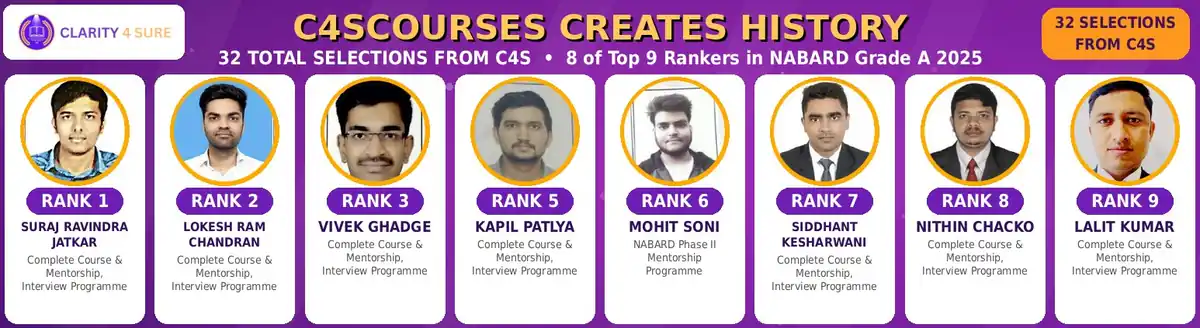
8 of the top 10 ranks in NABARD Grade A 2025 came from one classroom
Ranks 1, 2, 3, 5, 6, 7, 8 and 9 on the final list, and 32 selections in all, prepared with C4S Courses (Clarity 4 Sure). The same descriptive training and the same current affairs notes you are reading now.
- 1Suraj Ravindra JatkarRank 1
- 2Lokesh Ram ChandranRank 2
- 3Vivek GhadgeRank 3
- 5Kapil PatlyaRank 5
- 6Mohit SoniRank 6
- 7Siddhant KesharwaniRank 7
- 8Nithin ChackoRank 8
- 9Lalit KumarRank 9
- 31 January, 2026
- 03 & 04 February, 2026
- 05 & 06 February, 2026
- 07 February, 2026
- 08 & 09 February, 2026
- 10 February, 2026
- 11 February, 2026
- 12 February, 2026
- 13 February, 2026
- 14 February, 2026
- 15&16 February, 2026
- 17 February, 2026
- 18 February, 2026
- 19 February, 2026
- 20 February, 2026
- 21 February, 2026
- 22 & 23 February, 2026
- 24 February, 2026
- 25 February, 2026
- 26 February, 2026
- 27 February, 2026
31 January, 2026
Daily Current Affairs Quiz
31 January, 2026
National Affairs
1. BHARAT SAMPARK
Source: PIB
Context:
BHARAT SAMPARK – Engaging India’s Young Minds is an Economic Survey–linked outreach initiative that gained prominence after a Union Minister interacted with students at Indian Institute of Technology Delhi.
The initiative reflects the government’s effort to bridge policy-making with youth participation, especially in technology and innovation domains.
What is BHARAT SAMPARK?
BHARAT SAMPARK is a government outreach and engagement programme aimed at:
- Connecting India’s youth, particularly students of premier institutions, with
- Public institutions, policy processes, and nation-building initiatives.
Nodal Ministry: Ministry of Communications
Key Features of BHARAT SAMPARK
1. Youth–Government Interface
- Enables direct interaction between students and Union Ministers
- Discussions on:
- Technology and innovation
- Logistics and infrastructure
- Public sector careers and governance
- Promotes policy awareness and participatory governance
2. India Post Modernisation Focus
- Highlights transformation of India Post into a:
- Digitally enabled logistics and service platform
- Enabler of e-commerce, financial inclusion, and citizen services
- Demonstrates how legacy institutions can adapt to the digital economy
3. N-Gen (Next Generation) Campus Post Offices
Youth-centric postal facilities established within educational campuses:
- Digitally upgraded post offices
- Student-designed interiors
- Free Wi-Fi, QR-based services, digital payments
- Discounted Speed Post and parcel services for students
- Hands-on student engagement in postal operations and service delivery
4. Deep-Tech and Innovation Exposure
- Platform for students to showcase cutting-edge research, including:
- Tactile Internet
- Haptic robotics
- Supports India’s emerging deep-tech ecosystem
- Aligns with the vision of an “Internet of Skills”
2. National Commission for Women marks its 34th Foundation Day
Source: PIB
Context:
The National Commission for Women (NCW) marked its 34th Foundation Day at Bharat Mandapam, New Delhi, reaffirming its commitment to women’s rights, protection, and empowerment.
What is the National Commission for Women (NCW)?
- NCW is a statutory, apex body of the Government of India.
- Mandated to protect, promote, and safeguard the constitutional and legal rights of women.
- Functions as:
- Watchdog body
- Advisory authority
- Grievance redressal mechanism on women-related issues.
Establishment and Legal Basis
- Established: 31 January 1992
- Statutory Basis: National Commission for Women Act, 1990 (Act No. 20 of 1990)
- Nature: Statutory body (not a constitutional body)
Composition of the NCW
(As per Section 3 of the NCW Act, 1990)
- Chairperson: Nominated by the Central Government; committed to the cause of women
- Five Members: From fields such as:
- Law
- Administration
- Education
- Health
- Social welfare
- Labour
- Women’s movements
- Mandatory Representation:
- At least one member from SC
- At least one member from ST
3. India’s First Mega Shipbuilding Cluster in Tamil Nadu
Source: ET
Context:
On 29 January 2026, the Government of India (GoI), in collaboration with the Government of Tamil Nadu, established NSHIP—a Special Purpose Vehicle (SPV)—to develop India’s first mega shipbuilding cluster at Thoothukudi, Tamil Nadu.
About the NSHIP SPV
- Name: National Shipbuilding & Heavy Industries Park (NSHIP)
- Type: Special Purpose Vehicle (SPV)
- Joint Venture:
- V.O. Chidambaranar Port Authority – 50%
- State Industries Promotion Corporation of Tamil Nadu (SIPCOT) – 50%
Background
- Formed pursuant to an MoU signed in September 2025 in the presence of Sarbananda Sonowal, under the Ministry of Ports, Shipping and Waterways (MoPSW).
Shipbuilding Development Scheme (SbDS)
Overview
- Launched under a ₹69,725-crore maritime package (Oct 2025).
- Outlay for SbDS: ₹19,989 crore.
- Goal: Build domestic shipbuilding capacity to ~4.5 million GT annually by 2047 via infrastructure and technology upgrades.
Operational Framework
- Guidelines notified: 27 December 2025.
- Supports:
- Greenfield clusters (e.g., NSHIP-TN)
- Brownfield modernisation of existing shipyards
- India Ship Technology Centre at Indian Maritime University
Banking/Finance
1. New Consumer Price Index (CPI) Series
Source: The Indian Express
Context:
The Ministry of Statistics and Programme Implementation (MoSPI) has released details of a new Consumer Price Index (CPI) series, revising the base year from 2011–12 to 2023–24 and reducing the weight of food and beverages from ~46% to ~37%.
What is the New CPI Series?
The new CPI series is an updated framework for measuring retail inflation in India, featuring:
- Base year revision: 2011–12 → 2023–24
- Revised item weights based on the latest Household Consumption Expenditure Survey (HCES) 2023–24
- Expanded item coverage and improved methodology to reflect present-day consumption, including digital services
- CPI remains India’s headline inflation measure and the anchor for monetary policy under the inflation-targeting framework of the Reserve Bank of India
Organisations Involved
- Nodal Ministry: Ministry of Statistics and Programme Implementation
- Primary Data Source: Household Consumption Expenditure Survey (2023–24)
Historical Background of CPI in India
- CPI (Combined: Rural + Urban) introduced in 2011–12 as the primary inflation indicator.
- Earlier weights were based on 2011–12 consumption patterns, which became outdated due to:
- Rising incomes
- Urbanisation
- Shift towards services, housing, transport, and digital consumption
- Periodic base-year revision is a standard international practice to maintain accuracy and relevance.
Methodology / Criteria of the New CPI Series
The revised CPI is constructed using:
- HCES 2023–24 consumption shares (rural and urban)
- Expanded market coverage:
- 1,465 rural markets and 1,395 urban markets across 434 towns
- Addition of 12 online markets in large cities
- Item basket expansion: 299 → 358 items
- Improved House Rent Index (HRI):
- Rent coverage extended to rural areas
- Exclusion of employer-provided accommodation
- Inclusion of e-commerce prices:
- Airfares
- OTT subscriptions
- Telecom plans
Key Features of the New CPI Series
1. Reduced Food Weight
- Food + beverages weight falls from ~46% to ~36.5–36.75%
- Reflects Engel’s Law: as incomes rise, the share of food in total expenditure declines
2. Higher Housing Weight
- Housing (including water, electricity, gas) rises from ~7% to ~17.66%
- Captures rising urban housing and utility costs
3. Greater Services Representation
- Higher weights for transport, health, education, and communication
- Mirrors India’s services-led consumption transition
4. Digital Economy Inclusion
- Prices from OTT platforms, telecom plans, and online airfares included
- Improves relevance in a digitally integrated economy
5. Lower Inflation Volatility
- Reduced sensitivity of headline inflation to weather-driven food shocks
- Smoother inflation signals for policy decisions
2. Slice Introduces India’s First UPI-Centric Digital Banking Ecosystem
Source: BS
Context:
On 29 January 2026, Slice Small Finance Bank (Slice SFB) launched a UPI-centric digital banking ecosystem, introducing three innovative products:
- Repo-linked Digital Savings Account
- UPI-Integrated Credit Card
- Fully Digital Fixed Deposits (FDs)
Financial Products Launched
1. Digital Savings Bank Account (Repo-Linked)
- First in India to be linked to 100% of the Repo rate of the Reserve Bank of India.
- Interest calculation: Daily calculation and daily credit → real-time growth.
- Key features:
- Transparent, market-linked returns
- No minimum balance requirement
- Instant liquidity
- Fully digital onboarding
- UPI-enabled for everyday payments
2. UPI-Integrated Credit Card
- Scan & Pay: Enables payments at any UPI-enabled merchant using an approved credit limit, bypassing traditional card rails.
- Key features:
- Up to 3% cashback based on usage
- “Slice in 3”: No-cost EMI conversion for purchases above ₹2,000
- Weekly rewards via Slice Sparks
- Zero fees: No joining, renewal, or annual fees
- Fully digital onboarding and usage
- Significance: Blurs the line between UPI and credit cards, deepening credit penetration via UPI.
3. Digital Fixed Deposits (FDs)
- Fully digital: Opened and managed entirely via the app.
- Interest rate: Up to 7.25% per annum.
- Deposit insurance: Covered up to ₹5 lakh by the Deposit Insurance and Credit Guarantee Corporation (DICGC) under the Ministry of Finance.
- Significance: Combines safety of insured deposits with digital convenience.
Background
- In July 2025, Slice opened India’s first UPI-powered physical bank branch in Bengaluru, Karnataka, marking a hybrid digital-physical banking model.
About Slice Small Finance Bank (Slice SFB)
- CEO: Rajan Bajaj
- Headquarters: Guwahati, Assam
- Established: 2016
- Type: Small Finance Bank with a strong digital-first and UPI-led approach.
3. Paysharp Secures PA-P Licence from RBI
Source: BS
Context:
In January 2026, fintech startup Paysharp received the Payment Aggregator–Physical (PA-P) licence from the Reserve Bank of India (RBI).
Earlier, in August 2024, Paysharp had obtained the Payment Aggregator–Online (PA-O) licence.
What is the PA-P Licence?
- PA-P (Payment Aggregator–Physical) authorises an entity to aggregate and process in-person (offline) digital payments for merchants.
- With both PA-O and PA-P, Paysharp is now permitted to offer end-to-end payment acceptance across online and offline channels from a single, RBI-regulated platform.
Key Implications of the Licence
1. Unified Online–Offline Payments
- Enables a single, compliant stack for e-commerce and in-store payments.
- Improves settlement efficiency, compliance, and risk management.
2. Omnichannel Capability
- Serves merchants in-store, on-the-go, and online without dependence on third-party aggregators.
- Enhances merchant experience and reduces operational friction.
About Paysharp
- Established: 2019
- Headquarters: Chennai, Tamil Nadu
- Business Model: Flat-fee pricing—merchants pay a fixed charge per transaction.
- Client Base:
- Government and B2B enterprises
- NBFCs
- SMBs
- E-commerce merchants
4. UAE Central Bank Approves First USD-Backed Stablecoin
Source: News on Air
Context:
The Central Bank of the United Arab Emirates has approved the first USD-backed stablecoin (USDU) under its Payment Token Services Regulation, marking a significant step in regulating digital assets and blockchain-based payments.
What is the USD-Backed Stablecoin (USDU)?
- A USD-backed stablecoin is a cryptocurrency pegged 1:1 to the US dollar, designed to ensure price stability.
- The newly approved USDU is issued by Universal Digital, a crypto firm regulated by the Abu Dhabi Global Market (ADGM).
- It is the first foreign payment token issuer registered with the UAE central bank.
Key Features of the USDU Stablecoin
- Full USD backing: Each token is backed by equivalent US dollar reserves.
- Regulated framework: Approved under the UAE’s Payment Token Services Regulation.
- Blockchain-based settlement: Enables faster, cheaper, and transparent transactions.
- Cross-border utility: Useful for international transfers, trade settlement, and remittances.
- Financial innovation: Bridges traditional finance with regulated digital asset infrastructure.
5. NSE receives SEBI approval for IPO
Source: ET
Why in News?
The National Stock Exchange (NSE) has received a no-objection certificate (NOC) from the market regulator, clearing the way for it to initiate the process for its long-awaited Initial Public Offering (IPO).
What Does the NOC Mean?
- The NOC signifies that SEBI has no regulatory objection to NSE proceeding with IPO-related steps.
- It allows NSE to:
- Appoint merchant bankers and other intermediaries
- Finalise the Draft Red Herring Prospectus (DRHP)
- Begin formal IPO preparations, subject to compliance with listing norms
About NSE
- Established: 1992
- Nature: India’s largest stock exchange by trading volume
- Known for:
- Nationwide electronic trading
- Strong role in financial market modernisation
Facts To Remember
1. Shaheed Diwas / Martyrs’ Day 2026 – January 30
Observed across India to honour national martyrs and mark the 78th death anniversary of Mahatma Gandhi, assassinated on January 30, 1948, at Birla House (now Gandhi Smriti), New Delhi.
2. World Neglected Tropical Diseases Day 2026 – January 30
The 7th observance of WNTDD highlighted global efforts to eliminate neglected tropical diseases under the theme “Unite. Act. Eliminate,” aligned with WHO’s NTD Roadmap (2021–2030).
3. Kerala Budget FY27 Presented by FM K N Balagopal
Kerala’s Finance Minister presented a people-centric FY27 budget of about ₹2.40 lakh crore, focusing on social security, elderly welfare, women-centric schemes, and fiscal consolidation.
4. Andhra Pradesh Signs MoU with FICCI-FLO for Women Entrepreneurs’ Industrial Park
Andhra Pradesh signed an MoU with FICCI-FLO to establish a 30-acre Women Entrepreneurs’ Industrial Park in Amaravati to promote women-led MSMEs and industrial self-reliance.
5. Civil Aviation Minister Inaugurates Wings India 2026
Union Civil Aviation Minister Ram Mohan Naidu Kinjarapu inaugurated Wings India 2026 at Begumpet Airport, Hyderabad, a biennial aviation event themed “Indian Aviation: Paving the Future,” hosted by the Ministry of Civil Aviation with Telangana government support.
6. Bharat Parv 2026 Inaugurated at Red Fort
Lok Sabha Speaker Om Birla and Union Minister Gajendra Singh Shekhawat inaugurated the six-day Bharat Parv 2026 at Red Fort, New Delhi, to showcase India’s cultural diversity, promote tourism, and support Aatmanirbhar Bharat.
7. 12th SIFFCY 2026 Begins in New Delhi
The 12th Smile International Film Festival for Children and Youth (SIFFCY) 2026 began in New Delhi, focusing on diversity, equity, and inclusion through socially relevant films, including works by disabled children.
8. 11th Ajanta-Ellora International Film Festival Commences
The 11th Ajanta-Ellora International Film Festival started in Chhatrapati Sambhajinagar, honouring composer Ilaiyaraaja with the Padmapani Award and opening with the Spanish film ‘Siret’.
9. Assam Launches Mukhya Mantrir Eti Koli Duti Paat Scheme
Assam Chief Minister launched the Mukhya Mantrir Eti Koli Duti Paat scheme to mark 200 years of the tea industry, providing ₹5,000 financial aid and welfare benefits to over 6 lakh tea garden workers.
10. Department of Posts Partners with Stock Holding Services Ltd
The Department of Posts signed an agreement with Stock Holding Services Limited to expand access to regulated capital market services such as demat accounts, mutual funds, and IPOs through post offices and digital platforms.
11. Sheikh Joaan bin Hamad Al Thani Elected OCA President
Sheikh Joaan bin Hamad Al Thani was elected as the new President of the Olympic Council of Asia during the OCA General Assembly held in Tashkent, Uzbekistan.
12. Sikkim Police Receives President’s Police Colour Award
Sikkim Police was conferred the President’s Police Colour (Nishaan) for exemplary service, becoming the 15th state and third in Northeast India to receive this honour.
13. Dr Chandrakant Lahariya Wins Wiley Research Heroes Prize 2025
Dr Chandrakant Lahariya became the first Indian to win the Wiley Research Heroes Prize 2025 for his impactful health policy research under the “Impact Beyond Academia” category.
14. Indian Army Signs MoU with IISc Bengaluru for Indigenous AI System
The Indian Army signed an MoU with IISc Bengaluru to jointly develop a fully indigenous AI-based system to address emerging digital and information warfare challenges.
15. Former BCCI President Inderjit Singh Bindra Passes Away
Former BCCI President Inderjit Singh Bindra passed away at 84, remembered for his role in bringing the 1987 Cricket World Cup to the subcontinent and his long service to Indian cricket.
- Launched under a ₹69,725-crore maritime package (Oct 2025). India’s First Mega Shipbuilding Cluster in Tami…
- In July 2025, Slice opened India’s first UPI-powered physical bank branch in Bengaluru, Karnataka, marking a hybrid digital-physical banking model. Slice Introduces India’s First UPI-Centric Digi…
- Statutory Basis: National Commission for Women Act, 1990 (Act No. 20 of 1990) National Commission for Women marks its 34th Fo…
- Food + beverages weight falls from ~46% to ~36.5–36.75% New Consumer Price Index (CPI) Series
- In January 2026, fintech startup Paysharp received the Payment Aggregator–Physical (PA-P) licence from the Reserve Bank of India (RBI).Earlier, in August 2024, Paysharp had obtained the Payment Aggregator–Online (PA-O) licence. Paysharp Secures PA-P Licence from RBI
03 & 04 February, 2026
Daily Current Affairs Quiz
03 & 04 February, 2026
National Affairs
1. Wetlands as a National Public Good
Source: The Hindu
Context:
India observed World Wetlands Day 2026 under the theme “Wetlands and traditional knowledge”, highlighting the cultural–ecological linkages of wetlands. On this occasion, India added two new Ramsar sites — Patna Bird Sanctuary (Uttar Pradesh) and Chhari-Dhand (Gujarat) — taking the national total to 98 Ramsar sites, the highest in South Asia.
What are Wetlands and Why are They a National Public Good?
Wetlands are ecosystems where land is permanently or seasonally saturated with water, either fresh, brackish, or saline. They include marshes, swamps, floodplains, mangroves, peatlands, lakes, lagoons, and human-made systems such as tanks and paddy fields.
Why a National Public Good?
Wetlands qualify as national public goods because:
- Their benefits are non-excludable (no one can be easily prevented from benefiting)
- Their services are largely non-rivalrous (one person’s use does not diminish another’s)
They provide ecosystem services essential to society at large—flood control, groundwater recharge, water purification, climate regulation, biodiversity conservation, and livelihoods—which markets often fail to value adequately.
Key Characteristics of Wetlands
- Hydrology
Presence of water at or near the surface for at least part of the year, determining wetland functions. - Hydric Soils
Anaerobic, waterlogged soils formed due to prolonged saturation. - Hydrophytes
Specialized vegetation (e.g., mangroves, reeds, sedges) adapted to low-oxygen conditions. - Ecotone Status
Act as transition zones between terrestrial and aquatic ecosystems, enhancing ecological productivity and resilience.
Status of Wetlands in India
- Ramsar Network: 98 Ramsar sites (as of February 2026)
- Geographical Coverage: ~5% of India’s land area (≈15.9 million hectares)
- Rate of Loss: Nearly 40% of natural wetlands lost in the last three decades
- Leading State: Tamil Nadu (20 Ramsar sites)
Despite global recognition, ecological degradation remains widespread, even within notified wetlands.
Importance of Wetlands as a Public Good
1. Flood Mitigation
Wetlands act as natural sponges, absorbing excess rainfall and moderating floods.
- Example: Deepor Beel absorbs nearly 40% of Brahmaputra overflow, protecting Guwahati from severe floods.
2. Water Purification
Wetlands naturally filter pollutants such as nutrients, sediments, and heavy metals.
- Example: East Kolkata Wetlands treat ~750 million litres of sewage daily, saving substantial public expenditure.
3. Climate Resilience & Carbon Storage
Wetlands are significant carbon sinks and act as buffers against extreme weather.
- Example: Bhitarkanika Mangroves reduced wind impact during Cyclone Dana (2024), protecting inland habitations.
4. Livelihood Security
Millions depend on wetlands for fisheries, agriculture, fodder, and allied activities.
- Example: Kuttanad supports below-sea-level farming, producing over 6 lakh tonnes of rice annually.
5. Biodiversity Hotspots
Wetlands support nearly 40% of global species, including migratory birds and endemic fauna.
- Example: Chhari-Dhand hosts flamingos and supports breeding of endangered species like the Desert Fox.
2. Miniratna Category-I Status to Yantra India Limited (YIL)
Source: News on Air
Context:
Raksha Mantri Rajnath Singh approved Miniratna Category-I status to Yantra India Limited.
What is Miniratna Status?
Miniratna is a classification accorded to profit-making Central Public Sector Enterprises (CPSEs) to provide enhanced financial and operational autonomy, enabling faster and more competitive decision-making—below Navratna and Maharatna levels.
Historical Background
- Introduced: October 1997
- By: Government of India
- Objective:
- Decentralise decision-making
- Empower efficient CPSEs through delegated financial powers
- Reduce procedural delays and improve commercial efficiency
Types of Miniratna CPSEs
- Miniratna Category-I – Higher financial and operational autonomy
- Miniratna Category-II – Moderate autonomy
Eligibility Criteria for Miniratna Status
Common Conditions (Category-I & II)
- Continuous profit in the last 3 years
- Positive net worth
- No default in repayment of Government loans/interest
- No dependence on budgetary support or Government guarantees
- Board restructuring with at least three independent (non-official) directors
Additional Criteria
- Category-I:
- Pre-tax profit of ₹30 crore or more in at least one of the last three years
- Category-II:
- Profit in all three years (no minimum profit threshold)
3. Addition of 2 New Wetlands to India’s Ramsar List
Source: TOI
Context:
The Union Environment Minister announced the inclusion of Patna Bird Sanctuary (Uttar Pradesh) and Chhari Dhand Wetland Reserve (Gujarat) in India’s Ramsar List ahead of World Wetlands Day 2026. With this, India now has 98 Ramsar sites, marking a 276% increase since 2014.
What is the Ramsar Convention?
- An international treaty for the conservation and wise use of wetlands
- Adopted in 1971 at Ramsar, Iran
- India became a Contracting Party on 1 February 1982
- Ramsar sites serve as model ecosystems for:
- Biodiversity conservation
- Climate resilience
- Sustainable livelihoods
Newly Designated Ramsar Sites (2026)
1. Patna Bird Sanctuary
What it is
- A protected bird sanctuary and wetland ecosystem
- Also known as Patna Vihar Bird Sanctuary
Location
- Etah district, Uttar Pradesh
Key Facts
- Established: 1991
- Area: 108 hectares (wetland area ~1 km²)
- Smallest bird sanctuary in Uttar Pradesh
Important Avifauna
- Lesser Whistling Duck
- Graylag Goose
- Ruddy Shelduck
- Gadwall
- Eurasian Wigeon
- Northern Pintail
2. Chhari Dhand Wetland Reserve
What it is
- A seasonal desert wetland with unique saline–freshwater interactions
Location
- Kutch district, Gujarat
- Lies between:
- Banni Grasslands
- Rann of Kutch
Local Meaning
- Chhari = Salty
- Dhand = Shallow wetland
Key Features
- Becomes swampy during monsoon
- Fed by north-flowing rivers and surrounding hills
- Crucial habitat for migratory birds in monsoon and winter
Endangered & Notable Species
- Dalmatian Pelican
- Oriental Darter
- Black-necked Stork
- Indian Skimmer
- Large congregations of:
- Flamingos
- Cranes
- Painted storks
- Raptors
- Spoonbills
4. Motion of Thanks to President’s Address
Source: News on Air
Context:
Both Houses of Parliament discussed the Motion of Thanks following the President’s Address delivered by Droupadi Murmu at the start of the Budget Session.
What is the Motion of Thanks?
- A formal resolution moved in both Houses of Parliament to express gratitude to the President for the Special Address to a joint sitting of Parliament.
- The Address is delivered:
- At the beginning of each year’s first session, and
- After a general election.
- It provides Parliament an opportunity to debate, critique, and assess the policies and programmes of the Government outlined in the Address.
Origin and Background
- Rooted in the Westminster parliamentary tradition, adapted to India’s constitutional framework.
- The President’s Address is essentially the Government’s policy statement, drafted by the Council of Ministers and approved by the Cabinet.
- No direct discussion takes place on the Address itself; discussion is enabled only through the Motion of Thanks.
Constitutional Provisions
- Article 86(1): Empowers the President to address either House or both Houses assembled together.
- Article 87(1): Mandates a Special Address by the President:
- At the commencement of the first session after a general election, and
- At the commencement of the first session of every year.
- Article 87(2): Requires Parliament to frame rules for discussion on matters referred to in the Address—implemented via the Motion of Thanks.
5. IOM Global Appeal 2026 Report
Source: International Organization for Migration
Context:
IOM has sought USD 4.7 billion to assist 41 million people globally in 2026, signalling sharper prioritisation amid a Humanitarian Reset and a constrained global funding environment.
What is the IOM Global Appeal 2026?
- The Global Appeal 2026 is IOM’s operational and financing blueprint, aligned with its Strategic Plan 2024–2028.
- It aims to:
- Deliver life-saving humanitarian assistance
- Advance durable solutions to displacement
- Facilitate safe, orderly, and regular migration pathways
- Support vulnerable populations across migration corridors
Key Findings & Trends
- Record Internal Displacement: 83.4 million internally displaced persons (end-2024) — highest on record.
- Climate Acceleration: Disaster-related displacement rose to 9.8 million (2024) — +29% YoY.
- Deadliest Year for Migrants: ≥9,197 deaths (2024) — highest since 2014.
- Remittances: USD 905 billion (2024) — critical macroeconomic lifeline for many countries.
- Narrow Regular Pathways: <20% of assessed countries have programmes for regular labour migration.
- Workforce Indispensability: 168 million migrant workers globally, vital in healthcare, care economy, innovation.
- Funding Gap: Of USD 4.7 bn required, USD 1.3 bn secured → USD 3.4 bn shortfall.
Reasons for Migration
- Economic Opportunity: Labour shortages and innovation pull (168 million workers).
- Conflict & Violence: Protracted crises (e.g., Sudan, DR Congo).
- Environmental Degradation: Climate shocks and extreme weather.
- Protracted Displacement: Long stays erode local coping capacity, prompting onward movement.
- Inequality & Hardship: Push toward risky, irregular routes in search of dignity.
Key Challenges Highlighted
- Social Security Deficits: Insecure jobs; limited access to welfare/health systems.
- India example: Despite eShram, many urban migrants struggle to access state-specific benefits.
- Hazardous Living Conditions: Informal settlements; poor WASH outcomes.
- India example: Overcrowding in Dharavi (Mumbai) affects water and waste services.
- Exploitation & Low Wages: Weak legal protection; unsafe worksites; wage theft.
- India example: Seasonal construction labour from Bihar/UP.
- Restrictive Global Policies: Narrower admission rules.
- Example: H-1B changes (2025)—higher fees, wage-weighted selection.
- Harmful Narratives & Misinformation: Fuels exclusion and policy tightening.
- Example: Student and migration caps in UK/Canada (2025).
Way Forward (IOM’s Recommendations)
- Route-Based Approach: Integrated, corridor-wide responses over fragmented actions.
- Enhanced Localization: Empower local/national actors to lead.
- Regular Pathway Expansion: Flexible channels aligned to real labour-market needs.
- Data-Driven Solutions: Scale Displacement Tracking Matrix (DTM) for actionable insights.
- Resilience Funding: Increase flexible, unearmarked funds for agile field operations.
6. Waste-pickers Enumeration under NAMASTE Scheme
Source: TH
Context:
The Union government released nationwide enumeration data of waste-pickers for the first time under the NAMASTE scheme, revealing sharp social stratification within informal urban labour.
What is NAMASTE?
- NAMASTE (National Action for Mechanised Sanitation Ecosystem) is a central initiative aimed at:
- Eliminating hazardous sanitation work
- Mechanising sewer/septic tank cleaning
- Ensuring safety, dignity, and rehabilitation of sanitation workers
- Implemented by the Government of India in partnership with States/UTs and Urban Local Bodies (ULBs).
Key Enumeration Findings
Overall Numbers
- Total waste-pickers enumerated: 52 lakh
- Coverage: 35 States/UTs
- Social composition: 84.5% belong to SC, ST, and OBC communities
Regional Outliers
- General category majority: Delhi and Goa
- West Bengal: 42.4% from the General category
Linked Sanitation Data
- Sewer/Septic tank workers: 91.95% from SC/ST/OBC groups
→ Indicates continuity between waste-picking and hazardous sanitation work along caste lines.
7. Solid Fuel Ducted Ramjet (SFDR) Technology
Source: TH
Context:
The Defence Research and Development Organisation (DRDO) successfully demonstrated Solid Fuel Ducted Ramjet (SFDR) technology from the Integrated Test Range, Chandipur.
What is SFDR Technology?
- SFDR is an air-breathing missile propulsion system that:
- Uses atmospheric oxygen for combustion
- Burns solid fuel in a controlled manner
- It provides sustained thrust at supersonic speeds, unlike conventional rockets that burn out early.
- Ensures high energy retention, especially during the terminal phase of missile flight.
How SFDR Works
- Initial Acceleration
- A nozzle-less booster accelerates the missile to the required Mach number.
- Ramjet Takeover
- At high speed, atmospheric air is ingested and compressed naturally due to forward motion (no rotating compressors).
- Controlled Combustion
- Solid fuel burns steadily inside the duct.
- Combustion is regulated by an indigenous fuel flow control system.
- Sustained Thrust
- Continuous thrust keeps the missile fast, stable, and highly manoeuvrable until impact.
Key Features of SFDR
- Air-breathing propulsion
- No onboard oxidiser → more fuel space and longer range
- Sustained high-speed flight
- Maintains supersonic velocity throughout flight
- High terminal energy
- Retains speed in final phase → greater lethality against agile targets
- Enhanced end-game manoeuvrability
- Continuous thrust allows sharp evasive turns
- Makes interception by enemy air defence extremely difficult
- Reduced drag & improved range
- Optimised airflow minimises energy losses
- Indigenous supersonic combustion control
- Stable fuel-air combustion at high Mach numbers achieved domestically
- Considered a major technological breakthrough
Applications & Strategic Significance
1. Beyond Visual Range Air-to-Air Missiles (BVRAAMs)
- Enables long-range engagement of enemy aircraft
- Maintains high kill probability at extended distances
2. Air Superiority & BVR Combat Edge
- Allows first-strike capability
- Enhances pilot survivability by enabling safe disengagement
3. Defence Indigenisation
- Reduces dependence on foreign propulsion technologies
- Strengthens Aatmanirbhar Bharat in advanced missile systems
8. Peacocks
Source: TOI
Context:
A pair of peacocks was spotted at over 6,000 ft (~1,800 m) near Manali in Himachal Pradesh, an ecologically unusual altitude for a species typically associated with warmer lowland regions.
What are Peacocks?
- Peacocks are large, colourful birds of the pheasant family (Phasianidae).
- Collectively called peafowl:
- Male: Peacock
- Female: Peahen
- Young: Peachicks
- India’s national bird is the Indian / Blue Peacock (Pavo cristatus).
Habitat & Distribution
- Natural habitats:
- Warm semi-arid to moist deciduous forests
- Grasslands and agricultural landscapes
- Indian distribution:
- Mostly plains and low hills
- Typical altitude range:
- Up to ~1,000 m
- Occasionally up to ~1,500 m
- Why the Manali sighting is unusual:
- Recent observation at ~1,800 m (6,000 ft) exceeds the species’ normal altitudinal range
- Suggests behavioural flexibility, habitat expansion, or climate-linked shifts
IUCN Conservation Status
- Indian (Blue) Peacock (Pavo cristatus): Least Concern
- Green (Javanese) Peacock (Pavo muticus): Endangered
- Congo Peacock (Afropavo congensis): Vulnerable
9. Turtle Trails
Context:
The Union Budget 2026–27 proposed developing ‘turtle trails’ along key Olive Ridley nesting sites in Odisha, Karnataka, and Kerala to promote eco-tourism with conservation safeguards.
What are Turtle Trails?
- Turtle trails are regulated eco-tourism pathways and guided experiences near sea turtle nesting beaches.
- Objectives:
- Conservation awareness and protection of nesting habitats
- Community livelihoods through nature-based tourism
- Low-impact tourism aligned with sustainability principles
States & Locations Involved
- Odisha
- Rushikulya
- Vicinity of Gahirmatha
- Karnataka
- Coastal turtle nesting beaches along the Arabian Sea
- Kerala
- Key nesting stretches along the Arabian Sea coast
Key Features of Turtle Trails
- Guided & regulated access
- Entry limited by time/season (typically breeding season)
- Trained guides to prevent disturbance to turtles and nests
- Awareness & education
- Interpretation on marine biodiversity, turtle life cycles, threats
- Community participation
- Involvement of local fishers, volunteers, self-help groups, NGOs
- Low-impact infrastructure
- Temporary walkways, observation zones (as proposed)
- Minimal lighting and noise to avoid hatchling disorientation
- Policy integration
- Aligned with eco-tourism policies, livelihood generation, and sustainable tourism goals
10. AYUSH Ministry to Invite Proposals for New Ayurveda Institutes
Source: The Hindu
Context:
The Union Minister of State for AYUSH, Prataprao Jadhav, announced that the Ministry of AYUSH will soon invite proposals from States to establish three new All India Institutes of Ayurveda (AIIAs), as announced in the Union Budget 2026–27.
The move signals a strategic expansion of Ayurveda-based tertiary healthcare, education, and research infrastructure across India.
What are All India Institutes of Ayurveda (AIIAs)?
- AIIAs are apex institutions for Ayurveda, on the lines of AIIMS in allopathic medicine
- Mandate includes:
- High-quality undergraduate and postgraduate education
- Advanced research in Ayurveda and integrative medicine
- Tertiary-level healthcare services
- Standard-setting for Ayurveda education and practice
They function as centres of excellence to modernise and mainstream Ayurveda.
Key Budgetary and Policy Signals
1Increased Budget Allocation for AYUSH
- AYUSH Budget 2025–26 (RE): ₹3,671.82 crore
- AYUSH Budget 2026–27 (BE): ₹4,408.93 crore
- Increase: ~10%
This increase reflects the government’s intent to:
- Strengthen traditional systems of medicine
- Integrate AYUSH with mainstream healthcare delivery
- Build skilled human resources
11. Members of Parliament Local Area Development Scheme (MPLADS)
Context:
The Members of Parliament Local Area Development Scheme (MPLADS), launched in December 1993, has once again come under scrutiny following allegations of misuse by some Members of Parliament.
MPLADS is a Central Sector Scheme, fully funded by the Government of India, that allows MPs to recommend developmental works worth ₹5 crore annually, primarily for creating durable community assets such as roads, schools, drinking water facilities, and health infrastructure.
MPLADS Funds (Members of Parliament Local Area Development Scheme)
- MPLADS is a Central Sector Scheme that enables Members of Parliament to recommend developmental works in their constituencies with an emphasis on creation of durable community assets.
- Introduced in 1993.
Key Features
Annual Allocation
- ₹5 crore per MP per year
- Applicable to Lok Sabha MPs
- Rajya Sabha MPs can recommend works anywhere in the State/UT they represent
- Nominated MPs can recommend works anywhere in the country
Nature of Works
- Creation of durable assets such as:
- Drinking water facilities
- Roads, bridges, culverts
- School buildings, toilets
- Health infrastructure
- Community halls
- No private or individual assets allowed.
12. Pennaiyar River
Context:
The Supreme Court of India directed the Union Government to constitute an Inter-State River Water Disputes Tribunal within one month to resolve the Pennaiyar water dispute between Tamil Nadu and Karnataka.
The suit was filed by Tamil Nadu under Article 131 invoking the Inter-State River Water Disputes Act, 1956.
What is the Pennaiyar River?
- An east-flowing inter-state river of southern India
- Known as:
- Thenpennai / Ponnaiyar (Tamil)
- Dakshina Pinakini (Kannada)
- Crucial for irrigation, industry, and drinking water security, especially in Tamil Nadu
Origin
- Originates in the Nandi Hills
- Located in Chikkaballapura district, Karnataka
- Part of the Eastern Ghats river system
(Important prelims trap: not a Western Ghats river)
States Covered
- Karnataka – Upper riparian state
- Tamil Nadu – Lower riparian state
Banking/Finance
1.16th Finance Commission (2026–31)
Why in News?
The 16th Finance Commission report was tabled in Parliament of India on 1 February 2026 by Finance Minister Nirmala Sitharaman, alongside the Union Budget.
The government accepted the key recommendation to retain States’ share in central taxes at 41% for 2026–31.
I. Vertical Devolution (Centre → States)
- States’ Share: 41% of the divisible pool (unchanged from the 15th FC).
- Divisible Pool: Centre’s gross tax revenue minus cesses, surcharges, and cost of collection.
- Impact: Stability and predictability in transfers; reinforces fiscal federalism.
II. Horizontal Devolution (Among States)
Recalibrated formula with revised weights and a new parameter.
Devolution Criteria: 15th FC vs 16th FC
| Criteria | 15th FC | 16th FC | Key Change |
|---|---|---|---|
| Income Distance | 45% | 42.5% | Slight reduction |
| Population (2011) | 15% | 17.5% | Increased |
| Demographic Performance | 12.5% | 10% | Redefined |
| Area | 15% | 10% | Reduced |
| Forest & Ecology | 10% | 10% | Expanded scope |
| Tax Effort | 2.5% | 0% | Dropped |
| Contribution to GDP | 0% | 10% | New |
| Total | 100% | 100% |
Key Changes Explained
- Income Distance: Gap in per-capita GSDP vis-à-vis top-3 states (avg. 2018-19 & 2023-24; 2020-21 excluded).
- Contribution to GDP (10%): Rewards economic size using √GSDP (balances scale without overpowering).
- Forest & Ecology: Includes open forests and increase in forest cover (2015–23).
- Demographic Performance: Shift from TFR to population growth (1971–2011).
- Tax Effort: Removed.
III. Grants-in-Aid (Total: ₹9.47 lakh crore)
Streamlining: Revenue-deficit, sector-specific, and state-specific grants discontinued.
A. Local Body Grants (₹7,91,493 crore)
- Rural: ₹4.35 lakh crore
- Urban: ₹3.56 lakh crore
- Structure: 80% Basic (of which 50% tied to water & sanitation) + 20% Performance
- New Urban Components:
- Special Infrastructure Grant (₹56,100 cr): Wastewater management (cities 10–40 lakh population)
- Urbanisation Premium (₹10,000 cr): One-time support for peri-urban mergers and rural-urban transition policies
- Conditionalities: Timely State Finance Commissions, audited accounts, proper constitution of local bodies.
B. Disaster Management Grants (₹1,55,916 crore)
- For SDRF/SDMF.
- Cost Sharing:
- 90:10 (NE & Himalayan states)
- 75:25 (others)
IV. Fiscal Roadmap & Debt Management
- Centre FD: Reduce to 3.5% of GDP by 2030–31.
- States FD: Cap at 3% of GSDP.
- Off-Budget Borrowings: Discontinue; bring fully on-budget; uniform debt definition.
- Combined Debt: Projected to fall 77.3% (2026-27) → 73.1% (2030-31).
V. Power Sector Reforms
- DISCOM Privatisation: Actively pursue.
- SPV: Warehouse existing DISCOM debt.
- Conditional Central Aid: Access to Special Assistance for Capital Investment only post-privatisation.
VI. Subsidy Rationalisation
- Review and better targeting with clear exclusion criteria.
- Move away from unconditional cash transfers.
- No off-budget financing of subsidies.
- Uniform accounting & disclosure across states.
VII. State Public Sector Enterprise (SPSE) Reforms
- Review/close 308 inactive SPSEs.
- State-level disinvestment policy for underperformers.
- Loss-making SPSEs (losses in 3 of 4 years) to go to Cabinet for closure/privatisation/strategic continuation.
2. SBI launches ‘CHAKRA’ Centre of Excellence
Source: TH
Context:
State Bank of India has launched ‘CHAKRA’, a dedicated Centre of Excellence (CoE) to strengthen financing for eight critical sunrise sectors.
What is CHAKRA?
CHAKRA (Centre of Excellence) is a knowledge-led institutional platform created by SBI to enhance its capability to finance capital-intensive, technology-driven sunrise sectors by integrating:
- Sectoral expertise
- Advanced risk assessment
- Innovative and policy-aligned financing models
Aim
- Build institutional expertise in emerging, technology-led sectors
- Improve the flow of domestic and international debt capital into sunrise industries
- Develop innovative financing structures aligned with national policy priorities
3. Centre Tops Up RDI Fund with ₹20,000 Crore
Source: Business Standard
Context:
In the Union Budget 2026–27, Finance Minister Nirmala Sitharaman announced a ₹20,000 crore top-up to the Research, Development and Innovation (RDI) Fund, continuing last year’s allocation and reaffirming the government’s commitment to building a strong domestic R&D and deep-tech ecosystem.
The RDI Fund is the largest component of the ₹23,125 crore earmarked for Central Sector schemes under the Ministry of Science and Technology.
What Is the RDI Fund?
- Total Fund Size: ₹1 trillion
- Deployment Period: 7 years (Cabinet-approved)
- Objective:
- Support long-gestation, high-risk R&D
- Promote indigenous product innovation
- Crowd-in private capital into deep-tech and frontier research
- Launch: November 2025 by Narendra Modi
4. From UPI to CBDCs: India Sets Digital Payments Agenda at BRICS
Source: ET
Context:
During its BRICS presidency, India is expected to push for seamless cross-border digital payments among member countries using Central Bank Digital Currencies (CBDCs). This initiative builds on earlier BRICS commitments to interoperability of payment systems and reflects India’s growing leadership in Digital Public Infrastructure (DPI).
India will host the BRICS Summit later this year, providing a strategic platform to advance this agenda.
About BRICS
BRICS is a 10-member grouping that includes:
- Brazil
- Russia
- India
- China
- South Africa
- Along with newly inducted members (expansion phase)
The grouping aims to enhance economic cooperation, financial resilience, and South–South collaboration.
What Is India Proposing?
1. Cross-Border CBDC Payments
- Promote interoperable CBDC-based settlement systems among BRICS central banks.
- Enable direct, faster, cheaper, and secure cross-border transactions without relying on correspondent banking.
2. Payment System Interoperability
- Build on the 2025 BRICS declaration, which supported interoperability among national payment systems.
- Align technology, regulatory standards, cybersecurity protocols, and settlement mechanisms.
3. Reducing Dependence on Traditional Systems
- Lower reliance on:
- SWIFT
- Dollar-dominated settlement channels
- Enhance financial sovereignty of Global South economies.
Why CBDCs, Not Stablecoins?
RBI Governor Sanjay Malhotra, speaking in Washington DC (Nov 2025), stressed:
- CBDCs are:
- Sovereign-backed
- Regulated
- Less prone to volatility and regulatory arbitrage
- Stablecoins:
- Often privately issued
- Pose risks to monetary sovereignty and financial stability
4. SBI launches CHAKRA
Source: TH
Why in news?
State Bank of India (SBI) has launched CHAKRA, a Centre of Excellence (CoE) to support financing of sunrise sectors, with a potential investment of ₹100 trillion over the next five years.
What is CHAKRA?
- CHAKRA is a dedicated Centre of Excellence for financing sunrise sectors.
- It aims to strengthen project financing, co-financing, risk assessment, and patient capital structures.
- The initiative builds on SBI’s earlier Centre of Excellence for MSMEs at the State Bank Academy.
Key Sunrise Sectors Covered
- Renewable energy
- Advanced cell chemistry & battery storage
- Semiconductors
- Electric mobility & decarbonisation
- Smart infrastructure
- Data centre infrastructure
Institutional Partnerships
- SBI has signed MoUs with 21 financial institutions.
- Includes:
- Japanese banks such as SMBC and MUFG
- Indian institutions like PFC, REC, and NaBFID
- Discussions ongoing with European and American banks.
- Objective: Co-financing, capacity building, and risk sharing.
Rationale Behind CHAKRA
- Sunrise sectors involve high capital needs and new technology risks.
- Cannot rely solely on deposit-funded bank lending.
- Need for patient capital and participation from:
- Banks
- NBFCs
- Development finance institutions
- Global investors
Functions of CHAKRA
- Preparation of white papers and sector reports
- Industry roundtables and policy dialogues
- Structured engagement with:
- Multilateral agencies
- Start-ups and corporates
- Academia and think tanks
5. SEBI Likely to Extend Ban on Agricultural Futures
Source: Economic Times
Context:
The market regulator Securities and Exchange Board of India (SEBI) is likely to extend the ban on futures trading in key agricultural commodities by another year, beyond its scheduled end in March 2026.
The ban, first imposed in 2021, aims to curb price volatility, speculation, and food inflation, especially in essential commodities that directly affect household consumption.
Agricultural Commodities Under the Ban
Futures trading remains suspended in seven major agri-commodities:
- Non-basmati paddy
- Wheat
- Chana (gram)
- Mustard seed and its derivatives
- Soybean and its derivatives
- Crude palm oil
- Moong (green gram)
These commodities form a significant part of India’s food basket, making their price stability a political and economic priority.
What are Agricultural Commodities?
Agricultural commodities are primary goods produced through agriculture and allied activities that are standardised, produced in bulk, and traded in markets (spot and derivatives).
Key Features
- Derived from farming, livestock, fisheries, or plantations
- Homogeneous/standardised, enabling large-scale trade
- Prices influenced by demand–supply, weather, global markets, and policy
- Traded in mandis and commodity exchanges
Major Categories
- Food crops: Wheat, rice, maize
- Pulses: Chana, moong, urad
- Oilseeds: Soybean, mustard, groundnut
- Commercial crops: Cotton, sugarcane, tea, coffee
- Livestock products: Milk, meat, eggs
6. RBI Proposes Resolution Framework for Borrowers Affected by Natural Calamities
Source: BS
Why in news?
Reserve Bank of India (RBI) has issued draft guidelines proposing a principle-based framework for banks and other regulated entities to implement resolution plans for borrowers impacted by natural calamities.
What has RBI proposed?
- A principle-based resolution regime giving full discretion to regulated entities (REs) in designing and implementing resolution plans.
- Banks must anticipate climate and disaster-related risks and incorporate relief and resolution measures within their credit policies.
Key Features of the Draft Guidelines
- Eligibility:
- Borrowers who have not defaulted for more than 30 days.
- Possible Resolution Measures:
- Rescheduling of loan repayments
- Granting of moratorium
- Conversion of accrued interest into a separate credit facility
- Sanction of additional finance to address borrower stress
- Applicability:
- Banks and all RBI-regulated entities
- Implementation date:
- April 1
- Public consultation:
- Feedback invited till February 17
Objectives of the Guidelines
- Enhance financial resilience of borrowers affected by natural disasters
- Prevent sudden loan slippages and NPAs
- Integrate climate risk considerations into banking regulation
- Support orderly credit resolution without compromising prudential discipline
Agriculture
1. Trees Outside Forests (TOF) / Agroforestry in India
Source: BS
Why in news?
A report to be presented at the first South Asian Agroforestry and Trees Outside Forests Congress (TREESCAPES) highlights that India can unlock the full economic, social and environmental potential of Trees Outside Forests (TOF) by focusing on four high-growth industries.
What are Trees Outside Forests (TOF)?
- TOF refers to trees growing outside notified forest areas, including:
- Agroforestry systems
- Farm boundary plantations
- Trees on private, community and urban lands
- TOF is commonly associated with agroforestry in agricultural landscapes.
Status of TOF in India
- TOF cover: ~29.38 million hectares
- Accounts for 36.4% of India’s total forest and tree cover
- Major TOF species:
- Mango, neem, babool, coconut, palash
- Teak, ber, eucalyptus, rubber, katha
- These species account for ~40% of trees in rural India
Environmental & Social Benefits
- Reduces pressure on natural forests
- Enhances farm productivity and rural incomes
- Improves food, timber and non-timber supply
- Provides ecosystem services:
- Carbon sequestration
- Climate regulation
- Clean air and water
- Biodiversity habitats
2. Budget 2026-27: Plantations & Fisheries Central to Farm Income Strategy
Source: BS
Why in news?
The Union Budget 2026–27 has shifted focus from core food crops to allied sectors of agriculture, particularly plantations, livestock, and fisheries, as a strategy to raise farmers’ incomes through high-value agriculture.
Overall Allocation
- Allocation for agriculture and allied activities projected to grow by 7.1% in BE FY27 over RE FY26.
- This comes despite a 4.4% decline in overall sector spending in RE FY26 compared to BE FY26.
- Indicates reprioritisation within agriculture, rather than expansion of traditional crop subsidies.
Key Focus Areas
1. High-value Plantation Crops
Support announced for:
- Coconut
- Cocoa
- Cashew
- Sandalwood
- Agarwood (Northeast)
- Almonds, walnuts, pine nuts (hilly regions)
Special measures
- Coconut promotion scheme for southern states
- Coconut supports ~30 million people, including ~10 million growers.
- Plan to make Indian cashew and cocoa premium global brands by 2030.
- Partnership with states to revive Indian sandalwood.
2. Fisheries & Aquaculture
- Proposal for integrated development of 500 reservoirs and Amrit Sarovars.
- Aim: Strengthen fisheries value chains, especially in coastal areas.
- Budget allocation for fisheries increased by nearly 60% (BE FY27 over RE FY26).
3. Livestock & Animal Husbandry
- Livestock contributes ~16% of farm income, especially for marginal farmers.
- Key announcements by Nirmala Sitharaman:
- Loan-linked capital subsidy for:
- Veterinary & para-vet colleges
- Veterinary hospitals & diagnostic labs
- Breeding facilities (private sector)
- Target: 20,000+ additional veterinary professionals
- Encourage livestock Farmer Producer Organisations (FPOs)
- Loan-linked capital subsidy for:
- Department of Animal Husbandry allocation up by 16% (BE FY27 over RE FY26).
4. Digital & Knowledge Initiatives
- Bharat-VISTAAR (₹150 crore):
- Multilingual AI-based tool
- Integrates AgriStack portals with Indian Council of Agricultural Research advisory packages.
- High-value agriculture mission: ₹350 crore.
Facts To Remember
1. Lupin launches generic cancer drug in U.S.
Lupin has launched generic cancer drug Dasatinib Tablets, in multiple strengths, in the U.S. The product, bioequivalent to Bristol-Myers Squibb Company’s Sprycel Tablets, was developed by Lupin in partnership with Pharmascience Inc.
2. Wings India 2026 Held in Hyderabad
Asia’s largest civil aviation event, Wings India 2026, was held from 28–31 January 2026 at Begumpet Airport, Hyderabad. Inaugurated by Union Civil Aviation Minister Ram Mohan Naidu, it showcased India’s rise as the world’s 3rd-largest domestic aviation market.
3. Gujarat Becomes India’s Largest Renewable Energy Contributor
Gujarat emerged as the top contributor to India’s renewable energy capacity with 42.583 GW as of December 2025. The state leads in wind power, rooftop solar installations, and supports India’s net-zero target for 2070.
4. MHA Mandates Central Deputation for IPS IGP Posting
The Ministry of Home Affairs mandated a minimum two-year Central Deputation for IPS officers to be eligible for IGP-level posts. The move aims to strengthen leadership capacity in CAPFs and Central Police Organisations.
5. CCRAS–Berhampur University MoU on Ayurvedic Manuscripts
CCRAS signed a two-year MoU with Berhampur University to digitize and preserve rare Ayurvedic palm-leaf manuscripts. The initiative focuses on safeguarding traditional knowledge using modern technology.
6. SAIL Launches ‘SAIL-e-BRATION’ Creative Challenge
SAIL launched the SAIL-e-BRATION national challenge to highlight steel’s role in nation-building. Citizens are encouraged to submit creative digital content showcasing SAIL’s contribution to everyday life.
7. GoI Withdraws 18% Excise Duty on Unmanufactured Tobacco
The Government of India withdrew the 18% excise duty on unbranded, non-retail packed unmanufactured tobacco from February 1, 2026. The decision provides relief to farmers and small-scale suppliers.
8. Matrixport Gets In-Principle Approval in Bhutan
Matrixport received in-principle approval to offer regulated financial services in Gelephu Mindfulness City, Bhutan. Operations will commence after meeting all licensing and compliance requirements.
9. Central Bank of India Partners with HSBC AMC
Central Bank of India partnered with HSBC Asset Management India to distribute mutual fund products. The collaboration enhances investment and wealth management options for customers.
10. 68th Grammy Awards 2026 Highlights
The 14th Dalai Lama won his first Grammy, while Bad Bunny secured Album of the Year for a Spanish-language album. The awards reflected growing global diversity in music recognition.
11. Sunetra Pawar Becomes Deputy CM of Maharashtra
Sunetra Pawar was sworn in as Maharashtra’s first woman Deputy Chief Minister on January 31, 2026. She must enter the state legislature within six months to continue in office.
12. Australian Open 2026 Champions
Carlos Alcaraz and Elena Rybakina won the men’s and women’s singles titles at the Australian Open 2026. Alcaraz became the youngest man in the Open Era to complete a career Grand Slam.
13. Devika Sihag Wins Thailand Masters 2026
Indian shuttler Devika Sihag won her maiden BWF Super 300 title at the Thailand Masters 2026. She became the third Indian woman to achieve this milestone.
14. Indian Coast Guard Day 2026 – February 1
Indian Coast Guard Day commemorates the establishment of the ICG and its role in maritime security. The year 2026 marked the 50th Raising Day of the force.
15. World Wetlands Day 2026 – February 2
World Wetlands Day is observed to raise awareness about the ecological importance of wetlands. The 2026 theme highlighted the role of traditional knowledge in wetland conservation.
16. India Hosts 2nd India–Arab Foreign Ministers’ Meeting
India hosted the 2nd India–Arab Foreign Ministers’ Meeting in New Delhi after a gap of nearly 10 years. The meeting adopted the New Delhi Declaration, strengthening India–Arab League cooperation on regional and global issues.
17. NSO to Conduct Nationwide Migration Survey (2026–27)
The National Statistics Office announced a comprehensive migration survey from July 2026 to June 2027. It will generate updated data on migration patterns, labour mobility, employment, and remittance flows.
18. IHMCL–NFSU MoU on Cybersecurity in Highway Operations
IHMCL signed a three-year MoU with NFSU to enhance cybersecurity and data protection in national highway operations. The collaboration will support advanced forensics, secure imaging, and intelligent traffic systems.
19. MeitY Signs e-Signature Cooperation Pact with EU
MeitY and the EU’s DG CONNECT signed an agreement on advanced electronic signatures and seals. The pact enables cross-border digital signing, boosting trust and digital trade, especially for MSMEs.
20. MoPA Launches Upgraded Youth Parliament Portal ‘NYPS 2.0’
The Ministry of Parliamentary Affairs launched NYPS 2.0 to expand participation in the Youth Parliament programme. The upgrade allows institutions, groups, and individuals from remote areas to participate inclusively.
21. World Bank Approves USD 830 Million Loan for PM-SETU
The World Bank approved a USD 830 million loan to upgrade India’s ITIs under the PM-SETU programme. The initiative aims to align skill training with industry needs and generate over one million skilled workers annually.
22. PNB Launches ‘LUXURA Metal Credit Card’
Punjab National Bank launched the LUXURA Metal Credit Card on the Visa Infinite platform. The premium card offers luxury travel, lifestyle benefits, concierge services, and accelerated reward points.
23. Tripura Gramin Bank Launches First RRB Co-Branded RuPay Credit Card
Tripura Gramin Bank, with PNB, launched India’s first RRB co-branded RuPay credit card. The initiative enhances digital credit access for rural and semi-urban customers.
24. Yantra India Gets Miniratna Category-I Status
Defence Minister Rajnath Singh approved Miniratna Category-I status for Yantra India Limited. The status grants greater financial autonomy and strengthens indigenous defence manufacturing.
25. Kabak Yano Summits Mount Aconcagua
Arunachal Pradesh mountaineer Kabak Yano successfully scaled Mount Aconcagua in Argentina. She became the first woman from the Nyishi community to achieve this milestone.
26. Climate Scientist Veerabhadran Ramanathan Wins Crafoord Prize 2026
Indian-origin scientist Veerabhadran Ramanathan won the 2026 Crafoord Prize in Geosciences. He was honoured for pioneering research on aerosols, super-pollutants, and climate change.
27. World Cancer Day 2026 – February 4
World Cancer Day was observed globally to promote cancer awareness, prevention, and equitable treatment. The 2026 theme “United by Unique” emphasised patient-centred cancer care.
28. International Day of Human Fraternity 2026 – February 4
The UN observed the International Day of Human Fraternity to promote peace, tolerance, and interfaith harmony. The day coincided with World Interfaith Harmony Week.
29. Andhra Pradesh Launches ‘Pilloo AI’ for MSMEs
Andhra Pradesh CM N. Chandrababu Naidu launched Pilloo AI, a voice-based billing and accounting platform. The tool supports MSMEs by enabling easy accounting in multiple Indian languages.
- Record Internal Displacement: 83.4 million internally displaced persons (end-2024) — highest on record. IOM Global Appeal 2026 Report
- AYUSH Budget 2025–26 (RE): ₹3,671.82 crore AYUSH Ministry to Invite Proposals for New Ayur…
- The Members of Parliament Local Area Development Scheme (MPLADS), launched in December 1993, has once again come under scrutiny following allegations of misuse by some Members of Parliament. Members of Parliament Local Area Development Sc…
- Centre FD: Reduce to 3.5% of GDP by 2030–31. 16th Finance Commission (2026–31)
- High-value agriculture mission: ₹350 crore. Budget 2026-27: Plantations & Fisheries Central…
05 & 06 February, 2026
Daily Current Affairs Quiz
05 & 06 February, 2026
National Affairs
1. India–USA Trade Deal 2026
Source: TOI
Why in news?
India and the United States concluded a landmark bilateral trade deal in February 2026, sharply reducing tariffs and ending a phase of intense trade friction. The agreement was jointly announced by Donald Trump and the Prime Minister of India, signalling a strategic economic reset.
What is the India–USA Trade Deal 2026?
- A reciprocal, strategic trade agreement aimed at:
- De-escalating the trade war that escalated in late 2025
- Restoring market access for Indian exports
- Securing long-term energy and commodity commitments for the US
- It combines trade liberalisation with geopolitical and energy realignments.
Key Features of the Deal
1. Tariff Rationalisation
- US tariffs on Indian goods cut from a peak of 50% to 18%.
- India now enjoys preferential tariff treatment compared to competitors like Vietnam, Bangladesh and Pakistan (19–20%).
2. Removal of Punitive Duties
- The additional 25% penalty imposed over India’s Russian oil imports has been withdrawn.
3. Energy & Commodity Pivot
- India to significantly reduce / halt Russian oil imports.
- Shift in sourcing towards:
- US energy exports
- Potentially Venezuela
- $500 billion purchase commitment by India (multi-year) covering:
- Energy
- Agriculture
- Coal
- Technology products
4. Reciprocal Market Access
- India to progressively reduce tariffs and non-tariff barriers on US industrial goods, moving towards near-zero duties in selected sectors.
5. Sectoral Safeguards
- Sensitive sectors excluded, notably:
- Dairy
- Staple agricultural crops
- Protects domestic farmers and food security.
6. Technology & Nuclear Cooperation
- Leveraging India’s SHANTI Act, 2025, the deal:
- Expands US access to India’s civil nuclear energy sector
- Encourages US investment in data centres and digital infrastructure
2. Denotified Tribes Seek Constitutional Recognition, Separate Census Entry
Source: TH
Why in news?
Denotified Tribes (DNTs), Nomadic Tribes (NTs) and Semi-Nomadic Tribes (SNTs) across India have demanded a separate column in the 2027 caste Census and constitutional recognition through a distinct Schedule, arguing that they are politically and administratively misclassified within existing SC, ST and OBC categories.
Who are Denotified, Nomadic and Semi-Nomadic Tribes?
- These communities were historically branded as “criminal tribes” under the Criminal Tribes Act, 1871, a colonial law.
- The Act was repealed in 1952, after which these groups came to be known as Denotified Tribes.
- Many remain highly mobile, landless and socially excluded.
Key Demands
- Separate column/code in Census 2027
- To ensure accurate enumeration and visibility.
- Constitutional recognition
- Inclusion in a separate Schedule, on par with SCs and STs.
- Sub-classification
- Recognition of graded backwardness within DNT/NT/SNT groups.
- Inspired by a 2024 Supreme Court judgment allowing sub-classification within SCs and STs.
- Proper community certificates
- To enable access to welfare schemes.
3. SabhaSaar Initiative
Source: PIB
Why in news?
The SabhaSaar Initiative has seen rapid adoption, with over 1.11 lakh Gram Panchayats using the AI-enabled platform for automated summarisation of Gram Sabha meetings as of January 2026, marking a major milestone in digital local governance.
What is the SabhaSaar Initiative?
SabhaSaar is an AI-powered voice-to-text and meeting summarisation platform that automatically generates structured Minutes of Meetings (MoM) from Gram Sabha and Panchayat meeting recordings.
- Launched on: 14 August 2025
- Nature: Digital public governance tool for grassroots democracy
Institutional Framework
- Nodal Ministry: Ministry of Panchayati Raj
- Technology Backbone:IndiaAI Mission under MeitY
- Provides AI models, cloud infrastructure, and computational support
Objective
- Strengthen participatory democracy at the grassroots
- Improve transparency and accountability of Gram Sabha decisions
- Enhance efficiency and standardisation in Panchayat documentation
- Reduce manual burden on Panchayat officials
4. Disaster Victim Identification (DVI) Guidelines
Source: IE
Why in news?
India has released its first-ever national guidelines and Standard Operating Procedures (SOPs) for Disaster Victim Identification (DVI) to address long-standing gaps in the identification of victims in mass fatality disasters, ensuring scientific accuracy, legal certainty, and humane treatment of families.
What is Disaster Victim Identification (DVI)?
Disaster Victim Identification (DVI) is a scientific, structured and multidisciplinary process used to identify deceased persons in mass fatality incidents, such as:
- Air and rail crashes
- Earthquakes, floods, landslides
- Fires and industrial accidents
- Terror attacks and explosions
The process culminates in the dignified and lawful handover of remains to families.
Institutions Involved
- National Disaster Management Authority (NDMA) – Nodal agency issuing the guidelines
- National Forensic Sciences University (NFSU) – Technical and forensic expertise
- State police, health departments, forensic labs, emergency responders
- Guidelines aligned with INTERPOL’s global DVI framework
Aims of the DVI Guidelines
- Ensure accurate and error-free identification of victims
- Enable legal certification of death
- Provide timely, dignified closure to families
- Establish a uniform national protocol for mass fatality management
- Integrate modern forensic science and digital tools into disaster response
5. The International Space Station (ISS)
Source: ET
Why in news?
The International Space Station (ISS) is slated for controlled de-orbiting around 2030, marking the planned end of the longest continuous human presence in low Earth orbit (LEO) and a transition toward commercially operated space stations.
What is the ISS?
- A permanently crewed, modular space laboratory in low Earth orbit (~400 km).
- Dedicated to microgravity research, technology demonstrations, and long-duration human spaceflight studies.
- Continuous human habitation since November 2000.
Who Operates the ISS?
A five-agency international partnership:
- NASA (USA)
- Roscosmos
- European Space Agency
- Japan Aerospace Exploration Agency
- Canadian Space Agency
Governance model: Shared responsibilities—each partner maintains the hardware it provides; operations rely on tight interdependence.
Aims & Roles
- Science: Fundamental research in biology, medicine, materials, fluid physics, and Earth/space science under microgravity.
- Exploration readiness: Testing life-support, radiation mitigation, human factors, and operations for missions beyond LEO (Moon/Mars).
- Cooperation: A flagship of peaceful international collaboration.
- LEO economy: A platform for commercial payloads, private astronauts, and technology validation.
Key Features
- Modular architecture: Dozens of modules assembled in orbit over years.
- Human-tended laboratory: Continuous experimentation since 2000.
- Global integration: Power, thermal control, guidance, and data systems function as a single, integrated station.
- End-of-life plan: A U.S. Deorbit Vehicle will guide a controlled re-entry, minimizing risk to populated areas.
6. Tripartite Agreement for Creation of the Frontier Nagaland Territorial Authority (FNTA)
Source: PIB
Why in news?
A tripartite agreement has been signed between the Government of India, the Government of Nagaland, and the Eastern Nagaland People’s Organisation (ENPO) to establish the Frontier Nagaland Territorial Authority (FNTA)—granting enhanced autonomy to six eastern districts of Nagaland.
What is the FNTA?
- An autonomous territorial governance structure within Nagaland (not a separate State).
- Designed to provide administrative, financial, and developmental autonomy to historically underdeveloped eastern districts.
- Represents a negotiated, democratic alternative to demands for separate statehood.
Districts Covered
- Tuensang
- Mon
- Kiphire
- Longleng
- Noklak
- Shamator
Aims of the Agreement
- Address long-standing political, economic, and developmental grievances of Eastern Nagaland.
- Enable local decision-making and equitable development.
- Strengthen peace, stability, and cooperative federalism in the North-East.
Key Features
1) Creation of FNTA
- Establishes a new territorial authority with functional autonomy for the six districts.
2) Devolution of Powers
- 46 subjects devolved to FNTA, enabling tailored planning and implementation (e.g., local development, infrastructure, social sectors).
3) Financial Autonomy
- Fixed annual allocation from the Centre.
- Development outlay shared proportionate to population and area.
- Initial establishment costs borne by the Union Ministry of Home Affairs.
4) Administrative Structure
- A mini-Secretariat for FNTA.
- Headed by an Additional Chief Secretary / Principal Secretary–level officer to ensure administrative capacity and coordination.
7. India Joins BRICS Centre for Industrial Competencies
Source: News on Air
Why in news?
India has joined the BRICS Centre for Industrial Competencies (BCIC) to strengthen cooperation in manufacturing, MSME development, and Industry 4.0 adoption across BRICS and BRICS Plus countries.
The National Productivity Council (NPC) has been designated as India’s nodal agency for engagement with BCIC.
What is the BRICS Centre for Industrial Competencies (BCIC)?
- A multilateral public–private platform supporting:
- Manufacturing firms
- Micro, Small and Medium Enterprises (MSMEs)
- Focuses on:
- Advanced manufacturing
- Digital transformation
- Sustainable industrial practices
Established: 2024–25
Launched at: Headquarters of United Nations Industrial Development Organization (UNIDO)
Institutional framework: Supported under the BRICS Partnership on New Industrial Revolution (PartNIR)
Objectives of BCIC
- Enhance industrial competitiveness and productivity
- Accelerate digitalisation and Industry 4.0 transition
- Promote innovation-led manufacturing growth
- Support MSMEs integration into global and BRICS value chains
8. What is Bharat Taxi?
Source: News on Air
Why in news?
Bharat Taxi, a government-backed, cooperative-run ride-hailing platform, was formally launched on February 5, 2026 by Union Home and Cooperation Minister Amit Shah, positioning itself as a driver-owned alternative to private aggregators like Uber and Rapido.
What is Bharat Taxi?
- A ride-hailing app offering:
- Taxis
- Auto-rickshaws
- Two-wheelers
- Operated by Sahakar Taxi Cooperative Ltd (STCL), a multi-state cooperative society.
- Supported by institutions such as:
- National Cooperative Development Corporation (NCDC)
- Amul
- NABARD
9. Two decades of FRLs Fail to Rein in Debt in Several States: World Bank
Why in news?
A World Bank report submitted to the 16th Finance Commission has found that nearly two decades of state-level Fiscal Responsibility Laws (FRLs) in India have not led to convergence or sustained reduction in debt levels across States.
Key Findings of the Report
Report title: From Policy to Performance: Analysing India’s Subnational Fiscal Rules
- FRLs have helped improve headline fiscal deficits, but:
- Gains are fragile and uneven
- Debt levels remain high in several major States
- Highly indebted States:
- Kerala
- Punjab
- Rajasthan
- Andhra Pradesh
- West Bengal
Debt Trends Across States
- States with high initial debt and deficits in the mid-2000s continue to face:
- Elevated debt burdens
- Persistent revenue gaps
- Gujarat reduced debt:
- From >30% of GSDP to <20%
- In contrast, Kerala, Punjab and Rajasthan have failed to significantly lower debt levels.
Drivers of Rising Debt
Analysis of seven States (AP, Haryana, Kerala, Punjab, Rajasthan, Tamil Nadu, West Bengal) shows:
- Rising contingent liabilities
- Off-budget borrowings
- High committed expenditure on:
- Salaries
- Pensions
- Interest payments
Quality of Fiscal Consolidation
- Fiscal consolidation largely achieved through:
- Cuts in capital expenditure
- Reductions in development-related revenue spending
- Over 80% of deficit reduction came from expenditure compression rather than:
- Structural revenue reforms
- Durable tax mobilisation
- In relatively richer States, revenue growth did not contribute meaningfully to deficit correction.
Core Criticism of India’s Fiscal Rules
- India follows a one-size-fits-all fiscal deficit ceiling of 3% of GSDP.
- The report argues this:
- Ignores inter-state fiscal heterogeneity
- Penalises well-performing States
- Provides inadequate discipline for fiscally weak States
Key Recommendation: Debt-Anchored, Differentiated Framework
Traffic Light System for States
States to be classified based on:
- Debt-to-GSDP ratio (including off-budget liabilities)
- 3-year average operating balance
- Interest payments to own revenue ratio
| Category | Borrowing Limit |
|---|---|
| High-risk States | 2.5% of GSDP |
| Under-observation States | 2.8% of GSDP |
| Sustainable States | 3.25% of GSDP |
- All calibrated to a medium-term debt anchor of 25% of GSDP.
Banking/Finance
1. SEBI Moots Easing of Commodity Derivatives Rules
Why in news?
The Securities and Exchange Board of India (SEBI) has proposed easing certain risk-management norms in the commodity derivatives market, citing feedback that existing safeguards may be overly conservative and capital-intensive.
What has SEBI proposed?
- SEBI has issued a consultation paper suggesting changes to the rules governing the Settlement Guarantee Fund (SGF) of clearing corporations.
- The SGF acts as a financial buffer to absorb losses arising from member defaults in the derivatives market.
Key Change Suggested
Revision of Stress-Testing Norms
- Current framework:
- Stress tests based on 15 years of historical price data
- Extreme price movements capped using a Z-score of 10
- Proposed change:
- Reduce the Z-score threshold from 10 to 5
What is a Z-score?
- A statistical measure indicating how far a price movement deviates from its historical average.
- Expressed in standard deviations.
- Higher Z-score = more extreme and rarer market event.
- SEBI noted that a Z-score of 10 captures extremely rare events and may overstate risk.
What is the Settlement Guarantee Fund (SGF)?
The Settlement Guarantee Fund (SGF) is a financial safety net maintained by clearing corporations in Indian financial markets to ensure timely settlement of trades, even if one or more market participants default.
In simple terms, SGF guarantees completion of trades and protects the market from cascading failures due to defaults.
Who Regulates SGF?
- Securities and Exchange Board of India (SEBI) – for securities and commodity derivatives markets
- Implemented and managed by clearing corporations of stock exchanges (e.g., NSE, BSE)
2. SEBI Moves to Ease Some Rules for InvITs and REITs
Why in news?
The Securities and Exchange Board of India (SEBI) has proposed targeted regulatory relaxations for Infrastructure Investment Trusts (InvITs) and Real Estate Investment Trusts (REITs) to improve cash management, borrowing flexibility, and post-concession asset handling, while retaining investor protection norms.
Key Proposals in SEBI’s Consultation Paper
1) Holding SPVs Beyond Concession Period (InvITs)
- Issue under current rules:
- A Special Purpose Vehicle (SPV) must hold ≥90% assets in infrastructure projects.
- After a project’s concession expires, assets revert to the government, leaving the SPV temporarily non-compliant.
- SEBI’s proposal:
- Allow InvITs to continue holding such SPVs beyond concession expiry, even if they temporarily fail to meet SPV criteria.
- Rationale:
- InvITs often face tax assessments, litigation, defect-liability obligations, and contractual responsibilities post-concession.
- Avoids forced divestments and provides clarity to a long-standing regulatory ambiguity.
2) Greater Flexibility in Parking Surplus Cash (InvITs & REITs)
- Current position:
- Investments allowed only in a narrow set of liquid instruments.
- Proposed change:
- Expand the eligible universe of liquid mutual fund schemes.
- Expected benefit:
- Better treasury management and returns on idle funds without materially increasing risk.
3) Greenfield Projects: Level Playing Field
- Current issue:
- Private InvITs face tighter investment restrictions than publicly listed InvITs for greenfield projects.
- Proposal:
- Align conditions for private InvITs with those for listed InvITs.
- Impact:
- Encourages capital formation and project development via InvITs.
3. SEBI Plans to Revamp ‘Fit and Proper’ Framework
Source: Mint
Why in news?
The Securities and Exchange Board of India (SEBI) has proposed a review and revamp of its ‘fit and proper’ framework for market intermediaries, citing concerns that some existing provisions may be overly rigid and punitive at a preliminary stage of legal proceedings.
What is the ‘Fit and Proper’ Framework?
- A regulatory test used by SEBI to assess whether:
- Market intermediaries,
- Their promoters, directors, or key management personnel
are suitable to operate in the securities market.
- Governed by Schedule II of the SEBI (Intermediaries) Regulations.
- Criteria include:
- Integrity
- Reputation
- Competence
- Financial soundness
Why is SEBI Reviewing It Now?
- Five years of enforcement experience has highlighted unintended consequences.
- Market representations flagged:
- Onerous compliance burdens
- Risk of irreparable reputational and business harm due to early disqualifications
- SEBI also examined global best practices, prompting reconsideration.
4. RBI Imposes Compounding Fee on One 97 Communications for FEMA Violations
Source: BS
Why in news?
In February 2026, the Reserve Bank of India (RBI) imposed a compounding fee of ₹18.76 lakh on One 97 Communications Limited (OCL) for violations of the Foreign Exchange Management Act, 1999, relating to foreign investment transactions in its subsidiary.
What is the case about?
Transaction involved
- Foreign investment of about ₹33 crore
- Made by Little Internet Singapore Private Limited
- Into Little Internet Private Limited (LIPL)
- Period: March 2016 – June 2017
Nature of violation
- Contravention of:
- Regulation 5(1) read with Regulation 13
- FEMA Notification No. 120/RB-2004
- These provisions relate to foreign investment norms and reporting/compliance requirements.
Compounding Order Explained
- Compounding under FEMA is a voluntary settlement mechanism:
- The entity admits the contravention
- Pays a monetary penalty (compounding fee)
- The case is then disposed of without further proceedings
- It helps reduce litigation while ensuring regulatory compliance.
Disclosure & Compliance
- OCL disclosed the RBI compounding order under Regulation 30 of the
Securities and Exchange Board of India (Listing Obligations and Disclosure Requirements) Regulations, 2015, ensuring transparency to investors.
Facts To Remember
1. Operation Kiya
Operation Kiya is a joint counter-terrorism operation launched by Indian security forces in the forested areas of Jammu and Kashmir. It is in the news due to a fierce encounter in the Basantgarh area of Udhampur, where Pakistani terrorists have been cordoned off. The operation aims to track, contain, and neutralise infiltrated terrorists while ensuring civilian safety through improved intelligence coordination.
2. Exercise Khanjar
Exercise Khanjar is a bilateral counter-terrorism exercise between India and Kyrgyzstan, held at Missamari in Assam. It involves India’s Parachute Regiment (Special Forces) and Kyrgyzstan’s ILBRIS Special Forces Brigade. The exercise focuses on urban and mountain warfare, sniping, and complex operations, strengthening India–Central Asia defence cooperation.
3. Exercise Agni Pariksha
Exercise Agni Pariksha is conducted at Sigar in Arunachal Pradesh by the Indian Army and the Indo-Tibetan Border Police. It is a first-of-its-kind initiative to familiarise non-artillery personnel with artillery procedures. The exercise enhances inter-force integration, firepower coordination, and joint operational trust in future battle scenarios.
4. Exercise Vayu Shakti-2026
Exercise Vayu Shakti-2026 is the Indian Air Force’s largest day-to-night air-power exercise, held at the Pokaran Field Firing Range in Rajasthan. It features over 120 aircraft, including Rafale, Su-30 MKI, Tejas, and Apache helicopters. The exercise showcases precision strikes, air defence, SEAD missions, and indigenous systems like Akash.
5. Karimpuzha Wildlife Sanctuary
Karimpuzha Wildlife Sanctuary is located in the Nilambur forest landscape on the Nilgiri slopes of the Western Ghats in Kerala. A recent faunal survey recorded new species of birds, butterflies, and odonates, highlighting its rich biodiversity. The sanctuary is part of a critical Western Ghats hotspot known for dense forests and high endemism.
6. India–GCC Ink Terms of Reference to Launch FTA Talks
India and the Gulf Cooperation Council have signed the Terms of Reference to formally begin negotiations on a Free Trade Agreement. The GCC is India’s largest merchandise trade partner bloc. The proposed FTA aims to strengthen trade, investment, energy cooperation, and supply-chain integration with West Asia.
7. RBI Warns NBFCs Against Aggressive Growth
The Reserve Bank of India (RBI) has cautioned non-banking financial companies (NBFCs) against pursuing aggressive, return-driven business expansion without commensurate strengthening of risk management, governance, and compliance, warning that supervisory action may follow.
8. Ashwini Vaishnaw Announces Breakthrough of 2nd Mountain Tunnel of MAHSR Project
Union Minister Ashwini Vaishnaw announced the completion of tunnelling work of the second mountain tunnel (MT-6) of the Mumbai–Ahmedabad High-Speed Rail project in Palghar, Maharashtra. The milestone marks progress in India’s first bullet train project and enhances engineering capabilities in complex geological terrain.
9. MoPSW Signs MoUs for Bharat Container Shipping Line and Outer Harbour Project
The Ministry of Ports, Shipping and Waterways announced the signing of two MoUs to establish the Bharat Container Shipping Line and to finance the Outer Harbour Project at V.O. Chidambaranar Port in Thoothukudi, Tamil Nadu. The initiatives aim to strengthen India’s maritime logistics capacity and port-led development.
10. India–Kyrgyzstan Joint Military Exercise KHANJAR-XIII Begins in Assam
The 13th edition of the joint military exercise KHANJAR-XIII between India and Kyrgyzstan commenced at Misamari in Assam from 4 to 17 February 2026. The exercise focuses on enhancing interoperability between Special Forces, particularly in counter-terrorism operations in challenging terrain.
11. NGEL and Assago Sign MoU for India’s First Green Urea Plant
NTPC Green Energy Limited and Assago Industries signed an MoU to develop India’s first large-scale green urea plant at the Green Hydrogen Hub in Pudimadaka near Visakhapatnam, Andhra Pradesh. The project aligns with India’s clean energy transition and sustainable fertiliser production goals.
12. Walmart Becomes First Retail Company to Reach USD 1 Trillion Market Value
Walmart Inc. became the world’s first retail company to achieve a market capitalisation of USD 1 trillion following a sustained rally in its share price. The milestone reflects strong global retail performance and investor confidence in Walmart’s business model.
13. Bhutan Queen Mother Receives Upendra Nath Brahma ‘Soldier of Humanity’ Award
Queen Mother of Bhutan, Gyalyum Ashi Dorji Wangmo Wangchuck, was honoured with the 22nd Upendra Nath Brahma ‘Soldier of Humanity’ Award in Assam. She was recognised for her humanitarian leadership through the Tarayana Foundation in areas such as rural development, women’s empowerment, healthcare, and cultural preservation.
14. HMG Stones Secures ISO 9001:2015 and 5S Gold Certifications
HMG Stone LLP achieved ISO 9001:2015 certification for quality management and 5S Gold Grade certification for workplace organisation. The company became the first in India’s natural stone industry to receive both certifications simultaneously, covering its manufacturing units and experience centres.
15. Vinay Muralidhar Tonse Appointed MD & CEO of YES Bank
The Reserve Bank of India approved the appointment of Vinay Muralidhar Tonse as Managing Director and CEO of YES Bank for a three-year term. A veteran banker with over three decades of experience, he will succeed Prashant Kumar, whose tenure ends in April 2026.
16. DRDO Successfully Tests Solid Fuel Ducted Ramjet Technology
DRDO successfully conducted a flight demonstration of Solid Fuel Ducted Ramjet technology at the Integrated Test Range in Chandipur, Odisha. The successful test strengthens India’s indigenous missile capabilities and supports the development of next-generation beyond-visual-range air-to-air missiles.
17. India to Host Asian Rifle/Pistol Championship 2027
India secured the hosting rights for the Asian Rifle/Pistol Championship 2027, scheduled to be held at the Dr. Karni Singh Shooting Ranges in New Delhi. The event will serve as a qualifying tournament for the 2028 Los Angeles Olympics, offering eight continental quota places.
18. Travel Writer Hugh Gantzer Passes Away
Renowned travel writer and Padma Shri awardee Hugh Gantzer passed away at the age of 95 in Mussoorie, Uttarakhand. A former Indian Navy officer, he was widely known for his travel writing, documentaries, and long-running newspaper columns showcasing India’s cultural diversity.
19. World Interfaith Harmony Week 2026 – February 1 to 7
World Interfaith Harmony Week was observed from 1 to 7 February 2026 to promote peace, tolerance, and non-violence across religions. The initiative, recognised by the United Nations, is rooted in the ‘A Common Word’ movement and encourages interfaith dialogue and mutual understanding.
20. HM Amit Shah visits border posts in Jammu, launches welfare schemes for BSF personnel
Union Home Minister Amit Shah today visited forward areas in Hiranagar sector along the International Border in Kathua district, marking the start of his two-day tour of Jammu and Kashmir.
21. RBI keeps policy repo rate unchanged at 5.25 percent
The Reserve Bank of India has decided to keep the repo rate unchanged at 5.25 per cent.
22. MoS for Defence Sanjay Seth to participate in World Defence Show 2026 on Feb 8
Minister of State for Defence Sanjay Seth will lead a high-level Indian delegation to the Kingdom of Saudi Arabia to participate in the third World Defence Show 2026
23. India Australia Business Case Studies Compendium launch at IIFT
The India-Australia Business Case Studies Compendium, titled Pitch Perfect Australia-India: Perfect Conditions for a 100 Billion dollar Partnership, was launched at the Indian Institute of Foreign Trade, Delhi Campus.
24. India-EU Free Trade Agreement is game changing development for both sides: EAM S Jaishankar
External Affairs Minister Dr S Jaishankar today said that India-EU Free Trade Agreement is a game-changing development for both sides.
25. PM Modi to visit Malaysia tomorrow to boost strategic partnership ties
Prime Minister Narendra Modi will undertake a two-day visit to Malaysia beginning tomorrow to strengthen bilateral ties in areas of trade, investment, energy, and maritime security.
26. Indian Railways announces operation of record number of Holi Special Trains this year
Indian Railways has announced the operation of a record number of Holi Special Trains this year.
27. DRDO hosts 24th Indo-US Joint Technical Group Plenary Meeting to advance cooperation in Defence Science & Technologies
Defence Research and Development Organisation (DRDO) hosted the 24th Indo-US Joint Technical Group Plenary Meeting to advance cooperation in Defence Science and Technologies.
28. ISRO accelerates its space missions, & preparations are underway for ambitious Chandrayaan-4 & 5 projects
Indian Space Research Organisation Chairman V. Narayanan has said that following the historic success of Chandrayaan-3, India has accelerated its space missions and preparations are underway for the ambitious Chandrayaan-4 and Chandrayaan-5 projects.
- Established: 2024–25Launched at: Headquarters of United Nations Industrial Development Organization (UNIDO)Institutional framework: Supported under the BRICS Partnership on New Industrial Revolution (PartNIR) India Joins BRICS Centre for Industrial Compete…
- OCL disclosed the RBI compounding order under Regulation 30 of theSecurities and Exchange Board of India (Listing Obligations and Disclosure Requirements) Regulations, 2015, ensuring transparency to investors. RBI Imposes Compounding Fee on One 97 Communica…
- Leveraging India’s SHANTI Act, 2025 , the deal: India–USA Trade Deal 2026
- The Act was repealed in 1952, after which these groups came to be known as Denotified Tribes. Denotified Tribes Seek Constitutional Recogniti…
- 46 subjects devolved to FNTA, enabling tailored planning and implementation (e.g., local development, infrastructure, social sectors). Tripartite Agreement for Creation of the Fronti…
07 February, 2026
Daily Current Affairs Quiz
07 February, 2026
National Affairs
1. Centre Defines Eligibility Criteria for ‘Deep Tech’ Start-ups
Source: The Hindu
Why in News?
The Union Government has officially defined what constitutes a “deep tech” start-up through a gazette notification issued by the Department for Promotion of Industry and Internal Trade (DPIIT), bringing regulatory clarity to a term widely used but previously undefined.
What is a Deep Tech Start-up?
According to the notification, a deep tech start-up is an enterprise that:
- Develops solutions based on new scientific or engineering knowledge
- Is R&D-intensive
- Operates in areas involving high technical or scientific uncertainty
Key Eligibility Criteria
- R&D Focus:
- Majority of expenditure must be on research and development
- Intellectual Property (IP):
- Must own or be in the process of creating novel IP
- Must take steps to commercialise such IP
- Operational Characteristics:
- Long gestation periods
- Extended development timelines
- High capital and infrastructure requirements
Relaxed Start-up Norms for Deep Tech Firms
| Parameter | Normal Start-up | Deep Tech Start-up |
|---|---|---|
| Maximum age | 10 years | 20 years |
| Turnover limit | ₹200 crore | ₹300 crore |
2. NBA Launches Digital Portal for Certificate of Origin of Cultivated Medicinal Plants
Source: PIB
Why in News?
On 5 February 2026, the National Biodiversity Authority (NBA) launched a digital portal for the electronic issuance of Certificates of Origin (CoO) for cultivated medicinal plants, to support Access and Benefit Sharing (ABS) exemption applications.
Key Features of the Digital CoO Portal
- Purpose:
- Issuance of Certificates of Origin (CoO) for cultivated medicinal plants
- Facilitation of ABS exemption claims
- System Design:
- Single-window, end-to-end online platform
- Covers:
- Application submission
- Processing
- Approval and issuance of CoO
- Automation:
- Auto-generation of Form-12 for eligible stakeholders
About Access and Benefit Sharing (ABS)
- ABS ensures:
- Fair and equitable sharing of benefits
- Arising from the use of biological resources
- Exemptions:
- Available for cultivated medicinal plants
- Subject to certification through CoO
About National Biodiversity Authority (NBA)
- Established: 2003
- Under: Biological Diversity Act, 2002
- Headquarters: Chennai, Tamil Nadu
- Structure includes:
- National Biodiversity Authority
- Secretariat
- State Biodiversity Boards (SBBs)
- Biodiversity Management Committees (BMCs)
- Expert Committees
Banking/Finance
1. RBI Keeps Repo Rate Unchanged at 5.25%
Source: TH
Why in News?
The Reserve Bank of India (RBI), in its February monetary policy, decided to keep the policy repo rate unchanged at 5.25% and retained a neutral policy stance, signalling a likely pause in rate action.
Key Decisions
- Repo Rate:
- Maintained at 5.25%
- Policy Stance:
- Neutral
- MPC Decision:
- Status quo adopted amid stable macroeconomic conditions
What Does “Neutral Stance” Indicate?
- Global and domestic developments
- RBI is not pre-committed to either rate hikes or cuts
- Future actions will depend on:
- Inflation trajectory
- Growth outlook
What is Repo Rate?
The repo rate is the interest rate at which the Reserve Bank of India (RBI) lends short-term funds to commercial banks against government securities.
- Tool used by RBI to control inflation and liquidity
- Higher repo rate → borrowing becomes costlier
- Lower repo rate → borrowing becomes cheaper
What is Reverse Repo Rate?
The reverse repo rate is the interest rate at which RBI borrows money from commercial banks.
- Used to absorb excess liquidity from the banking system
- Banks park surplus funds with RBI to earn safe returns
- Usually lower than repo rate
Repo vs Reverse Repo
| Aspect | Repo Rate | Reverse Repo Rate |
|---|---|---|
| RBI’s role | Lender | Borrower |
| Banks’ role | Borrowers | Lenders |
| Objective | Inject liquidity | Absorb liquidity |
| Effect on money supply | Increases | Decreases |
2. RBI Raises Loan Limits for Small Businesses; Allows Bank Lending to REITs
Source: BS
Why in News?
The Reserve Bank of India (RBI) has announced measures to enhance credit flow to small businesses and support the real estate sector, as part of its monetary policy initiatives to strengthen formal and last-mile lending.
Key Announcements
1. Enhanced Collateral-Free Loans for Small Businesses
- Limit doubled:
- From ₹10 lakh to ₹20 lakh (₹1 million to ₹2 million)
- Objective:
- Improve access to formal credit for micro and small enterprises
- Reduce dependence on informal lenders
- Support entrepreneurship and job creation
2. Bank Lending to REITs Permitted
- Banks allowed to lend to Real Estate Investment Trusts (REITs)
- Lending to be subject to prudential safeguards
- Aimed at:
- Strengthening the real estate financing ecosystem
- Improving liquidity and transparency in the sector
What are REITs?
Real Estate Investment Trusts (REITs) are regulated investment vehicles that own, operate, or finance income-generating real estate such as office parks, malls, warehouses, and hotels. They allow investors to earn returns from real estate without directly owning property.
3. RBI Plans ₹25,000 Compensation for Cyber Fraud Victims
Source: TOI
Why in News?
The Reserve Bank of India (RBI) has proposed a new compensation framework to provide relief to victims of small-value online frauds, with compensation up to ₹25,000.
Key Features of the Proposed Framework
- Maximum compensation:
- Up to ₹25,000 per victim
- Coverage:
- Applicable to small-value cyber frauds (below ₹50,000)
- Such cases constitute around 65% of online fraud incidents by number
- Compensation sharing mechanism (Skin in the game):
- Victim: 15% of transaction value
- Bank: 15% of transaction value
- RBI: 85% of transaction value or ₹25,000 (whichever is lower)
- Funding source:
- RBI’s Depositor Education and Awareness (DEA) Fund, corpus ≈ ₹85,000 crore
4. NBFCs with Assets Below ₹1,000 Crore Exempted from Mandatory RBI Registration
Source: ET
Why in News?
The Reserve Bank of India (RBI) has announced regulatory relaxations for certain non-banking financial companies (NBFCs) to reduce compliance burden while maintaining systemic stability.
Key Announcements
1. Exemption from Mandatory Registration
NBFCs will be exempted from registration with RBI if they meet all of the following conditions:
- No access to public funds
- No customer interface
- Total assets below ₹1,000 crore
2. Branch Expansion Norms Relaxed
- RBI has proposed to remove the requirement of prior approval for certain NBFCs to:
- Open more than 1,000 branches
Objective of the Measures
- Reduce regulatory and compliance burden on smaller NBFCs
- Allow low-risk NBFCs to operate more efficiently
- Enable RBI to focus supervision on systemically important NBFCs
RBI’s Broader Regulatory Approach
- Adopts a risk-based regulation framework
- Balances:
- Ease of doing business
- Financial stability
- Continues monitoring:
- Liquidity conditions
- Credit flows in the economy
5. Mission SAKSHAM
Source: TH
Why in News?
The Reserve Bank of India (RBI) has announced the launch of Mission SAKSHAM (Sahakari Bank Kshamta Nirman), a sector-wide capacity-building and certification framework aimed at strengthening Primary (Urban) Cooperative Banks (UCBs).
What is Mission SAKSHAM?
- A nationwide capacity-building initiative for UCBs
- Focuses on:
- Skill development
- Technical capabilities
- Operational resilience
- Designed as a structured training and certification framework
Key Features
- Target group:
- Primary (Urban) Cooperative Banks (UCBs)
- Coverage:
- Around 1.4 lakh (140,000) participants
- Across multiple functions within UCBs
- Mode of implementation:
- Large number of physical training programmes
- A scalable digital learning platform
- Nature of programme:
- Sector-wide
- Certification-based
- Focused on long-term institutional strengthening
6. Urban Consumer Confidence Survey: RBI
Source: IE
Context:
The latest Urban Consumer Confidence Survey by the Reserve Bank of India reveals a softening of sentiment, signalling caution among urban households—but not alarm. The data fits neatly with the broader macro narrative: strong fundamentals, cautious households.
What the Dip Really Means
The decline in both the Current Situation Index (CSI) and the Future Expectations Index (FEI) does not point to economic distress. Instead, it reflects a cooling of optimism after a prolonged post-pandemic rebound.
The Urban Caution Paradox
Urban households are reacting to micro-level pressures even as macro indicators look robust:
1. Inflation Perception vs Inflation Reality
- Headline CPI is low
- But lived inflation—housing, education, healthcare, services—remains sticky
- Confidence surveys capture perception, not policy averages
Result: Households feel poorer even when inflation is technically benign.
2. Income Insecurity, Not Job Loss
- Employment has not deteriorated sharply
- But:
- Salary growth is uneven
- White-collar job churn is rising
- Gig and contract work is expanding
This creates income anxiety without unemployment, which dampens confidence.
3. Urban Exposure to Global Uncertainty
Urban consumers are more sensitive to:
- Global slowdown narratives
- Tech-led job disruption
- Trade and geopolitical risks
Rural households, buffered by transfers and agriculture-linked income, feel these shocks less immediately—explaining the urban–rural confidence divergence.
Facts To Remember
1. Suryavanshi goes berserk as India lords over England
Batting prodigy Vaibhav Suryavanshi lit up the grand stage with a jaw-dropping 175 (80b, 15×4, 15×6) to power India to a record-extending sixth ICC under-19 World Cup title with a 100-run victory over England in the final here on Friday.
2. Union Minister Rajnath Singh Flags Off Mount Aconcagua Expedition
On February 5, 2026, Union Minister Rajnath Singh, Ministry of Defence (MoD), flagged off a joint Indian mountaineering expedition to Mount Aconcagua in Argentina from New Delhi. Mount Aconcagua, with an elevation of about 6,960 metres, is the highest peak in South America and the tallest mountain outside Asia.
3. NTH Signs MoU with STQC–ERTL (North) for EMI/EMC Testing of Drones
In February 2026, the National Test House (NTH) signed a Government-to-Government MoU with STQC Directorate’s Electronics Regional Test Laboratory (ERTL), North, under the Ministry of Electronics and Information Technology. The partnership enables Electromagnetic Interference and Electromagnetic Compatibility testing of drones and subsystems in India. ERTL (North) will conduct testing as per IEC 61000 and Indian Standard IS 14700, strengthening India’s drone certification and compliance ecosystem.
4. Airbus and GSV Inaugurate Centre of Excellence for Aerospace Research in Gujarat
In February 2026, Airbus inaugurated a Centre of Excellence for aerospace studies at Gati Shakti Vishwavidyalaya (GSV), Vadodara, Gujarat. The CoE focuses on research, innovation, and skill development in aerospace, with emphasis on Sustainable Aviation Fuel and future technologies such as Municipal Solid Waste to SAF conversion.
5. Delhi Ranked World’s Most Affordable City for International Students
In February 2026, a joint report titled “India’s 155 Million Student Mandate” by Knight Frank India, Deloitte India, and QS ranked New Delhi as the world’s most affordable city for international students. The findings draw on QS Best Student Cities 2026 and QS International Student Survey 2025 data. Around 150 cities were assessed across six equally weighted categories: affordability, employer activity, university rankings, city desirability, student voice, and student mix.
6. Axis Bank Launches Rooftop Solar Finance for MSMEs
On February 5, 2026, Axis Bank launched “Rooftop Solar Finance” to promote solar energy adoption among MSMEs. The product offers collateral-free loans ranging from ₹10 lakh to ₹2 crore, with flexible repayment tenure of 4–7 years. Through partnerships with OEMs and a technology partner, the initiative aims to reduce energy costs for MSMEs and support India’s clean energy transition.
7. Alwar Becomes India’s First District with 100% Insurance Coverage
On February 3, 2026, Alwar district in Rajasthan became the first in India to achieve 100% insurance coverage under the “Insurance for All by 2047” initiative of the Government of India and IRDAI. The milestone covers nine fully insured villages, where premiums for eligible adults were funded by an NGO. Insurance policies were issued by United India Insurance Company Limited.
8. Adani Defence Partners Leonardo for Helicopter Manufacturing in India
In February 2026, Adani Defence & Aerospace signed an MoU with Italian aerospace firm Leonardo to develop a helicopter manufacturing ecosystem in India. The partnership covers manufacturing, assembly, MRO facilities, pilot training infrastructure, and phased indigenisation. It focuses on AW169M and AW109 TrekkerM helicopters and aligns with Make in India and Aatmanirbhar Bharat initiatives.
9. Paradip Port Authority Wins Swachhata Pakhwada Awards 2025
On February 3, 2026, Paradip Port Authority, Odisha, won first prize at the Swachhata Pakhwada Awards 2025 instituted by the Ministry of Ports, Shipping and Waterways. The award recognises excellence in cleanliness, sustainability, citizen participation, waste management, and Safai Mitra welfare.
10. Yumnam Khemchand Singh Sworn In as Manipur Chief Minister
On February 4, 2026, Yumnam Khemchand Singh was sworn in as Chief Minister of Manipur, nearly a year after President’s Rule under Article 356. Nemcha Kipgen and Losii Dikho took oath as Deputy Chief Ministers, marking Kipgen as the first woman to hold the post in the state.
11. Digantra Industries Partners DSTA Singapore on Space Debris Protection
On February 3, 2026, Bengaluru-based Digantra Industries signed an agreement with Singapore’s Defence Science and Technology Agency to co-develop Space Situational Awareness tools. The collaboration focuses on orbital monitoring, conjunction screening, and collision avoidance to protect satellites from space debris.
12. Sagar Defence Delivers First Unmanned Surface Vessels to Indian Navy
In February 2026, Sagar Defence Engineering delivered its first two Unmanned Surface Vessels to the Indian Navy. The AI-enabled, high-speed autonomous vessels exceed 50 knots, feature stealth design, and are equipped with a 12.7 mm gun and missile provisions. Over 70% of the content is indigenous, supporting Atmanirbhar Bharat.
13. Padma Awardee Dr. Andre Beteille Passed Away
In February 2026, eminent sociologist and Padma Bhushan awardee Dr. Andre Beteille passed away at the age of 91 in New Delhi. A Professor Emeritus at the University of Delhi, he was a leading scholar on caste, class, inequality, and social change, and author of seminal works such as Caste, Class and Power and Society and Politics in India.
14. Yumnam Khemchand Singh Becomes 13th Chief Minister as Manipur Exits President’s Rule
Yumnam Khemchand Singh was sworn in as the 13th Chief Minister of Manipur after the end of President’s Rule imposed in February 2025. He took oath from Governor Ajay Kumar Bhalla and is a BJP leader and two-time MLA from Singjamei. Manipur’s capital is Imphal.
15. RBI Approves Vinay Muralidhar Tonse as MD and CEO of Yes Bank
The RBI approved Vinay Muralidhar Tonse as MD and CEO of Yes Bank for a three-year term. A former SBI Managing Director, he succeeds Prashant Kumar, whose tenure ended in April 2026. Yes Bank is headquartered in Mumbai and was founded in 2003.
16. DAC Developers Appoints A R Rahman as Brand Ambassador
DAC Developers appointed Oscar and Grammy Award–winning composer A R Rahman as its brand ambassador to strengthen brand visibility. He is one of India’s most globally recognised music personalities.
17. IOC Elects Soraya Aghaei as First Female Member from Iran
Soraya Aghaei was elected as the first female IOC member from Iran and the youngest current member. A former Iranian badminton Olympian, she will serve an eight-year term, reflecting growing gender representation in the IOC.
18. Veerabhadran Ramanathan Wins 2026 Crafoord Prize in Geosciences
Indian-origin scientist Veerabhadran Ramanathan won the 2026 Crafoord Prize in Geosciences for his pioneering work on climate science and atmospheric research. The award is conferred by the Royal Swedish Academy of Sciences.
19. Paradip Port Authority Wins Swachhata Pakhwada Award 2025
Paradip Port Authority won the first prize at the Swachhata Pakhwada Awards 2025 for excellence in cleanliness, sustainability, and community participation. The award was presented by the Ministry of Ports, Shipping and Waterways.
20. Bhutan Queen Mother Conferred ‘Soldier of Humanity’ Award
Bhutan’s Queen Mother Gyalyum Ashi Dorji Wangmo Wangchuck received the 22nd Upendra Nath Brahma ‘Soldier of Humanity’ Award 2025 in Assam for her humanitarian and social service contributions.
21. INS Sudarshini Makes First International Port Call During Lokayan 26
INS Sudarshini made its first international port call at Salalah, Oman, during the Lokayan 26 expedition. The 10-month voyage will cover over 22,000 nautical miles and visit 18 foreign ports.
22. RBI Boosts Growth Forecast to 7.4%
India’s central bank yesterday raised its real GDP growth projection for 2025-26 to 7.4 percent, signalling confidence in the durability of domestic demand even as global trade uncertainties and financial market volatility cloud the external outlook, as it held interest rates steady.
23. Western Air Command conducts two-day Joint Operations Conclave
Headquarters Western Air Command conducted a two-day high-level Joint Operations Conclave under the framework of the All Domain Joint Operations Exercise 2026.
24. India successfully test-fires Agni-III intermediate-range ballistic missile from Integrated Test Range in Odisha
India today successfully test-fired the Agni-III intermediate-range ballistic missile from the Integrated Test Range at Chandipur in Odisha.
25. India Australia Business Case Studies Compendium launch at IIFT
The India-Australia Business Case Studies Compendium, titled Pitch Perfect Australia-India: Perfect Conditions for a 100 Billion dollar Partnership, was launched at the Indian Institute of Foreign Trade, Delhi Campus.
26. DRDO hosts 24th Indo-US Joint Technical Group Plenary Meeting to advance cooperation in Defence Science & Technologies
Defence Research and Development Organisation (DRDO) hosted the 24th Indo-US Joint Technical Group Plenary Meeting to advance cooperation in Defence Science and Technologies.
- Headquarters Western Air Command conducted a two-day high-level Joint Operations Conclave under the framework of the All Domain Joint Operations Exercise 2026. Western Air Command conducts two-day Joint Oper…
- Paradip Port Authority won the first prize at the Swachhata Pakhwada Awards 2025 for excellence in cleanliness, sustainability, and community participation. The award was presented by the Ministry of Ports, Shipping and Waterways. Paradip Port Authority Wins Swachhata Pakhwada …
- Auto-generation of Form-12 for eligible stakeholders NBA Launches Digital Portal for Certificate of …
- The Reserve Bank of India (RBI), in its February monetary policy, decided to keep the policy repo rate unchanged at 5.25% and retained a neutral policy stance, signalling a likely pause in rate action. RBI Keeps Repo Rate Unchanged at 5.25%
- The Reserve Bank of India (RBI) has proposed a new compensation framework to provide relief to victims of small-value online frauds, with compensation up to ₹25,000. RBI Plans ₹25,000 Compensation for Cyber Fraud …
08 & 09 February, 2026
Daily Current Affairs Quiz
08 & 09 February, 2026
International Affairs
1. Mount Aconcagua
Source: News on Air
Context:
Indian mountaineer Kabak Yano from Arunachal Pradesh successfully summited Mount Aconcagua in Argentina as part of her Seven Summits expedition.
What is Mount Aconcagua?
- Highest mountain in South America
- Highest peak in the Western Hemisphere
- Tallest mountain outside Asia
- Elevation: ~22,831 feet (6,959 metres)
- Part of the Seven Summits (highest peaks on each continent)
Location
- Country: Argentina
- Province: Western Mendoza Province
- Geographical setting:
- Near the Argentina–Chile border
- Part of the Southern Andes mountain range
National Affairs
1. Agni-3 Intermediate-Range Ballistic Missile
Source: News on Air
Context:
India successfully test-fired the Agni-3 Intermediate-Range Ballistic Missile (IRBM) from the Integrated Test Range, Chandipur, Odisha, validating its operational readiness and reliability, according to PIB
What is Agni-3?
Agni-3 is an Intermediate-Range Ballistic Missile (IRBM) with a strike range of about 3,000 km, forming a critical component of India’s land-based nuclear deterrent under the Agni missile family.
It strengthens India’s ability to deter long-range strategic threats and contributes to credible minimum deterrence.
Developed and Operated By
- Developer: Defence Research and Development Organisation
- Operational Command: Strategic Forces Command
Key Features of Agni-3
| Feature | Details |
|---|---|
| Range | ~3,000 km |
| Category | Intermediate-Range Ballistic Missile (IRBM) |
| Propulsion | Two-stage, solid-fuel |
| Launch Platform | Road-mobile launcher (canisterised variants tested earlier) |
| Payload | Conventional or nuclear warhead |
| Guidance | Advanced inertial navigation system with high accuracy |
| Operational Status | Successfully validated in 2026 test |
2. Dal Lake
Source: TH
What is the news?
The Jammu and Kashmir government has officially abandoned the ₹416.72-crore Dal Lake resettlement project after 17 years, citing only 27% progress since its approval in 2009. The information was shared in the J&K Assembly in response to a question by Tanvir Sadiq.
Dal Lake
- Situated in Srinagar, Jammu & Kashmir
- Lies in the Zabarwan range foothills of the western Himalayas
- Fed by the Telbal Nallah (from Dachigam catchment)
- Nicknamed: “Jewel in the crown of Kashmir”
3. India–Netherlands Hydrogen Fellowship Programme
Source: PIB
Context:
On 6 February 2026, Department of Science and Technology (DST) launched the India–Netherlands Hydrogen Fellowship Programme in New Delhi. The launch was led by DST Secretary Abhay Karandikar, under the Ministry of Science & Technology.
DST also hosted the signing of an MoU between the University of Groningen and 19 Indian Institutes of Technology (IITs) to establish an academic cooperation framework in green energy and hydrogen (H₂) research.
About the Fellowship Programme
A bilateral research fellowship programme aimed at building human capital and advanced research capacity to support the scale-up of green hydrogen technologies in India through collaboration with the Netherlands.
Scheme Launch Details
- Scheme Guidelines & Call for Proposals (CFP) released by DST
- Application process formally opened from the launch date
Who can apply?
The programme is open to:
- Indian PhD scholars
- Post-doctoral researchers
- Faculty members
across Indian academic and research institutions
3. VOC Port becomes India’s first port to deploy an advanced Anti-Drone System
Source: TH
Context:
In February 2026, V.O. Chidambaranar Port at Thoothukudi, Tamil Nadu, became the first port in India to initiate installation of an advanced Anti-Drone System, significantly strengthening maritime and coastal security.
Key Features of the Anti-Drone Project
Technology & System Design
- Integrated Radio Frequency (RF) and radar-based system
- Components include:
- Drone detector
- Drone detection radar
- Man-pack jammer
- Together form a comprehensive counter-UAS (C-UAS) system
Capabilities
- 360-degree coverage
- Omnidirectional bearing
- Effective range: Up to 5 km
- Enables:
- Real-time detection
- Tracking
- Classification
- Neutralisation of unauthorised drones
4. NSO launches beta version of ‘MCP Server’ on eSankhyiki Portal
Source: PIB
Context:
In February 2026, the National Statistics Office (NSO), under the Ministry of Statistics and Programme Implementation (MoSPI), launched the beta version of the Model Context Protocol (MCP) Server on the eSankhyiki portal.
This initiative allows users to directly connect official government datasets with their own Artificial Intelligence (AI) tools and applications.
What is the MCP Server?
The Model Context Protocol (MCP) Server is a data-access interface that enables:
- Machine-readable access to official statistics
- Direct integration of NSO datasets into AI models, analytics tools, and applications
- Secure, standardised, and real-time data consumption
It represents a shift from static data downloads to API-driven, AI-ready statistical infrastructure.
What is eSankhyiki?
eSankhyiki is the official digital data dissemination portal of the National Statistics Office (NSO) under the Ministry of Statistics and Programme Implementation (MoSPI).
It provides open, standardised, and machine-readable access to India’s official statistics.
Datasets Available in the Beta Version
The MCP Server currently hosts seven key datasets:
- Periodic Labour Force Survey (PLFS)
- Consumer Price Index (CPI)
- Annual Survey of Industries (ASI)
- Index of Industrial Production (IIP)
- National Accounts Statistics (NAS)
- Wholesale Price Index (WPI)
- Environment Statistics
5. Cybersecurity biggest risk for enterprises: Ficci–EY Report
Source: BS
Context:
A joint report by FICCI and EY finds that cybersecurity has emerged as the single biggest risk shaping organisational performance in India’s corporate sector. The findings are based on a survey of senior executives across sectors and reflect how risk perception in enterprises is rapidly evolving.
Key risks identified:
- Cybersecurity breaches – 61%
- Ranked as the top organisational risk
- Includes:
- Data breaches
- Ransomware
- Insider fraud
- No longer an IT issue alone — now a boardroom priority
- Limited adoption of emerging technologies – 59%
- Slow or inadequate adoption of AI and advanced digital tools
- Directly impacts:
- Productivity
- Operational efficiency
- Competitive advantage
- AI governance and ethical risks – 54%
- Executives feel AI-related risks are not effectively managed
- Concerns include:
- Bias
- Lack of transparency
- Weak governance frameworks
- Potential data theft and insider fraud – 57%
- Highlights human vulnerability alongside technical threats
- Insider risk now seen as nearly as serious as external attacks
- Changing customer demands – 49%
- Rapidly evolving expectations around:
- Digital experience
- Personalisation
- Speed and reliability
- Rapidly evolving expectations around:
- Geopolitical events – 48%
- Global conflicts, trade disruptions, sanctions
- Affect:
- Supply chains
- Data localisation
- Cyber threat intensity
- Difficulty tackling sophisticated cyber threats – 47%
- Organisations struggling to keep pace with:
- AI-driven cyberattacks
- Advanced persistent threats (APTs)
- Organisations struggling to keep pace with:
Banking/Finance
1. Why borrowings are now biting govts despite RBI rate cuts
Source: IE
Context:
Even as the Reserve Bank of India has cut policy rates, borrowing costs for the Centre and States have risen. Government bond yields are climbing, making debt servicing more expensive.
This shows that fiscal and liquidity dynamics are now overpowering monetary easing.
What is driving higher borrowing costs?
1. Debt overhang effect
- Pandemic-era borrowing sharply raised public debt
- Though debt ratios are declining, they remain well above pre-COVID levels
- Markets now price in:
- Higher future borrowing
- Greater refinancing risk
A large stock of debt itself pushes yields up, regardless of repo rate cuts.
2. Liquidity withdrawal
Earlier:
- Strong foreign inflows
- RBI’s forex purchases injected rupee liquidity
Now:
- Capital inflows have weakened
- RBI is selling dollars to stabilise the rupee
- This drains systemic liquidity
Less liquidity + large government borrowing = higher bond yields.
3. Weak monetary transmission
- Repo rate mainly affects short-term money market rates
- Government borrowing depends on long-term G-sec yields
- When liquidity is tight:
- Rate cuts do not transmit fully
- Yield curve remains elevated
Monetary easing loses traction in the bond market.
4. Crowding-out pressure
- Governments absorb a large share of domestic savings
- Leaves fewer funds for:
- Private investment
- Corporate borrowing
This can raise economy-wide interest rates and dampen growth.
Why does this matter?
Fiscal stress
- Rising interest payments consume a larger share of budgets
- Shrinks space for:
- Capital expenditure
- Social sector spending
Growth risk
- Higher yields discourage private investment
- Slows credit-led growth momentum
Policy lesson
- Monetary policy cannot offset fiscal stress indefinitely
- Debt management and liquidity conditions matter as much as repo rates
Way forward
- Gradual but credible fiscal consolidation
- Better coordination between:
- Debt management
- Liquidity operations
- Deepening bond markets to absorb borrowing without yield spikes
2. India Signs DPI Cooperation MoUs with 23 Countries
Context:
In February 2026, the Government of India (GoI) signed MoUs/agreements with 23 countries to share and promote India’s Digital Public Infrastructure (DPI) and components of the India Stack.
This was informed to Parliament by Jitin Prasada, Ministry of Electronics and Information Technology.
What is the initiative about?
India is exporting its DPI model—open, interoperable, population-scale digital systems—to partner countries to strengthen digital governance, financial inclusion, and service delivery.
Key Areas of Cooperation
The MoUs focus on:
- Digital identity
- Digital payments
- Data exchange frameworks
- Public service delivery platforms
Countries that signed DPI MoUs (23)
- Armenia
- Sierra Leone
- Suriname
- Antigua and Barbuda
- Papua New Guinea
- Trinidad and Tobago
- Tanzania
- Kenya
- Cuba
- Colombia
- Lao People’s Democratic Republic
- Saint Kitts and Nevis
- Ethiopia
- Jamaica
- Gambia
- Fiji
- Guyana
- Venezuela
- Sri Lanka
- Brazil
- Lesotho
- Maldives
- Mongolia
Global Expansion of UPI
India’s flagship digital payments system, Unified Payments Interface (UPI), is now operational in 8 countries:
- United Arab Emirates (UAE)
- Singapore
- Bhutan
- Nepal
- Sri Lanka
- France
- Mauritius
- Qatar
3. Kotak Mahindra Bank issues India’s first fully digital FPI licence
Source: BS
Context:
In February 2026, Kotak Mahindra Bank Limited (KMBL) became the first custodian in India to issue a Foreign Portfolio Investor (FPI) licence and complete the entire onboarding process digitally using e-signatures.
What is the significance?
This marks a major step in:
- Digitisation of capital market processes
- Ease of doing business for foreign investors
- Faster, paperless regulatory compliance
It reflects India’s shift towards end-to-end digital financial infrastructure.
Key Details of the Digital FPI Process
1. SEBI’s Unified Digital Workflow
- Implemented by Securities and Exchange Board of India in January 2026
- Enables:
- Digital Signature Certificates (DSCs)
- Electronic signatures (e-signatures)
- Operates through the FPI Common Application Form (CAF) portal
2. Legal Compliance
- As per SEBI directions:
- DSCs must be issued by Indian certifying authorities
- Must comply with the Information Technology Act, 2000
3. Kotak Mahindra Bank’s Milestone
- Issued its first two FPI licences using:
- Fully digitally signed documents
- Eliminated:
- Physical paperwork
- Wet signatures
- Reduced onboarding time and operational friction
4. India shifts to Risk-Based Deposit Insurance Premiums
Source: ET
Context:
From 1 April, India will overhaul its deposit insurance premium framework, moving from a flat-rate system to a risk-based pricing model.
The reform was announced by the Reserve Bank of India and will be implemented by the Deposit Insurance and Credit Guarantee Corporation (DICGC).
What was the earlier system?
- In place since 1962
- Flat premium rate for all banks, irrespective of risk
- Current rate:
- 12 paise per ₹100 of assessable deposits
- Advantage:
- Simple and uniform
- Limitation:
- Did not differentiate between well-managed and weak banks
- Created no incentive for prudent risk management
What is changing now?
1. Risk-based premium framework
Banks’ deposit insurance premiums will now depend on:
- Capital adequacy
- Asset quality
- Earnings
- Liquidity
- Supervisory assessment
- Potential loss their failure could impose on the insurance fund
Stronger banks pay lower premiums, riskier banks pay higher premiums.
2. Two risk assessment models
- Tier-1 model
- For scheduled commercial banks
- Excludes Regional Rural Banks (RRBs)
- Tier-2 model
- For RRBs and cooperative banks
3. Caps on premium variation
- Risk-based adjustment capped at ±33.33% of the base (“card”) rate
- Prevents:
- Excessive burden on weaker banks
- Abrupt shocks to the banking system
4. Vintage incentive
- Additional incentive of up to 25% reduction
- For banks with:
- Long contribution history
- No major claim payouts
- Final premium = Card rate ± risk incentive ± vintage incentive
5. Special treatment of certain banks
- Payments banks & local area banks
- Continue to pay flat card rate
- Reason: limited data availability
- Urban Cooperative Banks (UCBs)
- Under supervisory or corrective action:
- Brought into new framework only after exiting restrictions
- Under supervisory or corrective action:
5. RBI issues draft norms for Corporate Bond Index Derivatives & TRS
Source: ET
Context:
The Reserve Bank of India (RBI) has issued draft guidelines for derivatives trading in:
- Corporate bond indices
- Total Return Swaps (TRS)
These measures were announced by Finance Minister Nirmala Sitharaman in the Union Budget to deepen India’s corporate bond market.
Why this move?
RBI aims to:
- Improve credit risk management
- Enhance liquidity and price discovery
- Facilitate corporate bond issuance across ratings
- Broaden India’s credit risk transfer toolkit
What is a Total Return Swap (TRS)?
A TRS is a derivative where:
- One party receives the total return of a bond (coupon + price movement)
- Without owning the underlying bond
- The provider (typically a bank) holds the bond and receives a fixed or floating payment
Enables synthetic exposure to credit risk.
Key Provisions in the Draft Norms
1. Eligible Participants
- Residents (non-individuals):
- TRS permitted without restriction on purpose
- Individuals:
- Not allowed to participate in TRS
- Non-residents:
- TRS allowed only for hedging
2. Reference / Underlying Assets
Derivatives may reference indices comprising:
- Money market debt instruments
- Rated corporate bonds and debentures
- Unrated bonds/debentures issued by SPVs of infrastructure companies
3. Interest Rate Benchmark
- Floating leg of TRS / index derivatives must be linked to:
- Benchmarks published by financial benchmark administrators
4. Settlement Norms
- To be specified by Fixed Income Money Market and Derivatives Association of India (FIMMDA)
- After consultation with market participants
Agriculture
1. What India has conceded on agriculture in the India–US trade framework
Source: IE
Context:
India’s concessions on agriculture under the India–US interim trade framework are selective and calibrated, not a wholesale opening. The strategy reflects a balance between trade diplomacy and domestic political economy of farming.
India has opened non-sensitive segments of agriculture while ring-fencing staple crops and livelihood-critical sectors.
What India has agreed to open
India has committed to reducing or removing tariffs on a limited basket of US agricultural and food products, including:
- Animal feed inputs
- Distillers’ Dried Grains with Solubles (DDGS)
- Red sorghum
- Edible oils
- Soybean oil
- High-value / non-staple products
- Tree nuts (almonds, walnuts, pistachios)
- Fresh and processed fruits
- Wine and spirits
Why these were chosen
- These items:
- Are not central to India’s food security
- Have limited farmer footprint
- Support downstream sectors (poultry, dairy, food processing)
- Cheaper feed inputs can lower costs for livestock and aquaculture, aligning with protein-consumption goals.
What India has protected
India has explicitly kept out key sensitive agricultural sectors from tariff concessions:
- Food staples: rice, wheat, sugar
- Feed and oilseed crops: maize, whole soybean
- Dairy and poultry
- Fuel ethanol
- Meat and other politically sensitive farm products
Who gains and who faces pressure
Likely gainers
- Poultry and dairy industries (cheaper feed)
- Food processors and beverage industry
- Urban consumers (greater variety, price competition)
Potentially affected
- Domestic oilseed processors
- Certain feed manufacturers
- Farmers in niche crops facing import competition
What this tells us about India’s trade strategy
- India is not anti-trade, but risk-averse on agriculture
- Liberalisation is:
- Product-specific
- Input-oriented
- Politically sequenced
- Reflects a shift from:
- “All-or-nothing” stance
→ to managed openness
- “All-or-nothing” stance
2. GM Crops
Context:
The issue has resurfaced after the India–US interim trade framework released by the White House, where genetically modified (GM) crops are central to American agriculture.
Rather than being a threat, the editorial argues this moment offers India a policy reset opportunity — to revisit long-standing biases against GM technology and reassess its role in food security, sustainability, and competitiveness.
What are GM crops?
Genetically Modified (GM) crops are plants whose genetic material has been artificially altered using biotechnology to introduce desirable traits such as:
- Pest resistance
- Herbicide tolerance
- Improved nutrition
- Stress tolerance (drought, salinity)
This is done through recombinant DNA technology, unlike conventional breeding.
Why does India need GM crop technology?
1. Food security pressures
- Rising population
- Climate stress
- Stagnating yields
- Shrinking land and water availability
GM crops can:
- Improve yields
- Enhance pest resistance
- Reduce chemical pesticide use
- Increase resilience to climate variability
India’s refusal to even test many GM crops risks making agriculture uncompetitive and resource-intensive.
2. Global reality vs Indian hesitation
- GM crops are now widely adopted worldwide
- Even the developing world is embracing biotech
- India — despite its strong scientific base — has become an unlikely holdout
The paradox: India needs the technology but refuses to scientifically evaluate it.
What has caused the policy logjam?
The editorial identifies three core reasons:
1. Wrong categorisation of GM crops
GM crops have been politically framed as environmentally hazardous, rather than being evaluated case-by-case on scientific evidence.
This blanket suspicion ignores:
- Crop-specific impacts
- Differences between traits (pest resistance vs herbicide tolerance)
- Potential environmental benefits
2. Regulatory paralysis
Environmental “protection” has been enforced via administrative orders, not legislation.
This has:
- Rendered India’s GM regulator ineffective
- Created uncertainty for researchers
- Prevented field trials and evidence generation
An indefinite moratorium on testing means policy decisions are being made without data.
3. Centre–State conflict
- GM regulation is driven by the Centre
- Field trials are resisted by States
- This federal tension blocks experimentation
The result is a system where no authority can decisively act, leading to policy drift.
What does the editorial recommend?
1. Let scientists decide
- Regulatory decisions must be science-led
- Politicians should not substitute evidence with ideology
2. Restore regulatory credibility
- Replace ad-hoc administrative bans with clear legislation
- Enable transparent testing and risk assessment
3. Build informed public choice
- Allow data-based debate
- Let consumers and farmers decide, backed by evidence
4. Use the US trade deal as a re-entry point
- The trade framework offers diplomatic cover to restart GM evaluation
- India can reassess without appearing to “concede”
3. Central Sector Scheme of Formation and Promotion of 10,000 Farmer Producer Organizations (FPOs)
Source: PIB
Context:
The Government of India has completed the formation of 10,000 Farmer Producer Organisations (FPOs) under this central sector scheme. Notably, 21.96 lakh women farmers are members, underlining the scheme’s strong gender inclusion focus (PIB).
What is the Scheme?
The Central Sector Scheme of Formation and Promotion of 10,000 FPOs aims to collectivise small and marginal farmers into formal producer organisations so they can:
- Aggregate produce
- Access credit and technology
- Undertake processing and value addition
- Gain stronger market bargaining power
Launch Details
- Launched on: 29 February 2020
- Nature: Central Sector Scheme (100% funded by Centre)
Implementing Agencies (IAs)
- Small Farmers’ Agribusiness Consortium (SFAC)
- National Bank for Agriculture and Rural Development (NABARD)
- National Cooperative Development Corporation (NCDC)
- National Agricultural Cooperative Marketing Federation of India (NAFED)
Aim of the Scheme
To build a sustainable, income-oriented farming ecosystem by:
- Strengthening farmer collectives
- Improving access to inputs, institutional credit, technology
- Integrating farmers with value chains and markets
- Enhancing farmers’ bargaining power and resilience
Key Features of the Scheme
1. Cluster & Commodity-Based Approach
- FPOs formed around produce clusters
- Aligned with One District One Product (ODOP)
- Encourages scale, specialisation, and efficiency
2. Financial Support
a) Handholding Support
- Up to ₹18 lakh per FPO
- For 3 years
- Covers professional management, accounting, compliance, and business planning
b) Equity Grant
- Matching equity grant up to ₹15 lakh per FPO
- Limited to ₹2,000 per farmer
- Strengthens FPO balance sheets
c) Credit Guarantee
- Credit guarantee cover up to ₹2 crore per FPO
- For institutional project loans
- Reduces lending risk and improves credit access
3. Market Linkages
- NAFED-led forward linkages
- Integration with:
- Input suppliers
- Processors
- Bulk buyers
- Export markets
- Focus on value-chain participation, not just aggregation
4. Capacity Building
- Structured training programmes through:
- BIRD, Lucknow
- LINAC, Gurugram
- Training for:
- Board members
- CEOs
- Farmer shareholders
5. Inclusion Focus
- High participation of women farmers
- Coverage of:
- Aspirational districts
- Tribal and backward regions
- Promotes social and regional equity
Facts To Remember
1. Soraya Aghaei Hajiagha Elected as Iran’s First Female IOC Member
In February 2026, Soraya Aghaei Hajiagha was elected as the 107th member of the International Olympic Committee (IOC) at the 145th IOC Session in Milan, Italy. She is the first Iranian woman and the youngest current IOC member. A former badminton Olympian (Tokyo 2020), she previously served on the IOC Athletes’ Commission.
2. Agni-3 Missile Successfully Test-Fired
On 6 February 2026, India successfully test-fired the Agni-3 Intermediate Range Ballistic Missile from Chandipur, Odisha. Developed by DRDO, the missile has a range of 3,000–3,500 km and strengthens India’s strategic deterrence. The test was conducted under the Strategic Forces Command.
3. India Wins ICC U19 Men’s Cricket World Cup 2026
India won its record sixth ICC U19 Men’s Cricket World Cup by defeating England by 100 runs in the final held in Harare, Zimbabwe. Vaibhav Suryavanshi starred with a historic 175 runs and was named Player of the Match and Player of the Tournament.
4. Goa Publishes State-Level Bird Atlas
In February 2026, Goa became the second Indian state after Kerala to publish a comprehensive Bird Atlas. Released during the 9th Bird Festival of Goa, the atlas supports biodiversity conservation and citizen-led research.
5. NeVA Launched at Bihar Assembly
Lok Sabha Speaker Om Birla launched the National e-Vidhan Application (NeVA) at the Bihar Assembly in Patna, marking a key step towards paperless and digital legislative functioning.
6. India Joins BRICS Centre for Industrial Competencies
India joined the BRICS Centre for Industrial Competencies (BCIC) at an event organised by DPIIT in New Delhi. The centre, launched with UNIDO, will support manufacturing firms and MSMEs with Industry 4.0 capabilities, with the National Productivity Council designated as India’s nodal centre.
7. MSDE Partners with IPE Global for Women-Centric Skilling
The Ministry of Skill Development and Entrepreneurship signed an MoU with IPE Global to strengthen women-focused skilling initiatives. The partnership aims to improve programme design, boost women’s participation in emerging job roles, and enhance employability linkages.
8. Delhi Ranked World’s Most Affordable City for International Students
Delhi was ranked the world’s most affordable city for international students in the QS Best Student Cities 2026 report. The study by Knight Frank, Deloitte India, and QS assessed 150 cities across affordability, education quality, and student experience.
9. President Droupadi Murmu Inaugurates Bastar Pandum 2026
President Droupadi Murmu inaugurated the Bastar Pandum-2026 tribal cultural festival in Jagdalpur, Chhattisgarh. The festival showcases tribal art forms, folk traditions, and indigenous culture, with participation from over 700 artists.
10. Government Sanctions Over 3.87 Crore Houses Under PMAY-G
The Government of India has sanctioned over 3.87 crore houses under PMAY-Gramin. As of February 2026, more than 2.95 crore houses have been completed, advancing the target of 4.95 crore rural houses by March 2029.
11. RBI Approves Blackstone’s Investment in Federal Bank
The RBI approved Blackstone’s ₹6,196 crore investment to acquire up to 9.99% stake in Federal Bank. The move makes Blackstone the largest shareholder and reflects rising foreign interest in India’s banking sector.
12. India and GCC Sign ToR for Free Trade Agreement
India and the Gulf Cooperation Council signed the Terms of Reference to begin negotiations for an India–GCC Free Trade Agreement. The proposed FTA is expected to deepen trade ties, with India–GCC trade valued at USD 178.56 billion in FY25.
13. Axis Bank Launches Rooftop Solar Finance for MSMEs
Axis Bank introduced Rooftop Solar Finance to help MSMEs adopt solar energy. The scheme offers collateral-free loans of ₹10 lakh to ₹2 crore with flexible repayment periods of 4–7 years.
14. Equitas SFB Partners with Bharti AXA Life
Equitas Small Finance Bank partnered with Bharti AXA Life Insurance to offer life insurance products through its nationwide branch network. The initiative aims to improve insurance penetration and long-term financial security.
15. RBI Imposes Compounding Fee on Paytm for FEMA Violations
The RBI imposed a ₹18.76 lakh compounding fee on Paytm for FEMA-related violations. Paytm clarified that the issue has been resolved through the compounding process without operational impact.
16. Royal Challengers Bengaluru Win WPL Title
Royal Challengers Bengaluru won their second Women’s Premier League title by defeating Delhi Capitals in the final. Smriti Mandhana starred with a match-winning innings in the chase.
17. India Successfully Test-Fires Agni-III Missile
India successfully test-fired the Agni-III intermediate-range ballistic missile from Odisha. The test validated operational readiness and strengthened India’s strategic deterrence capability.
18. International Day of Zero Tolerance for Female Genital Mutilation
The International Day of Zero Tolerance for Female Genital Mutilation is observed annually on 6 February. The UN-led observance aims to eliminate FGM and promote women’s human rights worldwide.
- In February 2026, the National Statistics Office (NSO), under the Ministry of Statistics and Programme Implementation (MoSPI), launched the beta version of the Model Context Protocol (MCP) Server on the eSankhyiki portal. NSO launches beta version of ‘MCP Server’ on eS…
- In February 2026, Kotak Mahindra Bank Limited (KMBL) became the first custodian in India to issue a Foreign Portfolio Investor (FPI) licence and complete the entire onboarding process digitally using e-signatures. Kotak Mahindra Bank issues India’s first fully …
- Nature: Central Sector Scheme (100% funded by Centre) Central Sector Scheme of Formation and Promotio…
- In February 2026, V.O. Chidambaranar Port at Thoothukudi, Tamil Nadu, became the first port in India to initiate installation of an advanced Anti-Drone System, significantly strengthening maritime and coastal security. VOC Port becomes India’s first port to deploy a…
- Risk-based adjustment capped at ±33.33% of the base (“card”) rate India shifts to Risk-Based Deposit Insurance Pr…
10 February, 2026
Daily Current Affairs Quiz
10 February, 2026
International Affairs
1. India–Malaysia IMPACT Framework
Source: Mint
Why in News?
During his visit to Malaysia, the Prime Minister of India articulated IMPACT as the guiding framework for India–Malaysia relations while addressing the Indian diaspora in Kuala Lumpur.
What is the IMPACT Framework?
IMPACT stands for India–Malaysia Partnership for Advancing Collective Transformation.
It is a strategic vision to deepen bilateral cooperation by aligning:
- Economic growth
- Digital integration
- Cultural–civilisational ties
- People-centric development
Aims of the Framework
- Accelerate the pace and scale of bilateral cooperation
- Deliver tangible outcomes for citizens of both countries
- Position India–Malaysia ties as a driver of Asia’s collective growth
Key Pillars of IMPACT
1. Economic & Technology Cooperation
2. Digital Connectivity
3. People-to-People & Diaspora Linkages
4. Cultural & Civilisational Bonds
5. Strategic & Regional Outlook
2. USGBC LEED List 2025
Why in News?
In February 2026, the United States Green Building Council (USGBC) and Green Business Certification Inc. (GBCI) released the Annual List of 10 Countries and Regions for LEED in 2025 (outside the USA).
India climbed to 2nd position, while Mainland China topped the list.
What is LEED?
Leadership in Energy and Environmental Design (LEED) is a globally recognised green building certification system that evaluates buildings on sustainability parameters such as:
- Energy efficiency
- Water conservation
- Sustainable site development
- Material selection
- Indoor environmental quality
Key Highlights of the 2025 Ranking
Top Countries (Outside USA)
- China (Mainland China)
- 1st Position
- 26,645,737 Gross Square Meters (GSM)
- 1,939 projects
- India
- 2nd Position (up from 3rd in 2024)
- 16,111,512 GSM
- 611 projects
- Canada
- 3rd Position
- 8,450,146 GSM
- 288 projects
- South Korea (Republic of Korea)
- 3,879,192 GSM
- 100 projects
- Mexico
- 3,294,953 GSM
- 144 projects
- Hong Kong Special Administrative Region
- 3,158,950 GSM
- 96 projects
- Brazil
- 2,933,631 GSM
- 171 projects
- Vietnam
- 2,602,797 GSM
- 100 projects
- Debuted in Top 10
- Sweden
- 2,564,921 GSM
- 183 projects
- United Arab Emirates
- 2,251,714 GSM
- 174 projects
National Affairs
1. Nature-based Solutions (NbS) in Focus after TREESCAPES 2026 Congress
Why in News?
Nature-based Solutions (NbS) gained prominence at the TREESCAPES 2026 Congress (New Delhi), which highlighted agroforestry’s role in climate resilience. This coincided with the release of the United Nations Environment Programme (UNEP) – State of Finance for Nature 2026 report, warning of a large global investment gap in nature-positive actions.
What are Nature-based Solutions (NbS)?
According to the International Union for Conservation of Nature (IUCN):
- NbS are actions to protect, sustainably manage, and restore natural or modified ecosystems
- They address societal challenges such as:
- Climate change
- Food and water security
- Disaster risk reduction
- Core feature:
- Simultaneous benefits for human well-being and biodiversity
Key Data & Global Significance
- Climate mitigation:
NbS can deliver up to 37% of cost-effective CO₂ mitigation needed by 2030 to keep warming below 2°C. - Economic value:
Mangroves avert $57 billion annually in global flood damages, protecting 18+ million people. - Finance gap:
For every $1 invested in nature, nearly $30 is spent on nature-negative activities (UNEP, 2026). - Investment need:
NbS funding must triple to $571 billion/year by 2030. - India’s status:
India ranks 9th globally in forest area; forest & tree cover = ~25.17% of geographical area.
Why NbS are Critical for India
1. Climate Change Mitigation
- Forests, wetlands, and soils act as carbon sinks.
- Example: Ek Ped Maa Ke Naam (2025) → 262.4 crore saplings, strengthening India’s carbon sink.
2. Disaster Risk Reduction
- Ecosystems buffer extreme events.
- Example: MISHTI (Mangrove Initiative for Shoreline Habitats & Tangible Incomes) protects coastal Odisha & West Bengal from cyclonic surges.
3. Water Security
- Restored watersheds enhance groundwater recharge.
- Example: Jakkur Lake rejuvenation (Bengaluru) improved water tables and reduced floods.
4. Sustainable Livelihoods
- NbS generate jobs in:
- Eco-tourism
- Sustainable forestry
- Organic agriculture
- Example: MGNREGS increasingly funds natural resource management.
5. Food Security & Agroforestry
- Trees on farms improve:
- Soil fertility
- Crop resilience
- TREESCAPES 2026 insight:
Agroforestry contributes ~20% of India’s national carbon stocks, supporting marginal farmers.
2. Seven Chakras of the India–AI Impact Summit 2026
Source: PIB
Context:
India is hosting the India–AI Impact Summit 2026, the first global AI summit in the Global South, with participation from 100+ countries.
The summit is guided by Three Sutras: People, Planet, Progress, and operationalised through Seven Chakras.
India–AI Impact Summit 2026
- Held from 16–20 February 2026 in New Delhi
- Organised under the IndiaAI Mission of the Government of India
- Venue: Bharat Mandapam
- First major global AI summit hosted by a Global South country
- Focus shifts from AI discussion to AI implementation and real-world impact
What are the Seven Chakras?
- The Seven Chakras are thematic Working Groups.
- They convert high-level AI principles into:
- Policy frameworks
- Governance norms
- Implementation pathways
- Objective:
- Enable responsible, inclusive, and development-oriented AI at a global scale, especially for developing countries.
Seven Chakras of AI
| Chakra | Focus Area | Key Significance |
|---|---|---|
| 1. Human Capital | Workforce transition, reskilling & upskilling | Prevents job displacement shocks; positions India as a global AI talent hub |
| 2. Inclusion for Social Empowerment | Women, farmers, informal workers, PwDs, linguistic minorities | Ensures equity in AI systems; prevents elite-centric adoption |
| 3. Safe & Trusted AI | Transparency, accountability, bias mitigation | Builds public trust; protects democracy, privacy & fundamental rights |
| 4. Science | Health, climate, energy, agriculture | Accelerates innovation; reduces Global North–South research divide |
| 5. Resilience, Innovation & Efficiency | Energy-efficient AI, sustainable compute infrastructure | Aligns AI growth with climate commitments; reduces carbon footprint |
| 6. Democratising AI Resources | Access to data, compute & models | Bridges digital divide; supports startups & academia |
| 7. AI for Economic Development & Social Good | Agriculture, healthcare, education, justice delivery, productivity | Converts AI capability into development outcomes |
3. India–Greece Sign Joint Declaration of Intent on Defence Cooperation
Source: The Indian Express
Why in News?
India and Greece have signed a Joint Declaration of Intent (JDI) to strengthen defence and defence-industrial cooperation, signalling deeper strategic engagement between the two countries.
What was agreed?
- India and Greece signed a Joint Declaration of Intent (JDI) on defence cooperation.
- The agreement aims to:
- Deepen defence industrial collaboration
- Enhance military-to-military engagement
- Promote long-term strategic cooperation
- The JDI provides a framework for a five-year roadmap for defence industrial ties.
Key Areas of Cooperation
1. Defence Industrial Collaboration: India’s Aatmanirbhar Bharat initiative and Greece’s Agenda 2030 defence modernisation plan
2. Military Cooperation: Exchange of a Bilateral Military Cooperation Plan (BMCP) for 2026
3. Maritime Security Cooperation: Greece to post an International Liaison Officer at India’s
Information Fusion Centre – Indian Ocean Region (IFC-IOR) in Gurugram.
4. Government Forms Expert Groups to Upgrade Project Tiger
Source: The New Indian Express
Why in News?
The Union Government has constituted four expert working groups to review and modernise Project Tiger, marking 50 years (Golden Jubilee) of India’s flagship wildlife conservation programme.
What is Project Tiger?
Project Tiger is a Centrally Sponsored Scheme aimed at conserving tigers and their habitats through a scientifically designed core–buffer approach.
- Launched: 1973
- Significance: One of the earliest large-scale species conservation programmes in the world
Institutional Framework
- Nodal Ministry: Ministry of Environment, Forest and Climate Change (MoEFCC)
- Implementing Authority:National Tiger Conservation Authority (NTCA)
- Statutory body under the Wildlife (Protection) Act, 1972
5. PM Internship Scheme
Source: BS
Why in News:
The Ministry of Corporate Affairs (MCA) has proposed changes to the Prime Minister Internship Scheme (PMIS) to improve participation and effectiveness, including easing the age limit and internship duration.
What changes are being proposed?
- The MCA has submitted a note to the Expenditure Finance Committee (EFC) proposing:
- Reduction in age limit for eligibility
- Shortening of internship duration
- Rationale:
- Make the scheme more attractive and accessible
- Address issues identified during the pilot (dry run) phase
- The government intends to test these changes during the pilot stage before full-scale rollout.
About the PM Internship Scheme (PMIS)
- Announced in Union Budget, July 2024
- Objective:
- Provide internship opportunities to 1 crore (10 million) youth
- Over five years
- Across top 500 companies
- Aim:
- Enhance employability
- Bridge gap between education and industry
- Promote corporate participation in skilling
Banking/Finance
1. RBI Directs Banks to Offer Collateral-Free Loans up to ₹20 Lakh to MSMEs
Source: Mint
Why in News?
The Reserve Bank of India has issued revised directions asking banks not to insist on collateral security for loans up to ₹20 lakh to Micro and Small Enterprises (MSEs), enhancing access to formal credit.
What has the RBI decided?
- RBI directed banks to:
- Extend collateral-free loans up to ₹20 lakh to all Micro and Small Enterprise (MSE) units.
- Provide collateral-free loans up to ₹20 lakh to units financed under the Prime Minister Employment Generation Programme (PMEGP).
- The decision was notified through:
- Lending to Micro, Small & Medium Enterprises (MSME) Sector (Amendment) Directions, 2026
Additional Flexibility for Banks
- Banks may:
- Increase the collateral-free limit to ₹25 lakh
- Condition:
- Good repayment track record
- Sound financial position of the MSE
- As per the bank’s internal credit policy
- Banks can also:
- Avail coverage under Credit Guarantee Schemes, where applicable
Important Clarification by RBI
- Voluntary pledging of:
- Gold or silver
- For loans within the collateral-free limit:
- Will NOT be treated as a violation of RBI’s directions
- This ensures:
- Borrower flexibility
- No coercive collateralisation by banks
Coverage under PMEGP
- PMEGP is administered by the Khadi and Village Industries Commission (KVIC).
- RBI mandated:
- Universal collateral-free lending up to ₹20 lakh for all PMEGP-financed units
2. RBI Consumer Confidence Survey, January 2026
Source: RBI Consumer Confidence Survey, January 2026
Why in News?
The Reserve Bank of India (RBI) released the results of the January 2026 round of its Bi-monthly Urban Consumer Confidence Survey (UCCS).
About Urban Consumer Confidence Survey (UCCS)
- Conducted bi-monthly by RBI.
- Measures households’ perceptions about:
- General economic situation
- Employment scenario
- Price levels
- Own income
- Spending
- Captures both:
- Current perceptions (vis-à-vis one year ago)
- One-year ahead expectations
- Latest round conducted during January 2–11, 2026.
- Covered 5,933 respondents across 19 major cities.
Key Findings:
- According to the Reserve Bank of India’s Consumer Confidence Survey (January 2026), rural consumers remain relatively optimistic, while urban consumers continue to be cautious.
- Urban consumers show negative sentiment regarding:
- Overall economic situation
- Employment opportunities
- Price levels
- Their Consumer Confidence Index remains in the negative zone, with pessimism deepening compared to the previous survey round.
Current Situation Index (CSI)
- January 2026: 98.1
- Previous round: 98.4
- Marginal decline.
- Below 100 → Indicates pessimistic sentiment about present economic conditions.
Future Expectations Index (FEI)
- January 2026: 123.4
- Declined by 2.2 points from previous round.
- Still above 100 → Indicates optimism about future.
- Decline mainly due to weaker expectations regarding:
- General economic conditions
- Income
- Price levels
3. Taxpayers to Continue Using Existing ITR Forms for FY26
Source: BS
Why in News?
The Central Board of Direct Taxes (CBDT) has clarified that taxpayers will continue using existing Income Tax Return (ITR) forms for FY 2025–26, even as new simplified transactional forms and rules are set to be notified by early March 2026.
What is the clarification by CBDT?
- Existing ITR forms will remain applicable for:
- Income earned in FY26
- Assessment Year (AY) 2026–27
- Returns filed in July–August 2026 will continue under the current ITR format.
- This addresses concerns about:
- Transitional overlap
- System readiness for taxpayers and intermediaries
What is changing from April 1, 2026?
From April 1, 2026, certain transactional and reporting forms will move to the new simplified framework, including:
- TDS statements
- Foreign remittance reporting
- Form 60
- Form 15G / Form 15H
- Forms for lower or nil withholding applications
These changes will apply immediately, even before new ITRs come into effect.
4. EPFO to Appoint New Partner Agencies; Custodian Likely to Change After 15 Years
Source: BS
Why in News:
The Employees’ Provident Fund Organisation (EPFO) has initiated steps to appoint new partner agencies, including a new custodian for its funds, marking the first such change in nearly 15 years.
About EPFO
- Statutory body under the Ministry of Labour and Employment.
- Administers retirement savings schemes such as:
- Employees’ Provident Fund (EPF)
- Employees’ Pension Scheme (EPS)
- Employees’ Deposit Linked Insurance (EDLI)
- One of the world’s largest social security organisations.
Role of a Custodian
A custodian:
- Safeguards financial securities (government bonds, equities, etc.).
- Handles settlement of trades.
- Ensures compliance and record maintenance.
- Facilitates smooth investment operations.
Who is the current custodian?
- Standard Chartered Bank is the current custodian of EPFO funds.
- Appointed in November 2011
- Responsible for:
- Holding
- Safeguarding
- Settling transactions of EPFO’s ₹31 trillion corpus
5. RBI Streamlines Voluntary Retention Route (VRR) for FPIs
Source: BS
Why in News?
The Reserve Bank of India (RBI) has streamlined the Voluntary Retention Route (VRR) for Foreign Portfolio Investors (FPIs) by removing the overall investment cap and effectively merging VRR investments with the general investment route.
What has the RBI changed?
- Removed the overall VRR investment cap of ₹2.5 trillion
- Existing VRR investments will:
- Automatically migrate to the general route from April 1
- Not require unwinding or fresh approvals
- This eliminates:
- Parallel investment limits
- Dual-track regulatory frameworks for FPIs in debt markets
What does this mean for FPIs?
1. Unified Investment Framework
- All foreign investments made earlier under VRR:
- Government securities
- Treasury Bills
- State Development Loans (SDLs)
- Corporate bonds
- Will now be counted under general route limits
2. Greater Exit Flexibility
- Minimum retention requirement remains
- However:
- FPIs who voluntarily opted for longer lock-in periods can now:
- Exit fully or partially
- After completing the minimum holding period
- FPIs who voluntarily opted for longer lock-in periods can now:
- Earlier, such investors were compelled to remain invested for the entire extended lock-in.
What is the VRR?
- The Voluntary Retention Route (VRR) is a special investment channel introduced by the Reserve Bank of India (RBI) in 2019 to encourage stable, long-term investments by Foreign Portfolio Investors (FPIs) in India’s debt markets.
- Objective:
- Attract stable, long-term foreign capital into India’s debt market
- Incentive:
- Regulatory relaxations in return for:
- Commitment to retain investments for a specified period
- Regulatory relaxations in return for:
- Earlier features:
- Minimum retention period: 3 years
- Mandatory retention: 75% of committed portfolio
- Overall cap: ₹2.5 trillion
- Government securities: ₹40,000 crore
- Corporate debt: ₹35,000 crore
6. SEBI Proposes Sharp Cut in Minimum Investment for Social Impact Funds
Source: ET
Why in News:
The Securities and Exchange Board of India (SEBI) has proposed reducing the minimum investment amount for individual investors in Social Impact Funds (SIFs) to ₹1,000, from the existing ₹2 lakh.
What is SEBI proposing?
- Minimum investment by individuals in SIFs:
- Proposed: ₹1,000
- Current: ₹2 lakh
- Objective:
- Enable retail participation
- Broaden the investor base for social-sector securities
- The proposal is part of SEBI’s consultation framework on expanding access to social finance.
What are Social Impact Funds (SIFs)?
- A category under Alternative Investment Funds (AIFs)
- Purpose:
- Channel capital towards:
- Non-profit organisations
- Social enterprises
- Projects with measurable social outcomes
- Channel capital towards:
- Investments typically focus on:
- Education
- Healthcare
- Livelihoods
- Financial inclusion
- Climate and sustainability-linked social projects
Agriculture
1. Nationwide Pulse Self-Reliance Mission
Source: News on Air
Why in News?
On February 7, 2026, Union Minister Shivraj Singh Chouhan launched the Nationwide Pulse Self-Reliance Mission at the Food Legumes Research Centre (FLRP), Amlaha in Sehore, Madhya Pradesh.
About the Pulse Self-Reliance Mission
The mission has been launched by the Ministry of Agriculture and Farmers’ Welfare with the objective to:
- Achieve self-reliance in pulse production.
- Transform India into a global exporter of pulses.
- Strengthen farmer livelihoods and the domestic pulses value chain.
Key Features
- Cluster-Based Production Model
- Focused cultivation in identified clusters to increase productivity and efficiency.
- Establishment of Seed Villages
- Local production and distribution of high-quality seeds.
- Ensures availability of improved crop varieties.
- Establishment of 1,000 Pulse Mills
- 55 mills to be set up in Madhya Pradesh.
- Government subsidy up to ₹25 lakh per mill.
- Encourages local processing, value addition, and employment generation.
- Strengthening Research–Farmer Linkages
- Promotes adoption of scientific methods and improved technologies.
Facts To Remember
1. Ajith wins elite men’s 71kg gold with new mark in snatch
N. Ajith created a new snatch record while totalling 320kg to take the elite men’s 71kg gold medal at National weightlifting championships in Modinagar.
2. Manu Bhaker Misses Gold in Shoot-off; Esha Singh Wins 25m Pistol Bronze
Manu Bhaker narrowly missed the gold medal in the women’s 25m pistol after losing to Nguyen Thuy Trang in a double shoot-off. Esha Singh secured the bronze medal, her second individual medal of the championship.
3. Moody’s Projects India’s GDP Growth at 6.4% in FY27
Moody’s Ratings has projected India’s GDP growth at 6.4% in FY27, the highest among G-20 economies, highlighting strong domestic fundamentals and banking sector resilience.
4. Zetwerk Electronics Inaugurates New Manufacturing Facility in Bengaluru
Union Minister Ashwini Vaishnaw inaugurated Zetwerk Electronics’ ₹100 crore advanced manufacturing facility at KIADB Hi-Tech, Bengaluru. The unit will serve defence, aerospace, automotive, IT hardware, medical devices, and telecom sectors, and is equipped with SMT and FATP capabilities; he also launched Qualcomm’s 2nm chip design.
5. Foundation Stone Laid for India’s First Quantum Valley in Amaravati
Union MoS Dr. Jitendra Singh and AP CM N. Chandrababu Naidu laid the foundation for Amaravati Quantum Valley under the National Quantum Mission. The project will host a 133-qubit quantum computer with partners like IBM and TCS, aiming to boost R&D, innovation, and skill development in quantum technologies.
6. Rail Projects and New Train Service Inaugurated in West Bengal
Ashwini Vaishnaw virtually inaugurated the Siuri and Kumarpur Road Over Bridges and flagged off the Asansol–Bokaro train. The projects aim to improve regional connectivity, ease traffic congestion, and strengthen interstate economic links between West Bengal and Jharkhand.
7. ‘iLive Connect’ AI-Powered Home Healthcare Ecosystem Launched
India launched ‘iLive Connect’, a doctor-led AI-powered home healthcare system for continuous remote monitoring. Using certified wearable devices, it tracks vital health parameters and connects patients to a central medical command centre for 24/7 supervision.
8. Transcorp International Gets RBI’s In-Principle Approval for CPS
Transcorp International received RBI’s in-principle approval to participate in Centralized Payment Systems. The authorisation enables RTGS and NEFT access, enhancing its payment infrastructure, operational efficiency, and regulatory compliance.
9. Japan’s Ruling Party Wins Snap Elections
Japan’s Liberal Democratic Party led by PM Sanae Takaichi secured a landmark victory in snap elections. The LDP won 316 seats in the 465-member lower house, achieving a strong majority along with its coalition partners.
10. Anutin Charnvirakul Wins Thailand’s General Election
Thailand’s Bhumjaithai Party led by Anutin Charnvirakul won the 2026 general election. The party secured 194 seats in the 500-member House of Representatives, emerging as the largest party to form the government.
11. New Marine Worm and Dragonfly Species Discovered
Researchers from the Zoological Survey of India discovered two new marine worm species in West Bengal and a new dragonfly species in Kerala. The findings highlight India’s rich biodiversity and ongoing taxonomic research efforts.
12. India Wins SAFF U-19 Women’s Football Championship
India defeated Bangladesh 4–0 to win the SAFF U-19 Women’s Championship 2026 in Nepal. The victory marked India’s third title in the tournament’s history.
13. Odisha Governor Releases Two Books by Former AP Governor
Odisha Governor Hari Babu Kambhampati released two books authored by Biswabhushan Harichandan. The books highlight Odisha’s historical legacy and reflections on democracy and cultural identity.
14. International Day of the Arabian Leopard – February 10
The International Day of the Arabian Leopard is observed annually on 10 February to promote conservation of the endangered subspecies. The day was officially recognised by the UN General Assembly in 2023.
15. India, UK sign Social Security Agreement for Temporary Employees
India today signed an Agreement on Social Security relating to Social Security Contributions with the United Kingdom and Northern Ireland in New Delhi.
16. 10.5 lakh govt servants trained under Rashtriya Karmayogi Large Scale Jan Seva Programme
Capacity Building Commission’s Rashtriya Karmayogi Large Scale Jan Seva Programme (Phase-II) concluded.
17. National Conference on Tackling Cyber-Enabled Frauds and Dismantling the Ecosystem inaugurated in New Delhi
Home Minister Amit Shah today inaugurated the National Conference on Tackling Cyber-Enabled Frauds and Dismantling the Ecosystem in New Delhi.
18. India Showcases Defence Prowess at World Defence Show in Riyadh
India showcased its indigenous defence capabilities at the World Defence Show 2026 in Riyadh, Saudi Arabia.
19. National Medicinal Plants Board to Hold Chintan Shivir in New Delhi Tomorrow
The National Medicinal Plants Board will organise a Chintan Shivir on Medicinal Plants tomorrow to deliberate on key policy, research, and implementation-related issues concerning the medicinal plants sector in the country in New Delhi.
20. NITI Aayog releases 4 study reports on Scenarios towards Viksit Bharat and Net Zero
NITI Aayog today released four study reports on Scenarios towards Viksit Bharat and Net Zero in New Delhi, focusing on sectoral insights in power, transport, industry, and critical mineral assessment on demand and supply.
21. India conferred with ‘Country of the Year’ at BIOFACH 2026 in Germany
India has been conferred the prestigious ‘Country of the Year’ honour at BIOFACH 2026, the world’s leading trade fair for organic products, held in Nuremberg, Germany.
22. Russia supports India’s BRICS Chairship agenda on counter-terrorism and energy security
Russia has said it will actively support India’s chairmanship of BRICS, describing New Delhi’s agenda as modern and highly relevant, with a strong focus on counter-terrorism and energy security.
- According to the Reserve Bank of India’s Consumer Confidence Survey (January 2026), rural consumers remain relatively optimistic, while urban consumers continue to be cautious. RBI Consumer Confidence Survey, January 2026
- The Voluntary Retention Route (VRR) is a special investment channel introduced by the Reserve Bank of India (RBI) in 2019 to encourage stable, long-term investments by Foreign Portfolio Investors (FPIs) in India’s debt markets. RBI Streamlines Voluntary Retention Route (VRR)…
- Climate mitigation:NbS can deliver up to 37% of cost-effective CO₂ mitigation needed by 2030 to keep warming below 2°C. Nature-based Solutions (NbS) in Focus after TRE…
- Statutory body under the Wildlife (Protection) Act, 1972 Government Forms Expert Groups to Upgrade Proje…
- The Reserve Bank of India has issued revised directions asking banks not to insist on collateral security for loans up to ₹20 lakh to Micro and Small Enterprises (MSEs), enhancing access to formal credit. RBI Directs Banks to Offer Collateral-Free Loan…
11 February, 2026
Daily Current Affairs Quiz
11 February, 2026
National Affairs
1. Amendment on Information Technology Act, 2021
Source: TH
Why in News?
The Union Government has notified amendments to the Information Technology (Intermediary Guidelines and Digital Media Ethics Code) Rules, 2021, mandating prominent labelling of photorealistic AI-generated content. The amended provisions will come into force on February 20, 2026.
Key Provisions of the Amendment Rules, 2026
1. Mandatory Labelling of AI-Generated Content
- Social media platforms must clearly label photorealistic synthetic media.
- Applies to AI-generated content that appears real and indistinguishable from actual persons or events.
- A carve-out has been provided for routine smartphone image touch-ups and automatic enhancements.
2. Definition of Synthetic Media
The amended rules define synthetically generated content as:
- Audio, visual, or audio-visual information
- Artificially or algorithmically created, generated, modified, or altered
- Appearing real, authentic, or true
- Likely to be perceived as indistinguishable from a natural person or real-world event
The final definition is narrower than the draft version released in October 2025.
3. Reduced Takedown Timelines
The amendments significantly shorten the timeline for removal of unlawful content:
- Within 3 hours: Content declared illegal by a court or an “appropriate government.”
- Within 2 hours: Sensitive content such as non-consensual nudity and deepfakes.
Earlier, platforms were given 24–36 hours for content removal.
4. Safe Harbour Implications
- Non-compliance with the rules may result in loss of safe harbour protection.
- Safe harbour protects intermediaries from liability for user-generated content, provided due diligence norms are followed.
2. Corporate Average Fuel Efficiency (CAFE)-III
Why in News?
The proposal to relax emission targets for small cars under the upcoming Corporate Average Fuel Efficiency (CAFE)-III norms is still under discussion, according to the Power Ministry Secretary.
What are CAFE Norms?
CAFE (Corporate Average Fuel Efficiency) norms mandate automobile manufacturers to maintain a prescribed average fuel efficiency across their fleet of vehicles sold in a given year.
- Aim to reduce fuel consumption and carbon emissions.
- Encourage adoption of cleaner and more efficient technologies.
- Implemented in phases (CAFE-I, CAFE-II, and upcoming CAFE-III).
Background
- CAFE-I and CAFE-II progressively tightened fuel efficiency standards.
- CAFE-III is expected to introduce stricter emission and fuel efficiency targets in line with India’s climate commitments and energy transition goals.
3. Mangrove Clam (Geloina erosa)
Source: BL
Why in News?
The ICAR-Central Marine Fisheries Research Institute (CMFRI) has successfully achieved induced breeding of the mangrove clam under captive conditions, marking a rare global scientific breakthrough in molluscan aquaculture.
About Mangrove Clam
- Scientific name: Geloina erosa
- Also referred to under genus Polymesoda in some literature.
- Common name: Mangrove clam / Mud clam
- Local name (Kerala): “Kandal Kakka”
Habitat
- Found in mangrove and estuarine ecosystems of South and Southeast Asia.
- Lives in organic-rich muddy substrates of intertidal mangrove zones.
- Tolerates a wide salinity range (brackish to near-freshwater).
- Deep-burrowing, semi-infaunal species:
- Adults typically inhabit landward zones.
- Juveniles are less tide-dependent.
4. Network Readiness Index (NRI) 2025
Source: PIB
Why in News?
India improved its rank to 45th globally (up 4 places) in the Network Readiness Index (NRI) 2025, with its score rising to 54.43/100, reflecting stronger digital and network preparedness.
About Network Readiness Index (NRI)
The Network Readiness Index (NRI) is a global index that assesses how effectively countries leverage information and communication technologies (ICTs) to promote:
- Economic growth
- Innovation
- Governance efficiency
- Social development
Published by
Prepared by the Portulans Institute, an independent non-profit research and educational institution based in Washington, DC.
Aim of the Index
- Measure a country’s readiness to use digital networks and emerging technologies.
- Evaluate how ICT adoption translates into inclusive growth and societal impact.
India’s Performance in NRI 2025
Rank & Score
- Rank: 45th (up from 49th in 2024)
- Score: 54.43 (up from 53.63 in 2024)
Areas of Global Leadership
India ranked 1st globally in:
- Annual investment in telecommunication services
- AI scientific publications
- ICT services exports
- E-commerce legislation
Strong Infrastructure & Usage
India secured 2nd rank globally in:
- FTTH/building internet subscriptions
- Mobile broadband traffic
- International internet bandwidth
Market Scale
- Ranked 3rd in domestic market scale, reflecting India’s large digitally active population.
Income-Level Performance
- Ranked 2nd among lower-middle-income countries.
- Performance exceeds expectations relative to its income level.
5. Form 7 Controversy
Source: TH
Why in News?
Form 7 has become controversial during the ongoing Special Intensive Revision (SIR) of electoral rolls following allegations of bulk and fraudulent deletion requests targeting eligible voters.
What is Form 7?
Form 7 is a statutory form used to object to the inclusion of a name in the electoral roll.
It can be used to:
- Seek deletion of one’s own name.
- Object to another person’s inclusion on grounds such as:
- Death
- Duplication
- Shifting of residence
- Ineligibility due to age or citizenship
- Misrepresentation
Legal Basis
- Governed by the Election Commission of India (ECI).
- Prescribed under the Registration of Electors Rules, 1960, framed under the Representation of the People Act, 1950.
- As per Section 13(2), objections must be filed by a person whose name is already included in the electoral roll.
- Booth Level Agents (BLAs) are also authorised to file objections.
Aim of Form 7
- Maintain accuracy and integrity of electoral rolls.
- Remove ineligible, duplicate, shifted, or deceased voters.
- Ensure free and fair elections by preventing electoral fraud.
6. Lyriothemis keralensis
Source: TOI
Why in News?
Researchers have discovered and formally described a new dragonfly species from Kerala, named Lyriothemis keralensis, highlighting the State’s rich but underexplored biodiversity.

About Lyriothemis keralensis
- A newly described species of dragonfly.
- Belongs to Order: Odonata (dragonflies and damselflies).
- Genus: Lyriothemis.
- Endemic to Kerala.
The species name keralensis reflects its geographical origin.
About Odonata
- Odonata includes dragonflies (Anisoptera) and damselflies (Zygoptera).
- Indicators of healthy freshwater ecosystems.
- Sensitive to pollution and habitat disturbance.
- Endemic species are vulnerable to habitat loss and climate change.
Banking/Finance
1. Sebi May Tighten Scrutiny of IPO and QIP Proceeds
Why in News?
The Securities and Exchange Board of India (SEBI) is considering tightening oversight norms for utilisation of funds raised through public and institutional issuances. At the same time, Gold ETFs have, for the first time, recorded higher net inflows than active equity mutual funds.
Part I: Sebi Proposes Stricter Monitoring of IPO, QIP and Rights Issue Proceeds
Proposed Changes
- Lowering the Threshold
- SEBI is examining reducing the threshold from ₹100 crore to ₹50 crore, or removing it entirely.
- This would expand oversight to smaller issuers.
- Direct Filing by Monitoring Agencies
- Proposal to allow agencies to file monitoring reports directly with stock exchanges.
- Aims to prevent delays and issuer interference.
- Stronger Disclosure Norms
- Currently, monitoring reports must be filed within 45 days of each quarter-end.
- Delays and non-disclosures have limited investor transparency.
- Tougher Penalties
- Consideration of stricter action against companies that:
- Fail to share information with monitoring agencies
- Delay submissions
- Withhold payments to agencies
- Consideration of stricter action against companies that:
Part II: Gold ETFs Surpass Equity Funds in Inflows
For the first time, Gold Exchange-Traded Funds (ETFs) attracted higher net inflows than active equity mutual funds.
- Gold ETFs (January 2026): ₹24,040 crore
- December 2025: ₹11,647 crore
- More than doubled month-on-month.
2. RBI Proposes Higher Unsecured Loan Cap for UCBs
Source: News on Air
Why in News?
The Reserve Bank of India (RBI) has issued draft norms proposing changes in the unsecured loan exposure limits for Urban Cooperative Banks (UCBs).
Higher Unsecured Loan Limit for Urban Cooperative Banks
Key Proposal
- The RBI has proposed raising the unsecured loans cap for UCBs to 20% of total advances of the preceding financial year, from the earlier limit of 10% of total assets.
- The move is part of revised draft norms to rationalise the definition of unsecured advances.
Individual Exposure Limits
Within the overall ceiling, individual unsecured loan limits will be:
- ₹5 lakh – Tier I UCBs
- ₹7.5 lakh – Tier II UCBs
- ₹10 lakh – Tier III & IV UCBs
What are Unsecured Loans?
Unsecured loans are loans that are not backed by collateral or security. The lender does not have any claim over a specific asset if the borrower defaults.
Examples of Unsecured Loans
- Personal loans
- Credit card loans
- Consumer durable loans
- Education loans (in many cases)
- Short-term business loans (without collateral)
3. Surplus Liquidity Fuels Record Parking in RBI’s SDF
Source: ET
Why in News?
Banks have parked a record ₹4.52 lakh crore in the Standing Deposit Facility (SDF) window of the Reserve Bank of India (RBI), amid surplus liquidity in the banking system.
What is the Standing Deposit Facility (SDF)?
- The Standing Deposit Facility (SDF) is a liquidity absorption tool introduced by the Reserve Bank of India (RBI) in April 2022 to manage excess liquidity in the banking system.
- Allows banks to park excess funds with RBI without providing collateral.
- SDF rate currently stands at 5%, which is:
- 25 basis points below the policy repo rate (5.25%).
- It acts as the floor rate of the Liquidity Adjustment Facility (LAF) corridor.
Current LAF corridor structure:
- SDF (Floor): 5%
- Repo Rate (Policy Rate): 5.25%
- MSF (Ceiling): 5.50%
Why Was SDF Introduced?
- To absorb surplus liquidity efficiently.
- To reduce reliance on reverse repo (which requires collateral).
- To strengthen monetary policy transmission.
- To provide a stronger floor to short-term money market rates.
4. RBI Proposes Exempting Smaller NBFCs from Registration Requirement
Source: Mint
Why in News?
The Reserve Bank of India (RBI) has issued draft directions proposing to exempt certain small non-banking financial companies (NBFCs) from mandatory registration, citing their lower risk profile and limited systemic impact.
The draft norms are open for public comments until 4 March and are proposed to take effect from 1 April.
Key Proposal
NBFCs meeting the following criteria may be exempted from registration with RBI:
- Do not accept public funds
- Have no customer interface
- Have an asset size below ₹1,000 crore
These entities will be categorised as “Unregistered Type I NBFCs.”
Rationale
According to RBI:
- Such NBFCs primarily invest their own funds.
- They pose minimal systemic risk.
- Concerns relating to customer protection are not relevant.
The move is intended to reduce compliance burden and improve ease of doing business.
Scale-Based Regulation (SBR) Framework
In October 2021, RBI introduced the Scale-Based Regulatory Framework (SBR) for NBFCs, classifying them into:
- Base Layer (Type I NBFCs)
- Middle Layer
- Upper Layer
- Top Layer
Type I NBFCs (base layer) were recognised as low-risk entities deserving lighter regulation. The present draft operationalises this distinction by offering exemption from registration to eligible entities.
Definitions Clarified by RBI
Public Funds
Includes:
- Any funds from outside sources
- Indirect funds via associates or group entities
- Loans from directors or shareholders (treated as public funds)
Customer Interface
Includes:
- Lending
- Providing guarantees
- Offering financial products/services
- Transactions with group entities, directors, or shareholders
Exception:
- Employee loans provided under employment terms (non-commercial) are excluded.
Agriculture
1. Centre Set to Increase MSP for Minor Forest Produce
Source: ET
Why in News?
For the first time since the COVID-19 pandemic, the Union Government is set to increase the Minimum Support Price (MSP) for 87 Minor Forest Produce (MFP) items collected by forest dwellers. The revision is likely to be implemented from the next financial year.
Background
- The MSP for Minor Forest Produce scheme was launched in 2013–14 by the UPA government.
- The scheme aims to protect tribal gatherers from distress sales and exploitation by middlemen.
- MSP is fixed for identified MFP items collected by tribals in remote areas.
- If market prices fall below MSP, state agencies procure the produce.
The guidelines mandate revision of MSP every three years, but no revision has taken place in the last six years. The last hike occurred in May 2020 during the pandemic.
Key Developments
- The Ministry of Tribal Affairs has collected updated market price data from various states.
- The nodal agency, Tribal Cooperative Marketing Development Federation of India (TRIFED), has worked out the proposed increase.
- A notification is expected soon.
- The decision followed discussions in the Parliamentary Standing Committee on Social Justice and Empowerment, where concerns were raised about stagnant MSP pushing tribals toward middlemen.
About Minor Forest Produce (MFP)
Minor Forest Produce includes:
- Bamboo
- Tendu leaves
- Mahua seeds and flowers
- Lac
- Tamarind
- Sal seeds
These are critical sources of livelihood for forest-dwelling tribal communities.
Facts To Remember
1. Sofiya sets new World record on way to gold
Kazakhstan’s Sofiya Shulzhenko set a new World record in the 50m rifle 3 positions women’s event on her way to winning gold at the Asian Rifle/ Pistol Championship.
2. Unemployment Falls to 4.8% in Q3 FY26, Lowest in Three Quarters
India’s unemployment rate declined to 4.8% in Q3 (October–December) FY26, marking the lowest level in three quarters, according to the latest Periodic Labour Force Survey (PLFS) released by the National Statistics Office (NSO).
3. India Ranks 2nd Globally in Enterprise AI Usage: Zscaler Report
India has ranked second globally in enterprise Artificial Intelligence (AI) and Machine Learning (ML) transactions, according to the Zscaler ThreatLabz 2026 AI Security Report, released by Zscaler.
Key Findings:
- India ranked 2nd globally, after the United States, in enterprise AI/ML usage.
- Reflects rapid adoption of AI technologies across Indian enterprises.
- AI-driven transactions and deployment have grown significantly across sectors.
4. Revival in Private Investment: Key to Sustaining 7.4% Growth
India’s economy is projected to grow at 7.4% in FY26 (constant prices), up from 6.5% in FY25. A key driver in the post-pandemic phase has been sustained higher capital expenditure by the government, aimed at reviving growth and crowding in private investment.
5. Exercise Vayu Shakti to highlight success of Op Sindoor, reaffirming IAF’s dominance in airspace
Indian Air Force (IAF) will demonstrate its precision targeting capabilities at Exercise Vayu Shakti to be held in Pokhran, Rajasthan, on the 27th of this month.
6. DRDO signs agreement with Council of Scientific and Industrial Research for collaborative research
Defence Research and Development Organisation (DRDO) has signed an agreement with Council of Scientific and Industrial Research for collaborative research, technology development and resource sharing to advance human sustenance and performance in extreme environments.
7. Union Minister Prataprao Jadhav inaugurates Chintan Shivir on 25 years of National Medicinal Plants Board
Ayush Minister, Prataprao Jadhav, today inaugurated the Chintan Shivir on the completion of 25 years of the National Medicinal Plants Board (NMPB) in New Delhi.
8. Union Minister Mansukh Mandaviya introduces Industrial Relations Code (Amendment) Bill, 2026 in Lok Sabha
The Industrial Relations Code (Amendment) Bill, 2026, was introduced in the Lok Sabha.
9. India signs agreement with UK & Northern Ireland on Social Security relating to Social Security Contributions
India has signed an Agreement on Social Security relating to Social Security Contributions with the United Kingdom and Northern Ireland.
10. AIIA Signs MoU with General Insurance Council, Enables Cashless Ayurveda Treatment
All India Institute of Ayurveda (AIIA) under the Ministry of Ayush today signed a Common Empanelment Memorandum of Understanding (MoU) with the General Insurance Council (GIC) in New Delhi.
11. Rajasthan Becomes India’s Largest Wool Producer
Rajasthan emerged as India’s largest wool producer with 16,013.50 thousand kg, contributing about 47.5% of total output. As per BAHS 2024–25, India produced 33.69 million kg of wool in FY24, with Jammu & Kashmir and Karnataka ranking second and third respectively.
12. IPC Signs Three MoUs to Strengthen Drug Safety
The Indian Pharmacopoeia Commission signed MoUs with GSPC, QCI, and HITES to enhance pharmacovigilance and medicine quality. The agreements focus on capacity building, infrastructure support, and public awareness on drug safety.
13. India and Greece Sign Defence Cooperation Declaration
India and Greece signed a Joint Declaration of Intent to boost defence industrial cooperation. The pact aims to create a 5-year roadmap aligning India’s Aatmanirbhar Bharat initiative with Greece’s defence reforms.
14. ADB Approves USD 182 Million Loan for Assam
The Asian Development Bank approved a USD 182 million loan to strengthen flood and erosion management along the Brahmaputra in Assam. The funding will expand riverbank protection and climate-resilient infrastructure measures.
15. RBI Approves Vijay Anandh as MD & CEO of City Union Bank
RBI approved the appointment of R. Vijay Anandh as MD and CEO of City Union Bank for three years from May 1, 2026. He will succeed Dr. N. Kamakodi, subject to shareholder approval.
16. Shikhar Dhawan Named Brand Ambassador of Delhi Khel Mahakumbh
Former cricketer Shikhar Dhawan was appointed brand ambassador of the inaugural Delhi Khel Mahakumbh. The grassroots sports festival aims to boost participation across multiple disciplines in Delhi.
17. ISRO Identifies Lander Site for Chandrayaan-4
ISRO identified Mons Mouton-4 near the Moon’s south pole as the landing site for Chandrayaan-4. The mission marks a key step toward India’s first lunar sample-return programme.
18. Aditya Pandya Becomes Youngest Indian Male Analog Astronaut
Seventeen-year-old Aditya Pandya from Gujarat became India’s youngest male analog astronaut after completing a lunar habitat simulation mission. The programme simulated Moon-like conditions to prepare for future space missions.
19. Services Win 8th Santosh Trophy Title
Services defeated Kerala 1–0 in extra time to win their eighth Santosh Trophy title in Assam. The championship is India’s premier senior national football tournament organised by AIFF.
20. National Deworming Day – February 10
National Deworming Day is observed on 10 February to protect children from intestinal worm infections. Launched in 2015, the programme provides Albendazole or Mebendazole tablets under the National Health Mission.
21. World Pulses Day – February 10
World Pulses Day is observed annually on 10 February to highlight the role of pulses in food security and sustainable agriculture. The 2026 theme was “Pulses of the World: From Modesty to Excellence.”
22. Gujarat Signs LoI with Starlink
The Government of Gujarat signed a Letter of Intent with Starlink to enhance satellite-based internet connectivity. The initiative will improve digital access in remote and aspirational districts, supporting Digital India goals.
- Prescribed under the Registration of Electors Rules, 1960, framed under the Representation of the People Act, 1950. Form 7 Controversy
- The Standing Deposit Facility (SDF) is a liquidity absorption tool introduced by the Reserve Bank of India (RBI) in April 2022 to manage excess liquidity in the banking system. Surplus Liquidity Fuels Record Parking in RBI’s…
- The MSP for Minor Forest Produce scheme was launched in 2013–14 by the UPA government. Centre Set to Increase MSP for Minor Forest Pro…
- RBI approved the appointment of R. Vijay Anandh as MD and CEO of City Union Bank for three years from May 1, 2026. He will succeed Dr. N. Kamakodi, subject to shareholder approval. RBI Approves Vijay Anandh as MD & CEO of City U…
- Within 3 hours: Content declared illegal by a court or an “appropriate government.” Amendment on Information Technology Act, 2021
12 February, 2026
Daily Current Affairs Quiz
12 February, 2026
International Affairs
1. Corruption Perceptions Index (CPI) 2025
Why in News?
In February 2026, Transparency International (TI) released the Corruption Perceptions Index (CPI) 2025, ranking countries based on perceived levels of public sector corruption.
India’s Performance
- Rank: 91st out of 182 countries
- Score: 39 out of 100
- Improvement of 5 places from last year (96th rank).
- Score increased by 1 point (from 38 to 39).
Global Highlights
- Global average score: 42 out of 100.
- Marked the lowest global average in over a decade, indicating worsening corruption perceptions worldwide.
Top Performing Countries
- Denmark – Score: 89 (Retained top position for 8th consecutive year)
- Finland – Score: 88
- Singapore – Score: 84
About the Corruption Perceptions Index (CPI)
- Published annually by Transparency International, a Germany-based NGO.
- Measures perceived levels of public sector corruption.
- Scores range from:
- 0 (highly corrupt)
- 100 (very clean)
- Based on expert assessments and surveys of business leaders.
National Affairs
1. PLASTINDIA 2026 Held at Bharat Mandapam, New Delhi
Source: PIB
Why in News?
The 12th International Plastics Exhibition, Conference & Convention — PLASTINDIA 2026 — was held from February 5 to 10, 2026, at Bharat Mandapam, New Delhi. The event was inaugurated by Rekha Gupta, Chief Minister of Delhi.
About PLASTINDIA 2026
- “Bharat Next”
- Reflects the vision of Atmanirbhar Bharat and Viksit Bharat.
- Focus on strengthening India’s manufacturing ecosystem and global competitiveness.
Organisers
- Organised by the PlastIndia Foundation.
- Supported by:
- Department of Chemicals & Petrochemicals (DCPC), Ministry of Chemicals & Fertilizers
- Ministry of Commerce & Industry
- Ministry of Micro, Small and Medium Enterprises (MoMSME)
Key Highlights
- Recognised as one of the world’s premier plastics exhibitions.
- Marked as the first 100% Zero-Waste plastics exhibition, promoting sustainability and circular economy practices.
- Showcased innovations in plastics manufacturing, recycling, and green technologies.
Major Announcements & Releases
Plastic Industry Status Report 2025
- Released by Union Minister Chirag Paswan (Ministry of Food Processing Industries).
Startup Search Initiative Awards
- Awards presented to winners of the Startup Search Initiative.
- Organised by PlastIndia Foundation in collaboration with:
- IIM Calcutta Innovation Park (IIMCIP), Kolkata.
2. AIIA Signs MoU with GIC to Enable Cashless Ayush Treatment Across 32 Insurers
Source: News on Air
Why in News?
In February 2026, the All India Institute of Ayurveda (AIIA) signed a Memorandum of Understanding (MoU) with the General Insurance Council (GIC) to introduce cashless treatment facilities for eligible Ayurveda healthcare services.
Key Highlights of the MoU
Coverage and Benefits
- Enables access to cashless Ayurveda treatment under policies issued by 32 insurance companies.
- Enhances affordability of Ayush-based healthcare.
- Strengthens integration of traditional medicine systems with mainstream health insurance.
Ayush Health Insurance Helpline
- Government of India launched a dedicated helpline: 1800-11-0008.
- Aims to assist beneficiaries with Ayush health insurance-related queries.
About AIIA
- An apex institute under the Ministry of Ayush.
- Focuses on Ayurveda education, research, and clinical services.
About General Insurance Council (GIC)
- Established: 2001
- Headquarters: Mumbai, Maharashtra
- Chairman: Tapan Kumar Singhel
- Apex body representing general and health insurance companies in India.
3. Union MoS Jitin Prasada Launches STQC Lab Automation Portal ‘SATYA’
Source: News on Air
Why in News?
In February 2026, Union Minister of State Jitin Prasada (Ministry of Electronics & IT and Ministry of Commerce & Industry) inaugurated the STQC Lab Automation Portal ‘SATYA’ in New Delhi.
About SATYA Portal
Development
- Developed with technical support from the Centre for Development of Advanced Computing (C-DAC) under MeitY.
Purpose
- Digitises the entire certification lifecycle for electronics and IT products.
- Operates as a single-window automated platform.
Key Features
- Integration of:
- Testing
- Calibration
- Inspection
- Certification
- Real-time tracking
- Reduces manual intervention and procedural delays.
- Modernises and streamlines service delivery.
Beneficiaries
- Industry and manufacturers
- Startups
- MSMEs
- Government departments
- Citizens
4. IAF and Royal Thai Air Force Conduct Joint In-Situ Air Exercise
Source: TOI
Why in News?
On February 10, 2026, the Indian Air Force (IAF) and the Royal Thai Air Force (RTAF) conducted a joint in-situ air exercise to enhance operational coordination and interoperability between the two forces.
About the India–Thailand In-Situ Exercise
- Training conducted under realistic operational conditions.
- Takes place at or near actual mission locations.
- Enhances real-time coordination rather than simulated practice.
Assets Deployed
Indian Air Force (IAF)
- Su-30MKI multirole fighter aircraft
- AWACS (Airborne Warning and Control System)
- AEW&C (Airborne Early Warning & Control)
- IL-78 mid-air refuelling aircraft
Royal Thai Air Force (RTAF)
- Gripen multi-role fighter aircraft (Sweden-made)
5. IAF’s Vayu Shakti 2026
Source: PIB
Why in News?
The Indian Air Force (IAF) will conduct its biennial firepower exercise Vayu Shakti 2026 on February 27 at the Pokhran air-to-ground range in Rajasthan. The exercise will prominently feature frontline fighter aircraft and highlight the operational success of Operation Sindoor.
About Vayu Shakti
- A biennial live firepower demonstration by the IAF.
- Held at the Pokhran Field Firing Range near the India-Pakistan border.
- Aims to demonstrate precision strike capability, rapid response, and integrated combat operations.
Major Platforms Participating
- Fighter aircraft: Rafale, Su-30MKI, LCA Tejas, MiG-29, Jaguar, Mirage-2000.
- Helicopters: Apache, Chinook, Light Combat Helicopter (Prachand), Advanced Light Helicopter.
- Transport aircraft: C-130J, C-17, and C-295 (making its debut).
- Air defence and weapons systems: Akash, SpyDer, loitering munitions, and counter-UAS systems.
- More than 120 air assets are expected to participate.
Banking/Finance
1. CPI Base Revision from 2012 to 2024
Why in News?
The Ministry of Statistics and Programme Implementation (MoSPI) is undertaking a base revision of the Consumer Price Index (CPI) from 2012 to 2024, aligning the index with changing consumption patterns and improving data collection methods.
What is CPI?
- The Consumer Price Index (CPI) measures changes in prices of goods and services consumed by households.
- It is the primary measure of inflation in India.
- Used by the Reserve Bank of India (RBI) to guide monetary policy decisions such as interest rates.
- Forms the basis for:
- Dearness Allowance (DA) revisions
- Wage adjustments
- Social security benefits
Why Base Revision is Needed
- Since 2012, India’s economy has changed significantly:
- Increased urbanisation
- Expansion of services sector
- Rise of digital platforms and online purchases
- Diversified household spending patterns
- Inflation measurement must reflect current consumption realities, not outdated baskets.
Key Features of CPI 2024 Series
- Updated Consumption Basket
- Based on the Household Consumption Expenditure Survey (2023–24).
- Higher weight to items with increased spending.
- Reduced weight to items with lower spending share.
- Greater representation of services and lifestyle-related expenditure.
- Improved Methodology
- Alignment with international statistical standards.
- Retains India-specific features for domestic relevance.
- Enhanced Data Collection
- Continued traditional market surveys for essentials.
- Inclusion of online prices (telecom services, airfares, etc.).
- Use of computer-assisted price collection to reduce errors and enable real-time validation.
- Integration of Administrative Data
- Greater reliance on official sources for:
- Rail fares
- Postal charges
- Fuel prices
- Public Distribution System (PDS) items
- Improves accuracy and reduces survey bias.
- Greater reliance on official sources for:
2. RBI Proposes Ban on Third-Party Sales Incentives
Source: BS
Why in News?
The Reserve Bank of India (RBI) has issued draft amendment directions to curb mis-selling of financial products by banks. The proposals include banning third-party sales incentives and introducing stricter consumer protection norms. Public comments have been invited until March 4, 2026. The norms are proposed to come into effect from July 1, 2026.
Background
- Banks earn fee income by distributing insurance, mutual funds, and other third-party financial products.
- Concerns over aggressive cross-selling and mis-selling have been raised repeatedly.
- In November 2025, the Union Finance Minister emphasised the need to protect public confidence in the banking system.
- RBI has consistently advised banks to focus on core banking activities.
What are Third-Party Sales Incentives?
Third-party sales incentives are rewards or payments given to bank employees (or agents) by external financial companies—such as insurance companies, mutual fund houses, or NBFCs—for selling their products through the bank.
Key Proposals
Ban on Third-Party Incentives
- No direct or indirect incentives to bank employees from third parties for selling products.
- Sales competitions must not encourage mis-selling.
No Bundling or Forced Sales
- Banks cannot bundle third-party products with their own products.
- Sale of a bank product cannot be made contingent on purchase of a third-party product.
- Customers must have the option to choose any provider.
Explicit Customer Consent
- Products (bank’s own or third-party) can be sold only with explicit consent.
- Loan facilities cannot be used to fund product purchases without explicit approval.
Refund and Compensation
- Full refund required where mis-selling is established.
- Compensation for customer losses as per approved policies.
Customer Protection Measures
Feedback Mechanism
- Banks must seek customer feedback within 30 days of sale.
- Customers may lodge complaints within 30 days of receiving signed terms and conditions (if sector regulator has not specified otherwise).
- Half-yearly reports to review findings and update policies.
Suitability Assessment
- Banks must assess product suitability based on:
- Risk-return profile
- Time horizon
- Complexity
- Fee structure
- Customer age, income, and financial literacy
Conduct Norms for Agents
- Tele-calling and visits allowed only between 9 a.m. and 6 p.m. (beyond with consent).
- Third-party agents must be clearly distinguishable from bank staff.
- Code of conduct mandatory for employees, DSAs, and DMAs.
- Penal provisions for violations.
3. SEBI Mandates 2x Peak Load Capacity for Commodity Exchanges
Source: ET
Why in News?
The Securities and Exchange Board of India (SEBI) has introduced a new infrastructure planning and real-time performance monitoring framework for exchanges and clearing corporations in the commodity derivatives segment.
Key Provisions
Capacity Requirement
- Critical IT systems must maintain installed capacity of at least two times (2x) the projected peak load.
- Applies to exchanges and clearing corporations in the commodity derivatives market.
Earlier Norm (2016 Guidelines)
- Commodity exchanges were required to maintain 4x peak load capacity for trading systems.
Objective of the New Framework
- Strengthen system resilience.
- Ensure consistent response times during high-volume trading.
- Improve scalability and robustness of IT infrastructure.
- Enhance regulatory oversight of technology systems.
Background
- The move follows industry representations.
- Consultations were held with SEBI’s Technical Advisory Committee.
- Commodity derivatives markets rely heavily on high-speed, real-time trading systems, making IT stability critical.
Agriculture
1. BIOFACH 2026
Source: BS
Why in News?
India has been designated as the ‘Country of the Year’ at BIOFACH 2026, the world’s leading trade fair for organic food and agriculture, held annually in Nuremberg, Germany.
What is BIOFACH?
- The world’s premier trade fair for organic food and agriculture.
- Serves as a global platform for organic trade, sustainability, and innovation.
- Held annually at the Nuremberg Messe Exhibition Centre, Germany.
- Organised and managed by NürnbergMesse GmbH.
Organising Authority
- India’s participation is being organised by the Agricultural and Processed Food Products Export Development Authority (APEDA).
- APEDA functions under the Ministry of Commerce & Industry, Government of India.
- APEDA has been participating in BIOFACH for over a decade.
Aim
- Promote global trade in certified organic products.
- Facilitate B2B networking among producers, exporters, retailers, and policymakers.
- Encourage sustainable agriculture and environmentally responsible consumption.
- Showcase innovation in organic farming and food processing.
Significance of ‘Country of the Year’ Status
Strengthening India’s Global Organic Leadership
- Positions India as a key supplier of certified organic produce.
- Enhances India’s image in the global sustainable food ecosystem.
Boost to Agricultural Exports
- Supports exports of:
- Organic rice
- Spices
- Pulses
- Oilseeds
- Cashew
- Turmeric
- Ginger
- Mango puree
- Essential oils
Promotion of GI-Tagged Products
- Showcases five GI-tagged rice varieties, highlighting India’s agricultural heritage and biodiversity.
Empowerment of FPOs and Regional Producers
- Participation from over 20 States and Union Territories.
- Encourages integration of grassroots producers into global value chains.
Soft Power & Culinary Diplomacy
- Live tastings (e.g., organic biryani, heritage rice varieties).
- Promotes India’s organic identity and food culture globally.
Products Showcased
Organic rice (including basmati), Oilseeds, Herbs and spices, Pulses, Cashew, Ginger, Turmeric, Large cardamom, Cinnamon, Mango puree, Essential oils
Facts To Remember
1. Bhanwala wins bronze in 25m rapid-fire pistol
Anish Bhanwala clinched bronze in the men’s 25m rapid-fire pistol event of the Asian Rifle/Pistol Championship at the Dr. Karni Singh Shooting Range. It is his third Asian Championship medal.
2. FDI Inflow in Banking Sector Declines in FY25
The Ministry of Finance informed the Rajya Sabha that FDI equity inflows into the banking sector fell to USD 115 million in FY25 from USD 898 million in FY23. SBI recorded the highest foreign shareholding among PSBs at 11.07%, and over 56.31 crore Mudra loans worth Rs 37.31 lakh crore have been sanctioned since PMMY’s launch.
3. BOBCARD Launches Braille-Enabled Premier Credit Card
BOBCARD introduced a Braille-enabled Premier Credit Card to enhance accessibility for visually impaired users. The card combines inclusive design with premium benefits such as travel rewards and lounge access.
4. PB Pay Receives RBI Authorisation as Payment Aggregator
PB Pay Private Limited received RBI’s Certificate of Authorisation to operate as a Payment Aggregator under the PSS Act, 2007. The approval allows it to onboard merchants and process digital payments including UPI and card transactions.
5. Safer Internet Day – February 10
Safer Internet Day 2026 was observed on 10 February under the theme “Smart Tech, Safe Choices.” India ranked first in the 2026 Digital Well-Being Index, marking its fourth consecutive year at the top.
6. World Unani Day – February 11
World Unani Day is observed annually on 11 February to mark the birth anniversary of Hakim Ajmal Khan. The 2026 theme was “Innovation and Evidence in Unani Practice,” highlighting integration of traditional medicine with modern research.
7. Delhi Launches Lakhpati Bitiya Yojana
The Delhi Government announced the Lakhpati Bitiya Yojana to provide financial support to girls from low-income families. The scheme, effective from April 1, 2026, will offer phased deposits maturing to over Rs 1 lakh.
8. India–UK Sign Social Security Agreement
India and the United Kingdom signed a reciprocal Social Security Agreement (SSA), also known as a Double Contributions Convention (DCC). The pact prevents dual social security payments for employees on temporary assignments of up to 36 months, allowing them to contribute only to their home country’s system.
9. No-Confidence Motion Against Lok Sabha Speaker
The Opposition moved a no-confidence motion against Lok Sabha Speaker Om Birla. Under Article 94(c) of the Constitution, the Speaker or Deputy Speaker can be removed by a resolution passed by a majority of all the then members of the Lok Sabha.
10. Centre Issues New Guidelines on ‘Vande Mataram’
The Union Government issued fresh guidelines mandating the singing of all six stanzas of ‘Vande Mataram’ at official functions. The directive coincides with the 150th anniversary of the song’s creation.
11. Sawalkot Hydroelectric Project
The Sawalkot Hydroelectric Project is a 1,856 MW run-of-the-river project on the Chenab River in Jammu & Kashmir. Implemented by NHPC, it is the largest hydropower project in J&K and among the biggest in Northern India.
12. India–UK Sign Social Security Agreement
India and the United Kingdom signed a reciprocal Social Security Agreement (SSA), also known as a Double Contributions Convention (DCC). The pact prevents dual social security payments for employees on temporary assignments of up to 36 months, allowing them to contribute only to their home country’s system.
13. No-Confidence Motion Against Lok Sabha Speaker
The Opposition moved a no-confidence motion against Lok Sabha Speaker Om Birla. Under Article 94(c) of the Constitution, the Speaker or Deputy Speaker can be removed by a resolution passed by a majority of all the then members of the Lok Sabha.
14. Centre Issues New Guidelines on ‘Vande Mataram’
The Union Government issued fresh guidelines mandating the singing of all six stanzas of ‘Vande Mataram’ at official functions. The directive coincides with the 150th anniversary of the song’s creation.
15. Sawalkot Hydroelectric Project
The Sawalkot Hydroelectric Project is a 1,856 MW run-of-the-river project on the Chenab River in Jammu & Kashmir. Implemented by NHPC, it is the largest hydropower project in J&K and among the biggest in Northern India.
16. CES Hosts 4th Vidya Utsav
The Child Education Society (CES) organised the 4th Vidya Utsav on February 7 at the Manekshaw Centre Auditorium, focusing on reimagining education to create future-ready citizens.
- Safer Internet Day 2026 was observed on 10 February under the theme “Smart Tech, Safe Choices.” India ranked first in the 2026 Digital Well-Being Index, marking its fourth consecutive year at the top. Safer Internet Day – February 10
- The Delhi Government announced the Lakhpati Bitiya Yojana to provide financial support to girls from low-income families. The scheme, effective from April 1, 2026, will offer phased deposits maturing to over Rs 1 lakh. Delhi Launches Lakhpati Bitiya Yojana
- Marked as the first 100% Zero-Waste plastics exhibition, promoting sustainability and circular economy practices. PLASTINDIA 2026 Held at Bharat Mandapam, New De…
- In February 2026, the All India Institute of Ayurveda (AIIA) signed a Memorandum of Understanding (MoU) with the General Insurance Council (GIC) to introduce cashless treatment facilities for eligible Ayurveda healthcare services. AIIA Signs MoU with GIC to Enable Cashless Ayus…
- In February 2026, Transparency International (TI) released the Corruption Perceptions Index (CPI) 2025, ranking countries based on perceived levels of public sector corruption. Corruption Perceptions Index (CPI) 2025

13 February, 2026
Daily Current Affairs Quiz
13 February, 2026
National Affairs
1. Govt. Unveils New CPI Series
Source: TH
Why in News?
The Ministry of Statistics and Programme Implementation (MoSPI) has released a new Consumer Price Index (CPI) series with 2024 as the base year, replacing the earlier 2012 base year. Under this revised series, retail inflation for January 2026 is recorded at 2.75%.
Key Highlights:
- New Base Year: Updated from 2012 to 2024.
- First Data Release: Historical comparison with previous CPI series is not yet available.
- Expanded Item Basket:
- Total items: 358 (earlier 299)
- Goods: 308 (earlier 259)
- Services: 50 (earlier 40)
- Revised Consumption Weights: Based on Household Consumption Expenditure Survey (HCES) 2023–24.
- Wider Market Coverage:
- Rural markets: 1,465 (earlier 1,181)
- Urban markets: 1,395 (earlier 1,114)
What is CPI (Consumer Price Index)?
CPI (Consumer Price Index) is a measure that tracks the average change in prices of goods and services that people commonly buy over time. It is the most widely used indicator to measure inflation at the retail (consumer) level.
What is a Base Year?
A base year is a specific reference year used for comparison when measuring changes in economic indicators over time, such as inflation, GDP, or price levels.
In that year, the value of the index is usually set to 100, and all future values are compared with it.
How it Works (Example – CPI)
If 2024 is the base year for the Consumer Price Index (CPI):
- CPI in 2024 = 100 (reference point)
- CPI in 2026 = 110 → prices are 10% higher than in 2024
So, the base year helps measure how much prices or economic activity have increased or decreased compared to that reference year.
Reason for Revision
- Significant changes in consumption patterns and economic structure over the past decade.
- Need for a more accurate and updated measure of price changes reflecting modern lifestyles.
2. The States and the 16th Finance Commission
Subject: TH
Why in News?
The 16th Finance Commission has submitted its recommendations for the 2026–31 period, introducing important fiscal reforms such as a new “Contribution to GDP” criterion for tax distribution and stricter fiscal discipline norms for States.
What is the Finance Commission?
The Finance Commission of India is a constitutional body under Article 280 that recommends:
- Vertical Devolution: Distribution of central taxes between the Union and the States.
- Horizontal Devolution: Distribution of the States’ share among individual States.
Taxes in the divisible pool include:
- Corporation Tax
- Personal Income Tax
- Central GST (CGST)
- Centre’s share of Integrated GST (IGST)
Major Demands of the States
- Higher share of central taxes
- Increase from 41% to 50% due to rising welfare and development expenditure.
- Inclusion of cess and surcharge in divisible pool
- States argue increasing reliance on cesses reduces their effective tax share.
- Reward for economic performance
- Industrialised States sought recognition of GDP contribution.
- Flexible and untied grants
- States requested fewer conditional transfers and more autonomy in spending.
Major Recommendations of the 16th Finance Commission
Vertical Devolution
- States’ share retained at 41% for 2026–31.
New Horizontal Criterion
- Contribution to GDP given 10% weight, rewarding economically productive States.
Fiscal Discipline Measures
- Fiscal deficit of States capped at 3% of GSDP.
- Off-budget borrowings discontinued — all liabilities must appear in State budgets.
Power Sector Reform
- Recommendation for privatisation of power distribution companies (DISCOMs) to reduce debt burdens.
Local Government Funding
- ₹9.47 lakh crore recommended for local bodies and disaster management.
- Discontinuation of state-specific and sector-specific grants.
Environmental Incentives
- Rewards for increase in forest cover, not just maintenance of existing forests.
3. Industrial Relations Code (Amendment) Bill, 2026
Source: TOI
Why in News?
The Lok Sabha has passed the Industrial Relations Code (Amendment) Bill, 2026 to remove legal ambiguity regarding the repeal and continuity of laws replaced by the Industrial Relations Code, 2020.
Key Objective
- To avoid future legal confusion about the repeal of earlier labour laws.
- To ensure continuity and legal certainty after the implementation of the Industrial Relations Code, 2020.
Background
The Industrial Relations Code, 2020 replaced three major labour laws:
- Trade Unions Act, 1926
- Industrial Employment (Standing Orders) Act, 1946
- Industrial Disputes Act, 1947
These laws dealt with:
- Trade unions
- Industrial employment conditions
- Settlement of industrial disputes
4. DAC Approves ₹3.6 Lakh Crore Defence Acquisitions
Source: FE
Why in News?
The Defence Acquisition Council (DAC) has granted Acceptance of Necessity (AoN) for major defence procurement proposals worth about ₹3.6 lakh crore, including 114 Rafale fighter jets for the Indian Air Force (IAF) and six P-8I maritime reconnaissance aircraft for the Indian Navy.
Major Defence Approvals
1. Rafale Multi-Role Fighter Aircraft (MRFA)
- 114 fighter jets to be procured from France.
- Dassault Rafale is a twin-engine, multi-role fighter aircraft developed by France’s Dassault Aviation.
It is designed to perform multiple types of combat missions using a single platform.
2. S-400 Air Defence Missiles
- Includes both short-range and long-range missiles.
- Intended to replenish air defence stocks and strengthen layered missile defence.
- Advanced surface-to-air missile system.
- Capable of targeting aircraft, drones, cruise missiles and ballistic missiles.
- Engagement range: approximately 40 km to 400 km.
5. Ayushman Sahakar Scheme
Source: PIB
Why in News?
The Union Minister for Home and Cooperation informed the Rajya Sabha about the implementation status and funding framework of the Ayushman Sahakar Scheme, highlighting its role in expanding cooperative-led healthcare infrastructure.
What is the Ayushman Sahakar Scheme?
The Ayushman Sahakar Scheme is a dedicated financial assistance programme of the National Cooperative Development Corporation (NCDC) to support cooperative societies in establishing, modernising and expanding healthcare infrastructure across India.
Launch and Administrative Control
- Launched: 2020
- Implementing Agency: NCDC
- Administrative Ministry: Ministry of Cooperation
- Aligned with the objectives of the National Health Policy, 2017.
Objectives
- Promote affordable, community-based healthcare through cooperative institutions.
- Strengthen healthcare access in underserved areas.
- Support integration of AYUSH services and digital health systems.
- Expand cooperative participation in India’s public health delivery system.
Key Features
1. Eligible Institutions
- Cooperative societies registered under State or Multi-State Cooperative Societies Acts.
- Healthcare activities must be included in their bye-laws.
2. Comprehensive Healthcare Coverage
Financial support for:
- Hospitals, clinics and diagnostic centres
- Modernisation of existing facilities
- AYUSH healthcare services
- Digital health and telemedicine
- Health insurance services
- Working capital requirements
3. Financial Assistance Structure
- Term loans or investment loans based on project needs.
- Loan tenure up to 8 years with 1–2 year moratorium.
4. Incentive for Women-led Cooperatives
- 1% interest rebate for cooperatives with majority women members (subject to timely repayment).
5. Funding Mechanism
- Financing through State governments or directly through NCDC.
- Up to 90% of project cost may be financed.
- Requires collateral or guarantee as per norms.
6. Petroleum and Natural Gas Regulatory Board (PNGRB)
Source: BS
Why in News?
The Petroleum and Natural Gas Regulatory Board (PNGRB) has approved new guidelines for the injection of Compressed Biogas (CBG) into Natural Gas Pipeline (NGPL) and City Gas Distribution (CGD) networks.
This step supports the expansion of clean energy and integration of biofuels into India’s gas infrastructure.
What is PNGRB?
PNGRB is a statutory regulatory authority responsible for regulating the downstream petroleum and natural gas sector in India.
Establishment and Structure
- Established: 2006
- Legal Basis: Petroleum and Natural Gas Regulatory Board Act, 2006
- Headquarters: New Delhi
Objectives
- Protect consumer interests in petroleum and natural gas markets.
- Promote fair trade and competition.
- Ensure uninterrupted and adequate supply of petroleum products and natural gas across the country.
7. India to Establish Two New Advanced Telescopes in Ladakh
Source: Indian Express
Why in News?
The Union Budget 2026 has approved the establishment of two major ground-based astronomical telescopes in Ladakh and the upgrade of the Himalayan Chandra Telescope, significantly strengthening India’s observational astronomy capabilities.
Overview of the Initiative
India will develop advanced observatories to study the Sun and deep space, taking advantage of Ladakh’s:
- High altitude
- Dry climate
- Minimal atmospheric disturbance
- Exceptionally dark skies
These facilities will enhance research in:
- Solar physics (heliophysics)
- Exoplanets
- Stellar evolution
- Cosmology
National Large Solar Telescope (NLST)
A 2-metre aperture ground-based solar telescope to observe the Sun in visible and near-infrared wavelengths.
Location: Merak region near Pangong Tso, Ladakh.
Key Features
- High-resolution solar observation system.
- Studies solar magnetism and dynamic solar activity.
- High-altitude site reduces atmospheric distortion.
- India’s third ground-based solar observatory after Kodaikanal and Udaipur.
- Will complement solar data from India’s space missions.
National Large Optical–Near Infrared Telescope (NLOT)
A 13.7-metre segmented mirror optical–infrared telescope, among the largest of its kind globally.
Location: Hanle, Ladakh.
Key Features
- Primary mirror made of 90 hexagonal segments functioning as one large mirror.
- Observes faint and distant celestial objects in optical and near-infrared wavelengths.
- High-altitude dry environment ensures superior observation quality.
- Builds on India’s experience in large global telescope collaborations.
8. Dolphin Census in Odisha
Source: TNIE
Why in News?
Odisha has recorded 765 marine dolphins in the 2026 state-wide dolphin census, the highest count in the last five years, indicating improving conservation outcomes.
What is the Dolphin Census?
The Dolphin Census is an annual scientific survey conducted to estimate the population, distribution and diversity of dolphins and other cetaceans in Odisha’s marine and estuarine ecosystems.
Conducted by:
Wildlife Wing of the Forest, Environment and Climate Change Department, Government of Odisha, with participation from forest officials, marine scientists and field teams using boat- and shore-based surveys.
Key Findings of the 2026 Census
Total Dolphins Recorded: 765
Species-wise Distribution:
- Humpback dolphins – 497
- Irrawaddy dolphins – 208
- Bottlenose dolphins – 55
- Spinner dolphins – 3
- Finless porpoise – 2
Major Conservation Zones
Chilika Lake
- 159 Irrawaddy dolphins
- Largest known single-area concentration of Irrawaddy dolphins globally.
Gahirmatha Marine Sanctuary
- 474 Humpback dolphins
Overall trends suggest stable or improving populations due to habitat protection and community-based conservation.
About Dolphins
- Biological Classification: Aquatic mammals belonging to the order Cetacea.
- Habitat: Oceans, coastal waters, estuaries and some freshwater systems. In India, major habitats include Chilika Lake and coastal marine regions.
Conservation Status and Legal Protection
- Irrawaddy dolphin: Endangered (IUCN Red List)
- Dolphins: Protected under Schedule I of the Wildlife Protection Act, 1972
Species Found in Odisha
- Humpback dolphin
- Irrawaddy dolphin
- Bottlenose dolphin
- Spinner dolphin
- Finless porpoise
6. Tamil Brahmi Inscriptions Discovered in Egypt
Source: The New Times of India
Why in News?
Researchers have identified nearly 30 ancient Indian inscriptions — including Tamil Brahmi, Prakrit and Sanskrit — inside tombs in the Valley of the Kings, dating to the 1st–3rd centuries CE, indicating the presence of Indians in Roman-era Egypt.
What is the Discovery?
Ancient inscriptions, mainly in Tamil Brahmi script, have been found in Egyptian tombs. These likely represent names or markings left by Indian traders or visitors, showing direct contact between South India and Egypt during early historical times.
- Location: Six tombs in the Valley of the Kings, part of the Theban Necropolis along the Nile.
Key Findings
- Around 30 inscriptions identified in Tamil Brahmi, Prakrit and Sanskrit.
- The Tamil name “Cikai Korran” appears repeatedly (eight times across five tombs), suggesting frequent visits by a Tamil individual.
- Other Tamil names found include Kopan, Catan and Kiran, associated with Sangam-era Tamil culture.
- Similar Tamil inscriptions had earlier been found at Berenike, a Red Sea port of Roman Egypt.
- The inscriptions were carved alongside Greek graffiti, showing that Indian visitors followed local commemorative practices.
About the Valley of the Kings
- Major royal burial ground of ancient Egypt’s New Kingdom rulers.
- Located near Luxor on the west bank of the Nile.
- Used roughly between 1539–1075 BCE.
- Burial site of pharaohs including Tutankhamun.
- Recognised as a UNESCO World Heritage Site (Ancient Thebes complex).
Banking/Finance
1. RBI Tightens Rules on Loan Recovery Agents
Source: ET
Why in News?
The Reserve Bank of India (RBI) has issued draft guidelines to regulate the conduct of loan recovery agents, aiming to prevent harassment and ensure responsible recovery practices. The proposed rules will take effect from July 1, 2026, after public consultation.
Background
Complaints about recovery agents using coercion, intimidation and public humiliation have increased in recent years. To address this, the RBI has proposed comprehensive behavioural norms under the Responsible Business Conduct Second Amendment Directions, 2026.
What Will Be Treated as “Harsh Recovery Practices”?
Banks and recovery agents will be strictly prohibited from:
- Using threatening, abusive or humiliating language.
- Making repeated or excessive calls, or calling outside permitted hours.
- Sending inappropriate or coercive messages through phone or social media.
- Harassing borrowers, guarantors, or their relatives, friends or colleagues.
- Publicly shaming or intimidating borrowers.
- Threatening violence or damage to reputation or property.
- Providing false or misleading information about the debt or legal consequences.
New Responsibilities for Banks
Banks must institutionalise responsible recovery by:
- Creating a formal policy on loan recovery and engagement of recovery agents.
- Conducting due diligence before hiring recovery agents.
- Setting clear codes of conduct and performance standards.
- Establishing procedures for taking possession of collateral in a lawful manner.
Mandatory Grievance Redressal
- Every bank must create a dedicated mechanism to handle complaints related to recovery practices, ensuring timely resolution.
Regulatory Significance
- Strengthens borrower rights and financial consumer protection.
- Promotes ethical and transparent lending practices.
- Enhances accountability of banks and recovery agencies.
- Reinforces trust in the banking system.
2. Government to Monetise CPSE Assets through REITs
Source: ET
Why in News?
In the Union Budget, Finance Minister Nirmala Sitharaman proposed monetising real estate owned by Central Public Sector Enterprises (CPSEs) through Real Estate Investment Trusts (REITs) to unlock the value of idle government assets.
Key Objective
- Unlock an estimated ₹10 lakh crore worth of government-owned real estate.
- Convert underutilised public assets into income-generating investments.
- Strengthen public sector finances and deepen capital markets.
What is the Plan?
- Create dedicated REIT structures for CPSE-owned commercial properties.
- Allow investors (domestic and global) to invest in these assets and earn rental yields.
- Enable CPSEs to raise capital and reinvest funds into infrastructure and core operations.
What is a REIT?
A REIT pools money from many investors and invests it in large real estate projects that generate regular rental income.
Investors earn returns through:
- Dividends (from rental income)
- Capital appreciation (increase in REIT unit price)
REIT units are usually traded on stock exchanges, so they can be bought and sold like shares.
Key Features
- Invests in income-producing real estate
- Regular income distribution (often mandatory high payout)
- Listed and tradable like stocks
- Professionally managed
- Low entry cost compared to buying property
- Offers liquidity (easy to buy/sell)
In many countries (including India), REITs must distribute at least 90% of their income to investors.
Types of REITs
- Equity REITs – Own and rent properties (most common)
- Mortgage REITs – Finance real estate loans and earn interest
- Hybrid REITs – Combination of both
3. IRDAI Clarifies Investment Norms for Insurers in AIFs
Source: BL
Why in News?
The Insurance Regulatory and Development Authority of India (IRDAI) has issued clarifications on investment norms for insurers in Alternative Investment Funds (AIFs), allowing greater flexibility while tightening safeguards on overseas investments.
Key Clarifications
1. Restriction on Overseas Deployment of Policyholder Funds
- Insurers cannot deploy policyholder funds abroad through AIFs.
- Investments made using insurers’ capital must remain within India.
2. Aggregation of Exposure Limits
- Insurers must comply with single AIF exposure limits by combining:
- Direct investments in AIFs, and
- Indirect exposure through Fund of Funds (FoFs).
- Ensures accurate assessment of total risk exposure.
3. Greater Investment Flexibility
- While tightening safeguards, IRDAI has provided more operational clarity and flexibility for insurers investing in AIFs.
Objective of the Move
- Protect policyholder funds from overseas risk exposure.
- Improve transparency in investment limits.
- Strengthen prudential regulation of insurer investments.
- Balance investment flexibility with financial stability.
Agriculture
1. RBI Proposes Inclusion of Agri-Tech Expenses in Farm Loans
Source: News on Air
Why in News?
The Reserve Bank of India (RBI) has proposed revised draft norms for the Kisan Credit Card (KCC) scheme to expand farm credit coverage and support technology adoption in agriculture.
Key Proposals
1. Agri-Tech Expenses Eligible for Farm Loans
Expenses related to modern agricultural practices can now be covered under farm loans, including:
- Soil testing
- Real-time weather forecasting tools
- Certification for organic or good agricultural practices
These will be included within the existing 20% additional component allowed for repair and maintenance of farm assets.
2. Easier Access to Credit
- Collateral and margin requirements waived for agricultural and allied activity loans up to ₹2 lakh per borrower.
- Aims to improve credit access, especially for small and marginal farmers.
3. Standardisation of Crop Loan Cycles
To ensure uniformity in repayment and loan sanction:
- Short-duration crops: 12 months
- Long-duration crops: 18 months
4. Longer Loan Tenure
- KCC loan tenure extended to 6 years to better match crop cycles, especially for long-duration crops.
5. Credit Limits Linked to Actual Cultivation Costs
- Drawing limits aligned with the scale of finance for each crop season, ensuring adequate credit based on real production costs.
6. Flexi-KCC for Marginal Farmers
- Flexible credit limit of ₹10,000 to ₹50,000, depending on landholding and crops.
- Designed to meet both working capital and investment needs.
Objective of the Reform
- Promote adoption of modern agricultural technologies.
- Improve access to institutional credit.
- Align loan structure with real farming cycles and costs.
- Support small and marginal farmers.
2. Pulses Imports and India–U.S. Trade Concerns
Source: TH
Why in News?
Reports that a proposed India–U.S. trade arrangement could involve India purchasing pulses from American suppliers triggered concern among Indian farmers, as it may increase imports and depress domestic prices.
Key Highlights
- India manages pulse demand through:
- Import policy
- Price stabilisation measures
- Conditional Minimum Support Price (MSP) procurement
- Domestic production: ~2.5 crore tonnes annually
- Estimated demand: ~3 crore tonnes
- Imports fill the supply gap
- Pulses:
- Provide about 25% of non-cereal protein intake
- Support nearly 5 crore farmers and their families
Farmer Concerns
- Imports can reduce prices for domestic farmers.
- MSP procurement for pulses is weak compared to rice and wheat.
- Government procurement under the Price Support Scheme (2019–24):
- Only 2.9% to 12.4% of production
- Many states lack sufficient procurement centres.
- Pulses are largely rain-fed crops with lower yields than global competitors.
Result: Farmers underinvest in pulses, leading to continued import dependence.
Government Initiative
Self-Sufficiency Mission for Pulses (October 2025)
- Outlay: ₹11,440 crore
- Target cultivation: 310 lakh hectares
- Production target: 350 lakh tonnes by 2030–31
- Aim: Reduce import dependence and boost domestic output
However, farmers remain sceptical due to poor implementation of past commitments.
Structural Issues Identified
- Weak procurement infrastructure
- Lack of assured MSP support
- Low productivity in rain-fed areas
- Market incentives favour other crops
- Continued reliance on imports → food security vulnerability
Facts To Remember
1. Pak. launches its indigenous Earth Observation Satellite from China
Pakistan on Thursday successfully launched its second indigenous Earth Observation Satellite, EO-2, from China’s Yangjiang Seashore Launch Centre, according to the state media. The satellite is designed to significantly enhance the country’s earth observation and high-resolution imaging capabilities.
2. Aishwary claims 50m rifle 3P gold
Aishwary Pratap Singh Tomar hit a 10.7 in the final shot to clinch the 50m rifle 3 positions (3P) gold in the Asian Rifle/ Pistol Championship at the Dr. Karni Singh Shooting Range.
3. Telangana Launches ‘Aikam’ to Boost AI Ecosystem
The Telangana Government launched ‘Aikam’, an autonomous organisation aimed at strengthening the AI ecosystem through workforce upskilling, startup support, compute infrastructure, and an AI Fund-of-Funds. The initiative seeks to position Telangana among the top global innovation hubs and promote responsible AI adoption.
4. Assam Launches ‘Atal Vichal Agragami Assam’ Scheme
Assam launched the ‘Atal Vichal Agragami Assam’ scheme to financially support research scholars and boost innovation. Under the scheme, scholars will receive ₹25,000 per month, while Divyang scholars will get ₹40,000, promoting research, talent development, and a knowledge-driven academic ecosystem.
5. Gujarat Signs LoI with Starlink for Digital Connectivity
The Gujarat Government signed a Letter of Intent with Starlink to enhance satellite-based internet connectivity in remote and border areas. The initiative will connect CSCs, schools, PHCs, and governance facilities, strengthening digital infrastructure and supporting the Digital India vision.
6. SBI Crosses ₹10 Lakh Crore Market Capitalisation
State Bank of India crossed ₹10 lakh crore market capitalisation, becoming the sixth Indian company to reach the milestone. SBI joined the elite club alongside Reliance Industries, HDFC Bank, Bharti Airtel, TCS, and ICICI Bank.
7. Moody’s Projects India’s GDP Growth at 6.4% for FY27
Moody’s Ratings projected India’s real GDP growth at 6.4% for FY 2026–27, the fastest among G20 economies. The estimate is slightly lower than the Economic Survey’s projection of 6.8–7.2%.
8. SEBI Approves IIFL Capital Subsidiary at GIFT IFSC
SEBI granted a No Objection Certificate to IIFL Capital Services to set up a wholly owned subsidiary at GIFT IFSC. The entity will operate as a separate legal unit to expand international financial services operations.
9. RBI Approves R. Vijay Anandh as MD & CEO of City Union Bank
RBI approved the appointment of R. Vijay Anandh as MD & CEO of City Union Bank for three years, effective May 1, 2026, subject to shareholder approval. He will succeed N. Kamakodi, who has served since 2011.
10. Shikhar Dhawan Appointed Brand Ambassador for Delhi Khel Mahakumbh
Former Indian cricketer Shikhar Dhawan was appointed Brand Ambassador of the inaugural Delhi Khel Mahakumbh 2026, a grassroots sports festival to be held across 16 locations in all 12 districts of Delhi.
11. Manu Bhaker Wins Silver at Asian Shooting Championship
Olympian Manu Bhaker won the silver medal in the women’s 25m pistol event at the Asian Shooting Championship in New Delhi after a shoot-off against Vietnam’s Nguyen Thuy Trang.
12. Books Released by Odisha Governor
Odisha Governor Hari Babu Kambhampati released two books authored by Biswabhusan Harichandan—“E Mati Katha Kahe” (Odia) and “Buxi Jagabandhu: The Great Commander” (English).
13. First-Ever Liquor Export Policy by a State — Uttar Pradesh Sets Precedent
Uttar Pradesh has become the first Indian state to introduce a dedicated policy for liquor exports, aiming to promote state-manufactured alcoholic beverages in international markets and boost industrial growth.
14. Important Days
- International Day of Women and Girls in Science is observed on 11 February to promote gender equality in STEM, with the 2026 theme “From Vision to Impact: Redefining STEM by Closing the Gender Gap.”
- Safer Internet Day is observed globally to promote safe and responsible digital usage, with the 2026 theme “AI Aware: Safe, Smart, In Control.”
- Darwin Day is observed on 12 February to commemorate Charles Darwin and promote scientific thinking, evolution studies, and evidence-based understanding of natural phenomena.
15. India’s Growth Least Affected by Global Trade Shifts: Fitch Ratings
Global rating agency Fitch Ratings has stated that economic growth in India, Indonesia, and the Philippines is likely to be least affected by changing global trade patterns, as their economies rely less on manufacturing exports.
- CPI in 2026 = 110 → prices are 10% higher than in 2024 Govt. Unveils New CPI Series
- States’ share retained at 41% for 2026–31. The States and the 16th Finance Commission
- Legal Basis: Petroleum and Natural Gas Regulatory Board Act, 2006 Petroleum and Natural Gas Regulatory Board (PNG…
- Dolphins: Protected under Schedule I of the Wildlife Protection Act, 1972 Dolphin Census in Odisha
- Government procurement under the Price Support Scheme (2019–24): Pulses Imports and India–U.S. Trade Concerns
14 February, 2026
Daily Current Affairs Quiz
14 February, 2026
National Affairs
1. Henley Passport Index (HPI) February 2026
Source: TH
Why in News?
Henley & Partners released the Henley Passport Index (HPI) – February 2026, ranking passports worldwide based on travel freedom.
About Henley Passport Index (HPI)
- Published by Henley & Partners, a global investment migration consultancy.
- Ranks passports based on number of destinations accessible without prior visa.
- Includes:
- Visa-free travel
- Visa-on-arrival
- Electronic travel authorisation (e-visa)
- Based on data from the International Air Transport Association (IATA).
Purpose → Measures global mobility and travel freedom of citizens.
India’s Position
- Rank: 75th globally
- Earlier ranks:
- 80th in January 2026
- 85th in 2025
- Visa-free / visa-on-arrival access: 56 destinations
- Shares rank with:
- Côte d’Ivoire
- Gabon
- Madagascar
- Mauritania
Top Countries — HPI 2026
| Rank | Country / Countries | Visa-Free Access |
|---|---|---|
| 1 | Singapore | 192 destinations |
| 2 | Japan, South Korea | 187 |
| 4 | Belgium, Denmark, Finland, France, Germany, Ireland, Italy, Luxembourg, Netherlands, Norway, Spain, Switzerland | 185 |
| 5 | Austria, Greece, Malta, Portugal | 184 |
Lowest Ranked Country
- Afghanistan — Rank 101
- Access to only 24 destinations
- Reflects severe global mobility restrictions.
2. Cabinet Approves ₹10,000 Crore Startup India Fund 2.0
Source: TH
Why in News?
The Union Cabinet has approved the second tranche of the Startup India Fund of Funds Scheme (FFS 2.0) with a corpus of ₹10,000 crore to support startups, especially in manufacturing and high-technology sectors.
Key Highlights:
- Corpus: ₹10,000 crore
- Announced in Union Budget 2025–26
- Focus sectors:
- Deep technology
- Advanced manufacturing
- Early-stage innovation
- Breakthrough technologies
- Objective: Provide long-term funding support to innovation-driven startups.
About Fund of Funds Scheme (FFS)
- Launched: 2016 under Startup India initiative.
- Purpose: Catalyse venture capital investment in startups.
- Operating agency: Small Industries Development Bank of India (SIDBI).
- Mechanism:
- Government invests in SEBI-registered Alternative Investment Funds (AIFs).
- AIFs then invest in startups.
- AIFs must invest at least twice the amount received from FFS into startups.
3. Privilege Notice Against Leader of Opposition
Source: News on Air
Why in News?
The Union Government has announced that it will move a Privilege Notice against the Leader of Opposition for allegedly making baseless and misleading statements during the Budget discussion in the Lok Sabha.
What is a Privilege Notice?
- A formal complaint by a Member of Parliament alleging breach of parliamentary privilege or contempt of the House.
- Parliamentary privileges are special rights and immunities that allow MPs to perform their duties without obstruction or intimidation.
Constitutional Basis
- Article 105 — Privileges and immunities of Parliament and MPs.
- Article 194 — Similar provisions for State Legislatures.
- Article 122 — Courts cannot question parliamentary proceedings on procedural grounds.
- Article 105(2) — MPs have immunity for anything said or any vote given in Parliament.
When Can It Be Moved?
- Misleading the House with false information
- Obstructing a member from performing duties
- Defaming Parliament or its members
- Publishing distorted or expunged proceedings
- Any act lowering the authority of the House
The Speaker (Lok Sabha) or Chairman (Rajya Sabha) decides whether to admit the notice.
4. Dal Lake Conservation Plan Revised in Jammu & Kashmir
Source: TH
Why in News?
The Jammu & Kashmir government has shelved the ₹416.72-crore Dal Lake restoration plan and proposed an in-situ conservation strategy, allowing residents to remain within the lake ecosystem.
About Dal Lake
- A famous urban freshwater lake and wetland ecosystem in Srinagar.
- Known as the “Jewel in the Crown of Kashmir.”
- Vital for tourism, fisheries, floating agriculture, and local livelihoods.
Location
- Situated in Srinagar, the summer capital of Jammu & Kashmir.
- Surrounded by Mughal gardens like Shalimar Bagh and Nishat Bagh.
Origin & Formation
- Part of the Kashmir Valley lacustrine system.
- Formed due to tectonic and glacial processes shaping the Himalayan basin.
- Belongs to a larger interconnected wetland complex.
5. India to Procure Dornier 228 Aircraft for Indian Coast Guard
Source: IE
Why in News?
The Ministry of Defence has signed a ₹2,312 crore contract with Hindustan Aeronautics Limited (HAL) to procure eight Dornier 228 aircraft for the Indian Coast Guard.
What is the Dornier 228?
- A twin-engine turboprop Short Take-Off and Landing (STOL) utility aircraft.
- Used for:
- Maritime patrol
- Border surveillance
- Search and rescue
- Transport and logistics
Manufacturing
- Originally developed by Dornier GmbH (Germany) in the early 1980s.
- Manufactured in India by HAL at Kanpur under licence.
Major Variants
- Dornier 228-100 / 200 — Early passenger variants
- Dornier 228 NG — Upgraded version with glass cockpit
- Hindustan-Dornier 228 — Civilian and military versions by HAL
- Maritime patrol version — Equipped with surveillance systems
- Air ambulance / VIP transport versions
Banking/Finance
1. RBI to Revamp Lead Bank Scheme (LBS)
Source: ET
Why in News?
The Reserve Bank of India (RBI) has issued draft revised guidelines to overhaul the Lead Bank Scheme (LBS) to improve district-level credit delivery, coordination, and financial inclusion across the country.
Objective of the Revamp
- Enhance effectiveness of the scheme introduced in 1969.
- Strengthen institutional coordination among banks, governments, and development agencies.
- Improve monitoring and delivery of credit at the district level.
- Reduce regional disparities in banking access and lending.
Key Proposed Reforms
- Clearer roles and responsibilities of stakeholders under LBS.
- Strengthening of:
- State Level Bankers’ Committees (SLBCs)
- Lead District Manager (LDM) offices
- Improved data reporting and monitoring mechanisms.
- Stronger institutional framework for district-level planning.
- Greater focus on credit flow to underserved regions.
About the Lead Bank Scheme (LBS)
- Introduced: 1969
- Purpose: Improve financial inclusion and banking development across districts.
- Under the scheme:
- Each district is assigned a Lead Bank.
- The Lead Bank coordinates banking services and credit expansion in that district.
- Focus areas include priority sector lending, financial inclusion, and regional development.
2. RBI Allows Bank Loans for Takeovers of Listed and Unlisted Companies
Source: BS
Why in News?
The Reserve Bank of India (RBI) has issued final norms permitting banks to finance acquisitions (takeovers) of both listed and unlisted non-financial companies, with safeguards to ensure prudent lending and long-term value creation.
Key Provisions
- Funding cap: Banks can finance up to 75% of the total acquisition value.
- Objective: Support acquisitions that create long-term strategic value, not short-term financial restructuring.
- Loans may also fund acquisitions through:
- Non-financial subsidiaries of the acquirer
- Step-down Special Purpose Vehicles (SPVs)
Eligibility Criteria for Acquiring Companies
- Minimum net worth: ₹500 crore
- Must have reported net profit in each of the last 3 financial years
- If unlisted → must have investment-grade rating (BBB– or above)
Control and Ownership Rules
- Acquisition must result in control of the target company within 12 months.
- If the acquirer already has control, funding allowed only when ownership crosses key thresholds:
- 26%, 51%, 75%, or 90% voting rights
- Acquirer and target cannot be related parties.
Financial Safeguards
- Acquirer must fund at least 25% from own resources (equity, internal accruals).
- Corporate guarantee from acquirer / parent / group entity is mandatory.
- Post-acquisition debt-to-equity ratio capped at 3:1 (consolidated level).
- For unlisted targets → valuation for financing based on the lower of two independent valuations.
Bridge Financing
- Banks may provide secured bridge loans to meet the 25% own-fund requirement.
- Must be replaced with equity within 12 months from a clear repayment source.
Change from Draft Proposal
- RBI removed earlier proposal that limited a bank’s acquisition finance exposure to 10% of Tier-1 capital.
3. 60% Credit-Deposit Ratio for Rural & Semi-Urban Branches
Source: BS
Why in News?
The Reserve Bank of India (RBI), in its draft revised guidelines for the Lead Bank Scheme (LBS), has proposed that banks maintain a 60% credit-deposit (C/D) ratio for rural and semi-urban branches to improve credit flow and financial inclusion.
Key Proposal
- Banks must aim for a 60% C/D ratio in rural and semi-urban areas.
- Requirement is not mandatory at each branch or district level, but banks must avoid large regional disparities.
Monitoring Based on C/D Ratio
- 40%–60%: Monitored by the District Consultative Committee (DCC).
- Below 40% or declining credit: Special DCC sub-committee to create improvement plans.
- Below 20%: Classified as special category districts.
- State governments must improve infrastructure.
- Banks must increase lending.
- Progress closely monitored and reported.
Expansion of Banking Infrastructure
- Banks to prioritise opening core banking solution (CBS)-enabled outlets in Tier-V centres.
- At least 25% of new outlets must be in Tier-V and Tier-VI unbanked rural centres (URCs).
- Focus on unbanked villages with population above 5,000.
- State Level Bankers’ Committee (SLBC) convenor banks must maintain a list of all URCs.
Credit–Deposit Ratio (C/D Ratio)
Credit–Deposit Ratio (CDR) measures how much of the deposits collected by banks are used for lending. It is the percentage of total bank deposits that are given out as loans (credit).
Formula
Credit–Deposit Ratio = {Total Loans (Credit)×100} / Total Deposits
4. RBI Proposes to Allow Bank Loans to REITs from July 1
Source: TOI
Why in News?
The Reserve Bank of India (RBI) has issued draft regulations proposing to allow banks to lend to Real Estate Investment Trusts (REITs), with safeguards to manage risk and ensure proper use of funds.
Key Provisions
- Banks may lend only to SEBI-registered REITs.
- Proposed implementation date: July 1.
- Aggregate bank exposure cap:
- Up to 49% of the REIT’s asset value (as of March 31 of the previous financial year).
- Lending must be fully secured (mortgage of identified assets).
- Banks must monitor end-use of funds strictly.
Real Estate Investment Trusts (REITs)
Real Estate Investment Trusts (REITs) are companies or trusts that own, operate, or finance income-generating real estate and allow investors to earn returns from real estate without directly buying property.
A REIT pools money from many investors and invests it in commercial real estate, such as:
- Office buildings
- Shopping malls
- Warehouses and logistics parks
- Hotels
- Hospitals
- Data centres
5. SEBI Proposes Easing Reporting Norms for Stockbrokers
Source: Mint
Why in News?
The Securities and Exchange Board of India (SEBI) has issued a consultation paper proposing to ease reporting requirements for stockbrokers, especially those that also function as primary dealers, to improve ease of doing business.
Key Proposal
- Relax rules related to naming, tagging, and reporting of bank and demat accounts.
- Extend exemptions already given to brokers that are also banks to brokers that are also primary dealers.
- Aim: Reduce operational burden for entities performing multiple regulated roles.
Background
- SEBI’s Master Circular for Stock Brokers (June 17, 2025) strengthened supervision by requiring:
- Clear nomenclature of bank and demat accounts.
- Mandatory reporting of account opening and closure to stock exchanges.
- However, market institutions flagged operational overlaps for firms with multiple financial functions.
What Will Change?
- Currently, brokers must report all bank and demat accounts.
- Brokers that are also banks only report accounts used for stockbroking.
- Proposed change: Extend the same reporting relief to brokers that are also primary dealers.
Facts To Remember
1. BNP secures landslide victory in Bangladesh
The Bangladesh Nationalist Party, led by chairman Tarique Rahman, is set to return to power in Dhaka after two decades, following a landslide victory in the February 12 parliamentary election, winning an absolute majority of seats, according to the Election Commission of Bangladesh.
2. Tissa Vitarana, Sri Lanka’s LSSP leader, dies at 91
Tissa Vitarana, leader of Sri Lanka’s leftist Lanka Sama Samaja Party (LSSP) and a key figure in the All Party Representative Committee (APRC) formed in 2006 to develop a political solution to the island’s civil war, died in Colombo early Friday. He was 91.
3. India ends Asian championship on a high, tops table
India topped the standings in commanding fashion in the Asian rifle/pistol championship, securing a total of 94 medals, including 51 gold, 23 silver and 20 bronze, as the event concluded at the Dr. Karni Singh Shooting Range.
4. MoES Signs MoU with Puducherry for Marine Cooperation
The Ministry of Earth Sciences (MoES) signed an MoU with the Department of Science, Technology and Environment, Government of Puducherry, on 12 February 2026 to strengthen marine research, coastal development, and Blue Economy activities in Puducherry.
5. PM Inaugurates Seva Teerth Complex in New Delhi
Prime Minister Narendra Modi inaugurated the ‘Seva Teerth Complex’ in New Delhi on 13 February 2026. The integrated complex will house the Prime Minister’s Office, National Security Council Secretariat, and Cabinet Secretariat, which were earlier located separately, and reflects administrative integration and citizen-centric governance with the motto “Nagrik Devo Bhava”.
6. NITI Aayog Releases 10-Year Roadmap on Technology Services
NITI Aayog’s Frontier Tech Hub released a 10-year roadmap titled “Technology Services – Reimagination Ahead” to scale India’s USD 265 billion technology services sector to USD 750–850 billion by 2035. The roadmap highlights priority areas such as Agentic AI, digital infrastructure, innovation-led engineering, and India-for-India solutions, along with large-scale reskilling and R&D investment.
7. Indian Navy Assumes Command of CTF-154 in Bahrain
The Indian Navy assumed command of Combined Task Force (CTF) 154 under the Combined Maritime Forces during a ceremony in Manama, Bahrain, marking the first time India has led the multinational training task force focused on maritime security, anti-piracy, and capacity building.
8. IIT Bombay Signs MoU with Columbia University for AI in Manufacturing
IIT Bombay signed an MoU with Columbia University to establish the Columbia–IIT Bombay Centre of AI for Manufacturing. The centre will focus on applied AI research in sectors such as semiconductors, robotics, pharmaceuticals, logistics, and infrastructure.
9. MoD Signs ₹2,312 Crore Deal with HAL for Dornier Aircraft
The Ministry of Defence signed a ₹2,312 crore contract with Hindustan Aeronautics Limited for procurement of eight Dornier 228 aircraft with operational role equipment for the Indian Coast Guard, under the Buy (Indian) category to strengthen maritime surveillance and fleet capacity.
10. NIPL Partners with PayNet for Cross-Border QR Payments
NPCI International Payments Limited signed an agreement with Malaysia’s PayNet to enable cross-border QR-based payments between India and Malaysia, allowing UPI users to pay at DuitNow-enabled merchants and enhancing global UPI acceptance.
11. ICAI Elects CA Prasanna Kumar D as President
The Institute of Chartered Accountants of India elected CA Prasanna Kumar D as its 74th President for the 2026–27 term, succeeding CA Charanjot Singh Nanda.
12. RBI Reappoints Sanjay Agarwal as MD & CEO of AU SFB
Reserve Bank of India approved the reappointment of Sanjay Agarwal as MD & CEO of AU Small Finance Bank for a three-year term effective from April 19, 2026.
13. National Productivity Day 2026 – 12 February
National Productivity Day is observed on 12 February to mark the foundation day of the National Productivity Council, promoting productivity, efficiency, innovation, and MSME competitiveness. National Productivity Week 2026 is observed from 12–18 February with the theme “Clusters as Growth Engine: Maximizing Productivity in MSMEs”.
14. World Radio Day 2026 – 13 February
World Radio Day is observed annually on 13 February, proclaimed by UNESCO and adopted by the UNGA, to highlight the role of radio as a trusted communication medium. The 2026 theme is “Radio and Artificial Intelligence: AI is a tool, not a voice”.
15. Rajasthan Budget 2026–27 Presented
Rajasthan Deputy CM and Finance Minister Diya Kumari presented the ₹6.11 lakh crore budget for FY27, focusing on infrastructure, social security, digital transformation, green growth, and agricultural development, with a fiscal deficit of 3.69% of GSDP.
16. Kerala Approves Comprehensive Urban Policy
Kerala became the first Indian state to approve a comprehensive Urban Policy aimed at managing urbanisation, climate resilience, infrastructure development, and inclusive governance, with a long-term vision of climate-smart and sustainable cities by 2050.
- Henley & Partners released the Henley Passport Index (HPI) – February 2026, ranking passports worldwide based on travel freedom. Henley Passport Index (HPI) February 2026
- Launched: 2016 under Startup India initiative. Cabinet Approves ₹10,000 Crore Startup India Fu…
- RBI removed earlier proposal that limited a bank’s acquisition finance exposure to 10% of Tier-1 capital. RBI Allows Bank Loans for Takeovers of Listed a…
- 40%–60%: Monitored by the District Consultative Committee (DCC). 60% Credit-Deposit Ratio for Rural & Semi-Urban…
- SEBI’s Master Circular for Stock Brokers (June 17, 2025) strengthened supervision by requiring: SEBI Proposes Easing Reporting Norms for Stockb…
15&16 February, 2026
Daily Current Affairs Quiz
15 & 16 February, 2026
National Affairs
1. New Urban Challenge Fund (UCF)
Source: PIB
Why in News?
The Union Cabinet has approved the Urban Challenge Fund (UCF), a new Centrally Sponsored Scheme aimed at financing large-scale urban infrastructure through market-linked funding and competitive project selection.
Key Features of Urban Challenge Fund
- Central Assistance: ₹1 lakh crore
- Implementation Period: FY 2025–26 to 2030–31 (extendable up to 2033–34)
- Ministry: Ministry of Housing and Urban Affairs
Funding Structure
- Central government support: 25% of project cost
- Minimum 50% must be raised from the market, such as:
- Municipal bonds
- Bank loans
- Public–Private Partnerships (PPPs)
Expected total investment mobilised: About ₹4 lakh crore in the urban sector over five years.
Coverage and Eligibility
Eligible Cities
- Cities with population ≥ 10 lakh (2025 estimates)
- All State and Union Territory capitals
- Major industrial cities with population ≥ 1 lakh
Special Support Mechanism
- Credit Repayment Guarantee Scheme for:
- Urban Local Bodies (ULBs) in hilly and northeastern States
- Smaller ULBs with population below 1 lakh
Objectives of the Fund
- Mobilise market finance for urban infrastructure
- Reduce dependence on public grants
- Encourage private sector participation
- Build productive, inclusive and climate-responsive cities
- Strengthen cities as engines of economic growth
2. Seva Teerth & Kartavya Bhavan 1 & 2
Source: News on Air
Why in News?
The inauguration of Seva Teerth and Kartavya Bhavan 1 & 2 marks a major step in restructuring India’s administrative infrastructure to enable modern, efficient and citizen-centric governance.
What Are These Complexes?
They are new central government administrative complexes designed to:
- Consolidate key ministries and offices
- Replace fragmented and ageing infrastructure
- Improve coordination and service delivery
They form part of the broader transformation of India’s governance architecture.
Seva Teerth — Key Features
Houses major decision-making institutions:
- Prime Minister’s Office (PMO)
- National Security Council Secretariat (NSCS)
- Cabinet Secretariat
These were earlier located separately.
Purpose → Improve strategic coordination and executive functioning.
Kartavya Bhavan 1 & 2 — Key Features
Accommodates major Union ministries, including:
- Finance
- Defence
- Health
- Education
- Agriculture
- Information & Broadcasting
Purpose → Administrative integration and operational efficiency.
3. The Sangtam Community (Nagaland)
Source: TH
Why in News?
The apex body of Nagaland’s Sangtam community has passed a resolution to protect pangolins within its jurisdiction, highlighting the role of indigenous communities in wildlife conservation.
Who are the Sangtam?
- One of the recognised Naga tribes of Nagaland.
- Primarily inhabit:
- Kiphire district
- Tuensang district (eastern Nagaland)
- Part of the larger Naga ethnic group of Northeast India.
- Known for strong customary governance systems.
Origin and Historical Background
- Oral traditions trace their migration through areas of present-day Myanmar before settling in eastern Nagaland.
- The name “Sangtam” is believed to derive from “Sangdang”, an ancestral village name.
- The term appeared in British administrative records in the late 19th century.
3. AI Impact Summit 2026 & India AI Expo
Source: PIB
Why in News?
India is hosting the AI Impact Summit 2026 in New Delhi, with the Prime Minister inaugurating the India AI Impact Expo 2026. The summit brings together global leaders, policymakers, and technology companies to discuss the opportunities and challenges of Artificial Intelligence.
Event Overview
- Venue: Bharat Mandapam, New Delhi
- Dates: 16–20 February 2026
- Edition: 4th global AI Impact Summit
- Previous hosts: United Kingdom, South Korea, France
- Participation: Delegates from around 100 countries
Significance → First time the summit is hosted in a Global South country.
India AI Impact Expo 2026
- Global exhibition of AI technologies and startups
- Over 300 exhibitions and live demonstrations
- More than 3,000 speakers across 500 sessions
- Expected visitors: over 2.5 lakh
- Thematic framework:
- People
- Planet
- Progress
4. New Army Ant Species Discovered in Eastern Ghats
Why in News?
Scientists from Karnataka and Odisha have discovered two new army ant species in the Eastern Ghats of Andhra Pradesh, highlighting the region’s rich biodiversity.
Newly Discovered Species
- Aenictus chittoorensis
- Aenictus lankamallensis
Location of Discovery
- Sri Venkateswara Wildlife Sanctuary
- Southern Eastern Ghats, Andhra Pradesh
What Are Army Ants?
Army ants are highly social, nomadic predatory ants known for:
- Coordinated mass hunting raids
- Large colonies functioning as a single unit
- Continuous movement rather than permanent nesting
They are among the most efficient collective predators in tropical ecosystems.
5. ISRO Launch Vehicle Debris Found in Maldives
Source: TH
Why in News?
Debris bearing the ISRO logo and India’s National Emblem has been found on an uninhabited island in the Maldives. The object is believed to be part of a launch vehicle payload fairing.
Key Details
- Location: Island near L. Kunahandhoo, Maldives
- Date found: February 12, 2026
- Object: Payload fairing (PLF) fragment from a launch vehicle
- Likely origin: LVM3-M6 mission (as per spaceflight tracking sources)
- ISRO has not officially confirmed the origin yet.
Possible Mission Link
- LVM3-M6 / BlueBird Block-2 mission
- Launch date: December 2025
- Type: Dedicated commercial mission
- Payload: BlueBird Block-2 satellite (AST SpaceMobile, USA)
About Payload Fairing
- Protective nose cone of a rocket
- Shields satellite from heat and pressure during launch
- Detaches after the rocket exits dense atmosphere
- Detached parts fall into designated ocean zones
About LVM3 (Launch Vehicle Mark-3)
- Heaviest rocket developed by ISRO
- Three-stage configuration:
- Two solid strap-on boosters
- Liquid core stage
- Cryogenic upper stage
Uses
- Heavy communication satellites
- Commercial satellite launches
- Human spaceflight missions (Gaganyaan class)
Banking/Finance
1. Commercial Papers (CPs) vs Certificates of Deposit (CDs)
Source: BS
Why in News?
Investors are increasingly shifting from Commercial Papers (CPs) to Certificates of Deposit (CDs) due to higher CD issuances, better yields, and lower perceived credit risk.
Key Trend
- Outstanding CP issuances declined by ~₹1 trillion since August 2025.
- Outstanding CD issuances increased by ~₹1 trillion during the same period.
Commercial Papers (CPs) vs Certificates of Deposit (CDs)
| Basis | Commercial Paper (CP) | Certificate of Deposit (CD) |
|---|---|---|
| Definition | Short-term unsecured promissory note issued for working capital needs | Short-term negotiable time deposit issued to raise funds |
| Issuer | Corporates, financial institutions, NBFCs | Banks and select financial institutions |
| Nature of Instrument | Unsecured debt | Bank deposit instrument |
| Purpose | Corporate short-term financing | Bank short-term liquidity management |
| Credit Risk | Higher (depends on corporate creditworthiness) | Lower (issued by regulated banks) |
| Return / Yield | Generally higher to compensate for higher risk | Usually slightly lower but currently rising due to demand |
| Liquidity | Tradable but relatively less liquid | More liquid and widely traded |
| Investor Base | Mutual funds, banks, institutions, corporates | Mutual funds, banks, institutions, corporates |
| Regulation | Regulated by RBI guidelines for money market instruments | Regulated by RBI banking and money market norms |
| Typical Maturity | 7 days to 1 year | 7 days to 1 year (banks) |
| Collateral Requirement | No collateral (unsecured) | Backed by bank’s financial strength |
| Risk Perception | Sensitive to corporate financial health | Considered safer due to bank backing |
| Market Trend (Recent) | Issuances declining | Issuances rising |
| Main Reason for Current Shift | Higher perceived risk, competitive bank lending | Higher yields, better liquidity, strong bank demand |
| Economic Indicator | Reflects corporate borrowing conditions | Reflects banking system liquidity needs |
Why Investors Are Shifting from CPs to CDs
| Factor | Explanation | Impact on Market |
|---|---|---|
| Higher Yields | Rising interest rates on CDs have made them more attractive than CPs. | Investors shift funds toward CDs for better returns. |
| Lower Credit Risk | CDs are issued by banks, which are perceived safer than corporate issuers of CPs. | Preference for risk-adjusted returns increases demand for CDs. |
| Greater Liquidity | CDs are more easily tradable in secondary markets. | Investors prefer CDs for flexibility and easier exit. |
| Higher Bank Issuances | Banks are issuing more CDs to meet funding needs. | Increased supply boosts CD market share. |
Why Banks Are Issuing More Certificates of Deposit (CDs)
| Driver | Explanation | Effect |
|---|---|---|
| Credit–Deposit Gap | Loan demand growing faster than deposit growth. | Banks raise short-term funds via CDs. |
| Credit Growth | Around 13.1% year-on-year growth. | Higher funding requirement for lending. |
| Deposit Growth | Around 10.6% year-on-year growth. | Insufficient deposit mobilisation. |
| Deposit Tightness | Weak retail deposit growth and intense competition for deposits. | Banks rely more on market borrowing (CDs). |
| Liquidity & Monetary Conditions | RBI liquidity measures influence short-term interest rates. | CDs become flexible and responsive funding tool. |
2. RBI Restores Default Loss Guarantees (DLGs) for NBFCs
Source: ET
Why in News?
The Reserve Bank of India (RBI) has restored the use of Default Loss Guarantees (DLGs) for Non-Banking Financial Companies (NBFCs), reversing earlier restrictions that increased provisioning requirements for loans sourced through fintech partnerships.
What Is the Decision?
- NBFCs can again factor in DLGs while calculating loan loss provisions.
- Condition: The guarantee must be an integral part of the loan structure.
- Lenders must revise loss estimates each time the guarantee is invoked, as available protection declines.
- The revised framework is effective immediately.
Background — Earlier RBI Rule (2025)
- RBI had required NBFCs to ignore fintech-provided DLGs when setting aside buffers for risky loans.
- NBFCs had to make full provisions, increasing credit costs.
- This reduced lending through fintech partnerships.
Impact:
- Lower profitability
- Reduced digital loan origination
- Higher provisioning burden
What Are Default Loss Guarantees (DLGs)?
A DLG is a risk-sharing arrangement in digital lending:
- Fintech partner guarantees part of loan losses.
- If borrower defaults, guarantor covers agreed portion.
- Usually capped at around 5% of loan portfolio.
- Often backed by fixed deposits.
Purpose → Reduce lender risk and enable credit expansion.
3. RBI Initiates Talks to Ease Overseas Investment (OI) Norms
Source: ET
Why in News?
The Reserve Bank of India (RBI) has begun consultations with banks to review and simplify overseas investment rules, following industry concerns over procedural hurdles and regulatory ambiguities.
What Is the Development?
- RBI held discussions with major private and multinational banks.
- Objective → streamline the overseas investment (OI) framework.
- Aim → Reduce compliance burden and clarify regulatory provisions.
This has raised expectations of policy changes to facilitate outbound investment by Indian entities and individuals.
Current Overseas Investment Framework
Overseas Direct Investment (ODI) Limits
An Indian company can invest abroad up to:
- 4 times its net worth, or
- $1 billion (whichever is lower)
What is Overseas Investment (OI) Framework
The Overseas Investment (OI) framework is India’s regulatory system that governs how Indian residents, companies, and financial institutions invest abroad.
It lays down:
- Who can invest overseas
- How much they can invest
- In which sectors they can invest
- Reporting and compliance requirements
The framework ensures orderly capital outflows while safeguarding financial stability.
Legal and Regulatory Basis
The OI framework operates under:
- Foreign Exchange Management Act (FEMA), 1999
- Overseas Investment Rules and Regulations (latest major overhaul in 2022)
- Administered by:
- Reserve Bank of India (RBI) → implementation and reporting
- Central Government → policy decisions (especially non-debt investments)
Main Types of Overseas Investment
1. Overseas Direct Investment (ODI)
Long-term investment where the investor has control or significant influence in a foreign entity.
Examples:
- Setting up a foreign subsidiary
- Acquiring shares in an overseas company
- Joint ventures abroad
Typical corporate ODI limit:
- Up to 4 times net worth or $1 billion, whichever is lower (general rule, subject to conditions).
2. Overseas Portfolio Investment (OPI)
Passive investment without control.
Examples:
- Buying foreign stocks
- Investing in foreign bonds
- Investment through mutual funds or ETFs
4. RBI’s New Rules on M&A Financing and Broker Funding
Source: BL
Why in News?
The Reserve Bank of India (RBI) has issued new guidelines on merger & acquisition (M&A) financing and broker funding, introducing stricter conditions while also increasing lending limits.
Part I: M&A (Acquisition) Financing Rules
Key Provisions
1. Funding for Increased Stake Acquisition
- Banks can finance acquisitions where:
- The acquirer already holds control (≥26%)
- Seeks to increase stake up to 90%
2. Eligibility Criteria
For Listed Companies:
- Minimum ₹500 crore net worth
- At least three consecutive years of net profit
For Unlisted Companies:
- Must have investment-grade credit rating
3. Exposure Limits
- Banks’ exposure to acquisition financing capped at:
- 20% of eligible capital base
- (Higher than earlier proposed 10% of Tier-1 capital)
4. Funding Structure
- Maximum 75% bank financing
- Minimum 25% equity contribution by acquirer
Part II: Stricter Rules for Broker Financing
New Collateral Requirements
1. Bank Guarantees
- Must be backed by at least 50% tangible collateral.
2. Proprietary Trading Exposure
- Bank funding must be fully secured with high-quality collateral.
Agriculture
1. 40 Years of Agricultural and Processed Food Products Export Development Authority (APEDA)
Why in News?
The Union Minister congratulated the Agricultural and Processed Food Products Export Development Authority (APEDA) on completing 40 years of establishment, highlighting its role in promoting India’s agricultural exports.
About APEDA
- Full Form: Agricultural and Processed Food Products Export Development Authority
- Nature: Statutory export promotion body
- Established under: APEDA Act, 1985 (Act 2 of 1986)
- Operational from: 13 February 1986
- Administrative Ministry: Ministry of Commerce & Industry
- Replaced: Processed Food Export Promotion Council (PFEPC)
Objective
To promote, develop, and regulate exports of agricultural and processed food products from India and enhance global competitiveness.
Key Functions
1. Export Promotion and Market Development
- Financial assistance for exporters
- Market intelligence and trade facilitation
- Global branding of Indian agri-products
2. Registration of Exporters (RCMC)
- Registers exporters of scheduled products
- Ensures compliance with export regulations
3. Quality Standards and Certification
- Fixes export quality standards
- Inspects products like meat and processed foods
4. Packaging and Value Addition
- Promotes improved packaging and labeling
- Supports value-added processing
5. Organic Export Regulation
- Secretariat for National Programme for Organic Production (NPOP)
- Certification and monitoring of organic exports
6. Trade Data and Policy Support
- Collects and publishes export statistics
- Supports policy formulation
7. Monitoring of Sugar Imports
- Oversees import regulation of sugar
Product Coverage
APEDA covers a wide range of agricultural and processed products, including:
- Fruits and vegetables
- Basmati rice
- Meat and dairy products
- Cereals
- Honey
- Guar gum
- Floriculture
- Herbal and medicinal plants
- Cashew
- Beverages
Facts To Remember
1. Gomez, Ferreira Silva in the final; doubles title for Poonacha & Isaro
Federico Agustin Gomez had enjoyed smooth sailing in the draw till he faced his first big test in the Chennai Open ATP Challenger semifinal against Maks Kasnikowski before winning in three sets to set up a title clash with Frederico Ferreira Silva.
2. India-AI Impact Summit 2026 begins in New Delhi
The India-AI Impact Summit 2026 is underway in New Delhi. The five-day Summit is the first-ever global AI summit to be hosted in the Global South.
3. DDA organises annual Palaash Flower Festival 2026 in Delhi
The Delhi Development Authority (DDA) has organised an annual Palaash flower Festival 2026 across multiple locations in the national capital.
4. Union Minister JP Nadda attends 111th birth anniversary celebration of Thakur Ram Singh
Union Minister for Health and Family Welfare Jagat Prakash Nadda attended the 111th birth anniversary celebration of Thakur Ram Singh at the Thakur Ram Singh Institute of Historical Research in Hamirpur, Himachal Pradesh.
5. HM Amit Shah launches country’s first, Central Bank’s digital currency to bring transparency in delivery mechanism
Union Home Minister Amit Shah has reaffirmed the Narendra Modi government’s commitment to the agricultural community, ensuring that the interests of farmers, cattle rearers, and fishermen will remain protected in all international trade agreements.
6. EAM S Jaishankar meets his counterparts from G-4 countries in Germany
External Affairs Minister Dr. S. Jaishankar met his counterparts from the G-4 countries comprising India, Germany, Japan and Brazil in Germany.
7. PM Modi Launches PM RAHAT Scheme for Cashless Road Accident Treatment
Prime Minister Narendra Modi has approved the launch of the PM RAHAT (Road Accident Victim Hospitalization and Assured Treatment) Scheme.
8. EAM Jaishankar Stresses Dynamic Foreign Policy at Munich Security Conference 2026
External Affairs Minister Dr Jaishankar today said that the India-Middle East-Europe Economic Corridor (IMEC) is meant to ensure connectivity, logistics and trade.
9. Kenya’s Kemboi & Renu Singh Win Aizawl International Half Marathon 2026
Kenya’s Kemboi Kevin Kiprono won the men’s 21-km race, while Renu Singh topped the women’s event at the second Aizawl International Half Marathon 2026, which concluded today with nearly 3,000 runners.
10. Akashvani News Launches New Series ‘Prakriti ki Baat’ on India’s Environmental Achievements
Akashvani News is starting a new series, ‘Prakriti ki Baat, Akashvani ke Sath’. In the first episode, we speak to Minister of Environment, Forest & Climate Change, Bhupender Yadav.
11. G-4 Geological and Radiometric Surveys Commence in Koderma for Exploration of Rare & Strategic Minerals
In Koderma Lok Sabha constituency of Jharkhand, G-4 level geological and radiometric surveys have begun to explore rare and strategic minerals under the Department of Atomic Energy’s Atomic Minerals Directorate.
12. Cabinet approves launch of Urban Challenge Fund with a total Central Assistance of Rs one lakh crore
Information and Broadcasting Minister Ashwini Vaishnaw today said that the last Cabinet meeting at South Block was held yesterday.
13. PM Modi inaugurates Seva Teerth complex in Delhi
The inauguration of Seva Teerth and Kartavya Bhavan 1 & 2 marks a transformative milestone in India’s administrative governance architecture and reflects the Prime Minister’s commitment to building a modern, efficient, accessible and citizen-centric governance ecosystem.
14. INSA and CSIR-NIScPR Sign MoU for Science Communication
Indian National Science Academy and CSIR-National Institute of Science Communication and Policy Research signed an MoU in New Delhi to strengthen science communication and evidence-based policy research. The collaboration will focus on joint publications, policy research, capacity-building programmes, outreach initiatives, and stakeholder consultations to support robust Science, Technology and Innovation (STI) policymaking.
15. Nalsarovar Bird Sanctuary Records 6.42 Lakh Birds in Census 2026
Nalsarovar Bird Sanctuary recorded 6,42,232 birds of 270 species in the 2026 census conducted by the Gujarat Forest Department. Recognised as a Ramsar Site since 2012, it is Gujarat’s largest wetland, with surveys conducted across 50 zones involving experts, officials, and local communities.
16. CCI Approves Key Acquisition Deals and Penalises Intel
The Competition Commission of India approved Innomotics India’s acquisition of the low-voltage motor business of Siemens Limited and Fidelity Funds’ 6.63% stake acquisition in Valuedrive Technologies (Spinny Group). It also imposed a ₹27.38 crore penalty on Intel Corporation for anti-competitive practices related to its India-specific warranty policy in the boxed microprocessors market.
17. RBI Digital Payments Index Rises to 516.76
RBI’s Digital Payments Index (DPI) increased to 516.76 in September 2025 from 465.33 in September 2024, indicating rapid growth in digital payment adoption. The index, with March 2018 as the base year (100), is published semi-annually and measures payment enablers, infrastructure, performance, and consumer centricity.
18. India’s Retail Inflation at 2.75% Under Revised CPI Series
India’s retail inflation stood at 2.75% in January under the revised CPI series with base year updated to 2024 from 2012. Rural inflation was 2.73% and urban inflation 2.77%, while food inflation was 2.13%, with the rise mainly driven by higher prices in services, clothing, education, and personal care.
19. IN-SPACe Selects Start-ups for Satellite Bus Initiative
IN-SPACe selected Astrome Technologies, Azista Industries, and Dhruva Space under the Satellite Bus as a Service (SBaaS) initiative. Each firm will receive ₹5 crore to develop indigenous modular satellite bus platforms capable of supporting multiple payloads for cost-effective space missions.
20. Agneevasthraa Signs MoU with Indian Army
Agneevasthraa signed an MoU with the Indian Army to supply advanced carbon fabrics and composite materials for critical defence applications, enhancing indigenous defence manufacturing and access to high-performance material technologies.
21. World Congenital Heart Defect Awareness Day – 14 February
World Congenital Heart Defect (CHD) Awareness Day is observed on 14 February to raise awareness about birth-related heart defects, emphasising early diagnosis, treatment, research support, and improved access to cardiac healthcare.
- Established under: APEDA Act, 1985 (Act 2 of 1986) 40 Years of Agricultural and Processed Food Pro…
- Cities with population ≥ 10 lakh (2025 estimates) New Urban Challenge Fund (UCF)
- Outstanding CP issuances declined by ~₹1 trillion since August 2025. Commercial Papers (CPs) vs Certificates of Depo…
- Overseas Investment Rules and Regulations (latest major overhaul in 2022) RBI Initiates Talks to Ease Overseas Investment…
- The India-AI Impact Summit 2026 is underway in New Delhi. The five-day Summit is the first-ever global AI summit to be hosted in the Global South. India-AI Impact Summit 2026 begins in New Delhi
17 February, 2026
Daily Current Affairs Quiz
17 February, 2026
International Affairs
1. UNEP FI Impact Centre
Context:
The United Nations Environment Programme Finance Initiative (UNEP FI) has launched the UNEP FI Impact Centre, consolidating its work on SDGs and impact finance into a dedicated global knowledge and implementation hub.
This reflects growing global emphasis on aligning financial systems with sustainability outcomes.
What is UNEP FI?
- A partnership between United Nations Environment Programme (UNEP) and global financial institutions.
- Works to integrate environmental, social and governance (ESG) considerations into financial decision-making.
- Includes banks, insurers, and investors worldwide.
What is the UNEP FI Impact Centre?
A specialised centre of expertise designed to help financial institutions:
✔ Measure their environmental and social impact
✔ Align investments with sustainability goals
✔ Integrate impact management into business operations
It institutionalises UNEP FI’s work on impact finance and SDG alignment.
Core Objective
To transform finance from:
Risk management only → Impact-driven financial system
The centre aims to ensure that financial flows actively support:
- Sustainable development
- Climate goals
- Social inclusion
Key Goals
- Embed impact management in financial institutions
- Integrate sustainability into strategy and operations.
- Align global finance with Sustainable Development Goals (SDGs)
- Manage environmental and social risks systematically
- Balance financial returns with societal outcomes
National Affairs
1. PM RAHAT Scheme
Source: News on Air
Context:
The Government of India has launched PM RAHAT to provide cashless emergency medical treatment up to ₹1.5 lakh for road accident victims during the Golden Hour.
It aims to ensure timely life-saving treatment and remove financial barriers to emergency care.
What is PM RAHAT?
A national emergency healthcare scheme that guarantees:
✔ Cashless treatment for road accident victims
✔ Coverage for the first 7 days after accident
✔ Focus on Golden Hour medical intervention
It integrates emergency response, hospital treatment, insurance funding, and digital claim settlement.
Institutional Framework
Ministry of Road Transport and Highways (MoRTH)
- Policy design and oversight
- Accident data integration through eDAR platform
National Health Authority (NHA)
- Claims processing
- Digital transaction management (TMS 2.0)
District Administration
- Oversight and grievance redressal
- District Road Safety Committee monitoring
Objectives
- Prevent avoidable deaths due to delayed treatment
- Ensure financial access to emergency healthcare
- Strengthen trauma care ecosystem
- Improve coordination between police, hospitals, and insurers
- Institutionalise structured emergency response
2. Startup India Fund of Funds 2.0 (FoF 2.0)
Source: PIB
Context:
The Union Cabinet has approved Startup India Fund of Funds 2.0 with a ₹10,000 crore corpus to mobilise venture capital for India’s startup ecosystem.
It represents the next phase of India’s startup financing architecture under the Startup India initiative.
What is Startup India Fund of Funds 2.0?
A government-backed fund that invests in Alternative Investment Funds (AIFs), which then invest in startups. It does not directly fund startups, but catalyses private investment through professional fund managers.
Institutional Evolution
| Phase | Year | Purpose |
|---|---|---|
| FFS 1.0 | 2016 | Build startup funding ecosystem |
| FoF 2.0 | 2026 | Deepen capital markets and support advanced innovation |
FoF 2.0 expands and refines the earlier model.
Objectives
- Strengthen domestic venture capital ecosystem
- Support innovation-led entrepreneurship
- Reduce early-stage funding constraints
- Promote technology-intensive sectors
- Expand startup funding beyond metro hubs
- Mobilise long-term domestic capital
3. Bio-based Chemicals and Enzymes
Source: The Hindu
Context:
India is prioritising bio-based chemicals and enzymes under the BioE3 Policy of the Department of Biotechnology to promote sustainable manufacturing and reduce dependence on petrochemical imports.
What are Bio-based Chemicals?
Industrial chemicals produced from renewable biological feedstocks instead of fossil fuels.
Examples of feedstock:
- Sugarcane
- Corn
- Starch
- Agricultural residues
- Biomass
Production methods:
- Fermentation
- Microbial processing
- Enzymatic conversion
What are Enzymes?
- Biological catalysts (mostly proteins).
- Speed up chemical reactions.
- Widely used in industrial production processes.
Produced through:
- Microbial fermentation
- Purification and formulation
Applications
Chemical Industry
- Organic acids (lactic acid)
- Bio-alcohols
- Solvents
Pharmaceuticals
- Drug synthesis
- Vaccine production
Food Processing
- Brewing
- Baking
- Dairy
Textiles & Detergents
- Fabric treatment
- Stain removal
Clean Technology
- Bioplastics
- Biofuels
- Green manufacturing
4. CBDC-based Public Distribution System (PDS)
Source: PIB
Context:
India’s first Central Bank Digital Currency (CBDC)-based Public Distribution System (PDS) has been launched in Gandhinagar, Gujarat.
It integrates the Digital Rupee into the ration distribution system to improve transparency and efficiency.
What is CBDC-based PDS?
A digitally enabled ration distribution mechanism where Central Bank Digital Currency (CBDC) is used within the Public Distribution System to manage transactions and delivery of subsidised food grains.
It combines:
✔ Welfare delivery
✔ Digital payments
✔ Automated distribution
Institutions Involved
Ministry of Consumer Affairs, Food and Public Distribution
- Nodal ministry for PDS implementation and reform.
Reserve Bank of India (RBI)
- Issues the Digital Rupee (CBDC).
Objectives
- Eliminate leakages and corruption in PDS
- Improve transparency in welfare delivery
- Ensure secure access to subsidised food grains
- Digitise government service delivery
- Promote efficient public distribution governance
5. India’s First Underwater Road-cum-Rail Tunnel under Brahmaputra River
Source: Indian Express
Context:
The Cabinet Committee on Economic Affairs (CCEA) has approved India’s first underwater road-cum-rail tunnel beneath the Brahmaputra River in Assam at a cost of ₹18,662 crore.
What is the Project?
A major Greenfield connectivity corridor featuring a long underwater tunnel to improve transport between northern and central Assam.
Project Specifications
- Total project length: 33.7 km
- Underwater tunnel length: 15.79 km
- Four-lane access-controlled corridor
- Connects:
- Gohpur (NH-15)
- Numaligarh (NH-715)
About the Brahmaputra River (Mapping Focus)
Origin
- Chemayungdung Glacier near Lake Mapam, Tibet (~5,300 m elevation)
Different Names
- Tibet → Yarlung Tsangpo
- Arunachal Pradesh → Siang / Dihang
- Bangladesh → Jamuna
Countries Flowed Through
China (Tibet) → India → Bangladesh
Indian States
- Arunachal Pradesh
- Assam
Drainage basin includes:
Nagaland, Meghalaya, West Bengal, Sikkim
6. NGT Clears ₹92,000-Crore Great Nicobar Project
Source: TH
Context:
The National Green Tribunal (NGT) has cleared challenges to the environmental clearance (EC) granted to the Great Nicobar Island mega-infrastructure project. The tribunal disposed of petitions but directed authorities to ensure strict compliance with EC conditions.
About the Great Nicobar Project
A large infrastructure development in Great Nicobar Island (Andaman & Nicobar Islands) worth about ₹92,000 crore.
Major Components
- International transshipment port
- Greenfield airport
- Power plant
- Township
About the National Green Tribunal (NGT)
- Established under the National Green Tribunal Act, 2010.
- Specialized body for environmental protection and dispute resolution.
- Ensures speedy disposal of environmental cases.
Banking/Finance
1. RBI Eases Cost and Maturity Rules in New ECB Regime (2026)
Source: BS
Context:
The Reserve Bank of India (RBI) has amended the External Commercial Borrowing (ECB) framework through the Foreign Exchange Management (Borrowing and Lending) (First Amendment) Regulations, 2026.
Objective → rationalise and liberalise the ECB regime to improve access to foreign capital.
What is External Commercial Borrowing (ECB)?
- Loans raised by Indian entities from foreign lenders.
- Typically used for:
- Infrastructure
- Capital expenditure
- Business expansion
- Governed by RBI under FEMA regulations.
Key Objectives of the Revised Framework
- Simplify borrowing rules
- Expand access to global finance
- Improve ease of doing business
- Align borrowing costs with market conditions
- Rationalise maturity and usage norms
Major Changes Introduced
1. Expansion of Eligible Participants
- Broader set of borrowers and recognised lenders allowed.
2. Removal of Borrowing Cost Restrictions
- All-in-cost cap removed.
- Authorised dealer (AD) banks no longer need to verify cost alignment with market conditions.
➡ More flexibility in negotiating loan terms.
3. Rationalisation of Maturity and Borrowing Limits
- Changes in minimum average maturity rules.
- Clarifications on refinancing and outstanding borrowings.
4. End-Use Clarifications
ECB funds may now be used for:
- Acquisition of control
- Purchase of land or immovable property (subject to restrictions)
However:
- On-lending for real estate business is prohibited.
5. On-Lending by RBI-Regulated Entities
- ECB funds can be on-lent to individuals.
- Real estate business remains excluded.
6. Changes Related to Authorised Dealer (AD) Banks
- Requirement to maintain a current account to qualify as designated AD bank removed.
7. Simplified Reporting Requirements
- Streamlined compliance and reporting timelines.
8. Clarifications on Financial Instruments
- Treatment of:
- Foreign Venture Capital Investors (FVCIs)
- Convertible instruments
- Short-term borrowing limits (manufacturing sector)
2. CBDC-Based Public Distribution System (PDS)
Source: PIB
Context:
On 15 February 2026, the Union Home Minister Amit Shah launched India’s first Central Bank Digital Currency (CBDC)-based Public Distribution System (PDS) in Gandhinagar, Gujarat.
It aims to make ration distribution transparent, modern, and leakage-free using the Digital Rupee.
What is CBDC-Based PDS?
A digitised ration distribution system where beneficiaries receive programmable digital coupons (e₹) issued by the Reserve Bank of India and redeem them at Fair Price Shops (FPS) to obtain subsidised food grains.
Institutional Collaboration
- Government of India
- Reserve Bank of India (RBI)
- Government of Gujarat
How the System Works
- RBI generates programmable CBDC (e₹) in the form of digital coupons.
- Coupons are credited directly to beneficiaries.
- Beneficiaries redeem coupons at Fair Price Shops.
- Foodgrains are issued against digital vouchers.
Purpose
- Ensure transparency in ration distribution
- Reduce leakages and diversion of food grains
- Modernise welfare delivery
- Improve efficiency of PDS
- Address biometric authentication and e-POS failures
Key Features
✔ Programmable Digital Rupee (e₹) for welfare delivery
✔ Direct digital coupon transfer
✔ Redeemable at Fair Price Shops
✔ Reduced dependency on biometric authentication
✔ Improved tracking and monitoring
✔ Transparent subsidy delivery
3. DBS Becomes First in Asia-Pacific to Pilot Visa Intelligent Commerce
Context:
In February 2026, DBS Bank partnered with Visa to pilot Visa Intelligent Commerce (VIC) — enabling AI agents to make payments on behalf of consumers.
DBS becomes the first issuer in Asia-Pacific to test real-world agent-initiated payments.
What is Visa Intelligent Commerce (VIC)?
A payment ecosystem enabling:
✔ AI agents to initiate transactions
✔ Consent-based digital payments
✔ Secure API-based infrastructure
AI can conduct transactions such as:
- Food purchases
- Online shopping
- Travel bookings
4. NPCI Extends “UPI One World” to AI Summit Foreign Visitors
Source: TH
Context:
The National Payments Corporation of India (NPCI) has extended UPI One World wallet services to international visitors attending the India AI Impact Summit 2026 (Feb 16–20, New Delhi).
This is a pilot initiative to facilitate seamless digital payments for foreign travellers.
What is UPI One World?
- A prepaid UPI-based wallet designed for foreign visitors to India.
- Enables real-time digital payments without requiring an Indian bank account.
- Allows Person-to-Merchant (P2M) transactions across UPI-enabled merchants.
Key Features of the Initiative
- Available to visitors from 40+ countries.
- Enables secure and real-time payments via UPI.
- Designed for short-term use during travel.
- Operates through authorised issuing partners in India.
Purpose of the Pilot
- Improve convenience for international visitors.
- Showcase India’s digital payment ecosystem at a global event.
- Promote adoption of UPI for cross-border users.
- Support seamless spending in India without currency exchange hassles.
5. Unemployment in India Rises to 5% in January: Periodic Labour Force Survey (PLFS)
Source: TH
Context:
According to the Periodic Labour Force Survey (PLFS), India’s unemployment rate (UR) among persons aged 15 years and above rose slightly to 5% in January 2026, up from 4.8% in December 2025.
Key Findings of the Survey
1. Marginal Rise in Unemployment
- Overall unemployment increased to 5%.
- Rise observed in both rural and urban areas.
2. Decline in Labour Market Indicators
The survey reported a fall in:
- Labour Force Participation Rate (LFPR): Share of working-age population that is employed or seeking work.
- Worker Population Ratio (WPR): Share of population actually employed.
➡ Decline in both rural and urban regions.
About Periodic Labour Force Survey (PLFS)
- Conducted by the National Statistical Office (NSO).
- Provides data on:
- Employment
- Unemployment
- Labour force participation
- Key objective:
- Measure labour market indicators in rural and urban areas.
Important Labour Market Indicators
- Unemployment Rate (UR) = Percentage of unemployed persons among labour force.
- Labour Force Participation Rate (LFPR) = Labour force ÷ working-age population.
- Worker Population Ratio (WPR) = Employed persons ÷ total population.
6. NSE Gets SEBI Approval for Natural Gas Futures
Source: TH
Context:
The National Stock Exchange (NSE) has received approval from the Securities and Exchange Board of India (SEBI) to launch Indian Natural Gas futures.
This marks a step toward market-based price discovery for natural gas in India.
Key Features of the Futures Contracts
- Monthly futures contracts.
- At any time, 12 monthly contracts will be available for trading.
- Contract design and launch timeline to be announced later.
- Developed through collaboration between:
- NSE (derivatives market expertise)
- Indian Gas Exchange (IGX) (spot trading platform)
What Are Futures Contracts
- Financial contracts to buy or sell an asset at a predetermined price on a future date.
- Used for:
- Hedging price risk
- Speculation
- Price discovery
Common in commodities like oil, metals, and agricultural products.
7. Capital Market Stocks Fall After RBI Tightens Collateral Rules
Source: BS
Context:
Shares of brokerage firms and capital market intermediaries fell after the Reserve Bank of India (RBI) introduced stricter collateral and lending norms for loans to capital market participants.
The move is aimed at reducing leverage and strengthening financial stability, but it raises funding costs for brokers.
Key Regulatory Changes by RBI
1. Full Collateral Requirement
- Loans to capital market intermediaries (CMIs) must be 100% secured.
2. Higher Haircut on Equity Collateral
- Minimum 40% haircut on shares pledged as collateral.
- Reduces the value considered for borrowing.
3. Margin Trading Funding (MTF) Norms
- At least 50% cash collateral required for margin trading funding.
Who Are Capital Market Intermediaries (CMIs)?
Entities involved in securities market operations, such as:
- Stockbrokers
- Clearing members
- Proprietary traders
- Market makers
8. SEBI’s New ETF Proposals
Source: Mint
Context:
The Securities and Exchange Board of India (SEBI) has proposed reforms for Exchange Traded Funds (ETFs) to improve pricing accuracy and better manage market volatility.
A consultation paper is open for public comments until 6 March.
What Are ETFs?
- Investment funds traded on stock exchanges like shares.
- Track an index, commodity, or asset basket.
- Value based on Net Asset Value (NAV) of underlying assets.
NAV = Total asset value – expenses ÷ number of units.
Key Proposed Changes
1. Change in Base Price Calculation (Major Reform)
Current system:
- Uses T-2 NAV (two trading days old).
Proposed system:
- Use T-1 data (previous trading day).
Possible reference values:
- Closing market price on T-1
- Average iNAV in last 30 minutes of T-1
- Closing NAV of T-1
➡ Reduces pricing lag.
2. Review of Price Bands
Current price movement limits:
- Most ETFs: ±20% per day
- Overnight ETFs: ±5%
SEBI may:
- Reduce or rationalise price bands.
- Align bands with actual volatility.
3. Commodity ETF Reforms (Gold & Silver)
- Consider removing 20% price band.
- Align with derivative market limits.
- Introduce separate pre-open session for gold and silver ETFs.
Reason:
- Global commodity prices move continuously.
- Indian ETFs trade only during domestic market hours.
Agriculture
1. AI in Indian Agriculture & Dairy
Source: Mint
Context:
Farmers in Maharashtra and dairy producers in Gujarat are increasingly using AI-based digital advisory tools to replace or supplement traditional knowledge networks (“village universities”) and limited access to agricultural experts.
Two major examples:
- MahaVISTAAR — crop advisory platform (Maharashtra)
- Amul’s “Sarlaben” AI assistant — dairy advisory (Gujarat)
Structural Problem AI Is Trying to Solve
Decline of Traditional Knowledge Networks
Earlier:
- Joint families and community networks shared farming knowledge.
- Experience-based local learning.
Now:
- Nuclear families
- Time constraints
- Limited extension outreach
- Need for fast, field-level decisions
➡ Farmers rely on quickest advice source.
Model 1 — MahaVISTAAR (Crop Advisory AI)
A state-backed digital platform integrating:
- University research advisories
- ICAR and Krishi Vigyan Kendra knowledge
- Weather alerts
- Pest management
- Market prices
- Scheme information
- Storage and equipment directories
Key Innovation
Source-verified knowledge pipeline
- Information not scraped from the internet.
- Directly drawn from research institutions.
➡ Emphasis on credibility and scientific authority.
Benefits Observed
- Correct dosage advice reduces input cost.
- Faster pest alerts (within 24 hours).
- Centralised decision-support tool.
- Reduced dependence on input dealers’ commercial advice.
Model 2 — Amul’s “Sarlaben” AI (Dairy Advisory)
AI-powered voice assistant for livestock management.
Functions:
- Disease guidance
- Feeding advice
- Hygiene practices
- Treatment suggestions
- Works through phone calls (even for feature phones)
Problem It Addresses
- Veterinary access delays (2–4 hours).
- Small farmers managing few animals.
- High cost of repeated vet visits.
➡ Provides immediate first-level guidance.
Facts To Remember
1. Cabinet Approves ₹1 Lakh Crore UCF and Startup India FoF 2.0
The Union Cabinet chaired by Narendra Modi approved the Urban Challenge Fund (₹1 lakh crore) and Startup India Fund of Funds 2.0 (₹10,000 crore) to boost urban infrastructure financing and the startup ecosystem. UCF will run from FY26 to FY31 with 25% central assistance and major funding from market sources like municipal bonds and PPPs, while FoF 2.0 aims to mobilise venture capital under the Startup India initiative.
2. CCEA Approves ₹18,509 Crore Railway Multitracking Projects
The Cabinet Committee on Economic Affairs approved three multitracking railway projects covering about 389 km across Delhi, Haryana, Maharashtra, and Karnataka, targeted for completion by FY31. Key routes include Delhi–Ambala, Kasara–Manmad, and Ballari–Hosapete to enhance capacity and logistics efficiency.
3. Ministries to Shift from North & South Block to New Buildings
The Union Cabinet approved shifting key ministries from North Block and South Block on Raisina Hill to “Seva Teerth” and “Kartavya Bhavans” in New Delhi. The move aims to modernise administrative infrastructure and improve governance efficiency.
4. ₹2,000 Crore BIRAC–RDI Fund Launched for Biotech and Deep-Tech
Union MoS Dr. Jitendra Singh launched the ₹2,000 crore BIRAC–RDI Fund to support high-risk research in biotechnology, AI, and deep-tech sectors. The fund, part of the national RDI initiative approved in 2025 with ₹1 lakh crore outlay, is open to startups, SMEs, and industry partners with proposals assessed on TRL scale.
5. C-DOT and RRU Sign MoU on Telecom and Cybersecurity
Centre for Development of Telematics signed an MoU with Rashtriya Raksha University to collaborate on telecom and cybersecurity technologies. The partnership will establish an Innovation-cum-Experience Centre focusing on AI/ML, IoT, 5G, quantum technologies, and mission-critical services.
6. India Adds Record 52,537 MW Power Capacity in FY26
The Ministry of Power reported a record addition of 52,537 MW power capacity in the first 10 months of FY26, taking total installed capacity to about 521 GW. Renewable energy contributed over 75% of additions, with India achieving 50% installed capacity from non-fossil sources ahead of its NDC targets.
7. SING Submarine Cable to Connect India, Gulf and Southeast Asia
UAE-based du partnered with Datawave Networks to land the Singapore-India-Gulf (SING) submarine cable system linking UAE, Oman, India, Malaysia, and Singapore. The 16 fibre-pair corridor will support high-capacity, low-latency connectivity for AI, cloud computing, and digital trade, with readiness targeted by 2030.
8. Mia Mottley Re-elected as PM of Barbados
Mia Mottley was re-elected as Prime Minister of Barbados for a third consecutive term after her party won all 30 seats in the 2026 general elections. The Barbados Labour Party secured around 69.83% vote share, marking a decisive electoral mandate.
9. Uday Kotak Appointed Chairman of GIFT City
Industrialist Uday Kotak was appointed Chairman of Gujarat International Finance Tec-City (GIFT City), replacing Hasmukh Adhia. He is the founder of Kotak Mahindra Bank and a leading figure in India’s banking and financial sector.
10. GalaxEye Partners with NSIL for Satellite Imagery Solutions
GalaxEye signed a data reseller agreement with NewSpace India Limited, becoming the first private Indian satellite operator to collaborate with NSIL for Earth observation data resale. Its SyncFused OptoSAR imagery will support agriculture, disaster management, and infrastructure planning.
11. National Women’s Day – 13 February
National Women’s Day is observed on 13 February to mark the birth anniversary of Sarojini Naidu, the ‘Nightingale of India’. The day recognises her role in the freedom movement, women’s rights advocacy, and as the first woman Governor of independent India.
12. International Childhood Cancer Day – 15 February
International Childhood Cancer Day is observed on 15 February to raise awareness about childhood cancer and promote equitable access to treatment. The global campaign (2024–2026) focuses on unveiling challenges, inspiring action, and demonstrating impact in paediatric cancer care.
13. Kerala Approves India’s First Graphene Policy
The Kerala Cabinet approved India’s first comprehensive graphene policy to promote R&D, production, and innovation in graphene-based technologies. The policy includes incentives, dedicated graphene parks, and flagship projects like the Graphene Innovation Centre in Kochi to position Kerala as a global graphene hub.
14. Government Weighs Making NPS Mandatory for Gig Workers
The government is considering making the National Pension System (NPS) mandatory for gig workers and parts of the unorganised workforce as part of a broader goal to expand universal pension coverage.
15. Cash in Circulation at Record High Despite Rise in UPI: SBI Report
According to a State Bank of India (SBI) report, Currency in Circulation (CIC) reached an all-time high of about ₹40 trillion for the fortnight ending January 31, 2026. However, the cash-to-GDP ratio is declining, indicating structural changes in payment behaviour.
- Established under the National Green Tribunal Act, 2010. NGT Clears ₹92,000-Crore Great Nicobar Project
- The Reserve Bank of India (RBI) has amended the External Commercial Borrowing (ECB) framework through the Foreign Exchange Management (Borrowing and Lending) (First Amendment) Regulations, 2026. RBI Eases Cost and Maturity Rules in New ECB Re…
- On 15 February 2026, the Union Home Minister Amit Shah launched India’s first Central Bank Digital Currency (CBDC)-based Public Distribution System (PDS) in Gandhinagar, Gujarat. CBDC-Based Public Distribution System (PDS)
- In February 2026, DBS Bank partnered with Visa to pilot Visa Intelligent Commerce (VIC) — enabling AI agents to make payments on behalf of consumers. DBS Becomes First in Asia-Pacific to Pilot Visa…
- The National Payments Corporation of India (NPCI) has extended UPI One World wallet services to international visitors attending the India AI Impact Summit 2026 (Feb 16–20, New Delhi). NPCI Extends “UPI One World” to AI Summit Forei…
18 February, 2026
Daily Current Affairs Quiz
18 February, 2026
National Affairs
1. Two Digital Initiatives to Boost Health AI Ecosystem Launched
Source: TH
Why in News?
The Union Health and Family Welfare Ministry has launched two digital initiatives — SAHI and BODH — to strengthen the safe and responsible use of Artificial Intelligence in India’s healthcare system.
Launched By
Union Health and Family Welfare Minister J.P. Nadda at the India AI Impact Summit.
Objective
To promote the ethical, secure, and evidence-based deployment of Artificial Intelligence (AI) in India’s healthcare ecosystem.
Background Context
- India is building a comprehensive digital health ecosystem as envisioned in the National Health Policy, 2017.
- The Ayushman Bharat Digital Mission (2020) created digital public infrastructure for healthcare.
- AI development depends on:
- Strong digital infrastructure
- High-quality health data
- Regulatory oversight
Key Initiatives
1. SAHI (Secure AI for Health Initiative)
Nature: Governance and policy framework
Purpose:
- Provide a national roadmap for responsible use of AI in healthcare.
- Ensure AI is:
- Ethical
- Transparent
- Accountable
- People-centric
Significance:
- Establishes standards for AI deployment in health services.
- Focuses on trust, safety, and regulatory oversight.
2. BODH (Benchmarking Open Data Platform for Health AI)
Nature: Evaluation and validation platform
Purpose:
- Test and benchmark AI-based health solutions.
- Assess performance, reliability, and real-world effectiveness before large-scale deployment.
Significance:
- Prevents premature adoption of untested AI tools.
- Promotes evidence-based implementation.
2. Indian Army Showcases Homegrown Dual-Use AI Systems
Source: TH
Why in News?
The Indian Army unveiled a range of indigenous artificial intelligence (AI) solutions at the India AI Summit, highlighting its shift toward becoming a data-centric and AI-enabled force.
Objective
- Strengthen operational capability through AI.
- Promote technological self-reliance (Atmanirbhar Bharat).
- Develop dual-use platforms for both defence and civilian applications.
- Enhance cybersecurity and disaster response capacity.
Key Features of the Initiative
- Focus on indigenous innovation.
- Integration of AI across operations, training, logistics and security.
- Emphasis on data sovereignty and secure digital infrastructure.
- Support for both military operations and public welfare (disaster management, governance).
Major AI Systems Showcased
1. AI Examiner
- Automated assessment and feedback platform.
- Modernises military education and training systems.
2. SAM-UN
- Geospatial and AI-enabled situational awareness platform.
- Used for:
- Mission planning
- Disaster response
- Smart command centre integration
3. EKAM (AI-as-a-Service)
- Secure, air-gapped indigenous AI cloud platform.
- Ensures:
- Data sovereignty
- Secure processing of sensitive information
4. PRAKSHEPAN
- AI-based climatology and disaster prediction system.
- Provides early warnings for:
- Landslides
- Floods
- Avalanches
5. Security and Cyber Defence Systems
- XFace: AI facial recognition for identity verification.
- Deepfake Detection Systems: Counter synthetic media manipulation.
- AI Cyber Security Systems: Protect critical infrastructure from cyber threats.
6. Operational and Logistics Technologies
- Nabh Drishti: Real-time telemetry reporting and visualisation.
- Driver Fatigue Detection Device: Alerts for drowsiness.
- AI-in-a-Box: Portable AI solution for remote/disconnected environments.
- AI Vehicle Tracking System: Fleet monitoring and logistics optimisation.
3. AI Mission 2.0
Source: TH
Why in News?
The government announced plans to significantly expand computing infrastructure under the IndiaAI Mission, with the upcoming AI Mission 2.0 focusing heavily on research, innovation and AI adoption.
Announcement
Union IT Minister Ashwini Vaishnaw made the announcement at the AI Impact Summit, New Delhi.
Key Highlights
1. Expansion of Common Compute Infrastructure
- Government will procure 20,000 additional GPUs (Graphics Processing Units).
- These will be added to the government-run common compute cluster.
- Timeline: Installation within six months.
Purpose:
Provide shared high-performance computing resources to:
- Start-ups
- Researchers
- Academia
- Indian AI developers
2. AI Mission 2.0 — Focus Areas
The next phase of the IndiaAI Mission will emphasise:
- Artificial Intelligence research and development (R&D)
- Innovation and AI diffusion across sectors
- Strengthening computing infrastructure
- Development of impactful AI applications
3. Indigenous AI Development
- Government supporting development of an Indian foundational large language model (LLM).
- Objective: enable locally built AI solutions with real-world impact.
Objective of the Initiative
- Democratise access to advanced computing resources.
- Reduce dependence on foreign AI infrastructure.
- Promote domestic AI innovation ecosystem.
- Accelerate AI-driven economic and social applications.
What is “Common Compute”?
A shared national computing infrastructure that provides:
- High-performance GPUs
- AI training capability
- Large-scale data processing
- Affordable access to advanced computing
It supports smaller players who cannot build their own infrastructure.
4. 100 Years of Ol Chiki Script (1925–2025)
Source: PIB
Why in News?
The centenary of the Ol Chiki script is being inaugurated by the Ministry of Culture on 16 February 2026 in New Delhi, marking 100 years of the writing system of the Santhali language.
What is Ol Chiki?
- Official script of the Santhali language, a major tribal language of India.
- A scientifically designed script, created specifically to represent Santhali sounds.
- Not borrowed or adapted from other scripts (Roman, Bengali, Odia, Devanagari).
- Built to reflect the unique phonetics of Santhali.
Origin and Creator
- Developed in 1925 by Pandit Raghunath Murmu.
- Aim: provide Santhali speakers a distinct written identity.
- First major literary work: High Serena (1936).
- Revered among Santhals as Guru Gomke (Great Teacher).
5. United Nations Fellowship Training Programme on SALW Control
Source: ET
Why in News?
India is hosting the inaugural United Nations Fellowship Training Programme on Small Arms and Light Weapons (SALW) Control for the Asia-Pacific region, marking the first time the programme is being held in Asia.
What is the Programme?
A three-week capacity-building training initiative designed to strengthen government expertise in controlling the illicit trade and misuse of small arms and light weapons.
It supports implementation of key global disarmament frameworks:
- UN Programme of Action (PoA)
- International Tracing Instrument (ITI)
Host and Venue
- Host: Indian Army
- Venue: Military College of Materials Management, Jabalpur (Madhya Pradesh)
Organising Institutions
- United Nations Office for Disarmament Affairs (UNODA)
- UN Regional Centre for Peace and Disarmament in Asia and the Pacific (UNRCPD)
Banking/Finance
1. RBI Proposes Easing Forex Transaction Norms
Source: BS
Why in News?
The Reserve Bank of India (RBI) has issued draft directions proposing to liberalise foreign exchange (forex) transaction norms, including allowing authorised dealers to trade on offshore electronic trading platforms, subject to safeguards.
Objective
- Deepen India’s forex and derivative markets.
- Align regulations with global electronic trading practices.
- Improve market efficiency and liquidity.
- Strengthen regulatory oversight and risk management.
Key Proposals
1. Trading on Offshore Electronic Trading Platforms (ETPs)
- Authorised dealers (commercial banks and primary dealers) can transact on ETPs located outside India.
- Conditions:
- Platform must be in Financial Action Task Force (FATF) member jurisdiction.
- Must be regulated by authorities linked to:
- Committee on Payments and Market Infrastructures (CPMI)
- International Organization of Securities Commissions (IOSCO)
2. Rules for Rupee Transactions
- For rupee trades, authorised dealers can transact only with non-residents.
- Offshore ETP operators must publicly disclose transaction data.
3. Non-Deliverable Derivative Contracts (NDDCs)
- AD Category-I banks may undertake rupee NDDCs with:
- Other authorised dealers
- Overseas entities
- IFSC Banking Units (IBUs)
- Offshore Banking Units (OBUs)
- Settlement:
- Cash-settled in rupees or foreign currency.
- Condition:
- Bank or its non-resident parent must have an operating IBU.
4. Governance Requirements for Authorised Dealers
- Mandatory board-approved forex policy.
- Net Overnight Open Position (NOOP) limit:
- Maximum 25% of total capital (Tier I + Tier II).
- RBI may prescribe separate rupee-specific limits depending on market conditions.
5. Overseas Borrowing Limits
- AD Category-I banks can borrow foreign currency up to:
- 100% of Tier I capital or
- $10 million, whichever is higher
- Exemptions include:
- Export credit borrowings
- Capital-raising funds
- Certain head office funds
- Short-term nostro overdrafts
6. Deployment of Surplus Foreign Currency Funds
Authorised dealers may invest in:
- Overnight placements
- Reverse repos (up to one year)
- Overseas sovereign or money market instruments (up to one year maturity)
- Lending in rupees or foreign currency under FEMA regulations
FCNR(B) funds may be invested in long-term overseas sovereign debt (subject to conditions).
Who Are “Authorised Persons”?
- AD Category-I banks
- Standalone Primary Dealers (AD Category-III)
Authorised under Section 10(1) of FEMA, 1999.
What is Net Open Position (NOP)?
- Measures exposure of a bank or entity to foreign currency risk.
- Difference between foreign currency assets and liabilities.
- Used by regulators to monitor risk in forex markets.
Legal Framework
- Governed under the Foreign Exchange Management Act (FEMA), 1999.
- RBI regulates foreign exchange transactions in India.
2. Airtel Money Gets RBI Approval to Operate as NBFC
Why in News?
Airtel Money, a subsidiary of telecom major Bharti Airtel, has received a Certificate of Registration (CoR) from the Reserve Bank of India (RBI) to operate as a Type II Non-Deposit Taking Non-Banking Financial Company (NBFC).
What RBI Approved
- Airtel Money can now function as a Type II NBFC (Non-Deposit Accepting).
- It is authorised to undertake financial activities permitted under RBI regulations for such NBFCs.
What is a Type II NBFC (Non-Deposit Taking)?
- Cannot accept public deposits.
- Can provide financial services such as:
- Lending
- Payments-related financial services
- Other permitted non-banking financial activities
Type II classification generally involves entities with moderate asset size and regulatory requirements, compared to systemically important NBFCs.
Regulatory Framework
- NBFCs regulated by RBI under:
- RBI Act, 1934
- NBFC regulatory framework
3. Life Insurers Propose Deferment of Frontloaded Commissions
Source: BS
Why in News?
Life insurance companies have proposed changes to commission structures to the Insurance Regulatory and Development Authority of India (IRDAI), including deferring a portion of frontloaded distributor commissions to reduce policy costs and improve customer value.
Who Proposed
- Life insurance industry representatives
- Through discussions with IRDAI Chairman Ajay Seth
- Recommendations reviewed by a committee under the Life Insurance Council
Key Proposal
1. Deferment of Frontloaded Commissions
- Currently, large commissions are paid to distributors in the first year of policy sale.
- Proposal: pay a portion of these commissions over 3–5 years instead of upfront.
Objective:
- Reduce initial acquisition costs.
- Lower premium burden on policyholders.
- Improve long-term customer value.
2. Cost Optimisation Measures
- Reduce fixed operational expenses.
- Improve operating expense-to-sales ratio.
- Strengthen value proposition for policyholders.
3. Possible Commission Caps
- Consider capping commissions or restructuring payouts.
- Ensure distributors remain incentivised (“skin in the game”) while controlling costs.
Reason for Reform
High Acquisition Costs
- Insurance sector facing scrutiny from:
- Government
- IRDAI
- RBI
- Economic Survey
High distributor commissions are:
- Increasing operational expenses.
- Making insurance less affordable.
Expense of Management (EoM) Norms
- Insurers must operate within overall EoM limits (percentage of premiums).
- Flexibility to set product-wise commissions within overall cap.
- Separate limits for:
- First-year premium
- Renewal premium
4. RBI Draft Consumer Protection Norms for Financial Products & Loan Recovery
Source: ET
Why in News?
The Reserve Bank of India (RBI) has issued draft amendment directions on:
- Advertising, marketing and sales of financial products
- Conduct of regulated entities in loan recovery
The rules are expected to take effect from July 1, 2026, aiming to strengthen consumer protection in banking and financial services.
Objective
- Curb mis-selling of financial products.
- Reform incentive structures that promote unsuitable sales.
- Prevent coercive loan recovery practices.
- Improve transparency and customer trust.
Key Provisions — Mis-selling and Product Sales
1. Ban on Incentive-Driven Third-Party Sales
- No incentives for bank employees to sell third-party products (e.g., insurance).
2. Restrictions on Product Bundling
- Forced bundling of financial products prohibited.
- Loan funds cannot be used to purchase bundled financial products.
3. Ban on Dark Patterns
- Manipulative digital interface designs prohibited.
4. Customer Suitability Assessment
Banks must evaluate:
- Age
- Income
- Risk tolerance
before recommending products.
5. Explicit Customer Consent
- Separate consent required for each product.
- Option to buy third-party products from provider of choice.
6. Customer Feedback Mechanism
- Feedback to be collected within 30 days of sale.
- Half-yearly reports to identify recurring issues.
7. Compensation for Mis-selling
- Full refund of payments.
- Compensation for associated losses.
8. Expanded Definition of Mis-selling
Includes:
- Unsuitable products sold even with formal consent.
- Pressure or restricted choice of providers.
Key Provisions — Loan Recovery Practices
Prohibited Practices
- Harassment or threats
- Public humiliation
- Excessive or anonymous calls
- Contacting relatives
- Recovery outside permitted hours
Compliance Requirements
- Recording of recovery calls
- Training of recovery agents
- Clear grievance redress mechanisms
Agriculture
1. How the Fertiliser Industry Has Become Synonymous with Controls
Source: IE
Why in News?
An analysis explains why India’s fertiliser industry operates under extensive state control and examines the economic, fiscal and environmental consequences of this regulatory structure.
Core Theme
India’s fertiliser sector is one of the most heavily regulated industries due to its central role in:
- Food security
- Farmer welfare
- Agricultural productivity
- Political economy of subsidies
Government control ensures affordability but creates market distortions and long-term sustainability challenges.
Nature of Government Control
1. Price Control (Especially Urea)
- Urea price is fully controlled and highly subsidised.
- Other fertilisers receive subsidy under the Nutrient-Based Subsidy (NBS) regime.
- Retail prices do not reflect actual production or import costs.
2. Subsidy-Driven Market Structure
- Government reimburses manufacturers for cost differences.
- Fertiliser demand becomes subsidy-driven rather than agronomy-driven.
3. Administrative Control of Supply
- Allocation of fertilisers across states and districts is regulated.
- Production, imports and distribution closely monitored.
- Companies cannot freely decide supply based on market demand.
4. Regulatory Oversight of Sales and Products
- Intervention even in non-subsidised fertiliser segments.
- Tight quality and distribution regulation under the Fertiliser Control Order (FCO).
Facts To Remember
1. India Gets First Private Sector Helicopter Final Assembly Line in Kolar
India inaugurated its first private-sector helicopter Final Assembly Line (FAL) for the Airbus H125 helicopter at Vemagal, Kolar district, Karnataka.
2. Tarique Rahman Sworn in as New Bangladesh Prime Minister
Bangladesh Nationalist Party (BNP) leader Tarique Rahman was sworn in as the new Prime Minister of Bangladesh on 17 February 2026, marking a political transition after nearly 18 months of instability under the interim administration led by Nobel laureate Muhammad Yunus.
3. CCEA Approves ₹11,000 Crore Highway Projects and Brahmaputra Tunnel
The Cabinet Committee on Economic Affairs (CCEA), chaired by Narendra Modi, approved highway projects worth over ₹11,000 crore across Maharashtra, Gujarat, and Telangana.
Key projects include:
- Upgradation of NH-160A (Ghoti–Trimbak–Jawhar–Manor–Palghar) in Maharashtra
- 4-laning of NH-56 stretches in Gujarat under Hybrid Annuity Mode (HAM)
- Widening of 80.01 km NH-167 (Gudebellur–Mahbubnagar) in Telangana
The CCEA also approved India’s first underwater twin-tube road-cum-rail tunnel under the Brahmaputra River in Assam at an estimated cost of ₹18,662 crore, aimed at improving connectivity in the Northeast.
4. International Conference on Dam Safety 2026 Held in Bengaluru
The International Conference on Dam Safety (ICDS 2026) was held at IISc Bengaluru under DRIP Phase II and III. It was inaugurated by Karnataka CM Siddaramaiah and organised by the Ministry of Jal Shakti, Central Water Commission, Government of Karnataka, IISc, and the World Bank.
Key initiatives launched included DAMCHAT (AI-based knowledge platform) and the Jal Shakti Data Management Platform, aligned with the Dam Safety Act, 2021.
Rajnath Singh Unveils Mountain Fire Control Radar and BEL’s AI Policy
Defence Minister Rajnath Singh inaugurated a Missile Integration Facility, flagged off Akash 3rd & 4th Regiment Combat Systems, and unveiled the Mountain Fire Control Radar at Bharat Electronics Limited (BEL) in Bengaluru.
He also launched BEL’s AI Policy and remotely inaugurated the Centre of Excellence for AI (CoE-AI) in Pune to strengthen AI-driven defence R&D and autonomous systems.
5. Bharat Bodhan AI Conclave 2026 and Bodhan AI CoE Launch
Union Education Minister Dharmendra Pradhan addressed the Bharat Bodhan AI Conclave 2026 in New Delhi and inaugurated the Bodhan AI Centre of Excellence.
The conclave initiated the Bharat EduAI Stack to scale AI-powered learning solutions and promote Digital Public Infrastructure (DPI) in education, along with collaborations involving IIMs and global institutions.
6. President Launches ‘Karmayoga for Empowered Bharat’ Campaign
President Droupadi Murmu inaugurated an All-India Conference organised by the Brahma Kumaris and launched the ‘Karmayoga for Empowered Bharat’ campaign during the silver jubilee celebrations of the Om Shanti Retreat Centre in Gurugram.
The campaign promotes value-based development through principles of selfless duty, integrity, and service.
7. India Post Releases ‘Puppets of India’ Commemorative Stamps
The Department of Posts released a set of 8 commemorative postage stamps titled ‘Puppets of India’ at the Indian Habitat Centre, New Delhi.
The stamps feature traditional puppetry forms such as Kathputli (Rajasthan), Tolu Bommalatta (Andhra Pradesh), Ravanachhaya (Odisha), and Pavakathakali (Kerala), highlighting India’s rich cultural heritage.
8. NITI Aayog Releases Trade Watch Quarterly (TWQ) – Electronics Trade
NITI Aayog Vice Chairman Suman Bery released the 6th edition of Trade Watch Quarterly for Q2FY26 focusing on electronics trade trends.
Key findings:
- Electronics exports reached USD 42.1 billion (5× growth since 2016)
- India among top 6 global e-commerce markets
- E-commerce exports may contribute 20–30% of merchandise exports by 2030
- Services exports at USD 102 billion with strong trade surplus
9. ICG Inaugurates India’s First Waterjet Production & Testing Facility in Goa
Indian Coast Guard DG Paramesh Sivamani inaugurated India’s first Waterjet Production & Testing Facility of Marine Jet Power (MJP) in Goa under a Transfer of Technology framework.
The facility will strengthen indigenous naval manufacturing, MSME linkages, and domestic testing capacity for waterjet propulsion systems.
10. RBI Authorises In-Solutions Global as Payment Aggregator
Reserve Bank of India granted regulatory approval to In-Solutions Global (ISG) to operate as a Payment Aggregator across Online (PA-O), Physical (PA-P), and Cross-Border (PA-CB) categories under the RBI Master Directions framework.
11. Smriti Mandhana Named BBC Indian Sportswoman of the Year 2025
Star cricketer Smriti Mandhana was honoured with the BBC Indian Sportswoman of the Year 2025 for her key role in India’s ICC Women’s World Cup triumph and leadership in the Women’s Premier League.
12. RBI Approves Bain Capital’s Stake Acquisition in Manappuram Finance
The RBI approved Bain Capital’s acquisition of up to 41.66% stake in Manappuram Finance, an NBFC focused on gold loans. The investment deal involves ₹4,385 crore for an initial 18% stake, with promoter holding expected at 28.9% post-transaction.
13. India Tops Medal Tally at Asian Rifle/Pistol Championship 2026
India topped the medal tally with 94 medals (51 gold, 23 silver, 20 bronze) at the 17th Asian Rifle/Pistol Championship 2026 held at Dr. Karni Singh Shooting Range, New Delhi, featuring over 300 athletes from 20 countries.
14. Magnus Carlsen Wins FIDE Freestyle Chess World Championship 2026
Norwegian Grandmaster Magnus Carlsen won the inaugural FIDE Freestyle Chess World Championship 2026 in Germany by defeating Fabiano Caruana 2.5–1.5, marking his 21st world title across formats.
15. Veteran Actor Robert Duvall Passes Away
Legendary American actor Robert Duvall, known for iconic roles in The Godfather and Apocalypse Now, passed away at the age of 95. He won the Academy Award for Best Actor in 1983 for Tender Mercies and was a 7-time Oscar nominee.
16. Global Tourism Resilience Day – 17 February
Global Tourism Resilience Day is observed annually on 17 February, as declared by the United Nations General Assembly in 2023, to promote a resilient and sustainable global tourism sector.
17. Tamil Nadu Signs ₹5,980 Crore MoUs in Semiconductor & Aerospace
The Tamil Nadu government, led by CM M. K. Stalin, signed MoUs worth ₹5,980 crore to boost semiconductor and aerospace manufacturing.
Key projects include a semiconductor facility by MinebeaMitsumi in Tiruvallur and an aerospace & defence cluster by Aequs Group in Krishnagiri, aligning with India’s semiconductor self-reliance and defence indigenisation goals.
18. Union Minister Ashwini Vaishnaw inaugurates WAVES Creators’ Corner at India AI Impact Summit
Union Minister for Information and Broadcasting Ashwini Vaishnaw inaugurated the WAVES Creators’ Corner at Bharat Mandapam on the second day of the India AI Impact Summit yesterday.
19. South African Cheetah Gamini gives birth to 3 cubs at Kuno National Park
Gamini, a South African cheetah, has given birth to three cubs at Kuno National Park, taking the country’s total cheetah population to 38.
20. India AI and Intel India create World Record for most pledges received for an AI responsibility campaign in 24 hours
India AI and Intel India have created a new World Record under the category for most pledges received for an AI responsibility campaign in 24 hours.
21. First Indigenous Cadet Training Ship Launched at L&T Kattupalli in Chennai
The first of three indigenous Cadet Training Ships, being built by M/s L&T Shipyard for the Indian Navy, was launched today.
22. Union Minister Nadda launches Strategy for AI in Healthcare at India AI Impact Summit
Day two of the AI Impact Summit included panel discussions on themes like AI for Social Good and Global South collaboration, AI governance, ethics and regulatory frameworks, and Data Healthcare innovation with AI and Economic productivity and deployment in industry.
- The centenary of the Ol Chiki script is being inaugurated by the Ministry of Culture on 16 February 2026 in New Delhi, marking 100 years of the writing system of the Santhali language. 100 Years of Ol Chiki Script (1925–2025)
- Standalone Primary Dealers (AD Category-III)Authorised under Section 10(1) of FEMA, 1999. RBI Proposes Easing Forex Transaction Norms
- The Ayushman Bharat Digital Mission (2020) created digital public infrastructure for healthcare. Two Digital Initiatives to Boost Health AI Ecos…
- E-commerce exports may contribute 20–30% of merchandise exports by 2030 NITI Aayog Releases Trade Watch Quarterly (TWQ)…
- Proposal: pay a portion of these commissions over 3–5 years instead of upfront. Life Insurers Propose Deferment of Frontloaded …
19 February, 2026
Daily Current Affairs Quiz
19 February, 2026
International Affairs
1. G7 Summit 2026
Source: Mint
Context:
French President Emmanuel Macron has invited Prime Minister Narendra Modi to attend the 52nd G7 Summit 2026, to be held in Évian, France.
India is not a member but is often invited as an outreach partner due to its global economic and geopolitical significance.
What is the G7 Summit?
An annual meeting of leaders of major advanced economies to discuss:
- Global economic stability
- Security and geopolitics
- Climate change
- Development and global governance
About the G7
The Group of Seven (G7) is an informal forum of leading industrial democracies.
Members
- United States
- United Kingdom
- France
- Germany
- Italy
- Japan
- Canada
European Union participates as a non-enumerated member.
Origin and Evolution
- 1975: Established at Rambouillet Summit (France).
- Formed to address global economic instability after the 1973 oil crisis.
- 1976: Canada joined → G6 became G7.
- 1997–2014: Russia joined (G8), later suspended after Crimea annexation.
- Agenda expanded from economic coordination to global governance, climate, and security.
National Affairs
1. Beat the Heat Programme
Source: Indian Express
Context:
Maharashtra announced that 30 cities have joined the global Beat the Heat Programme during Mumbai Climate Week 2026.
What is the Beat the Heat Programme?
- A global climate initiative focused on tackling extreme heat through sustainable cooling and urban resilience measures.
- It operationalises the Global Cooling Pledge by translating it into practical city-level action.
- Launched under the COP30 Presidency (Brazil) and supported by the United Nations Environment Programme (UNEP) through the Cool Coalition.
Objectives
1. Climate Mitigation
- Reduce greenhouse gas emissions from cooling systems.
- Promote energy-efficient and low-carbon cooling technologies.
2. Climate Adaptation
- Protect vulnerable populations from heat stress.
- Integrate cooling and heat resilience into urban planning.
2. India–France Special Global Strategic Partnership
Source: News on Air
Context:
French President Emmanuel Macron visited India to attend the India AI Impact Summit and launch the 2026 India–France Year of Innovation. During the visit, India and France elevated ties to a “Special Global Strategic Partnership”, a long-term framework guiding cooperation till 2047.
What is the Special Global Strategic Partnership?
A major diplomatic upgrade that expands the relationship into a comprehensive global alliance, focusing on:
1. Strategic Autonomy
- Strengthening independent decision-making and sovereignty of both nations.
2. Global Governance
- Cooperation on global challenges such as climate change, economic imbalances, and geopolitical stability.
3. Security & Innovation
- Co-development of advanced technologies (AI, space, nuclear).
- Building trusted and resilient supply chains.
Evolution of India–France Relations
- 1947: Early diplomatic relations after India’s independence.
- 1998: France became the first Western country to sign a Strategic Partnership with India and did not impose sanctions after nuclear tests.
- 2008: First country to sign a civil nuclear agreement with India after the NSG waiver.
- 2023: Adoption of Horizon 2047 Roadmap (25-year cooperation plan).
- High-level symbolism:
- Indian PM invited as Bastille Day Guest of Honour (2023).
- Macron attended India’s Republic Day (2024).
Key Agreements Under the New Partnership
Innovation & Technology
- Year of Innovation 2026: Joint initiatives in AI, healthcare, and sustainability.
- AI-driven health research collaboration (AIIMS–Paris Brain Institute).
Defence Cooperation
- Co-production of fighter jet engines (Safran–HAL).
- Procurement of Rafale Marine jets.
Nuclear Energy
- Joint development of Small Modular Reactors (SMRs) and Advanced Modular Reactors.
Indo-Pacific Cooperation
- Triangular development cooperation in third countries (health, digital public infrastructure).
Space Collaboration
- Expanded cooperation between ISRO and CNES:
- Human spaceflight
- Satellite launch systems
- Space situational awareness
Mobility & Education
- Visa-free transit for Indians through French airports (pilot).
- Target: 30,000 Indian students in France by 2030.
3. Sarvam Launches Made-in-India Large Language Models (LLMs)
Source: BS
Context:
Indian artificial intelligence (AI) startup Sarvam launched two indigenous large language models (LLMs) specifically trained on Indian languages
What Happened?
- Indian AI startup Sarvam launched two indigenous Large Language Models (LLMs) trained specifically on Indian languages.
- Models announced:
- 30-billion parameter model (efficient, low-cost, real-time use)
- 105-billion parameter model (advanced reasoning and complex tasks)
Key Technical Features
- Real-time conversational abilities.
- Multilingual performance (e.g., Hindi, Punjabi).
- Designed for mathematical reasoning, coding, and problem-solving.
Large Language Models (LLMs)
Large Language Models (LLMs) are advanced artificial intelligence systems trained to understand, generate, and interact using human language.
They are called “large” because they are trained on massive amounts of text data and contain billions (or even trillions) of parameters — the internal settings that help the model learn patterns. Most modern LLMs use Transformer architecture (introduced in 2017).
4. AI-Preneurs of India
Source: PIB
Context:
The Atal Innovation Mission (AIM) under NITI Aayog launched AI-Preneurs of India at the India AI Impact Summit 2026.
What is AI-Preneurs of India?
- A flagship coffee table book documenting journeys of 45 pioneering AI startups in India.
- It is the 7th edition of AIM’s Innovations For You series.
- Highlights India’s expanding AI and deep-tech startup ecosystem.
Objectives
- Showcase purpose-driven AI innovation addressing real societal challenges.
- Position India as a responsible global contributor in AI entrepreneurship.
- Promote inclusive, ethical, and impact-oriented AI development.
5. Indian Navy Launches Cadet Training Ship INS Krishna
Source: TOI
Context:
- The Indian Navy launched INS Krishna, the first in a new series of indigenous Cadet Training Ships (CTS).
- Designed as “floating classrooms and living labs” to provide naval cadets hands-on training at sea.
- Built at L&T Shipyard, Kattupalli (near Chennai).
- Expected to be operational by the end of 2026.
What is INS Krishna?
- A dedicated cadet training ship designed as a “floating classroom and living lab.”
- Provides hands-on sea training to naval cadets after basic shore training.
- First of three indigenous Cadet Training Ships planned.
Purpose of Cadet Training Ships
- Provide real-world sea training after basic shore training.
- Enhance practical learning in:
- Navigation
- Seamanship
- Watchkeeping
- Will form the core of naval sea training infrastructure for next 30 years.
6. Government Launches SAHI & BODH Initiatives
Source: TH
Context:
At the India AI Impact Summit 2026, the Union Health Minister launched two major digital health initiatives:
- SAHI – Strategy for Artificial Intelligence in Healthcare for India
- BODH – Benchmarking Open Data Platform for Health AI
Nodal Ministry: Ministry of Health and Family Welfare
These initiatives aim to ensure safe, ethical, transparent and accountable use of AI in healthcare.
What is SAHI?
A national governance framework and policy roadmap for responsible AI adoption in India’s healthcare sector.
It acts as a policy compass guiding ethical and people-centric AI deployment.
Objectives
- Promote responsible and ethical AI in healthcare.
- Align AI innovation with public health priorities.
- Ensure patient data protection and transparency.
Key Features
1. Governance Framework
- Standardised policy guidelines at Union and State levels.
- Uniform regulatory approach to health AI deployment.
2. Ethical AI Standards
- Consent-based data usage.
- Algorithmic transparency.
- Accountability and audit mechanisms.
- Bias prevention safeguards.
3. Interoperability
- Integration with India’s digital health ecosystem.
- Alignment with Ayushman Bharat Digital Mission (ABDM) platforms.
4. Multi-Stakeholder Model
- Collaboration among:
- Government agencies
- Academia
- Startups
- Health-tech industry
5. Long-Term Policy Roadmap
- Scalable AI adoption with public trust safeguards.
What is BODH?
A national benchmarking and validation platform for health AI tools.
Developed by:
- Indian Institute of Technology Kanpur
- National Health Authority
Objectives
- Evaluate AI tools before large-scale deployment.
- Ensure safety, reliability, and fairness.
- Reduce algorithmic bias using real-world datasets.
Key Features
1. Open Data Benchmarking
- Uses anonymized real-world health datasets.
- Ensures fairness and broader applicability.
2. Performance Validation
- Tests accuracy and clinical robustness.
- Assesses operational reliability.
3. Bias & Risk Assessment
- Detects discrimination risks.
- Prevents inequitable healthcare outcomes.
4. Clinical Relevance Testing
- Aligns AI tools with medical standards.
- Ensures public health relevance.
5. Standardised Evaluation Norms
- Establishes national quality benchmarks for health AI.
7. Bee Corridor (India’s First Pollinator Highway Initiative)
Source: ET
Context:
The National Highways Authority of India (NHAI) has announced the development of India’s first dedicated “Bee Corridors” along National Highways.
What are Bee Corridors?
- Linear stretches of pollinator-friendly vegetation developed along highways.
- Designed with flowering plants and trees that provide year-round nectar and pollen.
- Support honeybees and other pollinators essential for agriculture and biodiversity.
Aim
- Reduce ecological stress on pollinators.
- Ensure continuous nectar availability.
- Strengthen agricultural productivity and ecological balance.
- Promote climate-sensitive highway plantation planning.
Key Features
1. Native Nectar-Rich Plant Species
Examples include:
- Neem
- Karanj
- Mahua
- Palash
- Jamun
- Siris
Supports biodiversity and local ecosystems.
2. Staggered Blooming Cycle
- Different species flower in different seasons.
- Ensures continuous food supply for pollinators.
3. Strategic Spacing
- Flowering clusters every 500 m to 1 km.
- Based on average bee foraging range.
Banking/Finance
1. Banks Take Cautious Approach to Acquisition Financing Under RBI Norms
Source: BS
What Happened?
After the Reserve Bank of India (RBI) issued final guidelines on acquisition financing, banks are preparing to enter the segment gradually and cautiously.
What is Acquisition Financing?
- Loans provided by banks to companies to purchase or acquire another company or asset.
- Common in mergers, takeovers, and corporate restructuring.
Key RBI Guardrails (Risk Control Measures)
1. Exposure Limits
- Earlier draft: 10% of Tier-I capital.
- Final rule: Up to 20% of eligible capital.
- Still counted within overall capital market exposure limits.
2. Corporate Eligibility Conditions
Acquiring company must have:
- Minimum ₹500 crore net worth.
- Net profit for 3 consecutive years.
- Investment-grade rating (if unlisted).
3. Leverage Control
- Post-acquisition Debt–Equity ratio capped at 3:1 (continuous basis).
4. Financing Structure
- Banks can fund maximum 75% of acquisition value.
- Remaining 25% allowed via bridge finance, repayable within 1 year.
Purpose of Safeguards
- Ensure only financially stable companies access funding.
- Prevent excessive leverage and risky lending.
- Limit systemic risk to banking sector.
2. NPCI–Nvidia Partnership for Sovereign AI in Payments
Source: ET
Context:
National Payments Corporation of India (NPCI) partnered with Nvidia to strengthen sovereign AI infrastructure for India’s payment ecosystem. Aim: Develop a payments-focused foundational AI model aligned with India’s regulatory and data sovereignty requirements.
Key Features of the Partnership
1. Payments-Native AI Foundation
- AI designed specifically for high-volume, real-time digital payments.
- Supports:
- Trust and security
- Operational intelligence
- Fraud monitoring and resilience
- Faster grievance redressal
2. Use of Nvidia Nemotron Models
- NPCI will use Nemotron open AI models to build domain-specific systems.
- Capabilities include:
- Advanced reasoning
- Agentic AI systems
- Multilingual processing
- Information retrieval
3. Scalable AI Architecture
- May use Mixture of Experts (MoE) architecture.
- Designed for:
- Low latency
- High transaction volumes
- Population-scale payment systems
3. RBI mandates Unique Transaction Identifier (UTI) for OTC derivatives
Source: BL
Context:
The Reserve Bank of India (RBI) has mandated the use of a Unique Transaction Identifier (UTI) for all Over-the-Counter (OTC) derivative transactions.
What is a UTI?
- A Unique Transaction Identifier (UTI) is a globally recognised data element used to uniquely identify each OTC derivative transaction.
- Helps in accurate reporting and monitoring of derivative trades.
Purpose of mandating UTI
- Enables policymakers and regulators to obtain a comprehensive and transparent view of the OTC derivatives market.
- Improves:
- Risk monitoring
- Market surveillance
- Data consistency
- Financial stability oversight
UTI will now be mandatory for all these transactions.
OTC (Over-the-Counter) derivatives
OTC (Over-the-Counter) derivatives are financial contracts that are traded directly between two parties, without going through a formal stock exchange. They are privately negotiated contracts.
Agriculture
1. Circular Economy in Agriculture: Waste to Wealth
Source: PIB
Context:
India is promoting a circular economy in agriculture by converting agricultural waste into energy, organic inputs, and economic value — aligning environmental sustainability with rural development.
What is Circular Economy in Agriculture?
A system that treats waste as a resource, not a disposal problem.
Core Principles (6Rs)
- Reduce
- Reuse
- Recycle
- Refurbish
- Recover
- Repair
Goal: Keep materials in use, minimise resource extraction, and eliminate waste.
Types of Agricultural Waste
- Crop residues / stubble → often burned, causing pollution.
- Animal manure and carcasses → requires safe disposal and reuse.
- Post-harvest losses → quantity and quality losses in supply chain.
- Food waste → from retail and households.
Value Conversion Technologies
- Biomass energy
- Organic fertilisers
- Biogas production
- Biochar / engineered biochar (soil fertility + carbon sequestration)
Major Government Initiatives
1. GOBARdhan Scheme
- Converts dung, crop residues, and food waste into:
- Compressed biogas (CBG)
- Organic manure
- Supported by carbon credits, tax incentives, and digital portal.
2. Crop Residue Management (CRM)
- Promotes in-situ and ex-situ residue use.
- Reduces stubble burning.
- Improves soil health and farm productivity.
3. Agriculture Infrastructure Fund (AIF)
- Credit support for post-harvest infrastructure.
- ₹66,000+ crore sanctioned across projects like:
- Warehouses
- Cold storage
- Processing units
4. Animal Husbandry Infrastructure Development Fund (AHIDF)
- ₹15,000 crore fund.
- Supports dairy, meat processing, and waste-to-wealth systems.
5. Water Reuse Initiatives (Jal Shakti)
- Treated wastewater used for agriculture and landscaping.
- Promotes water conservation and groundwater recharge.
Link to Sustainable Development Goals (SDGs)
Circular agriculture supports:
- SDG 2: Food security and sustainable farming
- SDG 12: Responsible consumption
- SDG 13: Climate action
Helps address 1.05 billion tonnes of global food waste (2022).
2. Bharat VISTAAR: Farmers’ Digital Companion
Source: News on Air
Context:
On 17 February 2026, Union Agriculture Minister Shivraj Singh Chouhan launched Bharat VISTAAR in Jaipur, Rajasthan.
Full name: Bharat – Virtually Integrated System to Access Agricultural Resources
It is an AI-driven digital platform for farmers.
What is Bharat VISTAAR?
A digital companion for farmers that integrates agricultural data, schemes, and advisory services into a single platform to improve access to government support and farm guidance.
Core Integration
Bharat VISTAAR connects:
- AgriStack — India’s agricultural digital public infrastructure
- Farmer registries
- Land records
- Crop data
- Farm practice packages of the Indian Council of Agricultural Research (ICAR)
Access Modes
✔ Toll-free helpline 155261
✔ AI voice assistant Bharati (works on basic phones)
✔ Web portal of Ministry of Agriculture
✔ Chatbot services (English and Hindi)
Phase-1 Implementation States
- Maharashtra
- Bihar
- Gujarat
- Rajasthan
Integrated with state platforms such as:
- Vasudha / MahaVistaar (Maharashtra)
- BiharKrishi (Bihar)
- Sarlaben (Gujarat)
Major Schemes Integrated (10)
- PM-KISAN
- PM Fasal Bima Yojana (PMFBY)
- Soil Health Card (SHC)
- Kisan Credit Card (KCC)
- PM-AASHA
- PM Krishi Sinchai Yojana (PMKSY)
- Agriculture Infrastructure Fund (AIF)
- Per Drop More Crop (PDMC)
- Modified Interest Subvention Scheme (MISS)
- Sub-Mission on Agricultural Mechanization (SMAM)
Facts To Remember
1. India Signs UN Statement on West Bank
India joined 100+ countries and international organisations in a UN joint statement condemning Israel’s actions in the West Bank. The statement criticises efforts to consolidate control and expand presence in the occupied territory. It says such actions violate international law and undermine peace efforts.
2. GoI Unveils India’s First Comprehensive AI Governance Framework
In February 2026, the Government of India introduced the country’s first comprehensive Artificial Intelligence (AI) Governance Framework under the IndiaAI Mission to promote safe, trusted, and innovation-driven AI across sectors like healthcare, education, agriculture, finance, and public administration without a standalone law.
3. Supreme Court Declares Menstrual Health a Fundamental Right
In January 2026, the Supreme Court of India, in the case of Dr. Jaya Thakur v. Government of India & Ors., recognised Menstrual Health and Hygiene (MHH) as a Fundamental Right under Article 21 (Right to Life and Dignity), mandating free sanitary napkins in schools, proper MHM infrastructure, and compliance monitoring by authorities.
4. President Inaugurates Centenary Celebrations of Ol Chiki Script
On 16 February 2026, President Droupadi Murmu inaugurated the centenary celebrations of the Ol Chiki script in New Delhi, marking 100 years of the script devised in 1925 by Raghunath Murmu for the Santhali language.
5. Indian Army Hosts First UN SALW Fellowship Programme in Jabalpur
The Indian Army hosted the first-ever UN Fellowship Training Programme on Small Arms and Light Weapons (SALW) Control in Asia at the Military College of Materials Management, Jabalpur, from 16 February to 6 March 2026, with participation from 13 Asia-Pacific countries under UN disarmament frameworks.
6. NHAI to Develop India’s First ‘Bee Corridors’ Along National Highways
In February 2026, the National Highways Authority of India launched an ecological initiative to create bee corridors along National Highways using pollinator-friendly vegetation to support biodiversity, honeybee conservation, and agricultural productivity.
7. Tamil-Brahmi Inscriptions Discovered in Egypt’s Valley of the Kings
Archaeologists identified around 30 ancient inscriptions, including about 20 in Tamil-Brahmi script, inside royal tombs at the Valley of the Kings in Egypt, dating from the 1st to 3rd century CE and possibly linked to ancient trade or merchant markings.
8. India’s First National Biobank for LSDs Launched in Ahmedabad
The Government of India launched the first national biobank for Lysosomal Storage Disorders (LSDs) at the Foundation for Research in Genetics and Endocrinology (FRIGE), Ahmedabad, to support diagnostics, genomic research, and therapy development for rare genetic diseases.
9. Air India and Lufthansa Group Sign MoU
In February 2026, Air India and the Lufthansa Group signed an MoU to deepen India–Europe air connectivity through joint route planning, schedule coordination, loyalty integration, and enhanced commercial cooperation under the Star Alliance framework.
10. Vice President and PM Modi Pay Tribute to Chhatrapati Shivaji Maharaj on Birth Anniversary
Vice President C P Radhakrishnan and Prime Minister Narendra Modi today paid tributes to Chhatrapati Shivaji Maharaj on his birth anniversary.
11. PM Modi to Formally Inaugurate India AI Impact Summit 2026 at Bharat Mandapam
Prime Minister Narendra Modi will inaugurate the India AI Impact Summit 2026 at Bharat Mandapam in New Delhi.
12. Google Announces $15 Billion ‘America-India Connect’ Subsea Cable Initiative at India AI Summit
At India AI Impact Summit, Google has announced that it will connect India with the US through new subsea cables as part of a 15 billion dollar investment spread over five years.
13. Ministry of Electronics and Information Technology launches AI Impact Startup Book
The Ministry of Electronics and Information Technology launched the AI Impact Startup Book at the India Impact Summit 2026 in New Delhi.
14. UP Govt launches District-Level Manuscript Digitisation initiative under ‘Gyan Bharatam Mission’
The Uttar Pradesh government has issued directives to all districts to identify and document manuscripts at the district level and present them digitally on a global platform.
15. MeitY launches VoicERA at India AI Impact Summit
The Ministry of Electronics and Information Technology (MeitY) launched VoicERA, an open-source, end-to-end Voice AI stack, at the India AI Impact Summit 2026 in New Delhi.
16. First-ever European Legal Gateway Office inaugurated in New Delhi
The first-ever European Legal Gateway Office in New Delhi was inaugurated in the presence of External Affairs Minister Dr S Jaishankar, Executive Vice-President of the European Commission for Technological Sovereignty, Security and Democracy, Henna Virkkunen and Director General of the International Centre for Migration Policy Development, Sussane Raab.
- 1998: France became the first Western country to sign a Strategic Partnership with India and did not impose sanctions after nuclear tests. India–France Special Global Strategic Partnersh…
- The Atal Innovation Mission (AIM) under NITI Aayog launched AI-Preneurs of India at the India AI Impact Summit 2026. AI-Preneurs of India
- 1975: Established at Rambouillet Summit (France). G7 Summit 2026
- Launched under the COP30 Presidency (Brazil) and supported by the United Nations Environment Programme (UNEP) through the Cool Coalition. Beat the Heat Programme
- Will form the core of naval sea training infrastructure for next 30 years. Indian Navy Launches Cadet Training Ship INS Kr…
20 February, 2026
Daily Current Affairs Quiz
20 February, 2026
International Affairs
1. India to Join US-Led Pax Silica Initiative
Source: TH
What is the news?
India is set to join the United States-led Pax Silica initiative, a multilateral framework aimed at building secure and resilient supply chains in advanced technologies such as semiconductors, artificial intelligence and critical minerals. The announcement is expected on the sidelines of an international summit.
What is Pax Silica?
Pax Silica is a strategic technology partnership led by the United States that seeks to:
- Secure global supply chains in advanced and emerging technologies.
- Reduce dependence on concentrated or geopolitically sensitive sources.
- Promote trusted production networks among partner countries.
- Coordinate investment, trade and technology standards across the innovation ecosystem.
It covers the full value chain — from mineral extraction and processing to chip fabrication, advanced manufacturing and digital infrastructure.
Why India’s Participation Matters
- Strengthening India’s semiconductor ambitions
- India is seeking to build domestic chip manufacturing capacity. Participation may enable access to technology partnerships, investment and supply chain integration.
- Integration into trusted global tech networks
- Membership positions India within a coalition of countries coordinating technology standards, production and trade in critical sectors.
- Deepening India–US strategic partnership
- The initiative reflects expanding cooperation beyond defence into high-technology and economic security domains.
- Enhancing supply chain resilience
- Diversifying production locations reduces vulnerability to disruptions in critical inputs such as chips, rare earths and battery materials.
- Positioning India in techno-geopolitical competition
- Control over advanced technologies is becoming central to global power dynamics. Participation gives India a role in shaping future technology governance.
National Affairs
1. India–UK Offshore Wind Taskforce
Source: TOI
Context:
India and the United Kingdom have launched the India–UK Offshore Wind Taskforce under Vision 2035 to strengthen bilateral cooperation and accelerate development of offshore wind energy in India.
What is the India–UK Offshore Wind Taskforce?
- A bilateral cooperation platform launched under the Fourth India–UK Energy Dialogue.
- Designed to support development of India’s offshore wind sector by combining UK technical expertise with India’s market scale.
- Brings together policymakers, industry stakeholders and technical experts from both countries.
Objectives
- Accelerate deployment of offshore wind energy through structured India–UK collaboration.
- Develop a comprehensive offshore wind ecosystem including policy, infrastructure and financing frameworks.
- Strengthen long-term energy security and industrial competitiveness under Vision 2035.
2. Privileges Committee
Source: TNIE
Context:
The Privileges Committee and the Ethics Committee have reportedly not been constituted in the Lok Sabha for nearly two years, raising concerns about oversight and enforcement of parliamentary privileges.
What is the Privileges Committee?
The Privileges Committee is a specialised parliamentary committee that examines cases of breach of privilege or contempt of the House. It functions as a quasi-judicial body to safeguard the special rights and immunities of the legislature and its members.
Its purpose is to ensure that Parliament and legislators can perform their duties without obstruction, intimidation or undue interference.
Historical Origin
- Based on British parliamentary traditions.
- Originally evolved to protect the House of Commons from interference by the monarch.
- Adopted in India as part of parliamentary practice.
Constitutional Provisions
- Article 105 — Powers, privileges and immunities of Parliament and its members.
- Article 194 — Powers, privileges and immunities of State Legislatures and their members.
Composition
- Lok Sabha: 15 members nominated by the Speaker.
- Rajya Sabha: 10 members nominated by the Chairman.
- State Legislatures: Usually 9–15 members (varies by state).
Main Functions
- Examine breach of privilege cases
Investigates matters referred by the House or presiding officer. - Collect evidence
Can summon individuals, record statements and call for documents. - Determine breach or contempt
Assesses whether actions have insulted, obstructed or undermined the House or its members. - Recommend action to the House
Possible recommendations include:- Admonition or reprimand
- Suspension or expulsion (if member involved)
- Imprisonment for the duration of the session (rare)
- Acceptance of apology and closure of the matter
3. MeitY Launches AI Impact Startup Book at India AI Impact Summit 2026
Source: PIB
Context:
The Ministry of Electronics and Information Technology (MeitY) launched the AI Impact Startup Book at the India AI Impact Summit 2026. The publication is a comprehensive study of India’s artificial intelligence and deep-tech startup ecosystem.
What is the AI Impact Startup Book?
- A consolidated repository of AI solutions developed by Indian startups.
- Provides insights into sectoral trends, technologies and global expansion of AI enterprises.
- Designed to help governments and institutions evaluate and scale AI solutions for large-scale deployment.
It is described as the first comprehensive compendium of AI solutions in India.
Purpose and Objectives
- Map the scale and diversity of India’s AI and deep-tech ecosystem.
- Identify high-impact AI solutions that can be deployed in public systems.
- Enable ministries, states and institutions to assess maturity and performance of AI applications.
- Support transition from pilot projects to population-scale implementation.
- Help position India as a global “use-case capital” for AI.
4. VoicERA Launched on BHASHINI National Infrastructure
Source: News on AIr
Context:
VoicERA, an open-source end-to-end Voice AI stack, was launched at the India AI Impact Summit 2026 on the BHASHINI National Language Infrastructure.
What is VoicERA?
VoicERA is an open-source Voice AI execution stack that serves as a national deployment layer for multilingual speech and conversational AI systems.
It enables large-scale voice-based digital services across sectors such as governance, public services and innovation.
Institutional Framework
- Launched by: Digital India BHASHINI Division (DIBD), Digital India Corporation, Ministry of Electronics and IT (MeitY)
- Developed with: EkStep Foundation, COSS, IIIT Bengaluru and AI4Bharat
- Platform: Built on BHASHINI — India’s national language technology infrastructure
Objectives
- Enable citizens to access digital and government services through natural speech in Indian languages.
- Build a common multilingual Voice AI platform for large-scale deployment.
- Reduce vendor dependence through open standards and interoperability.
- Provide secure and scalable infrastructure for government, research and innovation.
5. 23rd Edition of BioAsia 2026 Held in Hyderabad
Source: News on Air
Context:
The 23rd edition of BioAsia 2026, Asia’s leading life sciences and health-tech forum, was held in Hyderabad, Telangana on 17–18 February 2026. The event was inaugurated by the Chief Minister of Telangana, A. Revanth Reddy, at the HITEX Exhibition Centre.
About BioAsia 2026
Theme
“TechBio Unleashed – AI, Automation and the Biology Revolution.”
Organiser
Government of Telangana. Hyderabad is the permanent host city.
Significance of Hyderabad
- Known globally as the “Vaccine Capital of the World.”
- Contributes about one-third of global vaccine production.
- Emerging hub for biotechnology, TechBio and advanced healthcare innovation.
Key Significance of the Summit
- Showcases convergence of biology with AI and automation (TechBio).
- Strengthens India’s global role in biotechnology and health innovation.
- Promotes investment, research collaboration and startup development.
- Reinforces Telangana’s position as a global life sciences hub.
Banking/Finance
1. Draft RBI Norms on INR Derivatives May Boost Bank Presence in GIFT City
Source: BS
What is the news?
Draft norms issued by the Reserve Bank of India (RBI) on rupee non-deliverable derivative contracts (NDDCs) are expected to encourage banks to expand operations in GIFT City’s International Financial Services Centre (IFSC).
Background
- Non-deliverable derivatives are cash-settled contracts widely used offshore to hedge or speculate on currencies like the Indian rupee.
- India has been promoting GIFT City as a global financial hub through regulatory incentives.
- Authorised Dealer (AD) Category-I banks are key participants in forex markets.
Key Provisions in the Draft Framework
- Permission to trade rupee NDDCs
- AD banks may undertake NDDCs with other ADs and overseas entities, including IFSC Banking Units (IBUs) and Offshore Banking Units (OBUs).
- Contracts may be cash-settled in rupees or foreign currency.
- Eligibility linked to having an operating IBU.
- Indirect push to GIFT City
- Access to offshore trading platforms for NDDCs is restricted to banks with an operating IBU.
- This is expected to incentivise banks to establish or deepen presence in the IFSC.
- Trading on offshore electronic trading platforms (ETPs)
- AD banks may undertake forex and interest rate derivative trades on offshore ETPs.
- Platforms must be located in Financial Action Task Force (FATF) member jurisdictions and regulated by global standard-setting bodies.
- Rupee trades allowed only with non-residents.
- Transaction data must be publicly disseminated.
- Expanded purposes for OTC derivative transactions
- Includes market-making and proprietary trading.
- Allows entry into non-deliverable contracts with non-bank entities.
- Deployment of surplus foreign currency funds
- Overnight placements and reverse repos against overseas sovereign debt.
- Investment in short-term overseas money market or sovereign debt instruments.
- Lending under Foreign Exchange Management regulations.
- Investment of FCNR (Bank) funds in long-term overseas sovereign debt subject to conditions.
Facts
- NDDC: Non-deliverable derivative contract settled in cash without physical currency exchange.
- AD Category-I Bank: RBI-authorised bank permitted to deal in foreign exchange.
- IFSC (GIFT City): India’s international financial centre in Gujarat.
- FATF: Global body combating money laundering and terrorist financing.
2. RBI Asks NPCI to Review UPI Autopay Over Debit Concerns
Source: Mint
What is the news?
The Reserve Bank of India (RBI) has asked the National Payments Corporation of India (NPCI) to review UPI Autopay after a rise in complaints about involuntary recurring payment mandates and difficulty in cancelling them.
Background
- UPI Autopay was launched in 2020 to enable recurring payments such as subscriptions, utility bills, insurance premiums and EMIs.
- Complaints increased toward the end of 2025, including involuntary mandates, unclear consent and cancellation issues.
- Reports to cybercrime authorities triggered regulatory attention.
What is UPI Autopay?
UPI Autopay is a feature of the Unified Payments Interface (UPI) that allows users to set up automatic recurring payments through pre-approved mandates. Once authorised, payments are deducted automatically at scheduled intervals without requiring manual approval each time.
It was launched by the National Payments Corporation of India (NPCI) in 2020.
Facts To Remember
1. EPFO Likely to Link with Government Databases to Boost Compliance
The Employees’ Provident Fund Organisation (EPFO) is planning to integrate its database with multiple central ministries and state governments to strengthen compliance monitoring and improve implementation of employment-linked schemes.
2. FCI Signs MoU with WFP for Global Hunger Relief
In February 2026, the Food Corporation of India under the Ministry of Consumer Affairs, Food and Public Distribution signed an MoU with the World Food Programme to supply rice for global humanitarian operations. FCI will provide 2 lakh MT rice (up to 25% broken), with the agreement valid for 5 years from 17 February 2026 and current price fixed at ₹2,800 per quintal till March 31, 2026.
3. IICA Forms High-Level Ease of Doing Business Panel
On 18 February 2026, the Indian Institute of Corporate Affairs set up a high-level Advisory Group on Ease of Doing Business chaired by Gyaneshwar Kumar Singh to modernise compliance under the Companies Act, 2013. The School of Business Environment will act as Secretariat and IICA also signed an MoU with MCA for a study on “Re-envisioning Ease of Doing Business for Viksit Bharat 2047”.
4. CMA CGM Signs USD 360 Million Deal with Cochin Shipyard
France-based CMA CGM signed a contract with Cochin Shipyard Limited to build six LNG-fuelled feeder container vessels worth USD 360 million. The vessels will be constructed in Kochi, marking the first ‘Made in India’ container ship order by a global shipping major.
5. GEAPP Launches ‘India Grids of the Future Accelerator’
The Global Energy Alliance for People and Planet launched a USD 25 million accelerator during Mumbai Climate Week 2026 to modernise power distribution and support renewable integration. The initiative aims to support at least 15 DISCOMs and impact nearly 300 million people through digitalisation, DER integration, democratisation and grid innovation.
6. India–UK Offshore Wind Task Force under Vision 2035
India and the United Kingdom launched the Offshore Wind Task Force during the 4th India–UK Energy Dialogue to accelerate offshore wind deployment. Gujarat and Tamil Nadu were identified as priority zones, with ₹7,453 crore Viability Gap Funding allocated to support early-stage offshore wind projects.
7. IIT Madras Launches AI Innovation Centre in Dubai
The IIT Madras Global Research Foundation established its first Applied AI Innovation Centre at Dubai CommerCity, UAE, to support AI startups and product innovation. The centre will focus on IP creation, industry partnerships and scaling AI solutions under India–UAE cooperation frameworks like CEPA.
8. India–Nepal Mutual Legal Assistance Agreement on Criminal Matters
India and Nepal signed a Mutual Legal Assistance Agreement in Kathmandu to strengthen judicial cooperation and tackle transnational crimes such as terrorism, money laundering, trafficking and cybercrime. The agreement enables information sharing, coordinated investigations and designation of central authorities for legal assistance requests.
9. ASK Asset & Wealth Management Gets SEBI Approval for MF Business
Securities and Exchange Board of India approved ASK Asset & Wealth Management to operate as a mutual fund investment manager, making it the 52nd fund house in India. The license allows expansion into diverse investment products including equity, hybrid and fixed income schemes.
10. Axis Bank Partners with IndiGo for Co-branded Credit Cards
Axis Bank partnered with IndiGo to launch IndiGo Axis Bank and IndiGo Axis Bank Premium credit cards offering travel rewards through the BluChip loyalty programme. The cards provide lounge access, UPI rewards and travel-focused lifestyle benefits.
11. TVS SCS Signs MoU with ALA Group for A&D Supply Chains
TVS Supply Chain Solutions signed an MoU with Italy-based ALA Group to develop integrated aerospace and defence supply chain solutions in India. The partnership will focus on production support, MRO logistics, digital inventory management and defence-grade logistics services.
12. International Epilepsy Day 2026
International Epilepsy Day is observed on the second Monday of February to raise awareness about epilepsy and reduce stigma. It is jointly organised by the International Bureau for Epilepsy and the International League Against Epilepsy, with purple as the global awareness symbol.
13. International Asperger’s Day 2026
International Asperger’s Day is observed annually on 18 February to raise awareness about Asperger’s Syndrome, a condition under Autism Spectrum Disorder. The day marks the birth anniversary of Hans Asperger and promotes better understanding of neurodevelopmental conditions.
14. Tamil Nadu Interim Budget FY27
Tamil Nadu Finance Minister Thangam Thennarasu presented a ₹2.55 lakh crore interim budget for FY27 with major allocations to education, urban development, rural development and health. The budget estimates a revenue deficit of ₹48,696 crore and a 7.3% rise in expenditure over RE 2025-26.
15. Madhya Pradesh Budget FY27
MP Finance Minister Jagdish Devda presented a ₹4.38 lakh crore budget based on the GYANII framework focusing on welfare, youth, farmers, women and infrastructure. Over ₹1.15 lakh crore was allocated for agriculture and 2026 was declared as Kisan Kalyan Year.
16. Delhi Launches ‘Bhu-Aadhaar’ under ULPIN
The Delhi Government launched ‘Bhu-Aadhaar’ to assign a unique 14-digit ID to every land parcel under the ULPIN system. The initiative uses drone surveys, geo-tagging and digital mapping under the DILRMP and SVAMITVA scheme to enhance transparency in land records.
- Article 105 — Powers, privileges and immunities of Parliament and its members. Privileges Committee
- VoicERA, an open-source end-to-end Voice AI stack, was launched at the India AI Impact Summit 2026 on the BHASHINI National Language Infrastructure. VoicERA Launched on BHASHINI National Infrastru…
- Strengthen long-term energy security and industrial competitiveness under Vision 2035. India–UK Offshore Wind Taskforce
- Investment of FCNR (Bank) funds in long-term overseas sovereign debt subject to conditions. Draft RBI Norms on INR Derivatives May Boost Ba…
- UPI Autopay was launched in 2020 to enable recurring payments such as subscriptions, utility bills, insurance premiums and EMIs. RBI Asks NPCI to Review UPI Autopay Over Debit …
21 February, 2026
Daily Current Affairs Quiz
21 February, 2026
National Affairs
1. M.A.N.A.V. Vision for Human-Centric Artificial Intelligence
Source: PIB
Context:
- The Prime Minister of India presented the M.A.N.A.V. vision at the India AI Impact Summit 2026.
- It outlines India’s human-centric framework for artificial intelligence governance.
About M.A.N.A.V. Vision
- M.A.N.A.V. (PM Narendra Modi’s Human-Centric AI Odyssey) is India’s guiding framework for AI development.
- It places human values, ethics, inclusivity, and trust at the core of technological advancement.
Objectives
- Ensure AI development is ethical, inclusive, and accountable.
- Balance innovation with human dignity, safety, and legal safeguards.
- Democratise AI access across sectors such as governance, education, healthcare, and agriculture.
Five Pillars of M.A.N.A.V.
- Moral and Ethical Systems
- Focus on fairness, transparency, and human oversight in AI systems.
- Promotes AI literacy and ethics through the National Education Policy 2020.
- Accountable Governance
- Transparent oversight through IndiaAI Mission and governance guidelines.
- Encourages explainable, lawful, and responsible AI deployment.
- National Sovereignty
- Emphasis on secure data, domestic computing capacity, and indigenous AI models.
- Supported by initiatives such as the India Semiconductor Mission and trusted digital infrastructure.
- Accessible and Inclusive AI
- Democratization of AI through Digital Public Infrastructure.
- Platforms like IndiaAI Compute Portal, MeghRaj Cloud, and IndiaAI Kosh support affordable access for innovators.
- Valid, Safe and Legitimate Systems
- Ensures AI systems are trustworthy, legal, and verifiable.
- Supported by IT Amendment Rules 2026 regulating synthetic media and deepfakes.
2. Gaganyaan Drogue Parachute Successfully Tested
Source: News on Air
Context:
India achieved a major milestone in its human spaceflight programme as the Defence Research and Development Organisation (DRDO) successfully conducted a qualification-level load test of the Drogue Parachute for the Gaganyaan mission.
What is the Gaganyaan Drogue Parachute?
- A critical component of the Crew Module deceleration system in India’s Gaganyaan human spaceflight mission.
- Deployed during atmospheric re-entry to stabilise the crew module and reduce its velocity before the main parachutes deploy.
Developed and Tested By
- Developed jointly by the Indian Space Research Organisation (ISRO) and DRDO.
- Tested at the Terminal Ballistics Research Laboratory (TBRL), Chandigarh.
- Testing conducted using the Rail Track Rocket Sled (RTRS) facility.
3. Skill Acquisition and Knowledge Awareness for Livelihood Promotion ( SANKALP Scheme)
Source: TH
Context:
The Public Accounts Committee (PAC) of Parliament has criticised the government for slow and weak implementation of the SANKALP scheme. The committee reviewed a Comptroller and Auditor General (CAG) audit report highlighting delays and financial underutilisation.
About SANKALP Scheme
- Full form: Skill Acquisition and Knowledge Awareness for Livelihood Promotion.
- Ministry: Ministry of Skill Development and Entrepreneurship.
- Approved: October 2017 by the Cabinet Committee on Economic Affairs.
- Launched: 2018.
- Objective: Improve short-term skill training through institutional strengthening, industry linkage, and inclusion of marginalised groups.
- Total outlay: ₹4,455 crore.
- Funding sources:
- World Bank loan: ₹3,300 crore
- State leverage: ₹660 crore
- Industry leverage: ₹495 crore
- Timeline: Initially up to March 2023; extended to March 2024.
4. National Commission for Scheduled Tribes (NCST) — 23rd Foundation Day
Source: PIB
Context:
The National Commission for Scheduled Tribes (NCST) celebrated its 23rd Foundation Day in New Delhi. The occasion highlighted its role in protecting tribal rights and promoting inclusive development.
About National Commission for Scheduled Tribes (NCST)
- A constitutional body established under Article 338A of the Constitution of India.
- Mandate: Protect, monitor and promote the rights and welfare of Scheduled Tribes (STs).
- Functions as a watchdog to ensure implementation of constitutional safeguards and address tribal grievances.
Establishment
- Created in 2004 through the Constitution (89th Amendment) Act, 2003.
- Formed by separating tribal affairs from the earlier combined commission for Scheduled Castes and Scheduled Tribes to ensure focused attention.
Composition
- Chairperson
- Vice-Chairperson
- Three Members
- Appointed by the President of India.
- Members typically have expertise in tribal administration, social justice, or policy.
5. Bela Gram — India’s First Net-Zero Panchayat
Source: TH
Why in News?
Bela Gram, India’s first net-zero panchayat, was highlighted at Mumbai Climate Week 2026 as a model of grassroots climate action led by local governance.
Key Highlights:
- Bela Gram became Maharashtra’s first net-zero village.
- Led by Sarpanch Sharada Gaydhane through community participation and sustainable practices.
- Received the 2024 Rashtriya Panchayat Puraskar.
Measures Taken to Achieve Net Zero
- Plantation of 90,000+ trees during social events.
- Transition from traditional smoky chulhas to LPG cooking fuel.
- Solar panels installed in homes, anganwadis, and panchayat buildings.
- Waste segregation at source and elimination of single-use plastics.
- Promotion of circular economy — “waste to wealth” approach.
How a Village Becomes Net Zero
A village can achieve net zero by:
- Using renewable energy (solar, wind, biogas) instead of fossil fuels.
- Planting trees to absorb carbon dioxide.
- Managing waste properly (reduce, reuse, recycle).
- Using clean cooking fuel (like LPG or biogas).
- Saving water and electricity.
- Promoting eco-friendly farming.
6. Vibrant Villages Programme–II (VVP-II)
Source: PIB
Context:
- The Union Home Minister launched the Vibrant Villages Programme–II (VVP-II) in Nathanpur village, Cachar district, Assam.
- The programme focuses on comprehensive development of villages located along India’s international land borders.
What is VVP-II?
- A Central Sector Scheme aimed at developing villages in blocks adjoining India’s International Land Borders (ILBs), excluding northern border areas already covered under Vibrant Villages Programme-I.
- Designed to improve infrastructure, livelihoods, and integration of border communities.
Launch and Duration
- Approved for implementation during FY 2024-25 to 2025-26, with financial support up to FY 2028-29.
- Officially launched in February 2026 in Assam.
Background
- 1986-87: Border Area Development Programme (BADP) launched to address infrastructure gaps.
- Persistent issues of migration, livelihood insecurity, and underdevelopment in border regions.
- 2023: Vibrant Villages Programme-I launched for northern border areas.
- VVP-II: Extends the model to other international land borders such as Indo-Bangladesh, Indo-Nepal, Indo-Myanmar, Indo-Bhutan, and Indo-Pakistan.
Objectives
- Bridge infrastructure gaps and improve living standards in border villages.
- Generate sustainable livelihood opportunities.
- Integrate border communities with mainstream development.
- Strengthen border security by empowering local populations as “eyes and ears” of border guarding forces.
Key Features
- Total outlay: ₹6,839 crore up to FY 2028-29.
- Coverage: 15 States and 2 Union Territories.
- Identification of 1,954 strategic villages for intensive development.
- Saturation-based approach to ensure all eligible households benefit from government schemes.
- Convergence model integrating multiple flagship schemes.
Banking/Finance
1. SMS-Less UPI Signup Likely to be Introduced by 2026–27
Source: BS
Context:
The National Payments Corporation of India (NPCI) is working on a new system that may allow users to sign up for Unified Payments Interface (UPI) without sending SMS for verification. The new system may be implemented within the next 12–18 months, subject to technical feasibility and testing.
Present System (Device Binding)
- UPI registration currently requires sending an encrypted SMS from the user’s SIM-linked mobile number.
- This process verifies the device and mobile number before activation.
Proposed Change
- Move towards SMS-less or “silent” mobile verification.
- Device binding will shift largely to the back end and become invisible to users.
- May use tokenised verification and telecom network-based authentication instead of SMS.
Reasons for the Change
- Reduce dependency on SMS infrastructure.
- Improve security by preventing risks like SMS auto-forwarding.
- Simplify onboarding and improve user experience.
- Enable large-scale onboarding of new users (including the next 150 million users).
2. ICICI Launches Swasthya Pension Scheme Combining Retirement and Health Needs
Source: TOI
Context:
ICICI Prudential Pension Funds Management Company has launched the Swasthya Pension Scheme. The scheme has been introduced under the Pension Fund Regulatory and Development Authority (PFRDA) regulatory sandbox framework.
Objective of the Scheme
- Help subscribers build a retirement corpus.
- Provide flexibility to meet healthcare and medical expenses.
- Address rising healthcare costs during retirement.
Key Features
- Integrates long-term retirement savings with health-related financial needs.
- Designed to supplement health insurance, not replace it.
- Provides financial flexibility for medical contingencies during retirement.
Regulatory Aspect
- Introduced under the PFRDA regulatory sandbox, which allows testing of innovative financial products in a controlled environment.
- The regulator may consider linking account opening to existing health insurance coverage to ensure the scheme remains supplementary.
Agriculture
1. Shalimar Wheat Varieties Developed for Kashmir
Source: TH
Context:
Scientists at Sher-e-Kashmir University of Agricultural Sciences and Technology (SKUAST-K) have developed two new early-maturing wheat varieties to support the rice–wheat cropping system in Kashmir.
What is Shalimar Wheat?
- A set of early-maturing wheat varieties developed through conventional breeding.
- Designed specifically for Kashmir’s climatic conditions and cropping cycle.
- Enables timely wheat harvest before paddy transplantation.
New Varieties
- Shalimar Wheat-4 (SW-4): Matures by the last week of May.
- Shalimar Wheat-3 (SW-3): Matures by the first week of June.
Key Features
- Early maturity: Allows timely preparation of fields for rice cultivation.
- Climate adaptation: Suitable for mid-altitude regions up to about 1,850 metres.
- Rice–wheat cropping compatibility: Supports smooth crop rotation without delaying paddy transplantation.
- Disease resistance: Resistant to yellow rust, a major fungal disease in Kashmir.
- High productivity: SW-3 yields up to about 38 quintals per hectare.
- Biofortification: SW-3 contains higher iron and zinc (over 40 ppm) and around 12% protein.
- Conventional breeding: Developed through cross-breeding, pedigree selection and long-term field trials.
2. Salem Sago (Javvarisi) Exported to Canada
Source: PIB
Context:
The Agricultural and Processed Food Products Export Development Authority (APEDA) facilitated the first direct export consignment of GI-tagged Salem Sago from Tamil Nadu to Canada. The export marks a significant milestone for producer-led exports of traditional Indian food products.
About Salem Sago (Javvarisi)
- A starch-based food product made from tapioca (cassava) roots.
- Wet starch is processed into small pearl-like granules.
- Widely used as a staple food and in industries such as food processing, textiles, pharmaceuticals and construction.
Origin and Production
- Originates from Salem district, Tamil Nadu, often called the “Land of Sago.”
- The region offers ideal conditions including high tapioca yield, favourable climate and established processing infrastructure.
- Over 80% of India’s sago production comes from Salem and nearby districts such as Erode, Namakkal and Dharmapuri.
Geographical Indication (GI) Status
- Received GI tag in March 2023.
- Registered by The Salem Starch and Sago Manufacturers’ Service Industrial Co-operative Society Ltd (SAGOSERVE), under the Government of Tamil Nadu.
Facts To Remember
1. Bengali author Shankar passes away in Kolkata at 92
Veteran Bengali author Mani Shankar Mukhopadhyay, popularly known as Shankar, passed away on Friday at the age of 92.
2. Indian Navy Hosts IFR 2026, MILAN 2026 & IONS Conclave at Visakhapatnam
Exercise MILAN 2026, inaugurated by Defence Minister Rajnath Singh, was conducted from 19–25 February in the Bay of Bengal with the theme “Camaraderie, Cooperation, Collaboration.” IFR 2026 was held on 18 February under the theme “United through Oceans,” presided over by President Droupadi Murmu.
3. Amit Shah Launches Vibrant Villages Programme–II in Assam
Union Home Minister Amit Shah launched Vibrant Villages Programme–II (VVP–II) at Nathanpur village in Cachar district, Assam, to boost border development and security. The scheme has an outlay of ₹6,839 crore till FY29 and will cover 1,954 border villages across 15 states and 2 UTs, focusing on basic services, livelihoods, and strategic border infrastructure aligned with Viksit Bharat@2047.
4. Ministry of Power Sets Oversight Panels for PFC–REC Merger
The Ministry of Power constituted a high-level committee and a Working Group to oversee the proposed merger of Power Finance Corporation and REC Limited. The panel will monitor progress, resolve policy issues, and ensure integration of personnel, pay scales, and service conditions.
5. Mizoram Inaugurates Lengtekai ‘Faith Bridge’ over Tlawng River
Mizoram CM Lalduhoma inaugurated the 100-metre Lengtekai Bridge over the Tlawng River in Aizawl, built at a cost of ₹43.83 crore with funding from the Ministry of Road Transport and Highways. The bridge enhances connectivity between Aizawl, Lengpui Airport, and Mamit district, replacing old Bailey structures and improving transport safety.
6. UP Govt & IOCL Sign MoU for International Cricket Stadium in Gorakhpur
The Government of Uttar Pradesh signed an MoU with Indian Oil Corporation Limited to build a ₹339 crore international cricket stadium in Gorakhpur with a seating capacity of 30,000. The project will be funded through CSR contributions from IOCL, BPCL, and HPCL and is expected to be completed by December 2027.
7. India–Israel Sign MoU on Defence Industrial Cooperation
India and Israel signed an MoU in Tel Aviv to deepen defence industrial collaboration through joint seminars, technology sharing, co-development, and industrial partnerships. The agreement was facilitated by SIBAT and SIDM, focusing on strengthening interoperability and defence manufacturing under the Defence Acquisition Procedure (DAP) 2026.
8. GIFT City & AJNIFM Sign MoU for FinTech and Finance Talent
GIFT City signed an MoU with the Arun Jaitley National Institute of Financial Management to build talent in international finance and FinTech. The partnership includes PG programmes, research collaboration, and industry immersion aligned with India’s IFSC ecosystem.
9. Tata Group Partners OpenAI for India’s First Large-Scale AI Data Centre
The Tata Group partnered with OpenAI to establish an AI-ready data centre under the Stargate initiative. TCS HyperVault will begin with 100 MW capacity scalable to 1 GW, supported by green energy and AI-optimised hardware, with plans to deploy ChatGPT Enterprise across Tata operations.
10. DRDO Conducts Drogue Parachute Test for Gaganyaan
The Defence Research and Development Organisation successfully conducted a qualification-level load test of the drogue parachute for the Gaganyaan mission at the TBRL facility in Chandigarh, in collaboration with Indian Space Research Organisation and VSSC. The test validated structural strength, reliability, and safety margins for crew module stabilisation during re-entry.
11. Pankaj Advani Wins Liber Win Champions Cup 2026
Pankaj Advani won the inaugural Liber Win Champions Cup 2026 by defeating Kamal Chawla 6–3 in the final at Bengaluru and was also named Liber Win’s Indian Brand Ambassador.
12. IPC Lifts Ban on Russia & Belarus for Milano-Cortina 2026 Paralympics
The International Paralympic Committee lifted the ban on Russia and Belarus, allowing athletes to compete under national flags at the Milano-Cortina 2026 Winter Paralympics (6–15 March 2026) in Italy, with allocated quota slots in para-alpine, cross-country skiing, and para-snowboard events.
13. VP C.P. Radhakrishnan Releases Book on Sree Narayana Guru
Vice-President C. P. Radhakrishnan released the book “The Sage who Reimagined Hinduism: The Life, Lessons and Legacy of Sree Narayana Guru” authored by Shashi Tharoor at India International Centre, New Delhi. The book highlights the philosophy and reformist legacy of Sree Narayana Guru promoting equality and social justice.
14. World Day of Social Justice 2026 – February 20
World Day of Social Justice is observed annually on 20 February to promote awareness on poverty reduction, employment, gender equality, and inclusive social development. The 2026 theme was “Renewed Commitment to Social Development and Social Justice,” as declared by the United Nations General Assembly in 2007.
15. India’s First Private-Sector Helicopter Assembly Line for Airbus H125 Inaugurated
India’s first private-sector helicopter Final Assembly Line (FAL) for the Airbus H125 has been set up at Vemagal, Karnataka by Tata Advanced Systems Ltd in partnership with Airbus. The facility was virtually inaugurated by Prime Minister Narendra Modi and President Emmanuel Macron.
16. Kerala Approves India’s First Graphene Policy
Kerala has approved India’s first comprehensive Graphene Policy to position itself as a global hub for graphene research and manufacturing. The Union Cabinet has also cleared the Graphene (Grefine) Park to boost advanced material innovation.
17. India Sets Guinness World Record for AI Responsibility Campaign
India secured a Guinness World Record for the “Most pledges received for an AI responsibility campaign in 24 hours,” with 250,946 valid pledges during the India AI Impact Summit 2026 at Bharat Mandapam, New Delhi.
18. Uttar Pradesh Launches ‘Gyan Bharatam Mission’ for Manuscript Digitisation
The Uttar Pradesh government has launched a district-level manuscript digitisation drive under the ‘Gyan Bharatam Mission’. The initiative aims to preserve and digitise rare handwritten texts, palm-leaf manuscripts, and historical documents.
19. Delhi Launches India’s First AI-Driven CM Shri School
Delhi Chief Minister Rekha Gupta inaugurated the first AI-driven CM Shri School at Sarojini Nagar. The project aims to modernise school education through advanced infrastructure and AI-enabled learning models.
20. FAO Recognises West Bengal’s ‘Matir Srishti’ Programme
The Food and Agriculture Organization (FAO) awarded an international certificate to West Bengal for its ‘Matir Srishti’ programme, launched in 2020 to convert barren land into cultivable farmland. Chief Minister Mamata Banerjee announced the recognition. FAO also acknowledged three aromatic rice varieties—Gobindobhog, Tulaipanji, and Kanakchur—for their unique agricultural value.
21. NIGRANI App Launched to Monitor PMJVK
Union Minister Kiren Rijiju launched the NIGRANI App at Nalanda University to strengthen monitoring of the Pradhan Mantri Jan Vikas Karyakram (PMJVK). The app ensures real-time tracking of infrastructure development in minority-concentrated areas. The Ministry of Minority Affairs also introduced a digital Haj Wrist Band to improve management of Indian pilgrims.
22. Airtel Money Receives RBI Approval
A subsidiary of Bharti Airtel has received RBI approval to operate as a Type II NBFC-ND (ICC), enabling non-banking financial operations without accepting deposits.
23. IDFC FIRST Bank Launches Hello Cashback Credit Card
IDFC FIRST Bank introduced the Hello Cashback Credit Card offering up to 5% cashback on online spends. The card targets young digital users and supports credit history building.
24. Pramod Bhagat Wins Gold at BWF Para World Championships
Indian shuttler Pramod Bhagat won the SL3 gold at the BWF Para World Championships in Bahrain, securing his fourth consecutive singles gold.
- Approved: October 2017 by the Cabinet Committee on Economic Affairs. Skill Acquisition and Knowledge Awareness for L…
- The Prime Minister of India presented the M.A.N.A.V. vision at the India AI Impact Summit 2026. M.A.N.A.V. Vision for Human-Centric Artificial …
- Created in 2004 through the Constitution (89th Amendment) Act, 2003. National Commission for Scheduled Tribes (NCST)…
- Total outlay: ₹6,839 crore up to FY 2028-29. Vibrant Villages Programme–II (VVP-II)
- India secured a Guinness World Record for the “Most pledges received for an AI responsibility campaign in 24 hours,” with 250,946 valid pledges during the India AI Impact Summit 2026 at Bharat Mandapam, New Delhi. India Sets Guinness World Record for AI Respons…
22 & 23 February, 2026
Daily Current Affairs Quiz
22 & 23 February, 2026
National Affairs
1. India–Brazil Agreements on Minerals, Steel & Trade Expansion
Source: PIB
Why in News?
India and Brazil signed key agreements on rare earth & critical minerals and steel mining, while committing to expand bilateral trade and digital cooperation during Brazilian President Luiz Inácio Lula da Silva’s visit to India.
Key Agreements Signed
- Cooperation in rare earth and critical minerals.
- Partnership in steel mining.
- Launch of a Joint Declaration & Action Plan on Digital Partnership for the Future.
- Agreement to strengthen cooperation in:
- Defence
- Renewable energy
- Healthcare
- Agriculture
- Pharmaceuticals
- South–South cooperation
Trade & Economic Targets
- Current trade: about $12–15 billion annually.
- Earlier target: $20 billion by 2030.
- Brazil proposed a new target: $30 billion annual trade by 2030.
- Plan to expand the India–Mercosur Preferential Trading Agreement (PTA).
2. Indigenous Tetanus & Adult Diphtheria (Td) Vaccine Launched
Source: TH
Why in News?
Union Health Minister J.P. Nadda launched an indigenously manufactured Tetanus and Adult Diphtheria (Td) vaccine, marking a major step in strengthening India’s public health system and vaccine self-reliance.
Key Highlights:
- The vaccine is produced by the Central Research Institute (CRI), Kasauli.
- It will be supplied under India’s Universal Immunization Programme (UIP).
- 55 lakh doses to be supplied by April 2026.
- Production will increase in the coming years.
About Universal Immunization Programme (UIP)
- One of the largest immunisation programmes in the world.
- Provides 11 vaccines protecting against 12 vaccine-preventable diseases.
- Implemented by the Government of India to reduce child and maternal mortality.
About Central Research Institute (CRI), Kasauli
- Government vaccine manufacturing institute.
- First government facility producing vaccines under Good Manufacturing Practices (GMP) standards.
- Plays a key role in public sector vaccine production.
3. NITI Aayog Report — Revitalizing Apprenticeship Ecosystem
Source: PIB
Why in News?
NITI Aayog released a policy report titled “Revitalizing Apprenticeship Ecosystem: Insights, Challenges, Recommendations and Best Practices” to strengthen India’s apprenticeship system as a key pillar of Viksit Bharat @2047.
What is the Report About?
- Comprehensive analysis of India’s apprenticeship ecosystem.
- Provides 20 action-oriented recommendations.
- Focuses on five key pillars:
- Policy reforms
- Structural strengthening
- State & district-level interventions
- Industry engagement
- Aspirant support
- Proposes an Apprenticeship Engagement Index to compare state performance.
- Recommends a common digital platform for streamlined processes.
Key Findings / Data
- Apprenticeship participation highly concentrated in a few states.
- Gujarat alone accounts for ~24.18% of engagements (NAPS FY 2024–25).
- Top states: Gujarat, Maharashtra, Haryana, Tamil Nadu, Karnataka.
- Many states/UTs contribute less than 0.001% → major regional disparity.
- India has a large educated but unemployed youth population → huge potential for skill-based employment.
- Agricultural residues linked to bio-energy could generate 18,000 MW power annually.
Importance of Apprenticeship Ecosystem
- Bridges gap between education and industry skills.
- Improves employability through practical training.
- Boosts enterprise productivity.
- Promotes social mobility, especially for rural and marginalized youth.
- Enhances global competitiveness of Indian workforce.
Major Challenges Identified
- Aspirational bias toward academic degrees over vocational training.
- Regional imbalance in apprenticeship opportunities.
- Complex regulations and multiple portals (NAPS vs NATS).
- Weak training infrastructure, especially in rural districts.
- Mismatch between skills taught and industry needs (e.g., AI and digital skills gap).
Existing Government Initiatives
- NEP 2020: Integration of vocational education with formal education.
- National Apprenticeship Promotion Scheme (NAPS): Financial incentives to employers.
- National Apprentice Training Scheme (NATS): For graduates and diploma holders.
- District Skill Committees (DSCs): Local skill planning and implementation.
4. Export Promotion Mission (EPM)
Source: BS
Why in News?
The Union Commerce and Industry Minister launched seven new interventions under the Export Promotion Mission (EPM) to strengthen MSME participation in global trade.
What is Export Promotion Mission (EPM)?
- A flagship initiative of the Department of Commerce.
- Focuses on enabling MSMEs to expand exports and compete globally.
- Uses a holistic ecosystem approach — finance, logistics, compliance, and market access.
Objectives
- Improve global market access for Indian MSMEs.
- Reduce structural barriers:
- High cost of capital
- Logistics challenges
- Compliance requirements
- Promote inclusive export growth aligned with India’s trade ambitions.
Key Features
Dual Framework
- Niryat Protsahan → Financial support
- Niryat Disha → Trade ecosystem support
- Digitally monitored implementation.
Trade Finance Support
- Export factoring
- E-commerce credit
- Interest subvention (2.75%)
- Credit guarantees for MSMEs
Compliance & Certification (TRACE)
- Partial reimbursement for:
- Testing
- Inspection
- Certification for global standards
Logistics & Overseas Warehousing (FLOW & LIFT)
- Support for overseas warehouses
- Freight cost reimbursement
- E-commerce export hubs
Trade Intelligence & Capacity Building (INSIGHT)
- Strengthening district export hubs
- Market intelligence systems
MSME Financial Assistance
- Credit support up to ₹5 crore
- Interest subsidy and guarantee coverage
- Support for digital exporters
Market Integration
- Initiatives like Bharat Mart (Dubai) to connect exporters with:
- GCC countries
- Africa
- Europe
5. Launch of INS Krishna — Indigenous Cadet Training Ship
Source: Times of India
Why in News?
The Indian Navy launched INS Krishna, the first of three indigenously built Cadet Training Ships (CTS), aimed at strengthening naval training infrastructure.
What is INS Krishna?
- Lead ship of a new class of Cadet Training Ships (CTS).
- Designed and built in India by Larsen & Toubro (L&T).
- Dedicated platform for hands-on training of naval officer cadets at sea.
Purpose
- Bridge the gap between classroom training and real sea operations.
- Provide practical experience in:
- Navigation
- Seamanship
- Ship-handling
- Allows training without diverting frontline warships from operational duties.
6. “One Plant Per Day” Resolution
Source: PIB
Why in News?
The Union Minister marked five years of the “One Plant Per Day” resolution, highlighting its evolution from a personal pledge into a proposed nationwide environmental movement.
What is the One Plant Per Day Resolution?
- Launched in 2021 by Shivraj Singh Chouhan.
- Personal commitment to plant at least one sapling daily.
- Aims to transform individual responsibility into a mass afforestation movement.
- Led by:
- Ministry of Agriculture & Farmers’ Welfare
- Ministry of Rural Development
Key Features
- Daily plantation commitment: Encourages continuous tree planting.
- Institutional integration: Government programmes begin with plantation drives.
- Digital participation: Platforms like Ankur and proposed Tree Bank help track or sponsor trees.
Banking/Finance
1. New CPI Base (2024)
Source: TH
Why in News?
India has revised the Consumer Price Index (CPI) base year to 2024, updating how inflation is measured to better reflect current household spending patterns.
What Has Changed?
- Earlier CPI grouped consumption into 6 broad categories.
- New CPI follows COICOP 2018 classification with 12 detailed categories.
- Based on updated Household Consumption Expenditure Survey (HCES) data.
Major Structural Changes
- Food weight reduced in CPI basket.
- Housing and services weight increased.
- Rural housing and utilities now better captured.
Reflects long-term shift in spending from food to services and housing.
Understanding CPI vs Inflation
- CPI level shows how expensive goods are compared to base year.
- Example: CPI 104.46 → basket costing ₹100 in 2024 now costs ₹104.46.
- Inflation rate shows how fast prices rise year-to-year.
- Example: 2.75% inflation = price rise from 2025 to 2026.
State-Level Inflation Insights
Highest inflation (Jan 2026) among large States:
- Telangana — ~5%
- Kerala — ~3.67%
- Tamil Nadu — ~3.36%
- Rajasthan — ~3.17%
- Karnataka — high inflation due to services
Reason: higher spending on services like housing, health, education, transport.
Why Rajasthan Shows Higher Inflation
- New CPI includes rural housing and utilities more accurately.
- Earlier CPI understated non-food inflation in rural areas.
Importance for Monetary Policy (RBI)
- Helps RBI distinguish between:
- Temporary food price spikes, and
- Persistent service price inflation.
- Better assessment of long-term inflation trends.
- Improves interest-rate decision making.
2. Risk-Based Deposit Insurance Premium for Banks
Source: BS
Why in News?
India is shifting from a uniform deposit insurance premium to a risk-based premium (RBP) system, where banks pay insurance premiums according to their risk profile.
This also sets the stage for a likely increase in deposit insurance cover from ₹5 lakh to possibly ₹15 lakh.
What is Deposit Insurance?
- Protects bank depositors if a bank fails.
- Currently covers up to ₹5 lakh per depositor per bank.
- Managed by DICGC (established in 1962).
Key Change: Risk-Based Premium (RBP)
Earlier system:
- Flat premium of 12 paise per ₹100 deposits for all banks.
New system:
- Premium linked to bank risk rating.
- Better-rated banks pay lower premiums, riskier banks pay closer to the maximum.
Proposed premium structure (per ₹100 deposits):
- Rating A → 8 paise
- Rating B → 10 paise
- Rating C → 11 paise
- Rating D → 12 paise (cap)
Two-Tier Framework
- Tier I: Scheduled commercial banks (excluding RRBs).
- Tier II: Regional Rural Banks (RRBs) and cooperative banks.
Objectives
- Encourage prudent risk management by banks.
- Strengthen financial stability.
- Align insurance cost with bank risk.
3. Participatory Notes (P-Notes)
Source: ET
Why in News?
Proposed revisions to the India–France tax treaty may allow India to tax capital gains from equity sales by French investors. This could significantly affect the participatory note (P-note) investment route used by foreign investors.
What are Participatory Notes (P-Notes)?
Participatory Notes (P-Notes) are offshore derivative instruments issued by SEBI-registered Foreign Portfolio Investors (FPIs) to overseas investors who wish to invest in Indian securities without registering directly with SEBI.
They derive their value from underlying Indian assets such as:
- Equity shares
- Bonds
- Derivatives
How Do P-Notes Work?
- An overseas investor buys a P-note from an FPI.
- The FPI invests in Indian securities.
- The returns (capital gains/dividends) are passed on to the P-note holder.
The actual investor remains anonymous to Indian regulators (though disclosure norms have tightened).
Why Were P-Notes Popular?
- Ease of investment
- Minimal documentation
- Faster market entry
- Anonymity
At one time (early 2000s), P-notes accounted for over 40% of FPI investments in India.
Advantages
- Enables foreign capital inflow.
- Increases liquidity in Indian markets.
- Convenient for hedge funds and short-term investors.
4. NPCI Extends “UPI One World” Wallet & Launches AI Payment Initiatives
Source: ET
Why in News?
NPCI expanded the “UPI One World” wallet service for foreign delegates from over 40 countries attending the India AI Impact Summit 2026, along with launching AI-driven payment innovations.
What is UPI One World Wallet?
A special digital payment facility for foreign visitors that allows them to make UPI payments in India without needing:
- An Indian bank account
- An Indian mobile number
Enables seamless digital payments for international travellers.
Key Features
- Designed for short-term foreign visitors.
- Supports QR-based UPI transactions.
- Promotes cashless payments and tourism convenience.
Other Major Launches
Finance Model for India (FiMI)
- AI-based small language model developed by NPCI.
- Designed to handle:
- UPI dispute resolution
- Customer support queries
- Regulatory guidance
- Ecosystem information
AI-Powered UPI Pilot (NPCI + Razorpay)
- Conversational AI-based payments.
- Users can order food, groceries, and essentials directly within a chat interface.
- Integrated with platforms like:
- Zomato
- Swiggy
- Zepto
Strategic Partnership with Nvidia
- To develop sovereign AI models for India’s payment ecosystem.
- Focus on secure, India-specific AI capabilities.
Facts To Remember
1. Tejal and Prema steal the show as India-A wins Rising Stars title
Tejal Hasanbis made an impactful unbeaten 51 off 34 balls on a slow turner before leg-spinner Prema Rawat made the ball talk as India-A outplayed Bangladesh- A by a whopping 46 runs in a low-scoring final to defend the ACC Women’s Asia Cup Rising Stars here on Sunday.
2. Regional Rapid Transit System (RRTS) Corridor
India’s first Regional Rapid Transit System (RRTS) corridor between Delhi and Meerut has become fully operational after inauguration by Prime Minister Narendra Modi, along with the Meerut Metro.
3. RBI Establishes High-Security Data Centre in Odisha
The Reserve Bank of India (RBI) has set up a high-security greenfield data centre in Bhubaneswar to protect critical financial infrastructure and ensure continuity of core banking systems.
4. Union Minister Piyush Goyal Launches 7 Additional Interventions under EPM
In February 2026, Piyush Goyal launched seven new interventions under the Export Promotion Mission (EPM) to strengthen MSME exports.
With this, 10 of the 11 proposed EPM interventions are now operational.
The initiatives are grouped under two pillars – Niryat Protsahan and Niryat Disha.
They aim to enhance credit access, logistics, compliance, and global competitiveness of MSMEs.
5. MoMA Organizes ‘Chintan Shivir’ at Nalanda University, Bihar
The Ministry of Minority Affairs held a ‘Chintan Shivir’ on 18–19 February 2026 at Nalanda University.
The event was led by Union Minister Kiren Rijiju.
Digital initiatives like the NIGRANI App and AI-powered chatbots were launched.
A Haj Wrist Band was also introduced to modernize Haj management.
6. World Bank’s MIGA Provides USD 197.67 Million Guarantee to Citibank
Multilateral Investment Guarantee Agency issued a USD 197.67 million guarantee to Citibank N.A..
The guarantee supports refinancing of State Bank of India’s rooftop solar programme.
It enables refinancing of the remaining USD 500 million IBRD loan.
The move frees lending space for additional World Bank financing in India.
7. ICICI Launches Swasthya Pension Scheme under NPS
ICICI Prudential launched “ICICI PF NPS Swasthya Equity Plus” under the National Pension System.
The scheme blends retirement planning with healthcare benefits.
It is introduced as a Proof of Concept under the PFRDA sandbox framework.
Subscribers can withdraw up to 25% of contributions for medical expenses.
8. NPCI Extends ‘UPI One World’ Wallet at India AI Impact Summit 2026
National Payments Corporation of India extended ‘UPI One World’ for foreign delegates at the India AI Impact Summit 2026.
The service enables UPI payments without an Indian mobile number or bank account.
NPCI also launched FiMI, an AI-based dispute resolution model.
It partnered with Razorpay and Nvidia to strengthen AI capabilities.
9. MoCI Revises Base Year of India’s Merchandise Trade Indices
The Ministry of Commerce and Industry revised the base year of merchandise trade indices to 2022-23.
The update replaces the earlier 2012-13 base year.
The revision was recommended by a committee led by Prof. Nachiketa Chattopadhyay.
It enhances relevance for GDP estimation and trade analysis.
10. Rajan Bajaj Appointed as MD & CEO of Slice SFB
Rajan Bajaj was appointed MD & CEO of Slice Small Finance Bank.
He assumed office on 17 February 2026.
He succeeds Satish Kumar Kalra.
His appointment marks Slice’s transition into a fully licensed SFB.
11. IA’s Konark Corps Tests Strela-10 Missiles in Rajasthan
The Indian Army’s Konark Corps conducted a live test of Strela-10 VSHORADS in Pokhran.
The system demonstrated precision targeting against aerial threats.
The exercise enhanced crew coordination and operational readiness.
The Strela-10 has an engagement range of 6–10 km.
12. Renowned Novelist Mani Shankar Mukhopadhyay Passed Away
Renowned Bengali writer Mani Shankar Mukhopadhyay passed away on 20 February 2026.
Popularly known as Shankar, he was 93 years old.
He received the Sahitya Akademi Award in 2021 for ‘Eka Eka Ekashi’.
His notable works include Chowringhee and Kato Ajanare.
13. International Mother Language Day 2026 – February 21
International Mother Language Day is observed annually on 21 February.
The 2026 theme is “Youth voices on multilingual education”.
It was proclaimed by UNESCO in 1999.
The day promotes linguistic diversity and cultural heritage worldwide.
14. World Pangolin Day 2026 – February 21
World Pangolin Day is observed on the third Saturday of February.
In 2026, it falls on 21 February marking the 15th observance.
The day raises awareness about pangolin conservation.
Reports highlight rising illegal trade and enforcement efforts.
15. Waaree Energies to Establish India’s Largest Battery Gigafactory in AP
Waaree Energies will set up a lithium-ion battery gigafactory in Andhra Pradesh.
The project involves an investment of Rs. 8,175 crore.
It will have a planned capacity of 16 GWh.
The facility received in-principle approval from the AP government.
16. Bihar Cabinet Approves Greenfield International Airport in Sonpur
The Bihar Cabinet approved a Greenfield International Airport in Sonpur.
The project is chaired by CM Nitish Kumar.
Rs 1,302 crore has been sanctioned for land acquisition.
Once completed, it will boost regional connectivity in Bihar.
17. India AI Impact Summit: Bangladesh becomes 89th Signatory to endorse New Delhi Declaration
The New Delhi Declaration on AI Impact, which was adopted in the India AI Impact Summit 2026, has been endorsed by 89 countries and international organisations.
18. India’s Forex Reserves Hit Record 725.727 Billion Dollars
India’s foreign exchange (forex) reserves surged by 8.663 billion dollars to an all-time high of 725.727 billion dollars during the week ended February 13.
19. Fifth edition of Goa Maritime Conclave 2026 concludes at Naval War College
The fifth edition of the Goa Maritime Conclave concluded at the Naval War College today, with Chief of the Naval Staff Admiral Dinesh K. Tripathi calling for stronger, technology-driven maritime cooperation in the Indian Ocean Region.
- 55 lakh doses to be supplied by April 2026. Indigenous Tetanus & Adult Diphtheria (Td) Vacc…
- Gujarat alone accounts for ~24.18% of engagements (NAPS FY 2024–25). NITI Aayog Report — Revitalizing Apprenticeship…
- Launched in 2021 by Shivraj Singh Chouhan. “One Plant Per Day” Resolution
- Currently covers up to ₹5 lakh per depositor per bank. Risk-Based Deposit Insurance Premium for Banks
- Example: CPI 104.46 → basket costing ₹100 in 2024 now costs ₹104.46. New CPI Base (2024)
24 February, 2026
Daily Current Affairs Quiz
24 February, 2026
National Affairs
1. PRAHAAR: India’s First Counter-Terrorism Policy
Source: IE
Context:
India has formally adopted its first comprehensive national counter-terrorism doctrine, PRAHAAR, marking a shift from a largely operational response to a structured, long-term strategic framework.
The policy has been issued by the Ministry of Home Affairs and institutionalises a pro-active, intelligence-driven, whole-of-government approach to terrorism.
Core Objective
PRAHAAR aims to:
- Prevent terrorist acts before they occur
- Ensure swift and proportionate response to attacks
- Disrupt terror ecosystems (funding, logistics, recruitment, cyber networks)
- Strengthen coordination across agencies and jurisdictions
- Address root causes of radicalisation
- Enhance international cooperation
It seeks to deny terrorists resources, legitimacy, space and operational capability.
Seven Pillars of PRAHAAR
The doctrine is structured around seven strategic pillars:
- Prevention – intelligence-led monitoring, surveillance and disruption of terror plots.
- Response – swift, calibrated and proportionate counter-action.
- Aggregation – integrated “whole-of-government” security architecture.
- Human Rights – rule-of-law based action with legal safeguards and accountability.
- Attenuation – reduce socio-economic and ideological drivers of extremism.
- Alignment – international coordination on intelligence, finance and technology.
- Recovery – institutional and societal recovery after attacks.
This structure reflects a full prevention-response-recovery cycle.
Nature of Threats Identified
The policy recognises both traditional and emerging forms of terrorism:
Conventional threats
- Cross-border and state-sponsored terrorism
- Global jihadist networks and sleeper cells
- Local support networks and overground workers
Emerging threats
- Drones for surveillance, logistics and attacks
- Social media radicalisation and propaganda
- Encrypted messaging, dark web and cryptocurrency financing
- Linkages between terrorism and organised crime
- Transnational operational coordination
The policy emphasises technology-enabled and networked terrorism as the new reality.
Institutional and Operational Measures
- Standardised counter-terror structure across central, state and district levels
- Modernisation of law-enforcement with advanced technology and intelligence tools
- Continuous disruption of terror financing and logistics chains
- Periodic updating of counter-terror laws
- Stronger inter-agency data sharing and coordination
- Expanded international partnerships against cross-border threats
The policy stresses uniform procedures and interoperable capabilities nationwide.
2. India–France Amending Protocol to Double Taxation Avoidance Convention (DTAC)
Source: PIB
Context:
India and France have signed an Amending Protocol to update their Double Taxation Avoidance Convention (originally signed in 1992). The agreement was signed during the visit of the President of France to India.
The protocol aims to modernise tax rules, reduce disputes and boost investment and economic cooperation between the two countries.
What is a DTAC?
A Double Taxation Avoidance Convention is a tax treaty between two countries to:
- prevent the same income from being taxed twice
- allocate taxing rights between countries
- promote cross-border investment and trade
Key Changes in the Amending Protocol
1. Capital gains taxation — source country gets full rights
Tax on capital gains from sale of shares will be levied in the country where the company is resident.
Meaning:
If shares of an Indian company are sold, India gets full taxing rights.
2. Removal of Most-Favoured Nation (MFN) clause
The MFN clause has been deleted.
Impact:
- Ends disputes over automatic extension of tax benefits from other treaties.
- Provides clarity and legal certainty in tax treatment.
3. New dividend tax structure
Earlier: flat 10% withholding tax.
Now:
- 5% tax — if shareholder holds at least 10% of company capital
- 15% tax — all other cases
4. Fees for Technical Services (FTS) redefined
Definition aligned with the India–US tax treaty.
This narrows and clarifies scope of taxable technical service income.
5. Service Permanent Establishment (PE) introduced
Provision added to tax profits from services performed in a country beyond a defined threshold.
Meaning:
Foreign service providers operating substantially in India may be taxed in India.
6. Stronger tax cooperation
- Updated exchange of information provisions
- New article on assistance in collection of taxes
- Easier cross-border tax enforcement
7. Alignment with global tax reforms
Incorporates provisions of the BEPS Multilateral Instrument (MLI), which aims to:
- prevent tax avoidance
- curb profit shifting
- improve treaty integrity
3. The Splendour of the Hoysalas
Source: TH
Context:
In 2023, the Hoysala temples of Belur, Halebidu and Somanathapura were inscribed on the UNESCO World Heritage List. Scholars are now also highlighting lesser-known Hoysala monuments in rural Karnataka such as Koravangala and Doddagaddavalli.
Who Were the Hoysalas?
The Hoysala Empire (11th–13th century CE) ruled large parts of present-day Karnataka.
They are renowned for transforming temple architecture through extraordinary sculptural detail and decorative richness.
Their temples represent the culmination of medieval Deccan temple architecture.
Major Hoysala Temples
Halebidu – Hoysaleshwara Temple
- Built around 1121 CE.
- Commissioned by Ketamalla under King Vishnuvardhana.
- Located in the former capital Dorasamudra.
- Twin-shrine temple dedicated to Shiva.
- Famous for extremely detailed outer wall sculptures.
Belur – Chennakeshava Temple
- Built to commemorate Vishnuvardhana’s military victories.
- Dedicated to Vishnu (Kesava).
- Known for elegant bracket figures and sculptural refinement.
Somanathapura – Keshava Temple
- Built in the 13th century under Hoysala rule.
- Perfect example of symmetrical star-shaped layout.
- Rich iconographic programme of Vaishnava imagery.
Lesser-Known but Important Sites
Recent attention is shifting to rural Hoysala monuments such as:
- Koravangala temples
- Doddagaddavalli Lakshmi Devi Temple
UNESCO World Heritage Recognition (2023)
The “Sacred Ensembles of the Hoysalas” were recognised for:
- exceptional artistic achievement
- architectural innovation
- preservation of medieval Indian craftsmanship
- testimony to Hoysala cultural power
4. New Delhi Declaration – AI Impact Summit 2026
Source: Mint
Context:
The AI Impact Summit held in New Delhi concluded with 89 countries and international organisations endorsing the New Delhi Declaration, a global framework to guide the development and governance of Artificial Intelligence.
What is the New Delhi Declaration?
The New Delhi Declaration (2026) is a multinational consensus framework for responsible, inclusive and cooperative development of AI.
- Non-binding global roadmap for AI governance
- Promotes “AI for All”
- Based on the principle: Sarvajan Hitaya, Sarvajan Sukhaya (welfare and happiness for all)
- Seeks to reduce global inequality in access to AI technologies
Core Aim
Bridging the AI Divide
The declaration aims to ensure that key AI resources — such as computing infrastructure, data and technical knowledge — are not concentrated in a few advanced economies, but are widely accessible for:
- economic growth
- social development
- scientific progress
- inclusive innovation
Seven Pillars (“Chakras”) Framework
The declaration is structured around seven strategic pillars, including:
- Democratization of AI resources
- Trusted and secure AI systems
- Human capital development and reskilling
- AI for scientific research
- Social empowerment through AI
- Resilient and sustainable AI infrastructure
- International collaboration with national sovereignty
This provides a holistic governance architecture covering access, safety, innovation and sustainability.
5. Galápagos Giant Tortoise Reintroduction
Context:
The Galápagos National Park has released 158 hybrid giant tortoises on Floreana Island to restore ecological balance. These tortoises contain significant DNA from Chelonoidis niger, a giant tortoise species considered extinct for about 150 years.
About the Galápagos Islands
The Galápagos Islands are a volcanic archipelago in the Pacific Ocean.
Location
- About 1,000 km west of Ecuador.
Geological origin
- Formed by volcanic activity at the meeting of the Nazca, Cocos and Pacific tectonic plates.
Ecological importance
- Famous evolutionary laboratory that influenced Charles Darwin and the theory of natural selection.
- High level of endemic species (species found nowhere else).
- UNESCO Natural World Heritage Site (since 1978).
About the Floreana Giant Tortoise
- The original Floreana giant tortoise (Chelonoidis niger) was hunted to extinction in the mid-19th century.
- Later, tortoises with mixed ancestry were discovered on Isabela Island.
- These hybrids carry genetic material of the extinct population.
What Are Hybrid Giant Tortoises?
Hybrid tortoises have mixed genetic ancestry.
Key points:
- Carry about 40–80% DNA of the extinct Floreana lineage.
- Identified through genetic analysis.
- Bred selectively to revive ecological functions of the extinct species.
IUCN Status
- Pure Floreana giant tortoise: Extinct (in wild / historically extinct)
- Genus Chelonoidis overall: mostly Endangered or Critically Endangered
transactions through mandatory digital confirmation and AI-based monitoring, while investigating the ₹590-crore discrepancy through an external forensic audit.
Banking/Finance
1. National Monetisation Pipeline (NMP 2.0)
Source: News on Air
Context:
The Government of India has launched the second phase of the National Monetisation Pipeline (NMP 2.0), aiming to mobilise ₹16.72 trillion by monetising public assets between FY2026 and FY2030.
What is NMP 2.0?
National Monetisation Pipeline (NMP 2.0) is the Government of India’s second phase of asset monetisation covering FY 2026–2030.
It aims to unlock value from existing public infrastructure assets by leasing or monetising them and using the proceeds to fund new infrastructure projects.
Purpose of NMP 2.0
- To recycle value from existing public infrastructure assets.
- To unlock funds for new infrastructure and capital expenditure (capex).
- To mobilise resources without increasing government budgetary spending.
- To improve efficiency in infrastructure financing.
This model allows the government to generate revenue from operational assets while retaining ownership in most cases.
How Asset Monetisation Works
Government retains ownership but grants operational rights to private players for a fixed period.
Private operator:
- invests
- operates
- maintains
- pays upfront or periodic fee
After the concession period, the asset returns to the government.
This is different from privatisation (no permanent transfer of ownership).
Types of Assets Monetised
Primarily brownfield assets (already operational), such as:
- highways
- railway infrastructure
- transmission lines
- airports and ports
- warehouses and logistics parks
2. Automatic Settlement of Low-Balance Inoperative EPF Accounts
Source: TOI
Context:
The government has approved automatic settlement of small balances in inoperative provident fund accounts to reduce unclaimed funds and simplify benefit delivery.
The reform will be implemented by the Employees’ Provident Fund Organisation (EPFO).
What the Reform Provides
- Automatic refund of inoperative EPF accounts with balances up to ₹1,000.
- No application or claim filing required from the member.
- Amount will be credited directly to Aadhaar-linked bank accounts.
- Initially implemented as a pilot project.
What Is an Inoperative EPF Account?
After the 2016 amendment to the EPF Scheme:
- An account becomes inoperative only after the member turns 58 and does not withdraw the balance.
- Mere inactivity or lack of contribution does not automatically make it inoperative.
- EPF accounts earn interest until age 58; interest stops once they become inoperative.
Rationale Behind the Move
- Large number of small balances remain unclaimed due to paperwork barriers.
- Administrative cost of processing tiny claims is high.
- Dormant accounts complicate fund management and record-keeping.
- Supports digital governance and direct benefit transfer architecture.
Agriculture
1. India a Major Contributor to Global Pesticide Toxicity
Source: TH
Context:
A global scientific study has identified India as one of the largest contributors to pesticide-related environmental toxicity. The findings raise concerns about biodiversity loss, ecosystem health and sustainability of agricultural systems.
Core Finding
India, along with China, Brazil and the United States, accounts for nearly 70% of global Total Applied Toxicity (TAT) from pesticides.
The study shows that global pesticide toxicity increased between 2013 and 2019, indicating that current policies are insufficient to curb ecological risk.
What is Total Applied Toxicity (TAT)?
TAT is a composite measure used to assess environmental harm from pesticides. It considers:
- quantity of pesticide applied
- chemical toxicity levels
- exposure risk to non-target organisms
Unlike simple usage data, TAT captures real ecological impact, making it a more meaningful indicator of environmental risk.
Drivers of Rising Toxicity
Structural agricultural factors
- Expansion of intensive farming systems
- High dependence on chemical pest control
- Large-scale cultivation of cereals, oilseeds, fruits and vegetables
Chemical transition
- Increased use of high-potency pesticides
- Replacement of older chemicals with more toxic but efficient formulations
Economic pressures
- Need to maximise yields
- Pest resistance requiring stronger chemicals
- Limited adoption of integrated pest management
Ecological Impacts
The study highlights major risks to non-target species, including:
- terrestrial arthropods (insects and pollinators)
- soil microorganisms
- aquatic organisms and fish
- plant biodiversity
These species are foundational to ecosystem functioning through:
- pollination
- soil fertility
- nutrient cycling
- food chain stability
Their decline threatens long-term agricultural productivity itself.
Human and Environmental Spillover
Pesticide exposure extends beyond farms into:
- food systems
- soil and water bodies
- domestic and urban environments
This creates risks of:
- bioaccumulation in food chains
- groundwater contamination
- public health impacts
Thus pesticide toxicity is both an ecological and human development issue.
Global Policy Context
At the 2022 UN biodiversity negotiations, countries committed to reducing pesticide risk by 50% by 2030.
However, the study shows the world is not on track to meet this target due to rising toxicity levels.
This signals a gap between international commitments and actual agricultural practices.
India-Specific Implications
Environmental governance challenge
India must balance food security needs with biodiversity protection.
Regulatory concerns
- Continued use of pesticides banned elsewhere
- Outdated legal frameworks
- Limited monitoring of non-agricultural pesticide exposure
Agricultural transition pressure
India faces growing need to shift toward:
- integrated pest management
- biological pest control
- agroecological farming
- precision agriculture
Policy and Development Significance
The findings highlight three major governance priorities:
- Chemical risk management
Strengthening pesticide approval, monitoring and liability systems. - Agricultural transformation
Reducing chemical dependency while maintaining productivity. - Data and reporting systems
Regular national reporting of pesticide use and ecological impact.
Facts To Remember
1. One Battle After Another wins best film at BAFTAs
Paul Thomas Anderson’s politically charged thriller One Battle After Another won six prizes, including best picture, at the British Academy Film Awards on Sunday, building momentum ahead of Hollywood’s Academy Awards next month.
2. ‘Badhna Hai Toh Yahan Judna Hai’ Campaign Launched
Union MoS (IC) Jayant Chaudhary launched a nationwide campaign on 22 February 2026 to boost digital skilling through the Skill India Digital Hub (SIDH), unveiled at the India AI Impact Summit 2026 in New Delhi.
3. NDMA, AcSIR & CSIR-NIScPR Sign MoU on DMRR
National Disaster Management Authority, Academy of Scientific and Innovative Research and CSIR-National Institute of Science Communication and Policy Research signed an MoU on 21 February 2026 to enhance research, capacity building, and policy support in Disaster Management Research & Response.
4. RBI Sets Up Secure Data Centre in Odisha
Reserve Bank of India established a highly secure Tier IV-certified secondary data centre in Bhubaneswar, Odisha, to strengthen resilience and continuity of critical financial infrastructure.
5. Embraer & Mahindra to Establish C-390 MRO Facility in India
Embraer and Mahindra Group plan to set up a Maintenance, Repair and Overhaul facility for the C-390 Millennium aircraft in India under the Medium Transport Aircraft programme.
6. ICRA Projects India’s GDP Growth at 7.2% in Q3 FY26
ICRA Limited forecast India’s GDP growth to moderate to 7.2% in Q3 FY26 due to slower services growth, weak exports, and reduced government capital expenditure.
7. Vasai Cathedral Wins UNESCO Asia-Pacific Heritage Award 2025
The 475-year-old Our Lady of Grace Cathedral in Vasai, Maharashtra, received the Award of Merit at the UNESCO Asia-Pacific Awards for Cultural Heritage Conservation 2025.
8. Manipuri Film ‘Boong’ Wins BAFTA Award
The Manipuri-language film ‘Boong’ became the first Indian film to win the Best Children’s & Family Film award at the 79th British Academy of Film and Television Arts ceremony in London.
9. Milano Cortina 2026 Winter Olympics Conclude in Italy
The XXV Winter Olympic Games, officially Milano Cortina 2026, were held in Italy from 6–22 February 2026, with Norway topping the medal tally.
10. Hanne Vandewinkel Wins ITF W100 Bengaluru Title
Belgium’s Hanne Vandewinkel defeated India’s Shrivalli Bhamidipaty Adkar to win the ITF W100 Women’s Singles title in Bengaluru, earning 100 WTA ranking points.
11. Former Union Minister Mukul Roy Passes Away
Former Union Railway Minister and TMC leader Mukul Roy passed away on 23 February 2026 in Kolkata at the age of 71.
12. VP C.P. Radhakrishnan Launches Constitution in Gujarati & Tamil
Vice President C. P. Radhakrishnan released the Constitution of India in Gujarati and Tamil on International Mother Language Day to enhance linguistic accessibility.
13. World Thinking Day 2026 Observed on 22 February
World Thinking Day was celebrated globally on 22 February 2026 with the theme “Our Friendship” to promote international sisterhood among Girl Guides and Girl Scouts.
14. WB Govt Launches ‘Banglar Yuva Sathi’ Scheme
West Bengal CM Mamata Banerjee announced the ‘Banglar Yuva Sathi’ scheme providing a monthly ₹1,500 stipend to unemployed youth from April 1, 2026.
15. Delhi Launches CM Jan Sunwai Portal & e-District Integration
Delhi CM Rekha Gupta launched the CM Jan Sunwai portal, EWS admission system, and e-District integration to strengthen digital governance and grievance redressal.
- West Bengal CM Mamata Banerjee announced the ‘Banglar Yuva Sathi’ scheme providing a monthly ₹1,500 stipend to unemployed youth from April 1, 2026. WB Govt Launches ‘Banglar Yuva Sathi’ Scheme
- The AI Impact Summit held in New Delhi concluded with 89 countries and international organisations endorsing the New Delhi Declaration, a global framework to guide the development and governance of Artificial Intelligence. New Delhi Declaration – AI Impact Summit 2026
- Carry about 40–80% DNA of the extinct Floreana lineage. Galápagos Giant Tortoise Reintroduction
- Automatic refund of inoperative EPF accounts with balances up to ₹1,000. Automatic Settlement of Low-Balance Inoperative…
- At the 2022 UN biodiversity negotiations, countries committed to reducing pesticide risk by 50% by 2030. India a Major Contributor to Global Pesticide T…
25 February, 2026
Daily Current Affairs Quiz
25 February, 2026
International Affairs
1. Mexico
Why in News?
Mexico deployed around 10,000 troops following large-scale violence triggered after the death of drug cartel leader Nemesio “El Mencho” Oseguera.
About Mexico
- Official Name
United Mexican States (Estados Unidos Mexicanos) - Location
Southern part of North America. - Capital
Mexico City - Political System
Federal republic.
Borders and Water Bodies
Land Borders
- United States to the north
- Guatemala and Belize to the southeast
Water Boundaries
- Pacific Ocean to the west and south
- Gulf of Mexico to the east
- Caribbean Sea to the southeast
Major Physical Features
Tectonic Setting
- Lies along the Pacific Ring of Fire
- Highly prone to earthquakes and volcanic activity
Mountain Systems
- Sierra Madre Occidental (west)
- Sierra Madre Oriental (east)
- Trans-Mexican Volcanic Belt (Cordillera Neo-Volcánica)
Important Volcanoes
- Popocatépetl (active volcano)
- Citlaltépetl (Pico de Orizaba) — highest peak in Mexico
Major Physiographic Regions
- Mexican Plateau
- Yucatán Peninsula
- Baja California Peninsula
- Coastal plains
Major Rivers
- Río Bravo (Rio Grande) — forms part of US–Mexico border
- Grijalva River
- Balsas River
National Affairs
1. 2025 UNESCO Asia-Pacific Awards for Cultural Heritage Conservation
Why in News?
Our Lady of Grace Cathedral, Vasai (Maharashtra) has received the Award of Merit at the 2025 UNESCO Asia-Pacific Awards for Cultural Heritage Conservation.
About the UNESCO Asia-Pacific Awards for Cultural Heritage Conservation
- A UNESCO initiative recognising outstanding heritage conservation projects across the Asia-Pacific region.
- Honours restoration work that combines technical excellence, cultural authenticity and community participation.
Established
- Year 2000.
Objectives
- Promote high-quality conservation of historic sites.
- Preserve cultural integrity and sustainability.
- Encourage community participation in heritage protection.
- Support adaptive reuse of heritage structures for long-term preservation.
About Our Lady of Grace Cathedral, Vasai
- Papdy village, Vasai, Maharashtra.
Historical Significance
- A 16th-century Catholic cathedral.
- Represents early Portuguese colonial architecture in India.
- Built around 475 years ago during Portuguese rule on India’s western coast.
- Constructed using traditional materials such as stone and mud mortar, without modern cement.
2. INS Anjadip
Why in News?
The Indian Navy is set to commission INS Anjadip, the third vessel under the eight-ship Anti-Submarine Warfare Shallow Water Craft (ASW-SWC) project, into the Eastern Naval Command.
What is INS Anjadip?
INS Anjadip is a modern Anti-Submarine Warfare Shallow Water Craft (ASW-SWC) designed for operations in coastal and shallow waters. It is a reincarnation of the earlier Petya-class Corvette of the same name, which was decommissioned in 2003.
Construction and Indigenous Content
- Designed and built by Garden Reach Shipbuilders & Engineers (GRSE), Kolkata.
- Constructed under a Public-Private Partnership model with L&T Shipyard, Kattupalli.
- Reflects India’s push for defence indigenisation under the Atmanirbhar Bharat initiative.
ASW-SWC Project
- Total planned vessels: 8
- INS Anjadip is the third ship in the series.
- Other ships in this class include:
- INS Mahe
- INS Malvan
3. Union Minister Dharmendra Pradhan Launches Teacher App 2.0 with AI Integration
Source: News on Air
Context:
Education Minister Dharmendra Pradhan today launched the Teacher App 2.0 – Powered by AI in collaboration with Bharti Airtel and CK12 Foundation in New Delhi.
Developed by:
- Bharti Airtel Foundation
- In collaboration with CK-12 Foundation (California, USA-based global nonprofit)
Objective:
- Accelerate AI adoption in India’s K–12 education system
- Aligned with National Education Policy (NEP) 2020 and Viksit Bharat @2047
About Teacher App 2.0
- The app is an AI-driven technology companion designed to support and empower school teachers.
- Provides tools, content, and dashboards to make teaching more engaging and productive.
- Aims to improve classroom effectiveness and enhance teacher support.
Government’s AI Vision in Education
- The government is working rapidly to integrate AI into the education system.
- The launch strengthens India’s ongoing AI transformation in education.
- AI is seen as a force multiplier, helping to:
- Improve learning outcomes
- Increase student engagement
- Enable personalised education
Language and Technology Focus
- The Minister urged collaborators to use sovereign Language Learning Models (LLMs).
- Emphasis on making training tools available in most Indian languages.
4. States’ Electricity Transition (SET) Report 2026
Source: BL
Context:
The States’ Electricity Transition (SET) Report 2026, a joint study by Institute for Energy Economics and Financial Analysis (IEEFA) and Ember, analysed 21 States, representing 95% of India’s power demand.
Overall Finding
India’s electricity transition at the state level is progressing, though unevenly.
Uttar Pradesh, Andhra Pradesh, and Rajasthan have emerged as leaders in:
- Electric Vehicle (EV) adoption
- Green hydrogen development
Coverage
- Assessed 21 States, accounting for 95% of India’s total power demand.
- Evaluated progress toward clean electricity transition.
Assessment Framework (3 Dimensions)
1. Decarbonisation
Top Performers:
- Karnataka
- Himachal Pradesh
- Kerala
2. Power Ecosystem Readiness & Performance
Top Performers:
- Delhi
- Haryana
3. Market Enablers
Top Performers:
- Andhra Pradesh
- Uttar Pradesh
- Rajasthan
Banking/Finance
1. New RBI Norms May Trim Banks’ Fee Income
Source: FE
Context:
The Reserve Bank of India (RBI) has issued draft and final guidelines aimed at curbing mis-selling of financial products and tightening broker funding norms. Analysts say these measures could dent banks’ fee income—especially from bancassurance and capital market-related activities.
What Do the New Mis-Selling Guidelines Propose?
The new norms aim to:
- Curb bundled sales (forcing customers to buy insurance with loans/savings products).
- Eliminate dark patterns (misleading digital interface practices).
- Ensure product suitability and appropriateness.
- Mandate clear consent from borrowers.
- Provide compensation for mis-selling incidents.
Key Change:
Banks cannot bundle third-party products with their own offerings.
Likely Impact:
- Reduced cross-selling commissions
- Lower fee income, especially for large private banks
- Short-term hit expected; long-term impact may be moderate due to low insurance penetration.
Tighter Broker Funding Norms
RBI’s final guidelines (issued February 13) tighten exposure to stock brokers.
Key Provisions:
- No funding for brokers’ proprietary trading (except limited market-making).
- 100% collateral requirement for most exposures.
- Bank guarantees must be backed by:
- At least 50% collateral
- Minimum 25% in cash
Banks typically charge 50–100 basis points annually on bank guarantees. Reduced reliance on guarantees may lower fee income.
Capital Market Exposure Cap:
- Limited to 20% of banks’ net worth.
- Analysts say overall exposure is not large, so impact may be contained.
Agriculture
1. India’s Listed Food Companies Improve Protein Supply Chain Practices: APB100 Report
Source: BL
Context:
India’s listed food companies are making faster progress in managing protein-related supply chain risks across meat, dairy, poultry and seafood. However, climate action and animal welfare remain major gaps, according to the Asian Protein Buyers (APB) 100 benchmark released by Asia Research and Engagement (ARE).
What is APB100?
- An investor-backed benchmark assessing how 100 major Asian protein-buying companies manage:
- Environmental
- Social
- Governance (ESG) risks
- Covers companies across Asia including India, China, Japan, South Korea, Southeast Asia, and others.
India’s Performance
- Average score of Indian companies rose from ~7% (2023) to 16% (2025) — more than doubling.
- Based on 13 listed Indian food companies (manufacturers and restaurant chains).
- 11 of 13 companies improved year-on-year.
- Overall performance now broadly matches the Asia average, but India is improving faster than many peers.
Areas Where India Performs Strongly
India shows strongest progress in foundational supply chain governance, including:
- Traceability systems
- Supplier codes and sourcing policies
- Labour standards and due diligence frameworks
These indicate companies are building basic oversight of protein supply chains.
Major Gaps: Climate and Animal Welfare
Climate
- Over half of companies do not disclose climate-related indicators such as:
- Scope 3 emissions
- Transition plans
- Reduction targets
- Limited use of recognised disclosure frameworks.
- Rare commitments to absolute emissions cuts.
Animal Welfare
- Most companies lack:
- Formal policies
- Species-specific standards
- Measurable targets or timelines
- Few reference higher-welfare sourcing (e.g., cage-free or tether-free).
- Limited reporting of actual progress.
These weaknesses mirror broader challenges across Asia.
Facts To Remember
1. Union Cabinet nod for ‘Kerala’ to become ‘Keralam’
The Union Cabinet on Tuesday approved the Kerala government’s proposal to change the State’s name from ‘Kerala’ to ‘Keralam’, the name used in the Malayalam language.
2. Union Cabinet, led by Modi, holds the first meeting at Seva Teerth
The Union Cabinet, led by Prime Minister Narendra Modi, on Tuesday held its first meeting at the newly inaugurated Seva Teerth complex and adopted a resolution to fulfil the government’s goal of placing India among the world’s top three economies in the near future.
3. Dr. Bhargav Mallappa Conferred Royal Honour of ‘Dato’
Dr. Bhargav Mallappa, Chairman of MBRA Groups, was conferred the royal title ‘Dato’ by the Kutai Mulawarman institution of Indonesia for his contributions to social development, humanitarian work, and international agro-economic cooperation.
4. Rob Jetten Sworn in as Youngest PM of Netherlands
Rob Jetten was sworn in as the youngest Prime Minister of the Netherlands at age 38, succeeding Dick Schoof and leading a minority coalition government after the 2025 elections.
5. Abhinav Bindra Concludes IOC Athletes’ Commission Tenure
Abhinav Bindra completed his eight-year tenure (2018–2026) as Vice-Chair of the IOC Athletes’ Commission and was succeeded by Humphrey Kayange during the Milano Cortina 2026 Winter Games.
6. Tata Consumer Acquires Food & Nutrition Technologies from CSIR-NIIST
Tata Consumer Products Limited acquired innovative food technologies including Smarter Rice and Coffee Crema from CSIR-National Institute for Interdisciplinary Science and Technology to promote nutrition, wellness, and food security.
7. VP C.P. Radhakrishnan Releases Book on Atal Bihari Vajpayee
Vice President C. P. Radhakrishnan released the coffee table book “Atal Bihari Vajpayee: The Eternal Statesman” authored by Vijay Goel, highlighting Vajpayee’s political journey and contributions.
8. Gujarat CM Releases ‘Vishwaguru Srila Prabhupada’ Biography
Bhupendra Patel released the Gujarati biography “Vishwaguru Srila Prabhupada,” chronicling the life and global spiritual influence of ISKCON founder A.C. Bhaktivedanta Swami Prabhupada.
9. Central Excise Day 2026 – 24 February
Central Excise Day is observed annually on 24 February to commemorate the Central Excise and Salt Act, 1944, and recognise the role of the CBIC in tax administration and nation-building.
10. Kerala Signs ₹2,000 Crore MoUs for Vizhinjam Seaport Project
The Kerala government signed MoUs with central PSUs including Indian Oil Corporation Limited, Container Corporation of India, and Central Warehousing Corporation to develop logistics infrastructure at Vizhinjam International Seaport.
11. UP Inaugurates IBM AI GovTech Innovation Centre in Lucknow
Yogi Adityanath inaugurated IBM’s AI GovTech Innovation Centre in Lucknow to enhance AI-driven governance, service delivery, and AI literacy for students and teachers.
12. Delhi Implements ‘Rah-Veer’ Road Accident Assistance Scheme
Delhi CM Rekha Gupta implemented the ‘Rah-Veer’ scheme to reward citizens with ₹25,000 for helping road accident victims within the golden hour, supporting Good Samaritan protections.
- The States’ Electricity Transition (SET) Report 2026, a joint study by Institute for Energy Economics and Financial Analysis (IEEFA) and Ember, analysed 21 States, representing 95% of India’s power demand. States’ Electricity Transition (SET) Report 2026
- Average score of Indian companies rose from ~7% (2023) to 16% (2025) — more than doubling. India’s Listed Food Companies Improve Protein S…
- Our Lady of Grace Cathedral, Vasai (Maharashtra) has received the Award of Merit at the 2025 UNESCO Asia-Pacific Awards for Cultural Heritage Conservation. 2025 UNESCO Asia-Pacific Awards for Cultural He…
- Aligned with National Education Policy (NEP) 2020 and Viksit Bharat @2047 Union Minister Dharmendra Pradhan Launches Teac…
- 100% collateral requirement for most exposures. New RBI Norms May Trim Banks’ Fee Income
26 February, 2026
Daily Current Affairs Quiz
26 February, 2026
National Affairs
1. World Bank’s Women, Business and the Law 2026 Report
Why in News?
The World Bank released the Women, Business and the Law 2026 report, highlighting a major global implementation gap — laws supporting women’s economic equality exist in many countries but are weakly enforced due to inadequate policies, institutions, and support systems.
About the Report
- 11th annual edition of the Women, Business and the Law (WBL) series.
- Covers 190 economies.
- Uses the WBL 2.0 framework, assessing three pillars:
- Legal frameworks — laws granting rights
- Supportive frameworks — policies, services, and infrastructure
- Enforcement perceptions — how effectively laws work in practice
Key Findings
Global Implementation Gap
- Legal frameworks score: 67.9 / 100
- Supportive frameworks score: 47.3 / 100
- Enforcement perception score: 53.4 / 100
→ Laws exist, but systems to implement them are weak.
Safety Gap
- Lowest scoring area globally.
- Enforcement fails about 80% of the time.
- Only about one-third of necessary safety laws exist worldwide.
Limited Legal Equality
- Only 4% of women live in economies with near-full legal equality (score ≥ 90 across all pillars).
Economic Impact
- Closing gender gaps in labour force participation could raise global GDP by over 20% within a decade.
Childcare Deficit
- Fewer than half of countries provide financial support for families.
- In low-income economies, only 1% of required childcare support mechanisms exist.
Entrepreneurship Barriers
- Women can legally start businesses in most countries.
- But only half of economies ensure equal access to credit.
Reform Momentum
- In the last two years:
- 68 economies enacted 113 reforms.
- Sub-Saharan Africa led with 33 reforms.
Implementation Crisis
- Most countries have established less than half of the policies and services needed to enforce equality laws effectively.
Global Best Practices
- Linking legal reforms with dedicated budgets and enforcement agencies.
- Subsidised childcare and paid parental leave for both parents to raise female workforce participation.
- Gender-responsive public procurement to support women-led businesses.
Major Structural Challenges
- Weak safety protection systems
- Laws exist but specialised enforcement mechanisms are often absent.
- Motherhood penalty
- Lack of affordable childcare forces women out of the workforce.
- Financial exclusion
- Credit discrimination persists despite legal rights.
- Weak monitoring systems
- Limited data to assess whether laws are effective.
- Basic legal rights gaps
- Restrictions on mobility or marital rights persist in some regions.
Way Forward
- Strengthen institutional capacity and enforcement systems.
- Expand childcare and care infrastructure.
- Ensure equal access to credit and financial services.
- Build specialised safety and legal support mechanisms.
- Use gender-disaggregated data to monitor outcomes.
2. India–GCC Free Trade Agreement (FTA)
Source: TOI
Why in News?
India and the Gulf Cooperation Council (GCC) have signed a Joint Statement formally launching negotiations for the proposed India–GCC Free Trade Agreement (FTA).
What is the India–GCC FTA?
A proposed comprehensive trade agreement between India and the six GCC member states:
- Saudi Arabia
- United Arab Emirates
- Qatar
- Kuwait
- Oman
- Bahrain
The agreement aims to reduce trade barriers, improve market access, and deepen economic integration between India and the Gulf region.
Key Features
1. Formal Launch of Negotiations
- Joint Statement signed in February 2026.
- Marks the beginning of structured negotiations for a broad-based trade pact.
2. Comprehensive Coverage
The FTA is expected to include:
- Trade in goods (tariff reduction/elimination).
- Trade in services.
- Investment facilitation.
- Regulatory cooperation and trade facilitation measures.
3. Major Trade Partnership
- GCC is India’s largest trading partner bloc.
- Bilateral trade: USD 178.56 billion (FY 2024–25).
- Accounts for over 15% of India’s total global trade.
4. Sectoral Complementarity
India’s exports to GCC:
- Engineering goods
- Textiles
- Rice
- Gems and jewellery
India’s imports from GCC:
- Crude oil
- LNG
- Petrochemicals
- Precious metals
5. Investment & Diaspora Linkages
- GCC FDI in India: over USD 31 billion.
- Nearly 10 million Indians reside in GCC countries.
- Strong remittance flows and labour mobility links.
3. Eurasian Diving Duck Spotted in Kaziranga National Park
Source: TH
Why in News?
A rare Eurasian diving duck — the Smew (Mergellus albellus) — was recorded for the first time in Kaziranga National Park and Tiger Reserve, Assam, during the 7th waterbird census (January 2026).
Its presence has raised concerns about climate-driven shifts in migratory bird ranges.
About the Smew
- A small migratory diving duck native to the Eurasian taiga region.
- Scientific name: Mergellus albellus.
- Typically winters in sheltered freshwater lakes and wetlands.
- Feeds mainly on small fish and aquatic organisms.
- The Smew (Mergellus albellus) is classified as Least Concern (LC) on the International Union for Conservation of Nature (IUCN) Red List.
About Kaziranga Waterbird Census 2026
- Covered 166 wetlands across 10 ranges.
- Important Bird Areas include:
- Kaziranga National Park
- Laokhowa Wildlife Sanctuary
- Burhachapori Wildlife Sanctuary
4. Union Cabinet Approves Renaming Kerala as “Keralam”
Source: IE
Why in News?
The Union Cabinet has approved the proposal to officially rename the State of Kerala as Keralam, following resolutions passed by the Kerala Legislative Assembly in 2023 and 2024.
What is the Decision?
- The official constitutional name “Kerala” will be changed to “Keralam”.
- The move reflects the traditional Malayalam name used locally.
- The Kerala (Alteration of Name) Bill, 2026 will now follow the constitutional legislative process.
Constitutional Provisions Involved
Article 3 of the Constitution
Empowers Parliament to:
- Form new states
- Alter boundaries or areas
- Change the name of an existing state
Proviso to Article 3
- A Bill to change a state’s name can be introduced only on the President’s recommendation.
- The President must refer the proposal to the concerned State Legislature for its views.
First Schedule of the Constitution
- Lists the names of states and Union Territories.
- Amendment required to reflect the new name.
Procedure for Renaming a State
- State Legislature passes resolution requesting name change.
- Ministry of Home Affairs examines the proposal.
- Union Cabinet approves the proposal.
- President refers the Bill to the State Legislature (Article 3 proviso).
- Bill introduced in Parliament and passed by both Houses.
- Amendment to the First Schedule and official notification.
5. PMO Reviews Proposed CAFE-3 Norms for Passenger Vehicles
Source: Mint
Why in News?
The Prime Minister’s Office (PMO) held a high-level meeting to review the proposed Corporate Average Fuel Efficiency (CAFE-3) norms for passenger vehicles, expected to come into force from 2027.
No final decision has been taken yet.
What are CAFE Norms?
Corporate Average Fuel Efficiency (CAFE) standards regulate the average fuel efficiency and CO₂ emissions of vehicles sold by an automobile manufacturer in a financial year.
They aim to:
- Reduce vehicular emissions.
- Improve fuel efficiency.
- Lower dependence on fossil fuels.
- Support India’s climate commitments.
CAFE norms are implemented by the Bureau of Energy Efficiency (BEE) under the Ministry of Power.
About CAFE-3
- Applicable from 2027 onwards.
- Targets further reduction in fleet-wide CO₂ emissions.
- Revises emission calculation formula (slope adjustment).
- Removes certain relaxations earlier proposed for small cars.
- Encourages faster adoption of electric and fuel-efficient vehicles.
6. Human Papillomavirus (HPV) Vaccination Programme
Source: TH
Why in News?
The Government of India is set to launch a nationwide HPV vaccination programme to prevent cervical cancer among adolescent girls.
What is HPV Vaccination?
- The HPV vaccine is a recombinant vaccine that uses virus-like particles to stimulate immunity without containing a live virus.
- It protects against high-risk strains of Human Papillomavirus infection (HPV) that cause most cervical cancer cases.
How HPV Causes Cancer
- HPV is a common sexually transmitted infection.
- Persistent infection with high-risk types (especially HPV 16 and 18) leads to abnormal cervical cell growth.
- Untreated pre-cancerous changes may develop into cancer over 10–15 years.
7. Military Exercises in News
Source: ET
Why in News?
India has begun two major joint military exercises — Exercise DHARMA GUARDIAN (India–Japan) and Exercise VAJRA PRAHAR (India–US) — to strengthen defence cooperation, interoperability, and operational readiness.
What are Military Exercises?
Joint training operations conducted by armed forces of two or more countries to:
- Enhance interoperability and coordination.
- Improve operational readiness and combat capability.
- Share best practices and tactical knowledge.
- Strengthen strategic defence partnerships through realistic simulations.
Exercise DHARMA GUARDIAN
An annual bilateral military exercise between the Indian Army and the Japan Ground Self-Defense Force (JGSDF).
Host Location
Foreign Training Node, Chaubattia, Uttarakhand (India).
Participating Countries
- India
- Japan
Exercise VAJRA PRAHAR
A joint Special Forces exercise between India and the United States.
Host Location
Special Forces Training School, Bakloh, Himachal Pradesh (India).
Participating Countries
- India
- United States (US Special Forces / Green Berets)
8. UDAN (Ude Desh ka Aam Nagrik) Scheme
Why in News?
India has operationalised only four airports in FY26 under the UDAN (Ude Desh ka Aam Nagrik) scheme — the lowest number added in a single fiscal year since the programme began in 2016.
About UDAN Scheme
UDAN (Ude Desh ka Aam Nagrik) is a regional air connectivity scheme launched by the Government of India in 2016 to make air travel affordable and accessible, especially for people in smaller towns and remote regions.
It is implemented under the Regional Connectivity Scheme (RCS).
Objectives
- Enhance regional air connectivity.
- Make air travel affordable for common citizens.
- Develop unserved and underserved airports.
- Promote balanced regional development.
- Boost tourism, trade, and economic activity.
Banking/Finance
1. National Asset Monetisation Pipeline (NMP 2.0)
Why in News?
The Union government has launched the second phase of the National Asset Monetisation Pipeline (NMP 2.0), prepared by NITI Aayog in coordination with line ministries, to unlock value from public infrastructure assets and mobilise investment.
What is NMP?
The National Asset Monetisation Pipeline (NMP) is a structured programme aimed at monetising existing public infrastructure assets by leasing them to private players for a fixed period, while ownership remains with the government.
It was first launched in 2021.
About NMP 2.0
- Designed by NITI Aayog in collaboration with line ministries.
- Targets mobilisation of around ₹16.72 trillion in investment.
- Around ₹6 trillion expected from private capital expenditure.
- Focus on capital recycling to fund new infrastructure creation.
Key Objectives
- Unlock value of underutilised public assets.
- Attract long-term private investment.
- Reduce fiscal burden and public debt pressures.
- Improve operational efficiency of assets.
- Maintain growth momentum amid fiscal constraints.
2. Digital Rupee Pilot for Food Subsidy Under PMGKAY
Source: Mint
Why in News?
The Union government will launch a Central Bank Digital Currency (CBDC)-based pilot for delivering food subsidies under the Pradhan Mantri Garib Kalyan Anna Yojana (PMGKAY) in Puducherry from 26 February. This marks a shift toward digital, traceable, and purpose-bound subsidy delivery.
What is the Initiative?
- Subsidies will be delivered using the digital rupee (CBDC) issued by the Reserve Bank of India.
- The pilot aims to make subsidy delivery:
- Better targeted
- Fully traceable
- Purpose-bound (usable only for food purchases)
Objectives of the Pilot
- Reduce leakages in the Public Distribution System (PDS).
- Improve transparency and accountability.
- Ensure benefits are used only for intended purposes.
- Test operational readiness before scaling nationwide.
What is CBDC?
- A Central Bank Digital Currency (CBDC) is the digital form of a country’s sovereign currency, issued and regulated by its central bank.
- In India, the CBDC is the digital rupee, issued by the Reserve Bank of India (RBI).
- It is a legal tender, just like physical cash, but exists in electronic form.
About PMGKAY
- Provides free or subsidised foodgrains under the National Food Security Act.
- Covers over 800 million beneficiaries, making it one of the world’s largest food security programmes.
- Currently operates through:
- Public Distribution System (PDS)
- Direct Benefit Transfer (in select cases)
3. IRDAI Directs Insurers to Cut Costs to Make Health Covers Affordable
Source: The Times of India
Why in News?
The Insurance Regulatory and Development Authority of India (IRDAI) has asked insurers to reduce operational and distribution costs to make health insurance policies more affordable, particularly for the “missing middle” segment.
What is the Issue?
- Health insurance penetration in India remains low.
- Rising premiums and high management expenses make policies unaffordable for many households.
- A large section of the population is:
- Not poor enough to qualify for government schemes like Ayushman Bharat Pradhan Mantri Jan Arogya Yojana, and
- Not financially strong enough to afford comprehensive private insurance.
Key Directions by IRDAI
1. Reduce Expenses of Management (EoM)
- Cut administrative and distribution costs.
- Rationalise commissions and operational overheads.
2. Improve Efficiency
- Encourage digital onboarding and claims processing.
- Minimise customer acquisition costs.
3. Promote Product Innovation
- Expand use of the “Use and File” system to allow faster product launches.
- Develop affordable, simplified health covers.
Facts To Remember
1. Rajasthan Scraps Two-Child Norm for Local Body and Panchayat Elections
The Rajasthan Cabinet has approved the removal of the long-standing two-child norm that barred individuals with more than two children from contesting panchayat and urban local body elections.
2. UK Enforces Digital Travel System; eVisas Mandatory for Indians
The United Kingdom has implemented a fully digital immigration and border system from February 25, making eVisas mandatory for Indian travellers and introducing Electronic Travel Authorisation (ETA) for visa-exempt visitors.
3. RBI Summons Yes Bank Executives over Forex Card Data Breach
The Reserve Bank of India (RBI) has summoned senior officials of Yes Bank after a data breach involving the Yes Bank–BookMyForex multi-currency forex card, where sensitive customer card details were allegedly compromised.
4. Union Minister Annapurna Devi addresses Women-Led Conference ‘Sashakt Nari-Viksit Bharat’
Union Minister for Women and Child Development, Annapurna Devi, today said that women-led development remains at the centre of the government’s policy framework to ensure greater access to opportunities, financial independence and improved quality of life for women across the country.
5. South Central Railway launches next-generation ‘Rail Parcel App’
South Central Railway (SCR) achieved a significant digital milestone by launching a next-generation ‘Rail Parcel App’ at Rail Nilayam, Secunderabad.
6. RBI reports 10.1% sales growth for private non-financial companies
The Reserve Bank today said that listed private non-financial companies recorded a double-digit sales growth of 10.1% (year-on-year) during the third quarter of 2025-26.
7. Indian Navy concludes MILAN 2026 Maritime Exercise on INS Vikrant
The Indian Navy’s major multilateral maritime exercise MILAN 2026 concluded today with a closing ceremony held onboard the aircraft carrier INS Vikrant off the coast of Visakhapatnam.
8. India and Nepal sign MoU to promote bilateral cooperation
India and Nepal have signed a Memorandum of Understanding (MoU) to promote bilateral cooperation in the areas of forests, wildlife, environment, biodiversity conservation and climate change.
9. Airports Authority of India receives DGCA approval for IFR operations at Hisar
The Airports Authority of India (AAI) has been granted approval by the Directorate General of Civil Aviation (DGCA) to operate aircraft under Instrument Flight Rules (IFR) at Maharaja Agrasen Airport at Hisar in Haryana.
10. India & Sweden sign Statement of Intent to enhance cooperation in AI & digital technologies
India and Sweden have strengthened their Artificial Intelligence (AI) partnership.
11. Agriculture Minister Shivraj Singh Chouhan inaugurates Pusa Krishi Vigyan Mela in New Delhi
Agriculture and Farmers Welfare Minister Shivraj Singh Chouhan today inaugurated the Pusa Krishi Vigyan Mela in New Delhi.
12. Indian Army–Indian Railways launch Framework for post-retirement jobs
Indian Army and Indian Railways have launched a Framework of Cooperation to strengthen post-retirement employment avenues for Agniveers and Army personnel.
13. GoI & France Sign Protocol to Amend India-France DTAC
In February 2026, the Government of India and France amended the Double Taxation Avoidance Convention (DTAC) signed in 1992.
The protocol grants taxing rights on capital gains to the country where the company is resident.
It removes the Most-Favoured-Nation (MFN) clause to reduce tax disputes and improve clarity.
14. Lok Sabha Speaker Constitutes Parliamentary Friendship Groups with 64 Countries
Om Birla formed Parliamentary Friendship Groups (PFGs) to strengthen global legislative cooperation.
These groups will promote dialogue, exchange of best practices, and diplomatic engagement.
Each group will typically have 11 MPs from Lok Sabha and Rajya Sabha.
The initiative aims to boost cooperation in trade, technology, culture, and global challenges.
15. PWD, CSIR-CRRI & SPA Sign MoUs for RAMS in NCR
Public Works Departments of Delhi, Haryana, UP, and Rajasthan signed MoUs with CSIR-CRRI and SPA for sustainable urban roads.
The framework will implement Road Asset Management System (RAMS) in the NCR.
The MoUs will be valid for three years with nodal agencies in each state.
The project will cover over 28,000 km of roads across the NCR region.
16. Rs 1,500 Crore Projects Launched at VOC Port, Tamil Nadu
Sarbananda Sonowal inaugurated major projects at V.O. Chidambaranar Port Authority in February 2026.
The projects focus on infrastructure modernization, renewable energy, and digital security.
A Maritime Heritage Museum dedicated to V.O. Chidambaranar was also inaugurated.
The initiatives align with the Maritime Amrit Kaal Vision 2047.
17. 16th India-USA Exercise VAJRA PRAHAR Begins in Himachal Pradesh
The Indian Army and the United States Army commenced the 16th edition of Exercise VAJRA PRAHAR.
The exercise is being held at the Special Forces Training School, Bakloh.
It focuses on joint special forces operations in mountainous terrain.
45 Indian and 12 US Special Forces personnel are participating.
18. Indian Army Conducts Exercise Agni Varsha in Pokhran
The Indian Army conducted Exercise Agni Varsha in Pokhran, Rajasthan.
It tested integrated firepower, mechanised warfare, and network-centric operations.
The drill included tanks, artillery, drones, helicopters, and surveillance systems.
It showcased India’s focus on indigenisation and multi-domain combat readiness.
19. Indian Mountaineers Summit Mount Aconcagua in Argentina
A team from NIM and JIM&WS successfully scaled Mount Aconcagua in February 2026.
The expedition was led by Col. Hem Chandra Singh and flagged off by Rajnath Singh.
The team faced extreme temperatures ranging from -20°C to -30°C.
Aconcagua is the highest peak in South America and part of the Seven Summits.
20. ADB Partners with Aavas Financiers for Housing and MSME Lending
Asian Development Bank signed a USD 108 million financing deal with Aavas Financiers.
The funding will support affordable housing and MSME lending in underserved states.
It also promotes green and climate-resilient housing solutions.
Technical assistance will enhance awareness of sustainable housing practices.
21. Sachin Tendulkar Appointed UN Global Road Safety Champion
Sachin Tendulkar was named Global Champion for Road Safety by the United Nations.
He joined the UN’s #MakeASafetyStatement awareness campaign.
The initiative promotes seatbelt use, speed control, and safe driving habits.
Campaign messages will be displayed across major Indian cities.
22. Jharkhand Tables Rs 1.58 Lakh Crore Budget for FY27
The Jharkhand Government presented a Rs 1.58 lakh crore budget for FY2026-27 in Ranchi.
Named ‘Abua Dishom’, it is a tribute to former CM Shibu Soren.
Social sector received the highest allocation, followed by gender and child budgets.
The fiscal deficit is estimated at 2.8% of the state GDP.
- The Reserve Bank today said that listed private non-financial companies recorded a double-digit sales growth of 10.1% (year-on-year) during the third quarter of 2025-26. RBI reports 10.1% sales growth for private non-…
- Uses the WBL 2.0 framework , assessing three pillars: World Bank’s Women, Business and the Law 2026 R…
- Persistent infection with high-risk types (especially HPV 16 and 18) leads to abnormal cervical cell growth. Human Papillomavirus (HPV) Vaccination Programme
- Targets mobilisation of around ₹16.72 trillion in investment. National Asset Monetisation Pipeline (NMP 2.0)
- Covers over 800 million beneficiaries, making it one of the world’s largest food security programmes. Digital Rupee Pilot for Food Subsidy Under PMGK…
27 February, 2026
Daily Current Affairs Quiz
27 February, 2026
National Affairs
1. Artificial Intelligence (AI) Transforming Rural India
Source: PIB
Why in News?
Government highlights the expanding role of Artificial Intelligence (AI) in rural development. Emphasis on inclusive, people-centric AI aligned with Viksit Bharat@2047. India–AI Impact Summit 2026 signals transition from pilot projects to system-wide AI deployment.
Key Takeaways
- AI positioned as a public good to promote equity and inclusion.
- Focus on fairness, transparency, accountability, and India-specific risk mitigation.
- Integration of AI with Panchayati Raj Institutions, Digital Public Infrastructure, agriculture, health, and skilling.
- Multilingual AI tools reducing literacy and language barriers.
National AI Policy & Governance Framework
National Strategy for Artificial Intelligence (2018) – “AI for All”
- Launched by NITI Aayog.
- Focus on agriculture, healthcare, education, and governance.
- AI seen as an augmentation tool, not a replacement for human labour.
- Promotes decentralised skilling and digital work opportunities.
India AI Governance Guidelines (2025)
Launched by Ministry of Electronics and IT (MeitY).
Core Features
- Seven guiding ethical principles (Sutras).
- Six governance pillars.
- Time-bound action plan.
- Practical compliance guidelines for industry and regulators.
Focus Areas
- Prevent bias and exclusion in welfare delivery.
- Embed privacy and accountability in Digital Public Infrastructure.
- Promote whole-of-government coordination.
AI in Rural Governance
AI in Panchayati Raj Institutions
SabhaSaar
- AI tool generating structured minutes of Gram Sabha meetings.
- Integrated with BHASHINI for multilingual support.
- Reduces administrative burden and improves documentation.
eGramSwaraj
- Unified digital platform for planning, budgeting, accounting, and monitoring.
- Covers over 2.5 lakh Gram Panchayats.
Gram Manchitra
- GIS-based rural planning tool.
- Supports asset mapping and Gram Panchayat Development Plans.
AIKosh
- National AI repository with:
- 7,500+ datasets
- 273 AI models
- Enables reuse of AI tools for governance applications.
- Facilitates innovation in rural public service delivery.
AI Infrastructure in Rural Development
BhuPRAHARI
- AI + geospatial platform.
- Monitors MGNREGA and rural assets.
- Uses satellite and ground data.
- Enhances transparency and planning.
Digital ShramSetu Mission
- AI deployment for informal and rural workers.
- Supports livelihood services and regulatory integration.
AI in Agriculture
- Weather forecasting and pest detection.
- Crop health monitoring.
- Kisan e-Mitra virtual assistant.
- Real-time advisories using satellite and soil data.
- Improves productivity and reduces risk.
AI in Education & Skilling
DIKSHA (NCERT)
- AI-enabled search and read-aloud tools.
- Supports inclusive education.
YUVAI (Youth for Unnati and Vikas with AI)
- AI training for Classes VIII–XII.
- Focus on experiential learning and future-ready skills.
Suman Sakhi (Madhya Pradesh)
- AI-enabled WhatsApp chatbot.
- Supports maternal and newborn health.
- Enhances last-mile health delivery.
AI for Multilingual Inclusion
BHASHINI
- National AI language platform.
- Supports 36+ Indian languages.
- Integrated with 23+ government services.
- Provides translation and voice-based access.
BharatGen
- India’s sovereign multilingual Large Language Model.
- Supports 22 Indian languages.
- Designed for governance and public service applications.
Adi Vaani
- AI platform for tribal language inclusion.
- Supports governance and service delivery in native languages.
- Promotes preservation of endangered languages.
2. 7th Edition of India–Japan Joint Military Exercise DHARMA GUARDIAN
Source: News on Air
Why in News?
The 7th edition of Exercise DHARMA GUARDIAN, the annual joint military exercise between India and Japan, began on February 24, 2026 at the Foreign Training Node, Chaubattia, Uttarakhand. The exercise will continue till March 9, 2026.
About Exercise DHARMA GUARDIAN 2026
Nature of Exercise
- Annual bilateral military exercise between India and Japan.
- Focused on enhancing tactical cooperation and operational coordination.
Participating Forces
Indian Contingent
- Represented by the Indian Army (IA).
- Troops drawn from the Ladakh Scouts, known for expertise in high-altitude and rugged terrain operations.
Japanese Contingent
- Represented by the Japan Ground Self-Defense Force (JGSDF).
- Personnel from the 32nd Infantry Regiment.
- Around 120 personnel from each side are participating.
3. South Central Railway Launches Next-Generation ‘Rail Parcel App’
Source: News on Air
Why in News?
South Central Railway (SCR) launched a next-generation ‘Rail Parcel App’ at Rail Nilayam, Secunderabad. The app is designed as a digital e-marketplace for freight and parcel services.
About the Rail Parcel App
- First-of-its-kind digital platform for railway parcel logistics.
- Provides seamless end-to-end services including:
- Doorstep pickup
- Doorstep delivery
- Real-time tracking
- Automated notifications
- Secure digital payment options
- Aims to eliminate long queues at parcel offices and improve customer convenience.
Pilot Rollout
- Initially launched across seven major locations, including:
- Hyderabad
- Vijayawada
- Bengaluru
- To be expanded based on performance and feedback.
4. International Climate Initiative (IKI)
Source: NIE
Why in News?
Germany and India have launched a €20 million (approx. ₹180 crore) Large Grant project under the International Climate Initiative (IKI). The project aims to strengthen India’s climate resilience, especially in ecologically vulnerable regions.
About International Climate Initiative (IKI)
The International Climate Initiative (IKI) is a key financial mechanism of the German Government that funds international projects focused on:
- Climate change mitigation
- Climate adaptation
- Biodiversity conservation
It supports developing and emerging economies in achieving global climate goals.
Established: 2008
Countries Involved
- Donor Country: Germany
- Partner Countries: 150+ countries
- Priority Countries (14): Includes India, Brazil, China, South Africa, Mexico, Indonesia, among others.
Aim
- Support implementation and enhancement of Nationally Determined Contributions (NDCs) under the Paris Agreement.
- Assist in achieving targets under the Convention on Biological Diversity (CBD).
Banking/Finance
1. SEBI Broadens Mutual Fund Categories
Source: TH
Context:
India’s market regulator, Securities and Exchange Board of India (SEBI), has expanded mutual fund (MF) categories to better reflect changing investor needs and evolving market dynamics.
Key Regulatory Changes
1. Introduction of Lifecycle Funds
- A new mutual fund category aligned with long-term financial goals.
- Replaces retirement funds and children’s funds, which are being discontinued.
- Investment duration: minimum 5 years, maximum 30 years.
- Designed to adjust asset allocation over time based on investment horizon.
2. Sectoral Debt Funds Allowed
Asset Management Companies (AMCs) can now launch schemes that invest in debt instruments of specific sectors.
Key conditions:
- Minimum 80% investment in debt and debt-related instruments of a single sector.
- Investments restricted to corporate bonds rated above AA+ (high credit quality).
- Approved sectors include:
- Financial services
- Energy
- Infrastructure
- Housing
- Real estate
This enables targeted exposure to specific industries through relatively safer, high-rated debt.
3. Investment Flexibility in Long-Duration Funds
- Residual investments in long-duration funds may be allocated to Infrastructure Investment Trusts (InvITs).
- However, such investments must not exceed 50% of the sectoral composition of the debt fund.
2. New GDP Data Series to Capture Economy More Accurately
Source: ET
Why in News?
India is releasing a new series of national accounts incorporating methodological and statistical upgrades. The revision aims to make GDP and GVA estimates more accurate, granular, and reflective of the present economic structure.
Key Changes in the New GDP Series
1. Base Year Revision
- Base year updated from 2011–12 to 2022–23.
- Improves relevance of estimates and comparability across years.
2. Improved Measurement of Private Corporate Sector
- Earlier: Entire company’s value added assigned to its dominant sector.
- Now: Activity-wise revenue share used to allocate value added across sectors.
3. Changes in Government Sector Estimation
- Includes imputed value of housing services provided to government employees.
- Expanded coverage of autonomous institutions and local bodies.
4. Better Estimation of Household Sector
- Annual use of:
- Annual Survey of Unincorporated Sector Enterprises (ASUSE)
- Periodic Labour Force Survey (PLFS)
- Replaces earlier extrapolation-based estimates.
5. More Accurate Consumption Measurement
- Private Final Consumption Expenditure estimated using:
- Household Consumer Expenditure Surveys
- Production and other direct data sources.
3. RBI Gives Compliance Relief for Small Merchant UPI Transactions
Source: Business Standard
Why in News?
The Reserve Bank of India (RBI) has clarified regulatory norms for small merchant UPI transactions (P2PM). The move eases compliance requirements for fintech firms like PhonePe and Paytm, especially in the unorganised retail segment.
Key RBI Clarifications
- Peer-to-Peer Merchant (P2PM) transactions do not require a Payment Aggregator (PA) partner.
- These transactions are outside the scope of RBI’s Master Directions on Payment Aggregators (MD-PA).
- Funds move directly between customer and merchant accounts via UPI — no pooling or holding of funds.
- Due diligence responsibility lies with acquiring banks or payee Payment Service Providers (PSPs).
- Firms offering only technical infrastructure will be treated as technology service providers, not payment aggregators.
Background
- The P2PM category was introduced by NPCI in 2019.
- Typically used by small or informal merchants such as street vendors and gig workers.
- These merchants generate high transaction volumes but less than 20% of total transaction value.
- Many fintech firms have extensive QR code and soundbox networks among such merchants.
What are P2PM Transactions?
- UPI payments made by customers directly to small merchants, often in the unorganised retail sector.
- Usually involve low-value transactions and simple QR-based payments.
Difference: P2PM vs P2M
- P2PM: Direct bank-to-bank transfer; no intermediary handling funds.
- P2M (regular merchant payments): Licensed payment aggregators handle funds and settle through escrow accounts.
3. Sixteenth Finance Commission and Fiscal Challenges for States
Why in News?
- The Sixteenth Finance Commission (FC) has revised the formula for horizontal tax devolution among states while keeping vertical devolution unchanged.
- The new distribution creates fiscal pressures for some states, especially those with high debt and dependence on central transfers.
Key Concepts
Vertical Devolution
- Share of central tax revenue transferred from the Union to all states collectively.
Horizontal Devolution
- Distribution of that share among individual states, based on criteria such as population, income levels, and fiscal performance.
Major Changes in the 16th Finance Commission Award
Vertical Devolution
- Remains unchanged.
Horizontal Devolution
- Formula revised, creating gainers and losers among states.
States with Increased Share
- Andhra Pradesh
- Gujarat
- Haryana
- Karnataka
- Kerala
- Punjab
States with Reduced Share
- Arunachal Pradesh
- Madhya Pradesh
- Uttar Pradesh
- West Bengal
Debt and Devolution Concerns
- Several states with high debt-to-GSDP ratios (above 30–40%) are seeing:
- Decline or slow growth in tax devolution.
- Some highly indebted states are also heavily dependent on central transfers.
- Reduced transfers may strain their fiscal position.
Additional Concern: Shift in Central Funding Pattern
- Union government increasingly using “challenge mode” funding:
- Limited funds allocated competitively.
- States must design and execute strong proposals.
Implication
- Encourages efficiency and innovation.
- But creates uncertainty for fiscally weaker states.
Fiscal Consolidation Targets (16th Finance Commission)
- Union fiscal deficit:
- To reduce from 4.4% (2025–26) to 3.5% by 2030–31.
- States:
- Expected to maintain fiscal deficit at 3% of GDP.
- Strict enforcement under Article 293(3) of the Constitution.
4. Sebi Broadens Scope for Equity Mutual Funds
Source: Business Standard
Why in News?
- The Securities and Exchange Board of India (Sebi) has revised mutual fund scheme categorisation.
- Active equity schemes are now allowed to invest in gold and silver.
- New categories such as Life Cycle Funds and Sectoral Debt Funds have been introduced.
Key Regulatory Changes
1. Gold and Silver Exposure in Equity Funds
- Active equity schemes can now include gold and silver within the permitted 20–35% non-equity allocation.
- Earlier, this portion was limited to debt, REITs, and InvITs.
- Provides greater flexibility to manage market volatility.
2. Discontinuation of Solution-Oriented Schemes
- Retirement funds and children’s funds have been discontinued as separate categories.
3. Introduction of Life Cycle Funds
- Goal-based funds with a pre-determined maturity (5–30 years).
- Invest across asset classes:
- Equity
- Debt
- REITs and InvITs
- Exchange-traded commodity derivatives
- Gold and silver ETFs
- Follow a glide path: Gradual shift from equity to lower-risk assets as maturity nears.
- Open-ended but with higher exit load (up to 3% in first year).
- Designed to promote disciplined, long-term investing.
4. Expansion in Equity and Hybrid Categories
- Number of categories increased from 11 to 12.
- Fund houses can now offer:
- Both value and contra funds.
- Both balanced hybrid and aggressive hybrid funds.
5. Introduction of Sectoral Debt Funds
- Must invest at least 80% in AA+ rated bonds of specific sectors such as:
- Financial services
- Energy
- Infrastructure
- Housing and real estate
- Aims to provide targeted fixed-income exposure.
6. Restrictions on Portfolio Overlap
- Portfolio overlap between sectoral/thematic schemes and other equity schemes (except large-cap) capped at 50%.
- Existing schemes given three years to align or merge.
7. Rationalisation of Fund of Funds (FoF)
- FoF categories streamlined with clearer classification.
5. Sebi Shifts Gold and Silver Valuation Norms for Mutual Funds to Domestic Spot Prices
Source: Business Standard
Why in News?
- The Securities and Exchange Board of India (Sebi) has changed the valuation method for physical gold and silver held by mutual fund schemes.
- Mutual funds will now use domestic spot prices instead of international benchmark prices.
Key Change
- From April 1, 2026, mutual funds must value physical gold and silver using:
- Spot prices published by recognised domestic stock exchanges,
- Specifically those used for settlement of physically delivered derivative contracts.
Earlier Practice
- Valuation was based on London Bullion Market Association (LBMA) AM fixing prices.
- Adjustments were made for:
- Currency conversion
- Transport costs
- Customs duties and taxes
- Premiums or discounts
Reason for the Change
- Domestic exchange prices are regulated and transparent.
- They better reflect Indian market conditions.
- Ensures uniform valuation practices across mutual funds.
- Aligns asset valuation more closely with domestic price dynamics.
6. RBI Prop Trading Curbs May Give Edge to Foreign Firms
Source: Mint
Why in News?
The Reserve Bank of India (RBI) has tightened bank lending norms for proprietary (prop) traders. Market participants say the move may unintentionally favour foreign trading firms.
What Has RBI Changed?
- From April 1, bank guarantees (BGs) issued to proprietary traders must be:
- Fully secured
- At least 50% cash collateral
- Remaining backed by eligible securities
- Earlier, traders could use:
- Small cash margin
- Personal or corporate guarantees
Eligible Non-Cash Collateral
- Government bonds
- Sovereign gold bonds
- Listed shares
- Listed convertible debt securities
- Mutual fund units
(Banks apply haircuts before issuing guarantees.)
Stand-By Letters of Credit (SBLCs)
- Some banks may accept stand-by letters of credit (SBLCs) issued by global banks for foreign prop firms as collateral.
- SBLCs are not explicitly listed in RBI’s eligible collateral framework.
- Domestic prop traders usually do not have access to such global banking arrangements.
What is an SBLC?
- A guarantee issued by a global bank promising payment if its client defaults.
- Used as a form of credit support or collateral.
7. NSE IX Launches ‘Global Access’ Platform for Overseas Investing
Source: TOI
Why in News?
- The National Stock Exchange Limited International Exchange (NSE IX) has launched the ‘NSE IX Global Access’ platform.
- It enables Indian retail investors and Non-Resident Indians (NRIs) to directly invest in overseas markets.
About NSE IX Global Access Platform
- Direct trading in:
- Equities
- Debt instruments
- Exchange-Traded Funds (ETFs)
- Available to:
- Indian resident investors
- Non-Resident Indians (NRIs)
Market Coverage
- Initial Phase: Access to US-listed stocks.
- Future Expansion: Planned expansion to 30+ global markets within 3–6 months.
Investment Framework
- Operates under RBI’s Liberalised Remittance Scheme (LRS).
- Resident individuals can remit up to USD 250,000 per financial year for overseas investments.
Operational Mechanism
- Investors transfer funds in Indian rupees (INR) to a designated NSE IX bank account.
- Funds are converted into US dollars for global investments.
- No separate demat account required.
Regulation
- Regulated by the International Financial Services Centres Authority (IFSCA).
- Fully compliant with RBI’s LRS rules.
8. RBI Reports 10.1% Sales Growth for Private Non-Financial Companies
Source: News on Air
Why in News?
- The Reserve Bank of India reported that listed private non-financial companies recorded 10.1% year-on-year sales growth in Q3 FY 2025–26.
- This marks a return to double-digit growth after 11 consecutive quarters of single-digit expansion.
Coverage of the Report
- Based on abridged financial results of 3,188 listed non-government non-financial companies.
Sector-wise Performance
Manufacturing
- Sales growth: 11.4%, up from 8.5% in previous quarter.
- Key drivers:
- Automobiles
- Electrical machinery
- Non-ferrous metals
- Operating profit growth: 11.8%.
Information Technology (IT)
- Sales growth improved to 8.8%.
- Operating profit growth rose to 11.1%.
Non-IT Services
- Sales growth stable at 10.6%.
- Operating profit growth moderated to 4%.
Overall Trends
- Corporate sector showing broad-based improvement in revenues.
- Manufacturing sector leading the recovery.
- Profitability improving, though uneven across sectors.
9. RBI Approves SBI Mutual Fund’s Stake Purchase in Bandhan Bank
Source: ET
Why in News?
The Reserve Bank of India (RBI) has approved a proposal by SBI Mutual Fund to acquire up to 9.99% stake in Bandhan Bank.
Key Details
- Approval granted through an RBI letter dated 25 February 2026.
- SBI Mutual Fund may acquire up to 9.99% of paid-up share capital or voting rights in Bandhan Bank.
- The approval is subject to compliance with multiple regulatory frameworks.
Regulatory Conditions
The acquisition must comply with:
- Banking Regulation Act, 1949
- RBI Commercial Banks – Acquisition and Holding of Shares or Voting Rights Directions, 2025
- Foreign Exchange Management Act (FEMA), 1999
- Securities and Exchange Board of India (SEBI) regulations
- Other applicable laws and guidelines
Agriculture
1. Sebi Working Groups on Agricultural Commodities Submit Reports
Source: Mint
Why in News?
The Securities and Exchange Board of India (Sebi) has received reports from working groups reviewing the delivery and settlement framework in agricultural commodity markets.
Key Developments
- Working groups were set up to re-examine delivery and settlement mechanisms in agri commodity derivatives trading.
- The reports have now been submitted to Sebi for further regulatory action.
Agri Commodity Derivatives
- Derivative contracts (futures/options) based on agricultural products.
- Used mainly by farmers, traders, processors, and agri-businesses for hedging price risk.
Non-Agricultural Commodity Derivatives
- Derivatives based on metals, energy, bullion and other non-farm commodities.
- Used by industrial users, refiners, exporters, and financial participants.
2. AgroTech 2026
Source: Indian Express
Why in News?
A three-day AgroTech 2026 event has been inaugurated in Lucknow to promote innovation, investment, and growth in the agricultural sector.
Key Highlights:
- Venue: Indian Sugarcane Research Institute (ISRI), Lucknow.
- Activities include:
- Conferences and technical sessions
- Technology demonstrations
- Business and investment meetings
- Farmer outreach programmes
Focus Areas
- Adoption of modern agricultural technologies.
- Diversification into high-value crops.
- Strengthening agricultural infrastructure and value chains.
- Promotion of global partnerships and investments in agriculture.
3. AgriStack
Source: Business Standard
Why in News?
The Union Finance Minister described AgriStack as the “next UPI” at Business Standard Manthan. The government is building a digital public infrastructure for agriculture to improve service delivery to farmers.
What is AgriStack?
- A digital ecosystem for agriculture integrating farmer data, land records, and crop information.
- Aims to create digital IDs for about 110 million farmers.
- Built on three core databases:
- Farmer registry
- Land records
- Crop data
- Approved by the Union government in September 2024.
- Target completion: March 2027.
- So far, 86.2 million farmer IDs created.
Objectives
- Enable farmers to access benefits and services with minimal paperwork.
- Improve delivery of subsidies, insurance, and credit.
- Provide targeted agricultural policy support through accurate data.
Facts To Remember
1. Government Mandates Sale of Petrol with Up to 20% Ethanol Blending
The fuel must meet Bureau of Indian Standards (BIS) norms and have a minimum Research Octane Number (RON) of 95. The government has mandated the sale of petrol blended with up to 20% ethanol (E20) from April 1.
2. Government to Launch Grade-Based Driving Licence System
The Union government plans to introduce a grade-based (points-based) driving licence system to promote responsible driving and reduce road accidents.
3. Speaker of the Knesset Medal
The Israeli Parliament (Knesset) awarded the Speaker of the Knesset Medal to Prime Minister Narendra Modi. The honour recognises his role in strengthening India–Israel strategic relations.
About the Speaker of the Knesset Medal
- The highest honour conferred by the Israeli Parliament (Knesset).
- A special parliamentary distinction recognising individuals for exceptional contributions to Israel and the Jewish people.
4. Kempegowda International Airport Signs MoU with Frankfurt Airport
Kempegowda International Airport signed an MoU with Frankfurt Airport to strengthen India–Europe air cargo connectivity.
The agreement was signed during Air Cargo India 2026 in Mumbai.
It aims to develop a seamless digital cargo corridor between Bengaluru and Frankfurt.
Focus areas include pharma integrity standards and knowledge exchange for efficient trade.
5. Mangaluru Airport Wins 2025 Global ASQ Best Arrivals Award
Mangaluru International Airport won the 2025 Airports Service Quality (ASQ) Award for ‘Best Airport at Arrivals’ for the second consecutive year.
The awards are organised by Airports Council International.
Four Indian airports featured among global winners in the arrivals category.
The recognition highlights excellence in passenger experience and service quality.
6. Nidhi Chhibber Given Additional Charge as CEO of NITI Aayog
Nidhi Chhibber was given additional charge as CEO of NITI Aayog by the ACC.
She assumed the role following completion of B.V.R. Subrahmanyam’s tenure.
Currently, she serves as Director General of the Development Monitoring and Evaluation Office.
She has previously headed CBSE and served in key administrative roles.
7. Indian Army Wins Khelo India Winter Games 2026 Team Title
Indian Army won the 6th edition of the Khelo India Winter Games 2026 team championship.
The second leg of the games was held in Gulmarg, Jammu & Kashmir.
The Army secured 23 medals, including 9 gold medals overall.
Himachal Pradesh and Haryana finished second and third respectively.
8. Veteran Steel Executive Jatinder Mehra Passes Away
Jatinder Mehra, Vice Chairman of Essar Group (Metals & Mining), passed away at 86.
He played a pivotal role in modernising India’s steel industry.
He previously served as CMD of Rashtriya Ispat Nigam Limited and ED at SAIL.
In 2022, he received the Lifetime Achievement Award from the Indian Steel Association.
9. National Protein Day 2026 – 27 February
National Protein Day is observed annually on 27 February across India.
The day promotes awareness about the importance of adequate protein intake.
It was first observed in 2020 under the “Right to Protein” campaign.
The initiative is supported by the US Soybean Export Council to encourage better nutrition.
10. Meghalaya Presents Rs 32,023 Crore Budget for FY27
Conrad K. Sangma presented a Rs 32,023 crore budget for FY2026–27.
The budget projects a fiscal deficit of 3.5% of GSDP.
Capital expenditure is pegged at Rs 10,211 crore, the highest in the state’s history.
Major allocations were made for education, health, urban development, and agriculture sectors.
- The Reserve Bank of India reported that listed private non-financial companies recorded 10.1% year-on-year sales growth in Q3 FY 2025–26. RBI Reports 10.1% Sales Growth for Private Non-…
- Aims to create digital IDs for about 110 million farmers. AgriStack
- From April 1 , bank guarantees (BGs) issued to proprietary traders must be: RBI Prop Trading Curbs May Give Edge to Foreign…
- SBI Mutual Fund may acquire up to 9.99% of paid-up share capital or voting rights in Bandhan Bank. RBI Approves SBI Mutual Fund’s Stake Purchase i…
- To reduce from 4.4% (2025–26) to 3.5% by 2030–31. Sixteenth Finance Commission and Fiscal Challen…
Swipe for all 5 courses →
Clarity 4 Sure · +91 87086 52887 · info@c4scourses.in