Current Affairs October 2025
Tap below — WhatsApp opens with the message already written. Just press Send and the link arrives straight away.
Get the October 2025 full compilation on WhatsAppThe six highest scorers in NABARD Grade A 2026 were all in one classroom
Every one of them was enrolled in the NABARD Mentorship Complete Course at Clarity 4 Sure. The same descriptive training and the same current affairs notes you are reading now.
- 1Suraj Ravindra Jatkar188.75
- 2Lokesh Ram Chandran185
- 3Vivek Kumar185
- 4Kapil Patlya184.75
- 5Siddhant Khesarwani183.75
- 6Lalit182.5

- 30 September, 2025
- 1 October, 2025
- 2&3 October, 2025
- 4 October, 2025
- 5&6 October, 2025
- 7 October, 2025
- 8 October, 2025
- 9 October, 2025
- 10 October, 2025
- 11&12 October, 2025
- 13 October, 2025
- 14 October, 2025
- 15 October, 2025
- 16 October, 2025
- 17 October, 2025
- 18&19 October, 2025
- 20&21 October, 2025
- 22 October, 2025
- 23 October, 2025
- 24 October, 2025
- 25 October, 2025
- 26&27 October, 2025
- 28 October, 2025
- 29 October, 2025
- 30 October, 2025
Pulled straight out of this month's own facts. If a figure here is new to you, go back and read that item in full.
30 September, 2025
Daily Current Affairs Quiz
30 September, 2025
National Affairs
1. India’s Industrial Growth Slows to 4% in August 2025
Source: Mint
Context:
India’s industrial output, measured by the Index of Industrial Production (IIP), grew 4% in August 2025, easing slightly from July’s upwardly revised 4.3% growth. The slowdown was led by weaker manufacturing activity, despite a recovery in mining and electricity.
Key Highlights:
| Category | July 2025 | August 2025 | Remarks |
|---|---|---|---|
| Overall IIP Growth | 4.3% (revised from 3.5%) | 4% | Slight slowdown, but rebound from Jan–Jun weakness |
| Manufacturing | 5.38% | 3.8% | Slowed due to postponed purchases before Sept GST cuts |
| Mining | Contracted (monsoon impact) | 6% | Strong recovery |
| Electricity | Negative (May–June contraction) | 4.15% | Continued recovery |
| Capital Goods | 6.8% | 4.4% | Moderation in investment activity |
| Infrastructure/Construction Goods | 13.7% | 10.6% | Still robust despite slowdown |
| Consumer Durables | 7.2% | 3.5% | GST wait-and-watch sentiment hit demand |
| Consumer Non-durables | Negative trend | -6.3% | Continued contraction since start of FY25 |
Policy & Market Factors:
- GST Council’s sharp tax rate cuts on autos, textiles, packaged foods, kitchenware, and services (life & health insurance, restaurants) announced in Sept 2025 as a “GST savings festival” are expected to stimulate demand.
- Analysts highlight strong rural demand from good monsoon, kharif sowing, and benign inflation, while urban demand is supported by lower lending rates, income tax relief, and GST cuts.
- Risks: Weak global demand, US tariffs on India (50%), and excess rains impacting agriculture.
2. India Adds Two New Ramsar Sites in Bihar
Source: PIB
Context:
India has designated two new wetlands in Bihar Gokul Jalashay (Buxar) and Udaipur Jheel (West Champaran) as Ramsar sites, raising the national tally to 93 wetlands of international importance. With this, India retains its top position in Asia for the number of Ramsar sites.
Key Highlights:
Gokul Jalashay (Buxar, 448 ha):
- Oxbow lake on the southern edge of the Ganga River.
- Acts as a flood buffer for nearby villages.
- Habitat for 50+ bird species.
- Supports fishing, irrigation, farming.
- Unique feature: community-led cleaning rituals by villagers every year.
Udaipur Jheel (West Champaran, 319 ha):
- Oxbow lake encircling a village.
- Rich in biodiversity: 280+ plant species, including endemic Alysicarpus roxburghianus.
- Important wintering ground for 35+ migratory birds, incl. vulnerable Common Pochard.
About Ramsar Sites
- Wetlands of international importance under the Ramsar Convention (1971).
- Objective: Promote conservation and sustainable use of wetlands.
- Origin: Signed in Ramsar, Iran (1971); came into force in 1975 under UNESCO.
- Functions:
- Protects wetlands crucial for biodiversity, migratory birds, endangered species, flood control, water security, fisheries, and livelihoods.
- Provides a framework for national action and international cooperation.
India’s Ramsar Sites – Current Status (Sept 2025)
- Total Sites: 93 (covering 13.6 lakh hectares).
- Growth: 26 (2012) → 93 (2025). Notably, 51 sites added since 2020.
- Global Standing:
- India: 3rd largest number of Ramsar sites (after UK – 176, Mexico – 144).
- Asia: Rank 1.
- Bihar: Now has 5 Ramsar sites after the latest additions.
3. Sahyog Portal
Context:
The Karnataka High Court upheld the validity of the Union government’s Sahyog portal, which enables police and authorised agencies to send content takedown requests directly to social media platforms. X (formerly Twitter) had challenged this mechanism, arguing it amounted to censorship without judicial oversight.
What is the Sahyog Portal?
- The Sahyog portal is an online platform created by India’s Ministry of Home Affairs (MHA), maintained via the Indian Cyber Crime Coordination Centre (I4C).
- It was launched in October 2024 to automate and streamline the issuance of content takedown notices by government agencies, police, and other authorized bodies under Section 79(3)(b) of the Information Technology (IT) Act, 2000.
- The stated intent is to “expedite the process of sending notices to IT intermediaries” (social media platforms, ISPs, etc.) for removing or disabling access to content deemed “unlawful.”
How Sahyog Portal Works
- Nodal / authorized agencies issue takedown or removal notices via the portal to internet intermediaries.
- IT intermediaries receive notices and are required to act—either remove content or respond with reasons or request further evidence.
- The portal enables an integrated dashboard view so agencies can track action taken or non-compliance.
- Platforms can seek additional information or contest a notice in specific cases.
- The portal covers multiple agencies—central, state, police, ministries—and many intermediaries (e.g. Google, YouTube, Apple) have been onboarded.
4. NCRB Crime in India Report 2023
Source: IE
Context:
The National Crime Records Bureau (NCRB) released its annual Crime in India 2023 report, revealing a significant rise in overall crime, a shift in crime patterns, and growing concerns over cybercrime and crimes against vulnerable sections.
Key Findings (Compared to 2022)
- Overall Crime:
- Total: 6.24 million cases (↑7.2%).
- Crime rate: 448.3 per lakh population (vs. 422.2 in 2022).
- A crime every 5 seconds in India.
- Changing Pattern:
- Decline in traditional violent crimes like rape and dowry deaths.
- Surge in cybercrime and urban crimes.
- Cybercrime:
- ↑ 31.2% in 2023.
- Majority linked to fraud (68.9%), followed by sexual exploitation and extortion.
- Reflects risks of rapid digitalization without adequate cyber hygiene.
- Metropolitan Cities:
- Overall crime ↑ 10.6%.
- Delhi reported the highest number of cases.
- Indicates both urban pressures and improved reporting mechanisms.
- Crimes Against Vulnerable Sections:
- Women: ↑ 0.7%.
- Domestic cruelty = 29.8% of total cases.
- Scheduled Castes (SCs): Marginal increase.
- Scheduled Tribes (STs): ↑ 28.8%, mainly due to ethnic violence in Manipur.
- Children: ↑ 9.2%.
- Large share under POCSO Act, indicating both vulnerability and better reporting.
- Women: ↑ 0.7%.
About NCRB
- Established: 1986 (based on Tandon Committee, National Police Commission 1977-81, and MHA Task Force 1985).
- Ministry: Ministry of Home Affairs (MHA).
- Functions:
- Repository of crime and criminal data.
- Coordinates CCTNS (Crime and Criminal Tracking Network & Systems).
- Publishes national crime statistics:
- Crime in India
- Accidental Deaths & Suicides
- Prison Statistics
Banking/Finance
1. RBI Revised Liquidity Management Framework
Source: BS
Context:
The Reserve Bank of India (RBI) has retained the overnight weighted average call rate (WACR) as the operating target of monetary policy, under a revised liquidity management framework, ahead of its upcoming monetary policy decision.
Key Announcements:
- The overnight Weighted Average Call Rate (WACR) remains the operating target of India’s monetary policy.
- Purpose: Align short-term money market rates with the policy repo rate for smooth transmission of monetary policy.
Changes in Operational Tools
- 14-day Variable Rate Repo (VRR) and Variable Rate Reverse Repo (VRRR) will be discontinued as primary liquidity management tools.
- They will be replaced primarily by 7-day liquidity operations, with additional operations ranging from overnight to 14 days depending on liquidity conditions.
- All existing instruments for durable liquidity management—like Open Market Operations (OMOs), long-term variable rate repos/reverse repos, and forex swap auctions—will continue.
Policy Corridor
- The symmetric corridor around the policy repo rate is retained:
- Repo Rate: Midpoint
- Standing Deposit Facility (SDF): Floor (25 bps below repo)
- Marginal Standing Facility (MSF): Ceiling (25 bps above repo)
- Banks’ access: Standalone primary dealers retain access to SDF, overnight reverse repo, and all repo operations.
Liquidity Alignment & Transparency
- RBI aims to keep WACR close to the policy repo rate by maintaining optimal liquidity.
- Advance notice of at least one day will be given regarding tenor, quantum, and timing of liquidity operations, except in exceptional circumstances.
Cash Reserve Ratio (CRR)
- Banks must maintain at least 90% of prescribed CRR daily.
Key Definitions
| Term | Definition | Significance |
|---|---|---|
| WACR | Weighted Average Call Rate — average overnight interbank lending rate | Operating target of RBI’s monetary policy |
| Policy Repo Rate | Rate at which RBI lends to banks for short term against government securities | Benchmark for market rates; controls inflation & growth |
| SDF | Standing Deposit Facility — banks can park excess funds without collateral | Floor of policy corridor; absorbs liquidity |
| MSF | Marginal Standing Facility — banks borrow overnight from RBI against securities | Ceiling of policy corridor; lender of last resort |
| VRR / VRRR | Variable Rate Repo / Reverse Repo — liquidity operations with variable interest rate | Discontinued as main tools |
| 7-day Liquidity Operations | RBI injects or absorbs liquidity for 7 days | New primary tool for short-term liquidity management |
| OMOs | Open Market Operations — buying/selling government securities | Manages durable liquidity |
| Forex Swap Auctions | RBI swaps rupees for foreign currency with banks | Manages forex liquidity & market stability |
| CRR | Cash Reserve Ratio — % of NDTL banks must maintain with RBI | Ensures liquidity & financial stability |
2. RBI Revises Guidelines for Small Business Loans
Source: BS
Context:
The Reserve Bank of India (RBI) has announced new guidelines for small business loans, giving banks greater flexibility in adjusting the additional interest or spread charged over the loan term. Previously, banks could revise the spread linked to a borrower’s credit risk only once every three years.
Key Highlights:
Greater Flexibility in Loan Spreads
- Previous rule: Banks could revise the spread (additional interest over the base rate linked to borrower credit risk) only once every three years.
- New rule: Banks can now reduce other spread components earlier, benefiting borrowers.
- Additional option: Borrowers can switch to a fixed-rate loan at the time of reset.
Expanded Lending Using Gold
- Earlier restriction: Banks could not provide loans for purchasing gold/silver, except working capital loans to jewellers.
- New provision: Banks can now extend working capital loans to any business using gold as a raw material, broadening credit access beyond the jewellery sector.
Other Directions for Strengthening Lending
- Seven directions issued:
- Three mandatory
- Four open for consultation (feedback until October 20, 2025)
- Key measures:
- Expanded role of smaller urban co-operative banks in lending to enhance financial inclusion.
- Capital rules eased: Banks can use foreign-currency and overseas-rupee bonds as Additional Tier 1 (AT1) capital, facilitating access to global markets.
- Faster credit reporting: Data submissions will move from fortnightly to weekly, integrating unique CKYC identifiers for more accurate and timely reporting.
Key Definitions
| Term | Definition | Significance |
|---|---|---|
| Spread | Additional interest rate charged over the base/reference rate based on borrower credit risk | Determines cost of borrowing; now adjustable before 3-year period |
| Fixed-rate loan | Loan with interest rate fixed for the tenure | Provides interest stability to borrowers |
| Working Capital Loan | Short-term loan to meet daily operational expenses | Supports liquidity needs of businesses |
| Additional Tier 1 (AT1) Capital | Capital instruments that absorb losses while the bank remains a going concern | Helps banks meet regulatory capital requirements; can be raised via foreign/overseas-rupee bonds |
| CKYC (Central Know Your Customer) | Centralized database of customer identity information | Ensures accurate borrower data and faster reporting |
| Urban Co-operative Banks | Local banks serving urban areas, often MSMEs | Expanded role increases credit access for small businesses |
3. Moody’s Affirms India’s Sovereign Rating
Source: FE
Context:
Moody’s Ratings affirmed Government of India’s long-term local and foreign-currency issuer ratings at Baa3 (lowest investment grade). The outlook remains stable.
Key Rating Decisions:
- Long-term issuer ratings (local & foreign currency): Baa3 (affirmed).
- Local-currency senior unsecured rating: Baa3 (affirmed).
- Short-term local-currency rating: P-3 (affirmed).
- Local-currency (LC) bond ceiling: A2 (unchanged).
- Outlook: Stable.
Rationale Behind Rating:
| Aspect | Details |
|---|---|
| Strengths | – Large, fast-growing economy – Sound external position (adequate forex reserves, manageable external debt) – Stable domestic financing base for fiscal deficits – Resilience against external shocks (e.g., high U.S. tariffs, global trade headwinds) |
| Weaknesses | – High government debt burden – Weak debt affordability – Slow fiscal consolidation; revenue base eroded by measures to boost private consumption – Long-standing structural fiscal weaknesses |
Exam-Oriented Points:
- Baa3: Lowest investment grade rating (still investment grade, not junk).
- P-3: Short-term rating indicating “adequate ability” to meet obligations.
- Local-currency bond ceiling A2: Higher than sovereign rating, indicates scope for stronger performance of domestic borrowers relative to government.
- Peer Context: India remains investment-grade with all three major agencies — S&P (BBB-), Fitch (BBB-), Moody’s (Baa3).
4. Sebi Bars Man Industries & Top Executives Over Fund Diversion
Source: BS
Context:
India’s market regulator barred Man Industries and three of its top executives, including the chairman, from accessing the securities markets for two years over alleged fund diversion, according to an order issued.
Reason for Action:
- Diversion of funds to subsidiaries.
- Misrepresentation of financial statements by not consolidating subsidiary accounts.
- Non-disclosure of related-party transactions.
- Rotation of funds and failure to disclose material events.
SEBI Guidelines on Misuse of Funds
| Aspect | Key Points |
|---|---|
| Prohibition on Misuse | Funds raised via IPO, preferential allotment, or debt must be used as disclosed; diverting to promoters/directors without approval is banned. |
| Disclosure Requirements | All material transactions and related-party dealings must be reported to stock exchanges and in annual financial statements; deviations in fund usage must be disclosed promptly. |
| Corporate Governance | Independent directors oversee fund use and approve related-party transactions; audit committees review fund allocation and financial statements. |
| SEBI Investigation & Enforcement | SEBI can inspect, audit, and requisition data; violations can lead to capital-raising bans, board prohibitions, and monetary penalties. |
| Investor Protection | SEBI can direct recovery of misused funds; companies must refund diverted funds to investors. |
5. RBI Warns NBFCs Against Aggressive Business Growth
Context:
The Reserve Bank of India (RBI) has cautioned NBFCs, Microfinance Institutions (MFIs), and Housing Finance Companies (HFCs) against aggressive expansion without strong risk management frameworks and sustainable business practices.
Key Highlights:
- Concern raised over high return-on-equity chasing, leading to excessive interest rates, high processing fees, and penalties—posing risks to financial stability.
- RBI urged NBFCs to:
- Adopt a compliance-first culture.
- Follow Fair Practices Codes strictly.
- Address customer grievances effectively.
- Review compensation and incentive structures to prevent poor service and unethical practices.
Significance:
- Ensures prudent lending and risk management.
- Protects financial stability and consumer interests.
- Encourages responsible growth in the NBFC sector.
6. India Phasing in Secured Overnight Rupee Rate (SORR) to Replace MIBOR
Source: BL
Context:
India is revamping its key financial benchmark system to replace the Mumbai Interbank Outright Rate (MIBOR) with the Secured Overnight Rupee Rate (SORR), aligning with global trends away from unsecured interbank rates like Libor.
Key Highlights:
- SORR Introduction:
- SORR is a secured overnight borrowing rate, based on repurchase (repo) market transactions backed by securities such as government bonds.
- Unlike MIBOR, which is derived from a small unsecured interbank market, SORR reflects broader market liquidity including mutual funds and non-bank participants.
- Need for Transition:
- MIBOR underpins ~$1 trillion in interest-rate swaps but is based on only ~2% of the funding market.
- Secured rates provide a more accurate reflection of borrowing costs, improving transparency for derivatives, consumer loans, and hedging instruments.
- Benefits:
- Provides a robust benchmark for domestic and foreign investors.
- Facilitates foreign participation in India’s debt markets by improving hedging and risk management.
- Average SORR has been ~10 basis points lower than MIBOR since July 2025.
- Challenges:
- Transition requires banks to manage legacy contracts and new trades, similar to the global Libor transition.
- Timeline for full adoption is not yet announced, dependent on liquidity in SORR-linked swaps market.
- Potential risks for derivative pricing if MIBOR-linked contracts are not properly adjusted.
- Global Context:
- Mirrors global trends such as the SOFR (Secured Overnight Financing Rate) adoption in the US, post-Libor.
- India’s repo market now involves mutual funds, insurance companies, and banks, reflecting the evolving financial landscape.
MIBOR vs SORR
| Feature | Mumbai Interbank Outright Rate (MIBOR) | Secured Overnight Rupee Rate (SORR) |
|---|---|---|
| Type of Rate | Unsecured interbank rate | Secured overnight rate |
| Underlying Market | Banks’ lending to each other without collateral | Banks’ overnight lending collateralized by government securities |
| Tenor | Typically short-term, overnight, or term | Overnight only |
| Benchmark Usage | Reference for loans, floating-rate bonds, derivatives, and money market instruments | Will replace MIBOR as a risk-free benchmark for pricing loans, bonds, derivatives, and other financial contracts |
| Risk Profile | Higher credit risk (reflects interbank default risk) | Lower credit risk (secured by government securities, virtually risk-free) |
| Global Alignment | Similar to LIBOR (London Interbank Offered Rate), which is being phased out | Similar to SOFR (US), SONIA (UK), and €STR (Eurozone) – risk-free overnight rates |
| Calculation Method | Based on quotes submitted by banks in the interbank market | Based on actual transactions in the secured overnight repo market |
| Regulatory Aim | Traditional benchmark for Indian rupee money markets | Enhance transparency, reliability, and align with global risk-free rate standards |
7. TATA AIG Partners with Equitas Small Finance Bank to Expand Insurance Access
Source: BL
Context:
TATA AIG General Insurance Company Ltd has entered into a bancassurance partnership with Equitas Small Finance Bank to enhance the distribution of non-life insurance products, particularly in semi-urban and rural India.
Key Highlights:
- Nature of Partnership:
- Customers of Equitas Bank can now purchase TATA AIG’s general insurance products through the bank’s network.
- Products offered include motor, health, personal accident, travel, and other non-life insurance solutions.
- Focus Areas:
- Emphasis on financial protection for households and small businesses in emerging markets.
- Aims to increase insurance penetration in underserved semi-urban and rural regions.
Agriculture
1. Arya.ag Wins SmartAG Award 2025
Source: BL
Context:
Arya.ag, an integrated grain commerce platform, has been recognized with the SmartAG Award 2025 for its solutions promoting climate resilience and sustainable agriculture for smallholder farmers.
About SmartAG Award:
- Organized by responsAbility, a global impact asset manager focusing on private market investments aligned with UN Sustainable Development Goals (SDGs).
- Highlights innovative, scalable agriculture and food system solutions that enhance climate resilience, sustainability, and inclusion.
Arya.ag’s Winning Initiative
Smart Farm Centre Model:
- Core of Arya.ag’s award-winning solution.
- Integrates climate-smart technologies, economic resilience measures, and sustainable practices.
- Features the in-house developed AI-powered AryaQ grain quality device, helping assess and monitor grain quality efficiently.
Key Features:
- Operated by women community value chain resource persons.
- Provides smallholder farmers in climate-vulnerable regions with real-time access to advanced agri-tech services:
- Soil testing
- Drone-based spraying
- Hyperlocal weather advisories
- Enables data-driven decisions to reduce waste, boost procurement efficiency, and allow quality-linked pricing.
Facts To Remember
1. Centre appoints RBI ED Murmu as Deputy Governor
The Appointments Committee of the Cabinet (ACC) has approved the appointment of Shirish Chandra Murmu, Executive Director, Reserve Bank of India (RBI), for the post of Deputy Governor, RBI, for a period of three years.
2. Rinku clinches gold with championship record
A day after his namesake won the Asia Cup in cricket for India, Rinku Singh went one further, setting a new championship record en route being crowned the world champion at the World Para Athletics Championships at the Jawaharlal Nehru Stadium.
3. Prabu wins gold; silver medals for Dewan and Tarushi
Nine-year-old Aaruthran Prabu won gold in the karting slalom cadet class while Aarav Dewan, a 15-year-old from Gurugram, and Chikmagaluru’s Tarushi Vikram, won a silver each in the FIA Asia-Pacific motorsport championship at Bandaragama (Sri Lanka).
4. Ojasvi powers India to a sweep of air rifle medals
Ojasvi Thakur led a sweep of air rifle medals for the host in the Junior World Cup at the Dr. Karni Singh Range, Tughlakabad.
5. Punjab farm groups oppose crackdown on stubble burning
Farmer bodies have begun opposing the crackdown on stubble burning in Punjab and demanded cash incentives for farmers to desist from the practice, in keeping with the 2019 SC directive on crop-residue management.
6. India inks pact to construct first-ever rail links with Bhutan
India and Bhutan signed an agreement Monday for construction of two cross-border railway lines, aimed at strengthening economic and people-topeople links between the two neighbouring nations.
7. Tata Capital’s ₹15,511 Crore IPO to be India’s Largest NBFC Listing
Tata Capital, the financial services arm of Tata Group, is launching its ₹15,511-crore Initial Public Offering (IPO), making it the largest-ever IPO by any Non-Banking Financial Company (NBFC) in India and Tata Group’s biggest IPO to date.
8. India bag gold and silver in men’s javelin throw
Two unfortunate accidents, which resulted in disability for life, didn’t deter India’s leading differently-abled javelin throwers Rinku Hooda and Sundar Singh Gurjar from achieving a momentous 1-2 for the country at the ongoing World Para Athletics Championships.
9. IVF to save a rhino: Mumbai filmmaker’s docu-series wins at Cannes
WHILE OTT watchers were smitten by direwolves on Game of Thrones and their de-extinction was underway, a few more species were in various stages of conservation, or being brought back from their vanishing turns.
10. Yogesh Khatuniya Wins Silver in Men’s Discus Throw F56 at World Para Athletics Championship
Yogesh Khatuniya has won silver at the World Para Athletics Championship.
11. Sidbi net profit rises by 19.5% to record high of ₹4,811 cr in FY25
Small Industries Development Bank of India (Sidbi) said its net profit rose by 19.5 per cent to hit an all-time high of Rs 4,811 crore in the 2024-25 financial year.
1 October, 2025
Daily Current Affairs Quiz
1 October, 2025
National Affairs
1. India–EFTA Trade and Economic Partnership Agreement (TEPA)
Source: News on Air
Context:
The India–European Free Trade Association (EFTA) Trade and Economic Partnership Agreement (TEPA) came into effect on 1st October 2025. It is India’s first FTA with four developed European countries, promising $100 billion investments and 1 million jobs in the next 15 years.
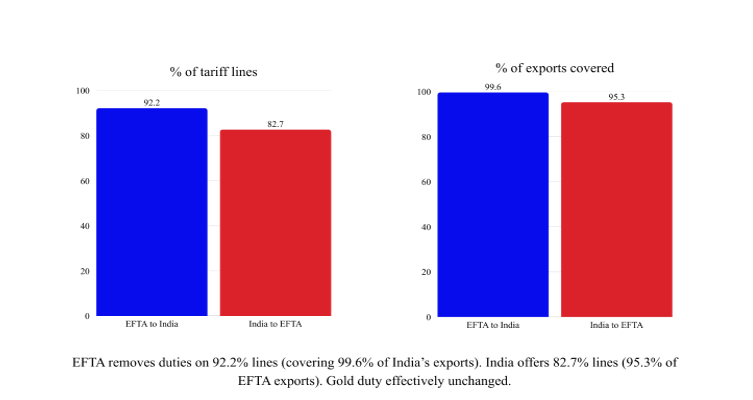
About TEPA
- What it is?
- A comprehensive Free Trade Agreement (FTA) between India and the European Free Trade Association (EFTA).
- First Indian FTA linking trade, investment, and job creation.
- Signed on:
- 10th March 2024 in New Delhi
- EFTA Members:
- Switzerland (India’s largest EFTA trade partner)
- Norway
- Iceland
- Liechtenstein
Key Features
| Key Area | Provisions / Highlights |
|---|---|
| 1. Investment & Employment | • $100 billion FDI commitment over 15 years • 1 million direct jobs in manufacturing & services |
| 2. Market Access for Goods | • EFTA offers zero-duty access on 92.2% tariff lines • Covers 99.6% of India’s exports |
| 3. Services & Mobility | • Commitments in 100+ sub-sectors (IT, education, audiovisual, business services) • Mutual Recognition Agreements (MRAs) in nursing, architecture, chartered accountancy • Facilitates: Mode 1 (Digital delivery), Mode 3 (Commercial presence), Mode 4 (Personnel mobility) |
| 4. Intellectual Property Rights (IPR) | • TRIPS+ standard with safeguards for generic medicines • Prevents patent evergreening while protecting innovation |
| 5. Sustainable Development | • Focus on green growth, social inclusion, and environmental protection • Encourages technology collaboration in renewable energy, precision engineering, and health sciences |
2. Dugong Conservation in India
Source: IE
Context:
The International Union for Conservation of Nature (IUCN) has recognised Tamil Nadu’s Dugong Conservation Reserve in Palk Bay as a global model for marine biodiversity conservation during the IUCN World Conservation Congress 2025.
Key Highlights:
- First Dugong Reserve of India: Declared in September 2022 under the Wildlife Protection Act, 1972.
- Location & Size: Spread over 448.34 sq. km in northern Palk Bay, Tamil Nadu; includes 12,250 hectares of seagrass meadows.
- IUCN Recognition: Motion proposed by Omcar Foundation, supported by 98% of countries/agencies and 94.8% NGOs/research bodies.
- Species Focus: Dugongs (Dugong dugon), listed as Vulnerable on the IUCN Red List.
- Ecological Role: Seagrass meadows provide feeding grounds, support biodiversity, and act as carbon sinks.
3. Female Labour Force Participation in India
Context:
The Female Labour Force Participation Rate (FLFPR) measures the share of women who are employed or actively seeking work. While India’s FLFPR fell from 31.2% in 2011-12 to 23.3% in 2017-18, it rose sharply to 41.7% in 2023-24, driven mainly by rural women.
Female Labour Force Participation Rate (FLFPR)
- Female Labour Force Participation Rate (FLFPR) is the proportion of women (aged 15 years and above) who are either employed (working) or actively seeking employment.
- It is a key indicator of gender equality, economic inclusion, and social progress.
Key Highlights:
| Dimension | Key Findings (2017-18 / 2018-19 vs 2023-24) |
|---|---|
| Earnings vs Participation | • Female Labour Force Participation Rate (FLFPR) rose, but real earnings declined for most women (except casual workers). • Increased participation ≠ better-paid or secure jobs. |
| Sectoral Composition | • Share of rural women in agriculture increased: 71.1% (2018-19) → 76.9% (2023-24). • Decline in women’s employment in secondary (industry) and tertiary (services) sectors. |
| Shift from Domestic Duties | • Women reporting domestic duties fell: 57.8% (2017-18) → 35.7% (2023-24). • Helpers in household enterprises: 9.1% → 19.6%. • Own account workers/employers: 4.5% → 14.6%. • Indicates shift mainly to self-employment, not wage employment. |
| Vulnerabilities | • Helpers in household enterprises often unpaid/low-paid, blurring line between employment & domestic labour. • Even among self-employed women, real earnings declined, showing persistent income insecurity. |
Banking/Finance
1. FPI Outflows from Indian Equities
Context:
Foreign Portfolio Investors (FPIs) withdrew ₹23,885 crore from Indian stocks in September 2025, marking the third consecutive month of net outflows, according to NSDL data.
What are Foreign Portfolio Investors (FPIs)?
- FPIs are investors (institutions, hedge funds, individuals) registered with SEBI who invest in Indian financial assets like:
- Stocks
- Bonds
- Mutual funds
- Investments are made in secondary markets and can be withdrawn quickly.
Characteristics
- Short-term & liquid investments.
- Highly sensitive to global interest rates, currency, and risk sentiment.
- Governed by SEBI FPI Regulations, 2019.
Impact of FPI Flows on Indian Market
- Outflows → Stock market correction, rupee depreciation, higher volatility.
- Inflows → Boost to equity valuations, liquidity, and investor confidence.
- FPIs hold ~16–18% of Indian market capitalization, making their flows crucial for market sentiment.
FPI vs FDI
| Feature | Foreign Portfolio Investment (FPI) | Foreign Direct Investment (FDI) |
|---|---|---|
| Nature | Investment in financial assets (stocks, bonds, etc.) | Investment in physical assets/companies (factories, infrastructure, JV) |
| Duration | Short-term, liquid | Long-term, stable |
| Control | No control over management | Provides management control/ownership |
| Volatility | Highly volatile (quick entry & exit) | Stable and less volatile |
| Regulation | SEBI (Securities market regulator) | DPIIT + RBI (FEMA guidelines) |
2. ADB Downgrades India’s Growth Outlook for FY26
Source: TH
Context:
The Asian Development Bank (ADB) has lowered India’s economic growth forecast for the current financial year (2025-26) to 6.5% from the earlier 6.7%, mainly due to the impact of 50% U.S. tariffs on imports from India. The growth outlook for 2026-27 has also been revised downward to 6.5% from 6.8%.
Key Highlights:
| Dimension | Key Highlights |
|---|---|
| Growth Forecast | • Developing Asia’s growth for 2025 revised: 4.9% → 4.8%. • 2026 forecast cut: 4.7% → 4.5%. • Downgrades due to global uncertainty, especially in India & Southeast Asia. |
| Impact of U.S. Tariffs | • Elevated tariffs cover ~60% of exports to the U.S. • Key affected sectors: textiles, garments, jewellery, shrimp, chemicals. • Likely to weigh on growth in H2 2025-26 and 2026-27. • Merchandise export growth modest, but services exports remain strong. • Investment growth subdued amid trade uncertainty. |
| Domestic Demand & Consumption | • Consumption demand expected to grow faster, aided by lower food prices and tax cuts. • Public investment continues to support growth momentum. |
| Inflation Outlook | • FY26 inflation revised down to 3.1% due to low oil & falling food prices. • FY27 inflation projected at 4.2% as food prices normalize. |
3. India’s Fiscal Deficit
Context:
The Centre’s fiscal deficit for April–August 2025 stood at 38.1% of the full-year Budget Estimate (BE), as per data released by the Controller General of Accounts (CGA).
What is Fiscal Deficit?
- The shortfall between the government’s total expenditure and total revenue (excluding borrowings).
- Formula:
Fiscal Deficit = Total Expenditure – (Revenue Receipts + Non-debt Capital Receipts) - It shows how much the government needs to borrow to finance its expenditure.
What to Do When Fiscal Deficit Occurs?
Governments adopt a mix of short-term financing measures and long-term structural reforms:
Short-term Financing (Bridging the Gap)
- Borrowings: From domestic market (bonds, securities) or foreign sources.
- Disinvestment: Selling govt stake in PSUs to raise capital.
- Use of Reserves: Dividend transfers from RBI/PSUs.
- External Aid/Loans: From multilateral institutions (World Bank, ADB, AIIB).
Long-term Structural Measures
- Boost Revenue:
- Widen tax base (GST, direct tax compliance).
- Improve non-tax revenues (dividends, fees, spectrum auctions).
- Rationalise Expenditure:
- Cut down subsidies/leakages.
- Better targeting via DBT (Direct Benefit Transfer).
- Prioritise productive capex over revenue expenditure.
- Reforms for Growth:
- Encourage FDI, FPI, private investment.
- Infrastructure push to boost GDP and tax collection.
Last Resort
- Monetisation of Deficit (RBI printing money) – Inflationary, avoided in normal times.
Types of Deficit
| Type of Deficit | Formula | Meaning | Implication |
|---|---|---|---|
| Fiscal Deficit | Total Expenditure – (Revenue Receipts + Non-debt Capital Receipts) | Borrowing requirement of govt. | Indicates debt burden. |
| Revenue Deficit | Revenue Expenditure – Revenue Receipts | Govt borrowing to meet daily expenses. | Fiscal imprudence. |
| Primary Deficit | Fiscal Deficit – Interest Payments | Borrowings excluding past debt interest. | Shows fresh burden of current policies. |
| Effective Revenue Deficit | Revenue Deficit – Grants for capital creation | Refines revenue deficit by excluding productive transfers. | Used in Budget targets. |
| Monetised Deficit | Part of Fiscal Deficit financed by RBI printing new money | Direct monetisation of deficit. | Highly inflationary, rarely used now. |
4. RBI Launches Scheme to Activate Inoperative Accounts and Settle Unclaimed Deposits
Source: News on Air
Context:
The Reserve Bank of India (RBI) has launched a one-year incentive scheme (October 2025 – September 2026) to encourage banks to reactivate inoperative accounts and repay unclaimed deposits to rightful claimants.
What is an Inoperative Account?
- A bank savings/current account that has had no customer-initiated transactions for 2 years (as per RBI guidelines).
- Balance remains but account is inactive until reactivated by the customer.
Key Highlights:
- Incentives for Banks:
- Banks will receive 5%–7.5% of amounts (up to ₹25,000) for:
- Reactivating inoperative accounts.
- Settling unclaimed deposits with legitimate owners.
- Payouts are linked to:
- Account age – older inoperative accounts may attract higher incentives.
- Deposit size – larger unclaimed amounts may receive proportionate rewards.
- Banks will receive 5%–7.5% of amounts (up to ₹25,000) for:
- Objective:
- Reduce the stock of dormant/inoperative accounts in the banking system.
- Ensure depositors receive their rightful funds, improving customer trust in banks.
5. SEBI Seeks Disclosures on Promoters’ In-Laws and Related Entities
Source: TOI
Context:
The Securities and Exchange Board of India (SEBI) has clarified that listed companies must disclose information about the relatives of promoters, including:
- Spouse’s parents
- Married children’s spouses and their parents
- Entities where these relatives hold over 20% shareholding, even if they do not own shares in the listed company
What is the New Proposal?
- Promoter-related disclosures to be expanded.
- Now, listed companies must also disclose relationships with:
- Promoters’ in-laws (beyond immediate family).
- Entities where such relatives hold beneficial interest or control.
Why is SEBI Doing This?
- Current loophole: Some promoters route money through relatives (like in-laws) or associated entities to avoid RPT scrutiny.
- SEBI wants to plug gaps and ensure all such transactions are reported to exchanges.
- Strengthens protection for minority shareholders.
Related-Party Transactions (RPTs)
- Any deal between a company and its related entities/individuals.
- Includes promoters, directors, relatives, and entities under their control.
- Must be disclosed and, in some cases, approved by shareholders.
6. RBI Governor to Chair New Payments Regulatory Board (PRB)
Source: IE
Context:
The Reserve Bank of India (RBI) has constituted a six-member Payments Regulatory Board (PRB) to regulate payment systems in India. The board replaces the existing Board for Regulation and Supervision of Payment and Settlement Systems (BPSS).
Composition of PRB:
- Chair: RBI Governor Sanjay Malhotra
- RBI Members (3):
- Deputy Governor
- Executive Director in charge of Payment and Settlement Systems
- Governor
- Government Nominees (2):
- Secretary, Department of Financial Services (DFS)
- Secretary, Ministry of Electronics and Information Technology (MeitY)
- Additional Member: Aruna Sundararajan, former MeitY secretary
- Permanent Invitee: RBI’s Principal Legal Adviser
Functions and Meetings:
- Regulates payment systems in India
- Will ordinarily meet at least twice a year
- Replaces BPSS, which had no government representatives and was a five-member body
Background:
- The move follows recommendations from an inter-ministerial committee headed by the Economic Affairs Secretary.
- The committee suggested amendments to the Payment and Settlement Systems Act, 2007 and proposed an independent regulatory board to handle payment-related issues.
7. RBI Raises Overseas Perpetual Debt Limit for Banks
Source: BS
Context:
The Indian central bank has raised the limit for perpetual debt that banks can raise overseas and use as part of their core capital, according to a circular
Key Highlights:
- Regulator: Reserve Bank of India (RBI) issued a circular allowing banks to raise perpetual debt overseas and include it in their core capital.
- Perpetual Debt: A type of debt without a fixed maturity date, often used by banks to strengthen capital buffers.
- Purpose: Eligible for inclusion in Additional Tier-1 (AT1) capital, which forms part of a bank’s core capital under Basel III norms.
- Additional Tier-1 (AT1) Capital: Additional Tier-1 (AT1) capital is a component of a bank’s regulatory capital that is perpetual in nature (no fixed maturity) and absorbs losses to help banks remain solvent during financial stress.
- It is part of the Tier-1 capital, which is considered core capital, along with Common Equity Tier-1 (CET1).
Updated Guidelines
- Limit for AT1 Inclusion: Banks can now include up to 1.5% of Risk-Weighted Assets (RWA) through perpetual debt.
- Risk-Weighted Assets (RWA): Risk-Weighted Assets (RWA) are a bank’s assets weighted by credit risk. They represent the total assets of a bank adjusted for the riskiness of each asset, rather than just the raw book value.
- Foreign Issuance: Debt issued in foreign currency or in Indian rupees overseas can now be fully counted towards the 1.5% AT1 limit.
- Earlier Norms: Previously, only less than half of the 1.5% AT1 limit could be raised overseas, the rest had to be domestic.
Significance
- Strengthens Bank Capital: Helps banks bolster their core capital to meet regulatory requirements.
- Flexibility: Provides banks with more leeway to raise funds globally, improving capital adequacy and liquidity.
- Cost Advantage: Overseas debt may offer competitive interest rates and access to a broader investor base.
8. PhonePe and Mastercard Launch Tap-and-Pay Feature
Source: BS
Context:
Fintech giant PhonePe and Mastercard have introduced a new feature allowing Mastercard cardholders to make in-store transactions via tap-and-pay using NFC-enabled smartphones.
Key Details:
- Mastercard users can tap their smartphones at NFC-enabled payment terminals to complete purchases.
- The feature also supports tokenised e-commerce transactions on NFC-capable Android smartphones.
- Cardholders can save their Mastercard credit, debit, and prepaid cards on their smartphones for seamless payments.
9. Major Rule Changes Effective from October 1, 2025
Source: ET
Context:
From October 1, 2025, several important regulatory and policy changes across banking, pensions, ticketing, and postal services will take effect. These changes aim to improve efficiency, enhance transparency, and provide greater flexibility to consumers.
Banking – Cheque Clearing
- What’s new? Cheque clearing moves from batch clearing to continuous clearing.
- Phased implementation:
- Phase 1: October 4, 2025 – January 2, 2026.
- Phase 2: Full roll-out after January 2, 2026.
- Impact: Faster settlement and reduced delay in fund transfers.
IRCTC Ticket Reservation
- New rules for general category online bookings.
- Aadhaar-based authentication mandatory in certain cases to prevent misuse.
- Impact: Reduces fraudulent and bulk ticket bookings.
NPS (National Pension System)
- 100% equity option allowed for non-government subscribers.
- Investors can maintain multiple schemes under one PRAN across different Central Recordkeeping Agencies (CRAs).
- Deadline: Government employees cannot switch from Unified Pension Scheme (UPS) to NPS after September 30, 2025.
- Impact: More flexibility, potentially higher returns for investors.
Banking Service Charges
- PNB, YES Bank, and others revising service charges.
- Affects locker rent, stop payment, nomination services, and standing instruction failure fees.
- Impact: Customers may face higher costs, need to check bank notifications.
Postal Services
- Speed Post tariff revision and new features.
- OTP-based delivery authentication and GST split shown separately in invoices.
- Impact: Better transparency and customer trust in India Post services.
10. RBI Raises Limit for Perpetual Debt in Banks’ Core Capital
Source: BS
Context:
The Reserve Bank of India (RBI) has revised rules on perpetual debt inclusion in banks’ capital structure, allowing a higher share of such debt raised overseas to count towards Additional Tier-1 (AT1) capital.
What is Perpetual Debt?
- A type of debt instrument that has no maturity date.
- Banks pay interest (coupon) on it indefinitely, but principal is not repaid.
- Treated as quasi-equity in regulatory terms.
RBI’s New Guidelines
- Earlier Rule: Perpetual debt up to 1.5% of Risk-Weighted Assets (RWA) could be counted in AT1 capital, but less than half was allowed from foreign currency or rupee-denominated bonds issued overseas.
- New Rule (Sept 2025): Entire 1.5% of RWA can now be raised overseas, either in foreign currency or in rupees issued abroad.
- Impact: Gives banks more flexibility to access cheaper global funds.
Why It Matters
- Strengthens Core Capital: AT1 capital is part of banks’ Basel-III capital framework, critical for absorbing financial shocks.
- Diversified Funding: Reduces over-reliance on domestic markets, allowing banks to tap global investors.
- Boosts Lending Capacity: Higher capital adequacy means more room to expand credit.
Related Concepts
- Risk-Weighted Assets (RWA): Bank assets (like loans, investments) adjusted for risk levels; used to calculate minimum capital requirements.
- Additional Tier-1 (AT1) Capital: The core capital of banks, consisting of equity and perpetual instruments, used to absorb losses while the bank is still a going concern.
Agriculture
1. Farmer Suicides in India – NCRB 2023 Data
Source: TH
Context:
The National Crime Records Bureau (NCRB) reported that 10,786 farmers and agricultural workers committed suicide in 2023. This continues a trend of over 10,000 farm sector suicides annually, highlighting ongoing distress in agriculture.
Key Highlights:
- State-wise Distribution:
- Maharashtra: 38.5% of cases (highest), especially Marathwada and Vidarbha cotton/soybean belts.
- Karnataka: 22.5%
- Andhra Pradesh: 8.6%
- Madhya Pradesh: 7.2%
- Tamil Nadu: 5.9%
- Several states reported no farm suicides: West Bengal, Bihar, Odisha, Jharkhand, Himachal Pradesh, Arunachal Pradesh, Goa, Manipur, Mizoram, Nagaland, Tripura, Chandigarh, Delhi, Lakshadweep.
- Farmer vs Agricultural Worker Suicides:
- Farmers/Cultivators: 4,690 (4,553 male; 137 female)
- Agricultural Workers: 6,096 (5,433 male; 663 female)
- Farm sector suicides accounted for 6.3% of total suicides (1,71,418) in India in 2023.
- Causes & Concerns:
- Farmer organisations blame government policies, including the waiver of import duty on cotton, which could impact domestic cotton farmers.
- Marathwada and Vidarbha regions are particularly affected.
- Critics argue that trade agreements and imports from the U.S. threaten the livelihoods of smallholders.
2. AVPL Launches Tech Park to Indigenize Drone Components
Source: BL
Context:
AVPL Ltd (AITMC Ventures Limited International), an integrated agri-drone company, is looking at indigenizing the drone ecosystem in the country in league with component manufacturers, said Preet Sandhu, co-founder and Chairperson, AVPL Ltd.
Objective: To reduce dependence on imported drone parts, enhance supply chain resilience, and foster innovation in the agricultural drone industry.
Key Features of the Tech Park
- Location: Situated in a strategic area to facilitate research, development, and production activities.
- Facilities: Equipped with state-of-the-art laboratories, testing zones, and assembly lines for drone components.
- Focus Areas:
- Development of autonomous navigation systems.
- Creation of lightweight drone frames.
- Integration of AI-powered sensors for precision agriculture.
- Manufacturing of high-capacity batteries tailored for agricultural drones.
Potential Impact on Agriculture
- Enhanced Productivity: Drones equipped with advanced sensors can monitor crop health, optimize pesticide use, and improve irrigation efficiency.
- Data-Driven Decisions: Real-time data collection enables farmers to make informed decisions, leading to better yield and resource management.
- Sustainability: Precision agriculture practices promoted by drone technology contribute to sustainable farming by minimizing chemical usage and conserving water.
Facts To Remember
1. BJP leader V.K. Malhotra passes away at 93
Veteran Bharatiya Janata Party (BJP) leader Vijay Kumar Malhotra, a five-time Lok Sabha member from Delhi, passed away on Tuesday morning after a brief illness. He was 93.
2. Sumit completes a hat-trick of titles with meet record
Sumit completes a hat-trick of titles with meet record with a season’s best of 72.35m, almost 25 metres more than the personal best of his closest competitor in the F64 javelin throw category, the two-time Paralympic champion and world record holder had only himself to beat on day four of the World Para Athletics.
3. Vinay wins trap bronze; Indian pairs make it a 1-2 in mixed air rifle
Vinay Pratap Chandrawat fought his way to the trap bronze, even as the Indian mixed air rifle teams clinched the gold and silver, in the Junior World Cup.
4. Srihari wins his fifth medal, Rohit claims silver in 50m butterfly
Star Indian swimmer Srihari Nataraj once again stood tall, bagging a bronze in the 100m freestyle to extend his personal haul to five medals at the 11th Asian aquatics championships.
5. Isha & Himanshu clinch 10m rifle gold
Indian shooters continued their winning run at the ISSF Junior World Cup by winning gold and silver at the Dr Karni Singh Shooting Range.
6. Nehra breaches 80m to claim javelin gold
Rishabh Nehra became India’s newest member of the 80m club as he grabbed the javelin gold at the National Open Athletics Championships in Ranchi.
7. Indian Railways to Launch First Container Service with Assured Transit Time
Indian Railways, in partnership with Container Corporation of India (CONCOR), will launch its first container train service with assured transit time on a pilot basis from October 1, 2025.
2&3 October, 2025
Daily Current Affairs Quiz
2 & 3 October, 2025
National Affairs
1. Beti Bachao, Beti Padhao Completes a Decade
Context:
The Beti Bachao, Beti Padhao (BBBP) scheme, launched in 2015, has completed 10 years, registering progress in sex ratio at birth and girls’ education outcomes across India. The initiative has been implemented as a convergence of Women & Child Development (WCD), Health, and HRD Ministries.
Beti Bachao, Beti Padhao (BBBP) Scheme
- Launch: 22 January 2015 by the Government of India at Panipat, Haryana.
- Nodal Ministry: Ministry of Women and Child Development (MoWCD) in collaboration with the Ministry of Health & Family Welfare (MoHFW) and the Ministry of Education (MoE, formerly HRD).
- Objective: To prevent gender-biased sex-selective elimination (female foeticide), ensure survival & protection of the girl child, and promote her education & participation.
Achievements of BBBP
- Sex Ratio at Birth (SRB): Improved from 919 (2015–16) to 929 (2019–21).
- State-level performance: 20 out of 30 States/UTs now above the national average.
- Awareness impact: Surveys (e.g., Madhya Pradesh) show 89.5% people aware of BBBP, with 63.2% motivated to send daughters to school.
- Education outcomes: Higher enrollment of girls in secondary schools and improved transition rates.
2. ANRF launches SARAL Tool to Simplify Scientific Research
Source: TH
Context:
The Anusandhan National Research Foundation (ANRF) has launched the SARAL Tool (Simplified and Automated Research Amplification and Learning). It is an AI-powered platform designed to simplify complex research papers into easy-to-understand summaries.
About SARAL Tool
- Full Form: Simplified and Automated Research Amplification and Learning.
- Developed by: Anusandhan National Research Foundation (ANRF).
- Purpose: To make scientific knowledge inclusive and accessible for citizens, policymakers, academia, and industry.
Key Features
- AI-driven Summaries: Extracts key insights from research papers and converts them into simplified versions.
- Multi-Format Outreach: Generates videos, podcasts, posters, and presentations to increase reach.
- Science Communication: Bridges the gap between researchers and the general public.
- Integration with AI Open India Stack: Linked to the upcoming AI Science & Engineering Open India Stack for applications in:
- Drug discovery
- Aerospace
- Climate science
- Advanced materials
Banking/Finance
1. RBI MPC Meeting – October 1, 2025
Context:
The Reserve Bank of India (RBI), in its October 2025 Monetary Policy Committee (MPC) meeting, kept the repo rate unchanged at 5.5% with a neutral stance. The decision comes amid tariff-related uncertainties, the need to evaluate the impact of previous rate cuts, and an improving domestic macroeconomic outlook.
Policy Decisions
- Repo Rate: Unchanged at 5.50% (second consecutive pause)
- Monetary Policy Stance: Neutral
- Cumulative Rate Cuts in 2025: 100 bps (Feb, Apr, Jun) → from 6.5% to 5.5%
Macro Outlook
- GDP Growth (FY26): Revised upward to 6.8% (from 6.5%)
- CPI Inflation (FY26): Revised downward to 2.6% (from 3.1%)
Rationale
- Tariff Uncertainties: May weigh on exports, create near-term risks.
- GST Rationalisation: Expected to lower inflation and boost demand.
- Global Headwinds: Persist as a risk factor.
Key Regulatory & Structural Announcements
- Expected Credit Loss (ECL) Framework
- Applicable to all Scheduled Commercial Banks from April 1, 2027.
- Forward-looking provisioning → enhances credit discipline.
- Basel III Norms
- Revised capital adequacy framework to be implemented from April 1, 2027.
- Strengthens resilience of banks through higher buffers.
- Group Entities Regulation
- Restrictions on overlaps between banks and group entities to be removed.
- Provides flexibility in operations.
- Risk-Based Insurance Premium
- RBI to introduce differentiated deposit insurance premium framework for banks based on risk profile.
- Capital Market Lending Expansion
- Removal of regulatory ceiling on lending against listed debt securities.
- Lending against shares: Raised to ₹1 crore (from ₹20 lakh per person).
- IPO Financing: Enhanced to ₹25 lakh (from ₹10 lakh per person).
Implications
For Economy
- Growth-supportive stance despite global uncertainty.
- Stable repo rate → supports investment and consumption.
- Upward GDP revision signals confidence in domestic recovery.
For Banks & Financial Institutions
- ECL & Basel III norms (from 2027) → strengthen risk management, capital adequacy.
- More freedom in capital market lending → deepens debt & equity markets.
- Higher IPO financing limits → encourages retail/HNI participation.
For Borrowers & Investors
- Loan EMIs remain stable (repo unchanged).
- Retail investors benefit from higher lending against shares & IPO financing.
- Lower inflation outlook → real interest rates remain supportive.
Key Terms
| Term | Definition | Impact / Purpose |
|---|---|---|
| Repo Rate | Rate at which RBI lends short-term funds to commercial banks against government securities as collateral. | ↑ Repo → Loans costly → Inflation control. ↓ Repo → Loans cheaper → Boosts growth. |
| Reverse Repo Rate | Rate at which RBI borrows money from commercial banks. | ↑ Reverse Repo → Absorbs liquidity → Controls inflation. ↓ Reverse Repo → Banks lend more → Boosts growth. |
| ECL (Expected Credit Loss) Framework | Forward-looking provisioning system where banks estimate expected loan losses instead of waiting for defaults. | Strengthens banking sector resilience by reducing risk of sudden shocks. |
| Basel III Norms | International banking reforms focusing on capital adequacy, leverage, and liquidity standards. | Ensures financial stability, prevents systemic risks, enhances risk management. |
2. RBI MPC October 2025 – Key Takeaways
Context:
- The Reserve Bank of India (RBI) conducted the 57th Monetary Policy Committee (MPC) meeting from 29 September – 1 October 2025.
- Policy stance: Neutral, keeping growth-supportive measures while monitoring inflation and external risks.
- Objective: Support domestic demand, maintain financial stability, and ensure orderly liquidity.
Policy Rates
| Instrument | Rate | Remarks |
|---|---|---|
| Repo Rate | 5.50% | Unchanged (second consecutive pause) |
| Reverse Repo (SDF) | 5.25% | By convention, 25 bps below repo |
| Bank Rate & MSF | 5.75% | No change |
- Cumulative rate cuts in 2025: 100 bps (Feb, Apr, Jun) from 6.5% → 5.5%.
Macro Outlook
GDP Growth (FY26)
- Revised upward to 6.8% from 6.5% in August projection.
- Quarterly forecast:
- Q1 FY26: 7.8%
- Q2 FY26: 7.0%
- Q3 FY26: 6.4%
- Q4 FY26: 6.2%
- Q1 FY27: 6.4%
- Drivers: Strong consumption, investment, government spending, good monsoon, GST rationalisation, and rising capacity utilisation.
CPI Inflation (FY26)
- Revised downward to 2.6% from 3.1%.
- Quarterly forecast:
- Q1 FY26: 4.5%
- Q2 FY26: 1.8%
- Q3 FY26: 1.8%
- Q4 FY26: 4.0%
- Factors: Food disinflation, mild fuel inflation, GST rationalisation, favourable base effects.
External Sector
- Current Account Deficit (CAD): 0.2% of GDP in Q1 FY26 (down from 0.9% last year).
- Services exports: double-digit growth; remittances: US$35.3 billion.
- Merchandise exports: +2.5%, imports: +2.1% (April–August 2025).
- FDI inflows: US$37.7 billion (April–July 2025).
Key Regulatory & Structural Announcements
- Banking & Risk Management
- ECL Framework: Forward-looking provisioning for all scheduled commercial banks from April 1, 2027.
- Basel III Norms: Revised capital framework effective April 1, 2027.
- Risk-Based Insurance Premium: Differential insurance premium for banks based on risk profile.
- Group Entities Regulation: Remove restrictions on overlaps between banks and group entities.
- Credit Flow & Capital Market Lending
- Removal of ceiling on lending against listed debt securities.
- Lending against shares limit raised from ₹20 lakh → ₹1 crore per person.
- IPO financing limit raised from ₹10 lakh → ₹25 lakh per person.
- NBFC lending to high-quality infrastructure: lower risk weights.
- Credit limit thresholds for large borrowers revised.
- External / FX & Ease of Doing Business
- Rationalisation of ECB/FEMA rules (borrowers, lenders, end-use norms, reporting).
- Exporters’ FCY repatriation extended: 1 → 3 months.
- Merchanting trade repatriation extended: 4 → 6 months.
- Promote INR cross-border transactions with Bhutan, Nepal, Sri Lanka.
- Financial Inclusion & Consumer Protection
- Strengthen Basic Savings Bank Deposit (BSBD) accounts.
- Revise RBI Ombudsman Scheme, including rural cooperative banks.
- Strengthen Internal Ombudsman mechanisms in regulated entities.
- Acquisition financing:
- Banks now allowed to finance mergers & acquisitions (M&A) of Indian companies, addressing a long-standing demand.
- Credit exposure liberalisation:
- Limit on lending to large corporates removed, previously capped under the 2016 circular.
- RBI to monitor system-level concentration risk rather than individual banks.
- Collateral and credit limits:
- Increased loan limits against shares, REITs, InvITs.
- Ceiling removed on loans against listed debt securities.
- Higher limits for financing IPOs and loans against shares for individuals.
Implications
For the Economy:
- Growth-supportive stance encourages investment and consumption.
- Lower inflation maintains purchasing power and real rates.
- External stability (CAD narrowing) supports rupee and financial markets.
For Banks & Financial Institutions:
- ECL and Basel III require stronger capital adequacy and risk management.
- Expanded capital market lending fosters market depth.
- Higher IPO financing supports retail and HNI participation.
For Borrowers & Investors:
- Loan EMIs stable due to unchanged repo.
- Real interest rates favorable amid lower inflation.
- Retail investors benefit from higher financing limits for shares and IPOs.
Key Terms for RBI Grade B / Exams
- Repo Rate: Rate at which RBI lends short-term funds to banks against government securities. Tool to control liquidity and inflation.
- Reverse Repo Rate: Rate at which RBI borrows from banks. Absorbs liquidity or encourages lending depending on level.
- ECL Framework: Forward-looking provisioning system; banks estimate expected credit losses.
- Basel III: International banking reforms to strengthen capital, liquidity, and leverage standards.
- CPI Inflation: Consumer Price Index; measures average change in prices of goods and services consumed by households.
- CAD (Current Account Deficit): Difference between imports & exports of goods, services, and net transfers.
3. RBI Withdraws System-Level Lending Cap for Large Corporates
Source: BS
Context:
The Reserve Bank of India (RBI) has withdrawn its 2016 circular that restricted banks from lending beyond a specified threshold to a single large corporate or group at the systemic level, while maintaining the large exposure framework at individual bank level.
Key Highlights:
- Previous Circular:
- Set credit exposure limits at the banking system level:
- ₹25,000 crore in FY18 → ₹15,000 crore in FY19 → ₹10,000 crore from FY20.
- Aimed to reduce concentration risk across the banking system.
- Set credit exposure limits at the banking system level:
- Current Framework:
- Large Exposure Framework continues:
- Single borrower: ≤20% of Tier-1 capital
- Corporate group: ≤25% of Tier-1 capital
- Large Exposure Framework continues:
- Reason for Withdrawal:
- Share of corporates in total banking exposure has fallen by ~10%, reducing systemic risk.
- The circular is no longer necessary to ensure financial stability, and its removal eases compliance burdens.
Market and Banking Impact
- Corporate credit demand remains muted due to:
- Slower capex cycle
- Alternative funding sources (bond markets, ECBs)
- Healthy cash reserves
- Some incremental lending may flow into:
- Infrastructure
- MSME sectors
- Potential funds returning to banks from bonds/ECBs: ₹3–4.5 trillion
4. RBI Proposes Lower Risk Weights for NBFC Infrastructure Loans
Source: BS
Context:
The Reserve Bank of India (RBI) has proposed reducing risk weights for loans by Non-Banking Financial Companies (NBFCs) to operational, high-quality infrastructure projects.
- Objective: Reduce the cost of infrastructure financing, improve risk assessment, and optimise capital allocation.
- The framework will be principle-based, allowing NBFCs more discretion in assigning risk weights for infrastructure lending.
Key Highlights
Scope of Proposal
- Applies to NBFCs lending to operational infrastructure projects.
- Draft regulations will be issued for public consultation before implementation.
- Existing norms already allow lower-risk weights for PPP projects; the proposal extends clarity and flexibility for other operational projects.
Expected Impact
- Cost of financing: Reduced for NBFCs, potentially making infrastructure projects more viable.
- Competitiveness: Other NBFCs beyond IDFs and IFCs can benefit, expanding financing sources.
- Market participation: Could attract new players to infrastructure lending.
Risks & Cautions
- Supervisory oversight is essential to avoid underestimation of risks.
- Excessive lowering of risk weights may lead to over-leveraging and concentration in infrastructure portfolios.
- NBFCs need prudent capitalisation to maintain strong credit profiles.
5. RBI to Consider Issuance of New Urban Cooperative Bank (UCB) Licences
Source: BL
Context:
The Reserve Bank of India (RBI) has announced plans to issue a discussion paper on licensing new banks in the Urban Cooperative Banking (UCB) sector, indicating a shift in policy after nearly two decades.
Background
- 2004 Freeze: Fresh licenses for UCBs were stopped due to weak financial health and governance issues in the sector.
- The decision to explore new licences comes in light of improved financial performance and regulatory compliance among existing UCBs.
- Consolidation Drive (2004–24):
- Amalgamation of unviable UCBs.
- Closure of non-viable entities.
- Suspension of new licenses.
- As a result, the number of UCBs fell from 1,926 (2004) to 1,472 (March 2024).
What are UCBs?
- Urban Cooperative Banks (UCBs) are cooperative banks operating in urban and semi-urban areas, primarily catering to small borrowers, traders, low- and middle-income groups.
- They are organised under the cooperative structure but perform banking functions like accepting deposits, lending, remittances, and other retail banking services.
RBI Governance of UCBs
| Aspect | Legal Framework / Authority | Scope of Regulation |
|---|---|---|
| Banking Regulation Act, 1949 | Applied to UCBs since 1966; regulated by RBI | Banking activities such as deposit mobilization, lending, capital adequacy, prudential norms, and supervision. |
| State Cooperative Societies Act | Registration under respective State Act | Governance, management elections, audit, and administrative control at the state level. |
| Multi-State Cooperative Societies Act, 2002 | Registration if UCBs operate in more than one state | Governance, management elections, audit, and administration under Central Registrar of Cooperative Societies. |
6. RBI Eases Bank Lending to Boost Corporate Growth and Capital Markets
Context:
The RBI has introduced its most comprehensive reforms in bank lending, targeting both corporate and individual borrowers. The aim is to reverse disintermediation (where companies bypass banks for funding), strengthen capital markets, and support economic growth.
Key Reforms and Implications
Corporate Lending and Acquisitions
- Banks can now finance mergers and acquisitions, reducing the cost of corporate takeovers.
- This encourages leveraged buyouts and supports a strong pipeline of new issues, improving corporate access to capital.
- Bank credit growth has lagged behind economic growth; these measures aim to expand banks’ corporate lending books.
Lending to Large Companies
- Withdrawal of the 2016 lending cap framework will allow banks to lend more flexibly.
- Freed resources can be directed to productive economic activity, such as infrastructure and MSMEs.
Individual Investor Lending
- Higher caps on loans for individuals investing in IPOs and shares will maintain investor interest in emerging and high-performing companies.
- This also improves liquidity in the equity market.
Risk Management and Prudential Measures
- Lower risk weights for infrastructure loans support ongoing capex projects.
- Ceilings on lending against debt securities removed, allowing banks more flexibility.
- RBI is shifting towards macroprudential regulation, focusing on systemic risk rather than punitive lending limits.
- Phased transition to international credit risk frameworks ensures minimal disruption.
External Commercial Borrowing (ECB) and Export Credit
- Revised ECB norms will expand the pool of eligible borrowers and lenders, relax borrowing limits, and simplify reporting.
- Export credit rules are being eased to improve ease of doing business.
7. Nuvama Wealth Gets SEBI Approval to Set Up Mutual Fund Business
Source: BS
Context:
Nuvama Wealth Management Ltd. (formerly Edelweiss Securities arm) has received regulatory clearance from the Securities and Exchange Board of India (SEBI) to enter the mutual fund (MF) industry as a sponsor.
SEBI Norms: Eligibility of a Mutual Fund Sponsor
The sponsor is the promoter who sets up the mutual fund and AMC. According to SEBI (Mutual Funds) Regulations, 1996, the following conditions must be fulfilled:
| Criteria | Key Requirements |
|---|---|
| Track Record & Reputation | • Minimum 5 years of business track record in financial services. • Positive net worth in each of the last 5 years. • Net worth > ₹50 crore in the immediately preceding year. • Profitability in at least 3 out of 5 years. |
| Fit & Proper Criteria | • Must satisfy SEBI’s “fit and proper person” norms. • No record of fraud, conviction, or regulatory violations. |
| Shareholding & Contribution | • Sponsor must contribute ≥ 40% of AMC’s net worth. • Minimum AMC net worth: ₹50 crore (as per latest SEBI amendments). • Contribution ensures “skin in the game”. |
| Professional Setup | • AMC & Trustee Co. must have ≥ 50% independent directors/trustees. • No conflict of interest with the sponsor. |
| Regulatory Approval | • SEBI conducts due diligence on financial strength, governance, compliance history, and risk management before granting approval. |
8. Fin-Influencers
Context:
The Securities and Exchange Board of India (SEBI) has been actively cracking down on financial influencers (“fin-fluencers”) for spreading misinformation and fraudulent advice. Yet, a recent SEBI-Kantar study shows Indian investors continue to place significant trust in them.
Who Are Finfluencers?
- Finfluencers are social media content creators who provide advice or opinions on stocks, mutual funds, crypto, insurance, trading strategies, and personal finance.
- Platforms: YouTube, Instagram, Telegram, Twitter (X), etc.
- Influence: Large following among young, first-time investors.
SEBI’s Concerns
- Misinformation: Many finfluencers provide unverified or fraudulent advice.
- Conflict of Interest: Paid promotions of stocks or schemes without disclosure.
- Pump-and-Dump Risk: Coordinated stock tips to artificially inflate prices.
- Lack of Registration: Most are not registered with SEBI as investment advisers (IA) or research analysts (RA).
SEBI’s Crackdown & Regulations
- Registered Advice Mandatory: Only SEBI-registered IAs and RAs can legally provide financial advice.
- Disclosure Norms: Strict rules on disclosure of affiliations, compensation, and risks.
- Finfluencer Ban Proposals:
- No profit-sharing arrangements between finfluencers and registered intermediaries.
- No misleading ads or referral models.
- Investor Education: SEBI is strengthening official investor education portals to counter finfluencer misinformation.
Key Terms
- Investment Adviser (IA) – Registered with SEBI to provide personalised financial advice for a fee.
- Research Analyst (RA) – Provides research reports/stock recommendations with mandatory disclosures.
- Pump-and-Dump – Fraud where promoters/finfluencers artificially inflate stock prices, then sell at a profit, leaving retail investors at a loss.
Agriculture
1. National Pulses Mission (2025–31)
Source: PIB
Introduction
- Approval: Union Cabinet, October 2025
- Nodal Ministry: Ministry of Agriculture & Farmers’ Welfare
- Duration: Six years (2025–26 to 2030–31)
- Budget: ₹11,440 crore
- Objective: To achieve Aatmanirbharta (self-reliance) in pulses, enhance food and nutritional security, and reduce import dependency.
Key Objectives
- Boost Domestic Production: Raise production from 242 lakh tonnes (2024–25) to 350 lakh tonnes (2030–31).
- Expand Cultivation Area: Bring pulses area under cultivation to 310 lakh hectares.
- Enhance Productivity: Increase yield to 1,130 kg/ha.
- Reduce Imports: Cut dependency by 15–20%, saving foreign exchange.
Major Features
- Seed Security:
- Distribution of 126 lakh quintals of certified seeds.
- 88 lakh free seed kits for farmers.
- Tracking via SATHI digital portal for transparency.
- Assured Procurement:
- 100% procurement of Tur (Arhar), Urad, and Masoor at MSP for 4 years.
- Infrastructure Support:
- Establishment of 1,000 post-harvest processing units.
- Subsidy support up to ₹25 lakh per unit.
- Research & Innovation:
- Multi-location trials for climate-resilient and pest-resistant varieties.
- Farmer Training & Capacity Building:
- Programmes for adoption of modern, sustainable pulse cultivation techniques.
2. Crop Insurance Premiums Fall 34% in FY26
Source: BS
Context:
India’s crop insurance sector is witnessing a sharp decline in premium collections in FY26 due to structural reforms, aggressive pricing, and re-tendering by states. The trend raises concerns about the sustainability of insurers under the current loss-sharing models.
Key Highlights:
- Major Insurer Performance:
- Agriculture Insurance Company of India (segment leader): ₹2,539 crore, down 4% YoY.
- State Trends:
- Maharashtra’s crop insurance premium dropped sharply from ₹9,000 crore earlier to ~₹3,000 crore.
- Other states may follow re-tendering practices, further reducing premiums.
- Pricing & Models:
- Farmers’ share of premiums remains capped under PMFBY:
- Kharif crops: max 2% of sum insured.
- Rabi crops: max 1.5%.
- Commercial/horticultural crops: max 5%.
- Balance subsidised by Centre & states.
- Risk-sharing frameworks include:
- Cup & cap model (80:110 / 60:130) – refunds to state treasury if claims < threshold; Centre/state share burden if claims exceed upper cap.
- Profit-loss sharing model – government subsidy partly refunded to state if claims below a certain level.
- Farmers’ share of premiums remains capped under PMFBY:
Facts To Remember
1. Thumri loses its voice as Pandit Chhannulal Mishra passes away leaving a musical legacy
Thumri fell silent on Thursday as Pandit Chhannulal Mishra, the most mellifluous exponent of the semi-classical art form, passed on from age-related ailments.
2. Dharambir, Atul add to India’s medal tally
On a day the retreating monsoon decided to turn up in full force in the city, Dharambir Nain proved he was still one of the best, winning silver in the club throw F51 category on the fifth day of the 2025 World Para Athletics Championships.
3. Top seed Iniyan crowned National chess champion
GM P. Iniyan of Tamil Nadu won the 62nd National chess championships, remaining undefeated over 11 rounds in Guntur.
4. India tops the table with 26 medals in Junior WC
Aleksandra Tikhonova beat Tejaswani 33-30 for the sports pistol gold in the Junior World Cup that concluded at the Dr. Karni Singh Range, Tughlakabad.
5. Global Agency Projections for India (FY26)
- CII: 6.4–6.7%
- IMF: 6.4%
- Fitch: 6.9% (FY26), 6.3% (FY27)
- S&P Global: 6.5%
- UN: 6.3% (FY26), 6.4% (FY27)
- OECD: 6.7%
4 October, 2025
Daily Current Affairs Quiz
4 October, 2025
National Affairs
1. Cyclone Shakthi
Source: TH
Context:
The India Meteorological Department (IMD) has officially confirmed the formation of Cyclone Shakthi over the northeast Arabian Sea, marking one of the early post-monsoon cyclonic events of 2025.
About Cyclone Shakthi
- A tropical cyclonic storm that developed in the northeast Arabian Sea, around 340 km west of Dwarka, Gujarat.
- Named “Shakhti” under the World Meteorological Organisation (WMO) regional naming system for the North Indian Ocean.
Origin and Development:
- Emerged from a low-pressure area formed over the warm Arabian Sea waters in early October 2025.
- Intensified into a Cyclonic Storm (CS) on October 3, and is forecast to strengthen into a Severe Cyclonic Storm (SCS) as it moves west-southwestwards.
Why the Bay of Bengal Gets More Cyclones than the Arabian Sea?
| Factor | Bay of Bengal | Arabian Sea |
|---|---|---|
| Sea Surface Temperature | Warmer (29–30°C) throughout the year | Cooler due to strong winds and high evaporation |
| Moisture Availability | High moisture from river inflows and monsoon winds | Dry winds from Oman and Yemen reduce moisture |
| External Atmospheric Triggers | Frequently receives remnants of Pacific typhoons that re-intensify | Rarely influenced by external low-pressure systems, leading to fewer cyclones |
2. Snow Leopards
Context:
The Himachal Pradesh Forest Department has recorded 83 snow leopards in its latest 2025 survey, showing a significant rise from 51 individuals reported in 2021. The increase reflects ongoing conservation success under India’s Project Snow Leopard and improved habitat monitoring through scientific tracking methods.

About the Snow Leopard (Panthera uncia)
- A large, elusive wild cat native to the high-altitude regions of Asia.
- Often called the “ghost of the mountains” for its remarkable camouflage and stealthy movement.
- Declared the State Animal of Himachal Pradesh.
Conservation Status
- IUCN Red List: Vulnerable (VU)
- CITES Appendix I: Trade strictly prohibited.
- Indian Wildlife (Protection) Act, 1972: Listed in Schedule I, offering the highest level of protection.
Key Conservation Initiatives in India
- Project Snow Leopard (2009):
- A central government initiative promoting landscape-level conservation across five Himalayan states.
- SECURE Himalaya Project:
- Jointly implemented by the Government of India and UNDP, focusing on sustainable livelihoods and biodiversity conservation in snow leopard habitats.
- Himalayan Wildlife Surveys:
- Use of camera traps, genetic sampling, and AI-based tracking for accurate population assessments.
Banking/Finance
1. External Commercial Borrowings (ECBs)
Context:
The Reserve Bank of India (RBI) has announced that it will soon release a draft framework to simplify and rationalise rules governing External Commercial Borrowings (ECBs). The new framework aims to expand the scope of eligible borrowers and recognised lenders, relax borrowing and maturity limits, remove cost restrictions, and simplify reporting procedures to enhance ease of doing business and promote capital inflows.
About External Commercial Borrowings (ECBs)
External Commercial Borrowings (ECBs) are commercial loans raised by eligible Indian entities from recognised non-resident entities in foreign currency or Indian Rupees (INR).
They are governed under the Foreign Exchange Management Act (FEMA), 1999, and related RBI regulations.
Organisations Involved
- Reserve Bank of India (RBI): Regulates and issues guidelines for ECBs.
- Borrowers: Indian corporates, Public Sector Undertakings (PSUs), Non-Banking Financial Companies (NBFCs), trusts, and institutions.
- Lenders: International banks, multilateral financial institutions, export credit agencies, foreign equity holders, and other recognised entities.
Aim of ECBs
- To provide Indian entities access to foreign capital at competitive interest rates.
- To diversify funding sources beyond domestic markets.
- To facilitate financing of infrastructure, capacity expansion, and other long-term projects.
Key Features of External Commercial Borrowings
Routes of Borrowing
- Automatic Route: Borrowing permitted directly if it meets standard conditions; processed through Authorised Dealer (AD) Category-I banks.
- Approval Route: Borrowing proposals that do not meet automatic route conditions require specific RBI approval.
Basic Conditions
- Minimum Maturity Period: ECBs must have a defined tenure (e.g., 3–5 years or more depending on end-use).
- All-in-Cost Ceiling: A cap on total borrowing costs, including interest, fees, and other charges.
- End-Use Restrictions: Rules defining permitted and prohibited uses of ECB funds.
- Mandatory Reporting: Borrowers must obtain a Loan Registration Number (LRN) and report transactions via Form ECB to the RBI.
Permitted Uses
- Financing capital expenditure, infrastructure, or expansion projects.
- Refinancing existing loans or replacing costlier debt.
Prohibited Uses
- Real estate business (except affordable housing and township projects).
- Investment in capital markets or speculative purposes.
- Working capital or general corporate purposes (unless specifically allowed).
2. Basic Savings Bank Deposit (BSBD) Accounts
Source: BS
Context:
The Reserve Bank of India (RBI) has issued a draft circular updating guidelines for Basic Savings Bank Deposit (BSBD) accounts, aiming to enhance customer service, promote digitisation, and deepen financial inclusion. BSBD accounts include those opened under the Pradhan Mantri Jan Dhan Yojana (PMJDY).
What Is a BSBD Account?
- A Basic Savings Bank Deposit (BSBD) account is a no-frills savings account designed to provide basic banking facilities to every individual without requiring a minimum balance.
- Accounts opened under the Pradhan Mantri Jan Dhan Yojana (PMJDY) are treated as BSBD accounts.
- Over 566 million PMJDY accounts have been opened, holding deposits of approximately ₹2.67 trillion.
Key Features of BSBD Accounts
| Feature | Description |
|---|---|
| 1. Zero Minimum Balance | No minimum balance requirement. All basic facilities are provided free of charge. |
| 2. Unlimited Deposits | Deposits allowed through cash, ATMs, cash deposit machines, and electronic channels without any limit. |
| 3. Free Core Services | • Minimum four free withdrawals per month (including ATM & fund transfers) • Free debit card and ATM facilities • Cheque book with at least 25 leaves per year • Free passbook or monthly statement • Free internet and mobile banking access |
| 4. Unlimited Digital Transactions | No cap or charge on UPI, NEFT, RTGS, IMPS, or PoS transactions. |
| 5. Optional Paid Services | Banks may offer additional services with or without charges, but must follow transparent and non-discriminatory practices with prior disclosure to customers. |
| 6. Single Account Restriction | • Only one BSBD account allowed per customer across all banks. • Customers must declare they do not hold another BSBD account. • If another savings account exists, it must be closed within 30 days of opening a BSBD account. • BSBD holders may also open term deposit accounts. |
| 7. Conversion and Switching | Existing savings account holders can convert their accounts to BSBD within seven days upon request. |
Significance
- Promotes financial inclusion for unbanked and underbanked populations.
- Aligns with the digitisation of banking services.
- Provides a standardised, cost-free, and accessible account for low-income and first-time bank users.
3. Scale-Based Regulation (SBR) Framework
Source: ET
Context:
The Reserve Bank of India (RBI) has directed 15 Upper Layer Non-Banking Financial Companies (NBFCs), including Tata Sons (a Core Investment Company – CIC), to list on stock exchanges by 30 September 2025.
This mandate stems from the Scale-Based Regulation (SBR) Framework, which classifies NBFCs based on their size, activity, and systemic importance to ensure proportionate regulation and stronger governance in the shadow banking sector.
About the Scale-Based Regulation (SBR) Framework
Introduced by the RBI in October 2021, the Scale-Based Regulation (SBR) framework is a risk-based regulatory structure for NBFCs.
It aims to align regulatory intensity with the size, complexity, and risk profile of NBFCs—similar to the tiered approach used for banks.
Objective
- To strengthen financial stability and regulatory oversight in the NBFC sector.
- To prevent systemic risks from large, interconnected NBFCs.
- To improve transparency, governance, and accountability through stricter compliance norms.
Four-Layer Structure Under the SBR Framework
| Layer | Category Name | Description / Entities Covered | Regulatory Intensity |
|---|---|---|---|
| 1. Base Layer (NBFC-BL) | Smaller NBFCs | Non-systemically important NBFCs (e.g., small loan companies, investment firms) | Light |
| 2. Middle Layer (NBFC-ML) | Larger systemically important NBFCs | Includes deposit-taking NBFCs, large housing finance companies, infrastructure debt funds, etc. | Moderate |
| 3. Upper Layer (NBFC-UL) | Top 10–15 large and systemically critical NBFCs | Identified by RBI based on size, leverage, interconnectedness, complexity, and risk profile | High |
| 4. Top Layer (NBFC-TL) | Possible future category | To be used if RBI observes extreme risk concentration in certain NBFCs | Very High |
Key Features of the SBR Framework
- Proportionate Regulation
- Regulatory requirements increase with the size and risk of the NBFC.
- Governance and Board Oversight
- Upper Layer NBFCs must adopt enhanced corporate governance, independent board composition, and risk management frameworks comparable to banks.
- Listing Requirement (for Upper Layer NBFCs)
- RBI mandates that NBFCs identified in the Upper Layer must be listed on a recognised stock exchange within three years of classification.
- This enhances market discipline and transparency.
- Capital Adequacy Norms
- Stricter minimum capital requirements, liquidity coverage ratio (LCR), and exposure norms apply to Upper Layer NBFCs.
- Disclosure and Supervision
- Regular stress testing, public disclosures, and supervisory reporting to RBI.
- Dynamic Classification
- RBI can reclassify NBFCs across layers annually based on changes in their balance sheet size, systemic importance, or risk profile.
4. RBI Proposes Overhaul of ECB Framework
Source: IE
Context:
The Reserve Bank of India (RBI) has released a draft framework to reform External Commercial Borrowing (ECB) regulations, aiming to enhance access to foreign capital while ensuring prudent risk management. The proposal seeks to link borrowing limits to company financial strength, remove cost caps, and simplify end-use and maturity rules to align with global standards.
Key Proposals:
- Borrowing Limits Linked to Net Worth:
- Companies may raise funds up to the higher of $1 billion in outstanding ECBs or total external and domestic borrowings up to 300% of net worth, based on the latest audited balance sheet.
- The move ties borrowing capacity to the borrower’s financial resilience rather than a uniform cap.
- Market-Determined Interest Rates:
- The RBI proposes to remove the all-in-cost ceiling (currently capped at 450 bps over benchmark).
- Borrowing costs will instead be aligned with prevailing market conditions, improving pricing efficiency and flexibility.
- Simplified End-Use and Maturity Norms:
- End-use restrictions and minimum average maturity (MAM) requirements will be eased.
- This change will benefit large corporates in infrastructure and capital-intensive sectors that need flexible long-term funding.
- Broadened Borrower and Lender Base:
- The framework expands the pool of eligible borrowers and lenders, facilitating greater participation and capital inflow.
- Operational Guidelines:
- ECB proceeds must be repatriated immediately and credited to an INR account with a bank in India.
- Pending deployment, funds can be held in fixed deposits for up to 12 months.
- Funds meant for permissible foreign currency expenditure can be held in foreign currency accounts in India or invested in high-quality overseas deposits until use.
- Restructuring or insolvency cases may raise ECBs only if permitted under their resolution plan.
- Reporting Simplification:
- ECB reporting and compliance requirements will be streamlined to reduce administrative friction.
5. Multi-Asset Allocation Funds
Source: BS
Context:
Multi-asset allocation funds (MAAFs) have emerged as strong performers among mutual funds (MFs), rivalling medium-term returns from traditional equity categories while maintaining a lower risk profile.
What Are Multi-Asset Allocation Funds (MAAFs)?
Multi-Asset Allocation Funds are hybrid mutual fund schemes that invest in at least three different asset classes, such as:
- Equity and equity-related instruments
- Debt and money market instruments
- Commodities (primarily gold or silver)
Regulatory Mandate (SEBI Rule):
As per the Securities and Exchange Board of India (SEBI), MAAFs must invest a minimum of 10% in each of at least three asset classes at all times.
Key Features of MAAFs
- Diversified Asset Mix
- Allocation across equity, debt, and commodities reduces portfolio concentration risk.
- Lower Volatility
- Since returns come from multiple asset classes, MAAFs exhibit lower drawdowns during equity market corrections.
- Dynamic Rebalancing
- Fund managers periodically rebalance the portfolio to capture opportunities across asset classes depending on market conditions.
- Inflation Hedge
- Exposure to gold and commodities provides a natural hedge against inflation and currency depreciation.
- Tax Efficiency
- If equity allocation exceeds 35%, the fund is taxed as a hybrid-debt fund (post-April 2023 norms).
- Earlier, some funds maintained >65% equity to avail equity taxation benefits, but SEBI’s latest rules ensure clearer classification.
Why MAAFs Are Performing Well
- Equity markets have delivered solid long-term gains, boosting fund returns.
- Debt instruments have provided stability amid fluctuating interest rates.
- Gold exposure has contributed positively amid global inflation and geopolitical uncertainty.
- This tri-asset structure has resulted in steady, risk-adjusted returns over the past three years.
Comparison: MAAFs vs. Traditional Equity Funds
| Feature | MAAFs | Equity Funds |
|---|---|---|
| Asset Mix | Equity + Debt + Commodities | Primarily Equity |
| Volatility | Moderate | High |
| Return Potential (3–5 yrs) | 9–12% (approx.) | 11–14% (approx.) |
| Downside Protection | High (diversified assets) | Low |
| Best Suited For | Moderate-risk, long-term investors | High-risk, growth-focused investors |
6. Kiwi Launches Interest-Backed EMI Option on UPI
Source: BS
Context:
Fintech firm Kiwi has announced the launch of India’s first-ever interest-backed EMI option on UPI payments, enabling users to convert high-value transactions into instalments while earning cashback equivalent to the interest paid. The move comes amid a broader push to expand credit accessibility via real-time payment systems.
Key Highlights
Unique Model: Users can split big-ticket UPI payments into EMIs with cashback on interest — a first-of-its-kind feature in India’s fintech ecosystem.
Objective: To promote credit-based UPI transactions while reducing the effective cost of borrowing for consumers.
7. RBI Tightens Related Party Lending Rules, Introduces Unified Framework
Source: ET
Context:
The Reserve Bank of India (RBI) has issued a draft circular expanding the definition and scope of related party transactions for commercial banks and NBFCs. This reform aims to strengthen corporate governance, prevent conflicts of interest, and ensure greater transparency in lending practices. The new norms will come into effect from April 1, 2026.
Key Highlights:
Broader Definition of Related Parties
The updated framework brings under its ambit:
- Promoters and Key Managerial Personnel (KMPs)
- Shareholders holding over 5% equity
- Entities with significant influence and their relatives
- Earlier, the restrictions were limited only to directors and entities in which they held interests.
Unified Governance Framework
- The new circular consolidates over a dozen legacy circulars, ensuring a single, harmonised rulebook for related party lending.
- The goal is to minimise regulatory arbitrage and create uniform compliance standards across all banks and NBFCs.
Scale-Based Approval Thresholds
Board approval is now mandatory for loans beyond specified limits:
| Bank Asset Size | Maximum Loan to Related Party (Before Board Approval) |
|---|---|
| Over ₹10 lakh crore | ₹50 crore |
| ₹1–10 lakh crore | ₹10 crore |
| Below ₹1 lakh crore | ₹5 crore |
Governance Safeguards
- Mandatory recusal of interested directors or executives from approval processes.
- Quarterly internal audits and statutory auditor reviews of all related party exposures.
- Public disclosures of top exposures and provisioning details in financial statements.
Exemptions and Allowances
- Loans to public trusts allowed if a trustee is also a bank director.
- Loans to directors backed by government securities, life insurance, or FDs are permitted (LTV ≤ 100%).
- Employee-directors can receive personal loans if they qualify under employee schemes.
- Non-fund-based facilities (e.g., guarantees) allowed if fully cash-collateralised.
Restrictions on Foreign Bank Branches
- Foreign bank branches in India are prohibited from lending to Indian firms where a director of the parent foreign bank abroad has an interest.
8. RBI Recognises FIDC as Self-Regulatory Organisation (SRO) for NBFCs
Source: TOI
Context:
The Reserve Bank of India (RBI) has officially recognised the Finance Industry Development Council (FIDC) as the Self-Regulatory Organisation (SRO) for the Non-Banking Financial Companies (NBFC) sector, marking a significant step toward structured self-governance, enhanced compliance, and sector-wide coordination.
About the Finance Industry Development Council (FIDC)
- Established: 2004
- Nature: A representative body for NBFCs registered with the RBI.
- Scope: FIDC primarily represents asset financing, loan, and investment NBFCs, advocating for fair practices, policy dialogue, and professional standards.
- Objective: To promote best governance practices, industry ethics, and collaborative engagement between NBFCs and regulators.
Significance of RBI Recognition
- Formal Role in Self-Regulation
- As an SRO, FIDC will now play an official supervisory and coordination role for NBFCs.
- It will help bridge communication between the RBI and NBFCs on policy, compliance, and operational matters.
- Enhanced Industry Discipline
- The SRO mechanism ensures peer accountability, encouraging members to adhere to ethical lending, transparency, and fair customer practices.
- Strengthened Regulatory Ecosystem
- Recognition of FIDC will help streamline grievance redressal, monitor market conduct, and promote capacity building across NBFCs.
- Improved Compliance Framework
- FIDC, as an SRO, will issue guidelines, best practices, and codes of conduct, ensuring consistent compliance across the NBFC sector.
What Is a Self-Regulatory Organisation (SRO)?
A Self-Regulatory Organisation (SRO) is an industry body recognised by a regulatory authority (like the RBI or SEBI) to:
- Develop and enforce standards of conduct among its members.
- Promote ethical business practices.
- Support regulators in monitoring and supervision.
- Facilitate two-way communication between industry participants and regulators.
Examples:
- AMFI (Association of Mutual Funds in India) – for mutual funds.
- FIMMDA (Fixed Income Money Market and Derivatives Association of India) – for bond and derivatives markets.
- FIDC – now, for NBFCs.
Broader Regulatory Context
- The recognition aligns with the RBI’s push for a stronger, tiered NBFC regulatory framework under the Scale-Based Regulation (SBR) structure.
- It complements the RBI’s broader strategy of risk-based supervision and market-led governance, particularly for systemically important NBFCs.
9. NITI Aayog Moves to Simplify Tax for Foreign Firms
Source: News on Air
Context:
In a move aimed at reducing tax disputes and simplifying compliance for foreign businesses, NITI Aayog has proposed an optional presumptive tax regime for permanent establishments (PEs) operating in India. The proposal, outlined in the Aayog’s Tax Policy Working Paper Series-1, seeks to enhance certainty, transparency, and uniformity in India’s tax administration system.
What is a Permanent Establishment (PE)?
A Permanent Establishment (PE) refers to a significant and fixed business presence of a foreign entity within India. Such entities are typically liable to pay corporate income tax on income attributable to their Indian operations.
Key Proposal: Optional Presumptive Tax Scheme
NITI Aayog has suggested introducing a simplified, optional tax mechanism where a foreign company can be taxed based on a pre-defined percentage of gross revenue rather than undergoing a full-scale audit and profit attribution process.
Main Features of the Proposal:
- Optional Scheme: Foreign companies may opt in for simplicity or opt out to file a regular return if their actual profits are lower.
- Sector-Specific Rates: Different deemed profit margins would apply across industries.
- Certainty & Compliance Ease: Companies opting in would be exempt from maintaining detailed books in India for covered activities.
- Safe Harbour Protection: Tax authorities would not litigate the existence of a PE for opted-in entities, offering legal certainty.
- Alignment with Global Norms: The scheme would align with OECD principles and avoid retrospective amendments.
Expected Benefits:
- Reduction in tax litigation and administrative burden,
- Boost in investor confidence and ease of doing business,
- Improved tax revenue certainty for the government,
- Alignment with Make in India and FDI promotion goals,
- Strengthened India’s global investment competitiveness.
Facts to Remember
1. Veteran journalist T.J.S. George no more
T.J.S. George, veteran journalist, biographer and columnist, who left a mark on Indian English journalism through his incisive commentary and uncompromising independence, passed away from age-related complications. He was 97.
2. Former Rajasthan Speaker Girraj Tiwari passes away
Former Rajasthan Assembly Speaker Girraj Prasad Tiwari died in Bharatpur late on Thursday night at the age of 105 years.
3. Nishad, Simran make it a golden day for India
Nishad Kumar broke the jinx, winning his maiden world title after a series of second-placed finishes in style with a new Asian record of 2.14m, on a productive day seven of the World Para Athletics Championships.
4. Cyclone Shakti, season’s 1st over Arabian Sea
The season’s first cyclonic storm over the Arabian Sea has intensified into ‘Cyclone Shakti’ on Friday, the IMD stated. Currently centred about 250km westsouthwest of Gujarat’s Dwarka, the system is expected to strengthen into a severe cyclonic storm by Saturday. While forecasters said it is unlikely to have a significant impact on the Indian landmass, sea conditions are expected to be rough over the weekend.
5. India Ratings Downgrades WAPCOS Bank Loans to BBB
India Ratings has downgraded the bank loan facilities of WAPCOS, a central public sector enterprise, from A to BBB. The move comes amid concerns over the company’s elongated working capital cycle and potential reliance on debt to manage temporary cash-flow mismatches.
6. Government Raises Wheat MSP for 2025-26 Amid Policy Concerns
The Narendra Modi government has announced a minimum support price (MSP) of Rs 2,585 per quintal for the 2025-26 wheat crop, up Rs 160 from last year. This marks a higher-than-usual hike, exceeding the Rs 150-per-quintal rise of the previous two years.
7. Digital Transformation in Cotton Procurement: Kapas Kisan App Empowers 16 Lakh Farmers
The Cotton Corporation of India (CCI) has launched the Kapas Kisan App to digitise and streamline the cotton procurement process across India, beginning with the 2025-26 procurement season. This marks a significant step toward transparent, efficient, and farmer-friendly operations under the Minimum Support Price (MSP) framework.
8. Amit Shah inaugurates ₹325 cr Sabar Dairy plant in Rohtak
Union Home Minister Amit Shah inaugurated the newly constructed Sabar Dairy Plant in Rohtak, as part of efforts to promote the cooperative sector.
5&6 October, 2025
Daily Current Affairs Quiz
5 & 6 October, 2025
National Affairs
1. India–UK Conduct Bilateral Naval Exercise KONKAN-2025
Source: News on Air
Context:
Exercise KONKAN-2025, a bilateral naval exercise between the Indian Navy and the Royal Navy (UK), commenced off the western coast of India on 5 October 2025. The exercise reaffirms both nations’ commitment to a secure, open, and free Indo-Pacific and aligns with the India–UK Comprehensive Strategic Partnership outlined in Vision 2035.
Key Highlights:
- Duration & Phases:
- Conducted in two phases (5–12 October 2025) — Harbour Phase and Sea Phase.
- Harbour Phase (5–8 October):
- Includes professional interactions, cross-deck visits, sports fixtures, and cultural exchanges.
- Joint Working Group meetings and Subject Matter Expert (SME) exchanges to strengthen operational understanding.
- Sea Phase (9–12 October):
- Involves complex maritime operations, including:
- Anti-Air, Anti-Surface, and Anti-Submarine Warfare drills.
- Flying operations and seamanship evolutions.
- Focus on interoperability and joint mission capability across domains.
- Involves complex maritime operations, including:
- Forces Involved:
- Indian Navy: Carrier Battle Group led by INS Vikrant along with other surface, sub-surface, and air assets.
- Royal Navy: UK Carrier Strike Group (CSG-25) led by HMS Prince of Wales, with participation from Norway and Japan.
- Follow-up Exercise:
- After KONKAN-2025, UK CSG-25 will conduct a one-day aerial defence exercise with the Indian Air Force on 14 October 2025.
2. Landslides in India
Source: TOI
Context:
Heavy rainfall in Darjeeling and Kalimpong districts (West Bengal) triggered multiple landslides, killing at least 14 people and damaging key infrastructure, including the Dudhia Bridge and Teesta Bazaar link road. The incident highlights the increasing frequency of climate-induced disasters in the fragile Eastern Himalayan region.
About Landslides:
- A landslide is the downward movement of rock, soil, or debris along slopes under the influence of gravity.
- Triggered when shear stress exceeds the shear strength of slope materials.
Key Causes:
- Heavy rainfall, earthquakes, deforestation, unplanned construction, and road cutting.
- Human interference in fragile terrains accelerates slope instability.
Impacts:
- Destroys roads, bridges, and settlements, isolates communities, and disrupts vital supply and communication networks.
India’s Vulnerability to Landslides:
- Around 13% of India’s land area (0.42 million sq. km) is landslide-prone, per the Geological Survey of India (GSI).
- Major high-risk regions: Himalayas, Northeastern Hills, Western Ghats, Nilgiris, and Eastern Ghats.
- The Northeast alone accounts for 42% of the total hazard zone due to:
- Steep gradients, fragile geology, and intense monsoon rainfall.
- Unregulated construction and deforestation.
Darjeeling Landslides – Causes and Impact:
| Aspect | Details |
|---|---|
| Geographical Factors | • Located in the Eastern Himalayas, composed of young, unconsolidated rocks highly prone to erosion. • Intense monsoon rains cause waterlogging and weaken soil cohesion. • Unscientific infrastructure projects (road cutting, tunneling for hydropower, etc.) disturb natural drainage systems. • The region is seismically active, increasing the risk of slope failure and landslides. |
| Policy Implications | • The crisis calls for a pan-Himalayan sustainable development policy that integrates land-use planning, ecological zoning, and climate adaptation. • Focus on geo-hazard mapping, early warning systems, and green infrastructure for long-term resilience. |
NDMA Guidelines on Landslide Management:
| Component | Details |
|---|---|
| 1. National Landslide Risk Management Strategy (2019) | • Focuses on vulnerability mapping, hazard zonation, and early warning systems. • Utilizes IMD rainfall data and ISRO terrain imagery to forecast slope instability. • Aims to integrate disaster risk reduction (DRR) with regional development planning. |
| 2. Landslide Hazard Zonation (LHZ) Maps | • Prepared at a 1:50,000 scale by the Geological Survey of India (GSI). • Provides scientific input for urban planning, infrastructure siting, and land-use regulation. • High-resolution maps are being digitized for inclusion in state GIS portals. |
| 3. Mitigation Measures | • Slope stabilization using vegetative cover and bio-engineering methods. • Drainage improvement to prevent water accumulation and loss of soil cohesion. • Construction of retaining walls, gabion structures, and surface protection works. • Relocation of habitations and facilities from chronic slide-prone zones. |
| 4. Institutional Collaboration | • NDMA coordinates with GSI, NRSC (ISRO), DST, and CSIR institutions. • Development of real-time GIS-based monitoring systems and data-sharing platforms. • Emphasis on capacity building, community awareness, and state-level implementation frameworks. |
3. Unified National Employment Framework
Source: TH
Context:
India’s employment challenge has re-emerged as a national policy priority as experts from the Confederation of Indian Industry (CII) urged the government to create a Unified National Employment Framework (NEF). The proposal aims to synchronize skilling, industrial, and labour policies to address job–skill mismatches and ensure inclusive growth amid rapid economic and technological changes.
Key Trends in Employment:
- Demographic Advantage:
- India is expected to add 133 million workers by 2050, forming 18% of the global workforce.
- The demographic window will peak by 2043, demanding urgent job creation strategies.
- Rise of Informal and Gig Sectors:
- Gig economy jobs projected to reach 9 crore by 2030, but most lack social security and formal benefits.
- Urban Job Distress:
- Automation and post-pandemic migration have widened rural–urban employment gaps.
- Low Female Participation:
- Female Labour Force Participation Rate (FLFPR): below 35% (PLFS 2024) despite growing education levels.
Need for a Unified Employment Framework:
- Fragmented Schemes: Existing job, skill, and welfare programmes operate in silos, reducing efficiency.
- Demographic Urgency: Delay in reforms may erode the demographic dividend opportunity.
- Economic Inclusivity: A unified policy can ensure balanced, gender-sensitive, and tech-driven employment.
- Policy Coherence: Aligns trade, industrial, and labour policies toward measurable job outcomes.
Major Government Initiatives (Ongoing):
- Skill India Mission & PMKVY:
- Target to skill 40 crore youth through short-term and industry-oriented courses.
- National Career Service (NCS) Portal:
- A digital employment exchange linking job seekers, employers, and counsellors.
- Production-Linked Incentive (PLI) Scheme:
- Promotes manufacturing-led employment via performance-based sectoral incentives.
- Labour Codes (2020):
- Consolidated 29 labour laws into 4 codes for ease of compliance and enhanced worker protection.
- Gig and Platform Worker Schemes:
- Expanding social security coverage to informal and gig sector workers.
Way Forward:
- Integrated National Employment Policy:
- Merge central and state employment programmes into a coordinated framework.
- MSME and Gig Worker Focus:
- Provide credit access, digital enablement, and safety nets for these job-rich sectors.
- Skill–Industry Alignment:
- Reform higher education and vocational training to match AI, robotics, and green industry demands.
- Inclusive Job Creation:
- Introduce urban employment guarantees and women-centric job incentives.
- Real-Time Labour Data:
- Create a Unified Labour Observatory for real-time monitoring of workforce dynamics.
4. IUCN World Conservation Congress 2025
Context:
India is set to release its first-ever National Red List of Endangered Species at the IUCN World Conservation Congress (WCC) 2025, scheduled in Abu Dhabi, UAE. This marks a major milestone in India’s biodiversity conservation framework, aligning national efforts with global sustainability goals.
About IUCN World Conservation Congress 2025
- Organiser: International Union for Conservation of Nature (IUCN)
- Nature: A quadrennial global summit bringing together governments, civil society, indigenous communities, scientists, and the private sector.
- Objective: To determine global priorities for biodiversity protection, climate action, and sustainable development.
- Host Country: United Arab Emirates (UAE)
- Previous Edition: Held in Marseille, France (2021), focusing on post-pandemic recovery and climate resilience.
Historical Background
- The first IUCN Congress was convened in 1948, the same year IUCN was established.
- India has been an IUCN State Member since 1969 and has consistently contributed to global biodiversity and conservation dialogues.
Themes of IUCN Congress 2025
- Scaling Up Resilient Conservation Action: Enhancing ecosystem restoration and species protection initiatives.
- Reducing Climate Overshoot Risks: Strengthening global climate mitigation to prevent ecological tipping points.
- Delivering on Equity: Ensuring inclusivity and community participation in conservation efforts.
- Transitioning to Nature-Positive Economies: Promoting circular economy, sustainable production, and green finance.
- Disruptive Innovation and Leadership: Leveraging technology, AI, and youth engagement for conservation breakthroughs.
5. Arunachal Pradesh Launches First Commercial Coal Mine at Namchik-Namphuk
Source: Mint
Context:
Arunachal Pradesh has launched its first-ever commercial coal mining operation at the Namchik-Namphuk coal block in Changlang district, marking a major step toward harnessing the state’s natural resources and supporting India’s Atmanirbhar Bharat (self-reliant India) energy strategy.
About Namchik-Namphuk Coal Block
- Location: Changlang district, southeastern Arunachal Pradesh, within the Upper Assam coal belt.
- Reserves: Estimated 1.5 crore tonnes of coal reserves, enabling long-term production.
- Significance:
- Will create local employment and help curb illegal coal extraction in the region.
- Developed under the eco-sensitive initiative “Mission Green Coal Regions”, focusing on land reclamation and afforestation post-mining.
- Aligned with the PM EAST Vision — Empower, Act, Strengthen, Transform — to promote inclusive and balanced development in the Northeast region.
About Commercial Coal Mining in India
- Definition: Commercial coal mining allows private companies to extract and sell coal in the open market, ending Coal India Ltd.’s monopoly.
- Origin:
- Introduced under the Coal Mines (Special Provisions) Act, 2015.
- Operationalised in 2020 as part of the AatmaNirbhar Bharat reforms.
- Objective:
- Enhance competition and efficiency in coal production.
- Strengthen energy security and self-reliance.
- Attract private investment and create jobs in the mining sector.
Banking/Finance
1. India Considers Early Warning Framework to Prevent Corporate Insolvency
Source: Mint
Context:
The Ministry of Corporate Affairs and the Insolvency and Bankruptcy Board of India (IBBI) are exploring the introduction of a pre-insolvency early warning system aimed at identifying financial distress signals before defaults occur. This follows a suggestion by the Supreme Court during the Mansi Brar Fernandes vs Shubha Sharma & ANR case.
Key Highlights:
Objective
- Enable companies and lenders to monitor early signs of financial distress.
- Pre-empt insolvency rather than addressing it post-default under the current Insolvency and Bankruptcy Code (IBC).
- Reduce load on the National Company Law Tribunal (NCLT) by resolving issues before formal proceedings.
Proposed Features
- Early stress indicators: Financial ratios, continuous disclosure obligations, sector-specific red flags.
- Mandatory risk reporting: Directors and auditors may need to report distress signs to regulators and creditors.
- Pre-insolvency mediation and restructuring: Structured platforms for promoters, creditors, and regulators to explore solutions before default escalates.
- Sector-based triggers: IBBI could introduce industry-specific early interventions.
Insolvency and Bankruptcy Board of India (IBBI)
The Insolvency and Bankruptcy Board of India (IBBI) is the key regulatory authority overseeing India’s insolvency resolution framework under the Insolvency and Bankruptcy Code (IBC), 2016. It plays a critical role in maintaining creditor confidence, improving the ease of doing business, and strengthening the financial system’s stability.
About IBBI
- Establishment: 1st October 2016
- Statutory Authority Under: Insolvency and Bankruptcy Code (IBC), 2016
- Headquarters: New Delhi
- Parent Ministry: Ministry of Corporate Affairs (MCA)
2. RBI’s AI Committee Report Sets Roadmap for Ethical, Responsible, and Inclusive Use of AI in Indian Banking
Source: BS
Context:
The Financial Regulation and Ethics in AI (FREE) Committee report by the Reserve Bank of India (RBI) provides a framework for harnessing AI in banking while managing risks and ethical challenges. The report aims to balance innovation with accountability, ensuring AI adoption drives financial inclusion, operational efficiency, and improved risk management.
Key Highlights:
- Governance and Accountability:
- Strong governance mechanisms for AI adoption in banks.
- Clear accountability for AI models and policy oversight.
- Banks expected to monitor, report, and mitigate algorithmic bias to ensure fairness, diversity, and inclusivity.
- Opportunities for Banking:
- Faster loan processing and credit scoring.
- Improved risk management and regulatory compliance.
- Integration with India’s Digital Public Infrastructure (Aadhaar, UPI, account aggregators) to expand credit availability and financial inclusion.
Critical Implementation Areas:
- Vendor Liability & Responsibilities:
- Responsibility allocation between banks and AI vendors needs clarity.
- Pre-market assessments and robust contracts are currently unspecified, requiring shared frameworks to avoid disputes.
- Data Readiness:
- High-quality data and upgraded legacy systems are essential.
- Cloud migration and compliance with BCBS 239 principles recommended for data governance, integrity, and a single source of truth.
- Collaboration between banks and regulators needed to standardize and share costs.
- Sector-Specific AI Models:
- Tailored AI solutions for banking and public infrastructure present efficiency and inclusion opportunities.
- Challenges: model ownership, data privacy, and secure data sharing.
- Metrics for Fairness:
- Banks and RBI must define measurable standards for fairness, diversity, and inclusivity in AI outcomes.
Significance / Implications:
- Marks a watershed moment in Indian banking, formalizing AI governance while encouraging innovation.
- Provides a clear roadmap for integrating AI with financial inclusion, particularly through digital public infrastructure.
- Encourages banks to adopt a proactive approach to ethical AI, mitigating bias, ensuring fairness, and strengthening trust.
- Success depends on collaboration among banks, vendors, and regulators, particularly on data quality, model governance, and privacy protection.
3. DARPG Rankings Spotlight Customer Service Improvements in Indian Banking and Insurance
Context:
The Department of Administrative Reforms and Public Grievances (DARPG) monitors and ranks government ministries and departments based on the redress of citizen complaints via the Centralised Public Grievance Redress and Monitoring System (CPGRAMS).
Financial sector entities, particularly under the Department of Financial Services (DFS), are seeing significant improvements in grievance handling.
The rankings encourage better customer service, faster grievance resolution, and improved public trust in banks and insurers.
Key Highlights:
| Category | Key Highlights |
|---|---|
| Overall DFS Performance | • Banking Division: Ranked 14th (↑ from 24th in April 2025). • Insurance Division: Ranked 12th (↑ from 30th in April 2025). • Pension Reforms Division: Achieved Top Rank (↑ from 14th in April 2025). • Grievances Addressed: 74.38% • Appeals Resolved: 60.22% |
| Complaint Volume & Resolution | • Total Banking Grievances: 22,013 • Resolved: 16,985 cases (≈77%). • Turnaround Time (TAT): Majority resolved within 21 days; only 155 exceeded TAT. • PSBs: Only 24 complaints exceeded TAT. • NBFCs/Private Banks: 89 complaints exceeded TAT. • Appeals: PSBs had no appeals pending beyond 30 days; NBFCs/private banks had 20 pending. |
| GRAI Index Metrics (Revised 2025 Framework) | • Efficiency (55%) – Resolution within 21 days, average resolution time, and pending grievances. • Feedback (35%) – Customer satisfaction levels and appeal trends. • Organisational Commitment (10%) – Adequacy of grievance-handling staff vs. complaint volume. • Note: Domain knowledge parameter was removed in the revised assessment. |
| Top-Ranked Banks (August 2025) | Public Sector Banks (PSBs): • 1st – Indian Overseas Bank • 2nd – Bank of India Private Sector Banks: • 1st – Yes Bank • Lowest – IndusInd Bank • Karur Vysya Bank – Best among smaller private banks. |
| Insurance Companies Rankings (August 2025) | • 1st: New India Assurance (↑ from 7th in July 2025). • 2nd: Life Insurance Corporation of India (LIC) – consistent rank for July & August 2025. |
4. RBI’s Digital Payment Authentication Overhaul to Enhance Security and User Convenience
Source: TOI
Context:
India’s digital payments ecosystem has grown rapidly, but concerns over fraud and cyber risks remain. The Reserve Bank of India (RBI) has issued new digital payment directions, effective April 2026, introducing a risk-based authentication (RBA) framework for banks. The framework aims to strengthen security, reduce consumer friction, and align India’s payment system with international best practices.
Key Highlights:
- Shift from OTP-centric system:
- Maintains mandatory two-factor authentication (2FA).
- Moves away from a static one-time password (OTP) approach to dynamic, risk-based checks.
- Risk-Based Authentication Features:
- Uses signals such as device compromise, transaction behaviour, location, and history to detect anomalies.
- Allows transaction-specific measures, reducing false rejections and enhancing fraud detection.
- Additional verification applied only when transactions appear suspicious (e.g., new device, odd timing, overseas).
- Routine transactions like bill payments and small purchases remain seamless.
- Alternative Authentication Methods:
- Banks can offer biometrics, device-binding, or other methods as one of the two authentication factors.
- Supports a layered, zero-trust approach, improving security without creating friction.
- Implementation Challenges:
- Banks may need to upgrade systems to incorporate AI-driven fraud detection and behavioural analytics.
- Potential rural-urban divide due to limited smartphone access in rural areas; OTPs remain important.
- Legal and regulatory considerations must be addressed alongside technical upgrades.
5. RBI May Allow Real Estate Projects to Access Offshore Loans to Boost Dollar Inflows
Source: ET
Context:
Historically, the Reserve Bank of India (RBI) has resisted allowing external commercial borrowings (ECBs) in real estate due to lessons from the 1997 Asian financial crisis, where foreign currency debt in property markets caused major economic disruptions in Thailand, South Korea, and Indonesia. RBI’s draft ECB policy now signals a major shift, proposing that all real estate projects eligible for foreign direct investment (FDI) can access ECBs.
Key Highlights:
- Eligibility Expansion:
- Previously, ECBs were limited to large projects such as industrial parks, integrated townships, and SEZs.
- The draft allows any real estate project approved for FDI to raise ECBs.
- ECBs will not be allowed for “real estate business” (trading in properties) or construction of farmhouses, aligning with FDI restrictions.
- Motivation for the Change:
- Boost Dollar Inflows:
- ECBs can increase dollar supply, countering pressures from foreign portfolio investor (FPI) sell-offs and export tariffs.
- Real Estate Sector Maturity:
- Regulatory reforms like RERA and REITs have deepened transparency and risk management.
- Industry Lobby:
- Entry of large corporates into real estate projects has likely influenced policy direction.
- Boost Dollar Inflows:
- Lender Relaxation:
- Current rule: ECB lenders must comply with FATF or IOSCO regulations.
- Draft proposal: Any person resident outside India can be a “recognised lender,” simplifying cross-border lending.
- Business Implications:
- Land Acquisition: Builders can use ECBs to purchase land for commercial or residential projects, reducing reliance on Joint Development Agreements (JDAs).
- LLPs and NRIs: Limited liability partnerships (LLPs) can borrow from NRI partners, expanding funding options.
6. India Expands UPI Reach to Qatar
Source: BL
Context:
India has extended the international reach of its Unified Payments Interface (UPI) by launching the facility at Lulu Group stores in Qatar, following its introduction at duty-free outlets in Hamad International Airport last month. This marks another milestone in India’s effort to globalize its digital payment ecosystem through NPCI International Payments Ltd (NIPL).
Key Highlights:
- Launched by: Piyush Goyal, Union Minister of Commerce and Industry.
- Partnership: NPCI International Payments Ltd (NIPL), Qatar National Bank (QNB), and Japanese payment gateway NETSTARS.
- Purpose: To enable seamless, real-time, and low-cost UPI payments for Indian residents and tourists in Qatar.
- Significance:
- Qatar becomes the 8th country to accept UPI payments.
- Aims to strengthen India–Qatar trade and financial integration.
- Facilitates faster, cost-effective cross-border capital movement and remittances.
- Beneficiaries: Around 8.3 lakh Indians living in Qatar, who will now experience faster and cheaper money transfers.
About Unified Payments Interface (UPI)
- Launched: 2016 by the National Payments Corporation of India (NPCI).
- Function: Enables instant, real-time fund transfers between bank accounts through mobile platforms using QR codes or phone numbers.
Facts To Remember
1. Takaichi set to be Japan’s first woman PM
Conservative Sanae Takaichi hailed a “new era” on Saturday after becoming head of Japan’s ruling party, putting her on course to become the country’s first woman Prime Minister.
2. PM Modi launches ₹62,000-crore schemes targeted at Bihar youth
Prime Minister Narendra Modi on Saturday launched various youth-focused initiatives estimated at more than ₹62,000 crore, with a focus on poll-bound Bihar, from New Delhi.
3. Veteran Congress leader Rameshwar Dudi passes away
A veteran Congress leader and former Leader of the Opposition in the Rajasthan Assembly, Rameshwar Dudi, died at his residence in Bikaner after a prolonged illness. He was 62.
4. Ekta and Soman bag silver; Praveen wins a bronze as India swells tally
Ekta Bhayan became the 18th medallist as India surpassed its best-ever performance at the World Para Athletics Championships on the penultimate day of action here.
5. Manish and Vaishnavi are national champions
Manish Sureshkumar and Vaishnavi Adkar were authoritative in emerging as champions in the Fenesta National tennis championship.
6. India signs off with four medals on final day
India won four medals to wrap up its most successful outing ever at the World Para Athletics Championships, finishing with 22 medals on a dramatic final day that saw medals being upgraded and a sprint run again because of technical faults.
7. INDIA FINISH WITH ‘SILVER LINING’
Girl power drove India’s medal rush on the final day of the World Para Athletics Championships, with Simran Sharma and Preethi Pal lighting up the track with their silver-winning performances before javelin thrower Navdeep Singh concluded the hosts’ successful campaign by achieving another podium finish, winning a silver medal at the JLN Stadium evening.
8. Telangana Tops UPI Usage Intensity; Peer-to-Merchant Transactions Driving Cash Decline
The Unified Payments Interface (UPI) has emerged as India’s most widely adopted digital payments platform, driving a structural shift from cash to digital transactions. Its adoption is reshaping payment behaviour, particularly for low-value, everyday transactions, and contributing to the decline in cash demand across the economy.
9. India adds nearly 17 crore jobs in six years as unemployment dips to 3.2%
Around 17 crore jobs have been added to the workforce in India over six years. As per the Labour and Employment Ministry, employment in India rose to 64 crore 33 lakh in 2023-24 compared to 47 crore 50 lakh in 2017-18, a net addition of 16 crore 83 lakh jobs over six years.
7 October, 2025
Daily Current Affairs Quiz
7 October, 2025
National Affairs
1. NCRB Data on Crimes Against Children 2023
Source: TH
Context:
The National Crime Records Bureau (NCRB) data for 2023 revealed that crimes against children recorded the sharpest increase in Assam, Rajasthan, and Kerala, even as the national average rose by 25%. These trends reflect both policy-driven interventions and improvements in classification and reporting of offences against minors.
National Overview
- Overall crimes against children in India rose by 25% in 2023 compared to the 2018–2022 average.
- However, Assam, Rajasthan, and Kerala saw exceptional increases ranging from 70% to over 100%, each driven by different underlying factors.
State-Wise Highlights
| State | Increase & Key Drivers (2023) | Interpretation |
|---|---|---|
| Assam | Cases nearly doubled (~5,100 → 10,000). Surge driven by strict enforcement of the Prohibition of Child Marriage Act, 2006; child marriage cases rose from ~150/year to 5,267. | Reflects state-led crackdown, not necessarily higher incidence. |
| Rajasthan | Cases up ~70% (~6,200 → 10,500). Driven by reclassification of offences (Section 376 IPC → POCSO provisions) and rise in child kidnapping/abduction. | Rise reflects both better categorisation and a genuine increase in child-related crimes. |
| Kerala | Cases up ~106% (~2,800 → 5,900+). Surge linked to POCSO cases and improved reporting. | Indicates enhanced law enforcement responsiveness and greater social awareness of child protection laws. |
2. Indian Navy Commissions INS Androth
Source: News on Air
Context:
The Indian Navy commissioned INS Androth, the second Anti-Submarine Warfare Shallow Water Craft (ASW-SWC), at the Naval Dockyard in Visakhapatnam. The commissioning marks a step forward in strengthening India’s coastal anti-submarine warfare capabilities.
Key Highlights:
Vessel Details:
- Length: 77 meters | Weight: ~1,500 tonnes
- Built with over 80% indigenous content by Garden Reach Shipbuilders and Engineers (GRSE).
- Designed for anti-submarine operations in coastal and shallow waters.
- Equipped with advanced weapons, sensors, and communication systems.
Capabilities:
- Anti-submarine warfare (primary role)
- Maritime surveillance and coastal defense
- Search and rescue operations
- Low-intensity maritime operations
- Long-duration operations in shallow waters
3. PM Modi to Inaugurate India Mobile Congress (IMC) 2025
Source: PIB
Context:
Prime Minister Shri Narendra Modi to inaugurate Asia’s Premier Telecom & Tech Event IMC 2025
Theme: “Innovate to Transform”—promoting self-reliance and Atmanirbhar Bharat in telecom and digital technologies.
Key Focus Areas:
- 6G ecosystem (via Bharat 6G Alliance)
- Artificial Intelligence and Machine Learning
- Internet of Things (IoT)
- Cybersecurity for 1.2 billion telecom users
- Satellite communication (Satcom)
- Telecom manufacturing
Major Global Summits & Programs:
- International Bharat 6G Symposium – Showcasing India’s 6G leadership.
- International AI Summit – Impact of AI on networks and services.
- Cyber Security Summit – Strengthening digital infrastructure.
- Satcom Summit – Satellite-based communication services.
- IMC Aspire Programme – Networking for 500 startups with 300 investors.
- Global Startup World Cup – India Edition – 15 finalists compete for $1 million investment.
Awards & Recognitions
1. Nobel Prize 2025
Source: TOI
Context:
The 2025 Nobel Prize in Physiology or Medicine has been awarded to Mary Brunkow (USA), Fred Ramsdell (USA), and Shimon Sakaguchi (Japan) for their pioneering discoveries on regulatory T cells (Tregs) and the Foxp3 gene, which govern peripheral immune tolerance. Their work has transformed understanding of autoimmune diseases and opened pathways for therapies in cancer, autoimmunity, and transplantation.
Key Discoveries
- Discovery:
- The trio identified regulatory T cells, which prevent the immune system from attacking the body’s own cells.
- Significance:
- This discovery is critical for understanding autoimmune diseases, cancer, and organ transplantation.
- Opens avenues for new therapies and clinical interventions.
- Individual Contributions:
- Mary E. Brunkow (USA) – Senior Programme Manager, Institute for Systems Biology, Seattle: Co-identified FOXP3 gene, a marker for regulatory T cells.
- Fred Ramsdell (USA) – Scientific Advisor, Sonoma Biotherapeutics, San Francisco: Studied genetic mechanisms of immune regulation.
- Shimon Sakaguchi (Japan) – Distinguished Professor, Osaka University: Discovered CD25+ regulatory T cells and their role in suppressing self-attacking T-cells.
Banking/Finance
1. Private Banks Lag Public Banks in Market Capitalisation
Source: BS
Context:
According to S&P Global Market Intelligence, private sector banks in India underperformed their government-owned counterparts in market capitalisation during July–September 2025, primarily due to trade uncertainties and corporate lending exposure.
Market Capitalization (MCAP)
MCAP stands for Market Capitalization. It is a measure of the total value of a publicly traded company’s outstanding shares in the stock market.
Formula:
Market Capitalization (MCAP)=Current Share Price × Total Number of Outstanding Share
Private Sector Banks Performance:
- HDFC Bank: mcap declined by 4.8%.
- ICICI Bank: mcap declined by 6.7%.
- Kotak Mahindra Bank and Axis Bank: Also posted mcap declines in Q3 FY25.
- IndusInd Bank: Worst performer among top 20 lenders, losing 15.7%, partly due to accounting lapses reported earlier in 2025.
Reason for Underperformance:
- Higher exposure to corporate lending, making them sensitive to global trade shocks.
- Trade tensions, particularly US tariffs of 50% on Indian goods, affected market sentiment and exporter confidence.
Public Sector Banks Performance
- SBI (State Bank of India): mcap gained 10%.
- Bank of Baroda: +3.9%
- Punjab National Bank: +2.1%
- Canara Bank: +8.3%
- Indian Bank: +16.7% (highest among top 20 banks by mcap)
Reason for Outperformance:
- Larger share of retail loans, especially in smaller towns and rural areas, insulated them from global trade shocks.
- Domestic drivers such as agricultural output, favorable monsoon, lower inflation, monetary easing, and GST reforms supported growth.
2. SEBI Launches Validated UPI Handles to Secure Investor Payments
Source: Mint
Context:
The Securities and Exchange Board of India (SEBI) has introduced @valid UPI handles and the SEBI Check tool to help investors ensure payments are made only to SEBI-registered intermediaries, reducing fraud risk in the securities market.
Key Features:
- Unique UPI IDs:
- Every SEBI-registered intermediary (brokers, mutual funds, etc.) will now use a UPI handle ending with @valid.
- Suffixes like .brk (broker) or .mf (mutual fund) indicate the type of intermediary.
- Trust Symbols:
- Payments via @valid handles display a green triangle with a thumbs-up symbol to confirm authenticity.
- QR codes with the same symbol allow investors to verify the entity before making payments.
Significance:
- Provides investors with enhanced security and instant verification of intermediaries.
- Reduces risks of fraudulent fund collection by unregistered entities.
- Ensures transparency and accountability in retail investment payments.
3. Indian Banks to Overhaul Business Correspondent (BC) Network
Source: BS
Context:
India’s Business Correspondent (BC) network, the world’s largest boots-on-the-ground channel with 2.5 million agents, is set for a significant revamp. The network is critical for delivering banking services to rural and remote areas.
Key Developments:
- The overhaul will be guided by findings from the NIBM study, Impact Assessment Study on the Services Rendered by BCs.
- NIBM (National Institute of Bank Management) was established by the RBI in 1969.
Who Are Business Correspondents (BCs)?
Business Correspondents (BCs) are retail agents appointed by banks to provide banking and financial services in areas where it is not viable for banks to open a full-fledged branch.
They act as representatives of banks and facilitate financial inclusion by delivering basic banking services at the doorstep of customers, especially in rural and remote areas.
Functions of Business Correspondents
BCs provide a range of services on behalf of banks, including:
- Opening of Basic Savings Bank Deposit (BSBD) and PMJDY accounts.
- Facilitating cash deposits, withdrawals, and fund transfers.
- Assisting in Aadhaar seeding and e-KYC verification.
- Disbursing government benefits through Direct Benefit Transfers (DBT).
- Selling insurance, pension, and mutual fund products.
- Providing loan applications, recovery support, and credit counseling.
Regulatory Framework
- The Reserve Bank of India (RBI) regulates BC operations under the Financial Inclusion Plan (FIP).
- Banks are fully responsible for the actions of their BCs, including customer protection and grievance redressal.
- BCs must operate using biometric devices and interoperable digital platforms linked to Core Banking Systems (CBS).
Challenges in the Current BC Model:
- Compensation & Viability:
- Existing fixed and variable remuneration models are inadequate.
- Calls for minimum guaranteed commissions, particularly in difficult geographies (North-East, hilly regions, villages <3,000 population).
- Suggestion to link commission structure to CPI for periodic adjustments.
- Proposal for a minimum fixed allowance/incentive of ₹5,000/month, independent of account openings/transactions.
- Operational Challenges:
- High attrition rates among BCs.
- Need for agent certification, skilling, and training.
- Absence of a comprehensive registry and geo-tagging of agents.
- Lack of a structured grievance redressal mechanism.
- Cost-effectiveness of BC operations for banks under review.
Potential Reforms:
- BCs may be allowed to combine government payments with insurance and other financial/non-financial services, expanding their portfolio.
- Shift from periodic physical audits to digital monitoring for efficiency and real-time oversight.
- NIBM study expected to propose policy and operational improvements to strengthen the ecosystem.
4. RBI Allows Banks to Fund Corporate Acquisitions
Source: BS
Context:
The Reserve Bank of India (RBI), on 1 October, proposed allowing banks to finance corporate acquisitions. This is a big change, as banks were previously restricted from this area. The move is expected to make capital cheaper and more available for companies and investors.
Background
- Under the current regulatory framework, banks are barred from financing the acquisition of shares or control in another company.
- The rule was originally introduced to prevent speculative takeovers and limit credit exposure to high-risk acquisition deals.
- With corporate governance and risk management improving, the RBI now seeks to liberalize this area in a controlled manner.
Key Provisions in the Proposal
- Permission for Banks:
- Scheduled commercial banks (excluding RRBs) may be allowed to extend loans for corporate acquisitions, including mergers and buyouts.
- Conditions:
- Financing will be subject to prudential exposure norms, due diligence, and board-approved policies.
- Risk Mitigation:
- The RBI is expected to impose exposure limits, due diligence norms, and long-term funding mandates to address asset-liability mismatches (ALM).
- Eligible Borrowers:
- Indian corporates, private equity-backed firms, or consortiums engaged in M&A activities.
- Purpose:
- To enhance liquidity and make capital more affordable for strategic corporate expansion.
Expected Impact on the Market
- Positive Effects:
- Boost in M&A activity across key sectors such as infrastructure, banking, and manufacturing.
- Greater access to domestic credit, reducing dependence on expensive offshore loans or NBFC financing.
- Encourages corporate consolidation, creating larger and more competitive entities.
- Potential Risks:
- Higher credit concentration risk for banks.
- Risk of over-leveraged buyouts if lending norms are not tightly monitored.
- Possible impact on asset quality, necessitating robust risk assessment.
Regulatory Safeguards
The RBI is expected to enforce:
- Exposure ceilings for such loans.
- Stringent credit appraisals and cash flow-based lending norms.
- Compliance with Basel III capital adequacy requirements.
- Regular monitoring and disclosures to ensure transparency.
5. SEBI Considers Bringing Family Offices Under Regulatory
Source: Mint
Context:
The Securities and Exchange Board of India (SEBI) has started discussions about potentially regulating family offices in India. This comes as family-run conglomerates and billionaires increasingly influence the capital markets through investments in publicly traded securities.
What are Family Offices?
A family office is a private investment and wealth management entity established by ultra-high-net-worth families to manage their assets, investments, taxation, and philanthropy.
- Single-Family Office (SFO): Manages wealth for one family.
- Multi-Family Office (MFO): Offers services to multiple wealthy families, operating more like a financial advisory firm.
Globally, family offices manage trillions of dollars in assets, acting as institutional investors in equity, debt, and alternative asset markets.
Proposed Measures Under Discussion:
- Disclosure Requirements:
- Family offices may need to reveal their entities, assets, and investment returns for the first time.
- Regulatory Framework:
- A separate category for family offices could be created to regulate their investment activities.
- Risk Monitoring:
- SEBI aims to have greater visibility into investments by family offices and the potential risks these pose to the market.
6. India Launches Foreign Currency Settlement System at GIFT IFSC
Source: Mint
Context:
Finance Minister Nirmala Sitharaman inaugurated the foreign currency settlement system at GIFT City International Financial Services Centre (IFSC) during the Global Fintech Fest 2025. The system aims to enable real-time settlement of foreign currency transactions, improve liquidity management, and ensure regulatory compliance.
Key Features
- Real-Time Settlement: Enables instant or same-day settlement of trades and payments in foreign currencies.
- Multicurrency Support: Initially supports USD, GBP, and EUR, with scope to expand to other major currencies.
- Regulated Environment: Operates under the supervision of the International Financial Services Centres Authority (IFSCA).
- Integrated Compliance: Fully compliant with KYC, AML, and FATF global standards.
- Liquidity Management: Improves liquidity for institutions operating in foreign currencies within GIFT City.
- Fintech-Ready: Designed to connect with banks, fintechs, and trading platforms for seamless settlement.
7. Zoho Payments to Launch Physical POS Devices in India
Source: BL
Context:
Zoho Payments, the fintech subsidiary of Chennai-based SaaS major Zoho, is set to expand its offerings by launching physical Point of Sale (POS) devices and sound boxes to enable credit/debit card and QR code-based payments. This move marks a significant step in Zoho’s strategy to deepen its presence in the payments and fintech ecosystem.
Fintech (Financial Technology): Definition, Scope & Importance
Fintech, short for Financial Technology, refers to the use of technology and innovation to improve, automate, and simplify financial services. It integrates software, data analytics, and digital platforms to make banking, investing, payments, and insurance more efficient and accessible. Examples – UPI, PhonePe, Google Pay, Paytm.
In simple terms, fintech makes financial services faster, cheaper, and more user-friendly through digital solutions.
Point of Sale (POS) Devices
A Point of Sale (POS) device is a machine or system used by merchants to accept payments from customers at the time of purchase. It serves as the final touchpoint in a sales transaction, allowing payments through credit cards, debit cards, UPI, or mobile wallets instead of cash.
Key Features of POS Devices
- Instant Digital Payment Processing
Enables card or UPI-based transactions within seconds. - Receipts Generation
Prints or sends digital receipts to customers. - Inventory & Billing Management
Advanced POS systems integrate with software to manage stock and sales. - Data Recording
Stores transaction data for accounting and analytics. - Connectivity
Works via internet, Wi-Fi, or SIM-based network for portability.
8. RBI Slaps Penalties on American Express and HDB Financial Services
Source: ET
Context:
The Reserve Bank of India (RBI) has imposed monetary penalties on American Express Banking Corp and HDB Financial Services Ltd for violating regulatory guidelines. The action was taken after statutory inspections and supervisory evaluations revealed instances of non-compliance.
Key Highlights:
- American Express Banking Corp:
- Penalty: ₹31.80 lakh
- Violation: Non-compliance with the RBI’s Credit Card and Debit Card – Issuance and Conduct Directions.
- Issue: Failed to promptly reverse credit balances to customers’ accounts arising from refunds or failed/reversed transactions.
- HDB Financial Services Ltd:
- Penalty: ₹4.2 lakh
- Violation: Breach of RBI’s Know Your Customer (KYC) Directions, 2016.
- Issue: Failed to obtain mandatory PAN or Form 60 for certain loan accounts.
- RBI clarified that these penalties relate to regulatory non-compliance and do not impact the validity of customer transactions or agreements.
RBI Norms Involved
- Credit Card and Debit Card – Issuance and Conduct Directions, 2022
- Mandates timely refund/reversal of failed transactions and transparent customer communication.
- Know Your Customer (KYC) Directions, 2016
- Requires verified identification, including PAN or equivalent documentation, before granting loans or opening accounts.
- Penalty Framework under Banking Regulation Act, 1949
- RBI can impose monetary penalties after inspection and due process (including show-cause notice and response evaluation).
9. Bandhan Bank Integrates with Bharat Connect for Digital EMI Repayment
Context:
Bandhan Bank has partnered with Bharat Connect, the digital payments platform of NPCI Bharat BillPay Ltd. (NBBL), to streamline EMI repayments for its loan customers. This move aims to strengthen the bank’s digital-first approach and promote financial inclusion across India.
Key Highlights:
- Digital Channels: Customers can repay through:
- Bandhan Bank Mobile App (mBandhan)
- Retail Internet Banking (RIB)
- 700+ apps and websites connected via Bharat Connect.
- Integration Benefits:
- Reduces missed payments and delays.
- Provides a smooth, repeatable, and user-friendly process.
- Strengthens Bandhan Bank’s digital ecosystem.
- Financial Inclusion: The collaboration leverages Bharat Connect’s 5 million offline agents nationwide, improving accessibility to digital repayment channels.
Agriculture
1. Mission for Atmanirbharta in Pulses
Context:
The Union Cabinet approved a ₹ 11,440 crore Mission for Atmanirbharta in Pulses, aimed at boosting domestic pulse production, reducing import reliance, and strengthening India’s food security, nutrition, and environmental sustainability.
Pulses are central to the Indian diet, providing protein and micronutrients, but India remains dependent on imports:
- 2024-25 imports: 7.3 million tonnes (mt), worth $5.5 billion, surpassing the 2016–17 record of 6.6 mt.
- Projected demand-supply gap: 15.7 mt by 2030, narrowing to 4.5 mt by 2047 (NITI Aayog report).
Challenges in Pulse Production
- Low productivity: India produces 27.4% of global pulses but has the lowest yield among top 10 producers, at 0.74 t/ha—less than half of Ethiopia or Canada.
- Cultivation constraints: Pulses are grown on marginal lands with limited irrigation and fertilizer use.
- Limited acreage: Large areas, such as rice-fallow lands, remain underutilized.
- Post-harvest losses: Storage challenges lead to 5–7% losses, affecting availability and price stability.
Mission Interventions (2025–26 to 2030–31)
- Seed and Variety Development
- Distribute 12.6 million quintals of certified seeds.
- Provide 8.8 million free seed kits to farmers.
- Promote climate-resilient and high-yield varieties.
- Expansion of Cultivable Area
- Add 3.5 million hectares, mainly rice-fallow lands.
- Encourage intercropping pulses with sugarcane in Maharashtra and Uttar Pradesh.
- Using just one-third of rice-fallow lands in 10 states could increase output by 2.85 mt.
- Minimum Support Price (MSP) and Procurement
- Assured procurement of tur (pigeon pea), urad (black gram), and masoor (lentil) at MSP for four years.
- Incentivises farmers to diversify from water-intensive crops like paddy.
- Post-Harvest Management and Value Addition
- Set up 1,000 processing and packaging units with subsidies up to ₹ 25 lakh per unit.
- Reduce storage losses, add value, and stabilise prices.
- Institutional Support
- Strengthen Farmer Producer Organisations (FPOs).
- Promote mechanisation, soil health interventions, and biofertilisers.
- Provide adequate credit facilities and technical support.
Benefits
- Enhances domestic pulse production, reducing import dependence.
- Improves farmer income and incentivises crop diversification.
- Promotes sustainable agriculture: pulses fix nitrogen in soil, require less water, and reduce reliance on chemical fertilizers.
- Supports nutrition security, particularly in protein-deficient diets.
Facts to Remember
1. Jilly Cooper, British best-selling author of racy romance, dies at 88
British author Jilly Cooper known for her chronicles of class and sex in risqué novels, including Rivals and Riders, has died, her agent and family.
2. Samson is official ambassador for Premier League in India
Indian cricketer Sanju Samson has been appointed as the official ambassador for the Premier League in India. He met former England striker Michael Owen during a Premier League fan engagement event in Mumbai.
3. Triple delight for Pramod Bhagat
Ace Indian para shuttler Pramod Bhagat clinched three titles at the first Abia para badminton international tournament in Abia, Nigeria recently.
4. Global Fintech Fest 2025
The 6th edition of Global Fintech Fest (GFF) will begin in Mumbai today. Union Finance Minister Nirmala Sitharaman will participate in the inaugural session of the festival. ‘Empowering Finance for a Better World Powered by AI’ is the theme for this year’s festival.
5. Power Minister Manohar Lal to attend G20 Energy meet in South Africa
Power Minister Manohar Lal will participate in the G20 Energy Transitions Ministerial meeting to be held in KwaZulu-Natal Province in South Africa. According to the Ministry of Power, the meeting is being organised under the South African G20 presidency.
6. Silver Jubilee Edition of FICCI FRAMES Inaugurated in Mumbai
Speaking at the inauguration, Mr Jaju highlighted the remarkable growth of the media and entertainment industry over the past 25 years. He said the industry has grown tenfold from 25 thousand crore rupees to two lakh 50 thousand crore rupees.
7. Maharishi Valmiki’s Teachings Will Continue to Illuminate Generations: PM Modi
Valmiki Jayanti is being celebrated in different parts of the country today. The day marks the birth anniversary of Maharishi Valmiki, the author of Ramayana. Maharishi Valmiki is also revered as the ‘Adi Kavi’ or first poet of the Sanskrit language.
8. Election Commission to Conduct Pan-India Special Intensive Revision of Voter Rolls
Chief Election Commissioner Gyanesh Kumar has said that the Election Commission has already decided to conduct a Special Intensive Revision (SIR) exercise throughout the country.
8 October, 2025
Daily Current Affairs Quiz
8 October, 2025
National Affairs
1. People’s Plan Campaign (PPC) 2025–26
Source: PIB
Context:
The People’s Plan Campaign (PPC) is an annual initiative launched by the Ministry of Panchayati Raj to strengthen participatory, transparent, and accountable local governance. It seeks to ensure comprehensive planning and effective delivery of development schemes at the Gram Panchayat, Block Panchayat, and District Panchayat levels. The 2025–26 edition was formally launched on 2nd October 2025 across all States and Union Territories under the theme: “Sabki Yojana, Sabka Vikas”.
Key Features
Gram Panchayat Development Plan (GPDP)
- Gram Panchayats prepare GPDPs for economic development and social justice, reflecting community needs and priorities.
- The planning process is participatory, transparent, and inclusive, involving Gram Sabhas, frontline workers, Self-Help Groups (SHGs), and community organizations.
- Plans align with the 29 subjects in the Eleventh Schedule of the Constitution and are linked to Sustainable Development Goals (SDGs).
Multi-Level Planning
- Block Panchayat Development Plans (BPDPs) and District Panchayat Development Plans (DPDPs) are prepared at intermediate and district levels.
- Integrates Village Prosperity and Resilience Plans (VPRPs) prepared by SHG federations for holistic development.
Objectives of PPC
- Strengthen people’s participation in local development.
- Ensure convergence of Central, State, and local schemes.
- Promote gender-responsive governance through active involvement of Women Elected Representatives (WERs) and women community members.
- Improve transparency and accountability through public information campaigns and disclosure of finances and schemes on Gram Panchayat offices and public boards.
Digital & Monitoring Tools
- Use of digital platforms such as eGramSwaraj, Meri Panchayat App, Panchayat NIRNAY to track progress.
- Planning guided by Panchayat Advancement Index (PAI); deliberations improved using SabhaSaar tool.
Special Focus Areas
- Tribal empowerment under Adi Karmayogi Abhiyaan.
- Efficient utilization of unspent Central Finance Commission grants.
- Strengthening Panchayats’ Own Source Revenue (OSR).
2. PM-SETU (Prime Minister’s Scheme for Empowerment through Technology Upgradation)
Source: PIB
Context:
The Prime Minister of India recently launched the PM-SETU (Prime Minister’s Scheme for Empowerment through Technology Upgradation) — a landmark initiative to modernize India’s Industrial Training Institutes (ITIs) and align skill development with industry and global employment needs.
Overview
- Full Form: Prime Minister’s Scheme for Empowerment through Technology Upgradation (PM-SETU)
- Launched by: Prime Minister of India
- Nodal Ministry: Ministry of Skill Development and Entrepreneurship (MSDE)
- Type: Centrally Sponsored Scheme
- Project Duration: 2025–2028
- Total Outlay: ₹60,000 crore (shared by Centre and States)
Aims & Objectives
- Upgrade 1,000 government ITIs across India with advanced facilities.
- Align vocational training with current and future industrial skill requirements.
- Build a globally competitive and digitally empowered workforce.
- Bridge the gap between classroom learning and industry employability.
Key Features
- Hub-and-Spoke Model:
- 200 ITIs to serve as Hubs, each connected with 4 Spokes (total 800).
- Hubs to function as central innovation and resource centres.
- Modern Infrastructure:
- Integration of smart classrooms, digital learning tools, advanced machinery, and innovation labs.
- Industry Collaboration:
- “Government-owned, Industry-managed (GOIM)” model.
- Partnerships with CII, FICCI, and local industry associations for training, internships, and placement.
- Skill Innovation Ecosystem:
- Hubs to act as centres for trainer training, R&D, production, and start-up incubation.
- Sectoral Coverage:
- Focus on manufacturing, agriculture, hospitality, renewable energy, and new-age technologies like AI, robotics, and green tech.
3. Indian Radio Software Architecture (IRSA) Standard 1.0 Launched
Source: News on Air
Context:
The Defence Research and Development Organisation (DRDO) has launched the Indian Radio Software Architecture (IRSA) Standard 1.0, marking a major step toward standardising and modernising India’s defence communication systems.
The framework aims to promote interoperability, self-reliance, and technological integration across the Army, Navy, and Air Force.
About IRSA Standard 1.0
- IRSA 1.0 is India’s first national software architecture standard for Software Defined Radios (SDRs) used by the Indian Armed Forces.
- It establishes a unified framework for developing, integrating, and upgrading secure and interoperable military communication systems.
Developed By
- Defence Research and Development Organisation (DRDO)
- Integrated Defence Staff (IDS)
- Tri-Services (Army, Navy, Air Force)
Objectives
- Ensure interoperability among Software Defined Radio (SDR) platforms across all three services.
- Enable waveform portability — allowing communication waveforms to be reused or transferred across systems.
- Support future-readiness through scalable architecture adaptable to new technologies.
Key Features
- Unified Standard:
- Common software framework for all military SDR platforms.
- Waveform Portability:
- Enables reuse of existing communication waveforms across platforms and services.
- Scalability:
- Designed to integrate advanced technologies like AI, 5G, and cognitive radio systems for next-generation warfare.
- Interoperability:
- Ensures seamless communication across Army, Navy, and Air Force networks.
- Certification Framework:
- Establishes testing, validation, and security conformance standards to ensure reliability and robustness.
Awards & Recognitions
1. Nobel Prize in Physics 2025
Context:
The 2025 Nobel Prize in Physics has been awarded to John Clarke, Michel Devoret, and John Martinis for their pioneering experiments that deepened scientific understanding of the quantum world, particularly the phenomenon of quantum tunnelling.
About the Nobel Prize in Physics
- The Nobel Prize in Physics, first awarded in 1901, recognises outstanding contributions to the field of physical sciences that deepen our understanding of the universe.
- It is awarded annually by the Royal Swedish Academy of Sciences.
- The 2025 prize includes a monetary award of 11 million SEK (≈ ₹8.5 crore).
2025 Laureates
| Name | Institution | Country | Key Contribution |
|---|---|---|---|
| John Clarke | University of California, Berkeley | USA | Developed experimental methods to detect quantum effects in macroscopic systems |
| Michel H. Devoret | Yale University | USA | Advanced understanding of superconducting circuits and quantum coherence |
| John Martinis | University of California, Santa Barbara | USA | Built one of the first practical superconducting qubits for quantum computation |
Scientific Contribution
- The trio demonstrated macroscopic quantum tunnelling — a quantum phenomenon observable not just in atomic particles, but in large-scale electrical circuits.
- Their research established that energy in superconducting circuits can be quantised, behaving according to quantum mechanical laws rather than classical ones.
About Quantum Tunnelling
- Quantum tunnelling is a phenomenon where particles such as electrons can pass through energy barriers that they cannot cross under classical physics.
- Example: In classical terms, a ball rolling up a hill without enough energy would roll back — but in quantum mechanics, part of the ball’s wave function tunnels through the barrier, appearing on the other side.
- This principle is critical in semiconductors, nuclear fusion, and quantum devices.
Banking/Finance
1. RBI Holds Back Nationwide Launch of CBDC
Source: ET
Context:
The Reserve Bank of India (RBI) has stated it is in no hurry to roll out the Central Bank Digital Currency (CBDC) nationwide for retail users, preferring to observe how other countries implement their digital currencies first. The announcement was made by Deputy Governor Rabi Sankar during the Global Fintech Fest 2025 in Mumbai.
About CBDC (Central Bank Digital Currency)
- CBDC is a digital form of the Indian Rupee, issued and regulated by the Reserve Bank of India.
- It represents legal tender in electronic form, backed by the sovereign, and can be used for payments and settlements just like physical cash.
- It is broadly classified into:
- Retail CBDC (e₹-R): For individual consumers and merchants.
- Wholesale CBDC (e₹-W): For interbank and institutional settlements.
RBI’s Current Stance
- Cautious Approach: RBI will continue with limited pilot testing to study user behaviour, technology reliability, and cybersecurity implications.
- Learning from Others: The Bank intends to observe how other central banks — such as the People’s Bank of China (Digital Yuan) and European Central Bank (Digital Euro) — manage implementation challenges.
- Focus Areas: Interoperability with UPI, offline transactions, scalability, and fraud prevention.
Background
- The CBDC pilot project was launched by RBI in December 2022, beginning with wholesale and retail trials in select cities.
- The RBI has since expanded pilots to include offline payments, programmable transactions, and cross-border settlement testing.
2. World Bank Upgrades India’s Growth Outlook to 6.5%
Source: ET
Context:
The World Bank, in its South Asia Development Update (October 2025), has revised India’s GDP growth forecast upward to 6.5% for FY2025-26, up from the earlier 6.3%, citing strong domestic demand and the positive impact of GST rate cuts.
Key Highlights:
- Revised Projection: India’s growth for FY26 raised to 6.5% (from 6.3% earlier).
- FY27 Outlook: Trimmed to 6.3%, reflecting tariff uncertainties and weaker external demand.
- Current Momentum: India’s GDP grew 7.8% in Q1 FY26, supported by robust consumption and investment.
- Export Risks: U.S. tariffs—up to 50% on nearly 75% of Indian goods exports—may weigh on manufacturing and external growth.
- Regional Outlook: South Asia’s growth projected to moderate from 6.6% (2025) to 5.8% (2026).
- Positive Drivers: Better rural demand, agricultural recovery, GST simplification, and improved compliance have strengthened domestic resilience.
- Structural Outlook: World Bank emphasized that AI adoption, trade liberalization, and productivity reforms can unlock higher long-term growth potential.
3. RBI Proposes Granular Risk Weighting Norms for Bank Exposures
Source: BS
Context:
The Reserve Bank of India (RBI) has released a draft framework revising risk weights for bank exposures to corporates, MSMEs, retail portfolios, and real estate. The move aligns with Basel Committee on Banking Supervision (BCBS) reforms and aims to make capital requirements more risk-sensitive while reducing capital pressure on banks.
Key Highlights:
- Effective Date: April 1, 2027
- Objective: Implement Basel III credit risk reforms in the Indian context, encouraging prudent lending and better capital management.
Risk Weight:
Risk weight refers to the percentage of a bank’s loan or asset value that is considered “risky” for the purpose of calculating how much capital the bank must hold as a safeguard against potential losses.
Risk Weight = How risky an asset is for the bank.
- A higher risk weight means the loan is riskier — so the bank must keep more capital aside.
- A lower risk weight means the loan is safer — so the bank can lend more freely.
Example:
Suppose a bank gives:
- ₹100 crore loan to a central government → Risk weight = 0%
- Bank need not keep any capital because sovereign debt is considered risk-free.
- ₹100 crore loan to a corporate → Risk weight = 100%
- Bank must keep capital against the full ₹100 crore exposure.
If the capital adequacy ratio (CAR) requirement is 9%, then:
- For 0% risk weight → Required capital = 0
- For 100% risk weight → Required capital = ₹9 crore
Retail & MSME Portfolio
- Risk Weight: 75% for fund-based and non-fund-based exposures to individuals, groups, or MSMEs.
- Eligibility Criteria:
- Consolidated group annual sales ≤ ₹500 crore.
- Individual borrower exposure ≤ ₹7.5 crore.
- Portfolio must be well-diversified—no single exposure > 0.2% of the retail portfolio.
- Impact: Lower capital requirements for banks’ MSME and retail exposures, encouraging credit flow to small businesses.
Corporate Exposure
- AAA & AA-rated entities: 20% risk weight (lower capital charge).
- BB-rated entities: 100% risk weight.
- Unrated exposures: Higher capital requirements based on the nature of lending.
Specialised Lending
Includes Object Finance, Commodity Finance, and Project Finance categories.
- Unrated exposures:
- Object/Commodity Finance – 100%
- Project Finance (pre-operational phase) – 130%
- Project Finance (operational phase) – 80% (high-quality) / 100% (non-high-quality)
Housing & Real Estate Loans
- Primary Residence Loans:
- Up to two housing loans per borrower treated as primary.
- Risk weight based on Loan-to-Value (LTV) ratio:
- LTV < 50% → 20% risk weight
- LTV 80–90% → 40% risk weight
- Third Housing Loan: Higher risk weight applied.
- Commercial Real Estate: 150% risk weight.
- Residential Real Estate (construction/development): 100% risk weight.
4. RBI Draft Frameworks on Bank Provisioning and Capital Requirements
Source: BS
Context:
On 7 October 2025, the Reserve Bank of India (RBI) released two important draft frameworks aimed at strengthening prudential regulation and improving credit risk management in banks:
- Expected Credit Loss (ECL)-based provisioning norms for stressed loans and securities.
- Frameworks are proposed to take effect from April 1, 2027.
Expected Credit Loss (ECL) Framework
Objective
To replace the current incurred-loss-based provisioning system with a more forward-looking ECL-based model, aligning Indian banking standards with IFRS 9 and global best practices.
Key Features
- Implementation timeline: Begins April 1, 2027; banks get four years (till March 31, 2031) to make additional provisions on the existing book.
- Model Components:
- Probability of Default (PD)
- Loss Given Default (LGD)
- Exposure at Default (EAD)
- Three-stage Classification for Credit Risk:
- Stage 1: No significant increase in credit risk (SICR); 12-month ECL.
- Stage 2: Significant increase in credit risk; lifetime ECL.
- Stage 3: Credit-impaired assets; lifetime ECL.
- Transitional Adjustment:
- The difference between new ECL-based provisions and current provisions (as of March 31, 2027) will be added back to Common Equity Tier 1 (CET1) capital.
- Asset Classification:
- NPAs will continue to be classified under existing norms.
- Provisions, however, will follow ECL calculations.
- Model Risk Management:
- Banks must adopt model governance principles to ensure accuracy and consistency in ECL computation.
5. RBI Prioritises Use Cases Over Mass Rollout of Digital Rupee
Source: Mint
Context:
At the Global Fintech Fest 2025, Reserve Bank of India (RBI) Deputy Governor T. Rabi Sankar said that the central bank is prioritising the development of new use cases for the Central Bank Digital Currency (CBDC), or e-rupee, rather than expanding its user base immediately.
Key Highlights:
- Focus on Programmable Use Cases:
RBI aims to make the e-rupee programmable for specific uses — such as merchant category, geography, or time period.
The goal is to ensure ease of use even for individuals unfamiliar with technology. - Government Scheme Integration:
Programmable CBDC features are being designed to enable direct digital payouts for government schemes and subsidies. - No Mass Rollout Yet:
The e-rupee currently has around 7 million users.
The RBI will wait for other countries to advance their own CBDC systems to ensure cross-border interoperability before scaling up. - Cross-Border Focus:
RBI emphasised that the “basic use case” for CBDC will be in cross-border payments, enhancing global settlement efficiency.
New Functionalities Announced
- Mobile-Linked Wallet Payments:
CBDC wallets can now be linked to mobile numbers, allowing users to make peer-to-peer payments without a bank account. - Integrated CBDC Access Platform:
A unified platform under NPCI allows users to access CBDC wallets across multiple banks in one place. - Solar Credit Trading via e-Rupee:
Retail users of solar rooftops can now trade energy credits directly through the e-rupee ecosystem. - Multi-Signatory Accounts on UPI:
RBI launched a multi-signatory/joint account feature for the Unified Payments Interface (UPI), improving flexibility for households and small businesses.
6. SEBI to Review ‘Fit and Proper Person’ Rule
Context:
The Securities and Exchange Board of India (SEBI) informed the Bombay High Court that it will review a controversial provision in its ‘fit and proper person’ criteria that disqualifies key managerial personnel (KMPs) and directors at market intermediaries merely for having a chargesheet filed against them.
This development follows petitions filed in 2023 by leading brokerage firms, including Motilal Oswal Financial Services and Anand Rathi Shares and Stock Brokers, challenging the rule as unconstitutional.
About the ‘Fit and Proper Person’ Criteria
- The rule determines eligibility and integrity standards for entities and individuals associated with SEBI-regulated intermediaries such as brokers, mutual funds, investment advisers, and rating agencies.
- It ensures that those managing or controlling intermediaries are of sound reputation, integrity, and competence.
Background
- The ‘fit and proper person’ framework was first introduced in 2004, and later subsumed under the SEBI (Intermediaries) Regulations, 2008.
- In November 2021, SEBI amended the regulations, introducing automatic trigger-based disqualifications in place of case-by-case assessments.
- Under the new clause (Clause 6, Schedule II), any individual named in a chargesheet or accused of an economic offence is automatically deemed “not fit and proper”.
The Controversial Clause
- Presently, filing of a chargesheet — even without conviction — can automatically disqualify an individual from being considered fit and proper.
- This has raised concerns about fairness and due process, as it penalises individuals before judicial determination of guilt.
SEBI’s Stand
- SEBI told the court that it will re-examine and review the provision to ensure it aligns with principles of natural justice and proportionality.
- The review will balance market integrity with individual rights, preventing misuse while maintaining investor confidence.
7. RBI Draft Ombudsman Scheme 2025
Source: TOI
Context:
The Reserve Bank of India (RBI) has released the draft Ombudsman Scheme 2025, aimed at strengthening grievance redressal mechanisms for customers of regulated entities. The draft seeks to provide a cost-effective, non-adversarial, and comprehensive platform for resolving disputes.
Key Highlights:
- Broader powers: The RBI ombudsman will have authority to handle complaints related to any deficiency in service by regulated entities, without any cap on the financial value of disputes.
- Compensation limits:
- Up to ₹30 lakh for consequential loss.
- Up to ₹3 lakh for harassment, time lost, or mental anguish.
- Shift in scope: The ombudsman’s role will expand from a primarily advisory and facilitative function to a decisive authority with high compensation powers.
- Comparison with current scheme: The Integrated Ombudsman Scheme currently has a dispute value limit of ₹50 lakh, which will be removed under the new draft.
Significance
- Enhances consumer protection in the financial sector.
- Provides a more robust mechanism for addressing complaints, including high-value disputes.
- Aligns with RBI’s objective of strengthening accountability and trust in regulated entities.
8. PhonePe and Utkarsh Small Finance Bank Launch “Wish Credit Card”
Context:
Digital payments platform PhonePe and Utkarsh Small Finance Bank (SFB) have jointly launched the “Wish Credit Card”, aimed at providing affordable and accessible credit to a wider section of users, especially those new to formal credit.
About the “Wish Credit Card”
Issuer: Utkarsh Small Finance Bank
Powered by: Visa Network
Distributed through: PhonePe app
Objective:
To expand credit inclusion by offering customised, flexible, and digital-first credit card solutions for both urban and semi-urban users.
Key Features
- Instant Digital Issuance: Customers can apply and get the card instantly through the PhonePe app with 100% digital onboarding.
- Customised Credit Limits: Based on user profile and spending behaviour.
- Rewards and Cashback: Offers reward points and cashback on digital payments, shopping, and bill payments.
- Secure Transactions: Enabled with advanced Visa security protocols and real-time transaction alerts.
- Accessibility: Targeted at first-time credit users, helping them build credit history.
9. PayPal Launches “PayPal World” – Global Interoperable Wallet Platform
Context:
At the Global Fintech Fest 2025 in Mumbai, PayPal CEO Alex Chriss announced the launch of “PayPal World”, a globally interoperable digital wallet platform that connects domestic digital wallets across countries. The platform’s first payments partner is India’s Unified Payments Interface (UPI).
About PayPal World
A cross-border payment interoperability platform that links domestic digital wallets (like UPI in India, Alipay in China, Venmo in the US, etc.) with PayPal’s global network, enabling seamless international transactions.
10. Fino Payments Bank Settles SEBI Case for ₹5.8 Lakh
Context:
Fino Payments Bank has settled a securities law violation case with the Securities and Exchange Board of India (SEBI) by paying a settlement amount of ₹5.8 lakh.
Details of the Case
- Issue:
- The case pertained to non-disclosure of material information regarding fraudulent activities committed by certain employees, which is a violation under SEBI’s Listing Obligations and Disclosure Requirements (LODR) Regulations.
- Violation:
- Fino Payments Bank allegedly failed to promptly inform the stock exchanges about incidents of internal fraud — a material event that could impact investor decisions.
Facts To Remember
1. IAF Celebrates 93rd Anniversary with Aerial Display at Hindan Airbase
The 93rd anniversary of the Indian Air Force (IAF) was commemorated at Air Force Station Hindan in Uttar Pradesh’s Ghaziabad today. This Air Force Day celebration included a spectacular aerial display by the Heritage Flight.
2. India to Host 8th International Solar Alliance Assembly in New Delhi from Oct 27–30
India is set to host the 8th Session of the International Solar Alliance Assembly from 27th to 30th October at Bharat Mandapam in New Delhi.
3. India Wins Global Social Security Award; Mandaviya Unveils Draft ‘Shram Shakti Niti 2025’
India has been conferred with the Outstanding Achievement in Social Security Award 2025 by the International Social Security Association.
4. Union Minister Nitin Gadkari Inaugurates India’s First Electric Truck Battery Swapping Station in Sonipat
Union Minister of Roads, Transport and Highways Mr Nitin Gadkari today inaugurated India’s first commercial electric truck battery swapping and charging station at the Delhi International Cargo Terminal Private Limited (DICT) in Panchi Gujran village on the GT Road near Ganaur in Sonipat.
5. IT Secretary S Krishnan Launches Smart Agri Quality and Environmental Monitoring Tech
Secretary, Ministry of Electronics and Information Technology, S Krishnan today launched the products on Smart Quality Analysis of Agri Produces and Environmental Monitored Technologies.
6. PM Modi Inaugurates 9th India Mobile Congress; Says Digital Connectivity is no Longer a Luxury
Prime Minister Narendra Modi today inaugurated the ninth edition of the India Mobile Congress 2025, Asia’s largest telecom, media, and technology event at Yashobhoomi in New Delhi.
7. PM Modi hails ₹24,000 Cr rail projects to boost connectivity across four states
Prime Minister Narendra Modi has said that Union Cabinet approval for four key multi-tracking projects of the Indian Railways worth over 24,000 crore across Maharashtra, Madhya Pradesh, Gujarat and Chhattisgarh
9 October, 2025
Daily Current Affairs Quiz
9 October, 2025
National Affairs
1. Draft National Labour and Employment Policy, 2025
Source: TH
Context:
The Union Ministry of Labour and Employment released the draft National Labour and Employment Policy (NLEP) titled Shram Shakti Niti, 2025 for public consultation on October 8, 2025. The policy envisions a fair, inclusive, and future-ready world of work, aligned with India’s aspiration to become a developed nation by 2047.
Key Objective
To establish a universal and portable social security system by integrating major national and state-level welfare and employment databases.
Universal Social Security Framework
The policy proposes creating a universal account integrating:
- Employees Provident Fund Organisation (EPFO)
- Employees State Insurance Corporation (ESIC)
- Pradhan Mantri Jan Arogya Yojana (PM-JAY)
- e-SHRAM portal
- State Welfare Boards
This aims to ensure portability of social security benefits across sectors and geographies, covering formal and informal workers.
Core Vision and Principles
- Rooted in India’s ethos of śrama dharma — dignity and moral value of work.
- Based on the 3Ps Framework: Protection, Productivity, and Participation.
- Strives to balance workers’ welfare with enterprise growth and sustainable livelihoods.
Major Policy Proposals
- Implementation of the Occupational Safety and Health Code with:
- Risk-based inspections
- Gender-sensitive standards
- AI-enabled safety systems
- Convergence of skill development schemes across ministries.
- Single-window digital compliance system with:
- Self-certification and simplified returns for MSMEs.
- Promotion of green and decent jobs and just transition pathways for affected workers.
- Unified National Labour Data Architecture to enable inter-ministerial coordination and real-time monitoring.
2. PM-KUSUM (Pradhan Mantri Kisan Urja Suraksha evam Utthan Mahabhiyan)
Source: TH
Context:
The Union Ministry of New and Renewable Energy (MNRE) plans to promote India’s flagship solar energy initiative — the PM-KUSUM (Pradhan Mantri Kisan Urja Suraksha evam Utthan Mahabhiyan) scheme — to several African and island nations through the International Solar Alliance (ISA) platform.
PM-KUSUM (Pradhan Mantri Kisan Urja Suraksha evam Utthan Mahabhiyan)
Launch: 2019 (by Ministry of New & Renewable Energy, Government of India)
Aim: Promote solar energy adoption in the agriculture sector, ensure energy security for farmers, and provide additional income through renewable energy.
Objectives
- Solar Pumps for Irrigation:
- Solar-powered pumps to reduce dependency on grid electricity and diesel.
- Grid-Connected Solar Plants:
- Farmers can sell surplus solar power to the grid, generating extra income.
- Decentralized Renewable Power Generation:
- Support small and medium farmers to set up renewable energy projects on barren/fallow land.
Components
- Component A – Solarization of Grid-Connected Agriculture Pumps:
- 17.5 lakh pumps targeted by 2022-23.
- Farmers get subsidy of up to 60–90% of pump cost (depending on landholding).
- Component B – Off-Grid Solar Pumps:
- Small pumps (≤10 HP) for remote/off-grid areas.
- Component C – Solar Power Plants on Barren Land:
- Farmers can install grid-connected solar plants (up to 2 MW).
- Sell power to DISCOMs under feed-in tariff mechanism.
3. NITI Aayog Report: Roadmap on AI for Inclusive Societal Development
Release Date: 2025
Purpose: Outline a strategic plan to leverage Artificial Intelligence (AI) for empowering India’s informal sector workforce through digital inclusion, skilling, and social security integration.
Key Highlights:
Informal Sector
- Massive Workforce Base: ~490 million Indians (~90% of workforce) engaged in informal work, contributing ~50% of GDP (MoLE, 2024).
- Rural Dominance: 80%+ rural workers lack formal contracts or social security; concentrated in agriculture, construction, retail, handicrafts.
- Gendered Informality: Women constitute >55% of informal workforce, especially in home-based work and agriculture.
- Low Productivity & Wages: Average productivity is ~25% of formal sector; over 75% earn <₹10,000/month.
- Rising Urban Informality: ~7.5 million gig/platform workers without labour protection (NITI Aayog, 2022).
Challenges
- Financial Insecurity: Lack of access to affordable credit, insurance, and social protection.
- Limited Market Access: Only 12% of small producers and artisans access digital/organized markets directly.
- Digital & Skill Divide: 70%+ of informal workers lack basic digital literacy.
- Fragmented Policies & Trust Deficit: Overlapping welfare schemes reduce benefits reach and reliability.
Role of AI & Digital Infrastructure
- AI for Financial Inclusion: Enables micro-loans for unbanked or under-documented workers (e.g., SBI YONO, Setu.ai).
- Digital Public Infrastructure (DPI): Platforms like Aadhaar, UPI, and e-Shram provide verifiable worker IDs for targeted benefits.
- Smart Contracts & Blockchain: Transparent wage payments and supply-chain traceability (pilots like Tata Steel Foundation).
- AI-enabled Skilling: Vernacular, voice-based adaptive learning for reskilling via Skill India Digital.
- Predictive Analytics for Welfare: Optimizes delivery of programs like PM Kisan Samman Nidhi.
Need for Urgent Action
- Rising inequality and vulnerability to automation.
- Leveraging the demographic dividend (65% of population <35 years).
- Participation in the global AI economy (potential $957 billion GDP boost by 2035, PwC).
- Address climate and urban risks affecting informal workers.
- Ensure ethical, inclusive AI deployment to avoid reinforcing social biases.
Key Recommendations
- Digital ShramSetu Mission: AI-enabled platform integrating social security, skilling, and livelihoods.
- Sectoral AI Models: Focus on agriculture, construction, retail, and logistics for productivity gains.
- Voice-First & Vernacular AI Interfaces: Bridge literacy and language barriers.
- Public–Private Partnerships (PPP): Scale innovations in informal ecosystems.
- Ethical AI & Data Governance: Responsible AI Charter ensuring transparency, privacy, inclusivity.
- AI Skilling & Micro-Credentials: Continuous upskilling under Skill India 2.0.
- Impact Evaluation Framework: Data-driven assessment of inclusion, income growth, and service delivery.
Award and Recognitions
1. Nobel Chemistry Prize 2025
Source: TOI
Context:
The 2025 Nobel Prize in Chemistry was awarded to Susumu Kitagawa (Japan), Richard Robson (Australia/UK), and Omar Yaghi (Jordan/US) for developing metal-organic frameworks (MOFs) — a new class of molecular materials with extraordinary porosity and versatile applications.
About MOFs
- Crystalline materials composed of metal ions and organic molecules forming an ultra-porous network.
- Key Feature: A sugarcube-sized piece can have as much surface area as a football field, enabling massive storage and filtration in a small volume.
- Nicknamed: “Hermione’s handbag” material for its ability to hold huge amounts in tiny spaces.
Laureates
| Name | Affiliation | Nationality |
|---|---|---|
| Susumu Kitagawa | Kyoto University, Japan | Japanese |
| Richard Robson | University of Melbourne, Australia | British-born, Australian |
| Omar Yaghi | University of California, Berkeley, USA | Jordanian-American |
Banking/Finance
1. RBI Unveils Unified Markets Interface (UMI) to Tokenise Financial Assets
Source: TOI
Context:
At the Global Fintech Fest 2025, the Reserve Bank of India (RBI) announced the conceptualisation of a Unified Markets Interface (UMI) a new digital infrastructure aimed at tokenising financial assets and enabling settlements via wholesale Central Bank Digital Currency (CBDC). The initiative marks another milestone in India’s ongoing digital finance transformation.
Key Highlights:
- Unified Markets Interface (UMI):
- Designed to tokenise financial assets, improving the efficiency, transparency, and security of market transactions.
- Will facilitate CBDC-based settlement for wholesale market participants.
- Expected to enhance liquidity management and reduce transaction costs in financial markets.
- Complementary Digital Initiatives Launched:
- UPI Reserve: Introduced as an innovation for liquidity management and high-value UPI transactions.
- Internet of Things (IoT) Compatibility for UPI: Expands the ecosystem by allowing smart devices to initiate and process real-time digital payments.
Tokenisation
Tokenisation is the process of representing ownership or rights to an asset in the form of a digital token. Each token acts as a digital certificate of ownership that can be traded or transferred securely.
Examples
- Financial assets: Bonds, shares, mutual fund units, or government securities can be tokenised — each token represents a portion (fraction) of the asset.
- Physical assets: Real estate, gold, or artwork can also be tokenised so that multiple investors can hold small digital shares of a high-value asset.
2. PFRDA Plans to Expand Pension Coverage to Agriculture, SHGs, and Gig Workers
Source: BS
Context:
The Pension Fund Regulatory and Development Authority (PFRDA) is targeting significant expansion of pension coverage in India, with a focus on underserved sectors such as agriculture, self-help groups (SHGs), and gig/platform workers. The announcement was made by PFRDA Chairman S. Ramann at the Global Fintech Fest 2025.
Key Highlights
- Target Groups:
- Agriculture Sector: Collaborating with 50,000+ Farmer Producer Organisations (FPOs), each with 300–500 members, to provide pension coverage.
- Self-Help Groups (SHGs): Encouraging institutional savings and long-term financial planning.
- Gig/Platform Workers: Exploring schemes tailored for workers on digital platforms like Uber and Urban Company.
- Investment Innovation:
- PFRDA is considering allowing pension funds to invest in commodities such as gold and silver, following recommendations from internal committees and other regulators.
- Previous investment guidelines were conservative, focusing primarily on equities, bonds, and government securities.
- Digital Integration & Distribution:
- Utilize fintech platforms for easier onboarding, especially for informal and platform workers.
- Ensure interoperability and portability within the National Pension Scheme (NPS) system.
- Focus on awareness campaigns to increase access and enrollment in underserved communities.
3. RBI Launches Four New UPI Initiatives
Source: ET
Context:
The Reserve Bank of India (RBI) launched four new digital payment initiatives at the Global Fintech Festival 2025, aimed at enhancing convenience, interoperability, and digital adoption in the UPI ecosystem.
Key Initiatives
- IoT-Based UPI Payments
- Enables payments through connected devices such as cars, smart TVs, smart glasses, and EV chargers.
- Expands UPI beyond smartphones, making transactions more seamless in the Internet-of-Things ecosystem.
- Banking Connect (Interoperable Net Banking Solution)
- Facilitates interoperability between banks and payment aggregators.
- Payment Aggregators (PAs) gain access to all participating banks via single integration, reducing technical complexity.
- UPI Reserve Pay
- Allows users to block part of their credit card limit or pre-sanctioned credit for repeat purchases.
- Simplifies payments on e-commerce, food delivery, cab aggregators, and other recurring services.
- AI-Based UPI Help
- AI-powered support system, leveraging NPCI’s Small Language Model (SLM).
- Offers transaction status checks, complaint resolution, mandate management, and contextual guidance for users.
Additional Features
- Biometric Authentication: Approve UPI payments without entering a PIN.
- Face Authentication via UIDAI: Simplifies onboarding and PIN setup for UPI using Aadhaar-based biometrics.
4. NPCI’s Credit Line on UPI (Clou)
Source: BS
Context:
The National Payments Corporation of India (NPCI) launched Credit Line on UPI (Clou) in 2023 to make credit as frictionless as digital payments, enabling users to access a pre-approved credit line directly through their UPI app.
Nearly two years since its launch, adoption remains limited due to regulatory uncertainty, uneven technological readiness, and low borrower awareness.
Key Features of Clou
- Provides pre-approved credit through the UPI interface.
- Targets underserved and new-to-credit segments.
- Designed to leverage digital payment footprints for credit assessment.
Lessons from UPI’s Impact on Credit
- Research by the National Bureau of Economic Research (Shashwat Alok et al.) shows:
- Between 2015–2019, fintech loans in subprime/new-to-credit segments increased tenfold.
- A 1% increase in UPI transactions was associated with a 0.73% increase in credit.
- UPI-enabled digital footprints did not increase defaults, helping lenders identify creditworthy but underserved borrowers.
- Key enablers included low-cost internet and Jan Dhan Yojana accounts, which strengthened digital credit growth.
Challenges for Clou
- Regulatory ambiguity:
- Unclear classification of Clou loans (personal vs credit card loans).
- Technological gaps:
- Small lenders lack real-time integration with UPI systems.
- Limited borrower awareness:
- Many potential users are unaware of Clou or how to access it.
Policy Recommendations
- Unified operational guidelines by RBI and NPCI for loan classification and reporting.
- Standardised data-sharing and consent framework to build trust between lenders and borrowers.
- Support for smaller banks through shared cloud infrastructure or fintech partnerships.
- Open, interoperable, and affordable digital platforms to expand credit access at scale.
5. RBI Urges Inclusive & Innovative Fintechs to Leverage Digital Public Infrastructure
Source: Mint
Context:
At the Global Fintech Fest 2025, RBI Governor Sanjay Malhotra called on Indian fintechs to design inclusive, accessible, and innovative financial products, particularly for underserved populations such as senior citizens, individuals with limited digital literacy, and the specially-abled.
Key Directives for Fintechs
- Inclusivity and Accessibility
- Develop products that are easy-to-use and assistive for vulnerable groups.
- Ensure no segment is left behind even while serving affluent customers.
- Leverage Digital Public Infrastructure (DPI)
- Fintechs can scale rapidly using Aadhaar-based identity, UPI, digitized government data, and other public infrastructure.
- DPI enables targeted solutions for both current and future financial challenges.
- Data-Driven Growth
- Responsible use of data through:
- Digital Rupee and CBDC frameworks.
- Asset tokenization.
- Account aggregator framework.
- RBI is setting standards to improve customer onboarding, UI/UX, data security, consent management, and transparency.
- Responsible use of data through:
- Unified Markets Interface (UMI) & Asset Tokenization
- RBI has conceptualized UMI, capable of tokenizing financial assets and enabling settlements via wholesale CBDC.
- Early pilot projects, such as short-term securities tokenization, have shown promising results.
- Expected benefits include expanded access, enhanced transparency, and improved settlement efficiency.
- AI Integration
- AI will be integrated into DPI layers to improve user experience, efficiency, and conversational payment systems.
6. RBI Proposes Revision of Loan Risk Weights
Source: ET
Context:
The Reserve Bank of India (RBI) has proposed lowering risk weights for various loan categories, linking them to borrower risk profiles.
Goal: Encourage disciplined credit behaviour, improve capital efficiency, and free up more capital for lending.
Key Proposals
| Loan Category | Key Changes / Criteria | Revised Risk Weight | Previous Risk Weight | Expected Impact / Rationale |
|---|---|---|---|---|
| 1. Credit Cards | • Transactors: Customers repaying dues in full for past 12 months classified under retail portfolio. • Other users: No change. | • Transactors: 75% • Others: 125% | 125% (uniform) | Encourages banks to acquire high-quality, low-risk customers. |
| 2. Home Loans | • Risk weight now linked to Loan-to-Value (LTV) and number of loans. • Up to 2 loans: 20% (LTV ≤50%) → 40% (LTV >80%). • Third loan: up to 60%, with 5% surcharge for loans above ₹3 crore. | 20%–60% (plus surcharge, where applicable) | 35%–50% (uniform earlier) | Introduces risk-based differentiation; supports competitive pricing while maintaining prudence. |
| 3. Personal Loans | Excludes housing, education, and vehicle loans. | 125% | 125% | Retained due to high-risk nature of unsecured credit. |
| 4. Corporate Loans | • BBB-rated: reduced to 75% • AA-rated: reduced to 20% • Unrated (>₹200 crore exposure): remains 150% | 20%–150% (based on rating) | 30%–150% | Improves capital efficiency for well-rated corporates, incentivising better-rated lending. |
| 5. MSME Lending & Real Estate | Risk weights linked to borrower risk profiles. | Not specified (dynamic) | Varied | Aims to improve capital allocation efficiency and align risk with borrower quality. |
7. RBI Digital Payments Initiatives
AI-based UPI HELP
- Purpose: Provides assistance for payments, mandates, and dispute resolution.
- Features:
- AI-powered support system for checking transaction status, raising complaints, managing mandates.
- Enhances customer trust by making digital payments secure and easy to access.
IoT Payments with UPI
- Purpose: Enables transactions directly from connected devices.
- Supported Devices: Cars, smart TVs, smart glasses, wearables.
- Functionality:
- Payments can be initiated using contextual triggers, routines, voice, or text commands.
- Works across devices or cloud environments within user-defined limits.
- Ideal for instant payments for fuel, EV charging, and other services.
- Impact: Makes transactions faster, smarter, and frictionless.
Banking Connect
- Purpose: Interoperable net banking solution for smooth payments.
- Features:
- Enables seamless transactions across banks and payment aggregators.
- Standardizes merchant onboarding and simplifies digital payment integration.
UPI Reserve Pay
- Purpose: Provides secure control over credit limits for specific purposes.
- Features:
- Users can block and manage portions of credit limits across merchants and UPI apps.
- Facilitates repeat purchases and budgeted spending.
8. Aditya Birla Capital Launches AI-Powered Personal Finance Assistant “SimpliFi”
Source: BL
Context:
Aditya Birla Capital Ltd (ABCL), a leading diversified financial services group, has launched “SimpliFi”, an AI-powered personal finance assistant on its omnichannel D2C platform — ABCD, to enhance customer experience through personalized financial guidance.
About SimpliFi
- SimpliFi is an AI-driven personal finance assistant designed to help customers manage their finances more intelligently.
- It offers 7 AI-powered features under the “MyTrack” section of the ABCD platform.
- Provides personalized insights across credit, health, and spending, integrating multiple financial products on a single platform.
Key Features
- Personalized Financial Guidance:
Offers insights on market movements, portfolio status, recommended actions, and goal-based financial planning across multi-asset categories. - “Know Your Policy” Feature:
- Decodes any health insurance policy, displaying coverage details and comparative alternatives instantly.
- Helps customers make informed health insurance choices.
- 360° Protection Suite:
Includes health-track tools, health-saver card, and benefits such as dental & eye check-ups, pharmacy discounts, and nutrition assistance.- Also offers comprehensive personal insurance and a digital will for legacy planning.
9. Gnani.ai Launches Self-Cloned Digital Human at Global Fintech Fest 2025
Source: FE
Context:
At the Global Fintech Fest 2025, Gnani.ai, a leading Indian conversational AI company, unveiled a self-cloned Digital Human, marking a major leap in human–AI interaction. The innovation aims to humanize digital communication through realistic, multilingual avatars for financial and enterprise applications.
About the Digital Human
- The Digital Human is created using a user-approved source video and voice reference, built on Gnani HumanOS — the company’s proprietary AI platform.
- It combines sight and sound to make interactions more natural, expressive, and life-like.
- Demonstrated through a live demo, the avatar showcased side-by-side comparisons of real and digital interactions, underlining its practical use cases in customer service and onboarding.
Key Features
- Real-Time Expressive Avatars: Offers realistic lip-sync, micro-expressions, and gaze tracking for authentic engagement.
- Multilingual and Interactive: Supports Indic languages, multilingual code-switching, and emotion controls to deliver contextually relevant experiences.
- Unified AI Framework: Combines cloning, speech synthesis, and fine-grained emotion control for smooth, real-time or pre-recorded communication.
- Low-Latency Performance: Works seamlessly across web, mobile, and kiosk devices, optimized for live customer engagement.
- Privacy-Centric Design: Institutions and employees must sign consent forms before using the digital twin service, ensuring ethical deployment.
Agriculture
1. KisanKraft Launches Nationwide Campaign to Promote Dry Direct Seeded Rice (DDSR) Technology
Source: BL
Context:
Agricultural equipment manufacturer KisanKraft Ltd. has announced a nationwide awareness and education campaign to promote its Dry Direct Seeded Rice (DDSR) technology. The initiative will begin on October 10, 2025, from Sitapur, Uttar Pradesh, and continue until December 2025, covering 10 states across India.
About DDSR Technology
- Dry Direct Seeded Rice (DDSR) is an alternative to the traditional transplanting method of paddy cultivation.
- It is grown on non-puddled fields without standing water, making it more water-efficient, cost-effective, and sustainable.
- The technique involves directly sowing rice seeds into dry soil instead of transplanting seedlings from nurseries.
Key Benefits
- Water Efficiency: Reduces water use by 50–60% as there is no puddling or standing water.
- Lower Input Costs: Cuts down on the use of pesticides, fungicides, and fertilisers.
- Reduced Methane Emissions: DDSR produces negligible methane, unlike wetland rice which contributes 8–12% of global methane emissions.
- Improved Soil Health: Encourages crop rotation and intercropping with pulses, enhancing soil fertility.
- Comparable Yields: Achieves similar yields to transplanted rice without compromising productivity.
- Faster Maturity: DDSR varieties mature in 110–140 days, adapting well to diverse soil conditions.
2. Kerala Launches Initiative to Promote Low-Emission Rice-Based Farming Systems
Source: TH
Context:
A three-day inception workshop on “Catalysing Transitions to Low-Emission Rice-Based Systems in Kerala” has begun at the College of Agriculture, Vellanikkara, marking a significant step towards climate-resilient and sustainable rice cultivation in the State.
Organisers and Partners
The event is jointly organised by:
- International Rice Research Institute (IRRI)
- Kerala Agricultural University (KAU)
- Centre for Water Resources Development and Management (CWRDM)
- Department of Agriculture, Government of Kerala
- Irrigation Department
The initiative forms part of the Kerala Climate Resilient Agri-Value Chain Modernization Project (KERA), implemented by the Department of Agriculture and Farmers’ Welfare with World Bank support.
Objectives of the Programme
- Promote low-emission rice farming techniques, especially Alternate Wetting and Drying (AWD) — a water-saving technology developed by IRRI.
- Enhance climate resilience and reduce greenhouse gas emissions from paddy cultivation.
- Support sustainable agricultural practices through economic incentives for farmers.
Facts To Remember
1. PM launches Mumbai’s first underground Aqua line 3
Prime Minister Narendra Modi on Wednesday launched the final phase of Mumbai’s first fully underground Metro 3, making the 33.5-km Aqua Line operational, which will connect Aarey in the north to Colaba in the south, aiming to ease congestion on suburban trains and roads.
2. IAF to Receive First Indigenous Tejas Mk1A Fighter Jet
Context:
The Indian Air Force (IAF) is set to induct the first Light Combat Aircraft (LCA) Tejas Mk1A, a significant milestone in India’s indigenous fighter aircraft development programme led by Hindustan Aeronautics Limited (HAL).

10 October, 2025
Daily Current Affairs Quiz
10 October, 2025
National Affairs
1. India Launches National Red List Assessment for Flora and Fauna
Source: BS
Context:
India has initiated a landmark National Red List Assessment of Indian Flora and Fauna, aimed at evaluating the extinction risk of nearly 11,000 species of plants and animals by 2030. This first-of-its-kind national exercise will provide a comprehensive picture of species vulnerability and guide evidence-based conservation planning.
Key Highlights
- Objective: To assess the conservation status of India’s flora and fauna and fulfil obligations under the Convention on Biological Diversity and the Kunming-Montreal Global Biodiversity Framework.
- Framework: India’s Vision 2025-2030 prepared by Zoological Survey of India (ZSI) and Botanical Survey of India (BSI) in collaboration with IUCN-India and the Centre for Species Survival.
- Outcome: Publication of National Red Data Books for both flora and fauna by 2030 using IUCN-aligned scientific guidelines.
2. India to Host 8th International Solar Alliance (ISA) Assembly
Source: News on Air
Context:
India will host the 8th ISA Assembly from October 27–30, 2025, at Bharat Mandapam, New Delhi. The event will bring together governments, industry players, and financial institutions to accelerate global solar energy deployment.
About International Solar Alliance (ISA)
- Type: Global intergovernmental organisation
- Objective: Promote solar energy for energy access, security, and climate resilience
- Launch: 2015, during COP21 Climate Summit, Paris
- Founding Countries: India & France
- Headquarters: Gurugram, India (first international organisation headquartered in India)
Membership
- 124 members & signatory countries (2025)
- Over 90 full members
- Open to all UN member states after 2020 framework amendment
Key Aims
- Mobilise USD 1 trillion in solar investments by 2030
- Provide clean energy access to 1 billion people
- Install 1,000 GW of solar capacity globally
- Promote low-cost, sustainable, equitable energy systems, especially for LDCs & SIDS
Functions and Initiatives
- Policy & Advocacy: Supports governments via Ease of Doing Solar analytics and annual solar investment reports
- Programmatic Support: Scales solar projects across agriculture, health, transport, and energy; replicates models like PM-KUSUM & PM Surya Ghar internationally
3. AMRAAM Missile
Source: ET
Context:
The United States has included Pakistan in a modified arms contract with Raytheon Technologies to supply AIM-120 AMRAAM (Advanced Medium-Range Air-to-Air Missiles).
About AIM-120 AMRAAM
- Type: Beyond-Visual-Range (BVR), radar-guided air-to-air missile
- Developer: U.S. Air Force & Raytheon (1980s)
- Capabilities:
- Fire-and-forget: Missile autonomously tracks targets after launch
- Range: Up to 160 km (C8/D3 variants)
- Speed: Up to Mach 4
- Guidance: Inertial navigation + active radar homing
- Platforms: F-15, F-16, F-35, Eurofighter Typhoon, Gripen, etc.
- Strengths: High precision, multi-target capability, all-weather operations, resistant to electronic countermeasures
4. Gharial Classified as “Critically Depleted” in IUCN’s First Green Status Report
Source: TOI
Context:
The International Union for Conservation of Nature (IUCN), in its first-ever “Green Status” assessment, has classified the gharial (Gavialis gangeticus) as “Critically Depleted”, highlighting that the species’ survival depends on restoring free-flowing river habitats and supporting wild breeding in South Asia, particularly India.
Key Highlights:
- Assessment: First-ever IUCN Green Status assessment.
- Conservation Status: Critically Depleted –
- Assesses species recovery potential, unlike the traditional Red List which focuses on extinction risk.
- Highlights gharial’s “conservation legacy” but emphasizes dependence on ongoing interventions.
- Population:
- About 681 adults remain in the wild, with 80% in the Chambal River (UP, MP, Rajasthan).
- Threats:
- Dam and barrage construction
- Sand mining
- Fishing nets and habitat fragmentation
- Conservation Measures Needed:
- Restoration of free-flowing river stretches
- Protection of nesting habitats
- Support for wild breeding programs
Awards & Recognitions
1. Hungarian Writer László Krasznahorkai Wins 2025 Nobel Prize in Literature
Source: IE
Context:
The 2025 Nobel Prize in Literature has been awarded to Hungarian novelist László Krasznahorkai, recognised for his “compelling and visionary oeuvre that, in the midst of apocalyptic terror, reaffirms the power of art.” The Nobel Committee praised his philosophical depth, artistic courage, and unique narrative style, which often unfolds in long, uninterrupted sentences.
About the Laureate
- Name: László Krasznahorkai
- Age: 71
- Born: Gyula, southeastern Hungary (near the Romanian border)
- Literary Style: Known for bleakly humorous, dense, and philosophical prose, often written as single-sentence novels reflecting chaos, absurdity, and existential struggle.
About the Nobel Prize
- The Nobel Prize in Literature, established in 1901, honours an author who has produced “the most outstanding work in an ideal direction.”
- Award ceremonies will be held on December 10, the anniversary of Alfred Nobel’s death, in Stockholm, Sweden.
Banking/Finance
1. Razorpay, NPCI, and OpenAI Partner to Launch Agentic Payments on ChatGPT
Source: BS
Context:
In a pioneering move blending AI and digital payments, Razorpay, the National Payments Corporation of India (NPCI), and OpenAI have jointly launched Agentic Payments — a feature that enables UPI-powered shopping and payments directly within ChatGPT. The initiative marks a first-of-its-kind integration of conversational AI and India’s UPI ecosystem, bringing AI-driven commerce into mainstream digital payments.
Key Highlights:
- Feature: Agentic Payments allows users to shop and pay seamlessly within ChatGPT without leaving the chat interface.
- Pilot Launch: The feature is currently in its pilot phase, with early partnerships and limited access.
- Banking Partners: Supported by Axis Bank and Airtel Payments Bank, leveraging UPI innovations like UPI Circle and UPI Reserve Pay.
- Technology Base: Built on Razorpay’s payment infrastructure and integrated with ChatGPT’s conversational capabilities to facilitate AI-native UPI transactions.
2. RBI Governor Urges Fintechs to Drive Inclusive Growth Using India’s Digital Public Infrastructure
Source: TOI
Context:
Reserve Bank of India (RBI) Governor Sanjay Malhotra urged India’s fintech ecosystem to leverage the country’s Digital Public Infrastructure (DPI) to deliver responsible innovation, promote inclusion, and strengthen India’s journey toward becoming a developed nation by 2047.
Key Highlights:
| Theme | Key Points (Simplified) |
|---|---|
| Responsible & Inclusive Innovation | – Fintechs should make easy-to-use services, especially for seniors and people not familiar with digital tech. – Earn profits by reaching new users, not just richer or already-served people. – India has around 10,000 fintech companies innovating in payments, loans, and financial inclusion. |
| Extending Digital Public Infrastructure (DPI) Success | – Use the success of UPI (Unified Payments Interface) and AePS (Aadhaar Enabled Payment System) to provide loans to small businesses and individuals. – DPI has three layers: Identity (Aadhaar), Payments (UPI, AePS), Data (Account Aggregators). |
| RBI-Led Digital Infrastructure | – UMI (Unified Market Interface): Helps trade financial assets digitally and settle with CBDC (Central Bank Digital Currency). – ULI (Unified Lending Interface): Helps lenders use data to give loans to underserved people. |
| Account Aggregator (AA) Framework | – Lets users share financial data safely with permission. – 160 million accounts connected, 3.66 billion data requests processed. – Helps create credit history for people without formal loans. – RBI encourages all AA players to integrate more data and work together. |
| Synergy of UMI, ULI, AA | – Using these together, 3.2 million loans worth ₹1.7 trillion were given by 58 lenders. – Improves loans, money transfers, and trust in digital finance. |
| NPCI Digital Payment Innovations | – AI-based UPI HELP: Chatbot-like help for payments and complaints. – IoT Payments: Pay using smart devices (cars, TVs, watches). – Banking Connect: Easy onboarding and payment settlement for merchants. – UPI Reserve Pay: Block part of credit for recurring payments across apps. |
3. SEBI Reviewing Stock Lending and Borrowing Mechanism (SLBM)
Source: FE
Context:
The Securities and Exchange Board of India (SEBI) is reviewing the Stock Lending and Borrowing Mechanism (SLBM) to make it more functional and increase market participation. Despite being allowed, short-selling through SLBM remains minimal in India.
Stock Lending and Borrowing Mechanism (SLBM)
The Stock Lending and Borrowing Mechanism (SLBM) is a framework in the Indian stock market that allows investors to temporarily lend or borrow securities. It is mainly used to facilitate short selling, hedging, or market-making.
How It Works
- Lender: A shareholder (like a mutual fund, insurance company, or retail investor) lends shares to a borrower in exchange for a fee.
- Borrower: Usually a trader or institution who wants to short-sell the shares or meet delivery obligations in the market.
- Duration: The lending is temporary, with a pre-agreed return date.
- Collateral: The borrower provides collateral (cash or securities) to the lender to cover risk.
- Settlement: After the loan period ends, the borrower returns the shares and the lender receives the collateral back along with the lending fee.
Purpose & Benefits
- Supports hedging strategies for institutional investors.
- Enables short selling, which helps in price discovery.
- Provides extra income to long-term investors through lending fees.
- Improves market liquidity by making shares available for trading.
4. RBI Lifts Ceiling on Loans Against Corporate Debt
Context:
The Reserve Bank of India (RBI) has removed restrictions on lending against listed corporate debt securities to deepen the corporate bond market, improve liquidity, and facilitate credit access for investors without forcing them to sell holdings.
Key Highlights:
- Loan Limits Removed:
- Previously, banks could lend only up to ₹20 lakh against listed corporate debt securities.
- Now, there is no ceiling, enabling higher borrowing against these instruments.
- Impact on Investors:
- High Net-Worth Individuals (HNIs), family offices, corporate treasuries, and institutional investors can now access credit more easily.
- AAA, AA+, and AA- rated bonds are likely to benefit first due to high credit quality.
- Bank Credit Against Shares:
- Loan limits for lending against shares increased from ₹20 lakh → ₹1 crore per person.
- IPO financing limits increased from ₹10 lakh → ₹25 lakh per person.
- Expected Benefits:
- Market Depth & Liquidity: Improved trading, turnover, and bid-ask efficiency.
- Investor Flexibility: Enables borrowing without liquidating investments.
- Corporate Bond Market Growth: Encourages participation and utilization of outstanding debt.
5. HSBC India Launches ‘HSBC Innovation Banking’ Platform
Source: BL
Context:
On October 9, 2025, HSBC India launched the “HSBC Innovation Banking” platform in Mumbai to support startups and the growing technology and venture ecosystem in India.
Objective: Provide non-dilutive debt funding to startups across all stages, from seed funding to IPO preparation.
HSBC in India
Full Name: The Hongkong and Shanghai Banking Corporation Limited
Established in India: 1853, as Mercantile Bank of India, London and China
Acquired by HSBC: 1959
Headquarters: Mumbai, Maharashtra
CEO (as of 2021): Hitendra Dave
Significance
- Supports startup growth without diluting equity, allowing founders and investors to retain control.
- Strengthens India’s startup and technology ecosystem.
- Facilitates global market access and strategic guidance for Indian startups.
Agriculture
1. e-NAM Platform Expanded with 09 New Commodities
Source: PIB
Context:
The Government of India has expanded the National Agriculture Market (e-NAM) by adding 9 new commodities, increasing the total tradable items to 247.
About e-NAM
- Launched: 14 April 2016
- Purpose: Connects all APMC mandis across India into a unified national digital marketplace.
- Aim:
- Promote uniform agricultural marketing
- Reduce information asymmetry between buyers and sellers
- Ensure transparent price discovery based on demand, supply, and quality
Functions
- Digital Marketplace: Links APMCs, private markets, and buyers nationwide.
- Price Transparency: Real-time auctioning for fair pricing to farmers.
- Quality Assurance: Introduces quality assaying for value-based pricing.
- Ease of Transaction: Online payments, warehouse-based sales, mobile access to market data.
- Inclusive Beneficiaries: Farmers, traders, processors, exporters, and mandis.
Recent Addition
9 new commodities added:
- Green Tea
- Tea
- Aswagandha Dry Roots
- Mustard Oil
- Lavender Oil
- Mentha Oil
- Virgin Olive Oil
- Lavender Dried Flower
- Broken Rice
Impact:
- Total tradable commodities rise to 247
- Enhances trade diversity
- Boosts farmers’ incomes
- Strengthens transparent and quality-driven agricultural trading ecosystem
Facts To Remember
1. PM pitches India’s fintech start-ups to Global South
Prime Minister Narendra Modi pitched India as a fintech hub for the Global South to “enhance digital cooperation and partnership across the world,” at an event where he shared the stage with Prime Minister of U.K. Keir Starmer, at Mumbai.
2. Champion jockey Aslam Kader passes away
Former champion jockey Aslam Kader passed away on Thursday morning (Oct. 9) in Bengaluru, after a long battle with lung cancer. He was 63.
3. All-India house price index up 3.6% annually in Q1: RBI
All-India House Price Index (HPI) based on transaction-level data of 18 major cities increased by 3.6% year-on-year in the first quarter of the current fiscal, according to the Reserve Bank of India (RBI) data released
4. India and Australia sign three key pacts to expand defence ties
India and Australia on Thursday signed three key pacts including one on information sharing, to further expand their bilateral defence and military ties following “productive” talks between defence minister Rajnath Singh and his Australian counterpart Richard Marles in Canberra.
5. Three Major Indian Ports Recognised as Green Hydrogen Hubs Under National Mission
Ministry of New and Renewable Energy has formally recognised three major ports as Green Hydrogen Hubs under the National Green Hydrogen Mission.
6. Rajnath Singh Co-Chairs Maiden India-Australia Defence Industry Roundtable in Sydney
Defence Minister Rajnath Singh today co-chaired the maiden India-Australia Defence Industry Business Roundtable in Sydney with Australia’s Assistant Minister of Defence, Peter Khalil to advance industrial partnerships and capability development between the two nations.
7. India-UK Navies Conduct First Combined Carrier Strike Group Exercise
The United Kingdom’s Royal Navy frigate HMS Richmond arrived at Mumbai Port today following the successful conclusion of Exercise Konkan 2025, held off India’s western coast from 5th-9th of this month.
8. India Wins Historic Bronze at BWF World Junior Mixed Team Championships 2025
The Indian Badminton team clinched bronze in the Mixed Team event at the BWF World Junior Mixed Team Championships 2025 in Guwahati
9. Health Minister JP Nadda Launches Enhanced Tele MANAS App on World Mental Health Day
Union Minister of Health and Family Welfare Jagat Prakash Nadda launched several new initiatives, including Tele MANAS App for the National Tele Mental Health Programme (Tele MANAS) on the occasion of the World Mental Health Day in New Delhi
10. Reserve Bank of India Appoints Shirish Chandra Murmu as Deputy Governor
Shirish Chandra Murmu took charge as the Deputy Governor of the Reserve Bank of India yesterday for a period of three years.
11&12 October, 2025
Daily Current Affairs Quiz
11 & 12 October, 2025
National Affairs
1. India Upgrades Kabul Mission to Embassy Status
Source: TH
Context:
India has announced the upgradation of its “technical mission” in Kabul to a full-fledged Embassy of India, signaling a significant step in diplomatic engagement with Afghanistan under the Taliban regime.
Key Highlights:
- Objective: To strengthen cooperation in Afghanistan’s national development, regional stability, and counterterrorism efforts.
- India’s Stand: India remains committed to the sovereignty, territorial integrity, and independence of Afghanistan.
- Security Concern: Jaishankar raised India’s concerns over forced repatriation of Afghan refugees by Pakistan and identified cross-border terrorism as a shared regional threat.
- Taliban Response: Amir Khan Muttaqi welcomed the move, stating that Afghanistan would send diplomats to the Afghan Embassy in New Delhi, though no ambassador will be appointed immediately.
- Significance:
- Enhances India’s diplomatic footprint and humanitarian presence in Afghanistan.
- Enables direct communication with the Taliban for regional stability and counterterrorism cooperation.
Background:
- India closed its Kabul Embassy in August 2021 after the U.S.-led withdrawal and Taliban’s takeover.
- A technical mission was established later to oversee humanitarian and consular work.
- The upgrade marks India’s cautious yet strategic re-engagement with Afghanistan.
2. India–U.K. Bilateral Maritime Exercise KONKAN 2025
Source: PIB
Context:
The Indian Navy and the Royal Navy of the United Kingdom commenced the bilateral maritime Exercise KONKAN 25 on 5 October 2025 off the western coast of India. Over the past two decades, this exercise has evolved in scale and complexity, enhancing interoperability and mutual understanding between the two navies.
Key Highlights:
- Exercise Name: KONKAN 25
- Participants: Indian Navy and the Royal Navy (U.K.)
- Objective: To enhance coordination and cooperation in complex maritime operations and strengthen the long-standing naval partnership between India and the U.K.
- Activities Conducted:
- Tactical air warfare and air defence drills
- Surface and anti-submarine warfare operations
- Underway replenishment exercises
- Communication and manoeuvring drills to refine joint operational capability
3. Demographic Mission 2025
Source: TH
Context:
In his Independence Day 2025 address, Prime Minister Narendra Modi announced the launch of a high-powered Demographic Mission, aimed at countering illegal infiltration and addressing India’s emerging demographic challenges.
About the Demographic Mission
The Demographic Mission is a proposed national initiative to monitor, manage, and analyse India’s demographic transformations — including fertility, mortality, migration, and population distribution — to ensure balanced growth, national security, and sustainable development.
Objectives
- Curb Illegal Infiltration: Strengthen border management and prevent demographic shifts in vulnerable regions.
- Data-Driven Governance: Build a demographic intelligence system for evidence-based policymaking.
- Promote Balanced Population Growth: Ensure equitable access to resources, education, and employment.
- Integrate Security with Development: Link border protection with socio-economic planning.
Key Features
- National Demographic Commission: A high-powered body for population assessment and migration management.
- Real-Time Monitoring: Use of data analytics, satellite mapping, and digital census tools to track demographic changes.
- Human Capability Focus: Emphasis on education, health, skill-building, ageing, and mobility.
- Cross-Sector Integration: Coordination between ministries handling home affairs, labour, health, and rural development.
4. CCRAS Launches SPARK–4.0
Context:
The Central Council for Research in Ayurvedic Sciences (CCRAS), under the Ministry of Ayush, has launched SPARK–4.0 (2025–26), the fourth edition of its flagship program aimed at encouraging research orientation among BAMS undergraduates.
About SPARK–4.0
- Full Form: Studentship Program for Ayurveda Research Ken
- Implemented By: CCRAS, Ministry of Ayush, Government of India
- Aim:
- Cultivate scientific curiosity among young Ayurveda scholars.
- Develop a research mindset while bridging classical Ayurvedic knowledge with modern scientific methods.
Key Features
- Studentships: 300 BAMS students to receive ₹50,000 each (₹25,000 per month for 2 months).
- Eligibility: Open to students from NCISM-recognized Ayurvedic colleges across India.
- Research Methodology: Faculty-guided, short-term independent research projects.
- Certification: Students receive a certificate upon successful completion of the program.
Significance
- Strengthens the research ecosystem in the Ayush sector.
- Builds a pipeline of trained researchers for future innovation.
- Supports the integration of traditional medicine into public health and evidence-based Ayurveda.
Banking/Finance
1. Microfinance Loan Defaults Surge in FY 2024-25: Sa-Dhan Report
Source: TH
Context:
According to the 2025 Bharat Microfinance Report by Sa-Dhan, a self-regulatory organization for microfinance institutions (MFIs), loan delinquencies in the microfinance sector rose sharply in FY 2024-25, indicating growing financial stress among small borrowers.
Key Findings:
- Rising Delinquencies:
- Loans overdue more than 30 days (PAR 30+) rose to 6.2% in FY25 from 2.1% in FY24.
- Non-Performing Assets (NPAs):
- Loans overdue more than 90 days increased to 4.8%, up from 1.6% in FY24.
- State-Level Insights:
- Bihar had the highest outstanding microfinance loans at ₹57,712 crore.
- Of these, 7.2% were overdue beyond 30 days and 4.6% beyond 90 days.
- Rural Borrower Stress:
- Out of ₹2.3 lakh crore rural loans, 6.4% were overdue beyond 30 days.
- Semi-urban and urban delinquencies were 6.1% and 6%, respectively.
Significance:
- The data suggests a post-pandemic stress persistence in rural credit markets despite economic recovery.
- Rising delinquencies may impact microfinance institutions’ balance sheets and credit availability for low-income households.
- Calls for stronger credit risk management, restructuring support, and financial literacy interventions in high-risk states like Bihar.
2. RBI Suggests Overhaul of EPFO’s Investment and Accounting Framework
Source: BS
Context:
The Reserve Bank of India (RBI) has advised the Central Government to introduce reforms in the Employees’ Provident Fund Organisation (EPFO) to strengthen its investment management, accounting systems, and governance structure. The recommendations come as the EPFO continues to declare annual interest rates significantly higher than prevailing government bond yields, creating long-term sustainability risks.
Background:
- The advisory was issued following a request from the Ministry of Labour and Employment, which sought the RBI’s technical expertise to assess EPFO’s investment practices, risk management, and accounting mechanisms.
- EPFO manages over ₹25 trillion in retirement savings for nearly 300 million formal-sector workers, making it India’s largest retirement fund.
RBI’s Recommendations:
- Differentiated Investment Strategy:
- Introduce portfolio diversification beyond government securities, based on risk appetite and member demographics.
- Adopt market-linked investment frameworks that align with modern pension fund practices.
- Market-Linked Accounting System:
- Shift from a book-value-based system to market-value accounting to reflect the true financial position of the fund.
- Enhanced Risk and Governance Framework:
- Strengthen internal controls, actuarial assessments, and treasury management capabilities.
- Establish an independent regulatory mechanism to mitigate conflicts of interest, as EPFO currently both manages and regulates its own funds.
- Capacity Building:
- Expand the expertise of the Central Board of Trustees (CBT) and the investment committee in portfolio management, accounting, and actuarial science.
- EPFO’s Current Investment Pattern:
- 45–65% in Government Securities
- 20–45% in Debt Instruments
- 5–15% in Equities (via index funds)
- 0–5% in Short-Term Debt Instruments
- Yield Comparison (FY19–FY25):
- EPFO interest rate: 8.1%–8.5% range
- Average 10-year G-Sec yield: around 6.5%–7%
- Nifty 50 returns: Highly volatile (ranging from -26% in FY20 to +70.9% in FY21)
3. RBI Consolidates 9,000 Regulatory Circulars into 238 Master Circulars
Source: BS
Context:
The Reserve Bank of India (RBI) has announced a major consolidation of its regulatory framework, streamlining thousands of circulars into a simplified structure to enhance clarity, accessibility, and compliance ease for regulated entities.
Key Highlights:
- Massive Consolidation Drive:
- The RBI will consolidate all regulatory instructions issued up to October 9, 2025, into 238 master circulars across 11 types of regulated entities and up to 30 regulatory areas.
- 9,000 Circulars to be Repealed:
- Around 9,000 circulars currently administered by the Department of Regulation will be repealed as part of this exercise.
- Objective:
- Simplify and improve accessibility of regulatory instructions.
- Reduce compliance costs for banks and other regulated entities.
- Ensure clarity on applicability of instructions to specific entities.
- Background:
- This consolidation continues the work initiated by the Regulations Review Authority (RRA), which had earlier reviewed RBI’s regulatory framework based on stakeholder feedback.
- The RRA had recommended:
- Withdrawal of 714 circulars, and
- Discontinuation/merger/conversion of 65 returns into online formats.
- The RRA had recommended:
- This consolidation continues the work initiated by the Regulations Review Authority (RRA), which had earlier reviewed RBI’s regulatory framework based on stakeholder feedback.
4. IRDAI Issues New Guidelines Mandating Board-Approved Anti-Fraud Policy for Insurers
Source: BL
Context:
The Insurance Regulatory and Development Authority of India (IRDAI) has introduced the Insurance Fraud Monitoring Framework Guidelines, 2025, requiring all insurers to adopt a board-approved Anti-Fraud Policy to strengthen fraud prevention and risk management practices across the insurance sector.
Key Highlights:
- Zero-Tolerance Policy for Fraud:
- Insurers must implement a comprehensive fraud risk management framework aimed at deterring, preventing, detecting, reporting, and remedying insurance frauds across all lines of business.
- Board-Approved Anti-Fraud Policy:
- To cover all business operations and activities.
- Must be reviewed at least once a year.
- Should identify red-flag indicators and suggest procedures to manage fraud risk in each category of insurance activity.
- Cyber and New-Age Fraud Protection:
Insurers are required to build and maintain a robust cybersecurity framework to counter emerging digital and cyber fraud risks.- Must include systems for incident tracking, customer verification, and access control.
- Continuous monitoring and upgrading of cybersecurity measures are mandated.
- Formation of Risk Management Committee (RMC):
- Insurers must constitute a Risk Management Committee responsible for implementing and overseeing the fraud risk management framework.
- The framework should be tailored to the insurer’s business, considering factors like size, product mix, risk profile, and distribution channels.
- Guidelines Objective:
- To ensure proactive fraud governance, improve market integrity, and safeguard policyholders’ interests through enhanced oversight and accountability.
5. NPCI and PayPal Partner to Integrate UPI with Global PayPal World Platform
Source: BS
Context:
The National Payments Corporation of India (NPCI) and PayPal announced a major global partnership to integrate India’s Unified Payments Interface (UPI) with PayPal World, a new interoperable platform connecting payment systems and digital wallets across countries. The announcement was made at the Global Fintech Fest 2025 in Mumbai.
Key Highlights:
- UPI Goes Global via PayPal World:
- India’s UPI will be the first instant payments platform to be integrated into PayPal World, marking a significant step toward global payment interoperability.
- Objective of Collaboration:
- The initiative aims to create a frictionless, seamless, and interoperable payments ecosystem allowing users and merchants across different countries to transact easily.
- Strategic Importance of India:
- PayPal considers India a key innovation and workforce hub, with the second-largest employee base globally.
- Chriss emphasized that instead of competing with UPI, PayPal aims to connect India’s UPI network to the global payments ecosystem.
- About PayPal World:
- PayPal World is designed as a global interoperable payments network, enabling cross-border wallet-to-wallet transactions, supporting local payment systems, and enhancing digital financial inclusion.
6. RBI Advisories and Public Communication (“RBI Kehta Hai”)
Source: BL
Context:
The Reserve Bank of India (RBI) often issues advisories to citizens, banks, and financial institutions to promote financial awareness, safety, and compliance. Recently, it emphasized the importance of following only verified communication channels, such as WhatsApp and official websites, to prevent misinformation and fraud.
Key Points from RBI’s Communication
- Verified WhatsApp Accounts
- Official RBI numbers: 99990 41935 (already active) and 99309 91935 (being added).
- Only accounts with blue tick verification are official.
- Purpose: Deliver updates on policies, financial literacy, and public advisories.
- Caution Against Misinformation
- RBI warns against trusting unverified sources that circulate incorrect or misleading information about banking, finance, or monetary policy.
- Use of Official Website
- Citizens are encouraged to refer to the RBI website for authentic circulars, press releases, and notifications.
- Financial Awareness
- Through verified channels, RBI spreads awareness about digital banking, fraud prevention, and schemes like UPI and financial inclusion initiatives.
Agriculture
1. Prime Minister Launches PM Dhan-Dhaanya Krishi Yojana & Dalhan Atmanirbharata Mission
Source: PIB
Date: 11 October 2025
Location: Indian Agricultural Research Institute (IARI), New Delhi
Total Outlay: ₹35,440 crore
Schemes Launched
a) PM Dhan-Dhaanya Krishi Yojana (₹24,000 crore)
- Aim: Transform agriculture in 100 low-performing districts by enhancing crop productivity, sustainable farming, post-harvest storage, irrigation, and credit access.
- Focus: Crop diversification, modern technology, and climate-resilient practices.
- Implementation: Integration of 36 existing schemes under one unified framework, including natural farming, oilseeds, and livestock development.
- Target Beneficiaries: Small and marginal farmers, FPOs, women farmers.
b) Dalhan Atmanirbharata Mission / Pulse Self-Reliance Mission (₹11,440 crore)
- Aim: Boost domestic pulse production, enhance nutritional security, and ensure self-reliance.
- Target: Expand pulse cultivation area by 35 lakh hectares; increase production of tur, urad, and masoor pulses.
- Beneficiaries: ~2 crore pulse farmers.
- Focus: Strengthening the entire pulse value chain – procurement, storage, processing, and reduction of losses.
Key Highlights from PM’s Address
- Agricultural Growth (2014–2025):
- Foodgrain production ↑ 90 million tonnes
- Fruits & vegetables ↑ 64 million tonnes
- India ranks 1st in milk, 2nd in fish production globally
- Honey and egg production doubled
- Agricultural exports nearly doubled
- Infrastructure & Support:
- 25 crore Soil Health Cards distributed
- Micro-irrigation covering 100 lakh hectares
- PM Fasal Bima Yojana insurance claims: ₹2 lakh crore
- 10,000 FPOs formed for better market access
- Women in Agriculture:
- Initiatives like “Namo Drone Didis” and Krishi Sakhis empowering rural women
- Over 17,000 natural farming clusters established
- GST & Cost Reduction:
- Tractor prices ↓ ₹40,000
- Lower GST on drip irrigation, sprinklers, and organic inputs
- District Focus:
- 100 districts selected based on crop output per hectare, cropping intensity, and access to institutional loans
- Inspired by Aspirational Districts Programme with convergence, collaboration, and healthy competition
2. Pradhan Mantri Dhan-Dhaanya Krishi Yojana (PMDDKY) 2025
Context:
On October 12, 2025, Prime Minister Narendra Modi launched the Pradhan Mantri Dhan-Dhaanya Krishi Yojana (PMDDKY), a landmark scheme targeting 100 low-performing districts to modernize farming, enhance productivity, and double farmers’ income by 2030.
About PMDDKY
A comprehensive agricultural mission under the Ministry of Agriculture and Farmers’ Welfare, aimed at technology integration, irrigation expansion, credit facilitation, and market reforms to make Indian agriculture climate-resilient, technology-driven, and sustainable.
Objectives
- Increase Crop Productivity: Targeting 20–30% growth.
- Reduce Post-Harvest Losses: Limit losses to below 5%.
- Double Farmers’ Income: By 2030 through modern farming and market access.
- Inclusive Growth: Support for women farmers, youth agripreneurs, and FPOs.
- Sustainable Practices: Promotion of green, organic, and climate-smart agriculture.
Eligibility
- Geographic Focus: 100 low-performing districts identified by NITI Aayog.
- Priority Beneficiaries: Women farmers, youth, and Farmer Producer Organizations (FPOs).
Key Features
- Budget Allocation: ₹1.44 lakh crore over 6 years (₹24,000 crore annually, 2025–31).
- Scheme Convergence: Integrates 36 existing schemes under a single digital framework.
- Smart Agriculture Tools: IoT sensors, drones, precision farming, and AI dashboards for monitoring.
- Digital KPI Tracking: 117 indicators covering yield, storage, irrigation, and market access.
- Infrastructure Development: Irrigation systems, warehouses, cold chains, processing units, and market linkages.
- Women Empowerment: 10,000 Women Producer Groups benefiting 5 lakh women farmers.
- Training & Global Exposure: Workshops via KVKs and international training for 500 farmers in Israel, Japan, and the Netherlands.
Facts To Remember
1. Ceasefire takes effect as Israel forces pull back to agreed area
A ceasefire between Israel and Hamas came into effect in Gaza, the Israeli military said, hours after Israel’s Cabinet approved a deal to pause the fighting and exchange the remaining hostages for Palestinian prisoners.
2. ‘Kitchen Mogul’ Jagannathan of TTK Prestige passes away at 77
T. T. Jagannathan, chairman emeritus, T. T. K. Prestige, passed away in Bengaluru. He was 77.
3. Venezuela’s María Machado wins Nobel Peace Prize
Venezuelan Opposition leader María Corina Machado won the Nobel Peace Prize on Friday for her struggle to achieve a democratic transition in the South American nation, winning recognition as a woman “who keeps the flame of democracy burning amid a growing darkness”.
4. RBI appoints Sonali Sen Gupta as Executive Director
The Reserve Bank of India (RBI) has appointed Sonali Sen Gupta as Executive Director (ED) with effect from October 09, 2025.
13 October, 2025
Daily Current Affairs Quiz
13 October, 2025
National Affairs
1. Global Fintech Fest 2025 (GFF 2025)
Source: PIB
Event Details:
- What: 6th edition of Global Fintech Fest (GFF 2025)
- When: October 7–9, 2025
- Where: Jio World Convention Centre & Nita Mukesh Ambani Cultural Centre (NMACC), Mumbai, Maharashtra
Key Highlights & Initiatives
Denmark-India Collaboration:
- Focus on Green Fintech, in partnership with Startup Réseau.
- Five thematic clusters: Policy & Framework, Industry, Investors, Startups, Ecosystem Enablers.
- Launch of report: “Green Fintech – Denmark: Digital Solutions for a Sustainable Future” highlighting innovation and collaboration opportunities.
Mastercard Initiatives:
- PhonePe Partnership: Ecosystem-wide device tokenisation for secure digital transactions.
- AU Small Finance Bank: Launch of Multi-Currency Forex Card with up to 6 currencies, emergency cash, embassy support, and insurance.
Visa Initiatives:
- Payment Passkey: Biometric/facial/passcode authentication in collaboration with Razorpay, PhonePe, PayU, Juspay.
- Corporate Sapphiro Forex Card: Premium prepaid card for corporate leaders via ICICI Bank.
- Multi-Currency Prepaid Forex Card: Launched with Zenith Leisure Holidays Ltd. via Pismo.
- AI Co-Branded Card: Partnership with Xoxoday for AI-powered rewards.
Bank of India (BoI) Initiatives:
- PoC Solutions: Prevent fraudulent mobile banking registrations.
- Biometric UPI Transactions: Simplified small-value payments.
- Premium Credit Cards:
- Celestia: For high-value customers, benefits up to ₹1.5 lakh.
- Lakshmi Card: Women-focused premium card.
- MoU with PayNearby: Empowering women under Digital Naari Initiative.
AI & Digital Integration:
- RBI: Digital Payments Intelligence Platform for real-time risk detection.
- OpenAI + NPCI/Razorpay: Agentic payments pilot via ChatGPT.
- Finternet Initiative: India’s integrated digital financial infrastructure for tokenised assets, expanding to 20 ecosystems globally.
- Paytm AI Soundbox: AI-powered merchant device supporting 11 Indian languages.
- CCAvenue CommerceAI: AI platform for autonomous commerce integration.
Other Notable Launches:
- BharatPeX: Payment Aggregator & Gateway platform for enterprises.
- Portfolio 360: Tata Mutual Fund’s app feature for complete portfolio overview.
- Vega (Getepay): Indigenous payment switch for real-time settlements and high-volume transactions.
- Lenskart Smartglasses: Direct UPI payments via QR scanning on smartglasses.
2. Iron Age Culture Near Western Ghats in Tamil Nadu
Source: TH
Context:
The Tamil Nadu State Department of Archaeology (TNSDA) has unearthed evidence of an Iron Age culture during the first phase of excavations at Thirumalapuram in Tenkasi district. This discovery marks a significant addition to Tamil Nadu’s early cultural history, extending the known boundaries of Iron Age settlements closer to the Western Ghats.
Key Highlights:
Location and Dating:
- The site is located about 10 km northwest of Thirumalapuram village, between two seasonal streams originating from the Western Ghats near the Kulasegarapereri tank.
- Tentative estimates suggest the site dates back to the early to mid-third millennium BCE, contemporaneous with sites such as Adichanallur and Sivagalai.
Excavation Details:
- Conducted by TNSDA archaeologists during the first season beginning last year.
- A total of 37 trenches were excavated across a 35-acre burial site.
- Unearthed artefacts include:
- A rectangular stone slab chamber with urn burials, a first-of-its-kind discovery in Tamil Nadu.
- The chamber was made of 35 stone slabs and filled with cobblestones up to a depth of 1.5 metres.
Artefacts and Findings:
- Ceramics: A large collection of grave pottery was discovered, including:
- White-painted black-and-red ware
- Red ware, red-slipped ware, black-polished ware, and coarse red ware
- The white-painted designs on black-and-red ware, black ware, and black-slipped ware are similar to patterns earlier found at T. Kallupatti, Adichanallur, Sivagalai, Thulukkarpatti, and Korkai.
- Symbols on urns were among the most notable findings, hinting at possible linguistic or cultural symbolism in the Iron Age communities of the region.
3. IUCN Recognises Indian Wolf as a Potential Distinct Species
Source: TOI
Context:
In a landmark update, the International Union for Conservation of Nature (IUCN) has, for the first time, evaluated the Indian wolf (Canis lupus pallipes) separately from the global gray wolf complex. The move acknowledges that the Indian wolf may represent a distinct species within the Canis genus, significantly enhancing its conservation priority worldwide.

Key Findings of IUCN Assessment:
- Estimated Population: Around 3,093 (range: 2,877–3,310) individuals across India and Pakistan.
- Conservation Status: Classified as “Vulnerable” on the IUCN Red List due to a declining population trend.
- Primary Threats:
- Habitat loss and fragmentation
- Human persecution and retaliatory killings
- Conflict in agrarian and pastoral landscapes
4. Shift to Non-Communicable Diseases (NCDs) in India: GBD 2023 Report
Source: IE
Context:
The Global Burden of Disease (GBD) 2023 report, published in The Lancet and launched at the World Health Summit, Berlin, highlights a global shift in causes of mortality and morbidity, with non-communicable diseases (NCDs) now accounting for nearly two-thirds of global deaths and illnesses.
In India, this trend mirrors the global pattern: deaths are increasingly caused by NCDs rather than infectious diseases.
Key Highlights:
- Global Context:
- Non-communicable diseases (NCDs) account for nearly two-thirds of global mortality and morbidity.
- Leading NCDs include ischaemic heart disease, stroke, and diabetes.
- India-Specific Findings:
- Shift in Mortality Patterns:
- 1990: Diarrhoeal diseases were the leading cause of death (ASMR: 300.53 per lakh).
- 2023: NCDs dominate:
- Ischaemic heart disease – ASMR 127.82 per lakh (1st)
- Chronic obstructive pulmonary disease (COPD) – ASMR 99.25 per lakh (2nd)
- Stroke – ASMR 92.88 per lakh (3rd)
- Covid-19 fell to 20th position in 2023.
- All-cause ASMR: Dropped from 1,513.05 per lakh in 1990 to 871.09 per lakh in 2023, showing improvement in overall mortality.
- Shift in Mortality Patterns:
- Life Expectancy Trends (1990–2023):
- Overall: 58.46 → 71.56 years (+13 years)
- Males: 58.12 → 70.24 years
- Females: 58.91 → 72.96 years
- Despite NCD prevalence, life expectancy has significantly increased.
- Drivers of Health Transition:
- Urbanisation, delayed industrialisation, and globalisation led to lifestyle changes, increasing NCD risk.
- Emphasis is shifting to healthy ageing and NCD prevention.
Banking/Finance
1. The Black Money (Undisclosed Foreign Income and Assets) and Imposition of Tax Act, 2015 (BMA)
Source: ET
Context:
The Black Money (Undisclosed Foreign Income and Assets) and Imposition of Tax Act, 2015 (BMA), one of India’s strictest tax laws, is under review by an internal government committee. The panel will examine challenges in enforcement, conflicts with the Income Tax Act, and explore ways to handle undisclosed foreign assets more effectively.
Black Money (Undisclosed Foreign Income and Assets) and Imposition of Tax Act, 2015 (BMA)
Objective:
- To combat black money stashed abroad by Indian residents.
- To tax undisclosed foreign income and assets and impose penalties for non-compliance.
Key Features:
| Aspect | Details |
|---|---|
| Scope | Applies to income or assets held outside India by:- Indian residents- Citizens of India- Entities controlled by Indian residents |
| Taxation | Undisclosed foreign income/assets taxed at 30% plus applicable surcharge and cess. Additional penalties and prosecution may apply in serious cases. |
| Penalty | Penalty can be equal to tax payable on undisclosed foreign income/assets. Additional penalties may apply for concealment or failure to report. |
| Voluntary Disclosure / Compliance | Government provides Voluntary Disclosure Schemes (VDS) periodically:- Allows taxpayers to disclose undisclosed foreign income/assets- Pay tax and penalty- Avoid prosecution |
| Prosecution | Willful concealment or misreporting is a criminal offense:- Imprisonment: 3 to 10 years- Fines: As per the Act |
| Reporting Requirements | Individuals and entities must report foreign income and assets in annual income tax returns. Compliance is strictly enforced with cross-checking of foreign data. |
Controversial Provisions:
- Retroactive Applicability:
- The BMA allows the I-T department to probe undisclosed foreign assets acquired decades ago.
- Under Section 72(c), the year the tax department discovers the asset is considered the year of income, bypassing usual time-barring provisions under the I-T Act.
- By contrast, under the I-T Act, the department can go back 5 years if escaped income ≥ ₹50 lakh, and 3 years if less.
- Heavy Tax & Penalties:
- 30% tax + 90% penalty on undisclosed foreign assets, totaling 120% of asset value, compared with 90% maximum under I-T Act.
- Prosecution for Non-Reporting:
- Under the BMA, failure to report a foreign asset—even if legitimately acquired—can trigger prosecution.
- Under the I-T Act, prosecution applies only for tax evasion, not mere non-reporting.
- Link with PMLA:
- Tax assessed under the BMA is treated as a scheduled offence under the Prevention of Money Laundering Act, allowing Enforcement Directorate (ED) intervention.
2. Banks Seek Exemption from SMS Alerts for Transactions Below ₹100
Source: ET
Context:
Banks in India have requested the Reserve Bank of India (RBI) to allow exemption from sending SMS alerts for low-value transactions (below ₹100), citing growing digital transaction volumes and customer notification fatigue.
Key Highlights:
- Reason for Request:
- Increased use of online payment channels, particularly UPI, has led to a surge in small-value transactions.
- Frequent SMS notifications create clutter and fatigue, sometimes causing customers to miss alerts for higher-value transactions.
- Proposed Safeguards:
- Notifications will still be sent if smaller transactions exceed a certain value or number within a defined period.
- Banks would seek customer consent before implementing the exemption.
- Alerts for customers who want them can continue via banking app notifications or email, which are free.
- Regulatory Background:
- Current RBI guidelines mandate SMS alerts for all electronic banking transactions.
- Customers can register for email alerts, SMS costs (~₹0.20 per SMS) are typically passed to customers or borne by banks depending on account type.
- Banks are advised to use technology and telecom service capabilities to charge customers only for actual usage.
3. Foreign Banks Propose Policy Eases to RBI
Source: ET
Context:
In a first-of-its-kind formal meeting, 14 foreign bank CEOs met RBI Governor Sanjay Malhotra to provide feedback on operational challenges and suggest measures to ease business in India. The recommendations focus on risk weights, priority sector lending, and on-lending norms.
Key Recommendations:
- Lower Risk Weights for Unrated Multinationals:
- Currently, unrated corporate loans above ₹200 crore attract a 150% risk weight, higher than rated corporates (30–100%).
- Foreign banks requested risk weights based on parent company ratings, enabling lending to multinationals at competitive rates in India.
- Priority Sector Lending Adjustments:
- Foreign banks with 20+ branches must meet the 40% priority sector lending (PSL) target, similar to local banks.
- Banks with fewer than 20 branches get leeway (up to 32% in export credit). Foreign banks suggested extending this flexibility to more banks and revising the 5% cap on PSL loans via NBFCs, proposing it be doubled.
- On-Lending via NBFCs:
- Proposal to increase the permissible amount of agricultural loans that can be extended through NBFCs.
- Banking Domain Norms:
- Foreign banks suggested that the mandatory transition to a bank.in internet domain may be excluded for non-retail facing banks due to their smaller network presence in India.
Foreign Banks
- Foreign banks are banks that are headquartered in a country outside India but have a branch or subsidiary operating in India.
- They conduct banking business in India under Indian laws and RBI regulations but are ultimately owned or controlled by foreign entities.
Regulatory Framework
- Governed under:
- Banking Regulation Act, 1949
- Foreign Exchange Management Act (FEMA), 1999
- RBI’s Master Directions for Foreign Banks
4. EPFO to Adopt Separate Investment Benchmarks for Its Social Security Schemes
Source: BS
Context:
The Employees’ Provident Fund Organisation (EPFO), which manages the retirement savings of India’s formal workforce, is considering separate benchmarks for its three social security schemes:
- Employees Provident Fund (EPF)
- Employees Pension Scheme (EPS)
- Employees Deposit-Linked Insurance (EDLI)
This comes after a Reserve Bank of India (RBI) suggestion to the Labour and Employment Ministry to review EPFO’s current approach of pooling all three schemes’ corpus (~₹25 trillion) with a common investment strategy, despite differing actuarial liabilities.
Current Investment Pattern:
- 45–65% in government securities
- 20–45% in debt instruments
- 5–15% in equity markets via index funds
- 0–5% in short-term debt instruments
Performance is currently assessed by Crisil, benchmarking debt portfolios to bond yields and equity portfolios to indices like BSE Sensex and Nifty 50.
Proposed Changes:
- Use separate benchmarks: one for EPF corpus, another for EPS and EDLI investments.
- Draft methodology prepared by Crisil; to be validated by external experts.
- Final proposal to go to EPFO Investment Committee and then recommended to the government.
Benefits:
- Better alignment of investment strategy with the actuarial liabilities of each scheme.
- Enhanced monitoring and performance evaluation of fund managers.
Additional Initiative – Doorstep Delivery of Digital Life Certificates (DLCs):
- Central Board of Trustees (CBT) to approve facility via India Post Payments Bank (IPPB) for ~8 million EPS pensioners.
- Enables pensioners to receive DLC at home or nearby post offices, addressing challenges of digital illiteracy and access.
- Charges reduced from ₹70 to ₹50, reimbursed by EPFO.
- Ensures timely pension payments and prevents overpayments.
5. IRDAI Mandates Fraud Risk Management Framework for Insurers
Source: BS
Context:
The Insurance Regulatory & Development Authority of India (IRDAI) has directed all insurers, reinsurers, and distributing channels to establish a comprehensive fraud risk management framework. This comes in response to rising instances of insurance and cyber frauds. The guidelines are set to take effect from April 1, 2026.
Key Requirements for Insurers:
- Zero Tolerance for Fraud:
- Insurance companies must adopt a board-approved anti-fraud policy.
- Policy should include red flag indicators and procedures to prevent, detect, report, and remedy fraud.
- Fraud Monitoring Committee (FMC):
- Companies must establish an FMC responsible for operationalising the fraud risk framework.
- Fraud Monitoring Unit:
- An independent unit (separate from internal audit) must support the FMC in implementing anti-fraud measures.
- Cybersecurity Measures:
- Robust cybersecurity frameworks must be implemented to prevent new-age cyber frauds.
- Continuous monitoring and strengthening of incident databases, customer verification, and access control systems.
- Data Utilisation and Industry Collaboration:
- Insurers must use available data to prevent frauds.
- Participation in the Fraud Monitoring Technology Framework provided by the Insurance Information Bureau (IIB).
- Share details of distribution channels, hospitals, vendors, and blacklisted fraud perpetrators with IIB.
- Caution Repository:
- IIB will maintain a central caution repository to safeguard sector integrity.
- Life Insurance Council and General Insurance Council will coordinate on unique identifiers, procedures, and timelines for reporting.
- Reinsurers and Distributors:
- All reinsurers and distributing channels (except individuals) must establish fraud risk frameworks proportional to their business size and risk profile.
6. RBI Eases Expansion Norms for Payment Aggregators
Source: BS
Context:
The Reserve Bank of India (RBI) has announced new guidelines allowing fully licensed payment aggregators (PAs) to expand into new segments, such as cross-border (CB) payments, with significantly streamlined approval processes.
Key Changes:
- Fast-Track Expansion:
- Fully licensed PAs can now commence operations in a new PA category by simply notifying the RBI 30 days in advance, compared to nearly one year previously for separate approvals.
- Scope of Expansion:
- Most fintechs start with a domestic PA license and later expand into PA-CB for cross-border payments.
- Compliance requirements for PA-CB are largely similar (≈80%) to a regular PA license.
- Certificate of Authorisation (CoA):
- Only PAs with a CoA issued by RBI can enter new categories.
- Notification must occur at least 30 days prior to commencing operations.
- Current Landscape:
- 56 fully licensed online PAs and 6 PA-CBs currently operate in India.
- PA-CBs handle cross-border transactions for imports and exports of permitted goods and services.
- Compliance and Oversight:
- PAs must actually engage in the new business; simply holding a license without operations is not allowed.
- All players remain subject to RBI audits.
- Relaxed norms come with the responsibility to demonstrate genuine business activity.
- Implications:
- Faster market entry could accelerate growth in lucrative cross-border payments.
- Streamlined approvals may increase competition in PA-CB space, which currently has higher margins due to fewer players.
- RBI retains oversight to mitigate risks to the broader payments ecosystem.
7. RBI Eases Transaction Compliance for EXIM Trade but Calls for Broader Reform
Context:
The Reserve Bank of India (RBI) recently introduced measures to simplify foreign exchange management and promote the use of the Indian Rupee (INR) in international trade, targeting exporters, importers, and merchant traders.
Key Measures:
- Reconciliation and Closure in EDPMS/IDPMS:
- AP (DIR Series) Circular No. 12, Oct 1, 2025 allows Authorised Dealer (AD) banks to reconcile and close entries in the Export Data Processing and Monitoring System (EDPMS) and Import Data Processing and Monitoring System (IDPMS) for bills valued ≤ ₹10 lakh.
- Closure can be based on a declaration from exporter/importer confirming realisation/payment.
- Quarterly consolidated submissions are permitted for bulk reconciliation.
- Helps address cases where payments are received/made through different AD banks or third parties.
- Flexibility in Merchanting Trade Transactions (MTT):
- Earlier: Entire transaction to be completed within 9 months, with foreign exchange outlay capped at 4 months.
- New: Foreign exchange outlay extended to 6 months, giving merchant traders additional operational flexibility.
- Special Rupee Vostro Accounts (SRVA) Investment Expansion:
- Previously: Surplus INR balances could be invested only in government securities.
- Now: Can also be invested in non-convertible debentures, bonds, and commercial papers of Indian companies, within prescribed limits.
- Impact: Broadens investment options for countries settling trade in INR.
Merchanting Trade Transactions (MTT) and Special Rupee Vostro Accounts (SRVA) updates by RBI (2025):
| Aspect | MTT (Merchanting Trade Transactions) | SRVA (Special Rupee Vostro Accounts) |
|---|---|---|
| Definition | International trade where an Indian merchant buys goods from one foreign country and sells to another, without goods entering India physically. | Accounts held by foreign partner banks in India in INR, used to settle trade in Indian Rupees. |
| Earlier Rule | – Transaction had to be completed within 9 months. – Foreign exchange outlay restricted to 4 months. | – Surplus balances could only be invested in government treasury bills or securities. |
| RBI 2025 Update | – Foreign exchange outlay extended to 6 months, giving more operational flexibility for merchant traders. | – Surplus balances can now also be invested in: • Non-convertible debentures (NCDs) • Corporate bonds • Commercial papers of Indian companies- Must follow existing investment guidelines and limits. |
8. SBI Cards & Payment Services: Impact of RBI’s Revised Credit Card Risk Weights
Context:
- The Reserve Bank of India (RBI) has proposed revised risk weight norms for credit card issuers.
- Current framework:
- All credit card dues (₹100) attract a uniform risk weight of 125%, leading to a capital requirement of ₹18.75 (CRAR of 15% applied to ₹125).
- No distinction between transactors (who pay in full on time) and revolvers (who carry forward balances and pay interest).
Proposed Changes:
- Transactor dues risk weight: Reduced to 75% as they pose lower credit risk.
- Revolver dues risk weight: Remains 125%.
- Definition of transactors: Customers who fully paid their dues by the due date in the last 12 months.
- Impact on SBI Cards:
- Transactors account for 40% of outstanding dues (Q1FY26).
- Blended risk weight reduces from 125% → 105% (75% on ₹40 + 125% on ₹60).
- Minimum capital requirement decreases from ₹18.75 → ₹15.75, giving more capital flexibility.
- Strategic implication: Encourages focus on high-quality customers with clean credit histories.
Financial & Operational Considerations:
| Aspect | Details / Observations |
|---|---|
| Stock Performance | – Up 40% in 2025.- CAGR since IPO (₹755 in March 2020 → ₹921.75) remains below 5%. – Volatility driven partly by high bad debts. |
| Credit Costs | – Gross credit cost: 6.7% (Q2 FY24) → 9.6% (Q1 FY26), except Q4 FY25. – Net credit cost: 5.5% → 8.5% sequentially. – Recoveries from past dues remain weak. |
| Preventive Measures | – Capping credit limits for existing customers. – Ensuring high quality of new card applicants. – Goal: Reduce delinquencies amid elevated household debt and leverage. |
| Capital Adequacy | – CRAR: 20.6% (Q1 FY25) → 23.2% (Q1 FY26).- Well above RBI’s minimum requirement of 15%, indicating capital is not a growth constraint. |
9. HDFC Bank Launches ‘My Business QR’ at GFF 2025
Event: Global Fintech Fest 2025 (GFF 2025)
Location: Mumbai, Maharashtra
Key Highlights:
- Initiative: ‘My Business QR’ – India’s first commerce identity QR solution for small businesses.
- Purpose: Helps retailers transition from offline to online, enhancing digital presence and commerce capabilities.
- Collaboration: HDFC Bank partnered with Vyaparify under the SmartHub Vyapar merchant app, which already serves 2 million+ merchants in India.
- Significance: Empowers small businesses with digital identity, streamlined payments, and broader reach in the online marketplace.
10. RBI Supersedes Board of Irinjalakuda Town Co-operative Bank
Authority: Reserve Bank of India (RBI)
Bank: Irinjalakuda Town Co-operative Bank Ltd.
Key Details:
- Purpose: Typically, such measures are taken to protect depositors’ interests, improve governance, and ensure financial stability of the bank.
- RBI has superseded the Board of Directors of the bank for 12 months.
- Action taken under Section 36AAA read with Section 56 of the Banking Regulation Act, 1949.
Agriculture
1. Natural Farming Gains Traction in Himachal Pradesh
Source: TH
Context:
Himachal Pradesh is witnessing a steady transition from chemical-based to natural, sustainable farming. The State’s flagship Prakritik Kheti Khushhal Kisan Yojana (PK3Y) and the introduction of Minimum Support Prices (MSPs) for naturally grown crops have encouraged thousands of farmers to adopt chemical-free agricultural practices.
About Prakritik Kheti Khushhal Kisan Yojana (PK3Y):
- Launched: 2018.
- Objective: Promote natural, non-chemical farming practices for sustainable soil and crop health.
- Implementation:
- Farmers trained: 3.06 lakh
- Practising natural farming: 2.22 lakh farmers (partial or full adoption)
- Certification: Over 2 lakh farmers certified under CETARA–NF (Certified Evaluation Tool for Agriculture Resource Analysis), a self-assessment certification mechanism under PK3Y.
What is CETARA–NF?
CETARA–NF is an online self-assessment tool that allows farmers to evaluate their adherence to natural farming practices. The system is designed to be:
- Farmer-friendly: Easy to use with minimal documentation.
- Transparent: Ensures traceability and accountability.
- Scalable: Can be integrated with national and international standards.
- Inclusive: Open to all farmers, including those new to natural farming.
What is Natural Farming?
Natural farming is a way of growing crops without using chemical fertilizers, pesticides, or genetically modified seeds. Instead, it relies on nature’s own processes to keep the soil healthy and plants strong.
Key Principles
- No Chemicals: Avoids synthetic fertilizers and pesticides.
- Healthy Soil: Uses compost, cow dung, neem, and plant-based inputs to nourish the soil.
- Local Seeds: Plants indigenous or traditional seeds suited to local conditions.
- Biodiversity: Encourages multiple crops and natural pest control through beneficial insects.
- Water Efficiency: Uses rainwater, mulching, and soil moisture conservation techniques.
- Sustainability: Focuses on long-term soil fertility and environmental balance.
2. India’s Mariculture Ambitions and ICAR-CMFRI Initiatives
Source: BL
Context:
India aims to significantly expand its marine fish production to meet rising seafood demand and address resource depletion challenges.
Key Highlights:
- Production Target: ICAR-Central Marine Fisheries Research Institute (CMFRI) targets 2.5 million tonnes of mariculture production by 2047, up from the current 1.5 lakh tonnes.
- Technologies: CMFRI promotes cage culture and Integrated Multi-Trophic Aquaculture (IMTA) to enhance marine fish production sustainably.
- Training and Support: A nationwide training programme for fish farmers was launched in conjunction with Pradhan Mantri Dhan Dhanya Krishi Yojana (PMDDKY).
- Seaweed Potential: India’s current seaweed production is low compared to the global output of 35.5 million tonnes. CMFRI estimates a potential of 5 million tonnes domestically, catering to industrial and nutraceutical demand.
- Strategic Vision: Adoption of modern mariculture technologies, backed by a national mariculture policy and legal framework, could transform coastal India into a global mariculture hub, boosting productivity and fisherfolk livelihoods.
3. ICAR Approves 28 New Wheat and Barley Varieties Ahead of Sowing Season
Source: BL
Context:
The Indian Council of Agricultural Research (ICAR) has approved 28 new wheat and barley varieties for consideration by the Central Sub-Committee on Crop Standards, Notification & Release of Varieties (CSN&RV), just before the start of the wheat sowing season.
Key Highlights:
- Varieties Cleared: Out of 46 new requests, 23 wheat varieties and all 5 barley varieties were identified for approval by the Varietal Identification Committee (VIC).
- Regional Focus:
- Punjab Agriculture University (PAU): 2 varieties approved – PBW 906 (central zone) and PBW 915 (North-East Plain Zone), both rust-resistant and high-yielding.
- Indian Agricultural Research Institute (IARI): 7 of 11 wheat varieties approved.
- Indian Institute of Wheat and Barley Research (IIWBR): 2 of 6 wheat varieties and all 3 barley varieties approved.
- Scrutiny of Releases: The approval process is under stricter monitoring after concerns over farmers not adopting previously released varieties, especially in regions unsuitable for wheat cultivation.
- Significance: Timely approval allows seed companies to produce breeder seeds, ensuring higher adoption and supporting India’s wheat output growth amid rising domestic consumption.
Significance for Farmers:
- Encourages cultivation of region-specific, high-yield, and disease-resistant wheat varieties.
- Supports national food security by aligning seed availability with production targets.
Facts To Remember
1. Diane Keaton, Oscar winner, star of Annie Hall, Godfather, dead
Actress Diane Keaton, known for her Oscar-winning performance in 1977’s Annie Hall and her role in The Godfather films, has died at age 79.
2. Indian men go down to Hong Kong
India’s streak of three successive men’s team category medals in the Asian table tennis championships came to an end, as a young side led by Manav Thakkar went down 0-3 to Hong Kong (China) in the quarterfinals at the Kalinga Indoor Stadium here.
3. India’s First QR Code-Based Traffic Challan Payment Kiosk Launched in Gurugram
Gurugram has become the first city in India to introduce a QR code-based kiosk for the digital payment of traffic challans, marking a new step toward digital governance and citizen convenience. The initiative aims to simplify and speed up challan payments through contactless technology.
4. Govt Launches Employees’ Enrolment Campaign 2025 to Boost Social Security Coverage
The Government has launched Employees’ Enrolment Campaign 2025 to expand social security coverage of employees. This campaign is intended to encourage employers to voluntarily declare and enroll eligible employees.
5. India, Canada Commit to Strengthening Trade, Investment, AI, and Energy Ties
External Affairs Minister Dr S. Jaishankar today said that India-Canada relations have been steadily progressing in the last few months, and both nations are working to restore and reinvigorate the mechanisms necessary to advance the partnership.
6. Indian Army Troops Arrive in Australia for 4th Edition of Exercise AUSTRAHIND 2025
In Australia, around 120 troops from the Indian Army have arrived to participate in the 4th edition of Exercise AUSTRAHIND 2025 with the Australian Army from today.
7. India to Participate in NAM Ministerial in Kampala on 15th–16th October
Minister of State for External Affairs Kirti Vardhan Singh will be leading the Indian delegation for the 19th Mid-Term Ministerial of the Non-Aligned Movement (NAM) being held in Kampala, Uganda, on the 15th and 16th of this month.
8. PM GatiShakti National Master Plan Completes Four Years Today
PM Gati Shakti National Master Plan for multi-modal connectivity is completing four years today.
9. India’s Largest School Hackathon ‘Viksit Bharat Buildathon 2025’ Begins Today
India’s largest school hackathon, ‘Viksit Bharat Buildathon 2025′, will be held today between 10 AM and 11 PM.
14 October, 2025
Daily Current Affairs Quiz
14 October, 2025
National Affairs
1. India’s Retail Inflation Falls to 8-Year Low of 1.54% in September 2025
Source: IE
Context:
India’s retail inflation fell sharply to an eight-year low of 1.54% in September, falling below the lower tolerance limit of the Reserve Bank of India’s 2-6% target band. The fall is primarily driven by lower food prices.
Key Highlights:
- Retail inflation (CPI-based): Fell to 1.54% in September 2025, the lowest in over eight years.
- Comparison:
- June 2017: 1.46% (last time inflation was lower)
- August 2025: 2.1%
- July 2025: Below 2%
- The current inflation rate is below RBI’s lower tolerance limit of 2%, set under its monetary policy framework (2%-6%).
Drivers of Decline:
- Food and beverages inflation: Contracted 1.4% in September, versus +0.05% in August and +8.4% in September 2024.
- Fuel prices: Continued to ease, further reducing the inflationary pressure.
Retail Inflation
Retail inflation measures the increase in prices of goods and services purchased by households over a period of time. It is commonly calculated using the Consumer Price Index (CPI). It reflects how the cost of living changes for consumers. A rise in retail inflation means that everyday items like food, clothing, and fuel are becoming more expensive.
2. India’s Civil Registration System (CRS) Report 2023
Source: TH
Context:
The Registrar-General of India (RGI) released the Vital Statistics of India based on the Civil Registration System (CRS) 2023 report, which provides official data on births, deaths, and sex ratio at birth across the country.
Key Findings
Birth Registration Trends
- India registered 2.52 crore births in 2023, which is 2.32 lakh fewer than the 2.54 crore births recorded in 2022.
- The overall registration level of births stood at 98.4%, showing a nearly complete coverage nationwide.
- Institutional births accounted for 74.7% of total registered births in 2023.
- 11 States/UTs achieved over 90% timely registration (within 21 days), including Gujarat, Tamil Nadu, Haryana, Punjab, Goa, Himachal Pradesh, Puducherry, Chandigarh, and Andaman & Nicobar Islands.
Death Registration Trends
- 86.6 lakh deaths were registered in 2023, marginally higher than 86.5 lakh in 2022.
- There was no major spike in death registration during 2022–2023, despite the Ministry of Health’s COVID-19 dashboard reporting 5.33 lakh pandemic-related deaths as of May 2025.
- However, 2021 saw a significant surge, with 102.2 lakh deaths, compared to 81.2 lakh in 2020 — a rise attributed to the second wave of COVID-19.
Sex Ratio at Birth (SRB)
- National concern: The sex ratio at birth (females per 1,000 males) remains uneven across States.
- Lowest SRB:
- Jharkhand – 899
- Bihar – 900
- Telangana – 906
- Maharashtra – 909
- Gujarat – 910
- Haryana – 911
- Mizoram – 911
- Highest SRB:
- Arunachal Pradesh – 1,085
- Nagaland – 1,007
- Goa – 973
- Ladakh & Tripura – 972
- Kerala – 967
- Lowest SRB:
- Bihar has consistently reported the lowest sex ratio at birth since 2020.
Statewise Registration Performance
- Above 90% registration (within 21 days): Gujarat, Puducherry, Chandigarh, Dadra & Nagar Haveli and Daman & Diu, Tamil Nadu, Lakshadweep, Andaman & Nicobar Islands, Haryana, Himachal Pradesh, Goa, Punjab.
- 80–90% registration: Odisha, Mizoram, Maharashtra, Chhattisgarh, Andhra Pradesh.
- 50–80% registration: Assam, Delhi, Madhya Pradesh, Tripura, Telangana, Kerala, Karnataka, Bihar, Rajasthan, J&K, Jharkhand, West Bengal, Meghalaya, Uttar Pradesh.
3. Dr. Sonali Ghosh Wins IUCN WCPA Kenton Miller Award 2025
Source: TH
Event Overview:
- Award: IUCN Kenton Miller Award 2025
- Recipient: Dr. Sonali Ghosh, Field Director, Kaziranga National Park & Tiger Reserve, Assam
- Significance: First Indian to receive this prestigious international award
- Announced at: IUCN World Conservation Congress, Abu Dhabi, October 2025
About the IUCN Kenton Miller Award:
- Purpose: Recognizes innovation and excellence in protected area management
- Established: 1999, by IUCN World Commission on Protected Areas (WCPA)
- Named after: Kenton R. Miller, pioneer conservationist and former IUCN Director-General
- Eligibility: Protected-area managers, researchers, and educators worldwide; preference for candidates without prior international awards
- Prize: USD 5,000 grant, global citation, and funded attendance at IUCN World Congress
4. IUCN World Heritage Outlook 4 Launched
Context:
The IUCN World Heritage Outlook is a global assessment evaluating the conservation status of all UNESCO natural and mixed World Heritage Sites every 3–5 years. Published by International Union for Conservation of Nature (IUCN) through its World Heritage Programme and World Commission on Protected Areas (WCPA).
Previous editions: 2014, 2017, 2020.
Aim:
- Track the conservation health of sites.
- Identify threats such as climate change, habitat loss, and governance gaps.
- Recognize best management practices and promote knowledge sharing.
Global Findings:
- About 65% of sites show stable or improving conservation outlooks.
- Examples: Galápagos Islands, Yellowstone National Park.
- Climate threats affect over 80% of natural sites (coral bleaching, glacier melt, wildfires).
- Example: Great Barrier Reef.
- Biodiversity pressures like invasive species and habitat loss impact around 60% of sites.
- Example: Hawaiian Volcanoes National Park.
- Positive cases: Marine parks like Komodo (Indonesia) and Aldabra Atoll (Seychelles) improved due to regulation, sustainable tourism, and monitoring.
- Technology adoption: AI-based monitoring, satellite mapping, and eDNA sampling are increasingly used.
- Example: Okavango Delta AI pilot for wildlife tracking.
- Socio-economic linkages: Well-managed sites support livelihoods, disaster mitigation, and store ~10% of terrestrial carbon.
- Warning signals: 15 sites added to the “World Heritage in Danger” list due to conflicts, pollution, and habitat loss.
Trends in India:
- Total sites: 7 natural and mixed World Heritage Sites (~1.5% of global natural heritage area).
- Improved sites: Kaziranga and Manas – better ecological health via anti-poaching patrols, habitat restoration, and eco-tourism.
- At-risk sites: Sundarbans (mangrove decline), Western Ghats (mining, construction).
- Emerging concerns: Nanda Devi and Great Himalayan National Park – glacial retreat and invasive species affecting water resources.
- Policy integration: Wildlife (Protection) Amendment Act, 2022, and LiFE Mission support global biodiversity goals (KM-GBF 2030).
- Funding gaps: India’s protected areas need 30–40% more recurring funds, especially for marine and transboundary zones.
5. PM Surya Ghar Yojana (PMSGY)
Context:
A joint report by the Institute for Energy Economics and Financial Analysis (IEEFA) and JMK Research & Analytics has highlighted the slow implementation of the PM Surya Ghar Muft Bijli Yojana (PMSGY) despite a surge in applications and government incentives.
Key Highlights:
Scheme Overview
- The PM Surya Ghar Muft Bijli Yojana (PMSGY) is a Central Government initiative launched to promote rooftop solar installations in residential households across India.
- The scheme aims to achieve 1 crore rooftop solar connections by FY2027, providing capital subsidies and low-cost loans to households.
- Only solar modules made in India (known as DCR-compliant modules) are eligible for subsidy support under the scheme.
Implementation Challenges
- Delayed approvals: Processing time between 45–120 days, mainly due to:
- Shortage of net meters.
- Poor coordination among consumers, installers, and DISCOMs.
- Utility-level procedural inefficiencies.
- High cost of DCR-compliant modules:
- Indian-made modules cost ₹12/watt more than imported ones, making large installations less economically attractive.
- State-level target gaps:
- Lack of clear and time-bound rooftop solar targets for individual States has hindered cohesive planning.
6. Government Launches Fixed-Fare Scheme for Alliance Air to Boost Regional Air Connectivity
Source: TOI
Context:
The Union Ministry of Civil Aviation has launched a fixed-fare scheme on a pilot basis for Alliance Air, India’s only state-owned fixed-wing airline. The initiative aims to test a transparent, stable fare structure while reviving the airline’s performance amid declining passenger numbers.
Key Highlights:
- Scheme Name: “Fare Se Fursat”
- Duration: October 13 – December 31, 2025
- Operator: Alliance Air (state-owned airline under the Government of India)
- Objective: To test the operational feasibility and passenger response to fixed ticket pricing on select routes.
About the Scheme
- The fixed-fare model replaces the current dynamic pricing system, where ticket rates fluctuate based on demand, competition, and timing.
- It aims to bring pricing transparency and affordability, especially for passengers from Tier-2 and Tier-3 cities.
- The initiative will help assess if stable pricing can enhance load factors and financial sustainability for regional routes.
7. PM Gati-Shakti Portal
Context:
The Government of India has opened the PM GatiShakti portal to the private sector, allowing industries, researchers, and developers to access non-sensitive infrastructure data for optimising last-mile delivery, planning logistics, and developing infrastructure-based digital applications. The initiative aims to promote data-driven, integrated planning and public-private collaboration in infrastructure development.
Key Highlights:
- Launch and Access:
- Commerce and Industry Minister Piyush Goyal launched the PM GatiShakti Public Interface through the Unified Geospatial Interface (UGI).
- The web-based platform offers regulated access to selected datasets from the PM GatiShakti National Master Plan (NMP).
- Purpose and Benefits:
- Enables private players, consultants, researchers, and citizens to use geospatial analytics for:
– Infrastructure planning and investment decisions
– Site suitability analysis
– Connectivity mapping
– Compliance checks
– Project feasibility and design
– Enhances coordination between various agencies and reduces logistics costs.
- Enables private players, consultants, researchers, and citizens to use geospatial analytics for:
- Data Coverage:
- – Provides access to 230 approved datasets covering:
– Physical infrastructure: Highways, railways, airports, ports, warehouses, multimodal logistics parks, and telecom towers.
– Social infrastructure: Schools, healthcare facilities, water bodies, and forest areas.
– Also includes track length details, district layers, freight corridors, and land records for better project planning.
- – Provides access to 230 approved datasets covering:
- Applications for Private Sector:
- Development of infrastructure-based apps and smart city solutions.
- Optimisation of last-mile logistics and supply chain management.
- Use in agriculture, healthcare, disaster management, and food distribution planning.
- Supporting Tools:
- Launch of PM GatiShakti Compendium, highlighting best practices and successful use cases.
- Launch of PMGS NMP Dashboard, a multi-sector reporting system to track project progress and derive insights.
8. GalaxEye to Launch India’s Largest Private EO Satellite – Mission Drishti
Source: TH
Context:
GalaxEye, an Indian space-tech startup, announced the launch of ‘Mission Drishti’, the world’s first multi-sensor Earth observation (EO) satellite, in Q1 2026. The satellite weighs 160 kg and is India’s largest privately built satellite. It is also the highest-resolution EO satellite developed in the country.
Significance:
- Marks a major step for private space industry in India.
- Will support applications in agriculture, disaster management, climate monitoring, and resource mapping.
- Demonstrates India’s growing private sector role in space technology alongside ISRO.
Awards & Recognitions
1. Sveriges Riksbank Prize in Economic Sciences 2025 (Nobel Prize in Economics)
Announcement: 13 October 2025
Organiser: Royal Swedish Academy of Sciences
Award Ceremony: 10 December 2025, Oslo, Norway
Prize Amount: 11 million SEK (split among laureates)
Laureates and Contributions
| Nobel Laureate | Affiliation | Contribution / Awarded For |
|---|---|---|
| Joel Mokyr | Northwestern University, USA | Explaining innovation-driven economic growth; identified prerequisites for sustained growth via technological progress. Showed that societies need practical knowledge, scientific understanding, and a culture open to new ideas. |
| Philippe Aghion | Collège de France & INSEAD, France; LSE, UK | Jointly awarded with Peter Howitt for theory of sustained growth through creative destruction; co-developed 1992 model showing how new products/technologies replace old ones, driving productivity and growth. |
| Peter Howitt | Brown University, USA | Emphasized innovation cycles improving living standards, health, quality of life; importance of managing transitions to avoid innovation blockages by vested interests. |
Prize Highlights and History
- Established: 1968 by Sveriges Riksbank on its 300th anniversary.
- First Awarded: 1969 to Ragnar Frisch (Norway) & Jan Tinbergen (Netherlands).
- Medal Design:
- Obverse: Portrait of Alfred Nobel + crossed horns of plenty (bank symbol)
- Reverse: North Star emblem of Royal Swedish Academy of Sciences + “Kungliga Vetenskaps Akademien”
- Components: Gold medal, personal diploma, and cash award.
Banking/Finance
1. SEBI Chief Urges Mutual Fund Trustees to Ensure Fair Fees and Stronger Oversight
Source: ET
Context:
The Securities and Exchange Board of India (SEBI) has emphasized the critical role of mutual fund trustees in ensuring fairness, transparency, and investor protection within the mutual fund industry.
Key Highlights:
- Fair Fees & Expenses:
- SEBI directed mutual fund trustees to ensure that fees and expenses charged to investors are fair, justified, and transparent.
- Empowered Role:
- Trustees are empowered to question, escalate, or intervene whenever required to protect investor interests. Pandey urged trustees to act “decisively and fearlessly” when irregularities arise.
- Who Are Mutual Fund Trustees?
- Mutual fund trustees are independent individuals or a board appointed to oversee a mutual fund’s operations, ensuring that it is managed fairly, transparently, and in compliance with regulations.
Governance and Oversight Measures
- Independent Oversight:
Trustees must independently verify compliance and not rely solely on reports from Asset Management Companies (AMCs).- Test internal controls
- Seek explanations for discrepancies
- Challenge management assumptions
- Early Warning Systems:
- Trustees should establish robust monitoring mechanisms to detect anomalies, track exceptions, and trigger timely interventions.
- New Role Clarity:
- SEBI recently delineated responsibilities between Trustees and AMC Boards:
- Trustees: Conduct independent due diligence and evaluation.
- AMC Boards: Must form a Unitholder Protection Committee (UPC) to safeguard investor interests.
- SEBI recently delineated responsibilities between Trustees and AMC Boards:
- Market Abuse Prevention:
Mutual funds are mandated to have structured mechanisms to prevent:- Front-running
- Insider trading
- Misuse of sensitive information
SEBI’s Broader Objective
- Strengthen investor confidence in the mutual fund industry.
- Enhance corporate governance and accountability among trustees and fund houses.
- Promote a culture of proactive supervision rather than reactive compliance.
2. Fraudbusters Digi Life: RBI’s AI Tool to Detect Fraud in Real Time
Source: ET
Context:
The Reserve Bank of India (RBI) is developing a next-generation Digital Payments Intelligence Platform (DPIP) to detect and prevent digital payment frauds in real time using Artificial Intelligence (AI). The initiative is being led through the RBI Innovation Hub, in collaboration with banks, telecom operators, and the Indian Cyber Crime Coordination Centre (I4C).
Key Highlights:
- AI-Powered Fraud Detection:
- The DPIP will use AI and machine learning models to identify fraud patterns and issue instant alerts during transactions.
- Negative Registry (Phase 1):
- In its first phase, RBI has created a negative registry—a shared database that integrates data from telecom companies and the I4C to flag suspicious or fraudulent entities.
- Pilot Implementation:
- Initially, five banks were onboarded to the platform. It is now being expanded to include over a dozen lenders, enabling wider data sharing and detection efficiency.
- Real-Time Risk Scoring (Phase 2):
- The upcoming second phase will introduce real-time fraud data sharing. Transactions will be automatically given instant risk scores, allowing banks to take preventive actions such as:
– Enhanced due diligence
– Additional verification steps
– Temporary debit freezes
- The upcoming second phase will introduce real-time fraud data sharing. Transactions will be automatically given instant risk scores, allowing banks to take preventive actions such as:
- Operational Framework:
- An independent entity will manage the platform, integrating data from multiple sources — including mule accounts, telecom signals, and geographical data — to train AI systems for risk detection.
- Pre-Transaction Alerts:
- The system will generate alerts before suspicious transactions are completed, giving banks or customers a chance to block or verify them.
3. Emirates NBD Bank in Talks to Acquire RBL Bank
Source: BS
Context:
Dubai-based Emirates NBD Bank PJSC is in talks to acquire a controlling stake (around 51%) in RBL Bank, India, for over $1 billion. The bank plans to buy 26% first from institutional investors and then make an open offer for another 25%. JP Morgan is advising Emirates NBD on the deal.
Regulatory Aspect:
- RBI rules: No shareholder can normally vote with more than 26% stake, even if owning more.
- Approval from RBI is required for the acquisition.
Why it matters:
- Marks a major Gulf bank investment in India.
- Follows similar trends, like Sumitomo Mitsui acquiring stake in Yes Bank.
- Will give Emirates NBD more presence in India’s fast-growing banking sector.
About RBL Bank:
- Founded in 1943, headquartered in Kolhapur, Maharashtra.
- Operates 562 branches and has total business of ₹2.07 trillion.
- Ownership: Retail 47.69%, domestic institutions 34.72%, foreign investors 17.56%.
About Emirates NBD in India:
- Has a loan book of ₹6,568 crore (March 2025).
- RBI allows foreign banks to operate via branches or wholly-owned subsidiaries (WOS).
- Subsidiaries are preferred for better regulation and flexibility.
4. RBI Allows Banks to Lend in Rupees to Bhutan, Nepal & Sri Lanka
Source: TOI
Context:
On October 1, 2025, the Reserve Bank of India (RBI) allowed Indian banks and their overseas branches to lend in Indian Rupees (INR) to residents of Bhutan, Nepal, and Sri Lanka. These amendments are part of RBI’s efforts to ease external trade and payments, under the Foreign Exchange Management Act (FEMA).
Purpose: To facilitate cross-border trade transactions and promote the international use of the Indian Rupee.
Other measures by RBI:
- Extended repatriation period:
- Foreign currency accounts in IFSCs (International Financial Services Centres) in India now have up to 3 months for repatriation.
- Encourages exporters to open accounts in IFSC units.
- Earlier permission (Jan 2025):
- Exporters could open foreign currency accounts outside India to realise export proceeds.
- Unutilised balances must be repatriated by next month-end.
5. UPI Goes PIN-Free with Biometric Authentication
Source: Mint
Context:
UPI (Unified Payments Interface) users in India can now authenticate payments using fingerprints or facial scans instead of entering a PIN. This move is aimed at making payments faster, easier, and safer, especially for first-time users and senior citizens.
How UPI worked earlier:
- Every UPI transaction required entering a Personal Identification Number (PIN).
- PINs were vulnerable to frauds, including phishing, fake QR codes, and SIM cloning.
About biometric authentication:
- Uses unique physical features like fingerprints or face for verification.
- Safer than PINs because biometric data cannot be easily cloned.
- Makes UPI more accessible for people with limited literacy.
Other uses:
- Aadhaar-based face authentication can now be used to set or reset UPI PIN, removing the need for debit card details or OTPs.
Economic impact:
- Frictionless payments can increase the speed and volume of transactions, acting as a growth multiplier for the economy.
- Easier payments can democratise UPI, encouraging more users from rural and urban areas alike.
Significance:
- Improves security and convenience for users.
- Likely to boost UPI adoption, transaction volumes, and digital payment penetration across India.
6. Government’s Sovereign Gold Bond (SGB)
Source: FE
Context:
The sharp rise in gold prices over 35% in this financial year has seen the government’s outstanding debt on sovereign gold bonds (SGBs) spiralling to a record Rs 1.5 lakh crore.
What are SGBs?
- Sovereign Gold Bonds (SGBs) are government securities denominated in grams of gold.
- Issued by the Government of India through the RBI.
- Investors can buy bonds instead of physical gold, earning 2.5% annual interest on the purchase price.
- Bonds mature in 8 years, with an option to redeem after 5 years.
- Benefits: no storage issues, earn interest, hedge against inflation, reduce gold imports.
Redemption Trends:
- Despite higher gold prices, premature redemption remains low.
- Government discontinued SGB issuance from FY25. Last tranche issued in Feb 2024 at ₹6,263/g, and gold prices have nearly doubled since then.
Economic Impact:
- SGBs help reduce gold imports (about 150 tonnes), easing pressure on the rupee.
- RBI has been buying gold for reserves, indirectly hedging this liability.
7. RBI Issues Letter of Caution to Axis Bank for KYC Non-Compliance
Source: BS
Context:
Axis Bank said it has received a “Letter of Caution” from the Reserve Bank of India’s High-Level Committee for lapses related to KYC compliance in an account opened in 2009.
Key Highlights:
- RBI’s view: Bank has taken remedial actions and improved its systems, so a letter of caution is considered sufficient.
- RBI advised Axis Bank to exercise extreme caution and diligence to ensure strict compliance with KYC norms.
- The bank does not expect any material impact on its financial, operational, or other activities.
What are KYC norms?
- KYC stands for Know Your Customer.
- Banks must verify the identity, address, and background of customers to prevent money laundering, fraud, and terrorist financing.
- Compliance is mandatory under RBI guidelines.
Agriculture
1. NITI Aayog Releases Report on Deep-Sea and Offshore Fisheries in India
Source: PIB
Report Title: “India’s Blue Economy: Strategy for Harnessing Deep-Sea and Offshore Fisheries”
Launched by Prof. Ramesh Chand, Member (Agriculture), NITI Aayog, and Shri B.V.R. Subrahmanyam, CEO, NITI Aayog.
Key Highlights:
- Global Position: India is the second-largest fish-producing country, contributing 8% of global production.
- Economic Impact: Fisheries sector supports nearly 30 million livelihoods; fishery exports earned ₹60,523 crore in FY 2023–24.
- Geographic Potential: India has a coastline of 11,098 km across 9 states and 4 UTs, and an Exclusive Economic Zone (EEZ) of over 2 million sq. km. Deep waters beyond the continental shelf remain largely unexploited, with an estimated yield potential of 7.16 million tonnes.
Key Recommendations:
- Policy and Regulatory Overhaul: Streamline licensing, registration, and resource access; align with international norms.
- Institutional Strengthening: Build capacity and governance for deep-sea fisheries management.
- Fleet Modernization & Infrastructure: Promote cluster-based cooperative models and inclusive fleet development.
- Sustainable Fisheries Management: Ensure ecological balance while boosting production.
- Resource Mobilization & Financing: Encourage investment, convergence of central schemes, and funding mechanisms.
- Stakeholder Participation: Enhance local community involvement and public-private partnerships.
Phased Roadmap:
- Phase 1 (2025–28): Lay the foundation and foster early growth.
- Phase 2 (2029–32): Scale up production and achieve global competitiveness.
- Phase 3 (2033 onwards): Achieve global leadership in sustainable deep-sea fisheries.
Expected Impact:
- Boost seafood exports and generate employment.
- Reduce pressure on coastal fisheries.
- Strengthen Blue Economy and make India a global leader in deep-sea fisheries.
- Promote social inclusivity, technological adoption, and ecological sustainability.
Facts To Remember
1. Deepika betters own mark; Nischay smashes meet record
Deepika bettered her own meet record to defend her women’s under-20 javelin title with an effort of 54.16m in the National junior athletics championships.
2. India to launch first nationwide income survey in February 2026
The Centre will launch India’s first nationwide household income survey in February 2026, marking a major step toward filling a persistent data gap in measuring income distribution and inequality, the ministry of statistics and programme implementation (MosPI).
3. Operation Golden Sweep
The Directorate of Revenue Intelligence, Mumbai, has recently arrested 13 people including foreign nationals, airport staff and others for smuggling gold through Chhatrapati Shivaji Maharaj International (CSMI) Airport and seized 10.5 kilograms of gold valued at Rs 12.58 crore.
4. International Purple Fest
On the second day of the International Purple Fest Goa 2025, three transformative initiatives were unveiled to strengthen accessibility in listening, reading, and writing for persons with disabilities, marking a step forward in inclusive education and skill development.
5. Armenia Becomes Newest IUCN Member
Armenia has become the newest State Member of the International Union for Conservation of Nature (IUCN), the announcement, made during the IUCN World Conservation Congress in Abu Dhabi, underscores Armenia’s growing commitment to advancing biodiversity conservation and sustainable development.
6. Jio Payments Bank to Implement ANPR-Based MLFF Tolling System
Jio Financial Services announced that its subsidiary Jio Payments Bank Ltd. (JPBL) has secured a contract to deploy a FASTag Automatic Number Plate Recognition (ANPR)-based Multi-Lane Free Flow (MLFF) toll collection system at two toll plazas on the Gurugram–Jaipur highway.
7. Indian Banks’ Deposit Growth Slows in Q2 FY26, Credit Outpaces Deposits
Credit-deposit ratio (CD ratio): Rose to 80.3%, crossing 80% for the first time in six months. In Q2 FY26 (July–September 2025), loan growth in Indian banks outpaced deposit growth, reversing the trend seen in Q1.
8. Finance Minister Nirmala Sitaraman To Inaugurate dhaRti BioNest Incubation Centre At IIT Dharwad
Finance Minister Nirmala Sitaraman to inaugurate dhaRti BioNest Incubation Centre at IIT Dharwad this evening.
9. India Hosts UN Troop Contributing Countries’ Chiefs’ Conclave in New Delhi
The Indian Army will host the United Nations Troop Contributing Countries’ (UNTCC) Chiefs’ Conclave in New Delhi, beginning
15 October, 2025
Daily Current Affairs Quiz
15 October, 2025
National Affairs
1. India Hosts First Chiefs’ Conclave of UN Troop Contributing Countries (UNTCC)
Source: PIB
Context:
India hosted the Conclave of Chiefs of UN Troop Contributing Countries (UNTCC) for the first time, in New Delhi from October 14-16, 2025, under the aegis of the Indian Army.
Objectives of the Conclave:
- Strengthen UN peacekeeping operations.
- Promote global stability through enhanced cooperation, consultation, and reform.
- Facilitate dialogue on operational challenges, technological integration, and training.
Participation:
- Over 30 military chiefs and senior officials from 32 nations, including key troop-contributing countries:
- Bangladesh
- Ethiopia
- Nepal
- Kenya
Key Highlights:
- Purpose of the Forum:
- Provide a platform to deliberate operational challenges, share best practices, and develop a common understanding of the future of peacekeeping.
- Focus on interoperability, technology adoption, and capacity building.
- Key Discussions:
- Adapting peacekeeping to modern threats like non-state actors, hybrid warfare, and disinformation.
- Enhancing coordination, consultation, and cooperation among troop-contributing countries.
- Emphasis on a “4C formula” by Indian Defence Minister: Consultation, Cooperation, Coordination, Capacity Building.
- Challenges Highlighted for Peacekeepers:
- Operating in volatile environments marked by terrorism and asymmetric warfare.
- Handling fragile political settlements, humanitarian crises, pandemics, and misinformation campaigns.
- Outcomes:
- Reinforced commitment to improve effectiveness and sustainability of UN peacekeeping operations.
- Highlighted the need for peace operations to be technologically advanced, adaptive, and cooperative.
2. PM Modi Strengthens India–Mongolia Strategic Partnership
Source: News on Air
Context:
Prime Minister Narendra Modi held bilateral talks with Mongolian President Khurelsukh Ukhnaa on Tuesday, reaffirming India’s commitment to deepening its strategic and developmental partnership with the mineral-rich nation. The talks emphasized cooperation in defence, security, critical minerals, and cultural exchange, with a strong focus on amplifying the voice of the Global South and promoting a rules-based Indo-Pacific.
Key Highlights:
MoUs Signed (10 total):
- Areas of cooperation: Humanitarian aid, restoration of heritage sites, immigration, geology & mineral resources, promotion of cooperatives, and digital solutions.
- Symbolic milestone: Joint release of commemorative stamps marking 70 years of India-Mongolia relations.
Key Announcements by PM Modi:
- Free e-visas for Mongolian citizens.
- Sponsorship of annual visits of young Mongolian cultural ambassadors to India.
- Strengthening historic Buddhist ties: linking Nalanda University with Gandan Monastery; continued promotion of Buddhist heritage.
- Emphasis on shared values and rules-based, free, inclusive Indo-Pacific.
- India remains a reliable partner in Mongolia’s development; $1.7 billion line of credit for Oil Refinery Project to boost energy security.
3. Logistics Excellence, Advancement, and Performance Shield (LEAPS) 2025
Source: PIB
Context:
On the 4th Anniversary of PM GatiShakti in October 2025 at Bharat Mandapam, New Delhi, the Union Minister for Commerce and Industry launched the Logistics Excellence, Advancement, and Performance Shield (LEAPS) 2025. This initiative aims to benchmark and recognize excellence in India’s logistics sector, promoting innovation, efficiency, and sustainability.
Key Highlights:
- Objective:
- Recognize leadership, innovation, and best practices across logistics in India.
- Enhance the global competitiveness of India’s logistics ecosystem.
- Align industry standards with the National Logistics Policy 2022 and PM GatiShakti vision for integrated, sustainable, and resilient infrastructure.
- Scope and Criteria:
- Covers air, rail, road, and maritime freight operators, warehousing (industrial and agricultural), MSMEs, startups, academic institutions, and e-commerce logistics providers.
- 13 award categories promote diversity, inclusion, and innovation.
- Features and Benefits:
- Encourages ESG compliance, green logistics, and sustainable practices.
- Fosters collaboration between Government, Industry, and Academia.
- Strengthens initiatives like Make in India, Atmanirbhar Bharat, and Viksit Bharat 2047.
- Provides a national platform to showcase technological adoption and efficiency in logistics.
Banking/Finance
1. POSB and EPFO May Come Under RBI Oversight After Fraud and Fund Management Concerns
Source: IE
Context:
The Government of India has sought the Reserve Bank of India’s (RBI) oversight over two major social security institutions — the Post Office Savings Bank (POSB) and the Employees’ Provident Fund Organisation (EPFO) — to strengthen internal controls, ensure transparency, and improve fund management practices.
Key Developments:
- Government’s Proposal:
- The Department of Posts and the Ministry of Labour & Employment have written separately to the RBI seeking supervisory and advisory intervention for POSB and EPFO, respectively.
- The move follows serious lapses detected in internal control and fund management practices across both entities.
- Post Office Savings Bank (POSB):
- Audit Findings: Over 60 cases of misappropriation across 14 postal circles revealed “manual manipulation” of the Sanchay Post database.
- The Department has proposed an MoU with RBI to review internal processes and strengthen fraud prevention mechanisms.
- POSB currently functions under the Ministry of Finance and falls under the Payment and Settlement Systems Act, 2007, already giving RBI partial authority over payment-related functions.
- Employees’ Provident Fund Organisation (EPFO):
- The Ministry of Labour sought RBI’s guidance on EPFO’s fund management and investment practices in February 2025.
- RBI’s Findings:
- Flagged accounting anomalies, including lack of mark-to-market valuation and absence of loss provisioning.
- Highlighted a conflict of interest between EPFO’s roles as regulator and fund manager.
- Recommended separation of regulatory and investment functions.
- Advised EPFO to conduct actuarial assessments and adopt a gradual diversification into equities and alternative assets.
2. EPFO Proposes Major Simplification in PF Withdrawal Rules
Source: ET
Context:
The Employees’ Provident Fund Organisation (EPFO) has proposed major reforms to simplify partial withdrawals from the Provident Fund (PF), while making full settlement after leaving a job more restrictive. The proposals were approved by the Central Board of Trustees (CBT) to enhance efficiency, digital processing, and long-term savings discipline.
Key Proposals at a Glance
| Aspect | Existing Rule | Proposed Change |
|---|---|---|
| Partial Withdrawals | 13 separate conditions with varying limits | Merged into 3 broad categories – (1) Personal milestones (marriage, illness, education), (2) Housing, and (3) Special circumstances |
| Frequency of Withdrawals | Combined limit of 3 for marriage & education | Up to 5 times for marriage and 10 times for education |
| Minimum Service Period | Varies by purpose | Standardised to 12 months |
| Minimum PF Balance | No such rule | Members must maintain 25% of contributions as minimum balance |
| Withdrawal Limit | Fixed per category | Up to 100% of eligible balance (after maintaining 25%) |
| Documentation | Documents required | Auto-settlement through simplified digital claim process |
| Full Settlement (Post-Resignation) | Allowed after 2 months | Waiting period increased to 12 months |
| Women Employees | Allowed early withdrawal under certain conditions | May continue under special circumstances |
| Employees’ Pension Scheme (EPS) | Withdrawal after 2 months | Waiting period extended to 36 months |
Rationale Behind the Reform
- Simplification: Reduces administrative complexity by consolidating 13 withdrawal categories into 3.
- Digital Ease: Enables 100% auto-settlement for partial withdrawals without physical documents.
- Savings Discipline: Prevents premature depletion of retirement savings by mandating a 25% minimum balance.
- Fiscal Prudence: Limits misuse of PF corpus for short-term needs.
3. NTT Data Partners with NPCI International to Enable UPI Payments in Japan
Source: BS
Context:
NTT Data has signed a Memorandum of Understanding (MoU) with NPCI International Payments Ltd (NIPL) to facilitate the acceptance of Unified Payments Interface (UPI) transactions in Japan. This initiative targets Indian tourists visiting Japan, aiming to make payments seamless and convenient.
Key Highlights:
- Objective: Enable Indian tourists in Japan to make payments using UPI, enhancing their shopping and payment experience.
- Benefits for Japanese Merchants: Access to a growing segment of Indian tourists and potential increase in transaction volumes.
- Collaborative Effort: NTT Data and NIPL will jointly explore opportunities to expand UPI acceptance in Japan, evaluating merchant networks, regulatory compliance, and technical enablement.
- Strategic Significance: The move aligns with globalizing UPI, India’s flagship digital payment system, and strengthens cross-border payment infrastructure.
4. Employees Enrolment Scheme, 2025 (EES 2025)
Source: BS
Context:
The Employees Provident Fund Organisation (EPFO) has announced the Employees Enrolment Scheme, 2025 (EES 2025) to bring more workers under the social security net. The scheme allows employers to voluntarily declare and enrol eligible employees who were previously left out of the EPF system.
Key Highlights:
- Scheme Period: 1 November 2025 to 30 April 2026.
- Eligibility: Employees who joined between 1 July 2017 and 31 October 2025, are alive and employed on the declaration date, and were not previously enrolled in the EPF scheme.
- Contribution Waiver: Employee share of PF contribution for the past period (July 2017 – October 2025) is waived, provided it was not deducted from wages; employer pays only its share.
- Penal Damage: Employers opting for the scheme pay a nominal ₹100 lump sum penalty instead of standard non-compliance penalties.
- Link to Other Schemes: Employers registering under EES 2025 or declaring additional employees become eligible for benefits under the Pradhan Mantri Viksit Bharat Rojgar Yojana, subject to its terms and conditions.
- Non-Compliance Protection: EPFO will not initiate compliance action against employers for employees who have left the establishment as of the declaration date.
EPF Withdrawal Simplification:
- The Central Board of Trustees (CBT) has streamlined withdrawal criteria from 13 to three categories:
- Essential needs (illness, education, marriage)
- Housing needs
- Special circumstances
- Members can withdraw up to 75% of their total PF balance; remaining 25% must be retained as a minimum balance to ensure accumulation of a high-value retirement corpus.
- Around 75% of EPF members had less than ₹50,000 at final settlement, motivating the minimum balance rule.
5. SEBI’s Relaxation of Minimum Public Shareholding
Source: BS
Context:
The Securities and Exchange Board of India (SEBI) recently relaxed the Minimum Public Shareholding (MPS) requirements for large companies at the time of listing. The move allows:
Key Changes:
- Initial Public Offer (IPO) Requirement:
- Large companies can now list with as low as 2.5% public shareholding at the time of listing.
- Timeline to Achieve Full MPS:
- Companies have a 10-year period to reach the standard 25% MPS threshold, instead of meeting it immediately at listing.
- Target Companies:
- Mostly large issuers with deep-pocketed promoters.
- Includes companies with substantial pre-IPO private equity investments or strategic placements.
- Some government-owned enterprises may also fall in this category.
- Rationale by SEBI:
- Avoid immediate oversupply of shares that could depress prices.
- Large companies may not need additional funds at IPO.
- Facilitates pre-IPO private investments and provides exit opportunities for existing investors.
- Implications for Investors and Governance:
- Minimal public shareholding reduces influence of minority shareholders.
- May not significantly enhance corporate governance.
- Extended timelines could cause valuation uncertainties and confusion for investors.
6. IMF Raises India’s FY26 GDP Forecast to 6.6%
Source: FE
Context:
The International Monetary Fund (IMF) revised India’s gross domestic product (GDP) growth forecast for FY26 to 6.6%, up 20 basis points from its previous projection of 6.4%, citing a robust first-quarter performance that offset the impact of US interest rate hikes. The FY27 forecast was also revised upward to 6.2%.
Key Highlights:
- Strong Domestic Momentum: Private sector growth and technology adoption remain key drivers of India’s economic expansion.
- Global Comparison: India continues to be projected as the world’s fastest-growing major economy, supported by resilient consumption.
- External Factors: Despite trade challenges, including a 50% US tariff on labour-intensive exports (textiles, footwear, marine products), the Indian economy has shown resilience.
- Global Growth Outlook: The IMF raised the global growth projection for 2025 by 20 bps to 3.2%, while 2026 remains at 3.1%.
Other Forecasts for India (FY26 GDP Growth %):
| Institution | Earlier | Current |
|---|---|---|
| World Bank | 6.3 | 6.5 |
| OECD | 6.3 | 6.7 |
| S&P Global | 6.5 | 6.5 |
| ADB | 6.5 | 6.5 |
| RBI | 6.5 | 6.8 |
| IMF | 6.4 | 6.6 |
7. Indian Banking Sector Attracts Significant Foreign Investments
Source: ET
Context:
India’s long-term growth prospects, coupled with a more accommodative regulatory environment from the Reserve Bank of India (RBI) and the government, are driving a wave of foreign investments in the country’s banking sector. These transactions aim to create larger and stronger banks, signaling confidence in India’s financial stability and growth potential.
Modes of Foreign Investment in Indian Banks
- Equity Investment / Stake Acquisition:
- Direct purchase of shares from promoters or private placements (e.g., SMBC in Yes Bank).
- Can be structured as preferential allotments, warrants, or secondary market purchases.
- FDI through Wholly-Owned Subsidiaries (WOS):
- Some foreign banks operate in India via subsidiaries fully owned by them, approved by RBI (e.g., Emirates NBD).
- Private Equity and Strategic Partnerships:
- Foreign investors invest pre-IPO or during reconstruction phases to gain significant stakes.
- These investments often precede public listing to improve capital structure and governance.
- Preferential Allotment with Open Offers:
- Foreign investors may subscribe to new shares via preferential allotments and follow up with mandatory open offers under SEBI rules to acquire additional shares.
Regulatory Environment:
- FDI in private banks is capped at 74%, with individual foreign financial entities limited to 15% without RBI approval.
- Foreign investors’ voting rights in private banks are capped at 26%, but the regulatory stance is becoming more supportive of larger foreign stakes, especially from countries with strong bilateral ties with India.
- Accommodative measures allow well-diversified banks to attract majority foreign stakes, enhancing capital bases and supporting long-term growth.
8. India’s First Wearables Payment Ecosystem – Muse & NPCI
- Who: Muse Wearables (IIT-Madras incubated startup) and NPCI
- Device: Ring One
- Network: Rupay
- Unique Feature: Contactless payments with hardware-level tokenisation
Key Features:
- NFC Payments: Tap the ring on any NFC-enabled POS terminal; no phone, card, or wallet needed.
- Security: Payments enabled via Muse Wallet and Rupay; card credentials converted to a token stored in a Secure Element (SE) chip.
- Anti-Theft: Ring only works when worn; disables payment if removed.
Significance:
- India’s first device-based wearables payment ecosystem, promoting contactless, secure, and convenient transactions.
9. Curie Money & ICICI Prudential AMC – Instant Mutual Fund Redemption via UPI
- Who: Curie Money (fintech) and ICICI Prudential AMC
- Feature: Instant redemption up to 90% of invested liquid fund amount via UPI
- Daily Limit: ₹50,000
Key Benefits:
- Combines investment growth with real-time liquidity.
- Eliminates standard 1–2 business days waiting period for redemption.
- Funds can be used immediately for UPI payments, enhancing digital money management.
Significance:
- Empowers retail investors with flexibility and instant access to invested funds without penalties.
Agriculture
1. IFBA Launches Food Awareness Initiative on World Food Day
Source: BL
Organisers:
- Indian Food & Beverage Association (IFBA)
- National Institute of Food Technology, Entrepreneurship and Management (NIFTEM-Kundli)
- Institute of Hotel Management, Catering and Nutrition (IHM Delhi)
Objective:
- Promote informed dialogue and collaborative action across the food ecosystem, bringing together industry leaders, regulators, researchers, and academia.
- Debunk myths surrounding common food choices shaped by misinformation rather than science.
- Empower consumers to make science-backed, healthy food decisions.
Key Focus Areas:
- Palm oil and its usage in diets.
- Processed and packaged foods: benefits and misconceptions.
- A1 vs A2 ghee varieties.
- Protein supplements and nutrition myths.
Special Features:
- Healthy Snacking Contest:
- Supported by Indian Federation of Culinary Associations.
- Judges include:
- Sudhir Sibal, Ambassador, World Chefs Without Borders
- Madhusudan Gupta, Treasurer, Indian Federation of Culinary Associations
- Manjari Chandra, Functional Nutritionist
- Purpose: Spotlight emerging culinary leaders shaping safe and nutritious food trends in India.
- Stakeholder Engagement:
- Combines discussions, practical demonstrations, and evidence-based approaches.
- Encourages collaboration between industry, academia, and regulators.
2. Finance Minister Inaugurate Farmers Training and Agro-Processing Centres in Kalyana Karnataka
Source: BL
Occasion:
- Inauguration by Nirmala Sitharaman, Minister for Finance and Corporate Affairs.
- Focus on strengthening the agriculture value chain in Kalyana Karnataka region.
Districts Covered:
- Koppal
- Raichur
- Ballari
- Vijayanagara
Project Details:
- Established with contributions from MPLADS, in collaboration with NABARD.
- Objectives:
- Enhance farmers’ income.
- Create employment opportunities.
- Build entrepreneurial capacities in farmer organizations.
District-wise Projects:
- Koppal (Methagal village):
- Farmers training centre.
- Fruit processing centre for mango, papaya, guava.
- Products: Juice, pulp, powder.
- Raichur (Jawalgera village):
- Pulses processing unit for red gram and Bengal gram.
- Products: Tur dal, chilla mix.
- Ballari:
- Red chilli processing centre.
- Products: High-quality chili powder and flakes.
- Vijayanagara:
- Groundnut and tamarind processing facility.
- Products: Peanut butter, salted peanuts, tamarind pulp.
3. NABARD to Launch Digital Infrastructure for Rural Cooperative Banks
Source: NABARD
Key Points:
- Planner: NABARD (National Bank for Agriculture and Rural Development)
- Initiative: Comprehensive digital solution platform for rural cooperative banks.
- Timeline: Expected in the second half of FY2025-26.
- Additional Focus: Similar digital infrastructure being developed for Regional Rural Banks (RRBs).
Significance:
- Aims to modernize banking operations in rural areas.
- Enhances efficiency, accessibility, and digital adoption among rural cooperative banks.
- Supports NABARD’s broader vision of strengthening rural financial inclusion.
Facts To Remember (15 October 2025)
1. India fails to qualify for AFC Asian Cup
On a night where India showed plenty of promise, it had to swallow a bitter pill at the hands of Singapore at the Jawaharlal Nehru Stadium. The 2-1 defeat ended any hopes of a third successive AFC Asian Cup qualification.
2. Japan’s 2-hour phone limit
Police won’t be rounding up people glued to phones in Japan’s Toyoake, but the mayor believes his two-hour limit can help residents find a healthier relationship with their screens.
3. Government Likely to Raise MGNREGA Allocation Amid Flood-Induced Rural Distress
The Central Government is considering an increase in the budget allocation for the Mahatma Gandhi National Rural Employment Guarantee Act (MGNREGA) as large parts of Bihar, Uttar Pradesh, Himachal Pradesh, and Punjab face severe flood-related agricultural disruptions.
4. Indian Navy to Host Seminar on Cyber Threats to Maritime Security Tomorrow in Delhi
The Indian Navy will organise a seminar on the Impact of Cyber Attacks on the Maritime Sector and Its Effects on National Security and International Relations in New Delhi tomorrow.
5. Railways Minister Inaugurates 16th International Railway Equipment Exhibition in New Delhi
Union Railways Minister Ashwini Vaishnaw today inaugurated the 16th International Railway Equipment Exhibition-2025, Asia’s largest and the world’s second-largest railway exhibition at Bharat Mandapam in New Delhi.
6. India, Saudi Arabia Hold Bilateral Talks to Boost Cooperation in Chemicals and Petrochemicals
Union Chemicals and Fertilisers Ministry held a bilateral meeting with the Industry and Minerals Ministry of the Kingdom of Saudi Arabia to further strengthen bilateral cooperation between the two nations in the Chemicals and petrochemicals sector.
7. India Elected Unopposed to UN Human Rights Council for 2026–28 Term
India has been elected unopposed to the Human Rights Council for the seventh time for a three-year term (2026-28) starting next year.
8. India Resumes International Postal Services to US After Suspension
India will resume international postal services to the United States from today.
16 October, 2025
Daily Current Affairs Quiz
16 October, 2025
National Affairs
1. Vital Statistics of India Report on Civil Registration System (CRS) 2023
Source: TH
Context:
The Registrar-General of India (RGI), under the Civil Registration System (CRS), released the “Vital Statistics of India 2023” report, highlighting India’s demographic transition and post-pandemic stabilization in population dynamics. CRS is a continuous, compulsory system recording births, deaths, and other vital events, governed under the Registration of Births and Deaths Act, 1969.
Key Findings (2023):
- Births:
- Total registered: 2.52 crore, a decline of 2.32 lakh from 2022.
- Indicates continuing fertility decline and demographic transition.
- Deaths:
- Total registered: 86.6 lakh, slightly higher than 86.5 lakh in 2022.
- Shows post-pandemic stabilization, after the spike in 2021 (102.2 lakh).
- Sex Ratio at Birth (SRB):
- National average remains skewed.
- Lowest: Jharkhand (899), Bihar (900).
- Highest: Arunachal Pradesh (1,085).
- Highlights gender disparity concerns.
- Institutional Births:
- 74.7% of births occurred in health institutions.
- Reflects improved maternal healthcare access.
- Registration Levels:
- Overall birth registration: 98.4%
- Timely registration (>90%) achieved by 11 States/UTs within 21 days.
Implications:
- Demographic Transition: Declining fertility indicates movement toward population stabilization, influenced by urbanization and socio-economic factors.
- Health Policy Impact: High institutional births show success of programs like Janani Suraksha Yojana and LaQshya.
- Gender Concerns: Low SRB in northern states underscores the need for continued Beti Bachao Beti Padhao interventions.
2. ISRO Highlights Crew Escape System (CES) for Gaganyaan Mission
Source: TH
Context:
The Indian Space Research Organisation (ISRO) showcased the Crew Escape System (CES), a critical safety mechanism designed for the Gaganyaan human spaceflight programme. CES ensures astronaut survival during launch emergencies by rapidly separating the crew module from a malfunctioning launch vehicle.
Key Features of CES:
- Purpose:
- Provides a rapid ejection mechanism to move the crew module to safety in case of a launch anomaly.
- Protects astronauts during critical phases of lift-off and early ascent.
- Development:
- Fully designed and developed by ISRO as part of the Gaganyaan human spaceflight programme.
- Working Mechanism:
- Located at the forward end of the LVM3 rocket.
- Uses high-burn solid motors to accelerate the crew module faster than the rocket.
- Triggered by Integrated Vehicle Health Management (IVHM) in case of an emergency.
- Crew module separation is followed by multi-stage parachute deployment for controlled splashdown.
- Types of CES:
- Puller Type (used by ISRO): Solid motors pull the crew module away (used in Gaganyaan, Soyuz, Saturn V).
- Pusher Type: Liquid-fuel engines push the module away (used in SpaceX Falcon 9).
3. India Elected Unopposed to United Nations Human Rights Council (UNHRC) for 2026–2028
Source: News on Air
Context:
India has been elected unopposed to the UN Human Rights Council (UNHRC) for the 2026–2028 term, marking its seventh tenure on the global body.
About UNHRC:
- Full Form: United Nations Human Rights Council
- Established: 2006 by the UN General Assembly, replacing the former UN Commission on Human Rights.
- Headquarters: United Nations Office, Geneva, Switzerland.
- Purpose: Promote and protect universal human rights, address violations, and strengthen international cooperation.
Functions of UNHRC:
- Monitors human rights of UN Member States through the Universal Periodic Review (UPR) mechanism.
- Appoints Special Rapporteurs and Working Groups to monitor thematic or country-specific issues.
- Adopts resolutions on urgent crises and thematic challenges such as freedom of speech, education, and gender rights.
- Authorizes Fact-Finding Missions and Commissions of Inquiry for investigating human rights violations.
- Provides a platform for dialogue among governments, NGOs, and civil society.
India’s Participation:
- Previous UNHRC tenures: 2006–2007, 2011–2014, 2014–2017, 2017–2020, 2022–2024, and now 2026–2028.
- India has contributed actively on issues like inclusive development, digital rights, and gender equality.
4. The India Justice Report 2025
Context:
The India Justice Report 2025 has once again highlighted the glaring under-representation of women in India’s higher judiciary. Despite progress in other public institutions, gender diversity in the Supreme Court and High Courts remains alarmingly low.
Current Status:
- Supreme Court: Women constitute only 3.1% of the total judges, with just one woman among 34 judges.
- High Courts: Women account for 14% of the total strength, with only one woman Chief Justice among 25 High Courts.
- The sole woman judge in the Supreme Court is expected to become the first woman Chief Justice of India, however, if no new appointments occur before her tenure ends, the apex court may once again have zero women representation.
Reasons for Under-Representation:
- The Collegium system—comprising the Chief Justice and senior judges—has been criticized for being an elitist, network-based structure, which limits access for women and marginalized groups.
- Lack of structural reforms and resistance to transparency have perpetuated this imbalance.
Proposed Reform – All-India Judicial Service (AIJS):
- The idea of creating an All-India Judicial Service has gained renewed traction, supported by President Droupadi Murmu in her 2023 Constitution Day address.
- The proposed system would introduce a merit-based, transparent, and competitive recruitment process for judicial appointments, similar to the IAS, IFS, and IPS.
- It aims to promote inclusivity by giving opportunities to women, OBCs, SCs, STs, and EWS candidates.
Constitutional Provision:
- Article 312 empowers Parliament to create new All-India Services, including the AIJS, ensuring uniform standards for recruitment, training, and service.
- Once established, the Supreme Court should retain control over the service, with the UPSC conducting exams in consultation with the judiciary.
5. PM GatiShakti Public
Source: PIB
Context:
The Government of India has launched PM GatiShakti Public, a public version of the national master plan for infrastructure, marking a key step towards transparent, data-driven, and integrated infrastructure development. This initiative extends the GatiShakti framework, launched in 2021, to the public and private sectors for improved planning and coordination.
About PM GatiShakti:
- Launched: 2021
- Objective: Enhance multi-modal infrastructure planning and coordination across sectors such as transport, energy, logistics, and urban development.
- Features:
- Integrated Planning: Combines ministries’ infrastructure projects in a unified digital platform.
- Technology-Driven: Uses GIS-based mapping and real-time project monitoring.
- Coordination: Reduces delays and cost overruns by synchronising various government and private sector projects.
PM GatiShakti Public Platform:
- Key Initiative: Launch of PM GatiShakti Public via the Unified Geospatial Interface (UGI).
- Purpose: Democratizes access to geospatial and infrastructure data for private entities, researchers, consultants, and citizens.
- Functionality:
- Access to 230 approved datasets on physical and social infrastructure assets.
- Conduct site suitability analyses, connectivity mapping, alignment planning, compliance checks.
- Generate analytical reports with pre-defined templates or user-defined criteria.
- Visualize multi-layered geospatial data to improve project design and inter-agency coordination.
- Technology & Security:
- Developed by BISAG-N and powered by National Geospatial Data Registry (NGDR).
- Self-registration with strong authentication and data security protocols.
- Future Evolution: New data layers and analytical modules to be added based on user feedback and emerging needs.
6. IUCN Elects Vivek Menon as Chair of Species Survival Commission (SSC)
Source: IE
Context:
The International Union for Conservation of Nature (IUCN) has elected Vivek Menon, founder and executive director of the Wildlife Trust of India (WTI), as the new Chair of the Species Survival Commission (SSC). This marks the first time an Asian has been appointed to this prestigious global conservation position.
Event Details:
- Announcement: Made during the World Congress of IUCN held in Abu Dhabi, UAE.
- Position: Chair, Species Survival Commission (SSC) — one of six expert commissions under the IUCN.
- Significance: The SSC advises the IUCN Secretariat on issues related to biodiversity conservation and species protection.
About the Species Survival Commission (SSC):
- Plays a pivotal role in preparing the IUCN Red List of Threatened Species, a critical global index for assessing extinction risks.
- Coordinates thousands of global experts through its specialist groups to drive science-based conservation policies.
About Vivek Menon:
- Founder and CEO of Wildlife Trust of India (WTI).
- An elephant conservationist, author, and environmental policy expert with decades of experience in wildlife protection.
- Has contributed to several global initiatives on species recovery and wildlife crime prevention.
7. India Conducts Multiple Bilateral Military Exercises – 2025
Context:
India conducted the inaugural India–South Korea naval exercise at Busan Naval Harbour, marking a key step in Indo-Pacific maritime cooperation. Simultaneously, India began AUSTRAHIND 2025 with Australia and INDRA 2025 with Russia, highlighting its expanding defence partnerships.
India–Republic of Korea (ROK) Naval Exercise:
- Nations Involved: India & South Korea
- Host: Busan Naval Harbour, South Korea
- Aim: Enhance naval interoperability, strengthen maritime partnership, and promote Indo-Pacific regional stability.
- Key Features:
- Conducted in two phases:
- Harbour phase: cross-deck visits, technical training, mutual familiarisation.
- Sea phase: joint naval operations between INS Sahyadri and ROKS Gyeongnam.
- Focus on operational synergy and maritime security under India’s Act East Policy.
- Conducted in two phases:
Military Exercise AUSTRAHIND 2025:
- Nations Involved: India & Australia
- Host: Perth, Australia
- Aim: Strengthen cooperation and interoperability in sub-conventional warfare and urban operations.
- Key Features:
- Company-level tactical drills in open and semi-desert terrains.
- Emphasis on integration of emerging technologies and combined operations.
Military Exercise INDRA 2025:
- Nations Involved: India & Russia
- Host: Mahajan Field Firing Range, Bikaner, Rajasthan
- Aim: Enhance counter-terrorism coordination and operational readiness.
- Key Features:
- Live-fire exercises, UAV reconnaissance, precision strikes.
- Focus on hostage-rescue missions, artillery coordination, and joint tactical planning in desert conditions.
Banking/Finance
1. SEBI Extends Deadline for Angel Funds to Disclose Allocation Methodology in PPM
Source: ET
Context:
The Securities and Exchange Board of India (SEBI) has extended the deadline for angel funds to disclose their allocation methodology in the Private Placement Memorandum (PPM) to 31 January 2026. The earlier deadline was 15 October 2025.
Key Update:
- Reason for Extension: Based on representations from the Alternative Investment Fund (AIF) industry, which sought more time to comply with the new disclosure norms.
- Objective: To provide ease of compliance and allow angel funds adequate time to align their documentation with SEBI’s requirements.
Angel Funds:
- SEBI-registered Category I Alternative Investment Funds (AIFs) that invest in early-stage startups, providing risk capital and mentorship.
- Objective: Support innovation and entrepreneurship by funding high-growth potential startups.
- Eligibility: Typically raised from high-net-worth individuals (HNIs) and family offices.
- Regulation: Governed under SEBI (Alternative Investment Funds) Regulations, 2012.
Private Placement Memorandum (PPM):
- A formal document issued to prospective investors by a fund manager detailing the investment strategy, risk factors, allocation methodology, fees, and terms of investment.
- Purpose:
- Ensure transparency and informed decision-making.
- Disclose allocation methodology — how investment funds will be distributed across startups.
- Highlight risks, fund objectives, and regulatory compliance.
- Importance for Angel Funds:
- Helps investors understand fund deployment strategy.
- Mitigates regulatory risks and aligns with SEBI guidelines.
2. Bitcoin
Source: Mint
Context:
Amid global market turbulence, gold and silver have traditionally been viewed as safe-haven assets. However, Bitcoin has emerged as a surprising outperformer, gaining nearly 90% in the past year, and reinforcing its growing acceptance as a legitimate asset class and potential “digital gold.”
Bitcoin vs Traditional Assets
- Gold: Surged 55% over the last year, reaching a record high of $4,000/ounce; 10g of 24K gold in India now costs ₹1.25 lakh.
- Silver: Crossed ₹1.5 lakh/kg domestically.
- Bitcoin: Despite recent volatility from Donald Trump’s new tariffs on China, it remains up 90% year-on-year in USD terms.
- Indian equity indices, meanwhile, have delivered zero returns in the same period.
Global Recognition of Bitcoin
- Launched in 2009, Bitcoin evolved from a niche digital payment tool to a globally traded asset.
- El Salvador became the first country to adopt Bitcoin as legal tender in 2021.
- 2024: The US SEC approved spot Bitcoin ETFs, including from BlackRock and Fidelity.
- 2025: The US established a Bitcoin reserve using seized tokens — the first formal recognition of Bitcoin as a reserve asset.
- Deutsche Bank Research Institute predicts Bitcoin could be included in central bank reserves within this decade.
Bitcoin and Gold
- Both have limited supply — Bitcoin capped at 21 million coins.
- Both are independent of central banks and used as a hedge against inflation and currency depreciation.
- Deutsche Bank forecasts both will co-exist, with Bitcoin growing in private reserves and gold maintaining its dominance in official reserves.
India’s Regulatory Journey with Crypto
- 2013: RBI issued its first cautionary note on virtual currencies.
- 2018: RBI banned banking access for crypto entities.
- 2020: Supreme Court overturned the ban.
- 2021: Companies required to disclose crypto holdings; draft Crypto Bill proposed to ban private tokens but introduce CBDC.
- 2022 Budget: Imposed 30% tax on virtual digital assets (VDAs) and 1% TDS on transactions.
- 2023: Crypto activities brought under PMLA, mandating KYC and FIU registration.
3. RBI Intervention Boosts Rupee to Biggest Single-Day Gain in Months
Context:
After weeks of weakness, the Indian rupee saw a sharp rebound as the Reserve Bank of India (RBI) actively intervened in both onshore and offshore forex markets to stabilize the currency.
Key Highlights:
- RBI Action:
- The central bank conducted market operations to curb excessive volatility.
- Measures included buying/selling of dollars to maintain orderly movement and prevent abrupt depreciation.
- Reason for Weakness:
- Prior weakness of the rupee was driven by:
- Global macroeconomic uncertainties
- Capital outflows from emerging markets
- Rising crude prices impacting India’s import bill
- Prior weakness of the rupee was driven by:
- Impact of Intervention:
- Stabilized the rupee against major currencies like the USD.
- Supported market confidence and helped prevent negative spillovers to trade and investment flows.
- RBI Approach:
- Focused on macro fundamentals, capital flows, and current account management.
- Ensures that excessive volatility does not disrupt domestic financial markets.
4. SEBI Cracks Down on Insider Trading in IEX
Source: BS
Context:
The Securities and Exchange Board of India (SEBI) barred eight individuals from the securities market and impounded ₹173.14 crore in alleged illegal gains from trades in Indian Energy Exchange (IEX).
What is Insider Trading?
Insider trading refers to:
- Buying or selling of securities by a person who has access to unpublished price-sensitive information (UPSI).
- UPSI is confidential information that could materially affect the price of a security once made public.
- Illegal insider trading undermines market integrity and investor confidence.
Key Elements of Insider Trading:
- Insider: Directors, officers, employees, or connected persons of a listed company.
- Unpublished Price Sensitive Information (UPSI): Any info not yet in the public domain that can influence the security price.
- Trading/Tip-Off: Using UPSI for personal gain or passing it to others who trade.
SEBI Regulations to Curb Insider Trading
- SEBI (Prohibition of Insider Trading) Regulations, 2015:
- Defines insider trading and roles of insiders.
- Mandates disclosure of holdings and trades by promoters and directors.
- Prohibits trading based on UPSI.
- Regulates communication or procurement of UPSI.
- Key Provisions:
- Trading Window: Insiders can only trade in designated periods.
- Pre-clearance: Required for trades above a threshold.
- Penalties: Monetary fines and market bans; disgorgement of profits.
- Monitoring & Enforcement:
- SEBI uses trading data analytics, digital evidence, and surveillance tools.
- Encourages whistleblowing and cooperation with other authorities.
5. Ageas Federal Life Partners with CSB Bank for SME Bancassurance
Source: BL
Context:
Ageas Federal Life Insurance has entered a SME Bancassurance partnership with CSB Bank to expand life insurance reach among SMEs and individual entrepreneurs across India.
Key Highlights:
- The partnership will provide comprehensive financial solutions combining credit, savings, and life insurance.
- SME customers can access bespoke life insurance solutions aimed at protecting business continuity, wealth, and family financial security.
What is Bancassurance?
- Bancassurance is a collaboration between a bank and an insurance company where the bank sells the insurance company’s products to its customers.
- It leverages the bank’s branch network, customer base, and trust to distribute insurance products.
Key Components:
- Bank: Acts as the distribution channel for insurance products.
- Insurance Company: Provides life, health, or general insurance products.
- Customers: Bank clients who gain easier access to insurance coverage.
Types of Bancassurance Models
- Corporate Agency Model:
- Bank acts as a corporate agent of the insurer.
- Bank earns commission on insurance sold.
- Referral/Lead Generation Model:
- Bank refers customers to insurer; earns a referral fee.
- Distribution/Direct Model:
- Insurance products are sold directly through bank branches.
- Joint Venture/Partnership Model:
- Bank and insurer may form a JV for selling products, sharing profits and risks.
6. Universal Sompo Partners with Andhra Pradesh Grameena Bank for Rural Insurance
Source: BL
Context:
Universal Sompo General Insurance Company has partnered with Andhra Pradesh Grameena Bank (APGB) to provide a wide range of general insurance products across all 26 districts of Andhra Pradesh.
Key Highlights:
- The collaboration leverages the ‘State Insurance Plan’ to enhance access to affordable insurance solutions for rural communities.
- Focus areas include agriculture, MSMEs, self-help groups (SHGs), addressing risks such as crop loss, property damage, and health emergencies.
- Both organizations aim to offer customised and integrated financial and insurance solutions for farmers and rural enterprises.
7. Paytm Transfers Offline Merchant Payments to PPSL to Comply with RBI Guidelines
Source: BS
Context:
One 97 Communications Ltd, parent company of Paytm, has approved the transfer of its offline merchant payments business to its wholly owned subsidiary, Paytm Payments Services Ltd (PPSL). The move is aimed at complying with the Reserve Bank of India’s (RBI) Master Directions on Regulation of Payment Aggregators (September 15, 2025).
RBI Norms for Payment Aggregators (PAs)
- RBI regulates Payment Aggregators under the Payment and Settlement Systems Act, 2007.
- Master Directions on Regulation of Payment Aggregators and Payment Gateways (issued 15 September 2025) define the rules.
- Purpose: Ensure financial stability, customer protection, and operational integrity of digital payment systems.
Key Requirements for Payment Aggregators
- Separate Entity Requirement
- All payment aggregation activities must be housed in a single regulated entity.
- Objective: Avoid commingling of funds, improve oversight, and strengthen risk management.
- Capital Requirements
- Minimum net worth for a Payment Aggregator is ₹15 crore (for entities handling card/UPI/BBPS transactions).
- Trust and Escrow Accounts
- Customer funds must be held in a separate escrow account with a scheduled commercial bank.
- PAs cannot use customer funds for operational expenses.
- Customer Protection Measures
- Funds must reach merchants within T+1 day for domestic transactions.
- Grievance redressal mechanism must be in place.
- Operational & IT Security Standards
- Data localization: All payment data must be stored in India.
- Regular cybersecurity audits and IT risk management frameworks required.
- Compliance with RBI circulars on security controls and PCI DSS standards.
- Reporting & Audit
- PAs must submit periodic reports to RBI on transaction volumes, merchant onboarding, complaints, and frauds.
- Annual statutory audit and certification by auditors on adherence to norms.
- Board & Governance Norms
- Board-approved risk management and compliance policies.
- Independent directors to oversee operational and regulatory compliance.
- Restriction on Fund Usage
- PAs are not allowed to lend, invest, or offer deposit-like services using merchant or customer funds.
- Certification & Licensing
- Must obtain in-principle approval from RBI to operate as a Payment Aggregator.
- Only then can the entity collect payments on behalf of merchants.
Implications for Paytm
- Transferring offline merchant payments to PPSL, a wholly owned subsidiary, ensures:
- All merchant payment activities under one regulated entity.
- Compliance with RBI’s norms on fund segregation, risk management, and reporting.
- Strengthened corporate governance and operational oversight.
Agriculture
1. Krishi Mangal 3.0
Source: BL
Context:
Cisco India CSR and Social Alpha launched the third edition of Krishi Mangal, aimed at supporting farmer-centric innovations with a focus on climate resilience and income security.
Key Highlights:
- Objective: Empower farmers by scaling startups that provide climate-smart, technology-driven solutions to enhance productivity, profitability, and sustainability.
- Selected Startups: Seven startups chosen for scale-up:
- Ekosight Technologies
- ArkaShine Innovations
- Terracroft Agritech
- Surobhi Agro Industries
- Agribotic Systems
- Bhairaj Organics
- Rudra Solar Energy
- Support Mechanism:
- Deployment-focused, milestone-based non-dilutive funding of up to ₹50 lakh per startup.
- Potential additional funding of up to ₹2 crore for expansion.
- Access to 200,000+ farmers and 150 FPOs for scaling solutions.
- Lab access for product design, prototyping, and manufacturing.
Technological Focus Areas:
- AI, IoT, robotics, renewable energy in agriculture.
- Solutions addressing soil degradation, water management, farm mechanisation, post-harvest losses, and supply chain inefficiencies.
2. Union Finance Minister Inaugurates Farmers’ Training cum Common Facility Centre at Koppal
Source: NABARD
Date & Place: October 16, 2025; Methagal, Koppal District, Karnataka
Key Highlights:
- Inauguration & Purpose:
- Union FM Nirmala Sitharaman inaugurated a Farmers’ Training cum Common Facility Centre for Agro-Processing.
- Aim: Empower farmers and agro-entrepreneurs by providing training, processing, and storage facilities.
- Central Schemes for Farmers:
- Pradhan Mantri Formalisation of Micro Food Processing Enterprises (PM FME): Supports small-scale food processors.
- Pradhan Mantri Dhan Dhanya Krishi Yojana: Enhances farmer incomes through crop-focused support.
- PM Kisan Samman Nidhi Yojana (PM-KISAN): Provides ₹6,000/year in three installments to 43 lakh farmers in Karnataka via Direct Benefit Transfer (DBT).
- Budget & Funding:
- ₹24,000 crore allocation for PM FME in 2025-26.
- Since 2020, ₹3,700 crore distributed to states for farmer loans and support, generating over 1 lakh agriculture entrepreneurs.
- The Koppal centre was partly funded through MPLAD funds and NABARD support.
- GST Reforms for Agriculture:
- Reduction of taxes on farm equipment, tractors, solar power, and machinery to 5%.
- GST cut on bio-pesticides, micronutrients, and bio-fertilisers to reduce input costs.
- Centre’s Facility Capacity & Certification:
- Facility can process 840 tonnes of mangoes and 600 tonnes of papaya.
- All products will be certified by the Food Safety and Standards Authority of India (FSSAI).
- Significance:
- Boosts agripreneurship, value addition, and storage infrastructure for farmers.
- Promotes profitability, skill development, and formalization of micro food processing units in Karnataka.
Facts To Remember (16 October 2025)
1. Former Kenya PM Raila Odinga dies in Kerala
Raila Odinga, former Prime Minister of Kenya, died at a private hospital in Koothattukulam in Ernakulam district of Kerala. He was 80.
2. Trade Deficit Widens 93% in September 2025 as Services Exports Decline
India’s trade deficit almost doubled in September 2025 as imports surged and services exports weakened. The latest data from the Ministry of Commerce and Industry highlights growing pressure on India’s external trade balance despite moderate growth in goods exports.
3. India Drops to 85th in 2025 Henley Passport Index
The 2025 Henley Passport Index, which ranks passports based on visa-free access, has seen India fall from 80th to 85th position. Indian passport holders can now access 57 countries without a visa, down from 62 countries last year.
4. PM Narendra Modi inaugurated multiple development projects worth around 13,430 crore rupees in Kurnool
Prime Minister Narendra Modi inaugurated multiple development projects worth around 13,430 crore rupees in Kurnool, Andhra Pradesh, this afternoon.
5. HM Amit Shah inaugurates Extradition of Fugitives-Challenges and Strategies conference in New Delhi
Home Minister Amit Shah has reiterated that the government has adopted a zero-tolerance policy against corruption, crime, and terrorism.
6. Ahmedabad in Gujarat recommended as host for 2030 Commonwealth Games
In a landmark development for Indian sports, Ahmedabad in Gujarat has been recommended as the host city for 2030 Commonwealth Games.
7. Veteran Singer Raavu Balasaraswathi Devi Passes Away at 97
Veteran actress and singer Raavu Balasaraswathi Devi, revered as the first playback singer in Telugu cinema, passed away at her residence in Hyderabad.
8. Veteran Actor Pankaj Dheer, Known for Role as Karna in Mahabharat, Passes Away at 68
Veteran actor Pankaj Dheer, best known for playing Karna in B.R. Chopra’s famous TV show Mahabharat, passed away in Mumbai today at the age of 68 after fighting cancer. His funeral will be held in Mumbai this evening.
17 October, 2025
Daily Current Affairs Quiz
17 October, 2025
National Affairs
1. Forest Declaration Assessment 2025
Source: IE
Context:
The Forest Declaration Assessment 2025 highlights that global deforestation reached 8.1 million hectares in 2024, leaving the world 63% off-track to achieve zero deforestation by 2030, despite international commitments under the Glasgow and Kunming-Montreal Declarations.
Key Findings:
- Forest Loss & Degradation:
- 8.1 M ha deforested and 8.8 M ha degraded, with tropical regions accounting for 94% of loss.
- Primary forests at risk: 6.7 M ha lost, mainly in Latin America and Africa.
- Carbon & Biodiversity Impact:
- Deforestation and degradation emitted 3.1 Gt CO₂e (150% of U.S. energy sector emissions).
- Forested Key Biodiversity Areas (fKBAs) lost 2.2 M ha, increasing extinction risks.
- Restoration Gap: Only 10.6 M ha under restoration globally (0.3% of potential), far below targets.
Causes:
- Agricultural expansion (86%) – pasture, soy, palm oil
- Mining and infrastructure projects
- Forest fires and climate stress (e.g., Amazon fires emitted 791 Mt CO₂e in 2024)
- Weak governance and corruption
- Unsustainable global consumption driving indirect deforestation
Restoration Efforts:
- Global targets: UN Decade on Ecosystem Restoration and Kunming-Montreal Framework aim for 30% degraded land restoration.
- Regional leadership: Latin America and Asia >70% of restoration projects.
- Innovative models: Agroforestry and community-based restoration link livelihoods with ecosystem recovery.
- India’s role: Green India Mission, CAMPA, National Afforestation Programme – targeting 26 M ha by 2030.
Challenges:
- Insufficient financing (<10% of climate finance benefits forests)
- Fragmented tracking and data gaps
- Policy incoherence between agriculture, trade, and climate policies
- Limited rights for Indigenous and forest-dependent communities
- Restoration quality often prioritises tree numbers over ecological integrity
Recommendations:
- Legally binding forest targets with audits and transparent reporting
- Redirect finance flows to deforestation-free supply chains and low-carbon commodities
- Empower local communities through legal recognition and participatory governance
- Strengthen monitoring by integrating databases like FAO-FERM and Forest Declaration Dashboard
- Promote nature-positive agriculture: agroforestry, regenerative farming, mixed cropping
2. 2030 Centenary Commonwealth Games
Source: News on Air
Context:
The Commonwealth Sport Executive Board (2025) has recommended Ahmedabad, Gujarat, as the proposed host city for the 2030 Centenary Commonwealth Games, bringing the prestigious multi-sport event back to India after 20 years.
Event Overview:
- The Commonwealth Games is a quadrennial multi-sport event involving athletes from 56 member nations.
- The 2030 edition will mark the 100th anniversary of the Games, first held in Hamilton, Canada (1930).
- It promotes peace, inclusivity, and friendship among former British Empire territories.
India’s Sporting Legacy:
- India last hosted the Games in 2010 (New Delhi).
- Ahmedabad’s proposal highlights modern sports infrastructure, including the Sardar Vallabhbhai Patel Sports Enclave, Narendra Modi Stadium, and new aquatics and football arenas.
- The bid aligns with India’s “Viksit Bharat 2047” vision and aims to position Gujarat as a global sports capital.
3. Su-57 Fighter Jets
Source: TH
Context:
Russia has proposed to jointly manufacture Su-57 fifth-generation fighter jets in India, marking a potential new phase in Indo-Russian defence collaboration. The offer reflects Moscow’s continued emphasis on deepening strategic cooperation with India, despite global geopolitical shifts and supply-chain challenges.
About the Su-57 Fighter Jet:
- Type: Fifth-generation stealth multirole fighter aircraft.
- Manufacturer: Sukhoi (Russia).
- Capabilities:
- Stealth technology for reduced radar detection.
- Supersonic speed and high maneuverability.
- Advanced avionics and sensor fusion for air superiority and strike missions.
- Multirole functions: Air-to-air, air-to-ground, and electronic warfare.
- Armament: Equipped with guided missiles, precision bombs, and a 30mm cannon.
- Significance for India:
- Enhances indigenous defence manufacturing under Make-in-India initiatives.
- Strengthens air combat capabilities against regional threats.
- Deepens strategic ties with Russia in defence technology.
4. IUCN Flags Western Ghats, Manas, and Sundarbans as ‘Significant Concern’ Sites
Source: TH
Context:
The International Union for Conservation of Nature (IUCN), in its World Heritage Outlook 4 (2025) report, has placed Western Ghats, Manas National Park, and Sundarbans National Park under the “Significant Concern” category due to rising ecological pressures.
About the IUCN World Heritage Outlook:
- Published every 3–4 years, it assesses the conservation status of natural World Heritage sites.
- Evaluates 63 Asian sites under four categories: Good, Good with Some Concerns, Significant Concern, and Critical.
- The share of sites under “Significant Concern” has increased from 26% (2020) to 30% (2025), reflecting rising threats from climate change, tourism, and invasive species.
Indian Sites under Significant Concern:
| Site | Location | Key Issues |
|---|---|---|
| Western Ghats | Maharashtra, Goa, Karnataka, Kerala, Tamil Nadu | Loss of evergreen forests (−5%), urbanisation, tourism, infrastructure projects |
| Manas National Park | Assam (India–Bhutan transboundary) | Habitat degradation, poaching, flood damage, invasive species |
| Sundarbans National Park | West Bengal (India–Bangladesh transboundary) | Climate change, sea-level rise, erosion, tourism pressure |
Other Observations:
- Out of 7 Indian natural World Heritage sites:
- 1 site (Khangchendzonga NP, Sikkim) – Good
- 4 sites (Kaziranga, Nanda Devi, Valley of Flowers, Keoladeo, Great Himalayan NP) – Good with Some Concerns
- 3 sites (Western Ghats, Manas, Sundarbans) – Significant Concern
- Top threats: Climate change has overtaken hunting, followed by tourism and invasive species.
- Infrastructure risks: Roads and railways have emerged as key threats, causing habitat fragmentation and wildlife mortality.
Banking/Finance
1. RBI Introduces Reforms to Boost Cross-Border Trade
Source: ET
Context:
The Reserve Bank of India (RBI) announced key amendments under the Foreign Exchange Management Act (FEMA) to facilitate smoother external trade and payment mechanisms.
Objective: Enhance regional financial integration, improve export efficiency, and promote the internationalisation of the Indian Rupee.
Rupee Lending to Neighbouring Economies
Regulation: Foreign Exchange Management (Borrowing and Lending) Regulations, 2018 – Amended in 2025
Key Highlights:
- Authorised Dealer (AD) banks in India and their overseas branches can now extend loans in Indian Rupees to persons or banks in Bhutan, Nepal, and Sri Lanka.
- Purpose:
- Reduce reliance on hard currencies like USD for regional trade
- Lower transaction costs and exchange rate risks
- Support easier trade finance, especially for Sri Lanka
- Strategic Significance:
- Supports India’s vision of Rupee internationalisation
- Promotes South Asia Regional Trade Integration
- Enhances cross-border payment systems (e.g., UPI expansion)
Extended Timeline for Repatriation of Export Proceeds
Regulation: Foreign Exchange Management (Foreign Currency Accounts by a Person Resident in India) (Seventh Amendment) Regulations, 2025
Key Highlights:
- Exporters with foreign currency accounts (FCA) in IFSC banks in India can retain export proceeds for up to three months before repatriation (earlier: next month).
- Benefits:
- Provides flexibility in cash flow management and currency hedging
- Aligns with international trade finance practices
- Encourages use of IFSC-based banking units, boosting GIFT City’s role as a trade finance hub
- Improves operational efficiency while retaining regulatory oversight
Regulatory Alignment
- RBI amended the Master Directions on:
- Export of Goods and Services
- Deposits and Accounts
- Provides procedural clarity for AD banks, exporters, and financial institutions.
Significance of the Reforms
- Strengthens India’s position as a regional trade and financial anchor
- Deepens economic diplomacy with South Asian neighbours
- Facilitates operational efficiency for exporters amid volatile global trade
- Supports Rupee internationalisation and IFSC growth
2. Groww Launches Commodities Trading on Its Platform
Source: BL
Context:
Stock broker Groww has introduced commodities trading for its users, expanding beyond equities and mutual funds. The service is available for customers with active trading accounts.
Commodities Trading
Commodities trading involves buying and selling raw materials or primary agricultural products in standardized contracts through commodity exchanges. Unlike stocks or mutual funds, which represent ownership in companies or pooled assets, commodities are physical goods or their derivatives.
Types of Commodities:
- Metals: Gold, silver, copper, aluminium.
- Energy: Crude oil, natural gas, coal.
- Agricultural: Wheat, rice, sugar, coffee, cotton.
- Others: Rubber, spices, palm oil.
How It Works:
- Investors can trade spot (cash) contracts for immediate delivery or futures contracts for delivery at a later date.
- Commodity prices are influenced by global supply-demand dynamics, weather conditions, geopolitical events, and currency fluctuations.
- Exchanges like MCX (Multi Commodity Exchange of India) and NCDEX (National Commodity & Derivatives Exchange) provide a platform for such trading.
3. EPFO Reforms and RBI Recommendations – October 2025
Source: ET
Context:
The Employees’ Provident Fund Organisation (EPFO) has introduced reforms to allow greater access to retirement savings, alongside an RBI review highlighting the need for sustainable fund management.
Key Reforms:
- Premature Withdrawal: Members can withdraw up to 75% of PF for essential needs (illness, education, marriage), housing, and special circumstances; 25% retained for prudence.
- Frequency: Withdrawals for education – 10 times, marriage – 5 times. Minimum membership: 12 months.
- Unemployment Clause: Retained 25% can be accessed after 1 year of no pay.
Fund Management Concerns:
- Current PF payouts (>8%) exceed returns on 10-year government bonds (~7%).
- Shortfall partly covered by selling equities and other capital assets, raising sustainability concerns.
RBI Recommendations:
- Conduct actuarial assessment of liabilities vs. assets for each scheme.
- Employ professional and sophisticated asset management.
- Split regulatory and fund management roles to avoid conflicts.
- Consider raising equity allocation cap beyond 15% to sustain payouts.
- Maintain transparency and risk-reward alignment.
4. GIFT City Climbs to 43rd in Global Financial Centres Index 2025
Source: IE
Context:
The 38th edition of the Global Financial Centres Index (GFCI 38) was released in October 2025 by the China Development Institute (Shenzhen) and Z/Yen Partners (London). GFCI evaluates 135 financial centres worldwide using 140 instrumental factors from organizations like the World Bank, OECD, and UN, along with 28,549 survey assessments.
GIFT City Performance:
- Rank: Improved from 46th to 43rd globally.
- FinTech Ranking: Rose from 40th to 35th, reflecting growing investor confidence in India’s IFSC.
- Asia-Pacific Standing: Among the top 15 financial hubs in the region and the only Indian city featured.
Global Financial Centres Highlights:
- Top 5 Centres:
- New York, USA – 766 points
- London, UK – 765 points
- Hong Kong, China – 764 points
- Singapore – 763 points
- San Francisco, USA – 749 points
- Indian Financial Centres: Mumbai – 46th, New Delhi – 54th.
- Asia-Pacific Trends: Six centres in the top 15, average rating increased by 1.27%. Beijing was the only city to see a decline.
- New Entrant: Labuan, Malaysia – 60th position.
Significance:
- GIFT City’s rise demonstrates India’s strengthening global competitiveness in financial services and FinTech.
- Signals investor trust in the regulatory framework, infrastructure, and operational efficiency of India’s IFSC.
5. LIC Launches Two New Insurance Products – Jan Suraksha and Bima Lakshmi
Source: Mint
Context:
Life Insurance Corporation of India (LIC) introduced two new insurance plans on 15 October 2025: LIC Jan Suraksha and LIC Bima Lakshmi. These are the first products launched under the next-gen GST regime.
Objective: Provide financial protection and savings for different target groups.
LIC Jan Suraksha
- Target Group: Lower-income individuals and economically weaker sections.
- Type: Non-participating, non-linked insurance plan.
Eligibility:
- Age: 18–55 years
- Must be in good health
Sum Assured: ₹1,00,000 to ₹2,00,000 (multiples of ₹5,000)
Policy Term & Premium Paying Term:
- Term: 12–20 years
- Premium Paying Term = Policy Term − 5 years
Key Features:
- Life micro-insurance plan
- Limited premium payment
- Auto cover after three full years of premiums
- Policy loan available after one full year
- Guaranteed additions throughout policy term
LIC Bima Lakshmi
- Target Group: Females seeking life insurance with savings benefits
- Type: Non-participating, non-linked insurance plan
Eligibility:
- Female, age 18–50 years
- Sum Assured: Minimum ₹2,00,000; no maximum limit (multiples of ₹10,000)
Policy Term & Premium Paying Term:
- Term: 25 years
- Premium Paying Term: 7–15 years
Key Features:
- Guaranteed additions as a % of annual premiums
- Choice of survival benefits from three options
- Option to defer survival benefits
- Payment of maturity/death benefits in instalments
- Auto cover after three full years of premiums
- Incentives for higher sum assured
- Option to enhance coverage with rider benefits
Significance:
- Jan Suraksha promotes financial inclusion for low-income groups.
- Bima Lakshmi empowers women with life cover + periodic money-back options.
- Strengthens LIC’s portfolio under the new GST regime, offering both protection and flexible savings solutions.
Agriculture
1. Centre to Roll Out Tech-Enabled Monitoring for Farmer Schemes
Source: Mint
Context:
The Government of India plans to introduce a comprehensive, technology-driven monitoring and evaluation (M&E) mechanism to ensure that farmers receive the full benefits of central and state schemes efficiently and without leakages.
Key Features:
- Quarterly Stakeholder Meetings:
- States will conduct quarterly meetings at block, district, and state levels with farmers, panchayat representatives, and other stakeholders to assess implementation of government schemes.
- Objective:
- Bridge the gap between policy formulation and implementation.
- Ensure farmers are aware of, understand, and can access schemes.
- Promote adoption of sustainable and improved farming practices.
- Farmer-Centric Focus:
- Special attention will be on small and marginal farmers, who often face barriers such as low literacy, lack of access to information, and complicated application processes.
- Existing Schemes Covered:
More than 27 major farmer-centric schemes, including:- PM-KISAN (Pradhan Mantri Kisan Samman Nidhi)
- PMFBY (Pradhan Mantri Fasal Bima Yojana)
- Agriculture Infrastructure Fund (AIF)
- FPO Formation and Promotion
- Paramparagat Krishi Vikas Yojana (PKVY)
- Sub-Mission on Agricultural Mechanization (SMAM)
Significance
- Bridges the gap between policy formulation and execution.
- Strengthens transparency, accountability, and efficiency in scheme delivery.
- Provides a structured feedback loop to improve government outreach and farmer participation.
Facts To Remember
1. IUCN World Conservation Congress 2025
IUCN World Conservation Congress concludes in Abu Dhabi, United Arab Emirates with ambitious vision for nature conservation.
2. Tribal Affairs Minister Jual Oram Launches Adi Karmayogi Abhiyan to Train 20 Lakh Change-Leaders
Tribal Affairs Minister Jual Oram has said that the Adi Karmayogi Abhiyan aimed to build a cadre of 20 lakh trained change-leaders across one lakh tribal villages in the country.
3. Defence Minister Rajnath Singh Unveils First Tejas LCA Mk1A from HAL’s New Nashik Production Line
Defence minister Rajnath Singh today unveiled the first Tejas LCA MK1A fighter jet from Hindustan Aeronautics’ new Nashik production line.
4. Health Minister JP Nadda Reaffirms Commitment to Strengthening Trauma Care on World Trauma Day
Health and Family Welfare Minister JP Nadda has reaffirmed the government’s commitment to reducing the burden of injuries and accidents that claim countless lives every year.
5. 8th National Nutrition Mission Concludes Today with Grand Event in Dehradun
The 8th National Nutrition Mission will conclude today with a grand event in Dehradun, the capital of Uttarakhand.
6. President Droupadi Murmu to Attend National Conclave on Adi Karmayogi Abhiyan in New Delhi Today
President Droupadi Murmu will attend the National Conclave on the Adi Karmayogi Abhiyan in New Delhi
7. Union Agriculture Minister Reviews Strategy to Strengthen Krishi Vigyan Kendras
Union Minister for Agriculture and Farmers’ Welfare Shivraj Singh Chouhan held a high-level meeting to deliberate on strategies for making Krishi Vigyan Kendras (KVKs) across the country
18&19 October, 2025
Daily Current Affairs Quiz
18 & 19 October, 2025
National Affairs
1. UNEP’s State of Finance for Forests (SFF) 2025 Report
Source: UNEP
Context:
The United Nations Environment Programme (UNEP) has released the State of Finance for Forests (SFF) 2025 Report, warning that global investments in forests must triple by 2030 to meet international climate, biodiversity, and land restoration goals. The report provides a comprehensive overview of global and country-level trends, highlighting both the progress made and the persistent gaps in forest finance.
Key Global Findings:
- Severe Underfunding of Forests
- Only US$ 8 billion was invested globally in 2023 (91% public, 9% private).
- An estimated US$ 24 billion per year is needed by 2030 to meet climate and biodiversity targets.
- Dominance of Public Finance
- Governments contributed US$ 7.3 billion, mainly China and the U.S.
- Tropical forest nations contributed only 17% of their domestic spending, showing regional disparities.
- Low Private Sector Participation
- Private forest finance amounted to US$ 0.7 billion, mainly through certified commodities (39%) and impact investing (23%).
- High-risk tropical commodities, causing 97% of deforestation, received minimal sustainable funding.
- Environmentally Harmful Flows Persist
- Agriculture subsidies harmful to the environment reached US$ 500 billion.
- Banks financed US$ 5.5 trillion to firms with deforestation risk—far exceeding green investments.
- Need for Nature-Based Solutions
- To meet Rio Convention targets, 1 billion hectares must be restored by 2030.
- Estimated financing requirement: US$ 30 billion/year for forest protection & avoided deforestation, US$ 20 billion/year for reforestation.
India-Specific Insights
- Public Finance Dominates
- India relies heavily on government schemes like CAMPA, Green India Mission, and National Afforestation Programme, with minimal private participation.
- Low Private Investment
- Engagement in carbon markets and biodiversity credits is negligible, highlighting untapped potential for green investors.
- High Domestic Commitment
- India spends over 30 times more domestically on forest protection than it receives in international aid.
- Shift Toward Nature-Based Solutions
- Initiatives like LiFE (Lifestyle for Environment), Green Credit Programme (2023), and REDD+ pilots align with global calls for climate-resilient investments.
- Inclusive and Community-Led Approach
- Increased focus on Joint Forest Management (JFM) and tribal livelihood projects.
- Emphasis on gender-inclusive and community-driven governance.
2. COP30 in Belém, Brazil
Context:
The 30th Conference of Parties (COP30) to the UN Framework Convention on Climate Change (UNFCCC), scheduled for November 2025 in Belém, Brazil, comes at a time of deepening climate anxiety. The 1.5°C target is slipping out of reach, the U.S. has withdrawn from the Paris Agreement, and global faith in multilateral climate diplomacy is being tested. COP30 is positioned as a defining moment to shift from commitments to concrete climate action.
About COP30 and Global Climate Diplomacy
- COP as a ‘Summit of Solutions’:
- COP30 is branded the “COP of Action,” emphasizing practical implementation and financing mechanisms over new promises. The focus is on deploying funds and operationalizing solutions.
- New Collective Quantified Goal (NCQG):
- Developed nations are expected to scale up climate finance to US$ 1 trillion annually by 2035, up from the earlier US$ 100 billion target, with greater transparency and equitable allocation between mitigation and adaptation.
- Baku–Belém Roadmap to Trillion:
- A proposed US$ 1 trillion climate finance roadmap by 2035 aims to mobilize funds through public–private partnerships, green bonds, and carbon markets.
- Regional Priorities – The Amazon and Beyond:
- Hosting COP in Belém, the “gateway to the Amazon,” highlights Brazil’s intent to link forest conservation, biodiversity protection, and indigenous participation in global climate policy.
- Focus on Just Transition and Carbon Markets:
- Developing nations plan to counter the EU’s Carbon Border Adjustment Mechanism (CBAM) and push for equitable climate finance, fair trade, and stronger voluntary carbon markets to support green industrialization.
Paris Agreement Context
- 1.5°C Target
- Symbolic and strategic: Represents the global ambition for climate justice.
- Overshoot pathway: Temporary exceedance (~1.7°C) may occur, but rapid emission cuts and carbon removal could restore limits later.
- Maintaining this benchmark motivates innovation and equity-focused action.
- U.S. Withdrawal and Global Implications
- Challenges trust and leadership in climate diplomacy.
- Reinforces the need for coalitions of the willing and regional cooperation.
- Scientific Guidance
- The IPCC Seventh Assessment Report will provide evidence reinforcing the 1.5°C target and urging alignment of national budgets and climate policies.
3. Tejas Mk1A
Source: TH
Context:
The Mk1A is an advanced and upgraded variant of India’s indigenous Tejas Light Combat Aircraft (LCA), jointly developed by Hindustan Aeronautics Limited (HAL) and the Aeronautical Development Agency (ADA). It represents a significant step in enhancing India’s defense self-reliance and combat capability.
About Tejas Mk1A Light Combat Aircraft (LCA)
The Mk1A is an advanced and upgraded variant of India’s indigenous Tejas Light Combat Aircraft (LCA), jointly developed by Hindustan Aeronautics Limited (HAL) and the Aeronautical Development Agency (ADA). It represents a significant step in enhancing India’s defense self-reliance and combat capability.
Key Features
- Avionics and Mission Systems
- Modern Active Electronically Scanned Array (AESA) radar for improved target detection and tracking.
- Advanced electronic warfare suite for self-protection.
- Upgraded cockpit displays and digital systems for enhanced situational awareness.
- Weapon Systems
- Integration of Beyond Visual Range (BVR) air-to-air missiles.
- Capability to carry precision-guided munitions and smart weapons.
- Supports air-to-surface and anti-ship missions.
- Structural and Aerodynamic Improvements
- Enhanced fuselage and wing design for higher payload and range.
- Improved maintainability and service life.
- Operational Benefits
- Multi-role capability: air superiority, ground attack, reconnaissance, and maritime roles.
- Reduced maintenance downtime and better mission reliability.
- Strengthens Indian Air Force’s (IAF) indigenous fleet and reduces dependence on foreign aircraft.
4. Synchronous All India Elephant Estimation (SAIEE) 2021–25
Source: IE
Context:
After a delay of over a year, the Union Environment Ministry and the Wildlife Institute of India (WII) released the results of the Synchronous All India Elephant Estimation (SAIEE) 2021–25 in Dehradun. The latest census estimates India’s total elephant population at 22,446 individuals, marking a comprehensive update on the status of the country’s largest terrestrial mammal.
About SAIEE 2021–25:
- What it is: India’s nationwide synchronized census of Asian elephants (Elephas maximus) conducted every five years.
- Published by: Ministry of Environment, Forest and Climate Change (MoEFCC) and Wildlife Institute of India (WII).
- Objective: To develop a harmonized, data-driven baseline for elephant population monitoring, integrated with tiger census methodologies for greater precision.
Key Findings:
- Total Elephant Population: 22,446 individuals.
- Regional Distribution:
- Western Ghats: 11,934
- Northeastern Hills & Brahmaputra Plains: 6,559
- Shivalik Hills & Gangetic Plains: 2,062
- Central India & Eastern Ghats: 1,891
- Top States by Elephant Population:
- Karnataka – 6,013
- Assam – 4,159
- Tamil Nadu – 3,136
- Kerala – 2,785
- Uttarakhand – 1,792
Population Trends:
- Decline:
- Jharkhand (–68%) and Odisha (–54%) due to mining activities and habitat loss.
- Increase:
- Chhattisgarh (+82.6%) and Madhya Pradesh due to elephant migration from disturbed eastern habitats.
5. NITI Aayog, DP World Launch ‘We Rise’ Initiative for Women Entrepreneurs
Source: PIB
Context:
NITI Aayog’s Women Entrepreneurship Platform (WEP) and DP World have jointly launched ‘We Rise – Women Entrepreneurs Reimagining Inclusive and Sustainable Enterprises’, a programme aimed at nurturing women-led MSMEs and making them export-ready.
About the Initiative:
- Type: Public–private partnership under WEP’s Award to Reward (ATR) framework.
- Objective: Identify and scale high-potential women-led MSMEs for global trade and sustainable growth.
- Launch Partners: NITI Aayog’s WEP and DP World, a global leader in logistics and supply chain management.
Key Features:
- Global Expansion Support: 100 women entrepreneurs will be mentored for international business operations and export readiness.
- Market Access: Participants will showcase their products at Bharat Mart (Dubai) in the Jebel Ali Free Zone, a global B2B and B2C marketplace.
- Strategic Mentorship: Guidance on trade compliance, branding, and cross-border logistics leveraging DP World’s expertise.
- Public-Private Partnership Model: Integrates WEP’s network of 90,000+ women entrepreneurs with DP World’s global trade infrastructure.
- ATR Framework: Provides scalable solutions addressing finance, market linkages, legal support, and growth challenges.
6. UNTCC Chiefs’ Conclave 2025
Source: PIB
Event Overview:
- Hosted by: Indian Army
- Dates: 14–16 October 2025
- Location: New Delhi
- Participants: UNTCC Chiefs from 32 countries, senior UN officials, policymakers, and industry leaders
Purpose:
- Strengthen UN peacekeeping operations globally
- Foster dialogue, cooperation, and interoperability among troop-contributing nations (TCCs)
- Explore technology and indigenous solutions to enhance operational effectiveness
Major Sessions and Initiatives:
- Interactive Session: “Leveraging Technology in UN Peacekeeping” with 15 industry leaders
- Defence Expo: 41 exhibitors across 9 operational domains showcasing indigenous weapon systems and technologies
- Cultural & Sustainability Activities:
- Homage at the National War Memorial
- Tree plantation at Manekshaw Centre (‘Peacekeepers Grove’) under “Ek Ped Maa Ke Naam” initiative
7. Scheme for Innovation and Technology Association with Aadhaar (SITAA)
Context:
The Unique Identification Authority of India (UIDAI) has launched the Scheme for Innovation and Technology Association with Aadhaar (SITAA) to strengthen Aadhaar authentication security and counter emerging threats such as deepfakes, spoofing, and biometric fraud.
What is SITAA?
SITAA is an innovation-led collaborative programme designed to bring together startups, academic institutions, and industry partners to develop advanced, indigenous technologies that enhance the security and resilience of Aadhaar-based authentication systems.
- Launched by: Unique Identification Authority of India (UIDAI)
Objectives
- Fortify India’s digital identity ecosystem against deepfake attacks and presentation attacks
- Promote indigenous research and development in biometrics, artificial intelligence, and cybersecurity
- Align Aadhaar-related innovation with the vision of Atmanirbhar Bharat and global data security standards
Key Features
Collaborative Innovation Framework
- Enables co-development of scalable and deployable Aadhaar security solutions
- Encourages participation from startups, research institutions, and technology companies
Three Focused Innovation Challenges
- Face Liveness Detection
- Development of AI-driven SDKs to identify spoofing attempts using photos, videos, or masks
- Presentation Attack Detection (PAD)
- AI/ML-based tools for real-time detection of fake or manipulated biometric inputs
- Contactless Fingerprint Authentication
- SDKs enabling secure fingerprint recognition using smartphones or low-cost devices without physical contact
Banking/Finance
1. LIC Launches Jan Suraksha (880) & Bima Lakshmi (881) Plans
Source: Economic Times
Context:
Life Insurance Corporation of India (LIC) launched two new life insurance plans — Jan Suraksha (Plan 880) and Bima Lakshmi (Plan 881) — under its first product launches post the GST regime. These plans aim to cater to specific demographics, focusing on financial inclusion and women empowerment.
LIC Jan Suraksha (Plan 880)
Type: Non-participating, non-linked individual savings plan.
Target Audience: Lower-income individuals.
Key Features:
- Policy Term: 25 years
- Premium Paying Term: 5 years
- Entry Age: 18–55 years
- Minimum Sum Assured: ₹50,000
- Guaranteed Additions: 4% of annualized premium at year-end
- Loan Facility: Available after one year of premium payment
- Auto Cover: Commences after 3 full years of premiums
Significance: Promotes long-term savings and life cover for economically weaker sections.
LIC Bima Lakshmi (Plan 881)
Type: Non-linked plan with life cover and periodic money-back options.
Target Audience: Exclusively women.
Key Features:
- Policy Term: 25 years
- Premium Paying Term: 7–15 years
- Entry Age: 18–50 years
- Minimum Sum Assured: ₹2,00,000 (no maximum, subject to underwriting)
- Critical Illness Rider: Optional with additional premium
- Auto Cover: After 3 full years of premium
Significance: Supports women’s financial empowerment and provides periodic liquidity along with life cover.
2. Getepay Partners with ESAF SFB to Deploy Payment Switch “VEGA”
Context:
Getepay, a leading Payment Aggregator, partnered with ESAF Small Finance Bank (ESAF SFB) to deploy VEGA, a next-generation payment switch.
Aim:
To enhance India’s digital payment infrastructure by integrating Getepay’s advanced payment technology with ESAF SFB’s financial network.
About VEGA:
- Function: Future-ready payment switch for real-time transaction processing and automated reconciliation.
- Features: Supports multiple payment modes, scalable, high-performance, compliant with Indian banking standards.
- Significance: Modernizes payment systems, ensuring a secure and efficient payment platform for banks and financial institutions.
3. Lxme Launches India’s First Women UPI “Lxmepay”
Source: BS
Context:
Lxme, India’s leading financial platform for women, launched LxmePay, the country’s first Unified Payments Interface (UPI) exclusively for women, aimed at empowering them to manage money smarter and build long-term wealth.
Purpose:
- To transform everyday transactions into financial opportunities for women.
- To address challenges such as overspending, losing track of expenses, and missing out on meaningful rewards.
Key Features:
- Digital Gold Rewards: Earn digital gold not only on spends but also when receiving money from other LxmePay users.
- Smart Expense Tracking: Automated insights, categorized spending, and monthly alerts to help women manage budgets effectively.
- Seamless Investment Options: Guided tools within the Lxme app to move from saving to investing.
- Women-Centric Design: Features tailored to women’s unique financial behaviors, goals, and money management needs.
4. Bajaj Finserv AMC Introduces ‘Pay with Mutual Fund’ Feature
Source: BL
Context:
Bajaj Finserv Asset Management Company (AMC) has launched ‘Pay with Mutual Fund’, a first-of-its-kind feature that allows investors to make daily UPI payments directly from their mutual fund investments.
Purpose:
- To blend investing and spending, allowing money to earn returns while remaining accessible for everyday transactions.
- To provide liquidity and convenience, making mutual funds more integrated into modern financial life.
Key Features:
- Instant Access via UPI: Payments can be made by scanning a QR code, triggering an automatic redemption from the mutual fund to the bank account in the background.
- Redemption Limit: Investors can redeem up to ₹50,000 or 90% of their investment, whichever is lower, under the Insta Redemption facility.
- Higher Returns: Money parked in liquid funds earns better returns than a traditional savings account, while remaining usable for everyday expenses.
- Collaboration: Developed in partnership with Curie Money, a fintech platform ensuring seamless transaction processing.
5. RBI’s Application Tracking System (ATS)
What is ATS?
- The Application Tracking System (ATS) is an online platform hosted on the RBI website for members of the public to submit applications to any department of the Reserve Bank of India and track their status until disposal.
Purpose:
- To enhance transparency and accountability in handling public applications.
- To enable applicants to monitor their requests in real time, including applications submitted physically or via post/courier.
Key Features:
- Accessibility: Available on the RBI website: http://www.rbi.org.in
- Registration: First-time users register with a valid email ID; system generates a password.
- Unique Application Number: Each submission generates a unique application number, which is communicated to the applicant.
- Real-Time Updates: Applicants receive emails for submission, disposal, or transfer of the application.
- Transfer of Applications:
- Applications can be transferred to other departments/offices.
- Applicants are notified of transfer details, and the complete history is available under “My Application.”
- Attachment Support: Documents can be uploaded with each application (max size 1 MB each).
- Tracking Physical Submissions: Applications submitted at RBI counters or via post/courier can also be tracked if a valid email ID is provided.
Agriculture
1. Social Alpha & Sustain Plus Tie-Up with PRADAN to Strengthen Agri Value Chain in Jharkhand
Source: BL
Objective:
- Strengthen agricultural value chains in Jharkhand from pre-production to post-harvest.
- Improve livelihoods of ~1 lakh small and marginal farmers over four years.
- Directly empower 40,000 women across 20 Farmer Producer Organisations (FPOs) in 20 blocks.
Partnership Structure:
- Social Alpha: Innovation curation and venture development platform.
- Sustain Plus: Implements technology-driven livelihood solutions.
- PRADAN: Leads on-ground mobilisation, capacity building, and community engagement.
Implementation Focus:
- Women-led collectives driving local implementation.
- Adoption of technology through “Lab to Communities” approach.
- Integration of farming with allied activities and entrepreneurship.
Significance:
- Promotes inclusive rural development, women empowerment, and technology adoption.
- Provides a scalable model for central India, bridging communities, technology, and government schemes.
- Encourages sustainable agriculture, allied livelihoods, and renewable energy integration.
Facts To Remember
1. Jyothi scripts history with World Cup Final bronze
V. Jyothi Surekha Vennam on Saturday became the first Indian woman compound archer to win a medal at the World Cup Final, clinching a bronze with a flawless performance in Nanjing (China).
2. Tanvi outclasses Liu, moves into World Juniors final
The decibel levels at the National Centre of Excellence (NCE) rose in sync with the music beats, but one spectator could barely look at the action unfolding on the Centre Court.
3. India Post to Launch 24–48 Hour Guaranteed Speed Post Service by January
The Department of Posts (India Post) is set to introduce a guaranteed 24–48 hour Speed Post service by January, aiming to enhance delivery efficiency and compete with private courier firms.
4. Rajnath Singh Commissions First Batch of BrahMos Missiles from Lucknow Unit
Defence Minister Rajnath Singh on Saturday commissioned the first batch of BrahMos missiles manufactured at the Lucknow unit of BrahMos Aerospace Ltd, marking a significant milestone in India’s defence indigenisation and manufacturing capabilities.
5. Egypt Invites Indian Firms to Set Up Industrial Zone in Suez Canal Economic Zone
During his two-day visit to New Delhi, Egyptian Foreign Minister Badr Abdelatty expressed Egypt’s keen interest in India establishing an industrial zone in the Suez Canal Economic Zone (SCEZ) — a strategic hub where China and Russia already have a presence. The initiative aims to deepen India-Egypt economic and strategic engagement.
20&21 October, 2025
Daily Current Affairs Quiz
20 & 21 October, 2025
National Affairs
1. India’s Balancing Act Between the Quad and BRICS Ahead of ASEAN Summit 2025
Source: TH
Context:
India’s foreign policy priorities are being tested at the upcoming ASEAN Summit (October 26–28, 2025, Kuala Lumpur) and the associated East Asia Summit (EAS). Prime Minister Narendra Modi is expected to attend, with key leaders from the Quad (U.S., Japan, Australia) and BRICS (Brazil, Russia, India, China, South Africa) either present or observing.
About ASEAN (Association of Southeast Asian Nations)
ASEAN is a regional intergovernmental organization promoting economic growth, political stability, and regional cooperation among Southeast Asian nations.
- Founded:
- 8 August 1967 (Bangkok Declaration)
- Headquarters:
- Jakarta, Indonesia
Member Countries (10):
- Indonesia
- Malaysia
- Singapore
- Thailand
- Philippines
- Brunei Darussalam
- Vietnam
- Laos
- Myanmar
- Cambodia
Key Frameworks:
- ASEAN Free Trade Area (AFTA) – tariff reduction and trade promotion.
- ASEAN Connectivity 2025 – physical and digital integration.
- ASEAN Outlook on Indo-Pacific (AOIP) – supports a rules-based, inclusive Indo-Pacific, aligning with India’s Act East Policy.
India–ASEAN Relations:
- India became a Sectoral Dialogue Partner (1992), Full Dialogue Partner (1996), and Strategic Partner (2012).
- Key cooperation areas: trade, connectivity (India–Myanmar–Thailand Highway), digital innovation, maritime security, and education.
About Quad (Quadrilateral Security Dialogue)
An informal strategic grouping among India, the United States, Japan, and Australia, aimed at ensuring a free, open, inclusive, and rules-based Indo-Pacific region.
- Formed:
- Initially in 2007, revived in 2017 amid rising regional tensions and China’s assertiveness.
Member Countries (4):
- India
- United States
- Japan
- Australia
Key Areas of Cooperation:
- Maritime security and freedom of navigation.
- Emerging technologies – AI, semiconductors, critical minerals.
- Climate action and renewable energy partnerships.
- Health cooperation and pandemic preparedness (Vaccine Partnership).
- Infrastructure investment and resilient supply chains.
About BRICS
A grouping of major emerging economies advocating for multipolar global governance, financial reform, and South–South cooperation.
- Founded:
- 2009 (as BRIC); South Africa joined in 2010, forming BRICS.
Member Countries (5):
- Brazil
- Russia
- India
- China
- South Africa
Key Institutions:
- New Development Bank (NDB) – headquartered in Shanghai.
- Contingent Reserve Arrangement (CRA) – to ensure financial stability.
2. Delhi-NCR Implements Stage II of GRAP as AQI Crosses 300
Source: TOI
Context:
The Commission for Air Quality Management (CAQM) invoked Stage II of the Graded Response Action Plan (GRAP) after Delhi-NCR’s Air Quality Index (AQI) exceeded 300, indicating “very poor” air quality.
About GRAP:
- Full Form: Graded Response Action Plan
- Purpose: Provides stage-wise interventions to manage deteriorating air quality in Delhi-NCR.
- Established: Introduced in 2017 under Supreme Court directives and the Environment (Protection) Act, 1986.
- Latest Revision: December 2024 by CAQM to include predictive measures based on IMD and IITM forecasts.
Objective:
- To create a graded, preemptive system for air quality management by defining specific actions at different AQI levels.
Stages and Measures:
| Stage | Category | AQI Range | Key Actions |
|---|---|---|---|
| I | Poor | 201–300 | Dust control, waste removal, vehicle norms enforcement |
| II | Very Poor | 301–400 | Mechanical sweeping, C&D (construction & demolition) monitoring, DG set regulations |
| III | Severe | 401–450 | Restrictions on BS-III/IV vehicles, construction limits |
| IV | Severe+ | Above 450 | Truck entry bans, work-from-home orders, halting C&D projects |
What is AQI (Air Quality Index)?
The Air Quality Index (AQI) is a numerical scale used to communicate the level of air pollution in a specific area, indicating how clean or polluted the air is and what associated health effects might be a concern for the public.
- Developed by:
- Central Pollution Control Board (CPCB), under the Ministry of Environment, Forest and Climate Change (MoEFCC), Government of India.
- Launched in India:
- 2014, under the Swachh Bharat Abhiyan, with the slogan “One Number – One Colour – One Description.”
Parameters Measured
The AQI in India is based on 8 key pollutants monitored under the National Air Quality Monitoring Programme (NAMP):
- PM₁₀ (Particulate Matter ≤10 microns)
- PM₂.₅ (Particulate Matter ≤2.5 microns)
- Nitrogen Dioxide (NO₂)
- Sulphur Dioxide (SO₂)
- Carbon Monoxide (CO)
- Ozone (O₃)
- Ammonia (NH₃)
- Lead (Pb)
3. Chandrayaan-2’s CHACE-2 Makes First-Ever Observation of Solar CME Impact on Moon
Source: IE
Context:
The Indian Space Research Organisation (ISRO) announced that the CHACE-2 payload onboard the Chandrayaan-2 lunar orbiter has made the first-ever direct observation of the Sun’s Coronal Mass Ejection (CME) impacting the Moon.
About CHACE-2 (Chandra’s Atmospheric Composition Explorer-2):
- Type: Neutral gas mass spectrometer
- Mission: Part of Chandrayaan-2 orbiter
- Launch Date: 22 July 2019, aboard GSLV Mk-III M1
- Purpose: Study the Moon’s lunar exosphere (extremely thin atmosphere)
Objectives:
- Analyze chemical composition, spatial and temporal variations, and density of the lunar exosphere (mass range: 1–300 amu)
- Detect water vapour and heavier molecules
- Understand lunar surface–exosphere interactions
Key Features:
- Successor to CHACE (Chandrayaan-1) and MENCA (Mars Orbiter Mission) instruments
- Measures neutral gases and isotopic abundances in situ
- Detects noble gases such as Argon-40 and their distribution
- Provides real-time data on exosphere composition and dynamics
- Assists in modeling lunar surface processes and space weather effects
Recent Discoveries:
- On 10 May 2024, CHACE-2 recorded the first evidence of a CME-induced increase in lunar exosphere pressure
- Observed a tenfold rise in total number density of neutral atoms, validating theoretical predictions
- Provided critical insights into how solar activity alters lunar atmospheric conditions
- Implications for future lunar bases and space weather prediction
4. Global Multidimensional Poverty Index (MPI) 2025 Report
Source: UNDP
Context:
The United Nations Development Programme (UNDP) and the Oxford Poverty and Human Development Initiative (OPHI) jointly released the Global Multidimensional Poverty Index (MPI) 2025 Report titled “Overlapping Hardships: Poverty and Climate Hazards.” The report highlights how poverty and climate risks intersect, affecting over a billion people worldwide.
Published by:
- United Nations Development Programme (UNDP) & Oxford Poverty and Human Development Initiative (OPHI)
Purpose of MPI:
- Measures acute poverty beyond income, capturing multiple deprivations in health, education, and standard of living
- Guides evidence-based policy aligned with SDG-1 (No Poverty)
Global Findings (109 Countries):
- Population in MPI Poverty: 1.1 billion (18.3%) live in acute multidimensional poverty
- Severity: 43.6% of poor people (~501 million) experience severe poverty (deprived in ≥50% of MPI indicators)
- Children: Represent 51% of global poor, highlighting intergenerational poverty
- Middle-Income Countries: Home to 740 million poor people, showing income-based measures underestimate deprivation
- Regional Concentration: Sub-Saharan Africa (49.2%) and South Asia together account for 83% of global poverty
- Rural Areas: 83.5% of the poor live in rural regions, despite constituting 55% of population
- Climate-Poverty Nexus: 80% of poor live in areas exposed to droughts, floods, or extreme heat
- Post-Pandemic Progress: Poverty reduction has slowed or stagnated due to inflation, conflict, and climate shocks
India-Specific Findings:
- Significant Reduction: Multidimensional poverty dropped from 55% (2005–06) to 16.4% (2019–21), lifting ~414 million people out of deprivation
- Child Poverty: Remains high, especially in nutrition, sanitation, cooking fuel, and housing
- Climate Exposure: ~99% of India’s poor live in climate-vulnerable regions
- Policy Drivers: Targeted welfare schemes like PM-Awas Yojana, Swachh Bharat Mission, Ujjwala, and Jal Jeevan Mission
- Challenges:
- Rural–urban disparities
- Climate-induced vulnerability
- Gender and child deprivations
- Data limitations for policy evaluation
- Fiscal constraints in many states
Key Recommendations:
- Integrate Poverty & Climate Policies: Climate-resilient welfare, green infrastructure, and disaster preparedness
- Localized Data Monitoring: District-level MPI dashboards for real-time, evidence-based policymaking
- Invest in Green Livelihoods: Renewable energy, organic farming, and circular economy employment
- Global Financial Support: Mobilize climate finance and concessional aid for dual poverty-climate challenges
- Child- and Gender-Sensitive Interventions: Focus on nutrition, clean fuel, education, and maternal health
5. INS Vikrant
Context:
Prime Minister of India celebrated Diwali onboard INS Vikrant, India’s first indigenous aircraft carrier. He lauded the armed forces for valour and success in Operation Sindoor.
About INS Vikrant (IAC-1)
- First indigenously built aircraft carrier of India.
- Symbol of technological self-reliance and naval modernization under Aatmanirbhar Bharat.
- Named after the historic INS Vikrant that played a key role in the 1971 Indo-Pak War.
- Officially commissioned on 2 September 2022 by the Prime Minister at Cochin.
- Built by Cochin Shipyard Limited (CSL) under the Indigenous Aircraft Carrier (IAC) programme.
- Designed by the Directorate of Naval Design (DND).
Key Features
| Feature | Details |
|---|---|
| Dimensions | 262 m long, 62 m wide, 18 decks high (≈ 2 football fields) |
| Displacement | ~45,000 tonnes — largest warship built in India |
| Aircraft Capacity | 30 aircraft, including MiG-29K jets, Kamov-31, MH-60R Seahawk helicopters, future indigenous aircraft |
| Crew & Facilities | 1,600 personnel, 16-bed hospital, 2,400 compartments (functions as “city at sea”) |
| Operational Status | Achieved full operational clearance in 2024; part of Western Naval Command |
| Propulsion | Four gas turbines, speeds up to 28 knots (52 km/h) |
Banking/Finance
1. Indian Economy Shows Resilience Amid Global Challenges: RBI Report
Source: The Economic Times
Context:
The Reserve Bank of India (RBI) released its latest report highlighting India’s economic performance amid global uncertainties. The report points to robust domestic demand, controlled inflation, and a healthy banking system as key factors behind India’s resilience.
Key Highlights:
- Economic Growth:
- India continues to be one of the fastest-growing major economies, supported by a revival in private consumption and public investment.
- The report notes that real GDP growth remains above 7%, driven by urban demand, infrastructure spending, and service sector expansion.
- Inflation and Monetary Stability:
- Headline inflation has moderated within the RBI’s target band, thanks to easing food and fuel prices.
- The central bank’s monetary policy stance remains focused on anchoring inflation expectations while supporting growth.
- Banking and Financial Sector:
- India’s banking system is well-capitalized, with declining non-performing assets (NPAs).
Credit growth remains strong, particularly in retail and MSME segments.
- India’s banking system is well-capitalized, with declining non-performing assets (NPAs).
- External Sector:
- Despite global headwinds, India’s external position remains stable, supported by strong remittances and resilient services exports.
- Foreign exchange reserves continue to provide a cushion against external shocks.
- Structural Strengths:
- The report underscores the impact of digitalization, fiscal prudence, and supply-side reforms in bolstering the economy’s medium-term prospects.
2. RBI May Ease Approval Norms for Banks to Float Subsidiaries
Source: BS
Context:
The Reserve Bank of India (RBI) is considering a major regulatory reform that could allow commercial banks to set up subsidiaries without prior approval from the central bank. The move is part of RBI’s broader agenda to enhance ease of doing business in the financial sector and promote operational flexibility for banks.
Key Highlights:
- Approval Requirement: Banks may no longer need RBI’s nod to float subsidiaries, except in cases involving insurance or asset management, where permissions from IRDAI and SEBI will still be required.
- Objective: To enhance operational flexibility for banks and reduce regulatory bottlenecks.
- Legal Basis: Section 6 of the Banking Regulation Act, 1949, specifies permissible non-core banking businesses.
- Segmentation Rule: RBI will propose that subsidiaries should operate in segments distinct from their parent banks (e.g., if a bank provides housing loans, its subsidiary may focus on affordable housing finance).
- Ease of Doing Business: Part of RBI’s broader efforts to streamline financial regulations and reduce micro-management.
- Historical Note: RBI has not approved any bank subsidiary in nearly two decades.
- Next Steps: Draft guidelines on forms of business and investment for banks to be released shortly.
Significance:
- Enhances ease of doing business for banks.
- Promotes segmented diversification in financial services.
- Aligns with RBI’s aim of streamlining banking operations and reducing regulatory friction.
3. RBI Pushes to Expand Rupee Settlements with Trade Partners
Source: ET
Context:
The Reserve Bank of India (RBI) is taking steps to expand rupee-based trade settlement mechanisms with major trading partners to promote rupee internationalisation and reduce dependence on the US dollar.
About the Initiative:
- The RBI is working on establishing direct rupee reference rates against currencies of key partner countries such as the UAE dirham and Indonesian rupiah.
- This will eliminate the need for a third-currency reference (like the dollar), making transactions more efficient and less volatile.
- The initiative is aligned with India’s broader goal of strengthening the rupee’s global standing and enhancing ease of trade settlements.
Background:
- India currently maintains daily rupee reference rates for USD, EUR, GBP, and JPY.
- The new reference rate framework will extend to currencies of trade partners in the Gulf, ASEAN region, and Mauritius.
- The effort supports the Rupee Trade Settlement System (RTS) introduced in July 2022, allowing foreign trade invoicing and payments in Indian rupees.
Objective:
- To promote rupee internationalisation and reduce reliance on the US dollar.
- To cut transaction costs, mitigate currency risks, and make trade settlements faster.
- To support India’s ambition of becoming a global economic powerhouse by 2047.
Key Partner Countries (Proposed Expansion):
- United Arab Emirates (UAE)
- Indonesia
- Mauritius
- Other ASEAN and Gulf nations
4. GSTR-3B
Context:
The Central Board of Indirect Taxes and Customs (CBIC) has extended the deadline for filing the GSTR-3B return for certain taxpayers, in view of the Deepavali festival.
About the Update:
- The CBIC issued a notification extending the deadline for GSTR-3B, the monthly summary return under the Goods and Services Tax (GST) regime.
- The extension applies to taxpayers registered in specific states and Union Territories where Deepavali festivities may affect timely filing.
About GSTR-3B:
- What it is: A monthly self-declaration form through which registered GST taxpayers report summary details of outward and inward supplies, input tax credit (ITC), and tax liability.
- Frequency: Filed monthly by regular taxpayers.
- Purpose: To ensure timely tax payment and accurate reporting under the GST framework.
5. SEBI Proposes Relaxation for Transfer of Pre-2019 Securities
Source: BS
Context:
The Securities and Exchange Board of India (SEBI) has proposed amendments to the Listing Obligations and Disclosure Requirements (LODR) Regulations, 2015, aimed at facilitating the transfer and dematerialisation of securities executed before April 1, 2019. This move seeks to provide relief to investors who missed earlier deadlines for regularising such holdings.
Purpose of the Proposal:
- Simplify the demat process for security transactions executed before April 2019.
- Provide one more opportunity for investors to re-lodge transfer deeds for physical securities.
- Address hurdles caused by rejected transfer deeds, corporate dissolutions, non-cooperative transferors, or misdirected submissions.
Background:
- SEBI discontinued transfer of physical securities from April 1, 2019, to encourage full dematerialisation.
- Despite this, some investors were unable to regularise holdings, creating persistent operational challenges.
Proposed Mechanism:
- Temporary relaxation under Regulation 40(1) of LODR for a specific period (sunset clause to be notified).
- Transfers to be permitted after due diligence by registrars, transfer agents (RTAs), and listed entities.
- Securities will be directly credited into demat accounts upon successful registration.
Policy Implications:
- Provides investor relief and reduces bottlenecks in demat conversion.
- Aligns with SEBI’s broader goal of full dematerialisation while allowing genuine cases to be regularised.
- Helps improve corporate governance and market efficiency by reducing physical shareholding.
6. Unclaimed Shares Portal Set for Major Upgrade
Source: ET
Context:
The Investor Education and Protection Fund Authority (IEPFA) under the Ministry of Corporate Affairs is planning to upgrade the integrated unclaimed shares and dividends portal to accelerate claim settlements and improve investor convenience.
Portal 2.0 Features:
- The upgraded portal, termed Integrated Portal 2.0, will leverage artificial intelligence (AI) and data analytics to expedite claim verification and reduce settlement time to about 15 days.
- Target Settlement: Claims to be processed within 15 days.
- Technology Integration: Use of artificial intelligence and data analytics to expedite verification, identify dormant accounts, and streamline scrutiny.
- Mobile App: Investors will be able to apply and track claim status via an app.
- Online KYC & Aadhaar Verification: Incorporation of KYC updates and Aadhaar-based face authentication for claimants.
Structural Changes:
- Delinking from MCA21: Portal will operate independently but fetch data via API from MCA21, insulating it from technical glitches of the MCA21 V3 system.
- Previous delays in settlements were partly due to technical issues with MCA21 V3, which led to extended deadlines for filing company financials.
Significance:
- Facilitates faster transfer of unclaimed shares, dividends, and matured debentures to investors or heirs.
- Strengthens corporate governance and investor protection.
- Supports digital governance and efficient use of technology in financial services.
Agriculture
1. India’s Agricultural Climate Initiatives: Building a Climate-Resilient Agri-Ecosystem
Source: BL
Context:
India’s agriculture is increasingly vulnerable to climate change, with extreme weather events affecting yields, soil health, and livelihoods. To address this, farmers, government agencies, and civil society are collaborating to implement climate-resilient practices across the country.
Key Highlights:
Climate-Resilient Farming Practices:
- Agroforestry: Integrating trees with crops to enhance biodiversity, prevent soil erosion, and improve micro-climates.
- Natural/Organic Farming: Adoption of organic inputs (cow dung, biofertilizers) to reduce chemical dependence.
- Water Management: Techniques like rainwater harvesting, drip irrigation, and efficient water use for sustainable irrigation.
Government Support & Policies:
- Pradhan Mantri Krishi Sinchayee Yojana (PMKSY): Expands irrigation coverage and promotes water-use efficiency.
- Soil Health Management Scheme: Encourages soil testing and balanced fertilization for sustainable productivity.
- Climate-Smart Villages: Model villages demonstrating resilient and sustainable agricultural practices.
Research and Innovation:
- Drought-Resistant Crop Varieties: Developed by ICAR to withstand erratic weather patterns.
- Climate Forecasting Models: Provide timely information to farmers for informed decision-making.
- Digital Tools & AI: Predictive analytics for crop management and early warning of extreme weather events.
Community Engagement:
- Capacity-building programs educate farmers on sustainable practices.
- Access to quality seeds, tools, finance, and market linkages is strengthened.
- Women farmers and Farmer Producer Organizations (FPOs) are being empowered for local implementation.
Significance:
- Enhances food security and farmers’ resilience to climate shocks.
- Reduces dependency on chemical inputs and promotes sustainable agriculture.
- Supports India’s commitments under the Paris Agreement and climate adaptation goals.
Facts To Remember
1. Phichitpreechasak wins as Tanvi falls at the final hurdle
Around 2 p.m. here on Sunday, India’s Tanvi Sharma and Thailand’s Anyapat Phichitpreechasak started warming up on adjacent practice courts at the National Centre of Excellence, ahead of their World junior badminton championships final.
2. Legendary horse trainer Padmanabhan passes away
The Indian horse racing fraternity bid goodbye to one of its most brilliant trainers, S. Padmanabhan, popularly known as Paddy, who passed away at Bengaluru. He was 71 and is survived by wife Sharmila Padmanabhan, who was a pillar of support.
3. Zoravar wins a ‘hair-razing’ medal
Zoravar Singh Sandhu ’s trap bronze at the World Championships in Athens on Friday was historic, but calling it a hair-raising performance would be a tad too much. Yet, it proved ‘hair-razing’ for a certain few.
4. Panwar’s gold caps India’s campaign
Olympian Balraj Panwar won his first medal at the continental level with the single scull gold as India wrapped up the campaign in the Asian Rowing Championships in Vietnam on a high.
5. 146 Bird Species Recorded in Kaziranga Survey
The Kaziranga National Park and Tiger Reserve, Assam, recorded 146 bird species in its latest avian survey, highlighting the park’s rich biodiversity.
6. India to Induct 800-km BrahMos and Upgraded Astra Missiles
India plans to significantly enhance its precision strike capabilities with the induction of 800-km extended range BrahMos supersonic cruise missiles and the over 200-km Astra air-to-air missiles in the next two to three years.
7. 26% of PMJDY Accounts in PSBs Are Inoperative
The share of inactive Pradhan Mantri Jan-Dhan Yojana (PMJDY) accounts in public sector banks (PSBs) has risen to 26% as of September 2025, up from 21% in September 2024, indicating a slowdown in account activity under India’s flagship financial inclusion scheme.
22 October, 2025
Daily Current Affairs Quiz
22 October, 2025
National Affairs
1. UNFPA Report 2025
Context:
The United Nations Population Fund (UNFPA) in its State of World Population 2025 Report revealed that India’s Total Fertility Rate (TFR) has declined to 1.9, slipping below the replacement level of 2.1. This milestone signals India’s transition into a phase of sub-replacement fertility, raising new concerns over ageing, workforce shrinkage, and demographic sustainability.
Understanding Total Fertility Rate (TFR):
- Definition: TFR measures the average number of children a woman would bear if she experienced current age-specific fertility rates throughout her reproductive life (ages 15–49).
- Computation: Derived from Age-Specific Fertility Rates (ASFRs) for seven age cohorts — 15–19, 20–24, 25–29, 30–34, 35–39, 40–44, and 45–49 years.
- Synthetic Cohort Assumption: The measure assumes current fertility patterns remain constant across generations — a simplification that may not reflect real behavioural shifts.
Limitations of the Current TFR Methodology:
- Synthetic Cohort Bias: Real fertility preferences evolve over time and differ between younger and older women, violating the model’s assumption.
- Tempo Effect: Postponement of childbirth — common among educated and working women — temporarily depresses TFR by excluding delayed births from the current year’s count.
- Age-Cohort Gaps: Births among women below 15 or above 49 are excluded, despite such cases being non-negligible in some rural or traditional communities.
- Survey Underreporting: Social sensitivities and enumerator bias in fertility surveys, especially concerning underage pregnancies, may distort the true fertility picture.
Shifting Fertility Patterns in India:
- Urban Areas: Fertility is increasingly postponed to older cohorts (25–34 years), indicating career and education priorities rather than a true decline in reproductive intent.
- Rural Areas: Fertility is also shifting to the 20–34 age group, though decline in older cohorts (35–39+) suggests emerging preference for smaller families.
- The data points to timing changes, not necessarily fewer children overall.
Implications for India:
- Demographic Transition: India’s declining fertility aligns with global trends but also raises concerns of future population ageing and a shrinking workforce.
- Economic Outlook: Sub-replacement fertility does not inherently hinder growth — many advanced economies prosper with low TFRs.
- Missed Demographic Dividend: Persistent youth unemployment and automation pressures have prevented India from fully leveraging its demographic advantage.
- Elderly Care Challenge: The size of the elderly population today is largely independent of current fertility trends, suggesting policy focus should remain on social protection systems rather than fertility manipulation.
2. UNESCO Global Education Report 2025
Source: The Print
Context:
The UNESCO Global Education Report 2025 highlights that 133 million girls worldwide remain out of school, three decades after the Beijing Declaration (1995), despite significant improvements in enrolment.
Global Snapshot
- Progress: Since 1995, over 91 million more girls attend primary school and 136 million more attend secondary school.
- Persistent Gaps: Despite enrolment gains, major disparities remain in access, quality, and educational outcomes.
Regional Parity Achievements and Challenges
- Central and South Asia: Achieved gender parity in secondary education.
- Sub-Saharan Africa & Oceania: Lagging due to poverty, rural isolation, and conflict.
- Example: In Mali and Guinea, fewer than 20% of girls complete lower secondary education.
Persistent Quality Gaps
- Only two-thirds of countries provide compulsory sexuality education at primary level.
- Gender bias in textbooks and curricula persists, reinforcing stereotypes.
Leadership Inequality
- Women dominate teaching professions, but only 30% of higher education leadership positions globally are held by women.
- Structural barriers exist in academic governance and decision-making.
Economic and Social Significance
- Education of girls is a societal investment: improves poverty reduction, labour participation, and inclusive economic growth.
- The World Bank (2024) estimates closing the global gender education gap could boost global GDP by $15–30 trillion.
3. NITI Aayog’s Roadmap for Climate Action and Energy Transition
Source: Mint
Context:
India is approaching its 2030 target of 500 GW non-fossil electricity capacity and aims to achieve net-zero carbon emissions by 2070 under its Nationally Determined Contributions (NDCs). India also targets a 45% reduction in emission intensity of GDP by 2030 (from 2005 levels). NITI Aayog’s draft roadmap outlines institutional and financial measures to achieve these goals.
Proposed Institutional Mechanisms
a) Low Carbon Development Commission (LCDC):
- Purpose: Guide policy, coordinate multi-ministry climate action, and develop bankable project pipelines for mitigation and adaptation.
- Functions:
- Policy support and data analysis on emissions.
- Mobilize $100 billion annually in climate finance.
- Assist in national communications on climate change and manage national emission inventories.
- Role: Primarily scientific and technical, rather than regulatory; supports states and professional agencies in project execution.
b) National Green Financing Institute (NGFI):
- Purpose: Bridge the financing gap for India’s net-zero targets.
- Functions:
- Focus on blended finance, providing guarantees to reduce Weighted Average Cost of Capital (WACC).
- Develop standardized term sheets and power purchase agreements (PPAs).
- Promote investment in emerging technologies (CCUS, green hydrogen, green ammonia) and renewable infrastructure.
Key Climate Measures Highlighted
- Emission reductions across mobility, industry, energy, and agriculture.
- Promotion of waste management, sustainable construction, mass transit, non-motorized and electric mobility, energy efficiency, and circular economy.
- Net zero approach involves reducing emissions to near-zero levels and offsetting the remainder through carbon capture, afforestation, and other measures.
4. UDAN Scheme
Source: IE
Context:
Civil Aviation Secretary Samir Kumar Sinha announced that the Regional Connectivity Scheme known popularly as UDAN (Ude Desh Ka Aam Nagrik) will be continued beyond 2027 and its nework will extend to 120 new destinations.
Full Form: Ude Desh ka Aam Nagrik
Objective: Make air travel affordable, accessible, and inclusive by connecting remote and regional areas to major cities, promoting regional economic development.
Launch and Milestones
- Launched: 21 October 2016 under the National Civil Aviation Policy (NCAP).
- First Flight: 27 April 2017 (Shimla–Delhi).
- Anniversary: MoCA celebrated the 9th anniversary in 2025.
Key Features
- Viability Gap Funding (VGF):
- Provides financial support to airlines operating on regional routes to maintain affordable fares.
- Airfare Cap:
- Limits ticket prices to keep flights accessible for common citizens.
- Incentivised Framework:
- Waivers on airport charges.
- Tax concessions on Aviation Turbine Fuel (ATF).
- Multi-Stakeholder Governance:
- Collaborative framework involving MoCA, State Governments, AAI, and private operators.
- UDAN 5.5 & Seaplane Guidelines (2024):
- Expanded coverage to water aerodromes and heliports.
- Supports last-mile connectivity in remote regions.
5. India Ranks 9th Globally in Total Forest Area: FAO Report
Source: TOI
Context:
India has achieved a major global environmental milestone by moving up to the 9th position worldwide in total forest area, according to the Global Forest Resources Assessment (GFRA) 2025 released by the Food and Agriculture Organisation (FAO) in Bali, Indonesia.
Key Highlights:
- India’s Improved Global Ranking:
- Current Rank: 9th globally in total forest area (up from 10th in the previous assessment).
- Issued By: Food and Agriculture Organisation (FAO) of the United Nations.
- Report Released: Global Forest Resources Assessment 2025.
- Annual Forest Area Gain:
- India continues to hold the 3rd position globally in annual forest area gain, showcasing its strong reforestation and conservation efforts.
- Reflects steady progress in afforestation, forest restoration, and community-led ecological initiatives.
- Government Initiatives Driving Growth:
- Ek Ped Ma Ke Naam: A national movement launched by Prime Minister Narendra Modi, encouraging citizens to plant trees in honour of their mothers.
- National Afforestation Programme (NAP) and Green India Mission (GIM): Strengthen sustainable forest management and climate resilience.
- Joint Forest Management (JFM): Empowers local communities in forest conservation and livelihood development.
About Global Forest Resources Assessment (GFRA)
- Published by: Food and Agriculture Organisation (FAO) every five years.
- Purpose: Tracks global trends in forest cover, management, biodiversity, and carbon stock.
- Latest Edition (2025): Focused on forest resilience, climate adaptation, and sustainable land-use planning.
Banking/Finance
1. RBI’s Expected Credit Loss (ECL) Model
Context:
The Reserve Bank of India (RBI) has proposed a shift from the current incurred loss model of provisioning to a forward-looking Expected Credit Loss (ECL) framework for scheduled commercial banks. This move aims to enhance the early recognition of credit stress and strengthen the resilience of the banking system.
Current Model – Incurred Loss
- Definition: Banks make provisions for non-performing assets (NPAs) only after a loss event has occurred.
- Limitations:
- Delayed recognition of stress in loans.
- Weakens early warning systems for credit deterioration.
- Can amplify shocks during economic downturns.
Proposed Model – Expected Credit Loss (ECL)
- Definition: Forward-looking approach where banks estimate and provision for potential future losses on loans.
- Key Features:
- Provisions are based on probability of default (PD), exposure at default (EAD), and loss given default (LGD).
- Requires banks to continuously monitor and update credit risk parameters.
- Enhances capital adequacy and financial stability.
Benefits of ECL Framework
- Early Recognition of Stress: Detects potential NPAs before defaults occur.
- Improved Risk Management: Banks adopt proactive measures to mitigate losses.
- Resilient Banking System: Strengthens buffers against economic shocks.
- Alignment with Global Standards: Consistent with IFRS 9 and Basel III guidelines for credit risk provisioning.
Implications for Banks
- Banks will need to upgrade data analytics and risk assessment capabilities.
- May increase short-term provisioning, affecting reported profits initially.
- Encourages prudent lending practices and better credit monitoring.
2. India Records Net FDI Outflow in August 2025
Source: TH
Context:
The Reserve Bank of India (RBI) reported a 159% decline in net Foreign Direct Investment (FDI) in August 2025, indicating that more money left India than entered it. This marks the second time in FY26 that outflows have exceeded inflows, signaling volatility in foreign investment trends.
What is FDI?
Foreign Direct Investment (FDI) refers to long-term capital investment by a foreign entity (company or individual) in another country’s business or assets, typically to gain a controlling interest.
It is different from Foreign Portfolio Investment (FPI), which involves short-term financial assets like stocks or bonds.
Types of FDI:
- Greenfield Investment: Building new facilities or plants (e.g., a new factory).
- Brownfield Investment: Acquiring or merging with existing companies.
FDI Components:
- Gross Inflows: Total money invested by foreign investors in India.
- Repatriation/Disinvestment: Money withdrawn or sent back by foreign firms.
- Net FDI: Gross inflows minus repatriations/outflows.
Possible Causes of FDI Outflow:
- Profit Repatriation: Multinational corporations (MNCs) transferring profits to parent companies abroad.
- Geopolitical and Economic Uncertainty: Investors shifting capital to safer markets.
- High Interest Rates Globally: Developed markets becoming more attractive.
- Corporate Restructuring: Indian firms investing abroad for diversification.
- Regulatory or Policy Concerns: Periodic policy uncertainty or compliance issues.
Consequences of FDI Outflow:
Short-Term Impact:
- Rupee Pressure: Increased demand for foreign currency may depreciate the rupee.
- Reduced Capital Availability: Affects startups, manufacturing, and infrastructure funding.
- Weaker Balance of Payments: Negative FDI flows can widen the current account deficit (CAD).
Long-Term Implications:
- Investor Sentiment: May dent India’s reputation as a stable investment destination.
- Employment & Growth: Lower FDI affects job creation and technology transfer.
- Policy Reforms Pressure: May push the government to liberalize FDI norms and improve the ease of doing business.
- Sectoral Shifts: Outflows may indicate overvaluation or sector-specific saturation in industries like IT or manufacturing.
3. New Tax Rules on Share Buybacks
Source: Mint
Context:
From 1 October 2024, India’s share buyback tax regime underwent a major transformation as per amendments in the Finance Act, 2024. The change aligns the tax treatment of buybacks with dividends, thereby impacting investor returns and corporate payout decisions.
What is a Buyback of Shares?
A buyback (or share repurchase) is a corporate action where a company buys back its own shares from existing shareholders, usually at a price higher than the market value.
After the buyback, the number of outstanding shares decreases, which can increase the earnings per share (EPS) and ownership percentage of remaining shareholders.
Legal Basis in India:
- Governed under Section 68–70 of the Companies Act, 2013 and SEBI (Buyback of Securities) Regulations, 2018 (for listed companies).
- Approval is required from the board or shareholders, depending on the size of the buyback.
- Buyback can be done from:
- Existing shareholders on a proportionate basis,
- Open market,
- Employees holding shares under ESOPs, or
- Odd-lot holders.
Earlier Framework (Before 1 October 2024)
- Buyback Tax: Companies were liable to pay a 20% tax (plus surcharge and cess) on the distributed income from share buybacks under Section 115QA of the Income Tax Act.
- Investor Treatment:
- Shareholders received the buyback proceeds tax-free.
- No further tax liability in the hands of investors.
- Rationale: This system was introduced in 2013 to prevent companies from avoiding Dividend Distribution Tax (DDT) by resorting to buybacks.
New Regime (From 1 October 2024 Onwards)
- Tax Shift:
- The 20% buyback tax on companies has been abolished.
- The entire buyback amount is now taxable as dividend income in the hands of shareholders.
- Investor Taxation:
- Taxed as per the individual’s applicable income tax slab rate.
- For non-resident investors, TDS provisions under Section 195 apply.
- Objective: Simplify taxation and create parity between dividends and buybacks as forms of capital return.
Implications
- For Investors:
- High-tax individuals face lower post-tax returns from buybacks.
- Foreign investors may see withholding tax impacts depending on DTAA (Double Taxation Avoidance Agreement) benefits.
- For Companies:
- May reduce preference for buybacks as a method of returning capital.
- Could increase dividend payouts or share-based incentives instead.
- For Market:
- Short-term dip in buyback announcements post-October 2024.
- Potential rebalancing of corporate capital allocation policies.
4. PFRDA Releases Draft Framework on Pension Wealth Accumulations
Source: PIB
Context:
The Pension Fund Regulatory and Development Authority (PFRDA) has issued a consultation paper proposing a revised framework for valuation and disclosure of pension wealth accumulations. The move aims to enhance transparency for subscribers and ensure the long-term financial stability of India’s pension ecosystem.
Objective of the Consultation Paper
The initiative aims to:
- Enhance governance and transparency in the pension valuation process.
- Protect subscriber interests by reducing NAV volatility.
- Support India’s financial infrastructure development through stable, long-term investments.
Key Proposal: Dual Valuation Framework
The paper proposes a dual valuation approach — combining accrual-based and fair market-based valuation for long-term Government Securities held by pension funds.
Purpose of Dual Valuation Framework
- Stable Wealth Depiction:
- To provide subscribers with a more stable and simplified picture of their pension wealth accumulation during the contribution phase.
- Reduced Interest Rate Impact:
- To minimize the impact of short-term interest rate fluctuations on Net Asset Value (NAV), since such volatility has limited relevance for long-term subscribers.
- Alignment with Long-Term Investments:
- To align pension fund portfolios with nation-building investments like infrastructure and capital formation, strengthening overall economic resilience.
About PFRDA
- Established: 2003 | Statutory Authority: Since 2013 (PFRDA Act, 2013)
- Regulates: National Pension System (NPS) and Atal Pension Yojana (APY)
- Headquarters: New Delhi
- Core Objective: To promote old-age income security and develop India’s pension market.
5. RBI Study Flags Overvaluation Risks in SME IPO Segment
Source: BS
Context:
A recent RBI Bulletin study authored by Bhagyashree Chattopadhyay and Shromona Ganguly has highlighted significant volatility in India’s Small and Medium Enterprises (SME) IPO market, marked by sharp listing gains followed by swift price reversals. The findings point to signs of overvaluation in several SME stocks listed during FY24 and FY25, raising regulatory concerns for the segment.
Key Findings of the RBI Study
- Sharp Listing Gains, Quick Reversals:
- Many SME IPOs witnessed strong listing-day gains, often driven by retail enthusiasm.
- However, these gains were frequently followed by negative returns within weeks or months, indicating unsustainable valuations.
- Retail Investor Frenzy:
- The decline is more pronounced in IPOs that attracted heavy retail participation.
- Retail investors, lured by potential for “quick profits,” often ignored business fundamentals, leading to price inflation at listing.
- Overvaluation Signals:
- The study compared price-to-earnings (P/E) ratios of 100 SMEs listed in FY24–FY25 with their respective industry averages.
- Around 20% of these stocks had excessive P/E multiples, suggesting overvaluation relative to peers.
- Dominance of Fresh Capital Issues:
- In FY24, fresh capital accounted for 94.8% of total issue size.
- In FY25, it was 91.5%, showing that companies are raising funds for expansion rather than providing exits to existing shareholders.
- Regulatory Response:
- The Securities and Exchange Board of India (SEBI) has initiated steps to tighten SME IPO norms, including stricter disclosure requirements and monitoring mechanisms to curb speculative activity.
Background: SME IPO Boom in India
- The SME platform was introduced by SEBI and stock exchanges (NSE Emerge, BSE SME) to help smaller firms raise capital efficiently.
- Over the past two years, record SME IPO activity has been observed — over 250 listings in FY25 — with massive retail participation.
- However, valuation discipline and post-listing governance have emerged as key challenges.
About SME IPOs
- Definition: IPOs issued by Small and Medium Enterprises to raise equity on specialized SME exchanges.
- Eligibility: As per SEBI, post-issue paid-up capital should be below ₹25 crore.
- Platform: Listed on BSE SME and NSE Emerge.
- Objective: To provide smaller businesses access to equity financing and visibility in capital markets.
6. Indian Banks’ Profitability and NIM Improvement Amid RBI Rate-Cut Cycle
Source: ET
Context:
Indian banks are showing stronger profitability and expanding Net Interest Margins (NIMs) as the Reserve Bank of India (RBI) begins its rate-cut cycle, signaling a shift in the monetary policy stance to support growth.
Key Highlights:
- Rate-Cut Impact: The RBI’s move to lower policy rates is easing borrowing costs for banks, allowing them to reprice loans while maintaining higher returns on existing lending portfolios.
- Improved Profitability: Lower funding costs and stable credit demand are enhancing banks’ interest income and overall profitability metrics.
- Changing Lending Dynamics: Banks are shifting towards internal benchmark-based lending, such as the External Benchmark Lending Rate (EBLR) and Marginal Cost of Funds-based Lending Rate (MCLR), improving transparency in loan pricing.
- Credit-Deposit Trends: Slower deposit growth relative to credit expansion has increased competition for deposits, pushing banks to optimize their asset-liability management.
- Sectoral Performance: Private sector banks continue to maintain higher NIMs compared to public sector peers, supported by better credit appraisal systems and diversified loan books.
What is NIM (Net Interest Margin)?
Net Interest Margin (NIM) measures a bank’s profitability from lending operations.
It is the difference between the interest earned on loans and investments and the interest paid on deposits and borrowings, expressed as a percentage of earning assets.
Formula:

Higher NIM = More efficient and profitable bank.
7. SEBI Tightens Insider Trading Oversight as Unlawful Gains Surge
Source: Mint
Context:
The Securities and Exchange Board of India (SEBI) has intensified its crackdown on insider trading after detecting a surge in illicit stock market gains. The move follows a major case involving a Central Electricity Regulatory Commission (CERC) official and trades in Indian Energy Exchange Ltd (IEX) shares, where SEBI ordered the impounding of over ₹173 crore in unlawful gains — one of the largest such actions in recent years.
Key Highlights:
- Case Overview: SEBI uncovered large-scale insider trading linked to unpublished price-sensitive information (UPSI) concerning the Indian Energy Exchange (IEX).
- Key Action: The regulator impounded over ₹173 crore of unlawful gains, marking one of the largest insider trading crackdowns in recent years.
- Entities Involved: A CERC official allegedly leaked confidential information to certain individuals, who then used it to profit through timely trades in IEX shares.
- Regulatory Response: SEBI has intensified surveillance and data analytics mechanisms to detect coordinated or pattern-based insider activity across the capital markets.
- Wider Crackdown: This move is part of SEBI’s broader efforts to ensure market integrity, transparency, and investor confidence, especially amid rising retail participation in equities.
About Insider Trading
Insider trading refers to buying or selling securities of a listed company by individuals who have access to unpublished price-sensitive information (UPSI).
- Example:
- If an employee or regulator learns about an upcoming merger, results, or policy decision before it becomes public and trades on that knowledge, it constitutes insider trading.
Legal Framework:
- Governed under SEBI (Prohibition of Insider Trading) Regulations, 2015.
- Punishable with penalties, disgorgement (return of unlawful gains), and market bans.
8. PFRDA Proposes Dual Valuation Framework for NPS and APY Portfolios
Source: ET
Context:
The Pension Fund Regulatory and Development Authority (PFRDA) has issued a discussion paper proposing a dual valuation approach for securities held in the portfolios of the National Pension System (NPS) and the Atal Pension Yojana (APY). The move aims to make pension wealth accumulation more transparent and stable while strengthening the long-term investment character of pension funds.
Key Highlights:
- Dual Valuation Proposal:
- The regulator has proposed valuing a portion of the government securities (G-Secs) portfolio on an accrual basis (based on interest earned over time).
- The remaining portion would be valued on a mark-to-market (MTM) basis (reflecting current market prices).
- This “dual valuation” method is expected to balance prudence and realism by providing both stability and economic relevance in fund valuation.
- Objective of the Framework:
- To present pension wealth accumulation more clearly to subscribers.
- To ensure long-term financial stability and reflect the true economic purpose of pension investments.
- To align pension fund investments with long-term capital formation—especially in funding productive infrastructure assets with long gestation periods.
9. RBI Launches Offline Digital Rupee (e₹) at Global Fintech Fest 2025
Context:
The Reserve Bank of India (RBI) launched the offline digital rupee (e₹) at the Global Fintech Fest 2025, marking a significant step in the digital finance ecosystem of India. The e₹ is a form of Central Bank Digital Currency (CBDC), combining the convenience of digital payments with the characteristics of physical cash.
Key Highlights:
- Nature of e₹:
- Official CBDC issued by RBI.
- Functions like physical cash in digital form.
- Stored in bank wallets provided by SBI, ICICI, HDFC, and Union Bank.
- Availability:
- Wallet apps available on Google Play and Apple App Store.
- Supports instant person-to-person (P2P) and person-to-merchant (P2M) transactions.
- Offline Capability:
- Supports offline payments using minimal network connectivity or NFC tap technology.
- Ensures usability in rural and remote areas, expanding financial inclusion.
- Programmability & Pilots:
- Being tested in government schemes:
- GSAFAL in Gujarat
- DEEPAM 2.0 in Andhra Pradesh
- Enables efficient subsidy delivery, transparency, and traceability of funds.
- Being tested in government schemes:
- Pilot & Adoption:
- India’s first retail e-rupee pilot started on December 1, 2022.
- Over 7 million users have participated so far.
Significance for India:
- Strengthens digital payment infrastructure.
- Promotes financial inclusion, especially in underserved regions.
- Reduces dependency on cash handling.
- Facilitates transparent, traceable, and programmable payments for government schemes.
Economy
1. Post-Diwali Farm Challenge: From Consumer Inflation to Farmer Woes
Source: The Indian Express
Context:
After months of food inflation being a primary concern for policymakers, India now faces a reverse challenge — many crops are selling below Minimum Support Prices (MSPs) despite a strong monsoon and rising sowing, shifting the policy focus from consumer prices to farmer viability.
Key Highlights:
- Food Inflation Eased: Retail food inflation has been in negative territory for four consecutive months ending September 2025, compared to an average of 8.5% annual rise during July 2023–Dec 2024.
- Crop Glut & High Stocks:
- Wheat stocks stood at 320.3 lakh tonnes on October 1, 2025 — highest in four years and about 1.5 times required buffer.
- Rice stocks held by government agencies were 4.4 times the PDS plus strategic reserve requirement.
- Weak Crop Prices Despite Sub-optimal Output:
- Example: Soyabean area and yield fell in 2025, yet market prices in places like Latur were around ₹4,100/quintal, well below MSP of ₹5,328.
- Export prices for soyabean meal fell from ~$490/tonne (Sept 2024) to ~$398/tonne (Sept 2025), reflecting global oversupply.
- Policy Shift Required:
- With crops such as maize, cotton, pulses and millets selling below MSP, the government may shift from a pro-consumer to a pro-farmer orientation — e.g., by restoring import duties on cotton and peas, or stepping up MSP procurement.
Food Inflation
Food inflation refers to the rise in the prices of food items such as cereals, pulses, vegetables, fruits, milk, meat, and edible oils over a period of time. It measures how much more consumers have to pay for food compared to previous months or years.
Measured By:
In India, food inflation is captured as part of the Consumer Price Index (CPI) — specifically under the CPI-Combined (CPI-C) and CPI-Rural/Urban categories. The National Statistical Office (NSO) compiles and publishes CPI data every month.
Formula:
Food Inflation (%)=Current Food Price Index−Previous Food Price Index×100/Previous Food Price Index
Causes of Food Inflation:
- Supply-Side Factors:
- Poor monsoon or drought → lower crop yields.
- Crop damage due to floods or heatwaves.
- Higher input costs (fertilisers, fuel, electricity).
- Disruption in logistics or storage losses.
- Demand-Side Factors:
- Rising household incomes → higher demand for protein-rich foods (milk, meat, pulses).
- Festive season demand or export surges.
- Government and Policy Factors:
- Export bans, minimum support price (MSP) hikes.
- Hoarding or stock limits on essential items.
- Import restrictions or global supply shocks (e.g., due to wars or trade bans).
Implications
- Rural distress risk: Low crop prices may reduce farm incomes and dampen rural consumption, which has knock-on effects for the broader economy.
- Food inflation paradox: While easing food inflation is welcomed by consumers, persistently low crop prices create structural risks for agriculture.
- Need for calibrated policy: The twin goals of moderating consumer prices and ensuring farmer profitability are now in tension — requiring calibrated interventions such as targeted MSP support, export regulation and crop diversification.
- Global linkages matter: Indian crop prices are affected by global trends — e.g., soyabean price drop tied to large harvests in Brazil, USA, Argentina. Domestic policy must respond in sync with external dynamics.
Agriculture
1. Kapas Kranti Mission
Source: TH
Context:
The Central Government has launched the ₹600 crore “Kapas Kranti Mission” to enhance cotton productivity and promote sustainable cultivation practices across India. The initiative focuses on long-staple, high-yield cotton through scientific innovation and farmer-oriented extension services.
About the Kapas Kranti Mission
To promote high-yield, long-staple cotton varieties through scientific innovation, modern agronomy, and farmer-focused support systems.
Key Goals:
- Enhance Productivity: Increase yield per hectare through improved seed varieties and better agronomic practices.
- Sustainable Cultivation: Encourage water-efficient irrigation, integrated pest management, and reduced chemical dependence.
- Farmer Empowerment: Build capacity through training, extension services, and market linkages.
- Technology Integration: Deploy AI-driven pest surveillance, drone-based nutrient mapping, and satellite-based crop monitoring.
- Climate Resilience: Promote climate-smart cotton farming models to adapt to changing weather patterns.
Implementation Framework
- Nodal Ministry: Ministry of Agriculture and Farmers’ Welfare
- Budget Allocation: ₹600 crore over multiple years.
- Focus States: Maharashtra, Gujarat, Telangana, Madhya Pradesh, and Punjab — India’s leading cotton-producing states.
- Collaborating Agencies:
- ICAR–Central Institute for Cotton Research (CICR)
- Cotton Corporation of India (CCI)
- Krishi Vigyan Kendras (KVKs)
- State agriculture departments and FPOs (Farmer Producer Organisations).
2. Per Drop More Crop Scheme
Source: News on Air
Context:
The Union Agriculture Ministry has introduced greater flexibility under the Per Drop More Crop (PDMC) scheme to promote micro-level water storage and conservation. The move aims to empower states and Union Territories (UTs) to design localised water management projects that enhance irrigation efficiency and ensure sustainable water availability.
About the Per Drop More Crop (PDMC) Scheme
Part of the Pradhan Mantri Krishi Sinchayee Yojana (PMKSY) – launched in 2015 to achieve “Har Khet Ko Pani” (Water for Every Field) and improve water-use efficiency in agriculture.
- Nodal Ministry:
- Ministry of Agriculture and Farmers’ Welfare
- Primary Objective:
- To promote micro-irrigation technologies (drip and sprinkler systems) and efficient on-farm water management practices to achieve “more crop per drop.”
Revised Guidelines:
- The “other interventions” section of PDMC has been expanded to include micro-level water management activities, such as:
- Diggi (small reservoir) construction
- Water harvesting systems
- States and UTs can now plan projects based on local needs—for both individual farmers and community-level systems.
- Increased Funding Flexibility:
- Earlier, funding for such activities was capped at 20% of total allocation for each state/UT.
- For Northeastern and Himalayan states, as well as UTs of J&K and Ladakh, the cap was 40%.
- Now, states/UTs can exceed these limits depending on their regional water requirements.
- Objective:
- Promote micro-irrigation and water-use efficiency.
- Support localized, sustainable water storage to strengthen irrigation reliability.
- Enhance farm productivity and income by optimizing water resources.
About the Scheme:
- Launched: 2015
- Part of: Pradhan Mantri Krishi Sinchayee Yojana (PMKSY)
- Focus: “More Crop Per Drop” – promoting efficient irrigation technologies such as drip and sprinkler systems.
Facts To Remember
1. Vanasamrakshana Samiti (forest protection committee)
In a touching display of humanity, three Kani tribal women from the Vanasamrakshana Samiti (forest protection committee) in Thiruvananthapuram, Kerala, revived a baby macaque that had suffered an electric shock near the Kallar Golden Valley forest check-post.
About the Vanasamrakshana Samiti (VSS):
- Members often assist forest officials in fire prevention, wildlife rescue, and ecological monitoring.
- VSSs are community-based forest protection groups functioning under the Kerala Forest Department.
- They involve local and tribal communities in forest conservation, wildlife protection, and sustainable resource use.
2. Defence Minister Rajnath Singh Releases Book on Civil-Military Fusion by Lt Gen Raj Shukla
Defence Minister Rajnath Singh has said that Operation Sindoor witnessed extraordinary jointness and integration among the three Services.
3. Centre Notifies Amendments to IT Rules, 2025 to Boost Content Moderation Transparency
Ministry of Electronics and Information Technology has notified the Information Technology (Intermediary Guidelines and Digital Media Ethics Code) Amendment Rules, 2025 to amend the Information Technology (Intermediary Guidelines and Digital Media Ethics Code) Rules – IT Rules, 2021.
4. Earth Sciences Ministry Conducts 54 Cleanliness Campaigns, Clears 192 Files Under SCDPM 5.0
The Ministry of Earth Sciences has conducted 54 impactful cleanliness campaigns and has weeded out 192 files after a thorough review of more than 500 files and records under the Special Campaign for Disposal of Pending Matters (SCDPM) 5.0.
5. NHAI to Deploy 3D Survey Vehicles in 23 States for AI-Based Highway Monitoring
National Highways Authority of India (NHAI) will deploy Network Survey Vehicles in 23 states covering 20 thousand 933 km for the collection, processing and analysis of Road inventory and Pavement condition data of National Highway stretches.
6. PSA Launches AI Playbooks for Agriculture, SMEs & White Paper to Boost Responsible AI Adoption
Principal Scientific Adviser (PSA) Prof. Ajay Kumar Sood has launched ‘AI Playbooks for Agriculture and SMEs’ and ‘AI Sandbox White Paper’ to accelerate Responsible AI Adoption across the country.
7. Neeraj Chopra Conferred Honorary Lt Colonel Rank in Territorial Army
Two time Olympic medallist javelin thrower Neeraj Chopra has been conferred the honorary rank of Lieutenant Colonel in the Territorial Army.
8. Gujaratis Across the World Celebrate ‘Bestu Varsh’ Today
The Gujarati community across the world is celebrating New Year today. In Gujarat, the new year, which is popularly known as ‘Bestu Varsh’, is celebrated on the first day of the Kartik month of the Hindu calendar Vikram Samvat.
23 October, 2025
Daily Current Affairs Quiz
23 October, 2025
National Affairs
1. Global Forest Resources Assessment (GFRA) 2025
Source: PIB
Context:
India has made remarkable strides in forest conservation. According to the Global Forest Resources Assessment (GFRA) 2025 by the FAO, India now ranks 9th in total forest area globally and 3rd in annual forest gain. This reflects decades of policy-driven efforts to restore and expand forests across the country.
What is GFRA 2025?
- A global assessment of forests, covering 236 countries.
- Tracks forest extent, management, and usage trends.
- Combines satellite imagery, national reporting, and statistical modelling.
- 2025 edition marks 80 years of continuous monitoring.
Global Forest Trends
- Total Forests: 4.14 billion hectares; tropical forests make up 45%.
- Top Forest Holders: Russia, Brazil, Canada, USA, China (over half of global forests).
- Deforestation Rate: Slowed to 10.9 million hectares annually (2015–2025).
- Forest Gain: 6.78 million hectares added per year, mainly via restoration in Asia and Europe.
- Planted Forests: 8% of global forests; Asia contributes 23%.
- Protected Areas: 813 million hectares (20% of forests) legally protected.
- Carbon Storage: Forests store 714 Gt of carbon (46% soil, 44% biomass).
- Ownership: 71% public, 24% private or community.
Global Challenges: land conversion, forest degradation, biodiversity loss, and uneven funding.
India’s Forest Achievements
- Forest Cover Growth: Driven by programs like Green India Mission, CAMPA, and NAP.
- Community Empowerment: Schemes like Van Dhan Yojana and Joint Forest Management involve local communities in forest care while providing livelihoods.
- Sustainability Measures: India integrates biodiversity corridors, mangrove protection, and carbon sinks, contributing to its climate commitments.
- Technology Use: Platforms like Bhuvan and AI-powered forest mapping help track forests, detect degradation, and ensure transparent governance.
Challenges for India
- Deforestation Hotspots: Agriculture expansion and mining still threaten tropical forests.
- Forest Degradation: Wildfires, pests, and climate stress affect forest quality.
- Funding Gaps: Restoration projects often lack sustained financial support.
- Biodiversity Threats: Habitat fragmentation continues despite increasing forest cover.
Way Forward
- Community Forestry: Engage local communities in sustainable management and livelihoods.
- Carbon Accounting: Use satellites and AI to measure forest carbon accurately.
- Global Collaboration: Share knowledge with other tropical nations to boost restoration.
- Eco-Tourism: Promote tourism that benefits conservation and local incomes.
- Policy & Finance: Strengthen legal frameworks and create cross-country funding solutions.
2. India’s Critical Mineral Recycling Scheme
Source: ET
Context:
The Union Ministry of Mines has stated that feedstock availability for the ₹1,500 crore Critical Mineral Recycling Incentive Scheme will be ensured through the formalisation of collection under the Extended Producer Responsibility (EPR) framework. This step aims to strengthen India’s domestic recycling ecosystem and support local critical mineral recyclers.
Key Highlights:
- Formalising Feedstock Collection:
- Integration of e-waste, spent lithium-ion batteries (LIBs), and catalytic converters into the recycling ecosystem will boost local upstream recyclers, including dismantlers, crushers, and shredders.
- Collection will be regulated under EPR rules, obligating extraction of specific end-products from waste.
- Current Industry Challenges:
- Domestic recyclers have flagged concerns such as:
- Informal feedstock collection
- Technology and skill gaps
- Caps on incentives
- Domestic recyclers have flagged concerns such as:
- Scheme Implementation & Incentives:
- The scheme, approved in September 2025, has started accepting applications.
- Customs duty elimination on LIB scrap (2025–26 budget) will facilitate imports.
- The government expects increased participation from private recycling companies that already operate scrap collection efficiently.
- Feedstock Availability:
- India generates 1.75 million tonnes of e-waste and about 60 kilotonnes of spent LIBs annually.
- The Centre expects feedstock availability to increase manifold over the next 4–5 years, reducing dependency on exports of black mass.
- Expected Impact:
- Boosts domestic critical mineral extraction from waste.
- Encourages formalisation of the upstream recycling sector.
- Supports India’s green and circular economy goals.
3. Water ATM Initiative
Context:
Innovative projects in Jharkhand and Maharashtra are turning coal mine discharge from a waste concern into a resource for clean drinking water and sustainable livelihoods. Initiatives such as Water ATMs by ACIC IIT-ISM Dhanbad and mine-water fisheries are leading the way.
Water ATM Initiative
Automated water-vending machines that purify and dispense treated mine water to communities at nominal costs, ensuring affordable access to clean drinking water.
Launch & Collaboration:
Developed under the Atal Community Innovation Centre (ACIC) at IIT-ISM Dhanbad in partnership with the Dhanbad Municipal Corporation (DMC).
Purpose:
- Convert discharged mine water into safe potable water.
- Promote community health and hygiene.
- Establish a circular water economy in mining regions.
Key Features:
- PARAM JAL Model: Treats multi-level mine water and dispenses 10 litres for ₹10 via coins or UPI.
- 24×7 Operation: Ensures constant access to clean water in rural and mining-affected areas.
- Advanced Filtration & IoT Monitoring: Maintains water quality standards.
- Community Empowerment: Encourages women-led entrepreneurship and self-help group (SHG) participation for local management.
4. Draft Labour Policy ‘Shram Shakti Niti’
Source: TH
Context:
The Ministry of Labour and Employment has released a draft national labour policy, titled Shram Shakti Niti, which seeks to modernize India’s labour framework by building a fair, inclusive, and future-ready employment ecosystem.
Key Objectives and Vision
The draft policy envisions a system where every worker—formal, informal, or gig-based—has access to dignity, protection, and opportunity. It aims to transform the Ministry’s role from a regulator to a facilitator of employment, using digital tools and artificial intelligence (AI) to seamlessly connect workers, employers, and skill-training institutions.
Digital and Data-Driven Employment Ecosystem
A central feature of the draft is the expansion of the National Career Service (NCS) into a Digital Public Infrastructure for Employment.
This initiative represents a shift towards a data-driven and worker-centric approach, aimed at reducing information asymmetry in the labour market and improving matching efficiency between job seekers and employers.
AI and Labour Market Transformations
According to the World Bank’s South Asia Development Update (October 2025):
- Only 7% of jobs in South Asia are highly exposed to automation.
- Around 15% of jobs are AI-human complementary, meaning productivity increases when technology supports human work.
- AI-related roles offer a 30% wage premium over other white-collar positions.
- Indian firms are transitioning from business process outsourcing (BPO) to knowledge process outsourcing (KPO)—raising skill requirements but reducing entry-level opportunities.
The Shram Shakti Niti aims to bridge these gaps through targeted skilling and reskilling programmes, especially in semi-urban and rural areas, aligning skills with industry needs.
Skill Development and Education Initiatives
The draft encourages:
- AI-enabled job matching and digital credentialing for transparency.
- Entrepreneurship support for women and youth.
- Integration of AI education at school and university levels, including:
- AI in CBSE curriculum from Class III onward.
- Inclusion of AI and data science in undergraduate programmes to prepare an AI-ready workforce.
Social Security and MSME Support
The draft proposes:
- Universal and portable social security coverage.
- Simplified compliance for micro, small, and medium enterprises (MSMEs).
- Policy support for green and technology-led transitions in employment sectors.
Banking/Finance
1. WACR Now Better Aligned with Repo Rate: RBI Report
Source: BS
Context:
The Reserve Bank of India (RBI) has noted that the Weighted Average Call Rate (WACR) showed improved alignment with the policy repo rate during the period September 16–October 16, according to its State of the Economy report released on Monday.
Weighted Average Call Rate (WACR)
- The WACR — The Weighted Average Call Rate (WACR) is the average interest rate at which banks borrow and lend funds to each other overnight in the uncollateralised call money market.
- Late September: The WACR rose above the repo rate, reflecting temporary liquidity tightness caused by tax outflows and increased short-term demand for funds.
- Early October: As liquidity improved, the WACR fell below the repo rate, prompting the RBI to conduct two Variable Rate Reverse Repo (VRRR) auctions (on October 9 and 15) to absorb excess liquidity.
Secured Overnight Rupee Rate (SORR)
- The Secured Overnight Rupee Rate (SORR) — a collateralised overnight rate based on repo transactions — moved broadly in line with the uncollateralised WACR, indicating a stable short-term money market environment.
- This alignment suggests effective monetary transmission under the revised liquidity management framework introduced on September 30, 2025.
Money Market Yield Developments
- T-Bills: The average yields on 3-month Treasury Bills eased, reflecting improved liquidity and stable short-term funding conditions.
- Certificates of Deposit (CDs) and Commercial Papers (CPs):
- Yields on 3-month CDs and CPs (issued by NBFCs) hardened, showing tighter credit conditions in the private sector.
- The risk premium — defined as the spread between 3-month CP and 91-day T-Bill yields — widened, indicating rising credit risk perceptions or selective risk pricing by investors.
Difference Between WACR and SORR
| Feature | WACR | SORR |
|---|---|---|
| Type of Market | Uncollateralised (Call Money Market) | Collateralised (Repo Market) |
| Security | No collateral | Backed by government securities |
| Administered by | RBI | FBIL |
| Use | Operating target of monetary policy | Benchmark reference rate |
| Risk Level | Higher (credit risk involved) | Lower (secured by collateral) |
2. Mutual Funds Seek Wider Operational Flexibility from SEBI
Source: BS
Context:
India’s mutual fund (MF) industry has urged the Securities and Exchange Board of India (SEBI) to relax restrictive clauses in its regulations governing asset management companies (AMCs). The move comes amid a broader review of Regulation 24(b) of the SEBI (Mutual Fund) Regulations, which limits AMCs’ participation in non-core businesses.
Regulation 24(b) of SEBI (Mutual Fund) Regulations, 1996
Regulation 24 of the SEBI (Mutual Fund) Regulations, 1996 governs the general responsibilities and obligations of Asset Management Companies (AMCs) — the entities responsible for managing mutual fund schemes in India.
Sub-clause (b) specifically outlines restrictions on business activities of AMCs to ensure investor protection and prevent conflicts of interest.
Industry’s Key Demands
Top mutual fund houses have made submissions to SEBI as part of its ongoing consultation, seeking greater operational and strategic freedom to expand both domestically and globally.
Key relaxations sought include:
- Easing restrictions on AMC mergers and acquisitions (M&A).
- Allowing wealth management and custom portfolio management for high-net-worth individuals (HNIs).
- Permitting cross-distribution of investment products from other AMCs.
- Enabling new value-added services and global fund advisory.
Background: SEBI’s July 2025 Consultation
In July 2025, SEBI released a consultation paper proposing limited relaxations under Regulation 24(b). The proposals included:
- Allowing AMCs to manage certain non-broad-based pooled funds such as family offices and offshore vehicles without obtaining a separate PMS (Portfolio Management Services) licence.
- Permitting AMCs to act as global distributors for funds managed by themselves or their subsidiaries, under strict regulatory oversight.
However, the industry’s latest representations go beyond these proposals, urging a comprehensive overhaul of the Mutual Fund Regulations to reflect the evolution of asset management.
Industry’s Broader Rationale
AMCs in India have evolved from managing traditional mutual fund schemes to also handling:
- Specialised Investment Funds (SIFs)
- Alternative Investment Funds (AIFs)
- Global advisory and distribution mandates
3. RBI Allows Banks to Cut Home Loan Spreads for Existing Borrowers
Source: BS
Context:
The Reserve Bank of India (RBI) has introduced a major relief for existing home loan borrowers, allowing banks to reassess and reduce the spread component of floating-rate home loans when a borrower’s credit profile improves. The move aims to bring parity between new and existing borrowers, ensuring fairer pricing of home loans.
What Has Changed
Earlier Regime:
- Floating-rate home loans were structured as:
Interest Rate = Benchmark Rate (e.g., Repo Rate) + Bank’s Spread - The spread reflected factors such as the borrower’s credit score, loan tenure, and the bank’s margin.
- Banks were not allowed to alter the non-credit-risk component of the spread for three years after sanction — even if the borrower’s creditworthiness improved.
- As a result, new borrowers often enjoyed lower rates, while existing borrowers remained stuck with higher EMIs.
New RBI Rule (Effective October 1, 2025):
- RBI has removed the three-year lock-in on spread revision.
- Banks can now reduce the spread earlier for existing borrowers on justifiable and non-discriminatory grounds.
- This means that if your credit score improves, or your risk profile becomes stronger, your bank can lower your loan rate without waiting for three years.
Why This Matters to Borrowers
- Fair Treatment for Existing Borrowers:
The reform eliminates the long-standing bias that favored new borrowers with lower rates. - Incentive for Better Credit Behaviour:
Borrowers who improve their credit score or reduce debt exposure can now negotiate lower EMIs. - Enhanced Competition Among Banks:
Lenders may compete more aggressively to retain good borrowers by offering quicker rate reductions. - Potential EMI Savings:
Even a small rate cut (e.g., 25–50 basis points) can significantly lower EMIs over the life of a long-tenure home loan.
4. Banking Laws (Amendment) Act, 2025
Source: News on Air
Context:
The Finance Ministry has announced that key provisions related to nomination under the Banking Laws (Amendment) Act, 2025 will come into effect from November 1, 2025. These measures are designed to enhance flexibility, transparency, and efficiency in claim settlements for depositors.
Key Highlights:
- Scope of Nomination Provisions:
- Deposit Accounts: Depositors can make nominations for their bank deposits according to their preference.
- Multiple Nominations: Allows more than one nominee, providing flexibility and uniformity.
- Safe Custody Articles & Lockers: Nomination facilities extend to articles kept in safe custody and contents of safety lockers maintained with banks.
- Relevant Sections:
- Provisions being implemented through Sections 10, 11, 12, and 13 of the amended Banking Laws.
- Expected Benefits:
- Ensures efficient and transparent settlement of claims.
- Reduces disputes among heirs or nominees.
- Aligns nomination rules across various banking products and services.
5. RBI Proposes to Mandate Unique Transaction Identifier (UTI) for All OTC Derivative Transactions
Source: The Economic Times
Context:
The RBI has released a draft circular proposing that all over-the-counter (OTC) derivative transactions in India—specifically those related to rupee interest rate derivatives, foreign currency derivatives, forward contracts in government securities, foreign currency interest rate derivatives, and credit derivatives—should carry a Unique Transaction Identifier (UTI) from the next financial year (beginning 1 April).
Key Provisions
- The UTI will be a unique reference number assigned to every OTC derivative transaction, covering the transaction’s full lifecycle.
- Format: A maximum of 52 characters, comprising the LEI of the generating entity plus a unique identifier for that transaction.
- The RBI has invited comments from banks, market participants and other stakeholders by 14 November 2025.
Rationale
- UTIs are viewed globally as a key data element for reporting OTC derivatives, helping regulators and policymakers aggregate, analyse and monitor risks in the derivatives markets.
- With the introduction of UTI, the RBI expects to gain a comprehensive view of the OTC derivatives market in India, improving its ability to monitor systemic risk, ensure transparency and strengthen market integrity.
Unique Transaction Identifier (UTI) and Over-the-Counter (OTC)
| Term | Meaning | Purpose | Example |
|---|---|---|---|
| UTI | A unique alphanumeric code assigned to each derivative transaction | To ensure consistent reporting and tracking | A code like “INRFX20251023001” assigned to an FX swap |
| OTC Derivative | A privately negotiated financial contract between two parties | To manage risk or speculate without using exchanges | Two banks agree on an interest rate swap |
6. SEBI (Merchant Bankers) Regulations
Context:
The Securities and Exchange Board of India (SEBI) has barred First Overseas Capital Ltd (FOCL) from taking new mandates for two years and imposed a ₹20 lakh penalty for multiple violations of the SEBI (Merchant Bankers) Regulations. The action underscores SEBI’s growing focus on accountability, financial soundness, and disclosure integrity among merchant bankers.
Key Facts
Regulatory Action: SEBI has prohibited FOCL from taking up new issue-management mandates (including IPOs), corporate advisory assignments, or acting as a manager or lead underwriter for the next two years.
SEBI (Merchant Bankers) Regulations, 1992
Merchant bankers are bound by the SEBI (Merchant Bankers) Regulations, 1992, which require strict adherence to norms on net worth, underwriting exposure, disclosure compliance, and scope of business.
The Securities and Exchange Board of India (SEBI) introduced the Merchant Bankers Regulations, 1992 to regulate the operations of merchant bankers in India. These regulations ensure transparency, accountability, and professionalism in capital market intermediation, especially in issue management, underwriting, and corporate advisory services.
The framework was designed to protect investors, maintain market integrity, and establish standards for entities engaged in managing public issues, takeovers, and other capital market transactions.
Definition of a Merchant Banker
A Merchant Banker is any person engaged in the business of issue management, either by making arrangements for buying, selling, or subscribing to securities, or by acting as manager, consultant, or adviser to an issue.
This includes services such as:
- Managing public issues (IPO/FPO)
- Underwriting or sub-underwriting
- Corporate restructuring and advisory services
- Portfolio and project finance advisory
Key Provisions of the Regulations
| Provision | Regulation Reference | Key Requirements / Highlights |
|---|---|---|
| 1. Registration Requirement | Reg. 3–6 | • Must obtain SEBI registration before business commencement. • Must have adequate infrastructure, qualified personnel, and financial soundness. • SEBI may reject/suspend registration for non-compliance or misconduct. |
| 2. Capital Adequacy Norms | — | • Minimum net worth: ₹5 crore (latest amendment). • Net worth = Paid-up capital + Free reserves (excluding revaluation reserves). • Non-compliance can lead to suspension/cancellation. |
| 3. Code of Conduct | Schedule III | • Maintain integrity, fairness, and diligence. • Avoid conflicts of interest. • Ensure full and fair disclosure to investors. • Maintain confidentiality and act in clients’ best interests. |
| 4. Underwriting & Issue Management | Reg. 13–16 | • Must sign formal agreement with issuer. • Conduct due diligence on disclosures. • Underwriting within financial capacity (linked to net worth). • Submit due diligence certificate to SEBI before issue opens. |
| 5. Books of Accounts & Records | Reg. 29 | • Maintain books, client agreements, reports, and correspondence for minimum 5 years. • Must be available for SEBI inspection. |
| 6. Half-Yearly Reporting | Reg. 32 | • Submit half-yearly activity and compliance reports to SEBI. • Delay or non-submission may attract penalties or suspension. |
| 7. Prohibition on Non-Securities Business | Reg. 24(b) | • Cannot engage in unrelated businesses (e.g., real estate, property, or trade). • SEBI may permit related activities (like portfolio/advisory services) with prior approval. |
7. RBI Payments System Report 2025
Source: BS
Context:
The Reserve Bank of India (RBI) released its Payments System Report 2025, offering a comprehensive overview of payment systems in India, cross-border flows, and emerging risks. The report highlights both opportunities arising from technological innovation and challenges due to geopolitical tensions, legacy infrastructure, and fragmented standards.
Key Risks to Cross-Border Payments
- Geopolitical Tensions: Centralised global financial infrastructure and reliance on major settlement currencies create vulnerabilities. Sanctions or restrictions can disrupt access to markets.
- Operational Barriers: Multiple intermediaries, fragmented data standards, compliance checks, and legacy platforms increase transaction costs and reduce efficiency, particularly for individuals and SMEs.
- RBI Measures: To mitigate risks, RBI promotes bilateral and multilateral linkages of India’s UPI with foreign Fast Payment Systems (FPS), QR code acceptance abroad, and participation in Project Nexus for instant cross-border retail payments.
Cross-Border Payment Initiatives
- UPI-FPS Integration: Operationalised linking of UPI (India) with PayNow (Singapore) in 2023.
- International Acceptance: UPI QR codes accepted in Bhutan, France, Mauritius, Nepal, Singapore, UAE, and Qatar.
- Project Nexus: Multilateral initiative with Malaysia, Philippines, Singapore, and Thailand for instant retail cross-border payments.
- Remittances: India remains the largest recipient globally, with $137.7 billion inflows in 2024, more than double Mexico ($67.6 billion). The Kuwait-India corridor is the most cost-efficient at 2.10%, below the UN SDG target of 3%.
Regulatory & Governance Framework
- Payments Regulatory Board (PRB): Replaced the BPSS; chaired by RBI Governor; oversees regulation and supervision of payment systems.
- Cross-Border Payment Policy: RBI encourages interoperability, UPI adoption abroad, and reduced remittance costs while monitoring risks from global sanctions and system dependencies.
Emerging Trends
- Technological Transformation: Increased adoption of digital payments, cross-border interoperability, and remittance platforms.
- Remittance Efficiency: India leads globally; corridor costs are declining.
- Card vs Digital Competition: Credit and debit cards face rising competition from UPI, wallets, and other digital payment platforms.
- Private Sector Dominance: Private banks are expanding digital and co-branded offerings, while foreign banks’ share in credit cards declines sharply.
Facts To Remember
1. OpenAI unveils AI powered search browser ‘Atlas’ in a challenge to Google
ChatGPT-maker OpenAIannounced an “Atlas” search browser, leveraging its artificial intelligence prowess in a direct challenge to Google Chrome.
2. Union Government Proposes Mandatory Labelling of Synthetic AI-Generated Content on Social Media
The Ministry of Electronics and Information Technology (MeitY) has released a draft amendment to the Information Technology (Intermediary Guidelines and Digital Media Ethics Code) Rules, 2021, proposing mandatory disclosure and labelling of all AI-generated or synthetic content on social media platforms. The move follows growing public and parliamentary concern over deepfakes, impersonation, and misinformation spread through synthetic media.
3. Punjab Records Fourfold Drop in Farm Fires in 2025: PPCB Data
Punjab has recorded a significant decline in stubble-burning incidents this season, according to the Punjab Pollution Control Board (PPCB). Between September 15 and October 21, 2025, the State reported 415 cases of farm fires, compared to 1,510 during the same period last year and 1,764 in 2023.
4. RBI Shifts Focus from US Treasuries to Gold
India’s Reserve Bank of India (RBI) has increasingly added gold to its reserves while reducing investments in US Treasury Securities since the start of FY2025-26. This reflects a strategy to diversify forex reserves amid global economic uncertainties.
24 October, 2025
Daily Current Affairs Quiz
24 October, 2025
National Affairs
1. Skilling for AI Readiness (SOAR)
Source: PIB
Context:
The Skilling for AI Readiness (SOAR) program in India represents a strategic initiative by the Ministry of Skill Development and Entrepreneurship (MSDE) to integrate artificial intelligence competencies into India’s educational framework. This aligns with the government’s goal to lead in global technological advancements.
About the Program
A flagship initiative under the Skill India Mission, designed to build AI literacy and competency among students (Classes 6–12) and educators. The programme combines structured learning, hands-on practice, and ethics-based training to prepare India’s youth for AI-driven careers.
Implemented by:
- Ministry of Skill Development and Entrepreneurship (MSDE)
- In coordination with Ministry of Education
Mission of SOAR
- Foster AI Awareness
- Introduce foundational AI concepts to students, including machine learning basics and ethical AI use.
- Train educators to integrate AI modules into school curricula, ensuring alignment with industry needs.
- Support Economic Self-reliance
- Equip youth with skills for high-demand AI-driven sectors, supporting Atmanirbhar Bharat.
- Complement PMKVY 4.0 by focusing on emerging technologies to enhance employability and entrepreneurship.
- Build a Tech-driven India
- Prepare students for careers in AI development, data analytics, and tech innovation.
- Develop a robust pipeline of AI-literate professionals and entrepreneurial talent.
Aim:
- Create AI awareness among students and teachers
- Equip youth with industry-relevant AI skills for self-reliance under Atmanirbhar Bharat
- Bridge the digital skill gap between urban and rural learners
Key Features
- Structured Learning Modules:
- 3 × 15-hour AI modules for students
- 1 × 45-hour advanced module for educators
- Ethical AI Training: Focus on responsible and ethical use of AI
- Centre of Excellence in AI: ₹500 crore allocated in Union Budget 2025–26
- Industry Integration: Collaboration with IITs, AICTE, and private sector partners for specialised AI/ML courses
- Digital Access: Linked with Skill India Digital Hub (SIDH) for access across urban and rural areas
- Apprenticeship Support: Under NAPS-2, 1,480 apprentices trained (FY 2022–26) in roles like AI Data Engineer and Machine Learning Engineer
2. NFR Introduces Intrusion Detection System to Protect Elephants
Source: IE
The Northeast Frontier Railway (NFR) has deployed an Intrusion Detection System (IDS) along key elephant corridors to prevent train–elephant collisions.
About IDS
An AI- and sensor-based surveillance system that uses vibration-sensitive fibre optic cables to detect elephants or other large animals near railway tracks and send instant alerts to control rooms.
- Launched by:
- Northeast Frontier Railway (NFR), under the Ministry of Railways
Aim:
- Reduce elephant fatalities due to train collisions
- Ensure safe train operations
- Integrate technology-driven conservation into railway management
How it Works
- Fibre optic cables detect movement vibrations of elephants or large animals near tracks
- Real-time signals are sent to control rooms and train drivers
- Trains can slow down or stop immediately
- Alerts also help monitor wildlife movement for conservation planning
Key Features
- Coverage: 4 pilot sections across Alipurduar, Lumding, Rangiya, and Tinsukia, covering 64.03 km
- Expansion: Additional 146.4 km by April 2026, totaling 210 km
- Dual Benefit: Protects wildlife while ensuring operational efficiency
- Real-time alerts: Instant communication between sensors and control rooms
- Data Integration: Supports long-term planning for habitat preservation
3. Coast is Clear for Doing Business Sustainably – NITI Aayog Report
Context:
NITI Aayog has proposed reforms to coastal regulation and green cover requirements to unlock land for economic activities while balancing environmental concerns.
Key Proposals:
- Coastal Regulation Zone (CRZ) Adjustment:
- Current CRZ limit: 500 meters from the high-tide line.
- Proposed reduction: 200 meters, aligning with global norms.
- Objective: Unlock 2,790 sq km of coastal land for tourism, infrastructure, and other economic activities.
- Green Cover Norms for Industrial Zones:
- Existing requirement: 33% green cover.
- Proposal: Reduce to 10%, similar to Taiwan, Indonesia, and Vietnam.
- Exception: Polluting industries must maintain up to 25% green cover based on a graded index.
Concerns & Risks:
- Climate and Environmental Vulnerability:
- Coastal erosion, cyclones, and extreme rainfall events (IPCC assessments) increase risk for low-lying and densely populated cities.
- 113 Indian coastal cities are at risk of submergence.
- A one-size-fits-all approach is impractical due to India’s 11,000+ km coastline and varied geomorphology.
- Carbon Sequestration & Emissions:
- Industrial expansion will increase emissions.
- Existing higher green cover norms (33-40%) act as natural carbon sinks.
- Simply adopting lower norms of other countries may not suit India’s distinct emissions profile.
Way Forward:
- India needs customised, sustainable regulations that allow industrial growth while mitigating ecological and climate risks.
- Policies must strike a balance between economic development and environmental protection, ensuring long-term resilience.
4. Blackbuck Makes Comeback in Chhattisgarh’s Barnawapara Sanctuary
Context:
The blackbuck, declared locally extinct in Chhattisgarh in 2017, has made a remarkable recovery under ax five-year revival plan (2021–2026) in Barnawapara Wildlife Sanctuary.
About Barnawapara Wildlife Sanctuary
A protected forest and wildlife sanctuary in Chhattisgarh, known for rich biodiversity, thriving herbivore and carnivore populations, and grassland–forest ecosystems that support both conservation and eco-tourism.
Conservation Status
- IUCN Red List: Near Threatened (NT).
- Threats:
- Habitat loss and fragmentation due to agriculture and urbanisation.
- Poaching for meat and horns.
- Competition with livestock for grazing.
Key Features
- Topography: Gently undulating plains, elevations up to 640 m, crisscrossed by rivers Balmedhi, Jonk, and Mahanadi
- Climate: Annual rainfall ~1,200 mm; pleasant winters Nov–Feb
- Flora: Teak, Sal, and mixed deciduous forests
- Fauna: Leopards, barking deer, bison, wild boar, chital, and now blackbuck; rich avian and aquatic species around Balar reservoir
- Tourism Infrastructure: Watchtowers, eco-camps, and patrol stations promoting eco-tourism and conservation awareness
5. India Endorses Transboundary Conservation Plan under CAMI
Context:
Central Asian nations, including India, have endorsed a six-year transboundary conservation plan under the Central Asian Mammals Initiative (CAMI) to protect 17 migratory mammal species across Central Asia’s vast ecological corridors. The plan aims to enhance regional cooperation to address shared threats like habitat loss, illegal hunting, and climate change impacts.
About Central Asian Mammals Initiative (CAMI)
The Central Asian Mammals Initiative (CAMI) is a collaborative conservation framework under the Convention on the Conservation of Migratory Species of Wild Animals (CMS). It seeks to ensure the survival and ecological connectivity of migratory and nomadic mammal species across the Central Asian landscape.
- Established in:
- 2014, during COP11 of CMS held in Quito, Ecuador.
- Updated at: COP13 (2020) in Gandhinagar, India, to expand scope and align with global biodiversity goals.
Aim
- To preserve migratory connectivity and ecological corridors across borders.
- To combat major threats such as habitat fragmentation, illegal poaching, infrastructure barriers, and climate-induced migration shifts.
- To strengthen regional cooperation among participating countries for joint conservation and monitoring efforts.
Key Features
- Coverage: Protects 17 flagship migratory species, including:
- Saiga antelope
- Snow leopard
- Wild camel
- Urial (mountain sheep)
- Argali (wild sheep)
- Bukhara deer
- Persian leopard
- Approach:
- Promotes ecosystem-level management rather than species-specific conservation.
- Emphasizes removal of migration barriers like border fences and infrastructure.
- Encourages data sharing, joint surveys, and harmonized policy actions among member countries.
- Stakeholders:
- Governments of Central and South Asian countries
- International Union for Conservation of Nature (IUCN)
- Non-Governmental Organizations (NGOs)
- Local communities involved in wildlife stewardship
India’s Role
- India is a key signatory to the CMS and CAMI framework.
- Actively contributes through the Project Snow Leopard and Integrated Development of Wildlife Habitats (IDWH) schemes.
- Strengthens its conservation diplomacy through engagement in transboundary species management and data collaboration with Central Asian neighbours.
6. India Re-elected as Vice-Chairperson of UNESCO Anti-Doping Bureau
Event:
- 10th Session of the Conference of Parties (COP10) to the UNESCO International Convention against Doping in Sport.
- Location: Paris, marking the 20th anniversary of the Convention.
- Outcome: India was re-elected as Vice-Chairperson of the Bureau for the Asia-Pacific (Group IV).
UNESCO International Convention against Doping in Sport
- A multilateral treaty adopted to prevent and eliminate doping in sports, ensuring fair and ethical competition.
- Adoption: 33rd UNESCO General Conference, 19 October 2005
- Entry into Force: 1 February 2007
- States Parties: 192 (UNESCO’s second most ratified treaty)
Objectives
- Harmonize anti-doping laws and standards worldwide.
- Ensure a level playing field for athletes.
- Promote integrity, ethics, and health in sports by curbing performance-enhancing drug use.
Key Features
- Legal Framework:
- Requires States to align national anti-doping measures with World Anti-Doping Agency (WADA) Code.
- Global Cooperation:
- Encourages collaboration among governments, sports organizations, and scientific institutions.
- Funding Mechanism:
- Establishes the Anti-Doping Fund for capacity-building and awareness programs.
- Ethical Oversight:
- Monitors emerging challenges such as gene doping and traditional pharmacopoeia to preserve sports values.
- Governance Reforms:
- COP sessions elect a Bureau and Approval Committee to oversee compliance and financing.
7. ‘23for23’ Initiative and National Snow Leopard Census
Context:
India observed International Snow Leopard Day (23 October 2025) with the nationwide ‘#23for23’ campaign. The government unveiled the first-ever National Snow Leopard Census, recording 718 individuals across the Indian Himalayas.
About the ‘23for23’ Initiative
- Launched by: Ministry of Environment, Forest and Climate Change (MoEFCC)
- Purpose:
- Raise awareness about snow leopard habitats and conservation challenges.
- Encourage citizen participation in protecting high-altitude ecosystems.
- Align with the Global Snow Leopard and Ecosystem Protection Programme (GSLEP).
- Mode: Nationwide awareness campaign with community-driven engagement.
About the Snow Leopard
- Scientific Name: Panthera uncia
- IUCN Status: Vulnerable
- Global Habitat: 12 countries including India, Nepal, China, Mongolia, Pakistan, Afghanistan, Kazakhstan
- Found at 3,000–5,000 meters in cold, arid, rocky terrains
- Indian Habitat: High-altitude Himalayan states and UTs — Ladakh, Jammu & Kashmir, Himachal Pradesh, Uttarakhand, Sikkim, Arunachal Pradesh
Banking/Finance
1. Microfinance Institutions (MFIs)
Context:
Non-Banking Financial Companies (NBFCs) and fintechs are increasing lending to low-income micro-borrowers, a segment traditionally served by Microfinance Institutions (MFIs). This growth is attracting regulatory scrutiny due to potential risks of over-indebtedness.
MFIN Guardrails
- The Microfinance Institutions Network (MFIN) is a self-regulatory organization (SRO) representing the microfinance sector in India.
- Established to promote responsible lending practices, transparency, and financial inclusion, MFIN acts as a bridge between the microfinance industry and regulatory authorities like the Reserve Bank of India (RBI).
- Key measures include:
- Capping the number of lenders per borrower at three (effective April 1, 2025).
- Monitoring outstanding loans to prevent excessive indebtedness.
Key Objectives:
- Industry Representation: Represents the interests of member microfinance institutions (MFIs) to regulators, policymakers, and other stakeholders.
- Self-Regulation: Implements a code of conduct and operational standards to ensure ethical lending, borrower protection, and compliance with RBI guidelines.
- Capacity Building: Provides training, workshops, and resources to enhance institutional governance, operational efficiency, and risk management.
- Data and Research: Maintains a centralized database on microfinance lending, credit scores, and sector trends to inform policy and industry practices.
- Financial Inclusion: Works to expand access to credit for underserved populations while promoting sustainable and responsible lending practices.
Functions:
- Establishes prudential norms and best practices for the sector.
- Monitors compliance with RBI guidelines for microfinance lending.
- Advocates for policy reforms to strengthen the microfinance ecosystem.
- Provides dispute resolution and grievance redressal mechanisms for borrowers and lenders.
2. New Bank Nomination Rules 2025
Source: TOI
Context:
The Ministry of Finance has announced that new provisions under the Banking Laws (Amendment) Act, 2025 — relating to nomination facilities, claim settlement, and depositor protection — will come into effect from November 1, 2025. These reforms mark a major step toward improving transparency, flexibility, and uniformity in the banking system.
Legal Background
- The Banking Laws (Amendment) Act, 2025 was notified on April 15, 2025.
- It includes 19 amendments across five key legislations:
- Reserve Bank of India Act, 1934
- Banking Regulation Act, 1949
- State Bank of India Act, 1955
- Banking Companies (Acquisition and Transfer of Undertakings) Acts, 1970 and 1980
- As per the notification, Sections 10, 11, 12, and 13 — dealing with nomination facilities — will come into force on November 1, 2025.
Objectives of the New Provisions
- Simplify and standardize the nomination process across all banks.
- Ensure faster claim settlement for depositors’ nominees.
- Strengthen governance and depositor protection.
- Enhance customer convenience and transparency in the banking ecosystem.
Key Features of the New Nomination Rules
1. Multiple Nominations (Up to Four)
- Depositors can now nominate up to four persons for their bank accounts, fixed deposits, lockers, and safe custody articles.
- This is the first time such flexibility is being introduced in Indian banking law.
2. Simultaneous Nomination
- Customers may nominate up to four individuals simultaneously.
- Each nominee’s entitlement share (percentage or portion) must be clearly specified, with the total equalling 100%.
- Enables transparent and proportionate fund distribution among nominees.
3. Successive Nomination
- Customers may also opt for successive nominations, where nominees are prioritized in sequence.
- If the first nominee passes away, the next nominee automatically becomes operative — ensuring continuity in claim settlement.
- For lockers and articles kept in safe custody, only successive nominations are allowed.
4. Simplified Claim Settlement
- The provisions are designed to make post-death claim settlements faster and dispute-free, protecting depositors’ families.
5. Uniform Implementation
- To ensure consistency across banks, the government will soon notify Banking Companies (Nomination) Rules, 2025.
- These rules will define standard forms and procedures for making, modifying, or cancelling nominations.
3. SEBI Proposes Easing Geo-Tagging Requirement for NRIs in KYC
Source: BS
Context:
The Securities and Exchange Board of India (SEBI) has proposed easing the geo-tagging requirement for Non-Resident Indian (NRI) clients during their re-KYC or KYC process.
Key Highlights:
- Relaxation for NRIs:
- NRIs will no longer be required to be physically present in India for KYC verification.
- Digital onboarding and Video Client Identification Process (V-CIP) can be used instead.
- Purpose:
- Simplifies compliance for overseas investors.
- Follows multiple stakeholder representations seeking streamlined KYC procedures.
- Public Consultation:
- SEBI has invited public comments on the draft circular before finalising the proposal.
Significance:
- Reduces compliance burden for NRI investors.
- Facilitates ease of investment from abroad while maintaining regulatory oversight.
4. Government Securities (G-Sec)
Government Securities (G-Secs) are debt instruments issued by the central or state governments to borrow money from the public. They are considered one of the safest investment options because they carry the sovereign guarantee of the government.
Types of G-Secs:
- Treasury Bills (T-Bills):
- Short-term securities with maturities of less than one year (commonly 91 days, 182 days, and 364 days).
- Issued at a discount and redeemed at face value (zero-coupon instrument).
- Government Bonds / Dated Securities:
- Long-term securities with maturities ranging from 5 to 40 years.
- Pay periodic interest (coupon) at fixed or floating rates.
Key Features:
- Safety: Virtually risk-free as they are backed by the government.
- Liquidity: Can be traded in the secondary market, offering liquidity to investors.
- Returns: Yield depends on market interest rates and tenure; longer-term bonds may offer higher returns.
- Minimum Investment: Varies by instrument; T-bills are often accessible to retail investors via RBI or banks.
Issuing Authority:
- Central Government: Through the Reserve Bank of India (RBI).
- State Governments: Known as State Development Loans (SDLs), also issued via RBI auctions.
Purpose:
- To raise funds for government expenditure and budgetary needs.
- To regulate money supply and implement monetary policy (RBI uses G-Secs in open market operations).
Investors:
- Banks, financial institutions, insurance companies, mutual funds, and retail investors.
5. RBI Gold Reserves
RBI gold reserves represent the total stock of gold held by the Reserve Bank of India as part of the country’s foreign exchange and monetary reserves. These reserves serve as a safe-haven asset, strengthening India’s financial stability, supporting the rupee, and providing insurance against global economic uncertainties.
Current Status (as of September 2025)
- Total gold reserves: 880 tonnes
- Recent addition: 0.2 tonnes added in the last week of September 2025
- Total value: Around $95 billion
- Gold purchased in H1 FY26: 0.6 tonnes (600 kg)
Context and Significance
- Rising Global Uncertainty:
- Escalating geopolitical tensions, volatile financial markets, and trade conflicts have increased demand for safe-haven assets like gold.
- Central banks worldwide, including India, have been increasing gold holdings to hedge against currency and market risks.
- India’s Monetary Strategy:
- Gold reserves complement foreign currency reserves, providing diversification and reducing dependence on the US dollar.
- Acts as a financial buffer for the Reserve Bank of India to stabilize the economy during crises.
- Trend and Policy:
- In the six months ended September 2025, RBI added 0.6 tonnes, showing a gradual accumulation strategy rather than large, sporadic purchases.
- Increasing reserves also reflect India’s long-term focus on risk-free assets amidst global market volatility.
- Global Comparison:
- India ranks among the top 10 countries in terms of gold reserves globally, underlining its commitment to secure, long-term financial stability.
Agriculture
1. NABARD Announces First Investment Under AgriSURE Fund at Global Fintech Festival 2025
Context:
At the Global Fintech Festival (GFF) 2025, the National Bank for Agriculture and Rural Development (NABARD) announced its first investment under the AgriSURE Fund, jointly promoted with the Union Ministry of Agriculture and Farmers Welfare. The initiative highlights NABARD’s focus on fostering agritech innovation, rural entrepreneurship, and digital financial inclusion.
About AgriSURE Fund
The AgriSURE Fund (Agriculture Sector Upscaling and Resilience Enhancement Fund) is a dedicated investment vehicle established by NABARD and the Ministry of Agriculture to support agri-focused startups and technological innovations that enhance productivity, sustainability, and resilience in India’s agricultural sector.
Key Objectives:
- To catalyse investments in agritech, food processing, and rural value chains.
- To promote digital and financial inclusion in agriculture and allied sectors.
- To strengthen the agriculture–fintech ecosystem by backing scalable, impact-driven startups.
- To enhance supply chain efficiency and farmer-market linkages through technology.
NABARD’s Broader Focus at GFF 2025
At GFF 2025, NABARD showcased several of its supported and funded ventures that are driving innovation and rural financial inclusion, including:
- Kuberjee Tech Pvt Ltd: Provides technology-driven financial solutions for rural and semi-urban markets.
- NAVADHAN Capital: Facilitates accessible and affordable credit for smallholder farmers and rural entrepreneurs.
- SLO Technologies (Advarisk): Offers a real-time collateral management platform enhancing transparency and risk management in agri-lending.
Facts To Remember
1. FIDE to probe Kramnik’s comments on Naroditsky
World chess governing body FIDE will look into former World champion Vladimir Kramnik’s statements on American Grandmaster Daniel Naroditsky, who died at the age of 29. The Russian had come under fire for his accusations of cheating against Naroditsky.
2. SBI Recognised as World’s Best Consumer Bank 2025
- Awards:
- World’s Best Consumer Bank 2025
- Best Bank in India 2025
- Awarding Body: Global Finance, New York.
- Event: Presented during the World Bank/IMF annual meetings.
- Significance:
- Reinforces SBI’s global leadership in banking.
- Highlights excellence in innovation, financial inclusion, and customer service.
- Recognises technological leadership and expansion across India’s diverse regions.
3. Health Minister JP Nadda Highlights India’s Polio Eradication Success on World Polio Day
On the occasion of World Polio Day, Health and Family Welfare Minister JP Nadda today highlighted India’s remarkable journey in eliminating polio through unwavering national efforts and strong public participation.
4. Two-Minute Film on ‘Sabki Yojana, Sabka Vikas’ to Promote People’s Role in Grassroots Planning
A two-minute Public Service Awareness film on the People’s Plan Campaign – Sabki Yojana, Sabka Vikas will be screened across cinema theatres in the country from today till 6th November.
5. Gaganyaan Uncrewed Test Flight Ready for Launch in December, Says ISRO Chief Dr. V. Narayanan
The Indian Space Research Organisation Chairman, Dr V Narayanan, has informed that 90 percent of the work on the Gaganyaan uncrewed test flight mission G1 is over, and they are set for launch in December first week.
6. ESTIC 2025 to Be Held at Bharat Mandapam from Nov 3–5
Emerging Science, Technology, and Innovation Conclave (ESTIC) 2025 will be organised from 3rd to 5th November, at Bharat Mandapam in New Delhi.
7. ISRO Says 90% of Gaganyaan Development Complete
Bengaluru: The Indian Space Research Organisation (ISRO) is making steady progress on its Gaganyaan mission, with about 90% of the development work already completed, according to ISRO Chairman V. Narayanan.
25 October, 2025
Daily Current Affairs Quiz
25 October, 2025
National Affairs
1. PM SHRI Scheme
Context:
Kerala’s Minister for General Education, V. Sivankutty, has termed the State’s decision to join the PM Schools for Rising India (PM SHRI) scheme as a “tactical move” to counter the Centre’s denial of education funds. The announcement came amid criticism from the Communist Party of India (CPI) and other Left allies opposing the scheme’s perceived ideological motives.
About PM SHRI Scheme
Launched in September 2022, the PM Schools for Rising India (PM SHRI) scheme aims to upgrade existing schools into model institutions demonstrating National Education Policy (NEP) 2020 principles — focusing on experiential learning, digital education, and holistic development.
- It is jointly funded by the Centre and States (60:40 ratio).
- Targets to develop 14,500 schools across India.
2. Gyan Bharatam Mission
Source: TH
Context:
The Gyan Bharatam Mission, a flagship initiative of the Union Ministry of Culture, is set to sign Memorandums of Understanding (MoUs) with around 20 institutions across India for the conservation, digitisation, and promotion of the country’s rich manuscript heritage. Another 30 institutions are expected to join in the coming days.
Key Highlights:
- Objective and Mandate:
- The mission aims to identify, document, conserve, digitise, preserve, and promote India’s vast and diverse manuscript heritage.
- It will establish a National Digital Repository (NDR) to make India’s manuscript heritage accessible worldwide through a unified digital platform.
- Institutional Framework:
- Partner institutes are categorised as:
- Cluster Centres: Responsible for their own activities and those of up to 20 partner centres in their cluster.
- Independent Centres: Handle manuscript-related activities for their own collections only.
- Partner institutes are categorised as:
- Scope of Activities:
Institutes under Gyan Bharatam will focus on the following six key areas:- Survey and Cataloguing
- Conservation and Capacity Building
- Technology and Digitisation
- Linguistics and Translation
- Research and Publication
- Public Outreach and Awareness
- Funding Structure:
- Funds will be disbursed in phased instalments:
- First Instalment: 70% on approval of the annual budget.
- Second Instalment: 30% after submission of progress and financial reports, utilisation certificates, and relevant documentation.
- Funds will be disbursed in phased instalments:
3. Indian Coast Guard Launches Two Indigenous Fast Patrol Vessels
Source: PIB
Context:
The Indian Coast Guard (ICG) achieved a major milestone in its maritime security mission with the launch of two advanced Fast Patrol Vessels (FPVs) — ICGS Ajit and ICGS Aparajit — at Goa Shipyard Limited (GSL) on October 24, 2025. These vessels are the 7th and 8th in a series of eight indigenously built FPVs, marking a significant stride in India’s coastal surveillance and defence readiness.
About the New Fast Patrol Vessels (FPVs)
- Vessels Launched: ICGS Ajit and ICGS Aparajit
- Builder: Goa Shipyard Limited (GSL) under the ‘Make in India’ and Atmanirbhar Bharat initiatives.
- Length: 52 metres
- Launch Location: Goa Shipyard, Goa
- Propulsion System: Equipped with Controllable Pitch Propellers (CPP) — the first in this class in India, ensuring superior manoeuvrability, propulsion efficiency, and operational flexibility.
- Design: Fully indigenous, reflecting India’s growing shipbuilding and technological self-reliance.
Operational Roles
- Primary Missions:
- Fisheries protection and anti-smuggling operations
- Anti-piracy and coastal patrol duties
- Search & Rescue (SAR) operations in maritime zones
- Operational Area: Indian Exclusive Economic Zone (EEZ) and island territories, enhancing 24×7 maritime vigilance.
4. Western Ghats Listed Under “Significant Concern” in IUCN World Heritage Outlook 4
Source: TH
Context:
The International Union for Conservation of Nature (IUCN), in its latest World Heritage Outlook 4 (2025), has downgraded the Western Ghats to the “Significant Concern” category. The report cites climate change, unregulated tourism, deforestation, and the spread of invasive species as major threats to this ecologically fragile region.
About the Western Ghats
- The Western Ghats, also called the Sahyadri Hills, are a continuous mountain range running along the western edge of the Deccan Plateau.
- Recognised as a UNESCO World Heritage Site (since 2012), the Ghats are one of the eight “hottest biodiversity hotspots” globally.
- They play a crucial role in monsoon regulation, water security, and biodiversity conservation in India.
Geographical Features
- Extent: ~1,600 km from the Tapti River in Gujarat to Kanyakumari in Tamil Nadu.
- States Covered: Gujarat, Maharashtra, Goa, Karnataka, Kerala, and Tamil Nadu.
- Area: Approximately 1,64,280 sq km.
- Palghat Gap: A 30 km-wide natural pass near 11°N latitude, linking Kerala and Tamil Nadu.
- Highest Peak: Anamudi (Kerala) — 2,695 m (8,842 ft).
Geological Background
- Formation: Older than the Himalayas, the Western Ghats were formed around 150 million years ago during the breakup of Gondwanaland.
- Composed primarily of basaltic lava flows, they form the western escarpment of the Deccan Plateau.
- Function as a climatic and geomorphic barrier, shaping India’s Southwest Monsoon.
- Described as an “Evolutionary Ecotone”, the region supports unique species evolution due to long-term isolation and climatic variations.
Biodiversity Richness
- Flora:
- Over 7,400 plant species, with a high degree of endemism (species found nowhere else).
- Home to dense tropical evergreen and semi-evergreen forests on the western slopes.
- Fauna:
- Habitat for 325 globally threatened species.
- Supports ~30% of the world’s Asian elephant population and ~17% of the global tiger population.
- Endemic species include the Lion-tailed macaque, Nilgiri tahr, and Malabar civet.
- Hydrological Role: Source of major peninsular rivers — Godavari, Krishna, Kaveri, and Periyar.
Major Threats Identified by IUCN
- Climate Change: Alters rainfall patterns, increasing risk of droughts and landslides.
- Unregulated Tourism: Leads to habitat fragmentation, pollution, and waste mismanagement.
- Deforestation & Infrastructure Expansion: Road building, mining, and encroachment threaten wildlife corridors.
- Invasive Species: Non-native plants and animals disrupt local ecosystems.
- Urbanisation: Expanding settlements and agricultural conversion reduce forest cover.
Banking/Finance
1. RBI Proposes New Norms to Allow Banks to Fund Corporate Acquisitions
Source: BS
Context:
The Reserve Bank of India (RBI) has issued a draft circular proposing to allow banks to finance acquisitions by Indian corporates both domestic and overseas marking a major policy shift in corporate financing regulations. The move aims to strengthen domestic participation in mergers and acquisitions (M&A) while ensuring financial stability through prudential exposure limits.
Key Highlights:
- Purpose: To permit banks to provide loans for acquiring entire or controlling stakes in companies as strategic investments that create long-term value.
- Eligibility: Only listed Indian companies with a satisfactory net worth and profitable operations for the past three years can access such financing.
- Funding Limit: Banks can fund up to 70% of the acquisition value, with at least 30% financed by the acquiring company’s own equity contribution.
- Exposure Cap: The aggregate exposure of a bank towards acquisition finance cannot exceed 10% of its Tier-I capital.
- Permissible Route: Banks may lend directly to the acquiring company or to a step-down Special Purpose Vehicle (SPV) set up exclusively for the acquisition.
- Restrictions:
- Acquirer and target cannot be related parties.
- Acquirer and SPV must be body corporates, not financial intermediaries like NBFCs or AIFs.
- Valuation: Acquisition value must be based on two independent valuations as per SEBI regulations, and credit appraisal should be on the combined balance sheet of the acquirer and target.
- Additional Provision: Banks will also be allowed to finance acquisition of PSU shares under the disinvestment programme.
- Implementation Date: The proposed norms will come into effect from April 1, 2026.
- Complementary Move: RBI also proposed lower risk weights for NBFC loans to infrastructure projects, easing capital requirements for lenders.
2. RBI Proposes Cap on Banks’ Capital Market and Acquisition Financing Exposure
Source: ET
Context:
In a move to strengthen financial stability and curb excessive risk-taking, the Reserve Bank of India (RBI) has proposed a new prudential framework limiting banks’ exposure to capital markets and acquisition financing. The draft circular aims to ensure that banks maintain adequate capital buffers while supporting credit growth in India’s expanding economy.
Key Highlights of the Draft Norms:
Exposure Limits
- Aggregate Cap:
- The total direct exposure of banks to capital markets and acquisition financing will be capped at 20% of their Tier-1 capital.
- Sub-limits:
- Capital Market Exposure: Cannot exceed 40% of Tier-1 capital, including loans, guarantees, and fund-based exposures.
- Acquisition Financing: Restricted to 10% of Tier-1 capital to prevent overleveraging in corporate takeovers.
Rules for Acquisition Finance
- Banks may finance up to 70% of the acquisition value, while the acquiring company must contribute at least 30% from its own funds.
- Only listed entities with sound financials—positive net worth and profitability over the last three years—will be eligible.
- The acquisition loans must be fully secured by the shares of the target company.
Revised Norms for NBFC Exposure
RBI has also proposed lower risk weights for NBFCs’ infrastructure loans, particularly for well-established projects. This will likely reduce capital requirements for banks, enhancing credit availability to the infrastructure sector.
Significance:
- Ensures better capital discipline and risk diversification among Indian banks.
- Encourages responsible corporate financing amid a surge in M&A activity.
- Supports the infrastructure financing ecosystem by easing risk-weight norms for NBFCs.
- Reinforces RBI’s dual strategy of credit growth with financial stability.
3. SEBI Restricts Mutual Funds from Participating in Pre-IPO Placements
Source: ET
Context:
The Securities and Exchange Board of India (SEBI) has issued a clarification restricting mutual funds (MFs) from participating in pre-IPO placements of equity shares. The decision aims to safeguard investors and ensure that MF portfolios remain compliant with listing requirements.
Key Highlights:
- Regulatory Clarification:
- SEBI stated that mutual funds can invest in unlisted shares only as anchor investors — that is, a day before an IPO opens to the public.
- Restriction on Pre-IPO Placements:
- Pre-IPO placements occur months before an IPO, while anchor allotments happen just one day before the IPO opens.
- MFs are now barred from investing in pre-IPO placements, which take place before the securities are formally listed.
- Reason for Restriction:
- Although pre-IPO placements occur after the filing of the offer document, IPOs can face delays or cancellations.
- This could result in MFs holding unlisted shares indefinitely, violating regulatory norms that permit investment only in listed or to-be-listed securities.
- Existing Ambiguity:
- MF regulations explicitly allow investments in listed and to-be-listed shares, but do not mention pre-IPO placements, creating regulatory uncertainty.
- The new directive removes this ambiguity by formally disallowing such investments.
- Regulatory Communication:
- The clarification was issued through a SEBI letter to the Association of Mutual Funds in India (AMFI).
4. Simplified GST Registration under GST 2.0
Context:
Finance Minister Nirmala Sitharaman has announced that a simplified Goods and Services Tax (GST) registration system under GST 2.0 will be implemented from November 1, 2025. The reform aims to enhance ease of doing business, reduce human interface, and make the tax administration more efficient and transparent.
Key Highlights:
- Automatic Approvals: New GST applicants will receive auto-approval within three working days in most cases.
- Eligibility for Automatic Registration:
- Applicants identified as low-risk by the system based on data analytics.
- Taxpayers self-assessing that their monthly output tax liability does not exceed ₹2.5 lakh.
- Coverage: Nearly 96% of new applicants are expected to benefit from this simplified system.
- Objective: To ease compliance, enhance efficiency, and ensure transparency by limiting discretionary approvals.
- Part of GST 2.0 Reforms:
- Rationalisation of GST rate slabs.
- Simplified return filing process.
- Automated refund system.
- Risk-based audit mechanism.
5. RBI Proposes Lower Risk Weights for NBFC Loans to High-Quality Infrastructure Projects
Source: BL
Context:
The Reserve Bank of India (RBI) has proposed reducing risk weights on loans given by Non-Banking Financial Companies (NBFCs) to high-quality operational infrastructure projects, according to draft guidelines released on October 24, 2025. The move seeks to reduce financing costs, promote infrastructure lending, and align capital norms with actual project risk.
Key Highlights:
- Lower Risk Weights Proposed:
- Loans where the borrower has repaid at least 10% of the sanctioned amount → 50% risk weight (reduced from 100%).
- Loans where the borrower has repaid between 5% and 10% of the sanctioned amount → 75% risk weight.
- Definition of High-Quality Infrastructure Projects:
- The project must have completed at least one year of satisfactory operations after the Commercial Operations Date (COD).
- The exposure should be classified as standard in the NBFC’s books.
- The obligor’s revenue should primarily depend on one main counterparty — either the Central Government or a Public Sector Entity (PSE).
- Additional safeguards must include:
- Escrow of project cash flows
- First charge over assets
- Restrictions on additional borrowings
- The obligor must have adequate financial arrangements to meet current and future working capital needs.
- Policy Context:
- The proposal aligns with the RBI’s announcement during the Monetary Policy Committee (MPC) meeting earlier in 2025 to rationalize capital adequacy norms for NBFCs.
- NBFCs are already permitted to assign lower risk weights for operational Public-Private Partnership (PPP) projects.
- This framework extends the benefit to other operational infrastructure projects that meet defined quality standards.
6. RBI Exempts Swamih Fund from Tightened AIF Rules
Source: TOI
Context:
The Reserve Bank of India (RBI) has granted an exemption to the Swamih Investment Fund—a government-backed initiative supporting stalled real estate projects—from its recently tightened regulations on Alternate Investment Funds (AIFs).
About Swamih Fund:
- Established: 2019
- Managed by: SBICAP Ventures, a subsidiary of the State Bank of India
- Objective: Provide debt financing to affordable and mid-income housing projects that have stalled due to financial difficulties
- Socio-economic significance: Supports completion of housing projects crucial for affordable housing and stimulates broader economic activity
RBI’s 2024 Tightened Rules on AIFs:
- Banks and Non-Banking Financial Companies (NBFCs) investing in an AIF were required to hold higher provisions if they also lent to projects financed by that fund.
- Purpose: Prevent evergreening of loans, a practice where troubled loans are rolled over to avoid being classified as Non-Performing Assets (NPAs).
Exemption Details:
- Swamih Fund is exempt from the double-provisioning requirement, reducing capital costs for banks.
- This facilitates greater investment in stalled real estate projects, enabling faster project completion and mitigating losses for homebuyers and developers.
7. SBI and BoB to Lead Digital Payments Intelligence Body to Curb Fraud
Source: ET
Context:
State Bank of India (SBI) and Bank of Baroda (BoB) will spearhead the establishment of a digital payments intelligence platform aimed at detecting and preventing fraudulent transactions in real time across banks.
Entity Formation:
- Name: Indian Digital Payment Intelligence Corporation (IDPIC)
- Legal Structure: Section 8 company (non-profit)
- Authorized Capital: ₹500 crore
- Paid-Up Capital: ₹200 crore
- Equity Participation: All 12 public sector banks (PSBs) expected to hold stakes
- Initial Funding: SBI and BoB to contribute ₹10 crore each
- Governance: Two senior executives from SBI and BoB will join as directors initially
Objectives:
- Strengthen risk management in the banking system amid rising digital transactions
- Detect and prevent bank frauds in real time
- Consolidate data from multiple sources (mule accounts, telecom, geographical location) and train an AI system for fraud detection
8. RBI Proposes Higher Loan-to-Value Limits for Loans Against Shares and Debt Mutual Funds
Source: ET
Context:
The Reserve Bank of India (RBI) released a draft circular on October 25, 2025, proposing to raise the LTV ceilings and loan limits for individuals availing loans against shares and debt mutual funds. The move aims to enhance credit flow, align prudential norms with market dynamics, and streamline capital market exposures.
Key Highlights of the Draft Proposal:
1. Increased Loan-to-Value (LTV) Ratios:
- For Shares: Increased from 50% to 60%.
- For Debt Mutual Funds (MFs): Increased from 50% to 75%.
- For Debt Securities and Commercial Papers: LTV ceiling also proposed to be raised.
- For Government Securities (G-Secs) and Sovereign Gold Bonds (SGBs):
- LTV to follow banks’ internal policies or existing gold loan norms.
2. Loan Amount Limits:
- Maximum loan amount: Increased fivefold — from ₹20 lakh to ₹1 crore per individual.
- Loan for acquisition of securities in secondary markets: Capped at ₹25 lakh per individual.
3. Risk Management Conditions:
- If the credit rating of a pledged debt security falls below investment grade (BBB-), banks must:
- Replace the security with another eligible one within 30 working days, or
- Repay a proportionate portion of the exposure.
- No loans (secured or unsecured) to be granted by banks to their own employees or employee trusts for purchasing the bank’s own shares under ESOPs, IPOs, or secondary market transactions.
- Loans against locked-in securities are not permitted.
Objective and Rationale
- To liberalize credit access for investors and individuals with financial assets.
- To improve liquidity in capital markets while maintaining prudential safeguards.
- To harmonize LTV norms across different types of securities and mitigate concentration risks.
- To align regulatory frameworks with evolving market instruments and investor profiles.
9. PMS Transfer Between Managers Gets SEBI Nod
Source: BS
Context:
The Securities and Exchange Board of India (SEBI) has allowed the transfer of Portfolio Management Services (PMS) businesses from one portfolio manager to another, subject to regulatory approval. The decision aims to bring greater operational flexibility, continuity of client services, and consolidation efficiency in India’s portfolio management industry.
Key Highlights of the SEBI Circular:
1. Transfer Permitted with SEBI Approval
- Portfolio managers can transfer their PMS business, either partially (specific investment approaches) or completely, to another manager after obtaining SEBI’s prior approval.
2. Intra-Group Transfers
- Transfers between portfolio managers within the same group are allowed for select investment approaches or the entire business.
- If the entire PMS business is transferred, the transferor’s PMS registration certificate must be surrendered within 45 days from completion.
3. Inter-Group Transfers
- If the transfer is between managers not belonging to the same group, a joint application must be filed with SEBI.
- In such cases, partial transfers are not allowed — the entire PMS business must be transferred.
4. Post-Transfer Obligations
- The transferee (receiving manager) must comply with all regulatory requirements.
- Upon completion, all pending actions, litigations, and obligations of the transferor become the responsibility of the transferee.
- A written undertaking confirming this assumption of responsibility must be submitted to SEBI.
Objective and Rationale
- To facilitate consolidation among portfolio managers for improved efficiency and scale.
- To ensure continuity of investor services without disruption during change of management.
- To enhance regulatory clarity and accountability between transferring and receiving entities.
- To support ease of doing business in India’s alternative investment and wealth management ecosystem.
About Portfolio Management Services (PMS)
Portfolio Management Services (PMS) are investment management services offered by SEBI-registered portfolio managers who manage clients’ investments in equity, debt, or hybrid portfolios for a fee, customized to investor objectives and risk appetite.
Key Features:
- Minimum Investment: ₹50 lakh (as per SEBI regulations).
- Types:
- Discretionary PMS: Portfolio manager takes all investment decisions.
- Non-Discretionary PMS: Decisions made with investor consent.
- Advisory PMS: Manager provides advice; execution is done by the investor.
Facts To Remember
1. Prime Minister will lead parade on 150th birth anniversary of Sardar Vallabhbhai Patel
Prime Minister Narendra Modi will lead the Rashtriya Ekta Diwas parade near Kevadia in Gujarat on October 31 to commemorate the 150th birth anniversary of Sardar Vallabhbhai Patel, the first Deputy Prime Minister and Home Minister of the country.
2. Advertising veteran Piyush Pandey passes away at 70
Advertising industry veteran Piyush Pandey passed away in Mumbai on Friday owing to illness. He was 70.
3. India’s Private Sector Growth Slows to Five-Month Low in October: HSBC Flash PMI
India’s private sector growth lost some momentum in October 2025, as business activity was dampened by weaker demand conditions and rising output prices, according to the HSBC Flash India Composite Purchasing Managers’ Index (PMI) compiled by S&P Global.
4. Starlink begins security tests ahead of India launch
Elon Musks Starlink is starting security tests in India, one of the final hurdles for the firm as it prepares to provide commercial satellite broadband services in the worlds most populous country, according to people familiar with the matter.
5. Australia launches First Nations mission to boost mining, RE sector ties with India
Australia will send itsfirst-ever First Nations business mission to India this month to strengthen trade and investment links between Indigenous Australian enterprises and Indias mining and renewable energy sectors.
26&27 October, 2025
Daily Current Affairs Quiz
26 & 27 October, 2025
National Affairs
1. Lokpal of India
Context:
The Lokpal of India, the country’s apex anti-corruption ombudsman, is facing renewed scrutiny following a steep decline in complaints—from 2,469 in FY 2022–23 to just 233 in 2025—and public criticism over a tender to purchase seven BMW cars. The developments have raised concerns about the institution’s relevance, credibility, and accountability in India’s anti-corruption ecosystem.
About Lokpal of India
An independent statutory body established under the Lokpal and Lokayuktas Act, 2013, the Lokpal investigates corruption allegations against public functionaries including the Prime Minister, Ministers, Members of Parliament, and government officials.
Historical Context:
- Origins: Conceptualised after the India Against Corruption movement (2011) led by Anna Hazare.
- Legal Foundation: The Act came into force on 16 January 2014, creating a national-level anti-corruption authority.
- Constitution: The first Lokpal was appointed in March 2019, marking a milestone in institutionalising accountability mechanisms at the central level.
Composition and Structure
- Chairperson: Justice A.M. Khanwilkar (former Supreme Court judge) – as of 2025.
- Members: Seven in total — four judicial and three non-judicial members, including former judges and senior administrators.
- Appointment Process:
Conducted by the President of India on recommendations from a Selection Committee comprising the Prime Minister, Speaker of Lok Sabha, Leader of Opposition, Chief Justice of India, and an eminent jurist.
Powers and Functions
- Inquiry & Investigation: Independent authority to investigate cases under the Prevention of Corruption Act, 1988.
- Jurisdiction: Covers the Prime Minister, Union Ministers, MPs, and government officials (Groups A–D), as well as organizations receiving government funding.
- Supervisory Role: Exercises oversight over the CBI in referred corruption cases to ensure impartial investigation.
- Prosecution Powers: Can sanction prosecutions, attach assets, and recommend suspensions or transfers of accused officials.
- Quasi-Judicial Authority: Possesses powers similar to a civil court for summoning witnesses, demanding records, and issuing orders.
2. Government Plans Integration of RNI, CBC, and PIB for Unified Media Communication Framework
Source: TOI
Context:
The Government of India is planning to integrate three key media-nodal bodies — the Registrar of Newspapers for India (RNI), Central Bureau of Communication (CBC), and Press Information Bureau (PIB) — under the Ministry of Information and Broadcasting (MIB). The move aims to create a unified, transparent, and responsive communication system for government outreach and media interaction.
Key Highlights:
Purpose of Integration
- The integration seeks to streamline information dissemination, reduce duplication, and ensure faster, verified communication from government ministries.
- It will enhance coordination between departments and strengthen access to authentic government data for journalists.
- Regional and local media outlets will gain quicker and contextual updates, boosting decentralized communication.
Agencies Involved
- Registrar of Newspapers for India (RNI): Regulates newspaper registration and publication details in India.
- Central Bureau of Communication (CBC): Formerly known as the Directorate of Advertising and Visual Publicity (DAVP); responsible for government advertising and public outreach.
- Press Information Bureau (PIB): The official agency that disseminates information, press releases, and briefings about government policies and initiatives.
Key Features of the Unified System
- Single-window access for journalists and media houses to obtain government:
- Press releases
- Policy briefs
- Multimedia content
- Verified statistics
- Unified database across print, television, and digital media platforms.
- Improved accountability and traceability of official information dissemination.
- Reduction of redundancy and communication delays in public announcements.
About the Three Key Bodies
| Institution | Key Function | Administered By |
|---|---|---|
| RNI (Registrar of Newspapers for India) | Registers and monitors newspapers and periodicals, maintains publisher data | MIB |
| CBC (Central Bureau of Communication) | Handles government publicity, campaigns, and advertising | MIB |
| PIB (Press Information Bureau) | Issues press releases, conducts media briefings, and facilitates official communication | MIB |
3. Trishul Military Exercise
Source: TOI
Context:
India has commenced a major tri-service military exercise named ‘Trishul’ along the western front with Pakistan, involving coordinated participation of the Army, Navy, and Air Force. The exercise is being conducted from October 30 to November 10, 2025, with a NOTAM (Notice to Airmen) issued for large sections of airspace over Rajasthan and Gujarat.
Key Highlights:
Nature and Objective of Exercise:
- Exercise Name: Trishul
- Duration: October 30 – November 10, 2025
- Forces Involved: Indian Army, Indian Air Force (IAF), and Indian Navy
- Aim: To test and enhance joint operational readiness, interoperability, and tri-service coordination in a high-intensity combat environment.
- The drills will include offensive, defensive, and amphibious operations across desert and coastal terrains.
Location and Scale:
- Conducted along India’s western front — Rajasthan, Gujarat, and the Sir Creek sector near the Rann of Kutch.
- NOTAM issued for civilian aircraft to avoid a large airspace region during the exercise.
Tri-Service Participation:
- Indian Army: Deployment of main battle tanks, howitzers, missile systems, and attack helicopters.
- Indian Air Force: High-tempo “Mahagujraj Operations” using Rafale and Sukhoi-30MKI fighters, IL-78 refuellers, AWACS, helicopters, and drones for precision missions.
- Indian Navy: Deployment of frigates and destroyers off the Gujarat coast to support amphibious and littoral warfare operations.
4. Pradhan Mantri Kaushal Mudra Yojana (PMKMY)
Context:
The Indian government is preparing to launch a new initiative, Pradhan Mantri Kaushal Mudra Yojana (PMKMY), aimed at integrating financing with skill development to boost workforce readiness across emerging sectors. The announcement is expected in the Union Budget 2026-27.
Background and Launch
- Launched by: Launched in 8 April 2015 Ministry of Skill Development and Entrepreneurship (MSDE) in collaboration with the Ministry of Finance.
- Parent Schemes:
- Pradhan Mantri Mudra Yojana (PMMY) – for collateral-free loans up to ₹10 lakh to small entrepreneurs.
- Skill India Mission (PMKVY) – to provide employable skill training.
- Objective: To provide financial support for skills training, ensuring access to high-quality government and private training providers, particularly where training costs are high.
- Target Beneficiaries: The scheme aims to cover all segments of society, including women, rural youth, and persons with disabilities, ensuring inclusive access to skill development.
- Implementation Features:
- Five-year rollout plan.
- Interest subvention for marginalized groups and special regions to improve affordability.
- Use of blended finance models combining government funding, CSR, and philanthropic contributions.
- Expansion of the skills finance market through credit guarantees and improved data for loan underwriting, reducing lender risk and increasing accessibility.
5. Maha MedTech Mission
Source: PIB
Context:
The Anusandhan National Research Foundation (ANRF), in partnership with the Indian Council of Medical Research (ICMR) and the Bill & Melinda Gates Foundation, has launched the Mission for Advancement in High-Impact Areas (MAHA) – Medical Technology (Maha MedTech). The initiative seeks to accelerate innovation, indigenization, and affordability in India’s medical technology sector while reducing dependence on costly imports.
Key Objectives of Maha MedTech Mission
- Public Health Impact: Support technologies that address priority diseases and improve access to safe and high-quality healthcare.
- Affordability and Accessibility: Encourage cost-effective and inclusive MedTech solutions to make healthcare more accessible to all.
- Self-Reliance and Competitiveness: Catalyze domestic innovation and manufacturing, strengthening India’s Atmanirbhar Bharat vision in the MedTech sector.
Funding Framework
- Eligible Entities: Academic and R&D institutions, hospitals, startups, MSMEs, and industry collaborations.
- Funding Range: ₹5–25 crore per project (up to ₹50 crore in exceptional cases).
- Disbursement Model: Milestone-linked funding, ensuring accountability and innovation outcomes.
Scope of the Mission
The mission encompasses a wide spectrum of medical devices and diagnostics, including:
- Equipment and subcomponents
- Implants, surgical and assistive devices
- Consumables and software-based solutions
- AI/ML-enabled platforms and robotics
Priority Areas: Tuberculosis, cancer, neonatal care, and primary healthcare — aligned with national health priorities and the Ayushman Bharat framework.
Enabling Ecosystem and Support Platforms
The Maha MedTech Mission will integrate several national initiatives to foster innovation and regulatory facilitation:
- Patent Mitra: Intellectual property protection and technology transfer assistance.
- MedTech Mitra: Support for regulatory guidance and market clearances.
- Clinical Trial Network: Facilitation of clinical validation and evidence generation.
- Mentorship: Guidance from industry experts and policymakers for commercialization readiness.
6. ISRO to Launch GSAT-7R (CMS-03)
Context:
The Indian Space Research Organisation (ISRO) is set to launch CMS-03 (GSAT-7R), a next-generation military communication satellite, in November 2025 using the Launch Vehicle Mark-3 (LVM-3) from the Satish Dhawan Space Centre, Sriharikota. The satellite is designed to significantly enhance secure, real-time communication capabilities of India’s defence forces across land, air, and sea.
About GSAT-7R (CMS-03)
- Developed by: Indian Space Research Organisation (ISRO)
- Type: Advanced military communication satellite
- Launch Vehicle: LVM-3 (used previously for Chandrayaan-3 mission in 2023)
- Weight: Approximately 4,400 kg, the heaviest Indian communication satellite to be launched to Geosynchronous Transfer Orbit (GTO) from Indian soil.
- Replaces: GSAT-7A, launched in 2018, which primarily served the Indian Air Force.
Mission Objective
To establish robust, encrypted, and long-range communication links for:
- The Indian Navy, Air Force, and Army
- Strategic command and control centres
- Network-centric warfare and maritime domain awareness operations
The satellite aims to ensure uninterrupted connectivity across vast oceanic regions and remote border terrains, enabling seamless coordination among India’s defence forces.
7. Janjatiya Gaurav Divas 2025
Context:
The Union Government has instructed all States and Union Territories to actively prepare for the fifth Janjatiya Gaurav Divas on November 15, 2025, which will mark the culmination of Birsa Munda’s 150th birth anniversary celebrations. The initiative aims to celebrate tribal heritage, showcase cultural contributions, and highlight government schemes targeted at tribal welfare.
About Janjatiya Gaurav Divas
- First Observed: 15 November 2021
- Declared By: Government of India
- Purpose: To honour the contributions of tribal leaders and communities in India’s freedom struggle and nation-building.
- Date Significance: Marks the birth anniversary of Bhagwan Birsa Munda, a revered tribal freedom fighter and social reformer from Jharkhand.
Theme and Objectives for 2025
- Cultural Celebration: Showcase the rich tribal traditions, arts, crafts, and folk heritage across states.
- Recognition of Tribal Heroes: Highlight the legacy of Birsa Munda and other tribal freedom fighters.
- Awareness on Government Initiatives: Display ongoing and new tribal welfare schemes under the Ministry of Tribal Affairs.
- Inclusive Development: Promote the vision of Sabka Saath, Sabka Vikas, Sabka Vishwas, Sabka Prayas through tribal empowerment.
Government Initiatives to be Highlighted
- Pradhan Mantri Janjati Adivasi Nyaya Maha Abhiyan (PM JANMAN): Focus on holistic development of Particularly Vulnerable Tribal Groups (PVTGs).
- Eklavya Model Residential Schools (EMRS): Providing quality education to tribal students.
- Van Dhan Vikas Kendras: Supporting forest-based livelihoods and entrepreneurship.
- Digital India initiatives for tribal regions, including digital literacy and connectivity projects.
- Tribal Health and Nutrition Mission to improve socio-economic indicators in remote tribal belts.
Banking/Finance
1. India’s Forex Reserves Cross $700 Billion for the First Time
Source: TOI
Context:
India’s foreign exchange reserves have touched a new milestone, crossing the $700 billion mark for the first time. The jump was mainly driven by an increase in gold reserves, boosted by both RBI’s purchases and a rise in global gold prices.
Key Highlights:
- The Reserve Bank of India (RBI) reported that total forex reserves surged by $8.5 billion, crossing $700 billion.
- Gold reserves rose sharply to over $60 billion, reflecting higher global prices and fresh RBI acquisitions.
- Foreign Currency Assets (FCA), which form the largest component, declined slightly by $1.2 billion due to exchange rate fluctuations.
- This increase marks a strong improvement in India’s external sector resilience and macro-financial stability.
About Forex Reserves:
- Definition: External assets held by the central bank in the form of foreign currencies, gold, Special Drawing Rights (SDRs), and IMF reserve positions.
- Custodian: Managed by the Reserve Bank of India (RBI).
- Objective:
- Maintain currency stability and investor confidence.
- Serve as a crisis buffer for external shocks or BoP (balance of payments) pressures.
- Ensure liquidity for international trade and debt servicing.
Components of India’s Forex Reserves:
- Foreign Currency Assets (FCA) – the largest share, denominated in major currencies like USD, EUR, GBP, and JPY.
- Gold Reserves – held domestically and abroad by the RBI.
- Special Drawing Rights (SDRs) – allocated by the IMF.
- Reserve Position in IMF – India’s quota contribution with the IMF.
2. Government Clarifies LIC’s Investment Autonomy
Source: TOI
Context:
The Department of Financial Services (DFS) under the Finance Ministry and NITI Aayog clarified that they have no role in the investment decisions of the Life Insurance Corporation of India (LIC). Officials emphasized that LIC’s investments are governed by board-approved policies, and all decisions are made independently, following regulatory norms laid down by SEBI and IRDAI.
Key Highlights:
Investment Autonomy of LIC
- LIC’s investments are governed by internal board-approved guidelines, not by any directive from DFS or NITI Aayog.
- The insurer’s investment strategy is based on market outlook, asset-liability management, and return optimization for policyholders.
- LIC is a listed entity and subject to regulatory oversight by SEBI (for equity holdings) and IRDAI (for insurance sector compliance).
About LIC (Life Insurance Corporation of India)
- Founded: 1956 (through nationalisation of life insurers)
- Headquarters: Mumbai, Maharashtra
- Assets under Management (AUM): Over ₹55 lakh crore
- Listed: 2022 on BSE and NSE
- LIC is India’s largest institutional investor, managing funds across equities, debt, infrastructure, and sovereign securities.
3. MCX Launches Options Trading on Bullion Index ‘Bulldex’ Amid Gold-Silver Price Volatility
Source: TOI
Context:
The Multi Commodity Exchange (MCX) has announced the launch of monthly options contracts on its bullion index ‘Bulldex’, marking a key development in India’s commodity derivatives market. The move follows one of the most intense buying phases in gold and silver that the country has witnessed in recent years.
Key Highlights:
- Launch Date: Monday, with contracts expiring in November, December, and January 2026 available initially.
- Underlying Index: Bulldex, MCX’s bullion index, is based on gold and silver futures prices.
- Market Context: The launch coincides with a period of price correction in both gold and silver after a sustained rally in the global and domestic markets.
- India’s Global Standing: India ranks as the world’s top country in terms of the number of options contracts traded, according to the Futures Industry Association (FIA).
- Existing Framework: MCX, launched Bulldex futures in August 2020, and is now expanding the product suite to include options contracts for greater hedging flexibility and participation.
What is Options Trading?
Options Trading is a type of derivatives trading where investors buy or sell contracts that give them the right, but not the obligation, to buy or sell an underlying asset (like a stock, index, or commodity) at a predetermined price (strike price) before or on a specific date (expiry date).
Key Concepts
1. Underlying Asset:
The financial instrument on which the option is based — for example, Nifty 50, Bank Nifty, or a specific stock like Reliance or Infosys.
2. Option Contract Types:
- Call Option (CE):
Gives the holder the right to buy the underlying asset at a fixed price before expiry.- Traders buy calls if they expect prices to rise.
- Put Option (PE):
Gives the holder the right to sell the underlying asset at a fixed price before expiry.- Traders buy puts if they expect prices to fall.
3. Strike Price:
The pre-decided price at which the buyer can buy (in a call) or sell (in a put) the asset.
4. Expiry Date:
The date when the option contract ends. In India, index options like Nifty and Bank Nifty have weekly and monthly expiries.
5. Premium:
The price paid by the buyer to the seller (writer) of the option to acquire the contract.
- It’s the cost of buying the “right” to trade the asset in the future.
4. Parametric Insurance
Source: BL
Context:
Recognizing the growing vulnerability of India’s smallholder farmers to climate shocks, the Government of India is planning to launch a nationwide climate-linked parametric insurance programme. The initiative aims to provide a transparent, data-driven protection mechanism against weather-induced agricultural losses—offering timely relief to the most vulnerable communities.
Background: Agriculture and Climate Vulnerability
- Employment and GDP: Agriculture employs nearly 50% of India’s population and contributes about 18% to GDP.
- Smallholder Dominance: Around 86% of Indian farmers are smallholders, managing limited landholdings and depending heavily on monsoons.
- Climate Risks: Erratic rainfall, droughts, floods, and cyclones have increasingly disrupted agricultural output, aggravating income instability and indebtedness among rural households.
Parametric Insurance
- Definition: Parametric (or index-based) insurance provides payouts automatically when a predefined climatic parameter (e.g., rainfall, temperature, wind speed) crosses a threshold.
- Mechanism: Unlike traditional crop insurance, no field inspection is required; payouts are based on satellite data, weather stations, or remote sensing metrics.
- Key Advantages:
- Speed: Quick, automated claim settlements.
- Transparency: Objective, data-based triggers reduce disputes and delays.
- Simplicity: Fewer procedural hurdles and documentation requirements.
- Cost-Effectiveness: Lower administrative and underwriting costs.
Challenges with Traditional Insurance Models
- Existing Scheme: Pradhan Mantri Fasal Bima Yojana (PMFBY), launched in 2016, replaced NAIS and MNAIS.
- Limitations:
- High premium costs.
- Delay in claim settlements due to field assessments.
- Low penetration among marginalized and remote communities.
- Complex procedures and limited trust among farmers.
Significance of the Climate-Linked Parametric Insurance
- Timely Risk Mitigation: Protects farmers from rapid-onset climate events like droughts or cyclones.
- Trust and Accessibility: Simplifies coverage, making insurance more inclusive and credible for smallholders.
- Financial Resilience: Reduces dependence on high-interest informal loans, curbing the cycle of rural indebtedness and poverty.
- Data-Driven Governance: Leverages satellite, IoT, and AI-enabled climate monitoring systems for transparent implementation.
- Alignment with Global Goals: Supports UN SDG 13 (Climate Action) and SDG 1 (No Poverty) by strengthening climate adaptation in agriculture.
Agriculture
1. National Seeds Corporation Launches Modern Seed Processing and Management Systems to Boost Farm Productivity
Source: News on Air
Context:
Union Agriculture Minister Shivraj Singh Chouhan inaugurated the National Seeds Corporation’s (NSC) new state-of-the-art seed processing plant in New Delhi, marking a major step toward ensuring the availability of high-quality seeds for farmers across India. The initiative aims to strengthen India’s seed supply chain, curb fake and substandard seeds, and enhance agricultural productivity and transparency through digital innovation.
New Seed Processing Infrastructure
- The newly inaugurated Beej Bhawan in Pusa, New Delhi, features a processing capacity of one ton per hour.
- Five additional NSC seed processing plants were virtually inaugurated in Bareilly (Uttar Pradesh), Dharwad and Hassan (Karnataka), Suratgarh (Rajasthan), and Raichur (Karnataka).
- Each of these plants is capable of processing four tons of seeds per hour, enabling large-scale production and distribution of certified seeds nationwide.
Addressing Quality and Counterfeit Concerns
- The Agriculture Minister highlighted that fake and substandard seeds had become a recurring challenge for farmers.
- The new plants will ensure that certified, high-germination seeds reach farmers efficiently and in time for the sowing seasons.
- NSC’s quality assurance and traceability mechanisms are designed to prevent fraudulent practices in seed supply chains.
Launch of Digital Platforms
- The Minister also launched Seed Management 2.0 and an online seed booking platform.
- These systems will allow farmers to book seeds online, ensuring real-time tracking, availability transparency, and reduction in middlemen dependency.
- The digital interface will also facilitate data-driven monitoring of seed demand and distribution across states.
Strengthening National Food Security
- Mr. Chouhan emphasized that seed availability and quality are foundational to increasing crop yields and farmers’ incomes.
- The initiative aligns with the government’s broader mission of achieving self-sufficiency in food production and boosting export potential.
- NSC has been tasked with creating a comprehensive roadmap to ensure small and marginal farmers receive timely access to superior seed varieties.
Role of the National Seeds Corporation (NSC)
- NSC, a Miniratna public sector enterprise under the Ministry of Agriculture and Farmers Welfare, is responsible for producing, processing, and distributing quality seeds across the country.
- It plays a vital role in promoting high-yielding and climate-resilient crop varieties, contributing to both agricultural resilience and national food reserves.
Facts To Remember
1. Rashtriya Ekta Diwas 2025
In a major step toward Atmanirbhar Bharat in security forces, indigenous dog breeds like Mudhol Hound and Rampur Hound will lead the parade during Rashtriya Ekta Diwas celebrations at Ekta Nagar, Gujarat on October 31, 2025. The move reflects the success of Prime Minister Narendra Modi’s 2020 call to replace foreign dog breeds with resilient desi breeds in police and paramilitary forces.
2. Satish Shah passes away
An effortless performer who made even a corpse a timeless monument of Indian cinema, Satish Shah bid adieu in Mumbai from kidney failure. Not just a supporting player, Shah was often the spark that lit scenes with humour and elevated his co-actors’ performances.
3. Murmu inaugurates Yashoda Medicity in Ghaziabad
President Droupadi Murmu inaugurated Yashoda Medicity, a private hospital, at Indirapuram in Ghaziabad.
4. Shaina and Diksha claim gold as India finishes with best-ever medal haul
India recorded its best-ever showing at the Badminton Asia under-17 and under-15 Championships as Shaina Manimuthu and Diksha Sudhakar clinched gold medals in their respective categories.
5. Aman wins Jaipur IGPL invitational
Aman Raj ended a 22-month title drought, winning the IGPL Invitational over the weekend in Jaipur. The 30-year-old shot a final round of 2-under 68 after 61 and 61 on the first two days for a three-day total of 20-under to win by two shots ahead of Kartik Singh.
6. India’s Largest Hydropower Project Begins Test Run
Context:
The Subansiri Lower Hydroelectric Project, India’s largest hydropower project with a total capacity of 2,000 MW, has commenced the wet commissioning of its first 250-MW unit, indicating that the project is nearing operational status. The project spans the Arunachal Pradesh–Assam boundary.
7. IPL Biologicals Wins Bronze at 10th Bernard Blum Awards 2025 for Biocontrol Innovation ‘Bellator’
IPL Biologicals Ltd, a leading Indian company specializing in biological solutions for sustainable agriculture, has won the Bronze Award at the 10th Bernard Blum Awards 2025 for its innovative biocontrol product, Bellator.
About the Award
- Purpose: Recognizes innovative, effective, and environmentally sustainable biological crop protection products.
- Event: 10th Bernard Blum Awards 2025
- Venue: Annual Biocontrol Industry Meeting (ABIM), Basel, Switzerland
- Organisers: Jointly hosted by the International Biocontrol Manufacturers Association (IBMA) and FiBL (Research Institute of Organic Agriculture)
8. Paytm enables UPI payments for NRIs using international mobile numbers
Paytm has launched a service allowing Non-Resident Indians from 12 countries to make UPI payments in India using their international mobile numbers, the company announced today. The feature eliminates the need for a local Indian SIM card and works with NRE or NRO bank accounts.
9. Election Commission to Conduct Special Intensive Revision in 12 States, UTs
The Election Commission today announced that the second phase of Special Intensive Revision (SIR) of Electoral Rolls will be conducted in 12 states and Union Territories.
10. Indian Navy to Commission Indigenous Survey Vessel Ikshak in Kochi on December 6
Indian Navy will commission its indigenously built Survey Vessel Ikshak at Naval Base Kochi on the 6th of next month.
11. Union Home Minister Amit Shah Inaugurates Deep-Sea Fishing Boats at Mazgaon Dock, Mumbai
Union Home and Cooperation Minister Amit Shah today inaugurated two boats for deep-sea fishing at Mazgaon Dock in Mumbai.
12. Vigilance Awareness Week 2025 Begins Nationwide with Theme “Vigilance – Our Shared Responsibility”
The Vigilance Awareness Week 2025 is being observed across the country from today to promote probity in public life and achieve a corruption-free society.
13. Grand Finale of Model Rocketry and CANSAT India Student Competition Begins in UP
In Uttar Pradesh, the 4-day-long grand finale of the Model Rocketry/CANSAT India Student Competition will start from today on the banks of the Narayani River at Tumkuhiraj, Kushinagar.
14. Rashtriya Vigyan Puraskar 2025 announced
Rashtriya Vigyan Puraskar 2025 were announced today. Prof. Jayant Vishnu Narlikar will be given the Vigyan Ratna award posthumously.
28 October, 2025
Daily Current Affairs Quiz
28 October, 2025
National Affairs
1. Great Nicobar Project
Source: ET
Context:
Union Home Minister Amit Shah, while addressing an event in Mumbai, highlighted India’s ambitious maritime vision linked to the Great Nicobar Project, aimed at transforming the island into a major maritime and logistics hub.
Key Highlights:
- Goal: India aspires to become one of the top five ship-building nations globally.
- Project Focus:
- The Great Nicobar Project is a strategic and infrastructure development initiative.
- It will serve as a key maritime trade hub, enhancing India’s global shipping and logistics network.
- The project is expected to significantly boost maritime trade and strengthen India’s position in the Indo-Pacific region.
- Strategic Importance:
- The island’s location near the Malacca Strait, one of the world’s busiest sea lanes, gives it high geostrategic value.
- The project aligns with India’s “Maritime Vision 2030” and Sagarmala initiatives.
- Components:
- A transshipment port at Galathea Bay.
- Expansion of air and road connectivity on the island.
- Promotion of eco-tourism and green infrastructure with environmental safeguards.
2. Electronics Components Manufacturing Scheme (ECMS)
Source: BS
Context:
The Government of India has approved the first batch of seven projects under ECMS worth ₹5,532 crore, expected to generate ₹36,559 crore in production. The scheme is part of India’s strategy to strengthen domestic electronics manufacturing and reduce dependence on imports.
Key Highlights:
- What is ECMS?
- A flagship initiative under the Ministry of Electronics and Information Technology (MeitY).
- Launched to promote component-level manufacturing of electronics in India.
- Focus: Sub-assemblies, bare components, and capital equipment.
- Integrates domestic firms with Global Value Chains (GVCs) in electronics and semiconductors.
- Objectives:
- Enhance Domestic Value Addition (DVA).
- Reduce import dependence on critical electronic parts.
- Strengthen R&D capabilities in electronics manufacturing.
- Tenure & Incentives:
- Turnover-linked incentives: 6 years (1-year gestation).
- Capital expenditure (Capex) incentives: 5 years.
- Types of incentives: Turnover-linked, Capex-linked, and hybrid to offset manufacturing disadvantages.
- Target Segments:
- PCBs (Printed Circuit Boards)
- Camera Modules
- Copper-Clad Laminates (CCLs)
- Polypropylene Films
- Capital equipment
- Complementary Ecosystem:
- Works alongside:
- PLI (Production-Linked Incentive) Scheme for Electronics
- India Semiconductor Mission (ISM)
- Aims to build a complete electronics manufacturing chain from devices to materials.
- Works alongside:
3. Mission for Aatmanirbharta in Pulses (2025–31)
Source: Indian Express
Context:
The Government of India launched the Mission for Aatmanirbharta in Pulses on October 11, 2025, aiming to boost domestic pulse production, enhance farmer incomes, and reduce import dependence from countries such as Myanmar and Canada. The mission was first announced in the Union Budget 2024–25.
Objectives:
- Achieve self-reliance in pulses by increasing domestic output and productivity.
- Raise pulse production from 242 lakh MT (2023–24) to 350 lakh MT (2030–31).
- Ensure price stability and farmer profitability.
- Promote climate-resilient varieties of pulses.
Implementation:
- Ministry of Agriculture & Farmers’ Welfare in collaboration with NAFED, NCCF, and state governments.
- Cluster-based approach: District clusters of 10+ hectares (2 hectares in hilly areas) for focused interventions.
- Emphasis on both traditional and non-traditional regions like NE India, rainfed areas, and rice-fallow zones.
Key Features:
- Mission Duration & Funding:
- Six years (2025–26 to 2030–31)
- Outlay: ₹11,440 crore
- Target: 45% increase in production and 13% expansion in area
- Focus Crops:
- Tur (Arhar), Urad, and Masoor
- Cover 34% of total pulse area
- Farmer Support & Incentives:
- ₹10,000/ha for Front Line Demonstrations (FLDs) of new technologies
- 100% assured procurement of Tur, Urad, and Masoor by NAFED and NCCF under PM-AASHA
- Technology & Market Integration:
- Climate-resilient seed development
- Protein enrichment programs
- Post-harvest storage and supply chain management
- Digital verification: Aadhaar-based biometric/facial authentication for registration and procurement transparency
- Integration with National Schemes:
- Linked with PM Dhan-Dhaanya Krishi Yojana
- Connected with Aspirational Districts Programme for regional development
4. Global Multidimensional Poverty Index Report 2025
Context:
The 2025 Global Multidimensional Poverty Index (MPI) report, titled Overlapping Hardships and Climate Hazards, highlights the intersection of climate change and global poverty. The report overlays climate-hazard data with multidimensional poverty indicators—including health, education, and living standards—for the first time.
Key Findings:
- Scale of Exposure:
- 8 out of 10 people living in multidimensional poverty (~887 million people) are directly exposed to climate hazards such as extreme heat, floods, drought, or air pollution.
- Among those in acute multidimensional poverty, 651 million face two or more climate hazards, and 309 million experience three or four hazards simultaneously.
- Most Prevalent Hazards Globally:
- High heat: 608 million poor people affected
- Air pollution: 577 million
- Floods: 465 million
- Droughts: 207 million
- Regional Impact:
- South Asia and Sub-Saharan Africa are most severely affected.
- In South Asia, 99.1% of poor people are exposed to at least one climate hazard, and 91.6% face two or more—the highest globally.
- India and Bangladesh have reduced multidimensional poverty, but climate shocks threaten these gains.
- Climate-Poverty Convergence:
- Poor populations have limited assets and low access to social protection, amplifying their vulnerability to climate hazards.
- Extreme climate events exacerbate daily challenges, deepening disadvantage.
- Temperature projections indicate that countries with higher multidimensional poverty will see the greatest rise in temperature by the century’s end.
- Policy Implications:
- Developed countries are urged to increase financial contributions for adaptation and mitigation in vulnerable developing economies.
- Coordinated climate-action strategies at regional and national levels are critical.
- Findings are expected to inform the COP30 agenda in Brazil (Nov 10–21, 2025).
Definitions / Key Terms:
- Multidimensional Poverty: Poverty measured across multiple deprivations, including health, education, and living standards, beyond income alone.
- Climate Hazards: Environmental events like heatwaves, floods, droughts, and air pollution that affect human well-being.
- Overlapping Hardships: Simultaneous exposure to multiple climate hazards, compounding vulnerability.
Banking/Finance
1. SEBI Proposes Easing Compliance for High Value Debt-Listed Entities
Source: Mint
Context:
Here’s a comprehensive, structured, and exam-oriented summary of SEBI’s latest consultation paper (October 2025) on High Value Debt Listed Entities (HVDLEs), with key highlights and statement-based MCQs — formatted for current affairs and financial governance coverage.
What are HVDLEs?
High Value Debt-Listed Entities (HVDLEs) are companies that have listed outstanding non-convertible debt securities (NCDs) exceeding a specified value and are therefore subject to enhanced corporate governance requirements under the SEBI (Listing Obligations and Disclosure Requirements) Regulations, 2015.
- Introduced: September 2021
- Regulation: 3(1)(ca), SEBI (LODR) Regulations, 2015
- Objective: Strengthen transparency and investor protection in India’s corporate bond market
Current Norms (Before Proposal)
- Threshold: ₹1,000 crore or more in outstanding listed NCDs
- Governance Norms: Mandatory from April 1, 2025
- Applies to: 137 entities (as of FY25)
- Comply-or-explain basis: Till March 31, 2025
These entities are required to follow corporate governance standards similar to equity-listed companies, including:
- Board and committee composition norms
- Quarterly and annual governance reports
- Secretarial compliance reports
- Appointment of independent directors
- Whistle-blower mechanisms
Proposed Changes (October 2025 Consultation Paper)
1. Higher Threshold for HVDLE Classification
- Proposal: Increase the threshold from ₹1,000 crore to ₹5,000 crore.
- Impact: Reduce HVDLEs from 137 to 48 entities, lowering the count by around 64%.
- Objective: Ease compliance for smaller issuers and frequent debt-raising NBFCs.
2. Alignment with Equity-Listed Entity Norms
SEBI proposed to harmonize governance norms of HVDLEs with those applicable to equity-listed companies, ensuring consistency across regulations.
Key Governance and Disclosure Proposals
| Area | Proposed Change |
|---|---|
| Definition of Material Subsidiary | Replace the term “income” with “turnover” for uniformity with equity-listed rules. |
| Age Limit for Directors | Require special shareholder approval if a director is aged above 75 years. |
| Nominee Directors | Exempt directors appointed by courts, tribunals, or regulators from needing shareholder approval. |
| Board Recommendations | Boards must provide a rationale for all recommendations made to shareholders. |
| Vacancies in Key Committees | Allow 3 months to fill vacancies in Audit, NRC, Stakeholders, and Risk Committees. |
| Independent Director Vacancy | Remove the 3-month mandatory filling requirement if minimum board composition is maintained. |
| Intra-Group Transfers | Exempt shareholder approval for intra-group asset transfers between subsidiaries. |
| CIRP-Related Companies | Give 3 months post-resolution to fill Key Managerial Positions (KMPs). |
| Compliance Reports | Replace fixed 21-day filing deadline with a flexible, SEBI-prescribed timeline. |
| Related Party Transactions (RPTs) | Exclude RPT disclosures from periodic reports (already covered in half-yearly filings). |
| Secretarial Auditors | Introduce clear provisions on appointment, reappointment, and removal of secretarial auditors. |
| Debenture Trustees’ Role | Retain the requirement for NOCs from debenture trustees and debenture holders for RPTs. |
Expected Benefits
- Reduced compliance cost and ease of doing business
- Encouragement of private placements and debt market participation
- Improved regulatory alignment across corporate governance frameworks
- Rationalization of reporting timelines for better efficiency
2. RBI’s 30th Standing Advisory Committee Meeting on MSME Credit Flow
Source: BS
Context:
The 30th meeting of the Standing Advisory Committee (SAC) to review the flow of credit to the Micro, Small and Medium Enterprises (MSME) sector was held in Coimbatore, chaired by RBI Deputy Governor Swaminathan J.
The meeting served as a platform for MSME industry associations to voice concerns related to geopolitical uncertainties and credit challenges.
MSME Sector Concerns
- Industry associations highlighted challenges such as:
- Uncertainty due to global geopolitical tensions, which has disrupted trade and input supply chains.
- Rising input costs, export slowdowns, and tightening credit conditions.
- They sought government, regulatory, and banking intervention to ensure sustained credit flow and timely policy support.
Recent Regulatory Measures
- Waiver of prepayment charges on floating-rate loans given to:
- Individuals, and
- Micro and small enterprises (MSEs).
- Objective: To provide greater financial flexibility and reduce the cost of credit for small borrowers.
- Part of RBI’s broader effort to improve credit accessibility and repayment ease in the MSME ecosystem.
3. Banks Prefer Direct Assignment Over Co-Lending
Source: BS
Context:
Despite recent relaxations in co-lending norms, Indian banks are showing a clear preference for direct assignment of loans from NBFCs rather than engaging in co-lending arrangements.
Direct Assignment vs. Co-Lending:
- Direct Assignment (DA): Banks buy a pool of loans directly from NBFCs without using a special purpose vehicle (SPV).
- Advantages:
- Banks acquire ownership and the right to receive borrower payments.
- Allows banks to free up capital for NBFCs.
- Enables banks to cherry-pick high-quality loans.
- Helps meet priority-sector lending targets.
- Advantages:
- Co-Lending: Banks and NBFCs jointly lend to borrowers, sharing risk and returns.
- Complexity has increased due to RBI’s new rules (15-day assignment window, tech integration requirements).
Reasons for Banks’ Preference:
- Risk Transfer: Direct assignment allows a clean transfer of credit risk.
- Operational Simplicity: Less administrative burden compared to co-lending.
- Profitability: Banks can retain higher-margin loans.
- Portfolio Expansion: Immediate exposure to new loan pools.
Definitions:
- Direct Assignment (DA): Transfer of loans from NBFCs to banks without SPV; bank assumes ownership and repayment rights.
- Co-Lending: Joint lending model where banks and NBFCs share loan disbursement, risk, and returns.
- A Special Purpose Vehicle (SPV) — also known as a Special Purpose Entity (SPE) — is a legally separate subsidiary company created by a parent organization to isolate financial risk and carry out a specific project or transaction.
- It acts as an independent legal entity with its own balance sheet, assets, and liabilities, distinct from its parent organization.
4. Gaja Capital Set to Become India’s First Private Equity (PE) Firm
Source: Mint
Context:
Gaja Capital, a leading private equity (PE) firm in India, has received approval from the Securities and Exchange Board of India (SEBI) to launch its initial public offering (IPO). If successful, it will become India’s first PE firm to go public.
Private Equity (PE) Firm
A Private Equity (PE) Firm is a financial institution that invests directly in private (unlisted) companies or buys out public companies to make them private, with the aim of enhancing their value and later selling them at a profit through an IPO, merger, or strategic sale.
Key Features
- Long-Term Investment Horizon:
Typically 5–10 years, focusing on business growth, restructuring, or turnaround. - Capital Source:
PE firms raise funds from institutional investors (pension funds, insurance companies, sovereign wealth funds) and high-net-worth individuals (HNIs). - Ownership:
They usually acquire significant or controlling stakes in target companies, influencing strategy and management decisions. - Exit Strategy:
Returns are realized when the firm exits the investment through an Initial Public Offering (IPO), trade sale, or secondary sale to another investor. - Active Management:
PE firms often play an active role in improving operations, governance, and profitability of portfolio companies.
Types of Private Equity Investments
| Type | Description |
|---|---|
| Venture Capital (VC) | Early-stage funding for startups with high growth potential. |
| Growth Capital | Funding for mature companies looking to expand or enter new markets. |
| Buyout / Leveraged Buyout (LBO) | Acquisition of majority control, often financed through debt. |
| Distressed / Turnaround | Investment in struggling companies for restructuring and revival. |
| Fund of Funds (FoF) | Investment in other PE or VC funds rather than direct companies. |
Regulatory Framework in India
- Regulated by the Securities and Exchange Board of India (SEBI) under the Alternative Investment Funds (AIF) Regulations, 2012.
- Typically registered as Category II AIFs (Private Equity and Debt Funds).
Difference between PE and Venture Capital
| Basis | Private Equity (PE) | Venture Capital (VC) |
|---|---|---|
| Stage of Investment | Mature or established companies | Early-stage startups |
| Ownership | Majority or controlling stake | Minority stake |
| Risk Level | Moderate | High |
| Investment Size | Large (₹100–1000+ crore) | Small to medium (₹1–100 crore) |
| Focus | Operational efficiency and growth | Innovation and scalability |
5. SEBI Proposes Incentives to Boost Retail Participation in Corporate Bonds
Source: Mint
Context:
The Securities and Exchange Board of India (SEBI) has proposed measures to encourage retail participation in public debt markets by allowing issuers to offer special incentives to select investor groups.
Key Highlights:
- Proposal Details:
- Issuers may provide incentives such as:
- Higher coupon rates
- Discounts on issue price
- Targeted investor groups:
- Senior citizens
- Women investors
- Armed forces personnel
- Retail subscribers
- Issuers may provide incentives such as:
- Rationale:
- Public debt issuance in India has declined sharply
- Retail participation has traditionally been low due to:
- Lower returns
- Lack of familiarity
- Perceived complexity
- Historical Context:
- In 2024, SEBI allowed discounts for retail investors in Offers for Sale (OFS), showing precedent for incentivization.
- Expected Impact:
- Encourage broader participation in corporate bonds
- Revive interest in public debt fundraising
- Potentially increase liquidity and depth in debt markets
Definitions / Key Terms:
- Corporate Bonds: Debt securities issued by companies to raise capital from investors.
- Coupon Rate: Interest rate paid by the issuer to bondholders.
- Retail Investors: Individual, non-institutional investors investing small amounts in financial markets.
- Offer for Sale (OFS): Mechanism for existing shareholders to sell shares to the public.
6. SEBI Proposes Tighter KYC for Mutual Fund Investors
Source: Mint
Context:
The Securities and Exchange Board of India (SEBI) has proposed stricter KYC verification norms for mutual fund (MF) investors to improve compliance, reduce unclaimed dividends/redemptions, and ensure full verification before allowing investments. However, a centralized, interoperable verification system has not yet been implemented.
Key Highlights:
- Proposed KYC Norms:
- First-time investments or new folios will be accepted only after the investor’s KYC is fully verified and marked “compliant” by the KYC Registration Agency (KRA).
- Aim: Prevent unclaimed dividends and blocked redemptions.
- Current KYC Challenges:
- Multiple verifications required across banks, insurance, and mutual funds.
- Lack of interoperability between PAN-based KYC system (capital markets) and Central KYC (CKYC) system (government-managed).
- Discrepancies in documents can mark a folio as KYC “non-compliant”, blocking redemptions or dividend payouts.
- Industry & Government Initiatives:
- Central KYC Registry: Managed by CERSAI, intended to unify KYC across banks, MFs, insurance, and pensions; expected launch March 2026.
- Mutual fund assets as of September 2025: ₹75.61 trillion (up ₹8.5 trillion YoY).
- Key Observations:
- Current system forces redundant KYC submissions despite existing Aadhaar-linked bank accounts.
- Lack of coordination between SEBI and RBI limits unified verification.
Definitions / Key Terms:
- KYC (Know Your Customer): Process of verifying the identity of investors to prevent fraud and ensure compliance.
- KRA (KYC Registration Agency): Agency that maintains KYC records for capital market investors.
- CKYC (Central KYC): Government-managed registry for a single KYC number usable across banks, insurance, mutual funds, and pension systems.
- CERSAI: Central Registry of Securitisation Asset Reconstruction and Security Interest of India, manages CKYC.
7. VFS Capital Withdraws Small Finance Bank Licence Application
Source: ET
Context:
VFS Capital has withdrawn its application for a small finance bank (SFB) licence in India. The Reserve Bank of India had earlier received the application under the on-tap licensing guidelines for private sector small finance banks.
About VFS Capital:
- Type: NBFC-MFI (Non-Banking Financial Company–Microfinance Institution)
- Headquarters: Kolkata, West Bengal
- Founded: 1995
- Business Focus: Provides microcredit to women entrepreneurs and small businesses across rural and semi-urban areas in India.
- Presence: Operates in 13+ states with a strong microfinance portfolio.
About Small Finance Banks (SFBs):
- SFBs are niche banks set up to further financial inclusion by providing savings and credit facilities to small businesses, marginal farmers, micro and small industries, and unorganized sector entities.
- Regulatory Authority: Reserve Bank of India (RBI).
- Key Features:
- Must be registered as a public limited company under the Companies Act, 2013.
- Minimum paid-up capital: ₹200 crore.
- Must maintain 75% of Adjusted Net Bank Credit (ANBC) for priority sector lending.
- At least 50% of loans should be up to ₹25 lakh.
About RBI’s On-Tap Licensing Guidelines:
- Introduced: December 2019
- Allows eligible entities to apply for an SFB licence at any time (unlike earlier batch-based processes).
- Eligible applicants include:
- Existing NBFCs, MFIs, and Local Area Banks (LABs).
- Promoters should have at least 10 years of experience in banking or finance.
8. RBI Urges Wider Use of Digital Solutions for MSME Credit
Source: ET
Context:
RBI Deputy Governor Swaminathan Janakiraman emphasized the importance of promoting digital solutions to address credit challenges in the MSME sector, including information asymmetry, financial literacy gaps, and delayed payments. His remarks came during the 30th Standing Advisory Committee (SAC) meeting on MSME credit flow.
Key Highlights:
- Focus Areas for MSME Credit Enhancement:
- Digital Adoption:
- Platforms like TReDS (Trade Receivables Discounting System) promote alternative credit assessment models, fair lending, and rehabilitation of distressed but viable MSMEs.
- Digital solutions help improve cash-flow-based lending and reduce reliance on collateral.
- Unified Lending Interface (ULI) & Account Aggregator Framework:
- Facilitate data-driven lending and credit decision-making.
- Regulatory Sandbox:
- Encourages innovation and pilot testing of new financial technologies for MSMEs.
- Capacity Building:
- MSME associations should help bridge information gaps and improve enterprises’ access to formal financial channels.
- Other Measures:
- Enhanced use of credit guarantee schemes.
- Support for revival and rehabilitation of viable but distressed MSMEs.
- Digital Adoption:
Definitions / Key Terms:
- TReDS: Digital platform enabling MSMEs to discount trade receivables, improving liquidity and alternative credit assessment.
- ULI (Unified Lending Interface): Digital interface aggregating borrower information to facilitate cash-flow-based lending.
- Account Aggregator Framework: Allows consent-based sharing of financial data for better credit assessment.
- Regulatory Sandbox: Controlled environment for testing fintech innovations under regulatory supervision.
Agriculture
1. Centre Approves ₹15,096-Crore Procurement of Pulses and Oilseeds under MSP
Source: PIB
Context:
The Government of India has approved procurement plans worth ₹15,095.83 crore for major pulses and oilseeds for the Kharif Marketing Season (KMS) 2025-26.
This initiative aims to ensure remunerative prices to farmers and stabilize market rates amid volatile pulse and oilseed prices.
States Covered
The approved procurement covers the following states:
- Telangana
- Odisha
- Maharashtra
- Madhya Pradesh
These states are significant producers of pulses and oilseeds, especially soybean, black gram, and mung beans.
Procurement Details
| State | Crop(s) Covered | Key Features |
|---|---|---|
| Telangana | Mung beans, black gram, soybean | 100% procurement approved for all these crops under Price Support Scheme (PSS) |
| Odisha | Pigeon pea (tur) | Full procurement permitted |
| Maharashtra | Mung beans, black gram, soybean | Largest procurement among the four states under PSS |
| Madhya Pradesh | Soybean | Bhawantar Bhugtan Yojana (BBY) to be launched for soybean |
Scheme Frameworks
- Price Support Scheme (PSS):
Central government-backed mechanism ensuring procurement at Minimum Support Price (MSP) to protect farmers from distress sales.- Implemented through NAFED and NCCF as central nodal agencies.
- Bhawantar Bhugtan Yojana (BBY):
- A price deficiency payment scheme, where farmers receive compensation for the difference between MSP and actual market price.
- Promotes market-based sales while ensuring income protection.
Financial Outlay
- Total Procurement Value: ₹ 15,095.83 crore
- The outlay covers procurement, storage, and distribution costs of pulses and oilseeds.
- Aimed at strengthening domestic production, price stability, and self-reliance in key protein crops.
Facts To Remember
1. Punjab registers highest single-day spike of the season with 122 cases of stubble burning
Punjab witnessed 743 stubble burning incidents from September 15 till October 26, with 122 cases on Sunday marking the highest single-day spike this season, official data showed.
3. Cyclone Montha: Andhra Pradesh Launches Extensive Relief and Evacuation Operations
With the Bay of Bengal churned by Cyclone Montha, the Andhra Pradesh government has undertaken extensive precautionary and relief measures, particularly along the Kakinada–Uppada coastal stretch, which experienced heavy rain and strong winds on Monday.
4. World’s oldest President, Paul Biya, wins Cameroon election at 92
The world’s oldest President, Cameroon’s 92-year-old Paul Biya, won election again, the country’s top court said, after days of protesters’ clashes with security forces left at least four dead as opposition demanded credible results.
5. World champion Gukesh eyes glory in FIDE World Cup
World chess champion D. Gukesh is looking forward to returning to Goa, a venue that holds fond memories from his early playing days, as he prepares to lead the Indian challenge at the prestigious FIDE World Cup.
6. Special Intensive Revision (SIR) 2.0 of Electoral Rolls
The Election Commission of India (ECI) has launched Phase II of the Special Intensive Revision (SIR) of voter lists across 12 States and Union Territories, covering around 51 crore voters. This marks a major electoral exercise ahead of upcoming Assembly elections in several states.
7. Youth Engagement Initiative ‘Mera Yuva Bharat’ Crosses 2 Crore Registrations
Flagship youth engagement initiative of The Ministry of Youth Affairs and Sports, Mera Yuva Bharat, has achieved a milestone with the platform by crossing over 2 crore registrations.
8. Cabinet Approves Terms of Reference for 8th Central Pay Commission
The Union Cabinet has approved the Terms of Reference of 8th Central Pay Commission.
9. Union Minister G Kishan Reddy to Launch ‘Koyla Shakti’ Smart Coal Analytics Dashboard Tomorrow
Union Minister of Coal and Mines G Kishan Reddy will launch Koyla Shakti, a smart coal analytics dashboard in New Delhi tomorrow.
10. HAL Signs MoU with Russian Firm to Produce SJ-100 Civil Aircraft in India
Hindustan Aeronautics Limited has signed an MoU with a Russian public Joint Stock Company United Aircraft Corporation for the production of SJ-100 civil commuter aircraft in India.
11. National Maritime Heritage Complex Logo Launched at India Maritime Week 2025
Union Minister of Ports, Shipping and Waterways, Sarbananda Sonowal, today unveiled the logo of the proposed National Maritime Heritage Complex (NMHC) at Lothal in Gujarat on the second day of India Maritime Week 2025 in Mumbai.
12. India Ranks Third Globally in Solar Power Generation: Union Minister Pralhad Joshi
Union Minister Pralhad Joshi today said that India has ranked third globally in solar power generation, having achieved 50 per cent of the installed capacity.
29 October, 2025
Daily Current Affairs Quiz
29 October, 2025
National Affairs
1. Cloud-Seeding
Source: TOI
Context:
Amid rising pollution levels in the national capital, the Delhi Government, in collaboration with the Indian Institute of Technology (IIT) Kanpur, conducted cloud-seeding trials to induce artificial rain and reduce air pollution.
Cloud Seeding in India
- Cloud seeding is an artificial weather modification technique aimed at enhancing rainfall by dispersing substances into clouds to encourage precipitation.
- India has been experimenting with cloud seeding for drought-prone areas, water-scarce regions, and agricultural enhancement.
Key Features:
- Technology & Method:
- Silver iodide or sodium chloride (salt) particles are dispersed into clouds using aircraft, drones, or ground-based generators.
- Particles act as nuclei for water condensation, promoting rain formation.
- Outcomes & Challenges:
- Mixed results: Some trials report modest increases in precipitation, others inconclusive.
- Difficult to quantify the exact impact, as natural rainfall patterns fluctuate.
- Environmental concerns: Potential impact of chemical agents on soil, water, and ecosystems.
- Cost-effectiveness and long-term sustainability remain debated.
- Policy Perspective:
- Cloud seeding is seen as a supplementary measure to tackle water scarcity.
- Not a replacement for comprehensive water management, including groundwater recharge, rainwater harvesting, and efficient irrigation.
- India may scale cloud-seeding trials, but with caution and scientific monitoring.
Key Terms
- PM2.5/PM10: Airborne particulate pollutants harmful to health.
- GRAP: Graded Response Action Plan, Delhi’s emergency air pollution management framework.
2. India and the ASEAN Summit
Source: News on Air
Context:
The recent ASEAN and East Asia Summits provided key platforms for regional cooperation and dialogue. However, Prime Minister Narendra Modi’s absence from the ASEAN-India Summit — for the second consecutive year — was seen as a missed diplomatic opportunity for India to reinforce its strategic and economic engagement with Southeast Asia.
Background
- India–ASEAN Relations:
- India became a Dialogue Partner of ASEAN in 1995.
- Partnership was upgraded to Summit level in 2002.
- These summits offer India a platform to strengthen ties with Southeast Asian nations and discuss key Indo-Pacific issues.
- The East Asia Summit (EAS) includes major powers — the U.S., China, Russia, Japan, Australia, South Korea, New Zealand, India, and ASEAN countries — making it a critical platform for regional diplomacy.
- The revival of the Quad (Australia, India, Japan, U.S.) in 2017 occurred on the sidelines of an ASEAN summit, underscoring ASEAN’s diplomatic centrality.
Key Developments at the 2025 Summit
- Venue: Kuala Lumpur, Malaysia.
- Representation: India was represented by External Affairs Minister S. Jaishankar, as PM Modi skipped the summit. PM Modi Address Virtually.
ASEAN (Association of Southeast Asian Nations)
- Founded: 8 August 1967
- Founding Declaration: Bangkok Declaration
- Headquarters: Jakarta, Indonesia
- Purpose: Promote economic growth, regional stability, social progress, and cultural development among Southeast Asian countries.
Member Countries (10):
- Indonesia
- Malaysia
- Singapore
- Thailand
- Philippines
- Brunei
- Vietnam
- Laos
- Myanmar
- Cambodia
3. Climate Inequality Report 2025
Source: IE
Context:
- Released 2025, co-authored by Lucas Chancel and Cornelia Mohren of the World Inequality Lab.
- Title: “Climate Change: A Capital Challenge – Why Climate Policy Must Tackle Ownership”.
- Focus: Relationship between wealth concentration, capital ownership, and greenhouse gas emissions.
Key Findings:
- Wealth vs Consumption Impact on Emissions:
- Ownership-based emissions (linked to wealth/capital):
- Top 1% globally → 41% of emissions.
- Top 10% in US, Germany, France → 3–5× higher than consumption-based estimates.
- Consumption-based emissions:
- Top 1% globally → 15% of emissions.
- Example (top 1%): France 3%, Germany 2%, US 6%.
- Per-capita emissions:
- Top 1% emits ~680× more than bottom 50% via ownership.
- Via consumption approach → ~75× more.
- Ownership-based emissions (linked to wealth/capital):
- Climate Inequality and Wealth Concentration:
- If wealthy individuals make and own all climate-related investments, top 1% wealth share could rise from 38.5% → 46% by 2050.
- Wealth concentration and climate damage exacerbate both social and economic inequality.
Policy Recommendations:
- Carbon-Adjusted Wealth Tax:
- Tax wealth based on carbon content of assets rather than consumption.
- Progressive: discourages high-carbon investments, finances green transition.
- Example: €150/tonne carbon tax → Revenue:
- France: €36B, Germany: €74B, US: $534B.
- Ban on New Fossil Fuel Investments:
- Restrict domestic dirty investments (exploration, extraction).
- Public Investment in Low-Carbon Infrastructure:
- Shared public ownership (national, local, cooperative).
- Boosts resilient energy systems and reduces inequality.
- Redirect Capital Flows:
- Encourage shift from high-carbon to low-carbon assets via fiscal and regulatory measures.
4. 8th Central Pay Commission
Context:
The Union Cabinet has formally approved the Terms of Reference (ToR) for the 8th Central Pay Commission (CPC), which will recommend revisions in salaries, allowances, and pension benefits for Central government employees. The announcement marks a crucial step in India’s periodic pay rationalisation framework, last implemented through the 7th CPC in 2016.
8th Central Pay Commission (CPC)
- The 8th Central Pay Commission is a temporary body constituted by the Union Government of India to review and recommend revisions to the salary structure, allowances, and pension benefits of Central Government employees and pensioners.
- Purpose:
- To ensure fair and updated compensation for government employees.
- To consider economic conditions, fiscal prudence, and employee welfare.
- To suggest improvements in service conditions and emoluments.
- Constitution and Leadership:
- The 8th CPC was announced in January 2025 and has now been officially constituted.
- Chairperson: Justice Ranjana Prakash Desai (Retd.)
- Part-time Member: Prof. Pulak Ghosh, Indian Institute of Management (IIM) Bangalore
- Member-Secretary: Pankaj Jain, Petroleum Secretary
Terms of Reference (ToR):
The 8th CPC will make recommendations keeping in view:
- The overall economic conditions and the need for fiscal prudence.
- Availability of resources for developmental and welfare expenditure.
- The unfunded liabilities arising from non-contributory pension schemes.
- The impact of recommendations on State finances.
- Comparison of emoluments and working conditions with employees in Central PSUs and the private sector.
5. UN Report Warns Global Emission Reductions are Insufficient for Paris Goals
Context:
Ahead of COP30 in Belem, Brazil, the United Nations released a synthesis report assessing countries’ updated nationally determined contributions (NDCs) for emission reductions. The report finds that current commitments are far below the levels needed to meet the Paris Agreement’s temperature targets.
Key Highlights:
- Emission Reduction Gap:
- Countries are projected to reduce emissions by only 17% by 2035 (from 2019 levels).
- Required reductions to meet Paris targets:
- 37% by 2035 to limit warming to 1.5°C
- 57% by 2035 to limit warming to 2°C
- NDC Submissions:
- Only 64 out of 190 countries submitted updated NDCs by September 30, 2025.
- India is yet to submit its updated NDC since August 2022.
- Focus Beyond Mitigation:
- 73% of new NDCs include adaptation measures (adjusting to climate impacts).
- NDCs also address finance, technology transfer, capacity building, and loss & damage, reflecting the comprehensive scope of the Paris Agreement.
- Projected GHG Reductions:
- Total projected GHG emissions in 2035: ~13 billion tonnes CO₂ equivalent, only 6% below previous NDCs.
- Key Domestic Measures & Options Needing Support:
- Afforestation and reforestation
- Solar energy expansion
- Tripling global renewable energy capacity by 2030
- Enhancing low-carbon hydrogen production
- Expanding Carbon Capture Utilisation and Storage (CCUS)
Banking/Finance
1. Sebi Seeks Details After MCX Trading Disruption
Source: BS
Context:
The Multi Commodity Exchange of India (MCX) faced a four-hour trading disruption on October 28, 2025, prompting the Securities and Exchange Board of India (SEBI) to seek details. This marks the second opening delay in four months at the largest commodities exchange in India.
About Multi Commodity Exchange of India (MCX)
- MCX is India’s largest commodity derivatives exchange, where trading of various commodity futures contracts takes place. It provides a platform for hedging, price discovery, and risk management for commodities like metals, energy, and agricultural products.
- Established:
- Year: 2003
- Headquarters: Mumbai, Maharashtra
- Ownership & Regulation:
- Regulated by: Securities and Exchange Board of India (SEBI)
- Operates as a demutualized exchange, meaning ownership and management are separate from trading membership.
- Products Traded:
- Metals: Gold, Silver, Copper, Aluminum, Lead, Zinc
- Energy: Crude Oil, Natural Gas
- Agriculture: Cotton, Cardamom, Mentha Oil, and others
- Key Functions:
- Price Discovery: Provides transparent market-driven prices for commodities.
- Hedging: Helps producers, consumers, and investors manage price risk.
- Investment Opportunity: Allows retail and institutional investors to participate in commodity markets.
- Market Infrastructure: Provides electronic trading, clearing, and settlement mechanisms.
2. Small Finance Banks (SFBs)
Context:
Crisil Ratings projects that advances of Small Finance Banks (SFBs) will exceed ₹2 trillion in FY26, marking a 16–17% year-on-year growth, up from 13% in FY25. The growth is driven by non-microfinance segments and a gradual recovery in microfinance loans.
Small Finance Banks (SFBs)
Purpose
- Promote financial inclusion and expand banking to underserved sections:
- Small businesses, micro-enterprises, marginal farmers, low-income households.
- Complement mainstream banks by providing niche credit.
Regulatory Framework
- Regulator: Reserve Bank of India (RBI)
- License: On-tap licensing under RBI guidelines
- Minimum Capital: ₹200 crore
- Compliance: CRAR, liquidity ratios, priority sector lending norms
Functions
- Deposits: Savings, current, term deposits
- Loans & Advances:
- Microfinance (priority sector)
- Small business loans, housing loans, vehicle loans
- Retail and commercial loans
- Payments & Remittances: Digital banking, UPI-enabled services
Key Features
- Priority Sector Lending: ≥75% of adjusted net bank credit
- Deposit Limit: ₹2 lakh per individual
- Focus Areas: Microfinance, small business loans, rural banking
- Digital Adoption: Strong use of UPI and mobile banking
3. SEBI Proposes Overhaul of Mutual Fund Regulations
Context:
The Securities and Exchange Board of India (SEBI) has released a consultation paper proposing sweeping changes to mutual fund (MF) regulations. The reforms aim to revamp the Total Expense Ratio (TER) structure, enhance transparency in investor charges, and ease business restrictions on Asset Management Companies (AMCs).
Key Highlights:
TER Structure and Transparency
- Definition of TER expanded:
To include all costs — base expense ratio, brokerage, exchange fees, regulatory fees, and statutory levies. - Disclosure requirement:
AMCs must disclose a complete cost breakdown in the all-inclusive TER, giving investors a full picture of charges. - Brokerage cap:
- Cash market: Reduced from 0.12% (12 bps) to 0.02% (2 bps)
- Derivatives: Reduced from 0.05% (5 bps) to 0.01% (1 bps)
→ Prevents investors from being charged multiple times for overlapping services.
- Removal of additional distribution expense:
The long-standing provision allowing AMCs to charge an extra 5 bps for distributor commissions and marketing expenses will be scrapped.
Open-Ended Scheme Adjustments
- To offset reduced distribution margins, SEBI proposed a 5 bps upward revision in the first two TER slabs for small open-ended active funds.
- Statutory levies (like STT, GST, and stamp duty) will be excluded from the TER cap, ensuring future tax changes are passed directly to investors.
Relaxation of AMC Business Restrictions
- Regulation 24(b) review: SEBI proposes allowing AMCs to offer investment management and advisory services to non-pooled funds (for large institutional clients).
- Conditions:
- Creation of ‘Chinese walls’ (internal separation of units)
- Key employee segregation
- Direct reporting to AMC CEO
→ Intended to prevent conflict of interest and align India’s AMC framework with global practices.
Differential Expense Ratio and Operational Reforms
- Performance-linked TER: AMCs may be allowed to voluntarily link TER to scheme performance.
- New Fund Offers (NFOs):
Launch-related costs up to unit allotment must be borne by the AMC, not charged to investors. - Winding-up costs defined:
Includes custodian and audit fees, but excludes advisory or investment fees. - Trustee meetings:
Frequency to be reduced from six to four per year.
Review of Mutual Fund Structure
- SEBI invited comments on the existing three-tier MF structure — comprising the Sponsor, Trustee, and AMC.
Suggestions include allowing corporate or LLP-based fund structures and potentially replacing trustees with independent oversight. - Industry experts like Jimmy Patel (Quantum MF) and D.P. Singh (SBI MF) welcomed the proposals, citing improved efficiency and international alignment.
Objective and Expected Impact
- Investor Benefit:
Lower costs, simpler disclosures, and enhanced transparency. - Industry Benefit:
Greater operational flexibility, diversification of AMC activities, and efficiency through digital and non-retail advisory expansion. - Regulatory Goal:
Build a transparent, competitive, and globally aligned mutual fund ecosystem in India.
Key Terms Explained
| Term | One-Line Explanation |
|---|---|
| TER (Total Expense Ratio) | Annual percentage of fund assets charged to cover management and operational costs. |
| AMC (Asset Management Company) | Entity that manages mutual fund schemes and investor money. |
| AUM (Assets Under Management) | Total market value of assets a fund manages on behalf of investors. |
| Basis Point (bps) | One-hundredth of a percent (0.01%), used for precise fee or rate measurement. |
| Chinese Wall | Internal barrier preventing conflict of interest between two business units. |
| Non-Pooled Fund | Investment vehicle serving large, specific clients rather than public investors. |
| NFO (New Fund Offer) | Initial launch phase of a mutual fund scheme to raise capital from investors. |
4. RBI Eases Rules for External Commercial Borrowings
Source: Mint
Context:
The Reserve Bank of India (RBI) recently proposed sweeping relaxations in rules for Indian companies to borrow overseas through External Commercial Borrowings (ECBs). ECBs are foreign currency or rupee-denominated loans raised from non-resident lenders, used for capital expenditure, refinancing, and working capital.
Key Relaxation Measures Explained
1. Increased Per-Tranche Borrowing Limits
- Earlier, Indian entities had a limit on how much they could borrow per transaction (tranche) under the automatic route.
- The RBI has now raised these limits, allowing companies to mobilise larger amounts in a single tranche without needing prior RBI approval.
- Impact:
- Reduces procedural delays.
- Enables quicker access to capital for large projects or refinancing needs.
2. Removal of Cost Caps on ECB Interest Rates
- Previously, ECBs had an interest rate ceiling — generally capped at a certain spread over the benchmark rate (like SOFR or LIBOR).
- The RBI has removed or relaxed these cost caps, giving borrowers and lenders freedom to negotiate interest rates based on market conditions.
- Impact:
- Makes Indian borrowers more attractive to global investors.
- Offers greater flexibility in structuring loans.
3. Flexibility in Currency Usage
- Borrowers can now raise funds in multiple currencies and switch between rupee-denominated and foreign currency bonds.
- This flexibility allows better management of foreign exchange risk and hedging costs.
- Impact:
- Encourages diversification of funding sources.
- Reduces currency exposure risks for corporates.
4. Simplified Procedures for Accessing Overseas Funds
- The RBI has streamlined procedural approvals under the Automatic Route, reducing documentation and compliance burdens.
- Certain sectors and end-use restrictions have been liberalised, allowing broader use of ECB proceeds for business expansion or refinancing.
- Impact:
- Faster capital inflow.
- Easier access for smaller corporates and NBFCs.
Key Terms
| Term | Explanation |
|---|---|
| ECB (External Commercial Borrowing) | Loans in foreign currency raised by Indian entities from non-resident lenders (like banks, institutions, or capital markets). |
| Automatic Route | Borrowing mechanism where no prior RBI approval is required if conditions are met. |
| Tranche | A portion or installment of a total borrowing amount raised at one time. |
| SOFR (Secured Overnight Financing Rate) | Benchmark interest rate replacing LIBOR for US dollar loans. |
| Currency Conversion | The process of switching loan denomination from one currency (e.g., USD) to another (e.g., INR). |
5. Bank Merger
Context:
The Union Finance Ministry is preparing a new blueprint for consolidation of public sector banks (PSBs) as part of ongoing banking reforms. The aim is to increase scale, operational efficiency, and capital deployment, not merely size. The timeline is expected to follow FY27, with due diligence and cost-benefit analysis underway.
Key Proposed Mergers:
| Banks Under Consideration | Rationale / Notes |
|---|---|
| Union Bank of India + Bank of India | Would create the second-largest PSB with assets of ₹25.67 trillion, just behind SBI; focus on scale and efficiency. |
| Indian Overseas Bank + Indian Bank | Operational synergies, complementary geographies, similar customer base and product portfolio, rationalization of branches and back-end functions. |
What is a Bank Merger?
A bank merger is the consolidation of two or more banks into a single entity to improve financial stability, efficiency, and competitiveness.
In such cases, one bank (the acquiring bank) absorbs the other(s), and all assets, liabilities, and operations of the merged bank(s) are transferred to it.
Purpose of Bank Mergers
- Strengthening Balance Sheets – to create large, financially stable banks.
- Operational Efficiency – reduces duplication of branches and improves economies of scale.
- Capital Optimization – better allocation of capital and reduction in cost of funds.
- NPA Management – allows stronger banks to absorb weaker ones and clean up stressed assets.
- Improved Credit Flow – larger banks can fund bigger projects and boost credit availability.
- Technological Synergy – integration of digital infrastructure and expertise.
RBI’s Role and Norms in Bank Mergers
The Reserve Bank of India (RBI) acts as the regulatory authority overseeing all bank mergers in India to ensure financial stability and depositor protection.
1. Legal Framework
- Governed by the Banking Regulation Act, 1949, particularly Sections 44A and 45.
- In case of public sector banks, mergers are carried out under the Banking Companies (Acquisition and Transfer of Undertakings) Act, 1970/1980 and require Cabinet approval on recommendation of the Finance Ministry.
- For private banks, the merger must be approved by RBI after the Boards of both banks and shareholders consent.
2. RBI Approval Process
RBI follows a multi-step approval process for bank mergers:
| Stage | Process |
|---|---|
| a. Proposal Stage | The banks submit a merger proposal to RBI with details of valuation, capital structure, and synergy plan. |
| b. Due Diligence | RBI evaluates the financial health, governance standards, and compliance history of both banks. |
| c. Valuation and Share Swap Ratio | Independent valuation experts decide how shares of merging entities will be exchanged. |
| d. Draft Scheme of Amalgamation | A draft scheme is submitted to RBI, outlining terms of merger, treatment of employees, branches, and depositors. |
| e. Public Notification | RBI may invite objections/suggestions from stakeholders. |
| f. Final Approval | RBI grants final sanction under Section 44A, and the scheme is notified in the Gazette of India. |
Key RBI Norms and Guidelines
- Fit and Proper Criteria: Both banks must have sound financials, governance standards, and compliance records.
- Capital Adequacy: Post-merger CRAR (Capital to Risk-weighted Assets Ratio) must meet minimum regulatory standards (as per Basel III norms, currently 11.5% including buffers).
- NPA Level Check: Merging banks’ asset quality and provisioning are carefully assessed to avoid systemic risks.
- Shareholder Protection: Shareholders of both banks must be given fair value through an independent valuation process.
- Employee Safeguards: Service conditions and pension rights of employees must be protected.
- No Adverse Impact on Depositors: RBI ensures continuity of depositor access and safety of funds.
- Post-Merger Compliance: The merged bank must submit reports on capital position, integration progress, and governance.
Types of Bank Mergers
| Type | Description | Example |
|---|---|---|
| Voluntary Merger | Initiated mutually by both banks with RBI approval. | HDFC Ltd with HDFC Bank (2023) |
| Forced/Directed Merger | Ordered by RBI/Government to protect depositors or stability. | Punjab & Maharashtra Cooperative Bank with Unity SFB (2022) |
| Public Sector Bank (PSB) Merger | Initiated by the Government of India with RBI oversight. | Oriental Bank of Commerce + United Bank of India → PNB (2020) |
Example (Recent Major Mergers)
| Year | Merged Banks | Merged Entity |
|---|---|---|
| 2017 | SBI and its 5 associate banks | State Bank of India |
| 2019 | Vijaya Bank + Dena Bank + Bank of Baroda | Bank of Baroda |
| 2020 | PNB + OBC + United Bank of India | Punjab National Bank |
| 2020 | Canara Bank + Syndicate Bank | Canara Bank |
| 2020 | Indian Bank + Allahabad Bank | Indian Bank |
6. RBI’s New Nomination Rules for Bank Accounts and Lockers
Context:
The Reserve Bank of India (RBI) has issued revised directions on the nomination facility available for deposit accounts, safe deposit lockers, and articles kept in safe custody.
These guidelines aim to simplify claim settlements and ensure ease of access for nominees after the account holder’s death, while maintaining customer freedom of choice.
Key Highlights:
1. Applicability
- Effective Date: 1 November 2025
- Covered Entities:
- Deposit Accounts (Savings, Current, Fixed Deposits, etc.)
- Safe Deposit Lockers
- Articles in Safe Custody with Banks
2. Nomination – Not Mandatory
- Banks must inform customers about the availability and advantages of the nomination facility.
- However, opting for a nomination is entirely voluntary.
- No account opening can be denied or delayed if a customer chooses not to nominate.
3. Customer Declaration
- If a customer does not wish to nominate, they must provide a written declaration to that effect.
- If the customer refuses to provide a written declaration, the bank shall record this refusal in its system.
- Banks cannot impose restrictions or delay account opening on this ground.
4. Multiple Nominees (As per Banking Laws Amendment Act, 2025)
- Customers can nominate up to four simultaneous nominees for their account or locker.
- The percentage of entitlement/share for each nominee must be clearly specified.
- Successive nominations are permitted — meaning the next nominee becomes operative only after the previous nominee’s death.
5. In Case of Nominee’s Death
- If a nominee dies before receiving the deposit or asset, that nomination becomes ineffective.
- The settlement of such deposits will follow rules applicable to accounts without nominees.
6. Bank Obligations
- Banks must maintain proper systems to:
- Register nominations
- Record cancellations
- Update variations as per customer requests
- Nomination details should be clearly reflected in bank records and confirmed to the customer.
7. Claim Settlement Simplification
- The primary objective is to facilitate expeditious and hassle-free claim settlement for nominees/legal heirs.
- Helps prevent legal complications or delays after the account holder’s demise.
Objective of the Revised Framework
- Enhance ease of banking for customers and their families
- Ensure uniformity and transparency across all banks
- Balance customer autonomy with operational efficiency
7. SIDBI Outlook Survey on MSMEs
Source: ET
Context:
- The Small Industries Development Bank of India (SIDBI) released its fourth MSME Outlook Survey for July–September 2025 (Q2 FY26). The survey assesses the performance and confidence levels of India’s micro, small, and medium enterprises (MSMEs) through structured indicators.
- It uses two indices:
- M-BCI (MSME Business Conditions Index)
- M-BEI (MSME Business Expectations Index)
Both indices range from 0 to 100; a value above 50 indicates optimism.
Key Findings
- The M-BCI fell slightly to 61.64 in Q2 FY26 from 63.75 in the previous quarter — showing a mild dip in business confidence, though still well above the 50-threshold.
- The M-BEI is expected to improve to 62.26 in the next quarter and 66.57 one year ahead (July-Sept 2026), supported by stronger domestic demand and policy measures such as GST rate cuts.
- Sales sentiment:
- Manufacturing: 47% of firms reported positive growth.
- Trading: 50% reported positive growth.
- Exports: Only 43% saw growth now; 56% expect recovery.
- Costs and capacity:
- Among manufacturing firms, the share facing higher finance costs fell from 41% to 33%.
- Capacity utilisation: 25% of manufacturing firms were operating above normal capacity in the current quarter; expected to rise to 36% next year.
- Ease of Doing Business (EoDB) & compliance: Over 60% of MSMEs expect improvement in permits, compliance, and power supply in the next year.
- Challenges:
- Awareness of Quality Control Orders (QCOs) remains low.
- Service-sector firms continue to face credit access issues.
Significance
- MSMEs remain resilient despite slight moderation in confidence.
- Expectations of improved conditions reflect optimism about recovery and policy support.
- The findings highlight the need to strengthen exports, quality compliance, and credit access to sustain growth.
Agriculture
1. Cabinet Approves ₹37,952 Crore Fertilizer Subsidy for Rabi 2025-26 Season
Source: ET
Context:
The Union Cabinet has approved a fertilizer subsidy of ₹37,952 crore for the Rabi (winter) season 2025-26, ensuring timely availability of key nutrients such as nitrogen (N), phosphorus (P), potash (K), and sulphur (S) for farmers. The decision aims to stabilise fertilizer prices and support agricultural productivity amid fluctuating global import costs.
Key Highlights:
- Total Subsidy: ₹37,952 crore for Rabi 2025-26 — an increase of ₹14,000 crore compared to the previous Rabi season (₹24,000 crore in 2024-25).
- Period of Applicability: From October 1, 2025 to March 31, 2026.
Subsidy Structure (per kg of nutrient):
- Nitrogen (N): ₹43.02 (unchanged from Kharif 2025)
- Phosphorus (P): ₹47.96 (up from ₹43.60 during Kharif 2025)
- Potash (K): ₹2.38 (unchanged)
- Sulphur (S): ₹2.87 (up from ₹1.77 during Kharif 2025)
About the Nutrient Based Subsidy (NBS) Scheme
- Launched: April 2010.
- Administered by: Department of Fertilizers.
- Objective: To promote balanced fertilizer use and soil health management by providing subsidies on nutrients rather than specific fertilizer brands.
- Mechanism:
- Subsidy is fixed per kilogram of N, P, K, and S content.
- Manufacturers sell fertilizers at market rates after accounting for government subsidy.
- Types of Fertilizers Covered:
- DAP (Di-Ammonium Phosphate)
- MOP (Muriate of Potash)
- NPK Complex fertilizers
- SSP (Single Super Phosphate)
Facts To Remember
1. Manush and Diya make it to the WTT Finals
India’s Manush Shah and Diya Chitale qualified for the mixed doubles event of the WTT Finals, to be held in Hong Kong from December 10 to 14. No Indian in any category has made it to the WTT Finals since it was introduced in 2021.
2. Indian squad for World Boxing Cup Finals named
The Indian contingent for the season-ending World Boxing Cup Finals next month was announced here with crucial ranking points on offer.
3. Comprehensive GST Reforms Underway to Ease Compliance
The Central Board of Indirect Taxes and Customs (CBIC) is finalising a major overhaul of GST processes to simplify compliance, improve transparency, and ensure faster fund releases, especially for MSMEs and small businesses.
30 October, 2025
Daily Current Affairs Quiz
30 October, 2025
National Affairs
1. Elderly in India
Source: PIB
Context:
India is experiencing a rapid demographic transition, with the population of elderly (60 years and above) expected to more than double from 100 million in 2011 to 230 million by 2036. This demographic shift is creating new socio-economic challenges and opportunities, including the emergence of a ‘silver economy’ driven by goods and services catering to older adults.
Key Highlights:
- Population Trends:
- Elderly population projected to reach 230 million by 2036 (~15% of total population).
- Southern states (Kerala, Tamil Nadu), Himachal Pradesh, and Punjab have higher elderly populations; Kerala expected to have 23% elderly population by 2036.
- Northern and eastern states, e.g., Uttar Pradesh, will see rapid growth from 7% (2011) to 12% (2036).
- LASI 2021 reports 12% of India’s population is elderly; women account for 58%, with 54% widows. Elderly dependency ratio: 62 dependents per 100 working-age individuals.
- Challenges Faced by Elderly:
- Health: Rise in age-related diseases, dementia, limited geriatric infrastructure, urban-rural disparities.
- Economic: Insufficient social security, rising living and medical costs, limited financial resources.
- Social: Weakening family support, social isolation, neglect.
- Digital Divide: Low adoption of technology, limited digital literacy.
- Infrastructure: Lack of elderly-friendly public spaces, transport, emergency systems.
Government Initiatives for Elderly in India
Nodal Ministry: Ministry of Social Justice and Empowerment (MoSJE)
MoSJE coordinates with Finance, Health & Family Welfare, Ayush, State Governments, NGOs, civil society, and private sector stakeholders to ensure comprehensive welfare programs for senior citizens. Key initiatives include:
1. Financial Security & Pension Schemes
- Atal Pension Yojana (APY):
- Launched: May 9, 2015.
- Target: Citizens 18–40 years (excluding income-tax payers from Oct 2022).
- Benefits: Monthly pension INR 1,000–5,000 after age 60; same for spouse; nominee gets accumulated wealth.
- Indira Gandhi National Old Age Pension Scheme (IGNOAPS):
- Part of NSAP; targets citizens 60+ below poverty line.
- Pension: INR 200 (up to 79 years), INR 500 (80+).
2. Healthcare & Geriatric Support
- National Programme for Health Care of Elderly (NPHCE):
- Launched: 2010–11.
- Provides comprehensive healthcare at primary, secondary, and tertiary levels across 713 districts.
- Services: Geriatric OPD, 10-bed geriatric wards, physiotherapy, labs.
- Ayushman Bharat – PMJAY:
- Healthcare coverage up to ₹5 lakh/year for secondary and tertiary care.
- Expansion: 6 crore senior citizens aged 70+ (Oct 2024); 40 lakh enrolled by Jan 2025.
- Rashtriya Vayoshri Yojana (RVY):
- Launched: April 1, 2017.
- Provides assistive devices (wheelchairs, walkers, hearing aids, dentures) to BPL/low-income seniors.
- Devices delivered via camps; doorstep delivery for 80+ seniors.
3. Social Inclusion & Empowerment
- Atal Vayo Abhyuday Yojana (AVYAY):
- Promotes well-being, social inclusion, and active participation of senior citizens.
- Integrated Programme for Senior Citizens (IPSrC):
- Grants to state/UT agencies, NGOs, youth organizations for:
- Senior homes, continuous care, mobile medicare, physiotherapy clinics, training centers.
- Operational Homes: 696; 84 new homes approved for FY 2025–26.
- Grants to state/UT agencies, NGOs, youth organizations for:
- Senior Citizens Welfare Fund (SCWF):
- Established: Finance Act 2015.
- Funded by unclaimed provident and insurance funds; managed by MoSJE.
4. Digital & Technology Initiatives
- Elderly Helpline (14567): Toll-free support, launched Oct 1, 2021.
- SAGE Portal: Supports start-ups providing elderly care solutions; equity support up to ₹1 crore.
- SACRED Portal: Connects citizens 60+ with job opportunities.
- Telemedicine & e-Sanjeevani: Remote consultations, chronic disease management, mental health support.
5. Capacity Building
- Geriatric Caregivers Training:
- Conducted via National Institute of Social Defence.
- FY 2023–24: 32 institutes trained 36,785 caregivers.
6. Legal Framework & Family Support
- Maintenance and Welfare of Parents & Senior Citizens Act, 2007 (Amended 2019):
- Obligates children/guardians to provide maintenance.
- Expanded definitions: step-children, adoptive children, children-in-law, legal guardians; parents now include in-laws and grandparents.
- Removed INR 10,000 maintenance ceiling; Tribunals determine appropriate amounts.
- Introduced:
- Homecare services for disabled seniors.
- Special Police Units and Nodal Officers for senior safety.
- Dedicated hospital queues, beds, and geriatric care.
- Mandates seniors live a “life of dignity” rather than just a “normal life.”
7. Digital Initiatives & Technology Integration:
- SAGE Portal: Supports elderly care start-ups.
- SACRED Portal: Job opportunities for citizens 60+.
- Elderly Helpline 14567 and Senior Citizens Welfare Portal for services and guidance.
- Telemedicine & e-Sanjeevani: Remote consultations, chronic disease management, mental health support.
8. Legal Framework & Family Support:
- Maintenance and Welfare of Parents and Senior Citizens Act, 2007 (amended 2019):
- Obligates children/guardians to provide maintenance; removes ₹10,000 ceiling.
- Mandates nodal officers, special police units, homecare services, and hospital prioritization.
9. Housing & Intergenerational Initiatives:
- Retirement Homes Guidelines 2019: Promotes age-friendly housing.
- NAITIK PATAM Game: Encourages moral education and inter-generational bonding.
2. RoDTEP and RoSCTL Schemes
Source: ET
Context:
The Government of India has set up a committee headed by former Secretary Neeraj Kumar Gupta to review the notified rates under two key export support schemes — Remission of Duties and Taxes on Exported Products (RoDTEP) and Rebate of State and Central Taxes and Levies (RoSCTL).
About the RoDTEP Scheme:
- Objective: To refund taxes, duties, and levies incurred by exporters during the manufacturing and distribution process that are not reimbursed under any other mechanism at the central, state, or local level.
- Rate Structure: The current rates range from 0.3% to 4.3% of the export value, depending on the product category.
- Extension: The scheme has been extended till March 2026 to continue supporting exporters amid global trade challenges.
About the RoSCTL Scheme:
- Applicable primarily to textile and apparel exports.
- Offers rebates on central and state taxes/levies to enhance the competitiveness of India’s labour-intensive textile sector.
- Aims to ensure that exported goods are tax-neutral and not burdened by domestic levies.
Significance:
- The review aims to enhance export competitiveness, particularly for MSMEs and labour-intensive sectors.
- It is part of India’s broader strategy to boost merchandise exports and maintain momentum under the Foreign Trade Policy (FTP) 2023.
3. NITI Aayog Proposes IP and Technology Push to Strengthen India’s Manufacturing Sector
Context:
The NITI Aayog has released a roadmap titled “Reimagining Manufacturing: India’s Roadmap to Global Leadership in Advanced Manufacturing”, developed jointly with CII and Deloitte, outlining a 10-year strategy to transform India’s manufacturing sector into a frontier technology-enabled, globally competitive ecosystem.
Key Objectives:
- Increase Manufacturing’s GDP Share: From 15–17% to 25% by 2035.
- Job Creation: Generate over 100 million jobs.
- Global Leadership: Position India among the top three hubs for advanced manufacturing by 2035.
- Alignment with Viksit Bharat 2047: Strategic milestone for long-term industrial growth.
Challenges Identified:
- Infrastructure Gaps: Industrial corridors lack sufficient facilities.
- Skilled Talent Shortage: Limited availability of high-tech workforce.
- Low R&D Investment: Insufficient innovation funding relative to global peers.
- Fragmented Supply Chains: Limits scale, efficiency, and global competitiveness.
- Technology Adoption: Slow integration of advanced technologies on shop floors.
Proposed Interventions:
- Intellectual Property (IP) Reforms:
- Streamlined approval mechanisms for modern technology applications in manufacturing.
- Promote cost-effective access to green and reliable energy.
- Frontier Technology Enablement:
- Focus areas: Artificial Intelligence (AI) & Machine Learning, Robotics, Digital Twins, and Advanced Materials.
- Encourage pilot-to-scale transitions through sustained funding from government and industry.
- Support shared R&D and testing infrastructure to reduce individual capex burdens.
- Collaborative Innovation:
- Promotion of joint industry-academia initiatives.
- Facilitate cluster-focused technology deployment to enhance competitiveness.
- Skilling and Capacity Building:
- Develop a future-ready workforce through large-scale, modular, cluster-aligned programs.
- Position advanced manufacturing as a strategic priority under the National Manufacturing Mission.
- Institutional Support:
- Establish the Global Frontier Technology Institute as a centre of excellence for advanced manufacturing research and innovation.
Phase 1 (FY2026–FY2028) Focus:
- Launch strategic interventions to promote advanced manufacturing adoption.
- Build skilling programs and technology diffusion frameworks.
- Set up infrastructure and funding mechanisms to accelerate technology absorption and deployment.
4. National Blockchain Framework (NBF)
Source: PIB
Context:
Launched in September 2024 with a budget of ₹64.76 crore, NBF provides a unified, secure, and scalable architecture for blockchain adoption in governance and public services. India is leveraging blockchain to improve transparency, accountability, efficiency, and trust in government operations, moving beyond its early association with cryptocurrencies.
What is Blockchain?
- A distributed, secure, and immutable ledger of transactions or records.
- Key features: Transparency, Immutability, Decentralization, Trust.
Types of Blockchain:
- Public: Open to all nodes, transparent and decentralized.
- Private: Permissioned, restricted to selected participants; ideal for government applications.
- Consortium: Semi-decentralized, managed by multiple organizations.
- Hybrid: Combination of public and private, allowing selective access.
Core Components of NBF
1. Vishvasya Blockchain Stack
- Indigenous modular platform for government applications.
- Features: Blockchain-as-a-Service (BaaS), permissioned layer, open APIs, distributed deployment across NIC data centres in Bhubaneswar, Pune, and Hyderabad.
2. NBFLite
- Sandbox for startups, academia, and researchers to test blockchain apps.
- Includes smart contract templates for governance and industry use cases.
3. Praamaanik
- Blockchain-based mobile app verification tool to ensure authenticity and protect users from fraud.
4. National Blockchain Portal
- Central platform promoting innovation, standardization, and cross-sector adoption of blockchain.
Key Blockchain-Enabled Use Cases in India
- Certificates & Document Chain
- Over 34 crore documents verified, including academic, caste, income, ration card, birth & death certificates.
- Ensures secure storage, verification, and retrieval of documents.
- Logistics Chain
- Tracks movement of goods, e.g., Karnataka’s Aushada online medicine supply chain.
- Provides traceability, transparency, and reduces spurious entries.
- Judiciary & Inter-Operable Criminal Justice System (ICJS)
- 665 judiciary documents and 39,000 ICJS records verified.
- Enables secure, time-stamped records, e-notices, and efficient judicial processes.
- Property Chain
- Over 34 crore property documents verified.
- Provides transparent ownership history and reduces litigation risks.
- Financial Sector & NSDL
- RBI uses blockchain for Digital Rupee (e₹) pilots.
- NSDL uses DLT for Debenture Covenant Monitoring, creating a secure audit trail.
Strategic & Regulatory Initiatives
- Centre of Excellence (CoE): Provides consultancy, training, and ICT support for blockchain pilots.
- TRAI: Uses DLT to track SMS messages end-to-end, reducing spam and enforcing compliance.
- RBI: Leverages blockchain for secure, traceable, and instant payments via e₹.
Capacity Building & Skill Development
- Skill Development Programmes: Trained 21,000+ government officials on blockchain.
- PG Diploma in FinTech & Blockchain Development (PG-DFBD): 900-hour curriculum covering blockchain, FinTech, AI/ML, cybersecurity.
- BLEND (C-DAC): Online course for students and professionals to develop blockchain applications.
- FutureSkills PRIME: Industry-oriented program for upskilling IT workforce in emerging technologies including blockchain.
Way Forward
- NBF promotes G2C and G2B services, building trust, transparency, and operational efficiency.
- Emerging use cases include: Land records, Blood Bank tracking, GST monitoring, and Public Distribution System (PDS).
- Aligns with Digital India and Aatmanirbhar Bharat, supporting indigenous innovation and inclusive growth.
Key Terms (One-Line Explanations)
- Blockchain-as-a-Service (BaaS): Shared blockchain infrastructure for easy deployment.
- Permissioned Blockchain: Access restricted to verified participants.
- Smart Contract: Self-executing digital agreements on blockchain.
- Distributed Ledger Technology (DLT): Database shared across multiple nodes for transparency.
- Proof of Concept (POC): Pilot project to test feasibility before full deployment.
Banking/Finance
1. SEBI Proposes Simpler Mutual Fund Rules to Cut Investor Costs
Source: ET
Context:
The Securities and Exchange Board of India (SEBI) has proposed a comprehensive overhaul of Mutual Fund (MF) regulations, aiming to make them simpler, more transparent, and investor-friendly. The proposals seek to remove outdated provisions, streamline fee structures, and reduce investor costs, reflecting SEBI’s push for regulatory modernisation in India’s fast-growing mutual fund industry.
Key Objectives
- Reduce Costs: Lower total charges for investors.
- Enhance Transparency: Clearer disclosure of fees and statutory charges.
- Simplify Compliance: Ease operational and regulatory burdens for AMCs.
- Improve Governance: Standardise roles of trustees and AMCs.
- Promote Investor Protection: Ensure investors bear only justified costs.
Major Proposals
1. Cost Rationalisation
- Brokerage cuts: Cash market 0.12% → 0.02%; Derivatives 0.05% → 0.01%.
- Exit-load expenses: Additional 0.05% charge removed; exit load continues to credit schemes directly.
- Revised Expense Ratio (TER): First two slabs for open-ended active schemes raised by 5 bps.
- Exclusion of statutory levies: GST, STT, CTT, Stamp Duty removed from TER computation.
2. Transparency in Fee Disclosure
- Statutory charges, brokerage, exchange, and regulatory fees to be disclosed separately.
- Optional performance-linked TER framework proposed for fees based on scheme performance.
3. Governance & Oversight
- Standardised roles for AMCs and trustees.
- Launch expenses borne by AMCs/trustees, not investors.
- Regulation 24(b) updated to allow AMCs/subsidiaries to provide advisory services to non-pooled funds with Chinese walls and trustee oversight.
4. Compliance & Operational Simplification
- Timelines clarified as calendar or business days.
- Digital communication (emails, SMS, websites) replaces newspaper ads for scheme changes.
- Submission of ad copies to SEBI no longer required.
5. Updating Definitions & Removing Redundancies
- New terms: Total Expense Ratio (TER), Exit Load.
- Updated definitions: Mutual Fund, Liquid Net Worth.
- Deleted outdated provisions: Capital Protection Oriented Schemes, Real Estate Mutual Funds, Infrastructure Debt Funds.
Key Terms – SEBI Mutual Fund Overhaul
- Total Expense Ratio (TER): Total costs (management fees, statutory charges, and operational expenses) charged to a mutual fund scheme annually, expressed as a percentage of assets.
- Exit Load: Fee charged to investors when they redeem units from a mutual fund before a specified period.
- Basis Point (bps): One-hundredth of a percentage point (0.01%). Used to measure changes in fees, interest rates, or costs.
- Statutory Levies: Mandatory government charges like GST, STT, CTT, and Stamp Duty applicable to mutual fund transactions.
- AMC (Asset Management Company): Firm responsible for managing a mutual fund’s investment portfolio.
- Trustee: Independent body overseeing that AMCs operate in the investors’ interest.
- Chinese Wall: Internal barrier to prevent conflict of interest between business units of the same company.
- Open-Ended Scheme: Mutual fund that allows investors to buy or redeem units at any time.
- Performance-Linked TER: Optional fee structure where AMC charges depend on scheme’s performance.
- Transitory Expense (0.05%): Previous additional charge allowed over exit load, now removed.
2. RBI Proposes Measures to Speed Up Cross-Border Remittances
Source: IE
Context:
The Reserve Bank of India (RBI) has issued a draft circular aimed at accelerating the credit of inward cross-border remittances to beneficiaries’ accounts, enhancing efficiency in foreign exchange transactions and aligning India with global standards.
Key Proposals:
- Same-Day Credit:
- Banks are advised to credit inward remittances received during forex market hours on the same business day.
- Currently, only 8–10% of inward remittances reach beneficiaries within an hour, compared to 75% in the US.
- Real-Time Nostro Reconciliation:
- Banks must reconcile and confirm credits in their nostro accounts on a near real-time basis or at maximum intervals of 30 minutes.
- This addresses delays caused by end-of-day reconciliation practices.
- Immediate Customer Notification:
- Banks must notify customers immediately upon receipt of cross-border payment messages.
- Payments received after business hours should be communicated at the start of the next working day.
- Straight-Through Processing (STP):
- Banks are encouraged to implement STP for crediting inward remittances to resident individual accounts to minimize manual intervention.
- Digital Interfaces for Customers:
- Banks should provide digital platforms for forex transactions, including document submission, transaction monitoring, and status updates.
Background:
- The initiative aligns with global practices, where most cross-border payments via SWIFT reach beneficiary banks within an hour.
- The draft follows discussions between SWIFT, the Finance Ministry, and RBI on speeding up cross-border settlements.
Significance:
- Reduces delays in inward remittances, improving the experience for NRIs, migrant workers, and exporters.
- Enhances efficiency and transparency in India’s foreign exchange and payment ecosystem.
- Encourages adoption of digital banking and automation for cross-border transactions.
Key Terms
- Cross-Border Payments: Money transfers between residents and non-residents.
- Inward Remittances: Funds sent to India from abroad.
- Nostro Accounts: Accounts held by an Indian bank in a foreign bank to facilitate foreign exchange transactions.
- Straight-Through Processing (STP): Fully automated processing of transactions from initiation to settlement without manual intervention.
3. India’s UPI Ecosystem
Source: BL
Context:
The Unified Payments Interface (UPI) in India continues to lead global digital payment innovation. A report by Worldline highlights the upcoming growth drivers for UPI, focusing on enhanced user experience, global adoption, and embedded financial services.
Growth Drivers
- Frictionless Biometric Authentication: Pilots are underway to simplify access, expand adoption, and enhance security across demographics.
- Conversational “Chat and Pay” Journeys: Integration of payments within messaging/chat platforms for seamless transactions.
- Embedded Finance: Adoption of recurring payments, micro-EMIs, and global cross-border corridors.
- Credit on UPI & Small-ticket EMIs: Encouraging higher-value transactions while maintaining volume in peer-to-merchant (P2M) payments.
Emerging Patterns
- Smaller Average Transaction Size: While average ticket size has decreased, overall reach and adoption have increased.
- Invisible Payments: Platforms like FASTag and Bharat Connect create seamless payment experiences integrated into daily life.
- Recurring Micro-Payments: Frequent small payments drive macro-level adoption, reinforcing financial inclusion.
Key Terms
- P2P Payments: Transfers between individuals.
- P2M Payments: Payments from individuals to merchants or service providers.
- Biometric Authentication: Using fingerprints, facial recognition, or iris scans to authorize transactions.
- Embedded Finance: Integration of financial services directly into apps or platforms without separate banking interfaces.
- Micro-EMI: Small, instalment-based payments for purchases via digital channels.
Agriculture
1. Nutrient Based Subsidy (NBS) Scheme
Source: IE
Context:
The Union Cabinet, chaired by the Prime Minister, approved NBS rates for Rabi 2025–26 for Phosphatic and Potassic (P&K) fertilizers to ensure smooth availability at affordable prices.
Definition
- A centrally sponsored scheme under the Department of Fertilizers, Ministry of Chemicals and Fertilizers.
- Provides fixed subsidy per kg of nutrient content (N, P, K, S) in P&K fertilizers.
- Launched on 1st April 2010, replacing the earlier product-based subsidy system for non-urea fertilizers.
Objectives
- Ensure fertilizers are available to farmers at reasonable prices.
- Promote balanced fertilizer use based on soil and crop needs.
- Encourage the fertilizer industry towards efficiency, cost-effectiveness, and competition.
Key Features
- Subsidy based on nutrient content: Fixed ₹/kg for N, P, K, S nutrients instead of per-product subsidy.
- Freedom in MRP fixation: Fertilizer companies can set MRPs, monitored by the government.
- Coverage: 28 grades of P&K fertilizers, including DAP and NPKS grades.
- Special Support: Government may announce additional packages to stabilize prices amid global volatility.
- Urea exception: Urea remains under statutory price control, with fixed MRP of ₹242 per 45-kg bag since March 2018.
Facts To Remember
1. ASTraM App
To curb traffic violations near educational institutions, the Bengaluru Traffic Police (BTP) will roll out a new feature on the ASTraM app, enabling college students to report offences occurring around their campuses.
2. President Droupadi Murmu Takes Historic Sortie in Rafale Fighter Jet
President Droupadi Murmu created history by taking a sortie in a Rafale fighter aircraft from the Indian Air Force (IAF) Station in Ambala, Haryana, on October 30, 2025. This marked her as the first President of India to fly in two different fighter jets of the IAF.
3. Govt to Launch Mobile Number Verification Platform to Curb Online Frauds
The Department of Telecommunications (DoT) will soon launch a Mobile Number Verification (MNV) platform to help banks and financial institutions verify the ownership of mobile numbers linked to accounts, aiming to reduce online frauds such as phishing and identity theft.
4. RBI Accelerates Repatriation of Gold to Strengthen Reserve Control
The Reserve Bank of India (RBI) has intensified its efforts to bring gold reserves back to domestic storage, with over 65% of its holdings now in India, nearly double the share from four years ago. This move enhances control over national bullion assets amid global geopolitical uncertainties.
5. Over 10,000 Farmer-Producer Organisations Established Across India, Says Agriculture Minister Shivraj Singh Chouhan
Union Agriculture and Farmers’ Welfare Minister Shivraj Singh Chouhan said that so far ten thousand Farmer-Producer Organisations (FPOs) have been established in the country and the turnover of some FPOs have reached 100 crore rupees.
6. Union Home Minister Amit Shah Pays Tribute to Arya Samaj Founder Maharishi Dayanand Saraswati on Death Anniversary
Union Home Minister Amit Shah today paid tribute to the founder of the Arya Samaj, Maharishi Dayanand Saraswati, on his death anniversary.
7. Government to Launch Model Youth Gram Sabha Initiative in New Delhi Today
The government will launch the Model Youth Gram Sabha (MYGS) initiative in New Delhi
8. 56th International Film Festival of India (IFFI) 2025 in Goa
With the 56th International Film Festival of India – IFFI 2025 scheduled to be held from 20th to 28th November 2025 at Panaji in Goa
Mentorship & Test Series
471 lessons · ARD master notes · descriptive answers evaluated by hand · daily 11 AM live class.
Clarity 4 Sure · +91 87086 52887 · info@c4scourses.in