Current Affairs December 2025
Tap below — WhatsApp opens with the message already written. Just press Send and the link arrives straight away.
Get the December 2025 full compilation on WhatsAppThe six highest scorers in NABARD Grade A 2026 were all in one classroom
Every one of them was enrolled in the NABARD Mentorship Complete Course at Clarity 4 Sure. The same descriptive training and the same current affairs notes you are reading now.
- 1Suraj Ravindra Jatkar188.75
- 2Lokesh Ram Chandran185
- 3Vivek Kumar185
- 4Kapil Patlya184.75
- 5Siddhant Khesarwani183.75
- 6Lalit182.5

- 28&29 November, 2025
- 30 November, 2025
- 1 December, 2025
- 2 December, 2025
- 3&4 December, 2025
- 5 December, 2025
- 6 December, 2025
- 7&8 December, 2025
- 9 December, 2025
- 10 December, 2025
- 11 December, 2025
- 12 December, 2025
- 13 December, 2025
- 14&15 December, 2025
- 16 December, 2025
- 17 December, 2025
- 18 December, 2025
- 19 December, 2025
- 20 December, 2025
- 21&22 December, 2025
- 23 & 24 December, 2025
- 25&26 December, 2025
- 27 December, 2025
- 28 & 29 December, 2025
Pulled straight out of this month's own facts. If a figure here is new to you, go back and read that item in full.
28&29 November, 2025
Daily Current Affairs Quiz
28 & 29 November, 2025
International Affairs
1. G20 Johannesburg Summit 2025
Context:
- The 2025 G20 Summit in Johannesburg, South Africa, highlighted geopolitical divides, with the US, China, and Russia absent.
- South Africa pushed through a Leaders’ Declaration despite US objections, underlining the influence of middle powers and the Global South.
About G20 – Establishment and Evolution
Origin and Purpose:
- Established: 1999, after the Asian Financial Crisis (1997–98).
- Initial Format: Forum of Finance Ministers and Central Bank Governors to stabilize global finance.
- Upgrade: Post-2008 Global Financial Crisis, elevated to Leaders’ Summit to coordinate macroeconomic responses.
- From G8 to G20: Inclusion of emerging economies (China, India, Brazil, Saudi Arabia) created a de facto “economic security council”.
- Mandate Expansion: Over time, G20 covers finance, trade, climate, energy, health, food security, digital governance, and development.
- Platform for Emerging Powers: Provides a voice to countries like India, Brazil, and South Africa amid UNSC stagnation.
Presidency:
- Annual Rotational Presidency: Rotates among member countries, giving the host country agenda-setting power.
- 2025 Host: South Africa, emphasizing Africa-centric development and Global South priorities.
G20 Johannesburg 2025
- UNSC Reform: Calls for representation of Africa, Latin America, and Asia-Pacific, reflecting modern geopolitical realities.
- Climate & Finance Commitments: Scaling climate finance from billions to trillions, ensuring just transitions, and supporting vulnerable economies.
- Debt & Cost of Capital: Launch of a Cost of Capital Commission to address Global South debt burden (USD 1.8 trillion) and unfair borrowing costs.
- Social Targets:
- Nelson Mandela Bay Target: Reduce NEET youth share by 5% by 2030.
- Gender parity: 25% labour force participation by 2030.
- Critical Minerals Framework: Secures sustainable and diversified mineral value chains and local beneficiation.
- Mission 300 & Energy Access: Brings electricity to 300 million people in Sub-Saharan Africa by 2030.
Geopolitical Tensions
- Absence of Big Three: US, China, Russia absent → summit influenced by middle powers.
- US–South Africa Clash: US opposed climate and debt language, refused the declaration, accusing South Africa of “weaponising” presidency.
- Other Frictions:
- Argentina (Milei government) withdrew over Middle East conflict references.
- Europe focused on Ukraine, while Global South emphasized Gaza and humanitarian issues.
National Affairs
1. IMF Assigns Second-Lowest ‘C’ Rating to India’s National Accounts Statistics (NAS) and Inflation Data
Source: BS
Context
The International Monetary Fund (IMF) currently rates India’s national accounts data at ‘C’, the second-lowest grade in its four-tier Data Adequacy Assessment (DAA) scale. The IMF assesses the adequacy of official statistics for surveillance of a country’s economy. A ‘C’ rating indicates that data shortcomings somewhat hamper economic surveillance.
Following India’s announcement of a new GDP and CPI series, the IMF is expected to upgrade its rating in early 2026.
Key Highlights:
National Accounts Statistics (NAS): Received a ‘C’ grade.
- Implication: Data is available regularly, but methodological weaknesses hinder cross-country comparability and effective economic surveillance.
Consumer Price Index (CPI): Graded ‘B’, meaning it is broadly adequate but with some shortcomings.
Current Status and IMF Assessment
- India’s DAA rating of ‘C’ has persisted for two consecutive years (2024–25).
- Concerns cited by IMF staff include:
- Outdated base year (2011-12) for GDP
- Single deflation methods introducing cyclical biases
- Gaps between production and expenditure approaches
- Limited coverage of the informal sector
- IMF notes India’s data is broadly adequate, but further improvements would enhance surveillance and policy formulation.
Reasons for ‘C’ Grade – IMF Observations
- Outdated Base Year:
- GDP and CPI still rely on 2011–12 consumption and production structures, not reflecting the modern economy.
- Use of WPI as Deflators:
- Absence of a comprehensive Producer Price Index (PPI) forces reliance on wholesale prices, weakening real GDP estimates.
- Production vs Expenditure Gaps:
- Recurring discrepancies indicate undercoverage of expenditure data and significant informal sector activity.
- Limited Seasonal Adjustment:
- Quarterly GDP lacks robust seasonal adjustments, affecting growth trend analysis.
- Need for Better Statistical Techniques:
- IMF recommends improved modelling practices for national accounts.
India’s National Accounts Statistics (NAS)
Publisher: Ministry of Statistics and Programme Implementation (MoSPI)
Purpose:
- Provides a comprehensive macroeconomic database of India’s economy, including GDP, GVA, consumption, investment, savings, and related aggregates.
Methodology:
- System Followed: UN System of National Accounts (SNA-2008)
- Income Approach (Primary): GDP estimated using incomes of households, enterprises, and government.
- Expenditure Approach (Supplementary): GDP estimated via consumption, investment, government spending, and net exports.
- Sectoral GVA Method: Value added computed across agriculture, industry, services at current and constant (2011–12) prices.
Key Indicators Published:
- GDP & GVA: Sector-wise and aggregate
- Consumption Expenditure: Private and government
- Gross Capital Formation (GCF): Machinery, construction, valuables
- Savings & Investment Rates across sectors
- National Income, Disposable Income, Per-Capita Indicators
Upcoming Revisions in India’s Data
- GDP base year: Updated to 2022-23, first revision since 2015.
- CPI base year: Updated to 2024 to better reflect consumption patterns.
- Methodological improvements:
- Better volume estimates using double deflation techniques with producer price indices
- Inclusion of new data sources and improved statistical methods for quarterly GDP
- Expected launch: February 2026
Other Improvements Highlighted by Indian Officials
- Balance of Payments (BoP):
- Released with a 2-month lag from Q1 FY26
- RBI plans monthly BoP statistics (lag ~40 days, more aggregate level)
- National accounts compilation: Uses data from private corporate and government accounts, improving coverage and granularity
- Suggested regular benchmark revisions for national accounts, prices, and other data sets in line with international best practices
IMF Recommendations for Further Improvements
- Conduct population census to ensure survey representativeness (last in 2011–12)
- Provide timely consolidated government fiscal accounts
- Expand data coverage for NBFCs
- Improve timeliness and granularity of systemic financial linkages
2. Samudrayaan Mission
Context:
India’s first manned deep-sea mission, Samudrayaan, has hit a timeline setback due to delays in receiving syntactic foam cladding from France. The foam is essential for providing buoyancy to the submersible MATSYA 6000, which is designed to dive 6,000 metres into the ocean. The mission is led by the National Institute of Ocean Technology (NIOT), Chennai under the Ministry of Earth Sciences.
What is Samudrayaan?
- India’s first crewed submersible mission to explore the deep ocean.
- Objective: Aims to reach 6,000 metres (Hadopelagic zone), a depth accessed by only a few countries.
- Submersible: MATSYA 6000
- Lead Agency: National Institute of Ocean Technology (NIOT), Chennai
- Governing Body: Ministry of Earth Sciences
- Three crew members will descend to the ocean floor to collect soil, rock, and mineral samples — critical for future deep-sea mining of polymetallic nodules and rare metals.
3. Tex-RAMPS Scheme
Source: TOI
Context:
- Strengthen research, innovation, and data systems in India’s textiles and apparel sector.
- Future-proof the sector through technology adoption, data-driven decision-making, capacity building, and entrepreneurship support.
Implementing Ministry:
- Ministry of Textiles, Government of India
- Type: Central Sector Scheme (fully funded by the Centre)
Financial Outlay:
- ₹305 crore for 2025–31, aligned with the next Finance Commission cycle for continuity
Key Components
- Research & Innovation:
- Support for advanced R&D in:
- Smart textiles
- Sustainable textile technologies
- Process efficiency
- Emerging textile innovations
- Support for advanced R&D in:
- Data, Analytics & Diagnostics:
- Development of robust data systems for:
- Employment mapping
- Supply chain studies
- India-Size project for sector-specific analysis
- Development of robust data systems for:
- Integrated Textiles Statistical System (ITSS):
- Real-time analytics platform
- Enables structured monitoring and evidence-based decision-making
- Capacity Development:
- Enhances State-level planning
- Knowledge sharing via workshops, best practices, and training programs
- Start-up & Innovation Support:
- Funding for incubators, hackathons, and academia–industry partnerships
- Boosts textile entrepreneurship and innovation ecosystem
Key Features
- Smart & Sustainable Focus: Aligns with global technology trends and green manufacturing.
- Structured Monitoring: ITSS ensures real-time visibility into sector performance nationwide.
- Uniform Implementation: Fully funded Central Sector Scheme ensures consistency across states.
4. India’s Revised Earthquake Design Code – 2025
Source: TOI
Context:
- India released a radically updated seismic zonation map under the revised Earthquake Design Code (IS 1893:2025).
- Entire Himalayan arc (J&K–Ladakh to Arunachal Pradesh) placed in a newly created highest-risk Zone VI, reflecting extreme tectonic stress for the first time.
Publishing Authority:
- Bureau of Indian Standards (BIS)
- Methodology: Probabilistic Seismic Hazard Assessment (PSHA) based on international standards
Key Features of the Revised Seismic Zonation Map
- Zone VI – Highest Risk:
- Entire Himalayan arc classified as Zone VI, recognizing consistent tectonic stress along the Indian–Eurasian plate boundary.
- Wider Hazard Coverage:
- 61% of India now falls under moderate to high seismic hazard zones, reflecting scientific modelling rather than just past earthquake epicentres.
- Boundary Towns Upgrade:
- Cities on the boundary of two zones automatically assigned the higher-risk zone, emphasizing geological realities over administrative boundaries.
- Rupture Propagation Southwards:
- Himalayan Frontal Thrust ruptures may extend south to foothill regions like Dehradun, influencing design codes there.
- Mandatory Structural & Non-Structural Safety:
- Anchoring of parapets, ceilings, tanks, façades, HVAC units if weight exceeds 1% of total load.
- Buildings near active faults must resist pulse-like ground motions typical of near-fault earthquakes.
- Soil & Ground Response Requirements:
- Detailed provisions for liquefaction, soil flexibility, site-specific shaking spectra.
- Encourages geotechnical investigations before major construction.
- Exposure Mapping – PEMA Method:
- Integrates population density, infrastructure concentration, and socioeconomic vulnerability.
- Focus on impact-based hazard assessment, linking geological hazard with societal exposure.
5. S-500 Prometey Air Defence System
Context:
PM of India and President of Russia to meet during the India–Russia Summit. Defence ministers expected to discuss India’s potential acquisition of Russia’s next-generation S-500 air defence system.
S-500 Prometey Air Defence System
Purpose:
- Russia’s most advanced long-range surface-to-air and anti-space defence system.
- Capable of intercepting:
- Aircraft
- Ballistic missiles
- Hypersonic weapons
- Low-orbit satellites
Key Features
- Ultra-long Range: Intercepts targets up to 600 km away.
- Near-Space Interception: Operates at altitudes up to 200 km, including low-Earth-orbit objects.
- Hypersonic Interceptors: Missiles 77N6-N / 77N6-N1 travel at Mach 5–7 using hit-to-kill accuracy.
- Multi-Target Engagement: Can neutralize stealth jets, ballistic missiles, hypersonic glide vehicles, and drones.
- Advanced Radar Suite: 91N6A(M) & 96L6-TsP radars detect threats up to 800 km, including stealth aircraft.
Banking/Finance
1. RBI Issues 244 Consolidated Master Directions to Simplify Compliance
Source: ET
Context:
The Reserve Bank of India (RBI) has issued 244 Consolidated Master Directions (MDs) to streamline and rationalise decades of regulatory instructions for Regulated Entities (REs). This step follows a review of around 3,500 prior directions, circulars, and guidelines and aims to reduce compliance burden.
Key Highlights:
Customer Consent and Choice
- Banks must obtain explicit consent from customers for providing digital banking services, which should be recorded/documented.
- Mandatory opt-in prohibited: Customers cannot be forced to use digital channels to avail banking facilities like debit/credit cards.
- Banks may collect mobile numbers for transaction alerts and KYC compliance.
- Customers retain the sole right to apply for digital banking services.
Risk Mitigation Requirements
- Banks must implement risk-based controls, including:
- Transaction limits (per transaction, daily, weekly, monthly)
- Transaction velocity checks
- Fraud detection systems
- Compliance with RBI and payment system operator guidelines (e.g., NPCI, VISA, Mastercard) is mandatory, applying the stricter standard when requirements differ.
- Continuous adherence to DPSS instructions under the Payment and Settlement Systems Act, 2007.
Accessibility and Network Independence
- Mobile banking services (excluding mobile apps) must be accessible across all mobile networks.
- Ensures network independence, promoting financial inclusion.
Monitoring and Surveillance
- Banks must have transaction monitoring systems to track unusual patterns.
- Outlier transactions may require prior confirmation from the customer.
- Fraud Risk Management Policy should guide these risk assessment protocols.
Restrictions on Third-Party Offerings
- Third-party products and services, including subsidiaries, JV partners, or promoter group entities, cannot be displayed on digital channels unless RBI permits.
Communication Guidelines
- Banks must clearly communicate that SMS/email alerts will be sent only to registered mobile numbers/emails.
Regulated Entities Covered
The consolidation covers the following 11 types of entities:
- Commercial Banks
- Small Finance Banks
- Payments Banks
- Local Area Banks
- Regional Rural Banks
- Urban Cooperative Banks
- Rural Cooperative Banks
- All India Financial Institutions
- Non-Banking Financial Companies (NBFCs)
- Asset Reconstruction Companies (ARCs)
- Credit Information Companies
Objective
- Reduce compliance complexity and duplication.
- Make it easier for REs to interpret and implement regulatory instructions.
- Strengthen transparency and governance by organising directives systematically.
2. IMF Gives ‘C’ Grade to India’s National Accounts Statistics
Source: IE
Context:
The International Monetary Fund (IMF), in its Annual Article IV Review, has assigned a ‘C’ grade to India’s national accounts statistics, including GDP and GVA. This grade is significant as India is set to release the Q2 FY25 national accounts data on Friday.
Meaning of ‘C’ Grade
- A ‘C’ grade indicates that data have shortcomings which hamper effective surveillance.
- Four grading categories exist: A, B, C, and D.
- For overall data quality across all categories, India received a ‘B’ grade.
Weaknesses Cited by IMF
1. Outdated Base Year (2011–12)
- The national accounts still rely on the 2011–12 base year, making GDP estimates less reflective of current economic structure.
- The IMF recommends updating it to capture changes in consumption, production, and technological shifts.
2. Use of Wholesale Price Index (WPI) for Deflators
- Due to the absence of Producer Price Indices (PPI), India uses WPI as a deflator.
- This affects the accuracy of real GDP estimates, especially in a services-led economy.
3. ‘Sizeable Discrepancies’ in GDP Estimates
- The IMF flagged periodic mismatches between:
- Production approach, and
- Expenditure approach of GDP.
- These discrepancies suggest:
- Inadequate coverage of the expenditure-side data, and
- Limited reflection of the informal sector, which is a major part of India’s economy.
Approaches to GDP Measurement in India
1. Income Approach (Primary method used by India)
Measures GDP by adding up incomes earned by:
- Government
- Households
- Companies
2. Expenditure Approach (Supplementary estimate)
Measures GDP by calculating spending by:
- Households
- Businesses
- Government
- External sector
Differences frequently arise due to:
- Different data sources
- Coverage gaps
- Limited visibility of informal sector activities
3. FinMin and RBI Developing Unified Portal for Unclaimed Financial Assets
Source: ET
Context:
The Ministry of Finance, in collaboration with the Reserve Bank of India (RBI), is developing a single unified digital portal to help individuals locate and claim unclaimed financial assets across multiple asset classes. The announcement was made by M. Nagaraju, Secretary, Department of Financial Services, during a PNB-led investor awareness event under Aapki Poonji Aapka Adhikar.
Unclaimed Financial Assets
Unclaimed Assets refer to money or financial instruments that legally belong to an individual but remain untouched, unwithdrawn, or unclaimed for a long period.
These assets typically become “unclaimed” because the owner:
- Forgot about the investment or deposit,
- Moved without updating contact details,
- Passed away and the heirs were unaware,
- Lost access due to inactive accounts or documentation issues.
Banks must transfer unclaimed bank deposits (10+ years) to the Depositors Education and Awareness Fund (DEAF) maintained by RBI.
Unified Portal for All Unclaimed Assets
- The portal will consolidate information on unclaimed bank deposits, pension funds, shares, dividends, and other financial instruments.
- Objective: To make it easier for savers and retail investors to identify, verify, and claim long-dormant or forgotten assets.
- This eliminates the need to visit multiple platforms maintained by banks, EPFO, insurance companies, or corporate registrars.
- The portal is being jointly developed by the Ministry of Finance and the Reserve Bank of India, ensuring regulatory integration and verified data flow.
What Is an Inoperative Account?
An Inoperative Account is a bank account that has seen no customer-initiated transaction for a fixed period.
- A savings/current account becomes inoperative if there is no customer-initiated transaction for 2 consecutive years.
- Automatic entries like interest credit, service charges, or penalty deductions do NOT count as customer-initiated transactions.
4. IMF Report: Zombie Firms Highlight Inefficient Insolvency Resolution in India
Source: BS
Context:
The International Monetary Fund (IMF), in its recent staff report on the Indian economy, highlighted structural inefficiencies in India’s business environment, low business dynamism, and issues in the insolvency resolution framework under the Insolvency and Bankruptcy Code (IBC) Amendment Bill. The report emphasised the prevalence of zombie firms and gaps in operational creditor rights.
Low Business Dynamism
- Entry and exit rates of firms in India are below 1%, far lower than 8–13% in US, Europe, Korea, and Chile.
- Low entry rates partly reflect high regulatory compliance burdens.
- Overall, India shows structural rigidities, discouraging formal sector participation.
Persistence of Zombie Firms
Zombie Firms are businesses that continue to operate but are financially weak and unable to generate enough profits to cover their interest payments for a prolonged period.
- 15% of continuously operating firms qualify as zombie firms:
- Do not generate enough earnings to cover interest expenses.
- Operate at low productivity levels.
- Causes include:
- Forbearance lending
- Inefficient insolvency resolution
- Limited exit mechanisms for non-viable firms.
IBC Amendment Bill Gaps
- Operational creditors still lack the right to vote on resolution plans.
- No rules for executory contracts, limiting the possibility of restructuring ongoing business operations instead of outright sale.
- Anticipated to expedite bankruptcy resolution, but gaps remain in governance and operational efficiency.
Recovery Rates and Pre-admission Delays
- Recovery rates for financial creditors declined:
- From 43% in March 2019 → 33% in June 2025.
- Pre-admission delays (filing to case opening) worsened:
- Operational creditors face an average wait of 650 days in 2022 vs 450 days in 2019.
Recommendations by IMF
- Complement legislative reforms with:
- Strengthened judicial capacity via dedicated tribunal benches.
- Adequate funding for tribunals.
- Operationalisation of the personal insolvency regime.
- Improve credit allocation to redirect resources from low-productivity to high-productivity firms.
5. Bandhan Bank to Sell Unsecured Non-Performing Assets (NPAs)
Source: IE
Context:
Kolkata-headquartered Bandhan Bank has announced plans to sell unsecured retail non-performing assets (NPAs), including written-off accounts, worth ₹6,931.31 crore to Asset Reconstruction Companies (ARCs) and other permitted entities. This marks one of the largest retail NPA sales by a private sector bank in India, primarily from its microfinance portfolio.
What is an NPA (Non-Performing Asset)?
A Non-Performing Asset (NPA) is a loan or advance where the borrower has stopped making scheduled payments (principal or interest) for a certain period.
As per RBI norms:
When does a loan become NPA?
A loan is classified as NPA after 90 days of overdue in the case of:
- Term loans
- Cash credit/overdraft accounts that remain out of order
- Bills purchased and discounted
- Agricultural loans (with seasonal norms)
Categories of NPAs
- Sub-standard Asset: NPA for ≤ 12 months
- Doubtful Asset: NPA for > 12 months
- Loss Asset: Identified as uncollectable (but not fully written off)
In simple words:
If a borrower does not pay for 90 days, the bank stops recognising income from that loan and marks it as NPA.
Norms to Sell NPAs (As per RBI Guidelines)
Banks can sell NPAs to:
- Asset Reconstruction Companies (ARCs),
- Other Banks,
- NBFCs,
- Financial Institutions,
as permitted by RBI.
Eligibility for Sale
- Only stressed assets classified as NPA or
- Standard assets under stress (SMA accounts)
can be sold. - Written-off accounts can also be sold.
6. RBI Final Guidelines on Digital Banking Channels
Source: TH
Context:
The Reserve Bank of India (RBI) has issued its final instructions for banks on digital banking channels, emphasizing customer consent, risk management, and operational compliance.
The guidelines clarify that digital banking cannot be made mandatory for accessing other services, such as debit cards.
Key Provisions
Explicit Customer Consent
- Banks must obtain clear and documented consent from customers before activating any digital banking channel.
- Customers’ choice to opt for digital banking is voluntary.
Mobile Number Collection
- Banks can collect and record customers’ mobile numbers for:
- Transaction alerts
- KYC compliance at account opening
Risk Mitigation Measures
- Banks may implement internal risk controls such as:
- Transaction limits (per transaction, daily, weekly, monthly)
- Transaction velocity limits
- Fraud checks
- These measures must align with the bank’s Fraud Risk Management Policy.
Risk-Based Monitoring
- Banks must have transaction surveillance mechanisms:
- Study customer transaction patterns
- Flag unusual transactions
- Seek prior confirmation for outlier transactions
Network-Independent Mobile Banking
- Mobile banking services must be accessible across all mobile network operators.
Restrictions on Third-Party Products
- Banks cannot display third-party or group-company products on digital channels unless explicitly permitted by RBI.
Policy and Oversight
- Banks must have a comprehensive digital banking policy covering:
- Liquidity management
- Operational risk management
- Senior management remains responsible for overseeing risks.
Launch of Transaction Banking Facilities
- Banks require RBI approval before launching fund-based or non-fund-based transaction banking services.
7. RBI Imposes ₹91 Lakh Penalty on HDFC Bank
Source: TOI
Context:
The Reserve Bank of India (RBI) has imposed a penalty of ₹91 lakh on HDFC Bank following violations detected during its Statutory Inspection for Supervisory Evaluation (ISE 2024), which assessed the bank’s financial position as on March 31, 2024.
The penalty is for non-compliance with the Banking Regulation (BR) Act, RBI directions, and related guidelines.
Key Findings
1. Interest Rate Benchmark Violations
- The bank adopted multiple interest rate benchmarks within the same loan category, contrary to RBI norms.
2. Unauthorized Business Activities
- A wholly-owned subsidiary engaged in business activities not permitted under Section 6 of the BR Act.
3. KYC Outsourcing Non-Compliance
- The bank outsourced compliance with KYC norms for certain customers to agents, which violated RBI regulations requiring banks to maintain oversight and accountability.
Norms / Provisions Violated by HDFC Bank
When RBI carried out its Statutory Inspection for Supervisory Evaluation (ISE 2024) — as of 31 March 2024 — it found multiple violations by HDFC Bank. The key norms breached were:
- Violation of certain provisions of the Banking Regulation Act, 1949 (BR Act), especially Section 19(1)(a) and Section 6(1).
- Non-compliance with RBI’s regulatory directions regarding:
- Interest Rate on Advances (i.e. lending/loan interest rate norms).
- Code of Conduct and Risk Management Guidelines for Outsourcing of Financial Services by banks (i.e. improper outsourcing).
- Know Your Customer (KYC) norms — regulatory standards on customer identification, due diligence, and ongoing compliance.
8. SEBI Proposes Social Media Disclosure Norms for Regulated Entities
Context:
The Securities and Exchange Board of India (SEBI) has proposed new guidelines for regulated entities and their agents regarding social media usage. The move aims to enhance transparency and protect investors from misleading content.
Key Proposals
1. Mandatory Display of Registration Details
- All SEBI-regulated entities and their agents (e.g., mutual fund distributors, PMS distributors) must prominently display:
- Registered name
- SEBI registration number
- Display must be on:
- The home page of their social media platforms
- Alongside each video or content posted
2. Content Standards and Restrictions
- Social media posts must not contain:
- Promises of guaranteed returns
- Statements prohibited under law
- False, misleading, biased, or investor-misguiding content
3. Purpose of the Guidelines
- Differentiate content posted by registered SEBI entities from unregistered individuals.
- Prevent investors from being misled by unverified or illegal financial content.
- Ensure accountability and transparency of content shared on social media.
9. Accredited Investors in India
Context:
The Securities and Exchange Board of India (Sebi) recently amended rules to allow Alternative Investment Funds (AIFs) to launch accredited investor-only schemes. Accredited investors (AIs) are sophisticated investors with high financial capacity and understanding, eligible for high-risk, high-return instruments.
Despite regulatory support, the accredited investor base in India remains small, raising questions about the impact of these reforms.
What Are Accredited Investors?
Accredited Investors (AIs) are financially sophisticated individuals or entities recognized by SEBI as having high financial capacity and risk-taking ability. They are allowed to invest in complex, high-risk, or customized investment products not typically available to retail investors.
The AI framework was introduced by SEBI in 2021 to deepen India’s capital markets and give flexibility to wealthy investors.
Sebi’s Definition of Accredited Investors (2021)
- Individuals, family trusts, sole proprietorships, partnerships with:
- Annual income ≥ ₹2 crore, or
- Net worth ≥ ₹7.5 crore with financial assets ≥ ₹3.75 crore
- Corporate bodies & non-family trusts: Net worth ≥ ₹50 crore
Recent Sebi Amendments (Nov 19, 2025)
- AIFs can now:
- Launch AI-only funds/schemes
- Convert existing AIFs into AI-only schemes
- Shift trustee responsibilities to fund managers
- 1,000-investor cap: No longer applies to AI-only funds
- Investment threshold: Removed for AIs, allowing smaller, diversified investments
Agriculture
1. India Pushes for Mutual Recognition of Agri Goods Testing
Source: Mint
Context:
India is seeking to align its inspection, testing, and certification systems for agricultural exports with major trading partners including the US, EU, UK, Singapore, Switzerland, ASEAN countries, and Australia.
Objective: Reduce non-tariff barriers such as rejections and delays caused by sanitary and phytosanitary (SPS) inspections, and facilitate low-friction trade for farm produce.
Mutual Recognition Agreements (MRAs)
- MRAs allow trading partners to mutually accept each other’s testing and certification systems.
- Example: India-Australia MRA (Sept 2025) on organic products enables cross-recognition of certification for a range of organic goods.
- Expected benefits:
- Faster market access for Indian agricultural exports.
- Reduced rejection rates due to SPS compliance issues.
- Lower compliance costs, making products more price-competitive internationally.
Targeted Agricultural Exports
MRAs aim to boost trade in key sectors:
- Staple crops: Basmati rice, spices
- Beverages: Tea, coffee
- Marine products
- Fruits and vegetables
Approximately 45–50% of India’s agricultural export basket could be covered under these MRAs.
2. Indian Seed Sector
Source: BS
Context:
India’s seed sector, valued at over ₹35,000 crore, is at the cusp of significant regulatory and policy changes through:
- A draft Seeds Bill (2025)
- Proposed amendments to PPVFRA (Protection of Plant Varieties and Farmers Rights Authority)
- Global negotiations under the International Treaty on Plant Genetic Resources for Food and Agriculture (ITPGRFA / Plant Treaty)
These reforms aim to enhance quality, investment, and innovation in the sector while balancing farmer rights and food security.
1. Draft Seeds Bill, 2025
- Purpose: Replace the Seeds Act, 1966 and Seeds (Control) Order, 1983 to regulate seed quality, facilitate production and supply of high-quality seeds, and improve traceability.
- Key Features:
- Centralised accreditation system, replacing state-level seed licences.
- Focus on traceability and quality inspection.
- Permits foreign organisations to conduct Value of Cultivation and Use (VCU) trials and certify seeds, though final certification remains with ICAR.
- Criticism:
- Farmer rights, compensation, and price regulation are minimally addressed.
- Penal provisions are emphasized, but compensation for substandard seeds is missing.
- States’ powers are curtailed, raising concerns about federal balance in seed governance.
- Positive aspects:
- Penal provisions and inspection powers are expected to improve compliance.
2. Proposed Amendments to PPVFRA
- Purpose: Protect Intellectual Property Rights (IPR) of plant varieties and safeguard farmers’ rights.
- Key Features / Changes:
- Provisional registration of plant varieties allowed while final certification is pending, reducing risk for breeders.
- “Innocent infringement” clause preserved to protect farmers using registered varieties unknowingly.
- Industry feedback:
- Cosmetic and definitional changes only; core structure remains unchanged.
- Demand to include genetic modification/gene editing under PPVFRA not accepted, remains under environment ministry regulation.
- Concerns:
- Transparency of committee composition and process questioned by civil society groups.
3. Plant Treaty (ITPGRFA) Negotiations
- Overview:
- Multilateral treaty for conservation, sustainable use, and equitable sharing of plant genetic resources for food and agriculture.
- India is a signatory since 2004; currently, only 9 crops (26,563 accessions) notified under the Multilateral System (MLS).
- Key Issues:
- Civil society claims India has shared over 400,000 samples, contradicting government statements.
- Expansion of MLS could provide Indian farmers access to developed varieties, e.g., South American corn.
- Data on utilization of MLS accessions for breeding in India remains unclear.
- Potential Impact:
- Improved access to high-quality foreign genetic material for breeding and hybrids.
- Could enhance farmer productivity and incomes, contributing to food security.
3. 37,000-Year-Old Thorny Bamboo Fossil – Manipur
Source: TOI
Context:
A team of scientists from the Birbal Sahni Institute of Palaeosciences (BSIP) has discovered a 37,000-year-old fossilized bamboo stem in the Imphal Valley of Manipur. This rare fossil provides the earliest evidence of thorny bamboo in Asia and offers important insights into Ice Age climate conditions and plant evolution.
Discovery:
- Found in silt-rich deposits of the Chirang River, Manipur.
- Conducted by Botanical Survey of India – BSIP (under DST).
- Species Identified: Chimonobambusa manipurensis
- Fossil retains thorn scars, nodes, and buds, features rarely preserved due to bamboo’s hollow, fragile structure.
Significance of the Discovery
- Earliest Evidence of Thorniness in Asian Bamboo:
- Shows that herbivore-defense traits in bamboo evolved before or during the Ice Age.
- Palaeobotanical Milestone:
- Exceptional preservation of delicate structures aids reconstruction of ancient ecosystems.
- Palaeoclimate Insights:
- Confirms Northeast India as a climatic refugium, while harsh Ice Age conditions wiped bamboo out in regions like Europe.
- Evolutionary and Biodiversity Implications:
- Provides rare insights into plant evolution, resilience, and biodiversity in the Indo-Burma biodiversity hotspot.
- Modern Linkage:
- Fossil traits are similar to modern thorny bamboos like Bambusa bambos.
Facts To Remember
1. Kerala’s Population to Grow Till 2041, Then Decline: New IIMAD–PFI Demographic Report
A new national-level report by the International Institute of Migration and Development (IIMAD) and the Population Foundation of India (PFI) projects Kerala’s demographic trajectory up to 2051. The State will continue ageing rapidly, eventually becoming India’s oldest State, with population growth peaking around 2041 before entering a slow decline.
2. India launches ‘Operation Sagar Bandhu’ to provide relief supplies to Sri Lanka
India on Friday delivered essential relief supplies to cyclone-battered Sri Lanka with Prime Minister Narendra Modi conveying to the island nation that New Delhi stands ready provide more aid to it to deal with the situation.
3. Portugal wins its maiden FIFA u-17 World Cup title
Portugal won the FIFA u-17 World Cup title on Thursday, beating Austria 1-0 in the final. Anisio Cabral scored into an empty net in the 32nd minute. It was Portugal’s first u-17 title.
4. PM Modi’s Visit to Goa and Udupi – Highlights
Unveiled a 77-feet bronze statue of Lord Rama at Shree Samsthan Gokarn Partagali Jeevottam Math.
Udupi:
- Paid homage to Jagadguru Madhvacharya, highlighting Udupi’s spiritual and cultural heritage.
- Emphasized Madhvacharya’s contribution to India’s cultural unity.
Madhvacharya:
- Era: 13th century CE
- Philosophy: Founder of Dvaita (dualism) Vedanta
- Significance: Major Vaishnava acharya; traditionally considered an incarnation of Vayu, the Wind God
5. Blind Women’s T20 World Cup 2025
Indian Women’s Blind Cricket Team won the first-ever Blind Women’s T20 World Cup, defeating Nepal by 7 wickets in the final.
- Hosts & Venues: Co-hosted by India and Sri Lanka
- India: Delhi, Bengaluru
- Sri Lanka: Colombo (Final at P. Sara Oval Stadium)
- Champion: India (Unbeaten campaign)
- Final Match Player of the Final: Phula Saren
- Captain of India: Deepika TC (Deepika Gaonkar)
6. Jakarta becomes the world’s largest city – UN urbanisation report
According to the latest United Nations World Urbanisation Prospects 2025 report, Jakarta has overtaken Tokyo to become the world’s largest city by population.
key findings:
- Jakarta (Indonesia) now has an estimated population of around 42 million people.
- Dhaka (Bangladesh) is the second-largest city, with nearly 37 million residents.
- Tokyo (Japan), which held the top position for decades, now ranks third with about 33 million people.
- The shift reflects rapid demographic growth in Asian megacities, especially in South and Southeast Asia.
7. Operation Sagar Bandhu
Rapid Humanitarian Assistance and Disaster Relief (HADR) mission by India to support Sri Lanka after Cyclone Ditwah, which caused severe floods and over 80 deaths. Reflects India’s Neighbourhood First and Vision MAHASAGAR maritime cooperation frameworks.
8. India Records 8.2% Q2 GDP Growth
India’s GDP grew 8.2% in Q2 (July–September) of FY26, marking the highest growth in six quarters, driven by strong manufacturing and services sector performance.
9. India’s First Private Orbital Rocket Vikram-1 Unveiled by Skyroot Aerospace
Hyderabad-based space startup Skyroot Aerospace unveiled Vikram-1, India’s first private commercial orbital rocket, capable of launching satellites into Low Earth Orbit (LEO). The Infinity campus, Skyroot’s new 2 lakh sq ft facility, was virtually inaugurated by PM Narendra Modi.
10. India secures third rank in Asia Power Index 2025
India has secured third ranking in the Asia Power Index 2025, while the U.S. and China occupy the first and second spots.
11. Rohit Sharma named Men’s T20 World Cup tournament
Rohit Sharma named Men’s T20 World Cup tournament ambassador.
12. Minister Dr. Jitendra Singh Unveils Hansa-3 (NG) Trainer Aircraft in Bengaluru
Union Minister for Science and Technology Dr. Jitendra Singh inagurated SARAS MK II Iron Bird Test facility, HAP Airframe Fabrication facility, NaviMet and unveiled Hansa-3 (NG) production standard aircraft at CSIR-NAL campus in Bengaluru.
13. India Re-Elected to UNESCO Executive Board for 2025–29 Term
India has been re-elected to the UNESCO Executive Board for the 2025-29 term.
14. India Crushes Canada 14-3 in Dominant Hockey Show at Sultan Azlan Shah Cup
India put on an absolute masterclass, storming to a 14-3 victory over Canada in a relentless display of attacking hockey at Sultan Azlan Shah Stadium in Ipoh, Malaysia.
15. India Ranks 2nd in Global Tea Exports; Govt Rolls Out ₹1,000 Crore Support for Tea Workers: Goyal
Union Commerce and Industry Minister Piyush Goyal said, India is the second largest exporter of tea in the world, with production of approximately 255 million tonnes of tea annually.
16. Cyclone Ditwah moves toward Tamil Nadu Coast at 7–10 kmph
Cyclonic Storm Ditwah has moved towards the Tamil Coast with a speed ranging from 7 to 10 kmph.
17. International Conference on Preserving Rural Buddhist Heritage inaugurated in New Delhi
The Academy for Preservation of Rural Buddhist Heritage today inaugurated an International Conference in New Delhi focused on the preservation of rural Buddhist heritage.
30 November, 2025
Daily Current Affairs Quiz
30 November, 2025
National Affairs
1. CSIR-NAL Launches Production Version of Hansa-3 Trainer Aircraft
Source: TH
Context:
The CSIR-National Aerospace Laboratories (NAL), Bengaluru has unveiled the production version of the Hansa-3(NG) trainer aircraft, a fully indigenous two-seater designed to meet India’s growing demand for pilot training. This initiative strengthens India’s self-reliance in aerospace technology and reduces dependence on foreign trainer aircraft.
Hansa-3(NG)
- Type: Two-seater trainer aircraft
- Airframe: All-composite (lighter and more durable than metal)
- Purpose: Private Pilot Licence (PPL) and Commercial Pilot Licence (CPL) training
- Origin: Developed by CSIR-NAL in the early 1990s; latest iteration features significant upgrades
Related Developments – SARAS Mk-2
- CSIR-NAL is developing SARAS Mk-2, a 19-seater Light Transport Aircraft for civilian and military use.
- Features: Pressurized cabin, digital avionics, glass cockpit, autopilot, command-by-wire flight controls, weight and drag reduction
- Aim: Strengthen regional connectivity and meet short-haul passenger aircraft needs
- Iron Bird Facility: Inaugurated for full-system integration, ground testing, and subsystem validation
2. Brown Butterflies Cause Flutter in Kolkata, Experts Cite Rains
Context:
Kolkata has recently witnessed an unusual surge in brown butterflies, sparking curiosity and mild concern among residents. Experts confirm that this rise is a seasonal, climate-driven natural phenomenon, primarily influenced by prolonged monsoon rains and favourable ecological conditions. The species responsible for this sudden appearance is the Common Evening Brown (Melanitis leda).

Common Evening Brown (Melanitis leda)
- Species: Common Evening Brown (Melanitis leda) — small, leaf-like butterflies with wingspan around 2.5–3 inches.
- Weight: A few milligrams
- Appearance: Brown wings that mimic dry or dead leaves, helping them blend into forest floors and grassy patches.
- Behaviour: Active during dusk and night; often attracted to artificial lighting.
- Extent: Swarming balconies, homes, gardens, pavements and common urban open spaces.
3. Dynamic Ground Water Resources of India, 2025 Report
Source: TOI
Context:
The Dynamic Ground Water Resources of India, 2025 report released by the Central Ground Water Board (CGWB) shows a slight improvement in India’s groundwater recharge. However, 25% of assessed units remain stressed, indicating persistent over-extraction and regional vulnerabilities.
Key Findings of the 2025 Report
Marginal Increase in Annual Recharge
- 2024: 446.9 BCM
- 2025: 448.52 BCM
- Still lower than the 2023 level of 449.08 BCM.
Assessment Coverage
- Total units assessed (blocks/mandals/talukas): 6,762.
Stress Categories (2025)
- Over-exploited units: 730 (10.8% of total).
- Combined Semi-critical + Critical + Over-exploited: Over 25% of all units.
- Indicates extraction exceeding recharge in many regions.
Regions Showing Decline in Recharge
Significant drop in groundwater recharge recorded in:
- Andhra Pradesh
- Arunachal Pradesh
- Assam
- Jharkhand
- Kerala
- Punjab
- Jammu & Kashmir
Hotspots of Over-Exploitation
States/UTs with highest concentration of over-exploited and critical units:
- Punjab
- Haryana
- Delhi
- Western Uttar Pradesh
- Rajasthan
- Gujarat
- Karnataka
- Tamil Nadu
- Telangana
- Andhra Pradesh
Causes
- Indiscriminate groundwater withdrawal
- Climatic factors, especially irregular rainfall
- High dependence on groundwater for irrigation
States Showing Improvement in 2025
Significant increase in groundwater recharge seen in:
- Bihar
- Chhattisgarh
- Madhya Pradesh
- Karnataka
- Maharashtra
- Rajasthan
- Tamil Nadu
- Telangana
- Uttar Pradesh
Why Did Recharge Improve?
- Rainfall contributes nearly 60% of India’s total groundwater recharge.
- A better monsoon in 2025 than in 2024 boosted recharge.
- Good rains reduced groundwater pumping for agriculture.
- Central and state initiatives for rainwater harvesting, aquifer recharge, and conservation have shown positive impact in many regions.
Agriculture
1. Scientists Raise Concerns Over ITPGRFA “Compromise Proposal”
Source: TH
Context:
A coalition of scientists, Scientists for Genetic Diversity, has voiced strong opposition to a “compromise proposal” discussed during the 11th session (GB11) of the International Treaty on Plant Genetic Resources for Food and Agriculture (ITPGRFA) in Lima, Peru. The proposal aims to enhance the Multilateral System (MLS), which governs global sharing of plant genetic resources.
Key Highlights:
- Event: 11th Session (GB11) of ITPGRFA
- Location: Lima, Peru
- Stakeholders Concerned: Scientists for Genetic Diversity
- Focus: “Compromise proposal” to strengthen Multilateral System (MLS)
Multilateral System (MLS)
- Purpose: Facilitates access and benefit-sharing of plant genetic resources for food and agriculture globally
- Scope: Covers agronomic crops and forages listed in the treaty
- Key Objective: Promote food security, sustainable agriculture, and equitable sharing of benefits
Scientists’ Concerns
- The “compromise proposal” may undermine genetic diversity protections
- Risks limiting access or imposing restrictive conditions on plant genetic resources
- Potentially affects research, breeding programs, and global food security initiatives
- Calls for greater transparency and inclusive decision-making in treaty negotiations
Facts To Remember
1. Crisil raises GDP growth forecast to 7% in FY26
Crisil has raised its forecast for the country’s GDP growth to 7% from 6.5% for the current financial year, following the first-half growth of 8% that exceeded expectations.
2. Arunachal Pradesh’s Traditional ‘Dao’ Blade and Yak Churpi Receive GI Tag
Arunachal Pradesh secured two new Geographical Indication (GI) tags in November 2025 for its traditional blade ‘Dao’ and the high-altitude dairy product Yak Churpi. The recognition by the GI Registry (DPIIT, Ministry of Commerce & Industry) highlights the rich craftsmanship, indigenous food heritage and cultural identity of tribal communities in the state.
1 December, 2025
Daily Current Affairs Quiz
1 December, 2025
National Affairs
1. NITI Aayog’s Fiscal Health Index (FHI), 2025
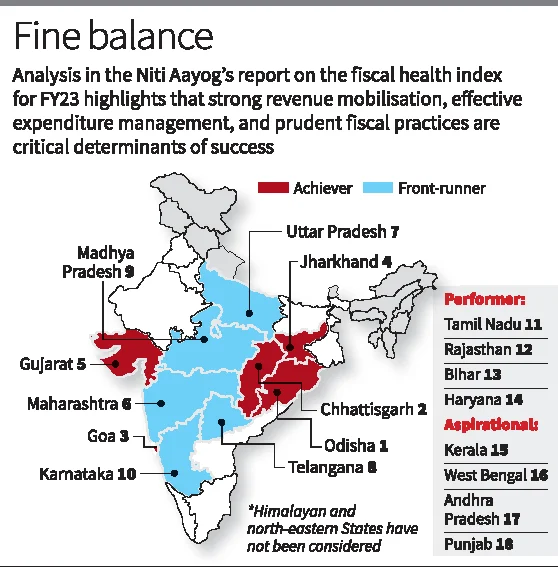
Purpose of the Report
The Fiscal Health Index (FHI) evaluates the fiscal performance of 18 major Indian states.
It focuses on key indicators such as contribution to GDP, public expenditure, revenues and fiscal stability to assess statelevel fiscal health.
Top Performing States Achievers
- States
- Odisha, Chhattisgarh, Goa and Jharkhand.
- Success Factors
- Strong capital investment up to 4% of Gross State Domestic Product or GSDP.
- Successful mobilization of non-tax revenue.
- Revenue surplus with low interest payment up to 7% of revenue receipts.
- Highest overall index score 678 for Odisha with a lead in debt index 990 and in debt sustainability at 640.
Front Runners
- States
- Maharashtra, Uttar Pradesh ,Telangana, Madhya Pradesh and Karnataka.
- Strengths
- Developmental expenditure very high up to 73 percent.
- Own tax revenues growth has been consistent.
- Improved fiscal management and the debt to GSDP ratio 24 per cent.
Moderate Performers
- States
- Tamil Nadu, Bihar, Rajasthan and Haryana.
- These States have performed moderately but have areas of improvement in the parameter of debt and also on expenditure management.
Aspirational States
- States
- Punjab, Andhra Pradesh, West Bengal and Kerala.
- Challenges
- Low revenue mobilization and the fiscal deficits are high.
- Increasing debt burdens and bad debt sustainability.
- Quality of Expenditure and Debt management
- Quality of expenditure and debt management is a concern for the States of Kerala and Punjab. West Bengal has problems with revenue mobilization and debt index issues.
- Andhra Pradesh is plagued with a very high fiscal deficit.
- The debt profile of Haryana is bad.
Fiscal Health Index (FHI) 2025 – Methodology & Key Indicators
Data Sources & Scope
- Source: Comptroller and Auditor General (CAG)
- Period Covered:
- 2022-23 (for index calculation and analysis)
- 2014-15 to 2021-22 (historical trends provided in the report appendix)
Five Major Sub-Indices & Their Minor Sub-Indices
| Major Sub-Index | Minor Sub-Indices | Purpose & Insights |
|---|---|---|
| 1. Quality of Expenditure | 1.1 Total Developmental Expenditure / Total Expenditure | Measures proportion of budget spent on long-term economic growth & social services |
| 1.2 Total Capital Outlay / GSDP | Assesses how much of the state’s economic output is invested in infrastructure & long-term assets | |
| 2. Revenue Mobilisation | 2.1 State Own Revenue / GSDP | Indicates financial independence by measuring state-generated revenue vs. economic output |
| 2.2 State Own Revenue / Total Expenditure | Shows the extent to which the state’s expenditures are funded by its own revenue sources | |
| 3. Fiscal Prudence | 3.1 Gross Fiscal Deficit / GSDP | Evaluates borrowing levels relative to economic size, signaling potential debt sustainability concerns |
| 3.2 Revenue Deficit / GSDP | Highlights if the state is generating sufficient revenue to cover its operational costs | |
| 4. Debt Index | 4.1 Interest Payments / Revenue Receipts | Measures percentage of revenue receipts used for interest payments, assessing debt servicing capability |
| 4.2 Outstanding Liabilities / GSDP | Reflects overall debt burden in proportion to the state’s economic output | |
| 5. Debt Sustainability | 5.1 Growth Rate of GSDP – Growth Rate of Interest Payments | A positive gap suggests debt is manageable; a negative gap indicates fiscal stress |
Detailed Explanation of Key Indicators
1. Quality of Expenditure
- Developmental Expenditure: Spending on long-term economic growth & infrastructure (schools, hospitals, roads, etc.)
- Non-Developmental Expenditure: Routine government expenses like salaries and operational costs
- Key Ratios:
- Developmental Expenditure/Total Expenditure → Shows government’s spending priorities
- Capital Outlay/GSDP → Measures investment in infrastructure & long-term assets
2. Revenue Mobilisation
- State Own Revenue: Income from state taxes & non-tax revenue sources
- Key Ratios:
- State Own Revenue/GSDP → Reflects state’s financial self-sufficiency
- State Own Revenue/Total Expenditure → Measures the extent to which a state funds its own expenses
3. Fiscal Prudence
- Gross Fiscal Deficit: Gap between total expenditure & total revenue, indicating borrowing needs
- Revenue Deficit: When government income is insufficient to cover operational costs
- Key Ratios:
- Gross Fiscal Deficit/GSDP → High ratio signals unsustainable borrowing
- Revenue Deficit/GSDP → High ratio shows reliance on borrowing to fund basic expenses
4. Debt Index
- Key Ratios:
- Interest Payments/Revenue Receipts → High ratio means more revenue is spent on debt servicing, reducing funds for development
- Outstanding Liabilities/GSDP → Measures overall debt burden relative to state’s economy
5. Debt Sustainability
- Key Indicator:
- Growth Rate of GSDP – Growth Rate of Interest Payments → Positive gap shows healthy economic management; negative gap signals financial distress
Key Takeaways
- Higher rankings in FHI indicate strong fiscal health, sustainable debt, and efficient resource allocation.
- Lower rankings highlight high deficits, excessive borrowing, and poor revenue generation.
- Interstate disparities in expenditure quality, debt management, and revenue mobilisation underline the need for targeted fiscal reforms.
Importance of the Report
- For better understandings of state level fiscal policy and practice.
- Proves necessity in revamping revenue mobilization and debt management issues in states.
- It encourages achievers and frontrunners to continue and build upon fiscal discipline and developmental spending.
This report provides a guide for states to enhance the stability of their finances and efficiently use their resources to achieve sustainable economic growth.
2. World Social Protection Report (WSPR) 2024-26: ILO
Source: PIB
Context:
According to the International Labour Organization’s (ILO) World Social Protection Report 2024–26, India’s social protection coverage has increased from 24.4% in 2021 to 48.8% in 2024, marking a significant expansion in welfare reach. The report credits key government initiatives for extending benefits such as health insurance, pensions, employment support, and food security to millions of citizens.
As per the Ministry of Labour and Employment, nearly 920 million people (65% of the population) are now covered by at least one form of social protection through central government schemes. India’s progress has also contributed to a 5-percentage point rise in global social protection coverage, highlighting its international significance.
Overview of the ILO Report
- The World Social Protection Report is published periodically by the ILO, a UN agency focused on labour rights and social justice.
- The 2024–26 edition emphasizes universal social protection for climate action and a just transition.
- For the first time, it incorporates trend data and offers regional companion reports, including Asia-Pacific, detailing unique socio-economic and environmental conditions.
Key Government Initiatives Expanding Social Security
1. Ayushman Bharat (AB-PMJAY)
- As of March 26, 2025: 39.94 crore Ayushman Cards issued.
- Offers health coverage up to ₹5 lakh per family.
- Accessible at 24,810 empanelled hospitals nationwide.
2. Pradhan Mantri Garib Kalyan Anna Yojana (PMGKAY)
- Provides free food grains to vulnerable populations.
- As of December 2024: 80.67 crore beneficiaries, close to the intended 81.35 crore.
3. eShram Portal
- Launched August 26, 2021 to create National Database of Unorganised Workers (NDUW).
- Offers Universal Account Number (UAN) for social security access.
- As of March 3, 2025: 30.68 crore unorganised workers registered, 53.68% women.
4. Atal Pension Yojana (APY)
- Launched May 9, 2015, targeting unorganised sector workers.
- Along with PMJJBY and PMSBY, strengthens social security.
- As of December 31, 2024: 7.25 crore enrolled with total corpus ₹43,369.98 crore.
5. Poverty Reduction Impact
- Over the past decade, 24.8 crore people have escaped multi-dimensional poverty due to social security measures.
Social Protection Data Pooling Exercise
- Launched March 19, 2025 by the Ministry of Labour & Employment.
- Aims to consolidate data across major central schemes to provide a holistic assessment of welfare coverage.
- Phase 1: Ten states targeted, including Uttar Pradesh, Rajasthan, Maharashtra, Madhya Pradesh, Tamil Nadu, Odisha, Andhra Pradesh, Telangana, Karnataka, Gujarat.
- Over 200 crore records processed using encrypted Aadhaar IDs across schemes like MGNREGA, EPFO, ESIC, APY, PM POSHAN.
- Collaboration with ILO ensures that housing, food security, and other in-kind benefits are incorporated in future evaluations.
Quick Takeaways
| Parameter | Details |
|---|---|
| Social protection coverage 2021 | 24.4% |
| Social protection coverage 2024 | 48.8% |
| People covered (2024) | 920 million (65% of population) |
| Key schemes | Ayushman Bharat, PMGKAY, eShram, APY, PMJJBY, PMSBY |
| Impact on poverty | 24.8 crore people escaped multi-dimensional poverty |
| Data pooling initiative | Phase 1 covering 10 states; 200 crore records processed |
| Global contribution | +5 percentage points in worldwide social protection coverage |
3. Asia Power Index 2025
Source: News on Air
Context:
In the 2025 Asia Power Index (API) published by the Australia-based Lowy Institute, India has been elevated from a “middle power” to a “major power”, ranking 3rd overall behind the United States and China. This milestone reflects India’s growing economic strength, military capability, and regional influence.
Key Highlights:
- Ranking & Major Power Status: India crosses the API-defined threshold for “major power” in 2025.
- Power Growth: Both India and China have improved across multiple metrics, but a significant gap remains between them.
- Scope of Assessment: The 7th edition of API evaluates 27 Asian countries/territories across 131 indicators in 8 thematic measures:
- Military Capability & Defence Networks
- Economic Capability & Relationships
- Diplomatic Influence
- Cultural Influence
- Resilience
- Future Resources
7–8. Other indicators assessing technology, governance, and soft power contributions
Strategic Implications
- India’s rise to a major power reflects growing economic clout, military strength, and diplomatic influence.
- The ranking enhances India’s geopolitical leverage in the Indo-Pacific region.
- Despite improvements, India still faces the challenge of converting capability into sustained influence at regional and global levels.
Banking/Finance
1. Crisil & AMFI Develop Market-Making Framework for AA–BBB Corporate Bonds
Source: FE
Context:
India’s corporate bond market is heavily skewed toward AAA-rated securities, leaving AA–BBB segments illiquid and unattractive despite their higher yields. To address this structural gap, Crisil and the Association of Mutual Funds in India (AMFI) are preparing a detailed proposal for a market-making framework for sub-AAA corporate bonds. The initiative aligns with consultations launched by the Department of Economic Affairs (DEA) under the Ministry of Finance.
Why a Market-Making Framework Is Needed
- About 66–67% of bond market trading is in AAA-rated securities.
- Nearly 33–34% involves AA-rated papers.
- BBB and other lower-rated segments see negligible trading, leading to low liquidity and high exit risk.
- MSMEs, mid-tier companies, NBFCs, HFCs, and startups—most of which do not enjoy AAA ratings—struggle to raise debt capital.
- A liquid market for AA–BBB bonds can unlock funding, reduce borrowing costs, and improve credit transmission.
DEA’s Proposed Models
The Department of Economic Affairs is reviewing two possible market-making structures:
1. Government-Backed Market Maker
- A government-sponsored entity will provide continuous two-way quotes (buy & sell).
- Ensures stability and market confidence.
- Useful for kick-starting liquidity in the AA–BBB space.
2. Private Entities as Market Makers
- Large institutions with high capital and net worth may act as market makers.
- Could be supported by a government backstop facility to mitigate risk.
- Encourages private sector innovation and competitive spreads.
What the Framework Will Cover
- Spread management for lower-rated papers
- Inventory handling rules for market makers
- Transparency and reporting norms
- Risk-mitigation safeguards to avoid concentration of exposure
- Mechanisms for price discovery in illiquid segments
Why This Matters?
According to industry participants:
For Investors
- Offers greater liquidity and better exit options.
- Encourages participation in higher-yielding sub-AAA bonds.
- Standardisation ensures better rate transmission and transparency.
For Issuers
- Expands access to debt financing, especially for:
- MSMEs
- NBFCs
- Housing finance companies
- Startups
- Reduces overdependence on AAA-dominated markets.
- Supports economic resilience by giving mid-tier companies new funding pathways.
Agriculture
1. Puducherry Launches NABARD-Supported Smart Farmer ID Cards
Source: PIB
Context:
On 27 November 2025, the Puducherry Agriculture and Farmers’ Welfare Minister, Thiru K. Djeacoumar, launched Smart Farmer Identification Cards (SFIC) at the State Level Bankers’ Committee (SLBC) meeting. Supported by NABARD under its Farm Sector Promotion Fund, the initiative aims to digitize farmers’ records, streamline access to government schemes, and enhance transparency in agricultural financing.
Key Highlights:
- Launched By: Thiru K. Djeacoumar, Agriculture & Farmers’ Welfare Minister
- Supporting Agency: NABARD (Grant: ₹9.50 lakh)
- Program: AgriStack — part of India’s digital agriculture framework
- Attendance: Finance Secretary, Agriculture Secretary, NABARD GM, RBI GM, Indian Bank ED, senior officials, and farmers
About Smart Farmer ID Cards (SFIC)
- Format: QR code-enabled, replacing traditional booklet-style ID cards
- Purpose: Provides single digital identity for farmers
- Key Benefits:
- Availing crop loans, subsidies, and government schemes
- Authorized as valid alternative to traditional land documents
- Real-time verification and paperless transactions
- Prevents duplication and enhances transparency
- Enables future services like digital Kisan Credit Cards (KCC), crop insurance, and online benefit delivery
Significance
- Digital Agriculture: Supports India’s move towards paperless, transparent, and secure agricultural financing
- Farmer Empowerment: Simplifies access to loans, subsidies, and schemes
- Financial Inclusion: Reduces delays, ensures real-time verification, and prevents fraud
- Replication Potential: Serves as a model for other states
2. Saras Food Festival 2025
Source: News on Air
Context:
Union Minister for Rural Development and Panchayati Raj, Shivraj Singh Chouhan, will inaugurate the Saras Food Festival 2025 in Delhi. The festival showcases India’s diverse rural cuisine, women-led enterprises, and traditional food culture under the DAY-NRLM (Deendayal Antyodaya Yojana – National Rural Livelihoods Mission).
Key Objectives
- Promote rural entrepreneurship and women-led SHGs.
- Provide urban consumers access to authentic regional cuisines.
- Enable market linkages for SHG food businesses.
- Boost the visibility of traditional Indian foods and local ingredients.
Key Highlights:
- The Saras Food Festival brings together Self-Help Groups (SHGs) from various states to present regional dishes.
- Organised by the Ministry of Rural Development under DAY-NRLM.
- Venue: Delhi (specific location to be announced or covered in the event schedule).
- Participants: Women SHGs representing multiple states and UTs.
- Focus: Traditional recipes, local ingredients, millet-based dishes, tribal foods, and state-specific culinary varieties.
- The festival is expected to attract strong footfall from Delhi NCR, supporting rural livelihoods.
Facts To Remember
1. Indira Gandhi International Airport becomes first in India to achieve “water-positive” status
Indira Gandhi International Airport (IGIA) has become the first airport to achieve water positive status in the country with a capacity of more than 40 million passengers per annum.
2. India–ADB Sign Over $800 Million in Loans for Key Infrastructure & Skills Projects
The Government of India and the Asian Development Bank (ADB) signed three major loan agreements worth over $800 million, along with a $1 million Technical Assistance grant, to support infrastructure, renewable energy, metro rail development, and skills enhancement across Maharashtra, Madhya Pradesh, Gujarat, and Assam.
3. Government Sanctions ₹17 Crore Under PM Janjatiya Unnat Gram Abhiyan for Tribal Homestays and Development
Over 17 crore rupees have been approved under Pradhan Mantri Janjatiya Unnat Gram Abhiyan to provide funding support for development and renovation of Tribal Homestays and village community requirements.
4. 14th edition of India-Maldives bilateral exercise EKUVERIN to take place tomorrow in Kerala
The 14th edition of the annual India-Maldives bilateral exercise EKUVERIN is set to take place from tomorrow till the 15th of this month in Thiruvananthapuram, Kerala.
5. World AIDS Day
Health and Family Welfare Minister Jagat Prakash Nadda highlighted the need for greater understanding of HIV and AIDS on the occasion of World AIDS Day today.
6. India finishes strong at World Skills Asia Competition 2025, Secures 8th Rank in first-ever participation
India marked a significant milestone on the global skills stage by securing 8th rank in its first-ever participation at the World Skills Asia Competition 2025, competing against 29 nations.
7. Union Minister Piyush Goyal Inaugurates MP Krida Mahotsav for Divyang Children in Mumbai
Union Commerce and Industry Minister Piyush Goyal today inaugurated the MP Krida Mahotsav for divyang children at Borivali in North Mumbai.
2 December, 2025
Daily Current Affairs Quiz
2 December, 2025
National Affairs
1. Fourth Edition of Kashi-Tamil Sangamam Begins in Varanasi
Source: News on Air
Context:
The fourth edition of Kashi-Tamil Sangamam commenced today in Varanasi, Uttar Pradesh, with Union Education Minister Dharmendra Pradhan and Chief Minister Yogi Adityanath jointly inaugurating the event. The grand opening ceremony is scheduled at Namo Ghat this evening.
Theme and Objective:
- The edition’s theme: “Let Us Learn Tamil – Tamil Karkalam”
- Focuses on Tamil language learning, emphasizing the shared Bharatiya Bhasha heritage across India
- Aims to strengthen cultural and linguistic ties between North and South India
2. Hornbill Festival 2025
Context:
The 26th edition of the Hornbill Festival began on Monday in Nagaland, amid renewed friction between the state and the Centre over the Protected Area Regime (PAP). Organised by the state tourism department with a budget of ₹7 crore, this is the first festival since the re-imposition of the PAP last December.
Background:
- The PAP was reinstated in Nagaland, Manipur, and Mizoram following volatility in Manipur and neighbouring Myanmar.
- The regime requires foreign nationals to obtain a special permit from the Ministry of Home Affairs to enter protected areas.
- Nagaland had previously enjoyed relaxed restrictions since 2011 to promote tourism.
Cultural Importance
- The festival is Nagaland’s flagship cultural event, showcasing traditional music, dance, handicrafts, and local cuisine.
- Acts as a tourism booster, attracting both domestic and foreign tourists.
3. Government Pushes for Food Safety with Labs and Irradiation Units
Source: News on Air
Context:
The Government of India is taking proactive measures to enhance food safety and quality across the country by promoting the establishment of food testing laboratories and irradiation units.
Food Testing Laboratories
- The Ministry of Food Processing Industries (MoFPI) is inviting proposals for setting up 100 NABL-accredited food testing laboratories.
- A financial outlay of ₹500 crore has been earmarked to support industry stakeholders in establishing these labs.
- Interested applicants can submit proposals via the Kisaan Sampada Portal until 20th January 2026.
- Objective: Ensure accurate testing and monitoring of food quality to maintain safety standards.
Food Irradiation Units
- The government has launched a scheme to set up 50 food irradiation units across India.
- Purpose:
- Eliminate harmful bacteria and insects in food
- Maintain the physical and nutritional integrity of food
- Aid longer preservation of organically produced commodities
- So far, 14 irradiation units have been approved.
- Assurance: The technique is safe and does not make food radioactive.
Key Benefits
- Strengthens food hygiene and safety standards nationwide
- Supports the agri-food sector and organic food industry
- Promotes consumer confidence in processed and fresh food products
4. Central Excise Amendment Bill 2025
Context:
The Union government has introduced the Central Excise (Amendment) Bill, 2025, alongside a companion cess bill, to overhaul the taxation of tobacco, pan masala, gutkha, and other “sin goods.” This legislative step comes as the GST compensation cess regime, introduced post-GST to compensate states for revenue losses, nears its end.
Key Proposals
- Tobacco Products: Cigarettes, cigars, chewing tobacco, and hookah will now attract central excise duty instead of the compensation cess.
- Pan Masala & Gutkha: A new Health Security and National Security Cess will replace the existing cess framework.
- The government intends to maintain high tax incidence, ensuring revenue continuity and discouraging harmful consumption.
Tax Structure Highlights
- Cigarettes and related products may face duties ranging from ₹5,000–₹11,000 per 1,000 sticks based on specifications.
- Other tobacco products could see 60–70% duty, with nicotine and inhalation products taxed up to 100%.
5. Heron Mk II UAVs
Source: TH
Context:
India is expanding its unmanned aerial surveillance and reconnaissance capabilities in the backdrop of Operation Sindoor. The armed forces have initiated emergency procurement of Heron Mk II UAVs, a move aligned with strengthening high-altitude and maritime situational awareness.
Heron Mk II UAV
- The Heron Mk II is a satellite-linked MALE UAV (Medium Altitude Long Endurance).
- Known for:
- Long endurance missions
- High-altitude performance
- Real-time intelligence, surveillance and reconnaissance (ISR)
- All-weather operational capability
6. Sanchar Saathi App
Source: TH
Context:
The Department of Telecommunications (DoT) has mandated that all new smartphones sold in India from March 2026 must come with the Sanchar Saathi app pre-installed, with functionalities fully enabled. The directive aims to prevent the circulation of non-genuine and stolen handsets and strengthen telecom security.
About the Sanchar Saathi App
Sanchar Saathi is a government-developed mobile application aimed at telecom security and consumer protection. It helps:
- IMEI verification: Helps detect spoofed or tampered IMEIs, which can operate in multiple devices simultaneously.
- SIM and device management:
- Identify SIMs registered in a user’s name.
- Remotely disable stolen phones.
- Fraud reporting: Similar to TRAI’s DND app, allows reporting of scam calls.
- Security impact: Assists in tackling cross-border digital frauds and SIM-related scams.
Banking/Finance
1. SEBI to Revamp Master Circular for Stock Exchanges
Source: Mint
Context:
The Securities and Exchange Board of India (Sebi) is set to revise the master circular for stock exchanges in the coming months. The move aims to simplify regulations, improve clarity, and enhance the ease of doing business in India’s capital markets.
Objective: Simplify regulations, improve clarity, and enhance ease of doing business
Key Features of Proposed Revamp
- Consolidation & Simplification
- Merge separate master circulars for equity and commodity-derivatives exchanges into a single unified circular
- Issue a distinct master circular for clearing corporations
- Rationalize circulars chapter by chapter
- Removal of Outdated Provisions
- Exchange-code requirements
- Other obsolete norms to reduce compliance burden
- Investor Protection & Claims
- Introduce a three-year lookback period for claims against defaulting brokers
- Merge separate Investor Protection Funds for equity and commodity derivatives segments into a single fund per exchange
- Stakeholder Consultation
- Public feedback on the consultation paper concluded on 29 October 2025
- SEBI plans wide consultation for balanced outcomes
Broader Regulatory Agenda
- Part of SEBI’s push for “optimum regulation” – leaner but effective rules that safeguard investors while easing compliance
- Recent regulatory reviews include:
- Mutual fund regulations
- Stockbroker norms
- Listing Obligations and Disclosure Requirements (LODR) framework
- Settlement rules
2. Banking Correspondent (BC) Sakhis
Source: Mint
Overview
- BC Sakhis are women banking correspondents linked to Self-Help Groups (SHGs) under the Deendayal Antyodaya Yojana–NRLM.
- They bring banking services to rural India, enabling doorstep access to accounts, loans, pensions, digital payments, and government schemes.
- Example: Sarika Arjun Chauhan from Madhya Pradesh handles ₹1.5–2 crore monthly, completing 62,000+ transactions worth ₹65 crore.
The Need
- Credit gap: Rural areas receive only 7.7% of bank credit, while urban metros get 60.6%.
- Access barrier: Women face travel and wage loss challenges, which BC Sakhis mitigate.
- Ambition: One BC agent in each of 150,000 Gram Panchayats to ensure comprehensive rural coverage.
Selection & Training
- Eligibility: Aadhaar enrolment, clean financial history, smartphone literacy.
- Training: Six-day residential programme, certification by Indian Institute of Banking and Finance.
- Success: 96.5% of trainees pass, becoming certified BC Sakhis.
Services Offered
- Account opening, cash handling, digital payments
- Loans, pensions (PMJJBY, PMSBY, Atal Pension Yojana)
- Aadhaar seeding, financial literacy guidance
- Over 375 million transactions worth ₹1.42 trillion conducted
- Vital during crises: disbursed ₹6,000 crore during COVID lockdown
Community Impact
- Promotes financial independence and leadership for rural women
- Boosts savings, financial planning, and trust in digital finance
- Facilitates agricultural credit, business expansion, and entrepreneurship
Benefits for Banks
- Increased customer acquisition and engagement
- Reduced branch footfall
- Expanded utility payment services
Challenges
- Low transactions → lower earnings in poorer regions
- Outdated tech and infrastructure
- Resistance from some banks to deploy women BCs
Recommendations for Strengthening
- Advanced Training: Digital banking, cybersecurity, entrepreneurship, financial literacy.
- Service Expansion: Micro-insurance, loan facilitation, digital payments, government programme support.
- Infrastructure Upgrade: Biometric devices, POS terminals, better internet connectivity.
- Coordination & Engagement: Between BC Sakhis, banks, NRLM staff, and communities.
- Incentive Model: Reward higher transaction volumes and service diversity, with focus on aspirational districts.
3. India’s Current Account Deficit
Source: IE
Context:
The Reserve Bank of India (RBI) reported that the country’s current account deficit (CAD) moderated to $12.3 billion, or 1.3% of GDP, in July–September 2025 (Q2 FY26), down from $20.8 billion, or 2.2% of GDP, in the year-ago period.
Current Account Deficit (CAD)
The Current Account Deficit occurs when a country’s total imports of goods, services, and transfers exceed its total exports over a specific period. In simpler terms, it means the country is spending more on foreign trade than it is earning.
Components of the Current Account:
- Trade Balance (Goods & Services): Exports minus imports of goods and services.
- Net Income from Abroad (Primary Income): Earnings on investments, wages, and dividends from foreign sources minus payments to foreign investors.
- Net Transfers (Secondary Income): Remittances sent by citizens working abroad, foreign aid, and other unilateral transfers.
Significance:
- A moderate CAD can indicate healthy investment inflows and growth opportunities.
- A high CAD may signal excessive dependence on foreign capital, risk of currency depreciation, and potential balance of payments stress.
4. National Strategy for Financial Inclusion 2025–30
Source: ET
The Reserve Bank of India (RBI), led by Governor Sanjay Malhotra, released the National Strategy for Financial Inclusion (NSFI) 2025–30. The strategy, approved by the Sub-Committee of the Financial Stability and Development Council, sets out a roadmap to deepen financial inclusion in India over the next five years.
Strategic Objectives (“Panch-Jyoti”)
The framework identifies five key strategic objectives supported by 47 action points:
- Universal Access to Financial Services
- Provide an equitable, affordable, and responsible suite of financial products — including savings, credit, insurance, pensions, and payments — for households and micro-enterprises, ensuring financial safety and security.
- Gender-Sensitive & Resilience-Oriented Inclusion
- Promote financial inclusion with special focus on women-led households and vulnerable segments, strengthening their resilience against economic shocks.
- Synergy with Livelihoods and Skills
- Integrate financial services with livelihood promotion, skill development, and support ecosystems so that financial inclusion drives sustainable economic participation.
- Financial Education & Responsible Usage
- Leverage financial literacy programs to encourage informed decision-making, disciplined financial behavior, and responsible credit use, especially for first-time users and micro-entrepreneurs.
- Customer Protection & Grievance Redressal
- Strengthen consumer protection mechanisms and ensure efficient grievance redressal, building trust in the formal financial system and minimizing misuse.
Implementation
- The strategy is framed under the Technical Group on Financial Inclusion and Financial Literacy.
- Developed through nationwide consultations with stakeholders, including government agencies, financial institutions, and civil society.
Significance
- Aims to bridge financial gaps for the underserved, especially women and vulnerable households.
- Supports inclusive growth, enabling households and micro-enterprises to gain access to formal financial services and protections.
5. Sebi Management Pushes Back Against Public Disclosure of Assets
Source: ET
Context:
The senior management of the Securities and Exchange Board of India (Sebi) has expressed opposition to a proposed rule requiring top officials to publicly declare their assets and liabilities, citing privacy concerns and potential speculation.
Key Details:
- A panel led by former Chief Vigilance Commissioner Pratyush Sinha had recommended that officials at the rank of Chief General Manager (CGM) and above publicly disclose their financial details to strengthen transparency and accountability.
- Sebi officers, both individually and through the employees’ association, have raised concerns about:
- Loss of privacy
- Unnecessary public scrutiny
- Potential pressure from relatives seeking financial assistance
- Officers are reportedly comfortable sharing information internally but oppose making it public.
Current Disclosure Norms:
- Executive board members must internally disclose conflicts of interest, which are kept confidential.
- Non-executive Sebi board members from the Finance Ministry, Corporate Affairs Ministry, and RBI are exempt if their parent organisations already require disclosures.
Global Context:
- In the UK, the Financial Conduct Authority keeps board members’ disclosures confidential but publicly shares broad details such as financial interests, directorships, and holdings in regulated entities.
Facts To Remember
1. Italian tennis icon Pietrangeli passes away at the age of 92
Nicola Pietrangeli, a two-time winner of the French Open, died aged 92, Italy’s tennis federation announced.
2. RBI appoints Usha Janakiraman executive director
The Reserve Bank of India (RBI) said that it has appointed Usha Janakiraman Executive Director (ED) with effect from December 1.
3. PMJAY Expansion for 70+ Age Group Covers 700K Treatments Since Launch
The Ayushman Bharat Pradhan Mantri Jan Arogya Yojana (ABPMJAY), India’s flagship health insurance scheme, was expanded in October 2024 to include people aged 70 years and above. As of October 2025, the scheme has authorised over 700,000 treatments worth ₹1,471 crore for this age group, significantly reducing out-of-pocket expenses for elderly beneficiaries.
4. Lok Sabha Passes Manipur GST Bill
On the first day of the Winter Session 2025, the Lok Sabha passed the Manipur Goods and Services Tax (Second Amendment) Bill, 2025, which replaces an Ordinance implementing GST reforms in Manipur. The passage occurred amid disruptions by Opposition members demanding a debate on the Special Intensive Revision (SIR) of electoral rolls.
3&4 December, 2025
Daily Current Affairs Quiz
3 & 4 December, 2025
National Affairs
1. Nationally Determined Contributions (NDCs)
Context:
India is preparing to submit its next round of Nationally Determined Contributions (NDCs) for the 2035 horizon under the Paris Agreement. Experts emphasise the need for a clear, economy-wide transition plan to meet long-term net-zero goals while sustaining growth.
About NDCs
- Definition: Country-specific climate commitments under the Paris Agreement, updated every five years (Article 4).
- Scope: Emissions reduction, renewable energy deployment, adaptation, climate finance, and technology deployment.
India’s Current NDC Targets
| Target | Details |
|---|---|
| Emissions Intensity Reduction | Reduce CO₂ emissions per unit of GDP by 45% (2005–2030). |
| Non-Fossil Power Capacity | Achieve 50% of total installed capacity from non-fossil sources (solar, wind, hydro, nuclear, biomass) by 2030. |
| Carbon Sink Expansion | Add 2.5–3 Bt CO₂ through afforestation and agroforestry by 2030. |
| LIFE Movement | Promote low-carbon lifestyles and resource-efficient habits. |
| Adaptation in Vulnerable Sectors | Scale up climate-resilient investments in agriculture, water, coastal systems, Himalayan ecology, health, and disaster management. |
| Climate Finance & Technology | Mobilise domestic and international funds to expand renewables, adaptation, and indigenous climate technologies. |
Key Challenges
| Challenge | Explanation |
|---|---|
| Rising Absolute Emissions | GDP growth offsets efficiency gains; peak emissions expected only ~2035. |
| Coal Dependence | Coal remains crucial for grid stability; rapid phase-down difficult without storage/CCS. |
| Investment Needs | ~$62 billion annually required through 2035 for renewables, storage, and grids. |
| Technology Gaps | Lack of commercially scalable long-duration storage, green hydrogen, CCS. |
| Climate Finance Shortfall | Global funding insufficient; India must self-finance major transition costs. |
| Just Transition Pressures | Coal-heavy states need worker retraining, economic diversification, and welfare support. |
| Adaptation Lag | Rising heatwaves, urban pollution, and extreme weather outpace adaptation efforts. |
2. National Commission for Backward Classes (NCBC)
Source: TH
Context:
The NCBC recently recommended excluding 35 communities, mostly Muslim, from West Bengal’s Central OBC list, after reviewing inclusions made in 2014.
Constitutional & Legal Basis
- Constitutional Status: Article 338B of the Constitution.
- Established: Originally under NCBC Act, 1993; gained constitutional status through the 102nd Constitutional Amendment Act, 2018 (Articles 338B & 342A).
- Aim: Safeguard rights and welfare of Socially and Educationally Backward Classes (SEBCs).
Composition
- Members: 5 (Chairperson, Vice-Chairperson, 3 Members)
- Appointment: By the President of India via warrant.
- Rank & Pay: Equivalent to Secretary, Government of India.
Functions
- Monitoring & Investigation: Ensure constitutional safeguards for SEBCs are implemented.
- Complaint Inquiry: Examine rights violations or misuse of reservation benefits.
- Socio-Economic Evaluation: Assess backward class welfare programs and advise governments.
- Consultation: Mandatory consultation by Union & State Governments on policy affecting SEBCs.
- Reporting: Submit annual and special reports to the President, tabled in Parliament and State Legislatures.
Powers
- Civil Court Powers:
- Summon witnesses
- Examine under oath
- Demand documents and evidence
- Advisory Role: Recommend inclusion/exclusion of communities in the Central OBC list.
- Final Authority: Parliament enacts changes to the Central OBC list under Article 342A.
3. PM-WANI (Prime Minister’s Wi-Fi Access Network Interface)
Source: PIB
Context:
- As of November 2025, over 3.9 lakh Wi-Fi hotspots have been deployed across India under PM-WANI, showing rapid nationwide expansion.
- The government updated Parliament on this progress.
Overview
- What it is: A national public Wi-Fi framework aimed at affordable, widespread broadband access through decentralized Wi-Fi hotspots operated by small entrepreneurs.
- Implementing Ministry: Department of Telecommunications (DoT), Ministry of Communications.
- Launch: Approved by the Union Cabinet on 9 December 2020.
- Aim:
- Democratize internet access
- Promote digital inclusion
- Support the goals of the National Digital Communications Policy (NDCP) 2018)
Key Features
- No License Required:
- Small businesses and shops can operate Wi-Fi hotspots without a licence, fee, or formal registration.
- Four-Tier Architecture:
- PDOs (Public Data Office): Provide Wi-Fi access
- PDOAs (Aggregators): Handle authentication and accounting
- App Providers: Enable user access
- Central Registry (C-DoT): Maintains records of all entities
4. WHO Issues First Global Guideline on Infertility
Source: TH
Context:
- WHO has released its first-ever global guideline on infertility.
- Objective: Ensure safer, fairer, and affordable fertility care worldwide.
- Relevance: Infertility affects 1 in 6 people globally, yet care remains expensive, inequitable, and fragmented in many countries.
About the Guideline
- Purpose: Standardize the prevention, diagnosis, and treatment of infertility.
- Scope: Integrates infertility care into public health systems and aligns with Universal Health Coverage (UHC) frameworks.
- Focus: Evidence-based, cost-effective, accessible, and equitable fertility care.
Key Features
- Comprehensive Recommendations:
- 40 recommendations covering:
- Prevention
- Early diagnosis
- Counselling
- Advanced treatment options
- 40 recommendations covering:
- Integration into Health Systems:
- Encourages countries to include infertility services in national health strategies.
- Promotes cost-effective care that reduces financial barriers.
- Fertility Awareness:
- Programs in schools, primary health centres, and reproductive health facilities.
- Risk Factor Management:
- Addresses untreated STIs, tobacco use, and poor lifestyle habits.
- Recommends healthy diet, regular exercise, and tobacco cessation for individuals trying to conceive.
- Clinical Guidance:
- Evidence-based diagnostic pathways for infertility in men and women.
- Psychosocial Support:
- Recognizes emotional stress, stigma, and mental health challenges associated with infertility.
- Rights-Based Approach:
- Promotes gender equality and reproductive rights in infertility care.
5. India Re-elected to IMO Council
Source: News on Air
Context:
- India has been re-elected to the International Maritime Organization (IMO) Council, Category B, for the 2026–27 term.
- Votes received: 154 out of 169, the highest in Category B.
- Significance: Marks India’s second consecutive highest vote tally, reinforcing its growing maritime influence.
About the IMO Council
- The executive body of the IMO responsible for supervising its work between Assembly sessions.
- Makes policy decisions on global maritime governance.
Formation & Role
- Constituted under the IMO Convention (1958).
- Elected every two years by the IMO Assembly.
- Category B: 10 nations with the largest interest in international seaborne trade.
- Members: Australia, Brazil, Canada, France, Germany, India, Netherlands, Spain, Sweden, UAE.
About the International Maritime Organization (IMO)
History
- Established by a UN Convention in 1948, came into force in 1958.
- First session held in 1959.
- Headquarters: London, UK.
Aim
- Ensure safe, secure, efficient, and environmentally responsible shipping.
- Maintain uniform global maritime standards to prevent unfair advantage.
Major Functions
- Formulates and updates global maritime conventions (e.g., SOLAS, MARPOL, STCW).
- Regulates ship design, construction, operation, and disposal.
- Develops rules to prevent marine and air pollution from ships.
- Oversees global norms on seafarer training and certification.
- Promotes sustainable maritime transport aligned with SDG-14 (Life Below Water).
6. WorldSkills Asia Competition (WSAC) 2025
Source: PIB
Context:
- India participated in WSAC for the first time in 2025, held in Chinese Taipei.
- Achievement: India secured 8th rank among 29 participating nations.
- Medals won:
- 1 Silver
- 2 Bronze
- 3 Medallions for Excellence
About WorldSkills Asia Competition
- A premier continental skill competition under the WorldSkills movement.
- Promotes excellence in technical and vocational education and training (TVET) across Asia.
- Brings together youth to compete in traditional, digital, and emerging trades.
History
- WorldSkills Asia (WSA) organizes regional contests within Asia.
- First WSAC: 2018, Kuala Lumpur, Malaysia.
- India’s debut: 2025.
India’s Performance
- Overall Rank: 8th among 29 nations.
- Team Composition:
- 23 competitors in 21 skills
- Supported by 21 experts
- Led by Ministry of Skill Development & Entrepreneurship (MSDE) and National Skill Development Corporation (NSDC)
- Medals:
- Silver: Painting & Decorating – Muskan
- Bronze: Industrial Design Tech – Komal Panda
- Bronze: Robot System Integration – Shivam Singh & Dinesh R.
- 3 Medallions for Excellence awarded to other participants
7. Bioremediation
Context:
- India’s growing pollution burden and industrial contamination has increased the need for sustainable cleanup methods.
- Bioremediation is highlighted as an eco-friendly, cost-effective, and scalable solution for soil, water, and waste contamination.
What is Bioremediation?
- Use of living organisms—bacteria, fungi, algae, or plants—to break down, transform, or detoxify pollutants.
- Mechanism: Microbes metabolize contaminants as food, converting them into harmless by-products such as water, CO₂, organic acids, or non-leachable metals.
Types of Bioremediation
1. In-situ Bioremediation (On-site)
- Treats pollutants directly at the contaminated location.
- Techniques:
- Bioventing: Air and nutrients injected to stimulate microbes in soil.
- Air Sparging: Oxygenates groundwater to degrade volatile pollutants.
- Biobarriers/Biowalls: Microbes in trenches degrade contaminants in flowing groundwater.
- Water Recirculation: Contaminated water is treated and reinjected to enhance biodegradation.
2. Ex-situ Bioremediation (Off-site)
- Contaminated soil or water is removed, treated in reactors, and returned.
- Used when pollution levels are high or on-site conditions cannot be controlled.
8. India Re-Elected to UNESCO Executive Board (2025–29)
Context:
- India has been re-elected to the UNESCO Executive Board for the 2025–29 term.
- Re-election reflects global confidence in India’s role in multilateral governance.
UNESCO Executive Board
- One of UNESCO’s three constitutional organs.
- Responsible for supervising programme implementation and providing strategic direction.
Establishment & Headquarters
- UNESCO established: 1945
- Executive Board: Operational since 1946
- Headquarters: Paris, France
Composition & Membership
- Members: 58 Member States
- Term: 4 years
- Election: By UNESCO General Conference via regional electoral groups to ensure equitable representation
9. INS Aridaman – India’s Third Indigenous SSBN
Source: ET
Context:
- India is set to commission INS Aridaman, the third indigenously built nuclear-powered ballistic missile submarine (SSBN).
- Navy Chief Admiral Dinesh K. Joshi to oversee the commissioning.
- Part of India’s Arihant-class, under the Strategic Forces Command, to ensure assured second-strike capability under the no-first-use nuclear doctrine.
Construction & Indigenous Content
- Built under the Advanced Technology Vessel (ATV) Project by the Ship Building Centre, Visakhapatnam.
- Integrates over 90% indigenous components, including nuclear reactor and propulsion systems.
Historical Milestones
- INS Arihant: Launched 2009, commissioned 2016 – India became 6th country with operational SSBNs.
- INS Arighat: Commissioned 2024.
- INS Aridaman: Third operational SSBN, enabling minimum rotation fleet for continuous at-sea deterrence.
10. INS Taragiri – Fourth Nilgiri-Class Advanced Stealth Frigate
Source: TH
Context:
- Indian Navy received INS Taragiri, the fourth Project 17A Nilgiri-class stealth frigate, delivered by Mazagon Dock Shipbuilders Ltd (MDL), Mumbai.
- Designed as a multi-mission combat platform with enhanced stealth, firepower, automation, and survivability.
Project 17A Ship List
- INS Nilgiri
- INS Himgiri
- INS Udaygiri
- INS Taragiri
- INS Dunagiri (upcoming)
Key Features
- Stealth Design: Reduced radar, acoustic, and infrared signatures.
- Propulsion: Combined Diesel or Gas (CODOG) – diesel engines + gas turbines; controllable pitch propellers (CPP).
- Sensors & Weapons:
- BrahMos supersonic cruise missiles
- MF-STAR multifunction radar
- MRSAM air defence missile complex
Banking/Finance
1. Masala Bond
Source: TH
Context:
- The Enforcement Directorate (ED) has issued show-cause notices to:
- Kerala Chief Minister
- Former Finance Ministry officials
- KIIFB (Kerala Infrastructure Investment Fund Board) officials
- Alleged violations pertain to FEMA and RBI regulations related to KIIFB’s 2019 Masala Bond issuance.
What is a Masala Bond?
- Definition: Rupee-denominated bonds issued overseas by Indian entities to raise funds.
- Currency Risk: Borne by the investor, not the Indian issuer.
Introduction & Regulation
- First issued by IFC in 2014 (~₹1,000 crore).
- Officially allowed by RBI in 2015 under the rupee-denominated bond framework.
Objectives
- Enable Indian corporates, NBFCs, and infrastructure trusts to raise global capital in INR.
- Reduce reliance on External Commercial Borrowings (ECBs).
- Shift forex/currency risk to investors.
- Promote internationalisation of the Indian rupee and deepen offshore rupee markets.
Key Features
- Rupee-denominated: Priced and redeemed in INR, but subscribed overseas.
- Investor bears currency risk: Unlike ECBs, where the borrower assumes forex risk.
- Eligible Issuers: Indian corporates, NBFCs, REITs, InvITs.
- Global Listing: Can be listed on exchanges like London and Singapore.
- Usage Restrictions: Cannot fund:
- Capital market investments
- Real estate (except affordable housing)
- Land purchase
- FDI-prohibited sectors
- Maturity: Initially 5 years, later reduced to 3 years.
- Tax Incentives:
- 5% withholding tax on interest
- Capital gains from rupee appreciation exempt
2. Big Banks or More Agile Banks?
Source: BS
Context:
India’s banking sector is witnessing a major shift driven by digital innovation, competition from fintechs, evolving customer needs, and heightened regulatory expectations. This has sparked an important policy and market question: Are large banks better suited for future challenges, or are smaller, more agile banks the real drivers of innovation?
Big Banks: Strengths and Limitations
Big Banks in India include institutions such as SBI, HDFC Bank, ICICI Bank, and Bank of Baroda, known for their nationwide presence and large balance sheets.
Strengths
- High Capital Strength & Systemic Stability: Ability to absorb shocks due to diversified loan books and strong capital buffers.
- Trust & Brand Equity: Long-standing customer relationships and high public confidence.
- Comprehensive Product Suite: Retail, corporate, international banking, treasury, insurance, and wealth management.
- Risk Diversification: Exposure across geographies and sectors minimises concentration risk.
Limitations
- Slower Decision-Making due to layers of hierarchy.
- Legacy Technology Systems that make modernization expensive and time-consuming.
- High Operating Costs due to branches, staff, and compliance requirements.
- Limited Flexibility to adopt niche, experimental business models.
More Agile Banks: Strengths and Limitations
Agile banks include small finance banks (SFBs), payments banks, digital-first banks, and tech-driven NBFCs/neo-banks.
Strengths
- Rapid Innovation with digital-native operations, AI-based underwriting, and customer-centric products.
- Lower Operational Costs due to limited branch presence and automated systems.
- Niche Focus on underserved segments like MSMEs, gig workers, rural markets, and young consumers.
- Faster Credit Delivery using alternative data and real-time analytics.
Limitations
- Smaller Capital Buffers, making them vulnerable to credit shocks.
- Limited Product Range compared to universal banks.
- Lower Trust Levels, especially during financial stress episodes.
- Compliance Burden, as smaller institutions have less capacity for regulatory complexity.
RBI Norms for Bank Mergers in India
The Reserve Bank of India (RBI) plays a central role in approving, regulating, and supervising all bank mergers. RBI ensures that mergers strengthen systemic stability, protect depositors, and maintain financial discipline.
Key RBI Norms & Requirements for Bank Mergers
- Prior Approval Under the Banking Regulation Act
- RBI approval is mandatory under Sections 44A, 45, and related provisions of the Banking Regulation Act, 1949.
- Both boards must approve the proposal before seeking RBI’s consent.
- Fit-and-Proper Criteria for Management
- Post-merger boards and senior management must meet RBI’s “fit and proper” standards concerning integrity, experience, and financial soundness.
- Financial Health Assessment
RBI evaluates:- Capital adequacy (CRAR),
- Asset quality (NPA ratios),
- Liquidity profile,
- Exposure concentration,
- Governance track record, and
- Compliance history.
- Customer & Branch Integration Guidelines
- The merged entity must ensure seamless transition of:
- Accounts
- IFSC codes
- Loan servicing
- Digital platforms
- No disruption to essential banking services is permitted.
- The merged entity must ensure seamless transition of:
- Compliance With Prudential Norms
- The merged bank must meet regulatory requirements on:
- Capital adequacy
- Priority sector lending
- Statutory Liquidity Ratio (SLR)
- Cash Reserve Ratio (CRR)
- Exposure norms
- Corporate governance standards
- The merged bank must meet regulatory requirements on:
- Special Cases: RBI-Directed Mergers
- Under Section 45 of the BR Act, RBI may force mergers to protect depositors (e.g., Global Trust Bank with Oriental Bank of Commerce, 2004).
- In such cases, the acquiring bank gets regulatory flexibility for a transition period.
3. RBI’s Annual Report of the Ombudsman Scheme 2024-25
Source: Mint
Context:
The Reserve Bank of India’s (RBI) 2024-25 Integrated Ombudsman Scheme (IOS) report highlights a steep rise in customer grievances—driven largely by private banks’ aggressive retail expansion. The data signals systemic weaknesses in grievance redressal, customer onboarding, and credit discipline within the rapidly growing retail loan ecosystem.
Key Highlights:
Surge in Complaints
- Total complaints (2024-25): 13.34 lakh, up 13.5% from the previous year.
- 87% of all complaints came from individual retail customers.
Private Banks Now Lead in Complaints
- Private sector banks accounted for 37.5% of all grievances—the highest among bank groups.
- Complaints against Public Sector Banks (PSBs) fell by 9%, countering the common perception that PSBs are the worst on customer service.
- The shift is linked to private banks’ intense push into:
- Unsecured personal loans,
- Small-ticket loans,
- Aggressive credit card enrolments.
Why Are Complaints Rising?
- Rapid retail growth since corporate lending slowed.
- Faulty or hasty loan appraisals leading to disputes over dues.
- Aggressive collection practices, especially in unsecured lending.
- Poor onboarding, resulting in confusion over interest, charges, and repayment schedules.
- Weak grievance redressal mechanisms despite higher retail exposure.
What Is the Ombudsman Scheme of RBI?
The Ombudsman Scheme is a complaint redressal mechanism created by the Reserve Bank of India (RBI) to resolve customer grievances related to banking, NBFCs, and digital payments. It provides cost-free, fair, and speedy resolution of complaints against regulated financial service providers.
Purpose of the Scheme
- To offer an accessible platform for customers to lodge complaints.
- To ensure transparent, timely, and impartial resolution of disputes.
- To enhance consumer protection in the banking and financial ecosystem
Regulatory Gaps Revealed
Inefficiencies in Redressal
- Many complaints remain unaddressed or inadequately resolved, revealing cracks in banks’ customer-service architecture.
- RBI Governor Sanjay Malhotra previously flagged the poor allocation of resources for customer grievance management.
Credit Bureaus: A New Flashpoint
- Complaints against credit bureaus increased four-fold.
- Structural issue:
- Credit bureaus rely financially on banks,
- They often accept bank-reported data without verification,
- Consumers receive secondary priority, even when ratings are disputed.
Larger Implications for Banking
Retail Customers Still Seen as “Depositors First”
- Despite relying on retail customers to drive profits, many banks continue treating them merely as deposit sources, not as service-entitled clients.
- As depositors increasingly explore mutual funds, gold, bonds, and market-linked products, banks risk facing weaker deposit inflows and pressure on their net interest margins (NIMs).
Financial Stability Angle
- Rising unsecured loan exposure + weak consumer protection = systemic risk.
- RBI’s concerns signal potential tightening in:
- Digital lending rules,
- Credit card governance,
- Customer-protection norms.
Way Forward
- RBI must strengthen the regulatory framework, especially around:
- Retail onboarding quality,
- Collection practices,
- Accuracy of credit bureau reporting,
- Banks’ spending on grievance-handling systems.
- Banks need to invest in service architectures that match their retail ambitions.
- If ignored, customer dissatisfaction could erode trust and revenue, undermining the very retail strategy banks are betting on.
Agriculture
1. Cluster-Based Natural Farming
Source: The Tribune
Context:
At a recent meet hosted by NABARD at Chaudhary Sarwan Kumar Himachal Pradesh Krishi Vishvavidyalaya, Palampur, agricultural experts highlighted the importance of cluster-based natural farming models. The approach promotes collective adoption of sustainable, chemical-free farming practices among geographically proximate farmers, enhancing productivity, resilience, and market linkages.
What is Cluster-Based Natural Farming?
- Cluster-based natural farming involves a group of farmers in a defined area (typically 50+ hectares) adopting natural farming practices together.
- Key Features:
- Shared bio-input production and resources
- Joint training and extension support
- Collective marketing and value-chain integration
- Risk sharing through diversified cropping and livestock integration
- Objective: Make natural farming economically viable, scalable, and sustainable.
Benefits of Cluster-Based Natural Farming
- Sustainability and Ecological Balance
- Reduces dependency on chemical fertilizers and pesticides
- Improves soil health, biodiversity, and water conservation
- Economies of Scale
- Shared resources and pooled inputs reduce costs per farmer
- Enables bulk procurement and production of bio-inputs
- Knowledge Sharing & Capacity Building
- Farmers access training, demonstrations, and expert guidance collectively
- Encourages adoption of scientific and indigenous practices
- Market Linkages & Income Security
- Aggregated produce helps secure better prices and market access
- Promotes value addition and supply-chain integration
- Risk Mitigation
- Diversified crops and livestock reduce climate and market risks
- Strengthens resilience of small and marginal farmers
Key Highlights from the NABARD Meet
- Promotion of Indigenous Practices: Experts stressed integrating indigenous cattle breeds and local crop varieties.
- Holistic Approach: Focus on crop-livestock integration, fodder production, and sustainable water management.
- Institutional Support: Collaboration between agricultural universities, NABARD, and extension services is crucial for farmer training, cluster setup, and supply-chain support.
- Replication Potential: Cluster-based models are scalable and adaptable for diverse agro-climatic zones, including Himachal Pradesh, Punjab, and Jharkhand.
Policy Alignment
| Policy Objective | Role of Cluster-Based Natural Farming |
|---|---|
| Sustainable agriculture | Promotes chemical-free, soil-friendly practices |
| Farmer income enhancement | Collective marketing ensures better price realization |
| Climate resilience | Crop diversification and livestock integration reduce risk |
| SDG alignment | Contributes to SDG 2 (Zero Hunger), SDG 12 (Responsible Consumption), and SDG 15 (Life on Land) |
Challenges Identified
- Initial Yield Uncertainty: Farmers may face short-term yield dips during transition from conventional farming.
- Resource Requirements: Need for bio-input production units, training centers, and seed banks.
- Market Linkages: Effective aggregation, certification, and access to buyers are essential to ensure economic sustainability.
Relevance to Jharkhand and Other States
- Jharkhand has identified 12 districts for 88 natural farming clusters, demonstrating the scalability and replicability of this model.
- Cluster-based natural farming can empower smallholders, enhance livelihoods, reduce input costs, and strengthen local ecosystems.
- Provides a pathway for sustainable and climate-resilient agriculture, especially in regions dependent on rainfed or marginal lands.
Economy
1. Top-Three Quantum Economy by 2047
Source: News on Air
Context:
The Frontier Tech Hub of NITI Aayog, in collaboration with IBM, has released a national roadmap aimed at transforming India into one of the world’s top-three quantum economies by 2047. The plan focuses on developing homegrown quantum computing hardware and software, nurturing at least 10 globally competitive quantum start-ups, and capturing a significant share of the global quantum software and services market.
Strategic Goals
- Technological Leadership:
- Build domestic quantum computing hardware and software capabilities.
- Establish globally competitive quantum enterprises.
- Sectoral Applications:
- Deploy quantum technologies across defence, energy, healthcare, logistics, and finance.
- Enhance security, operational efficiency, and innovation nationwide.
- Ecosystem Development:
- Accelerate R&D, commercialization, and talent development.
- Promote collective ownership across policymakers, scientists, entrepreneurs, investors, and states.
Roadmap Highlights
- Leverages the National Quantum Mission as the foundation for quantum initiatives.
- Identifies India’s current capabilities, strategic strengths, and critical gaps.
- Provides actionable pathways to accelerate innovation, research, and global market presence.
- Emphasizes building a globally trusted, competitive, and self-reliant quantum economy.
Facts To Remember
1. Former England batter Robin Smith passes away
Former England batter Robin Smith passed away aged 62, English county side Hampshire announced. The South Africa-born Smith, who played 62 Tests between 1988 and 1996, died unexpectedly on Monday in Australia, where he lived, his family said.
2. Sanchar Saathi App Can Be Deleted from Devices, Says Minister Scindia
The Union government has issued new directions requiring smartphone manufacturers to pre-install the Sanchar Saathi app on all devices sold in India from March 2026. The move has drawn concerns regarding privacy, surveillance, and app permissions. Responding to these concerns, Union Communications Minister Jyotiraditya Scindia clarified that the app neither snoops on users nor monitors their calls, and it can be deleted if a user does not want it.
3. Parliament Passes Central Excise (Amendment) Bill, 2025 to Raise Tobacco Duties
The Parliament today passed the Central Excise (Amendment) Bill, 2025 with the Rajya Sabha approving and returning it to the Lok Sabha.
4. Union Minister Annpurna Devi launches 100-Day Intensive Awareness Campaign for Child Marriage Free Bharat
Union Minister of Women and Child Development (WCD) Annpurna Devi today launched the 100-Day Intensive Awareness Campaign for a Child Marriage Free Bharat in New Delhi, marking the first anniversary of the Bal Vivah Mukt Bharat campaign.
5. India celebrates Navy Day with Spectacular Maritime Display in Kerala
Navy Day is being celebrated today. The day is celebrated on the 4th of December every year to recognise the achievements and role of the Indian Navy.
6. Operation Sagar Bandhu strengthens Sri Lanka’s relief efforts against Cyclone Ditwah
India’s Operation Sagar Bandhu continues to bolster Sri Lanka’s struggle against the devastation caused by Cyclone Ditwah.
5 December, 2025
Daily Current Affairs Quiz
5 December, 2025
National Affairs
1. DHRUVA (Digital Hub for Reference and Unique Virtual Address)
Source: TH
Context:
The Department of Posts has released a draft amendment in 2025 proposing DHRUVA (Digital Hub for Reference and Unique Virtual Address), a UPI-like digital addressing system. This system aims to digitise, standardise, and virtualise physical addresses across India, allowing users to share secure, consent-based address “labels” such as name@entity.
Key Features of DHRUVA
UPI-Like Address Labels
- Each user can obtain a virtual address label, e.g., name@entity, which acts as a proxy for their physical address.
- Reduces the need to repeatedly fill address forms in government and private services.
Consent-Based Access
- Users control who can access their geocoded or textual addresses.
- Access is time-bound and consent-driven, ensuring strong privacy protections.
DIGIPIN Backbone
- DIGIPIN is a 10-character alphanumeric geocode representing latitude–longitude coordinates.
- Maps every 14 sq m patch of India (~228 billion unique pins).
- Open-sourced, precise, and particularly useful for rural and hard-to-map areas.
Address-as-a-Service (AaaS) Framework
- Secure APIs enable integration of address data across:
- Government agencies
- Logistics companies
- E-commerce platforms
- Fintech and other private-sector services
Aim of DHRUVA
- Create a unified, secure, and user-controlled digital address ecosystem.
- Treat address data as core public infrastructure, similar to Aadhaar, UPI, and DigiLocker.
- Enable Address-as-a-Service (AaaS) for seamless integration across public and private services.
2. Shift in Stubble-Burning Timing in Punjab and Haryana: ISRO
Source: IE
Context:
A new ISRO study has revealed that peak stubble-burning activity in Punjab and Haryana has shifted from early afternoon to early evening between 2020 and 2024, resulting in possible underestimation of farm-fire incidents by government data that rely mainly on polar-orbiting satellites.
Key Findings from the ISRO Study
- Satellites Used:
- Geostationary: Meteosat Second Generation (MSG) satellites with SEVIRI instrument.
- Polar-Orbiting (for comparison): NOAA’s Suomi NPP, NASA’s Terra MODIS, Aqua MODIS.
- Significance of Geostationary Satellites:
- Orbit at ~36,000 km above equator, constantly monitoring the same region.
- Can detect fire events every half-hour, capturing altered burning times.
- Shift in Burning Practices:
- Peak burning moved from early afternoon to late afternoon/early evening (3:30–6 pm) since 2022.
- Shift likely aimed at avoiding detection by polar-orbiting satellites, which monitor fields only at fixed times.
- Implications:
- Possible undercounting of fire incidents in official records.
- Affects air quality assessments, emission inventories, and mitigation strategies.
- Publication: “Evidence of shift in stubble burning timing over northwest India from geostationary satellite observations,” Current Science, November 25, 2025.
Government Monitoring and Enforcement
- CAQM Actions:
- Communicated to Punjab and Haryana for effective elimination of stubble-burning.
- Requested reports on undetected fire locations, stocktaking methods, and punitive measures.
- State-Level Measures:
- Punjab deployed 10,500 personnel for round-the-clock monitoring.
- Supplemented by flying squads from CPCB and CAQM.
- Created a 1,700-member Parali Protection Force to identify fires escaping satellite detection.
- Late-evening patrols to catch farmers burning stubble at night.
- Penalties for Violations (CAQM 2025):
- Small landholders (≤2 acres): ₹5,000 per incident
- Medium landholders (2–5 acres): ₹10,000 per incident
- Large landholders (>5 acres): ₹30,000 per incident
- FIRs and Compensation:
- 1,963 FIRs registered under Section 223 of Bharatiya Nyaya Sanhita, 2023.
- Environmental compensation imposed: ₹1.26 crore.
Impact on Farm-Fire Incidence
- Punjab (Sep 15–Nov 30):
- 2020: 83,002 incidents → 2025: 5,114 incidents
- Haryana (Sep 15–Nov 30):
- 2021: 6,987 incidents → 2025: 662 incidents
- Government Statement: Union Environment Minister Bhupender Yadav reported ~90% reduction in fire incidences in Punjab and Haryana compared to 2022.
3. BNHS to Release Critically Endangered Vultures in Assam
Source: TH
Context:
The Bombay Natural History Society (BNHS) will release six critically endangered vultures—slender-billed (Gyps tenuirostris) and white-rumped (Gyps bengalensis)—into the wild in Assam in January 2026. This is part of India’s ongoing vulture recovery programme, aimed at conserving these species that have faced severe population declines over the past two decades.
Slender-billed Vulture (Gyps tenuirostris)
- Status: Critically Endangered (IUCN) with fewer than ~870 mature individuals.
- Habitat: Gangetic plains, Assam, northern Bangladesh, southern Nepal, Myanmar, and Cambodia. Nests on tall trees near human settlements, slaughterhouses, and riverine areas.
- Key Characteristics:
- Dark head, slender narrow bill, long bare neck
- Grey plumage with pale rump; juveniles have white neck down
White-rumped Vulture (Gyps bengalensis)
- Status: Critically Endangered; population declined rapidly due to diclofenac poisoning in livestock carcasses.
- Habitat: Cities, villages, plains, and open fields; nests on large trees or cliffs; often roosts near human habitation.
- Key Characteristics:
- Dark plumage with white neck ruff and distinct white rump patch
- White underwing coverts visible in flight
4. New Flight Duty Time Limitations (FDTL) Rules
Source: TOI
Context:
The Indian aviation sector is witnessing large-scale flight cancellations and delays, particularly at IndiGo, following the implementation of Flight Duty Time Limitations (FDTL) rules. The new norms, aimed at reducing pilot fatigue, have led to crew shortages and stricter compliance requirements for airlines.
What Are Flight Duty Time Limitations (FDTL)?
- Definition: Regulatory limits on pilot duty hours, flight hours, night operations, and mandatory rest periods to prevent fatigue.
- Issuing Authority: Directorate General of Civil Aviation (DGCA) under the revised framework notified in January 2024.
- Objective: Align Indian aviation with global safety standards, reduce fatigue-related risks, and ensure safer flight operations.
Key Features of FDTL Rules
- Weekly Rest:
- 48 hours of continuous rest to allow pilots adequate recovery and reduce cumulative fatigue.
- Night Operations:
- Night period extended to 00:00–06:00, covering high-fatigue biological windows for early-morning and late-night flights.
- Limit of two-night landings and two consecutive night duties to prevent performance decline during critical flight phases.
- Roster & Fatigue Management:
- Airlines must redesign schedules to comply with FDTL.
- Pilots can formally report fatigue, enhancing transparency and safety.
- Phased Implementation:
- Fully enforced by November 1, 2025, requiring airlines to expand crew capacity and overhaul existing scheduling practices.
5. Exercise Garuda and Exercise Garuda Shakti
Context:
Two major military exercises were recently in focus:
- Exercise Garuda 25 between India and France concluded in France.
- Exercise Garuda Shakti 2025 between India and Indonesia commenced in Himachal Pradesh.
These exercises aim to strengthen bilateral defence cooperation, enhance interoperability, and expose forces to advanced operational tactics.
Exercise Garuda 25
- Host: Air Base 118, Mont-de-Marsan, France
- Participating Nations: India (Indian Air Force – IAF) and France (French Air & Space Force – FASF)
- Key Features:
- Deployment of Su-30MKI, IL-78 air-to-air refuellers, and C-17 Globemaster III by IAF.
- Complex missions including strike, escort, air refuelling, and coordinated operations.
- Joint mission planning, tactical execution, and familiarisation with each other’s standard operating procedures (SOPs).
- High aircraft serviceability ensured through IAF maintenance teams.
Exercise Garuda Shakti 2025
- Host: Special Forces Training School, Bakloh, Himachal Pradesh
- Participating Nations: India (PARA SF) and Indonesia (Indonesian Special Forces)
- Key Features:
- Training on counter-terrorism tactics, unarmed combat, combat shooting, sniping, and heliborne operations.
- Focus on drone warfare, counter-UAS, and loiter-munition planning in semi-mountainous terrain.
- Exchange of expertise on weapons, equipment, and operational procedures.
- Culminates in a validation exercise simulating real-operation scenarios to test readiness.
Banking/Finance
1. RBI Cuts Repo Rate to 5.25%
Source: Mint
Context:
The Reserve Bank of India (RBI) reduced the repo rate by 25 basis points (bps) to 5.25%, citing a rare macroeconomic situation where growth is strong and inflation is exceptionally low. The move surprised sections of the market that expected the Monetary Policy Committee (MPC) to hold rates.
Why the Repo Rate Was Cut
1. Benign and Rapidly Falling Inflation
- Average CPI inflation for July–September fell to 1.7%, dipping below the 2% lower tolerance band for the first time since India adopted the inflation-targeting framework.
- October CPI was at 0.3%, signalling sharp disinflation.
- RBI revised FY26 inflation forecast downward to 2% (earlier 2.6%).
2. Robust GDP Growth
- GDP grew 8.2% in Q2 FY26 — the fastest in six quarters.
- RBI raised FY26 GDP forecast to 7.3% from 6.8%.
- Growth is resilient though some indicators like PMI and IIP show early moderation.
3. Policy Space + Low Inflation = Opportunity
Governor Sanjay Malhotra termed this a “rare goldilocks period” where inflation is low and growth is stable, enabling policy action to support momentum.
Impact of the Repo Rate Cut
1. Impact on Banks
- NIM Compression:
- 63% of floating loans are linked to repo/external benchmarks.
- Loan rates fall immediately, but deposit rates reprice slowly → NIM squeezes.
- Weak deposit growth means banks may need to raise deposits, not cut rates.
- Bond portfolios gain as yields fall.
2. Impact on Borrowers
- Cheaper EMIs on:
- Home loans
- Auto loans
- Personal loans
- Corporates benefit from lower working capital and long-term borrowing costs.
3. Impact on Economy
- Lower borrowing costs boost consumption and investment.
- Liquidity infusion supports credit flow, especially MSMEs and housing.
- Helps revive sectors showing early signs of slowdown (PMI, IIP softening).
4. Impact on Inflation
- Minimal near-term risk because inflation is already at multi-year lows.
- Some demand-led price pressure may emerge by mid-FY27.
What is Repo Rate?
Repo Rate is the rate at which the RBI lends short-term money to commercial banks against government securities.
Why Repo Rate Matters
- It is the key monetary policy rate.
- Determines borrowing costs for banks → influences loan rates (home, auto, personal loans).
- Used to control inflation:
- High repo = expensive loans = lower inflation
- Low repo = cheaper loans = support growth
What is Reverse Repo Rate?
Reverse Repo Rate is the rate at which commercial banks park their surplus funds with RBI.
Why It Matters
- Helps RBI absorb excess liquidity from the banking system.
- Used during high liquidity periods to stabilise money markets.
- A higher reverse repo encourages banks to deposit more with RBI rather than lend in the market.
2. LIC Launches New Insurance Plans: Protection Plus and Bima Kavach
Source: TNIE
Context:
The Life Insurance Corporation of India (LIC) has launched two new life insurance plans aimed at providing savings and risk coverage to individuals and their families.
Key Features:
- LIC Protection Plus (Plan 886)
- A linked savings plan that combines life cover with investment options.
- Policyholders can pick from investment funds, adjust the sum assured, make top-up payments, and avail partial withdrawals after five years.
- Entry age: 18 to 65 years; policy term up to 25 years.
- Type: Non-par, linked, life, individual savings plan
- Bima Kavach
- A pure risk, non-linked plan offering fixed death benefits.
- Offers either a level or increasing sum assured, depending on preference.
- Premium payment options: single, limited, or regular — with coverage potentially lasting up to 100 years.
- Type: Non-par, non-linked, life, individual, pure risk plan
- Special Features: Offers lower premium rates for women and non-smokers.
3. Fino Payments Bank Receives RBI Nod to Convert into Small Finance Bank (SFB)
Source: BS
Context:
Fino Payments Bank Ltd. has received ‘in-principle’ approval from the Reserve Bank of India (RBI) to convert into a Small Finance Bank (SFB).
First Payments Bank to Secure SFB Conversion Nod
- Fino becomes the first-ever payments bank eligible for SFB transformation.
- Eligibility achieved after completing five years of operations, as mandated by RBI.
- Fino launched its payments bank services in 2017.
What Conversion to SFB Enables
After full authorization, Fino will be able to:
- Accept higher-value deposits without payments bank limits.
- Start lending activities to individuals, MSMEs, and small businesses.
- Offer loans such as microcredit, agri-loans, business loans, and retail loans.
- Expand branch network—25% must be in unbanked rural centres.
- Operate like mainstream commercial banks but with a focus on underserved segments.
Eligibility to Become a Small Finance Bank (SFB)
As per RBI’s “on-tap” licensing guidelines, the following criteria must be met:
1. Existing Entity Requirements
- Eligible applicants include:
- Existing Payments Banks,
- NBFCs,
- Microfinance Institutions (MFIs),
- Local area banks,
- And other resident-owned entities.
- The applicant must be promoted by residents (Indian citizens/companies).
- Foreign shareholding allowed up to 49% automatically, higher requires approval.
2. Operations & Compliance Track Record
- Payments banks must complete minimum 5 years of operations.
- Must show sound financials, profitability path, and clean compliance history.
3. Capital Requirements
- Minimum paid-up capital: ₹200 crore.
- Promoter must contribute at least 40% of the paid-up capital (to be diluted to 26% in 12 years).
- Minimum CRAR of 15% is required post-conversion.
4. Priority Sector & Financial Inclusion Focus
- At least 75% of Adjusted Net Bank Credit (ANBC) must be towards priority sectors.
- At least 50% of loans must be up to ₹25 lakh ticket size.
5. Branch Expansion Rules
- At least 25% of branches must be in unbanked rural centres.
4. Bank Net Interest Margins (NIMs)
Source: BS
Context:
Following the RBI’s repo rate cut of 25 bps in December 2025, scheduled commercial banks are expected to experience further compression in Net Interest Margins (NIMs). This comes amid a high credit-deposit (CD) ratio and slower adjustment of deposit rates compared to lending rates.
Net Interest Margins (NIMs)
Net Interest Margin (NIM) is a key financial metric used in banking that measures how profitable a bank is in terms of generating income from its lending activities relative to the interest it pays on deposits and borrowings.
It tells how effectively a bank is earning from its core business — lending and investing, compared to what it pays out as interest to depositors and lenders.
Formula
NIM = (Interest Earned – Interest Expended) ÷ Average Interest-Earning Assets × 100
- Interest Earned: Income from loans, advances, government securities, investments, etc.
- Interest Expended: Interest paid on deposits, borrowings, and other funding sources.
- Interest-Earning Assets: Loans + advances + investments that generate interest.
Why NIMs Matter
1. Indicator of Bank Profitability
Higher NIM means the bank earns more margin from lending versus what it pays on deposits.
2. Reflects Efficiency of Banking Operations
Shows how well a bank manages its interest rate risk, asset–liability mix, and pricing strategy.
3. Impacts Overall Net Profit
A bank with stronger NIMs usually reports better Net Interest Income (NII) and stronger bottom-line growth.
5. RBI Tightens Rules for Foreign Banks to Reduce Concentration Risk
Source: Mint
Context:
The Reserve Bank of India (RBI) has introduced stricter norms for foreign banks operating in India by tightening exposure rules under the Large Exposures Framework (LEF). The amendments aim to curb concentration risk, ensure greater transparency, and strengthen the risk management practices of foreign lenders.
Key Changes:
No More Exemptions for Overseas Branch Exposures
- Indian branches of foreign banks can no longer exclude exposures to their head office, overseas branches, or subsidiaries under earlier exemption interpretations.
- These exposures must now be treated as regular counterparty exposures and brought fully under LEF limits.
Stricter Intragroup Exposure Rules
- Foreign banks must comply with tighter intragroup exposure limits, preventing excessive reliance on the parent entity or overseas network.
- This ensures that Indian branches maintain independent risk buffers and avoid concentrated exposures.
Gross Basis Calculation for All Transactions
- All transactions between Indian branches of foreign banks and their overseas affiliates must be calculated on a gross basis, regardless of central clearing.
- No netting will be allowed, making risk assessment more conservative and transparent.
- This change reduces the possibility of understating counterparty risk.
Effective Date and Early Adoption
- The revised norms will come into effect on 1 April 2026.
- RBI has allowed foreign banks to voluntarily adopt the framework earlier if they wish.
Why RBI Tightened the Rules
- To curb concentration risk arising from heavy dependence on head-office funding.
- To align with global best practices in cross-border banking risk management.
- To ensure foreign institutions maintain strong local buffers and risk discipline within Indian operations.
6. Large Exposures Framework (LEF)
Large Exposures Framework (LEF) is an RBI regulation designed to limit the concentration of credit risk in the banking system. It ensures that banks do not take excessively large exposures to a single borrower or a group of connected borrowers.
It aligns India with the Basel Committee on Banking Supervision (BCBS) global standards on large exposures.
Objectives of LEF
- Reduce systemic risk from large borrower defaults
- Prevent excessive concentration of lending
- Ensure banks diversify their credit portfolios
- Strengthen overall financial stability
Key Definitions
Exposure
Includes funded, non-funded credit limits, derivatives exposure, off-balance-sheet items, and investments in securities.
Connected Counterparties
Two or more borrowers treated as a single counterparty if they are interconnected through:
- Control (ownership, voting rights, management)
- Economic interdependence (common sources of funds, guarantees, group dependence)
Exposure Limits under LEF
1. Single Counterparty Exposure Limit
- 20% of a bank’s Tier-1 capital
- RBI may allow up to 25% for certain banks in specific conditions.
2. Group of Connected Counterparties
- 25% of a bank’s Tier-1 capital
- Can be raised to 30% by RBI in exceptional cases.
3. Exposure to NBFCs
- Banks may have exposure up to 25% of Tier-1 capital (Prudential norms announced earlier).
4. Exceptions
Certain exposures are exempt from LEF, such as:
- Exposure to Government of India
- Exposure backed by equivalent cash margins or government guarantees
- Intraday interbank exposures
Recent Update: Withdrawal of 2016 Large Borrower Framework
In December 2025, RBI scrapped the old 2016 guidelines that required large borrowers to raise a portion of their borrowings through the corporate bond market.
- Industry feared bond market volumes would fall.
- RBI clarified volumes are strong due to broader reforms; old rules added costs.
This affects how banks manage exposures under LEF but does not dilute LEF limits, which remain fully in force.
LEF Applicability to Foreign Banks
Foreign banks operating in India (branches of overseas banks) must also comply with LEF based on their India operations only.
1. Exposure Limit Calculation
For foreign banks, the limit is calculated using:
- Tier-1 capital / net owned funds in India, not the global balance sheet.
2. Group-Level Limits
Even if the global parent finances the same borrower elsewhere, only India books count towards LEF.
3. No Exemptions for Foreign Banks
Foreign banks must follow the same exposure caps as domestic banks, except for:
- Foreign sovereign exposures (e.g., home-country government bonds) are exempt outside India but not relevant for India books.
- Branch-level exposures in India cannot exceed LEF limits even if the parent guarantees it.
4. Exposure Aggregation
All Indian branches of a foreign bank are treated as a single entity.
Example:
If a foreign bank has 3 branches in India, their combined exposure to Reliance Group must stay within the 25% group exposure limit.
5. Special Case: Interbank Exposures
Foreign banks with large corporate treasuries often rely on:
- Interbank exposure
- Nostro/Vostro balances
- Forex derivatives
Intraday exposures are exempt, but end-of-day exposures are counted.
Agriculture
1. World Soil Day 2025
Source: TH
Context:
World Soil Day, observed annually on December 5, highlights the importance of soil—a critical yet often overlooked foundation of life and human civilisation. The 2025 theme, “Healthy Soils for Healthy Cities”, shifts focus from rural agriculture to urban environments, underlining the essential role of soil in building resilient cities.
Why Urban Soil Matters:
With over 56% of the global population living in cities, urban soils provide indispensable ecosystem services:
- Climate Regulation: Soils under vegetation reduce heat in urban “heat islands,” sequester carbon, and mitigate climate change.
- Flood Management: Healthy soils absorb rainwater, prevent flooding, and recharge groundwater, unlike impervious surfaces.
- Urban Food Systems & Biodiversity: Fertile soils support rooftop gardens, parks, and community farms while sustaining microbes, pollinators, and earthworms.
- Mental & Physical Health: Exposure to soil-rich green spaces reduces stress and promotes physical activity.
Challenges:
Urban soils are among the most degraded natural resources. They face:
- Contamination from industrial waste
- Compaction from construction
- Loss of organic matter
- Sealing by concrete and asphalt
These issues threaten food safety, urban ecosystems, and city livability.
Blueprint for Action:
The 2025 campaign emphasizes community and institutional engagement to restore and protect urban soils:
- Soil Restoration: Rehabilitate degraded lands with compost, organic amendments, and soil testing; limit further soil sealing.
- Green Infrastructure: Integrate soils in parks, rain gardens, and tree belts to combat flooding and heat stress.
- Urban Agriculture: Encourage community, backyard, and container gardening.
- Responsible Soil Management: Minimise chemical inputs, plant native species, and protect topsoil with mulching.
- Soil Literacy & Composting: Schools and households can conduct soil workshops and compost organic waste to enrich urban soil.
Facts To Remember
1. Ex-Mizoram Governor Swaraj Kaushal dies
Swaraj Kaushal, former Governor of Mizoram and and a senior advocate, passed away on Thursday afternoon. He was 73.
2. India in Talks with Eight More Countries to Expand UPI Acceptability
India is expanding the global footprint of its Unified Payments Interface (UPI). Currently, UPI is accepted in eight countries: Bhutan, Singapore, Qatar, Mauritius, Nepal, UAE, Sri Lanka, and France.
3. India to Host 20th UNESCO Intangible Cultural Heritage Committee Session at Red Fort
India will host the 20th session of the Inter-governmental Committee for the Safeguarding of the Intangible Cultural Heritage-ICH from 8th till 13th of this month at Red Fort in New Delhi.
4. Indian Army Hosts Inno-Yoddha 2025 to Promote Soldier-Led Innovation
The Indian Army today conducted its annual Idea and Innovation Competition and Seminar, Inno-Yoddha 2025 in New Delhi.
5. Lok Sabha Passes Health & National Security Cess Bill
The Lok Sabha has passed the Health Security se National Security Cess Bill, 2025.
6. 14th round of India-Oman Strategic Consultative Group meeting takes place in Muscat, Oman
The 14th round of the India-Oman Strategic Consultative Group meeting was held on December 4, 2025, in Muscat, Oman.
6 December, 2025
Daily Current Affairs Quiz
6 December, 2025
National Affairs
1. India–Russia Annual Summit 2025
Source: PIB
Context:
The 23rd India–Russia Annual Summit concluded with both nations reaffirming their Special & Privileged Strategic Partnership, marking 25 years of the Strategic Partnership (2000–2025). The Summit remains the highest-level institutional dialogue between the two countries, led by the Prime Minister of India and the President of Russia.
What is the India–Russia Annual Summit?
- It is the apex bilateral mechanism where top leadership reviews the full spectrum of cooperation.
- The Summit sets long-term strategic directions across defence, energy, technology, and global geopolitics.
- The 2025 edition underscored the maturity and resilience of ties amid a rapidly evolving global order.
Key Outcomes of the Joint Statement
1. Strategic Partnership Reaffirmed
- Both sides reiterated commitment to a time-tested, trust-based partnership.
- Emphasis on respecting each other’s core national interests.
- Shared focus on shaping a multipolar and stable global order.
2. Programme of Cooperation 2030 Adopted
A comprehensive roadmap till 2030 covering:
- Trade & investment
- Defence & technology
- Energy & nuclear
- Space cooperation
- Connectivity corridors
- Digital and financial systems
3. Trade & Payments: Major Push Towards USD 100 Billion
- Target of USD 100 billion bilateral trade by 2030.
- Strengthening national currency settlements to reduce dollar-dependence.
- Enhancing interoperability of payment systems and exploring CBDC (central bank digital currency) mechanisms.
4. Upgraded Defence & Military-Technical Cooperation
- Shift from buyer–seller model to joint R&D, co-development, and co-production under Make in India.
- Support for spare-part manufacturing in India for Russian-origin military platforms.
- Continued momentum in INDRA-2025 exercises and possible trilateral military engagements.
5. Energy Partnership Deepened
Focus areas include:
- Oil, gas, LNG, and hydrocarbons
- Petrochemicals and coal gasification
- Long-term fertilizer supply
- Resolution of pending investment issues between companies
India and Russia aim to build a secure and diversified energy partnership.
6. Connectivity Corridors: Strong Boost
Commitment to scale up infrastructure for:
- International North-South Transport Corridor (INSTC)
- Chennai–Vladivostok Eastern Maritime Corridor
- Northern Sea Route (Arctic)
These corridors aim to reduce logistics costs, shorten transit time, and integrate Eurasian markets.
7. Civil Nuclear & Space Cooperation Strengthened
- Progress on Kudankulam Nuclear Power Plant (Units 3–6).
- Discussions on identifying a second nuclear site in India.
- Cooperation in nuclear fuel cycle, localization of components, and advanced reactors.
- Enhanced collaboration between ISRO and Roscosmos.
- Plans on human spaceflight, satellite navigation, and rocket engine technologies.
2. India Hosts 20th UNESCO Inter-Governmental Committee on Intangible Cultural Heritage
Source: News on Air
About the Intergovernmental Committee for Safeguarding of ICH
The Intergovernmental Committee for the Safeguarding of Intangible Cultural Heritage is a 24-member UNESCO body established under the 2003 ICH Convention. Its core purpose is to promote, supervise, and operationalize safeguarding measures for living cultural heritage across the world.
Venue for 2025 Session
Red Fort (Lal Qila), New Delhi
A UNESCO World Heritage Site, symbolising India’s rich civilisational heritage and cultural leadership.
Structure of the Committee
Composition
- 24 Member States elected by the General Assembly of States Parties.
- Seats distributed across six UNESCO regional groups ensuring equitable geographical representation.
- Member States nominate experts with specialised knowledge in intangible cultural heritage.
Term Rules
- Four-year term for each Member State.
- Staggered renewal: Half the Committee is replaced every two years to blend continuity with new perspectives.
Functions of the Committee
Promote Objectives of the 2003 ICH Convention
- Ensures global cooperation for the preservation of living heritage, community traditions, and cultural expressions.
Offer Technical Guidance
- Advises States Parties on best safeguarding practices, capacity-building, and integration of communities in heritage preservation.
Prepare Operational Directives
- Drafts rules, procedures, and financial plans for effective implementation of the Convention, including management of the ICH Fund.
Examine Nominations for ICH Lists
- Evaluates entries for the Representative List of the Intangible Cultural Heritage of Humanity.
- Reviews the eligibility of cultural elements for the Urgent Safeguarding List.
Assess Good Safeguarding Practices
- Identifies and approves successful community-led safeguarding initiatives for the Register of Good Safeguarding Practices.
About Intangible Cultural Heritage (ICH)
Intangible Cultural Heritage refers to living traditions and knowledge systems transmitted across generations, including:
- Performing arts
- Rituals and festivals
- Oral traditions
- Craftsmanship
- Social practices
- Traditional knowledge and skills
Origin of the Concept
- Institutionalised under the 2003 UNESCO Convention for the Safeguarding of Intangible Cultural Heritage.
- Came into force in 2008.
- Established global ICH lists to protect traditions through community participation and international cooperation.
UNESCO’s ICH Lists
- Representative List of the Intangible Cultural Heritage of Humanity
- List of Intangible Cultural Heritage in Need of Urgent Safeguarding
- Register of Good Safeguarding Practices
India’s Position
India currently has 15 elements inscribed on UNESCO’s Representative List, reflecting its deep cultural diversity.
3. Exercise Harimau Shakti 2025
Source: PIB
Context:
India and Malaysia have commenced the 5th edition of Exercise Harimau Shakti 2025 at the Mahajan Field Firing Range, Rajasthan, focusing on enhancing coordination in counter-insurgency and peacekeeping operations.
What is Exercise Harimau Shakti?
Exercise Harimau Shakti is a bilateral military training exercise between the Indian Army and the Royal Malaysian Army. The exercise aims to strengthen cooperation, tactical coordination, and operational readiness in sub-conventional warfare and UN peacekeeping missions.
Participating Nations
- India: Troops primarily from the DOGRA Regiment
- Malaysia: Troops from the 25th Battalion, Royal Malaysian Army
- Host Location: Mahajan Field Firing Range, Rajasthan
Key Features of the Exercise
Focus on Sub-Conventional Operations
- Conducted under the framework of UN Chapter VII mandates
- Simulation of real-world peacekeeping challenges
Joint Tactical Drills
- Cordon and search operations
- Heliborne insertion and extraction
- Search-and-destroy missions
- Securing landing zones and helipads
Operational Readiness & Combat Skills
- Casualty evacuation drills
- Counter-terrorism tactical responses
- Small-team coordinated manoeuvres
- Army Martial Arts Routine (AMAR)
- Combat reflex shooting
- Yoga and physical conditioning
Exchange of Best Practices
Both armies share tactical knowledge and warfighting techniques to enhance collective proficiency and mission preparedness.
Banking/Finance
1. Open Market Operation (OMO)
Context:
The RBI announced a ₹1 trillion Open Market Operation (OMO) purchase along with a $5 billion dollar–rupee swap to inject durable rupee liquidity as the rupee slipped past 90 per dollar amid foreign outflows. The move aims to stabilise liquidity, interest rates, and currency markets.
What is an OMO Purchase?
An Open Market Operation (OMO) purchase is an action where the RBI buys government securities from banks and financial institutions to inject durable liquidity into the financial system.
Key outcomes:
- Increases bank reserves
- Lowers short-term interest rates
- Smoothens monetary policy transmission across the economy
Purpose of OMO Purchases
- Inject long-term, durable liquidity into the banking system
- Smoothen monetary transmission after policy rate changes
- Stabilise money-market rates such as the Weighted Average Call Rate (WACR)
- Counter liquidity shortages caused by capital outflows or currency volatility
Types of Open Market Operations
Expansionary OMO (Liquidity Injection)
- RBI buys government securities
- Bank reserves rise
- Interest rates fall
- Lending and investment activity increases
Contractionary OMO (Liquidity Absorption)
- RBI sells government securities
- Money supply reduces
- Market interest rates rise
- Helps control inflation
Special OMOs / Operation Twist
- RBI buys long-term bonds and sells short-term bonds simultaneously
- Adjusts the yield curve without altering overall liquidity
- Used to ease long-term borrowing costs
How OMO Purchases Work
Step 1: Assess Liquidity
RBI monitors:
- Currency pressures
- Capital flows
- Call money rates
- Banking system liquidity
Step 2: Announce OMO Auction
RBI specifies:
- Amount (e.g., ₹1 trillion)
- Type and maturity of government securities
Step 3: Banks Sell Bonds
Banks sell government securities to the RBI through the auction mechanism.
Step 4: Settlement
- RBI pays banks
- Bank reserves increase
- System liquidity expands
Step 5: Market Effects
- Overnight rates fall
- Bond yields soften
- Rupee money markets stabilise
- Monetary transmission improves
Significance of the OMO Purchase
- Strengthens Rupee Liquidity During Currency Pressure
- Foreign outflows reduce rupee liquidity; OMO purchases replenish it to prevent market stress.
- Improves Monetary Transmission
- Ensures lending rates ease in line with repo rate cuts.
- Stabilises Bond Markets
- Prevents abrupt spikes in bond yields, supporting government borrowing.
- Boosts Banking Sector Liquidity
- Provides banks with durable liquidity, enabling greater credit flow to businesses and households.
2. RBI Examining Bank Participation in Non-Agricultural Commodity Derivatives
Source: BS
Context:
The Reserve Bank of India (RBI) is reviewing a proposal by SEBI to allow banks to participate in non-agriculture commodity derivatives markets. RBI Governor Sanjay Malhotra clarified that current regulations under the Banking Regulation Act prohibit banks from such activities.
Key Points:
- Regulatory Requirement:
- bAllowing banks to trade in non-agri commodity derivatives would require amendments to the Banking Regulation Act.
- RBI emphasized that this is not limited to a single regulatory change; broader implications need study.
- SEBI’s Initiative:
- SEBI aims to enable banks, insurance companies, and pension funds to invest in non-agriculture commodity derivatives.
- Discussions with the government may also follow to allow institutional participation in this market.
What Are Non-Agricultural Commodity Derivatives?
Non-agricultural commodity derivatives are exchange-traded financial contracts whose value is derived from non-farm commodities such as metals, energy products, and bullion. These instruments allow participants to hedge price risks, speculate, or manage exposures in non-agri commodities.
They are traded on Indian commodity exchanges such as:
- MCX (Multi Commodity Exchange of India)
- ICEX (Indian Commodity Exchange)
3. RBI Allows Multiple Bank-Group Entities to Undertake Same Business, With Board Approval
Source: BS
Context:
The Reserve Bank of India (RBI) has allowed multiple entities within a bank group to undertake the same line of business, provided they cater to different customer segments and obtain mandatory board approval to justify any overlap.
Key Announcement
RBI has modified its earlier proposal to restrict a bank group to one entity per business activity. Now:
- Multiple entities in a bank group can undertake the same business,
- But only if they target different segments (e.g., geography, ticket size, customer profile),
- And they must have board-approved justification for overlaps.
This change provides greater operational flexibility to banks while ensuring governance discipline.
Why Did RBI Make This Change?
- Banking industry argued that customers and markets differ widely.
- Different group entities often specialise in distinct sectors/regions.
- A blanket restriction would have hampered business models, especially in retail lending, wealth management, payments, and credit subsidiaries.
RBI accepted the suggestion but added a governance check through mandatory board approval.
Background: 2024 Draft Circular
The draft regulatory framework (2024) had proposed:
- Only one entity per bank group may engage in a specific permissible business.
This has now been dropped.
New Relief for NBFC Group Entities of Banks
Exemption from Listing Requirement
RBI accepted industry demand to ease listing norms.
- NBFC group entities of banks that are not independently identified by RBI as NBFC-Upper Layer (NBFC-UL)
→ Are now exempt from mandatory listing.
Why This Matters
Under the Scale-Based Regulatory (SBR) framework:
- NBFCs classified as Upper Layer must list within 3 years of identification.
- Many bank-owned NBFCs feared unnecessary listing burdens.
- RBI has now clarified: only NBFCs explicitly identified as NBFC-UL have to list.
Anti-Circumvention Clause
To prevent banks from bypassing regulations by shifting activities to NBFC subsidiaries:
- Restrictions applicable to banks for specific loan segments
→ will also apply to NBFC group entities of banks.
Current NBFC-Upper Layer (NBFC-UL)
Largest NBFCs regulated similar to banks. Examples include:
- Bajaj Finance
- Shriram Finance
- Tata Capital
- HDB Financial Services
- 11 others (total 15)
Facts To Remember
1. Niger becomes 1st African country to eliminate onchocerciasis
Niger becomes the first country in the African Region to eliminate onchocerciasis. Niger’s Minister of Public Health, Population and Social Affairs Garba Hakimi officially declared at a ceremony that the country is free of onchocerciasis.
2. Govt Plans RRB Listings in FY27: Two Regional Rural Banks Set for Market Debut
The Government of India has instructed state-run banks to begin preparations for listing selected Regional Rural Banks (RRBs) on the stock market in FY27. This move follows the recent consolidation under the ‘One State, One RRB’ framework and aims to deepen rural credit access while improving financial discipline.
3. Mahaparinirvan diwas observed across India in tribute to Dr B.R. Ambedkar
The Mahaparinirvan Diwas, which commemorates the death anniversary of the Bharat Ratna Dr Bhimrao Ramji Ambedkar, was observed in various parts of the country.
4. 11th India International Science Festival Begins in Panchkula
The 11th India International Science Festival – IISF, organised by the Union Ministry of Science and Technology, started today at Dussehra Ground, Panchkula.
5. 11th India International Science Festival begins at Dussehra Ground, Panchkula
The first session of the 11th India International Science Festival – IISF, organised by the Union Ministry of Science and Technology, started today at Dussehra Ground, Panchkula.
4. MyGov launches nationwide competition ahead of 9th edition of ‘Pariksha Pe Charcha’
A nationwide competition is underway on the MyGov portal in the run-up to the ninth edition of Prime Minister Narendra Modi’s unique interactive program Pariksha Pe Charcha.
7&8 December, 2025
Daily Current Affairs Quiz
7&8 December, 2025
National Affairs
1. The Evolution of Pension Reforms in India
Context:
India’s rapidly ageing population poses a growing pension challenge. Over 153 million Indians are aged 60+, projected to rise to 347 million by 2050. Despite formal sector provisions, 88% of senior citizens work in the informal economy, lacking pensions or reliable social security. The government has progressively revised pension schemes to enhance financial inclusion, social protection, and long-term savings behaviour.
Key Pension Schemes and Evolution
a) Social Assistance Schemes
- Indira Gandhi National Old Age Pension Scheme (IGNOAPS), 1995:
- Targets BPL individuals aged 65+.
- Provides direct, regular income for older adults in the informal sector.
- Old Pension Scheme (OPS):
- Covered formal sector government employees.
b) Contributory Pension Schemes
- Atal Pension Yojana (APY), 2015:
- Contributory scheme for individuals aged 18-40.
- Flexible monthly, quarterly, or half-yearly contributions to accommodate informal sector income variability.
- Government guarantees minimum pension if returns are insufficient.
- New Pension Scheme (NPS), 2004:
- Replaced OPS for formal sector employees.
- Corporate sector model extends coverage to private employees.
- NPS 2.0: Allows 100% equity allocation and a flexible multiple scheme framework (MSF) for younger, high-risk investors.
Policy Reforms and Labour Codes
- Labour Codes redefine ‘wages’ to ensure basic pay ≥50% of total earnings.
- Pension, gratuity, and social security benefits are now calculated on a higher wage base, strengthening financial protection for workers.
Bridging Informal Sector Gaps
- Informal sector coverage: APY and e-SHRAM portal integrate informal workers into the social protection system.
- e-SHRAM: National database for workers; facilitates registration and awareness of eligible schemes.
- Challenges: Aadhaar-bank account linkage, digital literacy, and registration errors.
- Awareness gap: LASI data (2017-18) shows 42% of individuals aged 55+ unaware of NPS eligibility.
Challenges
- Digital literacy barriers: 63% of elderly unable to use the Internet.
- Fragmented access: Procedural requirements risk excluding the most vulnerable.
- Awareness and disbursement gaps: Limit full potential of social security schemes.
2. Indian Statistical Institute (ISI) Bill, 2025
Source: TH
Context:
On September 25, 2025, the Ministry of Statistics and Programme Implementation (MoSPI) released the draft Indian Statistical Institute Bill, 2025, proposing to repeal the Indian Statistical Institute Act, 1959. The draft Bill has sparked widespread protests among students and academicians, who argue that it threatens ISI’s academic autonomy and governance framework.
About the Indian Statistical Institute (ISI)
- Founded in 1931 by P.C. Mahalanobis in Kolkata.
- Originally a registered society, later declared an Institution of National Importance under the 1959 Act.
- Key contributions:
- Creation of the National Sample Survey Organisation (NSSO).
- Produced eminent statisticians like C.R. Rao and S.R.S. Varadhan.
- Academic offerings: Statistics, Mathematics, Quantitative Economics, Computer Science, Cryptology, Library Science, Operations Research.
- Current strength: six centres across India.
Key Changes Proposed in the Draft ISI Bill, 2025
- ISI would transition from a registered society to a statutory body corporate.
- Governance changes: Authority shifts to a Board of Governors (BoG) dominated by government nominees.
- Revenue generation powers (Section 29): Fees, consultancy, sponsored research, and other sources.
- All appointments will now be controlled by the Union Government, raising concerns of political interference.
Banking/Finance
1. Rupee Breaches 90 Against US Dollar Amid External Pressures
Source: IE
Context:
- The Indian rupee (₹) fell past the psychological 90 mark against the US dollar, hitting an intra-day low of ₹90.29 and settling at ₹90.19, marking a 5.5% depreciation since April 2025.
- The decline coincides with US reciprocal tariffs, high commodity prices, and foreign outflows.
- Foreign Portfolio Investors (FPIs) have pulled out $17.3 billion from the Indian equity market in 2025.
Key Drivers of Depreciation
- Trade and Tariff Pressures:
- High 50% US tariffs on select Indian goods.
- Rising gold and silver prices driving record imports, widening the trade deficit.
- Capital Outflows:
- Net FPI sale of $800 million in the first three days of December.
- Large private equity divestments during marquee IPOs.
- Commodity Imports:
- Expensive fuel, metals, and electronics imports increase external demand for dollars.
Economic Implications
- Imports costlier: Fuels, electronics, and metals become more expensive, raising inflationary pressures.
- Overseas expenses rise: Education, travel, and medical costs increase.
- Exports and remittances benefit: Depreciation makes Indian exports more competitive and foreign remittances more valuable.
- Current Account Deficit management: Controlled depreciation can help RBI conserve reserves and support trade competitiveness.
Policy and Market Response
- RBI intervention: Limited action to cap sharp fall; rupee managed at ₹90.21.
- Controlled depreciation strategy: Authorities appear to allow the currency to find its equilibrium, prioritizing export competitiveness over short-term stabilization.
- Near-term volatility expected: Clarity on India–US trade talks and commodity price trends will determine the rupee’s trajectory.
2. Sebi Grants In-Principle Approval to Raajmarg Infra InvIT
Source: BS
Context:
- Securities and Exchange Board of India (Sebi) has granted in-principle approval to Raajmarg Infra Investment Trust (RIIT) as an Infrastructure Investment Trust (InvIT).
- Final registration will be granted after RIIT meets specific conditions over the next six months.
Purpose and Objectives
- RIIT is designed to monetise National Highway assets.
- It aims to create a high-quality, long-term investment vehicle, primarily targeting retail and domestic investors.
- Focus on transparency, investor protection, and compliance standards under Sebi’s public InvIT framework.
Infrastructure Investment Trust (InvIT)
- An InvIT is a financial instrument that enables investment in income-generating infrastructure assets such as highways, power plants, ports, and renewable energy projects.
- It allows investors to earn returns from infrastructure projects without directly owning the physical assets.
Types of InvITs
- Public InvITs: Accessible to retail investors; must comply with SEBI’s disclosure and governance norms.
- Private InvITs: Limited to qualified institutional buyers (QIBs).
SEBI Criteria For InvITs:
| Criteria | Public InvIT | Private InvIT |
|---|---|---|
| Asset Type | Completed, revenue-generating infrastructure (≥80% of assets) | Same |
| Minimum Asset Size | ₹500 crore | ₹250 crore |
| Investors | ≥1,000 | Qualified Institutional Buyers (QIBs) only |
| Listing | Mandatory on stock exchange within 12 months | Not mandatory |
| Distribution | ≥90% of net distributable cash flows, semi-annual | Same |
| Debt Limit | Max 49% of asset value | Same |
Agriculture
1. World Soil Day: Grasslands, Not Trees, Are Key to India’s Climate Resilience
Source: TH
Context:
India’s semi-arid grasslands and savannahs, often termed “wastelands” since colonial times, are now recognised as critical ecosystems for biodiversity, pastoral livelihoods, and climate resilience. Grasslands differ from forests as most biomass is underground, concentrated in deep, fibrous root systems that stabilize soils, enhance structure, and store carbon.
Historical Undervaluation
- During British colonial rule, policy favoured woody forests for timber, neglecting grasslands.
- Post-independence, the National Wastelands Development Board (1985) continued this framing, classifying diverse ecosystems—scrublands, degraded pastures, barren areas—as “wastelands.”
- Policy missteps led to afforestation of grasslands, often with invasive species like mesquite, degrading soil and pastoral livelihoods.
Soil and Carbon Benefits
- Grasslands enhance soil fertility through organic matter deposition and support diverse microbial communities.
- Below-ground carbon storage in grasslands is more stable than above-ground biomass in forests and resilient to fires.
- Studies from Malshiras (Maharashtra) and Banni Grassland (Gujarat) show:
- CAMPA-funded grassland restoration increased soil organic carbon (SOC) by 21% in two years, 50% by three years.
- Banni Grasslands store 27 metric tonnes of carbon per hectare up to 30 cm depth, making them among the most carbon-rich arid ecosystems globally.
Livelihoods and Community Role
- Grasslands provide pastoral livelihoods; rotational grazing, biomass management, and local stewardship maintain ecosystem health.
- Community-led restoration, as seen in Banni, demonstrates that sustainable governance and local involvement are critical to ecological and climate outcomes.
Policy Implications
- Afforestation initiatives alone cannot ensure climate resilience in drylands.
- Restoration and management of native grasslands should be prioritized, focusing on:
- Removing invasive woody species
- Reintroducing native perennial grasses
- Supporting pastoralist communities in governance
2. Pesticides Management Bill
Source: BS
Context:
The government has reopened consultations on the long-pending Pesticides Management Bill (PMB), aimed at modernising India’s pesticide regulatory framework.
About Pesticides Management Bill (PMB)
Objective
- To regulate the import, manufacture, sale, transport, distribution, and use of pesticides.
- Ensure safe, effective, and environmentally responsible pesticide management.
Key Focus Areas
- Registration & Licensing: Mandatory registration of all pesticides; licensing for manufacturers, distributors, and dealers.
- Labeling & Packaging: Clear instructions, safety warnings, and hazard information.
- Safety & Compliance: Regular inspections, monitoring, and strict penalties for violations.
- Ban & Restrictions: Authority to prohibit hazardous pesticides.
- Promotion of Eco-friendly Pesticides: Support for bio-pesticides and integrated pest management practices.
Key Industry Concerns:
Licensing and Regulatory Control
- The draft gives excessive discretion to state licensing officers, without uniform central guidelines.
- Potential issues include arbitrary or inconsistent implementation across states.
- Suggestions:
- Define powers clearly.
- Mandate uniform licensing terms.
- Introduce a centralised digital system for issuing and renewing licences.
- Allow interstate sales without new licences.
- E-commerce sales to be regulated via licence verification and PIN-code restrictions.
Sampling and Inspection
- Section 40(1)(d) allows inspectors to take samples without representative or randomised selection, potentially enabling selective enforcement and corruption.
- Recommendation: Use rotational/randomised sampling, maintain digital records, and ensure disciplinary action for lapses.
Company Bans
- Section 35 permits bans on companies on vague grounds without scientific investigation, possibly for over a year.
- Proposal: Time-bound temporary bans (60–90 days) strictly based on scientific evidence; avoid bans triggered by trade disputes.
Data Protection and Innovation
- Regulatory Data Protection (RDP), allowing 5-year protection for new molecules, was present in the 2008 draft but dropped in current PMB.
- Absence of RDP may discourage research and development in new pesticides.
3. e-NAM 2.0
Source: BS
Context:
The Centre’s electronic National Agriculture Market (e-NAM) 2.0, aimed at enhancing mandi operations, is facing data migration challenges in Rajasthan. Rajasthan and Tamil Nadu were selected as pilot states for the new platform.
electronic National Agriculture Market (e-NAM)
- e-NAM is a pan-India electronic trading platform for agricultural commodities, launched to create a unified national market for farmers.
- It connects mandis (agricultural markets) across states, enabling transparent price discovery and easier trade.
Objectives
- Improve farmer income by providing better prices through competitive bidding.
- Reduce intermediation and market fragmentation across states.
- Facilitate direct access to buyers, assayers, and logistics providers.
- Promote digital trading, transparency, and efficiency in agricultural markets.
Key Features (e-NAM 2.0)
- Bank account validation and e-KYC for farmers and traders using Aadhaar.
- Integration of assaying, logistics, and value-added services.
- Designed to be robust, scalable, user-friendly, and open-network compliant.
- Supports real-time trading, price discovery, and data-driven market insights.
Features of e-NAM 2.0
- Designed to be efficient, robust, user-friendly, inclusive, scalable, and open-network compliant.
- Key functionalities include:
- Bank account validation
- eKYC via Aadhaar
- Onboarding of assaying, logistics, and other value-added service providers
- Objective: overcome logistical gaps, enable faster trade, reduce wastage, and improve mandi efficiency.
Facts To Remember
1. Suruchi and Sainyam make it a gold-silver finish for India
Suruchi Singh (245.1) clinched the women’s 10m air pistol gold, while compatriot Sainyam (243.3) took the silver as India made a big splash on the opening day of the season-ending ISSF World Cup Final in Doha.
2. Simranpreet Kaur claims women’s 25m pistol gold
Young Simranpreet Kaur overcame a challenging field to win the women’s 25m pistol gold, while men’s 50m rifle 3-position exponent Aishwary Pratap Tomar bagged a silver on ISSF World Cup Final debut.
3. ICAR Urges Universities to Launch Courses in Natural Farming
The Indian Council of Agricultural Research (ICAR) has urged all State and Central agricultural universities, as well as universities with agriculture departments, to introduce undergraduate and postgraduate courses and research programmes in natural farming.
4. UMEED Portal for Waqf Properties Officially Closed After Six-Month Window
The UMEED Central Portal for management of Waqf Properties has been officially closed for uploads on the 6th of this month.
5. Vice-President C P Radhakrishnan Launches Silver Jubilee Celebrations of Brahma Kumaris’ Om Shanti Retreat Centre
Vice President C P Radhakrishnan today launched Rajat Rashmiyan, formally marking the commencement of the silver jubilee celebrations of Brahma Kumaris’ Om Shanti Retreat Centre (ORC) in Gurugram, Haryana.
6. MNRE Denies Reports of Halting Renewable Energy Financing in India
The Ministry of New and Renewable Energy (MNRE) has clarified that no advisory has been issued to pause or halt new renewable energy financing, refuting reports of lending restrictions amid overcapacity concerns.
7. Rajnath Singh Inaugurates 125 Infrastructure Projects
Defence Minister, Rajnath Singh inaugurated 125 strategically significant infrastructure projects including Shyok Tunnel, across 7 States and 2 Union Territories constructed by The Border Roads Organisation (BRO).
8. Veteran actor Kalyan Chattopadhyay passes away at 82
Veteran actor Kalyan Chattopadhyay passed away at the age of 82. Recently, he had been hospitalised due to age‑related illness and breathed his last on Sunday night.

9 December, 2025
Daily Current Affairs Quiz
9 December, 2025
National Affairs
1. BNHS Scientist Parveen Shaikh Wins Sanctuary Wildlife Service Award 2025
Context:
Parveen Shaikh, a scientist at the Bombay Natural History Society (BNHS), has been awarded the Sanctuary Wildlife Service Award 2025 for her innovative, community-led conservation efforts for the endangered Indian Skimmer in the National Chambal Sanctuary.
About the Sanctuary Wildlife Service Award
- Purpose: Recognises outstanding contributions to wildlife conservation in India.
- Instituted by: Sanctuary Nature Foundation
- Scope: Awards field practitioners, scientists, and community leaders who protect ecosystems and threatened species.
Parveen Shaikh’s Key Contributions
- Scientific Research & Monitoring
- Conducted long-term studies (since 2016) on Indian Skimmer populations.
- Documented nesting behaviour, survival challenges, and threats from river-level fluctuations and predators.
- ‘Nest Guardian’ Model
- Developed a community-led protection system for nesting colonies on sandbars.
- Trained locals to fence colonies, monitor nests, and deter predators.
- Result: Nest survival increased from near zero to ~60%.
- Habitat & Threat Assessment
- Analysed impacts of dams, altered river flows, and sandbar accessibility on nesting.
- Proposed adaptive conservation measures aligned with river dynamics.
2. Defence Minister Inaugurates 125 BRO Projects Worth ₹5,000 Crore
Source: TH
Context:
- The Defence Minister of India inaugurated 125 infrastructure projects of the Border Roads Organisation (BRO), marking the largest single-day launch in the organisation’s history.
- Total investment: ₹5,000 crore.
About Border Roads Organisation (BRO)
- Type: Premier road construction executive force under the Ministry of Defence.
- Established: 7 May 1960
- Parent Body: Border Roads Development Board (BRDB)
- Headquarters: New Delhi
Objectives
- Strategic: Meet the infrastructure needs of the Armed Forces efficiently and in a time-bound manner.
- Socio-economic: Support the development of remote border regions.
3. Vande Mataram
Source: PIB
Context:
Special discussion in Lok Sabha commemorating 150 years of the National Song, Vande Mataram. PM Modi highlighted its role in inspiring India’s freedom struggle, uniting citizens, and promoting national pride.
Overview
- Meaning: “Vande Mataram” translates to “I bow to thee, Mother”.
- Origin: A poem written in Sanskrit and Bengali by Bankim Chandra Chatterjee in 1876, later included in his novel Anandamath (1882).
- Significance: Became a symbol of Indian nationalism and resistance during the freedom movement.
History
- Anandamath: Set during the Sannyasi Rebellion (18th century) in Bengal, portraying the struggle against oppressive rulers.
- Adoption in Freedom Movement: The song inspired revolutionaries and freedom fighters across India; sung in protests, rallies, and secret meetings.
- Emerged as a clarion call for freedom, especially during:
- Partition of Bengal (1905)
- Swadeshi Movement
Cultural & Legal Status
- National Song of India: Officially designated in 1950, distinct from the National Anthem (Jana Gana Mana).
- Themes: Personifies India as a mother goddess, emphasizing patriotism, unity, and devotion.
- Controversies: Only the first two stanzas are recognized as the National Song; some other verses faced objections for religious connotations.
4. India Plans Unified National Customs Platform
Source: BS
Context:
- The Union Finance Ministry is planning to digitise and integrate India’s Customs systems to simplify processes and reduce delays.
- Current systems—ICEGATE, RMS, and ICES—operate on different software platforms and do not communicate fully, causing duplication and inefficiency.
Existing Systems
- ICEGATE (Indian Customs Electronic Gateway): Enables e-filing and online customs payments for traders.
- RMS (Risk Management System): Automates risk-based scrutiny of shipments.
- ICES (Indian Customs Electronic Data Interchange System): Handles backend assessment and clearance workflows at Customs locations.
Proposed Integration
- All three systems will be merged into a single unified national Customs platform.
- Expected benefits:
- Streamlined customs clearance processes
- Reduced paperwork and duplication
- Faster and more transparent trade procedures
- Improved Ease of Doing Business and global trade rankings
4. National Intelligence Grid (NATGRID)
Source: TH
Context:
NATGRID is receiving around 45,000 data requests per month, reflecting increased reliance by Central agencies and State police for real-time intelligence.
About NATGRID
- Type: Real-time integrated intelligence platform under the Ministry of Home Affairs (MHA).
- Conceptualised: 2009, in the aftermath of the 26/11 Mumbai attacks.
- Operationalised: 2023, platform opened to a wider range of agencies.
Aim
- Provide seamless, real-time intelligence by integrating diverse datasets.
- Eliminate delays caused by agencies requesting data separately from multiple sources.
Functions
- Data Integration Across Databases: Connects Aadhaar, driving licences, bank records, telecom data, airline PNRs, immigration logs, and social media activity.
- Secure Access for Investigative Agencies: Now allows access up to SP-rank officers, ensuring confidentiality.
- Supports Intelligence & Investigation: Enables predictive intelligence, tracking suspicious behaviour, and analysing crime patterns without needing an FIR.
- Inter-Agency Coordination: Facilitates cooperation among IB, RAW, NIA, ED, FIU, DRI, NCB, and State police.
- Data Security & Cyber Protection: Employs advanced cybersecurity protocols to protect sensitive information.
5. Eturnagaram Wildlife Sanctuary to Launch Safari Services in Telangana
Source: TNIE
Context:
Telangana’s Mulugu forest officials are set to introduce safari services inside Eturnagaram Wildlife Sanctuary, creating new eco-tourism and livelihood opportunities for local communities.
About Eturnagaram Wildlife Sanctuary
- Location: Mulugu District, Telangana, along the Godavari River, near the Telangana–Maharashtra–Chhattisgarh tri-border region.
- Established: 30 January 1952; Notified: 7 July 1999 under wildlife protection rules.
- Cultural Heritage: Hosts Asia’s largest tribal congregation, the Medaram Jatara, every two years at Tadvai. Also contains ancient human dwellings and Stone Age sites like Rakshasa Gullu.
Biodiversity
- Fauna: Tigers, leopards, gaurs, sambar, chital, blackbuck, nilgai, wolves, pythons, antelopes.
- Flora: Dominated by Teak (Tectona grandis) and mixed dry deciduous forests.
- Landscape: Deccan dry deciduous forest zone with dense forest patches, riverine tracks, and undulating terrain.
6. Corporate Average Fuel-Efficiency (CAFE)
Source: Mint
Two global transport and road-safety organisations—the International Council on Clean Transportation (ICCT) and the International Road Federation (IRF)—have separately asked the Indian government to reassess further concessions under the upcoming Corporate Average Fuel-Efficiency (CAFE-III) norms.
The auto industry has argued that the revised norms remain too stringent and may affect sectoral viability.
What Are CAFE Norms?
- Corporate Average Fuel-Efficiency (CAFE) norms set mandatory limits on average CO₂ emissions per kilometre across an automaker’s entire fleet.
- It is a regulatory standard aimed at improving the average fuel efficiency of vehicles produced by an automaker.
- Primarily used to reduce fuel consumption, lower greenhouse gas emissions, and promote energy efficiency in the transport sector.
- Stricter norms push manufacturers toward cleaner technologies, including EVs, hybrids, and more efficient ICE models.
- India: Implemented through Bharat Stage (BS) emission norms and CAFE regulations, effective from April 2022 for passenger cars and commercial vehicles.
Purpose
- Energy Security: Reduces dependence on fossil fuels by lowering fuel consumption.
- Environmental Protection: Cuts greenhouse gas (GHG) emissions from vehicles.
- Technological Advancement: Encourages automakers to invest in fuel-efficient technologies, hybrid and electric vehicles.
- Economic Benefits: Lower fuel consumption reduces costs for consumers.
Banking/Finance
1. RBI Directs Weekly Updates of Credit Information Reports
Source: ET
Context:
- The Reserve Bank of India (RBI) has proposed that Credit Institutions (CIs) and Credit Information Companies (CICs) update their records weekly instead of the existing fortnightly schedule.
- This move aims to improve the accuracy and timeliness of credit information for lending and risk assessment.
Key Directives
- Frequency of Updates
- Weekly submissions on: 7th, 14th, 21st, 28th, and the last day of each month.
- Previously, updates were made fortnightly.
- Type of Data for Weekly Submissions
- Incremental data only, including:
- Newly opened accounts
- Accounts with a change in classification of assets (e.g., standard, SMA, or NPA)
- Other updates impacting credit assessment
- Incremental data only, including:
- Full Credit Report Submission
- CIs must submit the complete credit information record within three days after the end of each month.
Rationale
- Enhanced Accuracy: Reflects the most recent credit activity, supporting better credit decisions.
- Timely Risk Assessment: Ensures CIs have up-to-date data for underwriting loans and monitoring risk.
- System Efficiency: Facilitates faster error rectification and data submission.
2. RBI Monetary Policy Outlook: December 2025
Policy Action
- Repo Rate: Reduced by 25 basis points → 5.25%
- Standing Deposit Facility (SDF) Rate: 5.00%
- Marginal Standing Facility (MSF) Rate: 5.50%
- Bank Rate: 5.50%
- Fixed Reverse Repo Rate: 3.35%
Purpose of Policy Action:
- Boost liquidity in the banking system
- Support economic growth amid benign inflation
- Maintain flexibility for future rate adjustments
Explanation of Key RBI Rates
| Rate | Current Level | Function |
|---|---|---|
| Repo Rate | 5.25% | Rate at which RBI lends to commercial banks; cuts stimulate growth |
| SDF Rate | 5.00% | Rate at which banks deposit surplus funds with RBI without collateral |
| MSF Rate | 5.50% | Overnight borrowing rate for banks in urgent need; last-resort facility |
| Bank Rate | 5.50% | Long-term lending rate of RBI; benchmark for other interest rates |
| Fixed Reverse Repo Rate | 3.35% | Rate at which RBI borrows from banks; helps manage liquidity |
3. IDFC FIRST Bank Launches Upgraded “FIRST WOW! Credit Card”
Source: BL
Overview
- Product: Upgraded version of FIRST WOW! Credit Card, backed by a fixed deposit (FD).
- Eligibility: Individuals aged 18 and above
- FD Requirement: Minimum ₹20,000
Key Features
- Dual Card Facility:
- Physical Mastercard + UPI-enabled RuPay virtual credit card
- Both cards share the same credit limit and a single consolidated statement
- International Usage:
- Zero foreign exchange (Fx) markup on all international transactions
4. SEBI Launches PaRRVA to Strengthen Investor Protection
Source: Mint
Context:
On 8 December 2025, the Securities and Exchange Board of India (SEBI) launched the Past Risk and Return Verification Agency (PaRRVA) to curb mis-selling of financial products and enhance supervision of intermediaries, including social media “finfluencers.”
About PaRRVA:
- Full Form: Past Risk and Return Verification Agency
- Purpose: To provide verified performance records of investment products and services for investors and ensure accountability of intermediaries.
- Mechanism: Uses digital audit trails and standardised reporting to validate historical returns and risks of financial products.
- Scope: SEBI-regulated intermediaries and social media-based financial advisors.
Key Features:
- Ensures credible and consistent performance reporting.
- Enables investors to access verified track records of products and services.
- Provides regulators with digital audit trails for monitoring and enforcement.
- Standardises reporting to reduce misrepresentation and exaggeration of returns.
- Allows intermediaries to present genuine historical data, strengthening transparency.
Significance:
- Investor Protection: Prevents mis-selling and misleading claims by finfluencers or unregistered entities.
- Market Integrity: Strengthens accountability of brokers, mutual funds, and other intermediaries.
- Digital Regulation: Enables SEBI to monitor online financial advice and take corrective action.
- Responsible Investing: Encourages informed investment decisions based on verified data.
Background:
- SEBI has directed brokers and mutual funds to discontinue ties with unauthorised social media advisors.
- The initiative aligns with SEBI’s broader mandate to enhance transparency, reduce fraud, and promote fair practices in financial markets.
5. SEBI Introduces Framework for AI-Only Funds and Large Value Funds (LVFs)
Source: Mint
Context:
On 8 December 2025, the Securities and Exchange Board of India (SEBI) issued a circular formalising the process for existing Alternative Investment Funds (AIFs) to convert into Accredited Investor-only funds (AI-only funds) or Large Value Funds (LVFs). The move follows amendments to the SEBI (AIF) Regulations, 2012, notified on 19 November 2025.
Key Highlights of the Circular:
- Conversion & Launch: Existing AIFs can convert schemes into AI-only or LVF schemes; new schemes can be launched under these categories.
- Naming Requirement: All schemes must explicitly include ‘AI-only fund’ or ‘LVF’ in their name.
- Investor Consent: Existing schemes must obtain consent from all investors to migrate.
- Effective Date: Immediate; mandatory for all fresh launches and conversions.
About LVFs and AI-only Funds:
- Accredited Investor (AI) Status: Investors must qualify as accredited at onboarding; once accredited, status remains for the life of the scheme even if criteria are later lost.
- LVF Specifics:
- Minimum investment: ₹25 crore
- Lightened regulatory requirements and greater operational flexibility compared to regular AIFs
- Exempt from standard placement memorandum template
- Exempt from annual audit of placement memorandum
- No investor waiver required for these exemptions
- Operational Cap: Maximum scheme extension for AI-only funds and LVFs is five years, including prior extensions.
Significance:
- Provides regulatory sandbox for AIFs to experiment with new fund structures.
- Enhances operational flexibility for large and sophisticated investors.
- Encourages accreditation and investor sophistication in the AIF ecosystem.
- Reduces delays in fund placement and audit processes, especially for high-value funds.
Agriculture
1. Food Inflation Dips
Source: IE
Context:
The sowing of rabi crops—including wheat, mustard, chana, masoor, and maize—has been around 10% higher than last year. This reflects positive developments in rainfall, government support, and crop price incentives.
Key Drivers of Increased Rabi Sowing
- Surplus Rainfall & Soil Moisture
- Extended southwest monsoon filled reservoirs and recharged aquifers.
- Bolstered soil moisture, facilitating timely sowing.
- Recovery from Kharif Losses
- Farmers who faced crop damage in kharif are compensating by planting more rabi crops.
- Government MSP Incentives
- Increased minimum support prices, especially for wheat, have incentivized higher sowing.
- Favourable Weather Outlook
- World Meteorological Organisation predicts a 55% chance of a weak La Niña, potentially causing a colder and longer winter, beneficial for rabi crops.
Implications for Food Inflation and Economy
- Food inflation relief:
- Retail food inflation has remained in negative or low single digits since April 2025.
- Eases household spending pressure and boosts consumption.
- Monetary policy impact:
- Facilitates RBI rate cuts from 6.50% to 5.25% since February 2025.
- Along with income tax and GST cuts, contributes to improved economic sentiment.
- Supply stabilization:
- Bumper rabi harvest expected to prevent supply-induced price spikes in essential commodities like wheat and sugar.
Challenges: Farm Income and Price Volatility
- Deflationary pressures:
- Agriculture GDP growth at constant prices: 3.7% (Apr-Jun) and 3.5% (Jul-Sep) 2025.
- At current prices: 3.2% and 1.8%, indicating price declines.
- Impact on farmers:
- Low/negative inflation discourages planting and long-term investments.
- Extreme price volatility harms both producers and consumers.
- Structural concerns:
- Agriculture has lagged behind other sectors in reforms, contributing to persistent instability in farm incomes.
Significance
- Positive rabi sowing trends support food security and stabilize inflation.
- Policymakers must balance price stability and farmer incentives to ensure sustainable agricultural growth.
- Highlights the need for structural reforms in the farm sector to mitigate volatility and encourage investment.
2. Agri Business Summit 2025
Context:
At the Agri Business Summit 2025, NITI Aayog and the Ministry of Agriculture shared projections and policy priorities for India’s agricultural sector. The focus was on farm growth, soil health, and sustainable farming practices essential for achieving Viksit Bharat targets.
Farm Growth Outlook for 2025-26
1. NITI Aayog Projects 4% Agricultural Growth
- Farm sector expected to grow 4% in FY 2025-26, up from 3.5% in FY 2024-25.
- Growth driven primarily by:
- Fisheries
- Livestock sector
- Agriculture continues to anchor rural employment and food security.
2. Growth Needed for Viksit Bharat Goal
NITI Aayog Member Ramesh Chand highlighted:
- India needs 5% annual agricultural growth to become Viksit Bharat (Developed Nation) by 2042.
- If agricultural growth remains around 4.6%, the target shifts to 2047–48.
- Sustained higher farm growth is essential for:
- raising farmer incomes
- strengthening rural demand
- supporting overall GDP expansion
Soil Health & Fertiliser Use
1. Balanced Fertiliser Use to Prevent Soil Degradation
Agriculture Minister Shivraj Singh Chouhan stressed:
- Overuse and imbalanced application of fertilisers (high urea dependence) are degrading soil quality.
- Balanced N-P-K ratio is vital for:
- maintaining soil fertility
- ensuring long-term productivity
- preventing nutrient mining
2. Implications of Soil Degradation
- Declining soil health threatens:
- crop yields
- food security
- sustainability of small and marginal farmers
- Excessive nitrogen use also leads to:
- groundwater contamination
- greenhouse gas emissions (nitrous oxide)
Sustainable Farming Practices
1. Integrated Farming Systems (IFS)
Chouhan emphasised promoting integrated farming, especially for small farmers:
- Combines crops, livestock, fisheries, horticulture.
- Enhances:
- income diversification
- risk resilience
- resource recycling (e.g., manure, crop residues)
- Particularly suitable for small landholdings, which dominate Indian agriculture.
2. Long-Term Vision
- Strengthening soil health + integrated farming = foundation for:
- climate-resilient agriculture
- improved productivity
- reduced input costs for farmers
Facts To Remember
1 Renowned socialist leader Baba Adhav, 95, passes away
Renowned socialist leader Baba Adhav, 95, passed away at a hospital in Pune night.
2. Bangladesh downs Austria, wins Challenger Trophy
Bangladesh secured the Challenger Trophy at the FIH Junior Men’s World Cup 2025 after a 5-4 win over Austria.
3. Zoravar finishes seventh in India’s best-ever campaign
Zorawar Singh Sandhu finished seventh in the men’s trap final with seven hits in first 10 targets as India concluded an impressive campaign at the ISSF World Cup Final with six medals, including two gold.
4. Declining MGNREGA Dependence Signals Improving Rural Economy
Demand for work under the Mahatma Gandhi National Rural Employment Guarantee Act (MGNREGA) has shown a sharp and sustained decline, suggesting improving economic conditions in rural India. In October 2025, households seeking MGNREGA work fell 35.3% year-on-year, marking one of the steepest mid-year drops in recent years.
5. Kashi Tamil Sangamam 4.0 delegates engage students at Bangali Tola Inter College
As part of this year’s theme, Tamil Karkalam, the delegates of Kashi Tamil Sangamam 4.0 yesterday taught Tamil and engaged with the students at Bangali Tola Inter College in Varanasi – strengthening the bridge of language and culture between Tamil Nadu and Kashi.
6. President Droupadi Murmu confers National Handicrafts Awards in New Delhi
President Droupadi Murmu has conferred the National Handicrafts Awards for 2023 and 2024 in New Delhi. These prestigious national accolades celebrate exceptional artistic mastery and underscore the Government’s commitment to preserving and promoting India’s rich and diverse handicraft heritage.
7. MoS Kirti Vardhan Singh to attend UNEA in Kenya
Minister of State for Environment, Forest and Climate Change, Kirti Vardhan Singh, will attend the 7th session of the United Nations Environment Assembly (UNEA) in Nairobi, Kenya.
8. 8th Edition of Smart India Hackathon 2025 Begins: MIC
The 8th edition of the Smart India Hackathon (SIH) 2025, announced by the Ministry of Education’s Innovation Cell (MIC), Government of India, in collaboration with AICTE, began today across 60 nodal centres in the country.
9. PM Modi Welcomes 20th UNESCO Session on Intangible Cultural Heritage in India
Prime Minister Narendra Modi today expressed happiness at the commencement of the 20th session of UNESCO’s Committee on Intangible Cultural Heritage in the country.
10 December, 2025
Daily Current Affairs Quiz
10 December, 2025
National Affairs
1. Aditya‑L1
Source: TH
Context:
The May 2024 solar storm, called Gannon’s storm, was unusually powerful due to collision of two coronal mass ejections (CMEs) en route to Earth. These collisions caused a rare internal magnetic reconnection within the CMEs, intensifying their impact on Earth’s magnetosphere.
About Aditya‑L1
- Launch & Mission: Launched by ISRO in September 2023, Aditya‑L1 is India’s first dedicated mission to study the Sun.
- Launch Vehicle: PSLV‑XL (Polar Satellite Launch Vehicle – XL configuration).
- Launch Site: Satish Dhawan Space Centre, Sriharikota, Andhra Pradesh.
- Position: Placed at Lagrange Point 1 (L1), about 1.5 million km from Earth towards the Sun, providing an uninterrupted view of solar activity.
- Objective: Understand solar activity and its impact on space weather, climate, and Earth’s magnetosphere.
Key Findings
- Magnetic reconnection: Twisted magnetic field lines inside the CMEs snapped and rejoined in new configurations, increasing storm intensity.
- Scale: The reconnection region measured 1.3 million km across — nearly 100 times the Earth’s diameter.
- Multi-satellite observation: Aditya‑L1, alongside six U.S. spacecraft, provided 3‑D magnetic field mapping, confirming the reconnection process.
- Energetic particle bursts: Recorded by Aditya‑L1’s instruments, these bursts explained the storm’s unexpected strength.
2. India, France & UAE Launch Trilateral Air Drill Over Arabian Sea
Source: TOI
Context:
On 10 December 2025, the Indian Air Force (IAF), in partnership with the French Air and Space Force and the UAE Air Force, commenced a trilateral air combat exercise over the Arabian Sea, continuing through 11 December. The exercise zone spans roughly 200 nautical miles from Karachi, as per official Notices to Airmen (NOTAMs).
Participating Assets
- India: Sukhoi‑30MKI, Jaguar fighter jets, IL‑78 mid‑air refuellers, AEW&C aircraft, operating from western airbases including Jamnagar and Naliya (Gujarat).
- France: Rafale fighter jets.
- UAE: Mirage fighter jets, operating from Al Dhafra Airbase.
Objectives & Significance
- Military Interoperability: Enhance joint operations, coordination, and combat readiness across air and maritime domains.
- Strategic Signaling: Demonstrates collective preparedness in the Indo-Pacific and Indian Ocean region.
- Strengthened Partnerships: Reinforces the trilateral defence framework established in 2022, covering defence, technology, energy, and environment cooperation.
- Historical Context: Builds on previous trilateral exercises, including Desert Knight 2024, underscoring continuity in joint operational engagements.
3. India-Nepal Joint Army Exercise SURYAKIRAN-XIX
Source: TH
Context:
The 19th edition of the India-Nepal joint military exercise, SURYAKIRAN-XIX, concluded at Pithoragarh, Uttarakhand. The exercise reflects long-standing military cooperation and aims to enhance regional security and counter-terrorism preparedness.
Key Highlights of the Exercise
- Validation Exercise: A two-day battalion-level exercise at the Foreign Training Node, witnessed and validated by DGMOs of India and Nepal, Lieutenant General Manish Luthra and Major General Anup Jung Thapa.
- Focus Areas: Joint tactics, techniques, and procedures for counter-terrorism operations under Chapter VII of the UN Charter.
- Technological Integration: Utilised ISR drones, precision-targeting systems, advanced day/night weapon sights, AI-enabled surveillance feeds, unmanned operational/logistics platforms, and secure battlefield communication systems.
4. EARTH Summit 2025
Source: TNIE
Context:
Union Home and Cooperation Minister Amit Shah inaugurated the EARTH Summit 2025 at Mahatma Mandir, Gandhinagar. The summit unveiled over 13 digital services under the Sahakar Sarathi initiative, aimed at strengthening rural economy, cooperatives, and farmer empowerment.
Key Highlights:
New Digital Services under Sahakar Sarathi
- Digi KCC: Digital Kisan Credit Card for easy credit access to farmers.
- Campaign Sarathi & Website Sarathi: Tools for cooperative campaigns and information dissemination.
- Cooperative Governance Index: Assessing performance of cooperative institutions.
- ePACS: Digital platform for PACS operations.
- World’s Largest Grain Storage Application: For real-time storage tracking.
- Shiksha Sarathi & Sarathi Technology Forum: Education and technology support for cooperatives.
- Sahakar Taxi: Cooperative taxi network with 51,000 registered drivers.
- Cooperative Insurance: Coverage in health, life, agriculture, and accident sectors.
Strategic Objectives
- Establish cooperative institutions in every Panchayat.
- Expand cooperative membership to 50 crore people.
- Increase cooperatives’ contribution to India’s GDP.
- Develop a three-part summit series culminating in a national policy framework addressing rural development.
Key Models & Initiatives
- Gujarat’s ‘Cooperation Among Cooperatives’ model:
- Integrated credit, markets, dairies, PACS under district-level umbrellas.
- Strengthened cooperative credit fivefold; serves as a model for Priority Sector Lending.
- Digital & Technological Integration:
- NABARD initiatives for modern banking, real-time tracking, e-KYC, and appraisal services.
- e-KCC enables farmer credit similar to international standards.
- Circular Economy in Dairy: Gujarat model to be replicated nationwide.
- Organic Farming Promotion: 49 lakh farmers engaged in certified organic production; 40+ products available online with lab support for exports and direct payments.
Banking/Finance
1. RBI Finalises Bank‑Group Guidelines
Source: ET
Context:
The Reserve Bank of India (RBI) has released its final guidelines for bank groups, aiming to strengthen structural supervision while allowing business flexibility. These apply to commercial banks and their subsidiaries, NBFCs, and other group entities. The rules are a revision of the October 2024 draft, which had been criticized for being overly restrictive.
Key Highlights
- Overlapping Business Allowed: Unlike the draft, banks and their group entities can now engage in overlapping lending activities, subject to board approval.
- Prudential Safeguards Retained: Scale-based norms for NBFCs, limits on loans and exposures, and a 20% cap on ARC holdings ensure risk management.
- Compliance Timeline: Bank groups must comply by 31 March 2028, giving time to adjust structures and governance.
Regulatory Framework
- An NBFC is required to register with RBI if:
- Financial assets constitute more than 50% of total assets, and
- Income from financial assets is at least 50% of gross income.
- Core investment companies with ≥90% of net assets in group companies are also treated as NBFCs.
- RBI has historically recommended one business per entity to ensure clear ownership and accountability, easing supervisory and compliance burdens.
Why It Matters
- Reduces Disruption: Avoids forced restructuring of large groups, protecting ~55% of sectoral advances.
- Maintains Flexibility: Groups can leverage synergies across banking, NBFC, and housing finance arms.
- Controls Systemic Risk: Prudential norms ensure uniform supervision across all group entities.
2. Airpay Gets RBI Nod for International Payments
Source: BS
Context:
Airpay Payment Services has received RBI approval to operate as a cross-border payment aggregator, completing its authorizations under the unified Payment Aggregator (PA) framework.
Full-stack PA License: Airpay can now operate as a payment aggregator across:
- Online payments
- Physical (POS) payments
- Cross-border transactions
What Are International Payments?
International payments (cross-border payments) refer to money transfers between entities in different countries. These transactions can be:
- Business-to-Business (B2B): Companies paying suppliers abroad.
- Business-to-Consumer (B2C): Companies paying freelancers or employees overseas.
- Consumer-to-Business (C2B): Individuals paying foreign merchants (e.g., online shopping).
- Remittances: Money sent by individuals to family in another country.
International payments are more complex than domestic ones due to foreign exchange regulations, currency conversion, settlement systems, anti-money-laundering (AML) norms, and compliance with international banking standards.
RBI Criteria to Operate as an International Payments Aggregator
To provide cross-border payment services, the RBI requires entities to:
- Obtain PA License: Must already be licensed as a Payment Aggregator (PA) under the Unified Payments Interface (UPI) / PA framework.
- Foreign Exchange Compliance: Adhere to Foreign Exchange Management Act (FEMA), 1999 for currency conversion and outward/inward remittances.
- Risk & AML Framework: Implement robust fraud detection, anti-money laundering (AML), and Know Your Customer (KYC) systems.
- Capital Adequacy & Governance: Maintain adequate capital buffers, net-worth requirements, and strong corporate governance.
- Technology & Security Standards: Ensure secure, real-time, and interoperable payment infrastructure, protecting sensitive financial data.
3. IMF Recognises India’s UPI as World’s Largest Real-Time Payment System
Source: FE
Context:
The International Monetary Fund (IMF) has officially recognised India’s Unified Payments Interface (UPI) as the world’s largest real-time retail payment system by transaction volume, highlighting India’s leadership in digital payments.
About UPI
- What It Is:
- India’s instant, real-time, interoperable payments system enabling bank-to-bank transfers via mobile phones.
- Operator & Regulator:
- Operated by NPCI (National Payments Corporation of India)
- Regulated by RBI (Reserve Bank of India)
- Origin:
- Conceptualised to unify fragmented payment systems into a single platform.
- Launched as a pilot in April 2016 under RBI Governor Raghuram Rajan.
Key Features of UPI
- Real-time Payments: Transfers completed in under 5 seconds, 24×7.
- Interoperability: Works across banks, apps, QR codes, and merchants.
- Low-cost / Zero MDR: Encourages mass adoption among consumers and small businesses.
- Scalable Architecture: Handles billions of transactions per month.
- Versatility: Supports P2P, P2M, autopay, credit lines, RuPay linkage, and international acceptance.
4. Sebi Overhauls Merchant Banker Rules
Source: BS
Context:
The Securities and Exchange Board of India (Sebi) has introduced a comprehensive overhaul of merchant banker (MB) regulations, focusing on capital adequacy, net worth, revenue requirements, and operational flexibility. The reforms aim to strengthen financial stability, enhance risk management, and improve ease of doing business in India’s capital markets.
What is a Merchant Banker?
A merchant banker (MB) is a financial intermediary or institution that provides specialized services to corporates, governments, and high-net-worth clients in raising capital and managing financial transactions. Unlike commercial banks, merchant bankers primarily focus on capital market activities, advisory, and corporate finance, rather than deposit-taking.
Key Changes in Merchant Banker Regulations
- Capital Adequacy Framework
- Merchant bankers must maintain a minimum net worth based on their activity category:
- Category 1: Minimum Rs 50 crore net worth; can undertake all permitted activities.
- Category 2: Minimum Rs 10 crore net worth; can undertake all activities except managing main-board equity issues.
- Liquid Net Worth Requirement: At least 25% of the minimum net worth must be liquid at all times.
- Underwriting Limit: Capped at 20 times the merchant banker’s liquid net worth.
- Merchant bankers must maintain a minimum net worth based on their activity category:
- Revenue Requirements
- Category 1 MBs: Minimum Rs 12.5 crore cumulative revenue from permitted activities over the last three financial years.
- Category 2 MBs: Minimum Rs 2.5 crore cumulative revenue.
- Exemptions: Revenue criteria do not apply to MBs managing only issuance of non-convertible securities, securitized debt instruments, security receipts, municipal debt, commercial papers, REITs, and InvITs.
- Flexibility to Undertake Non-Regulated Activities
- MBs can engage in fee-based, non-fund activities in sectors not regulated by Sebi or any other financial sector regulator (FSR), subject to conditions.
- Initial Sebi plan to hive off non-regulated activities into a separate legal entity was relaxed after market feedback.
- Enhanced Transparency in ESOP & Sweat Equity Valuation
- Sebi replaced merchant bankers with independent registered valuers for employee compensation-linked valuations, including ESOPs and sweat equity shares.
- Aims to strengthen fairness and transparency in employee reward mechanisms.
Rationale Behind the Changes
- Risk Management: Ensure MBs are financially strong to manage underwriting and other market risks.
- Financial Stability: Limit over-leveraging and exposure of MBs to capital market volatility.
- Ease of Doing Business: Allow MBs operational flexibility to diversify into permissible financial services activities.
- Market Confidence: Strengthen investor protection and reliability of ESOP/share-linked valuations.
Implications for Market Participants
- Large MBs (Category 1): Greater autonomy and ability to manage multiple capital market activities.
- Smaller MBs (Category 2): Limited scope for main-board equity issuances but can expand into other permitted activities.
- Investors & Employees: More reliable and transparent valuation of ESOPs and sweat equity.
- Market Dynamics: Expected to encourage consolidation, improved compliance, and stronger financial performance of MBs.
Agriculture
1. Tamil Nadu Launches Invasive-Species Eradication Drive: Senna spectabilis
Source: TNIE
Context:
Tamil Nadu has launched one of India’s largest invasive-species eradication initiatives aimed at completely removing Senna spectabilis from all forest divisions by March 2026. The drive targets restoration of forest biodiversity and ecosystem health.
About Senna spectabilis
- What It Is:
- A fast-growing, yellow-flowering tree from the legume family (Fabaceae). Widely planted as an ornamental or shade tree but now considered a highly invasive alien species in India, Africa, and parts of Asia.
- Origin:
- Native to South & Central America – Brazil, Argentina, Paraguay, Bolivia, Peru, Venezuela.
In India, invasive in Nilgiris, Mudumalai, Sathyamangalam, Anaikatty, and other Western Ghats ecosystems.
- Native to South & Central America – Brazil, Argentina, Paraguay, Bolivia, Peru, Venezuela.
- Habitat:
- Thrives in dry to moist deciduous forests, disturbed woodlands, and savannahs.
Prefers full sunlight, adapts to poor soils, and spreads easily through prolific seeds.
- Thrives in dry to moist deciduous forests, disturbed woodlands, and savannahs.
- Key Characteristics:
- Height: 7–18 m, forming dense canopies
- Bright yellow flowers and long pods (15–30 cm) with hard-coated seeds
- Leaves exhibit nyctinasty – close at night, open at dawn
- Traditionally used for fuelwood, shade, ornamental planting, and small implements
- IUCN Status: Least Concern
Ecological Implications
- Forms dense monocultures, suppressing native vegetation and reducing biodiversity.
- Reduces fodder availability for elephants, deer, and herbivores, impacting wildlife movement.
- Increases forest fire risk due to accumulation of dry biomass.
- Delays natural forest regeneration, threatening long-term ecosystem resilience.
2. India–Brazil MoU on Dairy Cattle & Buffalo Genomics
Source: BL
Context:
India and Brazil signed a tripartite MoU to advance dairy cattle and buffalo genomics through a first-of-its-kind cross-continental genetic improvement program. The agreement was signed at the Embassy of India in Brasília between:
- Brazil: Embrapa (state-owned agricultural research under MAPA), Fazenda Floresta & DNAMark
- India: Leads Genetics Pvt. Ltd, B.L. Kamdhenu Farms Ltd, Leads Connect Services Pvt. Ltd
This marks Embrapa’s first private partnership in India, highlighting strategic convergence in livestock innovation, food security, and cattle genetics leadership.
Objectives
- Establish a state-of-the-art Cattle & Buffalo Genomics Laboratory in India.
- Combine Brazil’s advanced genetic technologies with India’s dairy ecosystem, indigenous breeds, and modern agri-tech infrastructure.
- Focus on key species: Bos indicus, Bos taurus, Bubalus bubalis.
- Enhance milk production, reproductive efficiency, and climate resilience of Indian livestock.
Key Features
- First B2G (Business-to-Government) Collaboration between India and Brazil in bovine genomics.
- Initial implementation in Uttar Pradesh, India’s largest milk-producing state.
- Integration of tropical dairy genetics and climate-resilient breeds.
- Scientific infrastructure:
- B.L. Kamdhenu Farms’ 10,000-head Integrated Model Dairy Farm, Bareilly
- Multi-location Centre of Excellence for Indigenous Cattle Genetics & Circular Dairy Economy
- Genomics labs, IVF facilities, and farmer networks
Significance
- Livestock Productivity: Improved milk yield and reproductive performance.
- Farmer Empowerment: Data-driven breeding and circular dairy economy practices.
- Scientific Excellence: Strengthens India’s capacity in genomics and sustainable dairy innovation.
- Global Collaboration: Positions India and Brazil as leaders in tropical dairy genetics.
3. Draft Seeds Bill 2025
What Is the Draft Seeds Bill 2025?
The Draft Seeds Bill 2025 aims to modernize India’s seed sector by replacing the outdated Seeds Act, 1966. It proposes a unified national framework for regulating seed production, distribution, and quality, ensuring that farmers receive certified, high-quality seeds. Key features include:
- Centralized Licensing & Registration: Seed producers must obtain a pan-India registration, replacing separate state-level approvals.
- Quality Assurance: Mandatory labelling with germination rates, purity, and seed health.
- Penalties for Violations: Fines and imprisonment for sale of substandard or spurious seeds.
- National Seed Register: Creation of a central database of registered seed varieties.
The Bill intends to ensure traceability, eliminate fake seeds, and promote uniform standards acrouss India.
Key Concerns Raised by Experts and States
- Weakening of State Powers
- States traditionally oversee seed registration, licensing, and quality control.
- Centralized accreditation may override state authority, ignoring local agro-climatic needs and biodiversity.
- Lack of Farmer Compensation
- While penalties apply to seed companies, the Bill does not guarantee farmers compensation for crop losses due to defective seeds.
- Farmers may have to rely on courts, which is time-consuming and costly.
- Impact on Traditional & Farmer-Saved Seeds
- Farmer-saved and community seeds may face restrictions if sold commercially under brand names.
- Could marginalize indigenous seed varieties and reduce agrobiodiversity.
- Corporate Dominance
- Pan-India licensing benefits large seed companies, potentially sidelining small and regional producers.
- Risk of oligopolies in the seed market.
- Weak Price Regulation
- Seed pricing intervention is limited to emergency situations, leaving farmers vulnerable to price spikes.
- Inadequate Grievance Mechanisms
- No statutory mechanism for traceability, recall, or compensation for seed failures, limiting accountability.
Implications for Farmers and Agriculture
- Increased Vulnerability: Farmers may face losses from substandard seeds without guaranteed compensation.
- Erosion of Seed Sovereignty: Traditional, local, and farmer-saved seeds may lose relevance.
- Risk to Biodiversity: Dependence on corporate seeds could reduce crop diversity.
- State Autonomy Undermined: Uniform central rules may ignore local agro-ecological conditions.
- Higher Seed Costs: Emergency-only price regulation may increase financial burden on farmers.
Suggestions by Experts for Improvement
- Introduce a time-bound compensation mechanism for farmers affected by seed failures.
- Restore state-level regulatory powers to maintain federal balance.
- Protect community and farmer-saved seeds to preserve biodiversity.
- Ensure permanent price regulation mechanisms, not just emergency controls.
- Implement a traceability and recall framework for defective seeds.
Facts To Remember
1. 2nd WHO Global Summit on Traditional Medicine, 2025
India has officially started the countdown to the 2nd WHO Global Summit on Traditional Medicine, scheduled from 17–19 December 2025 at Bharat Mandapam, New Delhi. The summit aims to promote the scientific validation, policy integration, and global collaboration in traditional and complementary medicine.
2. PFC and SIDBI Scraps ₹11,500-Crore Bond Issuances Amid Rising Yields
State-run lenders Power Finance Corporation (PFC) and Small Industries Development Bank of India (SIDBI) withdrew planned bond issuances totaling ₹11,500 crore after investor bids came at yields higher than expected. This comes despite the 25-bps rate cut announced by the Reserve Bank of India (RBI) in its December 5 policy review.
3. President Murmu meets India’s 2025 women’s World Boxing Champions
Indian women boxers who won the 2025 World Boxing Championships in Liverpool called on President Droupadi Murmu at Rashtrapati Bhavan.
4. Swahid Diwas: PM Modi recalls the valour of those involved in Assam Movement
Prime Minister Narendra Modi today recalled the valour of all those who were a part of the Assam Movement on the occasion of Swahid Diwas.
5. Human Rights Day
President Droupadi Murmu today said that India is committed to being a nation where Human Rights are not only protected but also celebrated.
6. Deepavali, included in UNESCO Representative List of Intangible Cultural Heritage of Humanity; Nation hails global recognition
Deepavali, one of India’s foremost cultural and spiritual festivals, has been included in the United Nations Educational, Scientific and Cultural Organisation’s (UNESCO) Representative List of Intangible Cultural Heritage of Humanity.
7. Andrej Babiš appointed as PM of Czech Republic
Prime Minister Narendra Modi has congratulated Andrej Babiš on being appointed as Prime Minister of the Czech Republic.
8. IIT Bombay’s SINE Launches India’s First Incubator-Linked Deep Tech VC Fund
IIT Bombay’s Society for Innovation and Entrepreneurship (SINE) today launched India’s first incubator-linked deep tech venture capital fund.
11 December, 2025
Daily Current Affairs Quiz
11 December, 2025
International Affairs
1. UNESCO Safeguards Pakistan’s Boreendo
Source: HT
Context:
A clay flute tradition from Pakistan’s Sindh region – with echoes stretching back to the Indus Valley and faint parallels in Gujarat – became the early focal point of the 20th session of UNESCO’s Intergovernmental Committee for Safeguarding Intangible Cultural Heritage.

Boreendo at a Glance
- What it is: A spherical clay vessel-flute producing soft, breathy tones, used in folk music, pastoral songs, and winter gatherings in Sindh.
- Origin: Keti Mir Muhammad Lund, Sindh; roots trace back to Mohenjo-daro, linking it to the Indus Valley Civilization (3300–1300 BCE).
- Design & Craftsmanship:
- Handmade from sun-dried, kiln-fired clay.
- Egg-shaped body with 1 inlet and 3–5 holes; pitch changes by tilting the mouthpiece.
- Decorated by women with natural motifs, reflecting local aesthetics.
- Acoustic Features:
- Produces haunting, mellow notes.
- Size-dependent tones: Large = deep resonance; small = sharper tones.
- Transmission: Skills passed orally in artisan families; only one maestro and one potter survive, making preservation urgent.
- Cultural Significance: Symbolizes Thari pastoral identity, community cohesion, and nature connection.
National Affairs
1. World Inequality Report 2026
Source: IE
Context:
The World Inequality Report 2026, released by the World Inequality Lab and edited by Lucas Chancel, Ricardo Gómez-Carrera, Rowaida Moshrif and Thomas Piketty, highlights worsening income, wealth, gender and climate inequality across the world.
The report draws on research by over 200 global scholars and follows earlier editions published in 2018 and 2022.
Income Inequality in India
- Top 10% earners capture 58% of national income
- Bottom 50% receive only 15% of national income
- India ranks among the most unequal countries globally in income distribution
Comparison with 2022 report
- Top 10% share (2021): 57%
- Bottom 50% share (2021): 13%
- Indicates persistent and worsening inequality
Wealth Inequality in India
- Top 10% own ~65% of total wealth
- Top 1% alone hold ~40% of national wealth
- Wealth inequality is sharper than income inequality
Average levels (PPP terms)
- Average annual income per capita: €6,200
- Average wealth per capita: €28,000
Gender Inequality in India
- Female labour force participation: only 15.7%
- No meaningful improvement over the past decade
- Reflects deep-rooted structural and social constraints
Global Inequality
Extreme Wealth Concentration
- Top 0.001% (fewer than 60,000 people) own 3 times more wealth than the bottom 50% of humanity
- Their wealth share rose from ~4% (1995) to over 6% today
- Top 1% control 37% of global wealth
- Top one-in-a-million hold 3% of global wealth, more than the entire bottom half
Global Distribution of Wealth
- Top 10% own 75% of global wealth
- Bottom 50% own just 2%
Shifting Global Income Positions (1980–2025)
- China: Significant upward mobility; large share now in middle 40%
- India: Relative decline
- In 1980, more Indians were in the global middle 40%
- Today, almost the entire population lies in the global bottom 50%
- Sub-Saharan Africa: Remains largely in the lower half
Gender Inequality (Global)
- Women earn 61% of men’s wages per hour (excluding unpaid work)
- Including unpaid labour, earnings fall to 32%
- Women receive only ~25% of global labour income
- Regional shares:
- Middle East & North Africa: 16%
- South & Southeast Asia: 20%
- Sub-Saharan Africa: 28%
- East Asia: 34%
- Europe/North America/Oceania: ~40%
Climate Inequality
- Bottom 50% account for 3% of emissions linked to private capital ownership
- Top 10% account for 77%
- Top 1% alone generate 41%, nearly double the bottom 90%
- Highlights strong linkage between wealth concentration and climate damage
Policy Concerns Highlighted
Failure of Tax Systems
- Effective tax rates rise for most people but fall sharply for billionaires
- Ultra-rich often pay proportionally less tax than middle-income households
- Results in reduced public spending on:
- Education
- Healthcare
- Climate action
Recommended Policy Responses
- Progressive taxation targeting ultra-rich
- Strong public investment in:
- Education
- Universal healthcare
- Nutrition and childcare
- Redistributive measures:
- Cash transfers
- Pensions
- Social security and targeted welfare
2. India and Brunei Launch First Defence Joint Working Group
Source: TH
Context:
India and Brunei Darussalam held the inaugural meeting of the Joint Working Group (JWG) on Defence Cooperation in New Delhi on 9 December 2025. This marks a milestone in bilateral defence relations, providing a structured platform to coordinate and deepen security and defence ties.
Areas of Cooperation
- Military Exchanges & Training: Officer exchanges, joint exercises, and professional military education to enhance interoperability.
- Maritime Security: Collaboration for safeguarding sea lanes and ensuring stability in the Indo-Pacific.
- Humanitarian Assistance & Disaster Relief (HADR): Coordinated response to natural and man-made disasters.
- Capacity Building & Technology: Defence industry partnerships, technology sharing, and training initiatives.
Strategic Importance
- Institutionalised Defence Ties: Moves India–Brunei engagement from occasional interactions to a formal, sustained mechanism.
- Regional Stability: Reinforces a rules-based order in the Indo-Pacific.
- Industry & Technology: Opens avenues for collaboration between Indian Defence Public Sector Units (DPSUs) and Brunei’s defence sector.
- Diplomatic Engagement: Highlights India’s commitment to strengthening ties with Southeast Asian nations.
3. Annual Survey of Unincorporated Sector Enterprises (ASUSE) 2026
Source: PIB
Context:
The Ministry of Statistics and Programme Implementation (MoSPI) has released the draft questionnaire for the Annual Survey of Unincorporated Sector Enterprises (ASUSE) 2026. The survey aims to capture critical data on the health and dynamics of unincorporated, non-agricultural enterprises across India.
Key Features of ASUSE
- Coverage: Unincorporated non-agricultural establishments in manufacturing, trade, and services.
- Data Collected:
- Economic: Number of workers, gross value added, wages, fixed assets, outstanding loans.
- Operational: Ownership type, nature of operation, registration status, use of ICT.
- Frequency: Conducted annually since 2021-22.
- Quarterly Bulletin: MoSPI has also launched QBUSE (Quarterly Bulletin of Unincorporated Sector) from Jan–Mar 2025, with Q2 (July–Sep 2025) available online.
Objectives of ASUSE 2026
- Improve Policy Relevance: Align survey design with stakeholder requirements for informed, data-driven decisions.
- Enhance Data Quality: Incorporate feedback from Data User Conferences, expert groups, and ministries.
- Generate Insights: Support national accounts statistics and policymaking in sectors like MSME, trade, and services.
4. India Launches First Indigenous Hydrogen Fuel Cell Vessel in Varanasi
Source: TH
Context:
On 11 December 2025, Union Minister Sarbananda Sonowal inaugurated India’s first fully indigenous hydrogen fuel-cell vessel at Namo Ghat, Varanasi. The vessel is a pilot project by Cochin Shipyard Limited (CSL) aimed at promoting clean energy in inland water transport and advancing India’s net-zero emission goals.
Key Features:
- Type & Size: Hydrogen fuel-cell powered passenger vessel, ~24 metres long
- Capacity: 50 passengers, air-conditioned
- Propulsion: Low-Temperature Proton Exchange Membrane (LT-PEM) hydrogen fuel cells combined with lithium-ion phosphate batteries
- Emissions: Zero-emission; water and heat are the only byproducts
- Performance: Silent operation, energy-efficient compared to conventional diesel vessels
- Builder: Cochin Shipyard Limited – fully designed and constructed in India
5. CITES Marks 50 Years at CoP20 in Samarkand
About CITES
- Full Form: Convention on International Trade in Endangered Species of Wild Fauna and Flora.
- Purpose: Legally binding treaty regulating international trade in wild animals and plants to prevent threats to species survival.
- History:
- Proposed by IUCN in 1963; text finalized in 1973, Washington D.C.
- Entered into force on 1 July 1975.
- Membership: 185 Parties (2025), one of the largest global conservation agreements.
- Mechanism: Three Appendices provide graded protection and trade restrictions.
- Key Functions:
- Permits and certificates for regulated wildlife trade.
- Enforcement against illegal trade.
- Promotion of sustainable use, scientific assessments, and global cooperation.
CoP20(Samarkand, Uzbekistan, 2025)
- Significance: 20th Conference of the Parties; marks CITES’ 50th anniversary.
- First CoP in Central Asia, fostering regional conservation dialogue.
Major Outcomes
- Species Additions & Uplistings:
- 77 species added to Appendices.
- Appendix I (strictest protection):
- Sharks & rays: oceanic whitetip, whale shark, all manta & devil rays.
- Iguanas: Galápagos land iguanas (3 species), marine iguana.
- African reptiles: Home’s hinge-back tortoise.
- Downlistings due to Conservation Success:
- Saiga antelope (Kazakhstan): moved from Appendix II with export flexibility.
- Guadalupe fur seal (Mexico): downlisted from Appendix I to II.
- India’s Role:
- Successfully opposed EU proposal to list guggul (Commiphora wightii) in Appendix II, citing lack of scientific assessment.
6. ISRO to Launch US Commercial Satellite BlueBird-6
Source: TOI
Context:
In a major boost to Indo-US space collaboration, the Indian Space Research Organisation (ISRO) is set to launch its heaviest American commercial satellite, BlueBird-6, on December 15, 2025, from the Sriharikota spaceport. The launch vehicle LVM3 (Bahubali) will place the 6.5-tonne satellite into low-Earth orbit (LEO).
Key Highlights
- Satellite Name: BlueBird-6
- Country of Origin: United States
- Operator: AST SpaceMobile (Texas-based)
- Launch Vehicle: LVM3 (Bahubali)
- Orbit: Low-Earth Orbit (LEO)
- Purpose: Commercial communication, direct-to-device mobile broadband
About BlueBird-6
- Block-2 Satellite: Part of AST SpaceMobile’s next-generation series
- Phased Array Antenna: Nearly 2,400 sq ft — 3.5× larger than BlueBird 1-5
- Service Objective: Bridge the digital divide by offering fast mobile broadband in areas lacking terrestrial network coverage
- Launch Vehicle – LVM3 (Bahubali):
- Configuration: Three-stage launch vehicle
- Recent Launches: Carried India’s heaviest CMS-3 satellite (4.4 tonnes) on November 2, 2025
Banking/Finance
1. ADB Raises India’s FY26 Growth Forecast to 7.2%
Source: TOI
Context:
The Asian Development Bank (ADB) raised India’s GDP growth forecast for FY26 to 7.2%, up 70 basis points from its earlier estimate of 6.5%, citing strong domestic consumption supported by recent tax cuts. The growth projection for FY27 remains unchanged at 6.5%.
Key Highlights:
- Q2FY26 GDP Growth: 8.2% (July–September 2025), fastest in six quarters.
- Drivers: Robust private consumption; moderate government spending.
- FY26 Upgrade: 0.7 percentage points to 7.2% due to strong domestic demand and tax reductions.
- Global Sentiment: Aligns with other agencies:
- IMF: Praised India’s growth momentum and fiscal discipline.
- Fitch Ratings: Upgraded FY26 growth forecast to 7.4% from 6.9%, citing stronger consumer spending and GST reforms.
- Inflation Outlook:
- FY26: 2.6% (down from 3.1%)
- FY27: Expected to rise near RBI target of 4.2%
- Retail inflation in October fell to 0.3%, lowest since 2012
- Factors Behind Low Inflation: GST cuts, food price deflation, strong agricultural output, favourable weather.
FY26 Growth Forecast Comparisons
| Institution | Earlier Forecast (%) | Revised Forecast (%) |
|---|---|---|
| ADB | 6.5 | 7.2 |
| Fitch | 6.9 | 7.4 |
| Crisil | 6.5 | 7.0 |
| SBI Research | 6.3 | 7.6 |
| CareEdge | 6.9 | 7.5 |
| IDFC Bank | 6.8 | 7.6 |
| Kotak Mahindra | 6.5 | 7.8 |
2. RBI Talks to Banks on Uniform Fee Disclosure and Removal of Overlaps
Source: ET
Context:
The Reserve Bank of India (RBI) has initiated discussions with authorised banks to ensure uniform disclosure of fees and to address overlaps in retail foreign exchange (forex) services. This move aims to enhance transparency for retail users in transactions involving forex cash, tom (next-day settlement) and spot contracts.
Key Highlights:
- Objective:
- Full disclosure of transaction costs, including:
- Remittance fees
- Foreign exchange rates
- Currency conversion charges
- Removal of overlaps and inconsistencies across banking services
- Full disclosure of transaction costs, including:
- Scope: Retail customers using foreign exchange cash, tom, and spot contracts
Previous Norms
- Banks were free to charge and disclose fees differently for forex services.
- Fee structures varied across banks and products, including cash, TOM, and spot contracts.
- No standardised format or mandatory transparency requirement, leading to:
- Hidden or overlapping charges.
- Difficulty for customers to compare costs across banks.
Proposed Measures
- Banks must provide a breakdown of total transaction costs before executing forex contracts with retail users.
- Details must be included in deal confirmations or term sheets.
- Prior RBI guidance (January 2024) already mandated disclosure of:
- Mid-market rates
- Bid-ask quotes for forex or foreign currency derivative contracts
3. PFRDA Expands Investment Universe for Pension Funds
Source: BS
Context:
The Pension Fund Regulatory and Development Authority (PFRDA) has revised investment norms for private pension funds, allowing broader diversification to optimize returns. The changes came into effect immediately with the circular issued on December 10, 2025.
Previous Norms
- Private pension funds were allowed to invest in only 200 approved stocks under the National Pension System (NPS).
- Investments in commodities or ETFs were restricted.
- Limited flexibility in portfolio diversification, which could constrain returns.
Key Changes
- Equity Investments:
- Private pension funds can now invest in the top 250 stocks by market capitalization listed on Indian exchanges, up from the previous 200-stock limit.
- Commodity Exposure:
- Investments in gold and silver ETFs are now permitted, enabling funds to diversify beyond equities.
- Objective:
- Enhance portfolio diversification, manage risk, and improve long-term returns for subscribers.
Implications
- For Pension Funds:
- Broader equity universe and commodity exposure reduce concentration risk and improve portfolio flexibility.
- For Subscribers:
- Access to diversified investment options, including top-performing equities and commodity ETFs.
- For Markets:
- Likely increased demand for top 250 stocks and gold/silver ETFs, supporting market depth.
4. RBI Likely to Maintain Repo Rate at 5.25% Through FY27: Fitch
Source: ET
Context:
The Reserve Bank of India is expected to keep its policy repo rate unchanged at 5.25% through the next fiscal year after a 25-basis-point cut earlier this month, according to BMI, part of Fitch Solutions.
Key Highlights:
- Rate Outlook: Fitch Solutions’ BMI expects the RBI policy repo rate to remain at 5.25% through FY2026‑27, following the recent 25 bps cut. The current rate is considered near its terminal level.
- Currency Forecast: The rupee is projected to trade around ₹90/USD by end‑2025 and ₹90.5/USD in 2026, reflecting a modest depreciation amid stable monetary policy.
- Policy Context: The RBI cut rates cumulatively by 125 bps in 2025 after aggressive hikes in 2022‑23, aiming to support growth while inflation remains subdued.
Economic Rationale
- Inflation: CPI inflation has fallen significantly, giving the RBI scope for continued accommodative policy.
- Growth: India’s GDP is forecast to remain robust, with strong domestic consumption and investment trends.
- Fitch notes that the current environment reflects a “Goldilocks” phase: low inflation and resilient growth, reducing the need for further rate adjustments.
Risks and Considerations
- External Risks: Prolonged trade disputes with the US may:
- Hurt exports due to tariffs
- Pressure GDP growth and currency value
- Domestic Risks: Inflation rebound and currency depreciation may influence future rate decisions.
- Growth vs Inflation: RBI balances resilient economic growth with expectations of softening momentum.
5. SEBI Plans Consolidated Financial Asset Statement
Source: Mint
Context:
The Securities and Exchange Board of India (SEBI) is exploring the creation of a consolidated statement of all financial assets of an individual, in collaboration with other financial sector regulators. The move is aimed at simplifying access to investment information and empowering households with a holistic view of their financial holdings.
Key Highlights:
- Consolidated Statement:
- SEBI chairman Tuhin Kanta Pandey proposed a single statement reflecting all financial assets across markets.
- The initiative will be taken forward through the inter-regulatory forum, involving other financial regulators.
- Current Scenario:
- Investors can currently access consolidated holdings within securities markets (equities, debt, mutual funds) through depositories.
- Simplifying Investor Onboarding:
- SEBI is considering allowing intermediaries access to supplementary account opening form (AOF) data via KYC registration agencies (KRAs).
- Objective: Reduce repetitive document submission and ensure clean, verified, and consistent data across intermediaries.
- Regulatory Strengthening:
- SEBI has enhanced governance and risk-management oversight for top 2,000 listed firms.
- A review of regulations for mutual funds, stockbrokers, and listing obligations is underway.
6. SEBI Eases Re-KYC Process for NRIs
Source: Mint
Context:
The Securities and Exchange Board of India (SEBI) has relaxed the re-KYC process for Non-Resident Indians (NRIs), making it easier for them to update their KYC details without being physically present in India.
Key Highlights:
- Modification:
- Physical presence in India is no longer required for digital re-KYC of existing NRI clients.
- The move follows references and requests from multiple stakeholders.
- Digital Verification Requirements:
- Tools such as random prompts, time-stamping, and geo-tagging will continue to ensure authenticity of the interaction.
- Note: New onboarding still requires the client to be physically located in India.
- Definition:
- Re-KYC (Re-Know Your Customer): Process of updating or revalidating customer KYC details with financial institutions or intermediaries.
7. RBI Urges MFIs to Diversify Asset Classes for Stability
Source: ET
Context:
The Reserve Bank of India (RBI) has called on microfinance institutions (MFIs) to expand their lending beyond the traditional joint liability group (JLG) model, in order to strengthen financial stability and enhance contribution to the economy.
This was highlighted at a seminar in Kolkata organized by the Association of Microfinance Institutions (AMFI)-West Bengal, where senior RBI officials and industry experts discussed the future of MFI lending.
Key Recommendations
- Diversify Lending Products:
- Move from mono-product lending (entrepreneurial loans) to micro-enterprise finance.
- Explore new asset classes such as:
- Inventory financing – short-term loans to manage cash flows between purchase and sale of goods.
- Capital asset financing – long-term loans for acquiring machinery and productive assets.
- Basic payments support – financial products that support operational liquidity.
- Progressive Lending Approach:
- Design products to match small business growth, starting with working-capital loans and gradually moving to larger financing solutions.
- Leverage Regulatory Relaxation:
- RBI reduced the qualifying microfinance asset ratio from 75% to 60%, allowing NBFC-MFIs to diversify into MSME loans, gold loans, and loans against property.
8. RBI Proposes Full Disclosure of Forex Transaction Costs for Retail Users
Context:
The Reserve Bank of India (RBI) has issued a draft circular requiring banks and authorised dealers to provide complete disclosure of all fees and charges for retail foreign exchange (forex) transactions. The objective is to improve transparency and enable informed decision-making by individual customers.
Scope
- Applicable Transactions:
- Forex cash
- TOM (next-day settlement) contracts
- Spot contracts
Current Scenario
- Retail forex users often face hidden or unclear charges while transacting in cash, TOM, or spot markets.
- Overlaps and inconsistent disclosure across banks create confusion and limit price comparability.
Proposed Change
- Banks must clearly disclose all transaction costs, including service charges, margins, and conversion fees.
- Standardised reporting will allow retail users to make better-informed choices when engaging in forex transactions.
9. Banks Increase Borrowing via Certificates of Deposit
Source: BS
Context:
Indian banks have stepped up borrowing through certificates of deposit (CDs) as deposit growth lags behind rising credit demand. In the fortnight ended November 28, 2025, banks raised nearly ₹ 78,000 crore via CDs, reflecting tight liquidity conditions in the banking system. This trend is expected to continue as credit growth accelerates while deposit accretion remains slow.
Certificates of Deposit (CDs)
- A Certificate of Deposit (CD) is a short- to medium-term financial instrument issued by banks or financial institutions to raise funds. It is a negotiable, fixed-income security that promises to pay the holder a specified interest rate for a predetermined period.
- Purpose:
- Alternative to bulk term deposits
- Replenish maturing deposits
- Ensure smooth liquidity management
- Impact: Provides banks with short-term funding to meet credit demand and regulatory requirements
Drivers of CD Borrowing
- Credit-Deposit Mismatch
- Credit growth: 11.4% (fortnight ended Nov 14, 2025)
- Deposit growth: 10.2%
- Gap: 120 basis points
- Tight Liquidity
- Sluggish retail deposit inflows post-RBI rate cuts
- Need for short-term borrowing to maintain Liquidity Coverage Ratio (LCR)
- Policy Rate Cuts & Margin Pressure
- Cumulative 125 bps RBI rate cuts
- Banks cautious about lowering deposit rates too sharply
- Need to safeguard margins while meeting credit demand
- Economic Recovery Signals
- GST rationalisation and income tax relief supporting credit demand
- Pickup in credit expected in H2 FY26
Agriculture
1. Green Revolution 2.0: Climate Action in India’s Food Sector
Source: Mint
Context:
India’s food sector is a major economic contributor, employing millions and encompassing food processing, agriculture, cold chains, and retail. Globally, food systems contribute about one-third of greenhouse gas (GHG) emissions, driven by land use, fertilizers, livestock, and transport. As India scales its food sector, integrating climate action into supply chains is increasingly critical for both economic resilience and environmental sustainability.
Key Challenges
- Complexity of Emissions Measurement:
- Farm emissions are hard to measure due to variations in soil type, weather, farming practices, fodder quality, and livestock breed.
- Current tools rely on estimates, producing high error margins, making companies hesitant to set strict targets.
- Weak Consumer Incentives:
- While Indian consumers express interest in sustainability, price and taste often drive decisions.
- Uncertainty around willingness to pay green premiums discourages investment in cleaner supply chains.
- Supplier Constraints:
- Majority of Indian farms are small-scale, with limited credit, irrigation, or advisory support.
- Adoption of climate-friendly practices is slow unless costs are shared or incentives are provided.
- Supply Chain Complexity:
- Ensuring resilience requires influencing millions of producers, each facing urgent daily risks beyond climate concerns.
Drivers for Action
- Climate Risks: Volatile weather affects procurement, input costs, and product quality across dairy, cereals, and spices.
- Market Expectations: Large buyers, commodity traders, and financial institutions increasingly demand evidence of emissions management.
- Science-Based Guidance: The Science Based Targets Initiative provides norms for emissions from forests, land, and farming, allowing companies to align with global standards.
Recommended Steps
- Efficiency Improvements:
- Reduce energy use in processing plants.
- Shift to renewable energy.
- Improve cold-chain and transport efficiency to cut emissions and costs.
- Targeted Trials in Sourcing Regions:
- Rice: Alternate wetting and drying to reduce methane and water use.
- Dairy: Enhanced animal feed, livestock health, and manure management for higher productivity.
- Collaboration & Measurement:
- Partner with research institutions and agricultural centers.
- Use satellite mapping and standardized records to monitor emissions collectively.
- Policy Support:
- Publish emission standards for crops.
- Provide open land-use datasets and expand extension networks.
- Reward suppliers in public procurement schemes for cleaner production.
- Establish a national framework for private supply chain emissions, with clear baselines and verification norms.
Facts To Remember
1. “Rage-Bait” Named OED Word of the Year
The Oxford English Dictionary (OED) has named “rage-bait” as its Word of the Year 2025, reflecting the growing influence of manipulative tactics used to drive online engagement. Its usage reportedly tripled in 2025, surpassing contenders “aura farming” and “biohack”.
- Rage-bait: Content (articles, videos, social media posts, etc.) deliberately created to provoke anger, outrage, or strong emotional reactions from an audience.
- Aura Farming: Cultivating an air of confidence, mystique, or coolness to attract attention online
- Biohack: Using diet, exercise, tech, or drugs to enhance physical or mental performance for social validation
2. MoS Kirti Vardhan Singh attends Diwali UNESCO recognition ceremony at Sri Ram Temple in Kenya
Union Minister of State for External Affairs Kirti Vardhan Singh joined the celebrations at the historic Sri Ram Temple in Kenya to mark Diwali’s inclusion in UNESCO’s Representative List of the Intangible Cultural Heritage of Humanity.
4. Rajya Sabha hails UNESCO inscription of Deepawali as Intangible Cultural Heritage
The Rajya Sabha today hailed the inscription of Deepawali in the UNESCO’s Intangible Cultural Heritage List.
5. ACS Supriya Sahu of Tamil Nadu wins UNEP 2025 Champions of the Earth Award
The Additional Chief Secretary of the Department of Environment, Climate Change and Forests of Tamil Nadu, Ms Supriya Sahu, has won the UN Environment Programme’s 2025 Champions of the Earth Award.
6. NABARD survey indicates rising incomes and improved household well-being in rural India
The Ministry of Finance said that the latest NABARD Rural Economic Conditions and Sentiments Survey shows a strong and broad-based revival in rural demand.
12 December, 2025
Daily Current Affairs Quiz
12 December, 2025
National Affairs
1. Working Paper on Generative AI & Copyright
Source: IE
Context:
The Government of India released a Working Paper on Generative AI & Copyright, introducing the country’s first structured framework for regulating AI training on copyrighted works. The model aims to balance creator rights with AI innovation, addressing disputes such as ANI vs OpenAI (Delhi HC, 2024–25) over unauthorized use of Indian content.
Key Issues Identified
- Unlicensed Use of Creative Works
- Generative AI models train on Indian books, articles, films, music, and news without permission, violating Section 14 of the Copyright Act.
- Example: ANI alleged OpenAI used its news content without consent.
- Legal Ambiguity
- No explicit Text & Data Mining (TDM) exception exists.
- Section 52 exceptions do not cover commercial AI training, leaving foreign AI developers in a legal grey zone.
- Absence of Compensation Mechanisms
- Creators gain nothing from AI usage despite their works enhancing model quality.
- Example: India’s informal music sector (~1.4 crore people) earns no royalties from AI training.
- Cultural and Economic Risks
- AI outputs may overshadow or replace Indian folk art, local music, and regional storytelling, eroding cultural diversity.
- Large AI firms benefit commercially, while small and independent creators remain disadvantaged.
Objectives of the Framework
- Protect India’s creative economy and safeguard livelihoods in entertainment, media, design, and folk sectors.
- Foster AI innovation aligned with IndiaAI Mission, enabling startups to access high-quality, lawful datasets.
- Preserve cultural diversity and human creativity.
- Ensure fair revenue sharing for Indian creators whose works train AI models.
- Simplify licensing for AI developers, especially MSMEs and smaller players.
Key Recommendations
- Mandatory Blanket License
- One license grants AI developers access to all lawfully acquired copyrighted works without individual permissions.
- Enables Indian LLMs (e.g., Sarvam, Gan AI, Soket) to train on diverse content across languages and formats.
- Statutory Royalty Payments
- Creators receive revenue-proportional royalties.
- Provides organized income streams to informal sectors such as music and journalism.
- Copyright Royalties Collective for AI Training (CRCAT)
- Central government-designated body to collect license fees and distribute royalties to creators.
- Royalty Rate-Setting Committee
- Government-appointed committee ensures fair, transparent, and periodically reviewed royalty rates with judicial oversight.
- Single-Window Licensing & Compliance
- One license → One payment → Nationwide coverage.
- Reduces transaction costs, especially for startups and smaller AI developers.
2. Deepavali Inscribed on UNESCO’s Intangible Cultural Heritage of Humanity
Source: News on Air
Context:
Deepavali, India’s festival of lights, has been officially inscribed on UNESCO’s Representative List of the Intangible Cultural Heritage of Humanity during the 20th Session of the Intergovernmental Committee held in New Delhi. The recognition highlights the festival’s cultural significance, social practices, and global reach.
About Intangible Cultural Heritage (ICH)
Living traditions, expressions, rituals, performing arts, craftsmanship, and knowledge systems recognised by communities as part of their cultural identity.
Background:
- UNESCO adopted the Convention for the Safeguarding of the Intangible Cultural Heritage (2003); enforced in 2006.
- India ratified the convention in 2005.
Objectives:
- Safeguard living heritage and support practitioners.
- Promote cultural diversity, intergenerational transmission, community participation, and intercultural dialogue.
Features of the ICH Framework:
- Community-Based: Practices recognised by the communities who sustain them.
- Dynamic & Living: Includes both traditional and contemporary adaptations.
- Five Domains:
- Oral traditions and expressions
- Performing arts
- Social practices, rituals, and festive events
- Knowledge concerning nature and the universe
- Traditional craftsmanship
- Representative List: Highlights practices contributing to humanity’s cultural diversity.
- Safeguarding Measures: States must inventory, conserve, support practitioners, and report periodically.
3. Shilp Didi Programme
Source: PIB
Context:
The Union Textiles Secretary announced that the Shilp Didi Programme, a government initiative to empower women artisans, has significantly increased their incomes, with some participants earning over ₹5 lakh annually. The scheme combines skill development, digital training, and market access to strengthen financial independence for women in the handicrafts sector.
About the Programme
- Nature: Economic empowerment initiative for women artisans (“Shilp Didis”) via training, market access, and entrepreneurship support.
- Launch: 2024, with a 100-day pilot phase starting in June.
- Implementing Agency: Ministry of Textiles, through the Office of the Development Commissioner (Handicrafts).
Objective:
- Promote financial independence among women artisans.
- Enhance design, business, and digital marketing skills.
- Enable access to modern sales channels, including physical exhibitions and e-commerce platforms.
Key Features
- E-Training Modules: Entrepreneurship, regulatory compliance, social media, and e-commerce onboarding.
- Marketing Opportunities: Access to Dilli Haat, craft fairs, and curated events.
- E-Commerce Integration: Nationwide and global visibility for handcrafted products.
- Coverage:
- 100 women artisans from 72 districts across 23 states.
- 30 handicraft categories, including textiles, pottery, metal crafts, embroidery, and more.
- Capacity Building: Supported through National Handicrafts Development Programme (NHDP) clusters.
Science & Tech
1. Europe Launches World’s Largest Planetary-Defense Drill on 3I/ATLAS
Source: ET
Context:
Europe has initiated the largest-ever planetary-defense simulation, focused on tracking the fast-approaching object 3I/ATLAS. The exercise is a global collaboration testing the detection, tracking, and response mechanisms for near-Earth threats.
- Launched by: European Space Agency (ESA), NASA, and the UN’s International Asteroid Warning Network (IAWN).
- Objective: Assess Earth’s readiness to respond to high-velocity celestial objects while identifying gaps in international coordination, data-sharing, and public communication.
Purpose of the Drill
- Test Early-Warning Systems – Evaluate tracking networks and detection efficiency for fast-moving objects.
- Simulate Emergency Response – Model deflection missions, civil-defense mobilization, and evacuation scenarios.
- Strengthen International Coordination – Measure collaboration among space agencies like NASA, ESA, ISRO, CNSA, JAXA, and UN-IAWN.
- Assess Public Communication – Address misinformation, manage citizen alerts, and test psychological preparedness.
Key Features
- Real-World Object: 3I/ATLAS provides authentic high-velocity challenges (~60 km/s).
- Multi-Agency Participation: Includes defense space commands and international space organizations.
- Public Communication Modules: Preparedness for misinformation and societal response.
- Geopolitical Context: Exercises run alongside ESA’s record budgets and global space security considerations involving the U.S., China, and India.
Banking/Finance
1. Is the Falling Rupee a Cause for Alarm?
Source: TH
Context:
The Indian rupee recently depreciated beyond ₹90 per US dollar, sparking political debate and public concern. Economists Madan Sabnavis and Ranen Banerjee assess whether this decline signals deeper economic issues or is a short-term market phenomenon.
Why Is the Rupee Falling?
The depreciation stems from a combination of fundamental and sentiment-driven factors:
- Trade & Current Account Deficit: Imports outpace exports, increasing dollar demand.
- FPI Outflows: Global investors seeking higher short-term returns abroad.
- Import Growth: Rising faster than exports, pushing up forex demand.
- Policy Uncertainty: India–U.S. tariff negotiations affecting market sentiment.
- Limited RBI Intervention: Suggesting the fall is within the central bank’s tolerance.
Insight: The rupee’s movement reflects forex market demand–supply pressures, not a collapse in confidence.
Does a Falling Rupee Signal Economic Weakness?
No. Key macro fundamentals remain strong:
- Robust GDP growth
- Benign inflation levels
- Adequate forex reserves (~11 months of imports)
- Fiscal consolidation on track
- Supportive monetary policy, including recent rate cuts
Conclusion: The depreciation is largely sentiment-driven and transient, not a sign of structural weakness.
Potential Benefits and Drawbacks of a Weaker Rupee
Benefits:
- Boosts export competitiveness, offsetting global tariff pressures.
- Improves services exports, supporting rupee earnings and corporate profitability.
- May enhance employment and consumption via higher exporter incomes.
Drawbacks:
- Costlier imports, raising input costs for firms.
- Minor imported inflation (~0.3–0.4% for a 5% depreciation).
- Pressure on import-dependent sectors like fertilizers and energy.
Net Impact: Mixed effects across sectors; overall neutral to mildly positive.
Should India Be Alarmed?
Consensus among economists: No immediate cause for alarm.
- Depreciation has not reached destabilising levels.
- Over the long term, the rupee has outperformed many EM currencies.
- Volatility, rather than the level itself, poses challenges for businesses.
- RBI’s role is to smooth volatility, not defend a fixed exchange rate.
2. Rural Demand Revival as Incomes Rise: NABARD Survey
Source: TOI
Context:
The eighth round of NABARD’s Rural Economic Conditions and Sentiments Survey (RECSS), presents the clearest evidence of a broad-based revival in rural demand, rising incomes and improved household well-being over the past year. RECSS is a high-frequency, bi-monthly assessment being conducted by NABARD since September 2024.
Key Findings:
Strong Consumption Growth Driven by Real Purchasing Power
- 80% of rural households consistently reported higher consumption over the past year.
- 67.3% of monthly income is spent on consumption — the highest share since survey inception.
- Supported by GST rate rationalisation, lower inflation, and welfare transfers.
- Indicates broad-based demand revival, not limited to specific income groups.
Income Growth at Record High Levels
- 42.2% of households reported income growth — the best performance so far.
- Only 15.7% experienced income decline — the lowest ever recorded.
- Future outlook extremely positive:
- 75.9% expect income to rise next year, the highest optimism since Sept 2024.
Rural Investment Activity Gains Momentum
- 29.3% of households increased capital investment, the highest across all rounds.
- Reflects renewed asset creation in agriculture and non-farm activities.
- Investment driven by income and consumption strength, not distress borrowing.
Formal Credit Access Reaches New High
- 58.3% of households accessed only formal credit sources, up from 48.7% in Sept 2024.
- Indicates improved financial inclusion and banking penetration.
- Informal credit share still ~20%, highlighting scope for further formalisation.
Welfare Transfers Support Demand Without Dependency
- Government transfers supplement about 10% of average monthly income.
- Includes benefits like:
- Subsidised food, electricity, water, LPG, fertilisers
- Education support, pensions, transport benefits
- For some households, transfers exceed 20% of income, stabilising consumption without distorting work incentives.
Inflation Perceptions at One-Year Low
- Average perceived inflation fell to 3.77%, below 4% for the first time.
- 84.2% perceive inflation at or below 5%.
- Nearly 90% expect inflation to remain below 5% in the near term.
- Enhanced real incomes and purchasing power.
Improved Loan Repayment Capacity
- Share of income allocated to loan repayment has declined.
- Lower inflation and easing interest rates have reduced repayment stress.
- Improved balance sheets are enabling higher productive investment.
Positive Feedback on Rural Infrastructure & Services
High satisfaction reported in:
- Road connectivity
- Education facilities
- Electricity supply
- Followed by improvements in drinking water and health services
These gains reinforce income growth and long-term rural prosperity.
About NABARD’s RECSS
- Frequency: Bi-monthly
- Coverage: Nationwide rural households
- Focus Areas: Income, consumption, inflation, credit, investment, welfare and expectations
- Purpose: Capture real-time rural economic conditions and household sentiment
3. RBI Eases Rules on Current, CC and OD Accounts
Source: ET
Context:
The Reserve Bank of India (RBI) has relaxed its framework governing the opening and operation of current accounts (CA) and overdraft (OD) accounts, reducing restrictions that earlier tied businesses closely to their lending banks. The revised norms aim to improve operational flexibility for companies while maintaining safeguards against diversion of funds.
Comparison: Current Account vs Cash Credit vs Overdraft
| Aspect | Current Account (CA) | Cash Credit (CC) Account | Overdraft (OD) Account |
|---|---|---|---|
| Nature | Deposit account | Working capital loan facility | Short-term credit facility |
| Primary Purpose | Routine business transactions | Financing day-to-day operational expenses | Meeting short-term liquidity gaps |
| Interest on Balance | No interest paid | Not applicable | Not applicable |
| Interest Charged | Not applicable | Charged only on utilised amount | Charged only on overdrawn amount |
| Withdrawals | Unlimited | Up to sanctioned credit limit | Beyond balance up to approved limit |
| Credit Limit | Not applicable | Sanctioned based on stock, receivables, or drawing power | Sanctioned limit based on creditworthiness or security |
| Revolving Nature | Not applicable | Yes, repaid amount can be reborrowed | Yes |
| Linkage | Base account for business operations | Usually linked to CA | Linked to CA or Savings Account |
| Security | Not required | Generally secured (inventory, receivables) | Can be secured or unsecured |
| Cost of Credit | Not applicable | Lower than OD | Generally higher than CC |
| Typical Users | Businesses, firms, institutions | Manufacturing, trading, MSMEs | Businesses and individuals |
| Common Uses | Payments, receipts, settlements | Inventory purchase, wages, operating costs | Temporary cash flow mismatches |
Key Changes Announced:
Higher Loan Threshold for Restrictions
- Earlier, businesses with borrowings of ₹5 crore or more could open current accounts only with their lending banks.
- The RBI has now raised this threshold to ₹10 crore.
- Borrowers with loans below ₹10 crore can open CA/OD accounts with any bank, subject to conditions.
Cash Credit Accounts Unrestricted
- RBI has removed all previous restrictions on cash credit accounts. These facilities can now be offered by banks based on customer needs without caps, recognising their unique role in working capital finance.
- Cash Credit Accounts: Banks can continue to provide CC facilities based on customer needs without restriction. CC accounts remain operationally distinct from current or OD accounts as they are primarily linked to working capital requirements.
Wider Choice of Banks
- The new framework applies to most banking categories, including:
- Public and private sector banks
- Small finance banks
- Local area banks
- Regional rural banks
- Co-operative banks
- Payments banks remain excluded.
Rules for Large Borrowers (₹10 crore and above)
- A bank can operate a CA/OD account if it has at least 10% of the borrower’s total exposure or 10% of fund-based exposure.
- If no single bank meets this criterion, the top two lenders by exposure may operate these accounts.
- Rules allow an extra bank of the borrower’s choice if only one bank currently has exposure, subject to a no-objection certificate (NOC) from the lending bank.
Non-Lending Banks and Collection Accounts
- Non-lending banks cannot freely operate CA/OD accounts for large borrowers.
- They may, however, operate collection accounts, provided funds are transferred to the main operating account within two working days.
- RBI now classifies current, CC and OD accounts collectively as “transaction accounts”, giving a uniform regulatory approach and simplifying compliance for banks and customers alike.
Background: Why the Change Matters
- In August 2020, RBI imposed tight restrictions to curb diversion of funds, effectively banning standalone current accounts for borrowers with CC/OD limits.
- While prudent, the rules forced firms to consolidate payments and collections with a narrow set of banks, increasing operational rigidity.
- The revised framework balances risk control with ease of doing business.
Exempted Accounts
Certain accounts remain outside these restrictions, including:
- Accounts opened under FEMA requirements
- Accounts mandated by law
- Accounts maintained by regulated financial entities for core activities
4. SEBI Notifies Leadership and Governance Framework for Market Infrastructure Institutions (MIIs)
Source: Mint
Context:
The Securities and Exchange Board of India (SEBI) has formalised a comprehensive framework to restructure leadership, reporting lines and governance responsibilities across Market Infrastructure Institutions (MIIs), including stock exchanges, clearing corporations and depositories. The changes aim to strengthen regulatory oversight, risk management and operational resilience.
Key Objectives
- Enhance independence and accountability within MIIs
- Strengthen regulatory, risk and technology governance
- Reduce concentration of power in the Managing Director’s office
- Improve transparency in senior appointments and performance oversight
Major Structural Changes
1. Mandatory Appointment of Two Executive Directors (EDs)
MIIs must appoint:
- ED (Critical Operations): Responsible for core operational functions
- ED (Regulation, Compliance & Risk): Responsible for regulatory affairs, compliance, risk management and investor grievances
Both EDs:
- Will be full-time executives
- Will sit on the governing board of the MII
- Will report directly to the Managing Director (MD)
2. Transparent Appointment Process
- Appointments must be advertised in all editions of at least one national daily
- MIIs must forward at least two candidates per post to SEBI
- Proposed compensation packages must be disclosed upfront
- Compensation terms cannot be altered without prior board approval
- Appointment process must begin at least two months before the incumbent’s term ends
3. Oversight by Public Interest Directors (PIDs)
- PIDs will oversee annual performance assessments of both EDs
- SEBI may grant temporary exemptions to MIIs facing genuine operational challenges
Revised Reporting and Oversight Structure
Executive Reporting
- Both EDs report to the MD
- Department heads, including:
- Chief Technology Officer (CTO)
- Chief Information Security Officer (CISO)
- Compliance Officer
- Chief Risk Officer (CRO)
will now report to their respective EDs, not directly to the MD
Independent Committee Interactions
- Standing Committee on Technology will meet the ED (Critical Operations) quarterly without the MD present
- Regulatory Oversight Committee and Risk Management Committee will meet the ED (Regulation & Risk) on similar terms
- Committees will submit independent performance assessments to the Nomination and Remuneration Committee
Facts To Remember
1. Axis AMC to Launch Third Private Credit Fund
- Timeline: Launch expected next week
- Fund House: Axis Asset Management Co. (AMC)
- Fund Type: Third Private Credit Alternative Investment Fund (AIF)
- Target Corpus: Up to ₹2,000 crore
2. India’s Retail Inflation Rises to 0.71% in November
India’s retail inflation rose to 0.71 per cent in November this year on an annual basis, up from a record low of 0.25 per cent recorded in October.
3. Sudha Murty Inaugurates ‘Craftkatha 2025’ to Celebrate India’s Handicraft Heritage
Rajya Sabha MP, Sudha Murty, today inaugurated “Craftkatha – 2025”, an exhibition showcasing artisans from across India, as part of the National Handicrafts and Heritage Week 2025 celebrations in New Delhi.
4. Textiles Ministry Launches Nationwide Chaupal Program to Empower Artisans
The Ministry of Textiles today organized the Nationwide Rollout of the Chaupal Program in New Delhi.
5. 8th India-Austria Foreign Office Consultations Held in Vienna
Secretary (West), External Affairs Ministry, Sibi George and Austria’s Secretary General for Foreign Affairs, Nikolaus Marschik, held the 8th round of India-Austria Foreign Office Consultations in Vienna.
6. Project Cheetah Sees Second Generation Born in Kuno National Park
Project Cheetah marks a significant step in India’s biodiversity restoration efforts, aiming to re-establish a once-lost species. Launched on 17 September 2022, when Prime Minister Narendra Modi released eight cheetahs from Namibia into Kuno National Park
13 December, 2025
Daily Current Affairs Quiz
13 December, 2025
National Affairs
1. India’s Resolution on ‘Strengthening the Global Management of Wildfires’ Adopted at UNEA-7
Source: PIB
Context:
India’s resolution on “Strengthening the Global Management of Wildfires” was adopted at the 7th Session of the United Nations Environment Assembly (UNEA-7) held in Nairobi, Kenya. The adoption reflects broad international consensus on the growing global threat posed by wildfires and the need for coordinated international action.
Why Wildfires Are a Global Concern
- Wildfires are no longer seasonal or localized events; they are becoming frequent, prolonged, and more intense
- Key drivers include:
- Climate change
- Rising global temperatures
- Extended droughts
- Human activities
- Annual impacts include:
- Destruction of forests and biodiversity
- Damage to soil health, water resources, and air quality
- Loss of livelihoods, especially for forest-dependent communities
- Release of large volumes of greenhouse gases, weakening global carbon sinks
India cited UNEP’s report “Spreading Like Wildfire”, which projects:
- 14% increase in wildfires by 2030
- 30% increase by 2050
- 50% increase by 2100
These projections underscore wildfires as a long-term, climate-driven global risk.
United Nations Environment Assembly (UNEA)
Established:
- 2012, following the UN General Assembly decision to strengthen and upgrade the United Nations Environment Programme (UNEP)
- UNEA replaced the earlier Governing Council of UNEP, giving universal membership to all UN Member States
Headquarters:
- Nairobi, Kenya
- UNEA functions from the UNEP Headquarters, making it the only UN headquarters located in Africa
2. Diving Support Craft (DSC) A20
Source: PIB
Context:
The Indian Navy will commission DSC A20, its first indigenously designed and built Diving Support Craft (DSC), at Kochi, marking a significant milestone in India’s naval self-reliance and underwater operational capability.
About Diving Support Craft (DSC) A20
DSC A20 is a purpose-built naval auxiliary vessel designed to support underwater diving operations, including inspection, repair and salvage activities in coastal and near-shore waters.
Developed by
- Titagarh Rail Systems Limited (TRSL), Kolkata
- Designed and built in compliance with Naval Rules and Regulations of the Indian Register of Shipping (IRS)
Objectives
- Enhance the Indian Navy’s diving, underwater inspection and salvage capabilities
- Provide dedicated support for coastal and harbour operations
- Strengthen indigenous ship design and construction under the Aatmanirbhar Bharat initiative
Banking/Finance
1. Foreign Exchange Management Act (FEMA), 1999
Context:
Indian residents who ask friends, associates, or agents abroad to make initial payments (10–20%) for overseas purchases—such as artwork, luxury watches, or real estate—risk violating the Foreign Exchange Management Act (FEMA), even if the transactions are genuine. The Enforcement Directorate (ED) has recently issued notices highlighting this issue, invoking Section 3(a) of FEMA.
Foreign Exchange Management Act (FEMA), 1999
The Foreign Exchange Management Act (FEMA), 1999 is India’s primary law governing foreign exchange transactions, external trade, and cross-border capital flows. It replaced the more restrictive Foreign Exchange Regulation Act (FERA), 1973.
In Force Since
- 1 June 2000
Administered By
- Ministry of Finance
- Enforced by: Reserve Bank of India (RBI) and Directorate of Enforcement (ED)
Objectives of FEMA
- Facilitate external trade and payments
- Promote orderly development and maintenance of the foreign exchange market in India
- Shift from a control-based regime (FERA) to a management-based regime
- Encourage foreign investment and capital inflows while ensuring macroeconomic stability
Key Features of FEMA
1. Civil Law Framework
- Violations are treated as civil offences, not criminal (unlike FERA)
- Focus on penalties and compliance, not imprisonment (except in extreme non-payment cases)
2. Classification of Transactions
FEMA divides forex transactions into two categories:
a) Current Account Transactions
- Related to trade, services, income and remittances
- Generally permitted, unless specifically restricted
Examples: - Import/export payments
- Travel, education and medical expenses abroad
- Interest and dividend payments
b) Capital Account Transactions
- Involve capital flows and asset/liability creation
- Regulated and controlled by RBI and Government
Examples: - Foreign Direct Investment (FDI)
- External Commercial Borrowings (ECBs)
- Acquisition of immovable property abroad
- Issue or transfer of securities to non-residents
Regulatory Powers under FEMA
Reserve Bank of India (RBI)
- Regulates capital account transactions
- Frames rules, regulations, and directions
- Authorises dealers (banks, money changers)
Central Government
- Prescribes rules for current account transactions
- Coordinates with RBI on capital controls
Directorate of Enforcement (ED)
- Investigates FEMA contraventions
- Conducts adjudication and enforcement actions
Key Concepts under FEMA
- Authorised Person (AP): Banks or entities licensed by RBI to deal in foreign exchange
- Person Resident in India: Defined based on duration and purpose of stay
- Foreign Exchange & Foreign Security: Broadly defined to cover modern financial instruments
Difference Between FEMA and FERA
| Aspect | FERA (1973) | FEMA (1999) |
|---|---|---|
| Approach | Restrictive | Facilitative |
| Nature of law | Criminal | Civil |
| Focus | Conservation of forex | Management of forex |
| Presumption | Guilty unless proven innocent | Innocent unless proven guilty |
| Economic context | Closed economy | Liberalised economy |
3. SEBI Mandates Two Executive Directors to Strengthen Market Infrastructure Institutions (MIIs)
Source: ET
Context:
The Securities and Exchange Board of India (SEBI) has notified a comprehensive leadership and governance framework for Market Infrastructure Institutions (MIIs)—including stock exchanges, clearing corporations and depositories—to strengthen oversight, accountability and risk management.
What Are MIIs?
MIIs are systemically important entities that provide the core infrastructure for capital markets, such as:
- Stock exchanges
- Clearing corporations
- Depositories
They play a critical role in ensuring market integrity, investor protection and financial stability.
Key Features of the New SEBI Framework
Mandatory Appointment of Two Executive Directors (EDs)
SEBI has mandated that every MII must appoint:
- ED (Critical Operations): Responsible for core operational functions
- ED (Regulatory, Compliance & Risk): Responsible for regulatory compliance, risk management and investor grievance redressal
Both EDs will be full-time and will sit on the governing board of the MII.
Transparent Appointment Process
- Appointments must be made through open advertisements in national newspapers
- MIIs must submit at least two candidates per position to SEBI
- Proposed compensation packages must be disclosed upfront
- Any change in remuneration requires prior board approval
Strengthened Reporting and Oversight
- Both EDs will report to the Managing Director (MD)
- Public Interest Directors (PIDs) will oversee annual performance evaluations
- EDs may escalate issues directly to SEBI when required
- MIIs must initiate appointments well before the end of an ED’s tenure to ensure continuity
Revised Internal Reporting Structure
- Department heads, including the CTO, CISO, Compliance Officer and Chief Risk Officer, will report to their respective EDs instead of the MD
- Statutory committees will continue to engage independently with key managerial personnel at least once every quarter
Agriculture
1. Centre Increases Minimum Support Price (MSP) for Copra
Source: BS
Context:
The Cabinet Committee on Economic Affairs (CCEA) has approved an increase in the Minimum Support Price (MSP) for copra for the 2026 market season, providing price assurance to coconut farmers amid rising input costs.
Revised MSP for Copra (2026 Season)
- Milling copra (Fair Average Quality): ₹12,027 per quintal
- Increase of ₹445 per quintal over the previous season
- Ball copra: ₹12,500 per quintal
- Increase of ₹400 per quintal over the previous season
What is Copra?
Coconut is a major plantation crop in Kerala, Tamil Nadu, Karnataka, Andhra Pradesh, Odisha and parts of the North-East. Copra converts perishable coconuts into a value-added, shelf-stable product.
Copra is the dried kernel (white meat) of mature coconuts. It is obtained by drying fresh coconut kernels either:
- Naturally (sun-drying), or
- Artificially (kiln or hot-air drying)
Once dried, copra becomes a storable and tradable agricultural commodity.
What is Minimum Support Price (MSP)?
- Minimum Support Price (MSP) is the pre-declared price at which the government purchases agricultural produce from farmers.
- It acts as a price floor, ensuring that farmers are not forced to sell their crops below the cost of production.
- MSP is recommended by the Commission for Agricultural Costs and Prices (CACP) and approved by the CCEA.
- The policy aims to provide income stability, incentivise production, and support food and agricultural security.
Facts To Remember
1. Nepal to Allow Indian High-Denomination Currency Notes
Nepal is set to allow Indian currency notes above ₹100, nearly a decade after banning high-denomination notes. Nepal Rastra Bank is in the final stages of issuing the official notice in the Nepal Gazette.
2. MGNREGA to Get New Name and More Work Days
The government is set to rename the Mahatma Gandhi National Rural Employment Guarantee Scheme (MGNREGA) as Pujya Bapu Grameen Rozgar Yojana. The mandatory employment days per rural household will rise from 100 to 125 days annually.
3. Italy Becomes First Country to Receive UNESCO Recognition for Its National Cuisine
UNESCO has inscribed “Italian cooking” on its Intangible Cultural Heritage (ICH) List, making Italy the first country in the world to receive recognition for its entire national cuisine, rather than a single dish or culinary practice.
14&15 December, 2025
Daily Current Affairs Quiz
14 & 15 December, 2025
National Affairs
1. Union Cabinet Approves Atomic Energy Bill, 2025 (SHANTI Bill)
Source: ET
Context:
The Atomic Energy Bill, 2025, also called the SHANTI Bill (Sustainable Harnessing of Advancement of Nuclear Energy for Transforming India), is the largest nuclear sector reform since 1962, aiming to modernise governance, safety, liability, and private-sector participation in India’s nuclear energy sector.
Key Objectives
- Enable large-scale nuclear expansion and achieve 100 GW of nuclear power by 2047.
- Attract private and global investment across the nuclear value chain.
- Modernise regulatory oversight for safety, licensing, and operations.
- Reform liability and insurance rules aligned with international norms.
Ministry
- Introduced by the Department of Atomic Energy (DAE) under the Prime Minister’s Office.
- Regulatory reforms include the creation of an independent nuclear safety authority.
Current Legal Framework (Before SHANTI Bill)
- Atomic Energy Act, 1962 – governs nuclear energy broadly.
- Civil Liability for Nuclear Damage Act, 2010 (CLND Act) – defines liability, but ambiguous and restrictive for private participation.
- Limitations: Fragmented laws, unclear liability, restricted private sector involvement.
Key Features of SHANTI Bill
1. Private Sector Participation
- Allows private companies to enter exploration, fuel fabrication, equipment manufacturing, and potentially plant operations.
- Opens the nuclear value chain to domestic and global investors.
2. Unified Legal Framework
- Consolidates outdated laws into a streamlined system covering:
- Licensing
- Safety compliance
- Operations
3. Nuclear Liability Reforms
- Clear operator-supplier responsibilities.
- Insurance-backed liability caps with government backstopping.
- Brings liability rules in line with global norms.
4. Independent Regulatory Authority
- A new nuclear safety authority to ensure transparent, professional, and globally benchmarked oversight.
5. Dedicated Nuclear Tribunal
- Specialised dispute resolution for liability and contractual issues.
6. Support for Small Modular Reactors (SMRs)
- Encourages R&D and deployment of SMRs for industrial and grid-scale decarbonisation.
2. India Ranks 3rd in Stanford Global AI Vibrancy Index 2025
Source: IE
Context:
Stanford University has ranked India third globally in its 2025 Global AI Vibrancy Index, reflecting the country’s rapid progress in artificial intelligence preparedness, innovation, and ecosystem development. The index evaluates how well countries are positioned for AI-led economic and governance transformation.
About the Stanford Global AI Vibrancy Tool
Issuing Institution
- Stanford University
Coverage
- 2025 edition, using data up to 2024
- Ranks 36 countries
- Indicator-level data expanded to 67 countries for selected metrics
Purpose
- Measures national AI preparedness, adoption, and ecosystem strength
- Tracks progress over time through comparative indicators
India’s Ranking and Performance
Global Position
- Rank: 3rd
- Ahead of:
- South Korea (Ranked below India)
- United Kingdom
Score
- India’s score: 21.59
- UK score: 16.64
- South Korea score: 17.24
Improvement
- Jumped from 7th position in 2023 to 3rd in 2024
- One of the largest year-on-year improvements among ranked countries
Seven Pillars of AI Vibrancy
The index evaluates countries across seven pillars:
- Research and Development
- Responsible AI
- Economy
- Talent
- Policy and Governance
- Public Opinion
- Infrastructure
India performed particularly well in:
- Innovation Index
- Economic competitiveness
- Research and development output
Global Leaders in AI Vibrancy
United States
- Rank: 1st
- Score: 78.6
- Leads in most pillars except talent and public opinion
- Strengths:
- Research and development
- Economy
- Infrastructure
- Home to leading AI models released in 2024:
- Gemini 2.0 Pro
- o1
- Llama 3.1
China
- Rank: 2nd
- Strong performance in:
- Scale
- Infrastructure
- Government-led AI deployment
Key Drivers Behind India’s Rise
- Expansion of AI research and patenting
- Growth of AI startups and innovation ecosystems
- Government initiatives on:
- Digital public infrastructure
- AI governance and ethical frameworks
- Rising talent pool in data science and AI engineering
- Renewed national focus on AI-led economic growth
3. Viksit Bharat Shiksha Adhishthan Bill, 2025
Source: HT
Context:
The Viksit Bharat Shiksha Adhishthan Bill, 2025 seeks to overhaul India’s higher education regulatory architecture by creating a single umbrella body, in line with the National Education Policy (NEP) 2020. The Bill aims to end multiplicity of regulators, reduce over-regulation, and introduce a “light but tight” regulatory framework.
Core Objective of the Bill
- Establish a single higher education regulator
- Separate funding functions from regulation, standard-setting, and accreditation
- Replace existing statutory bodies:
- University Grants Commission (UGC)
- All India Council for Technical Education (AICTE)
- National Council for Teacher Education (NCTE)
Viksit Bharat Shiksha Adhishthan (Commission)
- Type: Apex coordinating body for higher education.
- Role: Strategic direction, coordination among councils, policy roadmap.
- Composition:
- Chairperson: Eminent person, appointed by the President of India.
- Members (up to 12):
- Presidents of 3 councils
- Higher Education Secretary (MoE)
- 2 professors from state HEIs
- 5 experts
- Functions:
- Roadmap for multidisciplinary and research universities
- Integrate Bharatiya knowledge, languages, and arts
- Formulate and recommend education schemes
Councils Under the Commission
- Regulatory Council (Viksit Bharat Shiksha Viniyaman Parishad)
- Role: Single regulator for higher education (excl. medicine, law, etc.)
- Functions:
- Mandatory accreditation & graded autonomy
- Public disclosure of finances, courses, governance
- Specify minimum standards for establishment & operations
- Authorise institutions to grant degrees
- Regulate select foreign universities
- Revoke authorisation for violations
- Penalties: ₹10 lakh – ₹2 crore; maximum penalty for unauthorised institutions
- Exclusions: Cannot disburse grants or regulate fees
- Standards Council (Viksit Bharat Shiksha Manak Parishad)
- Functions:
- Frame learning outcomes, qualification frameworks
- Set academic & institutional standards
- Define minimum staff qualifications
- Functions:
- Accreditation Council (Viksit Bharat Shiksha Gunvatta Parishad)
- Functions:
- Develop & supervise Institutional Accreditation Framework
- Accreditation based on institutional data & public disclosures
- Functions:
4. National Blood Transfusion Bill, 2025
Source: TH
Context:
Thalassaemia patient groups have welcomed the introduction of the National Blood Transfusion Bill, 2025 in Parliament, describing it as a long-awaited reform to improve access to safe, quality blood across India.
What is Thalassaemia?
- A genetic blood disorder affecting haemoglobin production
- Patients require lifelong, regular blood transfusions
- Safe, timely and quality blood supply is critical for survival
Key Provisions of the National Blood Transfusion Bill, 2025
| Provision | Key Features | Objective/Impact |
|---|---|---|
| National Blood Transfusion Authority | Central regulatory authority for blood transfusion services | Ensures uniform governance and oversight across all states |
| Uniform National Standards | Covers collection, testing, processing, storage, distribution, and transfusion practices | Eliminates regional disparities; ensures consistent quality |
| Mandatory Registration of Blood Centres | All blood banks and centres must be registered | Enhances monitoring, accountability, and compliance |
| Promotion of Voluntary Blood Donation | Encourages non-remunerated voluntary donations | Reduces dependence on paid/replacement donors; improves safety |
| Stricter Oversight and Penalties | Introduces strict penalties for unsafe, unethical, or non-compliant practices | Curbs poor screening, storage lapses, and illegal blood trading |
5. Siliserh Lake (Rajasthan) and Kopra Jalashay (Chhattisgarh) Added to Ramsar List
Context:
India has added Siliserh Lake in Rajasthan and Kopra Jalashay in Chhattisgarh to the List of Wetlands of International Importance (Ramsar List), taking the total number of Ramsar sites in India to 96.
About Siliserh Lake, Rajasthan
- Type: Artificial lake / wetland (Ramsar Site No. 2581)
- Location: Alwar district, Rajasthan, ~8 miles southwest of Alwar city
- Historical Significance: Built in 1845 by Maharaja Vinay Singh on a tributary of the Ruparel River to supply drinking water to Alwar. Old aqueducts still exist.
- Ecological Importance:
- Area: ~7 km², surrounded by dense woodland and cenotaphs on its embankment
- Supports 149 bird species and 17 mammal species, including:
- Vulnerable river tern (Sterna aurantia)
- Endangered tiger (Panthera tigris)
- Black stork (Ciconia nigra) – 1% of its biogeographic population
- Lies within the buffer zone of Sariska Tiger Reserve, enhancing biodiversity and eco-tourism potential
- Uses: Drinking water, recreation, eco-tourism, birdwatching
- Threats: Intensive agriculture, urban expansion; restoration plan underway
About Kopra Jalashay, Chhattisgarh
- Type: Reservoir-type wetland (Ramsar Site No. 2583)
- Location: Upper catchments of River Mahanadi, near Bilaspur, Chhattisgarh
- Historical Significance: Constructed for irrigation; now recognised for hydrological and ecological importance
- Ecological Importance:
- Large open water area with shallow, nutrient-rich backwaters
- Strong hydrological connectivity creating a mosaic of habitats
- Supports 60+ migratory bird species, including:
- Vulnerable greater spotted eagle (Aquila clanga)
- Endangered Egyptian vulture (Neophron percnopterus)
- Uses: Birdwatching, local community livelihood, eco-tourism
- Threats: Siltation, invasive species, intensive agriculture; conservation measures proposed
Banking/Finance
1. 50 Years of Regional Rural Banks
Source: BS
Context:
India’s Regional Rural Banks (RRBs) completed 50 years in 2025, marking a significant milestone in the country’s journey towards financial inclusion and rural development. Established to bridge the gap between commercial banking and cooperative institutions, RRBs have played a crucial role in extending formal finance to underserved rural and semi-urban regions.
Regional Rural Banks (RRBs)
- Purpose: RRBs were established to provide banking and credit facilities to rural areas, especially to small and marginal farmers, agricultural laborers, artisans, and rural entrepreneurs.
- Founded: On 26 September 1975, under the Regional Rural Banks Act, 1976.
- Objective: Bridge the gap between rural demand for credit and formal banking services.
Genesis of RRBs
- First RRB: Prathama Gramin Bank
- Established on October 2, 1975
- Location: Moradabad, Uttar Pradesh
- Sponsor bank: Syndicate Bank (now part of Canara Bank)
- Legal foundation:
- RRB Ordinance, 1975
- Regional Rural Banks Act, 1976
- Inspired by:
- Narasimham Committee on Rural Credit (1975)
- Gandhian vision of self-reliant villages
Objective
- Provide low-cost, accessible banking to:
- Small and marginal farmers
- Agricultural labourers
- Rural artisans
- Micro and small enterprises
- Address cultural, linguistic, and geographical barriers in rural banking
Unique Institutional Design
Tripartite Ownership Structure
- Central Government: 50%
- State Government: 15%
- Sponsor Bank: 35%
Key Features
- Local staff recruitment to improve trust and outreach
- Sponsor banks provide:
- Capital support
- Managerial guidance
- Technology and training
- Initially operated within limited district boundaries
One Nation One RRB Initiative
- Consolidate multiple RRBs within a state into one larger entity to improve efficiency, capital base, and technology adoption.
- Reduce duplication of operations and improve financial inclusion and lending capacity.
- Align with the government’s financial inclusion and rural development goals.
Role in Financial Inclusion and Government Schemes
RRBs are key implementation partners for flagship schemes:
- Pradhan Mantri Jan Dhan Yojana (PMJDY)
- Pradhan Mantri Jeevan Jyoti Bima Yojana (PMJJBY)
- MUDRA loans
Recapitalisation and Regulatory Support
- KC Chakrabarty Committee (2009):
- Recommended recapitalisation to improve CRAR
- ₹2,200 crore for 40 RRBs
- Creation of training and contingency funds
- Continued recapitalisation:
- Cabinet approval in March 2020
- ₹1,340 crore total support, with ₹670 crore central share
2. SEBI Weighs Margin Cut to Boost Non-Expiry Day F&O Trading
Source: Mint
Context:
The Securities and Exchange Board of India (SEBI) is considering a reduction in margins for equity derivatives trading on non-expiry days to encourage longer-term positions and reduce excessive concentration of trading activity on weekly options expiry days.
What Are Margins in F&O Trading?
- Margin: Upfront amount an investor must deposit to initiate a derivatives trade.
- In India, exchanges require:
- SPAN (Standard Portfolio Analysis of Risk) margin
- Extreme Loss Margin (ELM) — additional margin based on notional contract value
- SPAN covers ~99.975% of risk scenarios, while ELM acts as a risk guardrail.
Why SEBI Is Considering This Move
- Derivatives trading in India is heavily skewed towards expiry days
- High margins on non-expiry days:
- Discourage positional and hedged trades
- Encourage short-term, high-frequency expiry-day strategies
- SEBI aims to:
- Deepen the derivatives market
- Promote risk-mitigated, longer-tenure positions
- Improve market quality and stability
Current Margin Structure in India
Components of Margin
- SPAN Margin
- Risk-based margining system developed by CME
- Covers 99.975% of risk scenarios
- Extreme Loss Margin (ELM)
- Additional margin imposed by Indian clearing corporations
- Based on notional contract value
- Acts as a guardrail against extreme volatility
Key Difference from Global Practice
- Globally: Mostly SPAN-only
- India: SPAN + ELM, making margins significantly higher
Proposed Changes Under Discussion
For Non-Expiry Days
- Hedged portfolios
- ELM may be reduced from 2% → 0.5–1%
- Unhedged portfolios
- ELM likely to remain at 2%
- Objective:
- Reward risk-reduced (hedged) positions
- Encourage non-expiry day participation
For Expiry Days
- Margin structure to remain stringent:
- SPAN + 4% ELM
- Rationale:
- Higher volatility and settlement risk on expiry days
3. Govt Urges Banks to Reprice MSME Loans
Source: TOI
Context:
The Government of India has informed Parliament that banks have been advised by the Reserve Bank of India (RBI) to link loans to micro, small, and medium enterprises (MSMEs) to an external benchmark, improving monetary policy transmission.
Key Measures for MSME Loans
- Linkage to External Benchmark
- MSME loans to be tied to an external benchmark (such as RBI repo rate or other benchmarks specified by the bank).
- Reset clause reduced to three months, allowing more frequent adjustments in line with benchmark changes.
- Switchover Option
- Banks advised to offer existing borrowers the option to switch to external benchmark-based interest rates.
- Terms to be mutually agreed between bank and borrower.
Quality Control Orders (QCOs) & MSME Exemptions
- Purpose: Ensure QCOs do not disrupt domestic MSME production.
- Implemented phase-wise by line ministries through Bureau of Indian Standards (BIS).
Key Relaxations:
- Time extensions:
- Micro enterprises: 6 months
- Small enterprises: 3 months
- Import-related exemptions:
- For domestic manufacturers producing export-oriented products.
- Up to 200 units for research & development purposes.
- Legacy stock clearance:
- Stock manufactured or imported before QCO implementation to be cleared within 6 months from the effective date.
Objective
- Strengthen monetary policy transmission to MSMEs.
- Enable lower borrowing costs reflecting benchmark rates.
- Prevent disruption in domestic production due to regulatory compliance.
Agriculture
1. Transforming Marathwada: How Natural Farming Rescued the Borole Family from Agrarian Distress
Source: NABARD
The drought-prone region of Marathwada, particularly Babhulgaon village in Nanded district, has long suffered from crop failures, soil degradation, and farmer indebtedness. Farmer couple Sumantai and Namdeorao Borole turned their ancestral land into a model of natural, diversified farming, demonstrating a successful path to financial stability and ecological restoration.
Background: Agrarian Crisis in Marathwada
- Traditional Farming: For nearly 20 years, the Boroles relied on chemical-intensive farming (sugarcane, cotton, soybean), leading to soil degradation, high input costs, and declining profits.
- Debt Trap: Interest on private loans reached 10% per month, forcing the family to farm mainly to service debts.
- Regional Stress:
- 69% of Nanded’s population depends on agriculture
- 79% are small/marginal farmers with limited risk buffers (NABARD)
- Droughts, unseasonal rains, soil erosion, and water scarcity intensified hardship
- 110 farmer suicides reported in the first 8 months of the year
Turning Point: The JIVA Programme
- Initiated in 2023 by NABARD, implemented by Sanskriti Samvardhan Mandal (SSM) with WASSAN as technical support, funded by GIZ through SuATI.
- Promotes agroecological farming integrating crops, livestock, and trees for climate resilience and food security.
- Training included:
- Beejamrut (seed treatment)
- Jeevamrut (soil enrichment)
- Mulching (aachadan) for moisture retention
- Wafsa for soil moisture monitoring
- Shift from chemicals to botanical pest control (e.g., Agniastra) proved effective.
The ATM Model: Diversified Farming for Continuous Income
- Adopted ATM (Any Time Money) model from Andhra Pradesh’s natural farming programme.
- 2024–25: 0.4 hectares planted with 20–25 vegetable varieties: tomatoes, okra, brinjal, greens, coriander, pulses.
- Direct market sales via Kandhar market led to loyal customers among teachers and government staff.
- Financial Outcome:
- Net income: Rs 1.02 lakh from 0.4 hectares
- Investment: Rs 15,640 in four months
- Subsequent crop: Kartule (spine gourd) on 10 gunthas earned Rs 1.06 lakh in 2 months
Ecological Impact and Biodiversity Restoration
- Soil improved: dark, porous, rich with earthworms
- Pollinators and birds, including the Asian green bee-eater, returned
- Practices adopted: intercropping, border cropping, crop rotation
- Livestock (buffalo) integrated for milk and compost, completing a sustainable cycle
- Farm now provides most household food, reducing dependency on markets
Community Learning and Replication
- The Boroles’ farm is a demonstration site for farmers and officials.
- Neighbouring farmers adopting Jeevamrut, mulching, and botanical pest control after observing results.
- Household empowerment:
- Sumantai handles accounts and market sales
- Daughter-in-law involved in bio-input preparation and crop planning
- NABARD and SSM cite their model as a blueprint for climate-stressed regions.
Facts To Remember
1. National shooting: Raiza claims golden double in skeet
Raiza Dhillon clinched the women’s senior and junior skeet gold in the National shooting in New Delhi. The 21-year-old shot 56 in the women’s final ahead of Yashasvi Rathore (55). Ganemat Shekhon finished third with 45.
2. Nandhidhaa beats Srishti, retains National title
P.V. Nandhidhaa beat Srishti Pandey in the 11th round on Saturday to retain her title in the National women’s chess championship at Durgapur.
3. Ministry of Education celebrates Bharatiya Bhasha Utsav 2025
The Department of School Education and Literacy (DoSEL), Ministry of Education, celebrated the valedictory Function of Bharatiya Bhasha Utsav (BBU) 2025 on 11th December 2025 on the occasion of National Bal Bhavan, New Delhi.
4. 2025 Passport Index: UAE Retains Top Spot, India at 67th
In December 2025, Arton Capital, a Canada-based global financial advisory firm, released the 2025 Passport Index, ranking passports worldwide based on travel freedom and mobility. Top-ranked Passport: United Arab Emirates (UAE)
- It is followed by Singapore and Spain which are placed jointly at 2nd spot in the index, with both countries securing an overall MS of 175.
- India ranked 67th globally with a mobility score of 74, granting visa-free access to 74 countries, covering 37% of the world.
5. India reaffirms ideals of Vasudhaiva Kutumbakam at 11th UNAOC forum in Riyadh
India reaffirmed its commitment to the ideals of Vasudhaiva Kutumbakam and religious harmony at the 11th United Nations Alliance of Civilizations, UNAOC, forum in Riyadh.
6. Raj Kumar Goyal takes oath as Chief Information Commissioner
Raj Kumar Goyal took the oath as the Chief Information Commissioner today. President Droupadi Murmu administered the oath to Mr Goyal at Rashtrapati Bhavan.
7. Indian Railways Nears 100% Broad-Gauge Electrification
The Railways is on the verge of completing electrification on almost its entire broad-gauge network, with more than 99 percent electrification completed across 25 states and union territories.
8. CAQM Enforces GRAP-IV Measures as Delhi-NCR Air Quality Worsens
With Stage IV of the Graded Response Action Plan already active across Delhi-NCR amid worsening air quality, the Commission for Air Quality Management has taken several measures to prevent further deterioration of air quality.
9. Indian Navy to Commission MH-60R Helicopter Squadron
Indian Navy will commission its second MH-60R helicopter squadron, INAS 335 (Ospreys), at INS Hansa in Goa on the 17th December.
10. PM Modi shares article by Union Minister Jyotiraditya Scindia on Nagaland Hornbill Festival
Prime Minister Narendra Modi today shared an article written by Union Minister for Development of North-Eastern Region Jyotiraditya Scindia in an English daily.
11. Vice President releases stamp honouring Emperor Perumbidugu Matharaiyar II Suvaran Maran
Vice President C P Radhakrishnan today released a commemorative postage stamp in honour of Emperor Perumbidugu Matharaiyar II Suvaran Maran in New Delhi.
12. ASEAN-India Tourism Exchange Programme 2025 Kicks Off in Guwahati
The ASEAN-India Tourism Professionals Exchange Programme 2025 began in Guwahati with two days of intensive interactions between tourism professionals from India and ten ASEAN Member States.
13. 28th Divya Kala Mela Inaugurated to Showcase Divangjans’ Talents
Union Minister for Social Justice and Empowerment Virendra Kumar today said that the government’s initiative of Divya Kala Mela is providing an opportunity to Divangjans to showcase their skills and talent.
16 December, 2025
Daily Current Affairs Quiz
16 December, 2025
National Affairs
1. Viksit Bharat — Guarantee for Rozgar and Ajeevika Mission (Gramin) Bill
Source: PIB
Context:
The Union government is preparing to introduce the Viksit Bharat — Guarantee for Rozgar and Ajeevika Mission (Gramin) Bill in the Lok Sabha, proposing to replace the Mahatma Gandhi National Rural Employment Guarantee Act (MGNREGA), 2005. The Bill signals a major restructuring of India’s flagship rural employment programme.
Key Changes Proposed:
Shift in Scheme Design
- Moves from a demand-driven framework (legal right to demand work) to a supply-driven model.
- Employment will be provided only in rural areas notified by the Union government, not universally across all rural regions.
Budgetary Structure
- Annual allocations will be capped at a fixed budget decided by the Centre.
- Budget determination will be based on unspecified “parameters”, reducing statutory entitlement.
Guaranteed Workdays
- Increases guaranteed employment from 100 days to 125 days per household.
Centre–State Financial Sharing
- State governments’ share of expenditure rises sharply:
- From 10% under MGNREGA
- To 40% under the new Bill
- This substantially increases fiscal pressure on States, particularly poorer ones.
Comparison with MGNREGA
| Aspect | MGNREGA (2005) | VB–G RAM G Bill |
|---|---|---|
| Nature of Scheme | Demand-driven, rights-based | Supply-driven |
| Legal Guarantee | Statutory right to work | Conditional on Centre’s notification |
| Workdays | 100 days | 125 days |
| Budget | Demand-based, uncapped | Fixed, capped allocation |
| State Share | ~10% | 40% |
| Coverage | All rural areas | Select notified rural areas |
2. Heritage Conservation Architects for ASI Monuments
Source: TNIE
Context:
The Ministry of Culture has launched an initiative to empanel heritage conservation architects to oversee the upkeep, restoration, and conservation of Archaeological Survey of India (ASI)-protected monuments.
What Are Heritage Conservation Architects?
A heritage conservation architect is a specialist trained to restore, conserve, and manage historic structures, preserving their architectural integrity, materials, and cultural significance in line with established scientific and conservation norms.
Key Features of the Empanelment Initiative
- National Panel Creation – Qualified architects will be empanelled to form an ASI-approved pool for heritage conservation projects.
- Donor Flexibility – Corporates, donors, and private entities can directly engage ASI-approved architects for projects funded through the National Cultural Fund (NCF).
- ASI Oversight – All projects will remain under ASI supervision to ensure compliance with scientific conservation standards.
- Defined Responsibilities – Architects will prepare Detailed Project Reports (DPRs), design conservation methodologies, provide project management, and supervise execution.
- Execution by Donor-Selected Agencies – Restoration work will be carried out by agencies chosen by donors, subject to ASI approval.
- Eligibility Criteria – Architects must have prior experience in conserving or restoring heritage structures over 100 years old.
- Tenure – Empanelment is valid for three years, with annual performance reviews.
3. Emperor Perumbidugu Mutharaiyar II
Source: IE
Context:
The Prime Minister of India welcomed the release of a commemorative postage stamp celebrating Emperor Perumbidugu Mutharaiyar II (Suvaran Maran), recognising his administrative excellence and patronage of Tamil culture.
About Emperor Perumbidugu Mutharaiyar II
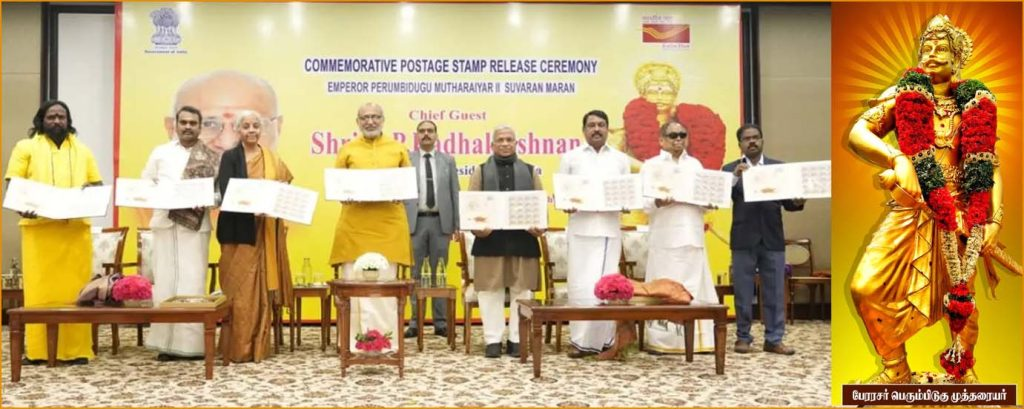
Period: c. 705–745 CE
Other Names: Suvaran Maran, Shatrubhayankar
Dynasty & Kingdom:
- Member of the Mutharaiyar dynasty, a powerful Tamil ruling lineage.
- Feudatories of the Pallavas, particularly under Nandivarman II.
- Controlled central Cauvery region, including Thanjavur, Tiruchirappalli, Pudukkottai, Perambalur, and nearby areas.
- Ruled primarily from Tiruchirappalli for nearly four decades.
4. Bison Horn Maria Dance
Source: TH
Context:
The Bison Horn Maria dance of the Dandami Maria (Maria) tribe in Bastar, Chhattisgarh, is celebrated for its vivid ceremonial performance and resilience of cultural identity despite modern influences.
About the Dandami Maria Tribe
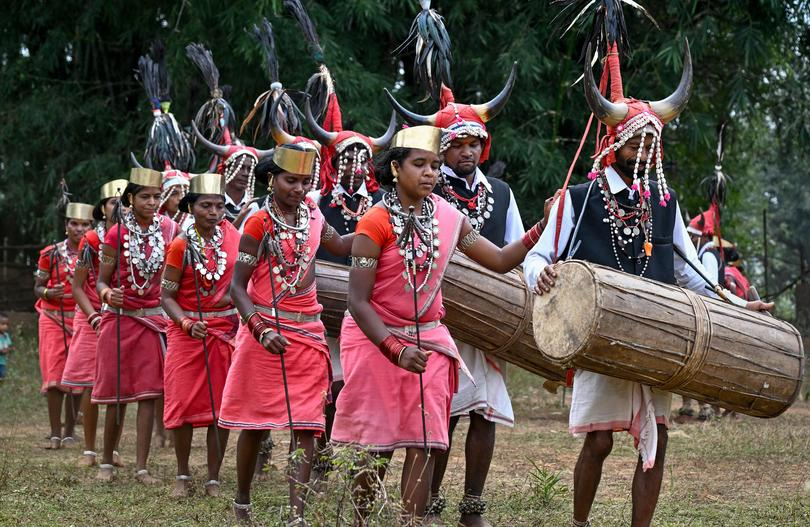
Other Names: Bison Horn Maria, Khalpati Maria
Ethnic Group: Part of the broader Gond (Koytorias) community
Origin:
- Descendants of the ancient Gondwana region in central India.
- Part of the Gond tribal tradition, one of the oldest indigenous groups of the Deccan plateau.
- Language: Dandami Maria, with Gondi dialects (Dravidian origin).
Habitat & Distribution:
- Predominantly in Bastar, southern Chhattisgarh, including Darbha, Tokapal, Lohandiguda, Dantewada.
- Forest-based settlements shape agriculture, hunting, fishing, and rituals.
Key Cultural Features
1. Bison Horn Maria Dance
- Performed during festivals, rituals, and community gatherings by men and women.
- Men’s attire: Horn-shaped bamboo headgear decorated with bison/cattle horns, feathers, cowries, cloth strips, bead necklaces, ankle bells.
- Women’s attire: Handwoven saris, silver and brass jewellery, coin ornaments, ceremonial crowns.
2. Social & Cultural Life
- Ghotul (youth dormitory): Central to socialisation, cultural transmission, and community cohesion.
- Distinct hairstyles, traditional ornaments, and ceremonial objects (tobacco boxes, combs) hold symbolic value.
- Flexible social norms: Divorce and widow remarriage are permitted, reflecting progressive tribal customs.
5. India’s Biosecurity Measures
Source: TH
Context:
Advances in modern biotechnology, including synthetic biology and genetic engineering, have significantly increased humanity’s ability to manipulate biological systems. While these technologies offer immense benefits for health, agriculture, and industry, they also lower barriers for misuse, making biosecurity a critical national and global concern.
What is Biosecurity?
Biosecurity refers to the policies, systems, and practices designed to prevent the intentional misuse of biological agents, toxins, or technologies.
Key dimensions of biosecurity:
- Protection of laboratories handling dangerous pathogens
- Monitoring and regulation of biological research
- Detection, attribution, and containment of deliberate disease outbreaks
- Safeguarding human, animal, and plant health
Biosecurity is distinct from biosafety, which focuses on preventing accidental release of pathogens. Strong biosafety frameworks are foundational to effective biosecurity.
What is the Biological Weapons Convention (BWC)?
- Came into force in 1975
- First multilateral disarmament treaty to completely ban an entire class of weapons of mass destruction
- Prohibits:
- Development
- Production
- Stockpiling
- Acquisition and use of biological and toxin weapons
- Requires destruction of existing stockpiles
Why Does India Need Stronger Biosecurity?
Structural Vulnerabilities
- Geography and ecology expose India to transboundary biological risks
- High population density amplifies outbreak impact
- Agricultural dependence increases vulnerability to agro-terrorism
- Extensive livestock and biodiversity heighten zoonotic risk
Emerging Threat Landscape
- Rapid spread of biotechnologies enables dual-use research
- Lower technical barriers allow malicious actors to experiment with pathogens
- Reports of non-state actors attempting to prepare Ricin toxin highlight real risks
India’s Existing Biosecurity Architecture
India has multiple institutions and legal instruments addressing bio-risk reduction:
Institutional Framework
- Department of Biotechnology: research governance and lab safety
- National Centre for Disease Control: disease surveillance and outbreak response
- Department of Animal Husbandry and Dairying: livestock biosecurity
- Plant Quarantine Organisation of India: agricultural biosecurity
- National Disaster Management Authority: biological disaster guidelines
Legal and Policy Instruments
- Environment (Protection) Act, 1986 (hazardous microorganisms and GMOs)
- Biosafety Rules, 1989
- Recombinant DNA Research and Biocontainment Guidelines, 2017
- Weapons of Mass Destruction Act, 2005
- Participation in:
- Biological Weapons Convention
- Australia Group (export controls)
6. Right to Disconnect Bill, 2025
Source: TOI
Context:
The Right to Disconnect Bill, 2025, a Private Member’s Bill introduced by NCP MP Supriya Sule, has sparked renewed debate on work–life balance and employee well-being in India’s increasingly digital work culture.
What the Bill Seeks to Do
The Bill aims to grant employees a statutory right to disengage from work-related communications outside agreed working hours, protecting personal time amid constant digital connectivity and remote work.
Key Features
- Legal Right to Disconnect – Employees can ignore work calls, emails, or messages after contractual work hours without fear of disciplinary action (Section 7).
- Defined Out-of-Work Hours – Clearly specifies hours beyond which employees are not expected to respond, reducing ambiguity and employer overreach.
- Employees’ Welfare Authority – A central body to oversee implementation, safeguard employee dignity, and promote work–life balance.
- Negotiation Charter – Mandates employer–employee agreements detailing after-hours communication protocols and exceptions.
- Overtime Compensation – Employees responding voluntarily after hours are entitled to overtime pay at normal wage rates (Section 11).
- Digital Well-Being Measures – Awareness programs, counselling services, and Digital Detox Centres, particularly for remote work environments.
- Penalties for Non-Compliance – Violating organizations face a financial penalty of 1% of total employee remuneration, acting as a deterrent.
Banking/Finance
1. Unemployment Rate Dips to 4.7% in November: PLFS
Source: TOI
Context:
The Periodic Labour Force Survey (PLFS), conducted by the National Statistical Office (NSO) under the Ministry of Statistics & Programme Implementation (MoSPI), provides monthly estimates of key labour market indicators for persons aged 15 years and above.
Key Findings:
Unemployment Rate (UR)
- Declined to 4.7% in November
- Lowest since April, when it was 5.1%
- Indicates improvement in employment conditions
Labour Force Participation Rate (LFPR)
The Labour Force Participation Rate (LFPR) is the percentage of a country’s working-age population (usually aged 15 and above) that is either employed or actively seeking employment.
Overall LFPR
- Increased to 55.8% in November
- Highest level since April
- Growth driven mainly by rural participation
Rural vs Urban Trends
- Rural LFPR: Rose to 58.6% in November (from 58% in April)
- Urban LFPR: Marginal dip from 50.5% (October) to 50.4% (November)
Female Labour Force Participation
Female Labour Force Participation Rate (FLFPR) is the percentage of women of working age (usually 15–64 years) who are either employed or actively seeking employment.
Overall Trend
- Steady increase from June to November 2025
- Rose from 32% to 35.1%
Rural–Urban Divide
- Rural female LFPR:
- Increased from 35.2% (June) to 39.7% (November)
- Major contributor to overall female participation
- Urban female LFPR:
- Remained relatively stable
Worker Population Ratio (WPR)
Worker Population Ratio (WPR) is the proportion of employed persons in the total population of a country or region.
Overall WPR
- Increased from 52.8% (April 2025) to 53.2% (November 2025)
Rural WPR
- Rose from 55.4% to 56.3%
Female WPR
- Overall female WPR increased from 32.5% to 33.4%
- Rural female WPR improved significantly from 36.8% to 38.4%
2. Draft Insurance Amendment Bill, 2025
Context:
The Union government has circulated the Draft Insurance Laws (Amendment) Bill, 2025 among Members of Parliament, proposing tighter regulatory controls on the utilisation of life insurance funds and other specified insurance business funds, with a strong focus on policyholder protection, actuarial transparency, and financial prudence.
Key Provisions of the Draft Bill
1. Restrictions on Use of Insurance Funds
- Life insurers and notified insurance classes are barred from:
- Declaring dividends to shareholders
- Paying bonuses to policyholders
- Servicing debentures
- These payments can be made only from a surplus:
- Disclosed through an actuarial valuation
- Reflected in the valuation balance sheet
- Submitted as part of statutory returns to IRDAI
2. Safeguards Against Artificial Surplus Creation
- Insurers cannot inflate surplus by transferring amounts from reserve funds
- Exception allowed only if:
- Reserve funds were created exclusively from earlier valuation surpluses
- Such surpluses were already reported to IRDAI
3. Caps on Debenture Servicing
- Payments from surplus for debentures (principal + interest):
- Maximum 50% of disclosed surplus
- Interest on debentures:
- Capped at 10% of surplus
- Exception if interest is offset against interest credited to the insurance fund while determining actuarial valuation assumptions
4. Limits on Shareholders’ Share in Surplus
- Participating (Par) Policies
- Shareholders’ share (including guaranteed dividends):
- Capped at 10% of surplus
- Subject to further limits prescribed by IRDAI
- Shareholders’ share (including guaranteed dividends):
- Non-Participating (Non-Par) Policies
- Entire surplus may be allocated as permitted by regulation
Institutional and Structural Amendments
Laws Proposed to be Amended
- Insurance Act, 1938
- Life Insurance Corporation Act, 1956
- Insurance Regulatory and Development Authority Act, 1999
Liberalisation of Foreign Investment
- Foreign investment cap in Indian insurance companies
- Proposed increase to 100% of paid-up equity capital
- Includes foreign portfolio investors
- Objective:
- Accelerate sectoral growth
- Enhance capital availability
- Improve insurance penetration
Policyholders’ Education and Protection Fund
- Mandatory creation of a dedicated fund
- Sources:
- Grants and donations
- Penalties imposed by IRDAI
- Purpose:
- Policyholder awareness
- Education
- Protection initiatives
3. Sebi–Amfi in Talks to Ease SIF Distributor Exam
Source: Mint
Context:
The Securities and Exchange Board of India (Sebi) and the Association of Mutual Funds in India (Amfi) are considering changes to the NISM Series XIII (Derivatives) examination, which is mandatory for distributors seeking to sell Specialized Investment Funds (SIFs). The move aims to make the exam more relevant, practical, and accessible without diluting investor protection.
Why the Issue Has Arisen
1. Misalignment Between Exam Content and SIF Products
- The NISM XIII exam has three sections:
- Currency derivatives
- Equity derivatives
- Interest rate derivatives
- Currency derivatives currently have no relevance to SIFs, as:
- Sebi does not permit SIF strategies involving currency derivatives
- All approved SIF strategies rely mainly on equity and debt derivatives
2. High Entry Barrier for Distributors
- The exam is considered much tougher than the standard MF distributor (NISM VA) exam
- Features:
- Advanced mathematics
- Derivatives-heavy content
- Negative marking
- Result: Very low pass rate, discouraging participation
Key Proposals Under Discussion
1. Rationalising Exam Content
- Partial removal or dilution of currency derivatives section
- Retention of equity and interest rate derivatives due to relevance for risk explanation
2. Introduction of Exam Levels
- Different levels aligned with product complexity
- Distributors can qualify for the specific SIF strategies they intend to sell
- Ensures relevance without compromising risk awareness
3. Maintaining Investor Protection
- Amfi is cautious about not weakening risk assessment standards
- Focus remains on ensuring distributors can explain risks clearly to investors
About Specialized Investment Funds (SIFs)
Purpose
- Designed to bridge the gap between:
- Retail Mutual Funds (low risk)
- Portfolio Management Services (PMS) (high ticket, high risk)
Key Features
- Minimum investment: ₹10 lakh (PMS: ₹50 lakh)
- Target investors: Risk-tolerant, informed investors
- Approved strategies (7):
- Equity Long-Short Fund
- Equity Ex-Top 100 Long-Short Fund
- Sector Rotation Long-Short Fund
- Debt Long-Short Fund
- Sectoral Debt Long-Short Fund
- Active Asset Allocator Long-Short Fund
- Hybrid Long-Short Fund
Facts To Remember
1. Bill to Repeal Obsolete Laws Tabled in Lok Sabha
Context
The Union government has introduced a Repealing and Amending Bill in the Lok Sabha to further streamline India’s statute books by removing laws that have become redundant, outdated, or operationally irrelevant.
2. Rajya Sabha Pays Homage to Martyrs on 54th Vijay Divas
The Rajya Sabha paid homage to the brave hearts, who made a supreme sacrifice in the service of the nation on the 54th Vijay Divas today. The day marks the victory of India against Pakistan in 1971.
3. India-Maldives Joint Military Exercise Ex Ekuverin Concludes in Thiruvananthapuram
The bilateral military exercise Ex Ekuverin between the Indian Army and the Maldives National Defence Forces, MNDF, concluded at Thiruvananthapuram with a joint validation exercise.
4. India’s Unemployment Rate Falls to 4.7% in November: MoSPI
India’s Unemployment Rate (UR), declined to 4.7 per cent in November this year, at its lowest level since April, for individuals aged 15 years and above.
5. SPARSH onboards over 31 lakh defence pensioners across India and Nepal
System for Pension Administration – Raksha (SPARSH) has onboarded more than 31 lakh defence pensioners across India and Nepal as of November 2025.
17 December, 2025
Daily Current Affairs Quiz
17 December, 2025
National Affairs
1. FSSAI Launches Egg Safety Drive After ‘Nitrofurans’ Controversy
Source: TNIE
Context:
India’s food safety regulator, Food Safety and Standards Authority of India (FSSAI), has started collecting egg samples of a popular brand to test its quality following uproar over a viral video that claimed that it contained traces of a banned, potentially cancer‑linked substance.
About Nitrofurans
- Nature: Synthetic antimicrobial agents used historically in veterinary medicine.
- Common Compounds: Nitrofurantoin, Furazolidone, Nitrofurazone, Furaltadone.
- Reason for Ban:
- Carcinogenic risk and potential toxicity in humans.
- Banned in India, the European Union, and several other countries.
- Health Implications:
- May cause neurological symptoms, gastrointestinal issues, and long-term cancer risk.
- Violates food safety standards and undermines consumer trust.
Human Health Implications
- Carcinogenic risk: Linked to cancer, prompting global bans.
- Toxicity: Excess exposure can cause neurological issues, gastrointestinal distress, and hypersensitivity.
- Food safety concern: Residues in eggs violate safety standards and erode consumer trust.
- Public health risk: Long-term low-level exposure may accumulate and pose health hazards.
2. India–France Pact on HAMMER (AASM) Precision‑Guided Weapon
Source: TOI
Context:
India has signed an agreement with France’s Safran to jointly manufacture, customise, supply and maintain the HAMMER (AASM) precision‑guided air‑to‑ground weapon. Manufacturing will be done in India through a 50:50 joint venture between Safran and Bharat Electronics Limited (BEL). The pact strengthens defence indigenisation, Make in India, and India–France strategic defence cooperation.
What is HAMMER (AASM)?
- Full form: Highly Agile Modular Munition Extended Range (AASM).
- Type: Stand‑off, precision‑guided air‑to‑ground weapon system.
- Function: Converts conventional “dumb” bombs into high‑accuracy smart munitions using modular guidance and propulsion kits.
Developer and Manufacturing
- Original developer: Safran Electronics & Defense, France.
- Indian production: Jointly manufactured by BEL–Safran JV (50:50).
- Scope of JV: Manufacturing, customisation, supply, maintenance, and lifecycle support in India.
Objective and Strategic Aim
- Provide the Indian Air Force with:
- High‑precision strike capability
- Stand‑off attack ability (launch from outside enemy air defence zones)
- Controlled escalation in conflict scenarios
- Reduced collateral damage and aircraft risk
3. India–Maldives Joint Military Exercise EKUVERIN
Source: TH
Context:
The bilateral military exercise EKUVERIN between the Indian Army and the Maldives National Defence Forces (MNDF) concluded after two weeks of joint training, reinforcing defence cooperation between the two countries.
Key Details
- Conclusion marked by: Joint validation exercise
- Location: Thiruvananthapuram
- Duration: Two weeks
Focus Areas of the Exercise
- Counter Insurgency operations
- Counter Terrorism operations
- Training tailored to contemporary operational environments
- Emphasis on joint drills, tactical coordination, and mission execution
4. IBC Amendment Bill, 2025
Source: Mint
Context:
A Lok Sabha select committee reviewed the IBC (Amendment) Bill, 2025 and is set to table its report in the lower house.
Objective: Overhaul the Insolvency and Bankruptcy Code (IBC), 2016, to make the distressed-assets market more attractive and reduce delays in corporate turnaround.
Key Provisions Proposed in the Bill
- Faster tribunal admissions to accelerate insolvency resolution.
- Creditor-led, mostly out-of-court bankruptcy resolution scheme for quick corporate turnaround.
- Group insolvency scheme to address insolvency of multiple companies in a corporate group simultaneously.
- Cross-border insolvency resolution regime to manage international insolvencies efficiently.
Purpose and Rationale
- Address systemic gaps in IBC implementation, including:
- Delays due to shortage of judges.
- Uncertainty in resolution plan finality.
- Accountability issues among insolvency professionals.
- Goal: Strengthen creditor confidence and improve outcomes, while maintaining the jurisprudential balance evolved through judicial interpretation.
What is Insolvency and Bankruptcy Code (IBC)?
The Insolvency and Bankruptcy Code (IBC), 2016 is India’s comprehensive law for resolving insolvency and bankruptcy in a time-bound and structured manner.
- A single, unified law replacing multiple old laws related to corporate and personal insolvency.
- Provides a legal framework to resolve the financial distress of companies, limited liability partnerships, partnerships, and individuals.
- Ensures creditors can recover dues efficiently, while also giving businesses a chance for revival.
Banking/Finance
1. Sabka Bima Sabki Raksha (Amendment of Insurance Laws) Bill, 2025
Source: TH
Objective
The Lok Sabha passed an amendment bill to raise foreign direct investment (FDI) limit in India’s insurance sector to 100% from 74% earlier, in a move that is likely to boost competition and spur capital inflows.
Key Provisions
- FDI Limit
- FDI in insurance companies increased from 74% to 100%.
- Indian citizenship requirement: At least one of the top executives (Chairperson, MD, or CEO) must be an Indian citizen.
- Regulatory and Governance Reforms
- Establishment of the Policyholders’ Education and Protection Fund to safeguard policyholder interests.
- Chairperson and whole-time members of IRDAI or insurance boards to have a five-year term or until age 65, whichever is earlier (current limit: 62 for members, 65 for Chairperson).
- Transparency in regulation-making and enhanced supervisory powers for regulators.
- Corporate Structure Flexibility
- Permits the merger of non-insurance companies with insurance companies, facilitating corporate restructuring and expansion.
- Empowers boards of insurance companies, including LIC, to make operational decisions like branch expansion and recruitment.
- Policyholder Protection & Market Development
- Promotes financial security of policyholders.
- Encourages entry of additional players to boost competition, economic growth, and employment generation.
- Enhances ease of doing business for insurers, intermediaries, and stakeholders.
Foreign Direct Investment (FDI)
Foreign Direct Investment is a long-term investment made by a foreign entity (company or individual) in the equity capital or business operations of a company in another country, with the intent to have significant control or influence over its management.
Key Features of FDI:
- Ownership & Control: Investor typically acquires 10% or more of voting shares or management control.
- Long-term Investment: FDI is intended for strategic involvement in the business.
- Forms:
- Greenfield investment (building new facilities)
- Mergers & acquisitions (acquiring existing firms)
- Joint ventures or strategic alliances
- Impact: Enhances employment, technology transfer, infrastructure development, and economic growth.
Key Differences Between FDI and FPI
| Feature | FDI (Foreign Direct Investment) | FPI (Foreign Portfolio Investment) |
|---|---|---|
| Ownership & Control | Significant (≥10% stake, management control) | Minimal (<10% stake, no control) |
| Investment Horizon | Long-term | Short-term |
| Forms | Equity in business, M&A, joint ventures | Stocks, bonds, mutual funds |
| Influence on Management | Yes | No |
| Impact on Economy | Jobs, technology transfer, infrastructure | Liquidity, capital inflow, market depth |
| Risk & Stability | Lower volatility, more stable | Higher volatility, market-sensitive |
2. Rupee Breaches 91 per Dollar, Becomes Weakest Asian Currency in 2025
Source: TH
Context:
The Indian rupee depreciated beyond the 91 mark against the U.S. dollar during intraday trade, touching 91.14, before closing at 90.93. This marks a fresh all-time low, making the rupee the weakest Asian currency in 2025 and among the weakest globally this year.
Factors Driving Rupee Weakness
| Factor | Details / Impact |
|---|---|
| Trade & Geopolitical Uncertainty | – Uncertainty over India–U.S. trade deal affecting investor sentiment. – Global trade tensions increasing risk aversion in financial markets. |
| Capital Outflows | – FPIs withdrew ~$2.7 billion in first two weeks of December. – One of the largest monthly outflows of 2025, pressuring the rupee. |
| Global Macro Pressures | – Rising U.S. bond yields and expected Bank of Japan rate hike triggering yen carry trade unwinding. – Leads to sell-off in emerging-market assets, including the rupee. |
RBI’s Stance and Policy Interpretation
Limited Intervention
- Experts suggest the RBI’s restrained intervention appears deliberate rather than reactive.
- With India’s growth strong and inflation under control, policymakers may be comfortable allowing gradual depreciation.
Strategic Considerations
- A weaker rupee can support export competitiveness, especially in a trade-war environment.
- Economists note that the RBI is allowing the currency to adjust within limits, rather than defend a fixed level aggressively.
Past Policy Legacy
- Analysts argue that earlier attempts to keep the rupee tightly pegged (around ₹83 per dollar) have constrained flexibility and contributed to current pressures.
3. PFRDA Allows Loans Against Pension Savings Under NPS
Source: BS
Context:
The Pension Fund Regulatory and Development Authority (PFRDA) has notified amendments to the PFRDA (Exits and Withdrawals under the NPS) Regulations, 2025, introducing significant reforms to enhance flexibility for National Pension System (NPS) subscribers, especially in withdrawals, exits, and retirement options.
Major Reform: Loan Against NPS Corpus
Financial Assistance Against Pension Savings
- NPS subscribers can now avail loans from regulated financial institutions by using their NPS account as collateral.
- Lenders are allowed to mark a lien or charge on the individual pension account.
Safeguards
- Lien/charge limited to 25% of the subscriber’s own contribution, in line with partial withdrawal limits.
- Earlier blanket prohibition on pledge or assignment of NPS benefits has been partially relaxed.
- Detailed operational guidelines will be issued separately by PFRDA and record-keeping agencies.
Rationalisation of Partial Withdrawal Rules
Housing
- Partial withdrawal for purchase or construction of a house (if the subscriber does not already own one, except ancestral property) is retained.
- Explicitly clarified as a one-time withdrawal.
Medical Needs
- Scope significantly widened.
- Allowed for medical treatment or hospitalisation of the subscriber, spouse, children, or parents.
- Earlier restriction to a specified list of critical illnesses removed.
Removed Eligible Purposes
- Skill development, re-skilling, and self-development
- Setting up a start-up or own venture
New Eligible Purpose
- Partial withdrawal allowed for settlement of a financial obligation taken from a regulated financial institution against a lien on the NPS account.
Changes in Exit and Withdrawal Structure (Non-Government Sector)
Lock-in and Vesting
- Five-year minimum subscription period removed under the All Citizen Model and Multiple Scheme Framework (MSF).
- Vesting period revised to:
- 15 years, or
- Any higher period specified under a scheme, or
- Till 60 years of age, whichever is earlier.
Lump Sum vs Annuity at Retirement
- Lump sum withdrawal limit increased to 80% of corpus.
- Minimum annuity requirement reduced to 20%, from earlier 40%.
Special Provisions for Smaller Pension Corpus
Corpus up to ₹8 lakh
- Subscriber may opt for:
- 100% lump sum, or
- Systematic Lump Sum Withdrawal (SLW), or
- Systematic Withdrawal Request (SUR), or
- Other approved options.
Corpus between ₹8 lakh and ₹12 lakh
- Up to ₹6 lakh can be withdrawn as lump sum.
- Remaining amount to be invested in:
- SUR for a minimum of six years, or
- Annuity, or
- Other approved instruments.
4. Unclaimed Bank Deposits in India More Than Double in Five Years
Source: BS
Context:
India’s unclaimed bank deposits have risen sharply, highlighting growing challenges in financial awareness, account dormancy, and beneficiary identification, even as the government has launched targeted recovery initiatives.
What are Unclaimed Bank Deposits?
An unclaimed bank deposit refers to money that has been deposited in a bank account but has not been accessed, withdrawn, or claimed by the account holder for a specified period. These can be in the form of savings accounts, fixed deposits (FDs), recurring deposits, or other bank instruments.
Key Features of Unclaimed Bank Deposits
- Dormancy:
- Accounts with no transactions for a prolonged period (usually 24–36 months) are classified as dormant.
- Once dormant, the balance is considered unclaimed until the account holder or nominee claims it.
- Types of Unclaimed Deposits:
- Savings account balances
- Fixed deposits and recurring deposits
- Interest accrued but unpaid
- Matured deposits not withdrawn
- Regulatory Guidelines:
- In India, the Reserve Bank of India (RBI) requires banks to transfer unclaimed deposits to a designated fund if not claimed for a long period.
- Banks must also attempt to inform and locate the account holder or nominee.
- Claiming Process:
- Account holders or their nominees can claim unclaimed deposits by submitting KYC documents and proof of ownership.
Recovery Efforts by the Government
‘Your Money, Your Right’ Initiative
- Announced by Prime Minister Narendra Modi on December 10
- Amount returned to rightful owners: Nearly ₹2,000 crore
- This represents about 3% of total unclaimed deposits as of June 30, 2025
Special Recovery Campaign
- Launched by: Finance Minister Nirmala Sitharaman
- Duration: Three months (starting October)
- Objective:
- Facilitate identification of rightful claimants
- Speed up recovery of dormant and unclaimed balances
Why Unclaimed Deposits Are Rising
- Increase in number of bank accounts due to financial inclusion drives
- Dormant accounts with no transactions over long periods
- Lack of nominee details or updated KYC
- Death of account holders without timely claim by heirs
5. India Needs Indian Banks
Source: BS
Context:
The Reserve Bank of India’s (RBI) approach to bank ownership and promoter control has evolved significantly over the past two decades. Recent approvals allowing foreign regulated institutions to take large stakes in Indian private banks indicate a renewed regulatory preference that raises important questions about India’s long-term banking capacity and financial sovereignty.
Evolution of RBI’s Bank Ownership Policy
Phase 1: Emphasis on “Skin in the Game” (Early 2000s)
- Promoters were encouraged to hold significant equity stakes to ensure commitment and accountability
- Example: Kotak Mahindra Bank (2001)
- Promoter holding: 61% at conversion from NBFC to bank
- RBI required reduction only to 49%, not dispersed ownership
Phase 2: Shift Towards Diversified Ownership (2005–2016)
- RBI began advocating dispersed shareholding to reduce promoter dominance
- 2013 Guidelines introduced:
- Mandatory Non-Operative Financial Holding Company (NOFHC) structure
- Promoter stake capped at 40% initially, to be reduced to 15% within 12 years
- Five-year lock-in on promoter stake
- 2016 Master Direction reinforced this approach
- Applied even to existing banks
- Target promoter holding: 15%
Core Concern: Over-Reliance on Foreign Capital
- India has too few banks for the size and credit needs of its economy
- Domestic entrepreneurs with patient, long-term capital are scarce
- Private equity-backed professional teams cannot meet systemic scale requirements
- Foreign capital alone cannot sustain India’s long-term credit growth
Policy Recommendations
- Reconsider frameworks on:
- Bank ownership norms
- Voting rights caps
- Blanket restrictions on industrial houses entering banking
- Encourage large, well-governed NBFCs to convert into banks
- Already possess:
- Advanced technology platforms
- Digital onboarding and data-driven credit assessment
- Robust risk management systems
- Already possess:
6. Sebi Board to Review MF Fee Structure and Stock Broker Rules
Source: BS
Context:
The Securities and Exchange Board of India (Sebi) is set to consider a wide-ranging set of regulatory reforms at its upcoming board meeting, aimed at reducing investor costs, modernising market regulations, improving disclosures, and streamlining capital market processes.
Key Regulatory Proposals Under Review
Overhaul of Stock Broker Regulations
- Review of three-decade-old Stock Brokers Regulations
- Objective:
- Ease compliance burden
- Align regulations with the Companies Act, 2013
- Key proposed changes:
- Formal definitions for:
- Algorithmic trading
- Proprietary trading
- Execution-only platforms
- Formal definitions for:
- Significance:
- Provides regulatory clarity amid growing use of automation and advanced trading strategies
Revamp of Mutual Fund Fee Structure (TER)
- Sebi to revisit Total Expense Ratio (TER) norms
- Background:
- Earlier proposal (2023) faced strong industry resistance
- Revised proposal floated in October 2025
- Key proposals:
- Reduction in brokerage and transaction costs:
- Cash market: 12 bps → 2 bps
- Derivatives: 5 bps → 1 bp
- Reduction in overall TER caps by 15–20 bps
- Reduction in brokerage and transaction costs:
- Policy intent:
- Lower investor costs
- Enhance long-term returns and transparency
IPO Process and Pledged Shares
- Amendments to ICDR Regulations proposed
- Focus area:
- Treatment of pledged shares held by non-promoters in IPO-bound companies
- Likely measures:
- Such pledged shares to be treated as locked-in
- Depositories to revise frameworks accordingly
- Objective:
- Prevent misuse and improve disclosure integrity in IPOs
Simplification of Offer Documents
- Sebi may:
- Rationalise offer document summaries
- Remove mandatory requirement for an abridged prospectus
- Aim:
- Improve investor comprehension
- Reduce complexity and repetition in IPO disclosures
Conflict of Interest Disclosure Norms
- Review of recommendations by a high-level committee constituted in March
- Key recommendations:
- Expanded disclosures of:
- Assets and liabilities
- Trading activities
- Relevant relationships
- Disclosure timelines:
- At appointment
- During annual reviews
- Expanded disclosures of:
- Objective:
- Strengthen governance and credibility of market institutions
Debt Market and Dematerialisation Measures
- Sebi may explore:
- Incentives for debt issuances
- Easing dematerialisation of physical shares
- Proposed change:
- Allow higher coupon rates or discounts for select investors in debt issues
- Rationale:
- Boost depth and participation in corporate bond markets
7. RBI Injects $5 Billion via Currency Swap to Boost Liquidity
Source: ET
Context:
The Reserve Bank of India (RBI) is facing early signs of liquidity strain among banks. Surplus funds with lenders have fallen sharply from ₹4 trillion in early August to about ₹1.3 trillion ($14.3 billion) in December 2025.The 10-year government bond yield has risen by ~10 basis points since RBI cut policy rates on 5 December, signaling tightening market conditions.
Currency Swap
A currency swap is a financial agreement between two parties to exchange principal and interest payments in different currencies over a specified period. Central banks, like the Reserve Bank of India (RBI), often use it as a tool to manage liquidity and stabilize the currency.
Key Features of a Currency Swap
- Exchange of Currencies:
- One party provides a certain amount in its currency (e.g., rupees), while the other provides an equivalent amount in a foreign currency (e.g., U.S. dollars).
- Reversal Agreement:
- At the end of the swap period, the parties re-exchange the principal amounts at a pre-agreed rate.
- Interest Payments:
- During the swap, interest may be paid in the respective currencies according to the terms of the agreement.
Why RBI Uses Currency Swaps
- Inject Liquidity: When RBI buys dollars from banks against rupees, it injects rupee cash into the banking system, increasing liquidity.
- Support the Rupee: Helps stabilize the exchange rate by managing the supply of foreign currency in the market.
- Manage Market Rates: Helps control short-term interest rates and credit availability.
Facts To Remember
1 Indian Army receives final batch of Apache helicopters
The Indian Army on Tuesday received the final batch of three AH-64E Apache attack helicopters, completing its six-unit fleet at the 451 Army Aviation Squadron based in Jodhpur, Rajasthan. The helicopters landed at the Air Force Station, Hindon, in Ghaziabad before being inducted into the service.
2. B. Sairam named chief of Coal India
State-owned miner Coal India appointed B. Sairam as their new chairman and managing director.
3. Aishwary wins 3P gold with world record
Aishwary Pratap Singh Tomar delivered a landmark performance at the 68th Shooting Nationals on Tuesday, firing a world record 470.5 to clinch gold in the men’s 50m rifle 3 positions final.
4. AFMS launches India’s first AI-driven community screening programme for diabetic retinopathy
The Armed Forces Medical Services (AFMS) has launched India’s first Artificial Intelligence-driven community screening programme for Diabetic Retinopathy.
5. PM Modi says, Global South is writing its own destiny; Addresses Joint Session of Ethiopia’s Parliament in Addis Ababa
Prime Minister Narendra Modi today said that India and Ethiopia stand together as members of one family to work for a more just, more equal and more peaceful world.
6. Indian film ‘Homebound’ shortlisted for Best International Feature Film at Oscars 2026
The Indian movie ‘Homebound’, directed by Neeraj Ghaywan, has been shortlisted for the 98th Academy Awards in the Best International Feature Film category.
7. Survey of India hosts National Workshop on Strengthening Geospatial Ecosystem to advance technologies for Viksit Bharat
The Survey of India, Department of Science & Technology, is hosting the National Workshop on Strengthening of Geospatial Ecosystem, “Geospatial Mission: An Enabler of Viksit Bharat” at Yashobhoomi, in the national capital.
8. Indian Navy commissions second MH-60R helicopter squadron INAS 335 at INS Hansa, Goa
The Indian Navy will commission its second MH-60R helicopter squadron, INAS 335 (Ospreys), at INS Hansa in Goa.
9. Second WHO Global Summit on Traditional Medicine to begin in New Delhi
The Second WHO Global Summit on Traditional Medicine will begin today in New Delhi.
18 December, 2025
Daily Current Affairs Quiz
18 December, 2025
National Affairs
1. World Anti-Doping Agency (WADA) Testing Figures Report 2024
Source: IE
Context:
India has again topped the global doping chart, according to the World Anti-Doping Agency (WADA) Testing Figures Report 2024, marking the third consecutive year at No. 1 — a worrying trend for Indian sport.
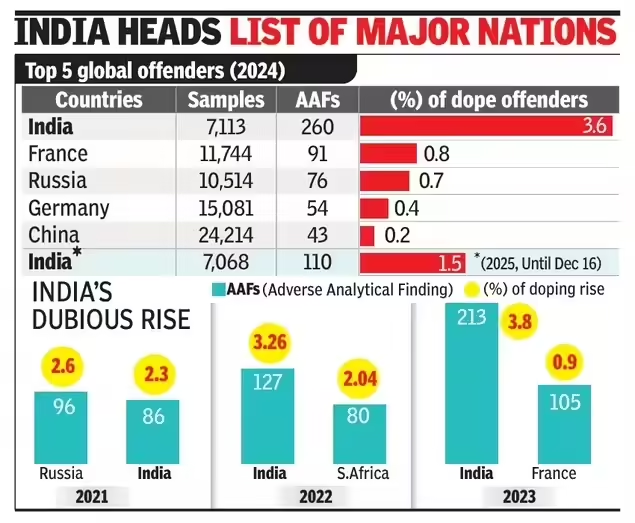
Key Data:
- Total positive cases (India): 260
- Samples tested by NADA: 7,113
- Positivity rate: 3.6% — among the highest worldwide
- Statutory testing body: National Anti-Doping Agency (NADA)
Sport-Wise Highest Offenders:
- Athletics: 76
- Weightlifting: 43
- Wrestling: 29
- Also notable: boxing, powerlifting, kabaddi
Global Comparison:
India far exceeds doping totals of other major sporting nations:
- France: 91 positives
- Russia: 76
- China: 43
- USA: Lower positivity rate despite lower test numbers
- India’s numbers are significantly higher despite testing on a smaller scale than major sporting nations.
2. AFMS Launches India’s First AI-driven Community Screening Programme for Diabetic Retinopathy
Source: News on Air
Context:
The Armed Forces Medical Services (AFMS) has rolled out India’s first artificial intelligence-enabled community screening programme for Diabetic Retinopathy, aimed at transforming early detection and prevention of diabetes-related blindness at scale.
What is the initiative?
A nation-first AI-powered screening system designed to detect and grade Diabetic Retinopathy at the community level.
Developed through a collaboration between:
- Armed Forces Medical Services (AFMS)
- Dr. Rajendra Prasad Centre for Ophthalmic Sciences (RPC), AIIMS
- eHealth AI Unit, Ministry of Health & Family Welfare
Powered by the AI platform MadhuNetrAI.
Aim of the programme
- Enable early, accurate identification of diabetic eye disease.
- Ensure timely referrals for treatment and vision protection.
- Build real-time, national-level health intelligence on disease patterns and geography.
- Reduce the incidence of preventable blindness caused by diabetes.
Key Features
- AI-based scanning and grading of retinal images.
- Retinal photographs captured through handheld fundus cameras.
- Screening conducted by trained Medical Officers, nurses and health assistants.
- Automated triaging to identify vision-threatening DR cases.
- Direct digital referral to retina specialists for advanced care.
- Real-time dashboard mapping DR prevalence for policy and resource planning.
- Supports integration with NCD (non-communicable disease) programmes for continuity of care.
3. ISRO launches RESPOND Basket 2025
Source: TOI
Context:
The Indian Space Research Organisation (ISRO) has released RESPOND Basket 2025, inviting targeted research proposals from academic and research institutions across India to support its upcoming mission and technology requirements.
What is RESPOND Basket 2025?
A curated set of mission-oriented research problem statements, identified by ISRO and Department of Space (DoS) centres, designed to guide the academic community toward high-priority areas linked to India’s current and future space programmes.
Issued by:
- Indian Space Research Organisation (ISRO)
- Under the Department of Space (DoS), Government of India
Aim of the initiative
- Strengthen collaboration between academia and ISRO.
- Channel research talent toward solving real-world space technology challenges.
- Build scientific capacity to support India’s next-generation space missions.
4. Vijay Diwas 2025
Source: TNIE
Context:
On Vijay Diwas 2025, President Droupadi Murmu inaugurated the ‘Param Vir Dirgha’ at Rashtrapati Bhavan — a dedicated gallery showcasing portraits of all 21 Param Vir Chakra (PVC) awardees.
This installation replaces portraits of former British Aide-de-Camps, marking a significant step in India’s ongoing effort to remove colonial-era symbols and honour the nation’s own military heritage.
About Param Vir Chakra (PVC)
India’s highest military gallantry award, given for exceptional bravery, valour and supreme sacrifice in the presence of the enemy during wartime.
- Instituted: 26 January 1950
Key features:
- Awarded to personnel of the Army, Navy, Air Force, Territorial Army and other armed forces
- Can be awarded posthumously (majority of awards have been posthumous)
- Comes with a monthly honorarium of ₹3,000, plus ₹3,000 for each bar awarded
Award criteria:
- Granted only in wartime conditions
- Recognises extraordinary courage and self-sacrifice in direct combat
About Aide-de-Camps (ADCs)
An Aide-de-Camp is a commissioned military officer attached to high constitutional authorities such as the President, Governors, or Service Chiefs.
Typical ranks:
- Major (Army)
- Lieutenant Commander (Navy)
- Squadron Leader (Air Force)
5. India endorses Tianjin Declaration at SCO Summit 2025
Context:
At the 2025 Shanghai Cooperation Organisation (SCO) Summit held in Tianjin, China, India joined other member states in adopting the Tianjin Declaration — a comprehensive outcome document affirming deeper cooperation in Artificial Intelligence governance, research, standards and capacity building across the Eurasian region.
The declaration reinforces India’s stand on equitable and responsible AI, while expanding its multilateral technology engagement within the SCO framework.
About the Tianjin Declaration
An outcome document adopted by the SCO Council of Heads of States at the Tianjin Summit, laying out shared priorities on security, technology, economy and institutional reforms.
About SCO (Shanghai Cooperation Organisation)
A permanent intergovernmental regional organisation focused on security, economic cooperation and cultural ties across Eurasia.
- Founded: 15 June 2001, Shanghai (emerging from Shanghai Five framework)
- Headquarters:
- Secretariat: Beijing, China
- RATS (Regional Anti-Terrorist Structure): Tashkent, Uzbekistan
- Members (10):
- India, China, Russia, Kazakhstan, Kyrgyzstan, Tajikistan, Uzbekistan, Pakistan, Iran, Belarus
- Observers:
- Afghanistan, Mongolia
Banking/Finance
1. SEBI Overhauls Mutual Fund Cost Framework and Stockbroking Rules
Source: Mint
Context:
The Securities and Exchange Board of India (Sebi) has revised the cost structure for the ₹80 trillion mutual fund industry, effective 1 April 2026, to enhance transparency and ease investor understanding.
Key Highlights:
1. Introduction of Base Expense Ratio (BER)
- The Base Expense Ratio (BER) is the core fee charged by a mutual fund’s Asset Management Company (AMC) only for managing investor money.
- Replaces the current TER structure, which included brokerage, STT, stamp duty & exchange fees.
- Pass-through levies now removed from BER and shown separately.
2. Brokerage Fee Reduction
- Cash market brokerage: reduced to 6 basis points (bps) from 12 bps
- Derivatives brokerage: reduced to 2 bps from 5 bps
- What is a basis point?
- 1 basis point = 0.01%
- Therefore, 6 bps = 0.06%
Brokerage is paid to stockbrokers for executing buy/sell transactions on behalf of mutual funds. Lower brokerage reduces total fund costs and may improve investor returns.
3. Exit-Load Brokerage Removed
- SEBI has scrapped the additional 5 bps brokerage linked to exit loads.
- Exit load is a fee charged to investors when they redeem units before a specified period. Earlier, AMCs could charge extra brokerage out of this exit-load component.
4. Shift from TER to BER Structure
- Earlier:
- Total Expense Ratio (TER) included:
- fund management fee + operations + brokerage + taxes + regulatory charges
- Now:
- SEBI has introduced the Base Expense Ratio (BER) concept.
- Base Expense Ratio (BER)
- BER is the core fee charged by the Asset Management Company for managing investor money. It excludes statutory taxes and levies.
Under the new system, TER = BER + brokerage + regulatory levies + statutory taxes
Market Impact
- Pressure on AMC profit margins, especially small AMCs
- Costs may be passed to distributors
- Greater pricing clarity and lower long-term investor cost burden
5. Stockbroker Regulations Overhauled
SEBI has modernised stockbroker rules for the first time since 1992.
Key features:
- Regulations reorganised into 11 chapters
- Outdated provisions removed or merged
- Stock exchanges designated as first-line regulators
Meaning: Instead of SEBI handling routine violations, stock exchanges will directly monitor stockbrokers for compliance, reporting, and misconduct.
Qualified Stockbroker (QSB) rules refined
Eligibility criteria updated to ensure firms with large scale operations are subject to tighter supervision.
Pledged Share Lock-in Clarity
Pledged shares will now remain locked in for the required period even after pledge invocation.
Why important?
During IPOs, promoters must lock in shares for a fixed period. But pledged shares couldn’t technically be locked earlier, creating compliance hurdles. The change fixes this gap.
6. Debt Market Reforms
Retail Participation Incentives
- Debt issuers may offer:
- extra interest
- price discounts to groups like women and senior citizens.
Aim: encourage wider retail investment in bonds.
HVDLE Threshold Raised
High Value Debt Listed Entities (HVDLE):
Classification limit increased from ₹1,000 crore to ₹5,000 crore.
This eases bond issuance requirements for NBFCs, HFCs, ARCs, and others.
7. Credit Rating Expansion
Credit rating agencies may now rate instruments regulated by other financial sector authorities, increasing coverage for unlisted and non-traditional debt products.
8. Unclaimed Funds Transfer Rule Revised
Unclaimed amounts from non-convertible securities must now be moved to the Investor Education and Protection Fund after seven years from maturity, instead of multiple staggered transfers earlier.
9. Conflict-of-Interest Norms Deferred
SEBI has postponed decisions on new rules requiring asset disclosures by officials due to privacy concerns and complexities involving spousal trading restrictions.
2. PFRDA Allows Up to 80% NPS Withdrawal
Source: TOI
Context:
The Pension Fund Regulatory and Development Authority (PFRDA) has revised NPS withdrawal rules, allowing private sector subscribers to withdraw up to 80% of their accumulated corpus, instead of the earlier 60%. The remaining 20% must be used to purchase an annuity to generate pension income.
Key Changes:
- Withdrawal limit raised:
Earlier: 60%
Now: 80% of corpus can be withdrawn - Subscriber age limit extended:
NPS account can now be continued up to 85 years, up from 75 years earlier - Systematic Redemption:
Regulator reiterates option for systematic unit redemption, similar to mutual fund SWP
Can be used only within the 80% withdrawal limit - Withdrawal frequency increased:
Four withdrawals permitted before age 60, instead of three earlier
Can be used for needs such as education, home purchase, or wedding expenses
Tax Clarity Pending:
- Currently, only 60% withdrawal is tax-free
- Govt may amend laws to make 80% withdrawal tax-free
Revised Eligibility Criteria:
- Applicable to:
Subscribers with 15+ years in NPS OR
Subscribers retiring from service
Full Withdrawal Limit Revised:
- Full withdrawal allowed if corpus ≤ ₹8 lakh (earlier limit ₹5 lakh)
- Change made because annuity providers require at least ₹2 lakh purchase value
For Corpus Between ₹8–12 Lakh:
Subscribers can:
- Withdraw up to ₹6 lakh as lump sum, OR
- Opt for periodic payouts via systematic withdrawal
3. Amazon Pay Launches Biometric UPI Authentication Feature
Context:
Amazon Pay has introduced a new biometric authentication feature for UPI payments, allowing users to complete transactions using fingerprints or facial recognition.
Key Highlights:
- Users can make UPI payments without entering a PIN.
- Authentication will be done through fingerprint or face scan, depending on the device.
- Amazon Pay claims this is an industry-first feature in India for UPI transactions.
Facts To Remember
ICG Ship Sarthak makes first port call at Iran’s Chabahar
The Indian Coast Guard (ICG) Ship Sarthak, an offshore patrol vessel, entered the Chabahar port in Iran on December 16 for a four-day visit till December 19.
2. World Tennis League
A sports exhibition is a double-edged sword. There is a certain detachment that it maintains from fierce competition, which a purist may liken to trivialising.
3. Anantjeet, Darshna clinch mixed team skeet gold
Rajasthan’s Anantjeet Singh Naruka and Darshna Rathore won the senior skeet mixed team gold at the 68th National shooting (shotgun) in New Delhi on Wednesday, defeating Uttar Pradesh’s Mairaj Ahmad Khan and Areeba Khan 45-43.
4. Kolkata unveils 70-foot Lionel Messi statue during GOAT India Tour 2025
A 70-foot statue of Lionel Messi was virtually unveiled in Lake Town, Kolkata, as part of the kickoff to the GOAT India Tour 2025, honouring the Argentine football legend’s remarkable career, including his FIFA World Cup triumph. The statue, commissioned by Sree Bhumi Sporting Club, was inaugurated remotely by Messi — an eight-time Ballon d’Or winner — ahead of his visit to India.
5. Navy Commissions Second MH-60R Helicopter Squadron ‘Ospreys’: Significance Explained
The Indian Navy has commissioned INAS 335 (‘Ospreys’), its second MH-60R helicopter squadron, at INS Hansa, Goa, marking a key step in strengthening naval aviation and maritime security on the western seaboard.
6. India’s GDP Growth Outlook Strong Despite Global Slowdown: CareEdge Ratings
CareEdge Ratings has projected that India’s economy will continue to show resilience over the next two years, despite global growth challenges and trade uncertainties.
Growth Forecasts:
- FY26 GDP growth: 7.5%
- FY27 GDP growth: 7%
7. Bhartiya Bhasha Utsav 2025
Held in New Delhi on Mahakavi Subramania Bharati’s birth anniversary.
Theme: “Many Languages, One Emotion.”
Focus: India’s linguistic diversity; tribal languages and cultural performances.
8. AIM–HUL Circular Economy Start-up Accelerator
NITI Aayog’s Atal Innovation Mission partnered with HUL under Project Circular Bharat.
Aim: Support 50 start-ups in 3 years in areas like recycling, refill/reuse systems, next-gen packaging, and textile/e-waste recovery.
9. Craftkatha 2025
Inaugurated in New Delhi by Sudha Murty.
Part of National Handicrafts & Heritage Week 2025.
Focus: Promotion of Indian handicrafts and artisans.
10. India & Oman ink Comprehensive Economic Partnership Agreement to deepen trade ties
Prime Minister Narendra Modi’s visit to Oman was very significant, especially when both friendly Nations are marking the 70th Anniversary of the establishment of diplomatic relations between them.
11. Union Ministers Congratulate Prime Minister Modi on Receiving Oman’s Highest Civilian Honour
Union Ministers Amit Shah, Dr S Jaishankar and Jagat Prakash Nadda today congratulated Prime Minister Narendra Modi on being conferred with the First Class of the Order of Oman, the highest civilian honour of Oman.
12. India and Saudi Arabia Sign Visa Waiver Agreement to Facilitate Official Travel
India and Saudi Arabia signed a bilateral visa waiver agreement in Riyadh to facilitate official travels and boost bilateral exchanges under the India-Saudi Arabia Strategic Partnership Council.
13. Indian Navy commissions second MH 60R helicopter squadron INAS 335 in Goa
Indian Navy’s second MH 60R helicopter squadron, INAS 335 (The Ospreys), was commissioned at INS Hansa in Goa.
19 December, 2025
Daily Current Affairs Quiz
19 December, 2025
International Affairs
1. Taliban Approves Water Diversion from Kunar River
Context:
Afghanistan’s Taliban administration has approved plans to divert water from the Kunar (Chitral) River to the Darunta Dam in Nangarhar province, triggering concerns in Pakistan about reduced downstream flows from the shared river system. The move could affect irrigation, drinking water supply, and hydropower potential in Pakistan’s Khyber Pakhtunkhwa province.
About the Kunar River
A major transboundary Himalayan river, known as the Chitral River in Pakistan and the Kunar River in Afghanistan. It forms an important part of the Indus Basin and supports agriculture, water supply, and energy needs.
Origin:
- Source: Chiantar Glacier, Hindu Kush Mountains
- Location: Northern Chitral region, Pakistan
Course:
- Begins as the Chitral/Mastuj River in Pakistan
- Enters Afghanistan at Arandu, becomes Kunar River
- Flows through Kunar & Nangarhar provinces
- Joins the Kabul River near Jalalabad
- Kabul River re-enters Pakistan
- Kabul merges with the Indus River near Attock
Countries involved:
Pakistan → Afghanistan → Pakistan (via Kabul–Indus system)
Major Tributaries:
- Pech River (significant tributary)
- Lotkoh River
River Hierarchy:
Kunar River → Kabul River → Indus River
National Affairs
1. DHRUV64 Microprocessor
Source: TH
Context:
On December 15, the Ministry of Electronics and Information Technology (MeitY) announced the launch of DHRUV64, a fully indigenous microprocessor developed under India’s Microprocessor Development Programme. The chip is positioned to strengthen India’s domestic processor ecosystem and support applications across telecom, industrial automation, and embedded systems.
Who developed DHRUV64?
- Developed by the Centre for Development of Advanced Computing (C-DAC) under MeitY.
What is DHRUV64?
- A 64-bit, dual-core, 1 GHz microprocessor.
- Designed to run operating systems and support broader industrial applications.
- Aligned with India’s goal of reducing dependence on foreign chip designs and strengthening security, supply-chain resilience, and domestic capability.
What is Microprocessor?
A microprocessor is an integrated circuit (IC) that functions as the central processing unit (CPU) of a computer or electronic system. It acts as the brain of a device—processing data, performing calculations, and executing instructions that run programs.
Part of India’s Processor Ecosystem
Other indigenous chips linked to this ecosystem:
- SHAKTI – IIT Madras
- AJIT – IIT Bombay
- VIKRAM – ISRO
- THEJAS64 / THEJAS32 – C-DAC
What is DIR-V?
- RISC-V based Digital India RISC-V (DIR-V) programme aims to develop an indigenous suite of processors.
- DHRUV64 is the third DIR-V chip, after THEJAS32 and THEJAS64.
- RISC-V offers an open, licence-free instruction set, enabling flexibility, lower cost, and broader design freedom.
Upcoming Indigenous Chips:
- DHANUSH: 1.2 GHz quad-core, probable 28 nm process node.
- DHANUSH+: 2 GHz quad-core, expected 14/16 nm node.
Government schemes supporting indigenous fabs & chip development:
- Chips to Startup (C2S) programme – ₹250 crore outlay
- Design Linked Incentive (DLI) scheme
- INUP-i2i Initiative – expanding nanofabrication access and training
- India Semiconductor Mission (ISM) – approved 10 projects in 6 States with investments worth ₹1.6 lakh crore
2. ULLAS Scheme
Context:
India’s goal of achieving 100% literacy by 2030, aligned with NEP 2020 and global SDG commitments, is facing a major hurdle due to Bihar’s refusal to participate in the Centre’s flagship ULLAS adult literacy programme.
What is ULLAS?
- Full form: Understanding Lifelong Learning for All in Society
- Launched: 2022
- Ministry: Ministry of Education, Government of India
- Focus: Adult literacy (15+ age group) through surveys, training & certification
- Five states/UTs – including Himachal Pradesh, Goa, Tripura, Mizoram, and Ladakh – have already declared 100% literacy under ULLAS.
Where Bihar Stands:
- Bihar and West Bengal are the only major states not enrolled in ULLAS.
- Bihar’s literacy rate (age 7+): 74.3% — 2nd lowest after Andhra Pradesh.
- National average: 80.9%
- Bihar has a large adult non-literate population: nearly 2 crore, including 1.32 crore women.
- The Centre says Bihar didn’t utilise ₹15.79 crore released in 2023-24 and hasn’t submitted its annual literacy plan.
3. UNESCO India Education Report 2025
Source: UNESCO
Context:
UNESCO has released its flagship report, Bhasha Matters: The State of the Education Report for India 2025, calling for a national transformation in India’s language-of-instruction framework. The report strongly advocates mother-tongue based multilingual education (MTB-MLE) to enhance equity, learning outcomes and linguistic inclusion, particularly for marginalised, tribal and multilingual learners.
Key Recommendations – UNESCO (India Education Report 2025)
- National Mission on MTB-MLE
- Create a coordinated national mission supported by Centre-State institutional partnerships to implement multilingual education.
- Strengthen Language-in-Education Policies
- Operationalise clear state-level MTB-MLE policies aligned with local linguistic diversity and sociocultural needs.
- Teacher Capacity Building
- Train and recruit multilingual teachers; reform teacher education (pre-service and in-service) to integrate multilingual pedagogy.
- Learner-Centred Pedagogy
- Adopt flexible pathways that recognise students’ language backgrounds and promote confidence and comprehension.
- Community & Indigenous Knowledge Integration
- Promote community participation and embed local oral traditions, knowledge systems and cultural narratives.
- Multilingual Learning Materials
- Develop high-quality textbooks, assessments and digital/print resources across multiple Indian languages for higher grades as well.
- Gender-Responsive Approach
- Apply MTB-MLE strategies across elementary to secondary levels with inclusive, gender-sensitive focus.
- Digital Public Infrastructure
- Use digital platforms to support multilingual teaching, learning, assessments and teacher mentoring.
- Inclusive Language Technologies
- Invest in translation, speech and AI-based tools to support multilingual learning while addressing digital access gaps.
- Sustainable Financing
- Ensure predictable, equitable and long-term funding to strengthen multilingual education and language-based technologies.
4. Rhino Dehorning and Conservation
Context:
A new international study has reported that rhino dehorning has reduced poaching in African reserves by nearly 75–78%, positioning it as a highly cost-effective anti-poaching strategy. Dehorning removes most of the rhino horn — which is made of keratin — thereby reducing the economic incentive for poachers. When combined with patrols and monitoring, it significantly raises survival rates.
About Rhinoceros (Rhino)
Rhinos are large, herbivorous mammals belonging to the family Rhinocerotidae. They are among the planet’s oldest megafauna, surviving since prehistoric times.
Habitat
Rhinos live in a range of ecosystems, depending on the species, including:
- Grasslands and savannahs
- Tropical/subtropical forests
- Swampy and riverine areas
- Shrublands
Five Rhino Species
| Species | Region | Status |
|---|---|---|
| White rhino (Ceratotherium simum) | Africa | Near Threatened |
| Black rhino (Diceros bicornis) | Africa | Critically Endangered |
| Greater one-horned / Indian rhino (Rhinoceros unicornis) | India, Nepal | Vulnerable |
| Javan rhino (Rhinoceros sondaicus) | Indonesia | Critically Endangered |
| Sumatran rhino (Dicerorhinus sumatrensis) | Indonesia | Critically Endangered |
Conservation Status Summary
- Critically Endangered: Javan, Sumatran, Black rhino
- Vulnerable: Greater one-horned rhino
- Near Threatened: White rhino
5. Brazil Hands Over BRICS Presidency to India for 2026
Source: TH
Context:
Brazil has officially transferred the 18th BRICS presidency to India for the year 2026, a transition taking place amid intensifying global trade frictions and geopolitical uncertainty.
About India’s BRICS Presidency 2026
India will serve as the rotating Chair of BRICS in 2026, responsible for:
- Setting annual priorities and themes
- Convening ministerial and working-group meetings
- Hosting the Leaders’ Summit
- Guiding institutional initiatives
BRICS – Formation & Evolution
- Origins (BRIC): Began with BRIC Foreign Ministers’ meeting in 2006 on the sidelines of UNGA.
- First Summit: 2009, Yekaterinburg (Russia).
- BRICS created: South Africa joined in 2011.
- Expansion: Over recent summits, new members were added.
Current Membership
Brazil, Russia, India, China, South Africa, Egypt, Ethiopia, Iran, United Arab Emirates, Saudi Arabia, Indonesia
Rotational System of BRICS Presidency
- Not decided by election — based on rotation, traditionally alphabetical.
- Tenure: 1 January to 31 December every year.
- Presiding country leads agenda-setting, coordination and summit organisation.
Institutional Setup
- BRICS has no permanent headquarters, functioning as an informal cooperation platform.
- New Development Bank (NDB) HQ: Shanghai, China.
6. India–UAE Joint Military Exercise DESERT CYCLONE–II (2025)
Context:
An Indian Army contingent has departed for the second edition of the bilateral joint military exercise DESERT CYCLONE–II (2025) to be held in Abu Dhabi, UAE.
About Exercise DESERT CYCLONE–II (2025)
A bilateral joint military exercise between the Indian Army and the UAE Land Forces, focused on improving interoperability, coordination and tactical cooperation.
Host Nation:
- United Arab Emirates (Abu Dhabi)
Participants:
- India: 45 personnel from a battalion of the Mechanised Infantry Regiment
- UAE: Personnel from the 53 Mechanised Infantry Battalion, UAE Land Forces
Banking/Finance
1. Securities Markets Code Bill 2025
Source: ET
Context:
Finance Minister Nirmala Sitharaman introduced the Securities Markets Code (SMC) Bill 2025 in the Lok Sabha, marking the biggest overhaul of securities market regulations in decades. The Bill aims to unify and simplify India’s securities law framework.
Key Objective:
The Bill will consolidate and replace three major securities legislations:
- Securities Contracts (Regulation) Act, 1956
- SEBI Act, 1992
- Depositories Act, 1996
Purpose & Scope:
The new code aims to:
- Establish a principle-based legislative framework
- Reduce compliance burden
- Remove outdated provisions
- Standardise processes
- Improve regulatory certainty
Notable Provisions:
- Functional separation in SEBI:
- Distinct separation between SEBI’s fact-finding functions (inspections, investigations) and enforcement functions (show-cause notices, adjudication).
- Defined timelines:
- Prescribed deadlines for investigations and interim orders to ensure faster resolution.
- Expanded SEBI Board:
- Board size to increase from 9 to up to 15 members, including the chairperson.
Additional Features (Salient Points):
- Simplifies market rules and reduces paperwork.
- Introduces an ombudsperson to help investors settle unresolved disputes faster.
- Enhances transparency by requiring SEBI to consult stakeholders before rule changes.
- Strengthens governance by mandating SEBI board members to declare conflicts of interest.
Facts To Remember
1. Jyotiraditya Scindia Unveils Shivaji Statue
Union Minister Jyotiraditya Scindia inaugurated a 25-foot statue of Chhatrapati Shivaji Maharaj at Athani in Belagavi district, Karnataka.
The event was described as symbolic of India’s values of courage, duty and self-respect.
2. Kavita Chand Scales Mount Vinson
Kavita Chand from Almora, Uttarakhand, became the first woman from the state to summit Mount Vinson (4,892 m) — the highest peak in Antarctica.
She is pursuing the Seven Summits challenge.
3. University of Patanjali Becomes First Yoga–Ayurveda Cluster Centre
University of Patanjali has been declared India’s first Yoga and Ayurveda-based Cluster Centre under the Ministry of Culture’s Gyan Bharatam Mission.
The focus is to preserve, promote and institutionalise traditional Indian knowledge systems.
4. Raj Kumar Goyal Sworn In as Chief Information Commissioner
Retired IAS officer Raj Kumar Goyal (1990 batch) took oath as the new Chief Information Commissioner (CIC).
The oath was administered by President Droupadi Murmu at Rashtrapati Bhavan.
5. José Antonio Kast Wins Chile Presidential Election
Far-right leader José Antonio Kast won Chile’s 2025 presidential election with around 58% votes, defeating Jeannette Jara.
About Chile:
Capital – Santiago
Language – Spanish
Continent – South America
President – José Antonio Kast
6. Minorities Rights Day – 18 December
Observed in India every year to recognise and protect the rights of religious and linguistic minorities.
Theme 2025 – Human Rights, Our Everyday Essentials
7. Sculptor Ram Sutar passes away at 100
Ram V. Sutar, the legendary sculptor whose creations, including the Statue of Unity, defined the country’s public art landscape, was instrumental in giving Indian memorial sculpture global recognition.
8. Syed Mushtaq Ali Trophy 2025: Ishan Kishan-inspired Jharkhand beat Haryana in final to win maiden title
Riding on captain Ishan Kishan’s power-packed century, Jharkhand steamrolled Haryana by 69 runs in the final of the Syed Mushtaq Ali Trophy 2025 to win their maiden title at the Maharashtra Cricket Association Stadium in Pune on Thursday.
9. Ketan beats strong field, wins women’s 10m air pistol gold
Haryana’s Ketan Malik overcame a strong field, comprising Paris Olympic double medallist Manu Bhaker, to be crowned the women’s 10m air pistol National shooting champion in New Delhi
10. Safonov’s heroics under the barhands PSG the title
Russian goalkeeper Matvei Safonov saved four out of five kicks in the penalty shootout to help Paris Saint-Germain pip Flamengo 2-1 to lift the FIFA Intercontinental Cup 2025 title.
11. FinMin unveils new logofor Regional Rural Banks
The Finance Ministry on Thursday unveiled a new logo for Regional Rural Banks (RRBs) to signify a single and unified brand identity. On the principle of ‘One State One RRB’, the Department of Financial Services, Ministry of Finance, has consolidated 26 Regional Rural Banks (RRBs) across 11 States/Union Territories, effective from May 1, 2025.
12. India, Malaysia conclude fifth edition of Harimau Shakti military exercise in Rajasthan
The closing ceremony of the fifth edition of the joint military exercise Harimau Shakti between the Indian and Malaysian armies was held today at Mahajan Field Firing Range in Rajasthan.
13. President Murmu to inaugurate National Conference of State PSC chairpersons in Hyderabad
President Droupadi Murmu will inaugurate a two-day National Conference of Chairpersons of State Public Service Commissions (PSC) in Hyderabad.
14. India holds bilateral talks with 16 countries on traditional medicine at Second WHO Global Summit
AYUSH Secretary Vaidya Rajesh Kotecha has said that bilateral discussions for strengthening cooperation in traditional medicine were held with around 16 countries during the Second WHO Global Summit in New Delhi.
20 December, 2025
Daily Current Affairs Quiz
20 December, 2025
International Affairs
1. India–Oman CEPA Signed
Source: TOI
Context:
India and Oman signed a Comprehensive Economic Partnership Agreement (CEPA), India’s second major trade pact in West Asia after the UAE.
About India–Oman CEPA
- A comprehensive trade agreement covering goods, services, investment, mobility, and regulatory cooperation.
- Marks Oman’s first bilateral trade deal since its FTA with the United States in 2006.
Key Features
Zero-duty Market Access
- Oman removed customs duties on 98.08% tariff lines, covering 99.38% of India’s exports.
- Major boost for Indian price competitiveness in West Asian markets.
Gains for Labour-Intensive Sectors
Tariff elimination to benefit:
- Textiles & garments
- Leather products
- Gems & jewellery
- Engineering goods
- Pharmaceuticals
- Automobiles
→ Supports MSMEs, jobs and export-led growth.
Services Sector Liberalisation
- Oman opened 127 sub-sectors for Indian services, including:
- IT & digital services
- R&D
- Professional services
- Education
- Healthcare
Enhanced Workforce Mobility (Mode 4)
- Intra-corporate transferee quota raised from 20% to 50%
- Contractual service suppliers can stay up to 2 years, extendable further
100% FDI in Services
- Full foreign ownership allowed to Indian firms in major Omani service sectors
- Enables long-term commercial presence and Gulf region expansion
AYUSH Access – First Global Commitment
- First time a trade partner committed to traditional medicine across all modes
- Opens Gulf region for Ayurveda, yoga and holistic wellness exports
Faster Pharma Approvals
- Oman to accept certificates from:
- USFDA
- EMA
- UKMHRA
→ Cuts regulatory costs & time → boosts Indian pharma exports
National Affairs
1. ISRO to launch U.S. BlueBird Satellite
Source: TH
Context:
ISRO is set to launch the U.S.-built BlueBird Block-2 communication satellite aboard the LVM3-M6 mission on 24 December 2025, under a commercial arrangement with AST SpaceMobile.
About BlueBird Satellite
- Built by AST SpaceMobile (USA)
- Part of a Low Earth Orbit (LEO) satellite constellation
- Mission Name: LVM3–M6
- Launch Vehicle: Launch Vehicle Mark-3 (LVM3)
- Launch Site: Second Launch Pad, Satish Dhawan Space Centre (SDSC), Sriharikota
- Weight: ~6,500 kg
- Launch Time: 8:54 am IST on 24 December 2025
2. Traditional Medicine Global Library (TMGL) at 2nd WHO Global Summit
Source: Times of India
Context:
At the closing ceremony of the 2nd WHO Global Summit on Traditional Medicine, PM Narendra Modi launched the Traditional Medicine Global Library (TMGL) — a first-of-its-kind international digital platform on traditional health systems.
What is TMGL?
- A digital global repository on traditional medicine systems
- Developed through collaboration between Government of India & WHO
- Hosts scientific data, policy documents, research papers, standards, and regulatory guidelines
- Covers traditional systems like Ayurveda, Siddha, Unani, Homeopathy, Yoga, and global equivalents
Coverage
- Data from 194 countries included
- Consolidates fragmented regional knowledge into one global platform
- Supports evidence-based research, policy-making, training, and regulation
Objectives
- Enable trustworthy, science-backed access to traditional medical knowledge
- Promote global collaboration in research and clinical practice
- Guide safe integration of traditional medicine into modern healthcare
- Strengthen digital access and innovation in traditional medicine
About the Summit
- Organised by: World Health Organization (WHO)
- Hosted by: Government of India
- Venue: Bharat Mandapam, New Delhi
- Theme focus: Traditional Medicine, Science, Innovation & Global Health
- Duration: Three-day summit
3. Erivan Anomalous Blue Butterfly
Context:
Armenia has officially released the logo for COP17 of the Convention on Biological Diversity (CBD), showcasing the Erivan Anomalous Blue (Polyommatus eriwanensis) — a rare butterfly endemic to the region.
About Erivan Anomalous Blue (Polyommatus eriwanensis)
- A rare blue butterfly species endemic to Armenia.
- Named after Yerevan (historically called Erivan).
- Occurs only in the southern Transcaucasia region.
- Found in calcareous grasslands of Armenia.
- Univoltine species — produces one generation a year.
Conservation Status
- Not listed under Global or European IUCN Red Lists.
- Classified as Endangered in the Red Book of Animals of Armenia (2010).
- Range overlaps with:
- Khosrov Forest State Reserve
- Gnishik Protected Landscape
4. Ponduru Khadi receives GI Tag
Context:
Ponduru Khadi, a traditional handspun and handwoven cotton fabric from Andhra Pradesh, has been granted the Geographical Indication (GI) tag by the Geographical Indications Registry.
Key Points
- Locally known as: Patnulu
- Location: Produced exclusively in Ponduru village, Srikakulam district, Andhra Pradesh.
- Significance: Showcases the region’s rich textile heritage and skilled craftsmanship.
- ODOP Recognition: Nominated under the One District One Product (ODOP) scheme, reinforcing its cultural and economic importance for Srikakulam.
About Ponduru Khadi
- Known for high-quality handspun yarn, smooth finish, and fine weaving.
- Cotton is processed traditionally using local varieties and eco-friendly techniques.
- Supports rural livelihoods and preserves heritage craft traditions.
About Andhra Pradesh
- Capital: Amaravati
- Chief Minister: N. Chandrababu Naidu
- Deputy CM: Pawan Kalyan
- Governor: Abdul Nazeer
Banking/Finance
1. RBI Board Approves Risk-Based Deposit Insurance
Source: TH
Context:
The RBI’s Central Board of Directors has approved a risk-based deposit insurance framework for banks during a meeting held in Hyderabad.
About the Risk-Based Deposit Insurance Framework
- Transition from the existing flat premium structure to a model where insurance premiums vary based on the financial risk profile of individual banks.
- Aim:
- Differentiated premium charges based on bank soundness
- Reduce burden on financially strong banks
- Encourage better risk management
- Detailed notification is expected soon, and the framework will become operational from the next financial year.
Existing System
- Operated by the Deposit Insurance and Credit Guarantee Corporation (DICGC) since 1962.
- Banks currently pay 12 paise per ₹100 of assessable deposits as insurance premium.
- Uniform charges apply to all banks irrespective of risk levels.
Why Change Was Needed?
RBI said the flat-rate model:
- Is simple but does not reward safer banks
- Fails to reflect differences in risk exposure
- Can lead to cross-subsidisation by stronger banks
The risk-based model will allow:
- Premium alignment with bank-specific risk
- Incentives for better governance
- Efficiency and fairness in the insurance system
2. IRDAI proposes allowing insurers to invest 20% in debt of public infra SPVs
Source: BS
Context:
The Insurance Regulatory and Development Authority of India (IRDAI) has proposed a regulatory change permitting insurers to invest up to 20% of their controlled fund in debt instruments issued by public limited Special Purpose Vehicles (SPVs) operating in the infrastructure sector.
Key Highlights of the Proposal:
- Investment Scope
- Insurers may invest up to 20% of their funds in debt instruments issued by infrastructure SPVs.
- Condition: Projects must have commenced commercial operations with stabilised cash flows.
- Removal of Guarantee Requirement
- The draft circular removes the earlier requirement of a parent company guarantee, making it easier for insurers to invest.
- Use of Funds
- Proceeds must be used only for refinancing existing debt of the SPV.
- Asset Quality Criteria
- Underlying debt must be classified as standard in the lender’s records.
- Issued instruments must have a minimum AA credit rating to qualify as approved investments.
What is an SPV?
A Special Purpose Vehicle (SPV) is a legally separate entity created to carry out a specific project or purpose — often used in infrastructure, real estate, energy, road, and transport projects.
Public Limited SPV
A public limited SPV is:
- Registered as a public limited company under the Companies Act
- May raise funds from the capital markets
- Has greater financial transparency and regulatory oversight
- Operates only for a specific project or activity
3. Employees’ Deposit Linked Insurance (EDLI) Scheme
Source: ET
Context:
EPFO has announced that weekends, holidays and job gaps up to 60 days will no longer be treated as a break in service while determining eligibility for insurance benefits under the Employees’ Deposit Linked Insurance (EDLI) scheme.
What will now be treated as continuous service?
- Weekends & weekly offs (Sat/Sun) between jobs
- National, gazetted, State & restricted holidays
- Job gap up to 60 days, if member worked in multiple EPF-covered establishments
Employees’ Deposit Linked Insurance (EDLI) Scheme
The EDLI Scheme (1976) is a compulsory life-insurance cover provided to all employees who are members of the Employees’ Provident Fund (EPF). It ensures a lump-sum financial benefit to the nominee/legal heir in case the employee dies while in service, regardless of cause, location, or duration of employment.
Key Features
- Automatic Cover
- No separate registration — coverage applies automatically to all EPF members.
- No Employee Contribution
- Employees pay ₹0. Contribution is entirely by the employer.
- Employer Contribution
- Employer pays 0.5% of basic wages + DA (up to a ceiling wage of ₹15,000).
- Insurance Benefit
- Lump-sum amount to nominee on death during service:
- Maximum payable: ₹7 lakh
- Minimum assured benefit also mandated
- Universal Coverage
- Covers death due to natural causes, illness, accident, workplace or elsewhere, even abroad.
Facts To Remember
1. Headline CPI inflation fell to: 0.3% in October 2025
Driven mainly by declining food prices. Current inflation is below the lower bound of India’s flexible inflation targeting framework.
2. Viksit Bharat Guarantee for Rozgar and Ajeevika Mission (Gramin) (VB-G RAM G) Bill
President Droupadi Murmu on Sunday gave her assent to the Viksit Bharat Guarantee for Rozgar and Ajeevika Mission (Gramin) (VB-G RAM G) Bill, the rural development ministry said.
3. ISRO conducts fresh parachute tests for Gaganyaan crew return system
ISRO has successfully conducted another round of crucial parachute qualification tests to validate the crew module deceleration system for the Gaganyaan human spaceflight mission. The tests are designed to ensure safe re-entry and landing of astronauts returning from orbit.
4. Gujarat’s Mitiyaj Becomes First Village to Run Gram Panchayat Office at Night
Mitiyaj village in Gir Somnath district, Gujarat, has become the first village in the state to run its Gram Panchayat office during night hours to improve accessibility for working residents.
5. Italy Becomes First Country to Have Entire National Cuisine Recognized by UNESCO
Italy has become the first country in the world to have its entire national cuisine recognised as part of UNESCO’s Intangible Cultural Heritage (Dec 2025).
6. Shafali Verma Named ICC Women’s Player of the Month – November 2025
India opener Shafali Verma won the ICC Women’s Player of the Month award (Nov 2025) after her match-winning 87*(78) in the Women’s World Cup final vs South Africa in Navi Mumbai.
Men’s winner (Nov 2025)
- Simon Harmer (South Africa) – standout spin performance vs India
Recent ICC Player of the Month Awards
Men
| Month 2025 | Winner | Country |
|---|---|---|
| Aug | Mohammed Siraj | India |
| Sep | Abhishek Sharma | India |
| Oct | Senuran Muthusamy | South Africa |
Women
| Month 2025 | Winner | Country |
|---|---|---|
| Aug | Orla Prendergast | Ireland |
| Sep | Smriti Mandhana | India |
| Oct | Laura Wolvaardt | South Africa |
7. Shashwat Sharma to Become MD & CEO of Airtel India
Shashwat Sharma appointed MD & CEO, Airtel India, effective 1 January 2026, for a five-year term.
8. PM Modi Receives Ethiopia’s Highest Civilian Honour
Honour Received
“The Great Honour Nishan of Ethiopia”
Awarded by: PM Abiy Ahmed Ali
Venue: Addis International Convention Centre
9. PM Modi Conferred Oman’s Highest Civilian Honour
Honour Received
“The First Class of the Order of Oman”
Awarded by: Sultan Haitham bin Tariq
Reason: Strengthening India–Oman ties
10. Veteran Karnataka Leader Shamanur Shivashankarappa Passes Away
Obituary
- Senior Congress MLA, Davangere South
- Former Karnataka minister
- Passed away at age 94 in Bengaluru
- Known for social service & cooperative sector contribution
11. PM Modi Extends Greetings to SSB Personnel on Raising Day
Prime Minister Narendra Modi has extended his greetings to all personnel of the Sashastra Seema Bal (SSB) on the occasion of its Raising Day.
12. Sri Sri Ravi Shankar Leads Meditation at UN on Second World Meditation Day
Recalling Lord Krishna’s teaching to Arjuna on meditation yoga in the battlefield, Indian guru and spiritual leader Sri Sri Ravi Shankar brought the lessons of the ancient practice to the United Nation, which encapsulates a world wracked by conflict and war.
14. India Emerges as World’s Third-Largest Domestic Aviation Market
India stands proudly as the world’s third-largest domestic civil aviation market, reflecting the rapid growth of the sector.
15. Government Launches Bharat Taxi, a Driver-Owned Ride-Hailing Initiative
The Government has launched Bharat Taxi on the first of this month for customers which is a cooperative-based mobility initiative aimed at providing a fair, transparent, and driver-owned alternative in India’s ride-hailing sector.
21&22 December, 2025
Daily Current Affairs Quiz
21&22 December, 2025
National Affairs
1. Hornbill Population Survey
Source: TH
Context:
Tamil Nadu forest authorities are planning an extensive survey to determine hornbill populations across forest landscapes, beginning late December 2025 and continuing till March/April 2026.
Hornbill
A hornbill is a large, striking bird found mainly in tropical and subtropical forests of Asia and Africa, known for its long curved bill and the distinctive casque (helmet-like structure) on top.
Ecological Importance
Hornbills are called “farmers of the forest” because they disperse seeds over large areas, helping forests regenerate.
IUCN Status of Hornbills (Major Species)
Hornbills as a group fall under different IUCN categories depending on the species. Below are the important hornbill species (India & Asia focused) with their current IUCN Red List status:
| Hornbill Species | IUCN Status |
|---|---|
| Great Hornbill | Vulnerable (VU) |
| Indian Grey Hornbill | Least Concern (LC) |
| Malabar Pied Hornbill | Near Threatened (NT) |
| Rhinoceros Hornbill | Vulnerable (VU) |
| Oriental Pied Hornbill | Least Concern (LC) |
| Narcondam Hornbill | Endangered (EN) |
Why Some Hornbills Are Threatened
- Habitat loss (deforestation)
- Felling of old nesting trees
- Hunting and illegal trade
2. India & Netherlands sign MoU on Maritime Heritage Cooperation
Source: ET
Context:
India and the Netherlands signed a Memorandum of Understanding to strengthen collaboration in maritime heritage, particularly supporting the development of the National Maritime Heritage Complex (NMHC) at Lothal, Gujarat.
Objectives of the MoU
- Collaboration in museum design, curation, and conservation
- Knowledge and expertise exchange in maritime heritage
- Joint research, exhibitions, and educational programmes
- Enhancing visitor experience and global outreach of NMHC
About NMHC, Lothal
- NMHC is envisioned as India’s largest maritime heritage complex
- Built near Lothal, an important Indus Valley Civilization port town
- Lothal is home to one of the world’s earliest known dockyards
- The complex will showcase India’s 4,500-year-old maritime history, including shipbuilding, navigation, ports, and overseas trade
3. World Anti-Doping Agency (WADA) Report
Context:
India has emerged as the world’s top doping offender for the third consecutive year, according to the latest World Anti-Doping Agency (WADA) report — a troubling sign for a nation with rising sporting ambitions. The Indian Express editorial argues that the problem is no longer about individual athletes but a deep cultural and structural failure in Indian sport.
What the numbers show
- India recorded the highest number of anti-doping rule violations globally.
- Over 260 positive cases were flagged, spanning elite athletes to college-level competitors.
- Violations range from banned substances to evasion and tampering.
About World Anti-Doping Agency
The World Anti-Doping Agency (WADA) is an independent international organization established in 1999 to promote, coordinate, and monitor the global fight against doping in sports.
Headquarters: Montreal, Canada
Mandate: Ensure fair play, athlete health, and integrity of sports worldwide.
4. Private Member Bills (PMBs)
Source: Business Standard
Context:
The recent introduction of several Private Member Bills (PMBs) — on issues such as digital harms, workplace rights, and voting freedom — has renewed focus on their role in India’s legislative system.
What is a Private Member Bill?
A Private Member Bill is a bill introduced in Parliament by any MP who is not a Minister.
- Introduced in: Lok Sabha or Rajya Sabha
- Purpose: To highlight issues of public importance and influence legislation
Relevant Constitutional Articles
Article 107 – Ordinary Bills
- Deals with introduction and passage of Bills in Parliament
- Applies to both Government Bills and Private Member Bills
- Bills may originate in either House
Article 109 – Money Bills
- States that Money Bills can be introduced only in Lok Sabha
- Only a Minister can introduce a Money Bill
Therefore, Private Member Bills cannot be Money Bills
Article 110 – Definition of Money Bill
- Defines what constitutes a Money Bill
- Since PMBs are introduced by non-ministers, they cannot fall under Article 110
Article 117 – Financial Bills
- Financial Bills (Category I & II)
- Cannot be introduced as Private Member Bills
- Require Ministerial introduction and President’s recommendation
Article 118 – Rules of Procedure
- Empowers each House of Parliament to make rules for its procedure
- Private Member Bills are governed by Rules of Procedure under Article 118
- Explains:
- One-month notice
- Friday sittings
- Ballot system for selection
Private Member Bill vs Government Bill (Constitutional Angle)
| Aspect | Private Member Bill | Government Bill |
|---|---|---|
| Article applicable | Art. 107 | Art. 107 |
| Introduced by | Non-Minister MP | Minister |
| Money Bill | (Art. 109, 110) | |
| Financial Bill | (Art. 117) | |
| Rules governed by | Art. 118 | Art. 118 |
5. Good Governance Week 2025 – ‘Prashasan Gaon Ki Ore’
Context:
Good Governance Week 2025 has been launched by the Department of Administrative Reforms and Public Grievances (DARPG) and will be observed from 19–25 December 2025.
Guidelines for the observance were released by DARPG Secretary Rachna Shah.
What is Good Governance Week?
- An annual nationwide initiative aimed at:
- Improving administrative efficiency
- Strengthening citizen-centric governance
- Enhancing grievance redressal and service delivery
- Observed to promote transparent, accountable, and responsive administration, especially at the grassroots level.
6. GI-Tagged Indi Lime from Karnataka Enters Oman Market
- GI-tagged Indi Lime from Vijayapura (Karnataka) exported first time to Oman (3 MT).
- Additional 350 kg exported to the UK, taking total exports to ~12.35 MT.
- Boosts agri-exports and showcases value of GI branding.
Why important: Enhances farmers’ income, market diversification, and brand India for horticulture.
7. Sujal Gram Samvad – 2nd Edition
- Organised by Department of Drinking Water and Sanitation (Ministry of Jal Shakti).
- Platform for direct feedback from rural communities on Har Ghar Jal Mission.
- Inclusive participation—sarpanchs, women groups, students; first edition covered 12 States/UTs in 12 languages.
Impact: Strengthens participatory water governance and course-correction.
8. India’s First Dedicated Forest University – Gorakhpur (UP)
- Uttar Pradesh to establish a specialised university on forestry, wildlife, ecology, climate change.
- 125-acre campus near Jatayu Conservation & Breeding Centre; ₹50 crore allocated for initial work.
- Emphasis on field-based learning and conservation research.
Why it matters: Builds human capital for biodiversity conservation and green jobs.
Banking/Finance
1. RBI Slaps ₹61.95 Lakh Penalty on Kotak Mahindra Bank
Source: ET
Why in News?
The Reserve Bank of India (RBI) has imposed a monetary penalty of ₹61.95 lakh on Kotak Mahindra Bank for non-compliance with regulatory norms, detected during a supervisory inspection.
About the Penalty
- Penalty Amount: ₹61.95 lakh (≈ ₹62 lakh)
- Inspection Basis: Statutory inspection conducted by RBI
- Nature of Action: Monetary penalty for regulatory lapses (not criminal)
Regulatory Violations Identified
The RBI found non-compliance with norms related to:
- Basic Savings Bank Deposit (BSBD) Accounts
- Business Correspondent (BC) Guidelines
- Credit Information Companies (CIC) Rules, 2006
Legal Basis
- Penalty imposed under provisions of:
- Banking Regulation Act, 1949
- Credit Information Companies (Regulation) Act, 2005
2. SEBI group to Review Non-Agri Commodity Derivatives
Source: TH
Context:
SEBI Chairman Tuhin Kanta Pandey announced that the regulator will form a working group to review India’s non-agricultural commodity derivatives segment. The group will be notified soon.
Objective:
- Review structure, rules, and performance of non-agri commodity derivatives.
- Strengthen the market framework and address sector-specific challenges.
What are Non-Agri Commodity Derivatives?
Non-Agricultural (Non-Agri) Commodity Derivatives are financial contracts whose value is derived from non-farm commodities such as metals and energy products. These contracts are traded on commodity exchanges for price discovery and risk management (hedging).
Major Categories of Non-Agri Commodities
- Metals
- Precious metals: Gold, Silver
- Base metals: Copper, Aluminium, Zinc, Nickel, Lead
- Energy Commodities
- Crude oil
- Natural gas
Types of Derivative Instruments
- Futures Contracts: Obligation to buy/sell a commodity at a future date at a predetermined price
- Options Contracts: Right (not obligation) to buy/sell at a specified price
- (Swaps exist globally but are limited in Indian exchange-traded markets)
Where are They Traded in India?
- Multi Commodity Exchange of India (MCX) – primary exchange for non-agri commodities
- National Commodity and Derivatives Exchange (NCDEX) – mainly agri, limited non-agri products
Regulator
- Regulated by the Securities and Exchange Board of India (SEBI)
- Commodity derivatives market brought under SEBI in 2015
Agriculture
1. Reforming the Fertiliser Subsidy in India
Source: IE
Why in News?
Amid ongoing economic reforms, economists have urged the government to urgently restructure India’s fertiliser subsidy regime due to rising fiscal burden, nutrient imbalance, and environmental concerns.
What is the Fertiliser Subsidy?
- A price-support mechanism where the government compensates fertiliser manufacturers/importers for the gap between cost of production/import and retail price to farmers.
- Focuses mainly on urea, keeping prices artificially low to ensure affordability and food security.
- Has evolved into one of India’s largest and most distortionary subsidies.
Why is the Subsidy Needed in India?
- Food Security
- Enabled Green Revolution and cereal self-sufficiency
- Fertiliser–grain response ratio ~1:10 in the 1970s
- Support to Small & Marginal Farmers
- Over 85% farmers hold small land parcels
- Shields them from global fertiliser and energy price volatility
- Affordability of Cultivation
- Lowers cost of cultivation, especially for cereal crops and rain-fed areas
- Inflation Control
- Moderates cost-push inflation in food prices
- Risk Cushion in Climate-Uncertain Agriculture
- Acts as a buffer against monsoon failures and yield shocks
Key Challenges with the Existing Regime
- Low Nutrient Use Efficiency (NUE)
- Only 35–40% of nitrogen absorbed by crops
- Environmental Degradation
- Groundwater nitrate pollution
- Declining soil organic carbon
- Productivity Stagnation
- Fertiliser–grain response ratio fell to ~1:2.7 by 2015
- Leakages & Diversion
- 20–25% subsidised urea diverted to non-agricultural uses
- Fiscal & Geopolitical Risks
- Import dependence exposes subsidy bill to global energy shocks
Way Forward
- Gradual Price Decontrol + Income Support
- Shift from price subsidy to direct income transfers (PM-KISAN–type support)
- Bring Urea under Nutrient-Based Subsidy (NBS)
- Align nitrogen pricing with P & K to correct imbalance
- Leverage Digital Agriculture (Agri Stack)
- Target fertiliser use based on land size, crop type, and satellite data
- Promote Balanced & Precision Farming
- Encourage complex fertilisers, micronutrients, fertigation, customised blends
- E-Vouchers & PoS-based Delivery
- Digitised distribution (e-RUPI–style vouchers) to curb diversion
Facts To Remember
1. Sreenivasan: Master Satirist Who Made Malayalam Cinema Laugh, Think, and Change
Sreenivasan, the versatile actor, screenwriter, and director who shaped the conscience of Malayalam cinema through razor-sharp satire and humane humour, passed away in Kochi on Saturday at the age of 69.
2. Eggs safe for use; cancer risk claims unfounded: FSSAI
The Food Safety and Standards Authority of India (FSSAI) stated that the eggs available in the country are safe for human consumption and that recent claims linking eggs to cancer risk are misleading, scientifically unsupported, and capable of creating unnecessary public alarm.
3. Indigenous duck varieties return to Kuttanad after bird flu setback
Three indigenous duck breeds that were nearly wiped out in last year’s bird flu outbreak have made a strong comeback in the Kuttanad wetlands, Kerala.
Key Varieties Restored:
- Vigova
- Kuttanadan Chembally
- Snow White
4. Armenia Unveils COP17 Logo – ‘Yerevan Blue Butterfly’
- Logo features Polyommatus eriwanensis, endemic to Yerevan region.
- COP17 (Oct 2026) to review Kunming–Montreal Global Biodiversity Framework.
- 23 colours symbolise 23 biodiversity targets; slogan: “Taking action for nature”.
5. India at 11th UNAOC, Riyadh
- MEA Secretary P. Kumaran highlighted Vasudhaiva Kutumbakam and Sarva Dharma Samabhav.
- UNAOC marks 20 years (est. 2005); theme stresses dialogue and mutual respect in a multipolar world.
6. ADB Commits USD 4.26 bn to India (2025)
- Asian Development Bank support for renewables, urban infra, healthcare, skills.
- Key loans: PM Surya Ghar, rural power modernisation (Maharashtra), healthcare (Assam).
- Sectoral focus: Human & social (32%), Energy (26%), Urban (18%+).
Takeaway: Accelerates India’s clean energy and urban transformation.
7. India Assumes BRICS Presidency 2026
- Brazil hands over chairship; India to host 18th BRICS Summit (2026).
- Opportunity to shape agenda on development finance, digital public infrastructure, Global South.
8. Bhopal joins India’s metro network: Orange Line begins operations
Bhopal became the 26th Indian city with metro services as commercial operations commenced on the Orange Line priority corridor on December 21, 2025. The launch marks a major upgrade in public transport for Madhya Pradesh’s capital, aimed at reducing congestion and improving urban mobility.
About the corridor
- Priority stretch length: ~6.2–7 km
- Operational stations: 8 elevated stations between Subhash Nagar and AIIMS
- Project part of the broader Bhoj Metro network
9. Important Days
- 20 December – International Human Solidarity Day
Theme 2025: Uniting Communities for a Shared Future - 21 December – World Saree Day (celebrates India’s textile heritage)
- 22 December – National Mathematics Day (birth anniversary of Srinivasa Ramanujan)
23 & 24 December, 2025
Daily Current Affairs Quiz
23 & 24 December, 2025
International Affairs
1. 11th COSP to the UN Convention Against Corruption Held in Doha, Qatar
Context:
The 11th edition of the Conference of the States Parties (COSP-11) to the United Nations Convention against Corruption (UNCAC) was held from December 15–19, 2025 in Doha, Qatar.
COSP is the world’s largest global anti-corruption conference, serving as the main policy-making body of UNCAC.
Hosting & Organisation
- Host Country: State of Qatar
- Co-Host: United Nations Office on Drugs and Crime (UNODC)
- Duration: 5 days
Key Outcomes of COSP-11
Doha Declaration 2025
- The conference culminated in the adoption of the Doha Declaration 2025.
- Focuses on leveraging digital technologies, including:
- Artificial Intelligence (AI)
- Advanced data analytics
- Digital governance tools
- Aim: To prevent, detect, and combat corruption at national and global levels.
Resolutions Adopted
- 11 resolutions were adopted covering:
- Prevention of corruption
- Criminalisation and law enforcement
- International cooperation
- Asset recovery
- Capacity building and technical assistance
National Affairs
1. Sustainable Harnessing and Advancement of Nuclear Energy for Transforming India (SHANTI) Act, 2025
Context:
The President of India has granted assent to the Sustainable Harnessing and Advancement of Nuclear Energy for Transforming India (SHANTI) Bill, 2025, which was passed during the Winter Session of Parliament, marking a major reform in India’s civil nuclear energy governance.
About the SHANTI Act, 2025
A comprehensive and unified legislation governing India’s civil nuclear sector.
It replaces:
- Atomic Energy Act, 1962
- Civil Liability for Nuclear Damage Act, 2010
and creates a single integrated framework for:
- Regulation
- Licensing
- Safety oversight
- Nuclear liability
Aim
- Accelerate nuclear power capacity for clean energy transition
- Enable private sector and joint venture (JV) participation under strict regulation
- Modernise safety, liability, and institutional oversight mechanisms
Key Features of the Act
1. Opening the Nuclear Sector to Non-Government Entities
- Licences may be granted to:
- Indian private companies
- Government–private joint ventures
- Other entities expressly permitted by the Central Government
- Foreign-incorporated companies are excluded
- Permitted activities include:
- Building, owning, operating, and decommissioning nuclear plants
- Fabrication, transport, trade, and storage of nuclear fuel
2. Revised Nuclear Liability Framework
- Retains:
- No-fault liability principle for operators
- Compulsory insurance coverage
- Introduces tiered liability caps based on reactor capacity:
- From ₹100 crore to ₹3,000 crore
- Replaces the earlier flat ₹1,500 crore cap
- Central Government bears liability beyond the operator’s cap
- Liability exclusions (e.g., specified natural disasters) and claims adjudication mechanisms retained
3. Change in Operator’s Right of Recourse
- Removes automatic right of recourse against suppliers for defective equipment/materials
- Recourse allowed only:
- If explicitly provided in contract, or
- In cases of deliberate acts causing damage
- Aligns India’s regime with global nuclear liability norms
4. Expanded Territorial Jurisdiction for Claims
- Compensation now extends to:
- Nuclear damage suffered in foreign states, arising from incidents in India
- Subject to conditions specified under the Act
5. Statutory Status to Atomic Energy Regulatory Board (AERB)
- Grants legal backing to AERB to ensure safe use of nuclear energy and radiation
- Composition:
- Chairperson
- One whole-time member
- Up to seven part-time members (experts of eminence)
- Appointments:
- Through search-cum-selection committee
- Tenure: 3 years, extendable up to 6 years
6. Atomic Energy Redressal Advisory Council
- New appellate body to hear appeals against decisions of:
- Central Government
- AERB
- Chairperson: Chairperson, Atomic Energy Commission
- Members include heads of:
- BARC
- AERB
- Central Electricity Authority (CEA)
- Further appeal lies with the Appellate Tribunal for Electricity
2. Aravalli Hills
Context:
The Supreme Court of India has accepted the Centre’s new definition of the Aravalli Hills, restricting legal protection to landforms rising 100 metres or more above local relief.
This has triggered the nationwide #SaveAravalli campaign, with environmental experts and civil society warning of large-scale ecological risks.
About the Save Aravalli Campaign
- A citizen-led, expert-backed environmental movement opposing the dilution of legal and ecological protection for the Aravalli mountain range, one of the oldest geological systems in the world.
- Seeks holistic landscape-level protection, instead of a narrow elevation-based definition.
About Aravalli Hills
The Aravalli Hills are among the oldest mountain ranges in the world, stretching ~800 km from Gujarat–Rajasthan to Haryana–Delhi. Though modest in height, they are ecologically critical to north-western India.
Ecological & Economic Significance
- Climate buffer: Act as a barrier against Thar Desert dust, moderating heat and air pollution in the Indo-Gangetic plains and Delhi-NCR.
- Water security: Recharge aquifers; sustain rivers like Chambal, Sabarmati, and Luni.
- Biodiversity: Support forests, commons, and wildlife corridors (leopards, birds).
- Livelihoods: Pastoralism, rain-fed agriculture, and ecosystem services.
Ecological Shield
- Act as the green lungs of North India
- Block desert dust from advancing eastwards
- Moderate regional climate
Water Security
- Recharge aquifers and sustain rivers such as:
- Chambal
- Sabarmati
- Luni
Climate Resilience
- Reduce:
- Heat extremes
- Drought vulnerability
- Air pollution levels
3. Viksit Bharat–Guarantee for Rozgar and Ajeevika Mission (Gramin) Act, 2025
Source: PIB
Why in News?
The President of India has granted assent to the Viksit Bharat–Guarantee for Rozgar and Ajeevika Mission (Gramin) Act, 2025, passed during the Winter Session of Parliament.
The Act replaces the Mahatma Gandhi National Rural Employment Guarantee Act (MGNREGA), 2005.
About Viksit Bharat–G RAM G Act, 2025
A revamped statutory framework for rural employment, repositioning wage employment as an integrated instrument for:
- Livelihood security
- Durable asset creation
- Climate resilience
Aligned with the Viksit Bharat @2047 vision.
Aims
- Enhance income security of rural households through expanded employment guarantee
- Transform wage employment into long-term rural development via asset creation
Key Features
1. Increased Guaranteed Employment
- Statutory guarantee of not less than 125 days of unskilled manual work per rural household per financial year
- Unemployment allowance retained if work is not provided within 15 days of demand
2. Centrally Sponsored Scheme with Revised Funding Pattern
- Implemented as a Centrally Sponsored Scheme (CSS)
- Funding pattern:
- 60:40 – Centre : States (most states)
- 90:10 – North-Eastern & Himalayan states
- 100% Central funding – Union Territories without legislatures
- States continue to bear:
- Unemployment allowance
- Delay compensation
3. Normative Allocations & State Responsibility
- Centre to notify state-wise normative allocations annually
- Excess expenditure beyond allocation to be borne by states
- Does not dilute the statutory right to work
4. Pause During Peak Agricultural Seasons
- States may notify a pause of up to 60 days annually during sowing/harvesting seasons
- 125-day entitlement remains intact, ensuring balance between farm labour needs and wage employment
5. Decentralised & Integrated Planning
- Gram Sabhas and Panchayats remain the core planning authorities
- Works to originate from Viksit Gram Panchayat Plans
- Plans:
- Prepared through participatory processes
- Integrated with PM Gati Shakti National Master Plan
- Aggregated upwards for convergence
6. Focus on Priority Development Domains
Works restricted to four thematic areas:
- Water security
- Core rural infrastructure
- Livelihood-related infrastructure
- Climate resilience & extreme weather mitigation
- Assets mapped into a National Rural Infrastructure Stack to prevent duplication
7. Strengthened Governance & Monitoring
- Retains Central and State Councils
- Establishes:
- National Level Steering Committee
- State Steering Committees
- Purpose: Oversight, convergence, and plan aggregation
8. Technology-Driven Transparency & Accountability
- Use of:
- Biometric authentication
- Geo-tagging of assets
- Real-time dashboards
- Weekly public disclosures
- Social audits by Gram Sabhas strengthened to ensure inclusion and accountability
4. Rapid Financing Instrument (RFI)
Why in News?
The International Monetary Fund (IMF) has approved USD 206 million in emergency assistance for Sri Lanka under the Rapid Financing Instrument (RFI) following the devastation caused by Cyclone Ditwah.
About the Rapid Financing Instrument (RFI)
The Rapid Financing Instrument (RFI) is an IMF emergency lending facility that provides quick, low-access financial assistance to member countries facing urgent balance-of-payments (BoP) needs, particularly during:
- Natural disasters
- External economic shocks
- Domestic instability or fragility
Aim
- Provide immediate liquidity to countries under sudden BoP pressure
- Prevent severe economic disruption when a full IMF programme is not feasible
- Support macroeconomic stability during short-term crises
5. India–France Sign Pact
Why in News?
India and France have signed a defence cooperation agreement for the local production of advanced artillery and navigation systems, strengthening bilateral defence ties and supporting India’s push for indigenous defence manufacturing.
Key Details of the Pact
- The agreement was signed between India Optel Limited (a defence PSU) and Safran Electronics & Defense of France.
- The signing took place in New Delhi and was witnessed by senior officials from the Ministry of Defence.
- The pact enables manufacturing, assembly, testing, quality assurance, and life-cycle support in India.
Systems Covered Under the Agreement
1. SIGMA 30N Inertial Navigation System
- A digital ring laser gyro-based system.
- Used in:
- Artillery guns
- Air defence systems
- Missiles and radars
- Enhances accuracy, navigation, and targeting.
2. CM3-MR Direct Firing Sight
- Fire-control system for:
- Artillery guns
- Anti-drone systems
- Improves precision in direct-fire operations.
6. Internationalization of Higher Education in India: Prospects, Potential, and Policy Recommendations by NITI Aayog
Source: TH
Why in News?
The NITI Aayog has released a report titled “Internationalisation of Higher Education in India: Prospects, Potential, and Policy Recommendations”, proposing a $10-billion national research fund, global scholarships, and regulatory reforms to address India’s widening student mobility imbalance.
Major Recommendations of the NITI Aayog Report
1. Bharat Vidya Kosh – National Research Sovereign Wealth Fund
- Proposed corpus: $10 billion
- Funding structure:
- 50% from Indian diaspora & philanthropy
- 50% matching contribution by the Union government
- Objective:
- Boost cutting-edge research
- Improve global competitiveness of Indian universities
2. Vishwa Bandhu Scholarships & Fellowships
- Vishwa Bandhu Scholarship
- To attract international students to Indian institutions
- Vishwa Bandhu Fellowship
- To attract foreign faculty and global research talent
- Aim: Position India as a knowledge hub, not merely a source country for students
3. Erasmus+-like Mobility Programme
- Proposal for a structured international student exchange programme
- Modeled on the EU’s Erasmus+
- Focus on:
- Credit transfer
- Short-term mobility
- Collaborative degrees
4. Regulatory & Institutional Reforms
- Easing norms to allow more international campuses in India
- Simplifying approvals under the new higher education regulatory framework
- Mandate to the proposed Standards Council (Manak Parishad) to design:
- Non-binding internationalisation frameworks
5. Academic & Ranking Reforms
- Curriculum modernisation with global relevance
- Expansion of NIRF rankings criteria to include:
- International students & faculty
- Global research collaboration
- Cross-border academic engagement
India as a Global Education Hub
- Using forecasting models, the report estimates that by 2047:
- India could host 7.89 lakh to 11 lakh international students
- This would mark a major shift from India being a net exporter of students to a destination for global education and research.
7. India–Netherlands MoU on National Maritime Heritage Complex (NMHC)
Context:
India and the Netherlands have signed a Memorandum of Understanding (MoU) to cooperate on the development of the National Maritime Heritage Complex (NMHC) at Lothal, Gujarat.
About National Maritime Heritage Complex (NMHC)
The NMHC is a flagship cultural and heritage initiative of the Ministry of Ports, Shipping and Waterways, aimed at presenting India’s 4,500–5,000-year-old maritime legacy through a world-class museum and cultural complex.
- Location:
Lothal, near Ahmedabad, Gujarat - Nodal Ministry:
Ministry of Ports, Shipping and Waterways (MoPSW)
About Lothal
- Location:
- Lothal, near Ahmedabad, Gujarat
- Cultural Context:
- Part of the Indus Valley (Harappan) Civilization landscape
Excavation:
- Excavated in 1957 by the Archaeological Survey of India
- Dates back to around 2400 BCE
Key Importance:
- Site of the world’s earliest known man-made dockyard, highlighting advanced maritime planning and trade in ancient India
8. Indian Conservationist Vivek Menon Elected Chair of IUCN SSC (2025–2029)
Indian wildlife conservationist Vivek Menon has been elected as the Chair of the IUCN Species Survival Commission (SSC) for the 2025–2029 term.
About IUCN Species Survival Commission (SSC)
The Species Survival Commission (SSC) is the largest and most influential scientific network of the International Union for Conservation of Nature (IUCN), focused on conserving species and halting biodiversity loss worldwide.
Established
- 1949, alongside the formation of IUCN
Organisational Position
- One of the six expert Commissions of IUCN
- Works closely with:
- IUCN Secretariat
- National governments
- NGOs
- Research and academic institutions
9. Great Indian Bustard (GIB)
Source: TH
Context:
The Supreme Court of India has strengthened conservation safeguards for the critically endangered Great Indian Bustard (GIB) while revising power transmission alignments under the Green Energy Corridor (GEC) in Rajasthan and Gujarat.
The move seeks to balance renewable energy expansion with species protection, especially in priority bustard habitats.
About the Great Indian Bustard (GIB)
The Great Indian Bustard (Ardeotis nigriceps) is one of the heaviest flying birds in the world and the state bird of Rajasthan.
It is a flagship grassland species and a crucial indicator of ecosystem health in India’s arid and semi-arid landscapes.
Conservation Status
- IUCN Red List: Critically Endangered
- Indian Wildlife (Protection) Act, 1972: Schedule I
- CITES: Appendix I
- CMS (Bonn Convention): Listed species
Population
- Estimated global population: ~200 individuals
10. Union Minister Manohar Lal Khattar Releases Toolkit for 10th Swachh Survekshan
Source: PIB
Context:
On December 20, 2025, Union Minister Manohar Lal Khattar, Ministry of Housing and Urban Affairs (MoHUA), released the Toolkit for the 10th edition of Swachh Survekshan (SS) in Bhopal, Madhya Pradesh.
Swachh Survekshan is recognized as the world’s largest urban cleanliness survey, conducted annually under the Swachh Bharat Mission–Urban (SBM-U).
About the Toolkit
- The Toolkit is the official assessment guideline issued by MoHUA.
- It serves as a roadmap for cities, defining:
- Evaluation parameters
- Indicators and weightages
- Methodology for assessment
- Aims to bring uniformity, transparency, and accountability in city-level cleanliness rankings.
Swachh Survekshan 2025–26
Theme
- “Swachhata Ki Nayi Pehel – Badhayein Haath, Karein Safai Saath”
- Emphasises collective responsibility and participatory cleanliness.
Citizen Participation (Major Reform)
- For the first time, citizens can provide year-round feedback.
- Digital platforms enabled:
- Vote For My City App
- MyGov App
- Swachhata App
- QR code–based feedback
- Strengthens people-centric governance and real-time monitoring.
11. Statutory Bureau of Port Security (BoPS): Institutionalising Maritime Security
India is moving from fragmented port security arrangements to a single statutory architecture through the creation of the Bureau of Port Security (BoPS).
- Nodal Ministry: Ministry of Ports, Shipping and Waterways.
- Decision taken after a high-level meeting chaired by Amit Shah.
- BoPS will be constituted under Section 13 of the Merchant Shipping Act, 2025.
Banking/Finance
1. Gold Most Stable Asset During Geopolitical Tensions: RBI Staff Study
Source: BS
Gold has emerged as the most stable asset during periods of heightened geopolitical stress, while crude oil has shown the highest sensitivity, according to a study published in the monthly bulletin of the Reserve Bank of India (RBI).
The study was authored by RBI staff members under the guidance of Poonam Gupta, with a clarification that the views expressed are those of the authors and not the official position of the RBI.
Key Findings of the Study
Asset-wise Response to Geopolitical Risk
- Gold
- Most stable and least sensitive to geopolitical shocks
- Reaffirms its role as a safe-haven asset, hedge against inflation, and store of value
- High prices during 2022–2025 reflect investor response to global uncertainty and tensions
- Crude Oil
- Most sensitive to geopolitical shocks
- Volatility rises sharply with increases in the Geopolitical Risk (GPR) Index
- Vulnerable due to exposure to supply disruptions, regional conflicts, and sanctions
- Silver
- Intermediate sensitivity
- More volatile than gold due to industrial demand exposure, but less sensitive than crude oil
- US Treasury Securities
- Show a steady rise in volatility as geopolitical risk increases
- Reflect flight-to-safety behaviour, where strong demand lowers yields but creates moderate volatility due to shifting capital flows
2. Global Headwinds Strong, but Growth Stable: RBI Report
Source: Mint
Why in News?
The Reserve Bank of India (RBI) has stated in its December State of the Economy report that despite persistent global headwinds—including trade and policy uncertainties—India’s economic growth remains resilient, anchored by strong domestic demand, particularly private consumption and investment.
Key Takeaways from the RBI Report
1. Growth Performance
- GDP growth (Q2 FY26):8.2%
- Highest in six quarters
- Growth drivers:
- Private consumption demand
- Fixed investment
- Reflects “remarkable resilience” amid global trade uncertainties.
2. Demand & Sectoral Trends
- High-frequency indicators (November):
- Overall economic activity held up
- Urban demand strengthened further
- Services sector: Continued to remain robust
- Manufacturing: Showed some signs of deceleration
3. Global Environment
- Global headwinds persisted due to:
- Trade policy uncertainties
- Volatile global financial conditions
- However, global volatility eased slightly in November, and global economic activity expanded at a steady pace.
4. Financial Markets & External Sector
- Market sentiment in Q2 FY26 improved due to:
- Healthy corporate earnings
- Policy rate cuts by RBI and the US Federal Reserve
- Challenges:
- Muted foreign portfolio inflows
- Uncertainty over the India–US trade deal
- Impact:
- Foreign portfolio outflows from equities
- Downward pressure on the rupee
- Spillover effects on foreign exchange reserves
5. Monetary Policy Response
- Monetary Policy Committee (MPC):
- Unanimously cut the repo rate by 25 bps to 5.25%
- Cumulative rate cut since Feb 2025: 125 bps
- Rationale:
- Support growth amid global uncertainty
- Leverage benign inflation conditions
3. Mswipe Technologies Receives Final Payment Aggregator Licence from RBI
Context:
In December 2025, digital payments firm Mswipe Technologies Private Limited received the final Payment Aggregator (PA) licence from the Reserve Bank of India (RBI). The licence allows Mswipe to operate both online and offline merchant payment acceptance under a single, unified regulatory framework.
About Payment Aggregator (PA) Licence – Mswipe
Scope of Operations
- Authorised to:
- Onboard merchants
- Aggregate multiple payment instruments
- Operate across online, offline, and hybrid environments
- Facilitate inward and outward cross-border transactions
Omnichannel Payment Enablement
- Enables seamless payment acceptance through:
- E-commerce websites
- Mobile applications (apps)
- Physical retail stores (POS terminals)
Regulatory Status
- Final PA approval places Mswipe among a select group of fully authorised Payment Aggregators in India.
Other Regulatory Approvals Held by Mswipe
- In-principle Prepaid Payment Instrument (PPI) licence
- Non-Banking Financial Company (NBFC) licence (granted in 2022)
4. South Indian Bank Launches ‘RuPay SIB Paytag’
Context:
On December 20, 2025, entity[“organization”,”South Indian Bank”,”private sector bank india”] (SIB) launched the ‘RuPay SIB Paytag Sticker’, a contactless payment solution that enables fast and secure transactions at Point-of-Sale (POS) terminals and e-commerce platforms, without the need for a physical debit card.
About RuPay SIB Paytag
Overview
- A small contactless payment tag that functions like a debit card.
- Eliminates the need to swipe or insert a card.
- Available in multiple formats:
- Sticker
- Wearable tags
- Keychains
Technology Used
- Uses NFC technology for tap-to-pay transactions.
- Compatible with contactless POS terminals and online payments.
Security & Authentication
- PIN authentication mandatory for:
- Transactions above ₹5,000
- Up to ₹1,00,000 at POS or online
- Enhances transaction security while maintaining convenience.
Facts To Remember
1. Biofabri, Bharat Biotech Ink Pact for TB Vaccine (MTBVAC)
Spain-based Biofabri, part of the Zendal Group, and Hyderabad-based Bharat Biotech International (BBIL) have signed a technology transfer agreement for the tuberculosis (TB) vaccine candidate MTBVAC.
About MTBVAC
- Designed to offer broader and longer-lasting protection, including against pulmonary TB in adolescents and adults.
- MTBVAC is a live-attenuated tuberculosis vaccine candidate.
- Developed as a potential replacement or improvement over BCG, the century-old TB vaccine.
2. Saudi Arabia confers top civilian honour on Pakistan military head Asim Munir
Saudi Arabia has awarded its highest national honor to Pakistan’s Army Chief, Field Marshal Asim Munir, during his visit to Riyadh, Pakistan’s military, underscoring deepening ties between the two countries, including cooperation on counterterrorism.
3. Pakistan Clinch U-19 Asia Cup Title, Beat India by 191 Runs
The Pakistan U-19 cricket team defeated the India U-19 cricket team by a massive 191-run margin to win the U-19 Asia Cup on Sunday.
4. FIFA men’s rankings: Spain ends 2025 as table-topper
Spain will end 2025 as the top men’s team in the FIFA rankings.
5. Celebrated writer, Jnanpith awardee Vinod Kumar Shukla passes away at 88
Renowned Hindi poet and author and 2024 Jnanpith Award winner Vinod Kumar Shukla passed away in Raipur.
6. India pledges $450 million to aid Sri Lanka’s recovery
India announced a $450-million “reconstruction package” for Sri Lanka to help the island nation recover from the devastating impact of Cyclone Ditwah, which claimed at least 643 lives and displaced scores of people.
7. Jnanpith awardee Vinod Kr Shukla passes away at 88
Renowned Hindi writer and Jnanpith Award recipient Vinod Kumar Shukla died on Tuesday. He was 88. ‘Naukar Ki Kameez’ (the servant’s shirt) was his most celebrated work.
8. India Reclaims 3rd Spot in Global Wind Market in 2025: BloombergNEF
India has reclaimed the third position in the global wind power market in 2025, recording its highest-ever annual capacity additions, according to a report by BloombergNEF (BNEF). India now ranks behind only China and the United States, marking its return to the top three for the first time since 2019, after four consecutive years at the fifth position.
9. Ashwagandha Postal Stamp: Symbolic Health Diplomacy
- Occasion: 2nd WHO Global Summit on Traditional Medicine, New Delhi.
- Narendra Modi released a commemorative stamp on Ashwagandha.
10. India’s First Gen-Z Post Office – J&K
- Opened at AIIMS Vijaypur.
- Part of the Department of Posts’ modernisation drive.
11. Airtel Payments Bank Enables EV Wallet Recharge
Airtel Payments Bank has enabled EV wallet recharges via Bharat Connect (BBPS) on the Airtel Thanks app in partnership with NPCI.
The facility allows instant, interoperable EV charging payments without using multiple operator-specific apps.
12. South Indian Bank Launches RuPay NFC Sticker
South Indian Bank launched the RuPay Contactless ‘SIB Paytag’, an NFC-based payment sticker for fast and secure transactions.
Payments up to ₹5,000 are PIN-less, while higher-value transactions require PIN authentication.
13. Piramal Finance–Shriram Life Insurance Deal
Piramal Finance will sell its entire 14.72% stake in Shriram Life Insurance to Sanlam Emerging Markets (Mauritius) Ltd for ₹600 crore, subject to IRDAI approval.
14. PM-YUVA 3.0 Scheme selects 43 young Authors through All-India contest
The results of the Prime Minister’s Scheme for Mentoring Young Authors (PM-YUVA 3.0) have been declared, with 43 young authors selected through an All-India contest.
15. NHAI receives SEBI approval for Raajmarg Infra Investment Trust as Infrastructure Investment Trust
The National Highways Authority of India (NHAI) has received approval from the Securities and Exchange Board of India for its sponsored Raajmarg Infra Investment Trust (RIIT) as an Infrastructure Investment Trust (InvIT).
16. ISRO Successfully Launches US AST SpaceMobile’s BlueBird Block-2 Communication Satellite
The Indian Space Research Organisation (ISRO) today successfully launched a next-generation US communication satellite BlueBird Block-2 onboard its heaviest vehicle LVM3-M6 from Sriharikota in Andhra Pradesh.
17. President Droupadi Murmu Extends Greetings on Dhanu Yatra of Bargarh
President Droupadi Murmu today extended greetings to the countrymen, especially the residents of Odisha, on the sacred occasion of the Dhanu Yatra of Bargarh.
18. India Re-elected to International Civil Aviation Organisation Council
Civil Aviation Minister Ram Mohan Naidu today said that India has been re-elected to the International Civil Aviation Organisation- ICAO Council with one of the highest mandates.
19. DRDO Successfully Completes User Evaluation Trials of Akash-NG Missile System
Defence Research and Development Organisation (DRDO) has successfully completed the User Evaluation Trials of Next Generation Akash missile (Akash-NG) system.
20. Indian Coast Guard inducts First Pollution Control Vessel at Goa Shipyard Limited
The Indian Coast Guard (ICG) has inducted the first Pollution Control Vessel, Samudra Pratap, at Goa Shipyard Limited (GSL).
21. President Droupadi Murmu confers Rashtriya Vigyan Puraskar 2025
President Droupadi Murmu today conferred the Rashtriya Vigyan Puraskar 2025 at a function held at Rastrapati Bhavan in New Delhi.
22. INSV Kaundinya to undertake its maiden overseas voyage, reviving India’s ancient shipbuilding tradition
INSV Kaundinya, the Indian Navy’s pioneering stitched sailing vessel that revives India’s ancient shipbuilding and seafaring traditions, will undertake its maiden overseas voyage on the 29th of this month.
23. National Farmers’ Day 2025
National Farmers’ Day is being observed across the nation today. The day honours the contributions of farmers to the nation’s growth and development.
IMPORTANT DAY
23 December – Kisan Diwas
- Celebrates farmers’ contribution to food security and rural economy.
- Birth anniversary of Chaudhary Charan Singh, India’s 5th Prime Minister.
25&26 December, 2025
Daily Current Affairs Quiz
25&26 December, 2025
National Affairs
1. PM Inaugurates Rashtra Prerna Sthal in Lucknow
Source: TH
Context:
Prime Minister Narendra Modi inaugurated the Rashtra Prerna Sthal in Lucknow, a grand memorial dedicated to former Prime Minister Atal Bihari Vajpayee and Hindutva ideologues Deen Dayal Upadhyay and Shyama Prasad Mookerjee.
About Rashtra Prerna Sthal
- Location: Hardoi Road, near the banks of the Gomti river, Lucknow
- Area: Spread across 65 acres
- Design: Lotus-shaped, symbolising the BJP’s election emblem
- Key Feature: Three towering bronze statues of Vajpayee, Upadhyay and Mookerjee
- Additional Attraction: A state-of-the-art lotus-shaped museum showcasing ideals of leadership, service and good governance
2. India Reclaims 3rd Spot in Global Wind Market
Source: BS
Context:
India has reclaimed the third position in the global wind energy market in 2025, recording its highest-ever annual wind capacity additions after a gap of four years, according to a report by BloombergNEF (BNEF).
India now trails only China and the United States in annual wind installations.
Record Capacity Additions
- Wind capacity addition in 2025 (forecast): 6.2 GW
- Capacity added till November 2025:5.8 GW
- Higher than the previous record of 4.2 GW in 2017
- The surge will allow India to overtake Brazil and Germany, which ranked above it in recent years
India has climbed back to the third position for the first time since 2019, after ranking fifth for four consecutive years (2021–2024).
3. SWAMIH-2 Fund
Source: TOI
Context:
The Union government is set to soon operationalise the ₹15,000 crore SWAMIH-2 Fund, aimed at providing last-mile financing to complete stalled housing projects, according to official sources. The move is expected to bring relief to nearly 1,00,000 middle-class homebuyers, whose investments remain stuck despite continuing to pay EMIs on housing loans.
What is SWAMIH-2?
- SWAMIH-2 stands for Special Window for Affordable and Mid-Income Housing – 2
- It is a government-backed fund to give last-mile money to housing projects that are stuck near completion
How will it help?
- Restores trust in the housing market
- Gives money only to viable but stuck projects
- Ensures money is used only for construction
- Helps projects get completed and homes delivered
4. Bhoramdeo Temple
Context:
The Chhattisgarh government has announced plans to develop the ancient Bhoramdeo Temple complex on the lines of the Kashi Vishwanath Corridor, under the Centre’s Swadesh Darshan Yojana 2.0.
About Bhoramdeo
- Located in Kabirdham district, about 125 km from Raipur
- Ancient Shiva temple complex, dating from the 7th to 11th century
- Architectural style comparable to Khajuraho temples (Madhya Pradesh) and the Konark Sun Temple (Odisha)
- Often referred to as the “Khajuraho of Chhattisgarh”
Kashi Vishwanath Corridor
The Kashi Vishwanath Corridor is a major redevelopment project in Varanasi that connects the Kashi Vishwanath Temple directly to the Ganga river ghats.
5. PESA Mahotsav: Utsav Lok Sanskriti Ka (2025)
Source: PIB
The Ministry of Panchayati Raj (MoPR) celebrated “PESA Mahotsav: Utsav Lok Sanskriti Ka” from 23–24 December 2025 at the Visakhapatnam Port Authority Stadium, Andhra Pradesh.
The event marked the anniversary of the Panchayats (Extension to Scheduled Areas) Act, 1996, commonly known as the PESA Act.
PESA Day is observed every year on 24 December.
What is PESA?
- Social and cultural practices
- PESA extends self-governance through Gram Sabhas to Scheduled (tribal) Areas
- It empowers tribal communities to manage:
- Natural resources
- Local development
Key Initiatives Launched
On the concluding day, Vivek Bharadwaj and Shashi Bhushan Kumar unveiled several important initiatives:
- PESA Portal
- For sharing information
- For tracking and monitoring PESA implementation
- PESA Indicators
- To measure how well different states are implementing PESA
- Training Modules in Tribal Languages
- To improve awareness
- To strengthen grassroots capacity
- E-book on Kinnaur District (Himachal Pradesh)
- Documents local traditions, culture, and traditional knowledge
6. India’s First PPP-Model Medical Colleges
Source: TNIE
In December 2025, Union Minister Jagat Prakash Nadda, Ministry of Health and Family Welfare, along with Madhya Pradesh Chief Minister Mohan Yadav, laid the foundation stones of India’s first medical colleges under the Public–Private Partnership (PPP) model in Dhar and Betul districts of Madhya Pradesh.
These districts are tribal-dominated areas, where access to quality medical education and healthcare has been limited.
Key Highlights:
- First-of-its-kind initiative: These are India’s first medical colleges developed under PPP mode
- Locations:
- Dhar (MP)
- Betul (MP)
- Focus: Improve medical education, local healthcare, and availability of doctors in tribal and underserved regions
About the PPP Medical Colleges
- Total planned colleges in MP: 4
- Dhar
- Betul
- Katni
- Panna
- These colleges are linked to existing district hospitals, which will:
- Strengthen hospital services
- Provide hands-on clinical training to medical students
PPP Model Explained (DBFOT)
The colleges will be developed under the Design–Build–Finance–Operate–Transfer (DBFOT) model:
- State Government role:
- Provides land
- Gives administrative support and oversight
- Private partner role:
- Builds medical college infrastructure
- Manages academic and clinical facilities
This model helps reduce the financial burden on the government while ensuring faster and quality infrastructure development.
7. ‘Samudra Pratap’, India’s First Indigenous Pollution Control Vessel
Source: PIB
The Indian Coast Guard (ICG) has inducted Samudra Pratap, India’s first indigenously designed and built Pollution Control Vessel (PCV), significantly strengthening the country’s ability to tackle marine pollution and maritime emergencies.
The vessel was commissioned on December 23, 2025, under a two-ship PCV project built by Goa Shipyard Limited (GSL).
Why Samudra Pratap Matters
- It has over 60% indigenous content, supporting Aatmanirbhar Bharat and Make in India
- It is the largest ship in the Indian Coast Guard fleet
- Enhances India’s ability to detect, control and clean oil spills at sea
Key Features
- Armament:
- 30mm CRN-91 gun
- Two 12.7mm remote-controlled guns
- Advanced Systems:
- Integrated Bridge System
- Integrated Platform & Power Management Systems
- High-capacity firefighting system
Samudra Pratap is also the first ICG ship with Dynamic Positioning (DP-1), allowing it to stay steady at one spot even in rough seas.
8. 2,000-Year-Old Stone Labyrinth Found in Maharashtra
Source: TOI
Context:
Archaeologists have discovered a 2,000-year-old circular stone labyrinth in Solapur district, Maharashtra. It is the largest circular labyrinth ever found in India and gives new clues about ancient trade routes and culture.
What Was Found
- A large circular labyrinth made of stone
- Built with carefully arranged concentric (circular) paths
- Dated to about 2,000 years ago
- Linked to the Satavahana dynasty (1st–3rd century CE)
Where It Was Found
- Boramani grasslands, Solapur district, Maharashtra
- The dry grassland climate helped preserve the structure for centuries
- Located away from temples, forts, or settlements, which makes it unusual
Key Features
- Setting: Open grassland, not a religious or residential site
- Size: About 50 feet × 50 feet
- Design: 15 circular stone rings — the highest number seen in India so far
- Shape: Completely circular
- Different from the square labyrinth at Gedimedu, Tamil Nadu
9. India’s First AI That Can Run Real Lab Experiments
Researchers at Indian Institute of Technology Delhi (IIT Delhi) have developed AILA (Artificially Intelligent Lab Assistant) — an advanced AI system that can independently conduct real scientific experiments, a first-of-its-kind achievement in India.
What is AILA?
- AILA is an autonomous AI-powered laboratory assistant
- It can design experiments, operate lab machines, analyse data, and interpret results without constant human help
- Unlike normal AI tools that only study data, AILA performs actual experiments
Who Developed It?
- In collaboration with research teams from Denmark and Germany
- Developed by IIT Delhi
Banking/Finance
1. RBI Defers Faster Cheque Clearance (CCSR Phase-2)
Source: BS
The Reserve Bank of India (RBI) has postponed the January 3, 2026 deadline for rolling out Phase-2 of faster cheque clearing under the Continuous Clearing and Settlement on Realisation (CCSR) system in the Cheque Truncation System (CTS).
The move has been made under the Payment and Settlement Systems Act, 2007, which gives RBI the legal power to regulate payment systems and protect financial stability.
What Is CCSR?
- CCSR is RBI’s plan to speed up cheque clearing
- It replaces the older T+1 / T+2 settlement with faster processing
- It works within the existing CTS framework, where cheque images are exchanged digitally
What Was Planned in Phase-2?
- Cheque settlement within 3 hours
- Much faster than the current system
- Automatic clearance if banks fail to respond within the time limit
What Has Changed Now?
- Phase-2 has been deferred “until further notice”
- RBI wants banks to get more time to prepare
- Many banks are still adjusting old systems to meet faster settlement needs
Phase-1 Continues
- Phase-1 started on October 4, 2025
- Cheques are still cleared faster than before, but not within 3 hours
Revised CTS Timings
RBI has also changed cheque processing timings:
- Presentation session: 9:00 AM – 3:00 PM
- Confirmation session: 9:00 AM – 7:00 PM
These changes give banks more operational flexibility.
What Does This Mean for Customers?
- No immediate impact
- Cheque clearance will continue under existing timelines
- Once Phase-2 starts, customers can expect:
- Faster fund availability
- Better cash flow for businesses
- Less waiting time for cheque payments
2. Securities Markets Code, 2025 (SMC 2025)
Source: BS
Context:
The Securities Markets Code, 2025 (SMC 2025) is a major consolidation and simplification exercise in India’s securities regulation framework. The Code has been referred to the Parliamentary Standing Committee on Finance for detailed scrutiny.
What the SMC 2025 Replaces
The Code subsumes three existing laws:
- Securities Contracts (Regulation) Act, 1956
- Securities and Exchange Board of India Act, 1992
- Depositories Act, 1996
Together, these laws regulate securities markets, exchanges, depositories, and establish Securities and Exchange Board of India (SEBI) and the Securities Appellate Tribunal (SAT).
Key Changes and Provisions
1. Composition & Governance of SEBI
- SEBI’s board strength increased from 9 to 15 members
- Provision for up to six independent, part-time members, aimed at bringing external expertise
- Expanded conflict-of-interest definition, covering direct and indirect interests, including those of family members
- Central government empowered to remove SEBI members if conflicts adversely affect SEBI’s functioning
2. Investigation & Adjudication
- Investigating and adjudicating officers must be:
- Whole-time SEBI members (including Chairperson), or
- SEBI officers
- Adjudicators cannot be involved in prior investigations of the same case
- Eight-year limitation period introduced for initiating investigations from the date of alleged offence
- Exception: cases with systemic market impact or those referred by investigating agencies
3. Penalties & Criminal Provisions
- Shift towards monetary penalties for several contraventions
- Imprisonment retained for serious offences, including:
- Non-compliance with SEBI or adjudicating officer orders
- Market abuse such as insider trading, fraud, price manipulation, and dealing in securities using unpublished price-sensitive information (UPSI)
4. Linkage with PMLA
- Market abuse offences may be brought under the Prevention of Money Laundering Act (PMLA)
- This enables investigation by the Enforcement Directorate (ED)
5. Market Infrastructure Institutions (MIIs)
The Code formally recognises Market Infrastructure Institutions (MIIs), including:
- Stock exchanges
- Clearing corporations
- Depositories
- Any new category notified by the Centre
MIIs may:
- Frame bye-laws to ensure non-discriminatory access, interoperability, and prevention of market abuse
- Be delegated powers by SEBI for registration of intermediaries or specific investor classes
6. Investor Protection
- Mandatory investor grievance redress mechanisms
- SEBI empowered to appoint an ombudsperson
- Provision for an Investor Charter to strengthen investor rights and transparency
Assessment
- Positives:
- Streamlined and unified legal framework
- Broader conflict-of-interest safeguards
- Clearer timelines for investigations
- Stronger investor protection architecture
- Concerns:
- Significant concentration of powers with SEBI
- Need for clearer checks and balances to ensure regulatory accountability
3. RBI to Infuse ₹3 Trillion Liquidity After Rupee Defence
Source: News on Air
Context:
The Reserve Bank of India (RBI) is set to inject around ₹3 trillion of durable liquidity into the banking system to offset the tightening impact of its recent foreign-exchange intervention aimed at supporting the rupee.
Why Liquidity Tightened
- RBI intervention strengthened the rupee from ₹91/$ to ₹89/$
- While stabilising the currency, this sucked rupee liquidity out of the banking system
- As a result, system liquidity conditions tightened despite a recent 25 basis point repo rate cut
What RBI Has Done So Far
- Open Market Operations (OMOs)
- Forex buy-sell swaps
This shifted liquidity from a persistent deficit (since mid-December 2024) to a surplus by end-March 2025.
Open Market Operations (OMOs)
OMOs are when the RBI buys or sells government bonds in the market.
Why RBI does this
- To control money (liquidity) in the banking system
- To influence interest rates
How it works
- RBI buys bonds → money goes into banks → liquidity increases
- RBI sells bonds → money goes out of banks → liquidity decreases
Simple example
If banks don’t have enough money to lend, RBI buys bonds from them and gives them cash.
Forex Buy–Sell Swaps
RBI exchanges dollars and rupees with banks, with an agreement to reverse the deal later.
Why RBI uses swaps
- To manage rupee liquidity
- To control pressure on the rupee
- To avoid sudden shocks in the forex market
How it works
- RBI buys dollars and gives rupees → rupee liquidity increases
- Later, RBI returns dollars and takes back rupees
Simple example
Think of it as RBI giving banks rupees temporarily, while holding dollars as security.
4. Gold is the most stable asset during global tensions: RBI study
Source: BS
A study published in the monthly bulletin of the Reserve Bank of India (RBI) says gold is the safest asset during geopolitical stress, while crude oil is the most affected.
The study was written by RBI staff with guidance from Poonam Gupta. RBI clarified that these are the authors’ views, not the official RBI position.
What the study found
- Crude oil
- Most sensitive to geopolitical tensions
- Prices swing sharply due to supply disruptions, wars, and sanctions
- Gold
- Most stable asset
- Acts as a safe haven during uncertainty
- Investors move money to gold in crises, which keeps it stable
- Silver
- Falls between gold and oil
- More volatile than gold because of industrial demand, but less risky than oil
- US Treasury bonds
- Show moderate volatility
- Investors buy them during stress (“flight to safety”), lowering yields but causing some market movement
Why gold stays strong
- Gold is seen as:
- A hedge against inflation
- A store of value
- Central banks, especially in emerging markets like India, are increasing gold in their forex reserves.
India’s forex reserves (latest data)
- Total reserves rose to $688.95 billion
- Gold reserves increased by $758 million to $107.74 billion
- Foreign currency assets (FCAs) rose to $557.79 billion
ETF (Exchange Traded Fund)
An ETF is an investment product that tracks something and is bought and sold like a share on the stock market.
What does an ETF track?
An ETF can track:
- A stock index (like Nifty 50 or Sensex)
- Gold (Gold ETF)
- Bonds
- A sector (banking, IT, pharma)
- Even foreign markets
Facts To Remember
1. Indian Army Relaxes Social Media Policy, Allows ‘Passive Participation’
The Indian Army has revised its long-standing restrictions on social media usage, permitting personnel to engage in “passive participation” on select platforms, while continuing to enforce strict safeguards to protect operational and national security.
2. Constitution of India Released in Santhali Language
President Droupadi Murmu on Thursday released the Constitution of India in the Santhali language at a function held at Rashtrapati Bhavan.
- The Constitution has been translated into Santhali, a language spoken by a large tribal population across Jharkhand, Odisha, West Bengal, and Bihar.
- The text is published in the Ol Chiki script, the traditional script of the Santhali language.
3. FSSAI Warns Food Firms Against Labelling Herbal Infusions as ‘Tea’
The Food Safety and Standards Authority of India (FSSAI) has issued a stern warning to food business operators (FBOs) against labelling herbal infusions and plant-based blends as ‘tea’, stating that such practices amount to misbranding and misleading consumers under the Food Safety and Standards Act, 2006.
What Prompted the Warning
FSSAI found several products being marketed as:
- Herbal tea
- Rooibos tea
- Flower tea
According to FSSAI rules, the term ‘tea’ can be used only for beverages derived from Camellia sinensis, including:
- Green tea
- Instant tea
- Regional varieties such as Kangra tea
4. Unit-2 of Subansiri Lower Hydroelectric Project Becomes Operational
On 23 December 2025, Union Minister Manohar Lal virtually inaugurated the commercial operation of Unit-2 (250 MW) of the Subansiri Lower Hydroelectric Project.
About the Project
- Annual power generation: About 7,422 million units of clean electricity
- It is a run-of-the-river hydropower project with small pondage
- Uses 8 Head Race Tunnels (HRTs)
5. Alpine SG Pipers Wins Tech Mahindra Global Chess League 2025
- Alpine SG Pipers won the 3rd edition of the Global Chess League (GCL) 2025.
- They defeated Triveni Continental Kings in the final.
- The final was held at the Royal Opera House, Mumbai.
- The league is officially called the Tech Mahindra Global Chess League.
- The event was organised by FIDE in partnership with Tech Mahindra.
6. VP C. P. Radhakrishnan Releases Book on India’s Economy
- Vice President C. P. Radhakrishnan released a book titled
“Economic Empowerment of Bharat in the Modi Era”. - The book is written by Dr. Sikander Kumar, MP.
- The event was held at the Vice President’s Enclave, New Delhi.
- The book explains economic reforms, welfare schemes and growth during the Modi government.
7. East Bengal FC Wins SAFF Women’s Club Championship 2025
- East Bengal Football Club won the first SAFF Women’s Club Championship
- Beat APF (Nepal) 3–0 in the final
- Final held at Dasrath Stadium, Kathmandu
- A proud moment for Indian women’s football
8. INS Sindhughosh Decommissioned
- Indian Navy decommissioned INS Sindhughosh
- Served for 40 years
- Lead submarine of its class
- Strengthened India’s conventional submarine force
9. IIT Delhi Develops AILAS
- Indian Institute of Technology Delhi developed AILAS
- Full form: Artificially Intelligent Laboratory Agent
- Can conduct lab experiments on its own
- Works like a human researcher
- Big step for AI-driven science
10. Oman Launches Polymer Banknote
- Central Bank of Oman unveiled polymer one-rial note
- To circulate from January 11, 2026
- Has advanced security features
- Will run alongside paper notes
11. Trump Announces “Trump-Class” Battleships
- Donald Trump announced a new class of US battleships
- Name: Trump-class battleships
- Announcement made in Florida, USA
12. Wildlife-Sensitive ‘Red Road’ Unveiled in Madhya Pradesh: NHAI
In a first-of-its-kind initiative, the National Highways Authority of India (NHAI) has introduced India’s first wildlife-sensitive ‘red road’ on a forested stretch of NH-45 passing through the Veerangana Durgavati Tiger Reserve in Madhya Pradesh.
13. ADB Signs $730 Million Pacts with Pakistan for Infrastructure, Reforms
The Asian Development Bank (ADB) has signed agreements worth $730 million with Pakistan to support energy infrastructure strengthening and institutional reforms, according to a statement issued by Pakistan’s Economic Affairs Division.
14. Important Days
1. National Consumer Rights Day – 24 December
- Observed across India on 24 December
- Focus: consumer rights and protection
- Theme 2025: Efficient and Speedy Disposal through Digital Justice
2. DMRC Foundation Day – 24 December
- Marks the formation of Delhi Metro Rail Corporation
- Celebrates India’s modern urban transport journey
27 December, 2025
Daily Current Affairs Quiz
27 December, 2025
National Affairs
1. Pradhan Mantri Gram Sadak Yojana
Context:
In December 2025, the Pradhan Mantri Gram Sadak Yojana (PMGSY) completed 25 years, marking a landmark achievement in India’s efforts to transform rural connectivity and infrastructure.
About Pradhan Mantri Gram Sadak Yojana (PMGSY)
PMGSY is a Centrally Sponsored Scheme (CSS) aimed at providing all-weather road connectivity to eligible, previously unconnected rural habitations, thereby integrating villages with:
- Markets
- Schools
- Healthcare facilities
- Administrative centres
Launch
- Launched on: 25 December 2000
- Purpose: Transform rural connectivity through all-weather roads
Objective
- To provide single all-weather road connectivity to eligible unconnected rural habitations of designated population size as per the core network.
Nodal Ministry
- Implemented by the Ministry of Rural Development (MoRD)
- Executed through the Rural Roads Wing, in coordination with States and Union Territories
Key Features of PMGSY
- PMGSY–I:
- Universal connectivity to eligible unconnected habitations
- PMGSY–II:
- Upgradation and consolidation of existing rural road networks
- PMGSY–III:
- Strengthening of through routes and major rural links connecting:
- Markets
- Schools
- Health facilities
- Strengthening of through routes and major rural links connecting:
- PMGSY–IV (2024–29):
- Connectivity to 25,000 habitations
- Construction of 62,500 km of rural roads
2. Five Digital Governance Reforms on Good Governance Day 2025
Source: PIB
Context:
On 25 December 2025, Jitendra Singh, Union Minister of State (Independent Charge), Ministry of Personnel, Public Grievances and Pensions (MoPP&P), launched five transformative digital governance initiatives of the Department of Personnel and Training (DoPT) on the occasion of Good Governance Day, during the National Workshop on Good Governance Practices 2025 in New Delhi.
Five Transformative Digital Initiatives Launched
Compendium on Reservation for Ex-Servicemen (ESM)
- A single consolidated reference document
- Brings together all existing guidelines and instructions on reservation for Ex-Servicemen in Central Government services
- Aims to:
- Remove ambiguity
- Improve uniformity in implementation
- Enhance transparency in recruitment
AI-Powered Recruitment Rules Generator Tool
- Integrated with the Recruitment Rules Formulation, Amendment and Monitoring System (RRFAMS)
- Uses Artificial Intelligence to:
- Draft and amend recruitment rules
- Reduce delays in framing Recruitment Rules
- Improve standardisation across ministries
e-HRMS 2.0 Mobile App
- Launched under Mission Karmayogi
- Available on Android and iOS
- Integrates key HR services:
- Service records
- Promotions and transfers
- Training and superannuation
- Linked with:
- SPARROW (Performance Appraisal System)
- PFMS (Public Financial Management System)
- Bhavishya (Pension Processing Portal)
iGOT AI Platforms
- AI-enabled enhancements added to iGOT Karmayogi:
- iGOT AI Sarthi – AI-based learning resource discovery
- iGOT AI Tutor – Personalised learning support for officers
- New tools introduced:
- iGOT Specialisation Programme
- AI-based Capacity Building Plan Tool
- Enables:
- Role–competency mapping
- Structured learning pathways for Ministries and States
KDLL 2.0
- Karmayogi Digital Learning Lab (KDLL) 2.0
- Upgraded facility for:
- High-quality digital content creation
- Capacity-building resources under Mission Karmayogi
- Strengthens in-house digital training ecosystems
3. PM-VIKAS Scheme
Source: PIB
Context:
In December 2025, the National Institute of Food Technology Entrepreneurship and Management, Kundli (NIFTEM-K) signed a Memorandum of Understanding (MoU) with the Ministry of Minority Affairs (MoMA) to implement the Pradhan Mantri Virasat Ka Samvardhan (PM-VIKAS) Scheme, aimed at skill development and livelihood generation for minority communities.
What is PM-VIKAS?
PM-VIKAS is a Central Sector Scheme implemented by the Ministry of Minority Affairs (MoMA) to provide skill development, entrepreneurship support and livelihood opportunities to minority communities across India.
It integrates and subsumes earlier livelihood-oriented schemes of the Ministry to ensure convergence, scale and outcome-based delivery.
- Launch Date: 2023
- Launched By / Ministry: Ministry of Minority Affairs (MoMA), Government of India
Key Objective
- Provide demand-driven, employment-oriented skill training
- Improve livelihood opportunities for youth from minority communities
- Scheme rollout expected from January 2026
4. India to Assume Chairpersonship of Kimberley Process
Source: TOI
Context:
In December 2025, it was announced that India will assume the Chairpersonship of the Kimberley Process Certification Scheme (KPCS) from January 1, 2026.
Key Highlights:
- Chairmanship begins: January 1, 2026
- India’s tenure: 3rd time as Chair of the Kimberley Process
- India takes over from: United Arab Emirates (UAE), the current Chair
- Objective: Strengthen global efforts to eliminate conflict diamonds from international trade
About the Kimberley Process (KP)
- Established: 2003
- Nature: A multilateral certification scheme
- Participants: Governments, diamond industry and civil society
- Core Aim:
- Prevent trade in conflict diamonds (diamonds used to finance armed conflict)
- Ensure diamonds entering the global market are conflict-free
- Mechanism:
- International trade in rough diamonds allowed only between KP-certified participants
5. India Successfully Test-Fires ‘K-4’ Missile from INS Arighaat
Context:
In December 2025, India successfully test-fired the ‘K-4’ Submarine-Launched Ballistic Missile (SLBM) with a range of ~3,500 km from INS Arighaat, India’s second nuclear-powered ballistic missile submarine (SSBN), in the Bay of Bengal, off the coast of Visakhapatnam, Andhra Pradesh.
Key Highlights:
- Missile: K-4 (Intermediate-Range SLBM)
- Range: ~3,500 km
- Launch Platform: INS Arighaat (SSBN)
- Test Location: Bay of Bengal
- Significance: Strengthens India’s sea-based nuclear deterrent
About K-4 SLBM
- Commissioned into Indian Navy: 29 August 2024
- Also known as: Kalam-4
- Named after: A. P. J. Abdul Kalam, chief architect of India’s Integrated Guided Missile Development Programme (IGMDP)
- Category: Submarine-launched ballistic missile (SLBM)
Banking/Finance
1. Insurance Regulatory and Development Authority of India fines Reliance General Insurance ₹1 crore
Source: TH
Context:
The Insurance Regulatory and Development Authority of India (IRDAI) has imposed a ₹1 crore penalty on Reliance General Insurance Company for violations related to commission payments, outsourcing norms and corporate governance guidelines.
Key Findings by IRDAI
- The action followed a remote inspection conducted in 2021.
- IRDAI examined four charges under provisions of the Insurance Act, 1938 and related regulations.
Sections & Norms Violated
Insurance Act, 1938
Section 40 – Limits on Commission
- What it says: Regulates and caps commissions/remuneration payable to insurance agents and intermediaries.
- Violation:
- Payments were routed as marketing, advertising, and customer/market awareness programmes.
- IRDAI held these to be disguised / overriding commissions, meant to circumvent Section 40.
Section 102(b) – Penalty for Contravention
- What it says: Provides for penalties if an insurer contravenes provisions of the Act or regulations issued under it.
- Application:
- IRDAI invoked this section to levy the ₹1 crore monetary penalty.
IRDAI (Outsourcing of Activities by Indian Insurers) Regulations
- Key requirement:
- Outsourcing must be transparent, justified, arm’s-length, and not conflict with regulatory intent.
- Violation:
- Reliance General Insurance engaged an individual agent of another insurer for advertising/publishing services.
- There was no transparent selection process or clear rationale, breaching outsourcing norms.
IRDAI Corporate Governance Guidelines
- Key principles:
- Strong internal controls
- Transparency in payments
- Board and senior management oversight
- Violation:
- Large payments were made without adequate governance checks.
- Failure to ensure compliance with commission and outsourcing regulations indicated weak internal controls.
IRDAI (Payment of Commission) Regulations
- Key requirement:
- Insurers must strictly adhere to prescribed commission structures.
- Violation:
- Payments labelled as awareness or marketing initiatives were found to be commission in substance, violating commission norms.
2. SEBI Simplifies Procedure for Issuing Duplicate Securities
Source: ET
Context:
The Securities and Exchange Board of India (SEBI) has simplified and standardised the process for issuance of duplicate securities certificates, doubling the threshold for simplified documentation from ₹5 lakh to ₹10 lakh to ease investor compliance.
Key Changes Announced by SEBI
- Threshold doubled: Simplified process now applicable for holdings up to ₹10 lakh
- Objective:
- Reduce compliance burden
- Speed up processing
- Promote dematerialisation
- Ensure uniform practices across listed companies and RTAs
Key Changes Introduced by SEBI
- Higher Threshold for Simplified Process
- The value limit for availing simplified documentation has been enhanced from ₹5 lakh to ₹10 lakh.
- Investors with securities valued up to ₹10 lakh will now face reduced compliance requirements.
- Standardised Documentation
- SEBI has introduced a uniform Affidavit-cum-Indemnity Bond format.
- This ensures consistency across listed companies, RTAs, and reduces investor confusion.
- Relaxation for Very Small Claims
- For securities valued up to ₹10,000, notarisation is no longer mandatory.
- A simple self-declaration / undertaking will suffice.
- Mandatory Dematerialisation
- All duplicate securities will be issued only in demat form.
- Reinforces SEBI’s long-term objective of phasing out physical securities.
- Stricter Requirements for High-Value Claims
- For securities valued above ₹10 lakh, additional safeguards remain:
- FIR / police complaint or court documents
- Newspaper advertisement, if required
- Issuer discretion for enhanced due diligence
- For securities valued above ₹10 lakh, additional safeguards remain:
- No Re-submission of Documents
- Investors who have already submitted documents under earlier rules need not resubmit them.
3. Insurers to Move Away from One-Size-Fits-All Models
Source: TOI
Context:
Insurance companies in India are set to change how they price policies and manage risk as the Insurance Regulatory and Development Authority of India (IRDAI) introduces two major reforms from April 2026.
What Are the Two Big Changes?
1. Risk-Based Capital (RBC) Norms
What are RBC Norms?
Risk-Based Capital (RBC) norms require insurers to maintain capital proportional to the actual risks they assume, instead of a flat, one-size-fits-all solvency requirement.
In India, RBC norms are being introduced by Insurance Regulatory and Development Authority of India (IRDAI).
Why Were RBC Norms Needed?
Under the earlier framework:
- All insurers had to maintain a uniform solvency ratio (150%)
- Capital requirements did not fully reflect risk profiles
- Low-risk and high-risk insurers were treated similarly
RBC corrects this distortion by linking capital → risk exposure.
- Insurers will now need to keep capital based on the risk they take, not a fixed solvency rule.
- Higher risk = more capital required
- Lower risk = less capital needed
2. Ind AS 117 (India’s version of IFRS 17)
What is Ind AS 117?
Ind AS 117 is India’s accounting standard for insurance contracts, aligned with IFRS 17, issued by the International Accounting Standards Board (IASB).
It replaces the existing Ind AS 104, bringing uniformity, transparency, and comparability in insurance accounting.
Why Was Ind AS 117 Introduced?
Earlier accounting allowed insurers to:
- Recognise entire premium upfront
- Follow diverse accounting practices
- Mask true profitability and risk exposure
Ind AS 117 corrects this by aligning revenue recognition with insurance service delivery.
4. IRDAI Gets More Powers to Prevent Mis-selling
Source: TOI
Context:
The Insurance Regulatory and Development Authority of India (IRDAI) has been granted enhanced statutory powers to curb insurance mis-selling through provisions in the Sabka Bima Sabki Raksha (Amendment of Insurance Laws) Bill, 2025, recently cleared by Parliament.
Key Objective of the Amendments
- Strengthen policyholder protection
- Improve transparency in commission disclosure
- Reduce conflicts of interest in insurance distribution, especially bancassurance
- Tackle widespread mis-selling of insurance products
Major Regulatory Powers Granted to IRDAI
1. Commission Disclosure & Regulation
- Clause 36 amends Section 40 of the Insurance Act, 1938
- Empowers IRDAI to:
- Set limits on commissions/remuneration
- Prescribe how commissions are paid
- Mandate how commissions must be disclosed to policyholders
- Enables rules requiring insurers and intermediaries to explicitly disclose embedded commissions in insurance products
This marks a shift from opaque pricing to informed consumer choice.
2. Stronger Conflict-of-Interest Norms (Bancassurance Focus)
- Clause 25 substitutes Section 32A of the Insurance Act
- Statutory ban introduced:
- Directors or officers of insurers cannot hold similar positions in:
- Banking companies
- Investment companies
- Directors or officers of insurers cannot hold similar positions in:
- Significance:
- Banks are the largest corporate agents for insurance
- Prevents board-level influence that may push products of linked insurers
3. Tighter Control Over Intermediaries
- Applies to:
- Insurance brokers
- Web aggregators
- Corporate agents
- Section 42D (amended) empowers IRDAI to:
- Prescribe fit-and-proper criteria
- Set eligibility conditions
- Suspend or cancel registrations for regulatory violations
- New Section 40(2A):
- Gives IRDAI wide rule-making authority over agents and intermediaries
- Covers commissions, disclosures, and conflicts of interest
5. India’s IPO Market Hits Record Highs
Context:
India’s IPO market has touched historic highs, raising about ₹3.8 lakh crore through 701 IPOs during 2024–25, surpassing the total capital raised in the previous four years combined. This reflects strong investor confidence, deepening capital markets, and robust corporate fundraising.
About Initial Public Offering (IPO)
An Initial Public Offering (IPO) is the process by which a private company offers its shares to the public for the first time, raising equity capital and becoming a publicly listed company on stock exchanges such as National Stock Exchange of India (NSE) and Bombay Stock Exchange (BSE).
Types of IPOs in India
Fixed Price Issue
- A single, pre-determined issue price is fixed by the company in consultation with merchant bankers.
- Investors know the exact price at which shares are offered.
Book Building Issue (Most common in India)
- Shares are offered within a price band (floor price to cap price).
- Final issue price is discovered based on investor demand during the bidding process.
Stages of an IPO Process
1. Preparation & Due Diligence
- Appointment of investment banks/merchant bankers
- Financial, legal and regulatory checks
2. DRHP Filing
- Draft Red Herring Prospectus (DRHP) filed with Securities and Exchange Board of India (SEBI)
- Discloses business details, risks, and financial information
3. Pricing & Bidding
- Issue price or price band announced
- Investors place bids during the subscription window
4. Basis of Allotment
- Registrar finalises allotment based on demand and SEBI norms
5. Listing
- Shares are listed on stock exchanges
- Trading begins in the secondary market
6. SBI launches YONO 2.0
Source: ET
Context:
India’s largest public sector bank, State Bank of India (SBI), has launched YONO 2.0, an upgraded version of its flagship digital banking platform YONO (You Only Need One).
What is YONO 2.0?
YONO 2.0 is a fully integrated digital banking ecosystem that combines:
- Mobile banking
- Internet banking
- Financial services marketplace
into a single, seamless platform with a common KYC and login framework.
Key Features of YONO 2.0
1. Unified Banking Experience
- Integrates internet banking and mobile banking.
- Customers can move seamlessly across devices without re-authentication.
2. Common KYC & Re-KYC Framework
- Introduces single KYC / re-KYC for all SBI products.
- Eliminates repeated verification for loans, investments, insurance, etc.
- Aligned with risk-based KYC norms.
3. Enhanced Security Architecture
- Stronger authentication mechanisms.
- Advanced fraud-prevention and transaction monitoring tools.
- Supports biometric and secure digital login options.
4. Improved User Interface
- Faster navigation and cleaner dashboards.
- Personalised insights on spending, savings, and financial behaviour.
5. Multilingual & Inclusive Design
- Initially available in English and Hindi.
- Planned rollout in multiple Indian languages to expand rural and semi-urban access.
6. Financial Super-App Model
- Offers banking plus:
- Loans
- Investments
- Insurance
- Bill payments
- Positions SBI against fintech-led super apps.
7. Canara Bank launches Canara ai1Pe – UPI Application
Context:
Public sector lender Canara Bank has launched Canara ai1Pe, a new Unified Payments Interface (UPI) application aimed at enabling simple, secure, and inclusive digital payments.
About Canara ai1Pe
- A UPI-based digital payments app
- Designed for everyday transactions
- Suitable for both first-time and experienced UPI users
- Allows linking of bank accounts from any bank
Key Features of Canara ai1Pe
1. Core UPI Payment Functions
- Person-to-person (P2P) transfers
- QR-based merchant payments
- Utility bill payments
- Mobile recharges
- Real-time transaction status & history
Users can link multiple bank accounts and select the preferred account at the time of payment.
2. Security & Authentication
- Device binding ensures transactions only from the registered mobile device
- UPI PIN-based authentication for payments
- Works within the standard UPI framework currently used across the ecosystem
Users already registered on other UPI apps can start using ai1Pe without repeating full onboarding.
3. Ease of Access
- QR scan widget on the home screen
- Enables scan-and-pay without opening the app
- Reduces steps for routine transactions
4. Delegated Payments (UPI Circle)
- Supports UPI Delegate / UPI Circle feature
- Primary user can authorise family members as delegates
- Delegates can transact within a predefined monthly limit (e.g., ₹15,000)
- Primary account holder retains overall control
Agriculture
1. New Soil-dwelling Micro-arthropod Species Neelus sikkimensis
Context:
In December 2025, scientists from the Zoological Survey of India (ZSI) announced the discovery of a new soil-dwelling micro-arthropod species, Neelus sikkimensis, from the high-altitude regions of Sikkim.
This marks the first record of the genus Neelus in India.
The discovery was published in the Journal of the Entomological Research Society.
Key Highlights of the Discovery
- Species discovered: Neelus sikkimensis
- Type: Soil-dwelling micro-arthropod (springtail)
- Group: Collembola
- Habitat: Soil and moss layers in high-altitude Himalayan ecosystems
- Significance: First Indian record of the genus Neelus
Key Features of Neelus sikkimensis
- Microscopic springtail (Collembola)
- Eyeless, adapted to life in complete darkness
- Lives within soil and moss layers
- Distinctive labral chaetotaxy
- (Unique arrangement of bristles on mouthparts used for species identification)
Ecological Significance
- Springtails (Collembola) play a crucial role in:
- Decomposition of organic matter
- Nutrient cycling
- Maintaining soil fertility and structure
- Act as indicators of soil health and ecosystem stability.
2. Agriculture Infrastructure Fund (AIF)
Context:
The Centre is considering a major expansion of the Agriculture Infrastructure Fund (AIF) by allocating over ₹1 trillion in the upcoming Union Budget to strengthen post-harvest infrastructure and reduce crop losses, especially in perishable produce.
About the Agriculture Infrastructure Fund (AIF)
The Agriculture Infrastructure Fund (AIF) is a Central Sector Scheme launched by the Government of India to provide medium- to long-term debt financing for the creation of post-harvest and community farming infrastructure.
- Launched: July 2020
- Nodal Ministry: Ministry of Agriculture and Farmers Welfare
- Nature: Credit-linked subsidy scheme
- Tenure: FY21 to FY33
Objectives of AIF
- Develop post-harvest infrastructure at farm-gate and aggregation points
- Reduce post-harvest losses
- Improve value realisation for farmers
- Strengthen agri value chains
- Promote private and cooperative investment in agriculture
Key Features
- Loans by banks/FIs for eligible agri-infrastructure projects
- 3% interest subvention on loans up to ₹2 crore for 7 years
- Credit guarantee cover for loans up to ₹2 crore
- Minimum beneficiary contribution: 10% of project cost
Key Features of the AIF
1. Fund Size
- Total financing facility of ₹1 lakh crore
2. Eligible Projects
AIF supports infrastructure such as:
- Warehouses & cold storage
- Silos
- Sorting, grading & packaging units
- Primary processing centres
- Ripening chambers
- Supply chain & logistics facilities
- Smart & precision agriculture infrastructure
Eligible Beneficiaries
- Farmers
- Farmer Producer Organisations (FPOs)
- Primary Agricultural Credit Societies (PACS)
- Self Help Groups (SHGs)
- Agri-entrepreneurs
- Startups
- State agencies & cooperatives
Facts To Remember
1. Suryavanshi gets Pradhan Mantri Rashtriya Bal Puraskar
The 14-year-old batting prodigy Vaibhav Suryavanshi, who has taken the cricket world by storm with his audacious stroke-play, and seven-year-old chess prodigy Pragnika Vaka Lakshmi were among a host of children who were conferred with the prestigious Pradhan Mantri Rashtriya Bal Puraskar by President Droupadi Murmu.
2 Israel Becomes First Country to Recognise Somaliland
Israel has become the first country to formally recognise the self-declared Republic of Somaliland as an independent and sovereign state, triggering sharp regional reactions and diplomatic pushback.
3. Pradhan Mantri Rashtriya Bal Puraskar 2025 — Inspiring Stories of Young Achievers
The Pradhan Mantri Rashtriya Bal Puraskar (PMRBP) 2025 — India’s highest civilian honour for children — was presented by **President **Droupadi Murmu to 20 exceptional children for outstanding achievements in fields such as bravery, social service, science & technology, environment, art & culture, and sports.
4. Shravan Singh (Bravery & Patriotism)
- Age: 10
- From: Chak Taran Wali village, Ferozepur, Punjab
- Amid heightened tensions during Operation Sindoor, Shravan regularly carried tea, milk, lassi and other essentials to Indian Army troops stationed near his village, despite the risks of conflict. His courage and compassion won national recognition.
5. P.V. Sindhu Elected Chair of BWF Athletes’ Commission (2026–2029)
In December 2025, P. V. Sindhu, two-time Olympic medallist and 2019 World Champion, was elected Chair of the Badminton World Federation (BWF) Athletes’ Commission for a three-year term from 2026 to 2029.
6. NHAI’s Raajmarg Infra Investment Trust (RIIT) Gets SEBI Approval
Raajmarg Infra Investment Trust (RIIT), sponsored by National Highways Authority of India (NHAI), received approval from Securities and Exchange Board of India (SEBI) as an Infrastructure Investment Trust (InvIT).
Purpose: Monetisation of operational national highway assets.
7. India to Chair Kimberley Process from January 2026
- Decision: KP Plenary selected India as Chair from 1 January 2026.
- Outgoing Chair: United Arab Emirates
- Why important?
- Third time India chairs the Kimberley Process Certification Scheme
- Reinforces India’s leadership in ethical diamond trade
- Strengthens global fight against conflict diamonds
8. Life of Husain’s Mural Insecure at LIC Headquarters, Mumbai
A wall mural painted by renowned artist M. F. Husain at the headquarters of the Life Insurance Corporation of India (LIC) in Mumbai is facing serious neglect and risk of damage, raising concerns over institutional apathy towards public art and cultural heritage.
9. Centre Issues EoI for Unified Customs Portal (CIS)
The Union government has issued an Expression of Interest (EoI) to select an agency for building a Customs Integrated System (CIS). This marks the formal start of the process to modernise and fully digitise India’s customs operations.
The move is led by the Central Board of Indirect Taxes and Customs (CBIC) through its Directorate General of Systems and Data Management.
10. What is the Customs Integrated System (CIS)?
CIS will be a single national digital platform that will merge multiple existing customs IT systems, including:
- Indian Customs Electronic Gateway (ICEGATE)
- Risk Management System (RMS)
- Indian Customs Electronic Data Interchange System (ICES)
At present, these systems run separately and do not fully communicate with each other. CIS aims to remove this fragmentation.
11. Zoho-Backed VoxelGrids Builds India’s First Indigenous MRI Scanner
On 25 December 2025, VoxelGrids, a startup backed by Zoho, developed and deployed India’s first fully indigenous 1.5-tesla MRI scanner.
12. Vaibhav Suryavanshi – Youngest List-A Centurion
- Achievement: Fastest 36-ball century
- Match: Bihar vs Arunachal Pradesh
- Tournament: Vijay Hazare Trophy
- Record: Youngest men’s List-A centurion
13. Virat Kohli Becomes Fastest to 16,000 List-A Runs
- Achieved milestone in 330 innings
- Surpassed Sachin Tendulkar
- Match: Delhi vs Andhra (Vijay Hazare Trophy)
14. Global Chess League 2025 Champions
- Winners: Alpine SG Pipers
- Key players:
- R Praggnanandhaa
- Anish Giri
- Defeated: Triveni Continental Kings
- Venue: Mumbai
15. Centre Issues EoI for Unified Customs Portal
The Centre has issued an Expression of Interest (EoI) to appoint an implementation agency for a Customs Integrated System (CIS), marking the formal start of a major overhaul of India’s customs IT infrastructure.
About the Customs Integrated System (CIS)
- Objective: Full digitisation and integration of customs operations
- Goal: Reduce cargo clearance time to 24 hours
- Nature: A single unified national platform integrating multiple existing systems
16. FIDE World Rapid Chess Championships
15-year-old Indian chess player Goutham Krishna produced an outstanding display on the opening day of the FIDE World Rapid Chess Championships.
17. Electronics has emerged as India’s third-largest export category: Ashwini Vaishnaw
Electronics and Information Technology Minister Ashwini Vaishnaw has highlighted that electronics has emerged as India’s third-largest export category, climbing from seventh place.
18. Israel becomes 1st country to formally recognise Somaliland as independent nation
Prime Minister Benjamin Netanyahu said Israel intended to immediately expand cooperation in agriculture, health, and technology.
19. Important Days
24 December – International Day against Cybercrime
- Theme 2025: Countering Cybercrime – Sharing Responsibility – Securing our Future
- Focus:
- Cybersecurity awareness
- Legal frameworks & reporting
- Protection of individuals, businesses & governments
27 December – International Day of Epidemic Preparedness
- Theme 2025: Strengthening Global Health Systems for Future Crises
- Highlights:
- Importance of preparedness & early warning
- Global cooperation
- Research, innovation & resilient health systems
December 26 – Veer Bal Diwas 2025
Veer Bal Diwas is observed annually on 26 December across India to honour the supreme sacrifice of the Sahibzadas, the four sons of Guru Gobind Singh Ji, the 10th Sikh Guru.
December 27 – International Day of Epidemic Preparedness 2025
The United Nations (UN) observes the International Day of Epidemic Preparedness annually on 27 December to stress the importance of preventing, preparing for, and responding to epidemics.
28 & 29 December, 2025
Daily Current Affairs Quiz
28 & 29 December, 2025
National Affairs
1. Kavach System
Source: TH
Context:
The Indian Railways has missed the December 2025 deadline for operationalising the Kavach automatic train protection system on the Mumbai–Delhi and Delhi–Howrah (Kolkata) routes. The Railways now expects completion sometime in 2026
What is KAVACH?
KAVACH is an indigenously developed Automatic Train Protection (ATP) system of Indian Railways, designed to prevent train collisions, over-speeding, and signal passing at danger (SPAD).
Key Objectives
- Enhance passenger safety
- Avoid head-on and rear-end collisions
- Automatically apply brakes when the loco pilot fails to respond
- Support safer operations in high-density rail corridors
How KAVACH Works
- Uses a combination of radio frequency communication, trackside equipment, and on-board systems in locomotives.
- Continuously exchanges data between:
- Trains
- Signals
- Trackside devices
- If danger is detected (collision risk, red signal breach, overspeeding), automatic braking is triggered.
Major Features
- Collision avoidance between trains on the same track
- Automatic braking on signal overshoot
- Speed regulation as per track and signal conditions
- SOS alert capability for emergency situations
- Works in low visibility conditions (fog, rain, night)
2. Passenger Assistance Control Room (PACR)
Source: TH
What is the News?
The Ministry of Civil Aviation (MoCA) has established a 24×7 Passenger Assistance Control Room (PACR) to fast-track grievance redressal for air passengers and strengthen crisis response in civil aviation.
What is Passenger Assistance Control Room (PACR)?
The Passenger Assistance Control Room (PACR) is a permanent, round-the-clock integrated control centre that:
- Monitors aviation operations in real time
- Enables immediate resolution of passenger grievances related to:
- Flights
- Airports
- Airlines
Objectives of PACR
- Place passengers at the centre of India’s civil aviation ecosystem
- Ensure fast, transparent and accountable grievance redressal
- Institutionalise a coordinated crisis-response mechanism during:
- Flight delays
- Cancellations
- Large-scale disruptions
3. PARAM Rudra Supercomputer Unveiled at IIT-Patna
Source: TOI
What is the News?
On 26 December 2025, the PARAM Rudra supercomputer was inaugurated at Indian Institute of Technology Patna, marking the first PARAM Rudra High-Performance Computing (HPC) system in Bihar.
About PARAM Rudra
- PARAM Rudra is a state-of-the-art supercomputer developed by Centre for Development of Advanced Computing (C-DAC).
- It is part of India’s indigenous PARAM series of supercomputers.
- High-performance computing power for complex simulations and data-intensive research
- PARAM → Sanskrit for supreme / ultimate
- Rudra → Vedic name of Lord Shiva
Framework & Development
- Developed under the National Supercomputing Mission (NSM)
- Fully indigenously built using:
- Rudra servers
- Indian software stack
- Strengthens Atmanirbhar Bharat in HPC and advanced computing
The National Supercomputing Mission (NSM)
The National Supercomputing Mission (NSM) is a flagship initiative of the Government of India to build a world-class supercomputing infrastructure, strengthen high-performance computing (HPC) capabilities, and support advanced research and innovation across the country.
Launch & Nodal Agencies
- Launched: 2015
- Implemented by:
- Ministry of Electronics and Information Technology (MeitY)
- Department of Science and Technology (DST)
- Executing Agency: Centre for Development of Advanced Computing (C-DAC)
- Technical Partner: Indian Institute of Science (IISc)
4. PRAGATI (Pro-Active Governance and Timely Implementation)
What is the News?
Prime Minister Narendra Modi has called upon States to replicate the Centre’s PRAGATI platform, establish Data Strategy Units, and create deregulation cells to strengthen outcome-oriented, data-driven governance.
The remarks were made at the National Conference of Chief Secretaries, a forum for Centre–State coordination.
What is PRAGATI?
PRAGATI (Pro-Active Governance and Timely Implementation) is a technology-enabled governance platform launched in 2015 by the Prime Minister’s Office. PRAGATI is a technology which ensure fast-track decision-making and effective implementation of critical government projects.
Core Functions
- Real-time monitoring of infrastructure projects & flagship schemes
- Direct interaction between:
- Prime Minister
- Union Secretaries
- State Chief Secretaries
5. Gandikota Canyon: India’s ‘Grand Canyon’ with Untapped Heritage Potential
Why in News?
Gandikota Canyon has drawn renewed attention as a spectacular but underdeveloped natural–heritage site, even as the state explores plans to enhance tourism infrastructure.
What is Gandikota Canyon?
Gandikota Canyon is a dramatic river gorge carved by the Penna (Pennar) River, renowned for its steep cliffs and striking geological formations.
It is often referred to as the “Grand Canyon of India.”
Location
- Kadapa district, Andhra Pradesh
- Around:
- 77 km from Kadapa town
- 300–380 km from Bengaluru, Hyderabad and Chennai
- Situated within the Erramala Hills
- Lies along the banks of the Penna River
6. Kanger Valley National Park
Why in News?
The Chhattisgarh government, with support from the Wildlife Institute of India (WII), has initiated detailed biodiversity surveys at Kanger Valley National Park as part of efforts to seek its recognition as a UNESCO World Heritage Site.
What is Kanger Valley National Park?
Kanger Valley National Park is a biodiversity-rich protected area known for:
- Dense forests
- Subterranean limestone caves
- Waterfalls
- Highly diverse ecosystems
It is regarded as one of the most ecologically significant national parks in Central India.
Location
- Bastar district, Chhattisgarh
- About 24 km southeast of Jagdalpur
- Situated on the Jagdalpur–Darbha Road
- Lies within the Deccan biogeographical zone
- Named after the Kanger River, which flows through the park
7. Regional Level Pollution Response Exercise 2025 (RPREX-25)
What is the News?
The Indian Coast Guard (ICG) conducted the Regional Level Pollution Response Exercise 2025 (RPREX-25) off the coast of Mumbai, Maharashtra, in December 2025.
ICG is the central coordinating authority for marine pollution response in India.
Objective of RPREX-25
- To test and validate preparedness of all stakeholders in:
- Oil spill response
- Marine pollution containment
- To assess:
- Inter-agency coordination
- Equipment readiness
- Real-time communication during pollution emergencies
About RPREX-25
Exercise Design
The exercise followed a two-phase approach:
Phase I: Planning & Coordination
- Initial Planning Conference (IPC) held on 18 December 2025
- Included:
- Technical lectures on oil spill response
- Table-top exercise to coordinate strategies among agencies
Phase II: Full-Scale Sea Exercise
- Conducted at sea off Mumbai coast
- Tested:
- Hardware
- Trained personnel
- Communication systems
- Simulated real-time oil spill recovery operations
Banking/Finance
1. Sabka Bima Sabki Raksha (Amendment of Insurance Laws) Bill, 2025
Context:
The Indian Parliament has passed the Sabka Bima Sabki Raksha (Amendment of Insurance Laws) Bill, 2025, introducing wide-ranging changes to insurance laws that had remained largely static for decades.
The reforms significantly liberalise the sector but raise concerns about whether consumer protection has been sidelined.
Key Provisions of the Amendment Bill
1. 100% Foreign Direct Investment (FDI)
The most significant change is raising the FDI cap in Indian insurance companies from 74% to 100% of paid-up equity. This allows full foreign ownership under the automatic route, intended to attract capital, global expertise, and innovation.
2. Liberalisation of Reinsurance
The Bill lowers net-owned fund requirements for foreign re-insurers from ₹5,000 crore to ₹1,000 crore, making it easier for global reinsurers to establish a presence in India and deepen the reinsurance market.
3. Stronger Regulatory Powers for IRDAI
The Insurance Regulatory and Development Authority of India (IRDAI) gets enhanced powers to:
- Investigate violations
- Curb unethical practices such as mis-selling and undisclosed commissions
- Improve transparency and supervision
This is meant to strengthen consumer protection and oversight.
4. Policyholders’ Rights and Protection Measures
New provisions include:
- Policyholders’ Education and Protection Fund to enhance awareness and safeguard interests
- Stricter requirements for disclosures so buyers understand products better
These are designed to improve informed decision-making by consumers.
5. Ease of Doing Business
The Bill simplifies compliance procedures, expands regulatory definitions (e.g., of “insurance intermediary”), and reduces bureaucratic hurdles, helping insurers grow and innovate.
6. Operational Autonomy for LIC
LIC gets greater freedom to open zonal offices and manage regional operations without prior government approval, expediting its organisational flexibility.
2. Aryaman Finance Receives CoR from RBI to Operate as NBFC
Source:
What is the News?
In December 2025, Aryaman Finance (India) Limited (AFIL) received a Certificate of Registration (CoR) from the Reserve Bank of India (RBI) to commence operations as a Non-Banking Financial Company (NBFC).
AFIL is a wholly owned subsidiary of Aryaman Financial Services Limited (AFSL).
Regulatory Basis
- Authority: RBI
- Legal Provision:
- Registration granted under Section 45-IA of the RBI Act, 1934
- This section mandates mandatory registration for entities seeking to operate as NBFCs in India.
NBFC Category Assigned
Type-II NBFC–ND–ICC
AFIL has been classified as a:
- Non-Deposit Taking NBFC (ND)
- Investment and Credit Company (ICC)
Meaning:
- Cannot accept public deposits
- Can undertake:
- Lending
- Investment activities
- Other permitted financial services
Permitted Functions of AFIL
As a Type-II NBFC-ND-ICC, AFIL can:
- Provide loans and advances
- Make investments in securities
- Undertake credit-related financial services
- Operate under RBI’s prudential norms, governance standards and compliance framework
About the Parent Company (AFSL)
- Securities and Exchange Board of India-registered Category-I Merchant Banker
- Core activities include:
- Lead management & syndication of:
- IPOs
- FPOs
- Rights issues
- Private Investment in Public Equity (PIPE)
- Venture Capital (VC) funding
- Other capital-raising activities
- Lead management & syndication of:
Entry into NBFC space enables business diversification beyond capital markets.
3. Canara HSBC Life Insurance Partners with Equitas Small Finance Bank
What is the News?
Canara HSBC Life Insurance has entered into a strategic bancassurance partnership with Equitas Small Finance Bank to expand life insurance access across India.
What is Bancassurance?
Bancassurance is a distribution model in which banks sell insurance products (life, health, and general insurance) to their customers, acting as corporate agents, brokers, or referral partners of insurance companies. It leverages the bank’s wide branch network, customer trust, and data to expand insurance coverage.
Insurance Products Offered
- Life protection plans
- Savings plans
- Annuity & retirement products
- Child plans
- Investment-linked insurance policies
4. PayNearby Gets NPCI TPAP Licence; Launches ‘Saathi’ App
What is the News?
Fintech firm PayNearby has received a Third-Party Application Provider (TPAP) licence from the National Payments Corporation of India (NPCI).
Following this, it launched the PayNearby Saathi App.
What is TPAP?
- TPAPs are non-bank entities authorised to:
- Provide UPI-based payment services
- Operate payment apps under NPCI’s framework
Features of PayNearby Saathi App
UPI & Banking
- UPI-enabled savings accounts
- Digital payments
Investment Products
- Fixed Deposits (FD)
- Recurring Deposits (RD)
- Gold
- Mutual Funds
Credit Products
- Personal loans
- Gold loans
- Business loans
- Credit cards
About NPCI
- Founded: 2008
- Headquarters: Mumbai, Maharashtra
- MD & CEO: Dilip Asbe
- Umbrella organisation for:
- UPI
- RuPay
- IMPS
- FASTag
Facts To Remember
1. Documentary filmmaker S. Krishnaswamy passes away
Internationally acclaimed documentary and television filmmaker S. Krishnaswamy, who produced over 900 non-fiction films, including the famed Indus Valley to Indira Gandhi, passed away on Sunday evening at a hospital in Chennai. He was 88.
2. Carlsen, Goryachkina Claim World Rapid Titles; Indians Shine with Bronze
At the World Rapid Chess Championship, Magnus Carlsen (Open) and Aleksandra Goryachkina (Women) won the gold medals. India secured two bronzes through Arjun Erigaisi (Open) and Koneru Humpy (Women).
Women’s Section
- Gold: Aleksandra Goryachkina
- Silver: Zhu Jiner
- Bronze: Koneru Humpy
Notable Indian performances:
- B Savitha Shri finished 4th after starting as the 67th seed.
- R Vaishali – 5th
- Divya Deshmukh – 8th
- D Harika – 19th
3. Tripura Assembly Speaker Biswa Bandhu Sen Passes Away
In December 2025, Biswa Bandhu Sen, the Speaker of the Tripura Legislative Assembly, passed away at the age of 72 in Bengaluru, Karnataka.
Below are three crisp, exam-ready Current Affairs notes, structured for UPSC | State PCS | SSC | Polity | Governance | Social Sector.
(Text-only, no images.)
4. Amit Shah Inaugurates Anti-Terrorism Conference 2025
Union Home Minister Amit Shah inaugurated the two-day Anti-Terrorism Conference–2025 in New Delhi.
5. Delhi Launches ‘Atal Canteen’ Scheme to Provide Meals at ₹5
Delhi Chief Minister Rekha Gupta and Union Minister Manohar Lal inaugurated the ‘Atal Canteen’ Scheme in New Delhi.
The launch coincided with the 101st birth anniversary of former PM Atal Bihari Vajpayee.
About Atal Canteen Scheme
- Provides nutritious meals at ₹5
- Target beneficiaries:
- Urban poor
- Daily wage workers
- Economically vulnerable groups
- Named in honour of Atal Bihari Vajpayee
6. JP Nadda Lays Foundation of India’s First PPP-Based Medical Colleges
Union Health Minister J. P. Nadda and Madhya Pradesh Chief Minister Mohan Yadav laid the foundation stone of two medical colleges in Dhar and Betul districts of Madhya Pradesh.
7. India Successfully Tests K-4 SLBM from INS Arighaat
India successfully test-fired the K-4 submarine-launched ballistic missile (SLBM) from INS Arighaat in the Bay of Bengal, off the coast of Visakhapatnam.
Key Features of K-4 Missile
- Type: Intermediate-range SLBM
- Range: ~3,500 km
- Origin: Derived from Agni-III
- Warhead Capability: ~2.5-ton nuclear warhead
- Launch Method: Underwater ejection technology
- Platform: Arihant-class nuclear submarines
8. Indian National Congress Marks 140th Foundation Day
The Indian National Congress (INC) marked its 140th Foundation Day on 28 December 2025, prompting reflection on its role in India’s freedom struggle and post-Independence political evolution.
- Founded: 28 December 1885
- Founder: A. O. Hume (with Indian nationalists)
- Foundation Place: Bombay (now Mumbai)
- Foundation Day 2025: 140th anniversary
9. ISRO to Develop a Third Launch Pad at Sriharikota
The Indian Space Research Organisation (ISRO) is in the process of developing a third launch pad at its spaceport in Sriharikota, as part of preparations to support heavier and next-generation launch vehicles, according to a senior ISRO scientist.
10. RBI Approves Re-Appointment of Ratan Kumar Kesh as ED of Bandhan Bank
On 26 December 2025, the Reserve Bank of India (RBI) approved the re-appointment of Ratan Kumar Kesh as Executive Director (ED) of Bandhan Bank.
11. Flower Lady of Manipur’ Praised in Mann Ki Baat
The Prime Minister of India Narendra Modi praised Chokhone Krichena, popularly known as the “Flower Lady of Manipur”, during Mann Ki Baat for transforming floriculture into a tool of self-reliance, women empowerment and inclusive growth.
About Chokhone Krichena (Flower Lady of Manipur)
- Chokhone Krichena
- A woman entrepreneur from Senapati district, Manipur
- Known for pioneering floriculture in the hill regions of the state
12. Arjun Erigaisi and Koneru Humpy win bronze at 2025 FIDE World Rapid Championships
In Chess, India’s Arjun Erigaisi and Koneru Humpy won the bronze medals in the men’s and women’s sections, respectively, as Magnus Carlsen and Alexandra Goryachkina won the titles in the 2025 FIDE World Rapid & Women’s World Rapid Championships played in Doha, Qatar.
13. Former England cricketer Hugh Morris dies at age of 62
Former England cricketer Hugh Morris passed away at the age of 62 yesterday. He was diagnosed with bowel cancer in January 2022.
14. French actor and singer Brigitte Bardot passes away at 91
French actor and singer Brigitte Bardot has died at the age of 91. Bardot shot to international fame in 1956 with ‘And God Created Woman’.
15. Important Day: International Cello Day
Date
- 29 December
About International Cello Day
- Celebrates the cello, a prominent string instrument of the violin family
- Highlights:
- Rich tonal depth
- Versatility across musical genres
- Observed to:
- Promote awareness of the cello
- Encourage young musicians to learn the instrument
Mentorship & Test Series
471 lessons · ARD master notes · descriptive answers evaluated by hand · daily 11 AM live class.
Clarity 4 Sure · +91 87086 52887 · info@c4scourses.in