Current Affairs September 2025
Tap below — WhatsApp opens with the message already written. Just press Send and the link arrives straight away.
Get the September 2025 full compilation on WhatsAppFree live session
NABARD Grade A 2026: what the 2025 cut-offs changed, and the 90-day plan
The 2025 cycle was the toughest on record at every stage. This session reads those numbers properly and turns them into a week-by-week plan for Phase 1.
In 2 days · Sun, 27 Sep at 7:30 PM IST · 75 minutes · free
The six highest scorers in NABARD Grade A 2026 were all in one classroom
Every one of them was enrolled in the NABARD Mentorship Complete Course at Clarity 4 Sure. The same descriptive training and the same current affairs notes you are reading now.
- 1Suraj Ravindra Jatkar188.75
- 2Lokesh Ram Chandran185
- 3Vivek Kumar185
- 4Kapil Patlya184.75
- 5Siddhant Khesarwani183.75
- 6Lalit182.5

- 31 August & 1 September, 2025
- 2 September, 2025
- 3 September, 2025
- 4 September, 2025
- 5 & 6 September, 2025
- 7&8 September, 2025
- 9 September, 2025
- 10 September, 2025
- 11 September, 2025
- 12 September, 2025
- 13 September, 2025
- 14&15 September, 2025
- 16 September, 2025
- 17 September, 2025
- 18 September, 2025
- 19 September, 2025
- 20 September, 2025
- 21&22 September, 2025
- 23 September, 2025
- 24 September, 2025
- 25 & 26 September, 2025
- 27 September, 2025
- 28&29 September, 2025
Pulled straight out of this month's own facts. If a figure here is new to you, go back and read that item in full.
31 August & 1 September, 2025
Daily Current Affairs Quiz
31 August & 1 September, 2025
International Affairs
1. State Energy Efficiency Index (SEEI) 2024
Source: PIB
Context:
On 29 August 2025, the Bureau of Energy Efficiency (BEE) released the State Energy Efficiency Index (SEEI) 2024, in collaboration with the Alliance for an Energy Efficient Economy (AEEE). This is the sixth edition since its launch in 2018.
About SEEI:
- What it is: A composite index to measure, track, and compare the progress of Indian states and UTs on energy efficiency.
- Objective:
- Drive data-backed policy action.
- Encourage inter-state competition.
- Support India’s net-zero 2070 vision.
- Coverage: 36 States/UTs, evaluated using 66 indicators across 7 sectors — Buildings, Industry, Transport, Agriculture, DISCOMs, Municipal Services, and Cross-sector initiatives.
Performance Bands:
- Front Runners: >60% score
- Achievers: 50–60%
- Contenders: 30–50%
- Aspirants: <30%
Top Performers (SEEI 2024):
- >15 MToE category: Maharashtra
- 5–15 MToE category: Andhra Pradesh
- 1–5 MToE category: Assam
- <1 MToE category: Tripura
2. Shanghai Cooperation Organisation (SCO)
Context:
Prime Minister Narendra Modi met Chinese President Xi Jinping on the sidelines of the Shanghai Cooperation Organisation (SCO) Summit in Tianjin, China (hosting for the 5th time). Theme of the summit is “Upholding the Shanghai Spirit: SCO on the Move”. The meeting comes amid gradual improvement in bilateral engagement after recent disengagement along the India-China border.
About Shanghai Cooperation Organization (SCO)
- Nature: Regional intergovernmental organisation for political, economic, and security cooperation.
- Established: 2001 (Shanghai), evolved from the Shanghai Five (1996).
- Headquarters: Beijing, China.
- Membership:
- Permanent Members (8): China, Russia, India, Pakistan, Kazakhstan, Kyrgyzstan, Tajikistan, Uzbekistan.
- Observers: Afghanistan, Belarus, Mongolia, Iran (progressing to full membership).
- Dialogue Partners: Turkey, Sri Lanka, Nepal, Egypt, Saudi Arabia, Qatar, etc.
Objectives:
- Promote regional peace and stability.
- Cooperate against terrorism, extremism, and separatism.
- Strengthen trade, energy, and connectivity.
- Encourage cultural and people-to-people exchanges.
- Uphold multipolarity and non-interference in internal affairs.
3. Pradhan Mantri Viksit Bharat Rozgar Yojana (PMVBRY)
Announced by: PM Narendra Modi during his 12th Independence Day address (15 August 2025, Red Fort)
Outlay: Nearly ₹1 lakh crore
Target: 3.5 crore jobs in two years
Aim: Bridge the journey from Swatantra Bharat to Samriddha Bharat by supporting massive employment generation.
Key Features of the Scheme
Part A – Support to First-Time Employees
- Eligibility: First-time employees registered with EPFO, with salary up to ₹1 lakh.
- Benefit: One month’s EPF wage, up to ₹15,000, given in two instalments.
- 1st instalment: After 6 months of service.
- 2nd instalment: After 12 months of service + completion of a financial literacy programme.
- Savings Incentive: A portion of the benefit will be locked in a savings instrument/deposit account.
Part B – Incentives for Employers
- Eligibility: Employers hiring new employees with salaries up to ₹1 lakh.
- Benefit: Up to ₹3,000 per month per employee for 2 years.
- Special Focus: Manufacturing sector, where incentives will extend to the 3rd and 4th years.
Incentive Payment Mechanism
- Employees (Part A): Payment via DBT using Aadhaar Bridge Payment System (ABPS).
- Employers (Part B): Direct credit into PAN-linked accounts.
4. Govt to Launch AI-Based Adivasi Language Translation App ‘Aadi Vaani’
Context:
The Ministry of Tribal Affairs will launch the beta version of ‘Aadi Vaani’, an AI-based translation model for Adivasi languages, on Monday. The app will be tested under the Adi Karmayogi initiative for capacity-building in tribal districts.
Key Highlights:
- Languages Covered (Phase-1):
- Bhil, Santal, Gond, Munda, Kui, Garo.
- Features of Aadi Vaani:
- Translates speech and text between Hindi/English and the six Adivasi languages (both ways).
- Built on a database of 1 lakh+ sentences per language with the help of experts.
- Incorporates Adivasi folklore, traditional songs, and public speeches (including those of PM Modi) for training.
Adi Karmayogi Initiative
The Ministry of Tribal Affairs has launched the Adi Karmayogi initiative under the Dharti Aba Janjatiya Gram Utkarsh Abhiyaan to create a cadre of 20 lakh “change leaders” for last-mile delivery of welfare schemes in tribal villages. The Adi Karmayogi Initiative was officially launched on August 19, 2025, by the Ministry of Tribal Affairs.
About the Initiative
- Aims to build a cadre of 20 lakh “change leaders” in tribal villages.
- Focus on self-driven community solutions instead of dependency on external support.
- Each tribal village will prepare a “Village Vision 2030” plan as an aspirational roadmap.
- Adi Seva Kendras to be set up in 1 lakh villages as single-window service centres for welfare schemes.
Banking/Finance
1. RBI Data Shows Slow Credit and Deposit Growth in Rural India
Source: BL
Context:
RBI’s latest data highlights that Scheduled Commercial Banks (SCBs) have struggled to mobilise deposits and expand lending in rural India (“Bharat”) compared to semi-urban, urban, and metropolitan areas over the last 25 years.
Key Highlights:
Credit Growth (2000–2025)
- Rural loans increased 30 times but still less than the overall 41 times average.
- Cities and metros saw faster loan growth, mostly due to retail loans like housing, vehicles, and personal credit.
- Meaning: How much bank lending (loans) has grown in rural, semi-urban, urban, and metro areas.
Deposit Growth (2000–2025)
- Rural deposits rose 20 times, lower than the overall 28 times average.
- Semi-urban deposits grew 22 times, urban 26 times, while metros grew the fastest at 36 times.
- Meaning: How much money people and businesses keep in banks as savings, current accounts, or fixed deposits.
Credit-Deposit Ratio (CDR)
- Went up from 56% in 2000 to 80% in 2025.
- Meaning: Shows how much of the deposits collected by banks are being given out as loans.
- Higher ratio means banks are lending more compared to the deposits they get.
Urbanisation Trends
- Urban population increased from 28% in 2000 to 37% in 2024.
- Rural population reduced from 72% to 63% in the same period.
- Meaning: More people are moving to cities, fewer people live in villages compared to before.
Important Concept You Should Know for RBI Exam
About Scheduled Commercial Banks (SCBs)
| Aspect | Details |
|---|---|
| Meaning | Banks listed in the Second Schedule of the RBI Act, 1934. |
| Facilities Available | Eligible to borrow from RBI, use clearinghouse facilities, and access liquidity support. |
| Types Included | 1. Public Sector Banks 2. Private Sector Banks 3. Foreign Banks in India 4. Regional Rural Banks (RRBs) |
| Eligibility (Section 42(6), RBI Act, 1934) | – Capital Requirement: Minimum paid-up capital & reserves of ₹5 lakh (practically higher required). – Depositor Safety: Should not conduct business harmful to depositors. – Affairs Management: Must be in the interest of depositors and the public. – Compliance: Must satisfy RBI that it can follow RBI Act & Banking Regulation Act. |
2. RBI Likely to Approve Fino Payments Bank’s Conversion to Small Finance Bank
Context:
The Reserve Bank of India (RBI) is likely to approve Fino Payments Bank’s request for conversion into a Small Finance Bank (SFB) by March 2026, sources confirmed. This development comes after RBI recently approved AU Small Finance Bank’s (AU SFB) application to become a Universal Bank on August 7, 2025. Fino Payments Bank is a type of Scheduled Commercial Bank.
Scheduled Commercial Bank (SCB) vs Small Finance Bank (SFB)
| Feature | Scheduled Commercial Banks (SCBs) | Small Finance Banks (SFBs) |
|---|---|---|
| Definition | Banks listed in the Second Schedule of RBI Act, 1934; includes Public, Private, Foreign, and RRBs. | A type of Scheduled Bank focused on financial inclusion for underserved sections. |
| Scope of Operations | Universal banking – can serve all segments (corporates, retail, MSMEs, rural, urban, international). | Primarily serve small borrowers, MSMEs, farmers, low-income groups. |
| Priority Sector Lending (PSL) | Must lend at least 40% of ANBC to PSL. | SFBs must allocate at least 60% of their ANBC (or Credit Equivalent of Off-Balance Sheet Exposures, whichever is higher) to priority sectors. |
| Branch Requirement | No specific rural mandate (but regulated by RBI norms). | At least 25% of branches must be in unbanked rural areas. |
| Examples | SBI, HDFC Bank, ICICI Bank, RRBs, etc. | AU SFB, Equitas SFB, Ujjivan SFB, Jana SFB, etc. |
| Capital Requirement | Higher; varies depending on bank type (Private, Public, RRBs). | Minimum ₹200 crore paid-up capital (at licensing). |
| Nature | Broad-based, covers the entire economy. | Specialized, focused on financial inclusion. |
Eligibility to Become a Small Finance Bank (SFB)
- Promoters: Individuals or professionals with at least 10 years’ experience in banking/finance, and entities like NBFCs, MFIs, and Local Area Banks (LABs).
- Resident Requirement: Only resident individuals or entities owned and controlled by residents can promote an SFB.
- Foreign Shareholding: Allowed as per FDI policy for private banks (up to 74%).
- Minimum Capital: ₹200 crore paid-up capital at the time of licensing.
- Promoter Contribution: Minimum 40% of paid-up capital (locked for 5 years), to be brought down to 26% within 12 years.
- Fit & Proper: Promoters must meet RBI’s “fit and proper” norms – integrity, sound track record, and financial health.
- Activities Allowed: Can accept deposits and lend, but mainly to underserved groups like small businesses, farmers, MSMEs, and low-income households.
- Branch Rule: At least 25% of branches must be in unbanked rural centres.
- Priority Sector Lending (PSL): 75% of adjusted net bank credit must go to PSL categories.
3. RBI Imposes Penalty on Bandhan Bank
Source: ET
Context:
The Reserve Bank of India (RBI) imposed a penalty of ₹44.70 lakh on Bandhan Bank following a supervisory inspection related to its financial position as of March 31, 2024. This highlights the regulator’s continued vigilance over banks’ adherence to compliance norms.
Key Highlights:
- Reason for Penalty:
- Payment of commission-based remuneration to certain employees—contrary to RBI regulations.
- Manual interventions in backend account data without properly capturing audit trails/logs with user details.
- Statutory Basis:
- Penalty imposed under powers conferred by Section 47A(1)(c) read with Section 46(4) of the Banking Regulation Act, 1949.
- Violations included breach of Section 10(1)(b)(ii) of the Act and RBI’s September 14, 2020 circular on automation of income recognition, asset classification and provisioning.
Important Sections For Exams
- 47A(1)(c): RBI’s power to impose penalty on banks for non-compliance.
- 46(4): Defines the maximum penalty amount (₹1 crore + ₹50,000/day for continuing default).
- Section 10(1)(b)(ii): Bars banks from employing persons convicted of serious offences or found unfit to protect depositor/public interest.
- RBI’s role: Ensures banks comply with this, safeguarding governance and depositor confidence.
4. SEBI’s Cybersecurity Framework to Ease Burden
Source: ET
Context:
The Securities and Exchange Board of India (SEBI) has issued clarifications on its Cybersecurity and Cyber Resilience Framework (CSCRF), introducing graded compliance norms to reduce the burden on smaller market intermediaries.
Key Highlight:
- Large entities (e.g., top brokers, clearing members, depositories): Must comply with stringent cybersecurity controls and strict timelines due to their higher systemic risk.
- Mid-sized entities: Moderate compliance requirements with some relaxations.
- Small entities (small brokers, portfolio managers, RIAs, etc.): Simplified norms and extended timelines to reduce operational burden.
Objectives:
- Ensure robust cyber resilience across the securities ecosystem.
- Apply “proportional regulation” so that smaller intermediaries are not overburdened.
- Strengthen investor confidence by protecting against cyber threats.
Cybersecurity and Cyber Resilience Framework (CSCRF) – SEBI
The CSCRF is a regulatory framework introduced by the Securities and Exchange Board of India (SEBI) to safeguard the securities market from cybersecurity risks and ensure that intermediaries can withstand, respond to, and recover from cyberattacks.
Objectives:
- Protect investors’ data and market infrastructure.
- Ensure continuity of critical market operations despite cyber incidents.
- Enhance trust and resilience in India’s securities market.
5. Unit Linked Insurance Plans (ULIPs)
Context:
The government has recently revised the tax treatment of Unit Linked Insurance Plans (ULIPs), removing earlier ambiguities and bringing them in line with other market-linked investment products like mutual funds.
What are ULIPs?
- ULIPs combine life insurance cover + investment in equity, debt, or hybrid funds.
- A portion of the premium provides life insurance, while the remaining is invested.
- They have a lock-in period of 5 years, but long-term holding is advised for wealth creation.
Recent Update
- ULIPs not meeting exemption conditions are now treated as capital assets.
- A capital asset is a long-term property, held for personal or investment purposes, including tangible assets like land, buildings, and machinery.
- Gains from such ULIPs will be taxed as capital gains, instead of enjoying blanket exemptions.
- This applies uniformly to ULIPs, including those issued before February 1, 2021, ending earlier confusion over tax treatment.
Section 10(10D) Exemption Conditions
To qualify for tax exemption under this section:
- Premium ≤ 10% of the sum assured (for policies issued after April 1, 2012).
- Annual premium ≤ ₹2.5 lakh.
- If conditions are not met:
- ULIP policy gains → Capital gains tax
- Non-ULIP policies → Taxed as income from other sources
Significance of the Amendment
- Brings uniformity in taxation of ULIPs regardless of issuance date.
- Simplifies tax compliance and enables accurate computation of liabilities.
- Aligns ULIPs with modern investment norms, making them comparable with mutual funds.
- Encourages investors to make informed financial planning decisions.
6. Foreign Investors Pull Out ₹34.99 Crore from Indian Equities
Source: TOI
Context:
Foreign Portfolio Investors (FPIs) withdrew ₹34,993 crore (~$4 billion) from Indian equities in August 2025, the sharpest sell-off in six months. The move was triggered by steep US tariffs on Indian exports, high domestic valuations, and disappointing Q1 corporate earnings in some sectors.
Foreign Portfolio Investors (FPIs) in India
Who are they?
- FPIs are overseas investors who invest in Indian stocks, bonds, or mutual funds for short- to medium-term gains.
- They don’t control or manage companies; their investments are purely financial and easily reversible.
FPI vs FDI (Key Difference)
- FPI (Foreign Portfolio Investment):
- Short-term, in stocks/bonds.
- No control over companies.
- Highly volatile and quick entry/exit.
- FDI (Foreign Direct Investment):
- Long-term, in factories, infrastructure, or companies.
- Gives ownership and management control.
- Stable and less affected by short-term market swings.
Why do FPIs Pull Out Money?
- Global factor: US tariffs of up to 50% on Indian exports hurt sentiment.
- Domestic factor: High Indian valuations compared to cheaper global markets.
- Corporate earnings: Weaker-than-expected Q1FY26 results in some sectors.
Impact of FPI Outflows on Indian Market
- Stock Market: Heavy selling leads to market correction or volatility.
- Currency: Rupee tends to weaken as dollars move out.
- Liquidity: Outflows reduce liquidity in capital markets.
- Investor Sentiment: Domestic investors may panic, worsening the sell-off. Also highlights FPIs’ shift towards primary markets (IPOs) and debt instruments.
Agriculture
1. Krishi Nivesh 2.0
Source: Mint
Context:
The government is expanding digital technology use in agriculture by integrating public-private partnership (PPP) schemes into the Krishi Nivesh portal, launched in September 2024. This move aims to streamline agricultural investments, improve service efficiency, and attract private sector participation.
Krishi Nivesh Portal
Launched by the Ministry of Agriculture & Farmers’ Welfare to improve ease of doing agri-business and attract private investments in Indian agriculture.
What it is:
- A single-window digital platform for investors, agri-entrepreneurs, FPOs (Farmer Producer Organisations), and start-ups.
- Helps in exploring investment opportunities, government schemes, subsidies, and state-level incentives in the agriculture sector.
Objectives:
- Bring transparency and efficiency in agri-investments.
- Encourage private sector participation in agriculture and allied sectors.
- Support rural employment and farmer incomes through agri-infrastructure growth.
Public-Private Partnership (PPP)
- A Public-Private Partnership (PPP) is a collaboration between the government and the private sector to finance, build, and operate projects that serve the public.
Reason for Integration
- Agriculture faces post-harvest losses of 6% annually (~₹1.2 trillion) due to gaps in storage, processing, and logistics.
- PPP expected to mobilize private capital and expertise to bridge infrastructure deficits.
2. India Produces Mono-Floral Lavender Honey in Kashmir
Source: TH
Context:
The Council of Scientific and Industrial Research – Indian Institute of Integrative Medicine (CSIR-IIIM), Pulwama (J&K), has for the first time produced mono-floral lavender honey, positioning India among a select group of countries like France, Spain, Italy, Bulgaria, England, and Turkey in the global premium lavender honey market.
What is Mono-Floral Honey?
- Honey derived majorly from nectar of a single flower type (≥80% of nectar source).
- Has distinct flavor, aroma, and medicinal properties based on the flower source.
Why Lavender Honey in Kashmir?
- Kashmir’s climatic conditions favor lavender cultivation, promoted under the “Aroma Mission” of CSIR-IIIM, Jammu.
- Confirmed with 61% lavender pollen concentration through scientific testing.
- Validated using advanced technologies like fluorescence and scanning electron microscopy.
- Beekeepers place hives near lavender farms to ensure bees collect nectar mainly from lavender.
Purple Revolution
- Lavender cultivation introduced in Kashmir in the 1970s (from Bulgaria).
- Expanded significantly since 2014, now spread over 750 hectares across J&K.
- Over 3,000 families involved; featured in 2024 Republic Day Parade tableaux.
- Farmers, especially women from Self Help Groups, are being trained in cultivation and beekeeping.
Benefits of Lavender Cultivation
- Pest-repellent due to antifungal, antimicrobial, and antibacterial properties.
- Enhances pollination in apple and plum orchards by supporting bee ecosystems.
- Provides farmers with high-value returns and boosts rural bio-enterprises.
Government’s Role
- National Beekeeping & Honey Mission (NBHM): Provides training, quality testing, and market linkages.
- CSIR Aroma Mission: Expanding lavender cultivation (“Purple Revolution”) in J&K.
Facts To Remember
1. WHO & India Collaborate to Standardise Yoga Training
In a first-of-its-kind initiative, the World Health Organization (WHO), in collaboration with India, is working to standardise yoga training practices to ensure it serves as a preventive, promotive, and rehabilitative intervention.
2. Union Minister Jyotiraditya Scindia launches India Mobile Congress- IMC 25 application
Union Communications Minister Jyotiraditya Scindia, today launched the India Mobile Congress- IMC 25 application in New Delhi. With AI-based suggestions, improved networking, and interactive elements, the app aims to enhance users’ experience at the Expo.
3. Educate Girls NGO wins Ramon Magsaysay Award 2025, becomes first Indian organisation to get the honour
An Indian non-profit organisation, ‘Foundation to Educate Girls Globally’, dedicated to mobilise community and government resources for girls’ education in rural and educationally disadvantaged areas of India, has been named a 2025 Ramon Magsaysay Awardee.
4. NeGD Achieves Pan-India Integration of Nearly 2,000 e-Government Services on DigiLocker and e-District Platforms
The National e-Governance Division (NeGD), under the Ministry of Electronics and Information Technology (MeitY), has achieved the digital India milestone by enabling Pan-India integration of nearly two thousand e-Government services on DigiLocker and e-District platforms.
2 September, 2025
Daily Current Affairs Quiz
2 September, 2025
National Affairs
1. Unified District Information System for Education Plus (UDISE+) Report 2024-25
Source: PIB
Context:
The Ministry of Education has released the Unified District Information System for Education Plus (UDISE+) 2024-25 report, presenting the latest status of school education in India. While basic infrastructure like toilets and drinking water has achieved near-universal coverage, serious concerns remain around digital access, teacher shortages, and uneven enrolment trends.
What is UDISE+?
- Annual school data system (Grades I–XII) launched in 2018 to replace UDISE.
- Collects data from all government, aided, and private schools.
- Tracks infrastructure, enrolment, pupil-teacher ratio (PTR), training, digital readiness, health facilities, and the overall learning environment.
Key Findings of UDISE+ 2024-25
Digital Divide
- Computers available: 65% of schools, but only 58% functional.
- Internet access: 63% schools overall.
- Govt. schools: 58.6%
- Private schools: 77.1%
- Digital inequality persists, especially in rural and government schools.
Infrastructure
- Toilets: 98.6% schools
- Hand-wash facilities: 95.9%
- Drinking water: 99%
- However, 25,000+ schools still lack electricity, limiting digital learning.
2. DBT–BIRAC Launch High-Performance Biomanufacturing Platforms
Source: ET
Context:
The Department of Biotechnology (DBT) and Biotechnology Industry Research Assistance Council (BIRAC) launched High-Performance Biomanufacturing Platforms in New Delhi, under the BioE3 Policy. The initiative was inaugurated by Union Minister of State for Science & Technology, Jitendra Singh.
About High-Performance Biomanufacturing Platforms
- Nature: National network of advanced bio-foundries and biomanufacturing hubs.
- Purpose: Provides world-class tools, technologies, and infrastructure to scale bio-based innovations from lab to production.
- Policy Base: Part of the BioE3 (Bio-manufacturing to Bio-Economy by 2047) Policy.
Aims & Objectives
- Accelerate biomanufacturing and commercialization of innovations.
- Reduce import dependence in critical bio-based products.
- Foster green growth and contribute to a multi-trillion-dollar bioeconomy by 2047.
- Empower startups, SMEs, academia, and industry in biotechnology R&D.
Key Features
- 21 bio-enablers supported under BioE3 Policy.
- Priority Areas:
- Microbial strains & smart proteins.
- Probiotics & bio-based chemicals.
- Cell therapies & mRNA-based medicines.
- Marine bio-innovations & sustainable biofuels.
- Focus on climate alignment, Atmanirbhar Bharat, and Viksit Bharat 2047.
- Capacity building and employment generation across biotech value chains.
3. SEMICON India 2025
Source: TOI
Context:
At SEMICON India 2025, Prime Minister Narendra Modi unveiled India’s first homegrown semiconductor chip, named ‘Vikram’, marking a landmark step in India’s semiconductor ecosystem.
India Semiconductor Mission (ISM)
- Launched in December 2021 with an outlay of ₹76,000 crore, now nearly fully committed.
- Approvals granted for:
- 1 chip fabrication unit
- 1 compound semiconductor fabrication unit
- 8 OSAT/ATMP units (Outsourced Semiconductor Assembly and Testing / Assembly, Testing, Marking, and Packaging).
- Participation in SEMICON India 2025 expected to double compared to the previous edition.
About Vikram Chip
The Vikram Chip is India’s first indigenously manufactured semiconductor chip, developed under the government’s Semicon India initiative to strengthen the domestic electronics manufacturing ecosystem. It was unveiled in 2025, marking a historic milestone for India’s entry into the global semiconductor value chain.
Key Features of Vikram Chip
- Developed at Micron’s Sanand facility in Gujarat, India’s first commercial semiconductor fabrication unit.
- Named after Dr. Vikram Sarabhai, the father of India’s space program.
- Built using 28nm technology node in the initial phase, with a roadmap toward advanced nodes.
- Designed for use in consumer electronics, telecom, automotive, and defense applications.
- Aligns with India’s vision of becoming a global semiconductor hub by 2030.
4. India–US Yudh Abhyas Army Exercise 2025
Source: PIB
Context:
India and the United States have begun their largest-ever edition of the Yudh Abhyas Army exercise at Fort Wainwright, Alaska, despite recent tariff-related trade tensions between the two nations.
About Yudh Abhyas:
- Type: Annual bilateral military exercise between the Indian Army and US Army.
- Focus Areas: Joint training in counter-terrorism, peacekeeping, high-altitude, and extreme cold climate warfare.
- Host (2025): United States, conducted in Alaska’s subarctic conditions.
Participants (2025):
- India: Soldiers from the Madras Regiment.
- United States: 5th Infantry Regiment “Bobcats” of the Arctic Wolves Brigade Combat Team, 11th Airborne Division.
Banking/Finance
1. Deutsche Bank Plans to Exit Indian Retail Banking
Source: Mint
Context:
Deutsche Bank is reportedly exploring the sale of its Indian retail banking assets, inviting bids from domestic and foreign lenders. This comes as part of its global strategy to make retail operations more profitable and streamline branch presence.
Retail Banking Assets
Retail banking assets are the loans, deposits, and services that a bank provides directly to individual customers (not businesses or corporates). Think of it as the part of a bank’s business that deals with “common people”—your savings account, home loan, credit card, etc.
Examples: Deposits + Loans + Cards + Services = Retail Banking Assets
Difference from Corporate Banking
| Retail Banking | Corporate Banking |
|---|---|
| Serves individuals and households | Serves companies, firms, large institutions |
| Products: savings accounts, home loans, credit cards | Products: business loans, working capital, trade finance, treasury services |
| Many small customers | Few large customers |
RBI Guidelines and Legal Provisions
When a bank (foreign or Indian) wants to sell its retail assets in India, RBI’s approval is mandatory. Key laws and rules:
- Banking Regulation Act, 1949
- Section 44A → Deals with voluntary amalgamation/transfer of banking business.
- Section 35B → Requires RBI’s prior approval for certain management decisions (including transfers).
- Section 12B → RBI approval needed for acquisition of more than 5% stake in a bank.
- Foreign Exchange Management Act (FEMA), 1999
- Foreign banks must comply with FEMA norms while selling/disposing assets in India.
- RBI Guidelines on Amalgamation of Private Sector Banks (2016)
- Even if only a portfolio or branch is transferred, the acquiring bank must satisfy RBI’s “fit and proper” criteria.
- Customer Protection Rules
- RBI ensures no disruption to depositors/loan customers.
- Buyer bank must guarantee seamless transfer of accounts, cards, and services.
About Deutsche Bank in India
- Presence: Since 1980s.
- Employees: 22,000+ in India (largest base outside Germany, mostly back-office/tech).
- Operations: Retail, corporate banking, investment banking, treasury, derivatives, wealth management.
2. RBI Update on Withdrawal of ₹2000 Banknotes
Source: RBI
Context:
The Reserve Bank of India (RBI) announced the withdrawal of ₹2000 denomination banknotes on May 19, 2023. RBI periodically updates the status of returned notes. As of August 31, 2025, almost all ₹2000 notes have been returned.
Background
₹2000 note was introduced in November 2016 (post-demonetisation) to quickly meet currency needs.
RBI’s Clean Note Policy
RBI Act, 1934
- Section 24: RBI’s power to determine denominations.
- Section 26(2): Central Government, on RBI’s recommendation, can declare any banknote to cease as legal tender.
Impact
- On Public: Minimal impact since deposits/exchanges were allowed widely.
- On Economy: Improved currency management, reduced hoarding of high-value notes.
- On Banks: Temporary workload during deposit/exchange phase, now shifted to RBI Issue Offices.
Sources of Income of RBI
| Source of Income | Explanation | Example |
|---|---|---|
| Seigniorage (Currency Issuance) | Profit earned from issuing currency at face value higher than printing cost | Printing a ₹500 note costs ~₹5, but RBI issues at ₹500 → profit = ₹495 |
| Investment in Foreign Assets | Earnings from interest on foreign exchange reserves invested in safe securities | US Treasury bonds, Euro Govt bonds |
| Government Securities (Domestic) | Interest income from GoI bonds & Treasury bills held by RBI | Holding G-Secs bought during OMO operations |
| Lending to Banks (Repo/MSF) | Interest earned from short-term lending to commercial banks | Repo rate lending to SBI, HDFC Bank |
| Government Debt Management Fees | Commission for managing central & state govt borrowings | Issuing and servicing G-Secs on behalf of Govt |
| Banking Services Fees | Charges for providing settlement and payment systems | RTGS/NEFT transactions, cheque clearing |
| Other Investments (Gold, Bonds) | Returns from gold reserves & other financial instruments | Income from RBI’s gold holdings |
3. India’s Current Account Deficit
Source: ET
Context:
The Reserve Bank of India (RBI) reported that India’s current account deficit (CAD) fell sharply to $2.4 billion (0.2% of GDP) in Q1FY26 (April–June 2025), compared to $8.6 billion (0.9% of GDP) in Q1FY25. This came after a current account surplus of $13.5 billion (1.3% of GDP) in Q4FY25.
What is Current Account Deficit?
- The Current Account records a country’s trade in goods & services, net income from abroad, and net transfers (remittances).
- Current Account Deficit (CAD) means India’s import of goods, services, and transfers > export earnings + remittances.
- Formula:
CAD = (Imports + Net Income Payments + Net Transfers) – (Exports + Remittances)
Key Components of Current Account
- Merchandise Trade Balance → Exports vs Imports of goods (e.g., oil, gold, machinery).
- Services Balance → IT, BPO, tourism, shipping.
- Primary Income → Interest, dividends, profits paid to foreign investors.
- Secondary Income (Transfers) → Remittances by Indians abroad.
Causes of CAD in India
- High Import Bill: Crude oil, gold, electronics.
- Weak Export Growth: Low competitiveness in manufacturing.
- Global Slowdown: Weak demand for IT/services exports.
- Rupee Depreciation: Raises cost of imports.
- High Outward Investment Returns: Profits repatriated by foreign companies.
Impact of CAD on India
| Positive (Short-term) | Negative (Long-term) |
|---|---|
| Can support domestic consumption & growth via imports (oil, machinery) | Weakens rupee (depreciation pressure) |
| Indicates demand for capital goods (industrial growth) | Higher external debt as CAD financed by borrowing |
| May attract FDI/FPI to finance gap | Rising inflation (imported oil & goods) |
| Shows integration with global economy | Reduces forex reserves if persistent |
RBI and Government Role
- RBI Tools:
- Use of forex reserves to stabilize rupee.
- Monetary policy (repo rate changes).
- Managing external debt flows.
- Government Measures:
- Boost exports via Foreign Trade Policy.
- Reduce gold imports (higher duties, gold bonds).
- Incentives for manufacturing (PLI scheme).
- Atmanirbhar Bharat push for domestic production.
Acts & Provisions
- FEMA, 1999 (Foreign Exchange Management Act) → Governs foreign exchange and external payments.
- RBI Act, 1934 → RBI manages forex reserves & balance of payments.
- Customs Act, 1962 → Governs import duties affecting trade balance.
4. India’s Path to Universal Health Care (UHC)
Source: TH
Context:
The debate on India’s Universal Health Care (UHC) has intensified with rising budgets for Ayushman Bharat–PMJAY and State Health Insurance Programmes (SHIPs). The Bhore Committee Report (1946) laid the foundation for Universal Health Care (UHC) in India, advocating a publicly funded, comprehensive health system.
Growth of Health Insurance in India:
- PMJAY (2018): Provides ₹5 lakh cover per household annually, covering 58.8 crore individuals (2023–24).
- State Health Insurance Programmes (SHIPs): Parallel state schemes cover a similar population with ~₹16,000 crore budget.
- Combined Annual Expenditure: ~₹28,000 crore, rising 8–25% (2018–2024).
- Utilisation Gap: Despite wide coverage, only 35% of insured hospital patients could use schemes (HCES 2022–23).
Fault Lines in Insurance Expansion:
- For-Profit Bias: Nearly two-thirds of PMJAY funds flow to private hospitals, leading to overcharging and unnecessary procedures.
- Neglect of Primary Care: Focus on hospitalisation diverts funds from PHCs, diagnostics, and preventive care.
- Utilisation Barriers: Awareness gaps, low reimbursement rates, and hospital reluctance restrict access.
- Discrimination: Public hospitals prefer insured patients; private hospitals prefer uninsured ones for higher billing.
- Financial Strain: Pending dues under PMJAY (₹12,161 crore) exceed budget; over 600 hospitals exited due to delayed reimbursements.
- Fraud Risks: NHA flagged 3,200 hospitals for fraudulent claims, ghost patients, and inflated bills.
Structural Risks for UHC:
- Public health expenditure remains 1.3% of GDP (vs global average 6.1%).
- Insurance reinforces private dominance without solving systemic quality gaps.
- Out-of-pocket (OOP) spending in India remains among the highest globally.
International Comparisons:
- Thailand, Canada: Successful UHC relies on non-profit providers, universal funding, and strong regulation.
- India’s Model: Targeted, profit-oriented, with weak regulatory oversight.
Way Forward:
- Strengthen public health infrastructure (PHCs, diagnostics, rural workforce).
- Prioritise preventive and primary care over hospitalisation-focused funding.
- Regulate private sector with price caps, standard treatment protocols, and strict audits.
- Improve beneficiary awareness, digital literacy, and grievance redressal.
- Ensure timely reimbursements and explore direct budgetary allocations.
- Raise public health spending to 2.5% of GDP as per National Health Policy 2017 target.
5. External Commercial Borrowings (ECBs) in India
Source: BS
Context:
The net inflows of foreign resources via External Commercial Borrowings (ECBs) rose to $4.6 billion in April-June period of the financial year 2025-26 (Q1FY26) from $ 2.8 billion in the same period previous year, the Reserve Bank of India data showed.
What are ECBs?
- Loans raised by Indian corporates from foreign lenders in foreign currency, regulated under FEMA, 1999.
- Sources include international banks, multilateral institutions, export credit agencies, and global bond markets.
RBI’s Role in Managing ECBs
The Reserve Bank of India (RBI) is the main regulator of ECBs. Its role includes:
- Policy Framework under FEMA, 1999
- Issues ECB Master Directions.
- Decides which sectors, borrowers, and lenders are eligible.
- Approval Mechanism
- Automatic Route: Within prescribed limits, no prior RBI approval needed.
- Approval Route: Sensitive sectors/large amounts require RBI clearance.
- Monitoring End-Use
- Restricts ECBs for speculative activities like real estate, land purchase, or stock market investment.
- Allows ECBs for infrastructure, manufacturing, innovation, and green projects.
- Hedging & Risk Management
- Mandates hedging for certain categories of borrowers to reduce currency risk.
- Cost & Tenor Regulations
- Prescribes all-in-cost ceilings (interest + fees) linked to international benchmarks (SOFR, etc.).
- Sets minimum maturity periods for short-term vs. long-term borrowings.
- Reporting & Transparency
- Borrowers must file ECB returns (Form ECB-2) to RBI for monitoring.
- RBI tracks inflows, repayments, and outstanding foreign debt.
- Macro-Prudential Regulation
- RBI uses ECB caps and conditions as tools to manage external sector stability, capital flows, and rupee volatility.
Impact of ECB Inflows
- Net inflows rose to $4.6 billion in Apr–Jun 2025 vs $2.8 billion in Q1FY25.
- Shows strong corporate demand for global capital.
Implications
- Boosts investment and industrial growth.
- Strengthens forex reserves temporarily.
- Raises India’s exposure to global interest rate cycles and currency risks.
- Heavy reliance may worsen external debt sustainability if rupee depreciates.
Acts & Provisions (Important for RBI Exam)
- Foreign Exchange Management Act (FEMA), 1999 – Legal basis for ECB regulation.
- RBI Act, 1934 – Empowers RBI to regulate external borrowings and foreign exchange.
- Companies Act, 2013 – Governs corporate borrowing and disclosure norms.
Facts To Remember
1. Earthquake Strikes Afghanistan
A strong earthquake and multiple aftershocks collapsed homes onto sleeping families in a remote, mountainous region in Afghanistan, killing more than 800 people and injuring at least 2,800.
2. Ajay Seth takes charge as Irdai chief
Ajay Seth, former secretary of the Department of Economic Affairs (DEA), assumed charge as the chairman of the Insurance Regulatory and Development Authority of India (Irdai) Ajay Seth has assumed charge as Chairman, Insurance Regulatory and Development Authority of India on 1st September, 2025.
3. Govt appoints Kalyani as new Controller General of Accounts
The government has appointed T.C.A. Kalyani, a 1991-batch officer of the Indian Civil Accounts Service, as the country’s new Controller General of Accounts, the finance ministry said in a statement.
4. ISRO’s Announcement of Opportunity (AO) for Chandrayaan-3 Data Utilisation
Chandrayaan-3 successfully achieved a soft landing on the Moon’s southern high latitudes on August 23, 2023, making India the first country to land near the lunar south pole. ISRO has invited proposals from the Indian scientific community for the scientific analysis and utilisation of Chandrayaan-3 lander and rover data.
5. India MedTech Expo 2025
The second edition of the India MedTech Expo 2025 will be held in New Delhi from Thursday to showcase the country’s MedTech strength and innovation.
6. 12-Day All India Thal Sainik Camp Inaugurated in New Delhi
A twelve-day All India Thal Sainik Camp was inaugurated today in New Delhi. Ministry of Defence said that about 15 hundred cadets, from 17 National Cadet Corps (NCC) Directorates representing all states and union territories, will participate in the camp.
3 September, 2025
Daily Current Affairs Quiz
3 September, 2025
National Affairs
1. Global Peace Index (GPI) 2025
Source: ET
Context:
In the 19th edition of the Global Peace Index (GPI) 2025, released by the Institute for Economics and Peace (IEP), Singapore has been ranked the safest country in Asia and 6th globally. India is ranked at 115th position with a score of 2.229. The index evaluates 163 countries based on safety, ongoing conflicts, and militarisation.
What is the Global Peace Index (GPI)?
- Definition: An annual ranking of countries on peacefulness.
- Coverage: 163 states and territories, representing 99.7% of the world’s population.
- Published by: Institute for Economics and Peace (IEP), an international think tank headquartered in Sydney, Australia.
Indicators and Methodology
GPI evaluates countries on 23 indicators grouped into 3 domains:
- Societal Safety & Security – crime rates, political stability, refugee/displacement impact.
- Ongoing Domestic & International Conflict – terrorism, civil unrest, war involvement.
- Militarisation – defence expenditure, weapons imports/exports, size of armed forces.
GPI 2025 – Global Trends and Rankings
- Most Peaceful Nations:
- 1st – Iceland (retains top spot).
- Followed by Ireland, New Zealand, Finland, Austria, Switzerland, Singapore, Portugal, Denmark, Slovenia.
- Least Peaceful Nations:
- Russia, Ukraine, Sudan, DR Congo, Yemen.
- Regional Highlights:
- Europe dominates the top 10.
- South America shows improvements (Argentina, Peru).
- Sub-Saharan Africa & Middle East remain the least peaceful regions.
- Global average peacefulness declined due to militarisation, wars, and geopolitical divides.
India in GPI 2025
- Rank: 115th out of 163 countries.
- Score: 2.229 (improved by 0.58% compared to 2024).
- Positives:
- Decline in domestic violence and community disputes.
- Better societal stability indicators.
- Challenges:
- High militarisation levels.
- Ongoing cross-border tensions.
- Sporadic internal unrest and protests.
2. Semiconductor & India’s Vision
Context:
At the 4th SEMICON India Conference (Sept 2025), PM Narendra Modi outlined India’s ambition to emerge as a “full-stack semiconductor nation”, covering the entire chip value chain from design and fabrication to packaging and innovation.
What are Semiconductors?
- Materials with conductivity between conductors (like copper) and insulators (like glass).
- Their electrical properties can be controlled by doping, temperature, and voltage.
- Key material: Silicon (others: gallium arsenide, germanium).
Applications of Semiconductors
- Electronics: Smartphones, laptops, televisions.
- Automotive: EVs, ADAS (driver-assistance systems), navigation, batteries.
- Telecom: 5G infrastructure, optical communication.
- Defense & Aerospace: Radars, satellites, navigation systems.
- Healthcare: Medical imaging, diagnostics, wearables.
- Artificial Intelligence (AI) & Cloud: High-performance computing, data centers.
India’s Current Status
- Strengths:
- Strong in chip design – major firms (Intel, Qualcomm, AMD, NVIDIA) have R&D centers in India.
- Skilled workforce in electronics & IT.
- Weaknesses:
- No large-scale commercial semiconductor fab (fabrication plant) yet.
- Heavy import dependence (India imports >90% of chips).
- Government Push:
- Semicon India Programme (2021): $10B incentive scheme for fabs, ATMP (assembly, testing, marking & packaging), and design.
- India Semiconductor Mission (ISM): Launched in December 2021 with an outlay of ₹76,000 crore. First semiconductor project cleared within 18 months of Cabinet approval.
- Micron Technology: Setting up a semiconductor assembly & test facility in Gujarat.
- Partnerships: Vedanta-Foxconn, ISMC, and others in talks.
- Target: India to become a global hub for semiconductor manufacturing & design by 2030.
Banking/Finance
1. Government’s Draft Norms Ease Compliance for Foreign Investment in Insurance Sector
Source: BS
Context:
The government has issued draft amendments to the Indian Insurance Companies (Foreign Investment) Amendment Rules, 2015, aimed at reducing compliance hurdles and making India’s insurance sector more attractive to global investors.
Key Highlights:
Relaxed Residency Requirement
- Proposal to remove the clause mandating a majority of directors and key management persons (KMPs) be resident Indian citizens in companies with significant foreign investment.
- Retained clause: At least one among the Chairperson, Managing Director, or CEO must be a resident Indian.
Board and Governance Conditions
- If foreign investment exceeds 49%, then:
- 50% of the board must comprise independent directors.
- Companies must maintain higher net profit and solvency safeguards.
- These conditions, experts noted, had earlier deterred global investors even after the FDI cap was raised from 49% to 74% in 2021.
Capital and Dividend-Related Changes
- Proposed wording change:
- Replace “to exceed 74% of paid-up equity capital” with “to exceed the limit as stipulated by the Insurance Act, 1938.”
- Seen as a precursor to raising the FDI cap to 100%, as announced in the Union Budget.
- Dividend Retention Clause Removed:
- Earlier, insurers with foreign investment had to retain dividends in reserves if solvency margin was <1.2x the control level.
- Now, no such restriction, companies can repatriate dividends freely without regulator’s approval.
2. SEBI Introduces Intraday Position Framework for Equity Index Options
Source: Mint
Context:
On September 2, 2025, SEBI announced a new entity-level framework to monitor intraday positions in equity index options, effective October 1, 2025. The move aims to curb risky expiry-day bets and enhance market stability.
What are Equity Index Options?
- Equity Index Options are derivative contracts that allow traders to take positions on stock indices (like Nifty 50, Bank Nifty) without buying or selling the actual stocks.
- They are widely used for hedging, speculation, and arbitrage.
What are Intraday Positions?
- Intraday position means the exposure a trader or entity builds within a single trading day.
- Positions are squared off (closed) before the end of the day, but during the day, they can be very large.
- Intraday monitoring is critical because sharp moves on expiry days (when contracts expire) can create volatility risks.
Key Features of the Framework
- Net Intraday Position Limit: ₹5,000 crore (up from existing end-of-day ₹1,500 crore).
- Earlier Rule: No intraday cap; only an end-of-day limit of ₹1,500 crore applied.
- Gross Intraday Position Limit: ₹10,000 crore per side (buy and sell separately), same as end-of-day.
- Monitoring: Exchanges to capture at least four random snapshots daily, including one between 2:45 pm–3:30 pm (peak volatility).
- Penalties: Breaches on expiry days will attract penalties or additional surveillance deposits from December 6, 2025.
- Exemptions: Higher limits for entities with underlying exposure above ₹5,000 crore.
- Implementation: Joint SOP for intraday monitoring to be issued by exchanges within 15 days.
| Parameter | Net Intraday Position Limit | Gross Intraday Position Limit |
|---|---|---|
| Definition | Overall directional exposure (long or short) after adjusting for offsetting positions | Total exposure on both buy and sell sides without netting opposite positions |
| How Calculated | Long positions – Short positions | Long positions + Short positions |
| Example | ₹7,000 cr long – ₹2,000 cr short = ₹5,000 cr net long | ₹7,000 cr long + ₹2,000 cr short = ₹9,000 cr gross |
| SEBI Cap | ₹5,000 crore per entity (on Futures Equivalent / delta basis) | ₹10,000 crore per side (buy and sell separately) |
| Status from Oct 1, 2025 | Newly introduced, effective October 1, 2025 | Already applicable, remains unchanged |
Monitoring Framework
- Calculation Method: FutEq (delta-based) open interest method, introduced via Sebi’s May circular.
- Snapshots: Minimum four random intraday checks by exchanges, including one between 2:45 pm and 3:30 pm when volatility peaks.
- Additional Oversight: Exchanges to review trading patterns of entities breaching limits and seek explanations.
- SOP Timeline: Exchanges and clearing corporations to publish a joint standard operating procedure (SOP) within 15 days.
Keywords
- Net Position: Overall directional bet (long minus short).
- Gross Position: Total exposure (buy + sell sides combined).
- Delta-Based Monitoring: Measures sensitivity of option price to index movement. (But misses risks from gamma and vega).
Why It Matters
- Market Stability: Prevents sudden large expiry-day positions causing volatility.
- Investor Protection: Shields retail participants from manipulation and abrupt swings.
- Expiry Day Changes: Comes as NSE shifted weekly index option expiry to Tuesday, BSE to Thursday, altering trading dynamics.
- Regulatory Vigilance: Triggered by Jane Street case, where SEBI alleged market manipulation in Bank Nifty options worth ₹4,843.57 crore gains.
3. No Insurance Licence to VC-backed Fintechs: IRDAI
Source: ET
Context:
The Insurance Regulatory and Development Authority of India (Irdai) has toughened its stance against granting insurance manufacturing licences to venture capital-backed fintech startups. The regulator believes such startups are better suited for insurance distribution, not manufacturing.
Venture Capital-backed Fintech Startups
- Fintech startups = Young companies that use technology to provide financial services (like payments, lending, insurance, wealth apps, etc.). Example: PhonePe, Razorpay, Policybazaar.
- Venture capital (VC) = Money invested by professional investors or funds into startups that show high growth potential. These investors take risk early in the business in return for possible high profits later.
- So, a VC-backed fintech startup is a young financial technology company that runs on money raised from venture capital funds.
Why IRDAI is Concerned?
- Making (manufacturing) insurance means creating and underwriting insurance products—this needs big capital, long-term stability, and risk management skills.
- VC-backed startups usually:
- Focus on fast growth.
- Depend on external funding.
- May not have long-term stability (since VCs often exit in a few years).
4. Suryoday Small Finance Bank Launches Secured Credit Cards
Source: Mint
Context:
Suryoday Small Finance Bank (SSFB) has introduced secured credit cards designed to expand credit accessibility for first-time users by leveraging fixed deposits as collateral. The offering targets homemakers, retirees, and individuals new to credit, encouraging responsible credit habits.
Key Features:
- Card Variants:
- Suryoday SFB RuPay Select Credit Card
- Suryoday SFB RuPay Platinum Credit Card
- Collateral & Credit Limit:
- Cards are secured against fixed deposits.
- Minimum fixed deposit:
- Platinum: ₹1,000
- Select: ₹1,11,500
- Digital Integration:
- Linked with RuPay and UPI platforms
- Instant virtual card issuance available
About Suryoday Small Finance Bank (SSFB)
- Founded: 2008 as Suryoday Micro Finance in Chennai, Tamil Nadu.
- Transition: Became a Small Finance Bank in 2017 to promote financial inclusion.
- Headquarters: Mumbai, Maharashtra; serves over 2.8 million customers.
- Services: Savings accounts, fixed deposits, MSME loans, rural financing, and digital banking.
5. The Council of Insurance Ombudsman (CIO) 2023-24 Report
Source: ET
Context:
The Council of Insurance Ombudsman (CIO) 2023-24 report highlights rising complaints against health insurers in India. Policyholders have increasingly approached the Ombudsman due to claim delays, partial or complete repudiations, and other service issues.
Key Highlights:
- Top Insurers by Complaints:
- Star Health & Allied Insurance – 13,308 complaints (10,000+ related to claim rejections)
- CARE Health Insurance – 3,718 complaints
- Niva Bupa Health Insurance – 2,511 complaints
- Public Sector Insurers in Top 5:
- National Insurance Co. Ltd – 2,196 complaints
- The New India Assurance Co. Ltd – 1,602 complaints
- Observation:
- The top three insurers with the most complaints are all stand-alone health insurers.
IRDAI Internal Ombudsman Initiative
- Objective: Resolve complaints for claims up to Rs 50 lakh internally within insurers.
- Scope: Handles complaints unresolved within 30 days or partially/wholly rejected complaints.
- Limitations:
- Excludes pending court, consumer forum, or Ombudsman cases.
- IO reports to the MD/CEO administratively, raising concerns about impartiality.
Agriculture
1. BHARATI Initiative
Source: News on Air
Context:
The Agricultural and Processed Food Products Export Development Authority (APEDA) has launched the BHARATI initiative to support 100 agri-food startups and enhance India’s agri-food export potential.
What is BHARATI?
- Bharat’s Hub for Agritech, Resilience, Advancement and Incubation for Export Enablement.
- Type: A national startup-support and export-acceleration platform for India’s agri-food and agri-tech ecosystem.
- Launch Authority: APEDA (Agricultural and Processed Food Products Export Development Authority) under the Ministry of Commerce & Industry.
- Support: Backed by the Ministry of Food Processing Industries, aligned with Startup India and Atmanirbhar Bharat.
Objectives
- Support and empower 100 agri-food and agri-tech startups.
- Achieve $50 billion agri-food exports by 2030.
- Foster innovation in production, processing, packaging, and logistics.
Key Features
- Startup Cohort: Selection of 100 startups through APEDA’s website (applications open September 2025).
- Acceleration Programme: 3-month training on product development, export readiness, compliance, and global market access.
- Innovation Focus: High-value GI products, organic foods, superfoods, livestock products, AYUSH-linked foods.
- Technology Integration:
- AI-based quality checks.
- Blockchain-enabled traceability.
- IoT-driven cold chain solutions.
- Agri-fintech tools for export financing.
- Problem Solving: Tackles key export barriers—perishability, wastage, logistics, packaging, and quality assurance.
- Awareness Campaign: National-level outreach to engage startups, investors, and agri-export stakeholders.
2. Horticulture as a Growth Engine
Source: BS
Context:
A recent RBI Bulletin research article highlights that India’s agricultural debate is shifting from staples (rice, wheat) to high-value crops such as fruits and vegetables. Horticulture is emerging as a key pathway to higher incomes, rural employment, and nutritional security, especially for small and marginal farmers.
Why Horticulture Matters
- India’s Position: World’s second-largest producer of fruits and vegetables (after China).
- Higher Returns: Horticulture provides greater value realisation per hectare compared to cereals.
- Employment: Labour-intensive, supporting rural jobs.
- Changing Diets: Rising demand for fruits and vegetables due to higher incomes, health awareness, and dietary diversification.
Challenges in Diversification
- Productivity Concerns
- Stagnant or declining yields in crops like grapes and sapota (1992–93 to 2021–22).
- Vulnerability to climate variability (e.g., unseasonal rains damaging perishable crops).
- Market Volatility
- Boom-bust cycles of tomatoes, onions, and potatoes harm farmers and consumers alike.
- Weak price discovery and absence of collective bargaining worsen distress sales.
- Post-Harvest Losses
- Annual food wastage and inefficiencies valued at ₹1.5 trillion.
- Inadequate cold chains, storage, refrigerated transport, and agro-processing facilities.
- Trade Risks
- Horticultural exports face tariff barriers (e.g., recent US tariffs).
- Limited market diversification exposes India to global policy shocks.
Solutions and Policy Pathways
- Technology and Innovation
- Weather prediction tools, better advisories, and intercropping techniques from global research institutions (CGIAR).
- Public investment in R&D and extension services to boost productivity.
- Market Reforms
- Strengthen Farmer Producer Organisations (FPOs) for aggregation and price negotiation.
- Expand digital platforms for transparent price discovery.
- Encourage fair contract farming for assured pricing.
- Post-Harvest & Supply Chain
- Investment in cold storage, transport, and processing units to cut wastage.
- Adopt World Resources Institute’s Target–Measure–Act framework to reduce food loss.
- Trade & Branding
- Diversify exports to West Asia, Africa, Southeast Asia.
- Build premium value through GI tags (e.g., Alphonso mango, Nagpur orange).
- Upgrade food safety and quality standards to enhance competitiveness.
Facts To Remember
1. PM Modi receives first Made in India Vikram 32-bit chip
Union Minister for Electronics & Information Technology Ashwini Vaishnaw presented Prime Minister Narendra Modi a memento containing the ‘Made in India’ Vikram 32-bit Processor Launch Vehicle Grade chip at the Semicon India 2025.
2. Bima Sugam Phase-I likely in December
The first phase of Bima Sugam the insurance regulators ambitious project to create an Amazon-likeone-stop digital platform for insurance policies is likely to be launched in December, according to people familiar with the development.
3. India Post Payments Bank (IPPB) Marks 8th Foundation Day
On 1st September 2025, India Post Payments Bank (IPPB) marked its 8th Foundation Day, celebrating its role in delivering inclusive, accessible, and affordable banking services across rural, semi-urban, and remote regions.
4 September, 2025
Daily Current Affairs Quiz
4 September, 2025
National Affairs
1. GST 2.0 Reforms
Source: Indian Express & Economic Times
Context:
On September 3, 2025, the GST Council, chaired by Union Finance Minister Nirmala Sitharaman, held its 56th meeting which lasted over 10 hours. The meeting marked the biggest overhaul of the eight-year-old Goods and Services Tax (GST) regime, approving the much-awaited GST 2.0 reforms.
Slab Rationalisation
- Previous Structure: 5%, 12%, 18%, 28%
- New Structure (from 22 Sept 2025):
- 5% (Merit rate) – essential/common goods & services
- 18% (Standard rate) – general goods & services
- 40% (Demerit rate) – sin/super luxury goods (tobacco, cigarettes, pan masala, big cars, etc.)
Rate Reductions for Common & Middle-Class Items
0% (Exempted)
- Food items: Ultra-high temperature (UHT) milk, paneer, Indian breads (roti, chapati, paratha), pizza bread, khakra.
- Education item: Erasers.
- Insurance: All life insurance & health insurance policies (individual, family floater, senior citizens, ULIPs, endowment).
- Healthcare: 33 life-saving medicines.
5% (Reduced from 12–18%)
- Household essentials: Hair oil, soaps, shampoos, toothbrush, toothpaste, bicycles, tableware, kitchenware.
- Food & FMCG: Packaged juices, butter, cheese, condensed milk, pasta, coconut water, soya milk drinks, nuts, sausages, namkeens, sauces, noodles, chocolates, coffee.
- Medical: Medical oxygen, gauze, bandages, diagnostic kits.
- Others: Bio-pesticides, bio-menthol, handicrafts, leather goods, granite & marble blocks.
- Electric Vehicles (EVs): retained at 5%.
- Gyms, salons, barbers, yoga centres: reduced to 5% from 18%.
18% (from 28% or 12%)
- White goods: Air conditioners, TVs, dishwashers.
- Cement.
- Automobiles:
- Small cars (≤1200cc petrol / ≤1500cc diesel, ≤4m length).
- Motorcycles (<350cc).
- Automotive parts.
40% (Demerit Rate)
- Tobacco, cigarettes, pan masala.
- Big cars/Super luxury vehicles.
Structural Reforms
- Inverted Duty Structure corrected:
- Manmade fibre: 18% → 5%
- Manmade yarn: 12% → 5%
- Fertiliser inputs (sulphuric acid, nitric acid, ammonia): 18% → 5%
- Ease of Doing Business:
- Automated GST refunds.
- Simplified MSME registration.
Fiscal Impact
- Net revenue implication: ₹48,000 crore (FY24 base).
- Consensus-based decision despite states’ revenue loss concerns (~₹80,000 cr – ₹1.5 lakh cr).
Significance
- Major move towards simplified GST 2.0.
- Relief for common man, MSMEs, labour-intensive industries, farmers.
- Boosts compliance, reduces disputes & litigation.
- Corrects duty structure distortions.
- Encourages demand growth while ensuring fiscal sustainability.
2. ARTHA Financing Framework
Source: ET
Context:
The government is set to launch ARTHA, a financing framework for repurposing de-coaled mines. Launch will take place during the Star Rating Awards Ceremony for Coal and Lignite Mines in Mumbai.
About ARTHA
- Full Form: Yet to be officially expanded, but referred to as a green financing framework.
- Purpose: To facilitate reuse and repurposing of de-coaled mines.
- Approach: Aims to support sustainable, responsible mine closure and post-mining land use.
Significance
- Environmental: Promotes green transition and responsible land reuse.
- Economic: Unlocks potential for new industries and livelihood opportunities on repurposed mine land.
- Policy: Part of India’s broader sustainability and energy-transition goals.
Banking/Finance
1. Long-Duration Debt Mutual Funds Hit by Rising G-Sec Yields
Source: BS
Context:
Long-duration debt mutual funds (MFs) have seen a sharp fall in returns due to a surge in government securities (g-sec) yields. Investors in dynamic bond funds and g-sec funds with exposure to long-maturity papers bore the maximum impact.
What are Long-Duration Debt Mutual Funds (MFs)?
- Debt mutual funds that invest primarily in long-term fixed-income instruments like government securities (G-secs), corporate bonds, debentures, etc., with a maturity period of more than 7 years.
- Objective: They aim to generate stable, predictable returns over the long term, mainly through interest income and potential capital gains from bond price appreciation.
- Risk Profile: These funds are highly sensitive to interest rate changes (measured by duration). A small movement in interest rates can cause significant changes in their Net Asset Value (NAV).
What are Government Securities (G-secs)?
- Debt instruments issued by the Government of India to borrow money.
- Types:
- Treasury Bills (T-bills) – short-term (<1 year).
- Government Bonds – long-term (5–40 years).
- Safety: Considered risk-free as they carry a sovereign guarantee.
- Yield: The return an investor earns from holding the security (interest/coupon + capital appreciation).
Current Situation?
- Recently, g-sec yields have surged (gone up) due to:
- Higher inflation concerns.
- RBI’s monetary stance (less chance of rate cuts soon).
- Higher government borrowing needs.
- When bond yields rise, bond prices fall. Since long-duration funds are most sensitive to yield changes, their returns have dropped sharply.
Impact of Rising G-sec Yields on Long-Duration Debt MFs
On Investors
- NAV Decline: The market value of bonds in these funds falls, leading to lower NAV and poor short-term returns.
- Higher Volatility: Long-term funds face larger mark-to-market (MTM) losses.
- Better Entry Opportunity: For new investors, higher yields mean future potential returns improve, as funds can reinvest at higher interest rates.
On Economy
- Higher Borrowing Cost: Government pays more to borrow, which may crowd out private sector credit.
- Bond Market Adjustment: Investors may prefer safer g-secs over risky debt, tightening liquidity for corporates.
On Mutual Fund Industry
- Possible redemptions from risk-averse investors.
- Fund managers may adjust portfolios by reducing duration to limit volatility.
2. Variable Rate Reverse Repo (VRRR) Auction
Context:
The Reserve Bank of India (RBI) plans to conduct an eight-day variable rate reverse repo (VRRR) auction on Thursday aimed to drain ₹ 1.5 trillion from the banking system.
What is Variable Rate Reverse Repo (VRRR)?
- A short-term liquidity absorption tool used by the RBI to take out excess liquidity from the banking system.
- Mechanism: Banks park their surplus funds with the RBI for a specified period (e.g., 7 or 14 days). The interest rate is determined through an auction (hence “variable rate”).
- Objective: To manage liquidity, control inflationary pressures, and align short-term rates with the policy repo rate.
Difference Between VRR and VRRR
| Feature | VRR (Variable Rate Repo) | VRRR (Variable Rate Reverse Repo) |
|---|---|---|
| Purpose | Inject liquidity into system | Absorb liquidity from system |
| Flow of Money | RBI → Banks | Banks → RBI |
| Collateral | Banks give G-secs to borrow funds | Banks deposit surplus cash |
| Impact | Eases shortage, reduces interest rates | Controls excess, supports inflation control |
Why is RBI Conducting this Auction?
- To drain ₹1.5 trillion excess liquidity from the banking system.
- Context:
- Banks currently have surplus liquidity due to government spending, deposit inflows, or RBI’s previous operations.
- Excess liquidity can lead to lower short-term interest rates, fueling inflation or creating asset bubbles.
- RBI conducts VRRR auctions to stabilize money market rates close to the repo rate.
Impact of VRRR Auction
On Banks
- Surplus liquidity gets parked with RBI → less cash for lending in short-term markets.
- Short-term money market rates (like call money rate, TREPS) may rise closer to policy repo rate.
On Economy
- Helps control inflationary pressures by reducing excess money supply.
- May tighten short-term liquidity, making borrowing slightly costlier for corporates and NBFCs.
On Investors
- Higher short-term rates → better yields on money market instruments (CPs, CDs, T-bills).
- Bond market may see some pressure if liquidity tightness continues.
3. Bank of Baroda Launches ‘bob Digi Udyam’ Collateral-Free Digital Financing Scheme
Source: BL
Context:
State-owned Bank of Baroda (BoB) announced the launch of bob Digi Udyam – a digital, collateral-free lending platform offering Micro and Small Enterprises (MSEs) quick access to working capital loans above ₹10 lakh to ₹50 lakh.
Purpose
- To provide working capital support through Cash Credit (CC) and Overdraft (OD) facilities.
Loan Features
- Loan Amount: ₹10 lakh – ₹50 lakh
- Tenure: 1 year
- Collateral: Not required (collateral-free).
- Coverage: Loans secured under Credit Guarantee Fund Trust for Micro and Small Enterprises (CGTMSE).
Digital Process
- Fast Sanction: Provisional sanction letter issued within minutes of application.
- Final Approval: Processed through TEJAS Loan Origination & Processing System (BoB’s digital platform).
- Modes of Application:
- Do-It-Yourself (DIY) online application.
- Assisted mode at bank branches.
Agriculture
1. Kapas Kisan App
Source: PIB
Context:
On 2 September 2025, Union Minister of Textiles Shri Giriraj Singh launched the Kapas Kisan mobile app, developed by the Cotton Corporation of India (CCI) under the Ministry of Textiles, in New Delhi. The app aims to digitize cotton procurement under the Minimum Support Price (MSP) scheme, empowering farmers with transparency and efficiency in the procurement process.
About Kapas Kisan App
- Developer: Cotton Corporation of India (CCI), Ministry of Textiles
- Launched by: Union Minister of Textiles, Shri Giriraj Singh
- Purpose: To streamline cotton procurement under the MSP scheme and protect farmers from distress sales.
Features
- Self-Registration: Farmers can securely register to sell cotton under MSP.
- Slot Booking: Digital scheduling at procurement centres to reduce waiting time & crowding.
- Payment Tracking: Real-time status updates on payments directly linked with Aadhaar & NACH.
- Quality & Quantity Updates: Farmers get updates on quality assessment and accepted quantity.
- User-Friendly Interface: Supports multiple Indian languages for easy access.
Benefits
- Ensures timely payments and transparency.
- Reduces manual paperwork and waiting time at procurement centres.
- Safeguards farmers from distress sales through assured MSP procurement.
- Aligns with the Digital India vision by digitizing agricultural procurement.
Facts To Remember
1. India defeats Bahrain in AFC u-23 Asian Cup qualifiers
India began its AFC under-23 Asian Cup qualifiers on a winning note with a 2-0 victory over Bahrain at the Suheim bin Hamad Stadium in Doha.
2. Elavenil Valarivan
Elavenil Valarivan was one of the star performers in the recent Asian shooting championship in Kazakhstan, as she won the women’s air rifle gold, and the mixed air rifle gold with Arjun Babuta.
3. Citibank gets new co head for investment banking in Apac
US-based Citibank on Wednesday said it has appointed Kaustubh Kulkarni asco-head of its investment banking coverage for Japan, Asia North and Australia, and Asia South (Asia Pacific, or Apac).
4. RBI clears reappointment of R Gandhi as Yes Bank Chairman till 2027
Private sector lender Yes Bank on Tuesday said the Reserve Bank has approved the reappointment of former RBI Deputy Governor R Gandhi as non-executive chairman of the bank.
5. Union Cabinet Approves ₹1,500-Crore Incentive Scheme for Recycling of Critical Minerals
The Union Cabinet on Wednesday approved a ₹1,500 crore incentive scheme to promote recycling of e-waste and battery waste for the extraction of critical minerals, a move aimed at strengthening India’s supply chain resilience in the sector.
5 & 6 September, 2025
Daily Current Affairs Quiz
5 & 6 September, 2025
National Affairs
1. Cabinet Clears ₹1,500 Crore Incentive Scheme for E-Waste & Battery Waste Recycling
Source: ET
Context:
The Union Cabinet has approved a ₹1,500 crore incentive scheme (2025–26 to 2030–31) to promote recycling of e-waste and battery waste, aimed at strengthening India’s critical mineral supply chain under the National Critical Mineral Mission (NCMM). The initiative will serve as a bridge solution until domestic mining and exploration projects yield results, given the long gestation of mining operations.
Key Features of the Scheme
- Duration: 6 years (FY 2025-26 to 2030-31).
- Objective: Extract critical minerals from secondary sources like e-waste, lithium-ion battery scrap, catalytic converters from end-of-life vehicles.
- Target Beneficiaries: Both large recyclers and SMEs/startups. One-third of the outlay is earmarked for small/new players.
About National Critical Mineral Mission (NCMM)
Approved by the Union Cabinet in January 2025, the NCMM is a flagship initiative under Atmanirbhar Bharat aimed at making India self-reliant in critical minerals—vital for high-tech manufacturing, clean energy, and defense. Its roots trace back to the Union Budget of 2024–25, when the mission was first announced.
Scope & Value-Chain Coverage
NCMM covers all critical mineral lifecycle stages, including:
- Exploration (onshore and offshore)
- Mining and beneficiation
- Processing
- Recovery/ Recycling from end-of-life products
Objective:
- Set up a fast-track regulatory approval mechanism for critical mineral projects
- Offer financial incentives for exploration and recovery from overburden/tailings
- Encourage PSUs and private players to acquire critical mineral assets abroad
- Develop a metal stockpile for resource security
2. NITI Aayog Report on Path to Atmanirbharta in Millets
Source: PIB
Context:
NITI Aayog released its report “Strategies and Pathways for Accelerating Growth in Pulses towards the Goal of Atmanirbharta”. While focused on pulses, the report provides key insights applicable to millets, highlighting strategies for productivity, sustainability, and self-reliance.
Current Status & Trends of Millets in India
- Global Share: India produces ~41% of global millets (~16 MT annually), making it the world’s largest producer.
- Regional Spread: Rajasthan, Maharashtra, Karnataka, Uttar Pradesh, and Madhya Pradesh account for over 80% of production.
- Decline in Consumption: Per capita millet consumption has dropped from 32 kg/year (1960s) to ~4 kg/year today, replaced by rice and wheat in PDS and diets.
- Policy Recognition: Union Budget 2023–24 renamed millets as “Shree Anna”, with funds for research, processing, and market linkages.
Importance of Millets
- Nutritional Security: Rich in iron, calcium, fiber, and protein; helps combat malnutrition and anemia.
- Climate Resilience: Require 70% less water than rice; suitable for drought-prone and arid regions.
- Farmer Benefits: Low-input crop, reducing dependence on fertilizers and irrigation.
- Food Security: Integrated into Mid-Day Meal, ICDS, and PDS to benefit vulnerable groups.
- Global Positioning: Marketed as a superfood under India’s Shree Anna branding, boosting exports and agri-diplomacy.
3. India Rankings 2025 by NIRF
Source: TOI
Context:
The Ministry of Education announced the India Rankings 2025 based on the National Institutional Ranking Framework (NIRF). The annual exercise benchmarks higher education institutions across categories and disciplines.
About India Rankings (NIRF)
- Introduced: 2015
- Published by: Ministry of Education, Govt. of India
- Data Support from: Scopus, Web of Science, Derwent Innovation
- Aim:
- Promote accountability, transparency, and quality benchmarking among HEIs.
- Help students, parents, and policymakers with credible performance indicators.
- Align higher education with NEP 2020 and India’s vision of a knowledge superpower by 2047.
Criteria & Weightage (5 Parameters)
- Teaching, Learning & Resources (30%) – faculty quality, student strength, financial resources.
- Research & Professional Practice (30%) – publications, citations, patents.
- Graduation Outcomes (20%) – placements, higher studies, median salary.
- Outreach & Inclusivity (10%) – gender balance, regional diversity, inclusivity.
- Perception (10%) – academic & public reputation.
Key Highlights of India Rankings 2025
- IIT Madras – No. 1 in Overall category (7th year) & Engineering (10th year).
- IISc Bengaluru – No. 1 in Universities (10th year) & Research Institutions (5th year).
- Domain Leaders (unchanged):
- Management: IIM Ahmedabad
- Medical: AIIMS Delhi
- Architecture: IIT Roorkee
- Law: NLSIU Bengaluru
- Delhi Colleges’ dominance: Hindu College ranked 1st (2nd year); 6 of top 10 colleges from Delhi.
- Expansion of Categories: 9 categories & 8 subject domains; SDG-based rankings introduced, topped by IIT Madras.
- Participation Growth: 7,692 institutions applied; 14,163 submissions (297% rise since 2016).
- Emerging Diversity:
- Pharmacy: Jamia Hamdard
- Open Universities: IGNOU
- Skill Universities: Symbiosis
- Agriculture: IARI Delhi
4. India’s First Vulture Conservation Portal Launched in Assam
Source: TH
Context:
On September 2, 2025 (International Vulture Awareness Day), India’s first vulture conservation knowledge portal was launched in Assam to boost awareness, data-sharing, and stakeholder collaboration in saving endangered vulture species.
Key Highlights:
- Launched by: We Foundation India (Assam-based NGO) in collaboration with Gauhati University’s Department of Zoology, supported by Assam Bird Monitoring Network, LASA Foundation, Suraksha Samitee, and independent conservationists.
- Portal Name: The Vulture Network.
- Features:
- Cloud-based knowledge hub.
- Awareness materials in local languages (starting with Assamese).
- Information on vulture ecology, threats (carcass poisoning, diclofenac, electrocution, food scarcity).
- Scientific data + downloadable outreach content.
- Platform to connect researchers, NGOs, citizens, and policymakers.
- Focus species: Slender-billed Vulture (only ~800 mature individuals left in India).
- India’s vulture diversity: 9 species, of which White-rumped, Indian, and Slender-billed are Critically Endangered.
5. Angikaar 2025 Campaign
Source: News on Air
Context:
The Ministry of Housing and Urban Affairs (MoHUA) launched Angikaar 2025, a nationwide outreach campaign under PMAY–Urban 2.0 to accelerate housing delivery and strengthen beneficiary awareness.
About Angikaar 2025
- What it is?
- A last-mile outreach initiative under Pradhan Mantri Awas Yojana – Urban (PMAY-U 2.0) aimed at bridging implementation gaps and ensuring that housing benefits reach intended beneficiaries.
- Aim:
- To create mass awareness of PMAY-U 2.0.
- To facilitate verification of applications and expedite completion of sanctioned houses.
Features
- Duration: Two-month campaign across 5,000+ Urban Local Bodies (ULBs).
- Activities: Door-to-door campaigns, loan melas, cultural events, and PM Awas Mela – Shehri.
- Focus: Special outreach to vulnerable groups and convergence with other social welfare programmes (health, sanitation, finance, etc.).
- Target: Completion of pending houses and delivery of 1 crore additional houses sanctioned under PMAY-U 2.0.
About PMAY-U 2.0
- Launched to provide “Housing for All” in urban areas by 2025.
- Focus on affordable housing, beneficiary-led construction, and technology-driven solutions.
- Integrates housing with welfare initiatives like Jal Jeevan Mission, Ujjwala, Ayushman Bharat for holistic urban living.
5. India’s First Port-Based Green Hydrogen Pilot Project
Source: ET
Context:
The Union Minister inaugurated India’s first port-based Green Hydrogen Pilot Project at V.O. Chidambaranar (VOC) Port, Tamil Nadu, making it the first port in the country to produce green hydrogen.
About the Project
- What it is?
- A pilot facility to produce green hydrogen at VOC Port, Tuticorin.
- Capacity: 10 Nm³ per hour.
- Cost: ₹3.87 crore.
- Under: Coastal Green Shipping Corridor Project (Kandla–Tuticorin).
- Aligned with: Viksit Bharat 2047 and the Sagarmala Programme.
Aim
- Promote green shipping and clean energy transition.
- Reduce dependence on fossil fuels in port operations.
- Develop VOC Port as a green bunkering and refuelling hub for South India.
Key Features
- Green hydrogen to power streetlights and EV charging stations in the port colony.
- Linked with a proposed Green Methanol Bunkering & Refuelling Facility (₹35.34 crore, 750 m³ capacity).
About V.O. Chidambaranar (VOC) Port
- One of India’s 13 major ports, located in Tuticorin, Tamil Nadu on the Coromandel Coast.
- Formerly called Tuticorin Port, renamed in 2011 after freedom fighter V.O. Chidambaranar, known as Kappalottiya Tamizhan.
- Plays a big role in coal handling, container movement, and South India’s maritime trade.
- Has seen heavy investment (₹16,000+ crore) under the Sagarmala Programme for modernisation.
6. India Joins Health AI Global Regulatory Network (Health AI GRN)
Source: TH
Context:
On 4 September 2025, the Ministry of Electronics and Information Technology (MeitY) announced that India joined the Health AI Global Regulatory Network (Health AI GRN) to strengthen oversight of Artificial Intelligence (AI) in healthcare. The signing took place in New Delhi.
About Health AI GRN
- What it is?
- A global platform launched by HealthAI (Global Agency for Responsible AI in Health) to bring together regulators, policymakers, and experts to ensure safe, ethical, and effective use of AI in healthcare.
- Mission:
- Strengthen global collaboration in AI governance.
- Promote safety, equity, and trust in medical AI.
- Develop early warning systems and safety protocols.
- Objectives:
- Share best practices & regulatory experiences.
- Ensure ethical deployment of AI tools.
- Support innovation while protecting data privacy & patient safety.
- Headquarters: Geneva, Switzerland.
- Established: 2023.
- CEO: Dr. Ricardo Baptista Leite.
- Existing Members: United Kingdom (UK) and Singapore.
Banking/Finance
1. Axis Bank Launches ‘Sparsh Week 2025’
Context:
On September 1, 2025, Axis Bank Limited launched the 3rd edition of Sparsh Week (September 1–5, 2025) under the theme “Raise the Bar”. The initiative brought together over 1 lakh employees across 5,868 branches in 40 cities to strengthen customer experience, employee engagement, and leadership visibility.
Sparsh Week 2025
- Theme: Raise the Bar.
- Core Principles:
- Own the Brand
- Own the Customer
- Act with Speed
- Zero Pendency
Segment-Specific Initiatives
- Students: “Piggy to Prodigy Day” – Bank tours, fun learning sessions, and engagement with Axis Bank Young Bankers (ABYB).
- Women: Financial awareness sessions via ARISE; Nari Shakti Diwas with panel discussions and discounts.
- Senior Citizens: Awareness drives on digital banking, fraud prevention, and will creation.
- Startups: Startup Sangam – showcasing ventures, CX roundtables, and networking.
- MSMEs: Expert sessions and loan facilitation.
- Farmers & Agri-entrepreneurs: Krishi Diwas advisory sessions, soil-testing kits, and rural outreach programs.
- NRIs: Client engagement across UAE, Singapore, and U.S. with homecoming meets.
- LGBTQ+ Community: Pink Economy event and inclusion-focused interactions.
About Axis Bank
- MD & CEO: Amitabh Chaudhry
- HQ: Mumbai, Maharashtra
- Established: 1993
- Tagline: Badhti Ka Naam Zindagi
2. PhonePe Introduces Loans Against Mutual Funds (LAMF) with DSP Finance
Source: BS
Context:
PhonePe, a leading Indian fintech platform, has partnered with DSP Finance, an NBFC backed by DSP Group, to launch Loans Against Mutual Funds (LAMF). The product allows individuals to unlock liquidity from their mutual fund investments without redeeming them.
Key Highlights:
- Loan Amount: Up to ₹2 crore, secured against pledged mutual fund units.
- Repayment Structure:
- No EMIs or mandatory monthly principal repayment.
- Borrowers only pay interest on the amount withdrawn.
- Target Audience: Retail investors and HNIs seeking flexible liquidity solutions.
About PhonePe
- Headquarters: Bengaluru, Karnataka
- Founded: 2015
- CEO: Sameer Nigam
3. Bandhan AMC Gets SEBI Nod to Launch ‘Arudha SIF’ Platform
Source: ET
Context:
In September 2025, Bandhan Asset Management Company (Bandhan AMC) received approval from the Securities and Exchange Board of India (SEBI) to launch Specialised Investment Funds (SIFs) under a new platform named ‘Arudha SIF’. This marks Bandhan AMC’s expansion beyond traditional Mutual Funds (MFs) into more flexible and regulated investment products.
Key Highlights:
- Platform Name: Arudha SIF
- Target Group: Sophisticated investors seeking differentiated risk-return profiles
- Strategies Offered:
- Equity
- Debt
- Hybrid
- Unhedged Short Derivatives
About Specialised Investment Funds (SIFs)
- Introduced by: SEBI to bridge the gap between Mutual Funds (MFs) and Portfolio Management Services (PMS).
- Key Features:
- Flexibility in portfolio construction.
- Enable non-traditional investment strategies.
- Offer sophisticated yet accessible solutions for both retail investors and High-Net-worth Individuals (HNIs).
About Arudha SIF
- Meaning of ‘Arudha’: Symbolises “ascent” and “progress.”
- Objective: To provide investors with advanced investment options beyond conventional MFs.
- Offerings: Equity, Debt, Hybrid, and Unhedged Short Derivatives positions.
4. REITs and InvITs Cross ₹9 Lakh Crore AUM in India
Context:
Real Estate Investment Trusts (REITs) and Infrastructure Investment Trusts (InvITs) have gained traction in India. According to industry bodies Indian REITs Association (IRA) and Bharat InvITs Association (BIA), their combined Assets Under Management (AUM) have crossed ₹9 lakh crore in just nine years.
Real Estate Investment Trusts (REITs) and Infrastructure Investment Trusts (InvITs) in India
To provide alternative investment avenues and deepen capital markets, SEBI introduced Real Estate Investment Trusts (REITs) and Infrastructure Investment Trusts (InvITs) in India in 2014. These are collective investment vehicles that pool investor money to invest in income-generating real estate or infrastructure assets.
Real Estate Investment Trusts (REITs)
- An investment vehicle that owns and operates income-generating commercial real estate assets (like office buildings, malls, hotels).
- Structure:
- Sponsor: Promoter who sets up the REIT.
- Trustee: Ensures compliance and safeguards investor interests.
- Manager: Manages the assets and operations.
- Regulatory Body: SEBI (REIT Regulations, 2014).
- Minimum Public Offer: At least ₹250 crore issue size, with minimum public float of 25%.
- Unit Listing: Units are listed and traded on stock exchanges, like shares.
Examples in India
- Embassy Office Parks REIT (launched 2019, India’s first REIT)
- Mindspace Business Parks REIT
- Brookfield India Real Estate Trust REIT
What Are SM REITs?
Introduced by the Securities and Exchange Board of India (SEBI) in March 2024 as a sub-category under the broader REIT framework, SM REITs enable investors to pool funds to co-own real estate assets valued between ₹50 crore and ₹500 crore much smaller than traditional REIT thresholds.
Asset Size –> Minimum asset value of ₹500 crore (Regular REITs) || Asset value between ₹50 crore and ₹500 crore (SM REITs (Small & Medium REITs)).
Infrastructure Investment Trusts (InvITs)
- Investment vehicle that owns and operates infrastructure assets like roads, power transmission lines, telecom towers, gas pipelines.
- Structure: Similar to REITs – Sponsor, Trustee, and Investment Manager.
- Regulatory Body: SEBI (InvIT Regulations, 2014).
- Minimum Public Offer: At least ₹250 crore issue size, with minimum public float of 25%.
- Unit Listing: Listed on stock exchanges, providing liquidity.
Examples in India
- IRB InvIT Fund (first InvIT in India, 2017)
- PowerGrid InvIT (launched 2021)
- IndiGrid InvIT (focused on power transmission assets)
5. Bank of Baroda Launches ‘bob Digi Udyam’
Source: BL
Context:
Bank of Baroda (BoB) has launched bob Digi Udyam, a fully digital collateral-free lending platform designed exclusively for Micro and Small Enterprises (MSEs). The platform aims to provide faster, seamless, and paperless loans to support MSME growth.
Key Highlights:
- Loan Range: Working capital loans from ₹10 lakh to ₹50 lakh.
- Facilities Offered: Cash Credit and Overdraft (OD) with a 12-month tenure.
- Collateral-Free: Loans are covered under the Credit Guarantee Fund Trust for Micro and Small Enterprises (CGTMSE).
- Technology Backbone: Uses digital footprints of MSEs for faster credit assessment.
- Alignment with Policy: Initiative is aligned with the Union Budget 2024–25 announcement for in-house MSME credit assessment by public sector banks.
About Bank of Baroda (BoB)
- Founded: 1908
- Headquarters: Vadodara, Gujarat
- MD & CEO: Debadatta Chand
- Tagline: India’s International Bank
6. NSE and BSE Penalise MTNL for Non-Compliance with SEBI Board Norms
Source: BS
Context:
The National Stock Exchange (NSE) and the Bombay Stock Exchange (BSE) have imposed penalties on Mahanagar Telephone Nigam Limited (MTNL) for violating SEBI’s board composition norms.
Reason for Non-Compliance: Improper constitution of the following committees:
SEBI (Listing Obligations and Disclosure Requirements) Regulations, 2015 (SEBI LODR Regulations, 2015).
Nomination & Remuneration Committee (NRC)
- Relevant Regulation: Regulation 19 of SEBI LODR, 2015
- Requirement:
- NRC must have at least 3 directors, all non-executive.
- At least 50% must be independent directors.
- The Chairperson of NRC must be an independent director.
Stakeholders’ Relationship Committee (SRC)
- Relevant Regulation: Regulation 20 of SEBI LODR, 2015
- Requirement:
- Committee must consist of a chairperson (non-executive) and such other members as decided by the board.
- Looks after redressal of grievances of security holders (shareholders, debenture holders, etc.).
Risk Management Committee (RMC)
- Relevant Regulation: Regulation 21 of SEBI LODR, 2015
- Requirement:
- Mandatory for top 1,000 listed entities by market cap.
- Committee must have a majority of board members.
- Chairperson must be a board member.
- At least one independent director must be a member.
Nature of Violation
- Failure to properly constitute NRC, SRC, and RMC = Violation of SEBI LODR, 2015 (Regulations 19, 20, 21).
- It is treated as non-compliance with corporate governance norms.
- SEBI may levy fines under SEBI Circular SEBI/HO/CFD/CMD/CIR/P/2018/77 (May 2018) prescribing standardized penalties for LODR violations.
About MTNL
- Full Form: Mahanagar Telephone Nigam Limited
- Status: Wholly owned subsidiary of Bharat Sanchar Nigam Limited (BSNL)
- Headquarters: New Delhi
- Sector: State-run telecom service provider
Agriculture
1. SLCM Partners with IDBI Bank and Punjab & Sind Bank
Source: BL
Context:
In September 2025, Sohan Lal Commodity Management Limited (SLCM), India’s largest post-harvest logistics and agri-solutions company, entered into a partnership with IDBI Bank Limited and Punjab & Sind Bank to provide unified collateral management services across India.
This marks Punjab & Sind Bank’s first venture into collateral management services.
About the Partnership
- Objective: To enable farmers, traders, and SMEs to use their stored agri-produce as collateral for loans.
- Supported Commodities: Cotton, pulses, maize, spices, and other staples.
- Technology Backbone: SLCM’s patented Agri Reach platform, offering real-time monitoring of agri-commodities.
- Farmer & Trader Benefits: Access to credit, efficient storage, better price realization, and enhanced trust due to SLCM’s strong warehousing and audit framework.
Expansion of SLCM’s Network
- With this collaboration, SLCM now has 27 banking partners across India and Myanmar.
- Strengthens SLCM’s role in bridging the gap between agri-finance and post-harvest solutions.
About SLCM
- Full Form: Sohan Lal Commodity Management Limited
- Core Business: Post-harvest logistics, warehousing, and agri-solutions.
- Flagship Technology: Agri Reach (real-time monitoring & scientific storage of agri-produce).
Facts To Remember
1. Nepal bans Facebook, X, YouTube, and 23 other social media platforms
The K.P. Sharma Oli government decided to ban as many as 26 social media platforms, including Facebook, X (formerly Twitter), Instagram, and YouTube, citing their failure to meet the deadline to comply with registration requirements in Nepal.
2. Amit Mishra retires from all formats
Veteran India leg-spinner Amit Mishra announced his retirement from all forms of cricket, ending a career spanning more than two decades.
3. Tata Capital’s $2 Billion IPO to Meet RBI Listing Mandate
Tata Capital, the NBFC arm of Tata Group, is set to launch its ₹17,500 crore ($2+ billion) IPO in the third week of September 2025.
4. SEBI Launches Formal Investigation into Jane Street
The Securities and Exchange Board of India (SEBI) launched a formal investigation into U.S.-based high-frequency trading firm Jane Street, despite its own surveillance department earlier recommending closure of the probe.
5. Karnataka Grameena Bank Adopts Common Logo for Amalgamated RRBs
On 5th September 2025, Karnataka Grameena Bank (KGB), headquartered in Ballari, Karnataka, adopted the common logo designed for all 11 amalgamated Regional Rural Banks (RRBs) in India.
7&8 September, 2025
Daily Current Affairs Quiz
7 & 8 September, 2025
National Affairs
1. Bodoland Territorial Region (BTR)
Source: TH
Context:
In Assam’s Bodoland Territorial Region (BTR), 21 traditional products — including textiles, musical instruments, beverages, cuisine, and medicinal plants have received Geographical Indication (GI) tags. This youth-led initiative, supported by the BTR government, has created enthusiasm among 26 indigenous communities to preserve and promote their cultural heritage through GI registration.
Bodoland Territorial Region (BTR)
The Bodoland Territorial Region (BTR) in Assam is a special administrative area created under the Bodo Peace Accord of January 2020, replacing the earlier Bodoland Territorial Area Districts (BTAD). It is administered by the Bodoland Territorial Council (BTC) and aims to ensure political, economic, and cultural rights of the Bodo community while maintaining territorial integrity of Assam.
Bodo Tribes of Assam
The Bodos are the largest plains tribe of Assam and an integral part of the Bodo-Kachari group, considered one of the oldest Indo-Mongoloid ethnolinguistic groups in Northeast India.
About BTR
- What it is:
- A territorial region in Assam governed under the Sixth Schedule of the Constitution.
It represents a political settlement between the Government of India, Government of Assam, and Bodo groups.
- A territorial region in Assam governed under the Sixth Schedule of the Constitution.
- Headquarters: Kokrajhar, Assam.
- Administered by: Bodoland Territorial Council (BTC).
- Constituent Districts (earlier BTAD): Kokrajhar, Baksa, Chirang, Udalguri.
Background
- The Bodo movement was among the most prolonged ethnic struggles in Northeast India, demanding autonomy and recognition of Bodo identity.
- Multiple accords were signed:
- 1993 Accord: Created Bodoland Autonomous Council.
- 2003 Accord: Established Bodoland Territorial Area Districts (BTAD) under Sixth Schedule.
- 2020 Accord: Created Bodoland Territorial Region (BTR) with greater autonomy, economic packages, and recognition of Bodo language.
2. National Industrial Classification (NIC-2025)
Source: BS
Context:
The government is preparing an update to the National Industrial Classification (NIC-2025), a standardised system maintained by the National Statistics Office (NSO). The revision aims to better capture new-age sectors like digital services, gig economy, and green industries, ensuring India’s economic data remains accurate and internationally comparable.
Background:
- Industrial classification first introduced in 1962, updated in 1970, 1987, 1998, 2004, and 2008.
- NIC codes are used in national accounts, surveys, investment data, and policymaking.
- With the rise of OTT platforms, EV charging, AI, and gig work, the existing 2008 codes risk becoming outdated.
Key Highlights of NIC-2025 Draft:
- Recognition of new sectors – OTT platforms, EV charging stations, AI, circular economy, and green jobs explicitly included.
- Better representation of gig economy – NITI Aayog estimates gig workforce to grow from 7.7 million (2020-21) to 23.5 million (2029-30).
- Policy relevance – Updated codes ensure policymakers capture where jobs and investments are flowing.
- Global alignment – NIC-2025 to align with International Standard Industrial Classification (ISIC), improving comparability and investor confidence.
- Use of digital data – Integration of GST filings and other digital platforms for more accurate classification.
- Continuity challenge – Need for concordance tables to match old and new codes, ensuring comparability with past datasets.
3. Operation Guddar
Context:
An encounter broke out in the Guddar forest of Kulgam, J&K, after terrorists opened fire on security forces during a search operation under Operation Guddar.
About Operation Guddar
- What it is:
- A counter-terrorism operation launched jointly by J&K Police, Army (Chinar Corps), and CRPF in Kulgam district.
- Name Origin:
- Named after the Guddar forest area, known for being a suspected militant hideout.
4. Sample Registration System (SRS) Statistical Report 2023
Source: BS
Context:
The Sample Registration System (SRS) Bulletin 2023 (Vol. 58 No.1) by the Office of the Registrar General of India highlights sharp declines in birth rate, death rate, infant mortality, and fertility compared to 1971 levels. While overall trends show progress in maternal-child health, family planning, and healthcare access, disparities persist across rural-urban regions and states.
Key Findings from SRS 2023:
Birth Rate (per 1,000 population)
- India (2023): 18.4 (↓ from 36.9 in 1971, 21.4 in 2013).
- Rural: 20.3 | Urban: 14.9.
- Highest: Bihar (25.8) | Lowest: Andaman & Nicobar Islands (10.1).
Top 5 States – Highest Birth Rates
- Bihar – 25.8
- Uttar Pradesh – 23.6
- Rajasthan – 22.9
- Madhya Pradesh – 22.5
- Chhattisgarh – 22.3
Bottom 5 States – Lowest Birth Rates
- Andaman & Nicobar – 10.1
- Tamil Nadu – 12.0
- Kerala – 12.3
- Punjab – 13.8
- Maharashtra/West Bengal – 14.0
Death Rate (per 1,000 population)
- India (2023): 6.4 (↓ from 14.9 in 1971, 7.0 in 2013).
- Gender gap: Men – 7.2 | Women – 5.7.
- Rural: 6.8 | Urban: 5.7.
- Highest: Chhattisgarh (8.3) | Lowest: Chandigarh (4.0).
Top 5 States – Highest Death Rates
- Chhattisgarh – 8.3
- Odisha – 7.7
- Kerala – 7.2
- Punjab – 7.3
- Andhra Pradesh/Karnataka – 6.9/6.8
Bottom 5 States – Lowest Death Rates
- Chandigarh – 4.0
- Delhi – 4.5
- Manipur – 4.5
- Nagaland/Sikkim – 5.5
- J&K – 5.6
5. CoWIN Portal
Source: The Hindu
Context:
India’s flagship CoWIN digital vaccination portal has been unavailable since early August 2025, disrupting access to COVID-19 vaccination certificates. Citizens who require vaccination records for travel, employment, and medical purposes are facing difficulties.
About CoWIN Portal
- CoWIN (COVID Vaccine Intelligence Network) is a government digital platform for:
- Registration
- Scheduling
- Tracking
- Certification of COVID-19 vaccinations.
- Serves as an end-to-end public health management tool from the national to the vaccinator level.
Launch & Ministry
- Launched: January 2021 (during India’s vaccination drive).
- Nodal Ministry: Union Ministry of Health and Family Welfare (MoHFW).
Aim
- Provide a transparent, efficient, and real-time system for vaccination delivery.
- Ensure equitable access, identity verification, dose tracking, and certification for every beneficiary.
Key Features
- Five Modules:
- Orchestration module (overall management).
- Vaccination cold-chain module (logistics).
- Citizen registration module (self & bulk registration).
- Vaccinator module (session management).
- Certificate, feedback & adverse-event reporting module.
- Integration: Available via CoWIN website, Aarogya Setu app, UMANG app, DigiLocker.
- Authentication: OTP, biometric, and demographic verification.
- Real-Time Tracking: Beneficiaries, doses, wastage, and coverage monitored at national, state, district, sub-district levels.
Banking/Finance
1. Bima Sugam
Source: BS
Context:
The Insurance Regulatory and Development Authority of India (IRDAI) has announced the launch of Bima Sugam, a digital one-stop insurance marketplace, scheduled to debut in December 2025. The initiative is part of IRDAI’s broader “Bima Trinity” strategy to boost financial inclusion and achieve “Insurance for All by 2047.”
Key Highlights:
- Platform Features:
- Unified marketplace for life, health, and general insurance.
- e-KYC enabled digital onboarding.
- End-to-end policy management and comparison tools.
- Real-time claim tracking and dispute resolution integration.
- Objective:
- Improve India’s insurance penetration (currently 3.7% vs global average of 7%).
- Lower transaction costs and improve consumer trust.
- Ensure transparency and efficiency in a sector often criticized for complexity.
- Challenges:
- Multiple launch delays due to insurer alignment and tech integration.
- Risk of market concentration, with smaller insurers fearing reduced visibility.
- Low financial literacy in rural areas could limit adoption without targeted outreach and multilingual support.
- Privacy and data security risks—a breach could erode trust.
- Need for robust grievance redressal, especially around claim settlement.
- Bima Trinity – IRDAI Initiative
- Purpose: Boost insurance penetration, inclusion, and digital adoption in India.
- Three Pillars:
- Bima Sugam – Unified digital platform for comparing, buying, and managing insurance.
- Bima Vistaar – Development of affordable, inclusive, and composite insurance products.
- Bima Vahak – Last-mile outreach through women entrepreneurs and community agents.
Significance:
If implemented effectively, Bima Sugam can:
- Democratize insurance coverage.
- Act as an equalizer, much like UPI in digital payments.
- Help India move towards universal risk protection and financial resilience.
2. RBI’s New Co-Lending Guidelines
Context:
On 6 August 2025, the Reserve Bank of India (RBI) issued revised guidelines on co-lending arrangements, expanding the framework to all regulated entities and beyond priority sector lending. The move aims to strengthen governance, transparency, and risk-sharing in co-lending but is expected to cause short-term disruptions, particularly for smaller NBFCs and fintechs.
Key Highlights:
- Mandatory Retention: Each lender must retain at least 10% of the loan on its own books.
- 15-Day Transfer Rule: Loan originator must transfer the loan to the co-lender within 15 days of origination, failing which it won’t qualify as co-lending.
- Escrow Accounts: Disbursements and collections must be routed through escrow-based mechanisms.
- Audit Inclusion: Loans under co-lending arrangements will now be subject to audits.
- Blended Rate: Clarification needed on calculation; lenders fear ambiguity could impact competitiveness.
- Deadline: Guidelines take effect from January 2026. Smaller NBFCs have requested an extension.
Operational Challenges:
- Increased compliance and operational costs due to escrow accounts, stricter KYC norms, and tech integration.
- Smaller NBFCs and microfinance players face hurdles in segments with cash-based collections.
- Risk of short-term moderation in co-lending volumes as lenders recalibrate systems.
- Fintechs warn of higher costs, slower deal execution, and need for process overhauls.
Long-Term Outlook
- Guidelines expected to improve transparency, governance, and lender confidence.
- Greater scope for partnerships beyond priority sector lending.
- With proper tech integration, co-lending books of banks, NBFCs, and fintechs expected to expand.
- Improved compliance frameworks may attract more structured capital into NBFC segments.
3. Deposit-Backed Credit Cards
Context:
Banks in partnership with fintechs are introducing secured credit cards backed by customer deposits, targeting first-time borrowers and financially underserved sections.
What are Deposit-Backed Credit Cards (Secured Credit Cards)?
A Deposit-Backed Credit Card, also known as a Secured Credit Card, is a type of credit card where the cardholder provides a fixed deposit (FD) as collateral with the issuing bank. The credit limit of the card is usually equal to or slightly less than the deposited amount.
These cards are primarily designed for:
- Individuals who are new to credit (no prior credit history).
- Those who have a low credit score or past credit challenges
Example:
- Customer: Ramesh, new to credit.
- FD with Bank: ₹50,000 at 6% interest.
- Credit Card Limit: ₹50,000 (secured against FD).
- Usage: Shops online for ₹10,000 and pays full bill on time.
- Benefits:
- FD continues earning interest.
- Builds credit score.
- Can be upgraded to an unsecured card after 12 months.
RBI / Regulatory Perspective
- RBI categorizes deposit-backed credit cards as secured credit cards.
- Banks must report usage and repayment activity to credit bureaus.
- In case of default, banks can adjust the outstanding amount from the FD.
4. India’s Central Bank Digital Currency (e-Rupee)
Source: Mint
Context:
With UPI crossing 700 million daily transactions, questions arise on the need for a Central Bank Digital Currency (CBDC). Experts argue that the e-rupee can achieve financial inclusion, compliance, and efficiency in ways that UPI cannot.
e-Rupee (Digital Rupee)
e-Rupee is the digital version of India’s fiat currency (INR), issued and guaranteed by the Reserve Bank of India (RBI). It is legal tender and functions like physical cash but exists in electronic form.
Key Features:
- Issuer:
- Issued by RBI, ensuring trust and stability.
- Forms:
- e-Rupee for Retail (e-R): For individuals and businesses.
- e-Rupee for Wholesale (e-W): For interbank transactions and large-value settlements.
- Purpose:
- Reduce cash dependency.
- Promote financial inclusion and digital payments.
- Lower transaction costs and improve efficiency.
- Technology:
- Can be held in digital wallets or bank accounts.
- Supports peer-to-peer (P2P) and merchant payments.
- Legal Status:
- Fully backed by the Government of India and RBI, making it equivalent to physical rupees.
- Benefits:
- Faster, secure, and traceable payments.
- Reduces black money circulation.
- No interest on holdings, but minimal transaction costs.
Cryptocurrency vs e-Rupee
| Feature | Cryptocurrency | e-Rupee (Digital Rupee) |
|---|---|---|
| Issuer | Decentralized, created by private entities | Centralized, issued by RBI |
| Legal Status in India | Not legal tender; investment allowed | Legal tender, backed by RBI |
| Value Stability | Highly volatile; depends on market demand | Stable; 1 e-Rupee = 1 INR |
| Underlying Technology | Blockchain, decentralized ledger | Digital ledger, controlled by RBI (CBDC) |
| Purpose | Investment, trading, peer-to-peer transfer | Digital payments, financial inclusion, faster settlements |
| Regulation | Partially regulated; no government guarantee | Fully regulated; government-backed |
| Interest / Incentives | None inherently | FD or bank account may earn interest (depends on storage method) |
| Risk | High (market risk, fraud, scams) | Low (regulated, government-backed) |
Agriculture
1. NABARD Takes Steps to Secure GI Tag for Jharkhand’s Traditional Products
Source: TOI
Context:
The National Bank for Agriculture and Rural Development (NABARD) has initiated efforts to secure Geographical Indication (GI) tags for nine traditional products from Jharkhand. The move aims to protect local products, prevent imitation, and enhance market opportunities both nationally and internationally.
Key Highlights:
- Products Identified for GI Tag:
- Atthe Mutton – Deoghar
- Sweet Tamarind – Simdega
- Biru Gamcha – Simdega
- Kuchai Silk Sarees – Seraikela Kharsawan
- Kuchai Turmeric – Seraikela Kharsawan
- Bhagaiyya Silk Sarees – Godda
- Tribal Jewellery – Ranchi
- Bamboo Crafts – Ranchi and Deoghar
- Karni Shawl – Khunti
- Objective of GI Tagging:
- Prevent imitation and ensure authenticity.
- Enhance market credibility for traditional products.
- Open national and global market opportunities for artisans.
- NABARD’s Promotion Strategy:
- Authorized user enrollment for GI products.
- Branding and marketing support.
- Market linkages and participation in fairs.
2. 5th Farmer Producer Organisation (FPO) Conclave by Samunnati & NABARD
Context:
Samunnati, in partnership with NABARD, organized the 5th National FPO Conclave at the Hyderabad International Convention Centre, themed “Partnerships for Sustainability towards a Future-Ready FPO Ecosystem.” The conclave brought together policymakers, industry leaders, and farmer collectives to discuss strategies for strengthening India’s FPO movement.
Key Highlights:
- Launch of ACCESS SAP Report on Social Procurement:
- Focused on responsible procurement practices.
- Aimed to integrate smallholder farmers into mainstream markets and promote rural entrepreneurship.
- Panel Discussions:
- Inclusive Digital Advisory Services: Showcased farmer-centric technologies improving access to knowledge, finance, and markets.
- Policy-Finance Linkages for Sustainable Horticulture: Highlighted the alignment of policy with financial mechanisms for innovation and investment.
- Perspectives on Agri Marketing: Discussed the evolution from local haats to global value chains.
Facts To Remember
1. Japan PM resigns after party’s loss in July polls
Japan’s Prime Minister Shigeru Ishiba announced on Sunday that he will resign, following growing calls from within his party to take responsibility for a historic defeat in parliamentary election in July.
2. Anuparna Roy wins best director award at Venice festival
Filmmaker Anuparna Roy, who made her debut with Songs of Forgotten Trees, has bagged the best director award at the Venice International Film Festival.
3. Thailand tycoon takes office as new PM after royal endorsement
Thai tycoon Anutin Charnvirakul took office as Prime Minister on Sunday, after an endorsement from the King.
4. India rules Asia, books a World Cup spot
India ended an eight year wait to be crowned the continental champion, winning 4-1 against defending champion Korea in the final of the Asia Cup here on Sunday and assuring itself of a spot at the 2026 World Cup.
5. Indian men shoot gold in the compound event
The Indian compound men’s team held its nerve to beat France and claim its maiden gold medal at the World archery championships in Gwangju, Korea.
6. PSBs Shut 1.5 Million Inoperative Jan Dhan Accounts
Public-sector banks (PSBs) closed nearly 1.5 million inoperative zero-balance accounts under the Pradhan Mantri Jan Dhan Yojana (PMJDY) in April 2025 as a one-time exercise.
7. Nepal PM KP Oli Resigns!
Nepal’s Prime Minister KP Oli resigned , officials confirmed, stepping down amid mounting pressure after one of the deadliest crackdowns in years left at least 19 people dead and reignited nationwide protests.
9 September, 2025
Daily Current Affairs Quiz
9 September, 2025
National Affairs
1. Two-Factor Authentication (2FA) and TOTP
Source: TH
Context:
With rising cyber threats, passwords alone are no longer secure. Many online services now rely on Two-Factor Authentication (2FA), often implemented through apps like Google Authenticator, which generate time-based one-time passwords (TOTPs).
What is 2FA?
- Two-Factor Authentication requires two proofs of identity:
- Something you know → Your password.
- Something you have → An authenticator app or hardware token.
- This makes attacks harder because both your password and your device are needed.
What are OTPs and TOTPs?
- OTP (One-Time Password): A short numeric code valid for a single use, expiring within seconds.
- TOTP (Time-based OTP): A special form of OTP that changes every 30 seconds.
- Defined under an open standard, ensuring compatibility across services and apps.
How Does TOTP Work?
- Secret Key Sharing: During setup, the service gives your app a secret key (often via QR code). Both sides store it.
- Time Counter: Time is divided into 30-second intervals, each with a unique counter value.
- HMAC Function:
- Inputs: secret key + current time counter.
- Process: Run through HMAC-SHA-256, a secure cryptographic function.
- Dynamic Truncation: Extract part of the HMAC output.
- Final OTP: Reduce it to a 6-digit code (000000–999999).
Because both your phone and the server share the secret key and use the same time slice, they generate identical codes.
2. Bhil Tribe
Source: TH
Context:
The Union government’s new translation initiative for tribal languages has enabled the publication of Anuvad, a Hindi collection of Bhil folk tales from Madhya Pradesh. The e-booklet will be made available on the Tribal Affairs Ministry’s Adi Vaani website and app.
Bhil Tribe:
- One of India’s oldest tribal communities, name derived from Dravidian word billu/villu (bow).
- The largest tribes in India, according to the 2011 Census, are the Bhil tribe, followed by the Gond tribe and the Santhal tribe.
- Habitats: Rajasthan, Gujarat, Madhya Pradesh, Maharashtra, Bihar; smaller populations in Tripura, Chhattisgarh, and Jharkhand.
- Culture: Patriarchal yet community-centric, rich oral traditions, folk tales, music, theatre, and worship of local/natural deities.
Adi Vaani Platform:
- Launched by the Ministry of Tribal Affairs for translation between Adivasi languages and Hindi/English.
- Currently supports Gondi, Bhili, Mundari, and Santali; support for Kui and Garo planned.
- Available on Android and iOS with a feedback mechanism for improving accuracy.
- Developed as a cost-effective, frugal innovation using linguistic data from State Tribal Research Institutes.
3. Vice President of India Election
Context:
Prime Minister of India cast the first vote in the Vice Presidential election, where CP Radhakrishnan and Justice B. Sudershan Reddy are contesting.
Electoral Process:
- Electoral College:
- Composed of all elected and nominated members of Lok Sabha and Rajya Sabha.
- Unlike the President’s election, State Legislatures are excluded.
- Equal Value of Votes:
- Each MP’s vote = 1 (no weighted value like in Presidential election).
- Ballot Paper & Preferences:
- Ballot paper is pink, bilingual (Hindi & English).
- MPs mark preferences numerically (1, 2, 3…).
Quota Calculation (Winning Threshold):
- Formula: (Total Valid Votes ÷ 2) + 1
- Example: If 780 MPs vote, quota = 391 votes.
Counting & Transfer of Votes (Single Transferable Vote – STV):
- First Preference Count: Candidate reaching quota is declared elected.
- If no one reaches quota → lowest candidate eliminated, votes transferred based on next preference.
- Process repeats until a candidate crosses the quota.
Constitutional Provisions:
- Article 63: Establishes the office of the Vice President as the second-highest constitutional authority.
- Article 64: Vice President is ex-officio Chairperson of the Rajya Sabha; cannot hold any other office of profit.
- Article 65: Acts as President in the event of death, resignation, removal, or incapacity of the President, until a new election is held (within 6 months).
Eligibility Criteria:
- Citizenship: Must be a citizen of India.
- Age: Minimum 35 years.
- Qualification: Must be eligible for election as a member of the Rajya Sabha.
- Office of Profit: Cannot hold any office of profit under the Union, State, or local authority, except as Vice President, Governor, or Union/State Minister.
Key Features of the Office:
- Tenure: 5 years; continues until successor assumes office.
- Vacancy & Removal:
- Can resign to the President.
- Can be removed by a Rajya Sabha resolution, agreed to by Lok Sabha (14-day notice required).
- Acting President: Assumes all powers, privileges, and emoluments of the President during absence or vacancy.
- Chairperson Role:
- Presides over Rajya Sabha debates and maintains order.
- Does not vote, except in case of a tie.
4. Pallas’s Cat
Source: TOI
Context:
A wildlife survey by WWF-India in collaboration with the Arunachal Pradesh Forest Department has provided the first-ever photographic evidence of Pallas’s cat in the state, reaffirming the eastern Himalayas’ position as a global biodiversity hotspot.

About Pallas’s Cat:
- Scientific name: Otocolobus manul.
- Small wild cat, adapted to cold, arid environments.
- Known for its dense fur, stocky build, and flattened face.
- Habitat: Central Asia, Mongolia, Tibet, and Himalayan regions.
- IUCN Status: Near Threatened
Banking/Finance
1. SEBI Postpones Settlement for Cash and SLBM Segments
Source: BS
Context:
The Securities and Exchange Board of India (SEBI) announced changes in the settlement schedule for cash and securities lending and borrowing mechanism (SLBM) market segments due to clearing corporation holidays.
Key Highlights:
- Reason for Revision: Clearing corporation holidays impacting normal settlement cycles.
- Affected Segments:
- Cash market
- SLBM market
- Objective: Ensure smooth settlement operations, avoid disruptions, and maintain market integrity.
- Cash Market: Trades in the regular stock market where shares are bought/sold for immediate delivery (T+2).
- SLBM: A market that allows investors to lend or borrow securities temporarily, facilitating activities like short selling and enhancing liquidity.
- Settlement Schedule: The timeline for transfer of money and securities post-trade.
2. SAT Asks Sebi to Explain Non-Disclosure of Documents in Jane Street Case
Source: ET
Context:
On 10 September 2025, the Securities Appellate Tribunal (SAT) directed Sebi to file a reply within three weeks explaining why it has not disclosed certain documents to US-based trading firm Jane Street in the ongoing derivatives market manipulation case.
Background:
- Jane Street had approached SAT alleging that SEBI failed to provide key documents related to its investigation into derivatives market manipulation, which they claimed were necessary to defend themselves effectively.
- The case pertains to alleged trading irregularities in the derivatives segment, potentially involving misuse of market positions, insider trading, or other manipulative practices.
SEBI Norms Potentially Invoked:
- SEBI (Prohibition of Fraudulent and Unfair Trade Practices) Regulations, 2003 – Prevents market manipulation, deceptive practices, or artificial price movements.
- SEBI (Prohibition of Insider Trading) Regulations, 2015 – Addresses trading based on unpublished price-sensitive information.
- SEBI (Procedure for Holding Inquiry and Imposing Penalties) Regulations, 2014 – Governs how SEBI conducts investigations and shares documents with parties under inquiry.
- SEBI Act, 1992 (Sections 11, 11B, 11C) – Provides SEBI the authority to regulate securities markets and take action against manipulative practices.
Securities Appellate Tribunal (SAT)
The Securities Appellate Tribunal (SAT) is a quasi-judicial body in India that adjudicates disputes and appeals arising from decisions of the Securities and Exchange Board of India (SEBI), the Insurance Regulatory and Development Authority of India (IRDAI), and the Pension Fund Regulatory and Development Authority (PFRDA).
Establishment:
- Constituted under Section 15K of the Securities and Exchange Board of India Act, 1992.
- Located in Mumbai, but can hold hearings at other places if necessary.
3. Reinsurance India
Context:
Jio Financial Services Ltd (JFSL) and Allianz Germany have incorporated a joint venture company named Allianz Jio Reinsurance Ltd (AJRL) to operate in the Indian reinsurance sector, reflecting the growing demand for risk management solutions in the country.
What is a Reinsurer?
- A reinsurer is an insurance company that provides insurance to other insurance companies.
- It helps share or transfer risk, especially for large or catastrophic exposures, so that no single insurance company bears the entire risk.
- Example: If an insurance company covers a huge industrial project, it may cede a portion of the premium and risk to a reinsurer like Allianz Re.
Key Functions of a Reinsurer:
- Risk diversification for insurers.
- Protection against huge claims.
- Financial stability of insurance companies.
- Capacity building for large-scale insurance coverage.
Types of Insurance
| Type of Insurance | Description | Examples |
|---|---|---|
| Life Insurance | Covers death, disability, or survival risks. Provides financial security to dependents. | Term insurance, Endowment plans, ULIPs |
| General (Non-Life) Insurance | Covers property, health, vehicles, liability, etc. | Health insurance, Motor insurance, Home insurance, Travel insurance |
| Reinsurance | Insurance for insurance companies to share/transfer risk. Can be treaty-based (portfolio) or facultative (specific risk). | Allianz Re, Swiss Re, GIC Re (Only Indian reinsurer company in India) |
| Microinsurance | Low-cost insurance for low-income populations. | Crop insurance for small farmers, Livestock insurance |
Who Regulates Insurance in India?
- Regulator: Insurance Regulatory and Development Authority of India (IRDAI)
- Established: 1999 (under IRDA Act, 1999)
4. Ujjivan Small Finance Bank Awaits RBI Nod for Universal Bank Licence
Source: Mint
Context:
Ujjivan Small Finance Bank (SFB) is awaiting the Reserve Bank of India’s (RBI) decision on its application for a universal banking licence, which could come by December 2025, according to CEO Sanjeev Nautiyal.
About Universal Bank:
A universal bank in India is a financial institution that provides the entire spectrum of banking services, including:
- Retail banking
- Corporate banking
- Investment banking
- Treasury services
- Asset management
Criteria to Become a Universal Bank in India (RBI Guidelines):
- Net Worth: The applicant bank must have a minimum paid-up capital of ₹500 crore (may vary as per RBI directions).
- Profitability & Track Record: The bank should have a strong financial track record and operational performance (for SFBs or other applicants).
- Corporate Governance: Robust governance, risk management, and compliance framework.
- Capital Adequacy: Must meet the Capital to Risk-Weighted Assets Ratio (CRAR) requirements as per Basel norms (minimum 9% for Indian banks).
- Promoter Eligibility: Promoters must meet RBI criteria regarding integrity, experience, and financial soundness.
- Business Plan: Must submit a credible business plan outlining financial projections, growth strategy, and risk management.
5. SBI Launches “Dream2Demo” Startup Pitch Fest
Context:
State Bank of India (SBI), through its Start-up Branch, hosted its first-ever Startup Pitch Fest called “Dream2Demo” to provide a platform for entrepreneurs to showcase their business ideas directly to leading investors. The event was held to promote innovation and strengthen India’s startup ecosystem.
Key Highlights:
- Financial Products: SBI showcased customized offerings for startups, including equity-linked funding solutions.
- Collaborations: The bank highlighted its partnerships with Startup TN and IIT Madras Incubation Cell.
- Objective: Facilitate startup growth from grassroots to global stages, ensuring mentorship, funding, and exposure.
Related Initiatives:
- In August 2025, SBI established a Centre of Excellence (CoE) for Micro, Small and Medium Enterprises (MSMEs) at the State Bank Academy (SBA) in Gurugram to further support business development and financial inclusion.
About SBI:
- Founded: 1 July 1955
- Headquarters: Mumbai, Maharashtra, India
- Chairman: Challa Sreenivasulu Setty
Economy
1. Small Business Spotlight Report
Context:
The Small Industries Development Bank of India (SIDBI), in collaboration with CRIF High Mark, released the Small Business Spotlight report, providing insights into lending trends, borrower segments, and geographic distribution of small business credit in India.
Key Highlights:
Credit Growth
- Total outstanding credit: ₹15.3 lakh crore (YoY growth 19.3%)
- Active loans: 6.9 crore (YoY growth 8.7%)
- Small business definition: Businesses with aggregate credit exposure ≤ ₹5 crore
Top Borrower Segments
| Segment | Contribution / Growth | Key Insight |
|---|---|---|
| Enterprises | Portfolio growth 24.7% YoY | Highest growth in outstanding credit |
| Sole Proprietors with Entity Presence | Borrower count growth 9.3% YoY | Fastest increase in number of borrowers |
| Sole Proprietors | >75% of outstanding credit, >85% of active loans | Dominant segment in terms of volume |
Geographic Distribution
Top States by Portfolio Outstanding:
| Rank | State | Outstanding (₹ Thousand cr) | YoY Growth (%) | % Share |
|---|---|---|---|---|
| 1 | Maharashtra | 606.2 | 16.4 | 13.4% |
| 2 | Tamil Nadu | 421.9 | 15.7 | 9.3% |
| 3 | Gujarat | 369.2 | 17.8 | 8.2% |
| 4 | Uttar Pradesh | 361.7 | 20.7 | 8.0% |
| 5 | Karnataka | 318.6 | 15.3 | 7.0% |
Facts To Remember
1. Sankarshan Thakur, senior journalist, passes away
Sankarshan Thakur, Editor of The Telegraph, passed away in a Gurgaon hospital on Monday. He was 63.
2. Macron Appoints Defence Minister Lecornu, 39, as France’s New PM
French President Emanuel Macron late on Tuesday appointed defence minister Sébastien Lecornu (in pic) as France’s new Prime Minister, the country’s fourth in about a year.
3. Doctors to bat for Healthcare League cancer awareness
In a unique initiative to promote cancer awareness, doctors, including former Director General of ICMR Prof Balram Bhargava, will swap their stethoscopes for cricket bats.
10 September, 2025
Daily Current Affairs Quiz
10 September, 2025
National Affairs
1. Swachh Vayu Sarvekshan Awards & Wetland Cities Recognition Ceremony 2025
Source: PIB
Context:
The Ministry of Environment, Forest and Climate Change (MoEFCC) organised the Swachh Vayu Sarvekshan Awards 2025 & Wetland Cities Recognition Ceremony to honour the best-performing cities under the National Clean Air Programme (NCAP) and recognise cities safeguarding wetlands.
About Swachh Vayu Sarvekshan (SVS) 2025
- Conducted in 130 NCAP cities to promote competition for improving air quality.
- Structured as a multi-tier evaluation mechanism based on due diligence.
- Awards given in three population categories.
Winners:
- Category 1 (population >10 lakh):
- 1st – Indore (₹1.5 crore prize, Guinness record tree plantation, EV public transport).
- 2nd – Jabalpur (₹1 crore, 11 MW waste-to-energy plant).
- 3rd – Agra & Surat (₹25 lakh each; Agra – legacy waste remediation, Surat – EV policy & 38% green cover).
- Category 2 (population 3–10 lakh):
- 1st – Amravati (₹75 lakh, 340 km road infrastructure, urban forests).
- 2nd – Jhansi & Moradabad (₹25 lakh each; greening & C&D waste management).
- 3rd – Alwar (₹25 lakh, legacy waste remediation).
- Category 3 (population <3 lakh):
- 1st – Dewas (₹37.5 lakh, industries shifted to cleaner fuels).
- 2nd – Parwanoo (₹25 lakh, road infrastructure).
- 3rd – Angul (₹12.5 lakh, public outreach & C&D waste management).
National Clean Air Programme (NCAP)
- Launched: 15 August 2020 with target cities.
- Funding:
- ₹20,130 crore allocated to 130 cities.
- ₹13,237 crore performance-linked grants released.
- Total mobilization of ₹1.55 lakh crore (Centre, states, local bodies).
- Achievements:
- 103 cities improved PM10 levels.
- 64 cities achieved 20% reduction in PM10 levels (2017–25).
- 25 cities achieved 40% reduction by 2025.
- Initiatives:
- Circular economy approach (recycle & reuse).
- PRANA portal for monitoring progress.
- Ward-level Swachh Vayu Sarvekshan guidelines released.
- Compendium of best practices launched.
Wetland Cities Recognition
- Ramsar Wetland City Accreditation scheme recognises exceptional urban wetland management.
- 2025 Recognition: Indore and Udaipur were certified as Wetland Cities by Ramsar Convention.
- India now has 91 Ramsar sites covering 1.36 million hectares (highest in Asia, 3rd globally).
- Linked to Mission Amrit Sarovar and Mission LiFE to rejuvenate water bodies and promote sustainable living.
2. Exercise Zapad 2025
Source: PIB
Context:
An Indian Armed Forces contingent has left for Russia to participate in Zapad 2025, a multilateral military exercise at the Mulino Training Ground, Nizhniy.
About Exercise Zapad 2025:
- Purpose: Designed to simulate high-intensity conventional warfare and counter-terrorism operations in a multinational setting.
- Host & Participants: Hosted by Russia, with participation from India and other partner nations.
- History: Zapad (meaning “West” in Russian) exercises have been conducted since the Soviet era, with modern iterations held quadrennially since 2009. India also participated in Zapad 2021.
3. U.K.–India Infrastructure Financing Bridge (UKIIFB)
Source: TH
Context:
The U.K.–India Infrastructure Financing Bridge (UKIIFB), launched in September 2024, completed its first year. On its anniversary in London, the initiative released a report recommending policy reforms to de-risk investments in India’s infrastructure sector.
About UKIIFB
- A bilateral platform to mobilise global private capital for India’s sustainable infrastructure.
- Launched in September 2024 during the India–UK Economic and Financial Dialogue.
- Lead institutions: NITI Aayog (India) & City of London Corporation (U.K.).
Objectives:
- Mobilise international private sector investments into Indian infrastructure.
- Align Indian procurement with global best practices (UK’s Five Case Model).
- Ensure compliance with ESG standards.
- Address barriers like revenue risks, taxation, and capital repatriation issues.
Functions:
- Provide policy recommendations for transparency and competitiveness in project financing.
- Develop knowledge frameworks for sustainable and climate-resilient infrastructure.
- Support joint planning & structuring of projects (roads, metros, renewable energy).
- Promote green finance and climate-resilient models.
Banking/Finance
1. Sebi Focuses on Easing FPI Investments Amid Global Uncertainties
Source: TOI
Context:
Since March 2025, Tuhin Kanta Pandey, Sebi Chairman, has been engaging with Foreign Portfolio Investors (FPIs), offshore strategic investors, and PE funds to encourage capital inflows critical for India’s balance of payments and currency stability. This comes amid choppy equity markets, cautious corporate capex, volatile bond prices, and US tariff pressures affecting the current account deficit.
Key Investor Proposals Under Consideration:
- FPI License Tenure
- Proposal: Extend tenure from 3 years to 5 years.
- Current SEBI Norm: As per SEBI (FPI) Regulations, 2019, FPI registration is valid for 3 years (renewable).
- KYC Reforms
- Proposal: Simplify onboarding.
- Current Norm: FPIs must comply with KYC norms under SEBI Master Circular on KYC (April 2023), including PAN, beneficial ownership disclosure, and FATF compliance.
- Disclosure Norms
- Proposal:
- Exempt large private funds from granular disclosures.
- Review the rule mandating disclosure of all natural persons owning >10% in FPIs.
- Current Norm: Under SEBI (FPI) Regulations, 2019 & August 2023 circular, FPIs must disclose all beneficial owners (BOs) per Prevention of Money Laundering (PMLA) rules.
- Proposal:
- Primary Market Measures
- Proposal:
- Shorten approval time for IPOs.
- Allow low-risk FPIs to raise funds from NRIs.
- Permit domestic institutions to act as sponsors/managers for FPIs in GIFT City.
- Current Norm:
- IPO approval follows SEBI (ICDR) Regulations, 2018—minimum public shareholding (MPS) of 25% within 3 years.
- FPIs are barred from pooling NRI money unless through regulated routes.
- Proposal:
- Mega IPOs
- Proposal: Allow longer timelines to meet MPS of 25%.
- Current Norm: Under SEBI (LODR) & ICDR Regulations, companies must achieve 25% public shareholding within 3 years of listing (exceptions possible for large issues).
2. Suryoday SFB Launches RuPay Secured Credit Cards Backed by FDs
Source: Mint
Context:
Suryoday Small Finance Bank (SSFB) launched two secured credit cards – RuPay Select and RuPay Platinum, backed by fixed deposits (FDs) as collateral.
Credit Cards Backed by FDs (Fixed Deposits)
- A secured credit card issued against a customer’s Fixed Deposit (FD) kept with the bank.
- The FD acts as collateral, reducing risk for the bank.
- Useful for people with no credit history, low income, or bad credit score.
About Suryoday Small Finance Bank Ltd:
- Incorporated: 2008; began SFB operations in 2017
- MD & CEO: Mr. Baskar Babu Ramachandran
- Focus: Financial inclusion and innovative credit solutions for underserved segments
Agriculture
1. NCEL and APEDA Sign MoU to Boost Cooperative-Led Agricultural Exports
Source: ET
Context:
National Cooperative Exports Limited (NCEL) and Agricultural and Processed Food Products Export Development Authority (APEDA) signed a Memorandum of Understanding (MoU) to enhance agricultural exports driven by cooperatives.
About National Cooperative Exports Limited (NCEL)
What it is?
- A national-level multi-state cooperative society serving as an umbrella organisation for all cooperative exports.
- Established: 25 January 2023, under the Multi-State Cooperative Societies Act, 2002.
- Headquarters: New Delhi.
Objectives:
- Facilitate export opportunities for Indian cooperatives.
- Strengthen farmers’ income through international market access.
- Realise the cooperative vision of “Sahakar se Samriddhi.”
Facts To Remember
1. ‘Anti-conversion’ Bill passed in Rajasthan
The Rajasthan Assembly on Tuesday passed a Bill to prevent religious conversions. Those returning to their “ancestral religion” are exempted from its stringent penal provisions.
2. Ethiopia Inaugurates Grand Ethiopian Renaissance Dam (GERD)
Egypt lodged a protest at the UN, citing the dam as an existential threat to its water security. Ethiopia inaugurated the Grand Ethiopian Renaissance Dam (GERD), Africa’s largest hydroelectric project.
3. Ministry of Statistics Invites Feedback on Draft National Industrial Classification (NIC) 2025
The Ministry of Statistics and Programme Implementation has invited feedback on the draft National Industrial Classification (NIC) 2025.

11 September, 2025
Daily Current Affairs Quiz
11 September, 2025
International Affairs
1. NASA Rover Finds Potential Sign of Ancient Life in Martian Rocks
Context:
On 10 September 2025, scientists reported that a rock sample collected by NASA’s Perseverance rover from Mars’ Jezero Crater shows potential signs of ancient microbial life, though non-biological processes cannot be ruled out. The findings were published in Nature journal.
Key Highlights:
- Sample Name: Sapphire Canyon sample.
- Location: Bright Angel rock formation in Jezero Crater, believed to be an ancient lake basin formed ~3.5 billion years ago.
- Rock Type: Sedimentary rocks – mudstones and conglomerates.
- Detected Minerals (Potential Biosignatures):
- Vivianite (iron phosphate).
- Greigite (iron sulfide).
About Perseverance Rover
- Landed: February 2021.
- Mission Goal: Explore Jezero Crater, collect rock and regolith samples, and seek signs of ancient microbial life.
- Long-Term Plan: Samples may be returned to Earth in future NASA–ESA missions for deeper analysis.
National Affairs
1. Adi Sanskriti” Digital Platform
Source: TH
Context:
On 10 September 2025, the Union Ministry of Tribal Affairs launched the beta version of “Adi Sanskriti”, a digital platform designed to preserve, promote, and commercialize tribal artforms and heritage. Officials highlighted that it is envisioned to evolve into the world’s first Digital University dedicated to tribal culture and knowledge.
Key Features of Adi Sanskriti:
- Three Core Components:
- Adi Vishwavidyalaya – Digital Tribal Art Academy, aimed at teaching, preserving, and promoting tribal artforms.
- Adi Sampada – A socio-cultural repository, serving as a digital archive of tribal traditions, folklore, knowledge systems, and heritage.
- Adi Haat – A digital marketplace for tribal artisans, providing direct online access to consumers and helping expand tribal entrepreneurship.
- Marketplace Integration:
- Will open digital markets for tribal products, boosting income and reducing middlemen exploitation.
- Enables global reach for tribal handicrafts, textiles, and art.
- Digital University Vision:
- Designed to become a first-of-its-kind Digital University globally.
- Offers knowledge-sharing, training modules, and certification in tribal arts and crafts.
2. Small Satellite Launch Vehicle (SSLV)
Source: TH
Context:
On 10 September 2025, the Indian Space Research Organisation (ISRO) signed a formal agreement with Hindustan Aeronautics Ltd. (HAL) to transfer technology for the production of Small Satellite Launch Vehicles (SSLVs). The deal marks a major milestone in industry participation in India’s space sector.
About Small Satellite Launch Vehicle (SSLV):
- What it is:
- A 3-stage, cost-effective launch vehicle designed to deploy small satellites
- Equipped with three solid propulsion stages and a liquid-based Velocity Trimming Module (VTM) for final orbital adjustments
- Developed by ISRO
- Objective:
- Meet growing global demand for small satellite launches
- Provide low-cost, quick-turnaround, launch-on-demand capability with minimal infrastructure
- Specifications:
- Size: ~2 meters wide, 34 meters tall (≈11-storey building)
- Engines & Propulsion:
- First Stage: Solid fuel
- Second Stage: Solid fuel
- Third Stage: Solid fuel
- VTM: Small liquid-fuel engines (MMH + MON-3) with 16 thrusters for precise orbit placement
3. Unicef Report: “Feeding Profit: How Food Environments Are Failing Children”
Source: ET
Context:
Unicef released its report “Feeding Profit: How Food Environments Are Failing Children”, highlighting the role of the ultra-processed food (UPF) and beverage industry in worsening childhood obesity and unhealthy diets.
Key Highlights of the Report:
- Industry Influence
- UPF industry has disproportionate control over children’s food environments.
- Uses financial resources, lobbying, and marketing to resist healthier food policies.
- Targets schools and communities where regulation is weak.
- Rising Childhood Obesity
- Low and middle-income countries face the steepest rise in overweight children.
- UPFs are cheap, widely available, and aggressively marketed in homes, schools, and retail markets.
- Case Studies
- In Tanzania & Zimbabwe, UPF companies entered schools via public-private partnerships.
- Built brand loyalty among children and improved corporate image at the cost of health.
- Global Trends
- Overweight vs. Underweight (2000 vs. 2022):
- 2000: 13% underweight vs. 11% overweight.
- 2022: 10% underweight vs. 20% overweight.
- Being overweight has overtaken underweight as the dominant form of malnutrition in children aged 5–19.
- Overweight vs. Underweight (2000 vs. 2022):
Recommendations by UNICEF
- Robust Safeguards: Protect policy-making from UPF industry interference.
- Conflict-of-Interest Measures: Prevent industry actors from influencing health and nutrition policies.
- Limit Availability & Marketing: Restrict UPFs in schools and children’s environments.
- Promote Healthy Food Environments: Ensure affordable and accessible nutritious foods.
4. Fast Track Immigration – Trusted Traveller Program (FTI–TTP)
Source: ET
Context:
On 12 September 2025, Union Home Minister Amit Shah launched the FTI–TTP facility at Lucknow, Thiruvananthapuram, Kozhikode, Tiruchirappalli, and Amritsar international airports through videoconferencing.
About FTI–TTP
- Launched on: 22 June 2024 at Delhi’s IGI Airport.
- Objective: To provide faster, seamless, and secure immigration using biometric authentication at automated e-gates.
- Vision Alignment: Part of ‘Viksit Bharat @2047’ mission for world-class infrastructure.
5. New Fungal Species Discovered in the Western Ghats
Context:
Indian scientists from MACS–Agharkar Research Institute (Pune), under the Department of Science & Technology (DST), have discovered two new species of Aspergillus section Nigri in the Western Ghats, along with the first reports of two other species in India.
About Aspergillus Section Nigri
- Commonly called black aspergilli.
- Widely found in soil and plants.
- Industrial and agricultural uses: citric acid production, fermentation, food industry, soil nutrient support.
- Known as “workhorses of biotechnology” due to their versatile applications.
Newly Identified Species
- Aspergillus dhakephalkarii
- Location: Western Ghats.
- Features: Rapid growth, brown spores, orange sclerotia.
- Spores: Smooth and oval-shaped (distinct from spiny spores in other species).
- Aspergillus patriciawiltshireae
- Location: Western Ghats.
- Features: Fast-growing, abundant sclerotia, moderate spore production.
- Spores: Spiny with branching structures splitting into many columns.
6. India’s First Overseas Atal Innovation Centre Inaugurated
Source: PIB
Context:
The Union Education Minister of India inaugurated India’s first overseas Atal Innovation Centre at the IIT Delhi–Abu Dhabi campus during his UAE visit in September 2025.
About the Atal Innovation Centre (Overseas)
- What it is: Premier innovation hub established outside India under the Atal Innovation Mission (AIM).
- Objective:
- Promote innovation, research, and entrepreneurship among students and young professionals.
- Strengthen India–UAE collaboration in education, sustainability, and technology-driven solutions.
- Functions:
- Incubate start-ups and mentor innovators.
- Provide infrastructure and labs for advanced research.
- Encourage student exchange, teacher training, and skill-building programs.
- Serve as a bridge for global knowledge-sharing and innovation networks.
About Atal Innovation Mission (AIM)
- What it is: Flagship initiative by the Government of India to create a culture of innovation and entrepreneurship.
- Implementing Agency: NITI Aayog.
- Key Features:
- Atal Tinkering Labs (ATLs):
- Labs in schools for Classes 6–12 to learn robotics, IoT, 3D printing, electronics.
- Over 10,000 labs established across India.
- Atal Incubation Centres (AICs):
- Business incubators at universities and corporates.
- Provide mentoring, funding, networking, and infrastructure.
- 72 AICs supporting 3,500+ start-ups, generating 32,000+ jobs.
- Entrepreneurial Ecosystem:
- Focus on sectors like HealthTech, FinTech, AgriTech, EdTech, Food Processing, Drone & Space Tech, AR/VR.
- Supported over 1,000 women-led start-ups.
- Atal Tinkering Labs (ATLs):
Banking/Finance
1. RBI Launches New Microsite for Banknote Information
Source: RBI
Context:
The Reserve Bank of India (RBI) has launched a dedicated microsite for banknotes: indiancurrency.rbi.org.in. The platform is designed to provide the public with comprehensive information on Indian banknotes, replacing the earlier microsite paisaboltahai.rbi.org.in.
Key Highlights:
- Purpose:
- To offer an interactive platform for accessing detailed information about Indian banknotes.
- Enhances public awareness of banknote design, security features, and circulation.
- Features:
- 360-degree view of banknotes.
- Multimedia content: videos, audios, animations.
- Interactive games to educate users about currency.
- Dedicated section on the exchange of banknotes.
- Simple and efficient navigation for users of all ages.
- Replacement:
- Supersedes the earlier microsite paisaboltahai.rbi.org.in with improved user interface and content.
Significance:
- Promotes financial literacy and awareness about currency security features.
- Helps in preventing counterfeiting by educating the public.
- Provides a user-friendly platform for learning about banknotes and their circulation.
2. PhonePe Partners with MSME Ministry & SIDBI to Boost Udyam Registrations
Source: TH
Context:
Digital payments platform PhonePe has announced a partnership with the Ministry of MSMEs and the Small Industries Development Bank of India (SIDBI) to help onboard more small merchants onto the Udyam registration facility. This move aims to increase formalisation of MSMEs, enabling them to access credit and government schemes.
Key Highlights:
- Objective
- To register more small merchants with Udyam, the government’s official platform for MSME recognition.
- Formalisation will help merchants become eligible for credit, subsidies, and welfare schemes.
- Role of SIDBI
- Has already developed an “Assist Platform” to simplify Udyam registration.
- Works as a facilitator for MSME access to finance and formalisation.
- PhonePe’s Role
- Will leverage its large merchant base and digital reach to promote Udyam registration.
- Acts as a digital enabler for small businesses to join the formal economy.
Udyam Registration (MSME Registration in India)
- What: Official online registration for Micro, Small, and Medium Enterprises (MSMEs), replacing Udyog Aadhaar.
- Eligibility: Manufacturing or service MSMEs, classified by investment and turnover:
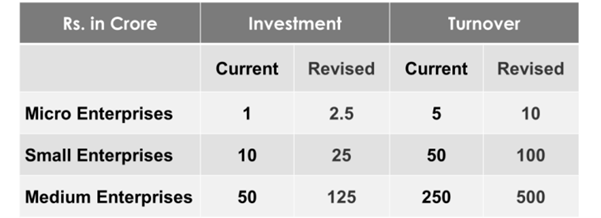
- Process: Fully digital; requires Aadhaar, PAN, and GSTIN; issues unique Udyam Registration Number.
- Benefits: Access to government schemes, priority sector lending, protection under MSME policies, ease of doing business, export incentives.
- Recent Update: Platforms like Udyam Assist (PhonePe + SIDBI) help informal micro-enterprises formalize digitally.
3. SEBI Eases Rules for Foreign Investors in Government Bonds
Context:
The Securities and Exchange Board of India (SEBI) announced that its revised regulations for foreign investors investing exclusively in Indian government securities will come into effect from 8 February 2026. The rules were initially approved at SEBI’s board meeting in June 2025.
Key Highlights:
- Applicability:
- Applies to Foreign Portfolio Investors (FPIs) who invest only in Indian government bonds under the fully accessible route.
- Relaxed Disclosure Requirements:
- FPIs under this route need not disclose their investor group details, unlike regular FPIs investing in equity or other debt instruments.
- Exemptions also cover certain reporting requirements applicable to regular FPIs.
About Fully Accessible Route (FAR)
- Introduced by the RBI in April 2020.
- Permits non-resident investors to invest in specified categories of government securities without restrictions.
- Aimed at attracting global capital flows into India’s bond market.
Role of FPIs:
- FPIs are foreign entities or individuals allowed to invest in Indian securities (equities, corporate debt, or government bonds).
- They bring foreign capital, enhance liquidity, and contribute to market depth.
- Under the FAR, FPIs can invest in government securities with fewer compliance burdens, promoting ease of access and long-term investments.
4. EPFO 3.0 Initiative
Context:
The Employees’ Provident Fund Organisation (EPFO) is expected to deliberate on the EPFO 3.0 initiative at its Central Board of Trustees (CBT) meeting scheduled for October 10–11, 2025. The meeting will be chaired by Labour and Employment Minister Mansukh Mandaviya.
Key Highlights:
What is EPFO 3.0: EPFO 3.0 is a proposed upgrade to the Employees’ Provident Fund Organisation’s digital ecosystem aimed at enabling seamless, bank-like services for subscribers.
Key Features:
- Digital Withdrawals: Allows partial withdrawal of provident fund (PF) balances via ATMs or UPI without extensive paperwork.
- Enhanced Pension: The central board may consider raising the minimum monthly pension from ₹1,000 to ₹1,500–2,500, addressing a long-pending demand from trade unions.
- User Convenience: Subscribers can access and manage their PF accounts more like a regular bank account, improving financial flexibility.
Objective:
- To modernize EPFO services and provide instant access to funds while maintaining retirement savings security.
- Boost consumption by enabling PF withdrawals ahead of major festivals or events.
5. RBI Approves Yes Bank Board Changes for SMBC Nominee Directors
Source: BL
Context:
Yes Bank announced that the Reserve Bank of India (RBI) has approved proposed changes in the Articles of Association (AoA) to facilitate the appointment of nominee directors on its board. This follows the planned stake acquisition by Sumitomo Mitsui Banking Corporation (SMBC) and involvement of SBI.
Key Highlights:
- Nominee Directors Appointment:
- 2 directors to be nominated by SMBC.
- 1 director to be nominated by SBI.
What is Articles of Association (AoA)?
- AoA is a legal document that defines the internal rules, powers, and governance structure of a company.
- Purpose:
- Specifies how the company is managed and run.
- Outlines roles and responsibilities of directors, shareholders, and management.
- Regulates decision-making, meetings, and board appointments.
- Relevance to Banks:
- Any change in board structure, capital, or powers of directors in a private bank requires RBI approval via AoA amendments.
6. Decentralised Finance (DeFi)
Context:
The DeFi boom has raised national security concerns, with experts warning about potential misuse for terror financing and money laundering.
About Decentralised Finance (DeFi)
- What it is: A blockchain-based financial system enabling saving, borrowing, investing, and transacting without traditional banks.
- Origin:
- Rooted in Bitcoin (2009) philosophy of decentralisation and transparency.
- Expanded with Ethereum (2015) and DAOs (Decentralised Autonomous Organisations).
- Aim:
- Democratise financial access by removing intermediaries.
- Offer inclusive, low-cost, borderless financial services.
How it Works?
- Users create crypto wallets (no KYC needed).
- Transactions occur via smart contracts on the blockchain.
- Services include:
- Decentralised exchanges (DEXs)
- Lending & borrowing
- Payments & derivatives
- Insurance & stablecoins creation
- Governance is managed by token holders in DAOs, not central authorities.
Key Features:
- Disintermediation: Direct peer-to-peer transactions without banks.
- Transparency: Transactions recorded on a public ledger.
- Anonymity: No identity verification required.
- Interoperability: Works across multiple blockchain applications.
- Low-cost & Fast: Avoids interbank or international fees.
7. Mutual Fund–Voluntary Retirement Account (MF-VRA) Scheme
Source: ET
Context:
The Association of Mutual Funds in India (AMFI) has proposed the Mutual Fund–Voluntary Retirement Account (MF-VRA), a retirement savings scheme inspired by the U.S. 401(k) plan, to boost long-term retirement planning in India.
Key Highlights:
- Voluntary Participation: Individuals can opt-in, with or without employer involvement.
- Employer Contributions: Employers can contribute a portion of employees’ salaries, which can be matched by employees.
- Tax Benefits: Contributions may qualify for deductions under Section 80C of the Income Tax Act.
- Investment Flexibility: Participants can invest in mutual fund schemes, including lifecycle funds that adjust asset allocation with age.
- Portability: Accounts can be transferred across jobs, ensuring continuity in retirement savings.
Comparison with U.S. 401(k):
- Both are employer-linked, tax-advantaged retirement savings schemes.
- Both aim to encourage long-term retirement planning and supplement existing retirement options.
Significance for India:
- Addresses the challenge of a rapidly aging population, projected to reach 21% of the population by 2050.
- Channels household savings into financial markets, enhancing market depth and long-term stability.
- Promotes a culture of retirement savings among individuals, particularly the working population.
8. Sebi Eases Rules for Privately Placed InvITs, REITs, and Portfolio Managers
Source: BS
Context:
The Securities and Exchange Board of India (Sebi) has notified a set of amendments to simplify regulations for Infrastructure Investment Trusts (InvITs), Real Estate Investment Trusts (REITs), and portfolio managers, aiming to improve ease of doing business and align primary and secondary market norms.
Key Highlights:
- Minimum Allotment Lot for Privately Placed InvITs
- Reduced to Rs 25 lakh (earlier Rs 1–25 crore depending on asset mix).
- Aligns primary market allotment with the secondary market trading lot size.
- Classification of Related Parties
- Units held by related parties of REIT/InvIT sponsors, investment/project managers not counted as “public” unless they are Qualified Institutional Buyers (QIBs).
- Units held by QIB-related parties now counted as public, enhancing transparency.
- Holdco Cash Flow Adjustments
- Earlier: Holding company had to distribute 100% of SPV cash flows to REIT/InvIT.
- Now: Holdco can offset its own negative cash flows before distribution, with proper disclosure to unitholders.
- Reporting Timelines Harmonization
- Quarterly reports to stock exchanges, trustees, and boards, along with valuation reports, are now aligned with financial results timelines.
- Replaces previous varied schedules.
- Portfolio Manager Disclosure
- Simplified format for disclosure documents.
- Must provide Board-specified format along with Form C certificate before client agreement.
- Ensures clients get essential information for informed investment decisions.
- A Portfolio Manager is a professional or firm responsible for managing investments on behalf of clients.
Agriculture
1. FPO Ecosystem in India
Source: BL
Context:
Farmer Producer Organisations (FPOs) have matured into key institutions empowering Indian farmers by aggregating volumes and enhancing bargaining power. Digital technologies and agri-tech startups have improved efficiencies in production, distribution, and services over the last two decades.
Farmer Producer Organisation (FPO)
An FPO is a collective of farmers mainly small and marginal who pool their resources (land, produce, labour) to improve bargaining power, access inputs, and market their produce efficiently. FPOs are registered as producer companies under the Companies Act, or sometimes as cooperatives.
Objectives:
- Aggregate produce to achieve economies of scale.
- Increase farmers’ bargaining power in the market.
- Facilitate access to institutional credit, inputs, and technology.
- Promote sustainable farming and better income for members.
Challenges:
- Low equity capital: Only 387 FPOs have paid-up capital exceeding ₹15 lakh.
- Inactive FPOs: Many remain dormant post-registration due to weak governance, inadequate capital, and lack of business avenues.
- Operational issues: Filing returns, conducting AGMs, and maintaining records remain challenging.
- Human resources gap: Shortage of skilled staff for compliance and day-to-day operations.
Opportunities and Recommendations:
- Strengthen FPOs to function as formal institutions.
- Develop mechanisms to ensure organizational stability.
- Encourage farmers to contribute equity capital to fund infrastructure and generate additional income.
- Digital platforms and agri-tech services are enhancing production efficiency, market access, and overall distribution.
Facts To Remember
1. India’s Nupur, Jaismine assured of medals
Paris Olympian Jaismine Lamboria (57kg) and Nupur Sheoran (80+kg) booked berths in the semifinals to ensure medals for India at the World boxing championships in Liverpool.
2. Double delight for Tamil Nadu in National junior basketball championships
The Tamil Nadu boys’ and girls’ teams bagged the titles in the 75th National junior basketball in Ludhiana.
3. MCD Launches Integrated Property Tax Module Portal for Factory Owners
The Municipal Corporation of Delhi (MCD) has launched an integrated property tax module portal to simplify and speed up the licensing process for factory owners. The unified single-window application was inaugurated at the Civic Centre by Mayor Raja Iqbal Singh.
4. IARC appoints Abhishek Maheshwari as MD & CEO
International Asset Reconstruction Company has appointed Abhishek Maheshwari as Managing Director & Chief Executive Officer.
5. India Likely to Avoid Legislation on Cryptocurrencies, Prefers Partial Oversight
A recent government document (Sept 2025) indicates that India is unlikely to bring a dedicated law to regulate cryptocurrencies. Instead, the country will maintain partial oversight, given the risks of granting legitimacy to crypto assets and the challenge of regulating decentralised transactions.
6. ICRA Flags Risks from SME Exposure
Credit rating agency ICRA has raised concerns over lenders’ exposure to the small and medium enterprise (SME) sector, highlighting it as a potential risk area for the banking system. At the same time, ICRA noted that bank deposit rates have bottomed out, and further reductions are unlikely if the RBI maintains current policy rates.
7. Bank of Baroda Launches ‘bob Aspire NRE Savings Account’ for Prospective NRIs
Bank of Baroda has introduced the bob Aspire NRE Savings Account, a savings product aimed at Indian citizens planning to move abroad for employment, business, education, or other long-term purposes. The initiative allows prospective Non-Resident Indians (NRIs) to open an NRE account from India before departure.
12 September, 2025
Daily Current Affairs Quiz
12 September, 2025
National Affairs
1. Vultures and Pandemic Preparedness in India
Source: TH
Context:
Vultures, once abundant in India (40+ million in the 1980s), have declined by 95% since the 1990s mainly due to diclofenac (a veterinary drug) use. Their disappearance poses ecological and public health risks, linking biodiversity decline to zoonotic disease spillovers. They are part of the Central Asian Flyway (CAF), connecting migratory ecosystems across 30+ countries.
About Vultures in India
- Species Diversity: India is home to 9 species of vultures, out of which 3 are Critically Endangered:
- White-rumped Vulture (Gyps bengalensis)
- Indian Vulture (Gyps indicus)
- Slender-billed Vulture (Gyps tenuirostris)
- Role in Ecosystem:
- Vultures are scavengers — they feed on carcasses of dead animals, preventing the spread of diseases.
- They are often called “nature’s cleanup crew” for their crucial role in maintaining ecological balance and public health.
Importance of Vultures for Public Health
- Act as nature’s waste managers by consuming carcasses.
- Prevent spread of deadly pathogens like anthrax, rabies, and botulinum toxin.
- Reduce risk of zoonotic spillovers that could trigger pandemics.
- Provide early surveillance opportunities at carcass sites.
2. Border Wing Home Guards (BWHG)
Source: TH
Context:
Ministry of Home Affairs (MHA) is considering raising BWHGs along the China border, similar to their deployment on the India-Pakistan border.
Aim: Assist ITBP & Army in intelligence gathering, presence, and local engagement.
About BWHG
- Civilian volunteer force drawn from border populations.
- Functions as an ancillary to Border Guarding Forces and Army during emergencies.
- Authorised in 7 States: Meghalaya, Tripura, Assam, West Bengal, Punjab, Rajasthan, Gujarat.
- Currently operational only in Rajasthan (2,279 active members).
- Role: Perform constable-level duties; enlistment for 3–4 years.
- Funding: 25% training & support borne by Government of India.
3. Great Nicobar Island Project
Source: TH
Context:
The Government of India has approved the Great Nicobar Island Project, a multi-component development plan aimed at boosting India’s strategic and economic presence in the Indian Ocean Region.
Project Overview:
- A mega integrated development project to transform Great Nicobar into a logistics, trade, and defence hub.
- Compliant with environmental safeguards under EIA Notification 2006 and Shompen Policy 2015 to protect ecology and tribal welfare.
Major Components:
- International Container Transhipment Terminal (ICTT): Capacity of 14.2 million TEU, reducing reliance on Colombo/Singapore and positioning India as a global shipping hub.
- Greenfield International Airport: Enhances connectivity, promotes tourism, and allows rapid troop/supply deployment.
- 450 MVA Gas + Solar Power Plant: Ensures uninterrupted energy supply combining conventional and renewable sources.
- Integrated Township: Spanning 16,610 hectares, providing modern housing and infrastructure.
- Phased Development (2025–2047): Spread over three phases to minimise ecological stress and allow adaptive planning.
4. India Flags Off ‘Samudra Pradakshina’
Source: Indian Expree
Context:
The Defence Minister of India virtually flagged off Samudra Pradakshina from the Gateway of India, Mumbai. This expedition marks India’s first tri-service all-women circumnavigation sailing mission, demonstrating women empowerment, maritime skill, and strategic outreach.
About the Expedition:
- India’s first-ever tri-service (Army, Navy, Air Force) all-women circumnavigation.
- Voyage meets World Sailing Speed Record Council norms for a full circumnavigation.
- Follows India’s circumnavigation legacy:
- Capt. Dilip Donde (2009–10) – first solo Indian circumnavigation.
- Cmde. Abhilash Tomy (2012–13) – first Indian non-stop circumnavigation.
- INSV Tarini – Navika Sagar Parikrama (2017–18) & (2024–25).
- Scientific Research:
- Collaborate with National Institute of Oceanography (NIO) on micro-plastics, ocean biodiversity, and marine health.
Key Features:
- Vessel: IASV Triveni, a 50-foot indigenous yacht (Class A) built in Puducherry.
- Route: ~26,000 nautical miles, crosses the Equator twice, rounds Capes Leeuwin, Horn, and Good Hope.
- Crew: 10 women officers, led by Lt Col Anuja Varudkar (Army) & Sqn Ldr Shraddha P Raju (IAF).
- Timeline: September 2025 – May 2026.
5. All India Debt and Investment Survey (AIDIS) & Situation Assessment Survey (SAS) of Agricultural Households
Source: PIB
Context:
The National Statistical Office (NSO) under Ministry of Statistics & Programme Implementation (MoSPI) announced that the All India Debt and Investment Survey (AIDIS) and the Situation Assessment Survey (SAS) of Agricultural Households will be conducted between July 2026 and June 2027. These surveys are part of the 81st round of the National Sample Survey (NSS) and aim to provide comprehensive insights into household finances and agricultural livelihoods.
All India Debt and Investment Survey (AIDIS):
- What it is: India’s flagship survey on household finance, capturing debt, assets, and investments across rural and urban households.
- Origin: Began as All India Rural Credit Survey (1951-52); expanded in 1961-62 to include urban households and investments.
- Conducted by: NSO (MoSPI).
- Objectives:
- Measure household indebtedness and asset ownership.
- Inform national accounts and credit policies.
- Aid RBI, MoSPI, NITI Aayog in financial inclusion and inequality studies.
- Key Features:
- Decadal survey; last conducted in 77th NSS round (2019).
- Covers institutional & non-institutional credit sources.
- Provides disaggregated data by state, sector, income group, and asset class.
- Supports policymaking for financial literacy, credit penetration, and asset creation.
Situation Assessment Survey (SAS) of Agricultural Households:
- What it is: Nationally representative survey assessing economic well-being of farm households.
- Origin: Launched in 2003, expanded in 2013, strengthened in 2019.
- Conducted by: NSO (MoSPI) in coordination with Ministry of Agriculture & Farmers Welfare (MoA&FW).
- Objectives:
- Assess income, expenditure, and debt of farm households.
- Track livelihood patterns, crop & livestock production, access to government schemes, and crop insurance.
- Support agriculture and rural development policies for inclusive growth.
- Key Features:
- Covers all agricultural households, including landless farmers.
- Collects data on land, livestock, technology adoption, and market access.
- Monitors institutional finance, crop loans, and insurance coverage.
- Used by NITI Aayog, MoA&FW, research bodies, and banks for policy design.
6. PM to Launch ‘Gyan Bharatam’ Portal
Source: TOI
Context:
Prime Minister Narendra Modi will address the International Conference on India’s Manuscript Heritage on Friday and launch the ‘Gyan Bharatam’ portal—a dedicated digital platform for manuscript digitisation, preservation, and public access.
Key Highlights:
- Event Theme: “Reclaiming India’s Knowledge Legacy through Manuscript Heritage.”
- Conference: A three-day event bringing together scholars, conservationists, technologists, and policy experts.
- Objective of Portal:
- Accelerate digitisation of India’s vast manuscript collections.
- Ensure preservation of ancient knowledge resources.
- Provide public access to manuscripts for global knowledge exchange.
- Government Role: The Ministry of Culture is leading the initiative.
7. Capacity of Dams Halved Due to Sedimentation: IISER Report
Source: ET
Context:
A study by the Indian Institute of Science Education and Research (IISER) Bhopal has revealed that dams and reservoirs across India have lost nearly 50% of their storage capacity due to heavy sedimentation build-up, significantly reducing their effectiveness in flood control, irrigation, and power generation.
Key Highlights of the Study:
- Scope: Examined government records of 300+ large reservoirs with storage capacity exceeding 100 million cubic metres.
- Findings:
- Several dams have already lost more than half of their designated storage.
- By 2050, many more—especially in the Himalayan region, Narmada-Tapi basin, Western Ghats, and Indo-Gangetic Plains—will face severe capacity loss.
- Causes of Sedimentation:
- Agriculture-driven soil erosion
- Deforestation
- Flooding and catchment degradation
Implications:
- Water Security: Reduced storage affects irrigation and drinking water supply.
- Energy Security: Declining hydroelectric power generation.
- Flood & Drought Risks: Lower resilience to extreme weather events.
- Investment Risk: Decades of infrastructure investment could be undone without corrective measures.
Recommended Measures:
- Catchment afforestation and upstream soil conservation
- Construction of check dams and sediment flushing systems
- Regular hydrographic surveys to assess storage capacity loss
- Integrated reservoir sediment management policies
Banking/Finance
1. Nabfid to Submit Infra Financing Report
Source: BS
Context:
National Bank for Financing Infrastructure and Development (Nabfid) will prepare a report on infrastructure financing challenges. To be submitted to the Department of Financial Services (DFS), Ministry of Finance within 15 days.
Key Issues Discussed
- Financing Gaps – Shortfall in availability of long-term infra finance.
- Municipal Bonds – Barriers in issuance, low investor appetite.
- Capacity Building – Need to strengthen institutions and skill base for infra financing.
- Data Gaps – Better availability of information on defaults and recoveries required for risk assessment.
About Nabfid
- Established under NABFID Act, 2021 as a Development Finance Institution (DFI).
- Objective: Provide long-term infrastructure financing and develop the bond/loan market.
- Functions as a catalyst for private investment in infra through credit enhancement, guarantees, and innovative financing.
2. RBI to Allow Lenders to Remotely Lock Phones for Defaulted Loans
Source: Mint
Context:
The Reserve Bank of India (RBI) plans to permit lenders to remotely lock mobile phones purchased on credit if borrowers default, aiming to reduce non-performing assets (NPAs) in small-ticket consumer loans.
Key Proposal:
- Banks and Non-Banking Financial Companies (NBFCs) may be allowed to remotely lock or disable mobile phones purchased on credit if the borrower defaults on repayments.
- This mechanism would act as a collateral-like security without physical repossession, helping lenders recover dues efficiently.
What you need to know from exam point of view?
This initiative would fall under RBI’s guidelines for secured lending and asset-backed financing, specifically:
- Master Directions on Fair Practices Code for Lenders – ensuring transparency, borrower consent, and grievance redressal.
- Master Directions on Non-Performing Assets (NPAs) Classification and Provisioning – providing norms for recognition, recovery, and enforcement of small-ticket loans.
- Digital Lending Guidelines 2023 – governing use of technology in lending, including device-based tracking or locking mechanisms, while protecting borrower data and privacy.
- Secured Credit Regulations under the RBI Act, 1934 – allowing secured lending where the collateral can be digitally controlled or monitored.
What are Non-Performing Assets (NPAs)?
A Non-Performing Asset (NPA) is a loan or advance where the borrower has stopped making interest or principal repayments for a specified period, indicating the asset is not generating income for the lender.
Criteria (as per RBI):
- A loan is classified as an NPA if interest or principal remains overdue for more than 90 days.
- Applies to banks, NBFCs, and other lending institutions.
3. NABARD to Launch Centralised Digital Lending Platform for RRBs
Source: BL
Context:
The National Bank for Agriculture and Rural Development (NABARD) is developing a centralised digital lending platform for Regional Rural Banks (RRBs) to strengthen their competitiveness against non-banking financial companies (NBFCs) and microfinance institutions (MFIs). This initiative is part of a broader strategy following the One State-One RRB policy, which came into effect on May 1, 2025, consolidating 43 RRBs into 28 banks.
Key Highlights:
- Centralised Digital Credit Infrastructure (CDCI):
- Designed for end-to-end automation of credit processing and management.
- Aims to enhance operational efficiency, transparency, and agility in loan delivery.
- Expected rollout: end of September 2025.
- Will support a range of loan products, including housing loans with first-loss default guarantees and MSME-focused products.
- Strategic Objectives:
- Reposition RRBs as competitive alternatives to NBFCs and MFIs.
- Leverage scale efficiencies and cost rationalisation post-consolidation.
- Support innovation in loan product design for diversified portfolios.
- RRB Overview:
- Established in 1975 under an Ordinance and Regional Rural Banks Act, 1976.
- Aimed at developing rural economies and supplementing the Cooperative Credit Structure.
- Shareholding pattern: Government of India 50%, State Government 15%, Sponsoring Bank 35%.
- Network: 28 RRBs, 22,158 branches across 26 states and 3 Union Territories.
- 92% branches in rural or semi-urban areas, highlighting their role in financial inclusion.
Facts To Remember
1. Veteran Congress leader P.P. Thankachan passes away
Kerala’s veteran Congress leader and former Speaker P.P. Thankachan, 87, passed away at a hospital in Ernakulam.
2. C.P. Radhakrishnan to take oath as Vice-President today
C.P. Radhakrishnan will take the oath of office as Vice-President at the Rashtrapati Bhavan.
3. Pooja ensures third medal for India
Olympian Pooja Rani rallied to edge past Poland’s Emilia Koterska 3-2 in a hard-fought quarterfinal bout to move into the women’s 80kg semifinals and secure a third medal for India at the World boxing championships in Liverpool.
4. Govt Likely to Refocus on Marketing, Credit Support in PM Vishwakarma Scheme
The PM Vishwakarma Scheme, launched by the Ministry of MSME to formalise and support traditional artisans and craftspeople, has already enrolled 3 million beneficiaries, surpassing its target three years ahead of FY28. The government is now shifting focus to the marketing and credit support components for the scheme’s next phase.
5. Public Sector Banks Manthan Summit 2025
Public Sector Banks (PSBs) will hold a two-day Manthan Summit from September 12, 2025, focusing on strategies to transform into globally competitive institutions aligned with the vision of Viksit Bharat 2047.
6. RBI Governor to hold open house for staff to boost functioning
Reserve Bank of India (RBI) Governor Sanjay Malhotra has introduced an open house for current and retired employees on improving the central bank’s functioning.
13 September, 2025
Daily Current Affairs Quiz
13 September, 2025
National Affairs
1. PM Launches Gyan Bharatam Portal
Source: PIB
Context:
Prime Minister Narendra Modi addressed the International Conference on Gyan Bharatam on the theme “Reclaiming India’s Knowledge Legacy Through Manuscript Heritage”. He stressed the importance of preserving India’s manuscript heritage and preventing intellectual piracy, as much of India’s traditional knowledge has historically been copied and patented abroad.
Gyan Bharatam Portal
- Launched as a digital repository of ancient manuscripts.
- Aims to accelerate digitisation, preservation, and wider access to India’s traditional knowledge systems.
- Supports the vision of Swadeshi and Aatmanirbhar Bharat.
India’s Manuscript Heritage
- India holds the world’s largest manuscript collection: nearly one crore manuscripts.
- Manuscripts reflect advancements in science, philosophy, medicine, mathematics, astronomy, and culture.
- PM called it a “renaissance of India’s golden past”, highlighting continuity of preservation, innovation, addition, and adaptation.
2. PSB Manthan 2025
Source: IE
Context:
At the PSB Manthan 2025 conclave (two-day event), the government set a long-term vision to make at least two public sector banks (PSBs) enter the world’s top 20 by 2047, aligning with the Viksit Bharat 2047 roadmap.
Global Positioning of Indian Banks
- Currently, only State Bank of India (SBI) and HDFC Bank feature in the top 100 global lenders by assets.
- Target: At least two PSBs in top 20 by 2047.
Focus Areas of PSB Manthan 2025
- Corporate Governance: Strengthening oversight and autonomy.
- Customer Experience: Personalised banking and service quality.
- Future-readiness: Adoption of AI, digital transformation, and modernisation.
- Cybersecurity & Workforce Transformation.
- Risk Management & Financial Stability: Part of EASErise agenda for FY26.
- CASA Ratio: Discussions on improving declining current account–savings account ratios.
Banking/Finance
1. SEBI Approves Key Reforms in Public Issues, FPIs, and Mutual Funds
Source: ET
Context:
The Securities and Exchange Board of India (SEBI), under Chairman Tuhin Kanta Pandey, has introduced a set of reforms across IPO norms, foreign portfolio investors (FPIs), real estate investment trusts (REITs), and mutual funds. The aim is to deepen capital markets, boost primary issuance, and ease compliance.
IPO and Market Capitalisation Norms
- For companies with market capitalisation between ₹1 trillion and ₹5 trillion:
- Minimum Public Offer (MPO) set at ₹6,250 crore + 2.75% of post-issue market cap.
- If public shareholding <15% at listing:
- 5 years to reach 15% public shareholding.
- 10 years to achieve mandated 25% Minimum Public Shareholding (MPS).
- Public issue norms for issues below ₹50,000 crore remain unchanged.
- Anchor Investors:
- An anchor investor is an institutional investor. They enter the game right before an IPO (Initial Public Offering) and they are seen as a booster for companies looking for a successful listing.
- Overall reservation raised from 33.33% → 40%.
- One-third reserved for domestic mutual funds, remainder for life insurers & pension funds.
- Number of permissible anchor investor allottees increased for allocations above ₹250 crore.
Foreign Portfolio Investors (FPIs)
- Launch of SWAGAT-FI (single-window framework) for easier registration of low-risk FPIs (e.g., sovereign wealth funds, government-related investors).
- Eligible entities include regulated public funds (mutual funds, insurance cos., pension funds).
- Relaxations:
- Reduced documentation.
- One-time KYC fee of $2,500 for a 10-year block (instead of 3-year cycle).
- Exemption from 50% aggregate contribution cap for NRIs and OCIs.
- Expected to cover 70%+ of FPIs.
REITs and InvITs
- Re-classified as equity for mutual funds → eligible for equity index inclusion.
- Expanded scope of strategic investors to include:
- Provident funds
- Public financial institutions
- Alternative Investment Funds (AIFs)
- State industrial development corporations
Mutual Funds
- Maximum exit load reduced from 5% to 3%, benefiting retail investors.
- Incentives reintroduced for distributors for inflows from beyond top 30 cities (B-30 regions).
Related Party Transactions (RPTs)
- RPT transactions, or Related Party Transactions, are business dealings between a company and its related entities or individuals, such as a parent company and its subsidiary, or a company and the immediate family of its director.
- Scale-based thresholds (based on turnover of listed companies) approved to determine material RPTs.
Other Announcements
- SEBI to consult further on derivatives curbs—no immediate changes.
- Report on conflict-of-interest code expected by end of the month.
2. SEBI Stresses Transparency on Family Settlements
Context:
The Securities and Exchange Board of India (SEBI) clarified before the Bombay High Court that:
- Deeds of Family Settlement (DFS) and similar family agreements must be disclosed by listed companies under LODR Regulations.
- However, such disclosures do not impose binding obligations on the company itself.
Deeds of Family Settlement (DFS)
- A legal agreement between family members concerning family-owned businesses, properties, or shares.
- Purpose:
- Resolve disputes among family members without litigation.
- Divide assets, shares, or responsibilities among heirs.
Listing Obligations and Disclosure Requirements (LODR)
- SEBI regulations that require listed companies to maintain transparency, accountability, and fair treatment of investors.
- Purpose:
- Protect investors’ interests.
- Ensure disclosure of material information affecting company performance or share price.
- Examples of Disclosures under LODR:
- Financial results, corporate governance reports.
- Changes in shareholding, promoter pledges, and agreements like DFS.
SEBI’s Stand on DFS Disclosure
- Disclosure is Mandatory:
- DFS agreements are considered material information under LODR.
- Shareholders must be informed to ensure transparency.
- No Binding Effect on the Company:
- Disclosure under Regulation 30A does not create or enforce private contractual obligations.
- Companies are not restricted or liable due to DFS disclosures.
- Management or control of the company is unaffected by these disclosures.
In short:
- DFS → Family agreement on assets/shares.
- LODR → SEBI rules requiring disclosure of material information.
- SEBI clarification → Disclose DFS for transparency, but it doesn’t bind or limit the company.
3. SEBI Eases FPI Entry with Automatic Registration Window
Source: The Economic Times
Context:
The Securities and Exchange Board of India (SEBI) has approved the introduction of an ‘automatic window’ to simplify the registration process for Foreign Portfolio Investors (FPIs). The move aims to boost capital inflows into India by reducing procedural hurdles and enhancing ease of doing business.
Key Highlights:
- Automatic Window for Registration: SEBI will allow certain FPIs to register through a simplified, largely automated process, minimizing documentation and compliance requirements.
- Unified Access: The new framework provides a single registration route, replacing multiple existing compliance channels for FPIs.
- Eligibility Criteria: FPIs that are at least 75% owned by foreign governments or are regulated in their home jurisdictions can avail of this facility.
- Objective: The reform seeks to attract more foreign capital, particularly after significant equity outflows of over ₹83,000 crore since July 2025.
Agriculture
1. FPOs Critical to Agtech Adoption in Rural India
Source: BL
Context:
Farmer Producer Organizations (FPOs) are increasingly being recognised as vital platforms to accelerate the adoption of agricultural technologies (agtech) among small and marginal farmers in rural India. By consolidating farmers, FPOs help address key structural and financial challenges, enabling technology-driven productivity improvements.
Key Highlights:
- Collective Bargaining and Affordability:
- FPOs allow farmers to pool resources, making modern inputs, machinery, and digital agtech tools more affordable and accessible.
- Knowledge and Training:
- FPOs function as knowledge hubs, facilitating demonstrations, workshops, and training programs on precision agriculture, crop monitoring, and climate-resilient practices.
- Access to Finance and Credit:
- Through FPOs, farmers gain better access to credit, subsidies, and financial products necessary for technology adoption. FPOs also help engage with banks, NBFCs, and government schemes.
- Shared Infrastructure Development:
- FPOs invest in common assets like storage facilities, processing units, and transport logistics, which are critical for implementing agtech effectively across the supply chain.
- Data-Driven Decision Making:
- Aggregated data from member farmers allows FPOs to implement precision farming, monitor soil health, and optimise crop planning.
- Policy Advocacy:
- FPOs represent collective farmer interests, advocating for supportive policies, regulatory frameworks, and government programs promoting agtech.
Challenges:
- Low digital literacy among rural farmers.
- Infrastructure gaps such as poor internet and power supply.
- High initial investment costs for new technologies.
- Fragmented land holdings limiting large-scale agtech adoption.
2. AI-Powered Monsoon Forecasts Transform Kharif Farming in India
Source: PIB
Context:
Millions of Indian farmers depend on rainfall for Kharif crops, which form the backbone of their income and livelihood. Accurate and timely monsoon forecasts are crucial for decisions on crop selection, sowing schedules, irrigation, and risk management. In a first-of-its-kind initiative, the Ministry of Agriculture and Farmers’ Welfare (MoAFW) has harnessed artificial intelligence (AI) to deliver advanced, farmer-centric monsoon forecasts across India.
Key Highlights:
- AI-Based Forecasting Models:
- The MoAFW integrated Google’s Neural GCM and ECMWF’s AI Forecasting System (AIFS) to create highly accurate predictions of monsoon onset, intensity, and progression, outperforming conventional weather models.
- Targeted Dissemination:
- Forecasts were sent via m-Kisan SMS platform to 3.8 crore farmers across 13 states, providing region-specific guidance up to four weeks in advance.
- Real-Time Monitoring:
- Weekly updates informed farmers of mid-season variations, such as pauses in rainfall, enabling timely agricultural interventions.
- Farmer-Centric Design:
- Teams from Development Innovation Lab – India and Precision Development ensured that information was understandable, actionable, and tailored to local farming needs.
Significance and Impact:
- Enhances farmers’ ability to plan Kharif crops efficiently and reduce climate-related risks.
- Strengthens resilience against climate variability, supporting sustainable agricultural practices.
- Positions India as a global leader in applying AI for real-world agricultural challenges.
- Empowers informed decisions on sowing, irrigation, and crop management, potentially improving yields and farmer incomes.
Facts To Remember
1. Karki is Nepal’s first woman PM
Nepal President Ram Chandra Poudel appointed former Chief Justice Sushila Karki as the country’s new Prime Minister and dissolved Parliament, as days of political turmoil showed signs of abating in the Himalayan nation.
2. C.P. Radhakrishnan takes oath as 15th Vice-President of India
Chandrapuram Ponnusamy Radhakrishnan was sworn in as the 15th Vice-President of India. President Droupadi Murmu administered the oath of office at the Rashtrapati Bhavan in the presence of several dignitaries.
3. Jagdeep Chhokar, co-founder of ADR, passes away at 81
Jagdeep S. Chhokar, co-founder of the non-governmental organisation Association for Democratic Reforms (ADR), passed away in Delhi. He was 81.
4. Navy’s latest base INS Aravali commissioned in Gurugram
The Indian Navy commissioned its latest Naval Base, INS Aravali, at Gurugram on Friday, marking a major boost to its information and communication infrastructure.
5. Kerala capital to host two-day blue economy conclave
Representatives from 29 European countries are expected to attend a two-day blue economy conclave in the State capital on September 18 and 19, Minister for Fisheries Saji Cherian has said.
6. Albania PM appoints AI-generated ‘minister’ to tackle corruption
Albania’s Prime Minister Edi Rama on Friday tapped an Artificial Intelligence-generated ‘minister’ for his cabinet to take on corruption.
7. Mehuli Ghosh places 23rd in rifle 3-position event
Mehuli Ghosh shot 583 and placed 23rd in the 50-metre rifle 3-position event in the World Cup in Ningbo, China.
14&15 September, 2025
Daily Current Affairs Quiz
14 & 15 September, 2025
National Affairs
1. 2nd National Conference of Anti-Narcotics Task Force (ANTF) Heads
Source: PIB
Context:
Union Home Minister Amit Shah will inaugurate the 2nd National Conference of Anti-Narcotics Task Force (ANTF) Heads of States and Union Territories in New Delhi on September 16–17, 2025.
Key Highlights:
- Inauguration: By Union Home Minister Amit Shah.
- Participants: ANTF Heads from all 36 States/UTs + representatives from other government departments.
- Key Releases & Launches:
- NCB Annual Report 2024 (Narcotics Control Bureau).
- Online Drug Disposal Campaign (digital platform for safe & transparent disposal of seized drugs).
- Objective:
- Strategic platform to strengthen coordination against drug trafficking and abuse.
- Reinforce PM Narendra Modi’s vision of a drug-free India.
2. PM Modi Inaugurates India’s First Bamboo-Based Ethanol Plant in Assam
Source: TH
Context:
Prime Minister Narendra Modi inaugurated the country’s first bamboo-based bioethanol plant in Golaghat, Assam, and laid the foundation stone for a ₹7,230-crore polypropylene plant at the Numaligarh Refinery. The initiative is part of India’s broader push for energy self-sufficiency, clean energy, and rural development.
What is a Bamboo-Based Bioethanol Plant?
A bamboo-based bioethanol plant is an industrial facility that converts bamboo into ethanol, a type of biofuel that can be blended with petrol or used as a renewable energy source.
Process:
- Feedstock Collection: Bamboo is harvested and transported to the plant.
- Pretreatment: Bamboo biomass is broken down into simpler components, mainly cellulose, hemicellulose, and lignin.
- Hydrolysis: Cellulose and hemicellulose are converted into fermentable sugars using enzymes or acids.
- Fermentation: Microorganisms (like yeast) ferment the sugars into ethanol.
- Distillation & Purification: Ethanol is separated and purified to make fuel-grade bioethanol.
- By-products: Lignin and other residues can be used for energy production, compost, or industrial applications.
Applications of Ethanol Produced:
- Can be blended with petrol (E5, E10, or higher) for vehicles.
- Used in industrial and chemical processes as a green solvent.
- Potential use in pharmaceutical and cosmetic industries.
3. Purple Fest 2025
Source: PIB
Context:
The Indian Sign Language Research and Training Centre (ISLRTC), in collaboration with Amity University, Noida, organized Purple Fest 2025, a national-level festival focused on the empowerment and inclusion of persons with disabilities (Divyangjan).
Key Highlights:
- Objective:
- Promote inclusion, awareness, and accessibility for persons with disabilities.
- Empower Divyangjan through entrepreneurship, skill-building, cultural participation, and education.
- Celebrate creativity and talent while strengthening capacity through Indian Sign Language (ISL)-focused training.
- Core Activities:
- Art & Craft Exhibition: Showcasing products created by Divyangjan artisans.
- Entrepreneurship Stalls: 22 stalls highlighting businesses led by persons with disabilities.
- Cultural & Sports Events: Encouraging participation, representation, and talent celebration.
- Continuing Rehabilitation Education (CRE): Focused on ISL and professional knowledge sharing.
Banking/Finance
1. India’s Outward Foreign Direct Investment (FDI)
Context:
An analysis of RBI data by The Hindu shows that in 2024-25, nearly 56% of India’s outward foreign direct investment (FDI) was routed through low-tax jurisdictions like Singapore, Mauritius, UAE, the Netherlands, UK, and Switzerland. This raises questions on taxation, regulatory arbitrage, and strategic corporate positioning.
Key Findings from RBI Data:
- Total outward FDI (2024-25): ₹3,488.5 crore.
- Top destinations:
- Singapore – 22.6%
- Mauritius – 10.9%
- UAE – 9.1%
India’s Outward Foreign Direct Investment (OFDI)
India’s Outward Foreign Direct Investment (OFDI) refers to investments made by Indian companies, firms, or residents in foreign countries. Unlike inward FDI, where foreign investors invest in India, OFDI involves Indian entities investing abroad to acquire assets, set up subsidiaries, or participate in joint ventures.
Forms of OFDI:
Indian companies can invest abroad in several ways:
- Greenfield Investment: Establishing a new business unit, subsidiary, or plant in a foreign country.
- Mergers & Acquisitions (M&A): Acquiring or merging with existing foreign companies.
- Joint Ventures: Forming partnerships with foreign firms to share capital, technology, and management.
- Portfolio OFDI: Sometimes, Indian firms invest in foreign financial assets, though this is more regulated under capital flows.
Key Features:
- Long-term commitment: Indian investors acquire significant ownership or control.
- Cross-border: Capital flows from India to other countries.
- Regulated: The Reserve Bank of India (RBI) and the Ministry of Commerce & Industry regulate OFDI through frameworks like the Foreign Exchange Management Act (FEMA), 1999.
Objectives of OFDI:
- Market Access: Entering new consumer markets abroad.
- Resource Access: Acquiring raw materials, technology, or skilled manpower.
- Diversification: Reducing dependency on domestic market or risks.
- Strategic Advantage: Acquiring global brands, intellectual property, or global supply chain integration.
Regulatory Framework in India:
- Automatic Route: No prior approval required if investment is within prescribed limits.
- Government Route: Requires approval for sensitive sectors or higher amounts.
- RBI Guidelines: Investments must comply with FEMA regulations and reporting requirements.
2. Insurance Amendment Bill
Source: BS
Context:
Finance Minister Nirmala Sitharaman has indicated that the Insurance Amendment Bill, which proposes 100% foreign direct investment (FDI) in the sector, is likely to be introduced in the upcoming Winter Session of Parliament.
Key Proposals of the Bill:
- FDI Enhancement:
- Raise the foreign investment limit from the current 74% to 100%.
- Applicable to companies investing the entire premium in India.
- Review and simplify existing guardrails and conditionalities for foreign investment.
- Amendments Across Insurance Laws:
- Insurance Act, 1938: Principal framework for insurance operations in India.
- Life Insurance Corporation Act, 1956: Empower LIC board for operational decisions (branch expansion, recruitment).
- Insurance Regulatory and Development Authority Act, 1999: Align regulatory provisions with the amended FDI policy.
- Other Provisions:
- Reduction in paid-up capital requirements.
- Provision for a composite licence to streamline operations.
Objectives:
- Promote policyholders’ interests and financial security.
- Encourage entry of new players, increasing competition.
- Boost insurance penetration to achieve the goal of ‘Insurance for All by 2047’.
- Enhance ease of doing business and create employment opportunities.
3. UPI-Based Cash Withdrawals to Expand Through Business Correspondents
Source: BS
Context:
The National Payments Corporation of India (NPCI) is planning to extend Unified Payments Interface (UPI)-based cardless cash withdrawals beyond ATMs and limited merchant outlets. This initiative aims to make cash access more convenient and accessible, particularly in underbanked and rural areas.
Business Correspondent (BC)
- A Business Correspondent (BC) is an individual or entity engaged by banks to provide basic banking services in areas where bank branches are not easily accessible.
- BCs act as the bank’s agents, bridging the gap between banks and customers, particularly in rural and semi-urban areas.
Key Highlights:
- Expansion Scope:
- Currently, UPI-driven cash withdrawals are available only at UPI-enabled ATMs and certain merchants (₹1,000 per transaction in urban areas; ₹2,000 in rural areas).
- Plans are underway to extend the facility to over 2 million Business Correspondents (BCs) across India.
- Mechanism:
- Users can scan a QR code at BC outlets with any UPI app to withdraw cash.
- The user’s account is debited and the BC’s account credited in real-time.
- This complements existing modes like biometric Aadhaar-enabled cash withdrawals and micro-ATMs.
- Proposed withdrawals via UPI at BCs could allow up to ₹10,000 per transaction, similar to micro-ATM limits.
4. Sebi Pushes Capital Market Reforms to Enhance Depth and Investor Participation
Source: TOI
Context:
The Securities and Exchange Board of India (Sebi) has implemented a series of structural reforms aimed at broadening market participation, improving transparency, and attracting quality securities into the Indian capital market. The reforms target both primary and secondary markets to make the investment ecosystem more appealing for domestic and institutional investors.
Key Reforms:
- Public Shareholding and Anchor Investors:
- Listed companies now have more time to meet the minimum public shareholding requirement post-IPO.
- The share reserved for anchor investors during IPO listing has been increased, incentivising early participation by large investors.
- Mutual Fund and FII Adjustments:
- Exit load thresholds for mutual funds have been lowered, providing greater flexibility for investors.
- Low-risk Foreign Institutional Investors (FIIs) now face relaxed disclosure requirements, reducing compliance burdens.
- REITs and Institutional Participation:
- Real Estate Investment Trusts (REITs) have been reclassified as equity for mutual fund investments.
- A wider group of institutional investors can now act in a strategic capacity in REITs, enhancing liquidity and market depth.
- Corporate Governance Tweaks:
- Shareholder approvals for related-party transactions will now be based on company turnover, lowering compliance burden for mid-sized and large companies.
Agriculture
1. Corteva Agriscience Launches New Pesticides for Potato and Grapes
Source: TH
Context:
Global agri-science company Corteva Agriscience has launched two new pesticides in India targeting Downy Mildew in grapes and Late Blight in potatoes, two of the most destructive crop diseases affecting farmers’ productivity and income.
Key Highlights:
- Diseases Targeted:
- Downy Mildew (Grapes) – a fungal disease causing leaf damage, reduced photosynthesis, and crop loss.
- Late Blight (Potatoes) – the same pathogen that caused the Irish famine; still a major global threat.
- Technology Used:
- Based on Corteva’s Zorvec technology, known worldwide for effective control of oomycete plant diseases.
- Product: Zorvec Entecta.
- Features of the New Pesticide:
- Fast action: Protected from wash-off within 20 minutes of spraying.
- Consistent protection: Active ingredients provide strong, long-lasting control.
- Crop benefits: Healthier crops, higher yields, and improved quality of produce.
- Company Claim:
- Expected to transform potato and grape cultivation in India by reducing crop losses and boosting farmer profitability.
Implications for Indian Agriculture
- Farmer Benefits: Reduced dependency on repeated spraying, lower crop losses, improved income stability.
- Market Impact: Grapes (important export crop) and potatoes (staple food crop) will see better disease management.
- Agri-Tech Adoption: Example of how advanced agri-chemicals are complementing India’s efforts in crop protection and food security.
Facts To Remember
1. Former Meghalaya CM D.D. Lapang passes away
Former Meghalaya Chief Minister Donwa Dethwelson Lapang passed away at a hospital in Shillong. He was 93.
2. Fiji ant numbers plunged after humans came
Researchers sequenced the DNA of more than 4,000 specimens preserved in museums, representing over 120 species, and found that 79% of Fiji’s endemic ant species are now in decline, with losses starting soon after humans arrived about 3,000 years ago.
3. Minakshi, Jaismine punch gold at Worlds
Minakshi Hooda and Jaismine Lamboria, both aged 24, upset two Paris Olympics medallists and top seeds in their respective weight classes to emerge as champions in the World boxing championships in Liverpool.
4. Meghana clinches bronze medal in air rifle
Meghana Sajjanar clinched bronze in women’s air rifle in the World Cup in Ningbo.
5. Delhi Govt to Launch ‘Seva Pakhwada’ from Sept 17
To mark Prime Minister Narendra Modi’s birthday, the Delhi government will roll out a series of welfare and development initiatives over a 15-day period, called ‘Seva Pakhwada’ (Fortnight of Service).
6. Retail Inflation Inches Up in August, Remains Below RBI Target
Retail inflation, as measured by the Consumer Price Index (CPI), rose marginally to 2.07% in August 2025, up from 1.61% in July, according to the National Statistics Office (NSO). The second-quarter average (July-August) stands at 1.84%, lower than the RBI’s earlier projection of 2.1%. Since February 2025, inflation has remained below the RBI’s 4% target.
16 September, 2025
Daily Current Affairs Quiz
16 September, 2025
National Affairs
1. Centre to Launch ‘Swasth Nari, Sashakt Parivar Abhiyaan’ & 8th Poshan Maah
Source: TH
Context:
The Central Government will launch the ‘Swasth Nari, Sashakt Parivar Abhiyaan’ (Healthy Woman, Strong Family Campaign) on 17th September 2025, alongside the 8th Poshan Maah (Nutrition Month). The initiative will be inaugurated by Prime Minister Narendra Modi.
Key Highlights:
- Objective: To strengthen women’s health as a foundation for family well-being and national development.
- Joint Initiative: Led by the Ministry of Health & Family Welfare and the Ministry of Women & Child Development.
- Poshan Maah 2025: Part of the ongoing POSHAN Abhiyaan, focusing on nutrition awareness, women’s health, and child development.
- Approach: Promotes the idea that empowering women through better health ensures healthier families and stronger communities.
2. Manki-Munda System
Source: IE
Context:
In Kolhan region of Jharkhand, members of the Ho tribal community protested following the removal of certain Mundas, alleging government interference in their traditional Manki-Munda system of self-governance. The protests underline the sensitivity of tribal autonomy and customary governance structures in India.
About Manki-Munda System:
- A traditional, decentralized tribal governance system of the Ho community, where Mundas (village heads) and Mankis (pidh heads overseeing clusters of villages) collectively maintain social order and resolve disputes.
- Historical Background:
- Pre-British Era: Operated as a fully community-driven governance model without external interference or land tax obligations.
- British Era Codification: Following early Ho and Kol revolts, the British codified the system under Wilkinson’s Rules (1833), implemented in Kolhan Government Estate (1837). Mankis and Mundas acted as intermediaries, preserving local autonomy while integrating Kolhan into British India.
- Functioning:
- Munda: Heads a single village; resolves local socio-political disputes.
- Manki: Supervises multiple villages (pidh); handles appeals when Munda-level resolution fails.
- Key Features:
- Hereditary Leadership: Positions traditionally pass from father to son.
- Community Participation: Decisions rely on collective consultation, akin to Gram Sabha.
- Cultural Autonomy: Safeguards tribal identity, customs, and land rights.
- Legal Recognition: Wilkinson’s Rules continue to be upheld by courts, acknowledging the absence of alternative governance structures.
3. Exotic Eustoma Blooms in Odisha
Source: TH
Context:
Scientists at CSIR–National Botanical Research Institute (NBRI) have successfully cultivated Eustoma (Lisianthus) for the first time in Odisha, in a polyhouse at Sanatanpali, Sambalpur district. Previously, Eustoma flowers were mostly imported from countries like the Netherlands and Kenya for premium events, weddings, and luxury décor.
About Eustoma (Lisianthus):
- Type: Herbaceous annual flower from the Gentianaceae family.
- Native Habitat: Mexico, southern USA, Caribbean, and northern South America; thrives in grasslands and warm climates.
- Growth in India: First successful polyhouse cultivation in Odisha shows adaptability to hot Indian conditions.
Key Features:
- Premium Ornamental Value: Large, funnel-shaped blooms in pink, purple, white, blue, with long vase life (2+ weeks).
- Economic Potential: Two harvests per year; potential income of up to ₹2 lakh per acre per season for farmers.
- Diversity: Single and double-flowered varieties, including bicolored types, suitable for weddings, décor, and exports.
- Sustainability: Reduces dependence on imported flowers, promotes local floriculture, and supports CSIR-NBRI’s 400+ farmer clusters.
Uses:
- Cut Flower Industry: Bouquets, floral décor, premium events.
- Exports: Offers a new high-value floriculture export option.
- Retail & Hospitality: Ideal for hotels, weddings, and events due to long vase life.
- Gardening & Landscaping: Dwarf varieties suitable for pots, balconies, and landscaping projects.
4. Defence Procurement Manual (DPM) 2025
Context:
The Ministry of Defence (MoD) approved the Defence Procurement Manual (DPM) 2025, replacing the 2009 manual. To accelerate revenue procurement for the Armed Forces and promote Aatmanirbharta (self-reliance) in defence manufacturing. Annual revenue procurement under this manual is worth ~₹1 lakh crore.
About DPM 2025:
- Policy framework guiding all revenue procurement of goods and services for the Armed Forces and MoD organizations.
- First update in 16 years, aligning with public procurement norms, technology adoption, and modern warfare requirements.
Aims:
- Streamline & Simplify procurement to reduce red tape and file movement delays.
- Support Industry by addressing working capital issues, easing penalties, and providing order assurance.
- Boost R&D & Innovation through collaborations with IITs, IISc, academia, and industry for indigenisation.
Banking/Finance
1. SEBI Plans Further Relaxations for Foreign Portfolio Investors (FPIs)
Source: BS
Context:
The Securities and Exchange Board of India (SEBI) is planning additional relaxations to simplify the registration process for Foreign Portfolio Investors (FPIs), including a common know-your-client (KYC) framework and wider adoption of India Digital Signature. These moves build on recent measures aimed at making India a more attractive investment destination.
Key Highlights:
- Digital Ease:
- SEBI to integrate India Digital Signature with the Common Application Form (CAF) for FPIs.
- Expected to reduce paperwork and streamline documentation.
- Common KYC:
- Discussions underway with the Reserve Bank of India (RBI) for a common KYC requirement across banks and FPIs.
- Aimed at reducing duplication and easing compliance for low-risk FPIs.
- Swagat-FI Framework:
- Applies to trusted FPIs (sovereign wealth funds, pension funds, government-related entities).
- Registration renewal cycle extended to 10 years (earlier 3 years).
- One-time KYC fee of $2,500 for a 10-year block instead of the three-year cycle.
- Exemptions from the 50% aggregate contribution cap for NRIs and OCIs.
- Boost to Investments:
- Combination of FVCI (Foreign Venture Capital Investor) and FPI registration expected to boost unlisted investments.
- SEBI now reaches out directly to FPIs/custodians if application processing exceeds a month.
- Surge seen in FPI registrations; the US, Singapore, Luxembourg, and Ireland dominate assets under custody.
- New Platform:
- SEBI to launch India Market Access, a platform for FPIs to seek regulatory information.
2. Rising Digital Fraud and Mule Accounts
Source: Mint
Context:
Indian banks are now more cautious about deposit accounts than loans, driven by the rising misuse of dormant accounts as mule accounts in digital fraud. These accounts, typically inactive, are exploited for low-value, high-volume transactions, often linked to money laundering and cybercrime.
What are Mule Accounts?
- Dormant or inactive bank accounts used to transfer illicit funds.
- Account holders may be unaware or complicit.
- Typically involved in low-value, high-volume transactions to avoid detection.
How Fraud is Done:
- Fraudsters transfer illegally obtained money through mule accounts to obscure its origin.
- Used in scams like fake investment schemes, lottery frauds, or unauthorized digital payments.
- Often involves identity theft or misuse of KYC documents.
RBI’s rules and guidelines to curb digital fraud:
- Section 35A of the Banking Regulation Act, 1949 – Empowers RBI to issue directions to banks for controlling banking operations, including KYC, monitoring, and risk management.
- Prevention of Money Laundering Act (PMLA), 2002 – Obligates banks to maintain KYC, report suspicious transactions, and prevent misuse for money laundering.
- RBI (Know Your Customer (KYC)) Directions – Issued under the above acts to ensure proper customer identification, verification, and monitoring of accounts.
- RBI Master Circulars / Notifications – Provide operational instructions for dormant accounts, reporting to FIU-IND, and transaction monitoring.
3. SEBI Reclassifies REITs as Equity for Mutual Fund Investments
Source: ET
Context:
The Securities and Exchange Board of India (SEBI) has reclassified Real Estate Investment Trusts (REITs) as equity securities for mutual fund (MF) investments. Earlier, they were treated as hybrid securities, which restricted fund exposure.
What This Means?
- Mutual funds can now invest in REITs without the previous restrictions that applied to hybrid securities.
- This could boost liquidity and inflows into the REIT market, making real estate investment more accessible to retail investors via MFs.
Difference Between Hybrid and Equity Securities:
| Feature | Hybrid Securities | Equity Securities |
|---|---|---|
| Definition | Financial instruments combining debt and equity features (e.g., convertible debentures, preference shares) | Represents ownership in a company, value fluctuates with the company’s stock price |
| Risk Profile | Moderate; partially fixed returns from debt component | High; returns depend on market performance |
| Mutual Fund Treatment | Exposure limits often restricted to reduce risk | Treated like stocks; higher exposure allowed in equity funds |
| Income Type | Fixed interest + potential capital gains | Dividends + capital gains from price appreciation |
| Examples | Convertible bonds, certain preference shares | Equity shares, now REITs under SEBI’s classification |
Significance:
- By classifying REITs as equity, equity mutual funds can now invest more freely, improving the capital inflow into commercial real estate.
- Supports the growth of REITs in India and encourages retail participation in real estate markets.
5. Securitisation
Source: BS
Context:
Securitisation activity (sale of loans through structured transactions) is projected to remain subdued in Q2FY26 (July–September 2025), with estimated volumes of ₹63,000 crore, compared to ₹70,000 crore in the same quarter last year.
What is Securitisation?
Securitisation is a financial process in which illiquid assets such as loans, receivables, or mortgages are pooled together and converted into tradable securities. These securities are then sold to investors, allowing the originator (bank or financial institution) to raise funds immediately.
Key Objective:
- To free up capital for banks and NBFCs.
- To transfer credit risk to investors.
- To improve liquidity in the financial system.
Securitisation Process
- Originator/Asset Holder
- Typically a bank, NBFC, or financial institution holding assets such as mortgages, car loans, or credit card receivables.
- These are assets expected to generate future cash flows.
- Pooling of Assets
- Similar loans or receivables are grouped together into a pool to diversify risk.
- Example: Pooling 1,000 home loans of ₹30 lakh each.
- Special Purpose Vehicle (SPV)
- The originator sells the asset pool to a Special Purpose Vehicle (SPV).
- SPV is a separate legal entity created solely for this transaction to isolate the assets from originator’s balance sheet risk.
- Issuance of Securities
- SPV issues securities backed by the cash flows of the asset pool (called Asset-Backed Securities (ABS) or Mortgage-Backed Securities (MBS)).
- These securities are rated by credit rating agencies and sold to investors.
- Investors
- Institutional investors like mutual funds, insurance companies, banks, or high-net-worth individuals purchase these securities.
- They receive periodic interest payments and principal repayment as per the underlying assets’ cash flows.
- Servicing
- The originator or a third-party servicer collects payments (EMIs, interest, principal) from the borrowers of the pooled assets.
- Payments are then transferred to the SPV, which distributes them to investors.
Key Features of Securitisation
- Liquidity Creation: Converts illiquid loans into cash.
- Risk Transfer: Credit risk is shifted from the originator to investors.
- Diversification: Investors gain exposure to diversified loan pools, reducing idiosyncratic risk.
- Capital Relief: Helps banks comply with regulatory capital requirements.
- Structured Instruments: Can be structured into tranches based on risk-return preferences (senior, mezzanine, junior).
6. Offshore Non-Deliverable Forward (NDF) Market
Context:
The Reserve Bank of India (RBI) has intensified its activity in the offshore non-deliverable forward (NDF) market to stabilize the Indian rupee amid volatility caused by shifting demand-supply dynamics.
Key Highlights:
- Reasons for Rupee Pressure:
- Exporters delaying dollar sales, reducing liquidity in the forex market.
- Importers increasing hedging activity due to US tariff risks.
- RBI’s Response:
- Resumed intervention in NDF market after a period of reduced activity.
- Interventions primarily visible during local trading hours, indicating a targeted approach to manage volatility.
Offshore Non-Deliverable Forward (NDF)
An offshore Non-Deliverable Forward (NDF) is a forward contract to buy or sell a currency at a predetermined rate on a future date without actual delivery of the underlying currency. Instead, the net difference between the contracted rate and the prevailing spot rate is settled in a convertible currency (usually USD).
Key Features:
- Used for currencies with restricted convertibility like the Indian rupee.
- Trades occur outside India, typically in financial centers like Singapore, London, and Dubai.
- Only the profit or loss (settlement amount) is exchanged, not the actual currency.
- Popular among exporters, importers, and speculators to hedge currency risk.
How NDFs Help Stabilize INR
- Hedging Tool for Corporates:
- Indian exporters and importers use NDFs to lock exchange rates, reducing uncertainty in trade transactions.
- Lower volatility in demand and supply for USD-INR reduces pressure on the rupee.
- RBI Intervention Mechanism:
- RBI can buy/sell USD contracts offshore to influence expectations and stabilize INR indirectly.
- Visible interventions signal central bank support, deterring speculative attacks.
- Smoothens Market Volatility:
- By participating in the NDF market, RBI balances excess demand or supply of USD offshore without impacting domestic FX reserves.
- Market Confidence:
- Enhances investor confidence that INR volatility will be managed, which stabilizes capital flows.
7. Prepaid Payment Instrument (PPI)
Context:
The Reserve Bank of India (RBI) has levied a fine of ₹21 lakh on PhonePe for non-compliance with regulations governing Prepaid Payment Instruments (PPIs).
Key Highlights:
- RBI observed that on certain days, PhonePe’s escrow account balance fell below the mandated minimum.
- PhonePe allegedly did not report the shortfall promptly as required under PPI regulations.
- Escrow Account: A secure account where PPI operators must maintain user funds to ensure their safety and proper usage in line with RBI rules.
Prepaid Payment Instrument (PPI)
A Prepaid Payment Instrument (PPI) is a financial instrument that allows a person to load money in advance and use it for making payments to merchants or transferring funds. PPIs are issued by banks or non-banking financial companies (NBFCs) and are regulated by the Reserve Bank of India (RBI).
Types of PPIs:
- Closed System PPIs – Usable only for merchant-specific transactions (e.g., gift cards).
- Semi-Closed System PPIs – Can be used at multiple merchants but cannot be redeemed for cash. Examples: PhonePe, Paytm wallet.
- Open System PPIs – Can be used for all merchant payments, ATM withdrawals, and fund transfers.
Key Features:
- Preloaded Value: Users load money into the instrument before use.
- Cashless Payments: Enables digital payments without directly using bank accounts.
- RBI-Regulated: Issuers must follow KYC norms, limits, and operational guidelines to prevent misuse.
Under Which Act RBI Did So?
The RBI action against PhonePe for its escrow account balance falling below the mandated minimum was done under the Payment and Settlement Systems Act, 2007 (PSS Act, 2007).
- PSS Act, 2007: Provides the legal framework for regulating payment systems in India.
- Escrow Account Requirement: Prepaid Payment Instrument (PPI) issuers are required to maintain a minimum balance in a designated escrow account, ensuring that customer funds are always secured.
8. ICICI Bank Extends Amazon Pay Co-Branded Credit Card Partnership
Context:
ICICI Bank has renewed its partnership with Amazon Pay for the co-branded “Amazon Pay ICICI Credit Card” for another 7 years.
Key Highlights:
- Launch: The card was first launched in 2018.
- Market Position: ICICI Bank is the third-largest credit card issuer in India, after HDFC Bank and SBI.
- Co-Branded Trends: Axis Bank, the fourth-largest issuer, partners with Flipkart for its co-branded credit card.
Agriculture
1. Union Government Announces Annual Opium Licensing Policy 2025-26
Source: PIB
Context:
The Union Government today announced the annual licensing policy for crop year 2025-26 during the Opium Crop Year from 1st October, 2025 to 30th September, 2026, of license for cultivation of opium poppy, for the farmers in the states of Madhya Pradesh, Rajasthan and Uttar Pradesh.
What is Opium?
- Opium is a narcotic substance derived from the latex (sap) of the opium poppy plant (Papaver somniferum).
- It contains alkaloids such as morphine, codeine, and thebaine, which have potent analgesic (pain-relieving) and medicinal properties.
- In India, opium cultivation is strictly regulated under the Narcotic Drugs and Psychotropic Substances (NDPS) Act, 1985.
States Where Cultivated in India:
- Madhya Pradesh
- Rajasthan
- Uttar Pradesh
Legal Framework:
- Farmers require a license from the Central Government to cultivate opium.
- Cultivation is primarily for medical, pharmaceutical, and research purposes.
Applications of Opium
- Medical Uses: Pain relief (morphine), cough suppression (codeine), antidiarrheal medications.
- Pharmaceutical Industry: Processed in licensed factories to produce essential narcotic drugs; base for opioids like morphine, codeine, oxycodone.
- R&D: Development of new painkillers; studies on opioid receptors, analgesia, and addiction.
- Economic/Export: Provides livelihood for licensed farmers; supports India’s supply of medical opiates globally.
Key Points from the 2025-26 Licensing Policy:
- Approximately 1.21 lakh farmers eligible for licenses – 23.5% increase from previous year.
- Focus on high-yield cultivators, incentivizing quality production.
- Digitization ensures transparency and inclusivity for marginal farmers.
- Goal: Balance domestic medical requirements and global compliance while promoting self-reliance in alkaloid production.
Objectives of the Policy
- Ensure adequate supply of essential narcotic drugs for healthcare needs.
- Support farmer participation and income generation through regulated cultivation.
- Encourage high productivity and yield optimization while maintaining compliance.
- Promote indigenous and self-reliant production of alkaloids.
- Strengthen India’s pharmaceutical export potential through regulated supply chains.
Facts To Remember
1. Vaishali retains Grand Swiss title, qualifies for Candidates
R. Vaishali is the champion once again at the FIDE Grand Swiss. In one of the most prestigious events in the chess calendar, the 24-year-old from Chennai showed her class.
2. UPI daily payment limit set at ₹10 lakh
India’s UPI system has enabled high-value transactions, allowing users to pay up to ₹10 lakh a day for investments, insurance, travel, credit cards and jewellery, starting today.
3. Only 45% of Students Feel Ready for Life Beyond School: Cambridge Global Survey
Source: TOI
A global survey by Cambridge University Press and Assessment titled “Preparing Learners to Thrive in a Changing World: The View from International Education” highlights gaps in student preparedness for future education and life. The survey covered 3,840 students and 3,021 teachers across 150 countries, including India.
4. Unemployment Rate Slows to 4-Month Low: Govt Data
According to the Periodic Labour Force Survey (PLFS) – August 2025, India’s unemployment rate for those aged 15 years and above fell to a four-month low, with male unemployment dipping to a five-month low, reflecting improved labour market conditions.
5. PM Modi shares Mansukh Mandaviya’s article
Prime Minister Narendra Modi today shared an article by Union Minister Mansukh Mandaviya on social media, showcasing how the vision of Sabka Saath, Sabka Vikas, Sabka Vishwas, Sabka Prayas is now part of everyday life.
6. Union Home Minister Amit Shah Inaugurates 2nd ANTF National Conference of Heads of States and UTs in New Delhi
Union Home Minister Amit Shah today inaugurated the 2nd National Conference of Anti-Narcotics Task Force (ANTF) Heads of States and Union Territories in New Delhi.
7. India Emerges as Global Climate Champion Under PM Modi’s Vision of Seva and Sushasan
Guided by the mantra of Seva and Sushasan, that is, Public Service and Good Governance, the Government, under Prime Minister Narendra Modi, has been working tirelessly to bring transformation and progress.
17 September, 2025
Daily Current Affairs Quiz
17 September, 2025
National Affairs
1. Sentient Launches Open-Source AGI Network
Source: BS
Context:
Artificial intelligence (AI) startup Sentient has launched the world’s first open-source artificial general intelligence (AGI) network, opening access to over 2 million waitlisted users. The platform enables 40+ AI agents, models, and 50+ data sources to collaborate in real time, offering India and allied nations an alternative to closed AI ecosystems.
Key Highlights:
- Open AGI Launch: First open AGI network where multiple AI agents collaborate in real time.
- Consumer Interface: Access through Sentient Chat for tasks like financial reporting, news briefings, research, and travel planning.
- Capabilities: Generates outputs such as comprehensive investment reports, personalised daily briefings, and multi-step workflows.
What it is?
- Artificial General Intelligence (AGI): Refers to AI systems capable of performing any intellectual task that a human can do, with adaptability, reasoning, and learning across domains. Unlike narrow AI, AGI is not limited to specific tasks.
- Open-Source AGI Network: A decentralized platform where AGI models, tools, and datasets are publicly accessible, allowing global collaboration, transparency, and innovation.
Relevance:
- Democratization of AI: Allows small organizations, startups, and researchers to access cutting-edge AGI tools without prohibitive costs.
- Innovation Acceleration: Facilitates collaboration across countries, sectors, and disciplines.
- Transparency & Trust: Open access reduces the “black-box” problem, allowing scrutiny for bias, fairness, and ethical compliance.
- AI Safety: Enables shared development of guardrails and standards to mitigate misuse risks.
- Applications: Healthcare, Education, Agriculture, Climate & Environment etc.
2. NITI Aayog Launches ‘AI for Viksit Bharat Roadmap’ & Frontier Tech Repository
Source: PIB
Context:
NITI Aayog launched two transformative initiatives, AI for Viksit Bharat Roadmap: Opportunity for Accelerated Economic Growth and NITI Frontier Tech Repository under its Frontier Tech Hub.
Key Highlights of the AI for Viksit Bharat Roadmap
- Objective: Harness AI to bridge 30–35% of India’s growth gap and achieve sustained 8%+ GDP growth by 2035.
- Focus Areas: Productivity enhancement, sector-specific AI adoption, and innovation-driven R&D.
- Approach:
- Accelerate AI adoption in industries like banking, manufacturing, pharma, and automobiles.
- Transform R&D using generative AI for faster, cost-efficient innovation.
- Strengthen infrastructure in data, compute, talent, and governance for inclusive growth.
3. Yudh Abhyas 2025
Source: IE
Context:
The 21st edition of Yudh Abhyas, the annual India–US joint military exercise, concluded successfully on September 14, 2025, after two weeks of intensive engagement. The exercise highlights deepening India–US defence cooperation despite ongoing trade frictions.
Key Highlights:
- Origins & Evolution:
- Started in 2002, initially focused on platoon-level peacekeeping operations.
- Has grown into one of the largest and most advanced bilateral exercises conducted by India.
- Conducted alternately in India and the US.
- Location & Duration (2025):
- Fort Wainwright & Yukon Training Area, Alaska, USA
- Sept 1–14, 2025
Banking/Finance
1. RBI Issues Final Guidelines for Payment Aggregators (PAs)
Context:
The Reserve Bank of India (RBI) has released its comprehensive final guidelines for Payment Aggregators (PAs), aimed at enhancing transparency, security, and governance in the digital payments ecosystem. These norms cover authorization, capital requirements, fund management, data security, and consumer protection.
Key Highlights:
- Authorization & Net Worth:
- Non-bank PAs must obtain RBI authorization under the Payment and Settlement Systems Act, 2007.
- Minimum net worth: ₹15 crore at application, rising to ₹25 crore by the end of the 3rd financial year.
- Banks providing PA services as part of regular operations are exempt.
- Governance & Compliance:
- PAs must be professionally managed, promoters and directors must meet ‘fit and proper’ criteria.
- Any acquisition or management change must be reported to RBI within 15 days.
- Appointment of a nodal officer for regulatory compliance and grievance handling is mandatory.
- Merchant Agreements & Escrow:
- Agreements must clearly define responsibilities, dispute resolution, refunds, and grievance redressal.
- Funds collected must be held in an escrow account with a scheduled commercial bank.
- An escrow account is a neutral bank account where funds are temporarily held by a third party (the escrow agent) until specific conditions of a transaction are fulfilled by the parties involved.
- Risk Management & Security:
- Mandatory background checks of merchants to prevent fraud or prohibited sales.
- Compliance with Payment Card Industry Data Security Standards (PCI-DSS).
- Robust IT and data security infrastructure required; annual security audits by CERT-In empanelled auditors.
- Cyber incidents must be reported immediately to RBI and CERT-In.
- Customer Protection:
- Card credentials must not be stored by PAs or merchants.
- Refunds must go to the original payment method unless agreed otherwise.
- Payment Gateways (PGs):
- Treated as technology providers; adherence to recommended security standards is encouraged.
- A Payment Gateway (PG) is a technology service that facilitates online payment transactions between customers, merchants, and banks.
Payment Aggregators (PAs)
A Payment Aggregator (PA) is a financial entity that facilitates online payments by collecting money from customers on behalf of merchants and transferring it to the merchant after settlement. PAs do not hold a banking license but act as intermediaries between customers, merchants, and banks.
Regulatory Framework:
- Governed by the Reserve Bank of India (RBI) under the Payment and Settlement Systems Act, 2007.
- Non-bank PAs must obtain RBI authorization to operate in India.
- Required to maintain a minimum net worth of ₹15 crore initially, increasing to ₹25 crore by the end of the 3rd financial year.
2. SEBI Launches Swagat-FI
Source: Mint
Context:
The Securities and Exchange Board of India (SEBI) unveiled the Single Window Automatic & Generalised Access for Trusted Foreign Investors (Swagat-FI) on 12 September 2025 the most comprehensive reform of foreign investment rules to date. The framework is designed to simplify onboarding, unify investment routes, and attract long-term global capital into India.
Key Features of SWAGAT-FI
- Targeted Investors: The framework is designed for “low-risk” foreign investors, including sovereign wealth funds, central banks, pension funds, global insurance companies, and large mutual funds. These entities are typically government-owned or have a strong track record of stable investments.
- Simplified Registration: SWAGAT-FI offers a single-window registration process, reducing the complexity and time required for foreign investors to enter the Indian market.
- Extended Validity: Registered entities under this framework will benefit from an extended registration validity of 10 years, providing greater stability and predictability for long-term investments.
- Streamlined Compliance: The framework aims to ease ongoing compliance requirements, making it more efficient for trusted foreign investors to operate within India’s regulatory environment.
Objectives and Implications
- Stabilizing FII Flows: By attracting long-term, stable foreign investments, SWAGAT-FI seeks to mitigate the impact of short-term capital outflows and enhance the resilience of Indian capital markets.
- Boosting Market Confidence: The initiative is expected to bolster investor confidence in India’s financial markets, signaling a commitment to fostering a conducive environment for foreign investments.
Challenges & Considerations
- Heightened Scrutiny: Single demat accounts improve transparency but may increase regulatory monitoring of fund flows.
- Complex Tax Landscape: Layered tax compliances, multiple treaty interpretations, and withholding tax regimes continue to create ambiguity and compliance costs.
- Next Steps: Experts suggest harmonising tax processes with the Income Tax Department and RBI to fully realize the framework’s benefits.
3. PFRDA Allows Bespoke Pension Plans
Source: ET
Context:
The Pension Fund Regulatory and Development Authority (PFRDA) has announced that individual pension fund houses can now launch tailor-made investment plans, marking a potential overhaul for India’s $175 billion pension industry.
Previously, subscribers under the National Pension System (NPS) could operate only one pension program with a predefined asset allocation set by PFRDA. This limited flexibility restricted pensioners’ ability to align investments with personal goals and risk preferences.
Key Changes:
- Multiple Pension Programs Per Subscriber
- Account holders can now operate multiple pension programs simultaneously, giving greater flexibility to diversify across risk profiles and retirement goals.
- Fund houses can offer bespoke products tailored to investor preferences, moving away from uniform, regulator-defined plans.
- Expanded Personalisation & Product Innovation
- Pension managers can now design plans targeting specific customer segments, advertising a broader range of potential returns.
- Subscribers can choose investments across four asset classes:
- Equity
- Corporate debt
- Government bonds
- Alternative investment funds
- Fund managers gain flexibility to innovate within these asset classes to meet diverse investor demands.
4. RBI, NPCI Set to Launch Netbanking 2.0
Context:
At least four major banks HDFC Bank, Axis Bank, SBI, and AU Small Finance Bank along with several online payment aggregators are preparing to go live on Netbanking 2.0, a new interoperable netbanking switch developed by NPCI Bharat BillPay Ltd. (NBBL). The official launch is expected by RBI Governor Sanjay Malhotra at the Global Fintech Fest 2025 (Oct 7–9).
Netbanking 2.0 Features:
- Aims to standardise and simplify netbanking transactions.
- Functions as a new independent switch, not reliant on existing payment rails.
- Enables interoperability across banks — merchants and aggregators won’t need separate bank tie-ups.
- Expected to resolve issues of settlement delays, chargebacks, reconciliations, and lack of visibility in the current system.
- Objective: Standardize netbanking services and improve customer experience across banks.
- Distinctiveness: Unlike existing systems, it removes the need for individual payment aggregators to integrate separately with each bank.
Benefits:
- Enhanced Interoperability: Simplifies settlements, reconciliations, and chargeback processes across banks.
- Dynamic QR Codes: Supports multi-device transactions, allowing initiation on laptops/desktops and authorization via mobile devices.
- Streamlined User Experience: Standardized processes reduce friction for end-users and financial service providers.
5. Viyona Fintech Approved as Third-Party Application Provider (TPAP) by NPCI
Context:
Hyderabad-based Viyona Fintech, a digital payments platform, has been granted approval by the National Payments Corporation of India (NPCI) to operate as a Third-Party Application Provider (TPAP), enabling support for UPI-based transactions.
Key Details:
- Approved Applications:
- GraamPay – flagship platform targeting rural India.
- Viyona Pay – supports UPI-based collections and payments.
- Objective: Expand digital payment access in Tier II, Tier III cities and rural areas.
- Target Users: Farmers, shopkeepers, and households.
- Services Offered:
- UPI transactions
- Digital collections
- Payouts and financial transfers
Third-Party Application Provider (TPAP)
A Third-Party Application Provider (TPAP) is a regulated intermediary that facilitates digital payments (like UPI) between customers and banks through mobile apps or web platforms, without holding the customers’ funds.
Key Features:
- Intermediary Role:
- Acts as a bridge between banks and end-users for payment initiation.
- Enables customers to make UPI-based transactions via third-party apps.
- Regulation:
- Authorized by the National Payments Corporation of India (NPCI).
- Must comply with security, data privacy, and operational standards prescribed by NPCI.
- No Fund Handling:
- Unlike Payment Aggregators, TPAPs cannot hold or settle customer funds; the transaction settlement happens directly between the bank accounts of payer and payee.
- Customer Experience:
- Provides user-friendly interfaces, such as mobile apps, for easy UPI payments, bill payments, and collections.
- Supports multi-bank interoperability, eliminating the need for users to install multiple bank apps.
6. RBI Approves Amendments to Yes Bank’s Articles of Association for Nominee Directors
Context:
The Reserve Bank of India (RBI) has approved changes to Yes Bank’s Articles of Association (AoA) regarding the appointment of nominee directors following a stake acquisition by Sumitomo Mitsui Banking Corporation (SMBC), Japan.
Articles of Association (AoA)
The Articles of Association (AoA) is a legal document that defines the internal rules, regulations, and management structure of a company. It governs the relationship between the company, its shareholders, and its directors.
Key Features:
- Internal Governance:
- Specifies how the company will be managed and controlled.
- Lays down powers, duties, and responsibilities of directors and officers.
- Relationship Rules:
- Governs the relationship between shareholders and the company.
- Includes rights, privileges, and obligations of shareholders.
- Operational Provisions:
- Rules regarding share issuance, dividend distribution, meetings, voting rights, and appointment/removal of directors.
- Can include provisions for nominee directors when a company receives investment from specific investors (like in Yes Bank case with SMBC).
- Legal Requirement:
- Required under the Companies Act, 2013 in India.
- Works alongside the Memorandum of Association (MoA), which defines the company’s objectives and scope of operations.
Examples of AoA Provisions:
- Appointment and removal of directors
- Rights of shareholders in voting and dividends
- Conduct of board and general meetings
- Borrowing powers and issuance of shares
- Rules for nominee directors from investor agreements
Agriculture
1. Agriculture Must Adapt to Changing Weather Patterns
Context:
The 2025 southwest monsoon has started withdrawing a little earlier than usual, after recording about 7% excess rainfall. Forecasts indicate La Niña conditions by October and a colder-than-normal winter ahead. These shifting weather patterns bring both opportunities and risks for Indian agriculture.
Opportunities for Agriculture
- Strong monsoon impact: Reservoirs are filled, and soil moisture is high, which supports Kharif harvests and sets a good base for Rabi sowing.
- Cold weather benefits: Farmers in Rajasthan and North India expect better yields of wheat, barley, and mustard, which thrive in cooler conditions.
- Food security & price stability: A strong Rabi harvest of wheat, pulses, and mustard will strengthen food security, stabilise domestic prices, and may even support higher farm exports.
Risks & Challenges
- Unseasonal Rain: Downpours at harvest can damage crops, reduce quality, and trigger food inflation (notably for perishables like fruits and vegetables).
- Cold Waves: Early chill aids sowing, but prolonged or extreme cold can harm flowering and grain development (e.g., frost concerns in Kutch, Gujarat).
- Lingering La Niña Rains: If rains persist, delayed withdrawal may waterlog fields, hurting yields—especially for perishable crops.
Policy & Farmer-Centric Solutions
- Weather Advisory & Insurance:
- Strengthen weather forecasting services and disseminate frequent advisories.
- Promote wider adoption of crop insurance to protect farmers from unseasonal rain and frost damage.
- Price & Market Stabilisation:
- Monitor food prices, especially perishables.
- Use cold storage, buffer stocking, and transport support to prevent shortages and inflation.
- Water & Infrastructure Management:
- Use reservoir water strategically for irrigation if rains fade.
- Maintain drainage systems in flood-prone zones to prevent waterlogging.
- Export Support:
- Encourage exports of wheat, pulses, and mustard to boost farmer incomes while maintaining domestic stability.
- Long-Term Climate Adaptation:
- Invest in climate-resilient seed varieties, local storage facilities, and advanced forecasting systems.
- Shift from a reactive approach to proactive planning in agriculture policy.
Facts To Remember
1. Kipyegon claims a record fourth title in 1,500m
Kenya’s Faith Kipyegon produced a trademark devastating last lap to win an unprecedented fourth World women’s 1,500 metres title in Tokyo.
2. ICMR licences multi-stage malaria vaccine ‘AdFalciVax’ to five companies
The Indian Council of Medical Research (ICMR) has granted non-exclusive rights for its multi-stage malaria vaccine, AdFalciVax, to five pharmaceutical companies.
3. PM Modi Launches ‘Swasth Nari Sashakt Parivar’ Abhiyan and Rashtriya Poshan Maah from Dhar in Madhya Pradesh
Prime Minister Narendra Modi today launched the nationwide Swasth Nari, Sashakt Parivar Abhiyaan and the 8th Rashtriya Poshan Maah camping from Dhar in Madhya Pradesh.
4. Swachhata Hi Seva Campaign 2025 Launched by Minority Affairs Ministry
The Ministry of Minority Affairs has organised the Swachhata Hi Seva Campaign 2025 from today, which will continue till the 2nd of October on Gandhi Jayanti.
5. ISRO to Invite Private Companies Specialising in On-Orbit Servicing and Refuelling
The Indian Space Research Organisation (ISRO) Chairman, Dr. V. Narayanan, has said that companies specialising in on-orbit servicing and refuelling tech will be invited to work with it. Speaking at the inauguration of the new R&D facility of OrbitAID Aerospace, India’s first space-tech startup in Bengaluru today.
18 September, 2025
Daily Current Affairs Quiz
18 September, 2025
National Affairs
1. First Time India’s CO2 Emissions Dip
Source: IE
Context:
Carbon dioxide emissions from India’s electricity sector dropped by 1% in the first half of 2025 compared to H1 2024. First sectoral decline outside Covid years, electricity accounts for ~40% of India’s annual greenhouse gas emissions.
Analysis Source: Centre for Research on Energy and Clean Air (CREA), for Carbon Brief.
Contributing Factors
- Weather Factors:
- Milder summer temperatures reduced electricity demand.
- Monsoon rainfall was ~30% above normal in pre-monsoon period (March–May).
- Fewer and less intense heatwaves reduced air-conditioning load (~10% of summer electricity demand).
- Structural Factors:
- Accelerated deployment of renewable energy.
- India added 25.1 GW of clean electricity capacity in H1 2025 (~70% higher than H1 2024).
- Total power generation increased by 9 TWh, while fossil fuel (mainly coal) generation fell by 29 TWh.
- Solar (+17 TWh), wind (+9 TWh), hydro (+9 TWh), and nuclear (+3 TWh) generation increased.
Government Initiatives for Reducing Electricity Sector Emissions
- National Solar Mission & NAPCC: Promotes solar, wind, hydro, and distributed generation.
- Green Energy Corridors: Efficient evacuation of renewable power.
- Energy Storage & Flexibility: Battery storage integration with solar and wind.
- Energy Efficiency: PAT scheme, smart meters, and demand-side management.
- Policy & Incentives: Renewable Energy Certificates, tax benefits, state RPOs.
2. India to Set Up First Joint Military Stations and Tri-Services Education Corps
Source: IE
Context:
India’s Armed Forces are moving towards greater integration to enhance operational efficiency and jointness among the Army, Navy, and Air Force.
Key Developments:
- Three Joint Military Stations:
- Announced at the three-day Combined Commanders’ Conference (CCC) 2025 in Kolkata.
- Will integrate logistics, infrastructure, repair, maintenance, stores, and supplies under a common lead service.
- Potential locations under discussion: Mumbai, Bengaluru, Ahmedabad, Gwalior, Pune, and Secunderabad.
- Aim: Optimise manpower, infrastructure, and assets, and test tri-service integration ahead of theatre commands implementation.
- Tri-Services Education Corps:
- Education branches of Army, Navy, and Air Force will merge.
- Objectives: Increase jointness, rationalise manpower, optimise administration, and foster better integration of personnel.
3. Bharat Innovates 2026
Source: TOI
Context:
India is launching Bharat Innovates 2026, a flagship initiative to showcase its deeptech innovations and attract global investment, reflecting its intent to position as a reliable partner in an evolving geopolitical landscape.
Launch Details:
- Dates & Venue: June 17–19, 2026, Nice, France.
- Applications: 430+ ventures applied, majority from healthcare, medtech, energy, AI, space & defence. Open until Sept 30, 2025.
- Nodal Institution: IIT Bombay, under Ministry of Education & guidance of Principal Scientific Adviser.
Focus Areas of Innovation:
The ventures span critical domains, including:
- Biotechnology and MedTech
- Industry 4.0, Smart Cities, and Mobility
- Artificial Intelligence and Quantum Computing
- Space and Defence
- Semiconductors and Advanced Materials
- Agrifood Technologies and Sustainable Energy
- Rare-earth minerals
Key Objectives:
- Connect Indian deeptech ventures with global capital.
- Position India as a predictable partner amid supply chain and trade uncertainties.
- Showcase innovations in biotech, AI & quantum computing, Industry 4.0, smart cities, space, defence, semiconductors, agri-food, medtech, sustainable energy, advanced materials, rare-earth minerals.
4. CAG to Launch AI-Powered LLM and Digital Audit Platform
Context:
The Comptroller and Auditor-General of India (CAG) is set to leverage artificial intelligence and digitisation to modernise the country’s auditing process. A large language model (LLM) and the ‘Connect Portal’ are at the core of this transformation, aimed at improving efficiency, transparency, and consistency in audits.
Key Highlights:
AI-Powered Large Language Model (LLM)
- First version expected by November 2025.
- Trained on decades of inspection reports to capture institutional knowledge.
- Capabilities:
- Analyse large datasets efficiently.
- Generate documents, including inspection reports.
- Assist auditors in preparing comprehensive, consistent audit reports.
Digitisation of Audit Processes
- Ongoing digitisation at Central and State levels will enable remote or hybrid audits.
- This will allow near real-time monitoring and reduce physical audit dependencies.
‘Connect Portal’
- To be launched at the annual conference of State Finance Secretaries.
- Features:
- Provides 10 lakh audit entities with a unified digital interface.
- Enables entities to directly respond to audit queries, observations, and inspection reports.
- Ensures transparency and accountability in the audit process.
Banking/Finance
1. RBI Sets Up Regulatory Review Cell and Advisory Group on Regulation
Source: BS
Context:
The Reserve Bank of India (RBI) has established a Regulatory Review Cell (RRC) and an Advisory Group on Regulation (AGR) to strengthen the institutional framework for periodic review of regulations for banks and other regulated entities.
Regulatory Review Cell (RRC):
- Launch Date: October 1, 2025
- Objective: To ensure that all RBI regulations undergo a comprehensive internal review every 5–7 years.
- Function: Operates under the Department of Regulation and conducts phased reviews of regulations.
Advisory Group on Regulation (AGR):
- Purpose: To channel industry feedback into RRC reviews and leverage external expertise.
- Composition: Six-member panel chaired by Rana Ashutosh Kumar Singh, MD, State Bank of India.
- Members:
- T T Srinivasaraghavan, former MD, Sundaram Finance
- Gautam Thakur, chairman, Saraswat Co-operative Bank
- Shyam Srinivasan, former MD & CEO, Federal Bank
- Ravi Duvvuru, former President & Chief Compliance Officer, Jana Small Finance Bank
- N S Kannan, former MD & CEO, ICICI Prudential Life Insurance
- Tenure: Initial 3 years, renewable for 2 more years. Provision to co-opt additional experts if needed.
2. SEBI Plans to Broaden Participation in Non-Agricultural Commodity Derivatives
Source: ET
Context:
The Securities and Exchange Board of India (SEBI) is exploring reforms to deepen participation in India’s commodity derivatives markets, particularly in the non-agriculture segment.
India’s commodity derivatives market
India’s commodity derivatives market involves standardized financial contracts (like futures and options) whose value is derived from commodities such as gold, oil, and agricultural products, allowing producers and investors to manage price risks and speculate on market movements.
Key Highlights:
Engagement with Government
- SEBI will consult with the government to permit banks, insurance companies, and pension funds to invest in non-agricultural commodity derivatives.
- Current participation of these institutions in such markets is restricted.
Foreign Portfolio Investors (FPIs)
- SEBI is considering allowing FPIs to trade in non-cash settled, non-agricultural commodity derivative contracts.
- This move could enhance liquidity and global integration of Indian commodity markets.
Focus Areas
- The reforms target non-agriculture commodities such as metals, energy products, and other industrial commodities.
- Excludes agricultural derivatives, which are more politically and socially sensitive.
SEBI’s Initiatives
- Formation of a working group for non-agricultural commodities with a four-point agenda:
- Real-time margin collection
- Promotion of new exchange products
- Support for logistics services, including tools for critical mineral exploration
- Boosting SME participation and potentially allowing select derivatives for FPIs
- By December, commodity brokers will come under a unified reporting system to simplify compliance.
MCX Initiatives
- MCX aims to expand participation in metal contracts across:
- Commercial participants: Large and small-to-medium metal producers and consumers
- Financial participants: Broker-members, investors, mutual funds, ETFs, banks
- Banks can support the ecosystem as lenders, corporate bankers, and market participants.
3. Bima Sugam India Federation Launches Official Website
Context:
The Bima Sugam India Federation (BSIF), the nodal entity for implementing the Bima Sugam electronic insurance marketplace, has launched its official website. The initiative is backed by the Insurance Regulatory and Development Authority of India (IRDAI) as part of creating India’s first digital public infrastructure for insurance.
Bima Sugam India Federation (BSIF)
BSIF is a public-private initiative launched by the Insurance Regulatory and Development Authority of India (IRDAI) to create a unified digital infrastructure for the Indian insurance industry. It aims to provide a seamless, transparent, and accessible platform for all insurance-related services.
Key Features:
- Unified Marketplace: Offers a one-stop platform for life, health, and general insurance products from various insurers.
- Digital Transactions: Facilitates policy purchase, renewal, portability, and claims through a paperless process using just the policy number.
- Transparency and Accessibility: Ensures transparency in insurance transactions and enhances accessibility for consumers.
Bima Sugam: India’s Electronic Insurance Marketplace
Bima Sugam is India’s first unified electronic insurance marketplace, launched by the Insurance Regulatory and Development Authority of India (IRDAI). It is designed to provide a seamless, transparent, and digital platform for insurance transactions across life, health, and general insurance.
4. CRED-IndusInd Bank Co-Branded Credit Card Launch
Source: ET
Context:
CRED has launched a new credit card program offering rewards across all e-commerce platforms, with instant and flexible redemption on flights, hotels, hundreds of merchants, and thousands of products.
First Card: CRED IndusInd Bank RuPay Credit Card.
Key Features
- Wide Reward Redemption: Flights, hotels, merchants, and products.
- Instant and Flexible Redemption: Rewards can be redeemed immediately and across multiple platforms.
- Premium Consumer Targeting: Focus on affluent, digitally-savvy users.
- Lifestyle Integration: Merges banking, product, and digital experiences into a unified offering.
Agriculture
1. BASAI 2025: Conference on Biologicals for Sustainable Agriculture
Source: BL
Context:
The Biological Agri Solutions Association of India (BASAI) will host BASAI 2025, a two-day conference on ‘Biologicals for sustainable agriculture. A climate resilient approach’ in New Delhi on September 22–23.
Theme:
“Biologicals for sustainable agriculture — A climate resilient approach”
Objective:
- Promote climate-resilient and sustainable farming through the use of bio-stimulants, biofertilizers, and biopesticides.
- Showcase science-backed solutions for enhancing productivity while protecting the environment.
Focus Areas / Key Themes:
- Climate-smart agriculture and resilient farming practices
- Residue-free food production
- Women’s leadership in agri-biologicals
- Fertilizer use efficiency
- Role of biological solutions in climate mitigation
Special Features:
- Exhibition of Innovations: Companies showcase the latest technologies and products in agri-biologicals.
- Knowledge Sharing: Sessions and discussions to guide policymakers, farmers, and industry stakeholders.
2. EDII & NABARD Launch Regional GI Facilitation Centre in Gujarat
Source: Times of India
Context:
Location: Entrepreneurship Development Institute of India (EDII), Ahmedabad
Collaborators: EDII and NABARD
Objective:
- To support artisans and entrepreneurs in Gujarat by facilitating Geographical Indication (GI) registration for traditional crafts and agro-products.
- To enhance market access, preserve cultural heritage, and promote sustainable rural development.
Key Highlights:
- Inauguration: By Shaji K V, Chairman of NABARD and member of EDII’s governing board.
- Significance: EDII Director General Dr. Sunil Shukla highlighted the centre’s role in preserving India’s heritage and promoting global market access for artisans.
- Products in Focus: 12 traditional crafts and agro-products in advanced stages of GI registration, including:
- Patari Craft (Jasdan)
- Beadwork (Dahod)
- Kites (Khambhat)
- Dhabla & Shawls (Saurashtra)
- Dabu Block Printing (Deesa)
- Mud Mirror Work (Kutch)
- Kodari, White Ragi, Varai (Dang)
- Cow Ghee (Gir)
- Bamboo Mat Weaving (Dadra & Nagar Haveli)
- Seashell Craft (Diu & Daman)
Impact:
- Facilitates branding and market outreach for traditional products.
- Strengthens artisan livelihoods and promotes cultural preservation.
3. Centre for Startups and FPOs Launched in Madurai
Source: TH
Location: Madurai, Tamil Nadu
Initiative: Establishment of a new centre aimed at supporting startups and Farmer Producer Organizations (FPOs) in the region.
Key Highlights:
- Objective: To provide a conducive environment for the growth and development of startups and FPOs, fostering innovation and entrepreneurship in the agricultural sector.
- Facilities: The centre is equipped with state-of-the-art infrastructure, including incubation spaces, training facilities, and access to resources that facilitate business development and scaling.
- Support Mechanisms: Entrepreneurs and FPOs will receive mentorship, networking opportunities, and guidance on business strategies, financial planning, and market access.
- Collaborations: The initiative involves partnerships with various stakeholders, including government agencies, educational institutions, and industry experts, to ensure comprehensive support for the beneficiaries.
Farmer Producer Organizations (FPOs) in India
An FPO is a legal entity formed by farmers, usually registered as a producer company, cooperative, or society, to collectively undertake activities like production, procurement, marketing, and value addition of farm produce.
Objectives:
- Improve farmer incomes through collective bargaining and better price realization.
- Facilitate access to credit, technology, and inputs.
- Promote market linkages and direct sales to reduce dependency on intermediaries.
- Encourage adoption of modern and sustainable agricultural practices.
Facts To Remember
1. EVMs to have colour photos of candidates soon, says EC
Beginning with the Bihar Assembly election, ballot papers on the electronic voting machines will display colour photographs of the candidates, the Election Commission said
2. Ex-Hurriyat chief Abdul Gani Bhat passes away
Former Hurriyat chairman Professor Abdul Gani Bhat, who became the face of Delhi-Srinagar talks with the NDA government in the 2000s, passed away in Sopore in north Kashmir on Wednesday. He was 89.
3. A change in mindset helped: Grand Swiss champion Vaishali
India’s R. Vaishali defended her title in the Grand Swiss Chess League, which no other player in the open or women’s section had done before. But it was a tournament the 24-year-old from Chennai was not keen to play in the first place.
4. 3 IIMs among worlds top 100B-schools: QS Global MBA Rankings
Three Indian Institutes of Management (IIMs) Bangalore, Ahmedabad and Calcutta have figured in worlds top 100B-schools, according to QS Global MBA, Online MBA and Business Masters Rankings 2026.
5. Swachhata Hi Seva 2025
The Department of Justice is observing the Swachhata Hi Seva Campaign 2025 under the Swachhotsav theme. The campaign will continue till 2 October to strengthen volunteerism and collective action for cleanliness.
6. Tokyo 2025: Neeraj Chopra Cruises into Final with First-Attempt 84.85m Throw
India’s javelin star and World Champion Neeraj Chopra is once again in the spotlight as he gears up for the men’s javelin throw final at the World Athletics Championships 2025 in Tokyo, Japan, this afternoon. The match will begin at four PM indian timings.
7. Annapurna Devi Launches Childcare Centres for Women’s Welfare in Delhi
Union Minister for Women and Child Development Annapurna Devi, along with Delhi Chief Minister Rekha Gupta, today inaugurated the 502 Palna-Anganwadi cum Creche Care Centres in New Delhi.
19 September, 2025
Daily Current Affairs Quiz
19 September, 2025
National Affairs
1. India’s SDG Progress: Health Gaps Remain Despite Improved Ranking
Source: TH
Context:
In June 2025, India ranked 99th out of 167 countries in the Sustainable Development Goals (SDG) Index, its best-ever performance, improving from 109 in 2024. While progress is evident in basic services and infrastructure, SDG 3 (Good Health and Well-being) remains a major challenge, with India off-track on several health targets.
Key Highlights:
- Maternal Mortality Ratio (MMR): 97 per 100,000 live births (Target: 70).
- Under-5 Mortality Rate: 32 per 1,000 live births (Target: 25).
- Life Expectancy: 70 years (Target: 73.63 years).
- Out-of-Pocket Expenditure: 13% of total consumption (Target: 7.83%).
- Immunisation Coverage: 93.23% (Target: 100%).
Challenges Identified
- Access barriers: Poor infrastructure, affordability gaps.
- Non-economic factors: Malnutrition, poor hygiene, sanitation.
- Cultural barriers: Stigma around physical & mental health, low awareness.
Recommendations for Accelerated Progress
- Universal Health Insurance: Reduce catastrophic health costs, improve equity.
- Strengthening Primary Health Care: Better coordination between primary, secondary, and tertiary levels; leverage digital health tools (telemedicine, e-records).
- Health Education in Schools:
- Early lessons on nutrition, hygiene, reproductive health, road safety, mental health.
- Global models: Finland’s school reforms (1970s), Japan’s compulsory health education.
- Reorientation of PDS-type interventions for nutrition: Targeting protein-rich diets and maternal health.
Policy Significance
- India’s SDG progress highlights infrastructure gains, but health gaps remain critical bottlenecks.
- Embedding health education in schools can create long-term behavioural change.
- Aligning reforms with Viksit Bharat 2047 vision requires universal healthcare + preventive education.
2. Equalising Primary Food Consumption in India
Source: TH
Context:
The publication, in February 2024, of a household consumption survey by the National Sample Survey (NSS) Office, after a gap of over a decade, has made it possible to estimate the poverty rate in India.
What is Primary Food Consumption?
- The basic minimum food intake required to ensure energy, protein, and micronutrient sufficiency for a healthy life.
- Components:
- Cereals (carbohydrates)
- Pulses (protein)
- Vegetables (vitamins & minerals)
- Fats (energy)
- Milk/curd (calcium & micronutrients)
- Metric Used: Thali Index – a standard South Asian meal (rice/roti, dal, vegetables, curd, salad).
Features of Primary Food Consumption
- Balanced Nutrition: Goes beyond calorie sufficiency; ensures carbs–protein–micronutrient balance.
- Universal Baseline: Sets a minimum desirable consumption level for all citizens.
- Affordability Sensitive: Considers residual spending power after non-food essentials (rent, transport, health).
- Equity-Oriented: Benchmarks disparities in food access.
- Policy-Relevant: Provides a realistic yardstick for PDS design and subsidy targeting.
Current Reality (NSS 2024 Survey)
- Food affordability gap:
- Nearly 50% of rural India cannot afford 2 thalis/day.
- About 20% of urban India also fall short.
- PDS impact: Reduces deprivation but insufficient to fill the protein gap.
- Cereal equality: Rich and poor consume nearly the same cereals → PDS success in cereals.
- Pulses gap: Bottom 5% consume half the pulses of the top 5% → protein deprivation persists.
Public Distribution System (PDS)
- Achievements:
- Equalised cereal consumption across socio-economic groups.
- Gaps:
- Protein deficiency remains unaddressed.
- Pulses missing from PDS in adequate measure.
- Inefficiencies:
- 80% coverage → even non-poor get cereals.
- High FCI stocking, fiscal strain.
- Urban vs Rural:
- Urban subsidies more progressive.
- Rural subsidies disproportionately benefit higher-expenditure households.
- Policy Overhang: Cereal entitlements exceed actual needs → wasteful subsidy burden.
Challenges in Equalising Food Consumption
- Fiscal Stress: Large cereal subsidies crowd out funds for nutrition diversification.
- Nutritional Deficit: Protein-energy malnutrition, anaemia, stunting persist despite cereal sufficiency.
- Logistics: Storage, buffer stocking, and transport of pulses are more complex.
- Targeting Errors: Leakages, wrong inclusion/exclusion reduce efficiency.
- Behavioural Factors: Food habits and awareness may limit uptake of nutrient-rich foods.
Restructuring PDS for Nutrition Security
- Rationalise Cereal Entitlement:
- Reduce rice/wheat quotas to match actual consumption of bottom deciles.
- Diversify Food Basket:
- Add pulses, millets, fortified oils, iodised salt.
- Promote balanced nutrition, not just cereal sufficiency.
- Remove Top-End Subsidies:
- Withdraw subsidies for top 20% consumption fractile.
- Free fiscal space for nutrition support.
- Dynamic Targeting:
- Use Aadhaar + SECC data for updated beneficiary lists.
- Leverage Technology:
- GPS-enabled grain movement, DBT for pulses, e-POS systems for accountability.
3. State of Global Water Resources Report 2024 – WMO
Context:
Just around a third of rivers across the globe had water within the normal range in 2024 and almost 60 per cent of them either showed too much or too little water for the sixth year running, according to the ‘The Status of Global Water Resources in 2024 Report’ from the World Meteorological Organisation (WMO) released.
Key Global Findings:
- River Flow:
- Only 1/3rd of global rivers had water within the normal range in 2024.
- Nearly 60% of rivers showed too much or too little water for the sixth consecutive year.
- Temperature & Climate:
- 2024 was the hottest year on record.
- Much of the world faced droughts, while other regions suffered devastating floods.
- Lakes:
- Surface temperatures were anomalously high.
- Nearly all of the 75 main lakes globally saw above-average water levels.
- Glaciers:
- Third straight year of widespread glacier loss.
- Many small-glacier regions nearing peak water point (maximum runoff, after which water availability declines due to shrinkage).
- Water Scarcity:
- 3.6 billion people currently face inadequate access to water for at least one month annually.
- Projected to rise to 5 billion by 2050 (UN estimate).
Regional Trends
- Wetter than normal: Kazakhstan, Southern Russia, Pakistan, Northern India, Southern Iran, North-Eastern China.
- Above/much-above normal river discharge: Ganges, Godavari, Indus basins.
- Middle East & Central Asia: Lake levels much below normal.
- South-East Asia: Typhoon Yagi among deadliest extreme events in 2024.
- Afghanistan, Iran, Pakistan: Severe impacts from intense spring rains.
Key Messages from WMO
- Water under pressure: Growing demand, climate extremes, and ecosystem strain threaten global water security.
- Cascading impacts: Both too much water (floods) and too little water (droughts) are disrupting lives and livelihoods.
- Urgent Action Needed: Stronger global monitoring, improved data sharing, and adaptive water management policies.
Banking/Finance
1. RBI’s New Master Direction on Payment Aggregators (2025)
Context:
On September 2025, RBI issued a revised Master Direction for PAs. Major fintechs like PhonePe, Paytm, and Cred have stopped offering rent payment via credit cards as a result.
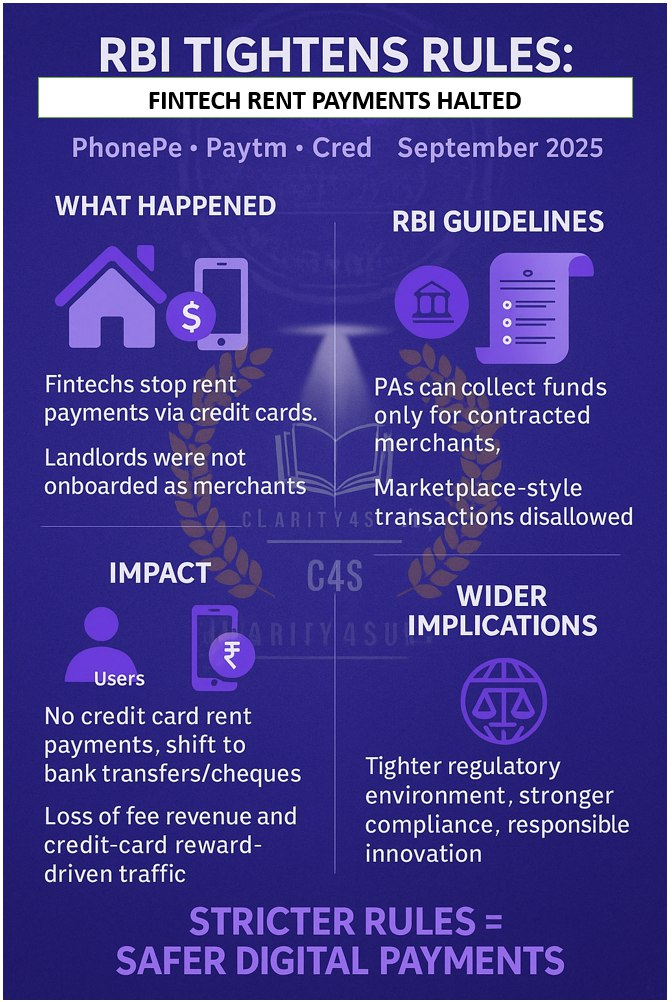
What Changed?
- Merchant-only aggregation
- A PA can aggregate funds only for merchants with whom it has a direct contractual relationship.
- Rent payments to landlords not registered as merchants with full KYC are now disallowed.
- Ban on Marketplace-style PA Business
- PAs cannot act as a marketplace themselves.
- Their role is limited to providing payment facilitation for onboarded merchants.
- Merchant Due Diligence
- PAs, not acquiring banks, are now directly responsible for verifying merchant KYC.
- Funds must be settled only into the onboarded merchant’s bank account.
Why RBI Did This?
- Prevent misuse of credit cards: Rent payments were functioning like disguised peer-to-peer (P2P) transfers.
- Curb fraud and money laundering: Fake “rent” payments were sometimes used for cash flow management or illicit transfers.
- Strengthen accountability: Ensures traceability of funds and merchant legitimacy.
- Regulatory simplification: Moves from multiple licenses and micro-rules → one unified PA licence, principle-based framework.
Impact
On Fintechs
- Loss of a high-volume, fast-growing use case (rent payments via cards).
- Reduced fee income and lower credit card transaction volumes.
- Need to re-onboard landlords as merchants → high cost, less attractive for casual landlords.
On Users
- No more earning credit card reward points / cashback on rent.
- Limited ability to convert rent into EMIs via fintech apps.
- Must switch back to bank transfers, UPI, cheques, or BBPS for rent payments.
Exam Relevance
- Payment Aggregator (PA): Entity that facilitates digital payments between merchants and customers without requiring merchants to set up their own payment infrastructure.
- Marketplace ban: PAs cannot run e-commerce-like setups; they only process payments for contracted merchants.
- KYC mandate: Full merchant verification required, strengthening AML (Anti-Money Laundering) safeguards.
2. SEBI Gives Clean Chit to Adani Group in Hindenburg Case
Context:
On September 18, 2025, the Securities and Exchange Board of India (SEBI) concluded its investigation into allegations by U.S.-based shortseller Hindenburg Research against the Adani Group. The case mainly involved Adani Ports & SEZ Ltd. and Adani Power Ltd.
Background:
- Hindenburg Report (Jan 2023):
- U.S.-based short-seller Hindenburg Research accused the Adani Group of stock price manipulation, accounting irregularities, and use of offshore shell companies.
- Impact:
- Adani Group companies lost over $100 billion in market capitalization within weeks.
- Concerns raised about transparency, corporate governance, and investor protection in Indian markets.
Role of SEBI in the Case
- Market Watchdog: Ensured that any alleged manipulation or irregularity in Adani stocks was thoroughly probed.
- Investor Protection: Addressed concerns of lakhs of investors impacted by stock volatility.
- Regulatory Oversight: Investigated FPIs linked to the Adani Group to check for round-tripping of funds.
- Judicial Accountability: Submitted reports directly to the Supreme Court, enhancing transparency.
- Policy Impact: Case led to discussions on tightening rules on disclosure norms, FPI transparency, and corporate governance.
Important SEBI Acts and Regulations (For Exams)
| Act/Regulation | Year | Purpose/Key Provisions | Exam Relevance |
|---|---|---|---|
| SEBI Act | 1992 | Establishes SEBI as market regulator; protects investors, promotes fair trading, regulates intermediaries. | Foundation of SEBI’s powers, must know sections like Section 11 (functions of SEBI). |
| Securities Contracts (Regulation) Act – SCRA | 1956 | Governs listing, recognition of stock exchanges, and trading of securities. SEBI empowered to regulate stock exchanges. | Important for listing rules, delisting, recognition of stock exchanges. |
| Depositories Act | 1996 | Provides framework for dematerialisation and working of depositories like NSDL, CDSL. | Related to demat accounts, electronic shareholding. |
| Companies Act (SEBI-linked provisions) | 2013 | Covers corporate disclosures, corporate governance, issue of securities, shareholder protection. | SEBI coordinates with MCA, exam focus on disclosure & governance norms. |
| Prevention of Fraudulent and Unfair Trade Practices (PFUTP) Regulations | 2003 | Prevents price rigging, insider trading, circular trading, misleading disclosures. | Invoked in Adani–Hindenburg type probes. |
| Listing Obligations and Disclosure Requirements (LODR) Regulations | 2015 | Prescribes disclosure norms for listed companies (quarterly results, shareholding patterns, related-party transactions, corporate governance). | Core for corporate governance & transparency. |
| Foreign Portfolio Investors (FPI) Regulations | 2019 | Regulates investment by foreign institutional investors (FIIs/FPIs). Defines categories of FPIs. | Key for exam after Adani–Hindenburg controversy. |
3. EPFO Launches ‘Passbook Lite’ and Online Access to Annexure K
Source: Mint
Context:
On September 18, 2025, the Employees’ Provident Fund Organisation (EPFO) introduced two major digital reforms to improve transparency and member convenience.Union Labour Minister Mansukh Mandaviya announced the launch of “Passbook Lite” on the EPFO members’ portal and direct online access to Annexure K.
Key Highlights:
- Passbook Lite Facility:
- Provides a summarised view of contributions, withdrawals, and current balance.
- Removes the need for dual login (earlier required separate login for “passbook portal”).
- Reduces password sync issues and technical delays.
- The detailed graphical passbook will still be available in the existing portal.
- Annexure K Online Access:
- Annexure K = PF transfer certificate generated when employees change jobs and accounts are shifted via Form 13.
- Previously, it was shared only between PF offices and available to members only on request.
- Now, employees can directly download Annexure K in PDF from the members’ portal.
- Members can also track transfer applications online, ensuring greater transparency.
About EPFO
- Statutory Body: Established under the Employees’ Provident Funds and Miscellaneous Provisions Act, 1952.
- Ministry: Functions under the Ministry of Labour & Employment, Government of India.
- Purpose: Provides social security benefits to employees in the organised sector through:
- Employees’ Provident Fund (EPF) – retirement savings.
- Employees’ Pension Scheme (EPS) – pension benefits.
- Employees’ Deposit Linked Insurance (EDLI) – insurance cover.
4. PhonePe Gets RBI Authorisation as Online Payment Aggregator
Source: BL
Context:
PhonePe received final authorisation from the Reserve Bank of India (RBI) to function as an online payment aggregator (PA). Enables PhonePe to directly onboard merchants, especially small and medium enterprises (SMEs), and expand its digital financial services.
What is a Payment Aggregator (PA)?
- A Payment Aggregator facilitates merchants to accept digital payments from customers by integrating multiple payment methods (cards, UPI, wallets, net banking) into a single gateway.
- RBI Regulation: Introduced in March 2020 under RBI’s Guidelines on Regulation of Payment Aggregators and Payment Gateways.
- Requirement: Non-bank entities must obtain RBI authorisation to operate as a PA.
Significance of RBI Approval for PhonePe
- Expansion to SMEs:
- Focus on small and medium businesses that are underserved by traditional digital payment solutions.
- Supports India’s digital financial inclusion agenda.
- Merchant Benefits:
- Secure, reliable, and compliant payment gateway.
- Smooth checkout experience for customers.
- Instant onboarding and developer-friendly plug-ins for fast integration.
- Strategic Edge:
- Strengthens PhonePe’s position in the fast-growing digital payments ecosystem.
- Competes with other RBI-authorised players like Razorpay, PayU, and Cashfree.
RBI’s Role and Regulatory Relevance
- RBI’s Objective: To ensure customer safety, fraud prevention, and orderly development of digital payments.
- Key Guidelines:
- PA/PG Framework (2020): Mandated authorisation for non-bank PAs.
- Minimum Net Worth Requirement: ₹15 crore at the time of application, rising to ₹25 crore by the end of the third financial year.
- Governance & Compliance: Fit-and-proper criteria, escrow account maintenance, grievance redressal mechanism.
5. RBI Conducts VRR Auctions to Infuse Liquidity
Source: BL
Context:
The Reserve Bank of India conducted two variable rate repo (VRR) auctions on Friday to infuse liquidity in the banking system.
RBI’s Liquidity Management Strategy
- RBI is targeting a system liquidity surplus of ₹1.5–2 lakh crore to ensure:
- Smooth monetary transmission of repo rate cuts into lending and deposit rates.
- Adequate short-term liquidity for banks.
Cash Reserve Ratio (CRR) Reduction
- CRR Cut: To be implemented in four tranches of 25 bps each on
- Sept 6, Oct 4, Nov 1, Nov 29 (2025).
- Impact: Will release about ₹2.5 lakh crore of primary liquidity into the banking system by Dec 2025.
Key Concepts for Exams
- Variable Rate Repo (VRR):
- Short-term liquidity tool under RBI’s Liquidity Adjustment Facility (LAF).
- Repo operations conducted at market-determined rates via auction (unlike fixed-rate repo at the policy repo rate).
- Liquidity Management Tools of RBI:
- Repo & Reverse Repo
- Variable Rate Repo (VRR) & Variable Rate Reverse Repo (VRRR)
- Cash Reserve Ratio (CRR)
- Open Market Operations (OMOs)
- Significance of VRR:
- Provides flexibility in liquidity injection.
- Ensures banks borrow at competitive rates.
- Helps RBI fine-tune short-term liquidity mismatches.
Facts To Remember
1. CM launches new curricula for govt. schools replacing initiatives introduced by AAP
Chief Minister Rekha Gupta launched three new curricula – Rashtraneeti, Science of Living, and New Era of Entrepreneurial Ecosystem & Vision (NEEEV) – for the Delhi government schools.
2. Antim wins bronze, opens India’s tally
Antim Panghal (53kg) redeemed some pride after her ignominious Paris Olympics performance as she claimed a bronze medal at the World wrestling championships in Zagreb and joined Vinesh Phogat in winning two Worlds bronze medals.
3. Sachin finishes fourth; Neeraj disappoints
Defending champion Neeraj Chopra endured a nightmarish outing at the World Championships’ men’s javelin throw final to end a disappointing eighth even as debutant compatriot Sachin Yadav logged in a personal best to finish a creditable fourth.
4. Neysa Empanelled as Cloud Service Provider under IndiaAI Mission
The empanelment is expected to accelerate Neysa’s growth, both in India and in international markets. Neysa, an AI Cloud services startup founded by Sharad Sanghi, has been officially empanelled under the IndiaAI Mission as one of its approved Cloud service providers.
20 September, 2025
Daily Current Affairs Quiz
20 September, 2025
International Affairs
1. H-1B Visas
Source: TH
Context:
US President Donald Trump signed a proclamation imposing a $100,000 fee on each H-1B visa sponsorship, significantly raising the cost for US firms hiring foreign skilled workers.
Key Highlights:
- Policy Objective:
- Prevent misuse of H-1B visas.
- Ensure hiring of highly skilled professionals.
- Protect American jobs and wages.
- Fee Impact: Increase from a few thousand dollars to $100,000 per applicant.
Implications for India
- Indian IT Companies: Major H-1B users (Infosys, Wipro, TCS) face higher compliance costs.
- Brain Drain: May reduce opportunities for mid-level Indian professionals.
- Business Shifts: Could encourage nearshoring to Canada/Mexico or strengthen domestic outsourcing.
- Tech Adoption: US companies may accelerate automation & AI to cut reliance on foreign talent.
About H-1B Visa
- Non-immigrant visa allowing US employers to hire foreign workers in specialty occupations.
- Eligibility: At least a Bachelor’s degree in relevant field.
- Validity: 3 years, extendable to 6 years.
- Quota: 65,000 visas + 20,000 for US Master’s holders.
- Employer-Sponsored: Requires petition by a US-based employer.
- Equal Pay Mandate: Employers must pay prevailing wages.
India & H-1B
- Beneficiary: India accounts for ~71% of H-1B visa holders.
- Major Users: Amazon, Microsoft, Google, Meta.
- Economic Impact: Supports India’s $150+ billion IT export sector and remittance inflows.
- Concerns: Long Green Card backlogs (>10 years).
National Affairs
1. India Re-elected to UPU Councils at 28th Congress
Source: News on Air
Context:
India has been re-elected to the Council of Administration and the Postal Operations Council (POC) of the Universal Postal Union (UPU) during the 28th UPU Congress held in Dubai.
About Universal Postal Union (UPU)
- Definition: Specialized UN agency and the primary forum for international postal cooperation.
- Members: 192 countries, ensuring a universal postal network.
- Founded: 1874 (Treaty of Bern)
- Headquarters: Berne, Switzerland
- Significance: Second oldest international organization after ITU.
Aim & Objectives
- Promote global postal cooperation and smooth international mail exchange.
- Develop modern, reliable, and affordable postal services.
- Facilitate growth in parcel, mail, and postal financial services.
Governance Structure
| Body | Role |
|---|---|
| Congress | Supreme authority; meets every 4 years; sets strategy & policies |
| Council of Administration (CA) | Policy, regulatory, legal, and administrative issues between Congress sessions |
| Postal Operations Council (POC) | Technical & operational body (48 elected members); drives postal service modernization |
| International Bureau | Secretariat; provides logistical and technical support |
Key Functions of UPU
- Rule-Setting: Establishes global postal regulations and standards.
- Advisory & Mediation: Resolves disputes, promotes international cooperation.
- Technical Assistance: Helps member countries modernize postal services.
- Capacity Building: Improves quality, efficiency, and financial sustainability.
- Global Integration: Supports interoperability, e-commerce, and cross-border logistics.
2. Indian Navy Inducts ‘Androth’ Anti-Submarine Warfare Ship
Context:
Indian Navy inducted ‘Androth’, the second Anti-Submarine Warfare Shallow Water Craft (ASW-SWC).
- Builder: Garden Reach Shipbuilders & Engineers (GRSE), Kolkata.
- Series: Part of an 8-ship series being inducted to enhance India’s coastal and maritime security.
About Androth ASW Ship
- Type: Indigenously built Anti-Submarine Warfare Shallow Water Craft (ASW-SWC).
- Role:
- Coastal security and surveillance
- Anti-submarine patrols in shallow waters, including Lakshadweep and strategic sea lanes
- Strengthening maritime border protection
Key Features
| Feature | Details |
|---|---|
| Length | ~77 metres; among largest Indian naval warships with diesel engine–waterjet propulsion |
| Weapon Systems | Indigenous lightweight torpedoes, anti-submarine rockets |
| Indigenous Content | >80% of components made in India |
| Maneuverability | Optimized for littoral and shallow coastal waters |
| Surveillance | Equipped with advanced sonar and sensors for submarine detection |
3. INSPIRE Awards 2025
Context:
National Innovation Rankings under INSPIRE Award-MANAK (Million Minds Augmenting National Aspiration and Knowledge) 2025.
- Highlight: Muzaffarpur, Bihar submitted 7,403 innovative student ideas, topping the national list.
- Organisers: Department of Science & Technology (DST), Ministry of Science & Technology (MoS&T), and National Innovation Foundation (NIF).
About INSPIRE Award-MANAK
- Scheme: Part of the Innovation in Science Pursuit for Inspired Research (INSPIRE) flagship initiative.
- Objective: Tap 10 lakh original science- and society-based ideas from school children.
- Eligibility: Students of Class VI to X (public & private schools).
- Recognition & Support:
- Financial assistance of ₹10,000 for model development
- Ideas first showcased at district level, then progress to state and national levels
- Top 60 innovations displayed at Rashtrapati Bhavan, with awards conferred by the President of India
National Innovation Rankings 2025: Top Performers
| Rank | District | State | Ideas Submitted |
|---|---|---|---|
| 1 | Muzaffarpur | Bihar | 7,403 |
| 2 | Bengaluru Urban | Karnataka | 7,306 |
| 3 | Bagalkot | Karnataka | 6,826 |
| 6 | Jaipur | Rajasthan | 6,311 |
| 6 | Vaishali | Bihar | 6,182 |
| 6 | Lucknow | UP | 6,182 |
| 7 | Hardoi | Uttarakhand | 5,544 |
| 8 | Allahabad | UP | 5,380 |
| 9 | Pratapgarh | UP | 5,380 |
| 10 | Unnao | UP | 5,051 |
4. Japan’s R&I Upgrades India’s Sovereign Credit Rating to BBB+
Source: News on Air
Context:
India’s Sovereign Rating has been upgraded to BBB plus rating by a Japanese credit rating agency namely ‘Rating and Investment Information (R&I)’. BBB plus rating indicates stability.
Key Highlights:
- Economic Drivers:
- Domestic consumption and policy reforms anchor growth despite global uncertainties.
- India remains one of the world’s best-performing economies.
- Global Context:
- Upgrade comes amid uncertain global economic environment.
- US tariffs on India (up to 50%) noted as a risk, but limited impact due to low dependence on US exports.
- Policy Reforms Supporting Upgrade:
- GST Rate Rationalisation: Moved from four slabs to two main rates.
- Expected revenue loss is partially offset by higher private consumption stimulated by lower tax rates.
- India’s Rating Momentum (2025):
- S&P Global: Upgraded to BBB from BBB– in August 2025.
- Morningstar DBRS: Upgraded to BBB from BBB(low) in May 2025.
- R&I: Third sovereign upgrade in the year, reflecting investor confidence in India’s macroeconomic stability.
Banking/Finance
1. SEBI and RBI Push for Corporate Bond Index Derivatives
Source: ET
Context:
The Securities and Exchange Board of India (SEBI) and the Reserve Bank of India (RBI) are in discussions to introduce corporate bond index derivatives, aiming to enhance trading activity in corporate debt securities.
Key Highlights:
SEBI cleared the way for Cash-Settled Corporate Bond Index Futures (CBIF) in January 2023 for corporate debt securities rated AA+ and above. Talks with RBI aim to reinvigorate this initiative.
Cash-Settled Corporate Bond Index Futures (CBIF)
- CBIF are derivative contracts based on a corporate bond index, allowing investors to take positions on the performance of a basket of high-quality corporate bonds.
- Cash-settled: No physical delivery of bonds occurs; settlements are made in cash based on the difference between contract price and the final index value at maturity.
Eligibility Criteria:
- SEBI allows CBIF contracts only on indices comprising corporate bonds rated AA+ and above.
Purpose & Significance:
- Provides investors with a tool to hedge interest rate risk and credit risk in corporate bonds.
- Helps improve liquidity and participation in the corporate bond market.
- Supports price discovery and strengthens India’s debt market infrastructure.
Regulatory Context:
- SEBI cleared CBIF in January 2023 for launch by stock exchanges.
- Discussions with RBI aim to revive and promote trading in these contracts to deepen India’s corporate debt market.
2. PFRDA in Talks with SEBI to Allow Pension Funds in Commodity Derivatives
Source: BS
Context:
The Pension Fund Regulatory and Development Authority (PFRDA) is in discussions with the Securities and Exchange Board of India (SEBI) to allow pension funds to participate in select commodity derivatives.
Key Highlights:
- Objective: Enable pension funds to access gold, silver, and potentially other metals for investment, aiming for long-term stable returns.
- Exclusions: Agricultural commodities may remain off-limits due to higher vulnerabilities.
- Regulatory Requirement: Implementation would require new PFRDA investment guidelines and board approval.
- Industry Signals:
- SEBI has indicated interest in permitting banks, insurers, and pension funds to access non-agricultural commodity markets.
- A working group may be formed to develop trading in metals and other non-agri commodities to help India shift from being a price taker to a price setter.
- Insurance regulators may take a cautious approach before allowing insurers to participate.
Significance:
- Expands the investment avenues for pension funds and other long-term institutional investors.
- Supports the development of a domestic commodities market and promotes price discovery in non-agricultural commodities.
- Aligns with India’s broader objective to enhance financial market depth and diversification.
3. PFRDA Introduces Multiple Scheme Framework for NPS
Source: BS
Context:
Pension Fund Regulatory and Development Authority (PFRDA) announced a Multiple Scheme Framework (MSF) for non-government NPS subscribers.
Key Features of MSF
- Multiple Schemes per Subscriber:
- Non-government subscribers can hold multiple schemes under a single PRAN across various CRAs (Central Record Keeping Agencies).
- Earlier, subscribers were limited to one investment choice per tier and one CRA.
- Tailored Schemes:
- Pension Funds (PFs) can design schemes for specific subscriber groups such as:
- Digital economy workers
- Self-employed professionals
- Corporate employees with employer co-contributions
- Pension Funds (PFs) can design schemes for specific subscriber groups such as:
- Variants & Equity Allocation:
- Each scheme must have at least two variants: moderate-risk and high-risk.
- Equity allocation in high-risk schemes can now go up to 100% (previously 75%).
About PFRDA
- Establishment: Initially set up as a regulatory body for pension sector; made statutory under PFRDA Act, 2013 (notified on Feb 1, 2014).
- Jurisdiction: Department of Financial Services (DFS), Ministry of Finance (MoF).
- Chairman: Sivasubramanian Ramann
- Headquarters: New Delhi, Delhi
- Mandate: Promote, develop, and regulate the pension sector in India, including NPS.
4. RBI Authorizes DBS Bank India as Agency Bank
Context:
DBS Bank India became the first wholly owned subsidiary of a foreign bank in India to be authorized by the Reserve Bank of India (RBI) as an agency bank.
Purpose: Collect Goods and Services Tax (GST) payments on behalf of the Central Board of Indirect Taxes and Customs (CBIC) under the Ministry of Finance (MoF).
Key Features of Authorization
- Payment Channels:
- DBS IDEAL (enterprise digital banking platform)
- NEFT (National Electronic Funds Transfer)
- RTGS (Real Time Gross Settlement)
- OTC payments at bank branches
- DBS IDEAL Platform Capabilities:
- Real-time transaction updates
- Instant payment acknowledgements
- Downloadable payment advice for recordkeeping
- Dedicated client support for GST compliance queries
What is an Agency Bank?
- An Agency Bank is a commercial bank that is authorized by the Reserve Bank of India (RBI) to carry out certain banking functions on behalf of the Central and State Governments.
- These functions include collection and disbursement of government funds, tax collections, pension payments, and issuance of savings instruments.
Key Functions of Agency Banks
- Revenue Collection
- Collects direct taxes (Income Tax, Corporate Tax).
- Collects indirect taxes (GST, Customs Duty, Excise Duty).
- Payments
- Makes pension payments to retired government employees.
- Disburses subsidies, scholarships, and government payments.
- Government Transactions
- Handles government receipts and payments through RBI’s accounts.
- Issues and redeems government securities, savings bonds, etc.
Why Agency Banks Exist?
- RBI cannot directly handle millions of government-related financial transactions.
- So, it appoints selected scheduled commercial banks as its agents = Agency Banks.
- This improves reach (through bank branches) and efficiency in government-related payments/collections.
5. SEBI Reintroduces B-30 Incentives and Caps Mutual Fund Exit Load
Context:
The Securities and Exchange Board of India (SEBI) has revised the mutual fund (MF) distribution incentive structure to boost financial inclusion in smaller cities and among women investors. The regulator has also capped the maximum exit load on MF schemes at 3 per cent.
Key Highlights:
Reintroduction of B-30 Incentives
- What? SEBI will provide incentives to distributors for bringing new individual investors (new PAN) from beyond top-30 (B-30) cities.
- Structure:
- Lumpsum investment: Incentive = 1% of the first application amount.
- SIP investment: Incentive = 1% of total investment in the first year.
- Cap: Maximum ₹2,000 per new investor.
- Purpose: Encourage mutual fund penetration in Tier-2, Tier-3, and smaller towns.
Incentives for Women Investors
- Gender Inclusion: Distributors will earn an additional commission for bringing new women investors (new PAN).
- Calculation: Same as B-30 incentive structure (up to ₹2,000 cap).
- Objective: Promote women’s participation in the mutual fund industry.
Background
- Suspension in 2023: B-30 incentives were suspended after SEBI found misuse — transaction splitting and portfolio churning to claim higher incentives.
- Revamped Framework: Now system-driven checks and tighter controls to prevent irregularities.
Reduction in Exit Load
- Earlier: MF schemes could charge up to 5% exit load (though most charged 1–2%).
- Now: Maximum cap reduced to 3%, aligning with industry practice.
- Rationale: Balances investor protection with scheme flexibility, especially for funds investing in less liquid securities.
Agriculture
1. BASAI Seeks Clarity on GST for Biostimulants
Source: BL
Context:
The Biological Agri Solutions Association of India (BASAI) has urged the government to clarify GST applicability on biostimulants, which are vital for sustainable agriculture and climate resilience.
What Are Biostimulants?
- Definition: Substances or microorganisms that enhance plant growth, nutrient uptake, and stress tolerance.
- Regulation: Brought under the Fertiliser (Control) Order (FCO), 1985 since 2021.
- Approved Products: As of August 2025, the government has officially notified and approved 146 biostimulant products under FCO.
Key Issues Highlighted by BASAI
- GST Confusion
- At present, some authorities classify biostimulants under 5% GST, while others under 18% GST.
- Notices have recently been issued to some companies, asking them to pay 18% GST.
- BASAI argues they should be taxed at 5%, similar to fertilizers, to make them affordable for farmers.
- HSN Code Ambiguity
- Lack of clarity on the correct Harmonized System of Nomenclature (HSN) code for biostimulants is causing compliance issues.
- Invalidation of Provisional Registrations
- Government recently invalidated 8,000+ provisional registrations of biostimulants.
- Only notified products remain valid; others must align with standards to re-enter the market.
Significance
- Promotes sustainable farming and reduces dependency on chemical fertilizers.
- Helps farmers combat climate change challenges (heat, drought, soil degradation).
- A GST clarification will boost industry growth and farmer adoption.
Facts To Remember
1. Zeel downs Shruti in the final
Top seed Zeel Desai recovered from being down 2-4 in the decider to beat first-time finalist Shruti Ahlawat 2-6, 6-1, 6-4 in the $15,000 ITF women’s tennis tournament at the Tennis Project, Baliawas.
2. Indian Railways Launches Scheduled Commodity-Specific Cargo Services in North
Indian Railways has enhanced in freight logistics by launching scheduled, commodity-specific, time-tabled cargo services, connecting key production and consumption centres across the northern region.
3. Over 2.83 Lakh Health Camps Held Across India Under Swasth Nari Sashakt Parivar Abhiyaan
The Ministry of Health and Family Welfare has said over 2.83 lakh health camps have been organized across the country under the Swasth Nari Sashakt Parivar Abhiyaan till 20th of this month. Launched on September 17th.
4. Union minester Piyush Goyal Unveils Guidebook on HSN Code Mapping in New Delhi
Commerce and Industry Minister Piyush Goyal today unveiled the Guidebook on Mapping of Harmonised System of Nomenclature (HSN) Codes in New Delhi.
5. PM Modi to Inaugurate Upgraded Mata Tripura Sundari Temple Complex on 22 Sep
In Tripura, preparations are complete for the visit of Prime Minister Narendra Modi, who is scheduled to inaugurate the newly developed infrastructure and beautification works at the Mata Tripura Sundari Temple complex under the PRASHAD scheme tomorrow.
6. BIRC 2025 to Be Held at Bharat Mandapam, New Delhi
Bharat International Rice Conference-BIRC 2025 will be held in New Delhi at Bharat Mandapam on 30th and 31st October. It is the world’s largest rice event with farmers, global buyers and stakeholders.
21&22 September, 2025
Daily Current Affairs Quiz
21 & 22 September, 2025
National Affairs
1. UN Report: Gender Snapshot 2025
Source: TOI
Context:
A recent UN report (Gender Snapshot 2025) indicates that women’s jobs globally face greater susceptibility to automation and AI-driven displacement compared to men’s jobs.
Key Findings:
- Risk Percentage:
- Approximately 28% of women’s jobs are estimated to be at risk due to AI and automation, compared to 21% for men.
- Workforce Representation:
- Women constitute roughly 29% of the global tech workforce, but only about 14% of tech leadership roles.
- Gender Digital Divide:
- The report emphasizes that unless actions are taken, AI could widen gender inequalities, especially as the jobs women hold are often more vulnerable to automation, less well-compensated, or in sectors less digitally protected.
- Potential Gains of Bridging the Gap:
- If gender digital inclusion improves, possible outcomes by 2030 include lifting millions out of poverty, improving food security, and contributing significantly to global growth (often cited in the range of US$1.5 trillion globally).
Recommendations
- Skill Development
- Invest in women’s digital and technical skills
- Prepare women for jobs in AI, tech, and other digital sectors
- Economic Transitions
- Facilitate women’s movement across sectors affected by technological disruption
- Policy Measures
- Implement gender-responsive labour policies
- Strengthen social protection measures to prevent disproportionate job losses among women
2. Kilnamandi Sarcophagus Redraws Harappan Age Trade Map
Source: TOI
Context:
Archaeologists in Tamil Nadu discovered a terracotta sarcophagus in Kilnamandi village (Tiruvannamalai district). The deposit (charcoal from a funeral pyre) was dated via AMS radiocarbon method to 1692 BCE, placing it in the Late Harappan period
About the Sarcophagus:
- What it is:
- A terracotta coffin used for burials, containing charcoal, pottery, and grave goods.
- Provides insights into burial practices and socio-cultural life of ancient Tamilakam.
- Where it was found:
- Site: Kilnamandi village, Tiruvannamalai district, Tamil Nadu.
Key Findings:
- Evidence of Trade Links
- Carnelian beads found in the burial were sourced from Gujarat and Maharashtra
- Suggests long-distance trade between southern India and northern Harappan centres during the late Harappan period
- Graffiti Marks and Cultural Links
- Potsherds around the sarcophagus carry graffiti symbols: fork-like shapes, semiconcentric circles in U-formation, vertical strokes with wavering lines
- Parallels found between Tamil Nadu graffiti and Indus Valley markings: ~90% similarity
- Dating pushes the graffiti tradition in Tamil Nadu back to 17th century BCE
- Archaeological Insights
- Grave goods suggest complex societal structures and possibly clan-specific burial practices
- Other objects: iron tools, pottery finds, indicating technological advancement and material culture
3. CAG’s State Finances Publication 2025
Source: IE
Context:
The Comptroller & Auditor General of India (CAG) released the State Finances Publication 2025, highlighting a sharp rise in states’ salary bills and debt burden over the past decade.
About the Publication:
- Annual report by the CAG covering all 28 states.
- Tracks revenue, expenditure, debt, subsidies, and fiscal sustainability.
- Acts as a guide for policymakers to understand state-level fiscal risks.
Key Highlights (2025 Report):
- Salary Bills: Increased 2.5 times in 10 years, touching ₹16.6 lakh crore; biggest component of committed expenditure.
- Subsidies: Tripled to ₹3.09 lakh crore. Punjab leads with subsidies at 17% of total expenditure.
- Committed Expenditure: Accounts for 43.5% of revenue expenditure. Highest in Nagaland (74%) and Kerala (63%).
- Public Debt: Jumped 3.4 times to ₹59.6 lakh crore, nearly 23% of combined GSDP, raising medium-term fiscal risk.
- Union Tax Devolution: States’ average share stayed ~27%. Five states (UP, Bihar, MP, West Bengal, Maharashtra) received 50% of devolved taxes.
4. Logistics Ease Across Different States (LEADS) 2025
Context:
Launched by Union Commerce & Industry Minister in New Delhi during the 10-year celebrations of Make in India. Aims to benchmark and enhance the logistics ecosystem across Indian States and Union Territories (UTs).
About LEADS:
- Full Form: Logistics Ease Across Different States.
- Administered by: Ministry of Commerce & Industry, Department for Promotion of Industry and Internal Trade (DPIIT).
- Purpose:
- Rank States/UTs on logistics performance.
- Identify gaps and best practices.
- Guide policy reforms, infrastructure planning, and capacity building.
- Reduce logistics costs and improve supply chain efficiency.
Assessment Criteria:
- Infrastructure Quality: Roads, warehousing, multimodal connectivity.
- Services: Availability, quality, and reliability of logistics services.
- Efficiency: Timeliness, truck turnaround time, ease of clearances.
- Policy Support: State-level facilitation measures, grievance redressal.
- Stakeholder Perception: Industry feedback on cost, speed, reliability.
Key Features of LEADS 2025:
- Corridor Performance Tracking: Monitors 5–7 national corridors using journey time, truck speed, and waiting time.
- API-Enabled Data: Real-time section-wise speed evaluation on major road corridors.
- State Rankings & Categories: States classified as Leaders, Achievers, and Aspirers to promote healthy competition.
- Policy Recommendations: Tailored interventions for States/UTs based on performance.
- Digital Dashboard: Interactive platform for continuous monitoring by States/UTs.
Banking/Finance
1. EPFO Allows Part Payments in PF Settlements to Prevent Financial Distress
Source: BS
Context:
The Employees’ Provident Fund Organisation (EPFO) has directed its regional and zonal offices to process part payments in provident fund (PF) settlement claims instead of rejecting them outright in certain cases. The move is aimed at reducing financial hardship for members facing settlement delays due to employer defaults or transfer-related issues.
Key Highlights:
New EPFO Directive
- Offices should not reject PF settlement claims in cases of incomplete contributions or transfer delays.
- Instead, part payments of available accumulations must be processed.
- This aligns with para 10.11 of the Manual of Accounting Procedure (MAP) Part-IIA, which allows such settlements.
Situations Eligible for Part Payments
According to EPFO’s accounting manual, part payments can be made in the following cases:
- Defaulting establishments (non-remittance of employer contribution).
- Non-receipt of Form 3A (annual contribution details).
- Past accumulations not realised in full.
- Transfer of PF accumulations not received from previous employer.
- Partial claims where the eligible person has not claimed the full amount.
Monitoring and Process
- All part payment cases must be recorded in a register of part-payments.
- Offices must review cases every month.
- Once the pending amount becomes available, the office should make further payments automatically, without requiring a fresh claim from members.
Recent Digital Reforms by EPFO
- Members can now access all key services and PF details with a single login on the EPFO portal.
- These measures are part of EPFO’s ongoing efforts to improve ease of access and timely settlement of claims.
2. CBIC to Launch Advanced GST Invoice Management System
Source: ET
Context:
The Central Board of Indirect Taxes and Customs (CBIC) is developing an advanced invoice management system for GST.
Objective: Stop unnecessary system-generated mismatch notices and streamline dispute resolution for taxpayers.
Key Features of the New System
- Prevention of Automatic Notices
- System will prevent auto-generation of mismatch notices triggered by minor discrepancies between GST returns.
- Currently, ~2 lakh notices are sent annually, covering nearly ₹10 lakh crore in disputes.
- Direct Correction Facility
- Taxpayers will be able to rectify mismatches directly on the portal instead of receiving formal notices.
- This includes reconciliations between various forms:
- GSTR-1: Outward supplies
- GSTR-2A/2B: Inward supplies
- GSTR-6: Input Tax Credit distribution
- GSTR-3B: Monthly return for tax payment
- Reduction in Litigation and Compliance Burden
- Currently, businesses spend considerable time responding to every mismatch notice, even if errors are minor or timing-related.
- New system will reduce trade compliance burden and cut down unnecessary litigation.
- Integration with Existing Facilities
- Existing tools like GSTR-1A (for outward invoices) and the invoice management system (for inward invoices) are optional and not fully aligned.
- The new software will offer a more harmonized, trade-friendly solution, enabling corrections during annual return preparation.
Central Board of Indirect Taxes and Customs (CBIC)
- CBIC is the apex body for administering indirect taxes in India.
- CBIC traces its roots to older boards, it’s constituted under the Central Boards of Revenue Act, 1963.
- Functions under the Department of Revenue, Ministry of Finance.
- Earlier known as Central Board of Excise and Customs (CBEC), renamed in 2018 after introduction of GST.
- Sanjay Kumar Agarwal is the present Chairperson of CBIC
3. FACEs Debt Collection Norms: New Benchmark for Fintechs and NBFCs
Source: BS
Context:
The Fintech Association for Consumer Empowerment (FACE) has rolled out self-regulatory norms on debt collection, aligning with RBI’s digital lending guidelines. These norms aim to bring discipline, transparency, and borrower protection into the lending ecosystem.
Key Highlights:
- Fintech: Fintech (short for Financial Technology) refers to the use of digital technologies, such as software, apps, and algorithms, to provide and automate financial services and products, making them more accessible, efficient, and less costly.
- Governance & Conduct: Norms cover governance, agent behaviour, borrower disclosures, data protection, and digital/field recovery safeguards.
- Objective: Create a robust, respectful, and responsible debt collection process, ensuring fair treatment of borrowers.
- Symbiotic Link: FACE stresses that strong debt collection improves lenders’ confidence, reduces delinquencies, and expands access to credit.
- Industry Impact: Debt recovery discipline could reshape business models, especially for unsecured lending.
- Benchmark Effect: Experts believe FACE’s framework will serve as a template for other SROs (NBFCs, microfinance, BCs).
Fintech Association for Consumer Empowerment (FACE)
- Name: Fintech Association for Consumer Empowerment (FACE)
- Type: Non-profit Section 8 company
- Founded: September 2020
- Location: Mumbai, Maharashtra
Recognition & Role
- SRO-FT Status: FACE is recognised by the Reserve Bank of India (RBI) as the Self-Regulatory Organisation for the FinTech sector (SRO-FT).
- A self-regulatory organization (SRO) is a non-governmental body that creates and enforces industry-specific rules, standards, and ethical guidelines for its members, often under the oversight of a government regulator.
- It was the only association approved under RBI’s fintech SRO framework as of August 2024.
- Mission & Vision:
- Promote responsible, consumer-centric fintech services that are safe, transparent, and suitable.
- Build a nurturing fintech ecosystem where innovation and consumer protection go hand in hand.
4. Stablecoin
Source: BS
Context:
Stablecoins, pegged to the US dollar and designed to reduce crypto volatility, are seeing significant adoption in India even though they lack regulatory backing. This comes as the Reserve Bank of India (RBI) pilots its own Central Bank Digital Currency (CBDC) as a sovereign alternative.
Key Highlights:
- What are Stablecoins?
- Private cryptocurrencies like Tether (USDT) and USD Coin (USDC), pegged to the US dollar with 1:1 convertibility.
- Used widely in crypto trading and cross-border remittances for instant, low-cost transfers.
- Adoption in India:
- India reportedly has 314 million stablecoin holders, the highest in the world.
- Users prefer them for global acceptability and faster remittances compared to banks.
- Global Context:
- The US passed the GENIUS Act (2025), providing a regulatory framework for stablecoins.
- However, risks remain—as seen in the TerraUSD collapse (2022), which wiped out $60 billion.
- Risks in India:
- No legal recognition or customer protection.
- Private stablecoins may collapse if issuers fail or pegs break.
- RBI’s CBDC as Alternative:
- RBI released a CBDC concept note (2022) and is conducting pilots.
- CBDC will be equivalent to sovereign-backed digital cash, ensuring public trust, security, and programmability.
- Designed to coexist with bank deposits and UPI-based digital payments, not disrupt them.
5. Clearing Corporation of India Ltd (CCIL)
Source: ET
Context:
On September 19, 2025, RBI Governor Sanjay Malhotra invited the Clearing Corporation of India Ltd (CCIL) to build infrastructure for trading and settling currency pairs beyond USD–INR, aligning with India’s broader objective of rupee internationalisation.
Background:
- CCIL was set up in April 2001 following recommendations of the Sodhani Committee (1995) and subsequent committees on forex and settlement systems.
- Promoted by SBI, LIC, BoB, IDBI, HDFC Bank, and ICICI Bank.
- First chairman: R.H. Patil (founder of NSE).
- Emerged after the East Asian Financial Crisis (1997) highlighted risks in weak settlement systems.
Key Functions of CCIL:
- Clearing & Settlement: Acts as a Central Counterparty (CCP) in government securities, forex, money markets, and OTC derivatives.
- Risk Management: Provides guaranteed settlement by novation, reduces bilateral counterparty risks, and ensures financial stability through collateral/margins.
- Platforms Managed:
- NDS-OM (Negotiated Dealing System–Order Matching): Primary platform for government bond trading.
- PDO-NDS: Facilitates electronic bidding in government securities.
- FX-Retail: Transparent forex platform for individuals and MSMEs.
- Retail Direct (with RBI): Enables retail investors to invest directly in G-Secs (minimum reduced from ₹10 lakh to ₹10,000).
Subsidiaries:
- Clearcorp Dealing Systems (2003): Runs electronic trading platforms.
- Legal Entity Identifier India Ltd (2015): Issues globally compatible LEIs.
- CCIL IFSC Ltd (2024): Strengthens market infra at GIFT City.
6. SMFG India Credit Partners with PhonePe to Offer Collateral-Free Credit
Source: ET
Context:
SMFG India Credit (SMICC), a Non-Banking Financial Company (NBFC), has partnered with PhonePe to provide collateral-free credit to merchants.
Key Highlights:
- Type of Credit: Merchant Cash Advance (MCA) loans for registered merchants on the PhonePe platform.
- Target Audience: Merchants in Tier-2 and Tier-3 towns, supporting small businesses in semi-urban and rural India.
- Objective: Strengthen SMICC’s role as a leading lender in the MCA space and improve access to working capital for small merchants.
Who are Micro-Merchants?
- Micro-merchants are very small business owners, usually self-employed or family-run enterprises, with low annual turnover (often below ₹50 lakh in India).
- They typically have 1–5 workers (sometimes just the owner) and operate at a neighborhood or community level.
- They form a subset of MSMEs (Micro, Small and Medium Enterprises), but at the smallest end of the spectrum.
- Example:
- A kirana (grocery) shop in a small town
- A street vendor selling vegetables or snacks
7. Paytm Launches UPI Credit Line ‘Paytm Postpaid’ with Suryoday SFB
Context:
Paytm, in collaboration with Suryoday Small Finance Bank (SFB), has introduced a credit line on UPI called Paytm Postpaid.
Key Highlights:
- Type of Credit: Short-term, interest-free credit for up to 30 days, repayable the following month.
- Usage: Can be used for online shopping, UPI payments, bill payments, recharges, and bookings on the Paytm app.
- Infrastructure: Powered by NPCI and leverages Paytm’s UPI payment platform for seamless transactions.
Significance:
- Financial Inclusion: Provides easy access to short-term credit for users without the need for formal loans.
- Digital Payments Growth: Encourages wider adoption of UPI-based credit and digital transactions.
- Convenience for Consumers: Enables users to manage monthly expenses without interest, promoting responsible digital credit usage.
8. Tax Loss Harvesting (TLH) Code
Context:
The Securities and Exchange Board of India (SEBI) has introduced measures to simplify the transfer of securities from nominees to legal heirs, reducing tax and compliance burdens.
Objective: Facilitate smooth transfer of securities upon the death of an investor, easing financial processes for legal heirs.
What is Tax Loss Harvesting (TLH)?
- Tax Loss Harvesting (TLH) is a strategy where investors sell securities at a loss to offset capital gains made elsewhere.
- This helps reduce the overall tax liability on capital gains.
- Later, the investor may reinvest in similar (but not identical) securities to maintain portfolio allocation.
TLH Code by SEBI
- Recently, SEBI introduced the Tax Loss Harvesting (TLH) Code to streamline securities transfer and reporting.
- The TLH Code ensures uniform classification of transactions made solely for the purpose of booking a loss (to adjust against capital gains).
- It will help distinguish genuine transfers from tax-loss-driven transfers, bringing transparency and reducing misuse.
Why is TLH Code Important?
- Standardization: Provides a common identifier for such transactions across brokers, exchanges, and depositories.
- Transparency: Tax authorities can clearly track when a transaction was done only for harvesting losses.
- Ease for Investors: Helps taxpayers claim legitimate tax benefits without confusion.
- Reduced Litigation: Minimizes disputes between taxpayers and tax authorities regarding the intent of transactions.
Example
- Suppose you sold Stock A at a ₹50,000 loss and made a ₹70,000 profit from Stock B.
- Using TLH, you can offset ₹50,000 from the profit, paying capital gains tax only on ₹20,000.
- Under the new TLH Code, this transaction would be marked/tagged properly in the system.
Agriculture
1. HyFarm Paathshala: Empowering Farmers with Knowledge
Context:
Ahmedabad-based HyFarm, a vertical of the HyFun Group, has launched an innovative farm school that shifts learning from classrooms to the actual fields. The initiative, called Paathshala, combines traditional practices with modern technology to make farming more efficient, sustainable, and profitable.
Key Highlights:
- Pilot Project and Convocation
- Over 30 farmers and their families in North Gujarat participated in the pilot project.
- Farmers were honored at the first-ever Paathshala Convocation Ceremony in Ahmedabad.
- These trained farmers are now seen as pioneers in potato cultivation.
- Training Focus
- Soil testing and seed treatment.
- Balanced nutrition and precision irrigation.
- Optimized planting techniques.
- Best harvest practices to reduce losses and improve tuber quality.
Significance
- Farmers trained under Paathshala now return as ambassadors of modern farming.
- Initiative strengthens farmer economics, enhances food quality, and supports India’s role in global potato markets.
- Aligns with sustainable agriculture goals by improving resource efficiency and farmer profitability.
Facts To Remember
1. CM launches ‘MLA on Wheels’ initiative for grassroots governance
Chief Minister Rekha Gupta on Saturday launched the ‘MLA on Wheels’ initiative to bring governance closer to the people and resolve their grievances.
2. Tourism Ministry launches national young chef contest
In order to promote Indian cuisine, a culinary contest is being organised for young chefs across the country by the Union Tourism Ministry for the first time.
3. Mohanlal to receive Dadasaheb Phalke Award
The Ministry of Information & Broadcasting on Saturday announced that actor Mohanlal will be presented the country’s highest film honour, the prestigious Dadasaheb Phalke Award, for 2023. The award will be presented at the 71st National Film Awards ceremony on September 23.
4. GST Exemption on Life and Health Insurance Policies
From September 22, 2025, all individual life and health insurance policies in India, along with their reinsurance, will be fully exempted from Goods and Services Tax (GST). The GST Council’s decision aims to improve affordability and boost insurance penetration across the country.
5. ISLRTC organises programme to celebrate Sign Language Day 2025 in new delhi
Indian Sign Language Research and Training Centre (ISLRTC), under the Department of Empowerment of Persons with Disabilities, will organise a programme to celebrate ‘Sign Language Day – 2025’, in New Delhi.
6. NHRC launches online Short Term Internship Programme for college and university students
The National Human Rights Commission (NHRC) began its Online Short Term Internship Programme (OSTI). The two-week programme aims to provide college and university students with a comprehensive understanding of the promotion and protection of Human Rights in the country.
7. CDS General Anil Chauhan inaugurates first Tri-Services Academia Technology Symposium in New Delhi
Chief of Defence Staff General Anil Chauhan today inaugurated the first Tri Services Academia Technology Symposium in New Delhi. The symposium is themed Victory through Wisdom and Researchaims to bridge the gap between academic innovation and military needs.
8. Prime Minister inaugurates developmental works of Mata Tripura Sundari temple under the PRASHAD scheme
Prime Minister Narendra Modi today inaugurated the developmental works of Mata Tripura Sundari temple under the PRASHAD scheme. With the inauguration of the developmental works, a new chapter has been added to Tripura’s rich cultural and spiritual heritage.
9. 28th National Conference on e-Governance 2025 Kicks Off in Visakhapatnam
The Department of Administrative Reforms & Public Grievances (DARPG) and the Ministry of Electronics & Information Technology (MeitY), in collaboration with the Government of Andhra Pradesh, are organising the 28th National Conference on e-Governance (NCeG) 2025, in Visakhapatnam.
23 September, 2025
Daily Current Affairs Quiz
23 September, 2025
National Affairs
1. Supreme Court Reaffirms Secularism as a Basic Structure of Indian Constitution
Source: TH
Context:
The Supreme Court of India recently reaffirmed that secularism is a fundamental principle and an inseparable part of the basic structure of the Constitution of India. This reiteration came during a case involving the participation of Kannada writer and International Booker Prize-winner Banu Mushtaq, a Muslim, in the inauguration of the Mysuru Dasara festival at the Chamundeshwari Temple.
Secularism in India
Secularism is the principle that the state treats all religions equally, neither favoring nor discriminating against any religion. It ensures freedom of religion for individuals while maintaining a separation between religion and government.
Key Features of Indian Secularism:
- Equal Treatment of All Religions: The government cannot give preferential treatment to any religion.
- Freedom of Religion: Citizens have the right to practice, profess, and propagate any religion under Articles 25–28 of the Constitution.
- State Neutrality: The state remains neutral in religious matters but can regulate practices to maintain public order, morality, and health.
- Protection of Minority Rights: Secularism also involves safeguarding the rights of religious minorities.
Basic Structure of the Constitution
The basic structure doctrine, established by the Supreme Court in the Kesavananda Bharati case (1973), states that certain fundamental features of the Constitution cannot be amended or destroyed by Parliament.
Key Features Included in the Basic Structure:
- Supremacy of the Constitution
- Rule of Law
- Separation of Powers
- Fundamental Rights
- Judicial Review
- Democracy
- Secularism
Basic Structure and the Constitution
- The Basic Structure is not explicitly mentioned anywhere in the Indian Constitution.
- It is a judicial doctrine developed by the Supreme Court in Kesavananda Bharati v. State of Kerala (1973).
- It represents the essential features of the Constitution that cannot be amended or destroyed, even by Parliament under Article 368.
2. World Food India (WFI) 2025
Source: PIB
Context:
Union Minister for Food Processing Industries reflects on World Food India (WFI) 2025, highlighting its evolution into a strategic platform aligned with Prime Minister Narendra Modi’s vision of positioning India as a global food basket. WFI serves as a convergence point for government, industry, farmers, FPOs, SHGs, and global investors, enabling innovation to translate into investment and growth.
Strategic Objectives
The agenda rests on five core pillars:
- Sustainability & Net-Zero Food Processing
- India as a Global Food Processing Hub
- Frontiers in Food Processing, Products & Packaging Technologies
- Processed Food for Nutrition & Health
- Livestock & Marine Products for Rural Economy
Each pillar is mapped to curated sessions, B2B meetings, and adoption pathways, ensuring actionable outcomes from discussions.
Key Highlights:
- CEO Roundtable: Strategic dialogue among industry leaders, investors, and policymakers to foster collaboration and address sectoral challenges.
- Micro-Entrepreneurs & SHGs:
- Free stalls enable direct engagement with domestic and global buyers.
- Trade orders worth crores generated; lasting partnerships established.
- North-East Pavilion: Showcases organic and sustainable products such as Assam teas and Meghalaya turmeric, highlighting the region as a launchpad for Indian organic brands.
- Comprehensive Stakeholder Engagement: Includes HoReCa, Alcobev sectors, and technology innovators.
3. CPCB Report 2023
Context:
The Central Pollution Control Board (CPCB) released its 2023 assessment of river water quality, focusing on Biological Oxygen Demand (BOD) as a key indicator. Rivers with BOD > 3 mg/litre are deemed unfit for bathing.
Key Highlights:
Overall Status
- Unfit River Locations:
- 2023 → 807 locations
- 2022 → 815 locations
- Polluted River Stretches (PRS):
- 2023 → 296 PRS across 271 rivers
- 2022 → 311 PRS across 279 rivers
State-wise PRS (2023)
- Maharashtra – 54 (highest in India)
- Kerala – 31
- Madhya Pradesh – 18
- Manipur – 18
- Karnataka – 14
‘Priority 1’ Stretches (Most Polluted, BOD > 30 mg/litre)
- 2023: 37 stretches
- 2022: 45 stretches
- Top States (2023): Tamil Nadu (5), Uttar Pradesh (5), Uttarakhand (5)
- Top States (2022): Gujarat (6), Uttar Pradesh (6)
CPCB Monitoring Network
- Total monitoring stations: 4,736 locations
- Coverage: Rivers, lakes, creeks, drains, canals
4. National Awards for e-Governance (NAeG) 2025
Source: PIB
Context:
In a historic initiative recognizing grassroots-level digital governance, Gram Panchayats were conferred with the National Awards for e-Governance (NAeG) 2025 under a newly instituted category dedicated to digital service delivery at the Panchayat level.
Award Winners
| Award | Gram Panchayat | District/State | Sarpanch | Incentive |
|---|---|---|---|---|
| Gold | Rohini | Dhule, Maharashtra | Dr. Anandrao Pawara | ₹10 lakh |
| Silver | West Majlishpur | West Tripura, Tripura | Smt. Anita Deb Das | ₹5 lakh |
| Jury Award | Palsana | Surat, Gujarat | Shri Pravinbhai Parshottambhai Ahir | — |
| Jury Award | Suakati | Kendujhar, Odisha | Smt. Kautuka Naik | — |
Financial incentives are to be reinvested in enhancing citizen-centric digital initiatives.
Notable Achievements of Award-Winning Panchayats
Rohini Gram Panchayat, Maharashtra (Gold)
- First Panchayat in Maharashtra with a fully paperless e-Office system
- Offers 1,027 online services and ensures 100% household digital literacy
- Real-time grievance redressal and bulk SMS outreach
West Majlishpur Gram Panchayat, Tripura (Silver)
- Citizen Charter–driven governance model
- Online delivery of birth/death/marriage certificates, trade licenses, property records, MGNREGS job cards
- Ensures accountability, timeliness, and transparency
Palsana Gram Panchayat, Gujarat (Jury Award)
- Integration with Digital Gujarat and Gram Suvidha portals
- QR/UPI-based property tax payments and online grievance redressal
- 10,000+ citizens access online services annually
Suakati Gram Panchayat, Odisha (Jury Award)
- Digitized services through OdishaOne and Seva Odisha platforms
- Provides 24/7 citizen access with real-time tracking
- Promotes women’s leadership and inclusive service delivery
Banking/Finance
1. SEBI Proposes Changes to Technical Glitch Framework for Stockbrokers
Source: ET
Context:
Currently, any malfunction in a stockbroker’s electronic trading system is classified as a “technical glitch.” This framework applies to all brokers, regardless of size or client base.
Key Proposed Changes
- Redefinition of Technical Glitch
- Excludes malfunctions after trading hours and issues beyond the control of stockbrokers.
- Applicability Threshold
- Applies only to brokers:
- Providing internet-based trading platforms
- Having more than 10,000 clients as of March 31 of the previous financial year
- Result: 457 small stockbrokers will now be excluded, reducing compliance burden.
- Applies only to brokers:
- Financial Disincentive Adjustments
- Brokers will not face penalties for glitches that do not materially affect client services
- Example: Minor operational issues with negligible impact
- Disclosure and Transparency
- Stock exchanges should rationalise financial disincentives
- Instances of technical glitches should be disclosed on their websites
- Capacity Planning Requirements
- Stockbrokers must ensure adequate infrastructure to handle increased investor load
- Requires monitoring of peak load across trading applications, servers, and networks
2. RBI Clarifies Regulations on NBFC-Peer to Peer (P2P) Lending Platforms
Context:
The Reserve Bank of India (RBI) issued clarifications on the regulatory framework for Non-Banking Financial Company – Peer to Peer (NBFC-P2P) lending platforms, aiming to enhance transparency, protect customer funds, and ensure operational stability.
Key Highlights:
- Definition:
- A P2P lending platform is an online marketplace connecting borrowers (individuals/businesses) directly with investors/lenders, bypassing traditional banks.
- Leverage and Capital Requirements:
- Leverage ratio: Outside liabilities ÷ owned funds (excluding customer funds).
- Investible funds: Capital infused by promoters and business surplus; excludes lender/borrower funds.
- Minimum ₹2 crore capital required before issuance of Certificate of Registration (CoR).
- Operational Guidelines:
- Customer funds cannot be used by the platform.
- All loan disbursals and repayments must go through bank accounts of registered lenders and borrowers via escrow accounts.
- ‘T+1’ settlement refers to one bank working day.
- Eligibility:
- Existing NBFCs are not allowed to operate as NBFC-P2P entities.
Significance:
- Strengthens the integrity and transparency of P2P lending in India.
- Protects lenders’ and borrowers’ funds, ensuring financial discipline.
- Encourages regulated growth of alternative lending platforms in India.
3. Baroda BNP Paribas Mutual Fund Announces Debt Fund Merger
Source: ET
Context:
Baroda BNP Paribas Mutual Fund has announced the merger of its Banking & PSU Bond Fund (merging scheme) into its Short Duration Fund (surviving scheme), effective 17th October 2025.
Key Highlights:
- Regulatory Framework:
- The merger is classified as a change in fundamental attributes under Regulation 18(15A) of SEBI Mutual Fund Regulations, 1996.
- SEBI has provided a no-objection for the merger.
- Unitholder Options:
- Investors have a 30-day notice period (17th September to 16th October 2025) to exit without any exit load.
- Post-Merger Scenario:
- No new scheme will be launched.
- Only the Short Duration Fund will continue post-merger.
Significance:
- Consolidates the debt fund offerings of the AMC.
- Simplifies fund management while providing unitholders a choice to exit during the transition period.
Agriculture
1. NABARD Rural Sentiment Survey September 2025
Source: BS
Context:
The National Bank for Agriculture and Rural Development (NABARD) has released the findings of its 7th bi-monthly rural economic conditions and sentiment survey (September 2025). The report shows weakening confidence among rural households, largely due to the impact of steep US tariffs on Indian exports imposed by President Donald Trump.
Rural Income Sentiment Weakens
- In July 2025, nearly 75% of rural households expected their incomes to rise in the next year.
- By September 2025, this figure fell to 72.8%.
- Short-term optimism also declined: 51.6% expect income improvement in the next quarter, compared to 56.4% in July.
Key Factor: US Tariffs
- Trump’s 50% tariff on Indian goods—covering 55% of India’s shipments to the US—is among the steepest globally.
- Sectors with strong rural linkages such as seafood exports are directly hit, dampening rural confidence.
Borrowing Behaviour and Credit Trends
- 54.5% of rural households now borrow exclusively from formal sources (highest since survey inception).
- 20% rely solely on informal credit, with over half borrowing from friends and relatives.
- Interest rates on informal loans remain high:
- Average: 17–18%
- Median: 12%
- One-third pay above 20%, while ~30% pay no interest (family/friend lending).
Income and Inflation Perceptions
- Among households reporting higher income over the past year, average earnings rose 12.8%, up from earlier rounds.
- Inflation expectations eased further:
- Average perceived inflation: 4.09% (down ~150 basis points since Nov 2024).
- Median inflation perception: 3%.
Rural Development Priorities
- Road infrastructure topped rural development satisfaction rankings: 45.3% households highlighted improvement.
- Followed by:
- Education (12%)
- Electricity (8.7%)
2. Brazil–India Cross-Incubation Programme in Agritech (Maitri 2.0)
Source: PIB
Context”
The Indian Council of Agricultural Research (ICAR) launched the second edition of the Brazil–India Cross-Incubation Programme in Agritech (Maitri 2.0) in New Delhi. The programme brings together innovators, startups, and institutions from both countries to foster collaboration in agri-food innovation and sustainable agricultural practices.
Strengthening India–Brazil Agricultural Ties
- Dr. Jat highlighted the 77-year-long partnership between India and Brazil, including collaboration on BRICS and G20 platforms.
- He recalled historical agricultural linkages and emphasized innovation-driven growth.
- Emphasis on commercialization as delivering public-funded innovations to end-users, not just generating revenue.
- Maitri 2.0 is envisioned as a two-way learning platform for co-creation between Indian and Brazilian innovators.
Objectives
- Strengthen incubator linkages between India and Brazil
- Exchange best practices in agritech innovation
- Promote co-incubation of startups and technologies
- Explore opportunities in sustainable agriculture, digital technologies, and value-chain development
- Build resilient food systems and empower farmers
Facts To Remember
1. India beats Pakistan in SAFF under-17
The India under-17 men’s team beat Pakistan 3-2 at the Racecourse International Stadium in Colombo on Monday to go to the top of Group-B in the SAFF under-17 Championship 2025.
2. India’s first overseas defence manufacturing facility inaugurated in Berrechid, Morocco
Defence Minister Rajnath Singh and his Moroccan counterpart Abdelatif Loudyi today jointly inaugurated Tata Advanced Systems Limited’s (TASL) defence manufacturing facility in Berrechid, Morocco.
3. Ministry of Culture Hosts Three-Day Nadi Utsav Highlighting Rivers
Indira Gandhi National Centre for Arts, under the Ministry of Culture, will hold the sixth edition of Nadi Utsav from the 25th of this month in New Delhi. Union Minister of Jal Shakti C R Patil will inaugurate the three-day event, which will highlight rivers as vital lifelines and cultural reservoirs.
4. World Food India 2025 Scheduled in New Delhi from September 25–28
World Food India 2025 will be organised from 25th to 28th of September at Bharat Mandapam in New Delhi. The 4th edition of World Food India aims to promote investments in the diverse food processing sector, as well as introduce India’s rich food culture to the World.
5. Union Education Minister Dharmendra Pradhan launches Viksit Bharat Buildathon 2025
Union Education Minister Dharmendra Pradhan today launched Viksit Bharat Buildathon 2025 in New Delhi. The initiative aims to nurture creativity, problem-solving, and self-reliance among youth.
6. Ayushman Bharat, the world’s largest govt-funded health assurance scheme, completes 7 years today
Ayushman Bharat – Pradhan Mantri Jan Arogya Yojana completes seven years today. Launched in September 2018 from Ranchi, it is the world’s largest government-funded health assurance scheme. The scheme has transformed healthcare in India, reaching over 55 crore beneficiaries.
7. National Ayurveda Day 2025
The All India Institute of Ayurveda, Goa, celebrated the 10th National Ayurveda Day at its Dhargal campus today.
24 September, 2025
Daily Current Affairs Quiz
24 September, 2025
National Affairs
1. Viksit Bharat Buildathon 2025
Source: PIB
Context:
The Union Education Ministry has launched the Viksit Bharat Buildathon 2025, inviting school students across India to participate in a large-scale innovation contest.
Key Highlights:
- Participants: Students from Classes 6 to 12 across six lakh schools.
- Launch: Announced by Union Education Minister Dharmendra Pradhan.
- Prize Pool: ₹1 crore to be awarded to winning teams.
Objective of the Buildathon:
- Encourage grassroots innovation among school students.
- Promote ideation and creation of products under four themes: Vocal for Local, Atmanirbhar Bharat, Swadeshi, and Samriddhi.
- Celebrate young innovators and make them key drivers of India’s Viksit, Samriddhi, and Atmanirbhar journey.
- Inspire self-reliance, sustainable growth, and position India as a global innovation hub.
2. NITI Aayog Evaluates Innovation Indicators to Boost India’s GII Ranking
Source: ET
Context:
NITI Aayog is reviewing certain Global Innovation Index (GII) indicators to identify gaps and help India improve its global innovation ranking. The move follows suggestions from the Ministry of Statistics and Programme Implementation (MoSPI) to focus on key parameters for targeted interventions.
Key Highlights:
| Indicator | Rank in 2023 | Rank in 2025 | Observation / Trend |
|---|---|---|---|
| Overall GII Rank | – | 38 | Improved from 81st in 2015 to 38th in 2025 |
| GDP per Unit of Energy | 71 | 76 | Decline in energy productivity |
| Domestic Industry Diversification | 10 | 19 | Reduced industrial diversification |
| Females Employed with Advanced Degrees | – | 101 / 139 | Low representation of women in advanced-degree roles |
Objective:
- To identify weaknesses in specific indicators and propose corrective measures for faster improvement in India’s GII ranking.
- NITI Aayog will coordinate with stakeholder ministries for implementing targeted interventions.
- Performance Snapshot:
- India improved in 8 GII indicators but worsened in 2 indicators in the short term.
- Year-on-year rise in GII ranking has been gradual, necessitating focused reforms.
3. Combined Operational Review and Evaluation (CORE) Programme
Source: PIB
Context:
The Headquarters Integrated Defence Staff (HQ IDS) has launched the Combined Operational Review and Evaluation (CORE) Programme in New Delhi a five-day professional engagement initiative aimed at strengthening civil-military synergy and strategic leadership.
About CORE Programme:
- Provides a forum for civil-military dialogue on national and regional security.
- Facilitates strategic review, leadership development, and joint problem-solving.
Key Features
- Themes:
- Regional and global security challenges
- Technological transformation in warfare
- Strategic communication and inter-agency coordination
- Methodology:
- Lectures, discussions, and interactive sessions with subject-matter experts
- Emphasis on joint problem-solving and cross-domain learning
- Focus Areas:
- Strengthening civil-military synergy
- Enhancing strategic awareness among future leaders
- Encouraging holistic decision-making in complex, multidimensional threat scenarios
4. Nine Bonnet Macaques Found Dead in Kerala
Context:
The Forest department has registered a case into the mysterious deaths of nine Bonnet macaques near Palode in Thiruvananthapuram.

About Bonnet Macaques
- Scientific & Common Name: Bonnet Macaque (Macaca radiata)
Key Characteristics:
- Distinctive Feature: “Bonnet-shaped” hair whorl on the head
- IUCN Status: Least Concern (LC) due to wide distribution
Habitat & Distribution:
- Endemic to southern India
- Found in Western Ghats, southern plains, and urban fringes
- Adaptable to evergreen forests, dry deciduous forests, plantations, and villages
- Both arboreal and terrestrial, often live close to humans
5. India’s First AI-Enabled Nature Experience Centre at Betla National Park
Source: IE
Context:
A first of its kind AI-enabled nature experience centre is set to come up at Betla National Park, a part of the Palamu Tiger Reserve (PTR) in Jharkhand. This cutting-edge facility will transport visitors into the heart of the jungle, allowing them to immerse themselves in the sights and sounds of nature.
Aim: To recreate realistic jungle life using cutting-edge technology for tourism, education, and research
Features of the AI-Enabled Centre
Technology & Tools:
- Artificial Intelligence (AI) assistants for guided learning
- 3D holographic projections to display lifelike animals
- Augmented Reality (AR) and immersive soundscapes (waterfalls, bird calls, predator-prey interactions)
- Simulation of ecosystem dynamics, including herd movements, food-sharing, and predator-prey behaviour
Functions:
- Enhances eco-tourism experiences in Palamu Tiger Reserve
- Promotes interactive wildlife and conservation education
- Supports researchers with virtual wildlife observation and study tools
About Betla National Park
- Only national park in Jharkhand
- Forms the core area of Palamu Tiger Reserve (PTR); total PTR area: 1,129.93 sq km
- Notified as a National Park in 1986
- Among the first nine tiger reserves under Project Tiger (1973)
Banking/Finance
1. S&P Retains India’s GDP Growth Forecast at 6.5%
Source: TH
Context:
S&P Global Ratings has maintained India’s GDP growth forecast for FY2025-26 at 6.5%, highlighting strong domestic demand and a supportive monsoon.
Key Highlights:
| Indicator | Forecast / Value | Notes / Drivers |
|---|---|---|
| GDP Growth (FY26) | 6.5% | Growth retained by S&P Global Ratings |
| Recent GDP Growth (Q1 FY26) | 7.8% | April–June 2025 quarter |
| Inflation (FY26) | 3.2% | Revised downward due to lower food inflation |
| Monetary Policy Outlook | 25 bps rate cut expected | RBI expected to adjust policy given low inflation |
| Key Growth Drivers | Strong domestic demand, benign monsoon, income tax & GST cuts, accelerating government investment | Consumption and investment expected to rise significantly |
2. Unclaimed Deposits
Context:
The Reserve Bank of India (RBI) has directed all banks to launch a 3-month drive (October–December 2025) to settle unclaimed funds such as deposits, dividends, interest warrants, and pensions.
What are Unclaimed Deposits?
Unclaimed deposits are funds held in bank accounts, fixed deposits, recurring deposits, or other financial instruments that remain unclaimed by the account holder or beneficiary for a specified period, usually due to inactivity, non-withdrawal, or lack of communication with the bank.
Key Features
| Feature | Details |
|---|---|
| Types of Unclaimed Deposits | – Savings/Current Account Balances: Dormant accounts – Fixed/Recurring Deposits: Maturity proceeds not claimed – Interest Warrants & Dividends: Payments issued but not encashed – Pension/Gratuity Payments: Benefits unclaimed by beneficiaries |
| Time Frame | – Savings/Current Accounts: Not operated for 10 years – Term Deposits: Not claimed within 10 years from maturity – Such funds are transferred to Depositor Education and Awareness (DEA) Fund at RBI – Depositors can claim funds later with applicable interest |
| Handling by Banks | – Maintain separate ledger for unclaimed deposits – Periodic reporting to RBI is mandatory – May transfer funds to DEA Fund or Unclaimed Deposits Fund per RBI norms |
3. FACE: India’s First Fintech SRO Expands Beyond Digital Lending
Source: BS
Context:
The Fintech Association for Consumer Empowerment (FACE), recognised by the RBI in July 2024 as India’s first Self-Regulatory Organisation for Fintech (SRO-FT), has emerged as a key industry body within just one year of recognition.
Fintech Association for Consumer Empowerment (FACE)
The Fintech Association for Consumer Empowerment (FACE) is India’s first Self-Regulatory Organisation for Fintech, recognised by the Reserve Bank of India (RBI) in July 2024.
Role
- Acts as a key industry body for fintech companies in India.
- Promotes consumer protection, transparency, and ethical practices within the fintech ecosystem.
- Facilitates engagement between fintech players and regulators.
Self-Regulatory Organisation for Fintech (SRO-FT)
A Self-Regulatory Organisation for Fintech (SRO-FT) is an industry body empowered to create, monitor, and enforce standards for fintech companies under the supervision of RBI.
Key Features:
- Autonomy: Operates independently but follows RBI oversight.
- Regulatory Functions:
- Sets industry-wide codes of conduct and operational standards.
- Monitors compliance and ensures ethical fintech practices.
- Addresses consumer grievances and promotes transparency.
- Objectives:
- Protect consumer interests.
- Promote responsible innovation in fintech.
- Reduce regulatory burden on RBI while ensuring sectoral integrity.
FACE as SRO-FT:
- FACE is the first recognised SRO for fintech in India.
- Works to empower consumers and ensure fintech firms follow best practices.
4. Centre May Get Powers to Empanel Private ODR Firms for MSME Delayed Payments
Source: Mint
Context:
The Ministry of Micro, Small and Medium Enterprises (MSME) is exploring a proposal to empower the central government to empanel private online dispute resolution (ODR) firms to handle delayed payments cases, a move aimed at faster recovery of dues for MSMEs.
Proposed Changes:
| Aspect | Current Scenario | Proposed Changes |
|---|---|---|
| MSME ODR Portal | Launched in June 2025; allows MSMEs to file digital claims and monitor disputes with large firms, PSUs, and government agencies. | N/A |
| Authority for Empanelment | Currently, only state governments can empanel private ODR firms via MSEFCs under the MSME Development Act, 2006. | Central government to be empowered to empanel private ODR service providers, similar to states. |
| Effectiveness | State-level MSEFCs are largely ineffective: – 250,000+ claims pending – Less than 10% resolved mutually | Strengthen dispute resolution, especially in regions with limited private ADR institutions (e.g., north-eastern states, tier-II/III cities). |
| Implementation Status | Active portal, but resolution backlog exists | Proposal in progress; implementation may take time |
5. SEBI-Registered Investment Advisers (RIAs)
Context:
Sebi-registered investment advisers (RIAs), who provide fee-based, conflict-free financial advice, have seen their numbers shrink sharply—from 1,350 a few years ago to 962—despite growing investor demand for unbiased guidance.
SEBI-Registered Investment Advisers (RIAs)
A SEBI-registered Investment Adviser (RIA) is a professional or firm registered with the Securities and Exchange Board of India (SEBI) who provides personalised investment advice to clients on securities, financial products, and portfolio management.
Key Features
- Registration Requirement:
- Mandatory for individuals/firms giving investment advice for a fee or remuneration.
- SEBI maintains a publicly available RIA registry.
- Scope of Advice:
- Securities including stocks, bonds, mutual funds, derivatives.
- Portfolio management and financial planning.
- Personalized recommendations based on client’s risk profile, investment horizon, and financial goals.
- Fiduciary Duty:
- RIAs must act in the best interest of clients.
- Must disclose all conflicts of interest and avoid misleading advice.
- Regulatory Oversight:
- Governed by SEBI (Investment Advisers) Regulations, 2013.
- Subject to audits, compliance checks, and penalties for violations.
- Types of RIAs:
- Individual advisers – Certified professionals with relevant qualifications.
- Corporate advisers – Firms providing advisory services, may employ multiple certified professionals.
Current Challenges
| Category | Challenges | Details / Impact |
|---|---|---|
| Regulatory Complexity | Registration & Membership | RIAs must obtain SEBI registration and BASL membership (BSE subsidiary) for supervision. |
| Compliance Burden | Multiple requirements: PMLA/KYC updates, record-keeping, marketing approvals; consume significant time and resources. | |
| Application Delays | Delays in processing applications and renewals leave advisers in limbo, affecting client onboarding. | |
| Operational Burden | Resource Constraints | Individual and mid-sized RIAs often lack funds or manpower to meet compliance needs. |
| Cost & Time | Monthly compliance can cost ₹2.5–3 lakh and require 15–20 hours of work per month. | |
| Impact on Advisers | Licence Surrenders | Some advisers surrender licences due to regulatory uncertainty. |
| Partial Relief | New relaxations (removal of CIBIL reports, proof of address, net worth statements) helpful, but accountability and communication gaps persist. |
6. Bank of Baroda Launches eRUPI P2P Digital Gifting on bob इ(e) Pay UPI
Source: BL
Launch Details:
- Launch: Bank of Baroda (BoB) introduced eRUPI Person-to-Person (P2P) digital gifting on its bob इ Pay UPI app.
- Platform: Powered by NPCI’s e-RUPI system, interoperable across UPI platforms.
Feature Highlights:
- Voucher Value: ₹1 to ₹10,000; users can issue unlimited vouchers subject to daily UPI transaction limits.
- Usage: Redeemable at UPI-enabled merchants across platforms.
- Security: Vouchers are non-transferable and refunded if unredeemed within validity.
- Category: Initially available for Food, with plans to expand to other services.
7. HSBC India PMI: September 2025
Source: BS
Context:
HSBC India’s Flash Purchasing Managers Index (PMI) for September 2025 indicates moderation in growth momentum in both manufacturing and services sectors amid global trade tensions and domestic policy changes.
Key Highlights:
| Indicator | September 2025 | August 2025 | Trend / Observation |
|---|---|---|---|
| Manufacturing PMI | 58.5 | 59.3 | Expansion continues (PMI > 50), but growth moderated; new export orders slowest rise in 6 months due to 50% US tariffs; domestic demand resilient via festive season & GST cuts. |
| Services PMI | 61.6 | 62.9 | Continued expansion, slightly slower than August. |
| Composite PMI Output | 61.9 | 63.2 | Sustained expansion in overall economic activity. |
| Input Costs | Moderated | – | Manufacturers reported higher costs for cotton, steel, oil; services firms saw slower wage-driven expenses. |
| Output Charges | Rose at slower pace | – | Despite factory-gate prices climbing at fastest rate in 12 years. |
| Employment | Manufacturing: 3% hiring; Services: 5% hiring | – | Job creation cooling, especially in private sector. |
Awards
1. 71st National Film Awards (2023)
Dadasaheb Phalke Award
- Conferred on Mohanlal by President Droupadi Murmu.
- Mohanlal: “Cinema is the heartbeat of my soul. Jai Hind.”
President’s Address
- Praised Mohanlal’s versatile contributions to Indian cinema.
- Highlighted growth of films focusing on women’s struggles, courage, and role in shaping society.
- Stressed adequate representation of women on jury panels.
- Noted cinema’s role in spreading awareness of social issues, especially among youth.
- Appreciated encouragement for children’s films; six child actors won awards.
Major Awards
| Category | Winner(s) |
|---|---|
| Best Feature Film | 12th Fail (Hindi) |
| Best Male Actor (tie) | Shah Rukh Khan (Jawan), Vikrant Massey (12th Fail) |
| Best Female Actor | Rani Mukerji (Mrs. Chatterjee vs Norway) |
| Best Director | Sudipto Sen (The Kerala Story – Hindi) |
| Best Popular Film Providing Wholesome Entertainment | Rocky Aur Rani Kii Prem Kahaani (Hindi, Karan Johar) |
| Best Feature Film Promoting National/Social/Environmental Values | Sam Bahadur (Hindi, Meghna Gulzar) |
| Best Children’s Film | Naal 2 (Marathi) |
| Best Animation/VFX/Gaming/Comic Film | Hanu-Man (Telugu) |
Facts To Remember
1. Legendary Dickie Bird passes away aged 92
Harold “Dickie” Bird, the charismatic and much-loved former cricket umpire from England who officiated in 66 Tests and three World Cup finals, has passed away. He was 92.
2. Dembele, Bonmati crowned the best in the world
Ousmane Dembele won the Ballon d’Or for leading Paris Saint-Germain to its first Champions League title, and Aitana Bonmati received the women’s award for a third successive year.
3. OECD Raises India’s FY26 Growth Forecast to 6.7%; S&P Retains 6.5%
The Organisation for Economic Co-operation and Development (OECD) and S&P Global Ratings released fresh outlooks for India’s economy for FY26, highlighting strong domestic demand but warning of export headwinds.
4. Cooperative Banks to Offer Aadhaar-Enabled Payment Services
UIDAI has unveiled a revised framework enabling cooperative banks to provide Aadhaar-based authentication and eKYC services, aiming to expand digital financial services in rural and semi-urban India.
25 & 26 September, 2025
Daily Current Affairs Quiz
25 & 26 September, 2025
National Affairs
1. India’s First Overseas Defence Manufacturing Facility in Morocco
Source: News On Air
Context:
Defence Minister Rajnath Singh began his maiden visit to Morocco by inaugurating India’s first overseas defence manufacturing facility in Berrechid, marking a milestone in India–Morocco defence ties. The facility, established by Tata Advanced Systems Limited (TASL), reflects India’s strategic push to expand its global defence manufacturing footprint.
About the Facility:
- Size: 20,000 sq. metre state-of-the-art plant
- Significance: First overseas defence manufacturing facility by an Indian private company in Africa
- Product: Wheeled Armoured Platform (WhAP) for the Royal Moroccan Army
Aim:
- Promote Aatmanirbhar Bharat → Make with Friends → Make for the World
- Strengthen India–Morocco defence partnership
- Enhance exports and support regional security
Key Features:
- Produces WhAP 8×8 Modular Combat Platform, jointly developed by DRDO & TASL
- Configurations include: Infantry Fighting Vehicle, Armoured Personnel Carrier, Reconnaissance Vehicle, Command Post, Mortar Carrier, Ambulance
- Equipped with advanced mobility, protection, remote weapon stations, and anti-tank guided missile options
- Local sourcing: Initially 1/3 components from Morocco, increasing to 50% in the future
2. DRDO–SFC Successfully Test-Fire Agni-Prime Missile from Rail-Based Mobile Launcher
Source: TH
Context:
The Defence Research and Development Organisation (DRDO) and the Strategic Forces Command (SFC) conducted a successful test of the Intermediate Range Ballistic Missile (IRBM) Agni-Prime under full operational conditions.
Key Highlights:
- Missile Tested: Agni-Prime (next-generation IRBM).
- Range: Up to 2,000 km.
- Launch Platform:
- First-ever test from a rail-based mobile launcher.
- The launcher is specially designed for rapid deployment, low-visibility operations, and cross-country mobility.
- Operational Success:
- Missile trajectory tracked by multiple ground stations.
- Test achieved all mission objectives.
- Advanced Features:
- Compact and lighter than earlier Agni-series missiles.
- Equipped with improved guidance, accuracy, and survivability.
3. India’s Forest Cover Expanded by 2.5% in a Decade
Source: BS
Context:
The Government of India has released its first-ever dedicated publication on forest accounting, highlighting trends in forest cover and condition between 2010-11 and 2021-22. The study, conducted by the Ministry of Statistics and Programme Implementation (MoSPI), follows the UN System of Environmental Economic Accounts (SEEA) Framework (2018).
Key Findings:
| Category | 2010-11 / 2001-02 | 2021-22 / 2024 | Change | Remarks |
|---|---|---|---|---|
| Total Forest Area (sq km) | 697,898 | 715,342 | +17,444 (+2.5%) | Net addition over 10 years due to afforestation, reforestation, conservation |
| Very Dense Forests (VDF, >70% canopy) | 83,502 | 102,502 | +19,000 (+22.7%) | Indicates improved forest quality and successful conservation |
| Moderately Dense Forests (MDF, 40–70% canopy) | 318,745 | 307,673 | −11,071 | Decline in medium-density forests |
| Open Forests (OF, 10–40% canopy) | 295,651 | 305,167 | +3.2% | Driven by plantations, natural regeneration, afforestation on degraded lands |
4. India Successfully Test-Fires Agni-Prime Missile from Rail-Based Launcher
Source: TOI
Context:
India successfully conducted its first-ever test of the Agni-Prime intermediate-range ballistic missile from a rail-based mobile launcher on 24 September 2025.
Strategic Significance
- Mobility & Survivability:
- Rail-based launch allows launch on the move with short reaction time.
- Reduces detectability by enemy satellites; can hide in tunnels or move across the rail network.
- Canisterised System:
- Missile is in a sealed canister, similar to Agni-V, allowing longer storage, protection from weather, and rapid transport for launch from multiple locations.
Operational Context
- Replacement Plans: Agni-Prime will gradually replace Agni-I (700 km) and Agni-II (2,000 km) in the SFC arsenal.
- Existing Missile Arsenal:
- Prithvi-2: 350 km
- Agni-3: 3,000 km
- Agni-4: 4,000 km
- Agni-5: 5,000+ km
5. World Food India (WFI) 2025
Source: PIB
Context:
In line with this vision, MoFPI launched World Food India (WFI), its flagship international event designed to showcase India’s rich food culture and attract global investment in 2017. Two more editions were held in 2023 and 2024, and the 4theditionis set to be held from 25thto 28thSeptember 2025 at Bharat Mandapam, New Delhi.
About WFI 2025:
- What it is: Flagship international event by Ministry of Food Processing Industries (MoFPI)
- Purpose: Platform for food innovation, investment, technology, and sustainability in India
- History: 1st edition – 2017; 2nd – 2023; 3rd – 2024; 4th – 2025
- Objective: Strengthen India’s position as the “Food Basket of the World”
Aim:
- Promote foreign and domestic investment in food processing
- Strengthen farm-to-fork linkages and value addition
- Encourage sustainable and future-ready food systems
- Showcase India’s diverse food culture globally
Key Features:
- Parallel Events:
- 3rd Global Food Regulators Summit (FSSAI)
- 24th India International Seafood Show (SEAI)
- Reverse Buyer-Seller Meet (APEDA)
- Core Pillars:
- Sustainability & Net Zero Food Processing
- India as a Global Food Hub
- Frontiers in Processing & Packaging Technologies
- Food for Nutrition, Health & Wellness
- Livestock & Marine Products driving rural economy
Banking/Finance
1. GST Appellate Tribunal (GSTAT) Launched
Context:
GSTAT is a statutory appellate body under the Goods and Services Tax (GST) laws, designed to provide taxpayers with a specialized, independent forum for appeal and dispute resolution. The launch marks a key milestone in the evolution of India’s GST regime and strengthens the institutional framework for indirect tax dispute resolution.
Key Features:
- Digital Platform:
- GSTAT e-Courts Portal for filing appeals, tracking cases, and participating in digital hearings.
- Staggered filing allowed up to 30 June 2026.
- Comprehensive guidance including FAQs, notes, and instructional videos available.
- Core Focus Areas:
- Plain-language decisions
- Simplified formats and checklists
- Time standards for listing, hearing, and pronouncement
- Reduced delays in litigation
| Aspect | Details |
|---|---|
| Objectives | – Provide a nationwide, specialized forum for GST disputes – Ensure jargon-free, transparent, and time-bound appellate decisions – Facilitate digital-by-default filings and virtual hearings – Reduce legal friction, enhance cash flows for MSMEs and exporters, and instill trust in the tax system – Uphold the principle of ‘One Nation, One Forum for Fairness and Certainty’ |
| Structure & Composition | Principal Bench: New DelhiState Benches: 31 Benches across 45 locations in India |
| Members per Bench | – 2 Judicial Members – 1 Technical Member (Centre) – 1 Technical Member (State) |
| Purpose of Composition | Designed to balance judicial expertise and technical knowledge from both Central and State administrations |
2. RBI Issues Directions for Digital Payment Transaction Authentication Mechanism
Source: BS
Context:
The Reserve Bank of India (RBI) has issued new guidelines mandating two-factor authentication (2FA) for all digital payment transactions in India, effective April 1, 2026, to enhance transaction security and reduce fraud.
Key Highlights:
- Mandatory Two-Factor Authentication (2FA):
- All digital transactions must use two distinct factors:
- Something the user knows (PIN/password)
- Something the user has (device/token)
- Something the user is (biometric)
- At least one factor must be dynamic, unique per transaction.
- All digital transactions must use two distinct factors:
- Risk-Based Authentication:
- Authentication may vary based on transaction amount, user behavior, device attributes, and historical patterns.
- Cross-Border Transactions:
- International card-not-present (CNP) transactions require additional authentication from October 1, 2026.
- Interoperability:
- Payment systems must ensure seamless and secure transactions across platforms.
- Issuer Responsibilities:
- Banks and non-bank payment service providers must comply with the guidelines.
- Systems must be robust, user-friendly, and secure.
3. Qatar Enables UPI Payments, Qatar Duty Free Becomes First Merchant
Source: TH
Context:
NPCI International Payments Ltd. (NIPL), in collaboration with Qatar National Bank (QNB), has launched UPI acceptance in Qatar. The initiative will make transactions easier for Indian travelers visiting Qatar, especially at tourist attractions and shopping outlets.
Key Highlights:
| Aspect | Details |
|---|---|
| Partnership | NIPL (subsidiary of NPCI) with Qatar National Bank (QNB) |
| Technology Provider | NETSTARS’ payment solution powers the integration |
| Coverage | UPI-enabled QR code payments accepted across Qatar via QNB-acquired merchants |
| First Merchant | Qatar Duty Free outlets |
| Benefit | Indian tourists can make instant, secure, and seamless payments via UPI at major tourist locations |
4. Sebi Compliance Rules Spotlight Social Impact Auditors Amid SSE Growth
Context:
The Securities and Exchange Board of India (Sebi) recently revised compliance rules for the Social Stock Exchange (SSE), drawing attention to the growing role and constraints of social impact auditors professionals who verify the real-world impact of social enterprises.
Key Updates:
- Sebi Circular (19 September 2025): Mandatory Annual Impact Report (AIR) audits now apply only to social enterprises that have successfully raised funds through the SSE.
- Non-compliance can attract penalties ranging from ₹1 lakh per day to ₹1 crore, along with potential delisting and loss of tax benefits.
- SSE-listed entities rely on social auditors to ensure that funds raised result in genuine, measurable social impact.
Social Auditors & Challenges:
- Around 1,000 social auditors are currently enrolled under ICAI, ICSI, and ICMAI-linked self-regulatory organizations.
- Their role includes linking non-profit activities to Sebi-defined measurable indicators (e.g., beneficiaries reached, income improvement, access to education or healthcare).
- Challenges include limited professional capacity, standardization gaps, data collection, field verification, and logistical costs, especially for smaller NGOs.
- Auditors use tools such as Social Return on Investment (SROI) and Environmental, Social, and Governance (ESG) ratings to quantify social impact.
Social Stock Exchange (SSE):
- Launched in 2022, SSE allows non-profits and social enterprises to raise funds from the public.
- Instead of shares, NGOs can list Zero Coupon Zero Principal (ZCZP) instruments.
- As of May 2025, over 200 NGOs are registered on SSE platforms managed by BSE and NSE.
5. RBI’s Supervisory Data Quality Index (sDQI) Improves in June 2025
Source: Economic Times
Context:
The Reserve Bank of India (RBI) reported a steady improvement in the Supervisory Data Quality Index (sDQI), which evaluates the quality of data submitted by Scheduled Commercial Banks (SCBs).
Key Highlights:
- Index Score: Improved to 89.9 (June 2025) from 89.3 (March 2025).
- Coverage: 87 Scheduled Commercial Banks.
- Parameters Assessed:
- Accuracy
- Timeliness
- Completeness
- Consistency
- Supervisory returns assessed include asset quality, liquidity, capital adequacy, and risk-based supervision.
- No bank scored below 80, showing improvement across the sector.
- Small Finance Banks (SFBs): Improved slightly from 90.6 (March 2025) to 90.7 (June 2025).
Significance
- Strengthens regulatory compliance and data governance.
- Helps RBI in risk-based supervision and financial stability monitoring.
- Ensures reliable and timely data for policy decisions.
About sDQI
- Introduced by RBI: To benchmark quality of supervisory data submissions.
- Objective: Improve accuracy and timeliness of reporting by banks.
- Importance: Critical for detecting risks early in the financial system.
6. Real-Time US Dollar Settlement Platform to Launch in GIFT City
Source: IE
Context:
Standard Chartered Bank, CCIL IFSC Ltd, and the International Financial Services Centres Authority (IFSCA) are set to launch a real-time settlement platform for US dollar-denominated trades in GIFT City, Gandhinagar, Gujarat, likely on October 7, 2025.
Key Details:
- Standard Chartered Bank is the sole banking partner for the platform.
- CCIL IFSC Ltd, a subsidiary of the Clearing Corporation of India Ltd (CCIL), will act as the payment system operator (PSO) for the foreign currency settlement system (FCSS).
- IFSCA will regulate and supervise the platform under its mandate for development of financial products and services in international financial services centres.
Operational Significance:
- The platform will enable real-time settlement of USD trades, reducing current settlement times which take several hours.
- It will centralize all dollar clearing activities in GIFT City, enhancing efficiency and liquidity management for international transactions.
7. NBFC Retail Bad Loans Outlook for FY26
Context:
Moody’s Ratings has projected that retail non-performing assets (NPAs) of Non-Banking Financial Companies (NBFCs) in India are likely to rise in FY26 by 20–30 basis points, following years of rapid loan disbursements that have outpaced India’s nominal GDP growth.
Key Highlights:
- Trend of Retail NPAs:
- NPAs will rise moderately in FY26 but remain below the pandemic peak of over 5% in FY22.
- The increase is linked to continued credit growth and rising vehicle loan exposure.
- Impact of GST Reforms on Vehicle Loans:
- Recent GST reforms may spur demand for vehicle loans.
- Risks include:
- Decline in collateral values.
- Lower vehicle utilisation due to increased supply.
- Potential stress on borrowers’ cash flows.
- However, loan quality is expected to remain relatively stable due to strong macroeconomic conditions.
Regulatory Measures:
- RBI interventions in FY24:
- Raised risk weights for unsecured loans and loans from banks to NBFCs.
- Implemented company-specific supervisory measures to maintain asset quality.
8. Transmission of Monetary Policy to NBFC Borrowing and Lending Rates
Source: BS
Context:
A research paper published in the RBI Bulletin analysed how monetary policy impulses are transmitted to Non-Banking Financial Companies (NBFCs). The study finds that while policy changes affect NBFC borrowing and lending rates, the transmission is incomplete due to structural and market constraints.
Key Highlights:
| Aspect | Key Highlights |
|---|---|
| Borrowing Side | – Dependence on bank and market borrowings; no direct access to LAF – Repo rate cuts don’t immediately lower NBFC funding costs- Borrowing costs depend on liquidity conditions & risk perception – Empirical finding: 1% repo rate change → 0.24% change in WABR (over 3 quarters) – Larger, profitable NBFCs borrow at lower rates |
| Lending Side | – NBFCs serve riskier borrowers, charging higher rates to cover defaults – Lending rates less responsive to policy rate changes – Empirical finding: 1% repo rate change → 0.33% change in WALR (over 3 quarters) |
| NBFC Sector Overview (Dec 2024) | – Asset quality improved: GNPA 3.4%, NNPA 1.2% – Credit portfolio: Industry + Retail = 72% of total – Retail loans growing double digits; industry & services moderate growth – Funding sources: Markets 38.7%, Banks 37.4%, ECBs rising (43% in FY25 vs 27.2% in FY24) |
| Digital & AI Integration | – NBFCs advised to proactively manage cyber risks – AI adoption to improve efficiency & service delivery |
9. New Development Bank (NDB) Plans First Rupee-Denominated Bond in India
Context:
The New Development Bank (NDB), a multilateral development bank established by BRICS countries (Brazil, Russia, India, China, South Africa), plans to issue its first rupee-denominated bond in the Indian domestic market before March 2026. The move is aimed at providing local currency financing for Indian projects and is seen as a step towards the internationalisation of the Indian rupee.
Rupee-Denominated Bond in India
A rupee-denominated bond is a type of debt instrument issued in Indian rupees (INR), where investors lend money to the issuer (government, company, or institution) and receive interest plus repayment in rupees.
Key Features of Rupee-Denominated Bonds
- Currency of Denomination:
- The bond is issued and repaid in Indian rupees, not in foreign currency.
- Issuers:
- Can be issued by Indian entities (government, corporates, NBFCs, banks) in domestic markets.
- Also issued by foreign institutions like the International Finance Corporation (IFC) or the New Development Bank (NDB) to raise funds in rupees.
- Investor Base:
- Attracts both domestic and foreign investors who want exposure to India’s growth story.
- Purpose:
- Helps raise funds for infrastructure, development projects, or corporate financing.
- Promotes internationalisation of the rupee by encouraging its use beyond India’s borders.
- Types:
- Domestic Rupee Bonds: Issued in India for local investors.
- Masala Bonds: Rupee-denominated bonds issued overseas, listed in foreign exchanges (repayment still in rupees).
Example
- If the New Development Bank (NDB) issues a ₹-denominated bond worth ₹4,000 crore, investors buy it in rupees, and NDB must repay in rupees (interest + principal).
Facts To Remember
1. Shah to launch Asia’slargest STP at Okhla on September 30: CM
Chief Minister Rekha Gupta on Wednesday said Union Home Minister Amit Shah will inaugurate “Asia’s largest sewage treatment plant (STP)” in Okhla on September 30.
2. Renowned Kannada novelist S.L. Bhyrappa passes away at 94
Well-known Kannada writer and Saraswati Samman awardee S.L. Bhyrappa, 94, passed away at a private hospital in Bengaluru.
3. Sahira prevails over Paola
Sahira Singh kept her composure and played a strong game to outwit sixth seed Paola Lopez of USA 6-0, 4-6, 6-1 in the first round of the $15,000 ITF women’s tennis tournament at the Tennis Project, Baliawas.
4. Anushka Thokur claims the women’s 50m rifle prone
Anushka Thokur gave a golden start for the host as India swept five of the six medals in 50-metre rifle prone event on the opening day of the Junior World Cup at the Dr. Karni Singh Range.
5. World Para Athletics Championships declared open
The 2025 World Para Athletics Championships (WPAC) was officially declared open at the Jawaharlal Nehru Stadium with a ceremony that aimed to highlight the infrastructure inclusivity at the upgraded venue.
6. Zeel and Akanksha in quarterfinals
The top two seeds Zeel Desai and Akanksha Nitture were the only Indian players progressing to the singles quarterfinals of the $15,000 ITF women’s tennis tournament at the Tennis Project, Baliawas.
7. Election Commission Launches Aadhaar-Based e-Sign for Voter Registration and Corrections
The Election Commission of India (EC) has introduced a new e-sign feature on its ECINet portal and app. Objective: Strengthen identity verification for voters applying for addition, deletion, or correction in electoral rolls.
8. UPI Acceptance Expanded to Qatar
NPCI International Payments Ltd. (NIPL), in partnership with Qatar National Bank (QNB), has enabled QR code-based UPI payments across Qatar.
9. Union Minister JP Nadda Inaugurates FSSAI Global Food Regulators Summit 2025
Health and Family Welfare Minister JP Nadda has stressed that food safety is not just about compliance but about building trust in the global food system.
10. Indian shooters Won Five Medals At The ISSF Junior World Cup
In the ISSF Junior World Cup 2025, Indian shooters today clinched all three podium spots in the women’s 50m prone event at the Dr Karni Singh Shooting Range in New Delhi.
27 September, 2025
Daily Current Affairs Quiz
27 September, 2025
National Affairs
1. Ek Din Ek Ghanta Ek Saath
Source: PIB
Context:
As part of the Swachhata Hi Seva (SHS) 2025 campaign (17 Sept. – 2 Oct.), Prime Minister Shri Narendra Modi called citizens to participate in Ek Din, Ek Ghanta, Ek Saath, a one-hour nationwide voluntary cleanliness drive at 8:00 AM.
Led by the Ministry of Housing & Urban Affairs (MoHUA) and the Department of Drinking Water & Sanitation (DDWS), MoJS.
Aim:
- Reinforce jan andolan (people’s movement) for cleanliness.
- Eliminate garbage-prone areas, maintain cleaner public spaces, and promote sustainable, plastic-free practices.
Features:
- Mass Participation: Over 5 crore citizens, including local bodies, NGOs, SHGs, students, and officials.
- Target-Oriented: Focused on 7 lakh Cleanliness Target Units (CTUs) and 3 lakh public areas.
- Inclusivity: Engagement of political leaders, gram panchayats, and diverse communities.
- Sustainability Focus: Promotion of zero-waste festivals, eco-friendly decorations, and plastic reduction initiatives.
2. Ministry of Ayush Launches “Prayas” Integrated Neuro-Rehabilitation Centre at AIIA Goa
Source: PIB
Context:
The Ministry of Ayush launched “Prayas”, India’s first integrated Neuro-Rehabilitation Centre at the All India Institute of Ayurveda (AIIA), Goa.
About Prayas:
- Type: Multi-disciplinary, integrated neuro-rehabilitation centre.
- Host Institution: AIIA, Goa
- Launch By: Ministry of Ayush
- Unique Feature: Combines Ayurveda, Yoga, Physiotherapy, Speech Therapy, Occupational Therapy, and modern Paediatrics under a single roof.
Aim and Function:
- Focus: Paediatric neuro-rehabilitation for children with neurological and developmental conditions.
- Objectives:
- Deliver holistic, patient-centric care.
- Combine traditional knowledge with modern rehabilitation sciences.
- Develop evidence-based solutions for neuro care.
- Act as a research and training hub for Ayush-based innovations.
- Support families through comprehensive multidisciplinary therapies.
3. The Foreign Contribution (Regulation) Act, 2010 (FCRA)
Source: IE
Context:
The Ministry of Home Affairs (MHA) cancelled the FCRA license of climate activist Sonam Wangchuk’s NGO following a violent protest in Leh, citing that his statements “incited” unrest.
About FCRA:
- The Foreign Contribution (Regulation) Act, 2010 (FCRA) regulates the acceptance and utilisation of foreign donations by individuals and NGOs in India.
- Historical Context: Initially enacted in 1976 to prevent foreign interference in domestic affairs.
- Objective: Ensure foreign funds are used for intended purposes and that recipients uphold democratic values.
- Governing Body: Union Ministry of Home Affairs (MHA).
Key Features:
- Mandatory Registration: NGOs must register and obtain a 5-year license; renewal is required within six months of expiry.
- Banking Mandate: Foreign contributions must be received only in a designated SBI account, New Delhi.
- Prohibition on Transfer: NGOs cannot transfer foreign funds to unregistered entities.
- Barred Recipients: Certain categories cannot receive foreign funds, including:
- Election candidates
- Journalists/media companies
- Judges, government servants, and legislators
- Political parties and political organisations
- Exemption for Relatives (2022 Update): Contributions from relatives abroad up to ₹10 lakh need not be notified, penalty applies only for non-intimation.
- Cancellation Grounds: MHA can cancel registration for violations such as false statements, non-activity for two years, fund misutilisation, or “public interest” reasons.
4. Sabki Yojana, Sabka Vikas
Source: News on Air
Context:
The Ministry of Panchayati Raj (MoPR) will launch the People’s Plan Campaign (PPC) “Sabki Yojana, Sabka Vikas” from 2nd October 2025 to kickstart the preparation of Panchayat Development Plans (PDPs) for FY 2026–27.
Objective:
- Strengthen participatory, transparent, and accountable local governance.
- Improve service delivery and development outcomes in rural areas.
- Make Gram Sabhas decisive forums for inclusive planning and decision-making.
Key Features:
- Participatory Planning: Local communities actively involved in planning and prioritisation of development projects.
- Tribal Empowerment Focus: Special emphasis under Adi Karmayogi Abhiyaan to ensure tribal inclusion in decision-making.
- Alignment with National Goals: PDPs to reflect broader national development objectives while addressing local needs.
- Enhanced Accountability: Promotes transparency and monitoring of resource utilisation at the Panchayat level.
Banking/Finance
1. RBI Stops Dollar Purchases in July 2025 Amid Rupee Depreciation
Context:
The Reserve Bank of India (RBI) refrained from purchasing US dollars in July 2025, marking the first zero-dollar purchase month since February 2014. Instead, the central bank sold dollars to stabilise the rupee.
Key Highlights:
- Rupee Depreciation:
- The rupee fell 2.23% in July 2025, its sharpest monthly fall of the year.
- Earlier declines: May (1.21%), January (1.16%), February (1.02%).
- RBI’s Intervention:
- No dollar purchases in July, instead, RBI sold $2.54 billion in the spot forex market.
- Shift from reserve accumulation to active currency stabilisation.
- Forex Reserves Impact:
- Reserves fell by $10.87 billion, from $6,99,736 million (July 4) to $6,88,871 million (August 1).
- Decline also influenced by fluctuations in Euro, Pound, and Yen values.
- External Pressures:
- US imposed 50% tariff on Indian goods (effective August 27, 2025).
- Geopolitical tensions (Russia-Ukraine, Israel-Iran).
- Foreign investor outflows added stress on the rupee.
Reason for Refraining from Dollar Purchases
| Reason | Details |
|---|---|
| Stabilise the Rupee | Rupee depreciated 2.23% in July 2025; RBI sold $2.54 billion to curb volatility. |
| Policy Priority Shift | RBI prioritized currency stability over reserve accumulation to prevent inflation, investor panic, and rising import costs. |
| External Pressures | US tariffs, foreign capital outflows, and geopolitical tensions contributed to rupee depreciation, RBI’s dollar sales eased market panic. |
Impact
| Impact | Details |
|---|---|
| Rupee Stability | Reduces short-term volatility and restores market confidence. |
| Forex Reserves Dip | Reserves fell by $10.87B, continued interventions could weaken buffers. |
| Imported Inflation | Helps limit costlier imports, especially crude oil. |
| Trade Competitiveness | Moderate depreciation supports exporters while avoiding extreme volatility. |
| Market Sentiment | Signals RBI’s proactive stance, reassuring investors and curbing panic outflows. |
2. Weakness of Rupee
Context:
Right through September, every passing week, the Indian rupee (INR) has been hitting all-time lows in its exchange value with the US dollar (USD). On September 23, the lowest level of 88.6 rupees to a US dollar was recorded.
- INR has depreciated over 3% since Jan 2025, sharper than many emerging markets.
- Against Other Majors: Weakened versus euro and pound, indicating broad-based depreciation.
Causes of INR Weakness
| Cause | Details / Explanation |
|---|---|
| Trade Imbalance | – Exports stagnant due to global protectionism. – High imports of oil (~85% dollar-priced), electronics, fertilizers → worsens current account deficit (CAD). |
| Investment Slowdown | – Weak corporate earnings and global uncertainty → FPI and FDI inflows sluggish or negative. – Example: Net FPI outflows of $1.5 bn recently, reducing dollar supply. |
| Relative Currency Demand | – Higher global demand for USD over INR, especially amid global financial tightening. |
| Growth Concerns | – Subdued GDP growth (~6.1% in Q1 FY26) lowers investor confidence. |
| Global Financial Tightening | – Attractive US asset returns pull capital out of India. |
3. Bank of Baroda Gains Approval for Bullion Exchange Operations at GIFT City
Source: TH
Context:
Bank of Baroda has been authorised by the International Financial Services Centres Authority (IFSCA) to operate as a Trading-Cum-Clearing Member (TCM) on the India International Bullion Exchange IFSC Limited (IIBX) at GIFT City.
Bullion Exchange
A Bullion Exchange is a marketplace where precious metals such as gold, silver, platinum, and other metals are traded in standardized forms. These exchanges facilitate buying, selling, and price discovery for bullion, usually in the form of bars, coins, or certificates.
Key Features of a Bullion Exchange:
- Standardization: Metals are traded in specified weights and purity levels.
- Price Discovery: Transparent pricing based on demand-supply dynamics.
- Trading Types: Can include spot trading (immediate delivery) and futures trading (contracts for future delivery).
- Participants: Banks, financial institutions, bullion dealers, exporters/importers, and sometimes retail investors.
- Regulation: Exchanges are usually regulated by a financial authority, ensuring fairness and transparency.
4. RBI Survey on International Trade in Banking Services (ITBS) 2024–25
Source: RBI Annual Survey (2025)
Context:
The Reserve Bank of India (RBI) released its annual Survey on International Trade in Banking Services (ITBS) for 2024–25, highlighting the performance of Indian banks’ overseas operations and foreign banks in India.
Key Highlights:
| Category | Indian Banks Abroad | Foreign Banks in India |
|---|---|---|
| Branch / Employee Growth | – Overseas branches ↑ 1.9% – Employee strength ↑ 6.1% | — |
| Consolidated Balance Sheet Growth | – Branches ↑ 9.1% – Subsidiaries ↑ 4.2% | ↑ 17.5% |
| Credit Growth | Lending ↑ 5.6% | ↑ 8.4% |
| Deposit Growth | Deposit mobilisation ↑ 9.4% | ↓ 6.8% (vs. 16.4% last year) |
| Income & Profitability | – Overseas branches: • Interest income ↑ 8% (vs. 72% last year) • Interest expenses ↑ 9% (vs. 87.5% last year) • Income-to-assets ratio ↓ 5.9% – Subsidiaries: • Income-to-assets ratio ↑ 7.4% | – Subsidiaries: Income-to-assets ratio ↓ 7.1% |
| Fee Income Trends | ↑ 4.3% | ↑ 9.4% |
| Main Fee Income Drivers | Credit-related services, trading, payments, trade finance | Same (credit-related, trading, payments, trade finance) |
Top Locations for Indian Banks’ Fee Income (2024–25):
- Hong Kong (new leader)
- UAE
- Singapore
- UK (declined sharply)
Significance
- Reflects global policy shifts and slowing interest income after last year’s high growth.
- Indicates strong deposit mobilisation abroad but weakening domestic deposit growth of foreign banks.
- Shows shifting global hubs, with Hong Kong overtaking the UK as the key fee-generating centre.
5. NPCI International & QNB Enable UPI Payments for Indian Travellers in Qatar
Source: BS
Context:
In September 2025, NPCI International Payments Limited (NIPL), a wholly owned subsidiary of NPCI, in partnership with Qatar National Bank (QNB), launched QR-based Unified Payments Interface (UPI) services for Indian travelers in Qatar.
Key Highlights:
- First Merchant: Qatar Duty Free, Hamad International Airport, Doha.
- UPI Integration: Qatar becomes the 8th country to adopt UPI, after Bhutan, France, Mauritius, Nepal, Singapore, Sri Lanka, and UAE.
- Payment Conversion: Transactions settle instantly, converting INR to QAR at prevailing forex rates.
- Payment Solution Provider: NETSTARS, a Japanese Payment Aggregator (PA).
6. RBI Renews Statement of Commitment to FX Global Code
Source: BS
Context:
In September 2025, the Reserve Bank of India (RBI) reaffirmed its commitment to global best practices in the foreign exchange (FX) market by renewing its Statement of Commitment (SoC) to the FX Global Code.
The Foreign Exchange (FX) Market, also called the Forex Market, is a global marketplace for buying, selling, and exchanging currencies. It is the largest and most liquid financial market in the world.
Key Highlights:
- Purpose: Ensures that RBI conducts its FX market operations in line with internationally recognised principles of good practice.
- Role: RBI acts as a Market Participant under the Code.
- First Published: The FX Global Code was first published in 2017.
- Review: Reviewed twice by the Global Foreign Exchange Committee (GFXC) – first in July 2021 and later in December 2024.
About FX Global Code:
- Objective: Sets global principles of good conduct to promote the integrity and effective functioning of the wholesale FX market.
- Background: Developed through a strategic partnership between central banks and market participants worldwide.
- Significance: Reinforces RBI’s adherence to transparency, fairness, and market integrity in FX operations.
7. SEBI Raises Custodian Net Worth Requirement to ₹75 Crore
Source: ET
Context:
In September 2025, the Securities and Exchange Board of India (SEBI) increased the minimum net worth requirement for custodians from ₹50 crore to ₹75 crore to strengthen risk management systems.
Key Highlights:
- Regulatory Amendment: Through the SEBI (Custodian) (Amendment) Regulations, 2025, modifying the SEBI (Custodian) Regulations, 1996.
- Separate Capital Requirement: New capital adequacy must be maintained separately from other business funds. This means that custodians must keep the funds required to meet SEBI’s new minimum net worth (Rs 75 crore) distinct from any other business or operational funds.
- Custodian: In the financial markets, a custodian is a specialized financial institution that safeguards and manages financial assets on behalf of clients, such as mutual funds, banks, corporations, or individual investors.
Custodian Responsibilities:
- Maintain strong governance structures.
- Implement robust risk management policies.
- Develop scalable infrastructure and adequate technical capacity.
- Prevent financial loss due to theft, fraud, or professional misconduct.
- Avoid exaggerated claims regarding services or achievements.
8. Societe Generale expands in India with the launch of the GIFT City branch
Source: BL
Context:
Paris-based Societe Generale has launched a new IFSC Banking Unit (IBU) at Gujarat International Finance Tec-City (GIFT City), Gujarat, to enhance its financial services for Indian clients.
About the Societe Generale IBU:
- Purpose: Strengthen the bank’s ability to deliver innovative and tailored structured finance solutions.
- Leadership: Headed by Mihir Baxi, who will also continue as Director, Corporate Coverage, Societe Generale India.
- Focus Sectors: Investment-intensive sectors including:
- Renewable energy
- Roads and transportation infrastructure
- Transmission infrastructure
- Data centres
- Technology and telecommunications
About GIFT City:
- Location & Purpose: India’s first operational International Financial Services Centre (IFSC) in Gandhinagar, Gujarat; aims to be a global financial hub.
- Regulatory Authority: Governed by International Financial Services Centres Authority (IFSCA) with liberalized rules for cross-border financial transactions.
- Core Activities: Banking, insurance, capital markets (stocks, bonds, derivatives), fund management, forex, and bullion trading.
- Infrastructure & Incentives: High-tech offices, smart city facilities, tax benefits, and world-class financial ecosystem.
9. Kerala Bank Signs MoU with KSUM to Launch FinTech Innovation Zone
Context:
Kerala Bank, in collaboration with the Kerala Startup Mission (KSUM), has launched a FinTech Innovation Zone to promote digital innovation in cooperative banking. The initiative was inaugurated by Chief Minister Pinarayi Vijayan during an IT Conclave organized by Kerala Bank.
Key Highlights:
| Aspect | Details |
|---|---|
| FinTech Innovation Hub | A 1,000 sq. ft. hub to be set up at Kerala Bank’s IT Department, Kakkanad (Kochi). |
| Startup Support | Cohort-based FinTech Accelerator programmes to identify and nurture promising startups. |
| Co-Creation | Development of digital banking solutions tailored for Kerala Bank and cooperative banking sector. |
| Role of KSUM | Kerala Startup Mission (KSUM) will handle: – Setting up the hub – Designing accelerator programmes – Incubation and technical advisory – Investor relations – Access to funding schemes (innovation grants, seed loans) |
10. Nidhi Aapke Nikat
Source: Mint
Context:
The Employees’ Provident Fund Organisation (EPFO) will organise its monthly outreach initiative, Nidhi Aapke Nikat, on 29 September 2025 across multiple districts in India. The programme aims to provide pensioners and stakeholders with doorstep services and grievance redressal.
Objective:
- Facilitate submission of Digital Life Certificates (DLCs) for pensioners.
- Provide on-the-spot assistance and grievance resolution for employees, employers, and pensioners.
- Spread awareness about EPFO schemes and services.
Key Details:
- Camps are usually held on the 27th of every month; if the date falls on a holiday, the programme is shifted to the next working day.
- Helpdesks and service kiosks will be set up in multiple locations across districts, including Jaipur, Tonk, Dausa, Jhunjhunu, Ajmer, Jodhpur, Udaipur, Kota, and several others in Rajasthan.
11. RBI Issues Revised Directions for Settlement of Deceased Customers’ Accounts and Lockers
Source: BL
Context:
The Reserve Bank of India (RBI) has issued the “Settlement of Claims in respect of Deceased Customers of Banks) Directions, 2025”, aiming to streamline and standardise procedures for settling claims on deceased customers’ bank accounts and safe deposit lockers.
Key Highlights:
Settlement Timeline:
- Claims must be settled within 15 calendar days of receiving all required documents.
- For safe deposit lockers and articles in safe custody, banks must process claims within 15 days and coordinate inventory with claimants.
Simplified Procedure for Small Deposits:
- Applicable when accounts lack a nominee or survivorship clause.
- Threshold limits:
- Co-operative banks: Rs 5 lakh
- Other banks: Rs 15 lakh (banks may set higher limits)
- Claims above threshold may require additional documents such as a succession certificate or legal heir certificate.
Standardised Documentation:
- Uniform documentation requirements to reduce divergence in banks’ practices.
- Payment to a nominee or survivor in accounts with nominations/survivorship clause is considered valid discharge of liability.
Compensation for Delay:
- If settlement is delayed due to the bank:
- Deposit accounts: Interest at Bank Rate + 4% per annum on the due settlement amount.
- Lockers/articles in safe custody: Rs 5,000 per day of delay.
- Banks must communicate reasons for delays to claimants.
Agriculture
1. Soilification Technology
Source: TH
Context:
Researchers at the Central University of Rajasthan (CUoR) successfully cultivated wheat in Ajmer’s desert land using an innovative biotechnology method called ‘soilification’, demonstrating a breakthrough in combating desertification and enhancing arid agriculture.
About Soilification Technology:
- A biotechnological approach that transforms loose desert sand into soil-like medium suitable for farming.
- Mechanism:
- Polymers: Cross-link sand particles to create structured soil.
- Bioformulations: Boost microbial activity, improving nutrient cycling and soil health.
- Water Retention: Reduces irrigation needs by binding sand particles.
- Stress Resistance: Strengthens crops against heat and arid conditions.
- Crops Tested: Wheat, bajra, guar gum, and chickpea.
Key Features:
- Reduced irrigation cycles (3–4 vs 5–6 in conventional desert farming).
- High yield: Wheat seed-to-harvest ratio of 1:20, double that of untreated desert soil.
- Low-cost and eco-friendly, converting barren desert into cultivable land.
Significance:
- Desertification Control: Mitigates Thar desert expansion toward NCR.
- Water Security: Optimizes groundwater usage in arid regions.
- Food Security: Enables cultivation of staple crops in desert areas.
Facts To Remember
1. Jonathan, a cut above the rest in air pistol
Jonathan Antony came up with a startling performance to outclass the field as he beat Luca Arrighi of Italy with a 8.5 point margin for the air pistol gold in the Junior World Cup at the Dr. Karni Singh Range, Tughlakabad.
2. MiG-21 Fighter Jets
On September 26, 2025, the Indian Air Force (IAF) formally decommissioned its last MiG-21 squadron at the Chandigarh Air Force Station. Defence Minister Rajnath Singh described the MiG-21 as a symbol of India-Russia defence cooperation and a machine that shaped India’s military aviation history.
3. Himachal Pradesh’s Cold Desert Biosphere Reserve Joins UNESCO World Network of Biosphere Reserves
The Cold Desert Biosphere Reserve in Himachal Pradesh has been inducted into the UNESCO World Network of Biosphere Reserves. The announcement was made at the World Congress of Biosphere Reserves in Hangzhou, China, underscoring the region’s value as a model for sustainable development.
4. Book Launch: MoS Dr. L Murugan Releases “Same Heart, Same World”
The Minister of State for Information and Broadcasting, Dr. L Murugan, released Dr. Maneesha V Ramesh’s book “Same Heart, Same World” during Mata Amritanandamayi’s 72nd birthday celebrations in Kollam, Kerala.
5. Prime Minister Modi virtually flags off Gujarat’s first Amrit Bharat Express train
Prime Minister Narendra Modi virtually flagged off the Amrit Bharat Express between Odisha’s Berhampur and Udhna at Surat in Gujarat. On the occasion, Union Railway Minister Ashwini Vaishnaw has said that Surat’s Udhna railway station is being renovated under the Amrit Bharat Station Scheme.
6. World Tourism Day
World Tourism Day (WTD) is commemorated each year on 27 September.
7. PM Modi Launches Women Employment Scheme for Bihar
Prime Minister Narendra Modi today launched Bihar’s Mukhyamantri Mahila Rojgar Yojana through video conferencing from New Delhi.
28&29 September, 2025
Daily Current Affairs Quiz
28&29 September, 2025
National Affairs
1. Cold Desert Biosphere Reserve (CDBR) Gains UNESCO Recognition
Source: IE
Context:
India’s Cold Desert Biosphere Reserve (CDBR) in Himachal Pradesh has been included in UNESCO’s World Network of Biosphere Reserves (WNBR).
Key Highlights:
- The inclusion was part of 26 new biosphere reserves across 21 countries, the largest addition in 20 years.
- With this, India now has 13 biosphere reserves listed in the WNBR.
- Decision taken at the 37th session of UNESCO’s International Coordinating Council of the Man and the Biosphere (MAB) in Paris.
Location & Area
- Spread across 7,770 sq km in Lahaul-Spiti district, Himachal Pradesh.
- Part of the Trans-Himalayan region, including:
- Spiti Wildlife Division
- Lahaul Forest Division areas: Baralacha Pass, Bharatpur, Sarchu
- Integrates:
- Pin Valley National Park
- Kibber Wildlife Sanctuary
- Chandratal Wetland
- Sarchu plains
UNESCO’s World Network of Biosphere Reserves (WNBR)
- Established under UNESCO’s Man and the Biosphere (MAB) Programme in 1971.
- Objective: Promote sustainable development by integrating conservation, research, education, and community participation.
- Serves as a global platform for sharing knowledge, research, and best practices in biodiversity conservation and sustainable resource management.
2. Ethambutol Hydrochloride
Source: TH
Context:
India has initiated an anti-dumping investigation into imports of Ethambutol Hydrochloride, a drug used in the treatment of tuberculosis.
What is Ethambutol Hydrochloride?
- Chemical nature: Ethambutol Hydrochloride is a first-line anti-tuberculosis (TB) drug.
- Use: It is used as part of combination therapy to treat tuberculosis, preventing the growth of Mycobacterium tuberculosis.
Why India Initiated the Anti-Dumping Investigation?
- Objective: To check whether imported Ethambutol Hydrochloride is being sold at below-market or unfairly low prices (i.e., dumped) in India.
- Reason: Dumping can hurt domestic manufacturers, threaten local production, and affect drug security for TB treatment.
3. Ganga River Experiencing Worst Dry Spell in 1,300 Years
Source: Economic Times
Context:
The Ganga River supports over 600 million people and contributes around 40% of India’s GDP. Recent studies indicate an unprecedented decline in river flow since the 1990s.
About Ganga River
- Origin: Gangotri Glacier, Uttarakhand.
- Length: ~2,525 km.
- Basin Area: ~1,08,000 sq km in India; 252,000 sq km including Nepal and Bangladesh.
- Significance: Supports over 600 million people, contributes ~40% of India’s GDP, crucial for agriculture, industry, and drinking water.
Key Findings:
| Category | Details |
|---|---|
| Methodology | – Streamflow reconstruction using tree -ring data (Monsoon Asia Drought Atlas) and hydrological models. – Validated against historical droughts, famines, and modern observations. |
| Key Findings | – Post-1990s droughts are more frequent and severe than any in the past 1,300 years. – 2004–2010 drought ranks as the worst in over a millennium. – Post-1990s drying ~76% more intense than 16th-century drought. |
| Causes | – Weaker summer monsoons due to Indian Ocean warming and aerosol pollution. – Groundwater depletion, reducing baseflows. – Land-use changes and increased human water consumption. |
| Implications | – Water security threat for 600+ million people in India, Nepal, and Bangladesh. – Agriculture, irrigation, and livelihoods severely affected. – Reveals limitations of current global climate models in predicting regional drying. |
| Recommendations | – Adopt adaptive water management policies considering natural and anthropogenic factors. – Strengthen river basin management and sustainable water-use practices. – Enhance climate and hydrological models for accurate forecasting. |
3. AstroSat Completes 10 Years
Source: IE
Date of Launch: September 28, 2015
Operator: Indian Space Research Organisation (ISRO)
Mission Type: Multi-wavelength space observatory
Orbit: Near-equatorial, low Earth orbit
Instruments: UVIT (Ultraviolet Imaging Telescope), LAXPC (Large Area X-ray Proportional Counter), CZTI (Cadmium Zinc Telluride Imager), SXT (Soft X-ray Telescope)
Mission Duration: Planned for 5 years; currently operational beyond 10 years
Key Highlights
Launch Details: AstroSat was launched aboard the PSLV-C30 rocket from the Satish Dhawan Space Centre on September 28, 2015.
Scientific Contributions: Over the past decade, AstroSat has enabled significant discoveries in astrophysics, including observations of distant galaxies, black holes, and neutron stars across ultraviolet, visible, and X-ray wavelengths.
4. Digital Competition Law
Source: Mint
Context:
India is exploring a standalone Digital Competition Act to regulate Big Tech with upfront rules of conduct, rather than relying solely on the Competition Act, 2002 which acts only after breaches occur.
Key Highlights:
- Targeted Firms: Large technology platforms like Google, Meta, Amazon, and major domestic tech companies.
- Focus Areas:
- Use of consumer data
- Treatment of smaller competitors
- Maintaining fair competition for startups
- Segments covered: search, social networking, e-commerce, operating systems, cloud services
Policy Approach:
- Ex-ante / Pre-emptive Regulation: Rules are forecast-based, specifying ‘dos and don’ts’ upfront.
- Financial and market thresholds will identify companies capable of influencing markets.
- Aims to prevent dominance from being established before regulators can intervene.
- Alternative Approach: Adding a new chapter to the existing Competition Act, 2002, but this is less preferred as it acts post-breach and is considered too slow for digital markets.
5. Ivermectin
Context:
- Global malaria deaths in 2023: ~6 lakh, 95% in Africa.
- India has achieved >80% reduction in malaria cases in the past decade, but some districts in Odisha, Chhattisgarh, Jharkhand, and Northeast India still face persistent transmission.
- Renewed interest in mass administration of endectocides, particularly ivermectin, as a vector-control measure.
What is Ivermectin?
- Ivermectin is a broad-spectrum antiparasitic drug used to treat infections caused by parasites, including river blindness (onchocerciasis), lymphatic filariasis, scabies, and intestinal strongyloidiasis.
- It works by paralyzing and killing parasites through interference with their nervous system.
- It is available in oral, topical, and injectable forms, depending on the condition being treated.
Banking/Finance
1. India’s Shift Towards a Diversified Credit Ecosystem
Context:
India’s financial system is witnessing a gradual yet profound transformation. While banks remain central to credit delivery, non-bank financial channels — including NBFCs, corporate bonds, equity, and foreign capital — are playing an increasingly important role. Regulatory reforms, digital infrastructure, and evolving borrower preferences are accelerating this shift.
The Role of NBFCs:
| Category | Details / Examples |
|---|---|
| Lending Growth | – NBFC loans reached ₹6.1 lakh crore (20% YoY increase). – Crucial for MSMEs, semi-urban, and underserved segments. |
| Key Advantages | – Flexible product design and repayment terms. – Strong local presence and contextual understanding. – Use of alternative data and AI for thin-file customers. – Digital channels enable faster, tailored lending. |
| Funding Diversification | – Access to corporate bonds, securitisation, co-lending partnerships, and external borrowings. – Innovations include first-loss default guarantees, API-led digital co-lending, and retail participation in loan pools. |
| Regulatory Support | – Rollback of higher risk weights on bank lending to NBFCs lowered borrowing costs. – Enabled competitive expansion of lending portfolios. |
Forward-Looking Reforms and Embedded Finance:
- RBI open tap bank licensing policy:
- Continuous applications for new bank licenses
- Encourages entry of specialized banks (small finance, digital-first)
- Enhances collaboration between banks, NBFCs, and fintechs
- Embedded finance:
- Lending integrated into platforms (e-commerce, mobility, logistics, government digital frameworks)
- Combines branch-led trust with digital efficiency
- Strengthens alternative credit delivery mechanisms
Implications for the Financial System:
- Diversification: Non-bank channels complement banks, making credit delivery more resilient.
- Access and Inclusion: Expands reach to underserved and thin-file borrowers.
- Innovation and Efficiency: Digital lending, AI underwriting, and embedded finance improve speed, customization, and risk management.
- MSME and Consumer Credit Support: Ensures steady credit flows even during banking sector slowdowns.
2. BNPL (Buy-Now-Pay-Later) Platforms
Source: TOI
Context:
RBI has directed Bengaluru-based BNPL firm Simpl to shut its payments operations immediately.
Reason: Operating a payment system without RBI authorisation, which violates the Payment and Settlement Systems Act, 2007.
Background on BNPL Regulation
- BNPL (Buy-Now-Pay-Later) platforms have rapidly grown in India, offering instant credit to consumers and smooth checkout solutions for merchants.
- RBI’s concerns include:
- Unsecured lending risks
- Weak regulatory oversight
- Poor consumer protection
- 2022 Ruling: BNPL firms were barred from topping up prepaid payment instruments using borrowed funds, bringing them closer to digital lending regulations.
BNPL (Buy-Now-Pay-Later)
BNPL is a financial service that allows consumers to purchase goods or services immediately and pay for them in instalments over time, often without interest for a short period.
How it works
- A customer selects a product at an online or offline store.
- At checkout, they choose the BNPL option.
- The BNPL provider pays the merchant upfront.
- The customer repays the provider in equal instalments (weekly, monthly, or per agreed schedule).
RBI Important Acts for BNPL
| Regulation / Act | Applicability to BNPL Providers |
|---|---|
| Reserve Bank of India Act, 1934 | Grants RBI authority to regulate both banking and non-banking financial institutions. |
| Banking Regulation Act, 1949 | Applicable if the BNPL provider functions as a bank. |
| NBFC Regulations | Applicable if the BNPL provider operates as an NBFC: • RBI (NBFC) Directions • Digital Lending Guidelines, 2022 (under RBI supervisory powers over NBFCs and digital lenders). |
| Payment and Settlement Systems Act, 2007 | Applicable if the BNPL provider issues prepaid payment instruments (PPIs). |
3. NaBFID Partners with World Bank & ADB for $1 Billion Credit Enhancement Facility
Source: Mint
Context:
NaBFID (National Bank for Financing Infrastructure and Development) is collaborating with the World Bank and Asian Development Bank (ADB) to set up a $1 billion risk-sharing facility.
Purpose of Facility:
- Introduce credit enhancement products such as partial credit guarantees.
- Support infrastructure companies with ‘BBB’ to ‘A’ credit ratings, helping them:
- Enhance credit profiles
- Reduce borrowing costs
- Access the bond market on favourable terms
Regulatory Context:
- RBI’s Limit Rule:
- Suppose an AIF scheme = ₹1,000 crore total size.
- 20% cap rule: All RBI-regulated entities together (banks, NBFCs, etc.) can invest maximum ₹200 crore in that scheme.
- 10% per entity rule: A single bank/NBFC cannot invest more than ₹100 crore in that ₹1,000 crore scheme.
- Backing from multilateral agencies expands NaBFID’s ability to issue partial credit guarantees beyond this cap.
Strategic Importance:
- Addresses India’s infrastructure financing gap (over 5% of GDP).
- Encourages private capital participation, given insurance and pension funds currently allocate only 6% of portfolios to infrastructure.
- Helps corporates reduce borrowing costs, particularly on long-term projects with high capital requirements.
4. Multi-Commodity Exchange of India (MCX) & Gold and Silver Exchange-Traded Funds (ETFs)
Context:
India Bullion & Jewellers Association (IBJA) urges regulators to allow Indian-refined gold and silver bars (“India Good Delivery”) for:
- Multi-Commodity Exchange of India (MCX) contracts
- Gold and silver exchange-traded funds (ETFs)
About MCX
- Multi Commodity Exchange of India Ltd. (MCX): India’s largest commodity derivatives exchange, regulated by SEBI.
- Provides nationwide trading in commodity futures like bullion, energy, base metals, and agri-commodities.
- Headquartered in Mumbai, plays a key role in price discovery and risk management for commodities.
Current Scenario:
- MCX: Allows delivery of 100g Indian-made gold bars but not for 1kg benchmark contracts.
- ETFs: Backed by LBMA-approved imported bars.
- Indian Good Delivery Bars: Refined in BIS- and NABL-approved facilities, quality comparable to LBMA bars.
Gold & Silver ETFs in India
What are ETFs?
- Exchange Traded Funds (ETFs): Marketable securities traded on stock exchanges, just like shares.
- They track the price of an underlying asset (e.g., gold, silver, equity index).
- Provide diversification, transparency, and liquidity to investors.
Gold ETFs
- Introduced in India: 2007.
- Backed by physical gold, stored with SEBI-approved custodians.
- Each unit usually represents 1 gram of gold.
- Prices are linked to domestic gold rates, adjusted for fund expenses.
Silver ETFs
- Introduced in India: 2021 (SEBI permitted AMCs to launch them).
- Backed by physical silver, eliminating storage/impurity risks of physical silver.
- Units represent a fixed quantity of silver, held in demat form.
5. National Pension System (NPS) Reforms
Source: FE
Context:
The National Pension System (NPS), which became available for the non-government sector in 2009, has evolved over the last 16 years, and today it is considered one of the most reliable retirement investment options.
Objective: Reduce rigidity, expand investor choice, and make NPS more appealing, especially to private-sector employees and optional subscribers.
Major Reforms:
- Equity Investment Flexibility:
- Non-government employees can invest 100% in equities if they wish.
- Pension fund managers can offer bespoke portfolios:
- Debt-heavy for near-retirement investors to protect principal.
- Equity-heavy for early-stage investors to maximize long-term capital gains.
- Lump-Sum Withdrawal Cap Increased:
- Current cap: 60%
- New cap: 80%
- Remaining 20% retained for annuity purchases.
- Reduces the deterrent of having a large portion locked up, enhancing scheme attractiveness.
- Enhanced Customization:
- Portfolios can be tailored for different investor segments, addressing one-size-fits-all limitations.
Benefits:
- Higher Potential Returns: With India’s growing economy, equities may outperform debt instruments over the long term.
- Cost Efficiency: NPS charges lower fees than mutual funds, adding to long-term gains.
- Tax Incentives:
- Investments up to ₹50,000 annually qualify for income tax exemption under the old regime.
Challenges / Tax Wrinkles:
- Annual NPS exemption currently applies only under the old income tax regime; uncertainty arises if India moves entirely to the new system.
- Lump-sum withdrawal tax exemption remains capped at 60%, whereas the withdrawal limit has been raised to 80%.
- Need for alignment between NPS rules and tax regulations to avoid confusion.
6. SBI Card & IndiGo Co-Branded Credit Card
Source: ET
Context:
Domestic carrier IndiGo on Thursday announced the launch of a co-branded premium credit card in collaboration with SBI Card, offering a host of benefits to the customers of the two companies.
Program: Part of IndiGo BluChip loyalty program
Card Variants:
- IndiGo SBI Card – Standard variant
- IndiGo SBI Card ELITE – Premium variant
Platform Availability:
- MasterCard
- Rupay
7. NPS vs UPS
Context:
- Only 1.37% of eligible staff opted for UPS as of July 2025 (Finance Ministry, Lok Sabha).
- Deadline: September 30, 2025, for central government employees to opt between NPS or Unified Pension Scheme (UPS).
- Decision hinges on risk appetite, retirement goals, and preference for assured payouts vs market-linked growth.
National Pension System (NPS)
- Launched 2004, for employees joining after Jan 1, 2004.
- Market-linked retirement savings plan investing in equities, corporate bonds, and government securities.
- No guaranteed returns, but higher growth potential.
Key Features:
- Flexible investment allocation as per risk appetite.
- At retirement, up to 60% of corpus tax-free; remaining used to purchase annuity.
- Portable across jobs.
Pros:
- Higher long-term growth potential.
- Tax benefits: Sections 80C, 80CCD(1), plus extra Rs 50,000 under 80CCD(1B).
- Suitable for risk-tolerant investors.
Cons:
- Returns depend on market performance, may fluctuate.
- Pension not guaranteed; depends on corpus value at retirement.
Unified Pension Scheme (UPS)
- Notified January 2025, effective April 1, 2025.
- Blends features of Old Pension Scheme with NPS.
- Regulated by PFRDA; offers assured payouts for employees with ≥10 years of service.
Key Features:
- Guaranteed pension: 50% of average basic pay after 25 years of service.
- Minimum pension: Rs 10,000/month.
- Family pension: 60% for spouse.
- Inflation-linked dearness relief and lump-sum benefits (10% of emoluments per six months served).
Pros:
- Predictable income; protection against market volatility.
- Suitable for risk-averse employees.
Cons:
- Less flexibility; growth limited if markets perform well.
- Cannot benefit fully from equity returns like NPS.
Eligibility & Switching Rules
- Employees joining April–August 2025 can switch from NPS → UPS.
- Those already in UPS may revert to NPS:
- Only up to one year before superannuation
- Or 3 months before voluntary retirement
- Provided no disciplinary issues
Tax Treatment
| Scheme | Employee Contribution | Employer Contribution | Withdrawals | Pension Taxability |
|---|---|---|---|---|
| NPS | Deduction under 80CCD(1) | Government: 80CCD(2) | 60% tax-free; rest used for annuity | Taxable as income (annuity portion) |
| UPS | Same as NPS | Same as NPS | 60% similar; excess taxed as salary | Pension taxable as income |
Which One to Choose?
| Factor | NPS | UPS |
|---|---|---|
| Risk Appetite | High, can handle market volatility | Low, prefers guaranteed income |
| Returns | Potentially higher, market-linked | Fixed, predictable, inflation-linked |
| Flexibility | High, investment allocation control | Low, fixed benefits |
| Suitability | Younger employees, long investment horizon | Risk-averse, nearing retirement, prefer certainty |
8. Life Insurance Industry Plans to Pass GST ITC Impact to Distributors
Source: BS
Context:
Following the nil GST on individual life and health insurance premiums announced by the GST Council, life insurers face a financial impact due to the removal of Input Tax Credit (ITC). The Life Insurance Council, representing insurers, plans to approach IRDAI to pass part of this burden to distributors by reducing commissions.
Rationale:
- To protect margins of insurers while maintaining affordability for policyholders.
- To accommodate differences in commission structures across insurers and distributors, a uniform approach may be challenging.
GST & ITC Background
- GST Council exempted all individual life insurance and health insurance policies (including term, ULIPs, endowment, family floater, and senior citizen plans) from GST.
- This exemption aims to:
- Boost insurance affordability.
- Expand insurance penetration across India.
Input Tax Credit (ITC)
Input Tax Credit (ITC) allows businesses to reduce the tax they have paid on inputs (goods or services purchased) from the tax they are required to pay on their outward supplies (sales). In simple terms, ITC ensures that tax is levied only on the value addition at each stage, preventing tax-on-tax (cascading effect).
Example:
If an insurer pays GST on services like agent commissions, office rent, or IT systems, they can normally claim credit for this GST against their output GST liability.
ITC Implications:
- Denial of ITC on commissions paid to agents (18% GST) increases costs for insurers.
- While reinsurance services remain exempt from GST, ITC on other inputs for individual policies is not available, affecting the cost-benefit transfer to policyholders.
- Despite ITC removal, insurers passed the nil GST benefit to customers starting Sept 22, 2025.
9. RBI Introduces Forward-Looking Guidelines on Digital Payment Authentication
Source: News on Air
Context:
The Reserve Bank of India (RBI) has released new guidelines for authentication of digital payment transactions. The move aims to enhance security, strengthen consumer trust, and promote financial inclusion amid rising digital payment volumes and growing fraud concerns.
Key Features of the Guidelines
- Move Beyond SMS OTPs: Traditional SMS-based one-time passwords will no longer be the sole authentication method.
- Advanced Authentication Options:
- Biometrics (fingerprint, face recognition)
- Device identity checks
- Behavioural signals (e.g., transaction patterns, usage behaviour)
- AI-driven risk-based authentication tailored to transaction context
- Technology-Agnostic Approach: Issuers and regulated entities can adopt flexible authentication methods without being limited to a specific technology.
- Enhanced Security for Vulnerable Users: First-time digital users, particularly in semi-urban and rural areas, will benefit from stronger safeguards against fraud.
Implications
- For Consumers: Safer and seamless transactions; reduced risk of phishing and fraud.
- For Payment Issuers: Flexibility to adopt modern authentication methods; enhanced operational resilience.
- For the Digital Ecosystem: Encourages financial inclusion and sets global standards for secure digital payments.
10. SWIFT and Global Banks Collaborate on Instant Cross-Border Payments
Context:
SWIFT, the global financial messaging network, and over 30 international banks have launched an initiative to make cross-border payments instantaneous. The collaboration aims to modernize international bank transactions using blockchain technology and support new forms of digital money.
Key Features of the Initiative
- Blockchain-Based Shared Ledger:
- Banks will use a secure, real-time distributed ledger to record, sequence, and validate transactions.
- Smart contracts will enforce rules automatically, improving efficiency and reducing errors.
- Real-Time 24/7 Payments:
- Cross-border payments can be made instantly instead of taking several days.
- Potential for lower transaction costs compared to traditional payment systems.
- Support for New Forms of Digital Money:
- Integration with stablecoins, tokenized bank deposits, and central bank digital currencies (CBDCs).
- Ensures interoperability with emerging digital payment systems globally.
- Global Reach:
- SWIFT network connects 11,000+ banks across 200+ countries, handling trillions of dollars daily.
- Initiative leverages this existing infrastructure while adding blockchain functionality.
Participating Institutions
- Major global banks involved include:
- JPMorgan, HSBC, Deutsche Bank, MUFG, BNP Paribas, Santander, OCBC
- Banks from the Middle East and Africa are also participating.
- Collaboration aims to design and build the shared digital ledger collectively.
Agriculture
1. India to Set Up 5 Modern Seed Breeding Facilities
Source: Mint
Context:
The Government of India plans to establish five modern seed breeding facilities at ICAR institutes to accelerate the development of high-yielding, disease-resistant, and climate-resilient crop varieties. This will expand the number of such facilities from two to seven by FY26.
What is Seed Breeding Technology?
- A process where seeds are bred under controlled environments (temperature, light, humidity, and day length) to fast-track crop development.
- Impact: Enables multiple crop generations per year (up to four), compared to 1–2 under natural conditions.
- Breeding Cycle Reduction: Shortened from 6–10 years to 2–3 years, helping farmers access improved seeds faster.
Proposed Centres
The new facilities will be developed at:
- CICR, Nagpur – Cotton
- IIRR, Hyderabad – Rice
- IARI, New Delhi – Multiple crops
- IIAB, Ranchi – Agricultural biotechnology
- IIMR, Ludhiana – Maize
(Existing: Indian Institute of Mustard Research, Bharatpur & CSSRI, Karnal).
Facts To Remember
1. India Wins Asia Cup 2025
Riding on Tilak Varma’s incredible half-century, fancied India beat Pakistan by five wickets in the summit showdown to win their second Asia Cup title in the T20 format in Dubai.
2. First bullet train section to be completed by 2027
India’s first bullet train project is progressing steadily, with the initial 50-km stretch between Surat and Bilimora in Gujarat set to open in 2027, Railway Minister Ashwini Vaishnaw announced. The entire Mumbai–Ahmedabad corridor is expected to be operational by 2029.
3. Dubai HDFC Bank barred from onboarding new clients
HDFC Bank has been barred from onboarding new customers at its Dubai International Financial Centre branch by the local regulator.
4. Sheetal, Toman provide golden sheen as India wins five medals
The 18-year-old Indian Sheetal Devi scripted history by becoming the first woman armless archer to win the World championship gold in the compound individual section, and Toman Kumar replicated the title run in the corresponding men’s event as India claimed five medals at the Para World Archery Championships.
5. Bhairabi wins triple jump amid chaos
Bhairabi Roy overcame a venue-related confusion to claim the women’s triple jump title while National record holder pole vaulter Dev Meena finished a disappointing third on the rain-battered opening day of the National Open athletics championships at the Birsa Munda Stadium, Morabadi.
6. India’s Shailesh sets championship record
India began its medal dreams in earnest, winning a gold, silver and bronze each on the opening day of the World Para Athletics Championships.
7. ‘Govt. aims to integrate Ayurveda into schools’
The government aims to integrate Ayurveda into the health education curriculum in schools and colleges, Ayush Minister Prataprao Jadhav has said.
8. Manhas elected BCCI chief
Mithun Manhas, the former Delhi captain, formally took over as the 37th president of the Board of Control for Cricket in India (BCCI) during its 94th annual general meeting (AGM) here.
9. Anushka adds another gold to her kitty; Adriyan clinches sliver
Anushka Thokur came up with a sterling fare to beat Anastasiia Sorokina by 6.1 points to clinch the 50-metre rifle 3-position gold in the Junior World Cup at the Dr. Karni Singh Range, Tughlakabad.
10. Shirish Chandra Murmu appointed RBI Deputy Governor
The government has appointed Shirish Chandra Murmu as a deputy governor of the Reserve Bank of India, according to a government notice.
11. India Calls for UN Reform at 80th UNGA Session
India expressed readiness to take greater responsibilities at the UN. External Affairs Minister S. Jaishankar addressed the 80th session of the United Nations General Assembly (UNGA) in New York.
12. Over 1,300 Stations Being Redeveloped Under Amrit Bharat Station Scheme
India’s railway reforms in the last decade have ignited a revolution on tracks, transforming the nation’s lifeline into a powerhouse of progress. Under the Modi government, Indian Railways has been transformed to provide more comfortable, safer and world-class travel experience to passengers.
13. World Food India 2025
World Food India 2025 concluded in New Delhi with investment commitments exceeding one lakh crore rupees, marking one of the largest announcements in India’s food processing sector.
14. Nation pays homage to revolutionary freedom fighter Bhagat Singh on his 118th birth anniversary today
The nation pays homage to revolutionary freedom fighter Bhagat Singh on his 118th birth anniversary today. It was on this day in 1907, Bhagat Singh was born in the village of Banga in Lyallpur district of Punjab, now in Pakistan.
Swipe for all 5 courses →
Clarity 4 Sure · +91 87086 52887 · info@c4scourses.in