Current Affairs August 2025
Every day of the month in one file. Enter your details once — the download opens right away.
We already have your details, so no form: tap to open.
Download the August 2025 PDFDownload the August 2025 revision sheet PDFFree live session
NABARD Grade A 2026: what the 2025 cut-offs changed, and the 90-day plan
The 2025 cycle was the toughest on record at every stage. This session reads those numbers properly and turns them into a week-by-week plan for Phase 1.
Today · 7:30 PM IST · 75 minutes · free
August 2025 at a glance
24 daily compilations, 387 items across 6 topics — Facts To Remember weighed the most. Read the charts first: they tell you where this month's questions will come from.
24 daily compilations | 387 items covered | 6 topics | 12 data tables |
Items by topic | Items per day Darker = a heavier day. Two-day posts are split across their days. |
7.75% Launched: July 1, 2020 (replacing the 7.75% Savings (Taxable) Bonds, 2018). RBI Floating Rate Savings Bond (FRSB) · 17 & 18 August 2025 | ₹19,744 crore National Green Hydrogen Mission (2023) with an outlay of ₹19,744 crore. India’s Green Hydrogen Potential: FICCI–EY Joint Report · 22 August 2025 |
3% Economic Burden: 2–3% of India’s GDP lost annually (Global Nutrition Report, 2021). The State of Food Security and Nutrition in the World 2025 Report · 19 August 2025 | ₹11 lakh Insurance market to grow from ₹11 lakh crore (2024) to ₹25 lakh crore (2030). Insurance Brokers Association of India (IBAI) Report on Insurance in India · 1 August 2025 |
₹2,000 crore The Union Cabinet has approved a new Central Sector Scheme titled “Grant-in-Aid to NCDC”, with a total outlay of ₹2,0… Cabinet Approves “Grant-in-Aid to National Cooperative Development Corporation (NCDC)” Scheme · 1 August 2025 | ₹1,000 crore A transaction exceeding ₹1,000 crore or 10% of annual consolidated turnover, whichever is lower, is currently classif… SEBI Proposes Turnover-Based Framework for Related Party Transactions (RPTs) · 5 August 2025 |
₹10 On August 19, 2025, Tata AIA Life Insurance Co Ltd launched the Momentum 50 Index Fund, with its New Fund Offer (NFO)… Tata AIA Launches Momentum 50 Index Fund · 19 August 2025 | ₹10,000 crore Initial Allocation (FY 2025–26): ₹10,000 crore Urban Challenge Fund (UCF) · 20 August 2025 |
₹2 lakh ₹2 lakh accidental insurance cover under Pradhan Mantri Suraksha Bima Yojana (PMSBY). Pradhan Mantri Jan-Dhan Yojana (PMJDY) · 24 & 25 August 2025 | ₹12,000 ₹12,000 annually (FY 2025–26) per selected student. NHAI Launches ‘Project Aarohan’ · 28 August 2025 |
₹7,332 crore The Union Cabinet, chaired by Prime Minister Narendra Modi, approved the extension and revamp of the Prime Minister S… Centre Extends PM SVANidhi Scheme · 28 August 2025 | ₹122 crore NICB was placed under RBI moratorium in February 2025 following governance failures and a ₹122 crore fraud by senior … RBI Approves Merger of New India Co-operative Bank with Saraswat Co-operative Bank · 3 & 4 August 2025 |
 Scheme to knowEmployees’ Pension Scheme (EPS-95): Contribution, Eligibility, Pension Types and FactsThe Employees' Pension Scheme, 1995 (EPS-95) is the pension scheme run by the Employees' Provident Fund Organisation…
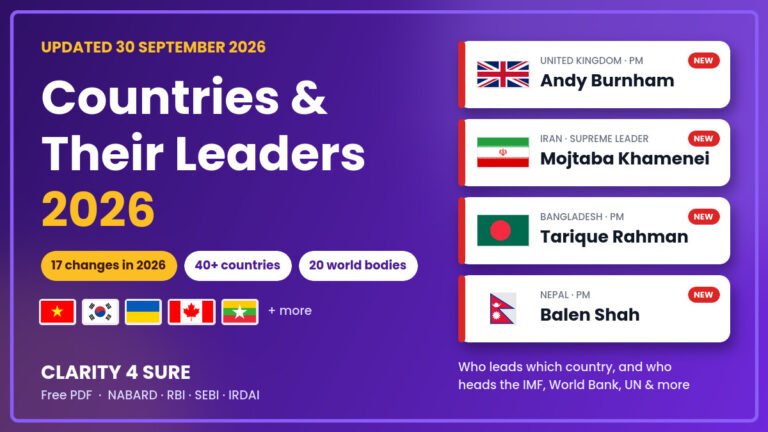 Free sheet · Static GKCountries & Their Leaders 2026Who leads which country in 2026, with all 17 changes marked. Get the article and the PDF free on WhatsApp.Get it free on WhatsApp →
8 of the top 10 ranks in NABARD Grade A 2025 came from one classroom
Ranks 1, 2, 3, 5, 6, 7, 8 and 9 on the final list, and 32 selections in all, prepared with C4S Courses (Clarity 4 Sure). The same descriptive training and the same current affairs notes you are reading now.
- 1Suraj Ravindra JatkarRank 1
- 2Lokesh Ram ChandranRank 2
- 3Vivek GhadgeRank 3
- 5Kapil PatlyaRank 5
- 6Mohit SoniRank 6
- 7Siddhant KesharwaniRank 7
- 8Nithin ChackoRank 8
- 9Lalit KumarRank 9
- 1 August, 2025
- 2 August, 2025
- 3&4 August, 2025
- 5 August, 2025
- 6 August, 2025
- 7 August, 2025
- 8 & 9 August, 2025
- 10 & 11 August, 2025
- 12 August, 2025
- 13 August, 2025
- 14 August, 2025
- 15&16 August, 2025
- 17&18 August, 2025
- 19 August, 2025
- 20 August, 2025
- 21 August, 2025
- 22 August, 2025
- 23 August, 2025
- 24 & 25 August, 2025
- 26 August, 2025
- 27 August, 2025
- 28 August, 2025
- 29 August, 2025
- 30 August, 2025
1 August, 2025
Daily Current Affairs Quiz
1 August, 2025
National Affairs
1. India Justice Report 2025
Context:
The India Justice Report 2025 has flagged persistent gaps in India’s legal aid system. Despite over 80% of the population being eligible, only 15.5 lakh individuals accessed free legal aid in FY 2023–24, highlighting deficiencies in reach, quality, and resource utilisation under NALSA.
About Legal Aid and NALSA
- Full Form: National Legal Services Authority
- Established: Statutory body under the Legal Services Authorities Act, 1987
- Operational Since: 1995
- Patron-in-Chief: Chief Justice of India
- Mandate: To provide free and competent legal services to eligible persons, especially marginalised communities.
Key Responsibilities
- Lays down policies and supervises State (SLSAs) and District Legal Services Authorities (DLSAs).
- Organises Lok Adalats, awareness drives, and promotes Alternative Dispute Resolution (ADR).
- Offers legal aid to SCs, STs, women, children, disabled persons, poor individuals, and prisoners under Section 12.
Major Initiatives by NALSA
- Legal Aid Defence Counsel (LADC) Scheme (2022):
- Institutional legal defence for accused persons in 610 districts.
- Para-Legal Volunteers (PLVs):
- Grassroots legal workers trained for community outreach, awareness, and mediation.
- Permanent Lok Adalats:
- Conciliation-based resolution for pre-litigative and pending disputes.
- Legal Literacy Clubs:
- Created in schools and colleges to improve early legal awareness.
- Jail Legal Aid Clinics:
- Dedicated legal services for undertrial and convicted prisoners.
- Special Schemes:
- Tailored legal aid for transgender persons, disaster victims, industrial workers, and custodial populations.
Key Challenges Identified
| Issue | Details |
|---|---|
| Budget Constraints | Legal aid accounts for <1% of the justice budget; funds fell to ₹169 crore (2022–23) from ₹207 crore (2017–18). |
| Fund Underutilisation | Utilisation rate dropped from 75% to 59%, hampering service delivery. |
| Decline in PLV Workforce | 38% drop in Para-Legal Volunteers between 2019–24; poor honorarium payments in many States. |
| Rural Inaccessibility | Just 1 legal aid clinic per 163 villages; per capita legal aid spending as low as ₹2. |
| Service Quality Gap | Widespread perception that legal aid quality is inferior to private counsel. |
| Centralised Fund Control | State Legal Services Authorities need central clearance for hiring and logistics, delaying implementation. |
Significance
- The report underscores the urgent need for decentralisation, better budgeting, and frontline legal workforce strengthening.
- Legal aid is vital for ensuring access to justice, a constitutional right under Article 39A.
- NALSA’s role is pivotal in achieving inclusive justice, especially for India’s vulnerable populations.
2. Indian Navy Inducts Indigenous Stealth Frigate Himgiri under Project-17A
Context:
India’s naval defence capabilities received a boost with the delivery of Himgiri, a second indigenous stealth frigate in July 2025, built under Project-17A. The move aligns with India’s long-term strategy of aatmanirbharta (self-reliance) in warship manufacturing.
About Himgiri
- Builder: Garden Reach Shipbuilders & Engineers (GRSE), Kolkata.
- Type: Multi-role stealth frigate.
- Commissioning: Slated for end-August 2025, along with sister ship Udaygiri (delivered July 1 by Mazagon Dock Ltd).
Part of Project-17A
- Project Objective: Construction of 7 advanced stealth frigates for the Indian Navy.
- Distribution:
- 4 frigates by MDL, Mumbai.
- 3 frigates by GRSE, Kolkata.
- Total Project Cost: ₹45,000 crore.
- First Commissioned Ship: INS Nilgiri (January 2024).
- Remaining frigates expected to be delivered by end-2026.
Advanced Capabilities
- Weaponry:
- Equipped with BrahMos supersonic cruise missiles (now extended to 450 km).
- Barak-8 surface-to-air missiles (range: 70 km) for air defence.
- Technology Highlights:
- High-end automation, sensor integration, and stealth features.
- Designed to tackle multi-dimensional maritime threats.
3. Mangrove Restoration Initiatives Across States
Context:
India has launched large-scale mangrove restoration drives across Tamil Nadu, Gujarat, and Mumbai to enhance coastal security, biodiversity, and climate resilience in the face of escalating ecological threats.
What Are Mangroves?
- Mangroves are salt-tolerant coastal forests thriving in tropical and subtropical tidal zones.
- India’s Mangrove Coverage: ~4,900 sq. km.
- Major Regions: Sundarbans (West Bengal), Pichavaram (Tamil Nadu), Mahanadi & Godavari deltas (Odisha & Andhra), Gulf of Kutch (Gujarat).
Ecological and Climate Importance
- Disaster Mitigation: Natural barriers against cyclones, floods, and tidal surges.
- Blue Carbon Sink: High carbon storage in roots and sediments.
- Biodiversity Hotspot: Habitat for flamingos, herons, mudskippers, and crustaceans.
Major Threats to Mangroves
- Urbanisation: Encroachment for roads, ports, and housing.
- Pollution: Waste and plastics reduce regeneration capacity.
- Aquaculture: Shrimp farms replacing native mangrove belts.
- Climate Change: Salinity shifts, sea-level rise, and erratic rainfall patterns.
- Invasive Species: Prosopis juliflora displacing native vegetation.
State-Led Restoration Efforts
- Tamil Nadu – Green Tamil Nadu Mission:
- Mangrove cover doubled from 4,500 ha to 9,000 ha (2021–24).
- Canal desiltation and Avicennia seed planting in Muthupettai Estuary (115 ha).
- Maharashtra – Thane Creek Project:
- ₹10.3 crore budget to plant 3.75 lakh saplings and remove 150 tonnes of plastic in 3 years.
- Women-led workforce ensures sustainability and employment.
- Gujarat – MISHTI Scheme Front-runner:
- Over 19,000 ha restored in two years, surpassing national targets.
Strategic and Socioeconomic Benefits
- Disaster Resilience: Mitigated tsunami impact (2004) and recent cyclone damages.
- Livelihood Source: Supports fishing, honey gathering, crab farming.
- Carbon Efficiency: Absorbs CO₂ at higher rates than terrestrial forests.
- Eco-Tourism Potential: Sites in Sundarbans and Gujarat attract tourists and promote conservation awareness.
4. Kavach 4.0
Context:
Indian Railways has successfully commissioned the indigenous train protection system, Kavach 4.0, on the Mathura-Kota section of the high-density Delhi–Mumbai route. This marks a significant leap in modernizing railway safety systems in India.
Key Highlights:
- What is Kavach 4.0?
- Kavach 4.0 is an Automatic Train Protection (ATP) system developed indigenously by Indian Railways. It ensures safe train operations by automatically controlling speed and applying brakes in emergency situations.
- Development and Approval
- Developed under Atmanirbhar Bharat vision.
- Approved by RDSO in July 2024.
- First operationalized in South Central Railway (2018).
- Kavach 4.0 approved in May 2025 for trains up to 160 km/h.
- Features
- Designed with Safety Integrity Level 4 (SIL 4) – the highest global safety rating.
- Works in fog and low visibility conditions—information visible on loco dashboard.
- Integrated with train braking systems.
- Uses RFID tags, telecom towers, optical fibre network, and station-based controls.
- Scale and Complexity
- Described as equivalent to setting up a telecom company.
- Requires high-end hardware like RFID tags (every 1 km), telecom towers, and OFC connectivity.
- Real-time communication between Loco Kavach and Station Kavach ensures safety and speed regulation.
Significance
- First such indigenous train safety initiative post-Independence.
- Enhances passenger safety across high-traffic corridors.
- Supports Make in India and Digital India missions.
- Aims to commission Kavach 4.0 on major national routes within 6 years.
Banking/Finance
1. ICICI Bank to Begin Charging Payment Aggregators for UPI Transactions
Context:
From August 1, 2025, ICICI Bank will start levying charges on payment aggregators (PAs) for processing Unified Payments Interface (UPI) transactions, becoming the latest major private bank to tap into this cost recovery mechanism.
Key Highlights:
Reason Behind the Move
- ICICI joins Yes Bank and Axis Bank, which already levy similar charges on PAs.
- Banks invest heavily in UPI infrastructure (switches, APIs, fraud monitoring, etc.).
- With no Merchant Discount Rate (MDR) applicable on UPI, banks currently earn minimal or no revenue per transaction.
- Banks also pay NPCI for access to the UPI switch.
Impact on PAs and Merchants
- PAs often charge merchants platform fees, convenience charges, or integration costs.
- With this move, PAs may:
- Pass on the charges to merchants to maintain margins.
- Absorb the cost depending on contractual terms with merchants.
Growing UPI Volumes and Monetisation Pressure
- Peer-to-merchant (P2M) UPI volumes are rising sharply.
- Credit card–linked UPI transactions are also growing, creating new opportunities for monetisation.
Operational Structure of PAs
- PAs act as intermediaries between the customer’s bank (debit side) and merchant’s bank (credit side).
- Typically maintain escrow accounts with their banking partner.
- Once funds are received, they are transferred to the merchant’s account.
2. Bank Credit Growth Slows Sharply in June 2025 – RBI Data
Context:
According to the Reserve Bank of India (RBI), non-food bank credit growth slowed to 10.2% year-on-year (Y-o-Y) as of the fortnight ended June 27, 2025, down from 13.8% during the same period in 2024. The slowdown was driven by weaker demand across agriculture, services, retail, NBFCs, and industrial sectors.
Key Highlights:
1. Agriculture and Allied Activities
- Credit flow to the agriculture sector has witnessed a marked decline.
- After a strong performance last year, banks are reporting a reduced pace of disbursement—likely due to high base effects and tightening liquidity in rural areas.
2. Services Sector
- One of the strongest performers in recent years, the services sector has also experienced a notable dip in credit offtake.
- Key sub-segments like trade and NBFCs have seen especially muted growth, indicating restrained working capital demand and cautious lending by banks.
3. NBFCs and Trade
- Non-Banking Financial Companies are facing limited credit flow from the banking system, partly due to regulatory tightening and increased scrutiny.
- The trade sector too has cooled off, with wholesalers and retailers showing lesser appetite for fresh credit amid subdued consumer demand.
4. Retail Lending Trends
Personal loans, housing finance, and vehicle loans—once pillars of credit growth—have all recorded slower expansion. This signals a shift in household borrowing behaviour, possibly due to higher interest rates, inflationary pressures, and reduced discretionary spending.
- Personal loans: Witnessed sluggish growth, especially in the unsecured segment.
- Housing loans: Demand continues but at a softer pace, possibly due to high property prices and cautious consumer sentiment.
- Vehicle and credit card loans: Reflect weakened urban consumption.
5. Industrial Credit
- Credit flow to industries, including infrastructure and manufacturing, has slowed.
- Despite strong government capex, private investment remains tentative, reflecting continued uncertainty and cautious business sentiment.
Reasons Behind the Slowdown
- Seasonal Factors: The April–June quarter typically sees lower demand, especially post financial year-end reconciliations.
- Compliance Overhang: Banks have been focused on audits, provisioning, and regulatory compliance during the start of the new fiscal.
- Borrower Caution: With macroeconomic volatility, both corporates and individuals are adopting a wait-and-watch approach to fresh borrowing.
3. Standing Committee on Finance Flags Gaps in PMIS and IBC
Context:
On July 31, 2025, the Standing Committee on Finance, chaired by MP Bhartruhari Mahtab, submitted a report in Parliament highlighting key issues and recommendations related to the Prime Minister’s Internship Scheme (PMIS), Insolvency and Bankruptcy Code (IBC), and rising direct and indirect tax disputes.
Key Highlights:
Prime Minister’s Internship Scheme (PMIS)
- Budget Allocation:
- ₹2,000 crore allocated in BE FY25; revised to ₹380 crore in RE FY25.
- Current funds sufficient for the pilot phase, but require dynamic reassessment for scaling.
- Issues Identified:
- Exclusion of families of govt. employees deemed excessive.
- No support for living expenses hinders participation by candidates from remote or economically weak backgrounds.
- Poor monitoring of internship-to-employment conversion rates.
- Limited engagement with SMEs, startups, and regional organisations.
- Recommendations:
- Periodic and independent evaluation for transparency.
- Relax eligibility norms for marginalised and poor candidates.
- Establish a robust monitoring framework to track internship outcomes.
- Expand participation to diverse sectors and regions.
Insolvency and Bankruptcy Code (IBC)
- Issues:
- Delays in resolution and growing case backlog at NCLTs.
- Recommendations:
- Set up fast-track tribunals with strict timelines for high-priority IBC cases.
- Strengthen NCLT infrastructure and explore public-private partnership models, inspired by the success of Seva Kendras.
- Ministry of Corporate Affairs agreed to initiate reforms and expand tribunals to improve case disposal speed.
4. Insurance Brokers Association of India (IBAI) Report on Insurance in India
Context:
The Insurance Brokers Association of India (IBAI) released a comprehensive report titled “Leading the Path to Insurance for All: Broker of the Future”, in collaboration with McKinsey & Company, to mark its 24th Foundation Day in Mumbai (August 2025).
Key Highlights:
- Low Insurance Penetration in India:
- Health insurance: Only 2 in 5 Indians are covered.
- If government schemes are excluded, this falls to just 1 in 4.
- Life insurance: Only 1 in 2 adults has any life insurance.
- Rural Access Gap:
- 65% of India’s population resides in rural areas.
- Yet, only 2% of life insurance branches are located in rural India.
- Rural India contributes 45% of GDP but remains underserved.
- Projected Market Growth:
- Insurance market to grow from ₹11 lakh crore (2024) to ₹25 lakh crore (2030).
- Insurance penetration to rise from 3.7% to 5%, closing the gap with the global average of 6.8%.
- Retail Gross Written Premiums (GWP) expected to double to ₹21 lakh crore by 2030.
- Life Insurance Challenges:
- Penetration rate: 2.8%.
- Large protection gap due to limited adoption of pure term insurance products.
- Broker Ecosystem:
- Only 735 licensed insurance brokers in India.
- Top 36 brokers account for 85% of insurance broking revenue.
- Many small brokers have failed to scale or digitize.
About IBAI (Insurance Brokers Association of India)
- Status: Statutory trade body under Section 25 of the Companies Act, 1956.
- Headquarters: Mumbai, Maharashtra
- President: Sumit Shantilal Bohra
- Role: Represents and regulates all licensed insurance brokers in India.
5. IRDAI Issues Master Circular to Raise Minimum Insurance Coverage Requirements
Context:
On 25 July 2025, the Insurance Regulatory and Development Authority of India (IRDAI) released its latest Master Circular. This circular lays out enhanced regulatory obligations for all life, general, and standalone health insurers for FY2025–26 and FY2026–27, superseding the 2024 version of the regulations.
Key Obligations for Insurers
Rural Sector Coverage
- FY26: Insurers must collectively cover lives, dwellings, and vehicles in 25,000 designated Gram Panchayats. Each insurer must ensure 15% coverage in their allocated panchayats.
- FY27: Target increased to 50,000 Gram Panchayats. Insurers must achieve 25% coverage in earlier allocated areas and 10% in newly assigned panchayats.
Social Sector Coverage
- Insurers must ensure that 10% of the total insured lives are from the social sector in FY26, rising to 12% in FY27.
- Where documentation is lacking, up to 20% of beneficiaries may be included based on self-certification.
Motor Third-Party (TP) Insurance
Obligations are based on an insurer’s market share in the TP segment:
| Market Share | FY26 Increase | FY27 Increase |
|---|---|---|
| ≤ 2% | 12.5% | 13.75% |
| 2%–5% | 10% | 11% |
| 5%–10% | 7.5% | 8.25% |
| > 10% | 5% | 5.5% |
Insurers must verify compliance using vehicle registration data and the Insurance Information Bureau (IIB) database to identify uninsured vehicles.
Key Changes Introduced
- A consolidated framework replaces separate regulations for rural, social, and motor TP insurance obligations.
- The definition of rural areas is now tied to Gram Panchayat jurisdiction, promoting better local targeting.
- The social sector definition has been broadened to include:
- Unorganised workers
- Informal sector employees in small establishments (fewer than 10 workers)
- Beneficiaries of government-sponsored schemes
- Emphasis placed on saturation-based coverage: insurers are encouraged to comprehensively cover dwellings, lives, livelihoods, and vehicles in each assigned area.
- Incentives proposed for insurers who exceed minimum targets or adopt innovative approaches.
About IRDAI
- Full Name: Insurance Regulatory and Development Authority of India
- Founded: 1999
- Headquarters: Hyderabad, Telangana
- Current Chairperson: Ajay Seth
6. SEBI Proposes Changes in IPO Allocation Norms for Large Issues
Context:
The Securities and Exchange Board of India (SEBI) has released a consultation paper proposing major reforms to the allocation structure of Initial Public Offerings (IPOs), particularly for large issues exceeding ₹5,000 crore. The move aims to better align IPO allocation with investor interest and institutional appetite.
Proposed Changes in IPO Allocation Structure
- For IPOs above ₹5,000 crore, SEBI proposes:
- Retail investor quota to be reduced from 35% to 25%.
- Institutional quota (Qualified Institutional Buyers – QIBs) to be increased from 50% to 60%.
- A graded approach will be applied based on IPO size.
Rationale Behind the Proposal
- SEBI noted that:
- IPO sizes have grown, but retail participation has remained flat over the last three years.
- In large IPOs, retail subscription levels have often been muted or underutilized, while institutional demand remains strong.
Anchor Investor Reforms
- SEBI proposes to increase the number of permissible anchor investor allottees for allocations exceeding ₹250 crore.
- This will make participation easier for large FPIs managing multiple funds.
- Inclusion of insurance companies and pension funds in the reserved anchor investor category is suggested.
Enhanced Reservation for Long-term Institutions
- Within the anchor investor portion, the reservation for:
- Life insurers, pension funds, and domestic mutual funds to increase from 30% to 40%.
- One-third of this (approx. 13.3%) remains for domestic mutual funds.
- 7% is earmarked specifically for insurance companies and pension funds.
- Life insurers, pension funds, and domestic mutual funds to increase from 30% to 40%.
Objective of the Reform
To align IPO structures with:
- Market demand and mutual fund flows
- Ground realities of retail application limits
- The goal of maintaining long-term investor confidence in India’s capital markets
Agriculture
1. Reassessing India’s Agricultural Protectionism and the Need for Market Reforms
Context:
India’s post-Independence tariff policy has been centred on protecting agriculture, citing food security and farm livelihoods. However, over the decades, this protectionist model has resulted in inefficiencies, uncompetitive farming, and persistent food insecurity. A recent opinion piece reconsiders the long-standing rationale for this policy, highlighting the market distortions and the need for structural reforms.
Key Highlights:
1. Protectionism in Agriculture: An Outdated Strategy
- Tariff protections, originally meant to shield farmers, have become counterproductive:
- Created concentric rings of protection across agriculture, manufacturing, and services.
- Result: Uncompetitive agriculture, low farm wages, and inefficient food systems.
2. Food Security Paradox
- Selective price support policies (like MSPs) distort cropping patterns in favour of government-stocked staples (e.g., rice, wheat).
- Leads to:
- Surpluses in some crops → necessitating exports.
- Deficits in others → requiring imports.
- India becomes a simultaneous importer and exporter of food—indicative of a flawed security model.
3. Stagnant Farm Productivity and Wages
- Factory jobs in a protected economy haven’t expanded fast enough to absorb surplus rural labour.
- Result: Persistently low agricultural productivity and incomes.
4. Need for Market-Based Reforms
- Farmers are entrepreneurs, yet denied fair access to markets.
- Protection should focus on:
- Risk reduction, not market insulation.
- Higher productivity through:
- Investment in GM crops.
- Sustainable land and water use.
- Enhanced logistics, warehousing, and marketing infrastructure.
5. Policy Contradictions
- Current gains in productivity rely heavily on imported fertilisers, worsening dependence.
- The state continues to dominate food policy, despite clear signs of market failure and inefficiencies.
6. Long-Term Economic Risk
- Shielding half of India’s population (farmers) from market forces is unsustainable.
- Agriculture must evolve into a mature industry if it is to secure food supply and contribute to growth.
TET
2. Cabinet Approves “Grant-in-Aid to National Cooperative Development Corporation (NCDC)” Scheme
Context:
The Union Cabinet has approved a new Central Sector Scheme titled “Grant-in-Aid to NCDC”, with a total outlay of ₹2,000 crore for four years (FY 2025–26 to FY 2028–29).
Key Features
- Nature of Scheme: Central Sector Scheme
- Total Outlay: ₹2,000 crore (₹500 crore annually)
- Implementing Agency: National Cooperative Development Corporation (NCDC)
- Funding Purpose:
- Grant to be used by NCDC to mobilize ₹20,000 crore from open markets.
- Loans to be provided to cooperatives for:
- Setting up new projects
- Expansion, modernization, and tech upgradation
- Working capital support
Expected Benefits
- Financial Empowerment of Cooperatives: Enables cooperatives to run profitably with improved liquidity and infrastructure.
- Capacity Building: Supports modernization, diversification, and scaling-up of cooperative enterprises.
- Social Impact: Aims to reduce socio-economic disparities and enhance women’s participation in the workforce.
- Asset Creation: Facilitates income-generating capital asset creation across cooperative sectors.
About NCDC
- Established: 1963
- Type: Statutory Corporation
- Headquarters: New Delhi
- Administrative Ministry: Ministry of Cooperation
- Mandate: Planning and promoting production, processing, marketing, and storage of agricultural produce and related activities under cooperative principles.
Facts To Remember
1. PM Modi invites citizens to share ideas for Independence Day
Prime Minister Narendra Modi has invited all citizens to contribute their thoughts and ideas for his Independence Day address. In a social media post, Mr Modi urged citizens to share their thoughts on the open forums on MyGov and the NaMo App.
2. HM Amit Shah pays tribute to Lokmanya Bal Gangadhar Tilak on his death anniversary
Union Home Minister Amit Shah paid tribute to Lokmanya Bal Gangadhar Tilak on his death anniversary today. In a social media post, Mr Shah stated that Tilak transformed Swaraj into a mass movement, made Swadeshi a matter of public consciousness, and elevated culture as a source of national pride.
3. PM Modi to disburse ₹20,500 cr under PM-KISAN scheme in Varanasi
Prime Minister Narendra Modi will visit his parliamentary constituency, Varanasi, tomorrow to lay the foundation stone and inaugurate the development projects worth around 2,200 crore rupees. On this occasion, PM Modi will also address a public gathering.
4. Cabinet approves ₹6,520 crore outlay for Pradhan Mantri Kisan Sampada Yojana
The Cabinet has approved a total outlay of 6520 crore rupees, including additional outlay of 1920 crore rupees for ongoing Central Sector Scheme “Pradhan Mantri Kisan Sampada Yojana” during 15th Finance Commission Cycle.
5. Starlink receives license to launch satellite internet service in India
Union Communications Minister Jyotiraditya Scindia today said that Elon Musk-led Starlink has received a license to launch satellite internet service in India and a framework for spectrum allocation is also in place for a smooth rollout.
6. PM Modi condoles passing away of former RSS Chief Pramila Medhe
Prime Minister Narendra Modi today condoled the passing of Pramukh Sanchalika of Rashtra Sevika Samiti, Pramila Tai Medhe.
- Established: Statutory body under the Legal Services Authorities Act, 1987 India Justice Report 2025
- Aims to commission Kavach 4.0 on major national routes within 6 years. Kavach 4.0
- First Commissioned Ship: INS Nilgiri (January 2024). Indian Navy Inducts Indigenous Stealth Frigate …
- From August 1, 2025, ICICI Bank will start levying charges on payment aggregators (PAs) for processing Unified Payments Interface (UPI) transactions, becoming the latest major private bank to tap into this cost recovery mechanism. ICICI Bank to Begin Charging Payment Aggregator…
- Insurance market to grow from ₹11 lakh crore (2024) to ₹25 lakh crore (2030). Insurance Brokers Association of India (IBAI) R…
2 August, 2025
Daily Current Affairs Quiz
2 August, 2025
National Affairs
1. Apna Ghar Initiative
Context:
The Ministry of Petroleum and Natural Gas has launched a national-level initiative titled ‘Apna Ghar’ in 2025, designed to provide dignified resting facilities for truck drivers across highways in India.
About Apna Ghar Initiative:
- What It Is:
- A resting infrastructure scheme for long-haul truck drivers to promote health, hygiene, and well-being.
- Nodal Ministry:
- Ministry of Petroleum and Natural Gas
- Operated By:
- Public Sector Oil Marketing Companies (OMCs) at fuel retail outlets located along national and state highways
- Launch Year: 2025
Objectives:
- Enhance road safety by reducing driver fatigue
- Provide inclusive, welfare-oriented infrastructure for truckers
- Support India’s logistics and transport ecosystem
- Align with SDG 8 (Decent Work and Economic Growth)
Key Features:
- Nationwide Coverage:
- 368 rest houses with 4,611 beds now operational
- Facilities Provided:
- Dormitories (10–30 beds each)
- Clean toilets and Houdas (bathing areas)
- Self-cooking spaces and dining facilities
- Restaurants/Dhabas
- Access to purified drinking water
- Technology Integration:
- ‘Apna Ghar’ mobile app launched for online booking, feedback, and service improvement
- Public-Private Model:
- Infrastructure built and managed by OMCs in collaboration with private stakeholders
- User-Centric Design:
- Facilities tailored to the actual needs of truck drivers using feedback and data analytics
2. ISRO Identifies Cause of PSLV-C61/EOS-09 Mission Failure
Context:
The Indian Space Research Organisation (ISRO) has concluded its investigation into the PSLV-C61/EOS-09 mission failure that occurred on May 18, 2025. ISRO Chairman V. Narayanan confirmed that the Failure Analysis Committee has pinpointed the cause.
Key Highlights:
- Mission Objective: To place EOS-09, an Earth Observation Satellite, into a sun-synchronous polar orbit.
- Launch Vehicle: PSLV-C61, launched from Satish Dhawan Space Centre, Sriharikota.
- Launch Outcome: Lift-off and performance were normal until the second stage; an anomaly in the third stage led to mission failure.
Significance
- This failure is notable as PSLV is ISRO’s most trusted and reliable launch vehicle, with a strong track record over multiple decades.
- The incident is a rare setback for ISRO’s operational record.
3. ISRO to Launch U.S.-Developed BlueBird Satellite Aboard LVM3
Context:
ISRO is set to launch the Block 2 BlueBird communication satellite, developed by U.S.-based AST SpaceMobile, in the next 3–4 months, ISRO Chairman V. Narayanan announced on Friday.
Key Highlights:
- Launch Details
- Satellite: BlueBird (Block 2)
- Developer: AST SpaceMobile (USA)
- Launch Vehicle: LVM3 (formerly GSLV Mk III)
- Launch Site: Satish Dhawan Space Centre, Sriharikota
- Significance
- Marks another key India–U.S. space collaboration, following the successful launch of the NISAR satellite on July 30, 2025.
- Highlights India’s role as a trusted launch partner for global heavy payloads.
4. Govt Expands PM SVANidhi Scheme
Context:
The Union Government has approved the second phase of the PM Street Vendor’s AtmaNirbhar Nidhi (PM SVANidhi) scheme with enhanced loan limits and the introduction of UPI-linked credit cards to deepen financial inclusion for urban street vendors.
Key Highlights:
- Expanded Coverage:
- The revamped scheme will cover 50 lakh more beneficiaries, in addition to the already existing street vendors.
- Enhanced Loan Amounts:
- First loan: Increased from ₹10,000 to ₹15,000
- Second loan: Increased from ₹20,000 to ₹25,000
- Third loan: Unchanged at ₹50,000
- All loans continue to carry an interest subsidy of 7%.
- UPI-Linked Credit Cards Introduced:
- Approved for 11 lakh street vendors who have successfully repaid the first two loans.
- These cards will have a limit of ₹30,000, enabling vendors to access rolling working capital through digital payments.
- Banks will frame repayment rules for the credit card facility.
- Improved Financial Behaviour:
- Out of over 68 lakh street vendors who took the initial ₹10,000 loan, around 38.4 lakh have repaid, indicating growing credit discipline.
- Objective of Reforms:
- The changes aim to boost creditworthiness, formalisation, and digital financial access among street vendors.
- Helps build confidence and improve capital availability for micro urban entrepreneurship.
Banking/Finance
1. SEBI Plans Major Reforms for Mega IPOs
Context:
The Securities and Exchange Board of India (SEBI) is considering regulatory reforms to streamline large Initial Public Offerings (IPOs) and improve market efficiency, especially for high-value companies like NSE, Reliance Jio, and Flipkart.
Key Highlights:
- Retail Quota to be Reduced:
- For IPOs above ₹5,000 crore, the retail investor reservation (applications below ₹2 lakh) may be reduced from 35% to 25%.
- This is in response to low retail participation in jumbo IPOs like Hyundai Motor India (₹27,859 crore issue).
- Increased Institutional Quota:
- The allocation for Qualified Institutional Buyers (QIBs) is proposed to be raised from 50% to 60%.
- Aims to enhance stability and pricing efficiency in large public issues.
- Lower Minimum Public Dilution:
- Currently, companies valued over ₹1 trillion must dilute at least 5% stake.
- SEBI may reduce this to 2.5%, enabling companies to raise smaller sums initially while maintaining public market access.
- Example: NSE (₹6 trillion valuation) currently needs a ₹30,000 crore issue; with relaxed norms, it could reduce the IPO size significantly.
- Operational Challenges Noted:
- Mobilising large volumes of retail investors has proven difficult.
- Institutions already manage much of retail capital through mutual funds and pension schemes.
- Additional Suggestions Under Review:
- Reserved portions in anchor books for pension funds and insurance companies.
- Enhanced regulatory discretion in unique listing scenarios.
2. RBI’s MuleHunter Platform to Tackle Bank Frauds Gains Traction
Context:
The Reserve Bank of India (RBI) is scaling up the deployment of its AI-driven MuleHunter platform across more banks to curb fraud involving mule accounts.
Key Highlights:
- MuleHunter Deployment:
- Already implemented by 5 banks: Canara Bank, PNB, BoI, BoB, and AU Small Finance Bank.
- Federal Bank to adopt it shortly.
- At least 15 more banks expected to onboard in the next 1–2 months.
- What is MuleHunter?
- Developed by RBI Innovation Hub.
- Uses AI/ML algorithms to detect mule accounts (fraudulent accounts used for money laundering or scams).
- Currently being provided to banks free of cost.
- Functionality & Efficiency:
- Detects 90% true positives, significantly better than traditional systems with 80% false positives.
- Identified 90 fraud patterns, such as frequent night-time transactions (esp. between 11 PM–1 AM).
- Used for both savings and current accounts.
- Implementation Requirements:
- Banks need infrastructure and data science teams for full adoption.
- Platform will learn and adapt better as more banks join.
- RBI’s Broader Strategy:
- AI Committee Report to be released soon.
- RBI is also evaluating threats from quantum computing to preempt future cyber risks.
Significance
- Enhances the cybersecurity framework for Indian banks.
- Aims to curb digital financial frauds more effectively.
- Supports real-time fraud prevention and inter-bank intelligence sharing.
3. UPI’s ‘Free Payments’ Model Under Strain as ICICI Bank Imposes Charges on Payment Aggregators
Context:
ICICI Bank has begun charging payment aggregators (PAs) for processing UPI transactions, raising concerns over the long-term viability of the zero-cost digital payments ecosystem.
Key Highlights:
- Impact on Payment Aggregators:
- Affects fintechs like Razorpay, PayU, Pine Labs, Innoviti, Worldline.
- These firms operate on thin margins, collecting merchant discount rates (MDR) on cards and platform fees on UPI.
- Banks handle backend infrastructure and transaction processing under UPI without charging users.
- Wider Industry Shift:
- Other banks like Axis Bank and Yes Bank reportedly also levy UPI processing charges on PAs.
- Indicates a broader pushback by banks against uncompensated costs of scale.
- Regulatory and Policy Tensions:
- Government insists UPI is a public good and must remain free for users and small merchants.
- However, RBI officials, including Governor Sanjay Malhotra, caution that UPI must be financially sustainable, and “someone will have to bear the cost”.
- Current Aggregator Strategy:
- Most PAs continue to subsidise UPI costs internally instead of burdening merchants.
- Business models now under review as sustainability concerns mount.
4. NPCI Introduces Revised UPI Rules
Context:
The National Payments Corporation of India (NPCI) has introduced new Unified Payments Interface (UPI) rules, effective from August 1, 2025, to enhance system efficiency, user experience, and fraud prevention.
Key Highlights:
- Scope of New Rules
- Applicable to all UPI-based payment service providers like Google Pay, PhonePe, Paytm, etc.
- Covers operations like balance enquiry, autopayments, bank detail access, transaction status, and recipient verification.
Balance Enquiry
- Users can check their bank balance up to 50 times per day on each UPI app.
- During peak hours, UPI apps may restrict balance checks to reduce system load.
- Starting August, available balance will be displayed with every transaction.
Auto Payment Processing
- Autopayments (recurring debits) will be processed only during non-peak hours:
- Before 10:00 am
- Between 1:00 pm – 5:00 pm
- After 9:30 pm
- If scheduled during peak time, the payment may be processed before or after.
- Retries will be attempted; failure after retries leads to auto-cancellation.
Bank Details Access
- Users can view the list of banks linked to their mobile number.
- Limited to 25 access requests per day.
- Bank detail requests must be initiated after selecting the issuer bank.
Transaction Status Updates
- During peak hours, pending payment status will now be updated instantly.
- Users can check the status only 3 times, with a 90-second gap between checks.
Recipient Details Before Payment
- Sender will see the recipient’s registered name and transaction ID before completing the transaction.
- Aims to prevent fraud and mistaken transfers.
Compliance & Penalties
- NPCI may impose penalties or restrictions in case of non-compliance:
- UPI API restrictions
- Onboarding suspension
- Fines and other regulatory actions
About NPCI
- Founded: 2008
- Headquarters: Mumbai, Maharashtra
- CEO: Dilip Asbe
5. MCX Relaunches Cardamom Futures Trading Contracts
Context:
The Multi-Commodity Exchange of India (MCX) has reintroduced cardamom futures contracts, initially launching for August, September, and October 2025. The relaunch comes after a regulatory pause initiated in 2021.
Key Highlights:
- Relaunch Date:
- Trading resumes from Tuesday, July 29, 2025.
- Reason for Previous Suspension:
- SEBI had discontinued cardamom futures in 2021 via regulatory circular.
- New Contracts Introduced:
- Futures contracts for August, September, and October 2025 will be available.
Cardamom Futures Contract Specifications
- Trading Symbol: CARDAMOM
- Trading Unit: 100 kg
- Tick Size (Minimum Price Movement): ₹1 per kg
- Delivery Location: Vandanmedu warehouse, Idukki district, Kerala
- Demat Account: Mandatory for participation
Significance of Relaunch
- Market Stability: Promotes structured trading and reduces price volatility in the spot market
- Price Discovery: Transparent and regulated pricing mechanism
- Farmer Empowerment: Ensures better pricing and risk hedging for growers
- Export Facilitation: Enables exporters to source quality produce via a national platform
This initiative is expected to benefit the entire cardamom value chain, from farmers to global buyers, aligning with broader goals of agricultural market modernization.
6. Finance Ministry Notifies 0.1% Concessional Government Guarantee Fee for NaBFID
Context:
The Ministry of Finance has set a 0.1% concessional guarantee fee for the National Bank for Financing Infrastructure and Development (NaBFID) to enable access to low-cost foreign capital for infrastructure development.
Key Highlights:
- Concessional Rate Details:
- The 0.1% concessional fee applies to government guarantees for borrowings from:
- Multilateral development banks
- Sovereign wealth funds
- Other notified foreign financial institutions
- The fee is payable at the time of guarantee issuance and annually every April 1 thereafter.
- Objective:
- To enable NaBFID to raise offshore funding at reduced costs.
- Supports funding of critical infrastructure projects aligned with India’s growth agenda.
- Credit Ratings for NaBFID:
- Moody’s: Baa3 (Stable)
- Fitch Ratings: BBB- (Stable)
- Both are at par with India’s sovereign credit rating, facilitating investor trust.
About NaBFID
- Established in 2021 through an Act of Parliament.
- Functions as a specialized Development Finance Institution (DFI).
- Aims to:
- Bridge long-term infrastructure financing gaps
- Promote bond market and derivatives market development in India
Agriculture
1. AI in Indian Agriculture
Context:
India’s agriculture sector, which supports over 42% of the population and contributes 18.2% to GDP, faces persistent challenges like low yields, high post-harvest losses (up to 15%), and limited access to irrigation, credit, and market linkage. Emerging digital solutions like artificial intelligence (AI) are now being deployed to address these gaps.
AI’s Transformative Impact
- Decision Support Tools: AI is enabling smarter crop planning, pest control, and irrigation.
- Water Efficiency: AI-based irrigation systems can cut water usage by 80% and boost yields by 20–30%.
- Digital Integration: Over 15 million farmers now use AI-enabled platforms that provide personalized insights based on crop, soil, and climate data.
- Post-Harvest Efficiency: AI helps reduce wastage and improves price discovery by directly linking farmers with buyers.
Challenges in Adoption
- Data Gaps: Most land records remain undigitised and crop datasets are limited.
- Digital Literacy: Many farmers are unaware or lack skills to use AI-based tools.
- Regulatory Issues: Absence of standardized frameworks for testing and validating AI solutions in agriculture.
Policy and Structural Reforms Needed
- Agri-Stack Development: Consolidating land, crop, and climate data for targeted interventions.
- IoT and Precision Tech: Use of farm-level monitoring tools to aid in real-time decision-making.
- Training & Capacity Building: Farmer training programs, curriculum reforms in agri-universities, and mentorship for agri-tech startups.
- Supportive Policy Framework: Need for AI validation centers, privacy rules, and AI-linked credit policies.
Awards
1. 71st National Film Awards 2023
Context:
The 71st National Film Awards, recognising excellence in Indian cinema for the year 2023, were announced. The honours celebrated both seasoned actors and emerging talent across multiple languages and genres, reflecting the depth and diversity of Indian filmmaking.
Top Awards and Major Highlights
Best Feature Film
- Winner: 12th Fail (Hindi)
- Lead Actor: Vikrant Massey (also shared Best Actor award)
Best Actor (Male) (Shared)
- Shah Rukh Khan for Jawan (Hindi)
- Vikrant Massey for 12th Fail (Hindi)
- Note: First National Award for both actors
Best Actor (Female)
- Rani Mukerji for Mrs Chatterjee vs Norway (Hindi)
- Note: First National Award for Rani Mukerji
Best Director
- Sudipto Sen for The Kerala Story (Hindi)
- Also won: Best Cinematography (Prasantanu Mohapatra)
Best Popular Film Providing Wholesome Entertainment
- Rocky Aur Rani Kii Prem Kahaani (Hindi), directed by Karan Johar
Best Film on National, Social and Environmental Issues
- Sam Bahadur (Hindi), directed by Meghna Gulzar
Facts To Remember
1. Trump to deploy nuclear submarines in response to Medvedev’s comments
U.S. President Donald Trump said on Friday that he had ordered the deployment of two nuclear submarines in response to “highly provocative” comments by a senior Russian official.
2. SAI felicitates young medal-winning archers Jadhav and Bhardwaj
World University Games champion archer Sahil Jadhav said coach Rahul Banerjee’s pep talk helped him clinch the gold medal in the keenly-contested compound men’s individual final in Essen, Germany, recently.
3. Federal Reserve Governor Kugler resigns, giving Trump key vacancy to fill
The Federal Reserve announced Friday that governor Adriana Kugler will step down next week, opening up a spot on the central bank’s powerful board that President Donald Trump will be able to fill.
4. 4 astronauts from US, Japan, Russia successfully dock at space station: NASA
Four astronauts from the United States, Japan, and Russia have successfully reached the International Space Station (ISS) as part of NASA’s Crew-11 mission.
5. India launches projects under India-UN Global Capacity Building Initiative to aid Global South
India launched the first set of four development projects under the “India-UN Global Capacity Building Initiative,” aimed at supporting countries of the Global South in meeting Sustainable Development Goals.
- Established in 2021 through an Act of Parliament. Finance Ministry Notifies 0.1% Concessional Gov…
- The Ministry of Petroleum and Natural Gas has launched a national-level initiative titled ‘Apna Ghar’ in 2025, designed to provide dignified resting facilities for truck drivers across highways in India. Apna Ghar Initiative
- The revamped scheme will cover 50 lakh more beneficiaries, in addition to the already existing street vendors. Govt Expands PM SVANidhi Scheme
- Users can check their bank balance up to 50 times per day on each UPI app. NPCI Introduces Revised UPI Rules
- For IPOs above ₹5,000 crore, the retail investor reservation (applications below ₹2 lakh) may be reduced from 35% to 25%. SEBI Plans Major Reforms for Mega IPOs
3&4 August, 2025
Daily Current Affairs Quiz
3&4 August, 2025
National Affairs
1. LVM3 Rocket with Semi-Cryogenic Engine
Context:
The Indian Space Research Organisation (ISRO) is preparing for a landmark technological advancement with the scheduled launch of an LVM3 rocket powered by a semi-cryogenic propulsion stage by early 2027. This will significantly enhance India’s space launch capability and reduce dependency on foreign engines.
Key Developments:
- Rocket Upgrade:
- The LVM3 (formerly GSLV Mk III), India’s most powerful rocket, will be upgraded with a semi-cryogenic engine stage, replacing the current L110 liquid propellant stage.
- Propellant Details:
- The new stage will use refined kerosene (RP-1) and liquid oxygen (LOX), a shift from the traditional hypergolic propellants.
- Engine Specification:
- The SE2000 semi-cryogenic engine is under testing. It will provide 200 tonnes of thrust, compared to 80 tonnes by the current Vikas engine.
2. National Child Survey to Develop Child Index Under Mission Vatsalya
Context:
To strengthen child rights protection and enhance evidence-based policymaking, the Ministry of Statistics and Programme Implementation (MoSPI), in collaboration with the Ministry of Women and Child Development (MoWCD), is set to conduct a National Child Survey.
Objective of the Survey
- Mission Vatsalya is the core focus of the survey.
- The survey aims to map the needs of children:
- In need of care and protection
- In conflict with law
- The ultimate goal is to develop a Child Index to guide welfare policies.
Mission Vatsalya Portal
The Ministry of Women and Child Development (MWCD) has launched the revamped Mission Vatsalya Portal, a unified digital platform designed to streamline child protection services and integrate earlier services like Khoya-Paya and TrackChild.
Objective
- To create a secure, centralized, and tech-enabled system for monitoring and managing child protection efforts across India, improving coordination among various stakeholders and ensuring real-time data-driven decision-making.
Key Features of the Mission Vatsalya Portal
- Integrated platform combining Khoya-Paya and TrackChild under a single portal.
- Multi-stakeholder access, including:
- State level: State Child Protection Society (SCPS), State Adoption Resource Agency (SARA)
- District level: District Child Protection Unit (DCPU), Child Welfare Committee (CWC), Juvenile Justice Board (JJB), Special Juvenile Police Unit (SJPU), and Child Care Institutions (CCIs)
- Real-time Monitoring: MIS dashboards enhance monitoring, evaluation, and reporting.
- Avoids duplication of data entry and services at the grassroots level.
- Ensures resource optimization and efficient implementation of child welfare schemes.
- Provides a digital workflow system for case tracking and inter-agency coordination.
Significance of the Child Index
- Will provide a data-driven foundation for policies under Mission Vatsalya.
- May serve as a tool to monitor child welfare outcomes across states.
- Addresses a major statistical gap in understanding vulnerable children’s conditions.
3. India to Launch Climate Finance Taxonomy
Context and Background:
India is set to launch its first comprehensive Climate Finance Taxonomy in August 2025, providing clear definitions for investments that qualify as climate-aligned. The move aims to mobilize both domestic and international capital towards clean energy, adaptation, and achieving India’s net-zero targets.
This taxonomy is aligned with India’s obligations under the Paris Agreement and was first announced in the Union Budget 2024 by Finance Minister Nirmala Sitharaman.
What is Climate Finance Taxonomy?
A climate finance taxonomy is a structured classification system that helps identify:
- Green and climate-resilient assets
- Eligible economic activities and projects
- Sectoral priorities consistent with climate mitigation, adaptation, and financing goals
Key Features of India’s Climate Finance Taxonomy
As per the final draft prepared by the Department of Economic Affairs:
- Hybrid Classification System: Includes both climate-supportive and transition-supportive investments
- Phased Rollout: A two-stage implementation—starting with a foundational taxonomy, followed by detailed sector-wise annexures
- Support for MSMEs: Strong emphasis on channeling finance towards micro, small and medium enterprises for green transitions
- Adaptation Focus: Equal weight on adaptation finance along with mitigation
- Guardrails against Greenwashing: Strong eligibility standards and verification criteria
- Alignment with National Targets: Fully integrated with India’s net-zero by 2070 goal and the Viksit Bharat 2047 development vision
Why This Matters
- Offers investors and financial institutions clarity and confidence about what qualifies as green finance
- Enables targeted policy incentives and resource allocation
- Helps India meet its Nationally Determined Contributions (NDCs)
- Boosts private sector participation in climate financing
- Positions India as a responsible and data-driven actor in global sustainable finance markets
Banking/Finance
1. Choice International Gets SEBI Approval to Launch Mutual Fund Business via Choice AMC
Context:
Mumbai-based financial services company Choice International Ltd has received the final approval from the Securities and Exchange Board of India (SEBI) for its subsidiary, Choice AMC, to operate as a full-fledged Asset Management Company (AMC). This marks the company’s entry into India’s ₹50 lakh crore mutual fund industry.
Key Highlights:
- Regulator: SEBI has granted the final nod to Choice AMC to commence mutual fund operations.
- Initial Strategy: The AMC will adopt a phased rollout, beginning with passive investment products, such as:
- Index Funds
- Exchange Traded Funds (ETFs)
Significance
- Investor Accessibility: Passive products offer low-cost, diversified investment options ideal for retail participation.
- Holistic Financial Platform: With this move, Choice Group strengthens its position as an integrated player across broking, lending, investment banking, and now mutual funds.
- Governance Focus: The AMC aims to operate within a strong regulatory and governance framework to ensure investor protection and long-term scalability.
2. Quant Mutual Fund Becomes First AMC in India to Launch Specialized Investment Fund (SIF)
Context:
Quant Mutual Fund has received final approval from the Securities and Exchange Board of India (SEBI) to launch India’s first Specialized Investment Fund (SIF), marking a major regulatory and strategic milestone in the evolution of the country’s asset management industry.
Key Highlights:
- First-of-its-Kind Approval: Quant MF will launch the QSIF Equity Long-Short Fund, India’s first fund under the newly created SIF category.
- Strategy: The fund will use long-short investment strategies across:
- Equity
- Debt
- Hybrid categories
- Launch Timeline: The fund is expected to be launched in August 2025.
What is a Long-Short Fund?
A long-short fund allows the fund manager to:
- Take long positions in securities expected to rise.
- Take short positions in securities expected to fall.
This approach seeks to reduce portfolio volatility while enhancing potential returns, especially useful in uncertain or volatile markets.
About Specialized Investment Funds (SIFs)
SIFs are a new fund category under SEBI’s framework allowing mutual funds to offer advanced investment strategies. These funds can be launched as:
- Open-ended, close-ended, or interval schemes.
- Designed to expand product diversity and deepen India’s mutual fund ecosystem.
SEBI’s Compliance Mechanism for SIFs
- Minimum Investment Threshold: ₹10 lakh per investor.
- Breach Handling:
- If threshold falls below ₹10 lakh due to any transaction, all SIF units of the investor will be frozen for debit.
- The investor will be given a 30-day notice to rebalance and comply.
- If rebalanced in time, units will be unfrozen.
- If not, the units will be automatically redeemed at the prevailing NAV by the AMC.
3. RBI Approves Merger of New India Co-operative Bank with Saraswat Co-operative Bank
Context:
The Reserve Bank of India (RBI) has approved the amalgamation of fraud-hit New India Co-operative Bank (NICB) with Saraswat Co-operative Bank (SCB), under its voluntary merger framework for Urban Co-operative Banks (UCBs).
Key Highlights:
- What Happened
- Saraswat Co‑operative Bank, India’s largest urban cooperative bank, has secured RBI approval to merge with the fraud-hit New India Co‑operative Bank (NICB).
- The merger is effective from August 4, 2025, and all NICB branches will operate as Saraswat Bank branches from that day onward.
- Reason for the Merger
- NICB was placed under RBI moratorium in February 2025 following governance failures and a ₹122 crore fraud by senior officials, which resulted in frozen withdrawals and deposit restrictions
- Saraswat Bank voluntarily proposed to absorb NICB to safeguard investors’ interests and stabilize the bank’s operations.
- Initiation
- India’s largest UCB, Saraswat Bank, had voluntarily proposed the merger to RBI.
Significance
- Strengthens Saraswat Bank’s presence in Maharashtra, especially Mumbai.
- Enhances stability in the UCB sector by protecting depositors and resolving distressed bank assets.
- Reinforces RBI’s strategy of consolidation and clean-up in the co-operative banking space through voluntary amalgamations.
4. India Post Payments Bank Rolls Out Aadhaar-Based Face Authentication for Digital Banking
Context:
India Post Payments Bank (IPPB), under the Ministry of Communications, has launched Aadhaar-based face authentication for customer transactions nationwide, making it the first large-scale deployment of facial recognition-based banking in India.
Objective
To promote inclusive, contactless, and accessible banking for all citizens, especially the elderly, differently-abled, and those facing challenges with fingerprint or OTP-based authentication.
Key Features of the Face Authentication Facility
- Developed under UIDAI framework using Aadhaar’s facial recognition capabilities.
- Enables secure, OTP-free and fingerprint-free Aadhaar authentication for transactions.
- Ensures fast, contactless, and seamless customer experience, especially during health-related emergencies.
- Available for a range of services:
- Account opening
- Balance inquiry
- Fund transfers
- Utility payments
Significance
- Strengthens IPPB’s mission of “Aapka Bank, Aapke Dwaar”.
- Supports Digital India and Financial Inclusion goals by increasing last-mile banking access.
- Particularly beneficial for rural and semi-urban populations, aged individuals, and citizens with worn-out fingerprints.
About India Post Payments Bank (IPPB)
- Established: September 1, 2018
- Parent Ministry: Department of Posts, Ministry of Communications
- Ownership: 100% Government of India
- Headquarters: New Delhi
- MD & CEO: Shri R. Viswesvaran
- Network:
- ~1.65 lakh post offices (including ~1.4 lakh in rural areas)
- ~3 lakh postal employees acting as banking service agents
- Technological Pillars: Based on India Stack for paperless, cashless, presence-less banking
- Customer Base: 11 crore+ customers across 5.57 lakh villages and towns
- Languages Supported: Banking available in 13 regional languages
Agriculture
1. Bio-Fortified Iron-Rich Potatoes to Enter Indian Markets Soon
Context:
India is set to introduce bio-fortified potatoes enriched with iron, aimed at combating nutritional deficiencies. The initiative is led by the International Potato Center (CIP), a global leader in tuber crop research, which is currently setting up its South Asia Regional Centre in Agra.
Key Highlights:
- Bio-Fortified Potato
- Bio-fortified potatoes are a new variety enriched with higher iron content aimed at addressing iron deficiency and hidden hunger.
- These are developed using conventional breeding and biotechnology without altering taste or yield.
- New Bio-Fortified Potato Variety:
- Developed by CIP with added iron content to address widespread iron deficiency and anaemia.
- The germplasm has been shared with ICAR’s Central Potato Research Institute (CPRI) in Shimla.
- The first iron-rich variety has already been released in Peru and is now under evaluation for Indian agro-climatic conditions.
- Bio-Fortified Sweet Potatoes Already in India:
- Vitamin A-enriched sweet potatoes, also developed by CIP, are currently cultivated and distributed in:
- Karnataka
- Assam
- West Bengal
- Odisha
- Vitamin A-enriched sweet potatoes, also developed by CIP, are currently cultivated and distributed in:
- Scaling Access to Farmers:
- CIP plans to expand seed access to Indian farmers to promote wider adoption of nutrient-rich tuber crops.
- Focus on integrating agronomic suitability with nutritional value in local crop development.
- Ideal Location
- The potato research and seed multiplication centre will be located in the Indo-Gangetic plains, the world’s largest potato-producing region, making it strategically important for national and global potato supply chains.
2. Agri-Influencers in India
Context:
India is on track to reach over 900 million internet users by 2025, with the majority from rural areas, according to IAMAI-Kantar. This digital expansion has given rise to a new category of content creators—agri-influencers—who are reshaping perceptions of rural life and agriculture through authentic, grassroots digital content.
Key Highlights:
- Who Are Agri-Influencers?
- Real-life farmers sharing their experiences on YouTube, Instagram, ShareChat, and similar platforms.
- Content includes crop techniques, pest control, equipment demos, and daily farm life.
- Videos are in local languages, making them relatable and culturally relevant.
- Impact on Public Perception
- Farming is now seen as aspirational and innovative, especially by rural youth.
- Content is creating peer-to-peer agricultural education, replacing the need for formal training in many areas.
- Influencers are becoming rural role models and fostering community pride.
- Commercial Potential
- Agri-influencers are trusted product endorsers, especially for seeds, tools, and agri-fintech products.
- Brands are partnering with these creators for vernacular, targeted marketing.
- A new niche industry has emerged around managing agri-influencer campaigns, content strategies, and performance analytics.
- Challenges and Risks
- Patchy internet access and limited monetisation models hinder growth.
- The influx of commercial interests may dilute authenticity.
- Emphasis must remain on education, community service, and truthful storytelling.
- Policy and Industry Implications
- Rural India is no longer a passive consumer base but an active creator ecosystem.
- Policymakers, platforms, and brands must invest in digital literacy, content infrastructure, and transparent partnerships.
- Supporting agri-influencers can drive inclusive rural growth and entrepreneurship.
Why It Matters?
This is more than a digital trend it’s a social transformation. Agri-influencers are helping India rethink agriculture through the lens of community, resilience, and innovation. Their stories are not only changing how farming is practiced but also how it is valued and celebrated.
Facts To Remember
1. China, Russia start three-day joint naval drills in Sea of Japan
China and Russia began joint naval drills in the Sea of Japan on Sunday as they seek to reinforce their ties and counterbalance what they see as a U.S.-led global order.
2. Four Somalis and three Ethiopians among 8 executed by Saudi Arabia
Saudi Arabia executed eight people in a single day, state media said, amid a surge in the use of the death penalty in the Gulf monarchy particularly over drug-related convictions.
3. Norris wards off Piastri to win Hungarian GP
Lando Norris held off McLaren teammate Oscar Piastri to win the Hungarian Grand Prix on a one-stop strategy and slash the Australian’s Formula One lead to nine points going into the August break.
4. Sreeshankar leaps to title in Kazakhstan
Long jumper Murali Sreeshankar clinched his third straight title at the Qosanov Memorial Athletics Meet in Almaty, Kazakhstan, on Saturday after coming back from a long injury lay-off.
5. PM to Launch Bengaluru’s Yellow Line Metro on Aug 10
Prime Minister Narendra Modi will open the long-delayed Yellow Line of Bengaluru Metro on August 10, connecting Rashtriya Vidyalaya Road in South Bengaluru to Bommasandra on the east with 16 stations.
6. India Misses AIP Upgrade for Kalvari-Class Submarines Amid DRDO Delays
India’s attempt to enhance the underwater endurance and stealth of its Kalvari-class (Scorpene) conventional submarines has suffered another setback. The indigenous Air Independent Propulsion (AIP) system being developed by DRDO is still not operational, causing delays in retrofitting submarines with this key strategic capability.
- The merger is effective from August 4, 2025, and all NICB branches will operate as Saraswat Bank branches from that day onward. RBI Approves Merger of New India Co-operative B…
- This taxonomy is aligned with India’s obligations under the Paris Agreement and was first announced in the Union Budget 2024 by Finance Minister Nirmala Sitharaman. India to Launch Climate Finance Taxonomy
- Minimum Investment Threshold: ₹10 lakh per investor. Quant Mutual Fund Becomes First AMC in India to…
- Customer Base: 11 crore+ customers across 5.57 lakh villages and towns India Post Payments Bank Rolls Out Aadhaar-Base…
- The LVM3 (formerly GSLV Mk III), India’s most powerful rocket, will be upgraded with a semi-cryogenic engine stage, replacing the current L110 liquid propellant stage. LVM3 Rocket with Semi-Cryogenic Engine
5 August, 2025
Daily Current Affairs Quiz
5 August, 2025
National Affairs
1. Matri Van Initiative
Context:
Union Ministers of Environment launched the ‘Matri Van’ initiative in Gurugram as part of the broader environmental movement ‘Ek Ped Maa Ke Naam’.
About Matri Van Initiative
A 750-acre theme-based urban forest project being developed in the Aravalli Hills, Gurugram (Haryana), under the Union Ministry of Environment.
Objective
- Ecological restoration of the degraded Aravalli landscape.
- Promotion of community-led plantation, biodiversity conservation, and creation of urban green lungs.
Key Features
- Multi-Stakeholder Participation
- Involves CSR bodies, RWAs, MNCs, NGOs, schools, and government agencies for collaborative execution.
- Native Flora Restoration
- Plantation of Aravalli-specific species like Peepal, Dhak, Amaltash, Neem, Bargad, Pilkhan, and Gullar.
- Eco-Friendly Amenities
- Includes nature trails, cycle tracks, yoga zones, gazebos, water bodies, treated water irrigation, and flood-control systems.
- Environmental Impact
- Acts as a carbon sink, reduces urban heat islands, and improves air quality—serving as the “Heart and Lung” of NCR.
- Alignment with National Campaigns
- Integrated with Ek Ped Maa Ke Naam, Mission LiFE, and Van Mahotsav 2025.
2. India Electric Mobility Index (IEMI) 2024
Context:
NITI Aayog has launched the India Electric Mobility Index (IEMI) 2024, India’s first national-level benchmarking tool to assess the performance of States and UTs in transitioning to electric mobility.
About India Electric Mobility Index (IEMI)
A composite index developed by NITI Aayog to score all States/UTs on a 0–100 scale based on their progress in EV adoption, infrastructure development, and innovation ecosystems.
Objective
- To evaluate, compare, and guide States/UTs in their EV transition journey.
- To align sub-national actions with India’s net-zero target by 2070.
Evaluation Criteria
IEMI evaluates performance on 16 indicators under 3 major pillars:
- Transport Electrification Progress
- Tracks EV adoption across passenger, freight, and public transport segments.
- Charging Infrastructure Readiness
- Measures deployment of public and private charging stations, and supporting policy frameworks.
- EV Research and Innovation Ecosystem
- Assesses manufacturing base, R&D, and technological advancements in EV components.
Top Performing States/UTs:
- 1st: Delhi
- 2nd: Maharashtra
- 3rd: Chandigarh
National Trends:
- EV Share in Total Vehicle Sales: Increased.
- Karnataka leads in terms of station count.
- EV Policies:
- 29 States/UTs have notified EV policies.
- 4 more are in the draft stage—indicating pan-India engagement.
Significance of IEMI
- Establishes a national benchmark for EV transition.
- Enhances data transparency and accountability.
- Facilitates climate-resilient transport planning.
- Acts as a tool for targeted interventions and resource allocation.
3. PAN 2.0 Project
Context:
The Income Tax Department has awarded LTIMindtree Ltd the contract for upgrading India’s PAN and TAN management infrastructure under the PAN 2.0 Project, a significant leap in digitizing public tax services. The project was approved by the Cabinet Committee on Economic Affairs (CCEA) in November 2024 and aligns with the Digital India mission.
What is PAN 2.0?
PAN 2.0 is a next-generation technology upgrade that will modernize and secure the issuance, management, and grievance redressal systems for:
- Permanent Account Number (PAN) – PAN (Permanent Account Number) is a 10-character alphanumeric identifier issued by the Income Tax Department of India to individuals, companies, and other entities. It is essential for tracking financial transactions and ensuring tax compliance under the Income Tax Act, 1961.
- Tax Deduction and Collection Account Number (TAN) – TAN (Tax Deduction and Collection Account Number) is a 10-digit alphanumeric number issued by the Income Tax Department of India to entities responsible for deducting or collecting tax at source (TDS/TCS) under the Income Tax Act, 1961.
Key Features and Objectives
- Eco-friendly and paperless systems
- Faster and secure digital issuance of PAN and TAN
- Improved public grievance redressal mechanisms
- Seamless interoperability with other government systems, positioning PAN as a universal digital identifier
4. Global Artificial Intelligence (AI) City Index 2025
Context:
Bengaluru has been ranked 26th globally in the Global AI City Index 2025, making it the top-ranked city in India for AI research, innovation, and data centre development.
About Global AI City Index 2025
- Published by: Counterpoint Research (market intelligence firm)
- Objective: To benchmark global cities on their AI ecosystem strength including R&D, investments, infrastructure, and real-world applications.
- Scope: Evaluates emerging and established urban centres leading artificial intelligence development.
Key Highlights:
- Bengaluru:
- Ranked 26th globally, India’s #1 AI city
- Strong AI R&D network, vibrant startup ecosystem, and expanding data centre capacity
- Other Indian Cities:
- Mumbai and Delhi utilize AI for traffic management and public security.
- Chennai and Kolkata recognized among top emerging Indian AI hubs.
- India-Wide Recommendations:
- The report suggests India needs a stronger national AI policy roadmap and robust regulatory frameworks.
Top 5 Global AI Cities (2025)
- Singapore
- Seoul
- Beijing
- Dubai
- San Francisco
Banking/Finance
1. Phygital Banking in India
Context:
Banks are adapting to a hybrid “phygital” model to serve both urban and underserved rural customers effectively. This trend reflects a strategic balance between physical expansion and tech-driven optimization.
What is Phygital Banking?
Phygital Banking is a blended model that combines the physical presence of traditional banking (branches, ATMs, in-person services) with digital banking (mobile apps, internet banking, UPI, chatbots). It aims to deliver a seamless, efficient, and personalized customer experience by integrating the best of both physical and digital worlds.
Key Components of Phygital Banking
- Mobile and internet banking
- Interactive kiosks in branches
- Video KYC and remote onboarding
- QR-based and UPI payments
- Physical branch services with digital enhancements
- Customer Relationship Managers (CRMs)
Pros of Phygital Banking in India
- Wider Reach: Merges branch and mobile access, aiding rural and senior users.
- Financial Inclusion: Boosts JAM trinity with BCs and mobile tech.
- Customer Experience: Offers 24/7 digital service with human support for complex needs.
- Cost Efficiency: Cuts branch and transaction costs.
- Personalization: Enables tailored services via combined physical-digital data.
Cons of Phygital Banking in India
- Infra Gaps: Connectivity and device issues in rural areas.
- Cyber Risks: Increased exposure to fraud and data breaches.
- Complex Operations: Needs major backend integration.
- User Reluctance: Older users favor traditional methods.
- Staff Upskilling: Requires training in digital tools and soft skills.
Examples of Phygital Initiatives in India
- SBI’s YONO: Combines digital services with branch-assisted support.
- HDFC’s Phygital Branches: Offers digital tablets, smart ATMs, and assisted onboarding.
- Airtel Payments Bank & India Post Payments Bank: Leverage mobile tech with doorstep services.
TH
2. SEBI Proposes Turnover-Based Framework for Related Party Transactions (RPTs)
Context:
The Securities and Exchange Board of India (SEBI) released a consultation paper proposing turnover-based thresholds for determining material Related Party Transactions (RPTs). The move aims to ease compliance for large listed entities while ensuring transparency and shareholder protection.
What is Related Party Transactions (RPTs)?
Related Party Transactions (RPTs) are transactions between a company and parties that have a pre-existing relationship with it, such as promoters, subsidiaries, key managerial personnel (KMP), or close family members of these individuals.
Examples
- Sale/purchase of goods or property between the company and its subsidiary.
- Payment of managerial remuneration to directors.
- Loans or guarantees given to related entities.
Material Related Party Transactions (Material RPTs)
Material RPTs are those transactions between a company and its related parties that cross a specified monetary threshold, making them significant enough to require stricter regulatory scrutiny and mandatory shareholder approval.
Current Rule
- Material RPT:
- A transaction exceeding ₹1,000 crore or 10% of annual consolidated turnover, whichever is lower, is currently classified as “material” and requires shareholder and audit committee approval.
- Requires shareholder approval if deemed material.
SEBI’s Proposed Turnover-Based Materiality Thresholds:
| Company Turnover | Proposed RPT Materiality Threshold |
|---|---|
| Up to ₹20,000 crore | 10% of annual turnover |
| ₹20,001–₹40,000 crore | ₹2,000 crore + 5% of amount exceeding ₹20,000 crore |
| Above ₹40,000 crore | ₹3,000 crore + 2.5% of amount exceeding ₹40,000 crore OR ₹5,000 crore (whichever is lower) |
Purpose of Regulating Material RPTs
- To safeguard the interests of minority shareholders.
- To ensure corporate governance and accountability in dealings with promoters or related entities.
- To prevent conflict of interest or diversion of funds under the guise of internal arrangements.
3. Irdai Imposes Penalty on Policybazaar for Regulatory Violations
Context:
The Insurance Regulatory and Development Authority of India (Irdai) has imposed a ₹5 crore fine on Policybazaar Insurance Brokers for multiple regulatory violations, marking one of the more serious enforcement actions in the online insurance space.
Key Regulatory Violations
- Misleading Promotion: Marketed select ULIPs and health plans as “Top Plans” without objective criteria, misleading consumers and implying false IRDAI endorsement.
- Governance Conflicts: Senior executives held undisclosed roles in other insurance firms, breaching IWA Guidelines on neutrality.
- Delayed Premium Remittance: Failed to transfer collected premiums to insurers on time, risking policy delays.
- Outsourcing & Commission Breach: Paid unregulated commissions to third parties without formal agreements, violating IRDAI norms.
- Policy Mapping & Call Record Lapses: Around 1 lakh telemarketed policies were unmapped; call records were incomplete, breaching compliance rules.
IRDAI Guidelines Violated
- Biased Promotions
- IRDAI Web Aggregators Regulations, 2017: Prohibits ranking products as “top” without objective criteria.
- Governance Conflicts
- IRDAI Guidelines, 2017: Prior approval required for Key Management Personnel (KMPs) holding directorships in other insurance entities.
- Premium Remittance Delays
- Web Aggregators Regulation 10(2): Premiums must be remitted to insurers within stipulated timelines.
- Outsourcing Violations
- Outsourcing Guidelines, 2017: Requires written agreements; prohibits unauthorized payouts or commissions.
- Policy Mapping & Call Recording
- Web Aggregators Regulation 13(5): All sales calls must be recorded and mapped to authorized personnel.
- Unauthorized Commissions
- Commission Regulations, 2023: Caps on commission payments; deviations need IRDAI approval.
- Corporate Governance Lapses
- Governance Guidelines, 2020: Mandates disclosure of related party transactions, conflict-of-interest norms.
Agriculture
1. Shifts in India’s Pesticide Market
Context:
India’s pesticide market is undergoing a significant transformation, driven by changing pest profiles, labour shortages, evolving cropping patterns, and environmental concerns. Herbicide use is growing rapidly, signalling a shift from traditional insecticide-centric use to labour-saving, weed-control strategies.
Types of Crop Protection Chemicals
Pesticides, also known as crop protection chemicals, are classified into:
- Insecticides: Target insect pests (e.g., white-backed plant hopper in paddy).
- Fungicides: Control fungal infections (e.g., blast, sheath blight).
- Herbicides: Eliminate or suppress weeds.
While pesticide use in India remained low till the mid-20th century, the Green Revolution catalyzed its expansion. Regulatory bans (e.g., DDT, endosulfan) and rising labour costs have further influenced the market in recent decades.
Composition of India’s Crop Protection Market
- Total Organised Market: ₹24,500 crore
- Insecticides: ₹10,700 crore
- Herbicides: ₹8,200 crore (growing >10% annually)
- Fungicides: ₹5,600 crore
- Global Use: Over 3.7 million tonnes of pesticides were used globally in 2022, double the 1990 levels (FAO).
- Regional Leaders: Asia dominates in production and usage, led by China and India.
Herbicides are the fastest-growing segment due to mechanisation needs and labour substitution.
Growth Drivers for Herbicide Use in India
- Labour Shortage & Cost:
- Manual weeding takes 8–10 hours/acre.
- Average daily wage for agricultural labour rose to ₹447.6 in Dec 2024 (Labour Bureau), from ₹326.2 in 2019.
- Erratic Labour Availability: Due to migration and rising opportunity costs.
- Herbicides as Labour Substitutes: Function like mechanised tools (e.g., tractors, harvesters).
Regulatory Framework
- Insecticides Act, 1968: Governs all aspects of pesticide lifecycle.
- Banned Pesticides: India has banned 46 pesticides; others like Paraquat and Glyphosate are under review.
- CIB&RC: Central Insecticide Board & Registration Committee approves and regulates pesticide usage.
- Anupam Verma Committee: Reviewed 66 pesticides still registered in India but banned globally.
Government Initiatives Promoting Sustainable Pesticide Use
- National Mission on Sustainable Agriculture (NMSA): Promotes Integrated Pest Management (IPM).
- Paramparagat Krishi Vikas Yojana (PKVY): Encourages organic and biopesticide-based farming.
- Kisan Drone Scheme (2022): Subsidizes drone-based precision pesticide application.
- Kisan Kavach Protective Kit: Developed by DBT to ensure applicator safety.
Key Concerns
- Environmental & Health Hazards: Overuse leads to water/soil contamination, pest resistance, and health risks.
- Weak Regulatory Oversight: Absence of a robust approval mechanism like the EPA (USA) or EFSA (EU).
- Import Dependence: India relies on MNCs for active ingredients and formulations due to weak domestic R&D.
Way Forward
- Promote Biopesticides: Accelerate approvals, provide incentives, and strengthen production systems.
- Strengthen Enforcement: Ensure state-level regulatory compliance and curb spurious pesticide sales.
- Farmer Training & Awareness: Expand extension outreach on rational, need-based pesticide use.
- Digital Traceability: Use QR codes for real-time tracking of pesticide origin and authenticity.
- Boost R&D: Invest in green chemistry, nano-formulations, and IPM innovation.
- Ban Hazardous Chemicals: Gradually phase out Class I pesticides per FAO-WHO standards.
2. Ethanol Blending in India
Context:
India has successfully achieved its E20 target 20% ethanol blended with petrol by early 2025, well ahead of its 2025–26 target. This milestone under the Ethanol Blended Petrol (EBP) Programme marks a significant stride towards cleaner fuels and energy self-reliance. However, it has also raised technical, consumer, and infrastructural concerns that merit urgent attention.
What is Ethanol Blending?
Ethanol blending involves mixing ethanol, a biofuel derived from biomass (sugarcane, maize, rice, etc.), with petrol in varying proportions—such as E10 (10%), E20 (20%), or higher blends.
Advantages
- Cuts GHG emissions and urban air pollution.
- Reduces import dependency and saves foreign exchange.
- Supports agro-industries and rural incomes.
India’s Ethanol Blending Journey
- EBP Programme launched: 2003.
- E10 target achieved: 2022.
- E20 achieved: March 2025.
- Next milestone: E30 blending by 2030.
Supporting Policy Framework
- National Policy on Biofuels (2018): Allowed diverse feedstocks, including sugarcane juice, FCI surplus grains, rotten potatoes, etc.
- Price & Tax Incentives:
- Fixed ethanol prices by OMCs for supply certainty.
- GST reduction from 18% to 5%.
- Capital support and interest subvention for ethanol distilleries.
- Infrastructure Push:
- PM-JI-VAN promotes 2G ethanol from rice straw and agri-residues.
- Global Role:
- India leads the Global Biofuels Alliance (GBA) to harmonise standards and cooperation globally.
Technical and Environmental Concerns
- Engine Corrosion & Material Degradation:
- Ethanol is hygroscopic (absorbs water), which increases internal moisture, leading to corrosion of metal parts, degradation of rubber/plastic components, and fuel system clogging due to residue loosening.
- Reduced Fuel Efficiency:
- Ethanol has lower energy density than petrol. This leads to a mileage drop, raising consumer costs per kilometer without a matching drop in fuel prices.
- Vehicle Compatibility Issues:
- Most existing vehicles in India are designed for E10. Lack of widespread flex-fuel vehicles or retrofit guidelines makes higher blends (E20+) unsuitable for the majority fleet, especially two-wheelers.
- Cold Start & Engine Performance Problems:
- Ethanol-rich blends have lower volatility and higher ignition temperatures, causing difficulty in starting vehicles in colder climates, rough idling, and sluggish engine response in older engines.
Systemic Gaps
- Auto Industry (SIAM): Seeks regulatory clarity and incentives for E20+ compatible engines.
- Fuel Retailers: Need upgraded storage, pumps, and pipelines for ethanol-blended fuels.
- Feedstock Concerns:
- Over-reliance on sugarcane and maize risks food security.
- Scaling up 2G bioethanol (from crop waste) is vital.
Facts To Remember
1. Shibu Soren, key tribal voice and former Chief Minister of Jharkhand, dies aged 81
Former Jharkhand Chief Minister and Jharkhand Mukti Morcha (JMM) co-founder Shibu Soren popularly known as “Dishom Guru” passed away in Delhi. He was 81.
2. Largest Asian tortoise back in Nagaland community reserve
The critically endangered Asian giant tortoise, the largest in mainland Asia, has been reintroduced into the Zeliang Community Reserve in Nagaland’s Peren.
3. PM’s Pariksha Pe Charcha sets Guinness World Record
Union Ministers Dharmendra Pradhan, Ashwini Vaishnaw, and Jitin Prasada received the Guinness World Record for the latest edition of “Pariksha Pe Charcha”, an annual event led by Prime Minister Narendra Modi.
4. TN, Karnataka teams win freestyle relays
Tamil Nadu and Karnataka emerged the boys’ and girls’ Group-III freestyle relay (4x50m) champions respectively on the opening day of the 41st National sub-junior Aquatic Championships here.
5. Philippines President Begins 5-Day India Visit Amid Strategic Engagements
Philippines President Ferdinand R. Marcos Jr. began his five-day state visit to India on Monday, marking a significant diplomatic and strategic engagement between the two Indo-Pacific nations.
6. Low Empanelment of Hospitals under Ayushman Bharat – PMJAY in 2024–25
The Ministry of Health has released updated data on the number of hospitals empanelled under the Ayushman Bharat – Pradhan Mantri Jan Arogya Yojana (AB-PMJAY), India’s flagship health insurance scheme.
7. Less than 15% Youth Skilled under PMKVY Secured Jobs, Reveals Govt Data
Despite sustained efforts under the Pradhan Mantri Kaushal Vikas Yojana (PMKVY) to address youth unemployment in India, the latest government data indicates that less than 15% of those trained since 2015 have secured job placements. The data was shared by Skill Development Minister Jayant Chaudhary in a written reply to the Lok Sabha.
8. Former J&K Governor Satya Pal Malik Passes Away
Former Jammu and Kashmir Governor Satya Pal Malik has passed away this afternoon at the age of 79 after a prolonged illness. He also served as the Governor of Goa and the Governor of Meghalaya.
9. PM Modi to Inaugurate Kartavya Bhavan on August 6 as Part of Central Vista Project
Prime Minister Narendra Modi will inaugurate Kartavya Bhavan at Kartavya Path in New Delhi tomorrow. Mr Modi will also address a public programme on the occasion. Kartavya Bhavan is part of the broader transformation of the Central Vista. It is the first among several upcoming Common Central Secretariat buildings that aim to streamline administrative processes and enable agile governance.
10. PM Matru Vandana Yojana Registration Drive Extended Till August 15
The Ministry of Women and Child Development has extended the special registration drive for the Pradhan Mantri Matru Vandana Yojana (PMMVY) till the 15th of this month.
- A transaction exceeding ₹1,000 crore or 10% of annual consolidated turnover, whichever is lower, is currently classified as "material" and requires shareholder and audit committee approval. SEBI Proposes Turnover-Based Framework for Rela…
- National Policy on Biofuels (2018): Allowed diverse feedstocks, including sugarcane juice, FCI surplus grains, rotten potatoes, etc. Ethanol Blending in India
- Integrated with Ek Ped Maa Ke Naam, Mission LiFE, and Van Mahotsav 2025. Matri Van Initiative
- NITI Aayog has launched the India Electric Mobility Index (IEMI) 2024, India’s first national-level benchmarking tool to assess the performance of States and UTs in transitioning to electric mobility. India Electric Mobility Index (IEMI) 2024
- IRDAI Web Aggregators Regulations, 2017: Prohibits ranking products as “top” without objective criteria. Irdai Imposes Penalty on Policybazaar for Regul…
6 August, 2025
Daily Current Affairs Quiz
6 August, 2025
National Affairs
1. Cloudburst
Context:
The recent tragic cloudburst in Uttarkashi (Uttarakhand), which devastated the village of Dharali and surrounding areas, is a stark reminder of how climate change is intensifying natural disasters in India.
What is a Cloudburst?
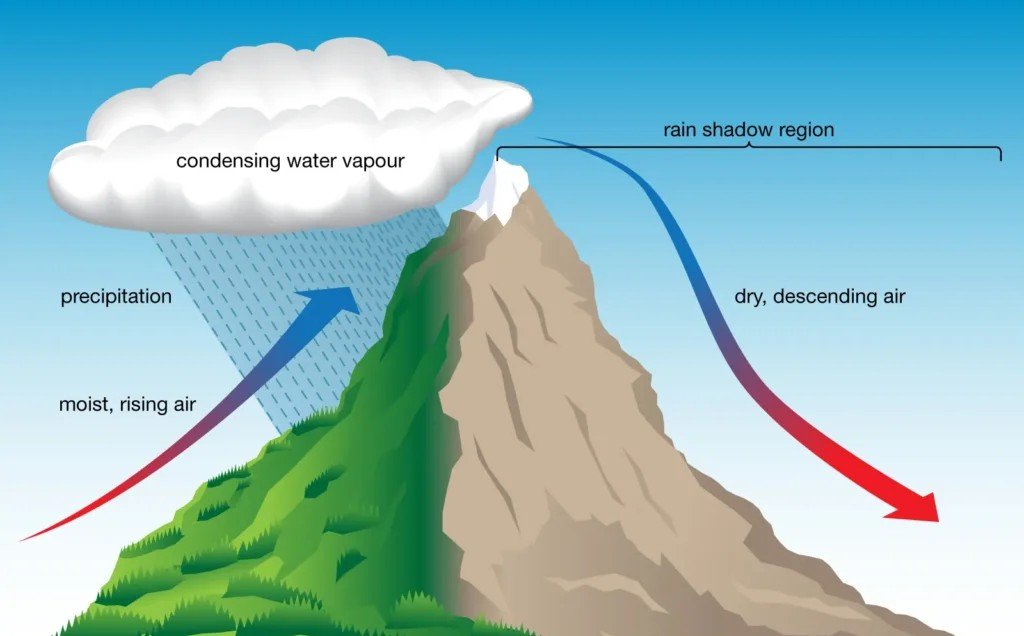
A cloudburst is an extremely intense rainfall event over a small area within a short duration. As per the India Meteorological Department (IMD), it is defined as rainfall exceeding 100 mm per hour across an area of 20–30 sq km. However, a 2023 study by IIT Jammu and the National Institute of Hydrology (NIH) redefined this as rainfall of 100–250 mm/hour concentrated in just 1 sq km, making it one of the most hyper-local and destructive meteorological phenomena.
Why Are Himalayan Regions More Vulnerable?
- Steep Terrain: Hilly slopes accelerate water runoff, triggering landslides and flash floods.
- Orographic Effect: Moist monsoon winds are forced upwards by mountains, leading to rapid condensation and heavy rainfall.
- Poor Soil Absorption: Rocky terrains reduce infiltration, increasing surface water accumulation.
- Fragile Ecosystems: High-altitude settlements (1,000–2,000m) are ecologically sensitive and structurally unprepared for such events.
Scientific Causes and Climate Link
- Moisture Build-Up and Collapse: Towering storm clouds (cumulonimbus) rapidly store moisture due to vertical air currents. A sudden collapse of these currents releases massive rainfall in minutes.
- Climate Change: Warmer air holds more water vapor. For every 1°C temperature rise, the atmosphere retains 7% more moisture, increasing the likelihood of intense short-duration rainfall events.
- Aerosols and Black Carbon: Pollution from forest fires, diesel vehicles, and stubble burning adds cloud condensation nuclei (CCN) to the atmosphere, altering cloud formation and intensifying rainfall episodes.
Impacts of Cloudbursts
- Sudden Flash Floods: Rapid overflow of streams and nullahs, sweeping away people, property, and vehicles.
- Landslides and Mudslides: Water-saturated slopes lose cohesion, causing devastating earth movements.
- Infrastructure Collapse: Roads, bridges, and electricity poles fail under the pressure of debris and water.
- High Casualty Rates: The unpredictable and sudden onset leaves communities with no time to respond.
Challenges in Forecasting Cloudbursts
- Short Duration & Micro-scale: The extremely localized nature makes it nearly impossible to predict using conventional forecasting tools.
- Lack of Dense Monitoring Network: Hilly regions lack sufficient Doppler radar and weather stations.
- Limited Local Alert Systems: Remote villages often receive alerts too late, if at all.
- High Cost of Modern Tech: AI-based early warning systems and high-resolution radars remain underfunded.
2. Moldova Becomes 107th Member of International Solar Alliance (ISA)
Context:
The Republic of Moldova has officially joined the International Solar Alliance (ISA), becoming its 107th member country.
Key Highlights:
- Moldova’s Ambassador to India, Ana Taban, handed it over to P. S. Gangadhar, Joint Secretary (Economic Diplomacy) and Head of Depository, ISA.
- Significance: Moldova’s inclusion is expected to boost global cooperation in solar energy adoption and sustainable development efforts.
About the International Solar Alliance (ISA)
- Founded: Joint initiative of India and France at COP-21 (2015).
- Headquarters: Gurugram, India.
- Objective: Promote affordable, reliable, and sustainable solar energy worldwide, especially in:
- Least Developed Countries (LDCs)
- Small Island Developing States (SIDS)
Key Focus Areas of ISA
- Analytics & Advocacy:
- Publishes solar market reports and trends
- Supports member countries in policy and regulation
- Capacity Building:
- Runs STAR-C centres for training and standard-setting
- Develops local solar ecosystems
- Programmatic Support:
- Implements solar projects
- Aggregates demand and enables funding and risk mitigation
3. Ayurveda Aahara Preparations
Context:
The Food Safety and Standards Authority of India (FSSAI), in collaboration with the Ministry of Ayush, has released a detailed list of food items classified under Ayurveda Aahara. This development aligns traditional Ayurvedic wisdom with modern food safety regulations.
What is Ayurveda Aahara?
- Ayurveda Aahara refers to food products prepared in accordance with Ayurvedic principles emphasizing balance, seasonal alignment, natural ingredients, and therapeutic herbs.
- Regulatory Framework: Governed by the Food Safety and Standards (Ayurveda Aahara) Regulations, 2022.
- Objective: To integrate Ayurvedic dietary wisdom with contemporary nutritional standards, promoting preventive health and sustainable lifestyles.
Significance and Impact
- Bridging Tradition and Regulation: Brings structured clarity to Ayurvedic food products, paving the way for innovation and expansion in the nutraceutical and health food market.
- Consumer Confidence: Aids informed dietary choices for health-conscious individuals seeking natural, preventive health approaches.
- Global Positioning: Strengthens India’s positioning as a source of time-tested traditional wellness practices within a regulatory framework.
4. BrahMos Supersonic Cruise Missile
Context:
Following the operational success of Operation Sindoor, the Indian Navy and Air Force are moving ahead with large-scale acquisition of BrahMos supersonic cruise missiles. The move highlights the missile’s exceptional performance, precision strike capabilities, and deterrence value particularly in the context of cross-border engagements.
About BrahMos Supersonic Cruise Missile:
Joint Development
- A joint venture between India’s DRDO and Russia’s NPOM.
- Named after the Brahmaputra (India) and Moskva (Russia) rivers.
Key Features
- Speed: Supersonic (Mach 2.8–3.0) throughout its trajectory.
- Range: ~290 km (with extended versions under development).
- Launch Platforms: Compatible with land-based launchers, ships, submarines, and aircraft.
What is Supersonic? (Mach 1 to Mach 5)
- Speed faster than sound but less than 5 times the speed of sound.
- Speed Range: Mach 1 to Mach 5 (1,235 km/h to ~6,174 km/h).
What is Hypersonic?
- Speeds greater than Mach 5.
- Speed Range: Above 6,174 km/h
Banking/Finance
1. Bank of Baroda Unveils bob FxOne
Context:
Bank of Baroda has launched “bob FxOne”, a digital foreign exchange platform, for its corporate and MSME customers.
Key Features
- Real‑time forex and derivative trading: Live rates, instant deal confirmations, downloadable tickets, and a personalized dashboard with alerts
- One-Click Trade (1CT) and Request‑For‑Quote (RFQ) options enable streamlined execution of bookings across cash, tom, spot, forward, bills, and options
- User-friendly, secure, and branchless interface, eliminating manual intervention and reducing dependency on bank visits
What is a Foreign Exchange Platform?
A foreign exchange platform is:
- An online or electronic interface that facilitates currency trading.
- Used to access real-time exchange rates, execute trades, and analyze market trends.
- Also known as a forex trading platform.
Key Functions
- Currency Conversion: Instantly convert one currency to another.
- Trading & Speculation: Allows traders to profit from currency price movements.
- Hedging: Helps businesses or investors protect against currency risk.
- Real-Time Market Access: Live price feeds, analytics, and charting tools.
2. RBI Removes Prior Approval Requirement for Special Rupee Vostro Accounts (SRVAs)
Context:
The Reserve Bank of India has amended the procedure for opening Special Rupee Vostro Accounts (SRVAs), aiming to promote trade settlement in INR and ease compliance for banks.
Key Highlights:
- RBI has eliminated the requirement for prior approval to open SRVAs.
- Authorised Dealer (AD) banks can now open SRVAs for foreign correspondent banks without seeking RBI’s permission.
- This move is part of India’s strategy to promote rupee-based international trade settlements.
About Special Rupee Vostro Accounts (SRVAs)
- SRVAs are INR-denominated accounts held by overseas banks with Indian AD banks.
- These accounts facilitate invoicing, payment, and settlement of exports/imports in Indian Rupees.
- Introduced as part of the RBI’s 2022 framework for international trade settlement in INR.
Significance
- Enhances ease of doing business in cross-border trade.
- Boosts internationalisation of the Indian Rupee.
- Strengthens India’s bilateral trade relationships, especially with nations facing dollar liquidity issues.
3. PFRDA Launches Modernized Website Under ‘PFRDA CONNECT’ Initiative
Context:
The Pension Fund Regulatory and Development Authority (PFRDA) unveiled its revamped and modernized website under the PFRDA CONNECT initiative.
Key Highlights:
- Launched by: Shri S. Ramann, Chairperson, PFRDA
- Objective: Enhance transparency, accessibility, and efficiency in pension sector governance through digital transformation.
Features of the New Website
- Design Features:
- Fully responsive design with improved navigation and content structure.
- Centralised access to pension schemes, regulatory updates, and announcements.
- Incorporates a modern Content Management System (CMS) for streamlined updates.
- Compliance:
- Adheres to GIGW (Guidelines for Indian Government Websites).
- Follows WCAG (Web Content Accessibility Guidelines) for global accessibility standards.
- Integration & Functionality:
- Enhanced search capabilities and system integration.
- Aligned with other regulatory digital platforms for seamless service delivery.
Significance
- Aligns with Digital India goals and inclusive governance
- Reinforces PFRDA’s commitment to a proactive, tech-driven pension administration model
4. IDFC FIRST Bank and IndiGo Launch Dual Credit Card with Shared Limit
Context:
IDFC FIRST Bank and IndiGo Airlines have jointly launched the IndiGo IDFC FIRST Dual Credit Card, featuring two cards (Mastercard and RuPay) under one shared credit limit.
Key Highlights:
- Dual Card Format: Two physical cards Mastercard and RuPay issued together with a single credit limit and a single statement.
- Application Options:
- With credit eligibility (standard)
- Without credit checks via FD-backed option
- PIN and transaction preferences must be set separately for each card.
- All spends contribute to IndiGo BluChips and milestone benefits.
Significance
- India’s first dual-network credit card combining Mastercard and RuPay
- Integrates fintech innovation with loyalty
5. Promoting Financial Literacy and Borrower Protection in Rural India: Initiatives by NABARD and RBI
Context:
To foster financial inclusion and literacy among rural populations, including microfinance borrowers, the Reserve Bank of India (RBI) and the National Bank for Agriculture and Rural Development (NABARD) have launched several targeted initiatives. These efforts aim to improve digital and financial awareness, ensure borrower protection, and streamline access to credit, especially in underserved areas.
Key Financial Literacy Initiatives
1. Financial & Digital Literacy Camps (NABARD):
- NABARD supports financial literacy camps across rural areas through rural bank branches and Financial Literacy Centres (FLCs).
- Focus areas include:
- Digital banking
- Government social security schemes
- Cyber security
- Mobile banking awareness
2. Centre for Financial Literacy (CFL) Project (RBI):
- Launched in 2017, CFLs use community-led and participatory methods for financial literacy.
- As of March 2025, 2,421 CFLs have been established, with one CFL serving three blocks on average.
3. Village Level Programmes (VLPs):
- NABARD organizes VLPs with the support of banks and State Rural Livelihood Missions (SRLMs).
- Objectives:
- Facilitate SHG account openings
- Strengthen credit linkage
- Encourage regular loan repayment
- Boost financial inclusion in villages
Microfinance Sector Reforms and Credit Access
1. Revised Definition of Microfinance Loan (RBI):
- Loans to households with annual income ≤ ₹3 lakh are now classified as microfinance loans.
- Removed:
- Loan amount caps per cycle
- Minimum tenure requirements
2. Greater Flexibility in Loan Usage:
- Borrowers can now use microfinance loans for:
- Health expenses
- Education
- Income smoothing
- Earlier restriction of 50% loan usage for income-generating purposes has been lifted.
Borrower Protection Measures
1. Repayment Cap to Prevent Over-Indebtedness:
- Monthly loan repayments are capped at 50% of household income.
2. Recovery Safeguards:
- RBI-mandated ethical recovery guidelines for Regulated Entities (REs).
- REs must have dedicated grievance redressal mechanisms for recovery-related complaints.
3. Interest Rate Regulation and Transparency:
- On March 14, 2022, RBI:
- Deregulated microfinance interest rates.
- Mandated board-approved policies to ensure non-usurious lending.
- Encouraged market-driven competitive rates.
Role of Industry SROs and Credit Information Systems
1. Self-Regulatory Organizations (SROs):
- Sa-Dhan and Microfinance Institutions Network (MFIN) ensure:
- Regulatory compliance among MFIs and NBFC-MFIs.
- Policy consultation with RBI.
- Monitoring of borrower indebtedness and lender caps.
2. Credit Information Reporting:
- Credit Institutions (CIs) are required to submit:
- Household income data
- Loan information
- This helps Credit Information Companies (CICs) assess borrower exposure and prevent over-indebtedness by enforcing the 50% repayment ceiling.
Agriculture
1. Farmers’ Library Inaugurated in Ludhiana
Context:
In a significant step to empower farmers with scientific knowledge and improve farm productivity, a Farmers’ Library was inaugurated at Mushkabad FAM Dairy Producer Company Limited in Ludhiana, Punjab. The initiative is part of a NABARD-funded research project aimed at promoting Farmer Producer Organizations (FPOs) in the dairy sector.
Key Highlights:
- Inaugurated by Dr J P S Gill, Vice-Chancellor of Guru Angad Dev Veterinary and Animal Sciences University (GADVASU).
- The library aims to disseminate the latest scientific farming practices, bridging the knowledge gap among farmers.
- Visitors can access farm literature aligned with university recommendations to boost livestock productivity and sustainable farming.
Project Details
- Implemented under the project: “Promotion of FPO on Dairy Farming in Ludhiana”.
- NABARD provides financial and technical support, enhancing market linkages and improving farmers’ economic status.
What is a Farmer Producer Organization (FPO)?
A Farmer Producer Organization (FPO) is a legal entity formed by farmers to collectively engage in agricultural and allied activities, aiming to improve their income, market access, and bargaining power.
Key Features of FPOs
- An FPO is a registered collective of farmers (usually small and marginal) who come together to improve production, processing, and marketing of their agricultural produce.
- FPOs are generally set up under:
- Companies Act, 2013 as Producer Companies
- Cooperative Societies Act
- Societies Registration Act, etc.
Objective
- To enhance farmers’ income by leveraging economies of scale, value addition, and better market access.
- To act as a bridge between farmers and buyers, including processors, exporters, and retailers.
2. TraceX Technologies Launches Agentic AI Tool
Context:
With the European Union’s Deforestation Regulation (EUDR) set to come into effect from December 2025, TraceX Technologies, a Bengaluru-based agrifood and climate tech start-up, has launched an Agentic AI-powered tool to automate compliance processes for exporters.
What is the EU Deforestation Regulation (EUDR)?
- Applies to products such as coffee, cocoa, palm oil, soy, rubber, cattle products, wood, and wood-based items.
- Mandates that all such products exported to the EU must be legally sourced and deforestation-free.
Core Features of TraceX’s Agentic AI Tool
- Automated Supplier Onboarding & KYC
- Captures supplier credentials, land ownership documents, and verifies plots using AI-based document and email parsing.
- Plot-Level Geolocation & GeoJSON Validation
- Maps exact farm locations and verifies spatial data (GeoJSON) to ensure plot-level traceability.
- Satellite-Based Risk Assessment
- Uses global satellite datasets (like Hansen and JRC) to check if land was deforested after the 2020 cut-off date under EUDR.
- AI-Driven Risk Scoring
- Provides dynamic risk scoring of suppliers and plots and recommends corrective actions before shipment.
- One-Click DDS Generation & TRACES Integration
- Automates the creation of Due Diligence Statements (DDS) and prepares them in formats compatible with the EU’s TRACES platform.
- Audit-Ready Dashboard
- Offers a centralized system for accessing all compliance data, including supplier details, risk status, location files, and DDS history.
Facts To Remember
1. Govt. can issue national IDs to citizens: Centre
The Lok Sabha was recently informed that the Citizenship Act, 1955 provides that the Union government should compulsorily register every citizen of India and issue national Identity Cards to them.
2. Rajiv Anand appointed MD and CEO of IndusInd Bank
IndusInd International Holdings Ltd. (IIHL), the holding company of IndusInd Bank, has appointed Rajiv Anand as the Managing Director and CEO of the bank, according to a statement from the company’s Chairman Ashok Hinduja.
3. Lok Sabha Passes Bill for ST Quota in Goa Assembly
Amid a prolonged protest by Opposition MPs over the Special Intensive Revision (SIR) of electoral rolls in Bihar, the Lok Sabha passes bill for ST Quota in Goa Assembly. The aim is to provide reservations to Scheduled Tribes (STs) in the Goa Legislative Assembly.
4. Doordarshan Aims to Promote Regional Languages and Culturally Rich Programs
Prasar Bharati Chairman, Navneet Kumar Sehgal, said that the endeavour of Doordarshan is to promote regional languages and produce culturally rich family programs.
5. India-New Zealand hold inaugural defence strategic dialogue in New Delhi to strengthen bilateral cooperation
The inaugural ‘India-New Zealand Defence Strategic Dialogue’ was held in New Delhi to discuss security perspectives and further bolster bilateral cooperation.
6. UPSC launches new email alert system for institutions on recruitment advertisements
The Union Public Service Commission- UPSC has enabled a new facility for educational and professional institutions to receive direct email alerts about UPSC recruitment advertisements relevant to their domains.
7. Gajendra Singh Shekhawat inaugurates 64th National exhibition of art, celebrating India’s diverse artistic heritage
Culture and Tourism Minister Gajendra Singh Shekhawat inaugurated the 64th National Exhibition of Art by the Lalit Kala Akademi in New Delhi.
- Founded: Joint initiative of India and France at COP-21 (2015). Moldova Becomes 107th Member of International S…
- Launched in 2017, CFLs use community-led and participatory methods for financial literacy. Promoting Financial Literacy and Borrower Prote…
- Companies Act, 2013 as Producer Companies Farmers’ Library Inaugurated in Ludhiana
- Climate Change: Warmer air holds more water vapor. For every 1°C temperature rise, the atmosphere retains 7% more moisture, increasing the likelihood of intense short-duration rainfall events. Cloudburst
- Speed: Supersonic (Mach 2.8–3.0) throughout its trajectory. BrahMos Supersonic Cruise Missile
7 August, 2025
Daily Current Affairs Quiz
7 August, 2025
National Affairs
1. Carriage of Goods by Sea Bill, 2025
Context:
India has enacted the Carriage of Goods by Sea Bill, 2025, replacing the Carriage of Goods by Sea Act, 1925, a colonial-era legislation. This reform aims to align Indian maritime trade laws with international conventions and boost the ease of doing business in the shipping sector.
Key Features
- Repeal of 1925 Act: Eliminates outdated provisions rooted in colonial law.
- Incorporation of Hague–Visby Rules:
- Standardizes bills of lading.
- Defines carrier obligations and liabilities clearly.
- Codified Carrier Responsibilities:
- Includes liability for loss/damage, exceptions, and time limits for claims.
- Government Empowerment:
- Centre can adopt emerging international maritime rules via notification.
- Enables faster alignment with future global standards.
- Parliamentary Oversight:
- Ensures executive decisions on international conventions are subject to legislative review.
- Trade Facilitation:
- Supports India’s ambition to become a global maritime logistics hub.
Objectives of the Bill
- Modernisation of Maritime Law: Replaces the 1925 Act with a contemporary legal framework.
- Global Alignment: Adopts Hague–Visby Rules, widely accepted international norms on cargo carriage by sea.
- Ease of Doing Business: Simplifies legal language, reduces ambiguities, and makes India more attractive for maritime trade.
- Future-readiness: Enables India to adopt future international maritime conventions via government notifications.
- Dispute Reduction: Clarifies the roles, responsibilities, and liabilities of carriers, reducing litigations and trade delays.
About Hague–Visby Rules
- A set of international rules that regulate the carriage of goods by sea.
- Originated from the Hague Rules (1924) and revised by the Visby Protocol (1968) and SDR Protocol (1979).
- Formal Title: “International Convention for the Unification of Certain Rules of Law Relating to Bills of Lading.”
- Adopted by many maritime nations to ensure uniformity in carrier liability.
2. Strategic Interventions for Green Hydrogen Transition (SIGHT) Scheme
Context:
India has achieved a record-low Green Ammonia price of ₹55.75/kg in the first SECI auction under Mode-2A of the SIGHT Scheme, marking a milestone in India’s clean energy transition.
About SIGHT Scheme
What is it?
A key financial mechanism under the National Green Hydrogen Mission (NGHM) designed to:
- Scale up production and usage of green hydrogen and its derivatives.
- Reduce costs to make green hydrogen competitive with fossil fuels.
- Create domestic demand across sectors like fertilizer, shipping, steel, and refining.
Nodal Ministries
- Ministry of New & Renewable Energy (MNRE) – Lead implementing agency.
- Ministry of Petroleum & Natural Gas (MoPNG) – Supports demand creation and offtake.
Modes of Implementation
| Mode | Description |
|---|---|
| Mode 1 | Incentive awarded to lowest incentive seeker (reverse auction model). |
| Mode 2A | Fixed incentive for Green Ammonia procurement via demand aggregation. |
| Mode 2B | Fixed incentive for Green Hydrogen procurement via demand aggregation. |
Budgetary Outlay
- ₹17,490 crore out of ₹19,744 crore (total NGHM budget) allocated to SIGHT.
- Covers production incentives, infrastructure, and offtake support.
What is Green Ammonia?
- Green Ammonia is produced using Green Hydrogen, generated through electrolysis powered by renewable energy.
- It is crucial for:
- Fertilizer production
- Marine fuel (low-carbon shipping)
- Clean energy storage and chemicals manufacturing
3. Merchant Shipping Bill, 2024
Context:
The Lok Sabha passed the Merchant Shipping Bill, 2024 on August 6, 2025, amidst ongoing opposition protests. The Bill is a major step toward modernizing India’s maritime legislation and aligns with the government’s broader agenda to strengthen the blue economy and maritime governance.
Why the Bill Matters?
- Repeals the outdated Merchant Shipping Act, 1958, reducing complexity—from 561 sections to 16 parts and 325 clauses.
- Modernizes maritime law to align with global conventions (MARPOL, Wreck Removal, ILO–MLC, STCW).
- Enables India to emerge as a credible and competitive maritime hub.
Key Provisions:
1. Expanded Ownership Criteria
- Allows NRIs, OCIs, body corporates, and joint ventures to own Indian-flagged vessels.
- Permits bareboat charter cum demise (BBCD) vessels to be registered before full ownership transfer.
- Helps increase Indian tonnage, cut foreign outflows, and grow the domestic fleet.
2. Detaining Stateless Vessels
- Government empowered to seize or detain vessels deemed to be without nationality within Indian waters.
3. Marine Casualty Inquiry Mechanism
- Framework for investigation of marine incidents, including pollution, ship wrecks, and emergencies.
- Enables enforcement of IMO conventions for environmental protection.
4. Seafarer Welfare & Training
- Introduces statutory obligations aligned with the Maritime Labour Convention (MLC, 2006).
- Oversees health, repatriation, skill training, and accountability of Recruitment & Placement Agencies (RPS).
- Aligns ship crew training with STCW Convention norms, boosting employability.
5. Safety, Salvage & Environmental Protection
- Adopts provisions from Nairobi Wreck Removal (2007), Salvage Convention (1989), and Bunker Oil Convention.
- Grants statutory powers for pollution control, inspection, wreck removal, and effective emergency response—critical for India’s 95% trade reliance on shipping.
4. Biochar
Context:
As India advances its commitment toward net-zero emissions by 2070, scalable and cost-effective carbon removal technologies are essential. Among these, biochar—a charcoal-like substance produced from biomass—is emerging as a high-potential tool for carbon sequestration, soil health enhancement, and waste management.
What is Biochar?
Biochar is produced through pyrolysis, a process that heats organic material (like crop residues, forest waste, or manure) in the absence of oxygen. Unlike combustion, pyrolysis preserves the carbon content in a stable form that can remain in soil for centuries.
Benefits of Biochar in the Indian Context
1. Carbon Sequestration
- Biochar can store carbon for hundreds to thousands of years.
- According to the IPCC, biochar has the potential to sequester up to 2.6 gigatonnes of CO₂ annually globally.
- In India, with abundant agricultural waste, the technical potential could reach 100–150 Mt CO₂ per year by 2050.
2. Waste Management Solution
- India generates over 500 million tonnes of crop residues annually.
- Biochar offers an alternative to stubble burning, particularly in Punjab and Haryana, reducing air pollution and black carbon emissions.
3. Soil Health and Productivity
- Enhances soil fertility, water retention, and microbial activity.
- Particularly useful in degraded or arid soils found across central and peninsular India.
- Reduces the need for chemical fertilizers, thus supporting sustainable agriculture.
4. Livelihood Opportunities
- Rural entrepreneurs, farmers, and SHGs can establish decentralized biochar units.
- Encourages green jobs and circular economy practices.
- Supports India’s Startup India and Atmanirbhar Bharat missions.
Current Gaps:
- No national policy framework for biochar in carbon markets or agriculture.
- Lack of standardized certification and verification mechanisms for carbon credits.
- Low awareness among farmers and limited R&D support.
Emerging Opportunities:
- Voluntary carbon markets increasingly recognize biochar as a durable carbon removal solution.
- India can monetize biochar projects under Article 6 of the Paris Agreement through bilateral or international cooperation.
- Government initiatives like PM-PRANAM, National Mission on Sustainable Agriculture, and GOBARdhan can integrate biochar incentives.
International Examples for India to Learn From
- Australia and the U.S. have developed strong biochar protocols under voluntary carbon standards like Verra and Puro.Earth.
- Kenya and Ghana use biochar for both carbon credits and soil restoration, especially in degraded lands.
TH
Banking/Finance
1. RBI Holds Repo Rate at 5.5%
Context:
Despite speculation of a 25 bps rate cut, the Monetary Policy Committee (MPC) of the Reserve Bank of India (RBI) opted for a status quo, unanimously holding the policy repo rate at 5.5%. The decision was guided by inflation risks, global uncertainty, and the need for forward-looking monetary policy.
Why RBI Held the Repo Rate?
- Global Trade Uncertainty
- New 25% US tariffs on Indian exports created instability; RBI chose caution to safeguard external sector.
- Real Estate Weakness
- Housing sales fell 20% YoY in Q2 2025; buyer sentiment remains weak amid uncertainty.
- Low Inflation
- Inflation dropped to 2.1% in June 2025, but RBI avoided further cuts to prevent demand overheating.
- Past Rate Cuts Still Working
- 100 bps cut since Feb 2025 is still being transmitted; RBI is allowing time for full impact.
Impact on the Indian Economy
- Short-Term Effects
- Loan EMIs remain unchanged for home, auto, and personal loans.
- Deposit rates stay attractive, benefiting savers, especially seniors.
- Consumption & Investment
- Consumer demand may remain muted due to still-high borrowing costs.
- Private investment could slow in interest-sensitive sectors like real estate and manufacturing.
- Inflation
- A steady rate supports ongoing disinflation and avoids premature demand-driven price spikes.
- Financial Markets
- Bond yields remain stable; the move signals RBI’s policy caution.
- Equity markets may stay range-bound unless clear cues on future rate cuts emerge.
What is Repo Rate and Reverse Repo Rate?
Repo Rate
- The Repo Rate (short for Repurchase Rate) is the rate at which RBI lends money to commercial banks against government securities.
- It is the main policy tool for controlling liquidity, inflation, and growth.
Current Repo Rate (as of August 2025): 5.5%
Reverse Repo Rate
- The Reverse Repo Rate is the rate at which RBI borrows money from commercial banks by offering them government securities.
- It is used to absorb excess liquidity from the banking system.
Current Reverse Repo Rate: 3.35%
What Happens When RBI Changes Repo/Reverse Repo Rates?
When RBI Cuts Repo Rate:
- Cheaper loans: Banks borrow at lower cost → reduce lending rates → boost consumption and investment.
- Lower EMIs: Home, auto, personal loan EMIs fall → consumer spending rises.
- Boosts growth: Encourages borrowing and capital expenditure.
- May raise inflation if done during high demand or supply constraints.
When RBI Raises Repo Rate:
- Costlier loans: Banks pass on higher borrowing costs → lending rates rise.
- Tames inflation: Reduces demand in the economy by discouraging excessive borrowing.
- Supports rupee: Higher rates attract foreign capital → stabilizes currency.
- May slow growth if borrowing becomes too expensive.
2. RBI Panel Recommends Retaining WACR as Operating Target for Monetary Policy
Context:
Amid global uncertainties and market volatility, the Reserve Bank of India’s internal working group has reaffirmed the Weighted Average Call Rate (WACR) as the most suitable operational target for monetary policy, citing its alignment with policy stance and regulatory control.
Key Recommendations of the RBI Working Group:
1. Retain WACR as the Operating Target
- WACR (Weighted Average Call Rate):
- The average interest rate at which banks borrow money from each other overnight in the unsecured market.
- Why Retain?
- It accurately reflects the RBI’s liquidity stance and transmits policy changes effectively as it includes credit and counterparty risk, unlike collateralized instruments.
2. Discontinue 14-Day VRR/VRRR as Main Liquidity Operation
- VRR/VRRR (Variable Rate Repo/Reverse Repo):
- Auctions where the interest rate is determined by market bids; used to inject (repo) or absorb (reverse repo) liquidity.
3. Use 7-Day or Shorter-Tenor Operations for Fine-Tuning
- Tenor:
- The duration or term of a financial contract or instrument.
- Why Shorter Tenors?
- Operations of up to 7 days offer greater flexibility to manage day-to-day liquidity pressures efficiently.
4. No New Tools Required
- FX Swap Auctions:
- RBI buys or sells foreign currency while agreeing to reverse the transaction later to adjust rupee liquidity.
5. Current Instruments Are Adequate:
- Open Market Operations (OMOs):
- RBI buys/sells government securities to manage money supply.
- Long-term VRR/VRRR:
- Used for durable liquidity adjustments with longer tenors (e.g., 1 month, 3 months).
3. RBI Introduces SIP Facility for Treasury Bills via Retail Direct Platform
Context:
The Reserve Bank of India (RBI) has launched a Systematic Investment Plan (SIP) facility for Treasury Bills (T-bills) under its Retail Direct scheme, marking a major expansion in direct access to government securities for retail investors.
Key Highlights:
- New Auto-Bidding Functionality:
- Retail investors can now automatically place bids in primary T-bill auctions.
- Facility covers both investment and reinvestment, enabling SIP-like investment planning in short-term government instruments.
- Retail Direct Portal:
- Launched in November 2021.
- Allows retail participation in:
- Primary auctions of G-Secs, T-bills
- Secondary market trading of government securities.
- Investors can open a Retail Direct Gilt (RDG) account directly with the RBI.
What Is a SIP in T-bills?
A Systematic Investment Plan (SIP) allows retail investors to invest fixed amounts at regular intervals (e.g., weekly, monthly) into Treasury Bills, just like SIPs in mutual funds.
What Are Treasury Bills (T-bills)?
- Short-term Government Securities with maturities of 91, 182, or 364 days.
- Issued at a discount and redeemed at face value, offering risk-free returns.
- Backed by the Government of India.
Key Features of SIP in T-bills:
- Available via RBI Retail Direct platform.
- Allows automatic periodic investment into T-bills.
- Ideal for conservative investors, including senior citizens and risk-averse savers.
- Offers liquidity, capital safety, and returns better than bank savings accounts.
Impact on Financial Markets:
- Boosts Retail Participation in sovereign debt market.
- Encourages financial literacy and discipline in retail investing.
- Supports market depth and broadens the investor base for government securities.
4. RBI Revises Co-Lending Framework to Enhance Transparency and Risk Sharing
Context:
The Reserve Bank of India (RBI) issued revised guidelines to strengthen the co-lending framework between banks and non-bank financial companies (NBFCs). The new rules mandate that all regulated entities (REs) involved in co-lending arrangements (CLAs) must retain at least 10% of each individual loan on their own books.
Objectives
- Strengthen the co-lending partnership framework between banks and non-bank lenders.
- Improve risk alignment, ensure uniform asset classification, and protect borrower interests.
- Expand co-lending applicability beyond priority sector lending (PSL) to non-priority sector loans.
Key Features of the Revised Co-Lending Norms:
1. Minimum Loan Retention Requirement:
- All regulated entities (REs) must retain at least 10% of each loan on their own books.
- Promotes risk participation and skin in the game for both partners.
2. Default Loss Guarantee (DLG) Provision:
- Originating lender may offer a first-loss guarantee up to 5% of the outstanding loan amount.
- Aligns with existing FLDG norms under digital lending.
3. Uniform Asset Classification:
- If one partner classifies a loan as an SMA (Special Mention Account) or NPA, the same must be adopted by the co-lender for their portion.
- A Special Mention Account (SMA) is a classification used by banks to identify potentially stressed loan accounts before they officially become Non-Performing Assets (NPAs).
4. Credit Policy Alignment:
- All REs must explicitly incorporate co-lending provisions in their internal credit policies.
5. Mandatory Disclosures in Loan Agreement:
- Loan agreements must clearly define roles of each partner (e.g., sourcing, servicing).
- Must mention the single point of contact for the borrower.
6. Blended Interest Rate Mechanism:
- Borrowers will be charged a blended rate, calculated based on the weighted average of each lender’s internal rate in proportion to their contribution.
7. Annual Percentage Rate (APR) Transparency:
- All additional fees or charges beyond the blended rate must be factored into the APR and disclosed.
8. Escrow-Based Transaction Handling:
- All loan disbursements and repayments must flow through an escrow account maintained with a bank.
- An Escrow Account is a temporary, third-party account where funds are held safely until all conditions of a transaction are fulfilled by the involved parties.
- Ensures real-time settlement, audit trail, and greater transparency.
9. Timely Loan Recognition:
- Loan portions must be reflected on each partner’s books within 15 days of origination.
10. Expanded Applicability:
- Framework now covers:
- Non-priority sector lending
- Co-lending between any regulated entities (not just bank-NBFC partnerships)
5. RBI Unveils Three Consumer-Focused Schemes to Boost Financial Inclusion
Context:
In a major push towards inclusive financial growth, Reserve Bank of India Governor Sanjay Malhotra announced three key consumer-centric initiatives following the August 2025 MPC meeting. These schemes target ease of access, simplified procedures, and broader retail participation, especially benefiting those at the bottom of the financial pyramid.
1. Doorstep Re-KYC for Jan Dhan Account Holders
Objective: To simplify KYC compliance for financially underserved sections.
- Method: Banks will organize Re-KYC camps at the Panchayat level.
- Additional Services:
- Opening of new bank accounts.
- Enrolment in micro-insurance and pension schemes.
- Redressal of customer grievances.
- Significance: Supports 10-year milestone of Pradhan Mantri Jan Dhan Yojana (PMJDY) and promotes last-mile connectivity in banking.
2. Simplified Claims Process for Deceased Customers
Objective: To relieve families of procedural burdens after the death of a bank account holder.
- Key Features:
- Standardized and streamlined process across all banks.
- Uniform timelines and documentation requirements.
- Applies to both account funds and locker contents.
- Impact:
- Reduces legal and administrative hassles.
- Offers faster and fairer access to rightful claimants.
3. Systematic Investment Plans (SIPs) in Government Securities via Retail Direct
Objective: To promote retail investor participation in sovereign debt markets.
- New Feature: Enables SIP functionality for Treasury Bills (T-Bills).
- Platform: RBI’s Retail Direct portal, launched in 2021.
- Benefits:
- Encourages automated, disciplined investing.
- Makes short-term G-Sec instruments accessible to small investors.
- Outcome Expected: Enhanced financial literacy, greater depth in the G-Sec market, and improved household savings discipline.
Why It Matters?
These reforms underline the RBI’s commitment to:
- Financial inclusion and consumer empowerment.
- Streamlining legacy banking processes.
- Democratizing access to investment instruments.
6. Axis Bank Launches ‘Lock FD’ Feature
Context:
Axis Bank has launched a ‘Lock FD’ feature for safeguarding customers’ Fixed Deposits (FDs) from rising digital frauds by allowing them to restrict FD closures through digital means.
Objective
To enhance the security of fixed deposits (FDs) by restricting premature closure through digital platforms, thereby protecting customers from online fraud.
What are Fixed Deposits (FDs)?
A Fixed Deposit (FD) is a savings and investment instrument offered by banks and NBFCs where you deposit a lump sum for a fixed tenure at a predetermined interest rate. It’s one of the most popular low-risk investment options in India.
Key Features of ‘Lock FD’
- Security Layer: Once the ‘Lock FD’ option is enabled, FDs cannot be prematurely closed via internet or mobile banking.
- Branch-only Closure: Closure of such locked FDs requires physical branch visit, ensuring identity verification.
7. Tata AIA Launches ‘Shubh Shakti’
Context:
On August 6, 2025, Tata AIA Life Insurance launched “Shubh Shakti”, a term insurance plan exclusively designed for women. The initiative targets rising female workforce participation and the persistent gender gap in financial planning and insurance coverage in India.
8. Gro Digital Platforms and IDFC FIRST Bank Partner to Launch FASTag Services for Fleet Operators
Context:
Gro Digital Platforms, a logistics services platform jointly promoted by Ashok Leyland and Hinduja Leyland Finance, has signed a Memorandum of Understanding (MoU) with IDFC FIRST Bank to launch FASTag services for fleet operators across India.
FASTag Services
FASTag is an electronic toll collection (ETC) system in India, operated by the National Payments Corporation of India (NPCI) under the National Electronic Toll Collection (NETC) program, mandated by the Ministry of Road Transport and Highways (MoRTH). It uses Radio Frequency Identification (RFID) technology for automatic toll deduction without stopping at toll plazas.
Agriculture
1. Punjab: First State to Upgrade Cooperative Banks to Finacle 10
Context:
Punjab has become the first state in India to complete the upgrade of its cooperative banks’ Core Banking Solution (CBS) from Finacle 7 to Finacle 10, marking a major leap in digital transformation for the rural banking sector.
Key Highlights:
- Banks Upgraded:
- SAS Nagar Central Cooperative Bank
- Ropar Central Cooperative Bank
- Under Aegis of: NABARD (National Bank for Agriculture and Rural Development)
- Significance of Upgrade:
- Faster, more secure, and customer-friendly banking services at grassroots level.
- Enhances transparency, operational efficiency, and security.
- Strengthens rural banking infrastructure to better serve farmers, self-help groups, and rural entrepreneurs.
What is Finacle?
Finacle is a core banking solution developed by Infosys used by banks for digital banking operations, including account management, deposits, loans, payments, and customer relationship management.
About Finacle 7
- Era: Older version (legacy system), widely used in early 2000s–2010s.
- Architecture: Primarily client-server based, less modular.
- Interface: Text-based UI, required bank staff to remember transaction codes.
- Features: Basic core banking functionalities like savings accounts, deposits, loans, and fund transfers.
About Finacle 10
- Developed by Infosys, Finacle is a Core Banking Solution (CBS) widely used by banks worldwide.
- Finacle 10 offers:
- Cloud-ready architecture for scalability.
- Advanced cybersecurity features.
- AI-powered analytics for customer service.
- Faster transaction processing compared to earlier versions.
- Support for digital channels like mobile & internet banking seamlessly.
Why This Matters for Cooperative Banks
- Cooperative banks operate deeply in rural and semi-urban areas, often serving as the primary banking touchpoint for millions.
- Upgrading to Finacle 10 enables them to:
- Provide real-time transactions and digital services.
- Integrate UPI, AEPS, and other payment systems.
- Meet RBI compliance more efficiently.
- Offer personalised financial products based on customer data.
Facts To Remember
1. PM Modi inaugurates Kartavya Bhavan in Delhi
The Prime Minister inaugurated Kartavya Bhavan at Kartavya Path in the National Capital. This development is part of the ongoing Central Vista Redevelopment Project.
2. IRCTC Receives RBI Nod to Operate as Payment Aggregator
On 4 August 2025, the Reserve Bank of India (RBI) granted in-principle authorization to IRCTC Payments Limited—a wholly-owned subsidiary—to operate as an online payment aggregator (PA) under the Payment and Settlement Systems Act, 2007.
3. Donald Trump doubles India tariff to 50% over Russian oil purchase
US President Donald Trump on Wednesday signed an executive order doubling India tariff to 50 per cent, announcing an additional 25 per cent duties over Russian oil purchase, according to the White House website.
- Repeal of 1925 Act: Eliminates outdated provisions rooted in colonial law. Carriage of Goods by Sea Bill, 2025
- Repeals the outdated Merchant Shipping Act, 1958, reducing complexity—from 561 sections to 16 parts and 325 clauses. Merchant Shipping Bill, 2024
- Housing sales fell 20% YoY in Q2 2025; buyer sentiment remains weak amid uncertainty. RBI Holds Repo Rate at 5.5%
- India has achieved a record-low Green Ammonia price of ₹55.75/kg in the first SECI auction under Mode-2A of the SIGHT Scheme, marking a milestone in India’s clean energy transition. Strategic Interventions for Green Hydrogen Tran…
- All regulated entities (REs) must retain at least 10% of each loan on their own books. RBI Revises Co-Lending Framework to Enhance Tra…
8 & 9 August, 2025
Daily Current Affairs Quiz
8 & 9 August, 2025
National Affairs
1. India Releases Joint Doctrines for Cyberspace and Amphibious Operations
Context:
The Chief of Defence Staff (CDS) has declassified and released India’s Joint Doctrines for Cyberspace Operations and Amphibious Operations to enhance interoperability, strengthen national defence strategy, and guide integrated multi-domain warfare. These doctrines outline operational principles, strategic objectives, and coordination mechanisms for the armed forces in two critical domains.
About Cyberspace
- A global domain of interconnected information systems, networks, and data infrastructures (internet, intranets, satellites, control systems).
- Characteristics:
- Borderless Domain – Operates beyond physical boundaries.
- Dual-use Nature – Serves both civilian and military needs.
- Real-time Impact – Actions can have immediate global effects.
- Anonymity Challenges – Attribution of attacks is difficult.
- Constantly Evolving Threats – Adapts with technology.
Components of Cyberspace Operations
- Defensive Cyber Operations: Protects networks from hacking, malware, and breaches.
- Offensive Cyber Operations: Disrupts enemy systems and critical infrastructure.
- Cyber Intelligence & Reconnaissance: Analyses threat data and vulnerabilities.
- Cyber Support Operations: Provides tools for land, air, sea, and space missions.
- Resilience & Recovery Systems: Ensures continuity via backups and redundancies.
About Amphibious Operations
- Coordinated military actions from sea to shore using naval, air, and land forces.
- Uses: Warfare, humanitarian assistance, disaster relief (HADR), force projection.
- Features:
- Tri-service integration.
- Rapid mobilisation from sea to shore.
- Flexible mission profiles (combat to HADR).
- Strategic reach over islands and coasts.
- Maritime–land operational linkage.
Significance of the Doctrines
- National Security: Safeguards critical infrastructure from cyber threats.
- Force Multiplier: Integrates cyber capabilities with conventional warfare.
- Maritime Superiority: Strengthens littoral zone dominance.
- Jointness: Enhances Army–Navy–Air Force coordination.
- Hybrid Warfare Preparedness: Counters combined cyber, sea, and land threats.
2. Kartavya Bhavan-03 under Central Vista Redevelopment
Context:
Prime Minister inaugurated Kartavya Bhavan-03, the first of ten planned Common Central Secretariat (CCS) buildings under the Central Vista redevelopment project in New Delhi. This marks a major step towards modernising government infrastructure, enhancing administrative efficiency, and integrating green and digital governance systems.
About Kartavya Bhavan-03
- Type: Common Central Secretariat building.
- Purpose: Consolidates offices of over 50 Union ministries (spread across Delhi) into centralised, modern buildings.
- Objective:
- Improve administrative efficiency.
- Reduce rental and maintenance costs.
- Integrate sustainable infrastructure and digital work systems.
- Location: New Delhi.
BS
3. Election Commission of India (ECI)
Context:
The Opposition party has accused the Election Commission of India (ECI) of large-scale voter list manipulation in Karnataka, Maharashtra, and other states, alleging bias and “vote theft” in favour of the ruling party.
About the Election Commission of India (ECI)
The Election Commission of India (ECI) is an autonomous constitutional authority responsible for conducting and regulating elections to the Lok Sabha, Rajya Sabha, State Legislative Assemblies, and the offices of the President and Vice President in India. It was established on 25 January 1950 (celebrated as National Voters’ Day), with its headquarters in New Delhi.
It does not conduct elections to Panchayats and Municipalities, as these fall under the jurisdiction of the State Election Commissions.
Constitutional Provisions (Part XV: Articles 324–329)
- Article 324 – Superintendence, direction, and control of elections vested in the Election Commission.
- Article 325 – No discrimination in electoral rolls on grounds of religion, race, caste, or sex.
- Article 326 – Elections based on adult suffrage (18 years and above).
- Article 327 – Parliament’s power to legislate on elections.
- Article 328 – State Legislature’s power to legislate on elections.
- Article 329 – Bar on judicial interference in electoral matters.
Structure of ECI
- Initially a single-member body, but became a multi-member body after the Election Commissioner Amendment Act, 1989.
- Presently consists of:
- Chief Election Commissioner (CEC)
- Two Election Commissioners (ECs)
- At the state level, assisted by the Chief Electoral Officer.
Appointment & Tenure
- Appointed by the President of India under the CEC and Other ECs (Appointment, Conditions of Service and Term of Office) Act, 2023.
- Tenure: 6 years or up to 65 years of age, whichever is earlier.
- Salary and service conditions are equivalent to a Supreme Court Judge.
Removal
- CEC: Can only be removed in the same manner as a Supreme Court judge (by Parliament).
- ECs: Can be removed on the recommendation of the CEC.
- All can resign before the expiry of their term.
Limitations
- No constitutional prescription of qualifications (legal, educational, administrative, or judicial).
- No specific term fixed in the Constitution.
- Retiring commissioners are not barred from future government appointments.
UPSC Civil Services Examination Previous Year Questions (PYQs)
Prelims
Q. Consider the following statements: (2017)
- The Election Commission of India is a five-member body.
- The Union Ministry of Home Affairs decides the election schedule for the conduct of both general elections and bye-elections.
- Election Commission resolves the disputes relating to splits/mergers of recognised political parties.
Which of the statements given above is/are correct?
(a) 1 and 2 only
(b) 2 only
(c) 2 and 3 only
(d) 3 only
Ans: (d)
Mains
Q. Discuss the role of the Election Commission of India in the light of the evolution of the Model Code of Conduct. (2022)
5. Pradhan Mantri Ujjwala Yojana (PMUY)
Context:
Government approved continuation of ₹300 per LPG cylinder subsidy for PMUY beneficiaries in FY 2025–26.
About PMUY
- Type: Flagship social welfare scheme for deposit-free LPG connections.
- Launch: May 2016, Ballia, Uttar Pradesh.
- Nodal Ministry: Ministry of Petroleum & Natural Gas (MoPNG).
- Goal: Replace hazardous traditional cooking fuels with clean LPG for health, environment, and women empowerment.
Key Features
- Deposit-Free LPG Connection – No initial security deposit.
- Financial Support for Stove Purchase – Ensures ready-to-use connections.
- ₹300 Subsidy per 14.2 kg Cylinder – Proportional for 5 kg cylinders, max 9 refills/year.
- Direct Benefit Transfer (DBT) – Subsidy directly credited to beneficiary bank accounts.
- Swachh Indhan Behtar Jeevan – Clean fuel for women’s health, reduced indoor air pollution, and sustainable cooking.
Objectives
- Universal access to clean cooking fuel.
- Reduce indoor air pollution & related health hazards.
- Empower rural women by reducing drudgery.
- Promote environmental conservation (reduce deforestation & carbon emissions).
Eligibility
- Adult women from BPL households.
- Identified via SECC 2011 data.
- PMUY 2.0: Includes migrant families without address proof.
Banking/Finance
1. AU Small Finance Bank Gets RBI Nod to Become Universal Bank
Context:
On 8 August 2025, the Reserve Bank of India (RBI) granted in-principle approval to AU Small Finance Bank (AU SFB) to transition into a universal bank. AU becomes the first SFB to receive such approval and the first universal bank approval in over 11 years. It currently commands about 40% market share among SFBs.
Eligibility Criteria for SFB to Transition into a Universal Bank
| Criterion | Requirement |
|---|---|
| Scheduled Status | Must have been in the RBI’s Scheduled Banks list for at least 5 years |
| Stock Listing | Shares must be listed on a recognised stock exchange |
| Net Worth | Minimum net worth of ₹1,000 crore |
| Financial Health – Profitability | Net profits in each of the last 2 Financial Years (FYs) |
| Financial Health – Asset Quality | G-NPA ≤ 3% and N-NPA ≤ 1% over the last 2 FYs |
| Promoter Requirements | No addition or change in promoters during the transition period |
| Portfolio Preference | Preference given to SFBs with diversified loan portfolios |
About Small Finance Banks (SFBs)
| Parameter | Details |
|---|---|
| Genesis | Announced in Union Budget 2014–15 |
| Objective | Promote financial inclusion by serving small businesses, marginal farmers, micro industries, and unorganised sector entities |
| Registration | Public limited company under Companies Act, 2013 |
| Licensing | Licensed & governed under Banking Regulation Act, 1949 |
| Capital Requirement | Minimum paid-up voting equity capital of ₹200 crore (except in certain cases) |
| Eligible Promoters | Resident individuals/professionals with ≥10 years experience in banking & finance |
Difference Between Small Finance Banks and Universal Banks
| Parameter | Small Finance Banks (SFBs) | Universal Banks |
|---|---|---|
| Primary Objective | Financial inclusion by providing credit to unserved/underserved segments like small businesses, farmers, low-income households | Provide a wide range of banking services to all segments of the economy |
| Customer Focus | Primarily rural and semi-urban customers, small borrowers | Both retail and corporate clients |
| Product Range | Savings accounts, fixed deposits, small business loans, microfinance | All banking products including corporate loans, international banking, investment banking |
| Priority Sector Lending | 75% of net loans | 40% of net loans |
| Regulatory Capital | Minimum capital requirement: ₹200 crore | Minimum capital requirement: ₹1,000 crore |
| Branch Expansion | At least 25% branches in unbanked rural areas | No such mandatory rural branch requirement |
| Scope of Operations | Restricted geographical and lending scope | Full-scale domestic and international operations |
2. IDFC FIRST Bank Launches RemitFIRST2India Digital Remittance Platform
Context:
IDFC FIRST Bank has launched RemitFIRST2India, a next-generation digital remittance platform enabling Non-Resident Indians (NRIs) to send money to India quickly, securely, and at zero transfer fees. Developed in partnership with SingX, the platform aims to provide a transparent, compliant, and customer-friendly cross-border payment experience.
About RemitFIRST2India
- Purpose: Simplify and speed up NRI remittances to India with competitive forex rates and full transparency.
- Availability:
- For IDFC FIRST Bank NRI customers – direct transfer via Mobile Banking App without extra registration.
- For non-customers – quick, paperless onboarding via a dedicated web portal.
- Current Coverage: Transfers from Singapore and Hong Kong; expansion planned to more countries.
- Partnership: SingX (licensed by Monetary Authority of Singapore) for regulatory compliance and operational efficiency.
About IDFC FIRST Bank
- Type: Private sector universal bank in India.
- Branch Network: 1,016 branches; digital-first approach with highly rated mobile app.
- Core Banking Principles: Ethical banking, customer-friendly products, financial inclusion, ESG focus, and transparent zero-fee services.
3. IFC Commits $150M to H-DREAM Fund for Green Affordable Housing
Context:
The International Finance Corporation (IFC), a member of the World Bank Group, has committed USD 150 million to HDFC Capital Affordable Real Estate Fund – 3 (H-CARE 3). The investment aims to boost the supply of green-certified affordable housing in India and advance climate-friendly construction practices.
Key Highlights:
- Investment Details: IFC will act as an anchor investor with a USD 150 million commitment to H-CARE 3.
- Fund Objective: Promote affordable, green-certified housing projects in India, supporting low- and middle-income homebuyers.
- Environmental Impact: Encourages sustainable construction and resource efficiency, aligning with India’s climate goals.
- Economic Impact: Supports real estate developers with long-term funding for environmentally responsible affordable housing.
- Partnership: This is IFC’s third investment with HDFC Capital’s H-CARE platform, reinforcing a long-standing collaboration.
About IFC
- A member of the World Bank Group.
- Focuses on private sector development in emerging markets through investments, advisory, and asset management services.
About H-CARE
- Managed by HDFC Capital Advisors Ltd.
- Focuses on financing affordable and mid-income housing projects in India.
4. FSSAI and Bank of Baroda Collaborate to Enhance Digital Payments
Context:
The Food Safety and Standards Authority of India (FSSAI) has partnered with Bank of Baroda to promote digital payment adoption in the food business sector. The initiative aims to improve financial transparency, reduce cash-based transactions, and encourage small food businesses to transition to secure, traceable payment methods.
Key Highlights:
- Partnership Objective: To integrate digital payment solutions for food business operators (FBOs) across India.
- Target Audience: Street vendors, small eateries, and micro food enterprises.
- Services Offered:
- QR code-based payment systems.
- Training and awareness campaigns for digital literacy.
- Access to simplified banking solutions.
- Implementation Plan: Nationwide roll-out through FSSAI’s regional offices and Bank of Baroda’s branch network.
- Expected Benefits: Enhanced financial inclusion, transparency in transactions, and faster payment processing for small vendors.
5. DSP Mutual Fund Launches India’s First Flexi-Cap Index Fund
Context:
DSP Mutual Fund has introduced the DSP Nifty500 Flexicap Quality 30 Index Fund, marking it as India’s first-ever flexi-cap index fund. The fund is designed to offer a low-cost, rules-based investment strategy that adapts dynamically to market conditions.
Flexi-Cap Index Fund
A Flexi-Cap Index Fund is a type of equity mutual fund that invests across large-cap, mid-cap, and small-cap stocks, offering diversification and flexibility. Unlike pure large-cap or small-cap funds, its allocation changes dynamically based on market conditions and index composition.
Key Features:
- Quality-Only Stock Selection: The fund tracks the Nifty500 Flexicap Quality 30 Index, comprising 30 fundamentally strong companies 10 each from large-cap, mid-cap, and small-cap segments, all equally weighted within each category.
- Dynamic Allocation: Fund manager can shift portfolio weightage between large, mid, and small caps depending on valuation and market trends.
- Index-Based: Tracks a specific benchmark index (e.g., Nifty 500, Nifty Flexi Cap Index) passively, ensuring low costs compared to actively managed flexi-cap funds.
- Risk-Return Profile: Balanced risk due to diversification; can capture growth opportunities in smaller companies while maintaining stability from large-cap exposure.
- SEBI Regulation: Categorised under “Flexi Cap Fund” with the mandate to invest at least 65% in equities across all caps.
6. Kotak Mahindra Bank Launches ‘Solitaire’ Programme
Context:
Kotak Mahindra Bank has introduced ‘Solitaire’, an exclusive, invitation-only programme designed for affluent customers, offering premium banking privileges and personalised services.
Eligibility
- Salaried individuals: Minimum relationship value of ₹75 lakh.
- Self-employed individuals: Minimum relationship value of ₹1 crore.
Key Benefits
- Pre-approved credit lines: Up to ₹8 crore across home loans, personal loans, and credit cards.
- Solitaire Credit Card perks:
- Zero annual fees
- Unlimited lounge access
- Zero forex markup
- Access to advanced investment tools and top-tier personalised banking services.
About Kotak Mahindra Bank:
- Founded: 2003
- Headquarters: Mumbai, Maharashtra, India
- Managing Director & CEO: Ashok Vaswani
- Tagline: Let’s Make Money Simple
- Merger: ING Vysya Bank merged with Kotak Mahindra Bank in 2015.
Agriculture
1. AI and Satellite Intelligence Transforming Indian Agriculture
Context:
India’s agriculture sector, employing ~150 million farmers and contributing 18% to GDP, faces climate change, soil degradation, and pest attack challenges. Traditional farming methods are increasingly inadequate, pushing the need for technology-driven, proactive solutions.
Key Challenges
- Climate Volatility: Irregular monsoons affect ~70% of farmland.
- Delayed Information: Crop stress, pests, and nutrient gaps often detected too late.
- Debt Cycle: Losses push farmers into repeated borrowing.
- Declining Soil Health: Excessive and inefficient input use.
Tech-Based Solutions
Artificial Intelligence (AI) + Satellite Intelligence:
- Soil Analysis: Done in hours instead of weeks.
- Hyperlocal Advisories: Based on soil moisture, weather history, and crop growth models.
- Weather & Pest Prediction: Advance alerts for rainfall, heat waves, and infestations.
- Yield Gains: AI-driven advisories have boosted yields by 15–20%.
- Input Efficiency: Fertiliser use reduced by up to 30% without affecting yield.
Example:
- Telangana chilli crop losses avoided via predictive advisories.
Impact Beyond Farming
- Credit & Insurance:
- AI + satellite data create verifiable farm records.
- Faster loan approvals and claim settlements.
- PM Fasal Bima Yojana: Using AI and space tech for better yield estimation and dispute resolution.
- Risk Management: Early warnings allow proactive, targeted interventions.
Policy & Vision
- Vision 2030 for Agriculture: Focus on sustainability and resilience.
- Need for Scale: Moving from pilot projects to nationwide implementation to make proactive, data-driven farming standard.
Facts To Remember
1. ChatGPT 5
OpenAI has officially launched ChatGPT 5, the newest version of its advanced AI chatbot, bringing significant upgrades that are already generating buzz.
2. India’s 3rd Launch Pad in Sriharikota by 2029
India’s space program is preparing for its next giant leap. The Indian Space Research Organisation (ISRO) has officially begun work on its Third Launch Pad (TLP) at the Satish Dhawan Space Centre in Sriharikota.
- Initially a single-member body, but became a multi-member body after the Election Commissioner Amendment Act, 1989. Election Commission of India (ECI)
- Merger: ING Vysya Bank merged with Kotak Mahindra Bank in 2015. Kotak Mahindra Bank Launches ‘Solitaire’ Progra…
- Government approved continuation of ₹300 per LPG cylinder subsidy for PMUY beneficiaries in FY 2025–26. Pradhan Mantri Ujjwala Yojana (PMUY)
- Branch Network: 1,016 branches; digital-first approach with highly rated mobile app. IDFC FIRST Bank Launches RemitFIRST2India Digit…
- SEBI Regulation: Categorised under “Flexi Cap Fund” with the mandate to invest at least 65% in equities across all caps. DSP Mutual Fund Launches India's First Flexi-Ca…
10 & 11 August, 2025
Daily Current Affairs Quiz
10 & 11 August, 2025
National Affairs
1. PM E-Drive Subsidy Scheme
Context:
The Central Government has extended the PM E-Drive subsidy scheme by two years, now running until the fiscal year 2027-28. This comes as nearly half of the allocated ₹10,900 crore budget remains unutilized. Subsidies for electric two- and three-wheelers under the scheme will end by March 31, 2026.
About PM E-Drive Subsidy Scheme
- Launch & Administration:
- Launched on 1 October 2024, replacing the Electric Mobility Promotion Scheme (EMPS-2024).
- Administered by the Ministry of Heavy Industries.
- Duration:
- Extended till March 31, 2028, or until the funds are fully utilized.
- Budget Allocation:
- Total outlay: ₹10,900 crore.
- Demand incentives for EVs: ₹3,679 crore.
- E-buses, charging infrastructure, and testing facilities: ₹7,171 crore.
Objectives
- Accelerate penetration of electric vehicles in public transport and logistics sectors.
- Reduce upfront cost of EVs for consumers to boost adoption.
- Strengthen charging infrastructure to mitigate range anxiety.
- Support domestic EV manufacturing under the Atmanirbhar Bharat initiative.
Coverage
- Electric two-wheelers, three-wheelers, trucks, ambulances, and buses.
- Charging infrastructure across urban areas and highways.
2. Khelo India ASMITA Football League 2025-26
Context:
The Khelo India ASMITA Football League 2025-26 was launched in Jalgaon, Maharashtra, marking a significant step toward affirmative action in sports aimed at boosting women’s participation, especially from underrepresented communities.
About Khelo India ASMITA
- What It Is:
- A focused affirmative action initiative under the broader Khelo India programme designed to increase women’s participation in sports, primarily by developing grassroots talent among marginalized groups.
- Launch:
- Initiated in 2025–26 with the inaugural football league held in Jalgaon.
- Administering Ministry and Partners:
- Ministry of Youth Affairs and Sports, supported by the Sports Authority of India (SAI), All India Football Federation (AIFF), and Western India Football Association (WIFA).
Aim
- Provide a dedicated platform for young girls to showcase and develop sporting skills.
- Promote social inclusion by engaging tribal, rural, and minority community talent.
3. India to Launch 6,500 kg U.S. Communication Satellite After NISAR Mission
Context:
Following the successful launch of the NISAR satellite on July 30, 2025, the Indian Space Research Organisation (ISRO) is preparing to launch a 6,500 kg U.S.-built communication satellite, Block-2 BlueBird, in the coming months. This mission underscores India’s growing capabilities in handling large-scale international payloads.
Key Details:
- Satellite Specifications:
- Block-2 BlueBird is equipped with a large 64.38 m² communication array.
- Provides direct broadband connectivity to smartphones without needing any special ground terminals.
- Supports data speeds up to 12 Mbps, enabling clear voice calls, fast data, and video communication for users.
- Launch Vehicle:
- Scheduled to be launched on ISRO’s heaviest rocket, the LVM-3-M5.
- Launch site: Sriharikota spaceport.
- Technology Provider:
- Uses patented technology from AST & Science.
- Enables reliable cellphone connectivity directly from space as part of the SpaceMobile network.
- International Collaboration:
- Strengthens Indo-U.S. cooperation in space exploration and technology.
- Builds on the success of the previous NISAR mission, showcasing strong bilateral partnership.
Banking/Finance
1. ICICI Bank Hikes Minimum Balance Requirement for New Savings Accounts
Context:
ICICI Bank, one of India’s leading private sector banks, has revised the minimum average balance (MAB) requirements for new savings accounts opened on or after August 1, 2025. This move marks a significant increase in the MAB norms for urban and semi-urban branches, reflecting a strategic shift in customer segmentation.
Key Highlights:
- Revised MAB Limits:
- Urban branches: ₹50,000 (previously ₹10,000)
- Semi-urban branches: ₹25,000
- Rural branches: ₹10,000 (unchanged)
- RBI’s Stance:
- The Reserve Bank of India clarified that MAB policies fall under the discretion of individual banks, and RBI does not regulate minimum balance requirements.
Minimum Average Balance (MAB)
Minimum Average Balance (MAB) is the minimum amount of money that a bank requires a customer to maintain in their savings or current account over a specified period (usually a month or quarter). It is the average of the daily closing balances during that period.
Purpose
- The increased MAB is seen as a move to prioritize high-value customers and optimize operational efficiency.
- Ensures that customers maintain a certain level of funds in their accounts to cover bank operational costs.
- Helps banks manage liquidity and operational expenses.
2. LIC Enters Bond Forward Rate Agreements (FRA) Market
Context:
State-owned Life Insurance Corporation of India (LIC) has officially entered the bond Forward Rate Agreements (FRAs) market through transactions with over 10 major banks, both domestic and foreign, marking a strategic move to manage interest rate risks associated with its portfolio.
Why This Move Matters?
- Purpose: To hedge against interest rate volatility, particularly for its growing share of non-participating (non-par) insurance products, which require stable long-term returns.
- Impact: Expected to increase demand for long-term government securities (30 years+), but may narrow forward spreads, affecting profitability of smaller market players.
Forward Rate Agreements (FRA)
A Forward Rate Agreement (FRA) is a financial contract between two parties to lock in an interest rate for a specified future period on a notional principal amount. The contract settles in cash based on the difference between the agreed-upon forward rate and the actual market interest rate on the settlement date.
Purpose
- FRAs are primarily used by institutions like banks and insurers to hedge against fluctuations in interest rates.
- By fixing a rate in advance, they manage the risk of rates rising or falling in the future, which impacts borrowing costs or investment returns.
Difference Between FRAs and Bond Forwards
| Aspect | Forward Rate Agreements (FRAs) | Bond Forwards |
|---|---|---|
| Nature of Contract | Agreement to lock in an interest rate on a notional amount for a future period. | Agreement to buy/sell a specific bond at a predetermined price on a future date. |
| Settlement | Settled in cash based on the difference between agreed rate and market rate. | Physical delivery of the bond at contract maturity (no cash settlement). |
| Underlying Asset | Interest rates (no actual bond or loan is exchanged). | Specific government bond or security. |
| Risk Mitigation | Hedge interest rate fluctuations without bond ownership. | Hedge interest rate risk with actual bond delivery, reducing procurement risk. |
| Market Usage | Commonly used by banks, insurers to hedge interest rate risk on liabilities or assets. | Used by insurers and investors to lock in bond prices and ensure delivery. |
| Settlement Risk | Requires sourcing bonds at settlement for hedging if needed, adding market risk. | Eliminates settlement risk as bond delivery is contractually guaranteed. |
| Regulatory Status in India | Allowed and widely used for interest rate risk management. | Recently permitted by RBI and IRDAI, expanding hedging tools. |
3. RBI Proposes Standardised Forms and 15-Day Settlement for Deceased Customers Claims
Context:
The Reserve Bank of India (RBI) has issued a draft circular titled Reserve Bank of India (Settlement of Claims in respect of Deceased Customers of Banks) Directions, 2025 to standardise and simplify the process for settling claims on bank accounts and safe deposit lockers of deceased customers.
Key Proposals
- Standardised Forms: Banks will be mandated to use uniform claim forms and document checklists for processing claims.
- Settlement Timeline: Banks are required to settle claims within 15 calendar days of receiving all necessary documents.
- Compensation for Delay: If banks fail to settle claims within the stipulated time, they must pay compensation to nominees at a rate of Bank Rate + 4% per annum on the settlement amount for the delay period. For locker-related claims, a penalty of ₹5,000 per day of delay is proposed.
Documents and Procedures
- If Nominee Exists: Nominee must submit the claim form, deceased’s death certificate, and valid identity/address proof.
- If No Nominee:
- Banks will fix a threshold limit, with a minimum of ₹15 lakh, for simplified claim settlements.
- Claims up to threshold require bond of indemnity/surety and disclaimer/no objection letters from other legal heirs (if applicable).
- Objective
- To reduce inconvenience and undue hardship to claimants/legal heirs, and improve the efficiency and transparency of claim settlements post customer’s demise.
4. NSE & BSE Introduced new Standard Operating Procedure (SOP)
Context:
The National Stock Exchange of India (NSE) and Bombay Stock Exchange (BSE) have introduced a new Standard Operating Procedure (SOP), effective from August 1, 2025, to expedite regulatory approvals for mergers and demergers involving listed companies. The Securities and Exchange Board of India (SEBI) has mandated this framework to bring predictability and speed to an otherwise lengthy process.
Key Features of the SOP for Scheme Processing
- Faster Processing: Applications with complete documents processed within 7 working days, down from 3-5 months earlier.
- Digital Filing Only: Physical paperwork abolished; submissions must be through NSE’s or BSE’s digital platforms.
- Strict Timelines: Draft schemes to be filed within 15 days of board approval; only two opportunities to respond to exchange queries.
- Sequential Approvals: Exchanges issue NOC/observation letters to SEBI; post-SEBI approval, companies approach NCLT for final sanction.
Challenges
- NCLT Approval Still Required: Lengthy NCLT process remains a bottleneck.
- Sequential Steps Cause Delays: Stepwise approvals extend deal timelines.
- No Fixed SEBI Deadline: Lack of statutory timeline for SEBI clearance creates uncertainty.
- Procedural Rigidity Risks: Strict rules and limited responses risk delays or rejections, with no clear appeal mechanism.
5. SEBI Proposes Separate Category of Alternative Investment Fund (AIF) Schemes
Context:
The Securities and Exchange Board of India (SEBI), the capital markets regulator, has proposed creating a new category of Alternative Investment Fund (AIF) schemes exclusively for accredited investors, offering a lighter regulatory framework compared to regular AIF schemes.
Alternative Investment Fund (AIF)
An Alternative Investment Fund (AIF) is a privately pooled investment vehicle that collects funds from investors for investing in accordance with a defined investment policy, other than traditional securities like stocks or bonds.
Categories:
SEBI classifies AIFs into three categories based on their investment strategy and risk profile:
- Category I: Funds investing in socially or economically desirable sectors (e.g., venture capital, SME funds, infrastructure).
- Category II: Funds employing diverse or complex strategies without leverage (e.g., private equity funds, debt funds).
- Category III: Funds employing diverse or complex trading strategies with leverage (e.g., hedge funds).
6. RBI Imposes Rs 75 Lakh Penalty on ICICI Bank for Regulatory Violations
Context:
The Reserve Bank of India (RBI) levied a monetary penalty of Rs 75 lakh on ICICI Bank Limited for non-compliance with specific regulatory guidelines.
Key Highlights:
- Valuation of Properties:
- The bank failed to ensure property valuations were conducted by independent valuers for certain mortgage loans, violating RBI’s norms on empanelment of valuers.
- Opening and Maintenance of Current Accounts:
- ICICI Bank opened or maintained current accounts without adhering to RBI’s prescribed discipline and regulatory requirements.
- RBI’s Position:
- The penalty is levied solely on grounds of regulatory non-compliance.
- It does not challenge the legitimacy of any customer transactions carried out by the bank.
- This action does not rule out further enforcement or supervisory measures by RBI.
Agriculture
1. Soil Health: The Cornerstone of Sustainable Food Security in India
Context:
India’s food security debate has progressed beyond simply increasing food production to focusing on the quality and sustainability of food. Central to this evolving discourse is the critical but often overlooked factor of soil health.
Global and Local Challenges
- Dependence on Soil: Over 99.7% of global food relies on soil, yet degradation undermines productivity, water resources, ecosystems, and nutrition.
- Undernourishment: 735 million people face chronic hunger, linked to declining soil fertility.
- India’s Soil Crisis: Intensive farming, fertilizer overuse, and monocropping have degraded ~30% of soils (147 million ha).
- Erosion: Soil erosion and sediment loss reduce yields, crop quality, and climate resilience.
- Nutrient Deficiency: Depleted soils lower crop nutrition, worsening rural malnutrition.
Restoration Pathways:
- Beyond Land Preservation: Restoring soil health is vital not only to halt land degradation but also to enhance the nutrient content and quality of food crops.
- Sustainable Practices: Sustainable farming practices such as organic farming, cover cropping, biofertilizers, and crop rotation naturally rebuild soil fertility.
- Regenerative Agriculture:
- Soil Organic Carbon (SOC) Build-up: Increasing SOC through composting organic waste and mulching.
- Crop Diversification: Promoting pulses, vegetables, and traditional grains to replenish soil nutrients, control pests, and break disease cycles.
- Natural Inputs and Indigenous Seeds: Encouraging use of indigenous seed varieties and natural inputs, reducing reliance on synthetic chemicals.
Impact on Food Security and Livelihoods:
- Improved Productivity and Nutrition: Healthy soils boost agricultural productivity and crop nutritional value while fostering resilient ecosystems and climate adaptation.
- Economic and Livelihood Threat: With agriculture employing a majority of India’s workforce and contributing significantly to GDP, soil degradation threatens both food availability and the livelihoods of millions of farmers.
- Urgency for Sustainable Management: Emphasizing sustainable soil management is crucial to feeding India’s 1.4 billion people nutritious food and ensuring long-term health and well-being.
Facts To Remember
1. CPI inflation at record low in July: Poll
India’s retail inflation likely fell to a record low in July due to a sustained decline in food inflation, according to a Mint poll.
2. India’s First State-of-the-Art Animal Stem Cell Biobank and Laboratory
The Union Minister inaugurated India’s first advanced Animal Stem Cell Biobank and Laboratory at the National Institute of Animal Biotechnology (NIAB) in Hyderabad. This cutting-edge facility represents a landmark development in India’s biotechnology capabilities, aimed at advancing livestock health and agricultural productivity.
3. Calcutta High Court Tops in Cases Pending for Over 50 Years
The Union Law Ministry released data revealing that Calcutta High Court (HC) has the highest number of cases pending disposal for over five decades among all High Courts in India.
4. Centre Plans to Reduce Ownership in LIC and Public Sector Banks Beyond Sebi Mandate
The Government of India is preparing to further reduce its stake in Life Insurance Corporation of India (LIC) and several public sector banks (PSBs), going beyond Securities and Exchange Board of India (Sebi) requirements. This move is aimed at raising capital while retaining majority ownership and control.
- Launched on 1 October 2024, replacing the Electric Mobility Promotion Scheme (EMPS-2024). PM E-Drive Subsidy Scheme
- Supports data speeds up to 12 Mbps, enabling clear voice calls, fast data, and video communication for users. India to Launch 6,500 kg U.S. Communication Sat…
- Impact: Expected to increase demand for long-term government securities (30 years+), but may narrow forward spreads, affecting profitability of smaller market players. LIC Enters Bond Forward Rate Agreements (FRA) M…
- Banks will fix a threshold limit, with a minimum of ₹15 lakh, for simplified claim settlements. RBI Proposes Standardised Forms and 15-Day Sett…
- The Reserve Bank of India (RBI) levied a monetary penalty of Rs 75 lakh on ICICI Bank Limited for non-compliance with specific regulatory guidelines. RBI Imposes Rs 75 Lakh Penalty on ICICI Bank fo…

12 August, 2025
Daily Current Affairs Quiz
12 August, 2025
National Affairs
1. Revised Income Tax Bill, 2025
Context:
Finance Minister Nirmala Sitharaman tabled the Revised Income Tax Bill, 2025 in the Lok Sabha, incorporating most of the 566 recommendations from the Parliamentary Select Committee. The Bill aims to replace the six-decade-old Income Tax Act, 1961.
Key Features of the Revised Bill
- Single ‘Tax Year’ Concept
- Replaces “Previous Year” and “Assessment Year” with a single term Tax Year to simplify understanding and compliance.
- Income Tax Refunds
- Removal of clause denying refunds for late ITR filing, taxpayers can now claim refunds even after the due date.
- Corporate & MSME Relief
- ₹80 million deduction for inter-corporate dividends restored.
- MSME definition aligned with the MSME Act for uniformity across laws.
- Rationalised Property Taxation
- Notional rent on vacant property removed.
- Clear deductions for municipal taxes and interest on rented property.
- Compliance & Governance Reform
- Unnecessary provisions removed.
- CBDT empowered for framing digital-era rules.
- NIL-TDS option available for zero-liability taxpayers.
- Charitable Trust & LLP Relief
- Relaxation in transfer pricing rules.
- Alternate Minimum Tax (AMT) removed for LLPs.
- Enhanced Digital Alignment
- Structured section numbering, improved terminology, and better cross-referencing for easier navigation.
- Section 80M Deduction
- Retained deduction for intercorporate dividends for companies under special tax rate of Section 115BAA.
About MAT & AMT
- Minimum Alternate Tax (MAT):
- A tax levied on companies that show low or zero taxable income after availing various deductions and exemptions, ensuring they pay a minimum amount of tax.
- Alternate Minimum Tax (AMT):
- Similar to MAT but applicable to non-corporate taxpayers like LLPs, individuals, and firms claiming certain deductions, to ensure they pay a minimum level of tax.
What is Section 80M?
Section 80M allows a domestic company receiving dividends from another domestic company to claim deduction for the amount it distributes as dividends in the same financial year. This provision prevents taxation of the same income at multiple corporate levels.
2. Jal Jeevan Mission
Context:
The Jal Jeevan Mission (JJM) has achieved a significant milestone with rural tap water coverage reaching 81% in 2025, up from 17% in 2019, benefiting over 15.68 crore households.
About Jal Jeevan Mission (JJM)
- Launch: August 2019 by the Government of India.
- Objective: Provide Functional Household Tap Connections (FHTCs) to every rural household.
- Key Features:
- Safe, adequate, and regular potable water supply.
- Use of Aadhaar-linked monitoring, geo-tagged assets, IoT-based sensors, and third-party inspections for transparency.
Banking/Finance
1. Minimum Alternate Tax & Alternate Minimum Tax
Context:
The Income Tax (No. 2) Bill, 2025, passed by the Lok Sabha, introduces a key structural change in India’s alternative tax regime. It now formally separates Minimum Alternate Tax (MAT) applicable to companies from Alternate Minimum Tax (AMT) applicable to certain non-corporate taxpayers.
Key Highlights of the Amendment:
1. Minimum Alternate Tax (MAT)
- Applicability: Only for companies (including foreign companies) that report low taxable income due to exemptions or deductions.
- Objective: Ensures companies pay a minimum tax even if their regular taxable income is reduced by incentives or exemptions.
2. Alternate Minimum Tax (AMT)
- Applicability: Only for non-corporate taxpayers, including LLPs, partnerships, and individuals, who claim specified deductions under sections such as 10AA or Chapter VI-A.
- Objective: Ensures these taxpayers also contribute a minimum level of tax despite deductions.
3. New Exemption for LLPs
- LLPs whose income consists only of capital gains and who do not claim any specified deductions will now be exempt from AMT.
- Significance: Resolves earlier ambiguity that unintentionally subjected investment-holding LLPs to AMT liability.
What is MAT (Minimum Alternate Tax)?
It ensures that companies paying minimal or no income tax due to exemptions still contribute a base level of tax, typically calculated on their book profits.
- Full Form: Minimum Alternate Tax
- Applicability: Companies (domestic & foreign)
- Purpose: Ensures companies that report low or zero taxable income (after using deductions) still pay a minimum percentage of book profits as tax.
- Current Rate: Around 15% of book profits plus surcharge & cess.
What is AMT (Alternate Minimum Tax)?
Applies to non-corporate taxpayers who claim significant deductions. It ensures they pay a minimum tax preventing complete erosion of their tax liability despite deductions and exemptions.
- Full Form: Alternate Minimum Tax
- Applicability: Non-corporate taxpayers (LLPs, partnerships, individuals, HUFs) who claim specified deductions under the Income Tax Act.
- Purpose: Prevents non-corporates from completely avoiding tax liability by claiming certain deductions; ensures they pay a minimum tax on adjusted total income.
- Current Rate: Around 18.5% plus surcharge & cess.
2. SEBI Proposes FPI Reforms to Boost Investment and Ease Compliance
Context:
The Securities and Exchange Board of India (SEBI) has issued two major proposals to enhance investment flows and simplify compliance in the Indian securities market. These aim to widen resident Indians’ participation in international investment schemes and streamline market entry for trusted foreign investors.
Key Highlights:
Expanding Resident Indian Participation in FPIs
- SEBI proposes allowing retail schemes based in International Financial Services Centres (IFSCs), sponsored or managed by resident Indian non-individuals or mutual funds, to register as Foreign Portfolio Investors (FPIs).
- Terminology Update:
- Replace “sponsor or manager” with Fund Management Entity (FME) or its associate.
- A Fund Management Entity (FME) is a legal entity registered with the International Financial Services Centres Authority (IFSCA) to carry out fund management activities in an IFSC, such as GIFT City in India.
- Investment Limit:
- Resident Indian non-individual FMEs or their associates can contribute up to 10% of a retail scheme’s corpus.
- Constituent Expansion:
- Overseas mutual funds/unit trusts registered as FPIs can include Indian mutual funds as constituents.
Single-Window Framework for Low-Risk Foreign Investors (SWAGAT-FI)
- The SWAGAT-FI framework will offer a single-window, unified registration process for eligible foreign investors, enabling them to invest through multiple routes without having to undergo separate compliance procedures for each.
- Introduction of SWAGAT-FI:
- Single Window Automatic & Generalised Access for Trusted Foreign Investors.
- Target Investors:
- Sovereign wealth funds, pension funds, central banks, multilateral agencies, highly regulated public retail funds, regulated insurance companies.
- Proposed Changes:
- Single Registration: Automatic FPI + FVCI status without extra documentation.
- Longer Validity: KYC and registration review extended from 3–5 years to 10 years.
- Single Demat Account: Option to hold all securities in one account with regulatory tagging.
- Cap Removal: No 50% contribution cap for NRIs/OCIs/RIs in SWAGAT-FI entities.
- Impact: Faster market entry, reduced costs, and improved investment flexibility for large institutional investors.
3. Large Value Funds (LVFs)
Context:
The Securities and Exchange Board of India (SEBI) has released a consultation paper proposing major reforms to Large Value Funds (LVFs) under the Alternative Investment Fund (AIF) framework to widen participation and ease compliance. Public comments are open until 29 August 2025.
What Are Large Value Funds (LVFs)?
Large Value Funds are a special category of Alternative Investment Funds (AIFs) in India where the minimum investment per investor is ₹70 crore. They are designed for sophisticated and ultra-high-net-worth investors who can commit substantial capital.
Key Features
- Minimum Investment Ticket Size: ₹70 crore per investor.
- Lower Diversification Norms: LVFs can invest more capital in a single investee company compared to standard AIFs.
- Reduced Regulatory Overhead: Fewer restrictions on investment limits and related-party transactions.
- Eligible Investors: Typically institutions, large family offices, sovereign wealth funds, and ultra-HNIs.
Key SEBI Proposals:
- Lower Entry Threshold
- Minimum investment cut from ₹70 crore → ₹25 crore per investor.
- Rationale: ₹70 crore was too high for many domestic institutions; ₹25 crore keeps sophistication but broadens access.
- Scrapping Certain Compliance Rules
- No need to follow SEBI’s standard Private Placement Memorandum (PPM) template.
- No NISM certification needed for managers’ key investment teams (if running only LVFs).
- Removing Investor Cap
- Current 1,000-investor limit for AIF schemes removed for LVFs.
- Justification: High ticket size & accredited status are already safeguards.
- Conversion Option
- Existing AIFs can convert into LVFs if all investors meet criteria and give unanimous consent.
- Categorical Exemptions
- Automatic relief from certain disclosure & audit requirements — no need for individual waivers.
- Accredited investors already sign risk acknowledgments.
- Committee Member Liability Relief
- Investment committee members in LVFs not personally responsible for compliance; accountability remains with fund & managers.
Private Placement Memorandum (PPM): A detailed disclosure document outlining a fund’s strategy, risks, fees, and governance, usually in SEBI’s standard format.
NISM Certification: A professional credential validating the investment team’s market knowledge and compliance expertise.
Agriculture
1. NABARD Marks National Handloom Day
Context:
The National Bank for Agriculture and Rural Development (NABARD) celebrated National Handloom Day on 7 August 2025 in Guwahati under the theme “Handloom for Reinvigorating the Rural Economy of Assam”. The event aimed to highlight the role of the handloom sector in driving rural development and women’s empowerment.
Key Highlights:
- Significance of Assam’s Handloom Sector:
- Assam has 12.83 lakh weavers, over 90% of whom are women.
- Known for products like the Assamese phulam gamosa.
- Key initiatives include Swanirbhar Naari portal, Integrated Handloom Park at Kaziranga, and Silk Tourism projects in Sualkuchi.
- NABARD’s Contribution:
- Over 8,000 weavers benefited from skill training, enterprise promotion, marketing support, and formation of Weavers Producer Organisations (WPOs).
- GI registration support for handloom products.
- Focus Areas Discussed:
- Eco-friendly weaving practices.
- Enhanced access to institutional credit.
- Convergence with government schemes.
- Marketing and export opportunities.
Weavers Producer Organisations (WPOs)
Weavers Producer Organisations are collective entities formed by handloom weavers to pool resources, improve bargaining power, access finance, and market their products collectively. They function similarly to Farmer Producer Organisations (FPOs) but are dedicated to the handloom and weaving sector.
Objectives
- Strengthen the collective capacity of weavers.
- Enable direct market linkages to reduce dependence on middlemen.
- Facilitate bulk procurement of raw materials at lower costs.
- Provide access to government schemes, credit, and training.
Facts To Remember
1. PM inaugurates new housing complex for parliamentarians
Prime Minister Narendra Modi on Monday inaugurated a complex of multi-storey flats for parliamentarians in New Delhi.
2. Australia ‘will recognise’ Palestinian state at UNGA
Australia will recognise a Palestinian state at the UN General Assembly in September, Prime Minister Anthony Albanese
3. India’s bid to host 2036 Olympics in ‘continuous dialogue’ phase
India’s bid to host the 2036 Olympics is in the “continuous dialogue” phase with the International Olympic Committee’s Future Host Commission, Sports Minister Mansukh Mandaviya told the Lok Sabha.
4. Banks free to set minimum balance
RBI Governor Sanjay Malhotra said banks are free to decide the minimum balance for savings accounts and that it does not fall under the regulatory domain of the RBI.
5. Operation Falcon saves Assam rhinos, says CM Himanta Biswa Sarma
The Assam government has achieved a significant success in protecting the one-horned rhinos – the pride of the state – from poachers since it launched ‘Operation Falcon.
6. IIST–KAU Post-Flight Seed Study after ISS Mission
The Indian Institute of Space Science and Technology (IIST) and Kerala Agricultural University (KAU) have initiated research on crop seeds sent to the International Space Station (ISS) during the Axiom-4 mission. The study aims to assess the effects of space exposure on seed germination, growth, and productivity.
- The Jal Jeevan Mission (JJM) has achieved a significant milestone with rural tap water coverage reaching 81% in 2025, up from 17% in 2019, benefiting over 15.68 crore households. Jal Jeevan Mission
- Resident Indian non-individual FMEs or their associates can contribute up to 10% of a retail scheme’s corpus. SEBI Proposes FPI Reforms to Boost Investment a…
- Applicability: Only for non-corporate taxpayers, including LLPs, partnerships, and individuals, who claim specified deductions under sections such as 10AA or Chapter VI-A. Minimum Alternate Tax & Alternate Minimum Tax
- Minimum Investment Ticket Size: ₹70 crore per investor. Large Value Funds (LVFs)
- Over 8,000 weavers benefited from skill training, enterprise promotion, marketing support, and formation of Weavers Producer Organisations (WPOs). NABARD Marks National Handloom Day
13 August, 2025
Daily Current Affairs Quiz
13 August, 2025
National Affairs
1. India Semiconductor Mission (ISM)
Context:
The Union Cabinet, chaired by PM Narendra Modi, has approved four new semiconductor manufacturing projects under the India Semiconductor Mission (ISM). These will involve a cumulative investment of ₹4,600 crore, generate 2,034 skilled jobs, and boost India’s electronics manufacturing ecosystem.
Details of the New Projects
1. SiCSem Pvt. Ltd. – Odisha (Bhubaneswar)
- Partner: Clas-SiC Wafer Fab Ltd., UK
- Focus: India’s first commercial Silicon Carbide (SiC) compound semiconductor fab.
- Applications: Missiles, defence, EVs, railways, fast chargers, data centres, consumer appliances, solar inverters.
2. 3D Glass Solutions Inc. – Odisha
- Focus: Vertically integrated advanced packaging & embedded glass substrate unit.
- Technologies: Glass interposers, silicon bridges, 3D Heterogeneous Integration (3DHI) modules.
- Applications: Defence, AI, high-performance computing, RF & automotive, photonics.
3. Advanced System in Package (ASIP) Technologies – Andhra Pradesh
- Partner: APACT Co. Ltd., South Korea.
- Applications: Mobile phones, set-top boxes, automobiles, and other electronics.
4. Continental Device India Pvt. Ltd. (CDIL) – Punjab
- Type: Brownfield expansion in Mohali.
- Products: High-power discrete semiconductors — MOSFETs, IGBTs, Schottky diodes, transistors.
- Applications: EVs, renewable energy, industrial power conversion, telecom.
About India Semiconductor Mission (ISM)
- Launched: 2021
- Nodal Ministry: Ministry of Electronics & IT (MeitY)
- Vision: Make India a global hub for semiconductor design, manufacturing, and innovation.
- Support:
- Funding for fabs, ATMP/OSAT units, and display fabs.
- Design ecosystem aid for startups, MSMEs, academia.
- Talent development — 60,000+ students trained.
2. Mines and Minerals (Development and Regulation) Amendment Bill 2025
Context:
A new Bill has been passed to boost India’s mineral sector, ensure secure supply chains for critical minerals, and align with the National Critical Mineral Mission. This comes amid global supply disruptions and India’s heavy import dependence for key resources.
Key Amendments
1. Renaming and Expanding NMEDT
- National Mineral Exploration Trust (NMET) renamed to National Mineral Exploration and Development Trust (NMEDT).
- New mandate includes offshore and international exploration for critical minerals.
- Funding boost: Contribution from mining leaseholders increased from 2% → 3% of royalty payable.
2. Setting Up Mineral Exchanges
- Establishment of electronic trading platforms for minerals, concentrates, processed forms, and metals.
- Goal: Transparent, dynamic price discovery and more efficient market operations.
3. Incentives for Critical Mineral Extraction
- Easier inclusion of new critical minerals in existing mining leases.
- No extra royalty for critical minerals listed in the Seventh Schedule or Part D of the First Schedule if added to an existing lease.
4. One-Time Lease Area Extension
- Deep-seated minerals (below 200m): Up to 10% extension.
- Composite licences: Up to 30% extension.
5. Removal of Captive Mine Sale Cap
- Earlier: Only up to 50% of minerals from captive mines could be sold.
- Now: No limit — companies can sell 100% surplus minerals.
- Extra measure: States allowed to authorise sale of old mineral dumps.
PIB
3. Indian Ports Bill, 2025
Context:
Lok Sabha passed the Indian Ports Bill, 2025, replacing the Indian Ports Act, 1908. Aims to modernise port rules, improve trade efficiency, and promote green and safe port practices.
Main Features:
1. Modern Port Governance
- Old colonial law replaced with modern regulations.
- Easier and faster port procedures through digital systems.
- Ports get more autonomy to set tariffs with transparent rules.
- Long-term planning for cargo growth and better connectivity.
2. Green and Safe Ports
- Waste handling facilities mandatory at all ports.
- Pollution control as per global standards (MARPOL, Ballast Water rules).
- Promotion of renewable energy and eco-friendly operations.
- All ports must have disaster and security response plans.
3. Boost to Trade and Jobs
- Promote coastal shipping and link with waterways & road-rail networks.
- Support public-private partnerships (PPP) and foreign investments.
- Faster cargo movement to cut logistics costs.
- Create jobs in ports, logistics, and warehousing.
4. New Institutions
- Maritime State Development Council (MSDC) for Centre–State coordination.
- State Maritime Boards to manage non-major ports.
- Dispute Resolution Committees for quick settlement of issues.
4. State Health Regulatory Excellence Index Launched (SHRESTH)
Context:
The Union Ministry of Health & Family Welfare, through the Central Drugs Standard Control Organization (CDSCO), has launched SHRESTH – the State Health Regulatory Excellence Index, India’s first national framework to benchmark and strengthen state drug regulatory systems via transparent, data-driven evaluation.
Key Highlights:
- What is SHRESTH?
- A virtual gap assessment tool to evaluate, rank, and improve state/UT drug regulatory authorities.
- Ensures medicine safety, quality, and efficacy in line with WHO standards.
- Objectives
- Benchmark state drug regulatory systems.
- Target improvements in human resources, infrastructure, and digitisation.
- Enhance public trust in medicines made and distributed in India.
- Evaluation Criteria
- Manufacturing States: 27 indicators under 5 themes – Human Resources, Infrastructure, Licensing, Surveillance, Responsiveness.
- Distribution States/UTs: 23 indicators under the same themes.
- Monthly: States submit data to CDSCO → scored → feedback loop.
- Key Features
- Two-tier categorisation: Manufacturing States & Distribution States/UTs.
- Continuous improvement via monthly rankings and updates.
- WHO-aligned to move towards ML3-equivalent global standards.
- Cross-learning platform for sharing success stories.
- Regulatory harmonisation for uniform Drugs & Cosmetics Act enforcement across India.
Banking/Finance
1. RBI Grants In-Principle Approval to Paytm Payments Services as Online Payment Aggregator
Context:
The Reserve Bank of India (RBI) has granted Paytm Payments Services Ltd (PPSL), a wholly-owned subsidiary of One 97 Communications Ltd, an in-principle approval to operate as an online payment aggregator. This lifts earlier restrictions and allows the company to onboard new merchants.
What is a Payment Aggregator (PA)?
- A Payment Aggregator is a service provider that allows merchants to accept digital payments (credit/debit cards, UPI, net banking, wallets) without creating their own direct relationship with banks.
- The PA collects payments from customers and settles them to the merchant’s account.
- Example: Razorpay, PayU, CCAvenue, Paytm Payments Services.
RBI Norms for Becoming a Payment Aggregator
Eligibility & Licensing
- Must be a company registered in India under the Companies Act.
- Requires RBI authorisation under the Payment and Settlement Systems Act, 2007.
Capital Requirements
- Minimum net worth:
- ₹15 crore at the time of application.
- Must increase to ₹25 crore by the end of the third financial year.
2. IBC Amendment Bill
Context:
On 12 August 2025, Finance Minister Nirmala Sitharaman introduced the Insolvency and Bankruptcy Code (IBC) Amendment Bill in the Lok Sabha. The Bill proposes major reforms, including group insolvency, cross-border insolvency, and pre-packaged insolvency for large corporations, aimed at speeding up admission, resolution, and liquidation processes.
What is IBC?
Insolvency and Bankruptcy Code (IBC)
- Introduced – 2016
- Purpose – To provide a time-bound process for resolving insolvency (when individuals or companies can’t repay debts) and, if necessary, liquidation.
- Nodal Ministry – Ministry of Corporate Affairs
- Regulator – Insolvency and Bankruptcy Board of India (IBBI)
Key Highlights:
New Concepts Introduced
- Group Insolvency – Allows joint resolution of multiple companies in the same group to avoid loss of value.
- Cross-Border Insolvency – Creates rules for dealing with cases involving foreign creditors or overseas assets.
- Pre-Packaged Insolvency for Large Corporates – Enables faster, cheaper, and less disruptive resolutions.
- Personal Guarantor Assets – Lets lenders take over personal guarantors’ assets during insolvency proceedings.
- Secured Claims Clarification – Government or state claims will be “secured” only if there is a contract; statutory claims won’t get automatic priority.
3. NPCI to Discontinue UPI ‘Pull’ Transactions from October 31, 2025
Context:
The National Payments Corporation of India (NPCI), operator of the Unified Payments Interface (UPI), will discontinue ‘pull’ transactions (recipient-initiated person-to-person digital payments) from October 31, 2025 to curb rising cases of online payment fraud.
Key Highlights:
- Feature Being Removed:
- ‘Pull’ or ‘collect’ payment method, where the beneficiary initiates the transaction and the payer approves it by entering a UPI PIN.
- Introduced to simplify bill-splitting or payment requests among peers.
- Reason for Removal:
- Increasing misuse by fraudsters posing as merchants or friends to deceive users into approving unintended payments.
- Linked to a surge in online scams and unauthorised fund transfers.
National Payments Corporation of India (NPCI)
- Type: Not-for-profit company under the Companies Act, 2013.
- Established: 2008.
- Ownership: Owned by a consortium of major banks; promoted by Indian Banks’ Association (IBA) under the guidance of RBI and Payment and Settlement Systems Act, 2007.
- Headquarters: Mumbai, Maharashtra.
Unified Payments Interface (UPI)
- Launched: April 2016 by NPCI.
- Nature: Instant real-time payment system for inter-bank transactions.
- Based on: IMPS (Immediate Payment Service) infrastructure
4. Parliament Passes New Income Tax Bill
Context:
Parliament passed the new Income Tax Bill, replacing the six-decade-old Income Tax Act, 1961, aiming to simplify India’s direct tax law. The Rajya Sabha returned the legislation to the Lok Sabha with a voice vote, completing the parliamentary procedure.
Key Highlights:
- Simplified Tax Framework:
- Introduces the concept of a “tax year” replacing the financial year and assessment year to reduce confusion.
- Makes the law easier to read, understand, and implement.
- Digital Asset Definition Expanded:
- Broader definition of ‘virtual digital assets’ to include crypto-assets, NFTs, and other government-specified digital assets.
- Search Operation Compliance:
- Taxpayers must provide access to virtual spaces like social media accounts, email servers, and cloud storage during search operations.
- CBDT to issue SOPs for handling digital data to protect taxpayer privacy.
- Related Taxation Laws (Amendment) Bill, 2025:
- Passed alongside the main bill.
- Key provisions:
- Tax exemption to public investment funds of Saudi Arabia and its subsidiaries.
- Tax exemption for partial withdrawal under Unified Pension Scheme.
- Revised definition of ‘income’ in block assessments during search/seizure cases.
Direct Tax & Indirect Tax
| Basis | Direct Tax | Indirect Tax |
|---|---|---|
| Who Pays | Paid directly by taxpayer to government | Paid indirectly via sellers/service providers |
| Burden Shift | Cannot be shifted | Can be shifted to another person |
| Examples | Income Tax, Corporate Tax | GST, Customs Duty |
| Nature | Progressive | Regressive |
| Collection | Direct from taxpayer | Collected by intermediaries and remitted to government |
5. RBI Allows ‘Vostro’ Accounts to Invest Surplus in Government Securities
Context:
The Reserve Bank of India (RBI) has permitted foreign investors to invest the entire surplus balance in their Vostro accounts into central government securities. This move is expected to deepen trade settlement in rupees and provide better returns on idle funds.
Key Highlights:
- What is a Vostro Account?
- An account held by a domestic bank on behalf of a foreign bank.
- Used for holding rupee-denominated balances arising from trade transactions between India and other countries.
- New Investment Permission
- Foreign investors can now invest entire surplus balances in central government securities.
- Aims to promote international trade settlement in INR.
- Expected Benefits
- Boosts the attractiveness of rupee trade arrangements.
- Provides a secure and interest-bearing option for surplus funds.
- Supports RBI’s strategy to internationalise the rupee.
6. Retail Inflation (Consumer Price Index – CPI)
Context:
In July 2025, retail inflation in India dropped to 1.55% – the lowest in 8 years. This is well below the RBI’s target range of 2% to 6% and has now stayed under 4% for six months in a row. The main reason is the fall in food prices.
What is Retail Inflation (Consumer Price Index – CPI)?
Retail inflation measures the average change over time in the prices that consumers pay for a basket of goods and services. It reflects the cost of living and purchasing power of households.
- In India, we measure it through the Consumer Price Index (CPI).
- It includes items like food, clothes, housing, transport, and fuel.
- It shows how much our cost of living is changing.
- Base Year: Currently 2012 (in India).
Wholesale Inflation (Wholesale Price Index – WPI)
Wholesale inflation measures the average change in prices of goods at the wholesale level (bulk transactions between businesses), before they reach the retail market.
- Base Year: Currently 2012 (in India).
- Categories Covered in CPI:
- Food & Beverages
- Clothing & Footwear
- Housing
- Fuel & Light
- Miscellaneous (education, healthcare, transport, etc.)
What is Inflation?
Inflation is the rate at which prices rise in the economy, which reduces the value of money.
- Demand-pull inflation: When demand for goods is more than supply.
- Cost-push inflation: When production costs go up and prices rise.
How RBI Controls Inflation (Monetary Policy Tools)
- Repo Rate: Increases loan interest rates to reduce spending.
- Reverse Repo Rate: Makes banks keep more money with RBI, reducing market cash.
- Cash Reserve Ratio (CRR): Forces banks to keep more money with RBI, limiting lending.
- Open Market Operations (OMO): RBI sells government securities to absorb extra cash from the market.
- Policy Stance: Tightening monetary policy to focus on controlling prices.
Facts To Remember
1. Bond Market Selloff Continues Despite Retail Inflation Hitting 8-Year Low
The Indian bond market witnessed continued selling pressure on 12 August 2025, even as retail inflation hit its lowest level in eight years. Government bond yields surged due to stop-loss triggers and higher-than-expected state development loan (SDL) cut-off yields.
2. PM addresses the 18th International Olympiad on Astronomy and Astrophysics
India is hosting the 18th International Olympiad on Astronomy and Astrophysics (IOAA) in 2025, welcoming over 300 young astronomers from 64 countries.
3. Toda Tribe Leads Endangered Language Preservation in Nilgiris
The Toda tribe of the Nilgiri Hills, Tamil Nadu, who speaks the Toda Language a proto-South Dravidian language with no native script, is spearheading efforts to safeguard their native language under the Scheme for Protection and Preservation of Endangered Languages (SPPEL), implemented by the Central Institute of Indian Languages (CIIL), Ministry of Education.
4. Private Sector Likely to Get Limited Access to PM GatiShakti Portal
The government is finalising rules for private sector access to the PM GatiShakti National Master Plan (NMP) portal — a digital platform aimed at transforming infrastructure planning and execution in India.
- Ownership: Owned by a consortium of major banks; promoted by Indian Banks’ Association (IBA) under the guidance of RBI and Payment and Settlement Systems Act, 2007. NPCI to Discontinue UPI ‘Pull’ Transactions fro…
- Requires RBI authorisation under the Payment and Settlement Systems Act, 2007. RBI Grants In-Principle Approval to Paytm Payme…
- Technologies: Glass interposers, silicon bridges, 3D Heterogeneous Integration (3DHI) modules. India Semiconductor Mission (ISM)
- Funding boost: Contribution from mining leaseholders increased from 2% → 3% of royalty payable. Mines and Minerals (Development and Regulation)…
- Manufacturing States: 27 indicators under 5 themes – Human Resources, Infrastructure, Licensing, Surveillance, Responsiveness. State Health Regulatory Excellence Index Launch…
14 August, 2025
Daily Current Affairs Quiz
14 August, 2025
National Affairs
1. Ministry of Panchayati Raj Launches AI-Powered ‘SabhaSaar’ Tool
Context:
The Ministry of Panchayati Raj (MoPR) has launched SabhaSaar, an Artificial Intelligence (AI) and Natural Language Processing (NLP)-based tool to automatically generate structured Minutes of Meetings (MoM) from Gram Sabha and other Panchayat meetings’ audio and video recordings.
Key Features:
– AI & NLP Integration: Transcribes spoken content, identifies key decisions and action points, and produces formatted meeting minutes
– Multi-Language Support: Currently supports 13 Indian languages, with plans to expand gradually
– Integration with Bhashini: Ensures translation and accessibility across linguistic backgrounds
– Automated Summarization: Highlights key decisions, resolutions, and action points
– Structured Output: Generates well-formatted, official-ready minutes
Significance:
– Participatory Governance: Strengthens local democracy by standardizing meeting records
– Efficiency: Reduces manual documentation time, allowing Panchayat officials to focus on governance and service delivery
– Transparency & Accountability: Ensures accurate, structured, and tamper-proof records
2. Export Promotion Mission
Context:
The Government of India is set to launch a ₹2,250 crore Export Promotion Mission aimed at safeguarding Indian industries from global trade shocks, including recent US tariff hikes on Indian goods.
Background:
- Announced in the Union Budget 2025 on 1st February 2025
- Presented by the Directorate General of Foreign Trade (DGFT) to export councils
- Developed in response to high tariffs affecting sectors such as textiles, chemicals, leather, and footwear
- Nodal Ministry: Ministry of Commerce and Industry
Objectives:
- Protect Indian exports from global market volatility and protectionist measures
- Expand India’s presence in new international markets and strengthen supply chains
- Enhance the competitiveness of MSMEs and e-commerce exporters
Key Features:
- Two Broad Components:
- NIRYAT PROTSAHAN – Trade finance support for exporters
- NIRYAT DISHA – Driving international holistic market access
- Financial Support: Easy credit schemes for MSMEs and e-commerce exporters
- Market Expansion: Assistance for exploring untapped markets and product diversification
- Overseas Warehousing: Facilitation of storage facilities abroad for supply efficiency
- Global Branding: International campaigns to promote Indian goods
- Ease of Doing Business: Simplification of trade procedures and GST rationalisation
3. India’s First Private EO Satellite Constellation under PPP Model
Context:
The Indian National Space Promotion and Authorization Center (IN-SPACe) has selected a PixxelSpace India-led consortium to design, build, and operate India’s first fully indigenous commercial Earth Observation (EO) satellite constellation under a Public-Private Partnership (PPP) model.
About the Initiative:
- What It Is: A landmark space project deploying 12 advanced EO satellites built and operated by the private sector in collaboration with the government
- Lead Partner: PixxelSpace India
- Consortium Members: Piersight Space, Satsure Analytics India, Dhruva Space
Key Features:
- Constellation Size: 12 state-of-the-art EO satellites
- Applications:
- Climate change monitoring
- Disaster management
- Agriculture analytics
- Marine surveillance
- National security
- Urban planning
- Global Reach: Data will cater to international demand for geospatial intelligence
- Data Output: Provides Analysis Ready Data (ARD) and Value-Added Services (VAS)
- PPP Model: First of its kind under IN-SPACe’s private sector promotion framework
4. National Sports Governance Bill & National Anti-Doping (Amendment) Bill
Context:
Parliament has passed the National Sports Governance Bill and the National Anti-Doping (Amendment) Bill, marking a landmark moment in India’s sports administration. Both bills now await the President’s assent to become law.
National Sports Governance Bill
- National Sports Bodies (NSBs):
- National Olympic Committee (NOC): The only official body for Olympic sports in India
- National Paralympic Committee (NPC): The sole authority for Paralympic sports
- Other Bodies: National Sports Federations (NSF) and Regional Sports Federations (RSF)
- National Sports Board (NSB):
- Can recognize any sports organization as a National Sports Body
- Chairperson and members appointed by the Central Government
- National Sports Tribunal:
- Handles sports-related disputes quickly
- Civil courts cannot interfere in cases under the Tribunal
- Oversight of Elections:
- Central government to set up a panel of electoral officers to supervise elections of national sports bodies
- Central Government Powers:
- May exempt a national body or its affiliates from any part of the Bill if it is necessary to promote the sport
National Anti-Doping (Amendment) Bill, 2025
- Appeal Panel:
- Central government can set up an Appeal Panel to hear appeals against decisions of the Disciplinary Panel
- Operational Independence:
- Both the Appeal Panel and National Anti-Doping Agency will have more autonomy in decision-making
- Alignment with International Standards:
- Provisions of the World Anti-Doping Code will now have the force of law in India
Banking/Finance
1. RBI Report on Framework for Responsible and Ethical Enablement of Artificial Intelligence (FREE-AI)
Context:
The Reserve Bank of India (RBI) has released a report by its committee on the Framework for Responsible and Ethical Enablement of AI (FREE-AI) to guide safe, fair, and transparent adoption of AI in banking and finance. Objective: To encourage the responsible and ethical adoption of Artificial Intelligence (AI) in the financial sector.
Why AI is Important for the Financial Sector?
- Efficiency & Automation – Faster transactions, loan approvals, fraud detection, compliance checks.
- Better Decisions – Advanced analytics for credit scoring, risk assessment, and investments.
- Improved Customer Experience – Chatbots, voice assistants, personalized services.
- Fraud Prevention – Real-time anomaly detection and cybersecurity enhancement.
- Regulatory Compliance – Automated monitoring for RBI/SEBI norms.
Challenges in AI Adoption
- Data Privacy Risks – Possible misuse or breaches of sensitive financial data.
- Bias & Discrimination – Poor-quality data can lead to unfair outcomes.
- High Costs – Infrastructure and skilled workforce are expensive.
- Regulatory Gaps – No universal AI governance standards yet.
- Cybersecurity Threats – AI systems may be manipulated or hacked.
- Lack of Explainability – Complex “black box” AI decisions are hard to understand.
RBI’s 7 Sutras (Guiding Principles) for AI in Finance:
- Trust is the foundation – Build transparency and reliability.
- People first – AI should support, not replace, human decision-making.
- Innovation over restraint – Encourage responsible innovation.
- Fairness and equity – Prevent bias and ensure equal access.
- Accountability – Financial institutions must own AI decisions.
- Understandable by design – Models must be explainable to users.
- Safety, resilience, sustainability – AI must be secure, adaptable, and long-term focused.
Key Recommendations:
- Shared AI Infrastructure – Common data & computing platforms for regulated entities.
- AI Innovation Sandbox – Safe testing space for AI applications in finance.
- Indigenous AI Models – India-specific tools for local banking needs.
- Board-Approved AI Policy – Governance framework for AI use in each institution.
- Risk Assessment for AI Products – Include AI-specific checks before launch.
- Consumer Protection & AI Audit – Integrate AI into grievance redressal and compliance reviews.
- Cybersecurity Strengthening – Robust response plans for AI-related cyber incidents.
About the FREE-AI Committee:
- Constituted as per RBI’s December 6, 2024 policy statement.
- Chairperson – Dr. Pushpak Bhattacharyya.
- Objective – Promote innovation in AI while safeguarding transparency, fairness, accountability, and customer protection in financial services.
2. RBI’s Revised Co-Lending Guidelines to Boost NBFC Growth – Crisil
Context:
RBI has issued revised co-lending guidelines, expected to create more growth opportunities for Non-Banking Financial Companies (NBFCs), as per Crisil Ratings. The changes broaden regulatory oversight and lending flexibility while reducing funding constraints for smaller NBFCs.
Key Highlights:
- Applicability – Extended to all arrangements between all Regulated Entities (REs) and all forms of loans (secured and unsecured).
- Minimum Retention Requirement – REs must retain at least 10% of loans on their books, down from the 20% requirement for NBFCs earlier.
- Benefit for Smaller NBFCs – Lower retention eases funding pressure for mid- and small-sized NBFCs.
- Direct Lending Guarantee (DLG) – Originating REs can now provide DLG of up to 5% of loans across all lending forms, earlier limited to digital lending.
- Uniform Asset Classification – All co-lending partners must follow consistent classification for a given loan exposure, ensuring transparency and standard risk assessment.
Impact Analysis by CRISIL
- Growth Catalyst – Broader scope and reduced retention norms likely to expand NBFC loan books.
- Risk Sharing – DLG expansion strengthens collaboration between banks and NBFCs.
- Regulatory Uniformity – Common asset classification promotes fair borrower profiling and reduces disputes.
3. Overseas Direct Investments (ODIs)
Context:
Indian companies investing funds abroad through Overseas Direct Investments (ODIs) are facing heightened scrutiny from banks, which are increasingly questioning the business rationale, viability, and end-use of funds.
Regulatory Background:
- A company can invest up to four times its net worth in ODIs.
- The move comes amid a dramatic 96% fall in net foreign direct investment (FDI) in 2024-25, partly due to increased outward investment and repatriation by foreign investors.
- Since mid-2022, regulations allow companies more freedom to write off unviable overseas investments, prompting banks to adopt a cautious approach.
Overseas Direct Investment (ODI)
Overseas Direct Investment (ODI) is when Indian companies or individuals invest in businesses outside India. This can be done in two main ways – by setting up a Joint Venture (JV) with a foreign partner or by creating a Wholly-Owned Subsidiary (WOS) in another country.
Purpose – To expand their operations, access new markets, benefit from resources, or diversify risks.
For example – An Indian car company opens a factory in another country to take advantage of lower labour costs. However, sectors like real estate and banking are not allowed for ODI.
4. SEBI Proposes Definitions for Algorithmic and Proprietary Trading in Broker Regulations
Context:
The Securities and Exchange Board of India (SEBI) has proposed to revise stock brokers’ regulations by including definitions for algorithmic trading and proprietary trading, which are currently not defined under existing rules.
Proposals
Algorithmic Trading:
Proposed Definition: Defined as any order generated or placed using automated execution logic.
What is Algorithmic Trading?
A process where trades are executed automatically using computer programs based on predefined rules like price, time, or volume thresholds far faster than a human could.
Proprietary Trading:
Proposed Definition: To be formally incorporated in the broker regulations, aligning with current market practices.
What is Proprietary Trading?
Proprietary trading refers to the practice where a brokerage firm, investment bank, or financial institution trades stocks, bonds, derivatives, currencies, or other financial instruments using its own capital rather than client funds. The goal is to earn direct profits from market opportunities instead of earning only commissions from client trades.
Other Proposals:
- Execution Only Platform: Proposed to mean any digital/online platform facilitating transactions such as subscription, redemption, and switch transactions in direct mutual fund plans.
- Access to NDS-OM Platform: Stock brokers may be allowed access to the Negotiated Dealing System-Order Matching (NDS-OM) platform, currently used by banks and primary dealers for government securities trading.
- Regulatory Alignment: Transactions by stock brokers on other platforms will remain under the purview of the respective regulators or authorities.
5. RBL Bank Partners with CAMSPay to Launch Digital Payment Gateway for Enterprises
Context:
RBL Bank has partnered with CAMSPay, the payments arm of CAMS, to introduce a new digital payment gateway platform catering to Indian enterprises.
Key Highlights:
- Partnership Role: RBL Bank will act as the merchant acquiring settlement service partner, while CAMSPay provides payment technology innovation.
- Platform Features:
- Real-time settlement capabilities
- Secure card processing
- Real-time analytics
- Automated reconciliation
- Open API–based settlement services
Digital Payment Gateway Platforms
- A Digital Payment Gateway is an online service that acts as a bridge between a merchant’s website/app and the bank/payment network to process electronic transactions securely.
- It authorizes and facilitates the transfer of funds from the customer’s account to the merchant’s account.
6. SBI Launches Special Personal Loan Scheme for Agniveers
Context:
State Bank of India (SBI) has introduced a special personal loan scheme for Agniveers serving under the Government’s Agnipath recruitment programme, launched on the occasion of India’s 79th Independence Day.
Key Highlights:
- Loan Amount – Up to ₹4 lakh for Agniveers with an SBI salary account.
- Collateral – No collateral required.
- Repayment Tenure – Matches the term of the Agnipath scheme for flexibility.
Objective
- To provide financial support and convenience to Agniveers during and after their service, easing their transition to civilian life.
Agriculture
1. NABARD, APGB Partner with Aqua Exchange for IoT-Enabled Shrimp Farming Loans
Context:
The National Bank for Agriculture and Rural Development (NABARD) and Andhra Pradesh Grameen Bank (APGB) have signed a Memorandum of Understanding (MoU) with Aqua Exchange Agritech Pvt. Ltd. to pilot an innovative financing model for shrimp farmers in Andhra Pradesh.
Key Highlights:
- Pilot Project: Introduces IoT-enabled loans for shrimp farmers to monitor water quality, feed usage, and disease control in real time.
- Objective: Bring farmers into the formal credit system, reduce reliance on informal lenders, and enhance productivity and sustainability.
- Loan Disbursement: Loan sanction letters worth ₹1.25 crore were issued to five farmers, along with IoT devices.
- Participants: NABARD, APGB, Union Bank of India, and Aqua Exchange officials attended the signing in Vijayawada.
Significance:
- Promotes sustainable aquaculture practices and risk mitigation through technology.
- If successful, the model could be scaled across Andhra Pradesh, supporting India’s shrimp export industry.
Parallel Initiative – Tribal Development:
- NABARD sanctioned ₹3.46 crore for a six-year tribal development project in Buttayagudem and Polavaram mandals, Eluru district.
- Targets families from Particularly Vulnerable Tribal Groups (PVTGs).
- Focus on mango and cashew orchards with supplementary border crops.
Facts To Remember
1. RBI permits transition to continuous cheque clearance
The Reserve Bank of India (RBI) has decided to transition the Cheque Truncation System (CTS) from the current approach of batch processing to continuous clearing with settlement on realisation in two phases.
2. ICICI Bank trims S/B minimum balance to ₹15,000 from ₹50,000
In a U-turn, ICICI Bank has slashed the minimum monthly average balance (MAB) requirement to ₹15,000 from the earlier steep hike to ₹50,000, citing “valuable feedback” from customers.
3. Rohit rises to second, Gill retains top spot in ODI rankings
Rohit Sharma has risen to the No. 2 spot in the latest ICC ODI rankings for batters released. With 756 rating points, Rohit sits just behind India’s Test captain Shubman Gill (784 points). Babar Azam slipped to No. 3 while Virat Kohli held the fourth position with 736 points.
4. Rohith Krishna is India’s 89th GM
Rohith Krishna S. has always been good in academics. He, however, felt the pursuit of excellence in education slowed down his quest to become a chess Grandmaster.
5. SEBI Bars Wadhawan Brothers and Others, Imposes ₹120 Crore Penalty
The Securities and Exchange Board of India (SEBI) has barred Kapil Wadhawan, former chairman of Dewan Housing Finance Corporation Ltd (DHFL), his brother Dheeraj Wadhawan, and four others from accessing the securities market for five years. A cumulative penalty of ₹120 crore has also been imposed.
- The move comes amid a dramatic 96% fall in net foreign direct investment (FDI) in 2024-25, partly due to increased outward investment and repatriation by foreign investors. Overseas Direct Investments (ODIs)
- The Government of India is set to launch a ₹2,250 crore Export Promotion Mission aimed at safeguarding Indian industries from global trade shocks, including recent US tariff hikes on Indian goods. Export Promotion Mission
- Minimum Retention Requirement – REs must retain at least 10% of loans on their books, down from the 20% requirement for NBFCs earlier. RBI’s Revised Co-Lending Guidelines to Boost NB…
- State Bank of India (SBI) has introduced a special personal loan scheme for Agniveers serving under the Government’s Agnipath recruitment programme, launched on the occasion of India’s 79th Independence Day. SBI Launches Special Personal Loan Scheme for A…
- Objective: Bring farmers into the formal credit system, reduce reliance on informal lenders, and enhance productivity and sustainability. NABARD, APGB Partner with Aqua Exchange for IoT…
15&16 August, 2025
Daily Current Affairs Quiz
15 & 16 August, 2025
National Affairs
1. Mission Sudarshan Chakra
Context:
On India’s 79th Independence Day (15th August 2025), the Prime Minister announced the launch of Mission Sudarshan Chakra, a landmark defence initiative to safeguard India’s strategic, civilian, and religious sites from potential enemy attacks.
About Mission Sudarshan Chakra
- What it is?
- A national security mission to build an advanced, multi-layered shield protecting vital installations across India.
- Inspired by the mythological Sudarshan Chakra of Lord Krishna, blending cultural ethos with modern defence technology.
- Nodal Ministry: Ministry of Defence.
- Objectives:
- Develop indigenous, research-based security systems for multi-domain threats (air, land, sea, cyber).
- Promote self-reliance (Aatmanirbhar Bharat) in advanced defence technology.
- Provide integrated protection for critical infrastructure, urban centres, and sacred sites.
- Key Features:
- Multi-Layered Defence: Surveillance, interception, and counter-attack capabilities.
- Comprehensive Coverage: Security shield for strategic, civilian, and religious places.
- Advanced Technology: AI-enabled radar tracking, cyber defence, and physical protection.
- Indigenous Development: Fully designed, developed, and manufactured in India.
- Long-Term Plan: Gradual expansion and upgradation of the system till 2035.
2. National Deep Water Exploration Mission
Context:
On the occasion of the 79th Independence Day, the Prime Minister of India announced the launch of the National Deep Water Exploration Mission to accelerate the discovery of offshore oil and gas reserves. The initiative will focus on areas such as the Andaman Sea and deep waters off the Andhra coast, with the goal of achieving energy self-reliance.
About the Mission
- What it is:
- A flagship energy security initiative to explore untapped oil and gas reserves beneath India’s seabed.
- Designed to operate in mission mode for accelerated offshore exploration.
- Nodal Ministry: Ministry of Petroleum and Natural Gas.
- Supporting Agencies: Directorate General of Hydrocarbons (DGH) and allied research institutions.
Key Features:
- Deep-Water Focus: Targeting unexplored offshore zones like the Andaman-Nicobar basin and Andhra coast.
- Policy Reforms Backing: Linked with the Open Acreage Licensing Policy (OALP) and recent exploration-friendly legislative changes.
- Large-Scale Bidding: Opening over 1 million sq km of erstwhile ‘No-Go’ areas for exploration.
- Advanced Technology: Use of seismic surveys, modern drilling techniques, and AI-enabled exploration tools.
- Public-Private Collaboration: Encouraging both domestic and global players to invest.
3. Next-Generation GST Reform
Context:
On 79th Independence Day, the Prime Minister of India announced a major restructuring of the Goods and Services Tax (GST) to be rolled out by Diwali 2025. The reform is aimed at simplifying tax slabs and reducing the burden on common citizens while enhancing economic growth.
About GST Revamp – Next-Gen Reform
- What It Is?
- A complete restructuring of the GST framework.
- Replaces the current multi-slab system with a simplified two-slab regime (5% & 18%), plus a special 40% rate for select goods.
- Objectives
- Reduce tax burden on essential and standard goods.
- Boost consumption and demand in the economy.
- Simplify compliance for MSMEs and small businesses.
- Stimulate long-term growth by creating a more predictable tax regime.
Proposed Features
- Two Core Rates:
- 5% → Merit goods & essential items.
- 18% → Standard goods & services.
- Special 40% Rate: For 7 items (tobacco, alcohol, pan masala, online betting, etc.).
- Slab Adjustments:
- 99% of current 12% slab items to move to 5%.
- ~90% of current 28% slab items to move to 18%.
- Zero Rate: Continued exemption for essential food items.
- Sectoral Considerations: Labour-intensive exports (e.g., diamonds) to retain present rates.
- GST Council Review: Proposal circulated to states & Group of Ministers (GoM) for final approval before rollout.
Banking/Finance
1. Payment Aggregator (PA) vs. Third-Party Payment Aggregator (TPA)
Context:
The Indian Railway Catering and Tourism Corporation (IRCTC), India’s largest online ticketing platform, is set to expand into the fintech space. Its wholly-owned arm, IRCTC Payments Limited, has received an in-principle approval from the Reserve Bank of India (RBI) to operate as a Payment Aggregator (PA). Currently, IRCTC uses multiple third-party aggregators and its in-house gateway iPay.
1. Payment Aggregator (PA)
- An entity that facilitates e-commerce sites and merchants to accept payment instruments (credit cards, debit cards, UPI, wallets, etc.) from customers.
- Role:
- Collects funds from customers.
- Pools the money into an escrow/nodal account.
- Settles it to the respective merchants after a set time.
- Regulation:
- Must obtain RBI authorisation under the Payment and Settlement Systems Act, 2007 (PSS Act).
- Example: Razorpay, PayU, Cashfree, BillDesk.
- Direct Handling of Funds: Yes, they directly handle customer funds before settlement.
2. Third-Party Payment Aggregator (TPA / Third-Party PA)
- An intermediary that provides technology infrastructure to connect merchants with banks/payment gateways but does not handle funds directly.
- Role:
- Acts as a technology service provider.
- Payment flow is routed directly to the bank/authorised PA’s nodal account.
- Does not pool or settle funds.
- Regulation:
- Since they don’t handle funds, RBI does not mandate separate PA authorisation.
- They must, however, comply with outsourcing & IT security guidelines issued by RBI.
- Examples: Some fintech companies that only provide APIs/SDKs to merchants without touching the money.
Key Difference
| Feature | Payment Aggregator (PA) | Third-Party PA (TPA) |
|---|---|---|
| Handles Funds? | Yes, collects & settles merchant payments | No, only provides tech platform |
| RBI Authorisation | Mandatory under PSS Act | Not required (but subject to IT/outsourcing norms) |
| Nodal/Escrow Account | Must maintain | Not applicable |
| Examples | Razorpay, PayU, BillDesk | Juspay (tech layer), Pine Labs (when acting only as API) |
2. Participating (Par) Products in Insurance
Context:
Indian life insurers are rebalancing their product mix towards participating (par) insurance products, moving away from unit-linked (ULIPs) and aggressively priced non-participating (non-par) products. This comes in response to volatile equity markets, falling interest rates, and pricing competition, which have increased balance sheet risks.
What are Par Products?
- Par Products (Participating Policies) are life insurance policies where the policyholder is eligible to receive a share in the profits (surplus) of the insurer, in the form of bonuses or dividends.
- These are called “with-profit policies”.
- Surplus depends on investment returns, expenses, and claims experience.
- Unlike non-par products (which offer fixed guaranteed returns but expose insurers to risk in low-rate environments) or ULIPs (where the policyholder bears full market risk), par products balance security with growth potential.
Key Features
- Profit Sharing
- Policyholders share in the insurer’s distributable surplus, usually declared annually.
- Bonuses are not guaranteed and depend on the insurer’s financial performance.
- Types of Bonuses
- Reversionary Bonus: Declared annually, added to the sum assured.
- Cash Bonus: Paid out immediately.
- Terminal Bonus: Paid at maturity or death.
- Premium
- Slightly higher than non-par products, since part of the premium funds the bonus pool.
- Returns
- Combines guaranteed benefits (like sum assured) with non-guaranteed bonuses.
- Provides long-term savings + protection.
3. Peer-to-Peer (P2P) Collect in Payments
Context:
The National Payments Corporation of India (NPCI) has announced that it will discontinue the peer-to-peer (P2P) collect request feature on UPI starting October 1, 2025. The decision comes amid rising cases of fraud and misuse linked to this feature.
What is Changing?
- Collect Request Feature:
- Allowed a UPI user to send a payment request to another user (e.g., to split bills or remind someone to repay money).
- The recipient could accept or decline the request.
- Problem: Fraudsters increasingly misused this feature by tricking unsuspecting users into approving bogus payment requests.
Peer-to-Peer (P2P) Collect
- P2P Collect is a feature in UPI (Unified Payments Interface) that allows a user to request money from another user, instead of sending it.
- Unlike a normal transfer (where the payer initiates), here the receiver initiates a “collect request” and the payer just needs to approve it.
Peer-to-Peer (P2P) in Payments
- Peer-to-Peer (P2P) payments are digital money transfers between two individuals without involving cash or physical instruments.
- Transactions happen using mobile apps, UPI IDs, QR codes, phone numbers, or bank accounts.
4. Credit-to-Deposit Ratio Remains Below 80%: CareEdge Ratings
Context:
According to CareEdge Ratings, the credit-to-deposit (CD) ratio in Indian banks remains below 80% as credit offtake continues to lag deposit growth.
Credit-to-Deposit (CD) Ratio
- The Credit-to-Deposit (CD) Ratio shows the proportion of a bank’s deposits that have been lent out as credit.
- Formula:

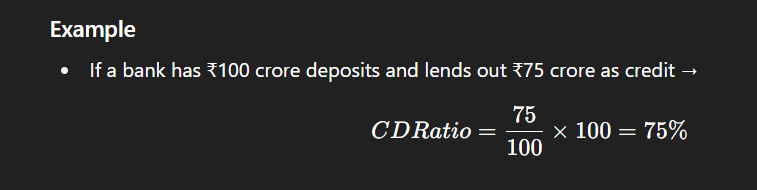
Purpose / Importance
- Measures how efficiently a bank is using its deposits.
- Indicates the health and liquidity of the banking system.
- Used by RBI as a key financial stability indicator.
5. RBI to Introduce Continuous Cheque Clearing System
Context:
The Reserve Bank of India (RBI) has announced a major reform in cheque processing by shifting from batch-based Cheque Truncation System (CTS) to continuous cheque clearing, aimed at faster settlements and enhanced customer convenience.
Current Process:
- Cheques are cleared in batches with a T+1 day cycle (up to 2 working days).
- Banks collect, scan, and process cheques in scheduled clearing sessions.
New System – Continuous Clearing:
- Cheques will be scanned, presented, and processed throughout business hours (10 AM – 4 PM).
- Clearing time: reduced to a few hours within the same day.
- Drawee bank will give positive/negative confirmation in real time.
Post-Settlement Rules:
- Clearing house shares results with presenting bank.
- Funds to be released to customers immediately, max within 1 hour after settlement.
Objectives:
- Faster cheque clearance (closer to digital payments).
- Lower settlement risks.
- Enhanced operational efficiency for banks.
- Improved customer convenience.
6. SBI Life Launches “Smart Shield Plus” Term Insurance
Context:
SBI Life Insurance has launched a new term insurance product—Smart Shield Plus—to meet the evolving protection needs of modern consumers.
Key Features
- Type of Plan: Individual, non-linked, non-participating, pure risk life insurance offering life cover without an investment component.
- Plan Options (3 Choices):
- Level Cover: Fixed sum assured throughout.
- Increasing Cover: Sum assured increases annually by 5%, up to a maximum of 200%.
- Level Cover with Future Proofing: Option to increase cover at key life stages (marriage, childbirth, etc.) without medical underwriting.
- Flexibility & Coverage:
- Whole-life protection (coverage up to age 100) and limited-term options.
- Multiple premium payment term options.
- Flexible payouts: lump sum, installments, or a combination.
- Accessibility & Innovation:
- Available through both digital and offline channels with simplified documentation.
- Affordable premiums with discounted rates for female lives.
- Objective: To provide a future-ready plan that adapts to changing responsibilities across life stages.
7. Punjab & Sind Bank Launches ‘PSB Naari Shakti’ Savings Account
Context:
Punjab & Sind Bank (PSB) has launched a special savings account named “PSB Naari Shakti” to empower women by offering financial as well as health-related benefits.
Key Features:
- Variants: Two options – PSB Pink and PSB Smile.
- Health Coverage:
- Cancer cover
- Group accidental insurance
- Free annual preventive health check-ups
- Financial Benefits:
- Complimentary Platinum RuPay debit card for seamless digital transactions
- Exclusive savings account privileges tailored for women customers
- Objective: To strengthen women’s financial independence while addressing their healthcare needs.
About Punjab & Sind Bank
- Founded: 24 June 1908
- Headquarters: New Delhi, India
- MD & CEO: Swarup Kumar Saha
Facts To Remember
1. Nagaland Governor L. Ganesan no more
L. Ganesan, 80, Governor of Nagaland and former senior BJP leader from Tamil Nadu, passed away in Chennai.
2. Keymer remains undefeated; Pranesh wins Challengers crown
German Vincent Keymer capped a memorable triumph in the Quantbox Chennai Grandmasters chess tournament 2025 with a convincing win in the final round of the Masters section over American GM Ray Robson.
3. AU Small Finance Bank to open 51 branches on Independence Day ahead of universal bank transition
AU Small Finance Bank is expanding its branch network in preparation for its conversion into a Universal Bank. It will launch 51 branches across the country on August 15, 2025, coinciding with India’s 79th Independence Day.
- Must obtain RBI authorisation under the Payment and Settlement Systems Act, 2007 (PSS Act). Payment Aggregator (PA) vs. Third-Party Payment…
- AU Small Finance Bank is expanding its branch network in preparation for its conversion into a Universal Bank. It will launch 51 branches across the country on August 15, 2025, coinciding with India’s 79th Independence Day. AU Small Finance Bank to open 51 branches on In…
- Large-Scale Bidding: Opening over 1 million sq km of erstwhile ‘No-Go’ areas for exploration. National Deep Water Exploration Mission
- Replaces the current multi-slab system with a simplified two-slab regime (5% & 18%), plus a special 40% rate for select goods. Next-Generation GST Reform
- Peer-to-Peer (P2P) payments are digital money transfers between two individuals without involving cash or physical instruments. Peer-to-Peer (P2P) Collect in Payments
17&18 August, 2025
Daily Current Affairs Quiz
17 & 18 August, 2025
National Affairs
1. Discovery of New Palm Species: Phoenix roxburghii
Context:
A palm described in the 17th-century botanical treatise Hortus Malabaricus has led to the discovery of a new species and the reclassification of existing ones after recent botanical studies.

New Species Identified:
- Name: Phoenix roxburghii (named after William Roxburgh, “Father of Indian Botany”).
- Habitat: Eastern coast of India, Bangladesh, Gujarat, Rajasthan, and Pakistan.
- Features:
- Height: 12–16 metres
- Tall solitary trunk
- Larger leaves and leaflets
- Musty-scented staminate flowers
- Large obovoid orange-yellow fruits
About Palm Tree
Family & Classification
- Belongs to Arecaceae (Palmae) family.
- Order: Arecales.
- Type: Monocotyledonous flowering plants.
Growth Forms
- Evergreen plant.
- Can grow as:
- Shrubs
- Trees
- Woody vines (lianas)
2. Sakura Science Programme 2025
Context:
A group of 34 Indian students has been flagged off to Japan to participate in the Sakura Science Programme 2025, a flagship youth exchange initiative aimed at promoting scientific curiosity and cross-cultural learning.
About the Programme:
- Full Name: Japan-Asia Youth Exchange Program in Science.
- Implemented by: Japan Science and Technology Agency (JST).
- Launched: 2014 by Japan.
- India’s Participation: Joined in 2016; continues to be an active participant.
Participating Nations:
- Includes India, Egypt, Ghana, Kenya, Nigeria, South Africa, Zambia, and multiple Asian countries.
Key Features:
- Short-term educational visits to Japan.
- Direct exposure to universities, research centres, and scientific institutions.
- Hands-on learning in science, technology, and innovation.
- Interaction with Japanese culture, discipline, and environmental ethics.
Objectives:
- Foster scientific temperament and innovation-driven outlook among youth.
- Strengthen India-Japan educational and cultural ties.
- Expose students to Japan’s technological ecosystem and research practices.
- Develop a global network of future scientists and leaders.
Banking/Finance
1. S&P Global Upgrades India’s Sovereign Credit Rating to ‘BBB’
Context:
S&P Global Ratings has upgraded India’s long-term unsolicited sovereign credit rating to ‘BBB’ from ‘BBB-’ after a gap of 18 years. The decision reflects India’s strong economic resilience, sustained fiscal consolidation, and a stable policy framework.
About S&P Global Ratings
- What it is?
- A leading global credit rating agency that provides independent assessments of credit risk.
- Headquarters:
- New York City, USA
- Aim:
- To enhance corporate transparency and investor confidence by offering credible opinions on creditworthiness.
- Functions:
- Assigns public and private credit ratings
- Provides analytical reports across corporate, government, infrastructure, and insurance sectors
- Helps investors assess the ability of borrowers to meet financial commitments
What does a sovereign credit rating mean?
A sovereign credit rating is like a report card for a country’s ability to repay its debts.
- It reflects how risky or safe it is to lend money to that country.
- Higher ratings = more trust = cheaper borrowing costs.
- Lower ratings = more risk = higher borrowing costs.
Rating Scale
- AAA = safest (like US, Germany).
- BBB and above = “Investment Grade” (safe for big investors).
- BB or lower = “Junk” (risky, speculative).
India was at BBB- (just one step above junk).
Now at BBB, India is seen as more stable and creditworthy.
Why is this important?
- Cheaper Borrowing for Government – When India issues bonds (borrows money), investors will demand lower interest rates because risk is lower.
- Boost for Foreign Investment – Global funds often require at least an “investment grade” rating, an upgrade widens India’s appeal.
- Stronger Rupee & Market Confidence – Better creditworthiness improves India’s global financial standing.
- Policy Validation – Shows that reforms, fiscal discipline, and economic growth are being recognized globally.
2. NSIC Signs MoUs with Private Banks to Boost MSME Credit Facilitation
Context:
To enhance the availability, accessibility, and affordability of credit for micro, small, and medium enterprises (MSMEs), the National Small Industries Corporation (NSIC) signed Memoranda of Understanding (MoUs) with five private sector banks on 11th August 2025 under its MSME Credit Facilitation Program.
Key Highlights:
- Partner Banks: Axis Bank, Dhanlaxmi Bank, Karnataka Bank, AU Small Finance Bank, and IndusInd Bank.
- Objective: To link MSMEs to the formal financial system and expand banks’ outreach to deserving micro and small enterprises.
Some MSME-Related Schemes in India
- Credit Guarantee Fund Trust for Micro and Small Enterprises (CGTMSE)
- Collateral-free loans up to ₹5 crore.
- Guarantees up to 75–85% of loan amount.
- Encourages banks/NBFCs to lend to MSMEs.
- Prime Minister’s Employment Generation Programme (PMEGP)
- Subsidy scheme for setting up new micro-enterprises.
- Subsidy: 15–35% of project cost depending on category and region.
- Implemented by KVIC (Khadi and Village Industries Commission).
- MUDRA Yojana (Pradhan Mantri MUDRA Yojana – PMMY)
- Loans up to ₹10 lakh under three categories:
- Shishu: up to ₹50,000
- Kishore: ₹50,000 – ₹5 lakh
- Tarun: ₹5 – ₹10 lakh
- Loans up to ₹10 lakh under three categories:
- Self-Reliant India (SRI) Fund
- ₹50,000 crore equity infusion scheme to help MSMEs grow and expand.
3. RBI Floating Rate Savings Bond (FRSB)
Context:
With bank fixed deposit (FD) rates softening after the RBI’s recent rate cuts, investors are exploring safer alternatives for higher returns. One such instrument is the RBI’s Floating Rate Savings Bond (FRSB), which currently offers 8.05% per annum and is backed by the Government of India.
RBI Floating Rate Savings Bond (FRSB):
- A government savings instrument issued by the Reserve Bank of India (RBI) on behalf of the Government of India.
- Launched: July 1, 2020 (replacing the 7.75% Savings (Taxable) Bonds, 2018).
- Known as a safe, risk-free investment since it is backed by the Government of India.
Key Features:
1. Interest Rate (Floating)
- The interest rate is linked to the prevailing National Savings Certificate (NSC) rate + 0.35%.
- Reset every 6 months (January 1 and July 1).
- Current interest rate (as of July 1, 2025): 8.05% (7.70% NSC rate + 0.35%).
- Interest is taxable, but no TDS is deducted.
2. Tenure
- 7 years fixed maturity.
- No premature withdrawal for general investors.
- Exceptions: Senior citizens (age-based lock-in):
- Age 60–70: 6 years
- Age 70–80: 5 years
- Above 80: 4 years
3. Investment Details
- Minimum investment: ₹1,000 (and in multiples of ₹1,000).
- No maximum limit (unlike many other small savings schemes).
- Can be held in demat or bond ledger account at RBI or designated banks.
4. Payment of Interest
- Interest is paid semi-annually (January 1 and July 1).
- Payment is credited directly to the investor’s bank account.
5. Taxation
- Fully taxable under the Income Tax Act.
- Interest income must be declared as “Income from Other Sources”.
- No TDS, but the investor has to pay tax as per their slab.
6. Security
- 100% backed by Government of India → zero default risk.
- Ideal for conservative investors looking for guaranteed income.
Why is it important?
- Provides a safe alternative to fixed deposits, especially for senior citizens.
- Protects against falling interest rates, since it floats with NSC rate.
- Acts as a stable, long-term investment with regular income.
4. B2B Fintechs Eye Retail Market Through TPAP
Context:
Business-to-business (B2B) fintechs in India are increasingly shifting towards the consumer payments market, using third-party UPI applications (TPAPs) as their entry points. The move is aimed at reducing customer acquisition costs (CAC) and monetising their already large user base.
Business-to-Business (B2B) Fintechs in India
- B2B fintechs are technology-driven financial service providers that serve businesses (MSMEs, corporates, startups, banks, NBFCs, etc.) rather than individual consumers.
- They help enterprises with payments, credit, compliance, accounting, lending, and digital infrastructure.
- Unlike B2C fintechs (like PhonePe or Paytm), B2B fintechs operate behind the scenes to power business transactions.
Third-Party UPI Applications (TPAPs)
- Third-Party UPI Application Providers (TPAPs) are apps that offer Unified Payments Interface (UPI) services to users, but are not banks themselves.
- They provide the front-end app/platform while actual payment processing is done through sponsor banks (called Payment Service Providers – PSP banks) connected to NPCI’s UPI system.
- Example: Google Pay, PhonePe, Paytm, Amazon Pay, BharatPe.
Agriculture
1. Discovery of Chalk9 Gene in Rice to Reduce Grain Chalkiness
Context:
Rice, the staple food for over half of the world’s population, often faces the problem of chalkiness in grains, which leads to higher breakage during milling. Recently, researchers from the Agricultural College of Yangzhou University, China, identified a key gene, Chalk9, that controls rice chalkiness.
What’s the Discovery?
Scientists have identified a gene that helps rice grains resist breakage during milling, particularly addressing grains with the trait known as chalkiness, a characteristic that makes them brittle and more prone to cracking when polished
- Breakthrough Discovery:
- Researchers sequenced genomes of 175 rice varieties.
- Found a DNA segment on chromosome 9 strongly linked with chalkiness.
- This segment regulates the Chalk9 gene in the rice endosperm.
- Varieties and Breeding:
- Chalk9-H (high chalkiness) was dominant before 1990.
- Chalk9-L (low chalkiness) increased significantly after 1990 due to breeding programs.
- Now, breeders can directly introduce Chalk9-L to improve grain quality.
What is Chalkiness?
- Rice grains are chalky if large parts of them appear opaque instead of translucent.
- Measured by chalky grain rate and degree of chalkiness.
- Leads to higher breakage during milling.
- Influenced by genetic factors and high temperature.
Why Chalkiness Important?
- Chalky grains are weaker and more likely to break during milling.
- This reduces the recovery of whole, commercially acceptable rice, thereby lowering its quality and market value
Why This Matters?
- Improved Grain Quality: By targeting this gene in breeding programs, scientists can develop rice varieties with lower chalkiness, boosting the yield of whole (unbroken) grains.
- Economic Benefit: Higher rate of unbroken rice translates to better profits for farmers and millers.
- Enhanced Food Value: Whole grains are more prized by consumers, improving both marketability and food quality.
Facts To Remember
1. China’s Wang to arrive for talks as India tries to boost ties with Beijing
India will host Chinese Foreign Minister Wang Yi next week, the Ministry of External Affairs (MEA) said on Saturday, as New Delhi continues efforts to energise its relationship with Beijing amid uncertainties in its trade ties with Washington, another major trading partner.
2. India, China Hold 24th Round of Boundary Talks in New Delhi; Chinese FM Wang Yi to Meet PM Modi
The 24th round of Special Representatives dialogue led by National Security Advisor Ajit Doval and Chinese Foreign Minister Wang Yi on the boundary question between India and China has begun in New Delhi.
3. Press Registrar General Launches ‘Press Sewa’ Portal to Simplify Newspaper, Periodical Registration
Press Registrar General of India (PRGI) Yogesh Baweja has said the Press Sewa portal has been introduced as a single-window solution to simplify the registration process for newspapers and periodicals.
4. One-time online registration for PMVBRY opens
The Pradhan Mantri Viksit Bharat Rozgar Yojana (PMVBRY) portal under the Pradhan Mantri Viksit Bharat Rozgar Yojana has gone live. The scheme will provide incentive of up to 15 thousand rupees in two instalments to newly employed youth and upto three thousand rupees per month per new employee to employers for creation of new job opportunities.
- Launched: July 1, 2020 (replacing the 7.75% Savings (Taxable) Bonds, 2018). RBI Floating Rate Savings Bond (FRSB)
- ₹50,000 crore equity infusion scheme to help MSMEs grow and expand. NSIC Signs MoUs with Private Banks to Boost MSM…
- B2B fintechs are technology-driven financial service providers that serve businesses (MSMEs, corporates, startups, banks, NBFCs, etc.) rather than individual consumers. B2B Fintechs Eye Retail Market Through TPAP
- Researchers sequenced genomes of 175 rice varieties. Discovery of Chalk9 Gene in Rice to Reduce Grai…
- India’s Participation: Joined in 2016; continues to be an active participant. Sakura Science Programme 2025
19 August, 2025
Daily Current Affairs Quiz
19 August, 2025
National Affairs
1. The State of Food Security and Nutrition in the World 2025 Report
Context:
The UN Food and Agriculture Organization (FAO) released its State of Food Security and Nutrition in the World 2025 Report, showing global undernourishment at 8.2% (673 million people). India has been a decisive contributor to this decline.
Key Highlights:
- India’s Progress: Prevalence of undernourishment reduced from 13% (2020–22) to 12% (2022–24), meaning 30 million fewer hungry people.
- Global Picture: Undernourishment down from 9.4% in 2020 to 8.2% in 2025.
- Hidden Hunger: Micronutrient deficiency remains a concern globally despite caloric improvements.
Understanding Hunger
- Definition: A state of chronic undernourishment due to lack of sufficient calories or nutrients.
- Forms:
- Undernourishment – calorie deficiency.
- Malnutrition – poor diet lacking protein/micronutrients.
- Hidden Hunger – micronutrient deficiencies (iron, iodine, vitamin A, zinc).
Causes of Hunger in India
- Poverty & Inequality: 11.28% still multidimensionally poor (NITI Aayog, 2023).
- Agricultural Challenges: Low productivity, erratic monsoons, high post-harvest losses (~13%).
- High Food Prices: 60% population cannot afford a healthy diet (FAO).
- Weak Infrastructure: ₹92,000 crore lost annually in post-harvest losses (ICAR, 2022).
- Climate Change & Conflict: Crop losses, pandemics, and wars disrupting food supply.
- Health & Sanitation: NFHS-5 shows 35.5% children stunted and 19.3% wasted.
Consequences of Hunger
- Human Capital Loss: Poor learning outcomes, low adult productivity.
- Economic Burden: 2–3% of India’s GDP lost annually (Global Nutrition Report, 2021).
- Health Risks: Anaemia, TB, infections, micronutrient-linked impairments.
- Social Instability: Hunger drives unrest, migration, and conflict.
- SDG Failure: Direct barrier to SDG 2 (Zero Hunger), indirect to SDG 3, 4, 8.
India’s Role in Combating Hunger
- Strengthened PDS: ONORC, Aadhaar linkage, subsidised grains for 800M people.
- Nutrition Schemes: PM POSHAN (school meals), POSHAN Abhiyaan, ICDS, Anaemia Mukt Bharat.
- Digital & Tech Support: e-NAM, AgriStack, AI tools for supply chain & crop monitoring.
- Agrifood System Reforms: Cold chains, FPOs, women-led enterprises, climate-resilient crops.
- Global Model: India’s governance in food security seen as replicable across Global South.
2. Impeachment Motion Against Chief Election Commissioner (CEC)
Context:
The Opposition is considering an impeachment motion against Chief Election Commissioner (CEC) Gyanesh Kumar, raising questions on the rare and stringent removal process of a CEC under the Constitution.
About the CEC Removal Process
Constitutional Authority:
- The CEC is appointed under Article 324 of the Indian Constitution.
- Removal safeguards are meant to ensure independence and neutrality of the Election Commission.
Grounds for Removal:
- Proved Misbehaviour: corruption, abuse of office, or failure to discharge duties.
- Incapacity: inability to perform constitutional functions.
Procedure of Removal:
- Initiation: Motion can be introduced in either House of Parliament, supported by at least 50 MPs.
- Inquiry: A judicial inquiry committee examines evidence and validates charges.
- Voting in Parliament: Motion must be passed by a two-thirds majority of members present and voting in both Houses.
- Presidential Action: Once approved by Parliament, the President orders removal (no discretion).
- Other Election Commissioners: Can be removed only on the recommendation of the CEC, further strengthening independence.
Historical Note:
- No Chief Election Commissioner has ever been removed since Independence.
- The high constitutional threshold ensures protection against political interference.
3. India to Land Astronaut on the Moon by 2040
Context:
Union Minister Jitendra Singh announced in the Lok Sabha that India will land an astronaut on the Moon by 2040. This declaration is part of a broader roadmap to establish India as a global space power and aligns with the Viksit Bharat @2047 vision.
About India’s Moon Mission
What it is:
- India’s proposed crewed lunar mission by 2040 is a long-term national vision.
- It aims to showcase human space exploration beyond Earth orbit.
- It integrates scientific, economic, and security goals with space capability.
Objectives:
- Demonstrate human exploration capacity beyond Earth.
- Build indigenous capacity for lunar habitation and resource utilisation.
- Enhance India’s role in the $45 billion global space economy.
Key Features:
- Human Landing: An Indian astronaut to step on the Moon by 2040.
- Indigenous Development: Use of Indian-built launch vehicles, life-support, and lunar surface technologies.
- Global Collaboration: Joint missions with advanced space agencies for tech sharing.
- Strategic Vision: Supports India’s global standing in space and national development.
Other Planned Milestones in India’s Space Programme
- 2026 – Vyommitra Mission: Uncrewed mission with humanoid robot Vyommitra to test systems.
- 2027 – Gaganyaan Mission: India’s first human spaceflight with astronauts in low Earth orbit.
- 2035 – Bharat Antariksh Station: India’s indigenous space station for long-duration research.
- 2040 – Crewed Moon Landing: Historic step with an Indian astronaut on the lunar surface.
4. Ethanol-Blended Petrol (E20)
Context:
India had set a target in 2021 to achieve 20% ethanol blending in petrol (E20) by 2025. Vehicles modified for E20 compatibility started rolling out from April 2025. While aimed at reducing carbon emissions and oil import dependency, the move has raised concerns among vehicle owners about mileage, corrosion, and higher maintenance costs.
What is Ethanol?
- A biofuel made from biomass (sugarcane molasses, broken rice, maize, lignocellulosic materials).
- Acts as an oxygenate when blended with petrol → enables better combustion.
Production Process
- From molasses (C-heavy & B-heavy) via fermentation using enzymes (invertase, zymase).
- From food grains & lignocellulosic material after conversion into fermentable sugars.
Fuel Properties
- Calorific Value (CV): Lower than petrol → theoretically reduces mileage.
- Octane Number: Higher than petrol → reduces engine knocking.
- Hygroscopic Nature: Ethanol attracts water → risk of corrosion in tanks, pipes, and injectors.
Impact on Vehicles
- Older Vehicles (pre-BS-VI, mostly carbureted): Cannot adapt easily; risk of corrosion and clogging.
- Modern Vehicles (BS-IV & BS-VI, ECU-equipped): Can recalibrate spark timing & combustion; less affected.
- Government’s Position: Part replacement (rubber/gaskets) is inexpensive and needed only once in a vehicle’s lifetime.
Global Comparison – Brazil’s Ethanol Story
- Brazil uses E27 petrol after decades of phased policy (since 1975).
- Government built strong production capacity, subsidies, and flex-fuel engine adoption.
- Indian scenario differs: Most pre-2020 vehicles not designed for flex-fuel.
Banking/Finance
1. SEBI Proposes Changes in Minimum Public Shareholding and Public Offer Norms
Context:
The Securities and Exchange Board of India (SEBI) has released a consultation paper to increase flexibility in Minimum Public Shareholding (MPS) and Minimum Public Offer (MPO) requirements. The proposal seeks to simplify fundraising and give listed companies more time to comply with shareholding norms.
Minimum Public Offer (MPO)
MPO refers to the minimum percentage of equity that must be offered to the public at the time of IPO (Initial Public Offer).
Regulation
- Governed under Rule 19(2)(b) of SCRR, 1957.
- Linked to post-issue market capitalization of the company.
- SEBI proposes to raise the MPO for companies approaching listing.
- Thresholds of post-issue market capitalisation revised to:
- ₹4,000 crore – ₹50,000 crore
- ₹50,000 crore – ₹1 lakh crore
- ₹1 lakh crore – ₹5 lakh crore
- Above ₹5 lakh crore
Minimum Public Shareholding (MPS)
MPS is the minimum percentage of shares in a listed company that must be held by the public (non-promoters).
Regulation
- Governed under Rule 19A of Securities Contracts (Regulation) Rules, 1957 (SCRR) and SEBI Listing Regulations.
- Current requirement: 25% public shareholding within 3 years of listing.
- Proposed: For companies with post-issue market cap ₹50,000 crore – ₹1 lakh crore:
- 15% public shareholding within 5 years of listing.
- 25% public shareholding within 10 years of listing.
2. Sebi Proposes Stricter Norms for Sectoral & Thematic Indices in Derivatives
Context:
On 29 May 2025, the Securities and Exchange Board of India (Sebi) released a consultation paper proposing stricter norms for sectoral and thematic indices used in derivatives trading. The move aims to ensure that indices are broad-based and not dominated by a few stocks, thereby reducing concentration risks.
Key Highlights:
- Minimum Constituents:
- Each sectoral/thematic index must have at least 14 stocks.
- Stock Weightage Cap:
- No single stock can have more than 20% weight in the index.
- Combined weight of the top 3 stocks capped at 45%.
- Remaining stocks must follow a descending order of weightage.
What are Derivatives?
A derivative is a financial instrument whose value is derived from the value of an underlying asset such as stocks, bonds, currencies, commodities, or indices.
Types of Derivatives:
- Forwards – Customized contracts between two parties to buy/sell an asset at a future date at a pre-agreed price (not traded on exchange, OTC).
- Futures – Standardized contracts to buy/sell an asset at a set price on a future date (traded on exchanges like NSE, BSE, MCX).
- Options – Contracts that give the buyer the right, but not the obligation, to buy/sell an asset at a specified price within a set time.
- Call Option = Right to Buy
- Put Option = Right to Sell
- Swaps – Agreement to exchange cash flows or liabilities (e.g., interest rate swaps, currency swaps).
What are Sectoral and Thematic Indices?
- Sectoral Indices track companies belonging to a specific sector such as banking, IT, FMCG, pharma, metals, energy, etc.
- Thematic Indices track companies across multiple sectors but grouped around a particular theme, e.g., infrastructure, ESG, consumption, services.
Why Important for Derivatives Trading?
- These indices are used for Futures & Options (F&O) contracts, allowing investors to hedge, speculate, or take exposure in a sector/theme without investing in individual stocks.
- Provide liquidity and risk management tools for institutional and retail investors.
3. Special Mention Accounts (SMA) and Non-Performing Asset (NPA)
Context:
The Union government is considering a proposal to extend the non-performing asset (NPA) classification period for loans given to micro, small, and medium enterprises (MSMEs) from the current 90 days to 180 days.
Key Highlights:
- Objective: To provide relief to cash-strapped MSMEs affected by steep US tariffs, supply chain disruptions, and liquidity stress.
- Comparison: Agriculture sector already enjoys longer repayment moratoriums (180–360 days). MSMEs, with cyclic/seasonal cash flows, seek similar flexibility.
- SMA Relaxation: The government may also relax the timeline for Special Mention Accounts (SMA), which are early indicators of loan stress.
Special Mention Accounts (SMA)
- A Special Mention Account (SMA) is a category introduced by RBI to identify and monitor incipient stress in loan accounts before they turn into Non-Performing Assets (NPAs).
- Objective: Early warning system for banks and financial institutions to take corrective action.
Classification of SMA Accounts
RBI (2014 framework) classifies SMA based on number of days a loan is overdue (principal or interest):
- SMA-0: Principal/interest overdue 1–30 days.
- SMA-1: Principal/interest overdue 31–60 days.
- SMA-2: Principal/interest overdue 61–90 days.
If overdue >90 days → NPA.
Non-Performing Asset (NPA)
An NPA is a loan or advance where the borrower has failed to make interest or principal payments for a specified period, indicating financial stress.
- As per RBI, a loan becomes NPA if interest or principal remains overdue for more than 90 days.
- Applies to commercial banks and financial institutions.
4. Tata AIA Launches Momentum 50 Index Fund
Context:
On August 19, 2025, Tata AIA Life Insurance Co Ltd launched the Momentum 50 Index Fund, with its New Fund Offer (NFO) priced at ₹10 per unit. The NFO will remain open until August 25, 2025.
Key Highlights:
- Portfolio: Invests in 50 high-momentum stocks selected from the BSE 500 universe, based on their recent strong performance.
- Unique Feature: Combines equity investment potential with life insurance protection for policyholders.
Momentum 50 Index Fund
A Momentum Index Fund is a type of equity-linked fund that invests in a basket of stocks selected based on their recent performance trend.
- The Momentum 50 Index Fund tracks the BSE 500 Momentum 50 Customised Index, consisting of 50 high-momentum stocks from the BSE 500 universe.
- Objective: To capture stocks likely to continue outperforming based on past price and earnings trends.
5. IRDAI Directs Insurers to Undertake QIS for Risk-Based Capital Framework
Context:
The Insurance Regulatory and Development Authority of India (IRDAI) has directed insurance companies to conduct a Quantitative Impact Study (QIS 2) as part of the transition to a Risk-Based Capital (RBC) regulatory framework for the Indian insurance industry.
Quantitative Impact Study (QIS)
A Quantitative Impact Study (QIS) is a regulatory exercise conducted by IRDAI to assess the impact of proposed regulatory changes—specifically the Risk-Based Capital (RBC) framework—on Indian insurance companies.
- Purpose: To evaluate solvency requirements and capital adequacy under a risk-sensitive approach.
- Replaces the traditional fixed-solvency margin system with a framework aligned to global standards.
Key Objectives of RBC Framework
- Principle of RBC: Insurers will hold capital proportionate to the risks they undertake, including investment, underwriting, operational, and market risks.
- Objective: Strengthen financial stability, enhance policyholder protection, and support globalisation of India’s insurance industry.
- Moves Indian insurers closer to international solvency norms.
Agriculture
1. SRMIST Hosts ‘Agri Startup 2.0’ to Promote Sustainable Farming
Context:
SRM College of Agricultural Sciences, part of SRM Institute of Science and Technology (SRMIST), Kattankulathur, organised ‘Agri Startup 2.0’, a platform bringing together farmers, youth, women entrepreneurs, and innovators to foster sustainable agriculture solutions.
Key Highlights:
- Organisers:
- SRMIST College of Agricultural Sciences.
- In collaboration with Isha Save Soil Movement, active in Tamil Nadu for nearly three decades.
- Focus Areas:
- Revitalising soil health.
- Promoting natural farming.
- Enhancing farmers’ livelihood.
- Ensuring toxin-free food for all.
- SRMIST Initiatives:
- Runs a College of Agricultural Sciences in Achirapakkam.
- Provides land and financial support to agriculture-related start-ups.
- Supports research and incubation initiatives for sustainable farming.
Significance:
- Encourages agripreneurship and innovation in farming.
- Promotes natural farming methods for environmental sustainability.
- Strengthens rural livelihoods while ensuring food security.
Facts To Remember
1. Modi meets Shukla, says India is proud of his achievement
Prime Minister Narendra Modi on Monday met Group Captain Shubhanshu Shukla, who became the first Indian astronaut to travel to the International Space Station (ISS).
2. Rajya Sabha passes Indian Ports Bill
The Rajya Sabha passed the Indian Ports Bill, 2025, that replaces the Indian Ports Act of 1908.
3. Bengal CM announces scheme for migrant workers facing harassment
West Bengal Chief Minister Mamata Banerjee announced a new scheme to provide monthly cash incentives to migrant workers who return to the State after facing harassment in other States.
4. 23% of PM Jan Dhan accounts inoperative
As many as 23% of the total 56.04 crore Pradhan Mantri Jan Dhan Yojana (PMJDY) accounts are inoperative, said Minister of State for Finance Pankaj Chaudhary.
5. Top Indians for Archery Premier League in October
Ace archers such as Olympians Deepika Kumari and B. Dhiraj in recurve and V. Jyothi Surekha and Abhishek Verma in compound are among the Indian archers named for the inaugural Archery Premier League (APL), scheduled to be held at the Yamuna Sports Complex in Delhi in October.
6. Kapil and Girish bag gold medals in Asian meet
Kapil Bainsla won the air pistol gold in the junior men’s event by beating Ilkhombek Obidjonov of Uzbekistan by 0.6 point in the 16th Asian shooting championship in Shymkent, Kazakhstan.
7. LIC launches campaign to revive lapsed policies
State-owned Life Insurance Corporation of India (LIC) launched a nationwide campaign to revive lapsed individual insurance policies, effective from August 18 to October 17. LIC is offering concession on late fees of up to 30 per cent, or a maximum of ₹ 5,000, for allnon-linked insurance plans.
8. Bank of Maharashtra and SBI Card Launch Co-Branded Credit Card
On August 19, 2025, Bank of Maharashtra (BoM) and SBI Card jointly launched the “Bank of Maharashtra SBI Card” in three variants to offer enhanced value, convenience, and lifestyle benefits to customers.
9. Government Launches PM Viksit Bharat Rojgar Yojana Portal for Employers
The Union Government has launched the Pradhan Mantri Viksit Bharat Rozgar Yojana (PM-VBRY) portal to facilitate implementation of its new employment-linked incentive programme aimed at boosting job creation.
10. Unemployment Rate Declines to 5.2% in July: PLFS Data
The Periodic Labour Force Survey (PLFS) released by the Ministry of Statistics and Programme Implementation (MoSPI) on 18 August 2025 shows that India’s unemployment rate has fallen, with notable improvements in rural employment indicators.
- Economic Burden: 2–3% of India’s GDP lost annually (Global Nutrition Report, 2021). The State of Food Security and Nutrition in the…
- 2027 – Gaganyaan Mission: India’s first human spaceflight with astronauts in low Earth orbit. India to Land Astronaut on the Moon by 2040
- No single stock can have more than 20% weight in the index. Sebi Proposes Stricter Norms for Sectoral & The…
- On August 19, 2025, Tata AIA Life Insurance Co Ltd launched the Momentum 50 Index Fund, with its New Fund Offer (NFO) priced at ₹10 per unit. The NFO will remain open until August 25, 2025. Tata AIA Launches Momentum 50 Index Fund
- On August 19, 2025, Bank of Maharashtra (BoM) and SBI Card jointly launched the “Bank of Maharashtra SBI Card” in three variants to offer enhanced value, convenience, and lifestyle benefits to customers. Bank of Maharashtra and SBI Card Launch Co-Bran…
20 August, 2025
Daily Current Affairs Quiz
20 August, 2025
National Affairs
1. Governor’s Assent to Bills
Context:
The Supreme Court of India delivered a significant judgment reprimanding Tamil Nadu Governor R.N. Ravi for withholding assent or delaying action on 10 state bills re-passed by the state legislature. The Court held that the Governor’s act of reserving these bills for the President’s consideration was unconstitutional.
Key Constitutional Provisions:
- Article 200: Governor’s powers on assent – assent, withhold, or reserve for President.
- Article 201: President’s veto on reserved bills.
- Article 142: SC’s plenary power to ensure complete justice.
Supreme Court’s Observations:
- Governor’s reservation of 10 bills was illegal and arbitrary.
- Bills re-presented are deemed assented from date of re-presentation.
- Governor has no discretion under Article 200; must act on aid & advice of Council of Ministers.
- No “absolute veto” or “pocket veto” possible.
- Delays violate federalism and democracy.
Timelines Fixed by SC (First Time Ever):
| Scenario | Maximum Time Allowed |
|---|---|
| Withhold assent or reserve for President (with CoM’s advice) | 1 Month |
| Withhold assent without CoM’s advice (returning bill) | 3 Months |
| Bill re-passed by Assembly (2nd time) | 1 Month |
Judicial Oversight:
- Non-compliance with timelines makes Governor’s inaction subject to Judicial Review.
- SC invoked Article 142 to declare the bills as deemed assented.
Reaffirmation of Democratic Principles:
- Governor cannot act as an obstructionist.
- Elected legislators are the true representatives of the people.
- Governor must act as a facilitator, not a political actor.
- Must act as a friend, philosopher, and guide.
Clarification on Reserve Power:
- Once re-passed, Governor cannot again reserve bill for President unless content is materially altered.
- Any delay beyond this violates constitutional oath.
2. Saltwater Crocodile
Context:
The West Bengal Forest Department has reported a notable increase in the population of saltwater crocodiles (Crocodylus porosus) in the Sundarban Biosphere Reserve (SBR), highlighting the success of ongoing conservation efforts.
About:
- The largest of 23 extant crocodilian species (includes true crocodiles, alligators, caimans).
- Also called Estuarine Crocodile, commonly found in brackish waters of estuaries.
- Capable of tolerating saltwater, can travel long distances in the open ocean using tidal currents.
Habitat (India & Global):
- In India: Sundarbans, Bhitarkanika National Park (Odisha), Andaman & Nicobar Islands.
- One of three crocodiles native to India, along with Mugger (Crocodylus palustris) and Gharial (Gavialis gangeticus).
Threats:
- Habitat loss, fragmentation, fishing activities, and illegal use of body parts in traditional medicine.
Protection Status:
- IUCN Red List: Least Concern
- CITES: Appendix I (except Australia, Indonesia & Papua New Guinea populations in Appendix II)
- Wildlife Protection Act, 1972 (India): Schedule I
3. “One Nation, One Election” Bill
Context:
The Joint Parliamentary Committee (JPC), headed by BJP MP P.P. Chaudhary, is reviewing the Constitution (One Hundred and Twenty-Ninth Amendment) Bill, 2024, aimed at enabling simultaneous elections to the Lok Sabha and State Assemblies. Former Chief Justice of India Sanjiv Khanna raised concerns regarding potential constitutional and federal implications of the legislation.
One Nation, One Election:
One Nation, One Election is a proposal under consideration by the Government of India to synchronise all elections in the country either on a single day or within a specific time frame, with an objective of cutting election cost.
Key Legal Concerns:
- Clause 5 of Article 82A: Grants the Election Commission (EC) “unfettered discretion” to postpone Assembly elections, which may be struck down under Article 14 (equality before law) for arbitrariness.
- Indirect President’s Rule Risk: The clause may extend powers beyond Article 356, enabling the Union Government to indirectly assume control of States.
- Limited Impact on Governance: Justice Khanna observed that the Bill fails to fully address policy paralysis, as premature dissolutions would still invoke the Model Code of Conduct, curbing governance efficiency.
Legislative Provisions in the Bill:
- Insertion of a new Article 82A.
- Amendments to Articles 83 and 172 relating to Lok Sabha and State Assembly terms.
Next Steps:
- The Joint Parliamentary Committee (JPC) will meet economists to assess financial implications of holding simultaneous elections.
- The Government’s position: The Bill will reduce election expenditure significantly and improve efficiency.
4. Govt Drafts Bill to Ban Online Real-Money Gaming in India
Context:
The Union Government has finalised a draft legislation to ban all forms of online real-money gaming (RMG) in India. The Promotion and Regulation of Online Gaming Bill, 2025 is scheduled to be introduced in the Lok Sabha.
What is Online Real-Money Gaming (RMG)?
- Online RMG refers to games where players stake real money with the potential to win monetary rewards.
- Includes skill-based games (like rummy, poker, fantasy sports) and chance-based games (betting, gambling).
Key Highlights of the Draft Bill:
- Definition of Online Money Gaming:
- The Bill defines RMGs as “depositing money or other stakes in expectation of winning which entails monetary or other enrichment in return”.
- Under this definition, most RMG platforms fall within the prohibited category.
- Total Ban:
- Prohibits offering, aiding, abetting, inducing, or promoting any online money gaming service.
Rationale:
- Aimed at addressing rising gaming addiction among youth, which has led to mental health issues and financial distress.
- Seeks to safeguard consumers from exploitation while providing clarity on permissible gaming formats.
5. Cloudburst Disasters in India
Context:
In 2025, cloudbursts, flash floods, and landslides have wreaked havoc across Northeast India, Uttarakhand, Himachal Pradesh, and most recently, Jammu and Kashmir. Over 60 lives were lost in J&K in less than a week, underscoring gaps in India’s climate preparedness and early-warning systems.
Background:
- Cloudbursts are intense rainfall events defined as precipitation exceeding 100 mm per hour over ~30 sq. km.
- Common in Himalayan regions due to interaction of monsoon winds, cold winds, and mountain topography.
- Effects are not localized – they cause landslides, flash floods, and downstream destruction.
- Global warming and changing monsoon patterns are increasing frequency and intensity.
Current Challenges:
- Weak Drainage & Infrastructure:
- Urban flooding in Delhi, Mumbai, and Bengaluru highlights poor planning and drainage systems.
- Gaps in Climate Information:
- Cloudbursts occur in small tracts often without rainfall gauges.
- IMD lacks dense weather-monitoring networks needed for hyper-local forecasts.
- Limited Preparedness:
- Fragile ecosystems in the Himalayas are exposed to unregulated construction and tourism.
Policy Imperatives:
- Strengthen IMD’s Monitoring Capacity: Invest in dense weather instrument networks and computing power.
- Cloudburst-Prone Mapping: Use satellite imagery + historical data to identify vulnerable zones.
- Integrated Coordination: Collaboration among IMD, scientists, planners, and authorities at all levels.
- Climate-Resilient Urban Planning: Upgrade drainage systems and regulate construction in high-risk zones.
- Public Awareness & Communication: Ensure early warnings reach local communities effectively.
Banking/Finance
1. RBI Study: Foreign Liabilities of Indian Mutual Funds Rise 19.9% in FY25
Context:
The Reserve Bank of India (RBI) released a study highlighting the growing foreign investor participation in Indian mutual fund schemes.
Key Highlights:
- Foreign Liabilities: Increased 19.9% YoY, reaching ₹2.6 lakh crore in FY25, up from ₹2.1 lakh crore in FY24.
- Top Investors:
- UAE: Largest contributor, accounting for 1/5th of total MF investments.
- U.S. & U.K.: Together contributed ~20% .
- Australia & Canada: Fastest growth, with investments rising over 40% in FY25.
Implications:
- Positive Side:
- Enhances capital inflows into domestic mutual funds.
- Strengthens India’s integration with global financial markets.
- Concerns:
- Increases exposure to global market volatility and sudden foreign outflows.
- May affect financial stability during external shocks.
- Raises regulatory challenges in monitoring cross-border flows.
Regulatory:
- Investments by Foreign Portfolio Investors (FPIs) and non-residents are regulated by SEBI and RBI.
- Governed under Foreign Exchange Management Act (FEMA), 1999.
2. Urban Challenge Fund (UCF)
Context:
India’s rapid urbanisation has highlighted the urgent need for new financing models for city infrastructure. To address this, the Union Budget 2025 announced the creation of an Urban Challenge Fund (UCF) worth ₹1 lakh crore, marking a strategic departure from entitlement-based grants to a competitive, performance-linked funding framework.
What is the Urban Challenge Fund (UCF)?
The Urban Challenge Fund (UCF) is a ₹1 lakh crore financing mechanism announced in the Union Budget 2025–26 to support transformative and bankable urban development projects in India.
Key Features of UCF:
- Corpus: ₹1 lakh crore
- Initial Allocation (FY 2025–26): ₹10,000 crore
- Objective: To promote innovation, competitiveness, and sustainability in urban development.
- Focus Areas:
- Cities as Growth Hubs
- Creative Redevelopment of Cities
- Water and Sanitation
Funding Mechanism:
- UCF will finance up to 25% of project costs.
- At least 50% of funding must come from market sources like:
- Municipal bonds
- Bank loans
- Public–Private Partnerships (PPPs)
- Remaining portion to be managed by local/state governments
3. Nifty Bank Index
Context:
The Securities and Exchange Board of India (SEBI) has proposed a relaxation in index realignment norms to avoid sudden market disruptions, especially in the Nifty Bank index, which is heavily skewed towards HDFC Bank and ICICI Bank.
Background:
SEBI’s May 2025 Norms
- Weight of any single stock in non-benchmark indices capped at 20%.
- Combined weight of top three constituents capped at 45%.
- Indices must have at least 14 stocks (Nifty Bank currently has 12).
What is Nifty Bank Index?
- The NIFTY Bank index is a stock market index that tracks the performance of the Indian banking sector.
- It comprises the most liquid and large-capitalized banking stocks from both public and private sector banks.
Key Features:
- Introduced by NSE: 2003
- Number of Constituents: 12 banks (free-float market capitalization weighted).
- Weightage Method: Free-float market capitalization.
- Types of Banks Included:
- Public sector banks (e.g., SBI)
- Private sector banks (e.g., HDFC Bank, ICICI Bank, Kotak Mahindra Bank, Axis Bank)
4. SEBI Reconsiders Intraday Limits for Equity Derivatives
Context:
The Securities and Exchange Board of India (SEBI) is reviewing stricter position limits on index derivatives in the Indian markets. This comes in the backdrop of concerns over manipulative trading strategies impacting retail investors.
Proposed Move:
- Stricter intraday position limits for index derivatives.
- Aimed at reducing market volatility, manipulation risks, and protecting retail participation.
Intraday Limits for Equity Derivatives
Intraday limits in equity derivatives are regulatory caps or restrictions on the size of trading positions (open contracts) that an investor, trader, or institution can take within the same trading day in products like index futures and options.
These limits are set by SEBI (Securities and Exchange Board of India) and monitored by stock exchanges to:
- Prevent excessive speculation or over-leveraging.
- Reduce chances of market manipulation.
- Safeguard retail investors from high-risk derivative bets.
- Ensure systemic stability in India’s derivatives-heavy market.
5. InvITs and REITs AUM Cross $94 Billion in FY25
Context:
According to a report by Knight Frank India, the combined Assets Under Management (AUM) of Infrastructure Investment Trusts (InvITs) and Real Estate Investment Trusts (REITs) in India have shown remarkable growth over the last five years.
InvITs (Infrastructure Investment Trusts)
- InvITs are collective investment vehicles that pool money from investors to invest in infrastructure projects (roads, power transmission lines, renewable energy, pipelines, etc.).
- They provide a way for retail and institutional investors to invest in long-term infrastructure assets that generate stable cash flows.
Key Features:
- Regulated by SEBI (Infrastructure Investment Trusts) Regulations, 2014.
- Investors receive returns from tolls, tariffs, annuities, or usage fees collected from infrastructure assets.
- Units are listed and traded on stock exchanges.
REITs (Real Estate Investment Trusts)
- REITs are pooled investment vehicles that allow investors to invest in commercial real estate properties (office spaces, malls, hotels, warehouses, etc.).
- They help small investors access real estate markets without needing to directly buy property.
Key Features:
- Regulated by SEBI (Real Estate Investment Trusts) Regulations, 2014.
- Like InvITs, REITs must distribute at least 90% of net distributable cash flows.
- Units are listed on exchanges, providing liquidity and transparency.
ET
6. Registered Investment Advisers (RIAs) and Research Analysts
Context:
The Securities and Exchange Board of India (SEBI) has floated a consultation paper to ease compliance for Registered Investment Advisers (RIAs) and Research Analysts, addressing practical challenges in the existing framework. This comes after a decline in the number of RIAs from around 1,300 a few years ago to 967 at present.
Background:
- SEBI introduced fee-based advisory regulations in 2013.
- The RIA model struggled to expand due to high entry barriers and stringent compliance introduced in 2020.
- Reforms since January 2025 have gradually eased these norms.
Registered Investment Advisers (RIAs) and Research Analysts (RAs)
- To protect investors and ensure transparency, SEBI regulates investment advice and research services through two separate categories:
- Registered Investment Advisers (RIAs)
- Research Analysts (RAs)
- The aim is to curb conflict of interest, ensure professional standards, and promote investor protection in capital markets.
Registered Investment Advisers (RIAs)
- Individuals or entities registered with SEBI to provide investment advice to clients for a fee.
- Registration with SEBI is mandatory.
- Governed by SEBI (Investment Advisers) Regulations, 2013.
Research Analysts (RAs)
- Professionals/entities that prepare and publish research reports or stock recommendations on listed securities/companies.
- Registration with SEBI is mandatory.
- Governed by SEBI (Research Analysts) Regulations, 2014.
7. HDFC ERGO and PhonePe Launch Affordable Health Insurance for the “Missing Middle”
Context:
HDFC ERGO General Insurance has partnered with digital payments platform PhonePe to introduce an affordable health insurance plan aimed at India’s “missing middle” — young adults who are typically first-time purchasers of insurance coverage.
Key Highlights:
- Premiums start at ₹12 per day for ₹3 lakh coverage.
- The policy is accessible through the PhonePe app, leveraging its digital reach.
- Target audience: Individuals aged 18–30 years, many new to insurance.
Significance:
- Enhances health insurance penetration among younger, underserved demographics.
- Demonstrates the power of digital platforms in making insurance more accessible and cost-effective.
- Strategic collaboration between a leading insurer and a fintech platform expands financial inclusion in the insurance sector.
8. TaxBuddy Launches AI-Powered Tax Filing System
Context:
TaxBuddy, a leading tax returns filing platform, has unveiled an AI-powered filing system aimed at making income tax filing faster, simpler, and more efficient for Indian taxpayers.
Key Features:
- Speed: Tax returns can now be filed in just three minutes.
- Instant Support: The system offers immediate query resolution, assisting users as they file.
- Empowerment: The initiative is about more than speed it’s designed to provide taxpayers with clarity and confidence during the process.
Significance:
- Marks a significant leap in fintech usability by incorporating AI directly into the user tax-filing workflow.
- Aligns with India’s broader push for digitization in financial services, emphasizing efficiency, accessibility, and user clarity.
- Reduces tax compliance and complexity.
9. Punjab National Bank Becomes First PSU Bank to Migrate to ‘.bank.in’ Domain
Context:
Punjab National Bank (PNB) has successfully migrated its corporate website to www.pnb.bank.in, becoming the first Public Sector Bank in India to adopt the ‘.bank.in’ domain, as per RBI’s recent guidelines.
Key Highlights:
- New Domain: PNB’s corporate website is now www.pnb.bank.in, replacing the old www.pnb.co.in.
- Regulatory Framework: Move made in line with the RBI circular (April 22, 2025) on migration to the ‘.bank.in’ domain.
- Registrar: The Institute for Development and Research in Banking Technology (IDRBT) is the exclusive registrar for this domain.
- Objective:
- Strengthen cyber security.
- Prevent frauds and phishing attacks.
- Enhance public trust in digital banking.
- Future Plans: RBI also proposes an exclusive “fin.in” domain for other non-bank financial entities.
Agriculture
1. Urea and Its Role in Agriculture
Context:
Telangana is witnessing a shortage of urea, a key soil nutrient for crop growth, leading to long queues outside fertilizer shops. The situation has become a political flashpoint between the Central government, the Telangana government, and opposition parties.
What is Urea?
- Urea is a nitrogen-rich chemical fertilizer (46% nitrogen content – the highest among solid nitrogenous fertilizers).
- Chemical formula: CO(NH₂)₂.
- It is white, crystalline, and highly soluble in water.
Relevance in Agriculture
- Essential Nutrient: Provides nitrogen, a key element for plant growth, protein synthesis, and chlorophyll formation.
- Widely Used: India is the world’s second-largest consumer of urea (after China).
- Cost-effective: Due to government subsidies, urea is the cheapest source of nitrogen for farmers.
- Food Security: Crucial for sustaining India’s food grain production and meeting fertilizer needs of small and marginal farmers.
Applications in Agriculture
- Soil Application: Urea granules are applied directly to soil for crops like wheat, rice, maize, sugarcane, and cotton.
- Foliar Spray: A diluted urea solution is sprayed on leaves for quick nitrogen absorption.
- Blending: Mixed with other fertilizers (DAP, MOP) to balance nutrients.
- Coated Urea: Neem-coated urea reduces nitrogen losses due to volatilization and improves nutrient use efficiency.
- Liquid Urea: Used in fertigation (applying fertilizers through irrigation).
Challenges with Urea Usage
- Overuse: Leads to soil nutrient imbalance, declining fertility, and lower crop yields.
- Environmental Issues: Nitrogen loss causes water pollution (nitrate leaching) and air pollution (nitrous oxide emissions – a greenhouse gas).
- Subsidy Burden: Heavy government subsidy (₹2 lakh crore+ annually) makes it prone to diversion and black marketing.
Government Measures
- Neem-coated Urea (2015): Made mandatory to reduce misuse and improve efficiency.
- Direct Benefit Transfer (DBT) in Fertilizer Subsidy.
- Promotion of Nano Urea by IFFCO as an eco-friendly, efficient alternative.
Facts To Remember
1. Kerala High Court Adjourned Due to Palm Civet Infestation
Hearings before a Bench led by the Chief Justice of the Kerala High Court were adjourned to facilitate cleaning after palm civets dirtied the courtroom ceiling and air-conditioning ducts.
2. Rajya Sabha Clears Mines and Minerals (Development and Regulation) Amendment Bill, 2025
The Rajya Sabha passed the Mines and Minerals (Development and Regulation) Amendment Bill, 2025, following its passage in the Lok Sabha on August 12, 2025. The Opposition staged a walkout, citing procedural concerns.
3. Shooters Rashmika, Kanak bag gold medals
Rashmika Sahgal and Kanak won the junior and youth gold medals in air pistol in the 16th Asian shooting championships in Shymkent (Kazakhstan).
4. Acquisition of another 97 Tejas, 6 AEW&C aircraft gets CCS nod
India on Tuesday gave the final nod for acquisition of another 97 indigenous Tejas fighter jets and six advanced airborne early-warning and control (AEW&C) aircraft or “eyes in the sky”, collectively worth around Rs 85,500 crore, which will be crucial to tackle the collusive and ‘fused’ challenge from ChinaPakistan in the years ahead.
5. Pvt Banks Told to Widen Role in Govt Schemes
The government has directed private banks to step up participation in flagship schemes and play a more active role in state level bankers’ committees that address issues concerning MSMEs and credit outreach programmes. Progress will be monitored.
6. India-China Relations: Positive Signals Ahead of SCO Summit
Chinese Foreign Minister Wang Yi highlighted an “important opportunity” in India-China bilateral relations during the 24th meeting of Special Representatives on the India-China boundary question. The statement comes amid efforts to stabilise ties after setbacks, including the 2020 Galwan clashes.
7. UPI Growth Reduces Debit Card Transactions: SBI Report
The State Bank of India (SBI) Research report has highlighted how the rise of Unified Payments Interface (UPI) transactions is displacing debit card usage in India’s digital payments ecosystem.
8. India Post Launches IT 2.0
India Post today announced that it has entered a new era of digital transformation with the nationwide rollout of IT 2.0 — Advanced Postal Technology (APT).
9. Press Registrar General Launches ‘Press Sewa’ Portal to Simplify Newspaper, Periodical Registration
Press Registrar General of India (PRGI) Yogesh Baweja has said the Press Sewa portal has been introduced as a single-window solution to simplify the registration process for newspapers and periodicals.
- Governor has no discretion under Article 200; must act on aid & advice of Council of Ministers. Governor’s Assent to Bills
- Initial Allocation (FY 2025–26): ₹10,000 crore Urban Challenge Fund (UCF)
- Governed by SEBI (Investment Advisers) Regulations, 2013. Registered Investment Advisers (RIAs) and Resea…
- Wildlife Protection Act, 1972 (India): Schedule I Saltwater Crocodile
- Governed under Foreign Exchange Management Act (FEMA), 1999. RBI Study: Foreign Liabilities of Indian Mutual…
21 August, 2025
Daily Current Affairs Quiz
21 August, 2025
National Affairs
1. Promotion and Regulation of Online Gaming Bill, 2025
Context:
The Lok Sabha passed the Promotion and Regulation of Online Gaming Bill, 2025 by voice vote, aiming to curb online money gaming and its associated social and financial harms.
- Objective:
- Protect citizens, especially middle class and youth, from harmful online money games.
- Promote e-sports, online social games, and responsible gaming.
- Background:
- WHO recognizes gaming disorder as a health condition.
- Online money games have led to addiction, financial ruin, suicides, fraud, and security risks.
Why the Bill Was Needed?
- Addiction & Financial Ruin: Loss of savings, family distress.
- Mental Health & Suicides: Depression linked to heavy monetary losses.
- Fraud & Money Laundering: Platforms used for illegal activities.
- National Security Threat: Misuse for terror financing & illicit messaging.
- Legal Loopholes: Online domain largely unregulated compared to physical gambling laws.
- Encouraging Healthy Alternatives: Promotion of e-sports and safe social/educational games.
Key Provisions:
- Applicability: Entire India, including offshore platforms offering services in India.
- Promotion of E-sports: Recognized as a legitimate competitive sport; training academies & incentives planned.
- Promotion of Social/Educational Games: Govt. to recognize and register safe, age-appropriate games.
- Ban on Online Money Games:
- Covers games of chance, skill, or hybrid involving money.
- Ads, promotion, and financial transactions linked to these games prohibited.
- Online Gaming Authority:
- National-level regulator for classification, registration, grievance redressal.
- Penalties:
- Up to 3 years imprisonment and ₹1 crore fine for offering/facilitating such games.
- Repeat offenders: Up to 5 years imprisonment and ₹2 crore fine.
- Advertising ban violation: Up to 2 years imprisonment and ₹50 lakh fine.
- Corporate Liability: Companies/officers accountable, except those proving due diligence.
- Investigation Powers: Search, seizure, and arrest without warrant under Bharatiya Nagarik Suraksha Sanhita, 2023.
- Rule-making Power: Central Govt. to frame rules for e-sports, social games, and regulator functioning.
Benefits
- Boost to Digital & Creative Economy: Encourages innovation, jobs, exports.
- Youth Empowerment: Promotes constructive digital engagement & career opportunities.
- Safer Digital Environment: Shields families from predatory gaming practices.
- Global Leadership: Sets India as a model for responsible gaming regulation.
Other Supporting Initiatives
- IT Act, 2000 & Rules (2021, amended 2023): Mandatory registration of permissible games, blocking illegal platforms.
- Bharatiya Nyaya Sanhita, 2023: Punishments for unauthorized betting & cybercrimes.
- IGST Act, 2017: Offshore platforms required to register & pay taxes.
- Consumer Protection Act, 2019: Prohibits misleading ads.
- Advisories (MIB, Education Ministry): Against betting ads, safe gaming guidelines.
- Cybercrime Reporting: cybercrime.gov.in, toll-free helpline 1930.
2. India Successfully Test-Fires Agni-5 Ballistic Missile
Context:
India successfully test-fired its intermediate-range ballistic missile Agni-5 from the Integrated Test Range (ITR), Chandipur, Odisha on August 20, 2025.
Key Details:
- Missile Type: Intermediate-Range Ballistic Missile (IRBM) with nuclear capability.
- Range: Can strike targets up to 5,000 km, covering entire Asia and parts of Europe.
About Agni-5 Missile:
- Developed by: Defence Research and Development Organisation (DRDO).
- Features:
- Three-stage, solid-fuel propulsion system.
- Canister-based launch system enabling quick deployment and high mobility.
- Capable of carrying nuclear warheads.
3. 130ᵗʰ Constitution Amendment Bill
Context:
Union Home Minister Amit Shah introduced the Constitution (130ᵗʰ Amendment) Bill, 2025, in the Lok Sabha, proposing the removal of the Prime Minister, Chief Ministers, and Ministers if arrested for serious criminal charges for 30 consecutive days. The move sparked massive protests from the Opposition.
Key Provisions of the Bill:
- Automatic Removal: PM, CMs, and Ministers to lose office on the 31st day of arrest for offences carrying a minimum punishment of 5 years.
- Applicability: Separate bills introduced to extend provisions to Union Territories and Jammu & Kashmir.
- Legal Gap Addressed: Amends Section 45 of the Government of Union Territories Act, 1963, which currently lacks provisions for removal on such grounds.
- Review Mechanism: Bills referred to a Joint Parliamentary Committee; report expected in the next session.
Significance & Implications:
- Aims to raise ethical standards in politics by preventing individuals from holding office while facing serious criminal charges.
- Could reshape political accountability and set a precedent for ethical governance.
- Likely to trigger intense political debate over morality vs. due process.
4. Silicon Valley of Solar
Context:
The International Solar Alliance (ISA) announced plans to establish 17 centres of excellence across various countries by the end of 2025 and a Global Capability Centre (GCC) in India to function as a global hub for solar energy development.
Key Details:
- Centres of Excellence:
- Located in 17 countries (names undisclosed).
- Focus on testing, lab training, and start-up incubation in universities modeled on IITs.
- Number may increase to 50 in future.
- Global Capability Centre (GCC):
- To be set up in India, envisioned as a “Silicon Valley for solar”.
- Will act as a hub connecting all centres of excellence worldwide.
What is ISA?
- ISA is a global coalition of solar resource-rich countries, aimed at promoting solar energy use, enhancing energy access, and facilitating investments in renewable energy projects.
- Launched: 30 November 2015, Paris, France
- Founders: India and France
- Headquarters: Gurugram, Haryana, India
- Treaty/Legal Status: ISA operates as an international intergovernmental treaty-based organization.
About ISA:
- Founded: 2015 by India and France at the Paris COP21.
- Headquarters: Gurugram, Haryana.
- Membership: ~100 countries.
- Objective: Promote solar energy deployment globally, especially in tropical countries.
- Installed Capacity: ~119 GW (as of July 2025).
- Emerging as a global supplier of skilled engineers for solar infrastructure.
Banking/Finance
1. RBI MPC August 2025
Context:
The Reserve Bank of India (RBI) released the minutes of the latest Monetary Policy Committee (MPC) meeting, underscoring concerns over the adverse impact of global trade tensions, tariffs, and geopolitical uncertainties on India’s growth outlook.
Key Highlights:
- Growth Concerns:
- India’s economic growth is still a bit slow.
- Private companies are hesitant to invest, partly because of uncertainty in global trade, like US tariffs.
- Banks are not lending as much as expected, even though interest rates are lower.
- Domestic Economic Conditions:
- Rural Economy: High-frequency indicators show buoyant rural economic activity and consumption.
- Urban Economy: Urban spending remains sluggish, with private investments showing limited momentum.
- Policy Support: Growth is expected to receive support from supply-side factors and a favourable policy environment in the second half of the financial year.
- Inflation Risks:
- Inflation is likely to go above the RBI’s 4% target, possibly near 4.9% in early 2026.
- RBI wants to avoid cutting rates too soon, which could reduce room to act if inflation rises further.
- Ongoing Transmission:
- Previous rate cuts are still taking time to reflect fully in the economy.
- Right now, borrowing costs aren’t a big problem for growth.
- Global Uncertainty:
- Geopolitical tensions and trade-policy uncertainties persist.
- Interest rate decisions by US Fed and other central banks could influence future RBI policy moves.
2. Centre Proposes GST Exemption on Life and Health Insurance Policies for Individuals
Context:
The Centre has proposed to exempt individual life and health insurance policies from the ambit of Goods and Services Tax (GST), aiming to make insurance more affordable and boost financial inclusion.
Key Highlights:
- Proposal: Complete GST exemption on individual life and health insurance policies.
- GoM Approval: The 13-member Group of Ministers (GoM) on health and insurance, headed by Bihar Deputy CM Samrat Choudhary, has endorsed the proposal.
- Objective:
- Reduce financial burden on consumers.
- Promote financial inclusion, strengthen healthcare, and support schemes like Ayushman Bharat.
GST on Life and Health Insurance Policies for Individuals
- Life Insurance Policies
- GST Rate: 18% on the insurance premium.
- Premium Components: GST is charged on the premium paid by the policyholder, excluding any investment component in ULIPs.
- Example: If annual premium = ₹1,00,000 → GST = ₹18,000.
- Health Insurance Policies
- GST Rate: 18% on the premium for individual health insurance.
- Policy Type: Applies to standalone health policies and riders like critical illness cover.
- Family Floater: GST charged on the total premium for the family.
- Exemptions / Clarifications
- No GST on maturity or claim payouts.
- GST is applicable only on premium payments, not on bonuses or surrender amounts.
- Corporate/group health insurance may attract different GST rules (still 18% generally).
3. India Exim Bank signs $40 million credit line deal with Africa’s ECOWAS Bank
Context:
The Export-Import Bank of India (India Exim Bank) and the ECOWAS Bank for Investment and Development (EBID) signed a $40 million commercial credit line agreement to boost India-Africa economic ties.
About the Agreement:
- Parties Involved: India Exim Bank (India) & EBID (West Africa).
- Objective:
- Facilitate Indian business participation in infrastructure projects in Africa.
- Strengthen bilateral trade and economic relations amidst global trade uncertainties.
- Significance for Indian Businesses:
- Provides financing support for Indian companies exporting goods & services to Africa.
- Enhances India’s role in cost-effective, locally adaptable infrastructure solutions.
About India Exim Bank:
- Founded in 1982 under the Export-Import Bank of India Act.
- Apex financial institution for facilitating and promoting India’s international trade and investment.
About EBID:
- Full Form: ECOWAS Bank for Investment and Development.
- Nature: Regional development finance institution.
- Ownership: Owned by 15 ECOWAS member states (West Africa).
Agriculture
1. Bayer Launches Camalus Insecticide for Indian Horticulture
Context:
Bayer has introduced Camalus, a dual-action insecticide specifically targeting chewing and sucking pests in horticultural crops, addressing a major pest-management gap for Indian vegetable farmers.
Key Highlights:
- Target Crops: Tomato, brinjal, chilli, cabbage, okra, and other premium vegetables.
- Mode of Action: Dual action through roots and leaves, stops pests from feeding quickly and provides long-lasting protection.
- Benefits:
- Reduces frequent spray cycles and lowers input costs.
- Compatible with Integrated Pest Management (IPM); minimizes harm to beneficial insects.
- Enhances leaf penetration for consistent performance even in adverse weather.
Facts To Remember
1. 21.89 lakh net additions to EPFO in June, says govt.
The Union Labour Ministry said that the Employees’ Provident Fund Organisation (EPFO) registered a net member addition of 21.89 lakh in June – the highest since tracking of payroll data began in April 2018. Compared with May, net payroll additions increased 9.14%, and vis-a-vis June 2024, the growth is 13.46%.
2. Exotel unveils programmable voice infrastructure for AI agents
Exotel has announced the launch of programmable voice infrastructure for AI agents designed to deliver “significant power” to plug-’n’-play AI bots.
3. RBI gets bids of ₹ 31K cr in ₹ 50K cr VRR auction
The Reserve Bank of India (RBI) received bids worth ₹ 31,025 crore at the overnight variable rate repo (VRR) auction on Thursday against the notified amount of ₹ 50,000 crore, which the experts said was on expected lines.
4. APEDA opening new offices at Patna, Raipur, Dehradun
The commerce ministry’s arm, Agricultural and Processed Food Products Export Development Authority (APEDA), has decided to open its three new regional offices in Patna, Dehradun and Raipur to support agri exporters, an official said.
5. India Post Launches IT 2.0 – Advanced Postal Technology to Drive Digital Transformation Nationwide
India Post today announced that it has entered a new era of digital transformation with the nationwide rollout of IT 2.0 — Advanced Postal Technology (APT). The new system offers several next-generation features, including a unified interface, QR-code-based payments, OTP-based delivery, and a 10-digit alphanumeric DIGIPIN to improve accuracy.
- Founded in 1982 under the Export-Import Bank of India Act. India Exim Bank signs $40 million credit line d…
- Investigation Powers: Search, seizure, and arrest without warrant under Bharatiya Nagarik Suraksha Sanhita, 2023. Promotion and Regulation of Online Gaming Bill,…
- Launched: 30 November 2015, Paris, France Silicon Valley of Solar
- Inflation is likely to go above the RBI’s 4% target, possibly near 4.9% in early 2026. RBI MPC August 2025
- Legal Gap Addressed: Amends Section 45 of the Government of Union Territories Act, 1963, which currently lacks provisions for removal on such grounds. 130ᵗʰ Constitution Amendment Bill
22 August, 2025
Daily Current Affairs Quiz
22 August, 2025
National Affairs
1. India’s Green Hydrogen Potential: FICCI–EY Joint Report
Context:
A joint report by FICCI and EY emphasizes that India could capture 10% of the global green hydrogen market by overcoming cost and infrastructure barriers, aligning with its net-zero ambitions.
What is Green Hydrogen?
- Produced through electrolysis of water using renewable energy.
- Zero-emission fuel with applications in steel, fertilisers, mobility, and shipping.
- Key to achieving decarbonisation and net-zero targets.
India’s Current Initiatives:
- National Green Hydrogen Mission (2023) with an outlay of ₹19,744 crore.
- Target: 5 MMT annual production by 2030, requiring 125 GW renewable capacity.
- Pilot Projects: ₹208 crore allocated; 37 hydrogen-powered vehicles deployed; 9 refuelling stations to be operational in 18–24 months.
- Cost Trends:
- Current: $4–4.5/kg
- Projected (2030): $3–3.75/kg
Key Challenges:
- High Costs: Nearly 2x grey hydrogen due to high capex and transmission losses.
- Fossil Fuel Subsidies: Incentivise carbon-intensive fuels, limiting hydrogen competitiveness.
- Infrastructure Gaps: Lack of pipelines, storage, and renewable integration.
- Demand Uncertainty: No assured industrial offtake discourages investment.
- Global Competition: EU, Japan, South Korea aggressively building import hubs.
Recommendations from Report:
- Subsidy Reforms: Redirect fossil fuel subsidies to hydrogen projects.
- Industry Use Mandate: Enforce mandatory green hydrogen use in key sectors.
- Carbon Pricing: Introduce carbon tax to improve competitiveness.
- Demand Aggregation: Ensure long-term contracts and price stability.
2. India’s Need for a National Space Law
Context:
India is set to celebrate its second National Space Day on 23 August. Despite major milestones like Chandrayaan-3 and the upcoming Gaganyaan mission, the country lacks a comprehensive national space legislation to regulate private participation and commercial use of outer space.
What is Space Law?
- A legal framework governing outer space activities, covering exploration, commercialisation, liability, and peaceful use.
- Balances international treaty commitments with domestic regulations for government and private entities.
Key Principles of Outer Space Treaty (OST), 1967
- Common Heritage: Outer space belongs to all humanity, no sovereign claims.
- Peaceful Use: Outer space must remain free of weapons and military conflict.
- State Responsibility: Nations are liable for activities of both state and private operators.
- Liability Clause: Countries bear international liability for damages caused by their space objects.
- International Cooperation: Promotes collaboration and exchange of scientific data.
Why India Needs a National Space Law
- Legal Clarity: Provides a stable, transparent framework for private players; reduces red tape.
- Safety & Compliance: Establishes licensing, accident investigations, and debris mitigation standards.
- Private Sector Growth & FDI: Clear rules on IP rights, insurance, and foreign investment will boost startups and attract global investors.
- Insurance & Liability Management: Prevents India from bearing full international liability; enables cost-effective risk coverage.
- Innovation & Talent Retention: Protects IP, fosters industry–academia collaboration, and curbs brain drain.
Global Practices
- U.S., Luxembourg, Japan have dedicated laws for space mining, launch services, and private participation, making them attractive to investors and innovators.
3. 18th International Earth Science Olympiad (IESO) 2025
Context:
Rayansh Gupta from Ludhiana won 1 Gold and 1 Silver medal at the 18th International Earth Science Olympiad (IESO 2025) held in Jining, China.
About IESO 2025:
- What is it?
- An annual global competition in Earth sciences for high-school students. Evaluates knowledge in geology, meteorology, oceanography, astronomy, and environmental sciences through individual and team events.
- Aims to promote scientific curiosity, research skills, and international collaboration.
- Host (2025): Jining, China.
India’s Performance:
- Total Medals: 7 medals + 1 Special Award.
- Individual Winners:
- Rayansh Gupta: 1 Gold, 1 Silver, and Special GYM Reporter Award.
- Bains Charuvrat: 2 Silver, 1 Bronze.
- Apam Nidhi Pandey: 1 Silver.
- Pryanshi Ghanghas: 1 Bronze.
- Supported by the Union Ministry of Earth Sciences (MoES).
4. India’s Draft Climate Finance Taxonomy
Context:
The Ministry of Finance released India’s draft Climate Finance Taxonomy for public consultation in May 2025.
About the Draft Taxonomy:
- What is it?
- A classification framework defining climate-aligned sectors, technologies, and practices.
- A “living document”, evolving with India’s priorities and global climate goals.
- Prepared by the Ministry of Finance, Department of Economic Affairs.
- Aim:
- Mobilize climate finance from public and private sources.
- Prevent greenwashing by distinguishing genuine green projects.
- Provide clarity and confidence for investors.
Key Features:
- Scope: Covers mitigation, adaptation, and transition activities.
- Review Mechanism:
- Annual reviews for short-term updates.
- Five-year reviews aligned with NDCs and global stocktake.
- Legal Coherence: Aligned with Energy Conservation Act, SEBI norms, Carbon Credit Trading Scheme, and global standards.
- Substantive Clarity: Precise definitions, updated data, accessible to experts & non-experts.
- Inclusivity: Simplified compliance for MSMEs, informal sectors, vulnerable communities.
Banking/Finance
1. SEBI’s Proposal to Regulate Grey Market & Pre-Listing Trading
Context:
The Securities and Exchange Board of India (SEBI) is exploring the creation of a regulated venue for pre-listing trading of company shares to bring transparency to the grey market and aid in fair price discovery.
What is it?
A formal SEBI-supervised platform allowing the trading of shares of unlisted companies before their Initial Public Offering (IPO). It aims to replace the opaque grey market with a transparent, legal system.
Objectives
- Enable fair and transparent price discovery before IPOs.
- Bring informal trades under legal scrutiny and ensure investor protection.
- Ensure proper tax collection and government revenue.
- Improve overall market integrity and efficiency.
About the Grey Market
- Definition: An unregulated market where shares of companies awaiting IPOs are traded privately between buyers and sellers.
- Issues:
- Creates unofficial pricing, distorting IPO valuations.
- Increases risk of fraud, manipulation, and lack of investor protection.
- Causes tax evasion as transactions go undocumented.
Significance of SEBI’s Move
- Fair Valuation: Reflects genuine demand-supply dynamics, avoiding inflated IPO pricing.
- Tax Compliance: Ensures revenue to the exchequer.
- Investor Safety: Protects against fraud and unfair practices under SEBI’s watch.
- Market Strengthening: Improves capital market transparency and aligns India with global practices where pre-IPO secondary markets are regulated.
2. RBI Discussion Paper on Flexible Inflation Targeting (FIT) Framework
Context:
The Reserve Bank of India (RBI) has released a discussion paper reviewing India’s Flexible Inflation Targeting (FIT) framework, questioning whether the current 4% inflation target continues to be optimal for balancing growth and price stability in a rapidly growing emerging economy.
Background
- FIT Framework introduced: 2016
- First review: 2021
- Current target: 4% CPI inflation with a tolerance band of ±2% (2%-6%).
Flexible Inflation Targeting (FIT)
Flexible Inflation Targeting (FIT) is a monetary policy framework adopted by central banks, including the Reserve Bank of India (RBI), to control inflation while supporting economic growth.
Key Features:
- Target Inflation:
- Current target: 4% headline CPI with a tolerance band of ±2%.
- Headline CPI includes food and energy prices, while core inflation excludes them.
- Objectives:
- Maintain price stability while supporting economic growth.
- Ensure monetary policy credibility and anchor inflation expectations.
- Discussion Points in RBI Paper:
- Should headline inflation or core inflation guide policy?
- Is the 4% target still optimal for India’s growing economy?
- Should the tolerance band be revised (narrowed, widened, or removed)?
- Should only a range be maintained instead of a fixed target?
- Rationale for Headline Inflation:
- Represents overall price conditions, including essential items like food and energy.
- Avoids de-anchoring inflation expectations and ensures inclusivity.
- Rationale for Core Inflation:
- Excludes volatile components such as food and fuel.
- Focuses on demand-driven price pressures, controllable by RBI via interest rates.
- Current Concerns:
- Food accounts for 46% of CPI basket, especially affecting low-income households.
- CPI base revision may reduce food weight and lower headline volatility.
Significance:
- FIT framework guides repo rate decisions, liquidity management, and inflation forecasts.
- Influences household consumption, investment, and credit growth.
- Ensures India’s monetary policy is responsive yet credible, balancing growth with price stability.
3. Dynamic Asset Allocation Active Fund of Funds (FoF)
Context:
SBI Mutual Fund (MF) has introduced a new Dynamic Asset Allocation Active Fund of Funds (FoF) to offer investors a diversified investment solution that adapts to changing market conditions.
Objective: Provide investors with a convenient one-fund solution by leveraging multiple actively managed equity and debt strategies.
Dynamic Asset Allocation Active Fund of Funds (FoF)
Dynamic Asset Allocation Active Fund of Funds (FoF) is a type of investment strategy in the mutual fund space that dynamically manages investments across different asset classes (equity, debt, gold, etc.) by investing primarily in other mutual funds rather than directly in securities.
Key Features:
- Fund of Funds (FoF) Structure:
- The FoF invests in a portfolio of other mutual funds instead of buying individual stocks, bonds, or commodities.
- Offers diversification across multiple fund managers and asset classes.
- Dynamic Asset Allocation:
- The fund actively changes its allocation between equity, debt, gold, or other asset classes based on market conditions, valuations, and risk-return expectations.
- Aims to capture upside in favorable markets and protect capital in downturns.
- Active Management:
- Unlike passive FoFs, a dynamic active FoF relies on expert fund managers who adjust asset allocation frequently.
- Uses market indicators, macroeconomic trends, and risk metrics to decide the proportion in each asset class.
- Risk & Return:
- Moderate to high risk, depending on equity exposure.
- Provides flexibility to manage volatility while aiming for better risk-adjusted returns compared to fixed-asset allocation funds.
- Ideal for Investors Who:
- Want a single product for diversified exposure.
- Prefer professional management to adjust allocations dynamically.
- Seek balanced growth with risk management across market cycles.
4. SEBI Looks to Promote Long-Tenure Derivatives
Context:
The Securities and Exchange Board of India (SEBI) is considering measures to extend the tenure of derivative (Futures & Options – F&O) contracts. This move comes amid growing concerns that weekly options trading has become excessively speculative, with data showing that nearly 90% of retail traders incur losses in this segment.
Key Highlights:
- Current Scenario: Retail investors prefer weekly options over longer-tenure (1, 2, and 3-month) contracts.
- SEBI’s Plan:
- Promote hedging and long-term investment strategies.
- Consult with stakeholders to review the maturity profile of derivatives.
- Potentially restrict or phase out weekly options contracts.
Long-Tenure Derivatives
Long-Tenure Derivatives are financial contracts in the derivatives market with a longer duration until expiry, as opposed to short-term or weekly contracts. These derivatives allow investors and institutions to hedge risks or make investments over a longer horizon, rather than engaging in rapid speculative trades.
A derivative is a financial contract whose value is derived from an underlying asset, such as a stock, commodity, bond, or currency.
Key Features:
- Extended Expiry Periods:
- Can expire monthly, quarterly, or even yearly, unlike weekly derivatives which expire in 7 days.
- Reduces the focus on short-term speculation and high-frequency trading.
- Purpose:
- Primarily used for hedging against price fluctuations in indices, commodities, or stocks.
- Supports long-term investment strategies and capital formation.
- Market Impact:
- Helps stabilize the derivatives market by reducing excessive retail speculation.
- Encourages investors to plan positions strategically rather than chasing quick profits.
- Regulatory Context:
- SEBI is exploring extending the maturity of index options and other derivatives to foster responsible trading and mitigate systemic risks.
- Weekly derivatives are not banned, but their dominance in trading volumes is being reconsidered.
- Benefits for Investors and Markets:
- Reduces volatility caused by short-term speculative trades.
- Enhances market trust and integrity.
- Aligns derivative usage with real economic hedging needs.
5. AU Small Finance Bank Launches UPI Services for NRE/NRO Accounts
Context:
AU Small Finance Bank (AU SFB) has enabled UPI services for NRE and NRO account holders using international mobile numbers, in line with NPCI’s directive. NRE (Non-Resident External) and NRO (Non-Resident Ordinary) accounts are bank accounts for Non-Resident Indians (NRIs) to manage their finances in India.
Key Highlights:
- Eligible Users: NRIs holding NRE/NRO accounts with AU SFB.
- Supported Countries (12): Australia, Canada, France, Hong Kong, Malaysia, Oman, Qatar, Saudi Arabia, Singapore, UAE, UK, USA.
- Feature: Allows NRIs to link accounts to UPI without an Indian SIM card, enabling seamless digital payments in India.
- Regulatory Basis: Aligned with NPCI’s guidelines to expand UPI access to international mobile numbers.
About AU Small Finance Bank (AU SFB)
- Established: 2017 (converted from AU Financiers).
- Headquarters: Jaipur, Rajasthan.
- Focus: Retail banking, MSME lending, and digital financial services.
6. IndiGo & IDFC FIRST Bank Launch Dual-Network IndiGo IDFC FIRST Credit Card
Context:
IndiGo and IDFC FIRST Bank have jointly introduced the IndiGo IDFC FIRST Credit Card, a premium co-branded product offering both Mastercard and RuPay networks under one application. This innovation aims to democratise premium travel benefits, improve payment flexibility, and strengthen IndiGo’s BluChip loyalty program.
Key Features & Benefits:
- Dual-Network Card Pair: Two cards (Mastercard & RuPay) issued via a single application, ensuring global acceptance, UPI compatibility, and domestic reach.
- Accessibility & Inclusion: Offers a Fixed Deposit (FD)-backed variant, making it accessible even to customers with limited credit history.
- UPI Integration: RuPay variant can be linked to UPI IDs, enabling POS, e-commerce, and QR-based payments.
Facts To Remember
1. Dal Lake hosts first-ever Khelo India water games with eye on Olympics
The picturesque and iconic Dal Lake in Srinagar on Thursday hosted the first-ever races under rowing, kayaking, and canoeing categories under the Khelo IndiaWater Sports Festival, with an eye on improving the rank in water sports at the Olympics in the coming years.
2. SpaceX took oxygen leak in rocket ‘lightly’: ISRO chief
The Chairman of the Indian Space Research Organisation (ISRO), V. Narayanan, Sweden will host a NATO logistics headquarters in Enkoping, northwest of Stockholm, to troop movements in Northern Europe, the government said said the Falcon 9 rocket team that launched Indian astronaut Group Captain Shubhanshu Shukla to the International Space Station (ISS) took the pre-launch leak in the oxidiser line to one of the engines “lightly”.
3. Sweden to host NATO troops, logistics base
Sweden will host a NATO logistics headquarters in Enkoping, northwest of Stockholm, to troop movements in Northern Europe, the government said.
4. Tapsya showcases her potential to clinch gold
Tapsya Gahlawat is proud to have fulfilled her late grandfather’s wish as she gave a good account of her potential to clinch a gold medal in the World under-20 wrestling championships at Samokov, Bulgaria.
5. Maharashtra Tops Payouts Under PMFBY (2022-25)
Maharashtra has emerged as the top recipient of payouts under the Centre’s flagship crop insurance scheme, Pradhan Mantri Fasal Bima Yojana (PMFBY), highlighting the continuing importance of agriculture in India’s most industrialized state.
6. World Orangutan Day August 19th
World Orangutan Day is a global event that takes place on the 19th of August every year. It’s an opportunity to show off just how spectacular these animals really are and to raise awareness of the dangers they face.
- Established: 2017 (converted from AU Financiers). AU Small Finance Bank Launches UPI Services for…
- National Green Hydrogen Mission (2023) with an outlay of ₹19,744 crore. India’s Green Hydrogen Potential: FICCI–EY Join…
- Current target: 4% CPI inflation with a tolerance band of ±2% (2%-6%). RBI Discussion Paper on Flexible Inflation Targ…
- Current Scenario: Retail investors prefer weekly options over longer-tenure (1, 2, and 3-month) contracts. SEBI Looks to Promote Long-Tenure Derivatives
- Total Medals: 7 medals + 1 Special Award. 18th International Earth Science Olympiad (IESO…
23 August, 2025
Daily Current Affairs Quiz
23 August, 2025
National Affairs
1. Adi Karmayogi Abhiyan
Context:
The Ministry of Tribal Affairs has launched the Adi Karmayogi Abhiyan, envisaged as the world’s largest tribal grassroots leadership programme, focusing on empowering tribal communities, building local leadership, and promoting responsive governance.
Key Objectives:
- Responsive Governance: Strengthen people-centric governance at the village level.
- Capacity Building: Conduct multi-departmental Governance Labs (state to village level) to train master trainers.
- Vision 2030: Co-create development plans for 1 lakh tribal villages, detailing action strategies and investments.
- Leadership Network: Build a cadre of 20 lakh change leaders across 550 districts in 30 States/UTs.
Major Features & Outcomes:
- Adi Sewa Kendra: Community-government collaboration centers in tribal villages for issue resolution, youth mentoring, and scheme implementation.
- Governance Lab Workshops: Problem-solving platforms engaging multiple departments and local communities.
- Tribal Village Vision 2030: Co-created village action plans aligned with SDGs and inclusive growth.
- Scheme Saturation: Ensure 100% coverage of government schemes in tribal areas.
Community Participation:
- Adi Sahyogi: Professionals like teachers and doctors mentoring communities.
- Adi Saathi: SHGs, NRLM members, youth, and tribal elders supporting outreach and mobilization.
- Leadership Training: Programs for tribal youth, women, and community leaders.
2. NITI Aayog’s Roadmap for Homestays
Context:
NITI Aayog has released a report titled “Rethinking Homestays: Navigating Policy Pathways”, outlining a strategic framework to develop an inclusive and sustainable homestay ecosystem in India. The report emphasizes fiscal incentives, streamlined registrations, and digitalization of homestay operations. These steps align with India’s broader aim of leveraging tourism for job creation and regional economic development.
Key Highlights of the Report:
- Strategic Policy Framework: Advocates for destination-specific incentives over asset-based subsidies to channel investments into under-served regions.
- Ease of Operations: Calls for a single-window digital platform for homestay registration, renewal, and compliance, with a strict 30-day approval timeline.
- Regulatory Rationalization: Recommends treating homestays as residential properties for utilities and taxation to reduce operational costs.
- Digital & Market Integration: Encourages greater collaboration with online travel aggregators to improve visibility, credibility, and revenue for hosts.
- Economic Potential: Projects an 11% CAGR in India’s homestay market (₹4,722 crore in 2024), positioning homestays as a solution to India’s hotel room shortage (2 lakh rooms gap).
Significance:
- Tourism-Led Livelihoods: Homestays offer culturally immersive experiences, fostering rural incomes and empowering micro-entrepreneurs.
- Public–Private Collaboration: Strong industry participation from platforms like Airbnb, MakeMyTrip, and ISPP reflects the sector’s transformative potential.
- Sustainable Development: Aligns with India’s goals of inclusive growth, heritage conservation, and eco-friendly tourism.
3. Kerala Becomes India’s First Fully Digitally Literate State
Context:
In August 2025, Kerala Chief Minister declared the state as India’s first fully digitally literate state, marking the successful completion of Phase I of the Digi Kerala Project.
Digital Literacy in India
- Digital Literacy: Ability of individuals and communities to understand and use digital technologies for meaningful actions in daily life.
- Digitally Literate Household: At least one member aged 5+ can operate a computer and use the internet.
Positive Impacts on Socio-Economic Development
- Improved Governance & Efficiency:
- Initiatives like Kisan Call Centres and Common Services Centres (CSCs) improve service delivery, transparency, and grievance redressal.
- Global Connectivity:
- Provides access to global information, enhances social interactions, and strengthens family/community bonds.
- Democratic Participation:
- Empowers citizens to actively engage in governance, RTI, and policy feedback.
- Financial Inclusion:
- Supports schemes like Direct Benefit Transfer (DBT) and UPI, promoting cashless economy.
- Skill Development & Livelihoods:
- Imparts ICT skills, enabling participation in the evolving digital economy.
Concerns in India
- Ethical Use of Internet:
- Misinformation, fake news, radicalisation threaten social harmony.
- Data Privacy Risks:
- Risks of identity theft and fraud due to careless sharing of personal data.
- Cybersecurity Threats:
- Constant risk of cyber-attacks; identified as the biggest challenge to digital adoption.
Banking/Finance
1. RBI’s Discussion Paper on Flexible Inflation Targeting (FIT)
Context:
RBI has released a discussion paper to review the Flexible Inflation Targeting (FIT) framework as the current 4% CPI target (with a 2–6% band) ends in March 2026. RBI warns that raising the target could weaken policy credibility and undo past gains.
Why Retain the 4% Target?
- Global Credibility & Investor Confidence
- A higher target may be seen as accepting higher inflation, hurting India’s reputation.
- S&P Global’s upgrade to BBB cited strong inflation management as key.
- Institutional Strength
- FIT strengthened Monetary Policy Committee (MPC) credibility and fiscal discipline.
- Domestic Success
- CPI inflation mostly stayed within 2–6% since 2016.
- July 2025 CPI at 1.55% shows effective price stability.
- External Stability
- Low inflation protects the rupee, supports capital inflows, and maintains trade competitiveness.
Headline vs. Core Inflation
- Headline CPI: Includes all items (food, fuel, housing, etc.).
- Core CPI: Excludes food & fuel (more stable but less relevant for households).
- Arguments for Core Targeting (2023–24 Survey):
- Food inflation is supply-driven and beyond RBI’s control.
RBI’s Stand:
- Food shocks spill over to wages and prices, impacting core inflation over time.
- Global Practice: Most countries target headline CPI (Uganda is the exception).
- India’s Reality: With food ~50% of CPI, excluding it would ignore what matters most to people.
Flexible Inflation Targeting (FIT)
- A monetary policy framework where the central bank sets a specific inflation target but retains the flexibility to consider growth, employment, and financial stability.
- In India: Adopted in 2016 under an amendment to the RBI Act, 1934.
Benefits of FIT So Far
- Anchored Expectations: People and businesses trust RBI’s 4% target.
- Improved Sovereign Ratings: Credible policy boosts ratings like S&P’s upgrade.
- External Stability: Strengthened rupee, steady capital inflows.
- Investor Confidence: Predictable inflation lowers risk, boosts FDI/FDI.
- Shock Resilience: Prevented runaway inflation despite global turmoil.
2. SEBI Chief Cautions AMCs on Micro-Cap Investments, Urges Transparency
Context:
At the 30th anniversary of the Association of Mutual Funds in India (AMFI), SEBI Chairperson Tuhin Kanta Pandey highlighted key regulatory concerns for the mutual fund industry, focusing on risk management, investor protection, and transparency.
Key Highlights:
1. Micro-Cap Investments (Small Companies)
- What? Firms with a market value of ₹500–₹1,000 crore.
- SEBI’s View: Be careful. Avoid risky customized debt deals (private lending arrangements) without proper checks and clear paperwork.
- Why? Prevents investor losses from overvalued or poorly managed small firms.
2. Chhoti SIPs (Small Monthly Investments)
- What? Systematic Investment Plans starting from just ₹250/month.
- SEBI’s View: Promote them more.
- Why? Encourages small savers to invest regularly and builds financial inclusion.
3. Investor Confidence (Trust in Markets)
- Concern: Fraudulent redemptions (fake or unauthorized withdrawals).
- SEBI’s Directive: Act fast on complaints, ensure transparency.
- Why? Protects investors and keeps mutual fund markets trustworthy.
3. L&T Finance Partners with Google Pay to Offer Instant Personal Loans
Context:
L&T Finance Ltd. (LTF), one of India’s leading non-banking financial companies (NBFCs), has partnered with Google Pay to provide personal loans directly via the digital payments platform.
Key Highlights:
- Objective: Strengthen LTF’s product diversification strategy and expand credit accessibility through a seamless digital channel.
- Functionality: Eligible Google Pay users can apply for and access LTF personal loans directly within the app.
- Digital Ecosystem Integration: Focus on embedding financial products into high-engagement platforms to reach a wider customer base.
4. Advisory Board for Banking & Financial Frauds (ABBFF)
Context:
The Advisory Board for Banking and Financial Frauds (ABBFF) has been reconstituted for a two-year term, effective August 21, 2025. Functions as a ‘Safety Valve’ for bankers, providing advice before criminal investigations in major fraud cases.
Advisory Board for Banking and Financial Frauds (ABBFF):
The Advisory Board for Banking and Financial Frauds (ABBFF) is a high-level panel set up by the Central Vigilance Commission (CVC) to examine the role of senior officials of Public Sector Banks (PSBs), Public Sector Insurance Companies, and Public Sector Financial Institutions in large fraud cases.
Key Points:
- Purpose: Acts as an advisory body to determine whether bank/financial institution officials had any criminal intent or malafide involvement in frauds.
- Cases Covered: Fraud cases involving ₹3 crore and above.
- Process:
- Public sector banks/financial institutions must refer such fraud cases to ABBFF before initiating criminal investigation.
- ABBFF gives advice on the culpability of officials.
- Advice is shared with investigating agencies like CBI.
- Composition: Includes former senior officials from banking, finance, law enforcement, and vigilance backgrounds.
- Significance: Protects honest bankers from harassment, while ensuring accountability in genuine fraud cases.
5. Capital Charge for Counterparty Credit Risk (CCR)
Context:
The Reserve Bank of India (RBI) has proposed to widen the scope of capital charge for Counterparty Credit Risk (CCR) to include derivatives in equity, precious metals (excluding gold), and other commodities.
Key Highlights:
- Current Coverage: CCR norms currently apply to interest rate contracts, exchange rate contracts, and derivatives.
- Proposed Changes:
- Inclusion of equity derivatives, precious metals (except gold), and commodity derivatives under CCR.
- Specification of credit conversion factors (CCF) to ensure adequate capital provisioning for such exposures.
- Objective:
- Align with Basel Committee on Banking Supervision (BCBS) guidelines.
- Reflect market developments since the last revision in August 2008.
- Impact on Banks:
- Clearing members of SEBI-recognised stock exchanges in equity and commodity derivatives must maintain capital charge for CCR.
Counterparty Credit Risk (CCR)
Counterparty Credit Risk (CCR) is the risk that the other party in a financial transaction (the counterparty) may fail to meet its obligations before the final settlement of the transaction. It is most common in derivatives, securities financing, and trading transactions.
Key Features of CCR:
- Arises in: Derivatives (like swaps, options, futures), securities lending, and repo transactions.
- Different from Regular Credit Risk:
- Credit Risk: Risk of borrower default on a loan.
- CCR: Risk that a trading partner defaults during the life of the contract, not just at maturity.
- Two Types of Loss:
- Replacement Cost: Loss if the counterparty defaults and the contract must be replaced at current market prices.
- Potential Future Exposure (PFE): Possible future loss due to market volatility over the life of the contract.
Why It Matters?
- For Banks: Impacts capital adequacy; they must maintain sufficient capital to cover CCR.
- Regulation:
- Basel Committee on Banking Supervision (BCBS): Provides global standards for CCR capital charges.
- RBI: Aligning Indian rules with Basel norms (recently proposed expansion to include equity, precious metals except gold, and other commodity derivatives).
6. RBI Empowers Federal Bank to Process Maharashtra Government Payments via GRAS
Context:
The Reserve Bank of India (RBI) has officially allowed Federal Bank to collect government receipts on behalf of Maharashtra through the Government Receipt Accounting System (GRAS) portal. This authorization broadens the number of banks that can accept both digital and in-person payments for state dues like stamp duty and taxes.
About the GRAS Portal
- Launched in 2010 by Maharashtra’s Finance Department, GRAS serves as a virtual treasury.
- It enables:
- Generation of e-challans
- Payments via net banking or participating bank branches
- Issuance of immediate electronic receipts
- This streamlines payment workflows, reduces manual entry errors, and enhances transparency.
What Will Change?
Once integrated with GRAS, Federal Bank customers can:
- Pay state dues such as stamp duty, registration fees, and departmental taxes directly via the portal.
- Choose between online payments or visiting a branch, with seamless receipt generation.
- Benefit from simplified, transparent, and efficient payment experiences.
About Federal Bank
- Founded: 1931 (as Travancore Federal Bank), renamed Federal Bank in 1949
- Headquarters: Aluva, Kerala
- Type: Private sector scheduled commercial bank
- Regulation: Governed by the Reserve Bank of India (RBI)
Agriculture
1. Fortified Rice Scheme
Context:
Union Cabinet (Aug 2025) approved universal supply of fortified rice under all government schemes till December 2028.
Outlay: ₹17,082 crore (100% central funding).
About the Scheme
- Objective: Address anaemia, malnutrition, and hidden hunger by adding Iron, Folic Acid, and Vitamin B12 to rice.
- Pilot Launch: 2019
- National Rollout: 2022 for universal coverage.
- Nodal Ministry: Ministry of Consumer Affairs, Food & Public Distribution (Dept. of Food & Public Distribution – DFPD).
- Standards: Framed by FSSAI.
Coverage & Components
- Public Distribution System (PDS): Fortified rice via ration shops.
- PM POSHAN (Mid-Day Meal): For schoolchildren to curb child anaemia.
- ICDS: For women and children under nutrition programmes.
- Special Nutrition Schemes: Wheat-Based Nutrition Programme (WBNP), Scheme for Adolescent Girls (SAG).
Key Features
- Universal Coverage: Normal rice replaced by fortified rice in all central schemes by March 2024.
- Nutrition Focus: Tackles iron-deficiency anaemia, neurological & cognitive deficiencies.
- Cost: Fully funded by GoI, including fortification expenses.
- Integration: Linked with Anemia Mukt Bharat (2018), DFS (Double Fortified Salt), and fortified edible oils.
- Monitoring: State/UT-level quality checks and compliance mechanisms.
- Partnerships: NDDB Foundation for Nutrition supports complementary nutrition (e.g., Gift Milk Programme).
Facts To Remember
1. 40% of Chief Ministers face criminal cases: ADR report
Of the 30 Chief Ministers in the country, 12 of them, or 40%, declared criminal cases against themselves, according to a new report by poll rights body Association for Democratic Reforms.
2. RBI’s Indranil Bhattacharyya nominated as MPC member
The Central Board of Directors of the Reserve Bank of India, at its meeting held in Lucknow, under the chairmanship of Governor Sanjay Malhotra, approved the nomination of Executive Director Indranil Bhattacharyya as an ex-officio member of the monetary policy committee (MPC).
3. Elavenil shoots her way to air rifle gold
Elavenil Valarivan battled the Chinese and Koreans efficiently to bag the women’s air rifle gold with a 0.6 point margin over Peng Xinlu in the 16th Asian shooting championship in Shymkent on Friday. It was the second Asian championship individual gold for the 26-year-old , following the first in 2019.
4. Priya claims silver and Suraj bronze in World u-20 wrestling
Priya Malik, a World under-20 champion in 2023, clinched the silver medal after being pinned by European World under-20 champion Nadiia Sokolovska in the women’s 76kg final at the World under-20 wrestling in Samokov.
5. Great Nicobar Project
The ₹72,000-crore Great Nicobar Island Project — comprising a transshipment port, airport, power plant, and township — faces renewed opposition from the Nicobarese Tribal Council. The council has accused the Andaman & Nicobar Islands (A&NI) administration of falsely certifying compliance with the Forest Rights Act (FRA), 2006, to secure forest clearances for the mega project.
6. National summit on Technical textiles and Viksit Bharat held at Patna
In Bihar, a national summit on technical textiles and Viksit Bharat was held at Patna to discuss the contribution and role of technical textiles in the growth story of India.
7. 4th Semicon India 2025 to be organised from Sept 2
Prime Minister Narendra Modi will inaugurate the fourth edition of Semicon India 2025 in New Delhi on 2nd September. The three-day event aims to showcase the country’s growing capabilities and ambitions in the microelectronics and semiconductor value chain.
8. National Space Day being celebrated across the country today
The second National Space Day is being celebrated across the country today. The day commemorates the successful soft landing of the Chandrayaan-3 Mission’s Vikram Lander and the deployment of the Pragyan Rover on the Moon on 23rd of August 2023.
- Founded: 1931 (as Travancore Federal Bank), renamed Federal Bank in 1949 RBI Empowers Federal Bank to Process Maharashtr…
- Vision 2030: Co-create development plans for 1 lakh tribal villages, detailing action strategies and investments. Adi Karmayogi Abhiyan
- Economic Potential: Projects an 11% CAGR in India’s homestay market (₹4,722 crore in 2024), positioning homestays as a solution to India’s hotel room shortage (2 lakh rooms gap). NITI Aayog’s Roadmap for Homestays
- CPI inflation mostly stayed within 2–6% since 2016. RBI’s Discussion Paper on Flexible Inflation Ta…
- National Rollout: 2022 for universal coverage. Fortified Rice Scheme
24 & 25 August, 2025
Daily Current Affairs Quiz
24 & 25 August, 2025
National Affairs
1. Integrated Air Defence Weapon System (IADWS)
Context:
The Defence Research and Development Organisation (DRDO) has successfully conducted the first flight tests of the Integrated Air Defence Weapon System (IADWS), a key project under Mission Sudarshan Chakra. This marks a significant step towards India’s goal of developing an indigenous, multi-layered air defence shield.
Mission Sudarshan Chakra:
- Launched on the 79th Independence Day.
- Aims to build an indigenous Iron Dome-like air defence system by 2035.
- Focused on protecting critical civil and defence infrastructure with rapid, precise counterstrike capabilities.
Integrated Air Defence Weapon System (IADWS):
What it is?
- A multi-layered, network-centric air defence system developed by DRDO under Project Sudarshan Chakra.
- Integrates Quick Reaction Surface-to-Air Missile (QRSAM), Very Short Range Air Defence System (VSHORADS), and Directed Energy Weapon (DEW) into a unified command system.
- Developed by: Defence Research & Development Organisation (DRDO).
Aim
- To provide comprehensive protection for military and critical national assets: airbases, radar sites, command centres, nuclear and space installations, power plants.
- To counter modern aerial threats including high-speed aircraft, cruise missiles, drones, swarm UAVs, and loitering munitions.
2. ISRO Successfully Conducts First Integrated Air Drop Test (IADT-1)
Context:
The Indian Space Research Organisation (ISRO) has successfully completed the Integrated Air Drop Test (IADT-01) to validate the parachute-based recovery system of the Gaganyaan crew module, a crucial milestone in India’s first human spaceflight programme.
ISRO Integrated Air Drop Test (IADT-01)
What it is?
- A specialised air-drop test to validate the end-to-end parachute recovery system of the Gaganyaan crew module.
- Conducted using a dummy crew capsule (~5 tonnes) dropped from an Indian Air Force Chinook helicopter.
- Developed by: Indian Space Research Organisation (ISRO).
Aim
- To demonstrate the reliability and sequencing of parachutes required to slow and stabilise the crew module during re-entry and splashdown.
- To ensure astronaut safety during the descent and landing phases, the most critical stage of human spaceflight.
3. Global Warming Curtailing Workers’ Productivity: WHO-WMO Report
Context:
A joint report by the World Health Organization (WHO) and the World Meteorological Organization (WMO) warns that rising global temperatures are increasingly harming workers’ health and reducing productivity worldwide.
Key Highlights:
- Rising Heat Levels: 2024 was the hottest year on record; daytime temperatures of 40°C–50°C are becoming more frequent.
- Health Impact: Workers face higher risks of heatstroke, dehydration, kidney dysfunction, and other heat-related illnesses.
- Economic Impact: Productivity drops 2–3% for every degree above 20°C, making this not just a health issue but also an economic challenge.
- Affected Sectors: Outdoor manual labourers in construction, agriculture, and fisheries are the most impacted.
- Geographical Scope: Impacts are global, not limited to equatorial nations; nearly half of the world’s population faces adverse effects of heat.
- Proposed Solutions:
- Adjusting work hours to avoid peak midday heat.
- Encouraging “siesta culture” in temperate regions.
- Workplace policies to mitigate heat exposure.
4. Sundarbans Tiger Reserve (STR) Becomes India’s 2nd-Largest Tiger Reserve
Context:
National Board of Wildlife (NBWL), led by the Union minister of Environment, Forest and Climate Change, approved the West Bengal government’s proposal to increase the area of Sundarbans Tiger Reserve (STR). STR has become India’s second-largest tiger reserve. Total area now: 3,629.57 sq km, up from its previous rank of seventh in size among tiger reserves.
Significance
- Part of India’s Project Tiger network.
- Recognized as a UNESCO World Heritage Site.
- Globally important for the mangrove–tiger ecosystem, combining rich biodiversity with unique mangrove habitats.
Establishment
- Declared a Tiger Reserve in 1973 under the first phase of Project Tiger.
- Designated a Biosphere Reserve in 1989.
- Recognized by UNESCO in 2001.
Banking/Finance
1. SEBI Proposes Closing Auction Session (CAS) for Derivative Stocks
Context:
The Securities and Exchange Board of India (SEBI) has proposed introducing a Closing Auction Session (CAS) initially for stocks deriving from derivatives to streamline and stabilize how closing prices are determined in the stock market.
Closing Auction Session (CAS)
The Closing Auction Session (CAS) is a process used by stock exchanges to decide the final price of a share at the end of the trading day. It ensures fair price discovery by consolidating buy and sell orders into a single closing price.
Key Features:
- Purpose:
- To arrive at a single closing price for securities.
- Reduce volatility and manipulation during market close.
- How it Works:
- Participants can place buy or sell orders during the CAS period.
- The exchange matches orders at a single equilibrium price where the maximum volume can be traded.
- Any unmatched orders are carried forward to the next trading day (subject to exchange rules).
- Timing:
- Typically occurs in the last few minutes of the trading session.
- Duration may vary by exchange (e.g., NSE CAS runs from 3:30 PM to 3:40 PM for most securities).
- Importance:
- Provides transparent and fair price discovery.
- Reflects the true market value of a security at the close of the trading day.
- Used for portfolio valuations, index calculation, and mutual fund NAVs.
- Exchanges Implementing CAS:
- NSE (National Stock Exchange of India)
- BSE (Bombay Stock Exchange)
2. SEBI Seeks States’ Help to Combat Cyber Fraud in Securities Market
Context:
SEBI Chairman Tuhin Kanta Pandey has urged state governments to collaborate in tackling rising cyber frauds in the securities market, particularly those exploiting social media platforms to mislead investors.
Key Highlights:
- Modus Operandi:
- Fraudsters impersonate registered intermediaries or market experts.
- They create fake profiles, run WhatsApp/Telegram groups as “educational” platforms, and give investment advice.
- SEBI’s Initiatives:
- Proposed state-level working group with police and SEBI officials.
- Offer to train state officials to fight cyber fraud.
- Increased monitoring of unlawful content on social media in collaboration with platforms.
- Action against unregistered investment advisors, research analysts, and “finfluencers”.
- Directives to stock exchanges to curb unauthorised schemes and practices.
Additional Protective Measures
- Verified Social Media Advertising
- Intermediaries are now required to register on social platforms using verified email and mobile numbers, and platforms must verify their credentials before allowing advertising.
- Verified UPI Mechanism
- Launching a new feature, SEBI enables investors to confirm if funds are being transferred to genuine SEBI-registered entities, reducing the risk of falling for impersonation scams.
- SEBIvsSCAM Awareness Campaign
- In collaboration with NSE, SEBI launched the #SEBIvsSCAM initiative, a multimedia drive to educate investors about fraud methods—including spoofed apps, fake advisory content, and phishing attempts.
3. Pradhan Mantri Jan-Dhan Yojana (PMJDY)
Context:
Pradhan Mantri Jan-Dhan Yojana, launched on August 28, 2014, has become the cornerstone of India’s financial inclusion agenda. It has dramatically expanded access to banking services, especially for rural and marginalized communities, and underpins the JAM (Jan-Dhan–Aadhaar–Mobile) trinity enabling direct benefit transfers (DBTs).
- Ministry: Ministry of Finance
Pradhan Mantri Jan-Dhan Yojana (PMJDY)
Launched on 28 August 2014, PMJDY is the Government of India’s flagship financial inclusion programme aimed at providing universal access to banking services.
Key Objectives
- Ensure access to basic banking services like savings accounts, deposits, withdrawals, remittances, credit, insurance, and pensions.
- Promote financial literacy and encourage formal financial savings.
- Expand Direct Benefit Transfer (DBT) for subsidies and welfare schemes.
Key Features
- Zero Balance Accounts: No minimum balance required.
- RuPay Debit Card: Provided to account holders with inbuilt accidental insurance cover.
- Overdraft Facility: Up to ₹10,000 available per household after satisfactory account operation.
- Life and Accident Insurance:
- ₹2 lakh accidental insurance cover under Pradhan Mantri Suraksha Bima Yojana (PMSBY).
- ₹30,000 life insurance cover for eligible beneficiaries at account opening.
4. Crisil Removes Watch Negative Tag for IndusInd Bank’s Long-Term Ratings
Context:
Rating agency Crisil has removed IndusInd Bank’s long-term debt instruments from the “watch with negative implications” list and reaffirmed the ratings.
Key Highlights:
- Revised Status: Crisil reaffirmed IndusInd Bank’s long-term rating at AA+, removing the Watch Negative tag but maintaining a Negative Outlook.
- Implications:
- Signals restored confidence in the bank’s capital position and governance reforms.
- Likely to reduce borrowing costs and enhance investor sentiment.
- Background Controversy:
- Accounting Irregularities: Undisclosed losses in its derivatives portfolio, leading to inflated profits.
- Management Shakeup: CEO and Deputy CEO resigned following the revelations.
- Regulatory Action:
- RBI mandated external audits and compliance fixes.
- SEBI launched investigations into insider trading by top executives.
- Forensic Probes: Additional lapses found in microfinance arm and asset accounting.
BS
5. SEBI Approves Reclassification of LIC as Public Shareholder in IDBI Bank
Context:
The Securities and Exchange Board of India (SEBI) has approved the reclassification of the Life Insurance Corporation of India (LIC) as a public shareholder in IDBI Bank following the completion of its strategic disinvestment. SEBI’s clearance enables LIC to be treated as a public shareholder post-divestment.
What changes with this reclassification?
- Loss of Control:
- As a promoter, LIC earlier had significant control over IDBI Bank’s management, policies, and decision-making.
- As a public shareholder, LIC cannot control or influence the bank’s operations.
- Voting Rights Limited:
- LIC’s voting rights will be capped at 10%, meaning it cannot dominate shareholder decisions.
- No Special Rights or Board Seat:
- LIC cannot have special rights such as nominating directors, influencing policy decisions, or having veto powers.
- Stake Reduction:
- LIC must bring down its holding in IDBI Bank to 15% or below within two years.
Why is this important?
- For IDBI Bank: It shows that the government’s strategic disinvestment plan is progressing, turning IDBI into a fully private, professionally managed bank.
- For LIC: It becomes a passive investor, reducing regulatory obligations and control responsibilities.
- For Investors: It boosts market perception, as IDBI will now be seen as a private bank with greater autonomy and potential for growth.
6. South Indian Bank Launches ‘SIB Gold Xpress’
Context:
South Indian Bank has introduced a new gold loan product, ‘SIB Gold Xpress’, aiming to offer quick and transparent credit access.
Target Audience & Advantages:
- Designed for MSMEs, small businesses, and individuals, particularly first-time or “new-to-credit” borrowers.
- Funds can be used for business expansion, working capital, or personal needs, offering fast, credit-helpful solutions.
What’s New:
- Borrowers can get loans worth up to 90% of their pledged gold’s value.
- Loan amounts range from ₹25,000 to ₹25 lakh, with tenures of up to 3 years.
- The process is digital and hassle-free, with zero hidden charges and a nationwide network ensuring convenience and security.
7. IndusInd Bank Signs MoU with NSIC to Boost MSME Credit Delivery
Context:
IndusInd Bank has signed a Memorandum of Understanding (MoU) with the National Small Industries Corporation (NSIC), a Government of India enterprise under the Ministry of MSME, to enhance financial access for micro, small, and medium enterprises (MSMEs).
Key Highlights:
- Purpose: To accelerate credit delivery and extend financial support to 6.7+ crore Udyam-registered MSMEs across India.
- Offerings: Customized banking solutions, including working capital, term loans, and structured credit facilities for NSIC-associated MSMEs.
- Scope: Aims to strengthen MSME financing, aiding in business expansion and financial inclusion.
About IndusInd Bank:
- Founded: 1994
- Headquarters: Mumbai, Maharashtra, India
- Promoter: Hinduja Group
- Type: Private sector bank
- Offers a diverse portfolio: microfinance, personal loans, commercial vehicle loans, credit cards, and SME loans.
8. SBI Launches Centre of Excellence for MSMEs at Gurugram Academy
Context:
State Bank of India (SBI) has inaugurated a Centre of Excellence (CoE) for MSMEs at its State Bank Academy (SBA) in Gurugram to strengthen the MSME ecosystem through capacity building, research, and industry collaboration.
Key Highlights:
- Purpose:
- Enhance the MSME ecosystem by engaging with promoters, startups, industry associations, academia, government, regulators, and banking professionals.
- Support India’s vision of becoming a developed nation.
- Strategic Importance:
- Promotes continuous innovation, deep engagement with fintechs and startups, and better access to credit.
- Strengthens SBI’s position as a key driver of MSME growth in India.
Agriculture
1. VOPPA Regulation Order, 2025
Context:
On August 1, 2025, the Government of India unveiled the Vegetable Oil Products, Production and Availability (VOPPA) Regulation Order, 2025, replacing the 2011 framework under the Essential Commodities Act, 1955. This policy aims to improve oversight and transparency in the edible oil sector, a critical commodity in India’s food supply chain.
Key Features of VOPPA 2025
- Mandatory Producer Registration
- All vegetable oil producers must now register with the Directorate of Sugar and Vegetable Oils in New Delhi, submitting details such as factory location and production capacity.
- Monthly Reporting Requirements
- Registered producers must file detailed monthly reports (by the 15th) on production, stocks, sales, and usage. This tightens supply chain tracking and helps maintain fair retail prices.
- Enhanced Enforcement Powers
- The Director is now empowered to conduct factory inspections, demand information, and seize stocks if false reporting or hoarding is suspected.
- Regulatory Simplification and Clarity
- The amendment brings harmonisation in terminology, aligns definitions (Producer, Vegetable Oil, Director) with relevant laws, removes obsolete references, and streamlines the regulatory text for clarity.
2. Union Government Launches Pilot Project to Boost Fisheries in Kuttanad, Kerala
Context:
Union Minister of State for Fisheries, Animal Husbandry and Dairying, and Minority Affairs, Shri George Kurian, announced a pilot project to enhance livelihood opportunities for fish farmers in the Kuttanad region of Kerala. The decision was taken at a consultative meeting held at ICAR-Central Marine Fisheries Research Institute (CMFRI), Kochi.
Key Highlights:
- Objective: Enhance income and livelihood for fish farmers in Kuttanad.
- Scope of the Project:
- Promote modern and traditional aquaculture practices, including:
- Integrated fish farming
- Cage fish farming
- “One fish, one paddy” sustainable initiative
- Biofloc fish farming
- Promote modern and traditional aquaculture practices, including:
- Formation of Fish Farmers Producers Organizations (FFPOs) to empower local communities and streamline operations.
- Extensive training programs to build technical skills in aquaculture.
- Encouragement of startups for post-harvest activities like processing, cleaning, packing, and trade of fish.
Fish Farmers Producers Organizations (FFPOs)
- FFPOs are collectives of fish farmers, structured as companies, where members come together to improve production, marketing, and income.
- Aim to empower small and marginal fish farmers by pooling resources and providing collective bargaining power.
Science & Tech
1. ICMR Launches Portable Brain Injury Diagnostic Device ‘CEREBO’
Context:
The Indian Council of Medical Research (ICMR) has introduced CEREBO, a portable, non-invasive diagnostic device aimed at reducing mortality and disability due to traumatic brain injuries (TBI), particularly in rural and resource-limited settings.
About CEREBO:
- Technology: Uses near-infrared spectroscopy (NIRS) powered by machine learning.
- Features:
- Detects intracranial bleeding and edema in under a minute.
- Radiation-free, low-cost, and colour-coded results.
- Safe for infants and pregnant women.
- Operable by paramedical staff/unskilled personnel after 30 minutes of training.
- Deployment: Designed for ambulances, trauma centres, rural clinics, and disaster response units.
TH
Facts To Remember
1. India sweeps mixed air rifle gold medals
It was a sweep of the air rifle mixed team gold medals for India as it won the three events, including juniors and youth, in the 16th Asian shooting championship in Shymkent, Kazakhstan.
2. Chikitha, Sharvari strike gold
Chikitha Taniparthi became the first Indian compound archer to win the women’s under-21 individual title at the World youth archery championships in Winnipeg, Canada.
3. Aishwary Pratap wins gold in rifle 3-position event
Aishwary Pratap Singh Tomar beat the qualification topper Zhao Wenyu (587) of China by half-a-point to clinch the gold in the 50-metre rifle 3-position event in the 16th Asian shooting championship in Shymkent, Kazakhstan.
4. Webb Telescope Finds Hidden Uranus Moon
Nasa announced the discovery of a previously undetected moon orbiting Uranus on Aug 20, bringing the number of known satellites orbiting the icy planet to 29.
5. SpaceX set for 10th Starship launch
Elon Musk’s SpaceX is set to launch its massive Starship rocket for a tenth time from Texas to achieve several long-sought development milestones missed due to past tests ending in early failures.
6. RBI Approves SMBC to Acquire up to 24.99% Stake in Yes Bank
The Reserve Bank of India (RBI) has granted approval to Sumitomo Mitsui Banking Corporation (SMBC) to acquire up to 24.99% stake in Yes Bank.
7. CISF launches its first all-women commando unit to boost gender parity
The Central Industrial Security Force (CISF) has launched its first all-women commando unit to boost gender parity. Training is underway at the Regional Training Centre in Barwaha, Madhya Pradesh.
8. INS Kadmatt Completes Port Call at Surabaya, Indonesia
Indian Naval Ship Kadmatt has successfully completed a three-day port call at Surabaya in Indonesia. In a statment. Ministry of Defence said that the port call reinforces long-standing maritime partnership between India and Indonesia under the shared vision of Partnership Across Sea.
- Launched on 28 August 2014, PMJDY is the Government of India’s flagship financial inclusion programme aimed at providing universal access to banking services. Pradhan Mantri Jan-Dhan Yojana (PMJDY)
- Aims to build an indigenous Iron Dome-like air defence system by 2035. Integrated Air Defence Weapon System (IADWS)
- Declared a Tiger Reserve in 1973 under the first phase of Project Tiger. Sundarbans Tiger Reserve (STR) Becomes India’s …
- LIC must bring down its holding in IDBI Bank to 15% or below within two years. SEBI Approves Reclassification of LIC as Public…
- Economic Impact: Productivity drops 2–3% for every degree above 20°C, making this not just a health issue but also an economic challenge. Global Warming Curtailing Workers’ Productivity…
26 August, 2025
Daily Current Affairs Quiz
26 August, 2025
National Affairs
1. Lunar Module Launch Vehicle (LMLV)
Context:
The Indian Space Research Organisation (ISRO) has announced the development of its heaviest rocket ever the Lunar Module Launch Vehicle (LMLV), which is expected to be ready by 2035.
What is LMLV?
- India’s most powerful rocket under development by ISRO.
- Specifically designed for lunar and interplanetary missions.
- Aimed at enabling crewed lunar missions by 2040 and supporting deep space exploration.
Key Objectives
- Carry large payloads to the Moon (~27 tonnes).
- Support human spaceflight programs beyond Earth orbit.
- Strengthen India’s self-reliance in heavy-lift and space exploration technology.
Why is LMLV Important?
- Positions India among elite nations capable of human lunar missions.
- Boosts technological independence in heavy-lift launch vehicles.
- Supports India’s long-term deep space exploration vision (Moon, Mars, beyond).
2. Women’s Employment Rate in India
Context:
The Labour Ministry reported that women’s employment rate in India nearly doubled from 22% in 2017-18 to 40.3% in 2023-24, while female unemployment fell from 5.6% to 3.2%.
What is it?
- Refers to Women’s Workforce Participation Rate (WPR) as per Periodic Labour Force Survey (PLFS).
- Indicates the share of women engaged in economic activities, including self-employment, regular salaried jobs, and casual labour.
3. Indian Navy Commissions INS Udaygiri & INS Himgiri
Context:
The Indian Navy has commissioned two Nilgiri-class stealth guided-missile frigates, INS Udaygiri and INS Himgiri, at Visakhapatnam. This marks the first-ever simultaneous induction of two major surface combatants from different Indian shipyards.
About INS Udaygiri
- Type: Second ship of Project 17A Nilgiri-class frigates.
- Role: Stealth-capable, multi-mission warship for anti-surface, anti-air, and anti-submarine warfare.
- Builder: Mazagon Dock Shipbuilders Ltd (MDL), Mumbai.
- Designer: Indian Navy’s Warship Design Bureau.
- Key Features:
- Weapons: LRSAM, 8 BrahMos supersonic cruise missiles, Barak-8, torpedoes, rocket launchers, 127 mm main gun, AK-630 guns.
- Systems: Modern radars, Humsa-NG sonar, Shakti Electronic Warfare suite.
About INS Himgiri
- Type: First Project 17A Nilgiri-class frigate built at GRSE, Kolkata.
- Role: Stealth guided-missile frigate with advanced weaponry and sensors.
- Builder: Garden Reach Shipbuilders & Engineers (GRSE).
- Designer: Indian Navy’s Warship Design Bureau.
- Key Features:
- Weapons: LRSAM, BrahMos, Barak-8, torpedoes, rocket launchers, 127 mm gun, AK-630 guns.
- Design: Integrated stealth with reduced radar cross-section.
4. Space-Based Solar Power (SBSP)
Context:
The International Energy Agency’s ‘Renewables 2024’ report highlights that solar power will drive 80% of global renewable energy growth by 2030. However, ground-based solar faces limitations such as intermittency, weather dependency, and high land requirements. A recent study by King’s College London suggests that space-based solar power (SBSP) could potentially supply 80% of Europe’s renewable energy needs by 2050.
What is Space-Based Solar Power (SBSP)?
- Involves placing solar power satellites in geostationary orbit to capture continuous solar energy.
- Converts sunlight into microwave energy, beams it to Earth, and reconverts it to electricity at ground stations.
- Utilizes mirror-like reflectors to ensure panels always face the sun, providing dispatchable, zero-carbon energy.
Advantages of SBSP
- Continuous Power Supply: Operates 24/7, unaffected by weather or day-night cycles.
- Higher Energy Yield: Solar radiation in space is stronger than on Earth’s surface.
- Solution to Land Constraints: Eliminates need for large land areas for solar farms.
Key Findings of the Study
- Simulations of NASA’s heliostat swarm and planar array designs show technical feasibility.
- Could solve intermittency issues faced by terrestrial renewables like wind and solar.
Challenges & Concerns
- Economic Viability:
- Requires gigantic infrastructure both in space and on Earth.
- Launch costs and construction expenses remain prohibitively high.
- Scale of Operations:
- A single satellite might span 1 km across; ground receivers would be 10 times larger.
- Hundreds of launches required, compared to 40 for the International Space Station.
- Operational Risks:
- Orbital congestion, transmission interruptions, and beaming variability not yet fully addressed.
- Timeline:
- Cost-effectiveness may only be feasible post-2050, pending major technological breakthroughs.
Banking/Finance
1. Finance Ministry Allows One-Time Switch from Unified Pension Scheme (UPS) to National Pension System (NPS)
Context:
The Finance Ministry has introduced a one-time, one-way switch for Central government employees to move from the newly launched Unified Pension Scheme (UPS) to the National Pension System (NPS).
Unified Pension Scheme (UPS) vs. National Pension System (NPS):
Unified Pension Scheme (UPS)
- What it is:
- Introduced April 1, 2025, as an option within NPS for Central government employees.
- Provides assured payouts post-retirement.
- Enrollment deadline: September 30, 2025.
- Key Features:
- Offers minimum guaranteed pension (exact rate to be notified).
- Combines elements of the old defined-benefit pension scheme and the defined-contribution NPS.
- Contributions by both employee and employer, but with an assured payout on retirement.
- Designed to address employee demands for security without fully reverting to the Old Pension Scheme (OPS).
National Pension System (NPS)
- What it is:
- A defined-contribution pension scheme introduced in 2004 for government employees (except armed forces) and later opened to all citizens.
- Key Features:
- Employees and employers contribute regularly to a pension corpus.
- Final pension depends on market returns, no guaranteed payout.
- Regulated by PFRDA (Pension Fund Regulatory and Development Authority).
2. RBI May Intervene if US Tariffs Impact Growth
Context:
Reserve Bank of India (RBI) Governor Sanjay Malhotra signaled readiness to take policy measures if the 50% U.S. tariff, set to take effect this week, negatively impacts India’s economic growth. He also outlined upcoming regulatory reforms for banks.
Key Highlights:
- US Tariff Impact & RBI Response:
- 50% U.S. tariff on select imports effective Wednesday.
- RBI assures ample liquidity to support growth and sector-specific support if required.
- Regulatory Initiatives:
- Basel-III Implementation:
- Basel III is an international regulatory framework developed by the Basel Committee on Banking Supervision (BCBS) to strengthen the regulation, supervision, and risk management of banks. For commercial banks covering market, credit, and operational risks.
- Draft Guidelines on Credit Risk & Expected Credit Loss (ECL):
- To be released shortly.
- Aims to strengthen banks’ risk management framework.
- Basel-III Implementation:
- Corporate Financing Trends (SBI View):
- India Inc holding ₹13.5 trillion in cash reserves.
- Capex funded largely through internal accruals, reducing demand for bank loans.
- Banks seek RBI nod to finance M&A deals to boost credit offtake.
- Internationalisation of the Rupee:
- RBI working to promote trade in local currency to reduce forex volatility.
- Existing agreements: Maldives, Mauritius, Indonesia, UAE.
- Process considered gradual, expected to evolve over decades.
- Banking Sector Priorities:
- Strengthening Banking Correspondents (BCs): Key to financial inclusion.
- Technology Adoption:
- Now central to decision-making and customer service, beyond just efficiency.
- Regulated entities urged to accelerate adoption to improve credit flow and reduce costs.
3. Fitch Retains India’s BBB- Sovereign Rating with Stable Outlook
Context:
Fitch Ratings has maintained India’s long-term foreign-currency issuer default rating (IDR) at BBB- with a ‘stable’ outlook, citing robust economic growth and strong external finances, despite emerging global trade risks.
Key Highlights:
- Current Rating:
- BBB- (Stable Outlook) – The lowest investment-grade rating.
- Implies low default risk, but economic challenges remain.
- Reasons for Retaining Rating:
- Robust Growth: India’s strong economic performance supports creditworthiness.
- Solid External Finances: Adequate foreign exchange reserves and stable external position.
- Concerns Highlighted by Fitch:
- Subdued Private Investment: Weak business sentiment may persist.
- Impact of U.S. Tariffs:
- Could dampen business confidence.
- May reduce India’s competitiveness compared to other Asian nations.
- Direct GDP impact is modest as U.S. exports account for only ~2% of GDP.
- Fiscal Challenges:
- High fiscal deficit and debt levels at the general government level.
- Lagging structural indicators like governance metrics and low GDP per capita.
- Overall Assessment:
- While short-term trade risks exist, India’s macroeconomic fundamentals remain strong enough to support a stable outlook.
4. Corporate Funding Moving Away from Banks – FICCI-IBA Report
Context:
A joint report by FICCI and the Indian Banks’ Association (IBA), titled “Charting New Frontiers” and prepared by Boston Consulting Group (BCG), highlights a significant transformation in India’s bank lending pattern over the last 14 years, as well as the emerging opportunities and challenges for the sector.
Key Highlights:
Changing Lending Mix
- Corporate Advances Decline: Share of corporate loans in total bank credit has fallen from 58% to 36%.
- Shift to Capital Markets: Corporates are increasingly opting for capital markets, private credit, external commercial borrowings (ECBs), Alternative Investment Funds (AIFs), and Real Estate Investment Trusts (REITs) for long-term funding.
- Working Capital Focus: Within bank lending, short-term working capital loans dominate over long-term capex loans.
Need for Banks in Emerging Sectors
- Banks must play a key role in funding new capex for sunrise sectors (green energy, digital infrastructure, manufacturing) and large infrastructure projects to achieve India’s growth aspirations.
5. SBI Requests RBI to Permit Acquisition Financing by Banks
Context:
State Bank of India (SBI), the country’s largest lender by assets, has sought regulatory approval from the Reserve Bank of India (RBI) to allow banks to finance mergers and acquisitions (M&A) of companies.
Key Highlights:
Current Regulatory Restriction
- Banks in India are currently barred from lending directly for mergers and acquisitions (M&A).
- Companies seeking funds for acquisitions depend on non-banking financial companies (NBFCs) or raise capital through bonds.
SBI’s Request to RBI
- SBI Chairperson Challa Sreenivasulu Setty urged the RBI to consider permitting acquisition financing, at least for large, listed companies.
- The move is aimed at enhancing bank participation in strategic corporate deals and boosting India’s M&A landscape.
Significance
- Allowing banks to fund acquisitions could:
- Increase liquidity for big-ticket deals.
- Reduce dependency on NBFCs and foreign lenders.
- Strengthen domestic credit markets.
6. Bandhan Bank Launches Legacy Savings Account for Affluent Customers
Context:
On its 10th anniversary, Bandhan Bank has introduced the Legacy Savings Account, a premium banking product designed for high-net-worth and affluent customers, offering exclusive lifestyle and banking benefits.
Product Features:
- World Elite Mastercard Debit Card with:
- Access to domestic & international airport lounges (with companion access for domestic lounges).
- Complimentary movie & event tickets.
- Complimentary golf sessions.
- Dedicated Relationship Manager for personalized service.
- Lifetime discounts on locker rentals.
- Unlimited free transactions, including cash deposits, RTGS, NEFT, and IMPS.
About Bandhan Bank
- Founded: 23 August 2015
- Headquarters: Kolkata, West Bengal, India
- MD & CEO: Partha Pratim Sengupta
7. RBI Imposes Penalty on Ayodhya Finlease Limited for Regulatory Non-Compliance
Context:
The Reserve Bank of India (RBI) has imposed a monetary penalty of ₹1 lakh on Ayodhya Finlease Limited, an NBFC, for violating regulatory guidelines.
Key Highlights:
- Entity Penalized: Ayodhya Finlease Limited (NBFC).
- Reason for Penalty:
- Failure to obtain prior written RBI approval for a change in shareholding exceeding 26% of paid-up equity capital.
- Regulations Violated:
- NBFC Master Directions, 2016.
- NBFC Scale-Based Regulation Directions, 2023.
- Legal Provision Invoked:
- Section 58G(1)(b) read with Section 58B(5)(aa) of the RBI Act, 1934.
- Significance
- This action underscores RBI’s strict stance on ensuring compliance with NBFC regulations, particularly regarding ownership and control changes.
Agriculture
1. Beyond Irrigation: Why India Needs Water Intelligence, Not Just Water Access
Context:
India’s agriculture sector consumes nearly 80% of the country’s freshwater resources, yet irrigation efficiency remains low at around 38%. This inefficiency, coupled with groundwater depletion, threatens long-term food security and environmental sustainability.
Key Issues:
- Overdependence on Groundwater: Unregulated extraction has caused rapid aquifer depletion, especially in north-western states.
- Low Irrigation Efficiency: Traditional flood irrigation leads to water wastage and reduced crop productivity.
- Climate Variability: Erratic rainfall patterns worsen water scarcity and affect farm incomes.
What is Water Intelligence?
Water intelligence focuses on using data-driven tools and advanced technologies for optimal water management rather than merely increasing water supply.
Key Components of Water Intelligence:
- Monitoring & Data Collection: Real-time soil moisture, weather, and water use data through sensors, drones, and IoT devices.
- Predictive Analytics & AI: Artificial intelligence to forecast irrigation needs, optimize schedules, and minimize wastage.
- Automation: Remote-controlled irrigation systems like mobile-enabled pump controls and automated drip irrigation.
- Smart Irrigation Practices: Precision farming techniques that reduce input costs and improve water-use efficiency.
Significance:
- Sustainability: Reduces over-extraction of groundwater and promotes long-term resource management.
- Cost Efficiency: Lowers water and energy costs for farmers while maintaining yields.
- Climate Resilience: Prepares agriculture to adapt to climate-induced water stresses.
Facts To Remember
1. Double delight for Neeru, Indian girls sweep junior sports pistol
Neeru won the women’s trap gold by beating Ray Bassil of Qatar by six points and combined with bronze medalist Aashima Ahlawat and Preeti Rajak to cllinch the team gold for India in the 16th Asian shooting championship in Shymkent, Kazakhstan.
2. PFRDA Calls for Measures to Boost Unified Pension Scheme (UPS) Enrolments
The Pension Fund Regulatory and Development Authority (PFRDA) has urged fresh measures to increase enrolments under the government’s Unified Pension Scheme (UPS), citing modest uptake compared to the Atal Pension Yojana (APY).
3. PM Modi to Inaugurate Hybrid Battery Electrode Production, Flag Off EV Exports from Gujarat
Prime Minister Narendra Modi will inaugurate localised production of hybrid battery electrodes and flag off battery electric vehicle exports to 100 countries at Hansalpur near Ahmedabad in Gujarat.
4. Minister Raksha Khadse Inaugurates ‘Giving Wings to Dreams Conclave 2025’
Minister of State for Youth Affairs and Sports Raksha Nikhil Khadse today inaugurated the ‘Giving Wings to Dreams Conclave 2025’ in New Delhi.
- Aimed at enabling crewed lunar missions by 2040 and supporting deep space exploration. Lunar Module Launch Vehicle (LMLV)
- The Labour Ministry reported that women’s employment rate in India nearly doubled from 22% in 2017-18 to 40.3% in 2023-24, while female unemployment fell from 5.6% to 3.2%. Women’s Employment Rate in India
- Corporate Advances Decline: Share of corporate loans in total bank credit has fallen from 58% to 36%. Corporate Funding Moving Away from Banks – FICC…
- A defined-contribution pension scheme introduced in 2004 for government employees (except armed forces) and later opened to all citizens. Finance Ministry Allows One-Time Switch from Un…
- Section 58G(1)(b) read with Section 58B(5)(aa) of the RBI Act, 1934. RBI Imposes Penalty on Ayodhya Finlease Limited…
27 August, 2025
Daily Current Affairs Quiz
27 August, 2025
National Affairs
1. Early Childhood Care and Education (ECCE) Reforms
Source: TH
Context:
Early childhood care and education (ECCE) has emerged as a national priority under Prime Minister Narendra Modi’s vision for a “Viksit Bharat.” Recognising that 85% of brain development occurs before the age of six (NEP 2020), the government has transformed Anganwadi Centres into hubs for holistic learning and parental engagement through key initiatives like Poshan Bhi Padhai Bhi and Navchetna.
Key Initiatives:
Poshan Bhi Padhai Bhi
- Objective: Transform Anganwadi Centres from mere nutrition hubs into vibrant early learning spaces.
- Features:
- Systematic training of Anganwadi workers in activity-based and play-oriented learning.
- Enhanced budget allocations for teaching-learning materials.
- Monthly ECCE days institutionalised for structured child engagement.
- 5+1 weekly plan under Aadharshila (National ECCE Curriculum):
- 30 minutes free play daily.
- Structured activities for language, creativity, motor skills, and social-emotional learning.
- Outdoor play and value-based interactions post-lunch.
- Outcome: Parents increasingly see Anganwadis as “first schools” rather than just nutrition centres.
Aadharshila – National Curriculum for ECCE (3-6 years)
- Developed by the National Council of Educational Research and Training (NCERT) under the National Education Policy (NEP) 2020.
- Aims to provide a structured, play-based, and activity-oriented curriculum for preschool education.
- Focuses on foundational literacy, numeracy, socio-emotional skills, motor development, and values.
- Designed for Anganwadis, preschools, and private early learning centres across India.
Navchetna – National Framework for Early Childhood Stimulation (0-3 years)
- Developed by the National Council of Educational Research and Training (NCERT) under the National Education Policy (NEP) 2020.
- Focuses on early brain development, caregiving practices, and stimulation-based learning during the critical first 1,000 days of life.
- Provides guidelines for parents, caregivers, Anganwadi workers, and health professionals.
- Covers areas like nutrition, health, emotional bonding, sensory stimulation, language exposure, and motor skill development.
2. National Cooperative Policy, 2025
Context:
The National Cooperative Policy, 2025, launched by Union Home and Cooperation Minister Amit Shah in July, has triggered a strong backlash from Kerala, a State with a deep-rooted cooperative movement. The policy has intensified Centre-State tensions over cooperative federalism and the constitutional division of powers.
What is it?
- A forward-looking, result-oriented policy to institutionalise, expand, and modernise India’s cooperative sector.
- Aims to make cooperatives key drivers of social equity, rural empowerment, and economic sustainability.
Objectives:
- Triple the cooperative sector’s share in GDP by 2034.
- Ensure participation of 50 crore members across India.
- Establish at least one cooperative in every village.
- Enhance transparency, financial sustainability, and digital adoption.
- Empower rural women, tribals, Dalits, and youth.
- Build a self-reliant, employment-rich cooperative ecosystem by 2047.
3. Adi Karmayogi Initiative
Source: TH
Context:
The Ministry of Tribal Affairs has launched the Adi Karmayogi initiative to build a cadre of 20 lakh “change leaders” in tribal villages under the Dharti Aba Janjatiya Gram Utkarsh Abhiyaan for last-mile delivery of welfare schemes.
Key Highlights:
- Objective:
- To motivate and empower officials, volunteers, and community leaders to improve governance in tribal areas through a participatory approach.
- Focus on self-driven solutions rather than dependency on external interventions.
- Training Approach:
- Activities include:
- Lighting the candle exercise: Encourages proactive problem-solving (“bring the light”).
- Fish-bowl exercise: Enhances interaction and understanding among participants.
- Village scenario role-play: Simulates real-life problem-solving in villages.
- Cognitive group tasks & knot-tying exercises: Build teamwork and creative thinking.
- Activities include:
- Village Vision 2030:
- Each of the 1 lakh target villages will prepare a “Village Vision” document to set development goals.
- These will be displayed as public murals to act as aspirational blueprints.
- Infrastructure Support:
- Establishment of 1 lakh Adi Seva Kendras as single-window service centres for welfare scheme access to ensure 100% saturation.
- Implementation Status:
- Phase 1 underway in 324 districts.
- Regional training for State-level trainers ongoing; district and block-level training to follow.
5. SAMARTH Panchayat Portal
Context:
The Centre is set to launch SAMARTH Panchayat, a dedicated digital platform to track and manage tax and non-tax revenues of Panchayats, aiming to bring transparency, efficiency, and self-reliance to local governance.
Source: Mint
Key Highlights:
- Purpose of SAMARTH Panchayat:
- Digitizes Own Source of Revenue (OSR) collection of Panchayats.
- Facilitates generation of tax and non-tax demands, maintenance of tax registers, online tracking of revenue, and asset management.
- Provides online payment facility for citizens.
- Pilot States:
- Successfully tested in Himachal Pradesh and Chhattisgarh.
- Current Challenges in Panchayat Financing:
- 42% of Gram Panchayats collect less than ₹1 lakh annually.
- 11 states/UTs still lack OSR rules (including Uttar Pradesh, Bihar, Jharkhand, Arunachal Pradesh, Nagaland, Sikkim, Manipur, and UTs like Ladakh, Lakshadweep).
- No centralized database currently exists for granular Panchayat revenue data.
- Expected Benefits:
- Creation of first-ever comprehensive database on Panchayat revenues.
- Improved policy framing for state and central governments.
- Encouragement to states to formulate OSR rules.
- Enhances financial self-reliance of Panchayats and supports Sustainable Development Goals (SDGs).
- Concerns Raised:
- Transparency may lead to greater monitoring, potentially delaying project execution at the grassroots level.
- Significance of OSR:
- Panchayats levy local taxes, duties, tolls, and fees but heavily depend on grants from Centre and states. OSR (local taxes, fees, user charges) reduces dependence on grants from Centre and States.
- Empowers Panchayats to plan and execute development projects as per local needs.
6. National Designated Authority (NDA) for Carbon Emissions Trading
Source: TH
Context:
The Ministry of Environment, Forest and Climate Change has set up a National Designated Authority (NDA) as mandated under Article 6 of the Paris Agreement (2015) to facilitate a carbon emissions trading mechanism.
Key Highlights:
- Mandate: Required under Article 6 of the Paris Agreement, which provides the framework for an international carbon market.
- Approval at COP29: Article 6 operational rules were finalised at the 29th Climate COP in Baku, Azerbaijan (Nov 2024).
- Composition:
- 21-member committee.
- Headed by Secretary, Environment Ministry.
- Includes officials from External Affairs, Steel, Renewable Energy Ministries, and NITI Aayog.
- Functions of NDA:
- Recommend activities for trading of emission reduction units (ERUs).
- Modify project lists in line with national sustainability goals and priorities.
- Evaluate, approve, and authorise carbon trading projects.
- Facilitate use of ERUs towards achieving India’s Nationally Determined Contributions (NDCs).
Carbon Emissions Trading
Carbon emission trading, also known as cap-and-trade, is a market-based mechanism to reduce greenhouse gas (GHG) emissions. It allows countries, companies, or entities to buy and sell emission allowances or credits within a regulated framework.
Banking/Finance
1. Framework to Simplify Transfer of Unclaimed Shares and Dividends
Source: BS
Context:
The Ministry of Corporate Affairs (MCA) and the Securities and Exchange Board of India (SEBI) are jointly developing a framework to streamline the transfer and claim process for unclaimed shares and dividends.
Key Highlights:
- Objective: Harmonise shareholder identification requirements, simplify transmission of shares, and ensure uniformity across companies.
- Current Rule:
- If a dividend remains unpaid/unclaimed for 30 days, it must be moved to an unpaid dividend account. This is mandated by Section 124 of the Companies Act, 2013.
- If unclaimed for seven consecutive years, both the amount and the associated shares are transferred to the Investor Education and Protection Fund (IEPF).
- Challenges: Varied verification processes by companies (e.g., affidavits, document requirements) create hurdles for investors.
- MCA’s Stand: Urged companies to run outreach campaigns to locate missing shareholders.
- SEBI’s Initiatives:
- Mitra: A searchable database for unclaimed/inactive mutual fund folios.
- Digilocker Integration: Allows investors to fetch and store mutual fund and demat account statements.
- Awareness Drives: Conducted nomination campaigns to ensure smoother investor identification.
Significance:
A unified framework will make the recovery of unclaimed financial assets easier, reduce investor grievances, and boost trust in capital markets.
2. RBI’s FREE-AI Framework
Source: The Economic Times
Context:
A recent report by the Reserve Bank of India (RBI) introduced a comprehensive framework, termed FREE-AI (Framework for Responsible and Ethical Enablement of Artificial Intelligence), to govern AI usage in the financial sector.
What Is the RBI’s FREE-AI Framework?
The FREE-AI Framework (Framework for Responsible and Ethical Enablement of Artificial Intelligence) is a strategic initiative by the Reserve Bank of India (RBI), introduced in August 2025. It aims to guide the ethical, transparent, and inclusive deployment of AI across India’s financial sector.
Core Principles (“Seven Sutras”):
The framework is built upon seven foundational principles meant to balance innovation with ethical safeguards:
- Trust Is the Foundation – AI systems must be reliable, transparent, and deserving of public confidence.
- People First – Human judgment and citizen welfare must remain central in AI decisions.
- Innovation over Restraint – Enable responsible innovation rather than restrict it.
- Fairness & Equity – AI must operate without bias and deliver inclusive outcomes.
- Accountability – Clear responsibility lies with those deploying AI systems.
- Understandable by Design – AI decisions must be interpretable and traceable.
- Safety, Resilience & Sustainability – AI should be secure, adaptable, and environmentally conscious.
Six Strategic Pillars with Actionable Recommendations
To support these principles, the framework lays out 26 actionable measures under six categories:
A. Innovation Enablement
- Infrastructure: Build shared data systems, AI sandboxes, and enable indigenous model development.
- Policy: Offer adaptive regulation, periodic reviews, and risk-based compliance.
- Capacity: Train leadership and professionals on ethical AI practices.
B. Risk Mitigation
- Governance: Mandate policies like board-level oversight, AI inventory, and product approval pathways.
- Protection: Emphasise customer protection, cybersecurity, red-teaming, and AI-incidents reporting.
- Assurance: Introduce audit frameworks, disclosures, and usable toolkits for AI governance.
3. Malaysia Launches Ryt Bank: First AI-Powered Digital Bank
Context:
Malaysia has launched Ryt Bank, the country’s and world’s first AI-powered digital bank, developed by YTL Group in collaboration with Sea Limited, ahead of its Independence Day (Merdeka).
Key Highlights:
- AI Core: Powered by Ryt AI, a conversational banking assistant built on ILMU, Malaysia’s first homegrown large language model (LLM).
- Multilingual Support: Supports Bahasa Malaysia and English from launch, with Mandarin to be added by September 2025.
- Smart Banking Features:
- Savings: Offers up to 4% p.a. daily interest on deposits up to RM 20,000 with no lock-in period.
- Credit: Ryt PayLater provides instant, no-document credit (~RM1,499) with 0% interest if repaid within one month, plus cashback rewards.
- Ryt Card: A Visa-powered card enabling debit/credit.
4. PhonePe Launches Affordable Home Insurance Product in India
Source: BS
Context:
On August 25, 2025, PhonePe announced the launch of its home insurance product line, aimed at providing a simple, affordable, and fully digital solution for homeowners to protect their properties.
Key Highlights:
- Low-Cost Premiums: Starting at ₹181 per year (including GST).
- Flexible Coverage: Ranges from ₹10 lakhs to ₹12.5 crores, covering both structure and contents (furniture, appliances, valuables, etc.).
- Risk Coverage: Protection against 20+ risks including fire, floods, earthquakes, riots, and theft.
- Accessibility:
- Available to all homeowners, regardless of whether they have a home loan.
- Accepted by all banks and lending institutions for home loan requirements.
- Digital Convenience:
- Instant policy issuance with zero paperwork and no inspection.
- Complete end-to-end digital process via the PhonePe app.
Agriculture
1. SAMARTH Mission (Sustainable Agrarian Mission on Use of Agri Residue in Thermal Power Plants)
Source: BS
Context:
India is promoting biomass co-firing in coal-fired thermal power plants to tackle rural distress, air pollution, and the transition to cleaner energy. The initiative is driven under the Ministry of Power’s SAMARTH Mission (Sustainable Agrarian Mission on Use of Agri Residue in Thermal Power Plants).
About:
- Launched: 2021
- Nodal Ministry: Ministry of Power, Government of India
- SAMARTH is a National Mission launched by the Ministry of Power to promote the use of agri-residue (biomass) in coal-based thermal power plants.
- It aims to reduce stubble burning, decrease carbon emissions, and provide additional income to farmers by utilizing agricultural waste.
Objectives:
- Utilize agri-residue/biomass for co-firing in thermal power plants.
- Reduce air pollution caused by stubble burning.
- Lower carbon footprint of coal-based power generation.
- Create a biomass market, encouraging farmers and entrepreneurs.
Key Features:
- Implementation Mechanism:
- Steering Committee: Chaired by the Secretary, Ministry of Power, to monitor and resolve inter-ministerial issues.
- Market Development: Long-term and short-term tenders for biomass supply.
- Training & Awareness Programs for farmers and pellet manufacturers conducted in Haryana, Punjab, and other states.
Significance:
- Social: Mitigates air pollution in northern India by reducing stubble burning.
- Environmental: Helps India meet its clean energy and emission reduction targets.
- Economic: Provides supplementary income to farmers and fosters a biomass-based industry.
Facts To Remember
1. Launch of Maruti Suzuki’s First Made-in-India Battery Electric Vehicle (BEV) – e Vitara
Maruti Suzuki has commenced production of its first Battery Electric Vehicle (BEV), e Vitara, at its Suzuki Motor Gujarat Private Ltd. plant. The first batch will be exported to Europe in August 2025, marking India’s entry into mass-scale electric vehicle exports.
2. Three Indians take silver; Koyel scripts youth record
India’s elite lifters could not rise to expectations as Raja Muthupandi (65kg, men), Sneha Soren (53kg, women) and Bindyarani Devi (58kg, women) finished second best in the Commonwealth weightlifting championships at the Veer Savarkar Sports Complex, Naranpura.
3. Sift hits the bull’s eye as India continues gold rush at Asians
World record holder and Asian Games champion Sift Kaur Samra beat Yang Yujie of China by 0.4 point to cinch the gold, after topping qualification with 589, in the rifle 3-position event in the 16th Asian shooting championship in Shymkent, Kazakhstan.
4. Nabfid & Nabard Plan Overseas Fundraising by FY26
The National Bank for Financing Infrastructure and Development (Nabfid) and the National Bank for Agriculture and Rural Development (Nabard) are preparing to tap international debt markets for the first time by FY26 to diversify funding sources and meet long-term financing needs.
- Establishment of 1 lakh Adi Seva Kendras as single-window service centres for welfare scheme access to ensure 100% saturation. Adi Karmayogi Initiative
- If a dividend remains unpaid/unclaimed for 30 days, it must be moved to an unpaid dividend account. This is mandated by Section 124 of the Companies Act, 2013. Framework to Simplify Transfer of Unclaimed Sha…
- 5+1 weekly plan under Aadharshila (National ECCE Curriculum) : Early Childhood Care and Education (ECCE) Refor…
- Aims to make cooperatives key drivers of social equity, rural empowerment, and economic sustainability. National Cooperative Policy, 2025
- 42% of Gram Panchayats collect less than ₹1 lakh annually. SAMARTH Panchayat Portal
28 August, 2025
Daily Current Affairs Quiz
28 August, 2025
National Affairs
1. NHAI Launches ‘Project Aarohan’
Source: PIB
Context:
The National Highways Authority of India (NHAI), in collaboration with Vertis Infrastructure Trust, has launched ‘Project Aarohan’ to promote educational opportunities for children of toll plaza employees. The initiative was inaugurated by NHAI Chairman Shri Santosh Kumar Yadav at NHAI Headquarters, New Delhi.
Objective:
- To remove financial barriers to education.
- To bridge socio-economic divides by supporting students from economically weaker sections (EWS), especially girls, first-generation learners, and students from SC, ST, OBC, and minority communities.
- To ensure equal access to quality education and prepare students for higher education, employment, and entrepreneurship.
Key Features of Project Aarohan:
- Implementing Agency: SMEC Trust’s Bharat Cares.
- Coverage (Phase 1): 500 students (Class 11 to final year of graduation).
- Scholarship Support:
- ₹12,000 annually (FY 2025–26) per selected student.
- ₹50,000 each for 50 meritorious students pursuing postgraduate or higher studies.
- Fund Allocation: ₹1 crore (July 2025 – March 2026).
- Beyond Financial Aid: Mentorship, career guidance, skill-building workshops, progress tracking, and renewal mechanisms.
- Application Process: Online portal with mandatory submission of academic records, income proof, caste certificate, and ID proof.
- Beneficiaries: Children of toll plaza employees across India’s national highway network.
2. Two Indian Startups Launch Satellites on SpaceX’s Falcon 9 Rocket
Source: TOI
Context:
Two Indian space-tech startups successfully launched their satellites onboard SpaceX’s Falcon 9 rocket, marking another milestone for India’s growing private space industry.
Key Highlights:
- Startups Involved: Dhruva Space (Hyderabad) and Skyroot Aerospace (Hyderabad).
- Mission: The satellites were launched as part of SpaceX’s Transporter-12 mission from Cape Canaveral, Florida.
- Dhruva Space Contribution: Deployed its satellite platform for technology demonstration in low-Earth orbit (LEO).
- Skyroot Aerospace Contribution: Tested advanced payload components aimed at future launch vehicle development.
- Significance:
- Boosts India’s private space ecosystem.
- Enhances global visibility of Indian space startups in satellite technology and launch solutions.
- Supports India’s ambitions in commercial space exploration and satellite-based services.
About Falcon 9 Rocket:
- Developed by SpaceX (USA).
- Partially reusable, two-stage orbital launch vehicle.
- First launch: June 4, 2010.
- First commercial resupply mission to ISS: October 8, 2012.
- First commercial crewed mission to orbit: 2020.
- Holds record as the most-launched American orbital rocket in history.
3. Centre Extends PM SVANidhi Scheme
Source: BS
Context:
The Union Cabinet, chaired by Prime Minister Narendra Modi, approved the extension and revamp of the Prime Minister Street Vendors AtmaNirbhar Nidhi (PM SVANidhi) scheme till March 31, 2030, with an outlay of ₹7,332 crore.
Key Features of the Revamped Scheme:
- Enhanced Loan Limits:
- 1st tranche increased from ₹10,000 to ₹15,000
- 2nd tranche increased from ₹20,000 to ₹25,000
- 3rd tranche remains ₹50,000
- Digital Integration:
- UPI-linked RuPay Credit Cards for beneficiaries after successful repayment of the second loan.
- Cashback incentives of up to ₹1,600 on retail and wholesale digital transactions.
- Expanded Coverage:
- Now includes census towns and peri-urban areas, beyond statutory towns.
- Capacity Building & Support:
- Focus on entrepreneurship, financial literacy, digital skills, and marketing.
- Street food vendors to receive FSSAI-certified hygiene and food safety training.
- SVANidhi se Samriddhi component to be strengthened with monthly Lok Kalyan Melas for saturation of other government welfare schemes.
PM Street Vendor’s AtmaNirbhar Nidhi (PM SVANidhi) Scheme
- Launched on June 1, 2020 by the Ministry of Housing and Urban Affairs (MoHUA).
- Part of the Atmanirbhar Bharat Abhiyan.
- Introduced to support street vendors affected by COVID-19, enabling them to restart and sustain their businesses.
About the Scheme:
- A micro-credit facility designed to provide affordable working capital to street vendors.
- Provides collateral-free loans in multiple phases:
- 1st loan: up to ₹10,000.
- 2nd loan: up to ₹20,000.
- 3rd loan: up to ₹50,000.
- Includes incentives for digital transactions and timely repayment.
- Promotes formalization of street vendors into the banking and digital ecosystem.
4. India to Begin Testing Indigenous ‘Iron Dome’ Under Project Kusha
Source: TOI
Context:
India will commence testing of new interceptor missiles in 2026 as part of Project Kusha, a key element of Mission Sudarshan Chakra (MSC) announced by Prime Minister Narendra Modi. The mission aims to provide a multi-layered air and missile defence shield for critical military and civilian assets by 2035.
Key Highlights:
- Interceptor Missiles Timeline:
- M1 Missile (150 km range) – Testing to begin in 2026.
- M2 Missile (250 km range) – Testing planned for 2027.
- M3 Missile (350 km range) – Testing scheduled for 2028.
- Objective:
- Complete development by 2028 and induct the system by 2030.
- Capabilities:
- Capable of intercepting aircraft, stealth fighters, cruise missiles, drones, and precision-guided munitions.
- Fully automated Long-Range Surface-to-Air Missile (LRSAM) system.
- Comparison with Global Systems:
- Expected to rival Russia’s S-400 Triumf.
- Part of MSC’s vision of a US ‘Golden Dome’ or Israel’s ‘Iron Dome’-like shield.
5. BioE3 (Biotechnology for Economy, Environment, and Employment) Policy
Source: TH
Context:
The Union Minister of Science and Technology, Dr. Jitendra Singh, launched the BioE3 Challenge for Youth and India’s first National Biofoundry Network, marking one year of the BioE3 (Biotechnology for Economy, Environment, and Employment) Policy.
BioE3 Policy
The BioE3 Policy (Biotechnology for Economy, Environment and Employment) was launched by the Department of Biotechnology (DBT), Ministry of Science & Technology in 2024. It positions biotechnology as a driver of India’s economy, environmental sustainability, and job creation, aligning with the vision of Atmanirbhar Bharat.
What is BioE3 Policy?
The BioE3 Policy is a national biotechnology strategy aimed at:
- Leveraging biotechnology for economic growth.
- Addressing environmental challenges through bio-based solutions.
- Creating large-scale employment opportunities in biotech-driven sectors.
Objectives:
- Expand India’s bioeconomy to $300 billion by 2030 (from $165.7 billion in 2024 and $10 billion in 2014).
- Promote biomanufacturing hubs, biofoundries, and bio-AI hubs across India.
- Foster R&D and innovation in advanced biotech areas like:
- Cell & gene therapy
- Climate-smart agriculture
- Carbon capture technologies
- Functional foods
- Strengthen global partnerships in biotechnology.
- Encourage youth-led innovation through initiatives like the BioE3 Challenge for Youth.
6. India Introduces First-Ever Guidelines for Animal Blood Transfusion and Blood Banks
Source: ET
Context:
The Department of Animal Husbandry and Dairying (DAHD), Government of India, has introduced the country’s first comprehensive guidelines for animal blood transfusion and the establishment of animal blood banks.
Key Highlights:
- First-of-its-kind Guidelines: India has, for the first time, formalized a framework for safe animal blood transfusions and the creation of blood banks.
- Regulatory Framework: The guidelines will regulate donor selection, collection, storage, testing, and transfusion of animal blood to ensure scientific and ethical practices.
- Scope: The framework covers both companion animals (like dogs and cats) and large animals (such as cattle and equines).
- Veterinary Healthcare Boost: This move is expected to improve emergency and critical veterinary care, reduce mortality in animals, and enhance animal welfare standards.
- Implementation: Veterinary institutions, hospitals, and research centres will play a key role in adopting these standards.
Significance:
- Marks a landmark step in veterinary medicine in India.
- Aligns with global practices in animal healthcare and welfare.
- Supports livestock health, pet care, and veterinary research.
Banking/Finance
1. India May Become World’s 2nd-Largest Economy by 2038: EY Report
Source: ET
Context:
According to the August 2025 issue of EY Economy Watch, India’s economic trajectory remains robust despite global uncertainties. The report projects India to emerge as the second-largest economy by 2038, supported by strong domestic fundamentals.
Key Highlights of the Report:
- Growth Projections:
- $20.7 trillion GDP (PPP) by 2030
- $34.2 trillion GDP (PPP) by 2038, making India the 2nd-largest economy globally.
- Economic Strengths:
- High savings and investment rates.
- Favourable demographics (youth-driven workforce).
- Sustainable fiscal position.
- Strong domestic demand and advancement in modern technologies.
- Global Challenges and Mitigation:
- US tariffs on Indian imports could impact growth, but adverse effects can be limited to 10 basis points with proper countermeasures.
- Resilience driven by domestic consumption rather than external trade reliance.
Significance:
- Positions India as one of the most dynamic among the world’s top five economies.
- Reinforces India’s potential as a global growth engine in the coming decades.
- Highlights the need for policy measures to counter external risks and leverage demographic advantages.
2. Specialised Investment Funds (SIFs) Set to Debut in India as SEBI Issues First Approvals
Source: BS
Context:
The Securities and Exchange Board of India (SEBI) has begun granting approvals for Specialised Investment Funds (SIFs), a new product category introduced in April 2025 to allow mutual funds (MFs) to deploy advanced strategies such as long-short equity and debt schemes.
Key Highlights:
- Launch Plans:
- Quant MF will launch qsif Equity Ex-Top 100 Long-Short Fund and qsif Equity Long-Short Fund in September 2025.
- At least one more AMC has received approval, and two others are close to securing it.
- About SIFs:
- Introduced by SEBI in April 2025.
- Allow complex investment strategies such as long-short equity and debt schemes.
- Minimum investment ticket size: ₹10 lakh.
- MFs require two clearances – a one-time licence and product-specific approvals.
- Distribution Bottleneck:
- Only ~300 distributors registered so far with AMFI.
- Distributors must clear NISM-Series-XIII certification exam, covering equity and currency derivatives.
- AMCs are conducting training sessions to expand distribution reach.
- Market Ecosystem:
- Exchange MF platforms and registrars expected to soon adapt for SIF transactions.
- Quant MF CEO Sandeep Tandon: Initial hiccups likely, but distributor strength growing.
- Scheme Strategy:
- qsif Equity Long-Short Fund → invests across market caps.
- qsif Equity Ex-Top 100 Long-Short Fund → focuses on midcaps & smallcaps.
- Derivatives long positions capped at 50%, unhedged short exposure up to 20%.
Significance:
- Marks the formal entry of SIFs into Indian capital markets.
- Expands product range beyond conventional equity and debt MFs.
- Aims to attract sophisticated investors seeking hedge fund–like strategies.
3. SEBI on Finfluencers
Source: Mint
Context:
The Securities and Exchange Board of India (SEBI) recently raided the Avadhut Sathe Trading Academy amid allegations of unregistered investment advice, signalling a stricter approach towards “finfluencers” and investor training platforms operating outside regulatory frameworks.
Key Highlights:
- New SEBI Circular (January 2025):
- Educators can only use stock data older than three months.
- Live prices, recent tips, or indirect recommendations are banned.
- Prohibited activities include stock-specific advice, return guarantees, demo trades, and coded investment suggestions.
- Legal Perspective:
- Experts highlight a fine line between education and advice; any suggestion influencing investment decisions can invite regulatory action.
- SEBI has powers to ban entities, seek refunds, and initiate criminal proceedings against violators.
Who are Finfluencers?
- Individuals who create finance-related content on platforms like YouTube, Instagram, Twitter (X) or any other platform.
- Cover topics such as stock market tips, mutual fund reviews, crypto trading, insurance, personal finance, and budgeting.
- Not all are qualified advisors, many are self-taught and operate without SEBI registration.
4. Government Appoints Goldman Sachs as Advisor for PSB Stake Sale
Source: ET
Context:
The Government of India has appointed Goldman Sachs as the sole transaction advisor for stake dilution in four public sector banks (PSBs) — UCO Bank, Central Bank of India, Punjab & Sind Bank, and Indian Overseas Bank (IOB).
What is Stake Dilution?
- Stake dilution means the government selling a portion of its equity in PSBs to other investors (retail, institutional, or foreign).
- This reduces the government’s shareholding percentage but brings in fresh capital and improves free float in markets.
- Role of Goldman Sachs: Responsible for structuring the transaction, identifying potential investors, and overseeing execution.
Why is Stake Dilution in PSBs Important?
- Capital Infusion – PSBs often need capital for lending growth, especially to support infrastructure and priority sectors.
- Market Discipline – With more private/retail investors, PSBs face higher scrutiny, leading to better governance.
- Privatisation Agenda – Stake dilution is a step towards disinvestment and possible privatisation of select PSBs.
- SEBI Norm Compliance – Listed entities must have 25% minimum public shareholding.
- Reducing Fiscal Burden – Less dependence on budgetary recapitalisation.
5. Tata AIA Launches ‘Health SIP’ and ‘Health Buddy’ for Integrated Health and Wealth Solutions
Source: BL
Context:
Tata AIA Life Insurance has introduced Health SIP, a unit-linked health insurance plan (ULIP) that integrates health protection with wealth creation, alongside Health Buddy, a 24×7 virtual health companion.
Key Highlights:
- Health SIP – Features:
- Combines health coverage with investment opportunities.
- Zero premium allocation charges with maturity boosters to enhance fund value.
- Tax-free withdrawals from the 6th policy year for health expenses.
- Critical illness protection with premium lock-in of up to 30 years.
- Variants:
- Health SIP Plus: Includes Accidental Total & Permanent Disability benefits.
- Health SIP Plus Pro: Adds Terminal Illness with Term Booster for extra protection.
- Health Buddy – Features:
- 24×7 virtual health support via mobile app.
- Offers preventive health check-ups, women’s health support, dental consultations, and access to 24+ medical specialties.
- Includes diagnostic discounts, medical second opinions, and fitness guidance.
- Marketed as India’s first 24×7 health and wellness companion from a life insurer.
What is Health SIP?
- Health SIP works on the principle of Systematic Investment Plan (SIP) used in mutual funds but applied to health insurance.
- Instead of paying a lump-sum premium, policyholders can pay monthly or periodic instalments towards their health insurance.
- It combines elements of insurance + savings to reduce financial stress.
6. SEBI Proposes Reforms to Block Deal Framework to Enhance Transparency
Source: ET
Context:
The Securities and Exchange Board of India (SEBI) has proposed reforms to the block deal framework to strengthen market transparency and prevent manipulation in large equity transactions.
Key Highlights:
- Block Deal Definition:
- A large, single-share transaction executed between two parties during a designated trading window.
- Minimum Order Size:
- Proposed increase to ₹25 crore (from the existing ₹10 crore, in place since 2017).
- Pricing Mechanism:
- Non-F&O stocks: Proposed widening of price band to 3% from the previous day’s closing price.
- F&O stocks: Existing 1% price band to continue.
- Disclosures:
- Stock exchanges must disclose block deal details—including scrip name, client name, quantity, and price on the same day after market hours.
- Objective:
- Reduce market manipulation in large trades.
- Enhance transparency in equity markets.
Significance:
- Aligns Indian markets with global best practices for large transactions.
- Improves investor confidence and market integrity.
- Ensures better price discovery in block trades.
7. BharatPe Launches Unity Bank BharatPe Credit Card
Source: BL
Context:
BharatPe, in partnership with Unity Small Finance Bank, has launched the Unity Bank BharatPe Credit Card on the NPCI RuPay network. The card aims to provide transparent, lifetime-free credit access with innovative features and flexibility for Indian consumers.
Key Highlights:
- Partnership: BharatPe + Unity Small Finance Bank (Unity Bank).
- Network: RuPay (NPCI), with UPI linkage for seamless payments.
- Zero-Fee Card:
- No joining fee, annual fee, processing charges, or foreclosure penalties.
- Customers can prepay EMIs anytime without penalties.
- Target Users: Salaried and self-employed individuals seeking transparent, digitally delivered credit solutions.
Facts To Remember
1. Stress in Small Finance Banks (SFBs) in Q1FY26
Small Finance Banks (SFBs) witnessed a sharp deterioration in profitability and asset quality in Q1FY26, primarily due to rising stress in small-ticket loans and MSME segments.
2. AIBOC opposes plan of central govt to privatise IDBI Bank
TheAll-India Bank Officers Confederation has come out strongly against the Centres plan to privatise IDBI Bank, warning that such a step would undermine social justice, financial inclusion, and the countrys economic sovereignty.
3. Mizoram Assembly passes Bill to prohibit beggary
The Mizoram Assembly on Wednesday (August 27, 2025) passed a Bill to prohibit beggery in the state amidst objections by opposition members.
4. India set to finalise General Electric deal for LCA Mark 1A engines
Soon after the government cleared the ₹62,000-crore order for 97 additional LCA Tejas Mark 1A fighter jets, India is close to finalising a deal worth about $1 billion with U.S. firm General Electric (GE) for 113 GE-404 engines to power the indigenous aircraft.
5. ‘India set to be 2nd-largest economy’
India’s economy could reach $20.7 trillion in terms of purchasing power parity by 2030 and may emerge as the second-largest economy by 2038 with $34.2 trillion gross domestic product (GDP), an EY report said.
6. PM Modi to Engage Global Shipping CEOs at India Maritime Week 2025
India is preparing to host India Maritime Week in October 2025, aimed at attracting significant investments in shipping, ports, and shipbuilding sectors.
- Launched on June 1, 2020 by the Ministry of Housing and Urban Affairs (MoHUA). Centre Extends PM SVANidhi Scheme
- First commercial resupply mission to ISS: October 8, 2012. Two Indian Startups Launch Satellites on SpaceX…
- ₹12,000 annually (FY 2025–26) per selected student. NHAI Launches ‘Project Aarohan’
- Proposed increase to ₹25 crore (from the existing ₹10 crore, in place since 2017). SEBI Proposes Reforms to Block Deal Framework t…
- US tariffs on Indian imports could impact growth, but adverse effects can be limited to 10 basis points with proper countermeasures. India May Become World’s 2nd-Largest Economy by…
29 August, 2025
Daily Current Affairs Quiz
29 August, 2025
National Affairs
1. Comprehensive Modular Survey (CMS) 2025
Context:
The Comprehensive Modular Survey (CMS) 2025 on education revealed that 33% of school students in India take private coaching, indicating growing reliance on “shadow schooling”.
About Shadow Schooling:
- Definition: Supplementing regular school education with private coaching or tutoring outside the formal system.
- Why “Shadow”? It mirrors school subjects but is offered privately, usually for a fee.
- Features:
- Operates parallel to formal schooling.
- Focus on practice, exam strategies, and personalized attention.
- Driven by competitive exams, parental aspirations, and concerns over school quality.
Key Findings of CMS 2025 Report:
- National Average: 27% of students take private coaching.
- Urban vs Rural:
- Urban: 30.7% students.
- Rural: 25.5% students.
- Spending Gap:
- Urban families: ₹3,988 annually per child.
- Rural families: ₹1,793 annually per child.
- Higher Secondary Education:
- Urban households spend ₹9,950 per student, almost double rural (₹4,548).
- Growth with Age:
- Pre-primary: ₹525 per student.
- Higher secondary: ₹6,384 per student.
- Funding Source:
- 95% of students depend on household resources.
- Only 1.2% benefit from government scholarships.
About CMS (Comprehensive Modular Survey):
- Conducted by the Government of India-National Statistics Office (NSO) to assess education, health, and social indicators.
- Provides granular data on household spending and access to services.
2. Comprehensive Modular Survey: Education (CMS:E) 2025 by NSO
Source: BS
Context:
A government report from the Comprehensive Modular Survey: Education (CMS:E) 2025, released by the National Statistical Office (NSO), has revealed a sharp decline in students attending government schools, especially at higher levels of schooling.
Key Findings:
- Rural Areas
- Higher secondary: Only 58.9% of students enrolled in government schools (down from 68% in 2017-18).
- Primary: 66.5% (down from 73.7%).
- Middle: 69.3% (down from 76.1%).
- Secondary: 65% (down from 68%).
- Urban Areas
- Higher secondary: 36.4% of students enrolled in government schools (down from 38.9% in 2017-18).
- Primary: 27.2% (down from 30.9%).
- Middle: 29.8% (down from 38%).
- Secondary: 35.8% (down from 38.9%).
- Pre-Primary (Anganwadi-linked rise)
- Rural: 65.6% (up from 44.2%).
- Urban: 24.1% (up from 13.9%).
Expenditure on Education:
- Rural Areas
- Government schools: ₹2,639 per student annually.
- Private schools: ₹19,554 per student annually.
- Urban Areas
- Government schools: ₹4,128 per student annually.
- Private schools: ₹31,782 per student annually.
Shadow Schooling / Private Coaching:
- Overall: 27% of students take private coaching.
- Rural: 25.5% students, spending ₹1,793 annually (₹4,548 at higher secondary).
- Urban: 30.7% students, spending ₹3,988 annually (₹9,950 at higher secondary).
About CMS: Education (2025)
- Conducted by: National Statistical Office (NSO).
- Period: April–June 2025 (80th NSS round).
- Coverage: 2,384 villages, 1,982 urban blocks, 52,085 households, and 221,617 students.
- Focus: Only school education (unlike earlier NSS surveys that covered all levels).
- Commissioned by: Department of School Education and Literacy (DoSEL).
Banking/Finance
1. SEBI Approves Groww’s $1 Billion IPO
Source: BS
Context:
Investment platform Groww has received approval from the Securities and Exchange Board of India (SEBI) to launch its Initial Public Offering (IPO). This will be the largest fund-raise by an Indian capital market firm through the primary market.
What is an IPO?
- IPO (Initial Public Offering):
- The process through which a private company offers its shares to the public for the first time and becomes a listed company on a stock exchange.
- It allows companies to raise funds for expansion, debt repayment, acquisitions, or growth.
- Investors, in turn, get an opportunity to own a stake in the company.
Eligibility Criteria for a Company to Launch IPO in India (SEBI Guidelines)
A company must meet SEBI’s ICDR Regulations (Issue of Capital and Disclosure Requirements):
- Net Tangible Assets: At least ₹3 crore in each of the past 3 years.
- Profitability: At least ₹15 crore aggregate pre-tax profit in the last 3 years.
- Net Worth: Minimum ₹1 crore in each of the past 3 years.
- Post-Issue Capital: The company must issue at least 25% of shares to the public (for companies with market cap < ₹4,000 crore).
- Other routes: Companies not meeting profitability criteria may come via QIB (Qualified Institutional Buyers) route with additional conditions.
About Groww
- Founded: 2016 (by ex-Flipkart employees Lalit Keshre, Harsh Jain, Neeraj Singh, and Ishan Bansal).
- Headquarters: Bengaluru, India.
- Services Offered:
- Mutual fund investments
- Stock broking (equity & derivatives)
- IPO applications
- Digital gold, US stocks, fixed deposits, ETFs
- Customer Base: Over 35 million registered users.
- Significance: One of India’s fastest-growing fintech platforms democratizing investment for millennials and first-time investors.
2. UMANG (Unified Mobile Application for New-age Governance)
Context:
The Employees’ Provident Fund Organisation (EPFO) has integrated its services with the government-backed UMANG (Unified Mobile Application for New-age Governance) app. This eliminates the need for subscribers to visit EPFO offices or use multiple portals for managing their provident fund accounts.
Objectives
- To integrate government services from various departments and states into one mobile platform.
- To promote ease of living by reducing the need for citizens to visit government offices physically.
- To encourage Digital India by making governance services available through smartphones.
Key Features
- Single Platform – Provides access to 1,000+ services from 200+ departments across the Centre, States, and Union Territories.
- Multi-Channel Access – Available on Android, iOS, web, and IVR (Interactive Voice Response).
- Multilingual Support – Supports 13 Indian languages apart from English.
- Integration with Aadhaar, DigiLocker, and PayGov India for secure transactions and authentication.
- Unified Login – Citizens can access multiple services with one-time registration.
- 24×7 Availability – Services are available anytime, anywhere.
Services Available on UMANG
- Central & State Government Services: EPFO, PAN, Passport, Income Tax, GST.
- Utility Payments: Gas booking, electricity bill, water bill.
- Education & Employment: CBSE results, National Scholarships, e-Pathshala, e-Books.
- Health & Welfare: Ayushman Bharat, e-Hospital.
- Transport: DigiLocker for vehicle RC & driving license, FASTag recharge.
3. RBI State of the Economy Report (August 2025)
Source: IE
Context:
The Reserve Bank of India (RBI), in its State of the Economy article published in the August 2025 bulletin, warned that persisting India-US trade policy uncertainties, including the US’s recent 50% tariff on Indian exports (effective August 27, 2025), could pose downside risks to India’s economy.
Key Highlights:
- Trade Concerns
- US imposed steep 50% tariffs on Indian goods exports from August 27, 2025.
- RBI flagged uncertainties in trade relations as a downside risk for growth.
- Positive Growth Environment
- Supportive factors include:
- Benign financial conditions
- Transmission of rate cuts
- Supportive fiscal measures
- Rising household optimism
- These create a favourable demand environment.
- Supportive factors include:
- Global Credit Rating Developments
- S&P Global Ratings upgraded India’s sovereign credit rating from BBB- to BBB with stable outlook (August 14, 2025).
- Benefits: Lower borrowing costs, stronger investor confidence, higher capital inflows.
- Fitch Ratings reaffirmed India’s BBB- rating with stable outlook.
- S&P Global Ratings upgraded India’s sovereign credit rating from BBB- to BBB with stable outlook (August 14, 2025).
- Inflation Outlook
- CPI inflation fell to 1.6% in July 2025 (8-year low) vs. 2.1% in June 2025.
- Headline inflation expected to remain below RBI’s 4% target in Q2 FY26, before edging up later in the year.
- Average inflation for FY26 expected to stay well below target.
- Monetary Policy and Rate Cuts
- RBI’s Monetary Policy Committee (MPC) cut repo rate by 100 basis points (Feb–June 2025).
- Transmission to banks:
- PSBs lowered lending rates by 77 bps (fresh loans) and 41 bps (outstanding loans).
- Private banks lowered rates by 46 bps (fresh loans) and 32 bps (outstanding loans).
- RBI emphasized continued data-driven vigilance on growth-inflation dynamics.
4. RBI Mulls Restrictions on Shadow Lenders’ Subsidiaries
Source: BL
Context:
The Reserve Bank of India (RBI) is considering directing non-banking financial companies (NBFCs), or shadow lenders, to scale down subsidiary operations that overlap with the parent’s business, aligning rules with those already proposed for banks.
What are Shadow Lenders?
- The term shadow lenders usually refers to Non-Banking Financial Companies (NBFCs) and other non-bank credit institutions that provide loans outside the traditional banking system.
- They operate under lighter regulations compared to banks, which sometimes leads to higher risk-taking.
- Examples: Housing Finance Companies (HFCs), microfinance NBFCs, fintech lending firms.
- Shadow Lenders’ Subsidiaries: These are entities owned or promoted by shadow lenders (NBFCs/HFCs/Fintechs) that engage in related financial services, often beyond core lending.
What Happened?
RBI plans to restrict shadow lenders’ subsidiaries from engaging in lending activities that overlap with their parent NBFCs, to curb risks, harmonize norms with banks, and ensure sustainable growth.
Key Concerns of RBI
- Complex lending structures: Overlaps between parent NBFCs and subsidiaries may create risks similar to those that caused past NBFC sector blowups (e.g., IL&FS, DHFL).
- Reckless growth: Some NBFCs are aggressively expanding customer acquisition through duplicate lending models.
- Systemic risk: Overlaps blur accountability and may increase defaults or misreporting.
Broader Regulatory Approach
- RBI’s stance: not anti-growth, but focused on risk management and sustainability.
- Deputy Governor Swaminathan Janakiraman (March 2025) clarified that regulation aims to:
- Prevent blowups,
- Ensure financial stability,
- Avoid stifling innovation in NBFCs.
5. Punjab National Bank Launches India’s First Startup-Centric Branch
Source: BL
Context:
Punjab National Bank (PNB) inaugurated its first dedicated branch for startups at Bhikaji Cama Place, New Delhi, aligned with the Startup India initiative.
Key Highlights:
- MoU with STPI:
- PNB signed an agreement with the Software Technology Parks of India (STPI).
- STPI will share a curated list of incubated, onboarded, or graduated startups to facilitate direct access to PNB’s startup-specific financial products.
- Tailored Banking Services:
- The branch offers customised credit schemes, advisory support, and financial literacy programs designed for early-stage startups.
- Strategic Objective:
- Aims to bridge the financing gap faced by startups by offering a one-stop banking solution, enhancing accessibility and support.
India’s First Startup-Centric Branch
A startup-centric branch is a dedicated banking branch that focuses exclusively on meeting the financial and advisory needs of startups and innovation-driven companies. Unlike a normal bank branch, which caters to all types of customers, this branch is designed to provide customized services for entrepreneurs.
Key Features
- Tailored Banking Products – Working capital loans, venture debt, startup-friendly credit lines.
- Digital Solutions – Online payment systems, cash management, and fintech partnerships.
- Advisory Support – Guidance on fundraising, compliance, and business scaling.
- Networking – Connects startups with venture capitalists, angel investors, and incubators.
- Simplified Processing – Easier and faster approval for loans and banking facilities, keeping in mind the unique challenges of startups.
6. RBI Grants In-Principle Approval for Aditya Birla Capital to Operate as Payment Aggregator
Source: ET
Context:
Aditya Birla Capital’s subsidiary, Aditya Birla Capital Digital Ltd (ABCDL), has received in-principle authorization from the Reserve Bank of India (RBI) to operate as an online payment aggregator under the Payment and Settlement Systems Act, 2007.
What is a Payment Aggregator?
A Payment Aggregator (PA) is a third-party service provider that enables merchants (online or offline) to accept various types of digital payments without having to directly integrate with banks or individual payment networks.
Examples in India
- Razorpay
- PayU
- CCAvenue
- BillDesk
Payment and Settlement Systems Act, 2007
The Payment and Settlement Systems Act, 2007 is the key legislation in India that provides a legal framework for regulation and supervision of payment systems in the country. It empowers the Reserve Bank of India (RBI) to regulate and oversee payment and settlement systems to ensure safety, efficiency, and stability.
Objectives
- To regulate and supervise payment and settlement systems in India.
- To designate RBI as the authority for authorization and oversight of payment systems.
- To ensure secure, efficient, and transparent transactions in financial markets.
- To promote consumer confidence in digital and non-cash payment mechanisms.
7. Utkarsh Small Finance Bank Partners with Hitachi Payment Services for Payment Processing and Debit Card Management
Context:
Utkarsh Small Finance Bank (SFB) has partnered with Hitachi Payment Services to enhance its payment processing system and debit card management platform.
Key Highlights:
- Scope of Partnership:
- Aims to streamline debit card lifecycle management for over 2.1 million cardholders.
- The system upgrade will make ATM, POS, and e-commerce transactions faster and more secure.
- Institutional Focus:
- Utkarsh SFB continues to provide financial services to underserved and unserved sections of society.
Government Initiatives to Enhance Financial Services for Underserved & Unserved Sections
| Initiative | Year / Institution | Key Features | Target Group / Benefit |
|---|---|---|---|
| Pradhan Mantri Jan Dhan Yojana (PMJDY) | 2014 | Zero-balance accounts, RuPay debit card, accidental & life insurance cover | Unbanked households |
| Business Correspondent (BC) Model | RBI directive | Agents deliver doorstep banking services | Rural & remote populations |
| Aadhaar Enabled Payment System (AePS) | UIDAI + NPCI | Biometric-based digital banking transactions | Rural & semi-urban poor |
| Unified Payments Interface (UPI) | NPCI (2016) | Instant, low-cost, interoperable digital payments | General public, merchants, small businesses |
| India Stack | Govt + Fintech | APIs for paperless, cashless, presence-less financial transactions | Digital economy & underserved |
| Pradhan Mantri Mudra Yojana (PMMY) | 2015 | Collateral-free loans up to ₹10 lakh (Shishu, Kishore, Tarun categories) | Small businesses, entrepreneurs |
8. SEBI Plans Incentives for First-Time Women Mutual Fund Investors
Source: Mint
Context:
To promote financial inclusion and encourage greater participation of women in mutual funds, SEBI Chairman Tuhin Kanta Pandey announced that the regulator is planning additional incentives for first-time female investors.
Key Highlights:
- Women Participation in MFs:
- SEBI aims to ensure equal representation of women in financial markets.
- A special distribution incentive will be introduced for first-time women investors.
- B30 City Incentives:
- SEBI has already proposed to incentivise distributors for investments from first-time individual investors in B30 cities (beyond top 30 cities).
- This will expand mutual fund penetration in tier-2 and tier-3 cities.
- Review of Mutual Fund Categorisation:
- SEBI is reviewing scheme categorisation to:
- Allow greater product innovation.
- Improve clarity and transparency.
- Avoid portfolio overlaps among schemes.
- SEBI is reviewing scheme categorisation to:
About SEBI:
- Full Form: Securities and Exchange Board of India
- Established: 1988 (statutory status in 1992)
- Headquarters: Mumbai, Maharashtra
- Chairman: Tuhin Kanta Pandey
Facts To Remember
1. CM launches regional version of Gujarat global summit
Chief Minister Bhupendra Patel launched a regional version of the Vibrant Gujarat Global Summit with a focus on highlighting the strengths of each region to promote local products at international, national levels and also seek investment in districts.
2. India hosts international meeting on military medicine
Union Minister of State for Defence Sanjay Seth on Thursday inaugurated “MILMEDICON-2025: international conference on physical and mental trauma in military settings” at Manekshaw Centre, New Delhi.
3. Nearly 60% of MGNREGS budget already spent in first 5 months of financial year
Nearly 60% of the budget allocated for the Union government’s flagship rural employment programme — Mahatma Gandhi National Rural Employment Guarantee Scheme (MGNREGS) — has been exhausted with a month still left to go for the second quarter to end.
4. Gurpreet shoots gold
Olympian Gurpreet Singh clinched the 25-metre standard pistol gold, beating compatriot Amanpreet Singh on the count-back after both shot 572 in the 16th Asian shooting championship in Shymkent, Kazakhstan.
5. Gujarat to host 70th edition of Filmfare 2nd year in a row
Gujarat will host the 70th Filmfare Awards for the second consecutive year, with the state govt on Thursday inking an MoU with Worldwide Media.
6. Mobile-Aadhaar Link Shields PMJDY Accounts from Fund Diversion
On the 11th anniversary of the Pradhan Mantri Jan Dhan Yojana (PMJDY), the government highlighted that linking Jan Dhan accounts with mobile numbers and Aadhaar has created a diversion-proof system for subsidy and benefit transfers.
- Founded: 2016 (by ex-Flipkart employees Lalit Keshre, Harsh Jain, Neeraj Singh, and Ishan Bansal). SEBI Approves Groww’s $1 Billion IPO
- Aims to streamline debit card lifecycle management for over 2.1 million cardholders. Utkarsh Small Finance Bank Partners with Hitach…
- Higher secondary: Only 58.9% of students enrolled in government schools (down from 68% in 2017-18). Comprehensive Modular Survey: Education (CMS:E)…
- US imposed steep 50% tariffs on Indian goods exports from August 27, 2025. RBI State of the Economy Report (August 2025)
- Established: 1988 (statutory status in 1992) SEBI Plans Incentives for First-Time Women Mutu…
30 August, 2025
Daily Current Affairs Quiz
30 August, 2025
National Affairs
1. The National Annual Report and Index on Women’s Safety (NARI 2025)
Source: Mint
Context:
The National Annual Report and Index on Women’s Safety (NARI 2025) has revealed that a significant proportion of women in urban India feel unsafe, highlighting gaps between lived experiences and official crime data.
About NARI 2025 Report:
- A survey-based index covering 31 cities across all states.
- Based on responses from 12,770 women.
- Goes beyond official NCRB data to capture unreported harassment, perceptions of safety, and lived experiences.
Key Findings:
- Overall Perception:
- 40% of urban women feel “unsafe” or “not so safe” in their own cities.
- 60% reported feeling safe, largely during the day in schools and colleges (86%).
- Safety perception declines sharply after dark in public transport, neighbourhood streets, and recreational spaces.
- City Rankings:
- Safest Cities: Mumbai, Kohima, Vishakhapatnam, Bhubaneswar, Aizawl, Gangtok, Itanagar.
- Least Safe Cities: Kolkata, Delhi, Ranchi, Srinagar, Faridabad, Patna, Jaipur.
- Harassment & Reporting:
- Only 1 in 3 women report harassment incidents.
- 2 in 3 cases go unreported, leading to official NCRB crime data underestimating real harassment levels.
Broader Impact:
- Women’s safety is not just a law-and-order issue, but also affects:
- Education (mobility to schools/colleges)
- Employment opportunities
- Health and psychological well-being
- Digital and financial inclusion
Institutional & Social Measures:
- Positive steps: women helplines, CCTV networks, higher women’s police force participation, and female bus drivers.
- But societal attitudes and community responsibility remain equally crucial.
2. Samudrayaan Project
Source: IE
Context:
Two Indian aquanauts recently dived over 5,000 metres in the Atlantic Ocean aboard the French submersible Nautile. The mission was part of training for India’s upcoming Samudrayaan Project under the Deep Ocean Mission (DOM).
About Samudrayaan Project:
- What it is: India’s first manned deep-sea mission, approved in 2021.
- Aim: Explore the ocean up to 6,000 metres depth for resources, biodiversity, and climate studies.
- Nodal Agency: National Institute of Ocean Technology (NIOT), Chennai.
Established in:
- Approved by Union Cabinet in 2021.
- Budget: ₹4,077 crore for five years.
Aims and Objectives:
- Develop deep-sea technologies (crewed submersibles, robotic vehicles, mining systems).
- Survey polymetallic nodules rich in manganese, cobalt, nickel, and rare earth elements.
- Create ocean climate advisory models for research.
- Support India’s blue economy policy through sustainable marine resource harnessing.
- Study and conserve deep-sea biodiversity.
3. DBT Biocare Programme
Source: TH
Context:
Nearly five months after being selected, none of the 75 women scientists chosen for the DBT Biocare programme have received their promised research grants or salaries. This has left many of them unable to start projects and financially insecure.
About the Biocare Programme
- Full Form: Biotechnology Career Advancement and Re-orientation Programme (BioCARe)
- Launched in 2011 by the Department of Biotechnology (DBT), Ministry of Science & Technology.
- Aim: To support unemployed women scientists in their early careers.
- Target Group: Women scientists who are:
- Early in their research career, or
- Seeking to re-enter research after a career break (due to maternity, childcare, family reasons, etc.)
Objectives
- To empower women scientists in Biotechnology and Life Sciences.
- To re-orient and retain trained women scientists in research.
- To provide financial, infrastructural, and mentoring support for independent research.
Banking/Finance
1. Index of Industrial Production (IIP)
Source: BS
Context:
India’s Index of Industrial Production (IIP) registered a 3.5% growth in July, a four-month high. The data came a day after the U.S., India’s largest trading partner, operationalised 25% penalty tariffs on Indian goods, citing continued oil purchases from Russia.
What it is:
- A composite indicator that measures the short-term changes in the volume of production of a basket of industrial goods.
- Serves as a key economic indicator for measuring the level of industrial activity in the country.
Released by:
- National Statistical Office (NSO), Ministry of Statistics and Programme Implementation (MoSPI).
- Released monthly (with a time lag of 6 weeks).
Base Year:
- 2011-12 (latest base year).
- The base year is the reference period used to measure the current performance of industrial production.
Components of IIP:
IIP has two types of classification:
- Sectoral Classification (3 Sectors):
- Manufacturing (77.63% weight)
- Mining (14.37% weight)
- Electricity (7.99% weight)
- Use-Based Classification (6 Categories):
- Primary goods
- Capital goods
- Intermediate goods
- Infrastructure/Construction goods
- Consumer durables
- Consumer non-durables
Weightage:
- Based on Gross Value Added (GVA) of industrial sector.
- IIP covers 8 core industries (coal, crude oil, natural gas, refinery products, fertilizers, steel, cement, electricity) which together have 40.27% weight in IIP.
2. Jio Payments Bank to Launch “Savings Pro” Deposit Account
Source: BL
Context:
At the second Annual General Meeting (AGM) of Jio Financial Services (JFS), MD & CEO Hitesh Sethia announced an upcoming innovative product, Savings Pro, under Jio Payments Bank. This marks a new step in integrating banking with investment products for retail customers.
Key Highlights:
Savings Pro – Innovative Deposit Account
- India’s first savings account that auto-invests idle cash into overnight mutual funds for better returns.
- Aims to combine the liquidity of savings deposits with the yield of short-term mutual funds.
- Product designed to enhance customer returns without compromising daily liquidity.
About Jio Payments Bank
- Launched: April 2018
- Promoters: Reliance Industries Limited (RIL) and State Bank of India (SBI)
- Nature: A Payments Bank licensed by the Reserve Bank of India (RBI)
- Objective: Promote digital banking & financial inclusion, especially for unbanked and underbanked Indians.
Agriculture
1. Financial Assistance in Agriculture
Source: BL
Context:
India’s farming communities have long struggled with unpredictable weather, volatile markets, and limited access to formal credit. Many farmers fall into high-interest debt traps with informal lenders, undermining their livelihoods.
Key Highlights:
Importance of Financial Assistance
- Acts as a lifeline for farmers by addressing liquidity issues during sowing, harvesting, and marketing.
- Helps in adopting modern technologies, quality seeds, fertilizers, irrigation, and mechanization.
- Provides a safety net against climate risks like droughts, floods, and pest attacks.
Major Forms of Financial Assistance
- Institutional Credit: Provided through banks, cooperative societies, and NBFCs.
- Subsidies: For seeds, fertilizers, irrigation, power, machinery, and crop diversification.
- Insurance Schemes: PM Fasal Bima Yojana (PMFBY) to protect against crop loss.
- Direct Income Support: PM-Kisan provides ₹6,000 annually to eligible farmers.
- Interest Subvention Schemes: Concessional loans for short-term crop credit.
Recent Developments & Policy Push
- Expansion of Kisan Credit Card (KCC) coverage to livestock and fisheries.
- Focus on digital lending platforms for speedy, transparent credit disbursal.
- Push for sustainable agriculture finance (solar irrigation pumps, micro-irrigation, organic farming).
- Use of data analytics and AI for crop risk assessment and credit scoring.
Challenges
- Credit Dependence: Small farmers rely heavily on informal moneylenders.
- Awareness Gap: Limited knowledge of schemes and digital platforms.
- Fragmented Landholdings: Difficult to scale mechanization and access credit.
- Delayed Payments/Claims: Crop insurance settlements often face time lags.
Way Forward
- Strengthen institutional credit penetration in rural areas.
- Ensure timely disbursal of subsidies and insurance claims.
- Promote financial literacy and digital adoption among farmers.
- Encourage value-chain finance by linking farmers with agri-businesses and FPOs.
Facts To Remember
1. Urjit Patel Appointed IMF Executive Director
Former RBI Governor Urjit Patel has been appointed as India’s Executive Director at the IMF for three years. He will represent India and neighboring countries at the global financial body.
2. Agriculture & Allied GVA Growth Q1FY26
Agriculture sector GVA grew 3.7% in Q1FY26 versus 1.5% last year. Growth reflects rabi harvest impact; kharif effects will be seen in Q2/Q3.
3. Rare Dragonfly Rediscovered in Western Ghats
The species Crocothemis erythraea, earlier known from the Himalayas and Europe, has been rediscovered in the southern Western Ghats. This resolves a debate over its Indian distribution.
4. Speaker Om Birla Seeks SC/ST Welfare Committees in States
Lok Sabha Speaker Om Birla urged all states/UTs to form committees on SC/ST welfare. The move aims to strengthen legislative oversight of marginalized communities.
5. First Tempered Glass Plant Inaugurated in Noida
Union Minister Ashwini Vaishnaw inaugurated India’s first tempered glass manufacturing plant in Noida, Uttar Pradesh. The facility boosts domestic electronics manufacturing.
6. TRAI Approves Agencies for In-Building Digital Ratings
TRAI approved eight Digital Connectivity Rating Agencies (DCRA) to assess in-building mobile and internet network quality. The initiative aims to improve user experience.
- What it is: India’s first manned deep-sea mission, approved in 2021. Samudrayaan Project
- Launched in 2011 by the Department of Biotechnology (DBT), Ministry of Science & Technology. DBT Biocare Programme
- 40% of urban women feel “unsafe” or “not so safe” in their own cities. The National Annual Report and Index on Women’s…
- IIP covers 8 core industries (coal, crude oil, natural gas, refinery products, fertilizers, steel, cement, electricity) which together have 40.27% weight in IIP. Index of Industrial Production (IIP)
- Direct Income Support: PM-Kisan provides ₹6,000 annually to eligible farmers. Financial Assistance in Agriculture
Swipe for all 5 courses →
Clarity 4 Sure · +91 87086 52887 · info@c4scourses.in