Current Affairs June 2025
Every day of the month in one file. Enter your details once — the download opens right away.
We already have your details, so no form: tap to open.
Download the June 2025 PDFDownload the June 2025 revision sheet PDFFree live session
NABARD Grade A 2026: what the 2025 cut-offs changed, and the 90-day plan
The 2025 cycle was the toughest on record at every stage. This session reads those numbers properly and turns them into a week-by-week plan for Phase 1.
Today · 7:30 PM IST · 75 minutes · free
June 2025 at a glance
25 daily compilations, 500 items across 7 topics — Banking and Finance weighed the most. Read the charts first: they tell you where this month's questions will come from.
25 daily compilations | 500 items covered | 7 topics | 16 data tables |
Items by topic | Items per day Darker = a heavier day. Two-day posts are split across their days. |
48% IBC = 48% of all bank recoveries (FY24) – RBI Trends & Progress Report 2024. Insolvency and Bankruptcy Code (IBC) · 6 June 2025 | ₹2.1 crore Objective: Recover dues worth ₹2.1 crore linked to insider trading violations in Gitanjali Gems shares. SEBI Attaches Mehul Choksi’s Bank, Demat, and MF Holdings to Recover ₹2.1 Crore in Insider Trading Case · 7 June 2025 |
7.75% Interest: 7.75%, taxable under the Income Tax Act, 1961. Government Bonds in India · 13 June 2025 | 6.3% World Bank (June 2025): Maintained India’s FY26 growth forecast at 6.3% amid rising trade barriers. S&P Global Upgrades India’s FY26 GDP Growth Forecast to 6.5% · 25 June 2025 |
22% Poverty has nearly halved from 22% in 2012 (NSSO) to 12% in 2023 (World Bank). Global Sustainable Development Rankings · 28 June 2025 | ₹2.63 trillion Between December 2023 and October 2024, ₹2.63 trillion was traded offshore, with uncollected TDS exceeding ₹60 billion. India’s Crypto Landscape and Regulatory Challenges · 1 & 2 June 2025 |
₹5,000 Users must open a fixed deposit (FD) starting at ₹5,000 with SBM Bank. FD-Backed Credit Card Launched by ZET in Partnership with SBM Bank · 1 & 2 June 2025 | ₹5.23 trillion RBI infused ₹5.23 trillion into the system via government bond purchases (OMOs) between December 2024 and May 2025. RBI's Pro-Growth Policy Stance · 3 June 2025 |
₹100 trillion As per PM Narendra Modi, the scheme has the potential to unlock over ₹100 trillion in economic activity. Grameen Credit Score (GCS) · 3 June 2025 | ₹56 crore Budget Allocation (2024–25): ₹56 crore Bharatiya Bhasha Anubhag · 7 June 2025 |
₹9.5 trillion ₹9.5 trillion liquidity infused since the start of 2025 RBI Frontloads Monetary Support Amid Uncertainty – Is This the Terminal Rate? · 8 & 9 June 2025 | ₹2.5 trillion The CRR cut is expected to inject ₹2.5 trillion of primary liquidity by end-November 2025. RBI Discontinues Daily VRR Auctions Amid Liquidity Surplus · 10 June 2025 |
 Scheme to knowAmended BharatNet Programme (ABP): Jharkhand Agreement, Outlay, Design and FactsThe Amended BharatNet Programme (ABP) is the redesigned version of BharatNet, approved in August 2023 with an outlay…
 Free sheet · Static GKCountries & Their Leaders 2026Who leads which country in 2026, with all 17 changes marked. Get the article and the PDF free on WhatsApp.Get it free on WhatsApp →
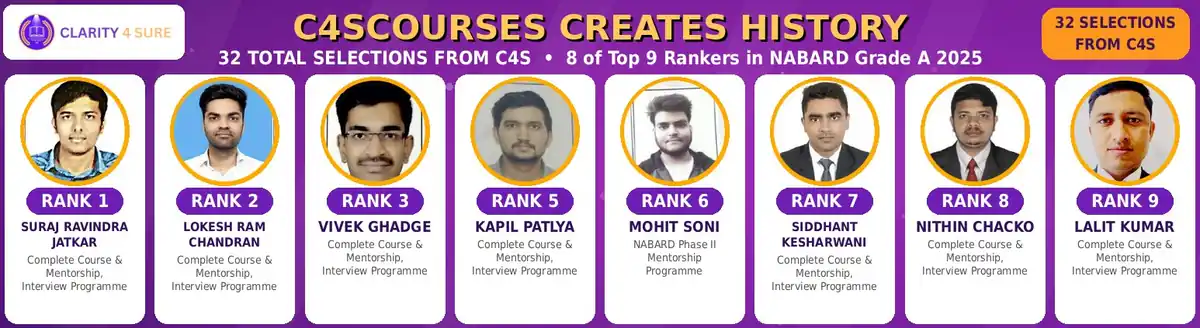
8 of the top 10 ranks in NABARD Grade A 2025 came from one classroom
Ranks 1, 2, 3, 5, 6, 7, 8 and 9 on the final list, and 32 selections in all, prepared with C4S Courses (Clarity 4 Sure). The same descriptive training and the same current affairs notes you are reading now.
- 1Suraj Ravindra JatkarRank 1
- 2Lokesh Ram ChandranRank 2
- 3Vivek GhadgeRank 3
- 5Kapil PatlyaRank 5
- 6Mohit SoniRank 6
- 7Siddhant KesharwaniRank 7
- 8Nithin ChackoRank 8
- 9Lalit KumarRank 9
- 1 & 2 June, 2025
- 3 June, 2025
- 4 June, 2025
- 5 June, 2025
- 6 June, 2025
- 7 June, 2025
- 8 & 9 June, 2025
- 10 June, 2025
- 11 June, 2025
- 12 June, 2025
- 13 June, 2025
- 14 June, 2025
- 15&16 June, 2025
- 17 June, 2025
- 18 June, 2025
- 19 June, 2025
- 20 June, 2025
- 21 June, 2025
- 22 & 23 June, 2025
- 24 June, 2025
- 25 June, 2025
- 26 June, 2025
- 27 June, 2025
- 28 June, 2025
- 29&30 June, 2025
1 & 2 June, 2025
Daily Current Affairs Quiz
1 & 2 June, 2025
International Affairs
1. Indus Waters Treaty at UN Glacier Conference
Context:
At the first UN Conference on Glaciers in Dushanbe, Tajikistan, India strongly rebutted Pakistan’s claims over the Indus Waters Treaty (IWT), asserting that cross-border terrorism from Pakistan is the real impediment to the treaty’s implementation.
India’s Arguments at the UN Forum
- Changed circumstances since the signing of the treaty in 1960 justify a reassessment:
- Technological advancements.
- Demographic pressures.
- Climate change.
- Persistent cross-border terrorism.
- The treaty’s preamble emphasized “goodwill and friendship,” but:
- “Unrelenting terrorism from Pakistan interferes with its provisions.”
Background: India’s Suspension of the IWT
- India suspended the IWT on April 22, 2025, following the Pahalgam terrorist attack that killed 26 people.
- Suspension part of broader punitive measures against Pakistan post-Operation Sindoor.
- Signed in 1960 by India, Pakistan, and the World Bank.
- Governs the distribution of the Indus river system waters.
- Considered one of the most successful transboundary water-sharing agreements.
Significance of the UN Glacier Conference
- Aimed at highlighting the role of glaciers in water security and ecological balance.
- Attended by 2,500 delegates from 80 countries and 70 international organizations.
- India used the platform to integrate climate resilience with geopolitical accountability.
TH
National Affairs
1. Osaka World Expo 2025
Context:
At the ongoing World Expo 2025 in Osaka, Japan, India has taken a unique approach by emphasizing its soft power and civilisational heritage rather than solely technological advancements. The Expo runs from April 13 to October 13 under the central theme: “Designing Future Society for Our Lives.”
About the Osaka World Expo 2025
- A global exhibition held every five years to promote cross-cultural exchange and innovation.
- Focuses on addressing global challenges and achieving the UN Sustainable Development Goals (SDGs).
- Intended as a “Living Lab” for collaborative solution-building between nations.
India Pavilion: A Civilisational Experience
- Curated by the Indira Gandhi National Centre for the Arts (IGNCA).
- Described as an “immersive civilisational experience”, focusing on India’s ancient philosophies and global identity rooted in compassion and wisdom.
- IGNCA likened its role to that of a modern-day sutradhar (narrator)—connecting ancient traditions with contemporary aspirations.
Key Themes and Symbolism
- The pavilion’s central inspiration is ‘Bodhisattva Padmapani’ from the Ajanta Caves:
- Symbol of compassion, enlightenment, and knowledge.
- Reflects India’s fusion of spiritual heritage and modern ambitions.
- Aligns with the sub-theme “Connecting Lives”, promoting values like:
- Inclusivity
- Sustainability
- Progress
Highlights of India’s Soft Power Projection
- Presentation of India’s cultural renaissance through art, heritage, and philosophical storytelling.
- Integration of India’s space programme, showcasing its scientific achievements alongside spiritual legacy.
TH
2. Union Education Ministry Urges Jharkhand and Bihar to Address Unrecognised Schools
Context:
The Ministry highlighted the large number of unrecognised private schools in Jharkhand and Bihar during the Project Approval Board (PAB) meetings in March and April 2025. These meetings discussed the Annual Work Plan and Budget for the Samagra Shiksha scheme (2025-26) under the chairmanship of Sanjay Kumar, Secretary (School Education and Literacy).
Data from UDISE+ (Unified District Information System for Education Plus)
- Jharkhand:
- 5,879 unrecognised schools
- 8,37,897 students enrolled
- 46,421 teachers
- Bihar:
- 4,915 unrecognised schools
- 7,75,704 students enrolled
- 42,377 teachers
What is an Unrecognised School?
- A private school operating without official government licence or recognition.
Legal Framework: Right to Education (RTE) Act Provisions
- Section 19 of RTE Act (2009) requires schools established before 2009 to comply with RTE norms within 3 years of the Act’s commencement.
- RTE Norms include:
- Adequate infrastructure and maintenance
- Prescribed teacher-student ratio
- Qualified teachers
- 25% reservation in Class 1 for economically weaker sections
- Official government recognition
- Failure to meet norms leads to withdrawal of recognition and cessation of school operations.
What does Article 21A say?
- It guarantees free and compulsory education for children between the ages of 6 and 14
- It prohibits discrimination in education
- It ensures equal opportunities for education
- It removes financial barriers to education
- It provides adequate infrastructure, facilities, and qualified teachers
Right to Education Act (RTE) of 2009
The Right to Education Act (RTE) of 2009 guarantees free and compulsory education for children between the ages of 6 and 14.
- The RTE Act was effective from April 1, 2010.
- The RTE Act prohibits denial of admission to any child, irrespective of the time of year.
- The RTE Act also prohibits holding back or expulsion of any child until he completes elementary education.
- Globally
- The Abidjan Principles on the Right to Education were adopted in 2019 by a committee of international human rights law experts.
- The UN‘s Human Rights Council has passed a decision to establish a working group to consider the possibility of including early childhood care and education explicitly within the right to education.
Penalties for Non-Compliance
- Running a school after recognition is withdrawn may attract a fine of up to ₹1 lakh.
- Continuing violations may lead to a further fine of ₹10,000 per day until compliance.
TH
3. “NITI Aayog to Release National Brain Health Blueprint to Combat Rising Cognitive Disorders”
Context:
NITI Aayog is in the final stages of drafting a National Brain Health Blueprint to address the rising burden of neurological and cognitive disorders in India. The blueprint will focus on early identification, prevention, and management of conditions like Alzheimer’s, Parkinson’s, epilepsy, and stroke.
Key Objectives
- Improve early diagnosis of cognitive disorders through dedicated brain health clinics.
- Strengthen healthcare delivery across primary, secondary, and tertiary levels.
- Bridge gaps in treatment access and affordability.
- Promote awareness and preventive interventions for dementia and other brain health conditions.
Stakeholders Involved
- NITI Aayog (lead policy maker)
- IBHAS, NIMHANS, AIIMS
- Mental health professionals and psychologists from private sector
Proposed Model
- Creation of a “Brain Health Service Model”, similar to physical or digital mental health clinics.
- Professionals will be trained to identify early cognitive decline and reduce risk of dementia.
- Integration of services for lifestyle modification, affordability, and interventions (both digital and in-person).
4. NAKSHA (National Geospatial Knowledge-Based Land Survey of Urban Habitations) Programme
Why in News?
The Department of Land Resources (DoLR) under the Ministry of Rural Development, Government of India, launched the second phase of capacity-building under the NAKSHA (National Geospatial Knowledge-Based Land Survey of Urban Habitations) programme. This training phase begins 2nd June 2025 and will be conducted across five national Centres of Excellence (CoEs).
NAKSHA: Urban Land Records Digitization Initiative
NAKSHA (National Urban Digital Mission for Land Records) is a pioneering initiative launched in 2024 under the Digital India Land Records Modernization Programme (DILRMP). It aims to digitally create and update land records in urban areas, ensuring reliable ownership documentation and enabling transparent, dispute-free governance.
Key Features of NAKSHA
Purpose:
- Modernize urban land records through digital mapping and data integration.
- Provide legal proof of ownership for urban residents.
- Pilot Programme:
- Duration: 1 year
- Coverage: 152 Urban Local Bodies across 26 States and 3 Union Territories
- Post-Pilot: Nationwide rollout based on pilot’s success.
- Technical & Administrative Framework:
- Survey of India: Conducts aerial surveys and supplies orthorectified imagery.
- Madhya Pradesh State Electronics Development Corporation (MPSEDC): Developing an end-to-end web-GIS platform.
- State-Level Committee (SLC): Formed under the Chief Secretary to monitor implementation.
Highlights of the Second Phase
- Objective: Equip 304 nominated ULB-level and district officers from 157 Urban Local Bodies (ULBs) with practical skills in geospatial technologies for urban land surveys.
- Inauguration:
- Virtually inaugurated by Shri Manoj Joshi, Secretary, Department of Land Resources,
- On 2nd June 2025 at 10:00 AM.
- Duration: 1 week of hands-on training.
Training Modules Include
- NAKSHA programme framework and objectives
- GNSS and ETS-based surveying techniques
- Use of Web-GIS applications
- Land parcel mapping
- Legal and administrative protocols for land surveys
About Digital India Land Records Modernization Programme (DILRMP)
- Launch Year: Revamped in 2016 (originally launched in 2008 as NLRMP)
- Type: Central Sector Scheme (100% centrally funded)
- Duration: Extended for 2021–2026
Key Components
- Computerization of land records and property registration
- Integration of land records with Aadhaar (voluntary)
- Digitization of Revenue Court records
- Unique Land Parcel Identification Number (ULPIN or Bhu-Aadhaar)
- BHOOMI SAMMAN initiative to recognize excellence in land record management
Achievements (as of FY25)
- 95% of Records of Rights (RoR) digitized
- 68% of cadastral maps digitized
- 95% of property registrations computerized
Significance of Digitizing Urban Land Records
- Citizen Empowerment: Secure and legal documentation of property ownership.
- Dispute Reduction: Minimizes litigation through verified records.
- Improved Urban Governance: Enhances planning, efficiency, and service delivery.
- Investment Facilitation: Creates transparency and ease of doing business, boosting urban economic growth.
PIB
5. India Emerges as Major Hub for Illegal Online Gambling, Says CUTS Report
Context:
Over 5.4 billion visits were recorded in FY25 to the top 15 unauthorised gambling platforms, including 1xBet, Parimatch, Stake, Fairplay, and BateryBet, according to a report by CUTS International.
- Estimated annual deposits on these illegal platforms: $100 billion.
- High direct traffic share (66% of 5.4 billion visits) shows strong brand recall and engagement, largely bypassing search engines or regulated app ecosystems.
Major Policy and Enforcement Gaps
- No central regulator for online betting/gambling in India.
- Lack of:
- KYC norms
- Age verification protocols
- Payment-blocking mechanisms
- Monitoring of advertising and domain activity
- Minors and young adults have unregulated access due to absence of safeguards.
- Some platforms (e.g., Parimatch) use cash-on-delivery payment models, further easing access for underage users.
National Security & Consumer Harm
- Platforms siphon crores of rupees abroad, raising national security concerns.
- Psychologically manipulative design increases risk of gambling addiction, particularly among:
- Youth
- Sensation-seeking and impulsive individuals
- These sites offer high-stakes, immersive experiences designed to promote risky betting behavior.
Alarming Online Visibility
- In March 2025, Parimatch’s traffic surpassed major Indian domains like:
- amazon.in
- wikipedia.org
- google.co.in
- flipkart.com
- linkedin.com
Aggressive User Acquisition & Engagement Strategies
- Use of:
- Mass media advertising (TV, billboards)
- Celebrity endorsements
- Private channel link sharing (WhatsApp, Telegram, etc.)
- These platforms create an illusion of credibility, attracting repeat and long-term users.
Recommendations from CUTS International
- Establish a central gambling regulator
- Ban advertising of illegal betting platforms
- Implement payment gateway restrictions
- Strengthen age and KYC compliance
- Launch public awareness campaigns
Banking/Finance
1. RBI’s Draft Directions on Gold Loans (April 2025)
Context:
On April 9, 2025, the Reserve Bank of India (RBI) released draft guidelines on loans against gold collateral.
- Objective: Harmonise gold loan regulations across banks and NBFCs, ensure transparency, and curb irregularities observed in FY24.
Why RBI Intervened
- Alarm over irregular practices and rapid portfolio expansion:
- Gold loan portfolio of banks and NBFCs grew over 50% in FY24.
- Bank gold loan books alone surged 104%, raising regulatory concerns.
- Rising gold prices and growing credit demand in the informal economy further complicated risk monitoring.
Key Provisions in the Draft
- LTV Ratio
- Cap remains at 75%.
- For bullet loans (especially for consumption), interest must be included in LTV, reducing disbursable amount.
- Collateral & Valuation
- Gold to be valued based on 22 carat price.
- Mandatory proof of ownership for pledged gold.
- Uniform standards for gold purity and weight assessment.
- Loan Structuring & Renewals
- No concurrent loans for both consumption and income generation.
- Top-up/renewal allowed only if the existing loan is standard and within LTV.
- Fresh loan only after complete repayment of principal and interest.
- Timely Return of Collateral
- If the lender delays return of gold beyond 7 working days, a ₹5,000/day penalty must be paid to the borrower.
Impact on Regulated Entities
- Reduced borrower flexibility; especially affects rural/agricultural borrowers dependent on gold loans.
- NBFCs face constraints in liquidity due to tougher renewal norms.
- Higher compliance costs from documentation, purity checks, and DSCR norms.
- Smaller NBFCs may face funding issues, leading to industry consolidation.
- Likely interest rate hikes to offset increased operational burden.
Critical Assessment
- Experts suggest the RBI consider differentiated norms:
- Micro gold loans (used by rural poor) vs. high-ticket urban loans.
- Blanket regulations may hurt financial inclusion and informal sector liquidity.
TH
2. India’s Crypto Landscape and Regulatory Challenges
Strong Crypto Adoption Amid Regulatory Uncertainty
- India ranks first globally for grassroots crypto adoption for the second year, according to Chainalysis (2024).
- Indian retail investors infused $6.6 billion into crypto assets, with the sector poised to create over 800,000 jobs by 2030 (NASSCOM).
- India also hosts one of the largest and fastest-growing cohorts of web3 developers.
Regulatory Environment and Judicial Remarks
- Despite vibrant market growth, India’s crypto regulation remains fragmented and unclear.
- The Supreme Court in May 2025 criticized the lack of clear crypto policy, stating “Banning may be shutting your eyes to ground reality,” underscoring the disconnect between market realities and policy.
Challenges with Regulatory and Monetary Controls
- RBI expressed early concerns (since 2013) over crypto risks due to lack of central bank authorization.
- A 2018 RBI circular banning financial institutions from crypto dealings was overturned by the Supreme Court in 2020.
- The government introduced stringent tax policies in 2022:
- 1% TDS on VDA transactions above ₹10,000 (Section 194S).
- 30% capital gains tax without loss offsetting (Section 115BBH).
- These taxes aimed to improve transparency and limit speculation but have had limited success.
Continued Offshore Trading and Tax Leakage
- From July 2022 to December 2023, over ₹1.03 trillion of VDAs were traded on non-compliant (mostly offshore) platforms.
- Only 9% of VDAs were held on domestic exchanges, resulting in an estimated ₹2,488 crore loss in tax revenue.
- Between December 2023 and October 2024, ₹2.63 trillion was traded offshore, with uncollected TDS exceeding ₹60 billion.
- Efforts to block non-compliant platforms (e.g., URL blocking) failed as users circumvented restrictions via VPNs, mirrors, and platform migration.
Importance of Virtual Asset Service Providers (VASPs)
- Global bodies (IMF, FSB, FATF) advocate for comprehensive, risk-based crypto regulation harmonized with international norms, relying on compliant domestic intermediaries (VASPs).
- VASPs act as regulatory bridges, enabling oversight, enforcement, and risk mitigation.
- India’s current policies push users offshore, eroding regulatory control and tax compliance.
- Indian VASPs are rapidly maturing, collaborating effectively with the Financial Intelligence Unit-India to strengthen AML/CFT controls.
- Post the $230 million crypto hack in 2024, Indian exchanges enhanced cybersecurity, established insurance funds, and implemented industry-wide security standards.
3. FD-Backed Credit Card Launched by ZET in Partnership with SBM Bank
Context:
ZET, a fintech platform focused on credit score building, has partnered with SBM Bank (India) to launch a fixed deposit-backed credit card — the SBM ZET Credit Card. The product is aimed at new-to-credit users, individuals without income proof, and those looking to build or repair their credit score.
Key Features
- FD-Linked Credit Limit:
- Users must open a fixed deposit (FD) starting at ₹5,000 with SBM Bank.
- The credit limit is up to 90% of the FD amount.
- FD earns up to 7% annual interest.
- No Credit History or Income Proof Required:
- Ideal for first-time borrowers or users with poor/no credit history.
- Zero Annual Charges:
- Lifetime free card with no joining or annual fees.
- UPI-Enabled RuPay Card:
- Operates on the RuPay network.
- Fully UPI compatible, can be used on UPI apps like PhonePe, Google Pay, etc.
- Instant Digital Issuance:
- Virtual credit card issued within minutes after online FD creation and video KYC.
Credit Score Benefits
- Helps users build and maintain a credit score above 750 through responsible usage.
- Credit behaviour is reported to credit bureaus, aiding formal financial inclusion.
Security & Regulation
- FD is insured up to ₹5 lakh under RBI’s DICGC scheme.
- Card transactions are secured and regulated under SBM Bank’s banking license.
User Engagement Benefits
- Offers rewards and discounts on partnered brands and categories.
- Enables disciplined credit usage backed by a collateral FD.
Target Audience
- Students and gig workers with no credit history.
- Salaried/self-employed individuals without formal documentation.
- Users seeking to rebuild a poor credit profile.
4. UPI’s Share in India’s Digital Transactions
Context:
Unified Payments Interface (UPI) continued to dominate India’s digital payments landscape in FY25, recording a 41.7% annual growth in volume and expanding its share of total digital transactions to 83.4%, up from 79.4% in FY24.
Regulatory and Policy Developments
- Survey on Digital Payments:
- RBI to launch a nationwide survey to understand user preferences, behaviour, and challenges.
- Digital Payments Intelligence Platform (DPIP):
- RBIH (Reserve Bank Innovation Hub) is building a prototype in collaboration with 5–10 banks.
- Goal: Detect and mitigate frauds, improve ecosystem trust.
- Authorisations Granted by RBI in FY25:
- 26 Online Payment Aggregators (PAs)
- 5 Cross-Border Payment Aggregators (PA-CB)
- 11 Non-bank PPI issuers
- 1 TReDS platform
- 84 On-site inspections of payment system operators conducted.
UPI Internationalization
- Led by NPCI International Payments Ltd (NIPL).
- Indian UPI apps now accepted in:
- France, Nepal, Bhutan, Singapore, Sri Lanka, Mauritius, UAE via QR codes.
- More international tie-ups expected in FY26.
- Goal: Expand UPI presence to more countries by FY29.
Significance
- Reflects India’s global leadership in real-time digital payments.
- Enhances financial inclusion, payment system efficiency, and consumer convenience.
- Strong regulatory oversight continues to strengthen trust and security in digital payments.
UPSC PYQ
Consider the following countries:
I. United Arab Emirates
II. France
III. Germany
IV. Singapore
V. Bangladesh
How many countries amongst the above there other than India where international merchant payments are accepted under UPI?
(a) Only two)
(b) Only three
(c) Only four
(d) All the five
5. RBI to Strengthen Liquidity Stress Tests and Assess Climate Risk for Financial Stability
Context:
The Reserve Bank of India (RBI) is set to bolster the financial system’s resilience by enhancing stress testing frameworks for Scheduled Commercial Banks (SCBs), NBFCs, and cooperative banks, alongside integrating climate transition risks into regulatory oversight.
Key Initiatives:
- Liquidity Stress Testing for SCBs:
- RBI will introduce a cash flow analysis framework.
- Objective: Simulate extreme but plausible scenarios to test liquidity resilience.
- Aims to assess:
- Banks’ ability to meet short-term obligations
- Adequacy of liquidity buffers
- Depositor protection and systemic risk containment
- Extension to NBFCs & Co-operative Banks:
- RBI will develop an in-house liquidity stress test framework for NBFCs.
- Similar frameworks will be designed for:
- Rural Co-operative Banks
- Mid-sized Urban Co-operative Banks (UCBs)
- Climate Risk Stress Testing:
- RBI will assess the impact of climate transition risk on:
- Carbon-intensive sectors
- Banks’ balance sheets with exposure to high-emission industries
- RBI will assess the impact of climate transition risk on:
- Prudential Guidelines on Climate Risk:
- RBI may issue final guidelines covering:
- Disclosure of climate-related financial risks
- Climate scenario analysis
- Climate stress testing frameworks
- RBI may issue final guidelines covering:
- Market Liquidity Risk Assessment:
- Development of a framework for liquidity risk stress testing of market portfolios.
- Will use scenarios based on past market stress events to detect vulnerabilities.
- ‘Growth-at-Risk’ (GaR) Model:
- RBI to develop a macrofinancial tool that:
- Links current economic and financial indicators
- With probabilities of future adverse economic outcomes
- RBI to develop a macrofinancial tool that:
Significance:
- Enhances forward-looking risk management in Indian banking.
- Strengthens crisis preparedness for systemic financial institutions.
- Aligns India’s financial regulation with global climate and ESG norms.
- Reinforces depositor confidence, financial stability, and macroprudential supervision.
6. Razorpay Relocates Parent Entity to India
Context:
Fintech unicorn Razorpay has completed the relocation of its parent company from the United States to India, positioning itself for a domestic Initial Public Offering (IPO) planned by the end of calendar year 2026. The move marks a key milestone in India’s growing trend of fintech companies shifting their base back to India.
Key Highlights
- Parent Entity Shift to India:
- Razorpay has officially reversed flipped its parent entity to India from the US.
- The move supports regulatory alignment and easier access to Indian capital markets.
- Tax Liability on Domicile Shift:
- Tax liability estimated at $150 million (₹1,275 crore).
- Will be paid from internal cash reserves.
- Earlier speculation pegged the tax burden at $200 million.
- IPO Timeline:
- Razorpay targets an IPO before December 2026 (end of CY2026).
- Reverse Flip Trend in Fintech Sector:
- PhonePe: Shifted from Singapore to India in 2022
- Groww: Relocated from Delaware to Bengaluru in FY24
- Zepto: Recently completed a reverse flip from Singapore to India
Significance
- Reinforces India as a preferred jurisdiction for high-growth fintech startups planning to list locally.
- Enhances regulatory transparency, governance, and investor confidence.
- Aligns Razorpay with Indian IPO and capital market compliance frameworks ahead of public listing.
7. SBI Research Projects Net Financial Savings to Hit ₹22 Lakh Crore in FY25
Context:
According to the SBI Research Report, India’s household sector net financial savings are projected to reach ₹22 lakh crore in FY 2024-25, reflecting growing economic resilience and macroeconomic stability.
Key Highlights
- Household Net Financial Savings:
- Expected to be ₹22 lakh crore in FY25.
- Equivalent to 6.5% of Gross National Disposable Income (GNDI).
- Up from:
- 5.1% of GNDI in FY24
- 4.9% of GNDI in FY23
- Macroeconomic Significance:
- Increased savings provide a vital capital pool for financing government and corporate deficits.
- Plays a key role in maintaining fiscal and monetary stability.
- RBI Surplus & Balance Sheet Expansion:
- RBI’s balance sheet expanded by 8.19% in FY25, below nominal GDP growth of 9.9%.
- RBI transferred ₹2.69 lakh crore in surplus to the government, enhancing fiscal space and reducing the need for market borrowing.
- Fraud Statistics in Financial System:
- Fraud cases fell in number but tripled in value to ₹36,014 crore in FY25.
- Card & Internet frauds:
- Declined from 29,802 cases in FY24 to 13,516 cases in FY25, indicating stronger security protocols.
- Systemic Stability:
- The report underscores that India’s financial system is robust and undergoing a transformative phase, driven by reforms, better risk management, and digital adoption.
8. Fintechs Seek Easier Provisioning Norms for DLG-Backed Loan Pools
Context:
Fintech companies and digital lenders are urging the Reserve Bank of India (RBI) to relax provisioning requirements for loan pools backed by Default Loss Guarantees (DLGs). They argue that current norms may result in double provisioning, reducing lending efficiency and capital deployment.
Key Issues Raised by Fintechs
Accounting Interpretation Differences
- Fintechs cite variability in interpreting Ind-AS standards.
- Ind-AS permits factoring in risk mitigants like DLGs while calculating Expected Credit Loss (ECL) provisions.
- RBI, however, insists that ECL provisions must be made in full, regardless of the DLG support.
Double Provisioning Concern
- Both the fintechs (LSPs) and regulated lenders (banks/NBFCs) are required to provision for the same loan pool.
- This redundancy impacts capital efficiency and may crowd out lending due to excess buffers being locked.
Industry Representation
- Unified Fintech Forum (UFF) and Fintech Association for Consumer Empowerment (FACE) have made formal representations to the RBI.
- They highlight the need for data-based regulatory clarity and emphasize that DLGs reduce effective credit risk.
RBI’s Stand
- In April, RBI wrote to four major non-bank lenders with high delinquencies in DLG-backed pools.
- Directed full provisioning under ECL norms for all third-party sourced loans, irrespective of DLGs.
- Concerns include:
- Elevated delinquencies and high DLG payouts
- Deterioration in asset quality of NBFCs
- Misuse of FLDG (First Loss Default Guarantee) arrangements as securitisation substitutes
Regulatory Perspective
- RBI supports DLGs as a risk-sharing mechanism, not as a replacement for robust underwriting.
- The aim is to ensure fintechs have ‘skin in the game’ but without compromising asset quality or provisioning discipline.
Economy
1. India’s Economic Performance in 2025

Headline Growth vs. Ground Reality
- IMF Projection (2025): India is set to overtake Japan to become the world’s 4th largest economy by absolute GDP, reaching $4.2 trillion.
- Caveat: Absolute GDP size does not reflect individual well-being, development quality, or income distribution.
GDP vs. GDP Per Capita
- Chart 1A: India’s GDP grew from $468 billion (2000) to $4,187 billion (2025).
- Chart 1B: Despite overtaking Japan in GDP size, India’s GDP per capita remains 12 times lower than Japan’s and 9 times lower than Poland’s.
- Implication: Economic size does not equate to broad-based prosperity.
Employment Structure
- Agricultural Dependency (Chart 2A-C):
- India (2023): ~45% of workforce in agriculture.
- Japan & Poland: <10%, with majority in industry/services.
- Formal Employment (Chart 3):
- India: 23.9% in regular wage/salaried work.
- Japan: 91%, Poland: 80.1% — highlighting better formal job markets abroad.
Education Outcomes
- Gross Enrolment Ratio (Chart 4):
- India (2022): 32.7% in college-level education.
- Poland: ~75%, Japan: ~65% — India lags in higher education access.
Health Indicators
- Life Expectancy (Chart 5):
- India: 72 years, Japan: 84, Poland: 78.5.
- Infant Mortality Rate (IMR):
- India (2023): 24.5 deaths per 1,000 live births.
- Japan & Poland: <5 deaths per 1,000 — underscoring healthcare gaps.
Human Development Index (Chart 6)
- India (2023 HDI): 0.685 – Medium human development.
- Japan & Poland: >0.9 – Very high human development.
- HDI incorporates health, education, and standard of living, offering a truer reflection of citizens’ quality of life.
TH
Agriculture
1. Agricultural Households in India Increasingly Rely on Non-Farm Income: PRICE Report
Context:
52% of agricultural households now earn additional income from non-agricultural activities, reflecting a growing trend toward income diversification.
- The working paper titled “Reimagining Annadata Households and Their Livelihoods Beyond the Farm” was published by People Research on India’s Consumer Economy (PRICE).
- The shift aims to build financial resilience against farming uncertainties caused by:
- Market volatility
- Climate events
- Economic shocks
Top States by Share of Agricultural Households with Non-Farm Income (2024–25)
- Nagaland: 98%
- Tripura: 94%
- Meghalaya: 85%
- Tamil Nadu: 83%
- Sikkim & Uttarakhand: 80% each
States With Highest Dependence on Farming Alone
- Arunachal Pradesh: 82%
- Punjab: 78%
- Assam: 77%
- Karnataka & Manipur: 73% each
Income Inequality Among Agricultural Households
- Average annual income (2024–25): ₹7.31 lakh
- Poor farmers: ₹2.03 lakh
- Rich farmers: ₹26 lakh
- Share of income from farming-related activities: 80% (₹5.77 lakh)
- Direct farming: 67.1%
- Allied activities (dairy/livestock): 7.4%
- Agricultural labour: 4.4%
- Share from non-farm sources:
- Non-agricultural business: 7.1%
- Salaried jobs: 3.4%
- Pension: 1.4%
- Remittances: Balance
States With Highest Average Annual Income for Agricultural Households
- Punjab: ₹20.1 lakh (₹16.2 lakh from farming alone)
- Haryana: ₹16.7 lakh
- Kerala: ₹11 lakh
- Mizoram & Tamil Nadu: Follow closely
States With Lowest Agricultural Household Income
- Chhattisgarh: ₹3.2 lakh
- Odisha: ₹4.15 lakh
- Jharkhand: ₹4.77 lakh
2. Crystal Crop Launches RICEACT Herbicide and JIVORA Insecticide for Rice and Cotton Farmers
Context:
Crystal Crop Protection Limited (CCPL), India’s leading agrochemicals solutions company, today announced the launch of a herbicide and insecticide, both major research-driven products. CCPL has launched RICEACT, a solution tailored specifically for rice cultivation, and JIVORA, a next-generation insecticide, designed to address the rising challenges of sucking pests in cotton, said a statement from the company.
About RICEACT (Herbicide for Rice)
- Composition: Triafamone (20%) + Ethoxysulfuron (10%)
- Mode of Action:
- Dual-action: Root and foliage absorption
- Inhibits Acetolactate Synthase (ALS) enzyme
- Systemic disruption of weed development
- Target Weeds: Grasses, sedges, and broadleaf weeds
- Application Window: Early post-emergence; ideal at 1–3 leaf stage of weeds
- Recommended Dose: 90 grams per acre
- Benefits:
- Season-long residual weed control
- Effective in both transplanted and wet direct-seeded rice
- Reduces labour costs
- Coverage: Expected usage on approx. 3 lakh hectares of paddy
- Available Pack Sizes: 45g, 60g, and 90g
About JIVORA (Insecticide for Cotton)
- Target Pests: Whiteflies, Jassids, and Aphids
- Timing: Designed for 2nd and 3rd spray windows
- Development: Based on extensive field trials and market research
- Coverage: Estimated adoption by 4.5–5 lakh cotton farmers
- Benefits:
- Strong residual control
- High efficacy in critical pest attack periods
- Available Pack Sizes: 50g, 100g, 250g, 500g, and 1kg
Strategic Impact
- Portfolio Expansion:
- Herbicide segment: +8%
- Insecticide segment: +7%
- Market Outlook:
- India’s crop protection market expected to grow from $2.59 billion (2025) to $3.21 billion (2030)
- CAGR: 4.35%
- Target Markets: Maharashtra, Andhra Pradesh, Gujarat, Karnataka, Rajasthan, Haryana, West Bengal
3. IRRI Scientists Discover Rice Varieties with Antioxidant and Anti-Cancer Properties
Context:
Scientists at the Philippines-based International Rice Research Institute (IRRI) have identified a few rice varieties with anti-oxidant and anti-cancer properties.
- Institute:
International Rice Research Institute (IRRI), Philippines - Research Publication:
Journal – Food Hydrocolloids and Health
Key Research Highlights
- Sample Size:
- Screened 1.32 lakh rice accessions worldwide.
- Focused on 800 pigmented (coloured) rice varieties for detailed analysis.
- Discovery:
- Identified 6 pigmented rice lines with very high antioxidant levels comparable to superfoods like blueberries and chia seeds.
- These six rice lines exhibited strong anti-cancer effects in laboratory tests on colorectal and breast cancer cell lines.
- Unique Feature:
- Extracts showed cytotoxicity (killing effect) only in cancer cells, sparing healthy cells, unlike many chemotherapeutic drugs which harm healthy cells too.
- This suggests a safer treatment profile.
Testing and Supplement Development
- In Vitro Bioavailability:
- Tests showed antioxidant and anti-cancer biomolecules were absorbed during the gastric phase.
- Rice Bran Extract Supplement:
- Produced by safe ethanol extraction and microencapsulation, forming a water-soluble multi-nutrient supplement.
- 7.5 μg/mL dose showed anti-cancer effects comparable to some chemotherapy drugs in cell line tests.
- Retention of Properties:
- Cooking the rice retains about 70% of antioxidant and anti-cancer benefits.
Notable Rice Varieties Identified
- Ketan Hitam (purple rice): Origin – Indonesia
- Balatino (purple rice): Origin – Philippines
- Kintuman (red rice): Origin – Philippines
Significance
- Potential development of functional foods and nutraceuticals targeting cancer prevention.
- Promotes dietary solutions with fewer side effects compared to traditional chemotherapy.
- Offers new opportunities for agricultural and health sectors to combat cancer through natural foods.
4. Krishi Nivesh Portal
Context:
Ministry’s circular requests states and ministries to identify and share agriculture investment schemes for inclusion. Emphasis on regular updates to maintain portal’s effectiveness.
Objective
To consolidate all Central and State government schemes related to agricultural investment into a single digital platform for easy access and streamlined investment.
Background
- Launched in September 2024 by the Ministry of Agriculture & Farmers Welfare.
- Aims to bring schemes from various ministries and states under one window.
- Currently includes schemes from 7 ministries:
- Agriculture & Farmers Welfare
- Food Processing Industries
- Rural Development
- New and Renewable Energy
- Jal Shakti
- Chemicals & Fertilisers
- Fisheries, Animal Husbandry and Dairying
- Other ministries expected to join:
- Micro, Small & Medium Enterprises (MSME)
- Cooperation
- Panchayati Raj
- Commerce
- Development of North Eastern Regions
- States yet to onboard; urged to share scheme details urgently for portal inclusion.
Key Features
- One-Stop Access: Centralized access to investment schemes from multiple government departments.
- Open Source & Standards: Built as an interoperable platform using open-source technology.
- Powered by BI, Analytics, AI/ML: Provides business intelligence, data analytics, and artificial intelligence/machine learning for better decision-making.
- User-Friendly: Helps investors, farmers, and agri-startups to find suitable schemes easily.
- Application Tracking: Stakeholders can track scheme application status and seek guidance digitally.
- Digital DPR Submission: Enables submission of Detailed Project Reports (DPRs) online, streamlining investment proposals.
Significance
- Boosts Private Investment: Encourages private sector participation to enhance productivity, infrastructure, and value chains in agriculture.
- Transparency & Efficiency: Simplifies investment process with greater transparency and timely information updates.
- Supports Modernisation: Aligns with the vision of modernizing Indian agriculture through technology and innovative practices.
- Categorized Investment Opportunities: Sorted by geography and available subsidies for targeted investments.
Science & Tech
1. Polluted Rivers Can Turn Into Airborne Hazards, New Study Warns
Context:
A new study published in Science Advances (May 28, 2025) reveals a disturbing environmental link: polluted river water can become aerosolised upon entering the ocean, releasing harmful compounds into the air that humans can inhale. This discovery significantly expands the known risks of river pollution, particularly in urban-industrial regions like parts of India.
Background
- Historically, human settlements grew around rivers for agriculture, water, and sanitation.
- Today, however, many rivers, especially in developing countries, have become channels for untreated sewage and industrial effluents, harming ecosystems and public health.
Study Location and Methodology
- Conducted by scientists in California on the Tijuana River, which flows from Mexico into the Pacific Ocean.
- Timeframe: January to March 2020
- Methods:
- Daily seawater sampling and 24-hour air filtration using quartz-fibre filters at five locations along 35 km of coast.
- Special focus during rain events, which intensify pollution flow.
Contaminants Monitored
- 12 common wastewater-related human-made compounds were tracked using high-resolution liquid chromatography–mass spectrometry.
- Substances included:
- Octinoxate (sunscreen ingredient)
- Dibenzylamine (tire rubber additive)
- Methamphetamine, illicit drugs
- Benzoylecgonine (cocaine metabolite used as sewage proxy)
- Prescription drugs and agricultural biocides
Key Findings
- 10 out of 12 compounds were more concentrated in river-influenced seawater.
- Aerosols from river-adjacent sites had the highest pollution loads.
- Strong correlations found between benzoylecgonine and levels of methamphetamine, octinoxate, and dibenzylamine, suggesting a common source: untreated wastewater.
- Estimated air emissions per 1 km of coastline:
- 1 kg of octinoxate
- 100 g of methamphetamine
- Several grams of tire additives
Global Implications
- Globally, such coastal pollution could aerosolise and release approximately:
- 40,000 tonnes of octinoxate
- 50 tonnes of dibenzylamine into the air each year.
- Chronic inhalation risks remain unquantified, especially for fisherfolk and marginalised communities living near polluted coasts.
India-Specific Relevance
- Many rivers in India, such as the Yamuna, Ganga, and Mithi, are heavily polluted and flow into seas, raising concerns about similar airborne toxic exposure in densely populated coastal zones like Mumbai, Chennai, and Kolkata.
- Environmental justice concerns emerge as the poor bear disproportionate health burdens from both water and now air pollution.
Facts To Remember
1. Opal Suchata Chuangsri of Thailand is Miss World 2025
Miss Thailand Opal Suchata Chuangsri was crowned Miss World 2025 at the 72nd edition of the Miss World pageant at the HITEX Exhibition Centre in Hyderabad.
2. Valmik Thapar, wildlife and tiger conservationist, dies at 73
Valmik Thapar, 73, wildlife and tiger conservationist, died in Delhi on Saturday. He was ailing from cancer.
3. Deepak and Naman punch gold in Thai Open boxing
Deepak (75kg) and Naman Tanwar (90kg) clinched gold medals at the Thailand Open International boxing tournament in Bangkok.
4. RBI Penalties in FY25: ₹54.78 Crore Fines Imposed on 353 Regulated Entities
- Total penalties imposed: ₹54.78 crore
- Number of enforcement actions: 353
- Time period: Financial Year ending March 31, 2025
- Entities penalised: Banks and other RBI-regulated entities (REs)
- Launched in September 2024 by the Ministry of Agriculture & Farmers Welfare. Krishi Nivesh Portal
- Section 19 of RTE Act (2009) requires schools established before 2009 to comply with RTE norms within 3 years of the Act’s commencement. Union Education Ministry Urges Jharkhand and Bi…
- Objective: Equip 304 nominated ULB-level and district officers from 157 Urban Local Bodies (ULBs) with practical skills in geospatial technologies for urban land surveys. NAKSHA (National Geospatial Knowledge-Based Lan…
- Bank gold loan books alone surged 104%, raising regulatory concerns. RBI's Draft Directions on Gold Loans (April 202…
- India ranks first globally for grassroots crypto adoption for the second year, according to Chainalysis (2024). India’s Crypto Landscape and Regulatory Challen…
3 June, 2025
Daily Current Affairs Quiz
3 June, 2025
National Affairs
1. Union Government Invites Proposals for DDACs in 291 Gap Districts
Context:
The Ministry of Social Justice and Empowerment has invited proposals to establish District De-Addiction Centres (DDACs) in 291 “gap” districts across 30 States and Union Territories. This is part of the National Action Plan for Drug Demand Reduction (NAPDDR).
What Are ‘Gap’ Districts?
- Districts without any existing de-addiction infrastructure supported by the Central government.
- These districts currently lack:
- Integrated Rehabilitation Centres for Addicts (IRCAs)
- Community-based Peer Led Initiatives (CPLIs)
- Outreach and Drop-in Centres (ODICs)
Features of Proposed DDACs
- Will serve multiple functions: treatment, rehabilitation, awareness, and community-based support.
- Must include:
- Treatment & rehabilitation facilities
- Drop-in centre area
- CPLI space
- Office/admin area
- Capacity: Can house 15 or 30 patients, based on specific government norms.
States with Highest Number of Gap Districts
- Chhattisgarh: 31 of 33 districts
- Bihar: 25
- Madhya Pradesh: 23
- Gujarat: 22
- Arunachal Pradesh: 21
- Uttar Pradesh: 18
- Jharkhand & Punjab: 16 each
- Assam: 10
Who Can Apply?
- Eligible NGOs and start-ups with minimum two years of experience in drug de-addiction services.
- Must submit proposals by June 30, 2025.
Objectives of DDACs
- Conduct awareness programmes for prevention.
- Provide treatment and rehabilitation for substance users.
- Enable community participation through CPLIs.
- Support risk mitigation and early intervention at the district level.
2. Periodic Labour Force Survey (PLFS) 2023-24
Context:
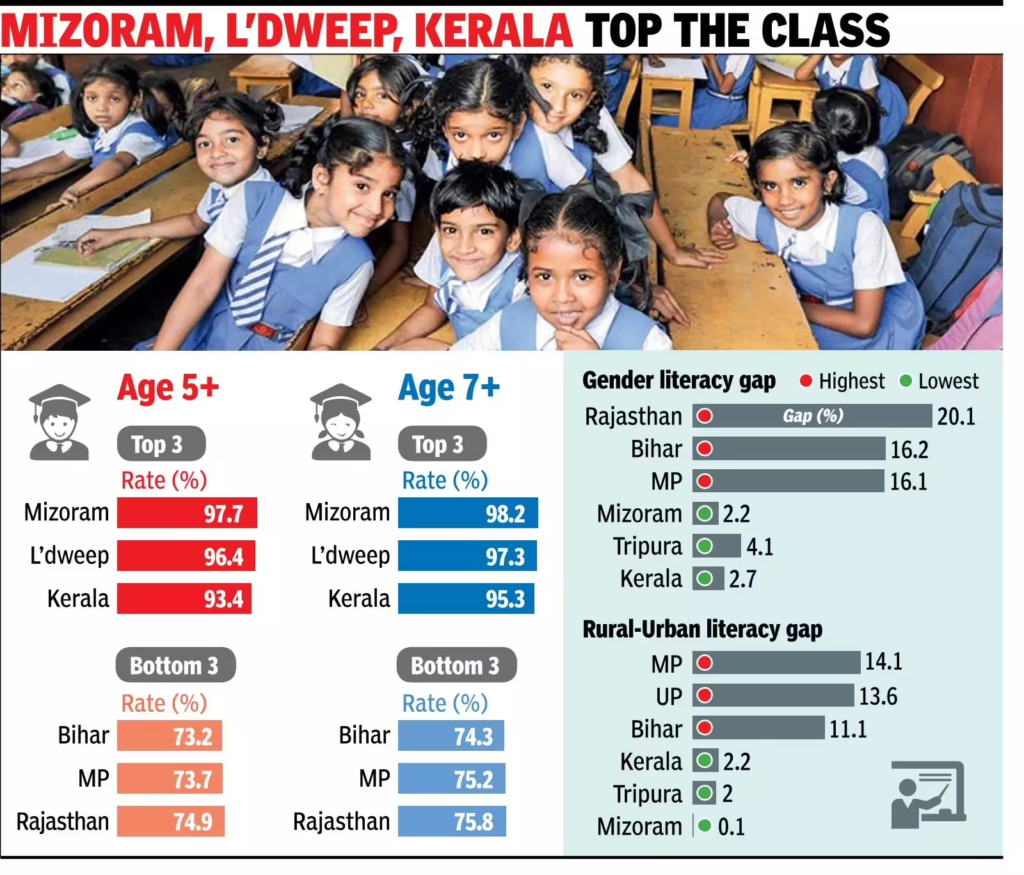
India’s literacy rate has reached 80.9% for individuals aged seven years and above, as reported in the Periodic Labour Force Survey (PLFS) 2023–24. Despite this progress, significant disparities persist across gender and urban-rural lines.
National Overview
- Overall literacy rate (7+ years): 80.9%
- Overall literacy rate (5+ years): 79.7%
- Male literacy (7+ years): 87.2%
- Female literacy (7+ years): 74.6%
- Gender gap (7+ years): 12.6 percentage points
- Source: Periodic Labour Force Survey (PLFS) 2023–24, released by NSSO, Ministry of Statistics and Programme Implementation.
Top 5 States/UTs with Highest Literacy (7+ years)
| Rank | State/UT | Literacy Rate (%) |
|---|---|---|
| 1 | Mizoram | 98.2 |
| 2 | Lakshadweep | 97.3 |
| 3 | Kerala | 95.3 |
| 4 | Tripura | 93.7 |
| 5 | Goa | 93.6 |
States with Lowest Literacy Rates (7+ years)
| Rank | State | Literacy Rate (%) |
|---|---|---|
| 1 | Bihar | 74.3 |
| 2 | Madhya Pradesh | 75.2 |
| 3 | Rajasthan | 75.8 |
Urban-Rural Literacy Divide
- Urban literacy rate (7+ years): 88.9%
- Rural literacy rate (7+ years): 77.5%
- Significant urban-rural gaps:
- Madhya Pradesh: Rural 71.6%, Urban 85.7%
- Bihar: Rural 72.1%, Urban 83.2%
- Rajasthan: Rural 72.5%, Urban 84.7%
Gender Gap
- Highest gender gaps (7+ years):
- Rajasthan: 20.1% (M: 85.9%, F: 65.8%)
- Bihar: 16.2% (M: 82.3%, F: 66.1%)
- Madhya Pradesh: 16.1% (M: 83.1%, F: 67.0%)
- Rural gender gap examples:
- Rajasthan: M: 83.6%, F: 61.8%
- Bihar: M: 81.5%, F: 65.0%
- MP: M: 80.0%, F: 62.6%
- Best performers in gender parity:
- Mizoram: M: 99.2%, F: 97.0%
- Kerala: M: 96.7%, F: 94.0%
Key Observations
- Literacy rates are improving but disparities remain stark across regions, especially:
- In northern and central states
- Among tribal and rural populations
- Between genders
- States with higher educational infrastructure and outreach, such as Kerala and Mizoram, report minimal gaps.
3. Launch of Bharat Gen: India’s First Indigenously Developed Multimodal AI LLM
Context:
Union Minister Dr. Jitendra Singh launched Bharat Gen, India’s first indigenously developed, multimodal, AI-based Large Language Model (LLM) for Indian languages, at the BharatGen Summit. The initiative is supported by the Department of Science and Technology (DST) under the National Mission on Interdisciplinary Cyber-Physical Systems (NM-ICPS) and implemented by TIH Foundation for IoT & IoE at IIT Bombay.
Main Features of Bharat Gen
- Multimodal LLM: Integrates text, speech, and image modalities
- Languages supported: 22 Indian languages
- Use Cases: AI-powered solutions for healthcare, education, agriculture, and governance
- Ethos: Ethical, inclusive, multilingual AI rooted in Indian values and culture
Key Objectives
- Promote region-specific AI solutions with cultural and linguistic relevance
- Enhance digital inclusion and trust, especially in remote areas (e.g., AI telemedicine in local languages)
- Realize the vision of “India’s Techade” through innovation and inclusion
Institutional Framework
- Executed through 25 Technology Innovation Hubs (TIHs); 4 of them upgraded to Technology Translational Research Parks (TTRPs)
- Supported by a consortium of academic institutions, researchers, and startups
Strategic Pillars of BharatGen Mission
- Technology Development
- Entrepreneurship
- Human Resource Development
- International Collaboration
Highlights from the BharatGen Summit
- Launch of Generative AI Hackathon 2025 to engage students in solving real-world problems using AI
- MoU exchanges among government departments and research organizations to strengthen collaboration
Relevance to Broader Policy Landscape:
- Aligns with NEP 2020 promoting interdisciplinary and multilingual education
- Supports CPGRAMS modernization via multilingual AI-driven grievance redressal
- Complements PM-led initiatives like PM MUDRA Yojana, PM SVANidhi, and PM Vishwakarma Yojana
Banking/Finance
1. Digital Rupee (e₹)
Context:
The digital rupee (e₹), launched as a pilot in late 2022 by the Reserve Bank of India (RBI), has witnessed significant scale-up in just two years. Retail transaction value rose from ₹5.7 crore in March 2023 to ₹1,016.5 crore in March 2025 — a 178x increase. This marks the transition of e₹ from an experimental phase to meaningful retail adoption.
Use-Case Evolution
- Wholesale adoption remains limited, but the retail use-case is expanding rapidly.
- Use of e₹ is supporting India’s core digital goals:
- Modernizing payment infrastructure
- Reducing reliance on physical cash
- Offering a regulated digital alternative to private cryptocurrencies
Strategic Implications
- Rising usage of e₹ reflects growing consumer and merchant trust.
- Focus on large-value transactions signals integration into mainstream financial behavior.
- Demonstrates potential for RBI to reshape currency usage without disrupting existing systems like UPI or NEFT.
Outlook & Policy Relevance
- The success of the digital rupee aligns with:
- India’s financial inclusion roadmap
- Global CBDC (Central Bank Digital Currency) developments
- Need for regulated, traceable digital money in contrast to volatile cryptocurrencies
2. NSE’s IPO Plans Face Regulatory Hurdles
Context:
The National Stock Exchange (NSE) has been trying to launch its Initial Public Offering (IPO) since 2016, but the process has faced repeated regulatory and legal delays. With a new SEBI Chairperson in place, the NSE is pushing for progress, but multiple concerns from Securities and Exchange Board of India (SEBI) remain unresolved.
Key Regulatory Hurdles
- Co-location Case:
- Originates from a 2015 whistleblower complaint alleging preferential access to select brokers via secondary servers.
- SEBI concluded this enabled some brokers to execute trades faster, creating unfair advantage.
- SEBI’s orders (2019) against NSE and others are under Supreme Court appeal; the CBI investigation is still ongoing.
- Technology Infrastructure:
- SEBI flagged frequent technical glitches at NSE and inadequate response systems.
- Governance Issues:
- Unequal compensation between NSE’s Managing Director and other Key Managerial Personnel (KMP).
- Absence of a permanent board chairperson—public interest directors currently rotate the chair.
- Concerns over NSE’s clearing corporation ownership, with SEBI emphasizing independent operation of clearing corporations.
Rationale for Listing
- NSE seeks listing to enhance valuation and address pressure from private equity investors.
- Several investors have exited or shifted holdings due to the lifecycle end of funds.
- NSE shares are actively traded in the unlisted market, with over 1 lakh shareholders.
Potential Listing Platform
- NSE cannot list on its own platform as per SEBI rules to avoid conflict of interest.
- Therefore, the Bombay Stock Exchange (BSE) is the likely listing venue.
NSE’s Response to SEBI Concerns
- NSE has proposed to settle pending cases with SEBI and the courts by paying a fine.
- It has committed to:
- Disclose clearing corporation risks in its IPO draft.
- Align KMP compensation with SEBI norms.
- Rectify tech infrastructure weaknesses as per future regulatory guidance.
3. Fintech Concern Under RBI’s New DLG Guidelines
Context:
The Reserve Bank of India (RBI) has mandated that regulated entities (REs) make full provisioning for loans sourced via Loan Service Providers (LSPs), regardless of Default Loss Guarantees (DLGs) offered. RBI has prohibited offsetting DLGs against provisioning requirements for stressed loans.
- Deadline for compliance: September 30, 2025.
Industry Reaction: Risk of Double Provisioning
- Fintech bodies are collecting industry data to present concerns to RBI about double provisioning, which they argue is:
- Capital-inefficient.
- Likely to discourage loan origination through LSPs.
DLG Framework Under RBI Norms
- DLG = A contractual guarantee by the LSP to compensate lenders for defaults up to 5% of a loan portfolio.
- Key RBI stipulations:
- DLG cover on an outstanding portfolio must not exceed 5% of total disbursed amount.
- Even if DLG exists, provisioning remains solely the RE’s responsibility under existing norms.
Additional Regulatory Requirements for Digital Lenders
- Digital lending platforms must now:
- Offer multiple loan options to borrowers.
- Ensure borrowers can make informed choices through transparent digital marketplaces.
- Fintechs claim this may disrupt customer experience and conversion rates.
Way Forward: Industry-RBI Consultative Process
- Fintech bodies intend to:
- Submit impact data to RBI before the provisioning deadline.
- Request reconsideration of the provisioning treatment of DLG-covered loans.
- RBI has signaled openness to engagement, but maintains that risk provisioning must rest with REs.
Implications for Digital Lending Ecosystem
- Possible slowdown in loan origination through LSPs.
- Reduced portfolio attractiveness for NBFCs and digital lenders.
- Increased capital requirements, affecting small fintech players more severely.
4. RBI’s Pro-Growth Policy Stance
Context:
RBI has implemented back-to-back rate cuts since February 2025, reducing policy rates by 50 basis points (bps). Effective easing is ~75 bps, as overnight rates are closer to the Standing Deposit Facility (SDF), the lower end of the policy corridor.
Aggressive Liquidity Infusion
- RBI infused ₹5.23 trillion into the system via government bond purchases (OMOs) between December 2024 and May 2025.
- The speed of infusion outpaced RBI’s response during the COVID-19 crisis, where a similar liquidity infusion took a full year.
Macroprudential Easing
- Regulatory relaxations include:
- Eased bank lending norms to NBFCs.
- Deferred implementation of Liquidity Coverage Ratio (LCR) requirements for digital retail deposits.
Inflation Dynamics Supporting Easing
- Headline CPI inflation has stayed below 4% since February 2025.
- Food inflation has eased substantially:
- Only 14% of CPI food items are showing >6% inflation, down from 57% a year ago.
- Core inflation remains subdued, reflecting a negative output gap and weak demand-side pressures.
External Environment Favorable for Easing
- The “impossible trinity” challenge (strong dollar, capital outflows, domestic easing) has eased.
- Rupee depreciation pressures have abated amid weakening dollar and concerns over US fiscal stability.
- This offers policy space for RBI to focus on domestic growth.
BS
5. Tri-Party Repo Dealing System (TREPS)
Context:
Banks are borrowing funds from the Tri-Party Repo (TREPS) market at lower rates and parking them in the RBI’s Standing Deposit Facility (SDF) to earn risk-free arbitrage. The weighted average TREPS rate was 5.66%, while the SDF rate stood at 5.75%, offering a 9 basis points spread.
Tri-Party Repo Dealing System (TREPS)
Definition and Functionality
- Full form: Tri-Party Repo Dealing System (TREPS)
- TREPS is a type of repo (repurchase agreement) involving a third-party agent (Tri-Party Agent) who facilitates:
- Collateral selection
- Settlement and payment services
- Custody and lifecycle management
- In TREPS, securities are sold with an agreement to repurchase at a later date at a predetermined price (including interest).
Key Features
- Short-term arrangement: Overnight to a few weeks
- Central Counterparty: Clearing Corporation of India Ltd. (CCIL), which also acts as the Tri-Party Agent
Why Mutual Funds Use TREPS?
- Liquidity Management:
- Ideal for deploying idle cash in the short term
- Offers quick liquidity with minimal risk
- Portfolio Diversification:
- Provides a low-risk fixed-income component
- Helps balance the fund’s risk-return profile
- Regulatory Compliance:
- TREPS investments support SEBI-mandated asset allocation norms
- Aid in tracking and limiting exposure across asset classes
BS
6. Grameen Credit Score (GCS)
Context:
The Grameen Credit Score (GCS) is a new initiative announced in the Union Budget 2025–26 by Finance Minister Nirmala Sitharaman. It aims to strengthen rural financial inclusion, with a special focus on self-help group (SHG) members. The Union government expects to roll out GCS within the next three months, pending final approval from the Reserve Bank of India (RBI).
Purpose and Utility
- The GCS will act as a supplementary credit assessment tool, specifically tailored to rural borrowers.
- It seeks to fill the gap left by existing credit bureaus like CRIF Highmark and CIBIL, whose scoring models are generic and not designed for rural lending profiles.
- Banks, NBFCs, and microfinance institutions will be able to better evaluate creditworthiness of borrowers in underbanked areas.
Institutional Framework
- A dedicated committee has been constituted to design and implement the GCS framework.
- The Ministry of Rural Development and other stakeholders are currently working out operational modalities in consultation with the RBI.
Linkage with SVAMITVA Scheme
- The rollout of GCS is aligned with the SVAMITVA scheme, which provides legal ownership records of residential properties in villages using drone-based mapping.
- As per PM Narendra Modi, the scheme has the potential to unlock over ₹100 trillion in economic activity.
- Property cards issued under SVAMITVA enable rural residents to access formal credit from banks, making GCS highly relevant for enhancing credit penetration.
Current Status and Economic Potential
- Over 6 lakh villages are covered under SVAMITVA; nearly half have already been surveyed.
- Lakhs of rural residents have availed bank loans using their property cards as collateral.
- GCS will further formalize credit assessment and is expected to boost rural lending and reduce dependency on informal sources.
Significance for Rural Credit Ecosystem
- Focus areas:
- Members of Self-Help Groups (SHGs)
- Rural borrowers with limited or no traditional credit histories
- Expected outcomes:
- Improved access to credit
- Reduced credit risk for lenders
- More inclusive growth in rural India
7. NITI Aayog Highlights Missing Middle in MSME Policy
Context:
Medium enterprises form only 0.3% of India’s MSMEs but contribute an outsized 40% of MSME export income. They operate in innovation-driven and globally integrated sectors like pharmaceuticals, auto components, and IT services. Despite their economic importance, they receive limited policy attention, as most schemes are targeted at micro and small enterprises (MSEs), which make up 99% of the MSME base.
Economic Contribution and Characteristics
- Average foreign exchange income per medium enterprise: ₹39 crore.
- Average employment per firm: 90 people.
- Average annual R&D expenditure: ₹2.07 crore.
- Medium enterprises often drive R&D and technology adoption, participating in global value chains.
Policy Asymmetry and Its Consequences
- Current MSME policy structure incentivizes firms to stay small and informal.
- This leads to:
- Disincentivized scaling up
- Reduced productivity
- Missed opportunities in innovation and export competitiveness
NITI Aayog Recommendations: A Multi-Pronged Policy Approach
a. Financial Support
- Launch a credit card facility with ₹5 crore pre-approved limit.
- Introduce a dedicated working capital support scheme tailored to medium firms’ higher capital needs.
- Expand access to concessionary finance, currently available mostly to micro and small units.
b. Innovation and Technology
- Transform existing Technology Centres into SME Competence Centres focusing on Industry 4.0.
- Provide medium enterprises access to:
- Advanced technologies
- Skill development programs
- Technology consultancy services
c. R&D and Cluster-Based Innovation
- Establish a dedicated R&D cell under the Ministry of MSME, inspired by EU funding models.
- Identify cluster-specific innovation needs and invite R&D proposals from medium enterprises.
- Extend the Cluster Development Programme to include medium enterprises for:
- Product testing
- Quality certification
- Regulatory compliance support
d. Digital Access and Awareness
- Develop a centralized digital portal for medium enterprises to:
- Access government schemes
- Track compliance requirements
- Access sectoral market research
- Address the persistent lack of awareness that hampers scheme utilization among medium enterprises.
5. Strategic Significance
- Medium enterprises are crucial to:
- India’s export growth
- Manufacturing competitiveness
- Technological innovation
- Without focused policy support, India’s Make in India goals and export expansion plans may fall short.
BS
8. Indian Rupee Asia’s Worst Performer
Context:
The Indian rupee is Asia’s worst-performing currency this quarter. While other emerging Asian currencies gained ground, the rupee remained broadly flat. The underperformance is linked to the Reserve Bank of India’s FX reserve management strategy.
RBI’s Forward Dollar Commitments & FX Reserve Focus
- RBI’s net short forward dollar position (future dollar sales):
- $73 billion as of April 2025
- Down from $88.8 billion in February (record high)
- The RBI is letting forward contracts run off while buying spot dollars to rebuild reserves.
- This demand for USD may depress the rupee further in coming months.
Market and Macro Context
- On June 2, the rupee was trading at ₹85.40/USD, up 0.2% following a strong Q4 GDP growth of 7.4%.
- Despite macro strength, foreign portfolio outflows and RBI’s intervention strategy are weighing on the currency.
India’s FX Reserve Status
- As of May 23, 2025, FX reserves stood at $693 billion, slightly below the all-time high of $705 billion (Sept 2024).
- RBI’s short-term dollar forward exposures:
- Up to 3 months: $15 billion
- 3 months to 1 year: $37.8 billion
Policy Outlook and RBI Strategy
- RBI aims to rebalance reserves while avoiding over-reliance on the forward market.
- The central bank prefers spot market purchases to maintain a strong buffer against global shocks and geopolitical risks.
- RBI Governor Sanjay Malhotra has allowed more market-driven currency movements, but retains active FX management.
Mint
9. RBI Launches Climate Risk Information System (RBI-CRIS)
Context:
The Reserve Bank of India (RBI) has launched a dedicated climate risk data platform, RBI-CRIS, aimed at equipping financial institutions with critical tools and information to address risks arising from climate change.
Key Highlights:
- Platform Name: RBI–Climate Risk Information System (RBI-CRIS)
- Objective:
- To address climate-related financial risks.
- To support regulated entities in integrating climate risk into decision-making and risk management frameworks.
- Platform Components:
- Public Directory:
- A freely accessible web-based directory.
- Lists geospatial and meteorological data sources relevant for climate risk assessment.
- Restricted Data Portal:
- Available only to regulated entities.
- Offers processed, standardized datasets to support climate risk modelling and mitigation.
- Public Directory:
- Significance:
- Bridges existing data gaps on climate vulnerability and exposure.
- Enables banks, NBFCs, and financial institutions to conduct robust climate scenario analysis.
- Aligns with global central banking efforts to assess financial stability risks linked to environmental factors.
- Regulatory Implication:
- Reinforces RBI’s focus on sustainable finance and risk-based supervision.
- Encourages integration of climate considerations in credit appraisal, portfolio management, and capital adequacy planning.
10. RBI Imposes ₹54.78 Crore in Penalties on 353 Regulated Entities
Source: Reserve Bank of India
Context:
To uphold regulatory discipline and enhance financial sector integrity, the Reserve Bank of India (RBI) imposed monetary penalties on various regulated entities (REs) for violations of key supervisory norms during FY25.
Key Highlights:
- Total Penalties:
- ₹54.78 crore imposed through 353 enforcement actions.
- Primary Areas of Violation:
- Cybersecurity framework lapses
- Breach of Exposure norms and IRAC (Income Recognition and Asset Classification) guidelines
- Non-compliance with Know Your Customer (KYC) norms
- Inaccurate classification/reporting of frauds
- Non-reporting to CRILC (Central Repository of Information on Large Credits)
- Delay/Failure in credit data submission to Credit Information Companies (CICs)
- Breakup by Entity Type:
- 264 Cooperative Banks: ₹15.63 crore
- 37 NBFCs/ARCs: ₹7.29 crore
- 13 Housing Finance Companies (HFCs): ₹0.83 crore
- 8 Public Sector Banks: ₹11.11 crore
- 15 Private Sector Banks: ₹14.8 crore
- 6 Foreign Banks: Penalized (amount not specified)
Objective of Enforcement:
- Promote robust compliance culture
- Ensure adherence to RBI’s regulatory framework
- Strengthen sector-wide financial governance and operational discipline
11. RBI to Launch Indigenous ‘IFS Cloud’
Source: Reserve Bank of India
Context:
The Reserve Bank of India (RBI) has announced a strategic initiative to enhance digital resilience and reduce dependence on global technology infrastructure by rolling out a sovereign cloud solution tailored for the Indian financial sector.
Key Highlights
Indian Financial Services (IFS) Cloud Launch
- Timeline: FY 2025–26
- Developed by: Indian Financial Technology & Allied Services (IFTAS), an RBI subsidiary
- Purpose:
- Promote data localisation
- Reduce reliance on foreign cloud service providers
- Provide cost-effective cloud solutions for small banks and NBFCs
- Ownership: Initially RBI-owned; to be transferred to a financial sector consortium in the future
- Type: Community cloud for RBI and its regulated entities
e-Kuber Upgrade (RBI’s Core Banking System)
- Enhancements Planned:
- New modules for government auctions, public debt management, and financial literacy
- Cloud-native and API-first redesign
- Objective: To handle growing digital volumes and improve scalability
- Coverage: Already serves 250+ commercial banks and state governments
Cybersecurity & Digital Trust Measures
- New Internet Domains:
- Launch of ‘.bank.in’ and ‘.fin.in’ domains
- Managed by IDRBT (Institute for Development and Research in Banking Technology)
- Objective: Reduce phishing risks and enhance trust in digital banking platforms
AI Governance Framework
- Focus Areas:
- Regulate use of AI/ML by RBI staff and partners
- Emphasize data protection, algorithmic transparency, and operational integrity
Strategic Importance
- Aligns with India’s sovereign digital infrastructure goals
- Supports the financial inclusion of smaller institutions
- Strengthens cyber resilience and consumer trust in digital platforms
Economy
1. India’s FDI Trends in FY25
Contrasting Narratives from RBI Bulletin
- Gross FDI inflows: Reported at $81 billion – hailed by government/media as a record high.
- Net FDI: Just $353 million, a steep fall, indicating increased disinvestment and outward FDI.
- Highlights discrepancy between headline numbers and underlying trends.
FDI-to-GDP and GFCF Ratios (Declining Trend)
- Gross FDI-to-GDP ratio: Dropped from 3.1% (FY21) to 2.1% (FY25).
- Net FDI-to-GDP: Declined from 1.6% to 0% over the same period.
Rise in Outward FDI (OFDI) & Disinvestment
- Outward FDI includes investment by Indian firms abroad for:
- Technology acquisition
- Market expansion
- Tax arbitrage via havens like Mauritius and Singapore
- Disinvestment refers to exit of foreign capital, especially during stock market booms.
PE/VC Dominance in FDI Composition
- Private Equity (PE) and Venture Capital (VC) now constitute over 75.9% of FDI (2020-21).
- Mostly brownfield FDI, focused on:
- Fintech
- Real estate
- Healthcare
- Retail
- Insurance
- Investments are short-term, exit-oriented, and loosely regulated.
- Examples:
- Blackstone in Care Hospitals
- ChrysCapital in Lenskart
Concerns from Global Research Findings
- Blanchard & Acalin (2016): India ranks 6th among 25 EMEs in correlated inward-outward FDI.
- Suggests India is a conduit for hot money and treaty shopping.
- FDI flows may reflect tax optimisation, not real investment in productive assets.
Structural & Policy Implications
- Decline in greenfield FDI → Less contribution to new capacity, tech absorption.
- Rising disinvestment and OFDI → Indicates limited domestic investment appeal.
- FDI’s role in gross capital formation is modest and shrinking.
- Need to reform foreign capital regulations to:
- Prioritise tech-intensive, long-term investments
- Minimise tax-arbitrage-led flows
- Align FDI with domestic industrial policy goals
TH
Agriculture
1. ESG-Driven Architecture in Agri-Food
Introduction
Across industries, sustainability is evolving from an aspiration to a necessity. In the agri-food value chain, where environmental and social stakes are high, ESG (Environmental, Social, and Governance) architecture emerges as the framework that transforms intent into impact. This article unpacks how agri-food businesses can embed ESG principles into operations using a structured architectural approach.
Key ESG Challenges in Agri-Food Value Chains
Agri-food systems are particularly exposed to ESG risks due to their complexity and scale:
- Water Scarcity: Agriculture consumes nearly 70% of global freshwater.
- Deforestation: Land clearing for crops and livestock is a key driver.
- Soil Degradation: Threatens future productivity and food security.
- Labor Rights: Especially among seasonal and migrant workers.
- Food Waste: Affects both environmental and financial performance.
- Supply Chain Emissions: Difficult to track and verify across actors.
What is ESG-Driven Architecture?
ESG-driven architecture is a blueprint that integrates sustainability and governance into core business systems. It includes:
- Data & Analytics Layers: Real-time monitoring of emissions (Scope 1, 2, 3), labor practices, and biodiversity.
- Technology Foundations: IoT sensors, precision farming tools, blockchain for traceability.
- Governance Mechanisms: Embedding ESG into procurement, supplier audits, and reporting workflows.
This structured architecture turns “good intentions” into accountable, measurable results.
Adopting ESG Architecture: Step-by-Step Guide
- Technology Integration
- Deploy smart agri-tech tools (e.g., soil health sensors, water optimization).
- Use ESG analytics platforms for integrated sustainability data.
- Sustainable-by-Design Framework
- Design modular, scalable systems with built-in environmental impact considerations.
- Cut long-term costs and reduce emissions at the development stage.
- Consolidated ESG Data Systems
- Combine environmental, social, and governance data across departments.
- Use real-time dashboards for compliance, performance, and strategy alignment.
- Investment Alignment
- Leverage green finance, ESG-linked bonds, and impact investments.
- Ensure transparent, auditable ESG disclosures to attract capital.
- Stakeholder Engagement
- Farmers & Suppliers: Offer tools, training, and incentives for sustainable practices.
- Consumers: Communicate sourcing, certifications, and eco-claims.
- Regulators: Maintain proactive engagement on reporting and compliance.
Why ESG Architecture Pays Off
- Risk Mitigation: Reduces exposure to climate disruptions and resource scarcity.
- Capital Access: Attracts ESG-focused investors with credible metrics.
- Brand Differentiation: Enhances trust and loyalty in conscious consumer segments.
- Operational Efficiency: Lowers resource and energy usage, reducing costs.
BL
Science & Tech
1. SHUKR Gene and Flowering Plant Evolution
Background
- Life on Earth depends heavily on plants, particularly for oxygen production and food supply.
- About 130 million years ago, flowering plants diversified rapidly, a phenomenon Charles Darwin called an “abominable mystery.”
- Recent research by CSIR-Centre for Cellular and Molecular Biology (CCMB), Hyderabad uncovers a genetic mechanism that may explain this.
Plant Life Cycle Basics
- Plants alternate between two phases:
- Gametophyte (haploid): produces gametes (sperm/egg)
- Sporophyte (diploid): produces spores, the dominant phase in flowering plants
- In mosses, the gametophyte phase dominates, and sperm swim in water to fertilize eggs.
- In flowering plants, the sporophyte dominates. Gametophytes are smaller, enclosed, and depend on the sporophyte for development.
Major Finding
- SHUKR gene, newly identified in the sporophyte of Arabidopsis thaliana, plays a critical role in pollen (male gametophyte) development.
- The gene controls a class of F-box genes responsible for removing old proteins and facilitating new protein formation in pollen cells.
- Loss of SHUKR function leads to non-viable pollen, confirming its essential role in reproduction.
Significance of SHUKR
- SHUKR is specific to eudicots, a group that includes 75% of flowering plants.
- Emerged about 125 million years ago, aligning with the rapid rise of flowering plant diversity.
- Both SHUKR and its downstream F-box genes are rapidly evolving, enabling pollen to adapt to varying climatic conditions.
Evolutionary
- Unlike mosses, flowering plants reproduce in diverse, often harsh, conditions (e.g., heat, aridity).
- SHUKR’s evolution may have allowed environmentally tailored pollen development, offering a molecular explanation for Darwin’s mystery.
- It highlights a shift from gametophyte-independent to sporophyte-controlled reproduction in flowering plants.
Relevance to Food Security
- Flowering plants, especially eudicots, form the bulk of global food crops (cereals, pulses, oilseeds).
- Climate change-induced male sterility threatens yields due to stress on pollen development.
- SHUKR could be key to developing climate-resilient crops by manipulating sporophyte-controlled pollen responses.
Future Applications
- Using preconditioned pollen to improve plant adaptation to specific environments.
- Enhancing research into stress-tolerant traits through SHUKR and associated gene networks.
Facts To Remember
1. First victory for Gukesh in a classical game against World No. 1 Carlsen
World champion D. Gukesh got his revenge on Magnus Carlsen as he pounced on a blunder by the World No. 1 to defeat him for the first time in a classical game, leaving the Norwegian superstar so frustrated that he banged his fist on the board after the sixth round of Norway Chess tournament.
2. ₹ 2,000 notes worth ₹ 6,181 crore still in circulation: RBI
The highvalue ₹ 2,000 notes worth ₹ 6,181 crore are still in circulation after two years of the Reserve Bank of India withdrawing the currency, according to data released. On May 19, 2023, the RBI had announced the withdrawal of the ₹ 2,000 denomination banknotes from circulation.
3. UCO Bank appoints Sumit Khandelwal as CFO
State-run UCO Bank has appointed Sumit Khandelwal as its new chief financial officer (CFO) with immediate effect, according to a regulatory filing. Khandelwal, who previously served as the general manager and the zonal head of the bank’s New Delhi zone, replaces Sujoy Dutta as CFO.
4. Canara Bank waives minimum balance requirement for all savings accounts
Canara Bank has announced the complete waiver of the Average Monthly Balance (AMB) requirement across all savings bank (SB) account types, which includes savings accounts, salary accounts and NRI SB Accounts.
5. India reaffirms commitment to inclusive digital growth at BRICS meet
India reaffirmed its commitment to inclusive, sustainable, and future-ready digital development during the 11th BRICS Communications Ministers’ Meeting held in Brasília, Brazil.
6. PM Modi invites world’s leading aviation companies to invest in India as country emerges 3rd largest domestic aviation market
Prime Minister Narendra Modi has invited the world’s leading aviation companies to invest in India, saying India has emerged as the world’s third-largest domestic aviation market.
7. World Milk Day 2025
World Milk Day is being celebrated today to highlight the importance of milk as a global food and a key source of livelihood for millions. Globally, milk production is growing steadily at a rate of 2% per year, but India stands out with a remarkable annual growth rate of 5.7%, proudly holding the title of the world’s largest milk producer.
- Originates from a 2015 whistleblower complaint alleging preferential access to select brokers via secondary servers. NSE’s IPO Plans Face Regulatory Hurdles
- RBI infused ₹5.23 trillion into the system via government bond purchases (OMOs) between December 2024 and May 2025. RBI's Pro-Growth Policy Stance
- As per PM Narendra Modi, the scheme has the potential to unlock over ₹100 trillion in economic activity. Grameen Credit Score (GCS)
- Private Equity (PE) and Venture Capital (VC) now constitute over 75.9% of FDI (2020-21). India's FDI Trends in FY25
- Gender gap (7+ years): 12.6 percentage points Periodic Labour Force Survey (PLFS) 2023-24
4 June, 2025
Daily Current Affairs Quiz
4 June, 2025
National Affairs
1. Axiom Mission-4
Context:
Launch of Axiom Mission-4 (Ax-4) to the International Space Station postponed from June 8 to June 10, 2025, due to weather and final checks.
Mission Details
- Launch Schedule:
- New Date: June 10, 2025
- Time: 8:22 a.m. Eastern Time (ET)
- Location: Launch Complex 39A, NASA Kennedy Space Center, Florida, USA
- Reason for Delay:
- Predicted inclement weather affecting SpaceX Falcon 9 rocket and Dragon spacecraft transport.
- Need for final processing and technical readiness of the spacecraft.
- Docking Timeline:
- Expected to dock with the ISS at approximately 12:30 p.m. ET on June 11 after ~28 hours in orbit.
TH
2. FGD Units Not Mandatory for Most Coal Power Plants in India
Context:
A government-appointed expert panel chaired by Principal Scientific Adviser Ajay Sood recommends exempting most thermal power plants (TPPs) from mandatory installation of Flue Gas Desulphurisation (FGD) units.
What Are FGD Units?
- Devices that remove sulphur dioxide (SO₂) emissions from exhaust flue gases of coal-fired power plants.
- Mandated since 2015 to curb air pollution.
- Only 8% of the 600 coal TPPs in India have installed them to date.
Key Recommendations of the Expert Panel
- FGDs not required for ~80% of TPPs.
- Only 66 “Category A” TPPs, located:
- Within 10 km of NCR or
- Cities with 1 million+ population,
must install FGDs.
- SO₂ stack emission standards may be relaxed, as long as National Ambient Air Quality (NAAQ) Standards are met.
Scientific and Policy Rationale
- Ambient SO₂ levels across India range from 10-20 μg/m³, well below the 80 μg/m³ limit.
- Indian coal is inherently low in sulphur.
- Studies show no significant difference in air quality near plants with vs. without FGDs.
- Mandating FGDs nationwide would:
- Raise electricity costs,
- Cause implementation delays, and
- Be unfeasible due to vendor limitations and past COVID-19 disruptions.
Importance
- Eases cost pressures on India’s energy sector.
- Aims to strike a balance between public health protection and energy affordability.
- Reopens the debate on India’s clean coal strategy and environmental regulation priorities.
3. Election Commission Launches Real-Time Voter Turnout Monitoring via ECINET App
Context:
Election Commission of India (EC) introduces a tech-driven system for real-time voter turnout updates, replacing the older manual method.
What’s New?
- ECINET App Integration:
- Presiding officers at each polling station will directly enter turnout data into the ECINET app every two hours.
- Data will be automatically aggregated at the constituency level.
- Faster Updates:
- Real-time or near-real-time updates will replace the previous 4–5 hour delays caused by manual aggregation.
- Final turnout figures will now be entered before officers leave the polling station after close of polling.
Previous Method
- Data was manually collected by sector officers via:
- Phone calls, SMS, or messaging apps.
- Turnout updates faced long lags due to delayed physical record submissions.
Key Features of the New System
- Every two-hour polling trend updates will continue.
- Constituency-wise data to be made available faster via the updated Voter Turnout app.
- Offline data entry capability included:
- In low-connectivity areas, entries can be made offline and synced later.
- The system will become a permanent part of ECINET infrastructure.
Why It Matters
- Addresses Opposition parties’ concerns over data discrepancies.
- Promotes greater transparency, faster dissemination, and better public trust in electoral data.
- To be implemented starting with the Bihar Assembly election later in 2025.
4. National Polio Surveillance Network (NPSN)
Context:
The Government of India, in consultation with WHO, has proposed a phased drawdown of the NPSN, sparking concern among public health experts amidst ongoing global polio risks.
About NPSN
- Established by the World Health Organization (WHO), the National Polio Surveillance Network comprises over 200 field units across India.
- Played a crucial role in India being declared polio-free in 2014.
- Now proposed to be subsumed into the Integrated Disease Surveillance Programme (IDSP).
Government’s Justification:
- Not an abrupt closure — the transition aims to avoid surveillance gaps.
- Surveillance functions will be absorbed by existing government systems.
- Assurance that critical surveillance activities will continue throughout the process.
Risk Assessment
- Global resurgence of polio makes such a move risky.
- Neighbouring countries still report active polio cases.
- Experts warn against destabilizing a “steady state” surveillance mechanism that took decades to build.
Strategic Implications
- Could potentially jeopardize India’s polio-free status if not carefully managed.
- Might affect preparedness for any re-emergence of wild or vaccine-derived poliovirus.
- Raises larger concerns on public health workforce sustainability during transitions.
5. Indian Space Situational Assessment Report (ISSAR)
Context:
Compiled annually by IS4OM under ISRO’s Space Situational Awareness (SSA) program. SSA includes monitoring the space environment, assessing threats, and implementing mitigation.
Key Highlights on India’s Space Operations
- Spacecraft Launched: 136 spacecraft launched in 2024.
- Operational Satellites Owned by Government:
- 22 in Low Earth Orbit (LEO)
- 31 in Geosynchronous Earth Orbit (GEO)
- Active Deep Space Missions:
- Chandrayaan-2 Orbiter (CH2O)
- Aditya-L1 at Sun-Earth Lagrange Point
- Collision Avoidance Manoeuvres (CAM): 10 CAMs executed by ISRO in 2024.
- Atmospheric Re-Entry: 9 Indian satellites, including Cartosat-2, re-entered Earth’s atmosphere.
- Spacecraft Decommissioning:
- Scatsat-1, INS-2B, EOS-7 de-orbited after mission completion.
- PSLV Orbital Experimental Module (POEM):
- POEM-3 and POEM-4 upper stages de-orbited to 350 km altitude as part of technology demonstration.
India’s Role in Global Space Governance
- Chairs the UN working group on Long-term Sustainability of Outer Space activities.
- Chaired the Inter-Agency Debris Coordination Committee (IADC) for 2023-24.
- Hosted 42nd annual IADC meeting.
- Contributed to revision of space debris mitigation guidelines.
- Commitment to achieve Debris Free Space Mission (DFSM) by 2030 for all Indian space actors (government and private).
Global Space Environment in 2024
- Launches: 254 successful launches globally.
- Objects Launched: 2,963 objects placed in orbit.
- Major On-Orbit Break-Up Events: 3 significant fragmentation events.
- Notably, fragmentation of Long March CZ-6A rocket stage produced ~650 catalogued debris objects.
6. C CARES Version 2.0 Launched to Digitally Empower Coal Workers
Event Highlights
- Launched by: Shri G. Kishan Reddy, Union Minister of Coal and Mines
- Developed by: C-DAC (Centre for Development of Advanced Computing)
About CMPFO
- Autonomous body under the Ministry of Coal (established in 1948)
- Administers Provident Fund and Pension schemes for coal sector workers
- Serves 3.3 lakh PF subscribers and 6.3 lakh pensioners
Key Features of C CARES 2.0 Portal
- Unified platform integrating coal workers, coal management, and CMPFO
- Enables real-time tracking of PF/Pension claims
- Reduces settlement time and ensures direct benefit transfer to beneficiaries
- Developed in collaboration with SBI for seamless fund transfer
Technological Advancements:
Mobile App for Members
- View personal and employment profiles
- Track claims and raise grievances
- Access PF balance details
- Features an AI-powered Chatbot assistant
Automated Ledger Update
- PF and pension ledgers update automatically using data from coal companies
Prescriptive Dashboards
- For CMPFO and coal companies
- Generates customized reports, identifies trends, and aids in predictive analytics
7. BharatGen: India’s First Indigenous Multimodal AI Large Language Model (LLM) for Indian Languages
Context:
Launched by Union Minister of State (Independent Charge) for Science & Technology, Dr. Jitendra Singh, at the “BharatGen Summit” — India’s largest Generative AI and LLM summit and hackathon. BharatGen is a government-funded, AI-based multimodal Large Language Model specifically designed for Indian languages.
Key Features of BharatGen
- Multimodal AI integrating text, speech, and image processing.
- Supports seamless AI applications in 22 Indian languages.
- Designed to be ethical, inclusive, multilingual, and rooted in Indian cultural values and ethos.
Vision and Objectives
- Empower critical sectors including healthcare, education, agriculture, and governance with region-specific AI solutions.
- Facilitate better service delivery through AI that understands local languages and contexts.
- Aligns with Prime Minister Narendra Modi’s vision of “India’s Techade,” focusing on innovation with inclusion.
Use Cases and Impact
- AI-powered telemedicine enabling doctors to communicate fluently in patient’s native languages, improving trust and healthcare outcomes in remote regions.
- Enhances citizen engagement and grievance redressal through multilingual feedback integration into platforms like CPGRAMS.
- Supports grassroots governance transformation through generative AI technologies.
Related Initiatives and Support
- Anusandhan National Research Foundation (NRF) to boost India’s R&D and innovation ecosystem.
- Flagship government schemes like PM MUDRA Yojana, PM SVANidhi, and PM Vishwakarma Yojana contribute to empowering street vendors, artisans, and micro-entrepreneurs.
- Over 3,000 Agri-tech startups exemplify innovation beyond metro areas, e.g., lavender cultivation in Jammu & Kashmir.
BharatGen Mission Pillars
- Technology development
- Entrepreneurship promotion
- Human resource development
- International collaboration
Banking/Finance
1. RBI Considers Easing Foreign Ownership Rules to Attract Global Capital in Indian Banks
Context:
The Reserve Bank of India (RBI) is reviewing shareholding and licensing norms to potentially ease foreign ownership restrictions in Indian banks.
- The move follows recent developments, including:
- RBI’s special permission to Sumitomo Mitsui Banking Corp to acquire a 20% stake in Yes Bank
- Ongoing bids by two foreign institutions for a stake in IDBI Bank
Key Existing Constraints on Foreign Investors
- Foreign ownership ceiling for strategic investors is capped at 15%
- Voting rights cap at 26%
- Mandatory dilution of holdings to 26% within 15 years if foreign investors act as “promoters” with managerial influence
- These are some of the strictest banking ownership norms among major economies
What May Change
- Greater openness to regulated foreign financial institutions acquiring larger stakes
- Case-by-case regulatory approvals for foreign investments
- Possible relaxation of timelines for stake dilution requirements
- Review intended to address disincentives for foreign acquisitions and boost long-term capital mobilisation
Strategic Drivers for Policy Shift
- India’s underpenetrated credit market and strong economic growth demand increased banking capital
- Foreign interest is growing, particularly from Asia and Middle East, amid India’s pursuit of regional trade agreements
- Experts highlight that India lags other large economies in attracting adequate banking capital for sustained growth
Significance
- A policy shift could transform the banking capital ecosystem by inviting strong, long-term foreign partners
- Will also strengthen India’s case as a global investment destination in financial services
- Could promote competitive efficiency, capital adequacy, and innovation in Indian banking
2. Curbing Online Payment Frauds in India
Digital Payment Landscape in India
- UPI Milestone:
- Monthly UPI transaction volume crossed 18.68 billion
- Other Payment Platforms:
- Strong growth in IMPS, AePS, and FASTag transactions
Benefits of Digital Adoption
- Financial Inclusion: Brings more citizens into the formal banking system
- Tax Compliance: Supports formalization and reduces the informal economy
- Convenience and Efficiency: Streamlines payments for individuals and businesses
Key Security Initiatives
- RBI’s Regulatory Measures:
- Mandated two-factor authentication
- Enabled transaction limit controls
- Issued Master Directions on Digital Payment Security (Feb 2021)
- Proposed exclusive internet domain for banks
- Launched MuleHunter, an AI-based tool to detect mule accounts
- Fraud Response System:
- Citizen Financial Cyber Fraud Reporting & Management System (2021)
- Helped prevent fraud of approx. ₹4,386 crore
- Based on 1.34 million complaints
- Citizen Financial Cyber Fraud Reporting & Management System (2021)
Rising Incidence of Fraud:
- Reported Cases (2014–2024):
- 63,315 cases of digital payment fraud (₹1 lakh or more)
- Total losses: ~₹733 crore
Way Forward:
- Awareness as First Line of Defense:
- User education critical to reducing vulnerabilities
- Continuous public campaigns needed
- Security vs. User Experience Balance:
- Real-time fraud detection + ease of use must coexist
- Role of Stakeholders:
- Banks and payment service providers must:
- Strengthen cybersecurity architecture
- Develop next-gen fraud prevention tools
- Protect data privacy and ensure regulatory compliance
- Banks and payment service providers must:
3. HDB Financial Services Gets SEBI Approval
Context:
HDB Financial Services, a subsidiary of India’s largest private lender HDFC Bank, has received the approval from Securities and Exchange Board of India (Sebi) for its ₹12,500 crore initial public offering (IPO).
Strategic Importance
- Will be India’s largest-ever NBFC IPO
- Expected to be 5th largest IPO in Indian stock market history
- Despite dilution, HDB Financial Services will remain a subsidiary of HDFC Bank, which currently holds a 94.36% stake
Regulatory & Compliance Highlights
- IPO filing: Draft Red Herring Prospectus (DRHP) submitted in October 2024
- SEBI approval was delayed due to:
- Compliance irregularities, including:
- Excess shareholder count (Companies Act violation)
- Irregularities in ESOP issuances by unlisted companies
- Compliance irregularities, including:
About HDB Financial Services
- Incorporated: 2007
- Category: Upper-layer NBFC (non-deposit taking) under RBI norms
- Business: Offers secured and unsecured loans across retail and MSME segments
4. Banks Turn Major Investors in Mutual Funds Amid Surplus Liquidity (FY25 Trend)
Context:
Banks, traditionally focused on lending, are now investing heavily in mutual fund schemes, a space that partly competes with them for retail investments. Bank investments in MFs surged 91% YoY to ₹1.19 lakh crore (as of March 21, 2025) vs ₹62,499 crore a year earlier (RBI Bulletin).
Key Reasons Behind the Shift
- Suboptimal credit growth: Bank credit growth slowed to 12.1% in FY25, down from 16.3% in FY24.
- Surplus liquidity: System liquidity stood at ₹1.5 lakh crore surplus as per RBI data.
- Lower loan demand: Due to slower income growth and job market uncertainty.
- Favourable returns: Short-term investments in liquid and money market mutual fund schemes offer higher returns with near-zero risk (e.g. T-bills).
- Ease of execution: Faster deployment via mutual funds than direct lending.
Monetary Policy Context
- The RBI shifted its stance from tight/neutral to accommodative, influencing liquidity trends and short-term returns.
- With inflation moderating, banks no longer need to borrow aggressively.
Behavioural Shifts in Savings
- Households moving away from traditional bank deposits to capital market instruments (e.g. mutual funds, equities).
- As per ex-RBI Governor Shaktikanta Das, bank deposits still dominate but are declining in share within total household financial assets.
Where are banks investing?
- Not in equity schemes or SIPs.
- Focus on liquid and debt mutual fund schemes investing in T-bills and other short-term instruments.
5. RBI Signals Rule Review to Ease Foreign Ownership in Indian Banks
Context:
Rising foreign interest in Indian banking and the country’s need for long-term capital.
Background
India’s banking regulator, the Reserve Bank of India (RBI), is reviewing existing shareholding and licensing rules to potentially ease foreign ownership norms in Indian banks. This comes amid:
- Increased interest from global financial institutions
- The country’s fast-growing economy and need for deep capital mobilization
- A push to enhance capital flows into the banking sector to sustain high growth
Key Developments
- Yes Bank Deal as Precedent:
- In a notable move, RBI relaxed norms for Japan’s Sumitomo Mitsui Banking Corp to acquire a 20% stake in Yes Bank.
- This was above the usual 15% cap for strategic foreign investors and is seen as a case-by-case relaxation.
- Ongoing IDBI Bank Bids:
- Canada’s Fairfax Holdings and Emirates NBD are competing to acquire a 60% stake in IDBI Bank.
- Emirates NBD recently secured subsidiary status in India, becoming the third major foreign bank to do so after DBS (Singapore) and SBM (Mauritius).
- Current Regulatory Barriers:
- 15% cap on foreign strategic investor holdings
- 26% cap on voting rights
- Mandatory sell-down of promoter stake to 26% within 15 years
- Complex licensing norms and regulatory disincentives
RBI’s Emerging Approach
- Greater openness to allowing regulated foreign financial institutions to hold larger stakes, subject to:
- Case-by-case approvals
- Strong governance record
- Incorporation as an Indian subsidiary
- Willingness to extend timelines for stake sell-downs
- Internal discussions ongoing; finance ministry may need to amend laws on voting rights
Strategic Implications
- India’s move could:
- Attract high-quality global investors
- Improve capital adequacy in the banking sector
- Bolster FDI in financial services
- Support government disinvestment plans (e.g., IDBI Bank)
- Position India as a regional financial hub
6. Moody’s Outlook on India’s Banking Sector – June 2025
Key Highlights:
- Supportive Domestic Economy:
- India’s strong domestic economic conditions will support overall growth and help preserve banks’ asset quality.
- Government initiatives such as capital expenditure, middle-class tax cuts, and monetary easing are positive growth drivers.
- India’s low dependency on goods trade limits exposure to global economic uncertainties.
- Asset Quality Outlook:
- Systemwide nonperforming loan (NPL) ratio expected to remain stable at 2-3% over the next 12 months (2.5% as of Dec 2024).
- Asset quality divergence will persist across loan types and banking segments.
- Wholesale Loans:
- Wholesale loan quality remains healthy due to good corporate profitability and low leverage.
- Wholesale loans form a significant portion of Indian banks’ loan portfolios alongside retail and agriculture loans.
- Retail Loans:
- Secured retail loans continue to have low new NPL formation rates.
- Unsecured retail loans show higher NPL formation, reflecting increased credit risk in this segment.
- Small private sector banks face weaker asset quality compared to larger private and public sector banks due to unsecured loan exposure.
7. RBI Launches 2024–25 Survey on Foreign Liabilities and Assets (FLA) of Mutual Funds and AMCs
Purpose of the Survey:
- To collect data on external financial liabilities and assets of Mutual Funds (MFs) and Asset Management Companies (AMCs).
- Data reference date: End-March 2025.
- Aims to strengthen India’s external sector statistics and assess financial stability and foreign exposure of the fund management sector.
Utility of the Survey
- Helps RBI monitor foreign liabilities/assets of MFs and AMCs.
- Used in compiling Balance of Payments (BoP) and International Investment Position (IIP) statistics.
- Supports policy formulation and risk assessment in the financial sector.
Recent Related Development
- May 2025: RBI is seeking Union Government approval to allow domestic banks and their foreign branches to lend in Rupees to overseas borrowers — a first-of-its-kind proposal to internationalize the Indian Rupee.
Agriculture
1. ICRISAT Launches Centre of Excellence for South-South Cooperation in Agriculture
Context:
The International Crops Research Institute for the Semi-Arid Tropics (ICRISAT), in collaboration with Research and Information System for Developing Countries (RIS), has launched the ICRISAT Centre for Excellence for South-South Cooperation in Agriculture (ISSCA). The centre is a landmark initiative to strengthen agricultural collaboration among Global South countries, especially in Asia and Africa.
Key Objectives
- Promote knowledge exchange, innovation sharing, and capacity building across developing nations
- Offer a common platform for non-patented agricultural technologies
- Tackle shared issues like low farm productivity, climate stress, and soil degradation
Significant Features
- Aimed at democratising agricultural research and knowledge for practical policy-making
- Provides access to over 100 technologies across:
- Crop improvement
- Natural resource management
- Digital agriculture
- Horticulture
- Farm mechanisation
Founding Partners
- Government of India
- Indian Council of Agricultural Research (ICAR)
- ICARDA
- International Rice Research Institute (IRRI)
- Bill & Melinda Gates Foundation
MoU Signed with DAKSHIN
- ICRISAT also signed an MoU with DAKSHIN, a government initiative to promote development partnerships and technical collaboration in the Global South.
Strategic Importance
- Positions India as a knowledge and innovation hub for Global South agriculture
- Boosts regional diplomacy through agri-tech cooperation
- Supports SDGs through improved food security, climate resilience, and inclusive development
2. NITI Aayog’s Dual-Track Strategy for India-US Agricultural Trade
Context:
- India and the US are in advanced talks for a bilateral trade agreement.
- The US’s “reciprocal tariffs” announcement under Donald Trump’s administration caused global trade uncertainties.
Key Recommendations
Dual-Track Approach
- Selective tariff reductions: Lower high tariffs on non-sensitive agricultural imports from the US.
- Targeted concessions: Offer concessions strategically where India faces domestic supply gaps (e.g., edible oils, nuts).
Safeguards for Indian Agriculture
- Protect price stability for producers and consumers.
- Address market volatility through non-tariff barriers on vulnerable sectors like poultry.
Edible Oil Trade
- India is the largest edible oil importer globally.
- The US has a surplus of GM soybean exports.
- Suggested allowing imports of soybean oil to meet domestic demand and reduce trade imbalance without hurting Indian farmers.
- Import duty on crude edible oils (including soybean oil) was cut from 27.5% to 16.5%.
Enhancing India’s Agri-Exports to the US
- Push for increased US market access for key exports: shrimp, fish, spices, rice, tea, coffee, rubber.
- Use duty waivers or tariff rate quotas (TRQs) to expand exports, currently at ~$5.75 billion annually.
- Diversify export portfolio beyond traditional items like basmati rice and frozen shrimp, including processed cereals and value-added products.
Medium-Term Structural Reforms Suggested
- Boost farm sector competitiveness via:
- Adoption of new technologies
- Market reforms and private sector participation
- Better logistics and supply chain development
- Competitive value chain building
Trade Balance
- India maintains an agricultural trade surplus with the US.
- US exports to India mostly consist of high-value commodities like almonds, pistachios, and walnuts.
3. India’s First International Agri Hackathon Concludes in Pune
Key Announcements & Themes
Technology in Agriculture
- CM Fadnavis emphasized the need to adopt modern technology to overcome climate-related agricultural challenges.
- Called for incubation and field deployment of technologies from the Hackathon.
- Highlighted potential for increased agricultural productivity through agri-tech innovations.
Horticulture Leadership & Crop Achievements
- Maharashtra recognized as a horticultural hub, excelling in grapes, oranges, pomegranates, chickpeas, and vegetables.
- Union Minister applauded farmer-government collaboration in the state’s success.
‘Clean Plant’ Programme Launched
- Objective: Ensure availability of disease-free and productive plants to farmers.
- Total Projects: 9 across India; 3 in Maharashtra
- Pune: Grapes
- Nagpur: Oranges
- Solapur: Pomegranates
- Budget: ₹300 crore
- Nursery Support:
- ₹3 crore for large nurseries
- ₹1.5 crore for medium nurseries
- Target: Production of 8 crore disease-free seedlings annually
International Collaboration
- Partnerships with Israel and the Netherlands for implementing best practices in horticulture.
Government’s Agricultural Vision
- Resolution of Developed India: Cannot be realized without developed agriculture and prosperous farmers.
- Action Points:
- Increase yield per hectare
- Reduce input costs
- Ensure fair market prices
- Provide compensation for losses
‘Lab to Land’ Initiative
- Aim: Bridge the gap between research and field application.
- Rollout:
- 16,000 agricultural scientists will work directly with farmers.
- Supported by Agriculture Department and Agricultural Universities.
Facts To Remember
1. Royal Challengers Bengaluru lift maiden IPL title in 18 years
Virat Kohli and Royal Challengers Bengaluru won their maiden title with a six-run victory over Punjab Kings in the final, ending an 18-year wait for the coveted trophy.
2. PM to flag off Vande Bharat train between Katra and Srinagar
Prime Minister Narendra Modi will flag off the first Vande Bharat train service to Kashmir on June 6, railway officials said.
3. Govt to conduct Population Census- 2027 in two phases with caste enumeration
The Government has decided to conduct the Population Census – 2027 in two phases, along with the enumeration of castes.
4. India wins presidency of International Institute of Administrative Sciences
India has won the presidency of the International Institute of Administrative Sciences (IIAS) in the election, which was held between India and Austria yesterday. India’s candidacy received widespread support from across the membership with 87 votes out of 141 votes. India, through the Department of Administrative Reforms, is a member state of the IIAS.
5. RBI MPC begins; repo rate likely to be cut further
Reserve Bank of India’s Monetary Policy Committee (MPC) meeting began today to decide on the repo rate cut. Chaired by RBI Governor Sanjay Malhotra, the committee’s decision will be announced on Friday.
6. President Murmu promulgates amendment reserving one-third seats for women in Ladakh Hill Councils
President Droupadi Murmu has promulgated the Ladakh Autonomous Hill Development Council (Amendment ) Regulation Rules, 2025 for further amendment in the Ladakh Autonomous Hill Development Council Act, 1997 to reserve one-third of the total seats for women.
- Commitment to achieve Debris Free Space Mission (DFSM) by 2030 for all Indian space actors (government and private). Indian Space Situational Assessment Report (ISS…
- RBI’s special permission to Sumitomo Mitsui Banking Corp to acquire a 20% stake in Yes Bank RBI Considers Easing Foreign Ownership Rules to…
- Despite dilution, HDB Financial Services will remain a subsidiary of HDFC Bank, which currently holds a 94.36% stake HDB Financial Services Gets SEBI Approval
- Suboptimal credit growth: Bank credit growth slowed to 12.1% in FY25, down from 16.3% in FY24. Banks Turn Major Investors in Mutual Funds Amid…
- In a notable move, RBI relaxed norms for Japan’s Sumitomo Mitsui Banking Corp to acquire a 20% stake in Yes Bank. RBI Signals Rule Review to Ease Foreign Ownersh…
5 June, 2025
Daily Current Affairs Quiz
5 June, 2025
International Affairs
1. Nicaragua Becomes 101st Country to Ratify WTO Fisheries Subsidies Agreement
Why in News?
- On June 2, 2025, Nicaragua formally accepted the WTO Agreement on Fisheries Subsidies, becoming the 101st WTO member to do so.
- The move places the landmark sustainability agreement just 10 ratifications away from the required 111 for its entry into force.
- The acceptance was officially submitted to WTO Director-General Ngozi Okonjo-Iweala by Ambassador Rosalía Bohorquez Palacios.
Background of the Agreement
- Adopted at: 12th WTO Ministerial Conference (MC12), Geneva – June 2022.
- First WTO agreement focused explicitly on marine sustainability and conservation.
- Culmination of two decades of negotiations to tackle harmful subsidies causing global fish stock depletion.
Objectives of the Agreement
- Ban harmful fisheries subsidies that promote:
- Illegal, Unreported, and Unregulated (IUU) fishing
- Overfishing of depleted fish stocks
- Unregulated fishing on the high seas
- Enhance global marine biodiversity and support the blue economy.
- Support developing and least-developed countries (LDCs) with technical assistance.
- Align trade practices with sustainable marine resource management.
Key Provisions
Prohibited Subsidies
- Subsidies for:
- IUU fishing
- Fishing of overfished stocks
- High seas fishing not under regional or international regulation
WTO Fish Fund
- Supports member countries (especially LDCs) with:
- Legal and technical assistance
- Capacity-building for implementation and compliance
UPSC Civil Services Examination, Previous Year Questions (PYQs)
Prelims:
Q1. The terms ‘Agreement on Agriculture’, ‘Agreement on the Application of Sanitary and Phytosanitary Measures’ and ‘Peace Clause’ appear in the news frequently in the context of the affairs of the (2015)
(a) Food and Agriculture Organization
(b) United Nations Framework Conference on Climate Change
(c) World Trade Organization
(d) United Nations Environment Programme
Ans: C
Q2. In the context of which of the following do you sometimes find the terms ‘amber box, blue box and green box’ in the news? (2016)
(a) WTO affairs
(b) SAARC affairs
(c) UNFCCC affairs
(d) India-EU negotiations on FTA
Ans: A
Mains:
Q1. What are the key areas of reform if the WTO has to survive in the present context of ‘Trade War’, especially keeping in mind the interest of India? (2018)
Q2. “The broader aims and objectives of WTO are to manage and promote international trade in the era of globalisation. But the Doha round of negotiations seem doomed due to differences between the developed and the developing countries.” Discuss in the Indian perspective. (2016)
National Affairs
1. UNESCO Global Education Monitoring (GEM) Report 2024–25
Context:
The UNESCO Global Education Monitoring (GEM) Report 2024–25 has revealed a significant disconnect between high enrolment levels and poor learning outcomes in India, while also highlighting global gender and leadership disparities in education.
Key Findings of India’s Position
India-Specific Insights
- High Enrolment, Low Learning:
- India has achieved >95% enrolment in primary education, but foundational learning gaps persist.
- ASER 2023: Only 43% of Class 3 students can read a Class 2-level text.
- NAS 2021: Only 25% of Class 8 students showed math proficiency.
- Gender Imbalance in Leadership:
- 60% of elementary teachers are women.
- But only 13% of central university vice-chancellors were women as of 2022.
- Weak Principal Training Framework:
- NEP 2020 mandates 50 hours/year of professional development for school leaders.
- Many states have not fully implemented this reform.
- Success Stories:
- Delhi’s Middle Leadership Pilot improved teacher collaboration and trust through peer mentorship and decentralized leadership.
Global Trends
- Gender Disparities in Learning:
- Globally, only 87 boys per 100 girls achieve minimum reading proficiency.
- In middle-income countries, the number drops to 72 boys per 100 girls.
- Post-COVID reversal: Girls underperforming in math in countries like Brazil, UK, and Italy.
- Women in Education Leadership:
- Globally, only 19% of education ministers are women.
- Female-led schools in Africa showed up to 1 year of additional learning gain.
- Leadership Accountability Gaps:
- Less than 50% of countries require formal leadership training before appointing school heads.
Positive Trends
- Rising Female Workforce: India’s teaching force is becoming more gender-inclusive.
- Policy Recognition: NEP 2020 links leadership training with learning outcomes.
- Evidence-Based Monitoring: UNESCO’s expanded dataset enhances performance tracking.
- Peer-Led Mentorship Models: Successful pilots in Delhi showcase scalable leadership pathways.
- Global Dialogue: Over 100 countries participated in UNESCO’s education leadership surveys.
Negative Trends
- Enrolment ≠ Learning: Access to schooling has not translated into learning gains.
- Persistent Gender Gap in Leadership: Women remain underrepresented in decision-making roles.
- Post-Pandemic Digital Divide: Girls in developing nations faced greater learning loss.
- Uneven Reform Execution: NEP goals for leadership training remain inconsistently implemented.
- Opaque Promotions: Merit-based selection in educational leadership is still lacking in many systems.
Way Forward
- Build Leadership Pipelines:
- Launch mandatory certification programs for principals and heads of schools.
- Empower Women Leaders:
- Create fast-track leadership pathways for women in school and education governance.
- Focus on Learning Outcomes:
- Use assessments like NAS and ASER to track foundational skills, not just enrolment.
- Embed Leadership in Teacher Education:
- Integrate school governance modules in both pre-service and in-service training.
- Scale Local Mentorship Initiatives:
- Replicate successful decentralized models (e.g., Delhi’s pilot) in other states for effective school transformation.
UPSC PYQ
Q1. Discuss the main objectives of Population Education and point out the measures to achieve them in India in detail. (2021)
2. India’s Draft National Policy on Senior Citizens
Context:
A new National Policy for Senior Citizens is under preparation by the Union Ministry of Social Justice and Empowerment. The draft was discussed in the 4th meeting of the National Council for Senior Citizens, chaired by Social Justice Minister Virendra Kumar. Stakeholder suggestions have been received, and the policy aims to align with India’s evolving demographic profile.
Demographic Shift: Ageing Population Trends
- Senior citizens constituted 8.23% of India’s population in the 2011 Census.
- The share is expected to rise to 12.16% by 2026 and 20% by 2047, according to official projections.
- The next Census reference period is scheduled for March 2027, which will provide updated data for policy recalibration.
Key Focus Areas in the Draft Policy
Digital Inclusion of the Elderly
- Emphasis on promoting digital literacy among senior citizens to ensure equitable access to digital services.
- The council discussed creating programs to bridge the digital divide for the ageing population.
Elder Abuse and Grievance Redress
- Proposal to establish a dedicated grievance redress mechanism for reporting and addressing elder abuse and neglect.
Institutional Reforms
- Suggestions to institutionalise the role of NGOs and senior citizen associations in:
- Policy formulation
- Implementation
- Feedback and monitoring
Progress Under Existing Schemes
Rashtriya Vayoshri Yojana (RVY)
- Over 5 lakh senior citizens have received free assisted living devices under RVY.
- The Council reviewed follow-up mechanisms and measures to improve the quality of distributed devices.
Integrated Programme for Senior Citizens (IPSrC)
- Reviewed for its effectiveness in providing shelter, care, and support to indigent older persons.
Senior Citizen Portal
- Focus on enhancing service delivery through the Senior Citizen Portal, ensuring better tracking and feedback mechanisms.
2. India’s 2027 Digital Census
Context:
The Union Ministry of Home Affairs has announced that India will conduct its next population Census by March 1, 2027. This will be conducted after a 16-year gap, making it the first Census since 2011.
What is Census in India?
A Census is the official enumeration of the population, providing comprehensive statistics on:
- Demographic details (age, sex, marital status)
- Economic indicators (occupation, income, employment)
- Socio-cultural data (language, religion, literacy, migration)
It serves as the primary source of population data used for planning, policy-making, and administrative governance at national, state, district, and local levels.
Key Features
- Decennial Process: Conducted once every 10 years
- Mandatory Exercise: Under Census Act, 1948
- Authority: Conducted by the Office of the Registrar General and Census Commissioner of India (RGI)
- Nodal Ministry: Ministry of Home Affairs, Government of India
- Coverage: Every household, village, ward, town, and city in India
2027 Digital Census
- First-ever digital Census in India.
- First post-Independence Census to include caste enumeration.
- Census to be conducted in two phases; completion target: February 28, 2027.
Improving Representativeness of Sample Surveys
- Current National Statistics Office (NSO) surveys rely on sample frames based on the 2011 Census, making them less reliable today due to demographic changes.
- The 2027 Census data will update sampling frames, improving the representativeness of surveys tracking key economic indicators such as consumption, health, and labour markets.
- Experts agree this will lead to more accurate reflections of the Indian economy’s realities.
Better Understanding of Urbanisation and Population Dynamics
- Census data will provide a clearer picture of India’s true urbanisation rate, which has been underestimated since 2011 due to rapid growth.
- Improved urban-rural classification will help policy design targeting infrastructure, services, and development.
- It will also clarify the gender composition across regions, aiding social planning.
Constitutional Significance
- Census Act, 1948 and Census Rules, 1990.
- It falls under Union List Entry 69, Seventh Schedule of the Constitution.
- As per the Constitution, the first Census after 2026 will be used to:
- Redraw Lok Sabha constituencies
- Replace the current delimitation based on 1971 Census data
2. World Environment Day 2025
Context:
- Date: 5 June 2025
- Global Host: Republic of Korea (South Korea)
- Theme: Beat Plastic Pollution
- India Highlight: PM plants a Banyan sapling under “Ek Ped Maa Ke Naam” at the Aravalli Green Wall Project site.
About World Environment Day (WED)
- Established: By UN General Assembly in 1972
- First Observed: 1973, led by UNEP
- Origin: Coincides with the Stockholm Conference on the Human Environment
- Purpose: Raise global awareness and encourage action for environmental protection
Plastic Pollution – Key Facts
- Global Impact:
- 11 million tonnes enter oceans annually
- Microplastics contaminate soil and water
- Global economic loss: USD 300–600 billion/year
- India-Specific Data:
- Annual plastic waste: ~9.3 million tonnes
- Single-use plastics (2023): 4.07 million tonnes (43%)
- Plastic burnt yearly: ~5.8 million tonnes
- Rivers (Ganga, Indus, Brahmaputra): Among top 10 global plastic waste carriers
Major Causes of Plastic Pollution in India
- High Consumption: 11 kg per capita annually
- Weak Waste Management: Only 15–20% recycled; informal sector dominates
- Urbanization: Tier-1 cities produce 72.5% of daily plastic waste
- River-Ocean Spillover: 0.6 million tonnes enter oceans each year
- Poor Alternatives: Biodegradable substitutes expensive/unavailable
- Limited Awareness: Especially among consumers and MSMEs
Impacts of Mismanaged Plastic Waste
Environmental
- Toxins (BPA, phthalates) leach into soil and food chain
- Harm to wildlife and aquatic species via ingestion and entanglement
- Burning releases dioxins and heavy metals
Public Health
- Open burning releases carcinogens (dioxins, furans)
- Microplastics detected in salt, seafood, drinking water
- Blocked drains increase vector-borne diseases
Economic
- Potential loss: USD 133 billion by 2030 (FICCI)
- Municipal cost for drain clearance: ₹1,500–2,000 crore/year
- Coastal tourism and fisheries affected
Government Regulations
- Plastic Waste Management Rules: 2016, 2022, 2024
- Extended Producer Responsibility (EPR): Mandatory for brands
- India Plastics Pact
- Swachh Bharat Mission: Includes solid waste management initiatives
Steps to Strengthen Plastic Waste Management
Policy & Enforcement
- Strictly enforce 2022 ban on single-use plastics
- Monitor EPR compliance for FMCG/e-commerce sectors
Infrastructure
- Set up Material Recovery Facilities (MRFs)
- Formalize & incentivize waste pickers (e.g., Pune’s SWaCH)
Sustainable Alternatives
- Promote bamboo, millet-based cutlery, biodegradable packaging
- Impose taxes on SUPs to discourage use
Awareness & Behavioural Change
- Campaigns: “Plastic Lao, Thaila Pao” (Delhi), Plastic-Free Schools (Gujarat)
- Integrate 3Rs in school curriculum and community programs
Technology & Innovation
- Pyrolysis: Converts plastic waste to fuel (e.g., Pune’s Rudra plant)
- Plastic Roads: Over 1 lakh km built using plastic waste across 11+ states
UPSC Mains PYQ
Mains
Q. What are the impediments in disposing of the huge quantities of discarded solid waste which are continuously being generated? How do we safely remove the toxic wastes that have been accumulating in our habitable environment? (2018)
3. IRCTC Deactivates 2.5 Crore Fake User IDs to Curb Bot Booking
Context:
Indian Railway Catering and Tourism Corporation (IRCTC) has launched a major digital drive, deactivating 2.5 crore suspicious user accounts to crack down on automated bot-based ticket bookings and enhance accessibility for genuine users.
Key Features of IRCTC’s Digital Drive
- Mass Deactivation:
- 2.5 crore suspicious/fake user IDs deactivated.
- Aimed at eliminating accounts used by touts and scalpers.
- Advanced Tech Integration:
- AI-powered Anti-Bot Systems to stop auto-booking software.
- CDN (Content Delivery Network) to manage high server load during Tatkal hours.
- Verification Push:
- 20 lakh user IDs sent for mobile/email revalidation.
- Aadhaar-linked authentication introduced:
- Aadhaar-verified users: Immediate Tatkal booking access.
- Non-Aadhaar users: 3-day wait period for Tatkal bookings.
- Cybercrime Action:
- 131 complaints registered against users engaging in ticket black marketing.
Need for the Initiative
- Curb Black Marketing:
- Bots were being used to block high-demand tickets and sell them at premium rates.
- Improve Booking Experience:
- Reduces traffic congestion on IRCTC servers during peak hours (e.g., Tatkal bookings).
- Strengthen Cybersecurity:
- Protects the platform and its users from fraudulent activities and data misuse.
Significance of the Digital Drive
- Fair Access to Tickets:
- Ensures that genuine passengers can book tickets without competing against bots.
- Modernization of Ticketing:
- IRCTC’s adoption of AI, Aadhaar authentication, and CDN technology reflects a shift towards secure and inclusive e-governance.
4. India Adds Menar & Khichan as Ramsar Sites; Total Rises to 91
Context:
India has designated Menar (Udaipur) and Khichan (Phalodi) as Ramsar Sites just before World Environment Day (June 5, 2025).
With this, India’s total Ramsar Sites reach 91, making it:
- 1st in Asia
- 3rd globally, after the UK (175) and Mexico (142)
About the New Ramsar Sites
Menar Wetland – Udaipur, Rajasthan
- Nickname: Bird Village
- Size: 104 hectares
- Biodiversity: Over 200 bird species – Eurasian coot, herons, spot-billed ducks, etc.
- Community Role: Hunting/fishing is locally banned; declared Important Bird Area (IBA) in 2016.
- Eco-Tourism: Growing tourist site on Udaipur–Chittorgarh route
Khichan Wetland – Phalodi, Rajasthan
- Known For: Hosting migratory Demoiselle Cranes in large numbers
- Ecological Importance: A vital stopover along the Central Asian Flyway
- Community Participation: Bird protection deeply rooted in local customs
About Ramsar Sites & India’s Status
What is a Ramsar Site?
- A wetland of international importance under the Ramsar Convention (1971) held in Ramsar, Iran (UNESCO framework)
- Recognizes wetlands critical to ecosystems, biodiversity, and livelihoods
India and Ramsar Convention
- Signed: February 1, 1982
- First Sites (1981): Chilika Lake (Odisha) & Keoladeo NP (Rajasthan)
- Current Count (as of June 2025): 91 Ramsar Sites
- Total Area Covered: ~13.59 lakh hectares
India’s Ramsar Rankings (2025)
- 1st in Asia
- 3rd Globally
- Top States by Number of Ramsar Sites:
- Tamil Nadu: 20
- Uttar Pradesh: 10
- Rajasthan: 4 (with Menar & Khichan)
Eligibility Criteria (Any One of 9 Required)
- Habitat for rare or endangered species
- Supports large populations of birds/fish
- Crucial for breeding, migration, or life cycle stages
- Unique hydrological or ecological characteristics
5. Investment Friendliness Index – NITI Aayog
Context:
Government think-tank NITI Aayog’s upcoming Investment Friendliness Index to rank states on dimensions of opportunity and risk will likely have four or more sub-indicators for a deeper assessment of performance, said two people aware of the development.Launch Timeline.
Purpose
- Guide investors in choosing optimal Indian states for setting up businesses
- Promote competitive cooperative federalism
- Support the National Manufacturing Mission by improving overall investment climate in India
Index Design
Primary Evaluation Dimensions
- Opportunity (65% weightage)
- State policies & incentives
- Infrastructure quality
- Business environment & innovation ecosystem
- Resource availability (land, talent, logistics)
- Risk (35% weightage)
- Natural risk (e.g., disaster vulnerability)
- Regulatory risk (policy stability, compliance)
- Financial risk (fiscal health of states)
- Institutional effectiveness (governance, dispute redressal)
Perception-Based Metrics
- Based on industry consultations across sectors
- Measures investor sentiment, experience, and ease of regulatory compliance
Strategic Relevance
- Identifies high-performing states to incentivize best practices
- Encourages lagging states to improve investor support infrastructure
- Enables data-driven decision-making for foreign and domestic investors
- Aligns with India’s goal of becoming a global manufacturing and innovation hub
Regional Investment Trends
- Southern States (Karnataka, Tamil Nadu, Telangana, Andhra Pradesh, Kerala):
- Account for ~30% of India’s GDP (FY24)
- Lead in automobile, electronics, and mobile manufacturing
- Western States (Maharashtra, Gujarat):
- Continue to dominate in industrial infrastructure and FDI inflows
Banking/Finance
1. SEBI Eases IPO Rules for Firms with Large Public Shareholder Base
Context:
The Securities and Exchange Board of India (SEBI) has relaxed its stance on approving initial public offerings (IPOs) by companies that already have a large number of public shareholders. This move resolves a regulatory ambiguity that had previously stalled high-profile IPOs, including those by HDB Financial Services and Hero FinCorp.
Background of the Issue
- The delay in approvals stemmed from uncertainty around compliance with the Companies Act, particularly whether having a large public shareholder base—without prior public fundraising—constituted a violation.
- Companies with thousands of shareholders from employee stock ownership plans (ESOPs), private placements, or share transfers were caught in this grey area.
SEBI’s Clarification and Resolution
- Not a Violation if No Public Fundraising
- If a company has not raised capital through a public offer, a large public shareholder base alone is not a regulatory breach.
- Most cases involve
- ESOP conversions
- Unlisted market trades
- ESOP allotments, even when resulting in 200+ shareholders, are exempt from the private placement threshold under Companies Act, 2013.
With this clarification, the regulatory bottleneck has been resolved, paving the way for IPO approvals.
Impact and Market Implications
- Five companies, including HDB Financial Services and Hero FinCorp, have recently received SEBI approval for IPOs following the clarification.
- This development is expected to reignite IPO activity, especially for NBFCs and fintech firms with widespread shareholder bases.
- It also enhances regulatory predictability, encouraging more private firms to prepare for public listing.
BS
2. Rethinking India’s Monetary Policy in 2025
Current Economic Context
- CPI-based inflation fell to 3.16% in April 2025, and could dip below 3% in May.
- Despite this sharp fall, RBI has maintained a high repo rate of 6.0%, following only two 25 bps cuts in February and April 2025.
- Real repo rate now stands at +2.84%—one of the highest levels in recent history.
Historical Parallels & Policy Missteps
- Between 2015 and 2019, the RBI kept real rates excessively high (avg. +2.2%), damaging growth.
- RBI’s inflation projections were consistently higher than actual inflation, leading to policy over-tightening.
- This mirrors the current situation, where inflation is well below RBI’s FY26 forecast of 4%, yet rate cuts remain timid.
Lessons from Past Monetary Policy Cycles
- During 2009–2013, the RBI kept repo rates too low for too long, fueling double-digit inflation.
- In contrast, 2015–2019 saw excessively tight policy, which curbed inflation but stifled growth.
Critique of Current RBI Approach
- The RBI has become over-cautious, risking another episode of prolonged tight monetary policy.
- Current inflation drivers (low global oil prices, improved agri output, strong INR) suggest FY26 inflation could be well below 4%.
- Despite a robust Q4FY25 GDP growth of 7.4%, future risks (global slowdown, trade tensions) necessitate stronger domestic demand support.
Policy Recommendations
- Lower the repo rate more aggressively—by at least 50 basis points in June 2025.
- Recognize the long lags in monetary policy transmission; waiting too long could harm investment and consumption recovery.
- Reform inflation forecasting models, which have repeatedly overestimated inflation.
- Balance the dual mandate—price stability and growth—not just inflation control.
3. Indian Bank Launches New NRE Account Variants and Premium Debit Cards for NRIs
Why in News?
- Indian Bank has introduced new NRE Savings Account variants and premium debit cards tailored for Non-Resident Indians (NRIs).
- The initiative aims to enhance banking convenience, security, and global accessibility for the Indian diaspora.
Key Features of New NRE Savings Accounts
- Designed to meet the evolving financial needs of NRIs.
- Linked with three premium debit cards:
- IND D’Elite
- IND Premium
- IND Plus
Benefits Offered:
- Domestic and international airport lounge access
- Personal accident insurance coverage
- Exclusive loyalty rewards
- Seamless digital banking experience
4. Canara Bank Abolishes Average Monthly Balance Requirement for SB Accounts
Context:
Canara Bank has announced the elimination of Average Monthly Balance (AMB) requirements across all types of Savings Bank (SB) accounts.
Key Highlights
- Policy Change: Minimum balance charges removed for:
- Regular savings accounts
- Salary accounts
- NRI (Non-Resident Indian) accounts
- Previous Rule: Customers were required to maintain an Average Monthly Balance (AMB) or pay penalties.
- Current Impact: Greater financial flexibility and customer relief from service charges.
- First in PSU Category: Canara Bank becomes the first major PSU bank to implement a blanket waiver on AMB penalties for all savings account types.
Implications for Customers
- No penalty for non-maintenance of monthly balance.
- Encourages broader usage of formal banking services among rural, salaried, and overseas account holders.
About Canara Bank
- Founded: 1906
- Headquarters: Bengaluru, Karnataka, India
- MD & CEO: K. Satyanarayana Raju
Agriculture
1. National Agriculture-Renewable Energy Conference 2025 Highlights
Why in News?
Union Minister of Agriculture and Farmers Welfare, Shri Shivraj Singh Chouhan, attended the National Agriculture-Renewable Energy Conference 2025 organized by the National Solar Energy Federation of India (NSEFI) in New Delhi. He released NSEFI’s annual reference book and report on agriculture and renewable energy, and emphasized integrated strategies to boost farmers’ prosperity through clean energy adoption.
Key Highlights
- Six-Fold Strategy for Farmer Prosperity:
- Increase agricultural production
- Reduce cost of production
- Ensure fair market prices
- Provide compensation for crop loss
- Promote diversification in agriculture
- Encourage balanced fertilizer use and organic farming
- Viksit Krishi Sankalp Abhiyan:
- Ongoing 15-day campaign (since May 29, 2025)
- Minister has visited Odisha, Jammu, Haryana, Uttar Pradesh, Patna, Maharashtra
- Aim: Direct engagement with farmers across the country
- Agricultural Growth:
- 40% rise in overall agricultural production since 2014-15
- Major gains in wheat, rice, maize, groundnut
- Need to further improve pulses and oilseeds production
Focus on Renewable Energy in Agriculture
- Solar Energy as a Game-Changer:
- PM-KUSUM Scheme is supporting energy security for farmers
- Encouraged installation of elevated solar panels over farmland to:
- Co-generate food and energy
- Enhance income of small and marginal farmers
- Proposal for Agrivoltaics:
- Solar panels above crops can maximize land use
- Government open to support modern, effective models of this system
Broader Vision
- Integrated Farming Systems: Recommended for optimal land utilization, especially by marginal farmers
- Environment Focus: On the eve of World Environment Day (June 5), the Minister stressed that solar energy is key to sustainable farming and environmental conservation
- ESOP allotments, even when resulting in 200+ shareholders, are exempt from the private placement threshold under Companies Act, 2013. SEBI Eases IPO Rules for Firms with Large Publi…
- ASER 2023: Only 43% of Class 3 students can read a Class 2-level text. UNESCO Global Education Monitoring (GEM) Report…
- Senior citizens constituted 8.23% of India’s population in the 2011 Census. India’s Draft National Policy on Senior Citizens
- The Union Ministry of Home Affairs has announced that India will conduct its next population Census by March 1, 2027. This will be conducted after a 16-year gap, making it the first Census since 2011. India’s 2027 Digital Census
- Established: By UN General Assembly in 1972 World Environment Day 2025
6 June, 2025
Daily Current Affairs Quiz
6 June, 2025
National Affairs
1. Ayush Nivesh Saarthi Portal
Why in News?
- On 29th May 2025, the Government of India launched the Ayush Nivesh Saarthi portal at the Ayush Stakeholder/Industry Interaction Meet at Vanijya Bhawan, New Delhi.
- Jointly unveiled by:
- Shri Piyush Goyal, Union Minister of Commerce & Industry
- Shri Prataprao Jadhav, MoS (IC), Ministry of Ayush
About Ayush Nivesh Saarthi Portal
- Purpose: A digital, investor-focused platform for promoting investments in India’s Ayush (Ayurveda, Yoga, Unani, Siddha, and Homeopathy) sector.
- Developed by: Ministry of Ayush in collaboration with Invest India
- Target Users: Domestic and global investors interested in the traditional medicine and wellness ecosystem
Key Features
- Investor Facilitation: Provides real-time support and streamlined interface for project guidance
- Policy Access: Consolidates central and state-level policy frameworks, incentives, and approval procedures
- Investment Opportunities: Lists investment-ready Ayush projects
- Transparency & Ease of Doing Business: Offers real-time data, policy clarity, and a unified interface for approvals and schemes
Significance
- Economic Growth:
- Supports 100% FDI in Ayush via automatic route
- Catalyzes job creation, MSME participation, and startup incubation
- Global Wellness Leadership:
- Positions India as a hub for natural and holistic health systems
- Aligns with the growing global demand for preventive, natural healthcare
- Support to Medical Value Travel (MVT):
- Ayush is a key contributor to India’s $13 billion MVT sector
- Sectoral Growth:
- Ayush sector recorded 17% CAGR (2014–2020)
- Leverages India’s biodiversity: over 8,000 medicinal plant species
2. Ek Ped Maa Ke Naam 2.0
Why in News?
- On World Environment Day 2025, Union Education Minister Dharmendra Pradhan launched Ek Ped Maa Ke Naam 2.0, along with:
- Eco Clubs for Mission LiFE Web Portal
- Microsite for Ek Ped Maa Ke Naam 2.0
- Special Environmental Education Modules for schoolchildren
Key Highlights
Launch Details
- Venue: New Delhi
Objectives of the Campaign
- Inspire tree plantation in honour of mothers
- Promote environmental consciousness among school students
- Integrate climate awareness and sustainable living into the curriculum through NEP 2020
Special Modules
- Launched for Preparatory, Middle, and Secondary stages
- Focus on:
- Parallels between mothers and Mother Earth
- Establishing Eco Clubs for Mission LiFE
- QR Codes for flora and School Nutrition Gardens
- Activity-based learning: puzzles, field assignments, hands-on tasks
Eco Clubs for Mission LiFE
- Align with 7 key themes of Mission LiFE (e.g., energy, waste, water, biodiversity)
- Target: Coverage in 14.7 lakh schools
- Mandate to establish Eco Clubs in all schools by 29th July 2025 (NEP 2020 anniversary)
Web Portal & Microsite Features
- Portal: https://ecoclubs.education.gov.in
- Features:
- Multilingual interface
- School-specific dashboards to track activities
- Upload selfies of tree plantation with mothers
- E-certificate generated upon participation
- Real-time monitoring & impact analysis
3. Waste Picker Enumeration App Launched under NAMASTE Scheme (MoSJE)
Why in News?
- On World Environment Day 2025, the Ministry of Social Justice & Empowerment (MoSJE) launched the Waste Picker Enumeration App under the NAMASTE Scheme in New Delhi.
- Aimed at ensuring dignity, inclusion, and safety for India’s informal waste workforce.
Major Announcements & Features
Waste Picker Enumeration App
- Digital profiling of 2.5 lakh waste pickers across India
- Enables:
- Formal occupational ID cards
- Ayushman Bharat (PM-JAY) health insurance
- PPE kits, skill training & capital subsidies
- Integration into urban waste management systems
About the NAMASTE Scheme
Full Form: National Action for Mechanised Sanitation Ecosystem
Launch Year: July 2023
Type: Central Sector Scheme
Purpose:
- Eliminate manual scavenging and hazardous sanitation work
- Promote mechanized, safe, and skilled sanitation services
- Extend coverage to sewer workers, septic tank cleaners, and now waste pickers
Expanded NAMASTE Scheme Scope
- Earlier focus: Sewer and Septic Tank Workers (SSWs)
- Expanded in June 2024 to include Waste Pickers
- Implemented jointly by MoSJE & MoHUA
- Executing agency: NSKFDC (National Safai Karamcharis Finance & Development Corporation)
Objectives of Expanded NAMASTE Scheme
- Recognize Waste Pickers as critical agents of India’s circular economy
- Ensure:
- Occupational safety & health
- Social protection & entitlements
- Livelihood security
- Collective empowerment through management of 750 Dry Waste Collection Centers (DWCCs)
Significance
- Promotes environmental justice, inclusive urban governance & formalization of informal workers
- Supports Mission LiFE, Swachh Bharat Mission 2.0, and Sustainable Development Goals (SDGs):
- SDG 1 (No Poverty)
- SDG 3 (Good Health & Wellbeing)
- SDG 8 (Decent Work)
- SDG 11 (Sustainable Cities)
4. India-U.S. Bilateral Trade Agreement (BTA)
Context:
India is actively negotiating an early tranche of the proposed Bilateral Trade Agreement (BTA) with the United States to protect key export sectors from punitive tariffs. This move is driven by a scheduled 26% reciprocal tariff hike on July 9, 2025, and the need to restore competitiveness for Indian goods affected by previous US trade actions.
Key Objectives of India’s Proposal
- Tariff Reversal Commitment: India seeks a binding US commitment to revert to pre-April 2 tariff levels on key labour-intensive products.
- Affected Product Categories:
- Apparel
- Leather
- Footwear
- Gems and jewellery
- These goods were subjected to an additional 10% tariff under former US President Donald Trump’s administration, raising effective duties from low single digits to double digits.
India’s Strategic Proposal
- Since the US administration currently lacks Congressional mandate to implement tariff cuts, India is proposing a “post-dated cheque” clause:
- The BTA should include a paragraph stating that once Congressional authorisation is granted, the US will reduce tariffs to zero on labour-intensive goods, subject to future negotiations.
- This will help lock in intent and provide policy predictability for exporters.
Urgency of an Early Tranche
- A 26% reciprocal tariff by India is scheduled to come into effect on July 9, 2025, which would further escalate trade costs.
- India is pushing for an early phase of the BTA to be finalised before this date to prevent tariff retaliation and maintain trade momentum.
Challenges and US Position
- The US has clarified that it cannot immediately cut tariffs due to the lack of Congressional approval.
- However, ongoing negotiations aim to build consensus around a future commitment, conditional on Congressional support.
Strategic and Economic Significance
- Restoring pre-2018 tariff regimes would reinforce bilateral trust and address India’s trade imbalance with the US.
- It would also contribute to inclusive and sustainable economic growth by supporting labour-intensive, export-oriented industries in India.
5. EnviStats India 2025
Released by: Ministry of Statistics and Programme Implementation (MoSPI)
Framework Used: Framework for the Development of Environment Statistics (FDES 2013)
Why in News?
8th edition of EnviStats India 2025: The 8th edition of EnviStats India 2025 was released by MoSPI on 5 June 2025, reflecting a structured statistical profile of India’s environment.
Key Environmental Indicators and Trends
Energy Generation Trends
- Thermal Power: Increased from 7.92 lakh GWh (2013–14) to 13.26 lakh GWh (2023–24)
- Renewable Energy: Rose from 65,520 GWh to 2.25 lakh GWh in the same period
Fisheries Production
- Inland Fish Output: Increased from 61.36 lakh tonnes to 139.07 lakh tonnes
- Marine Fish Output: Reached 44.95 lakh tonnes by 2023–24
Temperature and Rainfall Patterns
- Mean Annual Temperature: Rose from 25.05°C (2001) to 25.74°C (2024)
- Rainfall: High inter-annual variability, no clear rising/falling trend
Biodiversity Snapshot
- Total Faunal Species: 1,04,561 species
- Soil: 22,404 | Freshwater: 9,436 | Mangroves: 5,023
Public Expenditure on Environment (2021–22)
- Highest Allocation: ₹2,433 crore for Environmental Sustainability
- Lowest Allocation: Agroforestry
New Additions in 2025 Edition
- Ramsar Sites
- Sanitation Coverage
- Transport Infrastructure
- Electricity Access
Strengths of the Report
- Data-Driven Policy Support: Enhances climate action, resource planning, and biodiversity protection
- Energy Transition Tracking: Captures clear shift toward renewables
- Inclusive Indicator Set: Socio-environmental factors now covered for holistic sustainability view
- Biodiversity Highlight: Documents India’s rich ecological footprint with species-level data
Key Gaps and Challenges
- No Regional Break-Up: Rainfall/temperature trends not disaggregated by state or district
- Lacks Policy Impact Evaluation: Purely descriptive, no assessment of intervention outcomes
- Delayed Data: Several datasets are retrospective, limiting real-time response utility
- No Vulnerability Assessment: Rising climate risks not mapped to adaptive capacity or risks
Banking/Finance
1. RBI Cuts Repo Rate to 5.5%
Context:
In a bid to boost economic growth and ease borrowing costs, the Reserve Bank of India (RBI) announced a 50 basis points (bps) cut in the repo rate, lowering it from 6.00% to 5.50%. This is the third rate cut in 2025 and the largest single cut in over two years. The decision was made following a three-day Monetary Policy Committee (MPC) meeting chaired by RBI Governor Sanjay Malhotra.
Key Rates Announced
| Rate Type | New Rate | Previous Rate |
|---|---|---|
| Repo Rate | 5.50% | 6.00% |
| Standing Deposit Facility (SDF) | 5.25% | – |
| Marginal Standing Facility (MSF) & Bank Rate | 5.75% | – |
Why Did RBI Cut Rates?
- Inflation Outlook: CPI inflation eased to 3.2% in April 2025, the lowest in nearly six years, driven by falling food prices, moderate fuel costs, and stable core inflation.
- Growth Prospects: India’s GDP growth is steady at a projected 6.5% for 2025–26, but RBI sees scope to stimulate consumer demand and private investment.
- Global Risks: Ongoing global uncertainties and trade tensions prompted a supportive monetary stance.
What Does the Rate Cut Mean for You?
Lower EMIs for Borrowers
- Home loans, car loans, and personal loans linked to repo rate or external benchmarks are expected to become cheaper.
- Banks and NBFCs will likely pass on the benefits in the coming weeks.
Cheaper Credit for Businesses
- Small businesses and startups may benefit from lower working capital costs, potentially encouraging hiring and investment.
Impact on Fixed Deposits (FDs)
- FD interest rates are expected to decline, impacting savers, especially senior citizens.
- Investors are advised to consider government-backed schemes, debt mutual funds, or other targeted saving instruments.
Loan and Investment
- For Borrowers:
- Floating rate loans are favorable in the current environment.
- Borrowers with repo-linked home loans will benefit immediately.
- Existing borrowers with older loans tied to MCLR or base rates should evaluate refinancing to secure lower rates.
- For FD Investors:
- Lock in higher FD rates now for longer tenures (3-5 years) before rates drop.
- Consider 2-3 year corporate bonds, which may offer better spreads than FDs.
Policy Stance and Outlook
- RBI shifted its policy stance from “accommodative” to “neutral”, signaling that future rate cuts depend on inflation and growth trends.
- The next MPC meeting is scheduled for August 4–6, 2025.
Impact on Affordable Housing and Real Estate
- Home Loan Affordability: Lower repo rates reduce EMIs, improving home loan affordability, particularly for mid-income and affordable housing segments.
- Real Estate Demand:
- Expected boost in buyer sentiment, enquiries, and sales volumes, especially in affordable and mid-segment housing.
- Banks may lower home loan interest rates, enhancing developer and buyer confidence.
- Liquidity Support: Reduction in the Cash Reserve Ratio (CRR) will release more funds for banks to lend, helping developers access capital and accelerate project timelines.
2. Insolvency and Bankruptcy Code (IBC)
Why in News?
- As of 2024, creditors have realised ₹3.89 lakh crore under IBC with a recovery rate of 32.8% (IBBI data).
- The IBC is now a major instrument for corporate debt resolution and economic discipline.
Background
- Enacted in 2016 as India’s first comprehensive bankruptcy law.
- Objective: Provide a time-bound, creditor-driven resolution process for insolvency.
- Resolution timeline capped at 330 days, beyond which liquidation follows.
Role in Debt Recovery
- IBC = 48% of all bank recoveries (FY24) – RBI Trends & Progress Report 2024.
- Preferred over SARFAESI, Lok Adalats, and DRTs.
Key Impacts
- Credit Culture Shift: Debtors now more disciplined in repayments.
- Improved Credit Allocation: IIM Bangalore study indicates:
- Decline in Gross NPAs from 11.2% (Mar 2018) → 2.8% (Mar 2024).
- Cost of debt for distressed firms down by 3% post-IBC.
- Corporate Governance Reforms: More independent directors on resolved firms’ boards.
- Early Distress Resolution: Significant pre-admission settlements.
Key Challenges
| Area | Details |
|---|---|
| Judicial delays | NCLT backlog delays resolution despite CoC approval. |
| Post-resolution uncertainty | Implementation risks discourage investor bids. |
| Bhushan Steel verdict | SC review of a closed transaction threatens commercial certainty. |
| Infrastructure gaps | Insufficient benches, lack of trained professionals. |
| Future-readiness | Unclear treatment of IPRs, employee dues, and tech continuity. |
Suggestions for Reform
- Strengthen NCLT/NCLAT infrastructure and expand benches.
- Pre-packaged insolvency for faster, informal resolution (especially for MSMEs).
- Legal sanctity of approved resolution plans to avoid post-facto judicial reversals.
- Codify commercial wisdom protection to avoid excessive litigation.
- Update valuation, workforce, and IP treatment frameworks.
3. Flipkart Gets NBFC Licence from RBI
Context:
Flipkart has received a Non-Banking Financial Company (NBFC) licence from the Reserve Bank of India (RBI). This marks the first instance of a large e-commerce player in India being permitted to lend directly. The licence was officially granted on March 13, 2025, as per RBI documents reviewed by Reuters.
What This Means
- Flipkart can now offer loans directly to:
- Consumers shopping on its platform
- Sellers operating in its marketplace
- It cannot accept deposits, as per NBFC regulations.
- Direct lending is a more profitable model compared to existing partnerships with third-party banks and NBFCs.
Implications
- Flipkart Finance Pvt Ltd applied for this licence in 2022.
- This move aligns Flipkart more closely with fintech operations, helping Walmart (Flipkart’s majority owner with 80%+ stake) deepen its footprint in India’s digital financial ecosystem.
- Could trigger a broader shift in how e-commerce and embedded finance converge in India.
4. IndusInd Bank Accounting Irregularities
Context:
On March 10, 2025, IndusInd Bank disclosed accounting discrepancies in its derivatives portfolio, with an estimated adverse impact of 2.35% on its net worth as of December 2024.
NFRA Investigation
- National Financial Reporting Authority (NFRA) received a complaint via CPGRAMS on suspected accounting lapses.
- NFRA is coordinating with the RBI to access the forensic audit conducted by Grant Thornton, commissioned by the central bank.
- NFRA’s focus is on determining the role of the auditors of IndusInd Bank, as it falls within NFRA’s mandate for all listed entities.
Internal Red Flags
- IndusInd Bank’s board suspects fraud involving certain employees who played significant roles in accounting and financial reporting.
ICAI Oversight
- On May 29, ICAI’s Financial Reporting Review Board initiated a review of IndusInd’s financial statements for FY24 and FY25.
- If serious noncompliance is detected, it will be referred to Director (Discipline) and reported to relevant regulators.
SEBI Action
- The Securities and Exchange Board of India (SEBI) initiated a suo motu UPSI probe into possible insider trading linked to the derivatives disclosure.
- SEBI asked five senior IndusInd officials, including:
- Former CEO Sumant Kathpalia
- Former Deputy CEO Arun Khurana
to disgorge ₹20 crore for alleged insider trading.
BS
5. RBI Data: Bank Credit and Deposit Trends in FY2024–25
Overall Bank Credit Growth
- Total Credit Growth (FY25): Slowed to 11.1%, compared to 15.3% in FY24.
- Private Sector Banks: Witnessed the steepest slowdown, with March 2025 credit growth dipping to 9.5%, after maintaining over 15% growth for three consecutive years.
Retail Lending Trends
- Retail Credit Share: Increased to 31% of total bank credit in FY25 (up from 24.1% in FY20).
- Retail Credit Growth: Eased to 13.2%, but still outpaced overall credit expansion.
- Key Segments: Consumer durable loans and other personal loans accounted for nearly one-third of retail credit.
Borrower Profile Shifts
- Individual Borrowers: Contributed 47.8% of total credit as of March 2025, up from 41.5% in March 2020.
- Women Borrowers: Share rose gradually to 23.8% in FY25, up from 22.0% five years ago—indicating improved credit access for female borrowers.
Deposit Composition and Interest Rate Trends
- Savings Deposits: Share declined to 29.1% in March 2025 (from 30.8% in 2024 and 33.0% in 2023).
- Cause: Banks lowered savings deposit rates to protect net interest margins.
- Fixed Deposits (FDs): Gained preference among savers.
- Term Deposits ≥7%: Accounted for 72.7% of all FDs in March 2025—signaling depositor shift toward higher returns.
Key Takeaways
- Private banks are witnessing a notable slowdown in credit growth, post a multi-year boom.
- Retail lending remains the main driver, despite some moderation in pace.
- A clear shift in depositor behavior is visible, with high-return FDs gaining against low-yielding savings accounts due to interest rate differentials.
6. Motilal Oswal BSE 1000 Index Fund Launched
Context:
Motilal Oswal Mutual Fund has launched India’s first index fund tracking the BSE 1000 Total Return Index, offering investors access to a broad-based, passive equity portfolio covering 1,000 companies across large, mid, small, and micro-cap segments. The New Fund Offer (NFO) is open from June 5 to June 19, 2025.
Key Highlights
Fund Objective & Benchmark
- Objective: Generate returns that mirror the BSE 1000 Total Return Index, subject to tracking error.
- Benchmark: BSE 1000 TRI, representing ~94% of India’s listed market cap across 22 sectors.
Investment Features
- Type: Passive Index Fund
- Market Coverage: Large, mid, small, and micro-cap companies
- Top 10 Weight Cap: 33% to mitigate concentration risk
- Rebalancing: Semi-annual
- Weighting Method: Free-float market cap weighted
Why Invest in the Motilal Oswal BSE 1000 Index Fund?
Broad Diversification
- Exposure to 1,000 companies across 22 sectors
- Includes India’s top-performing emerging businesses and industry leaders
Passive & Cost-Effective
- No active stock picking
- Reduces fund manager bias and lowers cost
Aligned with India’s Growth Story
- Reflects India’s evolving economy across tech, infra, manufacturing, and consumption
- Linked to Viksit Bharat 2047 vision (target: $23–$35 trillion GDP)
Lower Risk via Index Cap
- 33% cap on top-10 stocks reduces overexposure to market heavyweights
7. SEBI Notifies Framework for ESG Debt Securities Including Social, Sustainability, and Linked Bonds
Notified by: Securities and Exchange Board of India (SEBI)
Effective From: June 5, 2025
Purpose: To standardize the issuance and monitoring of Environmental, Social, and Governance (ESG)-linked debt instruments in India
Context:
Markets regulator Sebi came out with an operational framework for issuance of social bonds, sustainability bonds and sustainability-linked bonds, which together will be known as Environment, Social and Governance (ESG) debt securities.
What are ESG Debt Securities?
Financial instruments issued to raise funds exclusively for projects with positive environmental, social, or governance (ESG) outcomes.
Types of ESG Debt Instruments:
- Green Bonds: Focus on environmental benefits (e.g., renewable energy)
- Social Bonds: Target social impact (e.g., affordable housing, healthcare)
- Sustainability Bonds: Blend of green and social objectives
- Sustainability-Linked Bonds: Linked to the issuer’s ESG performance targets
Key Features of ESG Debt Securities
- Use of Proceeds:
Funds must be used for eligible ESG projects only
Clear allocation for financing or refinancing - Accurate Labelling:
Bonds must be labelled (green, social, etc.) based on the primary project objective - Global Compliance:
Must adhere to international ESG norms and best practices - Third-Party Validation:
Mandatory engagement of independent reviewers/certifiers - Issue Scope:
Applies to both public issues and private placements
Highlights of SEBI’s Operational Framework
1. Classification Criteria
- Issuers must clearly classify debt as green, social, sustainability, or sustainability-linked
- Each issuance must demonstrate how the primary objective aligns with ESG goals
2. Mandatory Disclosures
- Initial (in offer documents):
- Eligibility of projects
- Selection & evaluation process
- Indicative use of proceeds (financing vs refinancing)
- Ongoing/Annual:
- Fund utilization reports
- Quantified ESG impact metrics
- Deviation statements (if any)
3. Independent Review
- Requirement to appoint external reviewers/certifiers for:
- Validating project eligibility
- Ensuring ESG claims are credible and measurable
4. Impact Monitoring & Transparency
- Issuers must monitor, measure, and disclose the ongoing impact of funded projects
- Ensures funds are not misused or greenwashed
Significance & Impact
- Promotes Responsible Capital: Aligns India’s capital markets with sustainable finance standards
- Boosts Investor Confidence: Transparent reporting and third-party audits reduce ESG risks
- Strengthens ESG Ecosystem: Encourages Indian corporates to adopt long-term ESG strategies
- SDG Alignment: Supports India’s commitments to UN Sustainable Development Goals, Paris Climate Agreement, and G20 green finance roadmap
Agriculture
1. FAIFA Report Urges Action on Climate-Resilient Agriculture
Context:
The Federation of All India Farmer Associations (FAIFA) released a report titled “Nourishing the Future: A Report on Climate-Resilient Agriculture” during a seminar in New Delhi on June 5, 2025. The study underscores the growing threats climate change poses to Indian agriculture and outlines key interventions needed to build resilience.
Key Climate Risks Identified
- Erratic Rainfall
- Unseasonal Droughts
- Temperature Spikes
- Rising Pest Incidence
These factors are disrupting crop cycles in major producing States and threatening farm productivity and rural incomes.
Barriers to Sustainable Farming Adoption
- High Initial Costs of sustainable and climate-resilient technologies
- Fragmented Infrastructure, especially in irrigation and storage
- Low Awareness among farmers about climate-smart practices
Recommendations from FAIFA Report
Policy and Institutional Actions
- Bridge implementation gaps in existing climate-resilient schemes
- Strengthen collaboration among government bodies, research institutions, and private sector players
- Promote integrated farming systems and conservation agriculture
Public Investment and Research
- Scale R&D in climate-resilient seed varieties
- Promote precision agriculture tools with higher subsidies
- Expand farmer training programmes on sustainable practices
Targeted Subsidies
- Focus on:
- Renewable energy solutions
- Micro-irrigation infrastructure
- Organic and bio-based inputs
Commendation for Existing Central Schemes
The report appreciated government initiatives such as:
- Pradhan Mantri Fasal Bima Yojana (PMFBY)
- Micro-irrigation and drip irrigation schemes
However, it urged greater targeting and flexibility to meet local needs more effectively.
Equity and Adaptation Needs
- Small and marginal farmers are the most affected due to low adaptive capacity
- There is growing urgency to balance food security with climate mitigation
- A shift is needed from a “grow more” approach to a “grow better” mindset, according to FAIFA General Secretary Murali Babu
Facts To Remember
1. Kaziranga National Park to be expanded to promote tourism
The Assam Cabinet, headed by Chief Minister Himanta Biswa Sarma, approved the expansion of the Kaziranga National Park and Tiger Reserve.
2. PM Modi to inaugurate Kashmir’s first all-weather rail link with Delhi today
Kashmir is set to finally have a rail link with the rest of the country, as Prime Minister Narendra Modi will inaugurate the Srinagar-Jammu-Delhi rail link on Friday at Katra in Udhampur district of Jammu.
3. Tata Capital IPO Likely to Receive SEBI Nod Soon: Set to be India’s Fourth-Largest Public Issue
Tata Capital, a key non-banking financial company (NBFC) under the Tata Group umbrella, is poised to receive regulatory clearance from the Securities and Exchange Board of India (SEBI) for its ₹17,200 crore ($2 billion) Initial Public Offering (IPO). The approval is expected within the next few weeks.
- IBC = 48% of all bank recoveries (FY24) – RBI Trends & Progress Report 2024. Insolvency and Bankruptcy Code (IBC)
- Ayush sector recorded 17% CAGR (2014–2020) Ayush Nivesh Saarthi Portal
- Align with 7 key themes of Mission LiFE (e.g., energy, waste, water, biodiversity) Ek Ped Maa Ke Naam 2.0
- Expanded in June 2024 to include Waste Pickers Waste Picker Enumeration App Launched under NAM…
- A 26% reciprocal tariff by India is scheduled to come into effect on July 9, 2025, which would further escalate trade costs. India-U.S. Bilateral Trade Agreement (BTA)
7 June, 2025
Daily Current Affairs Quiz
7 June, 2025
National Affairs
1. 800-Year-Old Shiva Temple from Pandya Era Unearthed in Tamil Nadu
Context:
An 800-year-old Shiva temple dating back to the later Pandya period has been unearthed in Udampatti village, Melur taluk, Madurai district, Tamil Nadu. The discovery sheds light on the region’s lost religious architecture and socio-economic systems during the 13th century.
Key Highlights
- Period: 1217–1218 CE during the reign of Maravarman Sundara Pandya
- Location: Udampatti village, previously known as Attur
- Deity: Dedicated to Lord Shiva, known as Thennavanisvaram
- Discovery: Unearthed by local children; confirmed by experts after clearing the site
- Remains: Only the temple’s stone foundation is intact, with inscriptions providing key historical details
Archaeological Significance
- Inscriptions: Two Tamil inscriptions found on the stone base
- Translation: The temple was financially supported through land and waterbody revenues
- Transaction: A waterbody named Nagankudi and surrounding land sold for 64 kasu (coins) by chieftain Alagaperumal to a man named Nambi Perambala Kuthan alias Kangeyan
- Revenue Usage: Taxes from the land were dedicated to the temple’s daily operations, indicating its financial independence
Cultural Importance
- The temple’s name, Thennavanisvaram, reflects the Pandya ruler’s title “Thennavan”
- The inscriptions validate ancient references to Attur village and its significance in the local temple economy
- The findings align with 1974–75 reports by the Tamil Nadu State Department of Archaeology about ancient temples in the region
2. UMEED Portal
Context:
Union Minister for Minority Affairs Kiren Rijiju launched the Unified Waqf Management, Empowerment, Efficiency and Development (UMEED) portal, a centralized digital platform aimed at modernizing and improving the management of Waqf properties across India.
Key Highlights
- Launched by: Union Minister for Minority Affairs, Kiren Rijiju
- Platform Name: UMEED (Unified Waqf Management, Empowerment, Efficiency and Development)
- Objective: To ensure real-time uploading, verification, and monitoring of Waqf properties
- Significance: Aims to enhance transparency, accountability, and community participation in Waqf asset administration
Features of the UMEED Portal
- Digital Inventory: Creation of a centralized database with geotagging of all Waqf properties
- GIS Integration: Mapping of properties using GIS for improved oversight and spatial planning
- Public Access: Availability of verified property records and reports for citizens
- Online Grievance Redressal: Responsive digital system to address public concerns and disputes
- E-Governance Tools: Seamless integration with government systems for efficient monitoring and decision-making
3. Bharatiya Bhasha Anubhag
Context:
Union Home Minister Amit Shah launched the Bharatiya Bhasha Anubhag (BBA)—Indian Languages Section—to institutionalize the use of Indian languages in official administration and reduce dependence on foreign languages. The initiative aims to empower governance processes by rooting them in the linguistic diversity of India.
Key Highlights
- Launched by: Union Home Minister Amit Shah
- Initiative Name: Bharatiya Bhasha Anubhag (BBA) – Indian Languages Section
- Objective: To promote use of Indian languages in government communication and decision-making
- Budget Allocation (2024–25): ₹56 crore
Policy Context and Implementation
- The BBA will provide a platform to translate documents across Indian languages and Hindi, facilitating bilingual governance
- Linked to the Official Languages Rules, which govern communication between the Centre and States
- For Region C States (Tamil Nadu, Kerala, Karnataka), the rules mandate correspondence in English, which the BBA now aims to supplement with local language support
4. India Hosts 4th India-Central Asia Dialogue
Overview
- Event: 4th India-Central Asia Dialogue
- Venue: New Delhi, India
- Chair: Dr. S. Jaishankar, External Affairs Minister of India
- Participants: Foreign Ministers of Kazakhstan, Kyrgyz Republic, Tajikistan, Turkmenistan, Uzbekistan
About the India-Central Asia Dialogue
- Initiated: 2019 (Samarkand)
- Nature: Multilateral forum to strengthen political, strategic, economic, and cultural engagement between India and the five Central Asian nations.
- Key Focus Areas: Trade, transport, energy, IT, health, security, and people-to-people connections.
Key Outcomes of the 4th Dialogue
- Counter-Terrorism & Regional Security
- Condemned the Pahalgam terror attack.
- Reiterated demand for early adoption of UN Comprehensive Convention on International Terrorism.
- Critical Minerals & Rare Earth Cooperation
- Agreed to enhance collaboration on exploration, processing, and trade of rare earth elements.
- Second India-Central Asia Rare Earth Forum to be organized soon.
- Connectivity & Trade Facilitation
- Called for full operationalization of the International North-South Transport Corridor (INSTC).
- Supported inclusion of Uzbekistan and Turkmenistan in INSTC framework.
- Promoted usage of Chabahar Port for regional trade.
- Digital and Financial Integration
- Emphasized development of digital payment systems, interbank cooperation, and trade in local currencies.
- Health & Traditional Medicine
- Discussed progress on Universal Health Coverage (UHC) and medical tourism.
- Promoted integration of traditional medicine systems.
- Energy and Technology Partnerships
- Committed to collaborating on India Stack, biofuels, and the International Solar Alliance.
- Joint emphasis on digital public infrastructure and clean energy initiatives.
- Multilateral Support
- Central Asian countries reaffirmed support for:
- India’s permanent membership in UNSC
- Enhanced Indian role in SCO and UN-led platforms
- Central Asian countries reaffirmed support for:
Challenges in India–Central Asia Relations
- Geographical Isolation: No direct land border; transit limitations via Pakistan.
- China’s Dominance: China’s BRI investments overshadow India’s initiatives.
- Afghanistan Instability: Disrupts trans-regional connectivity.
- Low Trade Volume: Under $2 billion trade (2022–23).
- Bureaucratic & Language Barriers: Slow execution of agreements.
Way Forward
- Enhance INSTC & Chabahar Utilization: Use TIR Convention to streamline customs and multimodal transit.
- Boost Digital Diplomacy: Implement India Stack for governance and fintech cooperation.
- Accelerate Critical Mineral Ties: Encourage joint R&D, value chain development, and green energy collaboration.
- Strengthen Soft Power: Expand ITEC programs, cultural exchanges, and scholarship schemes.
- Establish Functional Mechanisms: Regular Joint Working Groups on health, fintech, climate, and security.
5. National e-Vidhan Application (NeVA)
Overview
- Event: Inauguration of National e-Vidhan Application (NeVA)
- Date: June 9, 2025
- Location: Puducherry Legislative Assembly
- Inaugurated By: Union Minister for Parliamentary Affairs
What is NeVA?
- NeVA is a digital legislative platform that enables paperless functioning of State and Union Territory legislatures across India.
- Anchored in the vision of ‘One Nation – One Application’, it provides a single digital interface for conducting legislative business.
Development & Implementation
- Developed by: Ministry of Parliamentary Affairs (MoPA)
- Technological Partners:
- Supported by MeitY
- Integrated with BHASHINI for AI/ML-powered multilingual translation
- Approval Date: January 15, 2020 (by Public Investment Board)
- Project Cost: ₹673.94 crore (centrally sponsored scheme)
Aims and Objectives
- To digitize legislative processes and ensure paperless governance in all Houses of legislature.
- To create a national repository of legislative data, enhancing transparency and real-time information access.
Key Features of NeVA
- Complete Paperless Workflow
- Digitally manages agendas, bills, questions, debates, and replies.
- Real-Time AI Translation
- Powered by BHASHINI, enabling instant multilingual translation of debates and documents.
- Unified Digital Workspace
- Seamlessly connects legislators, Assembly staff, and government departments on a single platform.
- Secure Legislative Archives
- Stores all documents in a searchable digital format with role-based secure access.
- Capacity Building
- Offers training modules for MLAs and Assembly staff to support user-friendly adoption.
Impact and Benefits
- Reduces the carbon footprint by eliminating paper usage.
- Enhances transparency, efficiency, and institutional memory in law-making.
- Promotes interoperability between various legislative bodies.
- Empowers citizens through real-time access to legislative data via the NeVA mobile app and website.
6. 12th BRICS Parliamentary Forum to Be Held in 2026
Overview
- Event: India takes over as Chair of the 12th BRICS Parliamentary Forum
- Timeline: Chairmanship tenure from 2025 to 2026
- Previous Host: Brazil (11th Forum)
- Key Development: Forum condemned the Pahalgam terror attack, highlighting unified parliamentary voice against terrorism
About BRICS Parliamentary Forum
- Established: First held in 2015 to complement BRICS summits with inter-parliamentary engagement
- Nature: A multilateral platform for parliaments of BRICS nations to engage on key global challenges
- Rotational Chairmanship: Changes annually among BRICS countries
Objectives and Functions
- Strengthen Parliamentary Diplomacy: Promotes collaboration on global governance, terrorism, and sustainable development
- Promote Legislative Synergy: Encourages harmonization in lawmaking, democratic practices, and oversight mechanisms
- Voice of the Global South: Positions the forum as a parliamentary bloc for emerging economies and underrepresented regions
- Discuss Contemporary Challenges: Including AI governance, climate resilience, digital economy, and equitable growth
Focus Areas for India’s Chairmanship (2025–26)
- Terrorism and Global Security: Push for legislative consensus against terrorism
- Digital Democracy and AI Governance: Foster frameworks on AI regulation and ethical tech use
- Parliamentary Innovation: Promote e-Parliament tools, paperless lawmaking, and public engagement
- Inclusive Growth and SDGs: Align parliamentary policies with Sustainable Development Goals (SDGs)
- Civil Society and Youth Participation: Broaden outreach to non-state actors and youth in democratic governance
About BRICS
- What is BRICS?
- A multilateral coalition of 11 emerging economies working towards reforming global institutions and promoting inclusive growth
- Founded:
- Term ‘BRIC’ coined in 2001
- First Summit: 2009, Ekaterinburg (Russia)
- No Permanent HQ: Chair rotates yearly
- Original Members: Brazil, Russia, India, China, South Africa
- New Members (2024 expansion): Egypt, Ethiopia, Iran, Indonesia, Saudi Arabia, UAE
Core Functions of BRICS
- Promote economic cooperation and multilateral reforms
- Strengthen South-South partnerships and global digital inclusion
- Collaborate on climate change, energy transition, fintech, and health infrastructure
- Support technology-driven governance and civil society engagement
7. INS Arnala
Overview
- Event: Commissioning of INS Arnala, the first of 16 Anti-Submarine Warfare Shallow Water Crafts (ASW-SWC)
- Location: Visakhapatnam naval base
- Significance: Boosts India’s coastal and sub-surface maritime security capabilities
About INS Arnala
- Type: Indigenously-built Anti-Submarine Warfare Shallow Water Craft
- Builder: Garden Reach Shipbuilders & Engineers (GRSE), Kolkata, in partnership with L&T Shipbuilders
- Operational Area: Coastal waters and the Indian Ocean Region (IOR)
- Primary Roles: Coastal surveillance, mine-laying, sub-surface operations, Low-Intensity Maritime Operations (LIMO), and Search and Rescue (SAR)
- Propulsion: First Indian naval warship powered by a Diesel Engine–Waterjet combination
- Indigenization: Approximately 80% indigenous systems from Bharat Electronics Limited (BEL), Mahindra Defence, MEIL, and L&T
- Advanced Systems: AI-driven combat systems, sonar arrays, and mine-laying equipment
About Arnala Fort (Namesake of INS Arnala)
- Location: Arnala village, Vasai taluka, Maharashtra, near Mumbai’s northern coast
- Other Names: Jaldurg or Janjire Arnala
- Historical Background:
- Built by Sultan Mahmud Begda in 1516
- Later controlled by Portuguese, Marathas, Mughals, and Peshwas
- Architecture: Rectangular structure with three main entrances and multiple bastions
- Cultural Features: Houses temples such as Tryambakeshwar, Bhavani Mata, Kalika Mata, and Mahadev
- Sustainability: Despite scarcity of food on the fort, water was available in wells, reflecting coastal defense ingenuity
Banking/Finance
1. RBI Cuts Repo Rate to 5.5% and CRR
Key Policy Announcements
- Repo Rate: Reduced by 50 basis points to 5.50%
- Cash Reserve Ratio (CRR): Slashed by 100 basis points in a staggered manner
- Final CRR to be 3% of NDTL
- Four phased cuts of 25 bps each on:
- Sept 6, Oct 4, Nov 1, Nov 29
- Other Rates:
- Standing Deposit Facility (SDF): 5.25%
- Marginal Standing Facility (MSF) & Bank Rate: 5.75%
- Policy Stance: Shifted from ‘accommodative’ to ‘neutral’
- Offers flexibility for future tightening if inflation trends reverse
Why Did RBI Cut Rates and CRR
- Inflation under control:
- CPI inflation for FY26 projected at 3.7% (revised down from 4%)
- Q1: 2.9%, Q2: 3.4%, Q3: 3.9%, Q4: 4.4%
- CPI inflation for FY26 projected at 3.7% (revised down from 4%)
- Stable growth outlook:
- FY26 GDP growth retained at 6.5%
- Supported by:
- Private consumption recovery
- Rural activity revival
- Government capex
- Above-normal monsoon forecast
- Liquidity and transmission goals:
- CRR cut to release ₹2.5 lakh crore in primary liquidity
- Aims to reduce cost of funds and enhance credit flow
- Growth Concerns:
- Growth remains below aspirational levels amid global challenges
- Emphasis on stimulating domestic private consumption and investment
Impact on Borrowers, Banks, and Depositors
a. For Borrowers:
- Home, auto, and personal loans likely to get cheaper
- Repo-linked borrowers to benefit faster
- Potential for home loan rates <8%, last seen in 2022
b. For Banks and NBFCs:
- Cost of funds to decline
- More lending capital available
- Expected to strengthen policy transmission
c. For Savers and FD Investors:
- FD rates may decline
- Consider:
- Locking in long-term FDs now
- Exploring debt mutual funds and corporate bonds
Sectoral & Macroeconomic Outlook
- Real estate: Boost for affordable and mid-income housing
- Lower EMIs to improve buyer affordability
- Developer borrowing costs to decline
- Rural economy: Supported by above-normal monsoon, aiding farm output and demand
- Services sector: Momentum expected to continue
- Corporate sector: Improved balance sheets, rising capacity utilisation to support investment
2. RBI’s Monetary Policy Shift Prioritizes Growth Amid Low Inflation
Context:
The Reserve Bank of India’s Monetary Policy Committee (MPC) decisively chose growth over inflation concerns in its latest policy stance. The MPC cut the repo rate by 50 basis points to 5.5%, marking the third rate cut since February 2025. This move follows retail inflation hitting a 69-month low, allowing the RBI to deprioritize price stability in favor of stimulating economic activity.
Change in Policy Stance
- The RBI reverted its stance from accommodative (in April) back to neutral, signaling limited scope for further rate cuts unless growth weakens sharply.
- Neutral stance allows flexibility to hike rates if inflation unexpectedly surges, considering ongoing uncertainties including the monsoon outcome.
Rationale and Timing
- Inflation is currently subdued and unlikely to rise soon if prevailing conditions persist.
- Absence of major elections removes the need for pre-emptive monetary tightening.
- Growth remains moderate, with GDP projected at 6.5% for FY 2025-26, similar to last year’s provisional estimate.
Fiscal-Monetary Coordination
- Government’s fiscal stimulus has reached a plateau with capital expenditure maintained but unlikely to increase significantly due to developmental and defense commitments.
- Monetary policy is expected to take the lead in driving growth momentum, reflecting alignment between RBI and government priorities.
3. RBI Revises Loan-to-Value (LTV) Ratios for Loans Against Gold Collateral
Context:
The Reserve Bank is all set to raise the loan-to-value (LTV) ratio for lending against gold to 85% for loans under ₹2.5 lakh from the present 75%, Governor Sanjay Malhotra announced.
Key Changes
- Increased LTV for Small Loans:
- For loans up to ₹2.5 lakh, the LTV ratio has been raised from 75% to 85%, allowing borrowers to get a higher loan amount against the same gold collateral.
- LTV Ratios for Larger Loans:
- Loans between ₹2.5 lakh and ₹5 lakh have an LTV ratio fixed at 80%.
- Loans above ₹5 lakh have an LTV ratio capped at 75%.
- LTV Calculation Method:
- The LTV ratio on any given day is the ratio of the outstanding loan amount to the market value of the pledged gold on that day.
- For bullet repayment loans, the entire amount payable at maturity is considered in the LTV calculation.
- Collateral Weight Limits:
- Maximum weight of gold ornaments pledged should be 1 kilogram or less.
- Maximum weight of silver pledged is limited to 10 kilograms.
What Is the Loan-to-Value (LTV) Ratio?
- The Loan-to-Value (LTV) Ratio is a key financial metric used by lenders to assess the risk level of a mortgage or loan.
- It compares the loan amount to the appraised value of the property.
LTV Formula:

- Example: If you borrow ₹90,00,000 for a home appraised at ₹1,00,00,000, your LTV is 90%.
Why LTV Matters:
- Lower LTVs (<80%): Preferred by lenders, leads to lower interest rates and no PMI (Private Mortgage Insurance).
- Higher LTVs (>80%): Considered riskier, usually results in higher interest rates and may require PMI.
Where LTV Is Used:
- Home purchases
- Mortgage refinancing
- Home equity loans or lines of credit
Impact on Borrowers:
- A high LTV (e.g., 95%) may still get approved, but:
- Comes with higher interest rates
- Requires PMI
- A low LTV (e.g., 75%):
- Enhances approval chances
- Reduces borrowing cost
4. RBI Lowers Qualifying Asset Threshold for NBFC-MFIs to 60%
Background
- Previously, NBFC-MFIs were required to maintain qualifying assets at 75% of their total assets (net of intangible assets).
- Qualifying assets are microfinance loans that NBFC-MFIs must hold to be classified under the sector.
Key Change
- RBI has reduced the qualifying asset threshold from 75% to 60%.
- The 60% threshold must be maintained on an ongoing basis.
Compliance Requirement
- NBFC-MFIs failing to meet the 60% qualifying asset requirement for four consecutive quarters must submit a remediation plan to the RBI for review and approval.
Implications for NBFC-MFIs
- Enables NBFC-MFIs to diversify their asset portfolio beyond microfinance loans.
- Improves financial strength and operational flexibility.
- Allows the sector to expand services and serve a broader borrower base.
- Supports the design of loans with more adaptive terms.
5. RBI to Review Bank Licensing Norms, Ownership Structure Amid Economic Expansion
Context:
The Reserve Bank of India (RBI) is reassessing its framework for bank licensing and ownership to align with India’s growing economic needs. Governor Sanjay Malhotra stated the need for more banks and trustworthy promoters, owners, and managers in the banking system. Review triggered by increasing demand for financial intermediation and international investor interest in Indian banks.
Ownership and Eligibility Norms Under Review
- Existing caps:
- Foreign ownership allowed up to 74% (including portfolio investors).
- 15% cap on strategic foreign investor ownership.
- 5% or more stake requires prior RBI approval.
- 26% voting rights cap for large shareholders.
- Malhotra: “We allow 15% for non-residents, but on a case-by-case basis it can go above.”
- Example: Fairfax was permitted to acquire 51% in Catholic Syrian Bank.
Recent Developments in Foreign Bank Investment
- Sumitomo Mitsui Banking Corporation (SMBC) plans to buy 20% in Yes Bank from SBI and seven private banks for ₹13,482 crore.
- Emirates NBD (Dubai-based) received approval to establish a wholly owned subsidiary in India and is exploring a majority stake in IDBI Bank.
- IDBI Bank Disinvestment:
- Government to sell 30.48% stake.
- LIC to sell 30.24% stake.
- RBI is evaluating the ‘fit and proper’ criteria of prospective investors.
RBI to Review Type I NBFC Regulatory Framework
- RBI plans to evaluate and potentially revise regulations for Type I NBFCs (non-deposit-taking NBFCs with no public interface).
- Governor: “If a separate framework is necessary based on risk profile, we will introduce one.”
Implications and Sectoral Impact
- Policy Modernisation: Move reflects RBI’s intent to adapt licensing and ownership rules for a more dynamic financial ecosystem.
- Increased Foreign Participation: Case-by-case flexibility may attract long-term foreign capital while preserving regulatory oversight.
- Opportunity for SFBs: Opens the door for larger roles by well-performing small finance banks.
- Customized Oversight: Tailored regulation for low-risk NBFCs expected to reduce compliance burden.
6. RBI Imposes Monetary Penalties on Three Financial Institutions for Regulatory Violations
Context:
The Reserve Bank of India (RBI) has levied monetary fines on three financial institutions for breaches of regulatory guidelines related to deposit acceptance, KYC compliance, and supervisory norms.
Details of Penalties
- PayMe India Financial Services Pvt Ltd
- Fine: ₹2 lakh
- Violations:
- Unauthorized acceptance of public deposits, prohibited under its Certificate of Registration (CoR) conditions per Section 45IA(5) of the RBI Act, 1934.
- Failure to obtain prior RBI approval for a change in shareholding exceeding 26% of its paid-up equity capital.
- Ratanchand Shah Sahakari Bank Ltd, Mangalwedha (Maharashtra)
- Fine: ₹2 lakh
- Violations:
- Lapses in Know Your Customer (KYC) compliance and breach of supervisory norms under the RBI’s Supervisory Action Framework (SAF).
- Offering interest rates on deposits higher than SAF guidelines permit.
- Exceeding single borrower exposure limits.
- Issuing multiple Customer Identification Codes (CICs) instead of the mandated Unique Customer Identification Code (UCIC).
- Poornawadi Nagarik Sahakari Bank Maryadit, Beed (Maharashtra)
- Fine: ₹1 lakh
- Violations:
- Non-compliance with advanced management and KYC norms.
- Sanctioning gold loans exceeding permissible Loan-to-Value (LTV) ratios.
- Delayed uploading of KYC records to the Central KYC Registry.
Recent Related Enforcement:
- In May 2025, RBI fined:
- State Bank of India (SBI): ₹1.72 crore
- Jana Small Finance Bank: ₹1 crore
for similar regulatory violations.
7. SEBI Attaches Mehul Choksi’s Bank, Demat, and MF Holdings to Recover ₹2.1 Crore in Insider Trading Case
Context:
The Securities and Exchange Board of India (SEBI) has attached the bank accounts, demat holdings, and mutual funds of absconding businessman Mehul Choksi.
- Objective: Recover dues worth ₹2.1 crore linked to insider trading violations in Gitanjali Gems shares.
Background of the Case
- Mehul Choksi, former CMD and promoter of Gitanjali Gems, was fined ₹1.5 crore by SEBI in January 2022.
- Penalty included interest of ₹60 lakh, taking total dues to ₹2.1 crore.
- A demand notice was issued on May 15, 2025, giving Choksi 15 days to pay, failing which SEBI would proceed with asset attachment.
SEBI’s Attachment Order (Dated 4 June 2025)
- Directed CDSL, NSDL, mutual fund houses, and all banks to:
- Block all debit transactions from Choksi’s accounts
- Attach all accounts and lockers in his name
- Permit credits but restrict fund movements to protect asset value
- SEBI noted a risk of asset disposal and potential obstruction to recovery if urgent action wasn’t taken.
Facts To Remember
1. PM inaugurates rail projects in J&K, reminds Pakistan of ‘massive defeat’
Describing the Pahalgam terror attack as “an attack on Kashmiriyat and insaniyat (humanity)”, Prime Minister Narendra Modi on Friday said that India’s response, Operation Sindoor, had served a humiliating defeat to Pakistan.
2. PM Modi to Attend G-7 Summit in Canada Amid Signs of Diplomatic Reset
Prime Minister Narendra Modi will represent India at the upcoming G-7 summit in Kananaskis, Alberta, Canada next week. The invitation was extended by newly elected Canadian Prime Minister Mark Carney during a recent phone call, and Modi confirmed his participation on Friday. The visit is expected to signal a potential thaw in strained Indo-Canadian relations.
3. PNB, Indian Bank, BoI, UCO Bank, KVB tweak interest rates
Punjab National Bank (PNB), Indian Bank, UCO Bank, Bank of India (BoI) and Karur Vysya Bank (KVB) announced reduction in certain key rates in the backdrop of RBI slashing the repo rate by 50 basis points (bps).
- Established: First held in 2015 to complement BRICS summits with inter-parliamentary engagement 12th BRICS Parliamentary Forum to Be Held in 20…
- Objective: Recover dues worth ₹2.1 crore linked to insider trading violations in Gitanjali Gems shares. SEBI Attaches Mehul Choksi’s Bank, Demat, and M…
- Project Cost: ₹673.94 crore (centrally sponsored scheme) National e-Vidhan Application (NeVA)
- Potential for home loan rates <8%, last seen in 2022 RBI Cuts Repo Rate to 5.5% and CRR
- Example: Fairfax was permitted to acquire 51% in Catholic Syrian Bank. RBI to Review Bank Licensing Norms, Ownership S…
8 & 9 June, 2025
Daily Current Affairs Quiz
8 & 9 June, 2025
National Affairs
1. Civil Registration System’s (CRS) Vital Statistics 2022 Report
Context:
Bihar has recorded the lowest sex ratio at birth for 2022 among all States and Union Territories, reporting just 891 girls born for every 1,000 boys, according to the Civil Registration System’s vital statistics report, released this week by the Office of the Registrar General of India.
Key Finding: Bihar’s Declining Sex Ratio at Birth (SRB)
- Lowest in India: Bihar reported an SRB of 891 girls per 1,000 boys in 2022 — the lowest among all States and Union Territories.
- Three-Year Decline:
- 2020: 964
- 2021: 908
- 2022: 891
- Bihar is the only State with consistent SRB decline since 2020, when sex ratio at birth data became available.
States with Low SRB in 2022
- Maharashtra: 906
- Telangana: 907
- Gujarat: 908
States/UTs with High SRB in 2022
- Nagaland: 1,068 (Highest in India)
- Arunachal Pradesh: 1,036
- Ladakh: 1,027
- Meghalaya: 972
- Kerala: 971
- Assam: 933 (Improved from 863 in 2021)
CRS 2022: National Birth and Death Trends
Registered Births
- Total Registered Births: 254.4 lakh (↑ from 242 lakh in 2021)
- Gender Distribution:
- Males: 52.4%
- Females: 47.6%
- Urban-Rural Split:
- Urban: 56.5%
- Rural: 43%
State-wise Birth Registration Trends (2013–2022)
- Increasing Birth Registrations:
- Uttar Pradesh
- Bihar
- Madhya Pradesh
- Telangana
- Uttarakhand
- Declining or Fluctuating Trends:
- Tamil Nadu
- Kerala
- Himachal Pradesh
- Punjab
- Delhi
Stillbirths
- 2022: 1.15 lakh
- 2021: 1.24 lakh (↓ Decline in stillbirths)
Registered Deaths in 2022
- Total: 86.5 lakh (↓ from 102.2 lakh in 2021; back to near pre-pandemic levels)
- COVID-19 Undercount in 2021: CRS 2021 had revealed possible under-reporting of COVID deaths.
- Gender Share:
- Men: 60.4%
- Women: 39.6%
- Urban-Rural Split:
- Rural: 59.5%
- Urban: 40.5%
Delayed Reporting and Status of Demographic Surveys
- The government released CRS and MCCD reports for 2022, but Sample Registration System (SRS) 2022 is still pending.
- SRS: Provides annual estimates for fertility and mortality rates — crucial for population planning and policy.
2. The World Bank Revised Global Poverty Line
Context:
The World Bank revised the global poverty line to $3/day (PPP 2021) from $2.15/day (PPP 2017).
Key Findings:
Sharp Decline in Poverty (2011–2023)
- Extreme Poverty Rate fell from 27.1% in 2011–12 to 5.3% in 2022–23, based on the revised $3/day threshold.
- Earlier estimate (using $2.15/day benchmark) had pegged poverty at 2.3% in 2022–23.
- Lower-Middle Income Poverty Line saw a 33.7 percentage point decline over the same period.
Why This Matters
- The adjustment reflects changes in purchasing power parity (PPP) and global inflation.
- Even after accounting for inflation, $2.15 is a real increase in the poverty threshold.
- More people globally will now be classified as living in extreme poverty, as they fall below this new standard.
Revised Poverty Benchmark
- The World Bank updated its extreme poverty line to $3/day, adjusted for 2021 purchasing power parity (PPP).
- This represents a 15% higher threshold compared to the previous $2.15/day line (2021 PPP).
- The revision accounts for inflation in developing countries, particularly India’s inflation trends between 2017–2021.
India’s Poverty Rate in 2024
- At the $3/day threshold:
- Poverty Rate: 5.44% of the population
- Absolute Numbers: 54.7 million people lived on less than $3/day in 2024.
Trend Summary (Poverty Reduction in India)
| Year | Metric | Poverty Rate (%) | Benchmark Line |
|---|---|---|---|
| 2011–12 | Extreme Poverty | 27.1 | $2.15/day |
| 2011–12 | Lower-Middle Income Poverty | ~39.7 (est.) | $3.65/day |
| 2022–23 | Extreme Poverty | 2.3 | $2.15/day |
| 2022–23 | Extreme Poverty | 5.3 | $3/day (revised) |
| 2024 | Population under $3/day | 5.44 | $3/day (PPP-adjusted) |
What is Poverty Line?
The poverty line represents the minimum income level needed to meet basic needs like food, shelter, and clothing. It’s a benchmark used to identify individuals and households struggling to afford these necessities and are thus eligible for government assistance.
- Definition:
- The poverty line is a monetary threshold below which an individual or family is considered to be living in poverty.
- Purpose:
- It helps governments understand the extent of poverty and identify those who need support.
- Measurement:
- Different countries and regions may have different methods for calculating the poverty line, often considering factors like the cost of food, housing, and other essential items.
Implications and Insights
- Poverty Alleviation Progress: India has achieved a substantial decline in poverty across all global benchmarks, reflecting improved access to basic services, economic mobility, and rural development.
- Revised Standards: The $3/day benchmark offers a more realistic picture of poverty in the Global South, better aligned with rising living costs.
- Policy Focus Areas:
- Sustained inflation control,
- Rural employment,
- Social safety nets (e.g., PDS, MGNREGA),
- Access to education and healthcare remain critical to maintaining the pace of poverty reduction.
TH & Mint
3. MGNREGS Job Demand Rises in May–June 2025
Context:
Demand for unskilled jobs under the Mahatma Gandhi National Rural Employment Guarantee Scheme (MGNREGS) surged in May and early June 2025, but economists emphasize this is not necessarily a sign of rural distress. Rather, it reflects a seasonal pattern before the monsoon-led sowing begins.
What is MGNREGA ?
- MINISTRY
- Ministry of Rural Development
About
- MGNREGA was launched in the year 2005 as one of the largest work guaranteed program by the Ministry of Rural Government .
- The basic objective of MGNREGA was providing 100 days guaranteed employment in every financial year to any rural or adult people who are willing to do public work – related which is unskilled manual work.
Legal Right to Work
- Women should be at least one-third of the beneficiaries of this scheme .
- Wages should be paid as prescribed under the Minimum Wages Act,1948 as specified for the agricultural labourers in state.
Demand Driven Scheme
- The most crucial and important part of MGNREGA is that work should be provided to any rural or adult person within 15 days when demanded and if he/she did not get the work on proper time “unemployment allowance” must be paid to them.
- The demand-driven program allows the self-selection of work .
Decentralized Planning
- Through giving significant roles to Panchayati Raj Institutions there is a focus on strengthening the way or process of decentralization .
- Now this act is mandating the Gram Sabha for recommending the works which are to be undertaken and a minimum of 50% work should be performed by them.
4. DRUM App
About the DRUM App:
- Full Form: Dynamic Route Planning for Urban Green Mobility
- Developer: Researchers from IIT-Kharagpur
- Stage: Successfully simulated in Delhi; real-world trials starting soon
Core Objective:
- To minimize commuters’ exposure to air pollution through real-time, environment-sensitive route suggestions.
Key Features of DRUM:
- Route Types Offered:
- Shortest Route
- Fastest Route
- LEAP (Least Exposure to Air Pollution)
- LECR (Least Energy Consumption Route)
- Balanced Suggested Route (combines multiple criteria)
- Technology Stack:
- Based on GraphHopper and Mapbox platforms
- Integrated with real-time air quality data from CPCB and World AQI
- Works even in data-sparse urban zones
- Allows vehicle-specific customization for route selection
- Advanced Functionalities:
- Uses exposure time as the principal metric
- Crowdsourced sensor data integration planned for DRUM 2.0
- Will support AI/ML-powered time-based route suggestions in the next phase
Why DRUM Matters:
- Health Impact: Can reduce exposure to pollution by up to 50%, especially in high-density areas like Central Delhi
- Sustainability: Encourages eco-friendly route choices, energy conservation, and smart traffic management
- Target Users: Cyclists, pedestrians, and public transport commuters—groups most vulnerable to urban pollution
- Policy Implication: Enables data-driven urban planning and enhances decision-making for environmental sustainability
5. India Reaffirms Global Leadership in Climate-Resilient Infrastructure at ICDRI 2025
Event Overview
- Conference: International Conference on Disaster Resilient Infrastructure (ICDRI) 2025
- Location: First time hosted in Europe
- Theme: “Shaping a Resilient Future for Coastal Regions”
- Addressed by: Prime Minister of India
About the Coalition for Disaster Resilient Infrastructure (CDRI)
- Launch: Initiated by India in 2019
- Nature: Global multilateral coalition
- Headquarters: New Delhi, India
- Membership:
- 46 countries
- 8 partner organizations (UN agencies, multilateral banks, private sector)
- Primary Goal:
- Mobilize global efforts to make infrastructure climate- and disaster-resilient by 2050
- Target 3+ billion people for improved livelihood and environmental resilience
Funding and Support
- Voluntary contributions model
- Major supporters: India (lead contributor), USA, UK, France, Japan, Germany, Australia, Canada, and World Bank
Core Functions of CDRI
- Facilitate global knowledge sharing and research
- Promote capacity building and training
- Support resilient infrastructure financing
- Lead 10 thematic initiatives, including:
- Urban resilience
- SIDS (Small Island Developing States)
- Africa-focused infrastructure
- Critical infrastructure resilience
India’s 5 Global Priorities at ICDRI 2025
- Education & Skill Development
- Embed disaster resilience in higher education to build a future-ready workforce.
- Global Digital Repository
- Launch a knowledge-sharing platform for best practices and post-disaster reconstruction models.
- Innovative Financing for Developing Nations
- Create accessible funding mechanisms for infrastructure resilience in vulnerable and developing countries.
- Support for Small Island Developing States (SIDS)
- Recognize SIDS as Large Ocean Countries
- Address their unique climate vulnerability with tailored infrastructure strategies.
- Early Warning & Last-Mile Connectivity
- Strengthen real-time alert systems and community-level disaster response networks
Banking/Finance
1. RBI’s 2025 Gold and Silver Lending Guidelines
Context:
The Reserve Bank of India (RBI) has notified the Lending Against Gold and Silver Collateral Directions, 2025, introducing comprehensive reforms to regulate and standardize gold and silver-backed lending across financial institutions.
Key Features of the Directions
- Maximum LTV Ratio:
- Up to 85% for loans ≤ ₹2.5 lakh, benefiting small-ticket borrowers.
- Aims to enhance credit access for individuals and micro-enterprises.
- Scope of Applicability:
- Applicable to all RBI-regulated entities, including:
- NBFCs
- Commercial and Cooperative Banks
- Urban Cooperative Banks
- Applicable to all RBI-regulated entities, including:
- Collateral Eligibility:
- Gold jewellery, ornaments, and coins continue to remain eligible as collateral.
- Recognizes the role of gold loans in meeting short-term liquidity needs.
- Standardised Assaying & Valuation:
- Assaying must be done in the borrower’s presence.
- Use of reference prices from IBJA or SEBI-regulated exchanges to ensure pricing transparency.
- Objective:
- Promote transparency, ethical lending practices, and prudential discipline.
- Encourage responsible lending while expanding formal credit to underserved segments.
Implications for India’s Lending Ecosystem
- Improved Consumer Protection through transparent valuation practices.
- Level playing field for NBFCs, banks, and cooperative lenders.
- Greater financial inclusion by easing access to credit secured by household assets like gold and silver.
- Reduced regulatory ambiguity by consolidating multiple earlier circulars.
BS
2. RBI Frontloads Monetary Support Amid Uncertainty – Is This the Terminal Rate?
Context:
In an effort to anchor economic confidence amid global uncertainties, the Reserve Bank of India (RBI), through its Monetary Policy Committee (MPC), delivered a bigger-than-expected policy stimulus in June 2025.
Key Policy Announcements (June 2025)
- Repo Rate Cut: 50 basis points (bps) cut to 5.5% (market expected 25 bps)
- Total rate cuts in FY26: 100 bps (25 bps in February & April, 50 bps in June)
- Cash Reserve Ratio (CRR): Reduced by 100 bps to 3%, in four tranches
- Adds ₹2.5 trillion in durable liquidity
- Policy Stance Changed: From accommodative to neutral
RBI’s Recent Liquidity Measures
- ₹9.5 trillion liquidity infused since the start of 2025
- Weighted Average Call Rate (WACR): Hovering near the lower end of the LAF corridor, reflecting ample liquidity
- Monetary transmission to lending rates is expected to improve further
Has the RBI Reached the Terminal Rate?
Key Arguments
- The frontloaded rate cut and CRR reduction suggest RBI has done most of the heavy lifting.
- The shift to a neutral stance signals limited room for future rate cuts.
- Inflation Projections:
- April 2025 CPI inflation eased to 3.2%
- FY26 revised inflation forecast: 3.7% (from 4%)
- H2FY26 inflation expected to average slightly above 4%
- RBI’s estimated neutral real rate: 1.4%–1.9%
- With projected inflation at 3.7%, current policy rate aligns with neutral zone
Growth Outlook:
- FY26 GDP growth estimate: Retained at 6.5%
- FY25 GDP growth was also 6.5%, indicating monetary policy alone may not lift potential growth.
- Medium-term challenge: Boost potential GDP beyond 7%, which will require non-monetary interventions (e.g., structural reforms, capex boost)
3. Banks’ Proposal for Tax Relief on NPA Interest Under Review
Context:
The Indian government is reviewing a proposal from banks to amend the Income Tax Act and align the definition and treatment of Non-Performing Assets (NPAs) with the Reserve Bank of India’s (RBI) regulatory norms. This move aims to provide relief from taxation on unrealised interest income.
Key Regulatory Divergence
- RBI Definition of NPA:
- Loan becomes NPA if interest or principal is overdue for more than 90 days.
- Income Tax Act Definition:
- Loan is considered NPA only if overdue for more than 6 months.
Proposed Changes Under Consideration
- Exemption of Interest on NPAs:
- Amendment of Section 43D to prevent taxation of notional interest on NPAs unless realised or credited.
- Would align tax treatment with RBI’s prudential norms.
- Enhanced Provisioning Deduction:
- Lenders have proposed raising tax-deductible provisioning for NPAs from 8.5% to 15% of gross income.
- Relevant under Section 36(1)(viia) of the Income Tax Act.
- Applicable to banks, NBFCs, and housing finance companies.
Government Review Process:
- Inter-ministerial Consultations:
- Suggestions submitted to the Department of Financial Services (DFS) in May 2025.
- DFS has flagged the issue to the Department of Revenue, Ministry of Finance.
- Stakeholder Committee:
- Includes tax officials, industry representatives, and the Institute of Chartered Accountants of India (ICAI).
- Reviewing changes to the draft Income Tax law, including NPA taxation norms.
Current Status of NPAs:
- Gross NPAs (GNPAs) of Scheduled Commercial Banks (SCBs) stood at ₹4.16 lakh crore as of Q4 FY25.
Implications if Accepted:
- Boost to Bank Profits:
- Prevents tax outgo on unrealised income.
- Encourages more realistic income reporting aligned with prudential norms.
- Reduced Litigation:
- May lower tax-related disputes in courts over NPA-related interest income.
BS
4. RBI Launches Scheme to Promote Original Hindi Books on Economics, Banking, and Finance
Context:
To encourage original Hindi-language writing and research in the fields of economics, banking, and finance by Indian academicians.
Key Features of the Scheme
- Launched by: Reserve Bank of India (RBI)
- Target Group: Working or retired professors (including Assistant and Associate Professors) from UGC-recognized Indian universities
- Prize Amount: ₹1,25,000 each for three best entries
- Eligible Publications:
- Books must be originally written in Hindi
- Subject: Economics, Banking, or Finance
- Minimum 200 pages
- Publication window: April 1, 2024 to March 31, 2025
- Submission Deadline: June 30, 2025
- Cooling Period: Awardees for two consecutive years must observe a one-year gap before reapplying
Evaluation Process
- Assessment Criteria:
- 60% weightage for content quality
- 40% for language and style
- Evaluation Committee Composition:
- 2 Professors in Economics/Banking/Finance
- 1 Professor in Hindi Literature or Linguistics
- RBI officials
Significance
- Promotes financial literacy and academic contributions in Hindi
- Encourages regional language inclusion in high-level economic discourse
- Aligns with RBI’s vision to increase vernacular scholarship in finance and economics
Related Development:
- In June 2025, RBI also launched the 2024–25 round of its annual survey on Foreign Liabilities and Assets (FLA) of Mutual Funds and Asset Management Companies (AMCs).
This scheme not only supports language diversity in financial education but also fosters an environment for academic innovation in Hindi.
Economy
1. India’s Apparel Export Growth Challenge
Current Status and Challenges
- Stagnant Global Share: India’s apparel export share remains at 3%, despite being the second-largest employment sector after agriculture.
- Export Volume: Apparel exports are at $37.8 billion, while the global textile and apparel (T&A) market is worth $897.8 billion.
- MSME Dominance: Over 80% of apparel units are small-scale, leading to fragmentation, low scalability, and poor global integration.
Significance of the Textile and Apparel Sector
- Mass Employment Driver: Employs 45+ million people, especially in Tamil Nadu, Gujarat, and West Bengal.
- High Value Addition: Generates higher returns via full supply chain integration—from raw cotton to finished apparel.
- Export Potential: Key to India’s ambition to reach $40 billion in apparel exports by 2030.
- Boosts Ancillary Industries: Supports growth in dyes, logistics, chemicals, machinery, and retail.
- Women-Led Workforce: Nearly 70% of apparel workers are women, promoting gender-inclusive growth (e.g. Shahi Exports employs 70,000+ women).
Key Government Initiatives
- Textile-Focused:
- PM MITRA Parks: 7 mega integrated textile parks to lower logistics costs and enhance scale.
- Amended TUFS: Financial aid for technology upgradation in textile units.
- Apparel-Focused:
- RoSCTL: Refund of embedded taxes on exports.
- SAMARTH Scheme: Skill development for workers in the apparel value chain.
- PLI Scheme (Textiles): Incentivizes investment in MMF and technical textiles; PLI 2.0 aims to include large garment units.
Structural Bottlenecks
- Fragmented Ecosystem: MSMEs lack scale, affecting productivity and global competitiveness.
- Costly Capital: India’s high 9% interest rate limits expansion (vs. 3–4.5% in China/Vietnam).
- Labour Rigidity: Double overtime pay and complex regulations deter formal hiring and scalability.
- Inefficient Supply Chain: Dispersed production increases turnaround times and costs.
- Underutilized Female Labour: Despite high demand, female labour force participation (FLFP) remains low.
Policy Recommendations – The Way Forward:
- Subsidized Capital Expansion:
- Provide 25–30% capex subsidy and 5–7 years tax holiday for large units with 1,000+ machines.
- Flexible Labour Reforms:
- Align overtime payments to ILO standard (1.25x) and simplify compliance norms for apparel factories.
- MGNREGA-Wage Linkage:
- Use 25–30% of MGNREGA funds to subsidize wages in garment units to boost formal employment and cost competitiveness.
- Strategic MITRA Garment Hubs:
- Develop 2 integrated apparel-focused parks in Uttar Pradesh and Madhya Pradesh to reduce migration, enable clustering, and attract investment.
- Export-Linked Incentives (ELI):
- Transition from production-linked to export-linked incentives, rewarding global competitiveness and sustained market expansion.
Agriculture
1. Community-Led Seed Ball Plantation for Forest Regeneration in India
Context:
India’s forests, long considered the lungs of the nation, are under increasing pressure. Between 2001 and 2023, the country lost a staggering 2.33 million hectares of forest cover due to deforestation. Mineral-rich states like Jharkhand, Chhattisgarh, and Odisha are most affected due to mining-driven deforestation.
Key Initiative: Seed Ball Plantation
- What It Is: Encasing native seeds in a mix of soil and natural compost to protect and aid germination.
- How It Works: Balls are scattered in degraded forests; with rain, the seed germinates as the coating dissolves.
- Advantages:
- Low-cost, scalable, and eco-friendly
- Effective in remote and inaccessible forest areas
- Promotes natural reforestation with minimal human intervention
Role of PRADAN
- A 43-year-old grassroots organization, PRADAN is the Centre of Excellence – Forest.
- Mobilized women, youth, and village communities for forest regeneration.
- Delivered hands-on training for seed ball preparation and dissemination.
- Employed IEC (Information, Education, Communication) tools such as posters, videos, and forest dialogues to build public awareness.
Impact & Progress
- Seed Balls Sown:
- 2023: 1.3 million
- 2024: 1.6 million (23% YoY increase)
- Benefits:
- Enhanced soil health and biodiversity
- Boosted agricultural resilience
- Strengthened climate adaptation capacity
Collaborative Model
- Implemented through partnerships among:
- Local communities
- Panchayati Raj Institutions (PRIs)
- State Forest Departments
- Civil Society Organizations (CSOs)
Significance:
- Encourages eco-citizenship and community stewardship
- Integrates traditional knowledge with sustainable development
- Supports India’s commitment to forest restoration, climate resilience, and rural empowerment
2. Bayer Launches BICOTA to Protect Rice Crops from Stem Borer Pests
Context:
Bayer has announced the launch of BICOTA, a new product designed to help rice farmers manage stem borer pests effectively. BICOTA, which combines Bayer’s exclusive innovation to provide strong protection against these damaging pests, will be available across key rice-growing states, including Punjab, Haryana, Uttarakhand, Western UP, West Bengal, Chhattisgarh, Maharashtra, Karnataka, Tamil Nadu, Andhra Pradesh, and Telangana, starting in June 2025.
Key Features of BICOTA
- Fast-acting: Quickly halts pest feeding behavior.
- Extended Protection: Single application offers longer-lasting control than conventional options.
- Enhanced Crop Health:
- Promotes stronger root and tiller development
- Ensures higher yields even under unpredictable weather conditions
- Granular Formulation: Easy to apply, reduces time and labor costs.
- Eco-Friendly:
- Safe for beneficial insects
- Compatible with Integrated Pest Management (IPM) systems
Significance
- Targets one of the most damaging rice pests—stem borers
- Enhances climate-resilient agriculture by adapting to pest resurgence under changing weather
- Supports sustainable agriculture through safer, farmer-friendly crop protection technologies
3. India’s Ethanol Blending Policy Faces Delays
Context:
India’s plan to expand ethanol blending in petrol beyond the current 19% (E19) to 27–100% is facing significant supply-side, demand-side, and geopolitical headwinds, slowing the rollout of the new ethanol policy.
What is Ethanol?
It is obtained by feeding various raw materials or agricultural products through fermentation, and ethanol is used as a fuel. Ethanol is renewable fuel as it can be used in the pepping of gasoline, or it can work as an octane enhancer. This is also called grain alcohol, ethyl alcohol, or simply EtOH.
These are some applications of ethanol in agriculture:
- Fuel-Ethanol
- This is a high-octane fuel, which could be used for automobiles. Having lower evaporative emissions, it is less flammable compared with gasoline.
- Economic development
- Ethanol production is turning into an economic engine in India creating value from such agricultural commodities as corn and sugar beets.
- Feedstock
- Under various feedstocks such as corn, sorghum, barley, sugar cane, sugar beets, crop residues, wood, and grasses, various feedstocks produce ethanol.
- Byproducts
- Some byproducts include corn oil, protein feeds, and distillers dried grains (DDG). These are produced from processes of ethanol production. The last one is treated as part of animal feed.
Role of Ethanol in India
- Powers vehicles, aids the spirits industry, and cuts India’s imports of crude oil.
- Harmful emissions are reduced, air quality is improved, and ₹1.1 trillion has been saved in foreign exchange because of ethanol blending.
- In the last decade, from savings of 50 million carbon dioxide equivalent in a year, the increase in ethanol use has consistently been ahead of this target.
- New trade avenues to farmers would create a more even marketplace for their crops such as sugarcane.
The Ethanol Blended Petrol (EBP) Programme
The Ethanol Blended Petrol (EBP) Programme is a government initiative to increase the amount of ethanol blended with petrol in India:
- Goals:
- Blending 10% ethanol with petrol by 2021-22
- Blending 20% ethanol with petrol by 2025
What is Ethanol blending?
- It is the process of mixing ethanol with gasoline to reduce the use of fossil fuels.
Facts To Remember
1. Mcdonald and Tagger win French Open junior titles
Germany’s Niels Mcdonald and Austrian Lilli Tagger won the boys and girls titles respectively at the French Open.
2. Six-star show by India in Taiwan Open athletics
Asian champion Jyothi Yarraji won the women’s 100m hurdles race with yet another impressive time as India won six gold medals in the Taiwan Athletics Open here.
3. Carlsen clinches record-extending seventh title after draw with Arjun
World champion D. Gukesh committed a costly blunder against American Grandmaster Fabiano Caruana in the final round to finish third as five-time World champion Magnus Carlsen clinched a record-extending seventh Norway Chess title.
4. India, Mongolia hold joint military exercise ‘Nomadic Elephant’ in in Ulaanbaatar
Under institutionalized military collaboration to strengthen India–Mongolia relations, the 17th edition of the joint exercise “Nomadic Elephant 2025” is underway at the Special Forces Training Centre in Ulaanbaatar.
5. Delhi CM Rekha Gupta launches ‘Ek Ped Maa Ke Naam 2.0’
Delhi Chief Minister Rekha Gupta said that Delhi government has set a target of planting 70 lakh trees this season to improve the city’s environment.
6. From Isolation to innovation – A decade of transformation under Seva, Sushasan, Garib Kalyan
India has undergone a decade of remarkable transformation, driven by the principles of Seva, Sushasan, and Garib Kalyan.
7. Historic Axiom-4 mission to launch with Subhanshu Shukla among 4 astronauts headed to ISS
Indian astronaut and group captain of the Indian Air Force, Shubhanshu Shukla, is all set for his first journey to space aboard SpaceX’s Axiom-4 mission tomorrow evening for a two-week stay on the International Space Station.
8. Voice across India: Indian State Broadcasting Service becomes AIR on 8th June 1936
89 years ago, the Indian State Broadcasting Service was renamed All India Radio (AIR) on 8th June 1936. This red-letter day marks a special moment in the cultural, information and broadcasting history of the country, where a voice was born that would echo through generations.
- Wages should be paid as prescribed under the Minimum Wages Act,1948 as specified for the agricultural labourers in state. MGNREGS Job Demand Rises in May–June 2025
- Total Registered Births: 254.4 lakh (↑ from 242 lakh in 2021) Civil Registration System’s (CRS) Vital Statist…
- Extreme Poverty Rate fell from 27.1% in 2011–12 to 5.3% in 2022–23, based on the revised $3/day threshold. The World Bank Revised Global Poverty Line
- ₹9.5 trillion liquidity infused since the start of 2025 RBI Frontloads Monetary Support Amid Uncertaint…
- Blending 10% ethanol with petrol by 2021-22 India’s Ethanol Blending Policy Faces Delays
10 June, 2025
Daily Current Affairs Quiz
10 June, 2025
National Affairs
1. India’s First E-Waste Eco Park to be Set Up in Delhi
Context:
The Delhi Government has announced the development of India’s first electronic waste (e-waste) eco park in Holambi Kalan, North Delhi. This initiative aims to position Delhi as a pioneer in sustainable e-waste management and the circular economy.
- Objective: To establish a world-class e-waste processing ecosystem and promote green technology adoption
Processing Capacity & Scope:
- Annual E-Waste Capacity: 51,000 tonnes
- Regulatory Compliance: Will handle all 106 waste categories as per E-Waste Management Rules, 2022
Key Components of the Eco Park:
- Dedicated Zones For:
- Dismantling units
- Refurbishing facilities
- Plastic recovery plants
- Second-hand electronics market
- Training & Inclusion:
- Skilling centres for informal sector workers
- Formalization of unregulated e-waste handlers
- Focus on health, safety, and improved livelihoods
Significance:
- Environmental Benefit: Cleaner, safer e-waste handling
- Social Impact: Inclusion of informal recyclers into the formal economy
- Minister’s Quote: “The eco park will not just manage waste. It will be the symbol of Delhi’s transition into a circular economy, where no resource is wasted and no worker left behind.”
2. PM Modi’s Visits to Cyprus and Croatia
Context:
Prime Minister Narendra Modi is scheduled to visit Cyprus and Croatia en route to and from the G-7 Summit in Canada (June 15–17, 2025). These visits are being seen as an assertion of India’s traditional foreign policy principles with renewed engagement in Europe.
Visit to Cyprus: Political and Strategic Significance
- Message to Turkiye:
- Cyprus visit signals displeasure towards Turkiye’s support to Pakistan during Operation Sindoor (May 2025).
- Reinforces India’s solidarity with Cyprus amid its territorial dispute with Turkiye over Northern Cyprus.
- Diplomatic Alignment:
- Cyprus to hold the EU Council Presidency in H1 2026.
- Cyprus has supported India on:
- Kashmir issue
- Cross-border terrorism concerns
- UN Security Council reform
- Nuclear Suppliers Group (NSG) membership
- International Atomic Energy Agency (IAEA) roles
- Indian Reciprocity:
- India supports Cyprus’ reunification based on UNSC resolutions, international law, and EU regulations.
- Key Meeting:
- PM Modi is expected to meet President Nikos Christodoulides.
Visit to Croatia: Cultural and Economic Linkages
- Cultural Diplomacy:
- Croatia has a strong Indology tradition, especially at the University of Zagreb.
- Presence of ISKCON and widespread cultural interest in Indian philosophy and Sanskrit.
- Defence and Tech Cooperation:
- MoU on defence cooperation signed during Raisina Dialogue 2023.
- Visit strengthens India’s ties with smaller yet strategic European partners.
- Non-Alignment Legacy:
- Tribute to Josip Broz Tito, Croatian founder of Non-Aligned Movement (NAM).
- Reflects India’s continued engagement with NAM-origin countries in evolving multipolar world.
Geo-Economic Context: Role in IMEC
- India-Middle East-Europe Economic Corridor (IMEC):
- Announced at G20 Summit, New Delhi (2023).
- Cyprus and Croatia seen as potential investors and participants in corridor projects.
- Strategic Geography:
- Cyprus: Gateway to the Eastern Mediterranean and EU platforms.
- Croatia: Maritime infrastructure on the Adriatic Sea, key for logistics and trade under IMEC.
3. SEZ Rule Amendments to Boost Semiconductor & Electronics Manufacturing (June 2025)
Context:
The Union government has notified several changes to the regulations for the setting up of special economic zones (SEZs) for the manufacturing of semiconductors or electronic parts. Revisions include reducing minimum plot size for the units and allowing such semiconductor units to also supply to the rest of India, apart from exporting.
Key Amendments to SEZ Rules, 2006
- Rule 5 (Minimum Land Area Requirement)
- Previous requirement: 50 hectares
- Revised requirement: 10 hectares (for SEZs in semiconductors and electronic component manufacturing)
- Rule 18 (Domestic Supply Allowed)
- Change: SEZ units in semiconductors and electronics can now supply products within India (i.e., Domestic Tariff Area) after paying applicable duties
- Earlier: Only export-oriented operations were permitted
- Rule 7 (Encumbrance Relaxation)
- Change: The Board of Approval may now relax the “encumbrance-free land” requirement
- Applies where land is mortgaged or leased to government or authorized agencies
Objective of the Amendments
- Promote pioneering, high-tech investments
- Address capital intensity and long gestation challenges in semiconductor manufacturing
- Build India’s semiconductor ecosystem and reduce import dependency
New SEZ Approvals:
- Micron Semiconductor Technology India
- Location: Sanand, Gujarat
- Purpose: Semiconductor manufacturing SEZ
- Hubballi Durable Goods Cluster Pvt Ltd (Aequs Group)
- Location: Dharwad, Karnataka
- Purpose: Electronic components SEZ
TH
4. India’s Poverty Levels See Sharp Decline
Context:
India has made significant progress in reducing absolute poverty over the last two decades. However, the absence of updated official poverty estimates continues to hinder accurate measurement and policy targeting.
Key Points:
- Decline in Extreme Poverty (Based on World Bank Thresholds):
- Under $3/day (new low-income line):
- Down from 27.1% in 2011–12 to 5.3% in 2023–24
- Under $4.20/day (for lower middle-income countries):
- Down from 57.7% to 23.9% over the same period
- Under $3/day (new low-income line):
- World Bank Poverty Line Revisions:
- The World Bank has updated its thresholds in 2022:
- From $2.15 to $3.00 for low-income nations
- From $3.65 to $4.20 for lower middle-income countries like India
- This offers a new basis to evaluate India’s poverty trajectory
- The World Bank has updated its thresholds in 2022:
Contributing Factors to Poverty Reduction:
- Sustained economic growth
- Targeted welfare and poverty alleviation programs
- A reformist consensus on inclusive development strategies
Challenges and Gaps:
- Urban-Rural Disparities:
- Poverty remains significantly higher in rural areas
- Differences may be overstated due to price-level variations, needing clarification via consumer surveys
- Data Limitations and Policy Needs:
- India’s last official poverty estimate was nearly a decade ago
- Despite two recent household consumption surveys, the government has not produced updated poverty statistics
- There’s an urgent need for a revised poverty line tailored to India’s current socioeconomic reality
- Fragility of Poverty Gains:
- Lessons from the pandemic underscore that many who escaped poverty remain vulnerable to economic shocks
- The “last mile” in poverty elimination is the hardest, requiring precise targeting
Policy Considerations:
- Avoid overstating success (triumphalism); instead, build on gains with accurate data
- Evaluate how schemes like free food provision align with actual poverty numbers
- Rely on domestic, evidence-based poverty estimates rather than international proxies
BS
5. Bhashini & Indian Railways to Revolutionize Multilingual Passenger Services
In a major push for linguistic inclusion and AI-driven digital transformation, Digital India Bhashini Division (DIBD) and the Centre for Railway Information Systems (CRIS) signed an MoU to integrate multilingual AI solutions across Indian Railways’ public platforms.
Key Highlights of the Partnership:
- Objective: Enable railway services in 22 Indian languages using AI-powered language tools.
Technology Integration:
- Automatic Speech Recognition (ASR) – Voice-based queries in local languages.
- Text-to-Text Translation – Real-time multilingual responses.
- Text-to-Speech (TTS) – Audio announcements in regional languages.
- Optical Character Recognition (OCR) – Digitizing printed text for translations.
Platforms Covered:
- National Train Enquiry System (NTES)
- RailMadad (Passenger grievance system)
- Chatbots, voice assistants, call centers, kiosks, and mobile apps
Source: PIB
Banking/Finance
1. Marginal Cost of Funds-Based Lending Rate (MCLR)
Context:
HDFC Bank, India’s largest private lender, has reduced its Marginal Cost of Funds-Based Lending Rate (MCLR) by 10 basis points (bps) across select tenures, effective June 7, 2025.
What is MCLR?
MCLR (Marginal Cost of Funds-Based Lending Rate) is the minimum interest rate below which a bank cannot lend (except in special cases approved by the Reserve Bank of India). Introduced by the RBI in 2016, it replaced the older Base Rate system to make loan pricing more transparent and responsive to market changes.
Key Features of MCLR
- Dynamic Pricing: Adjusts based on:
- Repo rate changes (RBI’s policy rates).
- Deposit costs (banks’ cost of borrowing funds).
- Operating expenses & cash reserve requirements.
- Tenure-Based Rates:
- MCLR varies for different loan tenures (overnight, 1-month, 3-month, 6-month, 1-year, etc.).
- Reset Period:
- Floating-rate loans (e.g., home loans) linked to MCLR reset interest rates after a fixed period (e.g., every 6/12 months).
What This Means for Borrowers
- Lower EMIs for MCLR-linked loans (e.g., home, car, personal loans).
- Possible reduction in loan interest rates for new borrowers.
- HDFC Bank’s first rate cut in 2025, following RBI’s softer monetary stance.
Why the Rate Cut?
- Declining cost of funds due to surplus liquidity.
- Competitive pressure from other banks reducing rates.
- RBI’s pause on repo rate hikes (currently at 6.50%).
Who Benefits?
- Existing borrowers with floating-rate loans (reset after MCLR revision).
- New loan applicants seeking lower interest rates.
Why Did RBI Introduce MCLR?
- To ensure faster transmission of RBI’s rate cuts to borrowers.
- Prevent banks from delaying rate benefits to customers.
- Align lending rates with actual market conditions.
(Source: The Economic Times)
2. RBI Flags Misselling and Microfinance Concerns
Context:
In a recent address at an HSBC event on financial inclusion, RBI Deputy Governor M. Rajeshwar Rao expressed concerns over widespread misselling by financial institutions and persistent issues in the microfinance sector. His speech was later published on the RBI website.
Key Issues Highlighted
Misselling of Financial Products
- RBI is examining whether new guidelines are needed to regulate misselling of financial products by banks and NBFCs.
- Misselling includes pushing products (e.g., insurance) without assessing customer suitability and financial awareness.
- Such practices can erode trust in welfare schemes designed to provide a safety net for low-income groups.
High Interest Rates in Microfinance
- Private banks and Small Finance Banks (SFBs) with microfinance exposure are reportedly charging excessive interest rates, despite access to low-cost funds.
- Some institutions charge significantly higher margins than the industry average, which is seen as exploitative.
Over indebtedness and Recovery Practices
- The microfinance sector suffers from a cycle of over indebtedness, coercive recovery, and financial distress.
- Disruptions and borrower distress have become more frequent in recent years.
RBI’s Prescription for Responsible Lending
- Lenders must:
- Strengthen credit appraisal systems to prevent overleveraging.
- Avoid any form of coercive or unethical recovery.
- Ensure services are delivered in a sustainable and ethical manner.
- Rao stressed that financial inclusion must not come at the cost of consumer protection and dignity.
Call for Business Model Introspection
- Rao urged institutions to reflect on whether their incentive structures or operational models are creating perverse outcomes.
- Emphasized the need to go beyond the “high-yielding microfinance” mindset and adopt a developmental and empathetic approach.
Regulatory Signal
- RBI is likely to:
- Introduce specific norms to curb misselling.
- Reassess interest rate transparency in the microfinance sector.
- Make effective grievance redressal mechanisms mandatory across regulated entities.
BS
3. RBI Discontinues Daily VRR Auctions Amid Liquidity Surplus
Context:
The Reserve Bank of India (RBI) has announced it will discontinue daily Variable Rate Repo (VRR) auctions from Wednesday, June 11, 2025, following a review of the improving liquidity conditions in the banking system.
Key Highlights:
Daily VRR Auctions Discontinued
- Daily VRRs, introduced on January 16, 2025, to manage short-term liquidity tightness, will now be discontinued.
- This step reflects muted demand for funds: banks bid only ₹3,711 crore on June 9 against a notified ₹25,000 crore.
Reason for the Move
- The banking system is now in a liquidity surplus of ₹2.45 trillion (as of June 8).
- Earlier, the system had faced a deficit of ₹2.22 trillion on January 15 due to tax outflows and forex market interventions.
- As conditions improved, RBI had already reduced the size and frequency of both daily and 14-day VRR auctions.
Shift in RBI’s Monetary Stance
- On Friday, June 6, RBI:
- Cut the policy repo rate by 50 basis points.
- Shifted its stance from accommodative to neutral.
- Announced a 100 basis point reduction in CRR in four tranches (starting September), lowering it to 3%.
Impact on Liquidity
- The CRR cut is expected to inject ₹2.5 trillion of primary liquidity by end-November 2025.
- Since January, RBI has infused a total of ₹9.5 trillion in durable liquidity, including:
- ₹5.2 trillion via Open Market Operations (OMO).
- ₹2.1 trillion through long-term VRRs.
- ₹2.2 trillion via USD/INR buy-sell swaps.
- As a result, daily demand for short-term VRR fell, and balances under Standing Deposit Facility (SDF) averaged ₹2 trillion during April–May.
TET
4. National Investment and Infrastructure Fund (NIIF)
Why in News?
The Union Finance Minister recently chaired the 6th Governing Council meeting of NIIF, reviewing its performance, partnerships, and future strategies. Here’s a detailed overview of NIIF and its role in India’s infrastructure growth.
What is NIIF?
- Definition: A government-backed investment platform mobilizing long-term capital for infrastructure and strategic sectors in India.
- Structure: Operates as a Sovereign Wealth Fund (SWF)-linked asset manager with independent decision-making.
- Headquarters: Mumbai
- Nodal Ministry: Ministry of Finance (Dept. of Economic Affairs)
- Established: 2015 (Announced in Union Budget 2015-16)
Key Features of NIIF
1. Public-Private Fund Structure
- Government Stake: 49%
- Private Investors (51%): Includes Abu Dhabi Investment Authority (ADIA), Temasek (Singapore), Canada Pension Plan Investment Board (CPPIB), and others.
2. SEBI-Registered AIF
- Registered as a Category II Alternative Investment Fund (AIF) in December 2015.
3. Professional Management
- CEO & MD: Sanjiv Aggarwal (Appointed Feb 2024)
- Managed by a seasoned investment team.
4. Strong Financial Growth
- Assets Under Management (AUM): ₹30,000+ crore (~$4.9 billion)
- Catalyzed Investments: ₹1.17 lakh crore in infrastructure projects.
5. Global & Domestic Partnerships
- Collaborates with sovereign wealth funds, pension funds, and multilateral banks (ADB, AIIB, NDB).
Governing Council of NIIF
- Chairperson: Union Finance Minister
- Role: Advises on strategy, governance, capital mobilization, and fund deployment.
- Meeting Frequency: Annual (to align with evolving mandates).
Functions of NIIF
1. Capital Mobilization
- Attracts domestic & global investments for infrastructure development.
2. Investment Management
- Deploys equity & debt in commercially viable projects:
- Transport (roads, ports, airports)
- Energy (renewables, power grids)
- Digital Infrastructure
- Urban Development (smart cities, logistics)
3. Strategic Partnerships
- Builds investment platforms with global institutions (e.g., Green Growth Equity Fund with UK govt).
4. Policy Alignment
- Supports national initiatives like:
- Make in India
- Green Energy Transition
- Gati Shakti (Multi-Modal Connectivity)
Why NIIF Matters?
- Bridges India’s infrastructure funding gap (~$1.5 trillion needed by 2030).
- Attracts foreign investments while maintaining strategic control.
- Drives sustainable & inclusive growth in key sectors.
5. RBI Defends Role in Subvention Scheme Scandal as Supreme Court Probes Builder-Bank Nexus
Context:
The Supreme Court of India is examining a major financial scandal involving banks, real estate developers, and subvention housing schemes, after hundreds of aggrieved homebuyers alleged harassment and fraud due to misuse of sanctioned home loans.
Key Highlights:
- What is the Subvention Scheme?
- In this scheme, banks directly disburse home loan amounts to builders.
- Builders are required to pay EMIs until possession of flats is given to homebuyers.
- However, many builders defaulted on EMIs and construction, leading banks to demand repayment from innocent homebuyers.
- Supreme Court Intervention:
- SC, citing misuse and harassment, has ordered a CBI probe into the ‘unholy nexus’ between builders and banks.
- It also provided interim relief to buyers:
- Barred coercive recovery actions
- Stopped cheque bounce cases against homebuyers
- SC remarked, “A rich man (bank) gave money to another rich man (builder), and the poor man (buyer) is now left in the lurch.”
- RBI’s Response to the SC:
- Filed an affidavit stating it has fulfilled its regulatory duties under the Banking Regulation Act.
- RBI cited:
- 2015 Guidelines directing loan disbursals to be linked to construction stages — no upfront disbursal for incomplete projects.
- August 2022 circular on recovery practices, mandating ethical and non-coercive recovery methods by banks and agents.
- However, it acknowledged banks violated these norms by releasing funds before verifying construction progress.
- Regulatory Gap and Enforcement Failure:
- Despite RBI’s circulars, banks allegedly ignored norms and enabled siphoning of funds by builders.
- RBI has distanced itself from direct responsibility, saying enforcement is within the banks’ operational discretion.
Current Status:
- CBI probe underway as per SC orders.
- RBI maintains that it cannot be held liable, while SC is likely to determine the accountability framework across regulators, lenders, and developers.
6. The Digital Rupee (e₹)
Context:
The Digital Rupee (e₹) is a central bank digital currency (CBDC) issued by the Reserve Bank of India (RBI), functioning as a digital version of cash. Unlike cryptocurrencies, it is a legal tender backed by the RBI.
Key Features of e₹:
- Digital Cash Alternative – Works like physical money but stored in a digital wallet.
- Programmable Payments – Can be restricted for specific uses (e.g., subsidies, employee benefits).
- Offline Transactions – Future feature allowing payments without internet.
- UPI Compatibility – Can scan UPI QR codes, converting e₹ into regular money in the merchant’s account.
- No Interest Earned – Like holding cash, it does not accrue interest.
How It Differs from UPI & Cryptocurrencies
- vs. UPI: UPI transfers money between bank accounts, while e₹ is a direct digital cash substitute.
- vs. Cryptocurrencies: Unlike decentralized cryptos (e.g., Bitcoin), e₹ is centralized and RBI-backed.
Current Status (2025)
- Circulation: Grew from ₹234 crore (2024) to ₹1,016.5 crore (March 2025).
- Users: 6 million across 17 banks.
- Pilot Banks: SBI, HDFC, ICICI, Axis, Yes Bank, and others.
- Future Plans: Cross-border payments, reducing remittance costs, and expanding offline transactions.
Anonymity & Usage
- Not Fully Anonymous – Requires KYC (like a bank account).
- Wholesale e₹ (e₹-W) – Used for interbank settlements, not retail transactions.
The Digital Rupee aims to modernize payments, reduce cash dependency, and enhance financial inclusion in India’s digital economy.
7. RBI Flags High Interest Rates and Coercive Recovery in Microfinance Sector
Context:
RBI Deputy Governor M. Rajeshwar Rao, speaking at a Mumbai event on 5 June 2025, raised serious concerns over the deteriorating conditions in India’s microfinance sector. His speech was uploaded to the RBI website on 10 June 2025.
Key Highlights:
Persistent Sectoral Issues
- The microfinance sector is caught in a vicious cycle of:
- High interest rates
- Over-indebtedness of borrowers
- Coercive loan recovery practices
- These systemic problems are creating stress across microfinance portfolios, particularly affecting rural borrowers and low-income households.
Rising Financial Stress in FY26
- Banks have reported growing delinquency and stress in microfinance loans since the beginning of FY26.
- Contributing factors include:
- High borrower leverage
- Decline in rural incomes
- Election-related disruptions
Interest Rates and Margins
- Some lenders, despite access to low-cost capital, are charging excessively high margins, beyond industry norms.
RBI’s Recommendations
- Credit Assessment: Strengthen borrower evaluation to prevent over-leverage.
- Recovery Practices: Strictly avoid coercive recovery tactics.
- Cost Structure Scrutiny: Lenders must introspect whether high yields are driven by operational inefficiencies or unjustified business models.
- Rethinking Incentives: Rao warned that flawed organizational structures and incentive systems could lead to “perverse outcomes” for borrowers.
BS
8. Jana Small Finance Bank Applies to RBI for Universal Bank License
Context:
Jana Small Finance Bank (Jana SFB) has officially applied to the Reserve Bank of India (RBI) for approval to transition into a universal bank, marking a major step in its growth strategy.
Key Highlights:
- Strategic Expansion: The move aligns with Jana SFB’s long-term vision for financial inclusion, innovation, and sustainable banking.
- Strong Performance: Since receiving its SFB license in 2017, Jana has built a robust retail and MSME-focused franchise, expanding both digital and physical reach nationwide.
- Solid Financials: The bank has demonstrated consistent growth in deposits, loans, and asset quality, positioning it well for the transition.
- Next Growth Phase: With a growing deposit base, national presence, and digital capabilities, Jana believes it is ready to operate as a full-fledged universal bank.
What Is Universal Banking?
Universal banking is a system in which banks provide a wide variety of comprehensive financial services, including those tailored to retail, commercial, and investment services.
RBI’s Licensing Guidelines Universal Banking Licences in India (2016)
The Reserve Bank of India introduced the ‘On Tap’ Licensing Policy in August 2016 for private sector universal banks. This policy allows eligible applicants to seek a banking licence at any time, enhancing dynamism and competition in the Indian banking sector.
Eligibility Criteria
- Individuals/Professionals:
- Must be Indian residents
- Minimum 10 years of senior-level experience in banking and finance
- Private Entities/Groups:
- Resident-owned and controlled
- Minimum 10 years of successful operational track record
- Large industrial houses excluded but may hold up to 10% stake
- NBFCs:
- Resident-controlled with a 10-year track record
- Must meet additional criteria prescribed by RBI
- Small Finance Banks (Conversion Eligibility):
- Net worth ≥ ₹1,000 crore
- Scheduled bank status
- 5-year satisfactory operational record
- Gross NPA ≤ 3% and Net NPA ≤ 1% for past two years
- Mandatory listing on stock exchanges
This move could further strengthen India’s banking sector, promoting competition and inclusion.
9. Finance Ministry Pushes PSBs for Faster Loan Disbursal
Context:
To enhance credit flow to India’s handloom sector, the Ministry of Finance has instructed Public Sector Banks (PSBs) to speed up the sanction and disbursement of loans to eligible weavers under the Pradhan Mantri MUDRA Yojana (PMMY). This comes under the National Handloom Development Programme (NHDP) and aims to support both working capital and term loan needs.
Key Highlights:
Digital Portal for Scheme Monitoring
- A centralised portal has been developed in partnership with Punjab National Bank to streamline:
- Submission of claims for margin money
- Interest subvention reimbursement
- Credit guarantee fees
- PSBs are required to process and submit these claims through the Handloom Weaver Mudra Portal.
Credit Benefits for Individual Weavers and Organisations
- Margin Money Support:
- 20% of the loan amount, up to:
- ₹25,000 for individual weavers/entrepreneurs
- ₹20 lakh for handloom organisations (₹2 lakh per 100 weavers)
- 20% of the loan amount, up to:
- Interest Subvention:
- Concessional interest rate of 6% for 3 years, capped at 7%
- Credit Guarantee Fee: Waived for up to 3 years
Boost to Market Access for Weavers
- 150,000 weavers have been onboarded on the Government e-Marketplace (GeM) to enable direct sales to govt. departments.
- Ministry of Textiles has partnered with 23 e-commerce platforms and launched the ‘Indian Handmade’ portal to facilitate online sales by artisans and weavers.
10. SBI Offloads ₹1,556 Crore Stressed Loan of Regen Powertech to Clean Up Books
Context:
State Bank of India (SBI) is selling its ₹1,556 crore stressed loan exposure to Regen Powertech Private Ltd (RPPL), a South India-based wind turbine manufacturer, as part of efforts to clean up its balance sheet.
Key Details of the Sale
- Outstanding Principal: ₹580 crore (as of March 2025).
- Auction Method: Swiss Challenge (SBI already has an initial bid and is inviting counter-bids for price discovery).
Why Is SBI Selling?
- Bad Debt Cleanup: SBI has been actively reducing NPAs (Gross NPA improved to 1.82% in FY25 from 2.24% YoY).
- Recovery Efforts: In FY25, SBI recovered ₹17,213 crore through upgrades, cash recoveries, and write-offs.
SBI’s Broader NPA Strategy
- Stronger Asset Quality: Economic recovery and risk containment helped reduce NPAs.
- Aggressive Recovery: Using auctions, settlements, and write-offs to improve financial health.
This sale is part of SBI’s ongoing efforts to strengthen its balance sheet and focus on profitable lending.
Source: Business Standard
Economy
1. India-EFTA Trade Deal to Take Effect by September 2025
Context:
India’s Trade and Economic Partnership Agreement (TEPA) with the European Free Trade Association (EFTA)—comprising Switzerland, Norway, Iceland, and Liechtenstein—will come into force by September 2025, according to Commerce and Industry Minister Piyush Goyal.
Key Highlights:
- TEPA Agreement Timeline:
- Signed on March 10, 2024.
- Now ratified by all four EFTA countries’ parliaments.
- Switzerland’s citizen objection period ends on July 10, post which implementation is expected in September.
- Historic Investment Commitment:
- The deal includes a $100 billion investment commitment over 15 years from EFTA nations.
- This is the first time India has incorporated investment commitments into a free trade agreement.
- Dedicated Investment Facilitation Desk:
- India has set up a dedicated EFTA desk under Invest India to assist EFTA companies in investing in India.
- Sectoral Focus & Business Engagement:
- Sectors showing strong investment interest: biotech, cybersecurity, healthcare, and machinery manufacturing.
- Goyal is on a 4-day visit to Switzerland and Sweden with a 90-company Indian business delegation.
- He met with over a dozen Swiss companies; several are exploring pilot launches in the Indian market.
- Bilateral Trade Outlook:
- Goyal emphasized the trade pact will bring policy predictability, stability, and continuity for investors.
- A 100-company Swiss delegation visited India in February 2025, showing growing bilateral interest.
India’s Global Trade Strategy Update:
- India is accelerating talks with the European Union (EU) and United States (US).
- EU deal may conclude “faster than expected”.
- With the US, India is ready to finalize a deal based on low-hanging fruits—i.e., areas with mutual consensus.
- Other active trade negotiations:
- New Zealand, Chile, Peru, Oman.
- India has already signed an early harvest deal with Australia.
Agriculture
1. Farm Pond Irrigation Model in Rajasthan’s Kukas Village
Context:
A climate-resilient rural water conservation initiative in Kukas village, Jaipur district, Rajasthan, is demonstrating the impact of scientifically designed farm ponds. This model aims to capture seasonal monsoon run-off and transform farming livelihoods by ensuring year-round irrigation.
Key Features of the Kukas Model:
- Seasonal Water Harvesting Potential: 10 crore litres of monsoon run-off
- Farm Pond Design:
- Plastic-lined
- Built on 5% of each farmer’s land
- Secured with fencing
- Project Scope:
- Model inspired by similar success in Dausa district (250 farm ponds)
Water Security and Agricultural Benefits:
- Jaipur district’s farming relies 99.4% on groundwater
- Groundwater extraction is 2.22 times the recharge rate
- Farm ponds designed to:
- Support rabi and kharif crops
- Recharge groundwater
- Enable perennial crop cycles, livestock, and horticulture
- Encourage crop diversification (e.g., groundnut, cowpea)
Sustainability and Development Impact:
- Promotes climate adaptation, livelihood diversification, and food security
- Can facilitate dairy units, food processing, and market linkages
2. UN Declares 2026 as International Year of the Woman Farmer
Context:
The United Nations General Assembly has designated 2026 as the International Year of the Woman Farmer, with support from over 100 co-sponsoring countries. This historic resolution acknowledges women’s critical contributions to global agriculture and calls attention to the persistent challenges they face, including limited land rights, restricted access to markets, and climate vulnerabilities.
Key Statistics:
- Women produce 60–80% of food in developing countries.
- They represent 39% of agricultural labour in South Asia.
- In India, women comprise 80% of economically active workers in agriculture, but own only:
- 14% of agricultural land
- 8.3%, as per the latest National Family Health Survey (NFHS)
Challenges Faced by Women Farmers
- Limited land ownership reduces access to credit and insurance.
- Technology gap restricts access to mobile-based advisories.
- Undervalued labour and limited role in decision-making.
- Climate change increases their household and farming burdens.
Government Initiatives in India
- Mahila Kisan Sashaktikaran Pariyojana (MKSP): Skill-building and resource access.
- Sub-Mission on Agricultural Mechanisation: 50–80% subsidy for equipment.
- National Food Security Mission (NFSM): 30% budget allocation for women in several States/UTs.
Innovative Approach: ENACT Project (Assam)
- Full Form: Enhancing Climate Adaptation of Vulnerable Communities through Nature-based Solutions and Gender Transformative Approaches.
- Location: Nagaon district, Assam.
- Implemented by: UN World Food Programme (WFP) with the Government of Assam.
- Funded by: Government of Norway.
- Key Features:
- Weekly climate-smart advisories via mobile phones
- Flood-resilient crop varieties (e.g., submergence-tolerant rice)
- Women’s smart seed production and market linkage systems
- Climate Adaptation Information Centres for knowledge dissemination
Outcomes and Impact:
- Over 300 women farmers connected via IT-based platforms in 17 villages.
- Improved access to climate-resilient practices and technologies.
- Community-led climate adaptation and livelihood diversification models.
Recommendations and Policy Directions:
- Collect granular, gender-disaggregated data for targeted interventions.
- Design credit tools and agri-equipment suited to women’s needs.
- Strengthen agri-value chains owned and operated by women.
- Promote collective action, self-help groups, and market access.
- Integrate women in climate resilience planning, seed systems, and food processing.
3. India-US Trade Deal: Agricultural Negotiation
India has grouped US agricultural imports into three strategic buckets based on economic and political sensitivity:
- Non-Negotiable (No Concessions)
- Commodities: Rice, Wheat
- Reason: Politically sensitive staples critical for food security, large farmer base
- Stance: No tariff reductions or import concessions
- Very Sensitive (Limited Concessions)
- Commodities: Apples, others tied to regional farmer interests
- Mechanisms: May allow restricted imports via:
- Minimum Import Price (MIP)
- Tariff-Rate Quotas (TRQs)
- Rationale: Protect interests of states like Himachal Pradesh, Uttarakhand
- Liberal (High-Value Niche Imports)
- Commodities: Almonds, Pistachios, Walnuts, Blueberries
- Target Consumer: Urban affluent class
- Stance: Willing to drastically reduce tariffs for strategic trade-offs
Trade Priorities
- Focus on market access
- US wants to narrow trade deficit with India
- Political will on both sides seen as key to success
Implications:
- India’s nuanced approach balances trade diplomacy with domestic farmer interests
- Liberal concessions in niche segments show openness to strategic give-and-take
- Sensitive and non-negotiable categories protect food security and political stability
Facts To Remember
1. Dhoni among seven players inducted into ICC’s Hall of Fame
Former India captain Mahendra Singh Dhoni was inducted into the ICC’s Hall of Fame for 2025 along with six other cricketers, including two female players. Dhoni is the 11th Indian to make the elite club. Dhoni was joined by Australia’s Matthew Hayden, South African duo of Graeme Smith and Hashim Amla as well as former New Zealand skipper Daniel Vettori as the five male cricketers in the list.
2. Portugal fights back to edge Spain on penalties, wins second title
Ruben Neves scored the decisive spot kick after Alvaro Morata missed as Portugal beat Spain 5-3 via penalties, following a 2-2 draw, to claim its second Nations League title.
3. Fintech Startup Cred Raises $72 Million at $3.5 Billion Valuation, Eyes Public Listing by 2027
Indian fintech major Cred has raised ₹617 crore (approx. $72 million) in a new funding round, at a valuation of $3.5 billion, marking a significant drop from its $6.4 billion valuation in 2022.
4. Army to get new air def boost with ₹30,000cr QR-SAM deal
The defence ministry will soon take up the case for a preliminary nod to a Rs 30,000 crore proposal to procure three regiments of the new indigenous quick reaction surface to air missile (QR-SAM) systems for the Army.
5. Maharashtra, Karnataka Dominate India’s FDI Inflows in FY25; Delhi’s Share Declines Sharply
What is FDI?
Foreign Direct Investment (FDI) is a cross-border capital inflow where a foreign entity invests in and gains control over business operations in another country. In India, FDI is regulated by the Department for Promotion of Industry and Internal Trade (DPIIT) under automatic and government approval routes. It is a critical non-debt capital source for development.
6. VRR Auction Discontinue
The Reserve Bank of India (RBI) said it would discontinue daily variable rate repo (VRR) auctions to infuse shortterm liquidity in banks.
7. NHAI Mulls Public InvIT for Retail Participation in Highway Monetisation
The National Highways Authority of India (NHAI) is exploring the launch of a public infrastructure investment trust (InvIT) to widen retail investor participation in its asset monetisation efforts, as part of an aggressive pipeline under the second National Monetisation Pipeline (NMP).
- HDFC Bank’s first rate cut in 2025, following RBI’s softer monetary stance. Marginal Cost of Funds-Based Lending Rate (MCLR)
- Down from 27.1% in 2011–12 to 5.3% in 2023–24 India’s Poverty Levels See Sharp Decline
- Daily VRRs, introduced on January 16, 2025, to manage short-term liquidity tightness, will now be discontinued. RBI Discontinues Daily VRR Auctions Amid Liquid…
- Established: 2015 (Announced in Union Budget 2015-16) National Investment and Infrastructure Fund (NI…
- 2015 Guidelines directing loan disbursals to be linked to construction stages — no upfront disbursal for incomplete projects. RBI Defends Role in Subvention Scheme Scandal a…

11 June, 2025
Daily Current Affairs Quiz
11 June, 2025
National Affairs
1. State of the World Population 2025 Report
Source: United Nations Population Fund (UNFPA) & The Hindu
Context:
India’s population is estimated to have reached 146.39 crore by April, says a new UN demographic report, which adds that the country’s total fertility rate (TFR) has declined to 1.9, falling below the replacement level of 2.1.

Key Highlights:
- Global Population Trends:
- World population reached 8.2 billion in 2025.
- While population growth is slowing, significant disparities persist between high-income and low-income countries.
- Fertility Crisis Reframed:
- The real concern is unmet fertility goals—not overpopulation or underpopulation.
- Many individuals are unable to achieve desired family size due to lack of access to reproductive choices.
- Reproductive Rights and Agency:
- Focus on autonomy in reproductive decisions—when, how many, and whether to have children.
- Emphasizes access to contraception, healthcare, and education as foundational rights.
- Demographic Dividend Window:
- Over 60% of global population is aged 15–64, presenting a historic productivity opportunity.
- Potential for economic growth, especially in LMICs, if supported by education and job creation.
- Ageing Population Challenge:
- Rapid rise in the 65+ age group globally.
- Urgent need for healthcare systems, pension reforms, and social safety nets to support the elderly.
- Youth Bulge in LMICs:
- Countries like India, Nigeria have a high concentration of youth, posing both challenges and opportunities.
- Investing in skill development, health, and employment is crucial to harness this potential.
- Gender Gaps in Fertility and Healthcare:
- Women’s education, autonomy, and access to services directly influence fertility patterns.
- Persistent inequalities in contraception, maternal care, and family planning.
India’s Position
India’s Current Population Status (2025):
- Estimated population: 146.39 crore (April 2025)
- India is now the world’s most populous nation, overtaking China (141.61 crore)
Fertility Trends:
- Total Fertility Rate (TFR): Declined to 1.9, below the replacement level of 2.1
- TFR in 2021 (SRS data): 2.0 – replacement level “attained” nationally
- Replacement level TFR: Average number of children per woman required to maintain population level
- The report emphasizes reproductive agency – ensuring individuals have informed and free choices in reproductive matters
Population Growth Projection:
- India’s population expected to peak at 170 crore in the next ~40 years
- Post-peak, a gradual decline is anticipated due to sustained low fertility
Youth and Working-Age Demographics:
- 0–14 years: 24%
- 10–19 years: 17%
- 10–24 years: 26%
- Working age (15–64 years): 68% – reflects demographic dividend opportunity
Elderly Population and Life Expectancy:
- Aged 65+: 7% of total population in 2025
- Expected to rise significantly in future decades
- Life expectancy at birth (2025):
- Men: 71 years
- Women: 74 years
Census and Official Estimates:
- Last Census conducted in 2011
- The delayed 2021 Census now scheduled for completion by March 2027
- India’s internal population projection (2019): 141.10 crore by 2025
2. NABARD’s Rural Economic Conditions and Sentiments Survey (RECSS)
Context:
NABARD’s Rural Economic Conditions and Sentiments Survey (RECSS), conducted in May 2025 across 600 villages and 6,000 households, reveals a record-high rural income optimism, backed by positive employment sentiment, steady consumption patterns, and an above-normal monsoon forecast. This is the fifth round of the bi-monthly survey that began in September 2024.
Key Highlights:
Income Expectations at Historic High
- 73.6% of rural households expect their incomes to rise in the next 12 months — the highest ever recorded in RECSS.
- The proportion of respondents expecting income to fall dropped to 6.7% (lowest on record).
- Optimism is fueled by favorable monsoon predictions and improved farm income outlook.
One-Year Income Outlook Trends
| Survey Round | Income Increase | Income Decline | No Change |
|---|---|---|---|
| Sep 2024 | 70.2% | 7.3% | 22.5% |
| Nov 2024 | 71.3% | 7.8% | 20.9% |
| Jan 2025 | 71.2% | 7.4% | 21.4% |
| Mar 2025 | 72.2% | 7.5% | 20.3% |
| May 2025 | 73.6% | 6.7% | 19.7% |
Household Income – Past 12-Month Comparison
- 37.4% reported income growth (vs. 34.8% in March).
- 21.4% saw income decline; 41.3% reported no change.
Employment Sentiment Improves Sharply
- 53.5% expect better job opportunities in July–September 2025.
- Only 8% foresee deterioration in employment.
- Net positive sentiment: +45.4%, strongest since survey inception.
Consumption Remains Strong
- 79.1% of rural households reported increased spending (down slightly from 79.9% in March).
- Net consumption sentiment: +74.6%, indicating sustained rural demand.
Savings Sentiment Still Weak
- Only 18.8% households increased savings in May.
- 28.7% reported a decline in savings.
- Net savings sentiment remains negative at -9.9%, though slightly better than -11.9% in March.
- Savings sentiment has been in the red for five consecutive rounds.
Real Wages Outlook – FY26 (India Ratings)
- Real wage growth projected at 6.5%, marginally down from 7% in FY25.
- Supported by steady agricultural output.
- Risks include monsoon disruption, weather shocks, and global trade/geopolitical tensions.
3. Portal SAHAV Launched in Third United Nations Ocean Conference (UNOC3)
Context:
At the Third United Nations Ocean Conference (UNOC3) held in Nice, France, India called for urgent global collaboration on marine conservation and ocean governance. Union Minister Dr. Jitendra Singh led the Indian delegation, reaffirming India’s commitment to SDG-14 (Life Below Water).
Launch of SAHAV Digital Ocean Data Portal
- India introduced SAHAV, a real-time digital portal that:
- Facilitates open access to oceanic data
- Promotes transparent, evidence-driven ocean governance
- Aims to support climate forecasting, marine resource tracking, and disaster early warnings
Key Highlights:
- Call for Global Pact & Legal Frameworks:
- India advocated for a Global Ocean Pact and speedy ratification of the BBNJ Agreement (Biodiversity Beyond National Jurisdiction).
- Supported the creation of a legally binding Global Plastics Treaty to combat marine pollution.
- Deep Ocean Mission and Samudrayaan:
- Progress on ‘Samudrayaan’, India’s first manned deep-sea submersible, targeting ocean exploration up to 6,000 meters by 2026.
- Represents a leap in India’s marine scientific capabilities.
- Marine Conservation & Biodiversity:
- Expansion of Marine Protected Areas (MPAs) to 6.6% of India’s EEZ.
- Restoration of 10,000+ hectares of mangroves and launch of shoreline management plans using nature-based solutions.
- Marine Pollution & Plastic Cleanup:
- ‘Swachh Sagar, Surakshit Sagar’ campaign cleaned coastline and removed tonnes of plastic waste.
- Draft Marine Litter Policy prepared; India committed to supporting global plastics treaty negotiations.
- Blue Economy Investment & Fisheries Modernization:
- Highlighted progress under Sagarmala and Pradhan Mantri Matsya Sampada Yojana (PMMSY):
- Climate Resilience and Paris Commitments:
- Integrated ocean-based climate actions into India’s NDCs under the Paris Agreement.
- Promoted marine spatial planning through India-Norway collaboration.
4. Software-as-a-Service (SaaS)
Context:
Indian venture capital funding is undergoing a structural shift from pure-play SaaS (Software-as-a-Service) companies to AI-native startups, as investors prioritize scalability, automation, and deep tech innovation.
What is Software-as-a-Service (SaaS)?
Software-as-a-Service (SaaS) is a cloud-based software delivery model where applications are hosted by a service provider and made available to users via a web browser. Unlike traditional on-premises software, SaaS does not require installation, maintenance, or hardware infrastructure, as everything is managed by the vendor.
How SaaS Works ?
- Application Hosting –
- SaaS providers host applications on remote cloud servers.
- Internet Access –
- Users access the application via a web browser or dedicated app.
- Subscription Model –
- SaaS software is typically offered on a subscription basis (monthly/annually).
- Automatic Updates –
- The provider manages software updates, security patches, and maintenance.
- Scalability –
- Users can scale services up or down based on their business needs.

Benefits of SaaS
Cost Efficiency
- No need for expensive hardware or software licenses.
- Subscription-based pricing allows businesses to pay for what they use.
- Reduced IT maintenance costs, as providers handle updates and support.
Accessibility & Remote Work
- SaaS applications can be accessed from any device with an internet connection.
- Ideal for remote teams and businesses with multiple locations.
Automatic Updates & Maintenance
- Service providers manage all software updates and security patches.
- No need for manual installation or system downtime for upgrades.
Scalability & Flexibility
- Businesses can easily upgrade/downgrade their SaaS plans as per demand.
- Supports business growth without additional infrastructure costs.
Security & Compliance
- Leading SaaS providers implement high-end encryption, multi-factor authentication (MFA), and compliance certifications (GDPR, HIPAA, SOC 2, etc.) to ensure data security.
- Regular data backups prevent loss of critical information.
Seamless Integration
- SaaS applications often support API integrations with other software (e.g., CRM, ERP, accounting tools).
- Businesses can connect SaaS solutions with their existing workflows.
5. Jan Man Survey Launched on NaMo App
Context:
To commemorate 11 years of Prime Minister Narendra Modi’s leadership, the NaMo App launched a large-scale citizen engagement survey titled ‘Jan Man Survey’, aimed at gathering public opinion on governance, security, and development.
Key Highlights:
- About the Jan Man Survey:
- Launched via: NaMo App (June 2025)
- Objective: To collect real-time feedback from citizens on the performance of the government and future priorities.
- Survey Focus Areas:
- Governance and administration
- National security
- Cultural pride and heritage
- Youth empowerment and development
- Significance & Impact:
- Promotes participatory governance and direct democracy
- Strengthens digital civic engagement
- Encourages transparency and accountability through citizen-driven feedback mechanisms
- Digital Governance Tools:
- Utilizes the NaMo App as a tech-enabled feedback platform
- Integrates data insights into policy communication and perception management
6. Thailand’s National Bird Siamese Fireback
Context:
In a rare ecological occurrence, the Siamese Fireback (Lophura diardi)—Thailand’s national bird—was sighted for the first time in India, in the forests of Ranikhet, Uttarakhand, by a local bird enthusiast.
Key Highlights:
- About the Siamese Fireback:
- Scientific Name: Lophura diardi
- IUCN Status: Least Concern (IUCN), but witnessing moderate population decline due to habitat loss and poaching
- National Symbol: Official bird of Thailand
- Native Geographic Range:
- Commonly found in:
- Thailand
- Laos
- Cambodia
- Vietnam
- Commonly found in:
Banking/Finance
1. Finance Minister on Unclaimed Assets
Context:
Union Finance Minister Nirmala Sitharaman chaired the 29th meeting of the Financial Stability and Development Council (FSDC) in Mumbai on June 11, 2025, where she emphasized reducing unclaimed assets and ensuring seamless refund to rightful owners. The meeting also reviewed macro-financial stability, regulatory reforms, and investment strategies.
Key Highlights:
Focus on Unclaimed Assets
- FM urged regulators to reduce unclaimed financial assets, including:
- Bank deposits
- Unclaimed dividends and shares
- Post office savings
- Insurance and pension funds
- Directed district-level special camps to facilitate refunds in coordination with:
- RBI, SEBI, IRDAI, PFRDA, Ministry of Corporate Affairs, banks, and other financial institutions.
What is Unclaimed Assets?
Unclaimed assets refer to financial assets (money, shares, mutual funds, etc.) that have been left unclaimed or inactive by their owner for an extended period. These assets can become unclaimed due to various reasons, including death of the account holder, a change of address, or simply forgetting about them.
- Examples:
- Unclaimed assets can include forgotten bank accounts, uncashed checks, dormant stocks, and other financial assets.
- Reasons for Unclaimed Assets:
- Death of the account holder.
- Change of address without updating financial institutions.
- Lack of awareness about the assets.
- Incomplete documentation.
- Government Involvement:
- After a specified period, unclaimed assets are typically turned over to the government or state treasury.
- Claiming the Assets:
- The rightful owner or beneficiary can file a claim to retrieve the unclaimed assets.
- Digitalization and Unclaimed Assets:
- There are ongoing efforts to improve the process of identifying and retrieving unclaimed assets, including through digital platforms like Digilocker.
2. SEBI Probes Jane Street for Algorithmic Manipulation
Context:
The Securities and Exchange Board of India (SEBI) has launched an investigation into the activities of Jane Street, a global proprietary trading firm, for potential manipulation of benchmark indices through algorithmic trades in India’s Nifty 50 and banking indices. The probe spans the last three years and follows complaints from rival firms over unusual trading patterns and supernormal profits.
What Is Jane Street?
- A global quantitative trading firm founded in 2000 in New York.
- Operates across ETFs, equities, bonds, and derivatives.
Why Is SEBI Investigating Jane Street?
- Allegations of algorithmic manipulation using high-frequency trading (HFT).
- Specific trades flagged by NSE in January 2025 involved rapid buy-sell reversals at extreme prices, possibly impacting price discovery.
- The probe is part of SEBI’s larger effort to protect retail investors, who have suffered heavy losses in F&O markets.
What is Algorithmic Manipulation?
Algorithmic Manipulation refers to the intentional use of algorithmic trading systems—such as automated, high-frequency, or black-box algorithms. This includes generating false or misleading signals about supply, demand, or price of securities, often to mislead other market participants for unfair gain.
Key Elements:
- Intentional misuse of automated trading logic.
- Distortion of market prices, order book dynamics, or trading volumes.
- Can involve spoofing, layering, quote stuffing, or momentum ignition.
- Violates principles of market integrity and transparency.
India’s Current Legal Framework:
- SEBI (Prohibition of Insider Trading) Regulations, 2015:
- Focuses on preventing misuse of Unpublished Price Sensitive Information (UPSI).
- Enacted for traditional manual trading; lacks specificity for algorithmic contexts.
- Insufficient to track automated insider trading without AI-enabled enforcement tools.
- Key Gaps Identified:
- Absence of mandatory algorithm disclosure and audit norms.
- No clear definition or legal interpretation of “algorithmic intent”.
- Limited tech-based surveillance and reliance on post-facto compliance reviews.
BS
3. Alternative Investment Funds (AIFs)
Context:
The Securities and Exchange Board of India (SEBI) has extended the deadline for winding up expired Venture Capital Funds (VCFs) by one year, allowing more time for liquidation. However, it has mandated migration to the Alternative Investment Fund (AIF) framework by 19 July 2025, with one additional year granted for full liquidation after migration.
What Are Alternative Investment Funds (AIFs)?
Alternative Investment Funds (AIFs) are privately pooled investment vehicles that raise funds from investors to invest in non-traditional assets such as private equity, venture capital, hedge funds, infrastructure, and social impact ventures. These differ from conventional instruments like stocks and mutual funds and are governed under the SEBI (Alternative Investment Funds) Regulations, 2012.
Legal Structure:
AIFs in India can be formed as:
- Trusts
- Limited Liability Partnerships (LLPs)
- Companies
- Other permissible entities
Types of AIFs in India
Category I: Growth-Oriented and Impact Investments
Focus: Promote innovation, start-ups, SMEs, and social impact.
- Venture Capital Funds (VCFs): Finance high-growth start-ups; high risk, high return.
- Angel Funds: Early-stage funding with ₹25 lakh minimum per investor.
- Infrastructure Funds: Invest in sectors like transport, energy, and urban development.
- Social Venture Funds: Support impact-driven ventures in health, education, etc.
Category II: Private and Debt-Oriented Funds
Focus: Invest in private equity and debt without leverage.
- Private Equity (PE) Funds: Back unlisted firms with long lock-in periods.
- Debt Funds: Invest in unlisted debt securities with strong governance.
- Fund of Funds (FoFs): Invest in units of other AIFs for diversified exposure.
Category III: High-Risk, Market-Linked Strategies
Focus: Aggressive strategies, including leverage and arbitrage.
- PIPE Funds: Buy publicly traded shares at discounted prices.
- Hedge Funds: Invest in domestic/global markets using derivatives and leverage; high fee structure (typically 2% management + 20% performance fee).
Investor Eligibility and Requirements:
- Who Can Invest: Resident Indians, NRIs, foreign nationals.
- Minimum Investment: ₹1 crore (₹25 lakh for fund managers, employees, directors).
- Lock-in Period: Minimum 3 years.
- Investor Cap: Max 1,000 investors per scheme (49 for Angel Funds).
Key Benefits of AIFs:
- High Return Potential: Access to strategic and alternative investment models.
- Lower Volatility: Less sensitivity to public market movements.
- Diversification: Broader exposure beyond traditional equities and debt instruments.
- Tailored Investment Strategies: Better alignment with specific financial goals of HNIs.
4. SEBI Issues Recovery Notice to OPG Securities in NSE Co-Location Case
Context:
The Securities and Exchange Board of India (SEBI) has initiated recovery proceedings against OPG Securities and its directors for failing to pay penalties linked to the NSE co-location case, involving unfair trading access.
- Background:
- The penalty was originally imposed in April 2024
- It relates to unfair access to NSE’s secondary market servers via the co-location facility
- OPG Securities allegedly gained preferential access, violating fair market norms
NSE Co-Location Case
The NSE co-location case involves allegations that the National Stock Exchange of India (NSE) granted preferential access to certain stockbrokers through its co-location facility, giving them an unfair speed advantage in executing trades. This case has raised serious concerns about market integrity, transparency, and regulatory oversight in India’s capital markets.
Key Aspects of the NSE Co-Location Case
Co-Location Facility:
- The NSE allows brokers to place their trading servers in close proximity to the exchange’s main servers.
- This proximity reduces latency (delay in data transmission), enabling faster trade execution.
Secondary Server Access:
- Some brokers allegedly gained unfair and repeated access to NSE’s Secondary Point of Presence (POP) servers, which were less crowded and had faster data transmission.
- This resulted in preferential treatment and a latency advantage over other brokers.
Tick-by-Tick (TBT) Data Feed:
- The TBT feed provides real-time order book data to market participants.
- The allegations state that certain brokers were able to log in first and receive TBT data ahead of others, helping them anticipate market trends and front-run trades.
Unfair Market Advantage:
- By accessing faster and earlier market data, these brokers could execute trades with higher speed and accuracy.
- This compromised the level playing field, potentially harming retail investors and fair market participants.
Regulatory and Legal Actions:
- SEBI investigated the case and found violations of fair access norms.
- Penalties were imposed on NSE, certain brokers like OPG Securities, and individual officials.
- In 2024, SEBI dropped charges against NSE and its ex-officials citing lack of evidence, but maintained penalties on brokers.
- The Securities Appellate Tribunal (SAT) and the Supreme Court are still hearing appeals related to this matter.
5. SEBI’s Social Bonds, Sustainability Bonds, and Sustainability-Linked Bonds (SLBs) Framework
Context:
On June 5, 2025, the Securities and Exchange Board of India (SEBI) introduced a comprehensive operational framework for ESG debt securities. This applies to Social Bonds, Sustainability Bonds, and Sustainability-Linked Bonds (SLBs), excluding green bonds (which are already covered under a separate regulation).
Objective:
To ensure transparency, credibility, and accountability in ESG-labelled debt instruments and to curb “purpose-washing” (misuse of ESG labels without genuine impact).
Key Highlights:
- Applicable Instruments:
- Social Bonds: Targeting social projects (e.g., healthcare, education, food security)
- Sustainability Bonds: Blend of environmental and social goals
- Sustainability-Linked Bonds (SLBs): Linked to performance-based ESG targets
- Effective Date:
- Framework applicable from June 5, 2025, for all fresh issuances of these instruments
- Disclosures & Reporting:
- Offer Document Must Include:
- ESG objectives, project categories, eligibility criteria
- Intended use of proceeds and project evaluation mechanisms
- Post-Issuance Disclosures:
- Annual reporting on fund utilization and ESG impact
- For SLBs, status of achievement of sustainability KPIs
- Offer Document Must Include:
- Third-Party Review Mandatory:
- Issuers must appoint an external reviewer or certifier
- Certifications must align with international frameworks like:
- ICMA Principles
- EU Green Bond Standards
- ASEAN Social/Sustainability Bond Standards
- Climate Bonds Initiative
- Penalties for Non-Compliance:
- SLBs failing to meet stated ESG targets may trigger:
- Higher coupon payments or
- Other financial penalties
- SLBs failing to meet stated ESG targets may trigger:
- Purpose:
- To align India’s ESG debt market with global standards
- To attract sustainable finance into socially beneficial and verifiable ESG projects
- To ensure investor protection through verified impact reporting
Significance:
- Brings standardization and governance in ESG bond issuances
- Prevents green/social washing by ensuring clear frameworks and accountability
- Boosts investor confidence and aligns India’s market with global ESG trends
- Supports India’s sustainable development goals and climate finance commitments
6. AU Small Finance Bank Partners with IFC to Integrate Climate Risk into Core Banking Operations (June 2025)
Context:
AU Small Finance Bank (AU SFB) has entered into a strategic partnership with the International Finance Corporation (IFC) to embed climate risk into its core banking systems. This initiative enhances the bank’s alignment with global climate resilience standards and the Reserve Bank of India’s evolving climate-related financial guidelines.
Objective:
To build climate risk resilience into AU SFB’s governance, risk management, strategy, and ESG disclosures—boosting long-term sustainability and compliance with frameworks like TCFD and NGFS.
Key Features of the Climate Risk Program:
- Physical Risk Assessment:
- Evaluates the vulnerability of AU SFB’s loan portfolio to climate-induced natural disasters (floods, droughts, extreme weather).
- Uses IPCC scenarios through the year 2100.
- Transition Risk Assessment:
- Analyzes financial exposure to policy, market, and technology shifts in India’s transition to a low-carbon economy.
- Follows Network for Greening the Financial System (NGFS) transition risk scenarios.
- Financed Emissions Calculation:
- Measures Scope 3, Category 15 emissions (financed emissions) across:
- Corporate loans
- SME finance
- Real estate
- Sovereign bonds
- Uses PCAF (Partnership for Carbon Accounting Financials) methodology
- Covers FY 2024–25 and FY 2025–26.
- Measures Scope 3, Category 15 emissions (financed emissions) across:
Significance:
- Embeds climate risk into AU SFB’s risk framework and business strategy
- Aligns with RBI’s sustainable finance agenda
- Supports long-term climate-resilient banking practices in India
- Strengthens climate disclosure and ESG reporting standards in Indian banking
About AU Small Finance Bank (AU SFB):
- Founded: 1996
- MD & CEO: Sanjay Agarwal
About International Finance Corporation (IFC):
- Formation: July 20, 1956
- Headquarters: Washington, D.C., USA
- MD: Makhtar Diop
- Membership: 186 countries
7. RBI Annual Report Flags India’s FDI Paradox
Context:
The Reserve Bank of India (RBI), in its Annual Report 2024–25, highlighted a paradox in India’s foreign direct investment (FDI) landscape. While gross FDI inflows rose by 13.7%, net FDI sharply dropped to just $0.4 billion, compared to $44 billion in FY 2020–21, driven by high disinvestments and repatriation.
What is FDI?
Foreign Direct Investment (FDI) is investment by foreign entities in India’s productive sectors (equity, joint ventures, greenfield, etc.), aimed at:
- Capital inflow for infrastructure and startups
- Technology transfer and skill enhancement
- Job creation
- Support to balance of payments (BoP)
Key Findings – RBI Annual Report 2024–25:
- Gross vs Net Disparity:
- Gross inflows: Up 13.7% in FY25
- Net FDI: Down to $0.4 billion (from $44 billion in FY21) due to sharp rise in disinvestments
- FDI Composition Concerns:
- High disinvestment rate: Now 63.5% of gross FDI
- Major sources: Singapore (15%), Mauritius (~10%) – reflecting round-tripping and tax haven usage
- Fall in manufacturing FDI share: Down to 12% from previous peaks
- Long-Term Trends:
- Average annual FDI growth (FY21–FY25): Just 0.3%
- Outward FDI (OFDI): Rose to $29.2 billion, tripling in 5 years
- Rising private equity and venture capital flows focused on exits rather than production
- Sectoral and Geographic Issues:
- Withdrawal from productive sectors: Manufacturing, computer services see declining FDI
- Drop in FDI from innovation hubs like the US, Germany, and UK
- Discrepancy between RBI and UNCTAD FDI figures: RBI estimates up to 60% higher
Structural Challenges in India’s FDI Framework:
- Over-reliance on financial flows vs. greenfield investments
- Policy uncertainty and tax complications
- Limited reforms in labour, land acquisition, and judicial ease
- Weak monitoring of FDI’s real economic impact
Policy Recommendations – The Way Forward:
- Ensure Policy Consistency:
- Clear, stable FDI rules to attract long-term investors
- Prioritize Quality over Quantity:
- Target manufacturing, green energy, and R&D-driven investments
- Domestic Reforms Alignment:
- Improve ease of doing business, simplify labour and land laws
- Tax Treaty Rationalization:
- Prevent round-tripping through financial centres like Mauritius
- Robust Monitoring Mechanism:
- Evaluate sector-wise FDI impact, employment creation, and value addition
8. Zero-Coupon Bonds
Context:
Zero-Coupon Bonds (ZCBs), or deep-discount bonds, are fixed-income instruments issued at a discount and redeemed at face value. Popular among HNIs and family offices for their tax efficiency and lump-sum maturity payout, ZCBs saw high demand in late 2024. However, recent monetary and market developments have weakened investor interest.
What Is a Zero-Coupon Bond?
A Zero-Coupon Bond (ZCB) is a type of debt security that does not pay periodic interest (coupons). Instead, it is sold at a deep discount and redeemed at full face value (par value) upon maturity. The investor’s return is the difference between the purchase price and maturity value.
Also known as: Accrual Bond
Key Features of Zero-Coupon Bonds:
- No periodic interest payments (coupons)
- Issued at a discount, repaid at full face value at maturity
- Return = Par Value – Purchase Price
- Subject to interest rate risk if sold before maturity
- Longer maturity = deeper discount = more price volatility
Who Issues ZCBs?
- Government entities
- Corporations
- Financial institutions (which may strip coupons and repackage bonds)
How Zero-Coupon Bonds Work:
- Investor buys a ZCB at a low price (e.g., ₹6,855)
- At maturity, the investor receives full face value (e.g., ₹20,000)
- The implied yield (e.g., 5.5%) is compounded semiannually
- No interim payments; interest is “imputed” or “phantom” interest
Pricing Formula:

Where:
- M = Maturity Value (Face Value)
- r = Required Interest Rate (Yield)
- n = Years to Maturity
Taxation of Zero-Coupon Bonds:
- Imputed interest is taxable annually, even though no cash is received until maturity
- Taxed as ordinary income, not capital gains
- Known as “phantom interest”
- Ways to avoid tax:
- Buy municipal zero-coupon bonds (often tax-exempt)
- Hold in tax-deferred or tax-exempt accounts (e.g., retirement funds)
- Invest in tax-exempt corporate ZCBs
Advantages of ZCBs:
- Predictable lump-sum payout at maturity
- No reinvestment risk (unlike coupon-bearing bonds)
- Useful for long-term goals (e.g., education, retirement)
- Higher price sensitivity provides opportunities in falling interest rate scenarios
Disadvantages:
- No interim income
- Higher duration and price volatility
- Taxation on imputed interest
- Limited liquidity in secondary markets
Zero-Coupon Bond vs. Regular Bond:
| Feature | Zero-Coupon Bond | Regular (Coupon) Bond |
|---|---|---|
| Interest Payment | None (imputed, not paid) | Paid periodically (semiannual/annual) |
| Purchase Price | Deep discount to face value | Close to face value |
| Return | At maturity (par – purchase price) | Coupons + principal at maturity |
| Price Volatility | Higher | Lower |
| Tax on Interest | On imputed interest annually | On actual coupons received |
Economy
1. World Bank Retains India’s FY26 GDP Growth
Context:
The World Bank, in its Global Economic Prospects Report (June 2025), retained India’s FY26 GDP growth forecast at 6.3%, while projecting a gradual decline in the public debt-to-GDP ratio due to higher tax revenues and lower current expenditures.
Key Highlights:
India’s Growth Outlook:
- FY26 GDP growth forecast: Retained at 6.3%.
- Despite global headwinds, India is set to maintain the fastest growth among large global economies.
- Growth moderation in FY25 attributed to slower industrial output, but rebound expected from FY27 onwards, averaging 6.6% annually.
- Services sector and export recovery are seen as key drivers of medium-term growth.
Fiscal Outlook and Debt Management:
- The World Bank noted India’s shift from a fiscal deficit target to a debt-to-GDP anchor.
- The government targets bringing debt-to-GDP down to 50% by FY31, allowing for a ±1% deviation.
- Fiscal consolidation will be aided by:
- Higher tax revenues
- Falling current expenditures
Regional & Global Trends:
- India’s import demand will support trade across the South Asia region.
- Global growth in 2025 is projected at 2.3%, the weakest in 17 years excluding recessions.
- Trade tensions, policy uncertainty, and geopolitical risks pose downside risks.
- The report encourages developing countries to:
- Diversify trade
- Enter regional trade agreements
- Pursue strategic investment partnerships
Agriculture
1. India Launches ₹300 Cr Clean Plant Projects to Boost Horticulture
Context:
Union Agriculture Minister Shivraj Singh Chouhan, at the conclusion of India’s first International Agri Hackathon held in Pune, announced the launch of nine ‘Clean Plant’ projects across India. The initiative is aimed at supplying disease-free planting materials and boosting India’s horticulture competitiveness.
Key Announcements:
- Clean Plant Projects:
- Total Projects: 9 nationwide
- Maharashtra: 3 major centres at a cost of ₹300 crore
- Pune: Clean planting material for grapes
- Nagpur: Focus on oranges
- Solapur: Focus on pomegranates
- Objective: To produce 8 crore healthy seedlings annually through modern nurseries
- Funding Support for Nurseries:
- Large nurseries: ₹3 crore assistance
- Medium nurseries: ₹1.5 crore assistance
- Global Collaboration:
- International partners: Israel and Netherlands
- Role: Support modern horticulture technologies and practices
Key Policy Initiatives:
- Lab to Land Mission:
- 16,000 agricultural scientists to engage directly with farmers
- Focus: Transfer of seed technologies, disease solutions, yield optimization
- Youth & Startups:
- Emphasis on agri-entrepreneurship among the youth
- Promotion of agri-tech innovation in AI, mechanization, soil health, post-harvest tech, and pest control
- Viksit Krishi Sankalp Abhiyan 2025:
- Ongoing outreach campaign for farmer welfare and innovation diffusion
- Focus areas: Combat fake fertilizers, promote modern techniques, and improve market linkages
PIB
Facts To Remember
1. World Bank retains India growth forecast
The World Banks Global Economic Prospectss Report on Tuesday said that growing tax revenues and declining current expendituress are projected to contribute toa graduall decline in Indias public debttoGDP ratio and fiscal consolidation.
2. Pooran retires from international cricket
West Indies cricketer Nicholas Pooran, aged 29, has retired from international cricket as of June 11, 2025.
3. RBI Discontinues Daily VRR Auctions Amid Rs 3 Lakh Crore Liquidity Surplus
The Reserve Bank of India has discontinued daily Variable Rate Repo (VRR) auctions starting today, in view of a liquidity surplus in the banking system, currently estimated at around 2.75 to 3 lakh crore rupees.
4. PM Modi Reaffirms Commitment to Welfare-Driven Growth as Social Security Coverage Hits 64.3%
Prime Minister Narendra Modi today reaffirmed the government’s unwavering dedication to welfare-driven development, ensuring that various pro-people schemes reach maximum number of citizens
5. India’s social security coverage jumps to 64.3%, ranks 2nd globally: ILO
India’s social security coverage has increased from 19 per cent in 2015 to 64.3 per cent in 2025. According to the latest data from the International Labour Organisation’s ILOSTAT, the coverage reflects a 45 percentage point surge over the past decade.
6. A decade of transformation: Seva, Sushasan, & Garib Kalyan driving ease of living
India has undergone a decade of remarkable transformation, driven by the principles of Seva, Sushasan, and Garib Kalyan. Akashvani News brings you a special feature on the Government’s efforts over the last 11 years across key sectors.
7. Government sets target of 3 lakh crore rupees defence production by 2029
Defence Minister Rajnath Singh said that the government has set a target of 3 lakh crore rupees for defence production by 2029. Addressing an event on the topic ‘National Security & Terrorism’, organised in Dehradun, Uttarakhand, Mr Rajnath Singh added that the country’s exports in the sector will reach 50,000 crore by that time.
- Objective: To produce 8 crore healthy seedlings annually through modern nurseries India Launches ₹300 Cr Clean Plant Projects to …
- Estimated population: 146.39 crore (April 2025) State of the World Population 2025 Report
- 53.5% expect better job opportunities in July–September 2025. NABARD’s Rural Economic Conditions and Sentimen…
- Progress on ‘Samudrayaan’, India’s first manned deep-sea submersible, targeting ocean exploration up to 6,000 meters by 2026. Portal SAHAV Launched in Third United Nations O…
- Specific trades flagged by NSE in January 2025 involved rapid buy-sell reversals at extreme prices, possibly impacting price discovery. SEBI Probes Jane Street for Algorithmic Manipul…
12 June, 2025
Daily Current Affairs Quiz
12 June, 2025
National Affairs
1. SpaceX Postpones Axiom Space Ax-4 Mission
Context:
The Axiom Mission 4 (Ax-4), a private crewed mission to the International Space Station (ISS), has been postponed by SpaceX due to a liquid oxygen (LOx) leak detected during post-static fire inspections of the Falcon 9 booster.
Key Details:
- The mission was scheduled to launch on June 11, 2025, from Launch Complex 39A at NASA’s Kennedy Space Center, Florida.
- The crew includes India’s Group Captain Shubhanshu Shukla, alongside:
- Peggy Whitson, former NASA astronaut (Mission Commander)
- Sławosz Uznański-Wiśniewski, ESA astronaut from Poland
- Tibor Kapu, ESA astronaut from Hungary
Significance for India
- This mission marks the first time an Indian astronaut will fly to the ISS under the Axiom Space mission program, in collaboration with ISRO, NASA, and SpaceX.
- Group Captain Shubhanshu Shukla, referred to as the first Indian “Gaganyatri” to the ISS, is set to pave the way for future Indian human spaceflight missions.
2. Microfinance Sector in India
Context:
The Reserve Bank of India (RBI) Deputy Governor has flagged a deepening crisis in the Indian microfinance sector, citing a:
- 13.9% fall in Gross Loan Portfolio (GLP)
- Surge in NPAs crossing ₹55,000 crore
- Rise in credit stress across microloan accounts
About Microfinance in India
- Definition: Microfinance involves providing small loans, savings, and insurance to low-income individuals excluded from formal banking.
- Objective: Empower entrepreneurship, ensure financial inclusion, and alleviate poverty without collateral requirements.
- Timeline:
- 1974: First MFI – SEWA Bank, Ahmedabad
- 1976: Grameen Bank model (Bangladesh)
- 2010: Malegam Committee introduced norms for NBFC-MFIs
- Regulator: Reserve Bank of India (RBI)
Challenges
- Over-indebtedness: Multiple borrowings without credit assessment
- High Interest Rates: Lending margins remain high, bordering on usury
- Coercive Recovery: Harassment and ethical issues in collection practices
- Weak Credit Appraisal: Incentive-based lending promotes risky portfolios
- Regulatory Disruptions: State interventions (e.g., Karnataka) affecting even compliant MFIs
Way Forward
- Credit Risk Reforms: Improve profiling, limit borrower exposure
- Recovery Code: RBI must ensure respectful, ethical recovery norms across MFIs
- Rate Controls: Cap interest rates and regulate margins to prevent exploitation
- Empathy-Centric Lending: Shift from profit-led to community-centric microfinance
- Technology Integration: Use AI/data tools for real-time repayment monitoring and predictive risk alerts
UPSC Mains PYQ
Q. “In the villages itself no form of credit organisation will be suitable except the cooperative society.” – All Indian rural credit survey. Discuss this statement in the background of agriculture finance in India. What constrain and challenges do financial institutions face supplying agricultural finances? How can technology be used to better reach and serve rural clients? (2014)
3. India and Biodiversity Beyond National Jurisdiction (BBNJ) Agreement
Context:
India is unlikely to ratify the Biodiversity Beyond National Jurisdiction (BBNJ) agreement, also known as the High Seas Treaty, during the UN Ocean Conference in Nice, France (June 2025), despite having signed the agreement in September 2024.
- Key Reasons for Delay
- Amendments to existing laws, particularly the Biological Diversity Act, are required before formal ratification.
About the BBNJ Agreement
- Aim: To govern the conservation and sustainable use of marine biodiversity in the high seas, which lie beyond national EEZs.
- Status: As of June 10, 2025, 49 countries have ratified the treaty. It will come into legal force once 60 countries ratify.
- Controversy: Disagreements persist over sharing benefits from marine genetic resources, with developing nations demanding equitable frameworks.
India’s Position and Activities at the Conference
- Union Minister Jitendra Singh stated that India is in the “process of ratifying” the treaty.
- India emphasized:
- Samudrayaan: A manned submersible mission aiming to explore depths up to 6,000 metres with a trial dive in 2026.
- A nationwide ban on single-use plastics.
- $80+ billion in investments under the Blue Economy initiative.
- Advocacy for a legally binding Global Plastics Treaty.
- Launch of SAHAV, a new digital ocean data portal, highlighting India’s commitment to marine data sharing and governance.
4. India Pushes for Dysprosium and Terbium Imports
Context:
With China reportedly close to granting rare earth mining licenses to at least 10 applicants, India is urgently seeking to secure imports of dysprosium and terbium—two critical heavy rare earth elements (HREEs) used in EV motors and industrial magnets. These elements are not available in extractable quantities in India, making imports essential.
Dysprosium and Terbium: Critical Rare Earth Elements
Dysprosium (Dy) and Terbium (Tb) are essential heavy rare earth elements (HREEs) used as additives in Neodymium-Iron-Boron (NdFeB) magnets. These magnets are integral to clean energy technologies like wind turbines and electric vehicle (EV) motors due to their superior magnetic strength and thermal stability.
Key Properties and Industrial Significance
- Magnetic Enhancement:
- Both Dy and Tb boost the magnetic strength and coercivity of NdFeB magnets, making them more durable and efficient.
- High-Temperature Stability:
- These elements prevent demagnetization at elevated temperatures, critical for high-performance machinery like EV motors and wind turbines.
- Optimized Composition:
- Extracted together with other rare earths, Dy and Tb are added in specific ratios to tailor magnet performance for diverse applications.
- Strategic Role in Energy Transition:
As key components in clean technologies, they are classified as critical materials supporting global decarbonization efforts.
Major Applications
- NdFeB Permanent Magnets:
- Used across high-demand sectors for their powerful and compact magnetic capabilities.
- Wind Turbines:
- Essential in generator systems where thermal resilience ensures consistent performance.
- Electric Vehicles (EVs):
- Integral to the functionality and energy efficiency of modern EV drive systems.
- Other Uses:
- Found in air conditioners, elevators, and robotics due to their compact size and strong magnetic properties.
5. Social Security Coverage in India Rises to 64.3% in 2025: ILO Report
Context:
The International Labour Organization (ILO) has reported a significant rise in India’s social protection coverage, stating that nearly 64.3% of the population—around 950 million people—are now covered under at least one social security scheme in 2025, up from 19% in 2015.
Key Highlights:
Social Security Expansion Over a Decade:
- 2015: 19.0%
- 2019: 24.4%
- 2022: 48.8%
- 2025: 64.3%
- This marks a more than threefold increase in coverage over 10 years.
Coverage Estimation Based on ILO Criteria:
- Data sourced from 32 central and state-level schemes.
- Schemes included must be:
- Legislatively backed
- Provide cash benefits
- Be currently active
- Have verified time-series data for the last three years
Key Welfare Schemes Considered
- Atal Pension Yojana
- PM-Kisan Samman Nidhi
- MGNREGA
- Janani Suraksha Yojana
- PM POSHAN
- Other pension, maternity, and child benefit schemes
Impact on Global Labour Relations:
- Stronger domestic coverage is expected to:
- Enhance India’s ability to negotiate Social Security Agreements (SSAs) with developed countries
- Improve portability of social protection for Indian professionals abroad
- Boost India’s standing in trade and labour mobility negotiations
National Data Pooling Effort:
- Government conducted a national-level social protection data pooling exercise
- Phase-I covered central schemes and women-centric schemes across 8 major states (e.g., UP, Rajasthan, Maharashtra, MP, TN)
- This initiative allowed the ILO to incorporate fresh and verified data in its 2025 assessment
6. India Needs a Balanced Framework for Gig Workers
Context:
India’s gig and platform economy is projected to become a significant employment generator. A recent VV Giri National Labour Institute (VVGNLI) study estimates that the sector may employ 61 million workers by 2047, comprising 15% of the non-agricultural workforce.
What is a Gig Worker?
A gig worker is an individual who undertakes short-term, flexible jobs, often facilitated by digital platforms, without a traditional employer-employee relationship. These workers are typically independent contractors, providing services for various clients on a project-by-project or task-by-task basis. Examples include ride-sharing drivers, food delivery workers, freelance writers, and graphic designers.
Key Challenges
- Gig workers lack formal employment status, falling between contract and permanent workers.
- Excluded from key welfare benefits:
- No access to health insurance, paid leave, or provident fund.
- Often worse off than informal workers under the Unorganised Workers Social Security Act.
- Surveys since 2020 show:
- 1 in 7 gig workers earn below minimum wage.
- Precarious working conditions are common.
e-Shram Portal
- Launched by: Ministry of Labour & Employment, Government of India
- Launch Date: August 26, 2021
- Objective: To build a National Database of Unorganised Workers (NDUW) to ensure delivery of social security schemes
- Target Group: 38 crore unorganised workers including migrant labourers, gig workers, street vendors, construction workers
Key Features of the e-Shram Portal
- Universal Account Number (UAN): Unique 12-digit number for each worker
- e-Shram Card: Identity + Portability + Access to multiple government schemes
- Aadhaar-linked Registration: Single sign-up for access to central benefits
- Data Captured: Name, occupation, skill set, income, education, etc.
- Scheme Linkage: Integrated with major central schemes like:
- PM-SYM (Pension Yojana)
- PM-JAY (Ayushman Bharat)
- Future linking planned with ESI, EPFO
Objectives
- Provide universal social protection for informal workers
- Enable Direct Benefit Transfer (DBT) across schemes
- Create a live database to guide national policy and crisis relief
Banking/Finance
1. SEBI Introduces Mandatory @valid UPI Handles to Curb Financial Fraud
Context:
To strengthen investor protection and curb rising cases of fraud and impersonation in capital markets, the Securities and Exchange Board of India (SEBI) has introduced a mandatory UPI handle format – @valid – for all registered intermediaries.
Key Highlights:
New UPI Handle Format: @valid
- All SEBI-registered intermediaries (e.g. stockbrokers, mutual funds, research analysts, investment advisors) must use the @valid UPI ID (e.g.,
abc.bkr@validhdfc,xyz.mf@validhdfc). - Implementation deadline: October 1, 2025.
- Green thumbs-up icon will accompany verified UPI IDs to help users, especially non-English speakers, identify legitimate entities.
Purpose and Impact
- Ensures that investors transfer funds only to verified intermediaries.
- Aims to reduce fraud, phishing, and impersonation risks in financial transactions.
- No impact on existing SIPs (Systematic Investment Plans); however, all new investments must use the new UPI handles.
Verification and Rollout
- UPI handles will be issued only after verification on SEBI’s portal.
- An estimated 8,000–9,000 intermediaries will migrate to the new system.
- Old UPI handles to run in parallel temporarily before full phase-out.
SEBI Check-Supporting Measures
- SEBI will launch a tool called “SEBI Check” for real-time verification of UPI IDs and bank details of intermediaries.
- NPCI (National Payments Corporation of India) will issue operational guidelines soon.
- Use of the @valid handle for non-payment purposes will be prohibited.
UPI Transaction Limit
- The ₹5 lakh daily UPI limit for capital market transactions remains unchanged.
BS & TH
2. NSE Gets SEBI Nod to Launch Monthly Electricity Futures Contracts
Context:
The National Stock Exchange of India (NSE) has received regulatory approval from the Securities and Exchange Board of India (SEBI) to launch monthly electricity futures contracts. The move aligns with efforts to deepen India’s energy markets and improve risk management tools for power sector stakeholders.
What are They?
The new monthly electricity futures contracts aim to provide market participants with tools to hedge against price volatility, enabling more transparent and efficient price signals in the power sector. They are expected to spur investments across the electricity value chain, from generation to retail.
Objectives and Benefits
- Price Risk Management: Provides a structured hedging tool for electricity market participants to manage price volatility
- Transparent Price Discovery: Facilitates accurate and market-driven pricing signals
- Encourages Investment: Supports capital flow into power generation, transmission, distribution, and retail segments
- Energy Market Development: Enhances liquidity and financial depth in India’s electricity market
Strategic Importance
- Complements reforms in the energy and power sector
- Aligns with India’s broader strategy of promoting market-based mechanisms in electricity trade
Implications
- Likely to benefit DISCOMs, power generators, industrial consumers, and energy traders
- Promotes a shift towards financial instruments-based electricity trading
- Could help stabilize long-term contracts and project financing in the power sector
3. MTNL Loan Default
Context:
State-run Mahanagar Telephone Nigam Ltd (MTNL) has defaulted on over ₹8,300 crore worth of bank loans. A meeting has been called by Cabinet Secretary T.V. Somanathan to find a resolution, amid mounting pressure from public sector banks (PSBs) seeking repayment assurances.
Key Highlights:
- No Haircut, But Open to Restructuring
- Bankers have categorically ruled out any haircut on MTNL’s defaulted loans.
Willing to explore options such as
- Debt-to-equity conversion:
- A debt-to-equity conversion (also known as a debt-equity swap) is a financial restructuring process where a company’s debt obligations are exchanged for ownership interests (equity) in the company.
- Asset monetisation:
- To monetise something means to ‘express it or convert it into the form of currency’. Basically, monetising is ‘to utilise (something of value) as a source of profit,’ or ‘to convert an asset into money or a legal tender.’ For example, a government can monetise the nation’s debt by acquiring debt treasuries, which increases the supply of money.
- Structured debt restructuring plans:
- Structured debt restructuring is a process where a business negotiates with its lenders to modify the terms of its existing debt obligations to make repayment more manageable.
Banks’ Expectations
- Demand Central Government’s assurance on repayment.
- Seek transparency on MTNL’s asset monetisation plans, including its partnership with NBCC.
- Stress on not setting a precedent by taking losses on government-backed entities.
NPA Status and Provisions:
- All seven PSBs have classified MTNL loans as NPAs.
- Full 100% provisioning has already been done by the banks.
4. RBI Hikes LTV on Gold Loans to 85%
Context:
The Reserve Bank of India (RBI) has issued final guidelines increasing the Loan-to-Value (LTV) ratio for gold loans from 75% to 85% for loans below ₹2.5 lakh. The regulatory move is aimed at enhancing access to small-ticket loans, especially in rural areas, and supporting liquidity in the NBFC and MFI sectors.
Key Highlights:
Impact of LTV Hike on Gold Loans
- Small-ticket loans (below ₹2.5 lakh) are set to rise significantly in share of total gold loan AUM.
- Experts estimate 30–40% of AUM currently comprises larger loans, suggesting a reshuffle towards smaller loans in the coming quarters.
- NBFCs and gold loan providers are expected to expand lending in this segment, improving credit access in rural India.
Boost for NBFC-MFIs
- RBI has relaxed qualifying asset norms for NBFC-MFIs:
- Minimum qualifying assets (microfinance loans) lowered from 75% to 60%.
- Allows up to 40% of AUM in non-MFI assets, up from 25%.
- The move gives MFIs greater portfolio flexibility, enabling them to diversify into secured products like gold loans and LAP (loan against property).
What is Loan-to-Value (LTV) Ratio?
The Loan-to-Value (LTV) ratio is a crucial metric in lending, particularly for home loans. It represents the percentage of the property’s value that is financed by the loan. A higher LTV ratio means a larger portion of the property is financed, indicating a higher risk for the lender.
BS
5. RBI Plans to Tighten LRS Rules to Curb Foreign Currency Deposits by Resident Indians
Context:
The Reserve Bank of India (RBI) is set to tighten overseas remittance rules under the Liberalised Remittance Scheme (LRS) to prevent misuse through foreign fixed deposits and passive capital export, according to a Reuters report.
Key Highlights:
New Restrictions on Use of LRS Funds
- RBI plans to amend LRS guidelines to prohibit funds from being used for:
- Foreign currency fixed deposits
- Other interest-earning accounts abroad
- Aimed at stopping passive wealth shifting outside India, which is inconsistent with India’s current capital control regime.
Regulatory Concerns and Capital Control
- RBI is concerned about the impact of rising remittances on:
- Foreign exchange reserves
- Rupee stability and currency volatility
- Officials flagged this trend as a threat to monetary and macroeconomic stability.
Misuse and Loopholes
- The RBI wants to block:
- Deposits made under proxy names
- Indirect use of fintech platforms or private bank channels for passive remittances
- Described by officials as misuse of LRS for capital export under the guise of investment.
Scope of the LRS
- Under current rules, Indian residents can remit up to $250,000 per financial year for:
- Education, travel, foreign investments (stocks, bonds)
- Property purchase, medical expenses
- Proposed tightening will not affect legitimate investments like buying shares, mutual funds, or property abroad.
7. Financial Regulators to Implement Universal KYC and Strengthen Cyber Resilience
Context:
In the 2025 meeting of the Financial Stability and Development Council (FSDC) chaired by Finance Minister Nirmala Sitharaman in Mumbai, key decisions were taken to enhance financial sector efficiency and consumer protection through a universal KYC framework, improved cybersecurity, and faster refund of unclaimed financial assets.
Key Highlights:
Universal KYC Framework Proposed
- All major financial regulators — RBI, SEBI, IRDAI, PFRDA, MCA — will coordinate with the Central KYC Registry (CKYCR).
- Goal: Inter-usability of KYC records across the financial system to eliminate multiple verifications.
- Special focus on digital onboarding for NRIs, PIOs, and OCIs in capital markets.
KYC Simplification and Digitisation
- FSDC aims to:
- Prescribe common KYC norms across regulators
- Promote full digitisation of onboarding and verification
- Improve user experience and compliance transparency
Strengthening Cyber Resilience
- Council discussed a sector-specific cybersecurity strategy for:
- Financial institutions and intermediaries
- Mitigating cyber risks from increasing digital transactions
- Ensuring financial system stability
Push for Refund of Unclaimed Funds
- Special district-level refund camps to be organized for:
- Bank deposits (via RBI)
- Unclaimed dividends and shares (via IEPFA, MCA)
- Insurance and pension funds (via IRDAI, PFRDA)
- Aim: Protect consumer interest and ensure rightful owners receive dues promptly.
Vigilance on Macro-Financial Risks
- FSDC reviewed domestic and global financial trends.
- Emphasized proactive risk management to safeguard financial stability.
- Called for timely implementation of past policy decisions and Union Budget announcements.
8. RBI Increases Scrutiny of Newly Licensed Payment Aggregators Amid Fraud Concerns
Context:
The Reserve Bank of India (RBI) is tightening regulatory oversight on newly licensed payment aggregators (PAs) to ensure systemic integrity and prevent misuse of the digital payments ecosystem. This move follows the RBI’s broader effort to secure the digital financial space post-licensing of over 50 PAs.
Key Highlights:
Enhanced Regulatory Scrutiny
- RBI has initiated regular audits and field inspections of newly licensed payment aggregators.
- Focus areas include:
- KYC compliance for merchant onboarding
- Validation of genuine online business operations
- Payout mechanisms such as vendor payments, cashback, and refunds.
Mandatory Full KYC for Merchants (Proposed)
- RBI is working on a draft circular mandating full KYC for every merchant before onboarding.
- Some field verifications are already underway to assess adherence by agents and staff.
Payout Processing Under Review
- RBI is concerned about payout flows, particularly whether these must be processed only through settlement accounts to ensure traceability.
- This affects businesses handling cashbacks, returns, or B2B payouts.
Governance Reforms Mandated
- RBI has directed fintechs to:
- Adopt board-approved internal controls
- Strengthen management compliance systems
- Appoint independent directors to ensure regulatory hygiene
- Examples:
- PhonePe appointed ex-Standard Chartered India CEO Zarin Daruwala as independent director.
- PayU named ex-HDFC MD Renu Sud Karnad as chairperson.
Shift from Bank-led Audits to Direct RBI Oversight
- Earlier audits were largely procedural and bank-conducted.
- Now, RBI audits are direct and more rigorous, examining operational and risk frameworks across departments.
TET
9. RBI Plans Frequent Use of CRR to Manage Liquidity and Strengthen Policy Transmission
Context:
The Reserve Bank of India (RBI) is planning to use the Cash Reserve Ratio (CRR) more proactively as a regular liquidity management tool rather than reserving it for emergency interventions. The move follows a surprise 100-bps reduction in CRR, announced in four equal tranches, bringing it down to 3%, which will infuse ₹2.5 trillion into the banking system.
Key Highlights:
- CRR cut from 4% to 3% in phased manner to release ₹2.5 trillion ($29.25 billion) into the banking system.
- RBI intends to use CRR more frequently to manage liquidity, not just during crises.
- This strategy would reduce reliance on open market operations (OMOs) and FX swaps that can distort bond market yields.
- Shift aims to improve policy rate transmission and align the weighted average overnight call rate closer to the repo rate (currently 5.5%).
Why It Matters?
- Deposit Base Growth: India’s banking sector has seen a significant rise in total deposits, giving RBI greater flexibility to lower CRR without risking liquidity stability.
- Efficient Liquidity Absorption: CRR is seen as a more efficient tool for managing systemic liquidity compared to repeated OMOs or FX interventions.
- Between December and May, RBI injected $100 billion via OMOs and FX swaps — the largest such infusion in a similar timeframe.
Additional Tools Considered
- Variable Rate Reverse Repo (VRRR) auctions may be used to absorb excess liquidity as required.
- CRR may also be raised if sustained foreign inflows lead to excessive liquidity.
Mint
10. Insurance Laws (Amendment) Bill
Context:
The Insurance Laws (Amendment) Bill, proposing major sectoral reforms including 100% foreign direct investment (FDI) and composite licensing, is expected to be tabled in the Monsoon Session of Parliament starting 21 July 2025. The bill aims to modernize India’s insurance laws and attract global capital, while enhancing industry efficiency and regulatory autonomy.
Key Proposals in the Bill:
- 100% FDI in Insurance:
- Currently capped at 74%, the bill proposes allowing full foreign ownership, potentially unlocking global capital inflows.
- Composite Licensing Regime:
- A composite licence will permit insurers to offer both life and non-life products under one entity.
- Proposed capital requirement: ₹150 crore (higher than existing ₹100 crore for insurers and ₹200 crore for reinsurers).
- Inspired by models in Singapore, Malaysia, UK.
- Liberalization for Foreign Reinsurers:
- Net owned fund requirement cut from ₹5,000 crore to ₹1,000 crore, easing entry and operations.
- Legislative Changes Proposed:
- Amendments to the Insurance Act, 1938, LIC Act, 1956, and IRDA Act, 1999.
- Will provide greater operational autonomy to IRDAI and LIC for appointments, staffing, and infrastructure.
- Simplified Regulatory Structure:
- Designed to minimize the need for future amendments to LIC-related laws.
- Focus on regulatory clarity, ease of doing business, and market preparedness.
Status of Other Legislations
- Income Tax Bill, 2025:
- Final report from Parliament select committee (led by Baijayant Panda) expected on Day 1 of Monsoon Session.
- Introduction likely in Winter Session (Nov-Dec 2025).
- IBC and Companies Act Amendments:
- Not expected in the Monsoon Session due to pending internal reviews.
Mint
11. Stock Brokers Can Now Offer Insurance, Credit – MoF Amends Securities Rules
Context:
The Ministry of Finance (MoF) has amended provisions of the Securities Contracts (Regulation) Rules (SCRR), 1957, enabling stock brokers to invest surplus capital in non-capital market businesses such as insurance, credit, real estate, and NBFCs, provided such activities don’t involve client funds or create liabilities.
This reform significantly broadens the scope of services brokers can offer, transforming them into one-stop platforms for a range of financial needs.
Key Highlights of the Amendment:
- Expanded Investment Freedom for Brokers:
- Brokers may now deploy their surplus funds in non-capital market businesses without being deemed to have violated SCRR, provided:
- The activity does not involve client funds/securities.
- The broker does not assume any personal financial liability.
- Brokers may now deploy their surplus funds in non-capital market businesses without being deemed to have violated SCRR, provided:
- Amendment to Rule 8 of SCRR, 1957:
- Previously, brokers could only act as agents, not principals, and were restricted from engaging in other businesses.
- The amendment removes ambiguity and lifts the ban on brokers investing in sectors like NBFCs and real estate, so long as they maintain ring-fencing of client assets.
- Impact of the Amendment:
- Brokers can now offer insurance, credit, wealth management, and even manufacture financial products outside SEBI’s regulatory ambit.
- Promotes the rise of integrated fintech platforms serving the full spectrum of retail financial needs.
- Example of Platform Strategy:
- Angel One, India’s 3rd largest retail broker, plans to leverage the rule to evolve into a comprehensive digital finance provider.
- The amendment enables brokers to scale beyond distribution into manufacturing financial solutions.
Mint
12. Qualified Institutional Placement (QIP)
Context:
Indian Renewable Energy Development Agency Ltd. (IREDA) has successfully completed a Qualified Institutions Placement (QIP) to raise capital for expanding its clean energy financing capacity.
Qualified Institutional Placement (QIP)
Qualified Institutional Placement (QIP) is a mechanism through which listed companies in India can raise capital by issuing equity shares, fully and partly convertible debentures, or any other security convertible into equity shares (other than warrants) to Qualified Institutional Buyers (QIBs). Introduced by the Securities and Exchange Board of India (SEBI) in 2006, QIP provides companies with an alternative to global depository receipts (GDRs) and American depository receipts (ADRs) for capital raising.
Why QIP?
QIP was introduced to help Indian companies raise funds quickly and efficiently while reducing their dependence on foreign capital markets. Some of the key advantages of QIP include:
| Advantages | Details |
|---|---|
| Faster Process | QIP is quicker than an Initial Public Offering (IPO) or Follow-on Public Offering (FPO), as it involves only institutional investors. |
| Less Regulatory Compliance | Compared to public offerings, QIPs require fewer regulatory approvals, making the process more streamlined. |
| Cost-Effective | The cost of raising capital via QIP is lower than an IPO due to reduced underwriting and marketing expenses. |
| Avoids Dilution of Promoter Holding | Unlike rights issues, where retail investors participate, QIP allows companies to strategically allocate shares to institutional investors. |
Who are Qualified Institutional Buyers (QIBs)?
Qualified Institutional Buyers (QIBs) are institutional investors with financial expertise and the ability to evaluate investment risks. SEBI defines QIBs as:
| Category | Examples |
|---|---|
| Mutual Funds | SBI Mutual Fund, HDFC Mutual Fund |
| Scheduled Commercial Banks | ICICI Bank, HDFC Bank |
| Foreign Portfolio Investors (FPIs) | BlackRock, Vanguard |
| Insurance Companies | LIC, ICICI Prudential |
| Pension Funds | EPFO, NPS Trust |
| Alternative Investment Funds (AIFs) | Private Equity, Venture Capital Funds |
| Public Financial Institutions (PFIs) | IFCI, SIDBI |
| Sovereign Wealth Funds | Abu Dhabi Investment Authority, Temasek |
13. CreditAccess Grameen Secures $100 Million Multi-Currency Social Loan
Context:
CreditAccess Grameen, India’s largest NBFC-MFI, has raised a $100 million multi-currency syndicated social loan, marking a significant development in India’s microfinance and external borrowing landscape.
Key Highlights:
- Loan Size: $100 million
- Loan Type: External Commercial Borrowing (ECB)
- RBI Automatic Route
- First-of-its-kind ECB in India’s microfinance sector
- Currency Mix: Japanese Yen and US Dollar
- Participating Banks: 7 banks, mainly from South Asia and Far East
- Borrowing Cost: Highly competitive
- Lower than the company’s average cost of borrowing
- Comparable to domestic borrowing rates
Strategic Implications
- Use of Funds: To support social impact and financial inclusion through microloans
- Foreign Debt Target: Raise share of foreign borrowings to 25–30% by FY28
- Institutional Support: Second syndicated social loan led by Standard Chartered Bank
- Earlier, a $200 million ECB was raised in 2023 with the same lead arranger
About CreditAccess Grameen
- Founded: 1999
- Headquarters: Bangalore, Karnataka, India
- MD: Udaya Kumar Hebbar
- CEO: Ganesh Narayanan
- Stock Listings: NSE and BSE
14. Paytm Launches Custom UPI ID Feature
Context:
Paytm has launched a custom UPI ID feature to enhance privacy and security while attracting new users to its platform. This follows NPCI’s approval allowing Paytm to onboard new UPI users after prior restrictions.
Key Highlights:
- Custom UPI IDs:
- Users can now create personalised UPI handles
- Eliminates the need to link UPI IDs with mobile numbers
- Currently available for Yes Bank and Axis Bank users; more banks to be added soon
- Recent UPI Features Introduced by Paytm:
- Transaction hide/unhide option for privacy
- Monthly spending summaries
- Downloadable UPI statements in PDF and Excel formats
- Unified bank balance view across all linked accounts
- Spending categorisation to manage finances
- Receive Money widget for real-time payment alerts
- Scan & Pay widget for instant QR payments
- Auto top-up for UPI Lite (up to ₹5,000)
- Global Expansion:
Paytm is enabling international UPI payments for Indian travellers in:- UAE, Singapore, France, Mauritius, Bhutan, Sri Lanka, and Nepal
About Paytm:
- Founded: 2010
- Headquarters: Noida, Uttar Pradesh
- Chairman & CEO: Vijay Shekhar Sharma
15. DFCC Bank Becomes First Foreign Corporate to List Green Bond at GIFT IFSC
Context:
Sri Lanka’s DFCC Bank PLC has become the first foreign corporate issuer to list green bonds on the NSE International Exchange (NSE IX) at GIFT City, India’s International Financial Services Centre (IFSC). This marks a significant step in promoting cross-border sustainable finance in South Asia.
Key Highlights:
- Issuer: DFCC Bank PLC, Sri Lanka’s oldest development bank
- Bond Size: LKR 2.5 billion (~USD 8 million)
- Green Bond Listing Date: June 10, 2025
- Location: NSE International Exchange, GIFT City, Gujarat
- Inauguration Ceremony: Attended by IFSCA Chairperson K. Rajaraman and DFCC Bank officials
- Green Use of Proceeds: Funding solar energy projects (ground-mounted and rooftop PV systems) in Sri Lanka
- Compliance Framework: Aligned with ICMA’s Green Bond Principles and Sri Lanka’s Green Finance Taxonomy
Strategic Significance:
- Pioneering Status: First green bond from a foreign corporate at GIFT IFSC
- Dual Listing: Also listed on Luxembourg Stock Exchange (LuxSE)
- Environmental Focus: Contributes to Sri Lanka’s target of 70% renewable energy by 2030
- SDG Contribution: Supports SDG 7 (Affordable & Clean Energy) and SDG 13 (Climate Action)
- Regional Integration: Encourages more cross-border ESG-aligned issuances from BIMSTEC and South Asian countries
Agriculture
1. India to Use Satellite Technology for Kharif Acreage
Context:
For the first time, India’s first advance estimates of kharif crop acreage, scheduled for September 2025, will be based entirely on satellite data, replacing the traditional manual girdawari system. The move marks a major leap in the digitization of agricultural statistics.
Key Highlights:
Digital Transformation of Crop Estimation:
- Satellite-based data will replace the girdawari system, where village accountants manually recorded crop data.
- The Ministry of Agriculture and Farmers Welfare is spearheading this shift across all districts.
- This initiative aligns with India’s broader Digital Agriculture Mission.
Expanded Crop Coverage:
- Current methods cover only 25–26 major kharif crops (e.g., rice, maize, jowar).
- Satellite data enables estimation for new and emerging crops such as:
- Dragon fruit
- Kiwi
- Avocado
- Berries
Strategic Benefits:
- Enhances data-driven policy making.
- Reduces dependency on manual processes prone to errors and delays.
- Improves timely interventions, especially during crop failures or climate-related disruptions.
2. CROPIC (Collection of Real-Time Observations and Photos of Crops) scheme
Context:
The Ministry of Agriculture and Farmers Welfare has launched the to integrate artificial intelligence in crop monitoring and crop insurance under the Pradhan Mantri Fasal Bima Yojana (PMFBY).
Key Objectives:
- Use AI to identify crop types, growth stages, and detect crop stress or damage.
- Support faster, data-backed decisions for insurance claims and agricultural planning.
- Build a real-time, geo-tagged crop image repository across India.
How CROPIC Works
- Photo Collection: Farmers take and upload 4–5 photos of their crops per season using the CROPIC mobile app.
- AI-Powered Analysis: A cloud-based platform analyzes images to classify crop condition, type, and health.
- Official Dashboard: Visual insights and crop health status are made available to government officials via dashboards.
- Insurance Integration: Enables automated and transparent claim verification under PMFBY, reducing manual assessment delays.
Rollout Plan
- Pilot Phase: Implemented in 50 districts starting Kharif 2025, covering three notified crops per district.
- Technology Support: Images linked with coordinates; analysis supported by AI to minimize human bias.
- Funding: Backed by the Fasal Bima Yojana’s Innovation and Technology Fund (FIAT) with a corpus of ₹825 crore.
- Full Launch: Pan-India rollout planned post Rabi 2025–26 for all major PMFBY crops.
Benefits
- Speeds up claim settlement under crop insurance.
- Enhances transparency and data credibility.
- Helps government build a centralized agri-image database for future use in research and policy.
- Empowers farmers by giving real-time visibility into crop performance and insurance.
3. Govt Plans Region-Wise Fertilizer Allocation, Capping Subsidies Based on Crop Needs
Context:
The Union government is considering capping subsidized fertilizer distribution and aligning soil nutrient allocation with region-specific crop requirements and sowing patterns. The proposal, currently under inter-ministerial consultation, aims to improve soil health, promote efficient nutrient use, and reduce the rising fertilizer subsidy burden.
Key Features of the Proposed Plan
- Subsidized fertilizer distribution to be capped based on scientific assessment.
- Nutrient allocation will be linked to specific crops and regional sowing patterns.
- Point-of-sale (PoS) units in villages/panchayats will allocate fertilizers accordingly.
- Policy to be aligned with India’s agri-export quality norms and soil sustainability goals.
Objectives
- Reduce excessive and unbalanced fertilizer use, particularly urea.
- Lower the government’s subsidy bill, which has declined:
- Ensure compliance with global residue and quality standards in Indian agri-exports.
4. Inland Fisheries & Aquaculture Meet 2025
Event Overview:
- Event Name: Inland Fisheries & Aquaculture Meet 2025
- Organised by: Department of Fisheries, Ministry of Fisheries, Animal Husbandry & Dairying (MoFAH&D)
Major Announcements and Launches
- PMMSY Pradhan Mantri Matsya Sampada Yojana (PMMSY) Projects Launched/Funded:
- Inauguration and foundation laying of fisheries projects in 7 inland states and UTs
- Total Outlay: ₹52 crore under Pradhan Mantri Matsya Sampada Yojana (PMMSY)
- Launch of Reservoir Fisheries Cluster at Halali Dam, MP
- Distribution of Benefits:
- Kisan Credit Cards (KCC) to fishers
- Aquaculture Insurance for risk mitigation
- Certificates for Fisheries Cooperatives, FFPOs, and Start-ups
Technical Sessions Focus Areas
- Reservoir leasing policies
- Sustainable riverine and wetland fisheries
- Strengthening supply of quality inputs
- Cold-water fisheries development
Facts To Remember
1. Fire on Cargo Ship ‘Wan Hai 503’ Off Kerala Coast: Major Salvage Efforts Underway Amid BLEVE Risk
The cargo vessel mv Wan Hai 503 caught fire off the coast of Kerala, between Beypore and Azhikkal ports, triggering a multi-agency emergency response involving the Indian Coast Guard (ICG) and MERC Salvage Master.
2. SBI hires 13,455 clerical staff to boost customer experience
State Bank of India (SBI) said it has hired 13,455 juaior associates (clerical staff) to enhance customer experience at it’s branches across the country.
3. Brazil and Ecuador book World Cup berths, Uruguay on the verge
Brazil booked its place at the 2026 World Cup in North America on Tuesday with a lacklustre 1-0 home victory over Paraguay, the first win of Carlo Ancelotti’s reign.
4. Netherlands thrashes Malta, Poland stumbles at Finland and Australia bests Saudi Arabia, punches ticket to big event
Netherlands maintained its winning start to European 2026 World Cup qualifying by dismissing Malta and Australia qualified for next year’s World Cup in North America.
5. Union Bank , Canara Bank, IOB cut retail loan rates by 50 bps
Union Bank of India, Canara Bank, and Indian Overseas Bank have cut the external benchmarkk lending rate by 50 basis points after the Reserve Bank of India announceda 50 bps cut in the policy rate.
- Samudrayaan: A manned submersible mission aiming to explore depths up to 6,000 metres with a trial dive in 2026. India and Biodiversity Beyond National Jurisdic…
- Environmental Focus: Contributes to Sri Lanka’s target of 70% renewable energy by 2030 DFCC Bank Becomes First Foreign Corporate to Li…
- Funding: Backed by the Fasal Bima Yojana's Innovation and Technology Fund (FIAT) with a corpus of ₹825 crore. CROPIC (Collection of Real-Time Observations an…
- Total Outlay: ₹52 crore under Pradhan Mantri Matsya Sampada Yojana (PMMSY) Inland Fisheries & Aquaculture Meet 2025
- The mission was scheduled to launch on June 11, 2025, from Launch Complex 39A at NASA’s Kennedy Space Center, Florida. SpaceX Postpones Axiom Space Ax-4 Mission
13 June, 2025
Daily Current Affairs Quiz
13 June, 2025
National Affairs
1. World Economic Forum’s Global Gender Gap Report 2025
Context:
India ranked 131 out of 148 countries in the World Economic Forum’s Global Gender Gap Report 2025. India’s parity score stood at 64.1%, a marginal improvement of 0.3 points over last year, yet it slipped two ranks from 129 in 2024. The report emphasizes persistent structural gender gaps in India despite progress in education and health indicators.
South Asia Rankings 2025
- Best Performer: Bangladesh (Rank 24, jumped 75 places)
- India: Among the lowest in the region, trailing behind Nepal, Sri Lanka, and Bhutan.
Global Context
- Global gender gap closed to 68.8% in 2025 — the strongest improvement since the pandemic.
- At current progress rates, full gender parity is 123 years away.
- Top 5 countries in gender parity:
- Iceland (1st, 16th year in a row)
- Finland
- Norway
- United Kingdom
- New Zealand
India’s Performance by Subindex
- Economic Participation & Opportunity
- Labour force participation (female): 45.9% (no change from 2024)
- Persistent gaps in wage equality and leadership roles
- Educational Attainment
- Parity score: 97.1%
- Improvements in female literacy and tertiary education enrollment
- Health and Survival
- Improved sex ratio at birth and healthy life expectancy
- Higher parity despite overall life expectancy falling for both genders
- Political Empowerment
- No major gains; remains one of India’s weakest dimensions of gender parity
2. Finance Ministry Guidelines Central and Centrally Sponsored Schemes (CSS)
Context:
Finance Ministry’s New Guidelines on Continuation and Funding of Government Schemes to enhance outcome-based budgeting and ensure fiscal discipline across all Central and Centrally Sponsored Schemes (CSS) through mandatory evaluations, sunset clauses, and fund ceilings during the 16th Finance Commission cycle (FY26–FY31).
Conditional Continuation of Schemes
- Schemes will continue only if:
- Third-party evaluation shows positive outcomes.
- There is a need for continuation based on performance and relevance of objectives.
- Applies to fully funded Central schemes and Centrally Sponsored Schemes (CSS) ending on March 31, 2026.
- 54 Central Schemes
- 260 CSS under review
- Evaluation responsibility: Line Ministries + NITI Aayog
Special Provision for MGNREGS and Demand-Driven Schemes
- Schemes like MGNREGS will be subject to:
- Pre-approved outlay limits based on projected beneficiary count.
- Any increase in beneficiaries will need fresh approval from the Department of Expenditure.
- Unspent committed expenditure can be carried forward, but within the cycle limit.
3. RUDRASTRA Vertical Take-Off and Landing (VTOL) Drone
Context:
The Indian Army has successfully conducted trials of indigenous Vertical Take-Off and Landing (VTOL) drones capable of striking enemy artillery positions across the border, marking a major leap in India’s drone warfare capabilities.
RUDRASTRA UAV by Solar Aerospace and Defence Ltd (SDAL)
- Indigenous combat drone named Rudrastra tested on June 12, 2025.
- Maximum range: 170 km
- Endurance: ~1.5 hours (including loiter time)
- Warhead type: Airburst munition capable of wide-area destruction from altitude.
Features and Capabilities
- Equipped with precision-guided warheads for anti-personnel and infrastructure targets.
- Live video relay, real-time surveillance, and autonomous navigation supported.
TET
4. Swadeshi Jagran Manch Launches ‘Swadeshi Suraksha evam Swavlamban Abhiyan’
Context:
Following revelations under Operation Sindoor, which reportedly exposed threats posed by China and Türkiye to India’s sovereignty and trade interests, the Swadeshi Jagran Manch (SJM) has intensified its economic nationalism campaign.
Launch of Nationwide Campaign
- Campaign Name: Swadeshi Suraksha evam Swavlamban Abhiyan
- Location of Launch: Delhi
- Target Audience: Industrialists, traders, and farmers across India
- Aim:
- To raise mass awareness about the dangers of e-commerce monopolies
- Promote Indian-made (swadeshi) products
- Encourage economic self-reliance (Atmanirbharta)
Swadeshi Movement (1905)
- The Swadeshi Movement was launched in 1905 in protest against the Partition of Bengal by the British.
- It emphasized economic self-sufficiency, national pride, and the boycott of British goods, aiming to lay the foundation for political independence.
Key Objectives and Aspects
- Boycott of Foreign Goods: Advocated rejection of British-manufactured goods, especially textiles, in favor of Indian products like Khadi.
- Promotion of Swadeshi Goods: Encouraged local manufacturing and consumption of Indian goods to revive indigenous industries.
- National Unity and Cultural Pride: Aimed to unite Indians across regions by fostering shared economic interests and cultural identity.
- Economic Independence: Focused on reducing dependency on British goods and developing self-reliant local economies.
- Political Mobilization: Served as an early platform for political education and resistance, building a grassroots nationalist movement.
- Emergence of Nationalism: Inspired a surge in nationalist sentiment and the belief in India’s capability to govern and sustain itself.
5. World Bank’s State and Trends of Carbon Pricing 2025
Context:
The World Bank’s State and Trends of Carbon Pricing 2025 report comes at a pivotal moment when carbon pricing mechanisms cover nearly 28% of global greenhouse gas (GHG) emissions, generating over $100 billion in public revenues.
What is Carbon Pricing?
Carbon pricing is a market-based tool that assigns a cost to emitting greenhouse gases (GHGs), incentivizing industries and individuals to reduce emissions and internalizing the environmental and health costs of climate change.
Major Carbon Pricing Mechanisms
- Carbon Tax
- A fixed cost per tonne of CO₂ emissions, often calculated based on fossil fuel carbon content.
- Emissions Trading System (ETS)
- A cap-and-trade mechanism where emitters trade allowances under a capped limit.
- Carbon Credits/Crediting Mechanism
- Tradable certificates earned through verified emissions reduction or removal projects (e.g., reforestation, methane capture).
Why Carbon Pricing Matters
- Environmental: Creates financial incentives to cut emissions
- Economic: Generates revenue (over $100 billion in 2024)
- Social: Funds climate adaptation, energy transition, and green jobs
Key Trends in 2025
- Rapid Instrument Growth
Carbon pricing instruments increased from 5 in 2005 to 80 in 2025, including 43 carbon taxes and 37 ETSs. - Expanded Emission Coverage
About 28% of global GHG emissions are now covered by pricing tools. - New Regional Entrants
Countries like India, Brazil, and Türkiye are developing national carbon pricing frameworks. - India’s ETS Innovation
India’s proposed ETS (2024) follows a benchmark-based intensity model, not a strict emissions cap. - Public Revenue Surge
Carbon pricing mechanisms generated $100+ billion globally in 2024.
Sectoral Trends
- Power sector: Highest coverage
- Industry and aviation: Moderate
- Agriculture and waste: Largely excluded
- Nature-Based Credits Lead
- $14 billion raised (Q1–Q3 2024), primarily from afforestation and land restoration projects.
- Tech-Based Removals Emerging
- Interest is growing in Direct Air Capture (DAC) and Enhanced Rock Weathering, though delivery is lagging.
- Delivery Deficit
- Only 318,000 tons out of 8 million committed engineered removals were delivered in 2024.
Challenges in Carbon Pricing
- Unequal Sectoral Coverage
Sectors like agriculture and waste are mostly absent from carbon pricing schemes. - Volatile Voluntary Markets
Markets for voluntary credits showed instability despite increasing climate ambition. - Slow Tech-Based Delivery
Low actual delivery of tech-based carbon removals vs. pledged amounts. - Weak Monitoring in Developing Nations
Lack of strong Monitoring, Reporting, and Verification (MRV) systems in low-income countries. - Equity Concerns
- Carbon pricing can indirectly burden poor households through higher energy costs.
Policy Recommendations
- Expand Sector Inclusion
Integrate agriculture and waste sectors with tailored methodologies. - Upgrade Monitoring Systems
Adopt blockchain and satellite-based MRV for better transparency and credibility. - Stabilize Voluntary Credit Markets
Harmonize standards across platforms like Verra and Gold Standard. - Scale Engineered Removals
Promote public-private investment in DAC and other carbon removal technologies. - Ensure Just Transitions
- Redirect carbon revenues to fund clean energy, health care, and social protection for vulnerable groups.
Banking/Finance
1. RBI Allows Separate Trading of Principal and Interest in State Bonds
Context:
In a significant step towards deepening the bond market, the Reserve Bank of India (RBI) has permitted the separate trading of principal and interest components of State Government Loans (SGLs). This move aligns with similar facilities already available for select Government of India (GoI) securities.
Objective
- To develop active primary and secondary markets in State Government securities
- To enhance liquidity, price discovery, and market participation in SGLs
Scope of the Facility
- Applies to fixed-coupon bonds issued by:
- State Governments
- Union Territories
- Instruments must have:
- Residual maturity of up to 14 years
- Minimum outstanding amount of ₹1,000 crore
What are Fixed-Coupon Bonds?
Fixed-coupon bonds are a type of bond where the interest rate, or coupon, remains constant throughout the bond’s life. This means investors know exactly what interest payments they will receive at regular intervals. Unlike floating-rate bonds where the interest rate can change, fixed-coupon bonds offer a predictable income stream.
2. RBI Issues Fresh Guidelines on KYC Updation for Low-Risk Customers
Context:
To address widespread pendency in periodic KYC updation, especially for Direct Benefit Transfer (DBT) and PMJDY accounts, the Reserve Bank of India (RBI) has issued revised norms for regulated entities (REs), ensuring continued access to banking services while setting a firm timeline for compliance.
What is Direct Benefit Transfer (DBT)
Direct Benefit Transfer (DBT) is a system where government subsidies and benefits are directly transferred into the bank accounts of eligible beneficiaries. This eliminates intermediaries, ensuring benefits reach the intended recipients efficiently and effectively. DBT aims to reduce fraud, improve transparency, and enhance the accuracy of benefit targeting, ultimately improving the efficiency of government welfare programs.
What is PMJDY?
Launched on 28th August 2014, the Pradhan Mantri Jan-Dhan Yojana (PMJDY) by the Ministry of Finance is one of the globe’s most ambitious financial inclusion schemes.
The Pradhan Mantri Jan-Dhan Yojana (PMJDY) is a financial inclusion scheme launched by the Government of India that allows anyone without a bank account to open a Basic Savings Bank Deposit (BSBD) account at a bank branch or from a Business Correspondent (Bank Mitra) facility.
3. SEBI-NPCI Launch @valid UPI
Context:
To combat rising cases of fraudulent entities collecting investor funds, SEBI, in collaboration with the National Payments Corporation of India (NPCI), is launching a verified UPI handle system called @valid for SEBI-registered intermediaries.
What Is the @valid UPI Handle?
- A unique, verified UPI ID format for SEBI-registered entities.
- Format:
[readable-name][segment-abbreviation]@valid(e.g., abcbrk@valid for a stockbroker). - Helps investors verify authenticity before making payments.
Applicability (Who Can Register for @valid)
10 categories of SEBI-registered investor-facing intermediaries, including:
- Stockbrokers (suffix: brk)
- Depository Participants (dp)
- Mutual Funds (mf)
- Investment Advisors (ia)
- Portfolio Managers (pm)
- Research Analysts (ra)
- REITs (reit) and others
Role of NPCI and Banks
- NPCI will allocate @valid handles.
- 52 Self-Certified Syndicate Banks (SCSBs) will initiate requests for UPI handles after verifying applicants via SEBI’s SI Portal.
- Due diligence to prevent unauthorised entities from getting verified handles.
What Changes for Investors?
- Before making UPI payments, investors will:
- See a white thumbs-up icon inside a green triangle (symbol of SEBI verification).
- Confirm the UPI handle ends with @valid.
- Existing payment modes (NEFT/RTGS/cheque) remain unaffected.
- For new SIPs or renewal/extensions, only @valid UPI handles must be used.
- Daily UPI payment limit for capital market transactions: ₹5 lakh.
Fraud Prevention Measures
- Only verified SEBI-registered entities can get @valid handles
- Multiple UPI IDs allowed for entities with different bank accounts
- No change in investor rights or grievance redressal mechanisms
4. Government Bonds in India
Context:
The Reserve Bank of India (RBI) successfully conducted its second government bond buyback auction of FY26, infusing substantial liquidity while managing public debt maturities.
Implications and Market Reaction
- Liquidity infusion: Durable systemic liquidity is added through buybacks.
- Banks’ HTM Management: Banks may be offloading near-term securities from their Held-to-Maturity (HTM) portfolios.
- Yield Lock-in Opportunity: Banks use buybacks to swap short-term for long-term bonds to lock-in attractive yields.
What Are Government Bonds?
- Government bonds are debt instruments issued by the Central and State Governments of India.
- These are used to raise funds, often for infrastructure development or during liquidity crises.
- They guarantee interest payouts (coupon) and principal repayment on maturity.
Key Features
- Bonds fall under the broader category of Government Securities (G-Secs).
- Typically long-term instruments with tenures from 5 to 40 years.
- State government bonds are called State Development Loans (SDLs).
- Interest (coupon) is usually fixed or floating and paid semi-annually.
Access to Investors
- Initially available to large institutions (banks, corporates).
- Now also open to retail investors, co-operative banks, and individuals.
Types of Government Bonds in India
Fixed-Rate Bonds
- Offer a constant interest rate throughout the bond’s life.
- Example: “7% GOI 2021” means 7% annual coupon till 2021.
Floating Rate Bonds (FRBs)
- Interest rates change at fixed intervals (e.g., every 6 months).
- Some FRBs have a base rate + fixed spread (spread decided via auction).
Sovereign Gold Bonds (SGBs)
- Allow investment in digital gold linked to gold prices.
- Issued by the Central Government.
- Interest: 2.50% annually, exempt from tax.
- Redemption after 5 years, on interest payout dates.
- Limits:
- Individuals & HUFs – max 4 kg/year
- Trusts – max 20 kg/year
Inflation-Indexed Bonds (IIBs)
- Returns indexed to inflation (CPI or WPI).
- Ensure real returns regardless of inflation rise.
- Capital Indexed Bonds: Only principal is inflation-adjusted.
7.75% GOI Savings Bond
- Replaced the 8% Savings Bond in 2018.
- Interest: 7.75%, taxable under the Income Tax Act, 1961.
- Minimum investment: ₹1,000 and multiples thereof.
Bonds with Call or Put Options
- Call option: Government can buy back after 5 years.
- Put option: Investor can sell back to government after 5 years.
- Transactions happen on interest payout dates at face value.
- No periodic interest.
- Issued at a discounted price and redeemed at face value.
- Created from existing securities, not via auction.
5. RBI Plans Curbs on Foreign Currency Deposits Under Liberalised Remittance Scheme (LRS)
Context:
The Reserve Bank of India (RBI) is planning to amend the Liberalised Remittance Scheme (LRS) to prevent resident Indians from parking funds in overseas time deposits or other interest-bearing foreign currency accounts, two government sources revealed.
Objective Behind the Move
- RBI sees foreign currency time deposits as a form of passive wealth shifting, inconsistent with India’s controlled capital account regime.
- Aim is to safeguard forex reserves and reduce currency volatility.
- Aligns with India’s cautious approach to capital account convertibility.
What Will Change?
- Proposed amendment will ban resident individuals from:
- Investing in foreign currency time deposits abroad
- Using alternate names or proxies to bypass the rule
- Will apply under LRS, which currently allows remittance of up to $250,000 per financial year for education, travel, investments, healthcare, etc.
What is the Liberalised Remittance Scheme (LRS)?
The Liberalised Remittance Scheme (LRS) was introduced by the RBI in 2004 to simplify foreign remittances for Indian residents. Under this scheme, individuals can send up to USD 250,000 per financial year (April–March) outside India for permissible transactions without requiring prior approval from the RBI.
This means that Indian residents can freely remit funds for purposes like foreign travel, overseas education, investments, gifts, donations, medical treatment, and more—as long as they comply with RBI guidelines.
6. Groww Nifty India Internet ETF
Context:
Groww Mutual Fund has introduced the Groww Nifty India Internet ETF, India’s first exchange-traded fund (ETF) designed to track the Nifty India Internet Index (TRI). The fund aims to offer investors exposure to India’s fast-growing internet-based companies.
What Is the Groww Nifty India Internet ETF?
- A cost-effective ETF designed to track the Nifty India Internet Index
- Provides exposure to 21 listed companies generating significant online revenue
- Offers access to high-growth sectors like e-commerce, fintech, digital travel, and more
Key Features
- Index Tracked: Nifty India Internet Index (TRI), which comprises 21 companies engaged in online businesses like e-commerce, fintech, travel, food delivery, and digital content.
- NFO Period: Open from 13 June 2025 to 27 June 2025.
- Minimum Investment: ₹500, and in multiples of ₹1 thereafter.
Government Support
- Digital India, IndiaAI Mission, and Digital Public Infrastructure
- 6x increase in MeITY budget over 7 years
- India now ranks just behind the US and China in digital ecosystem scale
7. Urban Cooperative Bank in India
Context:
In a historic move, Vishweshwar Sahakari Bank, a leading Urban Cooperative Bank (UCB) based in Pune, has been granted Scheduled Bank status by the Reserve Bank of India (RBI). This is the first such approval in over two decades, signalling a renewed regulatory thrust to empower well-performing cooperative banks.
What Are Urban Cooperative Banks (UCBs)?
Urban Cooperative Banks (UCBs) are financial institutions based on the cooperative model. They emerged from co-operative credit societies where members pooled resources to provide affordable loans within the community.
- Classification
- UCBs operate in urban and semi-urban areas
- Rural Co-operative Banks operate in rural regions
- Regulation
- Initially regulated by State Registrars (RCS) and Central Registrar (CRCS)
- Since 2020, all UCBs and multi-state cooperatives are under RBI supervision
Four-Tier Structure Proposed by RBI (2021)
- Tier 1: All unit UCBs, salary earners’ UCBs, and UCBs with deposits up to ₹100 crore
- Tier 2: UCBs with deposits between ₹100 crore and ₹1,000 crore
- Tier 3: UCBs with deposits between ₹1,000 crore and ₹10,000 crore
- Tier 4: UCBs with deposits above ₹10,000 crore
RBI’s Key Recommendations for UCBs
- Governance Improvements
- Strengthen compliance, risk management, and internal audit frameworks
- Ensure proactive asset liability management and liquidity planning
- Board Reforms
- Boards should include skilled professionals with relevant expertise
- Promote diversity, transparent decision-making, and defined tenures
- Strengthen board-level committees for accountability
- Financial and Strategic Discipline
- Avoid masking financial health through creative accounting
- Develop modern business strategies for growth
- Leverage digital technology for better customer service
What Scheduled Bank Status Enables
- Access to RBI liquidity facilities at preferential rates
- Participation in clearinghouse operations
- Eligibility to handle government business and project lending
- Enhanced credibility and visibility in the financial system
- Ability to attract institutional investors and lower-cost funds
BS
UPSC Civil Services Examination, Previous Year Question (PYQ)
Prelims
Q. With reference to ‘Urban Cooperative Banks’ in India, consider the following statements:
- They are supervised and regulated by local boards set up by the State Governments.
- They can issue equity shares and preference shares.
- They were brought under the purview of the Banking Regulation Act, 1949 through an Amendment in 1966.
Which of the statements given above is/are correct?
(a) 1 only
(b) 2 and 3 only
(c) 1 and 3 only
(d) 1, 2 and 3
Economy
1. India’s Retail Inflation Falls to 75-Month Low of 2.8% in May 2025
Context:
Retail inflation, as measured by the Consumer Price Index (CPI), dropped to 2.8% in May 2025. This is the lowest inflation rate in 75 months, last seen in February 2019. The decline was primarily led by easing food prices.
Consumer Price Index (CPI)
The Consumer Price Index (CPI) is a key economic indicator that measures changes in the average prices of a fixed basket of goods and services over time. It reflects retail inflation and directly impacts the cost of living for households.
Key Features of CPI
- Compiled by: National Statistical Office (NSO), Ministry of Statistics and Programme Implementation (MoSPI)
- Current Base Year: 2012
- Purpose: To track changes in consumer prices and measure inflation
What’s in the CPI Basket?
- Food and beverages
- Clothing and footwear
- Housing
- Fuel and light
- Miscellaneous items (education, healthcare, transport, etc.)
How CPI Works
- The basket of goods/services is fixed in terms of quantity and quality.
- CPI compares the cost of this basket in the current period with the cost in a base period.
- If prices rise, CPI increases (indicating inflation); if prices fall, CPI decreases (deflation or disinflation).
Significance of CPI in India
- Inflation Targeting: Used by the Reserve Bank of India (RBI) for monetary policy.
- Economic Planning: Guides budget decisions and real growth estimations.
- Wage Adjustments: Helps in revising salaries, pensions, and subsidies.
Types of CPI in India
- CPI (Combined) – All-India measure including both urban and rural areas.
- CPI (IW) – For Industrial Workers; used in wage negotiations and DA calculations.
- CPI (AL) – For Agricultural Labourers.
- CPI (RL) – For Rural Labourers.
Agriculture
1. State of World Marine Fishery Resources Report 2025
Context:
The Food and Agriculture Organization (FAO) released its 2025 State of World Marine Fishery Resources report at the 3rd UN Ocean Conference (UNOC3) in Nice, France. This landmark report evaluates the current status, sustainability, and governance challenges of global marine fish stocks.
Key Highlights
- Global Stock Status:
- 64.5% of marine fishery stocks are biologically sustainable, while 35.5% remain overfished.
- Deep-Sea Species in Crisis:
- Only 29% of deep-sea species are sustainably harvested due to their biological vulnerabilities like slow growth and low fecundity.
- Shark Stock Decline:
- 43.5% of highly migratory shark stocks across seven species are fished unsustainably, especially in the tropical Indo-Pacific.
- Tuna Sustainability Success:
- 87% of tuna and tuna-like species are sustainably managed due to strong Regional Fisheries Management Organisations (RFMOs).
- Regional Differences:
- Northeast and Southwest Pacific show higher sustainability, while the Mediterranean and Black Sea regions report only 35.1% sustainable stock levels.
- Data Deficiency Caution:
- Regions like the eastern Indian Ocean appear to perform well (72.7% sustainability), but lack species-specific monitoring.
- Governance Emphasis:
- Calls for greater RFMO powers, improved tech-based monitoring, and precautionary management to counter overfishing trends.
Analysis of the Report
Positives
- Improving Global Sustainability
Example: Effective regulatory frameworks in the Pacific have stabilized stock health. - Effective Tuna Management
Example: Catch documentation and onboard observer programs have reduced illegal, unreported, and unregulated (IUU) fishing. - Robust Scientific Methodology
Example: Over 600 experts from 90 nations contributed to comprehensive ecological modeling and assessments. - Policy-Relevant Guidance
Example: Clear strategies for conserving high-risk species like sharks, rays, and deep-sea fish.
Negatives
- Deep-Sea Vulnerability
Example: Species such as the Orange Roughy are slow to regenerate due to late maturation and deep habitat ranges. - Shark Overexploitation
Example: Shark bycatch in tuna fisheries drives unsustainable mortality rates, particularly in the Indo-Pacific. - Data Gaps in Key Regions
Example: Southeast Asia and parts of Africa suffer from low-resolution species-level reporting. - Weak Enforcement in Some Areas
Example: Mediterranean and Black Sea regions still face issues from unregulated coastal and artisanal fishing.
Recommendations
- Strengthen RFMO Authority
Expand observer coverage, mandate electronic catch reporting, and impose binding conservation measures. - Adopt Ecosystem-Based Management
Incorporate climate risk and biodiversity metrics into fisheries policies and management tools. - Improve Data Collection Infrastructure
Invest in digital tools, training, and cross-border research partnerships via FAO, World Bank, and other development bodies. - Eliminate Harmful Subsidies
Ensure WTO-compliant enforcement of subsidy bans linked to IUU fishing and overcapacity. - Empower Coastal Communities
Scale up co-management models and expand Marine Protected Areas (MPAs) with local stakeholder participation.
2. Agri-Drone in India
Context:
Union Minister of State for Rural Development, Kamlesh Paswan, inaugurated Garuda Aerospace’s Agri-Drone Indigenisation Facility in Chennai. Spread across 35,000 sq ft, the facility is India’s first hub for designing, manufacturing, and testing advanced Unmanned Aerial Systems (UAS). The facility aims to indigenously produce 7 drone subsystems and 33 components, furthering India’s self-reliance in drone technology.
What Is an Agri-Drone?
An agri-drone (or farm drone) is an unmanned aerial vehicle (UAV) used in agriculture to enhance productivity, monitor crop health, and optimize farming practices. These drones are equipped with cameras and sensors to collect real-time data from fields.
What Agri-Drones Do?
- Crop monitoring: Capture images and videos to detect crop stress, pest infestation, or disease
- Aerial spraying: Apply pesticides, fertilizers, and micronutrients with precision
- Field mapping: Create detailed 2D or 3D maps for planning irrigation or seeding
- Soil analysis: Evaluate moisture levels, fertility, and pH through remote sensing
- Yield prediction: Estimate harvest outcomes using drone-based analytics
Benefits of Agri-Drones
- Increased efficiency: Cover large areas in less time
- Cost reduction: Minimize overuse of inputs through targeted application
- Higher yields: Enable faster diagnosis and treatment of plant issues
- Reduced labor dependency: Automate repetitive, time-consuming tasks
- Enhanced safety: Limit human exposure to chemicals and difficult terrains
How They Work
- Multispectral cameras: Analyze light spectrum to detect plant health issues
- Thermal sensors: Identify heat signatures for irrigation or disease insights
- GPS & RTK navigation: Allow for highly accurate flight paths and spraying
Applications in Agriculture
- Precision farming: Manage micro-zones within fields
- Crop protection: Conduct spot-spraying for pest control
- Seed & fertilizer broadcast: Distribute inputs with uniform coverage
- Livestock monitoring: Track animal movement and health via aerial view
- Horticulture and forestry: Survey and monitor health in orchards or plantations
3. Kerala Agricultural University Joins NASA’s Axiom Mission 4 with Space-Bound Seeds
Context:
Kerala Agricultural University (KAU) joins the prestigious Axiom Mission 4, led by NASA, with support from the European Space Agency, ISRO, and IIST. Six high-yielding crop varieties developed by KAU will be sent to the International Space Station (ISS) for agricultural experiments in microgravity. The research is led by the College of Agriculture, Vellayani, under KAU.
Crop Varieties Selected for Space Research
- Rice: Jyothi, Uma
- Horse gram: Kanakamani
- Sesame: Thilakathara
- Brinjal (eggplant): Soorya
- Tomato: Vellayani Vijay
Research Objectives
- Microgravity Study: Assess how the absence of gravity affects seed germination, growth, and viability.
- Post-Mission Analysis: Seeds will be returned to Earth, planted in controlled conditions, and evaluated for changes in resilience, productivity, and growth behavior.
Indian Representation in Space
- Astronaut Contribution: Group Captain Shubanshu Shukla of the Indian Air Force will assist with the space-based experiment aboard the ISS.
- Among Six Indian Projects: KAU’s project is one of six Indian-led experiments on the Axiom Mission 4, standing out in the field of space agriculture.
Facts To Remember
1. AI flight with 242 on board crashes in Ahmedabad
An Air India flight from Ahmedabad to London, carrying 230 passengers and 12 crew members, crashed shortly after take-off.
2. Trump unveils website for $5 mn ‘Gold Card’ U.S. residency visa
U.S. President Donald Trump launched a website, TrumpCard.gov, for his $5 million “Gold Card” visa, offering wealthy foreigners permanent U.S. residency and a path to citizenship.
3. Sift bags rifle 3-position bronze for second medal of the season
World record holder and Asian Games gold medallist, Sift Kaur Samra bagged the bronze medal in the 50-metre rifle 3-position event in the shooting World Cup in Munich, Germany.
4. Bank of Maharashtra, Bank of Baroda reduce rates after RBI rate cut
Stateowned Bank of Maharashtra has reduced interest rates by up to 50 basis points (bps) on retail loans, that includes loans on home, car, education and other loans linked to repo rate, the bank said ina statement.
5. World Day Against Child Labour: 138 million still affected, urges faster action
World Day Against Child Labour is being observed today globally. This day highlights the grave issue of child exploitation and mobilises efforts to eradicate it. The theme for this year is – “Progress is clear, but there’s more to do: let’s speed up efforts!”. This year’s theme reflects both the progress achieved and the urgency to intensify action to meet global targets.
6. PM Modi approves ₹6,405 crore railway projects to boost connectivity, commerce, sustainability
Prime Minister Narendra Modi has said that two new railway projects will improve connectivity, commerce and also boost sustainability.
- Interest: 7.75%, taxable under the Income Tax Act, 1961. Government Bonds in India
- Global gender gap closed to 68.8% in 2025 — the strongest improvement since the pandemic. World Economic Forum’s Global Gender Gap Report…
- The World Bank’s State and Trends of Carbon Pricing 2025 report comes at a pivotal moment when carbon pricing mechanisms cover nearly 28% of global greenhouse gas (GHG) emissions, generating over $100 billion in public revenues. World Bank’s State and Trends of Carbon Pricing…
- Launched on 28th August 2014, the Pradhan Mantri Jan-Dhan Yojana (PMJDY) by the Ministry of Finance is one of the globe’s most ambitious financial inclusion schemes. RBI Issues Fresh Guidelines on KYC Updation for…
- Retail inflation, as measured by the Consumer Price Index (CPI), dropped to 2.8% in May 2025. This is the lowest inflation rate in 75 months, last seen in February 2019. The decline was primarily led by easing food prices. India’s Retail Inflation Falls to 75-Month Low …
14 June, 2025
Daily Current Affairs Quiz
14 June, 2025
International Affairs
1. Iran-Israel Conflict Triggers Oil Price
Context:
The latest escalation in tensions between Israel and Iran has sparked fears of oil supply disruptions and rising inflation in India. Though India does not import significant oil volumes directly from Iran, analysts warn of ripple effects across global markets.
Key Economic Risks for India
Crude Oil Import Cost Surge
- India imports over 80% of its crude oil requirements.
- Global oil prices surged 8% in a day following the Israeli attack on Iran.
Strategic Supply Route at Risk
- 20% of global oil supply passes through the Strait of Hormuz.
- Located between Iran and the Arabian Peninsula, any blockade or tension here could impact oil shipments from key Indian suppliers like Iraq, Saudi Arabia, and the UAE.
Implications for Indian Exports
Route Disruptions
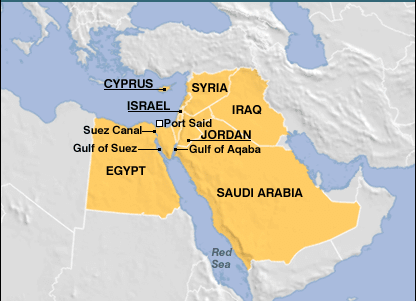
- Conflict in the Middle East could block access to the Suez Canal and Red Sea.
- Indian exporters may be forced to reroute via the Cape of Good Hope, adding:
- 15–20 days transit time
- $500–1,000 per container
National Affairs
1. India’s Gaza Ceasefire Abstention at UNGA
Context:
India abstained from a United Nations General Assembly (UNGA) vote on June 13, 2025, that called for an immediate ceasefire in Gaza. The resolution passed overwhelmingly, but India chose not to support it — marking its fourth abstention on Gaza-related votes in three years. This move contrasts with India’s vote in favour of a ceasefire resolution just six months earlier, in December 2024.
United Nations General Assembly (UNGA)
The United Nations General Assembly (UNGA) is one of the six principal organs of the United Nations (UN), acting as its main deliberative, policymaking, and representative body. The Assembly is currently in its 79th session, with its authority defined in Chapter IV of the UN Charter.
- Formation:1945
- President: Philémon Yang
Composition and Voting Rights
- Comprises all 193 UN member states, each with one equal vote, ensuring equitable representation.
- Most matters are decided by a simple majority.
- Two-thirds majority is required for:
- Budgetary decisions
- Recommendations on peace and security
- Membership issues (election, admission, suspension, expulsion)
Key Functions and Responsibilities
- Approves the UN budget
- Appoints non-permanent members to the Security Council
- Appoints the UN Secretary-General
- Receives reports from other UN organs
- Adopts non-binding resolutions on global issues
- Creates subsidiary bodies for specialized mandates
- Can recommend collective measures under the Uniting for Peace resolution when the Security Council is deadlocked
Banking/Finance
1. Cryptocurrency or Virtual Digital Asset (VDA)
Context:
In a significant move to tighten compliance, the Income Tax Department has issued notices to thousands of taxpayers who failed to disclose income from cryptocurrency or Virtual Digital Asset (VDA) transactions.
What is Virtual Digital Asset (VDA)?
According to the Finance Act 2022 (India), a Virtual Digital Asset (VDA) is defined as:
- Any form of digital representation of value that is generated using cryptographic methods.
- A store of value or a unit of exchange, transferred electronically.
- Includes cryptocurrencies like Bitcoin, Ethereum, and stablecoins.
- Includes NFTs (Non-Fungible Tokens), which represent ownership of unique digital or physical assets.
- Excludes digital representations of traditional currencies regulated by governments (like CBDCs – Central Bank Digital Currencies).
Cryptocurrency (or virtual currency)
Crypto assets are assets issued or transferred using distributed ledger technology (DLT) or blockchain technology. They are a wide range of digital instruments that can represent value or ownership. Crypto assets include cryptocurrencies.
Cryptocurrency (or virtual currency) is likely the most well-known type of crypto asset. Cryptocurrency is a digital currency or medium of exchange. It can be used To exchange for products or services, like fiat currency (such as Canadian dollars or US dollars)
Background
- Growing Scrutiny of Crypto
- The move follows increased monitoring of crypto exchanges and wallet transactions.
- VDA income is taxable under Section 115BBH of the Income Tax Act, effective from April 2022.
- It attracts a flat 30% tax rate without deductions (except cost of acquisition) and 1% TDS under Section 194S.
2. External Benchmark Lending Rate (EBLR)
Context:
The country’s largest lender, State Bank of India (SBI), reduced its External Benchmark Lending Rate (EBLR) and home loan rate by 50 basis points, keeping with Reserve Bank of Indias half per cent cut in policy repo rate. The revised EBLR would be 8.15 per cent as against the old rate of 8.65 per cent.
External Benchmark Lending Rate (EBLR)
The External Benchmark Lending Rate (EBLR) represents a paradigm shift in India’s banking landscape, aiming to ensure better transmission of monetary policy to end borrowers. Initiated by the Reserve Bank of India (RBI), EBLR replaced internal benchmarks like IBLR and MCLR, which were found ineffective in ensuring fair and timely rate transmission.
Background: Evolution from IBLR and MCLR
Before EBLR, Indian banks relied on two major benchmarks:
- Internal Benchmark Lending Rate (IBLR)
- Marginal Cost of Funds Based Lending Rate (MCLR)
Despite RBI’s policy rate cuts, banks often failed to pass on the benefits to borrowers, citing factors like internal spreads, operational costs, and non-performing assets. This inefficiency led RBI to constitute an Internal Study Group (ISG), whose recommendations culminated in the adoption of EBLR from October 1, 2019.
What is EBLR?
EBLR stands for External Benchmark Lending Rate, a rate linked to an external reference such as:
- RBI’s Repo Rate
- 3-month or 6-month Treasury Bill yield
- Any other benchmark published by Financial Benchmarks India Pvt. Ltd (FBIL)
Key Regulatory Instructions by RBI
- All floating-rate retail and MSME loans must be linked to EBLR.
- A bank must adopt a single benchmark for each loan category.
- The interest rate must be reset at least once every 3 months.
- Spread over EBLR is permitted, but any increase must be based on material changes in the borrower’s creditworthiness.
Why the Shift to EBLR?
The transition to EBLR was driven by key shortcomings of IBLR and MCLR:
- Poor transmission of RBI’s rate cuts to borrowers.
- Lack of transparency in internal benchmark setting.
- Limited influence of monetary policy on actual lending rates.
- Variability in spreads and subjective decisions across banks.
Impact of a Reduction in External Benchmark Lending Rate (EBLR) on Borrowers
When the External Benchmark Lending Rate (EBLR) is reduced, borrowers with EBLR-linked loans—such as home loans, personal loans, and loans to small businesses—generally benefit from lower interest rates. This mechanism ensures faster and more transparent monetary transmission compared to older internal benchmark systems like MCLR (Marginal Cost of Funds Based Lending Rate).
3. RBI Issues New Guidelines to Ease Reactivation of Dormant Bank Accounts and Access to Unclaimed Deposits
Context
The Reserve Bank of India (RBI) has issued revised guidelines aimed at simplifying the process for customers and heirs to reactivate inoperative bank accounts and claim unclaimed deposits. The move is designed to improve access to forgotten funds and reduce bureaucratic hurdles, particularly for senior citizens and rural customers.
What Are Inoperative Accounts and Unclaimed Deposits?
- According to RBI norms:
- A savings or current account becomes inoperative if there has been no customer-initiated transaction for 10 years.
- Term deposits, too, become unclaimed if not withdrawn within 10 years of maturity.
- Such funds are transferred to the Depositor Education and Awareness (DEA) Fund, maintained by the RBI.
Challenges Faced Earlier
- Physical visits to the home branch were mandatory.
- Process involved lengthy documentation, especially for legal heirs.
- Lack of digital support hindered accessibility, particularly in semi-urban and rural areas.
Key Changes Under the New RBI Guidelines
- Flexible KYC Update Options
- Customers can now update KYC at any branch of their bank, not just the home branch.
- Video-Based Customer Identification
- Banks have been directed to offer video KYC services for reactivating dormant accounts.
- Use of Business Correspondents
- Banks may authorise their business correspondents (BCs) to assist customers in completing KYC formalities in remote areas.
Expected Impact
- Faster reactivation of dormant accounts.
- Improved customer convenience, especially for elderly and rural users.
- Likely increase in the number of claims for unclaimed deposits lying with banks and the DEA Fund.
- Enhanced financial inclusion and trust in the banking system.
BS
4. Scapia Partners with Federal Bank to Launch Dual-Network RuPay Credit Card
Context:
Scapia, a Bengaluru-based travel fintech startup, has partnered with Federal Bank to launch the Scapia Federal RuPay Credit Card, featuring a dual-network architecture (VISA + RuPay). The card is designed for seamless integration of credit and UPI payments, catering especially to frequent travelers and digital-savvy users.
Key Features of the Scapia Federal RuPay Credit Card
- Dual-Network Support:
- Works on both VISA and RuPay, allowing for online, offline, UPI, and international transactions from a single credit card account.
- Integrated Spend Management:
- Users can track both credit card and UPI expenses (via RuPay) in one consolidated platform.
- Zero Forex Markup:
- No foreign exchange markup fees on international purchases, enhancing value for global travelers.
- Exclusive Airport Privileges:
- Unlimited domestic airport lounge access
- Complimentary dining, shopping, and spa benefits at airport outlets.
About Scapia
- Founded: 2022
- Headquarters: Bengaluru
- Founder & CEO: Anil Goteti
5. RBI Permits STRIPS Trading in State Government Bonds to Deepen Market Liquidity
Context:
The Reserve Bank of India (RBI) has expanded its STRIPS (Separate Trading of Registered Interest and Principal of Securities) framework to include State Government Securities (SGSs), aligning it with the existing facility for Central Government Securities (G-Secs). The move aims to boost liquidity, price discovery, and retail investor participation in the state bond market.
What is STRIPS?
STRIPS allows the principal and interest components of fixed-coupon securities to be traded separately as individual zero-coupon instruments. This promotes flexibility in trading and widens the investor base.
Key Highlights of the STRIPS Facility for State Bonds
- Eligible Securities Criteria:
- Fixed-coupon state government bonds only
- Residual maturity up to 14 years
- Outstanding issuance size of at least ₹10 billion (~$116.93 million)
- Must be SLR-eligible securities (Statutory Liquidity Ratio)
- Purpose & Benefits:
- Facilitates independent trading of interest and principal components
- Enhances market liquidity and pricing efficiency
- Offers banks and investors more options for portfolio and risk management
- Implementation:
- Introduced after consultations with state governments and market participants
- Effective immediately as per RBI’s circular
- Aligned with existing guidelines for central government STRIPS trading
Agriculture
1. NABARD Gets Government Nod to Raise ₹19,500 Crore via Deep-Discount Bonds
Context:
The National Bank for Agriculture and Rural Development (NABARD) has received central government approval to raise ₹19,500 crore (approximately $2.3 billion) through deep-discount zero-coupon bonds, the largest such approval among state-run entities this fiscal year. The bond issuance will remain open for subscription until March 31, 2027.
What Is a Zero-Coupon Bond?
A Zero-Coupon Bond (ZCB) is a type of debt security that does not pay periodic interest (coupons). Instead, it is sold at a deep discount and redeemed at full face value (par value) upon maturity. The investor’s return is the difference between the purchase price and maturity value.
Also known as: Accrual Bond
Key Features of Zero-Coupon Bonds:
- No periodic interest payments (coupons)
- Issued at a discount, repaid at full face value at maturity
- Return = Par Value – Purchase Price
- Subject to interest rate risk if sold before maturity
- Longer maturity = deeper discount = more price volatility
Who Issues ZCBs?
- Government entities
- Corporations
- Financial institutions (which may strip coupons and repackage bonds)
How Zero-Coupon Bonds Work:
- Investor buys a ZCB at a low price (e.g., ₹6,855)
- At maturity, the investor receives full face value (e.g., ₹20,000)
- The implied yield (e.g., 5.5%) is compounded semiannually
- No interim payments; interest is “imputed” or “phantom” interest
Strategic Implications for NABARD
- Supports long-tenure fundraising for rural credit and infrastructure projects.
- Deepens the long-term debt market with more structured offerings.
- Government backing may improve market confidence in upcoming tranches.
BS
2. National Conference on Agri Stack
Context:
The Ministry of Agriculture & Farmers’ Welfare (MoA&FW) organized the National Conference on Agri Stack: Turning Data into Delivery on June 14, 2025, at Sushma Swaraj Bhawan, New Delhi. The event marked a significant milestone in advancing India’s Digital Agriculture Mission (DAM), bringing together senior officials from the Centre and States, experts, and stakeholders to deliberate on progress, challenges, and the digital future of Indian agriculture.
Agri Stack Framework and Integrations
- Shri Pramod Kumar Meherda, Additional Secretary (Digital), outlined Agri Stack’s scope:
Major Announcements and Collaborations
- MoUs signed with Maharashtra, Kerala, Bihar, Odisha, and the PSB Alliance for enabling credit access via Farmer Registry-linked authentication.
- Launch of Special Central Assistance (SCA) Guidelines:
- Total allocation: ₹6,000 crore
- For Farmer Registry (including legal heir integration)
- For Digital Crop Survey (DCS)
- Disbursement on first-come-first-served basis.
Key Technological Innovations
- DVC/Kisan Pehchan Patra:
- Digitally authenticated land and crop credentials, linked with DigiLocker, revocable on land mutation.
- Launch of Unified Grievance Redressal Portal:
- OTP login, multilingual support, and audio upload
- Representative-based grievance lodging enabled
- Introduction of AI-powered Chatbot (trained on Agri Stack data via Google Gemini) for multilingual farmer support.
- Pilots underway for:
- Crop recognition via AI
- Facial authentication of surveyors
- AI-based backend optimization
State-Level Best Practices and Feedback
- Maharashtra:
- Enrolment in Farmer Registry across districts
- Request for Data Provisioning Engine (DPE) and Mahavistaar AI sandbox
- Uttar Pradesh:
- Use of Agri Stack in MSP e-procurement (2024)
- Field feedback on DCS challenges
- Karnataka:
- Integration of FRUITS platform with banks
- Use in disaster relief, soil health integration
Technical Discussions and Challenges Identified
- Emphasis on:
- Remote sensing, AI/ML, and auto-validation tools
- DCS compliance and data standardization
- Challenges:
- Outdated tribal land records
- Errors in photo-based crop surveys
- Data gaps and inconsistencies across States
Facts To Remember
1. Hat-trick of World Cup gold medals for Suruchi Phogat
Suruchi Phogat won the women’s air pistol gold with a 0.2 point margin over Camille Jedrzejewski of France in the shooting World Cup in Munich.
2. RBI gives Yes Bank MD & CEO Prashant Kumar 6-month extension: Lender
Prashant Kumar has got a six-month extension from the Reserve Bank of India (RBI) as Yes Bank’s managing director (MD) and chief executive officer (CEO), the lender said.
3. K Ramachandran appointed part-time chairman of Tamilnad Mercantile Bank
The board of Thoothukudi-headquartered Tamilnad Mercantile Bank (TMB) has appointed veteran banker K Ramachandran as an Additional Director (Non-Executive Independent) and also cleared his name as the Non-Executive Part-Time Chairman of the bank.
4. Ministry of Ayush to Host Global Yoga Summit ‘Yoga Connect’ Ahead of International Day of Yoga 2025
The Ministry of Ayush is set to host ‘Yoga Connect’, a hybrid global summit, on 14th June 2025 at Vigyan Bhawan, New Delhi, as a flagship event in the lead-up to the 11th International Day of Yoga (IDY).
5. Gensol Engineering and Gensol EV Lease Admitted to Insolvency: NCLT Acts on IREDA’s Plea
Gensol Engineering Ltd, known for managing the electric vehicle ride-hailing platform BluSmart, has entered insolvency proceedings after the Indian Renewable Energy Development Agency (IREDA) initiated action citing a ₹510 crore default. In a separate but related move, Gensol EV Lease Ltd was also admitted into insolvency on a ₹219 crore default.
6. Israel’s Operation Rising Lion
In pre-dawn strikes termed Operation Rising Lion, dozens of Israeli jets launched a sweeping aerial assault across Iranian territory on Friday, hitting multiple high-value nuclear and military targets.
- VDA income is taxable under Section 115BBH of the Income Tax Act, effective from April 2022. Cryptocurrency or Virtual Digital Asset (VDA)
- India imports over 80% of its crude oil requirements. Iran-Israel Conflict Triggers Oil Price
- A savings or current account becomes inoperative if there has been no customer-initiated transaction for 10 years. RBI Issues New Guidelines to Ease Reactivation …
- The implied yield (e.g., 5.5%) is compounded semiannually NABARD Gets Government Nod to Raise ₹19,500 Cro…
- Use of Agri Stack in MSP e-procurement (2024) National Conference on Agri Stack
15&16 June, 2025
Daily Current Affairs Quiz
15 & 16 June, 2025
International Affairs
1. Israel-Iran Conflict
Context:
In a dramatic escalation, Israel has launched a full-scale military operation—“Operation Rising Lion”—targeting key Iranian nuclear and missile facilities. The strike follows a formal declaration by the International Atomic Energy Agency (IAEA) that Iran is in violation of its nuclear safeguards obligations.
Background
- Historic Differences: Relations between the two nations have remained strained since Iran’s 1979 political transformation, which led to changes in its foreign policy stance.
- Regional Concerns: Both countries have maintained sharply divergent regional security priorities, contributing to complex geopolitical dynamics across the Middle East.
- Previous Precedents: Israel has conducted similar operations in the past, including airstrikes on nuclear sites in Iraq (1981) and Syria (2007).
- Recent Regional Shifts: Security concerns have influenced new alignments in the region, including normalization agreements between Israel and several Arab nations.
Key Developments Leading to the Operation
- IAEA Resolution: The IAEA Board expressed concerns regarding Iran’s nuclear transparency, citing unreported sites where traces of enriched uranium were detected.
- Diplomatic Stalemate: Recent indirect discussions between Iran and the United States in Oman failed to produce consensus on nuclear enrichment thresholds.
- Security Calculations: Israeli authorities have expressed the view that addressing perceived threats at the source is essential for long-term regional stability.
- Political Considerations: Observers note that the operation also comes at a time of heightened political debate within Israel.
IAEA Findings and Implications
- Non-Compliance Note: The IAEA resolution identified gaps in Iran’s cooperation regarding three specific sites—Lavisan-Shian, Varamin, and Turquzabad.
- Possible UN Engagement: Under Article XII.C of the IAEA Statute, repeated non-compliance may warrant deliberation by the UN Security Council.
- Iran’s Response: Tehran has rejected the resolution and announced its intention to expand domestic uranium enrichment efforts at new, deeply buried facilities.
- Upcoming Review: The IAEA is expected to release a comprehensive follow-up report in August 2025 to assess continued compliance.
Global and Regional Impact
- Energy Market Sensitivity: The Strait of Hormuz, a key route for global oil shipments, lies in close proximity to the affected region. Any escalation could influence global energy prices.
- International Reactions: The United States and European partners face a complex policy landscape—balancing diplomatic dialogue with regional stability commitments.
- Non-Proliferation Concerns: Any deviation from established nuclear agreements could raise broader concerns about strategic stability in West Asia.
Implications for India
- Safety of Indian Nationals: With a significant diaspora in the Middle East, the safety and mobility of Indian citizens remain a top priority.
- Energy Supply Chain Risks: A large portion of India’s crude oil imports transits through the Strait of Hormuz. Any disruption could have implications for inflation and energy planning.
- Diplomatic Considerations: India continues to maintain strong bilateral relations with both Israel and Iran. The government is expected to adopt a balanced and principled stance guided by strategic autonomy and national interest.
National Affairs
1. Flue Gas Desulphurisation (FGD) Units
Context:
A government-appointed expert committee led by Principal Scientific Advisor Ajay Sood has recommended rolling back India’s 2015 policy mandating the installation of Flue Gas Desulphurisation (FGD) units in all coal-fired thermal power plants (TPPs). The recommendation comes amid high installation costs, sluggish compliance, and mounting power demand.
What Is an FGD Unit?
FGD units are designed to remove sulphur dioxide (SO₂) from flue gas produced during coal combustion. SO₂ is a key contributor to respiratory illness and air pollution.
There are three major types of FGD systems:
- Dry sorbent injection – Injects powdered limestone into flue gas
- Wet limestone treatment – Passes flue gas through limestone slurry, producing gypsum
- Seawater scrubbing – Uses coastal seawater to absorb and neutralize SO₂
Why SO₂ Emissions Matter
- SO₂ causes acid rain, respiratory ailments, and contributes to secondary PM2.5 formation
- Studies show 15% of India’s PM2.5 is linked to coal burning, with SO₂ accounting for 80% of that share
- Reducing SO₂ is vital to improving ambient air quality and public health
Implementation Status in India
- The 2015 mandate required all 537 coal-based TPPs to install FGD units
- Only 39 plants had complied as of April 2025
- Original 2018 deadline extended multiple times — latest compliance dates stretch to 2029
- In December 2024, the Ministry of Environment extended deadlines by another 3 years, citing no official reason
Is There an Alternative to FGD Units?
- Experts affirm that no current alternative exists to remove SO₂ at source from coal combustion
- Reducing reliance on coal or investing in cleaner energy alternatives is a long-term solution, but FGDs remain essential in the interim
2. New Species of Jumping Spider Discovered in Southern India
Context:
A team of Indian researchers has discovered a new species of jumping spider from the subfamily Spartaeinae, marking a significant extension of the known distribution of the genera Spartaeus and Sonoita into the Indian subcontinent. These genera were previously known only from Southeast Asia and Africa.
Discovery Details
The new species, named Spartaeus karigiri, was identified in Devarayanadurga, Karnataka, specifically near Karigiri (Elephant Hill)—the location after which the species is named. The discovery was led by John Caleb T.D., a researcher at Saveetha Medical College, Chennai.
- Males were found hiding in crevices and rocky areas.
- Females were observed guarding egg clutches in the wild.
- Additional specimens were found in Villupuram district, Tamil Nadu.
The research, published in the European Journal of Taxonomy on June 11, highlights the first recorded presence of Spartaeus and Sonoita spiders in India.
TH
3. Shanghai Cooperation Organisation (SCO)
Why in News?
India refused to associate itself with a statement by the Shanghai Cooperation Organisation (SCO) condemning Israel’s military strikes on Iran in another show of solidarity with Israel this week, after it abstained from voting on a UN resolution seeking ceasefire in Gaza.
Shanghai Cooperation Organisation (SCO)
The Shanghai Cooperation Organisation (SCO) is a multilateral political, economic, security, and defence organization comprising 10 member states across Eurasia. It represents the world’s largest regional organization by area and population, covering approximately 24% of the world’s landmass and 42% of its population.
- Headquarter:
- Beijing, China
- Secretary-General:
- Nurlan Yermekbayev
Member States
- Founding Members (2001): China, Kazakhstan, Kyrgyzstan, Russia, Tajikistan, Uzbekistan
- Expanded Members:
- India and Pakistan joined in June 2017
- Iran became a full member in July 2023
- Belarus joined in July 2024
Origins and Development
- Predecessor: Shanghai Five (1996–2000), comprising China, Russia, Kazakhstan, Kyrgyzstan, and Tajikistan.
- 1996: Treaty on Deepening Military Trust in Border Regions
- 1997: Treaty on Reduction of Military Forces in Border Regions
- Regular summits fostered border cooperation, military trust, and non-interference principles.
- Formation of SCO:
- June 2001: Uzbekistan joined the Shanghai Five members to establish the SCO in Shanghai.
- The group evolved from a confidence-building mechanism to a broader strategic platform for regional stability, economic cooperation, and counter-terrorism.
Structure and Governance
- Heads of State Council (HSC): Supreme decision-making body, meets annually.
- Regional Anti-Terrorist Structure (RATS): Coordinates intelligence and counter-terrorism efforts among member states.
Key Principles
- Respect for sovereignty, non-interference, territorial integrity, and collective security.
- Promotion of a multipolar world order and regional integration without external intervention.
4. Second Batch of Phase 2 Capacity-Building under NAKSHA Programme
Context:
The Department of Land Resources (DoLR), under the Ministry of Rural Development, Government of India, has announced the launch of the second batch of Phase 2 of its capacity-building programme under the NAKSHA (National Geospatial Knowledge-based Land Survey of Urban Habitations) initiative. The programme commences on June 16, 2025, with training to be conducted across four Centres of Excellence (CoEs) nationwide.
Objectives
The training is designed to empower ULB-level and district officials with the technical competencies to carry out high-precision urban property surveys. Modules include:
- GNSS and ETS-based land surveying
- Web-GIS platforms for urban mapping
- Land parcel mapping and digitization
- Legal and administrative frameworks for land record modernization
- Implementation of the NAKSHA framework in real-time survey operations
About NAKSHA
The NAKSHA programme is a pioneering geospatial initiative launched by DoLR in partnership with:
- Survey of India
- NICSI
- MPSeDC
- Five Centres of Excellence
It is currently being piloted in 157 ULBs across 27 States and 3 Union Territories, and aims to meet the growing demand for accurate, accessible, and verifiable urban land records, especially as India’s urban population is projected to cross 600 million by 2031.
Banking/Finance
1. Govt Likely to Amend Refund Clause in New IT Bill, 2025
Context:
In a major relief for taxpayers, the government is likely to amend the controversial refund provision in the draft Income Tax (IT) Bill, 2025, which currently denies refunds for returns filed after the due date. A senior official from the Finance Ministry has confirmed that the provision will be rectified and brought in line with the current law.
Contradictory Clauses in the Draft Law
The draft Bill, introduced in Parliament on February 13, 2025, contains contradictory sections:
- Section 433 allows a refund claim regardless of whether the return is belated.
- In contrast, Section 263(1)(a)(ix) stipulates that a refund can be claimed only if the return is filed on or before the due date.
Tax experts and stakeholders flagged this inconsistency, calling it confusing and potentially unfair.
BS
2. SEBI Likely to Announce Regulatory Relaxations
Context:
The Securities and Exchange Board of India (SEBI) is expected to introduce a set of regulatory relaxations and reforms during its upcoming board meeting on June 18, the second under the chairmanship of Tuhin Kanta Pandey.
Key Expected Announcements
New Category of FPIs for Government Bond Investments
SEBI may introduce a dedicated category of foreign portfolio investors (FPIs) called IGBFPIs, specifically for those investing in Indian government bonds (IGBs) through the Voluntary Retention Route (VRR) and Fully Accessible Route (FAR). The proposed changes include:
- Eased KYC norms, aligned with RBI guidelines.
- Unrestricted participation for NRIs, OCIs, and resident Indians in IGBFPI vehicles.
- Simplified disclosure requirements related to material changes and equity investment limits.
Simplification of Delisting Process for PSUs
The board is also expected to consider reforms for voluntary delisting of public sector undertakings (PSUs) where the government holds more than 90% equity. The changes may include:
- Waiver of minimum public shareholding (25%) compliance.
- Elimination of the two-thirds public shareholder approval requirement for delisting.
Currently, eight listed PSUs have over 90% government ownership, including Haryana Financial Corporation and KIOCL, making public stake dilution and fair price discovery challenging.
Co-investment Reforms in AIFs
SEBI will likely review recommendations from a working group on facilitating co-investments in Alternative Investment Funds (AIFs) via separate co-investment vehicles. Topics under consideration include:
- Eligibility norms for co-investment structures.
- Exit conditions for co-investors.
Relaxations for REITs and InvITs
The board may also ease disclosure norms for Real Estate Investment Trusts (REITs) and Infrastructure Investment Trusts (InvITs) by:
- Streamlining QIP documentation to include only relevant disclosures.
KRAs and Policy Updates
- The process for winding up KYC Registration Agencies (KRAs) could be simplified.
- The board will be briefed on policy work concerning conflict of interest norms and disclosure obligations for SEBI officials.
3. The Journey of Regional Rural Banks (RRBs)
Context:
The journey of Regional Rural Banks (RRBs), which began with the establishment of five banks on October 2, 1975, has been both remarkable and transformational. These banks are jointly owned by the Central Government (50%), state governments (15%), and sponsor banks (35%), which include public sector, private, and cooperative banks. Sponsor banks also provide managerial support by deputing key personnel, including chairmen and general managers.
Expansion and Consolidation
Initially proliferating to 196 RRBs during the expansion phase, the sector later underwent two decades of consolidation, guided by the concept of “One State, One RRB”, now implemented fully as of May 1, 2025. This has brought down the number of RRBs to 28, with an expansive branch network exceeding 22,000, second only to the State Bank of India.
Opportunities Ahead
- Bankers to State Governments: RRBs are well-positioned to serve as official bankers for state governments.
- Transition to Universal Banks: With stronger financials, many RRBs could evolve into universal banks.
- Localized Expertise: Deep-rooted presence in specific states allows RRBs to leverage local manpower and knowledge.
- Growth in Rural Heartlands: RRBs operate in India’s rural and semiurban growth hubs, key to national development.
- Economies of Scale: Consolidation brings scale and operational synergies, enhancing profitability.
Challenges to Address
- Managerial Constraints: Key leadership remains on deputation, limiting continuity and ownership.
- Basel Norms Gap: RRBs still operate under Basel I, misaligned with their growing size and complexity.
- Capital Requirements: Upgrading to Basel II/III will demand substantial capital infusion.
- Compliance and Risk Management: Weaknesses in risk culture and compliance persist.
- Tech Dependence: Heavy reliance on sponsor banks for technology infrastructure is a vulnerability.
- Structural Reassessment Needed: Some RRBs may require a new organizational design to support their scaled-up operations.
4. Sebi Tightens ESG Bond Rules
Context:
India’s capital market regulator, the Securities and Exchange Board of India (Sebi), has introduced a comprehensive framework for the continuous monitoring and third-party verification of environmental, social, and governance (ESG)-labelled bonds, effective from 5 June 2025. While aimed at curbing “purpose-washing,” the move may increase compliance burdens, especially for mid-sized firms, according to market experts.
Environmental, social, and governance (ESG)-Labelled Bonds
Environment, Social and Governance Debt Securities or “ESG Debt Securities” means green debt securities, social bonds, sustainability bonds, sustainability-linked bonds, or any other type of bonds
Key Objectives of Sebi’s New Framework
- Combat Misrepresentation: Targets purpose-washing, where issuers misstate the environmental or social impact of bond proceeds.
- Mandatory Third-Party Verification: Issuers must appoint independent reviewers to verify alignment of ESG claims.
- Enhanced Disclosures: Requirements include detailed reporting on decision-making, project selection, fund deployment, and impact assessment.
- Early Redemption Clause: Allows redemption of bonds in cases where issuers deviate from stated ESG objectives.
- Quantification of Negative Externalities: Issuers must disclose potential negative outcomes from funded projects.
Risk of Market Bifurcation
- Larger companies can afford ESG investment and verification.
- Smaller issuers may resort to green-washing or abstain altogether due to high costs.
- Dudhat emphasized strict scrutiny and due diligence, not just on-paper compliance.
5. Jupiter and Scapia Launch RuPay-UPI Enabled Credit Cards
Context:
India’s fintech space continues to evolve rapidly with the launch of UPI-compatible RuPay credit cards by Jupiter and Scapia, in collaboration with CSB Bank and Federal Bank respectively. These digital-first offerings combine the power of credit with the convenience and ubiquity of UPI, marking a significant step forward in the integration of India’s payment systems.
Jupiter’s Edge+ RuPay Credit Card
Jupiter, a digital-first money management platform, has unveiled the Edge+ CSB Bank RuPay Credit Card, a no-joining-fee, no-annual-fee product focused on rewards and UPI-enabled convenience.
Key Features:
- UPI integration via the RuPay network for seamless QR-based credit payments.
- Cashback rewards worth over ₹50,000 annually.
- Flexible reward redemption: statement credit, bill payments, cash, and Digital Gold.
- Available exclusively through the Jupiter app, with built-in expense tracking tools.
6. NPCI–IDRBT Sign MoU to Boost Cybersecurity and Resilience in India’s Digital Payments Ecosystem
Context:
In a strategic move to enhance cybersecurity and digital resilience within India’s fast-expanding digital payments infrastructure, the National Payments Corporation of India (NPCI) and the Institute for Development and Research in Banking Technology (IDRBT) signed a Memorandum of Understanding (MoU) on June 12, 2025.
Why This Matters
As India’s digital payment ecosystem witnesses exponential growth, the associated risk of cyber threats has also surged. This partnership aims to fortify India’s financial infrastructure by building skilled human capital, improving threat intelligence, and introducing structured certification programs to enhance the sector’s preparedness against cyber threats.
Key Objectives of the MoU
- Strengthen cyber resilience in digital and retail payments.
- Launch specialized training programs on cybersecurity, data privacy, and digital risk.
- Roll out NPCI-certified security programmes tailored to regulatory and industry standards.
- Provide access to IDRBT’s upgraded threat intelligence platform, सचेत (IBCART 3.0).
- Promote information sharing, early warning mechanisms, and incident response frameworks.
Highlights of the Partnership
- Joint capacity-building efforts across rural and urban financial ecosystems.
- Proactive risk mitigation strategies for digital payment professionals.
- Empowerment of banks and fintechs with certified cybersecurity talent.
- Alignment with India’s broader Digital Public Infrastructure (DPI) and financial inclusion goals.
About NPCI
- Umbrella organization for retail payment systems in India, established by RBI and IBA.
- Pioneered systems like UPI, IMPS, RuPay, AePS, NACH, and e-RUPI.
- Key subsidiaries include NIPL (international), NBBL (bill payments), and NBSL (registry services).
- Central to the development of India’s interoperable and inclusive payment ecosystem.
About IDRBT
- Established by the Reserve Bank of India in 1996 for R&D in banking technology.
- Instrumental in launching INFINET, SFMS, and the National Financial Switch.
- Hosts CISO, CIO, and CAO forums, guiding Indian banks on tech governance and cybersecurity.
- Developer of the सचेत (IBCART 3.0) platform for real-time cyber threat intelligence and response.
7. CreditAccess Grameen Raises $100 Million Multi-Currency Syndicated Social Loan to Strengthen Rural Microfinance
Context:
In a key milestone toward advancing inclusive finance in India, CreditAccess Grameen Ltd (CA Grameen) has successfully secured a $100 million multi-currency syndicated social loan facility, marking its second such facility and the first structured in both Japanese Yen (JPY) and United States Dollar (USD).
Key Highlights
- Loan Composition: The funding comprises JPY and USD, predominantly sourced from banks across South Asia and the Far East.
- Use of Proceeds: Funds will be deployed for eligible social projects under CA Grameen’s Social Loan Framework, aligned with Social Loan Principles 2023 by the Loan Market Association.
- Scale and Reach: Operating in 423 districts across 16 states, CA Grameen focuses on women-centric microloans in rural India.
- RBI ECB Route: The loan qualifies as External Commercial Borrowing (ECB) under the automatic route of the Reserve Bank of India (RBI).
Strategic Impact
- Diversified Borrowing Profile: The company aims to achieve 25–30% foreign borrowings by FY28, enhancing geographic diversification, asset-liability management (ALM), and liability robustness.
- Cost Efficiency: CFO Nilesh Dalvi stated that the borrowing cost is competitive, on par with or lower than domestic borrowings.
About CreditAccess Grameen
Headquartered in Bengaluru, CreditAccess Grameen is India’s largest NBFC-MFI, with a mission to empower rural women through access to credit. The firm continues to expand its presence in states such as Andhra Pradesh, Bihar, Chhattisgarh, and Goa, among others.
8. RBI Eases Reactivation Process for Dormant Bank Accounts and Unclaimed Deposits
Context:
In a customer-centric move, the Reserve Bank of India (RBI) has issued fresh guidelines aimed at simplifying the reactivation of dormant bank accounts and facilitating access to unclaimed deposits, particularly benefiting senior citizens, non-resident Indians (NRIs), and heirs of deceased account holders.
Key Highlights of the New Guidelines
- KYC Update Flexibility: Customers can now update their Know Your Customer (KYC) information at any branch of their bank, not just the home branch.
- Video KYC (V-CIP): Banks are mandated to enable video-based customer identification for reactivating dormant accounts. This allows identity verification via secure video calls, offering greater convenience and accessibility.
- Use of Business Correspondents: Banks may deploy authorized Business Correspondents (BCs) to assist in the KYC update process—an important measure for rural and remote areas with limited branch access.
Agriculture
1. Ancient Indian Wisdom for a Sustainable Agricultural Future
Context:
In ancient India, Earth and sky were read as one text—a cosmic manuscript that dictated not just when to sow or harvest, but how to live in harmony with nature. The agricultural calendar was not written in spreadsheets but in stars, seasons, and sacred rhythms. This timeless philosophy did not reduce farming to mere food production; it elevated agriculture as a spiritual alignment between human effort and divine will.
Agriculture as Sacred Symbiosis
Farming in India was never just about output. It was a living expression of ecological awareness, embedded within a culture that revered nature as divine. Crops were not simply grown; they were coaxed into existence through attunement—to the land, the elements, and the cosmos. This symbiosis between soil and spirit offered meaning beyond metrics—something industrial agriculture has largely lost.
Nakshatras and the Agricultural Calendar
India’s Vedic agricultural knowledge placed the sky at the centre of agrarian life. The moon’s 27 nakshatras (lunar constellations) were believed to influence the elemental energy of each day—dictating what to plant, when to water, when to harvest, or even when to rest.
- Rohini, ruled by the Moon and associated with abundance, was considered the most auspicious constellation for sowing. Its nurturing influence was thought to infuse seeds with life.
- Mrigashira, symbolic of exploration, was ideal for searching new plots or rotating crops.
- In contrast, Bharani, associated with intense transformation, was avoided for sowing but embraced for composting and soil regeneration.
Farmers did look to the sky—but they also listened to the soil beneath their feet. For them, time was not linear but cyclical, sacred and seasonal.
Ritu Chakra: The Six-Season Agricultural Cycle
India’s agricultural calendar is intimately aligned with the six ritus (seasons), each bringing its own set of crops, rituals, and ecological imperatives:
- Vasanta (Spring): A season of rebirth. Soil is tilled, fields are prepped, and new life begins.
- Grishma (Summer): A time for resilience. Drought-resistant crops like millets are sown, and water is conserved with care.
- Varsha (Monsoon): Rain is welcomed with songs to Indra, as Kharif crops like paddy are planted. Water conservation structures like bunds are maintained.
- Sharad (Autumn): A celebration of harvest, marked by golden grains and thanksgiving festivals.
- Hemanta (Early Winter): Time to sow Rabi crops like wheat and mustard—slow-growing and rich in taste.
- Shishira (Late Winter): A season of closure and soil rest. Root vegetables are harvested and fields lie fallow, readying for the next cycle.
Facts To Remember
1. South Africa Becomes the WTC Champions!
Aiden Markram’s magnificent century was the cornerstone of South Africa’s five-wicket victory over Australia in the World Test Championship final at Lord’s.
2. Szocs leads from the front as U Mumba clinches maiden title
U Mumba TT didn’t have much time to recover after the thrilling semifinal on Saturday night. The schedule proved to be quite gruelling for the team.
3. MV Wan Hai 503 Fire Incident: Indian Navy, Coast Guard Continue Coordinated Response
The Indian Navy confirmed on Saturday that the Singapore-flagged container vessel MV Wan Hai 503, which caught fire following an onboard explosion on June 9, has now been moved to deeper waters. The vessel is located beyond the 1,000-metre sounding line, approximately 45 nautical miles off the Kerala coast.
4. Arya-Arjun pair brings home mixed air rifle gold
Arya Borse and Arjun Babuta clinched the mixed air rifle gold by beating the Chinese pair of Wang Zifei and Sheng Lihao 17-7 in the shooting World Cup that concluded in Munich, Germany.
5. Pranati wins vault bronze in Asian gymnastics c’ships
Pranati Nayak clinched her third bronze medal in women’s vault at the Asian artistic gymnastics championships in Jecheon, Korea.
6. Abhijeet wins Delhi Open chess for fourth time
Grandmaster Abhijeet Gupta settled for a quick draw in the 10th and final round against Aronyak Ghosh and clinched the title with 8.5 points in the 21st Delhi GM Open.
7. Investments in AIFs up 32% at ₹5.4 lakh cr
India’s affluent investors are increasingly turning to Alternative Investment Funds (AIFs), with investments in the space reaching to just under Rs 5.4 lakh crore by the end of the March 2025 quarter, a surge of 32% from the year earlier.
- In December 2024, the Ministry of Environment extended deadlines by another 3 years, citing no official reason Flue Gas Desulphurisation (FGD) Units
- Established by the Reserve Bank of India in 1996 for R&D in banking technology. NPCI–IDRBT Sign MoU to Boost Cybersecurity and …
- Previous Precedents: Israel has conducted similar operations in the past, including airstrikes on nuclear sites in Iraq (1981) and Syria (2007). Israel-Iran Conflict
- Founding Members (2001): China, Kazakhstan, Kyrgyzstan, Russia, Tajikistan, Uzbekistan Shanghai Cooperation Organisation (SCO)
- Diversified Borrowing Profile: The company aims to achieve 25–30% foreign borrowings by FY28, enhancing geographic diversification, asset-liability management (ALM), and liability robustness. CreditAccess Grameen Raises $100 Million Multi-…
17 June, 2025
Daily Current Affairs Quiz
17 June, 2025
National Affairs
1. India’s Next Census to Be Conducted in 2027
Context:
The Union Home Ministry has formally announced that India’s next Census will be conducted in 2027, marking a significant administrative and technological transition for the country’s decennial population survey. This will be India’s first digital Census, with self-enumeration options for citizens.
- The Census will occur in two distinct phases:
- House Listing Operations
- Population Enumeration
Boundary Freeze Comes Into Effect
As per the Gazette notification issued under Section 3 of the Census Act, 1948, the freezing of administrative boundaries has come into immediate effect. This means:
- No changes can be made by States to boundaries of districts, tehsils, police stations, or administrative blocks.
- The freeze will remain in place until the Census process is completed.
- This is essential because enumeration blocks are geographically defined and form the core basis of the Census exercise.
Digital Census and Self-Enumeration
The 2027 Census will introduce digital data collection for the first time:
- Data will be gathered using mobile applications.
- Citizens will have the option for self-enumeration.
- The Ministry has assured stringent data security during collection, transmission, and storage of data.
Constitutional and Legal Framework
Constitutional Basis
- The Census is a subject under the Union List of the Constitution, as specified in Entry 69 of the Seventh Schedule.
- Article 246 of the Constitution grants exclusive legislative power to the Parliament on subjects in the Union List, making census operations a Central Government responsibility.
Legal Framework: Census Act, 1948
- The Census Act, 1948 governs the conduct of the census in India.
- It authorizes the appointment of a Census Commissioner and defines the procedures for data collection, tabulation, and publication.
- The Act provides the legal backing for periodic population enumeration and related processes.
2. New Endemic Flowering Plant Discovered in Aravalis: Portulaca bharat
Context:
A team of Indian botanists has discovered a new endemic flowering plant species, Portulaca bharat, in the rocky, semi-arid slopes of the Aravalli Hills near Jaipur. The discovery, now published in the international journal Phytotaxa, unveils a previously undocumented element of India’s floristic diversity.

- Discovery and Identification
- Portulaca bharat was first observed by Nishant Chauhan, a researcher and conservationist with the Satpura Biodiversity Conservation Society, during a field visit near the historic Galtaji temple on Jaipur’s outskirts.
- Chauhan collected live specimens from rock crevices in the Galtaji hill region.
- Taxonomic Context
- The genus Portulaca includes 153 species worldwide, mainly in tropical and subtropical zones.
- In India, 11 species are recognized, of which four are endemic.
- Conservation Status
- The species is currently known only from a single location in the Galtaji hills, making it an example of narrow endemism.
- It has been provisionally assessed as “Data Deficient” under the IUCN Red List guidelines due to the absence of population-level data.
3. Three Tech Platforms to Boost Disaster Management Precision and Response
Context:
Union Home Minister Amit Shah on Monday launched three cutting-edge technology platforms to strengthen India’s disaster management framework. The announcement was made during the Annual Conference of Relief Commissioners, Disaster Management Secretaries, and State Disaster Response Forces.
Newly Launched Platforms
- Integrated Control Room for Emergency Response (ICR-ER)
- Enables real-time response to disasters across India.
- Integrates satellite data streaming to rescue and relief agencies.
- Aims to coordinate efforts across agencies for faster, data-driven responses.
- National Database for Emergency Management (NDEM) Lite 2.0
- An upgraded mobile-compatible version of India’s national emergency database.
- Designed to give agile, decentralised access to disaster response forces, even in remote locations.
- Helps responders operate as a unified force, with common access to critical real-time data.
- Flood Hazard Zonation Atlas of Assam
- Provides region-specific flood risk data for Assam, a state frequently affected by floods.
- Offers real-time information on flood impact, river water levels, and mitigation areas.
- Aimed at improving predictive planning and risk-based disaster preparedness.
Significance
- Enhances coordination and communication during disasters.
- Strengthens India’s move towards technology-driven resilience planning.
- Supports both central and state-level preparedness, especially in disaster-prone regions like Assam.
4. Microgravity Experiments During AX-4 Mission
Context:
India is poised to take a significant leap in space science and human spaceflight with Group Captain Shubhanshu Shukla, the country’s first astronaut aboard the International Space Station (ISS). Scheduled to launch on June 19, 2025, the mission is part of Axiom-4 (AX-4), coordinated by Axiom Space in partnership with NASA and ISRO.
Scientific Research on Board
ISRO has shortlisted seven pioneering microgravity research experiments to be conducted by Shukla during his 14-day stay aboard the ISS. These were proposed by Indian principal investigators (PIs) from national R&D labs and academic institutions:
- Impact of microgravity radiation on edible microalgae
- Aimed at understanding viability of microalgae as space food and bioresource.
- Sprouting of salad seeds in space
- Focused on assessing seed germination in microgravity to enhance space farming.
- Tardigrade survival and transcriptomics in microgravity
- Studies spaceflight effects on extremophile organisms for bio-survival insights.
- Effect of metabolic supplements on muscle regeneration
- Evaluates countermeasures against muscle atrophy in low-gravity environments.
- Human interaction with electronic displays in microgravity
- Improves user-interface design for astronauts in spacecraft and ISS modules.
- Comparative proteomics of cyanobacteria on urea vs nitrate in space
- Explores microbial adaptability to alternate nitrogen sources under space stress.
- Impact of microgravity on food crop seeds’ growth and yield
- Addresses food security for long-duration space missions.
5. Digital News Report 2025
Context:
The 2025 Digital News Report by the Reuters Institute for the Study of Journalism reveals a transformative shift in global news consumption patterns — with India emerging as a critical case study in the rise of alternative media, influencer-driven content, and AI-based information sources. Based on surveys of 100,000 respondents across 48 countries, the findings underscore the declining relevance of traditional news media amid the ascent of social media and generative AI.
Key Highlights from India
- Rise of Influencers and Personality-Led News
- Influencers on YouTube and other platforms are rapidly displacing legacy news broadcasters and print outlets.
- Content creators offer both pro- and anti-government narratives, catering to India’s fragmented political landscape.
- The preference to watch news rather than read it is increasingly dominant, especially in India, the Philippines, Thailand, and Kenya.
- News Avoidance on the Rise
- India ranks fourth globally in news avoidance, with 50% of English-speaking internet users saying they sometimes or always avoid the news.
- The report cautions that the sample reflects digitally connected, English-literate populations, and may not represent India’s full demographic spectrum.
- Social Media and YouTube as Primary Sources
- Among 18–34-year-olds, 41% identify social media and YouTube as their main sources of news.
- There is a growing disconnect from publishers’ official websites among younger audiences.
- Trust and Misinformation
- Global trust in news remains static at 40%.
- In India, WhatsApp is flagged as a unique concern. Despite being generally seen as a lower-risk platform globally, in India it has historically been linked to mob violence and misinformation-induced unrest.
- 11% of Indian respondents believe that friends and family contribute to the spread of fake news.
- AI and News Consumption
- 44% of Indian respondents report being comfortable with AI in news contexts.
- Nearly 20% use AI chatbots weekly to stay informed, signaling early adoption of generative tools for information gathering.
Implications for Indian Media
- Legacy media houses face an existential challenge in remaining relevant to a digital-native audience drawn to visual storytelling and interactive formats.
- Platforms such as YouTube, WhatsApp, and Instagram are now central battlegrounds for public opinion and misinformation alike.
- The evolving media landscape calls for greater regulation, content curation, and digital literacy, particularly as AI and influencer ecosystems amplify both credible journalism and unverified claims.
6. India’s Unemployment Rate Rises to 5.6% in May: PLFS Survey
Context:
India’s unemployment rate for individuals aged 15 years and above rose to 5.6% in May 2025, up from 5.1% in April, as per the Periodic Labour Force Survey (PLFS) Monthly Bulletin. The labour force participation rate (LFPR) also declined, indicating tighter labour market conditions exacerbated by extreme summer heat and seasonal shifts in employment patterns.
Key Labour Market Indicators (May 2025)
- Unemployment Rate (15+ age group)
- Overall: 5.6% (up from 5.1% in April)
- Males: 5.6% (up from 5.2%)
- Females: 5.8% (up from 5.0%)
- Youth Unemployment Rate (15–29 years)
- Rural Males: 14% (up from 13%)
- Rural Females: 13% (up from 10.7%)
- Urban Males: 15.8% (up from 15%)
- Urban Females: 24.4% (up from 23.7%)
- Labour Force Participation Rate (LFPR) – 15+ years
- Overall: 54.8% (down from 55.6%)
- Rural: 56.9%
- Urban: 50.4%
Sectoral and Gender Trends
- Shift in Employment Sectors (Rural):
- Share of employment in agriculture declined from 45.9% in April to 43.5% in May.
- Workers shifted to secondary (manufacturing, construction) and services sectors.
- This transition was seasonal and coincided with the end of the Rabi harvest.
- Female Workforce Dynamics:
- Female LFPR in rural areas fell significantly (more than 1 percentage point).
- Fewer women participated as casual labourers or unpaid family helpers.
- There was a reported movement of women from unpaid work to domestic chores, particularly in higher-income rural households.
Contributing Factors
- Heatwave Conditions: Suppressed outdoor employment activities, especially in agriculture and construction.
- Seasonality: Post-harvest decline in demand for farm labour.
- Socioeconomic Shifts: Changing labour dynamics in rural higher-income deciles.
7. Dharti Aaba Janbhagidari Abhiyan
Context:
In a landmark initiative to advance tribal inclusion and last-mile governance, the Government of India has launched the ‘Dharti Aaba Janbhagidari Abhiyan’, a nationwide benefit saturation campaign. The initiative is a flagship component of the ongoing Janjatiya Gaurav Varsh, commemorating the cultural legacy and contributions of India’s tribal communities.
Fact: Bhagwan Birsa Munda is known as Dharti Aaba, which translates to “Father of the Earth” in the tribal language.
Key Objectives
- Ensure saturation of government entitlements and welfare schemes in tribal and PVTG (Particularly Vulnerable Tribal Groups) regions
- Promote Janbhagidari (people’s participation) and dignified tribal empowerment
- Achieve last-mile delivery of services under convergence models involving multiple ministries and grassroots actors
Major Components of the Campaign
- Village-level benefit saturation camps offering doorstep access to:
- Aadhaar enrolment and updates
- Ayushman Bharat health cards
- Jan Dhan account opening
- PM-KISAN registration
- Pension scheme enrolments
- Scholarships and insurance coverage
- Skill training and livelihood initiatives
- Community-led model emphasizing tribal leadership, participation, and awareness building
- Door-to-door outreach coordinated by district administrations, Panchayati Raj Institutions, and tribal leaders
Vision Alignment
The Abhiyan operationalizes Prime Minister Narendra Modi’s vision under PM-JANMAN and Dharti Aaba Janjatiya Gram Utkarsh Abhiyan (DAJGUA), reaffirming the government’s commitment to:
- Equitable development
- Inclusive state-building
- Empowering tribal communities as partners in national progress
Banking/Finance
1. ATM Growth Stagnates Amid Digital Shift, But Bank Branches Still Vital in Rural India
Context:
Even as banks continue to expand their physical branch networks, the growth of automated teller machines (ATMs) has plateaued in recent years. This trend reflects a structural transformation in India’s banking ecosystem, driven by changing consumer preferences and the rapid adoption of digital payment modes, particularly Unified Payments Interface (UPI).
Branch Expansion vs ATM Stagnation
According to Reserve Bank of India (RBI) data:
- ATMs increased marginally from 211,000 in FY21 to 212,000 in FY25
- In contrast, bank branches rose significantly, from 130,000 in FY21 to 140,000 in FY25
This divergence highlights a decoupling of ATM and branch expansion strategies, with branches continuing to play a vital role in financial inclusion, especially in semi-urban and rural India.
Why ATM Growth Has Slowed
- Customer behaviour shift: More people now prefer mobile and internet banking, reducing the reliance on ATMs.
- Cost of operations: Maintaining ATMs involves high cash handling, cassette swap, and maintenance expenses, making them less attractive to banks.
- UPI dominance: The widespread use of UPI has drastically reduced low-value cash withdrawals and cash-based transactions, especially in urban areas.
- Strategic pivot: Banks, especially private ones, are reallocating resources to digital platforms and urban fintech channels instead of ATM networks.
ATM Demand Remains in Rural India
Despite stagnation in overall growth, the demand for ATMs remains strong in Tier-II, Tier-III, and rural areas, where:
- Digital access is limited
- Cash is still the dominant medium of exchange
- Over 60% of India’s population resides
2. TRAI Teams Up with RBI to Digitise Legacy User Consent in Banks
Context:
The Telecom Regulatory Authority of India (TRAI), in collaboration with the Reserve Bank of India (RBI) and select banks, has launched a pilot project aimed at digitising legacy user consents for receiving commercial communications. This initiative marks a significant step toward curbing rising incidents of financial frauds linked to spam calls and messages.
Why It Matters?
Paper-based user consents—still widely used in banking and financial services—pose a significant challenge in traceability and verification, often becoming a loophole exploited by fraudsters. By digitising these legacy records, TRAI and RBI aim to:
- Enhance accountability of consent collection
- Protect consumers from unsolicited communication
- Strengthen the overall security of mobile and banking ecosystems
Key features of the pilot include:
- Identification and digitisation of historical paper-based consents
- Integration with digital consent acquisition systems
- Ensuring real-time verification and traceability of customer permissions
The model may be extended to other high-risk sectors such as:
- Insurance
- E-commerce
- Digital lending
3. RBI Releases Draft Norms for Rupee Interest Rate Derivatives
Context:
On June 17, 2025, the Reserve Bank of India (RBI) issued draft regulations for the Rupee Interest Rate Derivatives (IRD) market. The move aims to update and align the existing regulatory framework—last revised in June 2019—with evolving financial market dynamics, product innovation, and increased foreign participation.
Background
The 2019 IRD framework was a major milestone in streamlining derivative transactions linked to rupee interest rates. However, since then, the market has witnessed:
- The introduction of new derivative instruments
- A notable rise in non-resident participation
- Greater sophistication in hedging tools used by domestic entities
What Are Rupee Interest Rate Derivatives?
Interest Rate Derivatives are financial contracts whose value is derived from:
- One or more rupee interest rates
- The prices of instruments linked to rupee interest rates
- Indices measuring rupee interest rate trends
These tools are widely used by financial institutions, corporations, and investors to hedge interest rate risk or speculate on future movements in interest rates.
Key Objectives of the Draft Regulations
- Market Alignment: Update the framework to reflect current trading practices and instruments.
- Non-Resident Participation: Define clearer rules and access mechanisms for foreign investors and institutions.
- Risk Management: Encourage sound practices to manage counterparty, liquidity, and operational risks.
- Transparency & Oversight: Ensure all derivative transactions are properly recorded, reported, and supervised.
4. FPIs Seek Relaxation in Disclosure Norms and Renewal Tenure
Context:
Foreign Portfolio Investors (FPIs) have collectively urged the Securities and Exchange Board of India (SEBI) to introduce regulatory relaxations aimed at enhancing operational efficiency, reducing compliance burden, and aligning Indian markets with global best practices. The key demands include extending licence renewal tenure, introducing a Closing Auction Session (CAS), and relaxing granular disclosure norms for large private funds.
Key Requests by FPIs
- Extension of FPI Licence Tenure from 3 to 5 Years
- FPIs currently renew their registration with SEBI every three years, involving re-submission of ownership details and payment of renewal fees.
- Fund managers argue that ownership structures rarely change materially within three years and that material changes are already reported promptly.
- A 5-year cycle would reduce compliance overhead and signal India’s commitment to ease of doing business.
- Introduction of Closing Auction Session (CAS)
- CAS is a mechanism used globally (e.g., US, Hong Kong, Japan, EU) to determine more accurate closing prices.
- Unlike the current Volume-Weighted Average Price (VWAP) model used in India, CAS is less prone to manipulation by large trades at the closing bell.
- CAS helps passive funds reduce tracking error by enabling price discovery based on the volume-weighted median trade during the session.
- SEBI had released a consultation paper on CAS in 2023, but no final implementation has followed yet.
- Exemption from Granular Disclosures for Large, Broad-Based Private Funds
- Current SEBI rules mandate FPIs with either:
- Over 50% of Indian AUM in a single corporate group, or
- Over ₹50,000 crore AUM in Indian equities,
to disclose the identities of the last natural persons behind each investor.
- Exemptions exist for sovereign wealth funds, retail public funds, and regulated pooled vehicles.
- FPIs now want similar exemption extended to large, well-regulated private funds with broad investor bases, which resemble the earlier “broad-based fund” regime.
- Current SEBI rules mandate FPIs with either:
5. Sebi’s Centralized Fee Collection Mechanism (CeFCoM)
Context:
The Securities and Exchange Board of India’s (Sebi) centralized fee collection mechanism (CeFCoM), introduced to safeguard investors from unregistered financial advisers and research analysts, has witnessed limited adoption nearly nine months after its launch. Despite offering a secure and auditable environment for fee payments, industry experts attribute its slow traction to its optional status, low promotion, and cost-related concerns.
Launch and Purpose
- CeFCoM was launched on 1 October 2024 and is managed by BSE Ltd. and MF Utilities India Pvt. Ltd. (MFU).
- The platform aims to create a closed, transparent ecosystem for fee collection from clients of registered investment advisers (RIAs) and research analysts (RAs), thus minimizing the role of unregistered entities.
Platform Features
- CeFCoM is a fully web-based portal with full-stack API integration.
- Supports e-mandates, ad-hoc payments, and recurring mandates, including via UPI.
- Annual subscription fee is around ₹7,499, offering advisers a consolidated dashboard to track investor payments.
Challenges in Adoption
- Optional Usage: The voluntary nature of the platform limits its uptake.
- Limited Awareness and Promotion: MFU CEO Ganesh Ram acknowledged that the system is yet to undergo major promotional campaigns to drive adoption.
- Cost Concerns: Some advisers prefer alternative platforms like ValidPay, which offer cheaper, faster UPI-based fee collections.
6. Maharashtra State Cooperative Bank Launches India’s First Cybersecurity Operations Centre for Cooperative Banks
Context:
The Maharashtra State Cooperative Bank (MSC Bank) has inaugurated India’s first dedicated Cyber Security Operations Centre (C-SOC) for the cooperative banking sector. Named Sahakar Suraksha, the centre is a pioneering initiative to bolster the cybersecurity posture of rural and cooperative banks.
Key Highlights
- First-of-its-Kind Initiative:
- MSC Bank becomes the first bank in India to set up a cybersecurity operations hub tailored for cooperative banks.
- Location and Investment:
- The C-SOC is located in Vashi, Navi Mumbai and was established at a cost of ₹50 crore.
- AI-Powered Monitoring:
- Equipped with artificial intelligence-enabled systems, the facility ensures 24/7 monitoring and threat detection.
- Staff and Operations:
- Operated by a team of 35 cybersecurity professionals, the centre currently supports 31 District Central Cooperative Banks (DCCBs) in Maharashtra free of charge.
- Cyber Threat Prevention:
- The C-SOC recently prevented a major cyberattack on a cooperative bank in Sindhudurg by issuing an early warning.
- Cyberattack Trends:
- Over 1 million cyberattacks have been reported across cooperative banks, with some cases leading to losses of up to ₹50 crore.
- Support Services:
- Cyber hygiene training for bank staff
- Security audits
- Digital security policy development and compliance support
- Regulatory Compliance:
- Helps member banks comply with RBI guidelines and Supreme Court mandates on safeguarding depositor funds and digital assets.
National Significance
MSC Bank’s cybersecurity initiative serves as a model for other states to replicate, particularly in enhancing the digital security infrastructure of rural and cooperative banks across India.
7. Indian Overseas Bank Launches ‘Locate IOB’ to Enhance Branch Accessibility
Context:
Indian Overseas Bank (IOB) has introduced a new digital tool, ‘Locate IOB’, aimed at improving customer access to its branches and ATMs by leveraging location-based technology.
Key Features
- Purpose:
To help customers easily locate IOB branches, ATMs, and access essential banking information digitally. - Platform:
The service is web-based and can be accessed through: - Functionalities:
- Locate nearest IOB branches and ATMs
- Access IFSC codes for branches
- Get step-by-step navigation via an integrated interface
- Directly call branches from the platform
- User Convenience:
- Designed to offer a seamless and integrated experience without requiring users to switch between banking apps and third-party maps.
- Digital Push:
- Part of IOB’s broader push towards digital transformation and enhanced mobile-first customer engagement, addressing the growing reliance on smartphones for everyday banking.
- Customer Impact:
- Reduces friction in locating services
- Minimizes service delays
- Enhances real-time access to branch details and support
8. Poonawalla Fincorp Launches ‘Business Loan 24/7’
Context:
Poonawalla Fincorp Limited (PFL), a Non-Banking Financial Company (NBFC) from the Cyrus Poonawalla Group, has introduced ‘Business Loan 24/7’, a fully digital lending platform tailored to meet the dynamic credit needs of MSMEs and self-employed individuals.
Key Features
- Target Segment:
- Micro, Small, and Medium Enterprises (MSMEs) and self-employed borrowers.
- Loan Features:
- Instant loan approvals through a digital interface
- Flexible repayment options suited to business cash flows
- Backed by a risk-first credit evaluation model
- End-to-End Digital Journey:
- Enabled via Straight Through Processing (STP) model
- No need for physical paperwork or branch visits
- Advanced Credit Assessment:
- Uses source-based digital data and advanced analytics
- Assesses creditworthiness beyond traditional financial documentation
- Facilitates accurate and responsible lending
Strategic Objective
The platform aims to improve access to timely credit for small businesses while ensuring faster, data-driven decisions, in line with India’s push for digitally inclusive financial services.
Agriculture
1. NABARD Inaugurates District Development Manager Office in Kiphire to Accelerate Rural Growth
Context:
In a significant move to catalyse grassroots development in one of India’s Aspirational Districts, the District Development Manager (DDM) Office of NABARD was formally inaugurated in Kiphire, Nagaland on June 16, 2025. The event was graced by P. Bulte, General Manager, NABARD Nagaland Regional Office, alongside key district officials, heads of Agri & Allied Departments, SHGs, NGOs, and local stakeholders.
- Strengthening Financial and Rural Development
- The DDM office aims to serve as a crucial link between financial institutions and rural stakeholders, streamlining the implementation of credit-linked schemes and infrastructure projects.
- Kiphire’s Special Focus as Aspirational District
- The DDM office was approved to accelerate development in Kiphire, a district identified for intensive intervention under the Aspirational Districts Programme.
Facts To Remember
1. PM Modi’s Visit to Cyprus Sends Strategic Message, Reinforces Bilateral Ties and Global Alignment
On his first foreign visit after Operation Sindoor in May 2025, Prime Minister Narendra Modi met with Cyprus President Nikos Christodoulides in Nicosia on Monday, marking a significant reinforcement of India-Cyprus ties and sending an indirect yet clear diplomatic signal to Turkiye, a staunch ally of Pakistan.
2. Modi to attend G7 Outreach Summit, hold bilateral meets
Prime Minister Narendra Modi is scheduled to reach Calgary, Canada on Monday to attend the G7 Outreach Summit.
3. SBI reduces interest rates by up to 50 bps after RBI rate cut
State Bank of India (SBI) has reduced its lending rate by 50 basis points (bps) following RBI’s rate cut, making loans cheaper for both existing and new borrowers.
4. TRAI Caps Tariffs for Public Wi-Fi Operators to Boost PM-WANI Rollout
In a significant intervention aimed at accelerating public Wi-Fi expansion, the Telecom Regulatory Authority of India (TRAI) has issued a tariff cap directive under the Telecommunication Tariff (71st Amendment) Order, 2025. The regulation mandates that Internet Service Providers (ISPs) cannot charge more than twice the prevailing residential broadband tariffs for providing bandwidth to Public Data Offices (PDOs)—the designated hotspot operators under the PM-WANI scheme.
5. Meta names Srinivas MD, head of India
Meta on Monday named Arun Srinivas as MD and head of Meta in India with effect from July 1, the company said in a Facebook post. He is currently Meta’s director and head of ads business in India.
6. Prominent names fail to make the team for archery Worlds
Reigning compound individual World champions Ojas Deotale and Aditi Swami, Asian Games silver medallist Abhishek Verma and Olympian recurve archers Atanu Das and Bhajan Kaur have missed out on berths in the Indian team for the World archery championships, to be held in Gwangju, South Korea, from September 5 to 12.
7. India’s Trade Deficit Narrows by 30% in May 2025
India’s trade deficit contracted to $6.6 billion in May 2025—a nearly 30% year-on-year improvement—supported by strong services exports and reduced oil-related imports. The official data, released by the Ministry of Commerce and Industry, reflects India’s evolving trade dynamics amid global economic uncertainties.
- 44% of Indian respondents report being comfortable with AI in news contexts. Digital News Report 2025
- The Census Act, 1948 governs the conduct of the census in India. India’s Next Census to Be Conducted in 2027
- Share of employment in agriculture declined from 45.9% in April to 43.5% in May. India’s Unemployment Rate Rises to 5.6% in May:…
- Annual subscription fee is around ₹7,499, offering advisers a consolidated dashboard to track investor payments. Sebi’s Centralized Fee Collection Mechanism (Ce…
- The C-SOC is located in Vashi, Navi Mumbai and was established at a cost of ₹50 crore. Maharashtra State Cooperative Bank Launches Ind…
18 June, 2025
Daily Current Affairs Quiz
18 June, 2025
International Affairs
1. Bonn Climate Change Conference 2025
Context:
The Bonn Climate Change Conference 2025 marks a critical mid-year milestone for global climate governance, convening negotiators, scientists, policymakers, and civil society actors. The conference sets the technical agenda for COP29, scheduled later this year, and evaluates the implementation of prior climate commitments under the UNFCCC and the Paris Agreement.
What is the Bonn Climate Change Conference?
- Purpose: An annual meeting focused on the scientific, technical, and implementation aspects of global climate negotiations.
- Inception: First held in 1995, following the adoption of the UNFCCC in 1992.
- Host: Bonn, Germany — headquarters of the UNFCCC Secretariat.
Objectives
- COP Preparation: Establishes the foundational technical work for the upcoming COP29 negotiations.
- Implementation Review: Assesses progress on commitments made under global climate agreements, especially the Paris Agreement.
- Science-Policy Integration: Aligns IPCC assessments with policy discussions.
- Finance and Technology Support: Reviews mechanisms for assisting developing countries.
- Inclusive Participation: Engages non-state actors, including indigenous communities, youth, and NGOs, in the global climate dialogue.
Key Features
- Permanent Subsidiary Bodies:
- SBI (Subsidiary Body for Implementation): Reviews execution of climate policies and actions.
- SBSTA (Subsidiary Body for Scientific and Technological Advice): Translates climate science into actionable policy frameworks.
- Multilateral Involvement: Includes negotiators from UN member states, scientists, private sector experts, and global civil society organizations.
- Influence on COP Outcomes: Serves as a pre-COP platform that informs and shapes final negotiation texts for COP29.
Theme for 2025
“Operationalising the Global Goal on Adaptation (GGA)”
National Affairs
1. SIPRI 2025 Report
Context:
A new report from the Stockholm International Peace Research Institute (SIPRI) highlights growing concern over nuclear proliferation and modernisation, warning of a gradual erosion of arms control agreements. The 2025 edition confirms that India now holds more nuclear warheads than Pakistan, although both remain far behind China’s rapidly expanding stockpile.
India’s Nuclear Developments
- Current Arsenal: India is estimated to possess 180 nuclear warheads, placing it ahead of Pakistan’s inventory.
- Triad Capability: India maintains a well-established nuclear triad, enabling nuclear delivery via land-based missiles, aircraft, and submarine-launched systems.
- Modernisation Path: India is reportedly working on advanced delivery systems, including canisterised missiles with potential multiple warhead capabilities (MIRVs).
- Doctrinal Evolution: A shift appears underway toward integrating warheads with launch platforms in peacetime, which marks a potential departure from India’s traditional de-mated posture.
Pakistan’s Strategic Arsenal
- Warhead Estimate: SIPRI places Pakistan’s nuclear stock at 170 warheads.
- Operational Focus: The country’s nuclear programme remains centered on deterring India, with an emphasis on tactical nuclear weapons and short-range systems.
- Growth Outlook: Pakistan continues to expand its fissile material production and is likely to increase its warhead count in the coming years.
China’s Expanding Nuclear Capabilities
- Warhead Count: China now holds approximately 600 nuclear warheads, growing by about 100 per year since 2023.
- Infrastructure Build-up: The construction of hundreds of intercontinental ballistic missile (ICBM) silos in remote regions signals strategic ambition.
- Operational Posture: There are signs that China may be moving toward deploying warheads on missiles during peacetime, breaking from earlier restraint.
Global Nuclear Landscape
- Total Inventory: Around 12,241 nuclear weapons exist globally, with roughly 9,614 available for military use.
- Dominant Powers: The United States and Russia continue to dominate global stockpiles, jointly holding over 90% of the world’s nuclear weapons (Russia: 5,459; USA: 5,177).
- Alert Status: An estimated 2,100 warheads are currently kept at high operational readiness.
Key Trends and Concerns
- Technology and Deterrence: The integration of artificial intelligence, cyber operations, quantum computing, and space-based systems into nuclear planning is making traditional deterrence models more complex and unstable.
- Arms Control Setbacks: With the New START treaty set to expire in 2026 and no new agreements in place, the world is at risk of entering an era of unchecked nuclear expansion.
- Strategic Instability: Disinformation campaigns and compressed decision-making timelines heighten the risk of miscalculation or unintended escalation.
India-Pakistan Tensions in 2025
The report highlights the border escalation earlier this year during ‘Operation Sindoor’, where concerns emerged over potential attacks near sensitive nuclear facilities, underscoring the volatility of the South Asian theatre.
Policy Directions for India
- Balanced Deterrence: India must modernize its capabilities without compromising its doctrine of minimum credible deterrence.
- Domestic Capacity Building: Strengthening indigenous technology in missile systems, early-warning networks, and secure communications will reduce external dependencies.
- Diplomatic Engagement: India should actively pursue regional dialogue on nuclear risk reduction and maintain its voice in global disarmament and non-proliferation platforms.
- Global Responsibility: As a non-NPT nuclear power with a strong track record, India has a strategic opportunity to lead on issues of responsible stewardship of nuclear technology.
The Hindu & The Indian Express
Banking/Finance
1. Fintech Sector Proposes UPI MDR Framework for Large Merchants
Context:
India’s fintech industry is exploring a proposal to introduce a Merchant Discount Rate (MDR) on Unified Payments Interface (UPI) transactions—but only for large merchants, while ensuring that end users and small merchants remain unaffected, sources familiar with the policy discussions have said.

Current Government Position
- The Ministry of Finance recently reaffirmed via a post on social media that it has no current plans to levy MDR on UPI payments.
What is Merchant Discount Rate (MDR)?
The Merchant Discount Rate (MDR) is a fee that merchants pay to banks or payment processors for processing debit and credit card transactions. This fee covers the cost of the infrastructure and services required to handle digital payments. The MDR is typically a percentage of the transaction amount, and it varies based on factors like the payment method, transaction volume, and merchant type.
Key Features of the Proposal
- MDR limited to large merchants: Only large-scale enterprises, such as e-commerce platforms and high-turnover businesses, would be subject to the proposed MDR.
- Small merchants and users protected: The proposal seeks to exempt over 90% of India’s 60 million UPI-accepting merchants, particularly those with annual turnovers of ₹20 lakh or less.
- End users unaffected: Customers will continue to pay zero fees on UPI transactions, regardless of the proposed changes.
Impact of MDR on UPI
- Promoting Digital Payments: MDR was made zero for RuPay debit cards and BHIM-UPI transactions to encourage their adoption.
- Supporting the Ecosystem: An incentive scheme has been implemented to support payment system participants in delivering services for low-value UPI transactions.
- Maintaining Cost-Effectiveness: Keeping UPI free ensures its continued use and avoids burdening merchants with additional charges.
2. RBI to Soon Decide on Small Finance Banks’ Bid for Universal Bank Status
Context:
Reserve Bank of India (RBI) Governor Sanjay Malhotra has confirmed that a decision on applications submitted by small finance banks (SFBs) seeking conversion into universal banks will be taken soon. His remarks were made in an interview earlier this week.
Applications Under Consideration
So far, three SFBs have formally applied for conversion:
- AU Small Finance Bank – Applied in September 2023
- Ujjivan Small Finance Bank – Applied in February 2024
- Jana Small Finance Bank – Applied in June 2025
What Is Universal Banking?
Universal banking is a system in which banks provide a wide variety of comprehensive financial services, including those tailored to retail, commercial, and investment services.
RBI’s Licensing Guidelines Universal Banking Licences in India (2016)
The Reserve Bank of India introduced the ‘On Tap’ Licensing Policy in August 2016 for private sector universal banks. This policy allows eligible applicants to seek a banking licence at any time, enhancing dynamism and competition in the Indian banking sector.
RBI Eligibility Criteria for Conversion
To be considered for conversion into a universal bank, SFBs must meet the following criteria:
- Be a listed entity
- Have a minimum net worth of ₹1,000 crore as of the quarter preceding the application
- Maintain a satisfactory track record for five years as a scheduled bank
- Maintain Gross NPA ≤ 3% and Net NPA ≤ 1% over the last two financial years
- Report net profit in the last two financial years
- Comply with the prescribed capital adequacy norms
- Submit a detailed rationale for conversion
- Maintain a diversified loan portfolio (preferred)
3. SEBI Restructures Derivatives Expiry Days
Context:
In a regulatory move set to reshape market dynamics in India’s equity derivatives segment, the Securities and Exchange Board of India (SEBI) has approved changes in the expiry days of weekly equity derivatives contracts for both the National Stock Exchange (NSE) and the BSE.
Revised Expiry Schedule
- NSE: Weekly equity derivatives contracts will expire on Tuesdays (from current Thursday).
- BSE: Weekly contracts will expire on Thursdays (from current Tuesday).
- Effective Date: The new schedule comes into effect September 1, 2025.
- Existing Contracts: Contracts already listed will retain current expiries, except long-dated index options, which will be realigned.
- New Contracts: No new weekly index futures can be launched after July 1, 2025, per SEBI’s directive.
SEBI’s Rationale
- The changes are aimed at reducing hyperactivity and concentration risk on expiry days.
- SEBI wants to curb frequent expiry day changes and ensure product differentiation between exchanges.
- The regulator limited expiry days to two per week, pushing exchanges to choose separate days.
Implications for Market Participants
For NSE:
- NSE contracts, being more liquid and preferred, may attract increased participation with the shift to Tuesday.
- As expiries move closer to the beginning of the trading cycle, premium values just ahead of expiry are expected to decline, making trades more cost-effective.
- Increased activity and potential market share gains are anticipated.
For BSE:
- BSE may suffer a loss of momentum due to the shift, possibly ceding 200–300 basis points in market share, per Nuvama Research.
- Shares of BSE have already dropped over 10% from recent highs amid concerns of trading volume erosion.
- However, BSE CEO Sundararaman Ramamurthy maintains that Thursdays remain familiar to market participants, potentially softening the blow.
4. RBI Tightens KYC Notification Norms to Boost Consumer Protection and Service Delivery
Context:
In a move aimed at enhancing consumer protection and ensuring timely compliance with Know Your Customer (KYC) norms, the Reserve Bank of India (RBI) has introduced new notification guidelines for banks and regulated entities. These rules are to be implemented by January 1, 2026.
Key Directives for KYC Update Notifications
- Advance Notification Requirement
- Banks must send at least three advance notifications to customers before the KYC update becomes due.
- These must include one physical letter and other alerts via SMS, email, or app notifications.
- Post-Due Date Reminders
- If the customer fails to update KYC by the due date, banks must send three additional reminders.
- One of these must also be in the form of a physical letter.
- Clarity and Accessibility
- All notifications must provide:
- Simple, clear instructions on how to update KYC
- Escalation mechanisms for support
- Clear disclosure of consequences for non-compliance
- All notifications must provide:
- Mandatory Audit Trail
- Each notification attempt must be recorded digitally to create a verifiable audit trail.
Consumer-Friendly Enhancements
- Involvement of Business Correspondents (BCs)
To aid customers, especially in rural and remote areas, RBI has permitted BCs to assist in the KYC update process. - Simplified Process for Minor Changes
- Customers who have unchanged details or have only updated their address can now submit a self-declaration through a BC.
Implications
These enhanced notification norms are designed to:
- Reduce disruption in banking services due to missed KYC deadlines
- Ensure inclusive compliance, especially for rural populations
- Strengthen auditability and transparency in KYC enforcement processes
5. SEBI Bars IIFL Director Sanjiv Bhasin for Front Running Using Public Stock Recommendations
Context:
In a rare and significant regulatory action, the Securities and Exchange Board of India (SEBI) has barred Sanjiv Bhasin, Director at IIFL Securities, from participating in the securities market for engaging in fraudulent front-running practices—a first involving a high-profile research analyst.
Key Findings by SEBI
Nature of Violation
- Bhasin purchased stocks prior to recommending them publicly on television channels and IIFL’s Telegram channel.
- After recommending these stocks to the public—mainly “buy” calls—he sold them post-price surge, thereby securing illicit gains.
- Front Running
- Front running generally involves exploiting non-public information about a large impending trade to profit from the subsequent price movement.
Stocks Involved
- Prominent listed entities such as:
- L&T Technology Services
- Parag Milk Foods
- InterGlobe Aviation
- SAIL
- Godrej RCP
6. Supervisory Data Quality Index (sDQI) for Scheduled Commercial Banks
Context:
The Supervisory Data Quality Index (sDQI) for Scheduled Commercial Banks (SCBs) improved marginally to 89.3 in March 2025, up from 88.6 in March 2024, according to the Reserve Bank of India (RBI). The sDQI evaluates the accuracy, timeliness, completeness, and consistency of supervisory returns submitted by banks to the RBI.
Scoring Benchmarks
The RBI classifies sDQI scores into the following categories:
- Above 90: Good
- 80–90: Acceptable
- 70–80: Needs Improvement
- Below 70: Major Concerns
Segment-wise Performance in March 2025
- Small Finance Banks (SFBs):
Highest sDQI among SCBs at 90.6, though slightly down from 91.0 in March 2024. - Public Sector Banks (PSBs):
Declined to 88.8, from 89.2 in the previous year. - Private Sector Banks:
Improved to 89.6, up from 88.9. - Foreign Banks:
Recorded a significant rise to 89.1, from 87.6 in March 2024.
Coverage and Scope
- The index covers 87 Scheduled Commercial Banks and evaluates the quality of key returns submitted to RBI, including:
- Return on Asset Liability and Off-Balance Sheet Exposures
- Return on Asset Quality
- Return on Operating Results
- Risk-Based Supervision Return
- Liquidity Return
- Return on Capital Adequacy
- CRILC (Central Repository of Information on Large Credits) – Main
7. RBI Proposes Eased Reporting Norms for Rupee Interest Rate Derivatives
Context:
The Reserve Bank of India (RBI) has released draft guidelines aimed at reducing the compliance burden and enhancing transparency in the reporting of rupee interest rate derivatives. The proposed framework seeks to align domestic reporting practices with global standards while providing greater operational flexibility to market participants.
Key Objectives
- Rationalize reporting timelines and compliance obligations
- Introduce international best practices for derivative transaction reporting
- Support efficient hedging and risk management in the rupee interest rate market
Understanding Interest Rate Derivatives
Interest rate derivatives are financial instruments whose value is derived from:
- Rupee interest rates
- Prices of rupee-denominated instruments
- Interest rate indices
Key Functions of Interest Rate Derivatives:
- Hedging against fluctuations in interest rates
- Speculating on interest rate movements
- Managing interest rate exposure using instruments like:
- Interest rate futures
- Forward rate agreements (FRAs)
- Interest rate swaps
- Collar and reverse collar structures
Proposed Reporting Reforms
- Rationalised Reporting Timelines:
- Non-resident transactions not settled in INR: Must be reported to the Trade Repository of Clearing Corporation of India (CCIL) within 30 minutes.
- Foreign currency transactions: Reporting deadline extended to 12:00 PM on the next business day.
- Current Requirements:
- Mandate 30-minute reporting for all transactions, along with a stated purpose.
- These are now under review for relaxation under the draft guidelines.
Economy
1. India’s May Inflation at 75-Month Low
Context:
India’s inflation figures for May 2025 delivered unexpected relief, with retail inflation plunging to a 75-month low of 2.8% and wholesale inflation dropping to 0.4%, its lowest in over a year. The sharp disinflation was largely attributed to cooling food prices and a slump in crude oil and natural gas costs. However, recent geopolitical tensions and climatic uncertainties may reverse these gains in the coming months.
Key Drivers Behind the Decline
- Food Prices Eased: A major contributor to the dip in retail inflation was a broad-based fall in food prices.
- Crude and Natural Gas Prices Contracted: Wholesale inflation was pushed down by a 12.4% contraction in oil and gas prices, caused by global oversupply and weakening demand.
- Global Oil Trends Helped India: With India importing nearly 80% of its crude oil, lower global oil prices significantly impacted domestic wholesale inflation.
RBI Forecast and Monetary Policy Update
- In its June 11 monetary policy review, the Reserve Bank of India (RBI) revised its annual inflation forecast to 3.7%, down from 4% in April.
- The RBI also shifted its stance to ‘neutral’, signaling flexibility for both rate hikes and cuts depending on inflationary trends.
Emerging Risks: Geopolitics and Monsoon Uncertainty
- Israel-Iran Tensions
- On June 13, oil prices surged by 8% in a single day following Israel’s strike on Iran.
- Any escalation or blockage of the Strait of Hormuz could disrupt India’s oil supplies from major exporters like Iraq, Saudi Arabia, and the UAE.
- Uncertain Monsoon Patterns
- While the monsoon has recently picked up, its initial slow progress raised concerns.
- A disruption in the food supply chain could quickly reverse the current decline in food prices.
- Historical patterns show that even with normal monsoon levels overall, uneven spatial distribution can leave key agricultural belts dry.
Agriculture
1. Tropical Agro Launches #SawalKalKaHai Campaign to Promote Sustainable Agriculture
Context:
Tropical Agrosystem (India) Pvt Ltd, a key player in the crop protection and plant nutrition industry, has launched an ambitious sustainability campaign titled #SawalKalKaHai. The initiative is aimed at empowering farmers, promoting environmentally friendly agricultural practices, and encouraging urban consumers to make informed food choices that safeguard both human health and ecological integrity.
Campaign Vision and Objectives
The #SawalKalKaHai campaign highlights the critical link between farming practices and consumer choices, seeking to:
- Foster nationwide awareness on sustainable agriculture and food systems.
- Emphasize the importance of soil health, ecological preservation, and long-term food security.
- Inspire collective action by farmers and consumers to build a sustainable and resilient food ecosystem.
Key Features of the Campaign
- Educational Film: A core component of the campaign is a compelling film that traces the journey of food from soil to plate, illustrating how everyday decisions affect the environment and public health.
- Sustainability Messaging: The campaign underscores that “sustainability begins in the soil and ends on our plates,” reinforcing the need for environmentally sound farming and responsible consumption.
Significance and Impact
- Build long-term awareness and behavioral change among both agricultural communities and urban consumers.
- Position sustainability at the center of India’s food and farming discourse.
- Support national goals on climate-smart agriculture and soil conservation.
Facts To Remember
1. Will highlight Global South at G7 meet: PM
India will highlight the priorities of the Global South at the G7 summit in Canada, said Prime Minister Narendra Modi, who reached Calgary on Tuesday to participate in the G7 Outreach Summit.
2. Kerala High Court Bans Single-Use Plastics in Tourist and Event Locations from October 2
In a significant move to combat plastic pollution, the Kerala High Court has ordered a ban on single-use plastic items in select areas of the State, effective from October 2, coinciding with Gandhi Jayanthi. The directive comes in response to growing environmental concerns over unregulated and irresponsible plastic waste disposal.
3. U.K. fighter jet Royal Navy F-35B grounded for third day
The Royal Navy F-35B fighter jet of the U.K. government that made an emergency landing at Thiruvananthapuram International Airport on June 14 remains grounded for the third day after it developed a technical snag.
4. Fintech app POP raises $30 mn from fintech Razorpay
Consumer payments application POP raised $30 million from businesstobusiness fintech Razorpay on Thursday,a year after the firm launched its operations on Indias real time payments system Unified Payments Interface (UPI). The investment will enable Razorpay to expand its presence in the businesstoconsumer segment.
5. Adobe Launches Firefly App on Android and iOS, Bringing AI Image and Video Tools to Mobile Users
Adobe has officially launched a standalone Firefly app for Android and iOS, expanding access to its artificial intelligence (AI) tools for image and video generation. This marks the first time Adobe’s Firefly features are available in a dedicated mobile interface, targeting both casual creators and professionals.
6. Sebi Bars IIFL Securities’ Ex-Director Bhasin, 11 Others for ‘Manipulation’
The Securities and Exchange Board of India (Sebi) on Tuesday barred Sanjiv Bhasin, a former director at IIFL Securities, and 11 others for their alleged involvement in stock manipulation.
7. Vietnam officially Joins BRICS As ‘Partner Country’
Brazil’s Foreign Ministry has announced that Vietnam has officially joined BRICS as a partner country. The ministry’s statement said that, as a dynamic economy deeply integrated into global value chains, Vietnam is an important player in Asia.
- Inception: First held in 1995, following the adoption of the UNFCCC in 1992. Bonn Climate Change Conference 2025
- The index covers 87 Scheduled Commercial Banks and evaluates the quality of key returns submitted to RBI, including: Supervisory Data Quality Index (sDQI) for Sched…
- In its June 11 monetary policy review, the Reserve Bank of India (RBI) revised its annual inflation forecast to 3.7%, down from 4% in April. India’s May Inflation at 75-Month Low
- AU Small Finance Bank – Applied in September 2023 RBI to Soon Decide on Small Finance Banks’ Bid …
- New Contracts: No new weekly index futures can be launched after July 1, 2025, per SEBI’s directive. SEBI Restructures Derivatives Expiry Days
19 June, 2025
Daily Current Affairs Quiz
19 June, 2025
International Affairs
1. G-7 Summit in Kananaskis, Canada
Context:
The 50th G-7 Summit in Kananaskis, Canada, highlighted growing internal divisions amid global turmoil, including the Russia-Ukraine war, Israel-Iran tensions, and Gaza bombardment.
Summit Disruptions and U.S. Influence
- Canada’s recent elections delayed outreach, with PM Modi invited only days before the summit.
- U.S. President Trump proposed expanding G-7 to include Russia and China, angering other leaders and Ukraine.
- He rejected a Gaza ceasefire statement and insisted on blaming Iran.
- Trump’s early exit further weakened summit cohesion.
Failure on Key Global Issues
- No joint communiqué issued due to lack of consensus.
- Only Chair’s Summary and statements on non-controversial topics like AI, quantum tech, minerals, wildfires, and transnational repression were released.
- India’s anti-terrorism push was excluded from final outcomes.
India-Canada Bilateral Reset
- PM Modi and PM Carney agreed to reinstate High Commissioners.
- Ties damaged over the Nijjar case showed limited improvement.
- Canada’s stance on Khalistani extremism remains unchanged.
- G-7’s Transnational Repression statement indirectly referenced Canada’s allegations against India.
Group of Seven (G7)
What is the G7?
The Group of Seven (G7) is a high-level intergovernmental forum comprising Canada, France, Germany, Italy, Japan, the United Kingdom, and the United States, with the European Union participating as a non-enumerated member. The G7 promotes shared values of pluralism, liberal democracy, and representative governance.
Key Features:
- Origins: Began in 1973 as an informal meeting of finance ministers; evolved into a platform for global coordination on key issues.
- Scope of Discussions: Global trade, security, economics, public health, and climate change.
- Annual Summit: Attended by heads of government and EU representatives; 2025 presidency is held by Canada.
- Structure:
- No formal treaty or permanent secretariat.
- Operates via a rotating presidency that sets the agenda and hosts meetings.
- Russia’s Status: Was a member (G8) from 1997–2014 but was expelled after Crimea’s annexation.
Global Impact & Criticism:
- Major Contributions:
- AIDS and global health initiatives.
- Support for the Paris Climate Agreement (2015).
- Development aid and pandemic response coordination.
- Criticism:
- Limited membership—does not include major emerging economies.
- Seen as less inclusive in the face of rising influence from blocs like BRICS+.
- Accused of ineffectiveness on global reform issues.
2. The UN Ocean Conference (UNOC) 2025
Context:
The UN Ocean Conference (UNOC) 2025, held in Nice, France, from June 9-13, focused on accelerating action to conserve and sustainably use the ocean. Co-hosted by France and Costa Rica, the conference brought together heads of state, ministers, scientists, and other stakeholders to address Sustainable Development Goal 14 (Life Below Water).
Key Outcomes:
- BBNJ Treaty (High Seas Treaty): 56 of 60 required countries have ratified; triggers legal enforcement after 60 ratifications and a 120-day countdown.
- Objective: Protect biodiversity in international waters by creating marine protected areas (MPAs), regulating genetic resource access, conducting impact assessments, and supporting developing nations.
- Challenge: Disagreements over fair sharing of commercial benefits from deep-sea resources; calls for stricter extraction limits.
- India’s Status: Yet to ratify but is in process; U.S. also has not ratified.
India is actively involved, having recently hosted the second Blue Talks in New Delhi to prepare for the conference. The Blue Talks focused on India’s blue economy and sustainable growth, aligning with the UNOC’s theme of “Accelerating action and mobilizing all actors to conserve and sustainably use the ocean”.
National Affairs
1. Operation Sindhu
Context:
Amid escalating conflict between Israel and Iran, India has launched Operation Sindhu to evacuate Indian nationals. The first batch of evacuees—110 students—will reach New Delhi on Thursday.
Evacuation Details
- 110 Indian students, mostly from Jammu & Kashmir, evacuated from northern Iran via Yerevan, Armenia.
- Special flight departed Wednesday, routed via Doha.
- Students were earlier moved from Tehran to Qom for safety following Israeli airstrikes.
TH
2. India–Croatia Ties Deepen
Context:
During his visit to Zagreb, Prime Minister Narendra Modi held bilateral talks with Croatian PM Andrej Plenković, focusing on expanding cooperation in defence, space, infrastructure, and technology.
Key Announcements
- Defence cooperation to include long-term plans for production, training, and military exchanges.
- India to boost investments in Croatian sectors such as pharmaceuticals, IT, agriculture, clean tech, semiconductors, and digital technology.
- Joint work planned on space ventures.
Coastal Infrastructure & Economic Opportunities
- Croatian firms invited to participate in India’s Sagarmala Project, focusing on port modernization, multimodal logistics, and coastal development.
- Emphasis on shipbuilding collaboration and strengthening maritime connectivity.
3. India Hits Record High in QS World University Rankings 2026
Context:
India achieved its strongest-ever presence in the QS World University Rankings 2026, with 54 institutions featured — up from 46 in 2025 and 45 in 2024, marking a 390% rise since 2014.
Key Highlights
- India is now the 4th most represented country, after the US, UK, and China.
- IIT Delhi rose to a joint 123rd position (its best ever), improving significantly in:
- Employer Reputation: 50th globally
- Citations per Faculty: 86th
- Academic Reputation: 142nd
- IIT Bombay slipped to 129th (from 118 in 2025) but retained a strong Employer Reputation rank (39th).
- IIT Madras made a major leap, moving up 47 places to 180th, entering the global top 200 for the first time.
- Other top institutions:
- IIT Kharagpur: 215
- IISc Bangalore: 219
- IIT Kanpur: 222
- Delhi University: 328
- Anna University: 465
New Entrants and Trends
- Eight new Indian universities were included — the highest among all countries this year.
- India’s research output and academic reputation have strengthened.
Challenges Remain
- International Students Ratio declined in 78% of Indian institutions; none ranks in the top 500 on this metric.
- Faculty-Student Ratio continues to lag; only OP Jindal Global University features in the top 350 globally for this.
Global Context
- MIT topped the rankings for the 14th year.
- Top 5 globally:
- MIT
- Imperial College London
- Stanford University
- University of Oxford
- Harvard University
Banking/Finance
1. SEBI Approves Compliance Easing, IPO Reforms to Aid Startups, PSUs, and FPIs
Context:
In its latest board meeting, SEBI introduced major relaxations to boost IPO participation, ease startup compliance, and support foreign fund flows into government securities. These steps also aid reverse flipping—startups shifting domicile back to India.
Key Announcements
- ESOP Retention for Startups
- Founders/promoters can retain ESOPs granted at least 1 year before filing DRHP.
- Fresh ESOP grants during IPO filing phase remain disallowed.
- Reverse Flipping & CCS Norms Relaxed
- Investors in fully paid CCS can now convert and sell shares without 1-year lock-in.
- Helps enable smoother Offer for Sale (OFS) during IPO.
- Promoter Contribution Rule Tweaked
- Shares held by foreign VCs, AIFs, and public financial institutions now count toward minimum promoter contribution.
- PSU Delisting Simplified
- PSUs where Govt or promoter group holds over 90% can now pursue delisting more easily.
- Foreign Portfolio Investors (FPIs)
- Compliance eased for FPIs investing solely in G-secs.
- Market Intermediaries Freed from Non-Core Carve-Outs
- Investment bankers, debenture trustees, custodians can now retain non-core activities, no longer required to hive them off.
- Settlement Scheme for Legacy Cases
- Scheme introduced for NSEL brokers and venture capital funds seeking to migrate under AIF regulations.
2. SEBI Approves Major Regulatory Reforms
Context:
In a major step to enhance ease of doing business, investor access, and startup ecosystem participation, the Securities and Exchange Board of India (SEBI) approved several key reforms during its latest board meeting chaired by Tuhin Kanta Pandey. The reforms span ESOP eligibility, PSU delisting, AIF flexibility, and FPI norms for government securities.
Key Reforms Announced by SEBI
Founders Allowed to Retain ESOPs Post-IPO
- Founders can now retain employee stock options (ESOPs) after a company goes public.
- Applies to ESOPs granted at least one year prior to IPO filing.
- Aims to align founders’ incentives with long-term shareholder value.
- Recognizes founders’ contribution who often take lower salaries in return for equity.
Voluntary Delisting Framework for PSUs
- SEBI approved voluntary delisting of public sector undertakings (PSUs) where government shareholding exceeds 90%.
- This is a shift from earlier restrictive delisting rules.
- Expected to aid strategic disinvestment and improve disinvestment efficiency.
- Five PSUs are currently eligible.
Co-Investment Vehicle (CIV) Framework for AIFs
- Category I and II AIFs can now offer co-investment schemes through separate CIVs.
- Select investors can invest directly alongside AIFs in unlisted companies.
- Each co-investment must be structured as an independent scheme under the AIF framework.
- AIF managers can also offer advisory services across investor categories, boosting flexibility and professionalism.
Simplified FPI Framework for Government Bond Investors
- FPIs investing exclusively in Indian government securities (G-secs) will now benefit from a simplified registration and compliance regime.
- Resident Indians, NRIs, and OCIs can also invest in these funds.
- Aimed at attracting long-term foreign capital to India’s sovereign debt market.
One-Time Settlement Scheme for Delayed VCF Wind-Ups
- SEBI introduced a one-time settlement scheme for venture capital funds (VCFs) that failed to wind up schemes within prescribed timelines.
- Settlement includes:
- ₹1 lakh penalty for delay up to 1 year.
- ₹50,000 for each additional year.
- ₹1–6 lakh depending on the cost of unliquidated investments.
Relaxation for Merchant Bankers
- Merchant bankers may now undertake non-SEBI-regulated activities provided they are:
- Fee-based and non-fund-based.
- Related to the financial services sector.
- Within the jurisdiction of another financial sector regulator or outside SEBI’s purview.
- A relaxation from the December 2024 rule, which had mandated the hiving off of such functions.
Angel Investors Must Be Accredited Investors (AIs)
- Angel investors must now be accredited and will be classified as Qualified Institutional Buyers (QIBs) for investment in angel funds.
- This change aims to increase transparency and safeguard retail participants.
Settlement Scheme for NSEL Brokers
- SEBI approved a settlement scheme for brokers involved in the National Spot Exchange Ltd (NSEL) case, excluding those who are charge-sheeted or declared defaulters.
- Scheme allows for monetary and non-monetary settlements to conclude proceedings efficiently.
3. SEBI Approves Key Regulatory Reforms for REITs, InvITs, and Merchant Bankers
Easing Regulations for REITs and InvITs
- Related Parties Clarification: Units held by related parties of sponsors, investment/project managers will not count as “public” unless they are Qualified Institutional Buyers (QIBs); even then, they remain excluded from the public category.
- Cash Flow Adjustment by HoldCos: HoldCos can now offset their own negative net distributable cash flows against cash received from Special Purpose Vehicles (SPVs) before distributing to REITs/InvITs—subject to disclosures.
- Aligned Reporting Timelines: SEBI has harmonized the submission timelines for quarterly and valuation reports with those for financial results to enhance operational efficiency.
- Primary Market Reforms: Minimum allotment size in the primary market for privately placed InvITs has been reduced from ₹1–25 crore to a uniform ₹25 lakh, aligning with the secondary market.
Relaxations for Merchant Bankers (MBs)
- SEBI revoked its earlier decision (Dec 2024) requiring MBs to hive off non-SEBI-regulated activities into separate entities.
- MBs are now permitted to:
- Engage in activities regulated by other Financial Sector Regulators (FSRs), provided they comply with relevant norms.
- Undertake fee-based, non-fund-based financial services activities not regulated by any FSR, within the same legal entity.
4. FM Urges Fintechs to Tackle Cyberfraud, Expand Global Footprint
Context:
At the Digital Payments Awards 2025, Finance Minister Nirmala Sitharaman urged fintech startups to develop robust solutions to counter cyber frauds, including digital arrests, deepfakes, and scams by fly-by-night operators.
Key Highlights
- Call to Action
- Fintechs should work on preventing emerging threats like digital impersonation and deepfakes, which are causing growing harm to citizens.
- She emphasized the need for real-time, secure solutions from the startup ecosystem.
- Role in Financial Inclusion
- Fintechs have significantly accelerated financial inclusion and expanded digital payments to remote regions.
- The FM encouraged further expansion of digital lending, especially to MSMEs.
- Global Ambition
- Indian fintech solutions should become global public goods, aiding other emerging and developed economies.
- UPI-based merchant payments are now accepted in seven countries: Bhutan, France, Mauritius, Nepal, Singapore, Sri Lanka, and the UAE.
- Market Outlook
- India’s fintech market is projected to grow to $400 billion by FY29, with an expected 30% annual growth.
- FM called on the sector to “Innovate, Include, and Inspire”, positioning India as a global fintech leader.
5. Gold Price Surge Driving Core Inflation: Crisil
Context:
Crisil has reported that rising gold prices, driven by global economic uncertainty, are significantly contributing to India’s core inflation—despite headline CPI inflation dropping to a 75-month low of 2.8% in May 2025. Core inflation rose to 4.2%, up 111 basis points year-on-year.
Key Highlights
- Gold’s Disproportionate Impact
- Gold contributed 17% of the core inflation increase over May 2024–May 2025.
- Despite a 2.3% weight in the core CPI basket, gold inflation averaged 24.7% in FY25, up from 15.1% in FY24.
- Crisil found gold price volatility (standard deviation: 12) exceeds that of fuel (4.5) and food (3.6).
- Other Contributors to Core Inflation
- Apart from gold, inflation rose in mobile tariffs, travel & transport, toiletries, and silver.
- Most other sub-categories saw a decline in price pressures.
- Crisil’s Recommendation
- Exclude gold from core inflation, as is done for food and fuel.
- Gold’s volatility, largely driven by global investor demand, distorts true signals of domestic demand-led inflation.
Global Comparison
- Advanced economies like the U.S., U.K., Japan, and EU include gold in core inflation with less than 1% weight, minimizing its inflationary impact.
6. SEBI Promotes Use of CeFCoM Platform for Safe Payments to Advisers and Analysts
Context:
The Securities and Exchange Board of India (SEBI) is actively urging investors to use the Centralized Fee Collection Mechanism (CeFCoM) to make payments to SEBI-registered investment advisers and research analysts, enhancing security and transparency in financial transactions.
Key Highlights:
- Purpose: CeFCoM aims to prevent fraud and unauthorized fund collection by routing payments through a secure, centralized platform.
- Operational Since: October 1, 2024
Managed by BSE Ltd. in partnership with MF Utilities India Pvt. Ltd. - Features:
- Supports multiple digital payment modes: UPI, UPI Autopay, Net Banking, IMPS, NEFT, RTGS, Debit/Credit Cards, eNACH, and cheques.
- Helps investors confirm they are dealing with SEBI-registered entities, avoiding scams from unregistered advisors.
- Usage So Far:
- Over ₹5 crore in payments processed through CeFCoM as of June 10, 2025.
Upcoming Measures:
- ‘SEBI Check’ Tool (from October 1, 2025):
- A digital verification service to confirm the authenticity of UPI handles and bank account details before payment.
- Will use structured UPI handles with suffixes like
@valid, and category-specific codes (e.g.,brk,mf). - Verified UPI handles will display a green triangle with a thumbs-up icon.
- App Store Collaboration:
- SEBI plans to work with online platforms to ensure only verified investment apps are listed, further reducing risk of fraud.
7. First Abu Dhabi Bank Adopts eMACH.ai for Digital Lending Transformation
Context:
First Abu Dhabi Bank (FAB), the UAE’s largest bank, has partnered with Intellect Design Arena to implement the eMACH.ai Lending platform, marking a major milestone in its digital transformation strategy.
Key Highlights:
- Digital Lending Shift: FAB is moving from manual credit processes to a fully automated digital lending workflow, aiming to boost operational efficiency and customer experience.
- Platform Capabilities:
- Automates end-to-end credit processes.
- Integrates with 10+ internal subsystems at FAB.
- Offers real-time portfolio visibility and seamless credit management.
- Advanced Debt Collection:
- Supports multiple strategies: equal distribution, percentage allocation, and bucket-based queue stamping.
- FAB targets full automation of debt collection within five years.
- Future-Ready Architecture:
- Powered by Intellect’s “First Principles” technology.
- Includes 329 microservices, 1,757 APIs, and 535 events, enabling a composable, cloud-native solution.
8. India Lags in SWIFT ISO 20022 Migration Ahead of November 2025 Deadline
Context:
India’s top private banks are behind schedule in migrating to the SWIFT ISO 20022 cross-border payments messaging standard, with only State Bank of India (SBI) having fully transitioned.
Current Status
- Global adoption of ISO 20022 stands at 43%, but India trails significantly.
- Only SBI is compliant; four other banks have partially migrated.
- The November 2025 deadline is considered final, with no further extensions likely.
Risks of Non-Compliance
- Banks risk payment disruptions, penalties, and operational bottlenecks post-deadline.
- SWIFT emphasizes timely migration to ensure uninterrupted cross-border transactions.
Benefits of ISO 20022
- Enables richer, structured, and granular data in payments.
- Improves analytics, compliance, fraud detection, and automation.
- Reduces manual intervention and enhances operational efficiency.
Challenges in India
- Migration slowed by the need to overhaul legacy core banking systems.
- Despite discussions with SWIFT, most private banks are behind schedule.
Agriculture
1. Technology Adoption in Agriculture: Drones and Digital Tools Drive Productivity
Context:
India’s agricultural sector is witnessing a significant push towards technology adoption through agri-drones and digital platforms. These innovations aim to improve productivity, reduce input costs, and create rural employment.
Agri-Drones: Scaling Up Rapidly
- Garuda Aerospace launched a facility in Chennai to manufacture over 100,000 drones by 2026.
- 300 Centres of Excellence inaugurated for R&D and skilling in drone tech.
- Drones offer:
- 10x coverage over manual spraying,
- Reduced pesticide/water use,
- Lower chemical exposure risks for farmers.
- Subsidies under the Sub-Mission on Agricultural Mechanisation:
- Up to 100% for demos, 75% for FPOs.
- Drone Didi scheme: 15,000 drones to women-led SHGs by 2026.
Digital Agriculture Mission & Agri Stack
- Agri Stack integrates land records, farmer IDs, crop data.
- Pilot projects cover 436 districts with digital IDs and geotagged crop surveys.
- Enables AI-powered precision farming, early warnings, and improved subsidy/credit targeting.
Challenges
- High equipment cost, poor rural connectivity, and low digital literacy.
- Fragmented land holdings hinder drone efficiency.
- Concerns over data privacy and ownership.
- Benefits currently unevenly distributed.
Way Forward
- Invest in last-mile training and infrastructure.
- Ensure SHG and FPO ownership models for shared drone access.
- Protect farmers’ data rights and promote inclusive digital adoption.
BS
2. Government Plans Amendments to Seed Act to Curb Spurious Seeds
Context:
The Government of India is preparing to amend the Seed Act to tackle the rising issue of spurious and low-quality seeds, which has significantly impacted crop yields and farmer incomes across the country.
Key Highlights
- Announcement by Minister: Union Agriculture and Farmers’ Welfare Minister Shivraj Singh Chouhan confirmed the move on Wednesday.
- Timeline for Introduction: A senior official from the Ministry of Agriculture stated that the government aims to introduce the revised Seed Bill in the Winter Session of Parliament, which typically begins in late November.
- Objective: The amendment is expected to strengthen regulatory oversight, ensure seed quality, and protect farmers from economic losses due to counterfeit seeds.
- Background: Spurious seeds have been a persistent challenge in Indian agriculture, especially in high-stake crops like cotton, pulses, and vegetables. Despite existing regulations, enforcement gaps have allowed counterfeit seed circulation to grow.
Expected Features of the Amended Seed Act
- Stricter penalties for companies and individuals selling fake or substandard seeds.
- Mandatory registration and quality certification for all seed varieties.
- Enhanced inspection mechanisms and seed traceability systems.
- Better grievance redressal framework for farmers affected by spurious seeds.
Facts To Remember
1. New system to deliver elector ID cards within 15 days of update: EC
The Election Commission (EC) on Wednesday introduced a new Standard Operating Procedure (SOP) enabling the delivery of voter ID cards within 15 days of an update to the electoral rolls.
2. MGNREGS to Resume in West Bengal from August 1: Calcutta High Court
The Calcutta High Court has ordered the Union government to resume MGNREGS implementation in West Bengal from August 1, 2025, ending a suspension that began in March 2022.
3. India–Canada Ties Reset: High Commissioners to Return, Trade Talks Resume
After a two-year diplomatic freeze, India and Canada have agreed to restore High Commissioners in New Delhi and Ottawa and resume engagement across multiple sectors. The decision was reached during a meeting between PM Modi and Canada’s new PM Mark Carney on the sidelines of the G-7 Summit in Kananaskis, Canada.
4. South Africans welcome home their WTC heroes
Several thousand supporters were at the main airport in Johannesburg on Wednesday to welcome home World Test Championship winner South Africa.
5. StanChart comes under RBI lens
Standard Chartered is on RBI’s radar after lapses were spotted in the sale of derivatives and problems identified in the bank’s risk controls, sources said. RBI raised concerns after sales to SMEs of target redemption forwards, a product that can cause significant losses.
- Origins: Began in 1973 as an informal meeting of finance ministers; evolved into a platform for global coordination on key issues. G-7 Summit in Kananaskis, Canada
- Gold contributed 17% of the core inflation increase over May 2024–May 2025. Gold Price Surge Driving Core Inflation: Crisil
- Over ₹5 crore in payments processed through CeFCoM as of June 10, 2025. SEBI Promotes Use of CeFCoM Platform for Safe P…
- Drone Didi scheme: 15,000 drones to women-led SHGs by 2026. Technology Adoption in Agriculture: Drones and …
- BBNJ Treaty (High Seas Treaty): 56 of 60 required countries have ratified; triggers legal enforcement after 60 ratifications and a 120-day countdown. The UN Ocean Conference (UNOC) 2025
20 June, 2025
Daily Current Affairs Quiz
20 June, 2025
International Affairs
1. International North-South Transport Corridor (INSTC)
Context:
With tensions escalating between Israel and Iran, India is closely monitoring the potential impact on its strategic infrastructure investments — particularly the Chabahar Port and the International North-South Transport Corridor (INSTC).
International North–South Transport Corridor (INSTC)
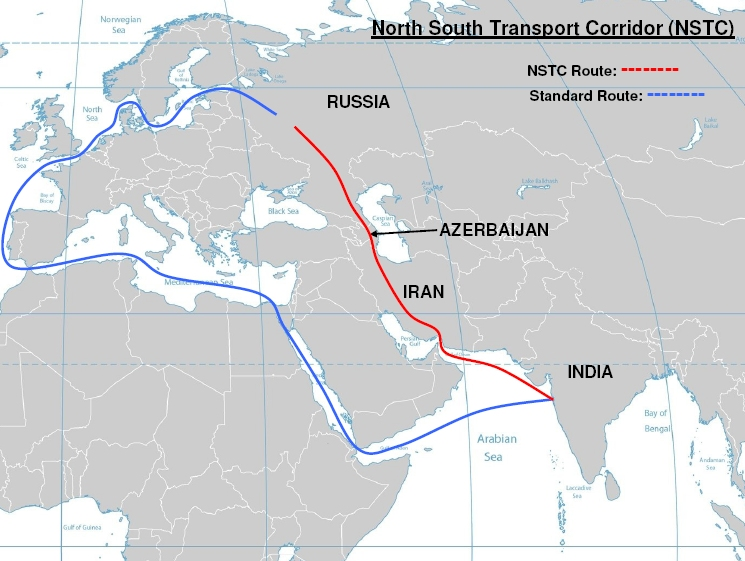
The International North–South Transport Corridor (INSTC) is a 7,200-kilometre multi-modal trade corridor that connects India with Iran, Central Asia, Russia, and Europe through an integrated network of ship, rail, and road routes. It aims to reduce the time and cost of cargo movement between major trade hubs such as Mumbai, Moscow, Tehran, Baku, Bandar Abbas, and Astrakhan.
Originally signed on 16 May 2002 by India, Iran, and Russia, the project has since expanded to include several Eurasian economies.
Key Objectives
- Trade Efficiency: Reduce transportation costs and time compared to traditional sea routes via the Suez Canal.
- Strategic Connectivity: Strengthen trade links between India, Central Asia, the Caucasus, Russia, and European markets.
- Cost & Time Savings: FFFAI estimates the route is 30% cheaper and 40% shorter than existing traditional options.
Synchronisation with Ashgabat Agreement
INSTC aligns with the Ashgabat Agreement, a multilateral pact aimed at facilitating goods transit between Central Asia and the Persian Gulf.
Members (Year of Joining):
- Oman (2011), Iran (2011), Turkmenistan (2011), Uzbekistan (2011), Kazakhstan (2015), India (2018)
INSTC Member Countries
Full Members:
- India
- Iran
- Russia
- Azerbaijan
- Armenia
- Kazakhstan
- Belarus
- Turkey
- Tajikistan
- Kyrgyzstan
- Oman
- Ukraine
- Syria
Observers:
- Bulgaria
Note: Turkmenistan is not a formal member but has been invited to join by India.
Geostrategic and Economic Significance
- Enables India’s outreach to Central Asia and Russia without relying on traditional sea routes via Suez.
- Provides a strategic alternative to China’s Belt and Road Initiative (BRI).
- Facilitates regional integration by building physical and institutional connectivity infrastructure.
- Enhances India’s Act East and Connect Central Asia policies.
National Affairs
1. Rare Earth Minerals and Magnets
Context:
India is finalizing a ₹3,500–5,000 crore incentive scheme to boost the domestic production of rare earth minerals and magnets, critical for electric vehicles (EVs), renewable energy, and defense applications. The scheme is expected to be approved within the next fortnight, according to a senior government official.
Key Highlights
- Incentive Mode: Benefits will be offered through a reverse auction mechanism, encouraging efficient cost discovery and competition.
- Objective: Reduce dependence on Chinese imports, enhance supply chain resilience, and ensure critical mineral security.
Rare Earth Elements (REEs):
- REEs are a group of 17 metallic elements, including the lanthanides, scandium, and yttrium.
- They are known for their unique magnetic, fluorescent, and conductive properties.
- While not extremely rare in abundance, they are difficult and costly to extract and refine.
Rare Earth Magnets:
- Definition: These are permanent magnets made from alloys of REEs.
- Types: Neodymium (NdFeB) and samarium-cobalt (SmCo) magnets are the most common.
- Strength: They produce much stronger magnetic fields compared to other types of magnets.
- Applications: Widely used in electronics, electric vehicles, wind turbines, and various industrial applications due to their high energy density and ability to generate strong magnetic fields in compact sizes.
- Considerations: Rare earth magnets can be brittle and susceptible to corrosion, so they are often coated or plated.
2. Privacy is a Fundamental Right but is Subject to Reasonable Curbs: HC
Context:
In a significant ruling impacting digital evidence in matrimonial disputes, the Madhya Pradesh High Court has upheld the admissibility of WhatsApp chats obtained without consent. The court emphasized that while privacy is a fundamental right under Article 21, it is not absolute and may yield to the right to a fair trial, also protected under Article 21.
Legal Provisions Referenced
- Article 21: Balancing privacy rights and fair trial guarantees.
- Section 14, Family Courts Act: Empowers courts to accept any material relevant to dispute resolution.
- Section 122, Indian Evidence Act: Marital communication is protected, but not in proceedings between spouses (e.g., divorce).
Right To Privacy
The right to privacy is the fundamental right of individuals to control the dissemination and use of their personal information, maintain personal autonomy, and protect their dignity. It encompasses the right to make personal decisions without unwarranted interference, safeguard personal data, and enjoy private spaces free from surveillance.
Right to Privacy is a Fundamental Right in Which Case?
In India, the right to privacy was recognized as a fundamental right in the case of Justice K.S. Puttaswamy (Retd.) and Anr. v. Union of India and Ors. (2017). This landmark judgment by the Supreme Court affirmed that the right to privacy is an intrinsic part of the right to life and personal liberty under Article 21 of the Constitution.
What are Fundamental Rights?
Fundamental rights are a set of basic human rights that are guaranteed to citizens by Articles 12 to 35 of the Indian Constitution, which are contained in Part III. They serve as a safeguard against potential abuses of power by the government and ensure individuals can enjoy certain freedoms and liberties.
3. Performance Grading Index (PGI) 2.0 Report
Context:
The Ministry of Education has released the Performance Grading Index (PGI) 2.0 report for 2022–23 and 2023–24, evaluating the performance of States and Union Territories (UTs) on school education quality. The report offers an evidence-based analysis of educational outcomes and infrastructure in alignment with NEP 2020 and UN SDGs.
What is PGI 2.0?
- Launched: 2017 (PGI 2.0 introduced to align with NEP 2020).
- Published by: Ministry of Education, Government of India.
- Purpose: To assess school education performance using evidence-based indicators.
- Coverage: 6 domains, 73 indicators.
- Learning Outcomes
- Access
- Infrastructure & Facilities
- Equity
- Governance Processes
- Teacher Education & Training
- Scoring: Out of 1,000 points, classified into 10 performance levels from ‘Daksh’ (951–1000) to ‘Akanshi-3’ (401–460).
Key Findings of PGI 2.0 (2022–24)
- Top Performer: Chandigarh scored 703 points, ranked in ‘Prachesta-1’ (701–760 band), driven by strong governance, infrastructure, and digital adoption.
- Lowest Performer: Meghalaya, with 417 points, placed in the lowest grade — ‘Akanshi-3’, indicating severe gaps in access and learning outcomes.
- No State/UT reached the top four bands (Daksh or Utkarsh), revealing systemic gaps in quality education.
Domain-Specific Performance
- Learning Outcomes:
- No State reached Daksh.
- Chandigarh, Punjab, Puducherry reached ‘Prachesta-2’ — the highest among all.
- Foundational literacy and numeracy remain a national concern.
- Access:
- Odisha is the only State in ‘Daksh’ (941–1000) — reflecting excellent enrolment and retention.
- Bihar, Telangana, Jharkhand made significant improvements.
- Infrastructure:
- Chandigarh is in ‘Ati Uttam’ (821–880) band.
- Delhi, Dadra & Nagar Haveli-Daman Diu reached ‘Uttam’ level.
- Equity:
- Most States are within the first three bands.
- Gaps in SC/ST and general category learning outcomes are narrowing but still persist.
- Governance & Digital Monitoring:
- Chandigarh led in UDISE+ adoption and transparent fund usage.
- Improvements observed in data-based governance practices.
Overall Trends in PGI 2.0 Report
Positive Developments:
- 24 States/UTs improved scores in 2023–24 over the previous year.
- Equity and gender parity are showing gradual improvement.
- Infrastructure upgrades seen in Delhi, J&K, Telangana—supporting NEP 2020 goals.
- Strong access gains in low-performing states like Bihar and Jharkhand through targeted interventions.
Persistent Challenges:
- No State achieved Daksh or Utkarsh levels—indicating lack of excellence in school education outcomes.
- Foundational learning remains weak, as seen in NAS 2021 outcomes.
- High inter-state disparity — a 286-point difference between Chandigarh and Meghalaya.
- Decline in performance of 12 States/UTs including Bihar, Karnataka, West Bengal, Ladakh—signaling slow recovery post-COVID.
- Critical infrastructure gaps (toilets, libraries, labs) persist in aspirational and low-ranked States.
4. FASTag-Based Annual Pass
Context:
In a bid to enhance seamless highway travel, the Union Minister for Road Transport has announced the rollout of a FASTag-based annual pass starting August 15, 2025. This initiative targets private non-commercial vehicles such as cars, jeeps, and vans, and aims to streamline toll payments and cut congestion across India’s national highway network.
What is FASTag?
- Technology: Radio Frequency Identification (RFID)-based electronic toll collection system.
- Launched: Pilot in 2014 on the Ahmedabad-Mumbai corridor.
- Mandatory Since: February 15, 2021, for all four-wheelers in India.
- Ministry: Ministry of Road Transport and Highways (MoRTH).
- Implementing Body: National Highways Authority of India (NHAI).
- How It Works: A FASTag sticker is affixed to the vehicle’s windshield and linked to a prepaid wallet or bank account. Tolls are auto-deducted as the vehicle crosses a toll plaza.
What is the FASTag-Based Annual Pass?
The annual pass is a prepaid tolling solution for frequent highway travelers using non-commercial private vehicles.
Key Features:
- Prepaid Value: ₹3,000.
- Validity: 1 year from activation or 200 national highway trips — whichever is earlier.
- Activation: Via Rajmarg Yatra app and NHAI/MoRTH official websites.
- Target Users: Private vehicles like cars, jeeps, and vans (non-commercial only).
- Applicability: Especially useful for short trips on stretches with less than 60 km between toll plazas.
Banking/Finance
1. RBI Eases Project Finance Norms
Context:
In a significant move offering relief to lenders, the Reserve Bank of India (RBI) has finalized its project finance norms with a much-lowered general provisioning requirement for new project loans. The revised guidelines will come into effect from October 1, 2025, and mark a substantial easing from the stricter provisioning rules proposed in May 2023.
Key Highlights of RBI’s Final Guidelines
- Lower General Provisioning During Construction Phase
- All projects (excluding CRE): 1% of funded outstanding
- Commercial Real Estate (CRE): 1.25%
- CRE – Residential Housing (CRERH): 1.0%
- (This is significantly lower than the 5% proposed in the earlier draft.)
- Provisioning During Operational Phase (Post Repayment Start)
- CRE: 1.0%
- CRERH: 0.75%
- Other Projects: 0.4% (same as current levels)
- Incentivised Provisioning Reduction Criteria (Earlier Draft)
- The May 2023 draft allowed a phased reduction in provisioning from 5% to 2.5%, and eventually to 1%, subject to:
- Positive net operating cash flow (NOCF) covering current repayment obligations, and
- A minimum 20% reduction in total long-term debt post commencement of commercial operations.
- These conditions have now been relaxed, and the final norms directly mandate lower provisioning across stages, simplifying compliance.
- The May 2023 draft allowed a phased reduction in provisioning from 5% to 2.5%, and eventually to 1%, subject to:
Impact
- Relief to Lenders: Banks and financial institutions will now set aside less capital for provisioning against standard project loans, especially during the high-risk construction phase.
- Support for Infrastructure Financing: By easing the provisioning burden, RBI aims to revive lending appetite in sectors such as infrastructure, manufacturing, and residential real estate.
- Balanced Prudence: While CRE projects still attract a higher provisioning rate (1.25%), the reduction from the proposed 5% ensures continued prudence without stifling credit flow.
2. UNCTAD World Investment Report 2025
Context:
Foreign Direct Investment (FDI) into India remained unchanged year-on-year in 2024 at $28 billion even as global FDI flows dropped 11 per cent, the United Nations Conference on Trade and Development (UNCTAD) said. In 2023, FDI inflows into India had plummeted 43 per cent in 2023 to $28 billion.
What is FDI?
- Foreign Direct Investment (FDI) plays a crucial role in the global economy, facilitating economic growth, creating jobs, and fostering innovation across borders.
- It refers to an investment made by a firm or individual in one country into business interests located in another country.
- FDI is typically characterized by the investor gaining a significant degree of influence or control over the foreign business, often in the form of acquiring a substantial percentage of its shares, establishing new businesses, or purchasing existing assets.
Key Highlights
- FDI Rankings (2024):
- Top Recipients:
- United States: $279 billion (1st)
- Singapore: $143 billion (2nd)
- Hong Kong (China): $126 billion (3rd)
- China: $116 billion (4th)
- India: $27.6 billion (15th, up from 16th)
- Top Recipients:
- Global Trends:
- FDI fell globally by 11% to $1.5 trillion in 2024.
- The headline increase was due to volatile financial flows rather than sustained real investment.
- India’s Sectoral and Strategic Strengths:
- Greenfield Projects: 1,080 in 2024 — 4th highest in the world.
- International Project Finance: 97 deals — among the top five globally.
- FDI Outflows: India ranked 18th, with $23.8 billion in outward investments.
- Digital Services Leadership:
- India led the Global South in greenfield digital services investment (2020–24) with $54 billion, ahead of Singapore ($12B), Brazil, Malaysia, and China.
UNCTAD Insights
- Manufacturing Shift: India, along with Malaysia and Vietnam, is emerging as a preferred manufacturing hub, aided by industrial policy reforms and global supply chain shifts.
- Digital Economy: Cited as a critical driver of global growth, the digital sector is growing 10–12% annually, outpacing global GDP and becoming central to FDI and value creation.
3. SEBI to Boost Transparency in Trading Costs Through Unbundling of Fees
Context:
The Securities and Exchange Board of India (SEBI) is taking steps to improve cost transparency for investors by unbundling trading and clearing charges. This move seeks to provide a clearer cost structure and enhance governance and financial independence of Clearing Corporations (CCs) from stock exchanges.
Key Developments
- Working group formed to examine:
- Separation of trading and clearing fees.
- Measures for ensuring financial self-sufficiency of CCs.
- Enhancing governance standards and transparency in CC operations.
- No structural overhaul:
- SEBI Chairman Tuhin Kanta Pandey clarified that there are no immediate plans to alter the ownership structure of CCs, currently fully owned by stock exchanges.
- Unbundling rationale:
- Ensures clear disclosure of charges to investors.
- Promotes accountability and competition among clearing service providers.
- Does not intend to increase investor costs.
Next Steps
- SEBI may soon issue standardized disclosure norms for clearing-related charges.
- The working group’s recommendations will shape future policy on unbundling and self-sustainability of CCs.
4. Sale of listed private non-financial firms rose 7.1% in Q4FY25: RBI Data
Context:
Sales of listed private non-financial companies registered 7.1% growth (y-o-y) during Q4-2024-25 compared with 8% growth in the previous quarter and 6.9% in Q4 2023-24, according to data released by the Reserve Bank of India (RBI).
Overall Sales Growth
- Listed private non-financial companies recorded a 7.1% year-on-year (y-o-y) sales growth in Q4FY25, down from 8% in Q3FY25 and 6.9% in Q4FY24.
- The data is based on financial results of 1,659 listed private firms compiled by the Reserve Bank of India (RBI).
Sector-wise Highlights
- Manufacturing Sector:
- Sales growth slowed to 6.6% in Q4FY25, compared to 7.7% in Q3FY25.
- Double-digit sales growth was observed in:
- Electrical machinery
- Chemicals
- Food products
- Pharmaceuticals
- However, sluggish performance in the petroleum industry dragged overall manufacturing sales growth.
- Information Technology (IT) Sector:
- Sales growth rose to 8.6% in Q4FY25, improving from 6.8% in Q3 and 3.1% a year ago.
- Non-IT Services Sector:
- Continued robust growth at 10% y-o-y, led by:
- Telecommunications
- Transport and storage services
- Continued robust growth at 10% y-o-y, led by:
Input Costs and Profitability
- Input expenses for manufacturing companies increased 8.3% y-o-y in line with sales.
- Raw material to sales ratio remained broadly stable, indicating effective cost management despite rising expenses.
Unlisted Companies Vs Listed Companies
Unlisted Public Company
An unlisted public company is a public company that is not listed on any stock exchange; therefore, it may raise finance through the issue and sale of shares to the public. The jurisdictions vary in criteria for listing. However, for a public company to be registered, it should meet minimum share capital and the number of shareholders.
- Reason For Not Listing?
- Some companies do not list for a variety of reasons, including to avoid costs, not wanting public investors, or having too few shareholders.
Listed Vs Unlisted Companies
- The most significant difference between a listed company and an unlisted company is that shares of a listed company are traded on a stock exchange, while the shares of an unlisted company are not traded on a stock exchange.
5. Bank of Maharashtra Partners with SBI Card to Launch Co-Branded Credit Cards
Context:
In a significant move to deepen financial inclusion and enhance customer engagement, Bank of Maharashtra (BoM) has partnered with SBI Card, one of India’s leading credit card issuers, to launch co-branded credit cards offering a host of consumer benefits.
Key Highlights of the Co-Branded Credit Cards:
- Strategic Collaboration: Combines Bank of Maharashtra’s extensive banking network and customer trust with SBI Card’s digital capabilities and credit card expertise.
- Nationwide Launch: The co-branded cards will be available to eligible customers across India through both online platforms and BoM branches.
- Application Convenience: Customers can apply via digital channels or through branch walk-ins, ensuring accessibility and a hassle-free onboarding experience.
Agriculture
1. Pradhan Mantri Garib Kalyan Anna Yojana (PM-GKAY)
Source: Mint
Context:
The Union government is confident of maintaining the wheat-rice distribution ratio under the Pradhan Mantri Garib Kalyan Anna Yojana (PM-GKAY) in 2025–26, owing to record wheat procurement, which has already crossed 30 million tonnes (mt) in the current Rabi marketing season. This marks a crucial development ahead of key state elections, particularly in Bihar and West Bengal, where subsidised food aid remains a major political tool.
What is PM-GKAY?
Overview
The Pradhan Mantri Garib Kalyan Anna Yojana (PM-GKAY) is a food security welfare scheme launched in March 2020 as part of the Pradhan Mantri Garib Kalyan Package (PMGKP) to mitigate the impact of the COVID-19 pandemic on the poor.
Key Features
- Objective: To ensure food security during the pandemic by providing free foodgrains to the poor.
- Coverage: All beneficiaries under the National Food Security Act (NFSA), 2013, which includes around 80 crore people.
- Benefit: An additional 5 kg of free wheat or rice per person per month over and above the subsidized NFSA quota.
- Mode of Delivery: Distributed through the Public Distribution System (PDS).
- Portability: Enabled through One Nation One Ration Card (ONORC) allowing migrant workers access across states.
Timeline and Funding
- Initial Phase: April to June 2020.
- Extended Till: September 2022 (in multiple phases).
- Total Expenditure: Approx. ₹3.91 lakh crore for all phases.
- Nodal Ministry: Initially under Ministry of Finance, now executed by Ministry of Consumer Affairs, Food & Public Distribution.
Challenges and Concerns
- Outdated Census Base: Beneficiaries determined based on 2011 Census, leaving many food-insecure individuals uncovered.
- Fiscal Burden:
- High cost raises concerns about fiscal deficit (aimed to be reduced to 6.4% of GDP).
- Inflationary Pressures:
- Program impacts food inflation, especially in rice and wheat, which constitute about 10% of retail inflation.
- In 2022, India restricted wheat and rice exports due to erratic monsoons and falling yields.
- Sustainability:
- Logistics and grain procurement challenges increase as the scheme scales.
Related Government Initiatives
- National Food Security Mission (NFSM)
- Rashtriya Krishi Vikas Yojana (RKVY)
- Pradhan Mantri Fasal Bima Yojana (PMFBY)
- Integrated Scheme on Oilseeds, Pulses, Palm oil & Maize (ISOPOM)
- National Food Security Act (NFSA), 2013
UPSC Civil Services Examination Previous Year Question (PYQ)
Mains
Q. What are the salient features of the National Food Security Act, 2013? How has the Food Security Bill helped in eliminating hunger and malnutrition in India? (2021)
2. Assam’s Solar Pump Initiative
Context:
Over 70% of Assam’s population depends on agriculture, with 85% of farmers holding small or marginal land. Only 21.54% of net sown area is irrigated (2022), compared to the national average of 49.92%. Erratic monsoons, droughts, and expensive diesel pumps create high uncertainty for rain-fed farming. Farmers lack access to affordable irrigation and awareness of income diversification options like horticulture.
A Multi-Stakeholder Partnership
Lead Organisations:
- Gramya Vikash Mancha (GVM) – Grassroots implementer
- NABARD – Financial support via Tribal Development Fund (TDF)
- WRI India – Knowledge partner for sustainable energy and monitoring systems
Key Intervention Sites:
- Khatarbari and Kalcheni villages, Tamulpur district, Assam
Intervention Design: Clean Energy Meets Livelihoods
- Adapted ‘Wadi’ homestead model to promote horticulture (mango, guava, Assam lemon).
- Installed:
- 2 units of 2HP and 3 units of 1HP submersible solar pumps for 48 acres
- 3 portable solar pumps with custom trolleys, co-designed with women farmers
- Conducted energy needs assessment, technology training, and performance monitoring.
Key Outcomes
- Improved Irrigation Access: Enabled year-round water supply, reducing dry-season losses.
- Diversified Crops: Farmers now intercrop potatoes, tomatoes, papaya, chillies, leafy greens, and more.
- Women Empowerment: Reduced manual labour, greater participation in technology decisions.
- Reduced Emissions: Shift from diesel to solar supports India’s clean energy transition.
- Shared Infrastructure: Portable pumps allow collaborative use across adjacent plots.
Monitoring and Scalability
- Real-time flow meters and remote systems for pump performance tracking.
- Farmers are exploring value-addition technologies like cold storage and food processing.
- NABARD and GVM aim to promote local entrepreneurship and replicable rural models.
Why This Matters
- Reduces vulnerability of small farmers in one of India’s most climate-sensitive states.
- Demonstrates alignment with SDGs 2, 7, and 13.
- Offers a replicable framework for other rain-fed, low-income farming regions in India.
Facts To Remember
1. HDB Financial Services IPO: HDFC Bank Accepts Lower Valuation Amid RBI Overhang
HDFC Bank, India’s largest private-sector lender, is set to launch a ₹12,500 crore initial public offering (IPO) for its non-banking financial arm, HDB Financial Services, on June 25–27, 2025. The IPO is expected to be the largest ever by an NBFC in the Indian market.
2. Russia Warns U.S. Against Military Action on Iran Amid Escalating Israel-Iran Tensions
Russia issued a stern warning to the United States against any military intervention targeting Iran, amid rising fears of wider conflict following recent Israel-Iran hostilities.
- Coverage: All beneficiaries under the National Food Security Act (NFSA), 2013, which includes around 80 crore people. Pradhan Mantri Garib Kalyan Anna Yojana (PM-GKA…
- Section 14, Family Courts Act: Empowers courts to accept any material relevant to dispute resolution. Privacy is a Fundamental Right but is Subject t…
- Launched: 2017 (PGI 2.0 introduced to align with NEP 2020). Performance Grading Index (PGI) 2.0 Report
- Launched: Pilot in 2014 on the Ahmedabad-Mumbai corridor. FASTag-Based Annual Pass
- The May 2023 draft allowed a phased reduction in provisioning from 5% to 2.5%, and eventually to 1%, subject to : RBI Eases Project Finance Norms
21 June, 2025
Daily Current Affairs Quiz
21 June, 2025
National Affairs
1. BSNL Soft Launches India’s First Indigenous SIM-less 5G FWA Service
Context:
Bharat Sanchar Nigam Limited (BSNL) has unveiled Quantum 5G Fixed Wireless Access (FWA) in a soft launch held at its Ameerpet Exchange in Hyderabad. This milestone marks India’s first indigenous, SIM-less 5G FWA service, designed to deliver fibre-like broadband speeds over wireless 5G networks without trenching or physical fibre installation.
Key Highlights of Quantum 5G FWA
Technological Firsts
- SIM-less Authentication: Powered by BSNL’s proprietary Direct-to-Device (D2D) platform, eliminating the need for a physical SIM card. Customer premises equipment (CPE) self-authenticates automatically.
- Fully Indigenous Stack: Developed entirely by Indian vendors under the Atmanirbhar Bharat initiative—comprising core, RAN (radio access network), and CPE.
TH
2. Direct-to-Device (D2D) Satellite Connectivity in India
Context:
Direct-to-Device (D2D) satellite connectivity is an emerging technology enabling direct communication between smartphones and satellites—bypassing traditional cell towers or terrestrial infrastructure. This innovation is critical for enhancing connectivity in remote, disaster-prone, or underserved regions.
What is D2D Satellite Connectivity?
D2D allows regular smartphones, wearables, and IoT devices to connect directly to satellites, using built-in antennas or minor software enhancements. This eliminates the need for satellite-specific hardware like bulky terminals or external receivers.
How It Works
- Utilizes Low-Earth Orbit (LEO) satellites for low latency and high data rates.
- Sends signals directly between satellite transponders and mobile devices.
- Operates in licensed spectrum bands, ensuring compatibility with existing telecom standards (e.g., 4G/5G).
Recent Developments in India
- Bharat Sanchar Nigam Limited (BSNL) has unveiled Quantum 5G Fixed Wireless Access (FWA) in a soft launch held at its Ameerpet Exchange in Hyderabad.
- SIM-less Authentication: Powered by BSNL’s proprietary Direct-to-Device (D2D) platform, eliminating the need for a physical SIM card. Customer premises equipment (CPE) self-authenticates automatically.
Key Features of D2D Services
- SIM-less Operation: Some models offer direct satellite authentication without a physical SIM.
- Global Coverage: Ensures internet and communication access in forests, deserts, seas, mountains, and disaster zones.
- Emergency Resilience: Ideal during natural calamities when terrestrial networks collapse.
- Minimal Infrastructure Needs: No towers, trenches, or fibre lines required.
- UPI Compatibility: Enables secure digital transactions in remote areas.
Non-Terrestrial Network (NTN)
NTNs are networks based on non-ground platforms—including:
- LEO/MEO/GEO Satellites (e.g., Starlink, OneWeb, Viasat)
- High-Altitude Platforms (drones, balloons)
- Maritime/Airborne Systems (ships, aircraft)
- Hybrid 4G/5G Networks combining terrestrial and satellite links
Applications of D2D Satellite Connectivity
- UPI Payments in Rural India
- Disaster Management and SOS Services
- Military and Border Communication
- Telemedicine in Remote Villages
- Real-time IoT for Smart Agriculture
- Logistics and Maritime Navigation
Banking/Finance
1. India Plans 100% FDI in Insurance with Eased Norms for Foreign Board Representation
Context:
The Union government is preparing to introduce amendments to the Insurance Act in the upcoming Monsoon Session, enabling 100% foreign direct investment (FDI) in the insurance sector—up from the current 74%. The reforms will also allow foreign insurers to appoint a majority of nonresident board members and key managerial personnel (KMPs).
Key Highlights:
- Policy Shift:
- Foreign insurers may soon be permitted to have a majority of nonresident board members, including foreign nationals in top leadership roles (e.g., CEO, MD).
- This aligns with long-standing demands from the U.S. government and insurance lobbies such as the USTR and the Coalition of Services Industry (CSI).
- Government Stance:
- The government emphasized that IRDAI regulation will continue to ensure operational safeguards and compliance.
Background (FDI in Insurance)
| Year | FDI Cap | Key Safeguards Introduced |
|---|---|---|
| 2021 | Raised from 49% to 74% | – 50% board must be resident Indian citizens – At least one resident Indian KMP (CEO/MD) required – Restrictions on dividend payouts and repatriation – Enhanced regulatory disclosures |
| 2025 (proposed) | 100% | Eased residency rules for board and KMPs; safeguards under review |
2. RBI Lowers Priority Sector Lending Norms for Small Finance Banks
Context:
The Reserve Bank of India (RBI) has revised its Priority Sector Lending (PSL) guidelines for Small Finance Banks (SFBs), reducing their mandatory lending target from 75% to 60% of Adjusted Net Bank Credit (ANBC) or credit equivalent of off-balance sheet exposures, whichever is higher. The new norms will be effective from FY26 (2025–26).
What is Priority Sector Lending (PSL)?
Priority Sector Lending refers to the mandatory lending by banks to sectors deemed important for the overall development of the economy, particularly in terms of inclusive growth. These sectors include:
- Agriculture
- Micro, Small and Medium Enterprises (MSMEs)
- Education
- Housing
- Renewable energy
- Export credit
- Social infrastructure
- Weaker sections
The RBI mandates specific PSL targets for different types of banks to ensure adequate credit flow to these sectors, which might otherwise be underserved by commercial lending.
Key Highlights of the New PSL Norm for SFBs:
- New Target:
- 60% of ANBC or credit equivalent of off-balance sheet exposure, whichever is higher
- Earlier Target:
- 75% under existing norms
- Effective Date:
- Applicable from Financial Year 2025–26
Implications of the Revision
- Brings regulatory relief and greater flexibility to SFBs
- Allows for more diversified loan portfolios and better credit risk management
- Expected to improve capital efficiency while still supporting critical development sectors
Background
- When launched, SFBs were required to meet a higher PSL obligation (75%) compared to 40% for scheduled commercial banks, due to their focus on financial inclusion.
- This revision reflects RBI’s intent to balance inclusion mandates with operational sustainability of these newer banking entities.
3. Parametric Insurance Gains Momentum in India Amid Rising Climate Risks
Context:
Amid increasing frequency of extreme weather events, parametric insurance—a product that pays out automatically based on predefined environmental thresholds—is gaining traction in India. While still nascent, insurers expect its growth to accelerate due to climate change’s growing impact on livelihoods and public health.
What is Parametric Insurance?
Parametric insurance provides automatic payouts when predefined parameters (such as temperature, rainfall, wind speed, or seismic magnitude) are met or exceeded.
Unlike traditional insurance, it does not require claim filing or damage assessment, ensuring quick and transparent disbursement.
Key Features:
- Insured Events: Heatwaves, excessive rainfall, earthquakes, tropical cyclones, and floods
- Trigger Parameters:
- Heat Index (temperature threshold)
- Rainfall (in mm/day or cumulative over days)
- Wind speed, water depth, or Richter scale magnitude
- Policy Benefits:
- Daily payout: ₹500–₹2,000 depending on severity and policy
- Hospitalization allowance: Up to ₹5,000 for weather-related injuries or illness
- Payouts triggered automatically using IMD (India Meteorological Department) data
4. RBI Imposes ₹29.6 Lakh Penalty on Fino Payments Bank for Licensing Norm Breach
Context:
The Reserve Bank of India (RBI) has levied a monetary penalty of ₹29.6 lakh on Fino Payments Bank Ltd for non-compliance with its licensing guidelines applicable to payments banks.
Key Highlights:
- Regulatory Action:
- Penalty imposed under the RBI’s powers to ensure adherence to licensing conditions
- Arising from findings during the Statutory Inspection for Supervisory Evaluation (ISE 2024), based on the bank’s financials as on March 31, 2024
- Nature of Violation:
- The bank exceeded the regulatory ceiling on end-of-day balances in customer accounts— a specific restriction applicable to payments banks, which are designed to hold smaller, transaction-focused balances
- Due Process:
- RBI issued a show-cause notice to Fino Payments Bank
- Considered the bank’s written and oral submissions before concluding that the violation was sustained, necessitating the imposition of the penalty
Regulatory Context
- Payments banks in India operate under limited banking licenses, with restrictions such as:
- No lending activity
- Maximum balance limit of ₹2 lakh per customer (subject to periodic revision)
- Focus on financial inclusion, especially low-income households and migrant workers
5. Yield Spread Between 3-Year and 10-Year G-Secs Widens Sharply Amid RBI’s Liquidity Easing
Context:
The yield spread between India’s 3-year and 10-year government bonds has widened to 48 basis points (bps) in FY26, up from 15 bps at the start of the fiscal and just 4 bps in January 2025. This reflects the RBI’s monetary easing, liquidity infusion, and a 100 bps CRR cut.
Key Highlights:
- Latest Bond Yields:
- 3-year G-sec: 5.83%
- 10-year G-sec (benchmark): 6.31%
- Yield spread: 48 bps (up 12x in CY25)
About Government Bonds
Government Securities (G-Secs) are sovereign debt instruments issued by the RBI on behalf of the Government of India.
- Short-term G-Secs: <5 years maturity
- Long-term G-Secs: Typically 10 years or more
- Used to fund fiscal deficits and manage public debt
6. SEBI Proposes Framework for Responsible Use of AI/ML in Securities Market
Context:
The Securities and Exchange Board of India (SEBI) has released a consultation paper proposing a structured framework to govern the responsible use of Artificial Intelligence (AI) and Machine Learning (ML) technologies in the Indian securities market. The proposals aim to safeguard investor interests, promote fairness, and ensure cybersecurity compliance amid rising adoption of AI/ML tools in trading, advisory, and surveillance.
Key Features of SEBI’s Five-Point Plan
- Model Governance
- Establish clear accountability for AI/ML model development, validation, and deployment.
- Mandate independent oversight and documentation to track model decisions and updates.
- Investor Protection & Disclosure
- Ensure transparency in use of AI/ML tools in client-facing services like robo-advisory.
- Require clear disclosures about AI-driven processes, including limitations and risks.
- Testing Framework
- Implement rigorous pre-deployment testing for accuracy, robustness, and reliability of AI/ML models.
- Emphasize back-testing, scenario analysis, and monitoring of outcomes to avoid systemic risks.
- Fairness & Bias
- Propose checks to prevent algorithmic bias in customer profiling or market strategies.
- Encourage adoption of ethical AI practices and inclusive datasets to maintain market integrity.
- Data Privacy & Cybersecurity
- Strengthen data protection norms in line with the Digital Personal Data Protection Act.
- Impose cybersecurity standards to secure sensitive financial and personal information used by AI/ML systems.
Background and Next Steps
- The proposals stem from a SEBI-constituted working group of AI/ML experts and industry stakeholders.
- The consultation paper, titled “Guidelines for Responsible Usage of AI/ML in the Indian Securities Market”, is open for public and industry feedback.
7. Bajaj Allianz Launches India’s First State-wise Health Insurance Policy Tailored to Local Healthcare Needs
Context:
Bajaj Allianz General Insurance has introduced a first-of-its-kind ‘State-wise Health Insurance Policy’, offering region-specific health insurance solutions across 25 states and 5 Union Territories. This initiative marks a pioneering step in customising healthcare protection in alignment with the unique medical infrastructure, affordability, and disease profiles of each state in India.
Key Features of the State-wise Health Insurance Policy
Regionally Customised Coverage
- Each policy is tailored to reflect the distinct healthcare ecosystem of a specific state.
- Factors considered include: local hospital infrastructure, prevalent health concerns, treatment costs, and affordability levels.
- Policies carry locally inspired names (e.g., “AapKe Liye” in Hindi-speaking states).
Lifetime Renewability
- No age restrictions for policy renewal, ensuring long-term security for individuals and families.
About Bajaj Allianz General Insurance
Bajaj Allianz is a joint venture between Bajaj Finserv Ltd and Allianz SE, offering a broad portfolio of insurance solutions including health, motor, home, cybersecurity, and even niche segments like pet and film insurance. The company holds an [ICRA]AAA rating, ensuring high trust and timely claims servicing across over 1,500 cities and towns in India.
BS
8. CCI’s 2025 Cost Norms
Context:
The Competition Commission of India (CCI) has notified the Determination of Cost of Production Regulations, 2025, marking a major reform in how predatory pricing is assessed and regulated in India. These reforms aim to reinforce competition safeguards, especially in digital and capital-intensive markets, by introducing clear, consistent benchmarks based on Average Total Cost (ATC).
What is Predatory Pricing?
Definition:
Predatory pricing involves a dominant firm deliberately setting prices below cost to eliminate competitors, eventually gaining monopoly power.
Example:
NSE vs. MCX case—NSE deployed zero-pricing strategies in currency derivatives, leading to allegations of market exclusion and regulatory scrutiny.
Key Features of Predatory Pricing
- Prices below production costs
- Intent to eliminate competitors
- Short-term consumer benefits followed by long-term monopoly harms
- Reduced market choice and innovation
Types:
- Direct Predation – Prices deliberately kept below cost.
- Cross-subsidisation – Using profits from one business segment to undercut rivals in another.
- Discriminatory Pricing – Targeting specific segments with lower prices to squeeze out competition.
Factors Encouraging Predatory Pricing
- Dominant Market Power with deep reserves
- Network Externalities in digital markets (e.g., data lock-ins)
- Weak Enforcement Record (only one predatory pricing case upheld pre-2025)
- Lack of Metric Clarity (older rules didn’t define “cost” benchmarks)
- Jurisdiction Gaps in cross-border e-commerce
- Short-Term Myopia in consumer response
Challenges in Regulation
- Proof of Intent: Predatory motive is difficult to establish under Section 4 of the Competition Act.
- Chilling Effect: Startups in AI, FinTech often avoid competitive segments due to fear of capital-intensive predation.
- Fragmented Market Surveillance: Absence of dynamic monitoring tools delays early detection.
- Judicial Delays: Legal battles often outlast the market cycle they intend to correct.
9. RBI Issues Master Circular to Enhance Credit Access for SC/ST Communities
Context:
The Reserve Bank of India (RBI) has issued a Master Circular on Credit Facilities to Scheduled Castes (SCs) & Scheduled Tribes (STs) aimed at enhancing credit access, promoting financial inclusion, and ensuring effective implementation through structured monitoring and policy measures.
Key Highlights of the Master Circular
Streamlined Procedures and Special Reservations
- Simplified loan application and processing norms for SC/ST applicants.
- Banks are required to reserve specific portions of their credit for SC/ST borrowers.
- Enhanced supervisory frameworks for implementation.
Centrally Sponsored Schemes Supporting SC/ST Credit Access
DAY-NRLM (Deendayal Antyodaya Yojana – National Rural Livelihoods Mission)
- Launched: April 1, 2013 (replacing Swarnajayanti Gram Swarozgar Yojana).
- Mandate: At least 50% of beneficiaries should belong to SC/ST communities.
Differential Rate of Interest (DRI) Scheme
- Provides loans up to ₹15,000 at 4% interest per annum to the economically weaker sections.
- 40% of DRI advances must go to SC/ST borrowers.
- Landholding restrictions (1 acre irrigated / 2.5 acres unirrigated) do not apply to SC/ST applicants.
- Additional housing loan of ₹20,000 available under the scheme.
Credit Enhancement Guarantee Scheme for Scheduled Castes (CEGSSC)
- Launched: May 6, 2015 by Ministry of Social Justice & Empowerment.
- Nodal Agency: IFCI Ltd.
- Objective: Promote SC entrepreneurship via credit enhancement guarantees.
- Eligibility: SC individuals/firms with >51% SC ownership and 6+ months management control.
- Guarantee cover: ₹0.15 crore to ₹5 crore.
- Tenure: Up to 7 years or loan repayment term, whichever is earlier.
10. RBI Issues Master Direction on Electronic Trading Platforms (ETPs)
Context:
The Reserve Bank of India (RBI) released a new Master Direction on Electronic Trading Platforms (ETPs) on June 16, 2025, aimed at strengthening the regulatory framework for digital financial market infrastructure. This direction replaces the 2018 guidelines and takes immediate effect.
Definition of ETP
An Electronic Trading Platform (ETP) is defined as:
“Any electronic system (excluding recognised stock exchanges) where transactions in eligible financial instruments are contracted electronically.”
Eligible Instruments include:
- Securities (non-stock exchange)
- Money market instruments
- Foreign exchange instruments
- Derivatives
Scope and Applicability
Not applicable to:
- Scheduled Commercial Banks (including foreign bank branches in India)
- Standalone Primary Dealers
—where the bank/dealer is the sole quote/price provider and a party to all trades.
Key Regulatory Provisions
Eligibility to Operate an ETP
Entities must:
- Be incorporated in India
- Have a minimum net worth of ₹5 crore
- Maintain robust technological infrastructure that ensures:
- High reliability
- Availability
- Scalability
- Strong cybersecurity
Approval Process
- Applications must be submitted via the PRAVAAH portal of RBI.
- RBI has discretion to grant, reject, or cancel authorisations based on compliance and public interest considerations.
Operational and Compliance Requirements
Data Retention:
- Maintain detailed transaction records for a minimum of 10 years.
Reporting Obligations:
- Submit quarterly reports on the platform’s operations to RBI by the 15th day of the month following the reporting quarter.
Monitoring and Enforcement:
- RBI retains enforcement powers including:
- Inspections
- Penalties
- Licence revocation for non-compliance.
Agriculture
1. Nabcons Deploys AI to Monitor Water Bodies, Carbon Credits and Boosts Digital Agriculture
Context:
Nabcons, the consultancy arm of NABARD, is leveraging Artificial Intelligence (AI), GIS, and open-source technologies to promote sustainable agriculture, monitor water bodies, and help smallholder farmers monetise carbon credits. The firm has also exceeded its annual business and revenue targets in FY25.
Key Technological Interventions
AI for Water Body Monitoring – Tamil Nadu
- Nabcons has developed an AI-based Hawk-Eye system for the Tamil Nadu Single Window for Integrated Waterbody Protection.
- Functions:
- Real-time health monitoring of water bodies around Chennai.
- Detection of encroachments using satellite imagery.
- Alerts authorities about violations and flood threats due to sudden rainfall.
Digital Dairy Receivables – Bihar
- A SaaS model is being developed for Bihar State Milk Cooperative Federation Ltd (COMFED).
- Aim: To digitise dairy receivables and operations of milk farmer unions and collection units.
Kathir Platform – Kerala
- Nabcons built Kathir (earlier Kerala Krishi Hub), a digital agriculture platform for the state.
- Features:
- Integrates services for farmers, agri departments, vendors, and surveyors.
- Supports data-driven decision-making across the agricultural value chain.
Carbon Credit Programme – Karnataka (Kolar District)
- A pilot initiative in partnership with Rabobank, targeting small and marginal agroforestry farmers.
- Utilises satellite imagery and ground-truthing to calculate Carbon Removal Units (CRUs).
- CRUs are sold to global corporations via Rabobank’s ACORN platform.
- No secondary market exists for these CRUs, ensuring direct farmer-to-buyer transactions.
BL
2. National Seminar on ‘Prosperity through Cooperatives’
Context:
On the backdrop of the UN declaring 2025 as the ‘International Year of Cooperatives’, Union Agriculture and Farmers Welfare Minister Shri Shivraj Singh Chouhan addressed a national-level seminar on the theme ‘Prosperity through Cooperatives’ in Mumbai. The seminar aimed to highlight the transformative role of cooperatives in India’s socio-economic framework, particularly in the agriculture sector.
Cooperatives
A cooperative (or co-op) is a business or organization owned and run jointly by its members, who share in its profits and benefits. It’s a form of self-governed group where individuals with common needs come together to meet their economic, social, and cultural needs through a collectively owned and democratically managed enterprise.
Key Highlights
- Importance of Cooperatives in Indian Ethos
- Cooperatives are ingrained in India’s cultural and socio-economic traditions.
- The model is ideal for inclusive growth and community development.
- Agriculture Sector: Backbone of the Economy
- Agriculture contributes 18% to India’s GDP and supports 46% of the population.
- Under PM Modi’s leadership, foodgrain production has risen by 44% in the last 11 years.
Strategic Roadmap for Agricultural Prosperity
Focus on:
- Higher yield per hectare
- Cost reduction
- Fair price for produce
- Crop-loss compensation
- Diversification
- Sustainable use of fertilizers and soil health
Major Government Initiatives and Announcements
- Connects scientific research to farming practice.
- 2,170 KVK scientist teams engaged with farmers to understand local issues.
- Issues identified: Poor quality seeds and pesticides.
- Government to enact stringent laws against manufacturers of substandard agri-inputs.
Market Intervention Scheme (MIS) for TOP Crops
- Tomato, Onion, Potato (TOP) farmers to receive transport cost support if selling outside their home state for better prices.
- Ensures price stability for both farmers and consumers.
Procurement Expansion
- Government to procure toor, masoor, and urad post farmer registration.
- Record procurement of pulses, oilseeds, and soybean already achieved.
- Plans for financial aid for storage facilities.
3. NABARD Launches ₹10,000 Crore Green Lending Facility for FY25
Context:
The National Bank for Agriculture and Rural Development (NABARD) has announced plans to disburse around ₹10,000 crore in FY25 under its newly introduced Green Lending Facility, aimed at supporting projects aligned with India’s Sustainable Development Goals (SDGs).
Green Lending Facility
A Green Lending Facility is a financial mechanism that provides loans specifically for projects with positive environmental impacts, promoting sustainable development and reducing carbon footprint.
Key Highlights:
- Eligibility & Scope:
- Borrowers: Central and State governments, government agencies, and private sector entities.
- Minimum loan size: ₹100 crore.
- Eligible sectors: Green infrastructure projects including ethanol production plants, electric vehicles (EVs), an other climate-aligned initiatives.
- Strategic Objective:
- The initiative is part of NABARD’s broader mandate to foster environmentally sustainable rural and agri-infrastructure, complementing national climate commitments and energy transition goals.
TH
Facts To Remember
1. Shubhanshu Shukla’s Axiom-4 mission to the ISS put off again
NASA has put off launch of the Axiom-4 mission carrying Indian astronaut Group Captain Shubhanshu Shukla and three others to the International Space Station, saying it required additional time to evaluate operations on the orbital lab after the recent repairs in its Russian section.
2. Hockey players to get ₹25,000 per month pocket allowance
The Mission Olympic Cell (MOC) sanctioned a pocket allowance of ₹25,000 to 80 hockey players in the national camp, following a request by the National Federation.
3. S Ramann assumes charge as PFRDA chairperson
Sivasubramanian Ramann on Friday has assumed charge as the chairperson of the Pensionn Fund Regulatory and Development Authorityy (PFRDA).
4. Meta partners Oakley to launch AIpowered smart glasses
Meta said on Friday it has teamed up with Oakley to release AIpowered smart glasses, expanding its push into wearable tech after the success of RayBan Meta glasses.
5. SEBI Clears Tata Capital’s ₹17,200 Crore IPO; Includes Offer for Sale by Tata Sons
Tata Capital, a subsidiary of Tata Sons, has received approval from the Securities and Exchange Board of India (SEBI) for its ₹17,200 crore initial public offering (IPO), filed under the confidential draft red herring prospectus (DRHP) route. The IPO is expected to be launched by September 2025, as per RBI norms.
6. 11th International Day of Yoga (IDY 2025)
India is set to mark the 11th International Day of Yoga (IDY) on 21st June 2025, with a record-breaking national event in Visakhapatnam, led by Prime Minister Narendra Modi. With the theme “Yoga for One Earth, One Health,” this year’s IDY will underscore the interdependence of human and planetary well-being.
7. RBI relocates Andhra Pradesh regional office to Vijayawada
The Reserve Bank of India ( RBI) has announced the relocation of its Andhra Pradesh regional office to Vijayawada, Andhra Pradesh.
- Launched: April 1, 2013 (replacing Swarnajayanti Gram Swarozgar Yojana). RBI Issues Master Circular to Enhance Credit Ac…
- Arising from findings during the Statutory Inspection for Supervisory Evaluation (ISE 2024), based on the bank's financials as on March 31, 2024 RBI Imposes ₹29.6 Lakh Penalty on Fino Payments…
- 60% of ANBC or credit equivalent of off-balance sheet exposure, whichever is higher RBI Lowers Priority Sector Lending Norms for Sm…
- Long-term G-Secs: Typically 10 years or more Yield Spread Between 3-Year and 10-Year G-Secs …
- Maintain detailed transaction records for a minimum of 10 years. RBI Issues Master Direction on Electronic Tradi…
22 & 23 June, 2025
Daily Current Affairs Quiz
22 & 23 June, 2025
International Affairs
1. U.S. Launches Strikes on Iran’s Nuclear Sites
Context:
In a dramatic escalation of the Israel-Iran conflict, the United States launched direct strikes on Iran’s nuclear facilities, dropping 30,000-pound bombs on key uranium enrichment sites. The unprecedented attack marks a significant shift in U.S. engagement, prompting fears of a full-blown regional war. This Mission was named as “Operation Midnight Hammer”.
Iran’s Nuclear Facilities Targeted in Airstrikes
The US-Israel joint strike, part of a coordinated military operation, hit three of Iran’s most sensitive nuclear sites:
1. Fordow Fuel Enrichment Plant
- Location: Deeply buried under a mountain near Qom.
- Function: Enriches uranium up to 60% purity.
- Significance: Its depth made it nearly immune to conventional strikes—until the use of MOPs.
2. Natanz Nuclear Facility
- Status: Iran’s largest uranium enrichment complex.
- Assets: Hosts thousands of advanced centrifuges in subterranean halls.
- Strategic Importance: Considered the backbone of Iran’s enrichment program.
3. Isfahan Nuclear Complex
- Capabilities: Includes uranium conversion facilities and nuclear research reactors.
- International Oversight: Monitored by the IAEA, which confirmed enriched uranium production.
Consequences of U.S. Involvement
- Destabilize Middle East: The move could destabilize the broader Middle East, entangle major powers like Russia and China, and undermine ongoing efforts to revive the Iran nuclear deal (JCPOA).
- Geopolitical Fallout: Iran views the U.S. attacks as a crossing of a “red line” and has declared that diplomacy has failed.
- Increased Regional Risk: If Iran retaliates against U.S. forces or bases, the war could spiral into a full-scale regional conflict.
- Global Ramifications: Trust in U.S.-led diplomacy may erode, smaller nations may accelerate nuclear ambitions (e.g., North Korea, possibly Iran).
- West Asia Instability: Israel’s aggressive strategy, now backed by U.S. firepower, has plunged the region into deeper insecurity.
TH
2. Strait of Hormuz
Why in News?
Iran’s parliament, the Majlis, has reportedly approved the closure of the Strait of Hormuz in response to the attacks by the U.S. on Iranian nuclear facilities, the country’s state-owned media PressTV reported.
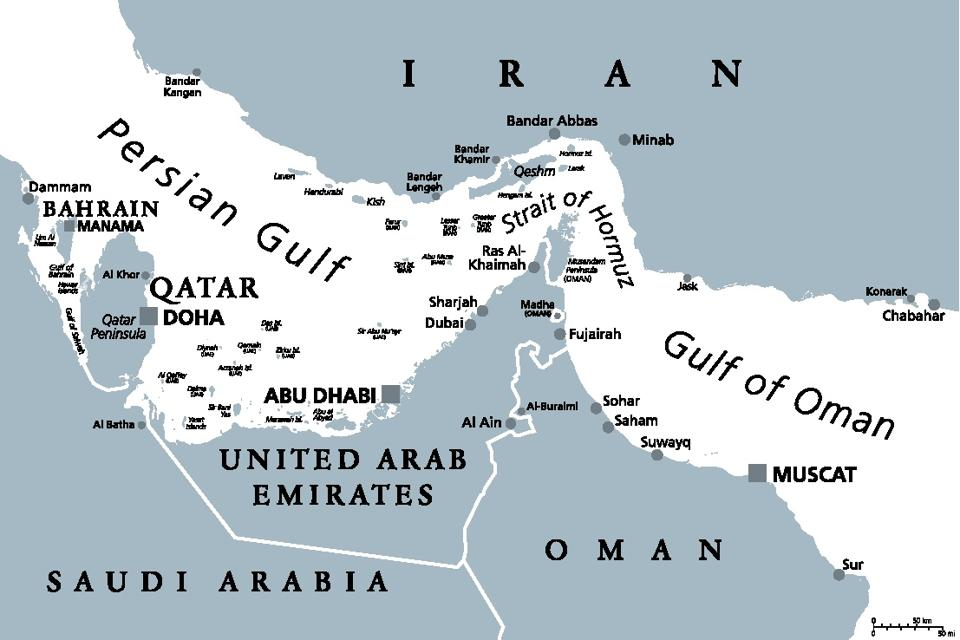
What is the Strait of Hormuz?
The Strait of Hormuz is one of the most strategically important maritime chokepoints in the world. Situated at the mouth of the Persian Gulf, it connects the Persian Gulf to the Gulf of Oman and the Arabian Sea, serving as a vital artery for global energy transport.
Geographical Significance
- Location: Lies between Iran (north) and Oman & the UAE (south).
- Width: Approximately 33 km wide at its narrowest point.
- Shipping Channel: Only 3 km wide in each direction for navigation.
Global Energy Lifeline
- Oil Transport: About 20% of all seaborne crude oil passes through the Strait.
- OPEC Dependence: Major oil exporters like Saudi Arabia, Iran, the UAE, Kuwait, and Iraq rely on this route.
- LNG Transit: Nearly all LNG exports from Qatar—the world’s largest LNG exporter—also pass through the Strait.
Alternate Routes & Strategic Moves
Due to the Strait’s vulnerability to geopolitical tensions:
- Saudi Arabia and the UAE have invested in alternate routes.
- This includes constructing oil pipelines that bypass the Strait of Hormuz, reducing dependency on this chokepoint.
Importance in Global Affairs
Any disruption to navigation in the Strait of Hormuz can:
- Impact global oil prices.
- Trigger military tensions, especially involving Iran and Western powers.
- Affect global energy security, making it a critical focal point in geopolitics.
UPSC Civil Services Examination, Previous Year Questions (PYQs)
Q. Which one of the following straits is nearest to the International Date Line? (2008)
(a) Malacca Strait
(b) Bering Strait
(c) Strait of Florida
(d) Strait of Gibraltar
Ans: (b)
National Affairs
1. e-Raktkosh Portal
Context:
In a major move aimed at saving lives and reducing costs for patients with rare blood groups and genetic blood disorders, the Union Health Ministry is set to integrate the Rare Donor Registry of India (RDRI) with e-Rakt Kosh, the national blood bank management and availability platform.
e-Raktkosh Portal
e-Raktkosh is a comprehensive, centralized IT solution developed to streamline and standardize the functioning of blood banks across India. It supports transparency, traceability, and efficiency in the blood donation life cycle.
- Launched on: 7th April 2016
- By: Ministry of Health and Family Welfare (MoHFW)
- Objective: To ensure compliance with Drugs & Cosmetics Act and National Blood Policy standards
Key Features of e-Raktkosh
- Centralized Blood Inventory Management System
- Donor Management System (Biometric)
- Blood Grouping and TTI Screening
- Antibody Screening Mechanisms
- Bio-Medical Waste Management for discarded blood
- Ensures availability, accessibility, and safety of blood
Understanding Blood Disorders
What is a Blood Disorder?
A blood disorder is a medical condition that affects the components of blood—red blood cells (RBCs), white blood cells (WBCs), plasma, or platelets—and hinders their normal function.
- Can be common (e.g., anemia) or rare (e.g., thalassemia)
- May impact oxygen transport, immunity, or clotting
2. Delhi’s First Artificial Rain Project to Tackle Pollution
Context:
The Delhi government, in partnership with IIT-Kanpur and the Department of Environment, is launching its first cloud seeding (artificial rain) pilot project to combat severe winter air pollution.
What is Artificial Rain?
- Definition: A weather modification technique to induce rainfall by dispersing chemicals into clouds.
- Chemicals Used: Silver iodide, potassium iodide, dry ice, rock salt.
- Purpose: Enhance condensation in clouds to trigger rainfall and wash out pollutants.
Why Delhi Needs It
- Pollution Spike: Delhi frequently records PM2.5 and PM10 levels in the ‘severe’ category.
- Sources of Pollution:
- Vehicle and industrial emissions
- Construction dust
- Crop stubble burning in neighbouring states
- Unfavourable meteorological conditions
- Health Risk: Hazardous air quality impacts respiratory and cardiovascular health.
Cloud Seeding
What is Cloud Seeding?
Cloud seeding is a scientific technique used to enhance precipitation by artificially dispersing chemical substances—such as silver iodide, potassium iodide, or dry ice—into clouds. These act as condensation or ice nuclei, encouraging the formation of raindrops or snowflakes.
- Purpose: To induce or increase rainfall/snowfall
- Common Chemicals: Silver iodide, potassium iodide, dry ice
- Mechanism: Enhances microphysical processes in clouds by accelerating droplet formation
Applications of Cloud Seeding
- Air Pollution Control: Helps settle airborne pollutants (like PM2.5 and PM10) by promoting rainfall, especially during high AQI periods
- Water Resource Management: Increases water availability in reservoirs, agriculture, and drought-prone areas
- Climate and Environmental Benefits: Contributes to ecosystem health, agricultural productivity, and weather stabilization
- Health Benefits: Improves air quality, reducing respiratory diseases linked to pollution
Types of Cloud Seeding
- Static Cloud Seeding
- Introduces ice-forming nuclei into cold clouds
- Converts supercooled water into ice crystals or snowflakes
- Typically used to induce precipitation in stable cloud systems
- Dynamic Cloud Seeding
- Aims to stimulate vertical air currents
- Enhances cloud growth and precipitation through energy amplification
- More complex and relies on meteorological conditions
- Hygroscopic Cloud Seeding
- Uses fine salt particles (e.g., sodium chloride) to attract moisture
- Increases cloud droplet size, making them heavy enough to fall as rain
- Effective in warm and moist cloud conditions
- Glaciogenic Cloud Seeding
- Induces ice formation in supercooled liquid clouds
- Leads to precipitation as snow or rain
- Commonly used in mountainous regions to increase snowpack, aid in drought relief, and combat pollution
UPSC Prelims PYQ 2025
Q. Artificial way of causing rainfall to reduce air pollution makes use of
(a) silver iodide and potassium iodide
(b) silver nitrate and potassium iodide
(c) silver iodide and potassium nitrate
(d) silver nitrate and potassium chloride
Ans: (a) silver iodide and potassium iodide
Banking/Finance
1. SEBI Initiates Comprehensive Review of Mutual Fund Regulations
Context:
The Securities and Exchange Board of India (SEBI) has launched a comprehensive review of the mutual fund (MF) regulatory framework to make it more investor-centric and industry-friendly, while improving the overall ease of doing business for stakeholders.
Key Objectives of the Review
- Simplification of Existing Rules:
- The current MF regulations are among the lengthiest in India’s securities law framework and require updating to stay relevant in light of:
- Changing investor behaviour
- Technological innovation
- Industry expansion
- The current MF regulations are among the lengthiest in India’s securities law framework and require updating to stay relevant in light of:
- Draft Regulations Underway:
- SEBI has begun the process of preparing draft regulations, which will be released for public feedback and stakeholder consultation before finalisation.
Focus Areas of Reform
- Investor-Centric Approach:
- Enhance investor protection
- Improve transparency and disclosures
- Encourage better advisory services
- Ease of Doing Business:
- Simplify compliance for Asset Management Companies (AMCs)
- Reduce regulatory burden without compromising accountability
- Advisory Functions:
- A separate consultation paper on MF advisory norms is being prepared to address product suitability and quality of advice.
Strategic Significance
- SEBI views mutual funds as a core pillar of inclusive financial growth and a key driver in expanding retail investor participation.
- The reforms aim to build a robust, transparent, and efficient mutual fund ecosystem, aligned with global best practices.
2. SEBI Eases Startup Regulations and Introduces Major Reforms for AIFs, REITs, and PSUs
Context:
The Securities and Exchange Board of India (SEBI), in its latest board meeting, introduced a comprehensive set of regulatory changes aimed at improving the capital-raising ecosystem for startups, simplifying delisting norms for PSUs, and enhancing operational flexibility for AIFs, REITs, and InvITs. These changes come amid global financial uncertainties and are expected to boost domestic fundraising and investment flows.
Key Reforms for Startups
- ESOP Clarity for Founders: Startups can now issue and allow the exercise of ESOPs to founders/promoters if granted at least one year before the filing of the Draft Red Herring Prospectus (DRHP).
- Dematerialisation Mandate: Senior management must now dematerialise their shareholdings before DRHP filing.
- Lock-in Period Scrapped: One-year lock-in for shares derived from Compulsorily Convertible Securities (CCS) removed, easing participation in Offer for Sale (OFS).
- Reverse Flipping Incentivised: Reforms will support Indian listings of startups initially launched abroad.
- Promoter Contribution Expanded: Shares held by foreign VC funds, AIFs, and public financial institutions can now count toward minimum promoter contribution in IPOs.
Co-Investment Vehicle (CIV) Framework under AIFs
- New CIV Framework: Category I and II AIFs can now form Co-Investment Vehicles (CIVs), simplifying co-investments for AIF investors.
- Streamlined Investment Process: Investors can co-invest in portfolio companies without routing through external PMS structures or breaching restrictions on unlisted companies.
REITs and InvITs Regulation Changes
- Unit Classification: Units held by related parties will no longer be counted as public holding.
- Cash Flow Flexibility: Holding companies can offset negative standalone net distributable cash flows against income from Special Purpose Vehicles (SPVs) before distribution, with disclosures.
- Reduced Minimum Investment: For privately placed InvITs, the minimum allotment size has been reduced from ₹1 crore to ₹25 lakh.
Simplified PSU Delisting Norms
- Eased Exit for Majority-Govt PSUs: New delisting norms apply to PSUs where the government holds at least a 90% stake. Around five listed PSUs could benefit.
BS
3. SEBI Proposes Guardrails for AI and ML in Indian Securities Markets
Context:
In a timely and forward-looking move, the Securities and Exchange Board of India (SEBI) has released a discussion paper titled “Guidelines for Responsible Usage of AI/ML in the Indian Securities Market.” This consultation initiative aims to regulate the rapid rise of artificial intelligence (AI) and machine learning (ML) applications—particularly algorithmic trading—on Dalal Street.
Why It Matters?
While AI doesn’t introduce fundamentally new risks to markets, it can amplify existing vulnerabilities such as market manipulation, flash crashes, systemic contagion, and biased decision-making. SEBI’s proactive stance is meant to ensure investor protection, financial stability, and ethical use of AI technologies in securities trading.
Key Elements of SEBI’s Proposed Framework
- Model Governance and Testing:
- Mandate for rigorous pre-deployment testing and periodic audits of AI/ML models.
- Explainability and traceability of model decisions to be ensured.
- Bias, Fairness, and Privacy:
- Guidelines on mitigating algorithmic bias, protecting investor data, and ensuring model integrity.
- Disclosure Requirements:
- Entities must disclose the nature of AI/ML systems used, data sources, model purpose, and decision-making logic to SEBI.
- Third-Party and Non-Traditional Players:
- Regulatory purview to expand to cover third-party algo vendors, fintech startups, and non-registered intermediaries using AI for financial services.
- Investor Protection and Oversight:
- Emphasis on human-in-the-loop supervision, especially as markets inch closer to agentic AI—AI systems that can act autonomously in investing.
Implications
- Market participants will need to revisit their AI governance frameworks, particularly around model validation and compliance reporting.
- Startups and fintechs must prepare for regulatory scrutiny if offering AI-based trading or advisory services.
- Investors may benefit from more transparent and explainable AI tools, subject to new disclosures and testing standards.
4. Credit Rating Agencies Seek Government Intervention
Contex:
Credit Rating Agencies (CRAs) in India have approached the Ministries of Finance and Corporate Affairs, seeking immediate regulatory clarity on rating unlisted debt instruments worth over ₹1 lakh crore. These include Pass-Through Certificates (PTCs) and unlisted corporate bonds—a vital part of the country’s wholesale debt ecosystem.
What’s the Issue?
- Regulatory Overlap: SEBI regulates CRAs but only for listed securities.
- Unlisted instruments like PTCs and company fixed deposits fall outside both SEBI’s and RBI’s clear jurisdiction.
- In 2023, SEBI required CRAs to obtain an NOC from RBI for rating unlisted papers.
- While RBI allowed ratings for Certificates of Deposit (CDs), it remains silent on PTCs and unlisted bonds, leaving a regulatory grey zone.
Why This Matters
- Market Size: Unlisted instruments like PTCs help lenders (NBFCs, banks) unlock liquidity from retail loan pools.
- Investor Confidence: Ratings influence pricing, risk evaluation, and compliance standards for institutional investors.
- Capital Requirements: Banks prefer rated instruments due to lower capital provisioning needs.
TET
5. Bank of Maharashtra Partners with SBI Card to Launch Co-Branded Credit Cards
Context:
In a strategic move to strengthen its retail offerings, Bank of Maharashtra (BoM) has announced a co-branding partnership with SBI Card to launch co-branded credit cards aimed at fulfilling the financial and lifestyle needs of its customer base.
Key Highlights of the Partnership
- Tailored Credit Cards: The co-branded cards will feature:
- Reward points on purchases
- Cashback offers on selected transactions
- EMI facilities
- Exclusive merchant discounts across major categories like dining, travel, and e-commerce
- Distribution Channels:
- Available through both digital platforms and branch-based channels
- Seamless and easy onboarding process for eligible customers nationwide
- Collaborative Strengths:
- BoM’s extensive banking network and trusted customer relationships
- SBI Card’s credit card expertise, digital capabilities, and diverse product suite
6. Outward Direct Investment (ODI)
Context:
India is witnessing a significant surge in outward direct investment (ODI) by domestic corporations, raising questions about whether this reflects increasing global competitiveness or underlying concerns about the business environment at home. Indian outward investment has jumped from $4 billion in 2014–15 to $29 billion in 2024–25, a 625% increase over a decade.
What is ODI?
Overseas Direct Investment (ODI) refers to investments made by Indian individuals or companies in businesses, assets, or operations located outside India. These investments typically involve ownership, control, or significant influence in foreign enterprises through subsidiaries, joint ventures, or branches.
Key Features of ODI
- Control & Influence: ODI involves significant control or influence, generally defined as ownership of at least 10% in the foreign entity.
- Purpose:
- Business expansion
- Market diversification
- Access to strategic resources
- Risk distribution across geographies
- Investment Forms:
- Equity participation in foreign companies
- Establishing manufacturing/service units abroad
- Real estate purchases and infrastructure projects
Major Destinations for Indian ODI
- Singapore
- United States
- United Kingdom
- United Arab Emirates (UAE)
- Saudi Arabia
- Oman
- Malaysia
Significance of ODI for India
- Technology & Skill Transfer: Facilitates the inflow of modern practices and R&D back into India.
- Global Market Access: Enables Indian companies to tap into international consumer bases and supply chains.
- Brand Promotion: Enhances the global brand visibility of Indian enterprises.
- Employment Generation: Creates jobs both in the host country and within India through backward linkages.
- Resource Utilisation: Leverages raw materials available in both India and the host country for value addition.
- Boost to Trade: Strengthens foreign trade by building international production and export networks.
- Foreign Exchange Earnings: Generates long-term foreign currency inflows from profits, royalties, and dividends.
TH
7. Digital Payment Intelligence Platform (DPIP)
Context:
In response to the rising tide of digital payment frauds, the Reserve Bank of India (RBI) has initiated the development of a Digital Payment Intelligence Platform (DPIP) — a cutting-edge Digital Public Infrastructure (DPI) aimed at strengthening fraud risk management across India’s financial ecosystem.
Key Objectives of DPIP
- Real-Time Intelligence Sharing: Enable participating banks to share and access real-time data on suspicious digital transactions.
- Centralised Threat Detection: Collect and analyse transaction data across sources to identify patterns, anomalies, and potential fraud.
- Unified Fraud Management: Establish a pan-industry mechanism to prevent cross-platform and cross-institutional fraud attempts.
- Digital Public Infrastructure: Position DPIP as part of India’s evolving DPI framework, much like UPI and Aadhaar.
Why the Urgency? – Rising Digital Payment Frauds
- Surge in Fraud Cases:
- FY25 fraud value surged to ₹36,014 crore, nearly 3x higher than FY24’s ₹12,230 crore.
Expected Benefits of DPIP
- Enhanced Transaction Security: Real-time alerts and monitoring will help identify and prevent fraud at the source.
- Improved Consumer Trust: Secured digital ecosystems will promote greater adoption of digital payments.
- Data-Driven Regulation: The RBI will gain sharper insights for future policy interventions and risk assessment.
- Scalability Across Platforms: The platform can integrate with UPI, RuPay, Internet Banking, and emerging payment modes.
Agriculture
1. India Emerges as World’s Top Rice Producer
Context:
India has overtaken China to become the world’s largest rice producer, with a record output of 149 million tonnes in 2025, and continues to be the top global rice exporter since 2012, accounting for nearly 40% of world trade. This agricultural milestone is a result of coordinated efforts from farmers, scientists, and policymakers.
Key Highlights
- Technological & Policy Support:
- Early adoption of IR8 in 1966 catalyzed the rice revolution.
- India’s extensive rice-breeding programs have developed high-yield, pest-resistant, climate-resilient varieties.
- Minimum Support Price (MSP), input subsidies, and assured procurement incentivized growth.
- India’s Global Standing:
- Leading exporter of rice and second-largest wheat producer.
- Emerged as a key food grain powerhouse despite small landholdings and a large population.
Challenges to Sustainability
- Water Overuse:
- Paddy cultivation uses up to 15,000 litres of water per kg—2.5 times the actual requirement.
- Rice consumes 45–50% of irrigation water, threatening water tables, especially in Punjab and Tamil Nadu.
- Excessive irrigation leads to higher greenhouse gas emissions from paddy fields.
- Sustainable Alternatives:
- Direct Seeding of Rice (DSR) and Alternate Wetting and Drying (AWD) methods can:
- Save 30–60% water.
- Reduce emissions and input usage.
- Maintain crop yield.
- Direct Seeding of Rice (DSR) and Alternate Wetting and Drying (AWD) methods can:
2. Tractor-Operated Plastic Mulch Layer-Cum-Planter
Context:
Union Minister of Agriculture and Farmers’ Welfare Shri Shivraj Singh Chouhan visited the ICAR-Central Institute of Agricultural Engineering (CIAE) in Bhopal to review its research contributions and push for accelerated development and dissemination of farmer-centric technologies, particularly for small and marginal farmers.
Tractor-Operated Plastic Mulch Layer-Cum-Planter
ICAR-CIAE demonstrated a multi-functional, tractor-operated implement that integrates plastic mulch laying, drip lateral installation, and seed planting in one pass, reducing manual labour and operational cost drastically.
Technical Specifications:
- Mechanism:
- Hydraulic system powers an eccentric slider crank mechanism.
- Vacuum seed metering via aspirator blower connected to tractor PTO.
Benefits:
- Labour savings: 26 man-days/ha (89%)
- Cost savings: ₹6,600/ha (43%)
- Suitable for planting high-value crops like:
- Melon, cucumber, sweet corn, baby corn, green pea, okra, and beans.
Relevance
The Minister’s visit and the technology demonstration align with national goals of:
- Enhancing mechanization in smallholder farming
- Promoting climate-smart and resource-efficient agriculture
- Strengthening food security through technology diffusion
Facts To Remember
1. No 90m this time but Neeraj bests Weber for the title
Olympic medal-winning Neeraj Chopra clinched his first Diamond League title in two years, upstaging German rival Julian Weber without having to hit the 90m mark in a strong field here.
2. Pakistan to Recommend Donald Trump for 2026 Nobel Peace Prize Over India-Pakistan Mediation
The Government of Pakistan announced on Saturday that it will formally recommend former U.S. President Donald Trump for the 2026 Nobel Peace Prize, citing his “decisive diplomatic intervention” during the recent India-Pakistan conflict.
3. INS Tamal to be Commissioned in Russia on July 1: India’s Last Foreign-Built Frigate
The Indian Navy will commission its latest and final foreign-built stealth frigate, INS Tamal, on July 1, 2025, at Kaliningrad, Russia. Built at the Yantar Shipyard, INS Tamal marks the completion of India’s long-standing Krivak-class warship programme with Russia. Future warships will now be built domestically under the “Atmanirbhar Bharat” initiative.
- In 2023, SEBI required CRAs to obtain an NOC from RBI for rating unlisted papers. Credit Rating Agencies Seek Government Interven…
- Function: Enriches uranium up to 60% purity. U.S. Launches Strikes on Iran’s Nuclear Sites
- Oil Transport: About 20% of all seaborne crude oil passes through the Strait. Strait of Hormuz
- Reduced Minimum Investment: For privately placed InvITs, the minimum allotment size has been reduced from ₹1 crore to ₹25 lakh. SEBI Eases Startup Regulations and Introduces M…
- Control & Influence: ODI involves significant control or influence, generally defined as ownership of at least 10% in the foreign entity. Outward Direct Investment (ODI)
24 June, 2025
Daily Current Affairs Quiz
24 June, 2025
International Affairs
1. Iran Strikes U.S. Base in Qatar in Retaliation for Nuclear Site Attacks
Context:
Iran launched missile attacks on the al-Udeid Air Base in Qatar, the largest U.S. military base in West Asia, in retaliation for U.S. airstrikes on Iranian nuclear facilities a day earlier.
Key Highlights
- Targeted Base: The al-Udeid Air Base, which hosts approximately 10,000 U.S. troops, was the focus of Iran’s missile offensive.
- IRGC Involvement: The Islamic Revolutionary Guard Corps (IRGC) led the missile strike under directives from Iran’s Supreme National Security Council.
Geopolitical Context
- The strike signifies a dangerous escalation in U.S.-Iran tensions in the Gulf region.
- Qatar, located just 190 km south of Iran, continues to host major U.S. military operations in the region, making it a strategic but vulnerable location.
Implications
- The incident raises fears of a broader regional conflict involving Iran, the U.S., and Gulf states.
- It may also impact diplomatic ties and energy markets, given Qatar’s strategic role in global LNG supply and regional stability.
National Affairs
1. Ruins of Fort Emmanuel in Fort Kochi
Context:
In a striking turn of events, monsoon sea erosion at Fort Kochi’s South Beach has unveiled what experts believe are long-buried remnants of Fort Emmanuel — the first European fort built in Asia, dating back to 1503.
The laterite rock and surkhi (brick-lime mix) foundation, previously hidden under coastal sand and stone, emerged after waves stripped the coastline, offering rare physical evidence of Portuguese colonial architecture.
Key Findings
Identification of Fort Emmanuel Remains
- Marine geologists from Cochin University of Science and Technology (CUSAT) confirmed the ruins likely belong to Fort Emmanuel, built by the Portuguese in 1503.
- The structure, composed of laterite stones bonded with surkhi, is exposed annually but has become more visible due to accelerated coastal erosion this season.
Ongoing Academic Investigation
- Researchers are examining whether the structure is the original Portuguese construction or a rebuild by the Dutch, who took over Fort Kochi later.
- Fort Emmanuel marked the birth of Europe’s first colonial township in Asia, and its remains provide a tangible link to that layered colonial past.
Historical Context and Previous Discoveries
- Fort Kochi shifted colonial hands multiple times — from Portuguese to Dutch to British (1503–1947).
- This discovery follows an earlier one on Fort Kochi’s northern coast, where stone artefacts unearthed during the Kochi Water Metro project were linked to a demolished Portuguese church.
- Marine geologists noted that the rock samples match formations found in the Munnar–Theni–Rajapalayam corridor, part of a Portuguese trade route.
2. World Meteorological Organization’s (WMO) State of the Climate in Asia 2024 Report
Context:
India’s eastern and western coasts are witnessing sea level rise at rates higher than the global average, according to the World Meteorological Organization’s (WMO) State of the Climate in Asia 2024 report. The alarming trends point to escalating climate risks for infrastructure, livelihoods, and ecosystems across the region.
Key Climate Trends in India
Accelerated Sea Level Rise
- Arabian Sea: Rising at 3.9 ± 0.4 mm/year
- Bay of Bengal: Rising at 4.0 ± 0.4 mm/year
- Global average: 3.4 mm/year
These figures place India’s coasts at heightened risk of flooding, erosion, and infrastructure loss.
Coastal and Urban Impact
- Low-lying regions within 50 km of the coast are increasingly susceptible to submergence and displacement.
- Critical infrastructure like ports, housing, and transport hubs face growing vulnerability.
Himalayan Glacial Retreat
- 23 of 24 glaciers in the Central Himalayas are shrinking.
- Rising risk of Glacial Lake Outburst Floods (GLOFs) threatens downstream populations and infrastructure.
Heatwaves and Lightning
- Over 450 heat-related deaths reported in 2024 across multiple Indian states.
- Lightning strikes claimed 1,300 lives, including a single event killing 72 people across five states on July 10.
Broader Climate Patterns in Asia
Rapid Regional Warming
- Asia’s warming rate is double the global average, intensifying the frequency of floods, droughts, and storms.
- 2024 was Asia’s second warmest year on record, with extreme heatwaves widespread across the continent.
Catastrophic Natural Events
- Kerala’s Wayanad landslide: Over 350 deaths after receiving 500 mm of rainfall in 48 hours.
- Melting glaciers in the Himalayas and Tian Shan ranges have increased GLOF incidents across South and Central Asia.
Scientific Drivers of Sea Level Rise
- Thermal Expansion: Warmer ocean temperatures cause seawater to expand.
- Melting Ice Sheets and Glaciers: Loss from Greenland, Antarctica, and other glaciers directly contributes to rising seas.
- Greenhouse Gas Emissions: Elevated CO₂ levels from fossil fuels accelerate warming and glacial melt.
- Ocean Circulation Changes: Shifts in regional currents affect how and where sea levels rise.
Consequences for India and Asia
India’s Climate Risks
- Coastal Erosion: Major threat to seaboards and coastal biodiversity.
- Livelihood Loss: Fishing, farming, and tourism-based incomes are at risk.
- Infrastructure Damage: Flooding threatens ports, power plants, and coastal cities.
- Climate Migration: Rising displacement pressures from coastal areas.
Regional Impacts in Asia
- Island Nations: Existential threat to low-lying countries like the Maldives.
- Urban Heat Islands: Cities face more frequent and severe heatwaves.
- Agricultural Stress: Warming disrupts monsoons and reduces crop yields.
- Public Health: Surge in heat-related illnesses and vector-borne diseases (e.g., dengue, malaria).
Recommended Measures and Strategic Response
1. Coastal Zone Management
- Build resilient infrastructure, restore mangroves, and strengthen natural coastal barriers.
2. Accelerated Emission Reductions
- Update and fulfill Nationally Determined Contributions (NDCs).
- Adopt net-zero pathways and scale up renewable energy deployment.
3. Early Warning and Climate Intelligence
- Invest in climate monitoring, risk mapping, and disaster forecasting systems.
4. Regional and Global Cooperation
- Deepen collaboration under UNFCCC, and build cross-border adaptation frameworks.
3. NAVYA Initiative
Context:
In a significant step towards gender-inclusive economic development, the Government of India has announced the launch of NAVYA—a pilot initiative aimed at skilling adolescent girls aged 16–18 years. The programme will be implemented in Uttar Pradesh as part of the broader Viksit Bharat@2047 Vision, with a focus on creating a self-reliant and inclusive India.
What is NAVYA?
NAVYA stands for “Nurturing Aspirations through Vocational Training for Young Adolescent Girls.” It is a pilot skilling programme jointly launched by:
- Ministry of Women and Child Development (MWCD)
- Ministry of Skill Development and Entrepreneurship (MSDE)
Objectives of the NAVYA Initiative
- Empowerment through Skilling: Equip girls with market-relevant vocational skills.
- Promote Gender Parity: Introduce girls to non-traditional job roles in emerging sectors.
- Foster Aspirations: Build career confidence, self-reliance, and economic independence among adolescent girls.
Key Features of NAVYA
- Target Group: Girls aged 16–18 years with minimum Class 10 qualification.
- Pilot Implementation: Across 27 districts in 19 States, including Aspirational Districts and North-Eastern States.
- Integrated Platforms: Leverages skill schemes such as:
- Pradhan Mantri Kaushal Vikas Yojana (PMKVY)
- PM Vishwakarma Yojana
- Inter-Ministerial Convergence: Coordinated efforts between MWCD and MSDE to ensure holistic delivery.
- Skill Certification: Beneficiaries will receive formal certification under PMKVY, enhancing their employability.
- Launch Event Activities:
- Live interactions with trainees
- Skill demonstration
- Certificate distribution
PIB
4. MToT Programme to Boost Panchayats’ Revenue Generation
Context:
In a major step toward empowering local governance, the Ministry of Panchayati Raj (MoPR), in collaboration with IIM Ahmedabad and the Indian Institute of Public Administration (IIPA), has launched a Training of Trainers (ToT) programme. This initiative aims to build the capacity of Panchayats to generate Own Source Revenue (OSR) under the Rashtriya Gram Swaraj Abhiyan (RGSA).
What is the ToT Programme?
The ToT programme is a training initiative focused on enhancing the financial autonomy of Panchayats by equipping them with the knowledge and tools needed for effective OSR generation.
Objective
- Promote financial self-reliance of Panchayats.
- Train Master Trainers to build a robust cadre of local resource leaders.
- Foster leadership, innovation, and accountability at the grassroots level.
Key Features of the ToT Programme
- Implemented under RGSA, a flagship capacity-building scheme for rural local bodies.
- Uses behavioural insights, strategic revenue planning, and local innovation tools to improve OSR generation.
- Initially trains Master Trainers from 16 States and Union Territories, with future expansions planned.
- Will support the creation of:
- A Model OSR Rules Framework for uniformity and compliance.
- A Digital Tax Collection Portal for streamlined revenue operations.
About Rashtriya Gram Swaraj Abhiyan (RGSA)
- A Centrally Sponsored Scheme (CSS) launched in 2018, revamped for 2022–2026.
- Aims to strengthen the Panchayati Raj system and help Panchayats achieve the Sustainable Development Goals (SDGs).
Objectives:
- Enhance governance capabilities of Panchayati Raj Institutions (PRIs).
- Build capacity for financial planning, including OSR mobilisation.
- Promote inclusive governance, resource convergence, and effective scheme implementation.
- Empower Gram Sabhas as platforms for citizen engagement.
Key Features:
- Focused training for elected Panchayat representatives.
- Supports decentralisation under the PESA Act (1996).
- Encourages technology adoption in local governance.
- Recognises and rewards top-performing Panchayats.
- Facilitates knowledge exchange with national and international institutions.
5. Tripura Declared Fully Literate Under ULLAS Scheme
Context:
Tripura has been officially declared a fully literate state under the ULLAS – Nav Bharat Saaksharta Karyakram (New India Literacy Programme). The announcement marks a historic milestone in the state’s journey towards universal literacy and positions Tripura as the third Indian state, after Mizoram and Goa, to achieve full literacy status.
About ULLAS – Nav Bharat Saaksharta Karyakram
What is it?
A centrally sponsored scheme (2022–2027) focused on adult literacy and lifelong learning, aligned with NEP 2020.
Target Group:
Youth and adults aged 15 years and above who missed formal schooling opportunities.
Key Features:
- Focus on foundational literacy, numeracy, and life skills
- Nationwide implementation in mission mode
- Use of ULLAS mobile app for digital learning, progress tracking, and certification
- Strong emphasis on Jan Bhagidari (people’s participation) and Kartavyabodh (sense of duty)
Banking/Finance
1. RBI Rate Cut Could Revive Loan Growth, But Deposit Mobilisation Key: Fitch
Context:
Fitch Ratings has projected that the Reserve Bank of India’s recent 50 basis point rate cut could help revive loan growth to 12–13% in FY26. However, this growth is contingent on stronger deposit mobilisation by the banking sector.
Key Banking Sector Metrics and Trends
- Loan-to-Deposit Ratio (LDR):
- Rose 120 basis points in FY25.
- Sustaining loan growth momentum will require banks to match or exceed lending with deposit growth.
- Sectoral Loan Growth:
- Dropped to a 4-year low of 10% in FY25.
- Decline driven by slower lending to Non-Banking Financial Companies (NBFCs).
- Public Sector Banks (PSBs) outperformed private banks, growing at 12.4%.
- Earnings Resilience:
- Net Interest Margin (NIM) fell by 20 basis points.
- Despite this, earnings were supported by:
- Lower credit costs
- Recoveries from non-performing assets
- Treasury gains
2. RBI Eases PSL Norms for SFBs, Unlocks ₹40,000 Cr for Diversification
Context:
In a move aimed at increasing operational flexibility for Small Finance Banks (SFBs), the Reserve Bank of India (RBI) has reduced the priority sector lending (PSL) target from 75% to 60% of adjusted net bank credit (ANBC), freeing up approximately ₹40,000 crore for deployment in diversified, lower-risk lending.
Key Regulatory Changes
- Old PSL Norms:
- SFBs were required to lend 75% of ANBC to PSL sectors.
- 40% was earmarked for specific PSL subsectors.
- Remaining 35% could be directed to any PSL subsector of their choice.
- New PSL Norms (Effective FY26):
- Overall PSL requirement reduced to 60% of ANBC or off-balance-sheet exposures (whichever is higher).
- The flexible 35% component has been reduced to 20%.
Implications for SFBs
- Operational Flexibility:
- SFBs can now de-risk their books and explore non-PSL asset classes such as:
- Loan Against Property (LAP)
- Vehicle and personal loans
- Loans against mutual funds or shares
- Asset Quality Boost:
- With many SFBs holding large microfinance portfolios, diversification may mitigate risks linked to economic volatility.
- Support for Universal Bank Transition:
- This move aligns with RBI’s broader vision of enabling SFBs to transition into universal banks. Three SFBs have already applied for conversion.
3. Concerns Over Health Insurance Premiums and Governance Issues
Context:
The Ministry of Finance has urged the Insurance Regulatory and Development Authority of India (IRDAI) to intensify regulatory vigilance, improve claims settlement mechanisms, and address grievance redressal, amid growing concerns over surging health insurance premiums and lapses in corporate governance, especially within Stand-Alone Health Insurance (SAHI) companies.
Key Government Concerns Highlighted
- Sharp Rise in Premiums: Health insurance premiums rose by up to 15% in 2024, forcing many policyholders to drop out, especially senior citizens.
- Grievances and Delayed Claims: A growing number of complaints on delays and denial in claim settlements.
- Governance Lapses: Especially in SAHIs, allegedly influenced by private equity (PE) control.
Policy and Regulatory Context
| Issue | Government Action |
|---|---|
| Premium Hikes | Directed IRDAI to review product pricing; prevent excessive hikes, especially for senior citizens. |
| Governance | IRDAI asked to scrutinize board decisions and ensure compliance with all regulations. |
| PE Influence | Concerns raised over PE-backed firms driving aggressive pricing strategies to boost valuations. |
| Leadership Void | IRDAI has been without a Chairperson since March 2025; government may appoint a senior bureaucrat. |
Insurance Amendment Bill
The Insurance Laws (Amendment) Bill is likely to reshape the regulatory landscape:
- Allows 100% foreign direct investment (FDI) in insurance.
- Introduces a composite licence regime (life + non-life).
- Permits foreigners as Key Managerial Personnel (KMP) in Indian firms.
- Government expects regulatory protocols to be tightened ahead of the Bill’s passage.
IRDAI’s Past Action
In January 2025, IRDAI:
- Barred insurers from raising premiums for senior citizens (60+) by more than 10% per annum without prior approval.
- Cited disproportionate premium increases and their adverse impact on vulnerable groups.
4. Housing Finance Company (HFC)
Context:
NHB Tightens Refinancing Norms for Under-Construction Home Loans to Curb Misuse.
Housing Finance Company (HFC)
A Housing Finance Company (HFC) is a type of Non-Banking Financial Company (NBFC) that specializes in providing housing loans and other related financial services. They are regulated by the Reserve Bank of India (RBI) and play a crucial role in the housing sector by offering loans for home purchase, construction, renovation, and land purchase for residential purposes.
Key Characteristics of HFCs:
- Focus on Housing Finance: At least 60% of an HFC’s assets must be dedicated to housing finance, and at least 50% of those assets must be for loans to individuals for housing purposes.
- Regulation: HFCs are regulated by the Reserve Bank of India (RBI), with some regulatory powers also held by the National Housing Bank (NHB).
- Loan Products: HFCs offer various loan products, including:
- Home loans for purchase or construction.
- Loans for home improvements and renovations.
- Loans for land purchase for residential construction.
- Role in the Housing Market: HFCs play a vital role in facilitating homeownership by providing access to credit, especially for those who may not qualify for loans from traditional banks.
- Comparison with Banks: While both banks and HFCs offer home loans, HFCs generally have more flexibility in their lending practices and can be a good option for those with specific needs or less traditional credit profiles.
Examples of HFCs in India:
- LIC Housing Finance Ltd.
- HDFC Ltd. (now merged with HDFC Bank)
- PNB Housing Finance Ltd.
- ICICI Home Finance Company Ltd.
- Can Fin Homes Ltd.
- Aadhar Housing Finance Limited
TET
5. Angel Funds in India
Context:
The Securities and Exchange Board of India (SEBI) has introduced a significant regulatory change by mandating that only accredited or “sophisticated” investors can participate in angel funds. This new framework is expected to raise governance standards but may temporarily disrupt early-stage funding, particularly in smaller cities.
Understanding Angel Funds in India
Angel funds are specialized investment vehicles designed to provide capital to startups during their early stages. Backed by high-net-worth individuals (HNIs) or corporate entities known as angel investors, these funds are a key subset of venture capital funds, but with a sharper focus on early-stage businesses.
What is an Angel Fund?
An Angel Fund is a money pool created by seasoned investors or companies to support startups with high growth potential. Unlike traditional venture capitalists, who typically invest during a company’s growth phase, angel funds engage during the seed or early development stage, often filling the funding gap before venture capital kicks in.
Key Features of Angel Funds
- Structure and Fundraising:
- Angel funds raise capital exclusively from angel investors by issuing units and must have a minimum corpus of ₹10 crore (₹100 million).
- Investor Limit:
- Angel funds can now accept investments from up to 200 investors, a significant increase from the previous cap of 49.
- Investment Range:
- Minimum investment: ₹25 lakhs (reduced from ₹50 lakhs).
- Maximum investment: ₹5 crore.
- Lock-in Period:
- The lock-in for angel investors has been reduced to one year, down from three years, enhancing liquidity and flexibility.
- Eligibility of Investee Companies:
Angel funds may invest only in startups that:- Are incorporated in India and are less than 5 years old.
- Have a turnover below ₹25 crore.
- Are unlisted entities.
- Have no familial ties with the investing angel.
Regulatory Framework
Angel Funds in India are governed by the SEBI (Alternative Investment Funds) Regulations, 2012, with specific provisions added through the SEBI (AIF) Amendment Regulations, 2013.
- Category Classification:
- Angel funds are categorized as a sub-class of Venture Capital Funds under Category I of Alternative Investment Funds (AIFs).
- Regulator:
- Securities and Exchange Board of India (SEBI) oversees the functioning, compliance, and disclosures required by Angel Funds.
Who Are Angel Investors?
Angel investors are typically:
- High-net-worth individuals (HNIs) or corporates with domain expertise and industry insights.
- Early-stage backers who provide capital, mentorship, and business networks.
- Strategic supporters focused not just on financial returns but also on nurturing innovation and entrepreneurial success.
Agriculture
1. Beej Utsav
Context:
A four-day Beej Utsav (Seed Festival) was recently held in the tribal regions at the tri-junction of Rajasthan, Madhya Pradesh, and Gujarat, spotlighting the cultural and ecological significance of indigenous seeds in sustainable farming.
Key Highlights
- Mass Tribal Participation:
- Over 9,400 tribal community members, including women and children, actively participated across more than 60 panchayats.
- Celebrating Indigenous Practices:
- Events such as ‘Beej Samvad’ (seed dialogues), biodiversity fairs, seed ball making, and plantation drives underscored the ecological wisdom and traditions of tribal agriculture.
- Recognition of Seed Guardians:
- Farmers preserving traditional seed varieties were honoured with titles such as ‘Beej Mitra’ (Seed Friend) and ‘Beej Mata’ (Seed Mother), affirming their role as custodians of biodiversity.
Organisers and Support
- The festival was co-organised by community-led institutions including:
- Krishi Evam Adivasi Swaraj Sangathan
- Gram Swaraj Samooh
- Saksham Samooh
- Bal Swaraj Samooh
- It was supported by Vaagdhara, a Banswara-based voluntary organisation working on tribal livelihoods and agroecology.
Philosophy and Message
- Seeds as Cultural Identity:
- Vaagdhara Secretary Jayesh Joshi emphasized that seeds should not merely be seen as the start of cultivation, but as symbols of identity, nutrition, life, culture, and climate resilience in tribal communities.
- Call for Seed Sovereignty:
- With nearly 70% of small farmers depending on market-driven hybrid seeds, Mr. Joshi advocated for a return to traditional, community-led seed systems to counter rising input costs, chemical dependency, and food insecurity.
Broader Implications
- The festival’s core message – “Return to the roots” – resonates with growing global concerns around climate resilience, biodiversity preservation, and food sovereignty.
- The Beej Utsav serves as a powerful grassroots initiative reclaiming indigenous knowledge systems to counter the dominance of industrial agriculture.
Facts To Remember
1. India Clinches Historic Double Olympiad Gold
GMs Gukesh Dommaraju, Arjun Erigaisi, and Praggnanandhaa Rameshbabu all won as the Indian men wrapped up victory in the 45th FIDE Chess Olympiad with a statement 3.5-0.5 win over Slovenia.
2. Tripura becomes third state in the country, after Mizoram and Goa, to achieve Full Functional Literacy
Tripura was declared fully literate today under the ULLAS – Nav Bharat Saaksharta Karyakram (New India Literacy Programme), a centrally sponsored scheme implemented from 2022 to 2027.
- Sharp Rise in Premiums: Health insurance premiums rose by up to 15% in 2024, forcing many policyholders to drop out, especially senior citizens. Concerns Over Health Insurance Premiums and Gov…
- A Centrally Sponsored Scheme (CSS) launched in 2018, revamped for 2022–2026. MToT Programme to Boost Panchayats’ Revenue Gen…
- Marine geologists from Cochin University of Science and Technology (CUSAT) confirmed the ruins likely belong to Fort Emmanuel, built by the Portuguese in 1503. Ruins of Fort Emmanuel in Fort Kochi
- 23 of 24 glaciers in the Central Himalayas are shrinking. World Meteorological Organization's (WMO) State…
- Target Group: Girls aged 16–18 years with minimum Class 10 qualification. NAVYA Initiative
25 June, 2025
Daily Current Affairs Quiz
25 June, 2025
National Affairs
1. Sustainable Development Report (SDR) 2025
Context:
India has achieved a significant milestone by entering the top 100 countries in the Sustainable Development Goals (SDG) Index for the first time. In the 2025 edition of the Sustainable Development Report (SDR) released by the UN Sustainable Development Solutions Network, India has been ranked 99th out of 167 nations, with an overall SDG score of 67.
India’s Ranking
This marks a sharp rise from 109th position in 2024, reflecting sustained progress across key social, economic, and environmental indicators. The SDG Index assesses a country’s performance across the 17 goals adopted by the United Nations in 2015, with a score of 100 representing full achievement.
India’s SDG Rankings Over Time
- 2025: 99th (score: 67)
- 2024: 109th
- 2023: 112th
- 2022: 121st
- 2021: 120th
Global Performance
| Country | Rank | SDG Score |
|---|---|---|
| Finland | 1st | — |
| Sweden | 2nd | — |
| Denmark | 3rd | — |
| United States | 44th | 75.2 |
| China | 49th | 74.4 |
| Maldives | 53rd | — |
| Bhutan | 74th | 70.5 |
| Nepal | 85th | 68.6 |
| Sri Lanka | 93rd | — |
| India | 99th | 67.0 |
| Bangladesh | 114th | 63.9 |
| Pakistan | 140th | 57.0 |
Key Highlights from the 2025 Report
- India’s steady improvement is noted as a positive outlier among developing economies.
- Despite overall progress, global advancement on SDGs has plateaued.
- Only 17% of SDG targets are on track to be met by 2030.
- Key global barriers include:
- Ongoing geopolitical conflicts
- Structural economic vulnerabilities
- Limited fiscal capacity in low-income countries
Dominance of European Countries
- European nations continue to lead the global SDG Index, occupying 19 of the top 20 positions.
- Finland, Sweden, and Denmark retain the top three spots.
- However, even high-ranking nations face setbacks in:
- Climate change adaptation
- Biodiversity protection
- Unsustainable consumption patterns
TH
2. NITI Aayog India’s Data Imperative Report
Context:
Government think tank NITI Aayog proposed institutionalising data ownership, incentivising data quality, and interoperability of data across platforms as measures to improve data quality in the country in view of Indians’ growing dependence on digital public infrastructure.
NITI Aayog Report
- Report Title: India’s Data Imperative: The Pivot Towards Quality (Released: 25 June 2025)
- Key Finding: Fiscal leakage and faulty/duplicate beneficiary records inflate welfare outlays by 4–7% annually.
- Core Concern: Poor data quality leads to mis-targeted schemes, delayed corrections, and erosion of public trust.
What is India’s Data Ecosystem?
- A digital infrastructure network powering governance, welfare schemes, and financial inclusion across sectors.
- Integrates platforms such as:
- Aadhaar – identity authentication
- UPI – real-time financial transactions
- Ayushman Bharat – health data interoperability
- DBT – subsidy and benefit transfers
- Aadhaar e-KYC – cost-effective user onboarding
Key Highlights
- Aadhaar Authentications: 27+ billion
- UPI Transactions: ₹23.9 trillion/month
- Ayushman Bharat IDs Issued: 369 million
- DBT Transfers: ₹5.47 lakh crore across 330+ schemes
- e-KYC Transactions: 1.8 billion
- Digital Penetration: 1.2 billion mobile users; 800 million internet users
Why a Robust Data Ecosystem is Essential
- Prevent Fiscal Leakage: Reduces duplicate beneficiaries and erroneous payouts (saves 4–7% of welfare budget).
- Enable Data-Driven Governance: Facilitates AI-backed decision-making and targeted delivery.
- Build Public Trust: Enhances confidence in digital governance.
- Strengthen AI Innovation: Clean data is foundational to AI progress in healthcare, agri-tech, and governance.
- Cross-Ministerial Coordination: Enables real-time, integrated service delivery across departments.
Key Challenges:
- Fragmentation: Siloed systems across ministries
- Lack of Ownership: No designated data custodians
- Legacy IT Systems: Hinders real-time data flow
- Incentive Mismatch: Quantity prioritized over accuracy
- Weak Data Culture: Tolerance for low-accuracy standards
Recommended Measures
- Institutional Ownership: Appoint national/state/district-level data custodians
- Quality Incentives: Link data accuracy with appraisals and budgets
- Interoperability: Use IndEA, NDGFP for format standardisation
- Tools for Improvement: Implement NITI Aayog’s Data Quality Scorecard
- Capacity Building: Train officials for better data governance
3. Scheme to Promote Manufacturing of Electric Passenger Cars in India (SPMEPCI)
Scheme Overview
- Scheme Name: SPMEPCI – Scheme to Promote Manufacturing of Electric Passenger Cars in India.
- Official Website: MHI Portal
Key Features
- Objective: Establish India as a global EV manufacturing hub and innovation center.
- Minimum Investment Required: ₹4,150 crore.
- Import Concession: 15% customs duty on EV CBUs (min CIF USD 35,000) for 5 years.
- Focus: Boosting domestic manufacturing, employment generation, and technology transfer.
Government Vision
- Leadership: Spearheaded under Prime Minister Shri Narendra Modi’s clean mobility mission.
- Minister’s Statement: Union Minister Shri H.D. Kumaraswamy highlighted the scheme as a step toward Net Zero by 2070, strengthening Make in India and Aatmanirbhar Bharat.
Strategic Impact
- Attracts global EV manufacturers to invest in India.
- Promotes indigenous value chains via Domestic Value Addition (DVA) targets.
- Enhances employment and accelerates India’s green mobility roadmap.
4. Dharti Aaba Janbhagidari Abhiyan (DAJA): India’s Largest Tribal Empowerment Drive
Context:
The Government of India has launched Dharti Aaba Janbhagidari Abhiyan (DAJA) — an unprecedented tribal empowerment drive across 1 lakh+ tribal villages in 31 States/UTs.
What is DAJA?
- Dharti Aaba Janbhagidari Abhiyan (DAJA) is a nationwide tribal outreach initiative named after Bhagwan Birsa Munda, a revered tribal freedom fighter.
- Launched by the Ministry of Tribal Affairs, it aims to saturate government welfare schemes among Scheduled Tribes (STs) and Particularly Vulnerable Tribal Groups (PVTGs).
- Objective: Empower over 5.5 crore tribal citizens through active people’s participation (Janbhagidari).
Key Features
- Coverage: Over 1 lakh tribal villages and PVTG habitations in 31 States/UTs.
- Janbhagidari Model: Community involvement in governance and implementation.
- Five Pillars of DAJA:
- Janbhagidari (People’s Participation)
- Saturation of Schemes
- Cultural Inclusion
- Convergence of Government Services
- Last-Mile Delivery
- Schemes Integrated: Aadhaar, Ayushman Bharat, PM Kisan, Jan Dhan, PM Ujjwala, pension schemes, Forest Rights Act (FRA) claims.
- Tech Integration: Real-time dashboard monitoring for transparency and accountability.
- Cultural Components: Celebration of tribal food, art, dance, and handicrafts at village camps to revive cultural pride.
PIB
Banking/Finance
1. EPFO Raises Auto-Settlement Limit for Advance Claims to ₹5 Lakh
Context:
In a major move to enhance financial access for formal sector workers, the Employees’ Provident Fund Organisation (EPFO) has increased the auto-settlement limit for advance claims from ₹1 lakh to ₹5 lakh. The step is aimed at expediting disbursal of funds for urgent needs such as illness, education, marriage, and housing.
Background: Auto-Settlement Mechanism Introduced During COVID-19
- The auto-settlement system was first introduced during the COVID-19 pandemic to ensure timely financial relief for EPFO members.
- Since then, the facility has been expanded to include:
- Medical emergencies
- Education and marriage expenses
- Housing-related advances
- Claims under this facility are processed automatically by the system, without human involvement—ensuring speed, transparency, and efficiency.
India’s Expanding Social Security Coverage Recognised by ILO
Minister Mandaviya also highlighted India’s growing recognition on the global stage for expanding social protection:
- The International Labour Organisation (ILO) acknowledged India’s achievement in its latest global dashboard.
- 64.3% of India’s population (over 94 crore people) are now covered by at least one social protection scheme.
- In 2015, this coverage was just 19%.
- India now ranks second globally in terms of total number of social protection beneficiaries.
TH
2. Variable Rate Reverse Repo (VRRR)
Context:
The Reserve Bank of India (RBI) will conduct a seven-day Variable Rate Reverse Repo (VRRR) auction worth ₹1 trillion on Friday, June 27, aiming to absorb excess liquidity from the banking system. The move follows a sharp build-up in surplus liquidity that has pushed the Weighted Average Call Rate (WACR) below the policy repo rate of 5.50%.
Relation Between Variable Rate Repo (VRR) and Variable Rate Reverse Repo (VRRR)
The Reserve Bank of India (RBI) uses multiple tools to manage systemic liquidity. Among these are the Variable Rate Repo (VRR) to inject liquidity and the Variable Rate Reverse Repo (VRRR) to absorb surplus liquidity from the banking system.
What is Variable Rate Reverse Repo (VRRR)?
- VRRR is a liquidity absorption mechanism where banks park surplus funds with the RBI.
- Conducted via auctions, the interest rate is market-determined through competitive bidding.
- Typically, the VRRR rate is equal to or slightly higher than the standard reverse repo rate.
- VRRR is deployed when the banking system has excess liquidity, making it an effective tool to:
- Curb inflationary pressures
- Maintain monetary stability
How it Relates to Variable Rate Repo (VRR):
| Tool | Objective | Liquidity Effect |
|---|---|---|
| VRR | Inject funds into the banking system | Adds liquidity |
| VRRR | Mop up surplus funds from banks | Absorbs liquidity |
3. S&P Global Upgrades India’s FY26 GDP Growth Forecast to 6.5%
Context:
S&P Global Ratings on Tuesday revised India’s GDP growth forecast for FY26 to 6.5%, up by 0.2 percentage points from its previous estimate. The upgrade was published in its latest Economic Outlook for Asia-Pacific (Q3 2025).
Key Assumptions Driving the Forecast
- Normal monsoon
- Lower crude oil prices
- Income tax concessions
- Monetary policy easing
Focus on Domestic Demand
The report underlined that strong domestic demand would help limit the slowdown in India’s overall GDP growth, in contrast to export-dependent economies in the region which may face greater challenges due to softening global trade.
S&P noted
- Export growth could be constrained by weak external demand.
- Risks to global growth have risen due to geopolitical turbulence in West Asia.
- However, long-term spikes in oil prices are unlikely under current market conditions.
Background and Global Context
In May 2025, S&P had lowered India’s FY26 growth forecast to 6.3%, citing uncertainty stemming from U.S. tariff policy and its spillover effects on global trade. That report, titled Global Macro Update: Seismic Shift in US Trade Policy Will Slow World Growth, warned of rising protectionism and its negative impact on global supply chains.
Global Forecasts
- World Bank (June 2025): Maintained India’s FY26 growth forecast at 6.3% amid rising trade barriers.
- IMF (April 2025): Lowered India’s FY26 forecast by 30 bps to 6.2%, citing trade tensions and global uncertainty.
4. SEBI Proposes Major Governance Overhaul for Market Infrastructure Institutions
Context and Regulatory Background
- MIIs include stock exchanges, clearing corporations, and depositories, regulated primarily under:
- Securities Contracts (Regulation) Act, 1956
- SEBI Act, 1992
- Depositories Act, 1996
- Relevant regulations like SECC Regulations, 2018, and D&P Regulations, 2018
Mandated Functional Segregation: Vertical Structure
MIIs are required to operate through three distinct verticals:
- Vertical 1: Critical Operations (e.g., trading, clearing & settlement)
- Vertical 2: Regulatory, Compliance, Risk Management & Investor Grievances
- Vertical 3: Business Development and Other Functions
SEBI stresses resource prioritization for Verticals 1 & 2 due to their public interest significance.
Rationale for Reform
- The rapid growth in market size, participants, technology usage, and capital flows demands stronger internal governance.
- Concerns:
- The Managing Director (MD) currently holds overarching authority across all verticals.
- Other Key Managerial Personnel (KMPs) have lower authority, posing governance risks.
- Lack of clear role definitions for CTO, CISO, and the proposed Executive Directors (EDs).
Key Proposals for Governance Reform
Appointment of Executive Directors (EDs)
- MIIs must appoint two EDs to independently head Vertical 1 and Vertical 2.
- EDs will serve on the Governing Board alongside the MD.
- EDs must be of comparable stature to the MD; their appointment/re-appointment requires SEBI approval.
Reporting Structures
- EDs report administratively to the MD, but performance evaluation involves independent committee oversight:
- SCOT (Technology) for ED of Vertical 1
- ROC and RMC (Compliance and Risk) for ED of Vertical 2
- Department heads (e.g., CTO, CISO, Compliance Officer, CRiO) will report to their respective EDs.
Directorship Restrictions
- MD may hold non-executive director positions in:
- Section 8 companies (non-profit)
- Unlisted government companies (non-commercial only)
- EDs may only serve on the board of an MII’s subsidiary, not any other company.
Amendments & Public Consultation
- Indicative amendments to SECC and D&P Regulations have been proposed (Annexure-2).
- Public comments are invited by July 15, 2025 via SEBI’s online portal or email:
- SEBI Public Comment Portal
- Subject Line: “Strengthening Governance of Market Infrastructure Institutions (MIIs)”
SEBI & TET
5. Venture Capital (VC)
Context:
Retail investors in India are increasingly shifting toward bond investments, prompted by volatile equity markets and plateauing fixed deposit (FD) rates. This trend is reshaping the investment ecosystem and drawing attention from venture capital (VC) firms.
What Is Venture Capital (VC)?
- Venture Capital (VC) is a form of private equity financing provided to startups and small businesses with high growth potential.
- VC firms invest in exchange for ownership equity in the startup.
- It is especially useful when a startup cannot raise funds through capital markets, bank loans, or traditional debt instruments.
Types of Venture Capital
| Stage | Description |
|---|---|
| Pre-Seed Stage | Earliest phase, focused on turning an idea into a business plan; often supported by incubators/accelerators. |
| Seed Funding | Helps startups launch their first product; usually no revenue yet, relies heavily on VC. |
| Early-Stage Funding | Required to scale production, expand marketing, and sales; divided into Series A, B, C rounds, etc. |
Difference: Venture Capital vs. Private Equity
| Parameter | Venture Capital | Private Equity |
|---|---|---|
| Target | Startups | Mature businesses |
| Risk | High | Moderate to low |
| Ownership | Minority stake | Often majority control |
| Focus | Innovation and growth | Restructuring and profitability |
6. L&T Lists India’s First ESG Bonds on NSE Under New SEBI Framework
Context:
Larsen & Toubro (L&T) has launched India’s first ESG (Environmental, Social and Governance) bonds on the National Stock Exchange (NSE), setting a precedent under SEBI’s new sustainability-linked bond framework notified in June 2025.
Key Highlights:
- SEBI Framework: Issued under SEBI’s ESG and sustainability-linked bond framework (effective June 5, 2025)
- Use of Proceeds: Tied to environmental KPIs including reduced freshwater withdrawal and lower greenhouse gas emissions
- ESG Goals:
- Water neutral by 2035
- Carbon neutral by 2040
About SEBI’s ESG Bond Framework
The framework mandates:
- Clear ESG-linked objectives
- Third-party evaluation (like Second-Party Opinions)
- Annual impact reporting against defined KPIs
- Greater transparency in sustainability disclosures
Definition
- Non-Convertible Debentures (NCDs): Fixed-income instruments that cannot be converted into equity shares and are typically used by companies to raise long-term funds.
- ESG Bonds: Debt instruments where proceeds are used to finance projects with environmental, social, or governance benefits.
7. RazorpayX Launches India’s First Founder-Friendly Corporate Credit Card for Startups
Context:
RazorpayX, the business banking arm of Razorpay, has introduced a new Corporate Credit Card tailored specifically for startups—an underserved segment in India’s financial ecosystem.
Key Highlights
- Product Name: RazorpayX Corporate Card
- Launched In Partnership With:
- Mastercard
- RBL Bank
- YES Bank
- Target Audience: Early-stage and growth-stage startups
- Key Features:
- Credit limits up to ₹2 crore
- No collateral required
- No personal liability (founders’ personal credit scores/assets not at risk)
- Low forex markup of 2.5%
- Problem Solved:
- Over 95% of Indian startups lack access to institutional corporate cards
- Many founders rely on personal credit cards, affecting their creditworthiness
- Significance:
- Helps segregate personal and business expenses
- Closes a major credit accessibility gap in the startup ecosystem
- Promotes financial discipline and transparency
Definitions
- Corporate Credit Card: A card issued to businesses (not individuals) to help manage operational expenses. Liability lies with the business, not the individual.
- Forex Markup Fee: A fee charged on international transactions; a lower fee reduces the cost of foreign payments.
8. NACH (National Automated Clearing House) 3.0 Platform
Context:
The National Payments Corporation of India (NPCI) is set to roll out NACH 3.0 in the first week of July 2025, aiming to accelerate and secure recurring bank transactions such as salaries, pensions, EMIs, SIPs, and government subsidies under the National Automated Clearing House (NACH) platform.
Key Features of NACH 3.0
- Revamped GUI: User-friendly dashboard for banks with real-time transaction monitoring.
- Faster Credit Processing: Speedy transfer of salaries, pensions, and subsidies.
- Quick Debit Settlements: Timely deduction of EMIs, SIPs, and utility bills.
- Self-Service Features:
- Easy account creation
- Password reset without administrator help
- Improved Escalation System: Direct issue resolution and tracking via NPCI.
What is NACH?
- A centralized clearing system designed to handle high-volume, recurring payments.
- Enables bulk transactions such as:
- Salary credits
- Government benefits
- Loan EMIs
- Insurance premiums
- Mutual fund SIPs
About NPCI
- Founded: 2008
- HQ: Mumbai, Maharashtra
- CEO: Dilip Asbe
- Major Initiatives:
- UPI (Unified Payments Interface)
- IMPS (Immediate Payment Service)
- RuPay (Domestic card scheme)
- BBPS (Bharat Bill Payment System)
- AePS (Aadhaar Enabled Payment System)
9. RBI Issues Final Framework on IRACP Norms for Project Finance Loans to Banks & NBFCs
Context:
The Reserve Bank of India (RBI) has released the final guidelines on Income Recognition, Asset Classification, and Provisioning (IRACP) norms specifically for project finance loans, applicable to both banks and NBFCs. These directions aim to align provisioning with the actual credit risk during a project’s lifecycle.
Key Highlights
Provisioning for Projects Under Construction:
- 1% standard asset provisioning
- 1.25% provisioning for Commercial Real Estate (CRE) projects under construction
- Staggered provisioning if the Date of Commencement of Commercial Operations (DCCO) is delayed – provisioning increases quarterly with delay
Provisioning After Project Becomes Operational:
- Standard CRE exposures: 1%
- CRE-RH (Residential housing under CRE): 0.75%
- Other operational projects: 0.40%
Objective of the Framework
- Ensure risk-based provisioning in sync with project lifecycle
- Introduce granularity and discipline in asset classification and provisioning
- Reduce systemic risk and encourage prudent project financing
Applicable Entities
- All Scheduled Commercial Banks
- All Non-Banking Financial Companies (NBFCs), including Infrastructure Finance Companies (IFCs)
10. India Post Payments Bank Wins Digital Payments Award 2024–25 for Financial Inclusion Excellence
Context:
The India Post Payments Bank (IPPB), a 100% Government of India-owned entity under the Department of Posts, Ministry of Communications, has won the Digital Payments Award 2024–25. The award was conferred by the Department of Financial Services (DFS), Ministry of Finance for IPPB’s outstanding contribution in expanding digital payment access and driving financial inclusion across India.
Key Highlights:
- Award: Digital Payments Award 2024–25 by DFS, Ministry of Finance
- Ranked 1st among all Payments Banks in India in the Performance Index for FY 2024–25
- Received a Special Mention award for FY 2023–24
About India Post Payments Bank (IPPB)
- Launch Date: September 1, 2018
- Ownership: 100% equity held by Government of India
- Parent Ministry: Department of Posts, Ministry of Communications
- Digital Banking Languages: Services offered in 13 Indian languages
- Coverage: Reaches 11 crore customers across 5.57 lakh villages and towns
Mission: To promote inclusive digital banking and make banking services accessible, simple, and affordable for underserved and unbanked populations.
Agriculture
1. Centre to Launch Crop- and State-Specific Planning Amid Strong Kharif Outlook
Context:
Union Agriculture Minister Shivraj Singh Chouhan on Tuesday announced that the government will adopt a crop-wise and state-specific planning approach to better align agricultural strategies and address regional challenges. The move is aimed at boosting productivity and ensuring timely policy interventions.
Focus on Strategic Crops
Chouhan said the initiative will begin with a review of soybean cultivation in Madhya Pradesh on June 26, followed by similar assessments for cotton and sugarcane. The government will take a targeted approach for crops such as:
- Pulses
- Oilseeds
- Soybean
- Cotton
- Sugarcane
“This crop-specific planning will help tailor interventions to the needs of farmers and regional conditions,” Chouhan stated during a media interaction following a review of the Vikshit Krishi Sankalp Abhiyan.
Kharif Sowing Off to a Strong Start
- Kharif crop sowing has surpassed last year’s levels by 10% as of June 20, driven by a favourable southwest monsoon.
- Crops have been planted across 13.74 million hectares, with paddy sowing alone covering 1.32 million hectares, nearly 60% higher than the same period in 2024.
- Oilseed sowing, however, remains sluggish but is expected to pick up as the monsoon advances further into Central India.
Rainfall and Input Preparedness
- India recorded 105 mm of rainfall between June 1 and June 22, just 1% below normal, bolstering expectations of a strong agricultural season.
- Chouhan assured that adequate input arrangements are in place to support kharif sowing across states.
MSP Procurement for Pulses
In a move to support farmers affected by falling prices, the Ministry of Agriculture has approved procurement of moong and urad dal under the Price Support Scheme (PSS) in Madhya Pradesh and Uttar Pradesh.
2. Scientists Raise Concerns Over India’s First Genome-Edited Rice Varieties
Context:
A group of eminent scientists under the banner of the ‘Agricultural Scientists Manch’ has written to Prime Minister Narendra Modi, raising serious concerns over the recent release of India’s first genetically edited rice varieties developed using the CRISPR-Cas9 technology.
Key Concerns
- The scientists warned that IPR (Intellectual Property Rights) issues around CRISPR-Cas9 could undermine the benefits to Indian farmers, potentially making them dependent on foreign seed technologies.
- While acknowledging the precision of CRISPR-Cas9, they cautioned that off-target effects could lead to undesirable consequences.
- There is concern that large-scale cultivation could contaminate India’s native rice germplasm.
- The letter claims that the released rice varieties were cleared without sufficient evaluation.
Released Varieties
The two genome-edited rice varieties, released last month, are:
- ‘Kamala–DRR Dhan-100’
- ‘Pusa DST Rice 1’
These varieties mark a major technological leap in Indian agriculture, with the government framing them as part of a sustainable future in rice cultivation.
Facts To Remember
1. 10 Indian Startups Named in WEF’s Tech Pioneers 2025 List
Ten Indian startups developing cutting-edge technologies in areas ranging from artificial intelligence to space tech have earned global recognition by featuring in the World Economic Forum’s (WEF) prestigious Tech Pioneers 2025 list.
The 10 Indian startups included in the 2025 cohort are:
- Equal
- GalaxEye
- Agnikul
- CynLr
- Dezy
- Digantara
- Exponent Energy
- Freight Tiger
- SolarSquare
- The ePlane Company
These companies represent India’s growing strength in deep tech and climate-focused innovation.
2. Rupee Rises 78 Paise vs Dollar as Oil Falls Amid ME Ceasefire
The rupee closed 78 paisa stronger from its previous close at 85.97 per dollar—the Indian currency’s biggest singleday rise in a month, as oil prices fell to $69 per barrel. The rupee had closed at 86.75/$1.
3. Haryana Set to Ban Hazardous Pesticides on Basmati to Boost Export Competitiveness
List of Pesticides Proposed for Ban
The same 11 insecticides banned in Punjab are expected to be prohibited in Haryana:
- Acephate
- Buprofezin
- Chlorpyriphos
- Propiconazole
- Thiamethoxam
- Profenofos
- Carbendazim
- Tricyclazole
- Tebuconazole
- Carbofuran
- Imidacloprid
These agrochemicals have been detected at levels well above permissible MRLs in exported basmati samples, as per the Punjab Rice Millers and Exporters Association.
4. US-Brokered Ceasefire Between Israel and Iran Sees Tensions Amid Violations
US President Donald Trump declared a ceasefire between Israel and Iran was “in effect” on Tuesday, despite escalating hostilities and mutual accusations of truce violations just before the ceasefire’s scheduled start at 7 a.m. Doha time.
- World Bank (June 2025): Maintained India’s FY26 growth forecast at 6.3% amid rising trade barriers. S&P Global Upgrades India’s FY26 GDP Growth For…
- Objective: Empower over 5.5 crore tribal citizens through active people’s participation (Janbhagidari). Dharti Aaba Janbhagidari Abhiyan (DAJA): India’…
- Only 17% of SDG targets are on track to be met by 2030. Sustainable Development Report (SDR) 2025
- 64.3% of India’s population (over 94 crore people) are now covered by at least one social protection scheme. EPFO Raises Auto-Settlement Limit for Advance C…
- Crops have been planted across 13.74 million hectares, with paddy sowing alone covering 1.32 million hectares, nearly 60% higher than the same period in 2024. Centre to Launch Crop- and State-Specific Plann…
26 June, 2025
Daily Current Affairs Quiz
26 June, 2025
International Affairs
1. Axiom Mission 4 (Ax-4) Launched
Context:
Marking a major milestone in India’s space ambitions, Group Captain Shubhanshu Shukla became the first Indian to be part of a commercial human spaceflight mission aboard the International Space Station (ISS), launching from NASA’s Kennedy Space Center as part of the Axiom Mission 4 (Ax-4).
About Mission
- Launch Vehicle: SpaceX Falcon 9 Block 5
- Spacecraft: Crew Dragon Grace (C213) — Maiden flight; fifth and final Crew Dragon
- Launch Date: 25 June 2025, after earlier delays due to a liquid oxygen leak and unrelated issues aboard ISS.
- Launch Site: Kennedy Space Center, Launch Complex 39A
Crew Composition (Prime Crew)
| Position | Astronaut | Affiliation | Nationality | Flight Number |
|---|---|---|---|---|
| Commander | Peggy Whitson | Axiom Space (former NASA astronaut) | United States | Fifth flight |
| Pilot | Shubhanshu Shukla | Indian Space Research Organisation (ISRO) | India | First flight |
| Mission Specialist 1 | Sławosz Uznański-Wiśniewski | ESA / POLSA | Poland | First flight |
| Mission Specialist 2 | Tibor Kapu | Hungarian Space Office (HSO) | Hungary | First flight |
Notable Firsts and Historical Significance
- First Indian astronaut (Shubhanshu Shukla) on a mission to the ISS.
- First government-sponsored spaceflights in over 40 years for India, Poland, and Hungary.
- Only second-ever human spaceflight for each of these nations after the Soviet-era Interkosmos missions.
- Marks the first time astronauts from these nations visit the ISS; previous flights docked at Salyut 6 or 7.
Mission Objectives
- Strengthen international collaboration in space exploration.
- Conduct science and outreach experiments aboard the ISS.
- Validate Crew Dragon Grace’s systems in orbital conditions.
- Encourage public-private partnerships in human spaceflight.
TH
National Affairs
1. Space Docking
Context:
Space docking is the process of joining two spacecraft in orbit, enabling them to form a unified, larger structure. It is a critical technique for modern space missions, particularly for space station assembly, crew and cargo transfers, and satellite servicing.
Phases of Docking Operation
- Rendezvous:
- Involves aligning the orbits of two spacecraft.
- Requires thruster burns and trajectory correction to bring them into proximity.
- Proximity Operations:
- Spacecraft use GPS, radar, laser sensors, and visual cameras.
- They slow down and approach gradually, often stopping at predefined waypoints (e.g., 400m, 200m, 20m from the target).
- Capture and Latching:
- Docking mechanisms engage, guided by magnets or robotic arms.
- Once soft capture is achieved, mechanical latches lock the spacecraft together for hard docking.
Importance of Docking in Space Missions
- Space Station Assembly:
- The International Space Station (ISS) is a prime example, assembled module by module via docking.
- Crew and Cargo Transfers:
- Enables safe movement of astronauts and resupply missions between modules or vehicles.
- Satellite Servicing:
- Permits in-orbit repair, refueling, and system upgrades, extending satellite lifespans.
- Deep Space Missions:
- Essential for lunar gateway, Mars missions, and orbital refueling stations.
Types and Technologies in Docking
- Manual vs. Autonomous:
- Manual docking is performed by astronauts (e.g., Soyuz).
- Autonomous systems (e.g., SpaceX Dragon, NASA’s Orion) use AI-guided navigation and onboard software.
- Androgynous vs. Non-Androgynous Systems:
- Androgynous: Either spacecraft can act as active/passive (e.g., NASA-ESA docking systems).
- Non-Androgynous: Fixed roles; one docks, the other receives.
- Precision and Safety:
- Docking occurs at relative speeds of centimeters per second.
- Redundant systems and multiple sensors reduce collision risk.
2. Kailash Mansarovar Yatra Resumes
Context:
After a six-year suspension due to the COVID-19 pandemic and India-China border tensions, the Kailash Mansarovar Yatra — a sacred pilgrimage for Hindus — has resumed, marking a significant step in reviving bilateral people-to-people mechanisms. The pilgrimage is being facilitated through the Nathu La pass in Sikkim and Lipulekh Pass in Uttarakhand, with renewed cooperation between both governments.
Significance of the Yatra
- Mount Kailash (18,000 ft) and Mansarovar Lake are among the holiest sites in Hinduism, also revered in Jainism, Buddhism, and Bon traditions.
- This is the first major bilateral cultural exchange initiative to be revived post the Galwan Valley clashes and LAC standoff.
- Lake Mansarovar:
- Located near Mount Kailash, Lake Mansarovar is a freshwater lake considered holy, with its waters believed to purify the soul.
3. Emergency in India
Context:
June 25, 2025, marked the 50th anniversary of the Emergency declared by then Prime Minister Indira Gandhi in 1975 — a controversial 21-month period during which civil liberties were curtailed, opposition leaders jailed, and press freedom suspended. On this day, the Union Government led by Prime Minister Narendra Modi observed what it termed “Samvidhan Hatya Divas” (Constitution Murder Day).
Emergency Provisions in the Indian Constitution
The Indian Constitution provides for extraordinary powers during crises to protect national security, constitutional governance, and financial stability.
Constitutional Framework:
- Articles Involved: Articles 352 to 360 under Part XVIII.
- Purpose: Ensure the sovereignty, unity, integrity, and security of India; safeguard the democratic order and financial stability.
Types of Emergencies
National Emergency (Articles 352–354, 358–359)
- Grounds: War, external aggression, or armed rebellion (formerly internal disturbance).
- Declared by: The President under Article 352.
- Approval: Must be ratified by both Houses of Parliament within 1 month.
- Duration: Initially 6 months, can be extended every 6 months indefinitely with special majority approval.
- Revocation: Can be done by the President or by a simple majority resolution in Lok Sabha.
Effects:
- Centre-State Relations:
- Executive: Centre can give directions to states.
- Legislative: Parliament can legislate on state subjects.
- Financial: President may alter fund distribution to states.
- Life of Legislatures:
- Lok Sabha/State Assemblies can be extended 1 year at a time, up to 6 months post-emergency.
- Fundamental Rights:
- Article 19 rights suspended (Art. 358).
- Other rights suspended in enforcement only (Art. 359).
President’s Rule / State Emergency (Articles 355–357)
- Grounds:
- Failure of constitutional machinery (Art. 356).
- State non-compliance with Union directives (Art. 365).
- Approval: Within 2 months by both Houses; simple majority.
- Consequences:
- Governor administers the state on behalf of the President.
- State legislature’s powers are exercised by Parliament.
Financial Emergency (Article 360)
- Grounds: Threat to India’s financial stability or credit.
- Declared by: President.
- Approval: Parliament must approve within 2 months.
- Duration: Indefinite until revoked; no repeated approval required.
- Consequences:
- Centre gains control over state finances.
- Can direct reduction in salaries of government and judicial officers.
- Money bills require Presidential assent, even post-state legislature passage.
Banking/Finance
1. GST Council Likely to Discuss 12% Slab
Context:
The Goods and Services Tax (GST) Council is expected to convene in July 2025 after a gap of over six months, with major reforms on its agenda, according to official sources. The Council, chaired by the Union Finance Minister and comprising state finance ministers, plays a key role in shaping India’s indirect tax policy.
Key Highlights
- 12% GST Slab Under Review:
- The Council will deliberate on reducing or eliminating the 12% tax slab to simplify the existing four-tier GST structure (5%, 12%, 18%, and 28%).
- Internal recommendations suggest subsuming the 12% slab into either the 5% or 18% category.
- The move aligns with long-standing goals of rate rationalisation and simplification.
- The Council will deliberate on reducing or eliminating the 12% tax slab to simplify the existing four-tier GST structure (5%, 12%, 18%, and 28%).
- Relief for Service Intermediaries:
- Final clarity is expected on the tax treatment of service intermediaries, which has long been a source of compliance disputes and litigation.
- Resolution could bring relief to sectors such as outsourcing, fintech, and consulting, with potential benefits running into thousands of crores.
- This may include redefining place-of-supply rules or clarifying tax applicability on exports of intermediary services.
- Final clarity is expected on the tax treatment of service intermediaries, which has long been a source of compliance disputes and litigation.
Implications
- Simplification of GST slabs would reduce classification disputes and improve ease of doing business.
- Clarifying tax on intermediaries will help exporters and global service providers, enhancing India’s competitiveness.
2. India’s Economy Shows Resilience Amid Global Uncertainty: RBI’s June 2025 Bulletin
Context:
In its latest State of the Economy report published in the June 2025 RBI Bulletin, the Reserve Bank of India (RBI) has highlighted continued domestic economic resilience despite global uncertainty, softening credit growth, and evolving financial conditions. The report was authored by RBI staff under the guidance of Deputy Governor Poonam Gupta.
Key Highlights
Growth and Resilience
- India’s economy remains robust amid global instability, supported by strong financial conditions and monetary easing.
- GDP growth for FY25 was reaffirmed at 6.5%, with Q4FY25 showing notable momentum.
- Consumer confidence and rural demand indicators continue to reflect stability.
Monetary Policy Transmission
- Policy repo rate has been cut by 100 bps between February and June 2025, currently standing at 5.5%.
- A 100 bps phased reduction in Cash Reserve Ratio (CRR) starting 6 September 2025 is expected to release ₹2.5 trillion in primary liquidity.
- This aims to lower funding costs for banks and enhance credit flow to productive sectors.
Lending and Deposit Rates
- Post-rate cuts:
- Lending rates:
- Fresh rupee loans: ↓ 6 bps
- Outstanding loans: ↓ 17 bps
- Term deposit rates:
- Fresh deposits: ↓ 27 bps
- Outstanding deposits: ↓ 1 bp
- Indicates gradual but positive monetary transmission.
Credit Growth Trends
- Scheduled commercial banks’ credit growth slowed to 9.9% (as of May 30, 2025), down from 16.2% a year earlier.
- Sectors most affected:
- Agriculture and services witnessed the sharpest deceleration.
- External Commercial Borrowings (ECBs) remained healthy despite a slight dip since March 2025.
Global Headwinds
- The global economy is being affected by:
- Trade policy uncertainties
- Escalating geopolitical tensions
- These factors will shape India’s medium-term growth outlook, especially post-July 2025 when the temporary tariff truce ends.
Additional Developments
- RBI to extend overnight money market trading hours from July 1, 2025, to enhance liquidity management.
- Net FDI inflows rose to $3.9 billion in April 2025, indicating sustained investor confidence.
Implications
- Monetary easing combined with targeted liquidity infusion is expected to support credit growth recovery in H2FY25.
- Policymakers and markets should stay alert to external risks, especially trade disruptions and geopolitical escalations.
- RBI’s proactive stance and liquidity operations may anchor inflation expectations while nurturing growth.
TH & BS
3. NSE Offers ₹13,880 Crore Settlement to SEBI
Context:
The National Stock Exchange (NSE), India’s largest stock exchange, has proposed to pay ₹13.88 billion (₹1,388 crore or $160 million) to the Securities and Exchange Board of India (SEBI) to settle a long-running legal dispute. This is expected to be the largest-ever settlement with SEBI, aimed at clearing the regulatory overhang delaying NSE’s long-pending Initial Public Offering (IPO).
Background of the Case
- The legal dispute dates back to 2019, when SEBI imposed a fine of ₹1,100 crore (₹11 billion) on NSE.
- The penalty stemmed from the co-location scandal, where preferential access to trading data and systems was allegedly provided to select high-frequency trading firms, compromising market fairness and transparency.
Proposed Settlement
- NSE has offered ₹1,388 crore as a settlement amount under SEBI’s consent mechanism — a route that allows entities to settle regulatory disputes without admitting or denying guilt.
- If approved, this would remove a major obstacle for NSE to launch its much-awaited IPO, which has been pending for over six years.
Significance
- The proposed settlement, if accepted, would be the biggest in SEBI’s history in terms of monetary value.
- It underscores the importance of regulatory clarity and dispute resolution in India’s capital markets ecosystem.
- Could set a precedent for timely settlement in other high-profile regulatory cases.
Implications
- For NSE:
- Clears a critical compliance hurdle before launching its IPO.
- Restores investor confidence and improves governance image.
- For SEBI:
- Demonstrates use of regulatory flexibility under the consent framework.
- Reinforces SEBI’s role in upholding market integrity while enabling resolution.
- For Investors:
- A potential NSE listing would give investors an opportunity to invest in India’s most dominant stock exchange.
- Could enhance transparency and public accountability of the bourse.
4. NSE to Launch ‘Electricity Futures’ to Manage Power Price Volatility
Context:
The National Stock Exchange (NSE) is set to introduce a new financial instrument called “Electricity Futures”, marking a significant step in developing India’s energy derivatives market. This product aims to help market participants hedge against electricity price volatility, offering more predictability in a traditionally unstable short-term electricity market.
What Are Electricity Futures?
- Electricity Futures are financial contracts that allow buyers and sellers to lock in electricity prices for a future date without actual physical delivery of power.
- These contracts are designed to manage price risk in the electricity market.
India’s energy derivatives market
India’s energy derivatives market involves trading financial contracts (like futures and options) whose value is derived from energy commodities such as electricity, crude oil, or natural gas. These derivatives allow participants to manage price risks associated with energy markets or speculate on price movements.
Who Will Benefit?
- Power generators
- Distribution Companies (DISCOMs)
- Traders and retailers
- Large industries and commercial users
By locking future electricity rates, participants can protect themselves from price spikes caused by demand-supply imbalances, seasonal variation, or fuel cost volatility.
Features of the New Product
- No physical delivery: Purely cash-settled contracts based on electricity market benchmarks.
- Monthly futures contract: Provides a tool for price discovery and risk management in the short-term electricity trading market.
- Aimed at unbundling the currently bundled supply and distribution market, promoting market efficiency.
5. IRDAI Imposes ₹1 Crore Penalty on Edelweiss Life Insurance for Corporate Governance Violations
Context:
The Insurance Regulatory and Development Authority of India (IRDAI) has imposed a ₹1 crore penalty on Edelweiss Life Insurance Company for violations related to outsourcing norms and customer onboarding practices, flagging serious lapses in corporate governance and regulatory compliance.
Outsourcing Violations
- IRDAI found that Edelweiss Life failed to manage conflicts of interest while outsourcing key functions.
- Insurers are mandated to:
- Conduct due diligence of service providers.
- Ensure compliance with regulatory obligations.
- Establish systems, policies, and procedures to avoid conflicts of interest.
Failure in Capturing Bank Details
- Edelweiss Life did not collect bank account details at the proposal stage for policyholders paying premiums above ₹10,000.
- The company argued that capturing such details was not required — a contention rejected by IRDAI.
- Directive issued: All proposer/insured bank details must be collected during proposal itself.
6. Govt Plans Partial Stake Dilution in General Insurers to Meet SEBI’s Norms
Context:
The Union Finance Ministry is set to initiate phased stake sales in public sector general insurers — New India Assurance Company and General Insurance Corporation (GIC Re) — to comply with SEBI’s Minimum Public Shareholding (MPS) requirement of 25% for all listed companies, including public sector units.
Regulatory Mandate
- As per SEBI’s Rule 19A of the Securities Contracts (Regulation) Rules, 1957, and Regulation 38 of the SEBI Listing Regulations:
- All listed companies must maintain at least 25% public shareholding.
Disinvestment vs Privatization
The Government of India continues to pursue disinvestment and privatization as part of its economic reform agenda. While often used interchangeably, both terms have distinct meanings and implications.
1. Disinvestment
Disinvestment refers to the sale or liquidation of government-owned shares in Public Sector Undertakings (PSUs) or other government-owned assets.
Purpose:
- Raise revenue for the government
- Reduce fiscal burden and debt
- Improve operational efficiency
- Promote wider share ownership
Types:
- Minority Disinvestment: Government retains majority stake and control
- Majority Disinvestment: Government loses majority stake but may retain some control
- Strategic Disinvestment: Transfer of both majority ownership and management control to a private entity (often overlaps with privatization)
Example:
- Government selling a 10% stake in Coal India through public offer
- Strategic sale of Air India to Tata Group (also considered privatization)
2. Privatization
Privatization is the process of transferring ownership and management of a public sector entity to the private sector.
Purpose:
- Improve efficiency through private management
- Promote competition
- Reduce political interference in commercial operations
- Focus government on core welfare functions
Modes:
- Full sale to private entity
- Public-private partnerships (PPPs)
- Strategic sale with management control transfer
Example:
- Full ownership transfer of Air India to Tata Group
- Conversion of public hospitals or transport services to private management
7. Jan Dhan 2.0
Context:
A decade after the launch of the Pradhan Mantri Jan Dhan Yojana (PMJDY) in 2014 to promote financial inclusion, the Union Finance Ministry is now exploring Phase 2 reforms aimed at deepening banking access and enhancing account activity, especially for the 110 million inoperative accounts.
Key Upgrades Under Consideration
Cheque Book Facility
- Jan Dhan account holders may soon receive chequebooks, expanding their transactional capabilities and financial credibility.
Enhanced Overdraft Limit
- The existing ₹10,000 overdraft limit may be increased, subject to eligibility.
- Aims to improve access to emergency funds and support consumption in rural/low-income households.
Low-Value Credit Cards (Proposed)
- The government is considering low-limit credit cards for eligible Jan Dhan account holders to:
- Promote digital credit access.
- Encourage credit discipline among first-time borrowers.
- Partner with banks and microfinance institutions for roll-out.
Problem of Inoperative Accounts
Alarming Inactivity
- Over 20% of Jan Dhan accounts (≈110 million) were classified as inoperative by December 2024, despite verification drives.
Reasons for Dormancy
- Immediate cash withdrawals post-benefit transfer.
- Lack of awareness about account benefits (e.g., insurance cover, overdraft).
- Perceived irrelevance after one-time transactions.
8. Public Sector Banks Dominate Certificate of Deposit Market
Context:
A recent RBI Bulletin highlights a significant realignment in India’s Certificate of Deposit (CD) market. Between 2022 and December 2024, the share of public sector banks (PSBs) in CD issuances surged from 6% to 69%, while private sector banks (PVBs) saw a decline from 85% to 30%.
Key Drivers of CD Issuance Surge
- Tight Liquidity and Strong Credit Growth:
- The banking sector saw credit growth outpacing deposit mobilisation, forcing banks to raise short-term funds via CDs.
- Liquidity deficit and year-end funding pressures led to a record ₹3.70 trillion in CD issuances in Q4FY25.
- Mutual Funds as Dominant Buyers:
- Mutual funds, buoyed by retail participation in equity markets, have remained the primary investors in CDs, facilitating larger allocation toward money market instruments.
- Rising Overall Market Volume:
- Outstanding CD issuances hit a record ₹11.75 trillion in FY25, reflecting continued demand.
- Issuance volumes climbed steadily since April 2022, peaking in March 2025 at ₹1.17 trillion, amid fiscal year-end liquidity pressures.
What is a Certificate of Deposit?
A Certificate of Deposit (CD) is a time deposit offered by banks and credit unions. Unlike regular savings accounts, CDs require the depositor to keep their money in the account for a fixed period in exchange for a higher interest rate. The term of a CD can range from a few months to several years, and the interest rate is usually higher than that of a standard savings account.
Who Issues CDs?
CDs are issued by:
- Banks (both commercial and online banks)
- Credit unions
- Brokerage firms (offering brokered CDs from partner banks)
These financial institutions use CDs to attract deposits, which they can then use for lending and other investment activities.
9. Call Money Market
Context:
In a move aimed at aligning Indian financial markets with global standards and enhancing liquidity management, the Reserve Bank of India (RBI) has announced extended trading hours for key segments of the money market.
Key Changes
- Effective from July 1, 2025:
- Call Money Market trading hours will be extended until 7:00 PM (previously closed at 5:00 PM).
- Effective from August 1, 2025:
- Market Repo and Tri-Party Repo (TREP) markets will also see a revision in closing time to 4:00 PM.
Call Money Market
In finance, call money refers to short-term funds lent by banks or financial institutions that are repayable on demand, with a maturity ranging from overnight to 14 days. It is a core component of the Indian inter-bank money market.
Key Features
- Tenure:
- Call money: Loans for 1 day (overnight)
- Notice money: Loans for more than 1 day up to 14 days
- Purpose:
Primarily used by banks and financial institutions to:- Meet short-term liquidity requirements
- Maintain the Cash Reserve Ratio (CRR) with the RBI
- Manage short-term mismatches in cash flows
- Participants:
- Commercial banks (excluding RRBs and cooperative banks)
- Primary dealers
- RBI (as lender of last resort)
- Mutual funds and insurance companies (only as lenders)
- Interest Rate:
The rate at which these funds are borrowed/lent is known as the call rate.- Highly volatile
- Changes daily or intra-day
- Sensitive to liquidity conditions in the banking system
Economic Importance
- Monetary Policy Transmission:
- RBI monitors call money rates as part of its liquidity and interest rate management.
- Liquidity Indicator:
- A high call rate signals tight liquidity, while a low call rate indicates surplus liquidity in the banking system.
- Alternative Instruments:
- When call rates are high, banks prefer to raise funds through commercial paper (CP) or certificates of deposit (CD) due to lower cost.
RBI Extends Call Money Market Trading Hours:
- Effective July 1, 2025, trading hours for the call money market have been extended till 7 PM.
- Aim: To ease end-of-day liquidity pressures and align with global best practices.
- Earlier closing time: 5 PM
- Part of RBI’s broader strategy to deepen money markets and promote efficient liquidity management.
TOI
10. RazorpayX Launches Corporate Cards for Startups Amid IPO Readiness
Context:
In a move to address the credit access gap faced by Indian startups, RazorpayX, the business banking arm of Razorpay, has unveiled RazorpayX Corporate Cards in collaboration with Mastercard, RBL Bank, and YES Bank.
Product Features
- Credit Limit: Up to ₹2 crore without requiring collateral.
- No Personal Liability: Business expenses no longer impact founders’ personal credit scores.
- FX Charges: Competitive foreign exchange mark-up fee of just 2.5%.
- Targeted specifically at startups, which often struggle with formal credit access.
Agriculture
1. Farmers Demand DBT for Schemes and AI-Based Price Forecasting Tools
Context:
A 15-day mass outreach programme under the Viksit Krishi Sankalp Abhiyan concluded with a report presented to Agriculture Minister Shivraj Singh Chouhan and senior officials. The initiative aimed to capture farmer concerns, improve productivity, and raise incomes.
Key Demands and Policy Recommendations
Direct Benefit Transfer (DBT)
- Farmers called for universal DBT coverage for all Central and State-sponsored schemes.
- Emphasis was placed on reducing middlemen, ensuring timely disbursals, and improving transparency.
AI-Based Price Forecasting Tools
- Farmers sought AI-powered tools to forecast prices of horticulture crops and basmati rice.
- Such tools are expected to improve market awareness and reduce post-harvest losses.
Identified Gaps and Action Areas
Actionable Policy Issues
- Expansion of crop residue management, especially to curb stubble burning.
- Quicker dissemination of subsidised super seeder machines.
- Need for village-level advisory mechanisms on planting and pest control.
Research and Extension Gaps
- Greater involvement of the Indian Council of Agricultural Research (ICAR) in addressing localised crop and soil issues.
- Tailored skill development programmes to address knowledge gaps in modern farming techniques.
Planned Interventions
Short-Term (Next 6 Months)
- Village-wise soil and water testing camps to guide optimal fertilizer use.
- Expansion of the Viksit Krishi Sankalp Abhiyan campaign to twice a year.
- Promotion of in-situ crop residue management and sustainable agriculture.
Medium-Term
- Establishment of Village-Level Plant Clinics and Seasonal Advisory Centres to provide expert guidance on crop diseases and weather-based advisory.
- Integration of plant clinics with the existing agri-extension framework.
2. India to Host International Potato Centre’s South Asia Regional Centre in Agra
Context:
The Union Cabinet chaired by Prime Minister Shri Narendra Modi has approved a proposal from the Department of Agriculture & Farmers Welfare to establish International Potato Centre (CIP)’s South Asia Regional Centre (CSARC) at Agra, Uttar Pradesh.
Key Highlights
- What’s approved?
- Establishment of the South Asia Regional Centre (CSARC) of the International Potato Centre (CIP) in Singna, Agra, Uttar Pradesh.
- Institutional Background:
- CIP is a global agricultural research organization headquartered in Lima, Peru.
- It is part of the CGIAR (Consultative Group on International Agricultural Research) system.
- Objective:
- Boost food and nutrition security
- Enhance farmers’ income
- Promote job creation across the potato and sweetpotato value chain
- Sectoral Impact:
- High-yielding, climate-resilient potato and sweetpotato varieties to be developed
- Focus on post-harvest management, processing, value addition, and export potential
- Technology and innovation to benefit India and other South Asian countries
PIB
3. Centre Approves Procurement of Moong and Urad under Price Support Scheme
Context:
Union Minister for Agriculture & Farmers’ Welfare and Rural Development Shri Shivraj Singh Chouhan, held a meeting in New Delhi and approved the procurement of Moong and Urad in Madhya Pradesh, and Urad in Uttar Pradesh under the Price Support Scheme (PSS).
Key Approvals & States Involved
- Madhya Pradesh (MP):
- Approval for procurement of Moong and Urad (summer pulses) under PSS.
- Proposal was submitted by the state government and approved post-ministerial review.
- Uttar Pradesh (UP):
- Approval granted for procurement of Urad under PSS.
- Objective:
- To ensure MSP-based procurement benefits reach farmers directly by eliminating middlemen.
- Procurement Agencies Involved:
- NAFED (National Agricultural Cooperative Marketing Federation of India)
- NCCF (National Cooperative Consumers’ Federation of India)
- State agriculture departments
4. Centre Announces MSP for Mangoes under Market Intervention Scheme (MIS)
Context:
The Union government on Tuesday announced a minimum support price (MSP) for mangoes, bringing relief to thousands of farmers in Karnataka, who had been affected by crop loss and drastic fall in prices this year.
Key Highlights
- Minimum Support Price (MSP):
- ₹1,616 per quintal for mangoes.
- Procurement Target:
- 2.5 lakh metric tonnes to be procured by the Karnataka government with Centre’s approval under the Market Intervention Scheme (MIS).
- Reason for Intervention:
- Severe crop losses and drastic price crash faced by mango farmers.
- Escalating protests, including highway blockade and fruit dumping on the Bengaluru-Chennai Highway near Kondarajanahalli.
- Successful bandh organized in Srinivasapura, the main mango cultivation hub in Karnataka.
What is the Market Intervention Scheme (MIS)?
- MIS is a price support mechanism implemented for horticultural and perishable commodities not covered under the MSP regime.
- Aims to protect farmers from distress sales by offering government-backed procurement during price crashes.
- It is implemented on the request of state governments, with the Centre sharing losses.
Facts To Remember
1. Tussle in Chhattisgarh Over Community Forest Resource Management Plans Highlights Institutional Conflict
A dispute has emerged in Chhattisgarh between the State’s Forest Department and Tribal Welfare authorities over the preparation and implementation of Community Forest Resource (CFR) management plans, a crucial mechanism under the Forest Rights Act (FRA), 2006. The issue centers around control over forest governance and the role of NGOs in assisting tribal communities.
2. Khelo India University Games in Jaipur in November
The fifth Khelo India University Games will be hosted jointly by Poornima University and Rajasthan University in Jaipur in November.
3. Indian wrestlers win four gold at Asian under-17 wrestling
Indian wrestlers won four gold medals at the Asian under-17 wrestling championships in Vung Tau, Vietnam, on Wednesday. Rachana (43kg), Moni (57kg), Ashvini Vishnoi (65kg) in women’s section and Gourav Punia (65kg) in men’s freestyle claimed the top honours.
4. Union Bank of India plans to raise ₹ 6,000 cr through equity, debt
Union Bank of India on Wednesday said the bank was planning to garner ₹ 6,000 crore through a mix of equity and debt to fund its business growth. The decision in this regard was taken in the board meeting held on Wednesday,, Union Bank of India said in a regulatoryy filing.
5. Sebi fines BSE ₹25L over early access to info
Markets regulator Sebi has fined BSE Rs 25 lakh for several erroneous business practices including sharing company announcements with its paid clients ahead of the same being published on its website.
6. Sebi asks bourses to monitor traders
India’s market regulator has directed stock exchanges to monitor whether trading members have implemented “corrective actions”, after regulatory inspections found violations, according to a circular issued by BSE.
- Policy repo rate has been cut by 100 bps between February and June 2025, currently standing at 5.5%. India’s Economy Shows Resilience Amid Global Un…
- The legal dispute dates back to 2019, when SEBI imposed a fine of ₹1,100 crore (₹11 billion) on NSE. NSE Offers ₹13,880 Crore Settlement to SEBI
- Edelweiss Life did not collect bank account details at the proposal stage for policyholders paying premiums above ₹10,000. IRDAI Imposes ₹1 Crore Penalty on Edelweiss Lif…
- Over 20% of Jan Dhan accounts (≈110 million) were classified as inoperative by December 2024, despite verification drives. Jan Dhan 2.0
- Issuance volumes climbed steadily since April 2022, peaking in March 2025 at ₹1.17 trillion, amid fiscal year-end liquidity pressures. Public Sector Banks Dominate Certificate of Dep…
27 June, 2025
Daily Current Affairs Quiz
27 June, 2025
National Affairs
1. Shanghai Cooperation Organisation (SCO)
Context:
During the Shanghai Cooperation Organisation (SCO) Defence Ministers’ meeting held in China, India refused to endorse the joint statement, citing the absence of strong language against terrorism, particularly in the wake of the Pahalgam attack on April 22.
Shanghai Cooperation Organisation (SCO)
The Shanghai Cooperation Organisation (SCO) is a multilateral political, economic, security, and defence organization comprising 10 member states across Eurasia. It represents the world’s largest regional organization by area and population, covering approximately 24% of the world’s landmass and 42% of its population.
- Headquarter:
- Beijing, China
- Secretary-General:
- Nurlan Yermekbayev
Member States
- Founding Members (2001): China, Kazakhstan, Kyrgyzstan, Russia, Tajikistan, Uzbekistan
- Expanded Members:
- India and Pakistan joined in June 2017
- Iran became a full member in July 2023
- Belarus joined in July 2024
Origins and Development
- Predecessor: Shanghai Five (1996–2000), comprising China, Russia, Kazakhstan, Kyrgyzstan, and Tajikistan.
- 1996: Treaty on Deepening Military Trust in Border Regions
- 1997: Treaty on Reduction of Military Forces in Border Regions
- Regular summits fostered border cooperation, military trust, and non-interference principles.
- Formation of SCO:
- June 2001: Uzbekistan joined the Shanghai Five members to establish the SCO in Shanghai.
- The group evolved from a confidence-building mechanism to a broader strategic platform for regional stability, economic cooperation, and counter-terrorism.
Structure and Governance
- Heads of State Council (HSC): Supreme decision-making body, meets annually.
- Regional Anti-Terrorist Structure (RATS): Coordinates intelligence and counter-terrorism efforts among member states.
Key Principles
- Respect for sovereignty, non-interference, territorial integrity, and collective security.
- Promotion of a multipolar world order and regional integration without external intervention.
TH
2. Keeladi Excavation
Context:
The Keeladi archaeological site in Tamil Nadu has become a focal point of both archaeological significance and political contention. The excavations, first launched by archaeologist K. Amarnath Ramakrishna in 2014, unearthed evidence of a sophisticated urban civilisation along the Vaigai River, possibly dating back to the Sangam period (2nd century BCE).

Keeladi Excavation
Keeladi, a village in Sivaganga district, Tamil Nadu, is located on the banks of the Vaigai River, about 12 km southeast of Madurai.
Excavation Highlights
- Artefacts Unearthed:
Over 18,000 antiquities including:- Pottery and Tamil-Brahmi script now dated to 5th century BCE, possibly earlier.
- Gold and copper ornaments, spindle whorls, seals
- Glass, shell, and ivory bangles, beads made of agate and carnelian
- Weaving and dyeing tools, game pieces like dice and hopscotch tiles
- Graffiti resembling Indus Valley signs
- Carbon dating confirmed the findings were at least 2,160 years old.
- Urban Indicators:
- Presence of brick structures, ring wells, and industrial zones for pottery, textile production, and metallurgy signal planned urbanization.
- Chronological Dating:
- Carbon dating of artefacts places the site between 800 BCE – 1st century CE, revising the start of the Sangam Age earlier than previously estimated.
Civilisational Significance
- Early Tamil Literacy:
- Tamil-Brahmi script found on potsherds suggests a literate urban society as early as the 6th–8th century BCE.
- Cultural Parallels:
- Some graffiti symbols resemble those from the Indus Valley Civilization, though a 1,000-year gap separates the two. Scholars propose deeper study to trace possible continuities.
- Vaigai Valley Civilisation:
- Keeladi is now associated with a hypothesized Vaigai Valley Civilisation, suggesting urban continuity in South India post-Indus period.
- Lack of Religious Structures:
- No signs of temples or religious worship found; reflects an industry- and trade-oriented society.
About the Sangam Age
- Time Period:
- Traditionally dated 300 BCE – 300 CE, but Keeladi findings may push it back to 800 BCE.
- Cultural Identity:
- Named after Tamil Sangams—assemblies of Tamil poets and scholars. Sangam literature details a flourishing civilization known for trade, arts, and governance.
- Capital City:
- Madurai served as the core of the Tamil Sangam assemblies.
3. India to Launch Nationwide Household Income Survey
Context:
The Ministry of Statistics and Programme Implementation (MoSPI) has announced plans to conduct a comprehensive nationwide household income survey beginning next year. This will mark the first systematic attempt in decades to directly measure household income distribution across India.
Purpose and Significance
- The survey aims to produce reliable estimates of:
- Poverty incidence
- Income inequality
- General household well-being (urban and rural)
- Addresses long-standing gaps in income data, which currently rely on proxies like:
- Household Consumption Expenditure Surveys (HCES)
- Income-tax filings
Why It Matters
- Current policy debates on inequality and trickle-down growth are often data-deficient.
- Institutions like the World Inequality Lab estimate that:
- The top 10% earners in India receive ~60% of national income
- The bottom 50% account for just 15%
- These findings rely on incomplete datasets due to the absence of direct income surveys.
Historical Attempts and Challenges
- Previous pilots (1955–1970s) failed due to:
- Underreported incomes compared to reported consumption + savings
- Reluctance to disclose income due to privacy/tax fears
- Current obstacles include:
- Low response rates in gated urban communities
- Difficulty capturing non-standard income (seasonal, in-kind, multiple sources)
- Enumerator access denial in affluent areas
- Fear of tax surveillance, especially among high-income earners
Concerns
- Representativeness: Ensuring sample diversity across India’s 1.4+ billion population.
- Trust-building: NSSO must address privacy concerns to secure honest responses.
- Enumerative coverage: Prevent substitution bias when gated communities refuse participation.
4. India Launches First Maritime Sector NBFC – Sagarmala Finance Corporation Ltd (SMFCL)
Context:
The Union Minister of Shipping inaugurated India’s first dedicated maritime sector NBFC, Sagarmala Finance Corporation Limited (SMFCL), aimed at bridging financing gaps in maritime infrastructure and boosting sectoral growth in line with the Maritime Amrit Kaal Vision 2047.
Key Highlights
- Entity Type: Registered as an NBFC with the Reserve Bank of India.
- Status: Mini Ratna Category-I CPSE
- Under Ministry: Ministry of Ports, Shipping and Waterways (MoPSW)
- Headquarters: New Delhi
Core Objectives
- Provide tailored financial solutions to the maritime sector
- Support MSMEs, startups, and maritime skilling institutions
- Facilitate funding in green energy, shipbuilding, cruise tourism, and logistics
- Accelerate port-led development under the Sagarmala Programme
- Contribute to India’s vision of becoming a global maritime leader by 2047
Key Functions of SMFCL
- Offer short-, medium-, and long-term credit to:
- Port authorities
- Maritime logistics companies
- Entrepreneurs and maritime startups
- Finance projects involving:
- Green hydrogen and sustainable technologies
- Digital port infrastructure and automation
- PPP infrastructure models
- Partner with:
- Research institutions for R&D
- Training centers for skill development
Banking/Finance
1. Bank of Baroda Launches “bob Flexi SDP” with Variable Contributions
Context:
Bank of Baroda (a leading PSU) has introduced a new savings product called the bob Flexi Systematic Deposit Plan (SDP). This enhanced version of their Systematic Deposit Plan allows flexible monthly deposits and lock-in interest rates for the full tenure of the plan.
Key Features
- Start Small, Save Big:
- Core monthly instalment can start at ₹500, with flexibility to increase in ₹100 increments up to ₹1 lakh/month, or 10× the core instalment—whichever is lower.
- Fixed Rate for Everything:
- Even though contributions are made monthly (and mature at different times), each contribution earns the higher interest rate fixed at the outset.
- Liquidity Built-In:
- Overdraft facility up to 95% of the outstanding balance
- Nomination benefits included
2. SBI Partners with FPSB India to Integrate CFP Certification into Employee Training
Context:
The State Bank of India (SBI) has entered into a strategic partnership with the Financial Planning Standards Board (FPSB) India to incorporate the Certified Financial Planner (CFP) certification into its internal employee training program.
Key Highlights
- Target Group: All 2.36 lakh SBI employees will be covered under the program.
- Objective: Enhance the bank’s advisory capabilities for NRI, HNI, and UHNI clients.
- Focus Areas:
- Investment Planning
- Retirement Readiness
- Insurance Advisory
- Estate Planning
- National Importance: The initiative aligns with India’s goal of improving financial literacy and professionalizing financial advice.
About FPSB India
- FPSB India is part of a global network representing over 230,000 CFP professionals globally.
- It sets standards for competent and ethical financial planning.
About SBI
- Established: 1 July 1955
- Headquarters: Mumbai, Maharashtra
- Chairman: Challa Sreenivasulu Setty
3. Equitas SFB and Edelweiss Life Insurance Forge Strategic Bancassurance Partnership
Context:
Equitas Small Finance Bank (SFB) and Edelweiss Life Insurance have entered into a strategic bancassurance partnership to offer life insurance products to Equitas Bank customers. The move aims to deepen insurance penetration and provide holistic financial solutions, especially in underserved regions.
Key Highlights
- Partnership Objective:
To enable Equitas SFB customers to access Edelweiss Life’s insurance offerings such as:- Term insurance (protection)
- Endowment/savings plans
- Unit-linked insurance plans (ULIPs)
- Bancassurance
- Bancassurance refers to the distribution of insurance products through banks. It’s a partnership between a bank and an insurance company where the bank sells the insurer’s products to its existing customer base.
- Distribution Model:
- Products will be sold via Equitas’s branch network and digital channels, particularly focusing on southern India, a key market for both firms.
- Strategic Importance:
- Helps Equitas SFB diversify revenue by earning commissions through insurance distribution (non-interest income).
- Enhances Edelweiss Life’s market reach through Equitas’s retail base, especially in Tier 2 and Tier 3 cities.
4. IRDAI Flags Concerns During Inspections of Eight Health Insurers
Context:
The Insurance Regulatory and Development Authority of India (IRDAI) has conducted routine inspections of several health and general insurance companies to review their adherence to regulatory norms, especially provisions under the new Health Insurance Master Circular issued earlier.
Concerns Highlighted
- Implementation issues with the Health Insurance Master Circular.
- Claims settlement practices raised red flags.
- Specific procedural lapses in:
- Customer Information Sheet (CIS) design and complexity.
- Representation on Claims Review Committees.
- Portability data submission delays to the Insurance Information Bureau (IIB).
Regulatory Background
- The Health Insurance Master Circular was issued by IRDAI to streamline and enhance transparency in policy terms, claims processes, portability, and disclosures.
- IRDAI aims to ensure consumer-friendly practices and better compliance across the sector.
Implications
- Reinforces IRDAI’s proactive regulatory role in promoting accountability and uniform standards.
- Prompts insurers to rectify procedural inefficiencies swiftly.
- May influence broader industry-wide reforms in claims transparency and data submission norms.
5. Cyberattack on Aditya Birla Capital’s ABCD App
Context:
Aditya Birla Capital’s flagship digital platform ‘ABCD’ app suffered a cybersecurity breach, compromising the digital gold accounts of hundreds of users. The breach has raised concerns over fintech security and data protection in the financial services sector.
Key Highlights
- Incident Details:
- Nearly ₹2 crore worth of digital gold was illicitly sold by an unidentified hacker.
- The stolen holdings were restored to customers after the breach.
- App Background:
- The ABCD app was launched in April 2024 with an investment of ₹100 crore.
- Offers 22+ financial products, including digital gold, insurance, loans, and mutual funds.
- As of August 2024, the platform had 1.2 million users, with a target to onboard 30 million users in 3 years.
Cybersecurity & Financial Sector Implications
- Highlights the growing threat of cyberattacks in digital finance platforms.
- Stresses the importance of cyber audits, data encryption, and multi-layered authentication for digital investment products.
- Reinforces the need for robust cyber insurance coverage in fintech.
Economy
1. MSME Credit Crosses ₹40 Trillion Mark in FY25
Context:
Credit to India’s Micro, Small, and Medium Enterprises (MSME) sector crossed ₹40 trillion as of March 2025, recording a robust 20% year-on-year (YoY) growth, according to a report by CRIF High Mark, a leading credit information bureau.
Key Drivers of Growth
- Strengthened Priority Sector Lending (PSL) norms mandated by the RBI.
- Targeted government initiatives aimed at MSME financing (such as Credit Guarantee Schemes, Emergency Credit Line Guarantee Scheme (ECLGS), etc.).
- Increased digitalisation, which enabled wider credit access and faster loan disbursals.
Credit Distribution
- Small exposure MSMEs (typically micro units or low-ticket loans) accounted for 40% of the total credit outstanding.
- This suggests continued financial deepening at the grassroots level, despite risk factors and economic uncertainties.
Implications
- The MSME sector continues to be a pillar of credit growth and a key beneficiary of financial inclusion efforts.
- The deceleration in new loan origination might indicate maturing portfolios, rising caution among lenders, or shifts in demand.
- Improving asset quality bodes well for future credit expansion without significant deterioration in Non-Performing Assets (NPAs).
2. Poverty Line
Context:
The World Bank’s updated poverty estimates for India have sparked renewed debate over how poverty is measured and understood in the country. Using a revised methodology and a new $3-a-day poverty line based on 2021 purchasing power parity (PPP), the Bank estimates that just 5.75% of Indians lived in abject (extreme) poverty in 2022–23, a sharp decline from 27% in 2011–12.
This translates to:
- 7.5 crore people living below the $3/day (or ₹62/day PPP-adjusted) poverty line in 2022–23
- Down from 34.4 crore in 2011–12
India’s Outdated Domestic Poverty Line
India last revised its official poverty line in 2011–12, based on the Tendulkar Committee’s recommendations. Since then:
- The Rangarajan Committee proposed raising the poverty line to ₹47/day (urban) and ₹33/day (rural), but this was never implemented.
- Hence, India has no updated official poverty line, leading it to increasingly rely on World Bank estimates or NITI Aayog’s Multidimensional Poverty Index, which uses non-monetary indicators.
Understanding Poverty Beyond Numbers
Two lenses to interpret World Bank’s data:
- Optimistic View: Only 5.75% live in “abject poverty” — a major success in poverty alleviation.
- Cautious View: Over 82% of Indians live on less than ₹171/day ($8.3/day PPP line), suggesting that the average Indian still faces severe economic vulnerability.
Free food to one-third of India’s population under the National Food Security Act raises questions about the actual material well-being of people not classified as “poor.”
Key Takeaways
- The definition of poverty critically shapes the understanding of India’s economic progress.
- PPP-based international comparisons offer a consistent framework but may not reflect real deprivation in Indian terms.
- Without a robust, updated domestic poverty line, India risks both underestimating and misrepresenting poverty levels.
- The wide variance in poverty estimates demands cautious interpretation, better data, and transparent methodologies.
Agriculture
1. Centre Identifies Key Agricultural Interventions for Odisha, West Bengal & Andaman-Nicobar Islands
Context:
As part of the Viksit Krishi Sankalp Abhiyan (VKSA), the Ministry of Agriculture conducted a 15-day outreach campaign to gather feedback from 18.5 lakh farmers across Odisha, West Bengal, and Andaman & Nicobar Islands.
Purpose:
To identify ground-level challenges and frame region-specific solutions to boost farmer productivity and income.
Key Recommendations Based on Farmer Feedback
Short-Term Measures:
- Promotion of low-input, high-value crops
- Availability of quality seeds for field and horticultural crops, livestock, and aquaculture
- Integration of agro-tourism for diversified rural income
- Micro Front-Line Demonstrations (FLDs) and diagnostic trials on key crops
- Farmer training in new technologies and farming systems
Medium-Term Measures:
- Convergence with MGNREGA and NRLM
- Women-led SHGs to be developed as agri-entrepreneur units
- Promotion of mini-processing units, branding, and establishing market linkages
Long-Term Measures:
- District Agri-Innovation Hubs with incubators for startups/youth
- Bio-village clusters focused on carbon-neutral technologies
State/UT-Specific Farmer Feedback
Andaman & Nicobar Islands:
- Sustainable, low-input farming models
- Access to farm machinery for smallholders
- Development of agro-tourism and agri-enterprises
- Aquaculture needs: poly-lined ponds, low-cost feed, revival of water bodies
West Bengal:
- Timely supply of quality seeds and planting materials
- Need for nano-fertilizers and eco-friendly plant protection
- Demand for subsidised irrigation pipes, sprayers
- Alternatives for flood-prone and waterlogged areas
Odisha:
- Precision irrigation and groundwater recharge systems
- Rainwater harvesting, farm pond lining, and IFS models
- Integration of crops, livestock, horticulture, fisheries, and mushrooms
- Demand for women-friendly farm implements
2. ICAR-IISR Develops Eco-Friendly Bio-Pesticide to Combat Cardamom Thrips
Context:
The Indian Institute of Spices Research (ICAR-IISR), Kozhikode, has developed a bio-pesticide using a native fungus to control cardamom thrips—a major pest responsible for severe crop losses and reduced export quality in India’s cardamom cultivation.
Key Highlights
- Threat Overview:
- Cardamom thrips cause damage to 30–90% of capsules, leading to yield losses of up to 45–48%.
- Estimated economic loss: ₹2–4 lakh per acre.
- Heavy reliance on chemical insecticides raises health risks and affects global export compliance due to pesticide residue.
- New Bio-Pesticide Solution:
- Developed using Lecanicillium psalliotae, an entomopathogenic fungus found on cardamom thrips.
- The fungus infects adult, larval, and pupal stages of thrips through spores and mycelia.
- Additional benefits: promotes plant growth and enhances soil nutrition.
- Application & Testing:
- Field-tested in Idukki and Wayanad districts.
- Performance found comparable to chemical pesticides.
- Granular formulation—easy to mix with farmyard manure and apply in soil basins (3–4 times).
- Suitable for Integrated Pest Management (IPM).
- Regulatory Approval & Commercialization:
- Certified by Central Insecticide Board & Registration Committee (CIBRC).
- IISR is inviting industrial partners for licensing and commercial production.
- Significance:
- Supports eco-friendly pest control, lowers input costs, and enhances export competitiveness.
- Reduces chemical load on the environment while maintaining yield and quality.
Facts To Remember
1. Belousov assures Rajnath of timely delivery of S-400 systems to India
Defence Minister Rajnath Singh held a comprehensive bilateral meeting with Russian Defence Minister Andrey Belousov in Qingdao, China, over cooperation in defence and aviation sectors between the two countries.
2. Shubhanshu Shukla 634th astronaut to reach space
India’s Shubhanshu Shukla became the 634th astronaut to travel to space as he entered the International Space Station on Thursday after a 28-hour journey.
3. Indian u-17 freestyle wrestlers sign off with 2 gold, 2 bronze
Indian freestyle wrestlers collected two gold and as many bronze medals on the final day of the Asian under-17 championships in Vung Tau, Vietnam. Arjun Ruhil (92kg) and Lacky (110kg) clinched gold medals, while Shivam (45kg) and Dhanraj Jamnik (51kg) claimed bronze. Earlier, Gourav Punia (65kg) had secured a gold.
4. China Eases Urea Export Ban Amid Global Fertilizer Price Surge — But Not for India
China, the world’s leading urea producer, is loosening its ban on urea exports, a move expected to relieve international fertilizer prices that have surged due to geopolitical tensions in West Asia. However, exports to India will remain restricted, according to unnamed sources.
5. CBI Uncovers Massive Cybercrime Network in Operation Chakra-V: Over 8.5 Lakh Mule Bank Accounts Found
The Central Bureau of Investigation (CBI) has unearthed a major cybercrime racket involving 850,000 mule accounts across 700 bank branches during Operation Chakra-V, an anti-cybercrime initiative targeting financial fraud networks.
- Founding Members (2001): China, Kazakhstan, Kyrgyzstan, Russia, Tajikistan, Uzbekistan Shanghai Cooperation Organisation (SCO)
- The ABCD app was launched in April 2024 with an investment of ₹100 crore. Cyberattack on Aditya Birla Capital’s ABCD App
- 7.5 crore people living below the $3/day (or ₹62/day PPP-adjusted) poverty line in 2022–23 Poverty Line
- Carbon dating confirmed the findings were at least 2,160 years old. Keeladi Excavation
- The top 10% earners in India receive ~60% of national income India to Launch Nationwide Household Income Sur…
28 June, 2025
Daily Current Affairs Quiz
28 June, 2025
National Affairs
1. India–U.S. Mini Trade Deal
Context:
Indian negotiators are in the U.S. to finalize a mini trade deal ahead of the July 8 deadline. The urgency stems from the expiration of a 90-day pause on U.S. tariffs—dubbed “Liberation Day” tariffs—set to resume on July 9 if no deal is reached.
Key Issues in Negotiation
- Tariff Threat: If no agreement is signed by July 8, Indian exports to the U.S. will face a 26% tariff starting July 9.
- U.S. Demands:
- Entry of Genetically Modified (GM) Crops into the Indian market.
- Export of Cow Milk and Dairy Products to India.
- India’s Concerns: India has longstanding regulatory and health concerns over GM foods and animal welfare issues related to dairy imports.
- Stalled Points: Removal of reciprocal tariffs remains unresolved, hindering the finalization of the agreement.
2. Global Sustainable Development Rankings
Context:
For the first time since the Sustainable Development Solutions Network (SDSN) began publishing the Sustainable Development Report in 2016, India has ranked among the top 100 countries, securing the 99th position out of 167 nations. This marks a significant milestone in India’s development journey, up from the 110th position in 2016.
- SDSN: An independent global initiative under the United Nations, focusing on the implementation of the UN Sustainable Development Goals (SDGs).
- The Sustainable Development Report assesses country-level progress across 17 SDGs using granular, comparable metrics.
Key Highlights of India’s Performance
- Improved Ranking:
- India climbed 11 ranks to reach 99 in 2025.
- The ranking improvement reflects advances in poverty reduction, infrastructure, and energy access.
- Strong Areas:
- Poverty Reduction (SDG 1):
- Poverty has nearly halved from 22% in 2012 (NSSO) to 12% in 2023 (World Bank).
- However, poverty data reliability is questioned due to outdated poverty lines and lack of post-2018 public consumption data.
- Energy Access (SDG 7):
- India has achieved near-universal electrification.
- Ranked 4th globally in renewable energy capacity, led by solar and wind power.
- Infrastructure & Digital Access (SDG 9):
- Growth in mobile connectivity and UPI-based digital payments has boosted financial inclusion.
- Poverty Reduction (SDG 1):
- Areas of Concern:
- Zero Hunger (SDG 2):
- Stunting remains high at 35.5%, barely improving from 38.4% (NFHS-4 to NFHS-5).
- Wasting declined modestly from 21.0% to 19.3%.
- Obesity in the 15–49 age group has nearly doubled, mostly in urban populations.
- Education (SDG 4):
- Internet inequality exposed during COVID-19 underscores a rural-urban digital divide affecting learning outcomes.
- Governance & Institutions (SDG 16):
- India lags in rule of law, press freedom, and institutional independence, with minimal improvement during the Modi years.
- Zero Hunger (SDG 2):
3. Uniform Renewable Energy Tariffs (URETs)
Context:
The central government is preparing to consult stakeholders on implementing Uniform Renewable Energy Tariffs (URETs) to streamline power procurement and tackle delays in Power Purchase Agreements (PPAs). The URET mechanism, proposed in October 2023, is yet to be implemented due to state-level resistance, as electricity is a concurrent subject under the Constitution.
Understanding Uniform Renewable Energy Tariff (URET)
The Uniform Renewable Energy Tariff (URET) refers to a standardized pricing mechanism for renewable energy within a region or jurisdiction. It is designed to bring uniformity, transparency, and efficiency to renewable energy procurement, especially in countries like India where tariff variability often leads to delays in Power Purchase Agreements (PPAs) and hesitancy among distribution companies (discoms).
Key Features of URET
1. Standardized Pricing Mechanism
- URET introduces a single, pooled tariff for renewable energy, eliminating project-specific or location-specific tariff disparities.
- The pooled tariff is computed by an implementing agency, such as the Grid Corporation of India Ltd, based on discovered tariffs from competitive bidding.
2. Consistency and Predictability
- Uniform tariffs provide pricing clarity to all stakeholders—generators, discoms, and investors—helping reduce risks in long-term planning.
- This uniformity supports better forecasting and budget planning for state utilities.
3. Boost to Renewable Energy Adoption
- A stable and transparent pricing environment encourages greater participation from developers.
- It mitigates delays in PPA signing by removing the “wait-and-watch” tendency of discoms expecting lower future tariffs.
Mint
4. Sugamya Bharat App
Context:
The Sugamya Bharat App, launched by the Department of Empowerment of Persons with Disabilities (DEPwD) under the Ministry of Social Justice and Empowerment, has been revamped to provide an improved user experience and more robust accessibility services for persons with disabilities (Divyangjan) and elderly citizens in India.
Key Features of the Revamped Sugamya Bharat App
- User-friendly interface for intuitive navigation.
- AI-powered chatbot to provide real-time assistance to users.
- Access to government circulars, notifications, and latest initiatives related to accessibility.
- Integration of government schemes and resources for Divyangjan.
- Users can report accessibility barriers through geo-tagged photos and descriptions.
5. Adi Karmyogi Programme
Context:
Union Minister for Tribal Affairs, Shri Jual Oram, launched the Adi Karmyogi Beta version at the closing session of a two-day conference organized by the Ministry of Tribal Affairs, aimed at advancing community-led, empathetic, and inclusive tribal development.
Key Highlights
Launch of ‘Adi Karmyogi’ Programme
- The Adi Karmyogi (Beta version) is a flagship capacity-building initiative designed to create a cadre of motivated and citizen-centric field officials.
- It targets the empowerment of 20 lakh stakeholders through:
- 180+ State Master Trainers
- 3,000 District Trainers
- 15,000 Block Trainers
- The goal is to transform governance in 1 lakh tribal villages and habitations.
Vision
- Shri Oram emphasized the need for empathetic governance, moving away from symbolic efforts to institutional transformation.
- The focus is on participatory planning, making tribal communities active stakeholders in governance.
Key Initiatives
- Startup Ecosystem for Tribal Entrepreneurs
- Explored innovative models to promote tribal entrepreneurship through incubation, market access, and capacity-building.
- Dharti Aaba Janjatiya Gram Utkarsh Abhiyan (DAJGUA)
- Discussions focused on integrated service delivery, last-mile outreach, and multi-departmental synergy.
- Strengthening Tribal Research Institutes (TRIs)
- Highlighted their role as policy think tanks, research centres, and ground-level support systems for implementation.
- Health and Sickle Cell Disease (SCD) Management
- Deliberations centred around the National Mission to Eliminate Sickle Cell Anaemia, including diagnostics, treatment, and awareness.
Banking/Finance
1. SEBI Regulatory Changes
Context:
Indian listed companies have significantly reduced share buybacks in 2025 due to a combination of taxation reforms and SEBI regulatory changes. As of June 26, 2025, only four buyback offers worth ₹186 crore have been recorded, compared to 38 buybacks totalling over ₹8,000 crore in the previous calendar year.
Key Factors Behind the Decline:
New Taxation Rule (Effective October 1, 2024):
- Earlier Regime: Companies paid a 20% buyback tax on the repurchase amount.
- New Regime: The tax burden has shifted to shareholders, who now must pay capital gains tax on income from buybacks, aligning it with dividend taxation.
- Impact: Shareholders now find buybacks less attractive due to higher post-tax returns on dividends.
What is a Buyback Tax?
Buyback tax is a type of tax imposed on companies that repurchase their own shares from shareholders. Governments typically levy this tax to discourage companies from distributing profits to shareholders through share buybacks instead of paying dividends.
SEBI Regulatory Reforms
- Phasing Out of Open Market Route:
- SEBI has eliminated the open market buyback route starting FY 2025.
- Companies are now allowed to conduct buybacks only through the tender offer route, which is costlier and more restrictive.
TH
2. DBS Bank India Waives Prepayment and Foreclosure Charges for UDYAM-Registered MSMEs
Context:
In a move aimed at easing credit access and enhancing cash flow flexibility for small businesses, DBS Bank India Ltd. (DBIL) has announced a complete waiver of prepayment and foreclosure charges for all MSME borrowers registered under UDYAM.
Key Highlights:
- Applicability:
- The waiver applies to both new and existing MSME borrowers.
- It is effective prospectively, meaning it will apply to loans prepaid or foreclosed after the announcement.
- Objective:
- To remove financial disincentives that prevent MSMEs from repaying early or refinancing.
- To support better cash flow management, especially during challenging economic cycles or rising interest rate regimes.
Significance for MSMEs
- Encourages financial flexibility without penalizing borrowers for early repayment.
- Empowers businesses to optimize credit costs and explore cheaper funding options.
- Complements government efforts to formalize and empower UDYAM-registered MSMEs.
About UDYAM
- UDYAM is the official government portal for MSME registration under the Ministry of MSME.
- It provides MSMEs with access to subsidies, financial support, and formal credit.
3. Pump and Dump Schemes
Context:
In a significant regulatory action to curb market manipulation, the Securities and Exchange Board of India (SEBI) announced on June 27, 2025, that it had conducted search and seizure operations across multiple locations earlier in the month related to pump and dump schemes in select scrips.
About Pump and Dump Schemes
A “pump and dump” scheme is a market manipulation tactic where fraudsters artificially inflate the price of a stock through misleading or false statements and then sell off their holdings at the inflated prices. This practice is illegal under SEBI’s Prohibition of Fraudulent and Unfair Trade Practices (PFUTP) Regulations in India and similar laws globally.
A pump and dump scheme involves artificially boosting (pumping) the price of a stock through misleading recommendations or information, then selling (dumping) the overvalued shares to retail investors, who suffer losses when prices collapse.
How a Pump and Dump Scheme Works
Pump Phase (Artificial Hype)
- Dissemination of False Information: Fraudsters spread misleading information—often online via emails, social media, WhatsApp groups, forums, or blogs—about a stock’s potential, claiming:
- “Insider tips”
- Major business developments
- Imminent acquisitions or partnerships
- Goal: Generate artificial buying interest and drive up the stock price and trading volume.
Dump Phase (Sudden Sell-Off)
- Selling by Promoters: Once the stock price rises due to the hype, manipulators sell off (dump) their large holdings at inflated prices.
- Investor Losses: As soon as selling pressure increases and promotional activity stops, the stock price crashes, leaving gullible investors with heavy losses.
Regulatory Perspective and Action (SEBI/Global)
- SEBI in India has launched search operations against pump-and-dump rackets (e.g., in June 2025).
- Enforcement tools include investigations, monetary penalties, trading bans, and criminal prosecution.
- Globally, regulators like the SEC (U.S.) and FCA (U.K.) have similar mechanisms to curb such frauds.
4. RBI Issues Final Guidelines for KYC and Due Diligence of AePS Operators
Context:
The Reserve Bank of India (RBI) on June 28, 2025, released final guidelines for due diligence and onboarding of Aadhaar Enabled Payment System (AePS) Touchpoint Operators (ATOs). The move is aimed at strengthening fraud risk management, improving accountability, and ensuring compliance with KYC norms. The guidelines will come into force from January 1, 2026.
Key Provisions of the RBI Guidelines:
Mandatory Due Diligence by Acquiring Banks
- Banks must conduct KYC and due diligence on all AePS Touchpoint Operators before onboarding them.
- The process must comply with RBI’s Master Direction on Know Your Customer (KYC).
Inactivity Rule
- If an ATO is inactive for 3 consecutive months (i.e., no financial or non-financial AePS transactions), the bank must re-verify KYC before reactivating them.
Existing KYC Validity
- If the ATO’s due diligence has already been completed in another role, such as a Business Correspondent (BC) or sub-agent, the same KYC records may be reused.
Ongoing KYC Compliance
- Acquiring banks must periodically update the KYC records of all onboarded ATOs to maintain data integrity and reduce fraud risks.
Significance of the Move:
- Enhances user trust in AePS-based services, especially in rural and semi-urban areas.
- Strengthens fraud prevention and detection by ensuring ATOs are continuously monitored.
- Creates a standardized compliance framework across banks and payment operators.
What is AePS?
- The Aadhaar Enabled Payment System allows customers to perform banking transactions such as cash withdrawals, balance inquiries, and fund transfers using Aadhaar authentication at micro-ATM or banking correspondent touchpoints.
5. Pradhan Mantri Jeevan Jyoti Bima Yojana (PMJJBY)
Context:
The Union Finance Ministry is working on a proposal to revamp the Pradhan Mantri Jeevan Jyoti Bima Yojana (PMJJBY) by doubling the life insurance coverage and revising the annual premium structure, in a bid to boost insurance penetration and long-term scheme sustainability.
The Pradhan Mantri Jeevan Jyoti Bima Yojana (PMJJBY)
The Pradhan Mantri Jeevan Jyoti Bima Yojana (PMJJBY) is a crucial initiative by the Government of India that aims to provide affordable life insurance coverage to the masses, particularly the economically weaker sections. Launched in 2015, PMJJBY is one of the key pillars under the umbrella of Jan Suraksha Yojana, ensuring that every citizen, irrespective of income, has access to life insurance coverage.
- Launch Date:
- 9th May, 2015
- Ministry:
- Ministry of Finance
Features of PMJJBY
The scheme offers several attractive features that make it simple, efficient, and accessible:
- Affordable Premium:
- ₹436 per annum per member.
- Substantial Coverage:
- ₹2 lakh life insurance cover.
- Universal Access:
- Available to all Indian citizens aged 18–50 with a bank account.
- Automatic Renewal:
- Auto-debit facility from the bank ensures yearly renewal.
- Comprehensive Coverage:
- Covers death due to any cause, including natural and accidental.
- Simple Enrollment:
- Minimal paperwork and easy onboarding through banks.
6. SEBI Revises Related Party Transactions (RPTs) Disclosure Norms
Context:
SEBI has updated its minimum disclosure requirements for the approval of related party transactions by audit committees and shareholders. The revised norms are a result of consultations with industry bodies including Assocham, FICCI, and CII.
Related party transactions (RPTs)
Related party transactions (RPTs) are business deals between a company and its related parties, such as directors, key managers, or their family members. These transactions can involve sales, purchases, loans, or service agreements and are subject to specific regulations due to the potential for conflicts of interest. Transparency and proper disclosure are crucial to avoid issues related to fairness and potential financial implications.
Key Revisions:
- Certification Requirement Expanded:
- Now, Managing Directors (MDs), Whole-Time Directors, or Managers may also certify that an RPT is in the best interest of the listed company, in addition to the CEO or CFO.
- Certificate Content Standardized:
- SEBI has detailed the mandatory contents of the certificate to improve uniformity and accountability.
- Enhanced Information to Audit Committees:
- Disclosure of:
- All transactions undertaken with the related party in the current financial year
- Defaults made by the related party in the previous financial year
- Previous transactions, relationship nature, and ownership structure of the related party
- Additional disclosures in case of royalty payments
- Disclosure of:
- Audit Committee Oversight:
- The committee may seek additional documents (e.g., valuation reports).
- It must record rationale and comments for approval or rejection of RPTs in meeting minutes.
Objective
To enhance transparency, prevent abuse by promoters, and improve investor protection, especially in firms where promoters or executive directors may have conflicts of interest.
7. Business Correspondents
Context:
Business Correspondents (BCs), critical to financial inclusion in rural India, have approached the Ministry of Finance (MoF) seeking resolution over stagnant remuneration structures, especially as banks intensify deposit mobilization efforts amid falling credit-deposit (CD) ratios.
Business Correspondent (BC)
A Business Correspondent (BC) is a representative of the bank, who offers banking services to people in the unorganized sectors. BCs are an important constituent of financial inclusion, which means making banking accessible to everyone.
- What does a BC do?
- Open a person’s bank account, Process a loan application, Deposit money and withdraw money, and many other financial services.
- How does a BC function?
- BCs make use of the mobile phone in the facilitation of the services provided by a bank
- A customer may make a transaction after he/she makes an electronic signature and/or thumb impression.
- For each transaction the BC completes, it is compensated.
- Why do BCs matter?
- BCs can facilitate a bank’s penetration of previously unreachable locations.
- BCs enable low-cost delivery of banking services.
Issues in Business Correspondent (BC)
- Static Commission Rates:
- The BC profitability gets impacted, mainly in rural and semi-urban areas.
- High Attrition:
- BCs have a very high attrition rate due to low commissions and operational demands.
- Limited Value-Added Services:
- BCs operate mostly on cash-in, cash-out operations and get limited training to offer more financial products.
Capacity-Building and Governance
- Need better training of the field staff and development of a larger pool of skilled trainers.
- Increase in Digital Banking Units (DBUs)
8. Finance Minister Urges PSBs to Boost Lending
Context:
On June 28, Finance Minister Nirmala Sitharaman met with the heads of Public Sector Banks (PSBs) to review their financial performance and direct them to capitalize on the RBI’s recent 50 basis points rate cut to drive credit growth and enhance financial inclusion.
Key Highlights
Push to Boost Credit Growth Post Rate Cut
- RBI’s repo rate was reduced by 50 basis points to 5.5% on June 6, 2025, led by Governor Sanjay Malhotra.
- Sitharaman urged PSBs to ensure increased lending to productive sectors, especially MSMEs, agriculture, and infrastructure.
- Target: Maintain or exceed FY25 credit growth levels in FY26.
Focus on Financial Inclusion & Government Schemes
- Banks were directed to onboard more customers into flagship government schemes:
- Pradhan Mantri Jeevan Jyoti Bima Yojana (PMJJBY)
- Pradhan Mantri Suraksha Bima Yojana (PMSBY)
- Atal Pension Yojana (APY)
- Kisan Credit Card (KCC)
- PM MUDRA Yojana
- The FM emphasized greater coverage in rural and underserved geographies.
Strengthening Deposit Base
- PSBs were advised to mobilize more low-cost deposits to improve Net Interest Margins (NIMs), especially through:
- Financial literacy campaigns
- Savings-linked government schemes
- Business Correspondents (BCs) and digital onboarding
Asset Quality and NPA Management
- FM appreciated the low levels of NPAs in FY25 and stressed continuity in maintaining asset quality through strong risk management practices.
Agriculture
1. Statistical Report on Value of Output from Agriculture and Allied Sectors (2011-12 to 2023-24)
Context:
The National Statistical Office (NSO) under the Ministry of Statistics and Programme Implementation (MoSPI) released its comprehensive annual publication on “Value of Output from Agriculture and Allied Sectors (2011–12 to 2023–24)” on June 28, 2025. The report provides detailed estimates at both current and constant (2011–12) prices across crop, livestock, forestry, and fishing & aquaculture sectors.

Key Highlights:
Overall Agricultural Growth
- Gross Value Added (GVA) at current prices grew by 225%, from ₹1,502 thousand crore in 2011–12 to ₹4,878 thousand crore in 2023–24.
- Gross Value of Output (GVO) at constant prices grew 54.6%, from ₹1,908 thousand crore to ₹2,949 thousand crore.
Crop Sector
- Crop sector remains the largest contributor to agricultural GVO with ₹1,595 thousand crore in 2023–24, forming 54.1% of total GVO.
- Cereals and fruits & vegetables together contribute 52.5% of total crop output.
Cereal Output and State Contributions
- Paddy and wheat alone account for ~85% of the cereal GVO.
- Top 5 states (Uttar Pradesh, Madhya Pradesh, Punjab, Telangana, Haryana) contribute 53% of total cereal GVO.
- Uttar Pradesh retained the top spot despite its share declining from 18.6% (2011–12) to 17.2% (2023–24).
Fruits, Vegetables, and Floriculture Trends
- Banana (₹47,000 Cr) overtook mango (₹46,100 Cr) in fruit GVO in 2023–24.
- Potato remained the top vegetable crop with GVO rising from ₹21,300 Cr to ₹37,200 Cr.
- Floriculture nearly doubled in value—from ₹17,400 Cr to ₹28,100 Cr—indicating diversification into commercial horticulture.
Regional Production Shifts
- Shifting contributions from different states in fruits, vegetables, and floriculture sectors reflect changing regional strengths and cropping patterns.
Condiments and Spices
- Madhya Pradesh became the leading state with 19.2% share in GVO of condiments and spices.
- Karnataka (16.6%) and Gujarat (15.5%) followed closely.
Livestock Sector
- Livestock GVO surged from ₹488k Cr (2011–12) to ₹919k Cr (2023–24).
- Milk continues to dominate with a slightly reduced share (67.2% → 65.9%), while meat increased from 19.7% to 24.1%.
Forestry and Logging
- Forestry GVO grew from ₹149k Cr to ₹227k Cr.
- Industrial wood’s share rose significantly from 49.9% to 70.2%, highlighting increased commercial exploitation.
Fisheries and Aquaculture
- Fisheries’ share in agricultural GVO increased from 4.2% to 7.0%.
- Marine fish output rose to 49.8%, surpassing inland fish which dropped to 50.2%.
- West Bengal and Andhra Pradesh saw notable shifts in fisheries output rankings.
Facts To Remember
1. Kerala’s Western Ghats Now Home To India’s First Butterfly Sanctuary: Details Inside
The Western Ghats, a haven for trekkers and nature enthusiasts, has long been a magnet for travellers seeking solace in its lush green landscapes and misty mountains. Tucked away in this breathtaking stretch now lies a butterfly sanctuary that’s just waiting to be discovered
2. Govt urges state-run banks to boost lending amid economic growth push
India’s finance ministry has asked state-run banks to step up lending after the Reserve Bank of India’s outsized interest rate cut earlier this month, a top government official said on Friday, a move aimed at bolstering economic growth.
3. Starlink to Soon Get Regulator’s Final Approval for India Entry
US satcom major Starlink is set to clear the final regulatory requirement for offering services in India with space regulator IN-SPACe issuing a draft document for signing to the Elon Musk-owned company, people aware of the details told ET .
- Poverty has nearly halved from 22% in 2012 (NSSO) to 12% in 2023 (World Bank). Global Sustainable Development Rankings
- RBI’s repo rate was reduced by 50 basis points to 5.5% on June 6, 2025, led by Governor Sanjay Malhotra. Finance Minister Urges PSBs to Boost Lending
- Gross Value Added (GVA) at current prices grew by 225%, from ₹1,502 thousand crore in 2011–12 to ₹4,878 thousand crore in 2023–24. Statistical Report on Value of Output from Agri…
- Tariff Threat: If no agreement is signed by July 8, Indian exports to the U.S. will face a 26% tariff starting July 9. India–U.S. Mini Trade Deal
- It targets the empowerment of 20 lakh stakeholders through: Adi Karmyogi Programme
29&30 June, 2025
Daily Current Affairs Quiz
29&30 June, 2025
International Affairs
1. World Bank Moves Pakistan, Afghanistan Out of South Asia Region
Context:
In a significant restructuring, the World Bank has shifted Pakistan and Afghanistan out of its South Asia administrative region, grouping them under the Middle East and North Africa (MENA) region. This move, while framed as a managerial alignment by the bank, comes at a time when India has raised serious concerns over international lending to Pakistan, citing its role in terrorism financing and misuse of aid.
Current Composition of World Bank’s South Asia Region
With this change, the South Asia region will now consist of only six countries:
- India
- Bangladesh
- Bhutan
- Maldives
- Nepal
- Sri Lanka
Pakistan and Afghanistan will now be grouped with MENA countries such as:
- Lebanon
- Syria
- Libya
- Yemen
- West Bank and Gaza
India’s Strategic Position
India has long opposed multilateral loans to Pakistan, particularly those from:
National Affairs
1. Bihar Launches e-Voting Facilities using Mobile Applications
Context:
In a historic development, Bihar became the first state in India where voters exercised their franchise via mobile phones during municipal bypolls and elections in six Nagar Panchayats, marking a significant leap toward digital democracy.
Key Features of Bihar’s E-Voting System
- App Used: E-SECBHR, developed by C-DAC (Centre for Development of Advanced Computing)
- Security Features:
- Blockchain technology
- Facial recognition and scanning
- Voter ID number verification
- Limit of two voters per mobile number
- Uses electronic voting machines (EVMs) or e-voting kiosks that:
- Record votes instantly
- Provide receipts
- Operate without internet connectivity, enhancing security and accessibility.
Advanced Technological Integration
- Blockchain Security: Ensures a tamper-proof record of votes and enhanced transparency.
- Biometric Authentication: Incorporates liveness detection and facial recognition for voter identity verification.
- Face Recognition System: Verifies voter authenticity at polling booths.
- Digital Locks: Secure the strong rooms for EVMs, preventing unauthorized access.
- OCR for Vote Counting: Optical Character Recognition (OCR) automates accurate and fast vote tallying and result generation.
TH
2. Mission Bonnet Macaque
Context:
In response to increasing human-wildlife conflict and agricultural losses, the Kerala Forest Department is preparing to launch a mass sterilisation programme targeting the bonnet macaque — a primate species endemic to South India.

Mission Bonnet Macaque
- The sterilisation initiative is part of a larger 10-point strategy to address human-animal conflict, named “Mission Bonnet Macaque.”
- The programme includes:
- Population control via sterilisation
- Eco-tourism waste management, especially where monkeys feed on human food leftovers.
Conservation Status
- The macaque is listed in Schedule I of the Wildlife Protection Act, requiring central permission for any such intervention.
- The bonnet macaque is categorised as “Vulnerable” by the International Union for Conservation of Nature (IUCN) due to its declining population.
- Population control measures must balance conservation priorities with conflict resolution.
3. NSO Launches GoIStats Mobile App
Context:
On Statistics Day 2025, the National Sample Survey Office (NSO), under the Ministry of Statistics and Programme Implementation (MoSPI), launched the GoIStats mobile application. This launch marks a major step in India’s data democratization journey, offering real-time access to official statistics in a mobile-first format and reinforcing NSO’s digital transformation efforts under the broader eSankhyiki initiative.
Features of GoIStats App
- Interactive Dashboard: “Key Trends” visualizing socio-economic indicators like GDP, inflation, employment
- Advanced Filtering & Search
- Comprehensive Metadata Access
- Mobile-Optimized Data Tables
- Seamless access to official statistics for researchers, policymakers, and citizens
Other Key Announcements on Statistics Day 2025
Publications Released:
- SDG National Indicator Framework (NIF) Progress Report 2025
- Data Snapshot on SDG-NIF Progress Report 2025
- SDG-NIF, 2025 (full report)
Highlights from SDG-NIF Report 2025:
- Social Protection Coverage:
Increased from 22% (2016) to 64.3% (2025) - Agriculture GVA per worker:
Rose from ₹61,247 (2015-16) to ₹94,110 (2024-25) - Rural Safe Drinking Water Access:
Improved from 94.57% (2015-16) to 99.62% (2024-25)
About Statistics Day
- Celebrated on: 29th June every year
- In honour of Prof. P.C. Mahalanobis, born on June 29
- Recognized for contributions to statistics and economic planning
4. National Turmeric Board Inaugurated in Nizamabad, Telangana
Context:
The Union Home Minister inaugurated the headquarters of the National Turmeric Board (NTB) in Nizamabad, Telangana, fulfilling a 40-year-old demand of turmeric farmers from the region.
About the National Turmeric Board
Type:
Specialized statutory body under the Ministry of Commerce and Industry
Headquarters:
Nizamabad, Telangana – known as the “Turmeric Capital of India”
Ministries Involved:
- Ministry of Commerce and Industry (nodal ministry)
- Coordination with Ministries of AYUSH, Agriculture, Pharmaceuticals, and Cooperation
Key Objectives
- Enhance value addition, branding, and marketing
- Boost exports of turmeric and GI-tagged products
- Eliminate middlemen to improve farmer income
- Create global awareness of turmeric’s medicinal benefits
- Improve logistics and quality compliance with international standards
- Provide training, research support, and skill development
Key Functions
- Develop end-to-end export infrastructure
- Promote organic and GI-tagged turmeric
- Ensure compliance with global food safety standards
- Coordinate with:
- Spices Board
- National Cooperative Exports Limited (NCEL) and related cooperatives
About Turmeric in India
Botanical Name: Curcuma longa
Common Names: Haldi, Golden Spice
Uses:
- Culinary, dyeing, medicinal, cosmetic, and Ayurvedic
Major Producing States:
- Telangana, Maharashtra, Meghalaya, Karnataka, Andhra Pradesh, Tamil Nadu
Climatic Requirements:
- Temperature: 20–30°C
- Rainfall: High rainfall areas
- Soil: Well-drained loamy soil
- Grown in both irrigated and rain-fed zones
5. Early Harappan Burial Discovery in Lakhapar, Gujarat
Location:
- Lakhapar village, Kutch district, Gujarat
- Excavation led by University of Kerala’s Department of Archaeology
Time Period:
- 3300–2600 BCE (Early Harappan Phase)
Key Discoveries
- Unique Human Burial:
- No architectural markers
- Burial directly in a pit
- Earliest known burial in Gujarat featuring Pre-Prabhas pottery
- Pre-Prabhas Pottery:
- Associated with Chalcolithic Saurashtra cultures (e.g., Prabhas Patan, Datrana)
- Indicates cross-cultural interactions
- Harappan-style Architecture:
- Use of sandstone and shale
- Evidence of planned construction and social organization
- Habitation Layers & Ceramics:
- Similarities with Early Harappan sites in Sindh
- Indicates trans-regional cultural exchange
Archaeological Context
- Nearby Juna Khatiya site: Contains 197 Early Harappan burials
- Together, Lakhapar + Juna Khatiya suggest a large Early Harappan network in Gujarat
Significance of the Discovery:
- Expands Harappan Geography:
- Shows Harappan influence deep into Western India
- Links Chalcolithic and Harappan Cultures:
- Through Pre-Prabhas ceramics and burial practices
- Challenges Linear Historical Models:
- Indicates coexistence of foragers, agro-pastoralists, and proto-urban societies
- Fills Gaps in Harappan Burial Data:
- Most existing data are from Mature Harappan phase
- This adds rare early insights into funerary practices
- Strengthens Cultural Chronology:
- Reinforces Gujarat’s role as a cultural bridge between Sindh and peninsular India
Banking/Finance
1. Bank Credit Growth Remains Tepid Despite RBI Rate Cuts
Context:
Despite a 100 basis points (bps) cut in the policy repo rate by the Reserve Bank of India (RBI) between February and June 2025, banks have maintained their credit growth guidance at 11–13% and deposit growth at 9–10% for FY26. This mirrors the trend observed in FY25 and indicates continued subdued demand and liquidity pressures.
Key Highlights:
Current Growth Projections Unchanged
- Banks are not revising loan or deposit growth guidance due to:
- Weak Q1 credit demand
- Challenges in retail deposit mobilisation
- Market uncertainties
CRR Reduction and Festival Demand Awaited
- The CRR cut (in four phases from September to November) and festival season are expected to stimulate demand.
- A State Bank of India (SBI) report estimates that CRR cuts could unlock resources supporting 1.4–1.5% additional credit growth.
Finance Ministry Pushes for Loan Expansion:
- In a recent meeting, the Ministry of Finance urged PSBs to enhance credit flow post-rate cuts.
- Despite policy easing, loan offtake remains soft, particularly for:
- Unsecured personal loans
- Mortgages
- NBFC lending, where banks are cautious
Microfinance and Liquidity Outlook
- Stress in the microfinance sector may begin to ease by September, aiding credit recovery.
- RBI’s policy actions have created a liquidity surplus, but transmission to credit growth is uneven.
2. SBI to Launch ‘Only Yono’
Context:
The State Bank of India (SBI), India’s largest public sector bank, is set to embark on a major digital transformation in FY26, headlined by the launch of a next-generation version of its flagship mobile banking app — ‘Only Yono’. The transformation strategy encompasses AI integration, multilingual customer engagement, and digitization across banking verticals.
Key Features of ‘Only Yono‘ App
- Hyper-personalised user journeys for seamless navigation and offers.
- Biometric login support for enhanced security.
- Multilingual interface to broaden accessibility across regions.
- Focus on paperless banking through:
- Video KYC for sole proprietorship account openings.
- Facial recognition in kiosk banking to boost rural and semi-urban inclusion.
Rural and Agri-Focused Digital Expansion
- Digital Kisan Credit Card (KCC) journey to be expanded to five more states, enhancing credit access for farmers.
- Revamp of Agri Loan Management System to streamline agricultural lending.
Branch and Self-Service Tech Upgrades
- Deployment of 3,000+ Swayam kiosks for automated passbook printing.
AI-Powered Customer Engagement
- A marketing technology platform integrated across SMS, WhatsApp, and email to go live by October 2025.
Advanced Data Infrastructure
- Development of a real-time analytics platform (Data Lakehouse) by September 2026.
- Will centralize decision-making data across business verticals.
Trade Finance & MSME Digital Push
- Revamp of trade finance operations with new digital modules.
- Export and import modules for trade finance went live in April 2025.
- Upgrades aimed at streamlining MSME and cross-border banking processes.
3. SEBI Imposes ₹25 Lakh Penalty on BSE for Regulatory Lapses
Context:
The Securities and Exchange Board of India (SEBI) has penalized BSE Limited ₹25 lakh for multiple regulatory violations identified during a detailed inspection.
Key Highlights
- Penalty Amount: ₹25 lakh
- Regulatory Body: SEBI (Securities and Exchange Board of India)
- Entity Penalized: Bombay Stock Exchange (BSE) Limited
- Inspection Period: February 2021 to September 2022
- Deadline for Payment: BSE must pay the penalty within 45 days of receiving the SEBI order.
Major Violations Identified by SEBI
- Premature Access to Price-Sensitive Information:
SEBI found that BSE’s system architecture allowed both:- Its internal Listing Compliance Monitoring (LCM) team, and
- Paid subscribers
to access corporate announcements before they were made public on the BSE website.
- Weak Supervision of Broker Trades:
Inadequate surveillance and enforcement of trading rules. - Delayed Regulatory Action:
Laxity in initiating timely enforcement action on violations.
About BSE
- Full Name: Bombay Stock Exchange
- Established: 1875
- Headquarters: Mumbai, Maharashtra
- Distinction: Oldest stock exchange in Asia
4. Goa’s Instifi Receives RBI Authorization as Payment Aggregator
Context:
Instifi, a fintech startup based in Goa, has received final authorization from the Reserve Bank of India (RBI) to operate as a licensed payment aggregator (PA) under the Payment and Settlement Systems Act, 2007. This makes Instifi the first and only RBI-authorized payment aggregator headquartered in Goa.
About Instifi
- Founded by: Mohit Aggarwal
- Core Services:
- Card processing (credit/debit)
- UPI integration
- Net banking
- Virtual accounts
RBI’s Regulatory Framework
- Under the Payment and Settlement Systems Act, 2007, non-bank PAs must obtain formal RBI authorization.
- Instifi is now included in RBI’s official list of authorized entities eligible to process sensitive financial transactions.
Agriculture
1. Ease of Doing Business in Agroforestry
Context:
The Union ministry of environment, forest and climate change has issued model rules for felling trees in agricultural land, aiming to boost exports of wood-based products. The objective is to promote ease of doing business in agroforestry, boost domestic timber production, and support wood-based exports by simplifying rules for tree felling on farmland.
Key Highlights of the Model Rules
Purpose and Vision:
- Encourage tree-based farming to:
- Reduce timber imports
- Double farmers’ income
- Support domestic wood-based industries
- Enhance agroforestry exports
- Promote sustainable land use models
Simplified Regulatory Framework:
- Agroforestry land registration
- Online tree harvesting permissions
- Traceability via geotagging and updates
Use of Digital Portal:
- Introduction of National Timber Management System (NTMS) portal
- Farmers must:
- Register plantations with details: land ownership, species, location, and planting year
- Upload geotagged photos and update data regularly
Tree Felling Application & Verification:
- Applications for tree felling can be submitted online via NTMS
- Empanelled verifying agencies will inspect sites
- Based on reports, tree felling permits will be issued for agricultural lands
Monitoring Mechanism:
- Divisional Forest Officers (DFOs) to supervise agencies
- State-level committees, under Wood-Based Industries Guidelines (2016), will guide:
- Agroforestry promotion
- Timber harvesting regulation
- Timber transit policies
Implementation & Appeal to States
- MoEFCC urges States/UTs to adopt model rules
- Goal: Incentivize farmers, remove bureaucratic hurdles, and integrate trees into farming systems
Science & Tech
1. Ammonium Sulphate Identified as Major Contributor to PM2.5 Pollution in India: CREA Report
Context:
A recent study by the Centre for Research on Energy and Clean Air (CREA) has revealed that secondary pollutants, especially ammonium sulphate, are responsible for nearly one-third of India’s PM2.5 pollution. These findings come amid concerns about rising air pollution and limited implementation of emission control systems in the country.
What Are Secondary Pollutants?
- Primary pollutants come directly from sources like automobiles, coal plants, and burning of organic matter.
- In the atmosphere, these react with other gases (e.g., water vapour, ammonia) to form secondary pollutants, which are more complex and often more harmful.
Ammonium Sulphate’s Contribution
- Formed by the reaction between sulphur dioxide (SO₂) and ammonia (NH₃) in the atmosphere.
- Average national concentration: 11.9 µg/m³.
- PM2.5 contribution: Accounts for 34% of PM2.5 mass on average across India.
Key Sources:
- Coal-fired thermal power plants contribute over 60% of SO₂ emissions, the main driver of ammonium sulphate.
- Despite a mandate, only 8% of thermal plants have installed flue gas desulphurisation (FGD) units.
- The government is reportedly considering removing the FGD requirement, raising alarm among environmental researchers.
Recommendations from CREA
- Mandatory and timely implementation of FGD systems in coal plants.
- Efficient fertilizer use to control ammonia emissions.
- Strict enforcement of emission norms across all polluting sectors.
- A combination of source-specific interventions and regulatory compliance is essential for sustainable air quality improvement.
2. Green Chemistry
Context:
As global concerns about environmental degradation intensify, green chemistry has emerged as a key scientific and industrial response. It aims to reduce or eliminate hazardous substances from chemical processes while promoting sustainability, safety, and efficiency.
What is Green Chemistry?
- Green chemistry refers to the design of chemical products and processes that reduce or eliminate the use and generation of hazardous substances.
- It aligns with the broader goals of sustainability and eco-friendly development.
Origin
- Introduced by Paul Anastas and John Warner in 1998, the 12 Principles of Green Chemistry emphasize:
- Use of safer solvents and reagents
- Energy-efficient reactions
- Design of non-toxic products
- Waste prevention at the source
- Maximization of atom economy
Key Examples and Applications
Biodiesel Production – A Green Fuel Mission
- Indian Oil Corporation uses non-edible Jatropha seeds (30% oil content) for biodiesel production.
- The transesterification process involves reacting seed oil with methanol (ideally from biomass) to yield:
- Biodiesel (main product)
- Glycerol (by-product, used in cosmetics, polymers, etc.)
- Catalyst Used:
- Traditional: Sodium hydroxide – generates wastewater
- Greener alternative: Calcium oxide (solid) – 95% recoverable, less waste
Pharmaceutical Green Chemistry
- Solvent toluene, used in paracetamol and drug production, is a neurotoxic VOC.
- Green chemistry promotes:
- Use of biodegradable, biomass-derived solvents (e.g., from sugarcane)
- Reduced exposure to volatile organic compounds
Tamoxifen Synthesis by BITS-Pilani (Hyderabad)
- Chemists developed a green route to synthesize Tamoxifen, an anti-cancer drug.
- Achieved 100% atom economy, making it:
- Cost-effective
- Scalable
- Non-polluting
Atom Economy
- Atom economy refers to the efficient use of atoms in chemical reactions, with the goal of minimizing waste.
- Example:
- Biodiesel production has 90% atom economy, with glycerol as a by-product.
- Sustainable processes utilize such by-products in value-added products, enhancing circularity.
TH
Facts To Remember
1. 225% increase in GVA in agriculture in 12 years: Centre
Country’s agriculture and allied sectors have witnessed a remarkable 225 percent rise in Gross Value Added at current prices, growing from 1,502 thousand crore rupees in 2011-12 to 4,878 thousand crore rupees in 2023-24, according to the National Statistics Office.
2. India rejects supplemental award given by illegally constituted Court of Arbitration under Indus Waters Treaty
India has rejected a ruling issued by the so-called Court of Arbitration on the Kishenganga and Ratle hydroelectric projects situated in Indian Union Territory of Jammu and Kashmir. In a statement, the Ministry of External Affairs dismissed the supplemental award given by the illegal Court of Arbitration purportedly constituted under the Indus Waters Treaty 1960.
3. RBI conducts 7-day VRRR auction, accepts ₹84,975 crore to absorb excess liquidity
As part of its liquidity management operations, the Reserve Bank of India, RBI, conducted a 7-day Variable Rate Reverse Repo, VRRR, auction to absorb excess liquidity from the banking system.
4. Bihar becomes first State to vote using mobile app
Patna Bihar on Saturday became the first State in India where people voted on mobile phones. The facility was made available for senior citizens, disabled persons, and pregnant women for municipal bypolls and election in six Nagar Panchayats.
5. Forged Cheque Case: Bank of Baroda Held Liable
The Kerala High Court, in a ruling dated June 13, held that banks are liable for making payments on forged cheques, citing settled legal principles from the Supreme Court.
- Social Protection Coverage:Increased from 22% (2016) to 64.3% (2025) NSO Launches GoIStats Mobile App
- A State Bank of India (SBI) report estimates that CRR cuts could unlock resources supporting 1.4–1.5% additional credit growth. Bank Credit Growth Remains Tepid Despite RBI Ra…
- Under the Payment and Settlement Systems Act, 2007, non-bank PAs must obtain formal RBI authorization. Goa’s Instifi Receives RBI Authorization as Pay…
- PM2.5 contribution: Accounts for 34% of PM2.5 mass on average across India. Ammonium Sulphate Identified as Major Contribut…
- Indian Oil Corporation uses non-edible Jatropha seeds (30% oil content) for biodiesel production. Green Chemistry
Swipe for all 5 courses →
Clarity 4 Sure · +91 87086 52887 · info@c4scourses.in